EP3594564A1 - Lighting device for vehicle - Google Patents
Lighting device for vehicle Download PDFInfo
- Publication number
- EP3594564A1 EP3594564A1 EP19184855.5A EP19184855A EP3594564A1 EP 3594564 A1 EP3594564 A1 EP 3594564A1 EP 19184855 A EP19184855 A EP 19184855A EP 3594564 A1 EP3594564 A1 EP 3594564A1
- Authority
- EP
- European Patent Office
- Prior art keywords
- reflecting surface
- light source
- led light
- light
- reflecting
- Prior art date
- Legal status (The legal status is an assumption and is not a legal conclusion. Google has not performed a legal analysis and makes no representation as to the accuracy of the status listed.)
- Granted
Links
Images





Classifications
-
- F—MECHANICAL ENGINEERING; LIGHTING; HEATING; WEAPONS; BLASTING
- F21—LIGHTING
- F21S—NON-PORTABLE LIGHTING DEVICES; SYSTEMS THEREOF; VEHICLE LIGHTING DEVICES SPECIALLY ADAPTED FOR VEHICLE EXTERIORS
- F21S41/00—Illuminating devices specially adapted for vehicle exteriors, e.g. headlamps
- F21S41/30—Illuminating devices specially adapted for vehicle exteriors, e.g. headlamps characterised by reflectors
- F21S41/32—Optical layout thereof
- F21S41/33—Multi-surface reflectors, e.g. reflectors with facets or reflectors with portions of different curvature
- F21S41/334—Multi-surface reflectors, e.g. reflectors with facets or reflectors with portions of different curvature the reflector consisting of patch like sectors
- F21S41/336—Multi-surface reflectors, e.g. reflectors with facets or reflectors with portions of different curvature the reflector consisting of patch like sectors with discontinuity at the junction between adjacent areas
-
- F—MECHANICAL ENGINEERING; LIGHTING; HEATING; WEAPONS; BLASTING
- F21—LIGHTING
- F21S—NON-PORTABLE LIGHTING DEVICES; SYSTEMS THEREOF; VEHICLE LIGHTING DEVICES SPECIALLY ADAPTED FOR VEHICLE EXTERIORS
- F21S41/00—Illuminating devices specially adapted for vehicle exteriors, e.g. headlamps
- F21S41/30—Illuminating devices specially adapted for vehicle exteriors, e.g. headlamps characterised by reflectors
- F21S41/32—Optical layout thereof
- F21S41/36—Combinations of two or more separate reflectors
-
- B—PERFORMING OPERATIONS; TRANSPORTING
- B62—LAND VEHICLES FOR TRAVELLING OTHERWISE THAN ON RAILS
- B62J—CYCLE SADDLES OR SEATS; AUXILIARY DEVICES OR ACCESSORIES SPECIALLY ADAPTED TO CYCLES AND NOT OTHERWISE PROVIDED FOR, e.g. ARTICLE CARRIERS OR CYCLE PROTECTORS
- B62J6/00—Arrangement of optical signalling or lighting devices on cycles; Mounting or supporting thereof; Circuits therefor
- B62J6/02—Headlights
- B62J6/022—Headlights specially adapted for motorcycles or the like
- B62J6/024—Switching between high and low beam
-
- B—PERFORMING OPERATIONS; TRANSPORTING
- B62—LAND VEHICLES FOR TRAVELLING OTHERWISE THAN ON RAILS
- B62J—CYCLE SADDLES OR SEATS; AUXILIARY DEVICES OR ACCESSORIES SPECIALLY ADAPTED TO CYCLES AND NOT OTHERWISE PROVIDED FOR, e.g. ARTICLE CARRIERS OR CYCLE PROTECTORS
- B62J6/00—Arrangement of optical signalling or lighting devices on cycles; Mounting or supporting thereof; Circuits therefor
- B62J6/02—Headlights
- B62J6/022—Headlights specially adapted for motorcycles or the like
- B62J6/026—Headlights specially adapted for motorcycles or the like characterised by the structure, e.g. casings
-
- F—MECHANICAL ENGINEERING; LIGHTING; HEATING; WEAPONS; BLASTING
- F21—LIGHTING
- F21S—NON-PORTABLE LIGHTING DEVICES; SYSTEMS THEREOF; VEHICLE LIGHTING DEVICES SPECIALLY ADAPTED FOR VEHICLE EXTERIORS
- F21S41/00—Illuminating devices specially adapted for vehicle exteriors, e.g. headlamps
- F21S41/10—Illuminating devices specially adapted for vehicle exteriors, e.g. headlamps characterised by the light source
- F21S41/14—Illuminating devices specially adapted for vehicle exteriors, e.g. headlamps characterised by the light source characterised by the type of light source
- F21S41/141—Light emitting diodes [LED]
-
- F—MECHANICAL ENGINEERING; LIGHTING; HEATING; WEAPONS; BLASTING
- F21—LIGHTING
- F21S—NON-PORTABLE LIGHTING DEVICES; SYSTEMS THEREOF; VEHICLE LIGHTING DEVICES SPECIALLY ADAPTED FOR VEHICLE EXTERIORS
- F21S41/00—Illuminating devices specially adapted for vehicle exteriors, e.g. headlamps
- F21S41/10—Illuminating devices specially adapted for vehicle exteriors, e.g. headlamps characterised by the light source
- F21S41/14—Illuminating devices specially adapted for vehicle exteriors, e.g. headlamps characterised by the light source characterised by the type of light source
- F21S41/141—Light emitting diodes [LED]
- F21S41/147—Light emitting diodes [LED] the main emission direction of the LED being angled to the optical axis of the illuminating device
- F21S41/148—Light emitting diodes [LED] the main emission direction of the LED being angled to the optical axis of the illuminating device the main emission direction of the LED being perpendicular to the optical axis
-
- F—MECHANICAL ENGINEERING; LIGHTING; HEATING; WEAPONS; BLASTING
- F21—LIGHTING
- F21S—NON-PORTABLE LIGHTING DEVICES; SYSTEMS THEREOF; VEHICLE LIGHTING DEVICES SPECIALLY ADAPTED FOR VEHICLE EXTERIORS
- F21S41/00—Illuminating devices specially adapted for vehicle exteriors, e.g. headlamps
- F21S41/20—Illuminating devices specially adapted for vehicle exteriors, e.g. headlamps characterised by refractors, transparent cover plates, light guides or filters
- F21S41/25—Projection lenses
-
- F—MECHANICAL ENGINEERING; LIGHTING; HEATING; WEAPONS; BLASTING
- F21—LIGHTING
- F21S—NON-PORTABLE LIGHTING DEVICES; SYSTEMS THEREOF; VEHICLE LIGHTING DEVICES SPECIALLY ADAPTED FOR VEHICLE EXTERIORS
- F21S41/00—Illuminating devices specially adapted for vehicle exteriors, e.g. headlamps
- F21S41/30—Illuminating devices specially adapted for vehicle exteriors, e.g. headlamps characterised by reflectors
- F21S41/32—Optical layout thereof
-
- F—MECHANICAL ENGINEERING; LIGHTING; HEATING; WEAPONS; BLASTING
- F21—LIGHTING
- F21S—NON-PORTABLE LIGHTING DEVICES; SYSTEMS THEREOF; VEHICLE LIGHTING DEVICES SPECIALLY ADAPTED FOR VEHICLE EXTERIORS
- F21S41/00—Illuminating devices specially adapted for vehicle exteriors, e.g. headlamps
- F21S41/30—Illuminating devices specially adapted for vehicle exteriors, e.g. headlamps characterised by reflectors
- F21S41/32—Optical layout thereof
- F21S41/36—Combinations of two or more separate reflectors
- F21S41/365—Combinations of two or more separate reflectors successively reflecting the light
-
- F—MECHANICAL ENGINEERING; LIGHTING; HEATING; WEAPONS; BLASTING
- F21—LIGHTING
- F21W—INDEXING SCHEME ASSOCIATED WITH SUBCLASSES F21K, F21L, F21S and F21V, RELATING TO USES OR APPLICATIONS OF LIGHTING DEVICES OR SYSTEMS
- F21W2102/00—Exterior vehicle lighting devices for illuminating purposes
-
- F—MECHANICAL ENGINEERING; LIGHTING; HEATING; WEAPONS; BLASTING
- F21—LIGHTING
- F21W—INDEXING SCHEME ASSOCIATED WITH SUBCLASSES F21K, F21L, F21S and F21V, RELATING TO USES OR APPLICATIONS OF LIGHTING DEVICES OR SYSTEMS
- F21W2107/00—Use or application of lighting devices on or in particular types of vehicles
- F21W2107/10—Use or application of lighting devices on or in particular types of vehicles for land vehicles
- F21W2107/13—Use or application of lighting devices on or in particular types of vehicles for land vehicles for cycles
- F21W2107/17—Use or application of lighting devices on or in particular types of vehicles for land vehicles for cycles for motorcycles
-
- F—MECHANICAL ENGINEERING; LIGHTING; HEATING; WEAPONS; BLASTING
- F21—LIGHTING
- F21Y—INDEXING SCHEME ASSOCIATED WITH SUBCLASSES F21K, F21L, F21S and F21V, RELATING TO THE FORM OR THE KIND OF THE LIGHT SOURCES OR OF THE COLOUR OF THE LIGHT EMITTED
- F21Y2115/00—Light-generating elements of semiconductor light sources
- F21Y2115/10—Light-emitting diodes [LED]
Definitions
- the present invention relates to a lighting device for a vehicle.
- Japanese Unexamined Patent Application, First Publication No. 2017-204343 discloses a headlamp apparatus for a vehicle including a light source and a reflector section having a reflecting surface configured to reflect light emitted from the light source forward, and the light source is an LED configured to emit light in one direction that is previously determined.
- an LED cannot radiate light toward at least a back side of a mounting substrate, light having higher directivity than that of a halogen lamp or the like used as a light source of a lighting device for a vehicle in the related art is radiated. For this reason, when an LED is used as the light source of a lighting device for a vehicle, a portion irradiated with light from the light source is narrowed in comparison with the lighting device for a vehicle in the related art. For example, like the headlamp apparatus disclosed in Japanese Unexamined Patent Application, First Publication No. 2017-204343 , when an LED light source is disposed downward, light is not radiated to a portion above the LED light source. Accordingly, the lighting device for a vehicle has a dark impression as a whole, and there is room for improvement in design and visibility from the outside. In addition, when a light source for improving visibility is added, component costs are increased.
- An aspect of the present invention is directed to providing a lighting device for a vehicle in which improvement in design and visibility from the outside is achieved while an increase in component costs is minimized.
- light can be radiated to the second reflecting surface by the notch while the radiation range of the light radiated to the first reflecting surface is defined by the window section. Accordingly, the third reflecting surface can be reliably lit while the road surface is suppressed from being directly illuminated by the leaked light. Accordingly, it is possible to provide the lighting device for a vehicle in which the radiation range is appropriately set and improvement in design and visibility from the outside is achieved.
- the aspect of the present invention it is possible to provide a lighting device for a vehicle in which improvement in design and visibility from the outside is achieved while an increase in component costs is suppressed.
- FIG. 1 is a right side view showing a motorcycle of the embodiment.
- a scooter type motorcycle 1 will be described as an example of the saddle riding vehicle.
- the motorcycle 1 includes a step floor 13 on which an occupant who sits on a seat 11 puts his/her legs.
- the motorcycle 1 includes a front wheel 2, a rear wheel 3, a vehicle body frame 20, the seat 11, a vehicle body cover 30, a power unit 40 and a headlight 50 (a lighting device for a vehicle).
- the front wheel 2 is axially supported by lower end portions of a pair of left and right front forks 4. Upper end portions of the pair of front forks 4 are connected by a bottom bridge 6 extending in a vehicle width direction.
- the front forks 4 are steerably supported by a front end of the vehicle body frame 20 fixed to the bottom bridge 6 via a steering stem 5.
- a bar handle 5a for steering is attached to an upper section of the steering stem 5.
- a front fender 15 is attached to the front forks 4.
- the vehicle body frame 20 is formed by integrally coupling a plurality of kinds of steel members through welding, fastening, or the like.
- the vehicle body frame 20 includes a head pipe 21, a down frame 22, a pair of left and right lower frames 23, a pair of left and right seat frames 25 and a cross member 26.
- the head pipe 21 is provided on a front end of the vehicle body frame 20.
- the head pipe 21 steerably supports steering system parts including the front wheel 2.
- the steering stem 5 is inserted through the head pipe 21.
- the down frame 22 extends downward and rearward from the head pipe 21.
- the pair of lower frames 23 horizontally extend rearward from a lower end portion of the down frame 22.
- the pair of seat frames 25 extend rearward and upward from rear end portions of the lower frames 23.
- the pair of seat frames 25 support the seat 11 from below.
- the cross member 26 extends in the vehicle width direction and is coupled to rear end portions of the pair of lower frames 23.
- the vehicle body cover 30 covers the vehicle body frame 20 or the like.
- the vehicle body cover 30 is formed of, for example, a synthetic resin.
- the vehicle body cover 30 includes a front cover 31, an inner cover 32, a floor board 33, a floor side cover 34, a rear cover 35, a rear side cover 36 and a rear fender 37.
- the front cover 31 covers the head pipe 21 and the down frame 22 from the front.
- the front cover 31 and the inner cover 32 constitute a leg shield configured to cover an occupant's legs from the front.
- the headlight 50 is attached to the front cover 31.
- the inner cover 32 covers the head pipe 21 and the down frame 22 from behind.
- the floor board 33 is connected to a rear side of a lower end portion of the inner cover 32.
- the floor board 33 covers the lower frames 23 from above.
- the floor board 33 constitutes the step floor 13.
- the pair of floor side covers 34 are provided on left and right sides, and connected below left and right edge portions of the floor board 33. Front end portions of the pair of floor side covers 34 are connected to a lower end portion of the front cover 31.
- the floor side covers 34 cover the lower frames 23 from an outer side in the vehicle width direction.
- the rear cover 35 is connected to a rear side of the floor board 33.
- the rear cover 35 covers the seat frames 25 from the front.
- the rear side cover 36 is connected to diagonally upper rear sides of rear end portions of the left and right floor side covers 34.
- the rear side cover 36 covers the seat frames 25 from an outer side in the vehicle width direction.
- the rear fender 37 extends rearward and downward from a rear end portion of the rear side cover 36.
- the rear fender 37 covers the rear wheel 3 from above and behind.
- the power unit 40 is vertically swingably supported by a rear lower section of the vehicle body frame 20.
- the power unit 40 includes an engine 41 that is an internal combustion engine, and an arm section (not shown) extending rearward from a left side of the engine 41 and configured to support the rear wheel 3 from a left side in a cantilever manner.
- the engine 41 is disposed in front of the rear wheel 3.
- An exhaust pipe 42 is connected to the engine 41.
- the exhaust pipe 42 is curved after being extracted downward from a cylinder head of the engine 41 and then extends rearward.
- a rear end of the exhaust pipe 42 is connected to a muffler 43 disposed on a right side of the rear wheel 3.
- a muffler protector 44 configured to cover an outer surface of the muffler 43 from above is attached to an upper section of the muffler 43.
- the headlight 50 is disposed in the front of the motorcycle 1 and configured to radiate light to a road surface.
- the headlight 50 is disposed above the front fender 15 and disposed on a central section of a front surface of the front cover 31 in the vehicle width direction.
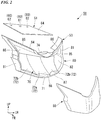
- FIG. 2 is an exploded perspective view of the headlight of the embodiment when seen from a right front side.
- the headlight 50 includes an LED module 51 having an LED light source 60, a reflecting member 53 configured to reflect light radiated from the LED light source 60, and a lens 55 attached to the reflecting member 53.
- FIG. 3 is a perspective view showing portions of an LED module and a reflecting member of the embodiment from below.
- the LED module 51 includes the LED light source 60, and a substrate 64 on which the LED light source 60 is mounted.
- the substrate 64 is formed in a rectangular flat plate shape and disposed substantially horizontally.
- a lower surface of the substrate 64 serves as a mounting surface 64a on which the LED light source 60 is mounted.
- the LED light source 60 includes a light source 61 for a high beam and a pair of light sources 62 for low beams.
- the light source 61 for a high beam is disposed on a central section in the mounting surface 64a of the substrate 64 in the vehicle width direction so as to be located at a central section of the headlight 50 in the vehicle width direction.
- the pair of light sources 62 for low beams are disposed so that the light source 61 for a high beam is interposed from both sides in the vehicle width direction. That is, the pair of light sources 62 for low beams are disposed further outward in the vehicle width direction than the light source 61 for a high beam.
- the pair of light sources 62 for low beams are disposed in front of the light source 61 for a high beam.
- the LED light source 60 radiates light downward.
- the LED light source 60 radiates light that is diffused radially. For example, an optical axis of the LED light source 60 extends along a vertical line.
- the reflecting member 53 is formed in a concave shape that opens forward.
- the reflecting member 53 is formed of a member having a light shielding property, and an inner surface thereof is a reflecting surface. An opening in front of the reflecting member 53 is closed by the lens 55.
- the LED module 51 is disposed above the reflecting member 53, and the LED light source 60 is configured to radiate light into the reflecting member 53.
- the reflecting member 53 includes a reflector 70 (a reflector for a headlight) and an extension 80 disposed around the reflector 70.
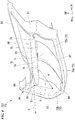
- FIG. 4 is a perspective view showing the reflecting member of the embodiment from a left front side.
- the reflector 70 includes a reflector main body 71 and a top plate section 74 (a light shielding section).
- An upper surface of the reflector main body 71 is a first reflecting surface 72.
- the first reflecting surface 72 is provided inside the lens 55 (see FIG. 2 ) in a radiation direction (i.e., downward) of the LED light source 60 with respect to the LED light source 60 (see FIG. 3 ).
- the first reflecting surface 72 reflects light from the LED light source 60 forward.
- the first reflecting surface 72 reflects light from the LED light source 60 to the outside through the lens 55.
- the first reflecting surface 72 has a high beam reflecting surface 72a and a pair of low beam reflecting surfaces 72b.
- FIG. 5 is a front view showing the LED module and the reflecting member of the embodiment.
- the high beam reflecting surface 72a is disposed at a central section of the headlight 50 in the vehicle width direction and disposed below the light source 61 for a high beam when seen in a front view.
- the high beam reflecting surface 72a extends with a substantially constant width in the upward and downward direction when seen in a front view.
- the high beam reflecting surface 72a is formed to have a concave curved surface in which a central section in the vehicle width direction is recessed when seen in a front view.
- the high beam reflecting surface 72a extends forward as it goes downward from behind the light source 61 for a high beam.
- the high beam reflecting surface 72a extends in front of the light source 61 for a high beam.
- the high beam reflecting surface 72a is formed in a concave shape when seen in the vehicle width direction.
- the pair of low beam reflecting surfaces 72b are disposed adjacent to the high beam reflecting surface 72a so that the high beam reflecting surface 72a is interposed from both sides in the vehicle width direction. That is, the pair of low beam reflecting surfaces 72b are disposed outside the high beam reflecting surface 72a in the vehicle width direction.
- the low beam reflecting surfaces 72b are disposed below the light sources 62 for low beams when seen in a front view.
- the low beam reflecting surfaces 72b extends in the upward and downward direction when seen in a front view.
- the low beam reflecting surfaces 72b are formed to have a concave curved surface in which a central section in the vehicle width direction is recessed when seen in a front view.
- the low beam reflecting surfaces 72b extend forward as they go downward from behind the light sources 62 for low beams.
- the low beam reflecting surfaces 72b extend in front of the light sources 62 for low beams.
- the low beam reflecting surfaces 72b are formed in a concave shape when seen in the vehicle width direction.
- the top plate section 74 is disposed between the LED module 51 and the first reflecting surface 72 of the reflector main body 71.
- the top plate section 74 extends forward from an upper edge of the reflector main body 71.
- the top plate section 74 is provided substantially horizontally.
- a front edge of the top plate section 74 is formed such that a central section in the vehicle width direction protrudes forward.
- a window section 75 for a high beam through which light radiated from the light source 61 for a high beam passes and a pair of window sections 76 for low beams through which light radiated from the light sources 62 for low beams passes are formed on the top plate section 74.
- FIG. 6 is a plan view showing the reflecting member of the embodiment.
- the window section 75 for a high beam is provided below the light source 61 for a high beam.
- the window section 75 for a high beam passes through the top plate section 74.
- the window section 75 for a high beam is formed in a rectangular shape, and defines a radiation range of light from the light source 61 for a high beam while causing light radiated from the light source 61 for a high beam to pass therethrough toward the first reflecting surface 72.
- the pair of window sections 76 for low beams are disposed below the light sources 62 for low beams.
- the window sections 76 for low beams pass through the top plate section 74.
- the window sections 76 for low beams are formed in a rectangular shape, and define a radiation range of light from the light sources 62 for low beams while causing light radiated from the light sources 62 for low beams to pass therethrough toward the first reflecting surface 72.
- Notches 77 that are cut out forward are formed in front end edges of the window sections 76 for low beams. The notches 77 finely adjust a radiation range of light from the light sources 62 for low beams while causing light radiated from the light sources 62 for low beams to pass therethrough toward a second reflecting surface 82 (see FIG. 4 ), which will be described below.
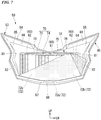
- FIG. 7 is a front view showing a radiation range of light by a light source for a low beam of the embodiment.
- light from the light sources 62 for low beams passing through the window sections 76 for low beams and the notches 77 is spread to both sides in the vehicle width direction as it goes downward from above when seen in a front view.
- the light from the light sources 62 for low beams passing through the window sections 76 for low beams is radiated to substantially the entirety of one of the low beam reflecting surfaces 72b provided immediately therebelow, a lower section of the high beam reflecting surface 72a and a lower section of the other low beam reflecting surface 72b.
- the light from the light sources 62 for low beams passing through the notches 77 is radiated to the second reflecting surface 82 adjacent to the one of the low beam reflecting surfaces 72b.
- the extension 80 is a frame-shaped member configured to cover surroundings of the reflector 70.
- the extension 80 is formed in a trapezoidal shape when seen in a front view.
- the extension 80 includes a pair of frame side sections 81 provided at both sides of the reflector 70 in the vehicle width direction, a frame upper section 84 provided above the reflector 70, and a frame lower section 87 provided below the reflector 70.
- the extension 80 extends in front of the reflector 70. According to the configuration, a profile of the light reflected by the reflector 70 and radiated forward becomes clear.
- the frame side sections 81 have the second reflecting surfaces 82 provided separately from the first reflecting surface 72.
- the second reflecting surface 82 is provided inside the lens 55 (see FIG. 2 ) and on a lower section of a surface of the frame side sections 81 facing an inner side in the vehicle width direction.
- the second reflecting surface 82 is provided below the window sections 76 for low beams of the top plate section 74 in the radiation direction (i.e., below) of the LED light source 60 with respect to the LED light source 60.
- the second reflecting surface 82 is adjacent to the first reflecting surface 72 of the reflector 70 and extends forward from an outer edge of the first reflecting surface 72 of the reflector 70 in the vehicle width direction.
- the second reflecting surface 82 extends outward in the vehicle width direction as it goes upward from below. Further, the second reflecting surface 82 becomes a flat surface or a curved surface having a convex shape.
- the second reflecting surface 82 faces the light sources 62 for low beams through the window sections 76 for low beams which is provided on the same side with the second reflecting surface 82 with respect to the central section of the headlight 50 in the vehicle width direction, among the pair of window sections 76 for low beams.
- the second reflecting surface 82 is disposed in a radiation range of light radiated from the light sources 62 for low beams (see FIG. 7 ).
- the second reflecting surface 82 faces a third reflecting surface 85, which will be described below.
- a normal line of at least one arbitrary point in the second reflecting surface 82 is directed toward a direction which is between a direction oriented to the light sources 62 for low beams from the arbitrary point and a direction oriented to the third reflecting surface 85 from the arbitrary point.
- the second reflecting surface 82 reflects light from the light sources 62 for low beams toward the third reflecting surface 85. More specifically, the second reflecting surface 82 reflects leaked light of main light S (see FIG. 5 ) radiated to the low beam reflecting surfaces 72b among the light from the light sources 62 for low beams toward the third reflecting surface 85.
- the second reflecting surface 82 serves as a diffusing and reflecting surface configured to diffuse and reflect light.
- the diffusing and reflecting surface is formed by performing light diffusion processing such as knurling, emboss processing, satin finishing, or the like.
- the second reflecting surface 82 can reflect the light from the light sources 62 for low beams toward the third reflecting surface 85 as shown by arrows A and B in FIGS. 4 and 5 because the second reflecting surface 82 faces the light sources 62 for low beams and the third reflecting surface 85.
- the frame upper section 84 has the third reflecting surface 85.
- the third reflecting surface 85 is provided inside the lens 55.
- the third reflecting surface 85 is adjacent to a lower surface of the top plate section 74 and extends upward and forward from a front edge of the top plate section 74. Accordingly, the third reflecting surface 85 faces a side opposite to the LED light source 60.
- At least a part of the third reflecting surface 85 is provided above the light sources 62 for low beams and in a range overlapping the low beam reflecting surfaces 72b of the first reflecting surface 72 in the upward and downward direction when seen in a front view.
- the third reflecting surface 85 is divided into left and right sections with respect to a center of the frame upper section 84 in the vehicle width direction. Further, the third reflecting surface 85 may be connected to a center of the frame upper section 84 in the vehicle width direction.
- the third reflecting surface 85 extends rearward as it goes outward from an inner side in the vehicle width direction to conform to a shape of the front edge of the top plate section 74.
- An outer end portion of the third reflecting surface 85 in the vehicle width direction is connected to an upper end portion of a surface of the frame side sections 81 facing an inner side in the vehicle width direction.
- the third reflecting surface 85 has a curved surface with a convex shape.
- Half sections of the third reflecting surface 85 face the second reflecting surface 82 which is provided on the same side with the half sections of the third reflecting surface 85 with respect to a central section of the headlight 50 in the vehicle width direction, among a pair of second reflecting surfaces 82.
- the third reflecting surface 85 faces the front side.
- a normal line of at least one arbitrary point in the third reflecting surface 85 is directed toward a direction which is between the direction oriented to the second reflecting surface 82 from the arbitrary point and the forward direction.
- the third reflecting surface 85 reflects the light from the light sources 62 for low beams reflected by the second reflecting surface 82 forward.
- the third reflecting surface 85 reflects the light from the second reflecting surface 82 to the outside through the lens 55.
- the third reflecting surface 85 becomes a diffusing and reflecting surface.
- the third reflecting surface 85 can reflect light from the second reflecting surface 82 forward as shown by arrows B and C in FIGS. 4 and 5 because the third reflecting surface 85 faces the second reflecting surface 82 and the front side.
- a fourth reflecting surface 86 is adjacent to above the third reflecting surface 85.
- the fourth reflecting surface 86 extends upward and rearward from an upper edge of the third reflecting surface 85 inside the lens 55.
- the fourth reflecting surface 86 faces upward and downward. Accordingly, the fourth reflecting surface 86 reflects external light such as solar light or the like radiated from above forward.
- the frame lower section 87 has a dummy reflecting surface 88 facing upward.
- the dummy reflecting surface 88 is provided inside the lens 55 (see FIG. 2 ).
- the dummy reflecting surface 88 is adjacent to the entire front edge of the first reflecting surface 72 and extends forward from the entire front edge of the first reflecting surface 72.
- the dummy reflecting surface 88 is formed to have a flat surface or a curved surface with a concave shape having a curvature larger than that of the high beam reflecting surface 72a and the low beam reflecting surfaces 72b.
- the dummy reflecting surface 88 is provided so as to be less inclined with respect to the horizontal direction than the high beam reflecting surface 72a and the low beam reflecting surfaces 72b.
- the dummy reflecting surface 88 becomes a diffusing and reflecting surface configured to diffuse and reflect light.
- the reflecting member 53 includes the reflector 70 that is provided in the radiation direction of the LED light source 60 with respect to the LED light source 60 and that has the first reflecting surface 72 configured to reflect the light radiated from the LED light source 60 toward outside, the second reflecting surface 82 that is provided in the radiation direction of the LED light source 60 with respect to the LED light source 60 and that is configured to reflect the light radiated from the LED light source 60, the second reflecting surface 82 being separately provided from the first reflecting surface 72, and the third reflecting surface 85 that faces a side opposite to the LED light source 60 and that is configured to reflect the light reflected by the second reflecting surface 82 toward outside.
- the light leaked from the first reflecting surface 72 among the light radiated from the LED light source 60 can be reflected by the second reflecting surface 82 and can be radiated to the third reflecting surface 85. Accordingly, the third reflecting surface 85 not directly irradiated with light from the LED light source 60 is in a lit state without facing the LED light source 60. Accordingly, the headlight 50 can be lit to a wider range without installing a new light source. Accordingly, improvement in design of the headlight 50 and visibility from the outside can be achieved while minimizing an increase in component costs.
- the second reflecting surface 82 faces the LED light source 60 and the third reflecting surface 85
- the third reflecting surface 85 faces the second reflecting surface 82 and the front side. According to the configuration, the second reflecting surface 82 can reflect the light from the LED light source 60 to the third reflecting surface 85, and the third reflecting surface 85 can reflect the light from the second reflecting surface 82 forward. Accordingly, it is possible to provide the headlight 50 that exhibits the above-mentioned effects.
- the light source 61 for a high beam is disposed on a central section of the headlight 50 in the vehicle width direction
- the light sources 62 for low beams are disposed further outward in the vehicle width direction than the light source 61 for a high beam
- the second reflecting surface 82 is disposed within the radiation range of the light radiated from the light sources 62 for low beams.
- the reflecting member 53 includes the extension 80 that is disposed around the reflector 70 and that has the second reflecting surface 82. According to the configuration, the light leaked from the reflector 70 can be reflected by the second reflecting surface 82. Accordingly, the third reflecting surface 85 can be lit without light distribution of the headlight 50 being influenced by reflection of the reflector 70.
- the third reflecting surface 85 is provided in a range that overlaps the first reflecting surface 72 in the upward and downward direction when seen in a front view. According to the configuration, since the third reflecting surface 85 is provided in the vicinity of the light sources 62 for low beams, an increase in incidence angle and reflection angle when the light is reflected from the second reflecting surface 82 toward the third reflecting surface 85 can be minimized. Accordingly, the light radiated to the second reflecting surface 82 can be efficiently reflected toward the third reflecting surface 85. Accordingly, the third reflecting surface 85 can be strongly lit, and design of the headlight 50 and visibility from the outside can be improved.
- the third reflecting surface 85 is a diffusing and reflecting surface configured to diffuse and reflect light. According to the configuration, in comparison with the case in which the third reflecting surface is a mirror surface configured to perform specular reflection of light, the third reflecting surface 85 can reflect the light from the second reflecting surface 82 to a wider range. Accordingly, visibility from the outside of the headlight 50 can be improved.
- the headlight 50 further includes the top plate section 74 disposed between the light sources 62 for low beams and the first reflecting surface 72.
- the window sections 76 for low beams through which light radiated from the light sources 62 for low beams passes toward the first reflecting surface 72 is formed in the top plate section 74, and the notches 77 through which light radiated from the light sources 62 for low beams passes toward the second reflecting surface 82 is formed in the window sections 76 for low beams.
- the light can be radiated to the second reflecting surface 82 by the notches 77 while the radiation range of the light radiated to the first reflecting surface 72 is defined by the window sections 76 for low beams.
- the third reflecting surface 85 can be reliably lit while minimizing direct irradiation of a road surface with the leaked light. Accordingly, it is possible to provide the headlight 50 in which the radiation range is appropriately set and improvement of design and visibility from the outside is achieved.
- the second reflecting surface 82 is the diffusing and reflecting surface
- the surface may be a mirror surface in which specular reflection is possible.
- a normal line of at least one arbitrary point in the second reflecting surface 82 is directed toward a direction which is between a direction oriented from the arbitrary point to the light sources 62 for low beams and a direction oriented from the arbitrary point to the third reflecting surface 85. Accordingly, the second reflecting surface 82 can reflect the light from the light sources 62 for low beams toward the third reflecting surface 85 at the arbitrary point.
- the third reflecting surface 85 is a curved surface having a convex shape
- the third reflecting surface 85 may have a twisted shape.
- the third reflecting surface 85 may be twisted such that, for example, an inclination angle with respect to the forward and rearward direction is increased as it goes outward from an inner side in the vehicle width direction.
- the third reflecting surface 85 may be a curved surface having a concave shape. According to the configurations, in comparison with the case in which the third reflecting surface is formed in a flat surface shape, the third reflecting surface 85 can reflect the light from the second reflecting surface 82 to a wider range. Accordingly, visibility from the outside of the headlight 50 can be improved.
- the LED light source 60 is disposed to radiate light downward, there is no limitation thereto.
- the LED light source may be disposed to radiate light inward in the vehicle width direction or may be disposed to radiate light upward.
- the configuration of the embodiment may be assembled to a motorcycle, a motor tricycle, or the like, having no leg shield.
- a headlight (50) includes an LED light source (60), a substrate (64) on which the LED light source (60) is mounted, and a reflecting member (53) configured to reflect light radiated from the LED light source (60).
- the reflecting member (53) includes a reflector (70) that is provided in a radiation direction of the LED light source (60) with respect to the LED light source (60) and that has a first reflecting surface (72) configured to reflect light radiated from the LED light source (60) toward outside, a second reflecting surface (82) that is provided in the radiation direction of the LED light source (60) with respect to the LED light source (60) and that is configured to reflect light radiated from the LED light source (60), the second reflecting surface (82) being separately provided from the first reflecting surface (72), and a third reflecting surface (85) that faces a side opposite to the LED light source (60) and that is configured to reflect the light reflected by the second reflecting surface (82) toward outside.
- a reflector (70) that is provided in a radiation direction of the LED light source (60) with respect to the LED light source (60) and that has a first reflecting surface (72) configured to reflect light radiated from the LED light source (60) toward outside
- a second reflecting surface (82) that is provided in the radiation direction
Landscapes
- Engineering & Computer Science (AREA)
- General Engineering & Computer Science (AREA)
- Mechanical Engineering (AREA)
- Physics & Mathematics (AREA)
- Microelectronics & Electronic Packaging (AREA)
- Optics & Photonics (AREA)
- Non-Portable Lighting Devices Or Systems Thereof (AREA)
Abstract
Description
- The present invention relates to a lighting device for a vehicle.
- In the related art, there is a lighting device for a vehicle using a light emitting diode (LED) as a light source (for example, see Japanese Unexamined Patent Application, First Publication No.
2017-204343 2017-204343 - Incidentally, since an LED cannot radiate light toward at least a back side of a mounting substrate, light having higher directivity than that of a halogen lamp or the like used as a light source of a lighting device for a vehicle in the related art is radiated. For this reason, when an LED is used as the light source of a lighting device for a vehicle, a portion irradiated with light from the light source is narrowed in comparison with the lighting device for a vehicle in the related art. For example, like the headlamp apparatus disclosed in Japanese Unexamined Patent Application, First Publication No.
2017-204343 - An aspect of the present invention is directed to providing a lighting device for a vehicle in which improvement in design and visibility from the outside is achieved while an increase in component costs is minimized.
- (1) A lighting device for a vehicle according to an aspect of the present invention includes an LED light source; a substrate on which the LED light source is mounted; and a reflecting member configured to reflect light radiated from the LED light source, wherein the reflecting member includes: a reflector for a headlight that is provided in a radiation direction of the LED light source with respect to the LED light source and that has a first reflecting surface configured to reflect light radiated from the LED light source toward outside; a second reflecting surface that is provided in the radiation direction of the LED light source with respect to the LED light source and that is configured to reflect light radiated from the LED light source, the second reflecting surface being separately provided from the first reflecting surface; and a third reflecting surface that faces a side opposite to the LED light source and that is configured to reflect light reflected by the second reflecting surface toward outside.
According to the aspect of the above-mentioned (1), the light leaked from the first reflecting surface among the light radiated from the LED light source can be reflected by the second reflecting surface and can be radiated to the third reflecting surface. Accordingly, the third reflecting surface to which the light from the LED light source is not directly radiated is lit without facing the LED light source. Accordingly, the lighting device for a vehicle can be lit in a wider range without providing a new light source. Accordingly, improvement of design of the lighting device for a vehicle and visibility from the outside can be achieved while an increase in component costs is minimized. - (2) In the aspect of the above-mentioned (1), the second reflecting surface may face the LED light source and the third reflecting surface, and the third reflecting surface may face the second reflecting surface and a front side.
According to the aspect of the above-mentioned (2), the second reflecting surface can reflect the light from the LED light source to the third reflecting surface, and the third reflecting surface can reflect the light from the second reflecting surface forward. Accordingly, it is possible to provide the lighting device for a vehicle capable of exhibiting the above-mentioned effects as the headlight. - (3) In the aspect of the above-mentioned (1) or (2), the LED light source may include a light source for a high beam and a light source for a low beam, the light source for a high beam may be disposed at a central section in a vehicle width direction, the light source for a low beam may be disposed further outward in the vehicle width direction than the light source for a high beam, and the second reflecting surface may be disposed within a radiation range of light radiated from the light source for a low beam.
According to the aspect of the above-mentioned (3), in comparison with the case in which the light source for a low beam is disposed further inward in the vehicle width direction than the light source for a high beam, a radiation range of the light source for a low beam can be easily widen toward an outer side than the first reflecting surface. For this reason, a degree of design freedom in installation of the second reflecting surface can be improved. Further, since the third reflecting surface is lit by light of a low beam that is always turned on, design of the lighting device for a vehicle and visibility from the outside can be consistently improved. - (4) In the aspect of any one of the above-mentioned (1) to (3), the reflecting member may include an extension that is disposed around the reflector for a headlight and that has the second reflecting surface.
According to the aspect of the above-mentioned (4), since the second reflecting surface is provided on the extension disposed around the reflector for a headlight, the light that leaks from the reflector for a headlight can be reflected by the second reflecting surface. Accordingly, the third reflecting surface can be lit without light distribution of the headlight being influenced by reflection of the reflector for a headlight. - (5) In the aspect of any one of the above-mentioned (1) to (4), the LED light source may include a light source for a low beam, and the third reflecting surface may be provided in a range that overlaps the first reflecting surface in an upward and downward direction when seen in a front view.
According to the aspect of the above-mentioned (5), since the third reflecting surface is provided in the vicinity of the light source for a low beam, an increase in an incidence angle and a reflection angle when light is reflected from the second reflecting surface toward the third reflecting surface can be minimized. Accordingly, the light radiated to the second reflecting surface can be efficiently reflected toward the third reflecting surface.
Accordingly, the third reflecting surface can be strongly lit, and design of the lighting device for a vehicle and visibility from the outside can be improved. - (6) In the aspect of any one of the above-mentioned (1) to (5), the third reflecting surface may be a diffusing and reflecting surface configured to diffuse and reflect light.
According to the aspect of the above-mentioned (6), in comparison with the case in which the third reflecting surface is a mirror surface that performs specular reflection of light, the third reflecting surface can reflect the light from the second reflecting surface to a wider range. Accordingly, visibility from the outside of the lighting device for a vehicle can be improved. - (7) In the aspect of any one of the above-mentioned (1) to (6), the third reflecting surface may have a twisted shape.
According to the aspect of the above-mentioned (7), in comparison with the case in which the third reflecting surface is formed in a flat surface shape, the third reflecting surface can reflect the light from the second reflecting surface to a wider range. Accordingly, visibility from the outside of the lighting device for a vehicle can be improved. - (8) In the aspect of any one of the above-mentioned (1) to (6), the third reflecting surface may have a concave shape.
According to the aspect of the above-mentioned (8), in comparison with the case in which the third reflecting surface is formed in a flat surface shape, the third reflecting surface can reflect the light from the second reflecting surface to a wider range. Accordingly, visibility from the outside of the lighting device for a vehicle can be improved. - (9) In the aspect of any one of the above-mentioned (1) to (8), the lighting device for a vehicle may further include a light shielding section disposed between the LED light source and the first reflecting surface, wherein a window section through which light radiated from the LED light source passes toward the first reflecting surface may be formed in the light shielding section, and a notch through which light radiated from the LED light source passes toward the second reflecting surface may be formed in the window section.
- According to the aspect of the present invention, light can be radiated to the second reflecting surface by the notch while the radiation range of the light radiated to the first reflecting surface is defined by the window section. Accordingly, the third reflecting surface can be reliably lit while the road surface is suppressed from being directly illuminated by the leaked light. Accordingly, it is possible to provide the lighting device for a vehicle in which the radiation range is appropriately set and improvement in design and visibility from the outside is achieved.
- According to the aspect of the present invention, it is possible to provide a lighting device for a vehicle in which improvement in design and visibility from the outside is achieved while an increase in component costs is suppressed.
-
-
FIG. 1 is a right side view showing a motorcycle of an embodiment. -
FIG. 2 is an exploded perspective view of a headlight of the embodiment when seen from a right front side. -
FIG. 3 is a perspective view of a portion of an LED module and a reflecting member of the embodiment when seen from below. -
FIG. 4 is a perspective view of the reflecting member of the embodiment when seen from a left front side. -
FIG. 5 is a front view showing the LED module and the reflecting member of the embodiment. -
FIG. 6 is a plan view showing the reflecting member of the embodiment. -
FIG. 7 is a front view showing a radiation range of light from a light source for a low beam of the embodiment. -
FIG. 8 is a perspective view showing a part of a reflecting member of a first variant of the embodiment. -
FIG. 9 is a perspective view showing a part of a reflecting member of a second variant of the embodiment. - Hereinafter, an embodiment of the present invention will be described with reference to the accompanying drawings. Further, directions of forward and rearward, upward and downward, leftward, rightward, and so on, in the following description are the same as directions in a vehicle described below unless the context clearly indicates otherwise. That is, an upward and downward direction coincides with a vertical direction, and a leftward/rightward direction coincides with a vehicle width direction. In addition, in the drawings used in the following description, an arrow UP indicates an upward direction with respect to a vehicle, an arrow FR indicates a forward direction with respect to the vehicle and an arrow LH indicates a leftward direction with respect to the vehicle.
- First, a schematic configuration of a saddle riding vehicle as a whole, on which a lighting device for a vehicle of the embodiment is mounted, will be described.
-
FIG. 1 is a right side view showing a motorcycle of the embodiment. - As shown in
FIG. 1 , in the embodiment, ascooter type motorcycle 1 will be described as an example of the saddle riding vehicle. Themotorcycle 1 includes astep floor 13 on which an occupant who sits on aseat 11 puts his/her legs. Themotorcycle 1 includes afront wheel 2, a rear wheel 3, avehicle body frame 20, theseat 11, avehicle body cover 30, apower unit 40 and a headlight 50 (a lighting device for a vehicle). - The
front wheel 2 is axially supported by lower end portions of a pair of left and right front forks 4. Upper end portions of the pair of front forks 4 are connected by a bottom bridge 6 extending in a vehicle width direction. The front forks 4 are steerably supported by a front end of thevehicle body frame 20 fixed to the bottom bridge 6 via a steering stem 5. Abar handle 5a for steering is attached to an upper section of the steering stem 5. Afront fender 15 is attached to the front forks 4. - The
vehicle body frame 20 is formed by integrally coupling a plurality of kinds of steel members through welding, fastening, or the like. Thevehicle body frame 20 includes ahead pipe 21, adown frame 22, a pair of left and rightlower frames 23, a pair of left and right seat frames 25 and across member 26. Thehead pipe 21 is provided on a front end of thevehicle body frame 20. Thehead pipe 21 steerably supports steering system parts including thefront wheel 2. The steering stem 5 is inserted through thehead pipe 21. The downframe 22 extends downward and rearward from thehead pipe 21. The pair oflower frames 23 horizontally extend rearward from a lower end portion of thedown frame 22. The pair of seat frames 25 extend rearward and upward from rear end portions of the lower frames 23. The pair of seat frames 25 support theseat 11 from below. Thecross member 26 extends in the vehicle width direction and is coupled to rear end portions of the pair of lower frames 23. - The vehicle body cover 30 covers the
vehicle body frame 20 or the like. Thevehicle body cover 30 is formed of, for example, a synthetic resin. Thevehicle body cover 30 includes afront cover 31, aninner cover 32, afloor board 33, afloor side cover 34, arear cover 35, arear side cover 36 and arear fender 37. Thefront cover 31 covers thehead pipe 21 and thedown frame 22 from the front. Thefront cover 31 and theinner cover 32 constitute a leg shield configured to cover an occupant's legs from the front. Theheadlight 50 is attached to thefront cover 31. - The
inner cover 32 covers thehead pipe 21 and thedown frame 22 from behind. Thefloor board 33 is connected to a rear side of a lower end portion of theinner cover 32. Thefloor board 33 covers thelower frames 23 from above. Thefloor board 33 constitutes thestep floor 13. - The pair of floor side covers 34 are provided on left and right sides, and connected below left and right edge portions of the
floor board 33. Front end portions of the pair of floor side covers 34 are connected to a lower end portion of thefront cover 31. The floor side covers 34 cover thelower frames 23 from an outer side in the vehicle width direction. Therear cover 35 is connected to a rear side of thefloor board 33. Therear cover 35 covers the seat frames 25 from the front. The rear side cover 36 is connected to diagonally upper rear sides of rear end portions of the left and right floor side covers 34. The rear side cover 36 covers the seat frames 25 from an outer side in the vehicle width direction. Therear fender 37 extends rearward and downward from a rear end portion of therear side cover 36. Therear fender 37 covers the rear wheel 3 from above and behind. - The
power unit 40 is vertically swingably supported by a rear lower section of thevehicle body frame 20. - The
power unit 40 includes anengine 41 that is an internal combustion engine, and an arm section (not shown) extending rearward from a left side of theengine 41 and configured to support the rear wheel 3 from a left side in a cantilever manner. Theengine 41 is disposed in front of the rear wheel 3. Anexhaust pipe 42 is connected to theengine 41. - The
exhaust pipe 42 is curved after being extracted downward from a cylinder head of theengine 41 and then extends rearward. A rear end of theexhaust pipe 42 is connected to amuffler 43 disposed on a right side of the rear wheel 3. Amuffler protector 44 configured to cover an outer surface of themuffler 43 from above is attached to an upper section of themuffler 43. - Next, the
headlight 50 of the embodiment will be described in detail. - The
headlight 50 is disposed in the front of themotorcycle 1 and configured to radiate light to a road surface. - The
headlight 50 is disposed above thefront fender 15 and disposed on a central section of a front surface of thefront cover 31 in the vehicle width direction. -
FIG. 2 is an exploded perspective view of the headlight of the embodiment when seen from a right front side. - As shown in
FIG. 2 , theheadlight 50 includes anLED module 51 having anLED light source 60, a reflectingmember 53 configured to reflect light radiated from the LEDlight source 60, and alens 55 attached to the reflectingmember 53. -
FIG. 3 is a perspective view showing portions of an LED module and a reflecting member of the embodiment from below. - As shown in
FIG. 2 andFIG. 3 , theLED module 51 includes theLED light source 60, and asubstrate 64 on which theLED light source 60 is mounted. Thesubstrate 64 is formed in a rectangular flat plate shape and disposed substantially horizontally. A lower surface of thesubstrate 64 serves as a mountingsurface 64a on which theLED light source 60 is mounted. TheLED light source 60 includes alight source 61 for a high beam and a pair oflight sources 62 for low beams. Thelight source 61 for a high beam is disposed on a central section in the mountingsurface 64a of thesubstrate 64 in the vehicle width direction so as to be located at a central section of theheadlight 50 in the vehicle width direction. The pair oflight sources 62 for low beams are disposed so that thelight source 61 for a high beam is interposed from both sides in the vehicle width direction. That is, the pair oflight sources 62 for low beams are disposed further outward in the vehicle width direction than thelight source 61 for a high beam. The pair oflight sources 62 for low beams are disposed in front of thelight source 61 for a high beam. TheLED light source 60 radiates light downward. TheLED light source 60 radiates light that is diffused radially. For example, an optical axis of theLED light source 60 extends along a vertical line. - As shown in
FIG. 2 , the reflectingmember 53 is formed in a concave shape that opens forward. The reflectingmember 53 is formed of a member having a light shielding property, and an inner surface thereof is a reflecting surface. An opening in front of the reflectingmember 53 is closed by thelens 55. TheLED module 51 is disposed above the reflectingmember 53, and the LEDlight source 60 is configured to radiate light into the reflectingmember 53. - The reflecting
member 53 includes a reflector 70 (a reflector for a headlight) and anextension 80 disposed around thereflector 70. -
FIG. 4 is a perspective view showing the reflecting member of the embodiment from a left front side. - As shown in
FIG. 4 , thereflector 70 includes a reflectormain body 71 and a top plate section 74 (a light shielding section). An upper surface of the reflectormain body 71 is a first reflectingsurface 72. The first reflectingsurface 72 is provided inside the lens 55 (seeFIG. 2 ) in a radiation direction (i.e., downward) of theLED light source 60 with respect to the LED light source 60 (seeFIG. 3 ). The first reflectingsurface 72 reflects light from the LEDlight source 60 forward. The first reflectingsurface 72 reflects light from the LEDlight source 60 to the outside through thelens 55. The first reflectingsurface 72 has a highbeam reflecting surface 72a and a pair of lowbeam reflecting surfaces 72b. -
FIG. 5 is a front view showing the LED module and the reflecting member of the embodiment. - As shown in
FIG. 4 andFIG. 5 , the highbeam reflecting surface 72a is disposed at a central section of theheadlight 50 in the vehicle width direction and disposed below thelight source 61 for a high beam when seen in a front view. The highbeam reflecting surface 72a extends with a substantially constant width in the upward and downward direction when seen in a front view. The highbeam reflecting surface 72a is formed to have a concave curved surface in which a central section in the vehicle width direction is recessed when seen in a front view. The highbeam reflecting surface 72a extends forward as it goes downward from behind thelight source 61 for a high beam. The highbeam reflecting surface 72a extends in front of thelight source 61 for a high beam. The highbeam reflecting surface 72a is formed in a concave shape when seen in the vehicle width direction. - The pair of low
beam reflecting surfaces 72b are disposed adjacent to the highbeam reflecting surface 72a so that the highbeam reflecting surface 72a is interposed from both sides in the vehicle width direction. That is, the pair of lowbeam reflecting surfaces 72b are disposed outside the highbeam reflecting surface 72a in the vehicle width direction. The lowbeam reflecting surfaces 72b are disposed below thelight sources 62 for low beams when seen in a front view. The lowbeam reflecting surfaces 72b extends in the upward and downward direction when seen in a front view. The lowbeam reflecting surfaces 72b are formed to have a concave curved surface in which a central section in the vehicle width direction is recessed when seen in a front view. The lowbeam reflecting surfaces 72b extend forward as they go downward from behind thelight sources 62 for low beams. The lowbeam reflecting surfaces 72b extend in front of thelight sources 62 for low beams. The lowbeam reflecting surfaces 72b are formed in a concave shape when seen in the vehicle width direction. - The
top plate section 74 is disposed between theLED module 51 and the first reflectingsurface 72 of the reflectormain body 71. Thetop plate section 74 extends forward from an upper edge of the reflectormain body 71. Thetop plate section 74 is provided substantially horizontally. A front edge of thetop plate section 74 is formed such that a central section in the vehicle width direction protrudes forward. Awindow section 75 for a high beam through which light radiated from thelight source 61 for a high beam passes and a pair ofwindow sections 76 for low beams through which light radiated from thelight sources 62 for low beams passes are formed on thetop plate section 74. -
FIG. 6 is a plan view showing the reflecting member of the embodiment. - As shown in
FIG. 3 andFIG. 6 , thewindow section 75 for a high beam is provided below thelight source 61 for a high beam. Thewindow section 75 for a high beam passes through thetop plate section 74. Thewindow section 75 for a high beam is formed in a rectangular shape, and defines a radiation range of light from thelight source 61 for a high beam while causing light radiated from thelight source 61 for a high beam to pass therethrough toward the first reflectingsurface 72. - The pair of
window sections 76 for low beams are disposed below thelight sources 62 for low beams. Thewindow sections 76 for low beams pass through thetop plate section 74. Thewindow sections 76 for low beams are formed in a rectangular shape, and define a radiation range of light from thelight sources 62 for low beams while causing light radiated from thelight sources 62 for low beams to pass therethrough toward the first reflectingsurface 72.Notches 77 that are cut out forward are formed in front end edges of thewindow sections 76 for low beams. Thenotches 77 finely adjust a radiation range of light from thelight sources 62 for low beams while causing light radiated from thelight sources 62 for low beams to pass therethrough toward a second reflecting surface 82 (seeFIG. 4 ), which will be described below. -
FIG. 7 is a front view showing a radiation range of light by a light source for a low beam of the embodiment. - As shown in
FIG. 7 , in the embodiment, light from thelight sources 62 for low beams passing through thewindow sections 76 for low beams and the notches 77 (seeFIG. 6 ) is spread to both sides in the vehicle width direction as it goes downward from above when seen in a front view. The light from thelight sources 62 for low beams passing through thewindow sections 76 for low beams is radiated to substantially the entirety of one of the lowbeam reflecting surfaces 72b provided immediately therebelow, a lower section of the highbeam reflecting surface 72a and a lower section of the other lowbeam reflecting surface 72b. The light from thelight sources 62 for low beams passing through thenotches 77 is radiated to the second reflectingsurface 82 adjacent to the one of the lowbeam reflecting surfaces 72b. - As shown in
FIG. 4 , theextension 80 is a frame-shaped member configured to cover surroundings of thereflector 70. Theextension 80 is formed in a trapezoidal shape when seen in a front view. Theextension 80 includes a pair offrame side sections 81 provided at both sides of thereflector 70 in the vehicle width direction, a frameupper section 84 provided above thereflector 70, and a framelower section 87 provided below thereflector 70. Theextension 80 extends in front of thereflector 70. According to the configuration, a profile of the light reflected by thereflector 70 and radiated forward becomes clear. - As shown in
FIG. 4 andFIG. 5 , theframe side sections 81 have the second reflectingsurfaces 82 provided separately from the first reflectingsurface 72. The second reflectingsurface 82 is provided inside the lens 55 (seeFIG. 2 ) and on a lower section of a surface of theframe side sections 81 facing an inner side in the vehicle width direction. The second reflectingsurface 82 is provided below thewindow sections 76 for low beams of thetop plate section 74 in the radiation direction (i.e., below) of theLED light source 60 with respect to theLED light source 60. The second reflectingsurface 82 is adjacent to the first reflectingsurface 72 of thereflector 70 and extends forward from an outer edge of the first reflectingsurface 72 of thereflector 70 in the vehicle width direction. The second reflectingsurface 82 extends outward in the vehicle width direction as it goes upward from below. Further, the second reflectingsurface 82 becomes a flat surface or a curved surface having a convex shape. - The second reflecting
surface 82 faces thelight sources 62 for low beams through thewindow sections 76 for low beams which is provided on the same side with the second reflectingsurface 82 with respect to the central section of theheadlight 50 in the vehicle width direction, among the pair ofwindow sections 76 for low beams. The second reflectingsurface 82 is disposed in a radiation range of light radiated from thelight sources 62 for low beams (seeFIG. 7 ). In addition, the second reflectingsurface 82 faces a third reflectingsurface 85, which will be described below. For example, a normal line of at least one arbitrary point in the second reflectingsurface 82 is directed toward a direction which is between a direction oriented to thelight sources 62 for low beams from the arbitrary point and a direction oriented to the third reflectingsurface 85 from the arbitrary point. - The second reflecting
surface 82 reflects light from thelight sources 62 for low beams toward the third reflectingsurface 85. More specifically, the second reflectingsurface 82 reflects leaked light of main light S (seeFIG. 5 ) radiated to the lowbeam reflecting surfaces 72b among the light from thelight sources 62 for low beams toward the third reflectingsurface 85. The second reflectingsurface 82 serves as a diffusing and reflecting surface configured to diffuse and reflect light. The diffusing and reflecting surface is formed by performing light diffusion processing such as knurling, emboss processing, satin finishing, or the like. The second reflectingsurface 82 can reflect the light from thelight sources 62 for low beams toward the third reflectingsurface 85 as shown by arrows A and B inFIGS. 4 and5 because the second reflectingsurface 82 faces thelight sources 62 for low beams and the third reflectingsurface 85. - The frame
upper section 84 has the third reflectingsurface 85. The third reflectingsurface 85 is provided inside thelens 55. The third reflectingsurface 85 is adjacent to a lower surface of thetop plate section 74 and extends upward and forward from a front edge of thetop plate section 74. Accordingly, the third reflectingsurface 85 faces a side opposite to theLED light source 60. At least a part of the third reflectingsurface 85 is provided above thelight sources 62 for low beams and in a range overlapping the lowbeam reflecting surfaces 72b of the first reflectingsurface 72 in the upward and downward direction when seen in a front view. The third reflectingsurface 85 is divided into left and right sections with respect to a center of the frameupper section 84 in the vehicle width direction. Further, the third reflectingsurface 85 may be connected to a center of the frameupper section 84 in the vehicle width direction. - The third reflecting
surface 85 extends rearward as it goes outward from an inner side in the vehicle width direction to conform to a shape of the front edge of thetop plate section 74. An outer end portion of the third reflectingsurface 85 in the vehicle width direction is connected to an upper end portion of a surface of theframe side sections 81 facing an inner side in the vehicle width direction. The third reflectingsurface 85 has a curved surface with a convex shape. - Half sections of the third reflecting
surface 85 face the second reflectingsurface 82 which is provided on the same side with the half sections of the third reflectingsurface 85 with respect to a central section of theheadlight 50 in the vehicle width direction, among a pair of second reflecting surfaces 82. In addition, the third reflectingsurface 85 faces the front side. For example, a normal line of at least one arbitrary point in the third reflectingsurface 85 is directed toward a direction which is between the direction oriented to the second reflectingsurface 82 from the arbitrary point and the forward direction. - The third reflecting
surface 85 reflects the light from thelight sources 62 for low beams reflected by the second reflectingsurface 82 forward. The third reflectingsurface 85 reflects the light from the second reflectingsurface 82 to the outside through thelens 55. The third reflectingsurface 85 becomes a diffusing and reflecting surface. The third reflectingsurface 85 can reflect light from the second reflectingsurface 82 forward as shown by arrows B and C inFIGS. 4 and5 because the third reflectingsurface 85 faces the second reflectingsurface 82 and the front side. - Further, in the embodiment, a fourth reflecting
surface 86 is adjacent to above the third reflectingsurface 85. - The fourth reflecting
surface 86 extends upward and rearward from an upper edge of the third reflectingsurface 85 inside thelens 55. The fourth reflectingsurface 86 faces upward and downward. Accordingly, the fourth reflectingsurface 86 reflects external light such as solar light or the like radiated from above forward. - As shown in
FIG. 5 , the framelower section 87 has adummy reflecting surface 88 facing upward. Thedummy reflecting surface 88 is provided inside the lens 55 (seeFIG. 2 ). Thedummy reflecting surface 88 is adjacent to the entire front edge of the first reflectingsurface 72 and extends forward from the entire front edge of the first reflectingsurface 72. Thedummy reflecting surface 88 is formed to have a flat surface or a curved surface with a concave shape having a curvature larger than that of the highbeam reflecting surface 72a and the lowbeam reflecting surfaces 72b. Thedummy reflecting surface 88 is provided so as to be less inclined with respect to the horizontal direction than the highbeam reflecting surface 72a and the lowbeam reflecting surfaces 72b. Thedummy reflecting surface 88 becomes a diffusing and reflecting surface configured to diffuse and reflect light. - As described above, in the
headlight 50 of the embodiment, the reflectingmember 53 includes thereflector 70 that is provided in the radiation direction of theLED light source 60 with respect to theLED light source 60 and that has the first reflectingsurface 72 configured to reflect the light radiated from the LEDlight source 60 toward outside, the second reflectingsurface 82 that is provided in the radiation direction of theLED light source 60 with respect to theLED light source 60 and that is configured to reflect the light radiated from the LEDlight source 60, the second reflectingsurface 82 being separately provided from the first reflectingsurface 72, and the third reflectingsurface 85 that faces a side opposite to theLED light source 60 and that is configured to reflect the light reflected by the second reflectingsurface 82 toward outside. According to the configuration, the light leaked from the first reflectingsurface 72 among the light radiated from the LEDlight source 60 can be reflected by the second reflectingsurface 82 and can be radiated to the third reflectingsurface 85. Accordingly, the third reflectingsurface 85 not directly irradiated with light from the LEDlight source 60 is in a lit state without facing theLED light source 60. Accordingly, theheadlight 50 can be lit to a wider range without installing a new light source. Accordingly, improvement in design of theheadlight 50 and visibility from the outside can be achieved while minimizing an increase in component costs. - In addition, the second reflecting
surface 82 faces theLED light source 60 and the third reflectingsurface 85, and the third reflectingsurface 85 faces the second reflectingsurface 82 and the front side. According to the configuration, the second reflectingsurface 82 can reflect the light from the LEDlight source 60 to the third reflectingsurface 85, and the third reflectingsurface 85 can reflect the light from the second reflectingsurface 82 forward. Accordingly, it is possible to provide theheadlight 50 that exhibits the above-mentioned effects. - In addition, the
light source 61 for a high beam is disposed on a central section of theheadlight 50 in the vehicle width direction, thelight sources 62 for low beams are disposed further outward in the vehicle width direction than thelight source 61 for a high beam, and the second reflectingsurface 82 is disposed within the radiation range of the light radiated from thelight sources 62 for low beams. According to the configuration, in comparison with the case in which the light source for a low beam is disposed further inward in the vehicle width direction than the light source for a high beam, the radiation range of thelight sources 62 for low beams can be easily widen toward an outer side than the first reflectingsurface 72. - For this reason, a degree of design freedom in installation of the second reflecting
surface 82 can be improved. Further, since the third reflectingsurface 85 is lit by the light of a low beam that is normally turned on, design of theheadlight 50 and visibility from the outside can be improved always. - Further, the reflecting
member 53 includes theextension 80 that is disposed around thereflector 70 and that has the second reflectingsurface 82. According to the configuration, the light leaked from thereflector 70 can be reflected by the second reflectingsurface 82. Accordingly, the third reflectingsurface 85 can be lit without light distribution of theheadlight 50 being influenced by reflection of thereflector 70. - In addition, the third reflecting
surface 85 is provided in a range that overlaps the first reflectingsurface 72 in the upward and downward direction when seen in a front view. According to the configuration, since the third reflectingsurface 85 is provided in the vicinity of thelight sources 62 for low beams, an increase in incidence angle and reflection angle when the light is reflected from the second reflectingsurface 82 toward the third reflectingsurface 85 can be minimized. Accordingly, the light radiated to the second reflectingsurface 82 can be efficiently reflected toward the third reflectingsurface 85. Accordingly, the third reflectingsurface 85 can be strongly lit, and design of theheadlight 50 and visibility from the outside can be improved. - In addition, the third reflecting
surface 85 is a diffusing and reflecting surface configured to diffuse and reflect light. According to the configuration, in comparison with the case in which the third reflecting surface is a mirror surface configured to perform specular reflection of light, the third reflectingsurface 85 can reflect the light from the second reflectingsurface 82 to a wider range. Accordingly, visibility from the outside of theheadlight 50 can be improved. - In addition, the
headlight 50 further includes thetop plate section 74 disposed between thelight sources 62 for low beams and the first reflectingsurface 72. Thewindow sections 76 for low beams through which light radiated from thelight sources 62 for low beams passes toward the first reflectingsurface 72 is formed in thetop plate section 74, and thenotches 77 through which light radiated from thelight sources 62 for low beams passes toward the second reflectingsurface 82 is formed in thewindow sections 76 for low beams. According to the configuration, the light can be radiated to the second reflectingsurface 82 by thenotches 77 while the radiation range of the light radiated to the first reflectingsurface 72 is defined by thewindow sections 76 for low beams. Accordingly, the third reflectingsurface 85 can be reliably lit while minimizing direct irradiation of a road surface with the leaked light. Accordingly, it is possible to provide theheadlight 50 in which the radiation range is appropriately set and improvement of design and visibility from the outside is achieved. - Further, the present invention is not limited to the above-mentioned embodiment described with reference to the accompanying drawings, and various variants are considered without departing from the technical scope.
- For example, in the embodiment, while the second reflecting
surface 82 is the diffusing and reflecting surface, there is no limitation thereto and the surface may be a mirror surface in which specular reflection is possible. In this case, a normal line of at least one arbitrary point in the second reflectingsurface 82 is directed toward a direction which is between a direction oriented from the arbitrary point to thelight sources 62 for low beams and a direction oriented from the arbitrary point to the third reflectingsurface 85. Accordingly, the second reflectingsurface 82 can reflect the light from thelight sources 62 for low beams toward the third reflectingsurface 85 at the arbitrary point. - In addition, in the embodiment, while the third reflecting
surface 85 is a curved surface having a convex shape, there is no limitation thereto. For example, as shown inFIG. 8 , the third reflectingsurface 85 may have a twisted shape. In this case, the third reflectingsurface 85 may be twisted such that, for example, an inclination angle with respect to the forward and rearward direction is increased as it goes outward from an inner side in the vehicle width direction. In addition, as shown inFIG. 9 , the third reflectingsurface 85 may be a curved surface having a concave shape. According to the configurations, in comparison with the case in which the third reflecting surface is formed in a flat surface shape, the third reflectingsurface 85 can reflect the light from the second reflectingsurface 82 to a wider range. Accordingly, visibility from the outside of theheadlight 50 can be improved. - In addition, in the embodiment, while the
LED light source 60 is disposed to radiate light downward, there is no limitation thereto. For example, the LED light source may be disposed to radiate light inward in the vehicle width direction or may be disposed to radiate light upward. - In addition, in the embodiment, while the example in which the lighting device for a vehicle of the present invention is applied to the scooter type saddle riding vehicle has been exemplified, for example, the configuration of the embodiment may be assembled to a motorcycle, a motor tricycle, or the like, having no leg shield.
- While preferred embodiments of the invention have been described and illustrated above, it should be understood that these are exemplary of the invention and are not to be considered as limiting. Additions, omissions, substitutions, and other modifications can be made without departing from the scope of the present invention. Accordingly, the invention is not to be considered as being limited by the foregoing description, and is only limited by the scope of the appended claims. A headlight (50) includes an LED light source (60), a substrate (64) on which the LED light source (60) is mounted, and a reflecting member (53) configured to reflect light radiated from the LED light source (60). The reflecting member (53) includes a reflector (70) that is provided in a radiation direction of the LED light source (60) with respect to the LED light source (60) and that has a first reflecting surface (72) configured to reflect light radiated from the LED light source (60) toward outside, a second reflecting surface (82) that is provided in the radiation direction of the LED light source (60) with respect to the LED light source (60) and that is configured to reflect light radiated from the LED light source (60), the second reflecting surface (82) being separately provided from the first reflecting surface (72), and a third reflecting surface (85) that faces a side opposite to the LED light source (60) and that is configured to reflect the light reflected by the second reflecting surface (82) toward outside.
Claims (9)
- A lighting device for a vehicle comprising:an LED light source (60);a substrate (64) on which the LED light source (60) is mounted; anda reflecting member (53) configured to reflect light radiated from the LED light source (60),wherein the reflecting member (53) comprises:a reflector (70) for a headlight that is provided in a radiation direction of the LED light source (60) with respect to the LED light source (60) and that has a first reflecting surface (72) configured to reflect light radiated from the LED light source (60) toward outside;a second reflecting surface (82) that is provided in the radiation direction of the LED light source (60) with respect to the LED light source (60) and that is configured to reflect light radiated from the LED light source (60), the second reflecting surface (82) being separately provided from the first reflecting surface (72); anda third reflecting surface (85) that faces a side opposite to the LED light source (60) and that is configured to reflect light reflected by the second reflecting surface (82) toward outside.
- The lighting device for a vehicle according to claim 1,
wherein the second reflecting surface (82) faces the LED light source (60) and the third reflecting surface (85), and
the third reflecting surface (85) faces the second reflecting surface (82) and a front side. - The lighting device for a vehicle according to claim 1 or 2,
wherein the LED light source (60) comprises a light source (61) for a high beam and a light source (62) for a low beam,
the light source (61) for a high beam is disposed at a central section in a vehicle width direction,
the light source (62) for a low beam is disposed further outward in the vehicle width direction than the light source (61) for a high beam, and
the second reflecting surface (82) is disposed within a radiation range of light radiated from the light source (62) for a low beam. - The lighting device for a vehicle according to any one of claims 1 to 3,
wherein the reflecting member (53) has an extension (80) that is disposed around the reflector (70) for a headlight and that has the second reflecting surface (82). - The lighting device for a vehicle according to any one of claims 1 to 4,
wherein the LED light source (60) comprises a light source (62) for a low beam, and
the third reflecting surface (85) is provided in a range that overlaps the first reflecting surface (72) in an upward and downward direction when seen in a front view. - The lighting device for a vehicle according to any one of claims 1 to 5,
wherein the third reflecting surface (85) is a diffusing and reflecting surface configured to diffuse and reflect light. - The lighting device for a vehicle according to any one of claims 1 to 6,
wherein the third reflecting surface (85) has a twisted shape. - The lighting device for a vehicle according to any one of claims 1 to 6,
wherein the third reflecting surface (85) has a concave shape. - The lighting device for a vehicle according to any one of claims 1 to 8, further comprising a light shielding section (74) disposed between the LED light source (60) and the first reflecting surface (72),
wherein a window section (76) through which light radiated from the LED light source (60) passes toward the first reflecting surface (72) is formed in the light shielding section (74), and
a notch (77) through which light radiated from the LED light source (60) passes toward the second reflecting surface (82) is formed in the window section (76).
Applications Claiming Priority (1)
| Application Number | Priority Date | Filing Date | Title |
|---|---|---|---|
| JP2018133076A JP6713022B2 (en) | 2018-07-13 | 2018-07-13 | Vehicle lighting |
Publications (2)
| Publication Number | Publication Date |
|---|---|
| EP3594564A1 true EP3594564A1 (en) | 2020-01-15 |
| EP3594564B1 EP3594564B1 (en) | 2021-05-05 |
Family
ID=67211551
Family Applications (1)
| Application Number | Title | Priority Date | Filing Date |
|---|---|---|---|
| EP19184855.5A Active EP3594564B1 (en) | 2018-07-13 | 2019-07-08 | Lighting device for vehicle |
Country Status (4)
| Country | Link |
|---|---|
| EP (1) | EP3594564B1 (en) |
| JP (1) | JP6713022B2 (en) |
| CN (1) | CN110715262B (en) |
| MY (1) | MY185414A (en) |
Cited By (2)
| Publication number | Priority date | Publication date | Assignee | Title |
|---|---|---|---|---|
| IT202000000979A1 (en) | 2020-01-20 | 2021-07-20 | Marelli Automotive Lighting Italy S P A Con Socio Unico | TERSA LENS LIGHTING DEVICE FOR VEHICLES |
| DE102020130859A1 (en) | 2020-11-23 | 2022-05-25 | Marelli Automotive Lighting Reutlingen (Germany) GmbH | Motor vehicle lighting device with a reflector and method for designing a reflecting surface of a reflector of such a motor vehicle lighting device |
Families Citing this family (2)
| Publication number | Priority date | Publication date | Assignee | Title |
|---|---|---|---|---|
| JP2021130395A (en) * | 2020-02-20 | 2021-09-09 | 株式会社小糸製作所 | Head lamp for motorcycle |
| CN111409745B (en) * | 2020-04-27 | 2025-03-04 | 江门市大长江集团有限公司 | Motorcycle headlight device and motorcycle |
Citations (6)
| Publication number | Priority date | Publication date | Assignee | Title |
|---|---|---|---|---|
| EP2184532A2 (en) * | 2008-11-10 | 2010-05-12 | Koito Manufacturing Co., Ltd. | Lighting unit |
| WO2012070169A1 (en) * | 2010-11-22 | 2012-05-31 | ヤマハ発動機株式会社 | Headlight and saddled vehicle equipped with same |
| US20150338047A1 (en) * | 2014-05-23 | 2015-11-26 | Koito Manufacturing Co., Ltd. | Vehicular headlamp |
| US9347636B2 (en) * | 2013-03-25 | 2016-05-24 | Stanley Electric Co., Ltd. | Vehicle lighting unit |
| JP2017204343A (en) | 2016-05-10 | 2017-11-16 | 川崎重工業株式会社 | Vehicle head lamp device |
| US20180272921A1 (en) * | 2017-03-24 | 2018-09-27 | Chian Yih Optotech Co., Ltd. | Light-projecting device and light cut-off structure thereof |
Family Cites Families (4)
| Publication number | Priority date | Publication date | Assignee | Title |
|---|---|---|---|---|
| JP2006049231A (en) * | 2004-08-09 | 2006-02-16 | Koito Mfg Co Ltd | Vehicle sign light |
| JP5614001B2 (en) * | 2009-07-14 | 2014-10-29 | 東芝ライテック株式会社 | Vehicle lighting |
| JP6495712B2 (en) * | 2015-03-30 | 2019-04-03 | 本田技研工業株式会社 | Headlight |
| JP6659310B2 (en) * | 2015-11-11 | 2020-03-04 | スタンレー電気株式会社 | Vehicle lighting |
-
2018
- 2018-07-13 JP JP2018133076A patent/JP6713022B2/en active Active
-
2019
- 2019-07-08 EP EP19184855.5A patent/EP3594564B1/en active Active
- 2019-07-08 MY MYPI2019003942A patent/MY185414A/en unknown
- 2019-07-08 CN CN201910613892.5A patent/CN110715262B/en active Active
Patent Citations (7)
| Publication number | Priority date | Publication date | Assignee | Title |
|---|---|---|---|---|
| EP2184532A2 (en) * | 2008-11-10 | 2010-05-12 | Koito Manufacturing Co., Ltd. | Lighting unit |
| WO2012070169A1 (en) * | 2010-11-22 | 2012-05-31 | ヤマハ発動機株式会社 | Headlight and saddled vehicle equipped with same |
| US9347636B2 (en) * | 2013-03-25 | 2016-05-24 | Stanley Electric Co., Ltd. | Vehicle lighting unit |
| US20150338047A1 (en) * | 2014-05-23 | 2015-11-26 | Koito Manufacturing Co., Ltd. | Vehicular headlamp |
| JP2017204343A (en) | 2016-05-10 | 2017-11-16 | 川崎重工業株式会社 | Vehicle head lamp device |
| US20180272921A1 (en) * | 2017-03-24 | 2018-09-27 | Chian Yih Optotech Co., Ltd. | Light-projecting device and light cut-off structure thereof |
| TW201834891A (en) * | 2017-03-24 | 2018-10-01 | 誠益光電科技股份有限公司 | Lamp device and its shutter structure |
Cited By (3)
| Publication number | Priority date | Publication date | Assignee | Title |
|---|---|---|---|---|
| IT202000000979A1 (en) | 2020-01-20 | 2021-07-20 | Marelli Automotive Lighting Italy S P A Con Socio Unico | TERSA LENS LIGHTING DEVICE FOR VEHICLES |
| EP3851738A1 (en) | 2020-01-20 | 2021-07-21 | Marelli Automotive Lighting Italy S.p.A. Con Socio Unico | Clear lens lighting device for vehicles |
| DE102020130859A1 (en) | 2020-11-23 | 2022-05-25 | Marelli Automotive Lighting Reutlingen (Germany) GmbH | Motor vehicle lighting device with a reflector and method for designing a reflecting surface of a reflector of such a motor vehicle lighting device |
Also Published As
| Publication number | Publication date |
|---|---|
| CN110715262B (en) | 2022-04-08 |
| CN110715262A (en) | 2020-01-21 |
| MY185414A (en) | 2021-05-18 |
| JP2020013638A (en) | 2020-01-23 |
| EP3594564B1 (en) | 2021-05-05 |
| JP6713022B2 (en) | 2020-06-24 |
Similar Documents
| Publication | Publication Date | Title |
|---|---|---|
| EP3594564B1 (en) | Lighting device for vehicle | |
| JP5531153B2 (en) | LIGHTING DEVICE FOR VEHICLE AND MOUNTING STRUCTURE FOR THE DEVICE | |
| US8118460B2 (en) | Motorcycle headlamp | |
| US10391925B2 (en) | Vehicle headlight with a plurality of inner non spherical lenses transmitting light from a high beam and a low beam light source | |
| US20100277939A1 (en) | Vehicular lamp | |
| JP2021012760A (en) | Lamp for saddle-riding type vehicle and saddle-riding type vehicle | |
| JP6109614B2 (en) | Saddle-type vehicle lights | |
| EP3000656B1 (en) | Headlight structure for vehicle | |
| JP6039101B2 (en) | Additional light structure for projector light assemblies for motorcycles | |
| CN107429893A (en) | headlights | |
| US9696002B2 (en) | Tail light device for vehicle | |
| JP2013203248A (en) | Lighting device for motorcycle | |
| CN102654264A (en) | Headlamp construction for vehicle | |
| JP5344957B2 (en) | Vehicle headlamp | |
| JP5875435B2 (en) | Motorcycle taillight device | |
| JP6114593B2 (en) | Saddle-type vehicle lights | |
| US11021202B2 (en) | Position light-integrated blinker apparatus | |
| JP6814193B2 (en) | Vehicle lights | |
| JP2024046345A (en) | Vehicle lights | |
| JP7124118B2 (en) | Straddle-type vehicle lighting device | |
| JP2015037037A (en) | Vehicle headlamp | |
| JP6670927B2 (en) | Vehicle lighting system | |
| JP5564011B2 (en) | Rear structure of the vehicle | |
| JP4592006B2 (en) | Vehicle lighting | |
| JP6944966B2 (en) | Lighter |
Legal Events
| Date | Code | Title | Description |
|---|---|---|---|
| PUAI | Public reference made under article 153(3) epc to a published international application that has entered the european phase |
Free format text: ORIGINAL CODE: 0009012 |
|
| STAA | Information on the status of an ep patent application or granted ep patent |
Free format text: STATUS: REQUEST FOR EXAMINATION WAS MADE |
|
| 17P | Request for examination filed |
Effective date: 20190708 |
|
| AK | Designated contracting states |
Kind code of ref document: A1 Designated state(s): AL AT BE BG CH CY CZ DE DK EE ES FI FR GB GR HR HU IE IS IT LI LT LU LV MC MK MT NL NO PL PT RO RS SE SI SK SM TR |
|
| AX | Request for extension of the european patent |
Extension state: BA ME |
|
| GRAP | Despatch of communication of intention to grant a patent |
Free format text: ORIGINAL CODE: EPIDOSNIGR1 |
|
| STAA | Information on the status of an ep patent application or granted ep patent |
Free format text: STATUS: GRANT OF PATENT IS INTENDED |
|
| INTG | Intention to grant announced |
Effective date: 20201127 |
|
| GRAS | Grant fee paid |
Free format text: ORIGINAL CODE: EPIDOSNIGR3 |
|
| GRAA | (expected) grant |
Free format text: ORIGINAL CODE: 0009210 |
|
| STAA | Information on the status of an ep patent application or granted ep patent |
Free format text: STATUS: THE PATENT HAS BEEN GRANTED |
|
| AK | Designated contracting states |
Kind code of ref document: B1 Designated state(s): AL AT BE BG CH CY CZ DE DK EE ES FI FR GB GR HR HU IE IS IT LI LT LU LV MC MK MT NL NO PL PT RO RS SE SI SK SM TR |
|
| REG | Reference to a national code |
Ref country code: GB Ref legal event code: FG4D |
|
| REG | Reference to a national code |
Ref country code: CH Ref legal event code: EP |
|
| REG | Reference to a national code |
Ref country code: AT Ref legal event code: REF Ref document number: 1390249 Country of ref document: AT Kind code of ref document: T Effective date: 20210515 |
|
| REG | Reference to a national code |
Ref country code: IE Ref legal event code: FG4D |
|
| REG | Reference to a national code |
Ref country code: DE Ref legal event code: R096 Ref document number: 602019004422 Country of ref document: DE |
|
| REG | Reference to a national code |
Ref country code: LT Ref legal event code: MG9D |
|
| REG | Reference to a national code |
Ref country code: AT Ref legal event code: MK05 Ref document number: 1390249 Country of ref document: AT Kind code of ref document: T Effective date: 20210505 |
|
| PG25 | Lapsed in a contracting state [announced via postgrant information from national office to epo] |
Ref country code: LT Free format text: LAPSE BECAUSE OF FAILURE TO SUBMIT A TRANSLATION OF THE DESCRIPTION OR TO PAY THE FEE WITHIN THE PRESCRIBED TIME-LIMIT Effective date: 20210505 Ref country code: HR Free format text: LAPSE BECAUSE OF FAILURE TO SUBMIT A TRANSLATION OF THE DESCRIPTION OR TO PAY THE FEE WITHIN THE PRESCRIBED TIME-LIMIT Effective date: 20210505 Ref country code: FI Free format text: LAPSE BECAUSE OF FAILURE TO SUBMIT A TRANSLATION OF THE DESCRIPTION OR TO PAY THE FEE WITHIN THE PRESCRIBED TIME-LIMIT Effective date: 20210505 Ref country code: AT Free format text: LAPSE BECAUSE OF FAILURE TO SUBMIT A TRANSLATION OF THE DESCRIPTION OR TO PAY THE FEE WITHIN THE PRESCRIBED TIME-LIMIT Effective date: 20210505 Ref country code: BG Free format text: LAPSE BECAUSE OF FAILURE TO SUBMIT A TRANSLATION OF THE DESCRIPTION OR TO PAY THE FEE WITHIN THE PRESCRIBED TIME-LIMIT Effective date: 20210805 |
|
| PG25 | Lapsed in a contracting state [announced via postgrant information from national office to epo] |
Ref country code: IS Free format text: LAPSE BECAUSE OF FAILURE TO SUBMIT A TRANSLATION OF THE DESCRIPTION OR TO PAY THE FEE WITHIN THE PRESCRIBED TIME-LIMIT Effective date: 20210905 Ref country code: GR Free format text: LAPSE BECAUSE OF FAILURE TO SUBMIT A TRANSLATION OF THE DESCRIPTION OR TO PAY THE FEE WITHIN THE PRESCRIBED TIME-LIMIT Effective date: 20210806 Ref country code: NO Free format text: LAPSE BECAUSE OF FAILURE TO SUBMIT A TRANSLATION OF THE DESCRIPTION OR TO PAY THE FEE WITHIN THE PRESCRIBED TIME-LIMIT Effective date: 20210805 Ref country code: PL Free format text: LAPSE BECAUSE OF FAILURE TO SUBMIT A TRANSLATION OF THE DESCRIPTION OR TO PAY THE FEE WITHIN THE PRESCRIBED TIME-LIMIT Effective date: 20210505 Ref country code: LV Free format text: LAPSE BECAUSE OF FAILURE TO SUBMIT A TRANSLATION OF THE DESCRIPTION OR TO PAY THE FEE WITHIN THE PRESCRIBED TIME-LIMIT Effective date: 20210505 Ref country code: RS Free format text: LAPSE BECAUSE OF FAILURE TO SUBMIT A TRANSLATION OF THE DESCRIPTION OR TO PAY THE FEE WITHIN THE PRESCRIBED TIME-LIMIT Effective date: 20210505 Ref country code: SE Free format text: LAPSE BECAUSE OF FAILURE TO SUBMIT A TRANSLATION OF THE DESCRIPTION OR TO PAY THE FEE WITHIN THE PRESCRIBED TIME-LIMIT Effective date: 20210505 Ref country code: PT Free format text: LAPSE BECAUSE OF FAILURE TO SUBMIT A TRANSLATION OF THE DESCRIPTION OR TO PAY THE FEE WITHIN THE PRESCRIBED TIME-LIMIT Effective date: 20210906 |
|
| REG | Reference to a national code |
Ref country code: NL Ref legal event code: MP Effective date: 20210505 |
|
| PG25 | Lapsed in a contracting state [announced via postgrant information from national office to epo] |
Ref country code: NL Free format text: LAPSE BECAUSE OF FAILURE TO SUBMIT A TRANSLATION OF THE DESCRIPTION OR TO PAY THE FEE WITHIN THE PRESCRIBED TIME-LIMIT Effective date: 20210505 |
|
| PG25 | Lapsed in a contracting state [announced via postgrant information from national office to epo] |
Ref country code: SM Free format text: LAPSE BECAUSE OF FAILURE TO SUBMIT A TRANSLATION OF THE DESCRIPTION OR TO PAY THE FEE WITHIN THE PRESCRIBED TIME-LIMIT Effective date: 20210505 Ref country code: RO Free format text: LAPSE BECAUSE OF FAILURE TO SUBMIT A TRANSLATION OF THE DESCRIPTION OR TO PAY THE FEE WITHIN THE PRESCRIBED TIME-LIMIT Effective date: 20210505 Ref country code: CZ Free format text: LAPSE BECAUSE OF FAILURE TO SUBMIT A TRANSLATION OF THE DESCRIPTION OR TO PAY THE FEE WITHIN THE PRESCRIBED TIME-LIMIT Effective date: 20210505 Ref country code: DK Free format text: LAPSE BECAUSE OF FAILURE TO SUBMIT A TRANSLATION OF THE DESCRIPTION OR TO PAY THE FEE WITHIN THE PRESCRIBED TIME-LIMIT Effective date: 20210505 Ref country code: SK Free format text: LAPSE BECAUSE OF FAILURE TO SUBMIT A TRANSLATION OF THE DESCRIPTION OR TO PAY THE FEE WITHIN THE PRESCRIBED TIME-LIMIT Effective date: 20210505 Ref country code: ES Free format text: LAPSE BECAUSE OF FAILURE TO SUBMIT A TRANSLATION OF THE DESCRIPTION OR TO PAY THE FEE WITHIN THE PRESCRIBED TIME-LIMIT Effective date: 20210505 Ref country code: EE Free format text: LAPSE BECAUSE OF FAILURE TO SUBMIT A TRANSLATION OF THE DESCRIPTION OR TO PAY THE FEE WITHIN THE PRESCRIBED TIME-LIMIT Effective date: 20210505 |
|
| REG | Reference to a national code |
Ref country code: DE Ref legal event code: R119 Ref document number: 602019004422 Country of ref document: DE |
|
| PLBE | No opposition filed within time limit |
Free format text: ORIGINAL CODE: 0009261 |
|
| STAA | Information on the status of an ep patent application or granted ep patent |
Free format text: STATUS: NO OPPOSITION FILED WITHIN TIME LIMIT |
|
| PG25 | Lapsed in a contracting state [announced via postgrant information from national office to epo] |
Ref country code: MC Free format text: LAPSE BECAUSE OF FAILURE TO SUBMIT A TRANSLATION OF THE DESCRIPTION OR TO PAY THE FEE WITHIN THE PRESCRIBED TIME-LIMIT Effective date: 20210505 |
|
| REG | Reference to a national code |
Ref country code: BE Ref legal event code: MM Effective date: 20210731 |
|
| 26N | No opposition filed |
Effective date: 20220208 |
|
| PG25 | Lapsed in a contracting state [announced via postgrant information from national office to epo] |
Ref country code: DE Free format text: LAPSE BECAUSE OF NON-PAYMENT OF DUE FEES Effective date: 20220201 |
|
| PG25 | Lapsed in a contracting state [announced via postgrant information from national office to epo] |
Ref country code: IS Free format text: LAPSE BECAUSE OF FAILURE TO SUBMIT A TRANSLATION OF THE DESCRIPTION OR TO PAY THE FEE WITHIN THE PRESCRIBED TIME-LIMIT Effective date: 20210905 Ref country code: LU Free format text: LAPSE BECAUSE OF NON-PAYMENT OF DUE FEES Effective date: 20210708 Ref country code: FR Free format text: LAPSE BECAUSE OF NON-PAYMENT OF DUE FEES Effective date: 20210731 Ref country code: AL Free format text: LAPSE BECAUSE OF FAILURE TO SUBMIT A TRANSLATION OF THE DESCRIPTION OR TO PAY THE FEE WITHIN THE PRESCRIBED TIME-LIMIT Effective date: 20210505 |
|
| PG25 | Lapsed in a contracting state [announced via postgrant information from national office to epo] |
Ref country code: IE Free format text: LAPSE BECAUSE OF NON-PAYMENT OF DUE FEES Effective date: 20210708 Ref country code: BE Free format text: LAPSE BECAUSE OF NON-PAYMENT OF DUE FEES Effective date: 20210731 |
|
| REG | Reference to a national code |
Ref country code: CH Ref legal event code: PL |
|
| PG25 | Lapsed in a contracting state [announced via postgrant information from national office to epo] |
Ref country code: LI Free format text: LAPSE BECAUSE OF NON-PAYMENT OF DUE FEES Effective date: 20220731 Ref country code: CH Free format text: LAPSE BECAUSE OF NON-PAYMENT OF DUE FEES Effective date: 20220731 |
|
| PG25 | Lapsed in a contracting state [announced via postgrant information from national office to epo] |
Ref country code: CY Free format text: LAPSE BECAUSE OF FAILURE TO SUBMIT A TRANSLATION OF THE DESCRIPTION OR TO PAY THE FEE WITHIN THE PRESCRIBED TIME-LIMIT Effective date: 20210505 |
|
| PG25 | Lapsed in a contracting state [announced via postgrant information from national office to epo] |
Ref country code: HU Free format text: LAPSE BECAUSE OF FAILURE TO SUBMIT A TRANSLATION OF THE DESCRIPTION OR TO PAY THE FEE WITHIN THE PRESCRIBED TIME-LIMIT; INVALID AB INITIO Effective date: 20190708 |
|
| GBPC | Gb: european patent ceased through non-payment of renewal fee |
Effective date: 20230708 |
|
| PG25 | Lapsed in a contracting state [announced via postgrant information from national office to epo] |
Ref country code: MK Free format text: LAPSE BECAUSE OF FAILURE TO SUBMIT A TRANSLATION OF THE DESCRIPTION OR TO PAY THE FEE WITHIN THE PRESCRIBED TIME-LIMIT Effective date: 20210505 Ref country code: GB Free format text: LAPSE BECAUSE OF NON-PAYMENT OF DUE FEES Effective date: 20230708 |
|
| PG25 | Lapsed in a contracting state [announced via postgrant information from national office to epo] |
Ref country code: TR Free format text: LAPSE BECAUSE OF FAILURE TO SUBMIT A TRANSLATION OF THE DESCRIPTION OR TO PAY THE FEE WITHIN THE PRESCRIBED TIME-LIMIT Effective date: 20210505 |
|
| PG25 | Lapsed in a contracting state [announced via postgrant information from national office to epo] |
Ref country code: MT Free format text: LAPSE BECAUSE OF FAILURE TO SUBMIT A TRANSLATION OF THE DESCRIPTION OR TO PAY THE FEE WITHIN THE PRESCRIBED TIME-LIMIT Effective date: 20210505 |
|
| PGFP | Annual fee paid to national office [announced via postgrant information from national office to epo] |
Ref country code: IT Payment date: 20260618 Year of fee payment: 8 |