EP3593545B1 - Distributed audio virtualization systems - Google Patents
Distributed audio virtualization systems Download PDFInfo
- Publication number
- EP3593545B1 EP3593545B1 EP17900117.7A EP17900117A EP3593545B1 EP 3593545 B1 EP3593545 B1 EP 3593545B1 EP 17900117 A EP17900117 A EP 17900117A EP 3593545 B1 EP3593545 B1 EP 3593545B1
- Authority
- EP
- European Patent Office
- Prior art keywords
- audio
- virtualization
- signals
- applying
- processing
- Prior art date
- Legal status (The legal status is an assumption and is not a legal conclusion. Google has not performed a legal analysis and makes no representation as to the accuracy of the status listed.)
- Active
Links
Images




Classifications
-
- H—ELECTRICITY
- H04—ELECTRIC COMMUNICATION TECHNIQUE
- H04S—STEREOPHONIC SYSTEMS
- H04S7/00—Indicating arrangements; Control arrangements, e.g. balance control
- H04S7/30—Control circuits for electronic adaptation of the sound field
- H04S7/302—Electronic adaptation of stereophonic sound system to listener position or orientation
-
- H—ELECTRICITY
- H04—ELECTRIC COMMUNICATION TECHNIQUE
- H04S—STEREOPHONIC SYSTEMS
- H04S1/00—Two-channel systems
- H04S1/007—Two-channel systems in which the audio signals are in digital form
-
- H—ELECTRICITY
- H04—ELECTRIC COMMUNICATION TECHNIQUE
- H04S—STEREOPHONIC SYSTEMS
- H04S2400/00—Details of stereophonic systems covered by H04S but not provided for in its groups
- H04S2400/03—Aspects of down-mixing multi-channel audio to configurations with lower numbers of playback channels, e.g. 7.1 -> 5.1
-
- H—ELECTRICITY
- H04—ELECTRIC COMMUNICATION TECHNIQUE
- H04S—STEREOPHONIC SYSTEMS
- H04S2400/00—Details of stereophonic systems covered by H04S but not provided for in its groups
- H04S2400/11—Positioning of individual sound objects, e.g. moving airplane, within a sound field
-
- H—ELECTRICITY
- H04—ELECTRIC COMMUNICATION TECHNIQUE
- H04S—STEREOPHONIC SYSTEMS
- H04S2420/00—Techniques used stereophonic systems covered by H04S but not provided for in its groups
- H04S2420/01—Enhancing the perception of the sound image or of the spatial distribution using head related transfer functions [HRTF's] or equivalents thereof, e.g. interaural time difference [ITD] or interaural level difference [ILD]
-
- H—ELECTRICITY
- H04—ELECTRIC COMMUNICATION TECHNIQUE
- H04S—STEREOPHONIC SYSTEMS
- H04S3/00—Systems employing more than two channels, e.g. quadraphonic
- H04S3/008—Systems employing more than two channels, e.g. quadraphonic in which the audio signals are in digital form, i.e. employing more than two discrete digital channels
-
- H—ELECTRICITY
- H04—ELECTRIC COMMUNICATION TECHNIQUE
- H04S—STEREOPHONIC SYSTEMS
- H04S7/00—Indicating arrangements; Control arrangements, e.g. balance control
- H04S7/30—Control circuits for electronic adaptation of the sound field
- H04S7/302—Electronic adaptation of stereophonic sound system to listener position or orientation
- H04S7/303—Tracking of listener position or orientation
- H04S7/304—For headphones
-
- H—ELECTRICITY
- H04—ELECTRIC COMMUNICATION TECHNIQUE
- H04S—STEREOPHONIC SYSTEMS
- H04S7/00—Indicating arrangements; Control arrangements, e.g. balance control
- H04S7/30—Control circuits for electronic adaptation of the sound field
- H04S7/307—Frequency adjustment, e.g. tone control
Definitions
- the scalability and mobility of consumer electronic devices along with the growth of wireless connectivity provides users with instant access to content.
- Various audio reproduction systems can be used for playback over headphones or loudspeakers.
- audio program content can include more than a stereo pair of audio signals, such as including surround sound or other multiple-channel configurations.
- a conventional audio reproduction system can receive digital or analog audio source signal information from various audio or audio/video sources, such as a CD player, a TV tuner, a handheld media player, or the like.
- the audio reproduction system can include a home theater receiver or an automotive audio system dedicated to the selection, processing, and routing of broadcast audio and/or video signals.
- Audio output signals can be processed and output for playback over a speaker system.
- Such output signals can be two-channel signals sent to headphones or a pair of frontal loudspeakers, or multi-channel signals for surround sound playback.
- the audio reproduction system may include a multichannel decoder.
- the audio reproduction system can further include processing equipment such as analog-to-digital converters for connecting analog audio sources, or digital audio input interfaces.
- the audio reproduction system may include a digital signal processor for processing audio signals, as well as digital-to-analog converters and signal amplifiers for converting the processed output signals to electrical signals sent to the transducers.
- the loudspeakers can be arranged in a variety of configurations as determined by various applications. Loudspeakers, for example, can be stand-alone units or can be incorporated in a device, such as in the case of consumer electronics such as a television set, laptop computer, hand held stereo, or the like. Due to technical and physical constraints, audio playback can be compromised or limited in such devices.
- HRTF Head-Related Transfer Functions
- the techniques are used for reproducing virtual loudspeakers localized in a horizontal plane with respect to a listener, or located at an elevated position with respect to the listener.
- various filters can be applied to restrict the effect to lower frequencies.
- Document US 2016/044434 A1 discloses an audio providing method that includes receiving an audio signal including a plurality of channels, applying an audio signal having a channel, from among the plurality of channels, giving a sense of elevation to a filter to generate a plurality of virtual audio signals to be respectively output to a plurality of speakers.
- the filter processes the audio signal to have a sense of elevation.
- Document US 2015/350802 A1 discloses an audio providing apparatus that includes an object renderer configured to render an object audio signal based on geometric information regarding the object audio signal; a channel renderer configured to render an audio signal having a first channel number into an audio signal having a second channel number; and a mixer configured to mix the rendered object audio signal with the audio signal having the second channel number.
- Document EP 2 866 227 A1 discloses a method which decodes a downmix matrix for mapping a plurality of input channels of audio content to a plurality of output channels, the input and output channels being associated with respective speakers at predetermined positions relative to a listener position, wherein the downmix matrix is encoded by exploiting the symmetry of speaker pairs of the plurality of input channels and the symmetry of speaker pairs of the plurality of output channels.
- Document EP 3 125 240 A1 discloses an audio signal rendering method for reducing distortion of a sound image even when the layout of the arranged speakers is different from the standard layout.
- Document WO 2016/130834 A1 discusses reverberation generation for headphone virtualization, wherein one or more components of a binaural room impulse response (BRIR) for headphone virtualization are generated.
- BRIR binaural room impulse response
- Document WO 2014/036121 A1 discusses a system of rendering object-based audio content through a system that includes individually addressable drivers.
- Document WO 2014/126682 A1 shows a frequency-domain signal processing chain of a multi-channel audio decoder applying a first upmix/downmix unit, a decorrelator, and a second upmix/downmix unit.
- the present invention provides for a method for providing virtualized audio information with the features of claim 1 and a system with the features of claim 8. Embodiments of the invention are identified in the dependent claims.
- Audio signal processing can be distributed across multiple processor circuits or software modules, such as in scalable systems or due to system constraints.
- a TV audio system solution can include combined digital audio decoder and virtualizer post-processing modules so that an overall computational budget does not exceed the capacity of a single Integrated Circuit (IC) or System-On-Chip (SOC).
- IC Integrated Circuit
- SOC System-On-Chip
- the decoder and virtualizer blocks can be implemented in separate cascaded hardware or software modules.
- an internal I/O data bus such as in TV audio system architecture, can be limited to 6 or 8 channels (e.g., corresponding to 5.1 or 7.1 surround sound systems).
- it can be desired or required to transmit a greater number of decoder output audio signals to a virtualizer input to provide a compelling immersive audio experience.
- the present inventors have thus recognized that a problem to be solved includes distributing audio signal processing across multiple processor circuits and/or devices to enable multi-dimensional audio reproduction of multiple-channel audio signals over loudspeakers or, in some examples, headphones.
- the problem can include using legacy hardware architecture with channel count limitations to distribute or process multi-dimensional audio information.
- a solution to the above-described problem includes various methods for multi-dimensional audio reproduction using loudspeakers or headphones, such as can be used for playback of immersive audio content over sound bar loudspeakers, home theater systems, TVs, laptop computers, mobile or wearable devices, or other systems or devices.
- the methods and systems described herein can enable distribution of virtualization post-processing across two or more processor circuits or modules while reducing an intermediate transmitted audio channel count.
- audio signal is a signal that is representative of a physical sound. Audio processing systems and methods described herein can include hardware circuitry and/or software configured to use or process audio signals using various filters. In some examples, the systems and methods can use signals from, or signals corresponding to, multiple audio channels. In an example, an audio signal can include a digital signal that includes information corresponding to multiple audio channels.
- audio processing systems and methods can be used to reproduce two-channel or multi-channel audio signals over various loudspeaker configurations.
- audio signals can be reproduced over headphones, over a pair of bookshelf loudspeakers, or over a surround sound or immersive audio system, such as using loudspeakers positioned at various locations with respect to a listener.
- Some examples can include or use compelling spatial enhancement effects to enhance a listening experience, such as where a number or orientation of physical loudspeakers is limited.
- audio signals can be processed with a virtualizer processor circuit to create virtualized signals and a modified stereo image.
- virtualization processing can be used to deliver an accurate sound field representation that includes various spatially-oriented components using a minimum number of loudspeakers.
- relative virtualization filters such as can be derived from head-related transfer functions, can be applied to render virtual audio information that is perceived by a listener as including sound information at various specified altitudes, or elevations, above or below a listener to further enhance a listener's experience.
- virtual audio information is reproduced using a loudspeaker provided in a horizontal plane and the virtual audio information is perceived to originate from a loudspeaker or other source that is elevated relative to the horizontal plane, such as even when no physical or real loudspeaker exists in the perceived origination location.
- the virtual audio information provides an impression of sound elevation, or an auditory illusion, that extends from, and optionally includes, audio information in the horizontal plane.
- virtualization filters can be applied to render virtual audio information perceived by a listener as including sound information at various locations within or among the horizontal plane, such as at locations that do not correspond to a physical location of a loudspeaker in the sound field.
- FIG. 1 illustrates generally an example 100 of audio signal virtualization processing.
- an input signal pair designated L 1 and R 1 are provided to a two-channel virtualizer module 110.
- the two-channel virtualizer module 110 can include a first processor circuit configured to processes the input signal pair and provide an output signal pair designated L O and R O .
- the output signal pair is configured for playback using a stereo loudspeaker pair or headphones.
- the virtualizer module 110 can be realized using a transaural shuffler topology such as when the input and output signal pairs represent information for loudspeakers that are symmetrically located relative to an anatomical median plane of a listener.
- sum and difference virtualization filters can be designated as shown in Equations (1) and (2), and can be applied by the first processor circuit in the two-channel virtualizer module 110.
- H 1 , DIFF H 1 i ⁇ H 1 c H 0 i ⁇ H 0 c ⁇ 1
- Equations (1) and (2) dependence on frequency is omitted for simplification, and the following notations are used:
- FIG. 2 illustrates generally an example 200 of a four-channel three-dimensional audio reproduction system.
- the example 200 can include or use virtualization processing to provide virtualized audio signal information for reproduction to a listener 202.
- a virtualization processor circuit 201 receives input signals L 1 , R 1 , L 2 and R 2 and applies virtualization processing to the input signals and renders or provides a fewer number of output signals than input signals.
- Binaural and transaural 3D audio virtualization algorithms can be used to process the various input signals, including sum and difference "shuffler"-based topologies that leverage properties such as left-right symmetry of channel layouts, minimum-phase models of head-related transfer functions (HRTFs) and spectral equalization methods, as well as digital IIR filter approximations.
- HRTFs head-related transfer functions
- the virtualization processor circuit 201 receives the multiple input signals L 1 , R 1 , L 2 and R 2 from an audio decoder circuit, such as a surround sound decoder circuit, and renders substantially the same information using a pair of loudspeakers.
- an audio decoder circuit such as a surround sound decoder circuit
- the three-dimensional audio reproduction system or processor circuit 201 provides output signals designated L O and R O .
- L O and R O signals are reproduced using a pair of loudspeakers (such as the loudspeakers corresponding to L and R in the example of FIG. 2 )
- audio information is perceived by the listener 202 as including information from multiple sources distributed about the loudspeaker environment.
- the listener 202 can perceive audio signal information as originating from the left or right front speakers L 1 and R 1 , from the left or right rear speakers L 2 and R 2 , or from an intermediate location or phantom source somewhere between the speakers.
- FIG. 3 illustrates generally an example 300 of multiple-stage virtualization processing.
- the three-dimensional audio reproduction system or processor circuit 201 from FIG. 2 can be implemented or applied using the virtualization processing in the example 300 of FIG. 3 .
- the example of FIG. 3 includes a first two-channel virtualizer module 310 and a second two-channel virtualizer module 320.
- the first two-channel virtualizer module 310 is configured to receive a first input signal pair designated L 1 and R 1
- the second two-channel virtualizer module 320 is configured to receive a second input signal pair designated L 2 and R 2
- L 1 and R 1 represent a front stereo pair
- L 2 and R 2 represent a rear stereo pair (see, e.g., FIG. 2 ).
- L 1 , R 1 , L 2 and R 2 can represent other audio information such as for side, rear, or elevated sound signals, such as configured or designed for reproduction using a particular loudspeaker arrangement.
- the first two-channel virtualizer module 310 is configured to apply or use sum and difference virtualization filters, such as shown in Equation (1).
- the second two-channel virtualizer module 320 can include a second processor circuit configured to receive the second input signal pair L 2 and R 2 and generate intermediate virtualized audio information as output signals designated L 2,O and R 2,O .
- the second two-channel virtualizer module 320 is configured to apply or use sum and difference virtualization filters, such as shown in Equation (2), to generate the intermediate virtualized output signals L 2,O and R 2,O .
- the second two-channel virtualizer module 320 is thus configured to provide or generate a partially virtualized signal, or multiple signals that are partially virtualized. The signal or signals are considered to be partially virtualized because the second two-channel virtualizer module 320 can be configured to provide virtualization processing in a limited manner.
- the second two-channel virtualizer module 320 can be configured for horizontal plane virtualization processing, while vertical plane virtualization processing can be performed elsewhere or using a different device.
- the partially virtualized signals can be combined with one or more other virtualized or non-virtualized signals before reproduction to a listener.
- the second two-channel virtualizer module 320 can apply or use the functions described in Equations 3 and 4 to provide the intermediate virtualized output signals.
- Equations (3) and (4) dependence on frequency is omitted for simplification, and the following notations are used:
- the intermediate virtualized output signals L 2,O and R 2,O are combined with the first input signal pair designated L 1 and R 1 prior to virtualization of the first input signal pair designated L 1 and R 1 .
- the combined signals are then further processed or virtualized using the first two-channel virtualizer module 310.
- the first and second two-channel virtualizer modules 310 and 320 can be configured to apply different virtualization processing such as to achieve different virtualization effects.
- the first two-channel virtualizer module 310 can be configured to provide horizontal-plane virtualization processing
- the second two-channel virtualizer module 320 can be configured to provide vertical-plane virtualization processing.
- Other types of virtualization processing can similarly be used or applied using the different modules.
- FIG. 4 illustrates generally an example 400 that includes independent virtualization processing by first and second two-channel virtualizer modules 410 and 420.
- the first two-channel virtualizer module 410 receives the input signal pair designated L 1 and R 1 and generates a partially virtualized output signal pair designated L 1,O and R 1,O
- the second two-channel virtualizer module 420 receives the input signal pair designated L 2 and R 2 and generates a partially virtualized output signal pair designated L 3,O and R 3,O
- the example 400 of FIG. 4 further includes a summing module 430 that includes a circuit configured to sum the partially virtualized output signal pairs L 1,O and R 1,O , and L 3,O and R 3,O to provide the virtualized output signals L O and R O .
- the first two-channel virtualizer module 410 is configured to apply the sum and difference virtualization filters as shown in Equations (1) and (2), and as similarly described above in the example of the two-channel virtualizer module 110 from FIG. 1 .
- the second two-channel virtualizer module 420 is configured to apply sum and different virtualization filters as shown in Equations (5) and (6).
- H 2 , SUM H 2 i + H 2 c H 0 i + H 0 c ⁇ 1 ;
- H 2 , DIFF H 2 i ⁇ H 2 c H 0 i ⁇ H 0 c ⁇ 1
- Equations (1) and (2) By comparing Equations (1) and (2) with Equations (3) and (4), it can be observed that the four-channel pairwise virtualizer examples of FIGS. 3 and 4 are substantially the same.
- FIG. 5 illustrates generally an example 500 that includes virtualization processing by first and second two-channel virtualizer modules 510 and 520.
- the second two-channel virtualizer module 520 receives the input signal pair designated L 2 and R 2 and generates a partially virtualized output signal pair designated L 4,O and R 4,O .
- the example 500 of FIG. 5 further includes a summing module 530 that includes a circuit configured to sum the partially virtualized output signal pair L 4,O and R 4,O with an input signal pair L 1 and R 1 and provide the summed signals to the first two-channel virtualizer module 510.
- the first two-channel virtualizer module 510 receives the summed signal pair and generates the virtualized output signals L O and R O .
- the first two-channel virtualizer module 510 is configured to apply the sum and difference virtualization filters as shown in Equations (1) and (2), and as similarly described above in the example of the two-channel virtualizer module 110 from FIG. 1 .
- the second two-channel virtualizer module 520 is configured to apply sum and different virtualization filters as shown in Equation (7).
- FIG. 5 thus illustrates generally a simplified version of the four-channel virtualizer of FIG. 3 , wherein the second two-channel virtualizer module 520 applies the same filter to both input signals when the transfer functions H 2/1,SUM and H 2/1,DlFF are approximately equal, that is, when ipsilateral and contralateral HRTF ratios are approximately equal.
- any one or more of the virtualization processing examples described herein can include or use decorrelation processing.
- any one of more of the virtualizer modules from FIGS. 1 , 3, 4 , and/or 5 can include or use a decorrelator circuit configured to decorrelate one or more of the audio input signals.
- a decorrelator circuit precedes at least one input of a virtualizer module such that the virtualizer module processes signal pairs that are decorrelated from each other. Further examples and discussion about decorrelation processing are provided below.
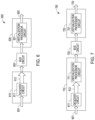
- FIG. 6 illustrates generally an example 600 of a block diagram that shows virtualization processing of multiple audio signals.
- the example 600 includes a first audio signal processing device 610 coupled to a second audio signal processing device 620 using a data bus circuit 602.
- the first audio signal processing device 610 can include a decoder circuit 611.
- the decoder circuit 611 receives a multiple-channel input signal 601 that includes digital or analog signal information.
- the multiple-channel input signal 601 includes a digital bit stream that includes information about multiple audio signals.
- the multiple-channel input signal 601 includes audio signals for a surround sound or an immersive audio program.
- an immersive audio program can include nine or more channels, such as in the DIS:X 11.1ch format.
- the immersive audio program includes eight channels, including left and right front channels (L 1 and R 1 ), a center channel (C), a low frequency channel (Lfe), left and right rear channels (L 2 and R 2 ), and left and right elevation channels (L 3 and R 3 ). Additional or fewer channels or signals can similarly be used.
- the decoder circuit 611 can be configured to decode the multiple-channel input signal 601 and provide a decoder output 612.
- the decoder output 612 can include multiple discrete channels of information. For example, when the multiple-channel input signal 601 includes information about an 11.1 immersive audio program, then the decoder output 612 can include audio signals for twelve discrete audio channels.
- the bus circuit 602 includes at least twelve channels and transmits all of the audio signals from the first audio signal processing device 610 to the second audio signal processing device 620 using respective channels.
- the second audio signal processing device 620 can include a virtualization processor circuit 621 that is configured to receive one or more of the signals from the bus circuit 602.
- the virtualization processor circuit 621 can process the received signals, such as using one or more HRTFs or other filters, to generate an audio output signal 603 that includes virtualized audio signal information.
- the audio output signal 603 includes a stereo output pair of audio signals (e.g., L O and R O ) configured for reproduction using a pair of loudspeakers in a listening environment, or using headphones.
- the first or second audio signal processing device 610 or 620 can apply one or more filters or functions to accommodate artifacts related to the listening environment to further enhance a listener's experience or perception of virtualized components in the audio output signal 603.
- the bus circuit 602 can be limited to a specified or predetermined number of discrete channels. For example, some devices can be configured to accommodate up to, but not greater than, six channels (e.g., corresponding to a 5.1 surround system).
- audio program information includes greater than, e.g., six channels of information
- at least a portion of the audio program can be lost if the program information is transmitted using the bus circuit 602.
- the lost information can be critical to the overall program or listener experience.
- the present inventors have recognized that this channel count problem can be solved using distributed virtualization processing.
- FIG. 7 illustrates generally an example 700 that includes a distributed audio virtualization system.
- the example 700 can be used to provide multiple-channel immersive audio rendering such as using physical loudspeakers or headphones.
- the example 700 includes a first audio signal processing device 710 coupled to a second audio signal processing device 720 using a second data bus circuit 702.
- the second data bus circuit 702 includes the same bandwidth as is provided by the data bus circuit 602 in the example of FIG. 6 . That is, the second data bus circuit 702 can include a bandwidth that is lower than may be required to carry all of the information about the multiple-channel input signal 601.
- the first audio signal processing device 710 can include the decoder circuit 611 and a first virtualization processor circuit 711.
- the decoder circuit 611 receives the multiple-channel input signal 601, such as can include digital or analog signal information.
- the multiple-channel input signal 601 includes a digital bit stream that includes information about multiple audio signals, and can, in an example, include audio signals for an immersive audio program.
- the decoder circuit 611 can be configured to decode the multiple-channel input signal 601 and provide the decoder output 612.
- the decoder output 612 can include multiple discrete channels of information. For example, when the multiple-channel input signal 601 includes information about an immersive audio program (e.g., 11.1 format), then the decoder output 612 can include audio signals for, e.g., twelve discrete audio channels.
- the bus circuit 702 includes fewer than twelve channels and thus cannot transmit each of the audio signals from the first audio signal processing device 710 to the second audio signal processing device 720.
- the decoder output 612 can be partially virtualized by the first audio signal processing device 710, such as using the first virtualization processor circuit 711.
- the first virtualization processor circuit 711 can include or use the example 300 of FIG. 3 , the example 400 of FIG. 4 , or the example 500 of FIG. 5 , to receive multiple input signals, apply first virtualization processing to at least a portion of the received input signals to render or provide intermediate virtualized audio information, and then combine the intermediate virtualized audio information with one or more others of the input signals.
- the multiple-channel input signal 601 can include the input signal pairs designated L 1 , R 1 , L 2 and R 2 (see FIG. 5 ).
- the first virtualization processor circuit 711 can receive at least the input signal pair designated L 2 and R 2 and can perform first virtualization processing on the signal pair.
- the first virtualization processor circuit 711 applies first HRTF filters to one or more of the L 2 and R 2 signals to render or generate the partially virtualized output signal pair designated L 4,O and R 4,O .
- the first virtualization processor circuit or a designated summing module can receive the partially virtualized output signal pair L 4,O and R 4,O and sum the partially virtualized output signal pair L 4,O and R 4,O with the other input signal pair L 1 and R 1 . Following the summation of the signals, fewer than four audio signal channels are provided by the first audio signal processing device 710 to the second data bus circuit 702. Thus, in an example where the multiple-channel input signal 601 includes four audio signals, the second data bus circuit 702 can be used to transmit partially virtualized information from the first audio signal processing device 710 to another device, such as without a loss of information.
- the second data bus circuit 702 provides the partially virtualized information to the second audio signal processing device 720.
- the second audio signal processing device 720 can further process the received signals using a second virtualization processor circuit 721 and generate further virtualized output signals (e.g., output signals L O and R O in the example of FIG. 5 ).
- the second virtualization processor circuit 721 can be configured to receive one or more of the signals from the second data bus circuit 702.
- the second virtualization processor circuit 721 can process the received signals, according to the invention using one or more HRTFs, to generate an audio output signal 703 that includes virtualized audio signal information.
- the audio output signal 703 includes a stereo output pair of audio signals (e.g., L O and R O from the example of FIG. 5 ) configured for reproduction using a pair of loudspeakers in a listening environment, or using headphones.
- the first or second audio signal processing device 710 or 720 can apply one or more filters or functions to accommodate artifacts related to the listening environment to further enhance a listener's experience or perception of virtualized components in the audio output signal 703.
- FIG. 7 illustrates generally a first audio signal processing device 710 that includes a first virtualization processor circuit 711 that is configured to process or "virtualize" information from one or more channels in the multiple-channel input signal 601 to provide one or more corresponding intermediate virtualized signals.
- the intermediate virtualized signals can then be combined with one or more other channels in the multiple-channel input signal 601 to provide a partially virtualized audio program that includes fewer channels than were included in the multiple-channel input signal 601.
- the first virtualization processor circuit 711 can receive an audio program that includes a first number of channels, then apply virtualization processing and render a fewer number of channels than were originally received with the audio program, such as without losing the information or fidelity provided by the other channels.
- the partially virtualized audio program can be transmitted using the second data bus circuit 702 without a loss of information, and the transmitted information can be further processed or further virtualized using another virtualization processor (e.g., using the second audio signal processing device 710 and/or the second virtualization processor circuit 721), such as before output to a sound reproduction system such as physical loudspeakers or headphones.
- another virtualization processor e.g., using the second audio signal processing device 710 and/or the second virtualization processor circuit 721
- a method for providing virtualized audio information using the system of FIG. 7 includes receiving audio program information that includes at least N discrete audio signals, such as corresponding to the multiple-channel input signal 601.
- the method can include generating intermediate virtualized audio information such as using the first virtualization processor circuit 711 using at least a portion of the received audio program information.
- generating the intermediate virtualized audio information can include applying a first virtualization filter ( based on an HRTF) to M of the N audio signals to provide a first virtualization filter output and providing the intermediate virtualized audio information using the first virtualization filter output.
- the intermediate virtualized audio information comprises J discrete audio signals, and J is less than N.
- M is less than or equal to N .
- the method can further include transmitting the intermediate virtualized audio information using the second data bus circuit 702 to the second virtualization processor circuit 721, and the second data bus circuit 702 can have fewer than N channels.
- the second virtualization processor circuit 721 can be configured to generate further virtualized audio information by applying a different second virtualization filter to one or more of the J audio signals.
- the first virtualization processor circuit 711 can be configured to apply horizontal-plane virtualization to at least the L 2 and R 2 signals to render or provide virtualized signals L 4,O and R 4,O , such as can be combined with other input signals L 1 and R 1 and transmitted using the second data bus circuit 702.
- the second virtualization processor circuit 721 can be configured to apply other virtualization processing (e.g., vertical-plane virtualization) to the combined signals received from the second data bus circuit 702 to provide virtualized output signals for reproduction via loudspeakers or headphones.
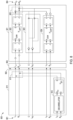
- FIG. 8 illustrates generally an example 800 of a first system configured to perform distributed virtualization processing on various audio signals.
- the example 800 includes a first audio processing module 811 coupled to a second audio processing module 821 using a third data bus circuit 803.
- the first audio processing module 811 is configured to receive various pairwise input signals 801, apply first virtualization processing and reduce a total audio signal or channel count by combining one or more signals or channels following the first virtualization processing.
- the first audio processing module 811 provides the reduced number of signals or channels to the second audio processing module 821 using the third data bus circuit 803.
- the second audio processing module 821 applies second virtualization processing and renders, in the example of FIG. 8 , a pairwise output signal 804.
- the multiple pairwise input signals 801 include various channels that can receive immersive audio program information, including signal channels L 1 and R 1 (e.g., corresponding to a front stereo pair), L 2 and R 2 (e.g., corresponding to a rear stereo pair), L 3 and R 3 (e.g., corresponding to a height or elevated stereo pair), a center channel C, and a low frequency channel Lfe.
- the pairwise output signal 804 can include a stereo output pair of signals designated L O and R O . Other channel types or designations can similarly be used.
- the first audio processing module 811 includes first stage virtualization processing by a first processor circuit 812 that receives input signals L 3 and R 3 , such as corresponding to height audio signals.
- the first processor circuit 812 includes a decorrelator circuit that is configured to apply decorrelation processing to at least one of the input signals L 3 and R 3 , such as to enhance spatialization processing and reduce an occurrence of audio artifacts in the processed signals.
- the decorrelated input signals are processed or virtualized such as using a two-channel virtualizer module (see, e.g., the second two-channel virtualizer module 520 from the example of FIG. 5 and Equation (7)).
- output signals from the first processor circuit 812 can be combined with one or more others of the input signals 801.
- the output signals from the first processor circuit 812 can be combined or summed with the L 1 and R 1 signals, such as using a summing circuit 813, to render signals L 1,3 and R 1,3 .
- One or more others of the input signals 801 can be processed using the first audio processing module 811, however, discussion of such other processing is omitted for brevity and simplicity of the present illustrative example.
- the first audio processing module 811 can thus provide six output signals (e.g., designated L 1,3 , R 1,3 , L 2 , R 2 , C, and Lfe in the example of FIG. 8 ) to the third data bus circuit 803.
- the third data bus circuit 803 can transmit the six signals to the second audio processing module 821.
- the second audio processing module 821 includes multiple second-stage virtualization processing circuits, including a second processor circuit 822, third processor circuit 823, and fourth processor circuit 824.
- the second through fourth processor circuits 822-824 are shown as discrete processors however processing operations for one or more the circuits can be combined or performed using one or more physical processing circuits.
- the second processor circuit 822 is configured to receive the signals L 1,3 , and R 1,3
- the third processor circuit 823 is configured to receive the signals L 2 , and R 2
- the fourth processor circuit 824 is configured to receive the signals C, and Lfe.
- the outputs of the second through fourth processor circuits 822-824 are provided to a second summing circuit 825 that is configured to sum output signals from the various processor circuits to render the pairwise output signal 804, designated L O and R O .
- the second processor circuit 822 receives input signals L 1,3 , and R 1,3 , such as corresponding to a combination of the virtualized height audio signals from the first processor circuit 812 and the L 1 and R 1 signals as received by the first audio processing module 811.
- the second processor circuit 822 includes according to the invention a decorrelator circuit that is configured to apply decorrelation processing to at least one of the input signals L 1,3 and R 1,3 , such as to enhance spatialization processing and reduce an occurrence of audio artifacts in the processed signals.
- the decorrelated signals are processed or virtualized such as using a two-channel virtualizer module (see the first two-channel virtualizer module 410 from the example of FIG. 4 and Equations (1 and 2)).
- the fourth processor circuit 824 can optionally include a decorrelator circuit (not shown) that is configured to apply decorrelation processing to at least one of the input signals L 2 and R 2 , such as to enhance spatialization processing and reduce an occurrence of audio artifacts in the processed signals.
- the input signals L 2 and R 2 are processed or virtualized such as using a two-channel virtualizer module (see, e.g., the second two-channel virtualizer module 420 from the example of FIG. 4 and Equations (5 and 6)).
- the third processor circuit 823 is configured to receive and process the C and Lfe signals, such as optionally using an all-pass filter and/or decorrelation processing.
- FIG. 8 thus illustrates a pairwise multi-channel virtualizer for two-channel output, such as over a frontal loudspeaker pair (see, e.g., FIG. 2 ) using pairwise virtualization processing, such as illustrated in FIGS. 1 and 3-5 .
- the height channel pair (L 3 , R 3 ) is processed using a first-stage virtualizer including a decorrelator.
- This virtualizer topology including using a designated virtual height filter implemented by the first processor circuit 812, can be computationally advantageous because it enables sharing horizontal-plane virtualization processing with the front input signal pair.
- the illustrated topology allows an effectiveness or degree of the virtual height effect to be optimized or tuned, such as independently of the horizontal-plane or other virtualization processing.
- FIG. 9 illustrates generally an example 900 of a second system configured to perform distributed virtualization processing on various audio signals.
- the example 900 includes a third audio processing module 911 coupled to a fourth audio processing module 921 using the third data bus circuit 803.
- the example of FIG. 9 includes or uses some of the same circuitry and processing as described above in the example 800 from FIG. 8 .
- the third audio processing module 911 is configured to receive the various pairwise input signals 801, apply virtualization processing and reduce a total audio signal or channel count by combining one or more signals or channels following the virtualization processing.
- the third audio processing module 911 provides the reduced number of signals or channels to the fourth audio processing module 921 using the six-channel, third data bus circuit 803.
- the fourth audio processing module 921 applies other virtualization processing and renders, in the example of FIG. 9 , a pairwise output signal 904.
- the pairwise output signals 804 and 904 from the examples of FIGS. 8 and 9 can be substantially the same when the various modules and processors are configured to provide substantially the same virtualization processing, however, in a different order and by operating on different base signals or combinations of signals.
- the third audio processing module 911 includes first stage virtualization processing by the fourth processor circuit 824. That is, the fourth processor circuit 824 receives input signals L 2 and R 2 , such as corresponding to rear stereo audio signals. Following the fourth processor circuit 824, output signals from the fourth processor circuit 824 can be combined with one or more others of the input signals 801. For example, as shown in FIG. 9 , the output signals from the fourth processor circuit 824 can be combined or summed with the L 1 and R 1 signals, such as using a first summing circuit 913, to render signals L 1,2 and R 1,2 .
- One or more others of the input signals 801 can be processed using the third audio processing module 911, however, discussion of such other processing is omitted for brevity and simplicity of the present illustrative example.
- the fourth audio processing module 911 can thus provide six output signals (e.g., designated L 1,2 , R 1,2 , L 2 , R 2 , C, and Lfe in the example of FIG. 9 ) to the third data bus circuit 803.
- the third data bus circuit 803 can transmit the six signals to the fourth audio processing module 921.
- the fourth audio processing module 921 includes multiple second-stage virtualization processing circuits, including the first processor circuit 812, the second processor circuit 822, and the third processor circuit 823.
- the first, second, and third processor circuits 812, 822, and 823 are shown as discrete processors however processing operations for one or more the circuits can be combined or performed using one or more physical processing circuits in the fourth audio processing module 921.
- the second processor circuit 822 is configured to receive the signals L 1,2 , and R 1,2
- the first processor circuit 823 is configured to receive the signals L 3 , and R 3
- the third processor circuit 824 is configured to receive the signals C, and Lfe.
- Virtualized outputs from the first processor circuit 812 are provided to a second summing circuit 924, where the outputs are summed with the received signals L 1,2 , and R 1,2 from the third data bus circuit 803 and then provided to the second processor circuit 822.
- the second processor circuit 822 applies virtualization processing to a combination of the L 2 , R 2 , and the L 3 and R 3 , signals after such signals have received other virtualization processing by the first and fourth processor circuits 812 and 824.
- the outputs of the first, second, and third processor circuits 812, 822, and 823 are provided to a third summing circuit 925 that is configured to sum output signals from the various processor circuits to render the pairwise output signal 904, designated L O and R O .
- FIGS. 8 and 9 thus illustrate examples of pairwise, multi-channel virtualization processing system for two-channel output, such as over a frontal loudspeaker pair (see, e.g., FIG. 2 ).
- the examples include pairwise virtualization processing, such as illustrated in FIGS. 1 and 3-5 .
- the height channel pair (L 3 , R 3 ) is processed using a first-stage virtualizer including a decorrelator.
- This virtualizer topology including using a designated virtual height filter implemented by the first processor circuit 812, can be computationally advantageous because it enables sharing horizontal-plane virtualization processing with the front input signal pair.
- the illustrated topology allows an effectiveness or degree of the virtual height effect to be optimized or tuned, such as independently of the horizontal-plane or other virtualization processing.
- the rear stereo channel pair (L 2 , R 2 ) is processed using a first-stage virtualizer.
- This virtualizer topology including using a designated virtual horizontal-plane filter implemented by the fourth processor circuit 824, can be computationally advantageous because it enables sharing height or other virtualization processing with the front input signal pair.
- the illustrated topology of FIG. 9 optimizes tuning flexibility for virtualization processing in multiple different planes. For example, when the example of FIG.
- this virtualizer topology provides independent tuning of virtual front and virtual rear effects over headphones for individual listeners, such as can be helpful to minimize occurrences of front-back confusion, spurious elevation errors, and to maximize perceived externalization.
- Some modules or processors discussed herein are configured to apply or use signal decorrelation processing, such as prior to virtualization processing.
- Decorrelation is an audio processing technique that reduces a correlation between two or more audio signals or channels.
- decorrelation can be used to modify a listener's perceived spatial imagery of an audio signal.
- Other examples of using decorrelation processing to adjust or modify spatial imagery or perception can include decreasing a perceived "phantom" source effect between a pair of audio channels, widening a perceived distance between a pair of audio channels, improving a perceived externalization of an audio signal when it is reproduced over headphones, and/or increasing a perceived diffuseness in a reproduced sound field.
- decorrelation processing By applying decorrelation processing to a left/right signal pair prior to virtualization, source signals panned between the left and right input channels will be heard by the listener at virtual positions substantially located on a shortest arc centered on the listener's position and joining the due positions of the virtual loudspeakers.
- the present inventors have realized that such decorrelation processing can be effective in avoiding various virtual localization artifacts, such as in-head localization, front-back confusion, and elevation errors.
- decorrelation processing can be carried out using, among other things, an all-pass filter.
- the filter can be applied to at least one of the input signals and, in an example, can be realized by a nested all-pass filter.
- Interchannel decorrelation can be provided by choosing different settings or values of different components of the filter.
- Various other designs for decorrelation filters can similarly be used.
- a method for reducing correlation between two (or more) audio signals includes randomizing a phase of each audio signal. For example, respective all-pass filters, such as each based upon different random phase calculations in the frequency domain, can be used to filter each audio signal. In some examples, decorrelation can introduce timbral changes or other unintended artifacts into the audio signals, which can be separately addressed.
- any one or more of the virtualization processing modules or virtualization processor circuits, decorrelation circuits, virtualization or spatialization filters, or other modules or processes can be implemented using a general-purpose machine or using a special, purpose-built machine that performs the various processing tasks, such as using instructions retrieved from a tangible, non-transitory, processor-readable medium.
- FIG. 10 is a block diagram illustrating components of a machine 1000, according to some example embodiments, able to read instructions 1016 from a machine-readable medium (e.g., a machine-readable storage medium) and perform any one or more of the methodologies discussed herein.
- FIG. 10 shows a diagrammatic representation of the machine 1000 in the example form of a computer system, within which the instructions 1016 (e.g., software, a program, an application, an applet, an app, or other executable code) for causing the machine 1000 to perform any one or more of the methodologies discussed herein may be executed.
- the instructions 1016 can implement modules or circuits or components of FIGS. 5-7 , and FIGS. 11-17, and so forth.
- the instructions 1016 can transform the general, non-programmed machine 1000 into a particular machine programmed to carry out the described and illustrated functions in the manner described (e.g., as an audio processor circuit).
- the machine 1000 operates as a standalone device or can be coupled (e.g., networked) to other machines.
- the machine 1000 can operate in the capacity of a server machine or a client machine in a server-client network environment, or as a peer machine in a peer-to-peer (or distributed) network environment.
- the machine 1000 can comprise, but is not limited to, a server computer, a client computer, a personal computer (PC), a tablet computer, a laptop computer, a netbook, a set-top box (STB), a personal digital assistant (PDA), an entertainment media system or system component, a cellular telephone, a smart phone, a mobile device, a wearable device (e.g., a smart watch), a smart home device (e.g., a smart appliance), other smart devices, a web appliance, a network router, a network switch, a network bridge, a headphone driver, or any machine capable of executing the instructions 1016, sequentially or otherwise, that specify actions to be taken by the machine 1000.
- the term "machine” shall also be taken to include a collection of machines 1000 that individually or jointly execute the instructions 1016 to perform any one or more of the methodologies discussed herein.
- the machine 1000 can include or use processors 1010, such as including an audio processor circuit, non-transitory memory/storage 1030, and I/O components 1050, which can be configured to communicate with each other such as via a bus 1002.
- the processors 1010 e.g., a central processing unit (CPU), a reduced instruction set computing (RISC) processor, a complex instruction set computing (CISC) processor, a graphics processing unit (GPU), a digital signal processor (DSP), an ASIC, a radiofrequency integrated circuit (RFIC), another processor, or any suitable combination thereof
- the processors 1010 can include, for example, a circuit such as a processor 1012 and a processor 1014 that may execute the instructions 1016.
- processor is intended to include a multi-core processor 1012, 1014 that can comprise two or more independent processors 1012, 1014 (sometimes referred to as "cores") that may execute the instructions 1016 contemporaneously.
- FIG. 10 shows multiple processors 1010
- the machine 1000 may include a single processor 1012, 1014 with a single core, a single processor 1012, 1014 with multiple cores (e.g., a multi-core processor 1012, 1014), multiple processors 1012, 1014 with a single core, multiple processors 1012, 1014 with multiples cores, or any combination thereof, wherein any one or more of the processors can include a circuit configured to apply a height filter to an audio signal to render a processed or virtualized audio signal.
- the memory/storage 1030 can include a memory 1032, such as a main memory circuit, or other memory storage circuit, and a storage unit 1036, both accessible to the processors 1010 such as via the bus 1002.
- the storage unit 1036 and memory 1032 store the instructions 1016 embodying any one or more of the methodologies or functions described herein.
- the instructions 1016 may also reside, completely or partially, within the memory 1032, within the storage unit 1036, within at least one of the processors 1010 (e.g., within the cache memory of processor 1012, 1014), or any suitable combination thereof, during execution thereof by the machine 1000. Accordingly, the memory 1032, the storage unit 1036, and the memory of the processors 1010 are examples of machine-readable media.
- machine-readable medium means a device able to store the instructions 1016 and data temporarily or permanently and may include, but not be limited to, random-access memory (RAM), read-only memory (ROM), buffer memory, flash memory, optical media, magnetic media, cache memory, other types of storage (e.g., erasable programmable read-only memory (EEPROM)), and/or any suitable combination thereof.
- RAM random-access memory
- ROM read-only memory
- buffer memory flash memory
- optical media magnetic media
- cache memory other types of storage
- EEPROM erasable programmable read-only memory
- machine-readable medium should be taken to include a single medium or multiple media (e.g., a centralized or distributed database, or associated caches and servers) able to store the instructions 1016.
- machine-readable medium shall also be taken to include any medium, or combination of multiple media, that is capable of storing instructions (e.g., instructions 1016) for execution by a machine (e.g., machine 1000), such that the instructions 1016, when executed by one or more processors of the machine 1000 (e.g., processors 1010), cause the machine 1000 to perform any one or more of the methodologies described herein.
- a “machine-readable medium” refers to a single storage apparatus or device, as well as “cloud-based” storage systems or storage networks that include multiple storage apparatus or devices.
- the term “machine-readable medium” excludes signals per se.
- the I/O components 1050 may include a variety of components to receive input, provide output, produce output, transmit information, exchange information, capture measurements, and so on.
- the specific I/O components 1050 that are included in a particular machine 1000 will depend on the type of machine 1000. For example, portable machines such as mobile phones will likely include a touch input device or other such input mechanisms, while a headless server machine will likely not include such a touch input device. It will be appreciated that the I/O components 1050 may include many other components that are not shown in FIG. 10 .
- the I/O components 1050 are grouped by functionality merely for simplifying the following discussion, and the grouping is in no way limiting. In various example embodiments, the I/O components 1050 may include output components 1052 and input components 1054.
- the output components 1052 can include visual components (e.g., a display such as a plasma display panel (PDP), a light emitting diode (LED) display, a liquid crystal display (LCD), a projector, or a cathode ray tube (CRT)), acoustic components (e.g., loudspeakers), haptic components (e.g., a vibratory motor, resistance mechanisms), other signal generators, and so forth.
- visual components e.g., a display such as a plasma display panel (PDP), a light emitting diode (LED) display, a liquid crystal display (LCD), a projector, or a cathode ray tube (CRT)
- acoustic components e.g., loudspeakers
- haptic components e.g., a vibratory motor, resistance mechanisms
- the input components 1054 can include alphanumeric input components (e.g., a keyboard, a touch screen configured to receive alphanumeric input, a photo-optical keyboard, or other alphanumeric input components), point based input components (e.g., a mouse, a touchpad, a trackball, a joystick, a motion sensor, or other pointing instruments), tactile input components (e.g., a physical button, a touch screen that provides location and/or force of touches or touch gestures, or other tactile input components), audio input components (e.g., a microphone), and the like.
- alphanumeric input components e.g., a keyboard, a touch screen configured to receive alphanumeric input, a photo-optical keyboard, or other alphanumeric input components
- point based input components e.g., a mouse, a touchpad, a trackball, a joystick, a motion sensor, or other pointing instruments
- tactile input components e.g., a physical button,
- the I/O components 1050 can include biometric components 1056, motion components 1058, environmental components 1060, or position components 1062, among a wide array of other components.
- the biometric components 1056 can include components to detect expressions (e.g., hand expressions, facial expressions, vocal expressions, body gestures, or eye tracking), measure biosignals (e.g., blood pressure, heart rate, body temperature, perspiration, or brain waves), identify a person (e.g., voice identification, retinal identification, facial identification, fingerprint identification, or electroencephalogram based identification), and the like, such as can influence a inclusion, use, or selection of a listener-specific or environment-specific impulse response or HRTF, for example.
- expressions e.g., hand expressions, facial expressions, vocal expressions, body gestures, or eye tracking
- biosignals e.g., blood pressure, heart rate, body temperature, perspiration, or brain waves
- identify a person e.g., voice identification, retinal identification, facial identification,
- the biometric components 1056 can include one or more sensors configured to sense or provide information about a detected location of the listener 110 in an environment.
- the motion components 1058 can include acceleration sensor components (e.g., accelerometer), gravitation sensor components, rotation sensor components (e.g., gyroscope), and so forth, such as can be used to track changes in the location of the listener 110.
- the environmental components 1060 can include, for example, illumination sensor components (e.g., photometer), temperature sensor components (e.g., one or more thermometers that detect ambient temperature), humidity sensor components, pressure sensor components (e.g., barometer), acoustic sensor components (e.g., one or more microphones that detect reverberation decay times, such as for one or more frequencies or frequency bands), proximity sensor or room volume sensing components (e.g., infrared sensors that detect nearby objects), gas sensors (e.g., gas detection sensors to detect concentrations of hazardous gases for safety or to measure pollutants in the atmosphere), or other components that may provide indications, measurements, or signals corresponding to a surrounding physical environment.
- illumination sensor components e.g., photometer
- temperature sensor components e.g., one or more thermometers that detect ambient temperature
- humidity sensor components e.g., pressure sensor components (e.g., barometer)
- acoustic sensor components e.g., one or more microphones that detect reverb
- the position components 1062 can include location sensor components (e.g., a Global Position System (GPS) receiver component), altitude sensor components (e.g., altimeters or barometers that detect air pressure from which altitude may be derived), orientation sensor components (e.g., magnetometers), and the like.
- location sensor components e.g., a Global Position System (GPS) receiver component
- altitude sensor components e.g., altimeters or barometers that detect air pressure from which altitude may be derived
- orientation sensor components e.g., magnetometers
- the I/O components 1050 can include communication components 1064 operable to couple the machine 1000 to a network 1080 or devices 1070 via a coupling 1082 and a coupling 1072 respectively.
- the communication components 1064 can include a network interface component or other suitable device to interface with the network 1080.
- the communication components 1064 can include wired communication components, wireless communication components, cellular communication components, near field communication (NFC) components, Bluetooth ® components (e.g., Bluetooth ® Low Energy), Wi-Fi ® components, and other communication components to provide communication via other modalities.
- the devices 1070 can be another machine or any of a wide variety of peripheral devices (e.g., a peripheral device coupled via a USB).
- the communication components 1064 can detect identifiers or include components operable to detect identifiers.
- the communication components 1064 can include radio frequency identification (RFID) tag reader components, :N'FC smart tag detection components, optical reader components (e.g., an optical sensor to detect one-dimensional bar codes such as Universal Product Code (UPC) bar code, multi-dimensional bar codes such as Quick Response (QR) code, Aztec code, Data Matrix, Dataglyph, MaxiCode, PDF49, Ultra Code, UCC RSS-2D bar code, and other optical codes), or acoustic detection components (e.g., microphones to identify tagged audio signals).
- RFID radio frequency identification
- :N'FC smart tag detection components optical reader components
- optical reader components e.g., an optical sensor to detect one-dimensional bar codes such as Universal Product Code (UPC) bar code, multi-dimensional bar codes such as Quick Response (QR) code, Aztec code, Data Matrix, Dataglyph, MaxiCode, PDF49, Ultra Code, UCC RSS-2D bar code, and
- IP Internet Protocol
- Wi-Fi ® Wireless Fidelity
- NFC beacon detecting an NFC beacon signal that may indicate a particular location
- identifiers can be used to determine information about one or more of a reference or local impulse response, reference or local environment characteristic, or a listener-specific characteristic.
- one or more portions of the network 1080 can be an ad hoc network, an intranet, an extranet, a virtual private network (VPN), a local area network (LAN), a wireless LAN (WLAN), a wide area network (WAN), a wireless WAN (WWAN), a metropolitan area network (MAN), the Internet, a portion of the Internet, a portion of the public switched telephone network (PSTN), a plain old telephone service (POTS) network, a cellular telephone network, a wireless network, a Wi-Fi ® network, another type of network, or a combination of two or more such networks.
- VPN virtual private network
- LAN local area network
- WLAN wireless LAN
- WAN wide area network
- WWAN wireless WAN
- MAN metropolitan area network
- PSTN public switched telephone network
- POTS plain old telephone service
- the coupling 1082 can implement any of a variety of types of data transfer technology, such as Single Carrier Radio Transmission Technology (1xRTT), Evolution-Data Optimized (EVDO) technology, General Packet Radio Service (GPRS) technology, Enhanced Data rates for GSM Evolution (EDGE) technology, third Generation Partnership Project (3GPP) including 3G, fourth generation wireless (4G) networks, Universal Mobile Telecommunications System (UMTS), High Speed Packet Access (HSPA), Worldwide Interoperability for Microwave Access (WiMAX), Long Term Evolution (LTE) standard, others defined by various standard-setting organizations, other long range protocols, or other data transfer technology.
- a wireless communication protocol or network can be configured to transmit headphone audio signals from a centralized processor or machine to a headphone device in use by a listener.
- the instructions 1016 can be transmitted or received over the network 1080 using a transmission medium via a network interface device (e.g., a network interface component included in the communication components 1064) and using any one of a number of well-known transfer protocols (e.g., hypertext transfer protocol (HTTP)).
- a network interface device e.g., a network interface component included in the communication components 1064
- HTTP hypertext transfer protocol
- the instructions 1016 can be transmitted or received using a transmission medium via the coupling 1072 (e.g., a peer-to-peer coupling) to the devices 1070.
- the term "transmission medium” shall be taken to include any intangible medium that is capable of storing, encoding, or carrying the instructions 1016 for execution by the machine 1000, and includes digital or analog communications signals or other intangible media to facilitate communication of such software.
Landscapes
- Engineering & Computer Science (AREA)
- Physics & Mathematics (AREA)
- Acoustics & Sound (AREA)
- Signal Processing (AREA)
- Stereophonic System (AREA)
- Multimedia (AREA)
Description
- This patent application claims the benefit of priority to
U.S. Provisional Patent Application No. 62/468,677, filed on March 8, 2017 U.S. Patent Application Serial No. 15/844,096, filed on December 15, 2017 - Audio plays a significant role in providing a content-rich multimedia experience in consumer electronics. The scalability and mobility of consumer electronic devices along with the growth of wireless connectivity provides users with instant access to content. Various audio reproduction systems can be used for playback over headphones or loudspeakers. In some examples, audio program content can include more than a stereo pair of audio signals, such as including surround sound or other multiple-channel configurations.
- A conventional audio reproduction system can receive digital or analog audio source signal information from various audio or audio/video sources, such as a CD player, a TV tuner, a handheld media player, or the like. The audio reproduction system can include a home theater receiver or an automotive audio system dedicated to the selection, processing, and routing of broadcast audio and/or video signals. Audio output signals can be processed and output for playback over a speaker system. Such output signals can be two-channel signals sent to headphones or a pair of frontal loudspeakers, or multi-channel signals for surround sound playback. For surround sound playback, the audio reproduction system may include a multichannel decoder.
- The audio reproduction system can further include processing equipment such as analog-to-digital converters for connecting analog audio sources, or digital audio input interfaces. The audio reproduction system may include a digital signal processor for processing audio signals, as well as digital-to-analog converters and signal amplifiers for converting the processed output signals to electrical signals sent to the transducers. The loudspeakers can be arranged in a variety of configurations as determined by various applications. Loudspeakers, for example, can be stand-alone units or can be incorporated in a device, such as in the case of consumer electronics such as a television set, laptop computer, hand held stereo, or the like. Due to technical and physical constraints, audio playback can be compromised or limited in such devices. Such limitations can be particularly evident in electronic devices having physical constraints where speakers are narrowly spaced apart, such as in laptops and other compact mobile devices. To address such audio constraints, various audio processing methods are used for reproducing two-channel or multi-channel audio signals over a pair of headphones or a pair of loudspeakers. Such methods include compelling spatial enhancement effects to improve the listener's experience.
- Various techniques have been proposed for implementing audio signal processing based on Head-Related Transfer Functions (HRTF), such as for three-dimensional audio reproduction using headphones or loudspeakers. In some examples, the techniques are used for reproducing virtual loudspeakers localized in a horizontal plane with respect to a listener, or located at an elevated position with respect to the listener. To reduce horizontal localization artifacts for listener positions away from a "sweet spot" in a loudspeaker-based system, various filters can be applied to restrict the effect to lower frequencies.
- Document
US 2016/044434 A1 discloses an audio providing method that includes receiving an audio signal including a plurality of channels, applying an audio signal having a channel, from among the plurality of channels, giving a sense of elevation to a filter to generate a plurality of virtual audio signals to be respectively output to a plurality of speakers. The filter processes the audio signal to have a sense of elevation. - Document
US 2015/350802 A1 discloses an audio providing apparatus that includes an object renderer configured to render an object audio signal based on geometric information regarding the object audio signal; a channel renderer configured to render an audio signal having a first channel number into an audio signal having a second channel number; and a mixer configured to mix the rendered object audio signal with the audio signal having the second channel number. -
Document EP 2 866 227 A1 discloses a method which decodes a downmix matrix for mapping a plurality of input channels of audio content to a plurality of output channels, the input and output channels being associated with respective speakers at predetermined positions relative to a listener position, wherein the downmix matrix is encoded by exploiting the symmetry of speaker pairs of the plurality of input channels and the symmetry of speaker pairs of the plurality of output channels. - Document
EP 3 125 240 A1 discloses an audio signal rendering method for reducing distortion of a sound image even when the layout of the arranged speakers is different from the standard layout. - Document
WO 2016/130834 A1 discusses reverberation generation for headphone virtualization, wherein one or more components of a binaural room impulse response (BRIR) for headphone virtualization are generated. - Document
WO 2014/036121 A1 discusses a system of rendering object-based audio content through a system that includes individually addressable drivers. - Document
WO 2014/126682 A1 shows a frequency-domain signal processing chain of a multi-channel audio decoder applying a first upmix/downmix unit, a decorrelator, and a second upmix/downmix unit. - The present invention provides for a method for providing virtualized audio information with the features of
claim 1 and a system with the features of claim 8. Embodiments of the invention are identified in the dependent claims. - Audio signal processing can be distributed across multiple processor circuits or software modules, such as in scalable systems or due to system constraints. For example, a TV audio system solution can include combined digital audio decoder and virtualizer post-processing modules so that an overall computational budget does not exceed the capacity of a single Integrated Circuit (IC) or System-On-Chip (SOC). To accommodate such a limitation, the decoder and virtualizer blocks can be implemented in separate cascaded hardware or software modules.
- In an example, an internal I/O data bus, such as in TV audio system architecture, can be limited to 6 or 8 channels (e.g., corresponding to 5.1 or 7.1 surround sound systems). However, it can be desired or required to transmit a greater number of decoder output audio signals to a virtualizer input to provide a compelling immersive audio experience. The present inventors have thus recognized that a problem to be solved includes distributing audio signal processing across multiple processor circuits and/or devices to enable multi-dimensional audio reproduction of multiple-channel audio signals over loudspeakers or, in some examples, headphones. In an example, the problem can include using legacy hardware architecture with channel count limitations to distribute or process multi-dimensional audio information.
- A solution to the above-described problem includes various methods for multi-dimensional audio reproduction using loudspeakers or headphones, such as can be used for playback of immersive audio content over sound bar loudspeakers, home theater systems, TVs, laptop computers, mobile or wearable devices, or other systems or devices. The methods and systems described herein can enable distribution of virtualization post-processing across two or more processor circuits or modules while reducing an intermediate transmitted audio channel count.
- This overview is intended to provide a summary of the subject matter of the present patent application. It is not intended to provide an exclusive or exhaustive explanation of the invention. The detailed description is included to provide further information about the present patent application.
- In the drawings, which are not necessarily drawn to scale, like numerals may describe similar components in different views. Like numerals having different letter suffixes may represent different instances of similar components. The drawings illustrate generally, by way of example, but not by way of limitation, various embodiments discussed in the present document.
-
FIG. 1 illustrates generally an example of audio signal virtualization processing. -
FIG. 2 illustrates generally an example of a four-channel three-dimensional audio reproduction system. -
FIG. 3 illustrates generally an example of multiple-stage virtualization processing. -
FIG. 4 illustrates generally an example that includes independent virtualization processing by first and second two-channel virtualizer modules. -
FIG. 5 illustrates generally an example that includes virtualization processing using first and second two-channel virtualizer modules. -
FIG. 6 illustrates generally an example of a block diagram that shows virtualization processing of multiple audio signals. -
FIG. 7 illustrates generally an example that includes a distributed audio virtualization system. -
FIG. 8 illustrates generally an embodiment of a first system configured to perform distributed virtualization processing on various audio signals. -
FIG. 9 illustrates generally an example of a second system configured to perform distributed virtualization processing on various audio signals. -
FIG. 10 is a block diagram illustrating components of a machine that is configurable to perform any one or more of the methodologies discussed herein. - In the following description that includes examples of virtual environment rendering and audio signal processing, such as for reproduction via headphones or other loudspeakers, reference is made to the accompanying drawings, which form a part of the detailed description. The drawings show, by way of illustration, specific embodiments in which the inventions disclosed herein can be practiced. These embodiments are also referred to herein as "examples." Such examples can include elements in addition to those shown or described. However, the present inventors also contemplate examples in which only those elements shown or described are provided.
- As used herein, the phrase "audio signal" is a signal that is representative of a physical sound. Audio processing systems and methods described herein can include hardware circuitry and/or software configured to use or process audio signals using various filters. In some examples, the systems and methods can use signals from, or signals corresponding to, multiple audio channels. In an example, an audio signal can include a digital signal that includes information corresponding to multiple audio channels.
- Various audio processing systems and methods can be used to reproduce two-channel or multi-channel audio signals over various loudspeaker configurations. For example, audio signals can be reproduced over headphones, over a pair of bookshelf loudspeakers, or over a surround sound or immersive audio system, such as using loudspeakers positioned at various locations with respect to a listener. Some examples can include or use compelling spatial enhancement effects to enhance a listening experience, such as where a number or orientation of physical loudspeakers is limited.
- In
U.S. Patent No. 8,000,485, to Walsh et al. , entitled "Virtual Audio Processing for Loudspeaker or Headphone Playback", audio signals can be processed with a virtualizer processor circuit to create virtualized signals and a modified stereo image. Additionally or alternatively to the techniques in the '485 patent, the present inventors have recognized that virtualization processing can be used to deliver an accurate sound field representation that includes various spatially-oriented components using a minimum number of loudspeakers. - In an example, relative virtualization filters, such as can be derived from head-related transfer functions, can be applied to render virtual audio information that is perceived by a listener as including sound information at various specified altitudes, or elevations, above or below a listener to further enhance a listener's experience. In an example, such virtual audio information is reproduced using a loudspeaker provided in a horizontal plane and the virtual audio information is perceived to originate from a loudspeaker or other source that is elevated relative to the horizontal plane, such as even when no physical or real loudspeaker exists in the perceived origination location. In an example, the virtual audio information provides an impression of sound elevation, or an auditory illusion, that extends from, and optionally includes, audio information in the horizontal plane. Similarly, virtualization filters can be applied to render virtual audio information perceived by a listener as including sound information at various locations within or among the horizontal plane, such as at locations that do not correspond to a physical location of a loudspeaker in the sound field.
-
FIG. 1 illustrates generally an example 100 of audio signal virtualization processing. In the example 100, an input signal pair designated L1 and R1 are provided to a two-channel virtualizer module 110. The two-channel virtualizer module 110 can include a first processor circuit configured to processes the input signal pair and provide an output signal pair designated LO and RO. In an example, the output signal pair is configured for playback using a stereo loudspeaker pair or headphones. - In an example, the
virtualizer module 110 can be realized using a transaural shuffler topology such as when the input and output signal pairs represent information for loudspeakers that are symmetrically located relative to an anatomical median plane of a listener. In this example, sum and difference virtualization filters can be designated as shown in Equations (1) and (2), and can be applied by the first processor circuit in the two-channel virtualizer module 110.

- H0i: ipsilateral HRTF for left or right physical loudspeaker locations (e.g., configured for reproduction of the output signal pair LO, RO);
- H0c: contralateral HRTF for left or right physical loudspeaker locations (e.g., configured for reproduction of the output signal pair LO, RO);
- H1i: ipsilateral HRTF for the left or right virtual loudspeaker locations (e.g., configured for reproduction of the output signal pair L1, R1); and
- H1c: contralateral HRTF for the left or right virtual loudspeaker locations (L1, R1).
-
FIG. 2 illustrates generally an example 200 of a four-channel three-dimensional audio reproduction system. The example 200 can include or use virtualization processing to provide virtualized audio signal information for reproduction to alistener 202. In the example 200, avirtualization processor circuit 201 receives input signals L1, R1, L2 and R2 and applies virtualization processing to the input signals and renders or provides a fewer number of output signals than input signals. Binaural and transaural 3D audio virtualization algorithms can be used to process the various input signals, including sum and difference "shuffler"-based topologies that leverage properties such as left-right symmetry of channel layouts, minimum-phase models of head-related transfer functions (HRTFs) and spectral equalization methods, as well as digital IIR filter approximations. In an example, thevirtualization processor circuit 201 receives the multiple input signals L1, R1, L2 and R2 from an audio decoder circuit, such as a surround sound decoder circuit, and renders substantially the same information using a pair of loudspeakers. - In
FIG. 2 , the three-dimensional audio reproduction system orprocessor circuit 201 provides output signals designated LO and RO. Based on the virtualization processing, when the LO and RO signals are reproduced using a pair of loudspeakers (such as the loudspeakers corresponding to L and R in the example ofFIG. 2 ), audio information is perceived by thelistener 202 as including information from multiple sources distributed about the loudspeaker environment. For example, when the LO and RO signals are reproduced using the speakers designated in the figure as L and R, thelistener 202 can perceive audio signal information as originating from the left or right front speakers L1 and R1, from the left or right rear speakers L2 and R2, or from an intermediate location or phantom source somewhere between the speakers. -
FIG. 3 illustrates generally an example 300 of multiple-stage virtualization processing. In an example, the three-dimensional audio reproduction system orprocessor circuit 201 fromFIG. 2 can be implemented or applied using the virtualization processing in the example 300 ofFIG. 3 . The example ofFIG. 3 includes a first two-channel virtualizer module 310 and a second two-channel virtualizer module 320. The first two-channel virtualizer module 310 is configured to receive a first input signal pair designated L1 and R1, and the second two-channel virtualizer module 320 is configured to receive a second input signal pair designated L2 and R2, In an example, L1 and R1 represent a front stereo pair and L2 and R2 represent a rear stereo pair (see, e.g.,FIG. 2 ). In other examples, L1, R1, L2 and R2 can represent other audio information such as for side, rear, or elevated sound signals, such as configured or designed for reproduction using a particular loudspeaker arrangement. In an example, the first two-channel virtualizer module 310 is configured to apply or use sum and difference virtualization filters, such as shown in Equation (1). - The second two-
channel virtualizer module 320 can include a second processor circuit configured to receive the second input signal pair L2 and R2 and generate intermediate virtualized audio information as output signals designated L2,O and R2,O. In an example, the second two-channel virtualizer module 320 is configured to apply or use sum and difference virtualization filters, such as shown in Equation (2), to generate the intermediate virtualized output signals L2,O and R2,O. In an example, the second two-channel virtualizer module 320 is thus configured to provide or generate a partially virtualized signal, or multiple signals that are partially virtualized. The signal or signals are considered to be partially virtualized because the second two-channel virtualizer module 320 can be configured to provide virtualization processing in a limited manner. For example, the second two-channel virtualizer module 320 can be configured for horizontal plane virtualization processing, while vertical plane virtualization processing can be performed elsewhere or using a different device. The partially virtualized signals can be combined with one or more other virtualized or non-virtualized signals before reproduction to a listener. In an example, the second two-channel virtualizer module 320 can apply or use the functions described inEquations 3 and 4 to provide the intermediate virtualized output signals.

- H2i: ipsilateral HRTF for the left or right virtual loudspeaker locations (L2, R2);
- H2c: contralateral HRTF for the left or right virtual loudspeaker locations (L2, R2).
- In the example of
FIG. 3 , the intermediate virtualized output signals L2,O and R2,O are combined with the first input signal pair designated L1 and R1 prior to virtualization of the first input signal pair designated L1 and R1. The combined signals are then further processed or virtualized using the first two-channel virtualizer module 310. The first and second two-channel virtualizer modules channel virtualizer module 310 can be configured to provide horizontal-plane virtualization processing, and the second two-channel virtualizer module 320 can be configured to provide vertical-plane virtualization processing. Other types of virtualization processing can similarly be used or applied using the different modules. - The present inventors have recognized that a result of virtualization processing by
modules FIG. 3 is substantially equivalent to virtualization processing by both modules independently.FIG. 4 , for example, illustrates generally an example 400 that includes independent virtualization processing by first and second two-channel virtualizer modules FIG. 4 , the first two-channel virtualizer module 410 receives the input signal pair designated L1 and R1 and generates a partially virtualized output signal pair designated L1,O and R1,O, and the second two-channel virtualizer module 420 receives the input signal pair designated L2 and R2 and generates a partially virtualized output signal pair designated L3,O and R3,O. The example 400 ofFIG. 4 further includes a summingmodule 430 that includes a circuit configured to sum the partially virtualized output signal pairs L1,O and R1,O, and L3,O and R3,O to provide the virtualized output signals LO and RO. - In the example of
FIG. 4 , the first two-channel virtualizer module 410 is configured to apply the sum and difference virtualization filters as shown in Equations (1) and (2), and as similarly described above in the example of the two-channel virtualizer module 110 fromFIG. 1 . The second two-channel virtualizer module 420 is configured to apply sum and different virtualization filters as shown in Equations (5) and (6).

- By comparing Equations (1) and (2) with Equations (3) and (4), it can be observed that the four-channel pairwise virtualizer examples of
FIGS. 3 and 4 are substantially the same. -
FIG. 5 illustrates generally an example 500 that includes virtualization processing by first and second two-channel virtualizer modules 510 and 520. In the example ofFIG. 5 , the second two-channel virtualizer module 520 receives the input signal pair designated L2 and R2 and generates a partially virtualized output signal pair designated L4,O and R4,O. The example 500 ofFIG. 5 further includes a summingmodule 530 that includes a circuit configured to sum the partially virtualized output signal pair L4,O and R4,O with an input signal pair L1 and R1 and provide the summed signals to the first two-channel virtualizer module 510. The first two-channel virtualizer module 510 receives the summed signal pair and generates the virtualized output signals LO and RO. - In the example of
FIG. 5 , the first two-channel virtualizer module 510 is configured to apply the sum and difference virtualization filters as shown in Equations (1) and (2), and as similarly described above in the example of the two-channel virtualizer module 110 fromFIG. 1 . The second two-channel virtualizer module 520 is configured to apply sum and different virtualization filters as shown in Equation (7).
- The example of
FIG. 5 thus illustrates generally a simplified version of the four-channel virtualizer ofFIG. 3 , wherein the second two-channel virtualizer module 520 applies the same filter to both input signals when the transfer functions H2/1,SUM and H2/1,DlFF are approximately equal, that is, when ipsilateral and contralateral HRTF ratios are approximately equal. - Any one or more of the virtualization processing examples described herein can include or use decorrelation processing. For example, any one of more of the virtualizer modules from
FIGS. 1 ,3, 4 , and/or 5, can include or use a decorrelator circuit configured to decorrelate one or more of the audio input signals. In an example, a decorrelator circuit precedes at least one input of a virtualizer module such that the virtualizer module processes signal pairs that are decorrelated from each other. Further examples and discussion about decorrelation processing are provided below. -
FIG. 6 illustrates generally an example 600 of a block diagram that shows virtualization processing of multiple audio signals. The example 600 includes a first audiosignal processing device 610 coupled to a second audiosignal processing device 620 using adata bus circuit 602. - The first audio
signal processing device 610 can include adecoder circuit 611. In an example, thedecoder circuit 611 receives a multiple-channel input signal 601 that includes digital or analog signal information. In an example, the multiple-channel input signal 601 includes a digital bit stream that includes information about multiple audio signals. In an example, the multiple-channel input signal 601 includes audio signals for a surround sound or an immersive audio program. In an example, an immersive audio program can include nine or more channels, such as in the DIS:X 11.1ch format. In an example, the immersive audio program includes eight channels, including left and right front channels (L1 and R1), a center channel (C), a low frequency channel (Lfe), left and right rear channels (L2 and R2), and left and right elevation channels (L3 and R3). Additional or fewer channels or signals can similarly be used. - The
decoder circuit 611 can be configured to decode the multiple-channel input signal 601 and provide adecoder output 612. Thedecoder output 612 can include multiple discrete channels of information. For example, when the multiple-channel input signal 601 includes information about an 11.1 immersive audio program, then thedecoder output 612 can include audio signals for twelve discrete audio channels. In an example, thebus circuit 602 includes at least twelve channels and transmits all of the audio signals from the first audiosignal processing device 610 to the second audiosignal processing device 620 using respective channels. The second audiosignal processing device 620 can include avirtualization processor circuit 621 that is configured to receive one or more of the signals from thebus circuit 602. Thevirtualization processor circuit 621 can process the received signals, such as using one or more HRTFs or other filters, to generate anaudio output signal 603 that includes virtualized audio signal information. In an example, theaudio output signal 603 includes a stereo output pair of audio signals (e.g., LO and RO) configured for reproduction using a pair of loudspeakers in a listening environment, or using headphones. In an example, the first or second audiosignal processing device audio output signal 603. - In some audio signal processing devices, particularly at the consumer-grade level, the
bus circuit 602 can be limited to a specified or predetermined number of discrete channels. For example, some devices can be configured to accommodate up to, but not greater than, six channels (e.g., corresponding to a 5.1 surround system). When audio program information includes greater than, e.g., six channels of information, then at least a portion of the audio program can be lost if the program information is transmitted using thebus circuit 602. In some examples, the lost information can be critical to the overall program or listener experience. The present inventors have recognized that this channel count problem can be solved using distributed virtualization processing. -
FIG. 7 illustrates generally an example 700 that includes a distributed audio virtualization system. The example 700 can be used to provide multiple-channel immersive audio rendering such as using physical loudspeakers or headphones. The example 700 includes a first audiosignal processing device 710 coupled to a second audiosignal processing device 720 using a seconddata bus circuit 702. In an example, the seconddata bus circuit 702 includes the same bandwidth as is provided by thedata bus circuit 602 in the example ofFIG. 6 . That is, the seconddata bus circuit 702 can include a bandwidth that is lower than may be required to carry all of the information about the multiple-channel input signal 601. - In the example of
FIG. 7 , the first audiosignal processing device 710 can include thedecoder circuit 611 and a firstvirtualization processor circuit 711. In an example, thedecoder circuit 611 receives the multiple-channel input signal 601, such as can include digital or analog signal information. As similarly explained above in the example ofFIG. 6 , the multiple-channel input signal 601 includes a digital bit stream that includes information about multiple audio signals, and can, in an example, include audio signals for an immersive audio program. - The
decoder circuit 611 can be configured to decode the multiple-channel input signal 601 and provide thedecoder output 612. Thedecoder output 612 can include multiple discrete channels of information. For example, when the multiple-channel input signal 601 includes information about an immersive audio program (e.g., 11.1 format), then thedecoder output 612 can include audio signals for, e.g., twelve discrete audio channels. In an example, thebus circuit 702 includes fewer than twelve channels and thus cannot transmit each of the audio signals from the first audiosignal processing device 710 to the second audiosignal processing device 720. - In an example, the
decoder output 612 can be partially virtualized by the first audiosignal processing device 710, such as using the firstvirtualization processor circuit 711. For example, the firstvirtualization processor circuit 711 can include or use the example 300 ofFIG. 3 , the example 400 ofFIG. 4 , or the example 500 ofFIG. 5 , to receive multiple input signals, apply first virtualization processing to at least a portion of the received input signals to render or provide intermediate virtualized audio information, and then combine the intermediate virtualized audio information with one or more others of the input signals. - Referring now to
FIG. 7 and toFIG. 5 as a representative and nonlimiting example, the multiple-channel input signal 601 (seeFIG. 7 ) can include the input signal pairs designated L1, R1, L2 and R2 (seeFIG. 5 ). The firstvirtualization processor circuit 711 can receive at least the input signal pair designated L2 and R2 and can perform first virtualization processing on the signal pair. According to the invention, the firstvirtualization processor circuit 711 applies first HRTF filters to one or more of the L2 and R2 signals to render or generate the partially virtualized output signal pair designated L4,O and R4,O. The first virtualization processor circuit or a designated summing module can receive the partially virtualized output signal pair L4,O and R4,O and sum the partially virtualized output signal pair L4,O and R4,O with the other input signal pair L1 and R1. Following the summation of the signals, fewer than four audio signal channels are provided by the first audiosignal processing device 710 to the seconddata bus circuit 702. Thus, in an example where the multiple-channel input signal 601 includes four audio signals, the seconddata bus circuit 702 can be used to transmit partially virtualized information from the first audiosignal processing device 710 to another device, such as without a loss of information. - In the example of
FIG. 7 , the seconddata bus circuit 702 provides the partially virtualized information to the second audiosignal processing device 720. The second audiosignal processing device 720 can further process the received signals using a secondvirtualization processor circuit 721 and generate further virtualized output signals (e.g., output signals LO and RO in the example ofFIG. 5 ). - The second
virtualization processor circuit 721 can be configured to receive one or more of the signals from the seconddata bus circuit 702. The secondvirtualization processor circuit 721 can process the received signals, according to the invention using one or more HRTFs, to generate anaudio output signal 703 that includes virtualized audio signal information. In an example, theaudio output signal 703 includes a stereo output pair of audio signals (e.g., LO and RO from the example ofFIG. 5 ) configured for reproduction using a pair of loudspeakers in a listening environment, or using headphones. In an example, the first or second audiosignal processing device audio output signal 703. - In other words, the example of
FIG. 7 illustrates generally a first audiosignal processing device 710 that includes a firstvirtualization processor circuit 711 that is configured to process or "virtualize" information from one or more channels in the multiple-channel input signal 601 to provide one or more corresponding intermediate virtualized signals. The intermediate virtualized signals can then be combined with one or more other channels in the multiple-channel input signal 601 to provide a partially virtualized audio program that includes fewer channels than were included in the multiple-channel input signal 601. That is, the firstvirtualization processor circuit 711 can receive an audio program that includes a first number of channels, then apply virtualization processing and render a fewer number of channels than were originally received with the audio program, such as without losing the information or fidelity provided by the other channels. The partially virtualized audio program can be transmitted using the seconddata bus circuit 702 without a loss of information, and the transmitted information can be further processed or further virtualized using another virtualization processor (e.g., using the second audiosignal processing device 710 and/or the second virtualization processor circuit 721), such as before output to a sound reproduction system such as physical loudspeakers or headphones. - In an example, a method for providing virtualized audio information using the system of
FIG. 7 includes receiving audio program information that includes at least N discrete audio signals, such as corresponding to the multiple-channel input signal 601. The method can include generating intermediate virtualized audio information such as using the firstvirtualization processor circuit 711 using at least a portion of the received audio program information. For example, generating the intermediate virtualized audio information can include applying a first virtualization filter ( based on an HRTF) to M of the N audio signals to provide a first virtualization filter output and providing the intermediate virtualized audio information using the first virtualization filter output. In an example, the intermediate virtualized audio information comprises J discrete audio signals, and J is less than N. In an example, M is less than or equal to N. The method can further include transmitting the intermediate virtualized audio information using the seconddata bus circuit 702 to the secondvirtualization processor circuit 721, and the seconddata bus circuit 702 can have fewer than N channels. In an example, the secondvirtualization processor circuit 721 can be configured to generate further virtualized audio information by applying a different second virtualization filter to one or more of the J audio signals. For example, the firstvirtualization processor circuit 711 can be configured to apply horizontal-plane virtualization to at least the L2 and R2 signals to render or provide virtualized signals L4,O and R4,O, such as can be combined with other input signals L1 and R1 and transmitted using the seconddata bus circuit 702. The secondvirtualization processor circuit 721 can be configured to apply other virtualization processing (e.g., vertical-plane virtualization) to the combined signals received from the seconddata bus circuit 702 to provide virtualized output signals for reproduction via loudspeakers or headphones. -
FIG. 8 illustrates generally an example 800 of a first system configured to perform distributed virtualization processing on various audio signals. The example 800 includes a firstaudio processing module 811 coupled to a secondaudio processing module 821 using a thirddata bus circuit 803. The firstaudio processing module 811 is configured to receive various pairwise input signals 801, apply first virtualization processing and reduce a total audio signal or channel count by combining one or more signals or channels following the first virtualization processing. The firstaudio processing module 811 provides the reduced number of signals or channels to the secondaudio processing module 821 using the thirddata bus circuit 803. The secondaudio processing module 821 applies second virtualization processing and renders, in the example ofFIG. 8 , apairwise output signal 804. In an example, the multiple pairwise input signals 801 include various channels that can receive immersive audio program information, including signal channels L1 and R1 (e.g., corresponding to a front stereo pair), L2 and R2 (e.g., corresponding to a rear stereo pair), L3 and R3 (e.g., corresponding to a height or elevated stereo pair), a center channel C, and a low frequency channel Lfe. Thepairwise output signal 804 can include a stereo output pair of signals designated LO and RO. Other channel types or designations can similarly be used. - In the example 800, the first
audio processing module 811 includes first stage virtualization processing by afirst processor circuit 812 that receives input signals L3 and R3, such as corresponding to height audio signals. Thefirst processor circuit 812 includes a decorrelator circuit that is configured to apply decorrelation processing to at least one of the input signals L3 and R3, such as to enhance spatialization processing and reduce an occurrence of audio artifacts in the processed signals. Following the decorrelator circuit, the decorrelated input signals are processed or virtualized such as using a two-channel virtualizer module (see, e.g., the second two-channel virtualizer module 520 from the example ofFIG. 5 and Equation (7)). Following thefirst processor circuit 812, output signals from thefirst processor circuit 812 can be combined with one or more others of the input signals 801. For example, as shown inFIG. 8 , the output signals from thefirst processor circuit 812 can be combined or summed with the L1 and R1 signals, such as using a summingcircuit 813, to render signals L1,3 and R1,3. One or more others of the input signals 801 can be processed using the firstaudio processing module 811, however, discussion of such other processing is omitted for brevity and simplicity of the present illustrative example. With the partially-virtualized L3 and R3 signals combined with the input signals L1 and R1 to provide signals L1,3 and R1,3, the firstaudio processing module 811 can thus provide six output signals (e.g., designated L1,3, R1,3, L2, R2, C, and Lfe in the example ofFIG. 8 ) to the thirddata bus circuit 803. - The third
data bus circuit 803 can transmit the six signals to the secondaudio processing module 821. In the example, the secondaudio processing module 821 includes multiple second-stage virtualization processing circuits, including asecond processor circuit 822,third processor circuit 823, andfourth processor circuit 824. In the illustration, the second through fourth processor circuits 822-824 are shown as discrete processors however processing operations for one or more the circuits can be combined or performed using one or more physical processing circuits. Thesecond processor circuit 822 is configured to receive the signals L1,3, and R1,3, thethird processor circuit 823 is configured to receive the signals L2, and R2, and thefourth processor circuit 824 is configured to receive the signals C, and Lfe. The outputs of the second through fourth processor circuits 822-824 are provided to a second summingcircuit 825 that is configured to sum output signals from the various processor circuits to render thepairwise output signal 804, designated LO and RO. - In the example of
FIG. 8 , thesecond processor circuit 822 receives input signals L1,3, and R1,3, such as corresponding to a combination of the virtualized height audio signals from thefirst processor circuit 812 and the L1 and R1 signals as received by the firstaudio processing module 811. Thesecond processor circuit 822 includes according to the invention a decorrelator circuit that is configured to apply decorrelation processing to at least one of the input signals L1,3 and R1,3, such as to enhance spatialization processing and reduce an occurrence of audio artifacts in the processed signals. Following the decorrelator circuit, the decorrelated signals are processed or virtualized such as using a two-channel virtualizer module (see the first two-channel virtualizer module 410 from the example ofFIG. 4 and Equations (1 and 2)). - The
fourth processor circuit 824 can optionally include a decorrelator circuit (not shown) that is configured to apply decorrelation processing to at least one of the input signals L2 and R2, such as to enhance spatialization processing and reduce an occurrence of audio artifacts in the processed signals. The input signals L2 and R2 are processed or virtualized such as using a two-channel virtualizer module (see, e.g., the second two-channel virtualizer module 420 from the example ofFIG. 4 and Equations (5 and 6)). In the example ofFIG. 8 , thethird processor circuit 823 is configured to receive and process the C and Lfe signals, such as optionally using an all-pass filter and/or decorrelation processing. - The example of
FIG. 8 thus illustrates a pairwise multi-channel virtualizer for two-channel output, such as over a frontal loudspeaker pair (see, e.g.,FIG. 2 ) using pairwise virtualization processing, such as illustrated inFIGS. 1 and3-5 . In this example, the height channel pair (L3, R3) is processed using a first-stage virtualizer including a decorrelator. This virtualizer topology, including using a designated virtual height filter implemented by thefirst processor circuit 812, can be computationally advantageous because it enables sharing horizontal-plane virtualization processing with the front input signal pair. In addition, the illustrated topology allows an effectiveness or degree of the virtual height effect to be optimized or tuned, such as independently of the horizontal-plane or other virtualization processing. -
FIG. 9 illustrates generally an example 900 of a second system configured to perform distributed virtualization processing on various audio signals. The example 900 includes a thirdaudio processing module 911 coupled to a fourthaudio processing module 921 using the thirddata bus circuit 803. The example ofFIG. 9 includes or uses some of the same circuitry and processing as described above in the example 800 fromFIG. 8 . - For example, the third
audio processing module 911 is configured to receive the various pairwise input signals 801, apply virtualization processing and reduce a total audio signal or channel count by combining one or more signals or channels following the virtualization processing. The thirdaudio processing module 911 provides the reduced number of signals or channels to the fourthaudio processing module 921 using the six-channel, thirddata bus circuit 803. The fourthaudio processing module 921 applies other virtualization processing and renders, in the example ofFIG. 9 , apairwise output signal 904. In an example, the pairwise output signals 804 and 904 from the examples ofFIGS. 8 and9 can be substantially the same when the various modules and processors are configured to provide substantially the same virtualization processing, however, in a different order and by operating on different base signals or combinations of signals. - In the example 900, the third
audio processing module 911 includes first stage virtualization processing by thefourth processor circuit 824. That is, thefourth processor circuit 824 receives input signals L2 and R2, such as corresponding to rear stereo audio signals. Following thefourth processor circuit 824, output signals from thefourth processor circuit 824 can be combined with one or more others of the input signals 801. For example, as shown inFIG. 9 , the output signals from thefourth processor circuit 824 can be combined or summed with the L1 and R1 signals, such as using a first summingcircuit 913, to render signals L1,2 and R1,2. One or more others of the input signals 801 can be processed using the thirdaudio processing module 911, however, discussion of such other processing is omitted for brevity and simplicity of the present illustrative example. With the partially-virtualized L2 and R2 signals combined with the input signals L1 and R1 to provide signals L1,2 and R1,2, the fourthaudio processing module 911 can thus provide six output signals (e.g., designated L1,2, R1,2, L2, R2, C, and Lfe in the example ofFIG. 9 ) to the thirddata bus circuit 803. - The third
data bus circuit 803 can transmit the six signals to the fourthaudio processing module 921. In the example, the fourthaudio processing module 921 includes multiple second-stage virtualization processing circuits, including thefirst processor circuit 812, thesecond processor circuit 822, and thethird processor circuit 823. In the illustration, the first, second, andthird processor circuits audio processing module 921. Thesecond processor circuit 822 is configured to receive the signals L1,2, and R1,2, thefirst processor circuit 823 is configured to receive the signals L3, and R3, and thethird processor circuit 824 is configured to receive the signals C, and Lfe. Virtualized outputs from thefirst processor circuit 812 are provided to a second summingcircuit 924, where the outputs are summed with the received signals L1,2, and R1,2 from the thirddata bus circuit 803 and then provided to thesecond processor circuit 822. In this example, thesecond processor circuit 822 applies virtualization processing to a combination of the L2, R2, and the L3 and R3, signals after such signals have received other virtualization processing by the first andfourth processor circuits audio processing module 921, the outputs of the first, second, andthird processor circuits circuit 925 that is configured to sum output signals from the various processor circuits to render thepairwise output signal 904, designated LO and RO. -
FIGS. 8 and9 thus illustrate examples of pairwise, multi-channel virtualization processing system for two-channel output, such as over a frontal loudspeaker pair (see, e.g.,FIG. 2 ). The examples include pairwise virtualization processing, such as illustrated inFIGS. 1 and3-5 . In the example ofFIG. 8 , the height channel pair (L3, R3) is processed using a first-stage virtualizer including a decorrelator. This virtualizer topology, including using a designated virtual height filter implemented by thefirst processor circuit 812, can be computationally advantageous because it enables sharing horizontal-plane virtualization processing with the front input signal pair. In addition, the illustrated topology allows an effectiveness or degree of the virtual height effect to be optimized or tuned, such as independently of the horizontal-plane or other virtualization processing. In the example ofFIG. 9 , the rear stereo channel pair (L2, R2) is processed using a first-stage virtualizer. This virtualizer topology, including using a designated virtual horizontal-plane filter implemented by thefourth processor circuit 824, can be computationally advantageous because it enables sharing height or other virtualization processing with the front input signal pair. Similarly to the example ofFIG. 8 , the illustrated topology ofFIG. 9 optimizes tuning flexibility for virtualization processing in multiple different planes. For example, when the example ofFIG. 9 is applied to render a two-channel output for headphone audio, this virtualizer topology provides independent tuning of virtual front and virtual rear effects over headphones for individual listeners, such as can be helpful to minimize occurrences of front-back confusion, spurious elevation errors, and to maximize perceived externalization. - Some modules or processors discussed herein are configured to apply or use signal decorrelation processing, such as prior to virtualization processing. Decorrelation is an audio processing technique that reduces a correlation between two or more audio signals or channels. In some examples, decorrelation can be used to modify a listener's perceived spatial imagery of an audio signal. Other examples of using decorrelation processing to adjust or modify spatial imagery or perception can include decreasing a perceived "phantom" source effect between a pair of audio channels, widening a perceived distance between a pair of audio channels, improving a perceived externalization of an audio signal when it is reproduced over headphones, and/or increasing a perceived diffuseness in a reproduced sound field.
- By applying decorrelation processing to a left/right signal pair prior to virtualization, source signals panned between the left and right input channels will be heard by the listener at virtual positions substantially located on a shortest arc centered on the listener's position and joining the due positions of the virtual loudspeakers. The present inventors have realized that such decorrelation processing can be effective in avoiding various virtual localization artifacts, such as in-head localization, front-back confusion, and elevation errors.
- In an example, decorrelation processing can be carried out using, among other things, an all-pass filter. The filter can be applied to at least one of the input signals and, in an example, can be realized by a nested all-pass filter. Interchannel decorrelation can be provided by choosing different settings or values of different components of the filter. Various other designs for decorrelation filters can similarly be used.
- In an example, a method for reducing correlation between two (or more) audio signals includes randomizing a phase of each audio signal. For example, respective all-pass filters, such as each based upon different random phase calculations in the frequency domain, can be used to filter each audio signal. In some examples, decorrelation can introduce timbral changes or other unintended artifacts into the audio signals, which can be separately addressed.
- Various systems and machines can be configured to perform or carry out one or more of the signal processing tasks described herein. For example, any one or more of the virtualization processing modules or virtualization processor circuits, decorrelation circuits, virtualization or spatialization filters, or other modules or processes, can be implemented using a general-purpose machine or using a special, purpose-built machine that performs the various processing tasks, such as using instructions retrieved from a tangible, non-transitory, processor-readable medium.
-
FIG. 10 is a block diagram illustrating components of amachine 1000, according to some example embodiments, able to readinstructions 1016 from a machine-readable medium (e.g., a machine-readable storage medium) and perform any one or more of the methodologies discussed herein. Specifically,FIG. 10 shows a diagrammatic representation of themachine 1000 in the example form of a computer system, within which the instructions 1016 (e.g., software, a program, an application, an applet, an app, or other executable code) for causing themachine 1000 to perform any one or more of the methodologies discussed herein may be executed. For example, theinstructions 1016 can implement modules or circuits or components ofFIGS. 5-7 , and FIGS. 11-17, and so forth. Theinstructions 1016 can transform the general,non-programmed machine 1000 into a particular machine programmed to carry out the described and illustrated functions in the manner described (e.g., as an audio processor circuit). In alternative embodiments, themachine 1000 operates as a standalone device or can be coupled (e.g., networked) to other machines. In a networked deployment, themachine 1000 can operate in the capacity of a server machine or a client machine in a server-client network environment, or as a peer machine in a peer-to-peer (or distributed) network environment. - The
machine 1000 can comprise, but is not limited to, a server computer, a client computer, a personal computer (PC), a tablet computer, a laptop computer, a netbook, a set-top box (STB), a personal digital assistant (PDA), an entertainment media system or system component, a cellular telephone, a smart phone, a mobile device, a wearable device (e.g., a smart watch), a smart home device (e.g., a smart appliance), other smart devices, a web appliance, a network router, a network switch, a network bridge, a headphone driver, or any machine capable of executing theinstructions 1016, sequentially or otherwise, that specify actions to be taken by themachine 1000. Further, while only asingle machine 1000 is illustrated, the term "machine" shall also be taken to include a collection ofmachines 1000 that individually or jointly execute theinstructions 1016 to perform any one or more of the methodologies discussed herein. - The
machine 1000 can include or useprocessors 1010, such as including an audio processor circuit, non-transitory memory/storage 1030, and I/O components 1050, which can be configured to communicate with each other such as via abus 1002. In an example embodiment, the processors 1010 (e.g., a central processing unit (CPU), a reduced instruction set computing (RISC) processor, a complex instruction set computing (CISC) processor, a graphics processing unit (GPU), a digital signal processor (DSP), an ASIC, a radiofrequency integrated circuit (RFIC), another processor, or any suitable combination thereof) can include, for example, a circuit such as aprocessor 1012 and aprocessor 1014 that may execute theinstructions 1016. The term "processor" is intended to include amulti-core processor independent processors 1012, 1014 (sometimes referred to as "cores") that may execute theinstructions 1016 contemporaneously. AlthoughFIG. 10 showsmultiple processors 1010, themachine 1000 may include asingle processor single processor multi-core processor 1012, 1014),multiple processors multiple processors - The memory/
storage 1030 can include amemory 1032, such as a main memory circuit, or other memory storage circuit, and a storage unit 1036, both accessible to theprocessors 1010 such as via thebus 1002. The storage unit 1036 andmemory 1032 store theinstructions 1016 embodying any one or more of the methodologies or functions described herein. Theinstructions 1016 may also reside, completely or partially, within thememory 1032, within the storage unit 1036, within at least one of the processors 1010 (e.g., within the cache memory ofprocessor 1012, 1014), or any suitable combination thereof, during execution thereof by themachine 1000. Accordingly, thememory 1032, the storage unit 1036, and the memory of theprocessors 1010 are examples of machine-readable media. - As used herein, "machine-readable medium" means a device able to store the
instructions 1016 and data temporarily or permanently and may include, but not be limited to, random-access memory (RAM), read-only memory (ROM), buffer memory, flash memory, optical media, magnetic media, cache memory, other types of storage (e.g., erasable programmable read-only memory (EEPROM)), and/or any suitable combination thereof. The term "machine-readable medium" should be taken to include a single medium or multiple media (e.g., a centralized or distributed database, or associated caches and servers) able to store theinstructions 1016. The term "machine-readable medium" shall also be taken to include any medium, or combination of multiple media, that is capable of storing instructions (e.g., instructions 1016) for execution by a machine (e.g., machine 1000), such that theinstructions 1016, when executed by one or more processors of the machine 1000 (e.g., processors 1010), cause themachine 1000 to perform any one or more of the methodologies described herein. Accordingly, a "machine-readable medium" refers to a single storage apparatus or device, as well as "cloud-based" storage systems or storage networks that include multiple storage apparatus or devices. The term "machine-readable medium" excludes signals per se. - The I/
O components 1050 may include a variety of components to receive input, provide output, produce output, transmit information, exchange information, capture measurements, and so on. The specific I/O components 1050 that are included in aparticular machine 1000 will depend on the type ofmachine 1000. For example, portable machines such as mobile phones will likely include a touch input device or other such input mechanisms, while a headless server machine will likely not include such a touch input device. It will be appreciated that the I/O components 1050 may include many other components that are not shown inFIG. 10 . The I/O components 1050 are grouped by functionality merely for simplifying the following discussion, and the grouping is in no way limiting. In various example embodiments, the I/O components 1050 may includeoutput components 1052 andinput components 1054. Theoutput components 1052 can include visual components (e.g., a display such as a plasma display panel (PDP), a light emitting diode (LED) display, a liquid crystal display (LCD), a projector, or a cathode ray tube (CRT)), acoustic components (e.g., loudspeakers), haptic components (e.g., a vibratory motor, resistance mechanisms), other signal generators, and so forth. Theinput components 1054 can include alphanumeric input components (e.g., a keyboard, a touch screen configured to receive alphanumeric input, a photo-optical keyboard, or other alphanumeric input components), point based input components (e.g., a mouse, a touchpad, a trackball, a joystick, a motion sensor, or other pointing instruments), tactile input components (e.g., a physical button, a touch screen that provides location and/or force of touches or touch gestures, or other tactile input components), audio input components (e.g., a microphone), and the like. - In further example embodiments, the I/
O components 1050 can includebiometric components 1056,motion components 1058,environmental components 1060, orposition components 1062, among a wide array of other components. For example, thebiometric components 1056 can include components to detect expressions (e.g., hand expressions, facial expressions, vocal expressions, body gestures, or eye tracking), measure biosignals (e.g., blood pressure, heart rate, body temperature, perspiration, or brain waves), identify a person (e.g., voice identification, retinal identification, facial identification, fingerprint identification, or electroencephalogram based identification), and the like, such as can influence a inclusion, use, or selection of a listener-specific or environment-specific impulse response or HRTF, for example. In an example, thebiometric components 1056 can include one or more sensors configured to sense or provide information about a detected location of thelistener 110 in an environment. Themotion components 1058 can include acceleration sensor components (e.g., accelerometer), gravitation sensor components, rotation sensor components (e.g., gyroscope), and so forth, such as can be used to track changes in the location of thelistener 110. Theenvironmental components 1060 can include, for example, illumination sensor components (e.g., photometer), temperature sensor components (e.g., one or more thermometers that detect ambient temperature), humidity sensor components, pressure sensor components (e.g., barometer), acoustic sensor components (e.g., one or more microphones that detect reverberation decay times, such as for one or more frequencies or frequency bands), proximity sensor or room volume sensing components (e.g., infrared sensors that detect nearby objects), gas sensors (e.g., gas detection sensors to detect concentrations of hazardous gases for safety or to measure pollutants in the atmosphere), or other components that may provide indications, measurements, or signals corresponding to a surrounding physical environment. Theposition components 1062 can include location sensor components (e.g., a Global Position System (GPS) receiver component), altitude sensor components (e.g., altimeters or barometers that detect air pressure from which altitude may be derived), orientation sensor components (e.g., magnetometers), and the like. - Communication can be implemented using a wide variety of technologies. The I/
O components 1050 can includecommunication components 1064 operable to couple themachine 1000 to anetwork 1080 ordevices 1070 via acoupling 1082 and acoupling 1072 respectively. For example, thecommunication components 1064 can include a network interface component or other suitable device to interface with thenetwork 1080. In further examples, thecommunication components 1064 can include wired communication components, wireless communication components, cellular communication components, near field communication (NFC) components, Bluetooth® components (e.g., Bluetooth® Low Energy), Wi-Fi® components, and other communication components to provide communication via other modalities. Thedevices 1070 can be another machine or any of a wide variety of peripheral devices (e.g., a peripheral device coupled via a USB). - Moreover, the
communication components 1064 can detect identifiers or include components operable to detect identifiers. For example, thecommunication components 1064 can include radio frequency identification (RFID) tag reader components, :N'FC smart tag detection components, optical reader components (e.g., an optical sensor to detect one-dimensional bar codes such as Universal Product Code (UPC) bar code, multi-dimensional bar codes such as Quick Response (QR) code, Aztec code, Data Matrix, Dataglyph, MaxiCode, PDF49, Ultra Code, UCC RSS-2D bar code, and other optical codes), or acoustic detection components (e.g., microphones to identify tagged audio signals). In addition, a variety of information can be derived via thecommunication components 1064, such as location via Internet Protocol (IP) geolocation, location via Wi-Fi® signal triangulation, location via detecting an NFC beacon signal that may indicate a particular location, and so forth. Such identifiers can be used to determine information about one or more of a reference or local impulse response, reference or local environment characteristic, or a listener-specific characteristic. - In various example embodiments, one or more portions of the
network 1080 can be an ad hoc network, an intranet, an extranet, a virtual private network (VPN), a local area network (LAN), a wireless LAN (WLAN), a wide area network (WAN), a wireless WAN (WWAN), a metropolitan area network (MAN), the Internet, a portion of the Internet, a portion of the public switched telephone network (PSTN), a plain old telephone service (POTS) network, a cellular telephone network, a wireless network, a Wi-Fi® network, another type of network, or a combination of two or more such networks. For example, thenetwork 1080 or a portion of thenetwork 1080 can include a wireless or cellular network and thecoupling 1082 may be a Code Division Multiple Access (CDMA) connection, a Global System for Mobile communications (GSM) connection, or another type of cellular or wireless coupling. In this example, thecoupling 1082 can implement any of a variety of types of data transfer technology, such as Single Carrier Radio Transmission Technology (1xRTT), Evolution-Data Optimized (EVDO) technology, General Packet Radio Service (GPRS) technology, Enhanced Data rates for GSM Evolution (EDGE) technology, third Generation Partnership Project (3GPP) including 3G, fourth generation wireless (4G) networks, Universal Mobile Telecommunications System (UMTS), High Speed Packet Access (HSPA), Worldwide Interoperability for Microwave Access (WiMAX), Long Term Evolution (LTE) standard, others defined by various standard-setting organizations, other long range protocols, or other data transfer technology. In an example, such a wireless communication protocol or network can be configured to transmit headphone audio signals from a centralized processor or machine to a headphone device in use by a listener. - The
instructions 1016 can be transmitted or received over thenetwork 1080 using a transmission medium via a network interface device (e.g., a network interface component included in the communication components 1064) and using any one of a number of well-known transfer protocols (e.g., hypertext transfer protocol (HTTP)). Similarly, theinstructions 1016 can be transmitted or received using a transmission medium via the coupling 1072 (e.g., a peer-to-peer coupling) to thedevices 1070. The term "transmission medium" shall be taken to include any intangible medium that is capable of storing, encoding, or carrying theinstructions 1016 for execution by themachine 1000, and includes digital or analog communications signals or other intangible media to facilitate communication of such software. - Many variations of the concepts and examples discussed herein will be apparent to those skilled in the relevant arts. For example, depending on the embodiment, certain acts, events, or functions of any of the methods, processes, or algorithms described herein can be performed in a different sequence, can be added, merged, or omitted (such that not all described acts or events are necessary for the practice of the various methods, processes, or algorithms). Moreover, in some embodiments, acts or events can be performed concurrently, such as through multi-threaded processing, interrupt processing, or multiple processors or processor cores or on other parallel architectures, rather than sequentially. In addition, different tasks or processes can be performed by different machines and computing systems that can function together.
- The various illustrative logical blocks, modules, methods, and algorithm processes and sequences described in connection with the embodiments disclosed herein can be implemented as electronic hardware, computer software, or combinations of both. To illustrate this interchangeability of hardware and software, various components, blocks, modules, and process actions are, in some instances, described generally in terms of their functionality. Whether such functionality is implemented as hardware or software depends upon the particular application and design constraints imposed on the overall system. The described functionality can thus be implemented in varying ways for a particular application, but such implementation decisions should not be interpreted as causing a departure from the scope of this document. Embodiments of the immersive spatial audio processing and reproduction systems and methods and techniques described herein are operational within numerous types of general purpose or special purpose computing system environments or configurations, such as described above in the discussion of
FIG. 10 . - In this document, the terms "a" or "an" are used, as is common in patent documents, to include one or more than one, independent of any other instances or usages of "at least one" or "one or more." In this document, the term "or" is used to refer to a nonexclusive or, such that "A or B" includes "A but not B," "B but not A," and "A and B," unless otherwise indicated. In this document, the terms "including" and "in which" are used as the plain-English equivalents of the respective terms "comprising" and "wherein."
- Conditional language used herein, such as, among others, "can," "might," "may," "e.g.," and the like, unless specifically stated otherwise, or otherwise understood within the context as used, is generally intended to convey that certain embodiments include, while other embodiments do not include, certain features, elements and/or states. Thus, such conditional language is not generally intended to imply that features, elements and/or states are in any way required for one or more embodiments or that one or more embodiments necessarily include logic for deciding, with or without author input or prompting, whether these features, elements and/or states are included or are to be performed in any particular embodiment.
- While the above detailed description has shown, described, and pointed out novel features as applied to various embodiments, it will be understood that various omissions, substitutions, and changes in the form and details of the devices or algorithms illustrated can be made without departing from the disclosure. As will be recognized, certain embodiments of the inventions described herein can be embodied within a form that does not provide all of the features and benefits set forth herein, as some features can be used or practiced separately from others.
- Moreover, although the subject matter has been described in language specific to structural features or methods or acts, it is to be understood that the subject matter defined in the appended claims is not necessarily limited to the specific features or acts described above. Rather, the specific features and acts described above are disclosed as example forms of implementing the claims.
Claims (14)
- A method for providing virtualized audio information, the method comprising:receiving audio program information (601) comprising at least N discrete audio signals;generating, using a first virtualization processor circuit (711, 811), intermediate virtualized audio information using at least a portion of the received audio program information, the generating including:applying a first virtualization filter (812) to M of the N audio signals to provide a first virtualization filter output, the first virtualization filter (812) comprising a Head-Related Transfer Function, HRTF, filter; andproviding the intermediate virtualized audio information using the first virtualization filter output, wherein the intermediate virtualized audio information comprises J discrete audio signals, wherein J is less than N;wherein M is less than N, and wherein the providing the intermediate virtualized audio information using the first virtualization filter output includes combining the first virtualization filter output with one or more of the N audio signals that are other than the M audio signals to provide one or more combined audio signals; andtransmitting the intermediate virtualized audio information to a second virtualization processor circuit (721, 822), wherein the second virtualization processor circuit (721, 822) is configured to generate further virtualized audio information by applying a different second virtualization filter to one or more of the combined audio signals, the second virtualization filter comprising an HRTF filter;wherein the second virtualization processor circuit (721, 822) includes a decorrelator circuit which is configured to apply decorrelation processing to at least one of the combined audio signals prior to applying the second virtualization filter;wherein N, M, and J are integers.
- The method of claim 1, further comprising generating the further virtualized audio information using the second virtualization processor circuit, including applying a virtualization filter other than a height virtualization filter to one or more of the J audio signals;wherein the audio program information comprises at least one height audio signal that includes audio information configured for reproduction using at least one elevated loudspeaker, andwherein the applying the first virtualization filter includes applying a height virtualization filter to the at least one height audio signal.
- The method of claim 1, wherein the audio program information comprises surround sound audio signals that include audio information for reproduction using multiple respective loudspeakers, andwherein the applying the first virtualization filter includes applying a horizontal-plane virtualization filter to one or more of the surround sound signals; andwherein the applying the different second virtualization filter to the one or more of the J audio signals includes applying other than a horizontal-plane virtualization filter.
- The method of claim 1, wherein the audio program information comprises at least left and right front audio signals that include audio information configured for reproduction using respective front left and front right loudspeakers, and
wherein the applying the first virtualization filter includes applying a horizontal-plane virtualization filter to at least the left and right front audio signals. - The method of claim 1, further comprising:receiving, at the second virtualization processor circuit, the intermediate virtualized audio information;wherein the generating the further virtualized audio information includes rendering K output signals for playback using at least K loudspeakers, wherein K is an integer less than J.
- The method of claim 1, wherein the transmitting the intermediate virtualized audio information includes using a data bus comprising fewer than N channels.
- The method of claim 1, wherein the generating the intermediate virtualized audio information includes decorrelating at least two of the M audio signals before applying the first virtualization filter.
- A system comprising:means for receiving multiple audio input signals (601), wherein the multiple audio input signals comprise at least N discrete signals;means (711, 812) for applying first virtualization processing to M of the N audio input signals to generate an intermediate virtualized signal, the first virtualization processing comprising applying a Head-Related Transfer Function, HRTF, filter, wherein M is less than N, and wherein the intermediate virtualized signal comprises J discrete audio signals, wherein J is less than N;means (813) for combining the intermediate virtualized signal with at least one other of the multiple audio input signals to provide one or more combined audio signals; andmeans (721, 822) for applying second virtualization processing to one or more of the combined audio signals to generate a virtualized audio output signal the second virtualization processing comprising applying an HRTF filter;wherein the means (721, 822) for applying second virtualization processing include a decorrelator circuit which is configured to apply decorrelation processing to at least one of the combined audio signals prior to applying second virtualization processing.
- The system of claim 8, further comprising a first device (710, 811) and a second device (720, 821), the first device (710, 811) comprising the means (711, 812) for applying first virtualization processing, the second device (720, 821) comprising the means (721, 822) for applying second virtualization processing, and further comprising means (702, 803) for transmitting the one or more combined audio signals from the first device (710, 811) to the second device (720, 821);
wherein the means (702, 803) for transmitting the one or more combined audio signals comprises means for transmitting fewer than N signals. - The system of claim 8, wherein the means (711, 812) for applying the first virtualization processing comprises means for applying one of horizontal-plane virtualization and vertical-plane virtualization, and wherein the means (721, 822) for applying the second virtualization processing comprises means for applying the other one of horizontal-plane virtualization and vertical-plane virtualization.
- The system of claim 8, wherein the means (711, 812) for applying the first virtualization processing comprises means for applying a first head-related transfer function to at least one of the multiple audio input signals.
- The system of claim 8, further comprising means for decorrelating at least two of the multiple audio input signals to provide multiple decorrelated signals, and wherein the means (711, 812) for applying the first virtualization processing includes means for applying the first virtualization processing to a first one of the decorrelated signals.
- The system of claim 8, wherein the means (721, 822) for applying the second virtualization processing further includes means for generating a stereo pair of virtualized audio output signals representative of the multiple audio input signals.
- The system of claim 9, wherein the second device (821) further comprises:at least one further processor circuit (823, 824) configured to process audio input signals (C, Lfe, L2, L3) received from the first device (811) without the audio input signals (C, Fe, L2, L3) having received virtualization processing at the first device (811), and wherein processing the audio input signals (C, Fe, L2, L3) at the at least one further processor circuit (823, 824) comprises using an all-pass filter and/or decorrelation processing or applying virtualization processing, anda summing circuit (825) configured to sum up output signals from the means (822) for applying second virtualization processing and from the at least one further processor circuit (823, 824) to render a pairwise output signal (804).
Applications Claiming Priority (3)
| Application Number | Priority Date | Filing Date | Title |
|---|---|---|---|
| US201762468677P | 2017-03-08 | 2017-03-08 | |
| US15/844,096 US10979844B2 (en) | 2017-03-08 | 2017-12-15 | Distributed audio virtualization systems |
| PCT/US2017/067026 WO2018164750A1 (en) | 2017-03-08 | 2017-12-18 | Distributed audio virtualization systems |
Publications (4)
| Publication Number | Publication Date |
|---|---|
| EP3593545A1 EP3593545A1 (en) | 2020-01-15 |
| EP3593545A4 EP3593545A4 (en) | 2020-12-09 |
| EP3593545B1 true EP3593545B1 (en) | 2025-06-04 |
| EP3593545C0 EP3593545C0 (en) | 2025-06-04 |
Family
ID=63445671
Family Applications (1)
| Application Number | Title | Priority Date | Filing Date |
|---|---|---|---|
| EP17900117.7A Active EP3593545B1 (en) | 2017-03-08 | 2017-12-18 | Distributed audio virtualization systems |
Country Status (6)
| Country | Link |
|---|---|
| US (1) | US10979844B2 (en) |
| EP (1) | EP3593545B1 (en) |
| JP (1) | JP7206211B2 (en) |
| KR (1) | KR102510726B1 (en) |
| CN (1) | CN110651487B (en) |
| WO (1) | WO2018164750A1 (en) |
Families Citing this family (9)
| Publication number | Priority date | Publication date | Assignee | Title |
|---|---|---|---|---|
| EP3453190A4 (en) | 2016-05-06 | 2020-01-15 | DTS, Inc. | IMMERSIVE AUDIO REPRODUCTION SYSTEMS |
| US10979844B2 (en) | 2017-03-08 | 2021-04-13 | Dts, Inc. | Distributed audio virtualization systems |
| US10397724B2 (en) * | 2017-03-27 | 2019-08-27 | Samsung Electronics Co., Ltd. | Modifying an apparent elevation of a sound source utilizing second-order filter sections |
| GB2569214B (en) * | 2017-10-13 | 2021-11-24 | Dolby Laboratories Licensing Corp | Systems and methods for providing an immersive listening experience in a limited area using a rear sound bar |
| WO2020201107A1 (en) * | 2019-03-29 | 2020-10-08 | Sony Corporation | Apparatus, method, sound system |
| US10735885B1 (en) * | 2019-10-11 | 2020-08-04 | Bose Corporation | Managing image audio sources in a virtual acoustic environment |
| US11246001B2 (en) | 2020-04-23 | 2022-02-08 | Thx Ltd. | Acoustic crosstalk cancellation and virtual speakers techniques |
| CN112019994B (en) * | 2020-08-12 | 2022-02-08 | 武汉理工大学 | Method and device for constructing in-vehicle diffusion sound field environment based on virtual loudspeaker |
| KR20240116852A (en) * | 2021-12-20 | 2024-07-30 | 돌비 레버러토리즈 라이쎈싱 코오포레이션 | How to process audio for playback of immersive audio |
Citations (1)
| Publication number | Priority date | Publication date | Assignee | Title |
|---|---|---|---|---|
| WO2014126682A1 (en) * | 2013-02-14 | 2014-08-21 | Dolby Laboratories Licensing Corporation | Signal decorrelation in an audio processing system |
Family Cites Families (81)
| Publication number | Priority date | Publication date | Assignee | Title |
|---|---|---|---|---|
| US4817149A (en) | 1987-01-22 | 1989-03-28 | American Natural Sound Company | Three-dimensional auditory display apparatus and method utilizing enhanced bionic emulation of human binaural sound localization |
| US5943427A (en) | 1995-04-21 | 1999-08-24 | Creative Technology Ltd. | Method and apparatus for three dimensional audio spatialization |
| US5809150A (en) | 1995-06-28 | 1998-09-15 | Eberbach; Steven J. | Surround sound loudspeaker system |
| US5742689A (en) | 1996-01-04 | 1998-04-21 | Virtual Listening Systems, Inc. | Method and device for processing a multichannel signal for use with a headphone |
| US6421446B1 (en) | 1996-09-25 | 2002-07-16 | Qsound Labs, Inc. | Apparatus for creating 3D audio imaging over headphones using binaural synthesis including elevation |
| JP3266020B2 (en) | 1996-12-12 | 2002-03-18 | ヤマハ株式会社 | Sound image localization method and apparatus |
| US6078669A (en) | 1997-07-14 | 2000-06-20 | Euphonics, Incorporated | Audio spatial localization apparatus and methods |
| AUPP271598A0 (en) | 1998-03-31 | 1998-04-23 | Lake Dsp Pty Limited | Headtracked processing for headtracked playback of audio signals |
| GB2343347B (en) | 1998-06-20 | 2002-12-31 | Central Research Lab Ltd | A method of synthesising an audio signal |
| WO2000024226A1 (en) | 1998-10-19 | 2000-04-27 | Onkyo Corporation | Surround-sound system |
| US6175631B1 (en) | 1999-07-09 | 2001-01-16 | Stephen A. Davis | Method and apparatus for decorrelating audio signals |
| US7480389B2 (en) | 2001-03-07 | 2009-01-20 | Harman International Industries, Incorporated | Sound direction system |
| US7415123B2 (en) | 2001-09-26 | 2008-08-19 | The United States Of America As Represented By The Secretary Of The Navy | Method and apparatus for producing spatialized audio signals |
| US6961439B2 (en) | 2001-09-26 | 2005-11-01 | The United States Of America As Represented By The Secretary Of The Navy | Method and apparatus for producing spatialized audio signals |
| US20070160216A1 (en) | 2003-12-15 | 2007-07-12 | France Telecom | Acoustic synthesis and spatialization method |
| US8638946B1 (en) | 2004-03-16 | 2014-01-28 | Genaudio, Inc. | Method and apparatus for creating spatialized sound |
| SE0400998D0 (en) | 2004-04-16 | 2004-04-16 | Cooding Technologies Sweden Ab | Method for representing multi-channel audio signals |
| GB2414369B (en) | 2004-05-21 | 2007-08-01 | Hewlett Packard Development Co | Processing audio data |
| JP4629388B2 (en) | 2004-08-27 | 2011-02-09 | ソニー株式会社 | Sound generation method, sound generation apparatus, sound reproduction method, and sound reproduction apparatus |
| WO2006029006A2 (en) | 2004-09-03 | 2006-03-16 | Parker Tsuhako | Method and apparatus for producing a phantom three-dimensional sound space with recorded sound |
| DE102005043641A1 (en) | 2005-05-04 | 2006-11-09 | Fraunhofer-Gesellschaft zur Förderung der angewandten Forschung e.V. | Apparatus and method for generating and processing sound effects in spatial sound reproduction systems by means of a graphical user interface |
| US7702116B2 (en) | 2005-08-22 | 2010-04-20 | Stone Christopher L | Microphone bleed simulator |
| US8027477B2 (en) | 2005-09-13 | 2011-09-27 | Srs Labs, Inc. | Systems and methods for audio processing |
| ATE456261T1 (en) | 2006-02-21 | 2010-02-15 | Koninkl Philips Electronics Nv | AUDIO CODING AND AUDIO DECODING |
| US7606377B2 (en) | 2006-05-12 | 2009-10-20 | Cirrus Logic, Inc. | Method and system for surround sound beam-forming using vertically displaced drivers |
| US8374365B2 (en) | 2006-05-17 | 2013-02-12 | Creative Technology Ltd | Spatial audio analysis and synthesis for binaural reproduction and format conversion |
| US9697844B2 (en) | 2006-05-17 | 2017-07-04 | Creative Technology Ltd | Distributed spatial audio decoder |
| US8712061B2 (en) | 2006-05-17 | 2014-04-29 | Creative Technology Ltd | Phase-amplitude 3-D stereo encoder and decoder |
| US20080004729A1 (en) | 2006-06-30 | 2008-01-03 | Nokia Corporation | Direct encoding into a directional audio coding format |
| KR101368859B1 (en) | 2006-12-27 | 2014-02-27 | 삼성전자주식회사 | Method and apparatus for reproducing a virtual sound of two channels based on individual auditory characteristic |
| US8270616B2 (en) | 2007-02-02 | 2012-09-18 | Logitech Europe S.A. | Virtual surround for headphones and earbuds headphone externalization system |
| US9197977B2 (en) | 2007-03-01 | 2015-11-24 | Genaudio, Inc. | Audio spatialization and environment simulation |
| US8639498B2 (en) | 2007-03-30 | 2014-01-28 | Electronics And Telecommunications Research Institute | Apparatus and method for coding and decoding multi object audio signal with multi channel |
| US20080273708A1 (en) | 2007-05-03 | 2008-11-06 | Telefonaktiebolaget L M Ericsson (Publ) | Early Reflection Method for Enhanced Externalization |
| US8126172B2 (en) | 2007-12-06 | 2012-02-28 | Harman International Industries, Incorporated | Spatial processing stereo system |
| WO2009111798A2 (en) | 2008-03-07 | 2009-09-11 | Sennheiser Electronic Gmbh & Co. Kg | Methods and devices for reproducing surround audio signals |
| US8023660B2 (en) | 2008-09-11 | 2011-09-20 | Fraunhofer-Gesellschaft Zur Foerderung Der Angewandten Forschung E.V. | Apparatus, method and computer program for providing a set of spatial cues on the basis of a microphone signal and apparatus for providing a two-channel audio signal and a set of spatial cues |
| US9100767B2 (en) | 2008-11-21 | 2015-08-04 | Auro Technologies | Converter and method for converting an audio signal |
| UA101542C2 (en) | 2008-12-15 | 2013-04-10 | Долби Лабораторис Лайсензин Корпорейшн | Surround sound virtualizer and method with dynamic range compression |
| US9173032B2 (en) | 2009-05-20 | 2015-10-27 | The United States Of America As Represented By The Secretary Of The Air Force | Methods of using head related transfer function (HRTF) enhancement for improved vertical-polar localization in spatial audio systems |
| US20100303245A1 (en) | 2009-05-29 | 2010-12-02 | Stmicroelectronics, Inc. | Diffusing acoustical crosstalk |
| US8000485B2 (en) | 2009-06-01 | 2011-08-16 | Dts, Inc. | Virtual audio processing for loudspeaker or headphone playback |
| US8442244B1 (en) | 2009-08-22 | 2013-05-14 | Marshall Long, Jr. | Surround sound system |
| CN102687536B (en) | 2009-10-05 | 2017-03-08 | 哈曼国际工业有限公司 | System for the spatial extraction of audio signal |
| WO2011045506A1 (en) | 2009-10-12 | 2011-04-21 | France Telecom | Processing of sound data encoded in a sub-band domain |
| KR101673232B1 (en) | 2010-03-11 | 2016-11-07 | 삼성전자주식회사 | Apparatus and method for producing vertical direction virtual channel |
| KR20120004909A (en) | 2010-07-07 | 2012-01-13 | 삼성전자주식회사 | Stereo playback method and apparatus |
| EP2661907B8 (en) | 2011-01-04 | 2019-08-14 | DTS, Inc. | Immersive audio rendering system |
| RU2595912C2 (en) | 2011-05-26 | 2016-08-27 | Конинклейке Филипс Н.В. | Audio system and method therefor |
| JP5640911B2 (en) | 2011-06-30 | 2014-12-17 | ヤマハ株式会社 | Speaker array device |
| EP2560161A1 (en) | 2011-08-17 | 2013-02-20 | Fraunhofer-Gesellschaft zur Förderung der angewandten Forschung e.V. | Optimal mixing matrices and usage of decorrelators in spatial audio processing |
| US9179237B2 (en) | 2011-12-16 | 2015-11-03 | Bose Corporation | Virtual audio system tuning |
| EP2802161A4 (en) | 2012-01-05 | 2015-12-23 | Samsung Electronics Co Ltd | METHOD AND DEVICE FOR LOCATING A MULTICANAL AUDIO SIGNAL |
| US20150131824A1 (en) | 2012-04-02 | 2015-05-14 | Sonicemotion Ag | Method for high quality efficient 3d sound reproduction |
| US20130308800A1 (en) | 2012-05-18 | 2013-11-21 | Todd Bacon | 3-D Audio Data Manipulation System and Method |
| EP2862370B1 (en) | 2012-06-19 | 2017-08-30 | Dolby Laboratories Licensing Corporation | Rendering and playback of spatial audio using channel-based audio systems |
| US9516446B2 (en) | 2012-07-20 | 2016-12-06 | Qualcomm Incorporated | Scalable downmix design for object-based surround codec with cluster analysis by synthesis |
| JP6085029B2 (en) | 2012-08-31 | 2017-02-22 | ドルビー ラボラトリーズ ライセンシング コーポレイション | System for rendering and playing back audio based on objects in various listening environments |
| AU2013355504C1 (en) | 2012-12-04 | 2016-12-15 | Samsung Electronics Co., Ltd. | Audio providing apparatus and audio providing method |
| PL2939443T3 (en) | 2012-12-27 | 2018-07-31 | Dts, Inc. | System and method for variable decorrelation of audio signals |
| TWI635753B (en) | 2013-01-07 | 2018-09-11 | 美商杜比實驗室特許公司 | Virtual height filter for reflected sound rendering using upward firing drivers |
| JP2014168228A (en) | 2013-01-30 | 2014-09-11 | Yamaha Corp | Sound emission device |
| CN104010265A (en) | 2013-02-22 | 2014-08-27 | 杜比实验室特许公司 | Audio space rendering device and method |
| US9794715B2 (en) | 2013-03-13 | 2017-10-17 | Dts Llc | System and methods for processing stereo audio content |
| KR101859453B1 (en) * | 2013-03-29 | 2018-05-21 | 삼성전자주식회사 | Audio providing apparatus and method thereof |
| US20160050508A1 (en) | 2013-04-05 | 2016-02-18 | William Gebbens REDMANN | Method for managing reverberant field for immersive audio |
| WO2014175591A1 (en) | 2013-04-27 | 2014-10-30 | 인텔렉추얼디스커버리 주식회사 | Audio signal processing method |
| EP2830047A1 (en) | 2013-07-22 | 2015-01-28 | Fraunhofer-Gesellschaft zur Förderung der angewandten Forschung e.V. | Apparatus and method for low delay object metadata coding |
| EP2830335A3 (en) | 2013-07-22 | 2015-02-25 | Fraunhofer-Gesellschaft zur Förderung der angewandten Forschung e.V. | Apparatus, method, and computer program for mapping first and second input channels to at least one output channel |
| EP2866227A1 (en) | 2013-10-22 | 2015-04-29 | Fraunhofer-Gesellschaft zur Förderung der angewandten Forschung e.V. | Method for decoding and encoding a downmix matrix, method for presenting audio content, encoder and decoder for a downmix matrix, audio encoder and audio decoder |
| RU2752600C2 (en) * | 2014-03-24 | 2021-07-29 | Самсунг Электроникс Ко., Лтд. | Method and device for rendering an acoustic signal and a machine-readable recording media |
| EP2928216A1 (en) | 2014-03-26 | 2015-10-07 | Fraunhofer-Gesellschaft zur Förderung der angewandten Forschung e.V. | Apparatus and method for screen related audio object remapping |
| BR112016022559B1 (en) | 2014-03-28 | 2022-11-16 | Samsung Electronics Co., Ltd | METHOD OF RENDERING AN AUDIO SIGNAL, APPARATUS FOR RENDERING AN AUDIO SIGNAL, AND COMPUTER READABLE RECORDING MEDIUM |
| EP2930957B1 (en) * | 2014-04-07 | 2021-02-17 | Harman Becker Automotive Systems GmbH | Sound wave field generation |
| RU2676415C1 (en) * | 2014-04-11 | 2018-12-28 | Самсунг Электроникс Ко., Лтд. | Method and device for rendering of sound signal and computer readable information media |
| CN110636415B (en) | 2014-08-29 | 2021-07-23 | 杜比实验室特许公司 | Method, system and storage medium for processing audio |
| HUE056176T2 (en) | 2015-02-12 | 2022-02-28 | Dolby Laboratories Licensing Corp | Headphone virtualization |
| CN105992119A (en) * | 2015-02-12 | 2016-10-05 | 杜比实验室特许公司 | Reverberation generation for earphone virtualization |
| KR102172051B1 (en) | 2015-12-07 | 2020-11-02 | 후아웨이 테크놀러지 컴퍼니 리미티드 | Audio signal processing apparatus and method |
| EP3453190A4 (en) | 2016-05-06 | 2020-01-15 | DTS, Inc. | IMMERSIVE AUDIO REPRODUCTION SYSTEMS |
| US10979844B2 (en) | 2017-03-08 | 2021-04-13 | Dts, Inc. | Distributed audio virtualization systems |
-
2017
- 2017-12-15 US US15/844,096 patent/US10979844B2/en active Active
- 2017-12-18 EP EP17900117.7A patent/EP3593545B1/en active Active
- 2017-12-18 WO PCT/US2017/067026 patent/WO2018164750A1/en not_active Ceased
- 2017-12-18 KR KR1020197029687A patent/KR102510726B1/en active Active
- 2017-12-18 CN CN201780090501.5A patent/CN110651487B/en active Active
- 2017-12-18 JP JP2019548894A patent/JP7206211B2/en active Active
Patent Citations (1)
| Publication number | Priority date | Publication date | Assignee | Title |
|---|---|---|---|---|
| WO2014126682A1 (en) * | 2013-02-14 | 2014-08-21 | Dolby Laboratories Licensing Corporation | Signal decorrelation in an audio processing system |
Also Published As
| Publication number | Publication date |
|---|---|
| US20180262858A1 (en) | 2018-09-13 |
| EP3593545A1 (en) | 2020-01-15 |
| JP2020510341A (en) | 2020-04-02 |
| WO2018164750A1 (en) | 2018-09-13 |
| KR102510726B1 (en) | 2023-03-15 |
| EP3593545C0 (en) | 2025-06-04 |
| KR20190134655A (en) | 2019-12-04 |
| CN110651487B (en) | 2022-03-22 |
| US10979844B2 (en) | 2021-04-13 |
| CN110651487A (en) | 2020-01-03 |
| JP7206211B2 (en) | 2023-01-17 |
| EP3593545A4 (en) | 2020-12-09 |
Similar Documents
| Publication | Publication Date | Title |
|---|---|---|
| EP3593545B1 (en) | Distributed audio virtualization systems | |
| US11304020B2 (en) | Immersive audio reproduction systems | |
| US10728683B2 (en) | Sweet spot adaptation for virtualized audio | |
| KR102656969B1 (en) | Discord Audio Visual Capture System | |
| US20190116452A1 (en) | Graphical user interface to adapt virtualizer sweet spot | |
| CN114008707B (en) | Adapting the audio stream for rendering | |
| EP3980993B1 (en) | Hybrid spatial audio decoder | |
| HK40016530B (en) | Distributed audio virtualization systems | |
| HK40016530A (en) | Distributed audio virtualization systems | |
| EP3977447B1 (en) | Omni-directional encoding and decoding for ambisonics | |
| HK40026575B (en) | Method, system and apparatus for sweet spot adaptation for virtualized audio |
Legal Events
| Date | Code | Title | Description |
|---|---|---|---|
| STAA | Information on the status of an ep patent application or granted ep patent |
Free format text: STATUS: THE INTERNATIONAL PUBLICATION HAS BEEN MADE |
|
| PUAI | Public reference made under article 153(3) epc to a published international application that has entered the european phase |
Free format text: ORIGINAL CODE: 0009012 |
|
| STAA | Information on the status of an ep patent application or granted ep patent |
Free format text: STATUS: REQUEST FOR EXAMINATION WAS MADE |
|
| 17P | Request for examination filed |
Effective date: 20191007 |
|
| AK | Designated contracting states |
Kind code of ref document: A1 Designated state(s): AL AT BE BG CH CY CZ DE DK EE ES FI FR GB GR HR HU IE IS IT LI LT LU LV MC MK MT NL NO PL PT RO RS SE SI SK SM TR |
|
| AX | Request for extension of the european patent |
Extension state: BA ME |
|
| DAV | Request for validation of the european patent (deleted) | ||
| DAX | Request for extension of the european patent (deleted) | ||
| A4 | Supplementary search report drawn up and despatched |
Effective date: 20201106 |
|
| RIC1 | Information provided on ipc code assigned before grant |
Ipc: H04S 3/00 20060101ALN20201102BHEP Ipc: A63F 13/25 20140101ALI20201102BHEP Ipc: H04S 7/00 20060101ALN20201102BHEP Ipc: H04R 5/02 20060101ALI20201102BHEP Ipc: H04S 5/00 20060101AFI20201102BHEP Ipc: G06F 17/00 20190101ALI20201102BHEP |
|
| STAA | Information on the status of an ep patent application or granted ep patent |
Free format text: STATUS: EXAMINATION IS IN PROGRESS |
|
| 17Q | First examination report despatched |
Effective date: 20220804 |
|
| GRAP | Despatch of communication of intention to grant a patent |
Free format text: ORIGINAL CODE: EPIDOSNIGR1 |
|
| STAA | Information on the status of an ep patent application or granted ep patent |
Free format text: STATUS: GRANT OF PATENT IS INTENDED |
|
| RIC1 | Information provided on ipc code assigned before grant |
Ipc: H04S 7/00 20060101ALN20241217BHEP Ipc: H04S 3/00 20060101ALN20241217BHEP Ipc: G06F 17/00 20190101ALI20241217BHEP Ipc: H04R 5/02 20060101ALI20241217BHEP Ipc: A63F 13/25 20140101ALI20241217BHEP Ipc: H04S 5/00 20060101AFI20241217BHEP |
|
| INTG | Intention to grant announced |
Effective date: 20250103 |
|
| GRAS | Grant fee paid |
Free format text: ORIGINAL CODE: EPIDOSNIGR3 |
|
| GRAA | (expected) grant |
Free format text: ORIGINAL CODE: 0009210 |
|
| STAA | Information on the status of an ep patent application or granted ep patent |
Free format text: STATUS: THE PATENT HAS BEEN GRANTED |
|
| AK | Designated contracting states |
Kind code of ref document: B1 Designated state(s): AL AT BE BG CH CY CZ DE DK EE ES FI FR GB GR HR HU IE IS IT LI LT LU LV MC MK MT NL NO PL PT RO RS SE SI SK SM TR |
|
| REG | Reference to a national code |
Ref country code: GB Ref legal event code: FG4D |
|
| REG | Reference to a national code |
Ref country code: CH Ref legal event code: EP |
|
| REG | Reference to a national code |
Ref country code: DE Ref legal event code: R096 Ref document number: 602017089832 Country of ref document: DE |
|
| REG | Reference to a national code |
Ref country code: IE Ref legal event code: FG4D |
|
| U01 | Request for unitary effect filed |
Effective date: 20250625 |
|
| U07 | Unitary effect registered |
Designated state(s): AT BE BG DE DK EE FI FR IT LT LU LV MT NL PT RO SE SI Effective date: 20250701 |
|
| PG25 | Lapsed in a contracting state [announced via postgrant information from national office to epo] |
Ref country code: ES Free format text: LAPSE BECAUSE OF FAILURE TO SUBMIT A TRANSLATION OF THE DESCRIPTION OR TO PAY THE FEE WITHIN THE PRESCRIBED TIME-LIMIT Effective date: 20250604 |
|
| PG25 | Lapsed in a contracting state [announced via postgrant information from national office to epo] |
Ref country code: NO Free format text: LAPSE BECAUSE OF FAILURE TO SUBMIT A TRANSLATION OF THE DESCRIPTION OR TO PAY THE FEE WITHIN THE PRESCRIBED TIME-LIMIT Effective date: 20250904 Ref country code: GR Free format text: LAPSE BECAUSE OF FAILURE TO SUBMIT A TRANSLATION OF THE DESCRIPTION OR TO PAY THE FEE WITHIN THE PRESCRIBED TIME-LIMIT Effective date: 20250905 |
|
| PG25 | Lapsed in a contracting state [announced via postgrant information from national office to epo] |
Ref country code: PL Free format text: LAPSE BECAUSE OF FAILURE TO SUBMIT A TRANSLATION OF THE DESCRIPTION OR TO PAY THE FEE WITHIN THE PRESCRIBED TIME-LIMIT Effective date: 20250604 |
|
| PG25 | Lapsed in a contracting state [announced via postgrant information from national office to epo] |
Ref country code: HR Free format text: LAPSE BECAUSE OF FAILURE TO SUBMIT A TRANSLATION OF THE DESCRIPTION OR TO PAY THE FEE WITHIN THE PRESCRIBED TIME-LIMIT Effective date: 20250604 |
|
| PG25 | Lapsed in a contracting state [announced via postgrant information from national office to epo] |
Ref country code: RS Free format text: LAPSE BECAUSE OF FAILURE TO SUBMIT A TRANSLATION OF THE DESCRIPTION OR TO PAY THE FEE WITHIN THE PRESCRIBED TIME-LIMIT Effective date: 20250904 |
|
| PG25 | Lapsed in a contracting state [announced via postgrant information from national office to epo] |
Ref country code: IS Free format text: LAPSE BECAUSE OF FAILURE TO SUBMIT A TRANSLATION OF THE DESCRIPTION OR TO PAY THE FEE WITHIN THE PRESCRIBED TIME-LIMIT Effective date: 20251004 |
|
| PGFP | Annual fee paid to national office [announced via postgrant information from national office to epo] |
Ref country code: GB Payment date: 20251223 Year of fee payment: 9 |
|
| PG25 | Lapsed in a contracting state [announced via postgrant information from national office to epo] |
Ref country code: SM Free format text: LAPSE BECAUSE OF FAILURE TO SUBMIT A TRANSLATION OF THE DESCRIPTION OR TO PAY THE FEE WITHIN THE PRESCRIBED TIME-LIMIT Effective date: 20250604 |
|
| PG25 | Lapsed in a contracting state [announced via postgrant information from national office to epo] |
Ref country code: CZ Free format text: LAPSE BECAUSE OF FAILURE TO SUBMIT A TRANSLATION OF THE DESCRIPTION OR TO PAY THE FEE WITHIN THE PRESCRIBED TIME-LIMIT Effective date: 20250604 |
|
| PG25 | Lapsed in a contracting state [announced via postgrant information from national office to epo] |
Ref country code: SK Free format text: LAPSE BECAUSE OF FAILURE TO SUBMIT A TRANSLATION OF THE DESCRIPTION OR TO PAY THE FEE WITHIN THE PRESCRIBED TIME-LIMIT Effective date: 20250604 |
|
| U20 | Renewal fee for the european patent with unitary effect paid |
Year of fee payment: 9 Effective date: 20251223 |