EP3592395B1 - Device for delivery of powdered hemostatic agents - Google Patents
Device for delivery of powdered hemostatic agents Download PDFInfo
- Publication number
- EP3592395B1 EP3592395B1 EP18712384.9A EP18712384A EP3592395B1 EP 3592395 B1 EP3592395 B1 EP 3592395B1 EP 18712384 A EP18712384 A EP 18712384A EP 3592395 B1 EP3592395 B1 EP 3592395B1
- Authority
- EP
- European Patent Office
- Prior art keywords
- layer
- wound
- hemostatic
- hemostatic agent
- physiological conditions
- Prior art date
- Legal status (The legal status is an assumption and is not a legal conclusion. Google has not performed a legal analysis and makes no representation as to the accuracy of the status listed.)
- Active
Links
Images

Classifications
-
- A—HUMAN NECESSITIES
- A61—MEDICAL OR VETERINARY SCIENCE; HYGIENE
- A61L—METHODS OR APPARATUS FOR STERILISING MATERIALS OR OBJECTS IN GENERAL; DISINFECTION, STERILISATION OR DEODORISATION OF AIR; CHEMICAL ASPECTS OF BANDAGES, DRESSINGS, ABSORBENT PADS OR SURGICAL ARTICLES; MATERIALS FOR BANDAGES, DRESSINGS, ABSORBENT PADS OR SURGICAL ARTICLES
- A61L26/00—Chemical aspects of, or use of materials for, wound dressings or bandages in liquid, gel or powder form
- A61L26/0009—Chemical aspects of, or use of materials for, wound dressings or bandages in liquid, gel or powder form containing macromolecular materials
- A61L26/0052—Mixtures of macromolecular compounds
-
- A—HUMAN NECESSITIES
- A61—MEDICAL OR VETERINARY SCIENCE; HYGIENE
- A61L—METHODS OR APPARATUS FOR STERILISING MATERIALS OR OBJECTS IN GENERAL; DISINFECTION, STERILISATION OR DEODORISATION OF AIR; CHEMICAL ASPECTS OF BANDAGES, DRESSINGS, ABSORBENT PADS OR SURGICAL ARTICLES; MATERIALS FOR BANDAGES, DRESSINGS, ABSORBENT PADS OR SURGICAL ARTICLES
- A61L15/00—Chemical aspects of, or use of materials for, bandages, dressings or absorbent pads
- A61L15/16—Bandages, dressings or absorbent pads for physiological fluids such as urine or blood, e.g. sanitary towels, tampons
- A61L15/22—Bandages, dressings or absorbent pads for physiological fluids such as urine or blood, e.g. sanitary towels, tampons containing macromolecular materials
- A61L15/32—Proteins, polypeptides; Degradation products or derivatives thereof, e.g. albumin, collagen, fibrin, gelatin
-
- A—HUMAN NECESSITIES
- A61—MEDICAL OR VETERINARY SCIENCE; HYGIENE
- A61F—FILTERS IMPLANTABLE INTO BLOOD VESSELS; PROSTHESES; DEVICES PROVIDING PATENCY TO, OR PREVENTING COLLAPSING OF, TUBULAR STRUCTURES OF THE BODY, e.g. STENTS; ORTHOPAEDIC, NURSING OR CONTRACEPTIVE DEVICES; FOMENTATION; TREATMENT OR PROTECTION OF EYES OR EARS; BANDAGES, DRESSINGS OR ABSORBENT PADS; FIRST-AID KITS
- A61F13/00—Bandages or dressings; Absorbent pads
- A61F13/00051—Accessories for dressings
- A61F13/00063—Accessories for dressings comprising medicaments or additives, e.g. odor control, PH control, debriding, antimicrobic
-
- A—HUMAN NECESSITIES
- A61—MEDICAL OR VETERINARY SCIENCE; HYGIENE
- A61F—FILTERS IMPLANTABLE INTO BLOOD VESSELS; PROSTHESES; DEVICES PROVIDING PATENCY TO, OR PREVENTING COLLAPSING OF, TUBULAR STRUCTURES OF THE BODY, e.g. STENTS; ORTHOPAEDIC, NURSING OR CONTRACEPTIVE DEVICES; FOMENTATION; TREATMENT OR PROTECTION OF EYES OR EARS; BANDAGES, DRESSINGS OR ABSORBENT PADS; FIRST-AID KITS
- A61F13/00—Bandages or dressings; Absorbent pads
- A61F13/01—Non-adhesive bandages or dressings
- A61F13/01008—Non-adhesive bandages or dressings characterised by the material
- A61F13/01012—Non-adhesive bandages or dressings characterised by the material being made of natural material, e.g. cellulose-, protein-, collagen-based
-
- A—HUMAN NECESSITIES
- A61—MEDICAL OR VETERINARY SCIENCE; HYGIENE
- A61F—FILTERS IMPLANTABLE INTO BLOOD VESSELS; PROSTHESES; DEVICES PROVIDING PATENCY TO, OR PREVENTING COLLAPSING OF, TUBULAR STRUCTURES OF THE BODY, e.g. STENTS; ORTHOPAEDIC, NURSING OR CONTRACEPTIVE DEVICES; FOMENTATION; TREATMENT OR PROTECTION OF EYES OR EARS; BANDAGES, DRESSINGS OR ABSORBENT PADS; FIRST-AID KITS
- A61F13/00—Bandages or dressings; Absorbent pads
- A61F13/01—Non-adhesive bandages or dressings
- A61F13/01021—Non-adhesive bandages or dressings characterised by the structure of the dressing
- A61F13/01029—Non-adhesive bandages or dressings characterised by the structure of the dressing made of multiple layers
-
- A—HUMAN NECESSITIES
- A61—MEDICAL OR VETERINARY SCIENCE; HYGIENE
- A61K—PREPARATIONS FOR MEDICAL, DENTAL OR TOILETRY PURPOSES
- A61K38/00—Medicinal preparations containing peptides
- A61K38/16—Peptides having more than 20 amino acids; Gastrins; Somatostatins; Melanotropins; Derivatives thereof
- A61K38/17—Peptides having more than 20 amino acids; Gastrins; Somatostatins; Melanotropins; Derivatives thereof from animals; from humans
- A61K38/1703—Peptides having more than 20 amino acids; Gastrins; Somatostatins; Melanotropins; Derivatives thereof from animals; from humans from vertebrates
-
- A—HUMAN NECESSITIES
- A61—MEDICAL OR VETERINARY SCIENCE; HYGIENE
- A61K—PREPARATIONS FOR MEDICAL, DENTAL OR TOILETRY PURPOSES
- A61K38/00—Medicinal preparations containing peptides
- A61K38/16—Peptides having more than 20 amino acids; Gastrins; Somatostatins; Melanotropins; Derivatives thereof
- A61K38/17—Peptides having more than 20 amino acids; Gastrins; Somatostatins; Melanotropins; Derivatives thereof from animals; from humans
- A61K38/36—Blood coagulation or fibrinolysis factors
-
- A—HUMAN NECESSITIES
- A61—MEDICAL OR VETERINARY SCIENCE; HYGIENE
- A61K—PREPARATIONS FOR MEDICAL, DENTAL OR TOILETRY PURPOSES
- A61K38/00—Medicinal preparations containing peptides
- A61K38/16—Peptides having more than 20 amino acids; Gastrins; Somatostatins; Melanotropins; Derivatives thereof
- A61K38/17—Peptides having more than 20 amino acids; Gastrins; Somatostatins; Melanotropins; Derivatives thereof from animals; from humans
- A61K38/36—Blood coagulation or fibrinolysis factors
- A61K38/363—Fibrinogen
-
- A—HUMAN NECESSITIES
- A61—MEDICAL OR VETERINARY SCIENCE; HYGIENE
- A61K—PREPARATIONS FOR MEDICAL, DENTAL OR TOILETRY PURPOSES
- A61K38/00—Medicinal preparations containing peptides
- A61K38/16—Peptides having more than 20 amino acids; Gastrins; Somatostatins; Melanotropins; Derivatives thereof
- A61K38/43—Enzymes; Proenzymes; Derivatives thereof
- A61K38/46—Hydrolases (3)
- A61K38/48—Hydrolases (3) acting on peptide bonds (3.4)
- A61K38/482—Serine endopeptidases (3.4.21)
- A61K38/4833—Thrombin (3.4.21.5)
-
- A—HUMAN NECESSITIES
- A61—MEDICAL OR VETERINARY SCIENCE; HYGIENE
- A61L—METHODS OR APPARATUS FOR STERILISING MATERIALS OR OBJECTS IN GENERAL; DISINFECTION, STERILISATION OR DEODORISATION OF AIR; CHEMICAL ASPECTS OF BANDAGES, DRESSINGS, ABSORBENT PADS OR SURGICAL ARTICLES; MATERIALS FOR BANDAGES, DRESSINGS, ABSORBENT PADS OR SURGICAL ARTICLES
- A61L15/00—Chemical aspects of, or use of materials for, bandages, dressings or absorbent pads
- A61L15/16—Bandages, dressings or absorbent pads for physiological fluids such as urine or blood, e.g. sanitary towels, tampons
- A61L15/42—Use of materials characterised by their function or physical properties
- A61L15/60—Liquid-swellable gel-forming materials, e.g. super-absorbents
-
- A—HUMAN NECESSITIES
- A61—MEDICAL OR VETERINARY SCIENCE; HYGIENE
- A61L—METHODS OR APPARATUS FOR STERILISING MATERIALS OR OBJECTS IN GENERAL; DISINFECTION, STERILISATION OR DEODORISATION OF AIR; CHEMICAL ASPECTS OF BANDAGES, DRESSINGS, ABSORBENT PADS OR SURGICAL ARTICLES; MATERIALS FOR BANDAGES, DRESSINGS, ABSORBENT PADS OR SURGICAL ARTICLES
- A61L15/00—Chemical aspects of, or use of materials for, bandages, dressings or absorbent pads
- A61L15/16—Bandages, dressings or absorbent pads for physiological fluids such as urine or blood, e.g. sanitary towels, tampons
- A61L15/42—Use of materials characterised by their function or physical properties
- A61L15/62—Compostable, hydrosoluble or hydrodegradable materials
-
- A—HUMAN NECESSITIES
- A61—MEDICAL OR VETERINARY SCIENCE; HYGIENE
- A61L—METHODS OR APPARATUS FOR STERILISING MATERIALS OR OBJECTS IN GENERAL; DISINFECTION, STERILISATION OR DEODORISATION OF AIR; CHEMICAL ASPECTS OF BANDAGES, DRESSINGS, ABSORBENT PADS OR SURGICAL ARTICLES; MATERIALS FOR BANDAGES, DRESSINGS, ABSORBENT PADS OR SURGICAL ARTICLES
- A61L24/00—Surgical adhesives or cements; Adhesives for colostomy devices
- A61L24/04—Surgical adhesives or cements; Adhesives for colostomy devices containing macromolecular materials
- A61L24/10—Polypeptides; Proteins
- A61L24/106—Fibrin; Fibrinogen
-
- A—HUMAN NECESSITIES
- A61—MEDICAL OR VETERINARY SCIENCE; HYGIENE
- A61L—METHODS OR APPARATUS FOR STERILISING MATERIALS OR OBJECTS IN GENERAL; DISINFECTION, STERILISATION OR DEODORISATION OF AIR; CHEMICAL ASPECTS OF BANDAGES, DRESSINGS, ABSORBENT PADS OR SURGICAL ARTICLES; MATERIALS FOR BANDAGES, DRESSINGS, ABSORBENT PADS OR SURGICAL ARTICLES
- A61L26/00—Chemical aspects of, or use of materials for, wound dressings or bandages in liquid, gel or powder form
- A61L26/0061—Use of materials characterised by their function or physical properties
- A61L26/0066—Medicaments; Biocides
-
- A—HUMAN NECESSITIES
- A61—MEDICAL OR VETERINARY SCIENCE; HYGIENE
- A61L—METHODS OR APPARATUS FOR STERILISING MATERIALS OR OBJECTS IN GENERAL; DISINFECTION, STERILISATION OR DEODORISATION OF AIR; CHEMICAL ASPECTS OF BANDAGES, DRESSINGS, ABSORBENT PADS OR SURGICAL ARTICLES; MATERIALS FOR BANDAGES, DRESSINGS, ABSORBENT PADS OR SURGICAL ARTICLES
- A61L26/00—Chemical aspects of, or use of materials for, wound dressings or bandages in liquid, gel or powder form
- A61L26/0061—Use of materials characterised by their function or physical properties
- A61L26/009—Materials resorbable by the body
-
- C—CHEMISTRY; METALLURGY
- C08—ORGANIC MACROMOLECULAR COMPOUNDS; THEIR PREPARATION OR CHEMICAL WORKING-UP; COMPOSITIONS BASED THEREON
- C08L—COMPOSITIONS OF MACROMOLECULAR COMPOUNDS
- C08L1/00—Compositions of cellulose, modified cellulose or cellulose derivatives
- C08L1/02—Cellulose; Modified cellulose
-
- C—CHEMISTRY; METALLURGY
- C08—ORGANIC MACROMOLECULAR COMPOUNDS; THEIR PREPARATION OR CHEMICAL WORKING-UP; COMPOSITIONS BASED THEREON
- C08L—COMPOSITIONS OF MACROMOLECULAR COMPOUNDS
- C08L1/00—Compositions of cellulose, modified cellulose or cellulose derivatives
- C08L1/08—Cellulose derivatives
- C08L1/26—Cellulose ethers
-
- C—CHEMISTRY; METALLURGY
- C08—ORGANIC MACROMOLECULAR COMPOUNDS; THEIR PREPARATION OR CHEMICAL WORKING-UP; COMPOSITIONS BASED THEREON
- C08L—COMPOSITIONS OF MACROMOLECULAR COMPOUNDS
- C08L89/00—Compositions of proteins; Compositions of derivatives thereof
- C08L89/04—Products derived from waste materials, e.g. horn, hoof or hair
- C08L89/06—Products derived from waste materials, e.g. horn, hoof or hair derived from leather or skin, e.g. gelatin
-
- A—HUMAN NECESSITIES
- A61—MEDICAL OR VETERINARY SCIENCE; HYGIENE
- A61F—FILTERS IMPLANTABLE INTO BLOOD VESSELS; PROSTHESES; DEVICES PROVIDING PATENCY TO, OR PREVENTING COLLAPSING OF, TUBULAR STRUCTURES OF THE BODY, e.g. STENTS; ORTHOPAEDIC, NURSING OR CONTRACEPTIVE DEVICES; FOMENTATION; TREATMENT OR PROTECTION OF EYES OR EARS; BANDAGES, DRESSINGS OR ABSORBENT PADS; FIRST-AID KITS
- A61F13/00—Bandages or dressings; Absorbent pads
- A61F2013/00361—Plasters
- A61F2013/00365—Plasters use
- A61F2013/00463—Plasters use haemostatic
- A61F2013/00472—Plasters use haemostatic with chemical means
-
- A—HUMAN NECESSITIES
- A61—MEDICAL OR VETERINARY SCIENCE; HYGIENE
- A61L—METHODS OR APPARATUS FOR STERILISING MATERIALS OR OBJECTS IN GENERAL; DISINFECTION, STERILISATION OR DEODORISATION OF AIR; CHEMICAL ASPECTS OF BANDAGES, DRESSINGS, ABSORBENT PADS OR SURGICAL ARTICLES; MATERIALS FOR BANDAGES, DRESSINGS, ABSORBENT PADS OR SURGICAL ARTICLES
- A61L2300/00—Biologically active materials used in bandages, wound dressings, absorbent pads or medical devices
- A61L2300/40—Biologically active materials used in bandages, wound dressings, absorbent pads or medical devices characterised by a specific therapeutic activity or mode of action
- A61L2300/418—Agents promoting blood coagulation, blood-clotting agents, embolising agents
-
- A—HUMAN NECESSITIES
- A61—MEDICAL OR VETERINARY SCIENCE; HYGIENE
- A61L—METHODS OR APPARATUS FOR STERILISING MATERIALS OR OBJECTS IN GENERAL; DISINFECTION, STERILISATION OR DEODORISATION OF AIR; CHEMICAL ASPECTS OF BANDAGES, DRESSINGS, ABSORBENT PADS OR SURGICAL ARTICLES; MATERIALS FOR BANDAGES, DRESSINGS, ABSORBENT PADS OR SURGICAL ARTICLES
- A61L2300/00—Biologically active materials used in bandages, wound dressings, absorbent pads or medical devices
- A61L2300/60—Biologically active materials used in bandages, wound dressings, absorbent pads or medical devices characterised by a special physical form
- A61L2300/602—Type of release, e.g. controlled, sustained, slow
- A61L2300/604—Biodegradation
-
- A—HUMAN NECESSITIES
- A61—MEDICAL OR VETERINARY SCIENCE; HYGIENE
- A61L—METHODS OR APPARATUS FOR STERILISING MATERIALS OR OBJECTS IN GENERAL; DISINFECTION, STERILISATION OR DEODORISATION OF AIR; CHEMICAL ASPECTS OF BANDAGES, DRESSINGS, ABSORBENT PADS OR SURGICAL ARTICLES; MATERIALS FOR BANDAGES, DRESSINGS, ABSORBENT PADS OR SURGICAL ARTICLES
- A61L2400/00—Materials characterised by their function or physical properties
- A61L2400/04—Materials for stopping bleeding
Definitions
- the disclosure relates generally to multilayered hemostatic devices. More particularly, the disclosure relates to multilayered hemostatic devices including a powdered hemostat and a rapidly dissolving/degrading film.
- Hemostatic agents and sealants are currently used as an aid to stop bleeding, including hemorrhaging during surgery.
- Hemostatic agents are typically presented in the form of solid fabrics, powders or granules, or as liquids.
- Flowable hemostatic agents provide for good contact with irregular surfaces which are typical of wounds so that good hemostasis can be achieved.
- US 2007/276345 A1 discloses a device capable of providing a hemostatic effect on a bleeding wound, said device comprising:
- a multilayered hemostatic device comprising:
- the multilayered hemostatic device of the disclosure allows for the precise, controlled delivery and application of flowable, powdered, hemostatic agents to a wound site in a manner which maximizes the utilization of the powdered hemostatic agent at the surgical site, without waste resulting from imprecise delivery or blowing away of the hemostatic agent from the site of delivery.
- powdered hemostatic agent refers to a flowable, solid particulate material.
- “Powdered” and “particulate” may be used interchangeably herein.
- the powdered hemostatic agent is provided on the first layer in a repeating pattern. In embodiments, the perimeter edges of the first layer and third layer are sealed.
- the first layer is soluble under physiological conditions, such that the first layer will dissolve when in contact with a fluid from a wound.
- Physiological conditions encompass aqueous-based milieu having a temperature in a range of about 20 to about 40 °C and a pH of about 6 to about 8, and an atmospheric pressure of about 0.8 atm to about 1.2 atm and corresponding atmospheric oxygen concentrations.
- the first layer is degradable under physiological conditions, such that the first layer will degrade when in contact with a fluid from a wound.
- the third layer is degradable under physiological conditions, such that the third layer will degrade when in contact with a fluid from a wound.
- the third layer forms a gel under physiological conditions.
- the third layer is not-soluble and/or not-degradable under physiological conditions, such that the third layer will not dissolve or degrade when in contact with a fluid from a wound and, after application of the device to the wound and dissolution and/or degradation of the first layer, the second layer is disposed between a wound and the third layer when the hemostatic device is applied to the wound.
- the first layer comprises carboxymethyl cellulose and may be provided as a knitted, non-woven fabric, as a woven fabric, or as a soluble/degradable film.
- Other materials for use in addition to carboxymethyl cellulose include, but are not limited to, polyvinyl alcohols and modified polyvinyl alcohols, polyacrylates, water-soluble acrylate copolymers, polyvinyl pyrrolidone, pullulan, gelatin, hydroxylpropylmethyl cellulose (HPMC), polyethylene oxide, polyethylene glycols, low viscosity grade hydroxypropylcellulose, polysaccharides, water-soluble natural polymers including, but not limited to, guar gum, xanthan gum, locust bean gum, carrageenan, and starch, modified starches including, but not limited to, ethoxylated starch and hydroxypropylated starch, copolymers of the foregoing and combinations of any of the foregoing.
- Soluble/degradable films according to the present disclosure may include other optional additive ingredients including, but not limited to, plasticizers, surfactants, film formers, and other functional ingredients, for example in amounts suitable for their intended purpose.
- Suitable plasticizers may include glycerol, diglycerol, propylene glycol, ethylene glycol, diethylene glycol, triethylene glycol, tetraethylene glycol, polyethylene glycols up to MW 400, phthalate derivatives, including but not limited to, dimethyl phthalate, diethyl phthalate, and dibutyl phthalate, citrate derivatives, including but not limited to tributyl citrate, triethyl citrate, acetyl citrate, triacetin citrate, and castor oil.
- phthalate derivatives including but not limited to, dimethyl phthalate, diethyl phthalate, and dibutyl phthalate
- citrate derivatives including but not limited to tributyl citrate, triethyl citrate, acetyl citrate, triacetin citrate, and castor oil.
- the first layer is soluble under physiological conditions, such that the first layer will dissolve when in contact with a fluid from a wound.
- the first layer is degradable under physiological conditions, such that the first layer will degrade when in contact with a fluid from a wound.
- the device of the disclosure comprises a second layer comprising a powdered hemostatic agent provided on the first layer.
- the second, powdered hemostatic agent layer may be a homogenous layer or a heterogeneous layer.
- the powdered hemostatic agent is provided on the first layer in a repeating pattern, for example, the powdered hemostatic agent can be deposited on the first layer as a pattern of discrete dots, as pattern of discrete columns or rows, or as a repeating pattern of other geometric shapes.
- hemostatic agent refers to a material that exerts a passive or active mode of hemostatic action upon a bleeding wound.
- the powdered hemostatic agent is selected from the group consisting of fibrinogen, thrombin, fibrin monomers, gelatin, and mixtures of the foregoing.
- the powdered hemostatic agent may be a lyophilized hemostatic agent, such as lyophilized thrombin or lyophilized fibrinogen.
- the powdered hemostatic agent is selected from the group consisting of fibrinogen, thrombin, fibrin monomers, the combination of thrombin and gelatin, and mixtures of the foregoing.
- the powdered hemostatic agent comprises fibrinogen.
- the powdered hemostatic agent is fibrinogen.
- the powdered hemostatic agent comprises fibrin monomers.
- the powdered hemostatic agent is fibrin monomers. In embodiments, the powdered hemostatic agent comprises thrombin. In embodiments, the powdered hemostatic agent comprises thrombin and gelatin. In embodiments, the powdered hemostatic agent is thrombin. In embodiments, the powdered hemostatic agent is the combination of thrombin and gelatin.
- powdered/particulate hemostatic agents for use in addition to fibrinogen, thrombin, fibrin monomer, and gelatin include, but are not limited to, oxidized cellulose, chitosan, alginate, polysaccharides, ethyl cellulose beads and beads of other oxidized celluloses, maltodextrin, clotting factor concentrates, recombinant Factor Vila, alphanate FVIII concentrate, bioclate FVm concentrate, monoclate-P FVHI concentrate, haemate P FVIII, von Willebrand factor concentrate, helixate FVII concentrate, kogenate FVII concentrate, recombinate FVIII concentrate, mononine FIX concentrate, fibrogammin P FXIII concentrate, and combinations of the foregoing.
- the device of the disclosure comprises a third layer provided on the second layer, wherein the first layer and the third layer encapsulate the second layer.
- the third layer may be soluble and/or degradable under physiological conditions, such that the third layer will dissolve and/or degrade when in contact with a fluid from a wound.
- the third layer may be non-soluble and non-degradable under physiological conditions, such that the third layer will not dissolve or degrade when in contact with a fluid from a wound, even when the contact between the wound and the third layer is for an extended period of time, for example, a period of time greater than 5 minutes, 15 minutes, or even one hour.
- the third layer may form a gel under physiological conditions.
- the third layer comprises a material selected from the group consisting of gauze, oxidized cellulose, collagen, and mixtures of the foregoing.
- the third layer comprises gauze.
- the third layer is gauze.
- the third layer comprises oxidized cellulose.
- the third layer is oxidized cellulose.
- the third layer comprises collagen.
- the third layer is collagen.
- the oxidized cellulose is oxidized regenerated cellulose.
- Suitable other materials for use in addition to gauze, oxidized cellulose, and collagen include, but are not limited to, silicone, keratin, gelatin, chitin, chitosan, polyvinyl pyrrolidone, alginate, cross-linked polyvinyl alcohol, and combinations of the foregoing.
- the third layer may also optionally include a pH modifier.
- a pH modifier may be included in the third layer to provide the third layer with a neutral pH to avoid the precipitation of fibrinogen.
- Suitable pH modifiers include, but are not limited to, soda ash, sodium silicate, lime, sodium phosphate, and buffer compositions, for example, acetate buffers, citrate buffers, phosphate-buffered saline. pH modifiers can be provided in particulate form or can be coated on the third layer, for example, as a solution.
- the device of the disclosure may have any suitable configuration, including but not limited to, triangular, quadrilateral, such as square or rectangular, circular, oblong, pentagon, hexagon, and octagon, for example.
- at least the first layer and the third layer have a similar configuration such that the first layer and third layer have substantially parallel perimeter edges to facilitate encapsulation and sealing of the second layer between the first and third layers.
- the perimeter edges of the first layer and the third layer are sealed.
- the perimeter edges of the first layer and third layer may be sealed according to any suitable process known in the art, including but not limited to, solvent sealing and heat sealing.
- the device of the disclosure may be disposed on a wound to provide a precise delivery and application of powdered hemostatic agents.
- the first wound-facing layer readily dissolves and/or degrades such that the hemostatic agent of the second layer is subsequently disposed between, and in contact with, the wound and the third layer.
- the third layer may be selected such that it will not dissolve or degrade until hemostasis of the wound has occurred or such that it will not dissolve or degrade at all and will remain in place until hemostasis of the wound has occurred and the third layer is removed.
- the rate of dissolution of the first layer under physiological conditions is greater than the rate of dissolution of the third layer under physiological conditions.
- the third layer is not-soluble and/or not-degradable under physiological conditions and the second layer is disposed between a wound and the third layer after the hemostatic device is applied to the wound.
- the hemostatic agent comprises fibrinogen
- the third layer comprises collagen
- first layer, second layer, and third layer may comprise the listed materials or may consist of the listed materials.
Landscapes
- Health & Medical Sciences (AREA)
- Life Sciences & Earth Sciences (AREA)
- Chemical & Material Sciences (AREA)
- Animal Behavior & Ethology (AREA)
- General Health & Medical Sciences (AREA)
- Public Health (AREA)
- Veterinary Medicine (AREA)
- Engineering & Computer Science (AREA)
- Epidemiology (AREA)
- Materials Engineering (AREA)
- Medicinal Chemistry (AREA)
- Hematology (AREA)
- Immunology (AREA)
- Proteomics, Peptides & Aminoacids (AREA)
- Gastroenterology & Hepatology (AREA)
- Bioinformatics & Cheminformatics (AREA)
- Pharmacology & Pharmacy (AREA)
- Chemical Kinetics & Catalysis (AREA)
- Zoology (AREA)
- Organic Chemistry (AREA)
- Polymers & Plastics (AREA)
- Vascular Medicine (AREA)
- Biomedical Technology (AREA)
- Heart & Thoracic Surgery (AREA)
- Dispersion Chemistry (AREA)
- Surgery (AREA)
- Dermatology (AREA)
- Marine Sciences & Fisheries (AREA)
- Materials For Medical Uses (AREA)
- Medicinal Preparation (AREA)
- Medicines That Contain Protein Lipid Enzymes And Other Medicines (AREA)
Description
- The disclosure relates generally to multilayered hemostatic devices. More particularly, the disclosure relates to multilayered hemostatic devices including a powdered hemostat and a rapidly dissolving/degrading film.
- Hemostatic agents and sealants are currently used as an aid to stop bleeding, including hemorrhaging during surgery. Hemostatic agents are typically presented in the form of solid fabrics, powders or granules, or as liquids. Flowable hemostatic agents provide for good contact with irregular surfaces which are typical of wounds so that good hemostasis can be achieved.
-
US 2007/276345 A1 discloses a device capable of providing a hemostatic effect on a bleeding wound, said device comprising: - a gauze substrate;
- a clay material disposed on said gauze substrate;
- a polyol disposed on said gauze substrate to bind said clay material; and
- further comprising a release agent disposed on said clay material;
- However, the flowable nature of particulate hemostatic agents also renders them relatively difficult to handle in use. Current powdered hemostats are conventionally applied with plastic bellow type applicators. Controlled and precise application of powders with this type of delivery system can be challenging, resulting, for example, in the hemostatic agent being blown away from the wound site such that a significant portion of the hemostatic agent can be wasted.
- The scope of the invention is defined by the claims. Any references in the description to methods of treatment refer to the products of the present invention for use in a method for treatment.
- A multilayered hemostatic device is provided, the device comprising:
- a wound-contacting first layer comprising carboxymethyl cellulose, the first layer being soluble under physiological conditions, such that the first layer will dissolve when in contact with a fluid from a wound;
- a second layer comprising a flowable powdered hemostatic agent provided on the first layer, the hemostatic agent comprising one of fibrinogen, thrombin, fibrin monomers, or the combination of thrombin and gelatin; and
- a third layer comprising at least one of gauze, oxidized cellulose, or collagen provided on the second layer,
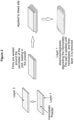
- For further facilitating the understanding of the present invention, two drawing figures are appended hereto.
-
Figure 1 shows a rendering of a multilayer device comprising a first soluble/degradable layer, a second powdered hemostatic agent layer, and a third soluble/degradable layer, and also shows after application of the device to a wound such that the first layer is in contact with the wound, the dissolution/degradation of the first layer to permit direct contact of the hemostatic agent with the wound and the subsequent dissolution/degradation of the third layer. -
Figure 2 shows a rendering of a multilayer device comprising a first soluble/degradable layer, a second powdered hemostatic agent layer, and a third non- soluble and non-degradable layer, and also shows after application of the device to a wound such that the first layer is in contact with the wound, the dissolution/degradation of the first layer to permit direct contact of the hemostatic agent with the wound and the subsequent removal of the third layer. - Advantageously, the multilayered hemostatic device of the disclosure allows for the precise, controlled delivery and application of flowable, powdered, hemostatic agents to a wound site in a manner which maximizes the utilization of the powdered hemostatic agent at the surgical site, without waste resulting from imprecise delivery or blowing away of the hemostatic agent from the site of delivery.
- As used herein, "powdered hemostatic agent" refers to a flowable, solid particulate material. "Powdered" and "particulate" may be used interchangeably herein.
- In embodiments, the powdered hemostatic agent is provided on the first layer in a repeating pattern. In embodiments, the perimeter edges of the first layer and third layer are sealed.
- The first layer is soluble under physiological conditions, such that the first layer will dissolve when in contact with a fluid from a wound. Physiological conditions encompass aqueous-based milieu having a temperature in a range of about 20 to about 40 °C and a pH of about 6 to about 8, and an atmospheric pressure of about 0.8 atm to about 1.2 atm and corresponding atmospheric oxygen concentrations. In embodiments, the first layer is degradable under physiological conditions, such that the first layer will degrade when in contact with a fluid from a wound. In embodiments, the third layer is degradable under physiological conditions, such that the third layer will degrade when in contact with a fluid from a wound. In embodiments, the third layer forms a gel under physiological conditions. In embodiments, the third layer is not-soluble and/or not-degradable under physiological conditions, such that the third layer will not dissolve or degrade when in contact with a fluid from a wound and, after application of the device to the wound and dissolution and/or degradation of the first layer, the second layer is disposed between a wound and the third layer when the hemostatic device is applied to the wound.
- The device of the disclosure comprises a first layer which is the wound-contacting layer. The first layer is soluble and/or degradable under physiological conditions, such that the first layer will dissolve and/or degrade when in contact with a fluid from a wound (e.g., blood and/or wound exudate). In embodiments, the first layer is rapidly soluble and/or degradable under physiological conditions and will dissolve and/or degrade after less than about 90 seconds of contact with a fluid from a wound, after less than about 60 seconds of contact with a fluid from a wound, or after less than about 30 seconds of contact with a fluid from a wound.
- The first layer comprises carboxymethyl cellulose and may be provided as a knitted, non-woven fabric, as a woven fabric, or as a soluble/degradable film. Other materials for use in addition to carboxymethyl cellulose include, but are not limited to, polyvinyl alcohols and modified polyvinyl alcohols, polyacrylates, water-soluble acrylate copolymers, polyvinyl pyrrolidone, pullulan, gelatin, hydroxylpropylmethyl cellulose (HPMC), polyethylene oxide, polyethylene glycols, low viscosity grade hydroxypropylcellulose, polysaccharides, water-soluble natural polymers including, but not limited to, guar gum, xanthan gum, locust bean gum, carrageenan, and starch, modified starches including, but not limited to, ethoxylated starch and hydroxypropylated starch, copolymers of the foregoing and combinations of any of the foregoing.
- Soluble/degradable films according to the present disclosure may include other optional additive ingredients including, but not limited to, plasticizers, surfactants, film formers, and other functional ingredients, for example in amounts suitable for their intended purpose.
- Suitable plasticizers may include glycerol, diglycerol, propylene glycol, ethylene glycol, diethylene glycol, triethylene glycol, tetraethylene glycol, polyethylene glycols up to MW 400, phthalate derivatives, including but not limited to, dimethyl phthalate, diethyl phthalate, and dibutyl phthalate, citrate derivatives, including but not limited to tributyl citrate, triethyl citrate, acetyl citrate, triacetin citrate, and castor oil.
- The first layer is soluble under physiological conditions, such that the first layer will dissolve when in contact with a fluid from a wound. In embodiments, the first layer is degradable under physiological conditions, such that the first layer will degrade when in contact with a fluid from a wound.
- The device of the disclosure comprises a second layer comprising a powdered hemostatic agent provided on the first layer. The second, powdered hemostatic agent layer may be a homogenous layer or a heterogeneous layer. In embodiments, the powdered hemostatic agent is provided on the first layer in a repeating pattern, for example, the powdered hemostatic agent can be deposited on the first layer as a pattern of discrete dots, as pattern of discrete columns or rows, or as a repeating pattern of other geometric shapes.
- As used herein, "hemostatic agent" refers to a material that exerts a passive or active mode of hemostatic action upon a bleeding wound.
- The powdered hemostatic agent is selected from the group consisting of fibrinogen, thrombin, fibrin monomers, gelatin, and mixtures of the foregoing. The powdered hemostatic agent may be a lyophilized hemostatic agent, such as lyophilized thrombin or lyophilized fibrinogen. In embodiments, the powdered hemostatic agent is selected from the group consisting of fibrinogen, thrombin, fibrin monomers, the combination of thrombin and gelatin, and mixtures of the foregoing. In embodiments, the powdered hemostatic agent comprises fibrinogen. In embodiments, the powdered hemostatic agent is fibrinogen. In embodiments, the powdered hemostatic agent comprises fibrin monomers. In embodiments, the powdered hemostatic agent is fibrin monomers. In embodiments, the powdered hemostatic agent comprises thrombin. In embodiments, the powdered hemostatic agent comprises thrombin and gelatin. In embodiments, the powdered hemostatic agent is thrombin. In embodiments, the powdered hemostatic agent is the combination of thrombin and gelatin.
- As used herein, "fibrin monomer" includes any form of fibrin, e.g., fibrin I, fibrin II, or des BB fibrin, wherein the fibrin is in monomeric form or oligomeric form that can be solubilized and can be converted to fibrin polymer. Fibrin oligomers are capable of being solubilized under physiological conditions whereas fibrin polymer is not soluble under physiological conditions.
- Other powdered/particulate hemostatic agents for use in addition to fibrinogen, thrombin, fibrin monomer, and gelatin include, but are not limited to, oxidized cellulose, chitosan, alginate, polysaccharides, ethyl cellulose beads and beads of other oxidized celluloses, maltodextrin, clotting factor concentrates, recombinant Factor Vila, alphanate FVIII concentrate, bioclate FVm concentrate, monoclate-P FVHI concentrate, haemate P FVIII, von Willebrand factor concentrate, helixate FVII concentrate, kogenate FVII concentrate, recombinate FVIII concentrate, mononine FIX concentrate, fibrogammin P FXIII concentrate, and combinations of the foregoing.
- The device of the disclosure comprises a third layer provided on the second layer, wherein the first layer and the third layer encapsulate the second layer. In embodiments, the third layer may be soluble and/or degradable under physiological conditions, such that the third layer will dissolve and/or degrade when in contact with a fluid from a wound. In embodiments, the third layer may be non-soluble and non-degradable under physiological conditions, such that the third layer will not dissolve or degrade when in contact with a fluid from a wound, even when the contact between the wound and the third layer is for an extended period of time, for example, a period of time greater than 5 minutes, 15 minutes, or even one hour. In embodiments, the third layer may form a gel under physiological conditions.
- The third layer comprises a material selected from the group consisting of gauze, oxidized cellulose, collagen, and mixtures of the foregoing. In embodiments, the third layer comprises gauze. In embodiments, the third layer is gauze. In embodiments, the third layer comprises oxidized cellulose. In embodiments, the third layer is oxidized cellulose. In embodiments, the third layer comprises collagen. In embodiments, the third layer is collagen. Optionally, the oxidized cellulose is oxidized regenerated cellulose.
- Suitable other materials for use in addition to gauze, oxidized cellulose, and collagen include, but are not limited to, silicone, keratin, gelatin, chitin, chitosan, polyvinyl pyrrolidone, alginate, cross-linked polyvinyl alcohol, and combinations of the foregoing.
- The third layer may also optionally include a pH modifier. Without intending to be bound by theory, it is believed that when the second layer comprises thrombin and the third layer comprises oxidized cellulose or oxidized regenerated cellulose, the acidic pH of the third layer may result in precipitation of fibrinogen from the wound before it has a chance to react with the thrombin to form a clot. Accordingly, without intending to be bound by theory, a pH modifier may be included in the third layer to provide the third layer with a neutral pH to avoid the precipitation of fibrinogen. Suitable pH modifiers include, but are not limited to, soda ash, sodium silicate, lime, sodium phosphate, and buffer compositions, for example, acetate buffers, citrate buffers, phosphate-buffered saline. pH modifiers can be provided in particulate form or can be coated on the third layer, for example, as a solution.
- The device of the disclosure may have any suitable configuration, including but not limited to, triangular, quadrilateral, such as square or rectangular, circular, oblong, pentagon, hexagon, and octagon, for example. In embodiments, at least the first layer and the third layer have a similar configuration such that the first layer and third layer have substantially parallel perimeter edges to facilitate encapsulation and sealing of the second layer between the first and third layers.
- The perimeter edges of the first layer and the third layer are sealed. The perimeter edges of the first layer and third layer may be sealed according to any suitable process known in the art, including but not limited to, solvent sealing and heat sealing.
- As shown in
Figure 1 andFigure 2 , the device of the disclosure may be disposed on a wound to provide a precise delivery and application of powdered hemostatic agents. Advantageously, after the device is applied such that the first layer is in contact with the wound, the first wound-facing layer readily dissolves and/or degrades such that the hemostatic agent of the second layer is subsequently disposed between, and in contact with, the wound and the third layer. The third layer may be selected such that it will not dissolve or degrade until hemostasis of the wound has occurred or such that it will not dissolve or degrade at all and will remain in place until hemostasis of the wound has occurred and the third layer is removed. - The rate of dissolution of the first layer under physiological conditions is greater than the rate of dissolution of the third layer under physiological conditions. Further, in embodiments, the third layer is not-soluble and/or not-degradable under physiological conditions and the second layer is disposed between a wound and the third layer after the hemostatic device is applied to the wound.
- In embodiments, when the hemostatic agent comprises fibrinogen, the third layer comprises collagen.
- The combinations provided in Table 1, below, are each particularly contemplated embodiments. In each of the combinations provided in Table 1, it is specifically contemplated that the first layer, second layer, and third layer may comprise the listed materials or may consist of the listed materials.
Table 1 First Layer Second Layer Third Layer 1 Carboxymethyl cellulose Thrombin and gelatin Oxidized cellulose 2 Carboxymethyl cellulose Thrombin and gelatin Gauze 3 Carboxymethyl cellulose Thrombin and gelatin Collagen 4 Carboxymethyl cellulose Fibrinogen Oxidized regenerated cellulose 5 Carboxymethyl cellulose Thrombin Oxidized regenerated cellulose 6 Carboxymethyl cellulose Fibrin monomers Oxidized regenerated cellulose
Claims (9)
- A multilayered hemostatic device comprising: A wound-contacting first layer comprising carboxymethyl cellulose, the first layer being soluble under physiological conditions, such that the first layer will dissolve when in contact with a fluid from a wound;a second layer comprising a flowable powdered hemostatic agent provided on the first layer, the hemostatic agent comprising one of fibrinogen, thrombin, fibrin monomers, or the combination of thrombin and gelatin; anda third layer comprising at least one of gauze, oxidized cellulose, or collagen provided on the second layer, wherein the first layer and the third layer encapsulate the second layer,wherein the first layer and the third layer have perimeter edges and the first layer and third layer are sealed along the perimeter edges; and wherein the rate of dissolution of the first layer under physiological conditions is greater than the rate of degradation of the third layer under physiological conditions.
- The multilayered hemostatic device of claim 1, wherein the powdered hemostatic agent is a solid particulate.
- The multilayered hemostatic device of claim 1 or claim 2, wherein the powdered hemostatic agent is provided on the first layer in a repeating pattern.
- The multilayered hemostatic device of claim 1, wherein the perimeter edges of the first layer and the third layer are heat sealed.
- The multilayered hemostatic device of any one of the preceding claims, wherein the third layer forms a gel under physiological conditions.
- The multilayered hemostatic device of any one of the preceding claims, wherein the third layer is not-soluble and/or not-degradable under physiological conditions and the second layer is disposed between a wound and the third layer when the hemostatic device is applied to the wound.
- The multilayered hemostatic device of any one of the preceding claims, wherein the oxidized cellulose is oxidized regenerated cellulose.
- The multilayered hemostatic device of any one of claims 1 to 7, wherein the third layer comprises oxidized regenerated cellulose, and the hemostatic agent comprises fibrinogen, preferably wherein the hemostatic agent is fibrinogen.
- The multilayered hemostatic device of any one of claims 1 to 7, wherein the third layer comprises oxidized regenerated cellulose, and the hemostatic agent comprises thrombin, preferably wherein the hemostatic agent is thrombin.
Applications Claiming Priority (2)
| Application Number | Priority Date | Filing Date | Title |
|---|---|---|---|
| US201762468797P | 2017-03-08 | 2017-03-08 | |
| PCT/US2018/021313 WO2018165275A1 (en) | 2017-03-08 | 2018-03-07 | Device for delivery of powdered hemostatic agents |
Publications (2)
| Publication Number | Publication Date |
|---|---|
| EP3592395A1 EP3592395A1 (en) | 2020-01-15 |
| EP3592395B1 true EP3592395B1 (en) | 2025-06-04 |
Family
ID=61692140
Family Applications (1)
| Application Number | Title | Priority Date | Filing Date |
|---|---|---|---|
| EP18712384.9A Active EP3592395B1 (en) | 2017-03-08 | 2018-03-07 | Device for delivery of powdered hemostatic agents |
Country Status (12)
| Country | Link |
|---|---|
| US (1) | US20200016292A1 (en) |
| EP (1) | EP3592395B1 (en) |
| JP (1) | JP2020509799A (en) |
| KR (1) | KR20190120244A (en) |
| CN (1) | CN110691614A (en) |
| AU (1) | AU2018230356A1 (en) |
| BR (1) | BR112019017884A2 (en) |
| CA (1) | CA3053646A1 (en) |
| ES (1) | ES3039757T3 (en) |
| MX (1) | MX2019010663A (en) |
| SG (1) | SG11201908061SA (en) |
| WO (1) | WO2018165275A1 (en) |
Families Citing this family (4)
| Publication number | Priority date | Publication date | Assignee | Title |
|---|---|---|---|---|
| EP3943126A4 (en) | 2019-03-20 | 2022-12-07 | Astellas Pharma Inc. | THROMBIN-LOADED HEMOSTATIC SHEET |
| WO2020261187A1 (en) * | 2019-06-28 | 2020-12-30 | Systagenix Wound Management, Limited | Multi-layered biopolymer film dressing to combat wound biofilm |
| CN112516377B (en) * | 2020-11-23 | 2022-05-27 | 铨丰科技(深圳)有限公司 | Collagen microfiber hemostatic material and preparation method and use method thereof |
| KR102494734B1 (en) * | 2022-02-21 | 2023-02-06 | 대가파우더시스템 주식회사 | Bio absorbable hydrogel hemostatic |
Family Cites Families (13)
| Publication number | Priority date | Publication date | Assignee | Title |
|---|---|---|---|---|
| JPH0136519Y2 (en) * | 1985-08-23 | 1989-11-07 | ||
| ITMI20041492A1 (en) * | 2004-07-23 | 2004-10-23 | Italiano Biochimico Far Maceut | NEW DEVICE FOR THE RELEASE OF ACTIVE PRINCIPLES |
| AU2006242246A1 (en) * | 2005-05-03 | 2006-11-09 | Innozen, Inc. | Edible film for transmucosal delivery of nutritional supplements |
| US7604819B2 (en) * | 2006-05-26 | 2009-10-20 | Z-Medica Corporation | Clay-based hemostatic agents and devices for the delivery thereof |
| MX2009006369A (en) * | 2006-12-15 | 2010-02-24 | Lifebond Ltd | Gelatin-transglutaminase hemostatic dressings and sealants. |
| JP2011507665A (en) * | 2007-12-31 | 2011-03-10 | アクラレント インコーポレイテッド | Mucosal tissue dressing and method of use |
| WO2010002435A2 (en) * | 2008-07-03 | 2010-01-07 | Kulinets Irina B | Hemostatic pouch and method to stabilize hemostatic components |
| WO2012133407A1 (en) * | 2011-03-28 | 2012-10-04 | 株式会社 資生堂 | Film-shaped externally used drug composition |
| US20130084323A1 (en) * | 2011-09-29 | 2013-04-04 | Jerome Riebman | Fenestrated hemostatic patch |
| US8697118B2 (en) * | 2011-10-18 | 2014-04-15 | St. Teresa Medical, Inc. | Stabilizers for hemostatic products |
| US10765774B2 (en) * | 2013-07-09 | 2020-09-08 | Ethicon, Inc. | Hemostatic pad assembly kit and method |
| CN103820411B (en) * | 2013-12-02 | 2016-05-04 | 华东师范大学 | The daily hemostasia products of a kind of glutamine of microbe transaminase and preparation thereof |
| CN106390177B (en) * | 2016-09-28 | 2020-07-14 | 深圳先进技术研究院 | A kind of chitosan-based multi-layer nanofiber film dressing and preparation method and application thereof |
-
2018
- 2018-03-07 BR BR112019017884-8A patent/BR112019017884A2/en not_active Application Discontinuation
- 2018-03-07 JP JP2019545302A patent/JP2020509799A/en active Pending
- 2018-03-07 CA CA3053646A patent/CA3053646A1/en active Pending
- 2018-03-07 AU AU2018230356A patent/AU2018230356A1/en not_active Abandoned
- 2018-03-07 KR KR1020197026277A patent/KR20190120244A/en not_active Withdrawn
- 2018-03-07 ES ES18712384T patent/ES3039757T3/en active Active
- 2018-03-07 SG SG11201908061SA patent/SG11201908061SA/en unknown
- 2018-03-07 WO PCT/US2018/021313 patent/WO2018165275A1/en not_active Ceased
- 2018-03-07 US US16/491,406 patent/US20200016292A1/en not_active Abandoned
- 2018-03-07 EP EP18712384.9A patent/EP3592395B1/en active Active
- 2018-03-07 MX MX2019010663A patent/MX2019010663A/en unknown
- 2018-03-07 CN CN201880014903.1A patent/CN110691614A/en active Pending
Also Published As
| Publication number | Publication date |
|---|---|
| US20200016292A1 (en) | 2020-01-16 |
| WO2018165275A1 (en) | 2018-09-13 |
| SG11201908061SA (en) | 2019-09-27 |
| MX2019010663A (en) | 2019-12-02 |
| CA3053646A1 (en) | 2018-09-13 |
| AU2018230356A1 (en) | 2019-10-24 |
| KR20190120244A (en) | 2019-10-23 |
| JP2020509799A (en) | 2020-04-02 |
| EP3592395A1 (en) | 2020-01-15 |
| ES3039757T3 (en) | 2025-10-24 |
| BR112019017884A2 (en) | 2020-05-12 |
| CN110691614A (en) | 2020-01-14 |
Similar Documents
| Publication | Publication Date | Title |
|---|---|---|
| US20250205383A1 (en) | Hemostatic sponge | |
| Wang et al. | Recent advances in hemostasis at the nanoscale | |
| Zhou et al. | Preparation and application of hemostatic hydrogels | |
| CN103957947B (en) | Use the bioabsorbable hemostasis device of polyethylene glycol binder | |
| JP5191736B2 (en) | Absorbable hemostat | |
| JP5734179B2 (en) | Hemostatic material | |
| US20200016292A1 (en) | Device for delivery of powdered hemostatic agents | |
| EP3500221B1 (en) | Collagen/orc dressing encapsulated within a bioresorbable envelope | |
| JP6968870B2 (en) | Hemostasis composition and method for producing the same | |
| JP2020503131A (en) | Antibacterial wound dressing | |
| JP2004174223A (en) | Tourniquet bandage for wound containing aldehyde-modified polysaccharides and hemostat | |
| EP3119443B1 (en) | Wound dressing | |
| KR102472705B1 (en) | Wound dressing | |
| TW201217005A (en) | Method of hydrogel sheet for wound | |
| AU2020325760B2 (en) | Expandable hemostat composed of oxidized cellulose | |
| EP3558325A1 (en) | Scaffold compositions for tissue repair | |
| CN108697829B (en) | Improved fibrinogen-based tissue adhesive patch | |
| RU2827960C1 (en) | Haemostatic solution, haemostatic product and method for obtaining thereof | |
| Ramana et al. | OVERVIEW OF SUPER ABSORBENT POLYMERS (SAPS) | |
| CN104436280A (en) | Composite material of potato starch system for stopping bleeding and preventing adhesion and preparation method thereof | |
| PL216818B1 (en) | Haemostatic laminar dressing and a method of manufacturing the haemostatic laminar dressing |
Legal Events
| Date | Code | Title | Description |
|---|---|---|---|
| STAA | Information on the status of an ep patent application or granted ep patent |
Free format text: STATUS: UNKNOWN |
|
| STAA | Information on the status of an ep patent application or granted ep patent |
Free format text: STATUS: THE INTERNATIONAL PUBLICATION HAS BEEN MADE |
|
| PUAI | Public reference made under article 153(3) epc to a published international application that has entered the european phase |
Free format text: ORIGINAL CODE: 0009012 |
|
| STAA | Information on the status of an ep patent application or granted ep patent |
Free format text: STATUS: REQUEST FOR EXAMINATION WAS MADE |
|
| 17P | Request for examination filed |
Effective date: 20190924 |
|
| AK | Designated contracting states |
Kind code of ref document: A1 Designated state(s): AL AT BE BG CH CY CZ DE DK EE ES FI FR GB GR HR HU IE IS IT LI LT LU LV MC MK MT NL NO PL PT RO RS SE SI SK SM TR |
|
| AX | Request for extension of the european patent |
Extension state: BA ME |
|
| DAV | Request for validation of the european patent (deleted) | ||
| DAX | Request for extension of the european patent (deleted) | ||
| STAA | Information on the status of an ep patent application or granted ep patent |
Free format text: STATUS: EXAMINATION IS IN PROGRESS |
|
| 17Q | First examination report despatched |
Effective date: 20201221 |
|
| GRAP | Despatch of communication of intention to grant a patent |
Free format text: ORIGINAL CODE: EPIDOSNIGR1 |
|
| STAA | Information on the status of an ep patent application or granted ep patent |
Free format text: STATUS: GRANT OF PATENT IS INTENDED |
|
| INTG | Intention to grant announced |
Effective date: 20250122 |
|
| GRAS | Grant fee paid |
Free format text: ORIGINAL CODE: EPIDOSNIGR3 |
|
| GRAA | (expected) grant |
Free format text: ORIGINAL CODE: 0009210 |
|
| STAA | Information on the status of an ep patent application or granted ep patent |
Free format text: STATUS: THE PATENT HAS BEEN GRANTED |
|
| AK | Designated contracting states |
Kind code of ref document: B1 Designated state(s): AL AT BE BG CH CY CZ DE DK EE ES FI FR GB GR HR HU IE IS IT LI LT LU LV MC MK MT NL NO PL PT RO RS SE SI SK SM TR |
|
| REG | Reference to a national code |
Ref country code: GB Ref legal event code: FG4D |
|
| REG | Reference to a national code |
Ref country code: CH Ref legal event code: EP |
|
| REG | Reference to a national code |
Ref country code: DE Ref legal event code: R096 Ref document number: 602018082378 Country of ref document: DE |
|
| REG | Reference to a national code |
Ref country code: IE Ref legal event code: FG4D |
|
| REG | Reference to a national code |
Ref country code: NL Ref legal event code: MP Effective date: 20250604 |
|
| PG25 | Lapsed in a contracting state [announced via postgrant information from national office to epo] |
Ref country code: FI Free format text: LAPSE BECAUSE OF FAILURE TO SUBMIT A TRANSLATION OF THE DESCRIPTION OR TO PAY THE FEE WITHIN THE PRESCRIBED TIME-LIMIT Effective date: 20250604 |
|
| REG | Reference to a national code |
Ref country code: LT Ref legal event code: MG9D |
|
| PG25 | Lapsed in a contracting state [announced via postgrant information from national office to epo] |
Ref country code: NO Free format text: LAPSE BECAUSE OF FAILURE TO SUBMIT A TRANSLATION OF THE DESCRIPTION OR TO PAY THE FEE WITHIN THE PRESCRIBED TIME-LIMIT Effective date: 20250904 Ref country code: GR Free format text: LAPSE BECAUSE OF FAILURE TO SUBMIT A TRANSLATION OF THE DESCRIPTION OR TO PAY THE FEE WITHIN THE PRESCRIBED TIME-LIMIT Effective date: 20250905 |
|
| PG25 | Lapsed in a contracting state [announced via postgrant information from national office to epo] |
Ref country code: PL Free format text: LAPSE BECAUSE OF FAILURE TO SUBMIT A TRANSLATION OF THE DESCRIPTION OR TO PAY THE FEE WITHIN THE PRESCRIBED TIME-LIMIT Effective date: 20250604 |
|
| PG25 | Lapsed in a contracting state [announced via postgrant information from national office to epo] |
Ref country code: BG Free format text: LAPSE BECAUSE OF FAILURE TO SUBMIT A TRANSLATION OF THE DESCRIPTION OR TO PAY THE FEE WITHIN THE PRESCRIBED TIME-LIMIT Effective date: 20250604 |
|
| PG25 | Lapsed in a contracting state [announced via postgrant information from national office to epo] |
Ref country code: HR Free format text: LAPSE BECAUSE OF FAILURE TO SUBMIT A TRANSLATION OF THE DESCRIPTION OR TO PAY THE FEE WITHIN THE PRESCRIBED TIME-LIMIT Effective date: 20250604 |
|
| PG25 | Lapsed in a contracting state [announced via postgrant information from national office to epo] |
Ref country code: RS Free format text: LAPSE BECAUSE OF FAILURE TO SUBMIT A TRANSLATION OF THE DESCRIPTION OR TO PAY THE FEE WITHIN THE PRESCRIBED TIME-LIMIT Effective date: 20250904 |
|
| REG | Reference to a national code |
Ref country code: ES Ref legal event code: FG2A Ref document number: 3039757 Country of ref document: ES Kind code of ref document: T3 Effective date: 20251024 |
|
| PG25 | Lapsed in a contracting state [announced via postgrant information from national office to epo] |
Ref country code: LV Free format text: LAPSE BECAUSE OF FAILURE TO SUBMIT A TRANSLATION OF THE DESCRIPTION OR TO PAY THE FEE WITHIN THE PRESCRIBED TIME-LIMIT Effective date: 20250604 |
|
| PG25 | Lapsed in a contracting state [announced via postgrant information from national office to epo] |
Ref country code: NL Free format text: LAPSE BECAUSE OF FAILURE TO SUBMIT A TRANSLATION OF THE DESCRIPTION OR TO PAY THE FEE WITHIN THE PRESCRIBED TIME-LIMIT Effective date: 20250604 |
|
| PG25 | Lapsed in a contracting state [announced via postgrant information from national office to epo] |
Ref country code: PT Free format text: LAPSE BECAUSE OF FAILURE TO SUBMIT A TRANSLATION OF THE DESCRIPTION OR TO PAY THE FEE WITHIN THE PRESCRIBED TIME-LIMIT Effective date: 20251006 |
|
| PG25 | Lapsed in a contracting state [announced via postgrant information from national office to epo] |
Ref country code: IS Free format text: LAPSE BECAUSE OF FAILURE TO SUBMIT A TRANSLATION OF THE DESCRIPTION OR TO PAY THE FEE WITHIN THE PRESCRIBED TIME-LIMIT Effective date: 20251004 |
|
| PG25 | Lapsed in a contracting state [announced via postgrant information from national office to epo] |
Ref country code: SM Free format text: LAPSE BECAUSE OF FAILURE TO SUBMIT A TRANSLATION OF THE DESCRIPTION OR TO PAY THE FEE WITHIN THE PRESCRIBED TIME-LIMIT Effective date: 20250604 |
|
| PG25 | Lapsed in a contracting state [announced via postgrant information from national office to epo] |
Ref country code: CZ Free format text: LAPSE BECAUSE OF FAILURE TO SUBMIT A TRANSLATION OF THE DESCRIPTION OR TO PAY THE FEE WITHIN THE PRESCRIBED TIME-LIMIT Effective date: 20250604 |
|
| PG25 | Lapsed in a contracting state [announced via postgrant information from national office to epo] |
Ref country code: EE Free format text: LAPSE BECAUSE OF FAILURE TO SUBMIT A TRANSLATION OF THE DESCRIPTION OR TO PAY THE FEE WITHIN THE PRESCRIBED TIME-LIMIT Effective date: 20250604 |
|
| PG25 | Lapsed in a contracting state [announced via postgrant information from national office to epo] |
Ref country code: RO Free format text: LAPSE BECAUSE OF FAILURE TO SUBMIT A TRANSLATION OF THE DESCRIPTION OR TO PAY THE FEE WITHIN THE PRESCRIBED TIME-LIMIT Effective date: 20250604 Ref country code: SK Free format text: LAPSE BECAUSE OF FAILURE TO SUBMIT A TRANSLATION OF THE DESCRIPTION OR TO PAY THE FEE WITHIN THE PRESCRIBED TIME-LIMIT Effective date: 20250604 |
|
| REG | Reference to a national code |
Ref country code: DE Ref legal event code: R097 Ref document number: 602018082378 Country of ref document: DE |
|
| PGFP | Annual fee paid to national office [announced via postgrant information from national office to epo] |
Ref country code: GB Payment date: 20260219 Year of fee payment: 9 |
|
| PLBE | No opposition filed within time limit |
Free format text: ORIGINAL CODE: 0009261 |
|
| STAA | Information on the status of an ep patent application or granted ep patent |
Free format text: STATUS: NO OPPOSITION FILED WITHIN TIME LIMIT |
|
| PG25 | Lapsed in a contracting state [announced via postgrant information from national office to epo] |
Ref country code: DK Free format text: LAPSE BECAUSE OF FAILURE TO SUBMIT A TRANSLATION OF THE DESCRIPTION OR TO PAY THE FEE WITHIN THE PRESCRIBED TIME-LIMIT Effective date: 20250604 |
|
| PGFP | Annual fee paid to national office [announced via postgrant information from national office to epo] |
Ref country code: DE Payment date: 20260219 Year of fee payment: 9 |
|
| PGFP | Annual fee paid to national office [announced via postgrant information from national office to epo] |
Ref country code: AT Payment date: 20260223 Year of fee payment: 9 |
|
| PGFP | Annual fee paid to national office [announced via postgrant information from national office to epo] |
Ref country code: IT Payment date: 20260219 Year of fee payment: 9 |
|
| REG | Reference to a national code |
Ref country code: CH Ref legal event code: L10 Free format text: ST27 STATUS EVENT CODE: U-0-0-L10-L00 (AS PROVIDED BY THE NATIONAL OFFICE) Effective date: 20260416 |
|
| 26N | No opposition filed |
Effective date: 20260305 |