EP3592017B1 - Verfahren und vorrichtung zur verarbeitung von berechtigungsinformationen für netzwerkverbindung und anwendung (app) - Google Patents
Verfahren und vorrichtung zur verarbeitung von berechtigungsinformationen für netzwerkverbindung und anwendung (app) Download PDFInfo
- Publication number
- EP3592017B1 EP3592017B1 EP18761355.9A EP18761355A EP3592017B1 EP 3592017 B1 EP3592017 B1 EP 3592017B1 EP 18761355 A EP18761355 A EP 18761355A EP 3592017 B1 EP3592017 B1 EP 3592017B1
- Authority
- EP
- European Patent Office
- Prior art keywords
- terminal
- certificate
- module
- certificate data
- credential information
- Prior art date
- Legal status (The legal status is an assumption and is not a legal conclusion. Google has not performed a legal analysis and makes no representation as to the accuracy of the status listed.)
- Active
Links
Images



Classifications
-
- H—ELECTRICITY
- H04—ELECTRIC COMMUNICATION TECHNIQUE
- H04W—WIRELESS COMMUNICATION NETWORKS
- H04W12/00—Security arrangements; Authentication; Protecting privacy or anonymity
- H04W12/06—Authentication
- H04W12/069—Authentication using certificates or pre-shared keys
-
- H—ELECTRICITY
- H04—ELECTRIC COMMUNICATION TECHNIQUE
- H04W—WIRELESS COMMUNICATION NETWORKS
- H04W12/00—Security arrangements; Authentication; Protecting privacy or anonymity
- H04W12/06—Authentication
- H04W12/068—Authentication using credential vaults, e.g. password manager applications or one time password [OTP] applications
-
- H—ELECTRICITY
- H04—ELECTRIC COMMUNICATION TECHNIQUE
- H04L—TRANSMISSION OF DIGITAL INFORMATION, e.g. TELEGRAPHIC COMMUNICATION
- H04L63/00—Network architectures or network communication protocols for network security
- H04L63/08—Network architectures or network communication protocols for network security for authentication of entities
- H04L63/0823—Network architectures or network communication protocols for network security for authentication of entities using certificates
-
- H—ELECTRICITY
- H04—ELECTRIC COMMUNICATION TECHNIQUE
- H04W—WIRELESS COMMUNICATION NETWORKS
- H04W12/00—Security arrangements; Authentication; Protecting privacy or anonymity
- H04W12/06—Authentication
-
- H—ELECTRICITY
- H04—ELECTRIC COMMUNICATION TECHNIQUE
- H04W—WIRELESS COMMUNICATION NETWORKS
- H04W12/00—Security arrangements; Authentication; Protecting privacy or anonymity
- H04W12/60—Context-dependent security
- H04W12/69—Identity-dependent
-
- H—ELECTRICITY
- H04—ELECTRIC COMMUNICATION TECHNIQUE
- H04W—WIRELESS COMMUNICATION NETWORKS
- H04W4/00—Services specially adapted for wireless communication networks; Facilities therefor
- H04W4/50—Service provisioning or reconfiguring
-
- H—ELECTRICITY
- H04—ELECTRIC COMMUNICATION TECHNIQUE
- H04W—WIRELESS COMMUNICATION NETWORKS
- H04W48/00—Access restriction; Network selection; Access point selection
- H04W48/08—Access restriction or access information delivery, e.g. discovery data delivery
-
- H—ELECTRICITY
- H04—ELECTRIC COMMUNICATION TECHNIQUE
- H04W—WIRELESS COMMUNICATION NETWORKS
- H04W48/00—Access restriction; Network selection; Access point selection
- H04W48/16—Discovering, processing access restriction or access information
-
- H—ELECTRICITY
- H04—ELECTRIC COMMUNICATION TECHNIQUE
- H04W—WIRELESS COMMUNICATION NETWORKS
- H04W88/00—Devices specially adapted for wireless communication networks, e.g. terminals, base stations or access point devices
- H04W88/02—Terminal devices
- H04W88/04—Terminal devices adapted for relaying to or from another terminal or user
-
- H—ELECTRICITY
- H04—ELECTRIC COMMUNICATION TECHNIQUE
- H04W—WIRELESS COMMUNICATION NETWORKS
- H04W84/00—Network topologies
- H04W84/02—Hierarchically pre-organised networks, e.g. paging networks, cellular networks, WLAN [Wireless Local Area Network] or WLL [Wireless Local Loop]
- H04W84/10—Small scale networks; Flat hierarchical networks
- H04W84/12—WLAN [Wireless Local Area Networks]
Definitions
- the present disclosure relates to the technical field of communications, and in particular to a credential information processing method and apparatus for network connection, and an application (APP).
- APP application
- the terminal When the terminal is to access the wireless network, it is usually required to provide credential information for networking to the wireless network.
- the terminal is allowed to access only when the credential information is verified correctly.
- the terminal may request, by using the network name and the connection password of the wireless network, to connect to the wireless network having the network name.
- the terminal is allowed to access the wireless network after the inputted connection password is verified successfully.
- WIFI wireless fidelity
- the wireless network provider needs to announce the credential information for connecting to the wireless network to the user of the terminal, and the user of the terminal needs to manually input the credential information on the terminal.
- a user X provides a wireless network at home, that is, the user X is a wireless network provider.
- the user Y comes to the home of the user X, and needs to connect the mobile phone of the user Y to the wireless network at home of the user X, the following operations are performed.
- the user X needs to tell the user Y the name and connection password of the wireless network, then the user Y opens "Settings" in the mobile phone, and selects and click the wireless network name of the user X from multiple wireless network names in "Settings". After the network connection interface appears, the user Y manually inputs the connection password for network connection.
- the connection password is complicated or lengthy, it is inconvenient to remember and cumbersome to enter for the user Y It can be seen that, on one hand, the user feels inconvenient to connect the terminal to the wireless network. On the other hand, the credential information of the wireless network is published, which may result in a potential security risk.
- a first mobile device establishes a first wireless connection with an infrastructure and a second wireless connection with a second mobile device.
- the first mobile device receives, from the second mobile device, a first certification request that includes a request for a digital certificate for the second mobile device and first biometric data associated with a user of the first mobile device.
- the first mobile device obtains second biometric data associated with a user of the second mobile device and conveys a second certification request to the infrastructure that includes the request for the digital certificate for the second mobile device and the first and second biometric data.
- the first mobile device then receives, from the infrastructure, the digital certificate for the second mobile device and forwards, to the second mobile device, the digital certificate.
- the technical problem to be solved by the present disclosure is to provide a credential information processing method, apparatus and an application APP, so that a terminal can obtain credential information of a wireless network without manual inputting by a user and can connect to the network by using the credential information.
- a terminal can obtain credential information of a wireless network without manual inputting by a user and can connect to the network by using the credential information.
- user networking operations are simplified, so as to avoid publishing of the credential information for networking, and improve the security of the wireless network.
- a credential information processing method for network connection which includes:
- a credential information processing apparatus for network connection is provided, which is applied in a first terminal and includes an application module.
- the application module is configured to send a first credential download request to a server in response to an instruction to apply a networking credential for a second terminal, receive first credential information sent by the server in a case that user identity verification is successful, where the received first credential information is in a system memory of the first terminal; and send the first credential information and a network identifier of a wireless network to be connected directly from the system memory of the first terminal to the second terminal.
- the first credential download request carries user identity information of the first terminal.
- the user identity information is used by the server to perform user identity verification on the first terminal;
- the first credential information is stored in a secure storage area of the second terminal and is used by the second terminal to connect to the wireless network having the network identifier.
- a credential information processing apparatus for network connection which is applied in a second terminal, and includes an application module, a storage module and a network connection module.
- the application module is configured to receive first credential information and a network identifier of a wireless network to be connected sent by a first terminal.
- the received first credential information is in a system memory of the second terminal.
- the first credential information is downloaded from a server and is sent to the second terminal by the first terminal in response to an instruction to apply a network credential for the second terminal.
- the storage module is configured to store the first credential information directly to a secure storage area of the second terminal from the system memory of the second terminal.
- the network connection module is configured to connect to the wireless network having the network identifier by using the first credential information in the secure storage area.
- an application APP is further provided, which is applied in a first terminal.
- the application APP includes an application module.
- the application module is configured to send a first credential download request to a server in response to an instruction to apply a networking credential for a second terminal, receive first credential information sent by the server in a case that user identity verification is successful, where the received first credential information is in a system memory of the first terminal; and send the first credential information and a network identifier of a wireless network to be connected directly from the system memory of the first terminal to the second terminal.
- the first credential download request carries user identity information of the first terminal.
- the user identity information is used by the server to perform user identity verification on the first terminal;
- the first credential information is stored in a secure storage area of the second terminal and is used by the second terminal to connect to a wireless network having the network identifier.
- an application APP is further provided, which is applied in a second terminal.
- the application APP includes an application module.
- the application module is configured to receive first credential information and a network identifier of a wireless network to be connected sent by a first terminal, and the received first credential information is in a system memory of the second terminal, and the first credential information is downloaded from a server and sent to the second terminal by the first terminal in response to an instruction to apply a networking credential for the second terminal.
- the application module is configured to call a storage module of the second terminal to store the first credential information directly to a secure storage area of the second terminal from the system memory of the second terminal.
- the application module is further configured to call a network connection module of the second terminal to connect to the wireless network having the network identifier by using the first credential information stored in the secure storage area.
- the present disclosure has the following advantages: according to the technical solutions of the embodiments of the present disclosure, when a second terminal needs to connect to the wireless network by using the credential information, a first terminal having the certificate application authority of the wireless network can request the server to download the credential information for connecting to the wireless network, and send the credential information and the network identifier of the wireless network to the second terminal, so that the second terminal can obtain the credential information and the network identifier of the wireless network without manual inputting, and connect to the wireless network having the network identifier by using the credential information.
- a wireless network provider needs to inform a user of the terminal of credential information for connecting to the wireless network, and the terminal can be connected to the wireless network after the user of the terminal manually inputs or installs the credential information on the terminal.
- the user needs to memorize the credential information (such as a password) for connecting to the wireless network, and manually input the credential information into a wireless network connection interface of the terminal, and thus the user operation is cumbersome.
- the wireless network provider needs to announce the credential information for networking to other users who use a terminal to connect to the wireless network, and the credential information is leaked with a great probability when being announced.
- the credential information is obtained by a malicious user, the malicious user may attack the wireless network. It can be seen that there is a potential risk in the security of the wireless network.
- the wireless network provider uses a first terminal
- the first terminal has the certificate application authority of the wireless network. That is, user identity information provided by the first terminal can be successfully verified by a server, and thus the credential information for networking can be downloaded from the server.
- the wireless network provider requests the server to download the credential information for networking by using the first terminal, and sends a network identifier of the wireless network and the credential information for networking to the second terminal, so that the second terminal can obtain the network identifier of the wireless network and the credential information without manual inputting, and connect to the wireless network having the network identifier by using the credential information.
- the networking operation is simplified, and the wireless network provider does not need to announce the credential information to the user using the second terminal to connect to the network, thereby avoiding the publishing of the credential information for networking, reducing a possibility that the malicious user obtains the credential information and attacks the wireless network due to the leakage of the credential information, and improving the security of the wireless network.
- a first terminal 110 may interact with a server 130 through a wireless access point AP (also referred to as a wireless router), and the first terminal 110 may interact with a second terminal 120.
- the first terminal 110 may include an application module 111, a certificate management module 112, a storage module 113 and a network connection module 114.
- the second terminal 120 may for example include an application module 121, a certificate management module 122, a storage module 123 and a network connection module 124.
- the first terminal 110 may include only an application module 111.
- the application module 111 may send a first certificate download request to the server in response to an instruction to apply a networking credential for other terminal (referring to a second terminal in the embodiment of the present disclosure).
- the instruction to apply the networking credential for other terminal may be generated by the first terminal 110, or may be generated by the second terminal 120 and sent to the first terminal 110 through the application module 121.
- the first credential download request carries the user identity information provided by the first terminal 110.
- the server 130 may perform user identity verification on the first terminal 110 based on the user identity information, and send first credential information to the first terminal 110 if the user identity verification of the first terminal 110 is successful.
- the first terminal 110 may receive the first credential information through the application module 111 and send the first credential information and a network identifier of a wireless network to be connected to the second terminal 120.
- the second terminal 120 may include only an application module 121, a storage module 123 and a network connection module 124.
- the second terminal 120 receives the first credential information and the network identifier through the application module 121, stores the first credential information in a secure storage area of the second terminal 120 by the storage module 123, and connects to the wireless network having the network identifier by using the first credential information stored in the secure storage area of the second terminal 120 through the network connection module 124.
- the network identifier may be manually inputted by the wireless network provider on a sending interface where the first terminal 110 sends the first credential information to the second terminal 120.
- the network identifier may be generated by default by the first terminal 110 on the sending interface where the first terminal 110 sends the first credential information to the second terminal 120.
- the sending interface is displayed on the first terminal 110.
- the application module 111 of the first terminal 110 may further send a second credential download request to the server in response to an instruction to apply a networking credential for the terminal (referring to the first terminal in the embodiment of the present disclosure).
- the second credential download request carries the user identity information provided by the first terminal 110.
- the first terminal 110 includes a storage module 113 and a network connection module 114, in addition to the application module 111.
- the server 130 performs user identity verification on the first terminal 110 based on the user identity information, and sends the second credential information to the first terminal 110 if the user identity verification of the first terminal 110 is successful.
- the first terminal 110 receives the second credential information through the application module 111, stores the second credential information in a secure storage area of the first terminal 110 through the storage module 113, and connects to the wireless network by using the second credential information in the secure storage area of the first terminal 110 through the network connection module 114.
- the credential information for connecting to the wireless network may be a network connection password, which is generally applicable to a WIFI network environment, and is also applicable to a network environment of a WAPI pre-shared key type.
- the network provider does not need to announce the credential information for networking (such as a network connection password) to the user of the second terminal when the second terminal is to connect to the wireless network, thereby avoiding the potential risk to the wireless network security caused by leakage of the credential information.
- the user of the second terminal can complete the network connection without manually inputting the credential information for networking (such as the network connection password) on the second terminal, thereby improving the convenience of the terminal networking.
- the second terminal 120 may further include a certificate management module 122, in addition to the application module 121, the storage module 123, and the network connection module 124.
- the certificate management module 122 may be configured to name the certificate data according to a certificate identifier set for the certificate data before the first certificate information is stored in the secure storage area of the second terminal 120, and call the storage module 123 to store the named certificate data in the secure storage area of the second terminal 120.
- the first terminal 110 may further include a certificate management module 112, in addition to the application module 111, the storage module 113, and the network connection module 114.
- the certificate management module 112 may be configured to name the certificate data according to the certificate identifier set for the certificate data before the second certificate information is stored in the secure storage area of the first terminal 110, and call the storage module 113 to store the named certificate data in the secure storage area of the first terminal 110.
- the application module 111 In the first terminal 110, the application module 111 generally runs in an application layer, and the certificate management module 112, the storage module 113 and the network connection module 114 run in a system layer.
- the application module 121 In the second terminal 120, the application module 121 generally runs in the application layer, and the certificate management module 122, the storage module 123, and the network connection module 124 run in the system layer.
- the module may be built in the terminal when the terminal leaves the factory, or may be acquired by the user from the outside and installed in the terminal after the terminal leaves the factory.
- the application module 111 or the application module 121 may run in the terminal as a third-party application (APP), that is, the third-party application APP including the application module 111 or the application module 121 may be installed in the terminal to facilitate the terminal to execute networking operations.
- APP third-party application
- the application module 111 and the application module 121 may also run in the system layer, and the application module 111 and the application module 121 running in the system layer are built in the terminal when the terminal leaves the factory.
- the module running in the application layer may be acquired from the outside and installed in the terminal by the user, or may be uninstalled from the terminal by the user; the module running in the system layer is built in the terminal system, and cannot be uninstalled by the user. Moreover, the modules running in the system layer have different operating rights.
- Figure 1 illustrates only one example in which the embodiments of the present disclosure may be implemented. The scope of the embodiments of the present disclosure is not limited by Figure 1 .
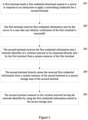
- Figure 2 shows a schematic flowchart of a credential information processing method for network connection according to an embodiment of the present disclosure.
- the method includes the following steps 201 to 205.
- a first terminal sends a first credential download request to a server in response to an instruction to apply a networking credential for a second terminal.
- the first credential download request carries user identity information of the first terminal, and the user identity information is used by the server to perform user identity verification on the first terminal.
- a credential download interface provided by the first terminal includes two operation options: "Apply Networking Credential for This Terminal” and "Apply Networking Credential for Other Terminal".
- the wireless network provider may select the operation option of "Apply Networking Credential for Other Terminal” on the credential download interface, and then trigger an instruction to apply for a networking credential for other terminal, which refers to the instruction to apply for a networking credential for the second terminal in the embodiment of the present disclosure.
- the wireless network provider may input a user name and a password as the user identity information of the first terminal, and may also input an Internet Protocol (IP) address and a port number of the server.
- IP Internet Protocol
- the wireless network provider may select the operation option of "Apply Networking Credential for This Terminal” or “Apply Networking Credential for Other Terminal”.
- the wireless network provider selects the operation option of "Apply Networking Credential for Other Terminal” on the credential download interface.
- the first terminal Based on the operation of the wireless network provider on the credential download interface, the first terminal generates a first certificate download request carrying the user identity information and sends the request to the server.
- the server may obtain the user identity information and perform user identity verification on the first terminal according to the user identity information.
- the server may verify the user identity of the first terminal as follows. For example, the server verifies whether the user name and password are legal and match with each other. If the user name and password are legal and match with each other, the user identity verification of the first terminal is successful.
- step 202 the first terminal receives the first credential information sent by the server in a case that the user identity verification of the first terminal is successful.
- the server may generate or acquire (for example, acquire from a certificate issuing server) the first credential information and send the first credential information to the first terminal, and thus the first terminal receives the first credential information sent by the server.
- the server may generate or obtain the first credential information based on a verification result of the user identity information of the first terminal.
- the first credential information may be encrypted during transmission between the first terminal and the server.
- Step 202 may include that: the first terminal receives first encrypted information sent by the server in a case that the user identity verification of the first terminal is successful; and the first terminal decrypts the first encrypted information to obtain the first credential information.
- the first encrypted information is obtained by encrypting the first credential information by the server.
- the first credential information may be encrypted by any feasible encryption method, and the encryption method is not limited in the present embodiment.
- the terminal when a terminal receives a certificate or a file, the certificate or file is stored in the terminal; and when the certificate or file needs to be sent to other terminals, the terminal obtains the certificate or file from a local storage location for transmission. Practically, there may be an unsecure application in the first terminal, and the security of the wireless network may be threatened if the unsecure application obtains the first credential information from the first terminal. In order to prevent the first credential information from being leaked in the first terminal, in some embodiments, after receiving the first credential information, the first terminal may send the first credential information directly from a system memory of the first terminal to the second terminal without storing the first credential information in other storage locations in the first terminal.
- the first credential information is temporarily stored in the traditional storage location in the first terminal, the first credential information may be read or duplicated by the unsecure application in the first terminal.
- the first credential information is directly sent from the system memory of the first terminal to the second terminal, the unsecure application in the first terminal can be prevented from reading or duplicating the first credential information. Therefore, the security of the first credential information can be better protected.
- the second terminal receives the first credential information and a network identifier of a wireless network to be connected directly sent by the first terminal from the system memory of the first terminal.
- the first terminal may prompt the wireless network provider through the credential sending interface.
- the wireless network provider may trigger a sending instruction carrying the network identifier and the first credential information on the credential sending interface provided by the first terminal.
- the first terminal sends the network identifier and the first credential information to the second terminal in response to the sending instruction.
- the network identifier of the wireless network may be a network identifier set by default, and the first terminal obtains the network identifier and provides the network identifier on the credential sending interface.
- the network identifier may be manually inputted by the wireless network provider on the credential sending interface.
- the wireless network provider sends the network identifier of the wireless network to the second terminal together with the first credential information by using the first terminal, so that the second terminal may directly and automatically select the wireless network having the network identifier when connecting to the wireless network by using the first credential information.
- the user of the second terminal does not need to manually click and select the wireless network having the network identifier from multiple wireless network names on the second terminal (for example, in the "setting" of the second terminal), and then perform the wireless network connection.
- the network identifier of the wireless network may be a display name of the wireless network.
- the network identifier of the wireless network may be a Service Set Identifier (SSID) of the wireless network.
- SSID Service Set Identifier
- the first terminal may send the first credential information to the second terminal by using a technology of point-to-point wireless communication without networking.
- the first terminal may send the first credential information to the second terminal by using a near field communication (NFC) technology
- the second terminal may receive the first credential information sent by the first terminal by using the near field communication (NFC) technology.
- the first credential information is transmitted by the NFC technology, and the first terminal and the second terminal can transmit the first credential information only by getting close to each other.
- the first credential information may be transmitted between the first terminal and the second terminal by using other technologies of point-to-point wireless communication, such as the Bluetooth technology.
- the credential information can be sent only after the connection is successful.
- the credential information can be transmitted as long as the terminals get close to each other. Therefore, it is more convenient and faster to transmit the credential information by using the NFC technology.
- the NFC technology for transmission a distance between terminal devices is short, and the terminal devices need to get close to each other, so the credential information is not easily intercepted during the transmission, and the transmission process is relatively safe.
- the credential information is transmitted between the terminals by using the NFC technology.
- the embodiments of the present disclosure do not limit the way in which the credential information is transmitted, and the credential information may also be transmitted by adopting other technologies of point-to-point wireless communication, such as Bluetooth technology.
- step 204 the second terminal directly stores the received first credential information from the system memory of the second terminal to a secure storage area of the second terminal.
- the second terminal may directly store the first credential information from the system memory of the second terminal to the secure storage area of the second terminal without temporarily storing the first credential information in other traditional storage locations in the second terminal.
- the first credential information is temporarily stored in the traditional storage location in the second terminal, the first credential information may be read or duplicated by the unsecure application in the second terminal.
- the first credential information is directly stored to the secure storage area of the second terminal from the system memory of the second terminal, the unsecure application in the second terminal can be prevented from reading or duplicating the first credential information. Therefore, the security of the first credential information can be better protected.
- the secure storage area may be different from the traditional hard disk storage, and the secure storage area may be a separate storage area in the terminal.
- the credential information is not stored in a form of file, but the credential information can only be stored in a form of data. Therefore, a file management tool with a file scanning function (for example, an RE file manager, and an ES file browser) cannot view the credential information by scanning, so the data stored in the area is invisible to the user and cannot be copied.
- the storage area can only be accessed by using a specific interface provided by the system, and any API related to file operations cannot access the storage area.
- the secure storage area may also be non-hardware, such as the keystore of an Android system, and a system storage area of a Windows system.
- a hardware security chip may be used to implement the function of the secure storage area. Since the first credential information is stored in the secure storage area, the first credential information cannot be scanned by the file management tool, and cannot be accessed by the API related to the file operation, thereby preventing the first credential information from being leaked in the second terminal. In this way, the security of the first credential information is better protected.
- the secure storage area described above not only refers to the secure storage area of the second terminal, and the secure storage area of the first terminal also has the same function.
- the first credential information may be encrypted and then stored in the secure storage area.
- the second terminal reads the encrypted first credential information from the secure storage area, the encrypted first credential information is required to be decrypted, and then the wireless network is connected by using the decrypted first credential information.
- step 205 the second terminal connects to the wireless network having the network identifier by using the first credential information in the secure storage area.
- the second terminal after receiving the network identifier and the first credential information, can determine the wireless network having the network identifier and send a connection request to an access point of the wireless network, so as to be connected to the wireless network through the access point of the wireless network.
- the mentioned wireless network may be any feasible wireless communication technology.
- Wireless networks of different wireless communication technologies correspond to different kinds of credential information, so the credential information mentioned in the present embodiment may have multiple types.
- the first credential information may be WAPI certificate data.
- the wireless network adopts a WIFI mode and an encryption mode is WPA/WPA2PSK
- the first credential information may be a password.
- the wireless network adopts the WIFI mode and the encryption mode is 802.1 ⁇ EAP
- the first credential information may include CA certificate data and other credential parameters.
- the other credential parameters for example include a specific EAP method (such as PEAP, TLS, TTLS, PWD), phase 2 identity authentication (such as MSCHAPV2, GTC), identity, anonymous identity, and password.
- the first credential information may be processed in different manners when the first terminal connects to the wireless network.
- the second terminal may directly store the credential information itself and connect to the wireless network by using the credential information itself, or the second terminal may directly connect to the wireless network by using the credential information itself.
- the second terminal may install the certificate, that is, store the certificate data, and connect to the wireless network by using the certificate data.
- the first certificate information includes the certificate data
- the second terminal may name the certificate data according to the certificate identifier set for the certificate data before storing the first certificate information in the secure storage area of the second terminal in step 204.
- the named certificate data is stored in the secure storage area of the second terminal.
- the wireless network having the network identifier is connected by using the certificate data in the secure storage area.
- the certificate data may be WAPI certificate data corresponding to the WAPI networking mode, or may be WIFI certificate data corresponding to the WIFI networking mode.
- a certificate used by a wireless network for networking usually includes a set of certificates containing multiple pieces of certificate data.
- the WAPI certificate data for networking refers to a set of WAPI certificate data.
- a set of WAPI certificate data in the embodiment of the present disclosure includes user certificate data, issuer certificate data, and a user private key.
- the second terminal may name a set of WAPI certificate data, that is, setting a certificate name, i.e., a certificate identifier, for the WAPI certificate data. After the naming process is performed, the user certificate data, the issuer certificate data, and the user private key in the WAPI certificate data share the same certificate identifier.
- the user certificate data is set to be "WAPI_USRCERT_NAME1”
- the issuer certificate data is set to be "WAPI_CACERT_NAME1”
- the user private key is set to be "WAPI_USRPKEY_NAME1”.
- the names of the three pieces of certificate data in a set of WAPI certificate data each include the certificate identifier "NAME1”. Therefore, when searching for WAPI certificate data subsequently, the second terminal only needs to find the certificate identifier "NAME1", thereby obtaining a complete set of WAPI certificate data.
- the certificate identifier may be an identifier set by the user.
- the user may input the certificate identifier on the certificate naming interface provided by the second terminal and trigger the installation of the certificate.
- the second terminal names the certificate data according to the inputted certificate identifier.
- the certificate identification may be automatically assigned or generated by the second terminal.
- the second terminal may display the certificate identifier automatically assigned or generated to the user, and automatically trigger the installation of the certificate after naming the certificate data according to the certificate identifier automatically assigned or generated.
- the second terminal may connect to the wireless network by using the certificate data under a manual operation of the user, that is, a manual connection mode.
- the second terminal may automatically connect to the wireless network by using the certificate data, that is, an automatic connection mode.
- the certificate data to be used may be found by the second terminal based on the certificate identifier selected manually by the user.
- the network connection mode in step 205 includes that: the second terminal enumerates the certificate identifiers of all certificate data in the secure storage area in response to the manual connection instruction, reads the corresponding certificate data based on the certificate identifier selected manually by the user, and connects to the wireless network by using the read certificate data.
- the certificate data to be used may be found automatically by the second terminal.
- the network connection mode in step 205 includes that, in response to the automatic connection instruction, the second terminal searches the secure storage area for the certificate data for connecting to the wireless network, and connects to the wireless network by using the found certificate data.
- the second terminal when the second terminal searches the secure storage area for the certificate data for networking, the second terminal first needs to read all the WAPI certificate data in the secure storage area and store the data in the memory temporarily, and then associates with the external wireless access point AP. After receiving the authentication activation packet sent by the AP, the second terminal obtains a field of "local ASU (Authentication Service Unit) identity" in the packet, then traverses all the WAPI certificate data previously read, obtains "holder name", "issuer name” and “serial number” from the issuer certificate data in each set of WAPI certificate data, and use the three pieces of information to constitute "identity” information. In a case that it is determined that the "identity" information from a certain set of WAPI certificate data matches the "local ASU identity” field in the authentication activation packet, the set of WAPI certificate data is used for network connection.
- local ASU Authentication Service Unit
- the second terminal needs to first read the certificate data in the secure storage area and temporarily store the data in the memory. After obtaining the "local ASU identity” field in the authentication activation packet, the second terminal traverses the certificate data from the memory to obtain the "identity” information, thereby greatly reducing the time spent, and thus avoiding the failure of the authentication activation packet.
- the second terminal 120 may cooperate with other modules by using the certificate management module 122 to store and use the certificate data.
- the application module 121 may call the certificate installation interface of the certificate management module 122 and provide interface parameters of the certificate installation interface.
- the interface parameters may include user certificate data, issuer certificate data, and a user private key in the WAPI certificate data.
- the certificate installation interface of the certificate management module 122 opens the certificate naming interface and displays a default certificate identifier on the certificate naming interface. Alternatively, the user may modify the certificate identifier on the certificate naming interface.
- the certificate installation interface of the certificate management module 122 After the certificate installation interface of the certificate management module 122 obtains the user certificate data, the issuer certificate data, and the user private key from the interface parameters, the user certificate data, the issuer certificate data and the user private key are named according to the default certificate identifier or the certificate identifier inputted on the certificate naming interface. Then the certificate management module 122 calls the storage module 123, and the storage module 123 stores the named certificate data in the secure storage area according to naming rules of the certificate management module 122, thereby completing the certificate installation process.
- the network connection module 124 calls a certificate enumeration interface of the certificate management module 122 to enumerate and present the certificate identifiers of all certificate data in the secure storage area. After the user selects the target certificate identifier, the network connection module 124 calls the storage module 123 to search the secure storage area for the certificate data that matches the target certificate identifier, and then the network connection module 124 connects to the wireless network based on the wireless network driver and using the found certificate data.
- the certificate naming interface is provided by the certificate management module 122 running in the system layer, rather than the application module 121 running in the application layer.
- the certificate naming interface provided by the certificate management module of the system layer usually cannot be controlled and operated maliciously by the unsafe application of the application layer, thereby avoiding that the unsafe application of the application layer maliciously inputs the name on the naming interface to perform the operation of certificate installation or certificate deletion.
- the compatibility with WAPI can be achieved by modifying the original WLAN network configuration interface of Android (including modifying the WifiConfiguration class and its subclass KeyMgmt), and manual connection and automatic connection are provided.
- Some member variables may be added under the WifiConfiguration class, including wapiPskType, wapiPsk, wapiCertSelMode, and wapiCertSel.
- wapiPskType is used to describe a key type of WAPI pre-shared key
- wapiPsk is used to describe the content of WAPI pre-shared key
- wapiCertSelMode is used to describe the selection mode of the WAPI certificate
- wapiCertSel is used to describe the certificate identifier of the WAPI certificate selected in a manual mode.
- wapiCertSelMode and wapiCertSel are adopted in the case of using the WAPI certificate to connect to the network
- wapiPskType and wapiPsk are adopted in the case of using the key to connect to the network.
- WAPI_PSK and WAPI_CERT may be added under the KeyMgmt class to describe the definition of the WAPI pre-shared key type and the definition of the WAPI certificate type respectively.
- the network connection module needs to implement two different networking modes, i.e., automatic connection and manual connection, for the key mode, some new member variables needs to be added under the WifiConfiguration class, including a member variable describing the key selection mode and a member variable describing the identity of the key selected in the manual mode.
- modules calling the storage module 123 run with different user identities. Different user identities correspond to different operation rights.
- a module which runs as a system user, can install a certificate for the terminal, can delete the certificate data installed in the terminal, and can enumerate the certificate identifiers, but cannot read the certificate data in the terminal.
- a module which runs as a wlan user, can read the certificate data and obtain the certificate identifier of the certificate in the terminal.
- the certificate management module 122 runs as a system user
- the network connection module 124 runs as a wlan user.
- the certificate management module 122 can call the storage module 123 to install the certificate data for the terminal, can call the storage module 123 to delete the certificate data installed in the terminal and enumerate the certificate identifiers, but cannot call the storage module 123 to read the certificate data in the terminal.
- the network connection module 124 can call the storage module 123 to read the certificate data and the certificate identifier in the terminal, but cannot call the storage module 123 to delete or install the certificate data.
- a certificate installation interface, a certificate deletion interface and a certificate identifier enumeration interface of the certificate management module 122 may be designed according to the Intent mechanism of the Andriod system. Specifically, an Activity may be preset in the system, and a related Intent Action is defined.
- the related Intent Action includes: "com.wapi.certificate.INSTALL" for installing the WAPI certificate data, "com.wapi.certificate.GET_ALIASES” for enumerating the certificate identifiers, and "com.wapi.certificate.DELETE” for deleting the WAPI certificate data.
- the application module 121 or the application APP with a built-in application module 121 may send a corresponding Intent Action to the preset Activity in the system, and the Activity performs the operation of installing the certificate data, deleting the certificate data, or enumerating the certificate identifiers according to the corresponding Intent Action.
- the application module 121 or the application APP with the built-in application module 121 sends relevant parameters by using the putExtra function of the Intent, and the preset Activity in the system acquires the parameters sent by the application module 121 or the application APP with the built-in application module 121 through the getExtras function of the Intent.
- the definition of relevant parameters is shown in Table 1.
- step 1 the Bundle object is obtained through the getExtras function of the Intent, and then relevant parameters are obtained from the Bundle object.
- step 2 it is determined whether the set of WAPI certificate data to be installed matches (that is, determining whether the issuer certificate data and the user certificate data belong to one set). If the data does not match, the installation fails. A corresponding return value is set by the setResult function of the Activity. If the data matches, the Activity pops up an interactive interface, that is, the certificate naming interface, for the user to customize an alias for the set of certificate data, that is, the certificate identifier (the interactive interface displays a default alias carried in the Intent parameter transmitted from the application module 121 or the application APP with the built-in application module 121, and the user may choose to directly use the default alias).
- the Activity determines whether the certificate identifier is duplicate with the alias of the installed certificate data. If the certificate identifier is duplicate with the alias of the installed certificate data, the user is prompted to re-edit.
- step 3 after the Activity obtains the certificate identifier finally confirmed by the user through the interactive interface, the operation of installing the WAPI certificate is performed. Then the corresponding return value is set by the setResult function of the Activity, to notify the application module 121 or the application APP with the built-in application module 121 of an installation result of the WAPI certificate data.
- the return value set by the setResult function is defined as follows. A return value 1 represents that the installation is successful, and a return value 0 represents that the installation fails.
- step 1 the Bundle object is obtained through the getExtras function of the Intent, and then the relevant parameters are obtained from the Bundle object.
- step 2 it is determined whether the alias (that is, the certificate identifier) of the WAPI certificate data to be deleted is in an alias list of the installed certificate data. If the alias is not in the alias list, the deletion operation fails. A corresponding return value is set by the setResult function of the Activity. If the alias is in the alias list, the Activity pops up an interactive interface, allowing the user to confirm whether to delete the set of certificate data. After the user confirms to delete, the deletion operation is performed. The corresponding return value is set by the setResult function of the Activity, to notify the application module 121 or the application APP with the built-in application module 121 of a deletion result of the WAPI certificate data.
- the return value set by the setResult function is defined as follows. A return value 1 represents that the deletion is successful, and a return value 0 represents that the deletion fails.
- step 1 "certificate identifier array” is returned to a caller through the putExtra function of the Intent.
- the parameter format is shown in Table 2.
- step 2 the return value is set by the setResult function, and is defined as follows.
- a return value 1 represents that the enumeration is successful, and a return value 0 represents that the enumeration fails.
- Table 2 Intent Action name Value and its type Explanation of Value com.wapi.certificate.GET_ALIASES ALIASES String[] certAliasArray An array of identifiers for installed certificates
- the first terminal having the credential application authority of the wireless network may request the server to download credential information of the wireless network and send the credential information to the second terminal.
- the second terminal can obtain the credential information of the wireless network without manual inputting by the user.
- the credential information (that is, the certificate data) may be named by using the default name generated by the terminal, the certificate may be automatically installed by the terminal, and the terminal automatically searches for the certificate data for networking and automatically connects to the network.
- the first terminal 110 may cooperate with other modules by using the certificate management module 112, to store and use the certificate data.
- the storage and use of the certificate data by the first terminal 110 is described above, the second terminal 120 stores and uses the certificate data in the same mode.
- the first terminal 110 and the second terminal 120 adopt the same design mechanism for the certificate management module, the storage module, and the network connection module, and details are not described herein again.
- FIG. 3 is a schematic structural diagram of a credential information processing apparatus for network connection according to an embodiment of the present disclosure.
- the apparatus is applied in the first terminal.
- the apparatus may include an application module 301.
- the application module 301 is configured to send a first credential download request to a server in response to an instruction to apply a networking credential for a second terminal, receive first credential information sent by the server in a case that user identity verification is successful, and send the first credential information and a network identifier of a wireless network to be connected directly from a system memory of the first terminal to the second terminal.
- the application module 301 is configured to send a second credential download request to the server in response to an instruction to apply a networking credential for the first terminal, and receive second credential information sent by the server in a case that the user identity verification is successful.
- the first credential download request or the second credential download request carries the user identity information of the first terminal, and the user identity information is used by the server to perform user identity verification on the first terminal.
- the first credential information is used by the second terminal to connect to the wireless network having the network identifier, and the second credential information is used by the first terminal to connect to the wireless network.
- the application module 301 is further configured to send the first credential information and the network identifier to the second terminal by using a technology of point-to-point wireless communication without networking.
- the apparatus may further include a storage module 303, and a network connection module 304.
- the storage module 303 is configured to store the second credential information directly from the system memory of the first terminal to the secure storage area of the first terminal.
- the network connection module 304 is configured to connect to the wireless network by using the second credential information stored in the secure storage area.
- the second credential information includes certificate data.
- the apparatus further includes a certificate management module 302 as shown in Figure 5 .
- the certificate management module 302 is configured to name the certificate data according to the certificate identifier set for the certificate data before the second certificate information is stored directly from the system memory of the first terminal to the secure storage area of the first terminal, and call the storage module 303 to store the named certificate data directly from the system memory of the first terminal to the secure storage area of the first terminal.
- the certificate management module 302 is further configured to name each piece of the data included in the certificate data by using the certificate identifier, so that the data included in the certificate data has the same certificate identifier.
- the data included in the certificate data includes user certificate data, issuer certificate data and a user private key.
- modules calling the storage module 303 run with different user identities. Different user identities correspond to different operation rights.
- the certificate management module 302 runs as a system user, and its operation rights include that: the certificate management module 302 can call the storage module 303 to install or delete the certificate data and enumerate the certificate identifiers, and the certificate management module 302 cannot call the storage module 303 to read the certificate data.
- the network connection module 304 runs as a wlan user, and its operation rights include that: the network connection module 303 can call the storage module 303 to read the certificate data and the certificate identifier, and the network connection module 304 cannot call the storage module 303 to install or delete the certificate data.
- the certificate management module 302 calls the storage module 303 to install or delete the certificate data, and enumerate the certificate identifiers, a certificate installation interface, a certificate deletion interface, and a certificate identifier enumeration interface of the certificate management module 302 are designed according to the Intent mechanism of the Android system.
- the Intent mechanism includes:
- the network connection module 304 is further configured to:
- the certificate data is WAPI certificate data and the network connection module 304 calls, in response to the automatic connection instruction, the storage module 303 to search the secure storage area for the certificate data for connecting to the wireless network,
- the network configuration interface of the network connection module 304 is obtained by modifying the WifiConfiguration class of the Android system.
- the modified WifiConfiguration class includes: a member variable describing a key type of a pre-shared key, a member variable describing content of the pre-shared key, a member variable describing a certificate selection mode, and a member variable describing a certificate identifier of the certificate selected in a manual mode.
- the network configuration interface of the network connection module 304 is further obtained by modifying a KeyMgmt subclass of the WifiConfiguration class.
- the modified KeyMgmt subclass includes a definition of a WAPI pre-shared key type and a definition of a WAPI certificate type.
- the storage module and the network connection module in the first terminal in a case that the first terminal performs networking by using the second credential information
- the first terminal having the credential application authority of the wireless network may request the server to download the credential information of the wireless network, so that the first terminal can obtain the credential information of the wireless network without manual inputting by the user, and can connect to the wireless network by using the credential information. It can be seen that, in the process of connecting to the wireless network by the first terminal, it is unnecessary to manually input the credential information by the user, the networking operation is simplified, and the credential information is not required to be published, thereby avoiding the leakage of the credential information of the wireless network and improving the security of the wireless network.
- FIG. 6 is a schematic structural diagram of a credential information processing apparatus for network connection according to an embodiment of the present disclosure.
- the apparatus is applied in the second terminal.
- the apparatus may include an application module 601, a storage module 603, and a network connection module 604.
- the application module 601 is configured to receive the first credential information and the network identifier of the wireless network to be connected sent by the first terminal.
- the first credential information is downloaded from the server and is sent to the second terminal by the first terminal in response to an instruction to apply a network credential for the second terminal.
- the storage module 603 is configured to store the first credential information directly from the system memory of the second terminal to the secure storage area of the second terminal.
- the network connection module 604 is configured to connect to the wireless network having the network identifier by using the first credential information in the secure storage area.
- the application module 601 is further configured to receive the first credential information and the network identifier sent by the first terminal by using a technology of point-to-point wireless communication without networking.
- the first credential information includes certificate data.
- the apparatus further includes a certificate management module 602 as shown in Figure 7 .
- the certificate management module 602 is configured to name the certificate data according to the certificate identifier set for the certificate data before the first certificate information is stored directly from the system memory of the second terminal to the secure storage area of the second terminal, and call the storage module 603 to store the named certificate data directly from the system memory of the second terminal to the secure storage area of the second terminal.
- the certificate management module 602 is further configured to name each piece of the data included in the certificate data by using the certificate identifier, so that the data included in the certificate data has the same certificate identifier.
- the data included in the certificate data includes user certificate data, issuer certificate data and a user private key.
- modules calling the storage module 603 run with different user identities. Different user identities correspond to different operation rights.
- the certificate management module 602 runs as a system user, and its operation rights include that: the certificate management module 602 can call the storage module 603 to install or delete the certificate data and enumerate the certificate identifiers, and the certificate management module 602 cannot call the storage module 603 to read the certificate data.
- the network connection module 604 runs as a wlan user, and its operation rights include that the network connection module 604 can call the storage module 603 to read the certificate data and the certificate identifier, and cannot call the storage module 603 to install or delete the certificate data.
- the certificate management module 602 calls the storage module 603 to install or delete the certificate data, and enumerate the certificate identifiers, a certificate installation interface, a certificate deletion interface, and a certificate identifier enumeration interface of the certificate management module 602 are designed according to the Intent mechanism of the Android system.
- the Intent mechanism includes:
- the network connection module 604 is further configured to:
- the certificate data is WAPI certificate data and the network connection module 604 calls, in response to the automatic connection instruction, the storage module 603 to search the secure storage area for the certificate data for connecting to the wireless network,
- the network configuration interface of the network connection module 604 is obtained by modifying the WifiConfiguration class of the Android system.
- the modified WifiConfiguration class includes: a member variable describing the key type of the pre-shared key, a member variable describing the content of the pre-shared key, a member variable describing the certificate selection mode, and a member variable describing the certificate identifier of the certificate selected in a manual mode.
- the network configuration interface of the network connection module 604 is further obtained by modifying a KeyMgmt subclass of the WifiConfiguration class.
- the modified KeyMgmt subclass includes the definition of the WAPI pre-shared key type and the definition of the WAPI certificate type.
- the storage module and the network connection module located in the second terminal in a case that the second terminal performs networking by using the first credential information one may refer to the embodiments described above. Details are not described herein again.
- the first terminal having the credential application authority of the wireless network may request the server to download the credential information of the wireless network, and the first terminal sends the credential information to the second terminal.
- the second terminal can obtain the credential information of the wireless network without manual inputting by the user, and can connect to the wireless network by using the credential information.
- the application module 111 in the first terminal 110 shown in Figure 1 may be built in the first terminal 110 when the first terminal leaves the factory, or may be built in a third-party application APP.
- the user acquires the third-party application APP in which the application module 111 is built, and installs the APP in the terminal to perform the operation of networking. Therefore, according to an embodiment of the present disclosure, an application APP is further provided, which is applied in the first terminal.
- the application APP includes an application module.
- the application module is configured to send a first credential download request to the server in response to an instruction to apply a networking credential for the second terminal, receive first credential information sent by the server in a case that the user identity verification is successful, and send the first credential information and the network identifier of the wireless network to be connected directly to the second terminal from the system memory of the first terminal.
- the application module is configured to send a second credential download request to the server in response to an instruction to apply a networking credential for the first terminal, and receive second credential information sent by the server in a case that the user identity verification is successful.
- the first credential download request or the second credential download request carries the user identity information of the first terminal.
- the user identity information is used by the server to perform user identity verification on the first terminal;
- the first credential information is used by the second terminal to connect to the wireless network having the network identifier;
- the second credential information is used by the first terminal to connect to the wireless network.
- the application module is further configured to call the storage module of the first terminal to store the second credential information directly from the system memory of the first terminal to the secure storage area of the first terminal.
- the application module is further configured to call the network connection module of the first terminal to connect to the wireless network by using the second credential information stored in the secure storage area.
- the second credential information includes certificate data.
- the application module is further configured to call the certificate management module of the first terminal to name the certificate data according to the certificate identifier set for the certificate data.
- the certificate management module calls the storage module of the first terminal to store the named certificate data directly from the system memory of the first terminal to the secure storage area of the first terminal.
- the application module is further configured to call the network connection module of the first terminal to perform a network connection operation in response to the automatic connection instruction, so that the network connection module calls the storage module of the first terminal to search the secure storage area for the certificate data for connecting to the wireless network, and the network connection module connects to the wireless network by using the found certificate data.
- the application module is further configured to call the network connection module of the first terminal to perform a network connection operation in response to the manual connection instruction, so that the network connection module calls the certificate management module of the first terminal to enumerate the certificate identifiers of all the certificate data in the secure storage area, and call the storage module of the first terminal to read the corresponding certificate data based on the manually selected certificate identifier, and connect to the wireless network by using the read certificate data.
- the application APP applied in the first terminal has the same function as the application module 111 shown in Figure 1 , and has the same function as the application modules shown in Figures 3, 4 and 5 . Details are not described herein again.
- the application module 121 in the second terminal 120 shown in Figure 1 may be built in the second terminal 120 when the second terminal leaves the factory, or may be built in the third-party application APP.
- the user acquires the third-party application APP in which the application module 121 is built, and installs the APP in the terminal to perform the operation of networking. Therefore, according to an embodiment of the present disclosure, an application APP is further provided, which is applied in the second terminal.
- the application APP includes an application module.
- the application module is configured to receive the first credential information and the network identifier of the wireless network to be connected sent by the first terminal.
- the first credential information is downloaded from the server and sent to the second terminal by the first terminal in response to the instruction to apply the networking credential for the second terminal.
- the application module is configured to call the storage module of the second terminal to store the first credential information directly from the system memory of the second terminal to the secure storage area of the second terminal.
- the application module is further configured to call the network connection module of the second terminal to connect to the wireless network having the network identifier by using the first credential information stored in the secure storage area.
- the first credential information includes certificate data.
- the application module is further configured to call the certificate management module of the second terminal to name the certificate data according to the certificate identifier set for the certificate data, so that the certificate management module calls the storage module of the second terminal to store the named certificate data directly from the system memory of the second terminal to the secure storage area of the second terminal.
- the application module is further configured to call the network connection module of the second terminal to perform a network connection operation in response to the automatic connection instruction, so that the network connection module calls the storage module of the second terminal to search the secure storage area for the certificate data for connecting to the wireless network, and connects to the wireless network by using the found certificate data.
- the application module is further configured to call the network connection module of the second terminal to perform a network connection operation in response to the manual connection instruction, so that the network connection module calls the certificate management module of the second terminal to enumerate the certificate identifiers of all the certificate data in the secure storage area, call the storage module of the second terminal to read the corresponding certificate data based on the manually selected certificate identifier, and connect to the wireless network by using the read certificate data.
- the application APP applied in the second terminal has the same function as the application module 121 shown in Figure 1 , and has the same function as the application modules shown in Figures 6 and 7 . Details are not described herein again.
- the system embodiments basically correspond to the method embodiments.
- the related parts between the system embodiments and the method embodiments one may refer to the description of the method embodiments.
- the system embodiments described above are merely illustrative, and the units described as separate components may or may not be physically separate, and the components displayed as units may or may not be physical units, that is, they may be located in one place or may be distributed to multiple network units.
- Some or all of the modules can be selected according to the actual needs to achieve the purpose of the present embodiments.
- operations that can be implemented in codes can be attached to a non-transient computer readable storage medium. When instructions in the storage medium are executed by the processor of the terminal, the terminal is capable of executing various embodiments of the present disclosure.
- the embodiments can be understood and implemented by those skilled in the art without any creative work.
Landscapes
- Engineering & Computer Science (AREA)
- Computer Networks & Wireless Communication (AREA)
- Signal Processing (AREA)
- Computer Security & Cryptography (AREA)
- Computer Hardware Design (AREA)
- Computing Systems (AREA)
- General Engineering & Computer Science (AREA)
- Mobile Radio Communication Systems (AREA)
Claims (34)
- Verfahren zur Verarbeitung von Berechtigungsinformationen für eine Netzwerkverbindung, die Schritte umfassend:Senden, durch ein erstes Endgerät (110), einer ersten Aufforderung zum Herunterladen einer Berechtigung an einen Server im Ansprechen auf eine Anweisung, eine Netzwerkberechtigung für ein zweites Endgerät (120) anzuwenden, wobei die erste Aufforderung zum Herunterladen einer Berechtigung Benutzeridentitätsinformationen des ersten Endgeräts (110) mit sich führt und die Benutzeridentitätsinformationen vom Server dazu verwendet werden, eine Benutzeridentitätsüberprüfung am ersten Endgerät (110) durchzuführen;Empfangen, durch das erste Endgerät (110), von ersten Berechtigungsinformationen, die von dem Server gesendet werden, falls die Benutzeridentitätsüberprüfung erfolgreich ist, wobei die empfangenen ersten Berechtigungsinformationen vorübergehend in einem Systemspeicher des ersten Endgeräts (110) gespeichert werden;Empfangen, durch das zweite Endgerät (120), der ersten Berechtigungsinformationen und einer Netzwerkkennung eines drahtlosen Netzwerks, mit dem eine Verbindung hergestellt werden soll, die direkt über das erste Endgerät (110) aus dem Systemspeicher des ersten Endgeräts (110) gesendet werden, wobei die empfangenen ersten Berechtigungsinformationen in einem sicheren Bereich des zweiten Endgeräts (120) gespeichert werden;Speichern der empfangenen ersten Berechtigungsinformationen durch das zweite Endgerät (120) direkt in einem sicheren Speicherbereich des zweiten Endgeräts (120) aus dem Systemspeicher des zweiten Endgeräts (120); undVerbinden, durch das zweite Endgerät (120), mit dem drahtlosen Netzwerk, das die Netzwerkkennung hat, unter Verwendung der ersten Berechtigungsinformationen in dem sicheren Speicherbereich.
- Verfahren nach Anspruch 1, wobei das erste Endgerät (110) die ersten Berechtigungsinformationen und die Netzwerkkennung an das zweite Endgerät (120) sendet, indem es eine Technologie der drahtlosen Punkt-zu-Punkt-Kommunikation ohne Netzwerkbetrieb einsetzt, und das zweite Endgerät (120) die ersten Berechtigungsinformationen und die Netzwerkkennung empfängt, die von dem ersten Endgerät (110) gesendet werden, indem es eine Technologie der drahtlosen Punkt-zu-Punkt-Kommunikation ohne Netzwerkbetrieb einsetzt.
- Verfahren nach Anspruch 1, wobei die ersten Berechtigungsinformationen Zertifikatsdaten enthalten,und wobei vor dem Speichern der ersten Berechtigungsinformationen direkt in dem sicheren Speicherbereich des zweiten Endgeräts (120) aus dem Systemspeicher des zweiten Endgeräts (120) das Verfahren darüber hinaus umfasst:Benennen der Zertifikatsdaten auf der Grundlage einer für die Zertifikatsdaten durch das zweite Endgerät (120) festgelegten Zertifikatskennung,und wobei das Speichern der ersten Berechtigungsinformationen in dem sicheren Speicherbereich des zweiten Endgeräts (120) umfasst:
Speichern der benannten Zertifikatsdaten in dem sicheren Speicherbereich des zweiten Endgeräts (120). - Verfahren nach Anspruch 3, wobei das Benennen der Zertifikatsdaten auf der Grundlage der für die Zertifikatsdaten durch das zweite Endgerät (120) festgelegten Zertifikatskennung umfasst:
Benennen jedes in den Zertifikatsdaten enthaltenen Datenelements durch das zweite Endgerät (120) unter Verwendung der Zertifikatskennung, wobei die in den Zertifikatsdaten enthaltenen Daten eine gleiche Zertifikatskennung aufweisen und die Daten Benutzerzertifikatsdaten, Ausstellerzertifikatsdaten und einen privaten Benutzerschlüssel umfassen. - Verfahren nach Anspruch 3, wobei das Verbinden durch das zweite Endgerät (120) mit dem drahtlosen Netzwerk, das die Netzwerkkennung hat, unter Verwendung der ersten Berechtigungsinformationen umfasst:Durchsuchen des sicheren Speicherbereichs nach den Zertifikatsdaten für die Verbindung mit dem drahtlosen Netzwerk durch das zweite Endgerät (120) im Ansprechen auf eine automatische Verbindungsanweisung und Verbinden mit dem drahtlosen Netzwerk durch das zweite Endgerät (120) unter Verwendung der vorgefundenen Zertifikatsdaten; oderAufzählen von Zertifikatskennungen aller Zertifikatsdaten in dem sicheren Speicherbereich durch das zweite Endgerät (120) im Ansprechen auf eine manuelle Verbindungsanweisung, Auslesen entsprechender Zertifikatsdaten durch das zweite Endgerät (120) auf der Grundlage einer manuell ausgewählten Zertifikatskennung, und Verbinden mit dem drahtlosen Netzwerk durch das zweite Endgerät (120) unter Verwendung der ausgelesenen Zertifikatsdaten.
- Verfahren nach Anspruch 5, wobei für den Fall, dass es sich bei den Zertifikatsdaten um WAPI-Zertifikatsdaten handelt, das Durchsuchen des sicheren Speicherbereichs durch das zweite Endgerät (120) nach den Zertifikatsdaten für eine Verbindung mit dem drahtlosen Netzwerk umfasst:Auslesen von WAPI-Zertifikatsdaten in dem sicheren Speicherbereich durch das zweite Endgerät (120);Zuordnen, durch das zweite Endgerät (120), zu einem drahtlosen Zugangspunkt AP, Empfangen, durch das zweite Endgerät (120), eines Authentifizierungsaktivierungspakets, das von dem drahtlosen Zugangspunkt AP gesendet wird, und Erhalten, durch das zweite Endgerät (120), eines Identitätsfeldes einer lokalen Authentifizierungsdiensteinheit ASU in dem Authentifizierungsaktivierungspaket;Erhalten, durch das zweite Endgerät (120), von Identitätsinformationen der WAPI-Zertifikatsdaten durch Durchlaufen der ausgelesenen WAPI-Zertifikatsdaten; undBestimmen, durch das zweite Endgerät (120), dass es sich bei den WAPI-Zertifikatsdaten mit den Identitätsinformationen um die Zertifikatsdaten für eine Verbindung mit dem drahtlosen Netzwerk handelt, falls festgestellt wird, dass die Identitätsinformationen mit dem Identitätsfeld der lokalen Authentifizierungsdiensteinheit ASU übereinstimmen.
- Vorrichtung zum Verarbeiten von Berechtigungsinformationen für eine Netzwerkverbindung, die in einem ersten Endgerät (110) angewendet wird, aufweisend:ein Anwendungsmodul (111, 121, 301, 601), das dafür ausgelegt ist, dass es im Ansprechen auf eine Anweisung zum Anwenden einer Netzwerkberechtigung für ein zweites Endgerät (120) eine erste Aufforderung zum Herunterladen einer Berechtigung an einen Server sendet, erste Berechtigungsinformationen empfängt, die von dem Server gesendet wurden, falls die Benutzeridentitätsüberprüfung erfolgreich ist, wobei die empfangenen ersten Berechtigungsinformationen vorübergehend in einem Systemspeicher des ersten Endgeräts (110) gespeichert werden; und die ersten Berechtigungsinformationen und eine Netzwerkkennung eines drahtlosen Netzwerks, mit dem eine Verbindung hergestellt werden soll, direkt an das zweite Endgerät (120) aus dem Systemspeicher des ersten Endgeräts (110) sendet;wobei die erste Aufforderung zum Herunterladen einer Berechtigung Benutzeridentitätsinformationen des ersten Endgeräts (110) mit sich führt und die Benutzeridentitätsinformationen vom Server dazu verwendet werden, eine Benutzeridentitätsüberprüfung am ersten Endgerät (110) durchzuführen; und die ersten Berechtigungsinformationen in einem sicheren Speicherbereich des zweiten Endgeräts (120) gespeichert und vom zweiten Endgerät (120) dazu verwendet werden, eine Verbindung mit dem drahtlosen Netzwerk herzustellen, das die Netzwerkkennung hat.
- Vorrichtung nach Anspruch 7, wobei das Anwendungsmodul (111, 121, 301, 601) darüber hinaus dafür ausgelegt ist, die ersten Berechtigungsinformationen und die Netzwerkkennung an das zweite Endgerät (120) zu senden, indem es eine Technologie der drahtlosen Punkt-zu-Punkt-Kommunikation ohne Netzwerkbetrieb einsetzt.
- Vorrichtung nach Anspruch 7,wobei das Anwendungsmodul (111, 121, 301, 601) dafür ausgelegt ist, im Ansprechen auf eine Anweisung zum Anwenden einer Netzwerkberechtigung für das erste Endgerät (110) eine zweite Aufforderung zum Herunterladen einer Berechtigung an einen Server zu senden, und zweite Berechtigungsinformationen zu empfangen, die von dem Server gesendet werden, falls die Benutzeridentitätsüberprüfung erfolgreich ist, wobei sich die empfangenen zweiten Berechtigungsinformationen in dem Systemspeicher des ersten Endgeräts (110) befinden; wobei die zweite Aufforderung zum Herunterladen einer Berechtigung Benutzeridentitätsinformationen des ersten Endgeräts (110) mit sich führt, die zweiten Berechtigungsinformationen in einem sicheren Speicherbereich des ersten Endgeräts (110) gespeichert sind und von dem ersten Endgerät (110) dazu verwendet werden, eine Verbindung mit dem drahtlosen Netzwerk herzustellen;wobei die Vorrichtung darüber hinaus aufweist: ein Speichermodul (113, 303) und ein Netzwerkverbindungsmodul (114, 304),wobei das Speichermodul (113, 303) dafür ausgelegt ist, die zweiten Berechtigungsinformationen direkt aus dem Systemspeicher des ersten Endgeräts (110) in dem sicheren Speicherbereich des ersten Endgeräts (110) zu speichern; unddas Netzwerkverbindungsmodul (114, 304) dafür ausgelegt ist, eine Verbindung mit dem drahtlosen Netzwerk herzustellen, indem es die in dem sicheren Speicherbereich gespeicherten zweiten Berechtigungsinformationen verwendet.
- Vorrichtung nach Anspruch 9, wobei die zweiten Berechtigungsinformationen Zertifikatsdaten enthalten und die Vorrichtung darüber hinaus ein Zertifikatsverwaltungsmodul (112) aufweist,
wobei das Zertifikatsverwaltungsmodul (112) dafür ausgelegt ist, Zertifikatsdaten auf der Grundlage einer für die Zertifikatsdaten festgelegten Zertifikatskennung zu benennen, bevor die zweiten Berechtigungsinformationen direkt aus dem Systemspeicher des ersten Endgeräts (110) in dem sicheren Speicherbereich des ersten Endgeräts (110) gespeichert werden, und das Speichermodul (113, 303) dazu aufzurufen, die benannten Zertifikatsdaten aus dem Systemspeicher des ersten Endgeräts (110) direkt in dem sicheren Speicherbereich des ersten Endgeräts (110) zu speichern. - Vorrichtung nach Anspruch 10, wobei das Zertifikatsverwaltungsmodul (112) darüber hinaus dafür ausgelegt ist, jedes in den Zertifikatsdaten enthaltene Datenelement unter Verwendung der Zertifikatskennung zu benennen, und wobei die in den Zertifikatsdaten enthaltenen Daten eine gleiche Zertifikatskennung haben; und die Daten Benutzerzertifikatsdaten, Ausstellerzertifikatsdaten und einen privaten Benutzerschlüssel umfassen.
- Vorrichtung nach Anspruch 10, wobei Module, die das Speichermodul (113, 303) aufrufen, mit unterschiedlichen Benutzeridentitäten laufen, und unterschiedliche Benutzeridentitäten unterschiedlichen Betriebsrechten entsprechen;wobei das Zertifikatsverwaltungsmodul (112) als Systembenutzer läuft und die Betriebsrechte des Zertifikatsverwaltungsmoduls (112) umfassen, dass das Zertifikatsverwaltungsmodul (112) in der Lage ist, das Speichermodul (113, 303) dazu aufzurufen, die Zertifikatsdaten zu installieren oder zu löschen und die Zertifikatskennungen aufzuzählen, und nicht in der Lage ist, das Speichermodul (113, 303) dazu aufzurufen, die Zertifikatsdaten auszulesen; unddas Netzwerkverbindungsmodul (114, 304) als WLAN-Benutzer läuft, die Betriebsrechte des Netzwerkverbindungsmoduls (114, 304) umfassen, dass das Netzwerkverbindungsmodul (114, 304) in der Lage ist, das Speichermodul (113, 303) dazu aufzurufen, die Zertifikatsdaten und die Zertifikatskennung auszulesen, und nicht in der Lage ist, das Speichermodul (113, 303) dazu aufzurufen, die Zertifikatsdaten zu installieren oder zu löschen.
- Vorrichtung nach Anspruch 12, wobei, wenn das Zertifikatsverwaltungsmodul (112) das Speichermodul (113, 303) dazu aufruft, die Zertifikatsdaten zu installieren oder zu löschen und die Zertifikatskennungen aufzuzählen, eine Zertifikatsinstallationsschnittstelle, eine Zertifikatslöschschnittstelle und eine Zertifikatskennungs-Aufzählungsschnittstelle des Zertifikatsverwaltungsmoduls (112) gemäß dem Absichtsmechanismus eines Android-Systems konzipiert sind, wobei der Absichtsmechanismus aufweist:Voreinstellen einer Aktivität in dem System und Definieren einer Absichtsaktion in Bezug auf das Installieren der Zertifikatsdaten, das Löschen der Zertifikatsdaten und das Aufzählen der Zertifikatskennungen; undSenden der Absichtsaktion an die Aktivität durch das Anwendungsmodul (111, 121, 301, 601) und Durchführen eines Vorgangs des Installierens der Zertifikatsdaten, des Löschens der Zertifikatsdaten oder des Aufzählens der Zertifikatskennungen durch die Aktivität gemäß der Absichtsaktion.
- Vorrichtung nach Anspruch 10, wobei das Netzwerkverbindungsmodul (114, 304) darüber hinaus dafür ausgelegt ist, um:im Ansprechen auf eine automatische Verbindungsanweisung das Speichermodul (113, 303) dazu aufzurufen, den sicheren Speicherbereich nach den Zertifikatsdaten für eine Verbindung mit dem drahtlosen Netzwerk zu durchsuchen und unter Verwendung der vorgefundenen Zertifikatsdaten eine Verbindung mit dem drahtlosen Netzwerk herzustellen; oderim Ansprechen auf eine manuelle Verbindungsanweisung das Zertifikatsverwaltungsmodul (112) dazu aufzurufen, die Zertifikatskennungen aller Zertifikatsdaten in dem sicheren Speicherbereich aufzuzählen, das Speichermodul (113, 303) dazu aufzurufen, entsprechende Zertifikatsdaten auf der Grundlage einer manuell ausgewählten Zertifikatskennung auszulesen und unter Verwendung der ausgelesenen Zertifikatsdaten eine Verbindung mit dem drahtlosen Netzwerk herzustellen.
- Vorrichtung nach Anspruch 14, wobei für den Fall, dass es sich bei den Zertifikatsdaten um WAPI-Zertifikatsdaten handelt, das Netzwerkverbindungsmodul (114, 304) dafür ausgelegt ist, das Speichermodul (113, 303) dazu aufzurufen, den sicheren Speicherbereich nach den Zertifikatsdaten für eine Verbindung mit dem drahtlosen Netzwerk zu durchsuchen, und zwar im Ansprechen auf eine automatische Verbindungsanweisung;wobei das Netzwerkverbindungsmodul (114, 304) dafür ausgelegt ist, das Speichermodul (113, 303) dazu aufzurufen, WAPI-Zertifikatsdaten in dem sicheren Speicherbereich auszulesen;wobei das Netzwerkverbindungsmodul (114, 304) dafür ausgelegt ist, eine Zuordnung zu einem drahtlosen Zugangspunkt AP herzustellen, ein Authentifizierungsaktivierungspaket zu empfangen, das von dem drahtlosen Zugangspunkt AP gesendet wird, und ein Identitätsfeld einer lokalen Authentifizierungsdiensteinheit ASU in dem Authentifizierungsaktivierungspaket zu erhalten;wobei das Netzwerkverbindungsmodul (114, 304) dafür ausgelegt ist, Identitätsinformationen der WAPI-Zertifikatsdaten durch Durchlaufen der ausgelesenen WAPI-Zertifikatsdaten zu erhalten; undwobei das Netzwerkverbindungsmodul (114, 304) dafür ausgelegt ist, festzustellen, dass es sich bei den WAPI-Zertifikatsdaten mit den Identitätsinformationen um die Zertifikatsdaten zum Verbinden mit dem drahtlosen Netzwerk handelt, falls festgestellt wird, dass die Identitätsinformationen mit dem Identitätsfeld der lokalen Authentifizierungsdiensteinheit ASU übereinstimmen.
- Vorrichtung nach Anspruch 14, wobei eine Netzwerkkonfigurations-Schnittstelle des Netzwerkverbindungsmoduls (114, 304) durch Modifizieren einer WifiConfiguration-Klasse des Android-Systems erhalten wird; wobei die modifizierte WifiConfiguration-Klasse umfasst:eine Elementvariable, die einen Schlüsseltypus eines vorinstallierten Schlüssels beschreibt, eine Elementvariable, die den Inhalt des vorinstallierten Schlüssels beschreibt, eine Elementvariable, die einen Zertifikatsauswahlmodus beschreibt, und eine Elementvariable, die eine Zertifikatskennung eines in einem manuellen Modus ausgewählten Zertifikats beschreibt.
- Vorrichtung nach Anspruch 16, wobei für den Fall, dass es sich bei den Zertifikatsdaten um WAPI-Zertifikatsdaten handelt, eine Netzwerkkonfigurations-Schnittstelle des Netzwerkverbindungsmoduls (114, 304) durch weiteres Modifizieren einer KeyMgmt-Unterklasse der WifiConfiguration-Klasse erhalten wird; und
die modifizierte KeyMgmt-Unterklasse umfasst: eine Definition eines Typus eines vorinstallierten WAPI-Schlüssels und eine Definition eines Typus eines WAPI-Zertifikats. - Vorrichtung zum Verarbeiten von Berechtigungsinformationen für eine Netzwerkverbindung, die in einem zweiten Endgerät (120) angewendet wird, aufweisend: ein Anwendungsmodul (121, 601), ein Speichermodul (123, 603) und ein Netzwerkverbindungsmodul (124, 604),wobei das Anwendungsmodul (121, 601) dafür ausgelegt ist, erste Berechtigungsinformationen und eine Netzwerkkennung, die von einem ersten Endgerät (110) gesendet werden, eines drahtlosen Netzwerks zu empfangen, mit dem eine Verbindung hergestellt werden soll,wobei die empfangenen ersten Berechtigungsinformationen in einem sicheren Speicherbereich des zweiten Endgeräts (120) zu speichern sind, und die ersten Berechtigungsinformationen von einem Server heruntergeladen und von dem ersten Endgerät (110) an das zweite Endgerät (120) gesendet werden, und zwar im Ansprechen auf eine Anweisung zum Anwenden einer Netzwerkberechtigung für das zweite Endgerät (120);wobei das Speichermodul (123, 603) dafür ausgelegt ist, die ersten Berechtigungsinformationen aus dem Systemspeicher des zweiten Endgeräts (120) direkt in dem sicheren Speicherbereich des zweiten Endgeräts (120) zu speichern; undwobei das Netzwerkverbindungsmodul (124, 604) dafür ausgelegt ist, eine Verbindung mit dem drahtlosen Netzwerk herzustellen, das die Netzwerkkennung hat, indem es die ersten Berechtigungsinformationen in dem sicheren Speicherbereich verwendet.
- Vorrichtung nach Anspruch 18, wobei das Anwendungsmodul (121, 601) darüber hinaus dafür ausgelegt ist, die ersten Berechtigungsinformationen und die Netzwerkkennung, die von dem ersten Endgerät (110) gesendet werden, zu empfangen, indem es eine Technologie der drahtlosen Punkt-zu-Punkt-Kommunikation ohne Netzwerkbetrieb einsetzt.
- Vorrichtung nach Anspruch 18, wobei die ersten Berechtigungsinformationen Zertifikatsdaten enthalten und die Vorrichtung darüber hinaus ein Zertifikatsverwaltungsmodul (112) aufweist;
wobei das Zertifikatsverwaltungsmodul (112) dafür ausgelegt ist, Zertifikatsdaten auf der Grundlage einer für die Zertifikatsdaten festgelegten Zertifikatskennung zu benennen, bevor die ersten Berechtigungsinformationen aus dem Systemspeicher des zweiten Endgeräts (120) direkt in dem sicheren Speicherbereich des zweiten Endgeräts (120) gespeichert werden, und das Speichermodul (123, 603) dazu aufzurufen, die benannten Zertifikatsdaten aus dem Systemspeicher des zweiten Endgeräts (120) direkt in dem sicheren Speicherbereich des zweiten Endgeräts (120) zu speichern. - Vorrichtung nach Anspruch 20, wobei das Zertifikatsverwaltungsmodul (112) darüber hinaus dafür ausgelegt ist, jedes in den Zertifikatsdaten enthaltene Datenelement unter Verwendung der Zertifikatskennung zu benennen, und wobei die in den Zertifikatsdaten enthaltenen Daten eine gleiche Zertifikatskennung haben; und die Daten Benutzerzertifikatsdaten, Ausstellerzertifikatsdaten und einen privaten Benutzerschlüssel umfassen.
- Vorrichtung nach Anspruch 20, wobei Module, die das Speichermodul (123, 603) aufrufen, mit unterschiedlichen Benutzeridentitäten laufen, und unterschiedliche Benutzeridentitäten unterschiedlichen Betriebsrechten entsprechen;wobei das Zertifikatsverwaltungsmodul (112) als Systembenutzer läuft und die Betriebsrechte des Zertifikatsverwaltungsmoduls (112) umfassen, dass das Zertifikatsverwaltungsmodul (112) in der Lage ist, das Speichermodul (123, 603) dazu aufzurufen, die Zertifikatsdaten zu installieren oder zu löschen und die Zertifikatskennungen aufzuzählen, und nicht in der Lage ist, das Speichermodul (123, 603) dazu aufzurufen, die Zertifikatsdaten auszulesen; unddas Netzwerkverbindungsmodul (124, 604) als WLAN-Benutzer läuft und die Betriebsrechte des Netzwerkverbindungsmoduls (124, 604) umfassen, dass das Netzwerkverbindungsmodul (124, 604) in der Lage ist, das Speichermodul (123, 603) dazu aufzurufen, die Zertifikatsdaten und die Zertifikatskennung auszulesen, und nicht in der Lage ist, das Speichermodul (123, 603) dazu aufzurufen, die Zertifikatsdaten zu installieren oder zu löschen.
- Vorrichtung nach Anspruch 22, wobei, wenn das Zertifikatsverwaltungsmodul (112) das Speichermodul (123, 603) dazu aufruft, die Zertifikatsdaten zu installieren oder zu löschen und die Zertifikatskennungen aufzuzählen, eine Zertifikatsinstallationsschnittstelle, eine Zertifikatslöschschnittstelle und eine Zertifikatskennungs-Aufzählungsschnittstelle des Zertifikatsverwaltungsmoduls (112) gemäß dem Absichtsmechanismus eines Android-Systems konzipiert sind, wobei der Absichtsmechanismus aufweist:Voreinstellen einer Aktivität in dem System und Definieren einer Absichtsaktion in Bezug auf das Installieren der Zertifikatsdaten, das Löschen der Zertifikatsdaten und das Aufzählen der Zertifikatskennungen; undSenden der Absichtsaktion an die Aktivität durch das Anwendungsmodul (121, 601) und Durchführen eines Vorgangs des Installierens der Zertifikatsdaten, des Löschens der Zertifikatsdaten oder des Aufzählens der Zertifikatskennungen durch die Aktivität gemäß der Absichtsaktion.
- Vorrichtung nach Anspruch 20, wobei das Netzwerkverbindungsmodul (124, 604) darüber hinaus dafür ausgelegt ist, um:im Ansprechen auf eine automatische Verbindungsanweisung das Speichermodul (123, 603) dazu aufzurufen, den sicheren Speicherbereich nach den Zertifikatsdaten für eine Verbindung mit dem drahtlosen Netzwerk zu durchsuchen und unter Verwendung der vorgefundenen Zertifikatsdaten eine Verbindung mit dem drahtlosen Netzwerk herzustellen; oderim Ansprechen auf eine manuelle Verbindungsanweisung das Zertifikatsverwaltungsmodul (112) dazu aufzurufen, die Zertifikatskennungen aller Zertifikatsdaten in dem sicheren Speicherbereich aufzuzählen, und das Speichermodul (123, 603) dazu aufzurufen, entsprechende Zertifikatsdaten auf der Grundlage einer manuell ausgewählten Zertifikatskennung auszulesen und unter Verwendung der ausgelesenen Zertifikatsdaten eine Verbindung mit dem drahtlosen Netzwerk herzustellen.
- Vorrichtung nach Anspruch 24, wobei für den Fall, dass es sich bei den Zertifikatsdaten um WAPI-Zertifikatsdaten handelt, das Netzwerkverbindungsmodul (124, 604) dafür ausgelegt ist, das Speichermodul (123, 603) dazu aufzurufen, den sicheren Speicherbereich nach den Zertifikatsdaten für eine Verbindung mit dem drahtlosen Netzwerk zu durchsuchen, und zwar im Ansprechen auf eine automatische Verbindungsanweisung;wobei das Netzwerkverbindungsmodul (124, 604) dafür ausgelegt ist, das Speichermodul (123, 603) dazu aufzurufen, WAPI-Zertifikatsdaten in dem sicheren Speicherbereich auszulesen;wobei das Netzwerkverbindungsmodul (124, 604) dafür ausgelegt ist, eine Zuordnung zu einem drahtlosen Zugangspunkt AP herzustellen, ein Authentifizierungsaktivierungspaket zu empfangen, das von dem drahtlosen Zugangspunkt AP gesendet wird, und ein Identitätsfeld einer lokalen Authentifizierungsdiensteinheit ASU in dem Authentifizierungsaktivierungspaket zu erhalten;wobei das Netzwerkverbindungsmodul (124, 604) dafür ausgelegt ist, Identitätsinformationen der WAPI-Zertifikatsdaten durch Durchlaufen der ausgelesenen WAPI-Zertifikatsdaten zu erhalten; undwobei das Netzwerkverbindungsmodul (124, 604) dafür ausgelegt ist, festzustellen, dass es sich bei den WAPI-Zertifikatsdaten mit den Identitätsinformationen um die Zertifikatsdaten zum Verbinden mit dem drahtlosen Netzwerk handelt, falls festgestellt wird, dass die Identitätsinformationen mit dem Identitätsfeld der lokalen Authentifizierungsdiensteinheit ASU übereinstimmen.
- Vorrichtung nach Anspruch 24, wobei eine Netzwerkkonfigurations-Schnittstelle des Netzwerkverbindungsmoduls (124, 604) durch Modifizieren einer WifiConfiguration-Klasse des Android-Systems erhalten wird; wobei die modifizierte WifiConfiguration-Klasse umfasst:
eine Elementvariable, die einen Schlüsseltypus eines vorinstallierten Schlüssels beschreibt, eine Elementvariable, die den Inhalt des vorinstallierten Schlüssels beschreibt, eine Elementvariable, die einen Zertifikatsauswahlmodus beschreibt, und eine Elementvariable, die eine Zertifikatskennung eines in einem manuellen Modus ausgewählten Zertifikats beschreibt. - Vorrichtung nach Anspruch 26, wobei für den Fall, dass es sich bei den Zertifikatsdaten um WAPI-Zertifikatsdaten handelt, eine Netzwerkkonfigurations-Schnittstelle des Netzwerkverbindungsmoduls (124, 604) durch weiteres Modifizieren einer KeyMgmt-Unterklasse der WifiConfiguration-Klasse erhalten wird; und
die modifizierte KeyMgmt-Unterklasse umfasst: eine Definition eines Typus eines vorinstallierten WAPI-Schlüssels und eine Definition eines Typus eines WAPI-Zertifikats. - Anwendungsmodul, das in einem ersten Endgerät (110) angewendet wird, das dafür ausgelegt ist, im Ansprechen auf eine Anweisung zum Anwenden einer Netzwerkberechtigung für ein zweites Endgerät (120) eine erste Aufforderung zum Herunterladen einer Berechtigung an einen Server zu senden, erste Berechtigungsinformationen zu empfangen, die von dem Server gesendet wurden, falls die Benutzeridentitätsüberprüfung erfolgreich ist, wobei die empfangenen ersten Berechtigungsinformationen vorübergehend in einem Systemspeicher des ersten Endgeräts (110) gespeichert werden; und die ersten Berechtigungsinformationen und eine Netzwerkkennung eines drahtlosen Netzwerks, mit dem eine Verbindung hergestellt werden soll, aus dem Systemspeicher des ersten Endgeräts (110) direkt an das zweite Endgerät (120) zu senden;
wobei die erste Aufforderung zum Herunterladen einer Berechtigung Benutzeridentitätsinformationen des ersten Endgeräts (110) mit sich führt und die Benutzeridentitätsinformationen vom Server dazu verwendet werden, eine Benutzeridentitätsüberprüfung am ersten Endgerät (110) durchzuführen; die ersten Berechtigungsinformationen in einem sicheren Speicherbereich des zweiten Endgeräts (120) gespeichert und vom zweiten Endgerät (120) dazu verwendet werden, eine Verbindung mit dem drahtlosen Netzwerk herzustellen, das die Netzwerkkennung hat. - Anwendung APP nach Anspruch 28,wobei das Anwendungsmodul (111, 121, 301, 601) dafür ausgelegt ist, im Ansprechen auf eine Anweisung zum Anwenden einer Netzwerkberechtigung für das erste Endgerät (110) eine zweite Aufforderung zum Herunterladen einer Berechtigung an einen Server zu senden und zweite Berechtigungsinformationen zu empfangen, die von dem Server gesendet wurden, falls die Benutzeridentitätsüberprüfung erfolgreich ist, wobei sich die empfangenen zweiten Berechtigungsinformationen in dem Systemspeicher des ersten Endgeräts (110) befinden; wobei die zweite Aufforderung zum Herunterladen einer Berechtigung Benutzeridentitätsinformationen des ersten Endgeräts (110) mit sich führt, die zweiten Berechtigungsinformationen in einem sicheren Speicherbereich des ersten Endgeräts (110) gespeichert sind und von dem ersten Endgerät (110) dazu verwendet werden, eine Verbindung mit dem drahtlosen Netzwerk herzustellen;wobei das Anwendungsmodul (111, 121, 301, 601) darüber hinaus dafür ausgelegt ist, ein Speichermodul (113, 123, 303, 603) des ersten Endgeräts (110) dazu aufzurufen, die zweiten Berechtigungsinformationen aus dem Systemspeicher des ersten Endgeräts (110) direkt in dem sicheren Speicherbereich des ersten Endgeräts (110) zu speichern, unddas Anwendungsmodul (111, 121, 301, 601) darüber hinaus dafür ausgelegt ist, ein Netzwerkverbindungsmodul (114, 304) des ersten Endgeräts (110) dazu aufzurufen, unter Verwendung der in dem sicheren Speicherbereich gespeicherten zweiten Berechtigungsinformationen eine Verbindung mit dem drahtlosen Netzwerk herzustellen.
- Anwendung APP nach Anspruch 29, wobei die zweiten Berechtigungsinformationen Zertifikatsdaten enthalten; bevor die zweiten Berechtigungsinformationen aus dem Systemspeicher des ersten Endgeräts (110) direkt in dem sicheren Speicherbereich des ersten Endgeräts (110) gespeichert werden, ist das Anwendungsmodul (111, 121, 301, 601) darüber hinaus dafür ausgelegt, ein Zertifikatsverwaltungsmodul (112) des ersten Endgeräts (110) dazu aufzurufen, die Zertifikatsdaten auf der Grundlage einer für die Zertifikatsdaten festgelegten Zertifikatskennung zu benennen, wobei das Zertifikatsverwaltungsmodul (112) das Speichermodul (113, 123, 303, 603) des ersten Endgeräts (110) dazu aufruft, die benannten Zertifikatsdaten aus dem Systemspeicher des ersten Endgeräts (110) direkt in dem sicheren Speicherbereich des ersten Endgeräts (110) zu speichern.
- Anwendung APP nach Anspruch 30,wobei das Anwendungsmodul (111, 121, 301, 601) darüber hinaus dafür ausgelegt ist, ein Netzwerkverbindungsmodul (114, 304) des ersten Endgeräts (110) dazu aufzurufen, im Ansprechen auf eine automatische Verbindungsanweisung einen Netzwerkverbindungsvorgang durchzuführen, wobei das Netzwerkverbindungsmodul (114, 304) das Speichermodul (113, 123, 303, 603) des ersten Endgeräts (110) dazu aufruft, den sicheren Speicherbereich nach den Zertifikatsdaten für eine Verbindung mit dem drahtlosen Netzwerk zu durchsuchen, und sich unter Verwendung der vorgefundenen Zertifikatsdaten mit dem drahtlosen Netzwerk verbindet; oderdas Anwendungsmodul (111, 121, 301, 601) darüber hinaus dafür ausgelegt ist, ein Netzwerkverbindungsmodul (114, 304) des ersten Endgeräts (110) dazu aufzurufen, im Ansprechen auf eine manuelle Verbindungsanweisung einen Netzwerkverbindungsvorgang durchzuführen, wobei das Netzwerkverbindungsmodul (114, 304) das Zertifikatsverwaltungsmodul (112) des ersten Endgeräts (110) dazu aufruft, die Zertifikatskennungen aller Zertifikatsdaten in dem sicheren Speicherbereich aufzuzählen, das Speichermodul (113, 123, 303, 603) des ersten Endgeräts (110) dazu aufruft, entsprechende Zertifikatsdaten auf der Grundlage einer manuell ausgewählten Zertifikatskennung auszulesen und unter Verwendung der ausgelesenen Zertifikatsdaten eine Verbindung mit dem drahtlosen Netzwerk herzustellen.
- Anwendungsmodul (121, 601), das in einem zweiten Endgerät angewendet wird, welches dafür ausgelegt ist, erste Berechtigungsinformationen und eine Netzwerkkennung eines drahtlosen Netzwerks zu empfangen, mit dem eine Verbindung hergestellt werden soll, die durch ein erstes Endgerät (110) gesendet werden,wobei sich die empfangenen ersten Berechtigungsinformationen in einem Systemspeicher des zweiten Endgeräts (120) befinden und die ersten Berechtigungsinformationen von einem Server heruntergeladen und von dem ersten Endgerät (110) an das zweite Endgerät (120) gesendet werden, und zwar im Ansprechen auf eine Anweisung zum Anwenden einer Netzwerkberechtigung für das zweite Endgerät (120);wobei das Anwendungsmodul (121, 601) darüber hinaus dafür ausgelegt ist, ein Speichermodul (113, 123, 303, 603) des zweiten Endgeräts (120) dazu aufzurufen, die ersten Berechtigungsinformationen aus dem Systemspeicher des zweiten Endgeräts (120) direkt in einem sicheren Speicherbereich des zweiten Endgeräts (120) zu speichern; unddas Anwendungsmodul (121, 601) darüber hinaus dafür ausgelegt ist, ein Netzwerkverbindungsmodul (114, 124, 304, 604) des zweiten Endgeräts (120) dazu aufzurufen, eine Verbindung mit dem drahtlosen Netzwerk herzustellen, das die Netzwerkkennung hat, und zwar unter Verwendung der in dem sicheren Speicherbereich gespeicherten ersten Berechtigungsinformationen.
- Anwendung APP nach Anspruch 32, wobei die ersten Berechtigungsinformationen Zertifikatsdaten enthalten; bevor die ersten Berechtigungsinformationen aus dem Systemspeicher des zweiten Endgeräts (120) direkt in dem sicheren Speicherbereich des zweiten Endgeräts (120) gespeichert werden, ist das Anwendungsmodul (121, 601) darüber hinaus dafür ausgelegt, ein Zertifikatsverwaltungsmodul (112) des zweiten Endgeräts (120) dazu aufzurufen, Zertifikatsdaten auf der Grundlage einer für die Zertifikatsdaten festgelegten Zertifikatskennung zu benennen, wobei das Zertifikatsverwaltungsmodul (112) das Speichermodul (113, 123, 303, 603) des zweiten Endgeräts (120) dazu aufruft, die benannten Zertifikatsdaten aus dem Systemspeicher des zweiten Endgeräts (120) direkt in dem sicheren Speicherbereich des zweiten Endgeräts (120) zu speichern.
- Anwendung APP nach Anspruch 33,wobei das Anwendungsmodul (121, 601) darüber hinaus dafür ausgelegt ist, ein Netzwerkverbindungsmodul (114, 124, 304, 604) des zweiten Endgeräts (120) dazu aufzurufen, im Ansprechen auf eine automatische Verbindungsanweisung einen Netzwerkverbindungsvorgang durchzuführen, wobei das Netzwerkverbindungsmodul (114, 124, 304, 604) das Speichermodul (113, 123, 303, 603) des zweiten Endgeräts (120) dazu aufruft, den sicheren Speicherbereich nach den Zertifikatsdaten für eine Verbindung mit dem drahtlosen Netzwerk zu durchsuchen und unter Verwendung der vorgefundenen Zertifikatsdaten eine Verbindung mit dem drahtlosen Netzwerk herzustellen; oderdas Anwendungsmodul (121, 601) darüber hinaus dafür ausgelegt ist, ein Netzwerkverbindungsmodul (114, 124, 304, 604) des zweiten Endgeräts (120) dazu aufzurufen, im Ansprechen auf eine manuelle Verbindungsanweisung einen Netzwerkverbindungsvorgang durchzuführen, wobei das Netzwerkverbindungsmodul (114, 124, 304, 604) das Zertifikatsverwaltungsmodul (112) des zweiten Endgeräts (120) dazu aufruft, Zertifikatskennungen aller Zertifikatsdaten in dem sicheren Speicherbereich aufzuzählen, das Speichermodul (113, 123, 303, 603) des zweiten Endgeräts (120) dazu aufruft, entsprechende Zertifikatsdaten auf der Grundlage einer manuell ausgewählten Zertifikatskennung auszulesen und unter Verwendung der ausgelesenen Zertifikatsdaten eine Verbindung mit dem drahtlosen Netzwerk herzustellen.
Applications Claiming Priority (3)
| Application Number | Priority Date | Filing Date | Title |
|---|---|---|---|
| CN201710117743 | 2017-03-01 | ||
| CN201710150249.4A CN108696868B (zh) | 2017-03-01 | 2017-03-14 | 用于网络连接的凭证信息的处理方法和装置 |
| PCT/CN2018/077364 WO2018157782A1 (zh) | 2017-03-01 | 2018-02-27 | 用于网络连接的凭证信息的处理方法、装置和应用app |
Publications (3)
| Publication Number | Publication Date |
|---|---|
| EP3592017A1 EP3592017A1 (de) | 2020-01-08 |
| EP3592017A4 EP3592017A4 (de) | 2020-01-08 |
| EP3592017B1 true EP3592017B1 (de) | 2024-04-03 |
Family
ID=63841747
Family Applications (1)
| Application Number | Title | Priority Date | Filing Date |
|---|---|---|---|
| EP18761355.9A Active EP3592017B1 (de) | 2017-03-01 | 2018-02-27 | Verfahren und vorrichtung zur verarbeitung von berechtigungsinformationen für netzwerkverbindung und anwendung (app) |
Country Status (5)
| Country | Link |
|---|---|
| US (1) | US11751052B2 (de) |
| EP (1) | EP3592017B1 (de) |
| JP (1) | JP6917474B2 (de) |
| KR (1) | KR102200936B1 (de) |
| CN (1) | CN108696868B (de) |
Families Citing this family (12)
| Publication number | Priority date | Publication date | Assignee | Title |
|---|---|---|---|---|
| US10771261B1 (en) * | 2016-09-29 | 2020-09-08 | EMC IP Holding Company LLC | Extensible unified multi-service certificate and certificate revocation list management |
| JP7163083B2 (ja) * | 2018-06-29 | 2022-10-31 | キヤノン株式会社 | 情報処理装置、情報処理装置の制御方法、及び、プログラム |
| DE102018211597A1 (de) * | 2018-07-12 | 2020-01-16 | Siemens Aktiengesellschaft | Verfahren zur Einrichtung eines Berechtigungsnachweises für ein erstes Gerät |
| WO2021046822A1 (zh) * | 2019-09-12 | 2021-03-18 | Oppo广东移动通信有限公司 | 设备激活方法、终端设备及计算机存储介质 |
| CN113746779A (zh) * | 2020-05-27 | 2021-12-03 | 西安西电捷通无线网络通信股份有限公司 | 一种数字证书安装方法及设备 |
| CN111757325B (zh) * | 2020-06-30 | 2023-06-30 | Oppo广东移动通信有限公司 | 网络连接方法、装置、终端设备以及存储介质 |
| CN116250287B (zh) * | 2020-07-31 | 2024-11-12 | Oppo广东移动通信有限公司 | 设备接入认证的方法、终端设备和云平台 |
| CN114760041A (zh) * | 2020-12-26 | 2022-07-15 | 西安西电捷通无线网络通信股份有限公司 | 一种身份鉴别方法和装置 |
| US11800573B2 (en) * | 2021-04-09 | 2023-10-24 | Qualcomm Incorporated | Disaggregated UE |
| JP7399929B2 (ja) * | 2021-11-26 | 2023-12-18 | 株式会社日立製作所 | 情報処理システム、情報処理方法、及びプログラム |
| CN116419230A (zh) * | 2022-01-05 | 2023-07-11 | 西安西电捷通无线网络通信股份有限公司 | 一种网络接入方法及装置 |
| CN118646605B (zh) * | 2024-08-14 | 2024-10-22 | 飞天诚信科技股份有限公司 | 一种智能终端设备中应用进行网络访问的方法及装置 |
Family Cites Families (56)
| Publication number | Priority date | Publication date | Assignee | Title |
|---|---|---|---|---|
| US7043553B2 (en) * | 1999-10-07 | 2006-05-09 | Cisco Technology, Inc. | Method and apparatus for securing information access |
| US7231517B1 (en) * | 2000-03-03 | 2007-06-12 | Novell, Inc. | Apparatus and method for automatically authenticating a network client |
| WO2004034671A1 (en) * | 2002-10-09 | 2004-04-22 | Nokia Corporation | Controlling delivery of certificates in a mobile communication system |
| US7797434B2 (en) * | 2002-12-31 | 2010-09-14 | International Business Machines Corporation | Method and system for user-determind attribute storage in a federated environment |
| US7644275B2 (en) * | 2003-04-15 | 2010-01-05 | Microsoft Corporation | Pass-thru for client authentication |
| US20060075001A1 (en) * | 2004-09-30 | 2006-04-06 | Canning Jeffrey C | System, method and program to distribute program updates |
| US20060294388A1 (en) * | 2005-06-22 | 2006-12-28 | International Business Machines Corporation | Method and system for enhancing user security and session persistence |
| US8719397B2 (en) * | 2005-11-03 | 2014-05-06 | Emoze Ltd. | Method and system for email and PIM synchronization and updating |
| CN101296509B (zh) * | 2007-04-28 | 2012-12-12 | 华为技术有限公司 | 紧急通信业务实现方法、系统及其相关设备 |
| CN100566251C (zh) * | 2007-08-01 | 2009-12-02 | 西安西电捷通无线网络通信有限公司 | 一种增强安全性的可信网络连接方法 |
| CN100512313C (zh) * | 2007-08-08 | 2009-07-08 | 西安西电捷通无线网络通信有限公司 | 一种增强安全性的可信网络连接系统 |
| CN100496025C (zh) * | 2007-11-16 | 2009-06-03 | 西安西电捷通无线网络通信有限公司 | 一种基于三元对等鉴别的可信网络接入控制方法 |
| CN100553212C (zh) * | 2007-11-16 | 2009-10-21 | 西安西电捷通无线网络通信有限公司 | 一种基于三元对等鉴别的可信网络接入控制系统 |
| US9928379B1 (en) * | 2008-09-08 | 2018-03-27 | Steven Miles Hoffer | Methods using mediation software for rapid health care support over a secured wireless network; methods of composition; and computer program products therefor |
| US9736149B2 (en) * | 2009-02-03 | 2017-08-15 | Inbay Technologies Inc. | Method and system for establishing trusted communication using a security device |
| WO2010115455A1 (en) * | 2009-04-07 | 2010-10-14 | Togewa Holding Ag | Method and system for authenticating a network node in a uam-based wlan network |
| US20110161659A1 (en) * | 2009-12-28 | 2011-06-30 | Motorola, Inc. | Method to enable secure self-provisioning of subscriber units in a communication system |
| WO2011094869A1 (en) * | 2010-02-05 | 2011-08-11 | Lipso Systèmes Inc. | Secure authentication system and method |
| US9350708B2 (en) * | 2010-06-01 | 2016-05-24 | Good Technology Corporation | System and method for providing secured access to services |
| GB201010546D0 (en) * | 2010-06-23 | 2010-08-11 | Applied Neural Technologies Ltd | Method of indentity verification |
| CN102026197A (zh) * | 2010-12-31 | 2011-04-20 | 东莞宇龙通信科技有限公司 | Wapi数字证书的获取方法和装置 |
| US10129211B2 (en) * | 2011-09-15 | 2018-11-13 | Stephan HEATH | Methods and/or systems for an online and/or mobile privacy and/or security encryption technologies used in cloud computing with the combination of data mining and/or encryption of user's personal data and/or location data for marketing of internet posted promotions, social messaging or offers using multiple devices, browsers, operating systems, networks, fiber optic communications, multichannel platforms |
| CN103220669B (zh) | 2012-01-19 | 2016-05-25 | 中国移动通信集团公司 | 私有wlan共享方法、系统、服务器、终端及网关管理服务器 |
| US9137234B2 (en) | 2012-03-23 | 2015-09-15 | Cloudpath Networks, Inc. | System and method for providing a certificate based on granted permissions |
| US9161219B2 (en) * | 2012-06-22 | 2015-10-13 | Guest Tek Interactive Entertainment Ltd. | Authorizing secured wireless access at hotspot having open wireless network and secure wireless network |
| US9258704B2 (en) | 2012-06-27 | 2016-02-09 | Advanced Messaging Technologies, Inc. | Facilitating network login |
| US9344452B2 (en) * | 2012-07-19 | 2016-05-17 | Sprint Communications Company L.P. | User control over WiFi network access |
| US10305884B2 (en) * | 2012-12-06 | 2019-05-28 | Mark Sauther | Secure identification of internet hotspots for the passage of sensitive information |
| US10237252B2 (en) * | 2013-09-20 | 2019-03-19 | Oracle International Corporation | Automatic creation and management of credentials in a distributed environment |
| CN104519020B (zh) * | 2013-09-29 | 2017-10-13 | 阿里巴巴集团控股有限公司 | 管理无线网络登录密码分享功能的方法、服务器及系统 |
| EP3114865B1 (de) * | 2014-03-06 | 2022-07-20 | Vodafone GmbH | Verwendung von diensten eines mobilen paketkernnetzwerkes |
| WO2015157942A1 (zh) * | 2014-04-16 | 2015-10-22 | 华为终端有限公司 | 接入无线网络的装置及方法 |
| US20150327069A1 (en) * | 2014-05-07 | 2015-11-12 | Altek Corporation | Method of establishing wireless connection and wireless access point device |
| CN104159226B (zh) * | 2014-07-24 | 2016-02-24 | 小米科技有限责任公司 | 网络连接方法和装置 |
| EP3787226B1 (de) * | 2014-10-31 | 2023-06-07 | OneSpan International GmbH | Starker mehrbenutzerauthentifizierungstoken |
| EP3091769A1 (de) * | 2015-05-07 | 2016-11-09 | Gemalto Sa | Verfahren zur verwaltung des zugriffs auf einen dienst |
| JP6471039B2 (ja) * | 2015-05-18 | 2019-02-13 | 株式会社Nttドコモ | 無線通信システムおよび無線端末 |
| US9882726B2 (en) * | 2015-05-22 | 2018-01-30 | Motorola Solutions, Inc. | Method and apparatus for initial certificate enrollment in a wireless communication system |
| US10524124B2 (en) * | 2015-06-04 | 2019-12-31 | Vm-Robot, Inc. | Routing systems and methods |
| US10206099B1 (en) * | 2015-07-31 | 2019-02-12 | Symantec Corporation | Geolocation-based two-factor authentication |
| US10454887B2 (en) * | 2015-11-18 | 2019-10-22 | Cisco Technology, Inc. | Allocation of local MAC addresses to client devices |
| CN105636030B (zh) | 2016-01-29 | 2019-02-22 | 北京小米移动软件有限公司 | 分享接入点的方法及装置 |
| CN105722078A (zh) * | 2016-01-29 | 2016-06-29 | 北京小米移动软件有限公司 | WiFi接入方法和装置 |
| US10009340B2 (en) * | 2016-03-25 | 2018-06-26 | Fortinet, Inc. | Secure, automatic second factor user authentication using push services |
| CN105959971A (zh) | 2016-06-30 | 2016-09-21 | 维沃移动通信有限公司 | 一种WiFi密码共享方法及移动终端 |
| US10530811B2 (en) * | 2016-08-11 | 2020-01-07 | Vm-Robot, Inc. | Routing systems and methods |
| US10574684B2 (en) * | 2017-07-09 | 2020-02-25 | Xm Cyber Ltd. | Locally detecting phishing weakness |
| US10659458B2 (en) * | 2017-11-13 | 2020-05-19 | Mastercard International Incorporated | Systems and methods for performing biometric registration and authentication of a user to provide access to a secure network |
| US10440044B1 (en) * | 2018-04-08 | 2019-10-08 | Xm Cyber Ltd. | Identifying communicating network nodes in the same local network |
| US10764752B1 (en) * | 2018-08-21 | 2020-09-01 | HYPR Corp. | Secure mobile initiated authentication |
| US10601828B2 (en) * | 2018-08-21 | 2020-03-24 | HYPR Corp. | Out-of-band authentication based on secure channel to trusted execution environment on client device |
| US11178148B2 (en) * | 2018-08-21 | 2021-11-16 | HYPR Corp. | Out-of-band authentication to access web-service with indication of physical access to client device |
| US10939295B1 (en) * | 2018-08-21 | 2021-03-02 | HYPR Corp. | Secure mobile initiated authentications to web-services |
| WO2021061159A1 (en) * | 2019-09-27 | 2021-04-01 | Visa International Service Association | Mapping user vectors between embeddings for a machine learning model |
| US11936664B2 (en) * | 2020-03-14 | 2024-03-19 | Microsoft Technology Licensing, Llc | Identity attack detection and blocking |
| US12484019B2 (en) * | 2021-10-01 | 2025-11-25 | Intel Corporation | Techniques for paging early indication for UE power saving in idle/inactive state |
-
2017
- 2017-03-14 CN CN201710150249.4A patent/CN108696868B/zh active Active
-
2018
- 2018-02-27 KR KR1020197021587A patent/KR102200936B1/ko active Active
- 2018-02-27 EP EP18761355.9A patent/EP3592017B1/de active Active
- 2018-02-27 US US16/482,475 patent/US11751052B2/en active Active
- 2018-02-27 JP JP2019560452A patent/JP6917474B2/ja active Active
Also Published As
| Publication number | Publication date |
|---|---|
| JP6917474B2 (ja) | 2021-08-11 |
| JP2020509718A (ja) | 2020-03-26 |
| KR102200936B1 (ko) | 2021-01-08 |
| CN108696868B (zh) | 2020-06-19 |
| EP3592017A1 (de) | 2020-01-08 |
| CN108696868A (zh) | 2018-10-23 |
| US11751052B2 (en) | 2023-09-05 |
| EP3592017A4 (de) | 2020-01-08 |
| KR20190099288A (ko) | 2019-08-26 |
| US20200008062A1 (en) | 2020-01-02 |
Similar Documents
| Publication | Publication Date | Title |
|---|---|---|
| EP3592017B1 (de) | Verfahren und vorrichtung zur verarbeitung von berechtigungsinformationen für netzwerkverbindung und anwendung (app) | |
| US10667131B2 (en) | Method for connecting network access device to wireless network access point, network access device, and application server | |
| CN109286932B (zh) | 入网认证方法、装置及系统 | |
| CN101120569B (zh) | 用户从用户终端远程访问终端设备的远程访问系统和方法 | |
| EP2314090B1 (de) | Zuordnung einer tragbaren vorrichtung | |
| RU2378796C2 (ru) | Устройство и способ защиты сотового устройства | |
| US7669232B2 (en) | Dynamic authentication in secured wireless networks | |
| US8099761B2 (en) | Protocol for device to station association | |
| CN101986598B (zh) | 认证方法、服务器及系统 | |
| DK2924944T3 (en) | Presence authentication | |
| JP2018533864A (ja) | 遠隔制御方法、装置及び携帯端末 | |
| WO2018157782A1 (zh) | 用于网络连接的凭证信息的处理方法、装置和应用app | |
| US9231932B2 (en) | Managing remote telephony device configuration | |
| US9143510B2 (en) | Secure identification of intranet network | |
| US10756899B2 (en) | Access to software applications | |
| US12021938B1 (en) | Device provisioning with a network profile | |
| CN112202799B (zh) | 一种实现用户和/或终端与ssid绑定的认证系统及方法 | |
| JP2003085142A (ja) | モバイルコンピューティングシステム及びモバイル端末 | |
| CA2962576C (en) | Access to software applications | |
| CN105722070A (zh) | 一种wlan加密认证方法及系统 | |
| CN106412900A (zh) | 一种免输入密码连接安全Wi‑Fi的方法 | |
| CN116546523A (zh) | 一种网络配置方法、系统以及存储介质 | |
| HK1213379A1 (zh) | 一种应用客户端、服务端及对应的portal认证方法 | |
| HK1213379B (en) | Application client and server and relevant method for portal authentication |
Legal Events
| Date | Code | Title | Description |
|---|---|---|---|
| STAA | Information on the status of an ep patent application or granted ep patent |
Free format text: STATUS: THE INTERNATIONAL PUBLICATION HAS BEEN MADE |
|
| PUAI | Public reference made under article 153(3) epc to a published international application that has entered the european phase |
Free format text: ORIGINAL CODE: 0009012 |
|
| STAA | Information on the status of an ep patent application or granted ep patent |
Free format text: STATUS: REQUEST FOR EXAMINATION WAS MADE |
|
| 17P | Request for examination filed |
Effective date: 20190718 |
|
| A4 | Supplementary search report drawn up and despatched |
Effective date: 20191122 |
|
| AK | Designated contracting states |
Kind code of ref document: A1 Designated state(s): AL AT BE BG CH CY CZ DE DK EE ES FI FR GB GR HR HU IE IS IT LI LT LU LV MC MK MT NL NO PL PT RO RS SE SI SK SM TR |
|
| AX | Request for extension of the european patent |
Extension state: BA ME |
|
| STAA | Information on the status of an ep patent application or granted ep patent |
Free format text: STATUS: EXAMINATION IS IN PROGRESS |
|
| 17Q | First examination report despatched |
Effective date: 20200407 |
|
| DAV | Request for validation of the european patent (deleted) | ||
| DAX | Request for extension of the european patent (deleted) | ||
| GRAP | Despatch of communication of intention to grant a patent |
Free format text: ORIGINAL CODE: EPIDOSNIGR1 |
|
| STAA | Information on the status of an ep patent application or granted ep patent |
Free format text: STATUS: GRANT OF PATENT IS INTENDED |
|
| RIC1 | Information provided on ipc code assigned before grant |
Ipc: H04W 84/12 20090101ALN20231004BHEP Ipc: H04W 88/04 20090101ALI20231004BHEP Ipc: H04W 48/16 20090101ALI20231004BHEP Ipc: H04L 9/40 20220101ALI20231004BHEP Ipc: H04W 12/06 20090101AFI20231004BHEP |
|
| RIC1 | Information provided on ipc code assigned before grant |
Ipc: H04W 84/12 20090101ALN20231011BHEP Ipc: H04W 88/04 20090101ALI20231011BHEP Ipc: H04W 48/16 20090101ALI20231011BHEP Ipc: H04L 9/40 20220101ALI20231011BHEP Ipc: H04W 12/06 20090101AFI20231011BHEP |
|
| INTG | Intention to grant announced |
Effective date: 20231023 |
|
| GRAS | Grant fee paid |
Free format text: ORIGINAL CODE: EPIDOSNIGR3 |
|
| GRAA | (expected) grant |
Free format text: ORIGINAL CODE: 0009210 |
|
| STAA | Information on the status of an ep patent application or granted ep patent |
Free format text: STATUS: THE PATENT HAS BEEN GRANTED |
|
| AK | Designated contracting states |
Kind code of ref document: B1 Designated state(s): AL AT BE BG CH CY CZ DE DK EE ES FI FR GB GR HR HU IE IS IT LI LT LU LV MC MK MT NL NO PL PT RO RS SE SI SK SM TR |
|
| REG | Reference to a national code |
Ref country code: GB Ref legal event code: FG4D |
|
| REG | Reference to a national code |
Ref country code: CH Ref legal event code: EP |
|
| REG | Reference to a national code |
Ref country code: IE Ref legal event code: FG4D |
|
| REG | Reference to a national code |
Ref country code: DE Ref legal event code: R096 Ref document number: 602018067525 Country of ref document: DE |
|
| REG | Reference to a national code |
Ref country code: LT Ref legal event code: MG9D |
|
| REG | Reference to a national code |
Ref country code: NL Ref legal event code: MP Effective date: 20240403 |
|
| REG | Reference to a national code |
Ref country code: AT Ref legal event code: MK05 Ref document number: 1673735 Country of ref document: AT Kind code of ref document: T Effective date: 20240403 |
|
| PG25 | Lapsed in a contracting state [announced via postgrant information from national office to epo] |
Ref country code: NL Free format text: LAPSE BECAUSE OF FAILURE TO SUBMIT A TRANSLATION OF THE DESCRIPTION OR TO PAY THE FEE WITHIN THE PRESCRIBED TIME-LIMIT Effective date: 20240403 |
|
| PG25 | Lapsed in a contracting state [announced via postgrant information from national office to epo] |
Ref country code: NL Free format text: LAPSE BECAUSE OF FAILURE TO SUBMIT A TRANSLATION OF THE DESCRIPTION OR TO PAY THE FEE WITHIN THE PRESCRIBED TIME-LIMIT Effective date: 20240403 |
|
| PG25 | Lapsed in a contracting state [announced via postgrant information from national office to epo] |
Ref country code: IS Free format text: LAPSE BECAUSE OF FAILURE TO SUBMIT A TRANSLATION OF THE DESCRIPTION OR TO PAY THE FEE WITHIN THE PRESCRIBED TIME-LIMIT Effective date: 20240803 |
|
| PG25 | Lapsed in a contracting state [announced via postgrant information from national office to epo] |
Ref country code: BG Free format text: LAPSE BECAUSE OF FAILURE TO SUBMIT A TRANSLATION OF THE DESCRIPTION OR TO PAY THE FEE WITHIN THE PRESCRIBED TIME-LIMIT Effective date: 20240403 |
|
| PG25 | Lapsed in a contracting state [announced via postgrant information from national office to epo] |
Ref country code: HR Free format text: LAPSE BECAUSE OF FAILURE TO SUBMIT A TRANSLATION OF THE DESCRIPTION OR TO PAY THE FEE WITHIN THE PRESCRIBED TIME-LIMIT Effective date: 20240403 Ref country code: FI Free format text: LAPSE BECAUSE OF FAILURE TO SUBMIT A TRANSLATION OF THE DESCRIPTION OR TO PAY THE FEE WITHIN THE PRESCRIBED TIME-LIMIT Effective date: 20240403 |
|
| PG25 | Lapsed in a contracting state [announced via postgrant information from national office to epo] |
Ref country code: GR Free format text: LAPSE BECAUSE OF FAILURE TO SUBMIT A TRANSLATION OF THE DESCRIPTION OR TO PAY THE FEE WITHIN THE PRESCRIBED TIME-LIMIT Effective date: 20240704 |
|
| PG25 | Lapsed in a contracting state [announced via postgrant information from national office to epo] |
Ref country code: PT Free format text: LAPSE BECAUSE OF FAILURE TO SUBMIT A TRANSLATION OF THE DESCRIPTION OR TO PAY THE FEE WITHIN THE PRESCRIBED TIME-LIMIT Effective date: 20240805 |
|
| PG25 | Lapsed in a contracting state [announced via postgrant information from national office to epo] |
Ref country code: ES Free format text: LAPSE BECAUSE OF FAILURE TO SUBMIT A TRANSLATION OF THE DESCRIPTION OR TO PAY THE FEE WITHIN THE PRESCRIBED TIME-LIMIT Effective date: 20240403 |
|
| PG25 | Lapsed in a contracting state [announced via postgrant information from national office to epo] |
Ref country code: CZ Free format text: LAPSE BECAUSE OF FAILURE TO SUBMIT A TRANSLATION OF THE DESCRIPTION OR TO PAY THE FEE WITHIN THE PRESCRIBED TIME-LIMIT Effective date: 20240403 |
|
| PG25 | Lapsed in a contracting state [announced via postgrant information from national office to epo] |
Ref country code: AT Free format text: LAPSE BECAUSE OF FAILURE TO SUBMIT A TRANSLATION OF THE DESCRIPTION OR TO PAY THE FEE WITHIN THE PRESCRIBED TIME-LIMIT Effective date: 20240403 |
|
| PG25 | Lapsed in a contracting state [announced via postgrant information from national office to epo] |
Ref country code: PL Free format text: LAPSE BECAUSE OF FAILURE TO SUBMIT A TRANSLATION OF THE DESCRIPTION OR TO PAY THE FEE WITHIN THE PRESCRIBED TIME-LIMIT Effective date: 20240403 |
|
| PG25 | Lapsed in a contracting state [announced via postgrant information from national office to epo] |
Ref country code: LV Free format text: LAPSE BECAUSE OF FAILURE TO SUBMIT A TRANSLATION OF THE DESCRIPTION OR TO PAY THE FEE WITHIN THE PRESCRIBED TIME-LIMIT Effective date: 20240403 |
|
| PG25 | Lapsed in a contracting state [announced via postgrant information from national office to epo] |
Ref country code: PT Free format text: LAPSE BECAUSE OF FAILURE TO SUBMIT A TRANSLATION OF THE DESCRIPTION OR TO PAY THE FEE WITHIN THE PRESCRIBED TIME-LIMIT Effective date: 20240805 Ref country code: PL Free format text: LAPSE BECAUSE OF FAILURE TO SUBMIT A TRANSLATION OF THE DESCRIPTION OR TO PAY THE FEE WITHIN THE PRESCRIBED TIME-LIMIT Effective date: 20240403 Ref country code: NO Free format text: LAPSE BECAUSE OF FAILURE TO SUBMIT A TRANSLATION OF THE DESCRIPTION OR TO PAY THE FEE WITHIN THE PRESCRIBED TIME-LIMIT Effective date: 20240703 Ref country code: LV Free format text: LAPSE BECAUSE OF FAILURE TO SUBMIT A TRANSLATION OF THE DESCRIPTION OR TO PAY THE FEE WITHIN THE PRESCRIBED TIME-LIMIT Effective date: 20240403 Ref country code: IS Free format text: LAPSE BECAUSE OF FAILURE TO SUBMIT A TRANSLATION OF THE DESCRIPTION OR TO PAY THE FEE WITHIN THE PRESCRIBED TIME-LIMIT Effective date: 20240803 Ref country code: HR Free format text: LAPSE BECAUSE OF FAILURE TO SUBMIT A TRANSLATION OF THE DESCRIPTION OR TO PAY THE FEE WITHIN THE PRESCRIBED TIME-LIMIT Effective date: 20240403 Ref country code: GR Free format text: LAPSE BECAUSE OF FAILURE TO SUBMIT A TRANSLATION OF THE DESCRIPTION OR TO PAY THE FEE WITHIN THE PRESCRIBED TIME-LIMIT Effective date: 20240704 Ref country code: FI Free format text: LAPSE BECAUSE OF FAILURE TO SUBMIT A TRANSLATION OF THE DESCRIPTION OR TO PAY THE FEE WITHIN THE PRESCRIBED TIME-LIMIT Effective date: 20240403 Ref country code: ES Free format text: LAPSE BECAUSE OF FAILURE TO SUBMIT A TRANSLATION OF THE DESCRIPTION OR TO PAY THE FEE WITHIN THE PRESCRIBED TIME-LIMIT Effective date: 20240403 Ref country code: CZ Free format text: LAPSE BECAUSE OF FAILURE TO SUBMIT A TRANSLATION OF THE DESCRIPTION OR TO PAY THE FEE WITHIN THE PRESCRIBED TIME-LIMIT Effective date: 20240403 Ref country code: BG Free format text: LAPSE BECAUSE OF FAILURE TO SUBMIT A TRANSLATION OF THE DESCRIPTION OR TO PAY THE FEE WITHIN THE PRESCRIBED TIME-LIMIT Effective date: 20240403 Ref country code: AT Free format text: LAPSE BECAUSE OF FAILURE TO SUBMIT A TRANSLATION OF THE DESCRIPTION OR TO PAY THE FEE WITHIN THE PRESCRIBED TIME-LIMIT Effective date: 20240403 Ref country code: RS Free format text: LAPSE BECAUSE OF FAILURE TO SUBMIT A TRANSLATION OF THE DESCRIPTION OR TO PAY THE FEE WITHIN THE PRESCRIBED TIME-LIMIT Effective date: 20240703 |
|
| REG | Reference to a national code |
Ref country code: DE Ref legal event code: R097 Ref document number: 602018067525 Country of ref document: DE |
|
| PG25 | Lapsed in a contracting state [announced via postgrant information from national office to epo] |
Ref country code: DK Free format text: LAPSE BECAUSE OF FAILURE TO SUBMIT A TRANSLATION OF THE DESCRIPTION OR TO PAY THE FEE WITHIN THE PRESCRIBED TIME-LIMIT Effective date: 20240403 |
|
| PG25 | Lapsed in a contracting state [announced via postgrant information from national office to epo] |
Ref country code: EE Free format text: LAPSE BECAUSE OF FAILURE TO SUBMIT A TRANSLATION OF THE DESCRIPTION OR TO PAY THE FEE WITHIN THE PRESCRIBED TIME-LIMIT Effective date: 20240403 |
|
| PG25 | Lapsed in a contracting state [announced via postgrant information from national office to epo] |
Ref country code: SK Free format text: LAPSE BECAUSE OF FAILURE TO SUBMIT A TRANSLATION OF THE DESCRIPTION OR TO PAY THE FEE WITHIN THE PRESCRIBED TIME-LIMIT Effective date: 20240403 Ref country code: RO Free format text: LAPSE BECAUSE OF FAILURE TO SUBMIT A TRANSLATION OF THE DESCRIPTION OR TO PAY THE FEE WITHIN THE PRESCRIBED TIME-LIMIT Effective date: 20240403 |
|
| PG25 | Lapsed in a contracting state [announced via postgrant information from national office to epo] |
Ref country code: SM Free format text: LAPSE BECAUSE OF FAILURE TO SUBMIT A TRANSLATION OF THE DESCRIPTION OR TO PAY THE FEE WITHIN THE PRESCRIBED TIME-LIMIT Effective date: 20240403 |
|
| PG25 | Lapsed in a contracting state [announced via postgrant information from national office to epo] |
Ref country code: SM Free format text: LAPSE BECAUSE OF FAILURE TO SUBMIT A TRANSLATION OF THE DESCRIPTION OR TO PAY THE FEE WITHIN THE PRESCRIBED TIME-LIMIT Effective date: 20240403 Ref country code: SK Free format text: LAPSE BECAUSE OF FAILURE TO SUBMIT A TRANSLATION OF THE DESCRIPTION OR TO PAY THE FEE WITHIN THE PRESCRIBED TIME-LIMIT Effective date: 20240403 Ref country code: RO Free format text: LAPSE BECAUSE OF FAILURE TO SUBMIT A TRANSLATION OF THE DESCRIPTION OR TO PAY THE FEE WITHIN THE PRESCRIBED TIME-LIMIT Effective date: 20240403 Ref country code: EE Free format text: LAPSE BECAUSE OF FAILURE TO SUBMIT A TRANSLATION OF THE DESCRIPTION OR TO PAY THE FEE WITHIN THE PRESCRIBED TIME-LIMIT Effective date: 20240403 Ref country code: DK Free format text: LAPSE BECAUSE OF FAILURE TO SUBMIT A TRANSLATION OF THE DESCRIPTION OR TO PAY THE FEE WITHIN THE PRESCRIBED TIME-LIMIT Effective date: 20240403 |
|
| PLBE | No opposition filed within time limit |
Free format text: ORIGINAL CODE: 0009261 |
|
| STAA | Information on the status of an ep patent application or granted ep patent |
Free format text: STATUS: NO OPPOSITION FILED WITHIN TIME LIMIT |
|
| 26N | No opposition filed |
Effective date: 20250106 |
|
| PG25 | Lapsed in a contracting state [announced via postgrant information from national office to epo] |
Ref country code: SI Free format text: LAPSE BECAUSE OF FAILURE TO SUBMIT A TRANSLATION OF THE DESCRIPTION OR TO PAY THE FEE WITHIN THE PRESCRIBED TIME-LIMIT Effective date: 20240403 |
|
| PG25 | Lapsed in a contracting state [announced via postgrant information from national office to epo] |
Ref country code: SE Free format text: LAPSE BECAUSE OF FAILURE TO SUBMIT A TRANSLATION OF THE DESCRIPTION OR TO PAY THE FEE WITHIN THE PRESCRIBED TIME-LIMIT Effective date: 20240403 |
|
| PG25 | Lapsed in a contracting state [announced via postgrant information from national office to epo] |
Ref country code: MC Free format text: LAPSE BECAUSE OF FAILURE TO SUBMIT A TRANSLATION OF THE DESCRIPTION OR TO PAY THE FEE WITHIN THE PRESCRIBED TIME-LIMIT Effective date: 20240403 |
|
| REG | Reference to a national code |
Ref country code: CH Ref legal event code: PL |
|
| PG25 | Lapsed in a contracting state [announced via postgrant information from national office to epo] |
Ref country code: LU Free format text: LAPSE BECAUSE OF NON-PAYMENT OF DUE FEES Effective date: 20250227 |
|
| PG25 | Lapsed in a contracting state [announced via postgrant information from national office to epo] |
Ref country code: CH Free format text: LAPSE BECAUSE OF NON-PAYMENT OF DUE FEES Effective date: 20250228 |
|
| REG | Reference to a national code |
Ref country code: BE Ref legal event code: MM Effective date: 20250228 |
|
| PG25 | Lapsed in a contracting state [announced via postgrant information from national office to epo] |
Ref country code: BE Free format text: LAPSE BECAUSE OF NON-PAYMENT OF DUE FEES Effective date: 20250228 |
|
| PG25 | Lapsed in a contracting state [announced via postgrant information from national office to epo] |
Ref country code: IE Free format text: LAPSE BECAUSE OF NON-PAYMENT OF DUE FEES Effective date: 20250227 |
|
| PG25 | Lapsed in a contracting state [announced via postgrant information from national office to epo] |
Ref country code: IT Free format text: LAPSE BECAUSE OF FAILURE TO SUBMIT A TRANSLATION OF THE DESCRIPTION OR TO PAY THE FEE WITHIN THE PRESCRIBED TIME-LIMIT Effective date: 20240403 |
|
| PGFP | Annual fee paid to national office [announced via postgrant information from national office to epo] |
Ref country code: GB Payment date: 20260219 Year of fee payment: 9 |
|
| PGFP | Annual fee paid to national office [announced via postgrant information from national office to epo] |
Ref country code: DE Payment date: 20260218 Year of fee payment: 9 |
|
| PGFP | Annual fee paid to national office [announced via postgrant information from national office to epo] |
Ref country code: FR Payment date: 20260218 Year of fee payment: 9 |