EP3590545B1 - Composition for injection into skin - Google Patents
Composition for injection into skin Download PDFInfo
- Publication number
- EP3590545B1 EP3590545B1 EP18760831.0A EP18760831A EP3590545B1 EP 3590545 B1 EP3590545 B1 EP 3590545B1 EP 18760831 A EP18760831 A EP 18760831A EP 3590545 B1 EP3590545 B1 EP 3590545B1
- Authority
- EP
- European Patent Office
- Prior art keywords
- hyaluronic acid
- cross
- linked hyaluronic
- composition
- acid particles
- Prior art date
- Legal status (The legal status is an assumption and is not a legal conclusion. Google has not performed a legal analysis and makes no representation as to the accuracy of the status listed.)
- Active
Links
Images


Classifications
-
- A—HUMAN NECESSITIES
- A61—MEDICAL OR VETERINARY SCIENCE; HYGIENE
- A61L—METHODS OR APPARATUS FOR STERILISING MATERIALS OR OBJECTS IN GENERAL; DISINFECTION, STERILISATION OR DEODORISATION OF AIR; CHEMICAL ASPECTS OF BANDAGES, DRESSINGS, ABSORBENT PADS OR SURGICAL ARTICLES; MATERIALS FOR BANDAGES, DRESSINGS, ABSORBENT PADS OR SURGICAL ARTICLES
- A61L27/00—Materials for grafts or prostheses or for coating grafts or prostheses
- A61L27/50—Materials characterised by their function or physical properties, e.g. injectable or lubricating compositions, shape-memory materials, surface modified materials
-
- A—HUMAN NECESSITIES
- A61—MEDICAL OR VETERINARY SCIENCE; HYGIENE
- A61L—METHODS OR APPARATUS FOR STERILISING MATERIALS OR OBJECTS IN GENERAL; DISINFECTION, STERILISATION OR DEODORISATION OF AIR; CHEMICAL ASPECTS OF BANDAGES, DRESSINGS, ABSORBENT PADS OR SURGICAL ARTICLES; MATERIALS FOR BANDAGES, DRESSINGS, ABSORBENT PADS OR SURGICAL ARTICLES
- A61L27/00—Materials for grafts or prostheses or for coating grafts or prostheses
- A61L27/14—Macromolecular materials
- A61L27/20—Polysaccharides
-
- A—HUMAN NECESSITIES
- A61—MEDICAL OR VETERINARY SCIENCE; HYGIENE
- A61L—METHODS OR APPARATUS FOR STERILISING MATERIALS OR OBJECTS IN GENERAL; DISINFECTION, STERILISATION OR DEODORISATION OF AIR; CHEMICAL ASPECTS OF BANDAGES, DRESSINGS, ABSORBENT PADS OR SURGICAL ARTICLES; MATERIALS FOR BANDAGES, DRESSINGS, ABSORBENT PADS OR SURGICAL ARTICLES
- A61L27/00—Materials for grafts or prostheses or for coating grafts or prostheses
- A61L27/40—Composite materials, i.e. containing one material dispersed in a matrix of the same or different material
- A61L27/44—Composite materials, i.e. containing one material dispersed in a matrix of the same or different material having a macromolecular matrix
- A61L27/48—Composite materials, i.e. containing one material dispersed in a matrix of the same or different material having a macromolecular matrix with macromolecular fillers
-
- A—HUMAN NECESSITIES
- A61—MEDICAL OR VETERINARY SCIENCE; HYGIENE
- A61L—METHODS OR APPARATUS FOR STERILISING MATERIALS OR OBJECTS IN GENERAL; DISINFECTION, STERILISATION OR DEODORISATION OF AIR; CHEMICAL ASPECTS OF BANDAGES, DRESSINGS, ABSORBENT PADS OR SURGICAL ARTICLES; MATERIALS FOR BANDAGES, DRESSINGS, ABSORBENT PADS OR SURGICAL ARTICLES
- A61L27/00—Materials for grafts or prostheses or for coating grafts or prostheses
- A61L27/50—Materials characterised by their function or physical properties, e.g. injectable or lubricating compositions, shape-memory materials, surface modified materials
- A61L27/52—Hydrogels or hydrocolloids
-
- A—HUMAN NECESSITIES
- A61—MEDICAL OR VETERINARY SCIENCE; HYGIENE
- A61L—METHODS OR APPARATUS FOR STERILISING MATERIALS OR OBJECTS IN GENERAL; DISINFECTION, STERILISATION OR DEODORISATION OF AIR; CHEMICAL ASPECTS OF BANDAGES, DRESSINGS, ABSORBENT PADS OR SURGICAL ARTICLES; MATERIALS FOR BANDAGES, DRESSINGS, ABSORBENT PADS OR SURGICAL ARTICLES
- A61L27/00—Materials for grafts or prostheses or for coating grafts or prostheses
- A61L27/50—Materials characterised by their function or physical properties, e.g. injectable or lubricating compositions, shape-memory materials, surface modified materials
- A61L27/54—Biologically active materials, e.g. therapeutic substances
-
- A—HUMAN NECESSITIES
- A61—MEDICAL OR VETERINARY SCIENCE; HYGIENE
- A61L—METHODS OR APPARATUS FOR STERILISING MATERIALS OR OBJECTS IN GENERAL; DISINFECTION, STERILISATION OR DEODORISATION OF AIR; CHEMICAL ASPECTS OF BANDAGES, DRESSINGS, ABSORBENT PADS OR SURGICAL ARTICLES; MATERIALS FOR BANDAGES, DRESSINGS, ABSORBENT PADS OR SURGICAL ARTICLES
- A61L27/00—Materials for grafts or prostheses or for coating grafts or prostheses
- A61L27/50—Materials characterised by their function or physical properties, e.g. injectable or lubricating compositions, shape-memory materials, surface modified materials
- A61L27/58—Materials at least partially resorbable by the body
-
- A—HUMAN NECESSITIES
- A61—MEDICAL OR VETERINARY SCIENCE; HYGIENE
- A61L—METHODS OR APPARATUS FOR STERILISING MATERIALS OR OBJECTS IN GENERAL; DISINFECTION, STERILISATION OR DEODORISATION OF AIR; CHEMICAL ASPECTS OF BANDAGES, DRESSINGS, ABSORBENT PADS OR SURGICAL ARTICLES; MATERIALS FOR BANDAGES, DRESSINGS, ABSORBENT PADS OR SURGICAL ARTICLES
- A61L2300/00—Biologically active materials used in bandages, wound dressings, absorbent pads or medical devices
- A61L2300/40—Biologically active materials used in bandages, wound dressings, absorbent pads or medical devices characterised by a specific therapeutic activity or mode of action
- A61L2300/402—Anaestetics, analgesics, e.g. lidocaine
-
- A—HUMAN NECESSITIES
- A61—MEDICAL OR VETERINARY SCIENCE; HYGIENE
- A61L—METHODS OR APPARATUS FOR STERILISING MATERIALS OR OBJECTS IN GENERAL; DISINFECTION, STERILISATION OR DEODORISATION OF AIR; CHEMICAL ASPECTS OF BANDAGES, DRESSINGS, ABSORBENT PADS OR SURGICAL ARTICLES; MATERIALS FOR BANDAGES, DRESSINGS, ABSORBENT PADS OR SURGICAL ARTICLES
- A61L2300/00—Biologically active materials used in bandages, wound dressings, absorbent pads or medical devices
- A61L2300/40—Biologically active materials used in bandages, wound dressings, absorbent pads or medical devices characterised by a specific therapeutic activity or mode of action
- A61L2300/412—Tissue-regenerating or healing or proliferative agents
- A61L2300/414—Growth factors
-
- A—HUMAN NECESSITIES
- A61—MEDICAL OR VETERINARY SCIENCE; HYGIENE
- A61L—METHODS OR APPARATUS FOR STERILISING MATERIALS OR OBJECTS IN GENERAL; DISINFECTION, STERILISATION OR DEODORISATION OF AIR; CHEMICAL ASPECTS OF BANDAGES, DRESSINGS, ABSORBENT PADS OR SURGICAL ARTICLES; MATERIALS FOR BANDAGES, DRESSINGS, ABSORBENT PADS OR SURGICAL ARTICLES
- A61L2400/00—Materials characterised by their function or physical properties
- A61L2400/06—Flowable or injectable implant compositions
-
- A—HUMAN NECESSITIES
- A61—MEDICAL OR VETERINARY SCIENCE; HYGIENE
- A61L—METHODS OR APPARATUS FOR STERILISING MATERIALS OR OBJECTS IN GENERAL; DISINFECTION, STERILISATION OR DEODORISATION OF AIR; CHEMICAL ASPECTS OF BANDAGES, DRESSINGS, ABSORBENT PADS OR SURGICAL ARTICLES; MATERIALS FOR BANDAGES, DRESSINGS, ABSORBENT PADS OR SURGICAL ARTICLES
- A61L2430/00—Materials or treatment for tissue regeneration
- A61L2430/34—Materials or treatment for tissue regeneration for soft tissue reconstruction
Definitions
- the present invention relates to a composition for dermal injection.
- Hyaluronic acid as a gel type product having transparency and viscosity, is a biodegradable and highly hydrophilic substance, and plays an important role in maintaining moisture in the dermal, dermal volume, and dermal elasticity because it attracts 214 water molecules per one molecule thereof.
- a filler containing hyaluronic acid as an ingredient has been used for restoration of facial dermal elasticity, subtle improvement of a contour, reduction of facial wrinkles, and general cosmetic facial contouring procedures.
- the hyaluronic acid used in the filler is made in a cross-linking state to be maintained in the dermal for a long period of time.
- the crosslinking results in preventing the degradation of hyaluronic acid caused by hyaluronidases and increasing viscosity to form volume ( Song, Yi-Seop et al., Korean Journal of Dermatology 2014;52(2):100-105 ).
- US 2013/203856 A1 discloses a filler composition comprising crosslinked hyaluronic acid particles and non-crosslinked hyaluronic acid.
- Hyaluronic acid fillers currently available on the market are in the monophasic or biphasic form.
- a monophasic filler is composed of a homogeneous gel so that it has high viscosity, is smoothly injected, and is useful for forming a delicate shape.
- a biphasic filler is made in the form of a particle by filtering a gel using a sieve so that it has high elasticity, and thus it is possible to maintain shape and increase volume.
- a hyaluronic acid filler having excellent in vivo stability has high gel hardness and high viscosity so that it may be difficult to inject the filler through a fine gauge needle.
- a hyaluronic acid filler capable of being easily injected through a fine gauge needle may have low in vivo stability. Accordingly, hyaluronic acid fillers excellent in both viscosity and elasticity are required.
- the present invention is directed to providing a composition for dermal injection which includes two or more types of cross-linked hyaluronic acid particles having different particle diameters and non-cross-linked hyaluronic acid.
- the present invention provides a composition for dermal injection as defined in claim 1.
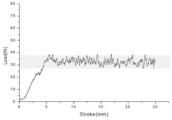
- FIGS. 1 to 5 are graphs illustrating extrusion force deviations of hyaluronic acid compositions according to Preparation Examples 1-6, 1-7, and 1-11 to 1-13.
- the present invention relates to a composition for dermal injection as defined in claim 1, which includes first cross-linked hyaluronic acid particles, second cross-linked hyaluronic acid particles having different particle diameters from the first cross-linked hyaluronic acid particles, and non-cross-linked hyaluronic acid.
- the first cross-linked hyaluronic acid particles and the second cross-linked hyaluronic acid particles are included in a weight ratio of 1: 2.5 or more to 5.5 or less, specifically 1: 2.5 or more to 3.5 or less.
- first cross-linked hyaluronic acid particles and the non-cross-linked hyaluronic acid are included in a weight ratio of 1: 0.1 or more to 1.2 or less, specifically 1: 0.1 or more to less than 0.5.
- compositions for dermal injection such as viscosity, extrusion force, viscoelasticity, and the like, may be achieved.
- Hyaluronic acid is a linear polymer including ⁇ -D-N-acetylglucosamine and ⁇ -D-glucuronic acid alternately bonded to each other, and may be interpreted as including all of hyaluronic acid itself, a salt thereof, and a combination thereof in the present invention.
- the hyaluronic acid may have a molecular weight of 100,000 to 5,000,000 Da or 1,000,000 to 1,500,000 Da, but the present invention is not limited thereto.
- Examples of the salt of hyaluronic acid include inorganic salts such as sodium hyaluronate, potassium hyaluronate, calcium hyaluronate, magnesium hyaluronate, zinc hyaluronate, cobalt hyaluronate, and the like and organic salts such as tetrabutylammonium hyaluronate and the like.
- hyaluronic acid hyaluronic acid itself and a salt thereof may be used alone or in combination of two or more.
- the hyaluronic acid or the salt thereof may be isolated from a microorganism, synthesized, or commercially available, but the present invention is not limited thereto.
- the hyaluronic acid may be isolated from Streptococcus sp. ( Streptocossus equi or Streptococcus zooepidemicus ) and purified.
- the cross-linked hyaluronic acid particles may be used in the same sense as hydrated cross-linked hyaluronic acid particles.
- it may mean that hyaluronic acid has been subjected to a crosslinking reaction through a covalent bond using a hydroxyl group.
- the moisture content or crosslinking ratio of hyaluronic acid may be adjusted through a common method used in the related art, and may be, for example, 10 to 20 mol% or 10 to 15 mol%.
- the hyaluronic acid particles may be crosslinked by a crosslinking agent.
- the crosslinking agent may be, but is not limited to, ethylene glycol diglycidyl ether (EGDGE), 1,4-butanediol diglycidyl ether (BDDE), 1,6-hexanediol diglycidyl ether, propylene glycol diglycidyl ether, polypropylene glycol diglycidyl ether, diglycerol polyglycidyl ether, 1-ethyl-3-(3-dimethylaminopropyl)carbodiimide (EDC), divinyl sulfone (DVS), biscarbodiimide (BCDI), or a combination thereof.
- ECDGE ethylene glycol diglycidyl ether
- BDDE 1,4-butanediol diglycidyl ether
- 1,6-hexanediol diglycidyl ether propylene glycol
- composition for dermal injection according to the present invention includes two or more types of cross-linked hyaluronic acid particles having different particle diameters.
- the first cross-linked hyaluronic acid particle has lower elasticity and higher cohesion than those of the second cross-linked hyaluronic acid particle.
- the first cross-linked hyaluronic acid particle may exhibit a G' value of less than 300 Pa and a tan ⁇ value of 0.3 or more.
- the tan ⁇ value is a G"/G' value (damping factor), which is a numerical value indicating whether the material is close to a solid or liquid state.
- G' represents elastic modulus
- G" represents viscous modulus.
- a tan ⁇ value close to 1 at a frequency of 0.01 to 1 Hz may represent a solution state (low elasticity), and a tan ⁇ value close to 0 may represent an elastic body with high elasticity. Also, it has been reported that as a tan ⁇ value is low and the percentage of elasticity (100 x G'/(G'+G")) is high, the duration of a filler is expected to be long.
- the first cross-linked hyaluronic acid particles have an average particle diameter of 10 to 250 ⁇ m, specifically, 20 to 200 ⁇ m, 50 to 150 ⁇ m, 80 to 130 ⁇ m, 20 to 100 ⁇ m, 100 to 200 ⁇ m, 200 to 250 ⁇ m, 50 to 100 ⁇ m, or 150 to 200 ⁇ m.
- the average particle diameter is D50 (50% diameter of particle), which means a particle size (volume) of a particle corresponding to the 50 percentile in the particle size distribution curve.
- D50 50% diameter of particle
- Such an average particle diameter is measured using a particle size analyzer (Malvern, MS3000), and water is used as a dispersing solvent. That is, the average particle diameter represents a particle diameter of hydrated cross-linked hyaluronic acid particles.
- properties of the second cross-linked hyaluronic acid particle are adjusted according to the size thereof.
- the second cross-linked hyaluronic acid particle has low viscosity and excellent elasticity compared to those of the first cross-linked hyaluronic acid particle.
- the second cross-linked hyaluronic acid particle may exhibit a G' value of 300 Pa or more and a tan ⁇ value of less than 0.3.
- the second cross-linked hyaluronic acid has an average particle diameter of 1,500 to 3,000 ⁇ m, specifically 1,800 to 2,800 ⁇ m, 2,000 to 2,700 ⁇ m, 2,300 to 2,500 ⁇ m, 1,500 to 2,000 ⁇ m, 2,000 to 2,500 ⁇ m, 2,500 to 3,000 ⁇ m, 1,700 to 2,200 ⁇ m, 2,200 to 3,000 ⁇ m, 1,500 to 2,500 ⁇ m, or 2,000 to 3,000 ⁇ m.
- the composition for dermal injection according to the present invention includes non-cross-linked hyaluronic acid.
- the non-cross-linked hyaluronic acid is in the form of a solution and may impart fluidity to the composition for dermal injection.
- the first cross-linked hyaluronic acid particles, second cross-linked hyaluronic acid particles, and non-cross-linked hyaluronic acid may be included at 1 to 10 parts by weight with respect to 100 parts by weight of the entire composition.
- composition for dermal injection according to the present invention may further include epidermal growth factor (EGF) in addition to the above-described components.
- EGF epidermal growth factor
- the EGF may be injected into the dermal to stimulate the production of collagen, a fibroblast, and elastin, for example, to increase an effect of tissue restoration.
- the EGF may be included at 0.0001 to 0.002 part by weight with respect to 100 parts by weight of the entire composition.
- composition for dermal injection according to the present invention may further include an anesthetic component.
- the anesthetic may alleviate pain experienced during injection of the composition.
- Such anesthetic component may be, but is not limited to, ambucaine, amolanone, amylocaine, benoxinate, benzocaine, betoxycaine, biphenamine, bupivacaine, butacaine, butamben, butanilicaine, butethamine, butoxycaine, carticaine, chloroprocaine, cocaethylene, cocaine, cyclomethycaine, dibucaine, dimethysoquin, dimethocaine, diperodon, dycyclonine, ecgonidine, ecgonine, ethyl chloride, etidocaine, beta-eucaine, euprocin, fenalcomine, formocaine, hexylcaine, hydroxytetracaine, isobutyl p-aminobenzoate, leucinocaine mesylate, levoxadrol, lidocaine, mepivacaine, meprylcaine, metabutoxyca
- the anesthetic component may be included at 0.1 to 1 part by weight with respect to 100 parts by weight of the composition.
- composition according to the present invention may be used with the addition of other common additives such as an antioxidant, a buffer solution and/or a bacteriostat, a diluent, a dispersant, a surfactant, a binder, a lubricant, or the like as necessary.
- other common additives such as an antioxidant, a buffer solution and/or a bacteriostat, a diluent, a dispersant, a surfactant, a binder, a lubricant, or the like as necessary.
- composition for dermal injection according to the present invention may have the following physicochemical properties.
- the viscosity is the amount that represents the magnitude of internal friction in a fluid, which is the resistance of the fluid to flow. Higher viscosity results in ease of injection and is useful for forming a delicate shape.
- a monophasic hyaluronic acid filler has high viscosity so that it is smoothly injected and is useful for forming a delicate shape.
- viscosity may be measured using Brookfield DV3T according to conditions of experimental examples to be described below.
- composition for dermal injection according to the present invention may have a viscosity of 65,000 to 95,000 cP, 70,000 to 90,000 cP, or 73,000 to 82,000 cP.
- the extrusion force means extrusion force at an injection rate at which a patient feels comfortable.
- the expression "a patient feels comfortable” is used to define an injection rate which does not cause injuries or excessive pain in a patient when the composition is injected into the dermal.
- the term “comfort” used herein encompasses the comfort or ability of a doctor or medical professional to inject the composition as well as the comfort of a patient.
- extrusion force may be measured using T0-101-161 commercially available from TestOne Co., Ltd. according to conditions of experimental examples to be described below. Generally, when extrusion force is low, there is no pressure pain during injection of the composition, and injection may be easily controlled.
- composition for dermal injection according to the present invention may have an extrusion force of 70 N or less or 65 N or less.
- Viscoelasticity is the property of a material that exhibits both liquid and solid characteristics when a force is applied to the material.
- viscoelasticity may be measured using a rheometer according to conditions of experimental examples to be described below. Specifically, a force resisting an applied force and a loss of energy in the composition due to the applied force may be measured using a rheometer to determine viscous modulus, elastic modulus, and phase angle.
- Elastic modulus (storage modulus; G') means the ratio of strain and stress which an elastic body has within the elastic limit. As the elastic modulus is higher, a composition is rigid and has a greater ability to resist strain.
- composition for dermal injection according to the present invention may have a elastic modulus of 800 to 1,200 or 850 to 1,000.
- Viscous modulus is a measure of lost energy and pertains to a viscous component of a material.
- composition for dermal injection according to the present invention may have a viscous modulus of 100 to 200 or 100 to 130.
- composition for dermal injection according to the present invention may have an elasticity of 81 to 92% or 85 to 90%.
- the phase angle is a measure of whether the composition is close to a liquid or solid state. As the phase angle is lower, the composition has solid characteristics, and as the phase angle is higher, the composition has liquid characteristics. In the case of a high phase angle, when deformation occurs due to a force applied from the outside or facial expression, the recovery to the original state is delayed, and the original shape is not maintained. In the case of a low phase angle, the G" value becomes smaller due to an instantaneous response to external deformation factors so that the composition is more like an elastic body than a fluid, and thus the composition does not flow out, and the original shape thereof may be continuously maintained. Thus, it is very important to appropriately maintain elasticity and phase angle values in the composition for dermal injection.
- composition for dermal injection according to the present invention may have a phase angle of 5 to 13° or 5 to 10°.
- composition for dermal injection according to the present invention may be prepared through a method commonly used in the related art.
- a method of restoring tissue which includes administering the above-described composition for dermal injection to a mammal.
- the mammal may be a human.
- the tissue restoration refers to temporarily or semi-permanently alleviating body wrinkles or restoring a wrinkle-free state, improving contours, forming volume in the tissue, or regenerating tissues such as in scar healing by injecting the composition.
- the dermal and tissue refer to those in the face, breast, hip, sexual organ, and other body regions.
- composition for dermal injection according to the present invention may be selected appropriately according to the degree of wrinkling of a user graded in accordance with the WSRS standard.
- the WSRS is an acronym for Wrinkle Severity Rating Scale, and classifies the degree of wrinkling of a human into 5 grades (Grades 1 to 5).
- the Grades 1 to 5 are absence (no of folds), mild (shallow folds), moderate (moderate folds), severe (deep folds), and extreme (very deep folds), respectively.
- the Ministry of Food and Drug Safety in Korea also classifies the wrinkling degree into mild, moderate, severe, and extreme according to the WSRS through guidelines for approval and review of a dermal cosmetic filler based on a hyaluronic acid raw material issued on December 2017, which proposes to include information on wrinkling degree in describing the purpose of a dermal cosmetic filler.
- composition according to the present invention may be used for severe folds of Grade 4 or extreme folds of Grade 5 in the WSRS.
- a syringe may be filled with the composition for dermal injection to inject the composition into the layers of dermal.
- the layers of dermal are classified into the epidermis, dermis, and hypodermis.
- the composition for dermal injection according to the present invention may be injected into the deep dermis or subdermis.
- the viscosity was measured according to a viscosity measurement method among the general test methods of the Korean Pharmacopoeia.
- composition sample 500 ul was loaded in a sample cup of a viscometer (DV3T, Brookfield), the sample cup was installed in a CP-52 sample cup, and the rotational speed of the spindle was then set to 2 rpm to measure viscosity.
- a viscometer Brookfield
- a compression test was performed using a universal testing machine (T0-101-161, TestOne).
- a syringe was filled with a composition sample, a 27G 1/2-inch needle was installed to the syringe, and the syringe was then set in a jig. Afterward, a speed of 50 mm/min and a displacement of 25 mm were set to perform a compression test.
- the gel thus obtained was input into 30 L of a 0.9X phosphate buffered saline (PBS) solution, and then the PBS solution was exchanged with a new one every 3 hours (3 times/day for 5 days) to eliminate a residual reagent. Then, a resulting substance was passed through a mortar grinder (RS 200 commercially available from Retsch GmbH) for 40 minutes to prepare first cross-linked hyaluronic acid particles.
- PBS 0.9X phosphate buffered saline
- the first cross-linked hyaluronic acid particles thus prepared had an average particle diameter of about 200 ⁇ m.
- the gel thus obtained was input into 30 L of a 0.9X PBS solution, and then the PBS solution was exchanged with a new one every 3 hours (3 times/day for 5 days) to eliminate a residual reagent. Then, a resulting substance was passed through a 1000 ⁇ m standard test sieve to prepare second cross-linked hyaluronic acid particles.
- the second cross-linked hyaluronic acid particles thus prepared had an average particle diameter of about 2,000 ⁇ m.
- the first cross-linked hyaluronic acid particles prepared in step (1), the second cross-linked hyaluronic acid particles prepared in step (2), and the non-cross-linked hyaluronic acid were mixed in predetermined contents (g) and content ratios to prepare a hyaluronic acid composition.
- Example 1 Evaluation of properties of hyaluronic acid composition including only one or two of first cross-linked hyaluronic acid particle, second cross-linked hyaluronic acid particle, and non-cross-linked hyaluronic acid
- hyaluronic acid compositions were prepared in the same manner as the preparation example except that the first cross-linked hyaluronic acid particles, second cross-linked hyaluronic acid particles, and non-cross-linked hyaluronic acid were mixed in contents (g) and content ratios as shown in the following Table 1.
- compositions including only first cross-linked hyaluronic acid particles or only non-cross-linked hyaluronic acid exhibited excessively low viscosity to be inappropriate as a filler composition
- composition including only second cross-linked hyaluronic acid particles exhibited excessively high extrusion force to be inappropriate as a filler composition.
- compositions including first or second cross-linked hyaluronic acid particles and not including non-cross-linked hyaluronic acid exhibited high viscosity and/or high extrusion force, and thus are not appropriate for use as a filler composition.
- non-cross-linked hyaluronic acid plays a role of lubrication
- Comparative Preparation Examples 2-2 to 2-7 which do not include non-cross-linked hyaluronic acid, may have a problem in that an extrusion force value significantly fluctuates during injection, there is difficulty in dermal injection, and there is a risk that the user may feel pressure pain.
- compositions including first or second cross-linked hyaluronic acid particles and not including non-cross-linked hyaluronic acid exhibited a low phase angle of 5 or less, and thus are not appropriate as a composition for dermal injection
- compositions including first cross-linked hyaluronic acid and non-cross-linked hyaluronic acid exhibited high phase angle values, and thus are not appropriate as a composition for dermal injection.
- a hyaluronic acid compound which exhibits excellent properties and thus is suitable for dermal injection can be prepared.
- Example 2 Evaluation of properties of hyaluronic acid composition according to content ratio of first cross-linked hyaluronic acid particles and second cross-linked hyaluronic acid particles
- Hyaluronic acid compositions were prepared using first cross-linked hyaluronic acid particles, second cross-linked hyaluronic acid particles, and non-cross-linked hyaluronic acid in contents (g) and content ratios as shown in the following Table 4.
- the compositions according to Comparative Preparation Examples 1-1 and 1-2 in which a weight ratio of second cross-linked hyaluronic acid to first cross-linked hyaluronic acid was 1: 1, exhibited low viscosities of less than 65,000 cP.
- the viscosity satisfied the viscosity range of 65,000 to 95,000 cP according to the present invention.
- the compositions according to Preparation Examples 1-5 and 1-6 exhibited viscosities of 73,000 to 82,000 cP, and thus are the most appropriate as a filler composition.
- compositions according to Comparative Preparation Examples 1-3 and 1-4 in which a weight ratio of second cross-linked hyaluronic acid was 2, exhibited viscosities of 65,000 cP or more, but had low elasticity as shown in the following viscoelasticity data, and thus are not appropriate as a filler composition.
- compositions according to Comparative Preparation Examples 1-1 to 1-4 in which a weight ratio of second cross-linked hyaluronic acid to first cross-linked hyaluronic acid was 1 to 2: 1, exhibited low elasticity or a high phase angle.
- first cross-linked hyaluronic acid and second cross-linked hyaluronic acid are included in a weight ratio of 1: 2.5 or more to 5.5 or less, a hyaluronic acid composition having excellent properties (such as viscosity, extrusion force, viscoelasticity) can be prepared.
- Example 3 Evaluation of properties of hyaluronic acid composition according to content of non-cross-linked hyaluronic acid
- Hyaluronic acid compositions were prepared using first cross-linked hyaluronic acid particles, second cross-linked hyaluronic acid particles, and non-cross-linked hyaluronic acid in contents (g) and content ratios as shown in the following Table 7.
- Table 7 First cross-linked hyaluronic acid particles
- Preparation Example 1-6 10 1 30 3 2 0.2
- Preparation Example 1-12 10 1 30 3 8 0.8
- Preparation Example 1-13 10 1 30 3 10 1.0
- the viscosities of the hyaluronic acid compositions according to Preparation Examples 1-6, 1-7, and 1-11 to 1-13 satisfied the viscosity range of 65,000 to 95,000 cP according to the present invention.
- the compositions including non-cross-linked hyaluronic acid in weight ratios of 0.2 or 0.4 exhibited viscosities of 73,000 to 82,000 cP, which are highly appropriate for a filler for dermal injection.
- the hyaluronic acid compositions according to Preparation Examples 1-6, 1-7, and 1-11 to 1-13 exhibited elasticities of 81 to 92 and phase angles of 5 to 13, both of which satisfied ranges according to the present invention.
- the compositions including non-cross-linked hyaluronic acid in weight ratios of 0.2 or 0.4 exhibited elasticities of 85 to 90 and phase angles of 5 to 10, indicating that they have highly appropriate viscoelasticity for a filler for dermal injection.
- first cross-linked hyaluronic acid and second cross-linked hyaluronic acid are included in a weight ratio of 1: 2.5 or more to 3.5 or less, and first cross-linked hyaluronic acid and non-cross-linked hyaluronic acid are included in a weight ratio of 1: 0.1 or more to less than 0.5, a composition is appropriate for use for dermal injection.
- the measurement results were plotted on a graph as shown in FIGS. 1 to 5 .
- FIGS. 1 to 5 are graphs illustrating extrusion force deviations of hyaluronic acid compositions according to Preparation Example 1-6, 1-7, and 1-11 to 1-13. It can be confirmed that when all of first cross-linked hyaluronic acid particles, second cross-linked hyaluronic acid particles, and non-cross-linked hyaluronic acid were included, the extrusion force was about 10 N, and a filler composition can be injected uniformly without a large extrusion force deviation.
- a composition for dermal injection according to the present invention satisfies viscosity, extrusion force, and viscoelasticity conditions for dermal injection, and an extrusion force deviation is low so that the user does not feel fatigue when the composition is injected into the dermal thereof.
- the composition is excellent in viscoelasticity and tissue restoring ability, is maintained for a long period of time, allows rapid recovery because an initial swelling degree is low, and also is excellent in safety and stability in the body.
Landscapes
- Health & Medical Sciences (AREA)
- Chemical & Material Sciences (AREA)
- Medicinal Chemistry (AREA)
- Life Sciences & Earth Sciences (AREA)
- Veterinary Medicine (AREA)
- Dermatology (AREA)
- Oral & Maxillofacial Surgery (AREA)
- Transplantation (AREA)
- Epidemiology (AREA)
- Animal Behavior & Ethology (AREA)
- General Health & Medical Sciences (AREA)
- Public Health (AREA)
- Engineering & Computer Science (AREA)
- Biomedical Technology (AREA)
- Molecular Biology (AREA)
- Composite Materials (AREA)
- Materials Engineering (AREA)
- Dispersion Chemistry (AREA)
- Medicinal Preparation (AREA)
- Pharmaceuticals Containing Other Organic And Inorganic Compounds (AREA)
- Materials For Medical Uses (AREA)
- Cosmetics (AREA)
- Hydrogenated Pyridines (AREA)
- Plural Heterocyclic Compounds (AREA)
- Medicines That Contain Protein Lipid Enzymes And Other Medicines (AREA)
- Nitrogen Condensed Heterocyclic Rings (AREA)
- Polysaccharides And Polysaccharide Derivatives (AREA)
- Acyclic And Carbocyclic Compounds In Medicinal Compositions (AREA)
Description
- This application claims priority to and the benefit of
Korean Patent Application No. 2017-0026490, filed on 02.28, 2017 - The present invention relates to a composition for dermal injection.
- Hyaluronic acid, as a gel type product having transparency and viscosity, is a biodegradable and highly hydrophilic substance, and plays an important role in maintaining moisture in the dermal, dermal volume, and dermal elasticity because it attracts 214 water molecules per one molecule thereof. Thus, a filler containing hyaluronic acid as an ingredient has been used for restoration of facial dermal elasticity, subtle improvement of a contour, reduction of facial wrinkles, and general cosmetic facial contouring procedures.
- However, since natural hyaluronic acid has a half-life of only 1 to 2 days, the hyaluronic acid used in the filler is made in a cross-linking state to be maintained in the dermal for a long period of time. Here, the crosslinking results in preventing the degradation of hyaluronic acid caused by hyaluronidases and increasing viscosity to form volume (Song, Yi-Seop et al., Korean Journal of Dermatology 2014;52(2):100-105).
-
US 2013/203856 A1 discloses a filler composition comprising crosslinked hyaluronic acid particles and non-crosslinked hyaluronic acid. - Hyaluronic acid fillers currently available on the market are in the monophasic or biphasic form. A monophasic filler is composed of a homogeneous gel so that it has high viscosity, is smoothly injected, and is useful for forming a delicate shape. A biphasic filler is made in the form of a particle by filtering a gel using a sieve so that it has high elasticity, and thus it is possible to maintain shape and increase volume.
- Meanwhile, research on the development of a filler having ideal in vivo characteristics and surgical usefulness is continuing. However, a hyaluronic acid filler having excellent in vivo stability has high gel hardness and high viscosity so that it may be difficult to inject the filler through a fine gauge needle. Also, a hyaluronic acid filler capable of being easily injected through a fine gauge needle may have low in vivo stability. Accordingly, hyaluronic acid fillers excellent in both viscosity and elasticity are required.
- The present invention is directed to providing a composition for dermal injection which includes two or more types of cross-linked hyaluronic acid particles having different particle diameters and non-cross-linked hyaluronic acid.
- The scope of the invention is defined by the claims. Any references in the description to methods of treatment refer to the products of the present invention for use in a method for treatment.
- The present invention provides a composition for dermal injection as defined in claim 1.
-
FIGS. 1 to 5 are graphs illustrating extrusion force deviations of hyaluronic acid compositions according to Preparation Examples 1-6, 1-7, and 1-11 to 1-13. - The present invention relates to a composition for dermal injection as defined in claim 1, which includes first cross-linked hyaluronic acid particles, second cross-linked hyaluronic acid particles having different particle diameters from the first cross-linked hyaluronic acid particles, and non-cross-linked hyaluronic acid.
- Hereinafter, the configurations of the present invention will be described in detail.
- In the present invention, a composition for dermal injection may be denoted as a filler composition.
- In the present invention, numerical values are presented using expressions such as "A or more", "A or less", "more than A" and "less than A", but in the case of numerical values given without such an expression, it is to be understood that the meaning of "A or more" or "A or less" is implied.
- In the composition for dermal injection according to the present invention, the first cross-linked hyaluronic acid particles and the second cross-linked hyaluronic acid particles are included in a weight ratio of 1: 2.5 or more to 5.5 or less, specifically 1: 2.5 or more to 3.5 or less.
- In addition, the first cross-linked hyaluronic acid particles and the non-cross-linked hyaluronic acid are included in a weight ratio of 1: 0.1 or more to 1.2 or less, specifically 1: 0.1 or more to less than 0.5.
- Within the above ranges, properties required for the composition for dermal injection, such as viscosity, extrusion force, viscoelasticity, and the like, may be achieved.
- Hyaluronic acid is a linear polymer including β-D-N-acetylglucosamine and β-D-glucuronic acid alternately bonded to each other, and may be interpreted as including all of hyaluronic acid itself, a salt thereof, and a combination thereof in the present invention. The hyaluronic acid may have a molecular weight of 100,000 to 5,000,000 Da or 1,000,000 to 1,500,000 Da, but the present invention is not limited thereto. Examples of the salt of hyaluronic acid include inorganic salts such as sodium hyaluronate, potassium hyaluronate, calcium hyaluronate, magnesium hyaluronate, zinc hyaluronate, cobalt hyaluronate, and the like and organic salts such as tetrabutylammonium hyaluronate and the like. In the present invention, as the hyaluronic acid, hyaluronic acid itself and a salt thereof may be used alone or in combination of two or more. The hyaluronic acid or the salt thereof may be isolated from a microorganism, synthesized, or commercially available, but the present invention is not limited thereto. For example, the hyaluronic acid may be isolated from Streptococcus sp. (Streptocossus equi or Streptococcus zooepidemicus) and purified.
- In the present invention, the cross-linked hyaluronic acid particles may be used in the same sense as hydrated cross-linked hyaluronic acid particles. For example, it may mean that hyaluronic acid has been subjected to a crosslinking reaction through a covalent bond using a hydroxyl group. The moisture content or crosslinking ratio of hyaluronic acid may be adjusted through a common method used in the related art, and may be, for example, 10 to 20 mol% or 10 to 15 mol%.
- The hyaluronic acid particles may be crosslinked by a crosslinking agent. The crosslinking agent may be, but is not limited to, ethylene glycol diglycidyl ether (EGDGE), 1,4-butanediol diglycidyl ether (BDDE), 1,6-hexanediol diglycidyl ether, propylene glycol diglycidyl ether, polypropylene glycol diglycidyl ether, diglycerol polyglycidyl ether, 1-ethyl-3-(3-dimethylaminopropyl)carbodiimide (EDC), divinyl sulfone (DVS), biscarbodiimide (BCDI), or a combination thereof.
- The composition for dermal injection according to the present invention (hereinafter, also referred to as a hyaluronic acid composition) includes two or more types of cross-linked hyaluronic acid particles having different particle diameters.
- In the present invention, the first cross-linked hyaluronic acid particle has lower elasticity and higher cohesion than those of the second cross-linked hyaluronic acid particle. For example, at a frequency of 0.01 Hz to 1 Hz, the first cross-linked hyaluronic acid particle may exhibit a G' value of less than 300 Pa and a tanδ value of 0.3 or more.
- The tanδ value is a G"/G' value (damping factor), which is a numerical value indicating whether the material is close to a solid or liquid state. Here, G' represents elastic modulus, and G" represents viscous modulus. A tanδ value close to 1 at a frequency of 0.01 to 1 Hz may represent a solution state (low elasticity), and a tanδ value close to 0 may represent an elastic body with high elasticity. Also, it has been reported that as a tanδ value is low and the percentage of elasticity (100 x G'/(G'+G")) is high, the duration of a filler is expected to be long.
- The first cross-linked hyaluronic acid particles have an average particle diameter of 10 to 250 µm, specifically, 20 to 200 µm, 50 to 150 µm, 80 to 130 µm, 20 to 100 µm, 100 to 200 µm, 200 to 250 µm, 50 to 100 µm, or 150 to 200 µm.
- In the present invention, the average particle diameter is D50 (50% diameter of particle), which means a particle size (volume) of a particle corresponding to the 50 percentile in the particle size distribution curve. Such an average particle diameter is measured using a particle size analyzer (Malvern, MS3000), and water is used as a dispersing solvent. That is, the average particle diameter represents a particle diameter of hydrated cross-linked hyaluronic acid particles.
- In the present invention, properties of the second cross-linked hyaluronic acid particle are adjusted according to the size thereof. The second cross-linked hyaluronic acid particle has low viscosity and excellent elasticity compared to those of the first cross-linked hyaluronic acid particle. For example, at a frequency of 0.01 to 1 Hz, the second cross-linked hyaluronic acid particle may exhibit a G' value of 300 Pa or more and a tanδ value of less than 0.3.
- The second cross-linked hyaluronic acid has an average particle diameter of 1,500 to 3,000 µm, specifically 1,800 to 2,800 µm, 2,000 to 2,700 µm, 2,300 to 2,500 µm, 1,500 to 2,000 µm, 2,000 to 2,500 µm, 2,500 to 3,000 µm, 1,700 to 2,200 µm, 2,200 to 3,000 µm, 1,500 to 2,500 µm, or 2,000 to 3,000 µm.
- The composition for dermal injection according to the present invention includes non-cross-linked hyaluronic acid. The non-cross-linked hyaluronic acid is in the form of a solution and may impart fluidity to the composition for dermal injection.
- In the present invention, the first cross-linked hyaluronic acid particles, second cross-linked hyaluronic acid particles, and non-cross-linked hyaluronic acid may be included at 1 to 10 parts by weight with respect to 100 parts by weight of the entire composition.
- The composition for dermal injection according to the present invention may further include epidermal growth factor (EGF) in addition to the above-described components. The EGF may be injected into the dermal to stimulate the production of collagen, a fibroblast, and elastin, for example, to increase an effect of tissue restoration.
- The EGF may be included at 0.0001 to 0.002 part by weight with respect to 100 parts by weight of the entire composition.
- In addition, the composition for dermal injection according to the present invention may further include an anesthetic component. The anesthetic may alleviate pain experienced during injection of the composition.
- Such an anesthetic component may be, but is not limited to, ambucaine, amolanone, amylocaine, benoxinate, benzocaine, betoxycaine, biphenamine, bupivacaine, butacaine, butamben, butanilicaine, butethamine, butoxycaine, carticaine, chloroprocaine, cocaethylene, cocaine, cyclomethycaine, dibucaine, dimethysoquin, dimethocaine, diperodon, dycyclonine, ecgonidine, ecgonine, ethyl chloride, etidocaine, beta-eucaine, euprocin, fenalcomine, formocaine, hexylcaine, hydroxytetracaine, isobutyl p-aminobenzoate, leucinocaine mesylate, levoxadrol, lidocaine, mepivacaine, meprylcaine, metabutoxycaine, methyl chloride, myrtecaine, naepaine, octacaine, orthocaine, oxethazaine, parethoxycaine, phenacaine, phenol, piperocaine, piridocaine, polidocanol, pramoxine, prilocaine, procaine, propanocaine, proparacaine, propipocaine, propoxycaine, psuedococaine, pyrrocaine, ropivacaine, salicyl alcohol, tetracaine, tolycaine, trimecaine, zolamine, or a combination thereof.
- The anesthetic component may be included at 0.1 to 1 part by weight with respect to 100 parts by weight of the composition.
- The composition according to the present invention may be used with the addition of other common additives such as an antioxidant, a buffer solution and/or a bacteriostat, a diluent, a dispersant, a surfactant, a binder, a lubricant, or the like as necessary.
- The composition for dermal injection according to the present invention may have the following physicochemical properties.
- (a) no bubbles in appearance, colorlessness, and transparency;
- (b) a pH of 7 ± 1;
- (c) a viscosity of 65,000 to 95,000 mPA·s (cP);
- (d) an average osmotic pressure of 0.325 osmol/kg ± 10 %;
- (e) an extrusion force of 70 N or less;
- (f) an elasticity of 81 to 92%; and
- (g) a phase angle of 5 to 15°.
- The viscosity is the amount that represents the magnitude of internal friction in a fluid, which is the resistance of the fluid to flow. Higher viscosity results in ease of injection and is useful for forming a delicate shape. For example, a monophasic hyaluronic acid filler has high viscosity so that it is smoothly injected and is useful for forming a delicate shape. In the present invention, viscosity may be measured using Brookfield DV3T according to conditions of experimental examples to be described below.
- The composition for dermal injection according to the present invention may have a viscosity of 65,000 to 95,000 cP, 70,000 to 90,000 cP, or 73,000 to 82,000 cP.
- The extrusion force means extrusion force at an injection rate at which a patient feels comfortable. The expression "a patient feels comfortable" is used to define an injection rate which does not cause injuries or excessive pain in a patient when the composition is injected into the dermal. The term "comfort" used herein encompasses the comfort or ability of a doctor or medical professional to inject the composition as well as the comfort of a patient. In the present invention, extrusion force may be measured using T0-101-161 commercially available from TestOne Co., Ltd. according to conditions of experimental examples to be described below. Generally, when extrusion force is low, there is no pressure pain during injection of the composition, and injection may be easily controlled.
- The composition for dermal injection according to the present invention may have an extrusion force of 70 N or less or 65 N or less.
- Viscoelasticity is the property of a material that exhibits both liquid and solid characteristics when a force is applied to the material. In the present invention, viscoelasticity may be measured using a rheometer according to conditions of experimental examples to be described below. Specifically, a force resisting an applied force and a loss of energy in the composition due to the applied force may be measured using a rheometer to determine viscous modulus, elastic modulus, and phase angle.
- Elastic modulus (storage modulus; G') means the ratio of strain and stress which an elastic body has within the elastic limit. As the elastic modulus is higher, a composition is rigid and has a greater ability to resist strain.
- The composition for dermal injection according to the present invention may have a elastic modulus of 800 to 1,200 or 850 to 1,000.
- Viscous modulus (loss modulus; G") is a measure of lost energy and pertains to a viscous component of a material.
- The composition for dermal injection according to the present invention may have a viscous modulus of 100 to 200 or 100 to 130.
- In addition, elasticity may be calculated by the following formula using elastic modulus and viscous modulus values. As the elasticity is higher, tissue restoring ability is excellent, and the duration of a filler is prolonged.

- The composition for dermal injection according to the present invention may have an elasticity of 81 to 92% or 85 to 90%.
- In addition, the phase angle is a measure of whether the composition is close to a liquid or solid state. As the phase angle is lower, the composition has solid characteristics, and as the phase angle is higher, the composition has liquid characteristics. In the case of a high phase angle, when deformation occurs due to a force applied from the outside or facial expression, the recovery to the original state is delayed, and the original shape is not maintained. In the case of a low phase angle, the G" value becomes smaller due to an instantaneous response to external deformation factors so that the composition is more like an elastic body than a fluid, and thus the composition does not flow out, and the original shape thereof may be continuously maintained. Thus, it is very important to appropriately maintain elasticity and phase angle values in the composition for dermal injection.
- The composition for dermal injection according to the present invention may have a phase angle of 5 to 13° or 5 to 10°.
- The composition for dermal injection according to the present invention may be prepared through a method commonly used in the related art.
- In addition, it is disclosed a method of restoring tissue, which includes administering the above-described composition for dermal injection to a mammal.
- The mammal may be a human.
- The tissue restoration refers to temporarily or semi-permanently alleviating body wrinkles or restoring a wrinkle-free state, improving contours, forming volume in the tissue, or regenerating tissues such as in scar healing by injecting the composition. The dermal and tissue refer to those in the face, breast, hip, sexual organ, and other body regions.
- In particular, the composition for dermal injection according to the present invention may be selected appropriately according to the degree of wrinkling of a user graded in accordance with the WSRS standard. The WSRS is an acronym for Wrinkle Severity Rating Scale, and classifies the degree of wrinkling of a human into 5 grades (Grades 1 to 5). The Grades 1 to 5 are absence (no of folds), mild (shallow folds), moderate (moderate folds), severe (deep folds), and extreme (very deep folds), respectively. Detailed contents of the WSRS and each grade are described in a document by Am J Clin Dermatol 2004; 5 (1): 49-52 1175-0561, and the present invention can evaluate wrinkles in accordance with the WSRS using a method presented in the document.
- Meanwhile, the Ministry of Food and Drug Safety in Korea also classifies the wrinkling degree into mild, moderate, severe, and extreme according to the WSRS through guidelines for approval and review of a dermal cosmetic filler based on a hyaluronic acid raw material issued on December 2017, which proposes to include information on wrinkling degree in describing the purpose of a dermal cosmetic filler.
- The composition according to the present invention may be used for severe folds of Grade 4 or extreme folds of Grade 5 in the WSRS.
- In addition, a syringe may be filled with the composition for dermal injection to inject the composition into the layers of dermal.
- The layers of dermal are classified into the epidermis, dermis, and hypodermis. The composition for dermal injection according to the present invention may be injected into the deep dermis or subdermis.
- Hereinafter, the present invention will be described in more detail with reference to embodiment examples of the present invention. However, the following examples are merely presented to exemplify the present invention, and the content of the present invention is not limited to the following examples. That is, the examples of the present invention serve to complete the disclosure of the present invention, and are provided to make known the full scope of the invention to those of ordinary knowledge and skill in the art to which this invention pertains. This invention should be defined based on the scope of the appended claims.
- The viscosity was measured according to a viscosity measurement method among the general test methods of the Korean Pharmacopoeia.
- Specifically, 500 ul of a composition sample was loaded in a sample cup of a viscometer (DV3T, Brookfield), the sample cup was installed in a CP-52 sample cup, and the rotational speed of the spindle was then set to 2 rpm to measure viscosity.
- A compression test was performed using a universal testing machine (T0-101-161, TestOne).
- Specifically, a syringe was filled with a composition sample, a 27G 1/2-inch needle was installed to the syringe, and the syringe was then set in a jig. Afterward, a speed of 50 mm/min and a displacement of 25 mm were set to perform a compression test.
- Rheological properties were measured using a rheometer.
- Specifically, a sample was placed between parallel plates, a force resistant to an applied force and a loss of energy were measured while vibrating and rotating the parallel plates to determine the elastic modulus (G'), viscous modulus (G"), and phase angle of the sample.
- Conditions for rheometer analysis are as follows.
- Frequency: 1 Hz
- Temperature: 25 °C
- Strain: 5 %
- Measuring geometry: 20 mm plate
- Measuring gap: 0.5 mm
- Measuring mode: oscillation mode
- In addition, elasticity was calculated by the following formula with reference to the measured G' and G" values.

- 10 g of sodium hyaluronate, 81 g of purified water, and 9 g of 1 M sodium hydroxide (1M NaOH) were stirred at 400 rpm under vacuum until the mixture became a transparent gel without granules. Then, 0.5 g of butanediol diglycidyl ether (BDDE) as a crosslinking agent was added thereto and stirred. After the stirring was completed, the container was sealed and a crosslinking reaction was performed under conditions of 80 rpm and 50 °C for 1 hour. Then, a resulting substance was allowed to stand at 27 °C for 16 hours to prepare a gel.
- Afterward, the gel thus obtained was input into 30 L of a 0.9X phosphate buffered saline (PBS) solution, and then the PBS solution was exchanged with a new one every 3 hours (3 times/day for 5 days) to eliminate a residual reagent. Then, a resulting substance was passed through a mortar grinder (RS 200 commercially available from Retsch GmbH) for 40 minutes to prepare first cross-linked hyaluronic acid particles.
- The first cross-linked hyaluronic acid particles thus prepared had an average particle diameter of about 200 µm.
- 20 g of sodium hyaluronate, 117 g of purified water, and 13 g of 1M NaOH were stirred at 400 rpm under vacuum until the mixture became a transparent gel without granules. Then, 1 g of BDDE as a crosslinking agent was added thereto and stirred. After the stirring was completed, the container was sealed and a crosslinking reaction was performed under conditions of 80 rpm and 50 °C for 1 hour. Then, a resulting substance was allowed to stand at 27 °C for 16 hours to prepare a gel.
- Afterward, the gel thus obtained was input into 30 L of a 0.9X PBS solution, and then the PBS solution was exchanged with a new one every 3 hours (3 times/day for 5 days) to eliminate a residual reagent. Then, a resulting substance was passed through a 1000 µm standard test sieve to prepare second cross-linked hyaluronic acid particles.
- The second cross-linked hyaluronic acid particles thus prepared had an average particle diameter of about 2,000 µm.
- 2 g of sodium hyaluronate was added to 100 g of purified water and stirred to prepare 2% non-cross-linked hyaluronic acid.
- The first cross-linked hyaluronic acid particles prepared in step (1), the second cross-linked hyaluronic acid particles prepared in step (2), and the non-cross-linked hyaluronic acid were mixed in predetermined contents (g) and content ratios to prepare a hyaluronic acid composition.
- As a comparative example of the composition including all of first cross-linked hyaluronic acid particles, second cross-linked hyaluronic acid particles, and non-cross-linked hyaluronic acid, hyaluronic acid compositions were prepared in the same manner as the preparation example except that the first cross-linked hyaluronic acid particles, second cross-linked hyaluronic acid particles, and non-cross-linked hyaluronic acid were mixed in contents (g) and content ratios as shown in the following Table 1.
[Table 1] First cross-linked hyaluronic acid particle Second cross-linked hyaluronic acid particle Non-cross-linked hyaluronic acid Content Content ratio Content Content ratio Content Content ratio Comparative Preparation Example 2-1 10 1 0 0 0 0 Comparative Preparation Example 2-2 10 1 10 1 0 0 Comparative Preparation Example 2-3 10 1 20 2 0 0 Comparative Preparation Example 2-4 10 1 30 3 0 0 Comparative Preparation Example 2-5 10 1 40 4 0 0 Comparative Preparation Example 2-6 10 1 50 5 0 0 Comparative Preparation Example 2-7 0 0 10 1 0 0 Comparative Preparation Example 2-8 0 0 10 1 2 0.2 Comparative Preparation Example 2-9 0 0 10 1 4 0.4 Comparative Preparation Example 2-10 0 0 10 1 6 0.6 Comparative Preparation Example 2-11 0 0 0 0 1 1 Comparative Preparation Example 2-12 10 1 0 0 2 0.2 Comparative Preparation Example 2-13 10 1 0 0 4 0.4 Comparative Preparation Example 2-14 10 1 0 0 6 0.6 Comparative Preparation Example 2-15 10 1 0 0 8 0.8 Comparative Preparation Example 2-16 10 1 0 0 10 1.0 - Measurement results of viscosity, extrusion force, and viscoelasticity of each of the hyaluronic acid compositions according to Comparative Preparation Examples 2-1 to 2-16 were shown in the following Tables 2 and 3.
[Table 2] First cross-linked hyaluronic acid particle Second cross-linked hyaluronic acid particle Non-cross-linked hyaluronic acid Viscosity (cP) Extrusion force (N) Comparative Preparation Example 2-1 1 0 0 25896 31.12 Comparative Preparation Example 2-2 1 1 0 75694 87.08 Comparative Preparation Example 2-3 1 2 0 108977 123.72 Comparative Preparation Example 2-4 1 3 0 111137 144.18 Comparative Preparation Example 2-5 1 4 0 114169 154.45 Comparative Preparation Example 2-6 1 5 0 125083 163.91 Comparative Preparation Example 2-7 0 1 0 93950 136.71 Comparative Preparation Example 2-8 0 1 0.2 Unmeasurable Unmeasurable Comparative Preparation Example 2-9 0 1 0.4 Unmeasurable Unmeasurable Comparative Preparation Example 2-10 0 1 0.6 Unmeasurable Unmeasurable Comparative Preparation Example 2-11 0 0 1 16041 11.66 Comparative Preparation Example 2-12 1 0 0.2 Unmeasurable Unmeasurable Comparative Preparation Example 2-13 1 0 0.4 Unmeasurable Unmeasurable Comparative Preparation Example 2-14 1 0 0.6 Unmeasurable Unmeasurable Comparative Preparation Example 2-15 1 0 0.8 Unmeasurable Unmeasurable Comparative Preparation Example 2-16 1 0 1.0 Unmeasurable Unmeasurable - As shown in Table 2, the compositions including only first cross-linked hyaluronic acid particles or only non-cross-linked hyaluronic acid exhibited excessively low viscosity to be inappropriate as a filler composition, and the composition including only second cross-linked hyaluronic acid particles exhibited excessively high extrusion force to be inappropriate as a filler composition.
- In addition, the compositions including first or second cross-linked hyaluronic acid particles and not including non-cross-linked hyaluronic acid exhibited high viscosity and/or high extrusion force, and thus are not appropriate for use as a filler composition. In particular, since non-cross-linked hyaluronic acid plays a role of lubrication, Comparative Preparation Examples 2-2 to 2-7, which do not include non-cross-linked hyaluronic acid, may have a problem in that an extrusion force value significantly fluctuates during injection, there is difficulty in dermal injection, and there is a risk that the user may feel pressure pain.
[Table 3] First cross-linked hyaluronic acid particles Second cross-linked hyaluronic acid particles Non-cross-linked hyaluronic acid Elasticity G' (Pa) G" (Pa) Phase angle Comparative Preparation Example 2-1 1 0 0 87.80 140.70 19.55 7.91 Comparative Preparation Example 2-2 1 1 0 92.17 822.80 69.93 4.86 Comparative Preparation Example 2-3 1 2 0 93.02 1082.00 81.24 4.29 Comparative Preparation Example 2-4 1 3 0 92.88 1246.00 95.54 4.25 Comparative Preparation Example 2-5 1 4 0 93.75 1264.00 84.24 3.81 Comparative Preparation Example 2-6 1 5 0 92.82 1362.00 105.40 3.70 Comparative Preparation Example 2-7 0 1 0 95.97 1433.00 60.16 2.40 Comparative Preparation Example 2-8 0 1 0.2 84.63 1124.00 204.10 10.29 Comparative Preparation Example 2-9 0 1 0.4 77.92 854.70 242.20 15.82 Comparative Preparation Example 2-10 0 1 0.6 70.93 616.00 252.50 22.29 Comparative Preparation Example 2-11 0 0 1 41.01 42.29 60.83 55.19 Comparative Preparation Example 2-12 1 0 0.2 75.77 105.90 33.87 17.73 Comparative Preparation Example 2-13 1 0 0.4 69.44 91.47 40.25 23.75 Comparative Preparation Example 2-14 1 0 0.6 64.45 65.15 35.93 28.88 Comparative Preparation Example 2-15 1 0 0.8 57.82 58.11 42.40 36.11 Comparative Preparation Example 2-16 1 0 1.0 49.34 41.89 43.01 45.76 - In addition, as shown in Table 3, the compositions including first or second cross-linked hyaluronic acid particles and not including non-cross-linked hyaluronic acid exhibited a low phase angle of 5 or less, and thus are not appropriate as a composition for dermal injection, and the compositions including first cross-linked hyaluronic acid and non-cross-linked hyaluronic acid exhibited high phase angle values, and thus are not appropriate as a composition for dermal injection.
- That is, when all of first cross-linked hyaluronic acid particles, second cross-linked hyaluronic acid particles, and non-cross-linked hyaluronic acid are included, a hyaluronic acid compound which exhibits excellent properties and thus is suitable for dermal injection can be prepared.
- Hyaluronic acid compositions were prepared using first cross-linked hyaluronic acid particles, second cross-linked hyaluronic acid particles, and non-cross-linked hyaluronic acid in contents (g) and content ratios as shown in the following Table 4.
[Table 4] First cross-linked hyaluronic acid particles Second cross-linked hyaluronic acid particles Non-cross-linked hyaluronic acid Content Content ratio Content Content ratio Content Content ratio Comparative Preparation Example 1-1 10 1 10 1 2 0.2 Comparative Preparation Example 1-2 10 1 10 1 4 0.4 Comparative Preparation Example 1-3 10 1 20 2 2 0.2 Comparative Preparation Example 1-4 10 1 20 2 4 0.4 Preparation Example 1-5 10 1 30 3 2 0.2 Preparation Example 1-6 10 1 30 3 4 0.4 Preparation Example 1-7 10 1 40 4 2 0.2 Preparation Example 1-8 10 1 40 4 4 0.4 Preparation Example 1-9 10 1 50 5 2 0.2 Preparation Example 1-10 10 1 50 5 4 0.4 - Measurement results of viscosity, extrusion force, and viscoelasticity of each of the hyaluronic acid compositions according to Comparative Preparation Examples 1-1 to 1-4 and Preparation Examples 1-5 to 1-10 are shown in the following Tables 5 and 6.
[Table 5] First cross-linked hyaluronic acid particles Second cross-linked hyaluronic acid particles Non-cross-linked hyaluronic acid Viscosity (cP) Extrusion force (N) Comparative Preparation Example 1-1 1 1 0.2 53380 37.71 Comparative Preparation Example 1-2 1 1 0.4 53072 33.16 Comparative Preparation Example 1-3 1 2 0.2 66996 44.79 Comparative Preparation Example 1-4 1 2 0.4 67955 44.69 Preparation Example 1-5 1 3 0.2 80203 60.04 Preparation Example 1-6 1 3 0.4 73941 44.19 Preparation Example 1-7 1 4 0.2 90400 66.13 Preparation Example 1-8 1 4 0.4 83113 49.05 Preparation Example 1-9 1 5 0.2 89287 67.17 Preparation Example 1-10 1 5 0.4 85958 57.15 - As shown in Table 5, the compositions according to Comparative Preparation Examples 1-1 and 1-2, in which a weight ratio of second cross-linked hyaluronic acid to first cross-linked hyaluronic acid was 1: 1, exhibited low viscosities of less than 65,000 cP. In the case of Preparation Examples 1-5 to 1-10, the viscosity satisfied the viscosity range of 65,000 to 95,000 cP according to the present invention. Particularly, the compositions according to Preparation Examples 1-5 and 1-6 exhibited viscosities of 73,000 to 82,000 cP, and thus are the most appropriate as a filler composition.
- Meanwhile, the compositions according to Comparative Preparation Examples 1-3 and 1-4, in which a weight ratio of second cross-linked hyaluronic acid was 2, exhibited viscosities of 65,000 cP or more, but had low elasticity as shown in the following viscoelasticity data, and thus are not appropriate as a filler composition.
[Table 6] First cross-linked hyaluronic acid particles Second cross-linked hyaluronic acid particles Non-cross-linked hyaluronic acid Elasticity G' G" Phase angle Comparative Preparation Example 1-1 1 1 0.2 76.73 334.1 101.3 10.74 Comparative Preparation Example 1-2 1 1 0.4 74.64 304.9 103.6 13.40 Comparative Preparation Example 1-3 1 1 0.2 80.36 492.1 120.3 8.28 Comparative Preparation Example 1-4 1 2 0.4 75.52 406.2 131.7 9.70 Preparation Example 1-5 1 3 0.2 88.84 920.30 115.60 7.16 Preparation Example 1-6 1 3 0.4 87.31 871.10 126.60 8.27 Preparation Example 1-7 1 4 0.2 89.42 1101.00 130.30 6.75 Preparation Example 1-8 1 4 0.4 86.36 964.50 152.40 8.98 Preparation Example 1-9 1 5 0.2 89.53 994.90 116.30 6.67 Preparation Example 1-10 1 5 0.4 87.61 904.40 127.90 8.05 - In addition, as shown in Table 6, the compositions according to Comparative Preparation Examples 1-1 to 1-4, in which a weight ratio of second cross-linked hyaluronic acid to first cross-linked hyaluronic acid was 1 to 2: 1, exhibited low elasticity or a high phase angle.
- That is, when first cross-linked hyaluronic acid and second cross-linked hyaluronic acid are included in a weight ratio of 1: 2.5 or more to 5.5 or less, a hyaluronic acid composition having excellent properties (such as viscosity, extrusion force, viscoelasticity) can be prepared.
- Hyaluronic acid compositions were prepared using first cross-linked hyaluronic acid particles, second cross-linked hyaluronic acid particles, and non-cross-linked hyaluronic acid in contents (g) and content ratios as shown in the following Table 7.
[Table 7] First cross-linked hyaluronic acid particles Second cross-linked hyaluronic acid particles Non-cross-linked hyaluronic acid Content Content ratio Content Content ratio Content Content ratio Preparation Example 1-6 10 1 30 3 2 0.2 Preparation Example 1-7 10 1 30 3 4 0.4 Preparation Example 1-11 10 1 30 3 6 0.6 Preparation Example 1-12 10 1 30 3 8 0.8 Preparation Example 1-13 10 1 30 3 10 1.0 - Measurement results of viscosity, extrusion force, and viscoelasticity of each of the hyaluronic acid compositions according to Preparation Examples 1-6, 1-7, and 1-11 to 1-13 are shown in the following Tables 8 and 9.
[Table 8] First cross-linked hyaluronic acid particles Second cross-linked hyaluronic acid particles Non-cross-linked hyaluronic acid Viscosity (cP) Extrusion force (N) Preparation Example 1-6 1 3 0.2 80203 60.04 Preparation Example 1-7 1 3 0.4 73941 44.19 Preparation Example 1-11 1 3 0.6 68638 45.20 Preparation Example 1-12 1 3 0.8 65651 37.97 Preparation Example 1-13 1 3 1.0 68793 32.28 - As shown in Table 8, the viscosities of the hyaluronic acid compositions according to Preparation Examples 1-6, 1-7, and 1-11 to 1-13 satisfied the viscosity range of 65,000 to 95,000 cP according to the present invention. Particularly, the compositions including non-cross-linked hyaluronic acid in weight ratios of 0.2 or 0.4 exhibited viscosities of 73,000 to 82,000 cP, which are highly appropriate for a filler for dermal injection.
[Table 9] First cross-linked hyaluroni c acid particles Second cross-linked hyaluroni c acid particles Non-cross-linked hyaluroni c acid Elasticity G' G" Phase angle Preparation Example 1-6 1 3 0.2 88.84 920.30 115.60 7.16 Preparation Example 1-7 1 3 0.4 87.31 871.10 126.60 8.27 Preparation Example 1-11 1 3 0.6 83.96 677.70 129.50 10.82 Preparation Example 1-12 1 3 0.8 82.80 695.20 144.40 11.73 Preparation Example 1-13 1 3 1.0 81.74 587.60 131.30 12.59 - In addition, as shown in Table 9, the hyaluronic acid compositions according to Preparation Examples 1-6, 1-7, and 1-11 to 1-13 exhibited elasticities of 81 to 92 and phase angles of 5 to 13, both of which satisfied ranges according to the present invention. Particularly, the compositions including non-cross-linked hyaluronic acid in weight ratios of 0.2 or 0.4 exhibited elasticities of 85 to 90 and phase angles of 5 to 10, indicating that they have highly appropriate viscoelasticity for a filler for dermal injection.
- That is, when first cross-linked hyaluronic acid and second cross-linked hyaluronic acid are included in a weight ratio of 1: 2.5 or more to 3.5 or less, and first cross-linked hyaluronic acid and non-cross-linked hyaluronic acid are included in a weight ratio of 1: 0.1 or more to less than 0.5, a composition is appropriate for use for dermal injection.
- For Preparation Examples 1-6, 1-7, and 1-11 to 1-13, the extrusion force was measured over time.
- The measurement results were plotted on a graph as shown in
FIGS. 1 to 5 . -
FIGS. 1 to 5 are graphs illustrating extrusion force deviations of hyaluronic acid compositions according to Preparation Example 1-6, 1-7, and 1-11 to 1-13. It can be confirmed that when all of first cross-linked hyaluronic acid particles, second cross-linked hyaluronic acid particles, and non-cross-linked hyaluronic acid were included, the extrusion force was about 10 N, and a filler composition can be injected uniformly without a large extrusion force deviation. - In addition, it can be confirmed that as the content of non-cross-linked hyaluronic acid increases, the extrusion force deviation becomes smaller.
- A composition for dermal injection according to the present invention satisfies viscosity, extrusion force, and viscoelasticity conditions for dermal injection, and an extrusion force deviation is low so that the user does not feel fatigue when the composition is injected into the dermal thereof.
- Also, the composition is excellent in viscoelasticity and tissue restoring ability, is maintained for a long period of time, allows rapid recovery because an initial swelling degree is low, and also is excellent in safety and stability in the body.
Claims (14)
- A composition for dermal injection, comprising first cross-linked hyaluronic acid particles, second cross-linked hyaluronic acid particles having different particle diameters from the first cross-linked hyaluronic acid particles, and non-cross-linked hyaluronic acid,obtained by mixing the first cross-linked hyaluronic acid particles, the second cross-linked hyaluronic acid particles and the non-cross-linked hyaluronic acid,wherein the first cross-linked hyaluronic acid particles and the second cross-linked hyaluronic acid particles are included in a weight ratio of 1: 2.5 or more to 5.5 or less,the first cross-linked hyaluronic acid particles and the non-cross-linked hyaluronic acid are included in a weight ratio of 1: 0.1 or more to 1.2 or less,the first cross-linked hyaluronic acid particles have an average particle diameter of 10 to 250 µm,the second cross-linked hyaluronic acid particles have an average particle diameter of 1,500 to 3,000 µmand the average particle diameter is volume-based D50, measured using a particle size analyzer and water as a dispersing solvent.
- The composition of claim 1, wherein the first cross-linked hyaluronic acid particles and the second cross-linked hyaluronic acid particles are included in a weight ratio of 1: 2.5 or more to 3.5 or less, and
the first cross-linked hyaluronic acid particles and the non-cross-linked hyaluronic acid are included in a weight ratio of 1: 0.1 or more to less than 0.5. - The composition of claim 1, wherein the first cross-linked hyaluronic acid particle, the second cross-linked hyaluronic acid particle, or the non-cross-linked hyaluronic acid has a molecular weight of 1,000,000 to 1,500,000 Da.
- The composition of claim 1, wherein the first cross-linked hyaluronic acid particle or the second cross-linked hyaluronic acid particle has a degree of crosslinking of 10 to 20 mol%.
- The composition of claim 1, wherein the first cross-linked hyaluronic acid particles, the second cross-linked hyaluronic acid particles, and the non-cross-linked hyaluronic acid are included at 1 to 10 parts by weight with respect to 100 parts by weight of the entire composition.
- The composition of claim 1, further comprising epidermal growth factor (EGF).
- The composition of claim 6, wherein the epidermal growth factor (EGF) is included at 0.0001 to 0.002 part by weight with respect to 100 parts by weight of the entire composition.
- The composition of claim 1, further comprising an anesthetic component.
- The composition of claim 8, wherein the anesthetic component is included at 0.1 to 1 part by weight with respect to 100 parts by weight of the composition.
- The composition of claim 1, wherein the composition for dermal injection has the following physicochemical properties:(a) no bubbles in appearance, colorlessness, and transparency,(b) a pH of 7 ± 1,(c) a viscosity of 65,000 to 95,000 mPa·s (cP) measured according to the method as defined in the reference example of the description;(e) an extrusion force of 70 N or less, measured according to the method as defined in the reference example of the description;(f) an elasticity of 81 to 92%, measured according to the method as defined in the reference example of the description; and(g) a phase angle of 5 to 15°, measured according to the method as defined in the reference example of the description.
- The composition of claim 10, wherein the composition for dermal injection has a viscosity of 73,000 to 82,000 mPa·s (cP).
- The composition of claim 10, wherein the composition for dermal injection has an extrusion force of 65 N or less.
- The composition of claim 10, wherein the composition for dermal injection has an elasticity of 85 to 90% and a phase angle of 5 to 10°.
- The composition according to any of claims 1 to 13, for use in a method of restoring tissue, including administering the composition for dermal injection to a mammal.
Applications Claiming Priority (2)
| Application Number | Priority Date | Filing Date | Title |
|---|---|---|---|
| KR20170026490 | 2017-02-28 | ||
| PCT/KR2018/002400 WO2018159983A1 (en) | 2017-02-28 | 2018-02-27 | Composition for injection into skin |
Publications (3)
| Publication Number | Publication Date |
|---|---|
| EP3590545A1 EP3590545A1 (en) | 2020-01-08 |
| EP3590545A4 EP3590545A4 (en) | 2020-12-23 |
| EP3590545B1 true EP3590545B1 (en) | 2024-06-26 |
Family
ID=63370829
Family Applications (1)
| Application Number | Title | Priority Date | Filing Date |
|---|---|---|---|
| EP18760831.0A Active EP3590545B1 (en) | 2017-02-28 | 2018-02-27 | Composition for injection into skin |
Country Status (10)
| Country | Link |
|---|---|
| US (1) | US11123455B2 (en) |
| EP (1) | EP3590545B1 (en) |
| JP (1) | JP6788127B2 (en) |
| KR (1) | KR102107699B1 (en) |
| CN (1) | CN110621355B (en) |
| AU (1) | AU2018228300B2 (en) |
| BR (1) | BR112019017795B1 (en) |
| ES (1) | ES2992541T3 (en) |
| TW (1) | TWI716671B (en) |
| WO (1) | WO2018159983A1 (en) |
Families Citing this family (11)
| Publication number | Priority date | Publication date | Assignee | Title |
|---|---|---|---|---|
| ES2992541T3 (en) | 2017-02-28 | 2024-12-13 | Cg Bio Co Ltd | Composition for dermal injection |
| CN111467568B (en) * | 2019-01-23 | 2022-04-15 | 爱美客技术发展股份有限公司 | Cross-linked sodium hyaluronate composite solution preparation and preparation method and application thereof |
| CN111773379A (en) * | 2019-04-03 | 2020-10-16 | 上海薇娜医疗科技有限公司 | Injectable whitening wrinkle-removing preparation, preparation method and application thereof |
| KR102051467B1 (en) * | 2019-06-12 | 2019-12-03 | 박상준 | Skin filler composition and method for manufacturing the same |
| NL2024060B1 (en) * | 2019-10-18 | 2021-06-22 | Biomed Elements B V | Dermal filler composition |
| WO2021132969A1 (en) * | 2019-12-24 | 2021-07-01 | 주식회사 엘지화학 | Injectable composition comprising anesthetic, buffer solution and hyaluronic acid hydrogel, and preparation method therefor |
| WO2021212097A1 (en) * | 2020-04-17 | 2021-10-21 | Brendan Patrick Purcell | Controlled release hyaluronic acid compositions |
| NL2028044B1 (en) | 2021-04-22 | 2022-11-02 | Biomed Elements B V | Bulking agent for the treatment of stress urinary and fecal incontinence |
| CN115245595B (en) * | 2022-07-28 | 2024-05-24 | 爱博诺德(北京)医疗科技股份有限公司 | Hyaluronic acid-based gel compositions for easy bolus injection |
| KR102684411B1 (en) * | 2023-05-02 | 2024-07-11 | (재)씨젠의료재단 | Dermal filler composition containing hyaluronic acid cross-linked by sulfosuccinic acid and biocompatible micro particles, and Method for preparing the same |
| KR102664134B1 (en) * | 2023-11-23 | 2024-05-10 | 한국콜마주식회사 | Cosmetic composition with hyaluronic acid and derivatives thereof |
Family Cites Families (22)
| Publication number | Priority date | Publication date | Assignee | Title |
|---|---|---|---|---|
| JPS5824455B2 (en) | 1979-06-01 | 1983-05-21 | 日立電線株式会社 | High dielectric constant rubber insulation composition |
| US8124120B2 (en) * | 2003-12-22 | 2012-02-28 | Anika Therapeutics, Inc. | Crosslinked hyaluronic acid compositions for tissue augmentation |
| KR20060084602A (en) * | 2005-01-20 | 2006-07-25 | 주식회사 코오롱 | Method for Controlling Particle Size of Hyaluronic Acid and Its Salts Using Organic Solvents |
| FR2909560B1 (en) * | 2006-12-06 | 2012-12-28 | Fabre Pierre Dermo Cosmetique | HYALURONIC ACID GEL FOR INTRADERMAL INJECTION |
| EP2170961A1 (en) * | 2007-07-25 | 2010-04-07 | S & V Technologies AG | Hyaluronic acid dispersion, production and use |
| EP2222715B1 (en) * | 2007-12-19 | 2019-07-24 | Evonik Degussa GmbH | Crosslinked hyaluronic acid in emulsion |
| US8450475B2 (en) * | 2008-08-04 | 2013-05-28 | Allergan, Inc. | Hyaluronic acid-based gels including lidocaine |
| AU2010276574B2 (en) * | 2009-07-30 | 2015-08-20 | Carbylan Therapeutics, Inc. | Modified hyaluronic acid polymer compositions and related methods |
| JP2013530785A (en) * | 2010-07-12 | 2013-08-01 | シン・プーン・ファーマシューティカル・カンパニー・リミテッド | Filling composition for tissue augmentation |
| CN103124558B (en) * | 2010-08-23 | 2015-06-24 | 电气化学工业株式会社 | Crosslinked hyaluronic acid composition and self-crosslinking hyaluronic acid particles |
| US20130116411A1 (en) * | 2011-09-06 | 2013-05-09 | Allergan, Inc. | Methods of making hyaluronic acid/collagen compositions |
| EP2581079B1 (en) * | 2011-10-11 | 2016-12-07 | BioPolymer GmbH & Co. KG | Combination of hyaluronic acid and prilocaine |
| CN102552974A (en) * | 2012-02-17 | 2012-07-11 | 上海白衣缘生物工程有限公司 | Gel composition for injection filling of skins and preparation method for gel composition |
| EP3750568A1 (en) * | 2012-09-06 | 2020-12-16 | Allergan, Inc. | Hyaluronic acid/collagen-based dermal filler compositions and methods for making same |
| WO2014055895A1 (en) * | 2012-10-05 | 2014-04-10 | Allergan, Inc. | Injectable device and method for sculpting, augmenting or correcting facial features such as the chin |
| FR3006689A1 (en) * | 2013-06-11 | 2014-12-12 | Benedicte Vincente Tauzin | PROCESS FOR CROSSLINKING HYALURONIC ACID; PROCESS FOR PREPARING AN INJECTABLE HYDROGEL; HYDROGEL OBTAINED; USE OF HYDROGET OBTAINED |
| US9421198B2 (en) * | 2013-07-30 | 2016-08-23 | Teoxane | Composition comprising hyaluronic acid and mepivacaine |
| CN103834053B (en) * | 2014-02-28 | 2016-04-27 | 陕西佰傲再生医学有限公司 | A kind of injectable cross-linked hyaluronic acid gel and preparation method thereof |
| CN104771331B (en) * | 2015-03-12 | 2017-12-12 | 华熙福瑞达生物医药有限公司 | A kind of hyaluronic acid elastomer and its application |
| CN105131348B (en) * | 2015-08-19 | 2018-01-16 | 李媚 | A kind of sterile injectable material |
| KR101660211B1 (en) | 2016-06-07 | 2016-09-26 | 동국제약 주식회사 | Crosslinked hyalruonic acid gel having monophasic and biphasic characteristics, preparation method thereof and use thereof |
| ES2992541T3 (en) | 2017-02-28 | 2024-12-13 | Cg Bio Co Ltd | Composition for dermal injection |
-
2018
- 2018-02-27 ES ES18760831T patent/ES2992541T3/en active Active
- 2018-02-27 US US16/488,938 patent/US11123455B2/en active Active
- 2018-02-27 EP EP18760831.0A patent/EP3590545B1/en active Active
- 2018-02-27 TW TW107106976A patent/TWI716671B/en active
- 2018-02-27 AU AU2018228300A patent/AU2018228300B2/en active Active
- 2018-02-27 KR KR1020180023952A patent/KR102107699B1/en active Active
- 2018-02-27 WO PCT/KR2018/002400 patent/WO2018159983A1/en not_active Ceased
- 2018-02-27 JP JP2019547669A patent/JP6788127B2/en active Active
- 2018-02-27 CN CN201880014654.6A patent/CN110621355B/en active Active
- 2018-02-27 BR BR112019017795-7A patent/BR112019017795B1/en active Search and Examination
Also Published As
| Publication number | Publication date |
|---|---|
| AU2018228300B2 (en) | 2020-04-30 |
| BR112019017795B1 (en) | 2022-12-06 |
| EP3590545A1 (en) | 2020-01-08 |
| KR102107699B1 (en) | 2020-05-14 |
| TW201840303A (en) | 2018-11-16 |
| JP6788127B2 (en) | 2020-11-18 |
| WO2018159983A1 (en) | 2018-09-07 |
| EP3590545A4 (en) | 2020-12-23 |
| TWI716671B (en) | 2021-01-21 |
| BR112019017795A2 (en) | 2020-03-31 |
| AU2018228300A1 (en) | 2019-09-19 |
| ES2992541T3 (en) | 2024-12-13 |
| CN110621355B (en) | 2022-01-21 |
| US11123455B2 (en) | 2021-09-21 |
| CN110621355A (en) | 2019-12-27 |
| US20200061241A1 (en) | 2020-02-27 |
| KR20180099549A (en) | 2018-09-05 |
| JP2020511215A (en) | 2020-04-16 |
Similar Documents
| Publication | Publication Date | Title |
|---|---|---|
| EP3590548B1 (en) | Composition for skin injection | |
| AU2018228300B2 (en) | Composition For Dermal Injection | |
| EP3590546B1 (en) | Composition for skin injection | |
| EP3804770B1 (en) | Hyaluronic acid filler having high lift capacity and low injection force | |
| TW202005656A (en) | Hyaluronic acid filler having high viscoelasticity and cohesivity simultaneously |
Legal Events
| Date | Code | Title | Description |
|---|---|---|---|
| STAA | Information on the status of an ep patent application or granted ep patent |
Free format text: STATUS: THE INTERNATIONAL PUBLICATION HAS BEEN MADE |
|
| PUAI | Public reference made under article 153(3) epc to a published international application that has entered the european phase |
Free format text: ORIGINAL CODE: 0009012 |
|
| STAA | Information on the status of an ep patent application or granted ep patent |
Free format text: STATUS: REQUEST FOR EXAMINATION WAS MADE |
|
| 17P | Request for examination filed |
Effective date: 20190930 |
|
| AK | Designated contracting states |
Kind code of ref document: A1 Designated state(s): AL AT BE BG CH CY CZ DE DK EE ES FI FR GB GR HR HU IE IS IT LI LT LU LV MC MK MT NL NO PL PT RO RS SE SI SK SM TR |
|
| AX | Request for extension of the european patent |
Extension state: BA ME |
|
| DAV | Request for validation of the european patent (deleted) | ||
| DAX | Request for extension of the european patent (deleted) | ||
| REG | Reference to a national code |
Ref country code: DE Free format text: PREVIOUS MAIN CLASS: A61L0027200000 Ipc: A61L0027580000 Ref country code: DE Ref legal event code: R079 Ref document number: 602018071018 Country of ref document: DE Free format text: PREVIOUS MAIN CLASS: A61L0027200000 Ipc: A61L0027580000 |
|
| A4 | Supplementary search report drawn up and despatched |
Effective date: 20201124 |
|
| RIC1 | Information provided on ipc code assigned before grant |
Ipc: A61L 27/58 20060101AFI20201118BHEP Ipc: A61L 27/52 20060101ALI20201118BHEP Ipc: A61L 27/54 20060101ALI20201118BHEP Ipc: A61L 27/50 20060101ALI20201118BHEP Ipc: A61L 27/48 20060101ALI20201118BHEP |
|
| STAA | Information on the status of an ep patent application or granted ep patent |
Free format text: STATUS: EXAMINATION IS IN PROGRESS |
|
| 17Q | First examination report despatched |
Effective date: 20211201 |
|
| GRAP | Despatch of communication of intention to grant a patent |
Free format text: ORIGINAL CODE: EPIDOSNIGR1 |
|
| STAA | Information on the status of an ep patent application or granted ep patent |
Free format text: STATUS: GRANT OF PATENT IS INTENDED |
|
| INTG | Intention to grant announced |
Effective date: 20240131 |
|
| GRAS | Grant fee paid |
Free format text: ORIGINAL CODE: EPIDOSNIGR3 |
|
| GRAA | (expected) grant |
Free format text: ORIGINAL CODE: 0009210 |
|
| STAA | Information on the status of an ep patent application or granted ep patent |
Free format text: STATUS: THE PATENT HAS BEEN GRANTED |
|
| AK | Designated contracting states |
Kind code of ref document: B1 Designated state(s): AL AT BE BG CH CY CZ DE DK EE ES FI FR GB GR HR HU IE IS IT LI LT LU LV MC MK MT NL NO PL PT RO RS SE SI SK SM TR |
|
| REG | Reference to a national code |
Ref country code: GB Ref legal event code: FG4D |
|
| REG | Reference to a national code |
Ref country code: CH Ref legal event code: EP |
|
| REG | Reference to a national code |
Ref country code: DE Ref legal event code: R096 Ref document number: 602018071018 Country of ref document: DE |
|
| P01 | Opt-out of the competence of the unified patent court (upc) registered |
Free format text: CASE NUMBER: APP_43532/2024 Effective date: 20240725 |
|
| PG25 | Lapsed in a contracting state [announced via postgrant information from national office to epo] |
Ref country code: BG Free format text: LAPSE BECAUSE OF FAILURE TO SUBMIT A TRANSLATION OF THE DESCRIPTION OR TO PAY THE FEE WITHIN THE PRESCRIBED TIME-LIMIT Effective date: 20240626 |
|
| PG25 | Lapsed in a contracting state [announced via postgrant information from national office to epo] |
Ref country code: FI Free format text: LAPSE BECAUSE OF FAILURE TO SUBMIT A TRANSLATION OF THE DESCRIPTION OR TO PAY THE FEE WITHIN THE PRESCRIBED TIME-LIMIT Effective date: 20240626 Ref country code: HR Free format text: LAPSE BECAUSE OF FAILURE TO SUBMIT A TRANSLATION OF THE DESCRIPTION OR TO PAY THE FEE WITHIN THE PRESCRIBED TIME-LIMIT Effective date: 20240626 |
|
| REG | Reference to a national code |
Ref country code: LT Ref legal event code: MG9D |
|
| PG25 | Lapsed in a contracting state [announced via postgrant information from national office to epo] |
Ref country code: GR Free format text: LAPSE BECAUSE OF FAILURE TO SUBMIT A TRANSLATION OF THE DESCRIPTION OR TO PAY THE FEE WITHIN THE PRESCRIBED TIME-LIMIT Effective date: 20240927 |
|
| PG25 | Lapsed in a contracting state [announced via postgrant information from national office to epo] |
Ref country code: LV Free format text: LAPSE BECAUSE OF FAILURE TO SUBMIT A TRANSLATION OF THE DESCRIPTION OR TO PAY THE FEE WITHIN THE PRESCRIBED TIME-LIMIT Effective date: 20240626 |
|
| REG | Reference to a national code |
Ref country code: NL Ref legal event code: MP Effective date: 20240626 |
|
| PG25 | Lapsed in a contracting state [announced via postgrant information from national office to epo] |
Ref country code: NO Free format text: LAPSE BECAUSE OF FAILURE TO SUBMIT A TRANSLATION OF THE DESCRIPTION OR TO PAY THE FEE WITHIN THE PRESCRIBED TIME-LIMIT Effective date: 20240926 Ref country code: LV Free format text: LAPSE BECAUSE OF FAILURE TO SUBMIT A TRANSLATION OF THE DESCRIPTION OR TO PAY THE FEE WITHIN THE PRESCRIBED TIME-LIMIT Effective date: 20240626 Ref country code: HR Free format text: LAPSE BECAUSE OF FAILURE TO SUBMIT A TRANSLATION OF THE DESCRIPTION OR TO PAY THE FEE WITHIN THE PRESCRIBED TIME-LIMIT Effective date: 20240626 Ref country code: GR Free format text: LAPSE BECAUSE OF FAILURE TO SUBMIT A TRANSLATION OF THE DESCRIPTION OR TO PAY THE FEE WITHIN THE PRESCRIBED TIME-LIMIT Effective date: 20240927 Ref country code: FI Free format text: LAPSE BECAUSE OF FAILURE TO SUBMIT A TRANSLATION OF THE DESCRIPTION OR TO PAY THE FEE WITHIN THE PRESCRIBED TIME-LIMIT Effective date: 20240626 Ref country code: BG Free format text: LAPSE BECAUSE OF FAILURE TO SUBMIT A TRANSLATION OF THE DESCRIPTION OR TO PAY THE FEE WITHIN THE PRESCRIBED TIME-LIMIT Effective date: 20240626 Ref country code: RS Free format text: LAPSE BECAUSE OF FAILURE TO SUBMIT A TRANSLATION OF THE DESCRIPTION OR TO PAY THE FEE WITHIN THE PRESCRIBED TIME-LIMIT Effective date: 20240926 |
|
| PG25 | Lapsed in a contracting state [announced via postgrant information from national office to epo] |
Ref country code: NL Free format text: LAPSE BECAUSE OF FAILURE TO SUBMIT A TRANSLATION OF THE DESCRIPTION OR TO PAY THE FEE WITHIN THE PRESCRIBED TIME-LIMIT Effective date: 20240626 |
|
| REG | Reference to a national code |
Ref country code: AT Ref legal event code: MK05 Ref document number: 1697177 Country of ref document: AT Kind code of ref document: T Effective date: 20240626 |
|
| PG25 | Lapsed in a contracting state [announced via postgrant information from national office to epo] |
Ref country code: NL Free format text: LAPSE BECAUSE OF FAILURE TO SUBMIT A TRANSLATION OF THE DESCRIPTION OR TO PAY THE FEE WITHIN THE PRESCRIBED TIME-LIMIT Effective date: 20240626 |
|
| PG25 | Lapsed in a contracting state [announced via postgrant information from national office to epo] |
Ref country code: PT Free format text: LAPSE BECAUSE OF FAILURE TO SUBMIT A TRANSLATION OF THE DESCRIPTION OR TO PAY THE FEE WITHIN THE PRESCRIBED TIME-LIMIT Effective date: 20241028 |
|
| REG | Reference to a national code |
Ref country code: ES Ref legal event code: FG2A Ref document number: 2992541 Country of ref document: ES Kind code of ref document: T3 Effective date: 20241213 |
|
| PG25 | Lapsed in a contracting state [announced via postgrant information from national office to epo] |
Ref country code: PT Free format text: LAPSE BECAUSE OF FAILURE TO SUBMIT A TRANSLATION OF THE DESCRIPTION OR TO PAY THE FEE WITHIN THE PRESCRIBED TIME-LIMIT Effective date: 20241028 |
|
| PG25 | Lapsed in a contracting state [announced via postgrant information from national office to epo] |
Ref country code: PL Free format text: LAPSE BECAUSE OF FAILURE TO SUBMIT A TRANSLATION OF THE DESCRIPTION OR TO PAY THE FEE WITHIN THE PRESCRIBED TIME-LIMIT Effective date: 20240626 |
|
| PG25 | Lapsed in a contracting state [announced via postgrant information from national office to epo] |
Ref country code: EE Free format text: LAPSE BECAUSE OF FAILURE TO SUBMIT A TRANSLATION OF THE DESCRIPTION OR TO PAY THE FEE WITHIN THE PRESCRIBED TIME-LIMIT Effective date: 20240626 |
|
| PG25 | Lapsed in a contracting state [announced via postgrant information from national office to epo] |
Ref country code: IS Free format text: LAPSE BECAUSE OF FAILURE TO SUBMIT A TRANSLATION OF THE DESCRIPTION OR TO PAY THE FEE WITHIN THE PRESCRIBED TIME-LIMIT Effective date: 20241026 Ref country code: AT Free format text: LAPSE BECAUSE OF FAILURE TO SUBMIT A TRANSLATION OF THE DESCRIPTION OR TO PAY THE FEE WITHIN THE PRESCRIBED TIME-LIMIT Effective date: 20240626 |
|
| PG25 | Lapsed in a contracting state [announced via postgrant information from national office to epo] |
Ref country code: CZ Free format text: LAPSE BECAUSE OF FAILURE TO SUBMIT A TRANSLATION OF THE DESCRIPTION OR TO PAY THE FEE WITHIN THE PRESCRIBED TIME-LIMIT Effective date: 20240626 |
|
| PG25 | Lapsed in a contracting state [announced via postgrant information from national office to epo] |
Ref country code: SK Free format text: LAPSE BECAUSE OF FAILURE TO SUBMIT A TRANSLATION OF THE DESCRIPTION OR TO PAY THE FEE WITHIN THE PRESCRIBED TIME-LIMIT Effective date: 20240626 Ref country code: RO Free format text: LAPSE BECAUSE OF FAILURE TO SUBMIT A TRANSLATION OF THE DESCRIPTION OR TO PAY THE FEE WITHIN THE PRESCRIBED TIME-LIMIT Effective date: 20240626 |
|
| PG25 | Lapsed in a contracting state [announced via postgrant information from national office to epo] |
Ref country code: SM Free format text: LAPSE BECAUSE OF FAILURE TO SUBMIT A TRANSLATION OF THE DESCRIPTION OR TO PAY THE FEE WITHIN THE PRESCRIBED TIME-LIMIT Effective date: 20240626 |
|
| PG25 | Lapsed in a contracting state [announced via postgrant information from national office to epo] |
Ref country code: SM Free format text: LAPSE BECAUSE OF FAILURE TO SUBMIT A TRANSLATION OF THE DESCRIPTION OR TO PAY THE FEE WITHIN THE PRESCRIBED TIME-LIMIT Effective date: 20240626 Ref country code: SK Free format text: LAPSE BECAUSE OF FAILURE TO SUBMIT A TRANSLATION OF THE DESCRIPTION OR TO PAY THE FEE WITHIN THE PRESCRIBED TIME-LIMIT Effective date: 20240626 Ref country code: RO Free format text: LAPSE BECAUSE OF FAILURE TO SUBMIT A TRANSLATION OF THE DESCRIPTION OR TO PAY THE FEE WITHIN THE PRESCRIBED TIME-LIMIT Effective date: 20240626 Ref country code: PL Free format text: LAPSE BECAUSE OF FAILURE TO SUBMIT A TRANSLATION OF THE DESCRIPTION OR TO PAY THE FEE WITHIN THE PRESCRIBED TIME-LIMIT Effective date: 20240626 Ref country code: IS Free format text: LAPSE BECAUSE OF FAILURE TO SUBMIT A TRANSLATION OF THE DESCRIPTION OR TO PAY THE FEE WITHIN THE PRESCRIBED TIME-LIMIT Effective date: 20241026 Ref country code: EE Free format text: LAPSE BECAUSE OF FAILURE TO SUBMIT A TRANSLATION OF THE DESCRIPTION OR TO PAY THE FEE WITHIN THE PRESCRIBED TIME-LIMIT Effective date: 20240626 Ref country code: CZ Free format text: LAPSE BECAUSE OF FAILURE TO SUBMIT A TRANSLATION OF THE DESCRIPTION OR TO PAY THE FEE WITHIN THE PRESCRIBED TIME-LIMIT Effective date: 20240626 Ref country code: AT Free format text: LAPSE BECAUSE OF FAILURE TO SUBMIT A TRANSLATION OF THE DESCRIPTION OR TO PAY THE FEE WITHIN THE PRESCRIBED TIME-LIMIT Effective date: 20240626 |
|
| REG | Reference to a national code |
Ref country code: DE Ref legal event code: R097 Ref document number: 602018071018 Country of ref document: DE |
|
| PG25 | Lapsed in a contracting state [announced via postgrant information from national office to epo] |
Ref country code: DK Free format text: LAPSE BECAUSE OF FAILURE TO SUBMIT A TRANSLATION OF THE DESCRIPTION OR TO PAY THE FEE WITHIN THE PRESCRIBED TIME-LIMIT Effective date: 20240626 |
|
| PLBE | No opposition filed within time limit |
Free format text: ORIGINAL CODE: 0009261 |
|
| STAA | Information on the status of an ep patent application or granted ep patent |
Free format text: STATUS: NO OPPOSITION FILED WITHIN TIME LIMIT |
|
| 26N | No opposition filed |
Effective date: 20250327 |
|
| PG25 | Lapsed in a contracting state [announced via postgrant information from national office to epo] |
Ref country code: SE Free format text: LAPSE BECAUSE OF FAILURE TO SUBMIT A TRANSLATION OF THE DESCRIPTION OR TO PAY THE FEE WITHIN THE PRESCRIBED TIME-LIMIT Effective date: 20240626 |
|
| PG25 | Lapsed in a contracting state [announced via postgrant information from national office to epo] |
Ref country code: MC Free format text: LAPSE BECAUSE OF FAILURE TO SUBMIT A TRANSLATION OF THE DESCRIPTION OR TO PAY THE FEE WITHIN THE PRESCRIBED TIME-LIMIT Effective date: 20240626 |
|
| REG | Reference to a national code |
Ref country code: CH Ref legal event code: PL |
|
| PG25 | Lapsed in a contracting state [announced via postgrant information from national office to epo] |
Ref country code: LU Free format text: LAPSE BECAUSE OF NON-PAYMENT OF DUE FEES Effective date: 20250227 |
|
| PG25 | Lapsed in a contracting state [announced via postgrant information from national office to epo] |
Ref country code: CH Free format text: LAPSE BECAUSE OF NON-PAYMENT OF DUE FEES Effective date: 20250228 |
|
| REG | Reference to a national code |
Ref country code: BE Ref legal event code: MM Effective date: 20250228 |
|
| PGFP | Annual fee paid to national office [announced via postgrant information from national office to epo] |
Ref country code: GB Payment date: 20251222 Year of fee payment: 9 |
|
| PGFP | Annual fee paid to national office [announced via postgrant information from national office to epo] |
Ref country code: FR Payment date: 20251223 Year of fee payment: 9 |
|
| PG25 | Lapsed in a contracting state [announced via postgrant information from national office to epo] |
Ref country code: BE Free format text: LAPSE BECAUSE OF NON-PAYMENT OF DUE FEES Effective date: 20250228 |
|
| PG25 | Lapsed in a contracting state [announced via postgrant information from national office to epo] |
Ref country code: IE Free format text: LAPSE BECAUSE OF NON-PAYMENT OF DUE FEES Effective date: 20250227 |
|
| PGFP | Annual fee paid to national office [announced via postgrant information from national office to epo] |
Ref country code: ES Payment date: 20260324 Year of fee payment: 9 |
|
| PGFP | Annual fee paid to national office [announced via postgrant information from national office to epo] |
Ref country code: DE Payment date: 20251222 Year of fee payment: 9 |
|
| PGFP | Annual fee paid to national office [announced via postgrant information from national office to epo] |
Ref country code: IT Payment date: 20251223 Year of fee payment: 9 |