EP3589752B1 - Verfahren zur erzeugung einer sequenzierungsbibliothek - Google Patents
Verfahren zur erzeugung einer sequenzierungsbibliothek Download PDFInfo
- Publication number
- EP3589752B1 EP3589752B1 EP17829138.1A EP17829138A EP3589752B1 EP 3589752 B1 EP3589752 B1 EP 3589752B1 EP 17829138 A EP17829138 A EP 17829138A EP 3589752 B1 EP3589752 B1 EP 3589752B1
- Authority
- EP
- European Patent Office
- Prior art keywords
- oligonucleotides
- amplification
- nucleic acids
- sequence
- primer
- Prior art date
- Legal status (The legal status is an assumption and is not a legal conclusion. Google has not performed a legal analysis and makes no representation as to the accuracy of the status listed.)
- Active
Links
Images





Classifications
-
- C—CHEMISTRY; METALLURGY
- C12—BIOCHEMISTRY; BEER; SPIRITS; WINE; VINEGAR; MICROBIOLOGY; ENZYMOLOGY; MUTATION OR GENETIC ENGINEERING
- C12Q—MEASURING OR TESTING PROCESSES INVOLVING ENZYMES, NUCLEIC ACIDS OR MICROORGANISMS; COMPOSITIONS OR TEST PAPERS THEREFOR; PROCESSES OF PREPARING SUCH COMPOSITIONS; CONDITION-RESPONSIVE CONTROL IN MICROBIOLOGICAL OR ENZYMOLOGICAL PROCESSES
- C12Q1/00—Measuring or testing processes involving enzymes, nucleic acids or microorganisms; Compositions therefor; Processes of preparing such compositions
- C12Q1/68—Measuring or testing processes involving enzymes, nucleic acids or microorganisms; Compositions therefor; Processes of preparing such compositions involving nucleic acids
- C12Q1/6806—Preparing nucleic acids for analysis, e.g. for polymerase chain reaction [PCR] assay
-
- C—CHEMISTRY; METALLURGY
- C12—BIOCHEMISTRY; BEER; SPIRITS; WINE; VINEGAR; MICROBIOLOGY; ENZYMOLOGY; MUTATION OR GENETIC ENGINEERING
- C12Q—MEASURING OR TESTING PROCESSES INVOLVING ENZYMES, NUCLEIC ACIDS OR MICROORGANISMS; COMPOSITIONS OR TEST PAPERS THEREFOR; PROCESSES OF PREPARING SUCH COMPOSITIONS; CONDITION-RESPONSIVE CONTROL IN MICROBIOLOGICAL OR ENZYMOLOGICAL PROCESSES
- C12Q1/00—Measuring or testing processes involving enzymes, nucleic acids or microorganisms; Compositions therefor; Processes of preparing such compositions
- C12Q1/68—Measuring or testing processes involving enzymes, nucleic acids or microorganisms; Compositions therefor; Processes of preparing such compositions involving nucleic acids
- C12Q1/6813—Hybridisation assays
- C12Q1/6834—Enzymatic or biochemical coupling of nucleic acids to a solid phase
- C12Q1/6837—Enzymatic or biochemical coupling of nucleic acids to a solid phase using probe arrays or probe chips
Definitions
- the present disclosure provides new methods for enriching template nucleic acids and for generating sequencing libraries on solid surface which are particularly useful in molecular biology applications, such as next generation sequencing (NGS).
- NGS next generation sequencing
- the methods of the disclosure employ oligonucleotides bound to a solid surface comprising at least two functional sequence elements.
- the method is useful in applications where the density of the surface bound oligonucleotide is important/beneficial and/or where consecutive steps of an application require different sequences.
- NGS Next-generation sequencing
- technologies include, e.g., de novo genome sequencing, transcriptome sequencing and epigenomics, as well as genetic screening for the identification of rare genetic variants and for efficient detection of either inherited or somatic mutations in cancer genes.
- NGS technologies include Illumina® (Solexa), and Ion torrent: Proton / PGM by Life Technologies/ Thermo Fisher Scientific.
- NGS technologies, NGS platforms and common applications/fields for NGS technologies are e.g. reviewed in Voelkerding et al. (Clinical Chemistry 55:4 641-658, 2009 ) and Metzker (Nature Reviews/Genetics Volume 11, January 2010, pages 31-46 ).
- the target DNA fragments are hybridized to specific oligonucleotides that are bound on surfaces or can be captured with beads to enrich the complex of target and capture oligonucleotide.
- the enriched fragment pool is amplified by PCR.
- the target fragments are directly amplified from the template nucleic acids in a multiplex PCR.
- the PCR-amplicons are then size-selectively purified and used for a library preparation.
- Another method describes the addition of a second specific sequence element to oligonucleotides already bound to the surface for specific capturing of target sequences (Hopmans et al. 2014).
- an amplification step is applied to generate identical copies of the templates.
- Several amplification technologies are known in the art.
- each vesicle comprises a single target molecule, the amplification reagents and a small bead which is used as a solid support to immobilize amplified nucleic acid molecules to form the cluster.
- the amplification reagents For the amplification two primers are necessary. One of them is within the solution, and the other primer is immobilized on the bead. Most often PCR is used for the amplification, but other amplification strategies may be adaptable to the method.
- the amplification takes place by an isothermal amplification process with one primer within the solution and the other primer immobilized to the solid support.
- the amplification is started by an intermediated hybridization product which is formed by an immobilized primer that invades into a double-stranded target nucleic acid which is bound to the surface as well.
- the primer of this triple helix intermediate is elongated by a strand displacement polymerase so that a new double-stranded nucleic acid product and a single stranded nucleic acid product is formed.
- the single stranded nucleic acid product is used for primer hybridization and primer elongation to form a second double strand nucleic acid product.
- RPA recombinase polymerase amplification
- thermophilic Helicase-Dependent Amplification amplification takes place in an isothermal amplification process using two primers wherein DNA is separated using a helicase.
- ⁇ -Amplification Isothermal Amplification on solid support, which is also termed “ ⁇ -Amplification” (hereinafter referred to as “ ⁇ -Amp”).
- ⁇ -Amp Isothermal Amplification on solid support
- the ⁇ -Amplification method comprises a) providing a surface comprising one or more immobilized primers attached to the surface, wherein the one or more immobilized primers comprise a blocking moiety at the 3'-end; b) providing one or more template nucleic acids under conditions suitable for hybridization of the one or more of the template nucleic acids to at least one of the immobilized primers, wherein one or more of the template nucleic acids hybridize to at least one of the immobilized primers; c) deblocking the immobilized primers hybridized to the template nucleic acid; and d) extending the deblocked immobilized primers to form a double stranded nucleic acid product comprising the template nucleic acid and a first strand product complementary to the template nucleic acid; e) after step d, providing a non-immobilized primer, wherein the non-immobilized primer is complementary to the 3'-end of the first strand product under conditions suitable for hybridization of the non-immobilized primer to the
- the extension of the immobilized primer results in production of a nucleic acid strand that is complementary to the template nucleic acid or a sequence identical to the template nucleic acid.
- the extended immobilized primer product which is the first strand product or a nucleic acid identical to the first strand product such as the fourth strand product, can remain attached to the surface during the amplification process.
- the template nucleic acid and those sequences produced by the extension of the non-immobilized primer are able to move around the surface.
- the methods of the disclosure allow highly efficient enrichment of template nucleic acids on solid surface by providing a high primer density on the solid surface.
- a high primer density is important if a certain sequence or a certain group of sequences of a more complex mixture of sequences needs to be enriched on the surface.
- all the primers on the solid surface may comprise the same 3'-end required for an actual reaction step and all primers bound to the solid support expose the right sequence to their 3'-ends.
- a high primer density may also be important if a portion of a complex mixture needs to be enriched via oligonucleotides with random sequences, thereby enabling generation of a complex sequencing library representing the complexity of the sample.
- high density of enriched template nucleic acids improves efficiency of next generation sequencing and allows for sequencing of template nucleic acids derived from different samples in parallel, thereby enabling more cost-effective sequencing.
- the captured nucleic acids need to be amplified on surface prior to analysis, a high density of functional primers is desired for the specific surface bound amplification.
- the methods of the disclosure enable utilizing different functionalities within surface bound oligonucleotides for different reactions. Via a multi-stage mechanism the same oligonucleotides can provide different functionalities, while the overall primer density stays the same.
- the present invention relates to a method for generating a sequencing library, as defined in the appended claims.
- the present disclosure relates to methods for enriching template nucleic acids and to methods for generating a sequencing library.
- the present disclosure relates to methods for enriching template nucleic acids or for generating a sequencing library, wherein the method comprises:
- the method of the disclosure further comprises the additional step of: f) hybridizing further template nucleic acids to the surface bound oligonucleotides or using functional sequence elements within surface bound oligonucleotides for a downstream application.
- the downstream application is nucleic acid amplification on the solid surface, de-coupling from solid surface, in-vitro transcription by the use of an RNA polymerase promotor within the oligonucleotide, labeling of immobilized nucleic acid by the use of a primer binding site or a molecular barcode region for identification within the oligonucleotide, sequencing, or a combination thereof.
- At least one of the functional sequence elements is a hybridization site or preferably a sequence useful for a downstream application.
- the functional sequence elements are consecutive or overlapping.
- the functional sequence elements are separated by predefined cleavage sites or generated by hybridization of protecting oligonucleotides to the surface bound oligonucleotides.
- steps a) to c) are repeated at least once with template nucleic acids from different samples.
- steps a) to e) are repeated at least once with template nucleic acids from the same sample or from different samples, optionally wherein the repetition(s) is (are) performed in parallel.
- the density of the surface bound oligonucleotides is between 500 - 500000 oligonucleotides / ⁇ m 2 , more preferably 750 - 200000 oligonucleotides / ⁇ m 2 , most preferably 1000 - 100000 oligonucleotides / ⁇ m 2 .
- the surface bound oligonucleotides comprise 2 to 20 functional sequence elements, more preferably 2 to 10, most preferably 2 to 5.
- the length of the surface bound oligonucleotides is within the range of 4-200 nt, preferably 10-200 nt, more preferably 6-180 nt, more preferably 8-160 nt, more preferably 10-140 nt, most preferably 20-100 nt. In some embodiments, the length of the surface bound oligonucleotides is 10 nt, preferably 20 nt.
- all functional sequence elements of the same position within a surface bound oligonucleotide have a unique sequence or comprise 2-100000, preferably 2-50000, more preferably 2-25000, more preferably 2-10000, more preferably 2-5000, more preferably 2-2500, most preferably 2-1000 different sequences.
- the 3' truncation is achieved enzymatically or chemically.
- the double-stranded nucleic acids bound to the surface are modified by introducing barcode sequences, adding sequencing adaptors, adding a fluorophore at the terminus, incorporation of modified bases, or other modifications.
- the single-stranded oligonucleotides bound to the surface are modified by adding biotin, labeling moieties, blocking moieties, or other modifications.
- DNA in the present invention relates to any one of viral DNA, prokaryotic DNA, archaeal DNA, and eukaryotic DNA.
- the DNA may also be obtained from any one of viral RNA, and mRNA from prokaryotes, archaea, and eukaryotes by generating complementary DNA (cDNA) by using a reverse transcriptase.
- oligonucleotides and “primers” are used as synonyms.
- Oligonucleotides or “primers” are short DNA molecules.
- the length of the oligonucleotides may be within the range of 4-200 nt, preferably 6-180 nt, more preferably 8-160 nt, more preferably 10-140 nt, most preferably 20-100 nt.
- Other molecules are also possible that may partially substitute DNA with for example PNA or RNA.
- the primers may comprise the bases G, A, T, C or any other base like I, U, oxiG or other bases.
- the bases may be modified by organic moieties.
- the molecules can be single-stranded or double-stranded.
- the molecules may be linear or may comprise hairpin- or loop-structures.
- the molecules may comprise modifications such as biotin, labeling moieties, blocking moieties, or other modifications.
- “Blocked oligonucleotides” are primers with blocked 3'-terminus.
- the blocking of the 3'-terminus of oligonucleotides results in the inhibition of primer extension. Inhibition means that primer extension is blocked completely or is reduced significantly. This inhibition may be facilitated by blocks of phosphate, organic or inorganic moieties attached to the terminal nucleotide, dideoxy-nucleotides or nucleotides resulting in mispairing if hybridized to a complementary sequence.
- a “solid support” is a surface which may be planar (e.g. planar chips or arrays) or curved (e.g. capillaries, beads).
- the support may be made of metal, glass, silica, plastics etc. It may also comprise a coated surface.
- the solid support may also comprise a soft and/or flexible surface or a hydrogel.
- Immobilization of oligonucleotides refers to binding of oligonucleotides or primers to the solid support. Binding may be realized by, e.g., hybridization, streptavidin-biotin interaction, neutravidin-biotin interaction, complex-formation, covalent bonds or strong ionic bonds. Other methods of oligonucleotide immobilization are equally applicable. If immobilization is performed, a washing step may be necessary to get rid of unbound nucleic acids and undesired buffer components.
- the oligonucleotides are immobilized to the solid support so that the 5'-end of the oligonucleotides is directed to the surface and the 3'-end of the oligonucleotides is directed to the solution.
- a "functional sequence element” is a section of an oligonucleotide that has one or more specific functions.
- the sequence element may include 5% to 95% of the complete oligonucleotide, depending on the overall number of sequence elements present in the oligonucleotide. Different sequence elements may partially overlap.
- Truncation of the surface bound oligonucleotides means the reduction of the number of bases of the surface bound oligonucleotides so that the surface bound oligonucleotide still contains at least one functional sequence element after truncation.
- the truncation can be achieved enzymatically with enzymes that possess a 3'-5'-directed exonuclease activity like exonucleases or proofreading polymerase.
- Suitable enzymes are DNA-Polymerase I, Klenow polymerase, Phi29 Polymerase, Phusion Polymerase, T4 Polymerase, T7 Polymerase, Vent Polymerase, Deep vent Polymerase, TMA-Endonuclease, Exonuclease I, Uracil-N-Glycosylase (UDG or UNG), Apurinic/Apyrimidinic (AP) endonuclease, Endonuclease III, Endonuclease IV, Endonuclease V, Endonuclease VIII and others.
- the truncation can also be achieved chemically, for instance if oligonucleotides comprise different modifications that can be addressed via different chemical reactions.
- Truncation may be hindered, e.g., by hybridization of oligonucleotides complementary to sequence elements of the surface bound oligonucleotides or by chemical modifications (protecting oligonucleotides) or by chemical modifications within the surface bound oligonucleotides.
- the oligonucleotides consisting of different sequence elements may have chemical modifications at certain positions for preventing a complete truncation of the oligonucleotides, leading to a partial truncation stopping at the or in the vicinity of the chemical modification.
- This chemical modification may for example be a phosphorothioate that prevents the further digestion by many exonucleases or peptide nucleic acid backbones substituting the degradeable phosphate backbone of nucleic acids.
- Protecting oligonucleotides are oligonucleotides for hindering of truncation of the surface bound oligonucleotides.
- the protecting oligonucleotides may be blocked or unblocked.
- the oligonucleotides may comprise the bases G, A, T, C or any other base like I, U, oxiG or other bases.
- the bases may be modified by organic moieties.
- the length of the oligonucleotides may be within the range 4-100 nt, preferably 6-80 nt, more preferably 8-60 nt, more preferably 10-50 nt, most preferably 20-40 nt.
- All oligonucleotides may have a unique sequence or comprise of 2, 3, 4, 5, 6, or more different sequences.
- the 5'-end of the oligonucleotides hybridizes to the very 3'-end of the sequence element of the surface bound oligonucleotide that shall be protected from truncation.
- the 3'-end may be variable.
- the "template nucleic acid” is a nucleic acid molecule that is hybridized to at least one of the sequence elements of the surface bound oligonucleotides.
- the template nucleic acid may comprise one or more entities. If the template nucleic acid comprises more entities, the template nucleic acid may comprise one or more different sequences.
- the template nucleic acid molecule comprises at least one hybridization site which is at least partially complementary to one of the sequence elements of the surface bound oligonucleotide.
- Such partially complementary nucleotide sequences can be ⁇ 20 %, preferably ⁇ 30 %, more preferably ⁇ 50 %, more preferably ⁇ 70 %, more preferably ⁇ 80 %, more preferably ⁇ 90 %, more preferably ⁇ 95 %, or 100 % complementary to each other.
- the template nucleic acid molecules can either be artificially produced (e.g. by molecular or enzymatic manipulations or by synthesis) or may be a naturally occurring DNA or RNA.
- Artificially produced template nucleic acid molecules are nucleic acid molecules which were manipulated or produced in vitro, e.g. by involving the activities of ligases, polymerases, nucleases etc.
- Template nucleic acid molecules can also be isolated or purified from nature, i.e. from organisms or the environment, e.g. soil, water, air etc. Common methods for the isolation of naturally occurring nucleic acid molecules are well known to the skilled person.
- the template nucleic acid template can be subjected to the reaction mixture either directly after synthesis or isolation or after it has been purified.
- the purification can comprise one or several steps of physical, chemical, enzymatic purification, or another type.
- Hybridization is a reaction where complementary or at least partially complementary nucleic acids (RNA, DNA, PNA or equivalent molecules) bind to each other in an antiparallel manner via hydrogen bounds.
- the resulting hybridization product is at least partially double-stranded.
- the hybridization reaction requires conditions well-known to the skilled person depending on the temperature, the pH value, the salt conditions, the concentration of the nucleic acid molecules in the reaction mixture, their lengths, GC contents, nucleotide sequences etc.
- the hybridization mixture may comprise reagents or enzymes that facilitate hybridization or strand exchange well known to the skilled person (e.g. recA).
- Polymerases for extension of hybridized templates are enzymes which catalyse the covalent bonding between nucleotides.
- the polymerase can be heat labile or heat stabile.
- the polymerase may be a holoenzyme, a part of a holoenzyme, or a mutated or genetically modified form of polymerases from viruses, phages, prokaryotes, eukayrotes, or Archaebacteria.
- the polymerase may be isolated from the original organism or produced in genetically modified organism.
- polymerases are Phi 29-type DNA-polymerases, DNA-polymerase Klenow exo- and DNA-polymerase from Bacillus stearothermophilus (Bst DNA-polymerase), Taq-Polymerase, Pfu-Polymerase, Vent-Polymerase, T7-Polymerase, T4-Polymerase, DNA-Polymerase I-V,RNA-Polymerase I-III.
- Phi29-type DNA-polymerases are polymerases derived e.g.
- Suitable polymerases are holoenzyme complexes from prokaryotes, eukaryotes, or Archaebacteria.
- PCR refers to polymerase chain reaction, which is a standard method in molecular biology for DNA amplification.
- qPCR refers to quantitative real-time PCR, a method used to amplify and simultaneously detect the amount of amplified target DNA molecule fragments. The process involves PCR to amplify one or more specific sequences in a DNA sample. At the same time, a detectable probe, typically a fluorescent probe, is included in the reaction mixture to provide real-time quantification.
- Two commonly used fluorescent probes for quantification of real-time PCR products are: (1) non-sequence-specific fluorescent dyes (e.g., SYBR® Green) that intercalate into double-stranded DNA molecules in a sequence non-specific manner, and (2) sequence-specific DNA probes (e.g., oligonucleotides labeled with fluorescent reporters) that permit detection only after hybridization with the DNA targets or after incorporation into PCR products.
- non-sequence-specific fluorescent dyes e.g., SYBR® Green
- sequence-specific DNA probes e.g., oligonucleotides labeled with fluorescent reporters
- the present disclosure refers to methods for enriching template nucleic acids and to methods for generating a sequencing library, e.g. prior to next generation sequencing.
- the method referred to herein is characterized by 3' truncation of surface bound oligonucleotides comprising at least two functional sequence elements.
- the 3' truncation step enables utilization of different functionalities of consecutive sequence elements within surface bound oligonucleotides simultaneously or consecutively.
- the disclosure relates to methods for enriching template nucleic acids, wherein the method comprises:
- the present invention relates to methods for generating a sequencing library, as defined by the appended claims, wherein the method comprises:
- the oligonucleotides are immobilized to the solid support via their 5'-end.
- the method further comprises removing unbound template nucleic acids after hybridization step a), preferably by a washing step.
- the method further comprises the additional step of f) hybridizing further template nucleic acids to the surface bound oligonucleotides or using functional sequence elements within surface bound oligonucleotides for a downstream application.
- Downstream applications according to the invention may comprise nucleic acid amplification on the solid surface, de-coupling from solid surface, in-vitro transcription by the use of an RNA polymerase promotor within the oligonucleotide, labeling of immobilized nucleic acid by the use of a primer binding site or a molecular barcode region for identification within the oligonucleotide, sequencing, or a combination thereof.
- Amplification methods may comprise amplification technologies known in the art.
- De-coupling from solid surface may be performed, e.g., by the use of a restriction site within the oligonucleotide, elution under denaturing conditions, disrupting the surface, specifically eluting the nucleic acids.
- At least one of the functional sequence elements is a hybridization site or preferably a sequence useful for a downstream application.
- the functional sequence elements are consecutive or overlapping. In some preferred embodiments, the functional sequence elements are separated by predefined cleavage sites or generated by hybridization of protecting oligonucleotides to the surface bound oligonucleotides.
- steps a) to c) are repeated at least once with template nucleic acids from different samples. For instance, when template nucleic acids from different samples are to be sequenced, steps a) to c) may be repeated with every single sample. Step c) of each repetition may be used to introduce modifications to distinguish template nucleic acids derived from different samples from each other, e.g., by introducing sample-specific barcode sequences.
- 3' truncation of step d) may expose functional sequence elements within surface bound oligonucleotides necessary for a downstream application. For instance, subsequent 3' truncation step d) may expose functional sequence elements useful for amplification, thereby enabling simultaneous amplification of template nucleic acids derived from different samples.
- 3' truncation of the surface bound oligonucleotides may be repeated up to (n-1) times with n being the total number of functional sequence elements present within the oligonucleotide. In some embodiments, 3' truncation takes place at the most 3' sequence element of the surface bound oligonucleotides.
- steps a) to e) are repeated at least once with template nucleic acids from the same sample or from different samples. For instance, the 3' sequence element initially exposed at the 3'-end of surface bound oligonucleotides may enable capturing of a first subpopulation of template nucleic acids complementary to said sequence element.
- the subsequently exposed sequence element Upon 3' truncation, the subsequently exposed sequence element allows binding of a second subpopulation of template nucleic acids complementary to this sequence element. Accordingly, consecutive functional sequence elements may be exposed upon different 3' truncation steps, thereby enabling binding of specific subpopulations of nucleic acids.
- the repetition(s), i.e. steps a) to e) is (are) performed in parallel. In this way, different functions of the oligonucleotide immobilized to the solid surface can be utilized in one reaction.
- the truncated oligonucleotide still contains at least one functional sequence element.
- the density of the surface bound oligonucleotides is between 500 - 500000 oligonucleotides / ⁇ m 2 , more preferably 750 - 200000 oligonucleotides / ⁇ m 2 , most preferably 1000 - 100000 oligonucleotides / ⁇ m 2 .
- the surface bound oligonucleotides comprise 2 to 20 functional sequence elements, more preferably 2 to 10, most preferably 2 to 5.
- the length of the surface bound oligonucleotides is within the range of 10-200 nt, more preferably 10-140 nt, most preferably 20-100 nt. In some embodiments, the length of the surface bound oligonucleotides is 10 nt, preferably 20 nt. In some embodiments, all functional sequence elements of the same position within a surface bound oligonucleotide have a unique sequence. For instance, surface bound oligonucleotides may comprise a first sequence element complementary to a first subpopulation of template nucleic acids and further sequence elements complementary to other subpopulations of template nucleic acids, thereby enabling enrichment of specific template nucleic acids. Different functional sequence elements may be exposed simultaneously or consecutively. Surface bound oligonucleotides may additionally comprise sequence elements useful for downstream applications.
- all functional sequence elements of the same position within a surface bound oligonucleotide comprise 2-100000, preferably 2-50000, more preferably 2-25000, more preferably 2-10000, more preferably 2-5000, more preferably 2-2500, most preferably 2-1000 different sequences.
- the sequence elements comprise random sequences allowing capturing of a variety of template nucleic acids out of a complex mixture of nucleic acids.
- the 3' truncation is achieved enzymatically or chemically.
- the double-stranded nucleic acids bound to the surface are modified by introducing barcode sequences, adding sequencing adaptors, adding a fluorophore at the terminus, incorporation of modified bases, or other modifications.
- the single-stranded oligonucleotides bound to the surface are modified by adding biotin, labeling moieties, blocking moieties, or other modifications.
- a panel of specific nucleic acids is captured followed by adaptor ligation (incl. barcode) and amplified for a subsequent NGS experiment according to the following protocol:
- a random fraction of a complex mixture of nucleic acids is captured followed by adaptor ligation (incl. barcode) and amplified for a subsequent NGS experiment according to the following protocol:
- one or several panels of specific nucleic acids are captured followed by adaptor ligation (incl. barcode), amplification and direct sequencing, according to the following protocol:
- a random fraction of one or several complex mixtures of nucleic acids is captured followed by adaptor ligation (incl. barcode), amplification and direct sequencing, according to the following protocol:
- Reagents necessary to perform the method of the invention may be comprised in kits suitable for enriching template nucleic acids.
- kits for enriching nucleic acids wherein the kit comprises
- kits providing reagents for the method described may comprise the following components:
- kits providing reagents for the method described may comprise the following components:
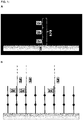
- Streptavidin Coated High Capacity Plates were loaded with primer 1, consisting of a poly-A-Spacer and 2 consecutive sequence elements (comp 1 and comp 2) complementary to different templates (template nucleic acids 1 and 2 respectively). After binding of primer 1 to the surface, the wells were washed to remove all primers that were not bound by the Streptavidin-Biotin interaction.
- primer 2 which is an oligonucleotide complementary to element comp 1 of primer 1, resulting in a protected double-stranded region at the element comp 1.
- the hybridization of primer 2 was done with a temperature gradient (75°C for 3 min, 70°C for 3 min, 65°C for 3 min, 60°C for 10 min).
- the hybridization mixture comprises 50 mM Tris-HCI (pH8,8), 100 mM NaCl, 15 mM MgCl 2 , 55% Polyethylene Glycol 300 and 2 ⁇ M primer 2. After the hybridization was finished, the surface washed to eliminate non-hybridized oligonucleotides.
- a specific hybridization of template DNA and extension reaction was performed at 45°C for 40 min with 400 pg of a mixture of templates (100 pg template 1 complementary to element comp 1, 100 pg template 2 complementary to element comp 2, 200 pg template 3 not complementary to any region of primer 1).
- the hybridization and extension reaction mixture comprises 20 mM Tris-HCI (pH8.8), 2 mM MgSO 4 , 10 mM (NH 4 ) 2 SO 4 , 0.1% Triton X-100, 10mM KCI, 0.25 mM dNTP, 1 ⁇ g/ ⁇ l BSA, 0.48 U/ ⁇ l Bst Polymerase and 8 pg/ ⁇ l of the mixture of templates.
- the surface was washed to eliminate non hybridized template nucleic acid.
- the partial digestion (3' truncation) of primer 1 was performed at 37°C for 20 min followed by 5 min incubation at 65°C and again 20 min at 37°C.
- the digestion mixture (pH9.5) comprises 67 mM Glycine-KOH, 6.7 mM MgCI2, 10 mM ⁇ -ME and 0.68 U/ ⁇ l Exonuclease I.
- After the digestion was finished the surface was washed several times to eliminate unspecific binding products.
- the washing procedure included a stringent washing step (for 5 min at 60°C) with a wash buffer comprising 50% DMSO, 0.012% Tween 20, 125 mM NaCl, 10 mM MgCl 2 and 50 mM Tris-HCI (pH7.5).
- the hybridization and extension reaction mixture comprises 20 mM Tris-HCI (pH8.8), 2 mM MgSO 4 , 10 mM (NH 4 ) 2 SO 4 , 0.1% Triton X-100, 10mM KCI, 0.25 mM dNTP, 1 ⁇ g/ ⁇ l BSA, 0.48 U/ ⁇ l Bst Polymerase and 0 pg/ ⁇ l of the mixture of templates.
- the surface was washed several times to eliminate unspecific binding products. The washing procedure was done as described before (also including the stringent washing step).
- the surfaces were treated with 50 ⁇ l reconstituted DLB solution (REPLI-g Single Cell Kit, QIAGEN) for 10 min. Thereafter, 50 ⁇ l of Stop Solution (REPLI-g Single Cell Kit, QIAGEN) was added to the surfaces. 100 ⁇ l of the eluate was transferred to a new microcentrifuge tube. 2 ⁇ l of a 1:10 diluted eluate were used for 20 ⁇ l quantitative real-time PCR reactions.
- DLB solution REPLI-g Single Cell Kit, QIAGEN
- the real-time PCR reactions were setup by QuantiFast SybrGreen reagents (QIAGEN) and primer 3 and 4 (for template 1) or primer 5 and 6 (for template 2) as described in handbook.
- QIAGEN QuantiFast SybrGreen reagents
- primer 3 and 4 for template 1
- primer 5 and 6 for template 2
- 1, 10,100 and 1000 fg DNA were used as a standard for quantification of the templates after hybridization.
- sequence element comp 1 complementary to template 1 was blocked (by primer 2 concerning the hybridization and by the consecutive sequence element comp 2 concerning the extension) and sequence element comp 2 complementary to template 2 was accessible for template hybridization (single stranded) and extension (existing 3'-OH end).
- sequence element comp 2 complementary to template 2 was accessible for template hybridization (single stranded) and extension (existing 3'-OH end).
- the most 3'-sequence element comp 2 can be used before the partial digestion (3' truncation) of the oligonucleotides immobilized to the surface. Therefore, a specific capturing of the respective template (template 2) is possible without unintentional capturing of templates (like template 1) that are complementary to other sequence elements (like element comp 1).
- Streptavidin Coated High Capacity Plates were loaded with primer 1, consisting of a poly-A-Spacer and 2 consecutive sequence elements (comp 1 and comp 2) complementary to different templates (template nucleic acids 1 and 2 respectively). After binding of primer 1 to the surface, the wells were washed to remove all primers that were not bound by the Streptavidin-Biotin interaction.
- primer 2 which is an oligonucleotide complementary to element comp 1 of primer 1, resulting in a protected double-stranded region at the element comp 1.
- the hybridization of primer 2 was done with a temperature gradient (75°C for 3 min, 70°C for 3 min, 65°C for 3 min, 60°C for 10 min).
- the hybridization mixture comprises 50 mM Tris-HCI (pH8,8), 100 mM NaCl, 15 mM MgCl 2 , 55% Polyethylene Glycol 300 and 2 ⁇ M primer 2. After the hybridization was finished, the surface washed to eliminate non-hybridized oligonucleotides.
- the hybridization and extension reaction mixture comprises 20 mM Tris-HCI (pH8.8), 2 mM MgSO 4 , 10 mM (NH 4 ) 2 SO 4 , 0.1% Triton X-100, 10mM KCI, 0.25 mM dNTP, 1 ⁇ g/ ⁇ l BSA, 0.48 U/ ⁇ l Bst Polymerase and 0 pg/ ⁇ l of the mixture of templates.
- the surface was washed to eliminate non hybridized template nucleic acid.
- the partial digestion (3' truncation) of primer 1 was performed at 37°C for 20 min followed by 5 min incubation at 65°C and again 20 min at 37°C.
- the digestion mixture (pH9.5) comprises 67 mM Glycine-KOH, 6.7 mM MgCI2, 10 mM ⁇ -ME and 0.68 U/ ⁇ l Exonuclease I.
- After the digestion was finished the surface was washed several times to eliminate unspecific binding products.
- the washing procedure included a stringent washing step (for 5 min at 60°C) with a wash buffer comprising 50% DMSO, 0.012% Tween 20, 125 mM NaCl, 10 mM MgCl 2 and 50 mM Tris-HCI (pH7.5).
- a second hybridization and extension reaction was performed at 45°C for 40 min with 400 pg of a mixture of templates (100 pg template 1 complementary to element comp 1, 100 pg template 2 complementary to element comp 2, 200 pg template 3 not complementary to any region of primer 1).
- the hybridization and extension reaction mixture comprises 20 mM Tris-HCI (pH8.8), 2 mM MgSO 4 , 10 mM (NH 4 ) 2 SO 4 , 0.1% Triton X-100, 10mM KCI, 0.25 mM dNTP, 1 ⁇ g/ ⁇ l BSA, 0.48 U/ ⁇ l Bst Polymerase and 8 pg/ ⁇ l of the mixture of templates.
- the surface was washed several times to eliminate unspecific binding products.
- the washing procedure was done as described before (also including the stringent washing step).
- the surfaces were treated with 50 ⁇ l reconstituted DLB solution (REPLI-g Single Cell Kit, QIAGEN) for 10 min. Thereafter, 50 ⁇ l of Stop Solution (REPLI-g Single Cell Kit, QIAGEN) was added to the surfaces. 100 ⁇ l of the eluate was transferred to a new microcentrifuge tube. 2 ⁇ l of a 1:10 diluted eluate were used for 20 ⁇ l quantitative real-time PCR reactions.
- the real-time PCR reactions were setup by QuantiFast SybrGreen reagents (QIAGEN) and primer 3 and 4 (for template 1) or primer 5 and 6 (for template 2) as described in handbook.
- QIAGEN QuantiFast SybrGreen reagents
- primer 3 and 4 for template 1
- primer 5 and 6 for template 2
- 1, 10,100 and 1000 fg DNA were used as a standard for quantification of the templates after hybridization.
- Streptavidin Coated High Capacity Plates were loaded with primer 1, consisting of a poly-A-Spacer and 2 consecutive sequence elements (comp 1 and comp 2) complementary to different templates (template nucleic acids 1 and 2 respectively). After binding of primer 1 to the surface, the wells were washed to remove all primers that were not bound by the Streptavidin-Biotin interaction.
- primer 2 which is an oligonucleotide complementary to element comp 1 of primer 1, resulting in a protected double-stranded region at the element comp 1.
- the hybridization of primer 2 was done with a temperature gradient (75°C for 3 min, 70°C for 3 min, 65°C for 3 min, 60°C for 10 min).
- the hybridization mixture comprises 50 mM Tris-HCI (pH8,8), 100 mM NaCl, 15 mM MgCl 2 , 55% Polyethylene Glycol 300 and 2 ⁇ M primer 2. After the hybridization was finished, the surface washed to eliminate non-hybridized oligonucleotides.
- a specific hybridization of template DNA and extension reaction was performed at 45°C for 40 min with 400 pg of a mixture of templates (100 pg template 1 complementary to element comp 1, 100 pg template 2 complementary to element comp 2, 200 pg template 3 not complementary to any region of primer 1).
- the hybridization and extension reaction mixture comprises 20 mM Tris-HCI (pH8.8), 2 mM MgSO 4 , 10 mM (NH 4 ) 2 SO 4 , 0.1% Triton X-100, 10mM KCI, 0.25 mM dNTP, 1 ⁇ g/ ⁇ l BSA, 0.48 U/ ⁇ l Bst Polymerase and 8 pg/ ⁇ l of the mixture of templates.
- the surface was washed to eliminate non hybridized template nucleic acid.
- the partial digestion (3' truncation) of primer 1 was performed at 37°C for 20 min followed by 5 min incubation at 65°C and again 20 min at 37°C.
- the digestion mixture (pH9.5) comprises 67 mM Glycine-KOH, 6.7 mM MgCI2, 10 mM ⁇ -ME and 0.68 U/ ⁇ l Exonuclease I.
- After the digestion was finished the surface was washed several times to eliminate unspecific binding products.
- the washing procedure included a stringent washing step (for 5 min at 60°C) with a wash buffer comprising 50% DMSO, 0.012% Tween 20, 125 mM NaCl, 10 mM MgCl 2 and 50 mM Tris-HCI (pH7.5).
- a second hybridization and extension reaction was performed at 45°C for 40 min with 400 pg of a mixture of templates (100 pg template 1 complementary to element comp 1, 100 pg template 2 complementary to element comp 2, 200 pg template 3 not complementary to any region of primer 1).
- the hybridization and extension reaction mixture comprises 20 mM Tris-HCI (pH8.8), 2 mM MgSO 4 , 10 mM (NH 4 ) 2 SO 4 , 0.1% Triton X-100, 10mM KCI, 0.25 mM dNTP, 1 ⁇ g/ ⁇ l BSA, 0.48 U/ ⁇ l Bst Polymerase and 8 pg/ ⁇ l of the mixture of templates.
- the surface was washed several times to eliminate unspecific binding products.
- the washing procedure was done as described before (also including the stringent washing step).
- the surfaces were treated with 50 ⁇ l reconstituted DLB solution (REPLI-g Single Cell Kit, QIAGEN) for 10 min. Thereafter, 50 ⁇ l of Stop Solution (REPLI-g Single Cell Kit, QIAGEN) was added to the surfaces. 100 ⁇ l of the eluate was transferred to a new microcentrifuge tube. 2 ⁇ l of a 1:10 diluted eluate were used for 20 ⁇ l quantitative real-time PCR reactions.
- the real-time PCR reactions were setup by QuantiFast SybrGreen reagents (QIAGEN) and primer 3 and 4 (for template 1) or primer 5 and 6 (for template 2) as described in handbook.
- QIAGEN QuantiFast SybrGreen reagents
- primer 3 and 4 for template 1
- primer 5 and 6 for template 2
- 1, 10,100 and 1000 fg DNA were used as a standard for quantification of the templates after hybridization.
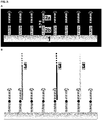
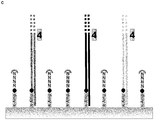
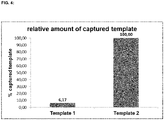
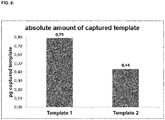
- Template 1 and template 2 were captured effectively by two rounds of specific hybridization and extension, separated by the partial digestions.
- the binding efficiency of template 1 seems to be a little bit higher than the binding efficiency of template 2, but the amounts of captured templates are both in the expected range (see Figure 6 ).
- the results show that the functionalities of both sequence elements can be used subsequently by the use of the partial digestion.
- the 3'-sequence element comp 2 can be used before the partial digestion to specifically capture template 2 and the 5'-sequence element comp 1 can be used after partial digestion to specifically capture template 1.
- An oligonucleotide with consecutive sequence elements having different functionalities is therefore possible.
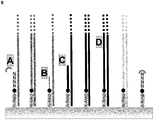
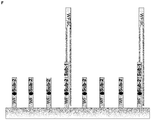
- Oligonucleotides used for example 4 /3ddC/ is the symbol for a dideoxy-Cytosine, sequence element with the functionality for the ⁇ -Amp-reaction ( ⁇ -Amp-element) in bold, 3'-sequence-element complementary to template nucleic acid 1 (comp 1) underlined, 3'-sequence-element not complementary to template nucleic acid 1 (no-comp 1) italic Oligonucleotide Comment Sequence Primer 1 Primer with two different sequence elements; immobilized onto surface Primer 2 ⁇ -Amp-primer; immobilized onto surface Primer 3 Primer with two different sequence elements; immobilized onto surface Primer 4 qPCR-Primer GCCAGATTCCAGATGAGGAC (SEQ ID NO: 5) Primer 5 qPCR-Primer CCAGAACATGGGCTTTCTTG (SEQ ID NO: 6) Template nucleic acid 1 Template that can be specifically captured by the 3'-sequence element comp 1 * means
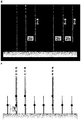
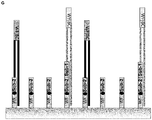
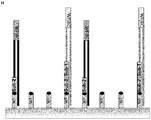
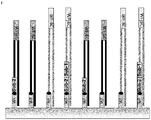
- an oligonucleotide immobilized to the surface can have (at least) one sequence element for capturing a template and another sequence element for amplifying the captured template. Proof that the amplification reaction and the partial digestion (3' truncation) can take place in the same reaction in parallel. Proof that a partial digestion (to activate the Amplification sequence element) is needed for efficient amplification if no functional primers for the amplification are provided from the very beginning on.
- Primer 1 and primer 3 comprise a 5'-sequence-element providing the functionality for the ⁇ -Amp-reaction ( ⁇ -Amp element) and a 3'-sequence-element for specific capturing of a target. While primer 1 comprises the 3'-sequence element comp 1 that is complementary to the template nucleic acid 1 used in this experiment, primer 3 comprises a 3'-sequence-element not complementary to template 1 (element no-comp 1). Primer 2 only consists of the 5'- ⁇ -Amp element and therefore is the standard oligonucleotide for a ⁇ -Amp-reaction.
- a specific hybridization and extension reaction was performed at 45°C for 40 min with 100 pg of template 1.
- Template 1 is specifically captured by the 3'-sequence element comp 1 of primer 1.
- the hybridization and extension reaction mixture comprises 20 mM Tris-HCI (pH8.8), 2 mM MgSO 4 , 10 mM (NH 4 ) 2 SO 4 , 0.1% Triton X-100, 10mM KCI, 0.25 mM dNTP, 1 ⁇ g/ ⁇ l BSA, 0.48 U/ ⁇ l Bst Polymerase and 2 pg/ ⁇ l of template 1.
- the surface was washed to eliminate non hybridized template nucleic acid.
- the ⁇ -amplification was performed for 60 min at 57°C in an amplification reaction mixture comprising 20 mM Tris-HCI (pH8.8), 1.25 mM MgSO 4 , 10 mM (NH 4 ) 2 SO 4 , 0.1% Triton X-100, 10mM KCI, 0.25 mM dNTP, 1 ⁇ g/ ⁇ l BSA, 1 ⁇ M Primer PEkurzGG, 25% Dextrane, 0.48 U/ ⁇ l Bst Polymerase, and 0.01 U/ ⁇ l Pfu Polymerase (used for deblocking of 3'-terminal blocked primer).
- the vials were washed to eliminate non bound amplification products.
- the surfaces were treated with 50 ⁇ l reconstituted DLB solution (REPLI-g Single Cell Kit, QIAGEN) for 10 min. Thereafter, 50 ⁇ l of Stop Solution (REPLI-g Single Cell Kit, QIAGEN) was added to the surfaces. 100 ⁇ l of the eluate was transferred to a new microcentrifuge tube. 2 ⁇ l of a 1:10 diluted eluate were used for 20 ⁇ l quantitative real-time PCR reactions.
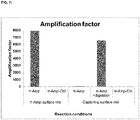
- reaction 1 The conditions in reaction 1 are very close to the conditions in a regular ⁇ -amplification. Most of the immobilized oligonucleotides (90% primer 2) do have the ⁇ -amplification functionality and the ⁇ -amplification mixture is not modified. The amplification factor under this conditions was >7900fold. The result is expected because most of the oligonucleotides on the surface support the ⁇ -amplification. The slightly lower amplification factor is probably because of the 10% of surface bound primers without an active functional ⁇ -amp-element (primer 1).
- reaction 2 The conditions in reaction 2 are similar to the conditions in reaction 1. The only difference is the absence of enzymes and the mobile primer in the amplification mixture. This made sure that no amplification took place, in order to determine the amount of hybridized and extended template nucleic acid molecules.
- the amplification factor in reaction 1 can be calculated by dividing the amount of specific templates after the amplification through the amount of specific templates in reaction 2.
- reaction 3 The conditions in reaction 3 are not very close to a regular ⁇ -amplification because there are only immobilized primers that do not have accessible ⁇ -amp-elements needed for the amplification (primer 1 and primer 3).
- the ⁇ -amplification mixture is not modified.
- the resulting amplification factors are very low based on control reaction 5. This result is expected because of the lack of accessible ⁇ -amp-elements in primer 1 and primer 3. Without the functional elements no ⁇ -amp-reaction can occur, although the reaction mixture would allow an efficient ⁇ -amplification.
- the residual amplification is very likely due to the partial digestion of a minor fraction of surface bound oligonucleotides by the proof reading activity of the Pfu polymerase, which activates some of the 3'- ⁇ -amp-elements of primers 1 and 3.
- reaction 4 The conditions in reaction 4 are very similar to reaction 3.
- the surface comprises primer 1 and 3 without any accessible ⁇ -amp-elements needed for the amplification.
- the important difference is the modification of the ⁇ -amplification mixture.
- the amount of Pfu-polymerase in the ⁇ -amplification reaction is increased by 800%.
- the amplification factor using this ⁇ -amplification with additional digestion activity was >6500fold (based on control reaction 5), which is very close to the amplification factor of reaction 1 (reaction with a majority of accessible functional ⁇ -amp-elements on the surface).
- the 3'-5'-exonuclease activity of the highly concentrated Pfu-polymerase allows the efficient partial digestion of primers 1 and 3.
- reaction 5 The conditions in reaction 5 are similar to the conditions in reaction 3. The only difference is the absence of enzymes and the mobile primer in the amplification mixture. This made sure that no amplification took place, in order to determine the amount of hybridized and extended template nucleic acid molecules.
- the amplification factor in reactions 3 and 4 can be calculated by dividing the amount of specific templates after the amplification through the amount of specific templates in reaction 5.
- primers with consecutive sequence elements can be used for multiple functionalities (specific capturing of target nucleic acids and amplification).
- the partial digestion (3' truncation) and the amplification can be done in the same reaction in parallel. Without the digestion of the 3'-sequence elements, the amplification functionality cannot be activated.
- the usage of those primers allows a high density of oligonucleotides on the surface for specific capturing of template nucleic acids combined with an efficient amplification of the captured nucleic acids.
Landscapes
- Chemical & Material Sciences (AREA)
- Organic Chemistry (AREA)
- Life Sciences & Earth Sciences (AREA)
- Zoology (AREA)
- Proteomics, Peptides & Aminoacids (AREA)
- Health & Medical Sciences (AREA)
- Engineering & Computer Science (AREA)
- Wood Science & Technology (AREA)
- Analytical Chemistry (AREA)
- Microbiology (AREA)
- Physics & Mathematics (AREA)
- Molecular Biology (AREA)
- Immunology (AREA)
- Biotechnology (AREA)
- Biophysics (AREA)
- Biochemistry (AREA)
- Bioinformatics & Cheminformatics (AREA)
- General Engineering & Computer Science (AREA)
- General Health & Medical Sciences (AREA)
- Genetics & Genomics (AREA)
- Chemical Kinetics & Catalysis (AREA)
- Measuring Or Testing Involving Enzymes Or Micro-Organisms (AREA)
Claims (12)
- Verfahren zum Erzeugen einer Sequenzierungsbibliothek, wobei das Verfahren umfasst:a) Hybridisieren von Template-Nukleinsäuren an Oligonukleotide, die über ihr 5'-Ende an eine feste Oberfläche gebunden sind und ursprünglich wenigstens zwei funktionelle Sequenzelemente umfassen, und Entfernen von ungebundenen Template-Nukleinsäuren, vorzugsweise durch einen Waschschritt;b) Verlängern der an die Template-Nukleinsäuren hybridisierten oberflächengebundenen Oligonukleotide, um einen Doppelstrang zu bilden;c) gegebenenfalls Modifizieren der in Schritt b) erzeugten doppelsträngigen Nukleinsäuren;d) 3'-Trunkieren der oberflächengebundenen Oligonukleotide, die bei der Template-Nukleinsäure-Hybridisierung von Schritt a) nicht verwendet wurden;e) gegebenenfalls Modifizieren der in Schritt d) erzeugten einsträngigen oberflächengebundenen Oligonukleotide; undf) Hybridisieren weiterer Template-Nukleinsäuren an die oberflächengebundenen Oligonukleotideoder
Verwenden von funktionellen Sequenzelementen in den oberflächengebundenen Oligonukleotiden bei einer nachgelagerten Anwendung,
wobei die Schritte a) bis e) wenigstens einmal mit Template-Nukleinsäuren aus derselben Probe oder aus unterschiedlichen Proben wiederholt werden,
wobei nach dem ersten 3'-Trunkierungsschritt der oberflächengebundenen Oligonukleotide das trunkierte Oligonukleotid noch immer wenigstens ein funktionelles Sequenzelement enthält, und
wobei die Länge der oberflächengebundenen Oligonukleotide 10 bis 200 Nukleotide beträgt. - Verfahren nach Anspruch 2, wobei die nachgelagerte Anwendung eine Nukleinsäure-Amplifikation auf der festen Oberfläche, eine Entkopplung von der festen Oberfläche, eine in-vitro-Transkription unter Verwendung eines RNA-Polymerase-Promotors in dem Oligonukleotid, ein Markieren der immobilisierten Nukleinsäure unter Verwendung einer Primer-Bindungsstelle oder einer molekularen Strichcoderegion zur Identifikation innerhalb des Oligonukleotids, eine Sequenzierung oder eine Kombination davon ist.
- Verfahren nach einem der vorhergehenden Ansprüche, wobei wenigstens eines der funktionellen Sequenzelemente eine Sequenz ist, die für eine nachgelagerte Anwendung nützlich ist.
- Verfahren nach einem der vorhergehenden Ansprüche, wobei die funktionellen Sequenzelemente aufeinanderfolgend oder überlappend sind.
- Verfahren nach einem der vorhergehenden Ansprüche, wobei die funktionellen Sequenzelemente durch vordefinierte Spaltungsstellen getrennt sind oder durch Hybridisierung von schützenden Oligonukleotiden an die oberflächengebundenen Oligonukleotide erzeugt werden.
- Verfahren nach einem der vorhergehenden Ansprüche, wobei die Dichte der oberflächengebundenen Oligonukleotide zwischen 500 und 500.000 Oligonukleotiden/µm2, stärker bevorzugt 750 und 200.000 Oligonukleotiden/µm2, am stärksten bevorzugt 1.000 und 100.000 Oligonukleotiden/µm2 , beträgt.
- Verfahren nach einem der vorhergehenden Ansprüche, wobei die oberflächengebundenen Oligonukleotide 2 bis 20, stärker bevorzugt 2 bis 10, am stärksten bevorzugt 2 bis 5 funktionelle Sequenzelemente umfassen.
- Verfahren nach einem der vorhergehenden Ansprüche, wobei die Länge der oberflächengebundenen Oligonukleotide im Bereich von 10 bis 140 nt, vorzugsweise 20 bis 100 nt, liegt.
- Verfahren nach einem der vorhergehenden Ansprüche, wobei alle funktionellen Sequenzelemente der gleichen Position innerhalb eines oberflächengebundenen Oligonukleotids eine einzige Sequenz aufweisen oder 2 bis 100.000, vorzugsweise 2 bis 50.000, stärker bevorzugt 2 bis 25.000, stärker bevorzugt 2 bis 10.000, stärker bevorzugt 2 bis 5.000, stärker bevorzugt 2 bis 2.500, am stärksten bevorzugt 2 bis 1.000 verschiedene Sequenzen umfassen.
- Verfahren nach einem der vorhergehenden Ansprüche, wobei die 3'-Trunkierung enzymatisch oder chemisch erzielt wird.
- Verfahren nach einem der vorhergehenden Ansprüche, wobei die an die Oberfläche gebundenen doppelsträngigen Nukleinsäuren durch das Einführen von Strichcodesequenzen, das Hinzufügen von sequenzierenden Adaptoren, das Hinzufügen eines Fluorophors am Terminus, den Einbau modifizierter Basen oder andere Modifikationen modifiziert wird.
- Verfahren nach einem der vorhergehenden Ansprüche, wobei die an die Oberfläche gebundenen einsträngigen Oligonukleotide durch das Hinzufügen von Biotin, markierenden Einheiten, blockierenden Einheiten oder andere Modifikationen modifiziert werden.
Priority Applications (1)
| Application Number | Priority Date | Filing Date | Title |
|---|---|---|---|
| EP21174298.6A EP3929306A1 (de) | 2017-01-26 | 2017-12-07 | Verfahren zur anreicherung von schablonennukleinsäuren |
Applications Claiming Priority (2)
| Application Number | Priority Date | Filing Date | Title |
|---|---|---|---|
| EP17153406 | 2017-01-26 | ||
| PCT/EP2017/081894 WO2018137826A1 (en) | 2017-01-26 | 2017-12-07 | Method for enriching template nucleic acids |
Related Child Applications (1)
| Application Number | Title | Priority Date | Filing Date |
|---|---|---|---|
| EP21174298.6A Division EP3929306A1 (de) | 2017-01-26 | 2017-12-07 | Verfahren zur anreicherung von schablonennukleinsäuren |
Publications (2)
| Publication Number | Publication Date |
|---|---|
| EP3589752A1 EP3589752A1 (de) | 2020-01-08 |
| EP3589752B1 true EP3589752B1 (de) | 2021-05-19 |
Family
ID=58016539
Family Applications (2)
| Application Number | Title | Priority Date | Filing Date |
|---|---|---|---|
| EP17829138.1A Active EP3589752B1 (de) | 2017-01-26 | 2017-12-07 | Verfahren zur erzeugung einer sequenzierungsbibliothek |
| EP21174298.6A Withdrawn EP3929306A1 (de) | 2017-01-26 | 2017-12-07 | Verfahren zur anreicherung von schablonennukleinsäuren |
Family Applications After (1)
| Application Number | Title | Priority Date | Filing Date |
|---|---|---|---|
| EP21174298.6A Withdrawn EP3929306A1 (de) | 2017-01-26 | 2017-12-07 | Verfahren zur anreicherung von schablonennukleinsäuren |
Country Status (3)
| Country | Link |
|---|---|
| EP (2) | EP3589752B1 (de) |
| CA (1) | CA3063364A1 (de) |
| WO (1) | WO2018137826A1 (de) |
Families Citing this family (9)
| Publication number | Priority date | Publication date | Assignee | Title |
|---|---|---|---|---|
| ES2625288T3 (es) | 2011-04-15 | 2017-07-19 | The Johns Hopkins University | Sistema de secuenciación segura |
| AU2013338393C1 (en) | 2012-10-29 | 2024-07-25 | The Johns Hopkins University | Papanicolaou test for ovarian and endometrial cancers |
| US11286531B2 (en) | 2015-08-11 | 2022-03-29 | The Johns Hopkins University | Assaying ovarian cyst fluid |
| IL319255A (en) | 2017-08-07 | 2025-04-01 | Univ Johns Hopkins | Methods and materials for cancer assessment and treatment |
| US10704094B1 (en) | 2018-11-14 | 2020-07-07 | Element Biosciences, Inc. | Multipart reagents having increased avidity for polymerase binding |
| US20200149095A1 (en) * | 2018-11-14 | 2020-05-14 | Element Biosciences, Inc. | Low binding supports for improved solid-phase dna hybridization and amplification |
| SG11202112049VA (en) * | 2019-05-24 | 2021-12-30 | Element Biosciences Inc | Multivalent binding composition for nucleic acid analysis |
| JP2023513606A (ja) | 2020-02-14 | 2023-03-31 | ザ・ジョンズ・ホプキンス・ユニバーシティー | 核酸を評価するための方法および材料 |
| US20240052406A1 (en) * | 2022-08-04 | 2024-02-15 | Singular Genomics Systems, Inc. | Competitive methods and compositions for amplifying polynucleotides |
Family Cites Families (10)
| Publication number | Priority date | Publication date | Assignee | Title |
|---|---|---|---|---|
| US5641658A (en) | 1994-08-03 | 1997-06-24 | Mosaic Technologies, Inc. | Method for performing amplification of nucleic acid with two primers bound to a single solid support |
| US5770370A (en) * | 1996-06-14 | 1998-06-23 | David Sarnoff Research Center, Inc. | Nuclease protection assays |
| US6300070B1 (en) | 1999-06-04 | 2001-10-09 | Mosaic Technologies, Inc. | Solid phase methods for amplifying multiple nucleic acids |
| US7244559B2 (en) | 1999-09-16 | 2007-07-17 | 454 Life Sciences Corporation | Method of sequencing a nucleic acid |
| US6274320B1 (en) | 1999-09-16 | 2001-08-14 | Curagen Corporation | Method of sequencing a nucleic acid |
| FR2805826B1 (fr) * | 2000-03-01 | 2002-09-20 | Nucleica | Nouvelles puces a adn |
| AR031640A1 (es) | 2000-12-08 | 2003-09-24 | Applied Research Systems | Amplificacion isotermica de acidos nucleicos en un soporte solido |
| US20090226975A1 (en) * | 2008-03-10 | 2009-09-10 | Illumina, Inc. | Constant cluster seeding |
| US9309557B2 (en) | 2010-12-17 | 2016-04-12 | Life Technologies Corporation | Nucleic acid amplification |
| EP3564392B1 (de) | 2010-12-17 | 2021-11-24 | Life Technologies Corporation | Verfahren für nukleinsäureamplifikation |
-
2017
- 2017-12-07 EP EP17829138.1A patent/EP3589752B1/de active Active
- 2017-12-07 WO PCT/EP2017/081894 patent/WO2018137826A1/en not_active Ceased
- 2017-12-07 EP EP21174298.6A patent/EP3929306A1/de not_active Withdrawn
- 2017-12-07 CA CA3063364A patent/CA3063364A1/en active Pending
Non-Patent Citations (1)
| Title |
|---|
| None * |
Also Published As
| Publication number | Publication date |
|---|---|
| CA3063364A1 (en) | 2018-08-02 |
| WO2018137826A1 (en) | 2018-08-02 |
| EP3929306A1 (de) | 2021-12-29 |
| EP3589752A1 (de) | 2020-01-08 |
Similar Documents
| Publication | Publication Date | Title |
|---|---|---|
| EP3589752B1 (de) | Verfahren zur erzeugung einer sequenzierungsbibliothek | |
| EP3872187B1 (de) | Zusammensetzungen und verfahren zur verbesserung der probenidentifikation in indizierten nukleinsäurebibliotheken | |
| US11072819B2 (en) | Methods of constructing small RNA libraries and their use for expression profiling of target RNAs | |
| EP3313992B1 (de) | Selektive degradierung von wild-typ-dns und anreicherung von mutierten allelen mit hilfe von nuklease | |
| EP2976435B1 (de) | Anreicherung von zielsequenzen | |
| EP2906715B1 (de) | Zusammensetzungen, verfahren, systeme und kits zur zielnukleinsäureanreicherung | |
| EP4293125A2 (de) | Verfahren zur gezielten genomanalyse | |
| CN107760772B (zh) | 用于核酸配对末端测序的方法、组合物、系统、仪器和试剂盒 | |
| US20170022551A1 (en) | Methods and compositions for reducing non-specific amplification products | |
| CN106715706A (zh) | 直接从未纯化的生物样本分析核酸的方法 | |
| US12545950B2 (en) | Methods for preparing CDNA samples for RNA sequencing, and CDNA samples and uses thereof | |
| CN107532166A (zh) | 用于减少非特异性扩增产物的方法和组合物 | |
| JP2012165755A (ja) | サブトラクション・ポリヌクレオチドの取得方法 | |
| CA3094054C (en) | Methods for amplification of nucleic acids with endonuclease-mediated shifting equilibrium (em-seq) | |
| EP4127220B1 (de) | Verfahren und zusammensetzungen zur herstellung von nukleinsäurebibliotheken | |
| EP4296372A1 (de) | Verfahren zum nachweis und zur unterscheidung von cytosinmodifikationen | |
| US20250002900A1 (en) | Methods for Producing DNA Libraries and Uses Thereof | |
| HK40109510A (en) | Methods and compositions for preparing nucleic acid libraries | |
| HK40103977A (en) | Methods for targeted genomic analysis | |
| HK40087449A (en) | Methods and compositions for preparing nucleic acid libraries | |
| HK40087449B (en) | Methods and compositions for preparing nucleic acid libraries | |
| HK40049316A (en) | Compositions and methods for improving sample identification in indexed nucleic acid libraries | |
| HK40049316B (en) | Compositions and methods for improving sample identification in indexed nucleic acid libraries | |
| HK40045238B (en) | Methods for amplification of nucleic acids with endonuclease-mediated shifting equilibrium (em-seq) | |
| HK40045238A (en) | Methods for amplification of nucleic acids with endonuclease-mediated shifting equilibrium (em-seq) |
Legal Events
| Date | Code | Title | Description |
|---|---|---|---|
| STAA | Information on the status of an ep patent application or granted ep patent |
Free format text: STATUS: UNKNOWN |
|
| STAA | Information on the status of an ep patent application or granted ep patent |
Free format text: STATUS: THE INTERNATIONAL PUBLICATION HAS BEEN MADE |
|
| PUAI | Public reference made under article 153(3) epc to a published international application that has entered the european phase |
Free format text: ORIGINAL CODE: 0009012 |
|
| STAA | Information on the status of an ep patent application or granted ep patent |
Free format text: STATUS: REQUEST FOR EXAMINATION WAS MADE |
|
| 17P | Request for examination filed |
Effective date: 20191030 |
|
| AK | Designated contracting states |
Kind code of ref document: A1 Designated state(s): AL AT BE BG CH CY CZ DE DK EE ES FI FR GB GR HR HU IE IS IT LI LT LU LV MC MK MT NL NO PL PT RO RS SE SI SK SM TR |
|
| AX | Request for extension of the european patent |
Extension state: BA ME |
|
| DAV | Request for validation of the european patent (deleted) | ||
| DAX | Request for extension of the european patent (deleted) | ||
| STAA | Information on the status of an ep patent application or granted ep patent |
Free format text: STATUS: EXAMINATION IS IN PROGRESS |
|
| 17Q | First examination report despatched |
Effective date: 20200917 |
|
| GRAP | Despatch of communication of intention to grant a patent |
Free format text: ORIGINAL CODE: EPIDOSNIGR1 |
|
| STAA | Information on the status of an ep patent application or granted ep patent |
Free format text: STATUS: GRANT OF PATENT IS INTENDED |
|
| INTG | Intention to grant announced |
Effective date: 20210304 |
|
| GRAS | Grant fee paid |
Free format text: ORIGINAL CODE: EPIDOSNIGR3 |
|
| GRAA | (expected) grant |
Free format text: ORIGINAL CODE: 0009210 |
|
| STAA | Information on the status of an ep patent application or granted ep patent |
Free format text: STATUS: THE PATENT HAS BEEN GRANTED |
|
| AK | Designated contracting states |
Kind code of ref document: B1 Designated state(s): AL AT BE BG CH CY CZ DE DK EE ES FI FR GB GR HR HU IE IS IT LI LT LU LV MC MK MT NL NO PL PT RO RS SE SI SK SM TR |
|
| REG | Reference to a national code |
Ref country code: GB Ref legal event code: FG4D |
|
| REG | Reference to a national code |
Ref country code: CH Ref legal event code: EP |
|
| REG | Reference to a national code |
Ref country code: DE Ref legal event code: R096 Ref document number: 602017038964 Country of ref document: DE |
|
| REG | Reference to a national code |
Ref country code: AT Ref legal event code: REF Ref document number: 1393998 Country of ref document: AT Kind code of ref document: T Effective date: 20210615 |
|
| REG | Reference to a national code |
Ref country code: IE Ref legal event code: FG4D |
|
| REG | Reference to a national code |
Ref country code: LT Ref legal event code: MG9D |
|
| REG | Reference to a national code |
Ref country code: AT Ref legal event code: MK05 Ref document number: 1393998 Country of ref document: AT Kind code of ref document: T Effective date: 20210519 |
|
| REG | Reference to a national code |
Ref country code: NL Ref legal event code: MP Effective date: 20210519 |
|
| PG25 | Lapsed in a contracting state [announced via postgrant information from national office to epo] |
Ref country code: FI Free format text: LAPSE BECAUSE OF FAILURE TO SUBMIT A TRANSLATION OF THE DESCRIPTION OR TO PAY THE FEE WITHIN THE PRESCRIBED TIME-LIMIT Effective date: 20210519 Ref country code: LT Free format text: LAPSE BECAUSE OF FAILURE TO SUBMIT A TRANSLATION OF THE DESCRIPTION OR TO PAY THE FEE WITHIN THE PRESCRIBED TIME-LIMIT Effective date: 20210519 Ref country code: HR Free format text: LAPSE BECAUSE OF FAILURE TO SUBMIT A TRANSLATION OF THE DESCRIPTION OR TO PAY THE FEE WITHIN THE PRESCRIBED TIME-LIMIT Effective date: 20210519 Ref country code: BG Free format text: LAPSE BECAUSE OF FAILURE TO SUBMIT A TRANSLATION OF THE DESCRIPTION OR TO PAY THE FEE WITHIN THE PRESCRIBED TIME-LIMIT Effective date: 20210819 Ref country code: AT Free format text: LAPSE BECAUSE OF FAILURE TO SUBMIT A TRANSLATION OF THE DESCRIPTION OR TO PAY THE FEE WITHIN THE PRESCRIBED TIME-LIMIT Effective date: 20210519 |
|
| PG25 | Lapsed in a contracting state [announced via postgrant information from national office to epo] |
Ref country code: LV Free format text: LAPSE BECAUSE OF FAILURE TO SUBMIT A TRANSLATION OF THE DESCRIPTION OR TO PAY THE FEE WITHIN THE PRESCRIBED TIME-LIMIT Effective date: 20210519 Ref country code: PT Free format text: LAPSE BECAUSE OF FAILURE TO SUBMIT A TRANSLATION OF THE DESCRIPTION OR TO PAY THE FEE WITHIN THE PRESCRIBED TIME-LIMIT Effective date: 20210920 Ref country code: NO Free format text: LAPSE BECAUSE OF FAILURE TO SUBMIT A TRANSLATION OF THE DESCRIPTION OR TO PAY THE FEE WITHIN THE PRESCRIBED TIME-LIMIT Effective date: 20210819 Ref country code: PL Free format text: LAPSE BECAUSE OF FAILURE TO SUBMIT A TRANSLATION OF THE DESCRIPTION OR TO PAY THE FEE WITHIN THE PRESCRIBED TIME-LIMIT Effective date: 20210519 Ref country code: SE Free format text: LAPSE BECAUSE OF FAILURE TO SUBMIT A TRANSLATION OF THE DESCRIPTION OR TO PAY THE FEE WITHIN THE PRESCRIBED TIME-LIMIT Effective date: 20210519 Ref country code: RS Free format text: LAPSE BECAUSE OF FAILURE TO SUBMIT A TRANSLATION OF THE DESCRIPTION OR TO PAY THE FEE WITHIN THE PRESCRIBED TIME-LIMIT Effective date: 20210519 Ref country code: GR Free format text: LAPSE BECAUSE OF FAILURE TO SUBMIT A TRANSLATION OF THE DESCRIPTION OR TO PAY THE FEE WITHIN THE PRESCRIBED TIME-LIMIT Effective date: 20210820 Ref country code: IS Free format text: LAPSE BECAUSE OF FAILURE TO SUBMIT A TRANSLATION OF THE DESCRIPTION OR TO PAY THE FEE WITHIN THE PRESCRIBED TIME-LIMIT Effective date: 20210919 |
|
| PG25 | Lapsed in a contracting state [announced via postgrant information from national office to epo] |
Ref country code: NL Free format text: LAPSE BECAUSE OF FAILURE TO SUBMIT A TRANSLATION OF THE DESCRIPTION OR TO PAY THE FEE WITHIN THE PRESCRIBED TIME-LIMIT Effective date: 20210519 |
|
| PG25 | Lapsed in a contracting state [announced via postgrant information from national office to epo] |
Ref country code: ES Free format text: LAPSE BECAUSE OF FAILURE TO SUBMIT A TRANSLATION OF THE DESCRIPTION OR TO PAY THE FEE WITHIN THE PRESCRIBED TIME-LIMIT Effective date: 20210519 Ref country code: SK Free format text: LAPSE BECAUSE OF FAILURE TO SUBMIT A TRANSLATION OF THE DESCRIPTION OR TO PAY THE FEE WITHIN THE PRESCRIBED TIME-LIMIT Effective date: 20210519 Ref country code: SM Free format text: LAPSE BECAUSE OF FAILURE TO SUBMIT A TRANSLATION OF THE DESCRIPTION OR TO PAY THE FEE WITHIN THE PRESCRIBED TIME-LIMIT Effective date: 20210519 Ref country code: RO Free format text: LAPSE BECAUSE OF FAILURE TO SUBMIT A TRANSLATION OF THE DESCRIPTION OR TO PAY THE FEE WITHIN THE PRESCRIBED TIME-LIMIT Effective date: 20210519 Ref country code: DK Free format text: LAPSE BECAUSE OF FAILURE TO SUBMIT A TRANSLATION OF THE DESCRIPTION OR TO PAY THE FEE WITHIN THE PRESCRIBED TIME-LIMIT Effective date: 20210519 Ref country code: EE Free format text: LAPSE BECAUSE OF FAILURE TO SUBMIT A TRANSLATION OF THE DESCRIPTION OR TO PAY THE FEE WITHIN THE PRESCRIBED TIME-LIMIT Effective date: 20210519 Ref country code: CZ Free format text: LAPSE BECAUSE OF FAILURE TO SUBMIT A TRANSLATION OF THE DESCRIPTION OR TO PAY THE FEE WITHIN THE PRESCRIBED TIME-LIMIT Effective date: 20210519 |
|
| REG | Reference to a national code |
Ref country code: DE Ref legal event code: R097 Ref document number: 602017038964 Country of ref document: DE |
|
| PLBE | No opposition filed within time limit |
Free format text: ORIGINAL CODE: 0009261 |
|
| STAA | Information on the status of an ep patent application or granted ep patent |
Free format text: STATUS: NO OPPOSITION FILED WITHIN TIME LIMIT |
|
| 26N | No opposition filed |
Effective date: 20220222 |
|
| PG25 | Lapsed in a contracting state [announced via postgrant information from national office to epo] |
Ref country code: IS Free format text: LAPSE BECAUSE OF FAILURE TO SUBMIT A TRANSLATION OF THE DESCRIPTION OR TO PAY THE FEE WITHIN THE PRESCRIBED TIME-LIMIT Effective date: 20210919 Ref country code: AL Free format text: LAPSE BECAUSE OF FAILURE TO SUBMIT A TRANSLATION OF THE DESCRIPTION OR TO PAY THE FEE WITHIN THE PRESCRIBED TIME-LIMIT Effective date: 20210519 |
|
| PG25 | Lapsed in a contracting state [announced via postgrant information from national office to epo] |
Ref country code: MC Free format text: LAPSE BECAUSE OF FAILURE TO SUBMIT A TRANSLATION OF THE DESCRIPTION OR TO PAY THE FEE WITHIN THE PRESCRIBED TIME-LIMIT Effective date: 20210519 Ref country code: IT Free format text: LAPSE BECAUSE OF FAILURE TO SUBMIT A TRANSLATION OF THE DESCRIPTION OR TO PAY THE FEE WITHIN THE PRESCRIBED TIME-LIMIT Effective date: 20210519 |
|
| REG | Reference to a national code |
Ref country code: CH Ref legal event code: PL |
|
| REG | Reference to a national code |
Ref country code: BE Ref legal event code: MM Effective date: 20211231 |
|
| PG25 | Lapsed in a contracting state [announced via postgrant information from national office to epo] |
Ref country code: LU Free format text: LAPSE BECAUSE OF NON-PAYMENT OF DUE FEES Effective date: 20211207 Ref country code: IE Free format text: LAPSE BECAUSE OF NON-PAYMENT OF DUE FEES Effective date: 20211207 |
|
| PG25 | Lapsed in a contracting state [announced via postgrant information from national office to epo] |
Ref country code: FR Free format text: LAPSE BECAUSE OF NON-PAYMENT OF DUE FEES Effective date: 20211231 Ref country code: BE Free format text: LAPSE BECAUSE OF NON-PAYMENT OF DUE FEES Effective date: 20211231 |
|
| PG25 | Lapsed in a contracting state [announced via postgrant information from national office to epo] |
Ref country code: LI Free format text: LAPSE BECAUSE OF NON-PAYMENT OF DUE FEES Effective date: 20211231 Ref country code: CH Free format text: LAPSE BECAUSE OF NON-PAYMENT OF DUE FEES Effective date: 20211231 |
|
| PG25 | Lapsed in a contracting state [announced via postgrant information from national office to epo] |
Ref country code: CY Free format text: LAPSE BECAUSE OF FAILURE TO SUBMIT A TRANSLATION OF THE DESCRIPTION OR TO PAY THE FEE WITHIN THE PRESCRIBED TIME-LIMIT Effective date: 20210519 |
|
| PG25 | Lapsed in a contracting state [announced via postgrant information from national office to epo] |
Ref country code: HU Free format text: LAPSE BECAUSE OF FAILURE TO SUBMIT A TRANSLATION OF THE DESCRIPTION OR TO PAY THE FEE WITHIN THE PRESCRIBED TIME-LIMIT; INVALID AB INITIO Effective date: 20171207 |
|
| PG25 | Lapsed in a contracting state [announced via postgrant information from national office to epo] |
Ref country code: MK Free format text: LAPSE BECAUSE OF FAILURE TO SUBMIT A TRANSLATION OF THE DESCRIPTION OR TO PAY THE FEE WITHIN THE PRESCRIBED TIME-LIMIT Effective date: 20210519 |
|
| PG25 | Lapsed in a contracting state [announced via postgrant information from national office to epo] |
Ref country code: MT Free format text: LAPSE BECAUSE OF FAILURE TO SUBMIT A TRANSLATION OF THE DESCRIPTION OR TO PAY THE FEE WITHIN THE PRESCRIBED TIME-LIMIT Effective date: 20210519 |
|
| PG25 | Lapsed in a contracting state [announced via postgrant information from national office to epo] |
Ref country code: TR Free format text: LAPSE BECAUSE OF FAILURE TO SUBMIT A TRANSLATION OF THE DESCRIPTION OR TO PAY THE FEE WITHIN THE PRESCRIBED TIME-LIMIT Effective date: 20210519 |
|
| PGFP | Annual fee paid to national office [announced via postgrant information from national office to epo] |
Ref country code: DE Payment date: 20251211 Year of fee payment: 9 |
|
| PGFP | Annual fee paid to national office [announced via postgrant information from national office to epo] |
Ref country code: GB Payment date: 20251219 Year of fee payment: 9 |