EP3587791A1 - Flow control nozzle - Google Patents
Flow control nozzle Download PDFInfo
- Publication number
- EP3587791A1 EP3587791A1 EP18275085.1A EP18275085A EP3587791A1 EP 3587791 A1 EP3587791 A1 EP 3587791A1 EP 18275085 A EP18275085 A EP 18275085A EP 3587791 A1 EP3587791 A1 EP 3587791A1
- Authority
- EP
- European Patent Office
- Prior art keywords
- flow
- flow control
- control nozzle
- nozzle
- sma material
- Prior art date
- Legal status (The legal status is an assumption and is not a legal conclusion. Google has not performed a legal analysis and makes no representation as to the accuracy of the status listed.)
- Granted
Links
Images


Classifications
-
- F—MECHANICAL ENGINEERING; LIGHTING; HEATING; WEAPONS; BLASTING
- F01—MACHINES OR ENGINES IN GENERAL; ENGINE PLANTS IN GENERAL; STEAM ENGINES
- F01D—NON-POSITIVE DISPLACEMENT MACHINES OR ENGINES, e.g. STEAM TURBINES
- F01D17/00—Regulating or controlling by varying flow
- F01D17/10—Final actuators
- F01D17/12—Final actuators arranged in stator parts
- F01D17/14—Final actuators arranged in stator parts varying effective cross-sectional area of nozzles or guide conduits
- F01D17/16—Final actuators arranged in stator parts varying effective cross-sectional area of nozzles or guide conduits by means of nozzle vanes
-
- F—MECHANICAL ENGINEERING; LIGHTING; HEATING; WEAPONS; BLASTING
- F16—ENGINEERING ELEMENTS AND UNITS; GENERAL MEASURES FOR PRODUCING AND MAINTAINING EFFECTIVE FUNCTIONING OF MACHINES OR INSTALLATIONS; THERMAL INSULATION IN GENERAL
- F16K—VALVES; TAPS; COCKS; ACTUATING-FLOATS; DEVICES FOR VENTING OR AERATING
- F16K31/00—Actuating devices; Operating means; Releasing devices
- F16K31/002—Actuating devices; Operating means; Releasing devices actuated by temperature variation
-
- F—MECHANICAL ENGINEERING; LIGHTING; HEATING; WEAPONS; BLASTING
- F15—FLUID-PRESSURE ACTUATORS; HYDRAULICS OR PNEUMATICS IN GENERAL
- F15C—FLUID-CIRCUIT ELEMENTS PREDOMINANTLY USED FOR COMPUTING OR CONTROL PURPOSES
- F15C1/00—Circuit elements having no moving parts
- F15C1/02—Details, e.g. special constructional devices for circuits with fluid elements, such as resistances, capacitive circuit elements; devices preventing reaction coupling in composite elements ; Switch boards; Program devices
- F15C1/06—Constructional details; Selection of specified materials ; Constructional realisation of one single element; Canal shapes; Jet nozzles; Assembling an element with other devices, only if the element forms the main part
-
- B—PERFORMING OPERATIONS; TRANSPORTING
- B05—SPRAYING OR ATOMISING IN GENERAL; APPLYING FLUENT MATERIALS TO SURFACES, IN GENERAL
- B05B—SPRAYING APPARATUS; ATOMISING APPARATUS; NOZZLES
- B05B1/00—Nozzles, spray heads or other outlets, with or without auxiliary devices such as valves, heating means
-
- F—MECHANICAL ENGINEERING; LIGHTING; HEATING; WEAPONS; BLASTING
- F02—COMBUSTION ENGINES; HOT-GAS OR COMBUSTION-PRODUCT ENGINE PLANTS
- F02M—SUPPLYING COMBUSTION ENGINES IN GENERAL WITH COMBUSTIBLE MIXTURES OR CONSTITUENTS THEREOF
- F02M61/00—Fuel-injectors not provided for in groups F02M39/00 - F02M57/00 or F02M67/00
- F02M61/04—Fuel-injectors not provided for in groups F02M39/00 - F02M57/00 or F02M67/00 having valves, e.g. having a plurality of valves in series
- F02M61/047—Fuel-injectors not provided for in groups F02M39/00 - F02M57/00 or F02M67/00 having valves, e.g. having a plurality of valves in series the valves being formed by deformable nozzle parts, e.g. flexible plates or discs with fuel discharge orifices
-
- F—MECHANICAL ENGINEERING; LIGHTING; HEATING; WEAPONS; BLASTING
- F02—COMBUSTION ENGINES; HOT-GAS OR COMBUSTION-PRODUCT ENGINE PLANTS
- F02M—SUPPLYING COMBUSTION ENGINES IN GENERAL WITH COMBUSTIBLE MIXTURES OR CONSTITUENTS THEREOF
- F02M61/00—Fuel-injectors not provided for in groups F02M39/00 - F02M57/00 or F02M67/00
- F02M61/16—Details not provided for in, or of interest apart from, the apparatus of groups F02M61/02 - F02M61/14
- F02M61/166—Selection of particular materials
-
- F—MECHANICAL ENGINEERING; LIGHTING; HEATING; WEAPONS; BLASTING
- F02—COMBUSTION ENGINES; HOT-GAS OR COMBUSTION-PRODUCT ENGINE PLANTS
- F02M—SUPPLYING COMBUSTION ENGINES IN GENERAL WITH COMBUSTIBLE MIXTURES OR CONSTITUENTS THEREOF
- F02M61/00—Fuel-injectors not provided for in groups F02M39/00 - F02M57/00 or F02M67/00
- F02M61/16—Details not provided for in, or of interest apart from, the apparatus of groups F02M61/02 - F02M61/14
- F02M61/18—Injection nozzles, e.g. having valve seats; Details of valve member seated ends, not otherwise provided for
-
- F—MECHANICAL ENGINEERING; LIGHTING; HEATING; WEAPONS; BLASTING
- F02—COMBUSTION ENGINES; HOT-GAS OR COMBUSTION-PRODUCT ENGINE PLANTS
- F02M—SUPPLYING COMBUSTION ENGINES IN GENERAL WITH COMBUSTIBLE MIXTURES OR CONSTITUENTS THEREOF
- F02M69/00—Low-pressure fuel-injection apparatus ; Apparatus with both continuous and intermittent injection; Apparatus injecting different types of fuel
- F02M69/16—Low-pressure fuel-injection apparatus ; Apparatus with both continuous and intermittent injection; Apparatus injecting different types of fuel characterised by means for metering continuous fuel flow to injectors or means for varying fuel pressure upstream of continuously or intermittently operated injectors
- F02M69/18—Low-pressure fuel-injection apparatus ; Apparatus with both continuous and intermittent injection; Apparatus injecting different types of fuel characterised by means for metering continuous fuel flow to injectors or means for varying fuel pressure upstream of continuously or intermittently operated injectors the means being metering valves throttling fuel passages to injectors or by-pass valves throttling overflow passages, the metering valves being actuated by a device responsive to the engine working parameters, e.g. engine load, speed, temperature or quantity of air
-
- F—MECHANICAL ENGINEERING; LIGHTING; HEATING; WEAPONS; BLASTING
- F15—FLUID-PRESSURE ACTUATORS; HYDRAULICS OR PNEUMATICS IN GENERAL
- F15C—FLUID-CIRCUIT ELEMENTS PREDOMINANTLY USED FOR COMPUTING OR CONTROL PURPOSES
- F15C1/00—Circuit elements having no moving parts
- F15C1/02—Details, e.g. special constructional devices for circuits with fluid elements, such as resistances, capacitive circuit elements; devices preventing reaction coupling in composite elements ; Switch boards; Program devices
- F15C1/04—Means for controlling fluid streams to fluid devices, e.g. by electric signals or other signals, no mixing taking place between the signal and the flow to be controlled
-
- F—MECHANICAL ENGINEERING; LIGHTING; HEATING; WEAPONS; BLASTING
- F15—FLUID-PRESSURE ACTUATORS; HYDRAULICS OR PNEUMATICS IN GENERAL
- F15D—FLUID DYNAMICS, i.e. METHODS OR MEANS FOR INFLUENCING THE FLOW OF GASES OR LIQUIDS
- F15D1/00—Influencing flow of fluids
- F15D1/08—Influencing flow of fluids of jets leaving an orifice
-
- G—PHYSICS
- G05—CONTROLLING; REGULATING
- G05D—SYSTEMS FOR CONTROLLING OR REGULATING NON-ELECTRIC VARIABLES
- G05D7/00—Control of flow
- G05D7/01—Control of flow without auxiliary power
-
- G—PHYSICS
- G05—CONTROLLING; REGULATING
- G05D—SYSTEMS FOR CONTROLLING OR REGULATING NON-ELECTRIC VARIABLES
- G05D7/00—Control of flow
- G05D7/06—Control of flow characterised by the use of electric means
- G05D7/0617—Control of flow characterised by the use of electric means specially adapted for fluid materials
- G05D7/0629—Control of flow characterised by the use of electric means specially adapted for fluid materials characterised by the type of regulator means
- G05D7/0635—Control of flow characterised by the use of electric means specially adapted for fluid materials characterised by the type of regulator means by action on throttling means
-
- F—MECHANICAL ENGINEERING; LIGHTING; HEATING; WEAPONS; BLASTING
- F01—MACHINES OR ENGINES IN GENERAL; ENGINE PLANTS IN GENERAL; STEAM ENGINES
- F01D—NON-POSITIVE DISPLACEMENT MACHINES OR ENGINES, e.g. STEAM TURBINES
- F01D9/00—Stators
- F01D9/02—Nozzles; Nozzle boxes; Stator blades; Guide conduits, e.g. individual nozzles
-
- F—MECHANICAL ENGINEERING; LIGHTING; HEATING; WEAPONS; BLASTING
- F02—COMBUSTION ENGINES; HOT-GAS OR COMBUSTION-PRODUCT ENGINE PLANTS
- F02M—SUPPLYING COMBUSTION ENGINES IN GENERAL WITH COMBUSTIBLE MIXTURES OR CONSTITUENTS THEREOF
- F02M2200/00—Details of fuel-injection apparatus, not otherwise provided for
- F02M2200/21—Fuel-injection apparatus with piezoelectric or magnetostrictive elements
-
- F—MECHANICAL ENGINEERING; LIGHTING; HEATING; WEAPONS; BLASTING
- F02—COMBUSTION ENGINES; HOT-GAS OR COMBUSTION-PRODUCT ENGINE PLANTS
- F02M—SUPPLYING COMBUSTION ENGINES IN GENERAL WITH COMBUSTIBLE MIXTURES OR CONSTITUENTS THEREOF
- F02M2200/00—Details of fuel-injection apparatus, not otherwise provided for
- F02M2200/22—Fuel-injection apparatus with bimetallic or memory shape alloy elements
-
- F—MECHANICAL ENGINEERING; LIGHTING; HEATING; WEAPONS; BLASTING
- F05—INDEXING SCHEMES RELATING TO ENGINES OR PUMPS IN VARIOUS SUBCLASSES OF CLASSES F01-F04
- F05D—INDEXING SCHEME FOR ASPECTS RELATING TO NON-POSITIVE-DISPLACEMENT MACHINES OR ENGINES, GAS-TURBINES OR JET-PROPULSION PLANTS
- F05D2270/00—Control
- F05D2270/30—Control parameters, e.g. input parameters
- F05D2270/303—Temperature
-
- F—MECHANICAL ENGINEERING; LIGHTING; HEATING; WEAPONS; BLASTING
- F15—FLUID-PRESSURE ACTUATORS; HYDRAULICS OR PNEUMATICS IN GENERAL
- F15B—SYSTEMS ACTING BY MEANS OF FLUIDS IN GENERAL; FLUID-PRESSURE ACTUATORS, e.g. SERVOMOTORS; DETAILS OF FLUID-PRESSURE SYSTEMS, NOT OTHERWISE PROVIDED FOR
- F15B13/00—Details of servomotor systems ; Valves for servomotor systems
- F15B13/02—Fluid distribution or supply devices characterised by their adaptation to the control of servomotors
- F15B13/04—Fluid distribution or supply devices characterised by their adaptation to the control of servomotors for use with a single servomotor
- F15B13/042—Fluid distribution or supply devices characterised by their adaptation to the control of servomotors for use with a single servomotor operated by fluid pressure
- F15B13/043—Fluid distribution or supply devices characterised by their adaptation to the control of servomotors for use with a single servomotor operated by fluid pressure with electrically-controlled pilot valves
- F15B13/0436—Fluid distribution or supply devices characterised by their adaptation to the control of servomotors for use with a single servomotor operated by fluid pressure with electrically-controlled pilot valves the pilot valves being of the steerable jet type
-
- F—MECHANICAL ENGINEERING; LIGHTING; HEATING; WEAPONS; BLASTING
- F15—FLUID-PRESSURE ACTUATORS; HYDRAULICS OR PNEUMATICS IN GENERAL
- F15B—SYSTEMS ACTING BY MEANS OF FLUIDS IN GENERAL; FLUID-PRESSURE ACTUATORS, e.g. SERVOMOTORS; DETAILS OF FLUID-PRESSURE SYSTEMS, NOT OTHERWISE PROVIDED FOR
- F15B13/00—Details of servomotor systems ; Valves for servomotor systems
- F15B13/02—Fluid distribution or supply devices characterised by their adaptation to the control of servomotors
- F15B13/04—Fluid distribution or supply devices characterised by their adaptation to the control of servomotors for use with a single servomotor
- F15B13/0401—Valve members; Fluid interconnections therefor
- F15B2013/0409—Position sensing or feedback of the valve member
Definitions
- the present disclosure relates generally to devices for controlling fluid flow, and in particular to devices for controlling a flow of an incompressible fluid.
- the pressure to the second stage spool or to the servo is controlled by flow impingement from a precision jet nozzle. Accordingly, it is desirable to try to maintain a substantially constant flow of hydraulic fluid from the jet nozzle since any fluctuations in the flow may degrade the performance of the jet pipe servo valve. However, this can often be difficult as the viscosity of the fluid is closely dependent on temperature. The performance of existing jet pipe designs can therefore be highly susceptible to changes in operating temperature. Similar problems can be found in various other flow control applications where the flow is sensitive to viscosity effects. For instance, another example would be a fuel control nozzle within a diesel engine.
- a flow control nozzle for controlling the flow of an incompressible fluid, the flow control nozzle having a flow area and comprising a deformable element comprising a shaped memory alloy (SMA) material wherein within a range of operating temperatures the SMA material is configured to reduce the flow area of the flow control nozzle as the operating temperature increases.
- SMA shaped memory alloy
- a SMA material is used to control the flow in order to compensate for variations in operating temperature.
- the SMA material may be used to control the flow in order to compensate for temperature dependent variations in the viscosity of the incompressible fluid that is being provided by the flow control nozzle.
- the flow control nozzle has a flow area through which the fluid flows in use and which flow area therefore determines (along with the flow velocity) the flow rate. As the operating temperature increases, the viscosity of the fluid will typically decrease and if this were not compensated for the flow rate would therefore increase. So, any variations in operating temperature would lead to a variation in flow rate.
- the flow area may be reduced as the operating temperature increases in order to reduce variations in the flow rate over the range of operating temperatures.
- the SMA material may be configured to reduce the flow area of the flow control nozzle as the operating temperature increases in order to maintain a (more) substantially constant flow rate over the range of operating temperatures.
- the flow control nozzle is thus able to dynamically compensate for changes in operating temperature in order to maintain a substantially constant flow.
- the flow area may generally comprise a flow passage through which the incompressible fluid flows in use.
- the flow passage may be defined at least in part by the deformable element.
- the deformable element may comprise an annular (or semi-annular) element defining (i.e. surrounding) at least a portion of the flow passage.
- the deformable element may thus define a flow orifice of the flow control nozzle.
- the SMA material may thus constrict as the temperature increases to reduce the flow area.
- the SMA material may constrict as the temperature increases to reduce the diameter of the flow passage.
- the diameter of the flow control nozzle is adjusted to compensate for variations in the operating temperature (fluid viscosity).
- the flow passage will typically have a circular cross section, it will be appreciated that the flow passage may also have other shaped cross sections.
- any reference to a "diameter" of the flow passage may be considered as a reference to a "dimension" of the flow passage.
- the flow area may comprise a flow passage, wherein the flow passage is defined at least in part by the deformable element, and wherein the SMA material is configured to reduce a dimension of the flow passage to reduce the flow area.
- the length of the flow control nozzle e.g. or of the flow passage thereof, may also in principle be adjusted to provide further control over the flow rate. However, typically, the length of the flow control nozzle remains constant.
- the dimensions of the flow orifice may be fixed, and the deformable element may be disposed within the flow area, wherein the deformable element deforms as the temperature increases to reduce the flow area.
- the flow area may comprise a flow passage, e.g. formed from steel or similar, having fixed dimensions, with the flow area then being varied using a deformable element located within the flow passage.
- the fluid may flow annularly around the deformable element.
- the deformable element may thus expand or move or otherwise deform to adjust (e.g. reduce) the flow area.
- the flow area may comprise a flow passage, wherein the deformable element is disposed within the flow area so that fluid flows around the deformable element through the flow passage. The deformable element can then deform as the temperature increases to reduce the flow area.
- the SMA material generally allows the flow control nozzle to dynamically (automatically) adjust the flow area within the range of operating temperatures in order to control the flow rate. For instance, as the operating temperature increases, the SMA material may be configured to automatically reduce the flow area of the flow control nozzle.
- the flow control nozzle is used for controlling the flow of a generally incompressible fluid such as a hydraulic fluid or a fuel.
- the flow control nozzle is used for providing a laminar flow. That is, the flow control nozzle may be configured for controlling the flow of an incompressible fluid under laminar flow conditions.
- the SMA material may be configured to change the flow area of the flow control nozzle according to a predetermined relationship for laminar flow conditions to maintain a substantially constant laminar flow over the range of operating temperatures.
- the SMA material may be characterised, e.g. during manufacture, to suitably deform at least over the range of operating temperatures in order to control the flow area in use according to a desired relationship.
- a method for controlling a flow of incompressible fluid using a flow control nozzle substantially as described herein.
- the method may comprise passing the incompressible fluid through the flow control nozzle to maintain substantially constant laminar flow conditions over the range of operating temperatures.
- the range of operating temperatures may comprise from about 0 to about 100 degrees Celsius. That is, the flow control nozzle may be configured to compensate the flow area at least within this range of operating temperatures. However, in principle, the flow control nozzle may be configured to compensate the flow area over any suitable range of operating temperatures, as desired, e.g. depending on the application. Thus, other temperature ranges may also be configured.
- any suitable SMA materials may be used, as desired (e.g. depending on the application and operating temperature range).
- a Nickel-Titanium alloy such as Nitinol may be used.
- Other suitable Nickel-Titanium alloys may include alloys of Nickel-Titanium-lron (e.g. Tinel®), Nickel-Titanium-Niobium or Nickel-Titanium-Copper.
- Various alloys of Iron-Manganese-Silicon, Copper-Zinc-Aluminium or Copper-Aluminium-Nickel may also suitably be used in some embodiments.
- the flow control nozzle may comprise part of a jet pipe servo valve.
- a jet pipe servo valve comprising a flow control nozzle substantially as described herein.
- the flow control nozzle may comprise a flow control nozzle of the jet pipe of the jet pipe servo valve.
- a method of controlling such jet pipe servo valve may comprise passing hydraulic fluid through a jet pipe and using the hydraulic fluid to control a servo valve.
- the flow control nozzle may comprise part of a fuel injector, e.g. for a diesel engine.
- a fuel injector comprising a flow control nozzle substantially as described herein.
- a diesel engine comprising such fuel injector and a method of injecting fuel using such fuel injector.
- flow control nozzles described herein may generally find application in any systems where it is desired to control the flow of an incompressible fluid where the flow rate is sensitive to changes in temperature.
- a method of manufacturing a flow control nozzle substantially as described herein, the flow control nozzle having a flow area and comprising a deformable element comprising a SMA material comprising training the SMA material within a range of operating temperatures so that the SMA material is configured to reduce the flow area of the flow control nozzle as the operating temperature increases.
- training the SMA material may comprise subjecting the SMA material to different mechanical deformations at different temperatures within the range of operating temperatures.
- the SMA material may be trained so as to reduce the flow area of the flow control nozzle according to a predetermined relationship for laminar flow conditions to maintain a substantially constant laminar flow over the range of operating temperatures.
- the SMA material may be trained so as to reduce a diameter of flow control nozzle according to the relationship presented above.
- the present disclosure provides a novel approach for maintaining a substantially constant flow through a nozzle with variations in temperature.
- SMA materials are a class of materials whose properties change with temperature. For example, at low temperatures, the SMA may take a more flexible form, referred to as the "martensitic" state. At high(er) temperatures, the SMA material changes state to a more rigid form, referred to as the "austenitic" state.
- SMA materials with two-way memory can thus have both high and low temperature shapes, and can move between them as the temperature changes.
- suitable SMA materials for use in embodiments may include Nickel-Titanium alloys such as those sold under the trade name "Nitinol". However, it will be appreciated that various other SMA materials may suitably be used.
- the SMA material may thus be 'trained' or characterised during manufacture by subjecting the SMA to a series of mechanical deformations whilst it is being heated.
- the SMA material retains knowledge of the deformations at the different temperatures so that when the SMA material is subsequently heated to a certain temperature (e.g. in use), the SMA material returns to a particular mechanical state.
- the SMA material may be configured to deform in a controlled fashion as a function of temperature.
- Figure 1 shows an example of a typical jet pipe servo valve 10.
- the jet pipe servo valve 10 comprises a jet nozzle 20 and a second stage spool 30 downstream of the jet nozzle 20.
- the impingement of hydraulic fluid flowing through the jet nozzle 20 thus provides pressure for moving the second stage spool 30.
- the jet nozzle has a fixed diameter. Accordingly, any changes in fluid viscosity, e.g. due to a change in operating temperature, will result in changes to the flow rate through the jet nozzle. This can degrade the performance of the jet pipe servo valve. Thus, it may be desirable to provide a more constant flow.
- FIG. 2 shows an example flow control nozzle 40 according to an embodiment.
- the flow control nozzle 40 may comprise a jet nozzle 20 of a jet pipe servo valve 10, as described above (although other arrangements are of course possible).
- the flow control nozzle 40 is comprised of SMA material 50.
- the SMA material 50 surrounds and thus defines a flow passage 51 extending through the flow control nozzle.
- the SMA material 50 may be arranged annularly around the flow passage 51. The flow passage 51 thus determines the flow rate through the flow control nozzle 40.
- the flow passage 51 through the flow control nozzle 40 is defined by the SMA material 50.
- the flow passage 51 defines the nozzle length (L) and the nozzle diameter (d).
- the SMA nozzle 40 is produced so that at the minimum operating temperature the passage 51 is oversized to enable a desired flow at the increased fluid viscosity.
- the nozzle may then be mechanically deformed (i.e. squashed) while being heated to the maximum operating temperature so that the nozzle diameter progressively decreases in size to present a smaller orifice required to maintain the desired flow over the entire range of operating temperatures.
- the SMA material can be squashed onto the appropriately sized forming rod for a particular operating temperature to achieve the desired behaviour.
- the SMA material can be effectively trained in order to compensate the nozzle diameter for fluid viscosity effects over the desired operational temperature range.
- the nozzle diameter can be controlled in order to maintain a substantially constant flow across a range of operating temperatures.
- the flow device is used for laminar flow control.
- Figure 3 shows the variation in kinematic viscosity of the Mil-H-83282 fluid as a function of temperature. As shown, there is a significant drop in viscosity over the temperature range 0 to 100 °C.
- Figure 5 shows the required nozzle diameters to compensate for the change in viscosity over the temperature range.
- the required nozzle diameters may be determined based on Equation 3.
- Figure 6 shows how the nozzle flow can be compensated accordingly in this way. Also plotted for reference in Figures 5 and 6 respectively are the uncompensated (i.e. constant) nozzle diameter and uncompensated flow.
- nozzle diameter scales with the fourth power, even relatively small adjustments in nozzle diameter can adjust for a wide range of operating temperatures. Also, adjusting the nozzle length may not always be desirable, e.g. when the flow device is to be incorporated in-line within a larger system. Thus, in embodiments, the nozzle length may be fixed.
- Figure 7 shows an example of a flow nozzle 40' according to another embodiment wherein instead of forming the nozzle orifice from SMA material, a deformable element 60 such as a tapered needle is positioned within a flow passage 61 through the flow control nozzle 40' with the deformable element 60 comprising or being connected to a suitable SMA material and configured to deform in use to reduce the flow area through the nozzle as a function of temperature.
- the fluid flows annularly around the deformable element 60 through the flow passage 61.
- the nozzle diameter may thus be fixed, and the flow area controlled by deformations of the deformable element.
- the deformable element 60 may be configured to expand in order to reduce the flow area, and thus compensate for the decreased viscosity.
- similar equations can be derived as above in order to determine the required expansion needed to compensate for the changes in fluid viscosity over the operating temperature range to maintain a more constant flow.
- the flow control nozzles described herein are not limited to this context and may generally find utility in various other applications where it is desired to control a fluid flow.
- the flow control nozzles described herein may be used as a fuel control nozzle of a fuel injector within a diesel engine and indeed the flow control nozzles shown in either Figure 2 or Figure 7 may thus comprise fuel injector nozzles. That is, it will be apparent that the techniques presented herein may generally be applied to any flow control nozzles, and are not limited e.g. to jet pipe servo valves.
Landscapes
- Engineering & Computer Science (AREA)
- General Engineering & Computer Science (AREA)
- Mechanical Engineering (AREA)
- Physics & Mathematics (AREA)
- Chemical & Material Sciences (AREA)
- Combustion & Propulsion (AREA)
- Fluid Mechanics (AREA)
- Automation & Control Theory (AREA)
- Theoretical Computer Science (AREA)
- General Physics & Mathematics (AREA)
- Flow Control (AREA)
- Nozzles (AREA)
- Fuel-Injection Apparatus (AREA)
Abstract
Description
- The present disclosure relates generally to devices for controlling fluid flow, and in particular to devices for controlling a flow of an incompressible fluid.
- Within a typical jet pipe servo valve the pressure to the second stage spool or to the servo is controlled by flow impingement from a precision jet nozzle. Accordingly, it is desirable to try to maintain a substantially constant flow of hydraulic fluid from the jet nozzle since any fluctuations in the flow may degrade the performance of the jet pipe servo valve. However, this can often be difficult as the viscosity of the fluid is closely dependent on temperature. The performance of existing jet pipe designs can therefore be highly susceptible to changes in operating temperature. Similar problems can be found in various other flow control applications where the flow is sensitive to viscosity effects. For instance, another example would be a fuel control nozzle within a diesel engine.
- From a first aspect there is provided a flow control nozzle for controlling the flow of an incompressible fluid, the flow control nozzle having a flow area and comprising a deformable element comprising a shaped memory alloy (SMA) material wherein within a range of operating temperatures the SMA material is configured to reduce the flow area of the flow control nozzle as the operating temperature increases.
- Thus, in embodiments, a SMA material is used to control the flow in order to compensate for variations in operating temperature. Particularly, the SMA material may be used to control the flow in order to compensate for temperature dependent variations in the viscosity of the incompressible fluid that is being provided by the flow control nozzle. For instance, the flow control nozzle has a flow area through which the fluid flows in use and which flow area therefore determines (along with the flow velocity) the flow rate. As the operating temperature increases, the viscosity of the fluid will typically decrease and if this were not compensated for the flow rate would therefore increase. So, any variations in operating temperature would lead to a variation in flow rate. By contrast, according to embodiments the flow area may be reduced as the operating temperature increases in order to reduce variations in the flow rate over the range of operating temperatures.
- In particular, the SMA material may be configured to reduce the flow area of the flow control nozzle as the operating temperature increases in order to maintain a (more) substantially constant flow rate over the range of operating temperatures. In embodiments, the flow control nozzle is thus able to dynamically compensate for changes in operating temperature in order to maintain a substantially constant flow.
- For instance, the flow area may generally comprise a flow passage through which the incompressible fluid flows in use. The flow passage may be defined at least in part by the deformable element. For example, the deformable element may comprise an annular (or semi-annular) element defining (i.e. surrounding) at least a portion of the flow passage. The deformable element may thus define a flow orifice of the flow control nozzle. The SMA material may thus constrict as the temperature increases to reduce the flow area. Particularly, the SMA material may constrict as the temperature increases to reduce the diameter of the flow passage. Thus, in embodiments, the diameter of the flow control nozzle is adjusted to compensate for variations in the operating temperature (fluid viscosity). Although the flow passage will typically have a circular cross section, it will be appreciated that the flow passage may also have other shaped cross sections. Thus, generally, any reference to a "diameter" of the flow passage may be considered as a reference to a "dimension" of the flow passage. That is, in embodiments, the flow area may comprise a flow passage, wherein the flow passage is defined at least in part by the deformable element, and wherein the SMA material is configured to reduce a dimension of the flow passage to reduce the flow area.
- The length of the flow control nozzle, e.g. or of the flow passage thereof, may also in principle be adjusted to provide further control over the flow rate. However, typically, the length of the flow control nozzle remains constant.
- In another example, the dimensions of the flow orifice may be fixed, and the deformable element may be disposed within the flow area, wherein the deformable element deforms as the temperature increases to reduce the flow area. That is, the flow area may comprise a flow passage, e.g. formed from steel or similar, having fixed dimensions, with the flow area then being varied using a deformable element located within the flow passage. In this case, the fluid may flow annularly around the deformable element. The deformable element may thus expand or move or otherwise deform to adjust (e.g. reduce) the flow area. So, in embodiments, the flow area may comprise a flow passage, wherein the deformable element is disposed within the flow area so that fluid flows around the deformable element through the flow passage. The deformable element can then deform as the temperature increases to reduce the flow area.
- Thus, it will be appreciated that the SMA material generally allows the flow control nozzle to dynamically (automatically) adjust the flow area within the range of operating temperatures in order to control the flow rate. For instance, as the operating temperature increases, the SMA material may be configured to automatically reduce the flow area of the flow control nozzle.
- The flow control nozzle is used for controlling the flow of a generally incompressible fluid such as a hydraulic fluid or a fuel. Typically, the flow control nozzle is used for providing a laminar flow. That is, the flow control nozzle may be configured for controlling the flow of an incompressible fluid under laminar flow conditions. It will be appreciated that the effect of fluid viscosity on a laminar flow of incompressible fluid is generally well understood and may be modelled or described using a suitable known relationship. Thus, in embodiments, the SMA material may be configured to change the flow area of the flow control nozzle according to a predetermined relationship for laminar flow conditions to maintain a substantially constant laminar flow over the range of operating temperatures. For instance, the SMA material may be characterised, e.g. during manufacture, to suitably deform at least over the range of operating temperatures in order to control the flow area in use according to a desired relationship. For example, in some embodiments, the SMA material may be configured to reduce a diameter of flow control nozzle according to the relationship

- d2 = compensated nozzle diameter for operating temperature;
- d1 = nozzle diameter at reference temperature;
- v2 = viscosity at operating temperature; and
- v1 = viscosity at reference temperature.
- In embodiments, a method is provided for controlling a flow of incompressible fluid using a flow control nozzle substantially as described herein. The method may comprise passing the incompressible fluid through the flow control nozzle to maintain substantially constant laminar flow conditions over the range of operating temperatures.
- The range of operating temperatures may comprise from about 0 to about 100 degrees Celsius. That is, the flow control nozzle may be configured to compensate the flow area at least within this range of operating temperatures. However, in principle, the flow control nozzle may be configured to compensate the flow area over any suitable range of operating temperatures, as desired, e.g. depending on the application. Thus, other temperature ranges may also be configured.
- In general, any suitable SMA materials, as are generally known in the art, may be used, as desired (e.g. depending on the application and operating temperature range). For example, in embodiments, a Nickel-Titanium alloy such as Nitinol may be used. Other suitable Nickel-Titanium alloys may include alloys of Nickel-Titanium-lron (e.g. Tinel®), Nickel-Titanium-Niobium or Nickel-Titanium-Copper. Various alloys of Iron-Manganese-Silicon, Copper-Zinc-Aluminium or Copper-Aluminium-Nickel may also suitably be used in some embodiments.
- The flow control nozzle may comprise part of a jet pipe servo valve. Thus, in embodiments there is provided a jet pipe servo valve comprising a flow control nozzle substantially as described herein. Particularly, the flow control nozzle may comprise a flow control nozzle of the jet pipe of the jet pipe servo valve. There is also provided a method of controlling such jet pipe servo valve. The method may comprise passing hydraulic fluid through a jet pipe and using the hydraulic fluid to control a servo valve.
- As another example, the flow control nozzle may comprise part of a fuel injector, e.g. for a diesel engine. Thus, in other embodiments there is provided a fuel injector comprising a flow control nozzle substantially as described herein. There is also provided a diesel engine comprising such fuel injector and a method of injecting fuel using such fuel injector.
- However, it will be appreciated that the flow control nozzles described herein may generally find application in any systems where it is desired to control the flow of an incompressible fluid where the flow rate is sensitive to changes in temperature.
- From another aspect there is provided a method of manufacturing a flow control nozzle substantially as described herein, the flow control nozzle having a flow area and comprising a deformable element comprising a SMA material, the method comprising training the SMA material within a range of operating temperatures so that the SMA material is configured to reduce the flow area of the flow control nozzle as the operating temperature increases.
- For instance, training the SMA material may comprise subjecting the SMA material to different mechanical deformations at different temperatures within the range of operating temperatures.
- As mentioned above, the SMA material may be trained so as to reduce the flow area of the flow control nozzle according to a predetermined relationship for laminar flow conditions to maintain a substantially constant laminar flow over the range of operating temperatures. For example, in embodiments, the SMA material may be trained so as to reduce a diameter of flow control nozzle according to the relationship presented above.
- Various arrangements and embodiments will now be described, by way of example only, and with reference to the accompanying drawings in which:
-
Figure 1 shows an example of a typical jet pipe servo valve; -
Figure 2 shows an example of a flow nozzle according to the present disclosure; -
Figure 3 illustrates a relationship between kinematic viscosity and temperature for an exemplary hydraulic fluid; -
Figure 4 illustrates the required viscosity compensation factor for the fluid shown inFigure 3 ; -
Figure 5 illustrates how the nozzle diameter may be controlled as a function of temperature to compensate for the variation in kinematic viscosity; -
Figure 6 illustrates how the nozzle flow may be maintained substantially constant according to the present disclosure; and -
Figure 7 shows another example of a flow nozzle according to the present disclosure. - The present disclosure provides a novel approach for maintaining a substantially constant flow through a nozzle with variations in temperature. Particularly, the present disclosure uses SMA material to vary the flow area through the nozzle to compensate for changes in fluid viscosity at different temperatures. SMA materials are a class of materials whose properties change with temperature. For example, at low temperatures, the SMA may take a more flexible form, referred to as the "martensitic" state. At high(er) temperatures, the SMA material changes state to a more rigid form, referred to as the "austenitic" state. SMA materials with two-way memory can thus have both high and low temperature shapes, and can move between them as the temperature changes. For instance, suitable SMA materials for use in embodiments may include Nickel-Titanium alloys such as those sold under the trade name "Nitinol". However, it will be appreciated that various other SMA materials may suitably be used.
- The SMA material may thus be 'trained' or characterised during manufacture by subjecting the SMA to a series of mechanical deformations whilst it is being heated. The SMA material retains knowledge of the deformations at the different temperatures so that when the SMA material is subsequently heated to a certain temperature (e.g. in use), the SMA material returns to a particular mechanical state. In this way, the SMA material may be configured to deform in a controlled fashion as a function of temperature.
- In order to illustrate the present disclosure,
Figure 1 shows an example of a typical jetpipe servo valve 10. As shown, the jetpipe servo valve 10 comprises ajet nozzle 20 and asecond stage spool 30 downstream of thejet nozzle 20. The impingement of hydraulic fluid flowing through thejet nozzle 20 thus provides pressure for moving thesecond stage spool 30. In typical jet pipe servo valves, the jet nozzle has a fixed diameter. Accordingly, any changes in fluid viscosity, e.g. due to a change in operating temperature, will result in changes to the flow rate through the jet nozzle. This can degrade the performance of the jet pipe servo valve. Thus, it may be desirable to provide a more constant flow. -
Figure 2 shows an exampleflow control nozzle 40 according to an embodiment. Theflow control nozzle 40 may comprise ajet nozzle 20 of a jetpipe servo valve 10, as described above (although other arrangements are of course possible). InFigure 2 theflow control nozzle 40 is comprised ofSMA material 50. Particularly, as shown, theSMA material 50 surrounds and thus defines aflow passage 51 extending through the flow control nozzle. For instance, theSMA material 50 may be arranged annularly around theflow passage 51. Theflow passage 51 thus determines the flow rate through theflow control nozzle 40. - That is, in
Figure 2 , theflow passage 51 through theflow control nozzle 40 is defined by theSMA material 50. Theflow passage 51 defines the nozzle length (L) and the nozzle diameter (d). TheSMA nozzle 40 is produced so that at the minimum operating temperature thepassage 51 is oversized to enable a desired flow at the increased fluid viscosity. During manufacture, the nozzle may then be mechanically deformed (i.e. squashed) while being heated to the maximum operating temperature so that the nozzle diameter progressively decreases in size to present a smaller orifice required to maintain the desired flow over the entire range of operating temperatures. For instance, using a series of forming rods of progressively decreasing size, the SMA material can be squashed onto the appropriately sized forming rod for a particular operating temperature to achieve the desired behaviour. In this way, the SMA material can be effectively trained in order to compensate the nozzle diameter for fluid viscosity effects over the desired operational temperature range. - Thus, the nozzle diameter can be controlled in order to maintain a substantially constant flow across a range of operating temperatures.
- For instance, typically, the flow device is used for laminar flow control. For laminar flow conditions, the flow, Q, through the nozzle is given by (Equation 1):

- d = the diameter of the nozzle;
- L = the length of the nozzle;
- v = the kinematic viscosity of the fluid;
- ρ = the density of the fluid; and
- ΔP = the pressure drop across the nozzle.
- In most cases, the fluid density (ρ), nozzle length (L) and pressure drop (ΔP) are substantially constant. On the basis that the flow (Q) is also constant, or is desired to be constant, Equation 1 can be re-formulated in terms of a constant, K, as (Equation 2):

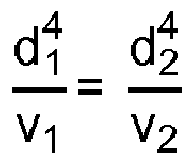

- d2 = compensated nozzle diameter for operating temperature;
- d1 = nozzle diameter at reference temperature;
- v2 = viscosity at operating temperature; and
- v1 = viscosity at reference temperature.
- Thus, for the geometry of
Figure 2 , wherein the nozzle diameter is defined by the SMA material, by suitably designing or training the SMA material based on the relationship given in Equation 3 to adjust the diameter of the nozzle in use it is possible for the flow control nozzle to automatically compensate for changes in viscosity and maintain a substantially constant flow over a range of operating temperatures. - An example of this will now be described with regard to a flow device controlling a flow of the commonly used hydraulic fluid "Mil-H-83282" having a fluid density (ρ) of 850 kg/m3, and a kinematic viscosity at a reference temperature of 40 ° C of 12.7 cSt (0.127 cm2/s) through a flow nozzle having a nozzle diameter (d1) at the reference temperature of 0.007 inches (0.18 mm), a nozzle length (L) of 0.1 inch (2.54 mm), and a pressure drop (ΔP) of 3000 psi (21 MPa).
-
Figure 3 shows the variation in kinematic viscosity of the Mil-H-83282 fluid as a function of temperature. As shown, there is a significant drop in viscosity over thetemperature range 0 to 100 °C. -
Figure 4 shows the viscosity compensation factor (K.v) required for compensating this to maintain a constant flow, wherein the viscosity compensation factor as shown inFigure 4 is defined based on Equation 1 (assuming that the parameters Q, ρ, ΔP and L are constant) in terms of the viscosities at the reference and operating temperatures, v1 and v2, as (Equation 4):
-
Figure 5 shows the required nozzle diameters to compensate for the change in viscosity over the temperature range. The required nozzle diameters may be determined based on Equation 3. -
Figure 6 shows how the nozzle flow can be compensated accordingly in this way. Also plotted for reference inFigures 5 and 6 respectively are the uncompensated (i.e. constant) nozzle diameter and uncompensated flow. - Thus, from
Figures 5 and 6 it can be seen that (due to the fourth power dependence on nozzle diameter in Equation 1) the flow can be maintained substantially constant over a wide range of operating temperatures with only relatively fine adjustments of the nozzle diameter (i.e. in the example between about 0.005 and 0.012 inches (0.127 and 0.3048 mm)). - Although embodiments have been described above wherein the flow is controlled by adjusting the nozzle diameter, with the nozzle length remaining fixed, it will be appreciated that in principle the SMA material may also be used to adjust the nozzle length, i.e. based on the equality:

- However, it will be appreciated that because the nozzle diameter scales with the fourth power, even relatively small adjustments in nozzle diameter can adjust for a wide range of operating temperatures. Also, adjusting the nozzle length may not always be desirable, e.g. when the flow device is to be incorporated in-line within a larger system. Thus, in embodiments, the nozzle length may be fixed.
- It will also be appreciated that various other arrangements for controlling the flow area are of course possible.
- For instance,
Figure 7 shows an example of a flow nozzle 40' according to another embodiment wherein instead of forming the nozzle orifice from SMA material, adeformable element 60 such as a tapered needle is positioned within aflow passage 61 through the flow control nozzle 40' with thedeformable element 60 comprising or being connected to a suitable SMA material and configured to deform in use to reduce the flow area through the nozzle as a function of temperature. In this case, the fluid flows annularly around thedeformable element 60 through theflow passage 61. The nozzle diameter may thus be fixed, and the flow area controlled by deformations of the deformable element. - Particularly, as the operating temperature increases, the
deformable element 60 may be configured to expand in order to reduce the flow area, and thus compensate for the decreased viscosity. In this case, similar equations can be derived as above in order to determine the required expansion needed to compensate for the changes in fluid viscosity over the operating temperature range to maintain a more constant flow. - Although various examples have been presented above in relation to a jet pipe servo valve, it will be appreciated that the flow control nozzles described herein are not limited to this context and may generally find utility in various other applications where it is desired to control a fluid flow. For instance, among other examples, the flow control nozzles described herein may be used as a fuel control nozzle of a fuel injector within a diesel engine and indeed the flow control nozzles shown in either
Figure 2 orFigure 7 may thus comprise fuel injector nozzles. That is, it will be apparent that the techniques presented herein may generally be applied to any flow control nozzles, and are not limited e.g. to jet pipe servo valves. - Thus, although the techniques presented herein have been described with reference to particular embodiments, it will be understood by those skilled in the art that various changes in form and detail may be made without departing from the scope of the accompanying claims.
Claims (15)
- A flow control nozzle (40, 40') for controlling the flow of an incompressible fluid, the flow control nozzle having a flow area and comprising a deformable element (50, 60) comprising a shaped memory alloy (SMA) material wherein within a range of operating temperatures the SMA material is configured to reduce the flow area of the flow control nozzle as the operating temperature increases.
- The flow control nozzle of claim 1 wherein the SMA material is configured to reduce the flow area of the flow control nozzle as the operating temperature increases in order to maintain a substantially constant flow rate over the range of operating temperatures.
- The flow control nozzle of claim 1 or 2 wherein the flow area comprises a flow passage (51), wherein the flow passage (51) is defined at least in part by the deformable element (50), and wherein the SMA material is configured to reduce a dimension of the flow passage (51) to reduce the flow area.
- The flow control nozzle of claim 1 or 2 wherein the flow area comprises a flow passage (51), and wherein the deformable element (60) is disposed within the flow area so that fluid flows around the deformable element (60) through the flow passage (51), and wherein the deformable element deforms as the temperature increases to reduce the flow area.
- The flow control nozzle of any preceding claim wherein the SMA material is configured to reduce the flow area of the flow control nozzle according to a predetermined relationship for laminar flow conditions to maintain a substantially constant laminar flow over the range of operating temperatures.
- The flow control nozzle of claim 5, wherein the SMA material is configured to reduce a diameter of flow control nozzle according to the relationship
 d2 = compensated nozzle diameter for operating temperature;d1 = nozzle diameter at reference temperature;v2 = viscosity at operating temperature; andv1 = viscosity at reference temperature.
 - The flow control nozzle of any preceding claim wherein the range of operating temperatures is from about 0 to about 100 degrees Celsius.
- The flow control nozzle of any preceding claim wherein the SMA material comprises a Nickel-Titanium alloy such as Nitinol.
- A jet pipe servo valve (10) comprising a flow control nozzle (40, 40') as claimed in any preceding claim.
- A fuel injector comprising a flow control nozzle (40, 40') as claimed in any preceding claim.
- A method of controlling a flow of incompressible fluid using a flow control nozzle (40, 40') as claimed in any of claims 1 to 8, the method comprising passing the incompressible fluid through the flow control nozzle to maintain substantially constant laminar flow conditions over a range of operating temperatures.
- A method of manufacturing a flow control nozzle as claimed in any of claims 1 to 8, the flow control nozzle having a flow area and comprising a deformable element (50, 60) comprising a SMA material, the method comprising training the SMA material within a range of operating temperatures so that the SMA material is configured to reduce the flow area of the flow control nozzle as the operating temperature increases.
- The method of claim 12, wherein training the SMA material comprises subjecting the SMA material to different mechanical deformations at different temperatures within the range of operating temperatures.
- The method of claim 12 or 13, wherein the SMA material is trained so as to reduce the flow area of the flow control nozzle according to a predetermined relationship for laminar flow conditions to maintain a substantially constant laminar flow over the range of operating temperatures.
- The method of claim 14, wherein the SMA material is trained so as to reduce a diameter of flow control nozzle according to the relationship
 d2 = compensated nozzle diameter for operating temperature;d1 = nozzle diameter at reference temperature;v2 = viscosity at operating temperature; andv1 = viscosity at reference temperature.
Priority Applications (6)
| Application Number | Priority Date | Filing Date | Title |
|---|---|---|---|
| EP18275085.1A EP3587791B1 (en) | 2018-06-21 | 2018-06-21 | Flow control nozzle |
| BR102019009267-0A BR102019009267B1 (en) | 2018-06-21 | 2019-05-07 | JET TUBE SERVOVALVE, AND, METHODS FOR CONTROLLING AN INCOMPRESSIBLE FLUID FLOW AND FOR FABRICATING A FLOW CONTROL NOZZLE |
| CA3042753A CA3042753A1 (en) | 2018-06-21 | 2019-05-08 | Flow control nozzle |
| US16/423,522 US11408301B2 (en) | 2018-06-21 | 2019-05-28 | Flow control nozzle |
| RU2019118722A RU2019118722A (en) | 2018-06-21 | 2019-06-17 | FLOW CONTROL NOZZLE |
| CN201910540726.7A CN110630421B (en) | 2018-06-21 | 2019-06-21 | Flow control nozzle |
Applications Claiming Priority (1)
| Application Number | Priority Date | Filing Date | Title |
|---|---|---|---|
| EP18275085.1A EP3587791B1 (en) | 2018-06-21 | 2018-06-21 | Flow control nozzle |
Publications (2)
| Publication Number | Publication Date |
|---|---|
| EP3587791A1 true EP3587791A1 (en) | 2020-01-01 |
| EP3587791B1 EP3587791B1 (en) | 2021-03-24 |
Family
ID=62784065
Family Applications (1)
| Application Number | Title | Priority Date | Filing Date |
|---|---|---|---|
| EP18275085.1A Active EP3587791B1 (en) | 2018-06-21 | 2018-06-21 | Flow control nozzle |
Country Status (5)
| Country | Link |
|---|---|
| US (1) | US11408301B2 (en) |
| EP (1) | EP3587791B1 (en) |
| CN (1) | CN110630421B (en) |
| CA (1) | CA3042753A1 (en) |
| RU (1) | RU2019118722A (en) |
Cited By (1)
| Publication number | Priority date | Publication date | Assignee | Title |
|---|---|---|---|---|
| EP4464879A1 (en) * | 2023-05-19 | 2024-11-20 | Volvo Truck Corporation | A nitrogen oxides reduction agent injection arrangement |
Families Citing this family (4)
| Publication number | Priority date | Publication date | Assignee | Title |
|---|---|---|---|---|
| EP4192622A4 (en) * | 2020-08-04 | 2024-02-21 | Integrated Global Services Inc. | System, method, and apparatus for improved cleaning of industrial furnaces |
| CN116923688B (en) * | 2023-09-15 | 2023-12-08 | 中国空气动力研究与发展中心低速空气动力研究所 | Jet flow circulation control device |
| CN117652372B (en) * | 2023-12-27 | 2024-05-17 | 武汉亚非种业有限公司 | Comprehensive-nutrition water-retaining fertilizer-retaining breeding seedling nutrient soil and preparation method thereof |
| CN120773332B (en) * | 2025-09-11 | 2025-11-21 | 吉林大学 | 3D printing spray head with variable diameter and anti-blocking function |
Citations (4)
| Publication number | Priority date | Publication date | Assignee | Title |
|---|---|---|---|---|
| US4253611A (en) * | 1978-06-05 | 1981-03-03 | Delta Materials Research Limited | Jet nozzles |
| JPS5862169U (en) * | 1981-10-23 | 1983-04-26 | トヨタ自動車株式会社 | Throttle type fuel injection valve for diesel engine |
| WO1993019313A2 (en) * | 1992-03-20 | 1993-09-30 | Mannesmann Rexroth Gmbh | Flow control valve, in particular for hydraulic pressure media |
| US20170152966A1 (en) * | 2015-12-01 | 2017-06-01 | Claverham Limited | Hydraulic Valve |
Family Cites Families (23)
| Publication number | Priority date | Publication date | Assignee | Title |
|---|---|---|---|---|
| US2111466A (en) * | 1938-03-15 | Fluid operated relay mechanism | ||
| FR1022236A (en) * | 1950-07-21 | 1953-03-02 | Regulateurs Francel | Improvements to gaseous fluid relays |
| US3286719A (en) * | 1963-12-30 | 1966-11-22 | Ling Temco Vought Inc | Piezoelectric fluid jet transfer valve |
| US5156189A (en) * | 1989-09-13 | 1992-10-20 | Hr Textron, Inc. | High flow control valve |
| JPH0486368A (en) | 1990-07-26 | 1992-03-18 | Kubota Corp | Nozzle top part heat insulating device of fuel injection nozzle for diesel engine |
| JPH04224613A (en) | 1990-12-26 | 1992-08-13 | Kawasaki Steel Corp | Method for refining molten metal and top blowing lance used therefor |
| DE19808068A1 (en) | 1998-02-26 | 1999-09-02 | Bosch Gmbh Robert | Fuel injector |
| US5984258A (en) | 1998-09-28 | 1999-11-16 | General Motors Corporation | Method and apparatus for control of a shape memory alloy actuator for a fuel injector |
| JP2001207936A (en) | 2000-01-27 | 2001-08-03 | Nissan Motor Co Ltd | Fuel injection valve |
| DE10056039A1 (en) | 2000-11-11 | 2002-05-16 | Bosch Gmbh Robert | Fuel injection valve, for an IC motor, has a disk at the injection openings with a bi-metal or shape memory alloy section which is distorted by a heater to free selected injection openings with the same sealed seat |
| JP2005090233A (en) | 2003-09-12 | 2005-04-07 | Hitachi Unisia Automotive Ltd | Fuel injection valve |
| US7185833B2 (en) * | 2004-03-18 | 2007-03-06 | Ernest Geskin | Method for fluid jet formation and apparatus for the same |
| JP2009002171A (en) | 2007-06-19 | 2009-01-08 | Toyota Motor Corp | Fuel injection device |
| DE102007037219A1 (en) | 2007-08-07 | 2009-02-12 | Robert Bosch Gmbh | Valve element and method for its manufacture |
| JP4959509B2 (en) * | 2007-11-06 | 2012-06-27 | 株式会社デンソー | Fuel injection valve |
| GB0908373D0 (en) | 2009-05-15 | 2009-06-24 | Rolls Royce Plc | Fluid flow control device |
| CH704124A1 (en) | 2010-11-19 | 2012-05-31 | Alstom Technology Ltd | Rotating machine, in particular gas turbine. |
| JP5482836B2 (en) * | 2011-09-20 | 2014-05-07 | 株式会社デンソー | Fuel injection valve and fuel injection valve manufacturing method |
| US10137992B2 (en) * | 2014-01-28 | 2018-11-27 | The Boeing Company | Remote controlled air nozzles and methods of assembling the same |
| US10253890B2 (en) * | 2016-06-27 | 2019-04-09 | Nabtesco Corporation | Servo-valve and fluidic device |
| US10584723B2 (en) * | 2016-06-27 | 2020-03-10 | Nabtesco Corporation | Servo-valve and fluidic device |
| US20170370496A1 (en) * | 2016-06-27 | 2017-12-28 | Nabtesco Corporation | Servo-valve and fluidic device |
| EP3412921B1 (en) * | 2017-06-05 | 2024-03-13 | Hamilton Sundstrand Corporation | Servovalve assembly |
-
2018
- 2018-06-21 EP EP18275085.1A patent/EP3587791B1/en active Active
-
2019
- 2019-05-08 CA CA3042753A patent/CA3042753A1/en active Pending
- 2019-05-28 US US16/423,522 patent/US11408301B2/en active Active
- 2019-06-17 RU RU2019118722A patent/RU2019118722A/en unknown
- 2019-06-21 CN CN201910540726.7A patent/CN110630421B/en active Active
Patent Citations (4)
| Publication number | Priority date | Publication date | Assignee | Title |
|---|---|---|---|---|
| US4253611A (en) * | 1978-06-05 | 1981-03-03 | Delta Materials Research Limited | Jet nozzles |
| JPS5862169U (en) * | 1981-10-23 | 1983-04-26 | トヨタ自動車株式会社 | Throttle type fuel injection valve for diesel engine |
| WO1993019313A2 (en) * | 1992-03-20 | 1993-09-30 | Mannesmann Rexroth Gmbh | Flow control valve, in particular for hydraulic pressure media |
| US20170152966A1 (en) * | 2015-12-01 | 2017-06-01 | Claverham Limited | Hydraulic Valve |
Cited By (2)
| Publication number | Priority date | Publication date | Assignee | Title |
|---|---|---|---|---|
| EP4464879A1 (en) * | 2023-05-19 | 2024-11-20 | Volvo Truck Corporation | A nitrogen oxides reduction agent injection arrangement |
| EP4464878A1 (en) * | 2023-05-19 | 2024-11-20 | Volvo Truck Corporation | A nox reduction agent injection arrangement |
Also Published As
| Publication number | Publication date |
|---|---|
| BR102019009267A2 (en) | 2019-12-24 |
| US20190390562A1 (en) | 2019-12-26 |
| CA3042753A1 (en) | 2019-12-21 |
| CN110630421B (en) | 2022-12-13 |
| US11408301B2 (en) | 2022-08-09 |
| EP3587791B1 (en) | 2021-03-24 |
| RU2019118722A (en) | 2020-12-17 |
| CN110630421A (en) | 2019-12-31 |
Similar Documents
| Publication | Publication Date | Title |
|---|---|---|
| US11408301B2 (en) | Flow control nozzle | |
| CN101737538B (en) | Flow control valve device and design method for flow control type hole | |
| EP2593659B1 (en) | Thermally neutral volume stroke transmitter, and metering valve | |
| JPS5854201A (en) | Electrically adjustable valve device | |
| CN102365600A (en) | Fluid regulator having pressure registration flow modifier | |
| EP1876327A3 (en) | Seal for turbine engine | |
| DE19940054A1 (en) | Dosing valve | |
| DE102020117768A1 (en) | Supersonic inlet with contour bulge | |
| DE602004006564T2 (en) | Pressure control valve | |
| Petryk | On stability of time-independent materials at finite strain | |
| EP0313503B1 (en) | Metering valve temperature compensation | |
| Sverbilov et al. | Study on dynamic behavior of a gas pressure relief valve for a big flow rate | |
| DE102019103913A1 (en) | Thermostatic valve | |
| US10330205B2 (en) | Valve assembly with electronic control | |
| BR102019009267B1 (en) | JET TUBE SERVOVALVE, AND, METHODS FOR CONTROLLING AN INCOMPRESSIBLE FLUID FLOW AND FOR FABRICATING A FLOW CONTROL NOZZLE | |
| US11814186B2 (en) | Flow aperture method and apparatus | |
| DE102011086014B4 (en) | Drive system for a motor vehicle with a temperature-controlled damping element | |
| Kumar et al. | Area Cavitating Venturi | |
| CN113515833B (en) | Production allocation design method for controlling pressure drop speed of gas well | |
| ATI Associazione Termotecnica Italiana et al. | An aerostatic pad with an internal pressure control | |
| DE102022112647A1 (en) | Device for dampening pressure pulsations | |
| EP4466480B1 (en) | Compensation element, method and system for the active damping of a medium | |
| Kumar et al. | Cold Flow Characterization of Variable Area Cavitating Venturi | |
| EP2927546B1 (en) | Steam valve | |
| US20080314458A1 (en) | Method and Device for Regulating a Pressure and/or a Volume Flow of a Fluid |
Legal Events
| Date | Code | Title | Description |
|---|---|---|---|
| PUAI | Public reference made under article 153(3) epc to a published international application that has entered the european phase |
Free format text: ORIGINAL CODE: 0009012 |
|
| STAA | Information on the status of an ep patent application or granted ep patent |
Free format text: STATUS: THE APPLICATION HAS BEEN PUBLISHED |
|
| AK | Designated contracting states |
Kind code of ref document: A1 Designated state(s): AL AT BE BG CH CY CZ DE DK EE ES FI FR GB GR HR HU IE IS IT LI LT LU LV MC MK MT NL NO PL PT RO RS SE SI SK SM TR |
|
| AX | Request for extension of the european patent |
Extension state: BA ME |
|
| STAA | Information on the status of an ep patent application or granted ep patent |
Free format text: STATUS: REQUEST FOR EXAMINATION WAS MADE |
|
| 17P | Request for examination filed |
Effective date: 20200701 |
|
| RBV | Designated contracting states (corrected) |
Designated state(s): AL AT BE BG CH CY CZ DE DK EE ES FI FR GB GR HR HU IE IS IT LI LT LU LV MC MK MT NL NO PL PT RO RS SE SI SK SM TR |
|
| GRAP | Despatch of communication of intention to grant a patent |
Free format text: ORIGINAL CODE: EPIDOSNIGR1 |
|
| STAA | Information on the status of an ep patent application or granted ep patent |
Free format text: STATUS: GRANT OF PATENT IS INTENDED |
|
| RAP1 | Party data changed (applicant data changed or rights of an application transferred) |
Owner name: CLAVERHAM LIMITED |
|
| INTG | Intention to grant announced |
Effective date: 20201007 |
|
| GRAS | Grant fee paid |
Free format text: ORIGINAL CODE: EPIDOSNIGR3 |
|
| GRAA | (expected) grant |
Free format text: ORIGINAL CODE: 0009210 |
|
| STAA | Information on the status of an ep patent application or granted ep patent |
Free format text: STATUS: THE PATENT HAS BEEN GRANTED |
|
| AK | Designated contracting states |
Kind code of ref document: B1 Designated state(s): AL AT BE BG CH CY CZ DE DK EE ES FI FR GB GR HR HU IE IS IT LI LT LU LV MC MK MT NL NO PL PT RO RS SE SI SK SM TR |
|
| REG | Reference to a national code |
Ref country code: GB Ref legal event code: FG4D |
|
| REG | Reference to a national code |
Ref country code: CH Ref legal event code: EP |
|
| REG | Reference to a national code |
Ref country code: IE Ref legal event code: FG4D |
|
| REG | Reference to a national code |
Ref country code: AT Ref legal event code: REF Ref document number: 1374733 Country of ref document: AT Kind code of ref document: T Effective date: 20210415 Ref country code: DE Ref legal event code: R096 Ref document number: 602018014340 Country of ref document: DE |
|
| REG | Reference to a national code |
Ref country code: LT Ref legal event code: MG9D |
|
| PG25 | Lapsed in a contracting state [announced via postgrant information from national office to epo] |
Ref country code: NO Free format text: LAPSE BECAUSE OF FAILURE TO SUBMIT A TRANSLATION OF THE DESCRIPTION OR TO PAY THE FEE WITHIN THE PRESCRIBED TIME-LIMIT Effective date: 20210624 Ref country code: GR Free format text: LAPSE BECAUSE OF FAILURE TO SUBMIT A TRANSLATION OF THE DESCRIPTION OR TO PAY THE FEE WITHIN THE PRESCRIBED TIME-LIMIT Effective date: 20210625 Ref country code: FI Free format text: LAPSE BECAUSE OF FAILURE TO SUBMIT A TRANSLATION OF THE DESCRIPTION OR TO PAY THE FEE WITHIN THE PRESCRIBED TIME-LIMIT Effective date: 20210324 Ref country code: HR Free format text: LAPSE BECAUSE OF FAILURE TO SUBMIT A TRANSLATION OF THE DESCRIPTION OR TO PAY THE FEE WITHIN THE PRESCRIBED TIME-LIMIT Effective date: 20210324 Ref country code: BG Free format text: LAPSE BECAUSE OF FAILURE TO SUBMIT A TRANSLATION OF THE DESCRIPTION OR TO PAY THE FEE WITHIN THE PRESCRIBED TIME-LIMIT Effective date: 20210624 |
|
| PG25 | Lapsed in a contracting state [announced via postgrant information from national office to epo] |
Ref country code: RS Free format text: LAPSE BECAUSE OF FAILURE TO SUBMIT A TRANSLATION OF THE DESCRIPTION OR TO PAY THE FEE WITHIN THE PRESCRIBED TIME-LIMIT Effective date: 20210324 Ref country code: LV Free format text: LAPSE BECAUSE OF FAILURE TO SUBMIT A TRANSLATION OF THE DESCRIPTION OR TO PAY THE FEE WITHIN THE PRESCRIBED TIME-LIMIT Effective date: 20210324 Ref country code: SE Free format text: LAPSE BECAUSE OF FAILURE TO SUBMIT A TRANSLATION OF THE DESCRIPTION OR TO PAY THE FEE WITHIN THE PRESCRIBED TIME-LIMIT Effective date: 20210324 |
|
| REG | Reference to a national code |
Ref country code: NL Ref legal event code: MP Effective date: 20210324 |
|
| REG | Reference to a national code |
Ref country code: AT Ref legal event code: MK05 Ref document number: 1374733 Country of ref document: AT Kind code of ref document: T Effective date: 20210324 |
|
| PG25 | Lapsed in a contracting state [announced via postgrant information from national office to epo] |
Ref country code: NL Free format text: LAPSE BECAUSE OF FAILURE TO SUBMIT A TRANSLATION OF THE DESCRIPTION OR TO PAY THE FEE WITHIN THE PRESCRIBED TIME-LIMIT Effective date: 20210324 |
|
| PG25 | Lapsed in a contracting state [announced via postgrant information from national office to epo] |
Ref country code: LT Free format text: LAPSE BECAUSE OF FAILURE TO SUBMIT A TRANSLATION OF THE DESCRIPTION OR TO PAY THE FEE WITHIN THE PRESCRIBED TIME-LIMIT Effective date: 20210324 Ref country code: CZ Free format text: LAPSE BECAUSE OF FAILURE TO SUBMIT A TRANSLATION OF THE DESCRIPTION OR TO PAY THE FEE WITHIN THE PRESCRIBED TIME-LIMIT Effective date: 20210324 Ref country code: EE Free format text: LAPSE BECAUSE OF FAILURE TO SUBMIT A TRANSLATION OF THE DESCRIPTION OR TO PAY THE FEE WITHIN THE PRESCRIBED TIME-LIMIT Effective date: 20210324 Ref country code: AT Free format text: LAPSE BECAUSE OF FAILURE TO SUBMIT A TRANSLATION OF THE DESCRIPTION OR TO PAY THE FEE WITHIN THE PRESCRIBED TIME-LIMIT Effective date: 20210324 Ref country code: SM Free format text: LAPSE BECAUSE OF FAILURE TO SUBMIT A TRANSLATION OF THE DESCRIPTION OR TO PAY THE FEE WITHIN THE PRESCRIBED TIME-LIMIT Effective date: 20210324 |
|
| PG25 | Lapsed in a contracting state [announced via postgrant information from national office to epo] |
Ref country code: PL Free format text: LAPSE BECAUSE OF FAILURE TO SUBMIT A TRANSLATION OF THE DESCRIPTION OR TO PAY THE FEE WITHIN THE PRESCRIBED TIME-LIMIT Effective date: 20210324 Ref country code: PT Free format text: LAPSE BECAUSE OF FAILURE TO SUBMIT A TRANSLATION OF THE DESCRIPTION OR TO PAY THE FEE WITHIN THE PRESCRIBED TIME-LIMIT Effective date: 20210726 Ref country code: RO Free format text: LAPSE BECAUSE OF FAILURE TO SUBMIT A TRANSLATION OF THE DESCRIPTION OR TO PAY THE FEE WITHIN THE PRESCRIBED TIME-LIMIT Effective date: 20210324 Ref country code: SK Free format text: LAPSE BECAUSE OF FAILURE TO SUBMIT A TRANSLATION OF THE DESCRIPTION OR TO PAY THE FEE WITHIN THE PRESCRIBED TIME-LIMIT Effective date: 20210324 Ref country code: IS Free format text: LAPSE BECAUSE OF FAILURE TO SUBMIT A TRANSLATION OF THE DESCRIPTION OR TO PAY THE FEE WITHIN THE PRESCRIBED TIME-LIMIT Effective date: 20210724 |
|
| REG | Reference to a national code |
Ref country code: DE Ref legal event code: R097 Ref document number: 602018014340 Country of ref document: DE |
|
| PG25 | Lapsed in a contracting state [announced via postgrant information from national office to epo] |
Ref country code: ES Free format text: LAPSE BECAUSE OF FAILURE TO SUBMIT A TRANSLATION OF THE DESCRIPTION OR TO PAY THE FEE WITHIN THE PRESCRIBED TIME-LIMIT Effective date: 20210324 Ref country code: AL Free format text: LAPSE BECAUSE OF FAILURE TO SUBMIT A TRANSLATION OF THE DESCRIPTION OR TO PAY THE FEE WITHIN THE PRESCRIBED TIME-LIMIT Effective date: 20210324 Ref country code: DK Free format text: LAPSE BECAUSE OF FAILURE TO SUBMIT A TRANSLATION OF THE DESCRIPTION OR TO PAY THE FEE WITHIN THE PRESCRIBED TIME-LIMIT Effective date: 20210324 Ref country code: MC Free format text: LAPSE BECAUSE OF FAILURE TO SUBMIT A TRANSLATION OF THE DESCRIPTION OR TO PAY THE FEE WITHIN THE PRESCRIBED TIME-LIMIT Effective date: 20210324 |
|
| REG | Reference to a national code |
Ref country code: CH Ref legal event code: PL |
|
| PLBE | No opposition filed within time limit |
Free format text: ORIGINAL CODE: 0009261 |
|
| STAA | Information on the status of an ep patent application or granted ep patent |
Free format text: STATUS: NO OPPOSITION FILED WITHIN TIME LIMIT |
|
| PG25 | Lapsed in a contracting state [announced via postgrant information from national office to epo] |
Ref country code: SI Free format text: LAPSE BECAUSE OF FAILURE TO SUBMIT A TRANSLATION OF THE DESCRIPTION OR TO PAY THE FEE WITHIN THE PRESCRIBED TIME-LIMIT Effective date: 20210324 |
|
| 26N | No opposition filed |
Effective date: 20220104 |
|
| REG | Reference to a national code |
Ref country code: BE Ref legal event code: MM Effective date: 20210630 |
|
| PG25 | Lapsed in a contracting state [announced via postgrant information from national office to epo] |
Ref country code: LU Free format text: LAPSE BECAUSE OF NON-PAYMENT OF DUE FEES Effective date: 20210621 |
|
| PG25 | Lapsed in a contracting state [announced via postgrant information from national office to epo] |
Ref country code: LI Free format text: LAPSE BECAUSE OF NON-PAYMENT OF DUE FEES Effective date: 20210630 Ref country code: IE Free format text: LAPSE BECAUSE OF NON-PAYMENT OF DUE FEES Effective date: 20210621 Ref country code: CH Free format text: LAPSE BECAUSE OF NON-PAYMENT OF DUE FEES Effective date: 20210630 |
|
| PG25 | Lapsed in a contracting state [announced via postgrant information from national office to epo] |
Ref country code: IS Free format text: LAPSE BECAUSE OF FAILURE TO SUBMIT A TRANSLATION OF THE DESCRIPTION OR TO PAY THE FEE WITHIN THE PRESCRIBED TIME-LIMIT Effective date: 20210724 |
|
| PG25 | Lapsed in a contracting state [announced via postgrant information from national office to epo] |
Ref country code: BE Free format text: LAPSE BECAUSE OF NON-PAYMENT OF DUE FEES Effective date: 20210630 |
|
| PG25 | Lapsed in a contracting state [announced via postgrant information from national office to epo] |
Ref country code: IT Free format text: LAPSE BECAUSE OF FAILURE TO SUBMIT A TRANSLATION OF THE DESCRIPTION OR TO PAY THE FEE WITHIN THE PRESCRIBED TIME-LIMIT Effective date: 20210324 |
|
| PG25 | Lapsed in a contracting state [announced via postgrant information from national office to epo] |
Ref country code: CY Free format text: LAPSE BECAUSE OF FAILURE TO SUBMIT A TRANSLATION OF THE DESCRIPTION OR TO PAY THE FEE WITHIN THE PRESCRIBED TIME-LIMIT Effective date: 20210324 |
|
| PG25 | Lapsed in a contracting state [announced via postgrant information from national office to epo] |
Ref country code: HU Free format text: LAPSE BECAUSE OF FAILURE TO SUBMIT A TRANSLATION OF THE DESCRIPTION OR TO PAY THE FEE WITHIN THE PRESCRIBED TIME-LIMIT; INVALID AB INITIO Effective date: 20180621 |
|
| PG25 | Lapsed in a contracting state [announced via postgrant information from national office to epo] |
Ref country code: MK Free format text: LAPSE BECAUSE OF FAILURE TO SUBMIT A TRANSLATION OF THE DESCRIPTION OR TO PAY THE FEE WITHIN THE PRESCRIBED TIME-LIMIT Effective date: 20210324 |
|
| PG25 | Lapsed in a contracting state [announced via postgrant information from national office to epo] |
Ref country code: MT Free format text: LAPSE BECAUSE OF FAILURE TO SUBMIT A TRANSLATION OF THE DESCRIPTION OR TO PAY THE FEE WITHIN THE PRESCRIBED TIME-LIMIT Effective date: 20210324 |
|
| PGFP | Annual fee paid to national office [announced via postgrant information from national office to epo] |
Ref country code: DE Payment date: 20250520 Year of fee payment: 8 |
|
| PGFP | Annual fee paid to national office [announced via postgrant information from national office to epo] |
Ref country code: GB Payment date: 20250520 Year of fee payment: 8 |
|
| PGFP | Annual fee paid to national office [announced via postgrant information from national office to epo] |
Ref country code: FR Payment date: 20250520 Year of fee payment: 8 |
|
| PG25 | Lapsed in a contracting state [announced via postgrant information from national office to epo] |
Ref country code: TR Free format text: LAPSE BECAUSE OF FAILURE TO SUBMIT A TRANSLATION OF THE DESCRIPTION OR TO PAY THE FEE WITHIN THE PRESCRIBED TIME-LIMIT Effective date: 20210324 |