EP3586848A1 - Pharmaceutical composition comprising compound capable of penetrating blood-brain barrier as effective ingredient for preventing or treating brain cancer - Google Patents
Pharmaceutical composition comprising compound capable of penetrating blood-brain barrier as effective ingredient for preventing or treating brain cancer Download PDFInfo
- Publication number
- EP3586848A1 EP3586848A1 EP18758340.6A EP18758340A EP3586848A1 EP 3586848 A1 EP3586848 A1 EP 3586848A1 EP 18758340 A EP18758340 A EP 18758340A EP 3586848 A1 EP3586848 A1 EP 3586848A1
- Authority
- EP
- European Patent Office
- Prior art keywords
- linear
- substituted
- membered
- unsubstituted
- ring
- Prior art date
- Legal status (The legal status is an assumption and is not a legal conclusion. Google has not performed a legal analysis and makes no representation as to the accuracy of the status listed.)
- Granted
Links
- 0 C*c1ncnc(N2CCN(CCF)CC2)c1 Chemical compound C*c1ncnc(N2CCN(CCF)CC2)c1 0.000 description 1
- GBZGCHGXCUTHQD-INIZCTEOSA-N C=C[C@@H](CCC1)CN1C(CCc1n[nH]c2ccnc(NC3CCCCC3)c12)=O Chemical compound C=C[C@@H](CCC1)CN1C(CCc1n[nH]c2ccnc(NC3CCCCC3)c12)=O GBZGCHGXCUTHQD-INIZCTEOSA-N 0.000 description 1
- ZGOQMWNALJKQMK-UHFFFAOYSA-N CC(C)(Cc1c(-c2n[nH]cc2)[s]c(SC2CCCC2)c11)CC1=O Chemical compound CC(C)(Cc1c(-c2n[nH]cc2)[s]c(SC2CCCC2)c11)CC1=O ZGOQMWNALJKQMK-UHFFFAOYSA-N 0.000 description 1
- QJLONFKWEUAJGY-UHFFFAOYSA-N CC(C)S(c(cccc1)c1Nc1nc(Nc(ccc(N(CC2)CCC2N2CCN(C)CC2)c2)c2OC)ncc1Cl)=O Chemical compound CC(C)S(c(cccc1)c1Nc1nc(Nc(ccc(N(CC2)CCC2N2CCN(C)CC2)c2)c2OC)ncc1Cl)=O QJLONFKWEUAJGY-UHFFFAOYSA-N 0.000 description 1
- RWTKCJIJNSPGGQ-UHFFFAOYSA-N CC(C1)OC(C)CN1c1cc(C)ncn1 Chemical compound CC(C1)OC(C)CN1c1cc(C)ncn1 RWTKCJIJNSPGGQ-UHFFFAOYSA-N 0.000 description 1
- KGVYCNDTNHAGIE-UHFFFAOYSA-N CCCC(C(CNC1COC1)F)[n]1nc(C)c(Nc2nc(NCC)c(C(F)(F)F)cn2)c1 Chemical compound CCCC(C(CNC1COC1)F)[n]1nc(C)c(Nc2nc(NCC)c(C(F)(F)F)cn2)c1 KGVYCNDTNHAGIE-UHFFFAOYSA-N 0.000 description 1
- JVHYMEOWUCXUJO-UHFFFAOYSA-N CCc1ncnc(N2CCN(CCF)CC2)c1 Chemical compound CCc1ncnc(N2CCN(CCF)CC2)c1 JVHYMEOWUCXUJO-UHFFFAOYSA-N 0.000 description 1
- IWMCPJZTADUIFX-UHFFFAOYSA-N CN(CC1)CCN1C(CC1)CCN1C(c(cc1)cc(OC)c1Nc(nc1)nc(N(C)c2ccccc22)c1N(C)C2=O)=O Chemical compound CN(CC1)CCN1C(CC1)CCN1C(c(cc1)cc(OC)c1Nc(nc1)nc(N(C)c2ccccc22)c1N(C)C2=O)=O IWMCPJZTADUIFX-UHFFFAOYSA-N 0.000 description 1
- ONQYZCIVDNVJRE-UHFFFAOYSA-N CNc1c(C(F)(F)F)cnc(Nc(c(OC)c2)ccc2C(N2CCOCC2)=O)n1 Chemical compound CNc1c(C(F)(F)F)cnc(Nc(c(OC)c2)ccc2C(N2CCOCC2)=O)n1 ONQYZCIVDNVJRE-UHFFFAOYSA-N 0.000 description 1
- GSQODBPYULJIAS-UHFFFAOYSA-N CNc1ccccc1NS(C)(=O)=O Chemical compound CNc1ccccc1NS(C)(=O)=O GSQODBPYULJIAS-UHFFFAOYSA-N 0.000 description 1
- NOEIAWSZOJDGDS-UHFFFAOYSA-N O=C(C1CC1)N(CCNc1nc2c-3cn[n]2cc1)CCOc1cc-3ccc1 Chemical compound O=C(C1CC1)N(CCNc1nc2c-3cn[n]2cc1)CCOc1cc-3ccc1 NOEIAWSZOJDGDS-UHFFFAOYSA-N 0.000 description 1
Images


Classifications
-
- A—HUMAN NECESSITIES
- A61—MEDICAL OR VETERINARY SCIENCE; HYGIENE
- A61K—PREPARATIONS FOR MEDICAL, DENTAL OR TOILETRY PURPOSES
- A61K31/00—Medicinal preparations containing organic active ingredients
- A61K31/33—Heterocyclic compounds
- A61K31/395—Heterocyclic compounds having nitrogen as a ring hetero atom, e.g. guanethidine or rifamycins
- A61K31/495—Heterocyclic compounds having nitrogen as a ring hetero atom, e.g. guanethidine or rifamycins having six-membered rings with two or more nitrogen atoms as the only ring heteroatoms, e.g. piperazine or tetrazines
- A61K31/505—Pyrimidines; Hydrogenated pyrimidines, e.g. trimethoprim
-
- A—HUMAN NECESSITIES
- A61—MEDICAL OR VETERINARY SCIENCE; HYGIENE
- A61K—PREPARATIONS FOR MEDICAL, DENTAL OR TOILETRY PURPOSES
- A61K31/00—Medicinal preparations containing organic active ingredients
- A61K31/33—Heterocyclic compounds
- A61K31/395—Heterocyclic compounds having nitrogen as a ring hetero atom, e.g. guanethidine or rifamycins
- A61K31/55—Heterocyclic compounds having nitrogen as a ring hetero atom, e.g. guanethidine or rifamycins having seven-membered rings, e.g. azelastine, pentylenetetrazole
- A61K31/551—Heterocyclic compounds having nitrogen as a ring hetero atom, e.g. guanethidine or rifamycins having seven-membered rings, e.g. azelastine, pentylenetetrazole having two nitrogen atoms, e.g. dilazep
- A61K31/5513—1,4-Benzodiazepines, e.g. diazepam or clozapine
-
- A—HUMAN NECESSITIES
- A23—FOODS OR FOODSTUFFS; TREATMENT THEREOF, NOT COVERED BY OTHER CLASSES
- A23L—FOODS, FOODSTUFFS OR NON-ALCOHOLIC BEVERAGES, NOT OTHERWISE PROVIDED FOR; PREPARATION OR TREATMENT THEREOF
- A23L33/00—Modifying nutritive qualities of foods; Dietetic products; Preparation or treatment thereof
- A23L33/10—Modifying nutritive qualities of foods; Dietetic products; Preparation or treatment thereof using additives
-
- A—HUMAN NECESSITIES
- A61—MEDICAL OR VETERINARY SCIENCE; HYGIENE
- A61K—PREPARATIONS FOR MEDICAL, DENTAL OR TOILETRY PURPOSES
- A61K31/00—Medicinal preparations containing organic active ingredients
- A61K31/33—Heterocyclic compounds
- A61K31/395—Heterocyclic compounds having nitrogen as a ring hetero atom, e.g. guanethidine or rifamycins
- A61K31/41—Heterocyclic compounds having nitrogen as a ring hetero atom, e.g. guanethidine or rifamycins having five-membered rings with two or more ring hetero atoms, at least one of which being nitrogen, e.g. tetrazole
- A61K31/415—1,2-Diazoles
-
- A—HUMAN NECESSITIES
- A61—MEDICAL OR VETERINARY SCIENCE; HYGIENE
- A61K—PREPARATIONS FOR MEDICAL, DENTAL OR TOILETRY PURPOSES
- A61K31/00—Medicinal preparations containing organic active ingredients
- A61K31/33—Heterocyclic compounds
- A61K31/395—Heterocyclic compounds having nitrogen as a ring hetero atom, e.g. guanethidine or rifamycins
- A61K31/435—Heterocyclic compounds having nitrogen as a ring hetero atom, e.g. guanethidine or rifamycins having six-membered rings with one nitrogen as the only ring hetero atom
- A61K31/4353—Heterocyclic compounds having nitrogen as a ring hetero atom, e.g. guanethidine or rifamycins having six-membered rings with one nitrogen as the only ring hetero atom ortho- or peri-condensed with heterocyclic ring systems
- A61K31/4365—Heterocyclic compounds having nitrogen as a ring hetero atom, e.g. guanethidine or rifamycins having six-membered rings with one nitrogen as the only ring hetero atom ortho- or peri-condensed with heterocyclic ring systems the heterocyclic ring system having sulfur as a ring hetero atom, e.g. ticlopidine
-
- A—HUMAN NECESSITIES
- A61—MEDICAL OR VETERINARY SCIENCE; HYGIENE
- A61K—PREPARATIONS FOR MEDICAL, DENTAL OR TOILETRY PURPOSES
- A61K31/00—Medicinal preparations containing organic active ingredients
- A61K31/33—Heterocyclic compounds
- A61K31/395—Heterocyclic compounds having nitrogen as a ring hetero atom, e.g. guanethidine or rifamycins
- A61K31/435—Heterocyclic compounds having nitrogen as a ring hetero atom, e.g. guanethidine or rifamycins having six-membered rings with one nitrogen as the only ring hetero atom
- A61K31/4353—Heterocyclic compounds having nitrogen as a ring hetero atom, e.g. guanethidine or rifamycins having six-membered rings with one nitrogen as the only ring hetero atom ortho- or peri-condensed with heterocyclic ring systems
- A61K31/437—Heterocyclic compounds having nitrogen as a ring hetero atom, e.g. guanethidine or rifamycins having six-membered rings with one nitrogen as the only ring hetero atom ortho- or peri-condensed with heterocyclic ring systems the heterocyclic ring system containing a five-membered ring having nitrogen as a ring hetero atom, e.g. indolizine, beta-carboline
-
- A—HUMAN NECESSITIES
- A61—MEDICAL OR VETERINARY SCIENCE; HYGIENE
- A61K—PREPARATIONS FOR MEDICAL, DENTAL OR TOILETRY PURPOSES
- A61K31/00—Medicinal preparations containing organic active ingredients
- A61K31/33—Heterocyclic compounds
- A61K31/395—Heterocyclic compounds having nitrogen as a ring hetero atom, e.g. guanethidine or rifamycins
- A61K31/495—Heterocyclic compounds having nitrogen as a ring hetero atom, e.g. guanethidine or rifamycins having six-membered rings with two or more nitrogen atoms as the only ring heteroatoms, e.g. piperazine or tetrazines
- A61K31/505—Pyrimidines; Hydrogenated pyrimidines, e.g. trimethoprim
- A61K31/506—Pyrimidines; Hydrogenated pyrimidines, e.g. trimethoprim not condensed and containing further heterocyclic rings
-
- A—HUMAN NECESSITIES
- A61—MEDICAL OR VETERINARY SCIENCE; HYGIENE
- A61K—PREPARATIONS FOR MEDICAL, DENTAL OR TOILETRY PURPOSES
- A61K31/00—Medicinal preparations containing organic active ingredients
- A61K31/33—Heterocyclic compounds
- A61K31/395—Heterocyclic compounds having nitrogen as a ring hetero atom, e.g. guanethidine or rifamycins
- A61K31/495—Heterocyclic compounds having nitrogen as a ring hetero atom, e.g. guanethidine or rifamycins having six-membered rings with two or more nitrogen atoms as the only ring heteroatoms, e.g. piperazine or tetrazines
- A61K31/505—Pyrimidines; Hydrogenated pyrimidines, e.g. trimethoprim
- A61K31/519—Pyrimidines; Hydrogenated pyrimidines, e.g. trimethoprim ortho- or peri-condensed with heterocyclic rings
-
- A—HUMAN NECESSITIES
- A61—MEDICAL OR VETERINARY SCIENCE; HYGIENE
- A61K—PREPARATIONS FOR MEDICAL, DENTAL OR TOILETRY PURPOSES
- A61K31/00—Medicinal preparations containing organic active ingredients
- A61K31/33—Heterocyclic compounds
- A61K31/395—Heterocyclic compounds having nitrogen as a ring hetero atom, e.g. guanethidine or rifamycins
- A61K31/535—Heterocyclic compounds having nitrogen as a ring hetero atom, e.g. guanethidine or rifamycins having six-membered rings with at least one nitrogen and one oxygen as the ring hetero atoms, e.g. 1,2-oxazines
- A61K31/5375—1,4-Oxazines, e.g. morpholine
- A61K31/5377—1,4-Oxazines, e.g. morpholine not condensed and containing further heterocyclic rings, e.g. timolol
-
- A—HUMAN NECESSITIES
- A61—MEDICAL OR VETERINARY SCIENCE; HYGIENE
- A61P—SPECIFIC THERAPEUTIC ACTIVITY OF CHEMICAL COMPOUNDS OR MEDICINAL PREPARATIONS
- A61P35/00—Antineoplastic agents
- A61P35/04—Antineoplastic agents specific for metastasis
-
- C—CHEMISTRY; METALLURGY
- C07—ORGANIC CHEMISTRY
- C07K—PEPTIDES
- C07K16/00—Immunoglobulins [IG], e.g. monoclonal or polyclonal antibodies
- C07K16/18—Immunoglobulins [IG], e.g. monoclonal or polyclonal antibodies against material from animals or humans
- C07K16/22—Immunoglobulins [IG], e.g. monoclonal or polyclonal antibodies against material from animals or humans against growth factors ; against growth regulators
-
- A—HUMAN NECESSITIES
- A23—FOODS OR FOODSTUFFS; TREATMENT THEREOF, NOT COVERED BY OTHER CLASSES
- A23V—INDEXING SCHEME RELATING TO FOODS, FOODSTUFFS OR NON-ALCOHOLIC BEVERAGES AND LACTIC OR PROPIONIC ACID BACTERIA USED IN FOODSTUFFS OR FOOD PREPARATION
- A23V2002/00—Food compositions, function of food ingredients or processes for food or foodstuffs
-
- A—HUMAN NECESSITIES
- A23—FOODS OR FOODSTUFFS; TREATMENT THEREOF, NOT COVERED BY OTHER CLASSES
- A23V—INDEXING SCHEME RELATING TO FOODS, FOODSTUFFS OR NON-ALCOHOLIC BEVERAGES AND LACTIC OR PROPIONIC ACID BACTERIA USED IN FOODSTUFFS OR FOOD PREPARATION
- A23V2200/00—Function of food ingredients
- A23V2200/30—Foods, ingredients or supplements having a functional effect on health
- A23V2200/308—Foods, ingredients or supplements having a functional effect on health having an effect on cancer prevention
Definitions
- the present invention relates to a pharmaceutical composition for the prevention or treatment of brain cancer, containing, as an active ingredient, a compound capable of penetrating a blood-brain barrier.
- Protein kinase is an enzyme that catalyzes the transfer of the terminal phosphate group of adenosine triphosphate (ATP) to tyrosine, serine or threonine, which is a specific residue of protein, and this enzyme is involved in signals that regulate cell activity or growth and differentiation depending on extracellular media and environmental changes.
- ATP adenosine triphosphate
- Inappropriately high protein kinase activity is directly or indirectly related to a number of diseases resulting from abnormal cellular actions.
- disease may be caused by failure of the appropriate regulatory mechanism of kinase involved in mutation, overexpression or unsuitable enzyme activity, or by excessive production or lack of factors involved in upstream or downstream signaling of cytokines and kinases.
- selective inhibition of kinase activity may become a goal for furthering the development of new drugs for the treatment of disease.
- the LRRK2 (leucin-rich repeat kinase-2) protein belongs to the leucine-rich repeat kinase family and is composed of a 2527-amino-acid sequence having high interspecies similarity.
- the LRRK2 protein is characterized by exhibiting both GTPase and serine-threonine kinase activities in a single protein.
- the expressed LRRK2 protein is observed in a variety of organs and tissues, including the brain, and is present in the cytoplasm or cell membrane and mitochondrial outer membrane at the cellular level.
- the LRRK2 protein has five functionally important domains and is inferred to regulate cell function through protein interaction and enzymatic action, as well as autoregulatory action through autophosphorylation.
- chaperone machinery cytoskeleton arrangement, protein translational machinery, synaptic vesicle endocytosis, mitogen-activated protein-kinase-signaling cascades and ubiquitin/autophage protein degradation pathways are known to be regulated by the LRRK2 protein.
- the LRRK2 protein has been reported to be associated with Alzheimer's-disease-related mild cognitive impairment progression, L-dopa-induced dyskinesia, and neural-precursor-differentiation-related CNS disorder. Furthermore, the G2019S mutation of the LRRK2 protein has been reported to increase the incidence of non-skin cancer such as acute myeloid leukemia (AML), kidney cancer, breast cancer, lung cancer, prostate cancer and the like. Specifically, the G2019S mutation of the LRRK2 protein increases the catalytic activity of the LRRK2 kinase domain.
- AML acute myeloid leukemia
- LRRK2 protein is also associated with amyotrophic lateral sclerosis, rheumatoid arthritis, and ankylosing spondylitis (International Patent Publication No. WO 2011/038572 ).
- methods of treating brain tumors include surgery, radiotherapy, anticancer drug therapy (chemotherapy), and hormone therapy.
- surgery and radiotherapy have been mainly carried out, but radiotherapy has a problem in that it is accompanied by side effects such as neurotoxicity and dementia.
- anticancer drug therapy chemotherapy
- drug therapy for the treatment of brain tumors is problematic in that most drugs are blocked by a special protection system called the 'blood-brain barrier' (BBB) and thus cannot be delivered to the brain, and is limited due to the resistance of cancer to anticancer drugs.
- BBB blood-brain barrier'
- a compound serving as an LRRK2 protein inhibitor, may efficiently penetrate the blood-brain barrier (BBB) and is thus useful for the prevention and treatment of brain cancer, which culminates in the present invention.
- BBB blood-brain barrier
- An objective of the present invention is to provide a pharmaceutical composition, which is capable of efficiently penetrating the blood-brain barrier and is thus useful in the prevention or treatment of brain cancer.
- the present invention provides a pharmaceutical composition for the prevention or treatment of brain cancer, containing an LRRK2 protein inhibitor as an active ingredient.
- the present invention provides a pharmaceutical kit for the prevention or treatment of brain cancer, including a first component containing a pharmaceutically effective amount of an LRRK2 protein inhibitor as an active ingredient and a second component containing a pharmaceutically effective amount of Avastin as an active ingredient.
- the present invention provides a method of treating brain cancer including administering an LRRK2 protein inhibitor to a subject.
- the present invention provides a method of treating brain cancer including administering an LRRK2 protein inhibitor to a subject and administering Avastin to the subject.
- the present invention provides the use of an LRRK2 protein inhibitor in the preparation of a pharmaceutical composition for the treatment of brain cancer.
- a pharmaceutical composition for the prevention or treatment of brain cancer contains an LRRK2 protein inhibitor as an active ingredient, and is thus effective in significantly inhibiting tumor formation by easily penetrating the blood-brain barrier, through which general drugs are difficult to pass.
- the present invention pertains to a pharmaceutical composition for the prevention or treatment of brain cancer, containing an LRRK2 (leucin-rich repeat kinase-2) protein inhibitor as an active ingredient.
- LRRK2 leucin-rich repeat kinase-2
- the LRRK2 protein inhibitor may be a compound represented by Chemical Formula 1 below, an optical isomer thereof, or a pharmaceutically acceptable salt thereof: in Chemical Formula 1,
- the compound represented by Chemical Formula 1 is any one selected from the following compound group: (1) 5-chloro-N4-(2-(isopropylsulfonyl)phenyl)-N2-(2-methoxy-4-(4-(4-methylpiperazin-1-yl)piperidin-1-yl)phenyl)pyrimidine-2,4-diamine; (2) N-(2-(2-(3-chloro-4-methoxyphenylamino)-5-fluoropyrimidin-4-ylamino)phenyl)methanesulfonamide; (6) (4-(dimethylamino)piperidin-1-yl)(3-methoxy-4-(4-(methylamino)-5-(trifluoromethyl)pyrimidin-2-ylamino)phenyl)methanone; (8) N4-ethyl-N2-(1-(3-fluoro-1-(oxetan-3-yl)piperidin-4-yl)
- the LRRK2 protein inhibitor may be a compound represented by Chemical Formula 2 below, an optical isomer thereof, or a pharmaceutically acceptable salt thereof: in Chemical Formula 2,
- L 1 and L 2 are independently -CH 2 -, -NH-, or -S-;
- the compound represented by Chemical Formula 2 is any one selected from the following compound group: (7) (S)-3-(cyclopropylthio)-7-methyl-1-(1H-pyrazol-3-yl)-6,7-dihydrothieno[3,4-c]pyridin-4(5H)-one; and (9) 3-(cyclopentylthio)-6,6-dimethyl-1-(1H-pyrazol-3-yl)-6,7-dihydrobenzo[c]thiophen-4(5H)-one.
- the LRRK2 protein inhibitor may be a compound represented by Chemical Formula 3 below, an optical isomer thereof, or a pharmaceutically acceptable salt thereof: in Chemical Formula 3,
- L 3 is absent, -NH-, or -O-;
- the compound represented by Chemical Formula 3 is any one selected from the following compound group: (3) (R)-3-(4-(cyclohexylamino)-1H-pyrazole[4,3-c]pyridin-3-yl)-1-(3-phenylpiperidin-1-yl)propan-1-one; (5) 4-(4-(6-methyl-4-(tetrahydro-2H-pyran-4-yloxy)-1H-pyrazole[4,3-c]pyridin-3-yl)pyridin-2-yl)morpholine; (18) 3-(6-(4-(2-fluoroethyl)piperazin-1-yl)pyrimidin-4-yl)-5-(1-methylcyclopropoxy)-1H-indazole; and (20) (2S,6R)-2,6-dimethyl-4-(6-(5-(1-methylcyclopropoxy)-1H-indazol-3-yl)pyrimidin-4-yl)morpholine.
- the LRRK2 protein inhibitor may be a compound represented by Chemical Formula 4 below, an optical isomer thereof, or a pharmaceutically acceptable salt thereof: in Chemical Formula 4,
- the compound represented by Chemical Formula 4 is any one selected from the following compound group: (19) 6-(1-methyl-1H-pyrazol-3-ylamino)-4-(3-methyl-4-(morpholinomethyl)phenyl)-1H-pyrrolo[2,3-b]pyridine-3-carbonitrile; (21) 3-(4-morpholino-1H-pyrrolo[2,3-b]pyridin-3-yl)benzonitrile; and (22) 1-methyl-4-(4-morpholino-7H-pyrrolo[2,3-d]pyrimidin-5-yl)-1H-pyrrole-2-carbonitrile.
- the LRRK2 protein inhibitor may be a compound represented by Chemical Formula 5 below, an optical isomer thereof, or a pharmaceutically acceptable salt thereof: in Chemical Formula 5,
- the compound represented by Chemical Formula 5 is the following compound:
- the LRRK2 protein inhibitor may be a compound represented by Chemical Formula 6 below, an optical isomer thereof, or a pharmaceutically acceptable salt thereof: in Chemical Formula 6,
- the compound represented by Chemical Formula 6 is the following compound: (13) (R)-4-(1-cyclopropylethylamino)-7-(1-methyl-1H-pyrazol-4-yl)cinnoline-3-carboxamide.
- the LRRK2 protein inhibitor may be a compound represented by Chemical Formula 7 below, an optical isomer thereof, or a pharmaceutically acceptable salt thereof: in Chemical Formula 7, T 1 is -H, a C 1-5 linear or branched alkyl, or an unsubstituted C 3-8 cycloalkylcarbonyl.
- the compound represented by Chemical Formula 7 is the following compound: (15) cyclopropyl[10,11,14,15-tetrahydro-1,16-etheno-4,8-(metheno)pyrazole[3,4-j][1,4,7,9]oxatriazacyclohexadecin-12(13H)-yl]methanone.
- the LRRK2 protein inhibitor may be a compound represented by Chemical Formula 8 below, an optical isomer thereof, or a pharmaceutically acceptable salt thereof: in Chemical Formula 8,
- the compound represented by Chemical Formula 8 is the following compound: (17) (4-(6-amino-5-(1-isopropyl-1H-1,2,3-triazol-4-yl)pyridin-3-yl)-2-methoxyphenyl)(morpholino)methanone.
- the pharmaceutical composition may be used to treat brain cancer, particularly brain cancer in which the LRRK2 protein is expressed or activated.
- the LRRK2 protein activity may be exhibited through phosphorylation of the LRRK2 protein.
- the LRRK2 protein inhibitor may be used in the form of a pharmaceutically acceptable salt thereof.
- a useful salt may be an acid addition salt formed using a pharmaceutically acceptable free acid.
- the acid addition salt may be obtained from inorganic acids such as hydrochloric acid, nitric acid, phosphoric acid, sulfuric acid, hydrobromic acid, hydroiodic acid, nitrous acid, phosphorous acid and the like, non-toxic organic acids such as aliphatic mono- and dicarboxylate, phenyl-substituted alkanoate, hydroxyalkanoate and alkanedioate, aromatic acids, aliphatic and aromatic sulfonic acids, etc., or organic acids such as acetic acid, benzoic acid, citric acid, lactic acid, maleic acid, gluconic acid, methanesulfonic acid, 4-toluenesulfonic acid, tartaric acid, fumaric acid, etc.
- inorganic acids such as hydrochloric acid, nitric acid, phosphoric acid, sulfuric acid, hydrobromic acid, hydroiodic acid, nitrous acid, phosphorous acid and the like
- non-toxic organic acids such
- Examples of the pharmaceutically non-toxic salt include sulfate, pyrosulfate, bisulfate, sulfite, bisulfite, nitrate, phosphate, monohydrogen phosphate, dihydrogen phosphate, metaphosphate, pyrophosphate chloride, bromide, iodide, fluoride, acetate, propionate, decanoate, caprylate, acrylate, formate, isobutyrate, caprate, heptanoate, propiolate, oxalate, malonate, succinate, suberate, sebacate, fumarate, maleate, butyne-1,4-dioate, hexane-1,6-dioate, benzoate, chlorobenzoate, methyl benzoate, dinitrobenzoate, hydroxybenzoate, methoxybenzoate, phthalate, terephthalate, benzene sulfonate, toluene sulf
- the acid addition salt according to the present invention may be prepared through a typical method, for example, by dissolving an LRRK2 protein inhibitor derivative in an organic solvent such as methanol, ethanol, acetone, methylene chloride or acetonitrile and adding an organic acid or an inorganic acid thereto to give a precipitate, which is then filtered and dried, or by subjecting a solvent and an excess of acid to vacuum distillation, drying and then crystallization in the presence of an organic solvent.
- an organic solvent such as methanol, ethanol, acetone, methylene chloride or acetonitrile
- the LRRK2 protein inhibitor according to the present invention may be prepared in the form of a pharmaceutically acceptable metal salt using a base.
- an alkali metal or alkaline earth metal salt may be obtained by, for example, dissolving the compound in an excess of an alkali metal hydroxide or alkaline earth metal hydroxide solution, filtering the undissolved compound salt, and evaporating the filtrate to dryness.
- the metal salt a sodium salt, a potassium salt or a calcium salt is pharmaceutically appropriate.
- the corresponding salt may be obtained by reacting an alkali metal or alkaline earth metal salt with a suitable silver salt (e.g. silver nitrate).
- the LRRK2 protein inhibitor, the optical isomer thereof, or the pharmaceutically acceptable salt thereof may be administered orally or parenterally in various dosage forms upon clinical administration.
- the formulation thereof may be prepared using diluents or excipients such as fillers, extenders, binders, wetting agents, disintegrants, surfactants and the like, which are usually used.
- formulations for oral administration include tablets, pills, hard/soft capsules, liquids, suspensions, emulsions, syrups, granules, elixirs, troches and the like.
- These formulations may contain diluents (such as lactose, dextrose, sucrose, mannitol, sorbitol, cellulose and/or glycine), or lubricants (such as silica, talc, stearic acid and magnesium or calcium salts thereof and/or polyethylene glycol), in addition to the active ingredient.
- diluents such as lactose, dextrose, sucrose, mannitol, sorbitol, cellulose and/or glycine
- lubricants such as silica, talc, stearic acid and magnesium or calcium salts thereof and/or polyethylene glycol
- the tablets may contain binders such as magnesium aluminum silicate, starch paste, gelatin, methyl cellulose, sodium carboxymethyl cellulose and polyvinyl pyrrolidine, and the like, and may optionally contain disintegrants such as starch, agar, alginic acid or sodium salts thereof, or boiling mixtures, absorbents, colorants, flavoring agents, and sweetening agents.
- binders such as magnesium aluminum silicate, starch paste, gelatin, methyl cellulose, sodium carboxymethyl cellulose and polyvinyl pyrrolidine, and the like
- disintegrants such as starch, agar, alginic acid or sodium salts thereof, or boiling mixtures, absorbents, colorants, flavoring agents, and sweetening agents.
- the present invention pertains to a pharmaceutical kit for the prevention or treatment of brain cancer, including a first component containing a pharmaceutically effective amount of an LRRK2 protein inhibitor as an active ingredient and a second component containing a pharmaceutically effective amount of Avastin as an active ingredient.
- the first component and the second component may be sequentially or simultaneously administered.
- the second component may be administered 30 min to 180 min, 60 min to 120 min, or 80 min to 100 min before or after administration of the first component.
- the second component may be administered 90 min after administration of the first component.
- the anticancer activity against brain cancer may be increased.
- the above administration may include administration to a mammal, particularly a human.
- the present invention pertains to a method of treating brain cancer, including administering an LRRK2 protein inhibitor to a subject.
- the LRRK2 protein may have the characteristics described above, and a detailed description thereof is omitted.
- the subject may be a mammal, particularly a human.
- composition according to the present invention containing, as an active ingredient, the LRRK2 protein inhibitor, the optical isomer thereof, or the pharmaceutically acceptable thereof, may be administered parenterally, and examples of parenteral administration include subcutaneous injection, intravenous injection, intramuscular injection, and intrathoracic injection.
- the LRRK2 protein inhibitor, the optical isomer thereof, or the pharmaceutically acceptable salt thereof is mixed with water, along with a stabilizer or a buffer, to afford a solution or suspension, which is prepared in an ampoule or vial unit dosage form.
- the composition may be sterilized, and may further contain an adjuvant, such as a preservative, a stabilizer, a hydration or emulsification accelerator, a salt for controlling osmotic pressure, and a buffer, as well as other therapeutically useful substances, and may be formulated through typical mixing, granulating or coating.
- the dose of the pharmaceutical composition according to the present invention, containing the LRRK2 protein inhibitor, the optical isomer thereof, or the pharmaceutically acceptable salt thereof as the active ingredient, administered to a human may vary depending on the patient's age, body weight, gender, dosage form, state of health and severity of disease, and is typically 0.1 to 1000 mg/day, and preferably 1 to 500 mg/day based on an adult patient weighing 70 kg, and moreover, may be administered once or several times a day at regular time intervals, as prescribed by a doctor or pharmacist.
- the present invention pertains to a method of treating brain cancer, including administering an LRRK2 protein inhibitor to a subject and administering Avastin to the subject.
- the LRRK2 protein may have the characteristics described above, and a detailed description thereof is omitted.
- the LRRK2 protein inhibitor and Avastin may be sequentially or simultaneously administered.
- Avastin may be administered 30 min to 180 min, 60 min to 120 min, or 80 min to 100 min before or after administration of the LRRK2 protein inhibitor.
- Avastin may be administered 90 min after administration of the LRRK2 protein inhibitor.
- the anticancer activity against brain cancer may be increased.
- the above administration may include administration to a mammal, particularly a human.
- the present invention pertains to the use of an LRRK2 protein inhibitor in the preparation of a pharmaceutical composition for the treatment of brain cancer.
- the present inventors have first proved that the LRRK2 protein inhibitor is effective in significantly inhibiting tumor formation by easily penetrating the blood-brain barrier through which general drugs are difficult to pass.
- the experimental results therefor will be described in detail through the following experimental examples.
- the above compound was prepared with reference to WO 2010106333 .
- the above compound was prepared with reference to WO 2010080712 or WO 2015176010 .
- Step 1 2,4-dichloro-5-iodopyrimidine (1.0 equivalent) was dissolved in THF and then added with methylamine (3.5 wt% in EtOH, 1.1 equivalents) at 0°C. The mixture was stirred at 0°C for 2 hr, the solvent was removed therefrom, and the resulting product was used in the subsequent step without further purification (yield: 100%).
- Step 2 A two-necked round-bottom flask was purged with nitrogen gas, and CuI (5.0 equivalents) and KF (5.0 equivalents) were placed therein. The resulting mixture was heated to 150°C and then stirred for 2 hr under reduced pressure. After the reaction, the temperature was decreased to room temperature and trimethyl(trifluoromethyl)silane (5.0 equivalents) dissolved in DMF/NMP (1:1) under nitrogen was added using a syringe. After reaction for 30 min, 2-chloro-5-iodo-N-methylpyrimidine-4-amine (1.0 equivalent) dissolved in DMF/NMP (1:1) was added using a syringe and allowed to react at 50°C for 18 hr.
- Example Chemical structure Example Chemical structure 1 12 2 13 3 14 4 15 5 16 6 17 7 18 8 19 9 20 10 21 11 22
- the title compound was prepared with reference to WO 2012062783 .
- cancer tissues were obtained from brain tumor patients, and Western blotting was performed to assay the LRRK2 protein expression. The results are shown in FIG. 1 .
- the LRRK2 protein was expressed in cancer tissues obtained from brain tumor patients, and the expression level was elevated with an increase in brain tumor malignancy. Therefore, it was confirmed that the LRRK2 protein is useful as a target for the treatment of brain tumors.
- the LRRK2 protein exhibits the activity thereof by being phosphorylated.
- changes in the prognosis of brain tumor patients due to LRRK2 protein phosphorylation in brain tumor cells were measured.
- tissue samples were obtained from about 200 stage 3 and stage 4 brain tumor patients, and the expression of phosphorylated LRRK2 protein in the obtained tissue samples was measured through immunostaining.
- the LRRK2 protein phosphorylation increased with an increase in brain tumor malignancy, that is, with progression of the brain tumor from the third stage to the fourth stage. Therefore, it was confirmed that phosphorylated LRRK2 protein is useful as a target protein for the treatment of brain tumors with high malignancy.
- nucleic acid sequences encoding the LRRK2 protein expressed in brain tumor cells had no specific mutations such as those commonly found in Parkinson's disease, except for the known single nucleotide polymorphism (SNP). Therefore, it was confirmed that, unlike Parkinson's disease or other types of cancer, brain tumors were caused by overexpressing wild-type LRRK2 protein, resulting in cancer.
- SNP single nucleotide polymorphism
- a lentiviral vector (pLenti CMV GFP DEST(736-1), Addgene #19732) containing a polynucleotide encoding the LRRK2 protein was manufactured, and 528NS, 464T (Samsung Seoul Hospital, Korea) and ex-vivo cell lines were infected therewith to form tumors.
- the cells were infected with a lentiviral vector not expressing the LRRK2 protein, as a control.
- the size of GSC glioma stem cell
- 528NS 528NS
- 464T ex-vivo cell lines infected with lentivirus expressing the LRRK2 protein compared to the control. Therefore, it was confirmed that the LRRK2 protein overexpression resulted in a tumor.
- 7.5x10 5 to 1.0x10 6 NCC01 cells were treated with the compound of each of Examples 10, 11, 12, 20, 21 and 22 at a concentration of 100 or 1,000 nM, and after 1 day, samples were collected and evaluated for LRRK2 protein phosphorylation inhibitory activity via Western blotting.
- the group not treated with the compound of Example was used as a vehicle. The results are shown in FIGS. 5 and 6 .
- the compounds of Examples 10, 11, 12, 20, 21 and 22 according to the present invention significantly inhibited LRRK2 protein phosphorylation in brain-tumor-patient-derived cell line NCC01 cells, compared to the vehicle.
- the compound of the present invention inhibited LRRK2 protein phosphorylation expressed in the brain-tumor-patient-derived cell line.
- 7.5x10 5 to 1.0x10 6 NCC01 cells were treated with the compound of each of Examples 10 and 12 at concentrations of 0.5, 1, 5, 10, 50 and 100 nM, and after 1 day, samples were collected and evaluated for LRRK2 protein phosphorylation inhibitory activity via Western blotting.
- the group not treated with the compound of Example was used as a vehicle. The results are shown in FIGS. 7 to 10 .
- the phosphorylated LRRK2 protein was detected when using the compound of Example 10 at a concentration of 100 nM, but the compound of Example 12 mostly inhibited LRRK2 protein phosphorylation at concentrations of 50 and 100 nM.
- 7.5x10 5 to 1.0x10 6 NCC01 cells were treated with the compound of Example 12 at a concentration of 100 nM, and after 1 day, 4 days and 8 days, samples were collected and evaluated for LRRK2 protein phosphorylation inhibitory activity via Western blotting.
- the group not treated with the compound of Example was used as a vehicle. The results are shown in FIGS. 11 and 12 .
- 1.0x10 6 NCC01 cells were treated with the compound of Example 12 at concentrations of 50, 100, 500, 1,000 and 2,000 nM. After 1 day, samples were collected and the expression of NESTIN protein, which is a cancer stem cell marker involved in the intracellular signaling pathway, was measured through Western blotting. Here, the group not treated with the compound of Example was used as a vehicle. The results are shown in FIGS. 13 to 15 .
- the LRRK2 protein phosphorylation in NCC01 cells was inhibited by the compound of Example 12, which also decreased in a manner dependent on the concentration of the compound that was used.
- Example 12 inhibited LRRK2-protein-mediated signaling in the cells derived from brain tumor patients, thereby reducing the expression of NESTIN protein involved in tumor stem cell growth and thus inhibiting cell growth.
- the LRRK2 protein which is located in the outer membrane of mitochondria, has been reported to be involved in the fragmentation of mitochondria and the regulation of membrane potential thereof. Thus, an experiment was conducted in order to determine the effect of the compound of Example inhibiting the LRRK2 protein on the mitochondrial function.
- NCC01 cells were treated with the compound of Example 12 at 1 ⁇ M, and after 1 day, TMRE (tetramethylrhodamine ethylester) dye for staining activated mitochondria was added thereto to evaluate changes in mitochondrial function.
- TMRE tetramethylrhodamine ethylester
- the results of staining were observed with a microscope, and are shown in FIG. 16 .
- the activity of the mitochondria in the cells of the control was maintained, whereby the color of the TMRE dye appeared clear.
- the degree of color development of the TMRE dye was decreased, and moreover, fragmentation of nuclei in the cells occurred. Therefore, it was confirmed that the compound of Example 12 according to the present invention inhibited mitochondrial activity to thus affect the death of brain tumor cells.
- brain tumor stem cell line NCC01 cells were treated with the compound of Example 12 at a concentration of 0.1 or 1 ⁇ M, and after 1 day, the mitochondria were stained as described in Experimental Example 9 to assay changes in the function thereof.
- the group not treated with the compound of Example was used as a vehicle. The results of staining were observed with a microscope, and are shown in FIG. 17 .
- the activity of the mitochondria present in the brain tumor stem cells was inhibited in the group treated with the compound of Example 12, compared to the control. Therefore, it was confirmed that the compound according to the present invention inhibited mitochondrial activity to thus induce the death of brain tumor stem cells, resulting in suppressed tumor metastasis.
- brain tumor stem cell line NCC01 cells were added with the compound of Example 12 at a concentration of 100 or 1,000 nM, and after 1 day, changes in the expression of TRAP1 were measured through Western blotting.
- the group not treated with the compound of Example was used as a vehicle.
- the expression of TRAP1 was inhibited by the compound of Example 12. Therefore, it was confirmed that the compound according to the present invention inhibited the expression of TRAP1 to thereby suppress mitochondrial activity.
- the sphere size of the NCC01 (a and b) and 528NS (c and d) cells exposed to hypoxic conditions was increased compared to the control, but was suppressed by LRRK2 shRNA-1 and LRRK2 shRNA-2, which are two kinds of shRNA against the LRRK2 gene. Therefore, it was confirmed that the growth of GSC, produced under hypoxic conditions, was suppressed through inhibition of LRRK2 protein expression.
- the compounds of Examples 11, 12 and 21 induced the apoptosis of NCC01 cells.
- the compound of Example 12 exhibited an apoptosis rate about 3 times as high as the compounds of Examples 11 and 21, indicating that the compound of Example 12 according to the present invention was very effective in inducing apoptosis compared to the compounds of other Examples.
- the tumor was formed at the position to which the NCC01 cells were injected in the vehicle not treated with the compound, but no tumor was observed in the group orally administered with the compound of Example 12 at 10 mg/kg or 60 mg/kg.
- Example according to the present invention significantly inhibited the formation of tumors derived from brain tumor cells in the animal model.
- mice were divided into three groups of 5 mice per group (a control (vehicle), a group administered with Avastin, and a group administered with the compound of Example 12 and Avastin), and the drug was administered thereto.
- the compound of Example 12 was orally administered at a dose of 30 mg/kg and Avastin was injected intraperitoneally at a dose of 10 mg/kg.
- the survival period was measured when the mice showed evidence of tumor formation such as a reduction in 20% or more of the total body weight thereof or abnormal behavior.
- the survival graph obtained using the statistical program is shown in FIG. 24 .
- a Western blotting experiment was carried out using brain-tumor-patient-derived cell line NCC01 cells in order to evaluate in-vitro drug efficacy of the compound of Comparative Example, known as an LRRK2 protein inhibitor.
- 7.5x10 5 to 1.0x10 6 cells were treated with the compound of Comparative Example at a concentration of 0.1 or 1.0 ⁇ M, and after 1 day, samples were collected and evaluated for LRRK2 protein phosphorylation inhibitory activity through Western blotting.
- the group not treated with the compound of Example was used as a vehicle. The results are shown in FIG. 25 .
- the compound of Comparative Example according to the present invention was known to inhibit LRRK2 protein expression, but did not inhibit LRRK2 protein phosphorylation.
- a Western blotting experiment was carried out using brain-tumor-patient-derived cell line 448T cells in order to evaluate in-vitro drug efficacy.
- the experiment was conducted in the same manner under the same conditions as in Experimental Example 5, with the exception that 448T cells (Samsung Seoul Hospital, Korea) were used in lieu of NCC01 cells, and the compounds of Examples 10, 11, 12, 20 and 21 were used.
- the compounds of Examples 10, 11, 12, 20 and 21 according to the present invention significantly inhibited LRRK2 protein phosphorylation in the brain-tumor-patient-derived cell line 448T cells, compared to the vehicle.
- the compound according to the present invention inhibited LRRK2 protein phosphorylation expressed in the brain-tumor-patient-derived cell line.
- Example 12 inhibited most of the LRRK2 protein phosphorylation at a concentration of 50 nM.
- Example 12 An experiment was conducted in order to evaluate whether the compound of Example according to the present invention exhibits the growth inhibitory activity on brain tumor cells in an animal model. Specifically, the experiment was conducted in the same manner under the same conditions as in Experimental Example 14, with the exception that 448T cells were used in lieu of NCC01 cells, and the compound of each of Examples 12, 20 and 21 was orally administered at a dose of 60 mg/kg.
- the tumor was formed at the position to which the 448T cells were injected in the vehicle not treated with the compound, but no tumor was observed in the group orally administered with the compound of each of Examples 12, 20 and 21.
- the compound of Comparative Example was known to inhibit LRRK2 protein expression, but did not inhibit LRRK2 protein phosphorylation, unlike the compounds of Examples 1, 11 and 12 according to the present invention.
- a powder was manufactured by mixing the above components and placing the mixture in an airtight bag.
- a tablet was manufactured by mixing the above components and tableting the mixture in accordance with a typical tablet-manufacturing method.
- a capsule was manufactured by mixing the above components and placing the mixture in a gelatin capsule in accordance with a typical capsule-manufacturing method.
- a liquid was manufactured by dissolving the above components in purified water, adding an appropriate amount of lemon flavor, mixing the above components, adding purified water such that the total volume was 100 ml, placing the resulting mixture in a brown bottle and performing sterilization, in accordance with a typical liquid-manufacturing method.
Landscapes
- Health & Medical Sciences (AREA)
- Chemical & Material Sciences (AREA)
- Life Sciences & Earth Sciences (AREA)
- Medicinal Chemistry (AREA)
- General Health & Medical Sciences (AREA)
- Pharmacology & Pharmacy (AREA)
- Animal Behavior & Ethology (AREA)
- Public Health (AREA)
- Veterinary Medicine (AREA)
- Epidemiology (AREA)
- Organic Chemistry (AREA)
- Nutrition Science (AREA)
- Engineering & Computer Science (AREA)
- Food Science & Technology (AREA)
- Polymers & Plastics (AREA)
- Mycology (AREA)
- Molecular Biology (AREA)
- Chemical Kinetics & Catalysis (AREA)
- Genetics & Genomics (AREA)
- Biochemistry (AREA)
- Proteomics, Peptides & Aminoacids (AREA)
- Immunology (AREA)
- Oncology (AREA)
- Biophysics (AREA)
- General Chemical & Material Sciences (AREA)
- Nuclear Medicine, Radiotherapy & Molecular Imaging (AREA)
- Pharmaceuticals Containing Other Organic And Inorganic Compounds (AREA)
- Medicines Containing Antibodies Or Antigens For Use As Internal Diagnostic Agents (AREA)
- Acyclic And Carbocyclic Compounds In Medicinal Compositions (AREA)
- Medicines That Contain Protein Lipid Enzymes And Other Medicines (AREA)
Abstract
Description
- The present invention relates to a pharmaceutical composition for the prevention or treatment of brain cancer, containing, as an active ingredient, a compound capable of penetrating a blood-brain barrier.
- Protein kinase is an enzyme that catalyzes the transfer of the terminal phosphate group of adenosine triphosphate (ATP) to tyrosine, serine or threonine, which is a specific residue of protein, and this enzyme is involved in signals that regulate cell activity or growth and differentiation depending on extracellular media and environmental changes.
- Inappropriately high protein kinase activity is directly or indirectly related to a number of diseases resulting from abnormal cellular actions. For example, disease may be caused by failure of the appropriate regulatory mechanism of kinase involved in mutation, overexpression or unsuitable enzyme activity, or by excessive production or lack of factors involved in upstream or downstream signaling of cytokines and kinases. Thus, selective inhibition of kinase activity may become a goal for furthering the development of new drugs for the treatment of disease.
- The LRRK2 (leucin-rich repeat kinase-2) protein belongs to the leucine-rich repeat kinase family and is composed of a 2527-amino-acid sequence having high interspecies similarity. The LRRK2 protein is characterized by exhibiting both GTPase and serine-threonine kinase activities in a single protein. The expressed LRRK2 protein is observed in a variety of organs and tissues, including the brain, and is present in the cytoplasm or cell membrane and mitochondrial outer membrane at the cellular level.
- Furthermore, the LRRK2 protein has five functionally important domains and is inferred to regulate cell function through protein interaction and enzymatic action, as well as autoregulatory action through autophosphorylation. In particular, chaperone machinery, cytoskeleton arrangement, protein translational machinery, synaptic vesicle endocytosis, mitogen-activated protein-kinase-signaling cascades and ubiquitin/autophage protein degradation pathways are known to be regulated by the LRRK2 protein.
- The LRRK2 protein has been reported to be associated with Alzheimer's-disease-related mild cognitive impairment progression, L-dopa-induced dyskinesia, and neural-precursor-differentiation-related CNS disorder. Furthermore, the G2019S mutation of the LRRK2 protein has been reported to increase the incidence of non-skin cancer such as acute myeloid leukemia (AML), kidney cancer, breast cancer, lung cancer, prostate cancer and the like. Specifically, the G2019S mutation of the LRRK2 protein increases the catalytic activity of the LRRK2 kinase domain. Moreover, it has been reported that the LRRK2 protein is also associated with amyotrophic lateral sclerosis, rheumatoid arthritis, and ankylosing spondylitis (International Patent Publication No.
WO 2011/038572 ). - Meanwhile, methods of treating brain tumors include surgery, radiotherapy, anticancer drug therapy (chemotherapy), and hormone therapy. Among these, surgery and radiotherapy have been mainly carried out, but radiotherapy has a problem in that it is accompanied by side effects such as neurotoxicity and dementia. With the goal of solving such problems, anticancer drug therapy (chemotherapy) is receiving attention, but drug therapy for the treatment of brain tumors is problematic in that most drugs are blocked by a special protection system called the 'blood-brain barrier' (BBB) and thus cannot be delivered to the brain, and is limited due to the resistance of cancer to anticancer drugs.
- Therefore, the present inventors first proved through in-vivo experiments that a compound, serving as an LRRK2 protein inhibitor, may efficiently penetrate the blood-brain barrier (BBB) and is thus useful for the prevention and treatment of brain cancer, which culminates in the present invention.
- An objective of the present invention is to provide a pharmaceutical composition, which is capable of efficiently penetrating the blood-brain barrier and is thus useful in the prevention or treatment of brain cancer.
- In order to accomplish the above objective, the present invention provides a pharmaceutical composition for the prevention or treatment of brain cancer, containing an LRRK2 protein inhibitor as an active ingredient.
- In addition, the present invention provides a pharmaceutical kit for the prevention or treatment of brain cancer, including a first component containing a pharmaceutically effective amount of an LRRK2 protein inhibitor as an active ingredient and a second component containing a pharmaceutically effective amount of Avastin as an active ingredient.
- In addition, the present invention provides a method of treating brain cancer including administering an LRRK2 protein inhibitor to a subject.
- In addition, the present invention provides a method of treating brain cancer including administering an LRRK2 protein inhibitor to a subject and administering Avastin to the subject.
- Moreover, the present invention provides the use of an LRRK2 protein inhibitor in the preparation of a pharmaceutical composition for the treatment of brain cancer.
- According to the present invention, a pharmaceutical composition for the prevention or treatment of brain cancer contains an LRRK2 protein inhibitor as an active ingredient, and is thus effective in significantly inhibiting tumor formation by easily penetrating the blood-brain barrier, through which general drugs are difficult to pass.
-
-
FIG. 1 is images showing the results of Western blotting of LRRK2 protein expression in cancer tissue obtained from brain tumor patients. -
FIG. 2 is images showing the results of evaluation of the correlation between LRRK2 protein phosphorylation and brain tumor malignancy. -
FIG. 3 is an image showing the results of analysis of a nucleic acid sequence encoding the LRRK2 protein expressed in brain tumor cells. -
FIG. 4a schematically shows the structure of a lentiviral vector expressing the LRRK2 protein. -
FIG. 4b is images showing the overexpression of the LRRK2 protein in cells infected with a lentiviral vector expressing the LRRK2 protein. -
FIG. 4c is images showing the self-renewal of tumor cells in cells infected with a lentiviral vector expressing the LRRK2 protein. -
FIG. 5a is images showing the results of Western blotting upon treatment of brain-tumor-patient-derived cell line NCC01 cells with the compounds of Examples 10, 11, 12, 20 and 21. -
FIG. 5b is images showing the results of Western blotting upon treatment of brain-tumor-patient-derived cell line NCC01 cells with the compounds of Examples 11, 12, 20, 21 and 22. -
FIG. 6 is a graph showing the results of Western blotting upon treatment of brain-tumor-patient-derived cell line NCC01 cells with the compounds of Examples 10, 11, 12, 20 and 21. -
FIGS. 7 and8 are images showing the results of Western blotting upon treatment of brain-tumor-patient-derived cell line NCC01 cells with the compound of Example 10 at various concentrations. -
FIGS. 9 and10 are images showing the results of Western blotting upon treatment of brain-tumor-patient-derived cell line NCC01 cells with the compound of Example 12 at various concentrations. -
FIGS. 11 and12 are images showing the results of Western blotting over time after treatment of brain-tumor-patient-derived cell line NCC01 cells with the compound of Example 12 at a concentration of 100 nM. -
FIGS. 13 to 15 are images showing the results ofWestern blotting 1 day after treatment of NCC01 cells with the compound of Example 12 in the concentration range of 50 nM to 2,000 nM. -
FIG. 16 is images showing the death of brain tumor cells induced by inhibiting the activity of mitochondria using the compound of Example 12. -
FIG. 17 is images showing the inhibition of the activity of mitochondria present in brain tumor stem cells using the compound of Example 12. -
FIG. 18 is images showing the inhibition of mitochondrial activity by suppressing TRAP1 expression using the compound of Example 12. -
FIG. 19a is images showing that the growth of spheres formed from NCC01 cells exposed to hypoxic conditions is inhibited by shRNA against the LRRK2 gene. -
FIG. 19b is images showing the results of Western blotting of LRRK2 protein expression in NCC01 cells exposed to hypoxic conditions. -
FIG. 19c is images showing that the growth of spheres formed from 528NS cells exposed to hypoxic conditions is inhibited by shRNA against the LRRK2 gene. -
FIG. 19d is images showing the results of Western blotting of LRRK2 protein expression in 528NS cells exposed to hypoxic conditions. -
FIGS. 20 and21 are images showing the results of evaluation ofcell cycle FACS 1 day after treatment of NCC01 cells with the compounds of Example 11, 12 and 21 at concentrations of 100 nM. -
FIG. 22 is an image showing the results of observation of changes in number of days of survival after oral administration of the compound of Example 12 to a brain-tumor-induced mouse model. -
FIG. 23 is images showing the result of measurement of changes in tumor size after oral administration of the compound of Example 12 to a brain-tumor-induced mouse model. -
FIG. 24 is an image showing an increase in the therapeutic effect on brain tumors when the compound of Example 12 is administered in combination with Avastin. -
FIG. 25 is images showing the results of Western blotting upon treatment of brain-tumor-patient-derived cell line NCC01 cells with the compound of Comparative Example. -
FIG. 26 is images showing the results of Western blotting upon treatment of brain-tumor-patient-derivedcell line 448T cells with the compounds of Examples 10, 11, 12, 20 and 21. -
FIG. 27 is images showing the results of Western blotting upon treatment of brain-tumor-patient-derivedcell line 448T cells with the compound of Example 12 at various concentrations. -
FIG. 28 is an image showing the results of observation of changes in number of days of survival after oral administration of the compounds of Examples 12, 20 and 21 to a brain-tumor-induced mouse model. -
FIG. 29 is images showing the results of Western blotting upon treatment of brain-tumor-patient-derivedcell line 448T cells with the compound of Comparative Example and the compounds of Examples 1, 11 and 12. - Hereinafter, a detailed description will be given of the present invention.
- The present invention pertains to a pharmaceutical composition for the prevention or treatment of brain cancer, containing an LRRK2 (leucin-rich repeat kinase-2) protein inhibitor as an active ingredient.
- In an embodiment, the LRRK2 protein inhibitor may be a compound represented by
Chemical Formula 1 below, an optical isomer thereof, or a pharmaceutically acceptable salt thereof:
Chemical Formula 1, - R1 is -H, -OH, halogen, nitro, nitrile, a C1-10 linear or branched alkyl, a C1-10 linear or branched alkoxy, a C1-5 linear or branched alkylamino, or a C1-5 linear or branched dialkylamino;
- R2 is -H, -OH, halogen, nitro, nitrile, or an unsubstituted or at-least-one-halogen-substituted C1-10 linear or branched alkyl, or is linked with R3 to form an unsubstituted, substituted or fused 5- to 8-membered-ring heterocycloalkyl containing at least one N or an unsubstituted or substituted 5- or 6-membered-ring heteroaryl containing at least one N,
- in which the substituted 5- to 8-membered-ring heterocycloalkyl and the substituted 5- or 6-membered-ring heteroaryl are independently a 5- to 8-membered-ring heterocycloalkyl and a 5- or 6-membered-ring heteroaryl substituted with at least one substituent selected from the group consisting of -OH, =O, halogen and a C1-5 linear or branched alkyl, and,
- the fused 5- to 8-membered-ring heterocycloalkyl is a 5- to 8-membered-ring heterocycloalkyl fused with an unsubstituted C6-10 aryl;
- R3 is -H, -OH, halogen, nitro, nitrile, a C1-10 linear or branched alkyl, a C1-10 linear or branched alkoxy, a C1-5 linear or branched alkylamino, a C1-5 linear or branched dialkylamino, a C1-5 linear or branched alkylsulfonyl C6-10 arylamino, or a C1-5 linear or branched alkylsulfonylamino C6-10 arylamino, or is linked with R2 to form an unsubstituted, substituted or fused 5- to 8-membered-ring heterocycloalkyl containing at least one N,
- in which the substituted 5- to 8-membered-ring heterocycloalkyl is independently a 5- to 8-membered-ring heterocycloalkyl substituted with at least one substituent selected from the group consisting of -OH, =O, halogen and a C1-5 linear or branched alkyl, and
- the fused 5- to 8-membered-ring heterocycloalkyl is a 5- to 8-membered-ring heterocycloalkyl fused with an unsubstituted C6-10 aryl; and
- Y is

- in which R4, R5 and R6 are independently -H, -OH, halogen, nitro, nitrile, a C1-10 linear or branched alkyl, a C1-10 linear or branched alkoxy, an unsubstituted or substituted 5- to 8-membered-ring heterocycloalkyl containing at least one hetero atom selected from the group consisting of N and O, or an unsubstituted or substituted 5- to 8-membered-ring heterocycloalkylcarbonyl containing at least one hetero atom selected from the group consisting of N and O,
- in which the substituted 5- to 8-membered-ring heterocycloalkyl is a 5- to 8-membered-ring heterocycloalkyl substituted with a C1-5 linear or branched dialkylamino or a 6-membered-ring heterocycloalkyl which contains at least one N and which is substituted with at least one C1-5 linear or branched alkyl, and
- R7, R8 and R9 are independently -H, -OH, halogen, nitro, nitrile, an unsubstituted or at-least-one-hydroxyl-group-substituted C1-10 linear or branched alkyl, or an unsubstituted or substituted 5- to 8-membered-ring heterocycloalkyl containing at least one hetero atom selected from the group consisting of N and O,
- in which the substituted 5- to 8-membered-ring heterocycloalkyl is a 5- to 8-membered-ring heterocycloalkyl substituted with at least one substituent selected from the group consisting of -OH, =O, halogen and an O-containing 4- or 5-membered-ring unsubstituted heterocycloalkyl.
- Preferably,
- R1 is -H or -NH(CH3);
- R2 is -H, halogen, or -CF3, or is linked with R3 to form

- R3 is -H, -NH (CH3), -NH (CH2CH3),


- Y is


- More preferably, the compound represented by
Chemical Formula 1 is any one selected from the following compound group:
(1) 5-chloro-N4-(2-(isopropylsulfonyl)phenyl)-N2-(2-methoxy-4-(4-(4-methylpiperazin-1-yl)piperidin-1-yl)phenyl)pyrimidine-2,4-diamine; (2) N-(2-(2-(3-chloro-4-methoxyphenylamino)-5-fluoropyrimidin-4-ylamino)phenyl)methanesulfonamide; (6) (4-(dimethylamino)piperidin-1-yl)(3-methoxy-4-(4-(methylamino)-5-(trifluoromethyl)pyrimidin-2-ylamino)phenyl)methanone; (8) N4-ethyl-N2-(1-(3-fluoro-1-(oxetan-3-yl)piperidin-4-yl)-3-methyl-1H-pyrazol-4-yl)-5-(trifluoromethyl)pyrimidine-2,4-diamine; (10) 2-[(2-methoxy-4-[[4-(4-methylpiperazin-1-yl)piperidin-1-yl]carbonyl]phenyl)amino]-5,11-dimethyl-5,11-dihydro-6H-pyrimido[4,5-b][1,4]benzodiazepin-6-one; (11) (4-(4-(ethylamino)-5-(trifluoromethyl)pyrimidin-2-ylamino)-2-fluoro-5-methoxyphenyl)(morpholino)methanone; (12) (3-methoxy-4-(4-(methylamino)-5-(trifluoromethyl)pyrimidin-2-ylamino)phenyl) (morpholino)methanone; (14) 1-(5-chloro-4-(4-(methylamino)-5-(trifluoromethyl)pyrimidin-2-ylamino)-1H-pyrazol-1-yl)-2-methylpropan-2-ol; and (16) N2-(5-chloro-1-((3S,4R)-3-fluoro-1-(oxetan-3-yl)piperidin-4-yl)-1H-pyrazol-4-yl)-N4-methyl-5-(trifluoromethyl)pyrimidine-2,4-diamine. - In another embodiment, the LRRK2 protein inhibitor may be a compound represented by
Chemical Formula 2 below, an optical isomer thereof, or a pharmaceutically acceptable salt thereof:
Chemical Formula 2, - L1 and L2 are independently -O-, -CH2-, -NH-, or -S-;
- A1 is an unsubstituted or substituted C3-10 cycloalkyl, in which the substituted C3-10 cycloalkyl is a C3-10 cycloalkyl substituted with at least one substituent selected from the group consisting of -OH, halogen, nitrile, nitro, a C1-5 linear or branched alkyl and a C1-5 linear or branched alkoxy;
- A2 is an unsubstituted or substituted 5- or 6-membered-ring heteroaryl containing at least one hetero atom selected from the group consisting of N, O and S, in which the substituted 5- or 6-membered-ring heteroaryl is a 5- or 6-membered-ring heteroaryl substituted with at least one substituent selected from the group consisting of -OH, halogen, nitrile, nitro, a C1-5 linear or branched alkyl and a C1-5 linear or branched alkoxy; and
- A3, A4 and A5 are independently -H, a C1-5 linear or branched alkyl or a C1-5 linear or branched alkoxy.
- Preferably, L1 and L2 are independently -CH2-, -NH-, or -S-;
- A1 is

- A2 is

- A3, A4 and A5 are independently -H or methyl.
- More preferably, the compound represented by
Chemical Formula 2 is any one selected from the following compound group:
(7) (S)-3-(cyclopropylthio)-7-methyl-1-(1H-pyrazol-3-yl)-6,7-dihydrothieno[3,4-c]pyridin-4(5H)-one; and (9) 3-(cyclopentylthio)-6,6-dimethyl-1-(1H-pyrazol-3-yl)-6,7-dihydrobenzo[c]thiophen-4(5H)-one. - In still another embodiment, the LRRK2 protein inhibitor may be a compound represented by
Chemical Formula 3 below, an optical isomer thereof, or a pharmaceutically acceptable salt thereof:
Chemical Formula 3, - L3 is absent, -NH-, or -O-;
- L4 is N or C;
- E1 is -H, -OH, halogen, nitrile, nitro, a C1-5 linear or branched alkyl, or a C1-5 linear or branched alkoxy;
- E2 is absent when L4 is N, or is

- E3 is -H, -OH, halogen, nitrile, nitro, a C1-5 linear or branched alkyl, a C1-5 linear or branched alkoxy, an unsubstituted or substituted C6-10 cycloalkyl, or an unsubstituted or substituted 5- to 8-membered-ring heterocycloalkyl containing at least one hetero atom selected from the group consisting of N and O,
- in which the substituted C6-10 cycloalkyl and the substituted 5- to 8-membered-ring heterocycloalkyl are independently a C6-10 cycloalkyl and a 5- to 8-membered-ring heterocycloalkyl substituted with at least one substituent selected from the group consisting of -OH, halogen, a C1-3 linear or branched alkyl, and a C1-3 linear or branched alkoxy; and
- E4 is an unsubstituted or substituted 6- to 8-membered-ring heterocycloalkylcarbonyl C1-5 linear or branched alkyl containing at least one N, or an unsubstituted or substituted 6- to 8-membered-ring heteroaryl containing at least one N,
- wherein the substituted 6- to 8-membered-ring heterocycloalkyl and the substituted 6- to 8-membered-ring heteroaryl are independently substituted with a C6-10 aryl or an unsubstituted or substituted 6-membered-ring heterocycloalkyl containing at least one hetero atom selected from the group consisting of N and O,
- the substituted 6-membered-ring heterocycloalkyl is a 6-membered-ring heterocycloalkyl substituted with -OH, halogen, or an unsubstituted or at-least-one-halogen-substituted C1-5 linear or branched alkyl.
- Preferably, L3 is absent, -NH-, or -O-;
- L4 is N or C;
- E1 is -H or methyl;
- E2 is absent when L4 is N, or is

- E3 is -H,

- E4 is


- More preferably, the compound represented by
Chemical Formula 3 is any one selected from the following compound group:
(3) (R)-3-(4-(cyclohexylamino)-1H-pyrazole[4,3-c]pyridin-3-yl)-1-(3-phenylpiperidin-1-yl)propan-1-one; (5) 4-(4-(6-methyl-4-(tetrahydro-2H-pyran-4-yloxy)-1H-pyrazole[4,3-c]pyridin-3-yl)pyridin-2-yl)morpholine; (18) 3-(6-(4-(2-fluoroethyl)piperazin-1-yl)pyrimidin-4-yl)-5-(1-methylcyclopropoxy)-1H-indazole; and (20) (2S,6R)-2,6-dimethyl-4-(6-(5-(1-methylcyclopropoxy)-1H-indazol-3-yl)pyrimidin-4-yl)morpholine. - In yet another embodiment, the LRRK2 protein inhibitor may be a compound represented by
Chemical Formula 4 below, an optical isomer thereof, or a pharmaceutically acceptable salt thereof:
Chemical Formula 4, - α is -CH= or -N=;
- G1 is -H, -OH, halogen, nitro, nitrile, a C1-5 linear or branched alkyl, a C1-5 linear or branched alkoxy, or an unsubstituted or substituted 5- to 8-membered-ring heteroarylamino containing at least one N,
- in which the substituted 5- to 8-membered-ring heteroaryl is a 5- to 8-membered-ring heteroaryl substituted with -OH, halogen or a C1-3 linear or branched alkyl;
- G2 is -H, -OH, halogen, nitro, nitrile, a C1-5 linear or branched alkyl, a C1-5 linear or branched alkoxy, an unsubstituted or substituted C6-10 aryl, or an unsubstituted or substituted 5- to 8-membered-ring heterocycloalkyl containing at least one hetero atom selected from the group consisting of N and O,
- in which the substituted C6-10 aryl and the substituted 5- to 8-membered-ring heterocycloalkyl are independently a C6-10 aryl and a 5- to 8-membered-ring heterocycloalkyl substituted with at least one substituent selected from the group consisting of a C1-5 linear or branched alkyl, a C1-5 linear or branched alkoxy, and a 6-membered-ring unsubstituted heterocycloalkyl C1-3 linear or branched alkyl containing N and O; and
- G3 is -H, -OH, halogen, nitro, nitrile, a C1-5 linear or branched alkyl, a C1-5 linear or branched alkoxy, an unsubstituted or at-least-one-nitrile-substituted C6-10 aryl, or an unsubstituted or substituted 5- to 10-membered-ring heteroaryl containing at least one hetero atom selected from the group consisting of N, O and S,
- in which the substituted 5- to 10-membered-ring heteroaryl is a 5- to 10-membered-ring heteroaryl substituted with at least one substituent selected from the group consisting of halogen, a C1-5 linear or branched alkyl, and nitrile.
- Preferably,
- G1 is -H or

- G2 is

- G3 is nitrile,

- More preferably, the compound represented by
Chemical Formula 4 is any one selected from the following compound group:
(19) 6-(1-methyl-1H-pyrazol-3-ylamino)-4-(3-methyl-4-(morpholinomethyl)phenyl)-1H-pyrrolo[2,3-b]pyridine-3-carbonitrile; (21) 3-(4-morpholino-1H-pyrrolo[2,3-b]pyridin-3-yl)benzonitrile; and (22) 1-methyl-4-(4-morpholino-7H-pyrrolo[2,3-d]pyrimidin-5-yl)-1H-pyrrole-2-carbonitrile. - In still yet another embodiment, the LRRK2 protein inhibitor may be a compound represented by
Chemical Formula 5 below, an optical isomer thereof, or a pharmaceutically acceptable salt thereof:
Chemical Formula 5, - M1 is an unsubstituted or at-least-one-halogen-substituted C6-10 aryl;
- M2 is an unsubstituted 6- to 8-membered-ring heteroaryl containing at least one hetero atom selected from the group consisting of N, O and S; and
- M3 is an unsubstituted 6- to 8-membered-ring heterocycloalkyl containing at least one hetero atom selected from the group consisting of N, O and S.
- Preferably, the compound represented by
Chemical Formula 5 is the following compound: - In a further embodiment, the LRRK2 protein inhibitor may be a compound represented by Chemical Formula 6 below, an optical isomer thereof, or a pharmaceutically acceptable salt thereof:


- Q1 is -H, amino, a C1-5 linear or branched alkyl, or a C1-5 linear or branched alkoxy;
- Q2 is -H, or an unsubstituted C6-10 cycloalkyl;
- Q3 is -H, a C1-5 linear or branched alkyl, or a C1-5 linear or branched alkoxy; and
- Q4 is a methyl-substituted 5-membered-ring heteroaryl containing at least one N.
- Preferably, the compound represented by Chemical Formula 6 is the following compound:
(13) (R)-4-(1-cyclopropylethylamino)-7-(1-methyl-1H-pyrazol-4-yl)cinnoline-3-carboxamide. - In still a further embodiment, the LRRK2 protein inhibitor may be a compound represented by
Chemical Formula 7 below, an optical isomer thereof, or a pharmaceutically acceptable salt thereof:

Chemical Formula 7,
T1 is -H, a C1-5 linear or branched alkyl, or an unsubstituted C3-8 cycloalkylcarbonyl. - Preferably, the compound represented by
Chemical Formula 7 is the following compound:
(15) cyclopropyl[10,11,14,15-tetrahydro-1,16-etheno-4,8-(metheno)pyrazole[3,4-j][1,4,7,9]oxatriazacyclohexadecin-12(13H)-yl]methanone. - In yet a further embodiment, the LRRK2 protein inhibitor may be a compound represented by
Chemical Formula 8 below, an optical isomer thereof, or a pharmaceutically acceptable salt thereof:
Chemical Formula 8, - Z1 is -H, amino, a C1-5 linear or branched alkyl, or a C1-5 linear or branched alkoxy;
- Z2 is a 5- to 8-membered-ring heteroaryl containing at least one N and substituted with a C1-5 linear or branched alkyl; and
- Z3 is -H, a C1-5 linear or branched alkyl, or a C1-5 linear or branched alkoxy.
- Preferably, the compound represented by
Chemical Formula 8 is the following compound:
(17) (4-(6-amino-5-(1-isopropyl-1H-1,2,3-triazol-4-yl)pyridin-3-yl)-2-methoxyphenyl)(morpholino)methanone. - According to the present invention, the pharmaceutical composition may be used to treat brain cancer, particularly brain cancer in which the LRRK2 protein is expressed or activated. The LRRK2 protein activity may be exhibited through phosphorylation of the LRRK2 protein.
- According to the present invention, the LRRK2 protein inhibitor may be used in the form of a pharmaceutically acceptable salt thereof. Here, a useful salt may be an acid addition salt formed using a pharmaceutically acceptable free acid.
- The acid addition salt may be obtained from inorganic acids such as hydrochloric acid, nitric acid, phosphoric acid, sulfuric acid, hydrobromic acid, hydroiodic acid, nitrous acid, phosphorous acid and the like, non-toxic organic acids such as aliphatic mono- and dicarboxylate, phenyl-substituted alkanoate, hydroxyalkanoate and alkanedioate, aromatic acids, aliphatic and aromatic sulfonic acids, etc., or organic acids such as acetic acid, benzoic acid, citric acid, lactic acid, maleic acid, gluconic acid, methanesulfonic acid, 4-toluenesulfonic acid, tartaric acid, fumaric acid, etc. Examples of the pharmaceutically non-toxic salt include sulfate, pyrosulfate, bisulfate, sulfite, bisulfite, nitrate, phosphate, monohydrogen phosphate, dihydrogen phosphate, metaphosphate, pyrophosphate chloride, bromide, iodide, fluoride, acetate, propionate, decanoate, caprylate, acrylate, formate, isobutyrate, caprate, heptanoate, propiolate, oxalate, malonate, succinate, suberate, sebacate, fumarate, maleate, butyne-1,4-dioate, hexane-1,6-dioate, benzoate, chlorobenzoate, methyl benzoate, dinitrobenzoate, hydroxybenzoate, methoxybenzoate, phthalate, terephthalate, benzene sulfonate, toluene sulfonate, chlorobenzene sulfonate, xylene sulfonate, phenyl acetate, phenyl propionate, phenyl butyrate, citrate, lactate, β-hydroxybutyrate, glycolate, maleate, tartrate, methane sulfonate, propane sulfonate, naphthalene-1-sulfonate, naphthalene-2-sulfonate, mandelate, and the like.
- The acid addition salt according to the present invention may be prepared through a typical method, for example, by dissolving an LRRK2 protein inhibitor derivative in an organic solvent such as methanol, ethanol, acetone, methylene chloride or acetonitrile and adding an organic acid or an inorganic acid thereto to give a precipitate, which is then filtered and dried, or by subjecting a solvent and an excess of acid to vacuum distillation, drying and then crystallization in the presence of an organic solvent.
- Also, the LRRK2 protein inhibitor according to the present invention may be prepared in the form of a pharmaceutically acceptable metal salt using a base. Specifically, an alkali metal or alkaline earth metal salt may be obtained by, for example, dissolving the compound in an excess of an alkali metal hydroxide or alkaline earth metal hydroxide solution, filtering the undissolved compound salt, and evaporating the filtrate to dryness. Here, as the metal salt, a sodium salt, a potassium salt or a calcium salt is pharmaceutically appropriate. Furthermore, the corresponding salt may be obtained by reacting an alkali metal or alkaline earth metal salt with a suitable silver salt (e.g. silver nitrate).
- In the pharmaceutical composition according to the present invention, the LRRK2 protein inhibitor, the optical isomer thereof, or the pharmaceutically acceptable salt thereof may be administered orally or parenterally in various dosage forms upon clinical administration. The formulation thereof may be prepared using diluents or excipients such as fillers, extenders, binders, wetting agents, disintegrants, surfactants and the like, which are usually used.
- Examples of the formulations for oral administration include tablets, pills, hard/soft capsules, liquids, suspensions, emulsions, syrups, granules, elixirs, troches and the like. These formulations may contain diluents (such as lactose, dextrose, sucrose, mannitol, sorbitol, cellulose and/or glycine), or lubricants (such as silica, talc, stearic acid and magnesium or calcium salts thereof and/or polyethylene glycol), in addition to the active ingredient. The tablets may contain binders such as magnesium aluminum silicate, starch paste, gelatin, methyl cellulose, sodium carboxymethyl cellulose and polyvinyl pyrrolidine, and the like, and may optionally contain disintegrants such as starch, agar, alginic acid or sodium salts thereof, or boiling mixtures, absorbents, colorants, flavoring agents, and sweetening agents.
- In addition, the present invention pertains to a pharmaceutical kit for the prevention or treatment of brain cancer, including a first component containing a pharmaceutically effective amount of an LRRK2 protein inhibitor as an active ingredient and a second component containing a pharmaceutically effective amount of Avastin as an active ingredient.
- In the pharmaceutical kit for the prevention or treatment of brain cancer according to the present invention, the first component and the second component may be sequentially or simultaneously administered. When the first component and the second component are sequentially administered, the second component may be administered 30 min to 180 min, 60 min to 120 min, or 80 min to 100 min before or after administration of the first component. In an embodiment of the present invention, the second component may be administered 90 min after administration of the first component.
- When the first component and the second component included in the pharmaceutical kit are co-administered, the anticancer activity against brain cancer may be increased. The above administration may include administration to a mammal, particularly a human.
- In addition, the present invention pertains to a method of treating brain cancer, including administering an LRRK2 protein inhibitor to a subject.
- The LRRK2 protein may have the characteristics described above, and a detailed description thereof is omitted. The subject may be a mammal, particularly a human.
- The pharmaceutical composition according to the present invention, containing, as an active ingredient, the LRRK2 protein inhibitor, the optical isomer thereof, or the pharmaceutically acceptable thereof, may be administered parenterally, and examples of parenteral administration include subcutaneous injection, intravenous injection, intramuscular injection, and intrathoracic injection.
- Here, in order to produce the formulation for parenteral administration, the LRRK2 protein inhibitor, the optical isomer thereof, or the pharmaceutically acceptable salt thereof is mixed with water, along with a stabilizer or a buffer, to afford a solution or suspension, which is prepared in an ampoule or vial unit dosage form. The composition may be sterilized, and may further contain an adjuvant, such as a preservative, a stabilizer, a hydration or emulsification accelerator, a salt for controlling osmotic pressure, and a buffer, as well as other therapeutically useful substances, and may be formulated through typical mixing, granulating or coating.
- Moreover, the dose of the pharmaceutical composition according to the present invention, containing the LRRK2 protein inhibitor, the optical isomer thereof, or the pharmaceutically acceptable salt thereof as the active ingredient, administered to a human may vary depending on the patient's age, body weight, gender, dosage form, state of health and severity of disease, and is typically 0.1 to 1000 mg/day, and preferably 1 to 500 mg/day based on an adult patient weighing 70 kg, and moreover, may be administered once or several times a day at regular time intervals, as prescribed by a doctor or pharmacist.
- In addition, the present invention pertains to a method of treating brain cancer, including administering an LRRK2 protein inhibitor to a subject and administering Avastin to the subject.
- The LRRK2 protein may have the characteristics described above, and a detailed description thereof is omitted.
- In the method of treating brain cancer according to the present invention, the LRRK2 protein inhibitor and Avastin may be sequentially or simultaneously administered. When the LRRK2 protein inhibitor and Avastin are sequentially administered, Avastin may be administered 30 min to 180 min, 60 min to 120 min, or 80 min to 100 min before or after administration of the LRRK2 protein inhibitor. In an embodiment of the present invention, Avastin may be administered 90 min after administration of the LRRK2 protein inhibitor.
- When the LRRK2 protein inhibitor and Avastin are co-administered, the anticancer activity against brain cancer may be increased. The above administration may include administration to a mammal, particularly a human.
- In addition, the present invention pertains to the use of an LRRK2 protein inhibitor in the preparation of a pharmaceutical composition for the treatment of brain cancer.
- The present inventors have first proved that the LRRK2 protein inhibitor is effective in significantly inhibiting tumor formation by easily penetrating the blood-brain barrier through which general drugs are difficult to pass. The experimental results therefor will be described in detail through the following experimental examples.
- A better understanding of the present invention will be given through the following examples and experimental examples.
- Here, the examples and experimental examples are merely set forth to illustrate the present invention, and are not to be construed as limiting the present invention.
-

- The above compound was prepared with reference to
WO 2004080980 ,WO 2005016894 ,WO 2009102446 ,WO 2012019132 orWO 2015077602 . -
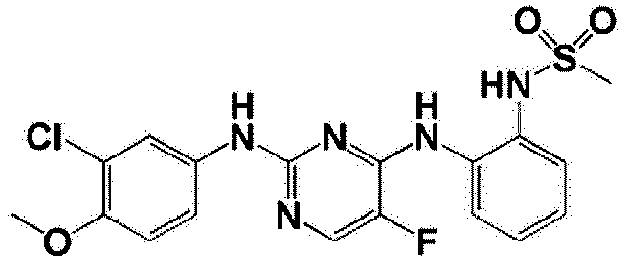
- The above compound was prepared with reference to
WO 2009127642 . -

- The above compound was prepared with reference to
WO 2010106333 . -

- The above compound was prepared with reference to
WO 2011038572 . -

- The above compound was prepared with reference to
WO 2011141756 . -

- The above compound was prepared with reference to
WO 2011151360 . -

- The above compound was prepared with reference to
WO 2012058193 . -
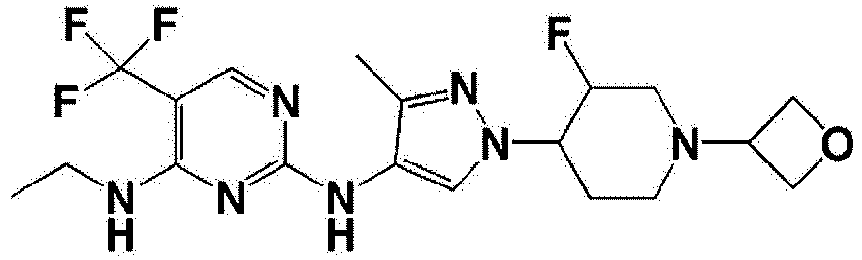
- The above compound was prepared with reference to
WO 2012062783 . -

- The above compound was prepared with reference to
WO 2012118679 . -

- The above compound was prepared with reference to
WO 2010080712 orWO 2015176010 . -

- The above compound was prepared with reference to
WO 2011151360 . -

- The above compound was prepared with reference to
WO 2011151360 . -

-
Step 1. 2,4-dichloro-5-iodopyrimidine (1.0 equivalent) was dissolved in THF and then added with methylamine (3.5 wt% in EtOH, 1.1 equivalents) at 0°C. The mixture was stirred at 0°C for 2 hr, the solvent was removed therefrom, and the resulting product was used in the subsequent step without further purification (yield: 100%). -
Step 2. A two-necked round-bottom flask was purged with nitrogen gas, and CuI (5.0 equivalents) and KF (5.0 equivalents) were placed therein. The resulting mixture was heated to 150°C and then stirred for 2 hr under reduced pressure. After the reaction, the temperature was decreased to room temperature and trimethyl(trifluoromethyl)silane (5.0 equivalents) dissolved in DMF/NMP (1:1) under nitrogen was added using a syringe. After reaction for 30 min, 2-chloro-5-iodo-N-methylpyrimidine-4-amine (1.0 equivalent) dissolved in DMF/NMP (1:1) was added using a syringe and allowed to react at 50°C for 18 hr. After the reaction, the resulting product was added with water to form a precipitate, which was then filtered off. From the filtrate thus obtained, the organic material was extracted using EtOAc (x3). The combined organic layer was washed with brine, and the remaining water was removed using Na2SO4. The dewatered mixture was purified using MPCL (EtOAc:Hex), thereby obtaining a yellow solid target compound (yield: 70%). -
Step 3. 2-chloro-N-methyl-5-(trifluoromethyl)pyrimidine-4-amine (1.0 equivalent) and (4-amino-3-methoxyphenyl)(morpholino)methanone (1.0 equivalent) were dissolved in dioxane and added with p-toluenesulfonic acid (1.0 equivalent) at room temperature. The resulting mixture was stirred at 100°C for 16 hr and cooled to room temperature, the solvent was removed therefrom, and then ice water was added thereto. The organic material was extracted using EtOAc (x3). The combined organic layer was washed with brine, and the remaining water was removed using Na2SO4. The dewatered mixture was purified using MPCL (EtOAc:Hex), thereby obtaining a white solid target compound (yield: 70%). -
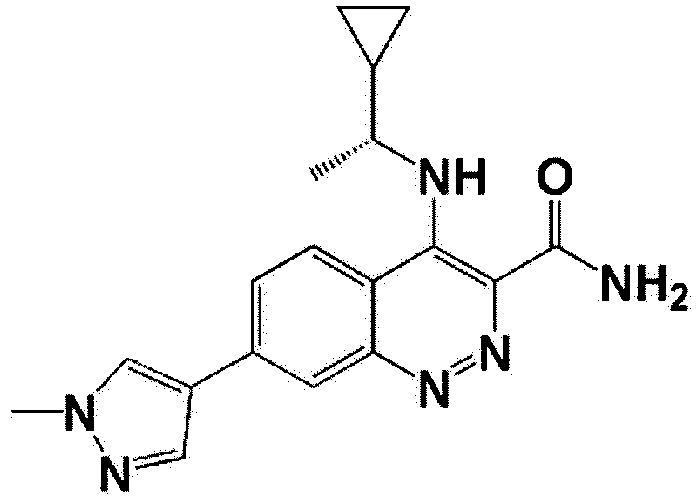
- The above compound was prepared with reference to
WO 2012162254 . -

- The above compound was prepared with reference to
WO 2012062783 . -

- The above compound was prepared with reference to
WO 2013046029 . -

- The above compound was prepared with reference to Journal of Medicinal Chemistry (2014), 57(3), 921-936.
-

- The above compound was prepared with reference to
WO 2014106612 . -

- The above compound was prepared with reference to
WO 2014137723 . -

- The above compound was prepared with reference to
WO 2014170248 . -

- The above compound was prepared with reference to
WO 2014137723 . -

- The above compound was prepared with reference to
WO 2015092592 . -
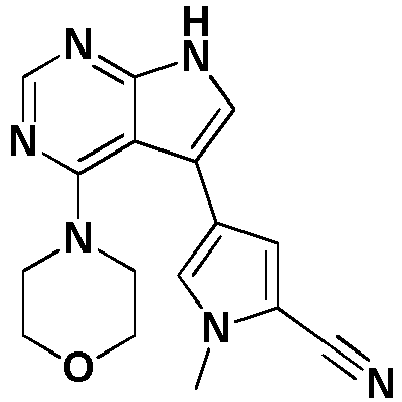
- The above compound was prepared with reference to USA
20140005183 A1 . - The structures of the compounds prepared in Examples 1 to 22 are shown in Table 1 below.
[Table 1] Example Chemical structure Example Chemical structure 1 
12 
2 
13 
3 
14 
4 
15 
5 
16 
6 
17 
7 
18 
8 
19 
9 
20 
10 
21 
11 
22 
-

- The title compound was prepared with reference to
WO 2012062783 . - In order to evaluate the potential to use the LRRK2 protein as a target protein for the treatment of brain tumors, Western blotting was performed using cancer tissues obtained from 19 brain tumor patients, and LRRK2 protein expression was thus assayed.
- Specifically, cancer tissues were obtained from brain tumor patients, and Western blotting was performed to assay the LRRK2 protein expression. The results are shown in
FIG. 1 . - As shown in
FIG. 1 , the LRRK2 protein was expressed in cancer tissues obtained from brain tumor patients, and the expression level was elevated with an increase in brain tumor malignancy. Therefore, it was confirmed that the LRRK2 protein is useful as a target for the treatment of brain tumors. - The LRRK2 protein exhibits the activity thereof by being phosphorylated. Thus, changes in the prognosis of brain tumor patients due to LRRK2 protein phosphorylation in brain tumor cells were measured.
- Specifically, tissue samples were obtained from about 200
stage 3 andstage 4 brain tumor patients, and the expression of phosphorylated LRRK2 protein in the obtained tissue samples was measured through immunostaining. - As shown in
FIG. 2 , the LRRK2 protein phosphorylation increased with an increase in brain tumor malignancy, that is, with progression of the brain tumor from the third stage to the fourth stage. Therefore, it was confirmed that phosphorylated LRRK2 protein is useful as a target protein for the treatment of brain tumors with high malignancy. - According to conventional studies, it has been reported that various carcinomas may be generated by mutation occurring in the LRRK2 protein, and that Parkinson's disease, which is known to be associated with the LRRK2 protein, is also caused by LRRK2 protein mutation. Thus, whether the LRRK2 protein, which was confirmed to be overexpressed in brain tumor cells in the above Experimental Example, is a mutant thereof was evaluated. Specifically, sequencing was performed using brain tumor cells obtained from five patients using the primers shown in Table 2 below.
[Table 2] Name Sequence (5'→3') SEQ ID NO: LRRK2_F1_For Gagcagcggacgttcatg SEQ ID NO: 1 LRRK2_F1_rev Tatgagctgggaaatggcca SEQ ID NO: 2 LRRK2_F1_For_2 Gcgggttggaagcaggtg SEQ ID NO: 3 LRRK2_F1_rev_2 Tcagcatggagagcatcact SEQ ID NO: 4 LRRK2_F2_For Agtacccagagaatgcagca SEQ ID NO: 5 LRRK2_F2_rev Gctcccaatagaagcaagca SEQ ID NO: 6 LRRK2_F3_For Gaactggacatctgctggc SEQ ID NO: 7 LRRK2_F3_rev Ctcgtgagtgcattctggtg SEQ ID NO: 8 LRRK2_F3_For_2 Cataggaactggacatctgc SEQ ID NO: 9 LRRK2_F3_rev_2 Cattctggtgaagctccagc SEQ ID NO: 10 LRRK2_F4_For Ctcaggcagcgatggaaatt SEQ ID NO: 11 LRRK2_F4_rev Gacagccaatctcaggagga SEQ ID NO: 12 LRRK2_F5_For Gctatgcctttcttgcctcc SEQ ID NO: 13 LRRK2_F5_rev Gcagtgctgggtcttgaaaa SEQ ID NO: 14 LRRK2_F6_For Cctgtgattctcgttggcac SEQ ID NO: 15 LRRK2_F6_rev Aggctgctcggtaaactgat SEQ ID NO: 16 LRRK2_F7_For Ttcctgggttgctggagatt SEQ ID NO: 17 LRRK2_F7_rev Tcccagacacaatccagctt SEQ ID NO: 18 LRRK2_F8_For Acttctgcccaggtctttga SEQ ID NO: 19 LRRK2_F8_rev Tgtgagtaccctttccatgtga SEQ ID NO: 20 LRRK2_F1_500F Gatctcctcctaacttcag SEQ ID NO: 21 LRRK2_F1_700r Caatgcagcacatgaagc SEQ ID NO: 22 LRRK2_F2_500F Gaagtggctgaaagtggctg SEQ ID NO: 23 LRRK2_F2_700r Gaatatcattcttgaaacac SEQ ID NO: 24 LRRK2_F3_500F Catcagcttgctcttaagg SEQ ID NO: 25 LRRK2_F3_700r Gaggctgttccttcttcc SEQ ID NO: 26 LRRK2_F5_500F Cttataaccgaatgaaac SEQ ID NO: 27 LRRK2_F5_700r Ctatagaattcctcacgac SEQ ID NO: 28 LRRK2_F7_500F Ggatcgcctgcttcagcag SEQ ID NO: 29 LRRK2_F7_700r Cattctacagcagtactg SEQ ID NO: 30 LRRK2_F8_500F Gctgctcctttgaagatac SEQ ID NO: 31 LRRK2_F8_700r Gtctaccaccactgttatg SEQ ID NO: 32 - As shown in
FIG. 3 , nucleic acid sequences encoding the LRRK2 protein expressed in brain tumor cells had no specific mutations such as those commonly found in Parkinson's disease, except for the known single nucleotide polymorphism (SNP). Therefore, it was confirmed that, unlike Parkinson's disease or other types of cancer, brain tumors were caused by overexpressing wild-type LRRK2 protein, resulting in cancer. - In order to evaluate whether brain tumors were caused by LRRK2 protein overexpression as confirmed in Experimental Example 3, a lentiviral vector (pLenti CMV GFP DEST(736-1), Addgene #19732) containing a polynucleotide encoding the LRRK2 protein was manufactured, and 528NS, 464T (Samsung Seoul Hospital, Korea) and ex-vivo cell lines were infected therewith to form tumors. Here, the cells were infected with a lentiviral vector not expressing the LRRK2 protein, as a control.
- As shown in the results of
FIG. 4 , the size of GSC (glioma stem cell) spheres was increased in 528NS, 464T or ex-vivo cell lines infected with lentivirus expressing the LRRK2 protein compared to the control. Therefore, it was confirmed that the LRRK2 protein overexpression resulted in a tumor. - In order to evaluate drug efficacy in vitro, a Western blotting experiment was performed using brain-tumor-patient-derived cell line NCC01 cells.
- More specifically, 7.5x10⁵ to 1.0x10⁶ NCC01 cells were treated with the compound of each of Examples 10, 11, 12, 20, 21 and 22 at a concentration of 100 or 1,000 nM, and after 1 day, samples were collected and evaluated for LRRK2 protein phosphorylation inhibitory activity via Western blotting. Here, the group not treated with the compound of Example was used as a vehicle. The results are shown in
FIGS. 5 and6 . - As shown in
FIGS. 5 and6 , the compounds of Examples 10, 11, 12, 20, 21 and 22 according to the present invention significantly inhibited LRRK2 protein phosphorylation in brain-tumor-patient-derived cell line NCC01 cells, compared to the vehicle. - Therefore, it was confirmed that the compound of the present invention inhibited LRRK2 protein phosphorylation expressed in the brain-tumor-patient-derived cell line.
- In order to specifically determine the concentration of the compound of Example according to the invention at which high efficacy is exhibited, this experiment was performed in a manner similar to the evaluation of LRRK2 protein phosphorylation inhibitory activity in Experimental Example 1.
- More specifically, 7.5x10⁵ to 1.0x10⁶ NCC01 cells were treated with the compound of each of Examples 10 and 12 at concentrations of 0.5, 1, 5, 10, 50 and 100 nM, and after 1 day, samples were collected and evaluated for LRRK2 protein phosphorylation inhibitory activity via Western blotting. Here, the group not treated with the compound of Example was used as a vehicle. The results are shown in
FIGS. 7 to 10 . - As shown in
FIGS. 7 to 10 , the phosphorylated LRRK2 protein was detected when using the compound of Example 10 at a concentration of 100 nM, but the compound of Example 12 mostly inhibited LRRK2 protein phosphorylation at concentrations of 50 and 100 nM. - Therefore, it was confirmed that the compound of the present invention significantly inhibited LRRK2 protein phosphorylation even at low nM concentrations.
- In order to evaluate changes in the activity of the compound of Example according to the present invention over time after treatment therewith, this experiment was performed in a manner similar to the evaluation of LRRK2 protein phosphorylation inhibitory activity in Experimental Example 1.
- More specifically, 7.5x10⁵ to 1.0x10⁶ NCC01 cells were treated with the compound of Example 12 at a concentration of 100 nM, and after 1 day, 4 days and 8 days, samples were collected and evaluated for LRRK2 protein phosphorylation inhibitory activity via Western blotting. Here, the group not treated with the compound of Example was used as a vehicle. The results are shown in
FIGS. 11 and12 . - As shown in
FIGS. 11 and12 , the extent of LRRK2 protein phosphorylation was drastically reduced starting 1 day after treatment of brain-tumor-patient-derived cell line NCC01 cells with the compound of Example 12, and the reduction thereof continued over time. - Therefore, it was confirmed that the compound of Example of the present invention inhibited LRRK2 protein phosphorylation continuously for a long period of time.
- An experiment was conducted in order to determine the effect of the compound of Example according to the present invention on the intracellular signaling pathway for cancer stem cell growth.
- More specifically, 1.0x10⁶ NCC01 cells were treated with the compound of Example 12 at concentrations of 50, 100, 500, 1,000 and 2,000 nM. After 1 day, samples were collected and the expression of NESTIN protein, which is a cancer stem cell marker involved in the intracellular signaling pathway, was measured through Western blotting. Here, the group not treated with the compound of Example was used as a vehicle. The results are shown in
FIGS. 13 to 15 . - As shown in
FIGS. 13 to 15 , the LRRK2 protein phosphorylation in NCC01 cells was inhibited by the compound of Example 12, which also decreased in a manner dependent on the concentration of the compound that was used. - Therefore, it was confirmed that the compound of Example 12 according to the present invention inhibited LRRK2-protein-mediated signaling in the cells derived from brain tumor patients, thereby reducing the expression of NESTIN protein involved in tumor stem cell growth and thus inhibiting cell growth.
- The LRRK2 protein, which is located in the outer membrane of mitochondria, has been reported to be involved in the fragmentation of mitochondria and the regulation of membrane potential thereof. Thus, an experiment was conducted in order to determine the effect of the compound of Example inhibiting the LRRK2 protein on the mitochondrial function.
- Specifically, NCC01 cells were treated with the compound of Example 12 at 1 µM, and after 1 day, TMRE (tetramethylrhodamine ethylester) dye for staining activated mitochondria was added thereto to evaluate changes in mitochondrial function. Here, the group not treated with the compound of Example was used as a control. The results of staining were observed with a microscope, and are shown in
FIG. 16 . - As shown in
FIG. 16 , the activity of the mitochondria in the cells of the control was maintained, whereby the color of the TMRE dye appeared clear. However, in the cells treated with the compound of Example 12, the degree of color development of the TMRE dye was decreased, and moreover, fragmentation of nuclei in the cells occurred. Therefore, it was confirmed that the compound of Example 12 according to the present invention inhibited mitochondrial activity to thus affect the death of brain tumor cells. - An experiment was conducted in order to evaluate whether apoptosis of stem cells is induced by inhibiting LRRK2 protein phosphorylation in tumor stem cells, which are known to be associated with tumor metastasis.
- Specifically, brain tumor stem cell line NCC01 cells were treated with the compound of Example 12 at a concentration of 0.1 or 1 µM, and after 1 day, the mitochondria were stained as described in Experimental Example 9 to assay changes in the function thereof. Here, the group not treated with the compound of Example was used as a vehicle. The results of staining were observed with a microscope, and are shown in
FIG. 17 . - As shown in
FIG. 17 , the activity of the mitochondria present in the brain tumor stem cells was inhibited in the group treated with the compound of Example 12, compared to the control. Therefore, it was confirmed that the compound according to the present invention inhibited mitochondrial activity to thus induce the death of brain tumor stem cells, resulting in suppressed tumor metastasis. - An experiment was conducted in order to evaluate whether the LKKR2 protein inhibitor according to the present invention, inhibiting the mitochondrial activity in the brain tumor stem cell line as confirmed in Experimental Example 10, has an influence on changes in expression of TRAP1 (TNF receptor associated protein 1), which is known to be involved in mitochondrial function regulation.
- Specifically, brain tumor stem cell line NCC01 cells were added with the compound of Example 12 at a concentration of 100 or 1,000 nM, and after 1 day, changes in the expression of TRAP1 were measured through Western blotting. Here, the group not treated with the compound of Example was used as a vehicle.
- As shown in
FIG. 18 , the expression of TRAP1 was inhibited by the compound of Example 12. Therefore, it was confirmed that the compound according to the present invention inhibited the expression of TRAP1 to thereby suppress mitochondrial activity. - Conventional studies have shown that hypoxic conditions are important in the function of GSC. Thus, changes in LRRK2 protein expression under hypoxic conditions and the size of GSC spheres upon inhibiting LRRK2 protein expression were measured.
- Specifically, NCC01 and 528NS cells were exposed to hypoxic conditions and treated with two kinds of shRNA against the LRRK2 gene, after which changes in the size of spheres were measured. Here, a control was shRNA (shNT) against luciferase.
[Table 3] Name Sequence (5'→3') SEQ ID NO: LRRK2 shRNA-1 
SEQ ID NO: 33 LRRK2 shRNA-2 
SEQ ID NO: 34 luciferase shRNA 
SEQ ID NO: 35 - As shown in
FIG. 19 , the sphere size of the NCC01 (a and b) and 528NS (c and d) cells exposed to hypoxic conditions was increased compared to the control, but was suppressed by LRRK2 shRNA-1 and LRRK2 shRNA-2, which are two kinds of shRNA against the LRRK2 gene. Therefore, it was confirmed that the growth of GSC, produced under hypoxic conditions, was suppressed through inhibition of LRRK2 protein expression. - In order to evaluate whether apoptosis of brain tumor cells is induced by inhibiting LRRK2 protein phosphorylation, an experiment was conducted using FACS (fluorescence-activated cell sorting).
- More specifically, 7.5x10⁵ to 1.0x10⁶ NCC01 cells were treated with the compound of each of Examples 11, 12 and 21 at a concentration of 100 nM, and after 1 day, samples were collected and subjected to FACS, thus assaying the apoptosis induction activity. The group not treated with the compound of Example was used as a control. The results are shown in
FIGS. 20 and21 . - As shown in
FIGS. 20 and21 , the compounds of Examples 11, 12 and 21 induced the apoptosis of NCC01 cells. In particular, the compound of Example 12 exhibited an apoptosis rate about 3 times as high as the compounds of Examples 11 and 21, indicating that the compound of Example 12 according to the present invention was very effective in inducing apoptosis compared to the compounds of other Examples. - An experiment was conducted in order to evaluate whether the compound of Example according to the present invention exhibits the growth inhibitory activity on brain tumor cells in an animal model.
- More specifically, 1.0x10⁴ NCC01 cells, a brain-tumor-patient-derived cell line, were injected into the brain of a Balb/c-nude mouse model, and after 3 days, the compound of Example 12 was orally administered at a dose of 10 mg/kg or 60 mg/kg. After administration of the compound, the survival rate of the mice based on the survival period was determined, and the size of the tumors generated in the mice was measured using MRI. Here, the group not treated with the compound of Example was used as a vehicle. The results are shown in
FIGS. 22 and23 . - As shown in
FIG. 22 , the average survival period of the mice was 54 days in the vehicle and was 71 days in the group orally administered with the compound of Example 12 at 10 mg/kg, and all the mice in the group orally administered with the compound of Example 12 at 60 mg/kg survived up to 100 days (Vehicle vs 10 mg/kg: p=0.032, Vehicle vs 60 mg/kg: p<0.001). - As shown in
FIG. 23 , the tumor was formed at the position to which the NCC01 cells were injected in the vehicle not treated with the compound, but no tumor was observed in the group orally administered with the compound of Example 12 at 10 mg/kg or 60 mg/kg. - Therefore, it was confirmed that the compound of Example according to the present invention significantly inhibited the formation of tumors derived from brain tumor cells in the animal model.
- An experiment was conducted in order to determine the therapeutic effect in an animal model when the compound of Example according to the present invention was administered in combination with Avastin, prescribed as a drug for treating brain tumors.
- More specifically, orthotopic mouse models were manufactured using 5-week-old Balb/c-nude mice. U87MG cells (ATCC, USA), a brain tumor cell line, were injected 3.5 mm deep at a position 2.2 mm to the left of and 0.5 mm behind the bregma using a stereotaxic device. 3 days after injection of the cells, mice were divided into three groups of 5 mice per group (a control (vehicle), a group administered with Avastin, and a group administered with the compound of Example 12 and Avastin), and the drug was administered thereto. The compound of Example 12 was orally administered at a dose of 30 mg/kg and Avastin was injected intraperitoneally at a dose of 10 mg/kg. Thereafter, the survival period was measured when the mice showed evidence of tumor formation such as a reduction in 20% or more of the total body weight thereof or abnormal behavior. The survival graph obtained using the statistical program is shown in
FIG. 24 . - As shown in
FIG. 24 , when the compound of Example 12 was administered in combination with Avastin, the therapeutic effect of Avastin on brain tumors was further significantly increased. - A Western blotting experiment was carried out using brain-tumor-patient-derived cell line NCC01 cells in order to evaluate in-vitro drug efficacy of the compound of Comparative Example, known as an LRRK2 protein inhibitor.
- More specifically, 7.5x10⁵ to 1.0x10⁶ cells were treated with the compound of Comparative Example at a concentration of 0.1 or 1.0 µM, and after 1 day, samples were collected and evaluated for LRRK2 protein phosphorylation inhibitory activity through Western blotting. Here, the group not treated with the compound of Example was used as a vehicle. The results are shown in
FIG. 25 . - As shown in
FIG. 25 , the compound of Comparative Example according to the present invention was known to inhibit LRRK2 protein expression, but did not inhibit LRRK2 protein phosphorylation. - A Western blotting experiment was carried out using brain-tumor-patient-derived
cell line 448T cells in order to evaluate in-vitro drug efficacy. Here, the experiment was conducted in the same manner under the same conditions as in Experimental Example 5, with the exception that 448T cells (Samsung Seoul Hospital, Korea) were used in lieu of NCC01 cells, and the compounds of Examples 10, 11, 12, 20 and 21 were used. - As shown in
FIG. 26 , the compounds of Examples 10, 11, 12, 20 and 21 according to the present invention significantly inhibited LRRK2 protein phosphorylation in the brain-tumor-patient-derivedcell line 448T cells, compared to the vehicle. - Therefore, it was confirmed again that the compound according to the present invention inhibited LRRK2 protein phosphorylation expressed in the brain-tumor-patient-derived cell line.
- An experiment was conducted in order to determine the concentration of the compound of Example according to the invention, which is able to exhibit high efficacy in 448T cells. Specifically, the experiment was performed in the same manner under the same conditions as in Experimental Example 6, with the exception that 448T cells were used in lieu of NCC01 cells, and the compound of Example 12 was used at concentrations of 50, 100, 500, 1,000, and 2,000 nM.
- As shown in
FIG. 27 , the compound of Example 12 inhibited most of the LRRK2 protein phosphorylation at a concentration of 50 nM. - Therefore, it was confirmed again that the compound according to the present invention significantly inhibited LRRK2 protein phosphorylation even at low nM concentrations.
- An experiment was conducted in order to evaluate whether the compound of Example according to the present invention exhibits the growth inhibitory activity on brain tumor cells in an animal model. Specifically, the experiment was conducted in the same manner under the same conditions as in Experimental Example 14, with the exception that 448T cells were used in lieu of NCC01 cells, and the compound of each of Examples 12, 20 and 21 was orally administered at a dose of 60 mg/kg.
- As shown in
FIG. 28 , the tumor was formed at the position to which the 448T cells were injected in the vehicle not treated with the compound, but no tumor was observed in the group orally administered with the compound of each of Examples 12, 20 and 21. - Therefore, it was confirmed again that the compound of Example according to the present invention significantly inhibited the formation of tumors derived from brain tumor cells in the animal model.
- An experiment was conducted in order to evaluate the in-vitro drug efficacy of the compound of Comparative Example, known as an LRRK2 protein inhibitor. Specifically, the experiment was conducted in the same manner under the same conditions as in Experimental Example 16, with the exception that 448T cells were used in lieu of NCC01 cells, and the compounds of Examples 1, 11 and 12 were used.
- As shown in
FIG. 29 , the compound of Comparative Example was known to inhibit LRRK2 protein expression, but did not inhibit LRRK2 protein phosphorylation, unlike the compounds of Examples 1, 11 and 12 according to the present invention. -
- 500 mg of the LRRK2 protein inhibitor of the present invention
- 100 mg of lactose
- 10 mg of talc
- A powder was manufactured by mixing the above components and placing the mixture in an airtight bag.
-
- 500 mg of the LRRK2 protein inhibitor of the present invention
- 100 mg of corn starch
- 100 mg of lactose
- 2 mg of magnesium stearate
- A tablet was manufactured by mixing the above components and tableting the mixture in accordance with a typical tablet-manufacturing method.
-
- 500 mg of the LRRK2 protein inhibitor of the present invention
- 100 mg of corn starch
- 100 mg of lactose
- 2 mg of magnesium stearate
- A capsule was manufactured by mixing the above components and placing the mixture in a gelatin capsule in accordance with a typical capsule-manufacturing method.
- 500 mg of the LRRK2 protein inhibitor of the present invention
- Appropriate amount of sterile distilled water for injection
- An injection was manufactured using the above amounts of the components per ampoule (2 ml) in accordance with a typical injection-manufacturing method.
-
- 100 mg of the LRRK2 protein inhibitor of the present invention
- 10 g of isomerized sugar
- 5 g of mannitol
- A liquid was manufactured by dissolving the above components in purified water, adding an appropriate amount of lemon flavor, mixing the above components, adding purified water such that the total volume was 100 ml, placing the resulting mixture in a brown bottle and performing sterilization, in accordance with a typical liquid-manufacturing method.


Claims (26)
- A pharmaceutical composition for preventing or treating brain cancer, containing an LRRK2 (leucin-rich repeat kinase-2) protein inhibitor as an active ingredient.
- The pharmaceutical composition of claim 1, wherein the LRRK2 protein inhibitor is a compound represented by Chemical Formula 1 below, an optical isomer thereof, or a pharmaceutically acceptable salt thereof:
 R1 is -H, -OH, halogen, nitro, nitrile, a C1-10 linear or branched alkyl, a C1-10 linear or branched alkoxy, a C1-5 linear or branched alkylamino, or a C1-5 linear or branched dialkylamino;R2 is -H, -OH, halogen, nitro, nitrile, or an unsubstituted or at-least-one-halogen-substituted C1-10 linear or branched alkyl, or is linked with R3 to form an unsubstituted, substituted or fused 5- to 8-membered-ring heterocycloalkyl containing at least one N or an unsubstituted or substituted 5- or 6-membered-ring heteroaryl containing at least one N,wherein the substituted 5- to 8-membered-ring heterocycloalkyl and the substituted 5- or 6-membered-ring heteroaryl are independently a 5- to 8-membered-ring heterocycloalkyl and a 5- or 6-membered-ring heteroaryl substituted with at least one substituent selected from the group consisting of -OH, =O, halogen and a C1-5 linear or branched alkyl, andthe fused 5- to 8-membered-ring heterocycloalkyl is a 5-to 8-membered-ring heterocycloalkyl fused with an unsubstituted C6-10 aryl;R3 is -H, -OH, halogen, nitro, nitrile, a C1-10 linear or branched alkyl, a C1-10 linear or branched alkoxy, a C1-5 linear or branched alkylamino, a C1-5 linear or branched dialkylamino, a C1-5 linear or branched alkylsulfonyl C6-10 arylamino, or a C1-5 linear or branched alkylsulfonylamino C6-10 arylamino, or is linked with R2 to form an unsubstituted, substituted or fused 5- to 8-membered-ring heterocycloalkyl containing at least one N,wherein the substituted 5- to 8-membered-ring heterocycloalkyl is independently a 5- to 8-membered-ring heterocycloalkyl substituted with at least one substituent selected from the group consisting of -OH, =O, halogen and a C1-5 linear or branched alkyl, andthe fused 5- to 8-membered-ring heterocycloalkyl is a 5-to 8-membered-ring heterocycloalkyl fused with an unsubstituted C6-10 aryl; andY is
 wherein R4, R5 and R6 are independently -H, -OH, halogen, nitro, nitrile, a C1-10 linear or branched alkyl, a C1-10 linear or branched alkoxy, an unsubstituted or substituted 5- to 8-membered-ring heterocycloalkyl containing at least one hetero atom selected from the group consisting of N and O, or an unsubstituted or substituted 5- to 8-membered-ring heterocycloalkylcarbonyl containing at least one hetero atom selected from the group consisting of N and O,wherein the substituted 5- to 8-membered-ring heterocycloalkyl is a 5- to 8-membered-ring heterocycloalkyl substituted with a C1-5 linear or branched dialkylamino or a 6-membered-ring heterocycloalkyl which contains at least one N and which is substituted with at least one C1-5 linear or branched alkyl, andR7, R8 and R9 are independently -H, -OH, halogen, nitro, nitrile, an unsubstituted or at-least-one-hydroxyl-group-substituted C1-10 linear or branched alkyl, or an unsubstituted or substituted 5- to 8-membered-ring heterocycloalkyl containing at least one hetero atom selected from the group consisting of N and O,wherein the substituted 5- to 8-membered-ring heterocycloalkyl is a 5- to 8-membered-ring heterocycloalkyl substituted with at least one substituent selected from the group consisting of -OH, =O, halogen and an O-containing 4- or 5-membered-ring unsubstituted heterocycloalkyl).
 - The pharmaceutical composition of claim 2, wherein R1 is -H or -NH(CH3);R2 is -H, halogen, or -CF3, or is linked with R3 to form
 R3 is -H, -NH (CH3), -NH(CH2CH3),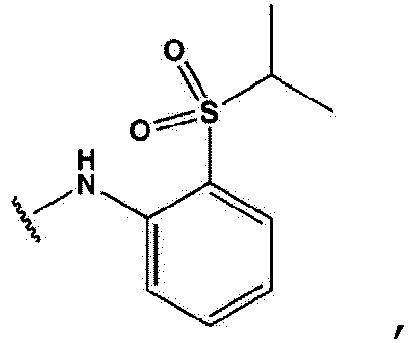

 Y is
Y is

 R7, R8 and R9 are independently -H, methyl, halogen,
- The pharmaceutical composition of claim 2, wherein the compound represented by Chemical Formula 1 is any one selected from the following compound group:
(1) 5-chloro-N4-(2-(isopropylsulfonyl)phenyl)-N2-(2-methoxy-4-(4-(4-methylpiperazin-1-yl)piperidin-1-yl)phenyl)pyrimidine-2,4-diamine; (2) N-(2-(2-(3-chloro-4-methoxyphenylamino)-5-fluoropyrimidin-4-ylamino)phenyl)methanesulfonamide; (6) (4-(dimethylamino)piperidin-1-yl) (3-methoxy-4-(4-(methylamino)-5-(trifluoromethyl)pyrimidin-2-ylamino)phenyl)methanone; (8) N4-ethyl-N2-(1-(3-fluoro-1-(oxetan-3-yl)piperidin-4-yl)-3-methyl-1H-pyrazol-4-yl)-5-(trifluoromethyl)pyrimidine-2,4-diamine; (10) 2-[(2-methoxy-4-[[4-(4-methylpiperazin-1-yl)piperidin-1-yl]carbonyl]phenyl)amino]-5,11-dimethyl-5,11-dihydro-6H-pyrimido[4,5-b][1,4]benzodiazepin-6-one; (11) (4-(4-(ethylamino)-5-(trifluoromethyl)pyrimidin-2-ylamino)-2-fluoro-5-methoxyphenyl)(morpholino)methanone; (12) (3-methoxy-4-(4-(methylamino)-5-(trifluoromethyl)pyrimidin-2-ylamino)phenyl)(morpholino)methanone; (14) 1-(5-chloro-4-(4-(methylamino)-5-(trifluoromethyl)pyrimidin-2-ylamino)-1H-pyrazol-1-yl)-2-methylpropan-2-ol; and (16) N2-(5-chloro-1-((3S,4R)-3-fluoro-1-(oxetan-3-yl)piperidin-4-yl)-1H-pyrazol-4-yl)-N4-methyl-5-(trifluoromethyl)pyrimidine-2,4-diamine. - The pharmaceutical composition of claim 1, wherein the LRRK2 protein inhibitor is a compound represented by Chemical Formula 2 below, an optical isomer thereof, or a pharmaceutically acceptable salt thereof:
 L1 and L2 are independently -O-, -CH2-, -NH-, or -S-;A1 is an unsubstituted or substituted C3-10 cycloalkyl, wherein the substituted C3-10 cycloalkyl is a C3-10 cycloalkyl substituted with at least one substituent selected from the group consisting of -OH, halogen, nitrile, nitro, a C1-5 linear or branched alkyl and a C1-5 linear or branched alkoxy;A2 is an unsubstituted or substituted 5- or 6-membered-ring heteroaryl containing at least one hetero atom selected from the group consisting of N, O and S, wherein the substituted 5- or 6-membered-ring heteroaryl is a 5- or 6-membered-ring heteroaryl substituted with at least one substituent selected from the group consisting of -OH, halogen, nitrile, nitro, a C1-5 linear or branched alkyl and a C1-5 linear or branched alkoxy; andA3, A4 and A5 are independently -H, a C1-5 linear or branched alkyl or a C1-5 linear or branched alkoxy).
 - The pharmaceutical composition of claim 5, wherein L1 and L2 are independently -CH2-, -NH-, or -S-;A1 is
 A2 is
A2 is A3, A4 and A5 are independently -H or methyl.
 - The pharmaceutical composition of claim 5, wherein the compound represented by Chemical Formula 2 is any one selected from the following compound group:
(7) (S)-3-(cyclopropylthio)-7-methyl-1-(1H-pyrazol-3-yl)-6,7-dihydrothieno[3,4-c]pyridin-4(5H)-one; and (9) 3-(cyclopentylthio)-6,6-dimethyl-1-(1H-pyrazol-3-yl)-6,7-dihydrobenzo[c]thiophen-4(5H)-one. - The pharmaceutical composition of claim 1, wherein the LRRK2 protein inhibitor is a compound represented by Chemical Formula 3 below, an optical isomer thereof, or a pharmaceutically acceptable salt thereof:
 L3 is absent, -NH-, or -O-;L4 is N or C;E1 is -H, -OH, halogen, nitrile, nitro, a C1-5 linear or branched alkyl, or a C1-5 linear or branched alkoxy;E2 is absent when L4 is N, or is
 E3 is -H, -OH, halogen, nitrile, nitro, a C1-5 linear or branched alkyl, a C1-5 linear or branched alkoxy, an unsubstituted or substituted C6-10 cycloalkyl, or an unsubstituted or substituted 5- to 8-membered-ring heterocycloalkyl containing at least one hetero atom selected from the group consisting of N and O,wherein the substituted C6-10 cycloalkyl and the substituted 5- to 8-membered-ring heterocycloalkyl are independently a C6-10 cycloalkyl and a 5- to 8-membered-ring heterocycloalkyl substituted with at least one substituent selected from the group consisting of -OH, halogen, a C1-3 linear or branched alkyl, and a C1-3 linear or branched alkoxy; andE4 is an unsubstituted or substituted 6- to 8-membered-ring heterocycloalkylcarbonyl C1-5 linear or branched alkyl containing at least one N, or an unsubstituted or substituted 6- to 8-membered-ring heteroaryl containing at least one N,wherein the substituted 6- to 8-membered-ring heterocycloalkyl and the substituted 6- to 8-membered-ring heteroaryl are independently substituted with a C6-10 aryl or an unsubstituted or substituted 6-membered-ring heterocycloalkyl containing at least one hetero atom selected from the group consisting of N and O,the substituted 6-membered-ring heterocycloalkyl is a 6-membered-ring heterocycloalkyl substituted with -OH, halogen, or an unsubstituted or at-least-one-halogen-substituted C1-5 linear or branched alkyl).
 - The pharmaceutical composition of claim 8, wherein L3 is absent, -NH-, or -O-;L4 is N or C;E1 is -H or methyl;E2 is absent when L4 is N, or is
 E3 is -H,
 E4 is
E4 is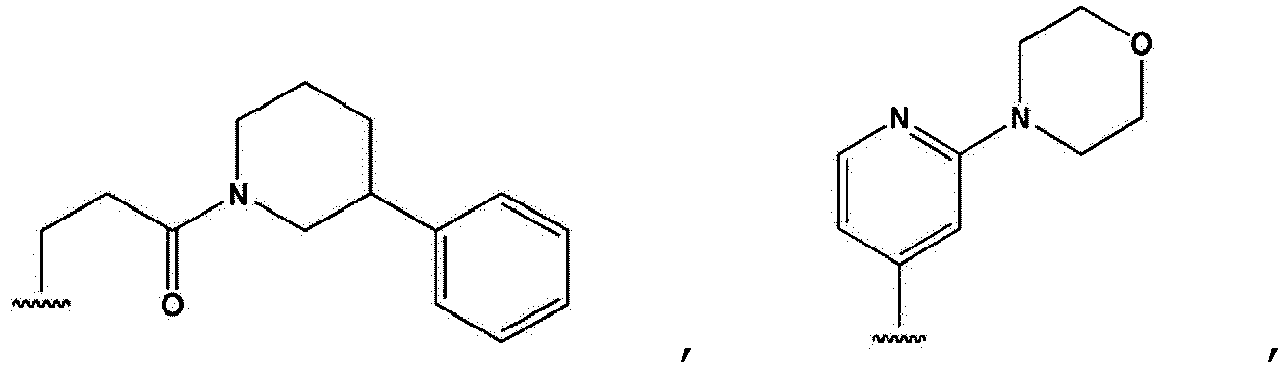

- The pharmaceutical composition of claim 8, wherein the compound represented by Chemical Formula 3 is any one selected from the following compound group:
(3) (R)-3-(4-(cyclohexylamino)-1H-pyrazole[4,3-c]pyridin-3-yl)-1-(3-phenylpiperidin-1-yl)propan-1-one; (5) 4-(4-(6-methyl-4-(tetrahydro-2H-pyran-4-yloxy)-1H-pyrazole[4,3-c]pyridin-3-yl)pyridin-2-yl)morpholine; (18) 3-(6-(4-(2-fluoroethyl)piperazin-1-yl)pyrimidin-4-yl)-5-(1-methylcyclopropoxy)-1H-indazole; and (20) (2S,6R)-2,6-dimethyl-4-(6-(5-(1-methylcyclopropoxy)-1H-indazol-3-yl)pyrimidin-4-yl)morpholine. - The pharmaceutical composition of claim 1, wherein the LRRK2 protein inhibitor is a compound represented by Chemical Formula 4 below, an optical isomer thereof, or a pharmaceutically acceptable salt thereof:
 α is -CH= or -N=;G1 is -H, -OH, halogen, nitro, nitrile, a C1-5 linear or branched alkyl, a C1-5 linear or branched alkoxy, or an unsubstituted or substituted 5- to 8-membered-ring heteroarylamino containing at least one N,wherein the substituted 5- to 8-membered-ring heteroaryl is a 5- to 8-membered-ring heteroaryl substituted with -OH, halogen or a C1-3 linear or branched alkyl;G2 is -H, -OH, halogen, nitro, nitrile, a C1-5 linear or branched alkyl, a C1-5 linear or branched alkoxy, an unsubstituted or substituted C6-10 aryl, or an unsubstituted or substituted 5- to 8-membered-ring heterocycloalkyl containing at least one hetero atom selected from the group consisting of N and O,wherein the substituted C6-10 aryl and the substituted 5-to 8-membered-ring heterocycloalkyl are independently a C6-10 aryl and a 5- to 8-membered-ring heterocycloalkyl substituted with at least one substituent selected from the group consisting of a C1-5 linear or branched alkyl, a C1-5 linear or branched alkoxy, and a 6-membered-ring unsubstituted heterocycloalkyl C1-3 linear or branched alkyl containing N and O; andG3 is -H, -OH, halogen, nitro, nitrile, a C1-5 linear or branched alkyl, a C1-5 linear or branched alkoxy, an unsubstituted or at-least-one-nitrile-substituted C6-10 aryl, or an unsubstituted or substituted 5- to 10-membered-ring heteroaryl containing at least one hetero atom selected from the group consisting of N, O and S,wherein the substituted 5- to 10-membered-ring heteroaryl is a 5- to 10-membered-ring heteroaryl substituted with at least one substituent selected from the group consisting of halogen, a C1-5 linear or branched alkyl, and nitrile).
 - The pharmaceutical composition of claim 11, whereinG1 is -H or
 G2 is
G2 is G3 is nitrile,
- The pharmaceutical composition of claim 11, wherein the compound represented by Chemical Formula 4 is any one selected from the following compound group:
(19) 6-(1-methyl-1H-pyrazol-3-ylamino)-4-(3-methyl-4-(morpholinomethyl)phenyl)-1H-pyrrolo[2,3-b]pyridine-3-carbonitrile; (21) 3-(4-morpholino-1H-pyrrolo[2,3-b]pyridin-3-yl)benzonitrile; and (22) 1-methyl-4-(4-morpholino-7H-pyrrolo[2,3-d]pyrimidin-5-yl)-1H-pyrrole-2-carbonitrile. - The pharmaceutical composition of claim 1, wherein the LRRK2 protein inhibitor is a compound represented by Chemical Formula 5 below, an optical isomer thereof, or a pharmaceutically acceptable salt thereof:

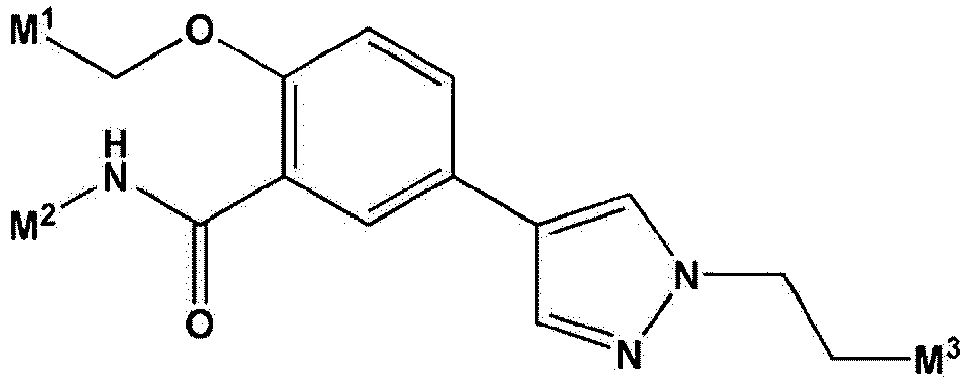 M1 is an unsubstituted or at-least-one-halogen-substituted C6-10 aryl;M2 is an unsubstituted 6- to 8-membered-ring heteroaryl containing at least one hetero atom selected from the group consisting of N, O and S; andM3 is an unsubstituted 6- to 8-membered-ring heterocycloalkyl containing at least one hetero atom selected from the group consisting of N, O and S).
 - The pharmaceutical composition of claim 14, wherein the compound represented by Chemical Formula 5 is the following compound:
(4) 2-(4-fluorobenzyloxy)-5-(1-(2-morpholinoethyl)-1H-pyrazol-4-yl)-N-(pyridin-3-yl)benzamide. - The pharmaceutical composition of claim 1, wherein the LRRK2 protein inhibitor is a compound represented by Chemical Formula 6 below, an optical isomer thereof, or a pharmaceutically acceptable salt thereof:

 Q1 is -H, amino, a C1-5 linear or branched alkyl, or a C1-5 linear or branched alkoxy;Q2 is -H, or an unsubstituted C6-10 cycloalkyl;Q3 is -H, a C1-5 linear or branched alkyl, or a C1-5 linear or branched alkoxy; andQ4 is a methyl-substituted 5-membered-ring heteroaryl containing at least one N).
 - The pharmaceutical composition of claim 16, wherein the compound represented by Chemical Formula 6 is the following compound:
(13) (R)-4-(1-cyclopropylethylamino)-7-(1-methyl-1H-pyrazol-4-yl)cinnoline-3-carboxamide. - The pharmaceutical composition of claim 1, wherein the LRRK2 protein inhibitor is a compound represented by Chemical Formula 7 below, an optical isomer thereof, or a pharmaceutically acceptable salt thereof:


T1 is -H, a C1-5 linear or branched alkyl, or an unsubstituted C3-8 cycloalkylcarbonyl). - The pharmaceutical composition of claim 18, wherein the compound represented by Chemical Formula 7 is the following compound:
(15) cyclopropyl[10,11,14,15-tetrahydro-1,16-etheno-4,8-(metheno)pyrazole[3,4-j][1,4,7,9]oxatriazacyclohexadecin-12(13H)-yl]methanone. - The pharmaceutical composition of claim 1, wherein the LRRK2 protein inhibitor is a compound represented by Chemical Formula 8 below, an optical isomer thereof, or a pharmaceutically acceptable salt thereof:
 Z1 is -H, amino, a C1-5 linear or branched alkyl, or a C1-5 linear or branched alkoxy;Z2 is a 5- to 8-membered-ring heteroaryl containing at least one N and substituted with a C1-5 linear or branched alkyl; andZ3 is -H, a C1-5 linear or branched alkyl, or a C1-5 linear or branched alkoxy).
 - The pharmaceutical composition of claim 20, wherein the compound represented by Chemical Formula 8 is the following compound:
(17) (4-(6-amino-5-(1-isopropyl-1H-1,2,3-triazol-4-yl)pyridin-3-yl)-2-methoxyphenyl)(morpholino)methanone. - A pharmaceutical kit for preventing or treating brain cancer, comprising:a first component containing a pharmaceutically effective amount of an LRRK2 protein inhibitor as an active ingredient; anda second component containing a pharmaceutically effective amount of Avastin as an active ingredient.
- The pharmaceutical kit of claim 23, wherein the first component and the second component are sequentially or simultaneously administered.
- A method of treating brain cancer, comprising administering an LRRK2 protein inhibitor to a subject.
- A method of treating brain cancer, comprising:administering an LRRK2 protein inhibitor to a subject; andadministering Avastin to the subject.
- Use of an LRRK2 protein inhibitor in preparation of a pharmaceutical composition for treatment of brain cancer.
Applications Claiming Priority (2)
| Application Number | Priority Date | Filing Date | Title |
|---|---|---|---|
| KR20170024812 | 2017-02-24 | ||
| PCT/KR2018/002241 WO2018155947A1 (en) | 2017-02-24 | 2018-02-23 | Pharmaceutical composition comprising compound capable of penetrating blood-brain barrier as effective ingredient for preventing or treating brain cancer |
Publications (3)
| Publication Number | Publication Date |
|---|---|
| EP3586848A1 true EP3586848A1 (en) | 2020-01-01 |
| EP3586848A4 EP3586848A4 (en) | 2020-07-29 |
| EP3586848B1 EP3586848B1 (en) | 2021-09-01 |
Family
ID=63253833
Family Applications (1)
| Application Number | Title | Priority Date | Filing Date |
|---|---|---|---|
| EP18758340.6A Not-in-force EP3586848B1 (en) | 2017-02-24 | 2018-02-23 | Pharmaceutical composition comprising compound capable of penetrating blood-brain barrier as effective ingredient for preventing or treating brain cancer |
Country Status (7)
| Country | Link |
|---|---|
| US (3) | US20210267997A1 (en) |
| EP (1) | EP3586848B1 (en) |
| JP (1) | JP6728503B2 (en) |
| KR (1) | KR101923852B1 (en) |
| CN (1) | CN110678182B (en) |
| SG (1) | SG11201908234WA (en) |
| WO (1) | WO2018155947A1 (en) |
Families Citing this family (6)
| Publication number | Priority date | Publication date | Assignee | Title |
|---|---|---|---|---|
| EP3866801A4 (en) * | 2018-10-16 | 2022-11-09 | Dana-Farber Cancer Institute, Inc. | DEGRADING AGENTS OF WILD-TYPE AND MUTANT FORMS OF LRRK2 KINASE |
| KR102168179B1 (en) | 2019-10-31 | 2020-10-20 | 주식회사 온코빅스 | Novel pyrimidine derivative showing growth inhibition of cancer cell and pharmaceutical composition comprising the same |
| CA3161667A1 (en) * | 2019-12-16 | 2021-06-24 | Pil Ho Kim | Novel pyrimidine derivative and use thereof |
| CN112225703B (en) * | 2020-09-28 | 2022-03-11 | 广州智睿医药科技有限公司 | Medicine for treating or preventing diseases related to LRRK2 kinase or abnormal LRRK2 mutant kinase activity |
| CN113831321B (en) * | 2021-09-18 | 2023-01-31 | 安润医药科技(苏州)有限公司 | Small molecule inhibitor of leucine-rich repeat kinase 2 and application thereof |
| CN115819405A (en) * | 2022-12-20 | 2023-03-21 | 沪渝人工智能研究院 | Pyrimidinylaminopyrazole derivatives and their use as leucine-rich repeat kinase 2 inhibitors |
Family Cites Families (28)
| Publication number | Priority date | Publication date | Assignee | Title |
|---|---|---|---|---|
| GB0305929D0 (en) | 2003-03-14 | 2003-04-23 | Novartis Ag | Organic compounds |
| TWI378923B (en) | 2003-08-15 | 2012-12-11 | Novartis Ag | Pyrimidine derivatives |
| JP2011511949A (en) | 2008-02-12 | 2011-04-14 | ザ・ブリガーム・アンド・ウーメンズ・ホスピタル・インコーポレーテッド | FISH assay for fusion of EML4 and ALK in lung cancer |
| WO2009127642A2 (en) | 2008-04-15 | 2009-10-22 | Cellzome Limited | Use of lrrk2 inhibitors for neurodegenerative diseases |
| CA2748181C (en) * | 2009-01-06 | 2019-07-16 | Nathanael S. Gray | Pyrimido-diazepinone kinase scaffold compounds and methods of treating disorders |
| JP5732036B2 (en) | 2009-03-19 | 2015-06-10 | メディカル リサーチ カウンシル テクノロジーMedical Research Council Technology | Compound |
| SG179120A1 (en) * | 2009-09-29 | 2012-05-30 | Glaxo Group Ltd | Novel compounds |
| US8323270B2 (en) * | 2009-10-19 | 2012-12-04 | Pharmaco-Kinesis Corporation | Enhanced method for delivering bevacizumab (avastin) into a brain tumor using an implanted magnetic breather pump |
| GB201008134D0 (en) | 2010-05-14 | 2010-06-30 | Medical Res Council Technology | Compounds |
| US8354420B2 (en) | 2010-06-04 | 2013-01-15 | Genentech, Inc. | Aminopyrimidine derivatives as LRRK2 inhibitors |
| US20120101108A1 (en) | 2010-08-06 | 2012-04-26 | Cell Signaling Technology, Inc. | Anaplastic Lymphoma Kinase In Kidney Cancer |
| WO2012058193A1 (en) | 2010-10-29 | 2012-05-03 | Merck Sharp & Dohme Corp. | Leucine-rich repeat kinase enzyme activity |
| US20120114638A1 (en) * | 2010-11-08 | 2012-05-10 | John Boylan | Combination therapy |
| SI2638031T1 (en) | 2010-11-10 | 2018-02-28 | Genentech, Inc. | Pyrazole aminopyrimidine derivatives as lrrk2 modulators |
| US20130338106A1 (en) * | 2011-02-28 | 2013-12-19 | John A. McCauley | Compounds inhibiting leucine-rich repeat kinase enzyme activity |
| AU2012258977A1 (en) * | 2011-05-23 | 2014-01-16 | Imago Pharmaceuticals, Inc. | Inhibitors of LRRK2 kinase activity |
| FR2975600B1 (en) * | 2011-05-24 | 2013-07-05 | Assist Publ Hopitaux De Paris | AGENTS FOR THE TREATMENT OF TUMORS |
| PT2760453T (en) | 2011-09-30 | 2016-08-02 | Ipsen Pharma Sas | Macrocyclic lrrk2 kinase inhibitors |
| MD20140130A2 (en) | 2012-06-29 | 2015-04-30 | Pfizer Inc. | Novel 4-(substituted-amino)-7H-pyrrolo[2,3-d]pyrimidines as LRRK2 inhibitors |
| WO2014106612A1 (en) | 2013-01-02 | 2014-07-10 | H. Lundbeck A/S | Aminopyridine derived compounds as lrrk2 inhibitors |
| WO2014134774A1 (en) * | 2013-03-04 | 2014-09-12 | Merck Sharp & Dohme Corp. | Compounds inhibiting leucine-rich repeat kinase enzyme activity |
| WO2014160430A1 (en) * | 2013-03-13 | 2014-10-02 | Georgetown University | Small molecule lrrk2 and erk5 inhibitors |
| EP3670515B1 (en) * | 2013-03-15 | 2024-03-06 | Dana-Farber Cancer Institute, Inc. | Pyrimido-diazepinone compounds and methods of treating disorders |
| TW201533043A (en) * | 2013-04-18 | 2015-09-01 | Lundbeck & Co As H | Arylpyrrolopyridine derived compounds as LRRK2 inhibitors |
| WO2015077602A1 (en) | 2013-11-22 | 2015-05-28 | Fred Hutchinson Cancer Research Center | Methods for identifying therapeutic targets and treating and monitoring cancers |
| WO2015092592A1 (en) | 2013-12-17 | 2015-06-25 | Pfizer Inc. | Novel 3,4-disubstituted-1h-pyrrolo[2,3-b]pyridines and 4,5-disubstituted-7h-pyrrolo[2,3-c]pyridazines as lrrk2 inhibitors |
| WO2015176010A1 (en) | 2014-05-15 | 2015-11-19 | The United States Of America, As Represented By The Secretary, Departmentof Health & Human Services | Treatment or prevention of an intestinal disease or disorder |
| US10004751B2 (en) * | 2014-07-10 | 2018-06-26 | The J. David Gladstone Institutes | Compositions and methods for treating Dengue virus infection |
-
2018
- 2018-02-23 SG SG11201908234W patent/SG11201908234WA/en unknown
- 2018-02-23 JP JP2019546316A patent/JP6728503B2/en not_active Expired - Fee Related
- 2018-02-23 US US16/488,706 patent/US20210267997A1/en not_active Abandoned
- 2018-02-23 CN CN201880016351.8A patent/CN110678182B/en not_active Expired - Fee Related
- 2018-02-23 EP EP18758340.6A patent/EP3586848B1/en not_active Not-in-force
- 2018-02-23 WO PCT/KR2018/002241 patent/WO2018155947A1/en not_active Ceased
- 2018-02-23 KR KR1020180021901A patent/KR101923852B1/en active Active
-
2022
- 2022-09-27 US US17/953,867 patent/US20230248740A1/en not_active Abandoned
- 2022-09-27 US US17/953,819 patent/US20230181596A1/en not_active Abandoned
Also Published As
| Publication number | Publication date |
|---|---|
| US20230248740A1 (en) | 2023-08-10 |
| US20230181596A1 (en) | 2023-06-15 |
| US20210267997A1 (en) | 2021-09-02 |
| JP6728503B2 (en) | 2020-07-22 |
| CN110678182B (en) | 2022-08-23 |
| SG11201908234WA (en) | 2019-10-30 |
| KR101923852B1 (en) | 2018-11-29 |
| KR20180098167A (en) | 2018-09-03 |
| CN110678182A (en) | 2020-01-10 |
| WO2018155947A1 (en) | 2018-08-30 |
| JP2020508340A (en) | 2020-03-19 |
| EP3586848B1 (en) | 2021-09-01 |
| EP3586848A4 (en) | 2020-07-29 |
Similar Documents
| Publication | Publication Date | Title |
|---|---|---|
| US20230248740A1 (en) | Pharmaceutical Composition Comprising Compound Capable of Penetrating Blood-Brain Barrier as Effective Ingredient for Preventing or Treating Brain Cancer | |
| US20230346786A1 (en) | Chiral diaryl macrocycles and uses thereof | |
| KR101323566B1 (en) | Di(arylamino)aryl compound | |
| EP2364302B1 (en) | Triazine analogs and their use as therapeutic agents and diagnostic probes | |
| EP4667458A1 (en) | Pharmaceutical composition for treatment of cancer, comprising sos1 inhibitor and anticancer drug | |
| EP3546462B1 (en) | Novel oxoisoquinoline derivative | |
| JP7564983B2 (en) | Pyrrolopyridine derivatives and their uses for use in the prevention or treatment of protein kinase-related diseases - Patents.com | |
| ES2930106T3 (en) | Pyrrole-pyridine derivative compound, process for preparing the same, and pharmaceutical composition containing the same as an active ingredient for the prevention or treatment of protein kinase-related diseases | |
| KR20220085735A (en) | Isoxazolidine derivative compounds, and uses thereof | |
| KR20160067946A (en) | Conformationally restricted PI3K and mTOR inhibitors | |
| AU2022401468B2 (en) | 2,7-substituted pyrrolo[2,1-f][1,2,4]triazine compound having protein kinase inhibitory activity | |
| KR20200110250A (en) | Heteroaryl derivatives, and pharmaceutical composition comprising the same | |
| KR102168179B1 (en) | Novel pyrimidine derivative showing growth inhibition of cancer cell and pharmaceutical composition comprising the same | |
| KR101990739B1 (en) | Pharmaceutical composition for preventing or treating brain cancer comprising compounds penetrating blood-brain barrier | |
| KR101990738B1 (en) | Pharmaceutical composition for preventing or treating brain cancer comprising compounds penetrating blood-brain barrier | |
| KR102352624B1 (en) | Pyridopyrimidine derivatives as lrrk2 (leucine rich repeat kinase 2) inhinitor | |
| KR101992059B1 (en) | Pharmaceutical composition for preventing or treating brain cancer comprising compounds penetrating blood-brain barrier | |
| RU2834201C1 (en) | Novel heterocyclic substituted pyrimidine derivative exhibiting inhibitory action on cancer cell growth, and pharmaceutical composition containing same | |
| CN119661531A (en) | Imidazolone compounds and preparation methods and applications thereof | |
| HK40061602A (en) | Heteroaryl derivatives and pharmaceutical composition comprising same as active ingredient | |
| HK40015251A (en) | Novel oxoisoquinoline derivative | |
| HK40015251B (en) | Novel oxoisoquinoline derivative | |
| HK1217485A1 (en) | Fused tricyclic urea compounds as raf kinase and/or raf kinase dimer inhibitors |
Legal Events
| Date | Code | Title | Description |
|---|---|---|---|
| STAA | Information on the status of an ep patent application or granted ep patent |
Free format text: STATUS: THE INTERNATIONAL PUBLICATION HAS BEEN MADE |
|
| PUAI | Public reference made under article 153(3) epc to a published international application that has entered the european phase |
Free format text: ORIGINAL CODE: 0009012 |
|
| STAA | Information on the status of an ep patent application or granted ep patent |
Free format text: STATUS: REQUEST FOR EXAMINATION WAS MADE |
|
| 17P | Request for examination filed |
Effective date: 20190924 |
|
| AK | Designated contracting states |
Kind code of ref document: A1 Designated state(s): AL AT BE BG CH CY CZ DE DK EE ES FI FR GB GR HR HU IE IS IT LI LT LU LV MC MK MT NL NO PL PT RO RS SE SI SK SM TR |
|
| AX | Request for extension of the european patent |
Extension state: BA ME |
|
| RIN1 | Information on inventor provided before grant (corrected) |
Inventor name: NAM, DO-HYUN Inventor name: LEE, SEUNG HOON Inventor name: SON, JUNG BEOM Inventor name: PARK, JONG BAE Inventor name: KIM, NAM DOO Inventor name: KO, EUNHWA Inventor name: CHOI, HWAN GEUN |
|
| DAV | Request for validation of the european patent (deleted) | ||
| DAX | Request for extension of the european patent (deleted) | ||
| A4 | Supplementary search report drawn up and despatched |
Effective date: 20200701 |
|
| RIC1 | Information provided on ipc code assigned before grant |
Ipc: A61K 31/519 20060101ALI20200625BHEP Ipc: A61K 31/506 20060101ALI20200625BHEP Ipc: A61K 31/5377 20060101ALI20200625BHEP Ipc: A61K 39/00 20060101ALI20200625BHEP Ipc: A61K 31/437 20060101ALI20200625BHEP Ipc: A61K 31/415 20060101ALI20200625BHEP Ipc: A23L 33/10 20160101ALI20200625BHEP Ipc: A61K 31/5513 20060101ALI20200625BHEP Ipc: A61K 31/505 20060101AFI20200625BHEP |
|
| STAA | Information on the status of an ep patent application or granted ep patent |
Free format text: STATUS: EXAMINATION IS IN PROGRESS |
|
| 17Q | First examination report despatched |
Effective date: 20201028 |
|
| GRAP | Despatch of communication of intention to grant a patent |
Free format text: ORIGINAL CODE: EPIDOSNIGR1 |
|
| STAA | Information on the status of an ep patent application or granted ep patent |
Free format text: STATUS: GRANT OF PATENT IS INTENDED |
|
| INTG | Intention to grant announced |
Effective date: 20210520 |
|
| GRAS | Grant fee paid |
Free format text: ORIGINAL CODE: EPIDOSNIGR3 |
|
| GRAA | (expected) grant |
Free format text: ORIGINAL CODE: 0009210 |
|
| STAA | Information on the status of an ep patent application or granted ep patent |
Free format text: STATUS: THE PATENT HAS BEEN GRANTED |
|
| AK | Designated contracting states |
Kind code of ref document: B1 Designated state(s): AL AT BE BG CH CY CZ DE DK EE ES FI FR GB GR HR HU IE IS IT LI LT LU LV MC MK MT NL NO PL PT RO RS SE SI SK SM TR |
|
| REG | Reference to a national code |
Ref country code: GB Ref legal event code: FG4D |
|
| REG | Reference to a national code |
Ref country code: CH Ref legal event code: EP Ref country code: AT Ref legal event code: REF Ref document number: 1425484 Country of ref document: AT Kind code of ref document: T Effective date: 20210915 |
|
| REG | Reference to a national code |
Ref country code: DE Ref legal event code: R096 Ref document number: 602018022936 Country of ref document: DE |
|
| REG | Reference to a national code |
Ref country code: IE Ref legal event code: FG4D |
|
| REG | Reference to a national code |
Ref country code: LT Ref legal event code: MG9D |
|
| REG | Reference to a national code |
Ref country code: NL Ref legal event code: MP Effective date: 20210901 |
|
| PG25 | Lapsed in a contracting state [announced via postgrant information from national office to epo] |
Ref country code: FI Free format text: LAPSE BECAUSE OF FAILURE TO SUBMIT A TRANSLATION OF THE DESCRIPTION OR TO PAY THE FEE WITHIN THE PRESCRIBED TIME-LIMIT Effective date: 20210901 Ref country code: ES Free format text: LAPSE BECAUSE OF FAILURE TO SUBMIT A TRANSLATION OF THE DESCRIPTION OR TO PAY THE FEE WITHIN THE PRESCRIBED TIME-LIMIT Effective date: 20210901 Ref country code: HR Free format text: LAPSE BECAUSE OF FAILURE TO SUBMIT A TRANSLATION OF THE DESCRIPTION OR TO PAY THE FEE WITHIN THE PRESCRIBED TIME-LIMIT Effective date: 20210901 Ref country code: SE Free format text: LAPSE BECAUSE OF FAILURE TO SUBMIT A TRANSLATION OF THE DESCRIPTION OR TO PAY THE FEE WITHIN THE PRESCRIBED TIME-LIMIT Effective date: 20210901 Ref country code: RS Free format text: LAPSE BECAUSE OF FAILURE TO SUBMIT A TRANSLATION OF THE DESCRIPTION OR TO PAY THE FEE WITHIN THE PRESCRIBED TIME-LIMIT Effective date: 20210901 Ref country code: BG Free format text: LAPSE BECAUSE OF FAILURE TO SUBMIT A TRANSLATION OF THE DESCRIPTION OR TO PAY THE FEE WITHIN THE PRESCRIBED TIME-LIMIT Effective date: 20211201 Ref country code: LT Free format text: LAPSE BECAUSE OF FAILURE TO SUBMIT A TRANSLATION OF THE DESCRIPTION OR TO PAY THE FEE WITHIN THE PRESCRIBED TIME-LIMIT Effective date: 20210901 Ref country code: NO Free format text: LAPSE BECAUSE OF FAILURE TO SUBMIT A TRANSLATION OF THE DESCRIPTION OR TO PAY THE FEE WITHIN THE PRESCRIBED TIME-LIMIT Effective date: 20211201 |
|
| REG | Reference to a national code |
Ref country code: AT Ref legal event code: MK05 Ref document number: 1425484 Country of ref document: AT Kind code of ref document: T Effective date: 20210901 |
|
| PG25 | Lapsed in a contracting state [announced via postgrant information from national office to epo] |
Ref country code: PL Free format text: LAPSE BECAUSE OF FAILURE TO SUBMIT A TRANSLATION OF THE DESCRIPTION OR TO PAY THE FEE WITHIN THE PRESCRIBED TIME-LIMIT Effective date: 20210901 Ref country code: LV Free format text: LAPSE BECAUSE OF FAILURE TO SUBMIT A TRANSLATION OF THE DESCRIPTION OR TO PAY THE FEE WITHIN THE PRESCRIBED TIME-LIMIT Effective date: 20210901 Ref country code: GR Free format text: LAPSE BECAUSE OF FAILURE TO SUBMIT A TRANSLATION OF THE DESCRIPTION OR TO PAY THE FEE WITHIN THE PRESCRIBED TIME-LIMIT Effective date: 20211202 |
|
| PG25 | Lapsed in a contracting state [announced via postgrant information from national office to epo] |
Ref country code: AT Free format text: LAPSE BECAUSE OF FAILURE TO SUBMIT A TRANSLATION OF THE DESCRIPTION OR TO PAY THE FEE WITHIN THE PRESCRIBED TIME-LIMIT Effective date: 20210901 |
|
| PG25 | Lapsed in a contracting state [announced via postgrant information from national office to epo] |
Ref country code: IS Free format text: LAPSE BECAUSE OF FAILURE TO SUBMIT A TRANSLATION OF THE DESCRIPTION OR TO PAY THE FEE WITHIN THE PRESCRIBED TIME-LIMIT Effective date: 20220101 Ref country code: SM Free format text: LAPSE BECAUSE OF FAILURE TO SUBMIT A TRANSLATION OF THE DESCRIPTION OR TO PAY THE FEE WITHIN THE PRESCRIBED TIME-LIMIT Effective date: 20210901 Ref country code: SK Free format text: LAPSE BECAUSE OF FAILURE TO SUBMIT A TRANSLATION OF THE DESCRIPTION OR TO PAY THE FEE WITHIN THE PRESCRIBED TIME-LIMIT Effective date: 20210901 Ref country code: RO Free format text: LAPSE BECAUSE OF FAILURE TO SUBMIT A TRANSLATION OF THE DESCRIPTION OR TO PAY THE FEE WITHIN THE PRESCRIBED TIME-LIMIT Effective date: 20210901 Ref country code: PT Free format text: LAPSE BECAUSE OF FAILURE TO SUBMIT A TRANSLATION OF THE DESCRIPTION OR TO PAY THE FEE WITHIN THE PRESCRIBED TIME-LIMIT Effective date: 20220103 Ref country code: NL Free format text: LAPSE BECAUSE OF FAILURE TO SUBMIT A TRANSLATION OF THE DESCRIPTION OR TO PAY THE FEE WITHIN THE PRESCRIBED TIME-LIMIT Effective date: 20210901 Ref country code: EE Free format text: LAPSE BECAUSE OF FAILURE TO SUBMIT A TRANSLATION OF THE DESCRIPTION OR TO PAY THE FEE WITHIN THE PRESCRIBED TIME-LIMIT Effective date: 20210901 Ref country code: CZ Free format text: LAPSE BECAUSE OF FAILURE TO SUBMIT A TRANSLATION OF THE DESCRIPTION OR TO PAY THE FEE WITHIN THE PRESCRIBED TIME-LIMIT Effective date: 20210901 Ref country code: AL Free format text: LAPSE BECAUSE OF FAILURE TO SUBMIT A TRANSLATION OF THE DESCRIPTION OR TO PAY THE FEE WITHIN THE PRESCRIBED TIME-LIMIT Effective date: 20210901 |
|
| REG | Reference to a national code |
Ref country code: DE Ref legal event code: R097 Ref document number: 602018022936 Country of ref document: DE |
|
| PLBE | No opposition filed within time limit |
Free format text: ORIGINAL CODE: 0009261 |
|
| STAA | Information on the status of an ep patent application or granted ep patent |
Free format text: STATUS: NO OPPOSITION FILED WITHIN TIME LIMIT |
|
| PG25 | Lapsed in a contracting state [announced via postgrant information from national office to epo] |
Ref country code: IT Free format text: LAPSE BECAUSE OF FAILURE TO SUBMIT A TRANSLATION OF THE DESCRIPTION OR TO PAY THE FEE WITHIN THE PRESCRIBED TIME-LIMIT Effective date: 20210901 Ref country code: DK Free format text: LAPSE BECAUSE OF FAILURE TO SUBMIT A TRANSLATION OF THE DESCRIPTION OR TO PAY THE FEE WITHIN THE PRESCRIBED TIME-LIMIT Effective date: 20210901 |
|
| 26N | No opposition filed |
Effective date: 20220602 |
|
| PG25 | Lapsed in a contracting state [announced via postgrant information from national office to epo] |
Ref country code: SI Free format text: LAPSE BECAUSE OF FAILURE TO SUBMIT A TRANSLATION OF THE DESCRIPTION OR TO PAY THE FEE WITHIN THE PRESCRIBED TIME-LIMIT Effective date: 20210901 |
|
| PG25 | Lapsed in a contracting state [announced via postgrant information from national office to epo] |
Ref country code: MC Free format text: LAPSE BECAUSE OF FAILURE TO SUBMIT A TRANSLATION OF THE DESCRIPTION OR TO PAY THE FEE WITHIN THE PRESCRIBED TIME-LIMIT Effective date: 20210901 |
|
| REG | Reference to a national code |
Ref country code: CH Ref legal event code: PL |
|
| REG | Reference to a national code |
Ref country code: BE Ref legal event code: MM Effective date: 20220228 |
|
| GBPC | Gb: european patent ceased through non-payment of renewal fee |
Effective date: 20220223 |
|
| PG25 | Lapsed in a contracting state [announced via postgrant information from national office to epo] |
Ref country code: LU Free format text: LAPSE BECAUSE OF NON-PAYMENT OF DUE FEES Effective date: 20220223 |
|
| PG25 | Lapsed in a contracting state [announced via postgrant information from national office to epo] |
Ref country code: FR Free format text: LAPSE BECAUSE OF NON-PAYMENT OF DUE FEES Effective date: 20220228 |
|
| PG25 | Lapsed in a contracting state [announced via postgrant information from national office to epo] |
Ref country code: LI Free format text: LAPSE BECAUSE OF NON-PAYMENT OF DUE FEES Effective date: 20220228 Ref country code: IE Free format text: LAPSE BECAUSE OF NON-PAYMENT OF DUE FEES Effective date: 20220223 Ref country code: GB Free format text: LAPSE BECAUSE OF NON-PAYMENT OF DUE FEES Effective date: 20220223 Ref country code: CH Free format text: LAPSE BECAUSE OF NON-PAYMENT OF DUE FEES Effective date: 20220228 |
|
| PG25 | Lapsed in a contracting state [announced via postgrant information from national office to epo] |
Ref country code: BE Free format text: LAPSE BECAUSE OF NON-PAYMENT OF DUE FEES Effective date: 20220228 |
|
| PG25 | Lapsed in a contracting state [announced via postgrant information from national office to epo] |
Ref country code: MK Free format text: LAPSE BECAUSE OF FAILURE TO SUBMIT A TRANSLATION OF THE DESCRIPTION OR TO PAY THE FEE WITHIN THE PRESCRIBED TIME-LIMIT Effective date: 20210901 Ref country code: CY Free format text: LAPSE BECAUSE OF FAILURE TO SUBMIT A TRANSLATION OF THE DESCRIPTION OR TO PAY THE FEE WITHIN THE PRESCRIBED TIME-LIMIT Effective date: 20210901 |
|
| PGFP | Annual fee paid to national office [announced via postgrant information from national office to epo] |
Ref country code: DE Payment date: 20240116 Year of fee payment: 7 |
|
| PG25 | Lapsed in a contracting state [announced via postgrant information from national office to epo] |
Ref country code: HU Free format text: LAPSE BECAUSE OF FAILURE TO SUBMIT A TRANSLATION OF THE DESCRIPTION OR TO PAY THE FEE WITHIN THE PRESCRIBED TIME-LIMIT; INVALID AB INITIO Effective date: 20180223 |
|
| PG25 | Lapsed in a contracting state [announced via postgrant information from national office to epo] |
Ref country code: TR Free format text: LAPSE BECAUSE OF FAILURE TO SUBMIT A TRANSLATION OF THE DESCRIPTION OR TO PAY THE FEE WITHIN THE PRESCRIBED TIME-LIMIT Effective date: 20210901 |
|
| PG25 | Lapsed in a contracting state [announced via postgrant information from national office to epo] |
Ref country code: MT Free format text: LAPSE BECAUSE OF FAILURE TO SUBMIT A TRANSLATION OF THE DESCRIPTION OR TO PAY THE FEE WITHIN THE PRESCRIBED TIME-LIMIT Effective date: 20210901 |
|
| REG | Reference to a national code |
Ref country code: DE Ref legal event code: R119 Ref document number: 602018022936 Country of ref document: DE |
|
| PG25 | Lapsed in a contracting state [announced via postgrant information from national office to epo] |
Ref country code: DE Free format text: LAPSE BECAUSE OF NON-PAYMENT OF DUE FEES Effective date: 20250902 |