EP3586621A1 - Fishing line guide member and fishing rod provided with same - Google Patents
Fishing line guide member and fishing rod provided with same Download PDFInfo
- Publication number
- EP3586621A1 EP3586621A1 EP18757899.2A EP18757899A EP3586621A1 EP 3586621 A1 EP3586621 A1 EP 3586621A1 EP 18757899 A EP18757899 A EP 18757899A EP 3586621 A1 EP3586621 A1 EP 3586621A1
- Authority
- EP
- European Patent Office
- Prior art keywords
- fishing line
- contacting surface
- guide member
- line
- roughness
- Prior art date
- Legal status (The legal status is an assumption and is not a legal conclusion. Google has not performed a legal analysis and makes no representation as to the accuracy of the status listed.)
- Withdrawn
Links
- TWNQGVIAIRXVLR-UHFFFAOYSA-N oxo(oxoalumanyloxy)alumane Chemical compound O=[Al]O[Al]=O TWNQGVIAIRXVLR-UHFFFAOYSA-N 0.000 claims description 17
- 239000000919 ceramic Substances 0.000 claims description 12
- 235000019592 roughness Nutrition 0.000 description 33
- 239000000843 powder Substances 0.000 description 14
- 238000001746 injection moulding Methods 0.000 description 12
- 238000005498 polishing Methods 0.000 description 12
- 238000005259 measurement Methods 0.000 description 11
- 238000010304 firing Methods 0.000 description 9
- 238000007493 shaping process Methods 0.000 description 8
- 235000019587 texture Nutrition 0.000 description 7
- 238000004519 manufacturing process Methods 0.000 description 6
- 230000001105 regulatory effect Effects 0.000 description 6
- 239000002002 slurry Substances 0.000 description 6
- 238000000034 method Methods 0.000 description 5
- 238000005245 sintering Methods 0.000 description 5
- GWEVSGVZZGPLCZ-UHFFFAOYSA-N Titan oxide Chemical compound O=[Ti]=O GWEVSGVZZGPLCZ-UHFFFAOYSA-N 0.000 description 4
- 238000011156 evaluation Methods 0.000 description 4
- 239000010419 fine particle Substances 0.000 description 4
- 239000000463 material Substances 0.000 description 4
- 239000008188 pellet Substances 0.000 description 4
- 238000001035 drying Methods 0.000 description 3
- 239000000049 pigment Substances 0.000 description 3
- 239000002994 raw material Substances 0.000 description 3
- UQSXHKLRYXJYBZ-UHFFFAOYSA-N Iron oxide Chemical compound [Fe]=O UQSXHKLRYXJYBZ-UHFFFAOYSA-N 0.000 description 2
- MCMNRKCIXSYSNV-UHFFFAOYSA-N Zirconium dioxide Chemical compound O=[Zr]=O MCMNRKCIXSYSNV-UHFFFAOYSA-N 0.000 description 2
- 238000005299 abrasion Methods 0.000 description 2
- 239000011230 binding agent Substances 0.000 description 2
- AMWRITDGCCNYAT-UHFFFAOYSA-L hydroxy(oxo)manganese;manganese Chemical compound [Mn].O[Mn]=O.O[Mn]=O AMWRITDGCCNYAT-UHFFFAOYSA-L 0.000 description 2
- 229910052751 metal Inorganic materials 0.000 description 2
- 239000002184 metal Substances 0.000 description 2
- 238000002156 mixing Methods 0.000 description 2
- 229920005989 resin Polymers 0.000 description 2
- 239000011347 resin Substances 0.000 description 2
- 238000005507 spraying Methods 0.000 description 2
- 229920005992 thermoplastic resin Polymers 0.000 description 2
- OGIDPMRJRNCKJF-UHFFFAOYSA-N titanium oxide Inorganic materials [Ti]=O OGIDPMRJRNCKJF-UHFFFAOYSA-N 0.000 description 2
- 238000005303 weighing Methods 0.000 description 2
- VYPSYNLAJGMNEJ-UHFFFAOYSA-N Silicium dioxide Chemical compound O=[Si]=O VYPSYNLAJGMNEJ-UHFFFAOYSA-N 0.000 description 1
- WGLPBDUCMAPZCE-UHFFFAOYSA-N Trioxochromium Chemical compound O=[Cr](=O)=O WGLPBDUCMAPZCE-UHFFFAOYSA-N 0.000 description 1
- 229910052782 aluminium Inorganic materials 0.000 description 1
- XAGFODPZIPBFFR-UHFFFAOYSA-N aluminium Chemical compound [Al] XAGFODPZIPBFFR-UHFFFAOYSA-N 0.000 description 1
- 238000005266 casting Methods 0.000 description 1
- 229910010293 ceramic material Inorganic materials 0.000 description 1
- 229910000423 chromium oxide Inorganic materials 0.000 description 1
- 239000011248 coating agent Substances 0.000 description 1
- 238000000576 coating method Methods 0.000 description 1
- LBFUKZWYPLNNJC-UHFFFAOYSA-N cobalt(ii,iii) oxide Chemical compound [Co]=O.O=[Co]O[Co]=O LBFUKZWYPLNNJC-UHFFFAOYSA-N 0.000 description 1
- 238000005238 degreasing Methods 0.000 description 1
- 238000010586 diagram Methods 0.000 description 1
- 238000002347 injection Methods 0.000 description 1
- 239000007924 injection Substances 0.000 description 1
- VTHJTEIRLNZDEV-UHFFFAOYSA-L magnesium dihydroxide Chemical compound [OH-].[OH-].[Mg+2] VTHJTEIRLNZDEV-UHFFFAOYSA-L 0.000 description 1
- 229910001862 magnesium hydroxide Inorganic materials 0.000 description 1
- 239000000347 magnesium hydroxide Substances 0.000 description 1
- 230000014759 maintenance of location Effects 0.000 description 1
- 239000002245 particle Substances 0.000 description 1
- 238000004445 quantitative analysis Methods 0.000 description 1
- 230000000630 rising effect Effects 0.000 description 1
- 229910052814 silicon oxide Inorganic materials 0.000 description 1
- 239000002904 solvent Substances 0.000 description 1
- 230000003746 surface roughness Effects 0.000 description 1
- 238000004381 surface treatment Methods 0.000 description 1
- XLYOFNOQVPJJNP-UHFFFAOYSA-N water Substances O XLYOFNOQVPJJNP-UHFFFAOYSA-N 0.000 description 1
Images
Classifications
-
- A—HUMAN NECESSITIES
- A01—AGRICULTURE; FORESTRY; ANIMAL HUSBANDRY; HUNTING; TRAPPING; FISHING
- A01K—ANIMAL HUSBANDRY; AVICULTURE; APICULTURE; PISCICULTURE; FISHING; REARING OR BREEDING ANIMALS, NOT OTHERWISE PROVIDED FOR; NEW BREEDS OF ANIMALS
- A01K87/00—Fishing rods
- A01K87/04—Fishing-line guides on rods, e.g. tips
Definitions
- the present disclosure relates to a fishing line guide member and a fishing rod provided with the same.
- a fishing rod to which a plurality of guide members of a ring shape (hereinafter, referred to as a fishing line guide member) are attached, is used. Then, a fishing line is guided by the fishing line guide members.
- Patent Literature 1 discloses a fishing line guide member formed of a ceramic material, and the fishing line guide member includes a through hole that guides a fishing line having a diameter of 0.1 mm or greater, wherein an average irregularity diameter of a surface of a region corresponding to 1/5 of a whole from at least an opening end of the through hole is 50 ⁇ m to 200 ⁇ m.
- Patent Literature 1 Japanese Unexamined Patent Publication JP-A 2001-321031
- a fishing line guide member includes a surface in contact with a fishing line (hereinafter, referred to as a line contacting surface).
- the line contacting surface has an arithmetic mean roughness Ra of 0.4 ⁇ m or less, the arithmetic mean roughness Ra being obtained from a roughness profile.
- the line contacting surface has a core roughness depth Rk of 0.3 ⁇ m or more and 1.5 ⁇ m or less, the core roughness depth Rk being obtained from the roughness profile.
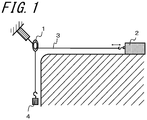
- FIG. 1 is a schematic diagram showing an example of a sliding characteristic evaluation device used to evaluate a sliding characteristic on a line contacting surface of a fishing line guide member according to the disclosure.
- the fishing line guide member according to the disclosure can smoothly guide the fishing line for a long period of time.
- the fishing line guide member according to the disclosure will be described below.
- the fishing line guide member includes a line contacting surface that is in contact with the fishing line.
- the line contacting surface has an arithmetic mean roughness Ra of 0.4 ⁇ m or less, the arithmetic mean roughness Ra being obtained from a roughness profile.
- the line contacting surface has a core roughness depth Rk of 0.3 ⁇ m or more and 1.5 ⁇ m or less, the core roughness depth Rk being obtained from the roughness profile.
- the arithmetic mean roughness Ra is a value regulated in JIS B 0601 (2013).
- the core roughness depth Rk is regulated in JIS B 0671-2 (2002), and is defined as follows. First, in a central portion of a material ratio curve including 40% of measurement points in the roughness profile, a straight light that makes a split line of the material ratio curve drawn to set a difference of a load length ratio to be 40% the gentlest slope is assumed to be an equivalent straight line. Next, a space between two height positions that are generated when the equivalent straight line crosses a vertical axis at locations where the load length ratio of 0% and 100% is assumed as a core.
- the core roughness depth Rk is an index indicating a level difference between an upper side and a lower side of the core.
- the fishing line guide member according to the disclosure satisfies the above configuration, irregularity on the line contacting surface is small, and a variation in a core height is small, the fishing line may be smoothly guided for a long period of time.
- the line contacting surface in the fishing line guide member according to the disclosure may have a peak count Pc of 5 or more and 25 or less, the peak count Pc being obtained from the roughness profile.
- the peak count Pc is regulated in JIS B 0601 (2013), and when an average height of the roughness is set as a center line, the peak count Pc is an index indicating the number of portions becoming a peak and a valley with respect to the center line per unit height (10 mm).
- the fishing line guide member according to the disclosure which satisfies the above configuration, can smoothly guide the fishing line because a contact area with the line contacting surface is small when guiding the fishing line.
- the line contacting surface in the fishing line guide member according to the disclosure may have a kurtosis Rku of less than 3, the kurtosis Rku being obtained from the roughness profile.
- the kurtosis Rku is regulated in JIS B 0601 (2013), and is an index indicating a criterion of surface sharpness.
- the kurtosis Rku is less than 3, a vicinity of a vertex of a portion becoming the peak and valley is rounded.
- the fishing line guide member satisfying the above configuration according to the disclosure can smoothly guide the fishing line because the line contacting surface is less likely to damage the fishing line when guiding the fishing line.
- the line contacting surface in the fishing line guide member according to the disclosure may have a total height of profile Rt of 1.0 ⁇ m or more and 3.2 ⁇ m or less, the total height of profile Rt being obtained from the roughness profile.
- the total height of profile Rt is regulated in JIS B 0601 (2013), and is an index indicating a total of a maximum profile peak height and a maximum profile valley depth along an evaluation length.
- the fishing line guide member satisfying the above configuration according to the disclosure has a small contact area with the fishing line when guiding the fishing line, and because there are few protruding peaks and valleys, the fishing line can be smoothly guided.
- a mean width of profile elements RSm the mean width of profile elements RSm being obtained from the roughness profile, may be set to be 45 ⁇ m or more and 95 ⁇ m or less.
- the mean width of profile elements RSm is regulated in JIS B 0601 (2013), and assuming that a sum of lengths of center lines corresponding to one peak and neighboring valley is an interval between the peak and the valley, the mean width of profile elements RSm is an index indicating an average value of the intervals.
- the fishing line guide member satisfying the above configuration according to the disclosure has a small contact area with the fishing line when guiding the fishing line, and because the fishing line is less likely to leap, the fishing line can be smoothly guided.
- the arithmetic mean roughness Ra, the peak count Pc, the kurtosis Rku, the total height of profile Rt, and the mean width of profile elements RSm can be determined by being measured based on JIS B 0601 (2013), and the core roughness depth Rk can be obtained by being measured based on JIS B 0671-2 (2002).
- Measurement conditions may include, for example, a measurement length of 1.0 mm, a cut-off value of 0.25 mm, and a scanning speed of 0.3 mm/second with a stylus having a stylus radius of 5 ⁇ m. Then, measurement is performed along a direction of guiding the fishing line on at least three points in the line contacting surface, and an average value of obtained values may be calculated.
- the line contacting surface of the fishing line guide member according to the disclosure may be formed of any type of material.
- the line contacting surface is made of ceramics
- the line contacting surface has an excellent abrasion resistance as compared with a case in which the line contacting surface is made of metal, a resin, etc., and thus, damage to the fishing line may be further reduced.
- the line contacting surface is made of aluminum oxide-based ceramics among the ceramics
- the line contacting surface may have more excellent abrasion resistance as compared with a case in which the line contacting surface is made of zirconia-based ceramics, etc.
- the aluminum oxide-based ceramics contains aluminum oxide of 80% by mass or greater with respect to all components of the ceramics taken as 100% by mass.
- the line contacting surface made of the aluminum oxide-based ceramics may be manufactured by coating a surface of the guide member including metal or resin with aluminum oxide-based ceramics.
- a durability may be further improved.
- a material of the line contacting surface can be confirmed by the following method.
- the line contacting surface is measured by using an X-ray diffractometer (XRD), and an identification is performed from an obtained value 2 ⁇ (2 ⁇ is a diffraction angle) by using a JCPDS card.
- XRD X-ray diffractometer
- a quantitative analysis of a component is performed by using a fluorescent X-ray analyzer (XRF).
- XRF fluorescent X-ray analyzer
- the fishing rod according to the disclosure includes the fishing line guide member according to the disclosure.
- the fishing rod of the disclosure includes the fishing line guide member capable of smoothly guiding the fishing line for a long period of time, it is less likely to break the fishing line and reliability may be improved.
- a method of manufacturing a fishing line guide member according to the disclosure will be described. Also, the fishing line guide member that is made of aluminum oxide-based ceramics will be described as an example.
- aluminum oxide (Al 2 O 3 ) powder that is a main raw material is put into a mill with a sintering aid, a solvent, and a ball, and then is ground to a predetermined particle size to prepare a slurry.
- granulated fine particles are obtained by spraying and drying the slurry by using a spray-dryer (spraying-drying apparatus).
- this fine particles, a thermoplastic resin, wax, etc. are put into a kneader and are kneaded while being heated to obtain a body. Then, the obtained body is put into a pelletizer, and then, a pellet that becomes a raw material for injection molding is obtained. Next, the obtained pellet is put into an injection molding machine to be injection molded, and then a molded body having a shape of the fishing line guide member is obtained.
- a shaping mold for obtaining the shape of the fishing line guide member is manufactured based on a general injection molding method, and may be installed in an injection molding machine so that injection molding is performed.
- the molded body may be manufactured by using the shaping mold having a surface texture in an inner surface thereof, wherein the surface texture is determined in consideration of a polishing amount caused due to a surface treatment such as a barrel polishing, etc. after the firing.
- the above is identically applied to a case in which the peak count Pc may be set to be 5 or more and 25 or less, the kurtosis Rku may be set to be less than 3, the total height of profile Rt may be set to be 1.0 ⁇ m or more and 3.2 ⁇ m or less, or the mean width of profile elements RSm may be set to be 45 ⁇ m or more and 95 ⁇ m or less.
- a sintered body is obtained by holding and firing the molded body for 1 to 4 hours to a maximum temperature of 1350°C or higher and 1500°C or lower under an atmospheric environment. Further, a temperature rising rate from a temperature of 1000°C to the maximum temperature may be 80 to 150°C/hour.
- the obtained sintered body is barrel-polished to obtain the fishing line guide member according to the disclosure.
- the firing condition may be adjusted according to necessity.
- Samples (fishing line guide member) having different arithmetic mean roughnesses Ra and different core roughness depths Rk in line contacting surfaces were manufactured, and sliding characteristics was evaluated.
- the pigment component powder was prepared by weighing and mixing chromium oxide powder, manganese oxide powder, cobalt oxide powder, and iron oxide powder at a mass ratio of 23:21:53:3.
- the sintering aid powder was prepared by weighing and mixing silicon oxide powder and magnesium hydroxide powder at a mass ratio of 2:1.
- respective powder was weighed so that aluminum oxide was 93% by mass in terms of Al 2 O 3 , titanium oxide was 2% by mass in terms of TiO 2 , the pigment component was 4% by mass, and the sintering aid powder was 1% by mass, and water was added and put into a mill with a ball to be pulverized and mixed to manufacture a slurry.
- a binder was added to the slurry, and after that, granulated fine particles were obtained by spraying and drying the slurry by using a spray-dryer. Then, a thermoplastic resin and wax were added to the obtained fine particles, and then were put into a kneader to be kneaded while being heated to obtain a body. Next, the obtained body was put into a pelletizer to obtain a pellet that is a raw material for injection molding. Then, the pellet was put into an injection molding machine to obtain a molded body having a shape of a fishing line guide member.
- the surface properties on the inner surface of a shaping mold provided in the injection molding machine were set so that the line contacting surface of each sample had the arithmetic mean roughness Ra and the core roughness depth Rk as illustrated in Table 1 below, in consideration of the polishing amount caused due to the barrel polishing after the firing.
- the molded body having the shape of the fishing line guide member was fired at a maximum temperature of 1420°C under an atmospheric environment with a retention time of 2 hours at the maximum temperature, and a sintered body having the shape of the fishing line guide member was obtained.
- the obtained sintered body was barrel-polished, and thus each sample of a ring shape having a thickness of 1.7 mm, a width of 2.3 mm, and an outer diameter of 14.4 mm was obtained.
- the arithmetic mean roughness Ra and the core roughness depth Rk in the line contacting surface were measured by using a contact type surface roughness meter based on JIS B 0601 (2013) and JIS B 0671-2 (2002).
- the measurement conditions were set to have a measurement length of 1.0 mm, a cut-off value of 0.25 mm, and a scanning speed of 0.3 mm/second with a stylus having a stylus radius of 5 ⁇ m.
- the calculated values were obtained by performing measurement at three points of the line contacting surface along a direction of guiding the fishing line, and then an average value of the calculated values was obtained.
- the sliding characteristic evaluation device is a device in which a fishing line 3 connected to a cylinder 2 passes through each sample 1 (fishing line guide member) and a sinker 4 is suspended from a tip of the fishing line 3 hanging from each sample 1 as a starting point, and in this state, the fishing line is slid by reciprocating the cylinder 2 at a constant speed and stroke.
- each sample was ranked in an order from the longest time taken for the fishing line 3 to break. In other words, the sample with the longest time taken for the fishing line 3 to break was ranked first, and the sample with the shortest time taken for the fishing line 3 to break was ranked lowest. In addition, as the time taken for the fishing line 3 to break is increased, it indicates that the fishing line may be smoothly guided for a long period of time.
- sample No. 10 is the same as sample No. 5 according to Example 1.
- Example 1 A sliding characteristic of the line contacting surface in each sample with respect to the fishing line was evaluated by the same method as that of Example 1.
- sample No. 17 is the same as sample No. 13 according to Example 2.
- sample No. 18 is highly ranked as compared with the sample No. 17. According to the result, it can be understood that, when the kurtosis of the line contacting surface is less than 3, the fishing line can be smoothly guided for a longer period of time.
- sample No. 19 is the same as sample No. 18 according to Example 3.
- Example 1 the total height of profile Rt of the line contacting surface was measured, and the measurement condition was the same as that in Example 1. Also, a sliding characteristic of the line contacting surface in each sample with respect to the fishing line was evaluated by the same method as that of Example 1.
- Results are shown in Table 4. Ranking in Table 4 is obtained only by comparing samples of Table 4. Table 4 Sample No. Rt ( ⁇ m) Rank 19 3.4 4 20 3.2 2 21 2.1 1 22 1.0 3 23 0.8 5
- Samples having different mean widths of profile elements RSm in line contacting surface were manufactured, and sliding characteristics were evaluated.
- sample No. 21 The manufacturing method was the same as that of sample No. 21 according to Example 4, except that the surface texture of an inner surface of a shaping mold provided in an injection molding machine is changed so that the line contacting surface of each sample may have the mean width of profile elements RSm as shown in Table 5 in consideration of the polishing amount caused due to the barrel polishing after the firing.
- Sample No. 24 is the same as sample No. 21 according to Example 4.
- Example 1 For each of obtained samples, the mean width of profile elements RSm in the line contacting surface was measured, and the measurement condition was the same as that in Example 1. Also, a sliding characteristic of the line contacting surface in each sample with respect to the fishing line was evaluated by the same method as that of Example 1.
Landscapes
- Life Sciences & Earth Sciences (AREA)
- Environmental Sciences (AREA)
- Marine Sciences & Fisheries (AREA)
- Animal Husbandry (AREA)
- Biodiversity & Conservation Biology (AREA)
- Fishing Rods (AREA)
- Compositions Of Oxide Ceramics (AREA)
Abstract
Description
- The present disclosure relates to a fishing line guide member and a fishing rod provided with the same.
- Fishing using a reel, e.g., casting, lure fishing, etc., has been widely distributed. For such fishing, a fishing rod, to which a plurality of guide members of a ring shape (hereinafter, referred to as a fishing line guide member) are attached, is used. Then, a fishing line is guided by the fishing line guide members.
- For example,
Patent Literature 1 discloses a fishing line guide member formed of a ceramic material, and the fishing line guide member includes a through hole that guides a fishing line having a diameter of 0.1 mm or greater, wherein an average irregularity diameter of a surface of a region corresponding to 1/5 of a whole from at least an opening end of the through hole is 50 µm to 200 µm. - Patent Literature 1: Japanese Unexamined Patent Publication
JP-A 2001-321031 - A fishing line guide member according to the disclosure includes a surface in contact with a fishing line (hereinafter, referred to as a line contacting surface). In addition, the line contacting surface has an arithmetic mean roughness Ra of 0.4 µm or less, the arithmetic mean roughness Ra being obtained from a roughness profile. Moreover, the line contacting surface has a core roughness depth Rk of 0.3 µm or more and 1.5 µm or less, the core roughness depth Rk being obtained from the roughness profile.
-
FIG. 1 is a schematic diagram showing an example of a sliding characteristic evaluation device used to evaluate a sliding characteristic on a line contacting surface of a fishing line guide member according to the disclosure. - Recently, in lure fishing, the number of throwing and rewinding operations of a lure are large, and thus a relatively thin line is frequently used to use a light lure. When the thin line is used, a load on the line increases and the line is likely to be broken. Accordingly, the fishing line guide member attached to the fishing rod is required to smoothly guide the fishing line for a long period of time.
- The fishing line guide member according to the disclosure can smoothly guide the fishing line for a long period of time. Hereinafter, the fishing line guide member according to the disclosure will be described below.
- The fishing line guide member according to the disclosure includes a line contacting surface that is in contact with the fishing line. In addition, the line contacting surface has an arithmetic mean roughness Ra of 0.4 µm or less, the arithmetic mean roughness Ra being obtained from a roughness profile. Moreover, the line contacting surface has a core roughness depth Rk of 0.3 µm or more and 1.5 µm or less, the core roughness depth Rk being obtained from the roughness profile.
- Here, the arithmetic mean roughness Ra is a value regulated in JIS B 0601 (2013). In addition, the core roughness depth Rk is regulated in JIS B 0671-2 (2002), and is defined as follows. First, in a central portion of a material ratio curve including 40% of measurement points in the roughness profile, a straight light that makes a split line of the material ratio curve drawn to set a difference of a load length ratio to be 40% the gentlest slope is assumed to be an equivalent straight line. Next, a space between two height positions that are generated when the equivalent straight line crosses a vertical axis at locations where the load length ratio of 0% and 100% is assumed as a core. In addition, the core roughness depth Rk is an index indicating a level difference between an upper side and a lower side of the core.
- In addition, since the fishing line guide member according to the disclosure satisfies the above configuration, irregularity on the line contacting surface is small, and a variation in a core height is small, the fishing line may be smoothly guided for a long period of time.
- In addition, the line contacting surface in the fishing line guide member according to the disclosure may have a peak count Pc of 5 or more and 25 or less, the peak count Pc being obtained from the roughness profile. Here, the peak count Pc is regulated in JIS B 0601 (2013), and when an average height of the roughness is set as a center line, the peak count Pc is an index indicating the number of portions becoming a peak and a valley with respect to the center line per unit height (10 mm).
- The fishing line guide member according to the disclosure, which satisfies the above configuration, can smoothly guide the fishing line because a contact area with the line contacting surface is small when guiding the fishing line.
- In addition, the line contacting surface in the fishing line guide member according to the disclosure may have a kurtosis Rku of less than 3, the kurtosis Rku being obtained from the roughness profile. Here, the kurtosis Rku is regulated in JIS B 0601 (2013), and is an index indicating a criterion of surface sharpness. In detail, when the kurtosis Rku is less than 3, a vicinity of a vertex of a portion becoming the peak and valley is rounded.
- The fishing line guide member satisfying the above configuration according to the disclosure can smoothly guide the fishing line because the line contacting surface is less likely to damage the fishing line when guiding the fishing line.
- In addition, the line contacting surface in the fishing line guide member according to the disclosure may have a total height of profile Rt of 1.0 µm or more and 3.2 µm or less, the total height of profile Rt being obtained from the roughness profile. Here, the total height of profile Rt is regulated in JIS B 0601 (2013), and is an index indicating a total of a maximum profile peak height and a maximum profile valley depth along an evaluation length.
- The fishing line guide member satisfying the above configuration according to the disclosure has a small contact area with the fishing line when guiding the fishing line, and because there are few protruding peaks and valleys, the fishing line can be smoothly guided.
- In the line contacting surface of the fishing line guide member according to the disclosure, a mean width of profile elements RSm, the mean width of profile elements RSm being obtained from the roughness profile, may be set to be 45 µm or more and 95 µm or less. Here, the mean width of profile elements RSm is regulated in JIS B 0601 (2013), and assuming that a sum of lengths of center lines corresponding to one peak and neighboring valley is an interval between the peak and the valley, the mean width of profile elements RSm is an index indicating an average value of the intervals.
- The fishing line guide member satisfying the above configuration according to the disclosure has a small contact area with the fishing line when guiding the fishing line, and because the fishing line is less likely to leap, the fishing line can be smoothly guided.
- In the line contacting surface of the fishing line guide member according to the disclosure, the arithmetic mean roughness Ra, the peak count Pc, the kurtosis Rku, the total height of profile Rt, and the mean width of profile elements RSm can be determined by being measured based on JIS B 0601 (2013), and the core roughness depth Rk can be obtained by being measured based on JIS B 0671-2 (2002). Measurement conditions may include, for example, a measurement length of 1.0 mm, a cut-off value of 0.25 mm, and a scanning speed of 0.3 mm/second with a stylus having a stylus radius of 5 µm. Then, measurement is performed along a direction of guiding the fishing line on at least three points in the line contacting surface, and an average value of obtained values may be calculated.
- In addition, the line contacting surface of the fishing line guide member according to the disclosure may be formed of any type of material. However, when the line contacting surface is made of ceramics, the line contacting surface has an excellent abrasion resistance as compared with a case in which the line contacting surface is made of metal, a resin, etc., and thus, damage to the fishing line may be further reduced. Moreover, when the line contacting surface is made of aluminum oxide-based ceramics among the ceramics, the line contacting surface may have more excellent abrasion resistance as compared with a case in which the line contacting surface is made of zirconia-based ceramics, etc. Here, the aluminum oxide-based ceramics contains aluminum oxide of 80% by mass or greater with respect to all components of the ceramics taken as 100% by mass.
- That is, the line contacting surface made of the aluminum oxide-based ceramics may be manufactured by coating a surface of the guide member including metal or resin with aluminum oxide-based ceramics. However, when the fishing line guide member itself is manufactured by using the aluminum oxide-based ceramics, a durability may be further improved.
- In addition, a material of the line contacting surface can be confirmed by the following method. First, the line contacting surface is measured by using an X-ray diffractometer (XRD), and an identification is performed from an obtained value 2θ (2θ is a diffraction angle) by using a JCPDS card. Next, a quantitative analysis of a component is performed by using a fluorescent X-ray analyzer (XRF). When the presence of aluminum oxide is confirmed through the above identification and the value converted from a content of aluminum (Al) measured by the XRF to the aluminum oxide (Al2O3) is 80% by mass or greater, it is identified as the aluminum oxide-based ceramics.
- In addition, the fishing rod according to the disclosure includes the fishing line guide member according to the disclosure. Thus, since the fishing rod of the disclosure includes the fishing line guide member capable of smoothly guiding the fishing line for a long period of time, it is less likely to break the fishing line and reliability may be improved.
- Hereinafter, a method of manufacturing a fishing line guide member according to the disclosure will be described. Also, the fishing line guide member that is made of aluminum oxide-based ceramics will be described as an example.
- First, aluminum oxide (Al2O3) powder that is a main raw material is put into a mill with a sintering aid, a solvent, and a ball, and then is ground to a predetermined particle size to prepare a slurry. Next, after adding a binder to the obtained slurry, granulated fine particles are obtained by spraying and drying the slurry by using a spray-dryer (spraying-drying apparatus).
- Next, this fine particles, a thermoplastic resin, wax, etc. are put into a kneader and are kneaded while being heated to obtain a body. Then, the obtained body is put into a pelletizer, and then, a pellet that becomes a raw material for injection molding is obtained. Next, the obtained pellet is put into an injection molding machine to be injection molded, and then a molded body having a shape of the fishing line guide member is obtained.
- In order to obtain the molded body having the shape of the fishing line guide member as described above, a shaping mold for obtaining the shape of the fishing line guide member is manufactured based on a general injection molding method, and may be installed in an injection molding machine so that injection molding is performed. Then, a surface texture of an inner surface of the shaping mold is transferred to a surface of the molded body, in order to obtain the line contacting surface having and the arithmetic mean roughness Ra of 0.4 µm or less and the core roughness depth Rk of 0.3 µm or more and 1.5 µm or less, the molded body may be manufactured by using the shaping mold having a surface texture in an inner surface thereof, wherein the surface texture is determined in consideration of a polishing amount caused due to a surface treatment such as a barrel polishing, etc. after the firing. Further, in the line contacting surface, the above is identically applied to a case in which the peak count Pc may be set to be 5 or more and 25 or less, the kurtosis Rku may be set to be less than 3, the total height of profile Rt may be set to be 1.0 µm or more and 3.2 µm or less, or the mean width of profile elements RSm may be set to be 45 µm or more and 95 µm or less.
- In addition, after degreasing the obtained molded body, a sintered body is obtained by holding and firing the molded body for 1 to 4 hours to a maximum temperature of 1350°C or higher and 1500°C or lower under an atmospheric environment. Further, a temperature rising rate from a temperature of 1000°C to the maximum temperature may be 80 to 150°C/hour.
- In addition, the obtained sintered body is barrel-polished to obtain the fishing line guide member according to the disclosure. In addition, since the firing condition varies depending on a shape and a size of a product, the firing condition may be adjusted according to necessity.
- Hereinafter, examples of the disclosure will be described in detail, but the disclosure is not limited to these examples.
- Samples (fishing line guide member) having different arithmetic mean roughnesses Ra and different core roughness depths Rk in line contacting surfaces were manufactured, and sliding characteristics was evaluated.
- First, aluminum oxide powder, titanium oxide powder, pigment component powder, and sintering aid powder were prepared. Here, the pigment component powder was prepared by weighing and mixing chromium oxide powder, manganese oxide powder, cobalt oxide powder, and iron oxide powder at a mass ratio of 23:21:53:3. In addition, the sintering aid powder was prepared by weighing and mixing silicon oxide powder and magnesium hydroxide powder at a mass ratio of 2:1.
- In addition, after the sintering, respective powder was weighed so that aluminum oxide was 93% by mass in terms of Al2O3, titanium oxide was 2% by mass in terms of TiO2, the pigment component was 4% by mass, and the sintering aid powder was 1% by mass, and water was added and put into a mill with a ball to be pulverized and mixed to manufacture a slurry.
- Next, a binder was added to the slurry, and after that, granulated fine particles were obtained by spraying and drying the slurry by using a spray-dryer. Then, a thermoplastic resin and wax were added to the obtained fine particles, and then were put into a kneader to be kneaded while being heated to obtain a body. Next, the obtained body was put into a pelletizer to obtain a pellet that is a raw material for injection molding. Then, the pellet was put into an injection molding machine to obtain a molded body having a shape of a fishing line guide member.
- Here, the surface properties on the inner surface of a shaping mold provided in the injection molding machine were set so that the line contacting surface of each sample had the arithmetic mean roughness Ra and the core roughness depth Rk as illustrated in Table 1 below, in consideration of the polishing amount caused due to the barrel polishing after the firing.
- Next, the molded body having the shape of the fishing line guide member was fired at a maximum temperature of 1420°C under an atmospheric environment with a retention time of 2 hours at the maximum temperature, and a sintered body having the shape of the fishing line guide member was obtained. In addition, the obtained sintered body was barrel-polished, and thus each sample of a ring shape having a thickness of 1.7 mm, a width of 2.3 mm, and an outer diameter of 14.4 mm was obtained.
- Then, for each of the obtained samples, the arithmetic mean roughness Ra and the core roughness depth Rk in the line contacting surface were measured by using a contact type surface roughness meter based on JIS B 0601 (2013) and JIS B 0671-2 (2002). The measurement conditions were set to have a measurement length of 1.0 mm, a cut-off value of 0.25 mm, and a scanning speed of 0.3 mm/second with a stylus having a stylus radius of 5 µm. Then, the calculated values were obtained by performing measurement at three points of the line contacting surface along a direction of guiding the fishing line, and then an average value of the calculated values was obtained.
- Next, a sliding characteristic of the line contacting surface in each sample with respect to the fishing line was evaluated by using the sliding characteristic evaluation device shown in
FIG. 1 . Here, as shown inFIG. 1 , the sliding characteristic evaluation device is a device in which afishing line 3 connected to acylinder 2 passes through each sample 1 (fishing line guide member) and asinker 4 is suspended from a tip of thefishing line 3 hanging from eachsample 1 as a starting point, and in this state, the fishing line is slid by reciprocating thecylinder 2 at a constant speed and stroke. Then, a test was performed under such conditions that a weight of the sinker was 4.5 kg, the stroke of the cylinder was 300 mm, and one reciprocation was performed within three seconds, and a time period taken for thefishing line 3 to break in each sample was measured. - In addition, each sample was ranked in an order from the longest time taken for the
fishing line 3 to break. In other words, the sample with the longest time taken for thefishing line 3 to break was ranked first, and the sample with the shortest time taken for thefishing line 3 to break was ranked lowest. In addition, as the time taken for thefishing line 3 to break is increased, it indicates that the fishing line may be smoothly guided for a long period of time. - Results are shown in Table 1.
Table 1 Sample No. Ra (µm) Rk (µm) Rank 1 0.5 1.6 9 2 0.4 1.6 7 3 0.4 1.5 4 4 0.3 1.3 2 5 0.2 1.0 1 6 0.2 0.7 3 7 0.2 0.3 5 8 0.1 0.3 6 9 0.1 0.2 8 - As shown in Table 1, since sample Nos. 3 to 8 are highly ranked, it can be understood that, when the arithmetic mean roughness Ra is 0.4 µm or less and the core roughness depth Rk is 0.3 µm or more and 1.5 µm or less in the line contacting surface, the fishing line may be smoothly guided for a long period of time.
- Samples having different peak counts Pc in the line contacting surface were manufactured, and sliding characteristics were evaluated.
- The manufacturing method was the same as that of sample No. 5 according to Example 1, except that the surface texture of an inner surface of the shaping mold provided in the injection molding machine is changed so that the line contacting surface in each sample may have the peak count Pc as shown in Table 2 in consideration of the polishing amount caused due to the barrel polishing after the firing. Sample No. 10 is the same as sample No. 5 according to Example 1.
- In addition, for each of the obtained samples, the peak count Pc of the line contacting surface was measured, and the measurement condition was the same as that of Example 1. A sliding characteristic of the line contacting surface in each sample with respect to the fishing line was evaluated by the same method as that of Example 1.
- Results are shown in Table 2. In addition, ranking in Table 2 is obtained only by comparing samples of Table 2.
Table 2 Sample No. Pc Rank 10 27 7 11 25 5 12 20 3 13 14 1 14 11 2 15 5 4 16 4 6 - As shown in Table 2, since sample Nos. 11 to 15 are highly ranked, it can be understood that, when the peak count Pc of the line contacting surface is 5 or more and 25 or less, the fishing line may be smoothly guided for a long time period.
- Samples having different kurtosises Rku in line contacting surfaces were manufactured, and sliding characteristics were evaluated.
- The manufacturing method was the same as that of sample No. 13 according to Example 2, except that the surface texture of an inner surface of a shaping mold provided in an injection molding machine is changed so that the line contacting surface of each sample may have the kurtosis Rku shown in Table 3 in consideration of the polishing amount caused due to the barrel polishing after the firing. Sample No. 17 is the same as sample No. 13 according to Example 2.
- In addition, for each of the obtained samples, the kurtosis Rku in the line contacting surface was measured, and measurement condition was the same as that in Example 1. A sliding characteristic of the line contacting surface in each sample with respect to the fishing line was evaluated by the same method as that of Example 1.
- Results are shown in Table 3. Ranking in Table 3 is obtained only by comparing samples of Table 3.
Table 3 Sample No. Rku Rank 17 4.2 2 18 2.1 1 - As shown in Table 3, sample No. 18 is highly ranked as compared with the sample No. 17. According to the result, it can be understood that, when the kurtosis of the line contacting surface is less than 3, the fishing line can be smoothly guided for a longer period of time.
- Samples having different total heights of profile Rt in line contacting surfaces were manufactured, and sliding characteristics were evaluated.
- The manufacturing method was the same as that of sample No. 18 according to Example 3, except that the surface texture of an inner surface of a shaping mold provided in an injection molding machine is changed so that the line contacting surface of each sample may have the total height of profile Rt as shown in Table 4 in consideration of the polishing amount caused due to the barrel polishing after the firing. Sample No. 19 is the same as sample No. 18 according to Example 3.
- In addition, for each of obtained samples, the total height of profile Rt of the line contacting surface was measured, and the measurement condition was the same as that in Example 1. Also, a sliding characteristic of the line contacting surface in each sample with respect to the fishing line was evaluated by the same method as that of Example 1.
- Results are shown in Table 4. Ranking in Table 4 is obtained only by comparing samples of Table 4.
Table 4 Sample No. Rt (µm) Rank 19 3.4 4 20 3.2 2 21 2.1 1 22 1.0 3 23 0.8 5 - As shown in Table 4, since sample Nos. 20 to 22 are highly ranked, it can be understood that, when the total height of profile Rt in the line contacting surface is 1.0 µm or more and 3.2 µm or less, the fishing line can be smoothly guided for a longer period of time.
- Samples having different mean widths of profile elements RSm in line contacting surface were manufactured, and sliding characteristics were evaluated.
- The manufacturing method was the same as that of sample No. 21 according to Example 4, except that the surface texture of an inner surface of a shaping mold provided in an injection molding machine is changed so that the line contacting surface of each sample may have the mean width of profile elements RSm as shown in Table 5 in consideration of the polishing amount caused due to the barrel polishing after the firing. Sample No. 24 is the same as sample No. 21 according to Example 4.
- In addition, for each of obtained samples, the mean width of profile elements RSm in the line contacting surface was measured, and the measurement condition was the same as that in Example 1. Also, a sliding characteristic of the line contacting surface in each sample with respect to the fishing line was evaluated by the same method as that of Example 1.
- Results are shown in Table 5. Ranking in Table 5 is obtained only by comparing samples of Table 5.
Table 5 Sample No. RSm (µm) Rank 24 100 4 25 95 2 26 72 1 27 45 3 28 41 5 - As shown in Table 5, since sample Nos. 25 to 27 are highly ranked, it can be understood that, when the mean width of profile elements RSm on the line contacting surface is 45 µm or more and 95 µm or less, the fishing line may be smoothly guided for a longer period of time.
-
- 1:
- Fishing line guide member
- 2:
- Cylinder
- 3:
- Fishing line
- 4:
- Sinker
Claims (7)
- A fishing line guide member, comprising:a line contacting surface that is in contact with a fishing line,the line contacting surface having an arithmetic mean roughness Ra of 0.4 µm or less, the arithmetic mean roughness Ra being obtained from a roughness profile, and a core roughness depth Rk of 0.3 µm or more and 1.5 µm or less, the core roughness depth Rk being obtained from the roughness profile.
- The fishing line guide member according to claim 1, wherein the line contacting surface has a peak count Pc of 5 or more and 25 or less, the peak count Pc being obtained from the roughness profile.
- The fishing line guide member according to claim 1 or 2, wherein the line contacting surface has a kurtosis Rku of less than 3, the kurtosis Rku being obtained from the roughness profile.
- The fishing line guide member according to any one of claims 1 to 3, wherein the line contacting surface has a total height of profile Rt of 1.0 µm or more and 3.2 µm or less, the total height of profile Rt being obtained from the roughness profile.
- The fishing line guide member according to any one of claims 1 to 4, wherein the line contacting surface has a mean width of profile elements RSm of 45 µm or more and 95 µm or less, the mean width of profile elements RSm being obtained from the roughness profile.
- The fishing line guide member according to any one of claims 1 to 5, wherein the line contacting surface is made of aluminum oxide-based ceramics.
- A fishing rod, comprising:
the fishing line guide member according to any one of claims 1 to 6.
Applications Claiming Priority (2)
| Application Number | Priority Date | Filing Date | Title |
|---|---|---|---|
| JP2017035007 | 2017-02-27 | ||
| PCT/JP2018/006737 WO2018155638A1 (en) | 2017-02-27 | 2018-02-23 | Fishing line guide member and fishing rod provided with same |
Publications (2)
| Publication Number | Publication Date |
|---|---|
| EP3586621A1 true EP3586621A1 (en) | 2020-01-01 |
| EP3586621A4 EP3586621A4 (en) | 2020-12-23 |
Family
ID=63253934
Family Applications (1)
| Application Number | Title | Priority Date | Filing Date |
|---|---|---|---|
| EP18757899.2A Withdrawn EP3586621A4 (en) | 2017-02-27 | 2018-02-23 | FISHING LINE GUIDE ELEMENT AND FISHING ROD WITH IT |
Country Status (5)
| Country | Link |
|---|---|
| US (1) | US11647740B2 (en) |
| EP (1) | EP3586621A4 (en) |
| JP (1) | JP6426881B1 (en) |
| CN (1) | CN110325034B (en) |
| WO (1) | WO2018155638A1 (en) |
Family Cites Families (15)
| Publication number | Priority date | Publication date | Assignee | Title |
|---|---|---|---|---|
| US3835571A (en) * | 1972-12-11 | 1974-09-17 | A Berry | Power fishing reel |
| JP3559303B2 (en) | 1994-02-28 | 2004-09-02 | 京セラ株式会社 | Ceramic guide member |
| JP2000102334A (en) * | 1998-07-27 | 2000-04-11 | Daiwa Seiko Inc | Spinning reel for fishing |
| JP4290851B2 (en) | 2000-05-12 | 2009-07-08 | 京セラ株式会社 | Fishing line guide member and manufacturing method thereof |
| JP2001333666A (en) * | 2000-05-26 | 2001-12-04 | Kyocera Corp | Guide member for fishing line |
| JP4879015B2 (en) * | 2004-03-29 | 2012-02-15 | 京セラ株式会社 | Ceramic sintered body, manufacturing method thereof, and decorative member using ceramic sintered body |
| WO2009119495A1 (en) * | 2008-03-24 | 2009-10-01 | 京セラ株式会社 | Ceramic for decorative part |
| KR101682242B1 (en) * | 2009-03-30 | 2016-12-05 | 글로브라이드 가부시키가이샤 | Manufacturing method of fishing line guide |
| JP5155285B2 (en) * | 2009-11-30 | 2013-03-06 | グローブライド株式会社 | Fishing line guide |
| CA2763711A1 (en) * | 2009-05-29 | 2010-12-02 | Abobelo Da | Terminal fly fishing tackle |
| US8247050B2 (en) * | 2009-06-02 | 2012-08-21 | Integran Technologies, Inc. | Metal-coated polymer article of high durability and vacuum and/or pressure integrity |
| JP5006909B2 (en) * | 2009-06-29 | 2012-08-22 | 富士工業株式会社 | Fishing line guide and fishing rod |
| TWI394631B (en) * | 2010-02-09 | 2013-05-01 | Jx日鑛日石金屬股份有限公司 | Solder wetting, excellent plug-in copper alloy tin |
| WO2012176777A1 (en) * | 2011-06-20 | 2012-12-27 | 京セラ株式会社 | Fiber guide |
| KR101466539B1 (en) * | 2013-09-10 | 2014-11-27 | 후지코교 가부시기가이샤 | Fishing line guide and fishing rod including the same |
-
2018
- 2018-02-23 WO PCT/JP2018/006737 patent/WO2018155638A1/en not_active Ceased
- 2018-02-23 EP EP18757899.2A patent/EP3586621A4/en not_active Withdrawn
- 2018-02-23 CN CN201880013959.5A patent/CN110325034B/en active Active
- 2018-02-23 JP JP2018541227A patent/JP6426881B1/en active Active
- 2018-02-23 US US16/488,610 patent/US11647740B2/en active Active
Also Published As
| Publication number | Publication date |
|---|---|
| US20200196583A1 (en) | 2020-06-25 |
| US11647740B2 (en) | 2023-05-16 |
| WO2018155638A1 (en) | 2018-08-30 |
| JPWO2018155638A1 (en) | 2019-03-07 |
| CN110325034B (en) | 2021-12-07 |
| CN110325034A (en) | 2019-10-11 |
| JP6426881B1 (en) | 2018-11-21 |
| EP3586621A4 (en) | 2020-12-23 |
Similar Documents
| Publication | Publication Date | Title |
|---|---|---|
| JP6640225B2 (en) | Ceramic and its preparation method | |
| PH12013000093B1 (en) | Bonding capillary | |
| EP3780026A1 (en) | Inductor core, electronic pen core portion, electronic pen, and input device | |
| GB2518325A (en) | Fishing line guide member, and fishing line guide and fishing rod provided with said fishing line guide member | |
| EP3586621A1 (en) | Fishing line guide member and fishing rod provided with same | |
| EP3461771B1 (en) | Fiber guide | |
| EP3326948B1 (en) | Fiber guide | |
| EP3550383B9 (en) | Timepiece case | |
| KR20200049100A (en) | Sintered pellet for NTC thermistor and manufacturing method of the same | |
| EP3238890B1 (en) | Suction nozzle | |
| JP6789379B2 (en) | Fiber guide | |
| EP3603554A1 (en) | Flow passage member and head for electric scalpel employing same | |
| JP7802091B2 (en) | Sliding member and false twisting machine disc using same | |
| JP2014039532A (en) | Ring member, ring member for fishing line, guide for fishing line, fishing rod and ring member for fiber machine | |
| JP2001203105A (en) | Oxide magnetic material, coil using the same, method of manufacturing the material, and method of manufacturing the coil | |
| JP2020121897A (en) | Low reflection material | |
| JPH09110517A (en) | Sliding member | |
| JP6412683B2 (en) | Ferrite manufacturing method | |
| JP6122325B2 (en) | Ceramic liner member and pulverizer using the same | |
| JPH07286166A (en) | Sintered abrasive grain composed of alumina-zirconia and its production | |
| KR940005460B1 (en) | Method of manufacturing a constant temperature heating element | |
| JP2013170109A (en) | Zirconia-based sintered body and pedestal for mounting electronic component using the same | |
| JP2016049018A (en) | Fishing line guide member | |
| JP2020142951A (en) | A heat treatment setter made of a ceramic sintered body having an uneven surface. | |
| JPH10217219A (en) | Ceramic sintered body with minute through hole and manufacture thereof |
Legal Events
| Date | Code | Title | Description |
|---|---|---|---|
| STAA | Information on the status of an ep patent application or granted ep patent |
Free format text: STATUS: THE INTERNATIONAL PUBLICATION HAS BEEN MADE |
|
| PUAI | Public reference made under article 153(3) epc to a published international application that has entered the european phase |
Free format text: ORIGINAL CODE: 0009012 |
|
| STAA | Information on the status of an ep patent application or granted ep patent |
Free format text: STATUS: REQUEST FOR EXAMINATION WAS MADE |
|
| 17P | Request for examination filed |
Effective date: 20190826 |
|
| AK | Designated contracting states |
Kind code of ref document: A1 Designated state(s): AL AT BE BG CH CY CZ DE DK EE ES FI FR GB GR HR HU IE IS IT LI LT LU LV MC MK MT NL NO PL PT RO RS SE SI SK SM TR |
|
| AX | Request for extension of the european patent |
Extension state: BA ME |
|
| DAV | Request for validation of the european patent (deleted) | ||
| DAX | Request for extension of the european patent (deleted) | ||
| A4 | Supplementary search report drawn up and despatched |
Effective date: 20201119 |
|
| RIC1 | Information provided on ipc code assigned before grant |
Ipc: A01K 87/04 20060101AFI20201113BHEP |
|
| STAA | Information on the status of an ep patent application or granted ep patent |
Free format text: STATUS: EXAMINATION IS IN PROGRESS |
|
| 17Q | First examination report despatched |
Effective date: 20211021 |
|
| STAA | Information on the status of an ep patent application or granted ep patent |
Free format text: STATUS: THE APPLICATION HAS BEEN WITHDRAWN |
|
| 18W | Application withdrawn |
Effective date: 20220217 |