EP3583194B1 - Polymeric poly-phosphorus lubricant additives for metal working - Google Patents
Polymeric poly-phosphorus lubricant additives for metal working Download PDFInfo
- Publication number
- EP3583194B1 EP3583194B1 EP18708310.0A EP18708310A EP3583194B1 EP 3583194 B1 EP3583194 B1 EP 3583194B1 EP 18708310 A EP18708310 A EP 18708310A EP 3583194 B1 EP3583194 B1 EP 3583194B1
- Authority
- EP
- European Patent Office
- Prior art keywords
- moiety
- alkylphenol
- compound
- free
- alkyl
- Prior art date
- Legal status (The legal status is an assumption and is not a legal conclusion. Google has not performed a legal analysis and makes no representation as to the accuracy of the status listed.)
- Active
Links
Images


Classifications
-
- C—CHEMISTRY; METALLURGY
- C10—PETROLEUM, GAS OR COKE INDUSTRIES; TECHNICAL GASES CONTAINING CARBON MONOXIDE; FUELS; LUBRICANTS; PEAT
- C10M—LUBRICATING COMPOSITIONS; USE OF CHEMICAL SUBSTANCES EITHER ALONE OR AS LUBRICATING INGREDIENTS IN A LUBRICATING COMPOSITION
- C10M153/00—Lubricating compositions characterised by the additive being a macromolecular compound containing phosphorus
- C10M153/04—Macromolecular compounds obtained otherwise than by reactions only involving carbon-to-carbon unsaturated bonds
-
- C—CHEMISTRY; METALLURGY
- C10—PETROLEUM, GAS OR COKE INDUSTRIES; TECHNICAL GASES CONTAINING CARBON MONOXIDE; FUELS; LUBRICANTS; PEAT
- C10M—LUBRICATING COMPOSITIONS; USE OF CHEMICAL SUBSTANCES EITHER ALONE OR AS LUBRICATING INGREDIENTS IN A LUBRICATING COMPOSITION
- C10M137/00—Lubricating compositions characterised by the additive being an organic non-macromolecular compound containing phosphorus
- C10M137/02—Lubricating compositions characterised by the additive being an organic non-macromolecular compound containing phosphorus having no phosphorus-to-carbon bond
- C10M137/04—Phosphate esters
- C10M137/10—Thio derivatives
- C10M137/105—Thio derivatives not containing metal
-
- C—CHEMISTRY; METALLURGY
- C10—PETROLEUM, GAS OR COKE INDUSTRIES; TECHNICAL GASES CONTAINING CARBON MONOXIDE; FUELS; LUBRICANTS; PEAT
- C10M—LUBRICATING COMPOSITIONS; USE OF CHEMICAL SUBSTANCES EITHER ALONE OR AS LUBRICATING INGREDIENTS IN A LUBRICATING COMPOSITION
- C10M2223/00—Organic non-macromolecular compounds containing phosphorus as ingredients in lubricant compositions
- C10M2223/02—Organic non-macromolecular compounds containing phosphorus as ingredients in lubricant compositions having no phosphorus-to-carbon bonds
- C10M2223/04—Phosphate esters
-
- C—CHEMISTRY; METALLURGY
- C10—PETROLEUM, GAS OR COKE INDUSTRIES; TECHNICAL GASES CONTAINING CARBON MONOXIDE; FUELS; LUBRICANTS; PEAT
- C10M—LUBRICATING COMPOSITIONS; USE OF CHEMICAL SUBSTANCES EITHER ALONE OR AS LUBRICATING INGREDIENTS IN A LUBRICATING COMPOSITION
- C10M2223/00—Organic non-macromolecular compounds containing phosphorus as ingredients in lubricant compositions
- C10M2223/02—Organic non-macromolecular compounds containing phosphorus as ingredients in lubricant compositions having no phosphorus-to-carbon bonds
- C10M2223/04—Phosphate esters
- C10M2223/0405—Phosphate esters used as base material
-
- C—CHEMISTRY; METALLURGY
- C10—PETROLEUM, GAS OR COKE INDUSTRIES; TECHNICAL GASES CONTAINING CARBON MONOXIDE; FUELS; LUBRICANTS; PEAT
- C10M—LUBRICATING COMPOSITIONS; USE OF CHEMICAL SUBSTANCES EITHER ALONE OR AS LUBRICATING INGREDIENTS IN A LUBRICATING COMPOSITION
- C10M2223/00—Organic non-macromolecular compounds containing phosphorus as ingredients in lubricant compositions
- C10M2223/02—Organic non-macromolecular compounds containing phosphorus as ingredients in lubricant compositions having no phosphorus-to-carbon bonds
- C10M2223/04—Phosphate esters
- C10M2223/047—Thioderivatives not containing metallic elements
-
- C—CHEMISTRY; METALLURGY
- C10—PETROLEUM, GAS OR COKE INDUSTRIES; TECHNICAL GASES CONTAINING CARBON MONOXIDE; FUELS; LUBRICANTS; PEAT
- C10M—LUBRICATING COMPOSITIONS; USE OF CHEMICAL SUBSTANCES EITHER ALONE OR AS LUBRICATING INGREDIENTS IN A LUBRICATING COMPOSITION
- C10M2223/00—Organic non-macromolecular compounds containing phosphorus as ingredients in lubricant compositions
- C10M2223/02—Organic non-macromolecular compounds containing phosphorus as ingredients in lubricant compositions having no phosphorus-to-carbon bonds
- C10M2223/049—Phosphite
-
- C—CHEMISTRY; METALLURGY
- C10—PETROLEUM, GAS OR COKE INDUSTRIES; TECHNICAL GASES CONTAINING CARBON MONOXIDE; FUELS; LUBRICANTS; PEAT
- C10M—LUBRICATING COMPOSITIONS; USE OF CHEMICAL SUBSTANCES EITHER ALONE OR AS LUBRICATING INGREDIENTS IN A LUBRICATING COMPOSITION
- C10M2223/00—Organic non-macromolecular compounds containing phosphorus as ingredients in lubricant compositions
- C10M2223/02—Organic non-macromolecular compounds containing phosphorus as ingredients in lubricant compositions having no phosphorus-to-carbon bonds
- C10M2223/049—Phosphite
- C10M2223/0495—Phosphite used as base material
-
- C—CHEMISTRY; METALLURGY
- C10—PETROLEUM, GAS OR COKE INDUSTRIES; TECHNICAL GASES CONTAINING CARBON MONOXIDE; FUELS; LUBRICANTS; PEAT
- C10M—LUBRICATING COMPOSITIONS; USE OF CHEMICAL SUBSTANCES EITHER ALONE OR AS LUBRICATING INGREDIENTS IN A LUBRICATING COMPOSITION
- C10M2225/00—Organic macromolecular compounds containing phosphorus as ingredients in lubricant compositions
-
- C—CHEMISTRY; METALLURGY
- C10—PETROLEUM, GAS OR COKE INDUSTRIES; TECHNICAL GASES CONTAINING CARBON MONOXIDE; FUELS; LUBRICANTS; PEAT
- C10M—LUBRICATING COMPOSITIONS; USE OF CHEMICAL SUBSTANCES EITHER ALONE OR AS LUBRICATING INGREDIENTS IN A LUBRICATING COMPOSITION
- C10M2225/00—Organic macromolecular compounds containing phosphorus as ingredients in lubricant compositions
- C10M2225/003—Organic macromolecular compounds containing phosphorus as ingredients in lubricant compositions used as base material
-
- C—CHEMISTRY; METALLURGY
- C10—PETROLEUM, GAS OR COKE INDUSTRIES; TECHNICAL GASES CONTAINING CARBON MONOXIDE; FUELS; LUBRICANTS; PEAT
- C10N—INDEXING SCHEME ASSOCIATED WITH SUBCLASS C10M RELATING TO LUBRICATING COMPOSITIONS
- C10N2020/00—Specified physical or chemical properties or characteristics, i.e. function, of component of lubricating compositions
- C10N2020/01—Physico-chemical properties
- C10N2020/04—Molecular weight; Molecular weight distribution
-
- C—CHEMISTRY; METALLURGY
- C10—PETROLEUM, GAS OR COKE INDUSTRIES; TECHNICAL GASES CONTAINING CARBON MONOXIDE; FUELS; LUBRICANTS; PEAT
- C10N—INDEXING SCHEME ASSOCIATED WITH SUBCLASS C10M RELATING TO LUBRICATING COMPOSITIONS
- C10N2020/00—Specified physical or chemical properties or characteristics, i.e. function, of component of lubricating compositions
- C10N2020/01—Physico-chemical properties
- C10N2020/079—Liquid crystals
-
- C—CHEMISTRY; METALLURGY
- C10—PETROLEUM, GAS OR COKE INDUSTRIES; TECHNICAL GASES CONTAINING CARBON MONOXIDE; FUELS; LUBRICANTS; PEAT
- C10N—INDEXING SCHEME ASSOCIATED WITH SUBCLASS C10M RELATING TO LUBRICATING COMPOSITIONS
- C10N2030/00—Specified physical or chemical properties which is improved by the additive characterising the lubricating composition, e.g. multifunctional additives
- C10N2030/06—Oiliness; Film-strength; Anti-wear; Resistance to extreme pressure
-
- C—CHEMISTRY; METALLURGY
- C10—PETROLEUM, GAS OR COKE INDUSTRIES; TECHNICAL GASES CONTAINING CARBON MONOXIDE; FUELS; LUBRICANTS; PEAT
- C10N—INDEXING SCHEME ASSOCIATED WITH SUBCLASS C10M RELATING TO LUBRICATING COMPOSITIONS
- C10N2040/00—Specified use or application for which the lubricating composition is intended
- C10N2040/20—Metal working
Definitions
- Metalworking fluids are well known, and there is a need for improved metalworking fluids.
- composition having a compound having the structure: wherein each R is an independently selected alkylphenol-free moiety that is a C 1-20 alkyl, C 2-22 alkenyl, C 6-40 cycloalkyl, C 7-40 cycloalkylene, C 3-20 methoxy alkyl glycol ether, C 3-20 alkyl glycol ether, or Y-OH moiety; wherein each Y is an independently selected alkylphenol-free moiety that is a C 2-40 alkylene, C 7-40 cycloalkylene, or C 3-40 alkyl lactone moiety; wherein m is an integer ranging from 1 to 100; and wherein x is an integer ranging from 1 to 1000.
- composition having a compound having the structure: wherein each R is an independently selected alkylphenol-free moiety that is a C 1-20 alkyl, C 2-22 alkenyl, C 6-40 cycloalkyl, C 7-40 cycloalkylene, C 3-20 methoxy alkyl glycol ether, C 3-20 alkyl glycol ether, or Y-OH moiety; wherein each Y is an independently selected alkylphenol-free moiety that is a C 2-40 alkylene, C 7-40 cycloalkylene, or C 3-40 alkyl lactone moiety; wherein m is an integer ranging from 1 to 100; and wherein x is an integer ranging from 1 to 1000.
- composition having a compound having the structure: wherein each R is an independently selected alkylphenol-free moiety that is a C 1-20 alkyl, C 2-22 alkenyl, C 6-40 cycloalkyl, C 7-40 cycloalkylene, C 3-20 methoxy alkyl glycol ether, C 3-20 alkyl glycol ether, or Y-OH moiety; wherein each Y is an independently selected alkylphenol-free moiety that is a C 2-40 alkylene, C 7-40 cycloalkylene, or C 3-40 alkyl lactone moiety; wherein m is an integer ranging from 1 to 100; and wherein x is an integer ranging from 1 to 1000.
- composition having a compound having the structure: wherein each R is an independently selected alkylphenol-free moiety that is a C 1-20 alkyl, C 2-22 alkenyl, C 6-40 cycloalkyl, C 7-40 cycloalkylene, C 3-20 methoxy alkyl glycol ether, C 3-20 alkyl glycol ether, or Y-OH moiety; wherein each Y is an independently selected alkylphenol-free moiety that is a C 2-40 alkylene, C 7-40 cycloalkylene, or C 3-40 alkyl lactone moiety; wherein each Z is independently selected from the group consisting of S and O; wherein m is an integer ranging from 1 to 100; and wherein x is an integer ranging from 1 to 1000.
- composition having a compound having the structure: wherein each R is an independently selected alkylphenol-free moiety that is a C 1-20 alkyl, C 2-22 alkenyl, C 6-40 cycloalkyl, C 7-40 cycloalkylene, C 3-20 methoxy alkyl glycol ether, C 3-20 alkyl glycol ether, or Y-OH moiety; wherein each Y is an independently selected alkylphenol-free moiety that is a C 2-40 alkylene, C 7-40 cycloalkylene, or C 3-40 alkyl lactone moiety; wherein each Z is independently selected from the group consisting of S and O; wherein m is an integer ranging from 1 to 100; and wherein x is an integer ranging from 1 to 1000.
- a method according to the invention having the step of using the following compound as a metalworking fluid additive: wherein each R is an independently selected moiety that is a C 1-20 alkyl, C 2-22 alkenyl, C 6-40 cycloalkyl, C 7-40 cycloalkylene, C 3-20 methoxy alkyl glycol ether, C 3-20 alkyl glycol ether, or Y-OH moiety; wherein each Y is an independently selected alkylphenol-free moiety that is a C 2-40 alkylene, C 7-40 cycloalkylene, or C 3-40 alkyl lactone moiety; wherein m is an integer ranging from 1 to 100; and wherein x is an integer ranging from 1 to 1000; and wherein the compound has a weight ranging from 400 to 30000 Daltons; or from 500 to 30000 Daltons; or from 1000 to 30000 Daltons.
- each Y is an ethylene, propylene, or caprylactone moiety.
- the compound has a weight ranging from 1000 to 30000 Daltons. In some polyhydrogen-phosphite embodiments, the compound has a weight ranging from 400 to 30000 Daltons. In some polyhydrogen-phosphite embodiments, the compound has a weight ranging from 500 to 30000 Daltons.
- each Y is an ethylene, propylene, or caprylactone moiety.
- the compound has a weight ranging from 1000 to 30000 Daltons. In some phosphate embodiments, the compound has a weight ranging from 400 to 30000 Daltons. In some phosphate embodiments, the compound has a weight ranging from 500 to 30000 Daltons.
- each Y is an ethylene, propylene, or caprylactone moiety.
- the compound has a weight ranging from 1000 to 30000 Daltons. In some thiophosphate embodiments, the compound has a weight ranging from 400 to 30000 Daltons. In some thiophosphate embodiments, the compound has a weight ranging from 500 to 30000 Daltons.
- each Y is an ethylene, propylene, or caprylactone moiety.
- the compound has a weight ranging from 1000 to 30000 Daltons. In some phosphorus-containing embodiments, the compound has a weight ranging from 400 to 30000 Daltons. In some phosphorus-containing embodiments, the compound has a weight ranging from 500 to 30000 Daltons.
- each Y is an ethylene, propylene, or caprylactone moiety.
- the compound has a weight ranging from 1000 to 30000 Daltons. In some phosphorus-containing copolymer compound embodiments, the compound has a weight ranging from 400 to 30000 Daltons. In some phosphorus-containing copolymer compound embodiments, the compound has a weight ranging from 500 to 30000 Daltons.
- the invention is directed to a method comprising the step: improving a metalworking fluid's anti-wear properties by adding a compound to the metalworking fluid, the phosphite compounds having the general structure:
- each Y is an ethylene, propylene, or caprylactone moiety.
- the phosphorus-containing copolymer compound has a weight ranging from 1000 to 30000 Daltons; or from 400 to 30000 Daltons; or from 500 to 30000 Daltons.
- phosphite compounds polyhydrogen phosphite compounds, phosphate compounds, thiophosphate compounds, and thiophosphite-phosphate copolymer compounds
- Methods for manufacturing phosphite compounds, polyhydrogen phosphite compounds, phosphate compounds, thiophosphate compounds, and thiophosphite-phosphate copolymer compounds can be determined by persons of ordinary skill in the art without having to exercise undue experimentation. Non-limiting examples of manufacturing methods can be found in the below Examples.
- Metalworking additives are well known, and any of the above compounds, either alone or in any combination, can be used as additives for metalworking fluids. Any of the above compounds, either alone or in any combination, can be used as additives for metalworking fluids in useful amounts that can be determined by persons of ordinary skill in the art. As a non-limiting example, useful amounts of the above compounds, either alone or in any combination, range from 5 to 10 % by weight of the metalworking fluid. In an additional non-limiting example, useful amounts of the above compounds, either alone or in any combination, range from 0.5 to 20 % by weight of the metalworking fluid.
- the amount of sulfur within the compound can range from 50 to 100 mole percent relative to the amount of phosphorus within the compound; stated differently, in any of the above sulfur-containing compounds, anywhere from half to all of the phorphorus atoms are bonded to a sulfur atom. In another embodiment, the amount of sulfur within the compound can range from 90 to 100 mole percent relative to the amount of phosphorus within the compound. In another embodiment, the amount of sulfur within the compound is 100 mole percent relative to the amount of phosphorus within the compound.
- TNPP-T Trisnonylphenyl thiophosphate
- This test is used for evaluating friction- reducing and anti-wear fluids. Testing involves 3 stationary steel balls secured in a steel cup and a 4 th steel ball lowered to make contact with the 3 stationary balls. The fluid to be tested is poured into the cup. The 4 th ball is the only ball that spins. Typical rpm for the ball is 1200 rpm. The single ball spins in contact with the 3 stationary balls at a constant load of 40 kg. Typical run time is 1 hour. The wear on the lower 3 balls is measured and reported in mm. The fluid to produce the smallest wear scars has the best performance. Parameter Setting Load (kg) 40 Temperature Ambient Time (min) 60 Dilution Rate 5% Speed (rpm) 1,200
- Example 2 Example 3
- Example 4 Example 5 1 0.91 0.39 0.52 0.52 0.57 2 0.91 0.39 0.52 0.52 0.55 3 0.86 0.39 0.52 0.52 0.55 Avg. mm 0.89 0.39 0.52 0.52 0.55
- Timken testing was carried out by adding weight to a lever applying pressure to a block that is in contact with a wheel. The bottom portion of the wheel is submersed in the fluid to be tested. As the wheel spins, the lubricant is carried to the interface of the block and wheel. A one pound weight is added to the lever every minute until a maximum of 13 pounds has been added. The wear scar on the block is measured and reported in millimeters. See Figure 1 .
- Example 1 Example 2 Example 3 Example 4 Example 5 2.34 2.08 2.08 2.24 2.60
- the water based formulae were prepared using a commercial semi-synthetic.
- the additive was added to either the Super Concentrate (SC) prior to dilution of the semi-synthetic with water, or to the concentrate after 50% dilution of the semi-synthetic with water. After the 50% dilution with water, all testing was conducted with the semi-synthetic diluted in water at 5%. Additive % Added to S.C. % Added to Concentrate Final Conc.
- This test is used for evaluating friction-reducing and anti-wear fluids. Testing involves 3 stationary steel balls secured in a steel cup and a 4 th steel ball lowered to make contact with the 3 stationary balls. The fluid to be tested is poured into the cup. The 4 th ball is the only ball that spins. Typical rpm for the ball is 1200 rpm. The single ball spins in contact with the 3 stationary balls at a constant load of 40 kg. Typical run time is 1 hour. The wear on the lower 3 balls is measured and reported in mm. The fluid to produce the smallest wear scars has the best performance. Parameter Setting Load (kg) 40 Temperature Ambient Time (min) 60 Speed (rpm) 1,200
- Vertical Drawbead is a machine used to determine a fluids ability to form a piece of metal.
- Vertical Drawbead works by applying pressure to a coated metal strip. The formulae to be tested is applied to a 24 inch metal strip which is raised between two dye. The dyes apply 500 psi of pressure to the bottom of the strip. The coated strip is pulled between the two dyes. The amount of force needed to pull the strip between the dyes, is plotted by an X-Y plotter and the force is calculated from this curve. In all cases, higher percent efficiency refers to the performance of the fluid being better.
- Microtap testing is one method used to determine a fluids ability to remove metal.
- a metal bar with predrilled holes is fastened to a vice.
- the tap and the metal bar are coated in the fluid to be tested.
- the tap rotates to tap out the pre-drilled hole.
- the force needed to tap the hole is measured by a computer and is reported as torque in newton centimeters. In all cases, higher percent efficiency refers to the performance of the fluid being better.
- Falex Pin and Vee Block Testing Falex Pin and Vee Block measures the fluids ability to perform in more severe operations, such as cold heading, but can also apply to grinding operations.
- a pin is fastened using a brass shear pin.
- Two Vee blocks are clamped onto the pin.
- the pin and vee blocks are submerged in the fluid to be tested.
- the load applied on the pin from the vee blocks begins at 250 pounds.
- the load is increased automatically by a ratcheting arm as the pin spins between the two vee blocks.
- the torque generated by the load on the pin is read at 250 pound load and is recorded every 250 pounds until a final load of 4500 pounds is reached or a failure occurs.
- a failure implies the pin or shear pin has broken. See Figures 2 and 3 .
- Microtap testing is one method used to determine a fluids ability to remove metal.
- a metal bar with predrilled holes is fastened to a vice.
- the tap and the metal bar are coated in the fluid to be tested.
- the tap rotates to tap out the predrilled hole.
- the force needed to tap the hole is measured by a computer and is reported as torque in newton centimeters. In all cases, higher percent efficiency refers to the performance of the fluid being better.
- Falex Pin and Vee Block Testing Falex Pin and Vee Block measures the fluids ability to perform in more severe operations, such as cold heading, but can also apply to grinding operations.
- a pin is fastened using a brass shear pin.
- Two Vee blocks are clamped onto the pin.
- the pin and vee blocks are submerged in the fluid to be tested.
- the load applied on the pin from the vee blocks begins at 250 pounds.
- the load is increased automatically by a ratcheting arm as the pin spins between the two vee blocks.
- the torque generated by the load on the pin is read at 250 pound load and is recorded every 250 pounds until a final load of 4500 pounds is reached or a failure occurs.
- a failure implies the pin or shear pin has broken. See Figures 4 and 5 .
Landscapes
- Chemical & Material Sciences (AREA)
- Chemical Kinetics & Catalysis (AREA)
- General Chemical & Material Sciences (AREA)
- Oil, Petroleum & Natural Gas (AREA)
- Organic Chemistry (AREA)
- Lubricants (AREA)
- Polymers With Sulfur, Phosphorus Or Metals In The Main Chain (AREA)
Description
- Metalworking fluids are well known, and there is a need for improved metalworking fluids.
- TOMINAGA, EIJI ET AL: "Lubricating oil compositions for sliding guideway" (XP002780523, retrieved from STN Database accession no. 1996:641045) and
JP H08 209175 A (NIPPON OIL CO LTD) - An unclaimed composition having a compound having the structure:

- An unclaimed composition having a compound having the structure:

- An unclaimed composition having a compound having the structure:

- An unclaimed composition having a compound having the structure:

- An unclaimed composition having a compound having the structure:

- A method according to the invention having the step of using the following compound as a metalworking fluid additive:

-
-
Figure 1 is a picture of a Timken testing apparatus. -
Figure 2 is a graph showing Falex Pin and Vee Block test results. -
Figure 3 is a graph showing Falex Pin and Vee Block test results. -
Figure 4 is a graph showing Falex Pin and Vee Block test results. -
Figure 5 is a graph showing Falex Pin and Vee Block test results. - The following embodiments, which are not all claimed, are directed to compounds that are useful as metalworking-fluid additives.
- An unclaimed embodiment is directed to polyhydrogen-phosphite compounds having the general structure:

- wherein each R is an independently selected alkylphenol-free moiety that is a C1-20 alkyl, C2-22 alkenyl, C6-40 cycloalkyl, C7-40 cycloalkylene, C3-20 methoxy alkyl glycol ether, C3-20 alkyl glycol ether, or Y-OH moiety;
- wherein each Y is an independently selected alkylphenol-free moiety that is a C2-40 alkylene, C7-40 cycloalkylene, or C3-40 alkyl lactone moiety;
- wherein m is an integer ranging from 1 to 100; and
- wherein x is an integer ranging from 1 to 1000.
- In some polyhydrogen-phosphite embodiments, each Y is an ethylene, propylene, or caprylactone moiety.
- In some polyhydrogen-phosphite embodiments, the compound has a weight ranging from 1000 to 30000 Daltons. In some polyhydrogen-phosphite embodiments, the compound has a weight ranging from 400 to 30000 Daltons. In some polyhydrogen-phosphite embodiments, the compound has a weight ranging from 500 to 30000 Daltons.
- An unclaimed embodiment is directed to phosphate compounds having the general structure:

- wherein each R is an independently selected alkylphenol-free moiety that is a C1-20 alkyl, C2-22 alkenyl, C6-40 cycloalkyl, C7-40 cycloalkylene, C3-20 methoxy alkyl glycol ether, C3-20 alkyl glycol ether, or Y-OH moiety;
- wherein each Y is an independently selected alkylphenol-free moiety that is a C2-40 alkylene, C7-40 cycloalkylene, or C3-40 alkyl lactone moiety;
- wherein m is an integer ranging from 1 to 100; and
- wherein x is an integer ranging from 1 to 1000.
- In some phosphate embodiments, each Y is an ethylene, propylene, or caprylactone moiety.
- In some phosphate embodiments, the compound has a weight ranging from 1000 to 30000 Daltons. In some phosphate embodiments, the compound has a weight ranging from 400 to 30000 Daltons. In some phosphate embodiments, the compound has a weight ranging from 500 to 30000 Daltons.
- An unclaimed embodiment is directed to thiophosphate compounds having the general structure:

- wherein each R is an independently selected alkylphenol-free moiety that is a C1-20 alkyl, C2-22 alkenyl, C6-40 cycloalkyl, C7-40 cycloalkylene, C3-20 methoxy alkyl glycol ether, C3-20 alkyl glycol ether, or Y-OH moiety;
- wherein each Y is an independently selected alkylphenol-free moiety that is a C2-40 alkylene, C7-40 cycloalkylene, or C3-40 alkyl lactone moiety;
- wherein m is an integer ranging from 1 to 100; and
- wherein x is an integer ranging from 1 to 1000.
- In some thiophosphate embodiments, each Y is an ethylene, propylene, or caprylactone moiety.
- In some thiophosphate embodiments, the compound has a weight ranging from 1000 to 30000 Daltons. In some thiophosphate embodiments, the compound has a weight ranging from 400 to 30000 Daltons. In some thiophosphate embodiments, the compound has a weight ranging from 500 to 30000 Daltons.
- An unclaimed embodiment is directed to phosphorus-containing compounds having the general structure:
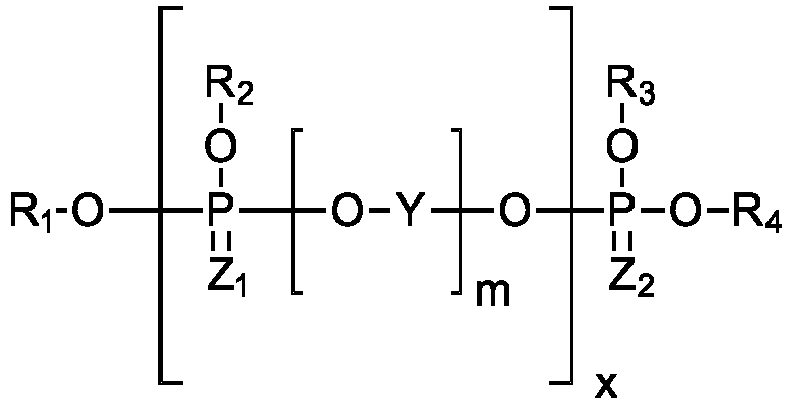
- wherein each R is an independently selected alkylphenol-free moiety that is a C1-20 alkyl, C2-22 alkenyl, C6-40 cycloalkyl, C7-40 cycloalkylene, C3-20 methoxy alkyl glycol ether, C3-20 alkyl glycol ether, or Y-OH moiety;
- wherein each Y is an independently selected alkylphenol-free moiety that is a C2-40 alkylene, C7-40 cycloalkylene, or C3-40 alkyl lactone moiety;
- wherein each Z is independently selected from the group consisting of S and O;
- wherein m is an integer ranging from 1 to 100; and
- wherein x is an integer ranging from 1 to 1000.
- In some phosphorus-containing-compound embodiments, each Y is an ethylene, propylene, or caprylactone moiety.
- In some phosphorus-containing-compound embodiments, the compound has a weight ranging from 1000 to 30000 Daltons. In some phosphorus-containing embodiments, the compound has a weight ranging from 400 to 30000 Daltons. In some phosphorus-containing embodiments, the compound has a weight ranging from 500 to 30000 Daltons.
- An unclaimed embodiment is directed to phosphorus-containing copolymer compounds having the general structure:

- wherein each R is an independently selected alkylphenol-free moiety that is a C1-20 alkyl, C2-22 alkenyl, C6-40 cycloalkyl, C7-40 cycloalkylene, C3-20 methoxy alkyl glycol ether, C3-20 alkyl glycol ether, or Y-OH moiety;
- wherein each Y is an independently selected alkylphenol-free moiety that is a C2-40 alkylene, C7-40 cycloalkylene, or C3-40 alkyl lactone moiety;
- wherein each Z is independently selected from the group consisting of S and O;
- wherein m is an integer ranging from 1 to 100; and
- wherein x is an integer ranging from 1 to 1000.
- In some phosphorus-containing copolymer compound embodiments, each Y is an ethylene, propylene, or caprylactone moiety.
- In some phosphorus-containing copolymer compound embodiments, the compound has a weight ranging from 1000 to 30000 Daltons. In some phosphorus-containing copolymer compound embodiments, the compound has a weight ranging from 400 to 30000 Daltons. In some phosphorus-containing copolymer compound embodiments, the compound has a weight ranging from 500 to 30000 Daltons.
- The invention is directed to a method comprising the step: improving a metalworking fluid's anti-wear properties by adding a compound to the metalworking fluid, the phosphite compounds having the general structure:
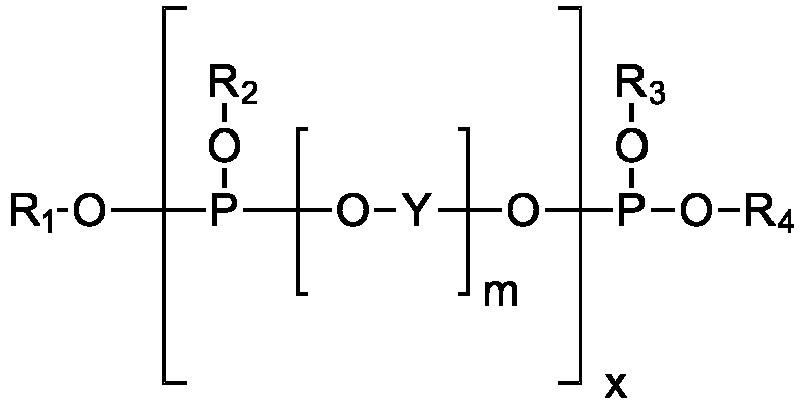
- wherein each R is an independently selected moiety that is a C1-20 alkyl, C2-22 alkenyl, C6-40 cycloalkyl, C7-40 cycloalkylene, C3-20 methoxy alkyl glycol ether, C3-20 alkyl glycol ether, or Y-OH moiety;
- wherein each Y is an independently selected alkylphenol-free moiety that is a C2-40 alkylene, C7-40 cycloalkylene, or C3-40 alkyl lactone moiety;
- wherein m is an integer ranging from 1 to 100; and
- wherein x is an integer ranging from 1 to 1000.
- In some phosphite embodiments, each Y is an ethylene, propylene, or caprylactone moiety.
- According to the invention, the phosphorus-containing copolymer compound has a weight ranging from 1000 to 30000 Daltons; or from 400 to 30000 Daltons; or from 500 to 30000 Daltons.
- Methods for manufacturing phosphite compounds, polyhydrogen phosphite compounds, phosphate compounds, thiophosphate compounds, and thiophosphite-phosphate copolymer compounds can be determined by persons of ordinary skill in the art without having to exercise undue experimentation. Non-limiting examples of manufacturing methods can be found in the below Examples.
- Metalworking additives are well known, and any of the above compounds, either alone or in any combination, can be used as additives for metalworking fluids. Any of the above compounds, either alone or in any combination, can be used as additives for metalworking fluids in useful amounts that can be determined by persons of ordinary skill in the art. As a non-limiting example, useful amounts of the above compounds, either alone or in any combination, range from 5 to 10 % by weight of the metalworking fluid. In an additional non-limiting example, useful amounts of the above compounds, either alone or in any combination, range from 0.5 to 20 % by weight of the metalworking fluid.
- In any of the above sulfur-containing compounds, the amount of sulfur within the compound can range from 50 to 100 mole percent relative to the amount of phosphorus within the compound; stated differently, in any of the above sulfur-containing compounds, anywhere from half to all of the phorphorus atoms are bonded to a sulfur atom. In another embodiment, the amount of sulfur within the compound can range from 90 to 100 mole percent relative to the amount of phosphorus within the compound. In another embodiment, the amount of sulfur within the compound is 100 mole percent relative to the amount of phosphorus within the compound.
- To a three-
neck 250 mL flask equipped with a mechanical stirrer and purged with nitrogen was added 75.83 grams of triisnonylphenol phosphite (0.110 mol), with a total nonylphenol content ranging from 0.05% to 0.5% with 0.1% being the target and 0.39 grams of 2,5-dimercapto-1,3,4-thiadiazole (0.0026 mol). The mixture was mixed well and heat was applied to a reaction temperature of 240°F. 3.37 grams of elemental sulfur (0.130 mol) was then added at this temperature. After one hour, the reaction temperature is increased to 280°F and held for 16-24 hours. This reaction takes place under a nitrogen blanket. The resulting thiophosphate had the following analysis:% Phosphorous 4.5 % Sulfur 4.2 Density 20C 1.01 Color, APHA 50 % Nonylphenol <0.20 - To a three-
neck 250 mL flask equipped with a mechanical stirrer and purged with nitrogen was added 75.83 grams of a alkylphenol-free liquid polymeric phosphite (Example #2 fromUS patent 8,563,637 ) with a molecular weight of about 9100 and 0.39 grams of 2,5-dimercapto-1,3,4-thiadiazole (0.0026 mol). The mixture was mixed well and heat was applied to a reaction temperature of 240°F. Then 3.51 grams of elemental sulfur (0.109 mol) was added. After one hour, the reaction temperature is increased to 280°F and held for 16-24 hours. This reaction takes place under a nitrogen blanket. The resulting alkyl phenol free polymeric thiophosphate had the following analysis:% Phosphorous 4.7 % Sulfur 4.4 Density 20C Color, APHA 60 % Nonylphenol 0 - To a three-
neck 250 mL flask equipped with a mechanical stirrer and purged with nitrogen was added 75.83 grams of cycloaliphatic polyphosphite (Example 2 fromUS patent 8,981,042 ) with a molecular weight range of about 14,000 and 0.39 grams of 2,5-dimercapto-1,3,4-thiadiazole (0.0026 mol). The mixture was mixed well and heat was applied to a reaction temperature of 240°F. 5.52 grams of elemental sulfur (0.172 mol) was then added. After one hour, the reaction temperature is increased to 280°F and held for 16-24 hours. This reaction takes place under a nitrogen blanket. The resulting analysis of the phenol free cycloaliphatic alkylated poly thiophosphate was:% Phosphorous 7.2 % Sulfur 6.75 Color, APHA 50 % Nonylphenol 0 - To a three-
neck 250 mL flask equipped with a mechanical stirrer and purged with nitrogen was added 75.83 grams of a alkylphenol-free liquid polymeric phosphite (Example #3 fromUS patent 8,563,637 ), with a molecular weight of about 1200 and 0.39 grams of 2,5-dimercapto-1,3,4-thiadiazole (0.0026 mol). The mixture was mixed well and heat was applied to a reaction temperature of 240°F. Then 6.29 grams of elemental sulfur (0.196 mol) was added. After one hour, the reaction temperature is increased to 280°F and held for 16-24 hours. This reaction takes place under a nitrogen blanket. The resulting alkyl phenol free polymeric thiophosphate had the following analysis:% Phosphorous 7.8 % Sulfur 7.6 Color, APHA 60 % Nonylphenol 0 - To a three-
neck 250 mL flask equipped with a mechanical stirrer and purged with nitrogen was added 75.83 grams of a Triisodecyl phosphite, with a molecular weight of about 500 and 0.39 grams of 2,5-dimercapto-1,3,4-thiadiazole (0.0026 mol). The mixture was mixed well and heat was applied to a reaction temperature of 240°F. Then 4.87 of elemental sulfur (0.152 mol) was added. After one hour, the reaction temperature is increased to 280°F and held for 16-24 hours. This reaction takes place under a nitrogen blanket. The resulting alkyl phenol free thiophosphate had the following analysis:% Phosphorous 6.2 % Sulfur 6.0 Color, APHA 60 % Nonylphenol 0 - Four Ball Wear: This test is used for evaluating friction- reducing and anti-wear fluids. Testing involves 3 stationary steel balls secured in a steel cup and a 4th steel ball lowered to make contact with the 3 stationary balls. The fluid to be tested is poured into the cup. The 4th ball is the only ball that spins. Typical rpm for the ball is 1200 rpm. The single ball spins in contact with the 3 stationary balls at a constant load of 40 kg. Typical run time is 1 hour. The wear on the lower 3 balls is measured and reported in mm. The fluid to produce the smallest wear scars has the best performance.
Parameter Setting Load (kg) 40 Temperature Ambient Time (min) 60 Dilution Rate 5% Speed (rpm) 1,200 -
Ball Example 1 Example 2 Example 3 Example 4 Example 5 1 0.91 0.39 0.52 0.52 0.57 2 0.91 0.39 0.52 0.52 0.55 3 0.86 0.39 0.52 0.52 0.55 Avg. mm 0.89 0.39 0.52 0.52 0.55 - Test results clearly show that the alkylphenol free polymeric polyphosphites give excellent results, better than the commercial trisnonylphenyl thiophosphate with excellent color. And there are no alkylphenols in the final products.
- Timken Testing: Timken testing was carried out by adding weight to a lever applying pressure to a block that is in contact with a wheel. The bottom portion of the wheel is submersed in the fluid to be tested. As the wheel spins, the lubricant is carried to the interface of the block and wheel. A one pound weight is added to the lever every minute until a maximum of 13 pounds has been added. The wear scar on the block is measured and reported in millimeters. See
Figure 1 . -
Example 1 Example 2 Example 3 Example 4 Example 5 2.34 2.08 2.08 2.24 2.60 - Test results clearly show that the alkylphenol free polymeric polyphosphites give excellent results, better than the commercial trisnonylphenyl thiophosphate with excellent color. And there are no alkylphenols in the final products.
- The following formulae were prepared for various machine testing:
-
Additive Functionality Conc. % By Weight Methyl Ester Added Paroil 152 Chlorinated Paraffin 5 7 Mayfree 133 Phosphate Amide 2.6 4.4 Doverphos 253 Di-oleyl Hydrogen Phosphite 2.6 7 Doverphos 53 Tri-lauryl Phosphite 2.6 7 Doverphos 50Phosphite 2.6 7 Complex Ester 5% Ester 5 0 Complex Ester 10% Ester 10 0 Complex Ester 25% Ester 25 0 Alkylphenol Free Polymeric Phosphite A Phosphite 2.6 7 Alkylphenol Free Polymeric Phosphite B Phosphite 2.6 7 Base 10SE Sulfurized Ester 5 2 Alkylphenol Free Polymeric Thiophosphate A Phos & Sulfur 5 7 Alkylphenol Free Polymeric Thiophosphate B Phos & Sulfur 5 7 ZDDP Phos, Sulfur & Zinc 2.6 7 - The water based formulae were prepared using a commercial semi-synthetic. The additive was added to either the Super Concentrate (SC) prior to dilution of the semi-synthetic with water, or to the concentrate after 50% dilution of the semi-synthetic with water. After the 50% dilution with water, all testing was conducted with the semi-synthetic diluted in water at 5%.
Additive % Added to S.C. % Added to Concentrate Final Conc. % Paroil 152 5 0 5 Mayfree 133 0 2.6 5 Doverphos 253 0 2.6 5 Doverphos 53 0 2.6 5 Dovephos 500 2.6 5 Complex Ester 5%0 5 5 Alkylphenol Free Polymeric Phosphite A 0 2.6 5 Alkylphenol Free Polymeric Phosphite B 0 2.6 5 - Four Ball Wear: This test is used for evaluating friction-reducing and anti-wear fluids. Testing involves 3 stationary steel balls secured in a steel cup and a 4th steel ball lowered to make contact with the 3 stationary balls. The fluid to be tested is poured into the cup. The 4th ball is the only ball that spins. Typical rpm for the ball is 1200 rpm. The single ball spins in contact with the 3 stationary balls at a constant load of 40 kg. Typical run time is 1 hour. The wear on the lower 3 balls is measured and reported in mm. The fluid to produce the smallest wear scars has the best performance.
Parameter Setting Load (kg) 40 Temperature Ambient Time (min) 60 Speed (rpm) 1,200 -
Additive Average Wear, mm Paroil 152, Std. 0.99 Doverphos 53 0.41 ZDDP 0.45 Base 10SE 0.52 Doverphos 253 0.54 Mayfree 133 0.61 Alkylphenol Free Polymeric Phosphite A 0.36 Alkylphenol Free Polymeric Phosphite B 0.49 Doverphos 50 0.46 Alkylphenol Free Polymeric Thiophosphate A 0.36 Alkylphenol Free Polymeric Thiophosphate B 0.39 Polymeric Ester-5% 0.66 Polymeric Ester-10% 0.65 Polymeric Ester-25% 0.53 - Vertical Drawbead: Vertical Drawbead is a machine used to determine a fluids ability to form a piece of metal. Vertical Drawbead works by applying pressure to a coated metal strip. The formulae to be tested is applied to a 24 inch metal strip which is raised between two dye. The dyes apply 500 psi of pressure to the bottom of the strip. The coated strip is pulled between the two dyes. The amount of force needed to pull the strip between the dyes, is plotted by an X-Y plotter and the force is calculated from this curve. In all cases, higher percent efficiency refers to the performance of the fluid being better.
- In this test, all formulae were evaluated on 1018 Steel and 316 Stainless Steel.
-
Additive % Efficiency Paroil 152, Std. 100.0 Doverphos 53 95.1 ZDDP 103.8 Base 10SE 81.0 Doverphos 253 77.3 Mayfree 133 102.2 Alkylphenol Free Polymeric Phosphite A 70.3 Alkylphenol Free Polymeric Phosphite B 46.4 Doverphos 50 103.8 Alkylphenol Free Polymeric Thiophosphate A 114.2 Alkylphenol Free Polymeric Thiophosphate B 119.0 Polymeric Ester-5% 112.5 Polymeric Ester-10% 116.8 Polymeric Ester-25% 147.6 -
Additive % Efficiency Paroil 152, Std. 100.0 Doverphos 53 109.4 ZDDP 103.8 Base 10SE 103.3 Doverphos 253 105.4 Mayfree 133 97.1 Alkylphenol Free Polymeric Phosphite A 103.5 Alkylphenol Free Polymeric Phosphite B 102.3 Doverphos 50 111.6 Alkylphenol Free Polymeric Thiophosphate A 107.0 Alkylphenol Free Polymeric Thiophosphate B 102.3 Polymeric Ester-5% 111.9 Polymeric Ester-10% 113.1 Polymeric Ester-25% 129.5 - Microtap Tap and Torque Testing: Microtap testing is one method used to determine a fluids ability to remove metal. A metal bar with predrilled holes is fastened to a vice. The tap and the metal bar are coated in the fluid to be tested. The tap rotates to tap out the pre-drilled hole. The force needed to tap the hole is measured by a computer and is reported as torque in newton centimeters. In all cases, higher percent efficiency refers to the performance of the fluid being better.
- In this test, all formulae were evaluated on 1018 Steel.
-
Additive % Efficiency Paroil 152, Std. 100.0 Doverphos 53 101.7 ZDDP 101.1 Base 10SE 100.5 Doverphos 253 101.1 Mayfree 133 103.8 Alkylphenol Free Polymeric Phosphite A 103.1 Alkylphenol Free Polymeric Phosphite B 102.9 Doverphos 50 103.8 Alkylphenol Free Polymeric Thiophosphate A 103.5 Alkylphenol Free Polymeric Thiophosphate B 104.3 Polymeric Ester-5% 105.2 Polymeric Ester-10% 104.0 Polymeric Ester-25% 106.9 - Falex Pin and Vee Block Testing: Falex Pin and Vee Block measures the fluids ability to perform in more severe operations, such as cold heading, but can also apply to grinding operations. A pin is fastened using a brass shear pin. Two Vee blocks are clamped onto the pin. The pin and vee blocks are submerged in the fluid to be tested. The load applied on the pin from the vee blocks begins at 250 pounds. The load is increased automatically by a ratcheting arm as the pin spins between the two vee blocks. The torque generated by the load on the pin is read at 250 pound load and is recorded every 250 pounds until a final load of 4500 pounds is reached or a failure occurs. A failure implies the pin or shear pin has broken. See
Figures 2 and3 . - Microtap Tap and Torque Testing: Microtap testing is one method used to determine a fluids ability to remove metal. A metal bar with predrilled holes is fastened to a vice. The tap and the metal bar are coated in the fluid to be tested. The tap rotates to tap out the predrilled hole.
- The force needed to tap the hole is measured by a computer and is reported as torque in newton centimeters. In all cases, higher percent efficiency refers to the performance of the fluid being better.
- In this test, all formulae were evaluated on 1018 Steel and 316 Stainless Steel.
-
Additive % Efficiency Paroil 152, Std. 100.0 Doverphos 53 108.6 Doverphos 253 112.0 Mayfree 133 117.6 Alkylphenol Free Polymeric Phosphite A 109.4 Alkylphenol Free Polymeric Phosphite B 112.1 Doverphos 50 109.4 Polymeric Ester-5% 107.6 -
Additive % Efficiency Paroil 152, Std. 100.0 Doverphos 53 102.4 Doverphos 253 101.1 Mayfree 133 101.9 Alkylphenol Free Polymeric Phosphite A 100.9 Alkylphenol Free Polymeric Phosphite B 100.2 Doverphos 50 100.0 Polymeric Ester-5% 99.3 - Falex Pin and Vee Block Testing: Falex Pin and Vee Block measures the fluids ability to perform in more severe operations, such as cold heading, but can also apply to grinding operations. A pin is fastened using a brass shear pin. Two Vee blocks are clamped onto the pin. The pin and vee blocks are submerged in the fluid to be tested. The load applied on the pin from the vee blocks begins at 250 pounds. The load is increased automatically by a ratcheting arm as the pin spins between the two vee blocks. The torque generated by the load on the pin is read at 250 pound load and is recorded every 250 pounds until a final load of 4500 pounds is reached or a failure occurs. A failure implies the pin or shear pin has broken. See
Figures 4 and5 .
Claims (2)
- A method comprising the step:improving a metalworking fluid's anti-wear properties by adding a compound to the metalworking fluid, the compound having the structure:
 wherein each R is an independently selected moiety that is a C1-20 alkyl, C2-22 alkenyl, C6-40 cycloalkyl, C7-40 cycloalkylene, C3-20 methoxy alkyl glycol ether, C3-20 alkyl glycol ether, or Y-OH moiety;wherein each Y is an independently selected alkylphenol-free moiety that is a C2-40 alkylene moiety, C7-40 cycloalkylene moiety, or C3-40 alkyl lactone moiety;wherein m is an integer ranging from 1 to 100; andwherein x is an integer ranging from 1 to 1000; andwherein the compound has a weight ranging- from 400 to 30000 Daltons; or- from 500 to 30000 Daltons; or- from 1000 to 30000 Daltons.
 - The method of claim 1, wherein each Y is an ethylene moiety, propylene moiety, or caprylactone moiety.
Applications Claiming Priority (3)
| Application Number | Priority Date | Filing Date | Title |
|---|---|---|---|
| US201762461084P | 2017-02-20 | 2017-02-20 | |
| US201862619351P | 2018-01-19 | 2018-01-19 | |
| PCT/US2018/018759 WO2018152513A1 (en) | 2017-02-20 | 2018-02-20 | Polymeric poly-phosphorus lubricant additives for metal working |
Publications (3)
| Publication Number | Publication Date |
|---|---|
| EP3583194A1 EP3583194A1 (en) | 2019-12-25 |
| EP3583194B1 true EP3583194B1 (en) | 2024-09-11 |
| EP3583194C0 EP3583194C0 (en) | 2024-09-11 |
Family
ID=61527568
Family Applications (1)
| Application Number | Title | Priority Date | Filing Date |
|---|---|---|---|
| EP18708310.0A Active EP3583194B1 (en) | 2017-02-20 | 2018-02-20 | Polymeric poly-phosphorus lubricant additives for metal working |
Country Status (7)
| Country | Link |
|---|---|
| US (1) | US10745639B2 (en) |
| EP (1) | EP3583194B1 (en) |
| JP (2) | JP7039604B2 (en) |
| KR (1) | KR102521969B1 (en) |
| CN (1) | CN110914390A (en) |
| CA (1) | CA3053515A1 (en) |
| WO (1) | WO2018152513A1 (en) |
Families Citing this family (6)
| Publication number | Priority date | Publication date | Assignee | Title |
|---|---|---|---|---|
| WO2020123986A1 (en) * | 2018-12-13 | 2020-06-18 | Dover Chemical Corporation | Polymeric poly-phosphorus additives for: gear oil, grease, engine-oil, combustion-engine lubricant, automatic transmission fluid, anti-wear agents, two-cycle engine lubricant, or marine-engine lubricant |
| FR3112791B1 (en) * | 2020-07-22 | 2023-04-28 | Total Marketing Services | Automotive transmission lubricating composition with improved anti-corrosion properties. |
| FR3112793B1 (en) * | 2020-07-22 | 2023-04-28 | Total Marketing Services | Automotive transmission lubricating composition. |
| FR3112792B1 (en) * | 2020-07-22 | 2023-04-28 | Total Marketing Services | Oxidation stable automotive transmission lubricant composition. |
| CN112011386A (en) * | 2020-09-21 | 2020-12-01 | 中国科学院兰州化学物理研究所 | Antirust and antiwear additive, and preparation method and application thereof |
| WO2023114161A2 (en) * | 2021-12-14 | 2023-06-22 | Dover Chemical Corporation | Gun-barrel lubricant compositions and related methods |
Citations (4)
| Publication number | Priority date | Publication date | Assignee | Title |
|---|---|---|---|---|
| US4242138A (en) * | 1975-07-31 | 1980-12-30 | Sandoz Ltd. | Flameproofed regenerated cellulose and method |
| JPH08209175A (en) * | 1995-02-01 | 1996-08-13 | Nippon Oil Co Ltd | Lubricating oil composition for sliding guide surface |
| EP2612876A1 (en) * | 2012-01-03 | 2013-07-10 | Basf Se | Flame-proof polyurethane foams |
| EP2848640A1 (en) * | 2013-09-13 | 2015-03-18 | LANXESS Deutschland GmbH | Phosphoric acid ester compositions with reduced hygroscopicity |
Family Cites Families (19)
| Publication number | Priority date | Publication date | Assignee | Title |
|---|---|---|---|---|
| FR1411831A (en) * | 1964-08-11 | 1965-09-24 | Kuhlmann Ets | Process for the preparation of secondary polyphosphites and applications of said products |
| JPS5738633B2 (en) * | 1973-12-12 | 1982-08-17 | ||
| JPS52145452A (en) * | 1976-05-12 | 1977-12-03 | Katsuta Kako Kk | Stabilized high molecular material compositions |
| JPH04227941A (en) * | 1990-05-15 | 1992-08-18 | Fuji Photo Film Co Ltd | Cellulose ester film and its production |
| TW291495B (en) | 1994-08-03 | 1996-11-21 | Lubrizol Corp | |
| US7691793B2 (en) * | 2004-07-21 | 2010-04-06 | Chemtura Corporation | Lubricant additive containing alkyl hydroxy carboxylic acid boron esters |
| CN101688145B (en) * | 2007-05-24 | 2013-03-27 | 千代田化学株式会社 | Functional fluid |
| JP5395453B2 (en) * | 2009-02-16 | 2014-01-22 | Jx日鉱日石エネルギー株式会社 | Continuously variable transmission oil composition |
| EP2424963B1 (en) * | 2009-04-30 | 2018-10-10 | The Lubrizol Corporation | A method of lubricating a drivetrain component with a lubricant comprising polymeric phosphorus esters |
| EP2459577A1 (en) * | 2009-07-31 | 2012-06-06 | Chemtura Corporation | Liquid alkylated trisaryl phosphite compositions having two alkyl groups with different carbon number |
| US8981042B2 (en) | 2010-02-19 | 2015-03-17 | Dover Chemical Corporation | Cycloaliphatic polyphosphite polymer stabilizers |
| ES2674400T3 (en) * | 2010-02-19 | 2018-06-29 | Dover Chemical Corporation | Alkylphenol-free liquid polymer phosphite polymer stabilizers |
| US9982112B2 (en) * | 2010-02-19 | 2018-05-29 | Dover Chemical Corporation | Copolymeric polyphosphite polymer stabilizers |
| EP2425944A1 (en) * | 2010-09-07 | 2012-03-07 | LANXESS Deutschland GmbH | Flame resistant wooden materials |
| CN104271630B (en) * | 2012-05-31 | 2017-07-28 | 陶氏环球技术有限公司 | Epoxy Resins for Aqueous Dispersions |
| EP2864411B1 (en) * | 2012-06-22 | 2019-01-02 | Dover Chemical Corporation | Cycloaliphatic polyphosphite polymer stabilizers |
| EP3063257B1 (en) * | 2013-10-29 | 2019-08-21 | Croda, Inc. | Lubricant composition comprising hydroxycarboxylic acid derived friction modifier |
| US9944879B2 (en) * | 2014-10-08 | 2018-04-17 | Afton Chemical Corporation | Phosphorous-containing compounds and uses thereof |
| EP3218455B1 (en) * | 2014-11-12 | 2021-05-05 | The Lubrizol Corporation | Mixed phosphorus esters for lubricant applications |
-
2018
- 2018-02-20 EP EP18708310.0A patent/EP3583194B1/en active Active
- 2018-02-20 CN CN201880012733.3A patent/CN110914390A/en active Pending
- 2018-02-20 KR KR1020197027056A patent/KR102521969B1/en active Active
- 2018-02-20 US US15/900,148 patent/US10745639B2/en active Active
- 2018-02-20 WO PCT/US2018/018759 patent/WO2018152513A1/en not_active Ceased
- 2018-02-20 JP JP2019544900A patent/JP7039604B2/en active Active
- 2018-02-20 CA CA3053515A patent/CA3053515A1/en active Pending
-
2022
- 2022-02-18 JP JP2022024311A patent/JP7305824B2/en active Active
Patent Citations (4)
| Publication number | Priority date | Publication date | Assignee | Title |
|---|---|---|---|---|
| US4242138A (en) * | 1975-07-31 | 1980-12-30 | Sandoz Ltd. | Flameproofed regenerated cellulose and method |
| JPH08209175A (en) * | 1995-02-01 | 1996-08-13 | Nippon Oil Co Ltd | Lubricating oil composition for sliding guide surface |
| EP2612876A1 (en) * | 2012-01-03 | 2013-07-10 | Basf Se | Flame-proof polyurethane foams |
| EP2848640A1 (en) * | 2013-09-13 | 2015-03-18 | LANXESS Deutschland GmbH | Phosphoric acid ester compositions with reduced hygroscopicity |
Non-Patent Citations (2)
| Title |
|---|
| DATABASE CAPLUS CHEMICAL ABSTRACTS SERVICE, COLUMBUS, OHIO, US; TOMINAGA, EIJI ET AL: "Lubricating oil compositions for sliding guideway", XP002780523, retrieved from STN * |
| ROMUALD WÓDZKI ET AL: "Pertraction of cations in a hybrid membrane system containing soluble polymeric ionophores : Pertraction of Cations", JOURNAL OF APPLIED POLYMER SCIENCE, vol. 84, no. 1, 4 April 2002 (2002-04-04), US, pages 99 - 109, XP055469604, ISSN: 0021-8995, DOI: 10.1002/app.10263 * |
Also Published As
| Publication number | Publication date |
|---|---|
| KR20200031065A (en) | 2020-03-23 |
| US20180237719A1 (en) | 2018-08-23 |
| JP7039604B2 (en) | 2022-03-22 |
| KR102521969B1 (en) | 2023-04-14 |
| WO2018152513A1 (en) | 2018-08-23 |
| EP3583194A1 (en) | 2019-12-25 |
| CA3053515A1 (en) | 2018-08-23 |
| CN110914390A (en) | 2020-03-24 |
| JP2022078123A (en) | 2022-05-24 |
| JP7305824B2 (en) | 2023-07-10 |
| EP3583194C0 (en) | 2024-09-11 |
| JP2020508375A (en) | 2020-03-19 |
| US10745639B2 (en) | 2020-08-18 |
Similar Documents
| Publication | Publication Date | Title |
|---|---|---|
| US10745639B2 (en) | Polymeric poly-phosphorus lubricant additives for metal working | |
| US11008529B2 (en) | Polymeric poly-phosphorus additives for: gear oil, grease, engine-oil, combustion-engine lubricant, automatic transmission fluid, anti-wear agents, two-cycle engine lubricant, or marine-engine lubricant | |
| US8969270B2 (en) | Water-soluble metal working fluid, and coolant for metal working | |
| US10815445B2 (en) | Lubricating oil composition, lubricating method, and transmission | |
| US6828285B2 (en) | Oil composition for heat treatment of a gear and gear treated by using the oil composition | |
| BRPI0510543B1 (en) | method for reducing inhalation toxicity of functional fluids, and functional fluid | |
| JP4334623B2 (en) | Lubricating oil composition for automatic transmission | |
| KR20160114647A (en) | The use of alkoxylated polyethylene glycols in lubricating oil compositions | |
| JP2008255239A (en) | Gear oil composition | |
| WO2004092312A1 (en) | Lubricant for water-miscible metal working oil | |
| KR100780580B1 (en) | Power transmission fluids with enhanced lifetime characteristics | |
| KR20140125784A (en) | Lubricating compositions for transmissions | |
| EP2930229B1 (en) | Boron-free corrosion inhibitors for metalworking fluids | |
| KR20230042294A (en) | Lubricant composition for automobile transmission | |
| WO1998008920A1 (en) | Friction-modifying additives for slideway lubricants | |
| CN109536258A (en) | Centrifugal compressor full synthetic oil | |
| US11149227B2 (en) | Lubricating oil composition, lubricating method, and transmission | |
| EP0227469B1 (en) | Improved lubricating oil composition | |
| CN105733744A (en) | Additive, preparation method thereof, and polyether lubricating oil composition | |
| EP3162876A1 (en) | Lubrication oil additive and method for manufacturing same, and lubrication oil composition using same | |
| CA2266841C (en) | Lubricating compositions | |
| EP4069808A1 (en) | Use of ester base stocks to improve viscosity index and efficiency in driveline and industrial gear lubricating fluids | |
| US8778855B2 (en) | Lubricating oil composition for continuously variable transmissions | |
| US6764610B2 (en) | Servo valve erosion inhibited aircraft hydraulic fluids | |
| WO2025132720A1 (en) | Lubricant compositions for industrial applications |
Legal Events
| Date | Code | Title | Description |
|---|---|---|---|
| STAA | Information on the status of an ep patent application or granted ep patent |
Free format text: STATUS: UNKNOWN |
|
| STAA | Information on the status of an ep patent application or granted ep patent |
Free format text: STATUS: THE INTERNATIONAL PUBLICATION HAS BEEN MADE |
|
| PUAI | Public reference made under article 153(3) epc to a published international application that has entered the european phase |
Free format text: ORIGINAL CODE: 0009012 |
|
| STAA | Information on the status of an ep patent application or granted ep patent |
Free format text: STATUS: REQUEST FOR EXAMINATION WAS MADE |
|
| 17P | Request for examination filed |
Effective date: 20190815 |
|
| AK | Designated contracting states |
Kind code of ref document: A1 Designated state(s): AL AT BE BG CH CY CZ DE DK EE ES FI FR GB GR HR HU IE IS IT LI LT LU LV MC MK MT NL NO PL PT RO RS SE SI SK SM TR |
|
| AX | Request for extension of the european patent |
Extension state: BA ME |
|
| DAV | Request for validation of the european patent (deleted) | ||
| DAX | Request for extension of the european patent (deleted) | ||
| STAA | Information on the status of an ep patent application or granted ep patent |
Free format text: STATUS: EXAMINATION IS IN PROGRESS |
|
| PUAG | Search results despatched under rule 164(2) epc together with communication from examining division |
Free format text: ORIGINAL CODE: 0009017 |
|
| 17Q | First examination report despatched |
Effective date: 20220530 |
|
| RIC1 | Information provided on ipc code assigned before grant |
Ipc: C10M 153/04 20060101ALI20220524BHEP Ipc: C10M 137/10 20060101AFI20220524BHEP |
|
| RIC1 | Information provided on ipc code assigned before grant |
Ipc: C10M 153/04 20060101ALI20220601BHEP Ipc: C10M 137/10 20060101AFI20220601BHEP |
|
| 17Q | First examination report despatched |
Effective date: 20220613 |
|
| B565 | Issuance of search results under rule 164(2) epc |
Effective date: 20220613 |
|
| GRAP | Despatch of communication of intention to grant a patent |
Free format text: ORIGINAL CODE: EPIDOSNIGR1 |
|
| STAA | Information on the status of an ep patent application or granted ep patent |
Free format text: STATUS: GRANT OF PATENT IS INTENDED |
|
| INTG | Intention to grant announced |
Effective date: 20240405 |
|
| GRAS | Grant fee paid |
Free format text: ORIGINAL CODE: EPIDOSNIGR3 |
|
| GRAA | (expected) grant |
Free format text: ORIGINAL CODE: 0009210 |
|
| STAA | Information on the status of an ep patent application or granted ep patent |
Free format text: STATUS: THE PATENT HAS BEEN GRANTED |
|
| AK | Designated contracting states |
Kind code of ref document: B1 Designated state(s): AL AT BE BG CH CY CZ DE DK EE ES FI FR GB GR HR HU IE IS IT LI LT LU LV MC MK MT NL NO PL PT RO RS SE SI SK SM TR |
|
| REG | Reference to a national code |
Ref country code: GB Ref legal event code: FG4D |
|
| REG | Reference to a national code |
Ref country code: CH Ref legal event code: EP |
|
| REG | Reference to a national code |
Ref country code: DE Ref legal event code: R096 Ref document number: 602018074207 Country of ref document: DE |
|
| REG | Reference to a national code |
Ref country code: IE Ref legal event code: FG4D |
|
| U01 | Request for unitary effect filed |
Effective date: 20240911 |
|
| U07 | Unitary effect registered |
Designated state(s): AT BE BG DE DK EE FI FR IT LT LU LV MT NL PT RO SE SI Effective date: 20240926 |
|
| PG25 | Lapsed in a contracting state [announced via postgrant information from national office to epo] |
Ref country code: NO Free format text: LAPSE BECAUSE OF FAILURE TO SUBMIT A TRANSLATION OF THE DESCRIPTION OR TO PAY THE FEE WITHIN THE PRESCRIBED TIME-LIMIT Effective date: 20241211 |
|
| PG25 | Lapsed in a contracting state [announced via postgrant information from national office to epo] |
Ref country code: GR Free format text: LAPSE BECAUSE OF FAILURE TO SUBMIT A TRANSLATION OF THE DESCRIPTION OR TO PAY THE FEE WITHIN THE PRESCRIBED TIME-LIMIT Effective date: 20241212 |
|
| PG25 | Lapsed in a contracting state [announced via postgrant information from national office to epo] |
Ref country code: HR Free format text: LAPSE BECAUSE OF FAILURE TO SUBMIT A TRANSLATION OF THE DESCRIPTION OR TO PAY THE FEE WITHIN THE PRESCRIBED TIME-LIMIT Effective date: 20240911 |
|
| PG25 | Lapsed in a contracting state [announced via postgrant information from national office to epo] |
Ref country code: ES Free format text: LAPSE BECAUSE OF FAILURE TO SUBMIT A TRANSLATION OF THE DESCRIPTION OR TO PAY THE FEE WITHIN THE PRESCRIBED TIME-LIMIT Effective date: 20240911 Ref country code: RS Free format text: LAPSE BECAUSE OF FAILURE TO SUBMIT A TRANSLATION OF THE DESCRIPTION OR TO PAY THE FEE WITHIN THE PRESCRIBED TIME-LIMIT Effective date: 20241211 |
|
| PG25 | Lapsed in a contracting state [announced via postgrant information from national office to epo] |
Ref country code: RS Free format text: LAPSE BECAUSE OF FAILURE TO SUBMIT A TRANSLATION OF THE DESCRIPTION OR TO PAY THE FEE WITHIN THE PRESCRIBED TIME-LIMIT Effective date: 20241211 Ref country code: NO Free format text: LAPSE BECAUSE OF FAILURE TO SUBMIT A TRANSLATION OF THE DESCRIPTION OR TO PAY THE FEE WITHIN THE PRESCRIBED TIME-LIMIT Effective date: 20241211 Ref country code: HR Free format text: LAPSE BECAUSE OF FAILURE TO SUBMIT A TRANSLATION OF THE DESCRIPTION OR TO PAY THE FEE WITHIN THE PRESCRIBED TIME-LIMIT Effective date: 20240911 Ref country code: GR Free format text: LAPSE BECAUSE OF FAILURE TO SUBMIT A TRANSLATION OF THE DESCRIPTION OR TO PAY THE FEE WITHIN THE PRESCRIBED TIME-LIMIT Effective date: 20241212 Ref country code: ES Free format text: LAPSE BECAUSE OF FAILURE TO SUBMIT A TRANSLATION OF THE DESCRIPTION OR TO PAY THE FEE WITHIN THE PRESCRIBED TIME-LIMIT Effective date: 20240911 |
|
| U20 | Renewal fee for the european patent with unitary effect paid |
Year of fee payment: 8 Effective date: 20250224 |
|
| PG25 | Lapsed in a contracting state [announced via postgrant information from national office to epo] |
Ref country code: IS Free format text: LAPSE BECAUSE OF FAILURE TO SUBMIT A TRANSLATION OF THE DESCRIPTION OR TO PAY THE FEE WITHIN THE PRESCRIBED TIME-LIMIT Effective date: 20250111 |
|
| PG25 | Lapsed in a contracting state [announced via postgrant information from national office to epo] |
Ref country code: SM Free format text: LAPSE BECAUSE OF FAILURE TO SUBMIT A TRANSLATION OF THE DESCRIPTION OR TO PAY THE FEE WITHIN THE PRESCRIBED TIME-LIMIT Effective date: 20240911 |
|
| PG25 | Lapsed in a contracting state [announced via postgrant information from national office to epo] |
Ref country code: CZ Free format text: LAPSE BECAUSE OF FAILURE TO SUBMIT A TRANSLATION OF THE DESCRIPTION OR TO PAY THE FEE WITHIN THE PRESCRIBED TIME-LIMIT Effective date: 20240911 Ref country code: PL Free format text: LAPSE BECAUSE OF FAILURE TO SUBMIT A TRANSLATION OF THE DESCRIPTION OR TO PAY THE FEE WITHIN THE PRESCRIBED TIME-LIMIT Effective date: 20240911 |
|
| PG25 | Lapsed in a contracting state [announced via postgrant information from national office to epo] |
Ref country code: SK Free format text: LAPSE BECAUSE OF FAILURE TO SUBMIT A TRANSLATION OF THE DESCRIPTION OR TO PAY THE FEE WITHIN THE PRESCRIBED TIME-LIMIT Effective date: 20240911 |
|
| PLBE | No opposition filed within time limit |
Free format text: ORIGINAL CODE: 0009261 |
|
| STAA | Information on the status of an ep patent application or granted ep patent |
Free format text: STATUS: NO OPPOSITION FILED WITHIN TIME LIMIT |
|
| 26N | No opposition filed |
Effective date: 20250612 |
|
| PG25 | Lapsed in a contracting state [announced via postgrant information from national office to epo] |
Ref country code: MC Free format text: LAPSE BECAUSE OF FAILURE TO SUBMIT A TRANSLATION OF THE DESCRIPTION OR TO PAY THE FEE WITHIN THE PRESCRIBED TIME-LIMIT Effective date: 20240911 |
|
| REG | Reference to a national code |
Ref country code: CH Ref legal event code: PL |
|
| PG25 | Lapsed in a contracting state [announced via postgrant information from national office to epo] |
Ref country code: CH Free format text: LAPSE BECAUSE OF NON-PAYMENT OF DUE FEES Effective date: 20250228 |
|
| GBPC | Gb: european patent ceased through non-payment of renewal fee |
Effective date: 20250220 |
|
| PG25 | Lapsed in a contracting state [announced via postgrant information from national office to epo] |
Ref country code: GB Free format text: LAPSE BECAUSE OF NON-PAYMENT OF DUE FEES Effective date: 20250220 |
|
| PG25 | Lapsed in a contracting state [announced via postgrant information from national office to epo] |
Ref country code: IE Free format text: LAPSE BECAUSE OF NON-PAYMENT OF DUE FEES Effective date: 20250220 |
|
| U20 | Renewal fee for the european patent with unitary effect paid |
Year of fee payment: 9 Effective date: 20260209 |