EP3582501A1 - Parallelisierbarer sao mit erweiterte verschmelzung - Google Patents
Parallelisierbarer sao mit erweiterte verschmelzung Download PDFInfo
- Publication number
- EP3582501A1 EP3582501A1 EP18305736.3A EP18305736A EP3582501A1 EP 3582501 A1 EP3582501 A1 EP 3582501A1 EP 18305736 A EP18305736 A EP 18305736A EP 3582501 A1 EP3582501 A1 EP 3582501A1
- Authority
- EP
- European Patent Office
- Prior art keywords
- candidate
- sao
- list
- indices
- video block
- Prior art date
- Legal status (The legal status is an assumption and is not a legal conclusion. Google has not performed a legal analysis and makes no representation as to the accuracy of the status listed.)
- Withdrawn
Links
- 238000000034 method Methods 0.000 claims abstract description 72
- 230000015654 memory Effects 0.000 claims abstract description 34
- 238000001914 filtration Methods 0.000 claims abstract description 30
- 230000003044 adaptive effect Effects 0.000 claims abstract description 16
- 230000001364 causal effect Effects 0.000 claims description 3
- 238000004590 computer program Methods 0.000 claims description 2
- 230000008569 process Effects 0.000 abstract description 26
- 238000004891 communication Methods 0.000 description 26
- 238000012545 processing Methods 0.000 description 24
- 230000006870 function Effects 0.000 description 8
- 238000013459 approach Methods 0.000 description 7
- 238000010586 diagram Methods 0.000 description 7
- 238000005457 optimization Methods 0.000 description 6
- 238000013139 quantization Methods 0.000 description 5
- 230000011664 signaling Effects 0.000 description 5
- 230000003111 delayed effect Effects 0.000 description 4
- 230000006835 compression Effects 0.000 description 3
- 238000007906 compression Methods 0.000 description 3
- 230000002093 peripheral effect Effects 0.000 description 3
- 230000003936 working memory Effects 0.000 description 3
- 230000015556 catabolic process Effects 0.000 description 2
- 238000006243 chemical reaction Methods 0.000 description 2
- 238000012937 correction Methods 0.000 description 2
- 238000006731 degradation reaction Methods 0.000 description 2
- 238000013461 design Methods 0.000 description 2
- 238000005516 engineering process Methods 0.000 description 2
- 238000011156 evaluation Methods 0.000 description 2
- 230000006872 improvement Effects 0.000 description 2
- 230000003287 optical effect Effects 0.000 description 2
- 238000000638 solvent extraction Methods 0.000 description 2
- 230000009466 transformation Effects 0.000 description 2
- 239000013598 vector Substances 0.000 description 2
- 241000023320 Luma <angiosperm> Species 0.000 description 1
- 230000006978 adaptation Effects 0.000 description 1
- 230000005540 biological transmission Effects 0.000 description 1
- 238000004364 calculation method Methods 0.000 description 1
- 239000002131 composite material Substances 0.000 description 1
- 238000013500 data storage Methods 0.000 description 1
- 238000011161 development Methods 0.000 description 1
- OSWPMRLSEDHDFF-UHFFFAOYSA-N methyl salicylate Chemical compound COC(=O)C1=CC=CC=C1O OSWPMRLSEDHDFF-UHFFFAOYSA-N 0.000 description 1
- 239000000203 mixture Substances 0.000 description 1
- 238000012986 modification Methods 0.000 description 1
- 230000004048 modification Effects 0.000 description 1
- 238000005192 partition Methods 0.000 description 1
- 229920001690 polydopamine Polymers 0.000 description 1
- 238000007781 pre-processing Methods 0.000 description 1
- 239000004065 semiconductor Substances 0.000 description 1
- 238000001228 spectrum Methods 0.000 description 1
- 230000008685 targeting Effects 0.000 description 1
- 238000012360 testing method Methods 0.000 description 1
Images









Classifications
-
- H—ELECTRICITY
- H04—ELECTRIC COMMUNICATION TECHNIQUE
- H04N—PICTORIAL COMMUNICATION, e.g. TELEVISION
- H04N19/00—Methods or arrangements for coding, decoding, compressing or decompressing digital video signals
- H04N19/80—Details of filtering operations specially adapted for video compression, e.g. for pixel interpolation
- H04N19/82—Details of filtering operations specially adapted for video compression, e.g. for pixel interpolation involving filtering within a prediction loop
-
- H—ELECTRICITY
- H04—ELECTRIC COMMUNICATION TECHNIQUE
- H04N—PICTORIAL COMMUNICATION, e.g. TELEVISION
- H04N19/00—Methods or arrangements for coding, decoding, compressing or decompressing digital video signals
- H04N19/10—Methods or arrangements for coding, decoding, compressing or decompressing digital video signals using adaptive coding
- H04N19/169—Methods or arrangements for coding, decoding, compressing or decompressing digital video signals using adaptive coding characterised by the coding unit, i.e. the structural portion or semantic portion of the video signal being the object or the subject of the adaptive coding
- H04N19/17—Methods or arrangements for coding, decoding, compressing or decompressing digital video signals using adaptive coding characterised by the coding unit, i.e. the structural portion or semantic portion of the video signal being the object or the subject of the adaptive coding the unit being an image region, e.g. an object
- H04N19/176—Methods or arrangements for coding, decoding, compressing or decompressing digital video signals using adaptive coding characterised by the coding unit, i.e. the structural portion or semantic portion of the video signal being the object or the subject of the adaptive coding the unit being an image region, e.g. an object the region being a block, e.g. a macroblock
Definitions
- the present aspects relate to video compression and video encoding and decoding.
- the JVET Joint Video Exploration Team
- H.266 aims to improve upon the performance of HEVC (ITU-T H.265 ISO/IEC 23008-2), High Efficiency Video Coding).
- the Coding Tree Unit when enabled, the Coding Tree Unit (CTU) can be coded with three Sample Adaptive Offset (SAO) modes ( SaoTypeldx ): inactive (OFF), edge offset (EO) or band offset (BO).
- SAO Sample Adaptive Offset
- SaoTypeldx inactive
- EO edge offset
- BO band offset
- EO or BO one set of parameters per channel (Y,U,V) is coded, possibly shared with neighboring CTUs.
- the SAO mode is the same for Cb and Cr components.
- Wavefront parallel processing enables parallel encoding and decoding.
- WPP consists in resetting the CABAC (Context Adaptive Binary Arithmetic Coding) probabilities of the first CTU in each line with the probabilities obtained after processing the second CTU of the line above. Otherwise, all inter-block dependencies are maintained.
- CABAC Context Adaptive Binary Arithmetic Coding
- parallel encoding and decoding is possible with moderate BD-rate (Bj ⁇ ntegaard delta rate) degradation because dependencies are not broken.
- the decoding of a current CTU is delayed by at least two CTUs in order to wait for the merging data of the CTU that is above and to the right to be available along with the decoded data from the CTU above the current CTU.
- a method comprises steps for encoding a video block using sample adaptive offset (SAO) filtering, wherein encoding comprises: ordering a list of indices of candidate SAO parameter sets; filtering a reconstructed version of said video block using at least one candidate SAO parameter set from the list of indices of candidate SAO parameter sets; and encoding at least one index value corresponding to the at least one candidate SAO parameter set into a bitstream of data for said video block.
- SAO sample adaptive offset
- a second method comprises steps for decoding a bitstream, comprising: parsing the bitstream for at least one index value; ordering a list of indices of candidate sample adaptive offset (SAO) parameter sets based on the at least one index value; and, filtering a decoded video block using the at least one candidate SAO parameter set.
- SAO sample adaptive offset
- an apparatus comprising a memory and a processor.
- the processor can be configured to encode a block of a video or decode a bitstream by executing the either of the aforementioned methods.
- a non-transitory computer readable medium containing data content generated according to any of the described encoding embodiments or variants.
- a signal comprising video data generated according to any of the described encoding embodiments or variants.
- a bitstream is formatted to include data content generated according to any of the described encoding embodiments or variants.
- a computer program product comprising instructions which, when the program is executed by a computer, cause the computer to carry out any of the described decoding embodiments or variants.
- Figure 15 illustrates an exemplary video encoder 100, such as a High Efficiency Video Coding (HEVC) encoder.
- Figure 15 may also illustrate an encoder in which improvements are made to the HEVC standard or an encoder employing technologies similar to HEVC, such as a JEM (Joint Exploration Model) encoder under development by JVET (Joint Video Exploration Team).
- JEM Joint Exploration Model
- JVET Joint Video Exploration Team
- An in-loop filter (165 in Figure 15 ) is applied to the reconstructed picture, for example, to perform deblocking/SAO (Sample Adaptive Offset) filtering to reduce coding artifacts.
- the filtered picture may be stored in a reference picture buffer (180) and used as reference for other pictures.
- SAO filtering may be activated or de-activated at video level, slice level and CTB (Coding Tree Block) level.
- Two SAO modes are specified: edge offset (EO) and band offset (BO).
- EO edge offset
- BO band offset
- the sample classification is based on local directional structures in the picture to be filtered.
- the parameters for EO or BO may be explicitly coded or derived from candidates in the neighborhood (merge up or merge left).
- SAO can be applied to the luma and chroma components, where the SAO mode is the same for Cb and Cr components.
- the SAO parameters are configured individually for each color component. More precisely, a set of SAO parameters (i.e. the offsets, the SAO types EO, BO and inactivated, the class in case of EO and the band position in case of BO) can be encoded at a CTU level.
- BO absolute offset values and signs are decoded.
- EO only absolute offset values are decoded, the signs being inferred from the category (positive sign for categories 1 and 2, and negative sign for categories 3 and 4).
- the plurality of candidate sets of filter parameters can be determined on the fly by Rate-Distortion Optimization known as RDO from the content of the picture.
- the different variants e.g. re-ordering of the candidate sets in the list
- the list of candidate sets resulting in the best rate-distortion trade-off can be selected.
- the list of candidate sets comprises a specific candidate set of filter parameters known as the OFF candidate set.
- the OFF candidate can be placed at a predefined position, e.g. the second position, in the list of candidate sets.
- An index is also determined for each block of the picture part, said index identifying one candidate set among the plurality of candidate sets to be used for filtering the block.
- the index may also be determined by RDO.
- the determination of the index can be done after the list re-ordering.
- the present embodiments are related to in-loop filtering using Sample Adaptive Offset (SAO) using "advance merge” (also known as SAO palette), for example, as described in EP 17305626.8 and EP 17305627.6 .
- SAO allows adding offsets to some categories of reconstructed samples to reduce coding artifacts.
- the Coding Tree Unit when enabled, the Coding Tree Unit (CTU) can be coded with 3 SAO modes ( SaoTypeldx ): inactive (OFF), edge offset (EO) or band offset (BO).
- SaoTypeldx inactive
- EO edge offset
- BO band offset
- EO or BO one set of parameters per channel (Y,U,V) is coded, possibly shared with neighboring CTUs (see SAO MERGE flag).
- the SAO mode is the same for Cb and Cr components.
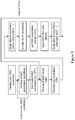
- Figure 3 depicts the way SAO is processed over the picture (left) and the SAO filtering process itself for each CTU (right).
- the number of SAO candidates (nb_sao_cand) and the list of SAO parameters is encoded in the same order as the order of use.
- the list of SAO parameters candidates is re-ordered after encoding each candidate index, putting the last used parameter on top of the list. More precisely, the list of candidates is re-ordered such that the spatially closest used candidates are ordered at first. This can be done by building a map of last used candidates.
- WPP wavefront parallel processing
- the decoding of the CTU of one row should be delayed by at least two CTUs in order to wait for the above-right CTU to be available for merging data with the above decoded CTU data (ex: AMVP, intra prediction, SAO merge,).
- CABAC encoding is flushed after the last CTU of each row, making the bitstream representing each row of CTU accessible using an entry point defined in the slice header.
- one thread may decode one row of a CTU faster so that it can be in advance of the row below by more than two CTUs.
- the thread below should be delayed by at least two CTUs. In the remaining discussion, it is assumed that the thread below is delayed by two CTUs.
- the list of SAO parameters in the SAO palette can be re-ordered before filtering with SAO, such that the spatially closest candidates are ordered first.
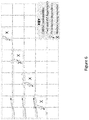
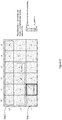
- wavefront parallel processing one can start decoding one row of a CTU as soon as the CTU situated at the row above and to the right (top-right) has finished decoding as depicted in Figure 6 .
- the decoding is single thread and the current CTU is situated at position (c1;L2).
- the list of SAO palette candidates has been re-ordered so that the spatially closest already decoded SAO candidates appear on top of the list (first) and the not yet used candidates are on the bottom (last).
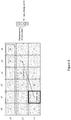
- the re-ordered list of candidates is ⁇ 2,1,3,4 ⁇ and the value of sao_merge_idx is equal to 2 corresponding to the SAO candidate labelled as "3" in Figure 7 .
- the bitstream has been converted into a parallel stream and the decoding is now multiple thread with wavefront parallelization enabled, with one thread per row.
- the first, second and third threads are decoding CTUs at position (c5;L0), (c3;L1), (c1;L2) respectively.
- the CTU situated at position (c1;L2) has re-ordered the list of available candidates that is ⁇ 2,1,4,3 ⁇ (in this example, label 3 is at the end of the list because it has not been used by any thread yet) and the value of sao_merge_idx that is equal to 2 corresponds to the SAO candidate labelled as "4" that is different from the single stream case of Figure 7 .
- ordering or re-ordering a list of SAO candidates can mean favoring some candidates over other candidates. It can also mean including some SAO candidates and not including others. The order of the candidates can be used such that those candidates in a particular position are first used when performing operations, such as SAO filtering.
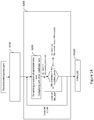
- Figure 12 shows one embodiment of an SAO palette synopsis method.
- the method comprises Start block S200 and control proceeds to block S210 for Accessing a bitstream.
- Control proceeds from block S210 to block S220 for decoding a plurality of candidate sets of filter parameters from a bitstream.
- Control proceeds from block S220 to block S23o for decoding for a current block an index identifying one of the decoded candidate sets of filter parameters from the bitstream.
- Control proceeds from block S230 to block S240 for decoding the current block from the bitstream.
- Control proceeds from block S240 to block S250 for re-ordering the candidate sets.
- Control proceeds from block S250 to block S260 for filtering the decoded current block with the candidate set of filter parameters identified by the decoded index.
- the method ends after control proceeds from block S260 to block S270.
- block S250 can be comprised of steps S310 for reordering a subset of candidate sets followed by step S320 for completing with other candidate sets.
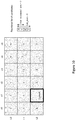
- a first embodiment proposes to constrain the SAO palette re-ordering to consider only the (wavefront) causal part (S310 of Figure 12 ) corresponding to the area delimited with the dashed line in Figure 8 , which corresponds to the wavefront region associated with the current CTU ⁇ 2,1 ⁇ , and mark the other candidates ⁇ 4 ⁇ as "not already used” or "considered as not already used", so that they will be placed at the end of the list (S320 of Figure 12 ).
- the area of consideration for candidates is limited to the current slice and/or the current tile.
- the area is the intersection between the current slice or the current tile and the wavefront area as described in embodiment 1.
- slice 0 includes L0-L1, c0-c5, and slice 1 includes L2, c0-c5.
- the current CTU is in slice 1 and only labels in slice 1 ( ⁇ 2 ⁇ ) are re-ordered, the others labels not in the current slice (and not in the previous slice) are marked as "not already used" and they are put at the end of the list.
- the SAO palette is defined per slice or tile, not per picture. Then one list of candidates is coded per slice or tile.
- one defines two regions: one where SAO-palette re-ordering apply (as in the first embodiment), and another region where the labels are taken to complete the list up to the size of the list, list_size.
- the list_size is not coded but is set as the number of distinct labels in the second region.
- the size of the re-ordered list of candidates is limited to a value "list_reordered_size" that is:
- list_reordered_size 2 and the re-ordered candidates are ⁇ 2,1 ⁇ .
- picture header eg., Picture Parameter Set, PPS
- sequence header eg., Sequence Parameter Set, SPS
- the list of SAO candidates is completed (up to "list_size”) by the other SAO candidates ⁇ 4,3 ⁇ (S320) that were parsed before, in their order of parsing in the bitstream.
- list_size can be less than or equal to the maximum number of candidates in the SAO palette. It can be known a-priori or encoded explicitly in the bitstream.
- list_reordered_size or “list_size” can be done using the value of SAO-palette-size (nb_sao_cand), which is the number of SAO candidates.
- nb_sao_cand the value of SAO-palette-size
- diff_num nb_sao_cand - list_size and derive the value of list_size from diff_num and nb_sao_cand.
- the size of the list is limited by the maximum distance (dist_max) of the candidates to the current CTU.
- dist_max the maximum distance of the candidates to the current CTU.
- the value of dist_max allows defining a neighboring area (hatched area) of previously decoded CTUs (causal) from which the list of re-ordered SAO candidates is built (S310).
- the other SAO palette candidates are placed at the end of the list (S320).
- the neighboring area corresponds to a pattern that is known a-priori or encoded in the bitstream.
- the second and third embodiments are combined so that the number of re-reordered candidates is less than or equal to "list_reordered_size" and all the re-reordered candidates are situated in the pre-defined neighboring area.
- Figure 18 shows one embodiment of a method 1800 for encoding a video block using sample adaptive offset (SAO) filtering.
- the method commences at Start block 1801 and control proceeds to block 1810 for ordering a list of indices of candidate SAO parameter sets.
- Control proceeds from block 1810 to block 1820 for filtering a reconstructed version of the video block using at least one candidate SAO parameter set from the list of indices.
- Control proceeds from block 1820 to block 1830 for encoding at least one index value corresponding to the at least one SAO candidate into a bitstream of data for the video block.
- Figure 19 shows one embodiment of a method 1900 for decoding a bitstream.
- the method commences at Start block 1901 and control proceeds to block 1910 for parsing the bitstream for an index value. Control then proceeds from block 1910 to block 1920 for ordering a list of indices of candidate sample adaptive offset (SAO) parameter sets based on the at least one index value. Control proceeds from block 1920 to block 1930 for filtering a decoded video block using the at least one candidate SAO parameter set.
- SAO sample adaptive offset
- Figure 20 shows one embodiment of an apparatus 2000 for encoding a video block using sample adaptive offset (SAO) filtering or decoding a bitstream.
- the apparatus comprises Processor 2010 having one or more input and output ports and is interconnected through one or more communication ports to Memory 2020.
- Apparatus 2000 is capable of performing either of the methods of Figure 18 or Figure 19 or any variant.
- the described embodiments herein allow improving the performance of the overall video compression. This is achieved through the improvement of the in-loop SAO filtering.
- the proposed adaptations support parallel decoding (wavefront) and the memory bandwidth can be reduced since the CTUs access a subset of SAO palette candidates.
- the proposed techniques can be implemented by a corresponding decoder.
- FIGs. 15 , 16 and 17 below provide some embodiments, but other embodiments are contemplated and the discussion of FIGs. 15 , 16 and 17 does not limit the breadth of the implementations.
- At least one of the aspects generally relates to video encoding and decoding, and at least one other aspect generally relates to transmitting a bitstream generated or encoded.
- These and other aspects can be implemented as a method, an apparatus, a computer readable storage medium having stored thereon instructions for encoding or decoding video data according to any of the methods described, and/or a computer readable storage medium having stored thereon a bitstream generated according to any of the methods described.
- the terms “reconstructed” and “decoded” may be used interchangeably, the terms “pixel” and “sample” may be used interchangeably, the terms “image,” “picture” and “frame” may be used interchangeably.
- the term “reconstructed” is used at the encoder side while “decoded” is used at the decoder side.
- each of the methods comprises one or more steps or actions for achieving the described method. Unless a specific order of steps or actions is required for proper operation of the method, the order and/or use of specific steps and/or actions may be modified or combined.
- modules such as, for example, the intra prediction, entropy coding, and/or decoding modules (160, 360, 145, 330), of a video encoder 100 and decoder 200 as shown in FIG. 15 and FIG. 16 , or as provided in other JVET or HEVC (for example) encoders and/or decoders.
- present aspects are not limited to JVET or HEVC, and can be applied, for example, to other standards and recommendations, whether pre-existing or future-developed, and extensions of any such standards and recommendations (including JVET and HEVC). Unless indicated otherwise, or technically precluded, the aspects described in this document can be used individually or in combination.
- FIG. 15 illustrates an exemplary encoder 100. Variations of this encoder 100 are contemplated, but the encoder 100 is described below for purposes of clarity without describing all expected variations.
- the video sequence may go through pre-encoding processing (101), for example, applying a color transform to the input color picture (e.g., conversion from RGB 4:4:4 to YCbCr 4:2:0), or performing a remapping of the input picture components in order to get a signal distribution more resilient to compression (for instance using a histogram equalization of one of the color components).
- Metadata can be associated with the pre-processing, and attached to the bitstream.
- a picture is encoded by the encoder elements as described below.
- the picture to be encoded is partitioned (102) and processed in units of, for example, CUs.
- Each unit is encoded using, for example, either an intra or inter mode.
- intra prediction 160
- inter mode motion estimation (175) and compensatio101 n (170) are performed.
- the encoder decides (105) which one of the intra mode or inter mode to use for encoding the unit, and indicates the intra/inter decision by, for example, a prediction mode flag.
- Prediction residuals are calculated, for example, by subtracting (110) the predicted block from the original image block.
- the prediction residuals are then transformed (125) and quantized (130).
- the quantized transform coefficients, as well as motion vectors and other syntax elements, are entropy coded (145) to output a bitstream.
- the encoder can skip the transform and apply quantization directly to the non-transformed residual signal.
- the encoder can bypass both transform and quantization, i.e., the residual is coded directly without the application of the transform or quantization processes.
- the encoder decodes an encoded block to provide a reference for further predictions.
- the quantized transform coefficients are de-quantized (140) and inverse transformed (150) to decode prediction residuals.
- In-loop filters (165) are applied to the reconstructed picture to perform, for example, deblocking/SAO (Sample Adaptive Offset) filtering to reduce encoding artifacts.
- the filtered image is stored at a reference picture buffer (180).
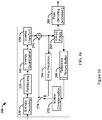
- FIG. 16 illustrates a block diagram of an exemplary video decoder 200.
- a bitstream is decoded by the decoder elements as described below.
- Video decoder 200 generally performs a decoding pass reciprocal to the encoding pass as described in FIG. 15 .
- the encoder 100 also generally performs video decoding as part of encoding video data.
- the input of the decoder includes a video bitstream, which can be generated by video encoder 100.
- the bitstream is first entropy decoded (230) to obtain transform coefficients, motion vectors, and other coded information.
- the picture partition information indicates how the picture is partitioned.
- the decoder may therefore divide (235) the picture according to the decoded picture partitioning information.
- the transform coefficients are de-quantized (240) and inverse transformed (250) to decode the prediction residuals.
- Combining (255) the decoded prediction residuals and the predicted block an image block is reconstructed.
- the predicted block can be obtained (270) from intra prediction (260) or motion-compensated prediction (i.e., inter prediction) (275).
- In-loop filters (265) are applied to the reconstructed image.
- the filtered image is stored at a reference picture buffer (280).
- the decoded picture can further go through post-decoding processing (285), for example, an inverse color transform (e.g. conversion from YCbCr 4:2:0 to RGB 4:4:4) or an inverse remapping performing the inverse of the remapping process performed in the pre-encoding processing (101).
- post-decoding processing can use metadata derived in the pre-encoding processing and signaled in the bitstream.
- FIG. 17 illustrates a block diagram of an exemplary system in which various aspects and exemplary embodiments are implemented.
- System 1000 can be embodied as a device including the various components described below and is configured to perform one or more of the aspects described in this document. Examples of such devices, include, but are not limited to, personal computers, laptop computers, smartphones, tablet computers, digital multimedia set top boxes, digital television receivers, personal video recording systems, connected home appliances, and servers.
- System 1000 can be communicatively coupled to other similar systems, and to a display via a communication channel as shown in FIG. 17 and as known by those skilled in the art to implement the various aspects described in this document.
- the system 1000 can include at least one processor 1010 configured to execute instructions loaded therein for implementing the various aspects described in this document.
- Processor 1010 can include embedded memory, input output interface, and various other circuitries as known in the art.
- the system 1000 can include at least one memory 1020 (e.g., a volatile memory device, a non-volatile memory device).
- System 1000 can include a storage device 1020, which can include non-volatile memory, including, but not limited to, EEPROM, ROM, PROM, RAM, DRAM, SRAM, flash, magnetic disk drive, and/or optical disk drive.
- the storage device 1040 can include an internal storage device, an attached storage device, and/or a network accessible storage device, as non-limiting examples.
- System 1000 can include an encoder/decoder module 1030 configured to process data to provide an encoded video or decoded video.
- Encoder/decoder module 1030 represents the module(s) that can be included in a device to perform the encoding and/or decoding functions. As is known, a device can include one or both of the encoding and decoding modules. Additionally, encoder/decoder module 1030 can be implemented as a separate element of system 1000 or can be incorporated within processors 1010 as a combination of hardware and software as known to those skilled in the art.
- processors 1010 Program code to be loaded onto processors 1010 to perform the various aspects described in this document can be stored in storage device 1040 and subsequently loaded onto memory 1020 for execution by processors 1010.
- one or more of the processor(s) 1010, memory 1020, storage device 1040, and encoder/decoder module 1030 can store one or more of the various items during the performance of the processes described in this document, including, but not limited to the input video, the decoded video, the bitstream, equations, formulas, matrices, variables, operations, and operational logic.
- memory inside of the processor 1010 and/or the encoder/decoder module 1030 is used to store instructions and to provide working memory for processing that is needed during encoding or decoding.
- a memory external to the processing device (for example, the processing device can be either the processor 1010 or the encoder/decoder module 1030) is used for one or more of these functions.
- the external memory can be the memory 1020 and/or the storage device 1040, for example, a dynamic volatile memory and/or a non-volatile flash memory.
- an external non-volatile flash memory is used to store the operating system of a television.
- a fast external dynamic volatile memory such as a RAM is used as working memory for video coding and decoding operations, such as for MPEG-2, HEVC, or VVC (Versatile Video Coding).
- the system 1000 can include communication interface 1050 that enables communication with other devices via communication channel 1060.
- the communication interface 1050 can include, but is not limited to, a transceiver configured to transmit and receive data from communication channel 1060.
- the communication interface can include, but is not limited to, a modem or network card and the communication channel can be implemented within a wired and/or a wireless medium.
- the various components of system 1000 can be connected or communicatively coupled together using various suitable connections, including, but not limited to internal buses, wires, and printed circuit boards.
- the external memory can be the memory 1020 and/or the storage device 1040, for example, a dynamic volatile memory and/or a non-volatile flash memory.
- an external non-volatile flash memory is used to store the operating system of a television.
- a fast external dynamic volatile memory such as a RAM is used as working memory for video coding and decoding operations, such as for MPEG-2, HEVC, or VVC (Versatile Video Coding).
- the input to the elements of system 1000 can be provided through various input devices as indicated in block 1130.
- Such input devices include, but are not limited to, (i) an RF portion that receives an RF signal transmitted, for example, over the air by a broadcaster, (ii) a Composite input terminal, (iii) a USB input terminal, and/or (iv) an HDMI input terminal.
- the input devices of block 1130 have associated respective input processing elements as known in the art.
- the RF portion can be associated with elements necessary for (i) selecting a desired frequency (also referred to as selecting a signal, or band-limiting a signal to a band of frequencies), (ii) downconverting the selected signal, (iii) band-limiting again to a narrower band of frequencies to select (for example) a signal frequency band which can be referred to as a channel in certain embodiments, (iv) demodulating the downconverted and band-limited signal, (v) performing error correction, and (vi) demultiplexing to select the desired stream of data packets.
- the RF portion of various embodiments includes one or more elements to perform these functions, for example, frequency selectors, signal selectors, band-limiters, channel selectors, filters, downconverters, demodulators, error correctors, and demultiplexers.
- the RF portion can include a tuner that performs various of these functions, including, for example, downconverting the received signal to a lower frequency (for example, an intermediate frequency or a near-baseband frequency) or to baseband.
- the RF portion and its associated input processing element receives an RF signal transmitted over a wired (for example, cable) medium, and performs frequency selection by filtering, downconverting, and filtering again to a desired frequency band.
- Adding elements can include inserting elements in between existing elements, such as, for example, inserting amplifiers and an analog-to-digital converter.
- the RF portion includes an antenna.
- USB and/or HDMI terminals can include respective interface processors for connecting system 1000 to other electronic devices across USB and/or HDMI connections.
- various aspects of input processing for example, Reed-Solomon error correction
- aspects of USB or HDMI interface processing can be implemented within separate interface ICs or within processor 1010 as necessary.
- the demodulated, error corrected, and demultiplexed stream is provided to various processing elements, including, for example, processor 1010, and encoder/decoder 1030 operating in combination with the memory and storage elements to process the datastream as necessary for presentation on an output device.
- Various elements of system 1000 can be provided within an integrated housing, Within the integrated housing, the various elements can be interconnected and transmit data therebetween using suitable connection arrangement, for example, an internal bus as known in the art, including the I2C bus, wiring, and printed circuit boards.
- suitable connection arrangement for example, an internal bus as known in the art, including the I2C bus, wiring, and printed circuit boards.
- the system 1000 includes communication interface 1050 that enables communication with other devices via communication channel 1060.
- the communication interface 1050 can include, but is not limited to, a transceiver configured to transmit and to receive data over communication channel 1060.
- the communication interface 1050 can include, but is not limited to, a modem or network card and the communication channel 1060 can be implemented, for example, within a wired and/or a wireless medium.
- Data is streamed to the system 1000, in various embodiments, using a Wi-Fi network such as IEEE 802.11.
- the Wi-Fi signal of these embodiments is received over the communications channel 1060 and the communications interface 1050 which are adapted for Wi-Fi communications.
- the communications channel 1060 of these embodiments is typically connected to an access point or router that provides access to outside networks including the Internet for allowing streaming applications and other over-the-top communications.
- Other embodiments provide streamed data to the system 1000 using a set-top box that delivers the data over the HDMI connection of the input block 1130.
- Still other embodiments provide streamed data to the system 1000 using the RF connection of the input block 1130.
- the system 1000 can provide an output signal to various output devices, including a display 1100, speakers 1110, and other peripheral devices 1120.
- the other peripheral devices 1120 include, in various examples of embodiments, one or more of a stand-alone DVR, a disk player, a stereo system, a lighting system, and other devices that provide a function based on the output of the system 1000.
- control signals are communicated between the system 1000 and the display 1100, speakers 1110, or other peripheral devices 1120 using signaling such as AV.Link, CEC, or other communications protocols that enable device-to-device control with or without user intervention.
- the output devices can be communicatively coupled to system 1000 via dedicated connections through respective interfaces 1070, 1080, and 1090.
- the output devices can be connected to system 1000 using the communications channel 1060 via the communications interface 1050.
- the display 1100 and speakers 1110 can be integrated in a single unit with the other components of system 1000 in an electronic device such as, for example, a television.
- the display interface 1070 includes a display driver, such as, for example, a timing controller (T Con) chip.
- T Con timing controller
- the display 1100 and speaker 1110 can alternatively be separate from one or more of the other components, for example, if the RF portion of input 1130 is part of a separate set-top box.
- the output signal can be provided via dedicated output connections, including, for example, HDMI ports, USB ports, or COMP outputs.
- the embodiments can be carried out by computer software implemented by the processor 1010 or by hardware, or by a combination of hardware and software. As a non-limiting example, the embodiments can be implemented by one or more integrated circuits.
- the memory 1020 can be of any type appropriate to the technical environment and can be implemented using any appropriate data storage technology, such as optical memory devices, magnetic memory devices, semiconductor-based memory devices, fixed memory, and removable memory, as non-limiting examples.
- the processor 1010 can be of any type appropriate to the technical environment, and can encompass one or more of microprocessors, general purpose computers, special purpose computers, and processors based on a multi-core architecture, as non-limiting examples.
- Decoding can encompass all or part of the processes performed, for example, on a received encoded sequence in order to produce a final output suitable for display.
- processes include one or more of the processes typically performed by a decoder such as, for example, entropy decoding, inverse quantization, inverse transformation, and differential decoding.
- a decoder such as, for example, entropy decoding, inverse quantization, inverse transformation, and differential decoding.
- decoding refers only to entropy decoding
- decoding refers only to differential decoding
- decoding refers to a combination of entropy decoding and differential decoding.
- encoding can encompass all or part of the processes performed, for example, on an input video sequence in order to produce an encoded bitstream.
- processes include one or more of the processes typically performed by an encoder such as, for example, partitioning, differential encoding, transformation, quantization, and entropy encoding.
- encoding refers only to entropy encoding
- encoding refers only to differential encoding
- encoding refers to a combination of differential encoding and entropy encoding.
- Various embodiments refer to rate distortion optimization.
- the rate distortion optimization is usually formulated as minimizing a rate distortion function, which is a weighted sum of the rate and of the distortion.
- the approaches may be based on an extensive testing of all encoding options, including all considered modes or coding parameters values, with a complete evaluation of their coding cost and related distortion of the reconstructed signal after coding and decoding.
- Faster approaches may also be used, to save encoding complexity, in particular with computation of an approximated distortion based on the prediction or the prediction residual signal, not the reconstructed one.
- the implementations and aspects described herein can be implemented in, for example, a method or a process, an apparatus, a software program, a data stream, or a signal. Even if only discussed in the context of a single form of implementation (for example, discussed only as a method), the implementation of features discussed can also be implemented in other forms (for example, an apparatus or program).
- An apparatus can be implemented in, for example, appropriate hardware, software, and firmware.
- the methods can be implemented in, for example, an apparatus such as, for example, a processor, which refers to processing devices in general, including, for example, a computer, a microprocessor, an integrated circuit, or a programmable logic device. Processors also include communication devices, such as, for example, computers, cell phones, portable/personal digital assistants ("PDAs”), and other devices that facilitate communication of information between end-users.
- PDAs portable/personal digital assistants
- references to "one embodiment” or “an embodiment” or “one implementation” or “an implementation”, as well as other variations thereof, means that a particular feature, structure, characteristic, and so forth described in connection with the embodiment is included in at least one embodiment.
- the appearances of the phrase “in one embodiment” or “in an embodiment” or “in one implementation” or “in an implementation”, as well any other variations, appearing in various places throughout this document are not necessarily all referring to the same embodiment.
- Determining the information can include one or more of, for example, estimating the information, calculating the information, predicting the information, or retrieving the information from memory.
- Accessing the information can include one or more of, for example, receiving the information, retrieving the information (for example, from memory), storing the information, moving the information, copying the information, calculating the information, determining the information, predicting the information, or estimating the information.
- Receiving is, as with “accessing”, intended to be a broad term.
- Receiving the information can include one or more of, for example, accessing the information, or retrieving the information (for example, from memory).
- “receiving” is typically involved, in one way or another, during operations such as, for example, storing the information, processing the information, transmitting the information, moving the information, copying the information, erasing the information, calculating the information, determining the information, predicting the information, or estimating the information.
- such phrasing is intended to encompass the selection of the first listed option (A) only, or the selection of the second listed option (B) only, or the selection of the third listed option (C) only, or the selection of the first and the second listed options (A and B) only, or the selection of the first and third listed options (A and C) only, or the selection of the second and third listed options (B and C) only, or the selection of all three options (A and B and C).
- This may be extended, as is clear to one of ordinary skill in this and related arts, for as many items as are listed.
- the word "signal" refers to, among other things, indicating something to a corresponding decoder.
- the same parameter is used at both the encoder side and the decoder side.
- an encoder can transmit (explicit signaling) a particular parameter to the decoder so that the decoder can use the same particular parameter.
- signaling can be used without transmitting (implicit signaling) to simply allow the decoder to know and select the particular parameter. By avoiding transmission of any actual functions, a bit savings is realized in various embodiments. It is to be appreciated that signaling can be accomplished in a variety of ways.
- one or more syntax elements, flags, and so forth are used to signal information to a corresponding decoder in various embodiments. While the preceding relates to the verb form of the word "signal”, the word “signal” can also be used herein as a noun.
- implementations can produce a variety of signals formatted to carry information that can be, for example, stored or transmitted.
- the information can include, for example, instructions for performing a method, or data produced by one of the described implementations.
- a signal can be formatted to carry the bitstream of a described embodiment.
- Such a signal can be formatted, for example, as an electromagnetic wave (for example, using a radio frequency portion of spectrum) or as a baseband signal.
- the formatting can include, for example, encoding a data stream and modulating a carrier with the encoded data stream.
- the information that the signal carries can be, for example, analog or digital information.
- the signal can be transmitted over a variety of different wired or wireless links, as is known.
- the signal can be stored on a processor-readable medium.
Landscapes
- Engineering & Computer Science (AREA)
- Multimedia (AREA)
- Signal Processing (AREA)
- Compression Or Coding Systems Of Tv Signals (AREA)
Priority Applications (2)
| Application Number | Priority Date | Filing Date | Title |
|---|---|---|---|
| EP18305736.3A EP3582501A1 (de) | 2018-06-15 | 2018-06-15 | Parallelisierbarer sao mit erweiterte verschmelzung |
| PCT/US2019/025477 WO2019204031A1 (en) | 2018-04-20 | 2019-04-03 | Coding with a sao palette |
Applications Claiming Priority (1)
| Application Number | Priority Date | Filing Date | Title |
|---|---|---|---|
| EP18305736.3A EP3582501A1 (de) | 2018-06-15 | 2018-06-15 | Parallelisierbarer sao mit erweiterte verschmelzung |
Publications (1)
| Publication Number | Publication Date |
|---|---|
| EP3582501A1 true EP3582501A1 (de) | 2019-12-18 |
Family
ID=62778852
Family Applications (1)
| Application Number | Title | Priority Date | Filing Date |
|---|---|---|---|
| EP18305736.3A Withdrawn EP3582501A1 (de) | 2018-04-20 | 2018-06-15 | Parallelisierbarer sao mit erweiterte verschmelzung |
Country Status (1)
| Country | Link |
|---|---|
| EP (1) | EP3582501A1 (de) |
Cited By (2)
| Publication number | Priority date | Publication date | Assignee | Title |
|---|---|---|---|---|
| CN116055744A (zh) * | 2022-11-17 | 2023-05-02 | 平头哥(上海)半导体技术有限公司 | 边带补偿的加速方法、加速装置、计算设备以及存储介质 |
| US12659518B2 (en) | 2018-07-11 | 2026-06-16 | Interdigital Vc Holdings, Inc. | In-loop filter with multiple regions |
-
2018
- 2018-06-15 EP EP18305736.3A patent/EP3582501A1/de not_active Withdrawn
Non-Patent Citations (2)
| Title |
|---|
| BORDES P ET AL: "Description of SDR, HDR and 360° video coding technology proposal by Qualcomm and Technicolor "" medium complexity version", 10. JVET MEETING; 10-4-2018 - 20-4-2018; SAN DIEGO; (THE JOINT VIDEO EXPLORATION TEAM OF ISO/IEC JTC1/SC29/WG11 AND ITU-T SG.16 ); URL: HTTP://PHENIX.INT-EVRY.FR/JVET/,, no. JVET-J0022-v3, 12 April 2018 (2018-04-12), XP030151186 * |
| ZHANG L ET AL: "Description of Core Experiment 2 (CE2): In-Loop Filters", 10. JVET MEETING; 10-4-2018 - 20-4-2018; SAN DIEGO; (THE JOINT VIDEO EXPLORATION TEAM OF ISO/IEC JTC1/SC29/WG11 AND ITU-T SG.16 ); URL: HTTP://PHENIX.INT-EVRY.FR/JVET/,, no. JVET-J1022-v3, 14 May 2018 (2018-05-14), XP030151315 * |
Cited By (2)
| Publication number | Priority date | Publication date | Assignee | Title |
|---|---|---|---|---|
| US12659518B2 (en) | 2018-07-11 | 2026-06-16 | Interdigital Vc Holdings, Inc. | In-loop filter with multiple regions |
| CN116055744A (zh) * | 2022-11-17 | 2023-05-02 | 平头哥(上海)半导体技术有限公司 | 边带补偿的加速方法、加速装置、计算设备以及存储介质 |
Similar Documents
| Publication | Publication Date | Title |
|---|---|---|
| US12244831B2 (en) | Method and device for picture encoding and decoding | |
| US12495160B2 (en) | Template matching prediction for versatile video coding | |
| US20230336775A1 (en) | Generalized bi-prediction and weighted prediction | |
| US12301818B2 (en) | Context-based binary arithmetic encoding and decoding | |
| US20240251078A1 (en) | Method and apparatus for video encoding and decoding based on asymmetric binary partitioning of image blocks | |
| US20250039357A1 (en) | Chroma prediction for video encoding and decoding based on template matching | |
| US12022079B2 (en) | Wide angle intra prediction and position dependent intra prediction combination | |
| US20230051873A1 (en) | Method and apparatus for video encoding and decoding based on adaptive coefficient group | |
| US12200197B2 (en) | Virtual temporal affine candidates | |
| US20260052279A1 (en) | In-loop filter with multiple regions | |
| US12256068B2 (en) | Signaling of merge indices for triangle partitions | |
| KR20220088939A (ko) | 이미지 블록의 심층 인트라 예측 | |
| US20220150501A1 (en) | Flexible allocation of regular bins in residual coding for video coding | |
| US20220124337A1 (en) | Harmonization of intra transform coding and wide angle intra prediction | |
| US20250030871A1 (en) | Luma to chroma quantization parameter table signaling | |
| US11539951B2 (en) | Method and device for picture encoding and decoding | |
| US20210344925A1 (en) | Block size based motion vector coding in affine mode | |
| EP3664450A1 (de) | Verfahren und vorrichtung zur bildcodierung und -decodierung | |
| US12401790B2 (en) | Combining ABT with VVC sub-block-based coding tools | |
| US20220264147A1 (en) | Hmvc for affine and sbtmvp motion vector prediction modes | |
| EP3611924A1 (de) | In-loop filter mit mehreren regionen | |
| WO2019204031A1 (en) | Coding with a sao palette | |
| WO2026008349A1 (en) | Unequal offset multiple reference line (mrl) for intra prediction |
Legal Events
| Date | Code | Title | Description |
|---|---|---|---|
| PUAI | Public reference made under article 153(3) epc to a published international application that has entered the european phase |
Free format text: ORIGINAL CODE: 0009012 |
|
| AK | Designated contracting states |
Kind code of ref document: A1 Designated state(s): AL AT BE BG CH CY CZ DE DK EE ES FI FR GB GR HR HU IE IS IT LI LT LU LV MC MK MT NL NO PL PT RO RS SE SI SK SM TR |
|
| AX | Request for extension of the european patent |
Extension state: BA ME |
|
| RAP1 | Party data changed (applicant data changed or rights of an application transferred) |
Owner name: INTERDIGITAL VC HOLDINGS, INC. |
|
| STAA | Information on the status of an ep patent application or granted ep patent |
Free format text: STATUS: THE APPLICATION IS DEEMED TO BE WITHDRAWN |
|
| 18D | Application deemed to be withdrawn |
Effective date: 20200619 |