EP3581682A1 - Electrolysis anode - Google Patents
Electrolysis anode Download PDFInfo
- Publication number
- EP3581682A1 EP3581682A1 EP17895882.3A EP17895882A EP3581682A1 EP 3581682 A1 EP3581682 A1 EP 3581682A1 EP 17895882 A EP17895882 A EP 17895882A EP 3581682 A1 EP3581682 A1 EP 3581682A1
- Authority
- EP
- European Patent Office
- Prior art keywords
- platinum
- anode
- electrolysis
- bronze
- platinum bronze
- Prior art date
- Legal status (The legal status is an assumption and is not a legal conclusion. Google has not performed a legal analysis and makes no representation as to the accuracy of the status listed.)
- Granted
Links
Images



Classifications
-
- C—CHEMISTRY; METALLURGY
- C25—ELECTROLYTIC OR ELECTROPHORETIC PROCESSES; APPARATUS THEREFOR
- C25B—ELECTROLYTIC OR ELECTROPHORETIC PROCESSES FOR THE PRODUCTION OF COMPOUNDS OR NON-METALS; APPARATUS THEREFOR
- C25B1/00—Electrolytic production of inorganic compounds or non-metals
- C25B1/01—Products
- C25B1/02—Hydrogen or oxygen
- C25B1/04—Hydrogen or oxygen by electrolysis of water
-
- C—CHEMISTRY; METALLURGY
- C25—ELECTROLYTIC OR ELECTROPHORETIC PROCESSES; APPARATUS THEREFOR
- C25B—ELECTROLYTIC OR ELECTROPHORETIC PROCESSES FOR THE PRODUCTION OF COMPOUNDS OR NON-METALS; APPARATUS THEREFOR
- C25B11/00—Electrodes; Manufacture thereof not otherwise provided for
- C25B11/04—Electrodes; Manufacture thereof not otherwise provided for characterised by the material
- C25B11/042—Electrodes formed of a single material
- C25B11/047—Ceramics
-
- C—CHEMISTRY; METALLURGY
- C25—ELECTROLYTIC OR ELECTROPHORETIC PROCESSES; APPARATUS THEREFOR
- C25B—ELECTROLYTIC OR ELECTROPHORETIC PROCESSES FOR THE PRODUCTION OF COMPOUNDS OR NON-METALS; APPARATUS THEREFOR
- C25B11/00—Electrodes; Manufacture thereof not otherwise provided for
- C25B11/04—Electrodes; Manufacture thereof not otherwise provided for characterised by the material
- C25B11/051—Electrodes formed of electrocatalysts on a substrate or carrier
- C25B11/073—Electrodes formed of electrocatalysts on a substrate or carrier characterised by the electrocatalyst material
- C25B11/075—Electrodes formed of electrocatalysts on a substrate or carrier characterised by the electrocatalyst material consisting of a single catalytic element or catalytic compound
-
- C—CHEMISTRY; METALLURGY
- C25—ELECTROLYTIC OR ELECTROPHORETIC PROCESSES; APPARATUS THEREFOR
- C25C—PROCESSES FOR THE ELECTROLYTIC PRODUCTION, RECOVERY OR REFINING OF METALS; APPARATUS THEREFOR
- C25C7/00—Constructional parts, or assemblies thereof, of cells; Servicing or operating of cells
- C25C7/02—Electrodes; Connections thereof
-
- C—CHEMISTRY; METALLURGY
- C25—ELECTROLYTIC OR ELECTROPHORETIC PROCESSES; APPARATUS THEREFOR
- C25D—PROCESSES FOR THE ELECTROLYTIC OR ELECTROPHORETIC PRODUCTION OF COATINGS; ELECTROFORMING; APPARATUS THEREFOR
- C25D13/00—Electrophoretic coating characterised by the process
- C25D13/22—Servicing or operating apparatus or multistep processes
-
- C—CHEMISTRY; METALLURGY
- C25—ELECTROLYTIC OR ELECTROPHORETIC PROCESSES; APPARATUS THEREFOR
- C25D—PROCESSES FOR THE ELECTROLYTIC OR ELECTROPHORETIC PRODUCTION OF COATINGS; ELECTROFORMING; APPARATUS THEREFOR
- C25D17/00—Constructional parts, or assemblies thereof, of cells for electrolytic coating
- C25D17/10—Electrodes, e.g. composition, counter electrode
-
- Y—GENERAL TAGGING OF NEW TECHNOLOGICAL DEVELOPMENTS; GENERAL TAGGING OF CROSS-SECTIONAL TECHNOLOGIES SPANNING OVER SEVERAL SECTIONS OF THE IPC; TECHNICAL SUBJECTS COVERED BY FORMER USPC CROSS-REFERENCE ART COLLECTIONS [XRACs] AND DIGESTS
- Y02—TECHNOLOGIES OR APPLICATIONS FOR MITIGATION OR ADAPTATION AGAINST CLIMATE CHANGE
- Y02E—REDUCTION OF GREENHOUSE GAS [GHG] EMISSIONS, RELATED TO ENERGY GENERATION, TRANSMISSION OR DISTRIBUTION
- Y02E60/00—Enabling technologies; Technologies with a potential or indirect contribution to GHG emissions mitigation
- Y02E60/30—Hydrogen technology
- Y02E60/36—Hydrogen production from non-carbon containing sources, e.g. by water electrolysis
Definitions
- the present invention relates to an anode for electrolysis, and more particularly to an anode for electrolysis including platinum bronze containing metallic element M.
- Electrolysis is a technique of chemically decomposing a compound by causing reduction reaction at a cathode and oxidation reaction at an anode. Electrolysis has been applied to polymer electrolyte membrane water electrolyzer, electroplating, electrodeposition coating, electrocasting, electrorefining, and others. To perform such electrolysis efficiently, required are electrodes that are high in activity for the intended reaction and excellent in durability under the electrolytic environment. To address this problem, various proposals have been conventionally made.
- Patent Literature 1 discloses a water electrolysis cell in which the anode includes a mixture of ruthenium oxide and iridium oxide prepared by a hydroxide coprecipitation method.
- the Literature describes that
- the Literature describes that Li x Pt 3 O 4 , Co x Pt 3 O 4 , and Ni x Pt 3 O 4 have high oxygen reduction activity and also have voltammetric characteristics comparable to those of a Pt 3 O 4 electrode.
- iridium oxide is normally used for the anode of a polymer electrolyte membrane water electrolyzer.
- iridium is poor in resources and expensive. To expand the use of the electrolyzer, therefore, an anode made of a less-expensive and abundant material is required.
- DSE electrodes including iridium oxide or ruthenium oxide have been used.
- iridium oxide has a problem in resources as described above.
- Ruthenium oxide has also a problem of being too low in stability to be used singularly.
- Non-Patent Literature 1 mentions the water electrolysis characteristics of platinum bronze. However, only the evaluation results on lithium-containing platinum bronze are shown, and the data described are not quantitative ones. Moreover, no evaluation has been made on the stability under the electrolytic environment.
- Non-Patent Literature 1 R.D. Shannon et al., Inorg. Chem., 21, 3372 (1982 )
- An objective of the present invention is to provide a novel anode for electrolysis including platinum bronze.
- Another objective of the present invention is to provide an anode for electrolysis that is inexpensive and excellent in durability.
- the anode for electrolysis according to the present invention is characterized in having the following configurations:
- platinum bronze Since platinum bronze is insoluble in aqua regia, it does not elute even under strong acid conditions where chloride ions coexist and does not degrade even under exposure to a high potential. Also, platinum bronze, which is an oxide itself, is not oxidized any further even at a high potential during water electrolysis, whereby its activity is not reduced, unlike platinum metal.
- platinum bronze containing predetermined metallic element M exhibits water electrolysis activity higher than Li-containing platinum bronze and iridium oxide. Also, the platinum bronze containing metallic element M is inexpensive compared to iridium oxide and exhibits high durability comparable to iridium oxide. Therefore, using such platinum bronze as an anode for electrolysis, electrolysis reaction can be performed efficiently.
- the anode for electrolysis according to the present invention has the following configurations:
- platinum bronze refers to a complex metal oxide including platinum, oxygen, and ions of metallic element M as the third ingredient.
- the compositional formula of the platinum bronze is generally represented by M x Pt 3 O 4 .
- the space group of the platinum bronze is Pm3n, where platinum atoms are at 6c site, oxygen atoms at 8e site, and the metallic element M at 2a site.
- the amount x of the metallic element M varies depending on the synthesis conditions (the nominal amount of metal, the synthesis temperature, etc.), but is normally 0 ⁇ x ⁇ 1.
- the anode for electrolysis according to the present invention may be one comprised of only platinum bronze, or one in which platinum bronze is supported on the surface of an appropriate carrier (e.g., a carbon carrier, a conductive oxide carrier, and a metal carrier).
- an appropriate carrier e.g., a carbon carrier, a conductive oxide carrier, and a metal carrier.
- the platinum bronze may be used singularly or in combination with another material.
- the metallic element M is Mn, Co, Cu, Ag, Bi, or Ce. Any one kind of these elements may be contained in the platinum bronze, or two or more kinds of them may be contained.
- the platinum bronze containing any of such metallic elements M exhibits higher water electrolysis activity and higher current maintenance rate than Li-containing platinum bronze.
- the anode for electrolysis according to the present invention can be used as anodes for various types of industrial electrolysis. Specifically, the anode for electrolysis according to the present invention can be used as anodes for polymer electrolyte membrane water electrolyzer, electroplating, electrodeposition coating, electrocasting, electrorefining, alkaline water electrolysis, and others.
- the platinum bronze is obtained by:
- a predetermined amount of a raw material of the metal element M (hereinafter referred to as the "metal source") is added to a platinum source (blending process).
- the platinum source is not specifically limited as far as platinum bronze can be synthesized from this source.
- Examples of the platinum source include:
- the metal source is not specifically limited as far as platinum bronze can be synthesized from this source.
- Examples of the metal source include:
- the optimum added amount of the metal source is selected according to the purpose. In general, as the added amount of the metal source is greater, platinum bronze whose x is greater is obtained.
- reaction process Thereafter, the raw material mixture is subjected to solid-phase reaction under predetermined conditions (reaction process).
- Optimum reaction conditions are selected according to the composition of the platinum bronze and the kind of the raw material.
- the reaction temperature is normally 650 to 700°C although it depends on the composition of the platinum bronze, etc.
- the reaction time is normally of the order of several minutes to several hours.
- the by-product metal platinum is then removed from the resultant reactant as required (purification process).
- the removal of the metal platinum is preferably performed by aqua regia treatment. With the aqua regia treatment under predetermined conditions, the platinum bronze can be isolated from the reactant.
- the resultant platinum bronze powder may be used singularly or in combination with another material.
- the platinum bronze powder may be used in a state of being applied to the surface of an appropriate substrate or in a molded state.
- the platinum bronze Since the platinum bronze is insoluble in aqua regia, it does not elute even under strong acid conditions where chloride ions coexist and resists degradation from exposure to a high potential. Also, the platinum bronze, which is an oxide itself, is not oxidized any further even at a high potential during water electrolysis, whereby its activity is not reduced, unlike platinum metal.
- the platinum bronze containing predetermined metallic element M exhibits water electrolysis activity higher than Li-containing platinum bronze and iridium oxide. Also, the platinum bronze containing metallic element M is inexpensive compared to iridium oxide and exhibits high durability comparable to iridium oxide. Therefore, using such platinum bronze as an anode for electrolysis, electrolysis reaction can be performed efficiently.
- Platinum bronze was synthesized by the following method using Non-Patent Literature 1 as a reference.
- Platinum oxide (PtO 2 ) and metal nitrate were weighed at a mole ratio of 3:1 and mixed in a mortar.
- the metal nitrate used was Co(NO 3 ) 2 ⁇ 6H 2 O (Example 1), Mn(NO 3 ) 2 ⁇ 6H 2 O (Example 2), Cu(NO 3 ) 2 ⁇ 3H 2 O (Example 3), AgNO 3 (Example 4), Ce(NO 3 ) 3 ⁇ 6H 2 O (Example 5), Bi(NO 3 ) 3 ⁇ 5H 2 O (Example 6), or LiNO 3 (Comparative Example 1).
- the mixture was heat-treated at 650°C for 5 hours while flowing air (1 L/min). Further, the resultant reactant (mixture of platinum bronze and metal platinum) was immersed in hot aqua regia for 30 minutes, and a supernatant liquid was removed to remove metal platinum.
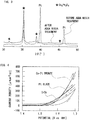
- FIG. 1 shows XRD patterns of a sample (Co x Pt 3 O 4 + Pt) after the heat treatment and a raw material mixture (PtO 2 + Co nitrate) before the heat treatment.
- FIGS. 2A and 2B show SEM images of the sample after the heat treatment ( FIG. 2A ) and the raw material mixture before the heat treatment ( FIG. 2B ). From FIGS. 1 , 2A, and 2B , it is found that:
- FIG. 3 shows XRD patterns of the sample before and after the aqua regia treatment. From FIG. 3 , it is confirmed that the metal platinum has been removed by the aqua regia treatment, isolating the platinum bronze.
- the platinum bronze powder was dispersed in acetone, and the dispersion was applied to the surface of a glassy carbon (GC) electrode and dried. Using this as the working electrode, electrochemical measurement was performed to evaluate the water electrolysis (oxygen evolution) activity.
- a reversible hydrogen electrode was used as the reference electrode, a gold mesh as the counter electrode, and 0.1 M perchloric acid as the electrolytic solution. The temperature of the solution was adjusted to 30°C.
- For the water electrolysis activity, used as the indicator was the value obtained by standardizing the current value at 1.7 V with the surface area of the catalyst supported on the GC electrode (calculated from the supporting weight and the BET specific surface area).
- FIG. 4 shows cyclic voltammograms of cobalt platinum bronze, platinum black, and IrO 2 .
- the water electrolysis activity of cobalt platinum bronze per unit area was higher than those of the platinum black and the iridium oxide.
- great hysteresis was observed in the platinum black. This is because oxidation proceeds down into a lower layer at a high potential.
- the cobalt platinum bronze is small in hysteresis. It is presumably because the oxidation does not proceed even at a high potential since the cobalt platinum bronze itself is an oxide.
- the water electrolysis activity of the platinum bronze containing any of the metallic elements M is greater than that of the platinum black except for the lithium platinum bronze.
- the anode for electrolysis according to the present invention can be used as anodes for polymer electrolyte membrane water electrolyzer, electroplating, electrodeposition coating, electrocasting, electrorefining, and others.
Landscapes
- Chemical & Material Sciences (AREA)
- Engineering & Computer Science (AREA)
- Chemical Kinetics & Catalysis (AREA)
- Electrochemistry (AREA)
- Materials Engineering (AREA)
- Metallurgy (AREA)
- Organic Chemistry (AREA)
- Inorganic Chemistry (AREA)
- Ceramic Engineering (AREA)
- Electrolytic Production Of Non-Metals, Compounds, Apparatuses Therefor (AREA)
- Electrodes For Compound Or Non-Metal Manufacture (AREA)
Abstract
Description
- The present invention relates to an anode for electrolysis, and more particularly to an anode for electrolysis including platinum bronze containing metallic element M.
- Electrolysis is a technique of chemically decomposing a compound by causing reduction reaction at a cathode and oxidation reaction at an anode. Electrolysis has been applied to polymer electrolyte membrane water electrolyzer, electroplating, electrodeposition coating, electrocasting, electrorefining, and others. To perform such electrolysis efficiently, required are electrodes that are high in activity for the intended reaction and excellent in durability under the electrolytic environment. To address this problem, various proposals have been conventionally made.
- For example, Patent Literature 1 discloses a water electrolysis cell in which the anode includes a mixture of ruthenium oxide and iridium oxide prepared by a hydroxide coprecipitation method.
- The Literature describes that
- (a) a RuO2 electrode, which is smaller in oxygen overvoltage than an IrO2 electrode, is effective for reducing the cell voltage but poor in durability,
- (b) the IrO2 electrode is excellent in durability, but higher in initial cell voltage than the RuO2 electrode, and
- (c) the cell voltage becomes low and the durability improves when a mixture of RuO2 and IrO2 prepared by the hydroxide coprecipitation method is used as the anode.
- Non-Patent Literature 1 discloses a method of synthesizing MxPt3O4 (M = Li, Na, Mg, Ca, Zn, Cd, Co, and Ni) type platinum metal oxides.
- The Literature describes that LixPt3O4, CoxPt3O4, and NixPt3O4 have high oxygen reduction activity and also have voltammetric characteristics comparable to those of a Pt3O4 electrode.
- As described in Patent Literature 1, iridium oxide is normally used for the anode of a polymer electrolyte membrane water electrolyzer. However, iridium is poor in resources and expensive. To expand the use of the electrolyzer, therefore, an anode made of a less-expensive and abundant material is required.
- For anodes for industrial electrolysis such as electroplating, electrodeposition coating, electrocasting, and electrorefining, DSE electrodes including iridium oxide or ruthenium oxide have been used. However, iridium oxide has a problem in resources as described above. Ruthenium oxide has also a problem of being too low in stability to be used singularly.
- Non-Patent Literature 1 mentions the water electrolysis characteristics of platinum bronze. However, only the evaluation results on lithium-containing platinum bronze are shown, and the data described are not quantitative ones. Moreover, no evaluation has been made on the stability under the electrolytic environment.
- [Patent Literature 1]
JP H10-273791 A - [Non-Patent Literature 1] R.D. Shannon et al., Inorg. Chem., 21, 3372 (1982)
- An objective of the present invention is to provide a novel anode for electrolysis including platinum bronze.
- Another objective of the present invention is to provide an anode for electrolysis that is inexpensive and excellent in durability.
- To attain the above objectives, the anode for electrolysis according to the present invention is characterized in having the following configurations:
- (1) the anode for electrolysis includes platinum bronze containing metallic element M, and
- (2) the metallic element M is constituted by any one or more elements selected from the group consisting of Mn, Co, Cu, Ag, Bi, and Ce.
- Since platinum bronze is insoluble in aqua regia, it does not elute even under strong acid conditions where chloride ions coexist and does not degrade even under exposure to a high potential. Also, platinum bronze, which is an oxide itself, is not oxidized any further even at a high potential during water electrolysis, whereby its activity is not reduced, unlike platinum metal.
- In particular, platinum bronze containing predetermined metallic element M exhibits water electrolysis activity higher than Li-containing platinum bronze and iridium oxide. Also, the platinum bronze containing metallic element M is inexpensive compared to iridium oxide and exhibits high durability comparable to iridium oxide. Therefore, using such platinum bronze as an anode for electrolysis, electrolysis reaction can be performed efficiently.
-
-
FIG. 1 is an XRD pattern of a sample (CoxPt3O4 + Pt) after heat treatment and a raw material mixture (PtO2 + Co nitrate) before heat treatment; -
FIGS. 2A and 2B are SEM images of the sample after heat treatment (FIG. 2A ) and the raw material mixture before heat treatment (FIG. 2B ); -
FIG. 3 is an XRD pattern of the sample before and after aqua regia treatment; -
FIG. 4 shows cyclic voltammograms of cobalt platinum bronze, platinum black, and IrO2; -
FIG. 5 shows comparisons of the water electrolysis activity among platinum black, IrO2, and MxPt3O4 (M = Mn, Co, Cu, Ag, Bi, Ce, and Li); and -
FIG. 6 shows comparisons of the current maintenance rate after retention of the constant potential at 1.7 V among platinum black, IrO2, and MxPt3O4 (M = Mn, Co, Cu, Ag, Bi, Ce, and Li). - Hereinafter, an embodiment of the present invention will be described in detail.
- The anode for electrolysis according to the present invention has the following configurations:
- (1) the anode for electrolysis includes platinum bronze containing metallic element M, and
- (2) the metallic element M is constituted by any one or more elements selected from the group consisting of Mn, Co, Cu, Ag, Bi, and Ce.
- The "platinum bronze" refers to a complex metal oxide including platinum, oxygen, and ions of metallic element M as the third ingredient. The compositional formula of the platinum bronze is generally represented by MxPt3O4. The space group of the platinum bronze is Pm3n, where platinum atoms are at 6c site, oxygen atoms at 8e site, and the metallic element M at 2a site. The amount x of the metallic element M varies depending on the synthesis conditions (the nominal amount of metal, the synthesis temperature, etc.), but is normally 0 < x ≤ 1.
- The anode for electrolysis according to the present invention may be one comprised of only platinum bronze, or one in which platinum bronze is supported on the surface of an appropriate carrier (e.g., a carbon carrier, a conductive oxide carrier, and a metal carrier). The platinum bronze may be used singularly or in combination with another material.
- The metallic element M is Mn, Co, Cu, Ag, Bi, or Ce. Any one kind of these elements may be contained in the platinum bronze, or two or more kinds of them may be contained.
- The platinum bronze containing any of such metallic elements M exhibits higher water electrolysis activity and higher current maintenance rate than Li-containing platinum bronze.
- The anode for electrolysis according to the present invention can be used as anodes for various types of industrial electrolysis. Specifically, the anode for electrolysis according to the present invention can be used as anodes for polymer electrolyte membrane water electrolyzer, electroplating, electrodeposition coating, electrocasting, electrorefining, alkaline water electrolysis, and others.
- The platinum bronze is obtained by:
- (a) adding a predetermined amount of a raw material of the metal element M to a platinum source;
- (b) subjecting the raw material mixture to solid-phase reaction under predetermined conditions; and
- (c) removing by-product metal platinum from the resultant reactant as required.
- First, a predetermined amount of a raw material of the metal element M (hereinafter referred to as the "metal source") is added to a platinum source (blending process).
- The platinum source is not specifically limited as far as platinum bronze can be synthesized from this source. Examples of the platinum source include:
- (a) platinum oxide (PtO2) ; and
- (b) nitrate, chloro complexes, ammine salt, and hydroxy complexes of platinum.
- The metal source is not specifically limited as far as platinum bronze can be synthesized from this source. Examples of the metal source include:
- (a) salt with inorganic anions such as nitrate, fluoride salt, chloride salt, bromide salt, iodide salt, carbonate, perchlorate, phosphate, sulfate, and borate; and
- (b) salt with organic anions such as acetate, oxalate, and citrate.
- The optimum added amount of the metal source is selected according to the purpose. In general, as the added amount of the metal source is greater, platinum bronze whose x is greater is obtained.
- Thereafter, the raw material mixture is subjected to solid-phase reaction under predetermined conditions (reaction process). Optimum reaction conditions are selected according to the composition of the platinum bronze and the kind of the raw material. The reaction temperature is normally 650 to 700°C although it depends on the composition of the platinum bronze, etc. The reaction time is normally of the order of several minutes to several hours. When the raw material mixture is heat-treated under the predetermined conditions, platinum bronze is produced, and simultaneously metal platinum is also produced as a by-product.
- The by-product metal platinum is then removed from the resultant reactant as required (purification process). The removal of the metal platinum is preferably performed by aqua regia treatment. With the aqua regia treatment under predetermined conditions, the platinum bronze can be isolated from the reactant.
- The resultant platinum bronze powder may be used singularly or in combination with another material.
- Also, the platinum bronze powder may be used in a state of being applied to the surface of an appropriate substrate or in a molded state.
- Since the platinum bronze is insoluble in aqua regia, it does not elute even under strong acid conditions where chloride ions coexist and resists degradation from exposure to a high potential. Also, the platinum bronze, which is an oxide itself, is not oxidized any further even at a high potential during water electrolysis, whereby its activity is not reduced, unlike platinum metal.
- In particular, the platinum bronze containing predetermined metallic element M exhibits water electrolysis activity higher than Li-containing platinum bronze and iridium oxide. Also, the platinum bronze containing metallic element M is inexpensive compared to iridium oxide and exhibits high durability comparable to iridium oxide. Therefore, using such platinum bronze as an anode for electrolysis, electrolysis reaction can be performed efficiently.
- Platinum bronze was synthesized by the following method using Non-Patent Literature 1 as a reference. Platinum oxide (PtO2) and metal nitrate were weighed at a mole ratio of 3:1 and mixed in a mortar. As the metal nitrate, used was Co(NO3)2·6H2O (Example 1), Mn(NO3)2·6H2O (Example 2), Cu(NO3)2·3H2O (Example 3), AgNO3 (Example 4), Ce(NO3)3·6H2O (Example 5), Bi(NO3)3·5H2O (Example 6), or LiNO3 (Comparative Example 1).
- Thereafter, the mixture was heat-treated at 650°C for 5 hours while flowing air (1 L/min). Further, the resultant reactant (mixture of platinum bronze and metal platinum) was immersed in hot aqua regia for 30 minutes, and a supernatant liquid was removed to remove metal platinum.
- For comparison, platinum black (BET specific surface area: 12.7 m2/g) (Comparative Example 2) and iridium oxide powder (BET specific surface area: 53.6 m2/g) (Comparative Example 3) were used.
-
FIG. 1 shows XRD patterns of a sample (CoxPt3O4 + Pt) after the heat treatment and a raw material mixture (PtO2 + Co nitrate) before the heat treatment.FIGS. 2A and 2B show SEM images of the sample after the heat treatment (FIG. 2A ) and the raw material mixture before the heat treatment (FIG. 2B ). FromFIGS. 1 ,2A, and 2B , it is found that: - (a) a fine reactant is obtained from the coarse raw material mixture, and
- (b) the reactant is constituted by a mixture of platinum bronze (CoxPt3O4) and metal platinum.
-
FIG. 3 shows XRD patterns of the sample before and after the aqua regia treatment. FromFIG. 3 , it is confirmed that the metal platinum has been removed by the aqua regia treatment, isolating the platinum bronze. - The BET specific surface area was measured for each platinum bronze by nitrogen adsorption measurement. Table 1 shows the measurement results. All of the resultant platinum bronzes had high specific surface areas.
[Table 1] Sample Specific surfaec area [m2/g] MnxPt3O4 12.0 ±0.3 CoxPt3O4 18.8 ±0.4 CuxPt3O4 14.0 ±0.2 AgxPt3O4 3.8 ±0.2 CexPt3O4 36.0 ±0.8 Bixpt3O4 8.9 ±0.1 LixPt3O4 17.2 ±0.2 - The platinum bronze powder was dispersed in acetone, and the dispersion was applied to the surface of a glassy carbon (GC) electrode and dried. Using this as the working electrode, electrochemical measurement was performed to evaluate the water electrolysis (oxygen evolution) activity. A reversible hydrogen electrode was used as the reference electrode, a gold mesh as the counter electrode, and 0.1 M perchloric acid as the electrolytic solution. The temperature of the solution was adjusted to 30°C. For the water electrolysis activity, used as the indicator was the value obtained by standardizing the current value at 1.7 V with the surface area of the catalyst supported on the GC electrode (calculated from the supporting weight and the BET specific surface area).
-
FIG. 4 shows cyclic voltammograms of cobalt platinum bronze, platinum black, and IrO2. The water electrolysis activity of cobalt platinum bronze per unit area was higher than those of the platinum black and the iridium oxide. Also, great hysteresis was observed in the platinum black. This is because oxidation proceeds down into a lower layer at a high potential. Contrarily, the cobalt platinum bronze is small in hysteresis. It is presumably because the oxidation does not proceed even at a high potential since the cobalt platinum bronze itself is an oxide. -
FIG. 5 shows comparisons of the water electrolysis activity among the platinum black, IrO2, and MxPt3O4 (M = Mn, Co, Cu, Ag, Bi, Ce, and Li). The water electrolysis activity of the platinum bronze containing any of the metallic elements M is greater than that of the platinum black except for the lithium platinum bronze. -
FIG. 6 shows comparisons of the current maintenance rate after retention of the constant potential at 1.7 V among the platinum black, IrO2, and MxPt3O4 (M = Mn, Co, Cu, Ag, Bi, Ce, and Li). The "current maintenance rate" refers to the ratio of the current value (I10) after a lapse of 10 seconds to the current value (I60) after a lapse of 60 seconds (= I10 × 100 / I60). It is found that any platinum bronze is higher in sustaining the water electrolysis activity than the platinum black. - While the embodiment of the present invention has been described in detail, it is to be understood that the present invention is not limited by any of the details of the embodiment, but various modifications may be made without departing from the spirit and scope of the present invention.
- The anode for electrolysis according to the present invention can be used as anodes for polymer electrolyte membrane water electrolyzer, electroplating, electrodeposition coating, electrocasting, electrorefining, and others.
Claims (2)
- An anode for electrolysis, comprising
platinum bronze containing metallic element M, wherein
the metallic element M is constituted by any one or more elements selected from the group consisting of Mn, Co, Cu, Ag, Bi, and Ce. - The anode for electrolysis according to claim 1, wherein the anode is used as an anode for a polymer electrolyte membrane water electrolyzer, electroplating, electrodeposition coating, electrocasting, or electrorefining.
Applications Claiming Priority (2)
| Application Number | Priority Date | Filing Date | Title |
|---|---|---|---|
| JP2017020392A JP6642473B2 (en) | 2017-02-07 | 2017-02-07 | Anode for electrolysis |
| PCT/JP2017/043742 WO2018146928A1 (en) | 2017-02-07 | 2017-12-06 | Electrolysis anode |
Publications (3)
| Publication Number | Publication Date |
|---|---|
| EP3581682A1 true EP3581682A1 (en) | 2019-12-18 |
| EP3581682A4 EP3581682A4 (en) | 2020-11-25 |
| EP3581682B1 EP3581682B1 (en) | 2024-06-12 |
Family
ID=63108256
Family Applications (1)
| Application Number | Title | Priority Date | Filing Date |
|---|---|---|---|
| EP17895882.3A Active EP3581682B1 (en) | 2017-02-07 | 2017-12-06 | Electrolysis anode |
Country Status (3)
| Country | Link |
|---|---|
| EP (1) | EP3581682B1 (en) |
| JP (1) | JP6642473B2 (en) |
| WO (1) | WO2018146928A1 (en) |
Cited By (2)
| Publication number | Priority date | Publication date | Assignee | Title |
|---|---|---|---|---|
| WO2023139040A1 (en) | 2022-01-21 | 2023-07-27 | Basf Se | Mixed platinum ruthenium oxide and electrodes for the oxygen evolution reaction |
| WO2024126872A1 (en) | 2022-12-16 | 2024-06-20 | Basf Se | Ruthenium oxide decorated with platinum oxide and electrodes for the oxygen evolution reaction |
Family Cites Families (9)
| Publication number | Priority date | Publication date | Assignee | Title |
|---|---|---|---|---|
| JPS478340B1 (en) * | 1967-04-06 | 1972-03-10 | ||
| US4042484A (en) * | 1972-10-19 | 1977-08-16 | Gerhard Thiele | Metal anode for electro-chemical processes |
| DE2312563A1 (en) * | 1973-03-14 | 1974-10-03 | Conradty Fa C | METALLANODE FOR ELECTROCHEMICAL PROCESSES |
| DE3036066A1 (en) * | 1980-09-25 | 1982-05-06 | Hoechst Ag, 6000 Frankfurt | Bonding electrode to fluorine contg. copolymer electrolysis membrane - by applying electrode powder to membrane and pressing opt. with heating |
| JPH10273791A (en) | 1997-03-28 | 1998-10-13 | Japan Energy Corp | Water electrolysis cell |
| DE102007023979B4 (en) * | 2007-05-23 | 2009-05-07 | Umicore Ag & Co. Kg | Two-stage process for the reactivation of thermally aged nitrogen oxide storage catalysts |
| CN101386997A (en) * | 2008-10-17 | 2009-03-18 | 华东师范大学 | A method of manipulating particulate materials |
| JP5790922B2 (en) * | 2011-04-22 | 2015-10-07 | セイコーエプソン株式会社 | Piezoelectric element, liquid ejecting head, liquid ejecting apparatus, ultrasonic device and sensor |
| ITTO20111154A1 (en) * | 2011-12-15 | 2013-06-16 | Indesit Co Spa | WASHING MACHINE FOR WASHING MACHINES |
-
2017
- 2017-02-07 JP JP2017020392A patent/JP6642473B2/en active Active
- 2017-12-06 EP EP17895882.3A patent/EP3581682B1/en active Active
- 2017-12-06 WO PCT/JP2017/043742 patent/WO2018146928A1/en not_active Ceased
Cited By (2)
| Publication number | Priority date | Publication date | Assignee | Title |
|---|---|---|---|---|
| WO2023139040A1 (en) | 2022-01-21 | 2023-07-27 | Basf Se | Mixed platinum ruthenium oxide and electrodes for the oxygen evolution reaction |
| WO2024126872A1 (en) | 2022-12-16 | 2024-06-20 | Basf Se | Ruthenium oxide decorated with platinum oxide and electrodes for the oxygen evolution reaction |
Also Published As
| Publication number | Publication date |
|---|---|
| JP2018127659A (en) | 2018-08-16 |
| JP6642473B2 (en) | 2020-02-05 |
| WO2018146928A1 (en) | 2018-08-16 |
| EP3581682A4 (en) | 2020-11-25 |
| EP3581682B1 (en) | 2024-06-12 |
Similar Documents
| Publication | Publication Date | Title |
|---|---|---|
| US4003817A (en) | Valve metal electrode with valve metal oxide semi-conductive coating having a chlorine discharge in said coating | |
| EP3546619B1 (en) | Electrode for electrolysis | |
| EP0404208B1 (en) | Method for preparing an electrode and use thereof in electrochemical processes | |
| EP2357267B1 (en) | Catalyst for oxygen reduction | |
| EP2113039B1 (en) | Catalyst for electrochemical reduction of oxygen | |
| EP2765222A1 (en) | Catalyst coating and method for its production | |
| McGinnity et al. | The role of silver in enhancing the electrochemical activity of lead and lead–silver alloy anodes | |
| US4176094A (en) | Method of making stoichiometric lead and bismuth pyrochlore compounds using an alkaline medium | |
| EP3581682B1 (en) | Electrolysis anode | |
| EP0046449A1 (en) | Dimensionally stable coated electrode for electrolytic process, comprising protective oxide interface on valve metal base, and process for its manufacture | |
| US4072585A (en) | Valve metal electrode with valve metal oxide semi-conductive coating having a chlorine discharge catalyst in said coating | |
| EP3523462B1 (en) | Method for producing an electrocatalyst for use in water oxidation | |
| US20250116017A1 (en) | Mixed metal iridium ruthenium palladium electrocatalysts | |
| JP2019163508A (en) | Electrolytic anode | |
| CN114616358A (en) | Electrode for electrochemical hydrogen evolution | |
| US4010091A (en) | Novel electrode for electrolysis cell | |
| JP6992624B2 (en) | Anode for electrolysis | |
| JP2836890B2 (en) | Electrode for organic matter electrolysis and method for producing the same | |
| GB2029385A (en) | Pyrochlore Compounds | |
| KR102941984B1 (en) | Catalyst electrode, method for manufacturing catalyst electrode and membrane electrode assembly | |
| US12480219B2 (en) | Electrode for electrolysis | |
| KR20250018225A (en) | Electrocatalyst for brine electrolysis and manufacturing method thereof | |
| TW202200846A (en) | Electrode for electrochemical evolution of hydrogen | |
| Vilana et al. | Synthesis and Stability of Pt3Co and Pt0. 7≤ X≤ 1Co Films Voltammetrically Activated in Acidic Medium for Methanol Fuel Cell Application | |
| DE2255690A1 (en) | ELECTRODE FOR ELECTROCHEMICAL PROCESSES |
Legal Events
| Date | Code | Title | Description |
|---|---|---|---|
| STAA | Information on the status of an ep patent application or granted ep patent |
Free format text: STATUS: THE INTERNATIONAL PUBLICATION HAS BEEN MADE |
|
| PUAI | Public reference made under article 153(3) epc to a published international application that has entered the european phase |
Free format text: ORIGINAL CODE: 0009012 |
|
| STAA | Information on the status of an ep patent application or granted ep patent |
Free format text: STATUS: REQUEST FOR EXAMINATION WAS MADE |
|
| 17P | Request for examination filed |
Effective date: 20190618 |
|
| AK | Designated contracting states |
Kind code of ref document: A1 Designated state(s): AL AT BE BG CH CY CZ DE DK EE ES FI FR GB GR HR HU IE IS IT LI LT LU LV MC MK MT NL NO PL PT RO RS SE SI SK SM TR |
|
| AX | Request for extension of the european patent |
Extension state: BA ME |
|
| DAV | Request for validation of the european patent (deleted) | ||
| DAX | Request for extension of the european patent (deleted) | ||
| A4 | Supplementary search report drawn up and despatched |
Effective date: 20201027 |
|
| RIC1 | Information provided on ipc code assigned before grant |
Ipc: C25B 11/04 20060101ALI20201020BHEP Ipc: C25B 11/08 20060101AFI20201020BHEP Ipc: C25C 7/02 20060101ALI20201020BHEP Ipc: C25D 13/22 20060101ALI20201020BHEP Ipc: C25D 17/10 20060101ALI20201020BHEP Ipc: C25B 1/10 20060101ALI20201020BHEP |
|
| REG | Reference to a national code |
Ref legal event code: R079 Free format text: PREVIOUS MAIN CLASS: C25B0011080000 Ipc: C25B0001040000 Ref country code: DE Ref document number: 602017082621 Country of ref document: DE |
|
| GRAP | Despatch of communication of intention to grant a patent |
Free format text: ORIGINAL CODE: EPIDOSNIGR1 |
|
| STAA | Information on the status of an ep patent application or granted ep patent |
Free format text: STATUS: GRANT OF PATENT IS INTENDED |
|
| RIC1 | Information provided on ipc code assigned before grant |
Ipc: C25D 17/10 20060101ALI20240202BHEP Ipc: C25D 13/22 20060101ALI20240202BHEP Ipc: C25C 7/02 20060101ALI20240202BHEP Ipc: C25B 11/075 20210101ALI20240202BHEP Ipc: C25B 11/047 20210101ALI20240202BHEP Ipc: C25B 1/04 20060101AFI20240202BHEP |
|
| INTG | Intention to grant announced |
Effective date: 20240220 |
|
| GRAS | Grant fee paid |
Free format text: ORIGINAL CODE: EPIDOSNIGR3 |
|
| GRAA | (expected) grant |
Free format text: ORIGINAL CODE: 0009210 |
|
| STAA | Information on the status of an ep patent application or granted ep patent |
Free format text: STATUS: THE PATENT HAS BEEN GRANTED |
|
| AK | Designated contracting states |
Kind code of ref document: B1 Designated state(s): AL AT BE BG CH CY CZ DE DK EE ES FI FR GB GR HR HU IE IS IT LI LT LU LV MC MK MT NL NO PL PT RO RS SE SI SK SM TR |
|
| REG | Reference to a national code |
Ref country code: GB Ref legal event code: FG4D |
|
| REG | Reference to a national code |
Ref country code: CH Ref legal event code: EP |
|
| REG | Reference to a national code |
Ref country code: DE Ref legal event code: R096 Ref document number: 602017082621 Country of ref document: DE |
|
| REG | Reference to a national code |
Ref country code: IE Ref legal event code: FG4D |
|
| PG25 | Lapsed in a contracting state [announced via postgrant information from national office to epo] |
Ref country code: BG Free format text: LAPSE BECAUSE OF FAILURE TO SUBMIT A TRANSLATION OF THE DESCRIPTION OR TO PAY THE FEE WITHIN THE PRESCRIBED TIME-LIMIT Effective date: 20240612 |
|
| PG25 | Lapsed in a contracting state [announced via postgrant information from national office to epo] |
Ref country code: HR Free format text: LAPSE BECAUSE OF FAILURE TO SUBMIT A TRANSLATION OF THE DESCRIPTION OR TO PAY THE FEE WITHIN THE PRESCRIBED TIME-LIMIT Effective date: 20240612 Ref country code: FI Free format text: LAPSE BECAUSE OF FAILURE TO SUBMIT A TRANSLATION OF THE DESCRIPTION OR TO PAY THE FEE WITHIN THE PRESCRIBED TIME-LIMIT Effective date: 20240612 |
|
| REG | Reference to a national code |
Ref country code: LT Ref legal event code: MG9D |
|
| PG25 | Lapsed in a contracting state [announced via postgrant information from national office to epo] |
Ref country code: GR Free format text: LAPSE BECAUSE OF FAILURE TO SUBMIT A TRANSLATION OF THE DESCRIPTION OR TO PAY THE FEE WITHIN THE PRESCRIBED TIME-LIMIT Effective date: 20240913 |
|
| REG | Reference to a national code |
Ref country code: NL Ref legal event code: MP Effective date: 20240612 |
|
| PG25 | Lapsed in a contracting state [announced via postgrant information from national office to epo] |
Ref country code: ES Free format text: LAPSE BECAUSE OF FAILURE TO SUBMIT A TRANSLATION OF THE DESCRIPTION OR TO PAY THE FEE WITHIN THE PRESCRIBED TIME-LIMIT Effective date: 20240612 |
|
| PG25 | Lapsed in a contracting state [announced via postgrant information from national office to epo] |
Ref country code: LV Free format text: LAPSE BECAUSE OF FAILURE TO SUBMIT A TRANSLATION OF THE DESCRIPTION OR TO PAY THE FEE WITHIN THE PRESCRIBED TIME-LIMIT Effective date: 20240612 |
|
| PG25 | Lapsed in a contracting state [announced via postgrant information from national office to epo] |
Ref country code: NO Free format text: LAPSE BECAUSE OF FAILURE TO SUBMIT A TRANSLATION OF THE DESCRIPTION OR TO PAY THE FEE WITHIN THE PRESCRIBED TIME-LIMIT Effective date: 20240912 Ref country code: LV Free format text: LAPSE BECAUSE OF FAILURE TO SUBMIT A TRANSLATION OF THE DESCRIPTION OR TO PAY THE FEE WITHIN THE PRESCRIBED TIME-LIMIT Effective date: 20240612 Ref country code: HR Free format text: LAPSE BECAUSE OF FAILURE TO SUBMIT A TRANSLATION OF THE DESCRIPTION OR TO PAY THE FEE WITHIN THE PRESCRIBED TIME-LIMIT Effective date: 20240612 Ref country code: GR Free format text: LAPSE BECAUSE OF FAILURE TO SUBMIT A TRANSLATION OF THE DESCRIPTION OR TO PAY THE FEE WITHIN THE PRESCRIBED TIME-LIMIT Effective date: 20240913 Ref country code: FI Free format text: LAPSE BECAUSE OF FAILURE TO SUBMIT A TRANSLATION OF THE DESCRIPTION OR TO PAY THE FEE WITHIN THE PRESCRIBED TIME-LIMIT Effective date: 20240612 Ref country code: ES Free format text: LAPSE BECAUSE OF FAILURE TO SUBMIT A TRANSLATION OF THE DESCRIPTION OR TO PAY THE FEE WITHIN THE PRESCRIBED TIME-LIMIT Effective date: 20240612 Ref country code: BG Free format text: LAPSE BECAUSE OF FAILURE TO SUBMIT A TRANSLATION OF THE DESCRIPTION OR TO PAY THE FEE WITHIN THE PRESCRIBED TIME-LIMIT Effective date: 20240612 Ref country code: RS Free format text: LAPSE BECAUSE OF FAILURE TO SUBMIT A TRANSLATION OF THE DESCRIPTION OR TO PAY THE FEE WITHIN THE PRESCRIBED TIME-LIMIT Effective date: 20240912 |
|
| PG25 | Lapsed in a contracting state [announced via postgrant information from national office to epo] |
Ref country code: NL Free format text: LAPSE BECAUSE OF FAILURE TO SUBMIT A TRANSLATION OF THE DESCRIPTION OR TO PAY THE FEE WITHIN THE PRESCRIBED TIME-LIMIT Effective date: 20240612 |
|
| REG | Reference to a national code |
Ref country code: AT Ref legal event code: MK05 Ref document number: 1694306 Country of ref document: AT Kind code of ref document: T Effective date: 20240612 |
|
| PG25 | Lapsed in a contracting state [announced via postgrant information from national office to epo] |
Ref country code: NL Free format text: LAPSE BECAUSE OF FAILURE TO SUBMIT A TRANSLATION OF THE DESCRIPTION OR TO PAY THE FEE WITHIN THE PRESCRIBED TIME-LIMIT Effective date: 20240612 |
|
| PG25 | Lapsed in a contracting state [announced via postgrant information from national office to epo] |
Ref country code: PT Free format text: LAPSE BECAUSE OF FAILURE TO SUBMIT A TRANSLATION OF THE DESCRIPTION OR TO PAY THE FEE WITHIN THE PRESCRIBED TIME-LIMIT Effective date: 20241014 |
|
| PG25 | Lapsed in a contracting state [announced via postgrant information from national office to epo] |
Ref country code: PT Free format text: LAPSE BECAUSE OF FAILURE TO SUBMIT A TRANSLATION OF THE DESCRIPTION OR TO PAY THE FEE WITHIN THE PRESCRIBED TIME-LIMIT Effective date: 20241014 |
|
| PG25 | Lapsed in a contracting state [announced via postgrant information from national office to epo] |
Ref country code: PL Free format text: LAPSE BECAUSE OF FAILURE TO SUBMIT A TRANSLATION OF THE DESCRIPTION OR TO PAY THE FEE WITHIN THE PRESCRIBED TIME-LIMIT Effective date: 20240612 |
|
| PG25 | Lapsed in a contracting state [announced via postgrant information from national office to epo] |
Ref country code: EE Free format text: LAPSE BECAUSE OF FAILURE TO SUBMIT A TRANSLATION OF THE DESCRIPTION OR TO PAY THE FEE WITHIN THE PRESCRIBED TIME-LIMIT Effective date: 20240612 |
|
| PG25 | Lapsed in a contracting state [announced via postgrant information from national office to epo] |
Ref country code: IS Free format text: LAPSE BECAUSE OF FAILURE TO SUBMIT A TRANSLATION OF THE DESCRIPTION OR TO PAY THE FEE WITHIN THE PRESCRIBED TIME-LIMIT Effective date: 20241012 Ref country code: AT Free format text: LAPSE BECAUSE OF FAILURE TO SUBMIT A TRANSLATION OF THE DESCRIPTION OR TO PAY THE FEE WITHIN THE PRESCRIBED TIME-LIMIT Effective date: 20240612 |
|
| PG25 | Lapsed in a contracting state [announced via postgrant information from national office to epo] |
Ref country code: CZ Free format text: LAPSE BECAUSE OF FAILURE TO SUBMIT A TRANSLATION OF THE DESCRIPTION OR TO PAY THE FEE WITHIN THE PRESCRIBED TIME-LIMIT Effective date: 20240612 |
|
| PG25 | Lapsed in a contracting state [announced via postgrant information from national office to epo] |
Ref country code: SK Free format text: LAPSE BECAUSE OF FAILURE TO SUBMIT A TRANSLATION OF THE DESCRIPTION OR TO PAY THE FEE WITHIN THE PRESCRIBED TIME-LIMIT Effective date: 20240612 Ref country code: RO Free format text: LAPSE BECAUSE OF FAILURE TO SUBMIT A TRANSLATION OF THE DESCRIPTION OR TO PAY THE FEE WITHIN THE PRESCRIBED TIME-LIMIT Effective date: 20240612 |
|
| PG25 | Lapsed in a contracting state [announced via postgrant information from national office to epo] |
Ref country code: SM Free format text: LAPSE BECAUSE OF FAILURE TO SUBMIT A TRANSLATION OF THE DESCRIPTION OR TO PAY THE FEE WITHIN THE PRESCRIBED TIME-LIMIT Effective date: 20240612 |
|
| PG25 | Lapsed in a contracting state [announced via postgrant information from national office to epo] |
Ref country code: SM Free format text: LAPSE BECAUSE OF FAILURE TO SUBMIT A TRANSLATION OF THE DESCRIPTION OR TO PAY THE FEE WITHIN THE PRESCRIBED TIME-LIMIT Effective date: 20240612 Ref country code: SK Free format text: LAPSE BECAUSE OF FAILURE TO SUBMIT A TRANSLATION OF THE DESCRIPTION OR TO PAY THE FEE WITHIN THE PRESCRIBED TIME-LIMIT Effective date: 20240612 Ref country code: RO Free format text: LAPSE BECAUSE OF FAILURE TO SUBMIT A TRANSLATION OF THE DESCRIPTION OR TO PAY THE FEE WITHIN THE PRESCRIBED TIME-LIMIT Effective date: 20240612 Ref country code: PL Free format text: LAPSE BECAUSE OF FAILURE TO SUBMIT A TRANSLATION OF THE DESCRIPTION OR TO PAY THE FEE WITHIN THE PRESCRIBED TIME-LIMIT Effective date: 20240612 Ref country code: IS Free format text: LAPSE BECAUSE OF FAILURE TO SUBMIT A TRANSLATION OF THE DESCRIPTION OR TO PAY THE FEE WITHIN THE PRESCRIBED TIME-LIMIT Effective date: 20241012 Ref country code: EE Free format text: LAPSE BECAUSE OF FAILURE TO SUBMIT A TRANSLATION OF THE DESCRIPTION OR TO PAY THE FEE WITHIN THE PRESCRIBED TIME-LIMIT Effective date: 20240612 Ref country code: CZ Free format text: LAPSE BECAUSE OF FAILURE TO SUBMIT A TRANSLATION OF THE DESCRIPTION OR TO PAY THE FEE WITHIN THE PRESCRIBED TIME-LIMIT Effective date: 20240612 Ref country code: AT Free format text: LAPSE BECAUSE OF FAILURE TO SUBMIT A TRANSLATION OF THE DESCRIPTION OR TO PAY THE FEE WITHIN THE PRESCRIBED TIME-LIMIT Effective date: 20240612 |
|
| PG25 | Lapsed in a contracting state [announced via postgrant information from national office to epo] |
Ref country code: IT Free format text: LAPSE BECAUSE OF FAILURE TO SUBMIT A TRANSLATION OF THE DESCRIPTION OR TO PAY THE FEE WITHIN THE PRESCRIBED TIME-LIMIT Effective date: 20240612 |
|
| REG | Reference to a national code |
Ref country code: DE Ref legal event code: R097 Ref document number: 602017082621 Country of ref document: DE |
|
| PG25 | Lapsed in a contracting state [announced via postgrant information from national office to epo] |
Ref country code: DK Free format text: LAPSE BECAUSE OF FAILURE TO SUBMIT A TRANSLATION OF THE DESCRIPTION OR TO PAY THE FEE WITHIN THE PRESCRIBED TIME-LIMIT Effective date: 20240612 |
|
| PLBE | No opposition filed within time limit |
Free format text: ORIGINAL CODE: 0009261 |
|
| STAA | Information on the status of an ep patent application or granted ep patent |
Free format text: STATUS: NO OPPOSITION FILED WITHIN TIME LIMIT |
|
| 26N | No opposition filed |
Effective date: 20250313 |
|
| PG25 | Lapsed in a contracting state [announced via postgrant information from national office to epo] |
Ref country code: MC Free format text: LAPSE BECAUSE OF FAILURE TO SUBMIT A TRANSLATION OF THE DESCRIPTION OR TO PAY THE FEE WITHIN THE PRESCRIBED TIME-LIMIT Effective date: 20240612 |
|
| REG | Reference to a national code |
Ref country code: CH Ref legal event code: PL |
|
| PG25 | Lapsed in a contracting state [announced via postgrant information from national office to epo] |
Ref country code: LU Free format text: LAPSE BECAUSE OF NON-PAYMENT OF DUE FEES Effective date: 20241206 |
|
| GBPC | Gb: european patent ceased through non-payment of renewal fee |
Effective date: 20241206 |
|
| PG25 | Lapsed in a contracting state [announced via postgrant information from national office to epo] |
Ref country code: SE Free format text: LAPSE BECAUSE OF FAILURE TO SUBMIT A TRANSLATION OF THE DESCRIPTION OR TO PAY THE FEE WITHIN THE PRESCRIBED TIME-LIMIT Effective date: 20240612 |
|
| REG | Reference to a national code |
Ref country code: BE Ref legal event code: MM Effective date: 20241231 |
|
| PG25 | Lapsed in a contracting state [announced via postgrant information from national office to epo] |
Ref country code: GB Free format text: LAPSE BECAUSE OF NON-PAYMENT OF DUE FEES Effective date: 20241206 Ref country code: BE Free format text: LAPSE BECAUSE OF NON-PAYMENT OF DUE FEES Effective date: 20241231 |
|
| PG25 | Lapsed in a contracting state [announced via postgrant information from national office to epo] |
Ref country code: FR Free format text: LAPSE BECAUSE OF NON-PAYMENT OF DUE FEES Effective date: 20241231 |
|
| PG25 | Lapsed in a contracting state [announced via postgrant information from national office to epo] |
Ref country code: CH Free format text: LAPSE BECAUSE OF NON-PAYMENT OF DUE FEES Effective date: 20241231 |
|
| PG25 | Lapsed in a contracting state [announced via postgrant information from national office to epo] |
Ref country code: IE Free format text: LAPSE BECAUSE OF NON-PAYMENT OF DUE FEES Effective date: 20241206 |
|
| PGFP | Annual fee paid to national office [announced via postgrant information from national office to epo] |
Ref country code: DE Payment date: 20251028 Year of fee payment: 9 |
|
| PG25 | Lapsed in a contracting state [announced via postgrant information from national office to epo] |
Ref country code: CY Free format text: LAPSE BECAUSE OF FAILURE TO SUBMIT A TRANSLATION OF THE DESCRIPTION OR TO PAY THE FEE WITHIN THE PRESCRIBED TIME-LIMIT; INVALID AB INITIO Effective date: 20171206 |