EP3580196B1 - Process for preparing pentenoate - Google Patents
Process for preparing pentenoate Download PDFInfo
- Publication number
- EP3580196B1 EP3580196B1 EP18703605.8A EP18703605A EP3580196B1 EP 3580196 B1 EP3580196 B1 EP 3580196B1 EP 18703605 A EP18703605 A EP 18703605A EP 3580196 B1 EP3580196 B1 EP 3580196B1
- Authority
- EP
- European Patent Office
- Prior art keywords
- compound
- formula
- acid
- conducted
- solvent
- Prior art date
- Legal status (The legal status is an assumption and is not a legal conclusion. Google has not performed a legal analysis and makes no representation as to the accuracy of the status listed.)
- Active
Links
Images
Classifications
-
- C—CHEMISTRY; METALLURGY
- C07—ORGANIC CHEMISTRY
- C07C—ACYCLIC OR CARBOCYCLIC COMPOUNDS
- C07C67/00—Preparation of carboxylic acid esters
- C07C67/30—Preparation of carboxylic acid esters by modifying the acid moiety of the ester, such modification not being an introduction of an ester group
- C07C67/333—Preparation of carboxylic acid esters by modifying the acid moiety of the ester, such modification not being an introduction of an ester group by isomerisation; by change of size of the carbon skeleton
- C07C67/343—Preparation of carboxylic acid esters by modifying the acid moiety of the ester, such modification not being an introduction of an ester group by isomerisation; by change of size of the carbon skeleton by increase in the number of carbon atoms
-
- C—CHEMISTRY; METALLURGY
- C07—ORGANIC CHEMISTRY
- C07C—ACYCLIC OR CARBOCYCLIC COMPOUNDS
- C07C45/00—Preparation of compounds having >C = O groups bound only to carbon or hydrogen atoms; Preparation of chelates of such compounds
- C07C45/51—Preparation of compounds having >C = O groups bound only to carbon or hydrogen atoms; Preparation of chelates of such compounds by pyrolysis, rearrangement or decomposition
- C07C45/52—Preparation of compounds having >C = O groups bound only to carbon or hydrogen atoms; Preparation of chelates of such compounds by pyrolysis, rearrangement or decomposition by dehydration and rearrangement involving two hydroxy groups in the same molecule
-
- C—CHEMISTRY; METALLURGY
- C07—ORGANIC CHEMISTRY
- C07C—ACYCLIC OR CARBOCYCLIC COMPOUNDS
- C07C69/00—Esters of carboxylic acids; Esters of carbonic or haloformic acids
- C07C69/66—Esters of carboxylic acids having esterified carboxylic groups bound to acyclic carbon atoms and having any of the groups OH, O—metal, —CHO, keto, ether, acyloxy, groups, groups, or in the acid moiety
- C07C69/73—Esters of carboxylic acids having esterified carboxylic groups bound to acyclic carbon atoms and having any of the groups OH, O—metal, —CHO, keto, ether, acyloxy, groups, groups, or in the acid moiety of unsaturated acids
- C07C69/732—Esters of carboxylic acids having esterified carboxylic groups bound to acyclic carbon atoms and having any of the groups OH, O—metal, —CHO, keto, ether, acyloxy, groups, groups, or in the acid moiety of unsaturated acids of unsaturated hydroxy carboxylic acids
Definitions
- the present invention relates to processes for preparing pentenoate and pentenoate-like compounds.
- the invention further provides a process for preparing propenals.
- propenals in particular acrolein, have a tendency to polymerize, rendering these compounds difficult to store and/or transport without substantial deterioration of the required propenal.
- Using such propenals to produce pentenoate or pentenoate-like compounds leads to an even lower yield and presence of (more) undesirable by-products.
- US 2014/051869 A1 discloses a continuous process for producing beta-keto esters by Claisen condensation.
- US 2015/087861 A1 describes a continuous method for production of acrolein and/or acrylic acid from glycerol, specifically a continuous production of a stream comprising at least acrolein.
- US 2013/217909 A1 also discloses a continuous process for obtaining acrolein by catalytic dehydration of glycerol or glycerin, in the presence of an acid catalyst.
- US 2011/319667 A1 is a further method for the production of acrolein disclosed, wherein supercritical water is used.
- Zibuck et al (in Journal of Organic Chemistry, vol. 54, (1989) pp 4717-4719 ) describe the production of a large amount of the annealing reagent ethyl-3-oxo-4-pentenoate (Nazarov's reagent).
- Paquette et al (in Encyclopedia of Reagents for Organic Synthesis, vol. 5 (1995), pp 3096-3104 ) is a method for producing lithium diisopropylamide (LDA) disclosed.
- the objective of the present invention is to provide a novel process as well as an improved process to prepare pentenoate and pentenoate-like compounds.
- the present invention pertains to a process for preparing a compound of formula (1) wherein R 1 is independently chosen from C 1 -C 6 alkyl, cycloalkyl, aralkyl and aryl, and R 2 , R 3 and R 4 are independently chosen from hydrogen and C 1 -C 6 alkyl, cycloalkyl, aralkyl and aryl; which process comprises the steps of:
- the process has the advantage that it is safe and the compound of formula (1) can be prepared with a good yield and good selectivity.
- steps (a) and/or (b) in continuous mode, and in particular when these steps are conducted in a microreactor or tube reactor, the process conditions can be controlled better and safety is considerably improved.
- a further advantage is that generally these process steps can be conducted at a higher temperature compared to batch-like processes that generally require cryogenic temperatures. Moreover, the productivity of the process of the invention is generally higher.
- R 1 , R 2 , R 3 and R 4 are present in any one of the compounds (1) to (4) wherein R 1 is independently chosen from C 1 -C 6 alkyl, cycloalkyl, aralkyl and aryl, and R 2 , R 3 and R 4 are independently chosen from hydrogen and C 1 -C 6 alkyl, cycloalkyl, aralkyl and aryl. These substituents can be the same or different.
- the substituents R 1 , R 2 , R 3 and R 4 are hydrogen and/or C 1 -C 4 alkyl.
- the substituents R 1 is alkyl, preferably ethyl, sec-butyl or tert-butyl and R 2 , R 3 and R 4 are hydrogen or methyl. Even more preferably the substituents R 1 is alkyl, preferably ethyl, sec-butyl or tert-butyl and R 2 , R 3 and R 4 are hydrogen.
- M + represents a monovalent metal ion.
- the metal ion M+ can be any metal ion that can be suitably used in the compounds of formulae (2) and (4).
- suitable metal ions include Na + , Li + and K + .
- the metal ion is Li + and K + .
- the metal ion is Li + .
- step (a) of the process of the invention the compounds of formulae (2) and (3) are contacted to form a compound of formula (4).
- the compound of formula (2) is tert-butyl acetate, ethyl acetate and sec butyl acetate and the compound of formula (3) is acrolein, 2-methylpropen-2-al and 4-methylbuten-2-al. More preferably, the compound of formula (2) is tert-butyl acetate and the compound of formula (3) is acrolein.
- the molar ratio of the compound of formula (2) and the compound of formula (3) is at least 0.1, preferably at least 0.5, more preferably at least 0.8 and most preferably at least 1, and generally at most 10, preferably at most 8, more preferably at most 6 and most preferably at most 5.
- a catalyst is present during this process step.
- suitable catalysts include chiral catalysts known in the art.
- the molar ratio of the catalyst and the compound of formula (2) is at least 0.001, preferably at least 0.002, more preferably at least 0.005 and most preferably at least 0.01, and generally at most 1, preferably at most 0.5, more preferably at most 0.2 and most preferably at most 0.1.
- a solvent is present during this process step.
- suitable solvents include alkanes such as pentane, hexane and heptane; and ethers such as tert-butyl methyl ether and tetrahydrofuran (THF).
- ethers such as tert-butyl methyl ether and tetrahydrofuran (THF).
- THF tert-butyl methyl ether and tetrahydrofuran
- the solvent is selected from alkanes, in particular hexane and heptane, and THF. Most preferably, the solvent is THF.
- the reaction mixture comprises the solvent in an amount of at least 50 % by weight (wt%), based on the total weight of the reaction mixture.
- the solvent is present in an amount of at least 55 wt%, more preferably at least 60 wt%, even more preferably at least 65 wt% and most preferably at least 70 wt%, and preferably at most 99 wt%, more preferably at most 95 wt%, even more preferably at most 90 wt% and most preferably at most 85 wt%, based on the total weight of the reaction mixture.
- the reaction mixture includes all ingredients that are necessary to convert the compounds of formulae (2) and (3) into the compound of formula (4), i.e. it includes the compounds of formulae (2) and (3), the (optional) catalyst, the (optional) solvent and any other ingredient present.
- this process step is conducted at a temperature of at least -100°C, preferably at least -50°C, more preferably at least -20°C and most preferably at least -10°C, and preferably at most 30°C, more preferably at most 20°C and most preferably at most 10°C.
- step (b) of the process of the invention the compound of formula (4) is contacted with an acid to form a compound of formula (1).
- the acid can be any acid suitable in the process of the invention. Examples of such acids include sulfuric acid, acetic acid, citric acid, hydrogen chloride, p -toluene sulfonic acid (pTsOH) and methane sulfonic acid.
- the acid is citric acid and acetic acid. Most preferred, the acid is acetic acid.
- the molar ratio of the acid and the compound of formula (4) is at least 0.1, preferably at least 0.3, more preferably at least 0.5 and most preferably at least 1.0, and generally at most 5, preferably at most 2, more preferably at most 1.5 and most preferably at most 1.1.
- a solvent is present during this step of the process.
- suitable solvents include alcohols such as methanol, ethanol or isopropanol; alkylene glycols such as ethylene glycol and propylene glycol; and water.
- the solvent is water or an alcohol, in particular methanol, ethanol and isopropanol.
- the solvent is water or methanol.
- the reaction mixture comprises the solvent in an amount of at least 50 % by weight (wt%), based on the total weight of the reaction mixture.
- the solvent is present in an amount of at least 55 wt%, more preferably at least 60 wt%, even more preferably at least 65 wt% and most preferably at least 70 wt%, and preferably at most 99 wt%, more preferably at most 95 wt%, even more preferably at most 90 wt% and most preferably at most 85 wt%, based on the total weight of the reaction mixture.
- the reaction mixture includes all ingredients that are necessary to convert the compound of formula (4) into the compound of formula (1), i.e. it includes the compound of formula (4), the acid, the (optional) solvent and any other ingredient present.
- this process step is conducted at a temperature of at least -40°C, preferably at least -20°C and most preferably at least -10°C, and preferably at most 50°C, more preferably at most 20°C and most preferably at most 10°C.
- the process of the invention may further comprise the step, wherein the compound of formula (2) is formed by the step of: (c) contacting a compound of formula (5) with a base.
- this step (c) of the process may further be conducted in continuous mode.
- the advantage of conducting this step in continuous mode is that the formed compound of formula (2) can be fed continuously into step (a) of the process of the invention described above without the need for a separation and/or purification step, or storage and/or transport of the compound of formula (2).
- the compound of formula (5) is contacted with a base to form a compound of formula (2).
- the compound of formula (2) can subsequently be used in step (a) of the process of the invention to form a compound of formula (4).
- the base can be any base that can be suitably used in the process of the present invention. Examples of such bases include lithium diisopropyl amide, potassium diisopropyl amide, potassium tert-butoxide, sodium tert-butoxide, lithium hexamethyl disilazane and potassium hexamethyl disilazane.
- the base is selected from lithium diisopropyl amide and lithium hexamethyl disilazane.
- the base is lithium diisopropyl amide.
- lithium diisopropyl amide can be added to the reaction mixture as such or can be formed in situ.
- the combination of diisopropyl amine and n-butyl lithium are added to the reaction mixture to form lithium diisopropyl amide in situ.
- the molar ratio of the base and the compound of formula (5) is at least 0.1, preferably at least 0.5, more preferably at least 0.8 and most preferably at least 1, and generally at most 10, preferably at most 8, more preferably at most 6 and most preferably at most 5.
- a catalyst is present during this process step.
- the catalyst is a non-racemic catalyst.
- suitable catalysts include chiral bis(oxazoline) copper(II) complexes and chiral amino acid-derived catalysts such as catalysts derived from L-proline and 5,5-dimethyl thiazolidinium-4-caroxylate (DMTC).
- the molar ratio of the catalyst and the compound of formula (5) is at least 0.001, preferably at least 0.002, more preferably at least 0.005 and most preferably at least 0.01, and generally at most 1, preferably at most 0.5, more preferably at most 0.2 and most preferably at most 0.1.
- a solvent is present during this process step.
- suitable solvents include alkanes such as pentane, hexane and heptane; and ethers such as tert-butyl methyl ether and tetrahydrofuran (THF).
- ethers such as tert-butyl methyl ether and tetrahydrofuran (THF).
- THF tert-butyl methyl ether and tetrahydrofuran
- the solvent is selected from alkanes, in particular hexane and heptane, and THF. Most preferably, the solvent is THF.
- the reaction mixture comprises the solvent in an amount of at least 50 % by weight (wt%), based on the total weight of the reaction mixture.
- the solvent is present in an amount of at least 55 wt%, more preferably at least 60 wt%, even more preferably at least 65 wt% and most preferably at least 70 wt%, and preferably at most 99 wt%, more preferably at most 95 wt%, even more preferably at most 90 wt% and most preferably at most 85 wt%, based on the total weight of the reaction mixture.
- the reaction mixture includes all ingredients that are necessary to convert the compound of formula (5) into the compound of formula (2), i.e. it includes the compound of formula (5), the base, the (optional) solvent and any other ingredient present.
- this process step is conducted at a temperature of at least -100°C, preferably at least -50°C, more preferably at least -20°C and most preferably at least -10°C, and preferably at most 30°C, more preferably at most 20°C and most preferably at most 10°C.
- the process of the invention may alternatively or additionally comprise the step wherein the compound of formula (3) is formed by the step of: (d) dehydration of a compound of formula (6) in the presence of an acid catalyst.
- this step (c) of the process may further be conducted in continuous mode.
- the advantage of conducting this step in continuous mode is that the formed compound of formula (3) can be fed continuously into step (a) of the process of the invention described above without the need for storage and/or transport of the compound of formula (3).
- Compounds of formula (3) such as acrolein are generally hazardous and toxic, rendering their transport and storage to be costly.
- storage and transport increases the presence of polymerization products of the compound of formula (3), which in turn decreases the yield of the process, and requires a purification step.
- the immediate and/or continuous use of the compound of formula (3) into step (a) of the process overcomes these issues, and moreover allows for better process control and increase the process safety and stability.
- the compound of formula (6) is contacted with an acid catalyst capable of dehydrating the compound of formula (6) to form a compound of formula (3).
- the compound of formula (3) can subsequently be used in step (a) of the process of the invention to form a compound of formula (4).
- the acid catalyst may be any acid that can be suitably used in the process of the present invention. Examples of such acids include sulfuric acid, phosphoric acid, potassium bisulfate/potassium sulfate mixture, hydrogen chloride, p-toluene sulfonic acid (pTsOH) and methane sulfonic acid.
- the acid is sulfuric acid.
- the molar ratio of the acid catalyst and the compound of formula (6) is at least 0.001, preferably at least 0.003, more preferably at least 0.005 and most preferably at least 0.01, and generally at most 1, preferably at most 0.5, more preferably at most 0.3 and most preferably at most 0.2.
- a solvent is present during this step of the process.
- suitable solvents include alcohols, in particular alcohols having a boiling point above 180°C, preferably above 200°C, such as alkylene glycols like tetraethylene glycol, polyethylene glycols, polypropylene glycols and ethers such as diphenyl ether.
- the solvent is an alcohol, in particular polyethylene glycol.
- the reaction mixture comprises the solvent in an amount of at least 1 % by weight (wt%), based on the total weight of the reaction mixture.
- the solvent is present in an amount of at least 3 wt%, more preferably at least 5 wt%, even more preferably at least 8 wt% and most preferably at least 10 wt%, and preferably at most 50 wt%, more preferably at most 30 wt%, even more preferably at most 25 wt% and most preferably at most 20 wt%, based on the total weight of the reaction mixture.
- the reaction mixture includes all ingredients that are necessary to convert the compound of formula (6) into the compound of formula (3), i.e. it includes the compound of formula (6), the acid, the (optional) solvent and any other ingredient present.
- this process step is conducted at a temperature of at least 150°C, preferably at least 170°C and most preferably at least 190°C, and preferably at most 250°C, more preferably at most 230°C and most preferably at most 220°C.
- the invention further pertains to a process for preparing the compound of formula (3) wherein R 3 and R 4 are independently chosen from C 1 -C 6 alkyl, cycloalkyl, aralkyl and aryl; and wherein the process comprises the step of:
- Suitable continuous reactors include continuously operated stirred tank reactors, micro- or millireactors. Each of these differs only from conventional size reactors in the dimensions and constructions of the reaction channel structures.
- a micro- or millireactor is a miniaturized reactor with characteristic dimensions (channel width and depth, or plate width) in micrometers (microreactor) to millimeters (millireactor).
- the characteristic dimensions are the dimensions perpendicular to the flow of the reaction mixture through the microreactor.
- the characteristic dimensions are for example from 0.1 mm to 20mm; typically from 1 to 10mm, for example 2 to 5mm.
- the process of the invention can be conducted in a micro- or millireactor, wherein the conversion of the compound of formula (6) to a compound of formula (3) is conducted in a continuously operated stirred tank reactor.
- a micro- or millireactor is defined as a reactor having a channel with a hydraulic diameter of 20 mm or less.
- the hydraulic diameter Dh is defined as 4A/U, wherein A is the cross sectional area of the reactor channel and U is the perimeter of said cross section.
- An advantage of using a micro- or millireactor is that they have very effective heat transfer to and from the reactor, allowing good control of a highly exothermic reaction. Also the volumes of reagents and products are low, meaning that safety is improved because any explosion is only on a small scale.
- the process steps (c), i.e. the conversion of compound (5) into compound (2), and (d), i.e. the conversion of compound (6) into compound (3) are conducted in continuous mode, in particular these steps are performed in a continuous stirred tank reactor, a microreactor or a millireactor, and the subsequent product stream are mixed in a further microreactor or millireactor, in which the conversion of compounds of formulae (2) and (3) into the compound of formula (4) proceeds.
- the mixing can be carried out using a conventional mixer, preferably a conventional stirrer or a static mixer such as a T-mixer.
- Example 1 continuous synthesis of acrolein from glycerol
- glycerol In a continuous stirred tank reactor are placed 14g glycerol, 40g KHSO 4 and 8g K 2 SO 4 . The mixture is heated up to 200-230°C. Then, during continuous operation, glycerol is added over 90 min at a rate of 380 ⁇ L/min. During the addition of glycerol, acrolein and water were distilled off at a constant rate of 390 ⁇ l/min such has to keep the volume within the stirred tank reactor constant with 1 ml. During 90 min 35.1 ml were distilled. The distillate consisted of water and acrolein.
- Example 2 continuous synthesis of acrolein from glycerol
- glycerol In a continuous stirred tank reactor are placed 28g glycerol, 80g KHSO 4 and 16g K 2 SO 4 . The mixture is heated up to 200-230°C. Then, during continuous operation, glycerol is added over 300 min at a rate of 1600 ⁇ L/min. During the addition of glycerol, acrolein and water were distilled off at a constant rate of 1230 ⁇ l/min. During 300 min 365 ml were distilled. The distillate consisted of water and acrolein.
Landscapes
- Chemical & Material Sciences (AREA)
- Organic Chemistry (AREA)
- Organic Low-Molecular-Weight Compounds And Preparation Thereof (AREA)
- Low-Molecular Organic Synthesis Reactions Using Catalysts (AREA)
Description
- The present invention relates to processes for preparing pentenoate and pentenoate-like compounds. The invention further provides a process for preparing propenals.
- Synthetic routes for the preparation of pentenoate and pentenoate-like compounds are known in the art. Kelly et al (in Tetrahedron Letters, vol. 40, Iss.16 (1999), pp.3251-3254) discloses the synthesis of pentenoate by the reaction of bromo acetate derivatives and propenal derivatives in the presence of a Zinc-based catalyst. A further synthesis uses the condensation of acetate derivatives as described by Dewi-Wuelfling et al. (in Synlett, nb.3 (2006), pp. 487-489). These reactions are exothermic and is consequently difficult to control and obtain high yields. Moreover, propenals, in particular acrolein, have a tendency to polymerize, rendering these compounds difficult to store and/or transport without substantial deterioration of the required propenal. Using such propenals to produce pentenoate or pentenoate-like compounds leads to an even lower yield and presence of (more) undesirable by-products.
-
US 2014/051869 A1 discloses a continuous process for producing beta-keto esters by Claisen condensation.US 2015/087861 A1 describes a continuous method for production of acrolein and/or acrylic acid from glycerol, specifically a continuous production of a stream comprising at least acrolein.US 2013/217909 A1 also discloses a continuous process for obtaining acrolein by catalytic dehydration of glycerol or glycerin, in the presence of an acid catalyst. InUS 2011/319667 A1 is a further method for the production of acrolein disclosed, wherein supercritical water is used. - Zibuck et al (in Journal of Organic Chemistry, vol. 54, (1989) pp 4717-4719) describe the production of a large amount of the annealing reagent ethyl-3-oxo-4-pentenoate (Nazarov's reagent). Paquette et al (in Encyclopedia of Reagents for Organic Synthesis, vol. 5 (1995), pp 3096-3104) is a method for producing lithium diisopropylamide (LDA) disclosed.
- The objective of the present invention is to provide a novel process as well as an improved process to prepare pentenoate and pentenoate-like compounds.
- The present invention pertains to a process for preparing a compound of formula (1)

- a) contacting a compound of formula (2)


- b) followed by contacting the compound of formula (4) with an acid to give a compound of formula (1),
- The process has the advantage that it is safe and the compound of formula (1) can be prepared with a good yield and good selectivity. By conducting steps (a) and/or (b) in continuous mode, and in particular when these steps are conducted in a microreactor or tube reactor, the process conditions can be controlled better and safety is considerably improved. A further advantage is that generally these process steps can be conducted at a higher temperature compared to batch-like processes that generally require cryogenic temperatures. Moreover, the productivity of the process of the invention is generally higher.
- The substituents R1, R2, R3 and R4 are present in any one of the compounds (1) to (4) wherein R1 is independently chosen from C1-C6 alkyl, cycloalkyl, aralkyl and aryl, and R2, R3 and R4 are independently chosen from hydrogen and C1-C6 alkyl, cycloalkyl, aralkyl and aryl. These substituents can be the same or different. Preferably, the substituents R1, R2, R3 and R4 are hydrogen and/or C1-C4 alkyl. Even more preferably the substituents R1 is alkyl, preferably ethyl, sec-butyl or tert-butyl and R2, R3 and R4 are hydrogen or methyl. Even more preferably the substituents R1 is alkyl, preferably ethyl, sec-butyl or tert-butyl and R2, R3 and R4 are hydrogen.
- M+ represents a monovalent metal ion. The metal ion M+ can be any metal ion that can be suitably used in the compounds of formulae (2) and (4). Examples of suitable metal ions include Na+, Li+ and K+. Preferably, the metal ion is Li+ and K+. Most preferably, the metal ion is Li+.
- In step (a) of the process of the invention the compounds of formulae (2) and (3) are contacted to form a compound of formula (4). Preferably, the compound of formula (2) is tert-butyl acetate, ethyl acetate and sec butyl acetate and the compound of formula (3) is acrolein, 2-methylpropen-2-al and 4-methylbuten-2-al. More preferably, the compound of formula (2) is tert-butyl acetate and the compound of formula (3) is acrolein.
- In one embodiment of the invention, the molar ratio of the compound of formula (2) and the compound of formula (3) is at least 0.1, preferably at least 0.5, more preferably at least 0.8 and most preferably at least 1, and generally at most 10, preferably at most 8, more preferably at most 6 and most preferably at most 5.
- Optionally, a catalyst is present during this process step. Examples of suitable catalysts include chiral catalysts known in the art.
- In one embodiment of the invention, the molar ratio of the catalyst and the compound of formula (2) is at least 0.001, preferably at least 0.002, more preferably at least 0.005 and most preferably at least 0.01, and generally at most 1, preferably at most 0.5, more preferably at most 0.2 and most preferably at most 0.1.
- Optionally, a solvent is present during this process step. Examples of suitable solvents include alkanes such as pentane, hexane and heptane; and ethers such as tert-butyl methyl ether and tetrahydrofuran (THF). Also a combination of two or more solvents is contemplated. Preferably, the solvent is selected from alkanes, in particular hexane and heptane, and THF. Most preferably, the solvent is THF.
- In one embodiment, the reaction mixture comprises the solvent in an amount of at least 50 % by weight (wt%), based on the total weight of the reaction mixture. Preferably, the solvent is present in an amount of at least 55 wt%, more preferably at least 60 wt%, even more preferably at least 65 wt% and most preferably at least 70 wt%, and preferably at most 99 wt%, more preferably at most 95 wt%, even more preferably at most 90 wt% and most preferably at most 85 wt%, based on the total weight of the reaction mixture. The reaction mixture includes all ingredients that are necessary to convert the compounds of formulae (2) and (3) into the compound of formula (4), i.e. it includes the compounds of formulae (2) and (3), the (optional) catalyst, the (optional) solvent and any other ingredient present.
- In one aspect, this process step is conducted at a temperature of at least -100°C, preferably at least -50°C, more preferably at least -20°C and most preferably at least -10°C, and preferably at most 30°C, more preferably at most 20°C and most preferably at most 10°C.
- In step (b) of the process of the invention the compound of formula (4) is contacted with an acid to form a compound of formula (1). The acid can be any acid suitable in the process of the invention. Examples of such acids include sulfuric acid, acetic acid, citric acid, hydrogen chloride, p-toluene sulfonic acid (pTsOH) and methane sulfonic acid. Preferably, the acid is citric acid and acetic acid. Most preferred, the acid is acetic acid.
- In one embodiment of the invention, the molar ratio of the acid and the compound of formula (4) is at least 0.1, preferably at least 0.3, more preferably at least 0.5 and most preferably at least 1.0, and generally at most 5, preferably at most 2, more preferably at most 1.5 and most preferably at most 1.1.
- Optionally, a solvent is present during this step of the process. Examples of suitable solvents include alcohols such as methanol, ethanol or isopropanol; alkylene glycols such as ethylene glycol and propylene glycol; and water. Also a combination of two or more solvents is contemplated. Preferably, the solvent is water or an alcohol, in particular methanol, ethanol and isopropanol. Most preferably, the solvent is water or methanol.
- In one embodiment, the reaction mixture comprises the solvent in an amount of at least 50 % by weight (wt%), based on the total weight of the reaction mixture. Preferably, the solvent is present in an amount of at least 55 wt%, more preferably at least 60 wt%, even more preferably at least 65 wt% and most preferably at least 70 wt%, and preferably at most 99 wt%, more preferably at most 95 wt%, even more preferably at most 90 wt% and most preferably at most 85 wt%, based on the total weight of the reaction mixture. The reaction mixture includes all ingredients that are necessary to convert the compound of formula (4) into the compound of formula (1), i.e. it includes the compound of formula (4), the acid, the (optional) solvent and any other ingredient present.
- In one aspect, this process step is conducted at a temperature of at least -40°C, preferably at least -20°C and most preferably at least -10°C, and preferably at most 50°C, more preferably at most 20°C and most preferably at most 10°C.
- The process of the invention may further comprise the step, wherein the compound of formula (2) is formed by the step of:
(c) contacting a compound of formula (5)
- Preferably, this step (c) of the process may further be conducted in continuous mode. The advantage of conducting this step in continuous mode is that the formed compound of formula (2) can be fed continuously into step (a) of the process of the invention described above without the need for a separation and/or purification step, or storage and/or transport of the compound of formula (2).
- The compound of formula (5) is contacted with a base to form a compound of formula (2). The compound of formula (2) can subsequently be used in step (a) of the process of the invention to form a compound of formula (4). The base can be any base that can be suitably used in the process of the present invention. Examples of such bases include lithium diisopropyl amide, potassium diisopropyl amide, potassium tert-butoxide, sodium tert-butoxide, lithium hexamethyl disilazane and potassium hexamethyl disilazane. Preferably, the base is selected from lithium diisopropyl amide and lithium hexamethyl disilazane. Most preferably, the base is lithium diisopropyl amide. It is noted that lithium diisopropyl amide can be added to the reaction mixture as such or can be formed in situ. In a preferred embodiment, the combination of diisopropyl amine and n-butyl lithium are added to the reaction mixture to form lithium diisopropyl amide in situ.
- In one embodiment of the invention, the molar ratio of the base and the compound of formula (5) is at least 0.1, preferably at least 0.5, more preferably at least 0.8 and most preferably at least 1, and generally at most 10, preferably at most 8, more preferably at most 6 and most preferably at most 5.
- Optionally, a catalyst is present during this process step. In one embodiment of the invention, the catalyst is a non-racemic catalyst. Examples of suitable catalysts include chiral bis(oxazoline) copper(II) complexes and chiral amino acid-derived catalysts such as catalysts derived from L-proline and 5,5-dimethyl thiazolidinium-4-caroxylate (DMTC).
- In one embodiment of the invention, the molar ratio of the catalyst and the compound of formula (5) is at least 0.001, preferably at least 0.002, more preferably at least 0.005 and most preferably at least 0.01, and generally at most 1, preferably at most 0.5, more preferably at most 0.2 and most preferably at most 0.1.
- Optionally, a solvent is present during this process step. Examples of suitable solvents include alkanes such as pentane, hexane and heptane; and ethers such as tert-butyl methyl ether and tetrahydrofuran (THF). Also a combination of two or more solvents is contemplated. Preferably, the solvent is selected from alkanes, in particular hexane and heptane, and THF. Most preferably, the solvent is THF.
- In one embodiment, the reaction mixture comprises the solvent in an amount of at least 50 % by weight (wt%), based on the total weight of the reaction mixture. Preferably, the solvent is present in an amount of at least 55 wt%, more preferably at least 60 wt%, even more preferably at least 65 wt% and most preferably at least 70 wt%, and preferably at most 99 wt%, more preferably at most 95 wt%, even more preferably at most 90 wt% and most preferably at most 85 wt%, based on the total weight of the reaction mixture. The reaction mixture includes all ingredients that are necessary to convert the compound of formula (5) into the compound of formula (2), i.e. it includes the compound of formula (5), the base, the (optional) solvent and any other ingredient present.
- In one aspect, this process step is conducted at a temperature of at least -100°C, preferably at least -50°C, more preferably at least -20°C and most preferably at least -10°C, and preferably at most 30°C, more preferably at most 20°C and most preferably at most 10°C.
- The process of the invention may alternatively or additionally comprise the step wherein the compound of formula (3) is formed by the step of:
(d) dehydration of a compound of formula (6)
- Preferably, this step (c) of the process may further be conducted in continuous mode. The advantage of conducting this step in continuous mode is that the formed compound of formula (3) can be fed continuously into step (a) of the process of the invention described above without the need for storage and/or transport of the compound of formula (3). Compounds of formula (3) such as acrolein are generally hazardous and toxic, rendering their transport and storage to be costly. Moreover, such storage and transport increases the presence of polymerization products of the compound of formula (3), which in turn decreases the yield of the process, and requires a purification step. The immediate and/or continuous use of the compound of formula (3) into step (a) of the process overcomes these issues, and moreover allows for better process control and increase the process safety and stability.
- The compound of formula (6) is contacted with an acid catalyst capable of dehydrating the compound of formula (6) to form a compound of formula (3). The compound of formula (3) can subsequently be used in step (a) of the process of the invention to form a compound of formula (4). The acid catalyst may be any acid that can be suitably used in the process of the present invention. Examples of such acids include sulfuric acid, phosphoric acid, potassium bisulfate/potassium sulfate mixture, hydrogen chloride, p-toluene sulfonic acid (pTsOH) and methane sulfonic acid. Preferably, the acid is sulfuric acid.
- In one embodiment of the invention, the molar ratio of the acid catalyst and the compound of formula (6) is at least 0.001, preferably at least 0.003, more preferably at least 0.005 and most preferably at least 0.01, and generally at most 1, preferably at most 0.5, more preferably at most 0.3 and most preferably at most 0.2.
- Optionally, a solvent is present during this step of the process. Examples of suitable solvents include alcohols, in particular alcohols having a boiling point above 180°C, preferably above 200°C, such as alkylene glycols like tetraethylene glycol, polyethylene glycols, polypropylene glycols and ethers such as diphenyl ether. Also a combination of two or more solvents is contemplated. Preferably, the solvent is an alcohol, in particular polyethylene glycol.
- On one embodiment, the reaction mixture comprises the solvent in an amount of at least 1 % by weight (wt%), based on the total weight of the reaction mixture. Preferably, the solvent is present in an amount of at least 3 wt%, more preferably at least 5 wt%, even more preferably at least 8 wt% and most preferably at least 10 wt%, and preferably at most 50 wt%, more preferably at most 30 wt%, even more preferably at most 25 wt% and most preferably at most 20 wt%, based on the total weight of the reaction mixture. The reaction mixture includes all ingredients that are necessary to convert the compound of formula (6) into the compound of formula (3), i.e. it includes the compound of formula (6), the acid, the (optional) solvent and any other ingredient present.
- In one aspect, this process step is conducted at a temperature of at least 150°C, preferably at least 170°C and most preferably at least 190°C, and preferably at most 250°C, more preferably at most 230°C and most preferably at most 220°C.
- The invention further pertains to a process for preparing the compound of formula (3)

- (a) dehydration of a compound of formula (6)

- The reactants and amounts are as described above.
- The processes of the invention are preferably conducted in continuous mode. Suitable continuous reactors include continuously operated stirred tank reactors, micro- or millireactors. Each of these differs only from conventional size reactors in the dimensions and constructions of the reaction channel structures. A micro- or millireactor is a miniaturized reactor with characteristic dimensions (channel width and depth, or plate width) in micrometers (microreactor) to millimeters (millireactor). The characteristic dimensions are the dimensions perpendicular to the flow of the reaction mixture through the microreactor. The characteristic dimensions are for example from 0.1 mm to 20mm; typically from 1 to 10mm, for example 2 to 5mm. In one embodiment, the process of the invention can be conducted in a micro- or millireactor, wherein the conversion of the compound of formula (6) to a compound of formula (3) is conducted in a continuously operated stirred tank reactor.
- Preferably, a micro- or millireactor is defined as a reactor having a channel with a hydraulic diameter of 20 mm or less. The hydraulic diameter Dh is defined as 4A/U, wherein A is the cross sectional area of the reactor channel and U is the perimeter of said cross section. Such reactors are described in the art, for example, in: V. Hessel and H. Lowe, "Mikroverfahrenstechnik: Komponenten, Anlagen-konzeption, Anwenderakzeptanz", Chem. Ing. Techn. 74, 2002, pages 17-30, 185-207 and 381- 400. S. Lobbecke et al., "The Potential of Microreactors for the Synthesis of Energetic Materials", 31st Int. Annu. Conf. ICT; Energetic Materials-Analysis, Diagnostics and Testing, 33, 27-30 June 2000, Karlsruhe, Germany. Microreactors, micromixers, micro- heat-exchangers have been developed, for example in Germany (i.e.: IMM, Mainz, and Forschungszentrum Karlsruhe) and in the USA (i.e.: MIT and DuPont).
- An advantage of using a micro- or millireactor is that they have very effective heat transfer to and from the reactor, allowing good control of a highly exothermic reaction. Also the volumes of reagents and products are low, meaning that safety is improved because any explosion is only on a small scale.
- In one embodiment, the process steps (c), i.e. the conversion of compound (5) into compound (2), and (d), i.e. the conversion of compound (6) into compound (3), are conducted in continuous mode, in particular these steps are performed in a continuous stirred tank reactor, a microreactor or a millireactor, and the subsequent product stream are mixed in a further microreactor or millireactor, in which the conversion of compounds of formulae (2) and (3) into the compound of formula (4) proceeds. The mixing can be carried out using a conventional mixer, preferably a conventional stirrer or a static mixer such as a T-mixer.
- A brief description of the Figures is given below.
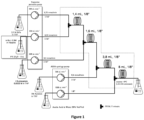
- Figure 1:
- set-up for production of pentenoate (1) with R1 = tert. butyl and R2 = R3 = R4 =H including flow rates of the pumps as well as the inner diameter of the tubes.
- The invention is exemplified in the following Examples.
- In a continuous stirred tank reactor are placed 14g glycerol, 40g KHSO4 and 8g K2SO4. The mixture is heated up to 200-230°C. Then, during continuous operation, glycerol is added over 90 min at a rate of 380µL/min. During the addition of glycerol, acrolein and water were distilled off at a constant rate of 390µl/min such has to keep the volume within the stirred tank reactor constant with 1 ml. During 90 min 35.1 ml were distilled. The distillate consisted of water and acrolein.
- In a continuous stirred tank reactor are placed 28g glycerol, 80g KHSO4 and 16g K2SO4. The mixture is heated up to 200-230°C. Then, during continuous operation, glycerol is added over 300 min at a rate of 1600µL/min. During the addition of glycerol, acrolein and water were distilled off at a constant rate of 1230 µl/min. During 300 min 365 ml were distilled. The distillate consisted of water and acrolein.
- In a set-up as depicted in
Fig 1 the indicated process flows of the indicated compositions are reacted to form compound (1). with R1 = tert. butyl and R2 = R3 = R4 =H. in a crude yield (based on tert-butylacetate) of 82% and a purity (determined by 1 H-NMR, pyridine as internal standard) of 86%, indicating a yield of pure product of 71% .
Claims (6)
- A process for preparing a compound of formula (1)
 a) contacting a compound of formula (2)
 wherein R1 and R2 are as above and M+ is a monovalent metal ion, with a compound of formula (3)
 wherein R3 and R4 are as above, to form a compound of formula (4)
 b) followed by contacting the compound of formula (4) with an acid to give a compound of formula (1),wherein step (a) and/or step (b) are conducted in continuous mode.
 - Process according to claim 1, wherein the compound of formula (2) is formed by the step of (c) contacting a compound of formula (5)

- Process according to claim 2, wherein step (c) is conducted in continuous mode.
- Process according to any one of the preceding claims, wherein the compound of formula (3) is formed by the step of:
(d) dehydration of a compound of formula (6)
- Process according to claim 4, wherein step (d) is conducted in continuous mode.
- A process for preparing the compound of formula (3)
 wherein R3 and R4 are independently chosen from C1-C6 alkyl, cycloalkyl, aralkyl and aryl; andwherein the process comprises the step of:(a) dehydration of a compound of formula (6)
 in the presence of an acid catalyst, wherein the acidic catalyst is selected from the group consisting of sulfuric acid, phosphoric acid, potassium bisulfate/potassium sulfate mixture, hydrogen chloride, p-toluene sulfonic acid (pTsOH) and methane sulfonic acid,; andwherein step (a) is conducted in continuous mode.
Applications Claiming Priority (2)
| Application Number | Priority Date | Filing Date | Title |
|---|---|---|---|
| EP17155927.1A EP3360857A1 (en) | 2017-02-13 | 2017-02-13 | Process for preparing pentenoate |
| PCT/EP2018/053434 WO2018146306A1 (en) | 2017-02-13 | 2018-02-12 | Process for preparing pentenoate |
Publications (3)
| Publication Number | Publication Date |
|---|---|
| EP3580196A1 EP3580196A1 (en) | 2019-12-18 |
| EP3580196C0 EP3580196C0 (en) | 2023-10-25 |
| EP3580196B1 true EP3580196B1 (en) | 2023-10-25 |
Family
ID=58043928
Family Applications (2)
| Application Number | Title | Priority Date | Filing Date |
|---|---|---|---|
| EP17155927.1A Ceased EP3360857A1 (en) | 2017-02-13 | 2017-02-13 | Process for preparing pentenoate |
| EP18703605.8A Active EP3580196B1 (en) | 2017-02-13 | 2018-02-12 | Process for preparing pentenoate |
Family Applications Before (1)
| Application Number | Title | Priority Date | Filing Date |
|---|---|---|---|
| EP17155927.1A Ceased EP3360857A1 (en) | 2017-02-13 | 2017-02-13 | Process for preparing pentenoate |
Country Status (8)
| Country | Link |
|---|---|
| US (1) | US10843999B2 (en) |
| EP (2) | EP3360857A1 (en) |
| JP (1) | JP7065119B2 (en) |
| CN (1) | CN110573488B (en) |
| ES (1) | ES2965241T3 (en) |
| IL (1) | IL268566B (en) |
| TW (1) | TWI799408B (en) |
| WO (1) | WO2018146306A1 (en) |
Citations (1)
| Publication number | Priority date | Publication date | Assignee | Title |
|---|---|---|---|---|
| US20110319667A1 (en) * | 2009-02-12 | 2011-12-29 | Takeyuki Kondo | Reaction process utilizing critical |
Family Cites Families (8)
| Publication number | Priority date | Publication date | Assignee | Title |
|---|---|---|---|---|
| CA1148155A (en) * | 1980-01-21 | 1983-06-14 | Alexander F. Orr | Tetrahydrofuran derivatives, a process for their preparation, herbicidal compositions containing them and a method of controlling undesired plant growth using them |
| JP2005304368A (en) * | 2004-04-21 | 2005-11-04 | Toyo Kasei Kogyo Co Ltd | Method for producing optically active 4-(n-protected amino)-1-alken-3-ol and method for producing 3-benzamide-2-hydroxycarboxylic acid or its salt using the same |
| US9273257B2 (en) * | 2009-06-05 | 2016-03-01 | Tara C. Mancini | Process for continuous production of biodiesel from fatty acid containing feedstocks |
| GB2474687A (en) * | 2009-10-23 | 2011-04-27 | Phoenix Chemicals Ltd | A continuous process for the production of (R)-6-cyano-5-hydroxy-3-oxo-hexanoic acid tert-butyl ester (and derivatives) |
| CN103228638B (en) * | 2010-08-19 | 2016-01-20 | 尹斯特有限公司 | Conversion of 5-(Chloromethyl)-2-furylcarbaldehyde to 5-methyl-2-furoic acid and its derivatives |
| FR2966456B1 (en) * | 2010-10-26 | 2013-03-15 | Adisseo France Sas | PROCESS FOR OBTAINING ACROLEIN BY CATALYTIC DEHYDRATION OF GLYCEROL OR GLYCERIN |
| FR2989684B1 (en) * | 2012-04-18 | 2014-10-31 | Arkema France | PROCESS FOR PRODUCING ACROLEIN AND / OR ACRYLIC ACID FROM GLYCEROL |
| CN104529842A (en) * | 2014-12-22 | 2015-04-22 | 泰州施美康多肽药物技术有限公司 | Intermediate of depsipeptide type histone deacetylase inhibitors and preparation method of intermediate |
-
2017
- 2017-02-13 EP EP17155927.1A patent/EP3360857A1/en not_active Ceased
-
2018
- 2018-02-12 ES ES18703605T patent/ES2965241T3/en active Active
- 2018-02-12 US US16/484,364 patent/US10843999B2/en active Active
- 2018-02-12 WO PCT/EP2018/053434 patent/WO2018146306A1/en not_active Ceased
- 2018-02-12 EP EP18703605.8A patent/EP3580196B1/en active Active
- 2018-02-12 JP JP2019565054A patent/JP7065119B2/en active Active
- 2018-02-12 CN CN201880013763.6A patent/CN110573488B/en active Active
- 2018-02-13 TW TW107105373A patent/TWI799408B/en active
-
2019
- 2019-08-07 IL IL268566A patent/IL268566B/en unknown
Patent Citations (1)
| Publication number | Priority date | Publication date | Assignee | Title |
|---|---|---|---|---|
| US20110319667A1 (en) * | 2009-02-12 | 2011-12-29 | Takeyuki Kondo | Reaction process utilizing critical |
Non-Patent Citations (1)
| Title |
|---|
| PAQUETTE L A ED - PAQUETTE ET AL: "Encyclopedia of Reagents for Organic Synthesis, L- M", ENCYCLOPEDIA OF REAGENTS FOR ORGANIC SYNTHESIS, JOHN WILEY & SONS, LTD, GB, vol. 5, 1 January 1995 (1995-01-01), pages 3096 - 3104, XP002175516, ISBN: 978-0-471-93623-7 * |
Also Published As
| Publication number | Publication date |
|---|---|
| TW201840519A (en) | 2018-11-16 |
| WO2018146306A1 (en) | 2018-08-16 |
| JP2020508346A (en) | 2020-03-19 |
| US20200002263A1 (en) | 2020-01-02 |
| US10843999B2 (en) | 2020-11-24 |
| EP3580196A1 (en) | 2019-12-18 |
| EP3580196C0 (en) | 2023-10-25 |
| IL268566A (en) | 2019-09-26 |
| EP3360857A1 (en) | 2018-08-15 |
| CN110573488B (en) | 2022-11-04 |
| TWI799408B (en) | 2023-04-21 |
| CN110573488A (en) | 2019-12-13 |
| IL268566B (en) | 2021-10-31 |
| ES2965241T3 (en) | 2024-04-11 |
| JP7065119B2 (en) | 2022-05-11 |
Similar Documents
| Publication | Publication Date | Title |
|---|---|---|
| Nagaki et al. | Generation and reaction of cyano-substituted aryllithium compounds using microreactors | |
| JP5860039B2 (en) | Process for the preparation of tetrahydropyranol substituted at the 2-position | |
| Lehmann | A scalable and safe continuous flow procedure for in-line generation of diazomethane and its precursor MNU | |
| Qian et al. | A mild and efficient procedure for asymmetric Michael additions of cyclohexanone to chalcones catalyzed by an amino acid ionic liquid | |
| Thirupathi et al. | Fe (ClO4) 3·× H2O-Catalyzed direct C–C bond forming reactions between secondary benzylic alcohols with different types of nucleophiles | |
| JP6383975B2 (en) | Method for producing cyclopropane derivative | |
| CN113015714B (en) | Continuous Flow Synthesis of Cannabidiol | |
| Yadav et al. | InBr 3–[bmim] PF 6: a novel and recyclable catalytic system for the synthesis of 1, 3-dioxane derivatives | |
| Kothandaraman et al. | Gold-and silver-catalyzed allylic alkylation of 1, 3-dicarbonyl compounds with allylic alcohols | |
| CN102361847B (en) | Method for producing aliphatic carboxylic acids from aldehydes by microreaction technology | |
| US9085526B2 (en) | Process for preparing carboxylic acid esters | |
| Rafiee et al. | Cs2. 5H0. 5PW12O40 catalyzed diastereoselective synthesis of β-amino ketones via three component Mannich-type reaction in water | |
| CN113582820A (en) | Synthesis method of m-hydroxyanisole | |
| Liu et al. | Continuous alkylation of 1, 3, 5-trihydroxy-2, 4, 6-trinitrobenzene in microreactor: Process intensification and reaction kinetics | |
| EP3360857A1 (en) | Process for preparing pentenoate | |
| Mohanta et al. | A continuous-flow approach for the multi-gram scale synthesis of C2-alkyl-or β-amino functionalized 1, 3-dicarbonyl derivatives and ondansetron drug using 1, 3-dicarbonyls | |
| Hao et al. | Recyclable hafnium (IV) bis (perfluorooctanesulfonyl) amide complex for catalytic Friedel–Crafts acylation and Prins reaction in fluorous biphase system | |
| KR20260004565A (en) | Method for synthesizing oxetane compound by microreactor | |
| JP3069925B2 (en) | Method for producing cycloalkanone | |
| JP4887699B2 (en) | Process for producing 4- (methylthio) butane-1,2-diol | |
| JP2012056852A (en) | Method and apparatus for producing claisen rearrangement compound using micro-space reaction field | |
| TW201808871A (en) | Method for producing acetal compound | |
| Dawane et al. | Bleaching Earth Catalyzed Synthesis of Bis (Indolyl) Methane’s Derivatives in (Polyethylene Glycol) PEG-400. | |
| JPS61126077A (en) | Production of 2-(4-isobutylphenyl)-1,2-epoxypropane | |
| JP2008074756A (en) | Method for producing 3,9-bis (2-chloroethyl) -2,4,8,10-tetraoxaspiro [5.5] undecane |
Legal Events
| Date | Code | Title | Description |
|---|---|---|---|
| STAA | Information on the status of an ep patent application or granted ep patent |
Free format text: STATUS: UNKNOWN |
|
| STAA | Information on the status of an ep patent application or granted ep patent |
Free format text: STATUS: THE INTERNATIONAL PUBLICATION HAS BEEN MADE |
|
| PUAI | Public reference made under article 153(3) epc to a published international application that has entered the european phase |
Free format text: ORIGINAL CODE: 0009012 |
|
| STAA | Information on the status of an ep patent application or granted ep patent |
Free format text: STATUS: REQUEST FOR EXAMINATION WAS MADE |
|
| 17P | Request for examination filed |
Effective date: 20190822 |
|
| AK | Designated contracting states |
Kind code of ref document: A1 Designated state(s): AL AT BE BG CH CY CZ DE DK EE ES FI FR GB GR HR HU IE IS IT LI LT LU LV MC MK MT NL NO PL PT RO RS SE SI SK SM TR |
|
| AX | Request for extension of the european patent |
Extension state: BA ME |
|
| DAV | Request for validation of the european patent (deleted) | ||
| DAX | Request for extension of the european patent (deleted) | ||
| STAA | Information on the status of an ep patent application or granted ep patent |
Free format text: STATUS: EXAMINATION IS IN PROGRESS |
|
| 17Q | First examination report despatched |
Effective date: 20201001 |
|
| GRAP | Despatch of communication of intention to grant a patent |
Free format text: ORIGINAL CODE: EPIDOSNIGR1 |
|
| STAA | Information on the status of an ep patent application or granted ep patent |
Free format text: STATUS: GRANT OF PATENT IS INTENDED |
|
| INTG | Intention to grant announced |
Effective date: 20230516 |
|
| GRAS | Grant fee paid |
Free format text: ORIGINAL CODE: EPIDOSNIGR3 |
|
| GRAA | (expected) grant |
Free format text: ORIGINAL CODE: 0009210 |
|
| STAA | Information on the status of an ep patent application or granted ep patent |
Free format text: STATUS: THE PATENT HAS BEEN GRANTED |
|
| AK | Designated contracting states |
Kind code of ref document: B1 Designated state(s): AL AT BE BG CH CY CZ DE DK EE ES FI FR GB GR HR HU IE IS IT LI LT LU LV MC MK MT NL NO PL PT RO RS SE SI SK SM TR |
|
| REG | Reference to a national code |
Ref country code: GB Ref legal event code: FG4D |
|
| REG | Reference to a national code |
Ref country code: CH Ref legal event code: EP |
|
| REG | Reference to a national code |
Ref country code: DE Ref legal event code: R096 Ref document number: 602018059887 Country of ref document: DE |
|
| REG | Reference to a national code |
Ref country code: IE Ref legal event code: FG4D |
|
| U01 | Request for unitary effect filed |
Effective date: 20231031 |
|
| U07 | Unitary effect registered |
Designated state(s): AT BE BG DE DK EE FI FR IT LT LU LV MT NL PT SE SI Effective date: 20231106 |
|
| U20 | Renewal fee for the european patent with unitary effect paid |
Year of fee payment: 7 Effective date: 20240214 |
|
| PG25 | Lapsed in a contracting state [announced via postgrant information from national office to epo] |
Ref country code: GR Free format text: LAPSE BECAUSE OF FAILURE TO SUBMIT A TRANSLATION OF THE DESCRIPTION OR TO PAY THE FEE WITHIN THE PRESCRIBED TIME-LIMIT Effective date: 20240126 |
|
| PG25 | Lapsed in a contracting state [announced via postgrant information from national office to epo] |
Ref country code: IS Free format text: LAPSE BECAUSE OF FAILURE TO SUBMIT A TRANSLATION OF THE DESCRIPTION OR TO PAY THE FEE WITHIN THE PRESCRIBED TIME-LIMIT Effective date: 20240225 |
|
| REG | Reference to a national code |
Ref country code: ES Ref legal event code: FG2A Ref document number: 2965241 Country of ref document: ES Kind code of ref document: T3 Effective date: 20240411 |
|
| PG25 | Lapsed in a contracting state [announced via postgrant information from national office to epo] |
Ref country code: IS Free format text: LAPSE BECAUSE OF FAILURE TO SUBMIT A TRANSLATION OF THE DESCRIPTION OR TO PAY THE FEE WITHIN THE PRESCRIBED TIME-LIMIT Effective date: 20240225 Ref country code: GR Free format text: LAPSE BECAUSE OF FAILURE TO SUBMIT A TRANSLATION OF THE DESCRIPTION OR TO PAY THE FEE WITHIN THE PRESCRIBED TIME-LIMIT Effective date: 20240126 |
|
| PG25 | Lapsed in a contracting state [announced via postgrant information from national office to epo] |
Ref country code: RS Free format text: LAPSE BECAUSE OF FAILURE TO SUBMIT A TRANSLATION OF THE DESCRIPTION OR TO PAY THE FEE WITHIN THE PRESCRIBED TIME-LIMIT Effective date: 20231025 Ref country code: PL Free format text: LAPSE BECAUSE OF FAILURE TO SUBMIT A TRANSLATION OF THE DESCRIPTION OR TO PAY THE FEE WITHIN THE PRESCRIBED TIME-LIMIT Effective date: 20231025 Ref country code: NO Free format text: LAPSE BECAUSE OF FAILURE TO SUBMIT A TRANSLATION OF THE DESCRIPTION OR TO PAY THE FEE WITHIN THE PRESCRIBED TIME-LIMIT Effective date: 20240125 Ref country code: HR Free format text: LAPSE BECAUSE OF FAILURE TO SUBMIT A TRANSLATION OF THE DESCRIPTION OR TO PAY THE FEE WITHIN THE PRESCRIBED TIME-LIMIT Effective date: 20231025 |
|
| PG25 | Lapsed in a contracting state [announced via postgrant information from national office to epo] |
Ref country code: CZ Free format text: LAPSE BECAUSE OF FAILURE TO SUBMIT A TRANSLATION OF THE DESCRIPTION OR TO PAY THE FEE WITHIN THE PRESCRIBED TIME-LIMIT Effective date: 20231025 |
|
| REG | Reference to a national code |
Ref country code: DE Ref legal event code: R097 Ref document number: 602018059887 Country of ref document: DE |
|
| PG25 | Lapsed in a contracting state [announced via postgrant information from national office to epo] |
Ref country code: SK Free format text: LAPSE BECAUSE OF FAILURE TO SUBMIT A TRANSLATION OF THE DESCRIPTION OR TO PAY THE FEE WITHIN THE PRESCRIBED TIME-LIMIT Effective date: 20231025 |
|
| PG25 | Lapsed in a contracting state [announced via postgrant information from national office to epo] |
Ref country code: SM Free format text: LAPSE BECAUSE OF FAILURE TO SUBMIT A TRANSLATION OF THE DESCRIPTION OR TO PAY THE FEE WITHIN THE PRESCRIBED TIME-LIMIT Effective date: 20231025 Ref country code: SK Free format text: LAPSE BECAUSE OF FAILURE TO SUBMIT A TRANSLATION OF THE DESCRIPTION OR TO PAY THE FEE WITHIN THE PRESCRIBED TIME-LIMIT Effective date: 20231025 Ref country code: RO Free format text: LAPSE BECAUSE OF FAILURE TO SUBMIT A TRANSLATION OF THE DESCRIPTION OR TO PAY THE FEE WITHIN THE PRESCRIBED TIME-LIMIT Effective date: 20231025 Ref country code: CZ Free format text: LAPSE BECAUSE OF FAILURE TO SUBMIT A TRANSLATION OF THE DESCRIPTION OR TO PAY THE FEE WITHIN THE PRESCRIBED TIME-LIMIT Effective date: 20231025 |
|
| PLBE | No opposition filed within time limit |
Free format text: ORIGINAL CODE: 0009261 |
|
| STAA | Information on the status of an ep patent application or granted ep patent |
Free format text: STATUS: NO OPPOSITION FILED WITHIN TIME LIMIT |
|
| PG25 | Lapsed in a contracting state [announced via postgrant information from national office to epo] |
Ref country code: MC Free format text: LAPSE BECAUSE OF FAILURE TO SUBMIT A TRANSLATION OF THE DESCRIPTION OR TO PAY THE FEE WITHIN THE PRESCRIBED TIME-LIMIT Effective date: 20231025 |
|
| 26N | No opposition filed |
Effective date: 20240726 |
|
| U20 | Renewal fee for the european patent with unitary effect paid |
Year of fee payment: 8 Effective date: 20250217 |
|
| PG25 | Lapsed in a contracting state [announced via postgrant information from national office to epo] |
Ref country code: CY Free format text: LAPSE BECAUSE OF FAILURE TO SUBMIT A TRANSLATION OF THE DESCRIPTION OR TO PAY THE FEE WITHIN THE PRESCRIBED TIME-LIMIT; INVALID AB INITIO Effective date: 20180212 |
|
| PG25 | Lapsed in a contracting state [announced via postgrant information from national office to epo] |
Ref country code: HU Free format text: LAPSE BECAUSE OF FAILURE TO SUBMIT A TRANSLATION OF THE DESCRIPTION OR TO PAY THE FEE WITHIN THE PRESCRIBED TIME-LIMIT; INVALID AB INITIO Effective date: 20180212 |
|
| PG25 | Lapsed in a contracting state [announced via postgrant information from national office to epo] |
Ref country code: TR Free format text: LAPSE BECAUSE OF FAILURE TO SUBMIT A TRANSLATION OF THE DESCRIPTION OR TO PAY THE FEE WITHIN THE PRESCRIBED TIME-LIMIT Effective date: 20231025 |
|
| REG | Reference to a national code |
Ref country code: CH Ref legal event code: U11 Free format text: ST27 STATUS EVENT CODE: U-0-0-U10-U11 (AS PROVIDED BY THE NATIONAL OFFICE) Effective date: 20260301 |
|
| U20 | Renewal fee for the european patent with unitary effect paid |
Year of fee payment: 9 Effective date: 20260211 |
|
| PGFP | Annual fee paid to national office [announced via postgrant information from national office to epo] |
Ref country code: GB Payment date: 20260210 Year of fee payment: 9 |
|
| PGFP | Annual fee paid to national office [announced via postgrant information from national office to epo] |
Ref country code: ES Payment date: 20260312 Year of fee payment: 9 |
|
| PGFP | Annual fee paid to national office [announced via postgrant information from national office to epo] |
Ref country code: IE Payment date: 20260204 Year of fee payment: 9 |
|
| PGFP | Annual fee paid to national office [announced via postgrant information from national office to epo] |
Ref country code: CH Payment date: 20260301 Year of fee payment: 9 |