EP3570513A1 - Internet of things structure with a 3d adaption matrix - Google Patents
Internet of things structure with a 3d adaption matrix Download PDFInfo
- Publication number
- EP3570513A1 EP3570513A1 EP18172675.3A EP18172675A EP3570513A1 EP 3570513 A1 EP3570513 A1 EP 3570513A1 EP 18172675 A EP18172675 A EP 18172675A EP 3570513 A1 EP3570513 A1 EP 3570513A1
- Authority
- EP
- European Patent Office
- Prior art keywords
- iot
- layer
- adaption
- data structure
- rules
- Prior art date
- Legal status (The legal status is an assumption and is not a legal conclusion. Google has not performed a legal analysis and makes no representation as to the accuracy of the status listed.)
- Granted
Links
Images
Classifications
-
- H—ELECTRICITY
- H04—ELECTRIC COMMUNICATION TECHNIQUE
- H04L—TRANSMISSION OF DIGITAL INFORMATION, e.g. TELEGRAPHIC COMMUNICATION
- H04L67/00—Network arrangements or protocols for supporting network services or applications
- H04L67/01—Protocols
- H04L67/10—Protocols in which an application is distributed across nodes in the network
-
- H—ELECTRICITY
- H04—ELECTRIC COMMUNICATION TECHNIQUE
- H04L—TRANSMISSION OF DIGITAL INFORMATION, e.g. TELEGRAPHIC COMMUNICATION
- H04L41/00—Arrangements for maintenance, administration or management of data switching networks, e.g. of packet switching networks
- H04L41/08—Configuration management of networks or network elements
- H04L41/0803—Configuration setting
- H04L41/0813—Configuration setting characterised by the conditions triggering a change of settings
- H04L41/0816—Configuration setting characterised by the conditions triggering a change of settings the condition being an adaptation, e.g. in response to network events
-
- G—PHYSICS
- G06—COMPUTING OR CALCULATING; COUNTING
- G06F—ELECTRIC DIGITAL DATA PROCESSING
- G06F9/00—Arrangements for program control, e.g. control units
- G06F9/06—Arrangements for program control, e.g. control units using stored programs, i.e. using an internal store of processing equipment to receive or retain programs
- G06F9/46—Multiprogramming arrangements
- G06F9/54—Interprogram communication
- G06F9/547—Remote procedure calls [RPC]; Web services
-
- H—ELECTRICITY
- H04—ELECTRIC COMMUNICATION TECHNIQUE
- H04L—TRANSMISSION OF DIGITAL INFORMATION, e.g. TELEGRAPHIC COMMUNICATION
- H04L41/00—Arrangements for maintenance, administration or management of data switching networks, e.g. of packet switching networks
- H04L41/08—Configuration management of networks or network elements
- H04L41/0803—Configuration setting
- H04L41/0823—Configuration setting characterised by the purposes of a change of settings, e.g. optimising configuration for enhancing reliability
-
- H—ELECTRICITY
- H04—ELECTRIC COMMUNICATION TECHNIQUE
- H04L—TRANSMISSION OF DIGITAL INFORMATION, e.g. TELEGRAPHIC COMMUNICATION
- H04L67/00—Network arrangements or protocols for supporting network services or applications
- H04L67/01—Protocols
- H04L67/12—Protocols specially adapted for proprietary or special-purpose networking environments, e.g. medical networks, sensor networks, networks in vehicles or remote metering networks
-
- H—ELECTRICITY
- H04—ELECTRIC COMMUNICATION TECHNIQUE
- H04L—TRANSMISSION OF DIGITAL INFORMATION, e.g. TELEGRAPHIC COMMUNICATION
- H04L69/00—Network arrangements, protocols or services independent of the application payload and not provided for in the other groups of this subclass
- H04L69/30—Definitions, standards or architectural aspects of layered protocol stacks
- H04L69/32—Architecture of open systems interconnection [OSI] 7-layer type protocol stacks, e.g. the interfaces between the data link level and the physical level
- H04L69/321—Interlayer communication protocols or service data unit [SDU] definitions; Interfaces between layers
-
- H—ELECTRICITY
- H04—ELECTRIC COMMUNICATION TECHNIQUE
- H04L—TRANSMISSION OF DIGITAL INFORMATION, e.g. TELEGRAPHIC COMMUNICATION
- H04L67/00—Network arrangements or protocols for supporting network services or applications
- H04L67/01—Protocols
- H04L67/10—Protocols in which an application is distributed across nodes in the network
- H04L67/104—Peer-to-peer [P2P] networks
-
- H—ELECTRICITY
- H04—ELECTRIC COMMUNICATION TECHNIQUE
- H04L—TRANSMISSION OF DIGITAL INFORMATION, e.g. TELEGRAPHIC COMMUNICATION
- H04L67/00—Network arrangements or protocols for supporting network services or applications
- H04L67/50—Network services
- H04L67/56—Provisioning of proxy services
- H04L67/565—Conversion or adaptation of application format or content
-
- H—ELECTRICITY
- H04—ELECTRIC COMMUNICATION TECHNIQUE
- H04L—TRANSMISSION OF DIGITAL INFORMATION, e.g. TELEGRAPHIC COMMUNICATION
- H04L67/00—Network arrangements or protocols for supporting network services or applications
- H04L67/50—Network services
- H04L67/56—Provisioning of proxy services
- H04L67/565—Conversion or adaptation of application format or content
- H04L67/5651—Reducing the amount or size of exchanged application data
Definitions
- the present invention relates to an Internet of Things (IoT) structure comprising application layers with a 3D Adaption Matrix, a server for an IoT structure, a device for an IoT application and a method for manipulating dependencies between the application layers.
- IoT Internet of Things
- the so called Internet of Things is a network of physical devices, vehicles, home appliances and other items (things) embedded with electronics, software, sensors, actuators, and connectivity which enable these things to connect and exchange data. Each thing is uniquely identifiable through its embedded computing system but is able to interoperate within the existing internet infrastructure.
- the IoT allows things to be sensed or controlled remotely across existing network infrastructure, creating opportunities for more direct integration of the physical world into computerbased systems, and resulting in improved efficiency, accuracy and economic benefit in addition to reduced human intervention.
- the term “things” can be understood as an "inextricable mixture of hardware, software, data and service”. These things collect useful data with the help of various existing technologies and then autonomously flow the data between other things.
- things thus can refer to a wide variety of devices such as heart monitoring implants, biochip transponders on farm animals, cameras streaming live feeds of wild animals in coastal waters, automobiles with built-in sensors, DNA analysis devices for environmental/food/pathogen monitoring, or field operation devices that assist firefighters in search and rescue operations.
- the ability to network embedded devices with limited CPU, memory and power resources means that IoT finds applications in nearly every field. Such systems could be in charge of collecting information in settings ranging from natural ecosystems to buildings and factories, thereby finding applications in fields of environmental sensing and urban planning.
- the IoT has an event-driven architecture, is bottom-up made (based on the context of processes and operations, in real-time) and considers any subsidiary level.
- the meaning of an event is not necessarily based on a deterministic or syntactic model but instead on the context of the event itself: this is also a semantic web. Consequently, it does not necessarily need common standards that would not be able to address every context or use: some actors (services, components, and avatars) will accordingly be self-referenced and, if ever needed, adaptive to existing common standards.
- the web of things is an architecture for the application layer of the IoT looking at the convergence of data from IoT devices into Web applications to create innovative use-cases.
- BPM Everywhere is a blending of traditional process management with process mining and special capabilities to automate the control of large numbers of coordinated devices.
- the IoT requires huge scalability in the network space to handle the surge of devices.
- IETF 6LoWPAN can be used to connect devices to IP networks. With billions of devices being added to the Internet space, IPv6 plays a major role in handling the network layer scalability.
- IETF's Constrained Application Protocol, ZeroMQ, and MQTT provide lightweight data transport. Fog computing is a viable alternative to prevent such large burst of data flow through Internet.
- IoT frameworks might help support the interaction between things and allow for more complex structures like distributed computing and the development of distributed applications. Some IoT frameworks focus on real-time data logging solutions, offering some basis to work with many things and have them interact.
- REpresentational State Transfer is a scalable architecture that allows things to communicate over Hypertext Transfer Protocol (HTTP) and is easily adopted for IoT applications to provide communication from a thing to a central web server.
- HTTP Hypertext Transfer Protocol
- REST is an architectural style that defines a set of constraints and properties based on HTTP.
- Web Services that conform to the REST architectural style, or RESTful web services, provide interoperability between computer systems on the Internet.
- REST-compliant web services allow the requesting systems to access and manipulate textual representations of web resources by using a uniform and predefined set of stateless operations. "Web resources" were first defined on the World Wide Web as documents or files identified by their URLs.
- requests made to a resource's URI will elicit a response that may be in XML, HTML, JSON, or some other format.
- the response may confirm that some alteration has been made to the stored resource, and the response may provide hypertext links to other related resources or collections of resources.
- HTTP HyperText Transfer Protocol
- the operations available are GET, POST, PUT, DELETE, and other predefined CRUD HTTP methods.
- REST systems aim for fast performance, reliability, and the ability to grow, by re-using components that can be managed and updated without affecting the system as a whole, even while it is running.
- REST "well-designed" Web applications behave such that it is a network of Web resources (a virtual state-machine) where the user progresses through the application by selecting links (e.g. /user/tom) and operations (e.g. GET or DELETE), so called state transitions, resulting in the next resource (representing the next state of the application) being transferred to the user for their use.
- links e.g. /user/tom
- operations e.g. GET or DELETE
- IoT structures often have the following setup:
- the gap between the storage system functionality of the IoT storage layer and the interaction mechanism of the IoT Interface layer increases.
- the layer in-between, the IoT Data Structure layer is often not capable enough to handle both a complex IoT Storage layer beneath and a simple IoT Interface layer above itself. This leads either to inferior exploitation of the storage system functionalities or to unwanted complex interaction mechanisms. For example, if a standard SQL database is used as data storage and the interface is chosen to be REST compliant the user either must have extensive knowledge of constructing SQL queries, or would only use a minimal proportion of the querying possibilities of the system.
- the present invention has the objective to solve or at least alleviate the above problems with the Internet of Things structure according to independent claim 1 and the method according to the further independent claim. Further refinements of the present invention are subject of the dependent claims.
- an Internet of Things (IoT) structure comprises application layers.
- the IoT structure further comprises a 3D Adaption Matrix including adaption rules.
- the adaption rules are specified once.
- the adaption rules enable specifying dependencies between the application layers.
- the IoT further comprises a module.
- the module is configured to employ the adaption rules for an IoT application.
- a server for an IoT structure as described above comprises a memory.
- the memory stores a 3D Adaption Matrix including adaption rules.
- the adaption rules are specified once.
- the adaption rules enable specifying dependencies between application layers of the IoT structure.
- the server further comprises a processing unit.
- the processing unit is configured to employ the adaption rules for an IoT application.
- a device for an IoT application of an IoT structure as described above is configured to communicate with instances of the IoT structure based on application layers of the IoT structure.
- Dependencies between the application layers are specified by adaption rules of a 3D Adaption Matrix of the IoT structure, which adaption rules are specified once and employed for the IoT application.
- a method for manipulating dependencies between application layers of an Internet of Things (IoT) structure comprises the following steps:
- the adaptation rules of the 3D Adaptation Matrix have to be specified manually once, taking into account the possible features of IoT interface types of the IoT Interface layer, data structures elements of the IoT Data Structure layer and storage types of the IoT Storage layer.
- the IoT structure according to the first aspect may be applied with the server according to the second aspect.
- the server may be a data processing equipment or a cluster of a plurality of data processing equipments.
- the server stores the 3D Adaption Matrix in its memory.
- the processing unit e.g. microprocessor
- a data processing equipment may be a Microcontroller ( ⁇ C), an integrated circuit, an Application-Specific Integrated Circuit (ASIC), an Application-Specific Standard Product (ASSP), a Digital Signal Processor (DSP), a Field Programmable Gate Array (FPGA) and the like.
- the data processing equipment may be part of the device (e.g. machine, apparatus or the like and specifically smartphone, automobile, home appliance, appliance of a smart home and the like).
- the device hosts or executes an IoT application in the IoT structure.
- the IoT structure according to the present invention provides a flexible mechanism to manipulate features of the application layers.
- the resources of the server according to the present invention and of the devices/IoT applications of the IoT structure according to the present invention are optimally utilized, because preferably all features of the application are utilized for communication between each of the IoT applications and the server. This leads to an optimized degree of capacity utilisation and reduced workload in the server and devices/IoT applications in the IoT structure.
- the application layers comprise an IoT Data Structure layer, an IoT Storage layer and an IoT Interface layer.
- the IoT Storage layer can comprise one or a multitude of different storages of the server and or IoT applications.
- the IoT Data Structure layer comprises at least one data structure (e.g. Amazon AWS IoT or SAP IoT).
- the IoT Interface layer (e.g. REST) comprises interaction mechanisms.
- the interaction mechanisms may be simple. Simple in this context means simple access technology like internet/http based techniques and simple expressivity of the interface language like attribute/value retrievals (e.g. GET, POST, PUT, PATCH, DELETE, etc.).
- the storage or memory of the server respectively, may be a data storage like a magnetic storage/memory (e.g.
- magnetic-core memory magnetic tape, magnetic card, magnet strip, magnet bubble storage, drum storage, hard disc drive, floppy disc or removable storage
- an optical storage/memory e.g. holographic memory, optical tape, Tesa tape, Laserdisc, Phasewriter (Phasewriter Dual, PD), Compact Disc (CD), Digital Video Disc (DVD), High Definition DVD (HD DVD), Blu-ray Disc (BD) or Ultra Density Optical (UDO)
- a magneto-optical storage/memory e.g. MiniDisc or Magneto-Optical Disk (MO-Disk)
- a volatile semiconductor/solid state memory e.g.
- RAM Random Access Memory
- DRAM Dynamic RAM
- SRAM Static RAM
- ROM Read Only Memory
- PROM Programmable ROM
- EPROM Erasable PROM
- EEPROM Electrically EPROM
- Flash-EEPROM Flash-EEPROM (e.g. USB-Stick), Ferroelectric RAM (FRAM), Magnetoresistive RAM (MRAM) or Phase-change RAM) or a data carrier/medium
- FRAM Ferroelectric RAM
- MRAM Magnetoresistive RAM
- Phase-change RAM Phase-change RAM
- the resources of the server according to the present invention and of the devices/IoT applications of the IoT structure according to the present invention are optimally utilized, because the storage in the IoT Storage layer and preferably all features of the interface(s) of the IoT Interface layer are utilized for communication between each of the IoT applications and the server based on the data structure of the IoT Data Structure layer.
- the module is configured to employ the adaption rules in order to automatically generate an IoT Interface layer, specifically an IoT REST Interface layer, when an IoT Data Structure layer and an IoT Storage layer are given.
- the adaption rules are employed in order to automatically generate an IoT Interface layer, specifically an IoT REST Interface layer, when an IoT Data Structure layer and an IoT Storage layer are given.
- the adaption rules can be employed to automatically generate an interface, specifically a REST interface for the IoT Interface layer.
- the IoT structure provides a flexible mechanism to link the interface properties (e.g. REST interface characteristics) of the IoT Interface layer with the data structure (e.g. class / instance distinction) of the IoT Data Structure layer and with the storage system (e.g. a relational database) of the IoT Storage layer.
- interface properties e.g. REST interface characteristics
- data structure e.g. class / instance distinction
- storage system e.g. a relational database
- a set of rules is defined that specifies the dependencies and implications between the three application layers with their specific technology setup.
- the module is configured to employ the adaption rules in order to automatically generate the IoT Interface layer fitting optimally to the IoT Data Structure layer and the IoT Storage layer.
- the adaption rules are employed in order to automatically generate the IoT Interface layer fitting optimally to the IoT Data Structure layer and the IoT Storage layer.
- the IoT application layers can be optimized automatically by employing a rule-based system or reasoning software.
- a flexible mechanism is provided to optimally link the interface properties of the IoT Interface layer with the data structure (e.g. class / instance distinction) of the IoT Data Structure layer and with the storage system (e.g. a relational database) of the IoT Storage layer.
- the data structure e.g. class / instance distinction
- the storage system e.g. a relational database
- the module is configured to employ the adaption rules in order to check data structure features of an IoT Data Structure layer by checking if all possible data structure features of the IoT Data Structure layer have been defined or are used correctly when the IoT Data Structure layer, an IoT Storage layer and an IoT Interface layer are given.
- the adaption rules are employed in order to check data structure features of an IoT Data Structure layer by checking if all possible data structure features of the IoT Data Structure layer have been defined or are used correctly when the IoT Data Structure layer, an IoT Storage layer and an IoT Interface layer are given.
- the adaptation process may be performed during design time. For example, when the data structure of the IoT Data Structure layer is defined and the storage technology of the IoT Storage layer and the interface technology of the IoT Interface layer are already known, the adaptation rules can be employed to check if all possible data structure features have been defined or are used in the right way.
- the module is configured to employ the adaption rules at a runtime of the IoT structure in order to check consistency of a new IoT Interface of the IoT application with the application layers of the IoT structure when an IoT Data Structure layer, an IoT Storage layer and the IoT Interface layer are given.
- the adaption rules are employed in order to check consistency of a new IoT Interface of the IoT application with the application layers of the IoT structure when an IoT Data Structure layer, an IoT Storage layer and the IoT Interface layer are given.
- the adaptation process may be applied at runtime. For example, when a second interface (e.g. for another customer) is deployed during runtime, the adaption rules can be used to check the consistency with the currently existing IoT structure (e.g. cloud infrastructure and currently available data structure).
- the currently existing IoT structure e.g. cloud infrastructure and currently available data structure.
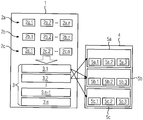
- FIG. 1 an Internet of Things (IoT) having an IoT structure according to the present invention is depicted.
- a 3D Adaption Matrix 1 is based on application layers 2 of the IoT structure.
- the IoT structure comprises an IoT Interface layer 2a with a multitude of IoT Interface types 2a.1-2a.n (e.g. REST, SQL-like, proprietary, etc.), an IoT Data Structure layer 2b with an multitude of Data Structure types 2b.1-2b.n (e.g. class/instance, attributes, etc.) and an IoT Storage layer 2c with an multitude of IoT Storage types 2c.1-2c.n (e.g. cloud storage, database, etc.).
- the 3d Adaption Matrix 1 comprises a multitude of adaption rules 3, respectively adaption rules 3.1-3.n, based on said application layers 2.
- An IoT application 4 comprises three implemented layers 5, namely an interface 5a with three distinct interfaces of a certain interface type (here: REST, SQL-like and proprietary), a data structure 5b with three distinct data structures of a certain data structure type (here: class/instance, attributes and other) and a storage 5c with three distinct storages of a certain storage type (here: cloud storage, database and other).
- a certain interface type here: REST, SQL-like and proprietary
- a data structure 5b with three distinct data structures of a certain data structure type (here: class/instance, attributes and other)
- a storage 5c with three distinct storages of a certain storage type (here: cloud storage, database and other).
- the IoT Data Structure layer 2b defines that an instance has a specific type (here: an instance "production module 27" in a plant is a "robot” type), the IoT Storage layer 2c defines that a SQL database is used.
- a resulting adaption rule 3.1 is that (because an instance is mapped to a class) the "InstanceOf" relation in the IoT structure is bound to the mapping of the two SQL tables "Types" and "Instances" (the mapping might be implemented by joining the tables or with a foreign key or other database technology means).
- Adaption rule 3.1 "structure-storage-rule 23: dataStructure:InstanceOf ⁇ storage:join tables(Types,Instances)"
- Adaption rule 3.2 "interface-structure-rule 42: HTTP-GET asset-type ⁇ dataStructure:InstanceOf(asset-type)"
- a proprietary interface 5a.3 might directly influence the retrieval of attributes in a cloud storage 5c.1.
- Adaption rule 3.1 "interface-storage-rule 23: readAttribute (X) ⁇ Cloud.getAttribute(X);"
Landscapes
- Engineering & Computer Science (AREA)
- Computer Networks & Wireless Communication (AREA)
- Signal Processing (AREA)
- Health & Medical Sciences (AREA)
- Software Systems (AREA)
- Theoretical Computer Science (AREA)
- Computer Security & Cryptography (AREA)
- Computing Systems (AREA)
- General Health & Medical Sciences (AREA)
- Medical Informatics (AREA)
- Physics & Mathematics (AREA)
- General Engineering & Computer Science (AREA)
- General Physics & Mathematics (AREA)
- Stored Programmes (AREA)
- Information Retrieval, Db Structures And Fs Structures Therefor (AREA)
Abstract
Description
- The present invention relates to an Internet of Things (IoT) structure comprising application layers with a 3D Adaption Matrix, a server for an IoT structure, a device for an IoT application and a method for manipulating dependencies between the application layers.
- The so called Internet of Things (IoT) is a network of physical devices, vehicles, home appliances and other items (things) embedded with electronics, software, sensors, actuators, and connectivity which enable these things to connect and exchange data. Each thing is uniquely identifiable through its embedded computing system but is able to interoperate within the existing internet infrastructure. The IoT allows things to be sensed or controlled remotely across existing network infrastructure, creating opportunities for more direct integration of the physical world into computerbased systems, and resulting in improved efficiency, accuracy and economic benefit in addition to reduced human intervention. The term "things" can be understood as an "inextricable mixture of hardware, software, data and service". These things collect useful data with the help of various existing technologies and then autonomously flow the data between other things. The term "things" thus can refer to a wide variety of devices such as heart monitoring implants, biochip transponders on farm animals, cameras streaming live feeds of wild animals in coastal waters, automobiles with built-in sensors, DNA analysis devices for environmental/food/pathogen monitoring, or field operation devices that assist firefighters in search and rescue operations. The ability to network embedded devices with limited CPU, memory and power resources means that IoT finds applications in nearly every field. Such systems could be in charge of collecting information in settings ranging from natural ecosystems to buildings and factories, thereby finding applications in fields of environmental sensing and urban planning.
- The IoT has an event-driven architecture, is bottom-up made (based on the context of processes and operations, in real-time) and considers any subsidiary level. In the IoT, the meaning of an event is not necessarily based on a deterministic or syntactic model but instead on the context of the event itself: this is also a semantic web. Consequently, it does not necessarily need common standards that would not be able to address every context or use: some actors (services, components, and avatars) will accordingly be self-referenced and, if ever needed, adaptive to existing common standards. Building on top of the IoT, the web of things is an architecture for the application layer of the IoT looking at the convergence of data from IoT devices into Web applications to create innovative use-cases. In order to program and control the flow of information in the IoT, a predicted architectural direction is being called BPM Everywhere which is a blending of traditional process management with process mining and special capabilities to automate the control of large numbers of coordinated devices. The IoT requires huge scalability in the network space to handle the surge of devices. For example IETF 6LoWPAN can be used to connect devices to IP networks. With billions of devices being added to the Internet space, IPv6 plays a major role in handling the network layer scalability. IETF's Constrained Application Protocol, ZeroMQ, and MQTT provide lightweight data transport. Fog computing is a viable alternative to prevent such large burst of data flow through Internet. The edge devices' computation power can be used to analyse and process data, thus providing easy real time scalability. IoT frameworks might help support the interaction between things and allow for more complex structures like distributed computing and the development of distributed applications. Some IoT frameworks focus on real-time data logging solutions, offering some basis to work with many things and have them interact.
- REpresentational State Transfer (REST) is a scalable architecture that allows things to communicate over Hypertext Transfer Protocol (HTTP) and is easily adopted for IoT applications to provide communication from a thing to a central web server. REST is an architectural style that defines a set of constraints and properties based on HTTP. Web Services that conform to the REST architectural style, or RESTful web services, provide interoperability between computer systems on the Internet. REST-compliant web services allow the requesting systems to access and manipulate textual representations of web resources by using a uniform and predefined set of stateless operations. "Web resources" were first defined on the World Wide Web as documents or files identified by their URLs. However, today they have a much more generic and abstract definition that encompasses everything or entity that can be identified, named, addressed, or handled, in any way whatsoever, on the web. In a RESTful web service, requests made to a resource's URI will elicit a response that may be in XML, HTML, JSON, or some other format. The response may confirm that some alteration has been made to the stored resource, and the response may provide hypertext links to other related resources or collections of resources. When HTTP is used, as is most common, the operations available are GET, POST, PUT, DELETE, and other predefined CRUD HTTP methods. By using a stateless protocol and standard operations, REST systems aim for fast performance, reliability, and the ability to grow, by re-using components that can be managed and updated without affecting the system as a whole, even while it is running. According to REST "well-designed" Web applications behave such that it is a network of Web resources (a virtual state-machine) where the user progresses through the application by selecting links (e.g. /user/tom) and operations (e.g. GET or DELETE), so called state transitions, resulting in the next resource (representing the next state of the application) being transferred to the user for their use.
- IoT structures often have the following setup:
- A first application layer is an IoT Storage layer comprising an as fast as possible and extensible storage system such as a cloud storage or a (distributed) database system. Depending on the specific application, the data is also partially stored on the things itself, which in fact mimics the functionality of a cloud storage.
- A second application layer is an IoT Data Structure layer comprising a pre-defined structure for the data stored in the IoT storage layer described before. An example of a structural definition is a class/instance distinction (e.g. some type of thing and the instantiated things of this type, specifically an asset type (e.g. in a plant) and the specific asset instances (e.g. controllers, production units, etc.) or a definition of what sort of information attributes might hold.
- A third application layer is an IoT Interface layer comprising an interaction mechanism to get and set the data. Simple interfaces are preferred. Simple in this context means both access technology (e.g. internet/http based techniques) and expressivity of the interface language (e.g. simple attribute/value retrievals and not SQL expressivity level). An example for a widely accepted interaction mechanism is REST. In combination, these three layers provide functionality foe example for event handling, reporting, time series handling, data structure manipulation, data retrieval and filtering via an abstracted access medium (e.g. internet or superimposed VPN) .
- With increasing complexity of IoT applications the gap between the storage system functionality of the IoT storage layer and the interaction mechanism of the IoT Interface layer increases. The layer in-between, the IoT Data Structure layer, is often not capable enough to handle both a complex IoT Storage layer beneath and a simple IoT Interface layer above itself. This leads either to inferior exploitation of the storage system functionalities or to unwanted complex interaction mechanisms. For example, if a standard SQL database is used as data storage and the interface is chosen to be REST compliant the user either must have extensive knowledge of constructing SQL queries, or would only use a minimal proportion of the querying possibilities of the system. Also with an IoT data structure sitting between the REST interface and the SQL database this problem is not solved, because the IoT Data Structure layer defines the existence of classes and instances, of what information attributes are made of, etc. but at the moment the user interacts with the IoT via the REST interface only a certain subset of the functionalities of both the chosen data structure and the installed storage system can be used.
- Common IoT systems based on data structure definitions for example proposed by Amazon (AWS IoT) or SAP (SAP IoT) or Bosch (Bosch Hono) tend to adapt the IoT Data Structure layer to mostly simple interaction interfaces. As described above the access to the data structure and storage layer thereby suffers from sub-optimal exploitation. In contrast, the creation of more complex data models, which would be better to exploit the capabilities of the storage systems, imposing more complex interaction interfaces is not chosen very often due to the inherent complexity.
- But there is no generic approach to flexibly define and interlink the IoT Interface layer, IoT Data Structure layer and IoT Storage layer.
- The present invention has the objective to solve or at least alleviate the above problems with the Internet of Things structure according to
independent claim 1 and the method according to the further independent claim. Further refinements of the present invention are subject of the dependent claims. - According to a first aspect of the present invention an Internet of Things (IoT) structure comprises application layers. The IoT structure further comprises a 3D Adaption Matrix including adaption rules. The adaption rules are specified once. The adaption rules enable specifying dependencies between the application layers. The IoT further comprises a module. The module is configured to employ the adaption rules for an IoT application.
- According to a second aspect of the present invention a server for an IoT structure as described above comprises a memory. The memory stores a 3D Adaption Matrix including adaption rules. The adaption rules are specified once. The adaption rules enable specifying dependencies between application layers of the IoT structure. The server further comprises a processing unit. The processing unit is configured to employ the adaption rules for an IoT application.
- According to a third aspect of the present invention a device for an IoT application of an IoT structure as described above is configured to communicate with instances of the IoT structure based on application layers of the IoT structure. Dependencies between the application layers are specified by adaption rules of a 3D Adaption Matrix of the IoT structure, which adaption rules are specified once and employed for the IoT application.
- According to a fourth aspect of the present invention a method for manipulating dependencies between application layers of an Internet of Things (IoT) structure comprises the following steps:
- Specifying adaption rules of a 3D Adaption Matrix of the IoT structure. The adaption rules enable specifying the dependencies between the application layers.
- Employing the adaption rules for an IoT application.
- The adaptation rules of the 3D Adaptation Matrix have to be specified manually once, taking into account the possible features of IoT interface types of the IoT Interface layer, data structures elements of the IoT Data Structure layer and storage types of the IoT Storage layer. The IoT structure according to the first aspect may be applied with the server according to the second aspect. The server may be a data processing equipment or a cluster of a plurality of data processing equipments. The server stores the 3D Adaption Matrix in its memory. The processing unit (e.g. microprocessor) employs the adaption rules of the 3D Adaption Matrix for IoT applications running on different data processing equipments. A data processing equipment may be a Microcontroller (µC), an integrated circuit, an Application-Specific Integrated Circuit (ASIC), an Application-Specific Standard Product (ASSP), a Digital Signal Processor (DSP), a Field Programmable Gate Array (FPGA) and the like. The data processing equipment may be part of the device (e.g. machine, apparatus or the like and specifically smartphone, automobile, home appliance, appliance of a smart home and the like). The device hosts or executes an IoT application in the IoT structure.
- The IoT structure according to the present invention provides a flexible mechanism to manipulate features of the application layers. Thus, the resources of the server according to the present invention and of the devices/IoT applications of the IoT structure according to the present invention are optimally utilized, because preferably all features of the application are utilized for communication between each of the IoT applications and the server. This leads to an optimized degree of capacity utilisation and reduced workload in the server and devices/IoT applications in the IoT structure.
- According to a further aspect of the present invention the application layers comprise an IoT Data Structure layer, an IoT Storage layer and an IoT Interface layer.
- The IoT Storage layer can comprise one or a multitude of different storages of the server and or IoT applications. The IoT Data Structure layer comprises at least one data structure (e.g. Amazon AWS IoT or SAP IoT). The IoT Interface layer (e.g. REST) comprises interaction mechanisms. The interaction mechanisms may be simple. Simple in this context means simple access technology like internet/http based techniques and simple expressivity of the interface language like attribute/value retrievals (e.g. GET, POST, PUT, PATCH, DELETE, etc.). The storage or memory of the server, respectively, may be a data storage like a magnetic storage/memory (e.g. magnetic-core memory, magnetic tape, magnetic card, magnet strip, magnet bubble storage, drum storage, hard disc drive, floppy disc or removable storage), an optical storage/memory (e.g. holographic memory, optical tape, Tesa tape, Laserdisc, Phasewriter (Phasewriter Dual, PD), Compact Disc (CD), Digital Video Disc (DVD), High Definition DVD (HD DVD), Blu-ray Disc (BD) or Ultra Density Optical (UDO)), a magneto-optical storage/memory (e.g. MiniDisc or Magneto-Optical Disk (MO-Disk)), a volatile semiconductor/solid state memory (e.g. Random Access Memory (RAM), Dynamic RAM (DRAM) or Static RAM (SRAM)), a non-volatile semiconductor/solid state memory (e.g. Read Only Memory (ROM), Programmable ROM (PROM), Erasable PROM (EPROM), Electrically EPROM (EEPROM), Flash-EEPROM (e.g. USB-Stick), Ferroelectric RAM (FRAM), Magnetoresistive RAM (MRAM) or Phase-change RAM) or a data carrier/medium
- The resources of the server according to the present invention and of the devices/IoT applications of the IoT structure according to the present invention are optimally utilized, because the storage in the IoT Storage layer and preferably all features of the interface(s) of the IoT Interface layer are utilized for communication between each of the IoT applications and the server based on the data structure of the IoT Data Structure layer.
- According to a further aspect of the present invention the module is configured to employ the adaption rules in order to automatically generate an IoT Interface layer, specifically an IoT REST Interface layer, when an IoT Data Structure layer and an IoT Storage layer are given. Alternatively, in the step of employing the adaption rules are employed in order to automatically generate an IoT Interface layer, specifically an IoT REST Interface layer, when an IoT Data Structure layer and an IoT Storage layer are given.
- When the definition of the data structure of the IoT Data structure layer has been completed and a storage technology for the IoT Storage layer was chosen the adaption rules can be employed to automatically generate an interface, specifically a REST interface for the IoT Interface layer.
- The IoT structure according to the present invention provides a flexible mechanism to link the interface properties (e.g. REST interface characteristics) of the IoT Interface layer with the data structure (e.g. class / instance distinction) of the IoT Data Structure layer and with the storage system (e.g. a relational database) of the IoT Storage layer. For each possible combination (e.g. Interface = REST, data structure defines CLASS/INSTANCE, storage = SQL-DB) a set of rules is defined that specifies the dependencies and implications between the three application layers with their specific technology setup.
- According to a further aspect of the present invention the module is configured to employ the adaption rules in order to automatically generate the IoT Interface layer fitting optimally to the IoT Data Structure layer and the IoT Storage layer. Alternatively, in the step of employing the adaption rules are employed in order to automatically generate the IoT Interface layer fitting optimally to the IoT Data Structure layer and the IoT Storage layer.
- Given a concrete IoT application, based on a specific set of adaptation rules of the 3D Adaptation Matrix, the IoT application layers can be optimized automatically by employing a rule-based system or reasoning software.
- Thus, a flexible mechanism is provided to optimally link the interface properties of the IoT Interface layer with the data structure (e.g. class / instance distinction) of the IoT Data Structure layer and with the storage system (e.g. a relational database) of the IoT Storage layer. For each possible combination (e.g. Interface = REST, data structure defines CLASS/INSTANCE, storage = SQL-DB) an set of rules is defined that optimally specifies the dependencies and implications between the three application layers with their specific technology setup.
- According to a further aspect of the present invention the module is configured to employ the adaption rules in order to check data structure features of an IoT Data Structure layer by checking if all possible data structure features of the IoT Data Structure layer have been defined or are used correctly when the IoT Data Structure layer, an IoT Storage layer and an IoT Interface layer are given. Alternatively, in the step of employing the adaption rules are employed in order to check data structure features of an IoT Data Structure layer by checking if all possible data structure features of the IoT Data Structure layer have been defined or are used correctly when the IoT Data Structure layer, an IoT Storage layer and an IoT Interface layer are given.
- The adaptation process may be performed during design time. For example, when the data structure of the IoT Data Structure layer is defined and the storage technology of the IoT Storage layer and the interface technology of the IoT Interface layer are already known, the adaptation rules can be employed to check if all possible data structure features have been defined or are used in the right way.
- According to a further aspect of the present invention the module is configured to employ the adaption rules at a runtime of the IoT structure in order to check consistency of a new IoT Interface of the IoT application with the application layers of the IoT structure when an IoT Data Structure layer, an IoT Storage layer and the IoT Interface layer are given. Alternatively, in the step of employing the adaption rules are employed in order to check consistency of a new IoT Interface of the IoT application with the application layers of the IoT structure when an IoT Data Structure layer, an IoT Storage layer and the IoT Interface layer are given.
- The adaptation process may be applied at runtime. For example, when a second interface (e.g. for another customer) is deployed during runtime, the adaption rules can be used to check the consistency with the currently existing IoT structure (e.g. cloud infrastructure and currently available data structure).
- The present invention is subsequently explained in further detail by an exemplary embodiment shown in the drawings. The exemplary embodiment only conduces better understanding of the present invention and in no case is to be construed as limiting for the scope of the present invention.
- Fig. 1
- schematically shows an Internet of Things application having an Internet of Things structure according to the present invention.
- In
Fig. 1 an Internet of Things (IoT) having an IoT structure according to the present invention is depicted. A3D Adaption Matrix 1 is based on application layers 2 of the IoT structure. The IoT structure comprises anIoT Interface layer 2a with a multitude of IoT Interface types 2a.1-2a.n (e.g. REST, SQL-like, proprietary, etc.), an IoTData Structure layer 2b with an multitude of Data Structure types 2b.1-2b.n (e.g. class/instance, attributes, etc.) and anIoT Storage layer 2c with an multitude of IoT Storage types 2c.1-2c.n (e.g. cloud storage, database, etc.). The3d Adaption Matrix 1 comprises a multitude ofadaption rules 3, respectively adaption rules 3.1-3.n, based on said application layers 2. - An
IoT application 4 comprises three implemented layers 5, namely aninterface 5a with three distinct interfaces of a certain interface type (here: REST, SQL-like and proprietary), adata structure 5b with three distinct data structures of a certain data structure type (here: class/instance, attributes and other) and astorage 5c with three distinct storages of a certain storage type (here: cloud storage, database and other). - For example, the IoT
Data Structure layer 2b defines that an instance has a specific type (here: an instance "production module 27" in a plant is a "robot" type), theIoT Storage layer 2c defines that a SQL database is used. A resulting adaption rule 3.1 is that (because an instance is mapped to a class) the "InstanceOf" relation in the IoT structure is bound to the mapping of the two SQL tables "Types" and "Instances" (the mapping might be implemented by joining the tables or with a foreign key or other database technology means). - In addition another rule could define the connection between a Class/Instance data structure and how one of the interfaces 5a.1-5a.3 would offer such a kind of data structure in one specific interface (e.g. REST).
- As another example, in a simpler constellation a proprietary interface 5a.3 might directly influence the retrieval of attributes in a cloud storage 5c.1.
- This example shows that not only neighbouring layers, but all layers might be influencing each other.
- Although specific embodiments have been illustrated and described herein, it will be appreciated by those of ordinary skill in the art that a variety of alternate and/or equivalent implementations exist. It should be appreciated that the exemplary embodiment or exemplary embodiments are only examples, and are not intended to limit the scope, applicability, or configuration in any way. Rather, the foregoing summary and detailed description will provide those skilled in the art with a convenient road map for implementing at least one exemplary embodiment, it being understood that various changes may be made in the function and arrangement of elements described in an exemplary embodiment without departing from the scope as set forth in the appended claims and their legal equivalents. Generally, this application is intended to cover any adaptations or variations of the specific embodiments discussed herein.
- In the foregoing detailed description, various features are grouped together in one or more examples or examples for the purpose of streamlining the disclosure. It is understood that the above description is intended to be illustrative, and not restrictive. It is intended to cover all alternatives, modifications and equivalents as may be included within the scope of the invention. Many other examples will be apparent to one skilled in the art upon reviewing the above specification. Specific nomenclature used in the foregoing specification is used to provide a thorough understanding of the invention. However, it will be apparent to one skilled in the art in light of the specification provided herein that the specific details are not required in order to practice the invention. Thus, the foregoing descriptions of specific embodiments of the present invention are presented for purposes of illustration and description. They are not intended to be exhaustive or to limit the invention to the precise forms disclosed; obviously many modifications and variations are possible in view of the above teachings. The embodiments were chosen and described in order to best explain the principles of the invention and its practical applications, to thereby enable others skilled in the art to best utilize the invention and various embodiments with various modifications as are suited to the particular use contemplated. Throughout the specification, the terms "including" and "in which" are used as the plain-English equivalents of the respective terms "comprising" and "wherein," respectively. Moreover, the terms "first," "second," and "third," etc., are used merely as labels, and are not intended to impose numerical requirements on or to establish a certain ranking of importance of their objects.
Claims (13)
- Internet of Things, IoT, structure, comprising application layers (2), characterized in that, the IoT structure further comprises
a 3D Adaption Matrix (8) including adaption rules (3), which adaption rules (3) are specified once and which adaption rules (3) enable specifying dependencies between the application layers (2), and
a module that is configured to employ the adaption rules (3) for an IoT application (4). - IoT structure according to claim 1 wherein the application layers (2) comprise an IoT Data Structure layer (2b), an IoT Storage layer (2c) and an IoT Interface layer (2a).
- IoT structure according to any preceding claim, wherein the module is configured to employ the adaption rules (3) in order to automatically generate an IoT Interface layer (2a), specifically an IoT REST Interface layer, when an IoT Data Structure layer (2b) and an IoT Storage layer (2c) are given.
- IoT structure according to claim 3, wherein the module is configured to employ the adaption rules (3) in order to automatically generate the IoT Interface layer (2a) fitting optimally to the IoT Data Structure layer (2b) and the IoT Storage layer (2c).
- IoT structure according to any preceding claim, wherein the module is configured to employ the adaption rules (3) in order to check data structure features of an IoT Data Structure layer (2b) by checking if all possible data structure features of the IoT Data Structure layer (2b) have been defined or are used correctly when the IoT Data Structure layer (2b), an IoT Storage layer (2c) and an IoT Interface layer (2a) are given.
- IoT structure according to any preceding claim, wherein the module is configured to employ the adaption rules (3) at a runtime of the IoT structure in order to check consistency of a new IoT Interface (5a) of the IoT application (4) with the application layers (2) of the IoT structure when an IoT Data Structure layer (2b), an IoT Storage layer (2c) and the IoT Interface layer (2a) are given.
- Server for an IoT structure according to one of the preceeding claims, characterized in that the server comprises
a memory storing a 3D Adaption Matrix (8) including adaption rules (3), which adaption rules (3) are specified once and which adaption rules (3) enable specifying dependencies between application layers (2) of the IoT stucture, and
a processing unit configured to employ the adaption rules (3) for an IoT application (4). - Device for an IoT application (4) of an IoT structure according to claims 1 to 6, characterized in that the device is configured to communicate with instances of the IoT structure based on application layers (2) of the IoT structure, wherein dependencies between the application layers (2) are specified by adaption rules (3) of a 3D Adaption Matrix (8) of the IoT structure, which adaption rules (3) are specified once and employed for the IoT application (4).
- Method for manipulating dependencies between application layers (2) of an Internet of Things, IoT, structure comprising the following steps:- specifying adaption rules (3) of a 3D Adaption Matrix (1) of the IoT structure, which adaption rules (3) enable specifying the dependencies between the application layers (2);- employing the adaption rules (3) for an IoT application (4) .
- Method according to claim 7, wherein in the step of employing the adaption rules (3) are employed in order to automatically generate an IoT Interface layer (2a), specifically an IoT REST Interface layer, when an IoT Data Structure layer (2b) and an IoT Storage layer (2c) are given.
- Method according to claim 8, wherein in the step of employing the adaption rules (3) are employed in order to automatically generate the IoT Interface layer (2a) fitting optimally to the IoT Data Structure layer (2b) and the IoT Storage layer (2c).
- Method according to claims 7 to 9, wherein in the step of employing the adaption rules (3) are employed in order to check data structure features of an IoT Data Structure layer (2b) by checking if all possible data structure features of the IoT Data Structure layer (2b) have been defined or are used correctly when the IoT Data Structure layer (2b), an IoT Storage layer (2c) and an IoT Interface layer (2a) are given.
- Method according to claims 7 to 10, wherein in the step of employing the adaption rules (3) are employed at a runtime of the IoT structure in order to check consistency of a new IoT Interface (5a) of the IoT application (4) with the application layers (2) of the IoT structure when an IoT Data Structure layer (2b), an IoT Storage layer (2c) and the IoT Interface layer (2a) are given.
Priority Applications (3)
| Application Number | Priority Date | Filing Date | Title |
|---|---|---|---|
| EP18172675.3A EP3570513B1 (en) | 2018-05-16 | 2018-05-16 | Internet of things structure with a 3d adaption matrix |
| US16/409,941 US11153161B2 (en) | 2018-05-16 | 2019-05-13 | Internet of things structure with a 3D adaption matrix |
| CN201910406038.1A CN110505266B (en) | 2018-05-16 | 2019-05-16 | System and method for internet of things architecture with 3D adaptation matrix |
Applications Claiming Priority (1)
| Application Number | Priority Date | Filing Date | Title |
|---|---|---|---|
| EP18172675.3A EP3570513B1 (en) | 2018-05-16 | 2018-05-16 | Internet of things structure with a 3d adaption matrix |
Publications (3)
| Publication Number | Publication Date |
|---|---|
| EP3570513A1 true EP3570513A1 (en) | 2019-11-20 |
| EP3570513B1 EP3570513B1 (en) | 2025-09-03 |
| EP3570513C0 EP3570513C0 (en) | 2025-09-03 |
Family
ID=62222401
Family Applications (1)
| Application Number | Title | Priority Date | Filing Date |
|---|---|---|---|
| EP18172675.3A Active EP3570513B1 (en) | 2018-05-16 | 2018-05-16 | Internet of things structure with a 3d adaption matrix |
Country Status (3)
| Country | Link |
|---|---|
| US (1) | US11153161B2 (en) |
| EP (1) | EP3570513B1 (en) |
| CN (1) | CN110505266B (en) |
Cited By (2)
| Publication number | Priority date | Publication date | Assignee | Title |
|---|---|---|---|---|
| US11210323B2 (en) | 2018-04-27 | 2021-12-28 | Microsoft Technology Licensing, Llc | Methods and systems for generating property keys corresponding to physical spaces, devices, and/or users |
| US11456915B2 (en) | 2018-05-21 | 2022-09-27 | Microsoft Technology Licensing, Llc | Device model templates |
Families Citing this family (1)
| Publication number | Priority date | Publication date | Assignee | Title |
|---|---|---|---|---|
| US11153212B2 (en) * | 2019-11-20 | 2021-10-19 | International Business Machines Corporation | Transmission frequency management for edge devices of an interconnected distributed network |
Citations (2)
| Publication number | Priority date | Publication date | Assignee | Title |
|---|---|---|---|---|
| CN103336813A (en) * | 2013-06-27 | 2013-10-02 | 南京邮电大学 | Data integrated management scheme for Internet of Things based on middleware framework |
| WO2016070145A1 (en) * | 2014-10-30 | 2016-05-06 | Equinix, Inc. | Interconnection platform for real-time configuration and management of a cloud-based services exchange |
Family Cites Families (12)
| Publication number | Priority date | Publication date | Assignee | Title |
|---|---|---|---|---|
| US8239632B2 (en) | 2009-03-12 | 2012-08-07 | At&T Mobility Ii Llc | Data caching in consolidated network repository |
| CA2783451C (en) | 2010-06-03 | 2018-01-16 | International Business Machines Corporation | Method and system of adapting a data model to a user interface component |
| KR102046287B1 (en) * | 2013-05-06 | 2019-11-18 | 콘비다 와이어리스, 엘엘씨 | Internet of things(iot) adaptation services |
| CN104144215B (en) * | 2014-07-24 | 2017-10-10 | 西北工业大学 | A kind of construction method of the ubiquitous device resource model of Internet of Things |
| US20160065306A1 (en) * | 2014-09-02 | 2016-03-03 | Chin Sheng Henry Chong | System and method for green communication for intelligent mobile internet of things |
| EP3826412B1 (en) * | 2015-05-15 | 2024-09-18 | Samsung Electronics Co., Ltd. | Method and device for transmitting or receiving scheduling request in mobile communication system |
| EP3278213B1 (en) * | 2015-06-05 | 2025-01-08 | C3.ai, Inc. | Systems, methods, and devices for an enterprise internet-of-things application development platform |
| CN107547314B (en) * | 2016-06-24 | 2021-03-12 | 夏普株式会社 | Smart home appliance cloud platform and smart home cloud system |
| CN113630215B (en) * | 2016-08-22 | 2024-04-16 | 三星电子株式会社 | Method and apparatus for providing various parameters of initial access procedure in a wireless cellular communication system |
| KR102683634B1 (en) * | 2016-08-22 | 2024-07-11 | 삼성전자 주식회사 | Method and apparatus for performing initial access in communication system |
| MX2019002184A (en) * | 2016-08-22 | 2019-08-16 | fybr | System for distributed intelligent remote sensing systems. |
| US11196623B2 (en) * | 2016-12-30 | 2021-12-07 | Intel Corporation | Data packaging protocols for communications between IoT devices |
-
2018
- 2018-05-16 EP EP18172675.3A patent/EP3570513B1/en active Active
-
2019
- 2019-05-13 US US16/409,941 patent/US11153161B2/en active Active
- 2019-05-16 CN CN201910406038.1A patent/CN110505266B/en active Active
Patent Citations (2)
| Publication number | Priority date | Publication date | Assignee | Title |
|---|---|---|---|---|
| CN103336813A (en) * | 2013-06-27 | 2013-10-02 | 南京邮电大学 | Data integrated management scheme for Internet of Things based on middleware framework |
| WO2016070145A1 (en) * | 2014-10-30 | 2016-05-06 | Equinix, Inc. | Interconnection platform for real-time configuration and management of a cloud-based services exchange |
Cited By (2)
| Publication number | Priority date | Publication date | Assignee | Title |
|---|---|---|---|---|
| US11210323B2 (en) | 2018-04-27 | 2021-12-28 | Microsoft Technology Licensing, Llc | Methods and systems for generating property keys corresponding to physical spaces, devices, and/or users |
| US11456915B2 (en) | 2018-05-21 | 2022-09-27 | Microsoft Technology Licensing, Llc | Device model templates |
Also Published As
| Publication number | Publication date |
|---|---|
| US20190356548A1 (en) | 2019-11-21 |
| CN110505266B (en) | 2022-12-06 |
| EP3570513B1 (en) | 2025-09-03 |
| CN110505266A (en) | 2019-11-26 |
| EP3570513C0 (en) | 2025-09-03 |
| US11153161B2 (en) | 2021-10-19 |
Similar Documents
| Publication | Publication Date | Title |
|---|---|---|
| US10423469B2 (en) | Router management by an event stream processing cluster manager | |
| US8024396B2 (en) | Distributed behavior controlled execution of modeled applications | |
| US9692794B2 (en) | Aggregation of sensor appliances using device registers and wiring brokers | |
| CN114830080A (en) | Data distribution flow configuration method and device, electronic equipment and storage medium | |
| WO2018215666A1 (en) | Application deployment in industrial internet of things | |
| US11153161B2 (en) | Internet of things structure with a 3D adaption matrix | |
| CN111314144B (en) | Communication data processing method, device and data processing terminal | |
| CN110622477B (en) | Method and equipment for rule-based information exchange in Internet of things | |
| CN112887356A (en) | System for sharing memory data distribution service and operation method thereof | |
| CN114826869B (en) | Device management method and device management system | |
| US20180191858A1 (en) | System for managing data of user devices | |
| CN104270403A (en) | Cloud platform information web monitoring system based on struts2 framework | |
| CN105913198A (en) | Physical entity class model construction module used for intelligent port, intelligent port and intelligent network | |
| CN113615147B (en) | Method and apparatus for selective address space aggregation | |
| EP3364348A1 (en) | A distributed, heterogeneous business process management process engine for the internet of everything | |
| US11438191B2 (en) | Interconnection box for user devices | |
| US11329841B2 (en) | Method of communication between a remote action manager and a communication box | |
| El Khaddar | Internet of Things: A Survey | |
| CN119276796B (en) | Service mesh global rate limiting methods, devices, computer equipment, media, and products | |
| Konttinen | Architecture of Industrial Device Interfaces | |
| Kiviluoma | Integrating Industrial process data to Azure using OPC UA and Azure IoT Edge | |
| Wang | Middleware Techniques in A Rapid Response System in Wireless Sensor Networks | |
| Magurano | Development of a scalable architecture for Industrial Internet of Things | |
| Singh | Testing Internet of Things Data Management (IoTDM) Middleware | |
| CN121814820A (en) | Remote service calling method, remote service calling device, computer equipment and readable storage medium |
Legal Events
| Date | Code | Title | Description |
|---|---|---|---|
| PUAI | Public reference made under article 153(3) epc to a published international application that has entered the european phase |
Free format text: ORIGINAL CODE: 0009012 |
|
| STAA | Information on the status of an ep patent application or granted ep patent |
Free format text: STATUS: THE APPLICATION HAS BEEN PUBLISHED |
|
| AK | Designated contracting states |
Kind code of ref document: A1 Designated state(s): AL AT BE BG CH CY CZ DE DK EE ES FI FR GB GR HR HU IE IS IT LI LT LU LV MC MK MT NL NO PL PT RO RS SE SI SK SM TR |
|
| AX | Request for extension of the european patent |
Extension state: BA ME |
|
| STAA | Information on the status of an ep patent application or granted ep patent |
Free format text: STATUS: REQUEST FOR EXAMINATION WAS MADE |
|
| 17P | Request for examination filed |
Effective date: 20200319 |
|
| RBV | Designated contracting states (corrected) |
Designated state(s): AL AT BE BG CH CY CZ DE DK EE ES FI FR GB GR HR HU IE IS IT LI LT LU LV MC MK MT NL NO PL PT RO RS SE SI SK SM TR |
|
| STAA | Information on the status of an ep patent application or granted ep patent |
Free format text: STATUS: EXAMINATION IS IN PROGRESS |
|
| 17Q | First examination report despatched |
Effective date: 20210126 |
|
| REG | Reference to a national code |
Ref legal event code: R079 Ipc: H04L0067120000 Ref country code: DE Ref legal event code: R079 Ref document number: 602018085135 Country of ref document: DE Free format text: PREVIOUS MAIN CLASS: H04L0029060000 Ipc: H04L0067120000 |
|
| GRAP | Despatch of communication of intention to grant a patent |
Free format text: ORIGINAL CODE: EPIDOSNIGR1 |
|
| STAA | Information on the status of an ep patent application or granted ep patent |
Free format text: STATUS: GRANT OF PATENT IS INTENDED |
|
| RIC1 | Information provided on ipc code assigned before grant |
Ipc: G06F 9/54 20060101ALI20250403BHEP Ipc: H04L 69/321 20220101ALI20250403BHEP Ipc: H04L 67/10 20220101ALI20250403BHEP Ipc: H04L 67/12 20220101AFI20250403BHEP |
|
| INTG | Intention to grant announced |
Effective date: 20250429 |
|
| GRAS | Grant fee paid |
Free format text: ORIGINAL CODE: EPIDOSNIGR3 |
|
| GRAA | (expected) grant |
Free format text: ORIGINAL CODE: 0009210 |
|
| STAA | Information on the status of an ep patent application or granted ep patent |
Free format text: STATUS: THE PATENT HAS BEEN GRANTED |
|
| AK | Designated contracting states |
Kind code of ref document: B1 Designated state(s): AL AT BE BG CH CY CZ DE DK EE ES FI FR GB GR HR HU IE IS IT LI LT LU LV MC MK MT NL NO PL PT RO RS SE SI SK SM TR |
|
| REG | Reference to a national code |
Ref country code: GB Ref legal event code: FG4D |
|
| REG | Reference to a national code |
Ref country code: CH Ref legal event code: EP |
|
| REG | Reference to a national code |
Ref country code: DE Ref legal event code: R096 Ref document number: 602018085135 Country of ref document: DE |
|
| REG | Reference to a national code |
Ref country code: IE Ref legal event code: FG4D |
|
| U01 | Request for unitary effect filed |
Effective date: 20250910 |
|
| U07 | Unitary effect registered |
Designated state(s): AT BE BG DE DK EE FI FR IT LT LU LV MT NL PT RO SE SI Effective date: 20250916 |
|
| PG25 | Lapsed in a contracting state [announced via postgrant information from national office to epo] |
Ref country code: NO Free format text: LAPSE BECAUSE OF FAILURE TO SUBMIT A TRANSLATION OF THE DESCRIPTION OR TO PAY THE FEE WITHIN THE PRESCRIBED TIME-LIMIT Effective date: 20251203 |
|
| PG25 | Lapsed in a contracting state [announced via postgrant information from national office to epo] |
Ref country code: HR Free format text: LAPSE BECAUSE OF FAILURE TO SUBMIT A TRANSLATION OF THE DESCRIPTION OR TO PAY THE FEE WITHIN THE PRESCRIBED TIME-LIMIT Effective date: 20250903 |
|
| PG25 | Lapsed in a contracting state [announced via postgrant information from national office to epo] |
Ref country code: GR Free format text: LAPSE BECAUSE OF FAILURE TO SUBMIT A TRANSLATION OF THE DESCRIPTION OR TO PAY THE FEE WITHIN THE PRESCRIBED TIME-LIMIT Effective date: 20251204 |
|
| PG25 | Lapsed in a contracting state [announced via postgrant information from national office to epo] |
Ref country code: PL Free format text: LAPSE BECAUSE OF FAILURE TO SUBMIT A TRANSLATION OF THE DESCRIPTION OR TO PAY THE FEE WITHIN THE PRESCRIBED TIME-LIMIT Effective date: 20250903 |
|
| PG25 | Lapsed in a contracting state [announced via postgrant information from national office to epo] |
Ref country code: RS Free format text: LAPSE BECAUSE OF FAILURE TO SUBMIT A TRANSLATION OF THE DESCRIPTION OR TO PAY THE FEE WITHIN THE PRESCRIBED TIME-LIMIT Effective date: 20251203 |
|
| PG25 | Lapsed in a contracting state [announced via postgrant information from national office to epo] |
Ref country code: ES Free format text: LAPSE BECAUSE OF FAILURE TO SUBMIT A TRANSLATION OF THE DESCRIPTION OR TO PAY THE FEE WITHIN THE PRESCRIBED TIME-LIMIT Effective date: 20250903 |
|
| PG25 | Lapsed in a contracting state [announced via postgrant information from national office to epo] |
Ref country code: SM Free format text: LAPSE BECAUSE OF FAILURE TO SUBMIT A TRANSLATION OF THE DESCRIPTION OR TO PAY THE FEE WITHIN THE PRESCRIBED TIME-LIMIT Effective date: 20250903 |
|
| PG25 | Lapsed in a contracting state [announced via postgrant information from national office to epo] |
Ref country code: IS Free format text: LAPSE BECAUSE OF FAILURE TO SUBMIT A TRANSLATION OF THE DESCRIPTION OR TO PAY THE FEE WITHIN THE PRESCRIBED TIME-LIMIT Effective date: 20260103 |
|
| PG25 | Lapsed in a contracting state [announced via postgrant information from national office to epo] |
Ref country code: CZ Free format text: LAPSE BECAUSE OF FAILURE TO SUBMIT A TRANSLATION OF THE DESCRIPTION OR TO PAY THE FEE WITHIN THE PRESCRIBED TIME-LIMIT Effective date: 20250903 |
|
| PG25 | Lapsed in a contracting state [announced via postgrant information from national office to epo] |
Ref country code: SK Free format text: LAPSE BECAUSE OF FAILURE TO SUBMIT A TRANSLATION OF THE DESCRIPTION OR TO PAY THE FEE WITHIN THE PRESCRIBED TIME-LIMIT Effective date: 20250903 |