EP3569659A1 - Black isoindolinone pigment and coloring agent - Google Patents
Black isoindolinone pigment and coloring agent Download PDFInfo
- Publication number
- EP3569659A1 EP3569659A1 EP17890910.7A EP17890910A EP3569659A1 EP 3569659 A1 EP3569659 A1 EP 3569659A1 EP 17890910 A EP17890910 A EP 17890910A EP 3569659 A1 EP3569659 A1 EP 3569659A1
- Authority
- EP
- European Patent Office
- Prior art keywords
- pigment
- black
- isoindolinone pigment
- coloring agent
- represented
- Prior art date
- Legal status (The legal status is an assumption and is not a legal conclusion. Google has not performed a legal analysis and makes no representation as to the accuracy of the status listed.)
- Withdrawn
Links
- 0 C*C=CC(C(NC(C1C(c2c3c(NC(c4ccccc44)=NC4=O)ccc2)=O)=CC=CC1C3=O)=N1)=C(C=CCN)C1=O Chemical compound C*C=CC(C(NC(C1C(c2c3c(NC(c4ccccc44)=NC4=O)ccc2)=O)=CC=CC1C3=O)=N1)=C(C=CCN)C1=O 0.000 description 1
- IZQSVCAZBMCNLY-UHFFFAOYSA-N O=C(c(c(Cl)c1Cl)c2c(Cl)c1Cl)N/C2=N\c(cc1C(C2C3=CC(/N=C(/c(c(Cl)c4Cl)c5c(Cl)c4Cl)\NC5=O)=CC2)=O)ccc1C3=O Chemical compound O=C(c(c(Cl)c1Cl)c2c(Cl)c1Cl)N/C2=N\c(cc1C(C2C3=CC(/N=C(/c(c(Cl)c4Cl)c5c(Cl)c4Cl)\NC5=O)=CC2)=O)ccc1C3=O IZQSVCAZBMCNLY-UHFFFAOYSA-N 0.000 description 1
- JJWOYRCXQYKVRN-UHFFFAOYSA-N O=C(c(c(Cl)c1Cl)c2c(Cl)c1Cl)N=C2Nc1cccc2c1cccc2NC(c(c(Cl)c1Cl)c2c(Cl)c1Cl)=NC2=O Chemical compound O=C(c(c(Cl)c1Cl)c2c(Cl)c1Cl)N=C2Nc1cccc2c1cccc2NC(c(c(Cl)c1Cl)c2c(Cl)c1Cl)=NC2=O JJWOYRCXQYKVRN-UHFFFAOYSA-N 0.000 description 1
Images


Classifications
-
- C—CHEMISTRY; METALLURGY
- C09—DYES; PAINTS; POLISHES; NATURAL RESINS; ADHESIVES; COMPOSITIONS NOT OTHERWISE PROVIDED FOR; APPLICATIONS OF MATERIALS NOT OTHERWISE PROVIDED FOR
- C09B—ORGANIC DYES OR CLOSELY-RELATED COMPOUNDS FOR PRODUCING DYES, e.g. PIGMENTS; MORDANTS; LAKES
- C09B1/00—Dyes with anthracene nucleus not condensed with any other ring
- C09B1/16—Amino-anthraquinones
- C09B1/20—Preparation from starting materials already containing the anthracene nucleus
- C09B1/201—Dyes with no other substituents than the amino groups
-
- C—CHEMISTRY; METALLURGY
- C09—DYES; PAINTS; POLISHES; NATURAL RESINS; ADHESIVES; COMPOSITIONS NOT OTHERWISE PROVIDED FOR; APPLICATIONS OF MATERIALS NOT OTHERWISE PROVIDED FOR
- C09B—ORGANIC DYES OR CLOSELY-RELATED COMPOUNDS FOR PRODUCING DYES, e.g. PIGMENTS; MORDANTS; LAKES
- C09B57/00—Other synthetic dyes of known constitution
- C09B57/04—Isoindoline dyes
-
- C—CHEMISTRY; METALLURGY
- C09—DYES; PAINTS; POLISHES; NATURAL RESINS; ADHESIVES; COMPOSITIONS NOT OTHERWISE PROVIDED FOR; APPLICATIONS OF MATERIALS NOT OTHERWISE PROVIDED FOR
- C09B—ORGANIC DYES OR CLOSELY-RELATED COMPOUNDS FOR PRODUCING DYES, e.g. PIGMENTS; MORDANTS; LAKES
- C09B1/00—Dyes with anthracene nucleus not condensed with any other ring
- C09B1/16—Amino-anthraquinones
- C09B1/20—Preparation from starting materials already containing the anthracene nucleus
- C09B1/206—Dyes with amino groups substituted by heterocyclic radicals
-
- C—CHEMISTRY; METALLURGY
- C07—ORGANIC CHEMISTRY
- C07D—HETEROCYCLIC COMPOUNDS
- C07D209/00—Heterocyclic compounds containing five-membered rings, condensed with other rings, with one nitrogen atom as the only ring hetero atom
- C07D209/02—Heterocyclic compounds containing five-membered rings, condensed with other rings, with one nitrogen atom as the only ring hetero atom condensed with one carbocyclic ring
- C07D209/44—Iso-indoles; Hydrogenated iso-indoles
- C07D209/50—Iso-indoles; Hydrogenated iso-indoles with oxygen and nitrogen atoms in positions 1 and 3
-
- C—CHEMISTRY; METALLURGY
- C08—ORGANIC MACROMOLECULAR COMPOUNDS; THEIR PREPARATION OR CHEMICAL WORKING-UP; COMPOSITIONS BASED THEREON
- C08K—Use of inorganic or non-macromolecular organic substances as compounding ingredients
- C08K5/00—Use of organic ingredients
- C08K5/0008—Organic ingredients according to more than one of the "one dot" groups of C08K5/01 - C08K5/59
- C08K5/0041—Optical brightening agents, organic pigments
-
- C—CHEMISTRY; METALLURGY
- C09—DYES; PAINTS; POLISHES; NATURAL RESINS; ADHESIVES; COMPOSITIONS NOT OTHERWISE PROVIDED FOR; APPLICATIONS OF MATERIALS NOT OTHERWISE PROVIDED FOR
- C09B—ORGANIC DYES OR CLOSELY-RELATED COMPOUNDS FOR PRODUCING DYES, e.g. PIGMENTS; MORDANTS; LAKES
- C09B1/00—Dyes with anthracene nucleus not condensed with any other ring
- C09B1/16—Amino-anthraquinones
-
- C—CHEMISTRY; METALLURGY
- C09—DYES; PAINTS; POLISHES; NATURAL RESINS; ADHESIVES; COMPOSITIONS NOT OTHERWISE PROVIDED FOR; APPLICATIONS OF MATERIALS NOT OTHERWISE PROVIDED FOR
- C09B—ORGANIC DYES OR CLOSELY-RELATED COMPOUNDS FOR PRODUCING DYES, e.g. PIGMENTS; MORDANTS; LAKES
- C09B1/00—Dyes with anthracene nucleus not condensed with any other ring
- C09B1/16—Amino-anthraquinones
- C09B1/20—Preparation from starting materials already containing the anthracene nucleus
-
- G—PHYSICS
- G02—OPTICS
- G02B—OPTICAL ELEMENTS, SYSTEMS OR APPARATUS
- G02B5/00—Optical elements other than lenses
- G02B5/20—Filters
-
- G—PHYSICS
- G02—OPTICS
- G02B—OPTICAL ELEMENTS, SYSTEMS OR APPARATUS
- G02B5/00—Optical elements other than lenses
- G02B5/20—Filters
- G02B5/208—Filters for use with infrared or ultraviolet radiation, e.g. for separating visible light from infrared and/or ultraviolet radiation
-
- G—PHYSICS
- G02—OPTICS
- G02B—OPTICAL ELEMENTS, SYSTEMS OR APPARATUS
- G02B5/00—Optical elements other than lenses
- G02B5/20—Filters
- G02B5/22—Absorbing filters
- G02B5/223—Absorbing filters containing organic substances, e.g. dyes, inks or pigments
Definitions
- the present invention relates to a near-infrared non-absorbing black isoindolinone pigment, and a coloring agent using the same.
- carbon black-based pigments and iron oxide-based pigments have been general as black pigments that are used as coloring agents for paints, printing inks, and plastics. These black pigments exhibit a black color by absorbing all the rays of light including visible light region of sunlight.
- the black pigments (carbon black-based pigments in particular) absorb light in a visible light region (about 380 to about 780 nm) to exhibit a black color, but in fact, also absorb light that is in a near-infrared region including a wavelength region of 800 to 1,400 nm and that greatly contributes to heat. Therefore, there has been a problem that the temperature of articles colored by the black pigments as described above rises easily by being irradiated with sunlight. In addition, as articles colored by a black pigment, sophisticated products such as a black matrix for a color filter have appeared in recent years.
- Patent Literature 1 Electric insulation is demanded of a black pigment to be used for constituting a black matrix for a color filter in order to prevent malfunction of a thin film transistor.
- Carbon black is a pigment having a low electric resistance. Therefore, it cannot be said that carbon black is not appropriate as a coloring material to be used in products such as a black matrix, and it is desirable to use a light-shielding material having a more excellent electric insulation.
- Patent Literature 1 various electrically insulating black organic pigments whose temperature is unlikely to rise even if they are irradiated with sunlight have been studied. It is to be noted that isoindolinone compounds each having a particular structure, the isoindolinone compounds each being useful as a pigment for coloring a polymer organic material and the like, are proposed (Patent Literatures 2 and 3).
- Examples of other uses of a black organic pigment which has attracted attention in recent years include a coloring agent to be used for forming a plastic product for use in laser resin welding.
- the laser resin welding is a method of welding plastic products without using an adhesive by combining a laser-transmissible resin layer and a laser-absorptive resin layer and performing irradiation with laser of wavelength in a near infrared region (for example, 800 to 1100 nm).
- Various black organic pigments which are useful as a coloring agent for forming a plastic product for use in laser resin welding have so far been studied.
- each of the isoindolinone compounds proposed in Patent Literatures 2 and 3 is a pigment that exhibits a yellow color, an orange color, or a red-orange color and is therefore unsuitable as a pigment that constitutes a black matrix for a color filter, or the like.
- the present invention has been completed in consideration of such problems of the conventional techniques, and an object of the present invention is to provide an infrared-reflecting black isoindolinone pigment having a novel skeleton, the black isoindolinone pigment having a high blackness (coloring power) and excellent durability such as heat resistance.
- another object of the present invention is to provide a coloring agent using the above-described black isoindolinone pigment.
- a black isoindolinone pigment described below is provided.
- an infrared-reflecting black isoindolinone pigment having a novel skeleton, the black isoindolinone pigment having a high blackness (coloring power) and excellent durability such as heat resistance can be provided.
- a coloring agent using this black isoindolinone pigment can be provided.
- a black isoindolinone pigment according to the present invention is a pigment having a structure represented by the following formula (1).
- X independently represents a chlorine atom, a bromine atom, or an alkyl group, and 8 ⁇ n+m ⁇ 0.
- the alkyl group represented by X is preferably a lower alkyl group having 1 to 6 carbon atoms and optionally having a branch and is more preferably a lower alkyl group having 1 to 3 carbon atoms.
- the black isoindolinone pigment according to the present invention has a structure represented by formula (1).
- the pigment having a structure represented by formula (1) has pigment properties which are equal to or higher than those of the other isoindolinone pigments.
- the black isoindolinone pigment according to the present invention has a 1,5-diaminoanthraquinone skeleton in the structure thereof and therefore exhibits a special color tone.
- the color tone of the pigment represented by formula (1) is different from those of the other isoindolinone pigments.
- a general isoindolinone pigment is a bright-color pigment exhibiting a yellow to orange color.
- the pigment represented by formula (1) effectively absorbs light in a wavelength region of 400 to 850 nm and therefore exhibits an excellent black color.
- the black isoindolinone pigment according to the present invention is suitable as a black pigment with high jetness.
- the black isoindolinone pigment according to the present invention can be produced, for example, by reacting a compound represented by the following formula (A), a compound represented by the following formula (B), and a compound represented by the following formula (C) in an inert solvent.
- a compound represented by the following formula (A) a compound represented by the following formula (B), and a compound represented by the following formula (C) in an inert solvent.
- each of X independently represents a chlorine atom, a bromine atom, or an alkyl group, and 8 ⁇ n+m ⁇ 0.
- 3-iminoisoindolin-1-ones represented by formula (A) and (B) include compounds represented by the following formulas. These compounds can be synthesized from an acid anhydride according to a known method.
- hydrophobic solvent examples include: aliphatic hydrocarbons such as n-hexane, n-heptane, cyclohexane, methylcyclohexane, ethylcyclohexane, and 2-methylpentane; and aromatic hydrocarbons such as toluene, xylene, chlorobenzene, dichlorobenzene, nitrobenzene, and chloronaphthalene.
- a solvent having a high dissolving power and a high boiling point such as chlorobenzene, dichlorobenzene, nitrobenzene, or chloronaphthalene, is preferably used because the reaction progresses smoothly.
- the reaction temperature is preferably set to 100 to 140°C. If the reaction is performed at a temperature lower than 100°C, large amounts of mono-substituted products are liable to be produced and the yield of a target compound may be lowered. It is to be noted that co-existence of an acid as a catalyst is preferable because the reaction progresses more smoothly.
- Performing a pigmentation treatment in which heating and stirring are performed at 150 to 200°C in an inert solvent is preferable because the blackness of a resultant pigment increases.
- the inert solvent include aromatic hydrocarbons such as xylene, dichlorobenzene, nitrobenzene, and chloronaphthalene.
- a coloring agent according to the present invention contains the above-described black isoindolinone pigment.
- the coloring agent which is a coloring composition can be obtained by allowing the above-described black isoindolinone pigment to be contained (dispersed) in a liquid dispersion medium or a solid dispersion medium. That is, a pigment component containing the black isoindolinone pigment may be dispersed in a liquid dispersion medium to prepare a liquid composition or may be dispersed in a solid dispersion medium to prepare a solid composition according to the object of coloring, the use, the use method, and the like.
- an additional pigment other than the black isoindolinone pigment can be used. That is, in the dispersion medium, only the black isoindolinone pigment may be dispersed as the pigment component or a pigment component containing the black isoindolinone pigment and the additional pigment may be dispersed.
- the additional pigment a chromatic color pigment, a white pigment, an additional black pigment, and an extender pigment can be used. These pigments can be used singly or in a combination of two or more thereof according to the intended color.
- the content of the black isoindolinone pigment in the coloring agent may appropriately be set according to the use and is not particularly limited. Specifically, the content of the black isoindolinone pigment in the coloring agent may be set to about 1 to about 50% by mass based on the total mass of the coloring agent.
- the coloring agent according to the present invention contains the black isoindolinone pigment having a high blackness (coloring power) and excellent durability such as heat resistance. Therefore, the coloring agent according to the present invention is useful as a coloring agent for forming a black matrix for a color filter, or a light-shielding film. Further, the coloring agent according to the present invention is also useful as a coloring agent for forming a plastic product for use in laser resin welding.
- a pigment (1-2) represented by the following formula (1-2) in an amount of 4.9 parts was obtained in the same manner as in the previously described Example 1 except that 6.1 parts of 3-iminoisoindolinone was used in place of 3-imino-4,5,6,7-tetrachloroisoindolinone. Mass analysis by MALDI was performed to detect a peak of 496.
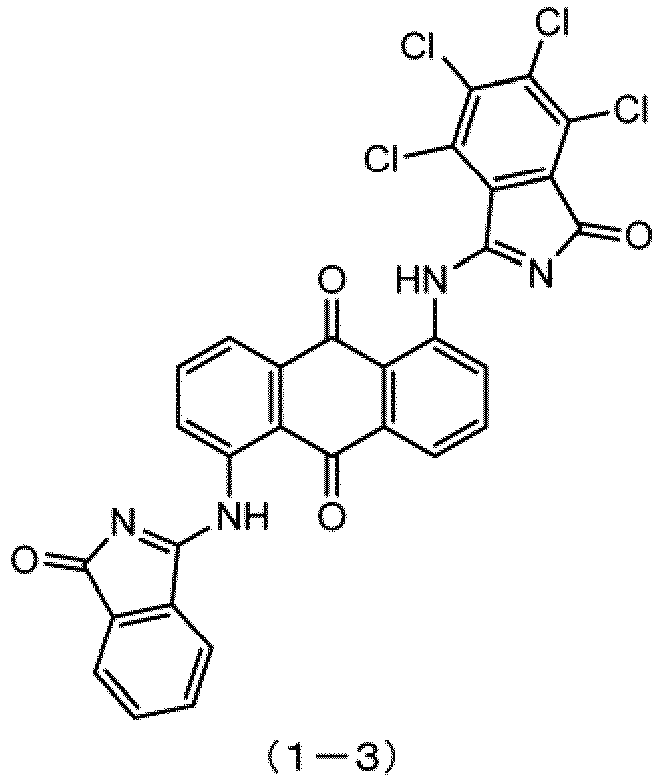
- a mixture of a pigment (1-3) represented by the following formula (1-3), the pigment (1-1) represented by formula (1-1), and the pigment (1-2) represented by formula (1-2) in an amount of 8.6 parts was obtained in the same manner as in the previously described Example 1 except that 6.0 parts of 3-imino-4,5,6,7-tetrachloroisoindolinone and 3.0 parts of 3-iminoisoindolinone were used in place of 3-imino-4,5,6,7-tetrachloroisoindolinone.
- Mass analysis by MALDI was performed to detect peaks of 496, 634, and 772.
- a pigment (2) represented by the following formula (2) was synthesized referring to the description in Patent Literature 3.
- the synthesized pigment (2) exhibits an orange color.
- a pigment (3) represented by the following formula (3) in an amount of 12.2 parts was obtained in the same manner as in the previously described Example 1 except that 2,6-diaminoanthraquinone was used in place of 1,5-diaminoanthraquinone. Mass analysis by MALDI was performed to detect a peak of 772.
- Paints deep color paints were each prepared by blending respective components according to the combination shown below and dispersing each resultant mixture for 90 minutes using a paint conditioner. Each of the prepared paints was applied on white paper using an applicator (3-mill) and was then baked at 140°C for 30 minutes, thereby forming a coating film.
- Visible-infrared absorption spectrum of each coating film formed in the previously described "Paint Test” was measured using a spectrophotometer (trade name “U-4100", manufactured by Hitachi High-Technologies Corporation). The measured visible-infrared absorption spectra are shown in Figures 1 to 5 .
- the CIE tristimulus values (X, Y, Z) of color were measured according to a conventional method to calculate the blackness, the hue angle, the lightness, and the saturation of each coating film. The results are shown in Table 1.
- the reflectance of the coating film formed using the pigment (4) of Comparative Example 3 increases rapidly from around 680 nm to the longer wavelength side.
- the rise of the reflectance is too steep to absorb light in a wavelength region of 400 to 700 nm, which is a visible light region, and therefore the blackness is deficient.
- the coating film formed using the pigment (5) of Comparative Example 4 absorbs light in a wide wavelength region to 2500 nm and does not exhibit infrared reflectivity at all.
- the coating films formed using the pigments (1-1), (1-2), and (1-3) of Examples 1 to 3 absorb light in a visible light region in a well-balanced manner, thoroughly absorb light in a wavelength region of around 500 to around 800 nm, and therefore exhibit a high blackness. Further, it can also be seen that the coating films formed using the pigments (1-1), (1-2), and (1-3) exhibit a favorable infrared reflectivity.
- Thermogravimetry and differential thermal analysis (TG-DTA) were performed for each pigment.
- the reduced rate at 350°C was calculated to evaluate the heat resistance according to the following evaluation criteria. The results are shown in Table 1.
- Molded plates (plates each having a portion with a thickness of 1 mm and a portion with a thickness of 2 mm) were each prepared by blending respective components according to the following combination and performing injection molding using an injection molding machine (manufactured by NISSEI PLASTIC INDUSTRIAL CO., LTD.).
- a resin molded plate (thickness of 1 mm) containing carbon black was prepared as a laser-transmissible resin layer.
- the previously described molded plate (thickness of 1 mm) was used as a laser-transmissible resin layer, and these two pieces of plates were laminated, and pinched and fixed by a clip.
- the two pieces of plates were welded using a laser apparatus (trade name "LP-Z", manufactured by Panasonic Corporation, 3D-Control FAYb Laser Marker). The welded plates were observed, and the laser weldability was evaluated according to the following evaluation criteria. The results are shown in Table 2.
- the black isoindolinone pigment according to the present invention is useful for uses, such as a black matrix, where a high blackness is demanded.
- the black isoindolinone pigment according to the present invention has a high light reflectance in a near infrared region and therefore is useful as a heat ray-reflecting black pigment, the use of which is unsuitable for pigments such as carbon black.
Landscapes
- Chemical & Material Sciences (AREA)
- Organic Chemistry (AREA)
- Physics & Mathematics (AREA)
- Optics & Photonics (AREA)
- General Physics & Mathematics (AREA)
- Health & Medical Sciences (AREA)
- Chemical Kinetics & Catalysis (AREA)
- Polymers & Plastics (AREA)
- Medicinal Chemistry (AREA)
- Toxicology (AREA)
- Compositions Of Macromolecular Compounds (AREA)
- Paints Or Removers (AREA)
- Optical Filters (AREA)
- Developing Agents For Electrophotography (AREA)
Abstract
Description
- The present invention relates to a near-infrared non-absorbing black isoindolinone pigment, and a coloring agent using the same.
- Up to now, carbon black-based pigments and iron oxide-based pigments have been general as black pigments that are used as coloring agents for paints, printing inks, and plastics. These black pigments exhibit a black color by absorbing all the rays of light including visible light region of sunlight.
- The black pigments (carbon black-based pigments in particular) absorb light in a visible light region (about 380 to about 780 nm) to exhibit a black color, but in fact, also absorb light that is in a near-infrared region including a wavelength region of 800 to 1,400 nm and that greatly contributes to heat. Therefore, there has been a problem that the temperature of articles colored by the black pigments as described above rises easily by being irradiated with sunlight. In addition, as articles colored by a black pigment, sophisticated products such as a black matrix for a color filter have appeared in recent years.
- Electric insulation is demanded of a black pigment to be used for constituting a black matrix for a color filter in order to prevent malfunction of a thin film transistor. Carbon black is a pigment having a low electric resistance. Therefore, it cannot be said that carbon black is not appropriate as a coloring material to be used in products such as a black matrix, and it is desirable to use a light-shielding material having a more excellent electric insulation. As related conventional techniques, various electrically insulating black organic pigments whose temperature is unlikely to rise even if they are irradiated with sunlight have been studied (Patent Literature 1). It is to be noted that isoindolinone compounds each having a particular structure, the isoindolinone compounds each being useful as a pigment for coloring a polymer organic material and the like, are proposed (
Patent Literatures 2 and 3). - Examples of other uses of a black organic pigment which has attracted attention in recent years include a coloring agent to be used for forming a plastic product for use in laser resin welding. The laser resin welding is a method of welding plastic products without using an adhesive by combining a laser-transmissible resin layer and a laser-absorptive resin layer and performing irradiation with laser of wavelength in a near infrared region (for example, 800 to 1100 nm). Various black organic pigments which are useful as a coloring agent for forming a plastic product for use in laser resin welding have so far been studied.
-
- Patent Literature 1: National Publication of International Patent Application No.
2007-522297 - Patent Literature 2: Japanese Patent Laid-Open No.
63-161062 - Patent Literature 3: Japanese Patent Publication No.
57-019145 - However, each of the isoindolinone compounds proposed in
Patent Literatures 2 and 3 is a pigment that exhibits a yellow color, an orange color, or a red-orange color and is therefore unsuitable as a pigment that constitutes a black matrix for a color filter, or the like. - In addition, it cannot be said that carbon black is suitable as a coloring material to be used in a laser-transmissible resin layer. Therefore, a coloring agent having an excellent transparency of light in a near infrared wavelength region and having suitability (dispersibility, blackness) for coloring a plastic product has been desired.
- The present invention has been completed in consideration of such problems of the conventional techniques, and an object of the present invention is to provide an infrared-reflecting black isoindolinone pigment having a novel skeleton, the black isoindolinone pigment having a high blackness (coloring power) and excellent durability such as heat resistance. In addition, another object of the present invention is to provide a coloring agent using the above-described black isoindolinone pigment.
- That is, according to the present invention, a black isoindolinone pigment described below is provided.
- [1] A black isoindolinone pigment represented by the following formula (1).

- [2] The black isoindolinone pigment according to [1], represented by the following formula (1-1), (1-2), or (1-3).


- [3] The black isoindolinone pigment according to [1] or [2], having a blackness of 240 or more in an alkyd/melamine baking paint.
Further, according to the present invention, a pigment coloring agent described below is provided. - [4] A coloring agent containing the black isoindolinone pigment according to any one of [1] to [3].
- [5] The coloring agent according to [4], to be used for forming a black matrix for a color filter, or a light shielding film.
- [6] The coloring agent according to [4], to be used for forming a plastic product for use in laser resin welding.
- According to the present invention, an infrared-reflecting black isoindolinone pigment having a novel skeleton, the black isoindolinone pigment having a high blackness (coloring power) and excellent durability such as heat resistance can be provided. In addition, according to the present invention, a coloring agent using this black isoindolinone pigment can be provided.
-
- [
Figure 1] Figure 1 is a visible-infrared absorption spectrum of a coating film formed using a pigment (1-1) of Example 1. - [
Figure 2] Figure 2 is a visible-infrared absorption spectrum of a coating film formed using a pigment (1-2) of Example 2. - [
Figure 3] Figure 3 is a visible-infrared absorption spectrum of a coating film formed using a pigment (1-3) of Example 3. - [
Figure 4] Figure 4 is a visible-infrared absorption spectrum of a coating film formed using a pigment (4) of Comparative Example 3. - [
Figure 5] Figure 5 is a visible-infrared absorption spectrum of a coating film formed using a pigment (5) of Comparative Example 4. - Hereinafter, embodiments according to the present invention will be described, but the present invention is not limited to the following embodiments. A black isoindolinone pigment according to the present invention is a pigment having a structure represented by the following formula (1). Hereinafter, the details will be described.

- In formula (1), the alkyl group represented by X is preferably a lower alkyl group having 1 to 6 carbon atoms and optionally having a branch and is more preferably a lower alkyl group having 1 to 3 carbon atoms.
- One of the important characteristics of the black isoindolinone pigment according to the present invention is that it has a structure represented by formula (1). The pigment having a structure represented by formula (1) has pigment properties which are equal to or higher than those of the other isoindolinone pigments. In addition, the black isoindolinone pigment according to the present invention has a 1,5-diaminoanthraquinone skeleton in the structure thereof and therefore exhibits a special color tone.
- The color tone of the pigment represented by formula (1) is different from those of the other isoindolinone pigments. A general isoindolinone pigment is a bright-color pigment exhibiting a yellow to orange color. In contrast, the pigment represented by formula (1) effectively absorbs light in a wavelength region of 400 to 850 nm and therefore exhibits an excellent black color.
- As a result of diligent studies conducted by the present inventors, it has been made clear that a compound having a 1, 5-diaminonaphthalene skeleton, the compound represented by the following formula (2), and a compound having a 2,6-diaminoanthraquinone skeleton, the compound represented by the following formula (3), do not exhibit a black color. It is to be noted that it is inferred that the pigment represented by formula (1) forms an intramolecular hydrogen bond between carbonyl oxygen of anthraquinone and hydrogen of an amino group to have a planar structure. Therefore, it is considered that strong intermolecular π-π interaction is formed and even light in a longer wavelength region is absorbed.

- In addition, the pigment represented by formula (1) exhibits a bluish black color with h*=270 to 290 (L*C*h* color system) in a deep color. Enhancement of design properties has been demanded in various fields in recent years. For example, with respect to a black color, a bluish black with a luxurious feel is demanded. The black isoindolinone pigment according to the present invention is suitable as a black pigment with high jetness.
- The black isoindolinone pigment according to the present invention can be produced, for example, by reacting a compound represented by the following formula (A), a compound represented by the following formula (B), and a compound represented by the following formula (C) in an inert solvent.

- Specific examples of 3-iminoisoindolin-1-ones represented by formula (A) and (B) include compounds represented by the following formulas. These compounds can be synthesized from an acid anhydride according to a known method.



- The above-described compounds each having an isoindolinone structure easily undergoes hydrolysis, and therefore a hydrophobic solvent is preferably used as the inert solvent. Specific examples of the hydrophobic solvent include: aliphatic hydrocarbons such as n-hexane, n-heptane, cyclohexane, methylcyclohexane, ethylcyclohexane, and 2-methylpentane; and aromatic hydrocarbons such as toluene, xylene, chlorobenzene, dichlorobenzene, nitrobenzene, and chloronaphthalene. It is to be noted that a solvent having a high dissolving power and a high boiling point, such as chlorobenzene, dichlorobenzene, nitrobenzene, or chloronaphthalene, is preferably used because the reaction progresses smoothly.
- The reaction temperature is preferably set to 100 to 140°C. If the reaction is performed at a temperature lower than 100°C, large amounts of mono-substituted products are liable to be produced and the yield of a target compound may be lowered. It is to be noted that co-existence of an acid as a catalyst is preferable because the reaction progresses more smoothly.
- Performing a pigmentation treatment in which heating and stirring are performed at 150 to 200°C in an inert solvent is preferable because the blackness of a resultant pigment increases. Specific examples of the inert solvent include aromatic hydrocarbons such as xylene, dichlorobenzene, nitrobenzene, and chloronaphthalene.
- A coloring agent according to the present invention contains the above-described black isoindolinone pigment. For example, the coloring agent which is a coloring composition can be obtained by allowing the above-described black isoindolinone pigment to be contained (dispersed) in a liquid dispersion medium or a solid dispersion medium. That is, a pigment component containing the black isoindolinone pigment may be dispersed in a liquid dispersion medium to prepare a liquid composition or may be dispersed in a solid dispersion medium to prepare a solid composition according to the object of coloring, the use, the use method, and the like.
- As the pigment component to be dispersed in a dispersion medium such as a liquid dispersion medium or a solid dispersion medium, an additional pigment other than the black isoindolinone pigment can be used. That is, in the dispersion medium, only the black isoindolinone pigment may be dispersed as the pigment component or a pigment component containing the black isoindolinone pigment and the additional pigment may be dispersed. As the additional pigment, a chromatic color pigment, a white pigment, an additional black pigment, and an extender pigment can be used. These pigments can be used singly or in a combination of two or more thereof according to the intended color. By dispersing the additional pigment together with the black isoindolinone pigment, coloring agents which enable dark chromatic coloring, achromatic coloring, and black coloring can be obtained.
- The content of the black isoindolinone pigment in the coloring agent may appropriately be set according to the use and is not particularly limited. Specifically, the content of the black isoindolinone pigment in the coloring agent may be set to about 1 to about 50% by mass based on the total mass of the coloring agent.
- The coloring agent according to the present invention contains the black isoindolinone pigment having a high blackness (coloring power) and excellent durability such as heat resistance. Therefore, the coloring agent according to the present invention is useful as a coloring agent for forming a black matrix for a color filter, or a light-shielding film. Further, the coloring agent according to the present invention is also useful as a coloring agent for forming a plastic product for use in laser resin welding.
- Hereinafter, the present invention will specifically be described based on Examples, but the present invention is not limited to these Examples. It is to be noted that "parts" and "%" in Examples and Comparative Examples are each on a mass basis unless otherwise noted.
- To 130 parts of nitrobenzene, 4.8 parts of 1,5-diaminoanthraquinone, 12.5 parts of 3-imino-4,5,6,7-tetrachloroisoindolinone, and 8.4 parts of para-toluenesulfonic acid monohydrate were added, and a resultant mixture was heated at 130°C for 3 hours. A resultant product was subjected to hot filtration and washing with methanol and water and was then dried at 80°C to obtain 11.6 parts of a pigment (1-1) represented by the following formula (1-1) . Mass analysis by MALDI was performed to detect a peak of 772.

- A pigment (1-2) represented by the following formula (1-2) in an amount of 4.9 parts was obtained in the same manner as in the previously described Example 1 except that 6.1 parts of 3-iminoisoindolinone was used in place of 3-imino-4,5,6,7-tetrachloroisoindolinone. Mass analysis by MALDI was performed to detect a peak of 496.

- A mixture of a pigment (1-3) represented by the following formula (1-3), the pigment (1-1) represented by formula (1-1), and the pigment (1-2) represented by formula (1-2) in an amount of 8.6 parts was obtained in the same manner as in the previously described Example 1 except that 6.0 parts of 3-imino-4,5,6,7-tetrachloroisoindolinone and 3.0 parts of 3-iminoisoindolinone were used in place of 3-imino-4,5,6,7-tetrachloroisoindolinone. Mass analysis by MALDI was performed to detect peaks of 496, 634, and 772.
- A pigment (2) represented by the following formula (2) was synthesized referring to the description in Patent Literature 3. The synthesized pigment (2) exhibits an orange color.

- A pigment (3) represented by the following formula (3) in an amount of 12.2 parts was obtained in the same manner as in the previously described Example 1 except that 2,6-diaminoanthraquinone was used in place of 1,5-diaminoanthraquinone. Mass analysis by MALDI was performed to detect a peak of 772.

- The following commercially available pigments were used as a pigment (4) of Comparative Example 3 and a pigment (5) of Comparative Example 4.
- Comparative Example 3 (Pigment (4)): trade name "CHROMOFINE BLACK A1103" (manufactured by Dainichiseika Color & Chemicals Mfg. Co., Ltd.)
- Comparative Example 4 (Pigment (5)): trade name "Carbon Black #45B" (manufactured by Mitsubishi Chemical Corporation)
- Paints (deep color paints) were each prepared by blending respective components according to the combination shown below and dispersing each resultant mixture for 90 minutes using a paint conditioner. Each of the prepared paints was applied on white paper using an applicator (3-mill) and was then baked at 140°C for 30 minutes, thereby forming a coating film.
- Pigment: 1.5 parts
- Trade name "Super Beckamine J-820" (*1): 8.5 parts
- Trade name "Phthalkyd 133 to 60 (*2): 17.0 parts
- Xylene/1-butanol (2/1 (mass ratio)) mixed solvent: 5.0 parts
- (*1) Butylated melamine resin (manufactured by DIC Corporation)
- (*2) Short oil length alkyd resin of palm oil (manufactured by Hitachi Chemical Company, Ltd.)
- Visible-infrared absorption spectrum of each coating film formed in the previously described "Paint Test" was measured using a spectrophotometer (trade name "U-4100", manufactured by Hitachi High-Technologies Corporation). The measured visible-infrared absorption spectra are shown in
Figures 1 to 5 . The CIE tristimulus values (X, Y, Z) of color were measured according to a conventional method to calculate the blackness, the hue angle, the lightness, and the saturation of each coating film. The results are shown in Table 1. - As shown in
Figure 4 , the reflectance of the coating film formed using the pigment (4) of Comparative Example 3 increases rapidly from around 680 nm to the longer wavelength side. However, the rise of the reflectance is too steep to absorb light in a wavelength region of 400 to 700 nm, which is a visible light region, and therefore the blackness is deficient. In addition, as shown inFigure 5 , it can be seen that the coating film formed using the pigment (5) of Comparative Example 4 absorbs light in a wide wavelength region to 2500 nm and does not exhibit infrared reflectivity at all. In contrast, as shown inFigures 1 to 3 , it can be seen that the coating films formed using the pigments (1-1), (1-2), and (1-3) of Examples 1 to 3 absorb light in a visible light region in a well-balanced manner, thoroughly absorb light in a wavelength region of around 500 to around 800 nm, and therefore exhibit a high blackness. Further, it can also be seen that the coating films formed using the pigments (1-1), (1-2), and (1-3) exhibit a favorable infrared reflectivity. - The infrared reflectance of each film formed in the previously described "Paint Test" was measured, and the infrared reflectivity was evaluated according to the following evaluation criteria. The results are shown in Table 1.
- Good: Infrared reflectance at 1300 nm is 30% or higher
- Poor: Infrared reflectance at 1300 nm is lower than 30%
- Thermogravimetry and differential thermal analysis (TG-DTA) were performed for each pigment. The reduced rate at 350°C was calculated to evaluate the heat resistance according to the following evaluation criteria. The results are shown in Table 1.
- Good: Reduced rate at 350°C is 10% or lower
- Poor: Reduced rate at 350°C is larger than 10%
- Molded plates (plates each having a portion with a thickness of 1 mm and a portion with a thickness of 2 mm) were each prepared by blending respective components according to the following combination and performing injection molding using an injection molding machine (manufactured by NISSEI PLASTIC INDUSTRIAL CO., LTD.).
- Pigment: 8 parts
- Trade name "SUMIPEX LG" (*1) 800 parts
- Trade name "Magnesium Stearate": 2 parts
(*1) PMMA resin (manufactured by SUMITOMO CHEMICAL COMPANY, LIMITED) - The color (blackness) of each prepared molded plate was checked visually. The results are shown in Table 2.
- Each molded plate was hot-pressed to obtain a thin piece (thickness of 100 µm). The obtained thin piece was observed with a microscope (manufactured by KEYENCE CORPORATION) to evaluate the dispersibility according to the following evaluation criteria. The results are shown in Table 2.
- Good: Pigment particles are not observed
- Poor: Pigment particles are observed
- As a laser-absorptive resin layer, a resin molded plate (thickness of 1 mm) containing carbon black was prepared. The previously described molded plate (thickness of 1 mm) was used as a laser-transmissible resin layer, and these two pieces of plates were laminated, and pinched and fixed by a clip. The two pieces of plates were welded using a laser apparatus (trade name "LP-Z", manufactured by Panasonic Corporation, 3D-Control FAYb Laser Marker). The welded plates were observed, and the laser weldability was evaluated according to the following evaluation criteria. The results are shown in Table 2.
- Good: Even if the clip is removed to lift the plates, the plates are welded.
- Poor: When the clip is removed to lift the plates, the plates are separated into two pieces of plates.
- The black isoindolinone pigment according to the present invention is useful for uses, such as a black matrix, where a high blackness is demanded. In addition, the black isoindolinone pigment according to the present invention has a high light reflectance in a near infrared region and therefore is useful as a heat ray-reflecting black pigment, the use of which is unsuitable for pigments such as carbon black.
| Pigment | Color | Blackness | Hue angle | Lightness | Saturation | Infrared reflectivity | Heat resistance | |
| Example 1 | (1-1) | Black | 254 | 291 | 2.7 | 3.5 | Good | Good |
| Example 2 | (1-2) | Black | 278 | 34 | 1.4 | 0.5 | Good | Good |
| Example 3 | (1-3) | Black | 246 | 319 | 3.1 | 2.7 | Good | Good |
| Comparative Example 3 | (4) | Black | 223 | 27 | 4.1 | 2.8 | Good | Poor |
| Comparative Example 4 | (5) | Black | 236 | 291 | 3.0 | 0.3 | Poor | Good |
| Pigment | Color (blackness) | Dispersibility | Laser weldabilty | |
| Example 1 | (1-1) | Bluish black | Good | Good |
| Example 2 | (1-2) | Bluish black | Good | Good |
| Example 3 | (1-3) | Bluish black | Good | Good |
| Comparative Example 1 | (4) | Reddish black | Poor | Good |
Claims (6)
- A black isoindolinone pigment represented by the following formula (1):

- The black isoindolinone pigment according to claim 1, represented by the following formula (1-1), (1-2), or (1-3):


- The black isoindolinone pigment according to claim 1 or 2, having a blackness of 240 or more in an alkyd/melamine baking paint.
- A coloring agent comprising the black isoindolinone pigment according to any one of claims 1 to 3.
- The coloring agent according to claim 4, to be used for forming a black matrix for a color filter, or a light shielding film.
- The coloring agent according to claim 4, to be used for forming a plastic product for use in laser resin welding.
Applications Claiming Priority (2)
| Application Number | Priority Date | Filing Date | Title |
|---|---|---|---|
| JP2017003779 | 2017-01-13 | ||
| PCT/JP2017/046978 WO2018131488A1 (en) | 2017-01-13 | 2017-12-27 | Black isoindolinone pigment and coloring agent |
Publications (2)
| Publication Number | Publication Date |
|---|---|
| EP3569659A1 true EP3569659A1 (en) | 2019-11-20 |
| EP3569659A4 EP3569659A4 (en) | 2021-02-17 |
Family
ID=62839536
Family Applications (1)
| Application Number | Title | Priority Date | Filing Date |
|---|---|---|---|
| EP17890910.7A Withdrawn EP3569659A4 (en) | 2017-01-13 | 2017-12-27 | BLACK ISOINDOLINONE PIGMENT AND COLORING AGENT |
Country Status (8)
| Country | Link |
|---|---|
| US (1) | US10723882B2 (en) |
| EP (1) | EP3569659A4 (en) |
| JP (1) | JP6928619B2 (en) |
| KR (1) | KR102365575B1 (en) |
| CN (1) | CN110168022B (en) |
| AU (1) | AU2017393056B2 (en) |
| TW (1) | TWI756336B (en) |
| WO (1) | WO2018131488A1 (en) |
Families Citing this family (6)
| Publication number | Priority date | Publication date | Assignee | Title |
|---|---|---|---|---|
| US11405797B2 (en) | 2018-03-19 | 2022-08-02 | Charter Communications Operating, Llc | Apparatus and methods for cell activation in wireless networks |
| US11716558B2 (en) | 2018-04-16 | 2023-08-01 | Charter Communications Operating, Llc | Apparatus and methods for integrated high-capacity data and wireless network services |
| US11044597B2 (en) | 2018-08-07 | 2021-06-22 | Charter Communications Operating, Llc | Apparatus and methods for registration and operation in wireless networks |
| CN112840728B (en) | 2018-10-12 | 2024-09-13 | 特许通讯运营公司 | Apparatus and method for cell identification in a wireless network |
| JP7642376B2 (en) * | 2019-11-18 | 2025-03-10 | 積水化学工業株式会社 | Black particles, black paint, coating film and black matrix for color filters |
| US11985641B2 (en) | 2020-04-22 | 2024-05-14 | Charter Communications Operating, Llc | Node apparatus and methods for providing high-capacity data services via a content delivery network architecture |
Family Cites Families (15)
| Publication number | Priority date | Publication date | Assignee | Title |
|---|---|---|---|---|
| BE559196A (en) * | 1956-07-13 | |||
| BE794089A (en) | 1972-01-17 | 1973-07-16 | Ciba Geigy | PIGMENTS DERIVED FROM ISO-INDOLINONE |
| US3923773A (en) * | 1973-04-25 | 1975-12-02 | Dainippon Ink & Chemicals | Method for preparing isoindolenone pigments |
| AT367327B (en) | 1980-05-29 | 1982-06-25 | Voest Alpine Ag | ARC CONTINUOUS CASTING MACHINE |
| DE3781257D1 (en) | 1986-12-17 | 1992-09-24 | Ciba Geigy Ag | NEW SUBSTANCE COMPOSITIONS BASED ON TETRACHLORISOINDOLINONE PIGMENTS. |
| DE60118787T2 (en) * | 2000-11-13 | 2006-12-28 | E.I. Dupont De Nemours And Co., Wilmington | COLORED THERMOPLASTIC RESIN COMPOSITIONS FOR LASER WELDING, ANTHRACHINONE COLORING AGENTS AND FORMAL PARTS THEREFROM |
| WO2005078023A2 (en) | 2004-02-11 | 2005-08-25 | Basf Aktiengesellschaft | Black perylene pigments |
| JP4951200B2 (en) * | 2004-08-20 | 2012-06-13 | 東洋インキScホールディングス株式会社 | Color filter |
| JP2007326973A (en) * | 2006-06-08 | 2007-12-20 | Sekisui Chem Co Ltd | Insulating adhesive sheet |
| JP4848872B2 (en) * | 2006-07-19 | 2011-12-28 | 旭硝子株式会社 | Laminated glass for windows |
| US20100226016A1 (en) * | 2007-07-25 | 2010-09-09 | Nippon Shokubai Co., Ltd. | Light-shielding film |
| JP2009076693A (en) * | 2007-09-20 | 2009-04-09 | Fuji Electric Systems Co Ltd | Solar cell module |
| US9334281B2 (en) * | 2008-09-08 | 2016-05-10 | Enzo Life Sciences, Inc. | Fluorochromes for organelle tracing and multi-color imaging |
| WO2013008679A1 (en) * | 2011-07-11 | 2013-01-17 | 大日本印刷株式会社 | Color filter formation substrate and method for manufacturing same, and display device |
| US9217070B2 (en) * | 2012-06-01 | 2015-12-22 | Basf Se | Black colorant mixture |
-
2017
- 2017-12-27 JP JP2018561923A patent/JP6928619B2/en active Active
- 2017-12-27 EP EP17890910.7A patent/EP3569659A4/en not_active Withdrawn
- 2017-12-27 CN CN201780082647.5A patent/CN110168022B/en active Active
- 2017-12-27 AU AU2017393056A patent/AU2017393056B2/en not_active Ceased
- 2017-12-27 KR KR1020197019994A patent/KR102365575B1/en active Active
- 2017-12-27 WO PCT/JP2017/046978 patent/WO2018131488A1/en not_active Ceased
- 2017-12-27 US US16/474,432 patent/US10723882B2/en active Active
-
2018
- 2018-01-09 TW TW107100793A patent/TWI756336B/en active
Also Published As
| Publication number | Publication date |
|---|---|
| AU2017393056A1 (en) | 2019-07-11 |
| CN110168022B (en) | 2021-09-07 |
| TWI756336B (en) | 2022-03-01 |
| AU2017393056B2 (en) | 2020-12-17 |
| CN110168022A (en) | 2019-08-23 |
| JP6928619B2 (en) | 2021-09-01 |
| KR20190094219A (en) | 2019-08-12 |
| WO2018131488A1 (en) | 2018-07-19 |
| TW201840736A (en) | 2018-11-16 |
| EP3569659A4 (en) | 2021-02-17 |
| US20190338130A1 (en) | 2019-11-07 |
| KR102365575B1 (en) | 2022-02-21 |
| JPWO2018131488A1 (en) | 2019-11-07 |
| US10723882B2 (en) | 2020-07-28 |
Similar Documents
| Publication | Publication Date | Title |
|---|---|---|
| US10723882B2 (en) | Black isoindolinone pigment and coloring agent | |
| EP1716208B1 (en) | Black perylene pigments | |
| EP2387600B1 (en) | Organic black pigments and their preparation | |
| US20050014863A1 (en) | Black pigment compositions | |
| DE60118787T2 (en) | COLORED THERMOPLASTIC RESIN COMPOSITIONS FOR LASER WELDING, ANTHRACHINONE COLORING AGENTS AND FORMAL PARTS THEREFROM | |
| JP7075713B2 (en) | Dispersions, colored layers, colored films, colored substrates, colored combined substrates, and inks | |
| DE69101599T2 (en) | 2,9-dichloroquinacridone in platelet form. | |
| EP3447092A1 (en) | Black azo pigment and colorant | |
| JP6738294B2 (en) | Colorant | |
| EP3521378B1 (en) | Pyrimidoquinazoline pigment, method for manufacturing pyrimidoquinazoline pigment, and pigment colorant | |
| DE102004007382A1 (en) | Black perylene pigments comprising fused-ring dipyridoperylenedione isomers useful for coloring high molecular weight organic material of natural and synthetic origin | |
| CA2420836A1 (en) | Stabilized pigmented polymer compositions | |
| DE102004057876A1 (en) | Black perylene pigments comprising fused-ring dipyridoperylenedione isomers useful for coloring high molecular weight organic material of natural and synthetic origin |
Legal Events
| Date | Code | Title | Description |
|---|---|---|---|
| STAA | Information on the status of an ep patent application or granted ep patent |
Free format text: STATUS: THE INTERNATIONAL PUBLICATION HAS BEEN MADE |
|
| PUAI | Public reference made under article 153(3) epc to a published international application that has entered the european phase |
Free format text: ORIGINAL CODE: 0009012 |
|
| STAA | Information on the status of an ep patent application or granted ep patent |
Free format text: STATUS: REQUEST FOR EXAMINATION WAS MADE |
|
| 17P | Request for examination filed |
Effective date: 20190725 |
|
| AK | Designated contracting states |
Kind code of ref document: A1 Designated state(s): AL AT BE BG CH CY CZ DE DK EE ES FI FR GB GR HR HU IE IS IT LI LT LU LV MC MK MT NL NO PL PT RO RS SE SI SK SM TR |
|
| AX | Request for extension of the european patent |
Extension state: BA ME |
|
| DAV | Request for validation of the european patent (deleted) | ||
| DAX | Request for extension of the european patent (deleted) | ||
| A4 | Supplementary search report drawn up and despatched |
Effective date: 20210120 |
|
| RIC1 | Information provided on ipc code assigned before grant |
Ipc: C07D 209/50 20060101ALI20210114BHEP Ipc: C09B 1/20 20060101AFI20210114BHEP Ipc: G02B 5/20 20060101ALI20210114BHEP |
|
| STAA | Information on the status of an ep patent application or granted ep patent |
Free format text: STATUS: EXAMINATION IS IN PROGRESS |
|
| 17Q | First examination report despatched |
Effective date: 20230103 |
|
| GRAP | Despatch of communication of intention to grant a patent |
Free format text: ORIGINAL CODE: EPIDOSNIGR1 |
|
| STAA | Information on the status of an ep patent application or granted ep patent |
Free format text: STATUS: GRANT OF PATENT IS INTENDED |
|
| INTG | Intention to grant announced |
Effective date: 20250813 |
|
| STAA | Information on the status of an ep patent application or granted ep patent |
Free format text: STATUS: THE APPLICATION IS DEEMED TO BE WITHDRAWN |
|
| 18D | Application deemed to be withdrawn |
Effective date: 20251216 |