EP3567581A1 - Board material for stringed instrument, acoustic stringed instrument, and method for manufacturing board material for stringed instrument - Google Patents
Board material for stringed instrument, acoustic stringed instrument, and method for manufacturing board material for stringed instrument Download PDFInfo
- Publication number
- EP3567581A1 EP3567581A1 EP17890451.2A EP17890451A EP3567581A1 EP 3567581 A1 EP3567581 A1 EP 3567581A1 EP 17890451 A EP17890451 A EP 17890451A EP 3567581 A1 EP3567581 A1 EP 3567581A1
- Authority
- EP
- European Patent Office
- Prior art keywords
- groove
- resin
- stringed instrument
- top plate
- purfling
- Prior art date
- Legal status (The legal status is an assumption and is not a legal conclusion. Google has not performed a legal analysis and makes no representation as to the accuracy of the status listed.)
- Granted
Links
Images


Classifications
-
- G—PHYSICS
- G10—MUSICAL INSTRUMENTS; ACOUSTICS
- G10D—STRINGED MUSICAL INSTRUMENTS; WIND MUSICAL INSTRUMENTS; ACCORDIONS OR CONCERTINAS; PERCUSSION MUSICAL INSTRUMENTS; AEOLIAN HARPS; SINGING-FLAME MUSICAL INSTRUMENTS; MUSICAL INSTRUMENTS NOT OTHERWISE PROVIDED FOR
- G10D3/00—Details of, or accessories for, stringed musical instruments, e.g. slide-bars
- G10D3/22—Material for manufacturing stringed musical instruments; Treatment of the material
-
- G—PHYSICS
- G10—MUSICAL INSTRUMENTS; ACOUSTICS
- G10D—STRINGED MUSICAL INSTRUMENTS; WIND MUSICAL INSTRUMENTS; ACCORDIONS OR CONCERTINAS; PERCUSSION MUSICAL INSTRUMENTS; AEOLIAN HARPS; SINGING-FLAME MUSICAL INSTRUMENTS; MUSICAL INSTRUMENTS NOT OTHERWISE PROVIDED FOR
- G10D1/00—General design of stringed musical instruments
- G10D1/02—Bowed or rubbed string instruments, e.g. violins or hurdy-gurdies
-
- G—PHYSICS
- G10—MUSICAL INSTRUMENTS; ACOUSTICS
- G10D—STRINGED MUSICAL INSTRUMENTS; WIND MUSICAL INSTRUMENTS; ACCORDIONS OR CONCERTINAS; PERCUSSION MUSICAL INSTRUMENTS; AEOLIAN HARPS; SINGING-FLAME MUSICAL INSTRUMENTS; MUSICAL INSTRUMENTS NOT OTHERWISE PROVIDED FOR
- G10D3/00—Details of, or accessories for, stringed musical instruments, e.g. slide-bars
- G10D3/02—Resonating means, horns or diaphragms
-
- B—PERFORMING OPERATIONS; TRANSPORTING
- B44—DECORATIVE ARTS
- B44C—PRODUCING DECORATIVE EFFECTS; MOSAICS; TARSIA WORK; PAPERHANGING
- B44C1/00—Processes, not specifically provided for elsewhere, for producing decorative surface effects
- B44C1/22—Removing surface-material, e.g. by engraving, by etching
- B44C1/228—Removing surface-material, e.g. by engraving, by etching by laser radiation
-
- B—PERFORMING OPERATIONS; TRANSPORTING
- B44—DECORATIVE ARTS
- B44C—PRODUCING DECORATIVE EFFECTS; MOSAICS; TARSIA WORK; PAPERHANGING
- B44C1/00—Processes, not specifically provided for elsewhere, for producing decorative surface effects
- B44C1/26—Inlaying with ornamental structures, e.g. niello work, tarsia work
-
- B—PERFORMING OPERATIONS; TRANSPORTING
- B44—DECORATIVE ARTS
- B44C—PRODUCING DECORATIVE EFFECTS; MOSAICS; TARSIA WORK; PAPERHANGING
- B44C3/00—Processes, not specifically provided for elsewhere, for producing ornamental structures
- B44C3/10—Producing and filling perforations, e.g. tarsia plates
Definitions
- the present invention relates to a board for a stringed instrument having a purfling, to an acoustic stringed instrument, and to a method of manufacturing a board for a stringed instrument.
- Non-Patent Document 1 discloses a traditional method of manufacturing a violin. According to this manufacturing method, in a conventional purfling for a violin, grooves having a width of about 2 mm to about 3 mm are engraved on peripheral edges of the top plate and the back plate, respectively. Members obtained by bonding three strips are fitted into the grooves, and then the top plate and the back plate are polished. Each of the members used for the fitting has a structure in which the middle strip among the three strips is sandwiched between the other two strips, which are black. Accordingly, after the members are fitted into the grooves, two black lines are formed on each of the top plate and the back plate.
- Such a method of manufacturing a violin is a traditional manufacturing method that has been practiced for more than 400 years and continues to this day.
- the role of the purfling is to improve durability, in addition to a design effect. Since a straight-grained board is often used for the top plate of the violin, the board may crack along a wood grain when a big impact is applied to the violin. It is possible to absorb the impact by the purfling provided on the peripheral edges of the top plate and the back plate.
- Non-Patent Document1 Chris Johnson, “The Art of Violin Making,” Robert Hale Ltd., April 1998
- An object of the present invention is to provide an acoustic stringed instrument having decorativeness and impact resistance with a simplified manufacturing process, and a method of manufacturing the same.
- a board for a stringed instrument which is used for a top plate or a back plate of an acoustic stringed instrument, includes a groove formed in the board and a resin filled in the groove.
- a method of manufacturing a board for a stringed instrument is a method of manufacturing a board for a stringed instrument that is used for a top plate or a back plate of an acoustic stringed instrument, where the board has a purfling, the method including forming a groove in the board, filling the groove with a resin, and curing the resin.
- a violin 1 will be described as an example of an acoustic stringed instrument.
- the violin 1 is merely an example, and the acoustic stringed instrument may be, for example, acoustic bowed stringed instrument such as a cello, a viola, or a contrabass that is similar to a violin.
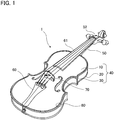
- FIG. 1 is an external perspective view of a violin according to an embodiment of the present invention.
- the violin 1 includes a main body 40 and a neck 50.
- the main body 40 includes a top plate 10, a back plate 20, and a rib 30 provided between the top plate 10 and the back plate 20.
- the top plate 10 is provided with a tailpiece 60 and a bridge 70. One end of each string is fixed to the tailpiece 60. The other end of each string is fixed by means of pegs 52 provided on a neck 50 via a bridge 70. The strings are tightened by winding the pegs 52.
- a stacked board is used for the top plate 10.
- the top plate 10 is formed by bonding a top surface board, a back surface board, and a core board disposed therebetween with an adhesive.
- a material of a single board for the top surface board, the back surface board, and the core board may be the same or may be different.
- spruce, maple, pine, cedar, birch, beech, or lauan may be used as the single board.
- all of the top surface board, the back surface board, and the core board, which constitute the top plate 10 be formed of spruce.
- top plate 10 provides a better appearance by using a straight-grained spruce material as the material of the single board forming the top surface board 1.
- the top plate 10 Before the top plate 10 is attached to the rib 30, the top plate 10 is formed into the same shape as that after completion of the violin. Alternatively, a top plate 10 that is larger than the completed shape may be prepared, so that the top plate 10 may be fixed to the rib 30, subsequent to which the shape of a peripheral edge of the top plate 10 may be trimmed. A purfling 80 is provided at the peripheral edge of each of the top plate 10 and the back plate 20.
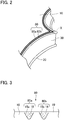
- FIG. 2 is an enlarged view showing a part of the purfling 80.
- the purfling 80 has two purfling lines 80a and 80b.
- the purfling line 80b is formed on the peripheral edge of the top plate 10 at a constant distance from an end of the top plate 10.
- the purfling line 80a is also formed in the same manner.
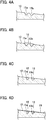
- FIG. 3 shows a cross-sectional view of the purfling 80.
- the purfling 80 is configured by filling a groove 15a and a groove 15b formed in the top plate 10 with resin 18 and providing a protective layer 19 on an upper surface thereof.
- the groove 15a and the groove 15b are approximately V-shaped, with the bottom part thereof being rounded. Since the bottom parts are rounded, even when flowability of the resin 18 is relatively low and viscosity thereof is relatively high, it is possible to fill the resin 18 in the groove 15a and the groove 15b without gaps. It is also possible to reduce occurrence of local stress as compared to sharp V-shapes. From the viewpoint of facilitating processing, it is preferable that the cross-sectional shapes of the groove 15a and the groove 15b be the same at any position.
- Forming the purfling lines 80a and 80b by use of the resin 18 has the following advantages.
- the skill of a skilled craftsman is required, for example, in order to align the purfling line 80a so that the gap is eliminated and the purfling line 80a is continuous in a superposed portion in which the purfling line 80a located in a region X in FIG. 2 is bent at an acute angle.
- the required skill for forming the purfling 80 according to the present embodiment is to fill the groove 15a and the groove 15b only with the resin 18 which is flowable. Thus, it is possible to fill easily the groove 15a and the groove 15b with the resin 18 without gaps. Therefore, the purfling 80 is easily manufactured.
- the purfling 80 is formed by filling the groove 15a and the groove 15b with the resin 18, resin 18 that has flowed out of the groove 15a and the groove 15b may be wiped off. Therefore, compared to the conventional purfling that requires cutting, the purfling 80 is easily manufactured.
- the purfling 80 uses the resin 18 having a degree of elongation greater than that of wood. As a result, it is possible to minimize formation of gaps between the resin 18 and each of the groove 15a and the groove 15b, and thus, prevent cracking of the surface coating.
- the purfling 80 absorbs the impact. Thus, cracking is minimized.
- the timbre of a sound is made possible to be closer to that in the purfling 80 formed by the inlaying.
- the purfling using the inlaying wood is embedded in the groove.
- a fiber direction of the wood is different from a fiber direction of the top plate or the back plate. Therefore, there is a possibility that the purfling using the inlaying may affect the vibration of the violin.
- the purfling since all the material of the member to be embedded in the groove and the material of the top plate and the back plate are wood, the influence on the vibration of the violin by adjusting the depth or width of the groove is limited. Accordingly, conventionally, the purfling is not used for adjusting sound quality.
- the peripheral edges are thinner than the central portions. This is to increase the vibration of the top plate and the back plate.
- the vibration of the violin is classified into various modes, but the vibration in a direction perpendicular to the top plate and the back plate accounts for a large proportion of the entire vibration of the violin.
- the top plate 10 since the resin 18 that is softer than wood is filled in the groove 15a and the groove 15b, the top plate 10 more easily vibrates than the conventional method. That is, it is possible to improve rising of the sound by lowering rigidity of an outer peripheral edge by use of the resin 18. Furthermore, it is possible to control the vibration of the top plate 10 by adjusting the material of the resin 18 or the width and depth of the groove 15a and the groove 15b.
- the violin 1 having a distinctive tone can be provided since it is possible to increase the number of factors for adjusting the timbre of the sound of the violin 1 by adopting the resin 18.
- the resin 18 will be described. It is preferable that the resin 18 have a hardness that is less than that of wood. Furthermore, the material of the resin 18 is selected so that the resin 18 is able to respond to changes in temperature or humidity of the top plate 10 and the back plate 20 or changes thereof with time. Therefore, it is preferable to use a soft material that has a large degree of elongation. As a material having such characteristics, for example, a urethane resin or a rubber resin may be adopted. Furthermore, a material that has good adhesion characteristics to wood of the top plate 10 is selected as the resin 18. After the resin 18 is filled in the groove 15a and the groove 15b, the resin 18 is cured and solidified.
- the cured resin 18 preferably has a degree of elongation of 20% or more.
- the degree of elongation is determined by a length up to breakage when the resin 18 having a linear shape is pulled.
- an original length is L1 and a length at the time of breakage is L2, the degree of elongation is obtained by (L2 - L1) / L1.
- the resin 18 may be colored using a dye or a pigment.
- a coloring agent when used, the coloring agent penetrates into the inside from the groove 15a and the groove 15b.
- the top plate 10 and the back plate 20 are formed of wood. The wood has many gaps in its cross section. When the resin 18 penetrates into the gaps, spreading occurs. As a result, the purfling lines 80a and 80b appear blurry.
- a transparent or translucent resin 18 contain a filler.
- a filler may be in the form of small pieces or beads.
- a diameter be 3 ⁇ m or more to less than 70 ⁇ m and that they be colored. Black beads may be used as the filler.
- the reason for setting the diameter of the beads to 3 ⁇ m or more to less than 70 ⁇ m is as follows. In a case in which the beads have such a size, the beads are larger than gaps of wood tissue and thus the penetration of the filler is suppressed.
- the resin 18 preferably has a large amount of filler and a small amount of a volatile component. In this case, a change in volume after curing is small, and thus, it is possible to finish smoothly.
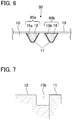
- FIGS. 4A to 4D are diagrams for explaining a manufacturing process for manufacturing the purfling 80. Although the following description explains the manufacturing process of forming the purfling 80 on the top plate 10, the purfling 80 is also formed on the back plate 20 by the same process.
- two grooves 15a and 15b are formed in the top plate 10 (the board).
- the groove 15a and the groove 15b are formed by laser processing. It is possible to perform the process with high accuracy using the laser processing even when the width of the purfling lines 80a and 80b is 1 mm or less.
- the formation of the groove 15a and the groove 15b is not limited to the laser processing.
- the groove 15a and the groove 15b may be performed by cutting using a mill. Alternatively, a worker may perform the groove 15a and the groove 15b using a chisel.
- the depths of the groove 15a and the groove 15b are preferably 20% or more and less than 60% of a thickness of the board.
- the reason for setting the depths in such a range is as follows. In a case in which the depths of the groove 15a and the groove 15b are too shallow, the resin 18 cannot be sufficiently filled and impact absorption and suppression of the cracking may not be sufficiently achieved. On the other hand, in a case in which the depths of the groove 15a and the groove 15b are too deep, strength is compromised and the cracking occurs easily.
- the groove 15a and the groove 15b are filled with the resin 18 in which the filler is dispersed.
- a worker may perform the filling by rubbing the resin 18 into the groove 15a and the groove 15b using a finger.
- the resin 18 may of course also be filled by using a manufacturing device.
- the resin 18 that has flowed out of the groove 15a and the groove 15b is removed. Specifically, a person may wipe it off with a cloth, or a manufacturing device may remove any resin 18 that overflowed. Thus, the surface of the top plate 10 becomes flat, and the groove 15a and the groove 15b are filled with the resin 18.
- the resin 18 filled in the groove 15a and the groove 15b is cured.
- a curing method for the resin 18 is determined according to the type of resin 18.
- the resin 18 may be cured by drying, heating, irradiation of ultraviolet light or the like.
- the surface of the top plate 10 is coated with a varnish or the like, and thus, a protective layer 19 is formed.
- the protective layer 19 has a function of protecting the violin 1 from dryness and humidity.
- the back plate 20 and the rib 30 are bonded with an adhesive, such as a glue.
- the rib 30 and the top plate 10 are bonded with an adhesive, such as a glue, and the main body 40 is formed.
- the neck 50 is attached to the main body 40, and the surface thereof is coated with a varnish.
- a fingerboard is bonded, and a sound post (not shown) is set. After that, the bridge 70 is provided and strings are drawn.
- the shape shown in FIG. 3 is exemplified as the cross-sectional shape of the groove 15a and the groove 15b, there are various aspects in the cross-sectional shape.
- the cross-sectional shape of the groove 15a will be described.
- the cross-sectional shape of the groove 15a is also the same.
- the cross-sectional shapes of the groove 15a and the groove 15b may be different from each other.
- the cross-sectional shape of the groove 15a shown in FIG. 5A is a V shape.
- the resin 18 is not completely filled in the groove 15a. Even when a volume of the resin 18 increases due to environmental changes, the increased amount is absorbed in a space S.
- the cross-sectional shape of the groove 15a shown in FIG. 5B is a rectangular shape.
- the purfling 80 may be easily manufactured by a well-known method.
- the cross-sectional shape of the groove 15a shown in FIG. 5C is a trapezoidal shape, and the width at the bottom is greater than the width at the top.
- a filling amount of the resin 18 is increased even when the width of the purfling line 80a, seen from the outside, is the same as that in FIG. 5B , by adopting this cross-sectional shape. Accordingly, it is possible to minimize damping of the vibration of the top plate 10.
- the cross-sectional shape of the groove 15a shown in FIG. 5D is an arc shape.
- the groove 15a having this cross-sectional shape is easy to manufacture.
- the cross-sectional shape of the groove 15a shown in FIG. 5E is a shape having unevenness on a bottom surface thereof. For this reason, a contact area between the top plate 10 and the resin 18 becomes large. Therefore, the resin 18 is firmly fixed to the top plate 10. As a result, it is possible to form purfling line 80a that is difficult to peel off.
- the cross-sectional shape of the groove 15a shown in FIG. 5F is a round shape.
- the filling amount of the resin 18 is large even when the width of the purfling line 80a, seen from the outside, is the same as that of FIG. 5B .
- Increasing the amount of the resin 18 minimizes damping of the vibration of the top plate 10.
- a board for a stringed instrument is a board for a stringed instrument used for a top plate or a back plate of an acoustic stringed instrument, and a purfling includes a groove and resin filled in the groove.
- a purfling includes a groove and resin filled in the groove.
- an acoustic stringed instrument includes a top plate, a back plate, and a rib provided between the top plate and the back plate, and is used as at least one of the top plate or the back plate is the above-described board for the stringed instrument.
- the acoustic stringed instrument it is possible to enhance the impact resistance because the resin absorbs the impact. Furthermore, it is possible to adjust the vibration of the top plate by adjusting the depth and width of the groove and selecting an appropriate type of the material for the resin. Accordingly, it is possible to adjust acoustic characteristics of the acoustic stringed instrument.
- the resin preferably has a degree of elongation of 20% or more. If the resin satisfies this condition, it is possible to follow changes in the width even when the width of the groove changes due to environmental changes. As a result, it is possible to minimize the generation of gaps between the resin and the groove and to minimize paint cracking due to the generation of gaps.
- a depth of the groove is preferably 20% or more and less than 60% of the thickness of the board for the stringed instrument.
- the resin cannot be sufficiently filled in.
- the impact absorption and the suppression of cracking may not be sufficiently achieved.
- the groove is too deep, the strength of the board for the stringed instrument is undermined, and the board is subject to cracking.
- Such a disadvantage does not occur if the depth of the groove is 20% or more and less than 60% of the thickness of the board for the stringed instrument.
- the resin includes colored particles having a diameter of 3 ⁇ m or more and less than 70 ⁇ m, and the colored particles be dispersed in the resin. Since the particles having such a size are often larger than the gaps of the wood tissue, it is possible to avoid the filler penetrating through the surface of the groove to the inside.
- a manufacturing method is also derivable.
- Such an invention is a method for manufacturing a board for a stringed instrument that is used for a top plate or a back plate of an acoustic stringed instrument, where the board has a purfling; the method includes a process of forming a groove in a board, a process of filling the groove with a resin, and a process of curing the resin.
- the above-described manufacturing method includes removing the resin that has flowed out of the groove after the filling of the groove with the resin and before the curing of the resin. Removal of the resin may be performed before or after curing of the resin.
- the above-described manufacturing method preferably includes providing a layer that covers a surface of the groove after the forming the groove in the board and before filling the groove with the resin. According to this aspect, it is possible to minimize penetration of the resin through a rib of the groove into the inside.
Landscapes
- Engineering & Computer Science (AREA)
- Physics & Mathematics (AREA)
- Acoustics & Sound (AREA)
- Multimedia (AREA)
- Manufacturing & Machinery (AREA)
- Health & Medical Sciences (AREA)
- General Health & Medical Sciences (AREA)
- Optics & Photonics (AREA)
- Toxicology (AREA)
- Mechanical Engineering (AREA)
- Stringed Musical Instruments (AREA)
Abstract
Description
- The present invention relates to a board for a stringed instrument having a purfling, to an acoustic stringed instrument, and to a method of manufacturing a board for a stringed instrument.
- A violin is constructed by holding a rib between a top plate and a back plate. Additionally, a highly decorative member called a "purfling" is provided at peripheral edges of the top plate and the back plate. Non-Patent
Document 1 discloses a traditional method of manufacturing a violin. According to this manufacturing method, in a conventional purfling for a violin, grooves having a width of about 2 mm to about 3 mm are engraved on peripheral edges of the top plate and the back plate, respectively. Members obtained by bonding three strips are fitted into the grooves, and then the top plate and the back plate are polished. Each of the members used for the fitting has a structure in which the middle strip among the three strips is sandwiched between the other two strips, which are black. Accordingly, after the members are fitted into the grooves, two black lines are formed on each of the top plate and the back plate. Such a method of manufacturing a violin is a traditional manufacturing method that has been practiced for more than 400 years and continues to this day. - The role of the purfling is to improve durability, in addition to a design effect. Since a straight-grained board is often used for the top plate of the violin, the board may crack along a wood grain when a big impact is applied to the violin. It is possible to absorb the impact by the purfling provided on the peripheral edges of the top plate and the back plate.
- In recent years, there has been known a violin in which two black lines are printed on the top plate and the back plate instead of the above-described structure of the purfling. This type of violin has an advantage in that manufacturing cost is reduced, because it does not require skilled craftsmanship to form the purfling.
- Non-Patent Document1: Chris Johnson, "The Art of Violin Making," Robert Hale Ltd., April 1998
- However, in a method of forming two black lines by printing, once a player has the violin in hand, the player will notice that the purfling is not formed by inlaying. Furthermore, in a case in which the two black lines are formed only by printing, since an internal structure of the top plate and the back plate is in line with the grain, there is a problem in that the top plate or the back plate may crack on impact. The present invention has been made in view of such circumstances. An object of the present invention is to provide an acoustic stringed instrument having decorativeness and impact resistance with a simplified manufacturing process, and a method of manufacturing the same.
- In order to achieve the aforementioned object, a board for a stringed instrument according to one aspect of the present invention, which is used for a top plate or a back plate of an acoustic stringed instrument, includes a groove formed in the board and a resin filled in the groove.
- Furthermore, a method of manufacturing a board for a stringed instrument according to one aspect of the present invention is a method of manufacturing a board for a stringed instrument that is used for a top plate or a back plate of an acoustic stringed instrument, where the board has a purfling, the method including forming a groove in the board, filling the groove with a resin, and curing the resin.
-
-
FIG. 1 is an external perspective view of a violin according to an embodiment. -
FIG. 2 is a perspective view for explaining purfling -
FIG. 3 is a cross-sectional view showing a cross section of the purfling. -
FIG. 4A is a process diagram showing a production process of the purfling. -
FIG. 4B is a process diagram showing the production process of the purfling. -
FIG. 4C is a process diagram showing the production process of the purfling. -
FIG. 4D is a process diagram showing the production process of the purfling. -
FIG. 5A is a cross-sectional view showing another example of a groove. -
FIG. 5B is a cross-sectional view showing another example of the groove. -
FIG. 5C is a cross-sectional view showing another example of the groove. -
FIG. 5D is a cross-sectional view showing another example of the groove. -
FIG. 5E is a cross-sectional view showing another example of the groove. -
FIG. 5F is a cross-sectional view showing another example of the groove. -
FIG. 6 is a cross-sectional view showing a structure of the purfling according to a modified example. -
FIG. 7 is a cross-sectional view showing a structure of the groove according to a modified example. - Hereinafter, an embodiment of the present invention will be described with reference to the drawings.
- In the following description, a
violin 1 will be described as an example of an acoustic stringed instrument. Theviolin 1 is merely an example, and the acoustic stringed instrument may be, for example, acoustic bowed stringed instrument such as a cello, a viola, or a contrabass that is similar to a violin. -
FIG. 1 is an external perspective view of a violin according to an embodiment of the present invention. Theviolin 1 includes amain body 40 and aneck 50. Themain body 40 includes atop plate 10, aback plate 20, and arib 30 provided between thetop plate 10 and theback plate 20. - The
top plate 10 is provided with atailpiece 60 and abridge 70. One end of each string is fixed to thetailpiece 60. The other end of each string is fixed by means ofpegs 52 provided on aneck 50 via abridge 70. The strings are tightened by winding thepegs 52. - For example, a stacked board is used for the
top plate 10. Thetop plate 10 is formed by bonding a top surface board, a back surface board, and a core board disposed therebetween with an adhesive. A material of a single board for the top surface board, the back surface board, and the core board may be the same or may be different. For example, spruce, maple, pine, cedar, birch, beech, or lauan may be used as the single board. Among them, it is preferable to use spruce, by use of which the top plate is given an excellent functions as a diaphragm. Furthermore, it is preferable that all of the top surface board, the back surface board, and the core board, which constitute thetop plate 10, be formed of spruce. The use of spruce for all the materials of the single boards provides a better function as thetop plate 10, as a result of which the sound quality of theviolin 1 is enhanced (compared to using spruce only in part). Moreover, thetop plate 10 according to the embodiment provides a better appearance by using a straight-grained spruce material as the material of the single board forming thetop surface board 1. - Before the
top plate 10 is attached to therib 30, thetop plate 10 is formed into the same shape as that after completion of the violin. Alternatively, atop plate 10 that is larger than the completed shape may be prepared, so that thetop plate 10 may be fixed to therib 30, subsequent to which the shape of a peripheral edge of thetop plate 10 may be trimmed. Apurfling 80 is provided at the peripheral edge of each of thetop plate 10 and theback plate 20. -
FIG. 2 is an enlarged view showing a part of thepurfling 80. As shown inFIG. 2 , thepurfling 80 has twopurfling lines purfling line 80b is formed on the peripheral edge of thetop plate 10 at a constant distance from an end of thetop plate 10. Thepurfling line 80a is also formed in the same manner. -
FIG. 3 shows a cross-sectional view of thepurfling 80. As shown in this drawing, thepurfling 80 is configured by filling agroove 15a and agroove 15b formed in thetop plate 10 withresin 18 and providing aprotective layer 19 on an upper surface thereof. Thegroove 15a and thegroove 15b are approximately V-shaped, with the bottom part thereof being rounded. Since the bottom parts are rounded, even when flowability of theresin 18 is relatively low and viscosity thereof is relatively high, it is possible to fill theresin 18 in thegroove 15a and thegroove 15b without gaps. It is also possible to reduce occurrence of local stress as compared to sharp V-shapes. From the viewpoint of facilitating processing, it is preferable that the cross-sectional shapes of thegroove 15a and thegroove 15b be the same at any position. - Forming the
purfling lines resin 18 has the following advantages. - In a conventional purfling formed by inlaying, the skill of a skilled craftsman is required, for example, in order to align the
purfling line 80a so that the gap is eliminated and thepurfling line 80a is continuous in a superposed portion in which thepurfling line 80a located in a region X inFIG. 2 is bent at an acute angle. On the other hand, the required skill for forming thepurfling 80 according to the present embodiment is to fill thegroove 15a and thegroove 15b only with theresin 18 which is flowable. Thus, it is possible to fill easily thegroove 15a and thegroove 15b with theresin 18 without gaps. Therefore, thepurfling 80 is easily manufactured. - Furthermore, in the conventional purfling formed by the inlaying, since a slightly larger member is embedded in the groove, it is necessary to cut out a portion protruding from the groove and then flatten the surface. On the other hand, since the purfling 80 according to the embodiment is formed by filling the
groove 15a and thegroove 15b with theresin 18,resin 18 that has flowed out of thegroove 15a and thegroove 15b may be wiped off. Therefore, compared to the conventional purfling that requires cutting, thepurfling 80 is easily manufactured. - Furthermore, in the conventional purfling formed by the inlaying, due to a difference in contraction rates between the embedding member, and the
top plate 10 or theback plate 20, a gap is formed between the groove and the embedding member. Thus cracks may occur on a surface coating. On the other hand, as will be described later, since the purfling 80 according to the embodiment uses theresin 18 having a degree of elongation greater than that of wood. As a result, it is possible to minimize formation of gaps between theresin 18 and each of thegroove 15a and thegroove 15b, and thus, prevent cracking of the surface coating. - Furthermore, in a case in which the purfling is formed by printing, a manufacturing process is shortened. However, in the printing of purfling, when an impact is applied to ends of the top plate and the back plate protruding from the rib to the outside, the impact may be transmitted directly to the top plate and the back plate, and cracks may occur along a wood grain. In contrast, in the
purfling 80 according to the embodiment, since theresin 18 serves as a shock absorbing material, thepurfling 80 absorbs the impact. Thus, cracking is minimized. - Furthermore, in the case in which the purfling is formed by printing, since the grooves are not formed in the top plate and the back plate, there is a concern that the timbre of a sound would be different from that of inlaying. On the other hand, in the
purfling 80 according to the embodiment, since thegroove 15a and thegroove 15b are filled with theresin 18, the timbre of the sound is made possible to be closer to that in thepurfling 80 formed by the inlaying. - The material of the
resin 18 used for thepurfling 80 in thetop plate 10 and a width and a depth of thegroove 15a and thegroove 15b affect acoustic characteristics of theviolin 1. Vibration of thetop plate 10 is also a major factor because it affects the sound generated by theviolin 1. In a normal violin, the peripheral edge is made thinner than a central portion so that the top plate easily vibrates. - In the conventional purfling using the inlaying, wood is embedded in the groove. A fiber direction of the wood is different from a fiber direction of the top plate or the back plate. Therefore, there is a possibility that the purfling using the inlaying may affect the vibration of the violin. However, since all the material of the member to be embedded in the groove and the material of the top plate and the back plate are wood, the influence on the vibration of the violin by adjusting the depth or width of the groove is limited. Accordingly, conventionally, the purfling is not used for adjusting sound quality. In general, in the top plate and the back plate of a violin, the peripheral edges are thinner than the central portions. This is to increase the vibration of the top plate and the back plate. The vibration of the violin is classified into various modes, but the vibration in a direction perpendicular to the top plate and the back plate accounts for a large proportion of the entire vibration of the violin. In the embodiment, since the
resin 18 that is softer than wood is filled in thegroove 15a and thegroove 15b, thetop plate 10 more easily vibrates than the conventional method. That is, it is possible to improve rising of the sound by lowering rigidity of an outer peripheral edge by use of theresin 18. Furthermore, it is possible to control the vibration of thetop plate 10 by adjusting the material of theresin 18 or the width and depth of thegroove 15a and thegroove 15b. More specifically, as the hardness of theresin 18 is greater and thegroove 15a and thegroove 15b each are narrower and shallower, a frequency at which the vibration of thetop plate 10 increases is higher. Conversely, as the hardness of theresin 18 is less and thegroove 15a and thegroove 15b each are wider and deeper, the frequency at which the vibration of thetop plate 10 increases is lower. In this way, theviolin 1 having a distinctive tone can be provided since it is possible to increase the number of factors for adjusting the timbre of the sound of theviolin 1 by adopting theresin 18. - Hereinafter, the
resin 18 will be described. It is preferable that theresin 18 have a hardness that is less than that of wood. Furthermore, the material of theresin 18 is selected so that theresin 18 is able to respond to changes in temperature or humidity of thetop plate 10 and theback plate 20 or changes thereof with time. Therefore, it is preferable to use a soft material that has a large degree of elongation. As a material having such characteristics, for example, a urethane resin or a rubber resin may be adopted. Furthermore, a material that has good adhesion characteristics to wood of thetop plate 10 is selected as theresin 18. After theresin 18 is filled in thegroove 15a and thegroove 15b, theresin 18 is cured and solidified. - More specifically, the cured
resin 18 preferably has a degree of elongation of 20% or more. The degree of elongation is determined by a length up to breakage when theresin 18 having a linear shape is pulled. When an original length is L1 and a length at the time of breakage is L2, the degree of elongation is obtained by (L2 - L1) / L1. - When the resin satisfies this condition, changes in the width are followed even when the widths of the
groove 15a and thegroove 15b change due to environmental changes. It is anticipated that the widths of thegroove 15a and thegroove 15b will be a maximum of 1.2 times the original widths, depending on environmental changes. Even in such a case, when the degree of elongation is 20% or more, no gap is formed in thegroove 15a and thegroove 15b. Thus, it is possible to minimize cracking due to generation of a gap and also to minimize the cracking of thepurfling lines - Furthermore, the
resin 18 may be colored using a dye or a pigment. However, when a coloring agent is used, the coloring agent penetrates into the inside from thegroove 15a and thegroove 15b. Thetop plate 10 and theback plate 20 are formed of wood. The wood has many gaps in its cross section. When theresin 18 penetrates into the gaps, spreading occurs. As a result, thepurfling lines - Therefore, it is preferable that a transparent or
translucent resin 18 contain a filler. Such a filler may be in the form of small pieces or beads. In the case of beads, it is preferable that a diameter be 3 µm or more to less than 70 µm and that they be colored. Black beads may be used as the filler. The reason for setting the diameter of the beads to 3 µm or more to less than 70 µm is as follows. In a case in which the beads have such a size, the beads are larger than gaps of wood tissue and thus the penetration of the filler is suppressed. Furthermore, theresin 18 preferably has a large amount of filler and a small amount of a volatile component. In this case, a change in volume after curing is small, and thus, it is possible to finish smoothly. -
FIGS. 4A to 4D are diagrams for explaining a manufacturing process for manufacturing thepurfling 80. Although the following description explains the manufacturing process of forming the purfling 80 on thetop plate 10, thepurfling 80 is also formed on theback plate 20 by the same process. - In a first process, as shown in
FIG. 4A , twogrooves groove 15a and thegroove 15b are formed by laser processing. It is possible to perform the process with high accuracy using the laser processing even when the width of thepurfling lines groove 15a and thegroove 15b is not limited to the laser processing. Thegroove 15a and thegroove 15b may be performed by cutting using a mill. Alternatively, a worker may perform thegroove 15a and thegroove 15b using a chisel. - Here, the depths of the
groove 15a and thegroove 15b are preferably 20% or more and less than 60% of a thickness of the board. The reason for setting the depths in such a range is as follows. In a case in which the depths of thegroove 15a and thegroove 15b are too shallow, theresin 18 cannot be sufficiently filled and impact absorption and suppression of the cracking may not be sufficiently achieved. On the other hand, in a case in which the depths of thegroove 15a and thegroove 15b are too deep, strength is compromised and the cracking occurs easily. - In a second process, as shown in
FIG. 4B , thegroove 15a and thegroove 15b are filled with theresin 18 in which the filler is dispersed. Specifically, a worker may perform the filling by rubbing theresin 18 into thegroove 15a and thegroove 15b using a finger. Theresin 18 may of course also be filled by using a manufacturing device. - In a third process, as shown in
FIG. 4C , theresin 18 that has flowed out of thegroove 15a and thegroove 15b is removed. Specifically, a person may wipe it off with a cloth, or a manufacturing device may remove anyresin 18 that overflowed. Thus, the surface of thetop plate 10 becomes flat, and thegroove 15a and thegroove 15b are filled with theresin 18. - In a fourth process, as shown in
FIG. 4D , theresin 18 filled in thegroove 15a and thegroove 15b is cured. A curing method for theresin 18 is determined according to the type ofresin 18. For example, theresin 18 may be cured by drying, heating, irradiation of ultraviolet light or the like. Thereafter, the surface of thetop plate 10 is coated with a varnish or the like, and thus, aprotective layer 19 is formed. Thus, thepurfling 80 is completed. Theprotective layer 19 has a function of protecting theviolin 1 from dryness and humidity. - In the
violin 1, theback plate 20 and therib 30 are bonded with an adhesive, such as a glue. Then, therib 30 and thetop plate 10 are bonded with an adhesive, such as a glue, and themain body 40 is formed. Thereafter, theneck 50 is attached to themain body 40, and the surface thereof is coated with a varnish. Next, a fingerboard is bonded, and a sound post (not shown) is set. After that, thebridge 70 is provided and strings are drawn. - In the above-described embodiment, although the shape shown in
FIG. 3 is exemplified as the cross-sectional shape of thegroove 15a and thegroove 15b, there are various aspects in the cross-sectional shape. Hereinafter, the cross-sectional shape of thegroove 15a will be described. In addition, the cross-sectional shape of thegroove 15a is also the same. However, the cross-sectional shapes of thegroove 15a and thegroove 15b may be different from each other. - The cross-sectional shape of the
groove 15a shown inFIG. 5A is a V shape. In this example, theresin 18 is not completely filled in thegroove 15a. Even when a volume of theresin 18 increases due to environmental changes, the increased amount is absorbed in a space S. - The cross-sectional shape of the
groove 15a shown inFIG. 5B is a rectangular shape. In this case, the purfling 80 may be easily manufactured by a well-known method. - The cross-sectional shape of the
groove 15a shown inFIG. 5C is a trapezoidal shape, and the width at the bottom is greater than the width at the top. A filling amount of theresin 18 is increased even when the width of thepurfling line 80a, seen from the outside, is the same as that inFIG. 5B , by adopting this cross-sectional shape. Accordingly, it is possible to minimize damping of the vibration of thetop plate 10. - The cross-sectional shape of the
groove 15a shown inFIG. 5D is an arc shape. Thegroove 15a having this cross-sectional shape is easy to manufacture. - The cross-sectional shape of the
groove 15a shown inFIG. 5E is a shape having unevenness on a bottom surface thereof. For this reason, a contact area between thetop plate 10 and theresin 18 becomes large. Therefore, theresin 18 is firmly fixed to thetop plate 10. As a result, it is possible to form purflingline 80a that is difficult to peel off. - The cross-sectional shape of the
groove 15a shown inFIG. 5F is a round shape. In this cross-sectional shape, similarly to the trapezoidal shape ofFIG. 5C , the filling amount of theresin 18 is large even when the width of thepurfling line 80a, seen from the outside, is the same as that ofFIG. 5B . Increasing the amount of theresin 18 minimizes damping of the vibration of thetop plate 10. - The present invention is not limited to the various embodiments described above, and, for example, various applications and modifications described below are possible. Furthermore, in the aspects of applications and modifications described below, one or more freely selected ones may be appropriately combined.
- (1) Although the
violin 1 is exemplified in the above-described embodiment, the present invention is not limited thereto and may be applied to any musical instrument as long as the instrument would need provision of thepurfling 80. For example, it may be an acoustic stringed instrument such as a jazz guitar or a classical guitar having an arch top. In the jazz guitar, the purfling may be provided on the peripheral edge of the top plate. Thus, the present invention may be applied to the jazz guitar. Also, in the classical guitar, the purfling may be provided on the peripheral edge of the top plate or around a sound hole. - (2) In the above-described embodiment, an example is described in which the
resin 18 is transparent or translucent and the filler is colored, but the present invention is not limited thereto. Theresin 18 may contain a black or dark brown pigment. It is preferable that the color of thepurfling lines top plate 10 or theback plate 20 such that a user recognizes the two lines. From the viewpoint of making the user perceive two lines, the color of a strip between thepurfling lines top plate 10. - (3) In filling the
groove 15a and thegroove 15b with theresin 18 in the above-described embodiment, portions other than thegroove 15a and thegroove 15b may be masked beforehand, and thegroove 15a and thegroove 15b may be filled with theresin 18. In this case, an advantage is obtained in that the surface of thetop plate 10 is not degraded by theexcess resin 18.
Furthermore, when the flowability of theresin 18 is high, theresin 18 may be applied or sprayed to fill thegroove 15a and thegroove 15b. Furthermore, when theresin 18 before curing is a liquid, theresin 18 may be poured into thegroove 15a and thegroove 15b and then cured in a state in which a level is maintained. - (4) In the above-described embodiment, although the
groove 15a and thegroove 15b have the same cross-sectional shape at any position, the present invention is not limited thereto. The cross-sectional shapes may be different depending on position. Also, cross-sectional areas of thegroove 15a and thegroove 15b may be changed depending on a position. Furthermore, at least one of the width or depth of thegroove 15a and thegroove 15b may be changed depending on position. Changing the shapes of thegroove 15a and thegroove 15b in this way enables vibration to be damped at a predetermined frequency or vibration to be increased at a predetermined frequency. As a result, the acoustic characteristics of theviolin 1 can be adjusted.
However, it is preferable that line width of thepurfling lines groove 15a and thegroove 15b may be set depending on a position while making the line width be constant such that the uniform line is recognized from the outside. - (5) In the above-described embodiment, after the
resin 18 is filled in thegroove 15a and thegroove 15b, theresin 18 that has flowed out of thegroove 15a and thegroove 15b is removed, and then theresin 18 is cured. However, the present invention is not limited thereto. Theresin 18 may be filled in thegroove 15a and thegroove 15b, subsequent to which theresin 18 may be cured, and thenexcess resin 18 may be removed by polishing using sandpaper or the like. - (6) In the above-described embodiment, although the
top plate 10 and theback plate 20 are formed of a stacked material, the present invention is not limited thereto. Thetop plate 10 and theback plate 20 may be configured using any material. For example, at least one of thetop plate 10 or theback plate 20 may be configured using a single board.
Also, regardless of the content of cellulose and wood, a fiber board or a high pressure laminate body may be used.
Furthermore, non-wood materials may be used for thetop plate 10 and theback plate 20. For example, carbon fibers or glass fibers may be used. - (7) In the above-described embodiment, although the
grooves 15a and thegrooves 15b are formed by cutting out, the present invention is not limited thereto. For example, thegrooves 15a and thegrooves 15b may be formed by pressing. Alternatively, when thetop plate 10 and theback plate 20 are formed of a fiber board or a stacked material, thetop plate 10 and theback plate 20 may be formed using a mold in which thegroove 15a and thegroove 15b are formed. - (8) In the above-described embodiment, although the
resin 18 is in direct contact with thegroove 15a and thegroove 15b, the present invention is not limited thereto. There may be provided a layer that covers at least thegroove 15a and thegroove 15b. Such a layer is a functional layer that is capable of promoting adhesion or minimizing the penetration of theresin 18 into wood.FIG. 6 shows a cross-sectional view of thepurfling 80 according to a modified example. As shown in this drawing, there is formed afunctional layer 17 that covers thegroove 15a and thegroove 15b. In a case in which thefunctional layer 17 has a function of minimizing the penetration of theresin 18 into wood, even when theresin 18 colored with a dye or a pigment is used, no spreading occurs in thepurfling lines functional layer 17 is preferably transparent. This is because as long asfunctional layer 17 is transparent, the appearance will not be impaired even if it penetrates into thetop plate 10 through thegroove 15a and thegroove 15b. Additionally, even if thefunctional layer 17 penetrates through gaps in wood tissue, theresin 18 no longer penetrates after curing of thefunctional layer 17. Thus,sharp purfling lines - (9) In the above-described embodiment, although the
groove 15b is formed in thetop plate 10 and theback plate 20 by the laser processing, the present invention is not limited thereto. Thegroove 15b may be formed by combining a plurality of members. For example, as shown inFIG. 7 , amember 11, which is an end portion of thetop plate 10 or theback plate 20, and amember 12, which is a main body of thetop plate 10 or theback plate 20, may be bonded to each other form thegroove 15b. According to this modified example, cutting may be unnecessary. - The following invention will be derived from the above-described embodiment and modified examples. First, one aspect of a board for a stringed instrument is a board for a stringed instrument used for a top plate or a back plate of an acoustic stringed instrument, and a purfling includes a groove and resin filled in the groove. In this board for a stringed instrument, it is possible to form the purfling with the groove and the resin. Therefore, it can be manufactured easily as compared with the embedded-type purfling.
- Next, one aspect of an acoustic stringed instrument includes a top plate, a back plate, and a rib provided between the top plate and the back plate, and is used as at least one of the top plate or the back plate is the above-described board for the stringed instrument. According to one aspect of the acoustic stringed instrument, it is possible to enhance the impact resistance because the resin absorbs the impact. Furthermore, it is possible to adjust the vibration of the top plate by adjusting the depth and width of the groove and selecting an appropriate type of the material for the resin. Accordingly, it is possible to adjust acoustic characteristics of the acoustic stringed instrument.
- In one aspect of the above-described acoustic stringed instrument, the resin preferably has a degree of elongation of 20% or more. If the resin satisfies this condition, it is possible to follow changes in the width even when the width of the groove changes due to environmental changes. As a result, it is possible to minimize the generation of gaps between the resin and the groove and to minimize paint cracking due to the generation of gaps.
- In one aspect of the above-described acoustic stringed instrument, a depth of the groove is preferably 20% or more and less than 60% of the thickness of the board for the stringed instrument. In a case in which the groove is too shallow, the resin cannot be sufficiently filled in. Thus, the impact absorption and the suppression of cracking may not be sufficiently achieved. On the other hand, in a case in which the groove is too deep, the strength of the board for the stringed instrument is undermined, and the board is subject to cracking. Such a disadvantage does not occur if the depth of the groove is 20% or more and less than 60% of the thickness of the board for the stringed instrument. In other words, it is possible to adjust the characteristics of the sound of the acoustic stringed instrument by adjusting the depth of the groove within a range of 20% or more and less than 60% of the thickness of the board for a stringed instrument.
- In one aspect of the above-described acoustic stringed instrument, it is preferable that the resin includes colored particles having a diameter of 3 µm or more and less than 70 µm, and the colored particles be dispersed in the resin. Since the particles having such a size are often larger than the gaps of the wood tissue, it is possible to avoid the filler penetrating through the surface of the groove to the inside.
- A manufacturing method is also derivable. Such an invention is a method for manufacturing a board for a stringed instrument that is used for a top plate or a back plate of an acoustic stringed instrument, where the board has a purfling; the method includes a process of forming a groove in a board, a process of filling the groove with a resin, and a process of curing the resin. According to this invention, since it is not necessary to fit the stacked material into the groove by inlaying, it is possible even for a person who is not highly skilled to manufacture the board for a stringed instrument having the purfling.
- Furthermore, the above-described manufacturing method includes removing the resin that has flowed out of the groove after the filling of the groove with the resin and before the curing of the resin.
Removal of the resin may be performed before or after curing of the resin. - Furthermore, the above-described manufacturing method preferably includes providing a layer that covers a surface of the groove after the forming the groove in the board and before filling the groove with the resin. According to this aspect, it is possible to minimize penetration of the resin through a rib of the groove into the inside.
-
- 10: Top plate
- 15a, 15b: Groove
- 17: Functional layer
- 18: Resin
- 19: Protective layer
- 20: Back plate
- 30: Rib
- 40: Main body
- 50: Neck
Claims (8)
- A board for a stringed instrument, used for a top plate or a back plate of an acoustic stringed instrument, where the board has a purfling, the purfling comprising:a groove formed in the board; anda resin filled in the groove.
- An acoustic stringed instrument comprising:a top plate;a back plate; anda rib provided between the top plate and the back plate, andwherein the board for a stringed instrument according to claim 1 is used as at least one of the top plate or the back plate.
- The acoustic stringed instrument according to claim 2, wherein the resin has a degree of elongation of 20% or more.
- The acoustic stringed instrument according to claim 2 or 3, wherein a depth of the groove is 20% or more and less than 60% of a thickness of the board for the stringed instrument.
- The acoustic stringed instrument according to any one of claims 2 to 4,wherein the resin includes colored particles having a diameter of 3 µm or more and less than 70 µm, andwherein the colored particles are dispersed in the resin.
- A method of manufacturing a board for a stringed instrument that is used for a top plate or a back plate of an acoustic stringed instrument, where the board has a purfling, the method comprising:forming a groove in the board;filling the groove with a resin; andcuring the resin.
- The method according to claim 6, further comprising removing the resin that has flowed out of the groove after the filling of the groove with the resin and before the curing of the resin.
- The method according to claim 6 or 7, further comprising providing a layer that covers a surface of the groove after the forming of the groove in the board and before the filling of the groove with the resin.
Applications Claiming Priority (1)
| Application Number | Priority Date | Filing Date | Title |
|---|---|---|---|
| PCT/JP2017/000216 WO2018127964A1 (en) | 2017-01-06 | 2017-01-06 | Board material for stringed instrument, acoustic stringed instrument, and method for manufacturing board material for stringed instrument |
Publications (3)
| Publication Number | Publication Date |
|---|---|
| EP3567581A1 true EP3567581A1 (en) | 2019-11-13 |
| EP3567581A4 EP3567581A4 (en) | 2020-07-22 |
| EP3567581B1 EP3567581B1 (en) | 2024-08-28 |
Family
ID=62791238
Family Applications (1)
| Application Number | Title | Priority Date | Filing Date |
|---|---|---|---|
| EP17890451.2A Active EP3567581B1 (en) | 2017-01-06 | 2017-01-06 | Board material for stringed instrument, acoustic stringed instrument, and method for manufacturing board material for stringed instrument |
Country Status (5)
| Country | Link |
|---|---|
| US (1) | US10964296B2 (en) |
| EP (1) | EP3567581B1 (en) |
| JP (1) | JP6791268B2 (en) |
| CN (2) | CN117524172A (en) |
| WO (1) | WO2018127964A1 (en) |
Families Citing this family (6)
| Publication number | Priority date | Publication date | Assignee | Title |
|---|---|---|---|---|
| CN110168632A (en) * | 2017-01-16 | 2019-08-23 | 雅马哈株式会社 | Acoustic stringed musical instrument, method of making the same, and method of repairing the same |
| CN110385761A (en) * | 2019-07-16 | 2019-10-29 | 泰兴市鸿艺乐器有限公司 | A kind of processing method of violin panel |
| US20230215404A1 (en) * | 2020-06-01 | 2023-07-06 | Kwang Rim LEE | Musical instrument having multiple sound boards |
| CN111945975A (en) * | 2020-06-17 | 2020-11-17 | 程建平 | Manufacturing method and structure of melamine veneer without seam edge |
| JP2022075435A (en) * | 2020-11-06 | 2022-05-18 | 徳雄 吉田 | String instrument and method for manufacturing the same |
| WO2024134999A1 (en) * | 2022-12-19 | 2024-06-27 | ヤマハ株式会社 | Musical instrument |
Family Cites Families (13)
| Publication number | Priority date | Publication date | Assignee | Title |
|---|---|---|---|---|
| GB1161122A (en) * | 1965-11-16 | 1969-08-13 | Raymond Brakewell | Improvements in and relating to Sound Boxes for Musical Instruments. |
| JPS5536873Y2 (en) * | 1976-05-18 | 1980-08-29 | ||
| US4353862A (en) * | 1980-05-12 | 1982-10-12 | Kaman Aerospace Corporation | Method for making sound board |
| JPH02150897A (en) * | 1988-12-02 | 1990-06-11 | Casio Comput Co Ltd | Fingerboard structure, neck structure, stringed instrument, and manufacturing method thereof |
| US6395845B1 (en) * | 1998-12-15 | 2002-05-28 | Resolution Performance Products Llc | Waterproofing membrane from epoxy resin and amine-terminated polyamide |
| JP2000211092A (en) * | 1999-01-27 | 2000-08-02 | Dainippon Printing Co Ltd | Cosmetic material |
| JP3499530B2 (en) * | 2001-01-15 | 2004-02-23 | 三洋化成工業株式会社 | Colored resin particles and manufacturing method |
| US20060174753A1 (en) * | 2001-02-15 | 2006-08-10 | Thomas Aisenbrey | Musical instruments and components manufactured from conductively doped resin-based materials |
| JP4929623B2 (en) * | 2004-06-21 | 2012-05-09 | 味の素株式会社 | Thermosetting resin composition containing modified polyimide resin |
| JP5098931B2 (en) * | 2008-09-30 | 2012-12-12 | 大日本印刷株式会社 | Oil resistant cosmetics |
| JP6037777B2 (en) * | 2012-10-31 | 2016-12-07 | 東洋鋼鈑株式会社 | Resin-coated metal plate for squeezed iron can, squeezed iron can and method for producing squeezed iron can |
| KR101655891B1 (en) * | 2016-02-29 | 2016-09-08 | 이세강 | Manufacturing Method and a guitar ornament |
| CN205845497U (en) * | 2016-08-01 | 2016-12-28 | 安阳师范学院 | A crack-resistant wooden ocarina |
-
2017
- 2017-01-06 JP JP2018560294A patent/JP6791268B2/en active Active
- 2017-01-06 CN CN202311322839.2A patent/CN117524172A/en active Pending
- 2017-01-06 EP EP17890451.2A patent/EP3567581B1/en active Active
- 2017-01-06 CN CN201780082180.4A patent/CN110168633A/en active Pending
- 2017-01-06 WO PCT/JP2017/000216 patent/WO2018127964A1/en not_active Ceased
-
2019
- 2019-07-03 US US16/502,938 patent/US10964296B2/en active Active
Also Published As
| Publication number | Publication date |
|---|---|
| JP6791268B2 (en) | 2020-11-25 |
| US20190325850A1 (en) | 2019-10-24 |
| US10964296B2 (en) | 2021-03-30 |
| CN110168633A (en) | 2019-08-23 |
| EP3567581B1 (en) | 2024-08-28 |
| JPWO2018127964A1 (en) | 2019-11-07 |
| WO2018127964A1 (en) | 2018-07-12 |
| EP3567581A4 (en) | 2020-07-22 |
| CN117524172A (en) | 2024-02-06 |
Similar Documents
| Publication | Publication Date | Title |
|---|---|---|
| US10964296B2 (en) | Board for stringed instrument, acoustic stringed instrument, and method of manufacturing board for stringed instrument | |
| KR102111138B1 (en) | Manufacturing Method of Flexible Cover Window | |
| CN104575452B (en) | Sheet material for stringed musical instrument, the method and stringed musical instrument for manufacturing the sheet material | |
| CN103514857B (en) | Stringed musical instrument with inlay plate and method for manufacturing same | |
| US10789915B2 (en) | Acoustic string instrument, and methods for manufacturing and repairing same | |
| US6175068B1 (en) | Drumhead | |
| US9666168B2 (en) | Board for stringed instrument, method of manufacturing board for stringed instrument, and stringed instrument | |
| CN202816329U (en) | Composite soundboard of piano | |
| CN100362565C (en) | Qin zheng prodn. method having arc planned and shaped by whole sound slot board | |
| US20090031878A1 (en) | Pick for playing a non-bowed stringed instrument | |
| CN204087762U (en) | A kind of piano soundboard splicing construction | |
| JP2016078338A (en) | Woody building material and method for manufacturing woody building material | |
| CN106169291A (en) | A kind of stringed musical instrument and preparation method thereof | |
| US20250299650A1 (en) | Musical instrument and producing method thereof | |
| CN217035116U (en) | The coordination structure of Yueshan and Chenglu of Guqin | |
| CN206833897U (en) | A kind of violin and its bridge | |
| CA2585512C (en) | Pick for playing a non-bowed stringed instrument | |
| CN104318914A (en) | Splicing structure and splicing process of piano soundboard | |
| JP7122536B2 (en) | building materials | |
| CN120388547A (en) | A guqin body resonance cavity structure | |
| JPS62257198A (en) | Resonance plate for large musical instrument | |
| CA2842746A1 (en) | Wooden newel post | |
| CN110385761A (en) | A kind of processing method of violin panel |
Legal Events
| Date | Code | Title | Description |
|---|---|---|---|
| STAA | Information on the status of an ep patent application or granted ep patent |
Free format text: STATUS: THE INTERNATIONAL PUBLICATION HAS BEEN MADE |
|
| PUAI | Public reference made under article 153(3) epc to a published international application that has entered the european phase |
Free format text: ORIGINAL CODE: 0009012 |
|
| STAA | Information on the status of an ep patent application or granted ep patent |
Free format text: STATUS: REQUEST FOR EXAMINATION WAS MADE |
|
| 17P | Request for examination filed |
Effective date: 20190722 |
|
| AK | Designated contracting states |
Kind code of ref document: A1 Designated state(s): AL AT BE BG CH CY CZ DE DK EE ES FI FR GB GR HR HU IE IS IT LI LT LU LV MC MK MT NL NO PL PT RO RS SE SI SK SM TR |
|
| AX | Request for extension of the european patent |
Extension state: BA ME |
|
| DAV | Request for validation of the european patent (deleted) | ||
| DAX | Request for extension of the european patent (deleted) | ||
| A4 | Supplementary search report drawn up and despatched |
Effective date: 20200624 |
|
| RIC1 | Information provided on ipc code assigned before grant |
Ipc: B44C 1/26 20060101ALI20200618BHEP Ipc: G10D 1/02 20060101ALI20200618BHEP Ipc: G10D 3/00 20200101AFI20200618BHEP |
|
| STAA | Information on the status of an ep patent application or granted ep patent |
Free format text: STATUS: EXAMINATION IS IN PROGRESS |
|
| 17Q | First examination report despatched |
Effective date: 20210722 |
|
| REG | Reference to a national code |
Ref country code: DE Ref legal event code: R079 Free format text: PREVIOUS MAIN CLASS: G10D0003000000 Ipc: B44C0001220000 Ref country code: DE Ref legal event code: R079 Ref document number: 602017084544 Country of ref document: DE Free format text: PREVIOUS MAIN CLASS: G10D0003000000 Ipc: B44C0001220000 |
|
| GRAP | Despatch of communication of intention to grant a patent |
Free format text: ORIGINAL CODE: EPIDOSNIGR1 |
|
| STAA | Information on the status of an ep patent application or granted ep patent |
Free format text: STATUS: GRANT OF PATENT IS INTENDED |
|
| RIC1 | Information provided on ipc code assigned before grant |
Ipc: G10D 3/02 20060101ALI20240423BHEP Ipc: B44C 1/26 20060101ALI20240423BHEP Ipc: G10D 1/02 20060101ALI20240423BHEP Ipc: G10D 3/22 20200101ALI20240423BHEP Ipc: B44C 1/22 20060101AFI20240423BHEP Ipc: B44C 3/10 20060101ALI20240423BHEP |
|
| INTG | Intention to grant announced |
Effective date: 20240508 |
|
| GRAS | Grant fee paid |
Free format text: ORIGINAL CODE: EPIDOSNIGR3 |
|
| GRAA | (expected) grant |
Free format text: ORIGINAL CODE: 0009210 |
|
| STAA | Information on the status of an ep patent application or granted ep patent |
Free format text: STATUS: THE PATENT HAS BEEN GRANTED |
|
| AK | Designated contracting states |
Kind code of ref document: B1 Designated state(s): AL AT BE BG CH CY CZ DE DK EE ES FI FR GB GR HR HU IE IS IT LI LT LU LV MC MK MT NL NO PL PT RO RS SE SI SK SM TR |
|
| RAP3 | Party data changed (applicant data changed or rights of an application transferred) |
Owner name: YAMAHA CORPORATION |
|
| REG | Reference to a national code |
Ref country code: GB Ref legal event code: FG4D |
|
| RIN1 | Information on inventor provided before grant (corrected) |
Inventor name: MIYAZAWA, KENICHI Inventor name: NAKAYA, HIROSHI Inventor name: YAMAZAKI, TOSHIHISA Inventor name: SOGA, KAZUKI |
|
| REG | Reference to a national code |
Ref country code: CH Ref legal event code: EP |
|
| REG | Reference to a national code |
Ref country code: DE Ref legal event code: R096 Ref document number: 602017084544 Country of ref document: DE |
|
| REG | Reference to a national code |
Ref country code: IE Ref legal event code: FG4D |
|
| REG | Reference to a national code |
Ref country code: LT Ref legal event code: MG9D |
|
| PG25 | Lapsed in a contracting state [announced via postgrant information from national office to epo] |
Ref country code: NO Free format text: LAPSE BECAUSE OF FAILURE TO SUBMIT A TRANSLATION OF THE DESCRIPTION OR TO PAY THE FEE WITHIN THE PRESCRIBED TIME-LIMIT Effective date: 20241128 |
|
| REG | Reference to a national code |
Ref country code: AT Ref legal event code: MK05 Ref document number: 1717580 Country of ref document: AT Kind code of ref document: T Effective date: 20240828 |
|
| PG25 | Lapsed in a contracting state [announced via postgrant information from national office to epo] |
Ref country code: PT Free format text: LAPSE BECAUSE OF FAILURE TO SUBMIT A TRANSLATION OF THE DESCRIPTION OR TO PAY THE FEE WITHIN THE PRESCRIBED TIME-LIMIT Effective date: 20241230 Ref country code: NL Free format text: LAPSE BECAUSE OF FAILURE TO SUBMIT A TRANSLATION OF THE DESCRIPTION OR TO PAY THE FEE WITHIN THE PRESCRIBED TIME-LIMIT Effective date: 20240828 Ref country code: GR Free format text: LAPSE BECAUSE OF FAILURE TO SUBMIT A TRANSLATION OF THE DESCRIPTION OR TO PAY THE FEE WITHIN THE PRESCRIBED TIME-LIMIT Effective date: 20241129 Ref country code: FI Free format text: LAPSE BECAUSE OF FAILURE TO SUBMIT A TRANSLATION OF THE DESCRIPTION OR TO PAY THE FEE WITHIN THE PRESCRIBED TIME-LIMIT Effective date: 20240828 Ref country code: PL Free format text: LAPSE BECAUSE OF FAILURE TO SUBMIT A TRANSLATION OF THE DESCRIPTION OR TO PAY THE FEE WITHIN THE PRESCRIBED TIME-LIMIT Effective date: 20240828 |
|
| PG25 | Lapsed in a contracting state [announced via postgrant information from national office to epo] |
Ref country code: BG Free format text: LAPSE BECAUSE OF FAILURE TO SUBMIT A TRANSLATION OF THE DESCRIPTION OR TO PAY THE FEE WITHIN THE PRESCRIBED TIME-LIMIT Effective date: 20240828 |
|
| PG25 | Lapsed in a contracting state [announced via postgrant information from national office to epo] |
Ref country code: LV Free format text: LAPSE BECAUSE OF FAILURE TO SUBMIT A TRANSLATION OF THE DESCRIPTION OR TO PAY THE FEE WITHIN THE PRESCRIBED TIME-LIMIT Effective date: 20240828 |
|
| REG | Reference to a national code |
Ref country code: NL Ref legal event code: MP Effective date: 20240828 |
|
| PG25 | Lapsed in a contracting state [announced via postgrant information from national office to epo] |
Ref country code: IS Free format text: LAPSE BECAUSE OF FAILURE TO SUBMIT A TRANSLATION OF THE DESCRIPTION OR TO PAY THE FEE WITHIN THE PRESCRIBED TIME-LIMIT Effective date: 20241228 Ref country code: AT Free format text: LAPSE BECAUSE OF FAILURE TO SUBMIT A TRANSLATION OF THE DESCRIPTION OR TO PAY THE FEE WITHIN THE PRESCRIBED TIME-LIMIT Effective date: 20240828 |
|
| PG25 | Lapsed in a contracting state [announced via postgrant information from national office to epo] |
Ref country code: HR Free format text: LAPSE BECAUSE OF FAILURE TO SUBMIT A TRANSLATION OF THE DESCRIPTION OR TO PAY THE FEE WITHIN THE PRESCRIBED TIME-LIMIT Effective date: 20240828 |
|
| PG25 | Lapsed in a contracting state [announced via postgrant information from national office to epo] |
Ref country code: RS Free format text: LAPSE BECAUSE OF FAILURE TO SUBMIT A TRANSLATION OF THE DESCRIPTION OR TO PAY THE FEE WITHIN THE PRESCRIBED TIME-LIMIT Effective date: 20241128 Ref country code: ES Free format text: LAPSE BECAUSE OF FAILURE TO SUBMIT A TRANSLATION OF THE DESCRIPTION OR TO PAY THE FEE WITHIN THE PRESCRIBED TIME-LIMIT Effective date: 20240828 |
|
| PG25 | Lapsed in a contracting state [announced via postgrant information from national office to epo] |
Ref country code: RS Free format text: LAPSE BECAUSE OF FAILURE TO SUBMIT A TRANSLATION OF THE DESCRIPTION OR TO PAY THE FEE WITHIN THE PRESCRIBED TIME-LIMIT Effective date: 20241128 Ref country code: PT Free format text: LAPSE BECAUSE OF FAILURE TO SUBMIT A TRANSLATION OF THE DESCRIPTION OR TO PAY THE FEE WITHIN THE PRESCRIBED TIME-LIMIT Effective date: 20241230 Ref country code: PL Free format text: LAPSE BECAUSE OF FAILURE TO SUBMIT A TRANSLATION OF THE DESCRIPTION OR TO PAY THE FEE WITHIN THE PRESCRIBED TIME-LIMIT Effective date: 20240828 Ref country code: NO Free format text: LAPSE BECAUSE OF FAILURE TO SUBMIT A TRANSLATION OF THE DESCRIPTION OR TO PAY THE FEE WITHIN THE PRESCRIBED TIME-LIMIT Effective date: 20241128 Ref country code: NL Free format text: LAPSE BECAUSE OF FAILURE TO SUBMIT A TRANSLATION OF THE DESCRIPTION OR TO PAY THE FEE WITHIN THE PRESCRIBED TIME-LIMIT Effective date: 20240828 Ref country code: LV Free format text: LAPSE BECAUSE OF FAILURE TO SUBMIT A TRANSLATION OF THE DESCRIPTION OR TO PAY THE FEE WITHIN THE PRESCRIBED TIME-LIMIT Effective date: 20240828 Ref country code: IS Free format text: LAPSE BECAUSE OF FAILURE TO SUBMIT A TRANSLATION OF THE DESCRIPTION OR TO PAY THE FEE WITHIN THE PRESCRIBED TIME-LIMIT Effective date: 20241228 Ref country code: HR Free format text: LAPSE BECAUSE OF FAILURE TO SUBMIT A TRANSLATION OF THE DESCRIPTION OR TO PAY THE FEE WITHIN THE PRESCRIBED TIME-LIMIT Effective date: 20240828 Ref country code: GR Free format text: LAPSE BECAUSE OF FAILURE TO SUBMIT A TRANSLATION OF THE DESCRIPTION OR TO PAY THE FEE WITHIN THE PRESCRIBED TIME-LIMIT Effective date: 20241129 Ref country code: FI Free format text: LAPSE BECAUSE OF FAILURE TO SUBMIT A TRANSLATION OF THE DESCRIPTION OR TO PAY THE FEE WITHIN THE PRESCRIBED TIME-LIMIT Effective date: 20240828 Ref country code: ES Free format text: LAPSE BECAUSE OF FAILURE TO SUBMIT A TRANSLATION OF THE DESCRIPTION OR TO PAY THE FEE WITHIN THE PRESCRIBED TIME-LIMIT Effective date: 20240828 Ref country code: BG Free format text: LAPSE BECAUSE OF FAILURE TO SUBMIT A TRANSLATION OF THE DESCRIPTION OR TO PAY THE FEE WITHIN THE PRESCRIBED TIME-LIMIT Effective date: 20240828 Ref country code: AT Free format text: LAPSE BECAUSE OF FAILURE TO SUBMIT A TRANSLATION OF THE DESCRIPTION OR TO PAY THE FEE WITHIN THE PRESCRIBED TIME-LIMIT Effective date: 20240828 |
|
| PG25 | Lapsed in a contracting state [announced via postgrant information from national office to epo] |
Ref country code: DK Free format text: LAPSE BECAUSE OF FAILURE TO SUBMIT A TRANSLATION OF THE DESCRIPTION OR TO PAY THE FEE WITHIN THE PRESCRIBED TIME-LIMIT Effective date: 20240828 Ref country code: SM Free format text: LAPSE BECAUSE OF FAILURE TO SUBMIT A TRANSLATION OF THE DESCRIPTION OR TO PAY THE FEE WITHIN THE PRESCRIBED TIME-LIMIT Effective date: 20240828 Ref country code: RO Free format text: LAPSE BECAUSE OF FAILURE TO SUBMIT A TRANSLATION OF THE DESCRIPTION OR TO PAY THE FEE WITHIN THE PRESCRIBED TIME-LIMIT Effective date: 20240828 |
|
| PG25 | Lapsed in a contracting state [announced via postgrant information from national office to epo] |
Ref country code: EE Free format text: LAPSE BECAUSE OF FAILURE TO SUBMIT A TRANSLATION OF THE DESCRIPTION OR TO PAY THE FEE WITHIN THE PRESCRIBED TIME-LIMIT Effective date: 20240828 |
|
| PG25 | Lapsed in a contracting state [announced via postgrant information from national office to epo] |
Ref country code: CZ Free format text: LAPSE BECAUSE OF FAILURE TO SUBMIT A TRANSLATION OF THE DESCRIPTION OR TO PAY THE FEE WITHIN THE PRESCRIBED TIME-LIMIT Effective date: 20240828 |
|
| PG25 | Lapsed in a contracting state [announced via postgrant information from national office to epo] |
Ref country code: SK Free format text: LAPSE BECAUSE OF FAILURE TO SUBMIT A TRANSLATION OF THE DESCRIPTION OR TO PAY THE FEE WITHIN THE PRESCRIBED TIME-LIMIT Effective date: 20240828 |
|
| REG | Reference to a national code |
Ref country code: DE Ref legal event code: R097 Ref document number: 602017084544 Country of ref document: DE |
|
| PLBE | No opposition filed within time limit |
Free format text: ORIGINAL CODE: 0009261 |
|
| STAA | Information on the status of an ep patent application or granted ep patent |
Free format text: STATUS: NO OPPOSITION FILED WITHIN TIME LIMIT |
|
| 26N | No opposition filed |
Effective date: 20250530 |
|
| REG | Reference to a national code |
Ref country code: CH Ref legal event code: PL |
|
| PG25 | Lapsed in a contracting state [announced via postgrant information from national office to epo] |
Ref country code: SE Free format text: LAPSE BECAUSE OF FAILURE TO SUBMIT A TRANSLATION OF THE DESCRIPTION OR TO PAY THE FEE WITHIN THE PRESCRIBED TIME-LIMIT Effective date: 20240828 |
|
| PG25 | Lapsed in a contracting state [announced via postgrant information from national office to epo] |
Ref country code: MC Free format text: LAPSE BECAUSE OF FAILURE TO SUBMIT A TRANSLATION OF THE DESCRIPTION OR TO PAY THE FEE WITHIN THE PRESCRIBED TIME-LIMIT Effective date: 20240828 Ref country code: LU Free format text: LAPSE BECAUSE OF NON-PAYMENT OF DUE FEES Effective date: 20250106 |
|
| GBPC | Gb: european patent ceased through non-payment of renewal fee |
Effective date: 20250106 |
|
| PG25 | Lapsed in a contracting state [announced via postgrant information from national office to epo] |
Ref country code: GB Free format text: LAPSE BECAUSE OF NON-PAYMENT OF DUE FEES Effective date: 20250106 Ref country code: BE Free format text: LAPSE BECAUSE OF NON-PAYMENT OF DUE FEES Effective date: 20250131 |
|
| PG25 | Lapsed in a contracting state [announced via postgrant information from national office to epo] |
Ref country code: FR Free format text: LAPSE BECAUSE OF NON-PAYMENT OF DUE FEES Effective date: 20250131 |
|
| PG25 | Lapsed in a contracting state [announced via postgrant information from national office to epo] |
Ref country code: CH Free format text: LAPSE BECAUSE OF NON-PAYMENT OF DUE FEES Effective date: 20250131 |
|
| REG | Reference to a national code |
Ref country code: BE Ref legal event code: MM Effective date: 20250131 |
|
| PG25 | Lapsed in a contracting state [announced via postgrant information from national office to epo] |
Ref country code: IE Free format text: LAPSE BECAUSE OF NON-PAYMENT OF DUE FEES Effective date: 20250106 |
|
| PGFP | Annual fee paid to national office [announced via postgrant information from national office to epo] |
Ref country code: DE Payment date: 20260121 Year of fee payment: 10 |
|
| PGFP | Annual fee paid to national office [announced via postgrant information from national office to epo] |
Ref country code: IT Payment date: 20260126 Year of fee payment: 10 |