EP3566444B1 - Modified adaptive loop filter temporal prediction for temporal scalability support - Google Patents
Modified adaptive loop filter temporal prediction for temporal scalability support Download PDFInfo
- Publication number
- EP3566444B1 EP3566444B1 EP18701627.4A EP18701627A EP3566444B1 EP 3566444 B1 EP3566444 B1 EP 3566444B1 EP 18701627 A EP18701627 A EP 18701627A EP 3566444 B1 EP3566444 B1 EP 3566444B1
- Authority
- EP
- European Patent Office
- Prior art keywords
- alf
- current region
- temporal layer
- alf parameters
- video
- Prior art date
- Legal status (The legal status is an assumption and is not a legal conclusion. Google has not performed a legal analysis and makes no representation as to the accuracy of the status listed.)
- Active
Links
Images




Classifications
-
- H—ELECTRICITY
- H04—ELECTRIC COMMUNICATION TECHNIQUE
- H04N—PICTORIAL COMMUNICATION, e.g. TELEVISION
- H04N19/00—Methods or arrangements for coding, decoding, compressing or decompressing digital video signals
- H04N19/10—Methods or arrangements for coding, decoding, compressing or decompressing digital video signals using adaptive coding
- H04N19/102—Methods or arrangements for coding, decoding, compressing or decompressing digital video signals using adaptive coding characterised by the element, parameter or selection affected or controlled by the adaptive coding
- H04N19/117—Filters, e.g. for pre-processing or post-processing
-
- H—ELECTRICITY
- H04—ELECTRIC COMMUNICATION TECHNIQUE
- H04N—PICTORIAL COMMUNICATION, e.g. TELEVISION
- H04N19/00—Methods or arrangements for coding, decoding, compressing or decompressing digital video signals
- H04N19/30—Methods or arrangements for coding, decoding, compressing or decompressing digital video signals using hierarchical techniques, e.g. scalability
- H04N19/31—Methods or arrangements for coding, decoding, compressing or decompressing digital video signals using hierarchical techniques, e.g. scalability in the temporal domain
-
- H—ELECTRICITY
- H04—ELECTRIC COMMUNICATION TECHNIQUE
- H04N—PICTORIAL COMMUNICATION, e.g. TELEVISION
- H04N19/00—Methods or arrangements for coding, decoding, compressing or decompressing digital video signals
- H04N19/46—Embedding additional information in the video signal during the compression process
- H04N19/463—Embedding additional information in the video signal during the compression process by compressing encoding parameters before transmission
-
- H—ELECTRICITY
- H04—ELECTRIC COMMUNICATION TECHNIQUE
- H04N—PICTORIAL COMMUNICATION, e.g. TELEVISION
- H04N19/00—Methods or arrangements for coding, decoding, compressing or decompressing digital video signals
- H04N19/80—Details of filtering operations specially adapted for video compression, e.g. for pixel interpolation
-
- H—ELECTRICITY
- H04—ELECTRIC COMMUNICATION TECHNIQUE
- H04N—PICTORIAL COMMUNICATION, e.g. TELEVISION
- H04N19/00—Methods or arrangements for coding, decoding, compressing or decompressing digital video signals
- H04N19/80—Details of filtering operations specially adapted for video compression, e.g. for pixel interpolation
- H04N19/82—Details of filtering operations specially adapted for video compression, e.g. for pixel interpolation involving filtering within a prediction loop
-
- H—ELECTRICITY
- H04—ELECTRIC COMMUNICATION TECHNIQUE
- H04N—PICTORIAL COMMUNICATION, e.g. TELEVISION
- H04N19/00—Methods or arrangements for coding, decoding, compressing or decompressing digital video signals
- H04N19/10—Methods or arrangements for coding, decoding, compressing or decompressing digital video signals using adaptive coding
- H04N19/169—Methods or arrangements for coding, decoding, compressing or decompressing digital video signals using adaptive coding characterised by the coding unit, i.e. the structural portion or semantic portion of the video signal being the object or the subject of the adaptive coding
- H04N19/17—Methods or arrangements for coding, decoding, compressing or decompressing digital video signals using adaptive coding characterised by the coding unit, i.e. the structural portion or semantic portion of the video signal being the object or the subject of the adaptive coding the unit being an image region, e.g. an object
-
- H—ELECTRICITY
- H04—ELECTRIC COMMUNICATION TECHNIQUE
- H04N—PICTORIAL COMMUNICATION, e.g. TELEVISION
- H04N19/00—Methods or arrangements for coding, decoding, compressing or decompressing digital video signals
- H04N19/70—Methods or arrangements for coding, decoding, compressing or decompressing digital video signals characterised by syntax aspects related to video coding, e.g. related to compression standards
Definitions
- This disclosure relates to video encoding and decoding.
- Digital video capabilities can be incorporated into a wide range of devices, including digital televisions, digital direct broadcast systems, wireless broadcast systems, personal digital assistants (PDAs), laptop or desktop computers, tablet computers, e-book readers, digital cameras, digital recording devices, digital media players, video gaming devices, video game consoles, cellular or satellite radio telephones, so-called "smart phones," video teleconferencing devices, video streaming devices, and the like.
- Digital video devices implement video compression techniques, such as those described in the standards defined by MPEG-2, MPEG-4, ITU-T H.263, ITU-T H.264/MPEG-4, Part 10, Advanced Video Coding (AVC), the ITU-T H.265, High Efficiency Video Coding (HEVC) standard, and extensions of such standards.
- the video devices may transmit, receive, encode, decode, and/or store digital video information more efficiently by implementing such video compression techniques.
- Video compression techniques may perform spatial (intra-picture) prediction and/or temporal (inter-picture) prediction to reduce or remove redundancy inherent in video sequences.
- a video slice e.g., a video frame or a portion of a video frame
- video blocks such as coding tree blocks and coding blocks.
- Spatial or temporal prediction results in a predictive block for a block to be coded.
- Residual data represents pixel differences between the original block to be coded and the predictive block.
- the residual data may be transformed from the pixel domain to a transform domain, resulting in residual transform coefficients, which then may be quantized.
- JVET-E0030 by Sjoberg et al, 02 January 2017 describes "JEM bug fix for ALF cross-picture prediction" which replaces a separate ALF array which stored ALF parameters from at most six previous pictures with a list that only contains indicators to pictures that are used for prediction through the RPS mechanisms in order to avoid ALF parameters sometimes being copied from reference pictures of higher temporal layers than the current picture.
- US 2013/022104 describes Adaptation parameter sets for video coding and memory management techniques for determining that adaptation parameter sets may be removed from a buffer of a video coding device to avoid storing excess data in a buffer. All or a portion of an APS may be predicted from one or more previous APSs. The APS may include an indication that its ALF coefficients are the same as a first previous APS or the ALF coefficients may be explicitly signaled. An APS associated with a coded picture may be constrained to refer only to an APS associated with coded pictures having an equal or lower temporal_ID value, such that sub-bitstream extraction does not impede the use of the dependent APS.
- this disclosure describes techniques related to adaptive loop filtering (ALF), especially for prediction of ALF filters from previously coded frames, slices, or tiles.
- ALF adaptive loop filtering
- the techniques may be used in the context of advanced video codecs, such as extensions of HEVC or the next generation of video coding standards.
- Adaptive Loop Filtering is a process that applies one or more adaptive filters (i.e., an ALF filters) as part of a coding loop to enhance the quality of decoded video data.
- An ALF filter is associated with a set of coefficients.
- a video coder i.e., a video encoder or a video decoder
- a video coder may store, in an array, sets of ALF parameters for ALF filters used in previously-coded pictures, tiles, or slices.
- a set of ALF parameters may include multiple coefficients associated with one or more ALF filters. For instance, a set of ALF parameter may indicate coefficients associated with multiple filters.
- the video coder replaces sets of ALF parameters in the array according to a First-In First-Out (FIFO) basis.
- FIFO First-In First-Out
- Different pictures in a video sequence may belong to different temporal layers. Different temporal layers are associated with different temporal identifiers. A picture in a given temporal layer may be decoded with reference to other pictures having the temporal identifier of the given temporal layer and pictures having temporal identifiers with values less than values of the temporal identifier of the given temporal layer.
- the array may contain filter data from a picture having a temporal identifier higher than a temporal identifier of a picture currently being decoded. This could potentially cause errors in the filtering process because this may make the current picture dependent on a picture in a temporal layer with a higher temporal identifier than the temporal layer of the current picture if the picture with the higher temporal identifier is lost or is not needed to be decoded.
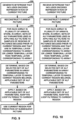
- a video coder may store, in a plurality of arrays, sets of ALF parameters used in applying one or more ALF filters to samples of regions of pictures of the video data coded prior to the current picture. Each respective array of the plurality of arrays corresponds to a respective different temporal layer. Furthermore, the video coder may determine, based on a selected set of ALF parameters in the array corresponding to a temporal layer to which a current region belongs, an applicable set of ALF parameters for the current region. This disclosure may use the term "region" to refer to a slice or other type of area of a current picture for performing ALF. The video coder may apply, based on the applicable set of ALF parameters for the current region, an ALF filter to the current region.
- a video coder stores, in an array, sets of ALF parameters used in applying one or more ALF filters to samples of pictures of the video data decoded prior to the current picture. Additionally, in this example, the video coder stores, in the array, temporal layer indexes associated with the sets of ALF parameters.
- a temporal layer index associated with a set of ALF parameters indicates a temporal layer of a region in which the set of ALF parameters was used to apply an ALF filter.
- the video coder may determine, based on a selected set of ALF parameters in the array whose associated temporal layer index indicates the temporal layer to which the current region belongs, an applicable set of ALF parameters for the current region. Furthermore, in this example, the video coder may apply, based on the applicable set of ALF parameters for the current region, adaptive loop filtering to the current region.
- associating ALF parameters with temporal layers may help to avoid the problem of a current picture being potentially dependent on the decoding of a picture in a higher temporal layer.
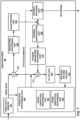
- FIG. 1 is a block diagram illustrating an example video encoding and decoding system 10 that may use techniques of this disclosure.
- system 10 includes a source device 12 that provides encoded video data to be decoded at a later time by a destination device 14.
- source device 12 provides the encoded video data to destination device 14 via a computer-readable medium 16.
- Source device 12 and destination device 14 may comprise any of a wide range of devices, including desktop computers, notebook (i.e., laptop) computers, tablet computers, set-top boxes, telephone handsets such as so-called "smart" phones, tablet computers, televisions, cameras, display devices, digital media players, video gaming consoles, video streaming devices, or the like.
- source device 12 and destination device 14 are equipped for wireless communication.
- source device 12 and destination device 14 may be wireless communication devices.
- the techniques described in this disclosure may be applied to wireless and/or wired applications.
- Source device 12 is an example video encoding device (i.e., a device for encoding video data).
- Destination device 14 is an example video decoding device (i.e., a device for decoding video data).
- the illustrated system 10 of FIG. 1 is merely one example.
- Techniques for processing video data may be performed by any digital video encoding and/or decoding device.
- the techniques may be performed by a video coder, typically referred to as a "CODEC.”
- Source device 12 and destination device 14 are examples of such coding devices in which source device 12 generates coded video data for transmission to destination device 14.
- source device 12 and destination device 14 operate in a substantially symmetrical manner such that each of source device 12 and destination device 14 include video encoding and decoding components.
- system 10 may support one-way or two-way video transmission between source device 12 and destination device 14, e.g., for video streaming, video playback, video broadcasting, or video telephony.
- source device 12 includes a video source 18, storage media 19 configured to store video data, a video encoder 20, and an output interface 22.
- Destination device 14 includes an input interface 26, storage media 28 configured to store encoded video data, a video decoder 30, and display device 32.
- source device 12 and destination device 14 include other components or arrangements.
- source device 12 may receive video data from an external video source, such as an external camera.
- destination device 14 may interface with an external display device, rather than including an integrated display device.
- Video source 18 is a source of video data.
- the video data may comprise a series of pictures.
- Video source 18 may include a video capture device, such as a video camera, a video archive containing previously captured video, and/or a video feed interface to receive video data from a video content provider.
- video source 18 generates computer graphics-based video data, or a combination of live video, archived video, and computer-generated video.
- Storage media 19 may be configured to store the video data.
- the captured, pre-captured, or computer-generated video may be encoded by video encoder 20.
- Output interface 22 may output the encoded video information to a computer-readable medium 16.
- Output interface 22 may comprise various types of components or devices.
- output interface 22 may comprise a wireless transmitter, a modem, a wired networking component (e.g., an Ethernet card), or another physical component.
- output interface 22 may be configured to transmit data, such as encoded video data, modulated according to a cellular communication standard, such as 4G, 4G-LTE, LTE Advanced, 5G, and the like.
- output interface 22 may be configured to transmit data, such as encoded video data, modulated according to other wireless standards, such as an IEEE 802.11 specification, an IEEE 802.15 specification (e.g., ZigBee TM ), a Bluetooth TM standard, and the like.
- source device 12 comprises a wireless communication device that includes a transmitter configured to transmit encoded video data.
- the wireless communication device comprises a telephone handset and the transmitter is configured to modulate, according to a wireless communication standard, a signal comprising the encoded video data.
- circuitry of output interface 22 is integrated into circuitry of video encoder 20 and/or other components of source device 12.
- video encoder 20 and output interface 22 may be parts of a system on a chip (SoC).
- SoC system on a chip
- the SoC may also include other components, such as a general purpose microprocessor, a graphics processing unit, and so on.
- Destination device 14 may receive encoded video data to be decoded via computer-readable medium 16.
- Computer-readable medium 16 may comprise any type of medium or device capable of moving the encoded video data from source device 12 to destination device 14.
- computer-readable medium 16 comprises a communication medium to enable source device 12 to transmit encoded video data directly to destination device 14 in real-time.
- the communication medium may comprise any wireless or wired communication medium, such as a radio frequency (RF) spectrum or one or more physical transmission lines.
- the communication medium may form part of a packet-based network, such as a local area network, a wide-area network, or a global network such as the Internet.
- the communication medium may include routers, switches, base stations, or any other equipment that may be useful to facilitate communication from source device 12 to destination device 14.
- Destination device 14 may comprise one or more data storage media configured to store encoded video data and decoded video data.
- output interface 22 may output data, such as encoded video data, to an intermediate device, such as a storage device.
- input interface 26 of destination device 14 may receive encoded data from the intermediate device.
- the intermediate device may include any of a variety of distributed or locally-accessed data storage media such as a hard drive, Blu-ray discs, DVDs, CD-ROMs, flash memory, volatile or non-volatile memory, or any other suitable digital storage media for storing encoded video data.
- the intermediate device corresponds to a file server.
- Example file servers include web servers, FTP servers, network attached storage (NAS) devices, or local disk drives.
- Destination device 14 may access the encoded video data through any standard data connection, including an Internet connection. This may include a wireless channel (e.g., a Wi-Fi connection), a wired connection (e.g., DSL, cable modem, etc.), or a combination of both that is suitable for accessing encoded video data stored on a file server.
- the transmission of encoded video data from the storage device may be a streaming transmission, a download transmission, or a combination thereof.
- Computer-readable medium 16 may include transient media, such as a wireless broadcast or wired network transmission, or storage media (that is, non-transitory storage media), such as a hard disk, flash drive, compact disc, digital video disc, Blu-ray disc, or other computer-readable media.
- a network server (not shown) may receive encoded video data from source device 12 and provide the encoded video data to destination device 14, e.g., via network transmission.
- a computing device of a medium production facility such as a disc stamping facility, may receive encoded video data from source device 12 and produce a disc containing the encoded video data. Therefore, computer-readable medium 16 may be understood to include one or more computer-readable media of various forms, in various examples.
- Input interface 26 of destination device 14 receives data from computer-readable medium 16.
- Input interface 26 may comprise various types of components or devices.
- input interface 26 may comprise a wireless receiver, a modem, a wired networking component (e.g., an Ethernet card), or another physical component.
- input interface 26 may be configured to receive data, such as the bitstream, modulated according to a cellular communication standard, such as 4G, 4G-LTE, LTE Advanced, 5G, and the like.
- input interface 26 may be configured to receive data, such as the bitstream, modulated according to other wireless standards, such as an IEEE 802.11 specification, an IEEE 802.15 specification (e.g., ZigBee TM ), a Bluetooth TM standard, and the like.
- destination device 14 may comprise a wireless communication device that comprises a receiver configured to receive encoded video data.
- the wireless communication device comprises a telephone handset and the receiver is configured to demodulate, according to a wireless communication standard, a signal comprising the encoded video data.
- source device 12 may comprise a transmitter and destination device devices 14 may comprise a transmitter and receiver.
- circuitry of input interface 26 may be integrated into circuitry of video decoder 30 and/or other components of destination device 14.
- video decoder 30 and input interface 26 may be parts of a SoC.
- the SoC may also include other components, such as a general-purpose microprocessor, a graphics processing unit, and so on.
- Storage media 28 may be configured to store encoded video data, such as encoded video data (e.g., a bitstream) received by input interface 26.
- Display device 32 displays the decoded video data to a user.
- Display device 32 may comprise any of a variety of display devices such as a liquid crystal display (LCD), a plasma display, an organic light emitting diode (OLED) display, or another type of display device.
- LCD liquid crystal display
- OLED organic light emitting diode
- Video encoder 20 and video decoder 30 each may be implemented as any of a variety of suitable fixed-function and/or programmable circuitry, such as one or more microprocessors, digital signal processors (DSPs), application specific integrated circuits (ASICs), field programmable gate arrays (FPGAs), discrete logic, software, hardware, firmware or any combinations thereof.
- DSPs digital signal processors
- ASICs application specific integrated circuits
- FPGAs field programmable gate arrays
- a device may store instructions for the software in a suitable, non-transitory computer-readable medium and may execute the instructions in hardware using one or more processors to perform the techniques of this disclosure.
- Each of video encoder 20 and video decoder 30 may be included in one or more encoders or decoders, either of which may be integrated as part of a combined encoder/decoder (CODEC) in a respective device.
- CDEC combined encoder/decoder
- video encoder 20 and video decoder 30 encode and decode video data according to a video coding standard or specification.
- video encoder 20 and video decoder 30 may encode and decode video data according to ITU-T H.261, ISO/IEC MPEG-1 Visual, ITU-T H.262 or ISO/IEC MPEG-2 Visual, ITU-T H.263, ISO/IEC MPEG-4 Visual and ITU-T H.264 (also known as ISO/IEC MPEG-4 AVC), including its Scalable Video Coding (SVC) and Multi-View Video Coding (MVC) extensions, or another video coding standard or specification.
- SVC Scalable Video Coding
- MVC Multi-View Video Coding
- video encoder 20 and video decoder 30 encode and decode video data according to High Efficiency Video Coding (HEVC), which as known as or ITU-T H.265, its range and screen content coding extensions, its 3D video coding extension (3D-HEVC), its multiview extension (MV-HEVC), or its scalable extension (SHVC).
- HEVC High Efficiency Video Coding
- 3D-HEVC 3D video coding extension
- MV-HEVC multiview extension
- SHVC scalable extension
- video encoder 20 and video decoder 30 operate in accordance with other standards, including standards currently under development.
- video data includes a series of pictures. Pictures may also be referred to as "frames.”
- a picture may include one or more sample arrays. Each respective sample array of a picture may comprise an array of samples for a respective color component.
- a picture may include three sample arrays, denoted S L , S Cb , and S Cr .
- S L is a two-dimensional array (i.e., a block) of luma samples.
- S Cb is a two-dimensional array of Cb chroma samples.
- S Cr is a two-dimensional array of Cr chroma samples.
- a picture may be monochrome and may only include an array of luma samples.
- video encoder 20 may encode pictures of the video data.
- video encoder 20 may generate encoded representations of the pictures of the video data.
- An encoded representation of a picture may be referred to herein as a "coded picture” or an "encoded picture.”
- video encoder 20 may encode blocks of the picture.
- Video encoder 20 may include, in a bitstream, an encoded representation of the video block.
- video encoder 20 performs intra prediction or inter prediction to generate one or more predictive blocks.
- video encoder 20 may generate residual data for the block.
- the residual block comprises residual samples. Each residual sample may indicate a difference between a sample of one of the generated predictive blocks and a corresponding sample of the block.
- Video encoder 20 may apply a transform to blocks of residual samples to generate transform coefficients.
- video encoder 20 may quantize the transform coefficients.
- video encoder 20 may generate one or more syntax elements to represent a transform coefficient.
- Video encoder 20 may entropy encode one or more of the syntax elements representing the transform coefficient.
- video encoder 20 may partition each sample array of the picture into coding tree blocks (CTBs) and encode the CTBs.
- CTB may be an NxN block of samples in a sample array of a picture.
- the size of a CTB can range from 16x16 to 64x64, although technically 8x8 CTB sizes can be supported.
- a coding tree unit (CTU) of a picture may comprise one or more CTBs and may comprise syntax structures used to encode the samples of the one or more CTBs.
- each a CTU may comprise a CTB of luma samples, two corresponding CTBs of chroma samples, and syntax structures used to encode the samples of the CTBs.
- a CTU may comprise a single CTB and syntax structures used to encode the samples of the CTB.
- a CTU may also be referred to as a "tree block” or a "largest coding unit” (LCU).
- a "syntax structure" may be defined as zero or more syntax elements present together in a bitstream in a specified order.
- an encoded picture is an encoded representation containing all CTUs of the picture.
- video encoder 20 may partition the CTBs of the CTU into one or more coding blocks.
- a coding block is an NxN block of samples.
- video encoder 20 may recursively perform quad-tree partitioning on the coding tree blocks of a CTU to partition the CTBs into coding blocks, hence the name "coding tree units.”
- a coding unit may comprise one or more coding blocks and syntax structures used to encode samples of the one or more coding blocks.
- a CU may comprise a coding block of luma samples and two corresponding coding blocks of chroma samples of a picture that has a luma sample array, a Cb sample array, and a Cr sample array, and syntax structures used to encode the samples of the coding blocks.
- a CU may comprise a single coding block and syntax structures used to code the samples of the coding block.
- video encoder 20 may encode CUs of a picture of the video data.
- video encoder 20 may partition a coding block of the CU into one or more prediction blocks.
- a prediction block is a rectangular (i.e., square or non-square) block of samples on which the same prediction is applied.
- a prediction unit (PU) of a CU may comprise one or more prediction blocks of a CU and syntax structures used to predict the one or more prediction blocks.
- a PU may comprise a prediction block of luma samples, two corresponding prediction blocks of chroma samples, and syntax structures used to predict the prediction blocks.
- a PU may comprise a single prediction block and syntax structures used to predict the prediction block.
- Video encoder 20 may generate a predictive block (e.g., a luma, Cb, and Cr predictive block) for a prediction block (e.g., luma, Cb, and Cr prediction block) of a PU of a CU.
- Video encoder 20 may use intra prediction or inter prediction to generate a predictive block. If video encoder 20 uses intra prediction to generate a predictive block, video encoder 20 may generate the predictive block based on decoded samples of the picture that includes the CU. If video encoder 20 uses inter prediction to generate a predictive block of a PU of a current picture, video encoder 20 may generate the predictive block of the PU based on decoded samples of a reference picture (i.e., a picture other than the current picture).
- a reference picture i.e., a picture other than the current picture.
- video encoder 20 In HEVC, video encoder 20 generates a "prediction_unit” syntax structure within a "coding_unit” syntax structure for inter predicted PUs, but does not generate a "prediction _unit” syntax structure within a "coding _unit” syntax structure for intra predicted PUs. Rather, in HEVC, syntax elements related to intra predicted PUs are included directly in the "coding _unit" syntax structure.
- Video encoder 20 may generate one or more residual blocks for a CU. For instance, video encoder 20 may generate a luma residual block for the CU. Each sample in the CU's luma residual block indicates a difference between a luma sample in one of the CU's predictive luma blocks and a corresponding sample in the CU's original luma coding block. In addition, video encoder 20 may generate a Cb residual block for the CU. Each sample in the Cb residual block of a CU may indicate a difference between a Cb sample in one of the CU's predictive Cb blocks and a corresponding sample in the CU's original Cb coding block. Video encoder 20 may also generate a Cr residual block for the CU. Each sample in the CU's Cr residual block may indicate a difference between a Cr sample in one of the CU's predictive Cr blocks and a corresponding sample in the CU's original Cr coding block.
- video encoder 20 may decompose the residual blocks of a CU into one or more transform blocks. For instance, video encoder 20 may use quad-tree partitioning to decompose the residual blocks of a CU into one or more transform blocks.
- a transform block is a rectangular (e.g., square or non-square) block of samples on which the same transform is applied.
- a transform unit (TU) of a CU may comprise one or more transform blocks.
- a TU may comprise a transform block of luma samples, two corresponding transform blocks of chroma samples, and syntax structures used to transform the transform block samples.
- each TU of a CU may have a luma transform block, a Cb transform block, and a Cr transform block.
- the luma transform block of the TU may be a sub-block of the CU's luma residual block.
- the Cb transform block may be a sub-block of the CU's Cb residual block.
- the Cr transform block may be a sub-block of the CU's Cr residual block.
- a TU may comprise a single transform block and syntax structures used to transform the samples of the transform block.
- Video encoder 20 may apply one or more transforms to a transform block of a TU to generate a coefficient block for the TU.
- a coefficient block may be a two-dimensional array of transform coefficients.
- a transform coefficient may be a scalar quantity.
- the one or more transforms convert the transform block from a pixel domain to a frequency domain.
- a transform coefficient may be a scalar quantity considered to be in a frequency domain.
- a transform coefficient level is an integer quantity representing a value associated with a particular 2-dimensional frequency index in a decoding process prior to scaling for computation of a transform coefficient value.
- video encoder 20 skips application of the transforms to the transform block.
- video encoder 20 may treat residual sample values in the same way as transform coefficients.
- the following discussion of transform coefficients and coefficient blocks may be applicable to transform blocks of residual samples.
- video encoder 20 may quantize the coefficient block to possibly reduce the amount of data used to represent the coefficient block, potentially providing further compression. Quantization generally refers to a process in which a range of values is compressed to a single value. For example, quantization may be done by dividing a value by a constant, and then rounding to the nearest integer. To quantize the coefficient block, video encoder 20 may quantize transform coefficients of the coefficient block. In some examples, video encoder 20 skips quantization.
- Video encoder 20 may generate syntax elements indicating some or all the potentially quantized transform coefficients. Video encoder 20 may entropy encode one or more of the syntax elements indicating a quantized transform coefficient. For example, video encoder 20 may perform Context-Adaptive Binary Arithmetic Coding (CABAC) on the syntax elements indicating the quantized transform coefficients. Thus, an encoded block (e.g., an encoded CU) may include the entropy encoded syntax elements indicating the quantized transform coefficients.
- CABAC Context-Adaptive Binary Arithmetic Coding
- Video encoder 20 may output a bitstream that includes encoded video data.
- video encoder 20 may output a bitstream that includes an encoded representation of video data.
- the encoded representation of the video data may include an encoded representation of pictures of the video data.
- the bitstream may comprise a sequence of bits that forms a representation of encoded pictures of the video data and associated data.
- a representation of an encoded picture may include encoded representations of blocks of the picture.
- a bitstream may comprise a sequence of network abstraction layer (NAL) units.
- NAL unit is a syntax structure containing an indication of the type of data in the NAL unit and bytes containing that data in the form of a raw byte sequence payload (RBSP) interspersed as necessary with emulation prevention bits.
- Each of the NAL units may include a NAL unit header and may encapsulate a RBSP.
- the NAL unit header may include a syntax element indicating a NAL unit type code.
- the NAL unit type code specified by the NAL unit header of a NAL unit indicates the type of the NAL unit.
- a RBSP may be a syntax structure containing an integer number of bytes that is encapsulated within a NAL unit. In some instances, an RBSP includes zero bits.
- Video decoder 30 may receive a bitstream generated by video encoder 20.
- the bitstream may comprise an encoded representation of video data.
- Video decoder 30 may decode the bitstream to reconstruct pictures of the video data.
- video decoder 30 may obtain syntax elements from the bitstream.
- Video decoder 30 may reconstruct pictures of the video data based at least in part on the syntax elements obtained from the bitstream.
- the process to reconstruct pictures of the video data may be generally reciprocal to the process performed by video encoder 20 to encode the pictures.
- video decoder 30 may use inter prediction or intra prediction to generate predictive blocks. Additionally, video decoder 30 may determine transform coefficients based on syntax elements obtained from the bitstream. In some examples, video decoder 30 inverse quantizes the determined transform coefficients. Furthermore, video decoder 30 may apply an inverse transform on the determined transform coefficients to determine values of residual samples. Video decoder 30 may reconstruct a block of the picture based on the residual samples and corresponding samples of the generated predictive blocks. For instance, video decoder 30 may add residual samples to corresponding samples of the generated predictive blocks to determine reconstructed samples of the block.
- video decoder 30 may use inter prediction or intra prediction to generate one or more predictive blocks for each PU of a current CU.
- video decoder 30 may inverse quantize coefficient blocks of TUs of the current CU.
- Video decoder 30 may perform inverse transforms on the coefficient blocks to reconstruct transform blocks of the TUs of the current CU.
- Video decoder 30 may reconstruct a coding block of the current CU based on samples of the predictive blocks of the PUs of the current CU and residual samples of the transform blocks of the TUs of the current CU.
- video decoder 30 may reconstruct the coding blocks of the current CU by adding the samples of the predictive blocks for PUs of the current CU to corresponding decoded samples of the transform blocks of the TUs of the current CU. By reconstructing the coding blocks for each CU of a picture, video decoder 30 may reconstruct the picture.
- a video coder may apply inter prediction to generate a predictive block for a video block of a current picture. For instance, the video coder may apply inter prediction to generate a prediction block of a CU. If the video coder applies inter prediction to generate a prediction block, the video coder generates the prediction block based on decoded samples of one or more reference pictures. Typically, the reference pictures are pictures other than the current picture. In some video coding specifications, a video coder may also treat the current picture itself as a reference picture.
- the video coder may determine one or more reference picture set (RPS) subsets for the current picture. For instance, in HEVC, a video coder may determine the following RPS subsets: RefPicSetStCurrBefore, RefPicSetStCurrAfter, RefPicSetFoll, RefPicSetLtCurr, and RefPicSetLtFoll. Furthermore, the video coder may determine one or more reference picture lists. Each of the reference picture lists of a current picture includes zero or more reference pictures from the RPS of the current picture. One of the reference picture lists may be referred to as Reference Picture List 0 (RefPicList0) and another reference picture list may be referred to as Reference Picture list 1 (RefPicList1).
- RPS reference picture set
- a slice of a picture may include an integer number of blocks of the picture.
- a slice of a picture may include an integer number of CTUs of the picture.
- the CTUs of a slice may be ordered consecutively in a scan order, such as a raster scan order.
- a slice is defined as an integer number of CTUs contained in one independent slice segment and all subsequent dependent slice segments (if any) that precede the next independent slice segment (if any) within the same access unit.
- a slice segment is defined as an integer number of CTUs ordered consecutively in the tile scan and contained in a single NAL unit.
- a tile scan is a specific sequential ordering of CTBs partitioning a picture in which the CTBs are ordered consecutively in CTB raster scan in a tile, whereas tiles in a picture are ordered consecutively in a raster scan of the tiles of the picture.
- a tile is a rectangular region of CTBs within a particular tile column and a particular tile row in a picture.
- a bitstream may include a representation of encoded pictures of the video data and associated data.
- the associated data may include parameter sets.
- NAL units may encapsulate RBSPs for video parameter sets (VPSs), sequence parameter sets (SPSs), and picture parameter sets (PPSs).
- VPS is a syntax structure comprising syntax elements that apply to zero or more entire coded video sequences (CVSs).
- An SPS is also a syntax structure comprising syntax elements that apply to zero or more entire CVSs.
- An SPS may include a syntax element that identifies a VPS that is active when the SPS is active. Thus, the syntax elements of a VPS may be more generally applicable than the syntax elements of an SPS.
- a PPS is a syntax structure comprising syntax elements that apply to zero or more coded pictures.
- a PPS may include a syntax element that identifies an SPS that is active when the PPS is active.
- a slice header of a slice segment may include a syntax element that indicates a PPS that is active when the slice segment is being coded.
- a video encoder may generate a bitstream that comprises a series of NAL units.
- different NAL units of the bitstream may be associated with different layers of the bitstream.
- a layer may be defined as a set of VCL NAL units and associated non-VCL NAL units that have the same layer identifier.
- a layer may be equivalent to a view in multi-view video coding.
- a layer can contain all view components of the same layer with different time instances. Each view component may be a coded picture of the video scene belonging to a specific view at a specific time instance.
- the term "access unit" may refer to a set of pictures that correspond to the same time instance.
- a “view component” may be a coded representation of a view in a single access unit.
- a view component may comprise a texture view component (i.e., a texture picture) or a depth view component (i.e., a depth picture).
- a layer may contain either all coded depth pictures of a specific view or coded texture pictures of a specific view. In other examples of multi-view video coding, a layer may contain both texture view components and depth view components of a specific view.
- a layer typically corresponds to coded pictures having video characteristics different from coded pictures in other layers. Such video characteristics typically include spatial resolution and quality level (e.g., Signal-to-Noise Ratio).
- data in a lower layer may be decoded without reference to data in any higher layer.
- data in a base layer may be decoded without reference to data in an enhancement layer.
- NAL units may only encapsulate data of a single layer.
- NAL units encapsulating data of the highest remaining layer of the bitstream may be removed from the bitstream without affecting the decodability of data in the remaining layers of the bitstream.
- higher layers may include additional view components.
- higher layers may include signal to noise ratio (SNR) enhancement data, spatial enhancement data, and/or temporal enhancement data.
- SNR signal to noise ratio
- a layer may be referred to as a "base layer" if a video decoder can decode pictures in the layer without reference to data of any other layer.
- the base layer may conform to the HEVC base specification (e.g., Rec. ITU-T H.265
- layers other than the base layer may be referred to as “enhancement layers” and may provide information that enhances the visual quality of video data decoded from the bitstream.
- Scalable video coding can enhance spatial resolution, signal-to-noise ratio (i.e., quality) or temporal rate.
- Multi-view coding may support inter-view prediction.
- Inter-view prediction is similar to the inter prediction used in HEVC and may use the same syntax elements.
- video encoder 20 may use, as a reference picture, a picture that is in the same access unit as the current video unit, but in a different view.
- conventional inter prediction only uses pictures in different access units as reference pictures.
- a view may be referred to as a "base view” if a video decoder (e.g., video decoder 30) can decode pictures in the view without reference to pictures in any other view.
- a video coder (such as video encoder 20 or video decoder 30) may add a picture into a reference picture list if the picture is in a different view but within a same time instance (i.e., access unit) as the picture that the video coder is currently coding.
- the video coder may insert an inter-view prediction reference picture at any position of a reference picture list.
- NAL units may include headers (i.e., NAL unit headers) and payloads (e.g., RBSPs).
- the NAL unit headers may include layer identifier syntax elements (e.g., nuh_layer_id syntax elements in HEVC).
- NAL units that have layer identifier syntax elements that specify different values belong to different "layers" of a bitstream.
- the layer identifier syntax element of the NAL unit specifies a layer identifier (i.e., a layer ID) of the NAL unit.
- the layer identifier of a NAL unit is equal to 0 if the NAL unit relates to a base layer in multi-layer coding. Data in a base layer of a bitstream may be decoded without reference to data in any other layer of the bitstream. If the NAL unit does not relate to a base layer in multi-layer coding, the layer identifier of the NAL unit may have a non-zero value.
- different layers of a bitstream may correspond to different views.
- scalable video coding e.g., SVC or SHVC
- layers other than the base layer may be referred to as "enhancement layers" and may provide information that enhances the visual quality of video data decoded from the bitstream.
- NAL units encapsulating data of certain pictures of a layer may be removed from the bitstream without affecting the decodability of other pictures in the layer. Removing NAL units encapsulating data of such pictures may reduce the frame rate of the bitstream.
- a subset of pictures within a layer that may be decoded without reference to other pictures within the layer may be referred to herein as a "sub-layer,” “temporal layer,” or a "temporal sub-layer.”
- a highest temporal layer may include all pictures in the layer.
- temporal scalability may be achieved within one layer by defining a group of pictures with a particular temporal level as a sub-layer (i.e., temporal layer).
- NAL units may include temporal identifier (e.g., temporal_id in HEVC) syntax elements.
- the temporal identifier syntax element of a NAL unit specifies a temporal identifier of the NAL unit.
- the temporal identifier of a NAL unit identifies a temporal sub-layer with which the NAL unit is associated. Thus, each temporal sub-layer of a bitstream may be associated with a different temporal identifier. If the temporal identifier of a first NAL unit is less than the temporal identifier of a second NAL unit, the data encapsulated by the first NAL unit may be decoded without reference to the data encapsulated by the second NAL unit.
- Video coding standards include ITU-T H.261, ISO/IEC MPEG-1 Visual, ITU-T H.262 or ISO/IEC MPEG-2 Visual, ITU-T H.263, ISO/IEC MPEG-4 Visual and ITU-T H.264 (also known as ISO/IEC MPEG-4 AVC), including its Scalable Video Coding (SVC) and Multi-View Video Coding (MVC) extensions.
- HEVC High Efficiency Video Coding
- JCT-VC Joint Collaboration Team on Video Coding
- JCT-VC Joint Collaboration Team on Video Coding
- VCEG Video Coding Experts Group
- MPEG Motion Picture Experts Group
- JEM Joint Exploration Model
- the filter can be applied as a post-filter, where filtered frame is not used for prediction of future frames or as an in-loop filter, where filtered frame is used to predict future frames.
- the normFactor is usually equal to 2 n .
- larger values of normFactor produce coefficients f ( k , l ) requiring more bits to transmit.
- the decoded filter coefficients f ( k, l ) are applied to the reconstructed image R ( i, j ) as follows:
- the in-loop adaptive filter was evaluated in HEVC stage, but not included in the final version.
- J. Chen et al. "Coding tools investigation for next generation video coding", SG16-Geneva-C806, Jan. 2015 .
- the basic idea is the same as the ALF with block-based adaption in T. Wiegand et al., "WD3: Working Draft 3 of High-Efficiency Video Coding," Joint Collaborative Team on Video Coding (JCT-VC) of ITU-T SG16 WP3 and ISO/IEC JTC1/SC29/WG11, JCTVC-E603, 5th Meeting: Geneva, CH, 16-23 March 2011 , hereinafter, "JCTVC-E603".
- each block can be categorized into one out of 15 (5x3) groups and an index is assigned to each 4x4 block according the value of Dir b and Act b of the block.
- group index by C and set C equal to 5 Dir b + ⁇ wherein ⁇ is the quantized value of Act b . Therefore, video encoder 20 may signal up to 15 sets of ALF parameters for the luma component of a picture.
- video encoder 20 may merge the groups along group index value. For each merged group, video encoder 20 may signal a set of ALF coefficients.
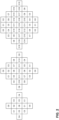
- FIG. 2 illustrates three different example ALF filter supports. In the example of FIG. 2 , up to three circular symmetric filter shapes are supported. For both chroma components in a picture, a single set of ALF coefficients is applied and the 5x5 diamond shape filter is always used.
- video decoder 30 may filter each pixel sample Î i,j , resulting in pixel value I' i,j as shown in equation (6), where L denotes filter length, f m,n represents filter coefficient and o indicates filter offset.
- only up to one filter is supported for the two chroma components.
- video encoder 20 may signal one flag when the number of merged groups is larger than 1 and forceCoeff0 is equal to 0.
- a set of a ALF parameters may include one or more of the syntax elements listed above and may also include filter coefficients.
- a video coder may also use temporal prediction of filter coefficients.
- the video coder may store ALF coefficients of previously-coded pictures and may reuse the ALF coefficients of the previously-coded pictures as ALF coefficients of a current picture.
- Video encoder 20 may choose to use the stored ALF coefficients for the current picture and bypass signaling of the ALF coefficients. In this case, video encoder 20 only signals an index to one of the reference pictures (which is actually equal to the index of the candidate in the stored array for ALF parameters), and the stored ALF coefficients of the indicated picture are simply inherited for the current picture.
- video encoder 20 may first encode a flag indicating usage of temporal prediction, before sending the index to the reference picture.
- video coders store ALF parameters from at most six previously-coded pictures which are coded with ALF parameters signaled (i.e., temporal prediction is disabled) in a separate array.
- a video coder effectively empties the array for intra random access point (IRAP) pictures.
- the video coder only stores ALF parameter values in the array if the ALF parameter values were explicitly signaled. Storing of ALF parameters operates in a FIFO fashion, so if the array is full, the video coder overwrites the oldest ALF parameter values (i.e., ALF parameters) with a new set of ALF parameter values, in decoding order.
- JVET-B0060 the Geometric transformations-based ALF
- one of four geometry transformations of filter coefficients is determined. That is, samples classified into the same category will share the same filter coefficients.
- the filter support region may be transformed based on the selected geometric transformation index.
- the method described in JVET-B0060 may effectively reduce the number of filters which have to be sent to the decoder, hence reducing the number of bits required to represent them, or alternatively reduce the differences between reconstructed frames and original frames.
- Each 2x2 block is categorized into one out of 25 classes based on its directionality and a quantized value of activity.
- a video coder assigns a set of 16 fixed filters to each class. That is, 16*25(classes) filters may be pre-defined. To indicate the usage of a fixed filter, a flag for each class is signaled and, if required, the index of the fixed filter. Even when the fixed filter is selected for a given class, the coefficients of the adaptive filter f ( k , l ) can still be sent for this class, in which case the coefficients of the filter which will be applied to the reconstructed image are sum of both sets of coefficients.
- One or more of the classes can share the same coefficients f ( k, l ) signaled in the bitstream, even if different fixed filters were chosen for them.
- U.S. Patent Publication No. 2017/0238020, published Aug. 17, 2017 describes how the fixed filters could also be applied to inter-coded frames.
- JVET-B0060 the design of temporal prediction from previously-coded frames as in the second version of JEM (i.e., JEM2) is kept unchanged.
- JEM2 is described in Jianle Chen et al., "Algorithm Description of Joint Exploration Test Model 2," Joint Video Exploration Team (JVET) of ITU-T SG 16 WP 3 and ISO/IEC JTC 1/SC 29/WG 11, 2nd Meeting, San Diego, USA, 20-26 February 2016 , document JVET-B1001_v3. That is, a flag is coded to indicate whether temporal prediction of ALF coefficients is used. If temporal prediction of ALF coefficients is used, an index of the selected pictures for stored ALF parameters is further signaled. In this case, there is no need to signal the filter indices for each class and filter coefficients.
- ALF filter coefficients may be used with GALF.
- a prediction pattern and prediction index from fixed filters may be explicitly coded in GALF.
- An index may be firstly coded to indicate one of the three cases.
- the forceCoeff0 flag may also be used.
- a one-bit flag denoted by CodedVarBin, is further signaled for each of the merged groups (all filters to be coded) to indicate whether the signaled filter coefficients are all zero.
- the predictive coding i.e., coding the difference between the current filter and previously-coded filter
- the filters to be signaled/coded mentioned above are the differences between the filter applied to the reconstructed image and the selected fixed filter. Other information, such as coefficients are coded in the same way as in JEM2.0.
- GALF is a form of ALF
- this disclosure may use the term "ALF" to apply to both ALF and GALF.
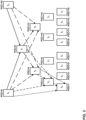
- the current designs for temporal prediction of filters in ALF and GALF have several shortcomings. For example, if a picture uses explicit coding of filters, after decoding the picture, the corresponding ALF filters may be added to an array of ALF filters for temporal prediction, regardless of temporal layers. That is, after decoding the picture, a video coder may include a set of ALF parameters in an entry in the array. The set of ALF parameters may include filter coefficients and group merging information for each of the ALF filters used in the picture. This design leads to failure when decoding of a subset of temporal layers under certain configurations, such as random access. An example is given in FIG. 3 wherein the GOP size is equal to 16. In the example of FIG.
- the encoding/decoding order of the pictures is: Picture Order Counter (POC) 0 [T 0 ], POC 16 [T 0 ], POC8 [T 1 ], POC4 [T 2 ], POC2 [T 3 ], POC1 [T 4 ], POC3 [T 4 ], POC6 [T 3 ], POC5 [T 4 ], POC7 [T 4 ], POC12 [T 2 ], POC10 [T 3 ], POC9 [T 4 ], POC11 [T 4 ], POC14 [T 3 ], POC13 [T 4 ], POC15 [T 4 ], Arrows with different dash patterns point to pictures that may use the pointed from pictures as reference pictures. Note that FIG. 3 omits certain arrows for the sake of clarity.
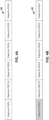
- FIG. 4A illustrates an array 50 for storing filter parameters.
- FIG. 4B illustrates a different state of array 50.
- the array for stored filters has the state shown in FIG. 4A .
- the array for stored ALF filters is updated as shown in FIG. 4B .
- the filters for POCO have been replaced with the filters for POC3 because filters are replaced in a FIFO fashion and the filters for POCO were the first filters added to array 50.
- a second shortcoming of the current designs for temporal prediction of filters in ALF is that, when temporal prediction of ALF filters is enabled for a slice, in some examples, all the ALF filters from a certain previously-coded frame shall be inherited. That means the merging of classes and filter coefficients are directly reused without the possibility of slightly modifying the classes and filter coefficients to better capture the characteristics for a current slice.
- the following techniques are proposed to resolve one or more of the shortcomings of the current designs for temporal prediction of filters in ALF mentioned above.
- the following itemized techniques may be applied individually. Alternatively, any combination of them may be applied.
- multiple arrays may be allocated to store one or more sets of previously-coded ALF filters.
- a video coder may store sets of ALF parameters in a plurality of arrays.
- Each array corresponds to an assigned temporal layer index (TempIdx, which is equivalent to TemporalId defined in the HEVC specification).
- TemporalIdx which is equivalent to TemporalId defined in the HEVC specification.
- each array only contains ALF parameters from pictures with the same TempIdx or lower TempIdx.
- a slice (or other unit for performing ALF) with the TempIdx may select one set of filters composed in this array.
- a video coder may apply, to samples in a block of the slice, an ALF filter based on ALF parameters in the array corresponding to the TempIdx of the slice.
- the set of ALF parameters for this region may be added to the array associated with the same or higher TempIdx. This may resolve the shortcomings described above regarding the array of stored ALF parameters including one or more ALF parameters corresponding to ALF filters used in pictures of temporal layers higher than the temporal layer of the current picture.
- FIG. 5 illustrates a plurality of arrays 60A-60E (collectively, "arrays 60") corresponding to different temporal layers, in accordance with a technique of this disclosure.
- arrays 60 corresponding to different temporal layers, in accordance with a technique of this disclosure.
- the arrays for stored ALF filters have the states shown in FIG. 5 .
- a video coder may use ALF filters from array 60D.
- whether or not POC1 is decoded has no impact on which ALF filters are available for use when decoding POC 6.
- video encoder 20 generates a bitstream that includes an encoded representation of a current picture of the video data.
- a current region e.g., slice or other type of unit for performing ALF
- a temporal index i.e., a temporal layer index
- video encoder 20 reconstructs all or part of the current picture.
- Video encoder 20 stores, in a plurality of arrays, sets of ALF parameters used in applying ALF filters to samples of regions of pictures of the video data decoded prior to the current region.
- video encoder 20 stores, in the respective array, sets of ALF parameters used in applying ALF filters to samples of regions of pictures of the video data that are decoded prior to the current region and that are in the temporal layer corresponding to the respective array or a lower temporal layer than the temporal layer corresponding to the respective array.
- Each respective array of the plurality of arrays corresponds to a respective different temporal layer.
- video encoder 20 determines, based on a selected set of ALF parameters in one of the arrays corresponding to the temporal layer to which the current region belongs or corresponding to a lower temporal layer than the temporal layer to which the current region belongs, an applicable set of ALF parameters for the current region.
- video encoder 20 may determine the selected set of ALF parameters based on a rate-distortion analysis of the sets of ALF parameters in the arrays. Video encoder 20 may signal an index of the selected set of ALF parameters in the bitstream. Furthermore, video encoder 20 applies, based on the applicable set of ALF parameters for the current region, adaptive loop filtering to the current region. Applying adaptive loop filtering to the current region may comprise applying an ALF filter to one or more, but not necessarily all, blocks within the current region. After applying the adaptive loop filtering to the current region, video encoder 20 may use the current region for prediction of a subsequent picture of the video data.
- video decoder 30 receives a bitstream that includes an encoded representation of a current picture of the video data.
- a current region of the current picture is associated with a temporal index indicating a temporal layer to which the current region belongs.
- Video decoder 30 then reconstructs all or part of the current picture.
- video decoder 30 stores, in a plurality of arrays, sets of ALF parameters used in applying ALF filters to samples of regions of pictures of the video data decoded prior to the current picture. Each respective array of the plurality of arrays corresponds to a respective different temporal layer.
- video decoder 30 For each respective array of a plurality of arrays that correspond to different temporal layers, video decoder 30 stores, in the respective array, sets of ALF parameters used in applying ALF filters to samples of regions of pictures of the video data that are decoded prior to the current region and that are in the temporal layer corresponding to the respective array or a lower temporal layer than the temporal layer corresponding to the respective array. Video decoder 30 determines, based on a selected set of ALF parameters in the array corresponding to the temporal layer to which the current region belongs or arrays of the plurality of arrays corresponding to a lower temporal layer than the temporal layer to which the current region belongs, an applicable set of ALF parameters for the current region.
- video decoder 30 determines the selected set of ALF parameters based on an index signaled in the bitstream. Video decoder 30 then applies, based on the applicable set of ALF parameters for the current region, adaptive loop filtering to the current region. Applying the ALF filter to the current region may comprise applying the ALF filter to one or more, but not necessarily all, blocks within the current region.
- Each array assigned by TempIdx may comprise sets of previously-decoded filters associated pictures with equal or lower TempIdx.
- the k -th array is assigned to be associated with TempIdx equal to k, and it will only contain the full sets or the subsets of filters (e.g., ALF parameters for filters) from pictures with TempIdx equal to or lower than k .
- a video coder e.g., video encoder 20 or video decoder 30
- the numbers of filter sets associated with different arrays may be different (which could be greater or equal to 0).
- the numbers of the filter sets associated with different temporal layers may be different and may depend on the temporal layer index.
- at least two of the plurality of arrays include different numbers of sets of ALF parameters. For instance, in the example of FIG. 5 , it may be unnecessary to have five locations in array 60A because, in a GOP of 16 pictures, there will never be more than two pictures in temporal layer T 0 . Thus, array 60A may only have two locations. Similarly, in the example of FIG. 5 , in a GOP of 16 pictures, there will be at most one picture in temporal layer T 1 . Hence, array 60B may only have three locations.
- a video coder may use the set of filters associated with the slice to update those arrays associated with equal or higher TempIdx. For instance, a video coder may store, in the array corresponding to the temporal layer to which the current region belongs (and, in some instances, arrays corresponding to temporal layers corresponding to higher temporal layers than the temporal layer to which the current region belongs), a set of ALF parameters applicable to a current region (i.e., slice or another unit for performing ALF). For instance, in the example of FIG. 3 and FIG. 5 , if the current region is in a picture associated with POC 8, the video coder may update arrays 60B, 60C, 60D, and 60E to include the set of ALF parameters applicable to the current region.
- the POC value associated with each filter set may be also recorded.
- a video coder may store, in the array corresponding to the temporal layer to which a current region of a current picture belongs, a POC value of the current picture.
- the POC value associated with the filter is equal to a POC value of one of the reference pictures in current reference picture lists.
- a video coder may store in array 60A data indicating a value of POCO.
- video encoder 20 is not allowed to select an ALF filter from among the ALF filters stored in array 60A for the picture at POCO.
- an array is still used to store sets of previously-coded ALF filters.
- the temporal layer index (TempIdx) associated with the filter set is also recorded.
- temporal layer indexes may be stored along with ALF parameters for ALF filters.
- the size of the array may be set to (number of possible temporal layers)*(maximum number of sets of filters for temporal prediction for a slice/picture or other unit for ALF usage).
- the number of possible temporal layers may depend on a coding structure (e.g., how many levels are supported in the hierarchy B structure) or a low delay check flag (NoBackwardPredFlag in the HEVC specification).
- a maximum number of sets of filters for temporal prediction for a slice/picture or other unit for ALF usage may be pre-defined or signaled or depend on the TempIdx.
- the number of possible temporal layers is set to 5 and the maximum number of sets of filters for temporal prediction for a slice/picture or other unit for ALF usage is set to 6.
- the possible candidates for temporal prediction may be decided by traversing the sets included in the array and all or some filter sets with equal or smaller TempIdx are treated as effective candidates.
- the set of filters associated with the slice and the associated TempIdx may be used to update the array.
- a video coded e.g., video encoder 20 or video decoder 30
- the encoder or decoder may store, in the array, the applicable set of ALF parameters.
- the encoder or decoder may also store the applicable set of ALF parameters in one or more of the arrays corresponding to higher temporal layers than the temporal layer to which the current region belongs.
- the video coder may not store ALF parameters in the array if the ALF parameters were not explicitly signaled in the bitstream.
- the encoder or decoder only stores the applicable set of ALF parameters in the array if the applicable set of ALF parameters has not yet been stored in the array.
- FIG. 6 illustrates an array 70 for storing ALF parameters and temporal layer index (TempIdx) values, in accordance with the second technique of this disclosure.
- the number of possible temporal layers is 5 and maximum number of sets of filters for temporal prediction for a region is set to 6, resulting in array 70 containing 30 entries.
- the arrays for stored ALF filters have the states shown in FIG. 6 .
- a video coder may review the TempIdx values stored in array 70 to determine which of the entries in array 70 store ALF parameters that the video coder may use as predictors of ALF parameters used in coding POC6. In doing so, the video coder may ignore any entries specifying TempIdx values greater than the T 3 (i.e., the TempIdx for POC6). In contrast to the example of FIG. 4B , the filters for POCO are not overwritten by the filters for POC3.
- video encoder 20 generates a bitstream that includes an encoded representation of a current picture of the video data.
- a current region of the current picture is associated with a temporal index indicating a temporal layer to which the current region belongs. Additionally, video encoder 20 reconstructs the current picture.
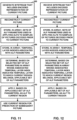
- Video encoder 20 also stores, in an array, sets of ALF parameters used in applying ALF filters to samples of pictures of the video data decoded prior to the current picture. Furthermore, video encoder 20 stores, in the array, temporal layer indexes associated with the sets of ALF parameters.
- a temporal layer index associated with a set of ALF parameters indicates a temporal layer of a region in which the set of ALF parameters was used to apply an ALF filter.
- Video encoder 20 determines, based on a selected set of ALF parameters in the array whose associated temporal layer index indicates the temporal layer to which the current region belongs or a temporal layer lower than the temporal layer to which the current region belongs, an applicable set of ALF parameters for the current region. Video encoder 20 then applies, based on the applicable set of ALF parameters for the current region, adaptive loop filtering to the current region. After applying the adaptive loop filtering to the current region, video encoder 20 may use the current region for prediction of a subsequent picture of the video data.
- video decoder 30 receives a bitstream that includes an encoded representation of a current picture of the video data.
- a current region of the current picture is associated with a temporal index indicating a temporal layer to which the current region belongs.
- video decoder 30 reconstructs the current picture.
- Video decoder 30 stores, in an array, sets of ALF parameters used in applying ALF filters to samples of pictures of the video data decoded prior to the current picture.
- video decoder 30 stores, in the array, temporal layer indexes associated with the sets of ALF parameters.
- a temporal layer index associated with a set of ALF parameters indicates a temporal layer of a region in which the set of ALF parameters was used to apply an ALF filter.
- Video decoder 30 determines, based on a selected set of ALF parameters in the array whose associated temporal layer index indicates the temporal layer to which the current region belongs, an applicable set of ALF parameters for the current region. Additionally, video decoder 30 applies, based on the applicable set of ALF parameters for the current region, adaptive loop filtering to the current region.
- the POC value associated with each set of ALF filters may be also recorded.
- a video coder may also store, in an array (e.g., array 70), a POC value of a current picture of which ALF parameters are explicitly coded.
- the video coder after encoding/decoding a plurality multiple pictures, the video coder has stored, in the array, sets of ALF parameters used in applying ALF filters to samples of pictures of the video data decoded prior to a new current picture.
- the possible candidates for temporal prediction may be decided by traversing the sets included in the array, all or some filter sets with equal or smaller TempIdx and those with a POC value equal to a POC value of one of the reference picture in a current reference picture list may be treated as effective candidates.
- a video coder may determine, based on a selected set of ALF parameters in the array whose associated temporal layer index indicates the temporal layer to which a current region of a current picture belongs or a temporal layer lower than the temporal layer to which the current region belongs, an applicable set of ALF parameters for the current region.
- a POC value associated with the applicable set of ALF parameters for the current region is equal to a POC value of a reference picture in a reference picture list of the current picture.
- each ALF filter to be stored in the array shall be associated with a reference picture that is included in a reference picture set of the current picture (these pictures would also be available in the decoded picture buffer). That is, if a picture is not included in the reference picture set of the current picture, the filters associated with the current picture cannot be stored and used for ALF temporal prediction.
- the size of the array may depend on the size of a reference picture set.
- the size of the array may be equal to a maximum number of reference pictures that are allowed to be in a reference picture set.
- a video coder does not generate a list specifically for ALF filter parameters (i.e., ALF parameters), but the list is the same as the reference picture lists that are generated for the current slice.
- ALF parameters i.e., ALF parameters
- the ALF parameters associated with reference pictures of the current region are directly stored together with other information (such as reconstruction samples, motion information of each block with one region) required by reference pictures storage.
- the list of ALF filter parameters is set equal to the reference picture set of the current slice (or picture).
- each ALF filter stored in the array (e.g., array 70) is associated with a reference picture included in the reference picture set of the current picture
- the list (array) of ALF filter parameters (associated with reference pictures included in the reference picture set of the current picture) is separately generated independently of the reference picture lists for the current slice.
- syntax elements for signaling of a particular order of the candidate sets of ALF filter parameter in the list of ALF filter parameters can be included in a slice header, similarly as the reference picture list modification syntax in the slice header.
- a third technique instead of using the FIFO rule to update an array(s) for stored ALF filters, it is proposed to further consider Picture Order Count (POC) differences for updating the array(s). For example, if an array (e.g., array 50 of FIG. 4A and FIG. 4B , one of arrays 60 of FIG. 5 , or array 70 of FIG. 6 ) is full, a video coder may determine which entry in the array stores ALF filters associated with a POC value most different from a POC value of a current picture.
- POC Picture Order Count
- a video coder may determine, based on differences between a POC value of the current picture and POC values associated with sets of ALF parameters, which set of ALF parameters in the array corresponding to the temporal layer to which the current region belongs to replace with the applicable set of ALF parameters for the current region.
- a video coder may determine, based on differences between a POC value of the current picture and POC values associated with sets of ALF parameters, which set of ALF parameters in the array to replace with the applicable set of ALF parameters for the current region.
- a separate list of selecting filters from reference picture set may be defined which is different from selecting reference pictures from reference picture set.
- the selected filters may be from a picture which is not included in any reference picture list of current slice/tile/picture.
- the signaling of an index of a selected set/subset of filters for ALF temporal prediction may depend on a temporal layer index.
- a subset of filters for ALF temporal prediction is a partial set of ALF filters. For example, currently, there could be 25 ALF filters per picture. In this example, when using temporal prediction, the video coder may choose 10 instead of 25 ALF filters to be associated with a picture.
- truncated unary binarization method may be used to code the selected index of a set of filters and the maximum value of allowed number of sets is dependent on the temporal layer index.
- video encoder 20 may include, in a bitstream, a syntax element indicating an index of a selected set of ALF parameters.
- video decoder 30 may obtain, from the bitstream, a syntax element indicating an index of a selected set of ALF parameters.
- the selected set of ALF parameters may be in one of the arrays of a type used in the first technique or the array of a type used in the second technique.
- video encoder 20 and/or video decoder 30 may determine, based on the selected set of ALF parameters in the array, an applicable set of ALF parameters for the current region.
- Video encoder 20 and/or video decoder 30 may apply, based on the applicable set of ALF parameters for the current region, an ALF filter to the current region.
- a format of the syntax element is dependent on a temporal layer index.
- a truncated unary binarization method may be used to code the syntax element and a maximum value of allowed number of sets of ALF parameters is dependent on the temporal layer index.
- the signaling of the index may further depend on the POC differences.
- the format of the syntax element is further dependent on POC differences. For example, if the index is 0, the selected set of ALF parameters is associated with the picture with a POC value closest to a POC value of a current picture; if the index is 1, the selected set of ALF parameters is associated with the picture with a next-closest POC value to the POC value of the current picture, and so on.
- the sets of ALF parameters associated with pictures with lower (or, in other examples, higher) POC values are associated with lower index values.
- the filter indices for different classes could be inherited from previously coded information.
- separate arrays may be allocated with one array to record the filter indices for each class and the other to record the filter coefficients.
- a video coder may store, in a plurality of arrays, sets of ALF parameters used in applying ALF filters to samples of pictures of the video data decoded prior to the current picture, each respective array of the plurality of arrays corresponding to a respective different temporal layer.
- the video coder may determine, from the set of ALF parameters in the array corresponding to the temporal layer to which the current region belongs or corresponding to a lower temporal layer than the temporal layer to which the current region belongs, class merging information and not filter coefficients.
- the video coder may store, in a second plurality of arrays, sets of filter coefficients used in applying ALF filters to samples of pictures of the video data decoded prior to a current picture, each respective array of the second plurality of arrays corresponding to a respective different temporal layer.
- the video coder may determine, based on a set of filter coefficients in one of the arrays of the second plurality of arrays corresponding to the temporal layer to which the current region belongs or corresponding to a lower temporal layer than the temporal layer to which the current region belongs and based on the set of ALF parameters in an array in the first plurality of arrays corresponding to the temporal layer to which the current region belongs or corresponding to a lower temporal layer than the temporal layer to which the current region belongs, the applicable set of ALF parameter.
- a video coder may store, in an array, sets of ALF parameters used in applying ALF filters to samples of pictures of the video data decoded prior to the current picture.
- the video coder may determine, from the set of ALF parameters in the array whose associated temporal layer index indicates the temporal layer to which the current region belongs or a temporal layer lower than the temporal layer to which a current region belongs, class merging information and not filter coefficients.
- the video coder may store, in a second array, sets of filter coefficients used in applying ALF filters to samples of pictures of the video data decoded prior to the current picture.
- the video coder may store, in the second array, temporal layer indexes associated with the sets of filter coefficients.
- a temporal layer index associated with a set of filter coefficients indicates a temporal layer of a region in which the set of ALF parameters was used to apply an ALF filter.
- the video coder may determine, based on a set of filter coefficients in one of the arrays of the second plurality of arrays corresponding to the temporal layer to which the current region belongs or corresponding to a lower temporal layer than the temporal layer to which the current region belongs and based on the set of ALF parameters in an array in the first plurality of arrays corresponding to the temporal layer to which the current region belongs or corresponding to a lower temporal layer than the temporal layer to which the current region belongs, the applicable set of ALF parameters for the current region.
- a video coder may store, in a plurality of arrays, sets of ALF parameters used in applying ALF filters to samples of pictures of the video data decoded prior to the current picture.
- Each respective array of the plurality of arrays corresponds to a respective different temporal layer.
- the video coder may determine, from the set of ALF parameters in the array corresponding to the temporal layer to which the current region belongs or corresponding to a lower temporal layer than the temporal layer to which the current region belongs, filter coefficients and not class merging information.
- the video coder may store, in a second plurality of arrays, sets of class merging information used in applying ALF filters to samples of pictures of the video data decoded prior to the current picture.
- Each respective array of the second plurality of arrays corresponds to a respective different temporal layer.
- the video coder may determine, based on a set of class merging information in one of the arrays of the second plurality of arrays corresponding to the temporal layer to which the current region belongs or corresponding to a lower temporal layer than the temporal layer to which the current region belongs and based on the set of ALF parameters in an array in the first plurality of arrays corresponding to the temporal layer to which the current region belongs or corresponding to a lower temporal layer than the temporal layer to which the current region belongs, the applicable set of ALF parameter.
- a video coder may store, in an array, sets of ALF parameters used in applying ALF filters to samples of pictures of the video data decoded prior to the current picture.
- the video coder may determine, from the set of ALF parameters in the array whose associated temporal layer index indicates the temporal layer to which the current region belongs or a temporal layer lower than the temporal layer to which the current region belongs, filter coefficients and not class merging information.
- the video coder may store, in a second array, sets of class merging information used in applying ALF filters to samples of pictures of the video data decoded prior to the current picture.
- the video coder may also store, in the second array, temporal layer indexes associated with the sets of class merging information.
- a temporal layer index associated with a set of filter coefficients indicates a temporal layer of a region in which the set of ALF parameters was used to apply an ALF filter.
- the video coder may determine, based on a set of filter coefficients in one of the arrays of the second plurality of arrays corresponding to the temporal layer to which the current region belongs or corresponding to a lower temporal layer than the temporal layer to which the current region belongs and based on the set of ALF parameters in an array in the first plurality of arrays corresponding to the temporal layer to which the current region belongs or corresponding to a lower temporal layer than the temporal layer to which the current region belongs, the applicable set of ALF parameters for the current region.
- the differences between selected stored filters and the derived filter may be further signaled.
- the current design for signaling temporal prediction enabling flag and index of a set of filters may be still used.
- a flag may be used to indicate whether to signal the filter differences or not. If yes, the differences may be further signaled.
- filters from previously coded frames or slices may be added and treated as part of fixed filters. In this case, the size of fixed filters and coefficients of fixed filters may be adaptively changed. Alternatively, furthermore, in some examples, when a filter of a set is added to the fixed filters, pruning shall be applied to avoid duplications.
- video encoder 20 may determine, based on a selected set of ALF parameters in an array corresponding to the temporal layer to which the current region belongs, an applicable set of ALF parameters for the current region.
- video encoder 20 may determine, based on a selected set of ALF parameters in the array whose associated temporal layer index indicates the temporal layer to which the current region belongs, an applicable set of ALF parameters for the current region.
- video encoder 20 may include, in the bitstream, an indication of a difference between the selected set of ALF parameters and the applicable set of ALF parameters for the current region.
- video encoder 20 may include, in the bitstream, a syntax element indicating whether the bitstream includes the indication of the difference.
- video decoder 30 may determine, based on a selected set of ALF parameters in an array corresponding to the temporal layer to which the current region belongs, an applicable set of ALF parameters for the current region.
- video decoder 30 may determine, based on a selected set of ALF parameters in the array whose associated temporal layer index indicates the temporal layer to which the current region belongs, an applicable set of ALF parameters for the current region.
- video decoder 30 may obtain, from the bitstream, an indication of a difference between the selected set of ALF parameters and the applicable set of ALF parameters for the current region.
- video decoder 30 may determine, based on the selected set of ALF parameters and the difference, the applicable set of ALF parameters for the current region. In some examples, video decoder 30 may obtain, from the bitstream, a syntax element indicating whether the bitstream includes the indication of the difference.
- one or more sets of ALF filters may be stored in parameter sets (e.g., sequence parameter sets or picture parameter sets) so that pictures even in different coded video sequences may use them.
- parameter sets e.g., sequence parameter sets or picture parameter sets
- a video coder may store, in an array, sets of ALF filters specified in a parameter set of the bitstream.
- slice headers may include ALF parameters defining additional ALF filters or filter differences.
- a slice header is a part of a coded slice (or coded slice segment) containing the data elements pertaining to the first or all coding tree units represented in the slice (or slice segment).
- FIG. 7 is a block diagram illustrating an example video encoder 20 that may implement the techniques of this disclosure.
- FIG. 7 is provided for purposes of explanation and should not be considered limiting of the techniques as broadly exemplified and described in this disclosure.
- the techniques of this disclosure may be applicable to various coding standards or methods.
- Processing circuitry includes video encoder 20, and video encoder 20 is configured to perform one or more of the example techniques described in this disclosure.
- video encoder 20 includes integrated circuitry, and the various units illustrated in FIG. 5 may be formed as hardware circuit blocks that are interconnected with a circuit bus. These hardware circuit blocks may be separate circuit blocks or two or more of the units may be combined into a common hardware circuit block.
- the hardware circuit blocks may be formed as combination of electric components that form operation blocks such as arithmetic logic units (ALUs), elementary function units (EFUs), as well as logic blocks such as AND, OR, NAND, NOR, XOR, XNOR, and other similar logic blocks.
- ALUs arithmetic logic units
- EFUs elementary function units
- logic blocks such as AND, OR, NAND, NOR, XOR, XNOR, and other similar logic blocks.
- one or more of the units illustrated in FIG. 7 may be software units executing on the processing circuitry.
- the object code for these software units is stored in memory.
- An operating system may cause video encoder 20 to retrieve the object code and execute the object code, which causes video encoder 20 to perform operations to implement the example techniques.
- the software units may be firmware that video encoder 20 executes at startup. Accordingly, video encoder 20 is a structural component having hardware that performs the example techniques or has software/firmware executing on the hardware to specialize the hardware to perform the example techniques.
- video encoder 20 includes a prediction processing unit 100, video data memory 101, a residual generation unit 102, a transform processing unit 104, a quantization unit 106, an inverse quantization unit 108, an inverse transform processing unit 110, a reconstruction unit 112, a filter unit 114, a decoded picture buffer 116, and an entropy encoding unit 118.
- Prediction processing unit 100 includes an inter-prediction processing unit 120 and an intra-prediction processing unit 126.
- Inter-prediction processing unit 120 may include a motion estimation unit and a motion compensation unit (not shown).
- Video data memory 101 may be configured to store video data to be encoded by the components of video encoder 20.
- the video data stored in video data memory 101 may be obtained, for example, from video source 18.
- Decoded picture buffer 116 may be a reference picture memory that stores reference video data for use in encoding video data by video encoder 20, e.g., in intra- or inter-coding modes.
- Video data memory 101 and decoded picture buffer 116 may be formed by any of a variety of memory devices, such as dynamic random access memory (DRAM), including synchronous DRAM (SDRAM), magnetoresistive RAM (MRAM), resistive RAM (RRAM), or other types of memory devices.
- Video data memory 101 and decoded picture buffer 116 may be provided by the same memory device or separate memory devices.
- video data memory 101 may be on-chip with other components of video encoder 20, or off-chip relative to those components.
- Video data memory 101 may be the same as or part of storage media 19 of FIG. 1 .
- Video encoder 20 receives video data.
- Video encoder 20 may encode each CTU in a slice of a picture of the video data.
- Each of the CTUs may be associated with equally-sized luma coding tree blocks (CTBs) and corresponding CTBs of the picture.
- CTBs luma coding tree blocks
- prediction processing unit 100 may perform partitioning to divide the CTBs of the CTU into progressively-smaller blocks. The smaller blocks may be coding blocks of CUs. For example, prediction processing unit 100 may partition a CTB associated with a CTU according to a tree structure.
- Video encoder 20 may encode CUs of a CTU to generate encoded representations of the CUs (i.e., coded CUs).
- prediction processing unit 100 may partition the coding blocks associated with the CU among one or more PUs of the CU.
- each PU may be associated with a luma prediction block and corresponding chroma prediction blocks.
- Video encoder 20 and video decoder 30 may support PUs having various sizes. As indicated above, the size of a CU may refer to the size of the luma coding block of the CU and the size of a PU may refer to the size of a luma prediction block of the PU.
- video encoder 20 and video decoder 30 may support PU sizes of 2Nx2N or NxN for intra prediction, and symmetric PU sizes of 2Nx2N, 2NxN, Nx2N, NxN, or similar for inter prediction.
- Video encoder 20 and video decoder 30 may also support asymmetric partitioning for PU sizes of 2NxnU, 2NxnD, nLx2N, and nRx2N for inter prediction.
- Inter-prediction processing unit 120 may generate predictive data for a PU. As part of generating the predictive data for a PU, inter-prediction processing unit 120 performs inter prediction on the PU.
- the predictive data for the PU may include predictive blocks of the PU and motion information for the PU.
- Inter-prediction processing unit 120 may perform different operations for a PU of a CU depending on whether the PU is in an I slice, a P slice, or a B slice. In an I slice, all PUs are intra predicted. Hence, if the PU is in an I slice, inter-prediction processing unit 120 does not perform inter prediction on the PU.
- the predicted block is formed using spatial prediction from previously-encoded neighboring blocks within the same frame.
- inter-prediction processing unit 120 may use uni-directional inter prediction to generate a predictive block of the PU. If a PU is in a B slice, inter-prediction processing unit 120 may use uni-directional or bidirectional inter prediction to generate a predictive block of the PU.
- Intra-prediction processing unit 126 may generate predictive data for a PU by performing intra prediction on the PU.
- the predictive data for the PU may include predictive blocks of the PU and various syntax elements.
- Intra-prediction processing unit 126 may perform intra prediction on PUs in I slices, P slices, and B slices.
- intra-prediction processing unit 126 may use multiple intra prediction modes to generate multiple sets of predictive data for the PU.
- Intra-prediction processing unit 126 may use samples from sample blocks of neighboring PUs to generate a predictive block for a PU.
- the neighboring PUs may be above, above and to the right, above and to the left, or to the left of the PU, assuming a left-to-right, top-to-bottom encoding order for PUs, CUs, and CTUs.
- Intra-prediction processing unit 126 may use various numbers of intra prediction modes, e.g., 33 directional intra prediction modes. In some examples, the number of intra prediction modes may depend on the size of the region associated with the PU.
- Prediction processing unit 100 may select the predictive data for PUs of a CU from among the predictive data generated by inter-prediction processing unit 120 for the PUs or the predictive data generated by intra-prediction processing unit 126 for the PUs. In some examples, prediction processing unit 100 selects the predictive data for the PUs of the CU based on rate/distortion metrics of the sets of predictive data. The predictive blocks of the selected predictive data may be referred to herein as the selected predictive blocks.
- Residual generation unit 102 may generate, based on the coding blocks (e.g., luma, Cb and Cr coding blocks) for a CU and the selected predictive blocks (e.g., predictive luma, Cb and Cr blocks) for the PUs of the CU, residual blocks (e.g., luma, Cb and Cr residual blocks) for the CU. For instance, residual generation unit 102 may generate the residual blocks of the CU such that each sample in the residual blocks has a value equal to a difference between a sample in a coding block of the CU and a corresponding sample in a corresponding selected predictive block of a PU of the CU.
- residual blocks e.g., luma, Cb and Cr residual blocks
- Transform processing unit 104 may partition the residual blocks of a CU into transform blocks of TUs of the CU. For instance, transform processing unit 104 may perform quad-tree partitioning to partition the residual blocks of the CU into transform blocks of TUs of the CU.
- a TU may be associated with a luma transform block and two chroma transform blocks.
- the sizes and positions of the luma and chroma transform blocks of TUs of a CU may or may not be based on the sizes and positions of prediction blocks of the PUs of the CU.
- a quad-tree structure known as a "residual quad-tree" (RQT) may include nodes associated with each of the regions.
- the TUs of a CU may correspond to leaf nodes of the RQT.
- Transform processing unit 104 may generate transform coefficient blocks for each TU of a CU by applying one or more transforms to the transform blocks of the TU. Transform processing unit 104 may apply various transforms to a transform block associated with a TU. For example, transform processing unit 104 may apply a discrete cosine transform (DCT), a directional transform, or a conceptually similar transform to a transform block. In some examples, transform processing unit 104 does not apply transforms to a transform block. In such examples, the transform block may be treated as a transform coefficient block.
- DCT discrete cosine transform
- Quantization unit 106 may quantize the transform coefficients in a coefficient block. The quantization process may reduce the bit depth associated with some or all of the transform coefficients. For example, an n-bit transform coefficient may be rounded down to an m-bit transform coefficient during quantization, where n is greater than m.
- Quantization unit 106 may quantize a coefficient block associated with a TU of a CU based on a quantization parameter (QP) value associated with the CU.
- QP quantization parameter
- Video encoder 20 may adjust the degree of quantization applied to the coefficient blocks associated with a CU by adjusting the QP value associated with the CU. Quantization may introduce loss of information. Thus, quantized transform coefficients may have lower precision than the original ones.
- Inverse quantization unit 108 and inverse transform processing unit 110 may apply inverse quantization and inverse transforms to a coefficient block, respectively, to reconstruct a residual block from the coefficient block.
- Reconstruction unit 112 may add samples of the reconstructed residual block to corresponding samples from one or more predictive blocks generated by prediction processing unit 100 to produce a reconstructed transform block associated with a TU. By reconstructing transform blocks for each TU of a CU in this way, video encoder 20 may reconstruct the coding blocks of the CU.
- Filter unit 114 may perform one or more deblocking operations to reduce blocking artifacts in the coding blocks associated with a CU. Filter unit 114 may perform the filter techniques of this disclosure. For example, filter unit 114 may store, in a plurality of arrays, sets of ALF parameters used in applying ALF filters to samples of pictures of the video data decoded prior to the current picture. In this example, each respective array of the plurality of arrays corresponds to a respective different temporal layer. Furthermore, in this example, filter unit 114 may determine, based on a selected set of ALF parameters in one of the arrays corresponding to the temporal layer to which the current region belongs, an applicable set of ALF parameters for the current region. In this example, filter unit 114 may apply, based on the applicable set of ALF parameters for the current region, adaptive loop filtering to one or more blocks in the current region.
- filter unit 114 may store, in an array (e.g., array 70 of FIG. 6 ), sets of ALF parameters used in applying ALF filters to samples of pictures of the video data decoded prior to the current picture. Additionally, filter unit 114 may store, in the array, temporal layer indexes associated with the sets of ALF parameters.
- a temporal layer index associated with a set of ALF parameters indicates a temporal layer of a region in which the set of ALF parameters was used to apply an ALF filter.
- filter unit 114 may determine, based on a selected set of ALF parameters in the array whose associated temporal layer index indicates the temporal layer to which the current region belongs or a temporal layer lower than the temporal layer to which the current region belongs, an applicable set of ALF parameters for the current region. In this example, filter unit 114 may apply, based on the applicable set of ALF parameters for the current region, adaptive loop filtering to one or more blocks in the current region.
- Decoded picture buffer 116 may store the reconstructed coding blocks after filter unit 114 performs the one or more deblocking operations on the reconstructed coding blocks.
- Inter-prediction processing unit 120 may use a reference picture that contains the reconstructed coding blocks to perform inter prediction on PUs of other pictures.
- intra-prediction processing unit 126 may use reconstructed coding blocks in decoded picture buffer 116 to perform intra prediction on other PUs in the same picture as the CU.
- Entropy encoding unit 118 may receive data from other functional components of video encoder 20. For example, entropy encoding unit 118 may receive coefficient blocks from quantization unit 106 and may receive syntax elements from prediction processing unit 100. Entropy encoding unit 118 may perform one or more entropy encoding operations on the data to generate entropy-encoded data.
- entropy encoding unit 118 may perform a CABAC operation, a context-adaptive variable length coding (CAVLC) operation, a variable-to-variable (V2V) length coding operation, a syntax-based context-adaptive binary arithmetic coding (SBAC) operation, a Probability Interval Partitioning Entropy (PIPE) coding operation, an Exponential-Golomb encoding operation, or another type of entropy encoding operation on the data.
- Video encoder 20 may output a bitstream that includes entropy-encoded data generated by entropy encoding unit 118.
- the bitstream may include data that represents values of transform coefficients for a CU.
- FIG. 8 is a block diagram illustrating an example video decoder 30 that is configured to implement the techniques of this disclosure.
- FIG. 8 is provided for purposes of explanation and is not limiting on the techniques as broadly exemplified and described in this disclosure.
- this disclosure describes video decoder 30 in the context of HEVC coding.
- the techniques of this disclosure may be applicable to other coding standards or methods.
- Processing circuitry includes video decoder 30, and video decoder 30 is configured to perform one or more of the example techniques described in this disclosure.
- video decoder 30 includes integrated circuitry, and the various units illustrated in FIG. 8 may be formed as hardware circuit blocks that are interconnected with a circuit bus. These hardware circuit blocks may be separate circuit blocks or two or more of the units may be combined into a common hardware circuit block.
- the hardware circuit blocks may be formed as combination of electric components that form operation blocks such as arithmetic logic units (ALUs), elementary function units (EFUs), as well as logic blocks such as AND, OR, NAND, NOR, XOR, XNOR, and other similar logic blocks.
- ALUs arithmetic logic units
- EFUs elementary function units
- logic blocks such as AND, OR, NAND, NOR, XOR, XNOR, and other similar logic blocks.
- one or more of the units illustrated in FIG. 8 may be software units executing on the processing circuitry.
- the object code for these software units is stored in memory.
- An operating system may cause video decoder 30 to retrieve the object code and execute the object code, which causes video decoder 30 to perform operations to implement the example techniques.
- the software units may be firmware that video decoder 30 executes at startup. Accordingly, video decoder 30 is a structural component having hardware that performs the example techniques or has software/firmware executing on the hardware to specialize the hardware to perform the example techniques.
- video decoder 30 includes an entropy decoding unit 150, video data memory 151, a prediction processing unit 152, an inverse quantization unit 154, an inverse transform processing unit 156, a reconstruction unit 158, a filter unit 160, and a decoded picture buffer 162.
- Prediction processing unit 152 includes a motion compensation unit 164 and an intra-prediction processing unit 166.
- video decoder 30 may include more, fewer, or different functional components.
- Video data memory 151 may store encoded video data, such as an encoded video bitstream, to be decoded by the components of video decoder 30.
- the video data stored in video data memory 151 may be obtained, for example, from computer-readable medium 16, e.g., from a local video source, such as a camera, via wired or wireless network communication of video data, or by accessing physical data storage media.
- Video data memory 151 may form a coded picture buffer (CPB) that stores encoded video data from an encoded video bitstream.
- Decoded picture buffer 162 may be a reference picture memory that stores reference video data for use in decoding video data by video decoder 30, e.g., in intra- or inter-coding modes, or for output.
- Video data memory 151 and decoded picture buffer 162 may be formed by any of a variety of memory devices, such as dynamic random access memory (DRAM), including synchronous DRAM (SDRAM), magnetoresistive RAM (MRAM), resistive RAM (RRAM), or other types of memory devices. Video data memory 151 and decoded picture buffer 162 may be provided by the same memory device or separate memory devices. In various examples, video data memory 151 may be on-chip with other components of video decoder 30, or off-chip relative to those components. Video data memory 151 may be the same as or part of storage media 28 of FIG. 1 .
- DRAM dynamic random access memory
- SDRAM synchronous DRAM
- MRAM magnetoresistive RAM
- RRAM resistive RAM
- Video data memory 151 and decoded picture buffer 162 may be provided by the same memory device or separate memory devices. In various examples, video data memory 151 may be on-chip with other components of video decoder 30, or off-chip relative to those components. Video data memory 151 may be the same as or part of storage
- Video data memory 151 receives and stores encoded video data (e.g., NAL units) of a bitstream.
- Entropy decoding unit 150 may receive encoded video data (e.g., NAL units) from video data memory 151 and may parse the NAL units to obtain syntax elements.
- Entropy decoding unit 150 may entropy decode entropy-encoded syntax elements in the NAL units.
- Prediction processing unit 152, inverse quantization unit 154, inverse transform processing unit 156, reconstruction unit 158, and filter unit 160 may generate decoded video data based on the syntax elements extracted from the bitstream.
- Entropy decoding unit 150 may perform a process generally reciprocal to that of entropy encoding unit 118.
- video decoder 30 may perform a reconstruction operation on a non-partitioned CU. To perform the reconstruction operation on a CU, video decoder 30 may perform a reconstruction operation on each TU of the CU. By performing the reconstruction operation for each TU of the CU, video decoder 30 may reconstruct residual blocks of the CU.
- inverse quantization unit 154 may inverse quantize, i.e., de-quantize, coefficient blocks associated with the TU.
- inverse transform processing unit 156 may apply one or more inverse transforms to the coefficient block in order to generate a residual block associated with the TU.
- inverse transform processing unit 156 may apply an inverse DCT, an inverse integer transform, an inverse Karhunen-Loeve transform (KLT), an inverse rotational transform, an inverse directional transform, or another inverse transform to the coefficient block.
- KLT Karhunen-Loeve transform
- Inverse quantization unit 154 may perform particular techniques of this disclosure. For example, for at least one respective quantization group of a plurality of quantization groups within a CTB of a CTU of a picture of the video data, inverse quantization unit 154 may derive, based at least in part on local quantization information signaled in the bitstream, a respective quantization parameter for the respective quantization group. Additionally, in this example, inverse quantization unit 154 may inverse quantize, based on the respective quantization parameter for the respective quantization group, at least one transform coefficient of a transform block of a TU of a CU of the CTU.
- the respective quantization group is defined as a group of successive, in coding order, CUs or coding blocks so that boundaries of the respective quantization group must be boundaries of the CUs or coding blocks and a size of the respective quantization group is greater than or equal to a threshold.
- Video decoder 30 e.g., inverse transform processing unit 156, reconstruction unit 158, and filter unit 160
- intra-prediction processing unit 166 may perform intra prediction to generate predictive blocks of the PU.
- Intra-prediction processing unit 166 may use an intra prediction mode to generate the predictive blocks of the PU based on samples spatially-neighboring blocks.
- Intra-prediction processing unit 166 may determine the intra prediction mode for the PU based on one or more syntax elements obtained from the bitstream.
- entropy decoding unit 150 may determine motion information for the PU.
- Motion compensation unit 164 may determine, based on the motion information of the PU, one or more reference blocks. Motion compensation unit 164 may generate, based on the one or more reference blocks, predictive blocks (e.g., predictive luma, Cb and Cr blocks) for the PU.
- predictive blocks e.g., predictive luma, Cb and Cr blocks
- Reconstruction unit 158 may use transform blocks (e.g., luma, Cb and Cr transform blocks) for TUs of a CU and the predictive blocks (e.g., luma, Cb and Cr blocks) of the PUs of the CU, i.e., either intra-prediction data or inter-prediction data, as applicable, to reconstruct the coding blocks (e.g., luma, Cb and Cr coding blocks) for the CU.
- transform blocks e.g., luma, Cb and Cr transform blocks
- the predictive blocks e.g., luma, Cb and Cr blocks
- reconstruction unit 158 may add samples of the transform blocks (e.g., luma, Cb and Cr transform blocks) to corresponding samples of the predictive blocks (e.g., luma, Cb and Cr predictive blocks) to reconstruct the coding blocks (e.g., luma, Cb and Cr coding blocks) of the CU.
- transform blocks e.g., luma, Cb and Cr transform blocks
- predictive blocks e.g., luma, Cb and Cr predictive blocks
- Filter unit 160 may perform a deblocking operation to reduce blocking artifacts associated with the coding blocks of the CU.
- Filter unit 160 may perform the filter techniques of this disclosure.
- filter unit 160 may store, in a plurality of arrays, sets of ALF parameters used in applying ALF filters to samples of pictures of the video data decoded prior to a current picture.
- each respective array of the plurality of arrays corresponds to a respective different temporal layer.
- filter unit 160 may store, in the respective array, sets of ALF parameters used in applying ALF filters to samples of regions of pictures of the video data that are decoded prior to the current region and that are in the temporal layer corresponding to the respective array or a lower temporal layer than the temporal layer corresponding to the respective array.
- filter unit 160 may determine, based on a selected set of ALF parameters in the array corresponding to the temporal layer to which the current region belongs, an applicable set of ALF parameters for the current region.
- filter unit 160 may apply, based on the applicable set of ALF parameters for the current region, an ALF filter to one or more blocks in the current region.
- filter unit 160 stores, in an array, sets of ALF parameters used in applying ALF filters to samples of pictures of the video data decoded prior to a current picture. Furthermore, in this example, filter unit 160 stores, in the array, temporal layer indexes associated with the sets of ALF parameters.
- a temporal layer index associated with a set of ALF parameters indicates a temporal layer of a region in which the set of ALF parameters was used to apply an ALF filter.
- filter unit 160 may determine, based on a selected set of ALF parameters in the array whose associated temporal layer index indicates the temporal layer to which the current region belongs, an applicable set of ALF parameters for the current region. In this example, filter unit 160 may apply, based on the applicable set of ALF parameters for the current region, an ALF filter to one or more blocks of the current region.
- Video decoder 30 may store the coding blocks of the CU in decoded picture buffer 162.
- Decoded picture buffer 162 may provide reference pictures for subsequent motion compensation, intra prediction, and presentation on a display device, such as display device 32 of FIG. 1 .
- video decoder 30 may perform, based on the blocks in decoded picture buffer 162, intra prediction or inter prediction operations for PUs of other CUs.
- FIG. 9 is a flowchart illustrating an example operation of video encoder 20, in accordance with the first technique of this disclosure.
- the flowcharts of this disclosure are provided as examples. In other examples, actions may be performed in different orders, or operations may include more, fewer, or different actions.
- video encoder 20 generates a bitstream that includes an encoded representation of a current picture of the video data (200).
- a current region e.g., a current slice or other unit
- Video encoder 20 may generate the bitstream in accordance with any of the examples described elsewhere in this disclosure, such as the example of FIG. 5 .
- video encoder 20 reconstructs the current picture (202). For instance, video encoder 20 may reconstruct a block of the current picture by adding samples of reconstructed residual blocks to corresponding samples from one or more predictive blocks to produce reconstructed blocks. By reconstructing blocks in this way, video encoder 20 may reconstruct the coding blocks of the current picture.
- video encoder 20 may store, in the respective array (e.g., one of arrays 60 of FIG. 5 ), sets of ALF parameters used in applying ALF filters to samples of regions of pictures of the video data that are decoded prior to the current region and that are in the temporal layer corresponding to the respective array or a lower temporal layer than the temporal layer corresponding to the respective array (204).
- Each set of ALF parameters may include a set of filter coefficients and/or a set of ALF class merging information.
- Video encoder 20 determines, based on a selected set of ALF parameters in one of the arrays corresponding to the temporal layer to which the current region belongs, an applicable set of ALF parameters for the current region (206). For example, video encoder 20 may select the selected set of ALF parameters by using a rate-distortion analysis of the sets of ALF parameters in the array corresponding to the temporal layer to which the current region belongs. In some examples, the applicable set of ALF parameters for the current region may be the same as the selected set of ALF parameters. In some examples, video encoder 20 may include, in the bitstream, an indication of a difference between the selected set of ALF parameters and the applicable set of ALF parameters for the current region.
- Video encoder 20 may then apply, based on the applicable set of ALF parameters for the current region, adaptive loop filtering to the current region (208).
- video encoder 20 may apply an ALF filter to one or more, but not necessarily all, of the blocks in the current region.
- video encoder 20 may divide the current region into blocks (e.g., 4x4 blocks).
- video encoder 20 may determine (e.g., based on a direction and activity of the block) a corresponding category for the block.
- the applicable set of ALF parameters for the current region may include filter coefficients of an ALF filter of the category for the block.
- video encoder 20 may then apply the ALF filter to the block.
- video encoder 20 uses the current region for prediction of a subsequent picture of the video data (210). For example, video encoder 20 may use the current region for inter prediction of a block of the subsequent picture.
- FIG. 10 is a flowchart illustrating an example operation of video decoder 30, in accordance with the first technique of this disclosure.
- video decoder 30 receives a bitstream that includes an encoded representation of a current picture of the video data (250).
- a current region of the current picture is associated with a temporal index indicating a temporal layer to which the current region belongs.
- video decoder 30 reconstructs the current picture (252).
- Video decoder 30 may reconstruct the current picture in accordance with any of the examples provided elsewhere in this disclosure. For example, video decoder 30 may reconstruct a block of the current picture by adding samples of reconstructed residual blocks to corresponding samples from one or more predictive blocks to produce reconstructed blocks. By reconstructing blocks in this way, video decoder 30 may reconstruct the coding blocks of the current picture.
- Video decoder 30 also stores, in a plurality of arrays, sets of ALF parameters used in applying ALF filters to samples of pictures of the video data decoded prior to the current picture (254).
- Each respective array of the plurality of arrays corresponds to a respective different temporal layer.
- video decoder 30 may store, in the respective array (e.g., one of arrays 60 of FIG. 5 ), sets of ALF parameters used in applying ALF filters to samples of regions of pictures of the video data that are decoded prior to the current region and that are in the temporal layer corresponding to the respective array or a lower temporal layer than the temporal layer corresponding to the respective array.
- video decoder 30 may determine, based on a selected set of ALF parameters in the array corresponding to the temporal layer to which the current region belongs, an applicable set of ALF parameters for the current region (256). For example, video decoder 30 may obtain, from the bitstream, an index indicating the selected set of ALF parameters in the array corresponding to the temporal layer to which the current region belongs. In some examples, the applicable set of ALF parameters for the current region may be the same as the selected set of ALF parameters. In some examples, video decoder 30 may obtain, from the bitstream, an indication of a difference between the selected set of ALF parameters and the applicable set of ALF parameters for the current region.
- Video decoder 30 may then apply, based on the applicable set of ALF parameters for the current region, adaptive loop filtering to the current region (258).
- video decoder 30 may apply an ALF filter to one or more, but not necessarily all, of the blocks in the current region.
- video decoder 30 may divide the current region into blocks (e.g., 4x4 blocks).
- video decoder 30 may determine (e.g., based on a direction and activity of the block) a corresponding category for the block.
- the applicable set of ALF parameters for the current region may include filter coefficients of an ALF filter of the category for the block.
- video decoder 30 may then apply the ALF filter to the block.
- FIG. 11 is a flowchart illustrating an example operation of video encoder 20 in accordance with the second technique of this disclosure.
- video encoder 20 generates a bitstream that includes an encoded representation of a current picture of the video data (300).
- a current region e.g., a current slice or other unit
- Video encoder 20 may generate the bitstream in accordance with any of the examples described elsewhere in this disclosure, such as the example of FIG. 5 .
- video encoder 20 may reconstruct the current picture (302). For instance, video encoder 20 may reconstruct a block of the current picture by adding samples of reconstructed residual blocks to corresponding samples from one or more predictive blocks to produce reconstructed blocks. By reconstructing blocks in this way, video encoder 20 may reconstruct the coding blocks of the current picture.
- Video encoder 20 stores, in an array (e.g., array 70 of FIG. 6 ), sets of ALF parameters used in applying ALF filters to samples of pictures of the video data decoded prior to the current picture (304). Additionally, video encoder 20 stores, in the array, temporal layer indexes associated with the sets of ALF parameters (306).
- a temporal layer index associated with a set of ALF parameters indicates a temporal layer of a region in which the set of ALF parameters was used to apply an ALF filter.
- video encoder 20 determines, based on a selected set of ALF parameters in the array whose associated temporal layer index indicates the temporal layer to which the current region belongs or a temporal layer lower than the temporal layer to which the current region belongs, an applicable set of ALF parameters for the current region (308). For example, video encoder 20 may select the selected set of ALF parameters by using a rate-distortion analysis of the sets of ALF parameters in the array. In some examples, the applicable set of ALF parameters for the current region may be the same as the selected set of ALF parameters. In some examples, video encoder 20 may include, in the bitstream, an indication of a difference between the selected set of ALF parameters and the applicable set of ALF parameters for the current region.
- Video encoder 20 applies, based on the applicable set of ALF parameters for the current region, an ALF to the current region (310). Video encoder 20 may apply the ALF filter to the current region in accordance with any of the examples provided elsewhere in this disclosure.
- video encoder 20 After applying the ALF filter to the current region, video encoder 20 uses the current region for prediction of a subsequent picture of the video data (312). For example, video encoder 20 may use the current region for inter prediction of a block of the subsequent picture.
- FIG. 12 is a flowchart illustrating an example operation of video decoder 30 in accordance with a technique of this disclosure.
- video decoder 30 receives a bitstream that includes an encoded representation of a current picture of the video data (350).
- a current region e.g., a current slice or other unit
- a current region is associated with a temporal index indicating a temporal layer to which the current region belongs.
- Video decoder 30 may then reconstruct the current picture (352).
- Video decoder 30 may reconstruct the current picture in accordance with any of the examples provided elsewhere in this disclosure. For example, video decoder 30 may reconstruct a block of the current picture by adding samples of reconstructed residual blocks to corresponding samples from one or more predictive blocks to produce reconstructed blocks. By reconstructing blocks in this way, video decoder 30 may reconstruct the coding blocks of the current picture.
- video decoder 30 stores, in an array, sets of ALF parameters used in applying ALF filters to samples of pictures of the video data decoded prior to the current picture (354). Furthermore, video decoder 30 stores, in the array, temporal layer indexes associated with the sets of ALF parameters (356).
- a temporal layer index associated with a set of ALF parameters indicates a temporal layer of a region in which the set of ALF parameters was used to apply an ALF filter.
- Video decoder 30 may determine, based on a selected set of ALF parameters in the array whose associated temporal layer index indicates the temporal layer to which the current region belongs, an applicable set of ALF parameters for the current region
- video decoder 30 may obtain, from the bitstream, an index indicating the selected set of ALF parameters in the array.
- the applicable set of ALF parameters for the current region may be the same as the selected set of ALF parameters.
- video decoder 30 may obtain, from the bitstream, an indication of a difference between the selected set of ALF parameters and the applicable set of ALF parameters for the current region.
- Video decoder 30 then applies, based on the applicable set of ALF parameters for the current region, an ALF filter to the current region (360). Video decoder 30 may apply the ALF filter to the current region in accordance with any of the examples provided elsewhere in this disclosure.
- a video coder may refer to a video encoder or a video decoder.
- a video coding unit may refer to a video encoder or a video decoder.
- video coding may refer to video encoding or video decoding, as applicable.
- the phrase "based on” may indicate based only on, based at least in part on, or based in some way on.
- This disclosure may use the term "video unit” or "video block” or “block” to refer to one or more sample blocks and syntax structures used to code samples of the one or more blocks of samples.
- Example types of video units may include CTUs, CUs, PUs, transform units (TUs), macroblocks, macroblock partitions, and so on. In some contexts, discussion of PUs may be interchanged with discussion of macroblocks or macroblock partitions.
- Example types of video blocks may include coding tree blocks, coding blocks, and other types of blocks of video data.
- the techniques of this disclosure may be applied to video coding in support of any of a variety of multimedia applications, such as over-the-air television broadcasts, cable television transmissions, satellite television transmissions, Internet streaming video transmissions, such as dynamic adaptive streaming over HTTP (DASH), digital video that is encoded onto a data storage medium, decoding of digital video stored on a data storage medium, or other applications.
- multimedia applications such as over-the-air television broadcasts, cable television transmissions, satellite television transmissions, Internet streaming video transmissions, such as dynamic adaptive streaming over HTTP (DASH), digital video that is encoded onto a data storage medium, decoding of digital video stored on a data storage medium, or other applications.
- DASH dynamic adaptive streaming over HTTP
- Computer-readable media may include computer-readable storage media, which corresponds to a tangible medium such as data storage media, or communication media including any medium that facilitates transfer of a computer program from one place to another, e.g., according to a communication protocol.
- computer-readable media generally may correspond to (1) tangible computer-readable storage media which is non-transitory or (2) a communication medium such as a signal or carrier wave.
- Data storage media may be any available media that can be accessed by one or more computers or one or more processing circuits to retrieve instructions, code and/or data structures for implementation of the techniques described in this disclosure.
- a computer program product may include a computer-readable medium.
- such computer-readable storage media can comprise RAM, ROM, EEPROM, CD-ROM or other optical disk storage, magnetic disk storage, or other magnetic storage devices, flash memory, or any other medium that can be used to store desired program code in the form of instructions or data structures and that can be accessed by a computer.
- any connection is properly termed a computer-readable medium.
- a computer-readable medium For example, if instructions are transmitted from a website, server, or other remote source using a coaxial cable, fiber optic cable, twisted pair, digital subscriber line (DSL), or wireless technologies such as infrared, radio, and microwave, then the coaxial cable, fiber optic cable, twisted pair, DSL, or wireless technologies such as infrared, radio, and microwave are included in the definition of medium.
- DSL digital subscriber line
- Disk and disc includes compact disc (CD), laser disc, optical disc, digital versatile disc (DVD), floppy disk and Blu-ray disc, where disks usually reproduce data magnetically, while discs reproduce data optically with lasers. Combinations of the above should also be included within the scope of computer-readable media.
- processing circuitry may include one or more processors, such as one or more digital signal processors (DSPs), general purpose microprocessors, application specific integrated circuits (ASICs), field programmable logic arrays (FPGAs), or other equivalent integrated or discrete logic circuitry.
- DSPs digital signal processors
- ASICs application specific integrated circuits
- FPGAs field programmable logic arrays
- processors may refer to any of the foregoing structure or any other structure suitable for implementation of the techniques described herein.
- the functionality described herein may be provided within dedicated hardware and/or software modules configured for encoding and decoding, or incorporated in a combined codec.
- Processing circuits may be coupled to other components in various ways.
- a processing circuit may be coupled to other components via an internal device interconnect, a wired or wireless network connection, or another communication medium.
- the techniques of this disclosure may be implemented in a wide variety of devices or apparatuses, including a wireless handset, an integrated circuit (IC) or a set of ICs (e.g., a chip set).
- IC integrated circuit
- a set of ICs e.g., a chip set.
- Various components, modules, or units are described in this disclosure to emphasize functional aspects of devices configured to perform the disclosed techniques, but do not necessarily require realization by different hardware units. Rather, as described above, various units may be combined in a codec hardware unit or provided by a collection of interoperative hardware units, including one or more processors as described above, in conjunction with suitable software and/or firmware.
Landscapes
- Engineering & Computer Science (AREA)
- Multimedia (AREA)
- Signal Processing (AREA)
- Compression Or Coding Systems Of Tv Signals (AREA)
Applications Claiming Priority (4)
| Application Number | Priority Date | Filing Date | Title |
|---|---|---|---|
| US201762442322P | 2017-01-04 | 2017-01-04 | |
| US201762445174P | 2017-01-11 | 2017-01-11 | |
| US15/861,165 US10506230B2 (en) | 2017-01-04 | 2018-01-03 | Modified adaptive loop filter temporal prediction for temporal scalability support |
| PCT/US2018/012355 WO2018129168A1 (en) | 2017-01-04 | 2018-01-04 | Modified adaptive loop filter temporal prediction for temporal scalability support |
Publications (3)
| Publication Number | Publication Date |
|---|---|
| EP3566444A1 EP3566444A1 (en) | 2019-11-13 |
| EP3566444B1 true EP3566444B1 (en) | 2025-02-19 |
| EP3566444C0 EP3566444C0 (en) | 2025-02-19 |
Family
ID=62712161
Family Applications (1)
| Application Number | Title | Priority Date | Filing Date |
|---|---|---|---|
| EP18701627.4A Active EP3566444B1 (en) | 2017-01-04 | 2018-01-04 | Modified adaptive loop filter temporal prediction for temporal scalability support |
Country Status (13)
| Country | Link |
|---|---|
| US (2) | US10506230B2 (enExample) |
| EP (1) | EP3566444B1 (enExample) |
| JP (2) | JP2020503801A (enExample) |
| KR (1) | KR102584662B1 (enExample) |
| CN (1) | CN110024401B (enExample) |
| AU (1) | AU2018205779B2 (enExample) |
| CA (1) | CA3042287A1 (enExample) |
| CL (1) | CL2019001805A1 (enExample) |
| CO (1) | CO2019007119A2 (enExample) |
| ES (1) | ES3013317T3 (enExample) |
| PL (1) | PL3566444T3 (enExample) |
| TW (1) | TWI745522B (enExample) |
| WO (1) | WO2018129168A1 (enExample) |
Families Citing this family (68)
| Publication number | Priority date | Publication date | Assignee | Title |
|---|---|---|---|---|
| US10506230B2 (en) | 2017-01-04 | 2019-12-10 | Qualcomm Incorporated | Modified adaptive loop filter temporal prediction for temporal scalability support |
| KR102830927B1 (ko) * | 2017-11-01 | 2025-07-04 | 인터디지털 브이씨 홀딩스 인코포레이티드 | 비디오 코딩에서 적응적 루프 필터를 단순화하기 위한 방법 |
| US20190313108A1 (en) * | 2018-04-05 | 2019-10-10 | Qualcomm Incorporated | Non-square blocks in video coding |
| US11451773B2 (en) | 2018-06-01 | 2022-09-20 | Qualcomm Incorporated | Block-based adaptive loop filter (ALF) design and signaling |
| US11284075B2 (en) * | 2018-09-12 | 2022-03-22 | Qualcomm Incorporated | Prediction of adaptive loop filter parameters with reduced memory consumption for video coding |
| CN112997500B (zh) * | 2018-11-09 | 2023-04-18 | 北京字节跳动网络技术有限公司 | 对基于区域的自适应环路滤波器的改进 |
| US11470340B2 (en) | 2018-12-10 | 2022-10-11 | Tencent America LLC | Simplified merge list construction for small coding blocks |
| US11051017B2 (en) * | 2018-12-20 | 2021-06-29 | Qualcomm Incorporated | Adaptive loop filter (ALF) index signaling |
| WO2020156534A1 (en) | 2019-02-01 | 2020-08-06 | Beijing Bytedance Network Technology Co., Ltd. | Interactions between in-loop reshaping and intra block copy |
| MY208172A (en) | 2019-02-01 | 2025-04-22 | Beijing Bytedance Network Tech Co Ltd | Signaling of in-loop reshaping information using parameter sets |
| GB201902829D0 (en) * | 2019-03-01 | 2019-04-17 | Canon Kk | Method and apparatus for encoding and decoding a video bitsream for merging regions of interest |
| WO2020177663A1 (en) | 2019-03-02 | 2020-09-10 | Beijing Bytedance Network Technology Co., Ltd. | Restrictions on partition structures |
| GB2582029A (en) * | 2019-03-08 | 2020-09-09 | Canon Kk | An adaptive loop filter |
| CN113796073B (zh) * | 2019-03-11 | 2025-05-02 | 瑞典爱立信有限公司 | 涉及基于gop的时间过滤的视频译码 |
| CN113574889B (zh) | 2019-03-14 | 2024-01-12 | 北京字节跳动网络技术有限公司 | 环路整形信息的信令和语法 |
| CN113632476B (zh) * | 2019-03-23 | 2024-03-19 | 北京字节跳动网络技术有限公司 | 默认的环内整形参数 |
| SG11202110102YA (en) | 2019-03-24 | 2021-10-28 | Beijing Bytedance Network Technology Co Ltd | Nonlinear adaptive loop filtering in video processing |
| US11683487B2 (en) * | 2019-03-26 | 2023-06-20 | Qualcomm Incorporated | Block-based adaptive loop filter (ALF) with adaptive parameter set (APS) in video coding |
| WO2020211770A1 (en) | 2019-04-15 | 2020-10-22 | Beijing Bytedance Network Technology Co., Ltd. | Temporal prediction of parameters in non-linear adaptive loop filter |
| CN117499679A (zh) * | 2019-04-16 | 2024-02-02 | 北京字节跳动网络技术有限公司 | 用于视频编解码的自适应环路滤波 |
| JP7303328B2 (ja) | 2019-04-20 | 2023-07-04 | 北京字節跳動網絡技術有限公司 | クロミナンス残差の結合符号化のための構文要素の信号通知 |
| US11019334B2 (en) * | 2019-05-17 | 2021-05-25 | Qualcomm Incorporated | Multiple adaptive loop filter sets for video coding |
| CN115567707B (zh) | 2019-05-30 | 2025-05-13 | 抖音视界有限公司 | 一种处理视频数据的方法、装置、介质 |
| KR20250021642A (ko) | 2019-06-04 | 2025-02-13 | 두인 비전 컴퍼니 리미티드 | 모션 후보 리스트 구성 프로세스의 조건부 구현 |
| JP7346599B2 (ja) | 2019-06-04 | 2023-09-19 | 北京字節跳動網絡技術有限公司 | ビデオ・データ処理方法、装置、記憶媒体及び記憶方法 |
| CN118138754A (zh) | 2019-06-14 | 2024-06-04 | 北京字节跳动网络技术有限公司 | 处理视频单元边界和虚拟边界 |
| WO2020256615A1 (en) * | 2019-06-21 | 2020-12-24 | Telefonaktiebolaget Lm Ericsson (Publ) | Video coding layer up-switching indication |
| JP7291846B2 (ja) | 2019-07-09 | 2023-06-15 | 北京字節跳動網絡技術有限公司 | 適応ループフィルタリングのためのサンプル決定 |
| CA3146773C (en) | 2019-07-11 | 2025-05-06 | Beijing Bytedance Network Technology Co., Ltd. | SAMPLE FILLING IN AN ADAPTIVE LOOP FILTER |
| EP3984215A4 (en) | 2019-07-14 | 2022-08-24 | Beijing Bytedance Network Technology Co., Ltd. | TRANSFORMATION BLOCK SIZE LIMITATION IN VIDEO ENCODING |
| JP7361196B2 (ja) | 2019-07-15 | 2023-10-13 | 北京字節跳動網絡技術有限公司 | 適応ループ・フィルタリングにおける分類 |
| JP7377953B2 (ja) * | 2019-08-19 | 2023-11-10 | フラウンホッファー-ゲゼルシャフト ツァ フェルダールング デァ アンゲヴァンテン フォアシュンク エー.ファオ | アクセスユニットデリミタおよび適応パラメータセットの使用 |
| KR102799921B1 (ko) | 2019-09-14 | 2025-04-25 | 바이트댄스 아이엔씨 | 크로마 디블로킹 필터링을 위한 양자화 파라미터 |
| US11202068B2 (en) * | 2019-09-16 | 2021-12-14 | Mediatek Inc. | Method and apparatus of constrained cross-component adaptive loop filtering for video coding |
| KR102707780B1 (ko) * | 2019-09-18 | 2024-09-20 | 베이징 바이트댄스 네트워크 테크놀로지 컴퍼니, 리미티드 | 비디오 코딩에서 적응형 루프 필터의 2-파트 시그널링 |
| CN114503594B (zh) * | 2019-09-22 | 2024-04-05 | 北京字节跳动网络技术有限公司 | 自适应环路滤波中样点填充的选择性应用 |
| EP3796652B1 (en) * | 2019-09-23 | 2022-05-18 | Axis AB | Video encoding method and method for reducing file size of encoded video |
| JP7326600B2 (ja) | 2019-09-27 | 2023-08-15 | 北京字節跳動網絡技術有限公司 | 異なるビデオユニット間の適応ループフィルタリング |
| CN117596389A (zh) | 2019-09-28 | 2024-02-23 | 北京字节跳动网络技术有限公司 | 视频编解码中的几何分割模式 |
| WO2021072177A1 (en) | 2019-10-09 | 2021-04-15 | Bytedance Inc. | Cross-component adaptive loop filtering in video coding |
| EP4029263B1 (en) | 2019-10-10 | 2025-08-20 | Beijing Bytedance Network Technology Co., Ltd. | Padding process at unavailable sample locations in adaptive loop filtering |
| KR20220073746A (ko) | 2019-10-14 | 2022-06-03 | 바이트댄스 아이엔씨 | 비디오 처리에서 크로마 양자화 파라미터 사용 |
| CN115244924B (zh) | 2019-10-29 | 2025-12-12 | 抖音视界有限公司 | 跨分量自适应环路滤波器的信令通知 |
| WO2021104409A1 (en) | 2019-11-30 | 2021-06-03 | Beijing Bytedance Network Technology Co., Ltd. | Cross-component adaptive filtering and subblock coding |
| US11432016B2 (en) | 2019-12-05 | 2022-08-30 | Hfi Innovation Inc. | Methods and apparatuses of syntax signaling constraint for cross-component adaptive loop filter in video coding system |
| EP4055827A4 (en) | 2019-12-09 | 2023-01-18 | ByteDance Inc. | USE OF QUANTIZATION GROUPS IN VIDEO CODING |
| MX2022006734A (es) | 2019-12-11 | 2022-06-09 | Beijing Bytedance Network Tech Co Ltd | Relleno de muestra para filtrado de circuito adaptivo de componente cruzado. |
| CN114902657B (zh) | 2019-12-31 | 2025-06-13 | 字节跳动有限公司 | 视频编解码中的自适应颜色变换 |
| JP7524327B2 (ja) | 2019-12-31 | 2024-07-29 | ホアウェイ・テクノロジーズ・カンパニー・リミテッド | エンコーダ、デコーダ、および対応する方法 |
| WO2021136555A1 (en) | 2020-01-05 | 2021-07-08 | Beijing Bytedance Network Technology Co., Ltd. | Use of offsets with adaptive colour transform coding tool |
| CN114982237B (zh) | 2020-01-14 | 2026-08-04 | 抖音视界(北京)有限公司 | 视频编解码中量化参数的信令通知 |
| WO2021143896A1 (en) | 2020-01-18 | 2021-07-22 | Beijing Bytedance Network Technology Co., Ltd. | Adaptive colour transform in image/video coding |
| CN115315944B (zh) | 2020-03-07 | 2025-06-13 | 抖音视界有限公司 | 视频编解码中的隐式多变换集信令通知 |
| GB2592957A (en) * | 2020-03-11 | 2021-09-15 | Canon Kk | High level syntax for video coding and decoding |
| KR20210118768A (ko) * | 2020-03-23 | 2021-10-01 | 주식회사 케이티 | 비디오 신호 처리 방법 및 장치 |
| EP4140140A4 (en) * | 2020-05-21 | 2023-07-05 | ByteDance Inc. | SIGNALING PROGRESSIVE DECODING UPDATE AND REFERENCE IMAGE LISTS |
| WO2021242716A1 (en) | 2020-05-26 | 2021-12-02 | Bytedance Inc. | Identification of inter-layer reference pictures in coded video |
| JP7522237B2 (ja) | 2020-06-30 | 2024-07-24 | 北京字節跳動網絡技術有限公司 | 適応ループフィルタリングのための境界位置 |
| US12075034B2 (en) * | 2020-07-24 | 2024-08-27 | Qualcomm Incorporated | Multiple adaptive loop filter sets |
| CN116134814B (zh) | 2020-08-21 | 2026-05-26 | 抖音视界有限公司 | 视频编解码中的系数重新排序 |
| CN116601953B (zh) | 2020-11-24 | 2026-06-09 | 抖音视界有限公司 | 编解码视频中的位置相关系数重新排序 |
| WO2022194197A1 (en) | 2021-03-17 | 2022-09-22 | Beijing Bytedance Network Technology Co., Ltd. | Separate Tree Coding Restrictions |
| US12603998B2 (en) | 2021-07-07 | 2026-04-14 | Lemon Inc. | Configurable neural network model depth in neural network-based video coding |
| US20230051066A1 (en) * | 2021-07-27 | 2023-02-16 | Lemon Inc. | Partitioning Information In Neural Network-Based Video Coding |
| KR20240089756A (ko) * | 2021-10-14 | 2024-06-20 | 인터디지털 씨이 페이튼트 홀딩스, 에스에이에스 | 다층 코딩 및 디코딩을 위한 alf aps |
| CN120693861A (zh) * | 2023-04-10 | 2025-09-23 | 联发科技股份有限公司 | 用于视频编解码的alf自适应参数的方法和装置 |
| CN121890089A (zh) * | 2023-09-22 | 2026-04-17 | 抖音视界有限公司 | 用于视频处理的方法、装置和介质 |
| US20250392710A1 (en) * | 2024-06-20 | 2025-12-25 | Qualcomm Incorporated | Temporal scalability for adaptive loop filter scaling factors for video coding |
Family Cites Families (34)
| Publication number | Priority date | Publication date | Assignee | Title |
|---|---|---|---|---|
| CA2849697A1 (en) * | 2006-10-16 | 2008-04-24 | Alexandros Eleftheriadis | Systems and methods for signaling and performing temporal level switching in scalable video coding |
| JPWO2009037803A1 (ja) | 2007-09-20 | 2011-01-06 | パナソニック株式会社 | 画像ノイズ除去装置、画像ノイズ除去方法及び画像ノイズ除去プログラム |
| EP2048886A1 (en) | 2007-10-11 | 2009-04-15 | Panasonic Corporation | Coding of adaptive interpolation filter coefficients |
| CA2650151C (en) * | 2008-01-17 | 2013-04-02 | Lg Electronics Inc. | An iptv receiving system and data processing method |
| JPWO2009133844A1 (ja) | 2008-04-30 | 2011-09-01 | 株式会社東芝 | エッジを考慮したフィルタリング機能を備えた動画像符号化/復号化方法及び装置 |
| US20100329361A1 (en) * | 2009-06-30 | 2010-12-30 | Samsung Electronics Co., Ltd. | Apparatus and method for in-loop filtering of image data and apparatus for encoding/decoding image data using the same |
| JPWO2011078002A1 (ja) | 2009-12-22 | 2013-05-02 | ソニー株式会社 | 画像処理装置および方法、並びにプログラム |
| WO2011087932A1 (en) * | 2010-01-14 | 2011-07-21 | Dolby Laboratories Licensing Corporation | Buffered adaptive filters |
| US8995776B2 (en) | 2010-06-17 | 2015-03-31 | Sharp Kabushiki Kaisha | Image filter device, decoding apparatus, encoding apparatus, and data structure |
| US9154807B2 (en) * | 2010-06-25 | 2015-10-06 | Qualcomm Incorporated | Inclusion of switched interpolation filter coefficients in a compressed bit-stream |
| KR20120016991A (ko) * | 2010-08-17 | 2012-02-27 | 오수미 | 인터 프리딕션 방법 |
| US9363533B2 (en) | 2010-09-29 | 2016-06-07 | Electronics And Telecommunications Research Institute | Method and apparatus for video-encoding/decoding using filter information prediction |
| US20120230423A1 (en) * | 2011-03-10 | 2012-09-13 | Esenlik Semih | Line memory reduction for video coding and decoding |
| GB2488830B (en) * | 2011-03-10 | 2015-07-29 | Canon Kk | Method and device for encoding image data and method and device for decoding image data |
| US20140072033A1 (en) * | 2011-06-10 | 2014-03-13 | Mediatek Inc. | Method and Apparatus of Scalable Video Coding |
| US9277228B2 (en) * | 2011-07-18 | 2016-03-01 | Qualcomm Incorporated | Adaptation parameter sets for video coding |
| US11496760B2 (en) * | 2011-07-22 | 2022-11-08 | Qualcomm Incorporated | Slice header prediction for depth maps in three-dimensional video codecs |
| US20130113880A1 (en) * | 2011-11-08 | 2013-05-09 | Jie Zhao | High Efficiency Video Coding (HEVC) Adaptive Loop Filter |
| US9451252B2 (en) * | 2012-01-14 | 2016-09-20 | Qualcomm Incorporated | Coding parameter sets and NAL unit headers for video coding |
| EP3442227B1 (en) * | 2012-02-29 | 2020-04-22 | LG Electronics Inc. | Inter-layer prediction method and apparatus |
| KR101715784B1 (ko) * | 2012-04-16 | 2017-03-13 | 노키아 테크놀로지스 오와이 | 비디오 코딩 방법 및 장치 |
| US20130287093A1 (en) * | 2012-04-25 | 2013-10-31 | Nokia Corporation | Method and apparatus for video coding |
| US9584805B2 (en) * | 2012-06-08 | 2017-02-28 | Qualcomm Incorporated | Prediction mode information downsampling in enhanced layer coding |
| US9794582B2 (en) * | 2012-06-12 | 2017-10-17 | Lg Electronics Inc. | Image decoding method and apparatus using same |
| AU2013285333A1 (en) * | 2012-07-02 | 2015-02-05 | Nokia Technologies Oy | Method and apparatus for video coding |
| JP6152421B2 (ja) * | 2012-09-27 | 2017-06-21 | ドルビー ラボラトリーズ ライセンシング コーポレイション | 符号化規格スケーラビリティーのための層間参照ピクチャー処理 |
| US20140092978A1 (en) * | 2012-10-01 | 2014-04-03 | Nokia Corporation | Method and apparatus for video coding |
| US20140092953A1 (en) * | 2012-10-02 | 2014-04-03 | Sharp Laboratories Of America, Inc. | Method for signaling a step-wise temporal sub-layer access sample |
| US9674519B2 (en) * | 2012-11-09 | 2017-06-06 | Qualcomm Incorporated | MPEG frame compatible video coding |
| US10477232B2 (en) * | 2014-03-21 | 2019-11-12 | Qualcomm Incorporated | Search region determination for intra block copy in video coding |
| US10057574B2 (en) * | 2015-02-11 | 2018-08-21 | Qualcomm Incorporated | Coding tree unit (CTU) level adaptive loop filter (ALF) |
| US11563938B2 (en) | 2016-02-15 | 2023-01-24 | Qualcomm Incorporated | Geometric transforms for filters for video coding |
| WO2018122092A1 (en) | 2016-12-30 | 2018-07-05 | Telefonaktiebolaget Lm Ericsson (Publ) | Methods, apparatus, and computer programs for decoding media |
| US10506230B2 (en) | 2017-01-04 | 2019-12-10 | Qualcomm Incorporated | Modified adaptive loop filter temporal prediction for temporal scalability support |
-
2018
- 2018-01-03 US US15/861,165 patent/US10506230B2/en active Active
- 2018-01-04 PL PL18701627.4T patent/PL3566444T3/pl unknown
- 2018-01-04 JP JP2019536184A patent/JP2020503801A/ja active Pending
- 2018-01-04 EP EP18701627.4A patent/EP3566444B1/en active Active
- 2018-01-04 CA CA3042287A patent/CA3042287A1/en active Pending
- 2018-01-04 CN CN201880004759.3A patent/CN110024401B/zh active Active
- 2018-01-04 WO PCT/US2018/012355 patent/WO2018129168A1/en not_active Ceased
- 2018-01-04 KR KR1020197019377A patent/KR102584662B1/ko active Active
- 2018-01-04 ES ES18701627T patent/ES3013317T3/es active Active
- 2018-01-04 AU AU2018205779A patent/AU2018205779B2/en active Active
- 2018-01-04 TW TW107100390A patent/TWI745522B/zh active
-
2019
- 2019-06-27 CL CL2019001805A patent/CL2019001805A1/es unknown
- 2019-07-02 CO CONC2019/0007119A patent/CO2019007119A2/es unknown
- 2019-11-01 US US16/671,499 patent/US10855985B2/en active Active
-
2023
- 2023-07-28 JP JP2023123350A patent/JP7631438B2/ja active Active
Also Published As
| Publication number | Publication date |
|---|---|
| ES3013317T3 (en) | 2025-04-11 |
| KR102584662B1 (ko) | 2023-10-04 |
| US10855985B2 (en) | 2020-12-01 |
| PL3566444T3 (pl) | 2025-04-22 |
| WO2018129168A1 (en) | 2018-07-12 |
| US20200068196A1 (en) | 2020-02-27 |
| JP7631438B2 (ja) | 2025-02-18 |
| CA3042287A1 (en) | 2018-07-12 |
| EP3566444A1 (en) | 2019-11-13 |
| US10506230B2 (en) | 2019-12-10 |
| JP2023159110A (ja) | 2023-10-31 |
| BR112019013705A2 (pt) | 2020-04-28 |
| US20180192050A1 (en) | 2018-07-05 |
| TW201830965A (zh) | 2018-08-16 |
| AU2018205779B2 (en) | 2022-08-04 |
| CL2019001805A1 (es) | 2019-11-29 |
| TWI745522B (zh) | 2021-11-11 |
| AU2018205779A1 (en) | 2019-05-23 |
| CN110024401B (zh) | 2021-12-07 |
| EP3566444C0 (en) | 2025-02-19 |
| JP2020503801A (ja) | 2020-01-30 |
| CO2019007119A2 (es) | 2019-10-09 |
| KR20190102201A (ko) | 2019-09-03 |
| CN110024401A (zh) | 2019-07-16 |
Similar Documents
| Publication | Publication Date | Title |
|---|---|---|
| US10855985B2 (en) | Modified adaptive loop filter temporal prediction for temporal scalability support | |
| US11044473B2 (en) | Adaptive loop filtering classification in video coding | |
| EP3272121B1 (en) | Downsampling process for linear model prediction mode | |
| JP2022525470A (ja) | ビデオコーディングにおける適応パラメータセット(aps)を用いるブロックベースの適応ループフィルタ(alf) | |
| KR20180120200A (ko) | 비디오 코딩 툴들을 위한 제약된 블록 레벨 최적화 및 시그널링 | |
| WO2018119431A1 (en) | Determining neighboring samples for bilateral filtering in video decoding | |
| WO2018119429A1 (en) | Deriving bilateral filter information based on a prediction mode in video decoding | |
| CN114097246A (zh) | 跨光栅扫描切片的自适应环路滤波 | |
| US10212437B2 (en) | Device and method for scalable coding of video information | |
| WO2015048453A1 (en) | Sub-prediction unit (pu) based temporal motion vector prediction in hevc and sub-pu design in 3d-hevc | |
| WO2015196104A1 (en) | Color palette mode in video coding | |
| CN104737538A (zh) | 执行量化以促进解块滤波 | |
| CA2917200A1 (en) | Device and method for scalable coding of video information | |
| US10356422B2 (en) | Fast rate-distortion optimized quantization | |
| HK40004612B (en) | Modified adaptive loop filter temporal prediction for temporal scalability support | |
| HK40004612A (en) | Modified adaptive loop filter temporal prediction for temporal scalability support | |
| BR112019013705B1 (pt) | Métodos de decodificação e codificação de dados de vídeo, decodificador e codificador de dados de vídeo e memória relacionada |
Legal Events
| Date | Code | Title | Description |
|---|---|---|---|
| STAA | Information on the status of an ep patent application or granted ep patent |
Free format text: STATUS: UNKNOWN |
|
| STAA | Information on the status of an ep patent application or granted ep patent |
Free format text: STATUS: THE INTERNATIONAL PUBLICATION HAS BEEN MADE |
|
| PUAI | Public reference made under article 153(3) epc to a published international application that has entered the european phase |
Free format text: ORIGINAL CODE: 0009012 |
|
| STAA | Information on the status of an ep patent application or granted ep patent |
Free format text: STATUS: REQUEST FOR EXAMINATION WAS MADE |
|
| 17P | Request for examination filed |
Effective date: 20190516 |
|
| AK | Designated contracting states |
Kind code of ref document: A1 Designated state(s): AL AT BE BG CH CY CZ DE DK EE ES FI FR GB GR HR HU IE IS IT LI LT LU LV MC MK MT NL NO PL PT RO RS SE SI SK SM TR |
|
| AX | Request for extension of the european patent |
Extension state: BA ME |
|
| DAV | Request for validation of the european patent (deleted) | ||
| DAX | Request for extension of the european patent (deleted) | ||
| STAA | Information on the status of an ep patent application or granted ep patent |
Free format text: STATUS: EXAMINATION IS IN PROGRESS |
|
| 17Q | First examination report despatched |
Effective date: 20211203 |
|
| GRAP | Despatch of communication of intention to grant a patent |
Free format text: ORIGINAL CODE: EPIDOSNIGR1 |
|
| STAA | Information on the status of an ep patent application or granted ep patent |
Free format text: STATUS: GRANT OF PATENT IS INTENDED |
|
| INTG | Intention to grant announced |
Effective date: 20240703 |
|
| RAP3 | Party data changed (applicant data changed or rights of an application transferred) |
Owner name: QUALCOMM INCORPORATED |
|
| GRAJ | Information related to disapproval of communication of intention to grant by the applicant or resumption of examination proceedings by the epo deleted |
Free format text: ORIGINAL CODE: EPIDOSDIGR1 |
|
| STAA | Information on the status of an ep patent application or granted ep patent |
Free format text: STATUS: EXAMINATION IS IN PROGRESS |
|
| REG | Reference to a national code |
Ref country code: DE Ref legal event code: R079 Free format text: PREVIOUS MAIN CLASS: H04N0019463000 Ipc: H04N0019820000 Ref document number: 602018079287 Country of ref document: DE |
|
| GRAP | Despatch of communication of intention to grant a patent |
Free format text: ORIGINAL CODE: EPIDOSNIGR1 |
|
| STAA | Information on the status of an ep patent application or granted ep patent |
Free format text: STATUS: GRANT OF PATENT IS INTENDED |
|
| GRAS | Grant fee paid |
Free format text: ORIGINAL CODE: EPIDOSNIGR3 |
|
| INTC | Intention to grant announced (deleted) | ||
| RIC1 | Information provided on ipc code assigned before grant |
Ipc: H04N 19/117 20140101ALI20241113BHEP Ipc: H04N 19/463 20140101ALI20241113BHEP Ipc: H04N 19/31 20140101ALI20241113BHEP Ipc: H04N 19/82 20140101AFI20241113BHEP |
|
| INTG | Intention to grant announced |
Effective date: 20241125 |
|
| GRAA | (expected) grant |
Free format text: ORIGINAL CODE: 0009210 |
|
| STAA | Information on the status of an ep patent application or granted ep patent |
Free format text: STATUS: THE PATENT HAS BEEN GRANTED |
|
| AK | Designated contracting states |
Kind code of ref document: B1 Designated state(s): AL AT BE BG CH CY CZ DE DK EE ES FI FR GB GR HR HU IE IS IT LI LT LU LV MC MK MT NL NO PL PT RO RS SE SI SK SM TR |
|
| REG | Reference to a national code |
Ref country code: GB Ref legal event code: FG4D |
|
| REG | Reference to a national code |
Ref country code: CH Ref legal event code: EP |
|
| REG | Reference to a national code |
Ref country code: IE Ref legal event code: FG4D |
|
| REG | Reference to a national code |
Ref country code: DE Ref legal event code: R096 Ref document number: 602018079287 Country of ref document: DE |
|
| U01 | Request for unitary effect filed |
Effective date: 20250302 |
|
| U07 | Unitary effect registered |
Designated state(s): AT BE BG DE DK EE FI FR IT LT LU LV MT NL PT RO SE SI Effective date: 20250310 |
|
| REG | Reference to a national code |
Ref country code: ES Ref legal event code: FG2A Ref document number: 3013317 Country of ref document: ES Kind code of ref document: T3 Effective date: 20250411 |
|
| REG | Reference to a national code |
Ref country code: GR Ref legal event code: EP Ref document number: 20250400611 Country of ref document: GR Effective date: 20250514 |
|
| PG25 | Lapsed in a contracting state [announced via postgrant information from national office to epo] |
Ref country code: RS Free format text: LAPSE BECAUSE OF FAILURE TO SUBMIT A TRANSLATION OF THE DESCRIPTION OR TO PAY THE FEE WITHIN THE PRESCRIBED TIME-LIMIT Effective date: 20250519 |
|
| PG25 | Lapsed in a contracting state [announced via postgrant information from national office to epo] |
Ref country code: IS Free format text: LAPSE BECAUSE OF FAILURE TO SUBMIT A TRANSLATION OF THE DESCRIPTION OR TO PAY THE FEE WITHIN THE PRESCRIBED TIME-LIMIT Effective date: 20250619 |
|
| PG25 | Lapsed in a contracting state [announced via postgrant information from national office to epo] |
Ref country code: HR Free format text: LAPSE BECAUSE OF FAILURE TO SUBMIT A TRANSLATION OF THE DESCRIPTION OR TO PAY THE FEE WITHIN THE PRESCRIBED TIME-LIMIT Effective date: 20250219 |
|
| PG25 | Lapsed in a contracting state [announced via postgrant information from national office to epo] |
Ref country code: SM Free format text: LAPSE BECAUSE OF FAILURE TO SUBMIT A TRANSLATION OF THE DESCRIPTION OR TO PAY THE FEE WITHIN THE PRESCRIBED TIME-LIMIT Effective date: 20250219 |
|
| PG25 | Lapsed in a contracting state [announced via postgrant information from national office to epo] |
Ref country code: SK Free format text: LAPSE BECAUSE OF FAILURE TO SUBMIT A TRANSLATION OF THE DESCRIPTION OR TO PAY THE FEE WITHIN THE PRESCRIBED TIME-LIMIT Effective date: 20250219 |
|
| PLBE | No opposition filed within time limit |
Free format text: ORIGINAL CODE: 0009261 |
|
| STAA | Information on the status of an ep patent application or granted ep patent |
Free format text: STATUS: NO OPPOSITION FILED WITHIN TIME LIMIT |
|
| REG | Reference to a national code |
Ref country code: CH Ref legal event code: L10 Free format text: ST27 STATUS EVENT CODE: U-0-0-L10-L00 (AS PROVIDED BY THE NATIONAL OFFICE) Effective date: 20251231 |
|
| PGFP | Annual fee paid to national office [announced via postgrant information from national office to epo] |
Ref country code: GB Payment date: 20251211 Year of fee payment: 9 |
|
| PGFP | Annual fee paid to national office [announced via postgrant information from national office to epo] |
Ref country code: NO Payment date: 20251230 Year of fee payment: 9 |
|
| PGFP | Annual fee paid to national office [announced via postgrant information from national office to epo] |
Ref country code: GR Payment date: 20251230 Year of fee payment: 9 |
|
| PGFP | Annual fee paid to national office [announced via postgrant information from national office to epo] |
Ref country code: IE Payment date: 20251216 Year of fee payment: 9 Ref country code: CZ Payment date: 20251218 Year of fee payment: 9 |
|
| U20 | Renewal fee for the european patent with unitary effect paid |
Year of fee payment: 9 Effective date: 20251217 |
|
| PGFP | Annual fee paid to national office [announced via postgrant information from national office to epo] |
Ref country code: PL Payment date: 20251218 Year of fee payment: 9 |
|
| 26N | No opposition filed |
Effective date: 20251120 |
|
| REG | Reference to a national code |
Ref country code: CH Ref legal event code: U11 Free format text: ST27 STATUS EVENT CODE: U-0-0-U10-U11 (AS PROVIDED BY THE NATIONAL OFFICE) Effective date: 20260201 |
|
| PGFP | Annual fee paid to national office [announced via postgrant information from national office to epo] |
Ref country code: ES Payment date: 20260205 Year of fee payment: 9 |
|
| PGFP | Annual fee paid to national office [announced via postgrant information from national office to epo] |
Ref country code: TR Payment date: 20260102 Year of fee payment: 9 |
|
| PGFP | Annual fee paid to national office [announced via postgrant information from national office to epo] |
Ref country code: CH Payment date: 20260201 Year of fee payment: 9 |