EP3565013A1 - Laminated battery - Google Patents
Laminated battery Download PDFInfo
- Publication number
- EP3565013A1 EP3565013A1 EP17887322.0A EP17887322A EP3565013A1 EP 3565013 A1 EP3565013 A1 EP 3565013A1 EP 17887322 A EP17887322 A EP 17887322A EP 3565013 A1 EP3565013 A1 EP 3565013A1
- Authority
- EP
- European Patent Office
- Prior art keywords
- sheet
- battery
- electrode
- sheet battery
- tab part
- Prior art date
- Legal status (The legal status is an assumption and is not a legal conclusion. Google has not performed a legal analysis and makes no representation as to the accuracy of the status listed.)
- Granted
Links
Images










Classifications
-
- H—ELECTRICITY
- H01—ELECTRIC ELEMENTS
- H01M—PROCESSES OR MEANS, e.g. BATTERIES, FOR THE DIRECT CONVERSION OF CHEMICAL ENERGY INTO ELECTRICAL ENERGY
- H01M10/00—Secondary cells; Manufacture thereof
- H01M10/04—Construction or manufacture in general
- H01M10/0413—Large-sized flat cells or batteries for motive or stationary systems with plate-like electrodes
-
- H—ELECTRICITY
- H01—ELECTRIC ELEMENTS
- H01M—PROCESSES OR MEANS, e.g. BATTERIES, FOR THE DIRECT CONVERSION OF CHEMICAL ENERGY INTO ELECTRICAL ENERGY
- H01M10/00—Secondary cells; Manufacture thereof
- H01M10/04—Construction or manufacture in general
- H01M10/0436—Small-sized flat cells or batteries for portable equipment
-
- H—ELECTRICITY
- H01—ELECTRIC ELEMENTS
- H01M—PROCESSES OR MEANS, e.g. BATTERIES, FOR THE DIRECT CONVERSION OF CHEMICAL ENERGY INTO ELECTRICAL ENERGY
- H01M10/00—Secondary cells; Manufacture thereof
- H01M10/05—Accumulators with non-aqueous electrolyte
- H01M10/058—Construction or manufacture
- H01M10/0585—Construction or manufacture of accumulators having only flat construction elements, i.e. flat positive electrodes, flat negative electrodes and flat separators
-
- H—ELECTRICITY
- H01—ELECTRIC ELEMENTS
- H01M—PROCESSES OR MEANS, e.g. BATTERIES, FOR THE DIRECT CONVERSION OF CHEMICAL ENERGY INTO ELECTRICAL ENERGY
- H01M10/00—Secondary cells; Manufacture thereof
- H01M10/36—Accumulators not provided for in groups H01M10/05-H01M10/34
- H01M10/38—Construction or manufacture
-
- H—ELECTRICITY
- H01—ELECTRIC ELEMENTS
- H01M—PROCESSES OR MEANS, e.g. BATTERIES, FOR THE DIRECT CONVERSION OF CHEMICAL ENERGY INTO ELECTRICAL ENERGY
- H01M50/00—Constructional details or processes of manufacture of the non-active parts of electrochemical cells other than fuel cells, e.g. hybrid cells
- H01M50/10—Primary casings; Jackets or wrappings
- H01M50/102—Primary casings; Jackets or wrappings characterised by their shape or physical structure
- H01M50/103—Primary casings; Jackets or wrappings characterised by their shape or physical structure prismatic or rectangular
-
- H—ELECTRICITY
- H01—ELECTRIC ELEMENTS
- H01M—PROCESSES OR MEANS, e.g. BATTERIES, FOR THE DIRECT CONVERSION OF CHEMICAL ENERGY INTO ELECTRICAL ENERGY
- H01M50/00—Constructional details or processes of manufacture of the non-active parts of electrochemical cells other than fuel cells, e.g. hybrid cells
- H01M50/10—Primary casings; Jackets or wrappings
- H01M50/116—Primary casings; Jackets or wrappings characterised by the material
- H01M50/124—Primary casings; Jackets or wrappings characterised by the material having a layered structure
-
- H—ELECTRICITY
- H01—ELECTRIC ELEMENTS
- H01M—PROCESSES OR MEANS, e.g. BATTERIES, FOR THE DIRECT CONVERSION OF CHEMICAL ENERGY INTO ELECTRICAL ENERGY
- H01M50/00—Constructional details or processes of manufacture of the non-active parts of electrochemical cells other than fuel cells, e.g. hybrid cells
- H01M50/20—Mountings; Secondary casings or frames; Racks, modules or packs; Suspension devices; Shock absorbers; Transport or carrying devices; Holders
- H01M50/204—Racks, modules or packs for multiple batteries or multiple cells
- H01M50/207—Racks, modules or packs for multiple batteries or multiple cells characterised by their shape
- H01M50/209—Racks, modules or packs for multiple batteries or multiple cells characterised by their shape adapted for prismatic or rectangular cells
-
- H—ELECTRICITY
- H01—ELECTRIC ELEMENTS
- H01M—PROCESSES OR MEANS, e.g. BATTERIES, FOR THE DIRECT CONVERSION OF CHEMICAL ENERGY INTO ELECTRICAL ENERGY
- H01M50/00—Constructional details or processes of manufacture of the non-active parts of electrochemical cells other than fuel cells, e.g. hybrid cells
- H01M50/50—Current conducting connections for cells or batteries
-
- H—ELECTRICITY
- H01—ELECTRIC ELEMENTS
- H01M—PROCESSES OR MEANS, e.g. BATTERIES, FOR THE DIRECT CONVERSION OF CHEMICAL ENERGY INTO ELECTRICAL ENERGY
- H01M50/00—Constructional details or processes of manufacture of the non-active parts of electrochemical cells other than fuel cells, e.g. hybrid cells
- H01M50/50—Current conducting connections for cells or batteries
- H01M50/502—Interconnectors for connecting terminals of adjacent batteries; Interconnectors for connecting cells outside a battery casing
- H01M50/503—Interconnectors for connecting terminals of adjacent batteries; Interconnectors for connecting cells outside a battery casing characterised by the shape of the interconnectors
-
- H—ELECTRICITY
- H01—ELECTRIC ELEMENTS
- H01M—PROCESSES OR MEANS, e.g. BATTERIES, FOR THE DIRECT CONVERSION OF CHEMICAL ENERGY INTO ELECTRICAL ENERGY
- H01M50/00—Constructional details or processes of manufacture of the non-active parts of electrochemical cells other than fuel cells, e.g. hybrid cells
- H01M50/50—Current conducting connections for cells or batteries
- H01M50/531—Electrode connections inside a battery casing
- H01M50/54—Connection of several leads or tabs of plate-like electrode stacks, e.g. electrode pole straps or bridges
-
- H—ELECTRICITY
- H01—ELECTRIC ELEMENTS
- H01M—PROCESSES OR MEANS, e.g. BATTERIES, FOR THE DIRECT CONVERSION OF CHEMICAL ENERGY INTO ELECTRICAL ENERGY
- H01M50/00—Constructional details or processes of manufacture of the non-active parts of electrochemical cells other than fuel cells, e.g. hybrid cells
- H01M50/50—Current conducting connections for cells or batteries
- H01M50/543—Terminals
- H01M50/552—Terminals characterised by their shape
- H01M50/553—Terminals adapted for prismatic, pouch or rectangular cells
- H01M50/557—Plate-shaped terminals
-
- H—ELECTRICITY
- H10—SEMICONDUCTOR DEVICES; ELECTRIC SOLID-STATE DEVICES NOT OTHERWISE PROVIDED FOR
- H10N—ELECTRIC SOLID-STATE DEVICES NOT OTHERWISE PROVIDED FOR
- H10N99/00—Subject matter not provided for in other groups of this subclass
-
- Y—GENERAL TAGGING OF NEW TECHNOLOGICAL DEVELOPMENTS; GENERAL TAGGING OF CROSS-SECTIONAL TECHNOLOGIES SPANNING OVER SEVERAL SECTIONS OF THE IPC; TECHNICAL SUBJECTS COVERED BY FORMER USPC CROSS-REFERENCE ART COLLECTIONS [XRACs] AND DIGESTS
- Y02—TECHNOLOGIES OR APPLICATIONS FOR MITIGATION OR ADAPTATION AGAINST CLIMATE CHANGE
- Y02E—REDUCTION OF GREENHOUSE GAS [GHG] EMISSIONS, RELATED TO ENERGY GENERATION, TRANSMISSION OR DISTRIBUTION
- Y02E60/00—Enabling technologies; Technologies with a potential or indirect contribution to GHG emissions mitigation
- Y02E60/10—Energy storage using batteries
-
- Y—GENERAL TAGGING OF NEW TECHNOLOGICAL DEVELOPMENTS; GENERAL TAGGING OF CROSS-SECTIONAL TECHNOLOGIES SPANNING OVER SEVERAL SECTIONS OF THE IPC; TECHNICAL SUBJECTS COVERED BY FORMER USPC CROSS-REFERENCE ART COLLECTIONS [XRACs] AND DIGESTS
- Y02—TECHNOLOGIES OR APPLICATIONS FOR MITIGATION OR ADAPTATION AGAINST CLIMATE CHANGE
- Y02P—CLIMATE CHANGE MITIGATION TECHNOLOGIES IN THE PRODUCTION OR PROCESSING OF GOODS
- Y02P70/00—Climate change mitigation technologies in the production process for final industrial or consumer products
- Y02P70/50—Manufacturing or production processes characterised by the final manufactured product
Definitions
- the present invention relates to a technique in which a plurality of sheet batteries are laminated together.
- Patent Literature 1 discloses a connection structure between an electrode tab and a tab lead in a capacitor such as a lithium-ion battery.
- Patent Literature 2 discloses a nonaqueous solid-electrolyte battery in which a tab lead is connected to a positive electrode and a negative electrode.
- a positive electrode tab and a negative electrode tab are arranged in a staggered fashion when viewed from above.
- a laminated structure where sheet batteries are laminated together is employed.
- the thickness of the battery increases.
- the thickness of the laminated structure increases because the thickness of a lamination of two sheets is the total thickness of sheets, tab leads, an insulating material, a conductive bonding agent and the like.
- tab leads are staggered to reduce the thickness, a step of joining tab leads is needed, which decreases productivity. Further, if tab leads are comb-shaped or the like, a step of lamination becomes complicated, which also decreases productivity.
- the present invention has been accomplished to solve the above problems and an object of the present invention is thus to provide a technique to simplify the structure of a laminated battery.
- a laminated battery is a secondary battery in which a plurality of sheet batteries are laminated, which includes a first sheet battery, a second sheet battery, a third sheet battery and a fourth sheet battery, each including a first electrode on a front side surface and a second electrode on a back side surface, in which when viewed from above in a state where the first sheet battery, the second sheet battery, the third sheet battery and the fourth sheet battery are laminated, the first sheet battery includes a first tab part placed so as to project outward of the second sheet battery, and the second sheet battery includes a second tab part placed so as to project outward of the first sheet battery in a state where the second electrode of the first sheet battery and the second electrode of the second sheet battery are placed face-to-face to each other, the third sheet battery includes a third tab part placed so as to project outward of the fourth sheet battery, and the fourth sheet battery includes a fourth tab part placed so as to project outward of the third sheet battery in a state where the second electrode of the third sheet battery and the second
- the second electrode on the surface of the first tab part and the second electrode on the surface of the fourth tab part may be connected through a conductive bonding agent.
- a thickness of the conductive bonding agent may be equal to a total thickness of the second sheet battery and the third sheet battery.
- the first to fourth sheet batteries may be laminated and folded without folding the first tab part, the second tab part, the third tab part and the fourth tab part.
- each of the first sheet battery, the second sheet battery, the third sheet battery and the fourth sheet battery may include a base material serving as the first electrode, and peripheral parts of the base materials of the first sheet battery, the second sheet battery, the third sheet battery and the fourth sheet battery may be bonded together.
- the second tab part and the third tab part may be placed so as to overlap each other when viewed from above in a state where the first to fourth sheet batteries are laminated.
- the laminated battery may further include a fifth sheet battery and a sixth sheet battery, each including a first electrode on a front side surface and a second electrode on a back side surface, wherein when viewed from above in a state where the first to sixth sheet batteries are laminated, the fifth sheet battery may include a fifth tab part placed so as to project outward of the sixth sheet battery, and the sixth sheet battery may include a sixth tab part placed so as to project outward of the fifth sheet battery in a state where the second electrode of the fifth sheet battery and the second electrode of the sixth sheet battery are placed face-to-face to each other, and the third tab part and the sixth tab part may overlap each other so that the second electrode on the surface of the third tab part and the second electrode on the surface of the sixth tab part are placed face-to-face to each other and connected.
- the fifth sheet battery may include a fifth tab part placed so as to project outward of the sixth sheet battery
- the sixth sheet battery may include a sixth tab part placed so as to project outward of the fifth sheet battery in a state where the
- the second electrode on the surface of the third tab part and the second electrode on the surface of the sixth tab part may be connected through a conductive bonding agent.
- the first electrode of the second sheet battery and the first electrode of the third sheet battery may be placed face-to-face to each other and connected.
- a first insulating material may be formed on the first sheet battery
- a second insulating material may be formed on the second sheet battery
- a third insulating material may be formed on the third sheet battery
- a fourth insulating material may be formed on the fourth sheet battery
- the first insulating material may be formed in close proximity to the second tab part
- the second insulating material may be formed in close proximity to the first tab part
- the third insulating material may be formed in close proximity to the fourth tab part
- the fourth insulating material may be formed in close proximity to the third tab part.
- the first to fourth sheet batteries may include rectangular parts placed so as to overlap each other when viewed from above in a state where the first to fourth sheet batteries are laminated, the first to fourth tab parts may project outward from one side of the rectangular parts.
- the first to fourth sheet batteries may include rectangular parts placed so as to overlap each other when viewed from above in a state where the first to fourth sheet batteries are laminated, the first tab part and the fourth tab part may project outward from a first side of the rectangular parts, and the second tab part and the third tab part may project outward from a second side opposed to the first side.
- each of the first to fourth sheet batteries may include a base material serving as the first electrode, the second electrode may be formed on both surfaces of the base material, and the second electrode of the second sheet battery and the second electrode of the third sheet battery may be placed face-to-face to each other and connected.
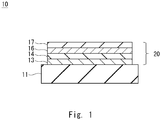
- Fig. 1 is a view showing the cross-sectional structure of a sheet battery 10, which is a sheet-shaped oxide semiconductor secondary battery.
- the sheet battery 10 has a laminated structure in which an n-type oxide semiconductor layer 13, a charging layer 14, a p-type oxide semiconductor layer 16, and a second electrode 17 are laminated in this order on a base material 11.
- the laminated structure formed on the base material 11 is a laminate 20.
- the laminate 20 includes the n-type oxide semiconductor layer 13, the charging layer 14, the p-type oxide semiconductor layer 16, and the second electrode 17.
- the base material 11 is made of a conductive material such as metal or the like, and it functions as a first electrode.
- the base material 11 acts as a negative electrode.
- a metallic foil sheet such as an SUS sheet or an aluminum sheet may be used as the base material 11.
- the base material 11 made of an insulating material may be prepared, and the first electrode may be formed on the base material 11.
- the base material 11 may have any structure as long as it includes the first electrode.
- a metallic material such as chromium (Cr) or titanium (Ti) may be used as a material of the first electrode.
- An ally film containing aluminum (Al), silver (Ag) or the like may be used as a material of the first electrode.
- it can be formed in the same manner as that by which the second electrode 17 is formed, which is described later.
- the n-type oxide semiconductor layer 13 is formed on the base material 11.
- the n-type oxide semiconductor layer 13 is formed so as to contain an n-type oxide semiconductor material (a second n-type oxide semiconductor material).
- a second n-type oxide semiconductor material titanium dioxide (TiO 2 ), tin oxide (SnO 2 ), zinc oxide (ZnO) or the like can be used as the n-type oxide semiconductor layer 13.
- the n-type oxide semiconductor layer 13 may be deposited on the base material 11 by, for example, sputtering or vapor deposition. It is preferred to use titanium dioxide (TiO 2 ) as a material of the n-type oxide semiconductor layer 13.
- the charging layer 14 is formed on the n-type oxide semiconductor layer 13.
- the charging layer 14 is made of a mixture of an insulating material and an n-type oxide semiconductor material.
- an n-type oxide semiconductor material (a first n-type oxide semiconductor material) of the charging layer 14 fine particles of n-type oxide semiconductor may be used.
- the photoexcited structure of the n-type oxide semiconductor is changed by exposure to ultraviolet radiation and becomes a layer with a charging function.
- Silicone resin may be used as an insulating material of the charging layer 14.
- the charging layer 14 is made of oxide silicon and titanium dioxide where the first n-type oxide semiconductor material is titanium dioxide.
- the first n-type oxide semiconductor material is titanium dioxide.
- Other preferred n-type oxide semiconductor materials that can be used for the charging layer 14 are tin oxide (SnO 2 ) and zinc oxide (ZnO).
- a material composed of a combination of two or all of titanium dioxide, tin oxide and zinc oxide may be used.
- a fabrication process of the charging layer 14 is described hereinafter.
- a coating liquid made by mixing a solvent with a mixture of a precursor of titanium oxide, tin oxide or zinc oxide and silicone oil is prepared.
- a coating liquid made by mixing fatty acid titanium and silicone oil with a solvent is prepared.
- the coating liquid is applied over the n-type oxide semiconductor layer 13 by spin coating, slit coating or the like.
- the coating film is then dried and baked, thereby forming the charging layer 14 on the n-type oxide semiconductor layer 13.
- a precursor is titanium stearate, which is a precursor of titanium oxide.
- Titanium oxide, tin oxide and zinc oxide are formed by being resolved from aliphatic acid chloride, which is a precursor of metallic oxide.
- the charging layer 14 after drying and baking may be exposed to ultraviolet radiation so that it is UV cured.
- fine particles of an oxide semiconductor may be used instead of using a precursor.
- a mixed solution is made by mixing nanoparticles of titanium oxide or zinc oxide with silicone oil.
- a coating liquid is made by mixing a solvent with the mixed solution. The coating liquid is applied over the n-type oxide semiconductor layer 13 by spin coating, slit coating or the like. The coating film is then dried, baked and UV-exposed, thereby forming the charging layer 14.
- the first n-type oxide semiconductor material contained in the charging layer 14 and the second n-type oxide semiconductor material contained in the n-type oxide semiconductor layer 13 may be the same or different.
- the n-type oxide semiconductor material contained in the n-type oxide semiconductor layer 13 is tin oxide
- the n-type oxide semiconductor material in the charging layer 14 may be tin oxide or an n-type oxide semiconductor material other than tin oxide.
- the p-type oxide semiconductor layer 16 is formed on the charging layer 14.
- the p-type oxide semiconductor layer 16 is formed so as to contain a p-type oxide semiconductor material.
- Nickel oxide (NiO), copper aluminum oxide (CuAlO 2 ) or the like can be used as a material of the p-type oxide semiconductor layer 16.
- the p-type oxide semiconductor layer 16 may be a nickel oxide layer with a thickness of 400 nm.
- the p-type oxide semiconductor layer 16 is deposited on the charging layer 14 by a deposition method such as vapor deposition or sputtering.
- the second electrode 17 may be formed using a conductive film.
- a metallic material such as chromium (Cr) or copper (Cu) may be used as a material of the second electrode 17.
- Another example of a metallic material is a silver (Ag) alloy containing aluminum (Al) or the like.
- a method of formation may be a vapor-phase deposition such as sputtering, ion plating, electron beam evaporation, vacuum deposition or chemical vapor deposition.
- a metallic electrode may be formed by electroplating, electroless plating or the like.
- a metal that is used for plating is typically copper, copper alloy, nickel, aluminum, silver, gold, zinc, tin or the like.
- the second electrode 17 is an Al film with a thickness of 300 nm.
- the n-type oxide semiconductor layer 13 is placed under the charging layer 14, and the p-type oxide semiconductor layer 16 is placed on top of the charging layer 14 in the above description, the positions of the n-type oxide semiconductor layer 13 and the p-type oxide semiconductor layer 16 may be interchanged. Specifically, the n-type oxide semiconductor layer 13 may be placed on top of the charging layer 14, and the p-type oxide semiconductor layer 16 may be placed under the charging layer 14. In this case, the base material 11 acts as a positive electrode, and the second electrode 17 acts as a negative electrode.
- the sheet battery 10 has a structure where the first electrode (the base material 11), the first conductivity type oxide semiconductor layer (the n-type oxide semiconductor layer 13 or the p-type oxide semiconductor layer 16), the charging layer 14, the second conductivity type oxide semiconductor layer (the p-type oxide semiconductor layer 16 or the n-type oxide semiconductor layer 13), and the second electrode 17 are laminated in this order from the bottom.
- the sheet battery 10 may have a structure that includes a layer other than the first electrode (the base material 11), the first conductivity type oxide semiconductor layer (the n-type oxide semiconductor layer 13 or the p-type oxide semiconductor layer 16), the charging layer 14, the second conductivity type oxide semiconductor layer (the p-type oxide semiconductor layer 16 or the n-type oxide semiconductor layer 13), and the second electrode 17.
- the laminate 20 that includes the n-type oxide semiconductor layer 13, the charging layer 14, the p-type oxide semiconductor layer 16 and the second electrode 17 is placed on top of the base material 11.
- the uppermost surface of the sheet battery 10 is the second electrode 17.
- the laminate 20 is not at the edge of the sheet battery 10.
- the laminate 20 is formed substantially all over the base material 11 except for the edge of its surface.
- the base material 11 is exposed to the outside at the edge of the sheet battery 10.
- the outside of the laminate 20 i.e., the periphery of the base material 11
- the base material 11 is the uppermost surface of the sheet battery 10 on the periphery of the sheet battery 10.
- the secondary battery according to this embodiment has a structure where the sheet batteries 10 shown in Fig. 1 are laminated together, thus having a high capacity. To be specific, a plurality of sheet batteries 10 are connected in parallel, thereby increasing the capacity of the secondary battery. To this end, the sheet batteries 10 are laminated face-to-face in this embodiment.
- Fig. 2 shows the planar shapes of two types of sheet batteries.
- one of the two types of sheet batteries is type-I sheet battery 110, and the other is type-II sheet battery 210.
- a plane on which the sheet batteries 110 and 210 are placed is an X-Y plane. The X direction and the Y direction are orthogonal to each other.
- Fig. 2 shows the planar shapes of the sheet batteries 110 and 210 when viewed from the laminate 20 side (the upper side of Fig. 1 ).
- the sheet battery 110 has a rectangular part 131 and a tab part 132.
- the rectangular part 131 may be oblong or square on the X-Y plane.
- the rectangular part 131 has an oblong shape having sides parallel to the X direction and the Y direction, with their longer sides along the X direction.
- the tab part 132 juts out in the +Y direction from the rectangular part 131.
- the tab part 132 projects outward from one side along the X direction of the rectangular part 131.
- the sheet battery 110 is inverted L-shaped on the X-Y plane.
- the tab part 132 is formed at the +X and +Y side edge of the rectangular part 131.
- a base material 111 in Fig. 2 corresponds to the base material 11 in Fig. 1 .
- a laminate 120 in Fig. 2 corresponds to the laminate 20 in Fig. 1 .
- the laminate 120 includes the n-type oxide semiconductor layer 13, the charging layer 14, the p-type oxide semiconductor layer 16 and the second electrode 17 as shown in Fig. 1 .
- a major part of the laminate 120 is formed in the rectangular part 131 and the tab part 132.
- the uppermost surface is the second electrode 17 in the most part of the rectangular part 131 and the tab part 132.
- the base material 111 is exposed to the outside. Therefore, the uppermost surface is the base material 111 in the peripheral part of the sheet battery 110.
- an insulating material 143 is formed on the sheet battery 110. As shown in Fig. 2 , the insulating material 143 is formed as a part of the rectangular part 131. To be specific, the tab part 132 is formed at the +X and +Y side edge of the rectangular part 131, and the insulating material 143 is formed at the -X and +Y side edge of the rectangular part 131. The insulating material 243 is placed along the X direction.
- the insulating material 143 is placed on the outside of the laminate 120. Specifically, the insulating material 143 is formed in the area where the uppermost surface is the base material 111. The insulating material 143 is formed directly on the base material 111 so as to be in contact with the base material 111. The insulating material 143 is formed to cover a part of the base material 111. The insulating material 143 is coated on the base material 111 by vapor deposition, spraying or the like. A resin film such as polyimide, for example, may be used as the insulating material 143. The insulating material 143 preferably has elasticity.
- the structure of the type-II sheet battery 210 is described next.
- the sheet battery 210 has a planar shape that is symmetrical to the sheet battery 110.
- the sheet battery 210 and the sheet battery 110 are symmetric with respect to a line parallel to the Y direction.
- the sheet battery 210 has a rectangular part 231 and a tab part 232.
- the rectangular part 231 may be oblong or square on the X-Y plane.
- the rectangular part 231 has an oblong shape having sides parallel to the X direction and the Y direction, with their longer sides along the X direction.
- the tab part 232 juts out in the +Y direction from the rectangular part 231.
- the tab part 232 projects outward from one side along the X direction of the rectangular part 231.
- the sheet battery 210 is inverted L-shaped on the X-Y plane.
- the tab part 232 is formed at the -X and +Y side edge of the rectangular part 231.
- a base material 211 in Fig. 2 corresponds to the base material 11 in Fig. 1 .
- a laminate 220 in Fig. 2 corresponds to the laminate 20 in Fig. 1 .
- the laminate 220 includes the n-type oxide semiconductor layer 13, the charging layer 14, the p-type oxide semiconductor layer 16 and the second electrode 17 as shown in Fig. 1 .
- the laminated construction of the laminate 220 is the same as that of the laminate 120.
- a major part of the laminate 220 is formed in the rectangular part 231 and the tab part 232.
- the uppermost surface is the second electrode 17 in the most part of the rectangular part 231 and the tab part 232.
- the base material 211 is exposed to the outside. Therefore, the uppermost surface is the base material 211 in the peripheral part of the sheet battery 210.
- an insulating material 243 is formed on the sheet battery 210. As shown in Fig. 2 , the insulating material 243 is formed as a part of the rectangular part 231. To be specific, the tab part 232 is formed at the -X and +Y side edge of the rectangular part 231, and the insulating material 143 is formed at the +X and +Y side edge of the rectangular part 131. The insulating material 243 is placed along the X direction.
- the insulating material 243 is placed on the outside of the laminate 220. Specifically, the insulating material 243 is formed in the area where the uppermost surface is the base material 211. The insulating material 243 is formed directly on the base material 211 so as to be in contact with the base material 211. The insulating material 243 is formed to cover a part of the base material 211. The insulating material 243 is coated on the base material 211 by vapor deposition, spraying or the like. A resin film such as polyimide, for example, may be used as the insulating material 243. The insulating material 243 preferably has elasticity.
- the insulating material 143 is placed to prevent the base material 111 from being short-circuited with the second electrode 17 of the other sheet battery 110 when the sheet batteries 110, 210 are laminated together.
- the insulating material 243 is placed to prevent the base material 211 from being short-circuited with the second electrode 17 of the other sheet battery 210 when the sheet batteries 210 are laminated together.
- the type-I sheet battery 110 and the type-II sheet battery 210 are different only in the positions of the tab parts 132 and 232 and the insulating materials 143 and 243 in the X direction.
- the rectangular part 231 has the same size as the rectangular part 131.
- the tab part 232 has the same size as the tab part 132.
- FIG. 3 is an exploded perspective view of the sheet pair 150.
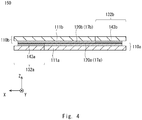
- Fig. 4 is an X-Z plane view showing the side structure of the sheet pair 150.
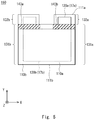
- Fig. 5 is an X-Y plane view showing the planar shape of the sheet pair 150.
- the sheet pair 150 has a pair of two sheet batteries 110a and 110b.
- the two sheet batteries 110a and 110b are connected.
- a plane on which the sheet batteries 110a and 110b are placed is an X-Y plane, just like in Fig. 2 .
- a direction orthogonal to the X-Y plane is the Z direction.
- An XYZ orthogonal coordinate system where the in-plane directions of the sheet batteries 110a and 110b are the X direction and the Y direction and the thickness direction of the sheet pair 150 is the Z direction is used in the following description.
- +Z side is the upper side
- -Z side is the lower side.
- the sheet battery 110a is placed on the upper side of the sheet battery 110b.
- the insulating material 143, the rectangular part 131, the tab part 132, the second electrode 17 and the laminate 20 included in the sheet battery 110a are the insulating material 143a, the rectangular part 131a, the tab part 132a, the second electrode 17a and the laminate 120a, respectively.
- the insulating material 143, the rectangular part 131, the tab part 132, the second electrode 17 and the laminate 120 included in the sheet battery 110b are the insulating material 143b, the rectangular part 131b, the tab part 132b, the second electrode 17b and the laminate 120b, respectively.
- the sheet pair 150 includes the sheet battery 110a, which is a first sheet battery, and the sheet battery 110b, which is a second sheet battery.
- the tab part 132a of the sheet battery 110a is a first tab part
- the tab part 132b of the sheet battery 110b is a second tab part.
- the insulating material 143a placed in the sheet battery 110a is a first insulating material
- the insulating material 143b placed in the sheet battery 110b is a second insulating material.
- the sheet battery 110a and the sheet battery 110b are placed with the second electrodes 17a and 17b facing each other.
- the sheet battery 110b is inverted relative to the sheet battery 110a so that the second electrode 17b faces in the -Z direction.
- rotating the sheet battery 110 in Fig. 2 by 180° about the Y axis being the axis of rotation gives the orientation of the sheet battery 110b.
- the orientation of the sheet battery 110a is the same as that of the sheet battery 110 in Fig. 2 .
- the second electrode 17a of the sheet battery 110a is placed facing upward, and the second electrode 17b of the sheet battery 110b is placed facing downward.
- the laminate 120a is placed on the upper side of the base material 111a in the sheet battery 110a, and the laminate 120b is placed on the lower side of the base material 111b in the sheet battery 110b.
- the sheet battery 110a and the sheet battery 110b are laminated together in such a way that the rectangular part 131a and the rectangular part 131b overlap each other when the XY plane is viewed from above.
- the second electrode 17a of the sheet battery 110a and the second electrode 17b of the sheet battery 110b are placed face-to-face with each other and connected.
- the second electrode 17a is exposed on the upper surface of the sheet battery 110a
- the second electrode 17b is exposed on the lower surface of the sheet battery 110b. Accordingly, by placing the second electrode 17a of the sheet battery 110a and the second electrode 17b of the sheet battery 110b facing each other, the second electrode 17a and the second electrode 17b come into contact with each other.
- the second electrode 17a of the sheet battery 110a and the second electrode 17b of the sheet battery 110b thereby become electrically continuous.
- the tab part 132a and the tab part 132b are arranged in a staggered fashion on the X-Y plane. Specifically, the tab part 132a is placed at the +X side edge of the sheet battery 110a, and the tab part 132b is placed at the -X side edge of the sheet battery 110b. In this manner, the position of the tab part 132a and the position of the tab part 132b in the X direction are different. The tab part 132a and the tab part 132b are staggered on the X-Y plane. In other words, the tab part 132a of the sheet battery 110a projects to the outer side of the sheet battery 110b on the X-Y plane. Likewise, the tab part 132b of the sheet battery 110b projects to the outer side of the sheet battery 110a on the X-Y plane.
- the insulating material 143b is formed on the lower surface of the sheet battery 110b.
- the insulating material 143b is placed in close proximity to the tab part 132a.
- the insulating material 143b is placed at the edge of the sheet battery 110b.
- a "close" position is a position where the laminate 120b of the sheet battery 110b is not placed and which corresponds to the tab part 132a, for example.
- the insulating material 143b is placed between the sheet battery 110a and the sheet battery 110b in the position extending to the tab part 132a of the sheet battery 110a.
- the insulating material 143b is placed in the area of the rectangular part 131a at the boundary between the tab part 132a and the rectangular part 131a of the sheet battery 110a on the X-Y plane.
- the insulating material 143b is thereby interposed between the second electrode 17a on the uppermost surface of the laminate 120a in close proximity to the tab part 132a and the base material 111b of the sheet battery 110b. It is thus possible to prevent short-circuit between the second electrode 17a of the sheet battery 110a and the base material 111a of the sheet battery 110b.
- the insulating material 143a is formed on the upper surface of the sheet battery 110a.
- the insulating material 143a is placed in close proximity to the tab part 132a.
- the insulating material 143a is placed at the edge of the sheet battery 110a.
- the insulating material 143a is placed between the base material 111a of the sheet battery 110a and the laminate 120b of the sheet battery 110b.
- the insulating material 143a is formed in a position where the laminate 120a of the sheet battery 110a is not placed and which corresponds to the tab part 132b.
- the insulating material 143a is placed between the sheet battery 110a and the sheet battery 110b in the position extending to the tab part 132b of the sheet battery 110b.
- the insulating material 143a is placed in the area of the rectangular part 131b at the boundary between the tab part 132b and the rectangular part 131b of the sheet battery 110b on the X-Y plane.
- the insulating material 143a is thereby interposed between the second electrode 17b on the uppermost surface of the laminate 120b in close proximity to the tab part 132b and the base material 111a of the sheet battery 110a. It is thus possible to prevent short-circuit between the second electrode 17a of the sheet battery 110a and the base material 111b of the sheet battery 110b.
- the tab part 132a and the tab part 132b are staggered in position in the X direction. Therefore, in this embodiment, there is an area where the second electrode 17 of one sheet battery 110 and the base material 11 of the other sheet battery 110 face each other at the boundary between the tab part 132 and the rectangular part 131.
- the insulating material 143 is placed in this area. In other words, the insulating material 143 is placed between the sheet battery 110a and the sheet battery 110b in the area where the base material 111 is exposed. By placing the insulating material 143 in this exposure position, it is possible to prevent the second electrode 17 from being short-circuited with the first electrode of the other sheet battery 110.
- the sheet batteries 210 are also laminated in the same manner to form a sheet pair.
- the two sheet batteries 210 are placed with their second electrodes facing each other and being connected.
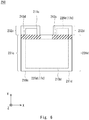
- Fig. 6 shows the X-Y plane shape of a sheet pair 250 that includes sheet batteries 210c and 210d. Note that the laminated construction of the sheet pair 250 is the same as that of the sheet pair 150 and therefore the description thereof is omitted.
- the type-II sheet batteries 210c and 210d shown in Fig. 2 are laminated together with the laminate 220c and the laminate 220d facing each other.
- the laminate 220c of the sheet battery 210c faces upward
- the laminate 220d of the sheet battery 210c faces downward.
- rotating the sheet battery 210 in Fig. 2 by 180° about the Y axis being the axis of rotation gives the orientation of the sheet battery 210d.
- the sheet battery 210c and the sheet battery 210d are placed in such a way that their second electrodes 17 face each other and are connected.
- the positions of the tab parts 232c and 232d along the X direction are different.
- the tab part 232c is placed at the -X side edge, and the tab part 232d is placed at the +X side edge.
- the tab part 132c of the sheet battery 210c projects to the outer side of the sheet battery 210d on the X-Y plane.
- the tab part 132d of the sheet battery 210d projects to the outer side of the sheet battery 210c on the X-Y plane.
- two kinds of sheet pairs 150 and 250 are used in this embodiment.
- the positions of the tab parts are different on the X-Y plane where the sheet batteries are laminated.
- the tab part of one sheet battery protrudes to the outside of the other sheet battery.
- the sheet pair 150 is referred to as a first sheet pair 150
- the sheet pair 250 is referred to as a second sheet pair 250.
- the sheet batteries 110 and 210 are laminated in such a way that the rectangular parts 131 and 231 overlap each other.
- the tab part 232c of the sheet pair 250 overlaps the tab part 132a of the sheet pair 150
- the tab part 232d of the sheet pair 250 overlaps the tab part 132b of the sheet pair 150.
- the tab part 132a and the tab part 232c are placed with the laminates 120a and 220c facing the +Z side
- the tab part 132b and the tab part 232d are placed with the laminates 120b and 220d facing the -Z side.
- Fig. 7 is a schematic view showing the structure of a laminated battery 1.
- Fig. 8 is an X-Z plane view showing the side structure of the laminated battery 1. Note that, in the laminated battery 1, the sheet batteries 110 and 210 are laminated with their substantially whole areas overlapping each other. In Fig. 8 , the sheet batteries 110 and 210 are partly displaced to clarify the description.
- Figs. 7 and 8 show the laminated battery 1 that includes 8 sheet batteries 110a, 110b, 210c, 210d, 110e, 110f, 210g, and 210h.
- the sheet batteries 110a, 110b, 110e and 110f are the type-I sheet batteries 110 shown in Fig. 2 .
- the sheet batteries 210c, 210d, 210g and 210h are the type-II sheet batteries 210 show in Fig. 2 .
- tab parts placed in the sheet batteries 110a, 110b, 110e and 110f are tab parts 132a, 132b, 132e and 132f, respectively.
- Laminates placed in the sheet batteries 110a, 110b, 110e and 110f are laminates 120a, 120b, 120e and 120f, respectively.
- tab parts placed in the sheet batteries 210c, 210d, 210g and 210h are tab parts 232c, 232d, 232g and 232h, respectively.
- Laminates placed in the sheet batteries 210c, 210d, 210g and 210h are laminates 220c, 220d, 220g and 220h, respectively. Further, in Fig.
- base materials placed in the sheet batteries 110a, 110b, 110e and 110f are base materials 111a, 111b, 111e and 111f, respectively, and base materials placed in the sheet batteries 210c, 210d, 210g and 210h are base materials 211c, 211d, 211g and 211h, respectively.
- the sheet batteries 110a, 110b, 210c, 210d, 110e, 110f, 210g, and 210h the alphabet "a” to "h” are omitted and they are simply referred to as the sheet batteries 110 and 210, which is the same for the other elements.
- the sheet batteries 110a, 110b, 210c, 210d, 110e, 110f, 210g, and 210h are laminated in this order.
- the sheet battery 110a is placed on the lowermost side
- the sheet battery 210h is placed on the uppermost side.
- the sheet batteries 110a, 110b, 210c, 210d, 110e, 110f, 210g, and 210h are sequentially referred to as a first sheet battery 110a to an eighth sheet battery 210h, which is the same for the other elements.
- sheet pairs composed of the type-I sheet batteries 110 are sheet pairs 150a and 150e.
- the first sheet pair 150a has two sheet batteries 110a and 110b.
- the sheet pair 150e has two sheet batteries 110e and 110f.
- sheet pairs composed of the type-II sheet batteries 210 are sheet pairs 250c and 250g.
- the second sheet pair 250c has two sheet batteries 210c and 210d.
- the sheet pair 250g has two sheet batteries 210g and 210h.
- the laminate 120a and the laminate 120b are placed facing each other, and therefore the second electrodes 17 (not shown in Figs. 7 and 8 ) are connected to each other as shown in Fig. 4 .
- the laminate 120e and the laminate 120e are placed facing each other, and therefore the second electrodes 17 (not shown in Figs. 7 and 8 ) are connected to each other.
- the laminate 220c and the laminate 220d are placed facing each other, and therefore the second electrodes 17 (not shown in Figs. 7 and 8 ) are connected to each other.
- the laminate 220g and the laminate 220h are placed facing each other, and therefore the second electrodes 17 (not shown in Figs. 7 and 8 ) are connected to each other. In this manner, the positive electrodes are connected to each other in each of the sheet pairs 150a, 150e, 250c and 250g.
- the sheet batteries 110b, 210d, 110f and 210h are placed in such a way that the laminates 120b, 220d, 120f and 220h face downward.
- the base material 111b is placed on the upper side of the laminate 120b.
- the base material 211 d is placed on the upper side of the laminate 220d.
- the base material 111f is placed on the upper side of the laminate 120f.
- the eighth sheet battery 210h also, the base material 211h is placed on the upper side of the laminate 220h.
- the sheet batteries 110a, 210c, 110e and 210g are placed in such a way that the laminates 120a, 220c, 120e and 220g face upward.
- the base material 111a is placed on the lower side of the laminate 120a.
- the base material 211c is placed on the lower side of the laminate 220c.
- the base material 111e is placed on the lower side of the laminate 120e.
- the base material 211g is placed on the lower side of the laminate 220g.
- the orientations of the base material and the laminate are vertically inverted between the odd-numbered sheet batteries 110a, 210c, 110e and 210g and the even-numbered sheet batteries 110b, 210d, 110f and 210h in their laminated structures.
- the base material 111b of the second sheet battery 110b and the base material 211c of the third sheet battery 210c are placed face-to-face with each other and connected.
- the base material 211d of the fourth sheet battery 210d and the base material 111e of the fifth sheet battery 110e are placed face-to-face with each other and connected.
- the base material 111f of the sixth sheet battery 110f and the base material 211g of the seventh sheet battery 210g are placed face-to-face with each other and connected.
- the sheet batteries 110a, 110b, 110e and 110f are the type-I sheet batteries 110 shown in Fig. 2
- the sheet batteries 210c, 210d, 210g and 210h are the type-II sheet batteries 210 show in Fig. 2 .
- the orientation of the laminate is different between the even-numbered sheet batteries and the odd-numbered sheet batteries.
- the tab parts 132a, 232d, 132e and 232h of the first sheet battery 110a, the fourth sheet battery 210d, the fifth sheet battery 110e and the eighth sheet battery 210h are placed at the +X side edge.
- the tab parts 132a, 232d, 132e and 232h thereby overlap each other on the X-Y plane (refer also to Fig. 9 ).
- the tab parts 132b, 232c, 132f and 232g of the second sheet battery 110b, the third sheet battery 210c, the sixth sheet battery 110f and the seventh sheet battery 210g are placed at the -X side edge.
- the tab parts 132b, 232c, 132f and 232g thereby overlap each other on the X-Y plane (refer also to Fig. 9 ).
- the tab parts 132b, 232c, 132f and 232g and the tab parts 132a, 232d, 132e and 232h are arranged in a staggered fashion on the X-Y plane.
- the second electrode 17 of the first tab part 132a and the second electrode 17 of the fourth tab part 232d are placed face-to-face with each other.
- the second electrode 17 of the first tab part 132a and the second electrode 17 of the fourth tab part 232d can be thereby easily connected.
- the laminated battery 1 has a conductive bonding agent 45ad so as to connect the second electrode 17 of the first tab part 132a and the second electrode 17 of the fourth tab part 232d.
- the first tab part 132a and the fourth tab part 232d are bonded together, and the second electrode 17 of the first sheet battery 110a and the second electrode 17 of the fourth sheet battery 210d are connected through the conductive bonding agent 45ad.
- the second electrodes 17 of the two adjacent sheet pairs 150a and 250c are thereby connected. Because the two sheet batteries 110b and 210c are placed between the first sheet battery 110a and the fourth sheet battery 210d, the conductive bonding agent 45ad corresponds to the thickness of the two sheet batteries.
- the third tab part 232c overlaps the sixth tab part 132f, the second electrode 17 of the third tab part 232c and the second electrode 17 of the sixth tab part 132f are placed face-to-face with each other.
- the second electrode 17 of the third tab part 132c and the second electrode 17 of the sixth tab part 132f can be thereby easily connected.
- the laminated battery 1 has a conductive bonding agent 45cf so as to connect the second electrode 17 of the third tab part 232c and the second electrode 17 of the sixth tab part 132f.
- the third tab part 232c and the sixth tab part 132f are bonded together, and the second electrode 17 of the third sheet battery 210c and the second electrode 17 of the sixth sheet battery 110f are connected through the conductive bonding agent 45cf.
- the second electrodes 17 of the two adjacent sheet pairs 150e and 250c are thereby connected. Because the two sheet batteries 210d and 110e are placed between the third sheet battery 210c and the sixth sheet battery 110f, the conductive bonding agent 45cf corresponds to the thickness of the two sheet batteries.
- the fifth tab part 132e overlaps the eighth tab part 232h, the second electrode 17 of the fifth tab part 132e and the second electrode 17 of the eighth tab part 232h are placed face-to-face with each other.
- the second electrode 17 of the fifth tab part 132e and the second electrode 17 of the eighth tab part 232h can be thereby easily connected.
- the laminated battery 1 has a conductive bonding agent 45eh so as to connect the second electrode 17 of the fifth tab part 132e and the second electrode 17 of the eighth tab part 232h.
- the fifth tab part 132e and the eighth tab part 232h are bonded together, and the second electrode 17 of the fifth sheet battery 110e and the second electrode 17 of the eighth sheet battery 210h are connected through the conductive bonding agent 45eh.
- the second electrodes 17 of the two adjacent sheet pairs 150e and 250c are thereby connected. Because the two sheet batteries 110f and 210g are placed between the fifth sheet battery 110e and the eighth sheet battery 210h, the conductive bonding agent 45eh corresponds to the thickness of the two sheet batteries.
- each of the conductive bonding agents 45ad, 45cf and 45eh has a thickness corresponding to two sheets batteries, which reduces the thickness of the laminated battery. It is thereby possible to save the space.
- the thickness of the bonding agent 45 is substantially equal to the total thickness of two sheets batteries. It is thereby possible to reduce a difference in thickness even when the number of laminated sheet batteries 110 and 210 is large. Easier lamination is achieved by making the thickness of a sheet pair equal to the thickness of a conductive bonding agent.
- the laminated battery 1 that includes four sheet batteries 110 and four sheet batteries 210 is described in this embodiment, the total number of sheet batteries 110 and 210 included in the laminated battery 1 is not limited to 8.
- the laminated battery 1 includes at least one sheet pair 150 and one sheet pair 250. In other words, the laminated battery 1 includes four or more sheet batteries 110 and 210.
- the laminated battery 1 preferably includes a plurality of sets of the sheet pair 150 and the sheet pair 250, i.e., four sheet batteries 110 and 210.
- the total number of sheet batteries 110 and 210 included in the laminated battery 1 may be 12 or 16.
- the sheet batteries 110 and 210 are laminated in such a way that the sheet pair 150 and the sheet pair 250 are arranged alternately.
- Fig. 9 is a plan view illustrating, in a simple way, the structure of the laminated battery 1 where a plurality of sheet batteries 110 and 210 are laminated.
- the laminated battery 1 can be folded along a fold line X1 in parallel with the X direction. Folding the laminated battery 1 allows the area on the X-Y plane to be reduced half, thereby easily reducing the size of the laminated battery 1.
- the fold line X1 does not lie across the tab parts 132 and 232. Only the rectangular parts 131 and 231 are thereby folded. Thus, the laminated battery 1 is folded without folding the tab parts 132 and 232.
- joint regions 135 and 235 are peripheral areas of the base materials 111 band 211, respectively.
- the laminate 120 is not placed, and the base materials 111 band 211 are exposed.
- the base materials 111 band 211 are exposed on the surfaces of the both sheet batteries 110 and 210.
- a joint part 46 joins the joint regions 135 and 235 together. In this manner, in the joint part 46, the peripheral areas of the base materials 111 and 211 of the sheet battery 110 and the sheet battery 210 are joined together.
- the joint part 46 is formed by welding such as resistance welding or ultrasonic welding, for example.
- the first electrodes of all the sheet batteries 110 and 210 are thereby connected.
- the plurality of sheet batteries 110 and 210 can be thereby connected in parallel. Further, all the sheet batteries 110 and 210 are bonded together in the joint part 46. Thus easily reduces the size of the laminated battery 1.
- This embodiment is the same as the first embodiment in that sheet batteries are laminated, and is different from the first embodiment in the planar shape of sheet batteries.
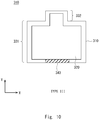
- the planar shape of a sheet battery 310 according to this embodiment is described hereinafter with reference to Fig. 10 . Note that, in this embodiment, all of sheet batteries 310 have the same planar shape. Specifically, all of sheet batteries are the type III. Note that the description common to the first embodiment is omitted as appropriate below.
- the type-III sheet battery 310 is different from the type-I sheet battery 110 and the type-II sheet battery 210 in the positions of a tab part 332 and an insulating material 343. Note that the type-III sheet battery 310 is the same as the sheet batteries 110 and 210 of the first embodiment except for the position of the tab part 332, and the description thereof is omitted.
- a base material 311 and a laminate 320 are the same as the base material 111 and the laminate 120, respectively, and the description thereof is omitted.
- a rectangular part 331 is oblong or square on the X-Y plane.
- the tab part 332 projects in the +Y direction from the rectangular part 331.
- the tab part 332 is placed in the middle of the rectangular part 331 in the X direction.
- the insulating material 343 is placed at the -Y side edge of the rectangular part 331.
- the insulating material 343 is placed in the middle of the rectangular part 331 in the X direction.
- the positions of the tab part 332 and the insulating material 343 in the X direction coincide with each other.
- FIG. 11 is an exploded perspective view of the sheet pair 350a.
- Fig. 12 is an X-Z plane view showing the side structure of the sheet pair 350a.
- Fig. 13 is an X-Y plane view showing the planar structure of the sheet pair 350a.
- the sheet battery 310a and the sheet battery 310b are placed with the second electrodes 17a and 17b facing each other.
- the sheet battery 310b has a structure that is the inverse of the sheet battery 310 in Fig. 10 .
- rotating the sheet battery 310 in Fig. 10 about the X axis being the axis of rotation gives the orientation of the sheet battery 310b.
- the sheet battery 310a is in the same orientation as the sheet battery 310 in Fig. 10 .
- the second electrode 17a of the sheet battery 310a is placed facing upward, and the second electrode 17b of the sheet battery 310b is placed facing downward.
- the laminate 320a is placed on the upper side of the base material 311a in the sheet battery 310a, and the laminate 320b is placed on the lower side of the base material 311 in the sheet battery 310b.
- the sheet battery 310a and the sheet battery 310b are laminated together in such a way that the rectangular part 331a and the rectangular part 331b overlap each other when the XY plane is viewed from above.
- the second electrode 17a of the sheet battery 310a and the second electrode 17b of the sheet battery 310b are placed face-to-face with each other and connected.
- the second electrode 17a is exposed on the upper surface of the sheet battery 310a
- the second electrode 17b is exposed on the lower surface of the sheet battery 310b.
- the second electrode 17a of the sheet battery 310a and the second electrode 17b of the sheet battery 310b thereby become electrically continuous.
- a tab part 332a and a tab part 332b are placed in different positions on the X-Y plane.
- the tab part 332a is placed at the +Y side edge
- the tab part 332b is placed at the -Y side edge. Therefore, just like in the first embodiment, the tab part 332a protrudes to the outside of the sheet battery 310b on the X-Y plane.
- the tab part 332b protrudes to the outside of the sheet battery 310a on the X-Y plane.
- An insulating material 343b is placed in close proximity to the tab part 332a.
- the insulating material 343b is thereby interposed between the base material 311b and the second electrode 17a of the sheet battery 310a. This prevents short-circuit between the base material 311b and the second electrode 17a of the sheet battery 310a.
- an insulating material 343a is interposed between the base material 311a and the second electrode 17b of the sheet battery 310b, which prevents short-circuit.
- the structure of a sheet pair 350c having a different planar structure from the sheet pair 350a is described hereinafter with reference to Fig. 14 .
- the sheet pair 350c includes a sheet battery 310c and a sheet battery 310d.
- the sheet battery 310c and the sheet battery 310d are placed with second electrodes 17c and 17d facing each other.
- the second electrode 17c of the sheet battery 310c is placed facing upward, and the second electrode 17d of the sheet battery 310d is placed facing downward.
- rotating the planar shape of Fig. 13 by 180° about the Z axis being the axis of rotation gives the planar shape shown in Fig. 14 .
- the sheet battery 310a corresponds to the sheet battery 310c
- the sheet battery 310b corresponds to the sheet battery 310d.
- a tab part 332c and a tab part 332d are placed in different positions on the X-Y plane.
- the tab part 332d is placed at the +Y side edge
- the tab part 332c is placed at the -Y side edge. Therefore, just like in the first embodiment, the tab part 332c protrudes to the outside of the sheet battery 310d on the X-Y plane, and the tab part 332c protrudes to the outside of the sheet battery 310d on the X-Y plane.
- the tab part 332a of the sheet battery 310a and the tab part 332d of the sheet battery 310d overlap each other on the X-Y plane.
- the tab part 332b of the sheet battery 310b and the tab part 332c of the sheet battery 310c overlap each other on the X-Y plane.
- the tab part 332a and the tab part 332d are arranged in a staggered fashion on the X-Y plane.
- Fig. 15 is an X-Z plane view showing the laminated structure of the laminated battery 3.
- the laminated battery 3 includes 8 sheet battery 310a to laminated battery 310h. As shown in Fig. 15 , a sheet battery 310a, a sheet battery 310b, a sheet battery 310c, a sheet battery 310d, a sheet battery 310e, a sheet battery 310f, a sheet battery 310g, and a sheet battery 310h are laminated in this order from the bottom.
- a sheet pair 350a includes the sheet battery 310a and the sheet battery 310b, having the planar shape shown in Fig. 13 .
- a sheet pair 350c includes the sheet battery 310c and the sheet battery 310d, having the planar shape shown in Fig. 14 .
- a sheet pair 350e includes the sheet battery 310e and the sheet battery 310f, having the planar shape shown in Fig. 13 .
- the sheet battery 310e has the same planar shape as the sheet battery 310a
- the sheet battery 310f has the same planar shape as the sheet battery 310d.
- a sheet pair 350g includes the sheet battery 310g and the sheet battery 310h, having the planar shape shown in Fig. 14 .
- the sheet battery 310g has the same planar shape as the sheet battery 310c
- the sheet battery 310h has the same planar shape as the sheet battery 310f.
- the second electrodes are connected to each other in the tab parts, just like in the first embodiment.
- the second electrode 17 (not shown in Fig. 15 ) of the sheet battery 310a and the second electrode 17 (not shown in Fig. 15 ) of the sheet battery 310d are connected through a conductive bonding agent 345ad.
- the second electrode 17 (not shown in Fig. 15 ) of the sheet battery 310e and the second electrode 17 (not shown in Fig. 15 ) of the sheet battery 310h are connected through a conductive bonding agent 345eh. Note that, although not shown in Fig.
- the second electrode 17 (not shown in Fig. 15 ) of the sheet battery 310c and the second electrode 17 (not shown in Fig. 15 ) of the sheet battery 310f are connected through a conductive bonding agent.
- the laminated battery 3 having such a structure can be also folded like the laminated battery 1 of the first embodiment.
- the laminated battery 3 can be folded along fold lines Y1 and Y2 in parallel with the Y direction.
- the laminated battery 3 is thereby reduced in size.
- the fold lines Y1 and Y2 do not lie across the tab part 332. Thus, only the rectangular part 331 is folded.
- an area of the tab part 332 which is on the outer side of the laminate 320 is a joint region 335.
- the laminate 320 is not placed and therefore the base material 311 is exposed.
- the base material 311 is exposed on both surfaces of the sheet battery 310.
- a joint part 346 joins the joint region 335.
- the joint part 346 is formed by welding such as resistance welding or ultrasonic welding, for example.
- the first electrodes of all the sheet batteries 320 are thereby connected.
- the plurality of sheet batteries 310 can be thereby connected in parallel. Further, all the sheet batteries 310 are bonded together in the joint part 346. Thus easily reduces the size of the laminated battery 3.
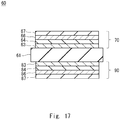
- Fig. 17 is a cross-sectional view showing the laminated structure of a sheet battery 60.
- a laminate 70 is placed on one surface of a base material 61, and a laminate 90 is placed on the other surface of the base material 61. Note that the description common to the first and second embodiments is omitted as appropriate below.
- the laminated structure of the laminate 70 and the laminate 90 is the same as the laminate 20 described in the first embodiment.
- the n-type oxide semiconductor layer 13, the charging layer 14, the p-type oxide semiconductor layer 16, and the second electrode 17 of the laminate 20 correspond to an n-type oxide semiconductor layer 63, a charging layer 64, a p-type oxide semiconductor layer 66, and a second electrode 67 of the laminate 70, respectively.
- the n-type oxide semiconductor layer 13, the charging layer 14, the p-type oxide semiconductor layer 16, and the second electrode 17 of the laminate 20 correspond to an n-type oxide semiconductor layer 83, a charging layer 84, a p-type oxide semiconductor layer 86, and a second electrode 87 of the laminate 90, respectively.
- a second electrode 67 is placed on one surface of the base material 61, and a second electrode 87 is placed on the other surface of the base material 61.
- the two types of sheet batteries are the sheet battery 60 where the laminate is placed on both surfaces of the base material 61 as shown in Fig. 17 and the sheet battery 10 where the laminate 20 is placed only on one surface of the base material 11 as shown in Fig. 1 .
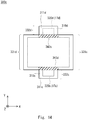
- Fig. 18 shows the planar shapes of two types of sheet batteries.
- the sheet battery 60 where the laminate is placed on both surfaces is referred to as a type-IV sheet battery 660
- the sheet battery 10 where the laminate 20 is placed only on one surface is referred to as a type-V sheet battery 710.
- the sheet battery 660 is also called a double-sided battery sheet
- the sheet battery 710 is also called a single-sided battery sheet.
- a laminate 670 is formed on one surface of a base material 661.
- the laminate formed on the other surface of the base material 661 is a laminate 690.
- the laminate 670 corresponds to the laminate 70 in Fig. 17 .
- the laminate 690 corresponds to the laminate 90 in Fig. 17 .
- the shape, size and position of the laminate 670 and the laminate 690 are the same on the X-Y plane.
- a laminate 720 is formed on a base material 711.
- the size and shape of the laminate 720 are the same as those of the laminates 670 and 690.
- the sheet battery 660 includes a rectangular part 631 and a tab part 632.
- the sheet battery 710 includes a rectangular part 731 and a tab part 732.
- the sheet battery 660 has an insulating material 643 for preventing short-circuit between the first electrode and the second electrode.
- the insulating material 643 may be placed on both surfaces or only on one surface of the base material 611.
- the sheet battery 710 has an insulating material 743 for preventing short-circuit between the first electrode and the second electrode.
- the shape, position and structure of the insulating materials 643 and 743 are the same as those of the insulating material 143 and therefore the description thereof is omitted.
- the base material 661 of the sheet battery 660 and the base material 711 of the sheet battery 710 have the same shape as the base material 111 of the type-I sheet battery 110.
- the tab parts 632 and 732 are located in the same position as the tab part 132.
- FIG. 19 is an X-Z plane view showing the side structure of the sheet pair 650.
- Fig. 20 is an X-Y plane view showing the planar shape of the sheet pair 650.
- the sheet pair 650 has a sheet battery 660b and a sheet battery 660c.
- the sheet battery 660c and the sheet battery 660b are type-IV sheet batteries 660 shown in Fig. 18 .
- the two sheet battery 660c and sheet battery 660b overlap each other in the same orientation.
- the sheet battery 660c and the sheet battery 660b are arranged completely overlapping each other.
- a tab part 632c of the sheet battery 660c and a tab part 632b of the sheet battery 660b are the same position in the X direction, which is different from the first and second embodiments.
- the tab part 632c of the sheet battery 660c and the tab part 632b of the sheet battery 660b overlap each other on the X-Y plane.
- a second electrode 67c of the sheet battery 660c and a second electrode 87b of the sheet battery 660b are connected face-to-face with each other.
- Fig. 21 is a view schematically showing the structure of the laminated battery 6.
- the laminated battery 6 includes a sheet battery 710a, a sheet pair 650b, a sheet pair 650d, a sheet pair 650f, a sheet pair 650h, and a sheet battery 710j.
- the sheet battery 710a, the sheet pair 650b, the sheet pair 650d, the sheet pair 650f, the sheet pair 650h, and the sheet battery 710j are laminated in this order.
- the sheet batteries 710a and 710j are the type-V sheet batteries 710 shown in Fig. 18 .
- the sheet pairs 650b, 650d, 650f and 650h are the sheet pairs 650 shown in Figs. 19 and 20 .
- the sheet pair 650 has two sheet batteries 660.
- the laminated battery 6 includes two sheet batteries 710 and eight sheet batteries 660.
- the two sheet batteries 660 that constitute the sheet pair 650b are sheet batteries 660b and 660c as shown in Figs. 19 and 20 .
- the two sheet batteries 660 that constitute the sheet pair 650d are sheet batteries 660d and 660e.
- the two sheet batteries 660 that constitute the sheet pair 650f are sheet batteries 660f and 660g.
- the two sheet batteries 660 that constitute the sheet pair 650h are sheet batteries 660h and 660i.
- the sheet battery 710a has the same structure as shown in Fig. 18 .
- the sheet battery 710j has a structure that is the inverse of the structure shown in Fig. 18 .
- the sheet pairs 650d and 650h have the same structure as shown in Figs. 19 and 20 .
- the sheet pairs 650b and 650f have a structure that is the inverse of the structure shown in Figs. 19 and 20 .
- tab parts 732j and 632 are placed at the -X side edge.
- the tab parts 732j and 632 of the sheet battery 710j and the sheet pairs 650b and 650f overlap each other on the X-Y plane.
- tab parts 732a and 632 are placed at the -X side edge.
- the tab parts 732a and 632 of the sheet battery 710a and the sheet pairs 650d and 650g overlap each other on the X-Y plane.
- the second electrodes can be connected by using the conductive bonding agent having a thickness corresponding to the total thickness of two sheet batteries (not shown in Fig. 21 ).
- the conductive bonding agent having a thickness corresponding to the total thickness of two sheet batteries (not shown in Fig. 21 ).
- the second electrode 17 of the sheet battery 710a and the second electrode 87 of the sheet pair 650d are placed face-to-face with each other and connected.
- the second electrode 67 of the sheet pair 650d and the second electrode 87 of the sheet pair 650h are placed face-to-face with each other and connected.
- the second electrode 87 of the sheet pair 650b and the second electrode 67 of the sheet pair 650f are placed face-to-face with each other and connected.
- the second electrode 17 of the sheet battery 710j and the second electrode 87 of the sheet pair 650f are placed face-to-face with each other and connected.
- a conductive bonding agent is used for connection of the second electrodes 17 in the tag parts as described in the first and second embodiments.
- the laminated battery 6 may be folded as described in the first embodiment. Further, the peripheral areas of the sheet batteries 660 and 710 may serve as joint regions and joined together by welding or the like.
- the uppermost and lower most sheet batteries of the laminated battery 6 in the thickness direction may be single-sided battery sheets, and sheet batteries between them may be double-sided battery sheets. Further, the number of sheet batteries included in the laminated battery 6 is four or more.
- the laminated battery 6 at least includes two sheet batteries 710 and two sheet batteries 660.
- a position to form an insulating material is not limited to the proximity to a tab part.
- an insulating material may be formed on the entire periphery of a base material.
- Figs. 22 and 23 show an example where an insulating material is formed on the entire periphery of a base material.
- insulating materials 143a and 143b may be formed on the entire periphery of the sheet batteries 110a and 110b, respectively.
- the insulating material 143a is formed continuously on the entire periphery of the sheet battery 110a and surrounds the laminate 120a when the XY plane is viewed from above.
- the insulating material 143a is on the uppermost surface, and in the central part, the laminate 120a is on the uppermost surface.
- the insulating material 143a is interposed between the laminate 120a in the tab part 132a and the base material 111b. This prevents short-circuit between electrodes.
- the insulating material 143a is interposed between the laminate 120b in the tab part 132b and the base material 111a. This prevents short-circuit between electrodes.
- the insulating material 143 is formed on the entire periphery of the sheet battery 110. This more reliably prevents short-circuit.
- the structure of the insulating material 143 is not limited to the above-described structure.
- the insulating material 143 may have the minimum necessary structure as shown in the first and second embodiments or may be formed continuously on the entire periphery as shown in Figs. 22 and 23 , as long as it can prevent short-circuit between electrodes.
- the insulating material 143 may have another structure as a matter of course.
- the insulating material 143 may be placed on the entire periphery of the sheet battery 110 in some part of the laminated battery, and the insulating material 143 may be placed only on a part of the periphery of the sheet battery 110 in another part of the laminated battery.
- the insulating material on the entire periphery as shown in Figs. 22 and 23 may be used also in the second and third embodiments.
- a position to place the tab part is not limited to the above-described position.
- the tab parts are placed at positions not overlapping each other.
- the tab parts are placed at positions overlapping each other in the sheet pair.
- the second electrode 17 may act as a negative electrode the base material may act as a positive electrode.
- a negative electrode which is the second electrode
- a positive electrode which is the second electrode
Landscapes
- Chemical & Material Sciences (AREA)
- Chemical Kinetics & Catalysis (AREA)
- Electrochemistry (AREA)
- General Chemical & Material Sciences (AREA)
- Engineering & Computer Science (AREA)
- Manufacturing & Machinery (AREA)
- Connection Of Batteries Or Terminals (AREA)
- Battery Mounting, Suspending (AREA)
Abstract
Description
- The present invention relates to a technique in which a plurality of sheet batteries are laminated together.
-
Patent Literature 1 discloses a connection structure between an electrode tab and a tab lead in a capacitor such as a lithium-ion battery. Patent Literature 2 discloses a nonaqueous solid-electrolyte battery in which a tab lead is connected to a positive electrode and a negative electrode. InPatent Literature 1 and 2, a positive electrode tab and a negative electrode tab are arranged in a staggered fashion when viewed from above. -
- PTL1: Japanese Unexamined Patent Application Publication No.
2014-38817 - PTL2: Japanese Unexamined Patent Application Publication No.
2011-81925 - For a high-capacity battery, a laminated structure where sheet batteries are laminated together is employed. In this case, if tabs overlap each other, the thickness of the battery increases. To be specific, the thickness of the laminated structure increases because the thickness of a lamination of two sheets is the total thickness of sheets, tab leads, an insulating material, a conductive bonding agent and the like.
- Further, if the positions of tab leads are staggered to reduce the thickness, a step of joining tab leads is needed, which decreases productivity. Further, if tab leads are comb-shaped or the like, a step of lamination becomes complicated, which also decreases productivity.
- The present invention has been accomplished to solve the above problems and an object of the present invention is thus to provide a technique to simplify the structure of a laminated battery.
- A laminated battery according to one aspect of this embodiment is a secondary battery in which a plurality of sheet batteries are laminated, which includes a first sheet battery, a second sheet battery, a third sheet battery and a fourth sheet battery, each including a first electrode on a front side surface and a second electrode on a back side surface, in which when viewed from above in a state where the first sheet battery, the second sheet battery, the third sheet battery and the fourth sheet battery are laminated, the first sheet battery includes a first tab part placed so as to project outward of the second sheet battery, and the second sheet battery includes a second tab part placed so as to project outward of the first sheet battery in a state where the second electrode of the first sheet battery and the second electrode of the second sheet battery are placed face-to-face to each other, the third sheet battery includes a third tab part placed so as to project outward of the fourth sheet battery, and the fourth sheet battery includes a fourth tab part placed so as to project outward of the third sheet battery in a state where the second electrode of the third sheet battery and the second electrode of the fourth sheet battery are placed face-to-face to each other, and the first tab part and the fourth tab part overlap each other so that the second electrode on the surface of the first tab part and the second electrode on the surface of the fourth tab part are placed face-to-face to each other.
- In the above-described laminated battery, the second electrode on the surface of the first tab part and the second electrode on the surface of the fourth tab part may be connected through a conductive bonding agent.
- In the above-described laminated battery, a thickness of the conductive bonding agent may be equal to a total thickness of the second sheet battery and the third sheet battery.
- In the above-described laminated battery, the first to fourth sheet batteries may be laminated and folded without folding the first tab part, the second tab part, the third tab part and the fourth tab part.
- In the above-described laminated battery, each of the first sheet battery, the second sheet battery, the third sheet battery and the fourth sheet battery may include a base material serving as the first electrode, and peripheral parts of the base materials of the first sheet battery, the second sheet battery, the third sheet battery and the fourth sheet battery may be bonded together.
- In the above-described laminated battery, the second tab part and the third tab part may be placed so as to overlap each other when viewed from above in a state where the first to fourth sheet batteries are laminated.
- In the above-described laminated battery, the laminated battery may further include a fifth sheet battery and a sixth sheet battery, each including a first electrode on a front side surface and a second electrode on a back side surface, wherein when viewed from above in a state where the first to sixth sheet batteries are laminated, the fifth sheet battery may include a fifth tab part placed so as to project outward of the sixth sheet battery, and the sixth sheet battery may include a sixth tab part placed so as to project outward of the fifth sheet battery in a state where the second electrode of the fifth sheet battery and the second electrode of the sixth sheet battery are placed face-to-face to each other, and the third tab part and the sixth tab part may overlap each other so that the second electrode on the surface of the third tab part and the second electrode on the surface of the sixth tab part are placed face-to-face to each other and connected.
- In the above-described laminated battery, the second electrode on the surface of the third tab part and the second electrode on the surface of the sixth tab part may be connected through a conductive bonding agent.
- In the above-described laminated battery, the first electrode of the second sheet battery and the first electrode of the third sheet battery may be placed face-to-face to each other and connected.
- In the above-described laminated battery, a first insulating material may be formed on the first sheet battery, a second insulating material may be formed on the second sheet battery, a third insulating material may be formed on the third sheet battery, a fourth insulating material may be formed on the fourth sheet battery, the first insulating material may be formed in close proximity to the second tab part, the second insulating material may be formed in close proximity to the first tab part, the third insulating material may be formed in close proximity to the fourth tab part, and the fourth insulating material may be formed in close proximity to the third tab part.
- In the above-described laminated battery, the first to fourth sheet batteries may include rectangular parts placed so as to overlap each other when viewed from above in a state where the first to fourth sheet batteries are laminated, the first to fourth tab parts may project outward from one side of the rectangular parts.
- In the above-described laminated battery, the first to fourth sheet batteries may include rectangular parts placed so as to overlap each other when viewed from above in a state where the first to fourth sheet batteries are laminated, the first tab part and the fourth tab part may project outward from a first side of the rectangular parts, and the second tab part and the third tab part may project outward from a second side opposed to the first side.
- In the above-described laminated battery, each of the first to fourth sheet batteries may include a base material serving as the first electrode, the second electrode may be formed on both surfaces of the base material, and the second electrode of the second sheet battery and the second electrode of the third sheet battery may be placed face-to-face to each other and connected.
- According to the present invention, it is possible to provide a technique to simplify the structure of a laminated battery.
-
-
Fig. 1 is a cross-sectional view showing the structure of a sheet battery. -
Fig. 2 is an X-Y plane view showing the structure of type-I and type-II sheet batteries. -
Fig. 3 is an exploded perspective view showing the structure of a sheet pair using the type-I sheet battery. -
Fig. 4 is an X-Z plane view showing the side structure of the sheet pair using the type-I sheet battery. -
Fig. 5 is an X-Y plane view showing the planar shape of the sheet pair using the type-I sheet battery. -
Fig. 6 is an X-Y plane view showing the planar shape of a sheet pair using the type-II sheet battery. -
Fig. 7 is a schematic view showing the structure of a laminated battery according to a first embodiment. -
Fig. 8 is an X-Z plane view showing the side structure of the laminated battery according to the first embodiment. -
Fig. 9 is an X-Y plane view illustrating a fold line of the laminated battery according to the first embodiment. -
Fig. 10 is an X-Y plane view showing the structure of a type-III sheet battery. -
Fig. 11 is an exploded perspective view showing the structure of a sheet pair using the type-III sheet battery. -
Fig. 12 is an X-Z plane view showing the side structure of the sheet pair using the type-III sheet battery. -
Fig. 13 is an X-Y plane view showing the planar shape of the sheet pair using the type-III sheet battery. -
Fig. 14 is an X-Y plane view showing the planar shape of another sheet pair using the type-III sheet battery. -
Fig. 15 is an X-Z plane view showing the side structure of a laminated battery according to a second embodiment. -
Fig. 16 is an X-Y plane view illustrating a fold line of the laminated battery according to the second embodiment. -
Fig. 17 is a cross-sectional view showing the structure of a sheet battery. -
Fig. 18 is an X-Y plane view showing the structure of type-IV and type-V sheet batteries. -
Fig. 19 is an X-Z plane view showing the side structure of a sheet pair using the type-IV sheet battery. -
Fig. 20 is an X-Y plane view showing the planar shape of the sheet pair using the type-IV sheet battery. -
Fig. 21 is a schematic view showing the structure of a laminated battery according to a third embodiment. -
Fig. 22 is a plan view showing a modified example where the position of an insulating material is different. -
Fig. 23 is an exploded perspective view showing a sheet pair using the sheet battery of the modified example. - Examples of embodiments of the present invention are described hereinafter with reference to the drawings. The following description describes preferred embodiments of the present invention, and the technical scope of the present invention is not limited to the embodiments described below.
-
Fig. 1 is a view showing the cross-sectional structure of asheet battery 10, which is a sheet-shaped oxide semiconductor secondary battery. - In
Fig. 1 , thesheet battery 10 has a laminated structure in which an n-typeoxide semiconductor layer 13, acharging layer 14, a p-typeoxide semiconductor layer 16, and asecond electrode 17 are laminated in this order on abase material 11. Note that the laminated structure formed on thebase material 11 is alaminate 20. Thus, thelaminate 20 includes the n-typeoxide semiconductor layer 13, thecharging layer 14, the p-typeoxide semiconductor layer 16, and thesecond electrode 17. - The
base material 11 is made of a conductive material such as metal or the like, and it functions as a first electrode. In this embodiment, thebase material 11 acts as a negative electrode. For example, a metallic foil sheet such as an SUS sheet or an aluminum sheet may be used as thebase material 11. - Alternatively, the
base material 11 made of an insulating material may be prepared, and the first electrode may be formed on thebase material 11. Thebase material 11 may have any structure as long as it includes the first electrode. In the case of forming the first electrode on thebase material 11, a metallic material such as chromium (Cr) or titanium (Ti) may be used as a material of the first electrode. An ally film containing aluminum (Al), silver (Ag) or the like may be used as a material of the first electrode. When forming the first electrode on thebase material 11, it can be formed in the same manner as that by which thesecond electrode 17 is formed, which is described later. - The n-type
oxide semiconductor layer 13 is formed on thebase material 11. The n-typeoxide semiconductor layer 13 is formed so as to contain an n-type oxide semiconductor material (a second n-type oxide semiconductor material). For example, titanium dioxide (TiO2), tin oxide (SnO2), zinc oxide (ZnO) or the like can be used as the n-typeoxide semiconductor layer 13. The n-typeoxide semiconductor layer 13 may be deposited on thebase material 11 by, for example, sputtering or vapor deposition. It is preferred to use titanium dioxide (TiO2) as a material of the n-typeoxide semiconductor layer 13. - The
charging layer 14 is formed on the n-typeoxide semiconductor layer 13. Thecharging layer 14 is made of a mixture of an insulating material and an n-type oxide semiconductor material. For example, as an n-type oxide semiconductor material (a first n-type oxide semiconductor material) of thecharging layer 14, fine particles of n-type oxide semiconductor may be used. The photoexcited structure of the n-type oxide semiconductor is changed by exposure to ultraviolet radiation and becomes a layer with a charging function. Silicone resin may be used as an insulating material of thecharging layer 14. For example, it is preferred to use a silicon compound (silicone) with a basic skeleton having a siloxane bond of silicon oxide or the like as an insulating material. - For example, the
charging layer 14 is made of oxide silicon and titanium dioxide where the first n-type oxide semiconductor material is titanium dioxide. Other preferred n-type oxide semiconductor materials that can be used for thecharging layer 14 are tin oxide (SnO2) and zinc oxide (ZnO). A material composed of a combination of two or all of titanium dioxide, tin oxide and zinc oxide may be used. - A fabrication process of the
charging layer 14 is described hereinafter. First, a coating liquid made by mixing a solvent with a mixture of a precursor of titanium oxide, tin oxide or zinc oxide and silicone oil is prepared. Further, a coating liquid made by mixing fatty acid titanium and silicone oil with a solvent is prepared. Then, the coating liquid is applied over the n-typeoxide semiconductor layer 13 by spin coating, slit coating or the like. The coating film is then dried and baked, thereby forming thecharging layer 14 on the n-typeoxide semiconductor layer 13. Note that an example of a precursor is titanium stearate, which is a precursor of titanium oxide. Titanium oxide, tin oxide and zinc oxide are formed by being resolved from aliphatic acid chloride, which is a precursor of metallic oxide. Thecharging layer 14 after drying and baking may be exposed to ultraviolet radiation so that it is UV cured. - Note that, for titanium oxide, tin oxide, zinc oxide and the like, fine particles of an oxide semiconductor may be used instead of using a precursor. A mixed solution is made by mixing nanoparticles of titanium oxide or zinc oxide with silicone oil. Further, a coating liquid is made by mixing a solvent with the mixed solution. The coating liquid is applied over the n-type
oxide semiconductor layer 13 by spin coating, slit coating or the like. The coating film is then dried, baked and UV-exposed, thereby forming thecharging layer 14. - The first n-type oxide semiconductor material contained in the
charging layer 14 and the second n-type oxide semiconductor material contained in the n-typeoxide semiconductor layer 13 may be the same or different. For example, when the n-type oxide semiconductor material contained in the n-typeoxide semiconductor layer 13 is tin oxide, the n-type oxide semiconductor material in thecharging layer 14 may be tin oxide or an n-type oxide semiconductor material other than tin oxide. - The p-type
oxide semiconductor layer 16 is formed on thecharging layer 14. The p-typeoxide semiconductor layer 16 is formed so as to contain a p-type oxide semiconductor material. Nickel oxide (NiO), copper aluminum oxide (CuAlO2) or the like can be used as a material of the p-typeoxide semiconductor layer 16. For example, the p-typeoxide semiconductor layer 16 may be a nickel oxide layer with a thickness of 400 nm. The p-typeoxide semiconductor layer 16 is deposited on thecharging layer 14 by a deposition method such as vapor deposition or sputtering. - The
second electrode 17 may be formed using a conductive film. A metallic material such as chromium (Cr) or copper (Cu) may be used as a material of thesecond electrode 17. Another example of a metallic material is a silver (Ag) alloy containing aluminum (Al) or the like. A method of formation may be a vapor-phase deposition such as sputtering, ion plating, electron beam evaporation, vacuum deposition or chemical vapor deposition. Further, a metallic electrode may be formed by electroplating, electroless plating or the like. A metal that is used for plating is typically copper, copper alloy, nickel, aluminum, silver, gold, zinc, tin or the like. For example, thesecond electrode 17 is an Al film with a thickness of 300 nm. - Although the n-type
oxide semiconductor layer 13 is placed under thecharging layer 14, and the p-typeoxide semiconductor layer 16 is placed on top of thecharging layer 14 in the above description, the positions of the n-typeoxide semiconductor layer 13 and the p-typeoxide semiconductor layer 16 may be interchanged. Specifically, the n-typeoxide semiconductor layer 13 may be placed on top of thecharging layer 14, and the p-typeoxide semiconductor layer 16 may be placed under thecharging layer 14. In this case, thebase material 11 acts as a positive electrode, and thesecond electrode 17 acts as a negative electrode. Thus, on top of thecharging layer 14 may be any of the n-typeoxide semiconductor layer 13 and the p-typeoxide semiconductor layer 16 as long as thecharging layer 14 is interposed between the n-typeoxide semiconductor layer 13 and the p-typeoxide semiconductor layer 16. In other words, thesheet battery 10 has a structure where the first electrode (the base material 11), the first conductivity type oxide semiconductor layer (the n-typeoxide semiconductor layer 13 or the p-type oxide semiconductor layer 16), thecharging layer 14, the second conductivity type oxide semiconductor layer (the p-typeoxide semiconductor layer 16 or the n-type oxide semiconductor layer 13), and thesecond electrode 17 are laminated in this order from the bottom. - Further, the
sheet battery 10 may have a structure that includes a layer other than the first electrode (the base material 11), the first conductivity type oxide semiconductor layer (the n-typeoxide semiconductor layer 13 or the p-type oxide semiconductor layer 16), thecharging layer 14, the second conductivity type oxide semiconductor layer (the p-typeoxide semiconductor layer 16 or the n-type oxide semiconductor layer 13), and thesecond electrode 17. - As described above, the laminate 20 that includes the n-type
oxide semiconductor layer 13, thecharging layer 14, the p-typeoxide semiconductor layer 16 and thesecond electrode 17 is placed on top of thebase material 11. Thus, the uppermost surface of thesheet battery 10 is thesecond electrode 17. Note that the laminate 20 is not at the edge of thesheet battery 10. The laminate 20 is formed substantially all over thebase material 11 except for the edge of its surface. Thus, thebase material 11 is exposed to the outside at the edge of thesheet battery 10. In other words, the outside of the laminate 20 (i.e., the periphery of the base material 11) is an exposure position where thebase material 11 is exposed to the outside. Thebase material 11 is the uppermost surface of thesheet battery 10 on the periphery of thesheet battery 10. - The secondary battery according to this embodiment has a structure where the
sheet batteries 10 shown inFig. 1 are laminated together, thus having a high capacity. To be specific, a plurality ofsheet batteries 10 are connected in parallel, thereby increasing the capacity of the secondary battery. To this end, thesheet batteries 10 are laminated face-to-face in this embodiment. - In this embodiment, two types of sheet batteries are prepared. The two types of sheet batteries are the same in laminated structure and different in planar shape.
Fig. 2 shows the planar shapes of two types of sheet batteries. InFig. 2 , one of the two types of sheet batteries is type-I sheet battery 110, and the other is type-II sheet battery 210. InFig, 2 , a plane on which thesheet batteries Fig. 2 shows the planar shapes of thesheet batteries Fig. 1 ). - The planar shape of the type-
I sheet battery 110 on the X-Y plane is described first. As shown inFig. 2 , thesheet battery 110 has arectangular part 131 and atab part 132. Therectangular part 131 may be oblong or square on the X-Y plane. In this example, therectangular part 131 has an oblong shape having sides parallel to the X direction and the Y direction, with their longer sides along the X direction. Thetab part 132 juts out in the +Y direction from therectangular part 131. Specifically, thetab part 132 projects outward from one side along the X direction of therectangular part 131. In this example, thesheet battery 110 is inverted L-shaped on the X-Y plane. Thetab part 132 is formed at the +X and +Y side edge of therectangular part 131. - A
base material 111 inFig. 2 corresponds to thebase material 11 inFig. 1 . Likewise, a laminate 120 inFig. 2 corresponds to the laminate 20 inFig. 1 . Thus, the laminate 120 includes the n-typeoxide semiconductor layer 13, thecharging layer 14, the p-typeoxide semiconductor layer 16 and thesecond electrode 17 as shown inFig. 1 . - A major part of the laminate 120 is formed in the
rectangular part 131 and thetab part 132. Thus, the uppermost surface is thesecond electrode 17 in the most part of therectangular part 131 and thetab part 132. In the area where the laminate 120 is not placed, thebase material 111 is exposed to the outside. Therefore, the uppermost surface is thebase material 111 in the peripheral part of thesheet battery 110. - Further, an insulating
material 143 is formed on thesheet battery 110. As shown inFig. 2 , the insulatingmaterial 143 is formed as a part of therectangular part 131. To be specific, thetab part 132 is formed at the +X and +Y side edge of therectangular part 131, and the insulatingmaterial 143 is formed at the -X and +Y side edge of therectangular part 131. The insulatingmaterial 243 is placed along the X direction. - The insulating
material 143 is placed on the outside of the laminate 120. Specifically, the insulatingmaterial 143 is formed in the area where the uppermost surface is thebase material 111. The insulatingmaterial 143 is formed directly on thebase material 111 so as to be in contact with thebase material 111. The insulatingmaterial 143 is formed to cover a part of thebase material 111. The insulatingmaterial 143 is coated on thebase material 111 by vapor deposition, spraying or the like. A resin film such as polyimide, for example, may be used as the insulatingmaterial 143. The insulatingmaterial 143 preferably has elasticity. - The structure of the type-
II sheet battery 210 is described next. Thesheet battery 210 has a planar shape that is symmetrical to thesheet battery 110. To be specific, thesheet battery 210 and thesheet battery 110 are symmetric with respect to a line parallel to the Y direction. - The
sheet battery 210 has arectangular part 231 and atab part 232. Therectangular part 231 may be oblong or square on the X-Y plane. In this example, therectangular part 231 has an oblong shape having sides parallel to the X direction and the Y direction, with their longer sides along the X direction. Thetab part 232 juts out in the +Y direction from therectangular part 231. Specifically, thetab part 232 projects outward from one side along the X direction of therectangular part 231. In this example, thesheet battery 210 is inverted L-shaped on the X-Y plane. Thetab part 232 is formed at the -X and +Y side edge of therectangular part 231. - A
base material 211 inFig. 2 corresponds to thebase material 11 inFig. 1 . Likewise, a laminate 220 inFig. 2 corresponds to the laminate 20 inFig. 1 . Thus, the laminate 220 includes the n-typeoxide semiconductor layer 13, thecharging layer 14, the p-typeoxide semiconductor layer 16 and thesecond electrode 17 as shown inFig. 1 . The laminated construction of the laminate 220 is the same as that of the laminate 120. - A major part of the laminate 220 is formed in the
rectangular part 231 and thetab part 232. The uppermost surface is thesecond electrode 17 in the most part of therectangular part 231 and thetab part 232. In the area where the laminate 220 is not placed, thebase material 211 is exposed to the outside. Therefore, the uppermost surface is thebase material 211 in the peripheral part of thesheet battery 210. - Further, an insulating
material 243 is formed on thesheet battery 210. As shown inFig. 2 , the insulatingmaterial 243 is formed as a part of therectangular part 231. To be specific, thetab part 232 is formed at the -X and +Y side edge of therectangular part 231, and the insulatingmaterial 143 is formed at the +X and +Y side edge of therectangular part 131. The insulatingmaterial 243 is placed along the X direction. - The insulating
material 243 is placed on the outside of the laminate 220. Specifically, the insulatingmaterial 243 is formed in the area where the uppermost surface is thebase material 211. The insulatingmaterial 243 is formed directly on thebase material 211 so as to be in contact with thebase material 211. The insulatingmaterial 243 is formed to cover a part of thebase material 211. The insulatingmaterial 243 is coated on thebase material 211 by vapor deposition, spraying or the like. A resin film such as polyimide, for example, may be used as the insulatingmaterial 243. The insulatingmaterial 243 preferably has elasticity. - The insulating
material 143 is placed to prevent thebase material 111 from being short-circuited with thesecond electrode 17 of theother sheet battery 110 when thesheet batteries material 243 is placed to prevent thebase material 211 from being short-circuited with thesecond electrode 17 of theother sheet battery 210 when thesheet batteries 210 are laminated together. - Note that the type-
I sheet battery 110 and the type-II sheet battery 210 are different only in the positions of thetab parts materials rectangular part 231 has the same size as therectangular part 131. Further, thetab part 232 has the same size as thetab part 132. - A battery structure where two
sheet batteries 110 are laminated together is described hereinafter with reference toFigs. 3 to 5 . Hereinafter, the battery structure where twosheet batteries 110 are laminated together is described as asheet pair 150.Fig. 3 is an exploded perspective view of thesheet pair 150.Fig. 4 is an X-Z plane view showing the side structure of thesheet pair 150.Fig. 5 is an X-Y plane view showing the planar shape of thesheet pair 150. - The
sheet pair 150 has a pair of twosheet batteries sheet pair 150, the twosheet batteries sheet batteries Fig. 2 . Further, a direction orthogonal to the X-Y plane is the Z direction. An XYZ orthogonal coordinate system where the in-plane directions of thesheet batteries sheet pair 150 is the Z direction is used in the following description. - Further, for the sake of description, +Z side is the upper side, and the -Z side is the lower side. The
sheet battery 110a is placed on the upper side of thesheet battery 110b. - To distinguish between the elements of the two
sheet batteries material 143, therectangular part 131, thetab part 132, thesecond electrode 17 and the laminate 20 included in thesheet battery 110a are the insulatingmaterial 143a, therectangular part 131a, thetab part 132a, thesecond electrode 17a and thelaminate 120a, respectively. Likewise, the insulatingmaterial 143, therectangular part 131, thetab part 132, thesecond electrode 17 and the laminate 120 included in thesheet battery 110b are the insulatingmaterial 143b, therectangular part 131b, thetab part 132b, thesecond electrode 17b and the laminate 120b, respectively. Note that, to clarify the description, the reference symbols of the laminate 120a, 120b and thesecond electrode sheet batteries - The
sheet pair 150 includes thesheet battery 110a, which is a first sheet battery, and thesheet battery 110b, which is a second sheet battery. Thetab part 132a of thesheet battery 110a is a first tab part, and thetab part 132b of thesheet battery 110b is a second tab part. Likewise, the insulatingmaterial 143a placed in thesheet battery 110a is a first insulating material, and the insulatingmaterial 143b placed in thesheet battery 110b is a second insulating material. - The
sheet battery 110a and thesheet battery 110b are placed with thesecond electrodes sheet battery 110b is inverted relative to thesheet battery 110a so that thesecond electrode 17b faces in the -Z direction. To be specific, rotating thesheet battery 110 inFig. 2 by 180° about the Y axis being the axis of rotation gives the orientation of thesheet battery 110b. The orientation of thesheet battery 110a is the same as that of thesheet battery 110 inFig. 2 . - The
second electrode 17a of thesheet battery 110a is placed facing upward, and thesecond electrode 17b of thesheet battery 110b is placed facing downward. Thus, as shown inFig. 4 , thelaminate 120a is placed on the upper side of thebase material 111a in thesheet battery 110a, and the laminate 120b is placed on the lower side of thebase material 111b in thesheet battery 110b. Thesheet battery 110a and thesheet battery 110b are laminated together in such a way that therectangular part 131a and therectangular part 131b overlap each other when the XY plane is viewed from above. - In the
sheet pair 150, thesecond electrode 17a of thesheet battery 110a and thesecond electrode 17b of thesheet battery 110b are placed face-to-face with each other and connected. Thesecond electrode 17a is exposed on the upper surface of thesheet battery 110a, and thesecond electrode 17b is exposed on the lower surface of thesheet battery 110b. Accordingly, by placing thesecond electrode 17a of thesheet battery 110a and thesecond electrode 17b of thesheet battery 110b facing each other, thesecond electrode 17a and thesecond electrode 17b come into contact with each other. Thesecond electrode 17a of thesheet battery 110a and thesecond electrode 17b of thesheet battery 110b thereby become electrically continuous. - Because the
sheet battery 110b is inverted relative to thesheet battery 110a, thetab part 132a and thetab part 132b are arranged in a staggered fashion on the X-Y plane. Specifically, thetab part 132a is placed at the +X side edge of thesheet battery 110a, and thetab part 132b is placed at the -X side edge of thesheet battery 110b. In this manner, the position of thetab part 132a and the position of thetab part 132b in the X direction are different. Thetab part 132a and thetab part 132b are staggered on the X-Y plane. In other words, thetab part 132a of thesheet battery 110a projects to the outer side of thesheet battery 110b on the X-Y plane. Likewise, thetab part 132b of thesheet battery 110b projects to the outer side of thesheet battery 110a on the X-Y plane. - Further, the insulating
material 143b is formed on the lower surface of thesheet battery 110b. The insulatingmaterial 143b is placed in close proximity to thetab part 132a. The insulatingmaterial 143b is placed at the edge of thesheet battery 110b. A "close" position is a position where the laminate 120b of thesheet battery 110b is not placed and which corresponds to thetab part 132a, for example. The insulatingmaterial 143b is placed between thesheet battery 110a and thesheet battery 110b in the position extending to thetab part 132a of thesheet battery 110a. In other words, the insulatingmaterial 143b is placed in the area of therectangular part 131a at the boundary between thetab part 132a and therectangular part 131a of thesheet battery 110a on the X-Y plane. The insulatingmaterial 143b is thereby interposed between thesecond electrode 17a on the uppermost surface of the laminate 120a in close proximity to thetab part 132a and thebase material 111b of thesheet battery 110b. It is thus possible to prevent short-circuit between thesecond electrode 17a of thesheet battery 110a and thebase material 111a of thesheet battery 110b. - Further, the insulating
material 143a is formed on the upper surface of thesheet battery 110a. The insulatingmaterial 143a is placed in close proximity to thetab part 132a. The insulatingmaterial 143a is placed at the edge of thesheet battery 110a. The insulatingmaterial 143a is placed between thebase material 111a of thesheet battery 110a and the laminate 120b of thesheet battery 110b. - To be specific, the insulating
material 143a is formed in a position where the laminate 120a of thesheet battery 110a is not placed and which corresponds to thetab part 132b. The insulatingmaterial 143a is placed between thesheet battery 110a and thesheet battery 110b in the position extending to thetab part 132b of thesheet battery 110b. In other words, the insulatingmaterial 143a is placed in the area of therectangular part 131b at the boundary between thetab part 132b and therectangular part 131b of thesheet battery 110b on the X-Y plane. - The insulating
material 143a is thereby interposed between thesecond electrode 17b on the uppermost surface of the laminate 120b in close proximity to thetab part 132b and thebase material 111a of thesheet battery 110a. It is thus possible to prevent short-circuit between thesecond electrode 17a of thesheet battery 110a and thebase material 111b of thesheet battery 110b. - As described above, the
tab part 132a and thetab part 132b are staggered in position in the X direction. Therefore, in this embodiment, there is an area where thesecond electrode 17 of onesheet battery 110 and thebase material 11 of theother sheet battery 110 face each other at the boundary between thetab part 132 and therectangular part 131. In this embodiment, the insulatingmaterial 143 is placed in this area. In other words, the insulatingmaterial 143 is placed between thesheet battery 110a and thesheet battery 110b in the area where thebase material 111 is exposed. By placing the insulatingmaterial 143 in this exposure position, it is possible to prevent thesecond electrode 17 from being short-circuited with the first electrode of theother sheet battery 110. - Note that the
sheet batteries 210 are also laminated in the same manner to form a sheet pair. The twosheet batteries 210 are placed with their second electrodes facing each other and being connected.Fig. 6 shows the X-Y plane shape of asheet pair 250 that includessheet batteries sheet pair 250 is the same as that of thesheet pair 150 and therefore the description thereof is omitted. - In the
sheet pair 250, the type-II sheet batteries Fig. 2 are laminated together with the laminate 220c and thelaminate 220d facing each other. To be specific, the laminate 220c of thesheet battery 210c faces upward, and the laminate 220d of thesheet battery 210c faces downward. Specifically, rotating thesheet battery 210 inFig. 2 by 180° about the Y axis being the axis of rotation gives the orientation of thesheet battery 210d. Thesheet battery 210c and thesheet battery 210d are placed in such a way that theirsecond electrodes 17 face each other and are connected. - In the
sheet pair 250, the positions of thetab parts tab part 232c is placed at the -X side edge, and thetab part 232d is placed at the +X side edge. The tab part 132c of thesheet battery 210c projects to the outer side of thesheet battery 210d on the X-Y plane. Likewise, the tab part 132d of thesheet battery 210d projects to the outer side of thesheet battery 210c on the X-Y plane. - As described above, two kinds of sheet pairs 150 and 250 are used in this embodiment. Note that, in a sheet pair composed of two sheet batteries of the same type, the positions of the tab parts are different on the X-Y plane where the sheet batteries are laminated. Specifically, in the sheet pair, the tab part of one sheet battery protrudes to the outside of the other sheet battery. The
sheet pair 150 is referred to as afirst sheet pair 150, and thesheet pair 250 is referred to as asecond sheet pair 250. - When laminating the sheet pairs 150 and 250 together, the
sheet batteries rectangular parts tab part 232c of thesheet pair 250 overlaps thetab part 132a of thesheet pair 150, and thetab part 232d of thesheet pair 250 overlaps thetab part 132b of thesheet pair 150. Note that thetab part 132a and thetab part 232c are placed with thelaminates tab part 132b and thetab part 232d are placed with thelaminates - The structure of a laminated battery having a plurality of sheet pairs is described hereinafter with reference to
Figs. 7 and8 .Fig. 7 is a schematic view showing the structure of alaminated battery 1.Fig. 8 is an X-Z plane view showing the side structure of thelaminated battery 1. Note that, in thelaminated battery 1, thesheet batteries Fig. 8 , thesheet batteries -
Figs. 7 and8 show thelaminated battery 1 that includes 8sheet batteries sheet batteries I sheet batteries 110 shown inFig. 2 . Thesheet batteries II sheet batteries 210 show inFig. 2 . - In
Figs. 7 and8 , tab parts placed in thesheet batteries tab parts sheet batteries laminates sheet batteries tab parts sheet batteries laminates Fig. 8 , base materials placed in thesheet batteries base materials sheet batteries base materials - In the following description, when there is no particular need to distinguish among the
sheet batteries sheet batteries - As shown in
Fig. 8 , thesheet batteries Fig. 8 , thesheet battery 110a is placed on the lowermost side, and thesheet battery 210h is placed on the uppermost side. Note that thesheet batteries first sheet battery 110a to aneighth sheet battery 210h, which is the same for the other elements. - In
Figs. 7 and8 , sheet pairs composed of the type-I sheet batteries 110 aresheet pairs first sheet pair 150a has twosheet batteries sheet pair 150e has twosheet batteries II sheet batteries 210 aresheet pairs second sheet pair 250c has twosheet batteries sheet pair 250g has twosheet batteries - In the
sheet pair 150a, thelaminate 120a and the laminate 120b are placed facing each other, and therefore the second electrodes 17 (not shown inFigs. 7 and8 ) are connected to each other as shown inFig. 4 . Likewise, in thesheet pair 150e, thelaminate 120e and the laminate 120e are placed facing each other, and therefore the second electrodes 17 (not shown inFigs. 7 and8 ) are connected to each other. In thesheet pair 250c, the laminate 220c and the laminate 220d are placed facing each other, and therefore the second electrodes 17 (not shown inFigs. 7 and8 ) are connected to each other. Likewise, in thesheet pair 250g, the laminate 220g and the laminate 220h are placed facing each other, and therefore the second electrodes 17 (not shown inFigs. 7 and8 ) are connected to each other. In this manner, the positive electrodes are connected to each other in each of thesheet pairs - As shown in
Fig. 8 , thesheet batteries laminates second sheet battery 110b, thebase material 111b is placed on the upper side of the laminate 120b. In thefourth sheet battery 210d also, thebase material 211 d is placed on the upper side of thelaminate 220d. In thesixth sheet battery 110f also, thebase material 111f is placed on the upper side of the laminate 120f. In theeighth sheet battery 210h also, thebase material 211h is placed on the upper side of the laminate 220h. - On the other hand, as shown in
Fig. 8 , thesheet batteries laminates first sheet battery 110a, thebase material 111a is placed on the lower side of the laminate 120a. In thethird sheet battery 210c also, thebase material 211c is placed on the lower side of the laminate 220c. In thefifth sheet battery 110e also, thebase material 111e is placed on the lower side of the laminate 120e. In theseventh sheet battery 210g also, thebase material 211g is placed on the lower side of the laminate 220g. - As shown in
Fig. 8 , the orientations of the base material and the laminate are vertically inverted between the odd-numberedsheet batteries sheet batteries - Therefore, the
base material 111b of thesecond sheet battery 110b and thebase material 211c of thethird sheet battery 210c are placed face-to-face with each other and connected. Likewise, thebase material 211d of thefourth sheet battery 210d and thebase material 111e of thefifth sheet battery 110e are placed face-to-face with each other and connected. Thebase material 111f of thesixth sheet battery 110f and thebase material 211g of theseventh sheet battery 210g are placed face-to-face with each other and connected. - The
sheet batteries I sheet batteries 110 shown inFig. 2 , and thesheet batteries II sheet batteries 210 show inFig. 2 . The orientation of the laminate is different between the even-numbered sheet batteries and the odd-numbered sheet batteries. - Thus, the
tab parts first sheet battery 110a, thefourth sheet battery 210d, thefifth sheet battery 110e and theeighth sheet battery 210h are placed at the +X side edge. Thetab parts Fig. 9 ). - The
tab parts second sheet battery 110b, thethird sheet battery 210c, thesixth sheet battery 110f and theseventh sheet battery 210g are placed at the -X side edge. Thetab parts Fig. 9 ). Further, thetab parts tab parts - Because the
first tab part 132a overlaps thefourth tab part 232d, thesecond electrode 17 of thefirst tab part 132a and thesecond electrode 17 of thefourth tab part 232d are placed face-to-face with each other. Thesecond electrode 17 of thefirst tab part 132a and thesecond electrode 17 of thefourth tab part 232d can be thereby easily connected. - To be specific, the
laminated battery 1 has a conductive bonding agent 45ad so as to connect thesecond electrode 17 of thefirst tab part 132a and thesecond electrode 17 of thefourth tab part 232d. Specifically, thefirst tab part 132a and thefourth tab part 232d are bonded together, and thesecond electrode 17 of thefirst sheet battery 110a and thesecond electrode 17 of thefourth sheet battery 210d are connected through the conductive bonding agent 45ad. Thesecond electrodes 17 of the twoadjacent sheet pairs sheet batteries first sheet battery 110a and thefourth sheet battery 210d, the conductive bonding agent 45ad corresponds to the thickness of the two sheet batteries. - Likewise, because the
third tab part 232c overlaps thesixth tab part 132f, thesecond electrode 17 of thethird tab part 232c and thesecond electrode 17 of thesixth tab part 132f are placed face-to-face with each other. Thesecond electrode 17 of the third tab part 132c and thesecond electrode 17 of thesixth tab part 132f can be thereby easily connected. - To be specific, the
laminated battery 1 has a conductive bonding agent 45cf so as to connect thesecond electrode 17 of thethird tab part 232c and thesecond electrode 17 of thesixth tab part 132f. Specifically, thethird tab part 232c and thesixth tab part 132f are bonded together, and thesecond electrode 17 of thethird sheet battery 210c and thesecond electrode 17 of thesixth sheet battery 110f are connected through the conductive bonding agent 45cf. Thesecond electrodes 17 of the twoadjacent sheet pairs sheet batteries third sheet battery 210c and thesixth sheet battery 110f, the conductive bonding agent 45cf corresponds to the thickness of the two sheet batteries. - Further, because the
fifth tab part 132e overlaps theeighth tab part 232h, thesecond electrode 17 of thefifth tab part 132e and thesecond electrode 17 of theeighth tab part 232h are placed face-to-face with each other. Thesecond electrode 17 of thefifth tab part 132e and thesecond electrode 17 of theeighth tab part 232h can be thereby easily connected. - To be specific, the
laminated battery 1 has a conductive bonding agent 45eh so as to connect thesecond electrode 17 of thefifth tab part 132e and thesecond electrode 17 of theeighth tab part 232h. Specifically, thefifth tab part 132e and theeighth tab part 232h are bonded together, and thesecond electrode 17 of thefifth sheet battery 110e and thesecond electrode 17 of theeighth sheet battery 210h are connected through the conductive bonding agent 45eh. Thesecond electrodes 17 of the twoadjacent sheet pairs sheet batteries fifth sheet battery 110e and theeighth sheet battery 210h, the conductive bonding agent 45eh corresponds to the thickness of the two sheet batteries. - As described above, use of the conductive bonding agents 45ad, 45cf and 45eh allows all the
second electrodes 17 of the eightsheet batteries second electrodes 17. It is thereby possible to reduce the number of parts and simplify the structure and the fabrication process. The productivity of the laminated battery is thereby improved. Each of the conductive bonding agents 45ad, 45cf and 45eh has a thickness corresponding to two sheets batteries, which reduces the thickness of the laminated battery. It is thereby possible to save the space. - The thickness of the bonding agent 45 is substantially equal to the total thickness of two sheets batteries. It is thereby possible to reduce a difference in thickness even when the number of
laminated sheet batteries - Further, because a lamination method is simple, it is possible to reduce manufacturing costs without adding an extra step. It is thereby possible to achieve a thinner laminated battery easily. Furthermore, because a plurality of
sheet batteries 110 are connected in parallel, it is possible to achieve high-capacity - Note that, although the
laminated battery 1 that includes foursheet batteries 110 and foursheet batteries 210 is described in this embodiment, the total number ofsheet batteries laminated battery 1 is not limited to 8. Thelaminated battery 1 includes at least onesheet pair 150 and onesheet pair 250. In other words, thelaminated battery 1 includes four ormore sheet batteries - Further, the
laminated battery 1 preferably includes a plurality of sets of thesheet pair 150 and thesheet pair 250, i.e., foursheet batteries sheet batteries laminated battery 1 may be 12 or 16. In this case, thesheet batteries sheet pair 150 and thesheet pair 250 are arranged alternately. - Further, the
laminated battery 1 may be folded. A structure of folding thelaminated battery 1 is described hereinafter with reference toFig. 9. Fig. 9 is a plan view illustrating, in a simple way, the structure of thelaminated battery 1 where a plurality ofsheet batteries - As shown in
Fig. 9 , thelaminated battery 1 can be folded along a fold line X1 in parallel with the X direction. Folding thelaminated battery 1 allows the area on the X-Y plane to be reduced half, thereby easily reducing the size of thelaminated battery 1. The fold line X1 does not lie across thetab parts rectangular parts laminated battery 1 is folded without folding thetab parts - Further, areas of the
tab parts joint regions 135 and 235. Thejoint regions 135 and 235 are peripheral areas of thebase materials 111band 211, respectively. In the peripheral areas of thebase materials 111band 211, the laminate 120 is not placed, and thebase materials 111band 211 are exposed. Specifically, in thejoint regions 135 and 235, thebase materials 111band 211 are exposed on the surfaces of the bothsheet batteries joint part 46 joins thejoint regions 135 and 235 together. In this manner, in thejoint part 46, the peripheral areas of thebase materials sheet battery 110 and thesheet battery 210 are joined together. - The
joint part 46 is formed by welding such as resistance welding or ultrasonic welding, for example. The first electrodes of all thesheet batteries sheet batteries sheet batteries joint part 46. Thus easily reduces the size of thelaminated battery 1. - This embodiment is the same as the first embodiment in that sheet batteries are laminated, and is different from the first embodiment in the planar shape of sheet batteries. The planar shape of a
sheet battery 310 according to this embodiment is described hereinafter with reference toFig. 10 . Note that, in this embodiment, all ofsheet batteries 310 have the same planar shape. Specifically, all of sheet batteries are the type III. Note that the description common to the first embodiment is omitted as appropriate below. - The type-
III sheet battery 310 is different from the type-I sheet battery 110 and the type-II sheet battery 210 in the positions of atab part 332 and an insulatingmaterial 343. Note that the type-III sheet battery 310 is the same as thesheet batteries tab part 332, and the description thereof is omitted. For example, a base material 311 and a laminate 320 are the same as thebase material 111 and the laminate 120, respectively, and the description thereof is omitted. - A
rectangular part 331 is oblong or square on the X-Y plane. Thetab part 332 projects in the +Y direction from therectangular part 331. Thetab part 332 is placed in the middle of therectangular part 331 in the X direction. - The insulating
material 343 is placed at the -Y side edge of therectangular part 331. The insulatingmaterial 343 is placed in the middle of therectangular part 331 in the X direction. Thus, the positions of thetab part 332 and the insulatingmaterial 343 in the X direction coincide with each other. - A battery structure where two
sheet batteries 310 are laminated together is described hereinafter with reference toFigs. 11 to 13 . Hereinafter, the battery structure where twosheet batteries sheet pair 350a.Fig. 11 is an exploded perspective view of thesheet pair 350a.Fig. 12 is an X-Z plane view showing the side structure of thesheet pair 350a.Fig. 13 is an X-Y plane view showing the planar structure of thesheet pair 350a. - The
sheet battery 310a and thesheet battery 310b are placed with thesecond electrodes sheet battery 310b has a structure that is the inverse of thesheet battery 310 inFig. 10 . To be specific, rotating thesheet battery 310 inFig. 10 about the X axis being the axis of rotation gives the orientation of thesheet battery 310b. Thesheet battery 310a is in the same orientation as thesheet battery 310 inFig. 10 . - The
second electrode 17a of thesheet battery 310a is placed facing upward, and thesecond electrode 17b of thesheet battery 310b is placed facing downward. Thus, as shown inFig. 12 , thelaminate 320a is placed on the upper side of thebase material 311a in thesheet battery 310a, and the laminate 320b is placed on the lower side of the base material 311 in thesheet battery 310b. Thesheet battery 310a and thesheet battery 310b are laminated together in such a way that therectangular part 331a and therectangular part 331b overlap each other when the XY plane is viewed from above. - In the
sheet pair 350a, thesecond electrode 17a of thesheet battery 310a and thesecond electrode 17b of thesheet battery 310b are placed face-to-face with each other and connected. Thesecond electrode 17a is exposed on the upper surface of thesheet battery 310a, and thesecond electrode 17b is exposed on the lower surface of thesheet battery 310b. Thesecond electrode 17a of thesheet battery 310a and thesecond electrode 17b of thesheet battery 310b thereby become electrically continuous. - Further, a
tab part 332a and atab part 332b are placed in different positions on the X-Y plane. To be specific, thetab part 332a is placed at the +Y side edge, and thetab part 332b is placed at the -Y side edge. Therefore, just like in the first embodiment, thetab part 332a protrudes to the outside of thesheet battery 310b on the X-Y plane. Thetab part 332b protrudes to the outside of thesheet battery 310a on the X-Y plane. - An insulating
material 343b is placed in close proximity to thetab part 332a. Thus, the insulatingmaterial 343b is thereby interposed between thebase material 311b and thesecond electrode 17a of thesheet battery 310a. This prevents short-circuit between thebase material 311b and thesecond electrode 17a of thesheet battery 310a. Likewise, an insulatingmaterial 343a is interposed between thebase material 311a and thesecond electrode 17b of thesheet battery 310b, which prevents short-circuit. - The structure of a
sheet pair 350c having a different planar structure from thesheet pair 350a is described hereinafter with reference toFig. 14 . Thesheet pair 350c includes asheet battery 310c and asheet battery 310d. - The
sheet battery 310c and thesheet battery 310d are placed withsecond electrodes second electrode 17c of thesheet battery 310c is placed facing upward, and thesecond electrode 17d of thesheet battery 310d is placed facing downward. Thus, rotating the planar shape ofFig. 13 by 180° about the Z axis being the axis of rotation gives the planar shape shown inFig. 14 . In this case, thesheet battery 310a corresponds to thesheet battery 310c, and thesheet battery 310b corresponds to thesheet battery 310d. - A
tab part 332c and atab part 332d are placed in different positions on the X-Y plane. To be specific, thetab part 332d is placed at the +Y side edge, and thetab part 332c is placed at the -Y side edge. Therefore, just like in the first embodiment, thetab part 332c protrudes to the outside of thesheet battery 310d on the X-Y plane, and thetab part 332c protrudes to the outside of thesheet battery 310d on the X-Y plane. - When laminating the
sheet pair 350a and thesheet pair 350c together, they are laminated in such a way that thetab part 332a of thesheet battery 310a and thetab part 332d of thesheet battery 310d overlap each other on the X-Y plane. Likewise, thetab part 332b of thesheet battery 310b and thetab part 332c of thesheet battery 310c overlap each other on the X-Y plane. Thetab part 332a and thetab part 332d are arranged in a staggered fashion on the X-Y plane. - The structure of a
laminated battery 3 where a plurality ofsheet batteries 310 are laminated is described hereinafter with reference toFig. 15. Fig. 15 is an X-Z plane view showing the laminated structure of thelaminated battery 3. - The
laminated battery 3 includes 8sheet battery 310a tolaminated battery 310h. As shown inFig. 15 , asheet battery 310a, asheet battery 310b, asheet battery 310c, asheet battery 310d, asheet battery 310e, asheet battery 310f, asheet battery 310g, and asheet battery 310h are laminated in this order from the bottom. - A
sheet pair 350a includes thesheet battery 310a and thesheet battery 310b, having the planar shape shown inFig. 13 . Asheet pair 350c includes thesheet battery 310c and thesheet battery 310d, having the planar shape shown inFig. 14 . - A
sheet pair 350e includes thesheet battery 310e and thesheet battery 310f, having the planar shape shown inFig. 13 . Thus, thesheet battery 310e has the same planar shape as thesheet battery 310a, and thesheet battery 310f has the same planar shape as thesheet battery 310d. - A
sheet pair 350g includes thesheet battery 310g and thesheet battery 310h, having the planar shape shown inFig. 14 . Thus, thesheet battery 310g has the same planar shape as thesheet battery 310c, and thesheet battery 310h has the same planar shape as thesheet battery 310f. - Thus, the second electrodes are connected to each other in the tab parts, just like in the first embodiment. For example, in the
tab parts Fig. 15 ) of thesheet battery 310a and the second electrode 17 (not shown inFig. 15 ) of thesheet battery 310d are connected through a conductive bonding agent 345ad. Further, in thetab parts Fig. 15 ) of thesheet battery 310e and the second electrode 17 (not shown inFig. 15 ) of thesheet battery 310h are connected through a conductive bonding agent 345eh. Note that, although not shown inFig. 15 , in thetab parts 332c and 332f, the second electrode 17 (not shown inFig. 15 ) of thesheet battery 310c and the second electrode 17 (not shown inFig. 15 ) of thesheet battery 310f are connected through a conductive bonding agent. - In this manner, the same effects as in the first embodiment are obtained. For example, because the need for tab leads and comb-like electrodes is eliminated, it is possible to reduce the number of parts and simplify the structure and the fabrication process. Further, it is possible to reduce the thickness of the
laminated battery 3, just like in the first embodiment. Because one type of thesheet battery 310 is used in this embodiment, it is possible to further reduce the number of parts. - The
laminated battery 3 having such a structure can be also folded like thelaminated battery 1 of the first embodiment. For example, as shown inFig. 16 , thelaminated battery 3 can be folded along fold lines Y1 and Y2 in parallel with the Y direction. Thelaminated battery 3 is thereby reduced in size. The fold lines Y1 and Y2 do not lie across thetab part 332. Thus, only therectangular part 331 is folded. - As shown in
Fig. 16 , an area of thetab part 332 which is on the outer side of the laminate 320 is ajoint region 335. In thejoint region 335, the laminate 320 is not placed and therefore the base material 311 is exposed. Thus, in thejoint region 335, the base material 311 is exposed on both surfaces of thesheet battery 310. Ajoint part 346 joins thejoint region 335. - The
joint part 346 is formed by welding such as resistance welding or ultrasonic welding, for example. The first electrodes of all thesheet batteries 320 are thereby connected. The plurality ofsheet batteries 310 can be thereby connected in parallel. Further, all thesheet batteries 310 are bonded together in thejoint part 346. Thus easily reduces the size of thelaminated battery 3. - The cross-sectional structure of a sheet battery that is used in this embodiment is described hereinafter with reference to
Fig. 17. Fig. 17 is a cross-sectional view showing the laminated structure of asheet battery 60. A laminate 70 is placed on one surface of abase material 61, and a laminate 90 is placed on the other surface of thebase material 61. Note that the description common to the first and second embodiments is omitted as appropriate below. - The laminated structure of the laminate 70 and the laminate 90 is the same as the laminate 20 described in the first embodiment. Specifically, the n-type
oxide semiconductor layer 13, thecharging layer 14, the p-typeoxide semiconductor layer 16, and thesecond electrode 17 of the laminate 20 correspond to an n-typeoxide semiconductor layer 63, acharging layer 64, a p-typeoxide semiconductor layer 66, and asecond electrode 67 of the laminate 70, respectively. Likewise, the n-typeoxide semiconductor layer 13, thecharging layer 14, the p-typeoxide semiconductor layer 16, and thesecond electrode 17 of the laminate 20 correspond to an n-typeoxide semiconductor layer 83, acharging layer 84, a p-typeoxide semiconductor layer 86, and asecond electrode 87 of the laminate 90, respectively. - Therefore, a
second electrode 67 is placed on one surface of thebase material 61, and asecond electrode 87 is placed on the other surface of thebase material 61. - In this embodiment, two types of sheet batteries are used. To be specific, the two types of sheet batteries are the
sheet battery 60 where the laminate is placed on both surfaces of thebase material 61 as shown inFig. 17 and thesheet battery 10 where the laminate 20 is placed only on one surface of thebase material 11 as shown inFig. 1 . -
Fig. 18 shows the planar shapes of two types of sheet batteries. Thesheet battery 60 where the laminate is placed on both surfaces is referred to as a type-IV sheet battery 660, and thesheet battery 10 where the laminate 20 is placed only on one surface is referred to as a type-V sheet battery 710. Note that thesheet battery 660 is also called a double-sided battery sheet, and thesheet battery 710 is also called a single-sided battery sheet. - In the
sheet battery 660, a laminate 670 is formed on one surface of abase material 661. Note that the laminate formed on the other surface of thebase material 661 is a laminate 690. The laminate 670 corresponds to the laminate 70 inFig. 17 . The laminate 690 corresponds to the laminate 90 inFig. 17 . The shape, size and position of the laminate 670 and the laminate 690 are the same on the X-Y plane. - In the
sheet battery 710, a laminate 720 is formed on abase material 711. The size and shape of the laminate 720 are the same as those of thelaminates - The
sheet battery 660 includes arectangular part 631 and atab part 632. Thesheet battery 710 includes arectangular part 731 and atab part 732. Thesheet battery 660 has an insulatingmaterial 643 for preventing short-circuit between the first electrode and the second electrode. The insulatingmaterial 643 may be placed on both surfaces or only on one surface of the base material 611. Thesheet battery 710 has an insulatingmaterial 743 for preventing short-circuit between the first electrode and the second electrode. The shape, position and structure of the insulatingmaterials material 143 and therefore the description thereof is omitted. - The
base material 661 of thesheet battery 660 and thebase material 711 of thesheet battery 710 have the same shape as thebase material 111 of the type-I sheet battery 110. Thetab parts tab part 132. - A battery structure where two
sheet batteries 660 are laminated together is described hereinafter with reference toFigs. 19 and20 . Hereinafter, the battery structure where twosheet batteries 660 are laminated together is described as asheet pair 650.Fig. 19 is an X-Z plane view showing the side structure of thesheet pair 650.Fig. 20 is an X-Y plane view showing the planar shape of thesheet pair 650. - The
sheet pair 650 has asheet battery 660b and asheet battery 660c. Thesheet battery 660c and thesheet battery 660b are type-IV sheet batteries 660 shown inFig. 18 . In thesheet pair 650, the twosheet battery 660c andsheet battery 660b overlap each other in the same orientation. - The
sheet battery 660c and thesheet battery 660b are arranged completely overlapping each other. Atab part 632c of thesheet battery 660c and atab part 632b of thesheet battery 660b are the same position in the X direction, which is different from the first and second embodiments. Thus, thetab part 632c of thesheet battery 660c and thetab part 632b of thesheet battery 660b overlap each other on the X-Y plane. Asecond electrode 67c of thesheet battery 660c and asecond electrode 87b of thesheet battery 660b are connected face-to-face with each other. - The structure of a
laminated battery 6 where a plurality ofsheet batteries Fig. 21. Fig. 21 is a view schematically showing the structure of thelaminated battery 6. - The
laminated battery 6 includes asheet battery 710a, asheet pair 650b, asheet pair 650d, asheet pair 650f, asheet pair 650h, and a sheet battery 710j. Thesheet battery 710a, thesheet pair 650b, thesheet pair 650d, thesheet pair 650f, thesheet pair 650h, and the sheet battery 710j are laminated in this order. - The
sheet batteries 710a and 710j are the type-V sheet batteries 710 shown inFig. 18 . The sheet pairs 650b, 650d, 650f and 650h are the sheet pairs 650 shown inFigs. 19 and20 . Thesheet pair 650 has twosheet batteries 660. Thus, thelaminated battery 6 includes twosheet batteries 710 and eightsheet batteries 660. - Note that the two
sheet batteries 660 that constitute thesheet pair 650b aresheet batteries Figs. 19 and20 . Further, the twosheet batteries 660 that constitute thesheet pair 650d aresheet batteries sheet batteries 660 that constitute thesheet pair 650f aresheet batteries sheet batteries 660 that constitute thesheet pair 650h aresheet batteries - The
sheet battery 710a has the same structure as shown inFig. 18 . The sheet battery 710j has a structure that is the inverse of the structure shown inFig. 18 . The sheet pairs 650d and 650h have the same structure as shown inFigs. 19 and20 . The sheet pairs 650b and 650f have a structure that is the inverse of the structure shown inFigs. 19 and20 . - Thus, in the sheet battery 710j and the sheet pairs 650b and 650f,
tab parts tab parts sheet battery 710a and the sheet pairs 650d and 650g,tab parts tab parts sheet battery 710a and the sheet pairs 650d and 650g overlap each other on the X-Y plane. - As described in the first and second embodiments, the second electrodes can be connected by using the conductive bonding agent having a thickness corresponding to the total thickness of two sheet batteries (not shown in
Fig. 21 ). For example, in the tab part at the +X side edge, thesecond electrode 17 of thesheet battery 710a and thesecond electrode 87 of thesheet pair 650d are placed face-to-face with each other and connected. - Likewise, in the tab part at the +X side edge, the
second electrode 67 of thesheet pair 650d and thesecond electrode 87 of thesheet pair 650h are placed face-to-face with each other and connected. Further, in the tab part at the -X side edge, thesecond electrode 87 of thesheet pair 650b and thesecond electrode 67 of thesheet pair 650f are placed face-to-face with each other and connected. Likewise, in the tab part at the -X side edge, thesecond electrode 17 of the sheet battery 710j and thesecond electrode 87 of thesheet pair 650f are placed face-to-face with each other and connected. A conductive bonding agent is used for connection of thesecond electrodes 17 in the tag parts as described in the first and second embodiments. - In this manner, the same effects as in the first and second embodiments are obtained. Further, an insulating material is not needed in this embodiment, which allows further reduction of the number of parts. It is thereby possible to further improve productivity. In addition, because a double-sided battery sheet is used, it is possible to further increase the battery capacity.
- The
laminated battery 6 may be folded as described in the first embodiment. Further, the peripheral areas of thesheet batteries - In the third embodiment, the uppermost and lower most sheet batteries of the
laminated battery 6 in the thickness direction may be single-sided battery sheets, and sheet batteries between them may be double-sided battery sheets. Further, the number of sheet batteries included in thelaminated battery 6 is four or more. Thelaminated battery 6 at least includes twosheet batteries 710 and twosheet batteries 660. - In the first and second embodiments, a position to form an insulating material is not limited to the proximity to a tab part. For example, an insulating material may be formed on the entire periphery of a base material.
Figs. 22 and23 show an example where an insulating material is formed on the entire periphery of a base material. - As shown in
Figs. 22 and23 , insulatingmaterials sheet batteries material 143a is formed continuously on the entire periphery of thesheet battery 110a and surrounds the laminate 120a when the XY plane is viewed from above. In the peripheral part of thebase material 111a, the insulatingmaterial 143a is on the uppermost surface, and in the central part, thelaminate 120a is on the uppermost surface. In this structure also, the insulatingmaterial 143a is interposed between the laminate 120a in thetab part 132a and thebase material 111b. This prevents short-circuit between electrodes. Further, the insulatingmaterial 143a is interposed between the laminate 120b in thetab part 132b and thebase material 111a. This prevents short-circuit between electrodes. - In this embodiment, the insulating
material 143 is formed on the entire periphery of thesheet battery 110. This more reliably prevents short-circuit. Note that the structure of the insulatingmaterial 143 is not limited to the above-described structure. The insulatingmaterial 143 may have the minimum necessary structure as shown in the first and second embodiments or may be formed continuously on the entire periphery as shown inFigs. 22 and23 , as long as it can prevent short-circuit between electrodes. The insulatingmaterial 143 may have another structure as a matter of course. Further, the insulatingmaterial 143 may be placed on the entire periphery of thesheet battery 110 in some part of the laminated battery, and the insulatingmaterial 143 may be placed only on a part of the periphery of thesheet battery 110 in another part of the laminated battery. The insulating material on the entire periphery as shown inFigs. 22 and23 may be used also in the second and third embodiments. - In the sheet battery, a position to place the tab part is not limited to the above-described position. In the first and second embodiments, the tab parts are placed at positions not overlapping each other. In the third embodiment, the tab parts are placed at positions overlapping each other in the sheet pair.
- Further, although an example in which the
second electrode 17 acts as a positive electrode and the base material 11 (first electrode) acts as a negative electrode is described above, thesecond electrode 17 may act as a negative electrode the base material may act as a positive electrode. Specifically, when the first electrode (base material) is a positive electrode, a negative electrode, which is the second electrode, is formed on the surface of the base material, and when the first electrode (base material) is a negative electrode, a positive electrode, which is the second electrode, is formed on the surface of the base material - Although an example of embodiments of the present invention is described in the foregoing, the present invention is not restricted to the above-described embodiments, and various changes and modifications may be made without departing from the scope of the invention.
- This application is based upon and claims the benefit of priority from Japanese patent application No.
2016-252630 filed on December 27, 2016 -
- 1
- LAMINATED BATTERY
- 3
- LAMINATED BATTERY
- 6
- LAMINATED BATTERY
- 10
- SHEET BATTERY
- 11
- BASE MATERIAL (FIRST ELECTRODE)
- 13
- N-TYPE OXIDE SEMICONDUCTOR LAYER
- 14
- CHARGING LAYER
- 16
- P-TYPE OXIDE SEMICONDUCTOR LAYER
- 17
- SECOND ELECTRODE
- 20
- LAMINATE
- 31
- RECTANGULAR PART
- 32
- TAB PART
- 120
- LAMINATE
- 220
- LAMINATE
- 320
- LAMINATE
- 143
- INSULATING MATERIAL
- 45
- CONDUCTIVE BONDING AGENT
- 345
- CONDUCTIVE BONDING AGENT
- 110
- SHEET BATTERY (TYPE I)
- 210
- SHEET BATTERY (TYPE II)
- 310
- SHEET BATTERY (TYPE III)
- 660
- SHEET BATTERY (TYPE IV)
- 710
- SHEET BATTERY (TYPE V)
- 150
- SHEET PAIR
- 250
- SHEET PAIR
- 350
- SHEET PAIR
- 650
- SHEET PAIR
- 660
- SHEET BATTERY
Claims (13)
- A secondary battery in which a plurality of sheet batteries are laminated, comprising:a first sheet battery, a second sheet battery, a third sheet battery and a fourth sheet battery, each including a first electrode on a front side surface and a second electrode on a back side surface, whereinwhen viewed from above in a state where the first sheet battery, the second sheet battery, the third sheet battery and the fourth sheet battery are laminated,the first sheet battery includes a first tab part placed so as to project outward of the second sheet battery, and the second sheet battery includes a second tab part placed so as to project outward of the first sheet battery in a state where the second electrode of the first sheet battery and the second electrode of the second sheet battery are placed face-to-face to each other,the third sheet battery includes a third tab part placed so as to project outward of the fourth sheet battery, and the fourth sheet battery includes a fourth tab part placed so as to project outward of the third sheet battery in a state where the second electrode of the third sheet battery and the second electrode of the fourth sheet battery are placed face-to-face to each other, andthe first tab part and the fourth tab part overlap each other so that the second electrode on the surface of the first tab part and the second electrode on the surface of the fourth tab part are placed face-to-face to each other.
- The laminated battery according to Claim 1, wherein the second electrode on the surface of the first tab part and the second electrode on the surface of the fourth tab part are connected through a conductive bonding agent.
- The laminated battery according to Claim 2, wherein a thickness of the conductive bonding agent is equal to a total thickness of the second sheet battery and the third sheet battery.
- The laminated battery according to any one of Claims 1 to 3, wherein the first to fourth sheet batteries are laminated and folded without folding the first tab part, the second tab part, the third tab part and the fourth tab part.
- The laminated battery according to any one of Claims 1 to 4, wherein
each of the first sheet battery, the second sheet battery, the third sheet battery and the fourth sheet battery includes a base material serving as the first electrode, and
peripheral parts of the base materials of the first sheet battery, the second sheet battery, the third sheet battery and the fourth sheet battery are bonded together. - The laminated battery according to any one of Claims 1 to 5, wherein the second tab part and the third tab part are placed so as to overlap each other when viewed from above in a state where the first to fourth sheet batteries are laminated.
- The laminated battery according to any one of Claims 1 to 6, further comprising:a fifth sheet battery and a sixth sheet battery, each including a first electrode on a front side surface and a second electrode on a back side surface, whereinwhen viewed from above in a state where the first to sixth sheet batteries are laminated, the fifth sheet battery includes a fifth tab part placed so as to project outward of the sixth sheet battery, and the sixth sheet battery includes a sixth tab part placed so as to project outward of the fifth sheet battery in a state where the second electrode of the fifth sheet battery and the second electrode of the sixth sheet battery are placed face-to-face to each other, andthe third tab part and the sixth tab part overlap each other so that the second electrode on the surface of the third tab part and the second electrode on the surface of the sixth tab part are placed face-to-face to each other and connected.
- The laminated battery according to Claim 7, wherein the second electrode on the surface of the third tab part and the second electrode on the surface of the sixth tab part are connected through a conductive bonding agent.
- The laminated battery according to any one of Claims 1 to 6, wherein the first electrode of the second sheet battery and the first electrode of the third sheet battery are placed face-to-face to each other and connected.
- The laminated battery according to Claim 9, wherein
a first insulating material is formed on the first sheet battery,
a second insulating material is formed on the second sheet battery,
a third insulating material is formed on the third sheet battery,
a fourth insulating material is formed on the fourth sheet battery,
the first insulating material is formed in close proximity to the second tab part,
the second insulating material is formed in close proximity to the first tab part,
the third insulating material is formed in close proximity to the fourth tab part, and
the fourth insulating material is formed in close proximity to the third tab part. - The laminated battery according to any one of Claims 1 to 10, wherein
the first to fourth sheet batteries include rectangular parts placed so as to overlap each other when viewed from above in a state where the first to fourth sheet batteries are laminated, and
the first to fourth tab parts project outward from one side of the rectangular parts. - The laminated battery according to any one of Claims 1 to 10, wherein
the first to fourth sheet batteries include rectangular parts placed so as to overlap each other when viewed from above in a state where the first to fourth sheet batteries are laminated,
the first tab part and the fourth tab part project outward from a first side of the rectangular parts, and
the second tab part and the third tab part project outward from a second side opposed to the first side. - The laminated battery according to any one of Claims 1 to 8 wherein
each of the first to fourth sheet batteries includes a base material serving as the first electrode,
the second electrode is formed on both surfaces of the base material, and
the second electrode of the second sheet battery and the second electrode of the third sheet battery are placed face-to-face to each other and connected.
Applications Claiming Priority (2)
| Application Number | Priority Date | Filing Date | Title |
|---|---|---|---|
| JP2016252630A JP6861029B2 (en) | 2016-12-27 | 2016-12-27 | Laminated battery |
| PCT/JP2017/041755 WO2018123353A1 (en) | 2016-12-27 | 2017-11-21 | Laminated battery |
Publications (3)
| Publication Number | Publication Date |
|---|---|
| EP3565013A1 true EP3565013A1 (en) | 2019-11-06 |
| EP3565013A4 EP3565013A4 (en) | 2020-06-24 |
| EP3565013B1 EP3565013B1 (en) | 2025-04-23 |
Family
ID=62708150
Family Applications (1)
| Application Number | Title | Priority Date | Filing Date |
|---|---|---|---|
| EP17887322.0A Active EP3565013B1 (en) | 2016-12-27 | 2017-11-21 | Laminated battery |
Country Status (8)
| Country | Link |
|---|---|
| US (1) | US20190334155A1 (en) |
| EP (1) | EP3565013B1 (en) |
| JP (1) | JP6861029B2 (en) |
| KR (1) | KR102214945B1 (en) |
| CN (1) | CN110114895B (en) |
| CA (1) | CA3048589C (en) |
| TW (1) | TWI647724B (en) |
| WO (1) | WO2018123353A1 (en) |
Families Citing this family (4)
| Publication number | Priority date | Publication date | Assignee | Title |
|---|---|---|---|---|
| EP3940847A4 (en) * | 2019-03-12 | 2022-05-04 | Panasonic Intellectual Property Management Co., Ltd. | LAMINATED BATTERY |
| CN111081962B (en) * | 2019-12-06 | 2021-05-11 | 中车株洲电力机车有限公司 | Aluminum-air battery |
| CN114788086B (en) * | 2019-12-11 | 2024-06-07 | 株式会社村田制作所 | Solid-state battery |
| CN114868294A (en) * | 2019-12-27 | 2022-08-05 | 株式会社村田制作所 | Solid-state battery |
Family Cites Families (19)
| Publication number | Priority date | Publication date | Assignee | Title |
|---|---|---|---|---|
| KR100612364B1 (en) * | 2004-10-28 | 2006-08-16 | 삼성에스디아이 주식회사 | Secondary battery |
| JP4661648B2 (en) * | 2005-06-16 | 2011-03-30 | 日産自動車株式会社 | Flat battery and assembled battery using the flat battery |
| JP5114036B2 (en) * | 2006-09-08 | 2013-01-09 | Necエナジーデバイス株式会社 | Manufacturing method of stacked battery |
| WO2008056908A1 (en) * | 2006-11-06 | 2008-05-15 | Lg Chem, Ltd. | Secondary battery having improved safety by deformation of electrode assembly-receiving portion in case |
| JP5076639B2 (en) * | 2007-05-22 | 2012-11-21 | 日産自動車株式会社 | Secondary battery and vehicle equipped with the same |
| JP4539742B2 (en) * | 2008-03-18 | 2010-09-08 | Tdk株式会社 | Electrochemical devices |
| JP2011081925A (en) | 2009-10-02 | 2011-04-21 | Sumitomo Electric Ind Ltd | Nonaqueous solid electrolyte battery |
| DE102010004272B4 (en) | 2010-01-09 | 2011-09-22 | Norma Germany Gmbh | coupling member |
| US8663849B2 (en) * | 2010-09-22 | 2014-03-04 | Envia Systems, Inc. | Metal halide coatings on lithium ion battery positive electrode materials and corresponding batteries |
| US8822057B2 (en) * | 2011-10-17 | 2014-09-02 | Lockheed Martin Corporation | High surface area flow battery electrodes |
| JP5462304B2 (en) * | 2012-03-12 | 2014-04-02 | Necエナジーデバイス株式会社 | Battery pack using lithium-ion battery |
| WO2013153603A1 (en) * | 2012-04-09 | 2013-10-17 | 株式会社日本マイクロニクス | Secondary battery |
| WO2013161053A1 (en) * | 2012-04-27 | 2013-10-31 | 株式会社日本マイクロニクス | Secondary cell |
| JP2014038817A (en) * | 2012-08-21 | 2014-02-27 | Toc Capacita Co Ltd | Connection structure and connection method for electrode tabs and tab leads of capacitor |
| KR101461277B1 (en) | 2012-09-21 | 2014-11-12 | 삼성전기주식회사 | Micro Electro Mechanical Systems Component |
| TWI476976B (en) * | 2012-12-28 | 2015-03-11 | Ind Tech Res Inst | Polymerized gel electrolyte and polymer lithium battery |
| WO2015008700A1 (en) * | 2013-07-15 | 2015-01-22 | Semiconductor Energy Laboratory Co., Ltd. | Positive electrode active material and secondary battery |
| KR102381777B1 (en) * | 2015-02-25 | 2022-04-01 | 삼성에스디아이 주식회사 | Battery pack |
| JP6622091B2 (en) * | 2016-01-05 | 2019-12-18 | 株式会社日本マイクロニクス | Battery structure and laminated battery |
-
2016
- 2016-12-27 JP JP2016252630A patent/JP6861029B2/en active Active
-
2017
- 2017-11-21 CN CN201780080920.0A patent/CN110114895B/en active Active
- 2017-11-21 EP EP17887322.0A patent/EP3565013B1/en active Active
- 2017-11-21 WO PCT/JP2017/041755 patent/WO2018123353A1/en not_active Ceased
- 2017-11-21 CA CA3048589A patent/CA3048589C/en active Active
- 2017-11-21 US US16/474,535 patent/US20190334155A1/en not_active Abandoned
- 2017-11-21 KR KR1020197022072A patent/KR102214945B1/en active Active
- 2017-12-22 TW TW106145300A patent/TWI647724B/en active
Also Published As
| Publication number | Publication date |
|---|---|
| TW201830440A (en) | 2018-08-16 |
| KR20190097264A (en) | 2019-08-20 |
| US20190334155A1 (en) | 2019-10-31 |
| KR102214945B1 (en) | 2021-02-09 |
| CA3048589C (en) | 2021-10-26 |
| CN110114895B (en) | 2023-11-21 |
| EP3565013B1 (en) | 2025-04-23 |
| JP6861029B2 (en) | 2021-04-21 |
| WO2018123353A1 (en) | 2018-07-05 |
| TWI647724B (en) | 2019-01-11 |
| CA3048589A1 (en) | 2018-07-05 |
| JP2018106940A (en) | 2018-07-05 |
| CN110114895A (en) | 2019-08-09 |
| EP3565013A4 (en) | 2020-06-24 |
Similar Documents
| Publication | Publication Date | Title |
|---|---|---|
| EP3565013B1 (en) | Laminated battery | |
| US9478781B2 (en) | Electrode assembly and secondary battery using the same | |
| WO2020233141A1 (en) | Electrode sheet and battery cell | |
| CN112821013B (en) | Assembly containing tab, pole piece assembly and battery | |
| CN102881937B (en) | Secondary cell | |
| KR20170104827A (en) | Electrode assembly and secondary battery comprising the same | |
| EP3883014A1 (en) | Solid battery | |
| KR102071622B1 (en) | Electrode assembly and secondary battery comprising the same | |
| KR20230127143A (en) | Electrode assembly including electrode tab of metalized film and metal connector connecting them, and secondary battery comprising the same | |
| CN214848955U (en) | Component containing tabs, pole piece component and battery | |
| US10892452B2 (en) | Cell structure unit and multilayer cell | |
| CN114614211B (en) | Electrochemical devices, battery modules and electronic devices | |
| US20240356170A1 (en) | Battery and electronic device | |
| US20210043889A1 (en) | Layering jig, layering method, and method for manufacturing cell structure | |
| JP2023513031A (en) | Foldable pouch-type battery cell and manufacturing method thereof | |
| EP4287387B1 (en) | Electrode assembly including electrode tabs of metalized film and metal connector connecting them, and secondary battery comprising the same | |
| US12230835B2 (en) | Electrode assembly comprising coating part of different colors and method of manufacturing the same | |
| US20210036304A1 (en) | Electrode structure and secondary battery including the same | |
| WO2025252359A1 (en) | A battery comprising a stack of electrodes with superposed tabs | |
| KR20260063816A (en) | Electrode assembly |
Legal Events
| Date | Code | Title | Description |
|---|---|---|---|
| STAA | Information on the status of an ep patent application or granted ep patent |
Free format text: STATUS: THE INTERNATIONAL PUBLICATION HAS BEEN MADE |
|
| PUAI | Public reference made under article 153(3) epc to a published international application that has entered the european phase |
Free format text: ORIGINAL CODE: 0009012 |
|
| STAA | Information on the status of an ep patent application or granted ep patent |
Free format text: STATUS: REQUEST FOR EXAMINATION WAS MADE |
|
| 17P | Request for examination filed |
Effective date: 20190723 |
|
| AK | Designated contracting states |
Kind code of ref document: A1 Designated state(s): AL AT BE BG CH CY CZ DE DK EE ES FI FR GB GR HR HU IE IS IT LI LT LU LV MC MK MT NL NO PL PT RO RS SE SI SK SM TR |
|
| AX | Request for extension of the european patent |
Extension state: BA ME |
|
| DAV | Request for validation of the european patent (deleted) | ||
| DAX | Request for extension of the european patent (deleted) | ||
| A4 | Supplementary search report drawn up and despatched |
Effective date: 20200526 |
|
| RIC1 | Information provided on ipc code assigned before grant |
Ipc: H01M 2/20 20060101ALI20200518BHEP Ipc: H01M 2/10 20060101ALI20200518BHEP Ipc: H01M 10/0585 20100101ALI20200518BHEP Ipc: H01M 2/30 20060101ALI20200518BHEP Ipc: H01M 10/04 20060101ALI20200518BHEP Ipc: H01M 2/02 20060101ALI20200518BHEP Ipc: H01L 49/00 20060101AFI20200518BHEP Ipc: H01M 2/34 20060101ALI20200518BHEP |
|
| REG | Reference to a national code |
Ref country code: DE Ref legal event code: R079 Ipc: H01M0010040000 Ref document number: 602017089105 Country of ref document: DE Free format text: PREVIOUS MAIN CLASS: H01L0049000000 |
|
| RIC1 | Information provided on ipc code assigned before grant |
Ipc: H01M 50/503 20210101ALI20241007BHEP Ipc: H10N 99/00 20230101ALI20241007BHEP Ipc: H01M 50/557 20210101ALI20241007BHEP Ipc: H01M 50/54 20210101ALI20241007BHEP Ipc: H01M 50/50 20210101ALI20241007BHEP Ipc: H01M 50/209 20210101ALI20241007BHEP Ipc: H01M 50/124 20210101ALI20241007BHEP Ipc: H01M 50/103 20210101ALI20241007BHEP Ipc: H01M 10/0585 20100101ALI20241007BHEP Ipc: H01M 10/04 20060101AFI20241007BHEP |
|
| GRAP | Despatch of communication of intention to grant a patent |
Free format text: ORIGINAL CODE: EPIDOSNIGR1 |
|
| STAA | Information on the status of an ep patent application or granted ep patent |
Free format text: STATUS: GRANT OF PATENT IS INTENDED |
|
| INTG | Intention to grant announced |
Effective date: 20241125 |
|
| GRAS | Grant fee paid |
Free format text: ORIGINAL CODE: EPIDOSNIGR3 |
|
| GRAA | (expected) grant |
Free format text: ORIGINAL CODE: 0009210 |
|
| STAA | Information on the status of an ep patent application or granted ep patent |
Free format text: STATUS: THE PATENT HAS BEEN GRANTED |
|
| AK | Designated contracting states |
Kind code of ref document: B1 Designated state(s): AL AT BE BG CH CY CZ DE DK EE ES FI FR GB GR HR HU IE IS IT LI LT LU LV MC MK MT NL NO PL PT RO RS SE SI SK SM TR |
|
| REG | Reference to a national code |
Ref country code: GB Ref legal event code: FG4D |
|
| REG | Reference to a national code |
Ref country code: CH Ref legal event code: EP |
|
| REG | Reference to a national code |
Ref country code: DE Ref legal event code: R096 Ref document number: 602017089105 Country of ref document: DE |
|
| REG | Reference to a national code |
Ref country code: IE Ref legal event code: FG4D |
|
| REG | Reference to a national code |
Ref country code: NL Ref legal event code: MP Effective date: 20250423 |
|
| PG25 | Lapsed in a contracting state [announced via postgrant information from national office to epo] |
Ref country code: NL Free format text: LAPSE BECAUSE OF FAILURE TO SUBMIT A TRANSLATION OF THE DESCRIPTION OR TO PAY THE FEE WITHIN THE PRESCRIBED TIME-LIMIT Effective date: 20250423 |
|
| REG | Reference to a national code |
Ref country code: AT Ref legal event code: MK05 Ref document number: 1788701 Country of ref document: AT Kind code of ref document: T Effective date: 20250423 |
|
| PG25 | Lapsed in a contracting state [announced via postgrant information from national office to epo] |
Ref country code: FI Free format text: LAPSE BECAUSE OF FAILURE TO SUBMIT A TRANSLATION OF THE DESCRIPTION OR TO PAY THE FEE WITHIN THE PRESCRIBED TIME-LIMIT Effective date: 20250423 Ref country code: ES Free format text: LAPSE BECAUSE OF FAILURE TO SUBMIT A TRANSLATION OF THE DESCRIPTION OR TO PAY THE FEE WITHIN THE PRESCRIBED TIME-LIMIT Effective date: 20250423 Ref country code: PT Free format text: LAPSE BECAUSE OF FAILURE TO SUBMIT A TRANSLATION OF THE DESCRIPTION OR TO PAY THE FEE WITHIN THE PRESCRIBED TIME-LIMIT Effective date: 20250825 |
|
| REG | Reference to a national code |
Ref country code: LT Ref legal event code: MG9D |
|
| PG25 | Lapsed in a contracting state [announced via postgrant information from national office to epo] |
Ref country code: NO Free format text: LAPSE BECAUSE OF FAILURE TO SUBMIT A TRANSLATION OF THE DESCRIPTION OR TO PAY THE FEE WITHIN THE PRESCRIBED TIME-LIMIT Effective date: 20250723 Ref country code: GR Free format text: LAPSE BECAUSE OF FAILURE TO SUBMIT A TRANSLATION OF THE DESCRIPTION OR TO PAY THE FEE WITHIN THE PRESCRIBED TIME-LIMIT Effective date: 20250724 |
|
| PG25 | Lapsed in a contracting state [announced via postgrant information from national office to epo] |
Ref country code: PL Free format text: LAPSE BECAUSE OF FAILURE TO SUBMIT A TRANSLATION OF THE DESCRIPTION OR TO PAY THE FEE WITHIN THE PRESCRIBED TIME-LIMIT Effective date: 20250423 |
|
| PG25 | Lapsed in a contracting state [announced via postgrant information from national office to epo] |
Ref country code: BG Free format text: LAPSE BECAUSE OF FAILURE TO SUBMIT A TRANSLATION OF THE DESCRIPTION OR TO PAY THE FEE WITHIN THE PRESCRIBED TIME-LIMIT Effective date: 20250423 |
|
| PG25 | Lapsed in a contracting state [announced via postgrant information from national office to epo] |
Ref country code: HR Free format text: LAPSE BECAUSE OF FAILURE TO SUBMIT A TRANSLATION OF THE DESCRIPTION OR TO PAY THE FEE WITHIN THE PRESCRIBED TIME-LIMIT Effective date: 20250423 |
|
| PG25 | Lapsed in a contracting state [announced via postgrant information from national office to epo] |
Ref country code: AT Free format text: LAPSE BECAUSE OF FAILURE TO SUBMIT A TRANSLATION OF THE DESCRIPTION OR TO PAY THE FEE WITHIN THE PRESCRIBED TIME-LIMIT Effective date: 20250423 |
|
| PG25 | Lapsed in a contracting state [announced via postgrant information from national office to epo] |
Ref country code: RS Free format text: LAPSE BECAUSE OF FAILURE TO SUBMIT A TRANSLATION OF THE DESCRIPTION OR TO PAY THE FEE WITHIN THE PRESCRIBED TIME-LIMIT Effective date: 20250723 |
|
| PG25 | Lapsed in a contracting state [announced via postgrant information from national office to epo] |
Ref country code: IS Free format text: LAPSE BECAUSE OF FAILURE TO SUBMIT A TRANSLATION OF THE DESCRIPTION OR TO PAY THE FEE WITHIN THE PRESCRIBED TIME-LIMIT Effective date: 20250823 |
|
| PG25 | Lapsed in a contracting state [announced via postgrant information from national office to epo] |
Ref country code: LV Free format text: LAPSE BECAUSE OF FAILURE TO SUBMIT A TRANSLATION OF THE DESCRIPTION OR TO PAY THE FEE WITHIN THE PRESCRIBED TIME-LIMIT Effective date: 20250423 |
|
| PGFP | Annual fee paid to national office [announced via postgrant information from national office to epo] |
Ref country code: DE Payment date: 20251201 Year of fee payment: 9 |
|
| PG25 | Lapsed in a contracting state [announced via postgrant information from national office to epo] |
Ref country code: SM Free format text: LAPSE BECAUSE OF FAILURE TO SUBMIT A TRANSLATION OF THE DESCRIPTION OR TO PAY THE FEE WITHIN THE PRESCRIBED TIME-LIMIT Effective date: 20250423 Ref country code: DK Free format text: LAPSE BECAUSE OF FAILURE TO SUBMIT A TRANSLATION OF THE DESCRIPTION OR TO PAY THE FEE WITHIN THE PRESCRIBED TIME-LIMIT Effective date: 20250423 |
|
| PGFP | Annual fee paid to national office [announced via postgrant information from national office to epo] |
Ref country code: FR Payment date: 20251128 Year of fee payment: 9 |
|
| PG25 | Lapsed in a contracting state [announced via postgrant information from national office to epo] |
Ref country code: CZ Free format text: LAPSE BECAUSE OF FAILURE TO SUBMIT A TRANSLATION OF THE DESCRIPTION OR TO PAY THE FEE WITHIN THE PRESCRIBED TIME-LIMIT Effective date: 20250423 |
|
| PG25 | Lapsed in a contracting state [announced via postgrant information from national office to epo] |
Ref country code: EE Free format text: LAPSE BECAUSE OF FAILURE TO SUBMIT A TRANSLATION OF THE DESCRIPTION OR TO PAY THE FEE WITHIN THE PRESCRIBED TIME-LIMIT Effective date: 20250423 |
|
| REG | Reference to a national code |
Ref country code: DE Ref legal event code: R097 Ref document number: 602017089105 Country of ref document: DE |
|
| PG25 | Lapsed in a contracting state [announced via postgrant information from national office to epo] |
Ref country code: SK Free format text: LAPSE BECAUSE OF FAILURE TO SUBMIT A TRANSLATION OF THE DESCRIPTION OR TO PAY THE FEE WITHIN THE PRESCRIBED TIME-LIMIT Effective date: 20250423 Ref country code: RO Free format text: LAPSE BECAUSE OF FAILURE TO SUBMIT A TRANSLATION OF THE DESCRIPTION OR TO PAY THE FEE WITHIN THE PRESCRIBED TIME-LIMIT Effective date: 20250423 |
|
| PG25 | Lapsed in a contracting state [announced via postgrant information from national office to epo] |
Ref country code: IT Free format text: LAPSE BECAUSE OF FAILURE TO SUBMIT A TRANSLATION OF THE DESCRIPTION OR TO PAY THE FEE WITHIN THE PRESCRIBED TIME-LIMIT Effective date: 20250423 |
|
| PLBE | No opposition filed within time limit |
Free format text: ORIGINAL CODE: 0009261 |
|
| STAA | Information on the status of an ep patent application or granted ep patent |
Free format text: STATUS: NO OPPOSITION FILED WITHIN TIME LIMIT |
|
| REG | Reference to a national code |
Ref country code: CH Ref legal event code: L10 Free format text: ST27 STATUS EVENT CODE: U-0-0-L10-L00 (AS PROVIDED BY THE NATIONAL OFFICE) Effective date: 20260304 |
|
| 26N | No opposition filed |
Effective date: 20260126 |