EP3564902A1 - Verfahren und vorrichtung zur erzeugung geschichteter tiefenbilder für lichtfelder - Google Patents
Verfahren und vorrichtung zur erzeugung geschichteter tiefenbilder für lichtfelder Download PDFInfo
- Publication number
- EP3564902A1 EP3564902A1 EP18305556.5A EP18305556A EP3564902A1 EP 3564902 A1 EP3564902 A1 EP 3564902A1 EP 18305556 A EP18305556 A EP 18305556A EP 3564902 A1 EP3564902 A1 EP 3564902A1
- Authority
- EP
- European Patent Office
- Prior art keywords
- pixels
- views
- reference view
- layered depth
- depth image
- Prior art date
- Legal status (The legal status is an assumption and is not a legal conclusion. Google has not performed a legal analysis and makes no representation as to the accuracy of the status listed.)
- Withdrawn
Links
Images




Classifications
-
- G—PHYSICS
- G06—COMPUTING OR CALCULATING; COUNTING
- G06T—IMAGE DATA PROCESSING OR GENERATION, IN GENERAL
- G06T7/00—Image analysis
- G06T7/10—Segmentation; Edge detection
- G06T7/11—Region-based segmentation
-
- H—ELECTRICITY
- H04—ELECTRIC COMMUNICATION TECHNIQUE
- H04N—PICTORIAL COMMUNICATION, e.g. TELEVISION
- H04N19/00—Methods or arrangements for coding, decoding, compressing or decompressing digital video signals
- H04N19/50—Methods or arrangements for coding, decoding, compressing or decompressing digital video signals using predictive coding
- H04N19/597—Methods or arrangements for coding, decoding, compressing or decompressing digital video signals using predictive coding specially adapted for multi-view video sequence encoding
-
- G—PHYSICS
- G06—COMPUTING OR CALCULATING; COUNTING
- G06T—IMAGE DATA PROCESSING OR GENERATION, IN GENERAL
- G06T2207/00—Indexing scheme for image analysis or image enhancement
- G06T2207/10—Image acquisition modality
- G06T2207/10052—Images from lightfield camera
-
- H—ELECTRICITY
- H04—ELECTRIC COMMUNICATION TECHNIQUE
- H04N—PICTORIAL COMMUNICATION, e.g. TELEVISION
- H04N13/00—Stereoscopic video systems; Multi-view video systems; Details thereof
- H04N2013/0074—Stereoscopic image analysis
- H04N2013/0081—Depth or disparity estimation from stereoscopic image signals
-
- H—ELECTRICITY
- H04—ELECTRIC COMMUNICATION TECHNIQUE
- H04N—PICTORIAL COMMUNICATION, e.g. TELEVISION
- H04N13/00—Stereoscopic video systems; Multi-view video systems; Details thereof
- H04N2013/0074—Stereoscopic image analysis
- H04N2013/0092—Image segmentation from stereoscopic image signals
Definitions
- the present disclosure relates to Light Fields representation and more particularly to a method and an apparatus for generating layered depth images or videos for Light-Fields.
- Light-Fields are captured with plenoptic Cameras or Camera Rigs.
- One example of a camera rig is illustrated in fig. 1 .
- the Light-Field can be seen as a collection of calibrated images or videos, also known as structured multi-view.
- the Light-Field not only provides the pixel information of a scene but also the angular information. So, the amount of data captured by such systems is huge, and become even more important when capturing dynamic Light-Fields, i.e. when capturing Light-Fields over time. Storing such an amount of data can rapidly become problematic, as well as the memory access and processing of such stored data.
- a solution for storing multi-view data in a compact format called LDI (Layered Depth Image) or LDV (Layered Depth Video) has been proposed in " Layered Depth Images". Shade, J., Gortler, S., He, L. W., & Szeliski, R. Layered depth images. In Proc. of the conference on Computer graphics and interactive techniques (pp. 231-242).
- ACM. 1998 A classical construction scheme consists in warping the different images of the Multiview towards a reference image and then merging the content. Thus, according to this method, a dense depth estimation is needed for each view to be warped. However, depth estimation is a complex task that cannot be performed in real time for all the views of a Light-Field, which renders this method not suitable for Light-Fields.
- a method for generating at least one layered depth image from a set of views representative of a Light-Field capture of a scene comprises segmenting the set of views into groups of pixels, each group of pixels corresponding to light rays imaging a same area in the scene, and generating the layered depth image using the groups of pixels, wherein a first layer of the layered depth image comprises groups of pixels comprised in a reference view from the set of views, and wherein other layers of the layered detph image comprise only groups of pixels that are not comprised in the reference view, and wherein a new layer of the layered depth image is created for a group of pixels from a current reference view if a current layer already comprises a color or texture at a same position as in the current reference view.
- an apparatus for generating a layered depth image from a set of views representative of a Light-Field capture of a scene comprises means for segmenting the set of views into groups of pixels, each group of pixel corresponding to light rays imaging a same area in the scene, and means for generating the layered depth image using the groups of pixels, wherein a first layer of the layered depth image comprises groups of pixels comprised in a reference view from the set of views, and wherein other layers of the layered detph image comprise only groups of pixels that are not comprised in the reference view, and wherein a new layer of the layered depth image is created for a group of pixels from a current reference view if a current layer already comprises a color or texture at a same position as in the current reference view.
- the present disclosure allows representing Light-Fields data so that data can be processed and stored in real-time. For this, according to the principle disclosed herein, only non-redundant information is taken into account and stored.
- the principle disclosed herein allows to store Light-Fields data without degrading image quality, compared for instance with compression methods.
- a method for generating a layered detph image for Light-Fields is disclosed.
- a captured Light-Field is considered as a multi-view content, comprising a set of still N views in the case of still image representation or a set of dynamic N views in the case of video.
- each view is represented as a still image, commonly represented in computer graphics as an array of pixel intensities.
- a view is a video sequence represented as successive images, each image being commonly represented as an array of pixel intensities.
- Such a segmentation could for instance be performed using Super-Rays of the Light-Field.
- the SuperRays are an extension of Super-Pixels for Light-Fields.
- Super-Pixels for Light-Fields are for instance disclosed in " 4D Light Field Superpixel and Segmentation", H. Zhu, Q. Wang, Computer Vision and Pattern Recognition (CVPR), 2017 IEEE.
- a super-ray is a grouping of light rays within and accross the set of views.
- Super-rays group perceptually similar and corresponding pixels accross several views.
- SuperRays are a set of pixels in the different views that correspond to light rays imaging the same zone of the scene with similar color.
- Figure 3 illustrates exemplaries images representative of SuperRays computed from a set of 4 views of a Light-Field image illustrated on Figure 2 .
- each SuperRay has been colored with a different grey level for visualization. It can be seen that a SuperRay is a collection of Super-Pixels imaging the same zone of the scene the different views of the light-field. For instance, areas denoted by 30, 31, 32, 33 correspond to a same SuperRay.
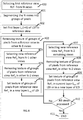
- Figure 4 illustrates an exemplary method for generating a layered depth image (LDI) for Light-Field data according to an embodiment of the present disclosure. The method will be described below with the aid of Figures 5 , 6A-C and 7A-F .
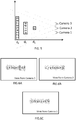
- Figure 5 illustrates an exemplary scene captured by three cameras. The exemplary scene comprises three objects located at different depths d 0 , d 1 , d 2 , from the cameras. Those three objects are represented as planar rectangles or squares. The numbers and letters represent the color or texture on each of the objects.
- Figures 6A-C illustrate exemplaries views of each of the cameras. It can be seen from figures 6A-C that due to the different parallax of the cameras, different parts of the scene are occluded or disoccluded, i.e. not visible, in each of the views. The different grey levels represent different SuperRays.
- a first Reference image Ref 1 in the set of N views constituting the light-field is selected. For instance, at the beginning of the process, a central view is selected. In the example described here, the first reference image is selected as the image acquired by camera 2.
- the set of N views is segmented into groups of pixels. For instance, SuperRays are computed as explained above. Each SuperRay has a label l and a depth value d l .
- Figure 6A-C illustrates the result of the segmentation on each image view. The different grey levels represent different SuperRays. A same grey level accross different views represents a same SuperRay.
- the first layer of the LDI corresponds to the first Reference image and the depth for this first layer is set equal to the corresponding depths d l .
- each SuperRay l of the first layer 1 is associated to its corresponding depth d l in the layered depth image.
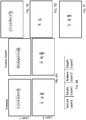
- Such a first layer of the LDI is illustrated on figure 8A (layer 1).
- the value or texture, e.g. color, intensity, of the pixels corresponding to this SuperRay l is removed from each of the N - 1 other views of the light-field.
- texture which is present in the reference view and in the other view corresponds to redundant information.
- Figure 7A illustrates the result on each image view of this removal step. It can be seen that for the image view of camera 3 and for the image view of camera 1, only the texture non present in the image of the reference view remains.
- a second Reference image Ref 2 is selected in the set of N - 1 other views in which the texture of the pixels corresponding to SuperRays l in the first reference view are removed. For instance, the view from camera 1 is selected as the second reference view.
- the remaining texture of the SuperRays l ' of the second reference view Ref 2 is stored in a second layer (layer 2) of the LDI.
- Each SuperRay l ' of the second reference view Ref 2 is stored in the second layer (layer 2) together with its depth d l' .
- the textures of the remaining SuperRays l ' in the second reference view Ref 2 are textures of SuperRays l' occluded in the first reference view and that are, consequently, not stored in the first layer of the LDI.
- the texture and the depth of the SuperRays l' are added to the second layer (layer 2) of the LDI since the first layer (layer 1) of the LDI already has a texture stored at a same position, as illustrated in Figure 7D .
- a third Reference image Ref 3 is selected in the set of N - 2 remaining views in which the texture of the pixels corresponding to SuperRays l' in the second reference view are removed. For instance, the view from camera 3 is selected as the new reference view.
- the remaining texture of the SuperRays l" of the third reference view Ref 3 is stored in the second layer (layer 2) of the LDI except if the second layer already has a texture stored at a same position.
- the remaining texture of the image of the reference view (camera 3) is added to the current layer (Layer 2).
- the current layer (layer 2) has not yet a texture at the position of the textures from the reference view.
- the resulting layer (Layer 2) is illustrated on Figure 7F .
- a third layer (layer 3) is created in the LDI and the texture of the SuperRays l" is stored in the third layer (layer 3).
- step 410 it is checked whether all the views of the light-field have been processed. If not, the process goes from steps 407 to 409 again, otherwise the process goes to step 411 and ends.
- Figure 8A illustrates the resulting layers of the LDI (Layer 1 and Layer 2) and the corresponding layered depth map.
- the Light-Field is stored in two images: the first layer and the second layer of the LDI, the second layer (Layer 2) having many regions equal to 0.
- the available depth values are not stored in a depth map per view (as in the MVD format - Multi-View +Depth) but consist in small number of depth values stored in the layers of the LDI.
- each SuperRay is stored in alayer of the LDI with its associated depth. It is to be noted that the depth is estimated during the SuperRay estimation, at step 401.
- the first layer (Layer 1) stores a texture for each of the pixels and a () depth.
- the second layer (Layer 2) stores many pixels with empty textures and depths.
- the layered depth image LDI illustrated on Figure 8A can be encoded in a data stream such as illustrated in Figure 8B .
- a data stream comprises data corresponding to the textures of the first layer (Layer 1), data corresponding to the depths stored in Layer 1, followed by the textures and depth of the second layer (Layer 2).
- Figure 9 illustrates an exemplary method for generating layered depth images for dynamic Light-Field data according to an embodiment of the present disclosure, which will be described below with the aid of figures 10 and 11.
- the light-field segmentation in SuperRays using the method disclosed in " Dynamic Super-Rays for efficient Light Field Video Processing", M. Hog, N. Sabater and C. Guillemot, 2017 . can be used. Results of such a segmentation in the case of the scene of Figure 10 is illustrated on Figure 11 .
- step 96 it is checked whether all the views have been processed. If not, the process goes to step 97 where the next reference view is selected according to the order of reference view selection used at step 90 and the process iterates at step 94 with the next reference view. Otherwise the process goes to step 98 and ends.
- the associated depth and motion information is also stored at this layer (layer 1).
- the layered depth image illustrated on figure 12A can be encoded in a data stream such as illustrated in figure 12B .
- Figure 13 illustrates an exemplary method for generating layered depth images for dynamic Light-Field data according to another embodiment of the present disclosure.
- keyframes in the video sequence are used.
- Such keyframes correspond to the frame in the video sequence at which the mehod for generating the LDI is used as described with Figure 4 .
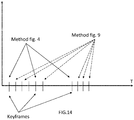
- the process described with Figure 9 is applied, and the order of the reference views selection used for these frames is the order used for the last keyframe. In other words, at each keyframe, the order of the reference views selection may be reset.
- a first keyframe is selected. For instance, the integer variable "NbKeyframe" is set to 0.
- step 133 if the number of SuperRays that have changed (appear, disappear, move) at timeT with regards to time T-1 is higher than a given threshold ⁇ and/or if the number of frames between time T and the last keyframe is bigger than a given threshold ⁇ , then the light field at time T is selected as a keyframe. In that case, the integer variable "NbKeyframe" should be increased by one. If at step 133, a new Keyframe is selected, then at step 134, a layered depth image for the frame at time T is computed using the method described with Figure 4 .
- a layered depth image is generated for the frame at time T using the same order of reference view selection as for the last keyframe.
- the layered depth image is generated at time T using the method described with Figure 9 (steps 92-98).
- step 136 the process goes to the next frame at time T+1.
- step 137 it is checked whether all the frames at a given time T of the video sequence have been processed, that is if T>T last , where T last corresponds to the last frame of the video sequence. If this is not the case, the process loops to step 132, otherwise the process ends at step 138.
- Figure 14 illustrates keyframes position over time for generating layered depth images for dynamic Light-Field data according to the embodiment described above.
- a compact representation for Light-Fields is provided, allowing easy and real-time processing of Light-Fields data, without any degradation on the texture information of the Light-Fields.
- a depth estimation (and eventually an Optical Flow estimation) can be added for each pixel which has a texture in the LDI.
- This estimation takes advantage of the estimation that is already available for each SuperRay.
- the advantage of this variant compared to estimating a full MVD is that the precise depth (or movement) is not estimated for all pixels in all the views but only for pixels having a texture in the LDI or LDV.
- Figure 5 illustrates an exemplary apparatus for generating at least one layered depth image for Light-Field data according to an embodiment of the present disclosure.
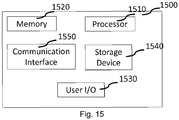
- FIG. 15 illustrates a block diagram of an exemplary system 1500 in which various aspects of the exemplary embodiments may be implemented.
- the system 1500 may be embodied as a device including the various components described below and is configured to perform the processes described above. Examples of such devices, include, but are not limited to, mobile devices, personal computers, laptop computers, smartphones, tablet computers, digital multimedia set top boxes, digital television receivers, personal video recording systems, connected home appliances, and servers.
- the system 1500 may be communicatively coupled to other similar systems, and to a display via a communication channel.
- the system 1500 include at least one processor 1510 configured to execute instructions loaded therein for implementing the various processes as discussed above.
- the processor 1510 may include embedded memory, input output interface, and various other circuitries as known in the art.
- the system 1500 may also include at least one memory 1520 (e.g., a volatile memory device, a non-volatile memory device).
- the system 1500 may additionally include a storage device 1540, which may include non-volatile memory, including, but not limited to, EEPROM, ROM, PROM, RAM, DRAM, SRAM, flash, magnetic disk drive, and/or optical disk drive.
- the storage device 1540 may comprise an internal storage device, an attached storage device, and/or a network accessible storage device, as non-limiting examples.
- Program code to be loaded onto one or more processors 1510 to perform the various processes described hereinabove may be stored in the storage device 1540 and subsequently loaded onto the memory 1520 for execution by the processors 10.
- one or more of the processor(s) 1510, the memory 1520, and the storage device 1540 may store one or more of the various items during the performance of the processes discussed herein above, including, but not limited to images, videos, textures, depths, optical flow datas, variables, operations, and operational logic.
- the system 1500 may also include a communication interface 1550 that enables communication with other devices via a communication channel.
- the communication interface 1550 may include, but is not limited to a transceiver configured to transmit and receive data from the communication channel.
- the communication interface 1550 may include, but is not limited to, a modem or network card and the communication channel 1550 may be implemented within a wired and/or wireless medium.
- the various components of the system 1500 may be connected or communicatively coupled together (not shown) using various suitable connections, including, but not limited to internal buses, wires, and printed circuit boards.
- the system 1500 also includes user interactions means 1530 coupled to the processor for receiving user inputs.
- the exemplary embodiments may be carried out by computer software implemented by the processor 1510 or by hardware, or by a combination of hardware and software. As a non-limiting example, the exemplary embodiments may be implemented by one or more integrated circuits.
- the memory 1520 may be of any type appropriate to the technical environment and may be implemented using any appropriate data storage technology, such as optical memory devices, magnetic memory devices, semiconductor-based memory devices, fixed memory, and removable memory, as non-limiting examples.
- the processor 1510 may be of any type appropriate to the technical environment, and may encompass one or more of microprocessors, general purpose computers, special purpose computers, and processors based on a multi-core architecture, as non-limiting examples.
- the implementations described herein may be implemented in, for example, a method or a process, an apparatus, a software program, a data stream, or a signal. Even if only discussed in the context of a single form of implementation (for example, discussed only as a method), the implementation of features discussed may also be implemented in other forms (for example, an apparatus or a program).
- An apparatus may be implemented in, for example, appropriate hardware, software, and firmware.
- the methods may be implemented in, for example, an apparatus such as, for example, a processor, which refers to processing devices in general, including, for example, a computer, a microprocessor, an integrated circuit, or a programmable logic device. Processors also include communication devices, such as, for example, computers, cell phones, portable/personal digital assistants ("PDAs”), tablets, and other devices that facilitate communication of information between end-users.
- PDAs portable/personal digital assistants
- a method for generating at least one layered depth image from a set of views representative of a Light-Field capture of a scene comprises:
- An apparatus for generating a layered depth image from a set of views representative of a Light-Field capture of a scene comprises:
- generating the layered depth image using the groups of pixels comprises:
- a layered depth image for representing Light-Fields can be generated fast and in real-time.
- the resulting format is more compact than MVD (Multi-View+Depth format) since the redundant information from the Light-Field capture is removed. Furthermore, the resulting information is sufficient to render a Dynamic window/Immersive window.
- the remaining texture in the obtained Layered Detph Image has the same quality as the captured texture. Therefore, no degradation of the quality of the Light-Field happens.
- a depth value is obtained from the segmentation of the set of views.
- the depth of each group of pixels is stored in the layered depth image.
- the layered depth image is generated for a set of views representative of the scene at a first time instant
- the method or the apparatus further comprises generating other layered depth images for the set of views over time.
- generating other layered depth images for the set of views over time comprises, for each current time instant:
- movements of at least one group of pixels in the set of views between the current time instant and the preceding time instant is stored in the layered depth image generated for the current time instant.
- the same reference view order selection from the set of views is used for generating other layered depth images over time as long as a number of frames between the current time instant and the first time instant is below a value or a number of groups of pixels obtained from segmenting the set of views that have changed between the current time instant and the time instant preceding the current time instant is below another value.
- the reference view order selection from the set of views used for generating other layered depth images over time is reset at each keyframe time instant, and wherein at a keyframe time instant, generating the layered depth image is performed as for generating the layered depth image at the first time instant.
- another layered depth image generated for a current time instant comprise only groups of pixels that are not comprised in another layered depth image generated for a preceding time instant and groups of pixels that have moved between the preceding time instant and the current time instant.
- texture of layers other than the first layer of the layered depth image is rearranged in at least one picture.
- One or more of the present embodiments also provide a computer readable storage medium having stored thereon instructions for generating at least one layered depth image representative of a set of views representative of a Light-Field capture of a scene, according to any one of the embodiments of the method described above.
- the present embodiments also provide a computer program product including instructions for performing any one of the embodiments of the method described.
- a data stream representative of at least one layered depth image representative of a set of views representative of a Light-Field capture of a scene is also disclosed.
- Said data stream comprising:
- said data stream comprises depth data associated to pixels data and/or movement information associated to pixels data.
Landscapes
- Engineering & Computer Science (AREA)
- Multimedia (AREA)
- Signal Processing (AREA)
- Computer Vision & Pattern Recognition (AREA)
- Physics & Mathematics (AREA)
- General Physics & Mathematics (AREA)
- Theoretical Computer Science (AREA)
- Testing, Inspecting, Measuring Of Stereoscopic Televisions And Televisions (AREA)
- Image Processing (AREA)
Priority Applications (2)
| Application Number | Priority Date | Filing Date | Title |
|---|---|---|---|
| EP18305556.5A EP3564902A1 (de) | 2018-05-03 | 2018-05-03 | Verfahren und vorrichtung zur erzeugung geschichteter tiefenbilder für lichtfelder |
| PCT/EP2019/061273 WO2019211389A1 (en) | 2018-05-03 | 2019-05-02 | Method and apparatus for generating layered depth images for light-fields |
Applications Claiming Priority (1)
| Application Number | Priority Date | Filing Date | Title |
|---|---|---|---|
| EP18305556.5A EP3564902A1 (de) | 2018-05-03 | 2018-05-03 | Verfahren und vorrichtung zur erzeugung geschichteter tiefenbilder für lichtfelder |
Publications (1)
| Publication Number | Publication Date |
|---|---|
| EP3564902A1 true EP3564902A1 (de) | 2019-11-06 |
Family
ID=62148280
Family Applications (1)
| Application Number | Title | Priority Date | Filing Date |
|---|---|---|---|
| EP18305556.5A Withdrawn EP3564902A1 (de) | 2018-05-03 | 2018-05-03 | Verfahren und vorrichtung zur erzeugung geschichteter tiefenbilder für lichtfelder |
Country Status (2)
| Country | Link |
|---|---|
| EP (1) | EP3564902A1 (de) |
| WO (1) | WO2019211389A1 (de) |
Cited By (1)
| Publication number | Priority date | Publication date | Assignee | Title |
|---|---|---|---|---|
| CN121767570A (zh) * | 2026-03-03 | 2026-03-31 | 浙江大学 | 一种基于分层深度图像的三维模型轻量化压缩方法及系统 |
-
2018
- 2018-05-03 EP EP18305556.5A patent/EP3564902A1/de not_active Withdrawn
-
2019
- 2019-05-02 WO PCT/EP2019/061273 patent/WO2019211389A1/en not_active Ceased
Non-Patent Citations (7)
| Title |
|---|
| H. ZHU; Q. WANG: "Computer Vision and Pattern Recognition (CVPR)", 2017, IEEE., article "4D Light Field Superpixel and Segmentation" |
| HOG MATTHIEU ET AL: "Superrays for Efficient Light Field Processing", IEEE JOURNAL OF SELECTED TOPICS IN SIGNAL PROCESSING, IEEE, US, vol. 11, no. 7, October 2017 (2017-10-01), pages 1187 - 1199, XP011671977, ISSN: 1932-4553, [retrieved on 20171025], DOI: 10.1109/JSTSP.2017.2738619 * |
| JANTET V ET AL: "Incremental-LDI for multi-view coding", 3DTV CONFERENCE: THE TRUE VISION - CAPTURE, TRANSMISSION AND DISPLAY OF 3D VIDEO, 2009, IEEE, PISCATAWAY, NJ, USA, 4 May 2009 (2009-05-04), pages 1 - 4, XP031471555, ISBN: 978-1-4244-4317-8 * |
| M. HOG; N. SABATER; C. GUILLEMOT, DYNAMIC SUPER-RAYS FOR EFFICIENT LIGHT FIELD VIDEO PROCESSING, 2017 |
| MATTHIEU HOG ET AL: "Dynamic Super-Rays for Efficient Light Field Video Processing", INRIA: HAL ARCHIVES OUVERTES, 27 November 2017 (2017-11-27), XP055504024 * |
| NELSON L CHANG ET AL: "Constructing a Multivalued Representation for View Synthesis", INTERNATIONAL JOURNAL OF COMPUTER VISION, KLUWER ACADEMIC PUBLISHERS, BO, vol. 45, no. 2, November 2001 (2001-11-01), pages 157 - 190, XP019216369, ISSN: 1573-1405, DOI: 10.1023/A:1012476031602 * |
| SHADE, J.; GORTLER, S.; HE, L. W.; SZELISKI, R.: "Proc. of the conference on Computer graphics and interactive techniques", 1998, ACM, article "Layered depth images", pages: 231 - 242 |
Cited By (1)
| Publication number | Priority date | Publication date | Assignee | Title |
|---|---|---|---|---|
| CN121767570A (zh) * | 2026-03-03 | 2026-03-31 | 浙江大学 | 一种基于分层深度图像的三维模型轻量化压缩方法及系统 |
Also Published As
| Publication number | Publication date |
|---|---|
| WO2019211389A1 (en) | 2019-11-07 |
Similar Documents
| Publication | Publication Date | Title |
|---|---|---|
| Xu et al. | Deep image matting | |
| US10284789B2 (en) | Dynamic generation of image of a scene based on removal of undesired object present in the scene | |
| US11704778B2 (en) | Method for generating an adaptive multiplane image from a single high-resolution image | |
| KR20230013243A (ko) | 프레임에서 타겟 오브젝트를 위한 고정된 크기 유지 | |
| CN110830802A (zh) | 基于机器学习的视频压缩 | |
| KR102380862B1 (ko) | 영상 처리 방법 및 장치 | |
| KR20180132946A (ko) | 멀티-뷰 장면 분할 및 전파 | |
| US12277688B2 (en) | Multi-task text inpainting of digital images | |
| Luo et al. | A disocclusion inpainting framework for depth-based view synthesis | |
| JP7787704B2 (ja) | 画像からシーンテキストを除去するための方法及びシステム | |
| US11659135B2 (en) | Slow or fast motion video using depth information | |
| WO2016120132A1 (en) | Method and apparatus for generating an initial superpixel label map for an image | |
| GB2620467A (en) | Applying object-aware style transfer to digital images | |
| CN111161299A (zh) | 影像分割方法、计算机程序、存储介质及电子装置 | |
| CN113313635A (zh) | 图像处理方法、模型训练方法、装置及设备 | |
| Wang et al. | 3d moments from near-duplicate photos | |
| KR101851896B1 (ko) | 파티클 기반 특징점을 이용한 비디오 안정화 방법 및 그 장치 | |
| CN104737539A (zh) | 减小含有相互类似的信息的多个图像的数据量的方法、程序及装置 | |
| KR101316848B1 (ko) | 배경 합성을 위한 자동 객체 분할 장치 및 방법 | |
| WO2019211389A1 (en) | Method and apparatus for generating layered depth images for light-fields | |
| CN105467741A (zh) | 一种全景拍照方法及终端 | |
| WO2015189369A1 (en) | Methods and systems for color processing of digital images | |
| Dalka | Detection and segmentation of moving vehicles and trains using Gaussian mixtures, shadow detection and morphological processing | |
| Hu et al. | CNN-based deghosting in high dynamic range imaging | |
| CN119380415A (zh) | 视频动作识别方法、装置、电子设备及存储介质 |
Legal Events
| Date | Code | Title | Description |
|---|---|---|---|
| PUAI | Public reference made under article 153(3) epc to a published international application that has entered the european phase |
Free format text: ORIGINAL CODE: 0009012 |
|
| AK | Designated contracting states |
Kind code of ref document: A1 Designated state(s): AL AT BE BG CH CY CZ DE DK EE ES FI FR GB GR HR HU IE IS IT LI LT LU LV MC MK MT NL NO PL PT RO RS SE SI SK SM TR |
|
| AX | Request for extension of the european patent |
Extension state: BA ME |
|
| STAA | Information on the status of an ep patent application or granted ep patent |
Free format text: STATUS: THE APPLICATION IS DEEMED TO BE WITHDRAWN |
|
| 18D | Application deemed to be withdrawn |
Effective date: 20200603 |