EP3564129B1 - Oberflächenabtastung zur unterscheidung von tröpfchengrössen - Google Patents
Oberflächenabtastung zur unterscheidung von tröpfchengrössen Download PDFInfo
- Publication number
- EP3564129B1 EP3564129B1 EP19172127.3A EP19172127A EP3564129B1 EP 3564129 B1 EP3564129 B1 EP 3564129B1 EP 19172127 A EP19172127 A EP 19172127A EP 3564129 B1 EP3564129 B1 EP 3564129B1
- Authority
- EP
- European Patent Office
- Prior art keywords
- sensor
- signal
- surface region
- predetermined threshold
- sensing surface
- Prior art date
- Legal status (The legal status is an assumption and is not a legal conclusion. Google has not performed a legal analysis and makes no representation as to the accuracy of the status listed.)
- Active
Links
Images




Classifications
-
- B—PERFORMING OPERATIONS; TRANSPORTING
- B64—AIRCRAFT; AVIATION; COSMONAUTICS
- B64D—EQUIPMENT FOR FITTING IN OR TO AIRCRAFT; FLIGHT SUITS; PARACHUTES; ARRANGEMENT OR MOUNTING OF POWER PLANTS OR PROPULSION TRANSMISSIONS IN AIRCRAFT
- B64D15/00—De-icing or preventing icing on exterior surfaces of aircraft
- B64D15/20—Means for detecting icing or initiating de-icing
-
- B—PERFORMING OPERATIONS; TRANSPORTING
- B64—AIRCRAFT; AVIATION; COSMONAUTICS
- B64D—EQUIPMENT FOR FITTING IN OR TO AIRCRAFT; FLIGHT SUITS; PARACHUTES; ARRANGEMENT OR MOUNTING OF POWER PLANTS OR PROPULSION TRANSMISSIONS IN AIRCRAFT
- B64D15/00—De-icing or preventing icing on exterior surfaces of aircraft
- B64D15/20—Means for detecting icing or initiating de-icing
- B64D15/22—Automatic initiation by icing detector
-
- B—PERFORMING OPERATIONS; TRANSPORTING
- B64—AIRCRAFT; AVIATION; COSMONAUTICS
- B64D—EQUIPMENT FOR FITTING IN OR TO AIRCRAFT; FLIGHT SUITS; PARACHUTES; ARRANGEMENT OR MOUNTING OF POWER PLANTS OR PROPULSION TRANSMISSIONS IN AIRCRAFT
- B64D45/00—Aircraft indicators or protectors not otherwise provided for
Definitions
- Ice formation on aircraft surfaces can increase the weight of the aircraft and can increase the drag of the aircraft. Increasing either the weight or the drag of an aircraft can result in a stall speed that is higher than it would otherwise be in an ice-free condition. Ice formation on lifting surfaces can result in a decrease in a wing's lift and/or a decrease in a propeller's thrust. Ice formation can also affect the controllability of an aircraft by affecting the airflow over control surfaces, such as ailerons.
- Various atmospheric conditions can cause more or less ice formation on an aircraft. For example, water droplet density, total moisture content, air temperature, water droplet temperature, droplet size distribution, etc. all factor into risk of ice formation. Some atmospheric conditions can present little or no risk of ice formation on an aircraft.
- Various aircraft flying conditions can affect locations and/or amounts of ice formation on aircraft surfaces. For example, airspeed, angle of attack, angle of side-slip, and presence of deicing equipment all factor into location and/or risk of ice formation. Some aircraft have been equipped with equipment intended to obtain metrics of the atmosphere so as to predict whether the atmosphere presents a risk of ice-formation on exterior surfaces.
- EP 0 393 960 A1 discloses apparatus for detecting the presence of ice on an exposed surface such as an airfoil surface of an aircraft, a sensor has a hollow body portion including a piezoelectric transducer which is energized to generate ultrasonic pulses which are directed internally to the sensor. In addition, the pulses are reflected back to the transducer.
- the invention provides a system capable of sensing ice accretion on an airfoil of an aircraft as claimed in claim 1.
- a further embodiment of any of the foregoing systems can further include an alert generator configured to generate an alert signal in response to the detected signal indicative of water particles of a size exceeding the predetermined threshold impinging the sensor surface region of the sensor.
- the senor is a surface resistance sensor having first and second exposed conductors on the sensing surface region so as to be exposed to an atmosphere adjacent to the sensing surface region.
- the surface resistor sensor can include first and second exposed conductors on the sensing surface so as to be exposed to an atmosphere adjacent to the sensing surface.
- first and second exposed conductors can be configured to sense current flow therebetween, wherein ice accretion on the sensing surface and spanning a separation distance between the first and second exposed conductors facilitates current flow therebetween.
- a further embodiment of any of the foregoing systems can further include an icing protection system.
- a further embodiment of any of the foregoing systems can further include a controller configured to control the icing protection system in response to the detected signal indicative of ice accretion.
- the sensor can be a first sensor
- the sensing surface region can be a first sensing surface region
- the mounting location can be a first mounting location
- the surrounding adjacent surface can be a first surrounding adjacent surface
- the predetermined threshold can be a first predetermined threshold
- the excitation signal can be a first excitation signal
- the sensor signal can be a first sensor signal.
- the system can further include a second sensor having a second sensing surface region and configured to be mounted at a second mounting location aft of the first mounting location such that the second sensing surface region is flush with a second surrounding adjacent surface of the airfoil. In certain flight conditions, water particles less than or equal to a second predetermined threshold greater than the first predetermined threshold do not impinge the second sensor surface region at the second mounting location.
- the sensor driver can be coupled to the second sensor and further configured to provide a second excitation signal to the second sensor.
- the signal detector can be further configured to detect a second sensor signal responsive to the provided second excitation signal, the detected sensor signal indicative of water particles of a size exceeding the second predetermined threshold impinging the second sensing surface region of the sensor.
- a further embodiment of any of the foregoing systems can further include a particle size analyzer configured to generate a water particle size histogram based on the first and second sensor signals.
- a further embodiment of the first aspect further comprising:
- the computer-readable memory is further encoded with instructions that, when executed by the one or more processors, cause the system to: generate an alert signal in response to the detected signal exceeding the predetermined threshold indicative of water particles of sizes exceeding the predetermined threshold impinging the sensor surface region of the sensor.
- the invention provides a method capable of sensing ice accretion on an airfoil of an aircraft as claimed in claim 12.
- a further embodiment of the foregoing method can further include generating, via an alert generator, an alert signal in response to the detected sensor signal exceeding a predetermined threshold indicative of a predetermined measure of ice accretion.
- a further embodiment of any of the foregoing methods can further include controlling, via a controller, an icing protection system in response to the detected sensor signal indicative of ice accretion.
- detecting a sensor signal responsive to the provided excitation signal can include sensing current flow between first and second conductors of a surface resistance sensor.
- Apparatus and associated methods relate to differentiating ice accretion caused by different supercooled water droplets on an airfoil of an aircraft.
- a sensor having a sensing surface region is mounted at a mounting location of the airfoil such that the sensing surface region is flush with a surrounding adjacent surface of the airfoil. Water particles of sizes less than or equal to a predetermined threshold do not impinge the sensor surface region at the mounting location when the aircraft is in flight.
- a sensor driver provides an excitation signal to the sensor.
- a signal detector detects a sensor signal responsive to the provided excitation signal. The sensor signal is indicative of water particles exceeding the predetermined threshold impinging the sensing surface region.
- the sensing surface region is mechanically coupled to a resonant cavity.
- the sensor is a surface resistance sensor configured to sense surface resistance.
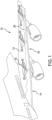
- FIG. 1 is a schematic view of an aircraft equipped with an exemplary automated ice accretion detection system.
- aircraft 10 has wing 12 that has an ice protection system 14 and an ice accretion detection system 16.
- Ice protection system 14 is configured to remove ice from a leading edge 18 of wing 12.
- ice protection system 14 provides heat to leading edge 18 so as to melt ice accreted thereto.
- ice protection system 14 deforms leading edge 18 so as to cause ice to loosen from leading edge 18.
- leading edge 18 of wing 12 is depicted as being ice free, due to the ice removal capability of ice protection system 14, ice accretion 20 is shown aft of ice protection system 14.
- Ice accretion detection system 16 has sensors 22, which are mounted to wing 12 such that each of sensors 22 has a surface region that is flush with a surrounding adjacent surface of wing 12, thereby exposing the surface region to the atmosphere adjacent to wing 12. Ice accretion detection system 16 generates a signal indicative of ice accretion on surface regions of sensors 22.
- a resonant cavity that is defined at least in part by the surface regions can be used to detect ice accretion upon these surface regions.
- the resonant cavity can have a resonant frequency that is indicative of ice accretion upon the surface region of sensor 22.
- two adjacent conductors can be located on the surface regions of sensors 22 such that the conductors are exposed to the atmosphere adjacent to wing 12. When water or ice accretes on the surface region and spans two adjacent conductors, the conductivity therebetween can be indicative of such conditions.
- a temperature sensor located in proximity to the surface sensor can be used to differentiate between detection of water and ice.
- testing regions may be located on the fuselage of aircraft 10, for example. In some embodiments, testing regions may be located on an airfoil, such as wing 12 or a tail, of aircraft 10. In some embodiments, testing regions may be located on some appendage of aircraft 10.
- the testing regions include various spanwise locations along wing 12 and at various chordwise locations aft of leading edge 18. These testing regions are monitored by sensors 22 of ice detection system 16.
- the specific aft locations relative to leading edge 18 can be used to determine a size composition of super-cooled water droplets in the atmosphere adjacent to wing 12.
- Some such conditions that affect the locations where ice accretes include: aircraft parameters; flying parameters; and atmospheric conditions.
- a boundary between where ice accretes and where no ice accretes can be calculated based on one or more of these conditions.
- fluid dynamic computations can be used to calculate the boundary location between ice-free and ice-accretion regions.
- a look-up table may be used to determine the indicative aft location, for example.
- an alert system can generate an alert signal, and/or a control system can control ice protection system 14.
- various types of alert signals may be generated.
- an audible alert signal may be generated.
- an alert signal may be in the form of an electrical signal sent to a display device.
- a display monitor may present an optical image of the testing region along with a flashing alert signal.
- an alert signal may be in the form of a signal to another aircraft system. The signal may be provided as either a simple alert or it may be provided with additional information regarding the size of super-cooled water droplets in the atmosphere outside the aircraft.
- FIG. 2 is a schematic diagram of ice accreting on a leading edge of a curved member in an airstream.
- three-dimensional wing or airfoil 12 is shown in cross section.
- Airfoil 12 has flow-dividing axis 24 aligned with a general direction of airflow. Airflow is represented by flow vectors 26a, 26b, 26c and 26d.
- Water droplets 28a, 28b are carried by the airflow. Small water droplets 28a generally follow the flow vectors, because the mass of the small water droplets 28a is small. A momentum of the small water droplets 28a is correspondingly small, because of the small mass.
- Large water droplets 28b have momentums that are larger than those of small water droplets 28a, due to larger masses of the large water droplets 26b. Such large water droplets 28b do not follow flow vectors 26a, 26b, 26c and 26d as readily as do small water droplets 28a. Because large water droplets 28b more readily cross flow vectors 26a, 26b, 26c, 26d, such large water droplets 28b impinge airfoil 22 along a greater section of leading edge 30 than is impinged by small water droplets 28a. Large water droplets 28b impinge airfoil 22 proximate flow-dividing axis 24 at leading edge 30 as do small water droplets 28a.
- Large water droplets 28b also impinge airfoil 22 aft of leading edge 30 for a distance that is related to the droplet size. Airflow does impart a force on large water droplets 28b, and therefore large water droplets 28b do experience momentum change. Because large water droplets 28b can undergo such momentum change, these large water droplets impinge airfoil 22 only over a limited range about leading edge 30.
- water droplets 28a, 28b are super-cooled (e.g., at temperatures below a freezing temperature of water), then such particles can freeze upon impact with airfoil 12 or another object (e.g., a fuselage, etc.). Pure water can be super-cooled without freezing in the absence of a nucleation site. Such a scenario is not infrequent in cloud atmospheres. The shock of impingement and/or the structural nucleation sites presented by the impinging object can cause such supercooled water droplets to freeze almost immediately upon such an impingement event.
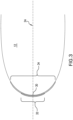
- FIG. 3 is a schematic diagram depicting different zones of ice-accretion associated with different sizes of super-cooled water droplets.
- airfoil 12 depicted in FIG. 2 is shown in magnification to demonstrate a relationship between water droplet size and impingement region.
- Two different impingement regions 32, 34 are depicted proximate leading edge 30 of airfoil 22.
- Impingement region 32 corresponds to a small region about leading edge 30.
- Small impingement region 32 is a region in which water droplets, which are less than or equal to a relatively small size (such as small water droplets 28a depicted in FIG. 2 ), can impinge, for a given set of aircraft and flying conditions.
- Small water droplets 28a can readily follow flow vectors 26a, 26b, 26c and 26d (depicted in FIG. 2 ).
- Flow vectors 26a and 26b show an airflow pattern above airfoil 22, and flow vectors 26c, 26d show an airflow pattern below airfoil 22.
- Flow vectors 26a and 26b diverge from flow vectors 26c and 26d about central axis 24. Only at locations along leading edge 30 that are proximate central axis 24 can small water droplets 28a impinge airfoil 22. The intersection of leading edge 30 and flow-dividing axis 24 can be called the stagnation point.
- Large impingement region 34 includes portions of airfoil 12 which can be impinged only by water droplets that are larger than a predetermined size (such as large water droplets 28b depicted in FIG. 2 ) for a given set of aircraft and flying conditions. Because larger water droplets 28b can cross flow vectors 26a, 26b, 26c and 26d more readily than can small water droplets 28a, such large water droplets 28b impinge airfoil 12 within larger region (e.g., large impingement region 34) about leading edge 30 than the region (e.g., small impingement region 32) impinged by small water droplets 28a. In this way, FIG. 3 demonstrates a relation that exists between a size of water droplets and a regional area in which such sized water droplets are capable of impingement.
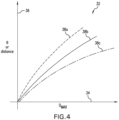
- FIG. 4 is a graph of exemplary relations of size of an ice-accretion region versus size of super-cooled water droplets.
- graph 32 has horizontal axis 34 and vertical axis 36.
- Horizontal axis 34 represents maximum size DMAX of water droplets in an atmosphere.
- Vertical axis 36 represents a distance dimension (e.g., angle ⁇ from stagnation point or chord length d from the stagnation point) of impingement region.
- Graph 32 has three relations 38a, 38b and 38c.
- Relation 38a represents a relation between maximum size DMAX of water droplets and distance dimension of impingement region for a first set of icing conditions.
- Relations 38b, 38c represent relations between maximum size DMAX of water droplets and distance dimension of impingement region for a second and a third set of icing conditions, respectively.
- Parameters that affect icing conditions can include aircraft conditions, flying conditions, and atmospheric conditions, for example.
- Aircraft conditions can include, for example, a shape of a structure to which water droplets impinge, temperature of a surface of the impingement region, aircraft configuration, etc.
- Flying conditions can include, for example, an angle of attack, an angle of side-slip, an airspeed, water droplet temperature, liquid water content, etc.
- Atmospheric conditions can include air temperature, air pressure, etc.
- Various embodiments may be more or less affected by one or more of the icing conditions. For example, some embodiments may be more or less sensitive to angle of attack.
- a structure that presents substantially the same shape to the airflow independent of angle of attack, for example, may be not very sensitive to angle of attack.
- Some geometries may be less sensitive to angle of sideslip, for example.
- FIGS. 5A-5B are perspective and schematic views of an embodiment of an ice-accretion detection system that uses a resonant cavity.
- ice accretion detection system 16 includes sensors 22 and sense circuitry 40.
- sensors 22 is configured to be mounted to an aircraft wing such that sensing surface region 42 is flush with a surrounding adjacent surface of the aircraft wing 12.
- Sense circuitry 40 can be mounted inside of the aircraft wing, or in an electronics bay of the aircraft, for example.
- Sense circuitry 40 includes a sensor electrical driver 41 configured to provide an electrical excitation signal to sensors 22.
- Sense circuitry 40 also includes a signal detector 43 configured to detect a signal responsive to the provided electrical excitation signal, the detected signal indicative of ice accretion on the sensing surface region of the sensor.
- sensors 22 have a resonant cavity 22C that has at least one surface, such as sensing surface region 22, that vibrates in response to a changing electro-magnetic field.
- Each of sensing surface regions 42 of sensors 22 is an exterior surface of resonant cavity 22C.
- the signal detected by signal detector 43 is a resonant frequency of resonant cavity 22C. The resonant frequency changes in response to ice accretion on sensing surface region 42.
- FIG. 6 is a schematic diagram of an aircraft equipped with an automated ice accretion detection system that measures surface conductivity.
- surface conduction sensor 22' and temperature sensor 44 are mounted to wing 12.
- Surface conduction sensor 22' is configured to measure the surface conductivity of wing 12 at the testing location where surface conduction sensor 22' is mounted.
- Surface conduction sensor 22' includes first and second exposed conductors 46A and 46B on the sensing surface so as to be exposed to an atmosphere adjacent to the sensing surface.
- First and second conductors 46A and 46B are configured to sense current flow therebetween. Ice accretion on the sensing surface and spanning separation distance ⁇ between first and second exposed conductors 46A and 46B facilitates current flow therebetween.
- the measured conduction, or equivalently the measured resistance, between exposed conductors 46A and 46B is indicative of ice accretion on the surface region.
- FIGS. 7A-7B are perspective and schematic views of an embodiment of an ice-accretion detection system that measures a surface conductivity.
- ice accretion detection system 16' includes sensor 22' and sense circuitry 40'.
- Sensor 22' sensor is configured to be mounted to an airfoil of an aircraft such that sensing surface region 42' is flush with or flat upon a surrounding adjacent surface of the airfoil.
- Sense circuitry 40' can be mounted inside of the aircraft wing, or in an electronics bay of the aircraft, for example.
- Sense circuitry 40' can include sensor electrical driver 41' configured to provide an electrical excitation signal, such as a voltage or current, to sensor 22'.
- Sense circuitry 40' can also include signal detector 43' configured to detect a signal responsive to the provided electrical excitation signal, the detected signal indicative of ice accretion on sensing surface region 42' of sensor 22'.
- sensor 22' has first and second conductors 46A and 46B.
- First and second conductors 46A and 46B are configured to sense current flow therebetween.
- First and second conductors 46A and 46B are separated from one another via insulative region 48 therebetween.
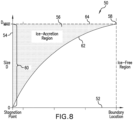
- FIG. 8 is a graph depicting a size span of water droplets vs. location along a chord of a convex-shaped housing.
- graph 50 has horizontal axis 52 and vertical axis 54.
- Horizontal axis 52 represents location along a chord of a convex exterior surface exposed to an atmosphere containing super-cooled water droplets.
- Vertical axis 54 represents a size of the super-cooled water droplets.
- Graph 50 includes droplet size/location relation 56 corresponding to a size of supercooled droplets that can strike the convex exterior surface at the indicated location.
- Line 62 identifies the relation corresponding to the predetermined minimum size of super-cooled water droplets that contribute to ice accretion vs. location along the chord of the convex shaped housing. Droplets smaller than the minimum size will follow the airflow vectors and will not impinge the convex-shaped housing except at locations near the stagnation point.
- Dashed line 64 identifies the maximum size of super-cooled water droplets contained in the cloud atmosphere.
- Point 58 of relation 56 corresponds to the boundary location separating an ice accretion portion and an ice-free portion of the convex exterior surface for the cloud atmosphere having the maximum size of super-cooled water droplet corresponding to dashed line 64. Not all sizes of particles, however, contribute to ice accretion at every location within the ice accretion portion of the convex exterior surface.
- relation 56 indicates that only supercooled water droplets equal to the maximum size (or greater if the cloud atmosphere had greater sized particles) accrete at the boundary location.
- the region to the right of point 58 on graph 50 corresponds to the ice-free portion of the convex exterior surface, and points to the left of point 58 correspond to the ice-accretion portion of the convex exterior surface.
- Vertical line 60 of relation 56 corresponds to the stagnation point of the convex exterior surface. At the stagnation point corresponding to vertical line 60, super-cooled water droplets of all sizes within the atmosphere contribute to ice accretion. Between point 58 and vertical line 60, super-cooled water droplets that have a size greater than a predetermined minimum will contribute to ice accretion. Super-cooled water droplets smaller than the predetermined minimum size will follow the flow vector lines and not impinge the convex exterior surface and therefore will not contribute to ice accretion.
- Line 62 identifies the relation corresponding to the predetermined minimum size of super-cooled water droplets that contribute to ice accretion vs. location along the chord of the convex shaped housing.
- FIG. 9 is a block diagram of an exemplary ice-accretion-detection/ice-protection system 70.
- ice-accretion-detection/ice-protection system 70 includes controller 72, sensor 22, and ice protection system 14 mounted to airfoil 12 of aircraft 10.
- Controller 72 includes processor(s) 74, ice detection interface 76, ice protection interface 78, aircraft interface 80, storage device(s) 82, user input devices 84, and user output devices 86.
- Storage device(s) 82 has various storage or memory locations.
- Storage device(s) 82 includes program memory 88, conditions data memory 90, boundary calculation module 92, and alert module 94.
- Controller 72 is in communication with ice detection system 16. Ice detection system 16 is configured to monitor ice accretion on sensor surface region 42 (depicted in FIG. 5 ). Sensor surface region 42 is depicted with ice-accretion 20 formed thereon.
- controller 72 includes processor(s) 74, ice detection interface 76, ice protection interface 78, aircraft interface 80, storage device(s) 82, user input devices 84, and user output devices 86.
- controller 72 can include more or fewer components.
- controller 72 may not include user input devices 84 and/or user output devices 86.
- controller 72 may include additional components such as a battery that provides power to components of controller 72 during operation.
- Processor(s) 74 in one example, is configured to implement functionality and/or process instructions for execution within controller 72.
- processor(s) 74 can be capable of processing instructions stored in storage device(s) 82.
- Examples of processor(s) 74 can include any one or more of a microprocessor, a controller, a digital signal processor (DSP), an application specific integrated circuit (ASIC), a field-programmable gate array (FPGA), or other equivalent discrete or integrated logic circuitry.
- DSP digital signal processor
- ASIC application specific integrated circuit
- FPGA field-programmable gate array
- Storage device(s) 82 can be configured to store information within controller 72 during operation.
- Storage device(s) 82 in some examples, is described as computer-readable storage media.
- a computer-readable storage medium can include a non-transitory medium.
- the term "non-transitory" can indicate that the storage medium is not embodied in a carrier wave or a propagated signal.
- a non-transitory storage medium can store data that can, over time, change (e.g., in RAM or cache).
- storage device(s) 82 is a temporary memory, meaning that a primary purpose of storage device(s) 82 is not long-term storage.
- Storage device(s) 82 in some examples, is described as volatile memory, meaning that storage device(s) 82 do not maintain stored contents when power to controller 72 is turned off. Examples of volatile memories can include random access memories (RAM), dynamic random access memories (DRAM), static random access memories (SRAM), and other forms of volatile memories.
- RAM random access memories
- DRAM dynamic random access memories
- SRAM static random access memories
- storage device(s) 82 is used to store program instructions for execution by processor(s) 74.
- Storage device(s) 82 in one example, is used by software or applications running on controller 72 (e.g., ice formation calculation) to temporarily store information during program execution.
- Storage device(s) 82 also include one or more computer-readable storage media.
- Storage device(s) 82 can be configured to store larger amounts of information than volatile memory.
- Storage device(s) 82 can further be configured for long-term storage of information.
- storage device(s) 82 include non-volatile storage elements. Examples of such non-volatile storage elements can include magnetic hard discs, optical discs, flash memories, or forms of electrically programmable memories (EPROM) or electrically erasable and programmable (EEPROM) memories.
- Ice detection interface 76 in some examples, includes a communications module. Ice detection interface 76, in one example, utilizes the communications module to communicate with external devices via one or more networks, such as one or more wireless or wired networks or both.
- the communications module can be a network interface card, such as an Ethernet card, an optical transceiver, a radio frequency transceiver, or any other type of device that can send and receive information.
- Other examples of such network interfaces can include Bluetooth, 3G, 4G, and Wi-Fi 33 radio computing devices as well as Universal Serial Bus (USB).
- Ice protection interface 78 in some examples, includes a communications module. Ice protection interface 78, in one example, utilizes the communications module to communicate with external devices via one or more networks, such as one or more wireless or wired networks or both.
- the communications module can be a network interface card, such as an Ethernet card, an optical transceiver, a radio frequency transceiver, or any other type of device that can send and receive information.
- Other examples of such network interfaces can include Bluetooth, 3G, 4G, and Wi-Fi 33 radio computing devices as well as Universal Serial Bus (USB).
- Aircraft interface 80 can be used to communicate information between controller 72 and an aircraft. In some embodiments, such information can include aircraft conditions, flying conditions, and/or atmospheric conditions. In some embodiments, such information can include data processed by controller 72, such as, for example, alert signals. Aircraft interface 80 can also include a communications module. Aircraft interface 80, in one example, utilizes the communications module to communicate with external devices via one or more networks, such as one or more wireless or wired networks or both.
- the communications module can be a network interface card, such as an Ethernet card, an optical transceiver, a radio frequency transceiver, or any other type of device that can send and receive information.
- network interfaces can include Bluetooth, 3G, 4G, and Wi-Fi 33 radio computing devices as well as Universal Serial Bus (USB).
- communication with the aircraft can be performed via a communications bus, such as, for example, an Aeronautical Radio, Incorporated (ARINC) standard communications protocol.
- ARINC Aeronautical Radio, Incorporated
- aircraft communication with the aircraft can be performed via a communications bus, such as, for example, a Controller Area Network (CAN) bus.
- CAN Controller Area Network
- User input devices 84 are configured to receive input from a user.
- user input devices 84 can include a mouse, a keyboard, a microphone, a camera device, a presence-sensitive and/or touch-sensitive display, push buttons, arrow keys, or other type of device configured to receive input from a user.
- input communication from the user can be performed via a communications bus, such as, for example, an Aeronautical Radio, Incorporated (ARINC) standard communications protocol.
- ARINC Aeronautical Radio, Incorporated
- user input communication from the user can be performed via a communications bus, such as, for example, a Controller Area Network (CAN) bus.
- CAN Controller Area Network
- User output devices 86 can be configured to provide output to a user.
- Examples of user output devices 86 can include a display device, a sound card, a video graphics card, a speaker, a cathode ray tube (CRT) monitor, a liquid crystal display (LCD), a light emitting diode (LED) display, an organic light emitting diode (OLED) display, or other type of device for outputting information in a form understandable to users or machines.
- output communication to the user can be performed via a communications bus, such as, for example, an Aeronautical Radio, Incorporated (ARINC) standard communications protocol.
- ARINC Aeronautical Radio, Incorporated
- output communication to the user can be performed via a communications bus, such as, for example, a Controller Area Network (CAN) bus.
- CAN Controller Area Network
Landscapes
- Engineering & Computer Science (AREA)
- Aviation & Aerospace Engineering (AREA)
- Investigating Or Analyzing Materials By The Use Of Electric Means (AREA)
- Geophysics And Detection Of Objects (AREA)
- Testing Or Calibration Of Command Recording Devices (AREA)
Claims (15)
- System (16), das in der Lage ist, Eisansetzen auf einer Tragfläche (12) eines Luftfahrzeugs (10) abzutasten, System (16) umfassend:einen Sensor (22), der einen Abtastoberflächenbereich (42) aufweist, wobei der Sensor (22) dazu konfiguriert ist, an einer Montagestelle hinter einer Vorderkante (18) der Tragfläche (12) derart angebracht zu sein, dass der Abtastoberflächenbereich (42) mit einer umgebenden angrenzenden Oberfläche der Tragfläche (12) bündig ist, wobei unter bestimmten Flugbedingungen Wassertröpfchen in Größen kleiner oder gleich einem vorbestimmten Schwellenwert nicht auf den Sensoroberflächenbereich auftreffen;einen Sensortreiber (41), der mit dem Sensor (22) gekoppelt und dazu konfiguriert ist, dem Sensor (22) ein Erregungssignal bereitzustellen; undeinen Signaldetektor (43), der dazu konfiguriert ist, ein Sensorsignal als Reaktion auf das bereitgestellte Erregungssignal zu erfassen, wobei das Sensorsignal Wasserpartikel in Größen, die den vorbestimmten Schwellenwert überschreiten, angibt, die auf den Abtastoberflächenbereich (42) des Sensors (22) auftreffen, wobei der Sensor (22) umfasst:einen Resonanzraum (22C),dadurch gekennzeichnet, dassder Abtastoberflächenbereich (42) des Sensors (22) eine äußere Oberfläche des Resonanzraums (22C) ist unddass das Signal, das von dem Signaldetektor (43) erfasst wird, eine Resonanzfrequenz des Resonanzraums (22C) ist, wobei sich die Resonanzfrequenz als Reaktion auf Wasser auf dem Abtastoberflächenbereich (42) ändert.
- System (16) nach Anspruch 1, ferner umfassend:
einen Alarmgenerator, der dazu konfiguriert ist, ein Warnsignal als Reaktion auf das erfasste Signal zu generieren, das Wasserpartikel in einer Größe, die den vorbestimmten Schwellenwert überschreitet, die auf den Sensoroberflächenbereich des Sensors (22) auftreffen, angibt. - System (16) nach Anspruch 1 oder 2, wobei der Sensor (22) umfasst:
einen Oberflächenwiderstandssensor, der einen ersten und einen zweiten exponierten Leiter (46A, 46B) auf dem Abtastoberflächenbereich (42) derart aufweist, dass er mit einer Atmosphäre exponiert ist, die an die Erfassungsoberfläche angrenzt. - System (16) nach Anspruch 3, wobei der erste und der zweite exponierte Leiter (46A, 46B) dazu konfiguriert sind, einen Stromfluss dazwischen abzutasten, wobei Eisansetzen auf der Abtastoberfläche und ein Überspannen eines Trennungsabstands zwischen dem ersten und dem zweiten exponierten Leiter (46A, 46B) den Stromfluss dazwischen erleichtern.
- System (16) nach einem vorstehenden Anspruch, ferner umfassend ein Vereisungsschutzsystem (16).
- System (16) nach Anspruch 5, wobei der Sensor (22) dazu konfiguriert ist, hinter einem Vereisungsschutzsystem (16) montiert zu sein.
- System (16) nach Anspruch 5 oder 6, ferner umfassend:
eine Steuerung (72), die dazu konfiguriert ist, das Vereisungsschutzsystem (16) als Reaktion auf das erfasste Signal, das Eisansetzen angibt, zu steuern. - System (16) nach einem vorstehenden Anspruch, wobei der Sensor (22) ein erster Sensor ist, der Abtastoberflächenbereich (42) ein erster Abtastoberflächenbereich (42) ist, die Montagestelle eine erste Montagestelle ist, die umgebende angrenzende Oberfläche eine erste umgebende angrenzende Oberfläche ist, der erste vorbestimmte Schwellenwert ein erster vorbestimmter Schwellenwert ist, das Erregungssignal ein erstes Erregungssignal ist und das Sensorsignal ein erstes Sensorsignal ist, wobei das System (16) weiter umfasst:einen zweiten Sensor, der einen zweiten Abtastoberflächenbereich (42) aufweist, wobei der zweite Sensor dazu konfiguriert ist, an einer zweiten Montagestelle hinter der ersten Montagestellen derart montiert zu sein, dass der zweite Abtastoberflächenbereich (42) mit einer zweiten umgebenden angrenzenden Oberfläche der Tragfläche (12) bündig ist, wobei unter bestimmten Flugbedingungen Wasserpartikel, die kleiner oder gleich einem zweiten vorbestimmten Schwellenwert sind, der größer als der erste vorbestimmte Schwellenwert ist, nicht auf den zweiten Sensoroberflächenbereich an der zweiten Montagestelle auftreffen,wobei der Sensortreiber (41) mit dem zweiten Sensor gekoppelt und ferner dazu konfiguriert ist, dem zweiten Sensor ein zweites Erregungssignal bereitzustellen,wobei der Signaldetektor (43) ferner dazu konfiguriert ist, ein zweites Sensorsignal als Reaktion auf das bereitgestellte zweite Erregungssignal zu erfassen, wobei das erfasste Sensorsignal Wasserpartikel mit einer Größe angibt, die den zweiten vorbestimmten Schwellenwert überschreitet, die auf den zweiten Abtastoberflächenbereich (42) des Sensors (22) auftreffen.
- System (16) nach Anspruch 8, ferner umfassend:
einen Partikelgrößenanalysator, der dazu konfiguriert ist, ein Wasserpartikelgrößen-Histogramm basierend auf den ersten und zweiten Sensorsignalen zu generieren. - System (16) nach Anspruch 1, ferner umfassend:einen oder mehrere Prozessoren; undcomputerlesbaren Speicher, der mit Anweisungen codiert ist, die, wenn sie von dem einen oder den mehreren Prozessoren ausgeführt werden, das System (16) veranlassen zum:Bereitstellen eines Erregungssignals an den Sensor (22); undErfassen eines Sensorsignals, das auf das bereitgestellte elektrische Erregungssignal anspricht, wobei das erfasste Sensorsignal angibt, dass Wasserpartikel in Größen, die den vorbestimmten Schwellenwert überschreiten, auf den Abtastoberflächenbereich (42) des Sensors (22) auftreffen.
- System (16) nach Anspruch 10, wobei der computerlesbare Speicher ferner mit Anweisungen codiert ist, die, wenn sie von dem einen oder den mehreren Prozessoren ausgeführt werden, das System (16) zu Folgendem veranlassen:
als Reaktion darauf, dass das erfasste Signal den vorbestimmten Schwellenwert überschreitet, Generieren eines Alarmsignals, das angibt, dass Wasserpartikel in Größen, die den vorbestimmten Schwellenwert überschreiten, auf den Sensoroberflächenbereich des Sensors (22) auftreffen. - Verfahren zum Abtasten von Eisansetzen auf einer Tragfläche (12) eines Luftfahrzeugs (10), das Verfahren umfassend:Präsentieren eines Abtastoberflächenbereichs (42) eines Sensors (22) hinter einer Vorderkante (18) der Tragfläche (12) und bündig mit einer umgebenden angrenzenden Oberfläche der Tragfläche (12), wobei unter bestimmten Flugbedingungen Wasserpartikel in Größen, die kleiner oder gleich einem vorbestimmten Schwellenwert sind, nicht auf den Sensoroberflächenbereich auftreffen;Bereitstellen eines Erregungssignals an den Sensor (22) über einen Sensortreiber (41), der an den Sensor (22) gekoppelt ist; undErfassen, über einen Signaldetektor (43), eines Sensorsignals als Reaktion auf das bereitgestellte Erregungssignal, wobei das erfasste Signal angibt, dass Wasserpartikel in Größen, die den vorbestimmten Schwellenwert überschreiten, auf den Abtastoberflächenbereich (42) des Sensors (22) auftreffen,dadurch gekennzeichnet, dass das Erfassen eines Sensorsignals als Reaktion auf das bereitgestellte Erregungssignal beinhaltet: Erfassen einer Resonanzfrequenz eines Resonanzraums (22C).
- Verfahren nach Anspruch 12, ferner umfassend:
Generieren eines Alarmsignals über einen Alarmgenerator als Reaktion darauf, dass das erfasste Sensorsignal einen vorbestimmten Schwellenwert überschreitet, der ein vorbestimmtes Maß an Eisansetzen angibt. - Verfahren nach Anspruch 12 oder 13, ferner umfassend: Steuern eines Vereisungsschutzsystems (16) über eine Steuerung (72) als Reaktion auf das erfasste Sensorsignal, das Eisansetzen angibt.
- Verfahren nach einem der Ansprüche 12 bis 14, wobei das Erfassen eines Sensorsignals als Reaktion auf das bereitgestellte Erregungssignal beinhaltet:
Abtasten des Stromflusses zwischen ersten und zweiten Leitern eines Oberflächenwiderstandssensors.
Applications Claiming Priority (1)
| Application Number | Priority Date | Filing Date | Title |
|---|---|---|---|
| US15/969,111 US10435161B1 (en) | 2018-05-02 | 2018-05-02 | Surface sensing for droplet size differentiation |
Publications (2)
| Publication Number | Publication Date |
|---|---|
| EP3564129A1 EP3564129A1 (de) | 2019-11-06 |
| EP3564129B1 true EP3564129B1 (de) | 2023-02-15 |
Family
ID=66349457
Family Applications (1)
| Application Number | Title | Priority Date | Filing Date |
|---|---|---|---|
| EP19172127.3A Active EP3564129B1 (de) | 2018-05-02 | 2019-05-01 | Oberflächenabtastung zur unterscheidung von tröpfchengrössen |
Country Status (3)
| Country | Link |
|---|---|
| US (1) | US10435161B1 (de) |
| EP (1) | EP3564129B1 (de) |
| CN (1) | CN110435898B (de) |
Families Citing this family (8)
| Publication number | Priority date | Publication date | Assignee | Title |
|---|---|---|---|---|
| US11142334B2 (en) * | 2017-12-19 | 2021-10-12 | Textron Innovations Inc. | Bird impact resistant protection system |
| US11459112B2 (en) * | 2019-07-19 | 2022-10-04 | Rosemount Aerospace Inc. | Active aircraft probe heat monitor and method of use |
| CN111114793B (zh) * | 2019-12-13 | 2021-06-01 | 武汉航空仪表有限责任公司 | 一种可探测过冷大水滴的结冰探测系统 |
| CN114754971B (zh) * | 2022-06-15 | 2022-09-02 | 中国空气动力研究与发展中心低速空气动力研究所 | 一种无水遮蔽区高度测试方法和装置 |
| US12416485B2 (en) | 2022-06-17 | 2025-09-16 | Rosemont Aerospace Inc. | Additive material integrated heater deposited or embedded within an ice detector |
| US12174149B2 (en) | 2022-08-18 | 2024-12-24 | Rosemount Aerospace Inc. | Variable shape sensing element of a magnetostrictive oscillating ice detector sensor for improved ice collection efficiency using additive manufacturing |
| CN115292656B (zh) * | 2022-09-22 | 2022-12-20 | 北京弘象科技有限公司 | 一种基于模糊逻辑的飞机积冰预测方法和装置 |
| CN117585166A (zh) * | 2023-11-23 | 2024-02-23 | 中国商用飞机有限责任公司 | 过冷大水滴探测器 |
Family Cites Families (22)
| Publication number | Priority date | Publication date | Assignee | Title |
|---|---|---|---|---|
| AU8358975A (en) * | 1974-08-05 | 1977-02-03 | Commw Of Australia | Accretion |
| US5398547A (en) * | 1989-01-10 | 1995-03-21 | Innovative Dynamics, Inc. | Apparatus for measuring ice distribution profiles |
| EP0393960A1 (de) * | 1989-04-20 | 1990-10-24 | Simmonds Precision Products Inc. | Einrichtung zum Feststellen der Vereisung und Verfahren |
| US5474261A (en) * | 1993-09-20 | 1995-12-12 | Raton Technology Research, Inc. | Ice detection apparatus for transportation safety |
| US5955887A (en) * | 1995-12-22 | 1999-09-21 | The B. F. Goodrich Company | Impedance type ice detector |
| US20040024538A1 (en) * | 2000-08-18 | 2004-02-05 | Rosemount Aerospace Inc. | Liquid water content measurement apparatus and method using rate of change of ice accretion |
| US6759962B2 (en) * | 2001-04-25 | 2004-07-06 | Rosemount Aerospace Inc. | Inflight ice detector to distinguish supercooled large droplet (SLD) icing |
| US6731225B2 (en) * | 2002-02-14 | 2004-05-04 | Lockheed Martin Corporation | Method and apparatus for detecting and measuring thickness of ice on aircraft |
| JP4620002B2 (ja) | 2006-07-07 | 2011-01-26 | 川崎重工業株式会社 | 液滴衝突センサ装置および防除氷装置 |
| EP2066565B1 (de) * | 2006-09-25 | 2010-11-24 | Rosemount Aerospace Inc. | Nachweis von eispartikeln |
| US7370525B1 (en) * | 2006-10-31 | 2008-05-13 | Swan International Sensors Pty. Ltd. | Inflight ice detection system |
| CN102336272B (zh) * | 2010-07-16 | 2015-01-14 | 中国商用飞机有限责任公司 | 结冰探测器探头及包括该探头的结冰探测器 |
| US8517601B2 (en) * | 2010-09-10 | 2013-08-27 | Ultra Electronics Limited | Ice detection system and method |
| EP2657133A3 (de) * | 2012-04-27 | 2016-08-03 | Goodrich Corporation | Eisschutzsystem für Flugzeug mit optimierter Funktion basierend auf Eiserfassungseingabe |
| US9359081B2 (en) * | 2012-06-12 | 2016-06-07 | The Boeing Company | Icing condition detection system |
| CN104296957B (zh) | 2014-09-11 | 2017-08-11 | 中国商用飞机有限责任公司 | 测量空气动力表面的水滴收集系数的方法和系统 |
| CN205256681U (zh) | 2015-08-31 | 2016-05-25 | 中国商用飞机有限责任公司 | 结冰条件探测系统及具有该系统的飞行器 |
| US9914543B2 (en) | 2015-12-09 | 2018-03-13 | The Boeing Company | System and method for aircraft ice detection within a zone of non-detection |
| GB2547635A (en) | 2016-02-16 | 2017-08-30 | Penny & Giles Aerospace Ltd | Sensor method |
| US10343783B2 (en) * | 2016-04-28 | 2019-07-09 | Rosemount Aerospace Inc. | Method and apparatus of detecting liquid water in a cloud |
| US10124900B2 (en) | 2016-06-28 | 2018-11-13 | Rosemount Aerospace Inc. | Automated super-cooled water-droplet size differentiation using aircraft accretion patterns |
| US10625869B2 (en) * | 2016-06-28 | 2020-04-21 | Rosemount Aerospace Inc. | Automated super-cooled water-droplet size differentiation using aircraft accretion patterns |
-
2018
- 2018-05-02 US US15/969,111 patent/US10435161B1/en active Active
-
2019
- 2019-04-30 CN CN201910359970.3A patent/CN110435898B/zh active Active
- 2019-05-01 EP EP19172127.3A patent/EP3564129B1/de active Active
Also Published As
| Publication number | Publication date |
|---|---|
| EP3564129A1 (de) | 2019-11-06 |
| US10435161B1 (en) | 2019-10-08 |
| CN110435898A (zh) | 2019-11-12 |
| CN110435898B (zh) | 2024-09-20 |
Similar Documents
| Publication | Publication Date | Title |
|---|---|---|
| EP3564129B1 (de) | Oberflächenabtastung zur unterscheidung von tröpfchengrössen | |
| EP3263459B1 (de) | Automatisierte grössenunterscheidung von supergekühlten wassertropfen unter verwendung von flugzeuganlagerungsmustern | |
| EP2990336B1 (de) | Detektion von eisbildungsbedingungen an einem flugzeug während des flugs | |
| US10124901B2 (en) | Icing condition detection method | |
| EP2800690B1 (de) | Supergekühltes grosstropfen-vereisungsbedingungsdetektionssystem | |
| EP3480117A1 (de) | Warnung/schutz vor flugzeugabstürzen mit zeitvariierenden maximalen anstellwinkel-einstellungen für vereisungsbedingungen | |
| EP3398855B1 (de) | Eisansatzgrenzenlokalisator | |
| US10093426B2 (en) | Super-cooled water-droplet size indicator | |
| EP2636599B1 (de) | Supergekühltes Großtropfen-Eis-Erkennungssystem | |
| EP3263460B1 (de) | Automatisierte grössenunterscheidung von supergekühlten wassertropfen unter verwendung von flugzeuganlagerungsmustern | |
| US9038453B2 (en) | Methods and apparatus to determine aircraft flight conditions | |
| CA2964259C (en) | Method and apparatus of detecting liquid water in a cloud | |
| EP3865880B1 (de) | Bestimmung von flugzeugflugbedingungen auf basis akustischer, durch den luftstrom hervorgerufene signale | |
| EP3428066A1 (de) | Redundante erwärmung der oberflächen einer flugzeughaut zur kontrolle der eisbildung | |
| EP3825233B1 (de) | Akustische erfassung von eigenschaften eines luftstroms, der sich über eine tragflächenoberfläche bewegt | |
| BR102017011192B1 (pt) | Sistema de medição de tamanho de gotícula de água super-resfriada, e, método para gerar um alerta |
Legal Events
| Date | Code | Title | Description |
|---|---|---|---|
| PUAI | Public reference made under article 153(3) epc to a published international application that has entered the european phase |
Free format text: ORIGINAL CODE: 0009012 |
|
| STAA | Information on the status of an ep patent application or granted ep patent |
Free format text: STATUS: THE APPLICATION HAS BEEN PUBLISHED |
|
| AK | Designated contracting states |
Kind code of ref document: A1 Designated state(s): AL AT BE BG CH CY CZ DE DK EE ES FI FR GB GR HR HU IE IS IT LI LT LU LV MC MK MT NL NO PL PT RO RS SE SI SK SM TR |
|
| AX | Request for extension of the european patent |
Extension state: BA ME |
|
| STAA | Information on the status of an ep patent application or granted ep patent |
Free format text: STATUS: REQUEST FOR EXAMINATION WAS MADE |
|
| 17P | Request for examination filed |
Effective date: 20191203 |
|
| RBV | Designated contracting states (corrected) |
Designated state(s): AL AT BE BG CH CY CZ DE DK EE ES FI FR GB GR HR HU IE IS IT LI LT LU LV MC MK MT NL NO PL PT RO RS SE SI SK SM TR |
|
| STAA | Information on the status of an ep patent application or granted ep patent |
Free format text: STATUS: EXAMINATION IS IN PROGRESS |
|
| 17Q | First examination report despatched |
Effective date: 20210208 |
|
| GRAP | Despatch of communication of intention to grant a patent |
Free format text: ORIGINAL CODE: EPIDOSNIGR1 |
|
| STAA | Information on the status of an ep patent application or granted ep patent |
Free format text: STATUS: GRANT OF PATENT IS INTENDED |
|
| INTG | Intention to grant announced |
Effective date: 20220824 |
|
| GRAS | Grant fee paid |
Free format text: ORIGINAL CODE: EPIDOSNIGR3 |
|
| GRAA | (expected) grant |
Free format text: ORIGINAL CODE: 0009210 |
|
| STAA | Information on the status of an ep patent application or granted ep patent |
Free format text: STATUS: THE PATENT HAS BEEN GRANTED |
|
| AK | Designated contracting states |
Kind code of ref document: B1 Designated state(s): AL AT BE BG CH CY CZ DE DK EE ES FI FR GB GR HR HU IE IS IT LI LT LU LV MC MK MT NL NO PL PT RO RS SE SI SK SM TR |
|
| REG | Reference to a national code |
Ref country code: CH Ref legal event code: EP Ref country code: GB Ref legal event code: FG4D |
|
| REG | Reference to a national code |
Ref country code: DE Ref legal event code: R096 Ref document number: 602019025209 Country of ref document: DE |
|
| REG | Reference to a national code |
Ref country code: AT Ref legal event code: REF Ref document number: 1548130 Country of ref document: AT Kind code of ref document: T Effective date: 20230315 Ref country code: IE Ref legal event code: FG4D |
|
| REG | Reference to a national code |
Ref country code: LT Ref legal event code: MG9D |
|
| REG | Reference to a national code |
Ref country code: NL Ref legal event code: MP Effective date: 20230215 |
|
| REG | Reference to a national code |
Ref country code: AT Ref legal event code: MK05 Ref document number: 1548130 Country of ref document: AT Kind code of ref document: T Effective date: 20230215 |
|
| PG25 | Lapsed in a contracting state [announced via postgrant information from national office to epo] |
Ref country code: RS Free format text: LAPSE BECAUSE OF FAILURE TO SUBMIT A TRANSLATION OF THE DESCRIPTION OR TO PAY THE FEE WITHIN THE PRESCRIBED TIME-LIMIT Effective date: 20230215 Ref country code: PT Free format text: LAPSE BECAUSE OF FAILURE TO SUBMIT A TRANSLATION OF THE DESCRIPTION OR TO PAY THE FEE WITHIN THE PRESCRIBED TIME-LIMIT Effective date: 20230615 Ref country code: NO Free format text: LAPSE BECAUSE OF FAILURE TO SUBMIT A TRANSLATION OF THE DESCRIPTION OR TO PAY THE FEE WITHIN THE PRESCRIBED TIME-LIMIT Effective date: 20230515 Ref country code: NL Free format text: LAPSE BECAUSE OF FAILURE TO SUBMIT A TRANSLATION OF THE DESCRIPTION OR TO PAY THE FEE WITHIN THE PRESCRIBED TIME-LIMIT Effective date: 20230215 Ref country code: LV Free format text: LAPSE BECAUSE OF FAILURE TO SUBMIT A TRANSLATION OF THE DESCRIPTION OR TO PAY THE FEE WITHIN THE PRESCRIBED TIME-LIMIT Effective date: 20230215 Ref country code: LT Free format text: LAPSE BECAUSE OF FAILURE TO SUBMIT A TRANSLATION OF THE DESCRIPTION OR TO PAY THE FEE WITHIN THE PRESCRIBED TIME-LIMIT Effective date: 20230215 Ref country code: HR Free format text: LAPSE BECAUSE OF FAILURE TO SUBMIT A TRANSLATION OF THE DESCRIPTION OR TO PAY THE FEE WITHIN THE PRESCRIBED TIME-LIMIT Effective date: 20230215 Ref country code: ES Free format text: LAPSE BECAUSE OF FAILURE TO SUBMIT A TRANSLATION OF THE DESCRIPTION OR TO PAY THE FEE WITHIN THE PRESCRIBED TIME-LIMIT Effective date: 20230215 Ref country code: AT Free format text: LAPSE BECAUSE OF FAILURE TO SUBMIT A TRANSLATION OF THE DESCRIPTION OR TO PAY THE FEE WITHIN THE PRESCRIBED TIME-LIMIT Effective date: 20230215 |
|
| PG25 | Lapsed in a contracting state [announced via postgrant information from national office to epo] |
Ref country code: SE Free format text: LAPSE BECAUSE OF FAILURE TO SUBMIT A TRANSLATION OF THE DESCRIPTION OR TO PAY THE FEE WITHIN THE PRESCRIBED TIME-LIMIT Effective date: 20230215 Ref country code: PL Free format text: LAPSE BECAUSE OF FAILURE TO SUBMIT A TRANSLATION OF THE DESCRIPTION OR TO PAY THE FEE WITHIN THE PRESCRIBED TIME-LIMIT Effective date: 20230215 Ref country code: IS Free format text: LAPSE BECAUSE OF FAILURE TO SUBMIT A TRANSLATION OF THE DESCRIPTION OR TO PAY THE FEE WITHIN THE PRESCRIBED TIME-LIMIT Effective date: 20230615 Ref country code: GR Free format text: LAPSE BECAUSE OF FAILURE TO SUBMIT A TRANSLATION OF THE DESCRIPTION OR TO PAY THE FEE WITHIN THE PRESCRIBED TIME-LIMIT Effective date: 20230516 Ref country code: FI Free format text: LAPSE BECAUSE OF FAILURE TO SUBMIT A TRANSLATION OF THE DESCRIPTION OR TO PAY THE FEE WITHIN THE PRESCRIBED TIME-LIMIT Effective date: 20230215 |
|
| PG25 | Lapsed in a contracting state [announced via postgrant information from national office to epo] |
Ref country code: SM Free format text: LAPSE BECAUSE OF FAILURE TO SUBMIT A TRANSLATION OF THE DESCRIPTION OR TO PAY THE FEE WITHIN THE PRESCRIBED TIME-LIMIT Effective date: 20230215 Ref country code: RO Free format text: LAPSE BECAUSE OF FAILURE TO SUBMIT A TRANSLATION OF THE DESCRIPTION OR TO PAY THE FEE WITHIN THE PRESCRIBED TIME-LIMIT Effective date: 20230215 Ref country code: EE Free format text: LAPSE BECAUSE OF FAILURE TO SUBMIT A TRANSLATION OF THE DESCRIPTION OR TO PAY THE FEE WITHIN THE PRESCRIBED TIME-LIMIT Effective date: 20230215 Ref country code: DK Free format text: LAPSE BECAUSE OF FAILURE TO SUBMIT A TRANSLATION OF THE DESCRIPTION OR TO PAY THE FEE WITHIN THE PRESCRIBED TIME-LIMIT Effective date: 20230215 Ref country code: CZ Free format text: LAPSE BECAUSE OF FAILURE TO SUBMIT A TRANSLATION OF THE DESCRIPTION OR TO PAY THE FEE WITHIN THE PRESCRIBED TIME-LIMIT Effective date: 20230215 |
|
| REG | Reference to a national code |
Ref country code: DE Ref legal event code: R097 Ref document number: 602019025209 Country of ref document: DE |
|
| PG25 | Lapsed in a contracting state [announced via postgrant information from national office to epo] |
Ref country code: SK Free format text: LAPSE BECAUSE OF FAILURE TO SUBMIT A TRANSLATION OF THE DESCRIPTION OR TO PAY THE FEE WITHIN THE PRESCRIBED TIME-LIMIT Effective date: 20230215 |
|
| PLBE | No opposition filed within time limit |
Free format text: ORIGINAL CODE: 0009261 |
|
| STAA | Information on the status of an ep patent application or granted ep patent |
Free format text: STATUS: NO OPPOSITION FILED WITHIN TIME LIMIT |
|
| REG | Reference to a national code |
Ref country code: CH Ref legal event code: PL |
|
| PG25 | Lapsed in a contracting state [announced via postgrant information from national office to epo] |
Ref country code: MC Free format text: LAPSE BECAUSE OF FAILURE TO SUBMIT A TRANSLATION OF THE DESCRIPTION OR TO PAY THE FEE WITHIN THE PRESCRIBED TIME-LIMIT Effective date: 20230215 |
|
| 26N | No opposition filed |
Effective date: 20231116 |
|
| REG | Reference to a national code |
Ref country code: BE Ref legal event code: MM Effective date: 20230531 |
|
| PG25 | Lapsed in a contracting state [announced via postgrant information from national office to epo] |
Ref country code: SI Free format text: LAPSE BECAUSE OF FAILURE TO SUBMIT A TRANSLATION OF THE DESCRIPTION OR TO PAY THE FEE WITHIN THE PRESCRIBED TIME-LIMIT Effective date: 20230215 Ref country code: MC Free format text: LAPSE BECAUSE OF FAILURE TO SUBMIT A TRANSLATION OF THE DESCRIPTION OR TO PAY THE FEE WITHIN THE PRESCRIBED TIME-LIMIT Effective date: 20230215 Ref country code: LU Free format text: LAPSE BECAUSE OF NON-PAYMENT OF DUE FEES Effective date: 20230501 Ref country code: LI Free format text: LAPSE BECAUSE OF NON-PAYMENT OF DUE FEES Effective date: 20230531 Ref country code: CH Free format text: LAPSE BECAUSE OF NON-PAYMENT OF DUE FEES Effective date: 20230531 |
|
| REG | Reference to a national code |
Ref country code: IE Ref legal event code: MM4A |
|
| PG25 | Lapsed in a contracting state [announced via postgrant information from national office to epo] |
Ref country code: IE Free format text: LAPSE BECAUSE OF NON-PAYMENT OF DUE FEES Effective date: 20230501 |
|
| PG25 | Lapsed in a contracting state [announced via postgrant information from national office to epo] |
Ref country code: IE Free format text: LAPSE BECAUSE OF NON-PAYMENT OF DUE FEES Effective date: 20230501 |
|
| PG25 | Lapsed in a contracting state [announced via postgrant information from national office to epo] |
Ref country code: IT Free format text: LAPSE BECAUSE OF FAILURE TO SUBMIT A TRANSLATION OF THE DESCRIPTION OR TO PAY THE FEE WITHIN THE PRESCRIBED TIME-LIMIT Effective date: 20230215 Ref country code: BE Free format text: LAPSE BECAUSE OF NON-PAYMENT OF DUE FEES Effective date: 20230531 |
|
| PG25 | Lapsed in a contracting state [announced via postgrant information from national office to epo] |
Ref country code: BG Free format text: LAPSE BECAUSE OF FAILURE TO SUBMIT A TRANSLATION OF THE DESCRIPTION OR TO PAY THE FEE WITHIN THE PRESCRIBED TIME-LIMIT Effective date: 20230215 |
|
| PG25 | Lapsed in a contracting state [announced via postgrant information from national office to epo] |
Ref country code: BG Free format text: LAPSE BECAUSE OF FAILURE TO SUBMIT A TRANSLATION OF THE DESCRIPTION OR TO PAY THE FEE WITHIN THE PRESCRIBED TIME-LIMIT Effective date: 20230215 |
|
| PGFP | Annual fee paid to national office [announced via postgrant information from national office to epo] |
Ref country code: DE Payment date: 20250423 Year of fee payment: 7 |
|
| PGFP | Annual fee paid to national office [announced via postgrant information from national office to epo] |
Ref country code: GB Payment date: 20250423 Year of fee payment: 7 |
|
| PGFP | Annual fee paid to national office [announced via postgrant information from national office to epo] |
Ref country code: FR Payment date: 20250423 Year of fee payment: 7 |
|
| PG25 | Lapsed in a contracting state [announced via postgrant information from national office to epo] |
Ref country code: CY Free format text: LAPSE BECAUSE OF FAILURE TO SUBMIT A TRANSLATION OF THE DESCRIPTION OR TO PAY THE FEE WITHIN THE PRESCRIBED TIME-LIMIT; INVALID AB INITIO Effective date: 20190501 |
|
| PG25 | Lapsed in a contracting state [announced via postgrant information from national office to epo] |
Ref country code: HU Free format text: LAPSE BECAUSE OF FAILURE TO SUBMIT A TRANSLATION OF THE DESCRIPTION OR TO PAY THE FEE WITHIN THE PRESCRIBED TIME-LIMIT; INVALID AB INITIO Effective date: 20190501 |
|
| PG25 | Lapsed in a contracting state [announced via postgrant information from national office to epo] |
Ref country code: TR Free format text: LAPSE BECAUSE OF FAILURE TO SUBMIT A TRANSLATION OF THE DESCRIPTION OR TO PAY THE FEE WITHIN THE PRESCRIBED TIME-LIMIT Effective date: 20230215 |
|
| P01 | Opt-out of the competence of the unified patent court (upc) registered |
Free format text: CASE NUMBER: UPC_APP_0017929_3564129/2025 Effective date: 20251217 |