EP3561899A1 - Secondary battery pouch sheath material, pouch-type secondary battery employing same, and method for manufacturing same - Google Patents
Secondary battery pouch sheath material, pouch-type secondary battery employing same, and method for manufacturing same Download PDFInfo
- Publication number
- EP3561899A1 EP3561899A1 EP18834580.5A EP18834580A EP3561899A1 EP 3561899 A1 EP3561899 A1 EP 3561899A1 EP 18834580 A EP18834580 A EP 18834580A EP 3561899 A1 EP3561899 A1 EP 3561899A1
- Authority
- EP
- European Patent Office
- Prior art keywords
- exterior material
- electrode assembly
- pouch
- pouch exterior
- accommodating portions
- Prior art date
- Legal status (The legal status is an assumption and is not a legal conclusion. Google has not performed a legal analysis and makes no representation as to the accuracy of the status listed.)
- Granted
Links
Images






Classifications
-
- H—ELECTRICITY
- H01—ELECTRIC ELEMENTS
- H01M—PROCESSES OR MEANS, e.g. BATTERIES, FOR THE DIRECT CONVERSION OF CHEMICAL ENERGY INTO ELECTRICAL ENERGY
- H01M10/00—Secondary cells; Manufacture thereof
- H01M10/04—Construction or manufacture in general
- H01M10/0436—Small-sized flat cells or batteries for portable equipment
-
- H—ELECTRICITY
- H01—ELECTRIC ELEMENTS
- H01M—PROCESSES OR MEANS, e.g. BATTERIES, FOR THE DIRECT CONVERSION OF CHEMICAL ENERGY INTO ELECTRICAL ENERGY
- H01M50/00—Constructional details or processes of manufacture of the non-active parts of electrochemical cells other than fuel cells, e.g. hybrid cells
- H01M50/10—Primary casings; Jackets or wrappings
- H01M50/102—Primary casings; Jackets or wrappings characterised by their shape or physical structure
- H01M50/105—Pouches or flexible bags
-
- H—ELECTRICITY
- H01—ELECTRIC ELEMENTS
- H01M—PROCESSES OR MEANS, e.g. BATTERIES, FOR THE DIRECT CONVERSION OF CHEMICAL ENERGY INTO ELECTRICAL ENERGY
- H01M50/00—Constructional details or processes of manufacture of the non-active parts of electrochemical cells other than fuel cells, e.g. hybrid cells
- H01M50/10—Primary casings; Jackets or wrappings
- H01M50/116—Primary casings; Jackets or wrappings characterised by the material
- H01M50/117—Inorganic material
- H01M50/119—Metals
-
- H—ELECTRICITY
- H01—ELECTRIC ELEMENTS
- H01M—PROCESSES OR MEANS, e.g. BATTERIES, FOR THE DIRECT CONVERSION OF CHEMICAL ENERGY INTO ELECTRICAL ENERGY
- H01M50/00—Constructional details or processes of manufacture of the non-active parts of electrochemical cells other than fuel cells, e.g. hybrid cells
- H01M50/10—Primary casings; Jackets or wrappings
- H01M50/116—Primary casings; Jackets or wrappings characterised by the material
- H01M50/121—Organic material
-
- H—ELECTRICITY
- H01—ELECTRIC ELEMENTS
- H01M—PROCESSES OR MEANS, e.g. BATTERIES, FOR THE DIRECT CONVERSION OF CHEMICAL ENERGY INTO ELECTRICAL ENERGY
- H01M50/00—Constructional details or processes of manufacture of the non-active parts of electrochemical cells other than fuel cells, e.g. hybrid cells
- H01M50/10—Primary casings; Jackets or wrappings
- H01M50/116—Primary casings; Jackets or wrappings characterised by the material
- H01M50/124—Primary casings; Jackets or wrappings characterised by the material having a layered structure
-
- H—ELECTRICITY
- H01—ELECTRIC ELEMENTS
- H01M—PROCESSES OR MEANS, e.g. BATTERIES, FOR THE DIRECT CONVERSION OF CHEMICAL ENERGY INTO ELECTRICAL ENERGY
- H01M50/00—Constructional details or processes of manufacture of the non-active parts of electrochemical cells other than fuel cells, e.g. hybrid cells
- H01M50/10—Primary casings; Jackets or wrappings
- H01M50/172—Arrangements of electric connectors penetrating the casing
- H01M50/174—Arrangements of electric connectors penetrating the casing adapted for the shape of the cells
- H01M50/178—Arrangements of electric connectors penetrating the casing adapted for the shape of the cells for pouch or flexible bag cells
-
- H—ELECTRICITY
- H01—ELECTRIC ELEMENTS
- H01M—PROCESSES OR MEANS, e.g. BATTERIES, FOR THE DIRECT CONVERSION OF CHEMICAL ENERGY INTO ELECTRICAL ENERGY
- H01M50/00—Constructional details or processes of manufacture of the non-active parts of electrochemical cells other than fuel cells, e.g. hybrid cells
- H01M50/50—Current conducting connections for cells or batteries
- H01M50/543—Terminals
- H01M50/547—Terminals characterised by the disposition of the terminals on the cells
- H01M50/548—Terminals characterised by the disposition of the terminals on the cells on opposite sides of the cell
-
- H—ELECTRICITY
- H01—ELECTRIC ELEMENTS
- H01M—PROCESSES OR MEANS, e.g. BATTERIES, FOR THE DIRECT CONVERSION OF CHEMICAL ENERGY INTO ELECTRICAL ENERGY
- H01M50/00—Constructional details or processes of manufacture of the non-active parts of electrochemical cells other than fuel cells, e.g. hybrid cells
- H01M50/60—Arrangements or processes for filling or topping-up with liquids; Arrangements or processes for draining liquids from casings
- H01M50/609—Arrangements or processes for filling with liquid, e.g. electrolytes
-
- B—PERFORMING OPERATIONS; TRANSPORTING
- B29—WORKING OF PLASTICS; WORKING OF SUBSTANCES IN A PLASTIC STATE IN GENERAL
- B29C—SHAPING OR JOINING OF PLASTICS; SHAPING OF MATERIAL IN A PLASTIC STATE, NOT OTHERWISE PROVIDED FOR; AFTER-TREATMENT OF THE SHAPED PRODUCTS, e.g. REPAIRING
- B29C65/00—Joining or sealing of preformed parts, e.g. welding of plastics materials; Apparatus therefor
- B29C65/02—Joining or sealing of preformed parts, e.g. welding of plastics materials; Apparatus therefor by heating, with or without pressure
-
- B—PERFORMING OPERATIONS; TRANSPORTING
- B29—WORKING OF PLASTICS; WORKING OF SUBSTANCES IN A PLASTIC STATE IN GENERAL
- B29C—SHAPING OR JOINING OF PLASTICS; SHAPING OF MATERIAL IN A PLASTIC STATE, NOT OTHERWISE PROVIDED FOR; AFTER-TREATMENT OF THE SHAPED PRODUCTS, e.g. REPAIRING
- B29C66/00—General aspects of processes or apparatus for joining preformed parts
- B29C66/01—General aspects dealing with the joint area or with the area to be joined
- B29C66/05—Particular design of joint configurations
- B29C66/10—Particular design of joint configurations particular design of the joint cross-sections
- B29C66/13—Single flanged joints; Fin-type joints; Single hem joints; Edge joints; Interpenetrating fingered joints; Other specific particular designs of joint cross-sections not provided for in groups B29C66/11 - B29C66/12
- B29C66/131—Single flanged joints, i.e. one of the parts to be joined being rigid and flanged in the joint area
- B29C66/1312—Single flange to flange joints, the parts to be joined being rigid
-
- B—PERFORMING OPERATIONS; TRANSPORTING
- B29—WORKING OF PLASTICS; WORKING OF SUBSTANCES IN A PLASTIC STATE IN GENERAL
- B29C—SHAPING OR JOINING OF PLASTICS; SHAPING OF MATERIAL IN A PLASTIC STATE, NOT OTHERWISE PROVIDED FOR; AFTER-TREATMENT OF THE SHAPED PRODUCTS, e.g. REPAIRING
- B29C66/00—General aspects of processes or apparatus for joining preformed parts
- B29C66/50—General aspects of joining tubular articles; General aspects of joining long products, i.e. bars or profiled elements; General aspects of joining single elements to tubular articles, hollow articles or bars; General aspects of joining several hollow-preforms to form hollow or tubular articles
- B29C66/51—Joining tubular articles, profiled elements or bars; Joining single elements to tubular articles, hollow articles or bars; Joining several hollow-preforms to form hollow or tubular articles
- B29C66/54—Joining several hollow-preforms, e.g. half-shells, to form hollow articles, e.g. for making balls, containers; Joining several hollow-preforms, e.g. half-cylinders, to form tubular articles
- B29C66/549—Joining several hollow-preforms, e.g. half-shells, to form hollow articles, e.g. for making balls, containers; Joining several hollow-preforms, e.g. half-cylinders, to form tubular articles said hollow-preforms being interconnected during their moulding process, e.g. by a hinge
-
- B—PERFORMING OPERATIONS; TRANSPORTING
- B29—WORKING OF PLASTICS; WORKING OF SUBSTANCES IN A PLASTIC STATE IN GENERAL
- B29L—INDEXING SCHEME ASSOCIATED WITH SUBCLASS B29C, RELATING TO PARTICULAR ARTICLES
- B29L2031/00—Other particular articles
- B29L2031/34—Electrical apparatus, e.g. sparking plugs or parts thereof
- B29L2031/3468—Batteries, accumulators or fuel cells
-
- H—ELECTRICITY
- H01—ELECTRIC ELEMENTS
- H01M—PROCESSES OR MEANS, e.g. BATTERIES, FOR THE DIRECT CONVERSION OF CHEMICAL ENERGY INTO ELECTRICAL ENERGY
- H01M2220/00—Batteries for particular applications
- H01M2220/20—Batteries in motive systems, e.g. vehicle, ship, plane
-
- H—ELECTRICITY
- H01—ELECTRIC ELEMENTS
- H01M—PROCESSES OR MEANS, e.g. BATTERIES, FOR THE DIRECT CONVERSION OF CHEMICAL ENERGY INTO ELECTRICAL ENERGY
- H01M50/00—Constructional details or processes of manufacture of the non-active parts of electrochemical cells other than fuel cells, e.g. hybrid cells
- H01M50/10—Primary casings; Jackets or wrappings
- H01M50/131—Primary casings; Jackets or wrappings characterised by physical properties, e.g. gas permeability, size or heat resistance
-
- H—ELECTRICITY
- H01—ELECTRIC ELEMENTS
- H01M—PROCESSES OR MEANS, e.g. BATTERIES, FOR THE DIRECT CONVERSION OF CHEMICAL ENERGY INTO ELECTRICAL ENERGY
- H01M50/00—Constructional details or processes of manufacture of the non-active parts of electrochemical cells other than fuel cells, e.g. hybrid cells
- H01M50/50—Current conducting connections for cells or batteries
- H01M50/543—Terminals
- H01M50/552—Terminals characterised by their shape
- H01M50/553—Terminals adapted for prismatic, pouch or rectangular cells
- H01M50/557—Plate-shaped terminals
-
- Y—GENERAL TAGGING OF NEW TECHNOLOGICAL DEVELOPMENTS; GENERAL TAGGING OF CROSS-SECTIONAL TECHNOLOGIES SPANNING OVER SEVERAL SECTIONS OF THE IPC; TECHNICAL SUBJECTS COVERED BY FORMER USPC CROSS-REFERENCE ART COLLECTIONS [XRACs] AND DIGESTS
- Y02—TECHNOLOGIES OR APPLICATIONS FOR MITIGATION OR ADAPTATION AGAINST CLIMATE CHANGE
- Y02E—REDUCTION OF GREENHOUSE GAS [GHG] EMISSIONS, RELATED TO ENERGY GENERATION, TRANSMISSION OR DISTRIBUTION
- Y02E60/00—Enabling technologies; Technologies with a potential or indirect contribution to GHG emissions mitigation
- Y02E60/10—Energy storage using batteries
-
- Y—GENERAL TAGGING OF NEW TECHNOLOGICAL DEVELOPMENTS; GENERAL TAGGING OF CROSS-SECTIONAL TECHNOLOGIES SPANNING OVER SEVERAL SECTIONS OF THE IPC; TECHNICAL SUBJECTS COVERED BY FORMER USPC CROSS-REFERENCE ART COLLECTIONS [XRACs] AND DIGESTS
- Y02—TECHNOLOGIES OR APPLICATIONS FOR MITIGATION OR ADAPTATION AGAINST CLIMATE CHANGE
- Y02P—CLIMATE CHANGE MITIGATION TECHNOLOGIES IN THE PRODUCTION OR PROCESSING OF GOODS
- Y02P70/00—Climate change mitigation technologies in the production process for final industrial or consumer products
- Y02P70/50—Manufacturing or production processes characterised by the final manufactured product
Definitions
- the present disclosure relates to a pouch exterior material for a secondary battery, a pouch type secondary battery using the same, and a method of manufacturing the same, and more particularly, to a pouch exterior material for a secondary battery, in which a forming shape is improved such that energy density of a cell is improved, a pouch type secondary battery using the pouch exterior material, and a method of manufacturing the pouch type secondary battery.
- the present application claims priority to Korean Patent Application No. 10-2017-0092152 filed on July 20, 2017 and Korean Patent Application No. 10-2018-0075766 filed on June 29, 2018 in the Republic of Korea, the disclosures of which are incorporated herein by reference.
- Secondary batteries are widely used as power sources of mobile devices, such as a mobile phone, a laptop computer, a camcorder, etc.
- the use of lithium secondary batteries is rapidly increasing due to a high operating voltage and high energy density per unit weight.
- Such a lithium secondary battery mainly uses a lithium-based oxide as a positive electrode active material and a carbon material as a negative electrode active material, and generally, may be distinguished into a lithium ion battery, a lithium ion polymer battery, or a lithium polymer battery based on a type of an electrolyte being used or may be distinguished into a cylindrical type, a rectangular type, or pouch type secondary battery based on an outer shape of a battery.
- demands for the rectangular type secondary battery and the pouch type secondary battery which are applicable to products, such as mobile phones, etc. with a thin thickness, are high.
- the pouch type secondary battery that does not have restriction on a shape and size, is easily assembled via thermal fusion, and easily discharges a gas or liquid when an abnormal behavior occurs, and thus is specifically suitable for manufacturing a light-weight cell having a thin thickness is in the limelight.
- the pouch type secondary battery has a structure in which an electrode assembly is embodied in a pouch exterior material formed of an aluminum laminate sheet.
- the pouch type secondary battery is manufactured by forming an accommodating portion for mounting the electrode assembly on the aluminum laminate sheet and thermally fusing a separate aluminum laminate sheet separated from the aluminum laminate sheet or the aluminum laminate sheet that is extended while the electrode assembly is provided in the accommodating portion.
- the accommodating portion may be formed by partially compressing the aluminum laminate sheet having a thickness of about 113 ⁇ m by using a die and a punch via a similar method as a deep-drawing process.
- the aluminum laminate sheet having such a thin thickness may break or the like during the compression, and thus it is generally difficult to form the accommodating portion having a depth equal to or greater than 15 mm.
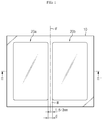
- FIG. 1 is a top view of a pouch exterior material 10 of a general 3-side sealing pouch type secondary battery.
- FIG. 2 is cross-sectional views of operations of a method of manufacturing a pouch type secondary battery using the pouch exterior material of FIG. 1 , which are taken along a line II-II' of FIG. 1 .
- FIG. 3 is a top view of a pouch type secondary battery manufactured via the method of FIG. 2 .
- two accommodating portions 20a and 20b which have completely corresponding shapes and sizes, are formed on one unit of the pouch exterior material 10 such as to be spaced apart from each other by a certain distance d greater than a thickness of an electrode assembly 30.
- a center portion F between the accommodating portions 20a and 20b is bent as shown in (c) of FIG. 2 to stack the accommodating portions 20a and 20b as shown in (d) of FIG. 2 , and then remaining 3 sides excluding the bent side are sealed as indicated by a reference numeral S, thereby manufacturing the pouch type secondary battery as shown in FIG. 3 .
- Such a technology of manufacturing the pouch type secondary battery may reduce a depth t of the accommodating portions 20a and 20b formed in the pouch exterior material 10 by about half of a thickness of the electrode assembly 30, and one side (a side of the bent center portion F) among four sides of the pouch type secondary battery may maintain a sealed state.
- the center portion F that is to be bent later is elongated in two sides such that the accommodating portions 20a and 20b are formed, and thus mechanical strength is weakened compared to when the center portion F is elongated in one side, and as a result, the center portion F is highly likely to break while the accommodating portions 20a and 20b are formed and/or bent.
- the accommodating portions 20a and 20b are spaced apart from each other by the certain distance d, and are formed to have a margin of about 1.5 mm to 3 mm around the center portion F that is bent during folding, considering a bent shape of a portion where the pouch exterior material 10 is folded.
- the pouch type secondary battery has many demands from customers for high capacity and miniaturization, and various structures and processes are studied/developed to realize the demands of customers. In particular, there have been attempts to study a method of increasing battery capacity by using an unnecessary space so as to increase capacity in the pouch type secondary battery.
- a folding portion W that is an unnecessary space is generated and protrudes.
- Such a folding portion W acts as a limitation of cell capacity, lowers energy density in a module/pack, and is disadvantageous in a cooling structure, and thus needs to be improved.
- pouch type secondary batteries that do not include the folding portion W are also suggested.
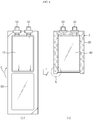
- FIG. 4 is schematic views of an example of manufacturing another general pouch type secondary battery in an order of processes.
- a pouch exterior material 60 processed in necessary length and width is bent almost at a center portion C in a length direction to determine a position an electrode assembly 40 and arrange the electrode assembly 40.
- a lead 50 extracted from electrodes forming the electrode assembly 40 is led to a front end of the pouch exterior material 60.
- a folding portion is not formed.
- the pouch exterior material 60 at the bent portion is pressed during the sealing, a protruding portion is generated in a direction of a bottom surface as indicated by a reference numeral A in (b) of FIG. 4 , and thus compactification of the protruding portion is damaged.
- the protruding portion acts as a limitation of cell capacity, lowers energy density in a module/pack, and is arranged in a bur shape called a bat ear, and thus hinders module assembly.
- the necessity for a pouch exterior material that does not have an unnecessary space so as to increase energy density of a cell while reducing a defective rate by preventing breakage or the like of the pouch exterior material during a process of forming an accommodating portion of an electrode assembly and/or a process of bending and overlapping the accommodating portion is increasing.
- the present disclosure is designed to solve the problems of the related art, and therefore the present disclosure is directed to providing a pouch exterior material that enables an electrode assembly to be easily mounted on a proper position of an accommodating portion, has an integrated shape to increases a life characteristic of a battery by minimizing a sealing portion contacting the atmosphere, is prevented from breaking during assembly, and increases energy density of a cell by not including an unnecessary space such as a folding portion or a protruding portion.
- the present disclosure is also directed to providing a pouch type secondary battery using the pouch exterior material and a method of manufacturing the same.
- a pouch exterior material being one unit of sheet type pouch exterior material used to pack an electrode assembly
- the pouch exterior material including: an inserting portion provided at a center of the pouch exterior material and having a width equal to a thickness of the electrode assembly; accommodating portions provided symmetrically at both sides of the inserting portion and gradually deepening from a portion corresponding to a width center of the electrode assembly towards a portion corresponding to an edge of the electrode assembly; and a triangular stepped portion provided at opposite ends of the inserting portion and having a depth gradually decreasing towards an end.
- a depth of a bottom corner of each of the accommodating portions far from the inserting portion may be equal to or greater than 1/2 of the thickness of the electrode assembly.
- the pouch exterior material between the inserting portion and each of the accommodating portions may be a flat section. Outer sides of the accommodating portions facing the inserting portion may be relatively elongated.
- a pouch type secondary battery according to an embodiment is manufactured by accommodating the electrode assembly in the pouch exterior material and thermally fusing the pouch exterior material.
- a pouch type secondary battery including: an electrode assembly; and one unit of sheet type pouch exterior material used to pack the electrode assembly, wherein the pouch exterior material includes: an inserting portion provided at a center of the pouch exterior material and having a width equal to a thickness of the electrode assembly; accommodating portions provided symmetrically at two sides of the inserting portion and gradually deepening from a portion corresponding to a width center of the electrode assembly towards a portion corresponding to an edge of the electrode assembly; and a triangular stepped portion provided at two ends of the inserting portion and having a depth gradually decreasing towards an end.
- a method of manufacturing a pouch type secondary battery including: preparing a pouch exterior material being one unit of sheet type pouch exterior material used to pack an electrode assembly, the pouch exterior material including: an inserting portion provided at a center of the pouch exterior material and having a width equal to a thickness of the electrode assembly; accommodating portions provided symmetrically at two sides of the inserting portion and gradually deepening from a portion corresponding to a width center of the electrode assembly towards a portion corresponding to an edge of the electrode assembly; and a triangular stepped portion provided at two ends of the inserting portion and having a depth gradually decreasing towards an end; mounting a side surface of the electrode assembly upright on the inserting portion and stacking the accommodating portions by folding up the pouch exterior material from both sides; and thermally fusing a surrounding region of the stacked accommodating portions.
- outer sides of the accommodating portions facing the inserting portion may be relatively elongated, regions of the accommodating portions excluding the outer sides may be thermally fused after the accommodating portions are stacked, an electrolyte solution may be injected through the outer sides of the accommodating portions and the outer sides are thermally fused, and the outer sides of the accommodating portions may be cut off.
- the present disclosure provides a pouch exterior material that can remove an unnecessary space of a folding portion from a 3-side sealing pouch type secondary battery and is formed such that a protruding portion is also not formed after sealing.
- the pouch exterior material according to the present disclosure does not require a margin of about 1.5 mm to 3 mm considering folding around a center portion like a general pouch exterior material since the pouch exterior material is folded up from two sides while a side surface of an electrode assembly is mounted upright on an inserting portion instead of being folded at the center portion like a related art.
- the present disclosure since a region of the electrode assembly in the pouch exterior material is maximized without leaving an unnecessary space in a cell, energy density of the cell can be improved. Not only cell capacity is increased by removing an unnecessary space of a folding portion, but also energy density of a module/pack including such a pouch type secondary battery is increased.
- a cooling structure of the module/pack and an assembly process can be simplified. Furthermore, since there is no protruding portion protruding from a bottom surface (a surface corresponding to the side surface of the electrode assembly inserted into the inserting portion) of the pouch type secondary battery even after sealing, the bottom surface can be adhered to a cooling member, and thus cooling performance of the module/pack of an edge cooling type can be improved.
- the pouch type secondary battery according to the present disclosure does not include a protruding portion having a bur shape, module assembly is not hindered and assembly process efficiency is not deteriorated.
- the pouch exterior material according to the present disclosure can be prevented from breaking during a manufacturing process to reduce a defective rate, can mount the electrode assembly at a proper position without having to use a separate device, and can minimize a sealing portion contacting the atmosphere to further reduce inflow of air, moisture, or the like and leakage of an electrolyte solution, thereby improving a life characteristic of a battery.
- FIG. 5 is an exploded perspective view of a pouch type secondary battery 100 according to an embodiment of the present disclosure.
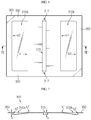
- FIG. 6 is a top view of a pouch exterior material 300 of FIG. 5 .
- FIG. 7 corresponds to a portion of a cross-section taken along a line VII-VII' of FIG. 6 .
- the pouch type secondary battery 100 includes an electrode assembly 200 and the pouch exterior material 300.
- the electrode assembly 200 may be a stack type electrode assembly in which a plurality of positive electrode plates and a plurality of negative electrode plates, which are cut in units of certain size, are sequentially stacked with a separator therebetween.
- a positive electrode lead 210 and a negative electrode lead 220 of the electrode assembly 200 face each other and protrude from two sides of the pouch exterior material 300.
- Two corresponding accommodating portions 310a and 310b are formed in the pouch exterior material 300 according to the present disclosure. Also, an inserting portion 315 is provided between the accommodating portions 310a and 310b, and the accommodating portions 310a and 310b do not communicate with each other.
- the accommodating portions 310a and 310b are symmetrically formed at both sides of the inserting portion 315.
- the accommodating portions 310a and 310b are gradually deepened from portions a1 and b1 corresponding to a width center of the electrode assembly 200 towards bottom corners a2 and b2 corresponding to an edge of the electrode assembly 200.
- the pouch exterior material 300 between the inserting portion 315 and each of the accommodating portions 310a and 310b is a flat section.
- the inserting portion 315 has a width equal to a thickness T of the electrode assembly 200.
- a distance between the two accommodating portions 310a and 310b is increased.
- mechanical strength of a certain region is not weakened or the certain region is not broken with respect to forming the pouch exterior material 300 to form the inserting portion 315 and the accommodating portions 310a and 310b.
- the accommodating portions 310a and 310b are provided at both sides of the inserting portion 315, and a triangular stepped portion 317 having a depth gradually decreasing towards the end thereof is provided at opposite ends of the inserting portion 315, the opposite ends being orthogonal to a direction of both sides.
- a length of the triangular stepped portion 317 is decreased, a slope of a bottom of the triangular stepped portion 317 is relatively steep.
- the slope of the bottom of the triangular stepped portion 317 is relatively gentle.
- a depth h of the inserting portion 315 is high, the slope of the bottom of the triangular stepped portion 317 is relatively steep.
- the slope of the bottom of the triangular stepped portion 317 is relatively gentle.
- the depth h of the inserting portion 315 and a shape of the triangular stepped portion 317 determine a final outer shape of a sealing portion during thermal fusion while the pouch type secondary battery 100 is manufactured.
- reference numerals 320, 330, and 350 respectively denote an upper sealing portion, a lower sealing portion, and a side sealing portion.
- the pouch exterior material 300 may have a structure in which outer sides of the accommodating portions 310a and 310b facing the inserting portion 315, i.e., the side sealing portions 350, are elongated.
- the pouch type secondary battery 100 may be manufactured by overlapping the accommodating portions 310a and 310b to accommodate the electrode assembly 200, sealing the remaining sealing portions (contacting regions) excluding the side sealing portion 350 that is elongated, i.e., the upper sealing portion 320 and the lower sealing portion 330, injecting an electrolyte solution through the side sealing portion 350 and then sealing the side sealing portion 350, and cutting the side sealing portion 350 to a certain size.
- the pouch exterior material 300 not only the electrolyte solution is easily injected, but also the electrolyte solution is prevented from overflowing due a mistake of an operator during an injecting process.
- the pouch exterior material 300 may be formed of a laminate sheet including a metal layer and a resin layer.
- the laminate sheet may be an aluminum laminate sheet.
- the pouch exterior material 300 may include a core portion whose material includes a metal layer, a thermal fusion layer provided on an upper surface of the core portion, and an insulating layer provided on a lower surface of the core portion.
- the thermal fusion layer may act as an adhesion layer by using modified propylene that is polymer resin, for example, casted polypropylene (CPP), and the insulating layer may include a resin material such as nylon or polyethylene terephthalate (PET), but structures and materials of the pouch exterior material 300 is not limited thereto.
- the pouch exterior material 300 may be one unit of sheet, and the accommodating portions 310a and 310b may be simultaneously formed via one process through compression molding of the aluminum laminate sheet by using a deep-drawing method using a die and a punch.
- the inserting portion 315 and the triangular stepped portion 317 may also be simultaneously formed via one process.
- the accommodating portions 310a and 310b, the inserting portion 315, and the triangular stepped portion 317 may also be simultaneously formed via one process.
- a depth t1 of the bottom corner a2 of the accommodating portion 310a far from the inserting portion 315 is equal to or greater than 1/2 of the thickness T of the electrode assembly 200, and similarly, the depth t1 of a bottom corner b2 of the accommodating portion 310b far from the inserting portion 315 is also equal to or greater than 1/2 of the thickness T of the electrode assembly 200. It is ideal that the depth t1 of bottom corners a2 and b2 is 1/2 of the thickness T of the electrode assembly 200 without any remaining portion, but the depth t1 may be higher as a margin for convenience of processes based on a product. Thus, the depth t1 of the bottom corners a2 and b2 is set to be equal to or greater than 1/2 of the thickness T of the electrode assembly 200.
- each of the accommodating portions 310a and 310b is inclined.
- the accommodating portions 310a and 310b are gradually deepened from the portions a1 and b1 corresponding to the width center of the electrode assembly 200 towards the bottom corners a2 and b2 corresponding to the edge of the electrode assembly 200.
- the portions a1 and b1 corresponding to the width center of the electrode assembly 200 is flexible based on the depth h of the inserting portion 315.
- the depth h of the inserting portion 315 is increased, the portions a1 and b1 corresponding to the width center of the electrode assembly 200 approach the inserting portion 315.
- the depth h of the inserting portion 315 is decreased, the portions a1 and b1 corresponding to the width center of the electrode assembly 200 recede away from the inserting portion 315.
- the depth h of the inserting portion 315 may be determined considering a material, elongation, etc.
- the depth h of the inserting portion 315 also affects a shape of the triangular stepped portion 317, thereby determining a final outer shape of a sealing portion, and thus the depth h of the inserting portion 315 is a factor that needs to be considered carefully.
- depths of existing accommodating portions correspond to about half of a thickness of an electrode assembly and thus are even, and a bottom surface of the accommodating portion is not inclined.
- the maximum depth of the accommodating portions 310a and 310b of the pouch exterior material 300 of the present disclosure is the depth t1, which is equal to or greater than 1/2 of the thickness T of the electrode assembly 200, and the minimum depth thereof is 0, and thus the bottom surface is inclined with a gradual slope from one corner having the maximum depth (a portion corresponding to the edge of the electrode assembly) to the opposite side having the minimum depth (a portion corresponding to the width center of the electrode assembly 200).
- the pouch exterior material 300 of the present disclosure is very different from the existing pouch exterior material in a molded depth of accommodating portions, a shape of bottom surface of the accommodating portions, existence of an inserting portion between the accommodating portions, a triangular stepped portion at two ends of the inserting portion, etc.
- FIG. 8 is cross-sectional views of operations of a method of manufacturing a pouch type secondary battery using the pouch exterior material 300 of FIG. 6 , which are taken along a line VII-VII' of FIG. 6 .
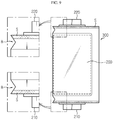
- FIG. 9 is a top view of a pouch type secondary battery manufactured via the method of FIG. 8 .
- FIG. 8 is a cross-sectional view of the pouch exterior material 300 being unfolded after being formed, and the electrode assembly 200 is moved above the inserting portion 315 to be mounted. Then, while a side surface 230 of FIG. 5 of the electrode assembly 200 is inserted upright into the inserting portion 315 at the center of the pouch exterior material 300 as shown in (b) of FIG. 8 , the pouch exterior material 300 at the accommodating portions 310a and 310b at the two sides is folded up in an order shown in (c) and (d) of FIG. 8 so as to overlap and stack the accommodating portions 310a and 310b on two surfaces of the electrode assembly 200, i.e., on a wide surface 240 of FIG. 5 determining the width of the electrode assembly 200.
- the side surface 230 of the electrode assembly 200 is mounted on the inserting portion 315 such that the positive electrode lead 210 and the negative electrode lead 220 respectively correspond to the upper sealing portion 320 and the lower sealing portion 330, and the pouch exterior material 300 is bent such that the upper sealing portion 320, the lower sealing portion 330, and the side sealing portion 350 contact each other.
- the side surface 230 of the electrode assembly 200 may be surrounded without any unnecessary space, and since a bending angle is not greater than that of the related art, an unreasonable bending force is not applied.
- the wide surface 240 of the electrode assembly 200 may be fittingly surrounded and even a corner portion of another side surface facing the side surface 230 of the electrode assembly 200 may be surrounded.
- the pouch exterior material 300 is flexible and thus may be easily folded up, does not include a bent portion that requires a large force and thus does not have a wrinkle or the like, and may be tightly sealed in during sequent processes.
- a bent portion that is a center portion between two accommodating portions and is bent based one bending line is provided as a margin portion at a side center portion of an electrode assembly, but in the present disclosure, there is no unnecessary margin at the side surface 230 of the electrode assembly 200 inserted into the inserting portion 315 since the inserting portion 315 is provided at the center portion.
- a side surface opposite to the side surface 230 of the electrode assembly 200 inserted into the inserting portion 315 may also be fittingly accommodated.
- a corner of a side surface of an electrode assembly is completely surrounded by changing a forming shape of a pouch exterior material, the corner may be stably sealed without any unnecessary space, and a region of the electrode assembly in the pouch exterior material may be maximized. Accordingly, a pouch type secondary battery that may be used as a large-capacity secondary battery or a high capacity and high density battery for an electric vehicle, and a method of manufacturing the pouch type secondary battery may be provided.
- the triangular stepped portion 317 having a depth gradually decreasing towards ends is formed at two ends of the inserting portion 315, a protruding portion is not formed at the side surface 230 of the electrode assembly 200 after the upper, lower, and side sealing portions 320, 330, and 350 are thermally fused.
- the sealing after the thermal fusion of the upper and lower sealing portions 320 and 330 is indicated by the reference numeral S, and unlike the related art, a dented portion as indicated by a reference numeral B rather formed instead of a protruding portion that is generated when a pouch exterior material is pressed from top and bottom portions from which electrode leads are respectively extracted.
- the dented portion B is formed by the triangular stepped portion 317 formed in the pouch exterior material 300.
- the shape of the triangular stepped portion 317 affects a shape and dented degree of the dented portion B.
- the shape of the triangular stepped portion 317 is affected by the length of the triangular stepped portion 317 and the depth h of the inserting portion 315, and thus the shape of the dented portion B may be determined by adjusting such factors.
- the surface where the side surface 230 of the electrode assembly 200 is provided may be manufactured to be flat.
- a protruding portion that is generated during sealing as in the related art does not protrude compared to the bottom surface of the pouch type secondary battery.
- an unnecessary space such as a folding portion of a pouch exterior material during 3-side sealing, a protruding portion during sealing, or the like, is removed, thereby increasing capacity of an electrode assembly included in a pouch type secondary battery. Since a protruding portion having a bur shape is not formed in the pouch type secondary battery manufactured by using the pouch exterior material according to the present disclosure, a dead space resulting from the protruding portion is not formed, and energy density of a module/pack including such a pouch type secondary battery may be remarkably increased. Also, module assembly is facilitated by removing the protruding portion.
- assembly process efficiency of the module/pack including the pouch type secondary battery according to the present disclosure may also be remarkably increased.
- a flat bottom surface in the pouch type secondary battery according to the present disclosure is advantageous in edge cooling type cooling.
- the pouch type secondary battery 100 has been described mainly based on the electrode assembly 200 in which the positive electrode lead 210 and the negative electrode lead 220 protrude in opposite directions, but an electrode assembly in which a positive electrode lead and a negative electrode lead protrude in the same direction may be manufactured into a pouch type secondary battery by using a pouch exterior material according to the present disclosure.
- FIG. 10 is a cross-sectional view of a configuration of a battery module 500 including the pouch type secondary battery 100 according to the present disclosure.
- the plurality of pouch type secondary batteries 100 may be gathered and attached to an upper surface of a cooling plate 600 while one un-sealed surface is positioned at the bottom.
- a surface of the pouch type secondary battery 100 of FIG. 9 corresponding to a left side surface may be positioned at the bottom, and such a surface may be mounted on and contact the upper surface of the cooling plate 600.
- the pouch type secondary battery 100 may be completely adhered to the cooling plate 600, and a top surface structure of the cooling plate 600 may be simplified.
- An electrode assembly in the pouch type secondary battery 100 and the cooling plate 600 may be very closely positioned.
- the cooling plate 600 and the pouch type secondary battery 100 may be completely adhered to each other.
- the overall volume of the battery module 500 is reduced, thereby increasing energy density.
- a contact area between the pouch type secondary battery 100 and the cooling plate 600 is secured as much as possible, and thus heat transmission may be increased. Accordingly, heat generated in the electrode assembly in the pouch type secondary battery 100 may be quickly and smoothly transferred to the cooling plate 600, and thus cooling efficiency may be increased.
- FIG. 11 is a photograph of a pouch exterior material manufactured according to an experiment example of the present disclosure.
- the pouch exterior material 300 is turned over such that the accommodating portions 310a and 310b are at the bottom, and thus a bottom surface of the pouch exterior material 300 is photographed.
- the pouch exterior material 300 was formed by forming the inserting portion 315 having a width equal to a thickness of an electrode assembly at a center of one unit of sheet type pouch exterior material, and symmetrically forming the accommodating portions 310a and 310b that are gradually deepened from portions corresponding to a width center of the electrode assembly to portions corresponding to an edge of the electrode assembly on two sides of the inserting portion 315.
- the triangular stepped portion 317 whose depth gradually decreases towards an end was formed at two ends of the inserting portion 315.
- the pouch exterior material 300 according to the present disclosure is formed without brakeage or tear during manufacturing processes.
- the accommodating portions 310a and 310b, the inserting portion 315, and the triangular stepped portion 317 are formed as desired without any distortion or stress concentration.
- FIG. 12 is a photograph of a pouch type secondary battery manufactured by using the pouch exterior material 300 of FIG. 11 .
- upper and lower sealing portions slightly protrude respectively by about distances P1 and P2 compared to a side surface corresponding to the inserting portion 315 of the pouch exterior material 300 of FIG. 11 , but the distances P1 and p2 are insignificant compared with a distance P3 of FIG. 13 that is a protruding degree of the related art.
- the distances P1 and P2 may be removed by adjusting a depth of the inserting portion 315 of the pouch exterior material 300.
- protruding portions may be removed.
- the widths of the accommodating portions 310a and 310b i.e., the length from the portion a1 corresponding to the width center of the electrode assembly 200 to the bottom corner a2 corresponding to the edge of the electrode assembly 200 and the length from the portion b1 corresponding to the width center of the electrode assembly 200 to the bottom corner b2 corresponding to the edge of the electrode assembly 200, need to be reduced.
- FIG. 14 is a photograph of a pouch type secondary battery manufactured by using a pouch exterior material according to another experiment example of the present disclosure.
- a pouch type secondary battery was manufactured by using the pouch exterior material, thereby removing protruding portions compared to FIG. 12 . Rather, a lower sealing portion was provided further inward by a certain distance P4 compared to the side surface corresponding to the inserting portion 315 of the pouch exterior material 300.
- an unnecessary space is removed from a surface where the side surface 230 of the electrode assembly 200 is provided (a bottom surface of the pouch type secondary battery), i.e., an un-sealed surface, thereby increasing cell capacity.
- energy density of a module/pack including such a pouch type secondary battery may be increased. Also, by removing the unnecessary space, a cooling structure and assembly processes of the module/pack may be simplified.
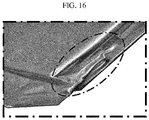
- FIG. 15 is a photograph of a bottom surface of a pouch type secondary battery according to the experiment example of the present disclosure (a surface corresponding to the side surface 230 of the electrode assembly 200 inserted into the inserting portion 315 of the pouch exterior material 300), and FIG. 16 is a photograph of a bottom surface of a pouch type secondary battery according to the related art. Comparing FIGS. 15 and 16 , the pouch type secondary battery of the present disclosure has a flat bottom surface, and thus adhesion in a module using an edge cooling method is increased, and accordingly, cooling performance is increased.
Landscapes
- Chemical & Material Sciences (AREA)
- Chemical Kinetics & Catalysis (AREA)
- Electrochemistry (AREA)
- General Chemical & Material Sciences (AREA)
- Inorganic Chemistry (AREA)
- Engineering & Computer Science (AREA)
- Manufacturing & Machinery (AREA)
- Sealing Battery Cases Or Jackets (AREA)
- Secondary Cells (AREA)
Abstract
Description
- The present disclosure relates to a pouch exterior material for a secondary battery, a pouch type secondary battery using the same, and a method of manufacturing the same, and more particularly, to a pouch exterior material for a secondary battery, in which a forming shape is improved such that energy density of a cell is improved, a pouch type secondary battery using the pouch exterior material, and a method of manufacturing the pouch type secondary battery. The present application claims priority to Korean Patent Application No.
10-2017-0092152 filed on July 20, 2017 10-2018-0075766 filed on June 29, 2018 - Secondary batteries are widely used as power sources of mobile devices, such as a mobile phone, a laptop computer, a camcorder, etc. In particular, the use of lithium secondary batteries is rapidly increasing due to a high operating voltage and high energy density per unit weight.
- Such a lithium secondary battery mainly uses a lithium-based oxide as a positive electrode active material and a carbon material as a negative electrode active material, and generally, may be distinguished into a lithium ion battery, a lithium ion polymer battery, or a lithium polymer battery based on a type of an electrolyte being used or may be distinguished into a cylindrical type, a rectangular type, or pouch type secondary battery based on an outer shape of a battery. Typically, in terms of a shape of a battery, demands for the rectangular type secondary battery and the pouch type secondary battery, which are applicable to products, such as mobile phones, etc. with a thin thickness, are high.
- Thereamong, the pouch type secondary battery that does not have restriction on a shape and size, is easily assembled via thermal fusion, and easily discharges a gas or liquid when an abnormal behavior occurs, and thus is specifically suitable for manufacturing a light-weight cell having a thin thickness is in the limelight. Generally, the pouch type secondary battery has a structure in which an electrode assembly is embodied in a pouch exterior material formed of an aluminum laminate sheet. In other words, the pouch type secondary battery is manufactured by forming an accommodating portion for mounting the electrode assembly on the aluminum laminate sheet and thermally fusing a separate aluminum laminate sheet separated from the aluminum laminate sheet or the aluminum laminate sheet that is extended while the electrode assembly is provided in the accommodating portion.
- In such a pouch exterior material, the accommodating portion may be formed by partially compressing the aluminum laminate sheet having a thickness of about 113 µm by using a die and a punch via a similar method as a deep-drawing process. However, the aluminum laminate sheet having such a thin thickness may break or the like during the compression, and thus it is generally difficult to form the accommodating portion having a depth equal to or greater than 15 mm.
- Meanwhile, in a separable pouch exterior material, since two units of aluminum laminate sheet are combined by being overlapped and sealed, accommodating portions at two sides need to be overlapped at proper positions while an electrode assembly is embodied therein during processes of manufacturing a secondary battery. If the electrode assembly is not mounted to a proper position, an internal short circuit is generated, and thus a separate guiding device is required, thereby increasing manufacturing costs. Also, since the two units of aluminum laminate sheet are combined on four sides to form a sealing portion, the two units of aluminum laminate sheet are in contact with the atmosphere from all four sides, and thus the possibility of air inflow is extremely increased after the long-term use, thereby reducing a life of the battery.
- In this regard, many techniques regarding a method of forming two corresponding accommodating portions on one unit of aluminum laminate sheet, overlapping the accommodating portions, and sealing three sides have been introduced.
-
FIG. 1 is a top view of a pouchexterior material 10 of a general 3-side sealing pouch type secondary battery.FIG. 2 is cross-sectional views of operations of a method of manufacturing a pouch type secondary battery using the pouch exterior material ofFIG. 1 , which are taken along a line II-II' ofFIG. 1 .FIG. 3 is a top view of a pouch type secondary battery manufactured via the method ofFIG. 2 . - First, referring to
FIG. 1 and (a) ofFIG. 2 , twoaccommodating portions exterior material 10 such as to be spaced apart from each other by a certain distance d greater than a thickness of anelectrode assembly 30. - Then, while the
electrode assembly 30 is mounted on theaccommodating portion FIG. 2 , a center portion F between theaccommodating portions FIG. 2 to stack theaccommodating portions FIG. 2 , and then remaining 3 sides excluding the bent side are sealed as indicated by a reference numeral S, thereby manufacturing the pouch type secondary battery as shown inFIG. 3 . - Such a technology of manufacturing the pouch type secondary battery may reduce a depth t of the
accommodating portions exterior material 10 by about half of a thickness of theelectrode assembly 30, and one side (a side of the bent center portion F) among four sides of the pouch type secondary battery may maintain a sealed state. - However, while the pouch
exterior material 10 is compressed to form the two adjacentaccommodating portions accommodating portions accommodating portions accommodating portions exterior material 10 is folded. - The pouch type secondary battery has many demands from customers for high capacity and miniaturization, and various structures and processes are studied/developed to realize the demands of customers. In particular, there have been attempts to study a method of increasing battery capacity by using an unnecessary space so as to increase capacity in the pouch type secondary battery.
- However, in the general 3-side sealing pouch type secondary battery described with reference to
FIGS. 1 through 3 , due to the margin of about 1.5 mm to 3 mm around the center portion F that is bent while the pouchexterior material 10 is folded, a folding portion W that is an unnecessary space is generated and protrudes. Such a folding portion W acts as a limitation of cell capacity, lowers energy density in a module/pack, and is disadvantageous in a cooling structure, and thus needs to be improved. - Meanwhile, pouch type secondary batteries that do not include the folding portion W are also suggested.
-
FIG. 4 is schematic views of an example of manufacturing another general pouch type secondary battery in an order of processes. - Referring to (a) of
FIG. 4 , first, a pouchexterior material 60 processed in necessary length and width is bent almost at a center portion C in a length direction to determine a position anelectrode assembly 40 and arrange theelectrode assembly 40. Here, alead 50 extracted from electrodes forming theelectrode assembly 40 is led to a front end of the pouchexterior material 60. - Then, in (b) of
FIG. 4 , other opened sides of the pouchexterior material 60 excluding a side where thelead 50 is led out are sealed as indicated by the reference numeral S. Next, a necessary electrolyte solution is injected through an opened portion where thelead 50 is led out, and then the opened portion is also sealed. - According to the example of (a) and (b) of
FIG. 4 , a folding portion is not formed. However, since the pouchexterior material 60 at the bent portion is pressed during the sealing, a protruding portion is generated in a direction of a bottom surface as indicated by a reference numeral A in (b) ofFIG. 4 , and thus compactification of the protruding portion is damaged. Like a folding portion described above, the protruding portion acts as a limitation of cell capacity, lowers energy density in a module/pack, and is arranged in a bur shape called a bat ear, and thus hinders module assembly. - As such, in one unit of pouch exterior material, the necessity for a pouch exterior material that does not have an unnecessary space so as to increase energy density of a cell while reducing a defective rate by preventing breakage or the like of the pouch exterior material during a process of forming an accommodating portion of an electrode assembly and/or a process of bending and overlapping the accommodating portion is increasing.
- The present disclosure is designed to solve the problems of the related art, and therefore the present disclosure is directed to providing a pouch exterior material that enables an electrode assembly to be easily mounted on a proper position of an accommodating portion, has an integrated shape to increases a life characteristic of a battery by minimizing a sealing portion contacting the atmosphere, is prevented from breaking during assembly, and increases energy density of a cell by not including an unnecessary space such as a folding portion or a protruding portion.
- The present disclosure is also directed to providing a pouch type secondary battery using the pouch exterior material and a method of manufacturing the same.
- These and other objects and advantages of the present disclosure may be understood from the following detailed description and will become more fully apparent from the exemplary embodiments of the present disclosure. Also, it will be easily understood that the objects and advantages of the present disclosure may be realized by the means shown in the appended claims and combinations thereof.
- In one aspect of the present disclosure, there is provided a pouch exterior material being one unit of sheet type pouch exterior material used to pack an electrode assembly, the pouch exterior material including: an inserting portion provided at a center of the pouch exterior material and having a width equal to a thickness of the electrode assembly; accommodating portions provided symmetrically at both sides of the inserting portion and gradually deepening from a portion corresponding to a width center of the electrode assembly towards a portion corresponding to an edge of the electrode assembly; and a triangular stepped portion provided at opposite ends of the inserting portion and having a depth gradually decreasing towards an end.
- A depth of a bottom corner of each of the accommodating portions far from the inserting portion may be equal to or greater than 1/2 of the thickness of the electrode assembly. The pouch exterior material between the inserting portion and each of the accommodating portions may be a flat section. Outer sides of the accommodating portions facing the inserting portion may be relatively elongated.
- A pouch type secondary battery according to an embodiment is manufactured by accommodating the electrode assembly in the pouch exterior material and thermally fusing the pouch exterior material.
- In particular, in another aspect of the present disclosure, there is also provided a pouch type secondary battery including: an electrode assembly; and one unit of sheet type pouch exterior material used to pack the electrode assembly, wherein the pouch exterior material includes: an inserting portion provided at a center of the pouch exterior material and having a width equal to a thickness of the electrode assembly; accommodating portions provided symmetrically at two sides of the inserting portion and gradually deepening from a portion corresponding to a width center of the electrode assembly towards a portion corresponding to an edge of the electrode assembly; and a triangular stepped portion provided at two ends of the inserting portion and having a depth gradually decreasing towards an end.
- In another aspect of the present disclosure, there is also provided a method of manufacturing a pouch type secondary battery, the method including: preparing a pouch exterior material being one unit of sheet type pouch exterior material used to pack an electrode assembly, the pouch exterior material including: an inserting portion provided at a center of the pouch exterior material and having a width equal to a thickness of the electrode assembly; accommodating portions provided symmetrically at two sides of the inserting portion and gradually deepening from a portion corresponding to a width center of the electrode assembly towards a portion corresponding to an edge of the electrode assembly; and a triangular stepped portion provided at two ends of the inserting portion and having a depth gradually decreasing towards an end; mounting a side surface of the electrode assembly upright on the inserting portion and stacking the accommodating portions by folding up the pouch exterior material from both sides; and thermally fusing a surrounding region of the stacked accommodating portions.
- Here, outer sides of the accommodating portions facing the inserting portion may be relatively elongated, regions of the accommodating portions excluding the outer sides may be thermally fused after the accommodating portions are stacked, an electrolyte solution may be injected through the outer sides of the accommodating portions and the outer sides are thermally fused, and the outer sides of the accommodating portions may be cut off.
- The present disclosure provides a pouch exterior material that can remove an unnecessary space of a folding portion from a 3-side sealing pouch type secondary battery and is formed such that a protruding portion is also not formed after sealing.
- The pouch exterior material according to the present disclosure does not require a margin of about 1.5 mm to 3 mm considering folding around a center portion like a general pouch exterior material since the pouch exterior material is folded up from two sides while a side surface of an electrode assembly is mounted upright on an inserting portion instead of being folded at the center portion like a related art.
- According to the present disclosure, since a region of the electrode assembly in the pouch exterior material is maximized without leaving an unnecessary space in a cell, energy density of the cell can be improved. Not only cell capacity is increased by removing an unnecessary space of a folding portion, but also energy density of a module/pack including such a pouch type secondary battery is increased.
- Also, by removing the unnecessary space of a folding portion, a cooling structure of the module/pack and an assembly process can be simplified. Furthermore, since there is no protruding portion protruding from a bottom surface (a surface corresponding to the side surface of the electrode assembly inserted into the inserting portion) of the pouch type secondary battery even after sealing, the bottom surface can be adhered to a cooling member, and thus cooling performance of the module/pack of an edge cooling type can be improved.
- Also, since the pouch type secondary battery according to the present disclosure does not include a protruding portion having a bur shape, module assembly is not hindered and assembly process efficiency is not deteriorated.
- The pouch exterior material according to the present disclosure can be prevented from breaking during a manufacturing process to reduce a defective rate, can mount the electrode assembly at a proper position without having to use a separate device, and can minimize a sealing portion contacting the atmosphere to further reduce inflow of air, moisture, or the like and leakage of an electrolyte solution, thereby improving a life characteristic of a battery.
- The accompanying drawings illustrate a preferred embodiment of the present disclosure and together with the foregoing disclosure, serve to provide further understanding of the technical features of the present disclosure, and thus, the present disclosure is not construed as being limited to the drawing.
-
FIG. 1 is a top view of a pouch exterior material of a general 3-side sealing pouch type secondary battery; -
FIG. 2 is cross-sectional views of operations of a method of manufacturing a pouch type secondary battery using the pouch exterior material ofFIG. 1 , which are taken along a line II-II' ofFIG. 1 ; -
FIG. 3 is a top view of a pouch type secondary battery manufactured via the method ofFIG. 2 ; -
FIG. 4 is schematic views of an example of manufacturing another general pouch type secondary battery in an order of processes; -
FIG. 5 is an exploded perspective view of a pouch type secondary battery according to an embodiment of the present disclosure; -
FIG. 6 is a top view of a pouch exterior material ofFIG. 5 ; -
FIG. 7 corresponds to a portion of a cross-section taken along a line VII-VII' ofFIG. 6 ; -
FIG. 8 is cross-sectional views of operations of a method of manufacturing a pouch type secondary battery using the pouch exterior material ofFIG. 6 , which are taken along a line VII-VII' ofFIG. 6 ; -
FIG. 9 is a top view of a pouch type secondary battery manufactured via the method ofFIG. 8 ; -
FIG. 10 is a cross-sectional view of a configuration of a battery module including a pouch type secondary battery according to the present disclosure; -
FIG. 11 is a photograph of a pouch exterior material manufactured according to an experiment example of the present disclosure; -
FIG. 12 is a photograph of a pouch type secondary battery manufactured by using the pouch exterior material ofFIG. 11 ; -
FIG. 13 is a photograph of a sealing portion of a general pouch type secondary battery; -
FIG. 14 is a photograph of a pouch type secondary battery manufactured by using a pouch exterior material according to another experiment example of the present disclosure; -
FIG. 15 is a photograph of a bottom surface of the pouch type secondary battery ofFIG. 12 ; and -
FIG. 16 is a photograph of a bottom surface of a pouch type secondary battery according to a related art. - Hereinafter, preferred embodiments of the present disclosure will be described in detail with reference to the accompanying drawings. Prior to the description, it should be understood that the terms used in the specification and the appended claims should not be construed as limited to general and dictionary meanings, but interpreted based on the meanings and concepts corresponding to technical aspects of the present disclosure on the basis of the principle that the inventor is allowed to define terms appropriately for the best explanation. Therefore, the description proposed herein is just a preferable example for the purpose of illustrations only, not intended to limit the scope of the disclosure, so it should be understood that other equivalents and modifications could be made thereto without departing from the scope of the disclosure.
-
FIG. 5 is an exploded perspective view of a pouch typesecondary battery 100 according to an embodiment of the present disclosure.FIG. 6 is a top view of apouch exterior material 300 ofFIG. 5 .FIG. 7 corresponds to a portion of a cross-section taken along a line VII-VII' ofFIG. 6 . - First, referring to
FIG. 5 , the pouch typesecondary battery 100 includes anelectrode assembly 200 and thepouch exterior material 300. - The
electrode assembly 200 may be a stack type electrode assembly in which a plurality of positive electrode plates and a plurality of negative electrode plates, which are cut in units of certain size, are sequentially stacked with a separator therebetween. Apositive electrode lead 210 and anegative electrode lead 220 of theelectrode assembly 200 face each other and protrude from two sides of thepouch exterior material 300. - Two corresponding
accommodating portions pouch exterior material 300 according to the present disclosure. Also, an insertingportion 315 is provided between theaccommodating portions accommodating portions accommodating portions portion 315. Theaccommodating portions electrode assembly 200 towards bottom corners a2 and b2 corresponding to an edge of theelectrode assembly 200. Thepouch exterior material 300 between the insertingportion 315 and each of theaccommodating portions - Compared to a related art in which a separation distance is set between accommodating portions, the separation distance being an interval greater than a thickness of an electrode assembly in addition to a margin of about 1.5 mm to 3 mm, the inserting
portion 315 has a width equal to a thickness T of theelectrode assembly 200. Compared to the related art, a distance between the twoaccommodating portions pouch exterior material 300 to form the insertingportion 315 and theaccommodating portions - The
accommodating portions portion 315, and a triangular steppedportion 317 having a depth gradually decreasing towards the end thereof is provided at opposite ends of the insertingportion 315, the opposite ends being orthogonal to a direction of both sides. When a length of the triangular steppedportion 317 is decreased, a slope of a bottom of the triangular steppedportion 317 is relatively steep. When the length of the triangular steppedportion 317 is increased, the slope of the bottom of the triangular steppedportion 317 is relatively gentle. Also, when a depth h of the insertingportion 315 is high, the slope of the bottom of the triangular steppedportion 317 is relatively steep. When the depth h of the insertingportion 315 is low, the slope of the bottom of the triangular steppedportion 317 is relatively gentle. The depth h of the insertingportion 315 and a shape of the triangular steppedportion 317 determine a final outer shape of a sealing portion during thermal fusion while the pouch typesecondary battery 100 is manufactured. - Here,
reference numerals - According to an embodiment, the
pouch exterior material 300 may have a structure in which outer sides of theaccommodating portions portion 315, i.e., theside sealing portions 350, are elongated. In this case, the pouch typesecondary battery 100 may be manufactured by overlapping theaccommodating portions electrode assembly 200, sealing the remaining sealing portions (contacting regions) excluding theside sealing portion 350 that is elongated, i.e., theupper sealing portion 320 and thelower sealing portion 330, injecting an electrolyte solution through theside sealing portion 350 and then sealing theside sealing portion 350, and cutting theside sealing portion 350 to a certain size. According to such a structure of thepouch exterior material 300, not only the electrolyte solution is easily injected, but also the electrolyte solution is prevented from overflowing due a mistake of an operator during an injecting process. - The
pouch exterior material 300 may be formed of a laminate sheet including a metal layer and a resin layer. In particular, the laminate sheet may be an aluminum laminate sheet. Thepouch exterior material 300 may include a core portion whose material includes a metal layer, a thermal fusion layer provided on an upper surface of the core portion, and an insulating layer provided on a lower surface of the core portion. The thermal fusion layer may act as an adhesion layer by using modified propylene that is polymer resin, for example, casted polypropylene (CPP), and the insulating layer may include a resin material such as nylon or polyethylene terephthalate (PET), but structures and materials of thepouch exterior material 300 is not limited thereto. - The
pouch exterior material 300 may be one unit of sheet, and theaccommodating portions portion 315 and the triangular steppedportion 317 may also be simultaneously formed via one process. Theaccommodating portions portion 315, and the triangular steppedportion 317 may also be simultaneously formed via one process. - Further referring to
FIG. 6 through (d) ofFIG. 8 , a depth t1 of the bottom corner a2 of theaccommodating portion 310a far from the insertingportion 315 is equal to or greater than 1/2 of the thickness T of theelectrode assembly 200, and similarly, the depth t1 of a bottom corner b2 of theaccommodating portion 310b far from the insertingportion 315 is also equal to or greater than 1/2 of the thickness T of theelectrode assembly 200. It is ideal that the depth t1 of bottom corners a2 and b2 is 1/2 of the thickness T of theelectrode assembly 200 without any remaining portion, but the depth t1 may be higher as a margin for convenience of processes based on a product. Thus, the depth t1 of the bottom corners a2 and b2 is set to be equal to or greater than 1/2 of the thickness T of theelectrode assembly 200. - In particular, as shown in
FIG. 7 , a bottom surface of each of theaccommodating portions accommodating portions electrode assembly 200 towards the bottom corners a2 and b2 corresponding to the edge of theelectrode assembly 200. - The portions a1 and b1 corresponding to the width center of the
electrode assembly 200 is flexible based on the depth h of the insertingportion 315. When the depth h of the insertingportion 315 is increased, the portions a1 and b1 corresponding to the width center of theelectrode assembly 200 approach the insertingportion 315. On the other hand, when the depth h of the insertingportion 315 is decreased, the portions a1 and b1 corresponding to the width center of theelectrode assembly 200 recede away from the insertingportion 315. The depth h of the insertingportion 315 may be determined considering a material, elongation, etc. of thepouch exterior material 300, and as described above, the depth h of the insertingportion 315 also affects a shape of the triangular steppedportion 317, thereby determining a final outer shape of a sealing portion, and thus the depth h of the insertingportion 315 is a factor that needs to be considered carefully. - In the related art described with reference to
FIGS. 1 through 3 , depths of existing accommodating portions correspond to about half of a thickness of an electrode assembly and thus are even, and a bottom surface of the accommodating portion is not inclined. On the other hand, the maximum depth of theaccommodating portions pouch exterior material 300 of the present disclosure is the depth t1, which is equal to or greater than 1/2 of the thickness T of theelectrode assembly 200, and the minimum depth thereof is 0, and thus the bottom surface is inclined with a gradual slope from one corner having the maximum depth (a portion corresponding to the edge of the electrode assembly) to the opposite side having the minimum depth (a portion corresponding to the width center of the electrode assembly 200). - As such, the
pouch exterior material 300 of the present disclosure is very different from the existing pouch exterior material in a molded depth of accommodating portions, a shape of bottom surface of the accommodating portions, existence of an inserting portion between the accommodating portions, a triangular stepped portion at two ends of the inserting portion, etc. -
FIG. 8 is cross-sectional views of operations of a method of manufacturing a pouch type secondary battery using thepouch exterior material 300 ofFIG. 6 , which are taken along a line VII-VII' ofFIG. 6 .FIG. 9 is a top view of a pouch type secondary battery manufactured via the method ofFIG. 8 . - (a) of
FIG. 8 is a cross-sectional view of thepouch exterior material 300 being unfolded after being formed, and theelectrode assembly 200 is moved above the insertingportion 315 to be mounted. Then, while aside surface 230 ofFIG. 5 of theelectrode assembly 200 is inserted upright into the insertingportion 315 at the center of thepouch exterior material 300 as shown in (b) ofFIG. 8 , thepouch exterior material 300 at theaccommodating portions FIG. 8 so as to overlap and stack theaccommodating portions electrode assembly 200, i.e., on awide surface 240 ofFIG. 5 determining the width of theelectrode assembly 200. - Referring to
FIG. 8 withFIG. 5 , theside surface 230 of theelectrode assembly 200 is mounted on the insertingportion 315 such that thepositive electrode lead 210 and thenegative electrode lead 220 respectively correspond to theupper sealing portion 320 and thelower sealing portion 330, and thepouch exterior material 300 is bent such that theupper sealing portion 320, thelower sealing portion 330, and theside sealing portion 350 contact each other. - Here, since the
pouch exterior material 300 is folded up from two sides while theelectrode assembly 200 is fitted and inserted to the insertingportion 315 instead of bending a flat center portion between theaccommodating portions side surface 230 of theelectrode assembly 200 may be surrounded without any unnecessary space, and since a bending angle is not greater than that of the related art, an unreasonable bending force is not applied. - In addition, since sections between the inserting
portion 315 and theaccommodating portions accommodating portions electrode assembly 200 to the bottom corners a2 and b2 corresponding to the edge of theelectrode assembly 200, thewide surface 240 of theelectrode assembly 200 may be fittingly surrounded and even a corner portion of another side surface facing theside surface 230 of theelectrode assembly 200 may be surrounded. - The
pouch exterior material 300 according to the present disclosure is flexible and thus may be easily folded up, does not include a bent portion that requires a large force and thus does not have a wrinkle or the like, and may be tightly sealed in during sequent processes. As such, in the related art, a bent portion that is a center portion between two accommodating portions and is bent based one bending line is provided as a margin portion at a side center portion of an electrode assembly, but in the present disclosure, there is no unnecessary margin at theside surface 230 of theelectrode assembly 200 inserted into the insertingportion 315 since the insertingportion 315 is provided at the center portion. Also, via slope structures of the bottom surfaces of theaccommodating portions side surface 230 of theelectrode assembly 200 inserted into the insertingportion 315 may also be fittingly accommodated. - As such, in the present disclosure, since a corner of a side surface of an electrode assembly is completely surrounded by changing a forming shape of a pouch exterior material, the corner may be stably sealed without any unnecessary space, and a region of the electrode assembly in the pouch exterior material may be maximized. Accordingly, a pouch type secondary battery that may be used as a large-capacity secondary battery or a high capacity and high density battery for an electric vehicle, and a method of manufacturing the pouch type secondary battery may be provided.
- After the process of (d) of
FIG. 8 in which thepouch exterior material 300 is bent and overlapped such that theupper sealing portion 320, thelower sealing portion 330, and theside sealing portion 350 ofFIG. 5 contact each other, theupper sealing portion 320 and thelower sealing portion 330 are thermally fused, an electrolyte solution is injected through a gap of theside sealing portion 350, theside sealing portion 350 is thermally fused, and then theside sealing portion 350 is cut to a certain length. - In particular, in the present disclosure, since the triangular stepped
portion 317 having a depth gradually decreasing towards ends is formed at two ends of the insertingportion 315, a protruding portion is not formed at theside surface 230 of theelectrode assembly 200 after the upper, lower, andside sealing portions - Referring to
FIG. 9 , the sealing after the thermal fusion of the upper andlower sealing portions portion 317 formed in thepouch exterior material 300. As described above, since the shape of the triangular steppedportion 317 determines the final outer shape of the sealing portion, the shape of the triangular steppedportion 317 affects a shape and dented degree of the dented portion B. Also, the shape of the triangular steppedportion 317 is affected by the length of the triangular steppedportion 317 and the depth h of the insertingportion 315, and thus the shape of the dented portion B may be determined by adjusting such factors. - As such, when the
electrode assembly 200 is inserted after forming the insertingportion 315 having a shape of theside surface 230 in a thickness direction of theelectrode assembly 200 in thepouch exterior material 300, the surface where theside surface 230 of theelectrode assembly 200 is provided (a bottom surface of the pouch type secondary battery) may be manufactured to be flat. Also, by forming the triangular steppedportion 317 at two end of the insertingportion 315, a protruding portion that is generated during sealing as in the related art does not protrude compared to the bottom surface of the pouch type secondary battery. - As such, according to the present disclosure, an unnecessary space, such as a folding portion of a pouch exterior material during 3-side sealing, a protruding portion during sealing, or the like, is removed, thereby increasing capacity of an electrode assembly included in a pouch type secondary battery. Since a protruding portion having a bur shape is not formed in the pouch type secondary battery manufactured by using the pouch exterior material according to the present disclosure, a dead space resulting from the protruding portion is not formed, and energy density of a module/pack including such a pouch type secondary battery may be remarkably increased. Also, module assembly is facilitated by removing the protruding portion. Since interference or the like between peripheral components, which may be caused by the protruding portion of the related art, is not occurred, assembly process efficiency of the module/pack including the pouch type secondary battery according to the present disclosure may also be remarkably increased. In addition, a flat bottom surface in the pouch type secondary battery according to the present disclosure is advantageous in edge cooling type cooling.
- Meanwhile, the pouch type
secondary battery 100 has been described mainly based on theelectrode assembly 200 in which thepositive electrode lead 210 and thenegative electrode lead 220 protrude in opposite directions, but an electrode assembly in which a positive electrode lead and a negative electrode lead protrude in the same direction may be manufactured into a pouch type secondary battery by using a pouch exterior material according to the present disclosure. - A plurality of the pouch type
secondary batteries 100 ofFIG. 9 may be stacked on each other to be manufactured as a module/pack.FIG. 10 is a cross-sectional view of a configuration of abattery module 500 including the pouch typesecondary battery 100 according to the present disclosure. - Referring to
FIG. 10 , in thebattery module 500, the plurality of pouch typesecondary batteries 100 may be gathered and attached to an upper surface of acooling plate 600 while one un-sealed surface is positioned at the bottom. For example, a surface of the pouch typesecondary battery 100 ofFIG. 9 corresponding to a left side surface may be positioned at the bottom, and such a surface may be mounted on and contact the upper surface of thecooling plate 600. - Since the un-sealed surface does not include an unnecessary protruding portion compared to a sealed surface, the pouch type
secondary battery 100 may be completely adhered to thecooling plate 600, and a top surface structure of thecooling plate 600 may be simplified. An electrode assembly in the pouch typesecondary battery 100 and thecooling plate 600 may be very closely positioned. In other words, since the un-sealed surface does not include an unnecessary protruding portion, thecooling plate 600 and the pouch typesecondary battery 100 may be completely adhered to each other. Thus, the overall volume of thebattery module 500 is reduced, thereby increasing energy density. Furthermore, according to such a configuration of the present disclosure, a contact area between the pouch typesecondary battery 100 and thecooling plate 600 is secured as much as possible, and thus heat transmission may be increased. Accordingly, heat generated in the electrode assembly in the pouch typesecondary battery 100 may be quickly and smoothly transferred to thecooling plate 600, and thus cooling efficiency may be increased. - Hereinafter, examples of the present disclosure and the related art are compared.
-
FIG. 11 is a photograph of a pouch exterior material manufactured according to an experiment example of the present disclosure. Thepouch exterior material 300 is turned over such that theaccommodating portions pouch exterior material 300 is photographed. Referring toFIG. 11 , thepouch exterior material 300 was formed by forming the insertingportion 315 having a width equal to a thickness of an electrode assembly at a center of one unit of sheet type pouch exterior material, and symmetrically forming theaccommodating portions portion 315. Also, the triangular steppedportion 317 whose depth gradually decreases towards an end was formed at two ends of the insertingportion 315. As shown inFIG. 11 , thepouch exterior material 300 according to the present disclosure is formed without brakeage or tear during manufacturing processes. Theaccommodating portions portion 315, and the triangular steppedportion 317 are formed as desired without any distortion or stress concentration. -
FIG. 12 is a photograph of a pouch type secondary battery manufactured by using thepouch exterior material 300 ofFIG. 11 . In the current experiment example, it is determined that upper and lower sealing portions slightly protrude respectively by about distances P1 and P2 compared to a side surface corresponding to the insertingportion 315 of thepouch exterior material 300 ofFIG. 11 , but the distances P1 and p2 are insignificant compared with a distance P3 ofFIG. 13 that is a protruding degree of the related art. Also, as described above, the distances P1 and P2 may be removed by adjusting a depth of the insertingportion 315 of thepouch exterior material 300. By adjusting the depth of the insertingportion 315 to be increased than the distances P1 and P2, protruding portions may be removed. However, when the depth of the insertingportion 315 is increased, the widths of theaccommodating portions electrode assembly 200 to the bottom corner a2 corresponding to the edge of theelectrode assembly 200 and the length from the portion b1 corresponding to the width center of theelectrode assembly 200 to the bottom corner b2 corresponding to the edge of theelectrode assembly 200, need to be reduced. -
FIG. 14 is a photograph of a pouch type secondary battery manufactured by using a pouch exterior material according to another experiment example of the present disclosure. - After checking a result of
FIG. 12 , another pouch exterior material was manufactured by adjusting the depth of the insertingportion 315 to be increased by the distances P1 and P2 and a pouch type secondary battery was manufactured by using the pouch exterior material, thereby removing protruding portions compared toFIG. 12 . Rather, a lower sealing portion was provided further inward by a certain distance P4 compared to the side surface corresponding to the insertingportion 315 of thepouch exterior material 300. As such, according to the present disclosure, an unnecessary space is removed from a surface where theside surface 230 of theelectrode assembly 200 is provided (a bottom surface of the pouch type secondary battery), i.e., an un-sealed surface, thereby increasing cell capacity. Furthermore, energy density of a module/pack including such a pouch type secondary battery may be increased. Also, by removing the unnecessary space, a cooling structure and assembly processes of the module/pack may be simplified. -
FIG. 15 is a photograph of a bottom surface of a pouch type secondary battery according to the experiment example of the present disclosure (a surface corresponding to theside surface 230 of theelectrode assembly 200 inserted into the insertingportion 315 of the pouch exterior material 300), andFIG. 16 is a photograph of a bottom surface of a pouch type secondary battery according to the related art. ComparingFIGS. 15 and16 , the pouch type secondary battery of the present disclosure has a flat bottom surface, and thus adhesion in a module using an edge cooling method is increased, and accordingly, cooling performance is increased. - The present disclosure has been described in detail. However, it should be understood that the detailed description and specific examples, while indicating preferred embodiments of the disclosure, are given by way of illustration only, since various changes and modifications within the scope of the disclosure will become apparent to those skilled in the art from this detailed description.
Claims (11)
- A pouch exterior material being one unit of sheet type pouch exterior material used to pack an electrode assembly, the pouch exterior material comprising:an inserting portion provided at a center of the pouch exterior material and having a width equal to a thickness of the electrode assembly;accommodating portions provided symmetrically at both sides of the inserting portion and gradually deepening from a portion corresponding to a width center of the electrode assembly towards a portion corresponding to an edge of the electrode assembly; anda triangular stepped portion provided at opposite ends of the inserting portion and having a depth gradually decreasing towards an end.
- The pouch exterior material of claim 1, wherein a depth of a bottom corner of each of the accommodating portions far from the inserting portion is equal to or greater than 1/2 of the thickness of the electrode assembly.
- The pouch exterior material of claim 1, wherein the pouch exterior material between the inserting portion and each of the accommodating portions is a flat section.
- The pouch exterior material of claim 1, wherein outer sides of the accommodating portions facing the inserting portion are relatively elongated.
- A pouch type secondary battery comprising:an electrode assembly; andone unit of sheet type pouch exterior material used to pack the electrode assembly,wherein the pouch exterior material comprises:an inserting portion provided at a center of the pouch exterior material and having a width equal to a thickness of the electrode assembly;accommodating portions provided symmetrically at two sides of the inserting portion and gradually deepening from a portion corresponding to a width center of the electrode assembly towards a portion corresponding to an edge of the electrode assembly; anda triangular stepped portion provided at two ends of the inserting portion and having a depth gradually decreasing towards an end.
- The pouch type secondary battery of claim 5, wherein a depth of a bottom corner of each of the accommodating portions far from the inserting portion is equal to or greater than 1/2 of the thickness of the electrode assembly.
- The pouch type secondary battery of claim 5, wherein the pouch exterior material between the inserting portion and each of the accommodating portions is a flat section.
- A method of manufacturing a pouch type secondary battery, the method comprising:preparing a pouch exterior material being one unit of sheet type pouch exterior material used to pack an electrode assembly, the pouch exterior material comprising: an inserting portion provided at a center of the pouch exterior material and having a width equal to a thickness of the electrode assembly; accommodating portions provided symmetrically at two sides of the inserting portion and gradually deepening from a portion corresponding to a width center of the electrode assembly towards a portion corresponding to an edge of the electrode assembly; and a triangular stepped portion provided at two ends of the inserting portion and having a depth gradually decreasing towards an end;mounting a side surface of the electrode assembly upright on the inserting portion and stacking the accommodating portions by folding up the pouch exterior material from both sides; andthermally fusing a surrounding region of the stacked accommodating portions.
- The method of claim 8, wherein outer sides of the accommodating portions facing the inserting portion are relatively elongated, regions of the accommodating portions excluding the outer sides are thermally fused after the accommodating portions are stacked, an electrolyte solution is injected through the outer sides of the accommodating portions and the outer sides are thermally fused, and the outer sides of the accommodating portions are cut off.
- The method of claim 8, wherein a depth of a bottom corner of each of the accommodating portions far from the inserting portion is equal to or greater than 1/2 of the thickness of the electrode assembly.
- The method of claim 8, wherein the pouch exterior material between the inserting portion and each of the accommodating portions is a flat section.
Priority Applications (1)
| Application Number | Priority Date | Filing Date | Title |
|---|---|---|---|
| PL18834580T PL3561899T3 (en) | 2017-07-20 | 2018-07-10 | Pouch exterior material for secondary battery, pouch type secondary battery using the same, and method of manufacturing the same |
Applications Claiming Priority (3)
| Application Number | Priority Date | Filing Date | Title |
|---|---|---|---|
| KR20170092152 | 2017-07-20 | ||
| KR1020180075766A KR102109926B1 (en) | 2017-07-20 | 2018-06-29 | Pouch case for secondary battery, pouch type secondary battery and manufacturing method thereof using the same |
| PCT/KR2018/007813 WO2019017637A1 (en) | 2017-07-20 | 2018-07-10 | Secondary battery pouch sheath material, pouch-type secondary battery employing same, and method for manufacturing same |
Publications (3)
| Publication Number | Publication Date |
|---|---|
| EP3561899A1 true EP3561899A1 (en) | 2019-10-30 |
| EP3561899A4 EP3561899A4 (en) | 2020-04-15 |
| EP3561899B1 EP3561899B1 (en) | 2021-04-07 |
Family
ID=65276676
Family Applications (1)
| Application Number | Title | Priority Date | Filing Date |
|---|---|---|---|
| EP18834580.5A Active EP3561899B1 (en) | 2017-07-20 | 2018-07-10 | Pouch exterior material for secondary battery, pouch type secondary battery using the same, and method of manufacturing the same |
Country Status (6)
| Country | Link |
|---|---|
| US (2) | US11239515B2 (en) |
| EP (1) | EP3561899B1 (en) |
| JP (1) | JP6734482B2 (en) |
| KR (1) | KR102109926B1 (en) |
| CN (1) | CN110062964B (en) |
| PL (1) | PL3561899T3 (en) |
Cited By (9)
| Publication number | Priority date | Publication date | Assignee | Title |
|---|---|---|---|---|
| EP3940876A1 (en) * | 2020-07-14 | 2022-01-19 | SK Innovation Co., Ltd. | Pouch case for secondary battery, secondary battery having same, secondary battery module, and method of manufacturing secondary battery |
| EP3905427A4 (en) * | 2019-12-17 | 2022-03-23 | Lg Energy Solution, Ltd. | BOX FOR SECONDARY BATTERY, AND ASSOCIATED SECONDARY BATTERY |
| EP4024548A1 (en) * | 2021-01-05 | 2022-07-06 | SK Innovation Co., Ltd. | Method of manufacturing rechargeable battery pouch, apparatus for manufacturing the same, and rechargeable battery manufactured thereby |
| EP4027426A1 (en) * | 2021-01-07 | 2022-07-13 | LG Energy Solution, Ltd. | Secondary battery case and secondary battery |
| EP4089779A1 (en) * | 2021-05-10 | 2022-11-16 | Volkswagen Ag | Method for manufacturing a battery cell, deep-drawing tool for forming a foil material in a housing part for a battery cell, housing part of a housing of a battery cell and a battery cell |
| EP4195374A4 (en) * | 2020-08-19 | 2024-08-21 | LG Energy Solution, Ltd. | BAG-TYPE BATTERY CASE AND BAG-TYPE SECONDARY BATTERY |
| US12244023B2 (en) | 2020-08-19 | 2025-03-04 | Lg Energy Solution, Ltd. | Pouch-type battery case and pouch type secondary battery |
| EP4557464A1 (en) * | 2023-11-16 | 2025-05-21 | Cellforce Group GmbH | Method for shortening sealing portions |
| US12431541B2 (en) | 2019-07-09 | 2025-09-30 | Lg Energy Solution, Ltd. | Battery cell and battery module |
Families Citing this family (33)
| Publication number | Priority date | Publication date | Assignee | Title |
|---|---|---|---|---|
| WO2018117654A1 (en) * | 2016-12-20 | 2018-06-28 | 에스케이이노베이션 주식회사 | Pouch-type secondary battery and manufacturing method therefor |
| JP7035174B2 (en) * | 2018-03-21 | 2022-03-14 | 寧徳新能源科技有限公司 | Battery cell package structure |
| KR102576860B1 (en) * | 2018-03-30 | 2023-09-11 | 에스케이온 주식회사 | Pouch case, and secondary battery and secondary battery pack using the same |
| KR102503738B1 (en) * | 2019-03-04 | 2023-02-27 | 주식회사 엘지에너지솔루션 | Case for secondary battery and secondary battery |
| KR102146189B1 (en) * | 2019-03-28 | 2020-08-19 | 주식회사 제일플랜트 | Apparatus and Method for manufacturing of a secondary cell pouch |
| KR102468697B1 (en) * | 2019-04-01 | 2022-11-21 | 주식회사 엘지에너지솔루션 | Case for secondary battery, method and device of manufacturing the same |
| KR102495887B1 (en) | 2019-04-16 | 2023-02-06 | 주식회사 엘지에너지솔루션 | The Apparatus And The Method For Manufacturing Secondary Battery |
| KR102918965B1 (en) * | 2019-04-26 | 2026-01-29 | 에스케이온 주식회사 | Bettery module |
| KR102522586B1 (en) | 2019-05-31 | 2023-04-18 | 주식회사 엘지에너지솔루션 | The Case For Secondary Battery And The Pouch Type Secondary Battery |
| KR102516221B1 (en) | 2019-06-07 | 2023-03-30 | 주식회사 엘지에너지솔루션 | The Apparatus And The Method For Manufacturing Secondary Battery |
| CN114008006A (en) * | 2019-06-19 | 2022-02-01 | 阿科玛股份有限公司 | Reticulated solid electrolyte separator |
| KR102689324B1 (en) * | 2019-07-01 | 2024-07-30 | 주식회사 엘지에너지솔루션 | The Case For Secondary Battery And The Pouch Type Secondary Battery |
| KR102797474B1 (en) | 2019-07-23 | 2025-04-18 | 주식회사 엘지에너지솔루션 | The Case For Secondary Battery And The Pouch Type Secondary Battery |
| KR102356020B1 (en) | 2019-09-30 | 2022-01-27 | 에스케이온 주식회사 | Pouch Case, Pouch Type Secondary Battery And Manufacturing Method Thereof |
| KR102704540B1 (en) | 2019-12-16 | 2024-09-09 | 주식회사 엘지에너지솔루션 | The Case For Secondary Battery And The Pouch Type Secondary Battery |
| EP4050704A4 (en) * | 2019-12-17 | 2023-05-03 | LG Energy Solution, Ltd. | COMPARTMENT FOR SECONDARY BATTERY AND SECONDARY BATTERY |
| KR102845975B1 (en) * | 2020-02-27 | 2025-08-13 | 주식회사 엘지에너지솔루션 | Pouch type secondary battery and method of manufacturing the same |
| CN113826269A (en) * | 2020-03-31 | 2021-12-21 | 宁德新能源科技有限公司 | Package structure and electrochemical device using the package structure |
| KR102343421B1 (en) * | 2020-04-25 | 2021-12-27 | 주식회사 클레버 | Device for aligning pouch type secondary battery |
| KR102885035B1 (en) * | 2020-06-25 | 2025-11-11 | 에스케이온 주식회사 | Pouch type secondary battery having improved energy density, battery module and battery pack |
| KR20220001039A (en) * | 2020-06-26 | 2022-01-05 | 주식회사 엘지에너지솔루션 | Pouch and forming apparatus for the pouch and manufacturing method for secondary battery including the pouch |
| PL4117076T3 (en) * | 2020-09-14 | 2025-08-18 | Lg Energy Solution, Ltd. | Method for manufacturing gel polymer electrolytesecondary battery |
| KR102826850B1 (en) | 2020-10-08 | 2025-06-30 | 에스케이온 주식회사 | Pouch type Secondary Battery |
| KR20220060807A (en) * | 2020-11-05 | 2022-05-12 | 주식회사 엘지에너지솔루션 | Pouch-type secondary battery sealing device comprising a stopper and sealing method of pouch-type secondary battery using the same |
| JP7552325B2 (en) * | 2020-12-11 | 2024-09-18 | トヨタ自動車株式会社 | battery |
| KR102321876B1 (en) | 2021-03-09 | 2021-11-04 | 주식회사 삼중 | Secondary battery pouch molding apparatus |
| KR102566013B1 (en) | 2021-03-30 | 2023-08-10 | 주식회사 엘지에너지솔루션 | Pouch type secondary battery and battery module having the same |
| CN115642351A (en) | 2021-07-19 | 2023-01-24 | Sk新能源株式会社 | Pouch type secondary battery and manufacturing method thereof |
| DE102021122009A1 (en) | 2021-08-25 | 2023-03-02 | Volkswagen Aktiengesellschaft | battery cell |
| KR20230045914A (en) * | 2021-09-29 | 2023-04-05 | 에스케이온 주식회사 | Pouch type rechargeable-battery |
| WO2023211258A1 (en) * | 2022-04-29 | 2023-11-02 | 주식회사 엘지에너지솔루션 | Pouch-type battery case, pouch-type secondary battery comprising same, method for manufacturing pouch-type battery case, and molding jig for manufacturing pouch-type battery case |
| KR20250066913A (en) | 2023-11-07 | 2025-05-14 | 에스케이온 주식회사 | Battery pouch cell exterior material not including a metal layer and battery pouch cell including the same |
| KR20250140141A (en) | 2024-03-18 | 2025-09-25 | 소프탈주식회사 | Exterior material for rechargeable battery cell container and method of manufacturing the same |
Family Cites Families (25)
| Publication number | Priority date | Publication date | Assignee | Title |
|---|---|---|---|---|
| CN1180506C (en) * | 1999-03-26 | 2004-12-15 | 松下电器产业株式会社 | laminated sheet packaged battery |
| JP2001338695A (en) | 2000-05-30 | 2001-12-07 | Sony Corp | Manufacturing method of non-aqueous electrolyte battery |
| JP4140311B2 (en) * | 2002-08-05 | 2008-08-27 | トヨタ自動車株式会社 | Method for manufacturing case for power storage element |
| JP3922208B2 (en) | 2002-09-27 | 2007-05-30 | ソニー株式会社 | Battery pack and manufacturing method thereof |
| KR100895202B1 (en) * | 2006-04-17 | 2009-05-06 | 주식회사 엘지화학 | Pouch Type Battery |
| KR100917736B1 (en) * | 2007-09-14 | 2009-09-15 | 삼성에스디아이 주식회사 | Battery Pouches and Pouch Type Batteries |
| KR101002468B1 (en) | 2008-07-01 | 2010-12-17 | 삼성에스디아이 주식회사 | Pouch Type Lithium Secondary Battery |
| KR101264527B1 (en) * | 2010-03-19 | 2013-05-14 | 주식회사 엘지화학 | Pouch case and battery pack using the same |
| KR101253671B1 (en) * | 2010-11-12 | 2013-04-11 | 주식회사 이아이지 | Lithium secondary battery and manufacturing method of the same |
| CN103125031A (en) | 2011-06-22 | 2013-05-29 | 株式会社Lg化学 | Pouch and pouch type secondary battery |
| CN103066218B (en) * | 2011-10-24 | 2016-01-20 | 索尼电子(无锡)有限公司 | Battery, battery container formation method and electronic equipment |
| JP2013157172A (en) * | 2012-01-30 | 2013-08-15 | Sanyo Electric Co Ltd | Manufacturing method of film exterior battery and film exterior battery |
| JP6037428B2 (en) * | 2012-03-28 | 2016-12-07 | 日本電気株式会社 | Secondary battery manufacturing method and manufacturing apparatus |
| US9701449B2 (en) * | 2013-01-29 | 2017-07-11 | Spectrum Brands, Inc. | Blister pack |
| US20140255757A1 (en) * | 2013-03-07 | 2014-09-11 | Samsung Sdi Co., Ltd. | Rechargeable battery |
| KR101595611B1 (en) | 2013-03-22 | 2016-02-18 | 주식회사 엘지화학 | a secondary battery for improving energy degree |
| KR20150089484A (en) * | 2014-01-28 | 2015-08-05 | 삼성에스디아이 주식회사 | Battery cell |
| EP3175971A4 (en) * | 2014-07-29 | 2018-04-04 | Sekisui Chemical Co., Ltd. | Film molded article, film packaged body using same, manufacturing method for film molded article and manufacturing method for film packaged body |
| KR102221806B1 (en) * | 2014-08-11 | 2021-03-02 | 삼성에스디아이 주식회사 | Curved secondary battery and manufacturing method thereof |
| KR101779156B1 (en) * | 2014-12-16 | 2017-09-18 | 주식회사 엘지화학 | Pouch type secondary battery and method of fabricating the same |
| KR20160077871A (en) | 2014-12-24 | 2016-07-04 | 주식회사 엘지화학 | Pouch type secondary battery for improving energy |
| KR102403485B1 (en) * | 2015-06-29 | 2022-05-30 | 에스케이온 주식회사 | Secondary battery and method for manufacturing same |
| KR102023554B1 (en) * | 2015-08-19 | 2019-09-24 | 주식회사 엘지화학 | Pouch for secondary battery |
| CN205050882U (en) * | 2015-10-19 | 2016-02-24 | 惠州Tcl金能电池有限公司 | Battery flexible package membrane and battery |
| KR101927262B1 (en) * | 2015-11-03 | 2018-12-10 | 주식회사 엘지화학 | A pouch case for a secondary battery |
-
2018
- 2018-06-29 KR KR1020180075766A patent/KR102109926B1/en active Active
- 2018-07-10 EP EP18834580.5A patent/EP3561899B1/en active Active
- 2018-07-10 JP JP2019529972A patent/JP6734482B2/en active Active
- 2018-07-10 US US16/334,509 patent/US11239515B2/en active Active
- 2018-07-10 PL PL18834580T patent/PL3561899T3/en unknown
- 2018-07-10 CN CN201880004185.XA patent/CN110062964B/en active Active
-
2021
- 2021-12-10 US US17/547,657 patent/US12057545B2/en active Active
Cited By (14)
| Publication number | Priority date | Publication date | Assignee | Title |
|---|---|---|---|---|
| US12431541B2 (en) | 2019-07-09 | 2025-09-30 | Lg Energy Solution, Ltd. | Battery cell and battery module |
| EP3905427A4 (en) * | 2019-12-17 | 2022-03-23 | Lg Energy Solution, Ltd. | BOX FOR SECONDARY BATTERY, AND ASSOCIATED SECONDARY BATTERY |
| US12237516B2 (en) | 2019-12-17 | 2025-02-25 | Lg Energy Solution, Ltd. | Case for secondary battery and secondary battery |
| EP3940876A1 (en) * | 2020-07-14 | 2022-01-19 | SK Innovation Co., Ltd. | Pouch case for secondary battery, secondary battery having same, secondary battery module, and method of manufacturing secondary battery |
| US12266805B2 (en) | 2020-07-14 | 2025-04-01 | Sk On Co., Ltd. | Pouch case for secondary battery, secondary battery having same, secondary battery module, and method of manufacturing secondary battery |
| US12244023B2 (en) | 2020-08-19 | 2025-03-04 | Lg Energy Solution, Ltd. | Pouch-type battery case and pouch type secondary battery |
| EP4195374A4 (en) * | 2020-08-19 | 2024-08-21 | LG Energy Solution, Ltd. | BAG-TYPE BATTERY CASE AND BAG-TYPE SECONDARY BATTERY |
| EP4024548A1 (en) * | 2021-01-05 | 2022-07-06 | SK Innovation Co., Ltd. | Method of manufacturing rechargeable battery pouch, apparatus for manufacturing the same, and rechargeable battery manufactured thereby |
| US11978843B2 (en) | 2021-01-05 | 2024-05-07 | Sk On Co., Ltd. | Method of manufacturing rechargeable battery pouch, apparatus for manufacturing the same, and rechargeable battery manufactured thereby |
| EP4027426A1 (en) * | 2021-01-07 | 2022-07-13 | LG Energy Solution, Ltd. | Secondary battery case and secondary battery |
| US12009529B2 (en) | 2021-01-07 | 2024-06-11 | Lg Energy Solution, Ltd. | Secondary battery case and secondary battery |
| EP4089779A1 (en) * | 2021-05-10 | 2022-11-16 | Volkswagen Ag | Method for manufacturing a battery cell, deep-drawing tool for forming a foil material in a housing part for a battery cell, housing part of a housing of a battery cell and a battery cell |
| EP4557464A1 (en) * | 2023-11-16 | 2025-05-21 | Cellforce Group GmbH | Method for shortening sealing portions |
| WO2025104336A1 (en) * | 2023-11-16 | 2025-05-22 | Cellforce Group Gmbh | Method for shortening seal portions |
Also Published As
| Publication number | Publication date |
|---|---|
| CN110062964A (en) | 2019-07-26 |
| EP3561899A4 (en) | 2020-04-15 |
| EP3561899B1 (en) | 2021-04-07 |
| US20220102790A1 (en) | 2022-03-31 |
| KR102109926B1 (en) | 2020-05-12 |
| JP2019537225A (en) | 2019-12-19 |
| US11239515B2 (en) | 2022-02-01 |
| US12057545B2 (en) | 2024-08-06 |
| PL3561899T3 (en) | 2021-10-11 |
| KR20190010434A (en) | 2019-01-30 |
| CN110062964B (en) | 2022-07-19 |
| JP6734482B2 (en) | 2020-08-05 |
| US20200365836A1 (en) | 2020-11-19 |
Similar Documents
| Publication | Publication Date | Title |
|---|---|---|
| US12057545B2 (en) | Pouch exterior material for secondary battery, pouch type secondary battery using the same, and method of manufacturing the same | |
| US11935997B2 (en) | Pouch exterior for secondary battery, pouch-type secondary battery using the pouch exterior, and method of manufacturing the pouch-type secondary battery | |
| KR102347901B1 (en) | Pouch-Type Battery Case Having Structure to Prevent Crack and Method for Preparing the Same | |
| CN105981196B (en) | Pouch-type secondary battery including a recessed sealing portion | |
| EP3573125B1 (en) | Pouch-type secondary battery, and pouch film forming device | |
| EP1901365B1 (en) | Battery cell with small groove at surface and battery pack including the same | |
| KR102087992B1 (en) | Pouch type secondary battery and Apparatus for forming Pouch film | |
| EP2602840A2 (en) | Secondary battery pouch having improved stability, pouch-type secondary battery using same, and medium- or large-sized battery pack | |
| KR20110105737A (en) | Pouch type case and battery pack including same | |
| WO2008016229A1 (en) | Pouch-type secondary battery having an non-sealing residue portion | |
| KR101424003B1 (en) | Pouch-type Secondary Battery for preventing swelling phenomena | |
| EP4174995A1 (en) | Secondary battery manufacturing method and secondary battery | |
| KR20150045623A (en) | Pouch type secondary battery | |
| EP4290675B1 (en) | Battery cell and method of manufacturing the same | |
| KR102168946B1 (en) | Method for Manufacturing Battery Cell Using Blow Forming | |
| US20230369690A1 (en) | Secondary Battery And Method For Manufacturing The Same | |
| EP4131589B1 (en) | Secondary battery manufacturing method | |
| EP2950365B1 (en) | Secondary battery frame and battery pack including same | |
| US20250300279A1 (en) | Pouch-Type Battery Case and Pouch-Type Secondary Battery Including the Same, Method for Pouch-Type Battery Case, and Forming Jig for Manufacturing Pouch-Type Battery Case | |
| KR102935762B1 (en) | Battery cell and battery module including the same | |
| KR20240162683A (en) | Battery cell comprising protection film and manufacutring method of battercy cell comprising protection film | |
| JP2024511345A (en) | Gas vent induction block and pouch-type secondary battery containing the same | |
| CN120380646A (en) | Sealing apparatus and pouch type secondary battery sealed by the same | |
| KR20220075739A (en) | Forming apparatus for pouch | |
| KR20220139620A (en) | Battery case and method for manufacturing the same |
Legal Events
| Date | Code | Title | Description |
|---|---|---|---|
| STAA | Information on the status of an ep patent application or granted ep patent |
Free format text: STATUS: THE INTERNATIONAL PUBLICATION HAS BEEN MADE |
|
| PUAI | Public reference made under article 153(3) epc to a published international application that has entered the european phase |
Free format text: ORIGINAL CODE: 0009012 |
|
| STAA | Information on the status of an ep patent application or granted ep patent |
Free format text: STATUS: REQUEST FOR EXAMINATION WAS MADE |
|
| 17P | Request for examination filed |
Effective date: 20190726 |
|
| AK | Designated contracting states |
Kind code of ref document: A1 Designated state(s): AL AT BE BG CH CY CZ DE DK EE ES FI FR GB GR HR HU IE IS IT LI LT LU LV MC MK MT NL NO PL PT RO RS SE SI SK SM TR |
|
| AX | Request for extension of the european patent |
Extension state: BA ME |
|
| A4 | Supplementary search report drawn up and despatched |
Effective date: 20200312 |
|
| RIC1 | Information provided on ipc code assigned before grant |
Ipc: H01M 2/02 20060101AFI20200306BHEP Ipc: H01M 10/04 20060101ALI20200306BHEP |
|
| GRAP | Despatch of communication of intention to grant a patent |
Free format text: ORIGINAL CODE: EPIDOSNIGR1 |
|
| STAA | Information on the status of an ep patent application or granted ep patent |
Free format text: STATUS: GRANT OF PATENT IS INTENDED |
|
| DAV | Request for validation of the european patent (deleted) | ||
| DAX | Request for extension of the european patent (deleted) | ||
| INTG | Intention to grant announced |
Effective date: 20201026 |
|
| GRAS | Grant fee paid |
Free format text: ORIGINAL CODE: EPIDOSNIGR3 |
|
| GRAA | (expected) grant |
Free format text: ORIGINAL CODE: 0009210 |
|
| STAA | Information on the status of an ep patent application or granted ep patent |
Free format text: STATUS: THE PATENT HAS BEEN GRANTED |
|
| AK | Designated contracting states |
Kind code of ref document: B1 Designated state(s): AL AT BE BG CH CY CZ DE DK EE ES FI FR GB GR HR HU IE IS IT LI LT LU LV MC MK MT NL NO PL PT RO RS SE SI SK SM TR |
|
| REG | Reference to a national code |
Ref country code: GB Ref legal event code: FG4D |
|
| REG | Reference to a national code |
Ref country code: AT Ref legal event code: REF Ref document number: 1380828 Country of ref document: AT Kind code of ref document: T Effective date: 20210415 Ref country code: CH Ref legal event code: EP |
|
| REG | Reference to a national code |
Ref country code: DE Ref legal event code: R096 Ref document number: 602018015358 Country of ref document: DE |
|
| REG | Reference to a national code |
Ref country code: IE Ref legal event code: FG4D |
|
| REG | Reference to a national code |
Ref country code: SE Ref legal event code: TRGR |
|
| REG | Reference to a national code |
Ref country code: LT Ref legal event code: MG9D |
|
| REG | Reference to a national code |
Ref country code: NL Ref legal event code: MP Effective date: 20210407 Ref country code: AT Ref legal event code: MK05 Ref document number: 1380828 Country of ref document: AT Kind code of ref document: T Effective date: 20210407 |
|
| PG25 | Lapsed in a contracting state [announced via postgrant information from national office to epo] |
Ref country code: HR Free format text: LAPSE BECAUSE OF FAILURE TO SUBMIT A TRANSLATION OF THE DESCRIPTION OR TO PAY THE FEE WITHIN THE PRESCRIBED TIME-LIMIT Effective date: 20210407 Ref country code: LT Free format text: LAPSE BECAUSE OF FAILURE TO SUBMIT A TRANSLATION OF THE DESCRIPTION OR TO PAY THE FEE WITHIN THE PRESCRIBED TIME-LIMIT Effective date: 20210407 Ref country code: FI Free format text: LAPSE BECAUSE OF FAILURE TO SUBMIT A TRANSLATION OF THE DESCRIPTION OR TO PAY THE FEE WITHIN THE PRESCRIBED TIME-LIMIT Effective date: 20210407 Ref country code: AT Free format text: LAPSE BECAUSE OF FAILURE TO SUBMIT A TRANSLATION OF THE DESCRIPTION OR TO PAY THE FEE WITHIN THE PRESCRIBED TIME-LIMIT Effective date: 20210407 Ref country code: BG Free format text: LAPSE BECAUSE OF FAILURE TO SUBMIT A TRANSLATION OF THE DESCRIPTION OR TO PAY THE FEE WITHIN THE PRESCRIBED TIME-LIMIT Effective date: 20210707 Ref country code: NL Free format text: LAPSE BECAUSE OF FAILURE TO SUBMIT A TRANSLATION OF THE DESCRIPTION OR TO PAY THE FEE WITHIN THE PRESCRIBED TIME-LIMIT Effective date: 20210407 |
|
| PG25 | Lapsed in a contracting state [announced via postgrant information from national office to epo] |
Ref country code: LV Free format text: LAPSE BECAUSE OF FAILURE TO SUBMIT A TRANSLATION OF THE DESCRIPTION OR TO PAY THE FEE WITHIN THE PRESCRIBED TIME-LIMIT Effective date: 20210407 Ref country code: NO Free format text: LAPSE BECAUSE OF FAILURE TO SUBMIT A TRANSLATION OF THE DESCRIPTION OR TO PAY THE FEE WITHIN THE PRESCRIBED TIME-LIMIT Effective date: 20210707 Ref country code: RS Free format text: LAPSE BECAUSE OF FAILURE TO SUBMIT A TRANSLATION OF THE DESCRIPTION OR TO PAY THE FEE WITHIN THE PRESCRIBED TIME-LIMIT Effective date: 20210407 Ref country code: PT Free format text: LAPSE BECAUSE OF FAILURE TO SUBMIT A TRANSLATION OF THE DESCRIPTION OR TO PAY THE FEE WITHIN THE PRESCRIBED TIME-LIMIT Effective date: 20210809 Ref country code: GR Free format text: LAPSE BECAUSE OF FAILURE TO SUBMIT A TRANSLATION OF THE DESCRIPTION OR TO PAY THE FEE WITHIN THE PRESCRIBED TIME-LIMIT Effective date: 20210708 Ref country code: IS Free format text: LAPSE BECAUSE OF FAILURE TO SUBMIT A TRANSLATION OF THE DESCRIPTION OR TO PAY THE FEE WITHIN THE PRESCRIBED TIME-LIMIT Effective date: 20210807 |
|
| REG | Reference to a national code |
Ref country code: DE Ref legal event code: R097 Ref document number: 602018015358 Country of ref document: DE |
|
| RAP2 | Party data changed (patent owner data changed or rights of a patent transferred) |
Owner name: LG ENERGY SOLUTION LTD. |
|
| PG25 | Lapsed in a contracting state [announced via postgrant information from national office to epo] |
Ref country code: SM Free format text: LAPSE BECAUSE OF FAILURE TO SUBMIT A TRANSLATION OF THE DESCRIPTION OR TO PAY THE FEE WITHIN THE PRESCRIBED TIME-LIMIT Effective date: 20210407 Ref country code: RO Free format text: LAPSE BECAUSE OF FAILURE TO SUBMIT A TRANSLATION OF THE DESCRIPTION OR TO PAY THE FEE WITHIN THE PRESCRIBED TIME-LIMIT Effective date: 20210407 Ref country code: DK Free format text: LAPSE BECAUSE OF FAILURE TO SUBMIT A TRANSLATION OF THE DESCRIPTION OR TO PAY THE FEE WITHIN THE PRESCRIBED TIME-LIMIT Effective date: 20210407 Ref country code: CZ Free format text: LAPSE BECAUSE OF FAILURE TO SUBMIT A TRANSLATION OF THE DESCRIPTION OR TO PAY THE FEE WITHIN THE PRESCRIBED TIME-LIMIT Effective date: 20210407 Ref country code: EE Free format text: LAPSE BECAUSE OF FAILURE TO SUBMIT A TRANSLATION OF THE DESCRIPTION OR TO PAY THE FEE WITHIN THE PRESCRIBED TIME-LIMIT Effective date: 20210407 Ref country code: ES Free format text: LAPSE BECAUSE OF FAILURE TO SUBMIT A TRANSLATION OF THE DESCRIPTION OR TO PAY THE FEE WITHIN THE PRESCRIBED TIME-LIMIT Effective date: 20210407 Ref country code: SK Free format text: LAPSE BECAUSE OF FAILURE TO SUBMIT A TRANSLATION OF THE DESCRIPTION OR TO PAY THE FEE WITHIN THE PRESCRIBED TIME-LIMIT Effective date: 20210407 |
|
| PLBE | No opposition filed within time limit |
Free format text: ORIGINAL CODE: 0009261 |
|
| STAA | Information on the status of an ep patent application or granted ep patent |
Free format text: STATUS: NO OPPOSITION FILED WITHIN TIME LIMIT |
|
| REG | Reference to a national code |
Ref country code: CH Ref legal event code: PL |
|
| 26N | No opposition filed |
Effective date: 20220110 |
|
| PG25 | Lapsed in a contracting state [announced via postgrant information from national office to epo] |
Ref country code: MC Free format text: LAPSE BECAUSE OF FAILURE TO SUBMIT A TRANSLATION OF THE DESCRIPTION OR TO PAY THE FEE WITHIN THE PRESCRIBED TIME-LIMIT Effective date: 20210407 |
|
| REG | Reference to a national code |
Ref country code: BE Ref legal event code: MM Effective date: 20210731 |
|
| PG25 | Lapsed in a contracting state [announced via postgrant information from national office to epo] |
Ref country code: LI Free format text: LAPSE BECAUSE OF NON-PAYMENT OF DUE FEES Effective date: 20210731 Ref country code: CH Free format text: LAPSE BECAUSE OF NON-PAYMENT OF DUE FEES Effective date: 20210731 |
|
| PG25 | Lapsed in a contracting state [announced via postgrant information from national office to epo] |
Ref country code: IS Free format text: LAPSE BECAUSE OF FAILURE TO SUBMIT A TRANSLATION OF THE DESCRIPTION OR TO PAY THE FEE WITHIN THE PRESCRIBED TIME-LIMIT Effective date: 20210807 Ref country code: LU Free format text: LAPSE BECAUSE OF NON-PAYMENT OF DUE FEES Effective date: 20210710 Ref country code: AL Free format text: LAPSE BECAUSE OF FAILURE TO SUBMIT A TRANSLATION OF THE DESCRIPTION OR TO PAY THE FEE WITHIN THE PRESCRIBED TIME-LIMIT Effective date: 20210407 |
|
| PG25 | Lapsed in a contracting state [announced via postgrant information from national office to epo] |
Ref country code: IT Free format text: LAPSE BECAUSE OF FAILURE TO SUBMIT A TRANSLATION OF THE DESCRIPTION OR TO PAY THE FEE WITHIN THE PRESCRIBED TIME-LIMIT Effective date: 20210407 Ref country code: IE Free format text: LAPSE BECAUSE OF NON-PAYMENT OF DUE FEES Effective date: 20210710 Ref country code: BE Free format text: LAPSE BECAUSE OF NON-PAYMENT OF DUE FEES Effective date: 20210731 |
|
| REG | Reference to a national code |
Ref country code: DE Ref legal event code: R081 Ref document number: 602018015358 Country of ref document: DE Owner name: LG ENERGY SOLUTION, LTD., KR Free format text: FORMER OWNER: LG CHEM, LTD., SEOUL, KR |
|
| P01 | Opt-out of the competence of the unified patent court (upc) registered |
Effective date: 20230512 |
|
| PG25 | Lapsed in a contracting state [announced via postgrant information from national office to epo] |
Ref country code: CY Free format text: LAPSE BECAUSE OF FAILURE TO SUBMIT A TRANSLATION OF THE DESCRIPTION OR TO PAY THE FEE WITHIN THE PRESCRIBED TIME-LIMIT Effective date: 20210407 |
|
| PG25 | Lapsed in a contracting state [announced via postgrant information from national office to epo] |
Ref country code: HU Free format text: LAPSE BECAUSE OF FAILURE TO SUBMIT A TRANSLATION OF THE DESCRIPTION OR TO PAY THE FEE WITHIN THE PRESCRIBED TIME-LIMIT; INVALID AB INITIO Effective date: 20180710 |
|
| REG | Reference to a national code |
Ref country code: GB Ref legal event code: 732E Free format text: REGISTERED BETWEEN 20230901 AND 20230906 |
|
| PG25 | Lapsed in a contracting state [announced via postgrant information from national office to epo] |
Ref country code: MK Free format text: LAPSE BECAUSE OF FAILURE TO SUBMIT A TRANSLATION OF THE DESCRIPTION OR TO PAY THE FEE WITHIN THE PRESCRIBED TIME-LIMIT Effective date: 20210407 |
|
| PG25 | Lapsed in a contracting state [announced via postgrant information from national office to epo] |
Ref country code: MT Free format text: LAPSE BECAUSE OF FAILURE TO SUBMIT A TRANSLATION OF THE DESCRIPTION OR TO PAY THE FEE WITHIN THE PRESCRIBED TIME-LIMIT Effective date: 20210407 |
|
| PGFP | Annual fee paid to national office [announced via postgrant information from national office to epo] |
Ref country code: PL Payment date: 20250625 Year of fee payment: 8 |
|
| PGFP | Annual fee paid to national office [announced via postgrant information from national office to epo] |
Ref country code: GB Payment date: 20250624 Year of fee payment: 8 |
|
| PGFP | Annual fee paid to national office [announced via postgrant information from national office to epo] |
Ref country code: FR Payment date: 20250624 Year of fee payment: 8 |
|
| PGFP | Annual fee paid to national office [announced via postgrant information from national office to epo] |
Ref country code: SE Payment date: 20250624 Year of fee payment: 8 |
|
| PGFP | Annual fee paid to national office [announced via postgrant information from national office to epo] |
Ref country code: DE Payment date: 20250624 Year of fee payment: 8 |
|
| PG25 | Lapsed in a contracting state [announced via postgrant information from national office to epo] |
Ref country code: TR Free format text: LAPSE BECAUSE OF FAILURE TO SUBMIT A TRANSLATION OF THE DESCRIPTION OR TO PAY THE FEE WITHIN THE PRESCRIBED TIME-LIMIT Effective date: 20210407 |