EP3561095A1 - Magnesium alloy sheet and method for manufacturing same - Google Patents
Magnesium alloy sheet and method for manufacturing same Download PDFInfo
- Publication number
- EP3561095A1 EP3561095A1 EP17882817.4A EP17882817A EP3561095A1 EP 3561095 A1 EP3561095 A1 EP 3561095A1 EP 17882817 A EP17882817 A EP 17882817A EP 3561095 A1 EP3561095 A1 EP 3561095A1
- Authority
- EP
- European Patent Office
- Prior art keywords
- magnesium alloy
- alloy sheet
- rolling
- rolled material
- intermediate annealing
- Prior art date
- Legal status (The legal status is an assumption and is not a legal conclusion. Google has not performed a legal analysis and makes no representation as to the accuracy of the status listed.)
- Granted
Links
Images


Classifications
-
- C—CHEMISTRY; METALLURGY
- C22—METALLURGY; FERROUS OR NON-FERROUS ALLOYS; TREATMENT OF ALLOYS OR NON-FERROUS METALS
- C22F—CHANGING THE PHYSICAL STRUCTURE OF NON-FERROUS METALS AND NON-FERROUS ALLOYS
- C22F1/00—Changing the physical structure of non-ferrous metals or alloys by heat treatment or by hot or cold working
- C22F1/06—Changing the physical structure of non-ferrous metals or alloys by heat treatment or by hot or cold working of magnesium or alloys based thereon
-
- B—PERFORMING OPERATIONS; TRANSPORTING
- B21—MECHANICAL METAL-WORKING WITHOUT ESSENTIALLY REMOVING MATERIAL; PUNCHING METAL
- B21B—ROLLING OF METAL
- B21B1/00—Metal-rolling methods or mills for making semi-finished products of solid or profiled cross-section; Sequence of operations in milling trains; Layout of rolling-mill plant, e.g. grouping of stands; Succession of passes or of sectional pass alternations
- B21B1/46—Metal-rolling methods or mills for making semi-finished products of solid or profiled cross-section; Sequence of operations in milling trains; Layout of rolling-mill plant, e.g. grouping of stands; Succession of passes or of sectional pass alternations for rolling metal immediately subsequent to continuous casting
-
- B—PERFORMING OPERATIONS; TRANSPORTING
- B21—MECHANICAL METAL-WORKING WITHOUT ESSENTIALLY REMOVING MATERIAL; PUNCHING METAL
- B21B—ROLLING OF METAL
- B21B3/00—Rolling materials of special alloys so far as the composition of the alloy requires or permits special rolling methods or sequences ; Rolling of aluminium, copper, zinc or other non-ferrous metals
-
- C—CHEMISTRY; METALLURGY
- C22—METALLURGY; FERROUS OR NON-FERROUS ALLOYS; TREATMENT OF ALLOYS OR NON-FERROUS METALS
- C22C—ALLOYS
- C22C1/00—Making non-ferrous alloys
- C22C1/02—Making non-ferrous alloys by melting
-
- C—CHEMISTRY; METALLURGY
- C22—METALLURGY; FERROUS OR NON-FERROUS ALLOYS; TREATMENT OF ALLOYS OR NON-FERROUS METALS
- C22C—ALLOYS
- C22C23/00—Alloys based on magnesium
- C22C23/02—Alloys based on magnesium with aluminium as the next major constituent
-
- C—CHEMISTRY; METALLURGY
- C22—METALLURGY; FERROUS OR NON-FERROUS ALLOYS; TREATMENT OF ALLOYS OR NON-FERROUS METALS
- C22C—ALLOYS
- C22C23/00—Alloys based on magnesium
- C22C23/04—Alloys based on magnesium with zinc or cadmium as the next major constituent
Definitions
- An exemplary embodiment of the present invention relates to a magnesium alloy sheet and a manufacturing method thereof.
- a highly molded magnesium alloy sheet having a limit dome height of 7 mm or more may be formed through a process improvement of a conventional alloy having 3 wt% of Al, 1 wt% of Zn, and 1 wt% of Ca.
- a conventional alloy having 3 wt% of Al, 1 wt% of Zn, and 1 wt% of Ca there is a disadvantage that intermediate annealing is performed at least once between rolling and rolling, and thus the process cost is greatly increased.
- the present invention has been made in an effort to provide a magnesium alloy sheet and a manufacturing method thereof.
- a magnesium alloy sheet may include 0.5 to 2.1 wt% of Al, 0.5 to 1.5 wt% of Zn, 0.1 to 1.0 wt% of Ca, and a balance of Mg and inevitable impurities, with respect to a total of 100 wt% of the magnesium alloy sheet.
- the magnesium alloy sheet may further include 1 wt% or less of Mn with respect to the total of 100 wt% of the magnesium alloy sheet.
- the magnesium alloy sheet may have a calcium element segregated at grain boundaries.
- An area fraction of a non-basal grain may be 20 % or more with respect to a total area of 100 % of the magnesium alloy sheet.
- a microtexture of the magnesium alloy sheet may have a particle diameter of 5 to 20 ⁇ m.
- the magnesium alloy sheet may have a twin texture or a second phase, and an area fraction of the twin structure or the second phase may be 0 to 30 % with respect to the total area of 100 % of the magnesium alloy sheet.
- the magnesium alloy sheet may have an Erickson value of 4.5 mm or more at room temperature.
- a manufacturing method of a magnesium alloy sheet may include: preparing a molten alloy containing 0.5 to 2.1 wt% of Al, 0.5 to 1.5 wt% of Zn, 0.1 to 1.0 wt% of Ca, and a balance of Mg and inevitable impurities, with respect to a total of 100 wt% of the molten alloy; preparing a casting material by casting the molten alloy; preparing a rolled material by rolling the casting material; and final annealing of the rolled material.
- rolling may be performed at a reduction ratio of 50 % or less (excluding 0 %) per rolling.
- the casting material may be rolled once, twice, or more.
- the rolling may be performed in a temperature range of 200 to 350 °C
- the preparing of the rolled material by rolling the casting material may further include intermediate annealing of the rolled material.
- a number of intermediate annealing is in a range of 1/6 to 1/8.
- the number of intermediate annealing may be number of intermediate annealing/total number of rolling.
- the intermediate annealing of the rolled material may be performed at a cumulative reduction ratio of 50 % or more of the rolled material.
- the immediate annealing may be performed in a temperature range of 300 to 500 °C.
- the immediate annealing may be performed for 30 to 600 min.
- the final annealing of the rolled material may be performed in a temperature range of 350 to 500 °C.
- the final annealing may be performed for 30 to 600 min.
- a magnesium alloy sheet having excellent moldability, and a manufacturing method thereof. It is possible to provide an effective magnesium alloy plate which is commercially mass-producible, and a manufacturing method thereof.
- excellent moldability may be achieved by controlling components and composition of a magnesium alloy, despite simplified process steps.
- a magnesium alloy sheet material having excellent moldability at room temperature may be obtained by controlling Al compositions and Ca components even while reducing the number of the intermediate annealing.
- a magnesium alloy sheet may include 0.5 to 2.1 wt% of Al, 0.5 to 1.5 wt% of Zn, 0.1 to 1.0 wt% of Ca, and a balance of Mg and inevitable impurities, with respect to a total of 100 wt% of the magnesium alloy sheet.
- the magnesium alloy sheet may further include 1 wt% or less of Mn with respect to the total of 100 wt% of the magnesium alloy sheet.
- Al may be included in an amount of 0.5 to 2.1 wt%.
- Such a solute dragging apparatus may deteriorate boundary mobility when heat or deformation is applied since an element such as Ca having a larger atomic radius than that of Mg is segregated in crystal grain boundaries. This may suppress basal texture from being formed by dynamic recrystallization or rolling deformation during rolling.
- an amount of the second phase of Al 2 Ca may increase to reduce an amount of Ca segregated in the grain boundary. As a result, the solute dragging effect may also be reduced.
- a non-basal grain indicates a non-basal grain formed by a basal slip phenomenon.
- magnesium has an HCP crystal structure, and it is referred to as a basal grain only when a C-axis of the HCP has a direction parallel to a thickness direction of a rolled plate. Accordingly, the non-basal grain indicates that crystal grains in all directions are not parallel to the C-axis and the thickness direction.
- Zn may be included in an amount of 0.5 to 1.5 wt%.
- zinc serves to improve moldability of the plate by activating the basal slip through softening of a basal plane when added.
- zinc when added in an amount exceeding 1.5 wt%, it forms an intermetallic compound by bonding with magnesium, which may adversely affect the moldability.
- Ca may be included in an amount of 0.1 to 1.0 wt%.
- calcium serves to improve moldability of the plate by activating the basal slip through softening of a basal plane when added.
- the texture has a characteristic of being changed into a strong base bottom aggregate structure upon rolling.
- An apparatus for suppressing the characteristic has a solute dragging effect.
- such a solute dragging apparatus may deteriorate boundary mobility when heat or deformation is applied since an element having a larger atomic radius than that of Mg is segregated in crystal grain boundaries.
- Ca may be used as an element having a larger atomic radius than Mg. This may suppress basal texture from being formed by dynamic recrystallization or rolling deformation during rolling.
- the sticking phenomenon may be increased due to an increase in stickiness with a casting roll during strip casting. This may reduce the fluidity of molten metal to lower the casting, which reduces producibility.
- the magnesium alloy sheet may further contain 1 wt% or less of Mn.
- Manganese forms an Fe-Mn compound to serve to reduce a content of the Fe component in the sheet. Therefore, when manganese is contained, the Fe-Mn compound may be formed as a dross or sludge in a molten alloy state before casting. This makes it possible to form a sheet having a small content of the Fe component during casting. In addition, manganese may form a second phase of Al 8 Mn 5 together with aluminum.
- manganese may be contained in an amount of 1 wt% or less. Specifically, when the manganese is excessively added, an Al-Mn second phase during casting may be excessive to increase an amount of solidification at the nozzle. As a result, inverse segregation in a cast material may be increased.
- the magnesium alloy sheet may have a calcium element segregated at grain boundaries.
- the calcium element may be crystallized in a solute form rather than an intermetallic compound form.
- calcium may be solid-solved without forming a second phase with an element such as aluminum, and is segregated in the grain boundary in a solute form, thereby suppressing formation of a basal texture by reducing the boundary mobility.
- an element such as aluminum
- An area fraction of a non-basal grain may be 20 % or more with respect to a total area of 100 % of the magnesium alloy sheet.
- an area fraction of a non-basal grain may be 20 % or more with respect to a total area of 100 % of the magnesium alloy sheet. Specifically, it may be 50 % or more.
- a substantially formation degree of the non-basal grain is known from XRD data.
- the magnesium alloy sheet according to the exemplary embodiment of the present invention may have a peak intensity value of 5 or less.
- peak intensity value when the peak intensity value is 0, this indicates that an orientation of each crystal grain is different, rather than a specific orientation group.
- the magnesium alloy sheet according to the exemplary embodiment of the present invention may have a peak intensity value of more than 0 and 5 or less.
- the number of edge cracks with respect to a length in a rolling direction of the magnesium alloy sheet may be 1 per 50 cm or less.
- an edge crack indicates a groove having a depth of 5 cm formed on a surface of the magnesium alloy plate.
- a microtexture of the magnesium alloy sheet may have a particle diameter of 5 to 20 ⁇ m.
- the magnesium alloy sheet may have a twin texture or a second phase, and an area fraction of the twin structure or the second phase may be 0 to 30 % with respect to the total area of 100 % of the magnesium alloy sheet.
- the magnesium alloy sheet may have the twin texture or the second phase
- the moldability at room temperature may be improved by controlling the fraction of the texture to a minimum as in the above range.
- the magnesium alloy sheet may have an Erickson value of 4.5 mm or more at room temperature.
- an Erickson value indicates an experimental value derived from an Ericsson test at room temperature.
- the moldability of the examples and comparative examples of the present invention may also be compared with a value through the room temperature Ericsson test.
- the Erickson value indicates a height at which a sheet is deformed until a fracture occurs, when the sheet is deformed into a cup shape. Accordingly, the higher the deformation height of the magnesium alloy sheet, the greater the Ericsson number. Accordingly, the moldability may be excellent.
- a manufacturing method of a magnesium alloy sheet may include: preparing a molten alloy containing 0.5 to 2.0 wt% of Al, 0.5 to 1.5 wt% of Zn, 0.1 to 1.0 wt% of Ca, and a balance of Mg and inevitable impurities, with respect to a total of 100 wt%; preparing a casting material by casting the molten alloy; preparing a rolled material by rolling the casting material; and final annealing of the rolled material.
- the preparing of the molten alloy containing 0.5 to 2.1 wt% of Al, 0.5 to 1.5 wt% of Zn, 0.1 to 1.0 wt% of Ca, and a balance of Mg and inevitable impurities, with respect to a total of 100 wt%, may be performed.
- 0.3 to 0.5 wt% of Mn, with respect to the total of 100 wt% of the molten alloy, may be further included.
- a reason for limiting components and composition of the molten alloy is the same as the reason for limiting the components and composition of the magnesium alloy sheet, and thus a description thereof will be omitted.
- the preparing of the casting material by casting the molten alloy may be performed.
- a casting method for preparing the casting material may include methods such as die casting, direct chill casting, billet casting, centrifugal casting, tungsten casting, mold gravity casting, sand casting, strip casting, and a combination thereof.
- the present invention is not limited thereto. Specifically, it may be cast by the strip casting method. More specifically, the molten alloy may be cast at a casting rate of 0.5 to 10 mpm.
- a thickness of the cast material thus produced may be in a range of 3 to 6 mm, but the present invention is not limited thereto.
- the preparing of the casting material by casting the molten alloy may include homogenizing the casting material.
- the homogenizing of the casting material may be performed in a temperature range of 350 to 500 °C.
- the homogenizing may be performed for 1 to 30 hours.
- the homogenizing may be performed to remove defects. Accordingly, defects such as edge cracks on the surface may be prevented in a rolling step to be described later by performing the homogenization heat treatment under the above conditions.
- the preparing of the rolled material by rolling the casting material may be performed.
- rolling may be performed at a reduction ratio of 50 % or less (excluding 0 %) per rolling. Specifically, when the reduction ratio per rolling exceeds 50 %, a crack may occur during rolling.
- the reduction ratio in this specification indicates a difference between a thickness of the material before passing through the rolling roll during rolling and a thickness of the material after passing through the rolling roll, divided by the thickness of the material before passing through the rolling roll, and then multiplied by 100.
- the rolling may be performed in a temperature range of 200 to 350 °C
- the temperature when rolled at less than 200 °C, the temperature may be too low to cause the crack.
- the temperature when rolling at a temperature higher than 350 ° C, atoms are likely to be diffused at high temperatures, so segregation of grain boundaries of Ca is suppressed, which may be disadvantageous for improvement of moldability.
- the casting material may be rolled once, twice, or more.
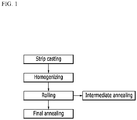
- the preparing of the rolled material by rolling the casting material may further include intermediate annealing the rolled material.
- the rolled material may be rolled at least two times, and annealing may be performed in the middle of the rolling.
- the intermediate annealing may be performed at a cumulative reduction ratio of 50 % or more of the rolled material.
- the cumulative reduction ratio is 50 % or more
- recrystallization may be generated and grown in a twin texture formed during rolling. Accordingly, the recrystallized grains may form a non-basal texture and contribute to the improvement of moldability of the magnesium alloy sheet.
- the immediate annealing may be performed in a temperature range of 300 to 500 °C.
- the immediate annealing may be performed for 30 to 600 min.
- a stress generated at the time of rolling may be sufficiently removed. More specifically, the stress may be relieved through recrystallization within a range not exceeding a melting temperature of the rolled material.
- a frequency of intermediate annealing is in a range of 1/6 to 1/8.
- the frequency of intermediate annealing indicates a ratio of a number of intermediate annealing to a total number of rolling times.
- relieving stress through intermediate annealing during rolling may be necessary.
- the final annealing of the rolled material may be performed.
- the final annealing of the rolled material may be performed in a temperature range of 350 to 500 °C.
- the final annealing may be performed for 30 to 600 min.
- Recrystallization may easily occur by performing the final annealing under the above conditions.
- the molten alloy was cast by a strip casting method to prepare a cast material.
- the cast material was subjected to homogenizing at 450 °C for 24 hours.
- the homogenized casting material was rolled at 300 °C, and in this case, the reduction ratio was 18 % per pass.
- intermediate annealing was performed. More specifically, the rolling and the intermediate annealing were performed under the conditions described in the following Table 2. In this case, the intermediate annealing was performed at 450 °C in the same manner, and only frequencies of rolling and intermediate annealing were different.
- a method of measuring Ericson values at room temperature is as follows.
- a magnesium alloy sheet was inserted between an upper die and a lower die, and then an external circumferential portion of the sheet was fixed with a force of 20 kN. Thereafter, the sheet was deformed at a rate of 5 to 20 mm/min using a spherical punch having a diameter of 20 mm. The punch was inserted until the plate was broken, and a deformation height of the plate was measured at the time of breaking.
- Table 1 Division Name Al (wt%) Zn (wt%) Ca (wt%) Mg (wt%) Inventive Material 1 AZX110.7 1 1 0.7 Bal.
- Inventive Material 2 AZX211 2 1 1 Bal.
- Example 3 Inventive Material 2 (AZX211) 0 174 250 14 6.2
- Example 6 1/8 161 249 25 8.1
- Table 2 shows physical properties of the magnesium alloy sheet using an inventive material satisfying components, and a composition of the magnesium alloy sheet and a comparative material not satisfying the same, according to the exemplary embodiment of the present invention.
- Comparative Example 3 in which a magnesium alloy sheet was formed using Comparative Material 2 in which calcium was excessively added, the moldability was remarkably deteriorated compared to Examples 1 to 7. Therefore, when calcium is excessively added as in Comparative Example 3, a large number of cracks are generated during rolling, and moldability and mechanical properties may be deteriorated.
- FIG. 2 shows comparison results of an Ericsson test at the room temperature according to Comparative Example 2, Example 6, and Example 7.
- Example 7 compared with Example 7, in Comparative Example 2, only the aluminum content did not satisfy the range according to the exemplary embodiment of the present invention.
- the magnesium alloy sheet was manufactured under the same condition for the frequency of intermediate annealing. As a result, as illustrated FIG. 2 , it can be visually confirmed that the deformation height of Comparative Example 2 is significantly smaller than that of Example 7.
- FIG. 3 illustrates a comparison of surface edge cracks of a magnesium alloy sheet manufactured by according to Comparative Example 2 and Example 7.
- Comparative Example 2 only the aluminum composition according to the exemplary embodiment of the present invention was not satisfied, and the magnesium alloy sheet was manufactured under the same conditions as in Example 7. Specifically, in Comparative Example 2 and Example 7, the intermediate annealing was carried out under the same conditions when the reduction ratio was 80 % or more, to manufacture the magnesium alloy sheet. As a result, a surface of Example 7 had a very small number of edge cracks, while a surface of Comparative Example 2 had surface edge cracks that could be visually confirmed.
- the number of edge cracks with respect to an area of the magnesium alloy sheet which has been final-annealed according to the exemplary embodiment of the present invention is 1 per 50 cm 2 or less.
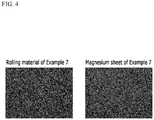
- FIG. 4 illustrates microtextures of a rolled material and a magnesium alloy sheet according to Example 7.
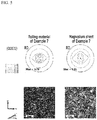
- FIG. 5 illustrates results of XRD observation of a change in texture of a ⁇ 0001 ⁇ plane in a rolled material and a magnesium alloy sheet according to Example 7, and an inverse pole figure (IPF) map through electron backscatter diffraction (EBSD).
- IPF inverse pole figure
- the magnesium alloy sheet finally annealed according to the exemplary embodiment of the present invention has an area fraction of 50 % or more of the recrystallized non-basal grains, as compared with a total area of 100 %.
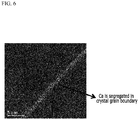
- FIG. 6 illustrates a state in which calcium is segregated in a form of a solute in crystal grain boundaries of Example 7.
Landscapes
- Chemical & Material Sciences (AREA)
- Engineering & Computer Science (AREA)
- Mechanical Engineering (AREA)
- Materials Engineering (AREA)
- Metallurgy (AREA)
- Organic Chemistry (AREA)
- Physics & Mathematics (AREA)
- Thermal Sciences (AREA)
- Crystallography & Structural Chemistry (AREA)
- Metal Rolling (AREA)
- Continuous Casting (AREA)
- Hard Magnetic Materials (AREA)
Abstract
Description
- An exemplary embodiment of the present invention relates to a magnesium alloy sheet and a manufacturing method thereof.
- Today, there are strict regulations on emissions of carbon dioxide in the international community. Accordingly, the vehicle industry is making efforts to reduce weight of a vehicle body. A most effective way to reduce vehicle body weight is to adopt lighter materials than steel, in general. An example of a lighter material is a magnesium plate. However, there are various barriers to the use of magnesium plates in the vehicle industry. A typical example of the barriers is moldability of the magnesium plate.
- Specifically, since the magnesium plate has an HCP structure and its deformation mechanism at room temperature is limited, room temperature molding is impossible. Several studies have been undertaken in order to overcome this problem. Particularly, methods for overcoming this problem through processes may include a differential speed rolling method in which rolling speeds of upper and low rolling rolls are differently controlled, an equal channel angular pressing (ECAR) process, a hot rolling method in which rolling is performed at a temperature that is close to a process temperature of the magnesium plate, and the like. However, all of these processes are difficult to commercialize.
- On the other hand, there are also techniques and patents to improve moldability through control of alloy components and composition. For example, a magnesium plate containing 1 to 10 wt% of Zn and 0.1 to 5 wt% of Ca may be used. However, there is a problem that it is difficult to apply a strip casting method to such an alloy. As a result, mass production is lacking, and even when casting is performed for a long time, a fusion phenomenon occurs between a cast material and a roll, thereby making casting difficult.
- In another example, a highly molded magnesium alloy sheet having a limit dome height of 7 mm or more may be formed through a process improvement of a conventional alloy having 3 wt% of Al, 1 wt% of Zn, and 1 wt% of Ca. However, in the above case, there is a disadvantage that intermediate annealing is performed at least once between rolling and rolling, and thus the process cost is greatly increased.
- The present invention has been made in an effort to provide a magnesium alloy sheet and a manufacturing method thereof.
- According to an exemplary embodiment of the present invention, a magnesium alloy sheet may include 0.5 to 2.1 wt% of Al, 0.5 to 1.5 wt% of Zn, 0.1 to 1.0 wt% of Ca, and a balance of Mg and inevitable impurities, with respect to a total of 100 wt% of the magnesium alloy sheet.
- The magnesium alloy sheet may further include 1 wt% or less of Mn with respect to the total of 100 wt% of the magnesium alloy sheet.
- The magnesium alloy sheet may have a calcium element segregated at grain boundaries.
- An area fraction of a non-basal grain may be 20 % or more with respect to a total area of 100 % of the magnesium alloy sheet.
- A microtexture of the magnesium alloy sheet may have a particle diameter of 5 to 20 µm.
- The magnesium alloy sheet may have a twin texture or a second phase, and an area fraction of the twin structure or the second phase may be 0 to 30 % with respect to the total area of 100 % of the magnesium alloy sheet.
- The magnesium alloy sheet may have an Erickson value of 4.5 mm or more at room temperature.
- According to another embodiment of the present invention, a manufacturing method of a magnesium alloy sheet may include: preparing a molten alloy containing 0.5 to 2.1 wt% of Al, 0.5 to 1.5 wt% of Zn, 0.1 to 1.0 wt% of Ca, and a balance of Mg and inevitable impurities, with respect to a total of 100 wt% of the molten alloy; preparing a casting material by casting the molten alloy; preparing a rolled material by rolling the casting material; and final annealing of the rolled material.
- In the preparing of the rolled material by rolling the casting material, rolling may be performed at a reduction ratio of 50 % or less (excluding 0 %) per rolling.
- Specifically, in the preparing of the rolled material by rolling the casting material, the casting material may be rolled once, twice, or more.
- More specifically, the rolling may be performed in a temperature range of 200 to 350 °C
- More specifically, the preparing of the rolled material by rolling the casting material may further include intermediate annealing of the rolled material.
- In the intermediate annealing of the rolled material, a number of intermediate annealing is in a range of 1/6 to 1/8. In this case, the number of intermediate annealing may be number of intermediate annealing/total number of rolling.
- In the intermediate annealing of the rolled material, the intermediate annealing may be performed at a cumulative reduction ratio of 50 % or more of the rolled material.
- Specifically, the immediate annealing may be performed in a temperature range of 300 to 500 °C.
- Specifically, the immediate annealing may be performed for 30 to 600 min.
- In the final annealing of the rolled material, the final annealing may be performed in a temperature range of 350 to 500 °C.
- Specifically, the final annealing may be performed for 30 to 600 min.
- According to an exemplary embodiment of the present invention, it is possible to provide a magnesium alloy sheet having excellent moldability, and a manufacturing method thereof. It is possible to provide an effective magnesium alloy plate which is commercially mass-producible, and a manufacturing method thereof.
- Specifically, excellent moldability may be achieved by controlling components and composition of a magnesium alloy, despite simplified process steps.
- More specifically, a magnesium alloy sheet material having excellent moldability at room temperature may be obtained by controlling Al compositions and Ca components even while reducing the number of the intermediate annealing.
-
-
FIG. 1 illustrates a process diagram of a manufacturing method of a magnesium alloy sheet according to an exemplary embodiment of the present invention. -
FIG. 2 illustrates comparison results of an Ericsson test at room temperature according to Comparative Example 2, Example 6, and Example 7. -
FIG. 3 illustrates surface edge cracks of a magnesium alloy sheet manufactured according to Comparative Example 2 and Example 7. -
FIG. 4 illustrates microtextures of a rolled material and a magnesium alloy sheet according to Example 7. -
FIG. 5 illustrates results of XRD observation of a change in texture of a {0001} plane in a rolled material and a magnesium alloy sheet according to Example 7 and an inverse pole figure (IPF) map through electron backscatter diffraction (EBSD). -
FIG. 6 illustrates a state in which calcium is segregated in a form of a solute in crystal grain boundaries of Example 7. - The advantages and features of the present invention and the methods for accomplishing the same will be apparent from the exemplary embodiments described hereinafter with reference to the accompanying drawings. However, the present invention is not limited to the exemplary embodiments described hereinafter, and may be embodied in many different forms. The following exemplary embodiments are provided to make the disclosure of the present invention complete and to allow those skilled in the art to clearly understand the scope of the present invention, and the present invention is defined only by the scope of the appended claims. Throughout the specification, the same reference numerals denote the same elements.
- In some exemplary embodiments, detailed description of well-known technologies will be omitted to prevent the disclosure of the present invention from being interpreted ambiguously. Unless otherwise defined, all terms (including technical and scientific terms) used herein have the same meaning as commonly understood by one of ordinary skill in the art. In addition, throughout the specification, unless explicitly described to the contrary, the word "comprise" and variations such as "comprises" or "comprising" will be understood to imply the inclusion of stated elements but not the exclusion of any other elements. Further, as used herein, the singular forms "a", "an", and "the" are intended to include the plural forms as well, unless the context clearly indicates otherwise.
- According to an exemplary embodiment of the present invention, a magnesium alloy sheet may include 0.5 to 2.1 wt% of Al, 0.5 to 1.5 wt% of Zn, 0.1 to 1.0 wt% of Ca, and a balance of Mg and inevitable impurities, with respect to a total of 100 wt% of the magnesium alloy sheet.
- Specifically, the magnesium alloy sheet may further include 1 wt% or less of Mn with respect to the total of 100 wt% of the magnesium alloy sheet.
- Hereinafter, reasons for limiting components and composition of the magnesium alloy sheet will be described.
- Al may be included in an amount of 0.5 to 2.1 wt%.
- Specifically, since aluminum plays a role of improving moldability at room temperature, casting through a strip casting method is possible. More specifically, when it is added in an amount exceeding 2.0 wt%, the moldability at room temperature may be rapidly deteriorated, and when it is added in an amount of less than 0.5 wt%, it may be difficult to expect the moldability at room temperature to be improved. More specifically, a texture changes to a strong basal texture in rolling during a rolling step of the manufacturing method of the magnesium alloy sheet to be described later. In this case, an apparatus for suppressing the change to the basal texture has a solute dragging effect. Such a solute dragging apparatus may deteriorate boundary mobility when heat or deformation is applied since an element such as Ca having a larger atomic radius than that of Mg is segregated in crystal grain boundaries. This may suppress basal texture from being formed by dynamic recrystallization or rolling deformation during rolling.
- Therefore, when aluminum is added in an amount exceeding 2.1 wt%, an amount of the second phase of Al2Ca may increase to reduce an amount of Ca segregated in the grain boundary. As a result, the solute dragging effect may also be reduced.
- On the other hand, when aluminum is added at less than 0.5 wt%, casting by the strip casting method may not be possible. Aluminum improves fluidity of molten metal, which prevents a roll sticking phenomenon during casting. Therefore, a Mg-Zn-based magnesium alloy without aluminum cannot be cast by strip casting due to the actual roll sticking phenomenon.
- Hereinafter, in the present specification, a non-basal grain indicates a non-basal grain formed by a basal slip phenomenon. Specifically, magnesium has an HCP crystal structure, and it is referred to as a basal grain only when a C-axis of the HCP has a direction parallel to a thickness direction of a rolled plate. Accordingly, the non-basal grain indicates that crystal grains in all directions are not parallel to the C-axis and the thickness direction.
- Zn may be included in an amount of 0.5 to 1.5 wt%.
- Specifically, similar to calcium, zinc serves to improve moldability of the plate by activating the basal slip through softening of a basal plane when added. However, when zinc is added in an amount exceeding 1.5 wt%, it forms an intermetallic compound by bonding with magnesium, which may adversely affect the moldability.
- Ca may be included in an amount of 0.1 to 1.0 wt%.
- Similar to zinc, calcium serves to improve moldability of the plate by activating the basal slip through softening of a basal plane when added.
- Specifically, in the manufacturing method of the magnesium alloy sheet to be described below, the texture has a characteristic of being changed into a strong base bottom aggregate structure upon rolling. An apparatus for suppressing the characteristic has a solute dragging effect. In this case, such a solute dragging apparatus may deteriorate boundary mobility when heat or deformation is applied since an element having a larger atomic radius than that of Mg is segregated in crystal grain boundaries. In this case, Ca may be used as an element having a larger atomic radius than Mg. This may suppress basal texture from being formed by dynamic recrystallization or rolling deformation during rolling.
- However, when it is added in an amount exceeding 1.0 wt%, the sticking phenomenon may be increased due to an increase in stickiness with a casting roll during strip casting. This may reduce the fluidity of molten metal to lower the casting, which reduces producibility.
- More specifically, the magnesium alloy sheet may further contain 1 wt% or less of Mn.
- Manganese forms an Fe-Mn compound to serve to reduce a content of the Fe component in the sheet. Therefore, when manganese is contained, the Fe-Mn compound may be formed as a dross or sludge in a molten alloy state before casting. This makes it possible to form a sheet having a small content of the Fe component during casting. In addition, manganese may form a second phase of Al8Mn5 together with aluminum.
- This suppresses an amount of calcium consumed to increase an amount of calcium that can segregate in grain boundaries. Thus, when manganese is added, the solute dragging effect may be further improved.
- Accordingly, manganese may be contained in an amount of 1 wt% or less. Specifically, when the manganese is excessively added, an Al-Mn second phase during casting may be excessive to increase an amount of solidification at the nozzle. As a result, inverse segregation in a cast material may be increased.
- The magnesium alloy sheet may have a calcium element segregated at grain boundaries. In this case, the calcium element may be crystallized in a solute form rather than an intermetallic compound form.
- Specifically, calcium may be solid-solved without forming a second phase with an element such as aluminum, and is segregated in the grain boundary in a solute form, thereby suppressing formation of a basal texture by reducing the boundary mobility. As a result, it is possible to provide a magnesium alloy sheet with excellent moldability at room temperature.
- An area fraction of a non-basal grain may be 20 % or more with respect to a total area of 100 % of the magnesium alloy sheet.
- As described above, according to the exemplary embodiment of the present invention, it is possible to provide a magnesium alloy sheet having excellent moldability at room temperature by suppressing formation of a basal texture and activating slip of the non-basal grain. Accordingly, an area fraction of a non-basal grain may be 20 % or more with respect to a total area of 100 % of the magnesium alloy sheet. Specifically, it may be 50 % or more.
- A substantially formation degree of the non-basal grain is known from XRD data.
- Specifically, it can be determined whether a number of basal grains is large or small, through numerical values appearing in the XRD-pole figure measurement. More specifically, the greater the numerical value, the greater the number of the basal grains. The numerical value is referred to as peak intensity, and the magnesium alloy sheet according to the exemplary embodiment of the present invention may have a peak intensity value of 5 or less. In addition, when the peak intensity value is 0, this indicates that an orientation of each crystal grain is different, rather than a specific orientation group.
- Accordingly, the magnesium alloy sheet according to the exemplary embodiment of the present invention may have a peak intensity value of more than 0 and 5 or less.
- The number of edge cracks with respect to a length in a rolling direction of the magnesium alloy sheet may be 1 per 50 cm or less.
- In the exemplary embodiment of the present invention, an edge crack indicates a groove having a depth of 5 cm formed on a surface of the magnesium alloy plate.
- A microtexture of the magnesium alloy sheet may have a particle diameter of 5 to 20 µm.
- The magnesium alloy sheet may have a twin texture or a second phase, and an area fraction of the twin structure or the second phase may be 0 to 30 % with respect to the total area of 100 % of the magnesium alloy sheet.
- Specifically, although the magnesium alloy sheet may have the twin texture or the second phase, the moldability at room temperature may be improved by controlling the fraction of the texture to a minimum as in the above range.
- Accordingly, the magnesium alloy sheet may have an Erickson value of 4.5 mm or more at room temperature.
- In this specification, an Erickson value indicates an experimental value derived from an Ericsson test at room temperature. Specifically, the moldability of the examples and comparative examples of the present invention may also be compared with a value through the room temperature Ericsson test.
- More specifically, the Erickson value indicates a height at which a sheet is deformed until a fracture occurs, when the sheet is deformed into a cup shape. Accordingly, the higher the deformation height of the magnesium alloy sheet, the greater the Ericsson number. Accordingly, the moldability may be excellent.
- According to another embodiment of the present invention, a manufacturing method of a magnesium alloy sheet may include: preparing a molten alloy containing 0.5 to 2.0 wt% of Al, 0.5 to 1.5 wt% of Zn, 0.1 to 1.0 wt% of Ca, and a balance of Mg and inevitable impurities, with respect to a total of 100 wt%; preparing a casting material by casting the molten alloy; preparing a rolled material by rolling the casting material; and final annealing of the rolled material.
- First, the preparing of the molten alloy containing 0.5 to 2.1 wt% of Al, 0.5 to 1.5 wt% of Zn, 0.1 to 1.0 wt% of Ca, and a balance of Mg and inevitable impurities, with respect to a total of 100 wt%, may be performed.
- Specifically, in the step, 0.3 to 0.5 wt% of Mn, with respect to the total of 100 wt% of the molten alloy, may be further included.
- A reason for limiting components and composition of the molten alloy is the same as the reason for limiting the components and composition of the magnesium alloy sheet, and thus a description thereof will be omitted.
- Thereafter, the preparing of the casting material by casting the molten alloy may be performed.
- In this case, a casting method for preparing the casting material may include methods such as die casting, direct chill casting, billet casting, centrifugal casting, tungsten casting, mold gravity casting, sand casting, strip casting, and a combination thereof. However, the present invention is not limited thereto. Specifically, it may be cast by the strip casting method. More specifically, the molten alloy may be cast at a casting rate of 0.5 to 10 mpm.
- A thickness of the cast material thus produced may be in a range of 3 to 6 mm, but the present invention is not limited thereto.
- Specifically, the preparing of the casting material by casting the molten alloy may include homogenizing the casting material.
- The homogenizing of the casting material may be performed in a temperature range of 350 to 500 °C.
- Specifically, the homogenizing may be performed for 1 to 30 hours.
- As such, it is possible to eliminate defects generated during casting by performing the homogenizing of the cast material depending on the above-described conditions. Specifically, since segregation and defects are mixed inside and outside of the cast magnesium sheet, cracks are likely to occur during rolling. Thus, the homogenizing may be performed to remove defects. Accordingly, defects such as edge cracks on the surface may be prevented in a rolling step to be described later by performing the homogenization heat treatment under the above conditions.
- Thereafter, the preparing of the rolled material by rolling the casting material may be performed.
- In the preparing of the rolled material by rolling the casting material, rolling may be performed at a reduction ratio of 50 % or less (excluding 0 %) per rolling. Specifically, when the reduction ratio per rolling exceeds 50 %, a crack may occur during rolling.
- Herein, the reduction ratio in this specification indicates a difference between a thickness of the material before passing through the rolling roll during rolling and a thickness of the material after passing through the rolling roll, divided by the thickness of the material before passing through the rolling roll, and then multiplied by 100.
- Specifically, the rolling may be performed in a temperature range of 200 to 350 °C
- More specifically, when rolled at less than 200 °C, the temperature may be too low to cause the crack. On the other hand, when rolling at a temperature higher than 350 ° C, atoms are likely to be diffused at high temperatures, so segregation of grain boundaries of Ca is suppressed, which may be disadvantageous for improvement of moldability.
- Specifically, the casting material may be rolled once, twice, or more.
- More specifically, the preparing of the rolled material by rolling the casting material may further include intermediate annealing the rolled material.
- The rolled material may be rolled at least two times, and annealing may be performed in the middle of the rolling.
- The intermediate annealing may be performed at a cumulative reduction ratio of 50 % or more of the rolled material. When the intermediate annealing is carried out when the cumulative reduction ratio is 50 % or more, recrystallization may be generated and grown in a twin texture formed during rolling. Accordingly, the recrystallized grains may form a non-basal texture and contribute to the improvement of moldability of the magnesium alloy sheet.
- The immediate annealing may be performed in a temperature range of 300 to 500 °C. The immediate annealing may be performed for 30 to 600 min.
- When the intermediate annealing is performed under the above conditions, a stress generated at the time of rolling may be sufficiently removed. More specifically, the stress may be relieved through recrystallization within a range not exceeding a melting temperature of the rolled material.
- In the intermediate annealing of the rolled material, a frequency of intermediate annealing is in a range of 1/6 to 1/8. In this case, the frequency of intermediate annealing indicates a ratio of a number of intermediate annealing to a total number of rolling times.
- Specifically, relieving stress through intermediate annealing during rolling may be necessary. However, according to the exemplary embodiment of the present invention, it is possible to effectively relieve the stress in the rolled material through a low frequency of intermediate annealing as described above.
- Finally, the final annealing of the rolled material may be performed.
- The final annealing of the rolled material may be performed in a temperature range of 350 to 500 °C.
- Specifically, the final annealing may be performed for 30 to 600 min.
- Recrystallization may easily occur by performing the final annealing under the above conditions.
- Hereinafter, the details will be described with reference to examples. The following examples are illustrative of the present invention and are not intended to limit the scope of the present invention.
- First, a molten alloy satisfying components and compositions shown in Table 1 below was prepared.
- Thereafter, the molten alloy was cast by a strip casting method to prepare a cast material.
- The cast material was subjected to homogenizing at 450 °C for 24 hours.
- Then, the homogenized casting material was rolled at 300 °C, and in this case, the reduction ratio was 18 % per pass. Specifically, when rolling was performed twice or more, intermediate annealing was performed. More specifically, the rolling and the intermediate annealing were performed under the conditions described in the following Table 2. In this case, the intermediate annealing was performed at 450 °C in the same manner, and only frequencies of rolling and intermediate annealing were different.
- Thereafter, the rolled material was subjected to the final annealing at 400 °C for 1 hour.
- As a result, physical properties of the formed magnesium alloy sheet material are as shown in Table 2 below.
- In this case, a method of measuring Ericson values at room temperature is as follows.
- A magnesium alloy sheet was inserted between an upper die and a lower die, and then an external circumferential portion of the sheet was fixed with a force of 20 kN. Thereafter, the sheet was deformed at a rate of 5 to 20 mm/min using a spherical punch having a diameter of 20 mm. The punch was inserted until the plate was broken, and a deformation height of the plate was measured at the time of breaking.
(Table 1) Division Name Al (wt%) Zn (wt%) Ca (wt%) Mg (wt%) Inventive Material 1 AZX110.7 1 1 0.7 Bal. Inventive Material 2AZX211 2 1 1 Bal. Inventive Material 3 AZX210.7 2 1 0.7 Bal. Comparative Material 1 AZX311 3 1 1 Bal. Comparative Material 2AZX112,212 1 1 2 Bal. (Table 2) Division Name Number of Intermediate Annealing Yield Strength (MPa) Tensile Strength (Mpa) Elongation (%) Ericsson value (mm) Example 1 Inventive Material 1 (AZX110.7) 0 166 237 20 4.5 Example 2 1/8 164 235 25 8.3 Example 3 Inventive Material 2 (AZX211) 0 174 250 14 6.2 Example 4 1/8 163 248 24 7.7 Example 5 Inventive Material 3 (AZX210.7) 0 167 250 16 6.5 Example 6 1/8 161 249 25 8.1 Example 7 1/7 160 249 28 9.8 Comparative Example 1 Comparative Material 1 (AZX311) 0 235 288 10 3.8 Comparative Example 2 1/7 189 266 15 4.0 Comparative Example 3 Comparative Material 2 (AZX112,212) 1/5-1/2 134 221 3 3-4 - Table 2 shows physical properties of the magnesium alloy sheet using an inventive material satisfying components, and a composition of the magnesium alloy sheet and a comparative material not satisfying the same, according to the exemplary embodiment of the present invention.
- Specifically, it can be seen that moldability is remarkably high in the case of Comparative Examples 1 to 3 in which a magnesium alloy sheet was formed using Comparative Material 1 in which aluminum was excessively added, as compared with Examples 3 and 4 only having a different aluminum composition.
- In addition, in Comparative Example 3 in which a magnesium alloy sheet was formed using
Comparative Material 2 in which calcium was excessively added, the moldability was remarkably deteriorated compared to Examples 1 to 7. Therefore, when calcium is excessively added as in Comparative Example 3, a large number of cracks are generated during rolling, and moldability and mechanical properties may be deteriorated. - Specifically, in the case of Examples 1 to 7, which satisfy all the components and the composition of the magnesium alloy sheet and the frequency of intermediate annealing according to the exemplary embodiment of the present invention, it can be seen that even when the intermediate annealing is not performed (Example 1), an Erickson value of at least 4.5 mm is exhibited, which is superior in moldability to the comparative example (Comparative Example 3) in which the intermediate annealing is performed. In other words, excellent moldability is confirmed even though the frequency of intermediate annealing was lower than that of the comparative examples.
- This may also be confirmed through the drawings.
-
FIG. 2 shows comparison results of an Ericsson test at the room temperature according to Comparative Example 2, Example 6, and Example 7. - As illustrated in
FIG. 2 , compared with Example 7, in Comparative Example 2, only the aluminum content did not satisfy the range according to the exemplary embodiment of the present invention. The magnesium alloy sheet was manufactured under the same condition for the frequency of intermediate annealing. As a result, as illustratedFIG. 2 , it can be visually confirmed that the deformation height of Comparative Example 2 is significantly smaller than that of Example 7. - In addition, it can be confirmed that the deformation height of the magnesium alloy sheet in Comparative Example 2 is smaller than that in Example 6 in which the frequency of intermediate annealing is small. As a result, it can be visually confirmed that the moldability of the examples is excellent.
- In addition, it can be confirmed from
FIG. 3 that surface defects in Comparative Example 2 are also deteriorated as compared with those in Example 7. -
FIG. 3 illustrates a comparison of surface edge cracks of a magnesium alloy sheet manufactured by according to Comparative Example 2 and Example 7. - In Comparative Example 2, only the aluminum composition according to the exemplary embodiment of the present invention was not satisfied, and the magnesium alloy sheet was manufactured under the same conditions as in Example 7. Specifically, in Comparative Example 2 and Example 7, the intermediate annealing was carried out under the same conditions when the reduction ratio was 80 % or more, to manufacture the magnesium alloy sheet. As a result, a surface of Example 7 had a very small number of edge cracks, while a surface of Comparative Example 2 had surface edge cracks that could be visually confirmed.
- Accordingly, it can be seen that the number of edge cracks with respect to an area of the magnesium alloy sheet which has been final-annealed according to the exemplary embodiment of the present invention is 1 per 50 cm2 or less.
-
FIG. 4 illustrates microtextures of a rolled material and a magnesium alloy sheet according to Example 7. - As shown in
FIG. 4 , it can be confirmed that a large amount of twin texture and second phase texture are distributed throughout the rolled material of Example 7. On the other hand, in the magnesium alloy sheet of Example 7 which was final-annealed by the final annealing according to the exemplary embodiment of the present invention, most of the twin texture was annihilated, and a new crystal grain was formed therefrom. - This may also be confirmed through
FIG. 5 . -
FIG. 5 illustrates results of XRD observation of a change in texture of a {0001} plane in a rolled material and a magnesium alloy sheet according to Example 7, and an inverse pole figure (IPF) map through electron backscatter diffraction (EBSD). - As shown in
FIG. 5 , it can be seen that a large number of recrystallized non-basal grains deviating from a basal orientation were formed in the magnesium alloy sheet material of Example 7 as compared with the rolled material of Example 7. As a result, it can be seen that a peak intensity value is lower than that of the rolled material. - It can also be confirmed from the EBSD that the distribution of the recrystallized non-basal grains was increased in the case of the magnesium alloy sheet of Example 7 as compared with the rolled material of Example 7. In other words, it can be seen that the magnesium alloy sheet finally annealed according to the exemplary embodiment of the present invention has an area fraction of 50 % or more of the recrystallized non-basal grains, as compared with a total area of 100 %.
-
FIG. 6 illustrates a state in which calcium is segregated in a form of a solute in crystal grain boundaries of Example 7. - This is because, as calcium is segregated in the crystal grain boundaries in a form as disclosed in
FIG. 6 , boundary mobility is lowered, to facilitate forming the recrystallized non-basal grains. - Accordingly, it is possible to obtain a magnesium alloy sheet material having excellent formability even when the frequency of intermediate annealing is low, by controlling the components of aluminum and calcium according to the exemplary embodiment of the present invention. Therefore, it is possible to provide a manufacturing method of a magnesium alloy sheet capable of mass production and capable of reducing the process cost in mass production.
- While the exemplary embodiments of the present invention have been described hereinbefore with reference to the accompanying drawings, it will be understood by those skilled in the art that various changes in form and details may be made thereto without departing from the technical spirit and essential features of the present invention.
- Therefore, it is to be understood that the above-described exemplary embodiments are for illustrative purposes only and the scope of the present invention is not limited thereto. The scope of the present invention is determined not by the above description, but by the following claims, and all changes or modifications from the spirit, scope, and equivalents of claims should be construed as being included in the scope of the present invention.
Claims (18)
- A magnesium alloy sheet comprising:
0.5 to 2.1 wt% of Al, 0.5 to 1.5 wt% of Zn, 0.1 to 1.0 wt% of Ca, and a balance of Mg and inevitable impurities, with respect to a total of 100 wt% of the magnesium alloy sheet. - The magnesium alloy sheet of claim 1, further comprising
1 wt% or less of Mn with respect to the total of 100 wt% of the magnesium alloy sheet. - The magnesium alloy sheet of claim 2, wherein
the magnesium alloy sheet has a calcium element segregated at grain boundaries. - The magnesium alloy sheet of claim 3, wherein
An area fraction of a non-basal grain is 20 % or more with respect to a total area of 100 % of the magnesium alloy sheet. - The magnesium alloy sheet of claim 4, wherein
a microtexture of the magnesium alloy sheet has a particle diameter of 5 to 20 µm. - The magnesium alloy sheet of claim 5, wherein
the magnesium alloy sheet has a twin texture or a second phase, and
an area fraction of the twin structure or the second phase is 0 to 30 % with respect to the total area of 100 % of the magnesium alloy sheet. - The magnesium alloy sheet of claim 6, wherein
the magnesium alloy sheet has an Erickson value of 4.5 mm or more at room temperature. - A manufacturing method of a magnesium alloy sheet, the method comprising:preparing a molten alloy containing 0.5 to 2.1 wt% of Al, 0.5 to 1.5 wt% of Zn, 0.1 to 1.0 wt% of Ca, and a balance of Mg and inevitable impurities, with respect to a total of 100 wt% of the molten alloy;preparing a casting material by casting the molten alloy;preparing a rolled material by rolling the casting material; andfinal annealing of the rolled material.
- The manufacturing method of claim 8, wherein
in the preparing of the rolled material by rolling the casting material,
rolling is performed at a reduction ratio of 50 % or less (excluding 0 %) per rolling. - The manufacturing method of claim 9, wherein
in the preparing of the rolled material by rolling the casting material,
the casting material is rolled once, twice, or more. - The manufacturing method of claim 10, wherein
in the preparing of the rolled material by rolling the casting material,
the rolling is performed in a temperature range of 200 to 350 °C. - The manufacturing method of claim 11, wherein
the preparing of the rolled material by rolling the casting material includes intermediate annealing of the rolled material. - The manufacturing method of claim 12, wherein
in the intermediate annealing of the rolled material,
a number of intermediate annealing is in a range of 1/6 to 1/8,
wherein the number of intermediate annealing = number of intermediate annealing/total number of rolling. - The manufacturing method of claim 13, wherein
in the intermediate annealing of the rolled material,
the intermediate annealing is performed at a cumulative reduction ratio of 50 % or more of the rolled material. - The manufacturing method of claim 14, wherein
in the intermediate annealing of the rolled material,
the intermediate annealing is performed in a temperature range of 300 to 500 °C. - The manufacturing method of claim 15, wherein
in the intermediate annealing of the rolled material,
the intermediate annealing is performed for 30 to 600 min. - The manufacturing method of claim 8, wherein
in the final annealing of the rolled material,
the final annealing is performed in a temperature range of 350 to 500 °C. - The manufacturing method of claim 17, wherein
in the final annealing of the rolled material,
the final annealing is performed for 30 to 600 min.
Applications Claiming Priority (2)
| Application Number | Priority Date | Filing Date | Title |
|---|---|---|---|
| KR1020160177010 | 2016-12-22 | ||
| PCT/KR2017/015262 WO2018117695A1 (en) | 2016-12-22 | 2017-12-21 | Magnesium alloy sheet and method for manufacturing same |
Publications (3)
| Publication Number | Publication Date |
|---|---|
| EP3561095A4 EP3561095A4 (en) | 2019-10-30 |
| EP3561095A1 true EP3561095A1 (en) | 2019-10-30 |
| EP3561095B1 EP3561095B1 (en) | 2023-06-14 |
Family
ID=62626909
Family Applications (1)
| Application Number | Title | Priority Date | Filing Date |
|---|---|---|---|
| EP17882817.4A Active EP3561095B1 (en) | 2016-12-22 | 2017-12-21 | Method for manufacturing magnesium alloy sheet |
Country Status (5)
| Country | Link |
|---|---|
| US (1) | US11268178B2 (en) |
| EP (1) | EP3561095B1 (en) |
| JP (1) | JP7125416B2 (en) |
| CN (1) | CN110114486B (en) |
| WO (1) | WO2018117695A1 (en) |
Families Citing this family (3)
| Publication number | Priority date | Publication date | Assignee | Title |
|---|---|---|---|---|
| JP7116394B2 (en) * | 2017-02-28 | 2022-08-10 | 国立研究開発法人物質・材料研究機構 | Magnesium alloy and method for producing magnesium alloy |
| KR102043786B1 (en) * | 2017-12-26 | 2019-11-12 | 주식회사 포스코 | Magnesium alloy sheet and method for manufacturing the same |
| CN114561579A (en) * | 2022-03-03 | 2022-05-31 | 上海康德莱医疗器械股份有限公司 | Biodegradable magnesium alloy without rare earth elements and preparation method and application thereof |
Family Cites Families (18)
| Publication number | Priority date | Publication date | Assignee | Title |
|---|---|---|---|---|
| JP2002129272A (en) | 2000-10-31 | 2002-05-09 | Ahresty Corp | Magnesium alloy for diecasting |
| KR100509648B1 (en) * | 2003-05-23 | 2005-08-24 | 연우인더스트리(주) | High formability the Magnesium alloy and manufacture method of the Magnesium alloy product thereof |
| AU2005258658B8 (en) * | 2004-06-30 | 2011-03-10 | Sumitomo Electric Industries, Ltd. | Method of Producing a Magnesium-Alloy Material |
| JP4306547B2 (en) | 2004-06-30 | 2009-08-05 | 住友電気工業株式会社 | Magnesium alloy plate and manufacturing method thereof |
| CN1743486A (en) * | 2004-08-31 | 2006-03-08 | 唐智荣 | Alloy as magnesium element as matrix and its use as bone-fracture internal fixer |
| JP4780601B2 (en) | 2004-11-18 | 2011-09-28 | 三菱アルミニウム株式会社 | Magnesium alloy plate excellent in press formability and manufacturing method thereof |
| KR101078308B1 (en) * | 2008-05-19 | 2011-10-31 | 포항공과대학교 산학협력단 | Magnesium alloy panel having high strength and manufacturing method for the same |
| KR20100106137A (en) | 2009-03-23 | 2010-10-01 | 주식회사 지알로이테크놀로지 | Mg-zn base wrought magnesium alloys having superior formability at a high strain rate and low temperature and manufacturing method of the alloy sheet |
| JP5606709B2 (en) | 2009-09-10 | 2014-10-15 | 公立大学法人大阪府立大学 | Magnesium alloy rolled material and method for producing the same |
| JP5590660B2 (en) | 2010-03-01 | 2014-09-17 | 独立行政法人産業技術総合研究所 | Magnesium alloy sheet with improved cold formability and in-plane anisotropy and method for producing the same |
| KR101303585B1 (en) | 2010-11-23 | 2013-09-11 | 포항공과대학교 산학협력단 | Magnesium alloy sheet having excellent room temperature formability and method of fabricating the same |
| JP5880811B2 (en) | 2011-06-22 | 2016-03-09 | 住友電気工業株式会社 | Magnesium alloy cast material, magnesium alloy cast coil material, magnesium alloy wrought material, magnesium alloy joint material, method for producing magnesium alloy cast material, method for producing magnesium alloy wrought material, and method for producing magnesium alloy member |
| KR101626820B1 (en) | 2013-12-05 | 2016-06-02 | 주식회사 포스코 | magnesium-alloy plate and manufacturing method of it |
| KR20150099025A (en) | 2014-02-21 | 2015-08-31 | 서울대학교산학협력단 | Magnesium alloy sheet and method for the same |
| KR101585089B1 (en) | 2014-06-17 | 2016-01-22 | 한국생산기술연구원 | High ignition-resistance with high-strength magnesium alloy and method of manufacturing the same |
| KR20170075407A (en) | 2015-12-23 | 2017-07-03 | 주식회사 포스코 | Magnesium alloy sheet, method for manufacturing the same |
| KR102043287B1 (en) * | 2017-12-26 | 2019-11-11 | 주식회사 포스코 | Magnesium alloy sheet and method for manufacturing the same |
| KR102043786B1 (en) * | 2017-12-26 | 2019-11-12 | 주식회사 포스코 | Magnesium alloy sheet and method for manufacturing the same |
-
2017
- 2017-12-21 CN CN201780080377.4A patent/CN110114486B/en active Active
- 2017-12-21 WO PCT/KR2017/015262 patent/WO2018117695A1/en not_active Ceased
- 2017-12-21 EP EP17882817.4A patent/EP3561095B1/en active Active
- 2017-12-21 US US16/470,733 patent/US11268178B2/en active Active
- 2017-12-21 JP JP2019552440A patent/JP7125416B2/en active Active
Also Published As
| Publication number | Publication date |
|---|---|
| JP2020503461A (en) | 2020-01-30 |
| EP3561095B1 (en) | 2023-06-14 |
| US11268178B2 (en) | 2022-03-08 |
| CN110114486A (en) | 2019-08-09 |
| US20200087767A1 (en) | 2020-03-19 |
| EP3561095A4 (en) | 2019-10-30 |
| JP7125416B2 (en) | 2022-08-24 |
| WO2018117695A1 (en) | 2018-06-28 |
| CN110114486B (en) | 2022-05-13 |
Similar Documents
| Publication | Publication Date | Title |
|---|---|---|
| EP3395458B1 (en) | Magnesium alloy sheet and method for manufacturing same | |
| JP6176393B2 (en) | High-strength aluminum alloy plate with excellent bending workability and shape freezing property | |
| JP5233607B2 (en) | Aluminum alloy plate excellent in formability and method for producing the same | |
| KR102043774B1 (en) | High formability magnesium alloy sheet and method for manufacturing the same | |
| KR101626820B1 (en) | magnesium-alloy plate and manufacturing method of it | |
| EP3561095B1 (en) | Method for manufacturing magnesium alloy sheet | |
| JP7274585B2 (en) | Magnesium alloy plate and manufacturing method thereof | |
| KR20150099025A (en) | Magnesium alloy sheet and method for the same | |
| KR20190000756A (en) | Magnesium alloy sheet having high room temperature formability and high strength and method for fabrication | |
| EP3733889B1 (en) | Magnesium alloy sheet and method for producing same | |
| KR101937928B1 (en) | Magnesium alloy sheet and method for manufacturing the same | |
| JP6778615B2 (en) | Aluminum alloy plate for superplastic molding and its manufacturing method | |
| JP3867569B2 (en) | Aluminum foil for containers and manufacturing method thereof | |
| KR101977830B1 (en) | Magnesium alloy sheet | |
| JPH09272938A (en) | Aluminum foil and manufacturing method thereof | |
| KR102043287B1 (en) | Magnesium alloy sheet and method for manufacturing the same | |
| JP6809363B2 (en) | High-strength aluminum alloy plate with excellent formability, bendability and shape freezing property and its manufacturing method | |
| EP3561096B1 (en) | Magnesium alloy plate and method for manufacturing same | |
| KR20170000098A (en) | High strength, high formability magnesium alloy sheet and method for the same | |
| KR102252289B1 (en) | Magnesium alloy sheet and manufacturing method of the same | |
| KR102045063B1 (en) | Magnesium alloy sheet and method for manufacturing the same | |
| KR20160120688A (en) | Magnesium alloy sheet and method for the same | |
| KR20200036420A (en) | Magnesium alloy sheet and method for manufacturing the same |
Legal Events
| Date | Code | Title | Description |
|---|---|---|---|
| STAA | Information on the status of an ep patent application or granted ep patent |
Free format text: STATUS: THE INTERNATIONAL PUBLICATION HAS BEEN MADE |
|
| PUAI | Public reference made under article 153(3) epc to a published international application that has entered the european phase |
Free format text: ORIGINAL CODE: 0009012 |
|
| STAA | Information on the status of an ep patent application or granted ep patent |
Free format text: STATUS: REQUEST FOR EXAMINATION WAS MADE |
|
| 17P | Request for examination filed |
Effective date: 20190709 |
|
| A4 | Supplementary search report drawn up and despatched |
Effective date: 20190823 |
|
| AK | Designated contracting states |
Kind code of ref document: A1 Designated state(s): AL AT BE BG CH CY CZ DE DK EE ES FI FR GB GR HR HU IE IS IT LI LT LU LV MC MK MT NL NO PL PT RO RS SE SI SK SM TR |
|
| AX | Request for extension of the european patent |
Extension state: BA ME |
|
| DAV | Request for validation of the european patent (deleted) | ||
| DAX | Request for extension of the european patent (deleted) | ||
| STAA | Information on the status of an ep patent application or granted ep patent |
Free format text: STATUS: EXAMINATION IS IN PROGRESS |
|
| 17Q | First examination report despatched |
Effective date: 20200810 |
|
| RAP3 | Party data changed (applicant data changed or rights of an application transferred) |
Owner name: POSCO HOLDINGS INC. |
|
| GRAP | Despatch of communication of intention to grant a patent |
Free format text: ORIGINAL CODE: EPIDOSNIGR1 |
|
| STAA | Information on the status of an ep patent application or granted ep patent |
Free format text: STATUS: GRANT OF PATENT IS INTENDED |
|
| INTG | Intention to grant announced |
Effective date: 20230109 |
|
| RAP1 | Party data changed (applicant data changed or rights of an application transferred) |
Owner name: POSCO CO., LTD |
|
| GRAS | Grant fee paid |
Free format text: ORIGINAL CODE: EPIDOSNIGR3 |
|
| GRAA | (expected) grant |
Free format text: ORIGINAL CODE: 0009210 |
|
| STAA | Information on the status of an ep patent application or granted ep patent |
Free format text: STATUS: THE PATENT HAS BEEN GRANTED |
|
| AK | Designated contracting states |
Kind code of ref document: B1 Designated state(s): AL AT BE BG CH CY CZ DE DK EE ES FI FR GB GR HR HU IE IS IT LI LT LU LV MC MK MT NL NO PL PT RO RS SE SI SK SM TR |
|
| REG | Reference to a national code |
Ref country code: CH Ref legal event code: EP |
|
| REG | Reference to a national code |
Ref country code: DE Ref legal event code: R096 Ref document number: 602017070321 Country of ref document: DE |
|
| REG | Reference to a national code |
Ref country code: AT Ref legal event code: REF Ref document number: 1579281 Country of ref document: AT Kind code of ref document: T Effective date: 20230715 |
|
| REG | Reference to a national code |
Ref country code: LT Ref legal event code: MG9D |
|
| REG | Reference to a national code |
Ref country code: NL Ref legal event code: MP Effective date: 20230614 |
|
| PG25 | Lapsed in a contracting state [announced via postgrant information from national office to epo] |
Ref country code: SE Free format text: LAPSE BECAUSE OF FAILURE TO SUBMIT A TRANSLATION OF THE DESCRIPTION OR TO PAY THE FEE WITHIN THE PRESCRIBED TIME-LIMIT Effective date: 20230614 Ref country code: NO Free format text: LAPSE BECAUSE OF FAILURE TO SUBMIT A TRANSLATION OF THE DESCRIPTION OR TO PAY THE FEE WITHIN THE PRESCRIBED TIME-LIMIT Effective date: 20230914 Ref country code: ES Free format text: LAPSE BECAUSE OF FAILURE TO SUBMIT A TRANSLATION OF THE DESCRIPTION OR TO PAY THE FEE WITHIN THE PRESCRIBED TIME-LIMIT Effective date: 20230614 |
|
| REG | Reference to a national code |
Ref country code: AT Ref legal event code: MK05 Ref document number: 1579281 Country of ref document: AT Kind code of ref document: T Effective date: 20230614 |
|
| PG25 | Lapsed in a contracting state [announced via postgrant information from national office to epo] |
Ref country code: RS Free format text: LAPSE BECAUSE OF FAILURE TO SUBMIT A TRANSLATION OF THE DESCRIPTION OR TO PAY THE FEE WITHIN THE PRESCRIBED TIME-LIMIT Effective date: 20230614 Ref country code: NL Free format text: LAPSE BECAUSE OF FAILURE TO SUBMIT A TRANSLATION OF THE DESCRIPTION OR TO PAY THE FEE WITHIN THE PRESCRIBED TIME-LIMIT Effective date: 20230614 Ref country code: LV Free format text: LAPSE BECAUSE OF FAILURE TO SUBMIT A TRANSLATION OF THE DESCRIPTION OR TO PAY THE FEE WITHIN THE PRESCRIBED TIME-LIMIT Effective date: 20230614 Ref country code: LT Free format text: LAPSE BECAUSE OF FAILURE TO SUBMIT A TRANSLATION OF THE DESCRIPTION OR TO PAY THE FEE WITHIN THE PRESCRIBED TIME-LIMIT Effective date: 20230614 Ref country code: HR Free format text: LAPSE BECAUSE OF FAILURE TO SUBMIT A TRANSLATION OF THE DESCRIPTION OR TO PAY THE FEE WITHIN THE PRESCRIBED TIME-LIMIT Effective date: 20230614 Ref country code: GR Free format text: LAPSE BECAUSE OF FAILURE TO SUBMIT A TRANSLATION OF THE DESCRIPTION OR TO PAY THE FEE WITHIN THE PRESCRIBED TIME-LIMIT Effective date: 20230915 |
|
| PG25 | Lapsed in a contracting state [announced via postgrant information from national office to epo] |
Ref country code: FI Free format text: LAPSE BECAUSE OF FAILURE TO SUBMIT A TRANSLATION OF THE DESCRIPTION OR TO PAY THE FEE WITHIN THE PRESCRIBED TIME-LIMIT Effective date: 20230614 |
|
| PG25 | Lapsed in a contracting state [announced via postgrant information from national office to epo] |
Ref country code: SK Free format text: LAPSE BECAUSE OF FAILURE TO SUBMIT A TRANSLATION OF THE DESCRIPTION OR TO PAY THE FEE WITHIN THE PRESCRIBED TIME-LIMIT Effective date: 20230614 |
|
| PG25 | Lapsed in a contracting state [announced via postgrant information from national office to epo] |
Ref country code: IS Free format text: LAPSE BECAUSE OF FAILURE TO SUBMIT A TRANSLATION OF THE DESCRIPTION OR TO PAY THE FEE WITHIN THE PRESCRIBED TIME-LIMIT Effective date: 20231014 |
|
| PG25 | Lapsed in a contracting state [announced via postgrant information from national office to epo] |
Ref country code: SM Free format text: LAPSE BECAUSE OF FAILURE TO SUBMIT A TRANSLATION OF THE DESCRIPTION OR TO PAY THE FEE WITHIN THE PRESCRIBED TIME-LIMIT Effective date: 20230614 Ref country code: SK Free format text: LAPSE BECAUSE OF FAILURE TO SUBMIT A TRANSLATION OF THE DESCRIPTION OR TO PAY THE FEE WITHIN THE PRESCRIBED TIME-LIMIT Effective date: 20230614 Ref country code: RO Free format text: LAPSE BECAUSE OF FAILURE TO SUBMIT A TRANSLATION OF THE DESCRIPTION OR TO PAY THE FEE WITHIN THE PRESCRIBED TIME-LIMIT Effective date: 20230614 Ref country code: PT Free format text: LAPSE BECAUSE OF FAILURE TO SUBMIT A TRANSLATION OF THE DESCRIPTION OR TO PAY THE FEE WITHIN THE PRESCRIBED TIME-LIMIT Effective date: 20231016 Ref country code: IS Free format text: LAPSE BECAUSE OF FAILURE TO SUBMIT A TRANSLATION OF THE DESCRIPTION OR TO PAY THE FEE WITHIN THE PRESCRIBED TIME-LIMIT Effective date: 20231014 Ref country code: EE Free format text: LAPSE BECAUSE OF FAILURE TO SUBMIT A TRANSLATION OF THE DESCRIPTION OR TO PAY THE FEE WITHIN THE PRESCRIBED TIME-LIMIT Effective date: 20230614 Ref country code: CZ Free format text: LAPSE BECAUSE OF FAILURE TO SUBMIT A TRANSLATION OF THE DESCRIPTION OR TO PAY THE FEE WITHIN THE PRESCRIBED TIME-LIMIT Effective date: 20230614 Ref country code: AT Free format text: LAPSE BECAUSE OF FAILURE TO SUBMIT A TRANSLATION OF THE DESCRIPTION OR TO PAY THE FEE WITHIN THE PRESCRIBED TIME-LIMIT Effective date: 20230614 |
|
| PG25 | Lapsed in a contracting state [announced via postgrant information from national office to epo] |
Ref country code: PL Free format text: LAPSE BECAUSE OF FAILURE TO SUBMIT A TRANSLATION OF THE DESCRIPTION OR TO PAY THE FEE WITHIN THE PRESCRIBED TIME-LIMIT Effective date: 20230614 |
|
| REG | Reference to a national code |
Ref country code: DE Ref legal event code: R097 Ref document number: 602017070321 Country of ref document: DE |
|
| PLBE | No opposition filed within time limit |
Free format text: ORIGINAL CODE: 0009261 |
|
| STAA | Information on the status of an ep patent application or granted ep patent |
Free format text: STATUS: NO OPPOSITION FILED WITHIN TIME LIMIT |
|
| PG25 | Lapsed in a contracting state [announced via postgrant information from national office to epo] |
Ref country code: DK Free format text: LAPSE BECAUSE OF FAILURE TO SUBMIT A TRANSLATION OF THE DESCRIPTION OR TO PAY THE FEE WITHIN THE PRESCRIBED TIME-LIMIT Effective date: 20230614 |
|
| PG25 | Lapsed in a contracting state [announced via postgrant information from national office to epo] |
Ref country code: SI Free format text: LAPSE BECAUSE OF FAILURE TO SUBMIT A TRANSLATION OF THE DESCRIPTION OR TO PAY THE FEE WITHIN THE PRESCRIBED TIME-LIMIT Effective date: 20230614 |
|
| 26N | No opposition filed |
Effective date: 20240315 |
|
| PG25 | Lapsed in a contracting state [announced via postgrant information from national office to epo] |
Ref country code: SI Free format text: LAPSE BECAUSE OF FAILURE TO SUBMIT A TRANSLATION OF THE DESCRIPTION OR TO PAY THE FEE WITHIN THE PRESCRIBED TIME-LIMIT Effective date: 20230614 Ref country code: IT Free format text: LAPSE BECAUSE OF FAILURE TO SUBMIT A TRANSLATION OF THE DESCRIPTION OR TO PAY THE FEE WITHIN THE PRESCRIBED TIME-LIMIT Effective date: 20230614 |
|
| REG | Reference to a national code |
Ref country code: CH Ref legal event code: PL |
|
| PG25 | Lapsed in a contracting state [announced via postgrant information from national office to epo] |
Ref country code: LU Free format text: LAPSE BECAUSE OF NON-PAYMENT OF DUE FEES Effective date: 20231221 |
|
| PG25 | Lapsed in a contracting state [announced via postgrant information from national office to epo] |
Ref country code: MC Free format text: LAPSE BECAUSE OF FAILURE TO SUBMIT A TRANSLATION OF THE DESCRIPTION OR TO PAY THE FEE WITHIN THE PRESCRIBED TIME-LIMIT Effective date: 20230614 |
|
| REG | Reference to a national code |
Ref country code: BE Ref legal event code: MM Effective date: 20231231 |
|
| PG25 | Lapsed in a contracting state [announced via postgrant information from national office to epo] |
Ref country code: MC Free format text: LAPSE BECAUSE OF FAILURE TO SUBMIT A TRANSLATION OF THE DESCRIPTION OR TO PAY THE FEE WITHIN THE PRESCRIBED TIME-LIMIT Effective date: 20230614 Ref country code: LU Free format text: LAPSE BECAUSE OF NON-PAYMENT OF DUE FEES Effective date: 20231221 |
|
| REG | Reference to a national code |
Ref country code: IE Ref legal event code: MM4A |
|
| PG25 | Lapsed in a contracting state [announced via postgrant information from national office to epo] |
Ref country code: IE Free format text: LAPSE BECAUSE OF NON-PAYMENT OF DUE FEES Effective date: 20231221 |
|
| PG25 | Lapsed in a contracting state [announced via postgrant information from national office to epo] |
Ref country code: BE Free format text: LAPSE BECAUSE OF NON-PAYMENT OF DUE FEES Effective date: 20231231 |
|
| PG25 | Lapsed in a contracting state [announced via postgrant information from national office to epo] |
Ref country code: CH Free format text: LAPSE BECAUSE OF NON-PAYMENT OF DUE FEES Effective date: 20231231 |
|
| PG25 | Lapsed in a contracting state [announced via postgrant information from national office to epo] |
Ref country code: IE Free format text: LAPSE BECAUSE OF NON-PAYMENT OF DUE FEES Effective date: 20231221 Ref country code: CH Free format text: LAPSE BECAUSE OF NON-PAYMENT OF DUE FEES Effective date: 20231231 Ref country code: BE Free format text: LAPSE BECAUSE OF NON-PAYMENT OF DUE FEES Effective date: 20231231 |
|
| PG25 | Lapsed in a contracting state [announced via postgrant information from national office to epo] |
Ref country code: BG Free format text: LAPSE BECAUSE OF FAILURE TO SUBMIT A TRANSLATION OF THE DESCRIPTION OR TO PAY THE FEE WITHIN THE PRESCRIBED TIME-LIMIT Effective date: 20230614 |
|
| PG25 | Lapsed in a contracting state [announced via postgrant information from national office to epo] |
Ref country code: BG Free format text: LAPSE BECAUSE OF FAILURE TO SUBMIT A TRANSLATION OF THE DESCRIPTION OR TO PAY THE FEE WITHIN THE PRESCRIBED TIME-LIMIT Effective date: 20230614 |
|
| PG25 | Lapsed in a contracting state [announced via postgrant information from national office to epo] |
Ref country code: CY Free format text: LAPSE BECAUSE OF FAILURE TO SUBMIT A TRANSLATION OF THE DESCRIPTION OR TO PAY THE FEE WITHIN THE PRESCRIBED TIME-LIMIT; INVALID AB INITIO Effective date: 20171221 |
|
| PG25 | Lapsed in a contracting state [announced via postgrant information from national office to epo] |
Ref country code: HU Free format text: LAPSE BECAUSE OF FAILURE TO SUBMIT A TRANSLATION OF THE DESCRIPTION OR TO PAY THE FEE WITHIN THE PRESCRIBED TIME-LIMIT; INVALID AB INITIO Effective date: 20171221 |
|
| PG25 | Lapsed in a contracting state [announced via postgrant information from national office to epo] |
Ref country code: TR Free format text: LAPSE BECAUSE OF FAILURE TO SUBMIT A TRANSLATION OF THE DESCRIPTION OR TO PAY THE FEE WITHIN THE PRESCRIBED TIME-LIMIT Effective date: 20230614 |
|
| PGFP | Annual fee paid to national office [announced via postgrant information from national office to epo] |
Ref country code: GB Payment date: 20251222 Year of fee payment: 9 |
|
| PGFP | Annual fee paid to national office [announced via postgrant information from national office to epo] |
Ref country code: FR Payment date: 20251223 Year of fee payment: 9 |
|
| PGFP | Annual fee paid to national office [announced via postgrant information from national office to epo] |
Ref country code: DE Payment date: 20251222 Year of fee payment: 9 |