EP3560938A1 - Luminescent alkenyl-phosphorus containing materials - Google Patents
Luminescent alkenyl-phosphorus containing materials Download PDFInfo
- Publication number
- EP3560938A1 EP3560938A1 EP18168977.9A EP18168977A EP3560938A1 EP 3560938 A1 EP3560938 A1 EP 3560938A1 EP 18168977 A EP18168977 A EP 18168977A EP 3560938 A1 EP3560938 A1 EP 3560938A1
- Authority
- EP
- European Patent Office
- Prior art keywords
- alkyl
- substituted
- unsubstituted
- heteroatom
- formula
- Prior art date
- Legal status (The legal status is an assumption and is not a legal conclusion. Google has not performed a legal analysis and makes no representation as to the accuracy of the status listed.)
- Withdrawn
Links
- 239000000463 material Substances 0.000 title 1
- 229910052698 phosphorus Inorganic materials 0.000 title 1
- 239000011574 phosphorus Substances 0.000 title 1
- 150000001875 compounds Chemical class 0.000 claims abstract description 45
- 239000000203 mixture Substances 0.000 claims abstract description 43
- 238000000034 method Methods 0.000 claims abstract description 29
- 230000003287 optical effect Effects 0.000 claims abstract description 21
- 239000003599 detergent Substances 0.000 claims abstract description 11
- 238000004377 microelectronic Methods 0.000 claims abstract description 9
- 125000000217 alkyl group Chemical group 0.000 claims description 72
- 229910052760 oxygen Inorganic materials 0.000 claims description 69
- 229910052717 sulfur Inorganic materials 0.000 claims description 64
- 125000005842 heteroatom Chemical group 0.000 claims description 54
- 229910052757 nitrogen Inorganic materials 0.000 claims description 54
- 125000004178 (C1-C4) alkyl group Chemical group 0.000 claims description 49
- 229910052739 hydrogen Inorganic materials 0.000 claims description 43
- 239000001257 hydrogen Substances 0.000 claims description 43
- 125000004122 cyclic group Chemical group 0.000 claims description 37
- YMWUJEATGCHHMB-UHFFFAOYSA-N Dichloromethane Chemical compound ClCCl YMWUJEATGCHHMB-UHFFFAOYSA-N 0.000 claims description 35
- 150000002430 hydrocarbons Chemical group 0.000 claims description 24
- 125000004435 hydrogen atom Chemical group [H]* 0.000 claims description 24
- 125000003342 alkenyl group Chemical group 0.000 claims description 18
- 238000006243 chemical reaction Methods 0.000 claims description 18
- 125000001424 substituent group Chemical group 0.000 claims description 17
- 125000003118 aryl group Chemical group 0.000 claims description 16
- -1 methyl ,ethyl Chemical group 0.000 claims description 16
- 125000002496 methyl group Chemical group [H]C([H])([H])* 0.000 claims description 15
- 125000004169 (C1-C6) alkyl group Chemical group 0.000 claims description 13
- 125000003178 carboxy group Chemical group [H]OC(*)=O 0.000 claims description 13
- 125000001495 ethyl group Chemical group [H]C([H])([H])C([H])([H])* 0.000 claims description 13
- RTZKZFJDLAIYFH-UHFFFAOYSA-N Diethyl ether Chemical compound CCOCC RTZKZFJDLAIYFH-UHFFFAOYSA-N 0.000 claims description 12
- UFHFLCQGNIYNRP-UHFFFAOYSA-N Hydrogen Chemical compound [H][H] UFHFLCQGNIYNRP-UHFFFAOYSA-N 0.000 claims description 10
- 125000003903 2-propenyl group Chemical group [H]C([*])([H])C([H])=C([H])[H] 0.000 claims description 9
- UHOVQNZJYSORNB-UHFFFAOYSA-N Benzene Chemical compound C1=CC=CC=C1 UHOVQNZJYSORNB-UHFFFAOYSA-N 0.000 claims description 9
- 150000002431 hydrogen Chemical group 0.000 claims description 9
- CSCPPACGZOOCGX-UHFFFAOYSA-N Acetone Chemical compound CC(C)=O CSCPPACGZOOCGX-UHFFFAOYSA-N 0.000 claims description 8
- YXFVVABEGXRONW-UHFFFAOYSA-N Toluene Chemical compound CC1=CC=CC=C1 YXFVVABEGXRONW-UHFFFAOYSA-N 0.000 claims description 6
- QVGXLLKOCUKJST-UHFFFAOYSA-N atomic oxygen Chemical compound [O] QVGXLLKOCUKJST-UHFFFAOYSA-N 0.000 claims description 5
- 239000001301 oxygen Substances 0.000 claims description 5
- 239000002904 solvent Substances 0.000 claims description 5
- IAZDPXIOMUYVGZ-UHFFFAOYSA-N Dimethylsulphoxide Chemical compound CS(C)=O IAZDPXIOMUYVGZ-UHFFFAOYSA-N 0.000 claims description 4
- 238000004519 manufacturing process Methods 0.000 claims description 3
- LFQSCWFLJHTTHZ-UHFFFAOYSA-N Ethanol Chemical compound CCO LFQSCWFLJHTTHZ-UHFFFAOYSA-N 0.000 claims description 2
- 238000005227 gel permeation chromatography Methods 0.000 claims description 2
- 239000003960 organic solvent Substances 0.000 claims description 2
- 230000015572 biosynthetic process Effects 0.000 abstract description 2
- 238000003786 synthesis reaction Methods 0.000 abstract description 2
- 125000000325 methylidene group Chemical group [H]C([H])=* 0.000 description 19
- OKKJLVBELUTLKV-UHFFFAOYSA-N Methanol Chemical compound OC OKKJLVBELUTLKV-UHFFFAOYSA-N 0.000 description 18
- HEDRZPFGACZZDS-MICDWDOJSA-N Trichloro(2H)methane Chemical compound [2H]C(Cl)(Cl)Cl HEDRZPFGACZZDS-MICDWDOJSA-N 0.000 description 18
- 239000011734 sodium Substances 0.000 description 17
- ZUOUZKKEUPVFJK-UHFFFAOYSA-N diphenyl Chemical compound C1=CC=CC=C1C1=CC=CC=C1 ZUOUZKKEUPVFJK-UHFFFAOYSA-N 0.000 description 12
- 238000003756 stirring Methods 0.000 description 7
- 235000010290 biphenyl Nutrition 0.000 description 6
- 125000000484 butyl group Chemical group [H]C([*])([H])C([H])([H])C([H])([H])C([H])([H])[H] 0.000 description 6
- 239000003054 catalyst Substances 0.000 description 6
- VLKZOEOYAKHREP-UHFFFAOYSA-N n-Hexane Chemical compound CCCCCC VLKZOEOYAKHREP-UHFFFAOYSA-N 0.000 description 6
- 239000000243 solution Substances 0.000 description 6
- 125000001997 phenyl group Chemical group [H]C1=C([H])C([H])=C(*)C([H])=C1[H] 0.000 description 5
- 125000001436 propyl group Chemical group [H]C([*])([H])C([H])([H])C([H])([H])[H] 0.000 description 5
- 150000001345 alkine derivatives Chemical class 0.000 description 4
- 239000012071 phase Substances 0.000 description 4
- YJTKZCDBKVTVBY-UHFFFAOYSA-N 1,3-Diphenylbenzene Chemical group C1=CC=CC=C1C1=CC=CC(C=2C=CC=CC=2)=C1 YJTKZCDBKVTVBY-UHFFFAOYSA-N 0.000 description 3
- 238000001644 13C nuclear magnetic resonance spectroscopy Methods 0.000 description 3
- 238000005160 1H NMR spectroscopy Methods 0.000 description 3
- 238000004679 31P NMR spectroscopy Methods 0.000 description 3
- 238000005033 Fourier transform infrared spectroscopy Methods 0.000 description 3
- VYPSYNLAJGMNEJ-UHFFFAOYSA-N Silicium dioxide Chemical compound O=[Si]=O VYPSYNLAJGMNEJ-UHFFFAOYSA-N 0.000 description 3
- 239000004305 biphenyl Substances 0.000 description 3
- 238000004440 column chromatography Methods 0.000 description 3
- 125000004051 hexyl group Chemical group [H]C([H])([H])C([H])([H])C([H])([H])C([H])([H])C([H])([H])C([H])([H])* 0.000 description 3
- 125000001160 methoxycarbonyl group Chemical group [H]C([H])([H])OC(*)=O 0.000 description 3
- WKGDNXBDNLZSKC-UHFFFAOYSA-N oxido(phenyl)phosphanium Chemical compound O=[PH2]c1ccccc1 WKGDNXBDNLZSKC-UHFFFAOYSA-N 0.000 description 3
- 238000002360 preparation method Methods 0.000 description 3
- 239000000741 silica gel Substances 0.000 description 3
- 229910002027 silica gel Inorganic materials 0.000 description 3
- 239000007858 starting material Substances 0.000 description 3
- 239000000725 suspension Substances 0.000 description 3
- NLXLAEXVIDQMFP-UHFFFAOYSA-N Ammonia chloride Chemical compound [NH4+].[Cl-] NLXLAEXVIDQMFP-UHFFFAOYSA-N 0.000 description 2
- YLQBMQCUIZJEEH-UHFFFAOYSA-N Furan Chemical compound C=1C=COC=1 YLQBMQCUIZJEEH-UHFFFAOYSA-N 0.000 description 2
- MZRVEZGGRBJDDB-UHFFFAOYSA-N N-Butyllithium Chemical compound [Li]CCCC MZRVEZGGRBJDDB-UHFFFAOYSA-N 0.000 description 2
- 239000007832 Na2SO4 Substances 0.000 description 2
- 229910006069 SO3H Inorganic materials 0.000 description 2
- PMZURENOXWZQFD-UHFFFAOYSA-L Sodium Sulfate Chemical compound [Na+].[Na+].[O-]S([O-])(=O)=O PMZURENOXWZQFD-UHFFFAOYSA-L 0.000 description 2
- 150000001336 alkenes Chemical class 0.000 description 2
- GLYVRRRFNFDOCA-UHFFFAOYSA-N argon dichloro(phenyl)phosphane Chemical compound C1=CC=C(C=C1)P(Cl)Cl.[Ar] GLYVRRRFNFDOCA-UHFFFAOYSA-N 0.000 description 2
- 239000012267 brine Substances 0.000 description 2
- 229910052799 carbon Inorganic materials 0.000 description 2
- 239000012043 crude product Substances 0.000 description 2
- 125000004672 ethylcarbonyl group Chemical group [H]C([H])([H])C([H])([H])C(*)=O 0.000 description 2
- 239000006260 foam Substances 0.000 description 2
- 238000009472 formulation Methods 0.000 description 2
- 125000001072 heteroaryl group Chemical group 0.000 description 2
- 125000001624 naphthyl group Chemical group 0.000 description 2
- 239000012074 organic phase Substances 0.000 description 2
- 125000001147 pentyl group Chemical group C(CCCC)* 0.000 description 2
- 229910052938 sodium sulfate Inorganic materials 0.000 description 2
- HPALAKNZSZLMCH-UHFFFAOYSA-M sodium;chloride;hydrate Chemical compound O.[Na+].[Cl-] HPALAKNZSZLMCH-UHFFFAOYSA-M 0.000 description 2
- 125000000020 sulfo group Chemical group O=S(=O)([*])O[H] 0.000 description 2
- 229910052723 transition metal Inorganic materials 0.000 description 2
- 150000003624 transition metals Chemical class 0.000 description 2
- XLYOFNOQVPJJNP-UHFFFAOYSA-N water Substances O XLYOFNOQVPJJNP-UHFFFAOYSA-N 0.000 description 2
- DURPTKYDGMDSBL-UHFFFAOYSA-N 1-butoxybutane Chemical compound CCCCOCCCC DURPTKYDGMDSBL-UHFFFAOYSA-N 0.000 description 1
- RAXXELZNTBOGNW-UHFFFAOYSA-N 1H-imidazole Chemical compound C1=CNC=N1 RAXXELZNTBOGNW-UHFFFAOYSA-N 0.000 description 1
- ZNJRONVKWRHYBF-UHFFFAOYSA-N 2-[2-[2-(1-azatricyclo[7.3.1.05,13]trideca-5,7,9(13)-trien-7-yl)ethenyl]-6-methylpyran-4-ylidene]propanedinitrile Chemical compound O1C(C)=CC(=C(C#N)C#N)C=C1C=CC1=CC(CCCN2CCC3)=C2C3=C1 ZNJRONVKWRHYBF-UHFFFAOYSA-N 0.000 description 1
- BFYDFYPPEYSRDB-UHFFFAOYSA-N C(=CCCCCCC)P(C1=CC=CC=C1)=O Chemical compound C(=CCCCCCC)P(C1=CC=CC=C1)=O BFYDFYPPEYSRDB-UHFFFAOYSA-N 0.000 description 1
- LCGLNKUTAGEVQW-UHFFFAOYSA-N Dimethyl ether Chemical compound COC LCGLNKUTAGEVQW-UHFFFAOYSA-N 0.000 description 1
- 239000004593 Epoxy Substances 0.000 description 1
- ZCQWOFVYLHDMMC-UHFFFAOYSA-N Oxazole Chemical compound C1=COC=N1 ZCQWOFVYLHDMMC-UHFFFAOYSA-N 0.000 description 1
- 239000004793 Polystyrene Substances 0.000 description 1
- JUJWROOIHBZHMG-UHFFFAOYSA-N Pyridine Chemical compound C1=CC=NC=C1 JUJWROOIHBZHMG-UHFFFAOYSA-N 0.000 description 1
- YTPLMLYBLZKORZ-UHFFFAOYSA-N Thiophene Chemical compound C=1C=CSC=1 YTPLMLYBLZKORZ-UHFFFAOYSA-N 0.000 description 1
- 238000007259 addition reaction Methods 0.000 description 1
- 239000000853 adhesive Substances 0.000 description 1
- 230000001070 adhesive effect Effects 0.000 description 1
- 125000002178 anthracenyl group Chemical group C1(=CC=CC2=CC3=CC=CC=C3C=C12)* 0.000 description 1
- 125000005428 anthryl group Chemical group [H]C1=C([H])C([H])=C2C([H])=C3C(*)=C([H])C([H])=C([H])C3=C([H])C2=C1[H] 0.000 description 1
- UMWMJKFBAIZUGF-UHFFFAOYSA-N argon 1,4-dibromobenzene Chemical compound C1=CC(=CC=C1Br)Br.[Ar] UMWMJKFBAIZUGF-UHFFFAOYSA-N 0.000 description 1
- BIWHRNJFCGFCEO-UHFFFAOYSA-N argon 1-bromo-4-(4-bromophenyl)benzene Chemical group C1=CC(=CC=C1C2=CC=C(C=C2)Br)Br.[Ar] BIWHRNJFCGFCEO-UHFFFAOYSA-N 0.000 description 1
- 125000004744 butyloxycarbonyl group Chemical group 0.000 description 1
- 125000004432 carbon atom Chemical group C* 0.000 description 1
- 238000004177 carbon cycle Methods 0.000 description 1
- 239000007795 chemical reaction product Substances 0.000 description 1
- 125000002704 decyl group Chemical group [H]C([H])([H])C([H])([H])C([H])([H])C([H])([H])C([H])([H])C([H])([H])C([H])([H])C([H])([H])C([H])([H])C([H])([H])* 0.000 description 1
- POLCUAVZOMRGSN-UHFFFAOYSA-N dipropyl ether Chemical compound CCCOCCC POLCUAVZOMRGSN-UHFFFAOYSA-N 0.000 description 1
- 238000005265 energy consumption Methods 0.000 description 1
- 125000003700 epoxy group Chemical group 0.000 description 1
- 125000003754 ethoxycarbonyl group Chemical group C(=O)(OCC)* 0.000 description 1
- 229940035423 ethyl ether Drugs 0.000 description 1
- 239000012467 final product Substances 0.000 description 1
- 125000002541 furyl group Chemical group 0.000 description 1
- 125000003187 heptyl group Chemical group [H]C([*])([H])C([H])([H])C([H])([H])C([H])([H])C([H])([H])C([H])([H])C([H])([H])[H] 0.000 description 1
- 239000012943 hotmelt Substances 0.000 description 1
- 239000011261 inert gas Substances 0.000 description 1
- 125000000959 isobutyl group Chemical group [H]C([H])([H])C([H])(C([H])([H])[H])C([H])([H])* 0.000 description 1
- 125000001800 methanetriyl group Chemical group C(*)(*)* 0.000 description 1
- 238000000465 moulding Methods 0.000 description 1
- 125000004108 n-butyl group Chemical group [H]C([H])([H])C([H])([H])C([H])([H])C([H])([H])* 0.000 description 1
- DKGNUEDPYYVYOB-UHFFFAOYSA-N n-butylmethanimine Chemical compound CCCCN=C DKGNUEDPYYVYOB-UHFFFAOYSA-N 0.000 description 1
- FKOYAFITBICFAO-UHFFFAOYSA-N n-ethylmethanimine Chemical compound CCN=C FKOYAFITBICFAO-UHFFFAOYSA-N 0.000 description 1
- NYVSDPNXBIEFPW-UHFFFAOYSA-N n-methylmethanimine Chemical compound CN=C NYVSDPNXBIEFPW-UHFFFAOYSA-N 0.000 description 1
- IGPVHWXJXDFSIH-UHFFFAOYSA-N n-propylmethanimine Chemical compound CCCN=C IGPVHWXJXDFSIH-UHFFFAOYSA-N 0.000 description 1
- 125000001400 nonyl group Chemical group [H]C([*])([H])C([H])([H])C([H])([H])C([H])([H])C([H])([H])C([H])([H])C([H])([H])C([H])([H])C([H])([H])[H] 0.000 description 1
- UMIPWJGWASORKV-UHFFFAOYSA-N oct-1-yne Chemical compound CCCCCCC#C UMIPWJGWASORKV-UHFFFAOYSA-N 0.000 description 1
- 125000002347 octyl group Chemical group [H]C([*])([H])C([H])([H])C([H])([H])C([H])([H])C([H])([H])C([H])([H])C([H])([H])C([H])([H])[H] 0.000 description 1
- 125000001148 pentyloxycarbonyl group Chemical group 0.000 description 1
- 229910000073 phosphorus hydride Inorganic materials 0.000 description 1
- 229920000058 polyacrylate Polymers 0.000 description 1
- 229920000647 polyepoxide Polymers 0.000 description 1
- 229920000642 polymer Polymers 0.000 description 1
- 238000006116 polymerization reaction Methods 0.000 description 1
- 229920002223 polystyrene Polymers 0.000 description 1
- 125000004742 propyloxycarbonyl group Chemical group 0.000 description 1
- 125000001725 pyrenyl group Chemical group 0.000 description 1
- 125000004076 pyridyl group Chemical group 0.000 description 1
- 238000007789 sealing Methods 0.000 description 1
- 125000002914 sec-butyl group Chemical group [H]C([H])([H])C([H])([H])C([H])(*)C([H])([H])[H] 0.000 description 1
- JVBXVOWTABLYPX-UHFFFAOYSA-L sodium dithionite Chemical compound [Na+].[Na+].[O-]S(=O)S([O-])=O JVBXVOWTABLYPX-UHFFFAOYSA-L 0.000 description 1
- 235000011152 sodium sulphate Nutrition 0.000 description 1
- 230000000707 stereoselective effect Effects 0.000 description 1
- 238000001308 synthesis method Methods 0.000 description 1
- 125000000999 tert-butyl group Chemical group [H]C([H])([H])C(*)(C([H])([H])[H])C([H])([H])[H] 0.000 description 1
- 125000001544 thienyl group Chemical group 0.000 description 1
- 239000002699 waste material Substances 0.000 description 1
Classifications
-
- C—CHEMISTRY; METALLURGY
- C07—ORGANIC CHEMISTRY
- C07F—ACYCLIC, CARBOCYCLIC OR HETEROCYCLIC COMPOUNDS CONTAINING ELEMENTS OTHER THAN CARBON, HYDROGEN, HALOGEN, OXYGEN, NITROGEN, SULFUR, SELENIUM OR TELLURIUM
- C07F9/00—Compounds containing elements of Groups 5 or 15 of the Periodic Table
- C07F9/02—Phosphorus compounds
- C07F9/28—Phosphorus compounds with one or more P—C bonds
- C07F9/50—Organo-phosphines
- C07F9/53—Organo-phosphine oxides; Organo-phosphine thioxides
- C07F9/5329—Polyphosphine oxides or thioxides
Definitions
- the invention pertains to a method for the synthesis of specific alkenyl-phosphorous compounds according to formula (I), as defined herein, comprising or consisting of the steps: reacting a compound of formula (II), as defined herein, with a compound of formula (III), as defined herein, wherein the reaction is carried out in the presence of oxygen and the equivalent ratio of compounds of formula (II) and (III) is 1:1. Furthermore, the invention relates to compounds obtained by this method, and compositions comprising the compounds of the present invention, wherein the compositions are compositions for lighting applications, optical applications, microelectronic compounds, optical brighteners or are detergent compositions. Finally, the invention relates to the use of the compounds of the present invention in lighting applications, optical applications, microelectronic compounds, optical brighteners, or detergent compositions.
- alkenes which require rather harsh conditions, namely alkalinity and reaction temperatures of about 100 °C, as for example disclosed in Koenig et al, J. Org. Chem. 1997, 62, 2414-2422 .
- the present invention pertains to a method for producing a compound of formula (I): wherein in formula (I)
- the invention refers to a compound obtainable by the method of the present invention.
- composition comprising at least one compound obtainable by the method of the present invention or at least one compound of formula (I): wherein in formula (I)
- Exemplary lighting applications include LED or OLED.
- Exemplary optical applications are displays.
- a preferred field of use for optical brighteners are detergent formulations or polymer matrixes such as polyacrylates, epoxies, and hot melts for adhesive, molding and sealing applications.
- At least one means one or more, i.e. 1, 2, 3, 4, 5, 6, 7, 8, 9, or more.
- At least one refers to the number of chemically different molecules, i.e. to the number of different types of the referenced species, but not to the total number of molecules.
- at least one alkyne means that at least one type of molecule falling within the definition for alkyne is used but that also two or more different molecule types falling within this definition can be present, but does not mean that only one molecule of said alkyne is present.
- compositions or formulations relate to weight % relative to the total weight of the respective composition or formula, if not explicitly stated otherwise.
- essentially without solvent means that in the reaction preferably less than 5 wt.-%, more preferably less than 1 wt.-%, most preferably less than 0.1 wt.-% or no solvent is present, based on the total weight of the composition.
- the reaction is carried out in the presence of oxygen; preferably at least 500 ppm, more preferably at least 10.000 ppm of oxygen are present. In the most preferred embodiment the reaction is carried out in the presence of air.
- aryl as used in the present invention means a group which has an aromatic backbone or comprises several aromatic groups either directly or indirectly linked with each other, e.g. via an alkyl group. Examples are phenyl, naphthyl, anthryl, biphenyl, or triphenyl groups.
- R 2 is hydrogen and/or R 1 is a group selected from methyl, ethyl, propyl, butyl, pentyl, hexyl, in particular the linear isomers thereof, ethylether, methylether, propylether, butylether, ethyl diether, propyl diether, butyl diether, ethyl triether, propyl triether, butyl triether, phenyl, methoxycarbonyl, ethoxycarbonyl, propoxycarbonyl, butoxycarbonyl, pentoxycarbonyl, hexoxycarbonyl, methylene methylamine, methylene ethylamine, methylene propylamine, methylene butylamine, methylene dimethyldiamine, methylene diethyldiamine, methylene dipropyl diamine, methylene dibutyl diamine, methylene triamine, methylene mono-, di-, triamine, methylene
- R 3 and R 4 are methyl, ethyl, propyl, butyl, pentyl, hexyl, in particular the linear isomers thereof, phenyl, biphenyl, and triphenyl.
- R 3 is hydrogen,methyl, ethyl, propyl, butyl, hexyl, heptyl, octyl, nonyl, decyl, phenyl, heteroaryl containing N,S,O (e.g.
- R 4 is phenyl, biphenyl, triphenyl, condensed carbon-cycles such as naphthyl, anthracenyl, pyrenyl etc., heteroaryl containing N,S,O (e.g.
- n is 1 to 3, more preferably 1 or 2, most preferably 2.
- both m are 0 or 1, preferably 0.
- X is O.
- At least two of Y 1 , Y 2 and Y 3 are L.
- the reaction can be performed in an organic solvent, preferably a C 2-12 alcohol, a C 2-12 ether, toluene, dimethyl sulfoxide, acetone, benzene, dichloromethane, a mixture thereof or essentially without solvents. It is especially preferred that dichloromethane is used.
- organic solvent preferably a C 2-12 alcohol, a C 2-12 ether, toluene, dimethyl sulfoxide, acetone, benzene, dichloromethane, a mixture thereof or essentially without solvents. It is especially preferred that dichloromethane is used.
- the reaction is preferably performed at 20 to 150°C, preferably at 20 to 80 °C, more preferably 20 to 75 °C, most preferably 20 to 40 °C.
- reaction is preferably performed for 1 minute to 2 weeks, more preferably 1 hour to 24 hours, most preferably 5 hours to 12 hours.
- the compound of formula (I) has a weight averagemolecular weight of 500 g/mol to 1000000 g/mol, preferably 1000 g/mol to 100000 g/mol, measured with gel permeation chromatography.
- polystyrene As standard polystyrene can be used.
- the at least one compound of formula (II) is distilled prior to use in the reaction.
- compositions comprising at least one compound obtainable by the method of the present invention or at least one compound of formula (I): wherein in formula (I) R 1 is selected from hydrogen or a substituted or unsubstituted C 1-40 hydrocarbon group, wherein the group optionally contains at least one heteroatom, preferably O, N or S; n is an integer of 1 to 4, preferably 1 or 2, more preferably 2, with the proviso if R 1 is hydrogen, n is 1; and A is a group represented by formula (a):
Landscapes
- Chemical & Material Sciences (AREA)
- Organic Chemistry (AREA)
- Health & Medical Sciences (AREA)
- Life Sciences & Earth Sciences (AREA)
- Biochemistry (AREA)
- General Health & Medical Sciences (AREA)
- Molecular Biology (AREA)
- Organic Low-Molecular-Weight Compounds And Preparation Thereof (AREA)
Abstract
The invention pertains to a method for the synthesis of specific alkenyl-phosphorous compounds according to formula (I). Furthermore, the invention relates to compounds obtained by this method, and compositions comprising the compounds of the present invention, wherein the compositions are compositions for lighting applications, optical applications, microelectronic compounds, optical brighteners or are detergent compositions. Finally, the invention relates to the use of the compounds of the present invention in lighting applications, optical applications, microelectronic compounds, optical brighteners or detergent compositions.
Description
- The invention pertains to a method for the synthesis of specific alkenyl-phosphorous compounds according to formula (I), as defined herein, comprising or consisting of the steps: reacting a compound of formula (II), as defined herein, with a compound of formula (III), as defined herein, wherein the reaction is carried out in the presence of oxygen and the equivalent ratio of compounds of formula (II) and (III) is 1:1. Furthermore, the invention relates to compounds obtained by this method, and compositions comprising the compounds of the present invention, wherein the compositions are compositions for lighting applications, optical applications, microelectronic compounds, optical brighteners or are detergent compositions. Finally, the invention relates to the use of the compounds of the present invention in lighting applications, optical applications, microelectronic compounds, optical brighteners, or detergent compositions.
- Various synthesis methods for alkenyl-phosphorous compounds are known in the art. However, the presently known methods have drawbacks like the need for a transition metal catalyst. Such a method using alkenes as starting material is, for example, disclosed in Tanaka et al, J. Am. Chem. Soc. 2000, 122, 5407-5408. However, by employing a transition metal catalyst, the method is expensive because of the high costs for the catalyst, and additionally the catalyst has to be removed from the final product, which is labor intensive, requires time and creates additional cost. Moreover, such reactions, due to the catalysts, often have to be performed in inert gas atmosphere which requires rather sophisticated and expensive equipment.
- Moreover, further methods using alkenes are known, which require rather harsh conditions, namely alkalinity and reaction temperatures of about 100 °C, as for example disclosed in Koenig et al, J. Org. Chem. 1997, 62, 2414-2422.
- It was thus an object of the present invention to provide an improved method, which is less challenging and more environmentally friendly by reducing the overall energy consumption of the method, and preferably waste in form of solvents.
- In this regard, the inventors of the present invention have surprisingly found that the afore-mentioned problems can be solved by the specific method of the present invention.
- Therefore, in a first aspect, the present invention pertains to a method for producing a compound of formula (I):

- R1 is selected from hydrogen or a substituted or unsubstituted C1-40 hydrocarbon group, wherein the group optionally contains at least one heteroatom, preferably O, N or S;
- n is an integer of 1 to 4, with the proviso that if R1 is hydrogen, n is 1; and
- A is a group represented by formula (a):

- wherein R2 is selected from hydrogen or a substituted or unsubstituted C1-40 hydrocarbon group,
- wherein the group optionally contains at least one heteroatom, preferably O, N or S; X is independently O or S;
- R3 and R4 are independently selected from a substituted or unsubstituted C1-40 hydrocarbon group, wherein the group optionally contains at least one heteroatom, preferably O, N or S;
- m is independently 0 or 1;
- Y1, Y2 and Y3 are independently selected from hydrogen, -F, -Cl, -Br, -NH2, -NHR5, with R5 being a C1-16 alkyl, preferably a C1-4 alkyl, and L, wherein at least one of Y1, Y2 and Y3 is L; and L is a group of following formula (b)

the method comprising or consisting of the steps:
reacting a compound of formula (II)
with a compound of formula (III)
- R4 is defined as in formula (I);
- Z1, Z2 and Z3 are independently selected from hydrogen, -F, -Cl, -Br, -NH2, -NHR5, with R5 being a C1-16 alkyl, preferably a C1-4 alkyl, and M, wherein at least one of Z1, Z2 and Z3 is M;
- M is a group of following formula (c)

wherein the reaction is carried out in the presence of oxygen and the equivalent ratio of compounds of formula (II) and (III) is 1:1.
- With this method for the production of alkenyl phosphorus compounds, which is based on alkyne compounds as starting materials, neither a catalyst, harsh conditions nor a high reaction temperature is necessary. The improved method is thus cheaper, needs less process steps and is less energy consuming compared to the known processes.
- In a second aspect, the invention refers to a compound obtainable by the method of the present invention.
- In a further aspect, the invention pertains to composition comprising at least one compound obtainable by the method of the present invention or at least one compound of formula (I):

- R1 is selected from hydrogen or a substituted or unsubstituted C1-40 hydrocarbon group, wherein the group optionally contains at least one heteroatom, preferably O, N or S;
- n is an integer of 1 to 4, with the proviso if R1 is hydrogen, n is 1; and
- A is a group represented by formula (a):

- wherein R2 is selected from hydrogen or a substituted or unsubstituted C1-40 hydrocarbon group, wherein the group optionally contains at least one heteroatom, preferably O, N or S;
- X is independently O or S;
- R3 and R4 are independently selected from a substituted or unsubstituted C1-40 hydrocarbon group, wherein the group optionally contains at least one heteroatom, preferably O, N or S;
- m is independently 0 or 1;
- Y1, Y2 and Y3 are independently selected from hydrogen, -F, -Cl, -Br, -NH2, -NHR5, with R5 being a C1-16 alkyl, preferably a C1-4 alkyl, and L, wherein at least one of Y1, Y2 and Y3 is L;
- and L is a group of following formula (b)

- Exemplary lighting applications include LED or OLED. Exemplary optical applications are displays. A preferred field of use for optical brighteners are detergent formulations or polymer matrixes such as polyacrylates, epoxies, and hot melts for adhesive, molding and sealing applications.
- Finally, the use of at least one compound obtainable by the method of the present invention or of at least one compound of formula (I):

- R1 is selected from hydrogen or a substituted or unsubstituted C1-40 hydrocarbon group, wherein the group optionally contains at least one heteroatom, preferably O, N or S;
- n is an integer of 1 to 4, with the proviso if R1 is hydrogen, n is 1; and
- A is a group represented by formula (a):

- wherein R2 is selected from hydrogen or a substituted or unsubstituted C1-40 hydrocarbon group, wherein the group optionally contains at least one heteroatom, preferably O, N or S;
- X is independently O or S;
- R3 and R4 are independently selected from a substituted or unsubstituted C1-40 hydrocarbon group, wherein the group optionally contains at least one heteroatom, preferably O, N or S;
- m is independently 0 or 1;
- Y1, Y2 and Y3 are independently selected from hydrogen, -F, -Cl, -Br, -NH2, -NHR5, with R5 being a C1-16 alkyl, preferably a C1-4 alkyl, and L, wherein at least one of Y1, Y2 and Y3 is L;
- and L is a group of following formula (c)

- Further preferred embodiments are set forth in the appended claims.
- In the following, the invention is described in greater detail. It is however understood that the present invention is not limited to the below embodiments.
- In the present specification, the terms "a" and "an" and "at least one" are the same as the term "one or more".
- "At least one" means one or more, i.e. 1, 2, 3, 4, 5, 6, 7, 8, 9, or more. "At least one", as used herein in relation to any component, refers to the number of chemically different molecules, i.e. to the number of different types of the referenced species, but not to the total number of molecules. For example, "at least one alkyne" means that at least one type of molecule falling within the definition for alkyne is used but that also two or more different molecule types falling within this definition can be present, but does not mean that only one molecule of said alkyne is present.
- All percentages given herein in relation to the compositions or formulations relate to weight % relative to the total weight of the respective composition or formula, if not explicitly stated otherwise.
- If a specific alkyl is disclosed, it is referred to all isomers of this alkyl, i.e. linear and branched isomers, if not explicitly stated otherwise. For example if the term "butyl" is disclosed, the term includes "n-butyl, iso-butyl, sec-butyl, and tert-butyl".
- The term "essentially without solvent" means that in the reaction preferably less than 5 wt.-%, more preferably less than 1 wt.-%, most preferably less than 0.1 wt.-% or no solvent is present, based on the total weight of the composition.
- In the compounds of formula (I) even though the group R1 has been depicted as an (E) isomer, not only (E) isomers are claimed but (E) and (Z) isomers are encompassed, since the addition reaction is in general not stereoselective. Depending on the substituents, only (E) or (Z) isomers or mixtures of those can be present.
- In the present invention, it is important that the reaction is carried out in the presence of oxygen; preferably at least 500 ppm, more preferably at least 10.000 ppm of oxygen are present. In the most preferred embodiment the reaction is carried out in the presence of air.
- The specific alkenyl-phosphorous compounds of the present invention are represented by formula (I):

- R1 is selected from hydrogen or a substituted or unsubstituted C1-40 hydrocarbon group, wherein the group optionally contains at least one heteroatom, preferably O, N or S;
- n is an integer of 1 to 4, preferably 1 or 2, more preferably 2, with the proviso if R1 is hydrogen, n is 1; and
- A is a group represented by formula (a):

- wherein R2 is selected from hydrogen or a substituted or unsubstituted C1-40 hydrocarbon group,
- wherein the group optionally contains at least one heteroatom, preferably O, N or S;
- X is independently O or S;
- R3 and R4 are independently selected from a substituted or unsubstituted C1-40 hydrocarbon group, wherein the group optionally contains at least one heteroatom, preferably O, N or S; m is independently 0 or 1;
- Y1, Y2 and Y3 are independently selected from hydrogen, -F, -Cl, -Br, -NH2, -NHR5, with R5 being a C1-16 alkyl, preferably a C1-4 alkyl, and L, wherein at least one, preferably at least two of Y1, Y2 and
- Y3 is (are) L;
- and L is a group of following formula (b)

- According to the present invention, the optional substituent of a group can be selected from -F, -Cl, -Br, =O, -NH2, -NHR5, with R5 being a C1-16 alkyl, preferably a C1-4 alkyl, -NR5R6, with R5 being a C1-16 alkyl, preferably a C1-4 alkyl and R6 being a C1-4 alkyl, -COOH, -C(=O)H, -C(=O)OR7 with R7 being a C1-16 alkyl, preferably a C1-6 alkyl.
- In the following, preferred embodiments will be disclosed for the different groups of formulas (I) to (III). With regard to R1 it is pointed out that in the following only the monovalent groups are explicitly mentioned which are present if n is 1. However, the respective multivalent groups are encompassed for R1 as well. For example, if it is disclosed that R1 can be methyl (n = 1), it is understood that the options of it being a methylene bridge (n = 2), methanetriyl (n = 3) and a fourfold substituted carbon atom (n = 4) are encompassed as well.
- In a preferred embodiment R1 and R2 are independently selected from hydrogen or a group selected from methyl, ethyl, substituted or unsubstituted, branched, linear or cyclic C3-40 alkyl, wherein the substituted or unsubstituted, branched, linear or cyclic C3-40 alkyl group can contain at least one heteroatom, preferably O, N or S; allyl; substituted or unsubstituted branched, linear or cyclic C3-40 alkenyl, wherein the substituted or unsubstituted branched, linear or cyclic C3-40 alkenyl group can contain at least one heteroatom, preferably O, N or S; substituted or unsubstituted aryl, which can contain at least one heteroatom, preferably O, N or S, in its ring, wherein the at least one optional substituent of the afore-mentioned groups is selected from -F, -Cl, -Br, =O, -NH2, -NHR5, with R5 being a C1-16 alkyl, preferably a C1-4 alkyl, -NR5R6, with R5 being a C1-16 alkyl, preferably a C1-4 alkyl and R6 being a C1-4 alkyl, -COOH, -C(=O)H, -C(=O)OR7 with R7 being a C1-16 alkyl, preferably a C1-6 alkyl.
- The term "aryl" as used in the present invention means a group which has an aromatic backbone or comprises several aromatic groups either directly or indirectly linked with each other, e.g. via an alkyl group. Examples are phenyl, naphthyl, anthryl, biphenyl, or triphenyl groups.
- In a more preferred embodiment R2 is hydrogen and/or
R1 is selected from a group selected from methyl, ethyl, substituted or unsubstituted, branched, linear or cyclic C3-40 alkyl, wherein the substituted or unsubstituted, branched, linear or cyclic C3-40 alkyl group optionally contains at least one heteroatom, preferably O, N or S; allyl; substituted or unsubstituted, branched, linear or cyclic C4-40 alkenyl, wherein the C4-40 alkenyl group optionally contains at least one heteroatom, preferably O, N or S; substituted or unsubstituted C6-18 aryl, which optionally contains at least one heteroatom, preferably O, N or S, in its ring, wherein the at least one optional substituent of the afore-mentioned groups is selected from -F, -Cl, -Br, =O, -NH2, -NHR5, with R5 being a C1-16 alkyl, preferably a C1-4 alkyl, -NR5R6, with R5 being a C1-16 alkyl, preferably a C1-4 alkyl and R6 being a C1-4 alkyl, -COOH, -C(=O)H, -C(=O)OR7 with R7 being a C1-16 alkyl, preferably a C1-6 alkyl. - In an even more preferred embodiment R2 is hydrogen and/or R1 is selected from a group selected from methyl, ethyl, substituted or unsubstituted, branched, linear or cyclic C3-15 alkyl which optionally contains at least one heteroatom, preferably O, N, S, more preferably O; substituted or unsubstituted C6-18 aryl, which optionally contains at least one heteroatom, preferably O, N or S, in its ring, wherein the at least one optional substituent of the afore-mentioned groups is selected from -F, -Cl, -Br, =O, -NH2, -NHR5, with R5 being a C1-16 alkyl, preferably a C1-4 alkyl, -NR5R6, with R5 being a C1-16 alkyl, preferably a C1-4 alkyl and R6 being a C1-4 alkyl, -COOH, -C(=O)H, -C(=O)OR7 with R7 being a C1-16 alkyl, preferably a C1-6 alkyl.
- In an especially preferred embodiment, R2 is hydrogen and/or R1 is a group selected from methyl, ethyl, propyl, butyl, pentyl, hexyl, in particular the linear isomers thereof, ethylether, methylether, propylether, butylether, ethyl diether, propyl diether, butyl diether, ethyl triether, propyl triether, butyl triether, phenyl, methoxycarbonyl, ethoxycarbonyl, propoxycarbonyl, butoxycarbonyl, pentoxycarbonyl, hexoxycarbonyl, methylene methylamine, methylene ethylamine, methylene propylamine, methylene butylamine, methylene dimethyldiamine, methylene diethyldiamine, methylene dipropyl diamine, methylene dibutyl diamine, methylene triamine, methylene mono-, di-, tri-methyl triamine, methylene mono-, di-, tri-ethyl triamine, methylene mono-, di-, tri-propyl triamine, methylene mono-, di-, tri-butyl triamine, methylene oxycarboxymethyl, methylene oxycarboxyethyl, methylene oxycarboxybutyl, methylene aminocarboxymethyl, methylene aminocarboxyethyl, methylene aminocarboxybutyl and their mixtures.
- In further preferred embodiments R3 and R4 are independently selected from a group selected from methyl, ethyl, substituted or unsubstituted, branched, linear or cyclic C3-40 alkyl, wherein the substituted or unsubstituted, branched, linear or cyclic C3-40 alkyl group optionally contains at least one heteroatom, preferably O, N or S; allyl; substituted or unsubstituted, branched, linear or cyclic C3-40 alkenyl, wherein the substituted or unsubstituted, branched, linear or cyclic C3-40 alkenyl group optionally contains at least one heteroatom, preferably O, N or S; substituted or unsubstituted aryl, which optionally contains at least one heteroatom, preferably O, N or S, in its ring, wherein the at least one optional substituent of the afore-mentioned groups is selected from -F, -Cl, -Br, =O, -NH2, -NHR5, with R5 being a C1-16 alkyl, preferably a C1-4 alkyl, -NR5R6, with R5 being a C1-16 alkyl, preferably a C1-4 alkyl and R6 being a C1-4 alkyl, -COOH, -C(=O)H, -C(=O)OR7 with R7 being a C1-16 alkyl, preferably a C1-6 alkyl. This limitation is in particular preferred in combination with any of the above-mentioned embodiments of R1 and R2.
- In an even more preferred embodiment R3 and R4 are independently selected from a group selected from methyl, ethyl, substituted or unsubstituted, branched, linear or cyclic C3-15 alkyl, substituted or unsubstituted C6-18 aryl, which optionally contains at least one heteroatom, preferably O, N or S, in its ring, wherein the at least one optional substituent of the afore-mentioned groups is selected from -F, -Cl, -Br, =O, -NH2, -NHR5, with R5 being a C1-16 alkyl, preferably a C1-4 alkyl, -NR5R6, with R5 being a C1-16 alkyl, preferably a C1-4 alkyl and R6 being a C1-4 alkyl, -COOH, -C(=O)H, -C(=O)OR7 with R7 being a C1-16 alkyl, preferably a C1-6 alkyl. This limitation is particularly preferred in combination with any of the above-mentioned embodiments of R1 and R2.
- Especially preferred groups of R3 and R4 are methyl, ethyl, propyl, butyl, pentyl, hexyl, in particular the linear isomers thereof, phenyl, biphenyl, and triphenyl. In an especially preferred embodiment R3 is hydrogen,methyl, ethyl, propyl, butyl, hexyl, heptyl, octyl, nonyl, decyl, phenyl, heteroaryl containing N,S,O (e.g. pyridinyl, imidazoyl, oxazoyl, thiophenyl, furanyl) with and without substituents such as aryl, OH, CN, NH2, N(alkyl)2, OMe, OEt, COMe, COEt, CO2Me, CO2Et, CONMe2, CONEt2, NO2, SO3H, SO3Na, SOalkyl, PO4H2, PO4Na2, S-Alkyl, S-Aryl, or their mixtures, and/or R4 is phenyl, biphenyl, triphenyl, condensed carbon-cycles such as naphthyl, anthracenyl, pyrenyl etc., heteroaryl containing N,S,O (e.g. pyridin, imidazol, oxazol, thiophen, furan), all with and without substituents such as aryl, OH, CN, NH2, N(alkyl)2, OMe, OEt, COMe, COEt, CO2Me, CO2Et, CONMe2, CONEt2, NO2, SO3H, SO3Na, SOalkyl, PO4H2, PO4Na2, S-Alkyl, S-Aryl or their mixtures. This limitation is particularly preferred in combination with any of the above-mentioned embodiments of R1 and R2. It is especially preferred that R3 and R4 are both the same.
- In most preferred embodiments in addition to the restriction of any one of the above-mentioned embodiments in view of R1 and R2 and/or R3 and R4, n is 1 to 3, more preferably 1 or 2, most preferably 2.
- In most preferred embodiments in addition to the restriction of any one of the above-mentioned embodiments in view of R1 and R2, and/or R3 and R4, and/or n, both m are 0 or 1, preferably 0.
- In further most preferred embodiments in addition to the restriction of any one of the above-mentioned embodiments in view of R1 and R2, and/or R3 and R4, and/or n and/or m, X is O.
- In further most preferred embodiments in addition to the restriction of any one of the above-mentioned embodiments in view of R1 and R2, and/or R3 and R4, and/or n and/or m, at least two of Y1, Y2 and Y3 are L.
- With regard to the optional substituent of the afore-mentioned groups, they can be selected from -F, -Cl, -Br, =O, -NH2, -NHR5, with R5 being a C1-16 alkyl, preferably a C1-4 alkyl, -NR5R6, with R5 being a C1-16 alkyl, preferably a C1-4 alkyl and R6 being a C1-4 alkyl, -COOH, -C(=O)H, -C(=O)OR7 with R7 being a C1-16 alkyl, preferably a C1-6 alkyl.
- In order to obtain the preferred embodiments for the compounds of formula (I) as disclosed above, the substituents in the starting materials, i.e., compounds of formula (II) and formula (III) are the same as stated above, respectively.
- In the method according to the present invention, the reaction can be performed in an organic solvent, preferably a C2-12 alcohol, a C2-12 ether, toluene, dimethyl sulfoxide, acetone, benzene, dichloromethane, a mixture thereof or essentially without solvents. It is especially preferred that dichloromethane is used.
- In the method according to the present invention, the reaction is preferably performed at 20 to 150°C, preferably at 20 to 80 °C, more preferably 20 to 75 °C, most preferably 20 to 40 °C.
- Furthermore, the reaction is preferably performed for 1 minute to 2 weeks, more preferably 1 hour to 24 hours, most preferably 5 hours to 12 hours.
- In a preferred embodiment the compound of formula (I) has a weight averagemolecular weight of 500 g/mol to 1000000 g/mol, preferably 1000 g/mol to 100000 g/mol, measured with gel permeation chromatography. As standard polystyrene can be used.
- In a further preferred embodiment the at least one compound of formula (II) is distilled prior to use in the reaction.
- In compositions comprising at least one compound obtainable by the method of the present invention or at least one compound of formula (I):

R1 is selected from hydrogen or a substituted or unsubstituted C1-40 hydrocarbon group, wherein the group optionally contains at least one heteroatom, preferably O, N or S;
n is an integer of 1 to 4, preferably 1 or 2, more preferably 2, with the proviso if R1 is hydrogen, n is 1; and
A is a group represented by formula (a):
- wherein R2 is selected from hydrogen or a substituted or unsubstituted C1-40 hydrocarbon group,
- wherein the group optionally contains at least one heteroatom, preferably O, N or S;
- X is independently O or S;
- R3 and R4 are independently selected from a substituted or unsubstituted C1-40 hydrocarbon group, wherein the group optionally contains at least one heteroatom, preferably O, N or S; m is independently 0 or 1;
- Y1, Y2 and Y3 are independently selected from hydrogen, are independently selected from hydrogen, -F, -Cl, -Br, -NH2, -NHR5, with R5 being a C1-16 alkyl, preferably a C1-4 alkyl, and L, wherein at least one, preferably at least two of Y1, Y2 and Y3 is (are) L;
- and L is a group of following formula (b)

- The invention is further illustrated by the following, non-limiting examples.
-
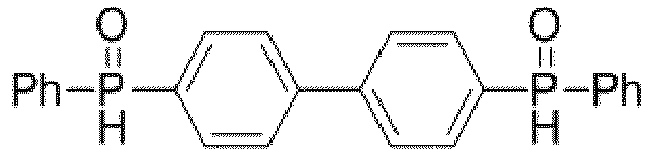
- In a Schlenk flask under an atmosphere of argon 4,4'-dibromobiphenyl (4.0 g, 12.8 mmol) was solved in dry Et2O (60 mL) and dry benzene (10 mL). The solution was cooled to -78° C. Afterwards nBuLi (1.6 M in hexane, 16.8 mL) was added dropwise over 1 hr. The solution was allowed to warm up to room temperature and stirred for another 4 hrs. In a second Schlenk flask under an atmosphere of argon P,P-dichlorophenylphosphine (4.8 g, 26.9 mmol) was solved in dry Et2O (60 mL) and cooled to -78° C. To this solution was added the first suspension dropwise via canula over appr. 15 min. The first vessel was rinsed with dry Et2O (20 mL) and the content added to the second via canula. The mixture was then allowed to warm up to room temperature. After stirring over night the reaction was quenched by addition of water, brine and sat. aq. NH4Cl. The phases were separated and the aq. phase extracted twice with DCM. The combined organic phases were dried over Na2SO4, filtered and concentrated under reduced pressure. The crude product was purified by column chromatography (silica gel; DCM:MeOH, 60:1) to afford 1 as a colorless foam (2.56 g, 6.36 mmol, 50%).
Rf = 0.16 (EE:DCM:acetone:MeOH; 20:5:5:1).
FTIR (film): ν̃ = 3415, 2331, 1597, 1438, 1139, 1125, 943, 815, 717, 696 cm-1.
1H-NMR (300 MHz, CDCl3): δ = 8.14 (d, J = 482.2 Hz, 2H, PH), 7.86 - 7.68 (m, 12H, Ar-H), 7.64 - 7.48 (m, 6H, Ar-H) ppm.
13C-NMR (101 MHz, CDCl3): δ = 127.7 (d, J = 13.1 Hz, CH, 4C), 129.0 (d, J = 12.9 Hz, CH, 4C), 130.7 (d, J = 11.6 Hz, CH, 4C), 131.1 (d, J = 103.6 Hz, C, 2C), 131.4 (d, J = 11.7 Hz, CH, 4C), 132.2 (d, J = 108.8 Hz, C, 2C), 132.7 (d, J = 2.9 Hz, C, 2C), 143.9 (C, 2C) ppm.
31P-NMR (162 MHz, CDCl3) δ = 20.9 ppm.
MS (ESI): 403 ([M+H]+, 7%), 425 ([M+Na]+, 100%), 626 (28%), 827 ([2M+Na]+, 7%), 1229 ([3M+Na]+, 3%).
HRMS (ESI) Exact mass calculated for C24H20O2P2Na ([M+Na]+): 425.0831, found: 425.0832. -

- In a Schlenk flask under an atmosphere of argon 1,4-dibromobenzene (756 mg, 3.21 mmol) was solved in dry Et2O (20 mL). The solution was cooled to -78° C. Afterwards nBuLi (1.6 M in hexane, 4.2 mL) was added dropwise over 1 hr. The solution was allowed to warm up to room temperature and stirred for another 4 hrs. In a second Schlenk flask under an atmosphere of argon P,P-dichlorophenylphosphine (1.2 g, 6.73 mmol) was solved in dry Et2O (20 mL) and cooled to -78° C. To this solution was added the first suspension dropwise via canula over appr. 15 min. The first vessel was rinsed with dry Et2O (10 mL) and the content added to the second via canula. The mixture was then allowed to warm up to room temperature. After stirring over night the reaction was quenched by addition of water, brine and sat. aq. NH4Cl. The phases were separated and the aq. phase extracted twice with DCM. The combined organic phases were dried over Na2SO4, filtered and concentrated under reduced pressure. The crude product was purified by column chromatography (silica gel; EE:DCM:MeOH; 20:10:1) to afford 2 as a colorless foam (300 mg, 919 µmol, 29%).
Rf = 0.14 (EE:DCM:MeOH; 20:10:1).
m.p.: 102-104° C.
FTIR (film): ν̃ = 2357, 1644, 1542, 1437, 1379, 1185, 1096, 932, 822, 747, 691 cm-1.
1H-NMR (300 MHz, CDCl3): δ = 8.11 (d, J = 485.7 Hz, 2H, PH), 7.89 - 7.79 (m, 4H, Ar-H), 7.75 - 7.65 (m, 4H, Ar-H), 7.64 - 7.57 (m, 2H, Ar-H), 7.56 - 7.48 (m, 4H, Ar-H) ppm.
13C-NMR (101 MHz, CDCl3): δ = 129.1 (d, J = 13.3 Hz, CH, 4C), 130.6 (d, J = 12.1 Hz, CH, 4C), 131.0 (t, J = 12.1 Hz, CH, 4C), 133.0 (CH, 2C), 136.2 (d, J = 97.8 Hz, C, 2C), 136.3 (d, J = 97.7 Hz, C, 2C) ppm.
31P-NMR (122 MHz, CDCl3) δ = 20.0 ppm.
MS (ESI): 349 ([M+Na]+, 100%), 512 ([3M+2Na]2+, 40%), 675 ([2M+Na]+, 38%), 1001 ([3M+Na]+, 10%). HRMS (ESI) Exact mass calculated for C18H16O2P2Na ([M+Na]+): 349.0518, found: 349.0517. -

- In a vial (3 mL) [1,1'-biphenyl]-4,4'-diylbis(phenylphosphine oxide) (100 mg, 249 µmol) and 1-octyne (110 mg, 994 µmol) were dissolved in DCM (200 µL), sodium dithionite (86.7 mg, 498 mmol) was added and the resulting suspension was stirred for nine days at room temperature. The crude reaction product was subjected to column chromatography (silica gel; EE:DCM:MeOH; 20:10:1) to afford the yellow oil 5 as a mixture of diastereoisomers (36.2 mg, 58.1 µmol, 23%).
Rf = 0.49 (EE:DCM:MeOH; 20:10:1).
FTIR (film): ν̃ = 2925, 2855, 1613, 1437, 1185, 1118, 816, 719, 596 cm-1.
1H-NMR (400 MHz, CDCl3): δ = 7.87 - 7.62 (m, 12H, Ar-H), 7.56 - 7.41 (m, 6H, Ar-H), 6.86 - 6.60 (m, 2 H, CH), 6.32 - 6.05 (m, 2 H, CH), 2.59 - 2.49 (m, 4H, CH2, 5a), 2.35 - 2.24 (m, 4H, CH2, 5b), 1.55 - 1.00 (m, 16H, CH2), 0.86 (t, J = 6.8 Hz, 6H, CH3, 5b) 0.80 (t, J = 6.9 Hz, 6H, CH3, 5a) ppm.
13C-NMR (101 MHz, CDCl3): δ = 14.0 (2C, CH3), 22.5 (2C, CH2), 27.8 (2C, CH2, 5b) 28.7 (d, J = 1.5 Hz, 2C, CH2), 28.8 (2C, CH2), 29.7 (2C, CH2, 5b) 31.0 (d, J = 8.1 Hz, 2C, CH2), 31.5 (2C, CH2), 34.6 (d, J = 16.9 Hz, 2C, CH2, 5b), 121.0 (d, J = 101.3 Hz, 2C, CH, 5a), 121.2 (d, J = 103.7 Hz, 2C, CH2, 5b), 127.3 (d, J = 12.2 Hz, 4C, CH), 128.6 (d, J = 12.0 Hz, 4C, CH), 130.90 (d, J = 9.9 Hz, 4C, CH), 131.3 (d, J = 9.9 Hz, 2C, CH, 5b), 131.6 (d, J = 13.5 Hz, 4C, CH), 131.6 (2C, CH), 131.93 (d, J = 10.1 Hz, 2C, C, 5b), 134.1 (d, J = 104.0 Hz, 2C, C), 134.3 (d, J = 104.1 Hz, 2C, 2), 143.1 (2C, C), 143.3 (2C, C, 5b), 153.4 (2C, CH, 5b), 155.6 (2C, CH, 5a) ppm.
31P-NMR (162 MHz, CDCl3) δ = 20.9 ppm.
MS (ESI): 334 (64%), 645 ([M+Na]+, 100%).
HRMS (ESI) Exact mass calculated for C40H48O2P2Na ([M+Na]+): 645.3022, found: 645.30008. -

Entry alkyne time temp. atm conditions max. ratio of s.m. in add. prod. 1 31 20 d 40 °C air closed 3 mL vol. vial, stirring, 0.4 mL DCM 3 (4) + 4 (31) 2 32[1] 13d r.t. air closed 3 mL vol. vial, stirring, 0.1 mL DCM 2 (4) + 2 (32) 3 33[2] 30 d r.t. air closed 3 mL vol. vial, stirring, 0.1 mL DCM 3 (4) + 2 (33) 4 34 24 d r.t. air closed 3 mL vol. vial, stirring, 0.15 mL DCM - 5 34 24 d 40 °C air closed 3 mL vol. vial, stirring, 0.15 mL DCM - [1] 4 equivalents of 32 used.
[2] 2/3 equivalents of 33 used.
Claims (14)
- A method for producing a compound of formula (I):
 R1 is selected from hydrogen or a substituted or unsubstituted C1-40 hydrocarbon group, wherein the group optionally contains at least one heteroatom, preferably O, N or S;n is an integer of 1 to 4, with the proviso if R1 is hydrogen, n is 1; andA is a group represented by formula (a):
 wherein R2 is selected from hydrogen or a substituted or unsubstituted C1-40 hydrocarbon group, wherein the group optionally contains at least one heteroatom, preferably O, N or S; X is independently O or S;R3 and R4 are independently selected from a substituted or unsubstituted C1-40 hydrocarbon group, wherein the group optionally contains at least one heteroatom, preferably O, N or S; m is independently 0 or 1;Y1, Y2 and Y3 are independently selected from hydrogen, -F, -Cl, -Br, -NH2, -NHR5, with R5 being a C1-16 alkyl, preferably a C1-4 alkyl, and L, wherein at least one of Y1, Y2 and Y3 is L;and L is a group of following formula (b)
comprising or consisting of the steps:
reacting a compound of formula (II)
with a compound of formula (III) R4 is the same as defined in formula (I);Z1, Z2 and Z3 are independently selected from hydrogen, -F, -Cl, -Br, -NH2, -NHR5, with R5 being a C1-16 alkyl, preferably a C1-4 alkyl, and M, wherein at least one of Z1, Z2 and Z3 is M;M is a group of following formula (c)
the reaction is carried out in the presence of oxygen and the equivalent ratio of compounds of formula (II) and (III) is 1:1. - The method according to claim 1, wherein
R1 and R2 are independently selected from hydrogen or a group selected from methyl ,ethyl, substituted or unsubstituted, branched, linear or cyclic C3-40 alkyl, wherein the substituted or unsubstituted, branched, linear or cyclic C3-40 alkyl group optionally contains at least one heteroatom, preferably O, N or S; allyl; substituted or unsubstituted, branched, linear or cyclic C3-40 alkenyl, wherein the substituted or unsubstituted, branched, linear or cyclic C3-40 alkenyl group optionally contains at least one heteroatom, preferably O, N or S; substituted or unsubstituted aryl, which can contain at least one heteroatom, preferably O, N or S, in its ring, wherein the at least one optional substituent of the afore-mentioned groups is selected from - F, -Cl, -Br, =O, -NH2, -NHR5, with R5 being a C1-16 alkyl, preferably a C1-4 alkyl, -NR5R6, with R5 being a C1-16 alkyl, preferably a C1-4 alkyl and R6 being a C1-4 alkyl, -COOH, -C(=O)H, - C(=O)OR7 with R7 being a C1-16 alkyl, preferably a C1-6 alkyl. - The method according to claim 1 or 2, wherein
R3 and R4 are independently selected from a group selected from methyl, ethyl, substituted or unsubstituted, branched, linear or cyclic C3-40 alkyl, wherein the substituted or unsubstituted, branched, linear or cyclic C3-40 alkyl group optionally contains at least one heteroatom, preferably O, N or S; allyl; substituted or unsubstituted, branched, linear or cyclic C3-40 alkenyl, wherein the substituted or unsubstituted, branched, linear or cyclic C3-40 alkenyl group optionally contains at least one heteroatom, preferably O, N or S; substituted or unsubstituted aryl, which optionally contains at least one heteroatom, preferably O, N or S, in its ring, wherein the at least one optional substituent of the afore-mentioned groups is selected from -F, -Cl,-Br, =O, -NH2, -NHR5, with R5 being a C1-16 alkyl, preferably a C1-4 alkyl, -NR5R6, with R5 being a C1-16 alkyl, preferably a C1-4 alkyl and R6 being a C1-4 alkyl, -COOH, -C(=O)H, -C(=O)OR7 with R7 being a C1-16 alkyl, preferably a C1-6 alkyl. - The method according to any one of claims 1 to 3, wherein the reaction is performed in an organic solvent, preferably a C2-12 alcohol, a C2-12 ether, toluene, dimethyl sulfoxide, acetone, benzene, dichloromethane, a mixture thereof or essentially without solvents.
- The method according to any one of claims 1 to 4, wherein the reaction is performed at 20 to 150°C, preferably at 20 to 80 °C, more preferably 20 to 75 °C, most preferably 20 to 40 °C.
- The method according to any one of claims 1 to 5, wherein the reaction is performed for 1 minute to 2 weeks, preferably 1 hour to 72 hours, more preferably 5 hours to 24 hours.
- The method according to any one of claims 1 to 6, wherein the compound of formula (I) has a weight average molecular weight in the range of from 500 g/mol to 1000000 g/mol, preferably from 1000 g/mol to 100000 g/mol, measured with gel permeation chromatography.
- A compound obtainable by the method of any one of claims 1 to 7.
- A composition comprising at least one compound according to claim 8 or at least one compound of formula (I):
 R1 is selected from hydrogen or a substituted or unsubstituted C1-40 hydrocarbon group, wherein the group optionally contains at least one heteroatom, preferably O, N or S;n is an integer of 1 to 4, with the proviso if R1 is hydrogen, n is 1; andA is a group represented by formula (a):
 wherein R2 is selected from hydrogen or a substituted or unsubstituted C1-40 hydrocarbon group, wherein the group optionally contains at least one heteroatom, preferably O, N or S;X is independently O or S;R3 and R4 are independently selected from a substituted or unsubstituted C1-40 hydrocarbon group, wherein the group optionally contains at least one heteroatom, preferably O, N or S; m is independently 0 or 1;Y1, Y2 and Y3 are independently selected from hydrogen, -F, -Cl, -Br, -NH2, -NHR5, with R5 being a C1-16 alkyl, preferably a C1-4 alkyl, and L, wherein at least one of Y1, Y2 and Y3 is L; and L is a group of following formula (b)
and wherein the composition is a composition for lighting applications, optical applications, microelectronic compounds, optical brighteners or is a detergent composition. - The composition according to claim 9, wherein
R1 and R2 are independently selected from hydrogen or a group selected from methyl ,ethyl, substituted or unsubstituted, branched, linear or cyclic C3-40 alkyl, wherein the substituted or unsubstituted, branched, linear or cyclic C3-40 alkyl group can contain at least one heteroatom, preferably O, N or S; allyl; substituted or unsubstituted, branched, linear or cyclic C3-40 alkenyl, wherein the substituted or unsubstituted, branched, linear or cyclic C3-40 alkenyl group can contain at least one heteroatom, preferably O, N or S; substituted or unsubstituted aryl, which can contain at least one heteroatom, preferably O, N or S, in its ring, wherein the at least one optional substituent of the afore-mentioned groups is selected from -F, -Cl, -Br, =O, -NH2,-NHR5, with R5 being a C1-16 alkyl, preferably a C1-4 alkyl, -NR5R6, with R5 being a C1-16 alkyl, preferably a C1-4 alkyl and R6 being a C1-4 alkyl, -COOH, -C(=O)H, -C(=O)OR7 with R7 being a C1-16 alkyl, preferably a C1-6 alkyl. - The composition according to claim 9 or 10, wherein
R3 and R4 are independently selected from a group selected from methyl, ethyl, substituted or unsubstituted, branched, linear or cyclic C3-40 alkyl, wherein the substituted or unsubstituted, branched, linear or cyclic C3-40 alkyl group optionally contains at least one heteroatom, preferably O, N or S; allyl; substituted or unsubstituted, branched, linear or cyclic C3-40 alkenyl, wherein the substituted or unsubstituted, branched, linear or cyclic C3-40 alkenyl group optionally contains at least one heteroatom, preferably O, N or S; substituted or unsubstituted aryl, which optionally contains at least one heteroatom, preferably O, N or S, in its ring, wherein the at least one optional substituent of the afore-mentioned groups is selected from -F, -Cl,-Br, =O, -NH2, -NHR5, with R5 being a C1-16 alkyl, preferably a C1-4 alkyl, -NR5R6, with R5 being a C1-16 alkyl, preferably a C1-4 alkyl and R6 being a C1-4 alkyl, -COOH, -C(=O)H, -C(=O)OR7 with R7 being a C1-16 alkyl, preferably a C1-6 alkyl. - The use of at least one compound according to claim 8 or at least one compound of formula (I):
 R1 is selected from hydrogen or a substituted or unsubstituted C1-40 hydrocarbon group, wherein the group optionally contains at least one heteroatom, preferably O, N or S;n is an integer of 1 to 4, with the proviso if R1 is hydrogen, n is 1; andA is a group represented by formula (a):
 wherein R2 is selected from hydrogen or a substituted or unsubstituted C1-40 hydrocarbon group, wherein the group optionally contains at least one heteroatom, preferably O, N or S; X is independently O or S;R3 and R4 are independently selected from a substituted or unsubstituted C1-40 hydrocarbon group, wherein the group optionally contains at least one heteroatom, preferably O, N or S; m is independently 0 or 1;Y1, Y2 and Y3 are independently selected from hydrogen, -F, -Cl, -Br, -NH2, -NHR5, with R5 being a C1-16 alkyl, preferably a C1-4 alkyl, and L, wherein at least one of Y1, Y2 and Y3 is L; and L is a group of following formula (b)
in lighting applications, optical applications, microelectronic compounds, optical brighteners or detergent compositions. - The use according to claim 12, wherein
R1 and R2 are independently selected from hydrogen or a group selected from methyl ,ethyl, substituted or unsubstituted, branched, linear or cyclic C3-40 alkyl, wherein the substituted or unsubstituted, branched, linear or cyclic C3-40 alkyl group can contain at least one heteroatom, preferably O, N or S; allyl; substituted or unsubstituted, branched, linear or cyclic C3-40 alkenyl, wherein the substituted or unsubstituted, branched, linear or cyclic C3-40 alkenyl group can contain at least one heteroatom, preferably O, N or S; substituted or unsubstituted aryl, which can contain at least one heteroatom, preferably O, N or S, in its ring, wherein the at least one optional substituent of the afore-mentioned groups is selected from -F, -Cl, -Br, =O, -NH2,-NHR5, with R5 being a C1-16 alkyl, preferably a C1-4 alkyl, -NR5R6, with R5 being a C1-16 alkyl, preferably a C1-4 alkyl and R6 being a C1-4 alkyl, -COOH, -C(=O)H, -C(=O)OR7 with R7 being a C1-16 alkyl, preferably a C1-6 alkyl. - The use according to claim 12 or 13, wherein
R3 and R4 are independently selected from a group selected from methyl, ethyl, substituted or unsubstituted, branched, linear or cyclic C3-40 alkyl, wherein the substituted or unsubstituted, branched, linear or cyclic C3-40 alkyl group optionally contains at least one heteroatom, preferably O, N or S; allyl; substituted or unsubstituted, branched, linear or cyclic C3-40 alkenyl, wherein the substituted or unsubstituted, branched, linear or cyclic C3-40 alkenyl group optionally contains at least one heteroatom, preferably O, N or S; substituted or unsubstituted aryl, which optionally contains at least one heteroatom, preferably O, N or S, in its ring, wherein the at least one optional substituent of the afore-mentioned groups is selected from -F, -Cl, - Br, =O, -NH2, -NHR5, with R5 being a C1-16 alkyl, preferably a C1-4 alkyl, -NR5R6, with R5 being a C1-16 alkyl, preferably a C1-4 alkyl and R6 being a C1-4 alkyl, -COOH, -C(=O)H, -C(=O)OR7 with R7 being a C1-16 alkyl, preferably a C1-6 alkyl.
Priority Applications (1)
| Application Number | Priority Date | Filing Date | Title |
|---|---|---|---|
| EP18168977.9A EP3560938A1 (en) | 2018-04-24 | 2018-04-24 | Luminescent alkenyl-phosphorus containing materials |
Applications Claiming Priority (1)
| Application Number | Priority Date | Filing Date | Title |
|---|---|---|---|
| EP18168977.9A EP3560938A1 (en) | 2018-04-24 | 2018-04-24 | Luminescent alkenyl-phosphorus containing materials |
Publications (1)
| Publication Number | Publication Date |
|---|---|
| EP3560938A1 true EP3560938A1 (en) | 2019-10-30 |
Family
ID=62062899
Family Applications (1)
| Application Number | Title | Priority Date | Filing Date |
|---|---|---|---|
| EP18168977.9A Withdrawn EP3560938A1 (en) | 2018-04-24 | 2018-04-24 | Luminescent alkenyl-phosphorus containing materials |
Country Status (1)
| Country | Link |
|---|---|
| EP (1) | EP3560938A1 (en) |
Citations (2)
| Publication number | Priority date | Publication date | Assignee | Title |
|---|---|---|---|---|
| EP0406683A2 (en) * | 1989-07-07 | 1991-01-09 | Hoechst Aktiengesellschaft | Radiation polymerizable composition and recording material comprising said composition |
| JP2007063168A (en) * | 2005-08-30 | 2007-03-15 | National Institute Of Advanced Industrial & Technology | Novel bisphosphinoyl compound, method for producing the same, and pharmaceutical comprising the same |
-
2018
- 2018-04-24 EP EP18168977.9A patent/EP3560938A1/en not_active Withdrawn
Patent Citations (2)
| Publication number | Priority date | Publication date | Assignee | Title |
|---|---|---|---|---|
| EP0406683A2 (en) * | 1989-07-07 | 1991-01-09 | Hoechst Aktiengesellschaft | Radiation polymerizable composition and recording material comprising said composition |
| JP2007063168A (en) * | 2005-08-30 | 2007-03-15 | National Institute Of Advanced Industrial & Technology | Novel bisphosphinoyl compound, method for producing the same, and pharmaceutical comprising the same |
Non-Patent Citations (3)
| Title |
|---|
| KOENIG ET AL., J. ORG. CHEM., vol. 62, 1997, pages 2414 - 2422 |
| TANAKA ET AL., J. AM. CHEM. SOC., vol. 122, 2000, pages 5407 - 5408 |
| TIEQIAO CHEN ET AL: "Hydrophosphorylation of Alkynes Catalyzed by Palladium: Generality and Mechanism", JOURNAL OF THE AMERICAN CHEMICAL SOCIETY, vol. 140, no. 8, 19 February 2018 (2018-02-19), US, pages 3139 - 3155, XP055509126, ISSN: 0002-7863, DOI: 10.1021/jacs.8b00550 * |
Similar Documents
| Publication | Publication Date | Title |
|---|---|---|
| EP3530664B1 (en) | Diol, process for producing diol, di(meth)acrylate, and process for producing di(meth)acrylate | |
| HK1226391A1 (en) | Mono- and dialkyl ethers of furan-2,5-dimethanol and (tetra-hydrofuran-2,5-diyl)dimethanol and amphiphilic derivatives thereof | |
| CN101811968A (en) | Multi-functionalized benzoylformicacid hydroxy-ketone ester compounds and photoinitiator containing compounds | |
| CN115947711A (en) | Photochemical buffering agent and synthesis method thereof | |
| EP3560938A1 (en) | Luminescent alkenyl-phosphorus containing materials | |
| CN101326149B (en) | Process for producing polyglyceryl ether derivative | |
| CN115947714A (en) | Method for synthesizing photochemical buffering agent | |
| CN114423727B (en) | Method for producing fluorine-containing compound | |
| EP3560936A1 (en) | Method for the synthesis of alkenyl-phosphorous compounds | |
| CN113861238B (en) | A method for the simultaneous synthesis of secondary/tertiary phosphine oxide compounds with phosphine chiral centers catalyzed by palladium/chiral ligands | |
| JP7740325B2 (en) | Method for producing fluorine-containing compounds | |
| JP2014084289A (en) | Method for producing fluorene derivative | |
| KR102367000B1 (en) | A ortho-carborane compound incorporated with dienyl group and method preparating the same | |
| CN119661475B (en) | Preparation method of alpha-allyl-alpha, alpha-difluoro amide compound | |
| EP2325188A1 (en) | Fluorine-containing boronic acid ester compound and method for producing same | |
| JP2010280637A (en) | Method for producing B-arylborazine | |
| Morikawa et al. | Sc (OTf) 3-catalyzed cyclooligomerization of 2, 4-dialkoxybenzyl alcohols. Formation of resorcin [n] arene peralkyl ethers | |
| JP5181190B2 (en) | Method for producing heterocyclic compound | |
| CN113372386A (en) | Process for preparing organic phosphine-hydrogen compound | |
| JP7709173B2 (en) | How ammonia is produced | |
| KR102823550B1 (en) | Method of preparing alkenylated ortho-carborane | |
| CN116731061B (en) | Method for efficiently preparing 1-silicon-based-2-alkyl compound | |
| CN113773294B (en) | Preparation method and application of flavonoids and isoflavones | |
| KR102600309B1 (en) | Salt compound and producing method of the same and alkylating reagent comprising the same | |
| KR20200099546A (en) | Method of making diol |
Legal Events
| Date | Code | Title | Description |
|---|---|---|---|
| PUAI | Public reference made under article 153(3) epc to a published international application that has entered the european phase |
Free format text: ORIGINAL CODE: 0009012 |
|
| AK | Designated contracting states |
Kind code of ref document: A1 Designated state(s): AL AT BE BG CH CY CZ DE DK EE ES FI FR GB GR HR HU IE IS IT LI LT LU LV MC MK MT NL NO PL PT RO RS SE SI SK SM TR |
|
| AX | Request for extension of the european patent |
Extension state: BA ME |
|
| STAA | Information on the status of an ep patent application or granted ep patent |
Free format text: STATUS: THE APPLICATION IS DEEMED TO BE WITHDRAWN |
|
| 18D | Application deemed to be withdrawn |
Effective date: 20200603 |