EP3560723A1 - A sticker suitable for inserting into a book; and/or an insert for a book - Google Patents
A sticker suitable for inserting into a book; and/or an insert for a book Download PDFInfo
- Publication number
- EP3560723A1 EP3560723A1 EP19000195.8A EP19000195A EP3560723A1 EP 3560723 A1 EP3560723 A1 EP 3560723A1 EP 19000195 A EP19000195 A EP 19000195A EP 3560723 A1 EP3560723 A1 EP 3560723A1
- Authority
- EP
- European Patent Office
- Prior art keywords
- finger portion
- flexible
- book
- sticker
- loop
- Prior art date
- Legal status (The legal status is an assumption and is not a legal conclusion. Google has not performed a legal analysis and makes no representation as to the accuracy of the status listed.)
- Withdrawn
Links
- 230000008878 coupling Effects 0.000 claims abstract description 238
- 238000010168 coupling process Methods 0.000 claims abstract description 238
- 238000005859 coupling reaction Methods 0.000 claims abstract description 238
- 239000000463 material Substances 0.000 claims abstract description 136
- 239000000853 adhesive Substances 0.000 claims abstract description 95
- 230000001070 adhesive effect Effects 0.000 claims abstract description 95
- -1 poly(ethylene terephthalate) Polymers 0.000 claims description 220
- 229920002457 flexible plastic Polymers 0.000 claims description 79
- 229920000139 polyethylene terephthalate Polymers 0.000 claims description 58
- 239000005020 polyethylene terephthalate Substances 0.000 claims description 58
- 229920001778 nylon Polymers 0.000 claims description 49
- 239000004677 Nylon Substances 0.000 claims description 47
- 229920003023 plastic Polymers 0.000 claims description 34
- 239000004033 plastic Substances 0.000 claims description 34
- 229920000747 poly(lactic acid) Polymers 0.000 claims description 34
- 239000002985 plastic film Substances 0.000 claims description 30
- 229920000520 poly(3-hydroxybutyrate-co-3-hydroxyvalerate) Polymers 0.000 claims description 29
- 229920001020 poly(3-hydroxybutyrate-co-3-hydroxyhexanoate) Polymers 0.000 claims description 28
- 229920000728 polyester Polymers 0.000 claims description 26
- 229920000562 Poly(ethylene adipate) Polymers 0.000 claims description 20
- 229920000954 Polyglycolide Polymers 0.000 claims description 20
- 239000004698 Polyethylene Substances 0.000 claims description 19
- 229920001707 polybutylene terephthalate Polymers 0.000 claims description 19
- 229920000573 polyethylene Polymers 0.000 claims description 19
- 229920002215 polytrimethylene terephthalate Polymers 0.000 claims description 19
- 238000003780 insertion Methods 0.000 claims description 18
- 230000037431 insertion Effects 0.000 claims description 18
- 239000004800 polyvinyl chloride Substances 0.000 claims description 18
- 229920001610 polycaprolactone Polymers 0.000 claims description 17
- 229920000642 polymer Polymers 0.000 claims description 16
- 239000005014 poly(hydroxyalkanoate) Substances 0.000 claims description 15
- 125000000383 tetramethylene group Chemical group [H]C([H])([*:1])C([H])([H])C([H])([H])C([H])([H])[*:2] 0.000 claims description 15
- 239000004743 Polypropylene Substances 0.000 claims description 14
- 229920003207 poly(ethylene-2,6-naphthalate) Polymers 0.000 claims description 14
- 239000011112 polyethylene naphthalate Substances 0.000 claims description 14
- 229920001155 polypropylene Polymers 0.000 claims description 14
- 239000004014 plasticizer Substances 0.000 claims description 13
- 238000000034 method Methods 0.000 claims description 12
- 229920001577 copolymer Polymers 0.000 claims description 11
- 229920000915 polyvinyl chloride Polymers 0.000 claims description 11
- 229920001007 Nylon 4 Polymers 0.000 claims description 10
- 230000000873 masking effect Effects 0.000 claims description 10
- 229920002292 Nylon 6 Polymers 0.000 claims description 9
- 229920002302 Nylon 6,6 Polymers 0.000 claims description 9
- 229920001903 high density polyethylene Polymers 0.000 claims description 8
- 239000004700 high-density polyethylene Substances 0.000 claims description 8
- 229920001684 low density polyethylene Polymers 0.000 claims description 8
- 239000004702 low-density polyethylene Substances 0.000 claims description 8
- 239000005038 ethylene vinyl acetate Substances 0.000 claims description 7
- 229920000092 linear low density polyethylene Polymers 0.000 claims description 7
- 239000004707 linear low-density polyethylene Substances 0.000 claims description 7
- 239000004952 Polyamide Substances 0.000 claims description 6
- 229920002647 polyamide Polymers 0.000 claims description 6
- AEMRFAOFKBGASW-UHFFFAOYSA-N Glycolic acid Polymers OCC(O)=O AEMRFAOFKBGASW-UHFFFAOYSA-N 0.000 claims description 5
- 239000004708 Very-low-density polyethylene Substances 0.000 claims description 5
- 238000009826 distribution Methods 0.000 claims description 5
- 238000004519 manufacturing process Methods 0.000 claims description 5
- 229920001866 very low density polyethylene Polymers 0.000 claims description 5
- 238000005520 cutting process Methods 0.000 claims description 4
- 229920001179 medium density polyethylene Polymers 0.000 claims description 4
- 239000004701 medium-density polyethylene Substances 0.000 claims description 4
- VGGSQFUCUMXWEO-UHFFFAOYSA-N Ethene Chemical compound C=C VGGSQFUCUMXWEO-UHFFFAOYSA-N 0.000 claims description 3
- 229920000058 polyacrylate Polymers 0.000 claims description 3
- BLDFSDCBQJUWFG-UHFFFAOYSA-N 2-(methylamino)-1,2-diphenylethanol Chemical compound C=1C=CC=CC=1C(NC)C(O)C1=CC=CC=C1 BLDFSDCBQJUWFG-UHFFFAOYSA-N 0.000 claims description 2
- 229920002319 Poly(methyl acrylate) Polymers 0.000 claims description 2
- 229920002125 Sokalan® Polymers 0.000 claims description 2
- 238000001035 drying Methods 0.000 claims description 2
- 229920003229 poly(methyl methacrylate) Polymers 0.000 claims description 2
- 239000004584 polyacrylic acid Substances 0.000 claims description 2
- 229920000120 polyethyl acrylate Polymers 0.000 claims description 2
- 229920000193 polymethacrylate Polymers 0.000 claims description 2
- 239000004926 polymethyl methacrylate Substances 0.000 claims description 2
- 230000001419 dependent effect Effects 0.000 claims 1
- PAPBSGBWRJIAAV-UHFFFAOYSA-N ε-Caprolactone Chemical compound O=C1CCCCCO1 PAPBSGBWRJIAAV-UHFFFAOYSA-N 0.000 claims 1
- 239000000123 paper Substances 0.000 description 59
- 239000011230 binding agent Substances 0.000 description 32
- 239000000203 mixture Substances 0.000 description 17
- 229920000331 Polyhydroxybutyrate Polymers 0.000 description 15
- 239000005015 poly(hydroxybutyrate) Substances 0.000 description 15
- 229920000218 poly(hydroxyvalerate) Polymers 0.000 description 15
- 239000011111 cardboard Substances 0.000 description 13
- 239000004753 textile Substances 0.000 description 10
- 229920000229 biodegradable polyester Polymers 0.000 description 9
- 239000004622 biodegradable polyester Substances 0.000 description 9
- 239000005026 oriented polypropylene Substances 0.000 description 7
- 239000004820 Pressure-sensitive adhesive Substances 0.000 description 5
- 239000004005 microsphere Substances 0.000 description 5
- 239000000178 monomer Substances 0.000 description 5
- 239000011087 paperboard Substances 0.000 description 5
- 229920000071 poly(4-hydroxybutyrate) Polymers 0.000 description 5
- 229920000070 poly-3-hydroxybutyrate Polymers 0.000 description 5
- VXNZUUAINFGPBY-UHFFFAOYSA-N 1-Butene Chemical compound CCC=C VXNZUUAINFGPBY-UHFFFAOYSA-N 0.000 description 4
- LIKMAJRDDDTEIG-UHFFFAOYSA-N 1-hexene Chemical compound CCCCC=C LIKMAJRDDDTEIG-UHFFFAOYSA-N 0.000 description 4
- KWKAKUADMBZCLK-UHFFFAOYSA-N 1-octene Chemical compound CCCCCCC=C KWKAKUADMBZCLK-UHFFFAOYSA-N 0.000 description 4
- XTXRWKRVRITETP-UHFFFAOYSA-N Vinyl acetate Chemical compound CC(=O)OC=C XTXRWKRVRITETP-UHFFFAOYSA-N 0.000 description 4
- XNGIFLGASWRNHJ-UHFFFAOYSA-L phthalate(2-) Chemical compound [O-]C(=O)C1=CC=CC=C1C([O-])=O XNGIFLGASWRNHJ-UHFFFAOYSA-L 0.000 description 4
- 229920003232 aliphatic polyester Polymers 0.000 description 3
- 238000013461 design Methods 0.000 description 3
- 230000006872 improvement Effects 0.000 description 3
- 239000002086 nanomaterial Substances 0.000 description 3
- 229920001432 poly(L-lactide) Polymers 0.000 description 3
- 239000005033 polyvinylidene chloride Substances 0.000 description 3
- REKYPYSUBKSCAT-UHFFFAOYSA-N 3-hydroxypentanoic acid Chemical compound CCC(O)CC(O)=O REKYPYSUBKSCAT-UHFFFAOYSA-N 0.000 description 2
- 239000005977 Ethylene Substances 0.000 description 2
- DGAQECJNVWCQMB-PUAWFVPOSA-M Ilexoside XXIX Chemical compound C[C@@H]1CC[C@@]2(CC[C@@]3(C(=CC[C@H]4[C@]3(CC[C@@H]5[C@@]4(CC[C@@H](C5(C)C)OS(=O)(=O)[O-])C)C)[C@@H]2[C@]1(C)O)C)C(=O)O[C@H]6[C@@H]([C@H]([C@@H]([C@H](O6)CO)O)O)O.[Na+] DGAQECJNVWCQMB-PUAWFVPOSA-M 0.000 description 2
- 229920001244 Poly(D,L-lactide) Polymers 0.000 description 2
- 229920001328 Polyvinylidene chloride Polymers 0.000 description 2
- KKEYFWRCBNTPAC-UHFFFAOYSA-N Terephthalic acid Chemical compound OC(=O)C1=CC=C(C(O)=O)C=C1 KKEYFWRCBNTPAC-UHFFFAOYSA-N 0.000 description 2
- WNLRTRBMVRJNCN-UHFFFAOYSA-N adipic acid Chemical compound OC(=O)CCCCC(O)=O WNLRTRBMVRJNCN-UHFFFAOYSA-N 0.000 description 2
- WERYXYBDKMZEQL-UHFFFAOYSA-N butane-1,4-diol Chemical compound OCCCCO WERYXYBDKMZEQL-UHFFFAOYSA-N 0.000 description 2
- 239000003086 colorant Substances 0.000 description 2
- 238000010276 construction Methods 0.000 description 2
- 238000007334 copolymerization reaction Methods 0.000 description 2
- WOZVHXUHUFLZGK-UHFFFAOYSA-N dimethyl terephthalate Chemical compound COC(=O)C1=CC=C(C(=O)OC)C=C1 WOZVHXUHUFLZGK-UHFFFAOYSA-N 0.000 description 2
- 229920001198 elastomeric copolymer Polymers 0.000 description 2
- 150000002148 esters Chemical class 0.000 description 2
- 230000009477 glass transition Effects 0.000 description 2
- 230000008018 melting Effects 0.000 description 2
- 238000002844 melting Methods 0.000 description 2
- TVMXDCGIABBOFY-UHFFFAOYSA-N n-Octanol Natural products CCCCCCCC TVMXDCGIABBOFY-UHFFFAOYSA-N 0.000 description 2
- 238000004806 packaging method and process Methods 0.000 description 2
- 229920001200 poly(ethylene-vinyl acetate) Polymers 0.000 description 2
- 229920006267 polyester film Polymers 0.000 description 2
- 229920000903 polyhydroxyalkanoate Polymers 0.000 description 2
- 230000003252 repetitive effect Effects 0.000 description 2
- 229910052708 sodium Inorganic materials 0.000 description 2
- 239000011734 sodium Substances 0.000 description 2
- 239000000126 substance Substances 0.000 description 2
- GETQZCLCWQTVFV-UHFFFAOYSA-N trimethylamine Chemical compound CN(C)C GETQZCLCWQTVFV-UHFFFAOYSA-N 0.000 description 2
- AXKZIDYFAMKWSA-UHFFFAOYSA-N 1,6-dioxacyclododecane-7,12-dione Chemical compound O=C1CCCCC(=O)OCCCCO1 AXKZIDYFAMKWSA-UHFFFAOYSA-N 0.000 description 1
- LMAUULKNZLEMGN-UHFFFAOYSA-N 1-ethyl-3,5-dimethylbenzene Chemical compound CCC1=CC(C)=CC(C)=C1 LMAUULKNZLEMGN-UHFFFAOYSA-N 0.000 description 1
- NCTBYWFEJFTVEL-UHFFFAOYSA-N 2-methylbutyl prop-2-enoate Chemical compound CCC(C)COC(=O)C=C NCTBYWFEJFTVEL-UHFFFAOYSA-N 0.000 description 1
- VAPQAGMSICPBKJ-UHFFFAOYSA-N 2-nitroacridine Chemical compound C1=CC=CC2=CC3=CC([N+](=O)[O-])=CC=C3N=C21 VAPQAGMSICPBKJ-UHFFFAOYSA-N 0.000 description 1
- WHBMMWSBFZVSSR-UHFFFAOYSA-M 3-hydroxybutyrate Chemical compound CC(O)CC([O-])=O WHBMMWSBFZVSSR-UHFFFAOYSA-M 0.000 description 1
- HPMGFDVTYHWBAG-UHFFFAOYSA-N 3-hydroxyhexanoic acid Chemical compound CCCC(O)CC(O)=O HPMGFDVTYHWBAG-UHFFFAOYSA-N 0.000 description 1
- SJZRECIVHVDYJC-UHFFFAOYSA-M 4-hydroxybutyrate Chemical compound OCCCC([O-])=O SJZRECIVHVDYJC-UHFFFAOYSA-M 0.000 description 1
- BVDBXCXQMHBGQM-UHFFFAOYSA-N 4-methylpentan-2-yl prop-2-enoate Chemical compound CC(C)CC(C)OC(=O)C=C BVDBXCXQMHBGQM-UHFFFAOYSA-N 0.000 description 1
- DXPPIEDUBFUSEZ-UHFFFAOYSA-N 6-methylheptyl prop-2-enoate Chemical compound CC(C)CCCCCOC(=O)C=C DXPPIEDUBFUSEZ-UHFFFAOYSA-N 0.000 description 1
- 241000251468 Actinopterygii Species 0.000 description 1
- QGZKDVFQNNGYKY-UHFFFAOYSA-O Ammonium Chemical compound [NH4+] QGZKDVFQNNGYKY-UHFFFAOYSA-O 0.000 description 1
- 241000894006 Bacteria Species 0.000 description 1
- 244000025254 Cannabis sativa Species 0.000 description 1
- 241000196324 Embryophyta Species 0.000 description 1
- JVTAAEKCZFNVCJ-REOHCLBHSA-N L-lactic acid Chemical compound C[C@H](O)C(O)=O JVTAAEKCZFNVCJ-REOHCLBHSA-N 0.000 description 1
- JVTAAEKCZFNVCJ-UHFFFAOYSA-N Lactic Acid Natural products CC(O)C(O)=O JVTAAEKCZFNVCJ-UHFFFAOYSA-N 0.000 description 1
- 229920010126 Linear Low Density Polyethylene (LLDPE) Polymers 0.000 description 1
- 241001520808 Panicum virgatum Species 0.000 description 1
- 240000008299 Pinus lambertiana Species 0.000 description 1
- 229920000614 Poly(1,3-propylene succinate) Polymers 0.000 description 1
- ZLMJMSJWJFRBEC-UHFFFAOYSA-N Potassium Chemical compound [K] ZLMJMSJWJFRBEC-UHFFFAOYSA-N 0.000 description 1
- WHBMMWSBFZVSSR-UHFFFAOYSA-N R3HBA Natural products CC(O)CC(O)=O WHBMMWSBFZVSSR-UHFFFAOYSA-N 0.000 description 1
- 244000061456 Solanum tuberosum Species 0.000 description 1
- 235000002595 Solanum tuberosum Nutrition 0.000 description 1
- 241000270666 Testudines Species 0.000 description 1
- 240000008042 Zea mays Species 0.000 description 1
- 235000005824 Zea mays ssp. parviglumis Nutrition 0.000 description 1
- 235000002017 Zea mays subsp mays Nutrition 0.000 description 1
- 230000001464 adherent effect Effects 0.000 description 1
- 239000001361 adipic acid Substances 0.000 description 1
- 235000011037 adipic acid Nutrition 0.000 description 1
- 150000001412 amines Chemical class 0.000 description 1
- DZGUJOWBVDZNNF-UHFFFAOYSA-N azanium;2-methylprop-2-enoate Chemical compound [NH4+].CC(=C)C([O-])=O DZGUJOWBVDZNNF-UHFFFAOYSA-N 0.000 description 1
- 238000006065 biodegradation reaction Methods 0.000 description 1
- 239000012620 biological material Substances 0.000 description 1
- DQXBYHZEEUGOBF-UHFFFAOYSA-N but-3-enoic acid;ethene Chemical compound C=C.OC(=O)CC=C DQXBYHZEEUGOBF-UHFFFAOYSA-N 0.000 description 1
- 239000006227 byproduct Substances 0.000 description 1
- 239000011248 coating agent Substances 0.000 description 1
- 238000000576 coating method Methods 0.000 description 1
- 235000005822 corn Nutrition 0.000 description 1
- 230000008021 deposition Effects 0.000 description 1
- 239000000839 emulsion Substances 0.000 description 1
- 230000007613 environmental effect Effects 0.000 description 1
- 230000001747 exhibiting effect Effects 0.000 description 1
- 238000009459 flexible packaging Methods 0.000 description 1
- 229920005570 flexible polymer Polymers 0.000 description 1
- 239000003292 glue Substances 0.000 description 1
- 125000004051 hexyl group Chemical group [H]C([H])([H])C([H])([H])C([H])([H])C([H])([H])C([H])([H])C([H])([H])* 0.000 description 1
- 239000010903 husk Substances 0.000 description 1
- 229960000448 lactic acid Drugs 0.000 description 1
- FPYJFEHAWHCUMM-UHFFFAOYSA-N maleic anhydride Chemical compound O=C1OC(=O)C=C1 FPYJFEHAWHCUMM-UHFFFAOYSA-N 0.000 description 1
- 239000003550 marker Substances 0.000 description 1
- 238000007734 materials engineering Methods 0.000 description 1
- 238000005259 measurement Methods 0.000 description 1
- 244000005700 microbiome Species 0.000 description 1
- 238000012986 modification Methods 0.000 description 1
- 230000004048 modification Effects 0.000 description 1
- 230000002085 persistent effect Effects 0.000 description 1
- 235000010204 pine bark Nutrition 0.000 description 1
- 229920001896 polybutyrate Polymers 0.000 description 1
- 229910052700 potassium Inorganic materials 0.000 description 1
- 239000011591 potassium Substances 0.000 description 1
- 239000000047 product Substances 0.000 description 1
- 229920005989 resin Polymers 0.000 description 1
- 239000011347 resin Substances 0.000 description 1
- 238000005096 rolling process Methods 0.000 description 1
- 229910052709 silver Inorganic materials 0.000 description 1
- 239000004332 silver Substances 0.000 description 1
- ISXSCDLOGDJUNJ-UHFFFAOYSA-N tert-butyl prop-2-enoate Chemical compound CC(C)(C)OC(=O)C=C ISXSCDLOGDJUNJ-UHFFFAOYSA-N 0.000 description 1
- 229920001169 thermoplastic Polymers 0.000 description 1
Images




Classifications
-
- B—PERFORMING OPERATIONS; TRANSPORTING
- B42—BOOKBINDING; ALBUMS; FILES; SPECIAL PRINTED MATTER
- B42D—BOOKS; BOOK COVERS; LOOSE LEAVES; PRINTED MATTER CHARACTERISED BY IDENTIFICATION OR SECURITY FEATURES; PRINTED MATTER OF SPECIAL FORMAT OR STYLE NOT OTHERWISE PROVIDED FOR; DEVICES FOR USE THEREWITH AND NOT OTHERWISE PROVIDED FOR; MOVABLE-STRIP WRITING OR READING APPARATUS
- B42D9/00—Bookmarkers; Spot indicators; Devices for holding books open; Leaf turners
- B42D9/001—Devices for indicating a page in a book, e.g. bookmarkers
- B42D9/004—Devices for indicating a page in a book, e.g. bookmarkers removably attached to the book
-
- B—PERFORMING OPERATIONS; TRANSPORTING
- B42—BOOKBINDING; ALBUMS; FILES; SPECIAL PRINTED MATTER
- B42B—PERMANENTLY ATTACHING TOGETHER SHEETS, QUIRES OR SIGNATURES OR PERMANENTLY ATTACHING OBJECTS THERETO
- B42B5/00—Permanently attaching together sheets, quires or signatures otherwise than by stitching
- B42B5/08—Permanently attaching together sheets, quires or signatures otherwise than by stitching by finger, claw or ring-like elements passing through the sheets, quires or signatures
- B42B5/10—Permanently attaching together sheets, quires or signatures otherwise than by stitching by finger, claw or ring-like elements passing through the sheets, quires or signatures the elements being of castellated or comb-like form
-
- B—PERFORMING OPERATIONS; TRANSPORTING
- B42—BOOKBINDING; ALBUMS; FILES; SPECIAL PRINTED MATTER
- B42B—PERMANENTLY ATTACHING TOGETHER SHEETS, QUIRES OR SIGNATURES OR PERMANENTLY ATTACHING OBJECTS THERETO
- B42B5/00—Permanently attaching together sheets, quires or signatures otherwise than by stitching
- B42B5/08—Permanently attaching together sheets, quires or signatures otherwise than by stitching by finger, claw or ring-like elements passing through the sheets, quires or signatures
- B42B5/12—Permanently attaching together sheets, quires or signatures otherwise than by stitching by finger, claw or ring-like elements passing through the sheets, quires or signatures the elements being coils
-
- B—PERFORMING OPERATIONS; TRANSPORTING
- B42—BOOKBINDING; ALBUMS; FILES; SPECIAL PRINTED MATTER
- B42D—BOOKS; BOOK COVERS; LOOSE LEAVES; PRINTED MATTER CHARACTERISED BY IDENTIFICATION OR SECURITY FEATURES; PRINTED MATTER OF SPECIAL FORMAT OR STYLE NOT OTHERWISE PROVIDED FOR; DEVICES FOR USE THEREWITH AND NOT OTHERWISE PROVIDED FOR; MOVABLE-STRIP WRITING OR READING APPARATUS
- B42D13/00—Loose leaves modified for binding; Inserts
-
- B—PERFORMING OPERATIONS; TRANSPORTING
- B42—BOOKBINDING; ALBUMS; FILES; SPECIAL PRINTED MATTER
- B42F—SHEETS TEMPORARILY ATTACHED TOGETHER; FILING APPLIANCES; FILE CARDS; INDEXING
- B42F21/00—Indexing means; Indexing tabs or protectors therefor
- B42F21/02—Tabs integral with sheets, papers, cards, or suspension files
Definitions
- the present invention relates to a sticker, which can be (i.e. which is capable of being) detachably coupled to the binding (binder) of a book, preferably to the binding (binder) of a loop-bound book, in particular a ring-bound (e.g. open-and-close ring-bound), spiral-bound (coil-bound), comb-bound, and/or wire-bound book.
- the sticker can function as an insert capable of being detachably coupled to the binding of a book, preferably of a loop-bound book; and/or, preferably, the sticker is suitable for inserting into a book, preferably into a loop-bound book.
- the sticker of the invention comprises a detachable coupling means and/or an inserting member, which typically is capable of being detachably coupled to the binding (binder) of a book, preferably to the binding (binder) of a loop-bound book.
- the present invention also relates to an insert (preferably a book insert, bookmark and/or divider), in particular a multifunctional insert, for a loop-bound book such as a spiral-bound book.
- an insert preferably a book insert, bookmark and/or divider
- a multifunctional insert for a loop-bound book such as a spiral-bound book.
- the present invention also relates to an insert (preferably a book insert, bookmark and/or divider), suitable for using with a loop-bound book (preferably a spiral- or ring- bound book) and/or suitable to act as and/or being a bookmark.
- an insert preferably a book insert, bookmark and/or divider
- a loop-bound book preferably a spiral- or ring- bound book
- the insert comprises: i) a body (preferably an elongated body); ii) a first detachable coupling means extending and/or projecting from at or adjacent to the top and/or a top portion of the body, wherein the first detachable coupling means is suitably sized, shaped and/or arranged so as to be capable of being inserted inside (i.e.
- a or the loop binding preferably a spiral or ring binding
- a second detachable coupling means extending and/or projecting from at or adjacent to the bottom and/or a bottom portion of the body, wherein the second detachable coupling means is suitably sized, shaped and/or arranged so as to be capable of being inserted inside (i.e. received by) a or the loop binding (preferably a spiral or ring binding) of a or the loop-bound book.
- a or the book is preferably a loop-bound book, and/or preferably comprises (e.g. is) a notebook (e.g. a workbook) or a personal organizer. Most preferably, in the present invention, a or the book comprises (e.g. is) a loop-bound notebook (e.g. a loop-bound workbook) or a loop-bound personal organizer.
- the present invention also relates to a multipurpose bookmark specifically designed for (and/or adapted for) a book with loop binding (such as a spiral binding); in particular a bookmark designed for (and/or adapted for) a notebook (e.g. a workbook) or a personal organizer.
- a multipurpose bookmark specifically designed for (and/or adapted for) a book with loop binding (such as a spiral binding); in particular a bookmark designed for (and/or adapted for) a notebook (e.g. a workbook) or a personal organizer.
- the present invention also relates to an insert which can be (i.e. which is capable of being) detachably coupled to the binding (binder) of a book, preferably to the binding (binder) of a loop-bound book such as a ring-bound (e.g. open-and-close ring-bound), spiral-bound (coil-bound), comb-bound and/or wire-bound book.
- the insert comprises a detachable coupling means and/or an inserting member.
- the insert can be for marking a page of the stack and/or for other uses.
- bookmarks of various sorts have been common for many years.
- a bookmark is a thin marker or book insert, made from a suitably thin material, such as paper or cardboard, and is placed by a reader inside the book so that it is easy to return to the same book page in the future. It is normally designed to avoid any damage to the book.
- Notebooks (for example workbooks) and/or personal organizers are commonly used for the recording of various kinds of information. These include, amongst other things, calendar planners, personal diaries, names and addresses of contacts, notes, and/or task lists; and/or written information recording some or all of the information discussed in a meeting, the discussions which took place in a meeting, and/or decision(s) made in a meeting (in particular minutes or notes of a or the meeting).
- Notebooks (e.g. workbooks) and/or personal organizers typically comprise pre-printed sheets of paper for writing the information, tab dividers, pockets, pouches or other features. These pre-printed sheets of paper may include ruled lines, calendars, spaces for names and addresses according to the design of the manufacturer.
- open-and-close ring binders to conveniently bind or detach sheets of material (e.g. paper sheets).
- the stack of sheet material e.g. a stack of paper sheets
- a binding coil such that the relative locations of the material are permanently fixed.
- binding guides are examples of binding guides that guide each sheet of material when it is flipped over while allowing the materials to retain their relative positions in the stack.
- these sheets e.g. paper sheets
- binding coils the sheets (e.g.
- paper sheets should usually be torn from the binding coil for removal; or alternatively, for binding coils, the sheets (e.g. paper sheets) should usually be torn off and/or removed along a line of weakness, e.g. a perforated line, in the sheet which is typically generally parallel to and/or is typically adjacent to the binding coil.
- a line of weakness e.g. a perforated line
- dividers and other components for these personal organizers and/or notebooks should preferably have features that allow them to be conveniently attached to or removed from the binder. This allows customization because the various components can then be releasably coupled to the binder in any location within the stack of material and are reusable by moving them to another location.
- US 1961527 A titled “Bookmark”, relates generally to reading accessories, and particularly to a book mark arranged for novel association with a book. Also, it discloses a body member for insertion between the inner edges of the pages and the back of the binding of a book, and flexible members extending from the body member and arranged for placing between selected pages of the book, to mark a plurality of places in the book.
- CN 102463763 A discloses a precise bookmark, comprising a bookmark, wherein a V-shaped clamping plate is arranged on the upper part of the bookmark; an indicating bar is in sliding connection with the bookmark; the bookmark is fixed on the top of a book page after reading, the indicating bar is slid to the unread row, and the book is closed; and when the book is opened again, less time can be used to find out the unread paragraph.
- the precise bookmark disclosed by the invention is alleged to have the advantages of a simple structure and convenience for reading.
- US 2448611 A titled “Magnetic bookmark” discloses a bookmark having magnetic means secured thereon for placement on opposite sides of the page to be marked, the magnet elements being attracted to each other whereby the mark will be detachably secured to the page. These magnetic elements are not very practical.
- WO 2006/118546 A2 and US 2009/0311037 A1 disclose an insert for detachable coupling to a plurality of spaced binding guides holding a stack of sheet material, comprising: (i) a flexible body; and (ii) a hook comprising a finger portion extending substantially parallel to a side of the flexible body to form an elongated slit with the flexible body that is configured for slidably receiving a binding guide through an opening of the elongated slit whereby to engage the binding guide in a position along the elongated slit; wherein the finger portion extends from near an end portion of the side of the flexible body in a direction away from said end portion such that the opening of the elongated slit faces away from said end portion.
- the insert of WO 2006/118546 A2 also includes a second hook comprising a second finger portion extending substantially parallel to said side of the flexible body to form a second elongated slit with the flexible body that is configured for slidably receiving a second binding guide through an opening of the second elongated slit whereby to engage the second binding guide in a position along the second elongated slit.
- the opening of the second elongated slit faces away from the opening of the first elongated slit.
- the insert disclosed in WO 2006/118546 A2 also includes a flange portion projecting from the second hook in the direction of the first hook for engaging another binding guide when the first binding guide is engaged in the first elongated slit.
- Page 9 of the Detailed Description of WO 2006/118546 A2 discloses an example of this flange arrangement and its function as follows: “... The flexible body 12 is then unflexed, and the result will be that one binding guide 36a is received by the first elongated slit 18 of the first hook 16 and another binding guide 36b is received by the flange portion 31 of the second hook 26. As can be seen from FIG.
- the insert 10 is prevented from being separated from the binding guides 36 by the finger portion 22 of the first hook 16 and the flange portion 31 of the second hook 24."
- this flange portion 31 of the second hook 26, which projects and/or faces in the opposite (reverse-facing) direction to that of the main finger portion of the second hook 26, is unnecessary and in some cases may be disadvantageous.
- the flexible body preferably further comprises an attachment portion (specifically, a clip-like flap 32) cut from the flexible body which is pliable for receiving and attaching objects (such as loose pieces of paper) between the attachment portion (e.g. flap 32) and the flexible body (e.g. 12).
- an attachment portion specifically, a clip-like flap 32
- the flexible body e.g. 12
- this is not a very secure means of attachment; the pieces of paper can easily fall out of the flap 32.
- a bookmark and/or a device for marking a page of a book (preferably a loop-bound book, in particular a spiral-bound (coil-bound), ring-bound (e.g. open-and-close ring-bound), comb-bound and/or wire-bound book; in particular a loop-bound (e.g. spiral- or ring- bound) notebook (e.g. workbook) or personal organizer),
- a first aspect of the present invention provides a sticker suitable for inserting into a book (preferably suitable for inserting into a loop-bound book, in particular a spiral-, ring-, comb- and/or wire- bound book), comprising:
- the first aspect of the present invention also provides a sticker suitable for inserting into a book, or preferably a sticker suitable for inserting into a loop-bound book, or more preferably a sticker suitable for inserting into a spiral-bound (coil-bound), ring-bound (e.g. open-and-close ring-bound), comb-bound, and/or wire-bound book, wherein the sticker comprises:
- the "sticky body” is sometimes shortened or abbreviated to the "body”.
- loop binding As used herein, for any and/or all aspects and/or embodiments of the present invention, the terms “loop binding”, “loop binder”, “loop-bound” or similar terms, should be understood as meaning a binding system (or bound by a binding system) which loosely joins a sheaf or stack of pages (preferably pages of a book), wherein the binding system loops around and/or through holes (in particular sequential holes) on one edge of the pages.
- the binding system preferably comprises loops, typically a plurality of loops.
- the loops may be in a spiral (preferably a continual spiral); or the loops may be as separate, individual loops.
- the loops are curved in some manner; and more preferably the loops are made from circles, rings, spirals, straight lines, and/or ellipses, and/or are made from portions of circles, rings, spirals, straight lines, and/or ellipses.
- ring binding typically as or in a multi ring binding system and/or a ring binder such as a two-ring or three-ring binder (preferably a binder having a plurality of, more preferably two or three, openable and closable rings; and/or preferably an open-and-close ring binder), would be included as a preferred embodiment of "loop binding".
- Other examples, which are alternative and/or additional preferred embodiments of "loop binding” include comb binding, spiral binding (also called coil binding), and/or wire binding.
- a or the loop binding is a or the spiral or ring binding.
- the detachable coupling means (such as the inserting member) is elongate and/or narrow; and more preferably is elongate.
- the detachable coupling means (preferably elongate and/or preferably the inserting member) continues (i.e. extends) from, or from adjacent to, a top portion of the body.
- the detachable coupling means (preferably elongate and/or preferably the inserting member) is aligned generally parallel to the body and/or to a side (preferably an adjacent side) of the body.
- the detachable coupling means preferably elongate and/or preferably the inserting member
- the body together form a gap between the detachable coupling means (preferably the inserting member) and the body, wherein the gap is adapted to receive (and/or is adapted to be inserted inside) the loop binding of the book (and/or wherein the gap is adapted so that a or the loop binding of a or the book can be inserted inside the gap).
- the detachable coupling means (preferably the inserting member) is elongate and comprises a finger portion which is capable of being detachably coupled to the binding of a loop-bound book.
- the finger portion is aligned generally parallel to the body and/or to a side of the body; and/or preferably, the finger portion is connected (preferably integrally) to the body via a stem portion (in which case, preferably, a base of the stem portion extends in a direction generally away from, in particular generally perpendicular to and away from, the body, such as generally away from the side e.g. adjacent side of the body).
- the detachable coupling means is elongate and comprises a finger portion which is capable of being detachably coupled to the binding of a loop-bound book, wherein:
- the finger portion is connected (preferably integrally) to the body via a stem portion; in which case, even more preferably, a base of the stem portion extends in a direction generally away from, in particular generally perpendicular to and away from, the body, such as generally away from the side e.g. adjacent side of the body.
- the width of the base of the stem portion is from 2 to 7 mm, preferably from 2 to 6 mm or from 2 to 5 mm, more preferably from 2.5 to 6 mm or from 2.5 to 5 mm or from 2.5 to 4.5 mm, even more preferably from 3 to 5 mm or from 3 to 4.5 mm or from 3 to 4 mm, most preferably about 3.5 mm.
- the detachable coupling means is elongate and comprises a finger portion which is capable of being detachably coupled to the binding of a loop-bound book; wherein:
- an outer edge of the stem portion and/or an outer edge of the elongate detachable coupling means extends generally away from the body (preferably generally perpendicularly), at the base of the stem portion, and then forms a curve in a direction generally towards an outer tip of the finger portion.
- the curved outer edge of the stem portion (i) extends generally away from the body (preferably generally perpendicularly) at the base of the stem portion, and (ii) joins the finger portion (preferably integrally) in a direction generally parallel to the longitudinal axis of the finger portion.
- This curved outer edge, of the stem portion and/or of the elongate detachable coupling means has been found to facilitate the smooth insertion of the finger portion (and/or the elongate detachable coupling means) between two adjacent loops of a loop bound book, in particular for spiral-bound, ring-bound or comb-bound books.
- an outer edge of the stem portion and/or an outer edge of a or the elongate detachable coupling means is either directed generally towards a or the outer tip of the finger portion, or extends generally away from the body (preferably generally perpendicularly) and then forms a curve directed generally towards a or the outer tip of the finger portion, or extends generally away from the body (preferably generally perpendicularly) and then turns at a non-reverse-facing edge so as to be directed generally towards a or the outer tip of the finger portion.
- This non-reverse-facing shape of the outer edge, of the stem portion and/or of the elongate detachable coupling means has been found generally to facilitate the smooth insertion of the finger portion (and/or the elongate detachable coupling means) between two adjacent loops of a loop bound book, in particular for spiral-bound, ring-bound or comb-bound books.
- a or the outer edge of the stem portion (and/or of the elongate detachable coupling means) does not include a reverse-facing projection or edge which faces generally away from (in particular substantially directly away from) a or the outer tip of the finger portion.
- the (preferably elongate) detachable coupling means preferably the stem portion and/or the finger portion
- the detachable coupling means (preferably the inserting member; and/or preferably the finger portion and/or the stem portion; even more preferably the finger portion and the stem portion) is or are integrally formed with the body.
- the sticker suitable for inserting into a book (preferably suitable for inserting into a loop-bound book) is made out of a non-brittle and/or flexible plastic, paper or cardboard. More preferably, the sticker suitable for inserting into a book is made out of a non-brittle and/or flexible plastic or paper; even more preferably a non-brittle and/or flexible plastic; yet more preferably a flexible plastic.
- a "flexible” material e.g. a “flexible” plastic, and/or other uses of the term “flexible”, should be interpreted in a way consistent with a or the purpose(s) of the present invention, i.e. or e.g. to enable and/or to facilitate the detachable coupling means (preferably elongate and/or preferably a or the inserting member and/or preferably a or the finger portion) to be flexible enough, and/or to enable and/or to facilitate the body (e.g. of the sticker, insert, book insert, bookmark, divider and/or device) to be flexible enough:
- the sticker and/or the detachable coupling means preferably elongate and/or preferably the inserting member
- the body in particular the sticky body, or more particularly the body before addition of and/or excluding any adhesive
- the insert, book insert, bookmark, divider and/or device is or are made out of a non-brittle and/or flexible plastic, paper or cardboard; or more preferably a flexible plastic; or most preferably a flexible plastic as defined herein e.g. hereinbelow.
- the sticker [and/or the sticker's detachable coupling means and/or the sticker's body (and/or, in other aspects of the invention, the insert, book insert, bookmark, divider and/or device)] is or are made out of a flexible plastic (which is generally also non-brittle), wherein the flexible plastic comprises:
- a flexible polyester preferably comprises (e.g. is): [and/or, preferably, a or the sticker, insert, bookmark, divider or other article of the invention, (and/or a or the sticker's detachable coupling means and/or a or the sticker's body), is made out of or from]:
- a flexible polyester preferably comprises (e.g. is): [and/or, preferably, a or the sticker, insert, bookmark, divider or other article of the invention, (and/or a or the sticker's detachable coupling means and/or a or the sticker's body), is made out of or from]:
- a flexible polyester preferably comprises (e.g. is): [and/or, preferably, a or the sticker, insert, bookmark, divider or other article of the invention, (and/or a or the sticker's detachable coupling means and/or a or the sticker's body), is made out of or from]:
- a flexible poly(lactic acid) (PLA, also called polylactide) is preferably a flexible poly-(DL-lactic acid) (PDLLA, also called poly-DL-lactide), or a flexible poly-(L-lactic acid) (PLLA, also called poly-L-lactide), or a flexible poly(L-lactide- co -DL-lactide) (PLDLLA) copolymer.
- PLLA flexible poly-(DL-lactic acid)
- PLLA flexible poly-(L-lactic acid)
- PLDLLA flexible poly(L-lactide- co -DL-lactide) copolymer
- a flexible poly(lactic acid) (PLA, also called polylactide) is present as a blend, more preferably as a blend with a flexible non-PLA-polyester (preferably a flexible biodegradable non-PLA-polyester), even more preferably as a blend with PBAT, PEA, PBA, PESu, PPSu and/or PBSu.
- PLA, and also PGA, PCL, PBAT, PEA, PBA, PESu, PPSu and PBSu are biodegradable polyesters.
- PLA-PBAT (5-20 wt% PBAT), PLA-PBA (5-20 wt% PBA), and PLA-PBSu (5-20 wt% PBSu) blends have been shown to modify and/or improve the properties of PLA, e.g. exhibiting a higher elongation at break and a slightly lower strength than PLA alone; see e.g. Peng et al., J. Nanomaterials, 2010, vol. 2010, article ID 287082, 8 pages .
- a blend (of a flexible plastic, polymer and/or polyester) which contains a flexible poly(lactic acid) (PLA) blended with a flexible non-PLA-polyester (in particular with a flexible biodegradable non-PLA-polyester)
- the blend contains 0.5-50 wt% or 2-40 wt% or 2.5-30 wt% or 5-20 wt% of the non-PLA-polyester, by weight of the PLA-(non-PLA-polyester) blend present.
- a flexible poly(hydroxyalkanoate) is: [and/or, preferably, a or the sticker, insert, bookmark, divider or other article of the invention, (and/or a or the sticker's detachable coupling means and/or a or the sticker's body), is made out of or from]:
- a flexible poly(hydroxyalkanoate) is: [and/or, more preferably, a or the sticker, insert, bookmark, divider or other article of the invention, (and/or a or the sticker's detachable coupling means and/or a or the sticker's body), is made out of or from]:
- a flexible poly(propylene succinate) which can be poly(1,3-propylene succinate) or poly(1,2-propylene succinate), and/or a flexible poly(ethylene succinate) (PESu), and/or a flexible poly(butylene succinate) (PBSu), preferably has an average (preferably number average) molecular weight of from 2000 to 2,000,000 g/mol (Daltons), preferably from 5000 to 500,000 g/mol (Daltons), more preferably from 10,000 to 200,000 g/mol (Daltons).
- the poly(alkylene succinates) PESu, PPSu and PBSu are useful biodegradable polyesters (PPSu is most preferred, as it has the fastest biodegradation rate of the three), and generally and/or often PESu, PPSu and/or PBSu have a useful balance of properties, e.g. regarding flexibility, strength, glass-transition temperature and/or melting temperature.
- a flexible PPSu, PESu and/or PBSu is present as a blend with a flexible polylactide (PLA); in which case, preferably, the polymer (polyester) blend contains 0.5-50 wt% or 2-40 wt% or 2.5-30 wt% or 5-20 wt% of (PPSu, PESu and/or PBSu) by weight of the PLA-(PPSu, PESu and/or PBSu) blend present (see e.g. Peng et al., J. Nanomaterials, 2010, vol. 2010, article ID 287082, 8 pages ).
- a flexible ethylene-vinyl acetate (EVA) copolymer is typically a flexible EVA copolymer containing from 0.001 to 30% or from 0.01 to 30% of copolymerized vinyl acetate, preferably from 0.01 to 15% of copolymerized vinyl acetate, more preferably from 0.01 to 5% or from 0.05 to 5% or from 0.1 to 4% of copolymerized vinyl acetate.
- the percentages of copolymerized vinyl acetate stated are % by weight of the ethylene-vinyl acetate copolymer present.
- a flexible poly(3-hydroxybutyrate- c o-3-hydroxyvalerate) is: [and/or, preferably, a or the sticker, insert, bookmark, divider or other article of the invention, (and/or a or the sticker's detachable coupling means and/or a or the sticker's body), is made out of or from]: a flexible PHBV containing from 0.3 to 50% or from 0.5 to 40%, more preferably from 1 to 30% or from 2 to 25%, even more preferably from 2 to 20% or from 5 to 20%, typically about 1%, about 2%, about 5%, about 8% or about 12%, of copolymerized 3-hydroxyvalerate by weight of the poly(3-hydroxybutyrate- c o-3-hydroxyvalerate) present.
- a flexible poly(3-hydroxybutyrate-co-3-hydroxyhexanoate) is: [and/or, preferably, a or the sticker, insert, bookmark, divider or other article of the invention, (and/or a or the sticker's detachable coupling means and/or a or the sticker's body), is made out of or from]: a flexible PHBH containing from 0.3 to 50% or from 0.5 to 40%, more preferably from 1 to 30% or from 2 to 25%, even more preferably from 2 to 20% or from 5 to 20%, typically about 1%, about 2%, about 5%, about 8% or about 12%, of copolymerized 3-hydroxyhexanoate by weight of the poly(3-hydroxybutyrate-co-3-hydroxyhexanoate) present.
- a flexible poly(butylene adipate-co-terephthalate) is preferably a flexible PBAT obtainable from and/or synthesized from adipic acid, (terephthalic acid and/or preferably dimethyl terephthalate), and 1,4-butane diol (see e.g. the Wikipedia entry for this polymer).
- PBAT is a useful biodegradable polyester.
- a flexible poly(butylene adipate-co-terephthalate) can contain from 1 to 99 wt% or from 5 to 95 wt% or from 10 to 90 wt% or from 20 to 80 wt% or from 30 to 75 wt% of copolymerized butylene adipate by weight of PBAT present.
- a flexible poly(butylene adipate-co-terephthalate) is present as a blend of a flexible polylactide (PLA) and a flexible poly(butylene adipate-co-terephthalate), which more preferably contains 0.5-50 wt% or 2-40 wt% or 2.5-30 wt% or 5-20 wt% of PBAT by weight of the PBAT-PLA blend present (see e.g. Jiang et al., Biomacromolecules, 2005, vol. 7(1), 199 ; and/or Peng et al., J. Nanomaterials, 2010, vol. 2010, article ID 287082, 8 pages ).
- the sticker [and/or the sticker's detachable coupling means and/or the sticker's body (and/or, in other aspects of the invention, the insert, book insert, bookmark, divider and/or device)] is made out of a flexible plastic (which is preferably also non-brittle), wherein the flexible plastic comprises:
- the sticker [and/or the sticker's detachable coupling means and/or the sticker's body (and/or, in other aspects of the invention, the insert, book insert, bookmark, divider and/or device)] is made out of a flexible plastic (which is preferably also non-brittle), wherein the flexible plastic comprises:
- the sticker [and/or the sticker's detachable coupling means and/or the sticker's body (and/or, in other aspects of the invention, the insert, book insert, bookmark, divider and/or device)] is made out of a flexible plastic (which is preferably also non-brittle), wherein the flexible plastic comprises:
- the sticker [and/or the sticker's detachable coupling means and/or the sticker's body (and/or, in other aspects of the invention, the insert, book insert, bookmark, divider and/or device)] is made out of a flexible plastic (which is preferably also non-brittle), wherein the flexible plastic comprises a flexible polyethylene terephthalate (PET).
- a flexible plastic which is preferably also non-brittle
- the flexible plastic comprises a flexible polyethylene terephthalate (PET).
- PET (and presumably also PBT and PTT and PEN) is a more preferred plastic than PP, based on PET being more workable than, and/or more able to be printed upon, than PP.
- PVC is likely to be approximately as good as PET in a technical sense, but PET is cheaper than PVC which may be important for disposable and/or low-cost stationery-type goods.
- PET and PEN, and presumably also PBT and PTT
- PET is or are often very persistent in (i.e. can take a long time to biodegrade in) natural (e.g. marine) environments.
- PET essentially-non-biodegradable polyesters, typified by PET (a great amount of which is present in marine environments currently), are at present a major environmental problem and can be damaging to marine life.
- a sticker according to the first aspect of the present invention which is usually of a small size and which usually has an extending finger portion and/or inserting member, has the potential to be damaging if & when eaten e.g. by fish, turtles or other marine life; so biodegradable and/or UV-degradable polyesters or polymers or plastics are preferable in an "environmentally friendly or responsible" embodiment of the invention.
- the sticker [and/or the sticker's detachable coupling means and/or the sticker's body (and/or, in other aspects of the invention, the insert, book insert, bookmark, divider and/or device)] is made out of a flexible plastic (e.g. as further defined herein) which generally biodegrades at a faster rate than PET in land and/or marine environments, in particular in typical and/or representative (e.g. most) land and/or marine environments, more particularly in temperate, Mediterranean, semi-equatorial, and/or equatorial climates and/or environments (e.g. land and/or marine environments).
- a flexible plastic e.g. as further defined herein
- Such a biodegradable flexible plastic can for example be made and/or derived from biological materials, preferably from suitable plant-based materials, such as corn husks, grass e.g. switch grass, bark e.g. pine bark, oat hulls, orange peels, potato peels, and/or other agricultural byproducts; alternatively, some biodegradable flexible plastics can be biosynthesized by certain microorganisms e.g. certain bacteria.
- suitable plant-based materials such as corn husks, grass e.g. switch grass, bark e.g. pine bark, oat hulls, orange peels, potato peels, and/or other agricultural byproducts
- some biodegradable flexible plastics can be biosynthesized by certain microorganisms e.g. certain bacteria.
- polyesters typically aliphatic polyesters, e.g. PCL, PHA (e.g.
- PHB, PHV and/or PHH PLA, PGA, PESu, PPSu, PBSu, PEA and/or PBA, and/or any other aliphatic polyesters listed herein, and/or the at-least-partially-aliphatic polyester copolymers listed herein (PHBV, PHBH and/or PBAT)) are thought to be generally-suitable, biodegradable (relative to PET), flexible plastics.
- flexible nylons more preferably flexible nylon comprising a flexible nylon 6, a flexible nylon 4, a flexible nylon 6,6, a flexible nylon 1,6, and/or a flexible nylon 510
- moderately-biodegradable flexible plastics especially flexible nylon 4
- the body in particular of the sticker (in particular the sticky body, or the body excluding and/or before addition of any adhesive), is in the form of a sheet and/or is generally planar. More preferably, the body, in particular of the sticker, is in the form of a thin and/or generally planar sheet and/or more preferably a flexible sheet; even more preferably a sheet of flexible plastic or paper; most preferably a flexible plastic sheet (which is usually generally planar).
- the body, in particular of the sticker is in the form of a sheet and/or is generally planar (or more preferably is in the form of a flexible and/or generally planar sheet, or most preferably is a flexible plastic sheet, which is usually generally planar); and the body, in particular of the sticker (in particular the sticky body, or in particular the body before addition of and/or excluding any adhesive), has a thickness of from 0.01 to 1 mm, preferably from 0.02 to 1 mm or from 0.02 to 0.5 mm, or more preferably from 0.05 to 1 mm or from 0.05 to 0.5 mm or from 0.025 to 0.25 mm, or for example from 0.03 to 0.2 mm or from 0.05 to 0.1 mm.
- the sticker body in particular the sticky body, or in particular the body before addition of and/or excluding any adhesive
- the body in particular of the sticker (in particular the sticky body, or in particular the body before addition of and/or excluding any adhesive), has a thickness of 0.05 mm or more or from 0.05 to 1 mm or from 0.05 to 0.7 mm or from 0.05 to 0.5 mm, or preferably has a thickness of 0.15 mm or more or from 0.15 to 1 mm or from 0.15 to 0.7 mm or from 0.15 to 0.5 mm, or preferably has a thickness of 0.2 mm or more or from 0.2 to 1 mm or from 0.2 to 0.7 mm or from 0.2 to 0.5 mm or from 0.2 to 0.4 mm, or more preferably has a thickness of 0.25 mm or more or from 0.25 to 1 mm or from 0.25 to 0.7 mm or from 0.25 to 0.5 mm or from 0.25 to 0.4 mm, or even more preferably has a thickness of 0.3 mm or more or from 0.3 to 1 mm or from 0.3 to 0.7 mm or from 0.3 to
- the body in particular of the sticker (in particular the sticky body, or in particular the body before addition of and/or excluding any adhesive), is in the form of a sheet and/or is generally planar, or more preferably is in the form of a flexible and/or generally planar sheet, or most preferably is in the form of a flexible plastic sheet (which is usually generally planar).
- the sticker is made out of a flexible plastic, and/or the detachable coupling means (preferably elongate) and/or the body (in particular the sticky body, or more particularly the body before addition of and/or excluding any adhesive) is or are made out of a flexible plastic.
- any of the above-mentioned preferred thicknesses apply, and the sticker is made from PET, and/or the sticker is made from a flexible plastic (in particular a flexible nylon) wherein the flexible plastic has a tear resistance (a tear strength, preferably an initial tear strength) generally similar to and/or generally equivalent to (preferably substantially the same as) that of PET (preferably that of PET in sheet form).
- a tear resistance a tear strength, preferably an initial tear strength
- the tear strengths of some flexible packaging plastics (sheet plastics) suitable for use in the present invention [as a ratio to the tear strength of oriented polypropylene (OPP), as a reference], including the tear strengths of PET, LDPE, HDPE, LLDPE, nylon, PVDC (polyvinylidene chloride), and oriented polypropylene (OPP), are shown in Table 8.5 below, which is reproduced from page 833 of An Introduction to Materials Engineering and Science for Chemical and Materials Engineers, by Brian S. Mitchell, John Wiley & Sons, 2004 (954 pages ): Table 8.5 Tensile, Tear, and Impact Strengths of Some Packaging Polymers a Polymer Tensile Strength Ratio (vs.
- LDPE Tear Strength Ratio
- OPP Impact Strength Ratio
- Nylon or HDPE Low-density polyethylene
- LDPE Low-density polyethylene
- HDPE High-density polyethylene
- LLDPE Linear low-density polyethylene
- PVDC Polyvinyl chloride
- OPP Oriented polypropylene
- PET Polyethylene terephthalate
- Nylon packaging polymer also has a relatively high tear strength of from 4.5 to 18.0, as a ratio to the tear strength of OPP, e.g. according to Table 8.5. Nylon sheet is therefore generally similar/equivalent to (and substantially the same as) PET sheet, with respect to its tear strength. Therefore, nylon (e.g. as a sheet or film) is a preferred flexible plastic according to the invention; and/or, preferably, in particular in the sticker of the present invention, the detachable coupling means (preferably elongate and/or preferably a or the inserting member) and/or the body (in particular the sticky body, or more particularly the body before addition of and/or excluding any adhesive) is or are made out of nylon (e.g. as a sheet).
- the flexible nylon comprises a flexible nylon 6, a flexible nylon 4, a flexible nylon 6,6, a flexible nylon 1,6, and/or a flexible nylon 510.
- the body in particular of the sticker (in particular the sticky body, or the body before addition of and/or excluding any adhesive), is in the form of a sheet and/or is generally planar; and the body, in particular of the sticker (in particular the sticky body, or in particular the body before addition of and/or excluding any adhesive),
- the body in particular of the sticker (in particular the sticky body, or the body excluding any adhesive), contains, or is at least partially (preferably partially) covered by, an adhesive on at least one (preferably one) face of the sheet and/or on at least one (preferably one) face of the generally planar body.
- the detachable coupling means (preferably the inserting member and/or elongate and/or extending and/or made of flexible plastic; and/or preferably a or the finger portion and/or a or the stem portion; even more preferably a or the finger portion and a or the stem portion), in particular of the sticker of the present invention, is not covered by an adhesive.
- upper and lower faces of the detachable coupling means are not covered by an adhesive.
- the adhesive, and/or the application or distribution pattern of the adhesive, on at least one (preferably one) face of the sheet and/or on at least one (preferably one) face of the generally planar body is such that the sticker can be removed from the material (in particular can be removed from a piece of paper, an envelope, or a plastic sheet, or a piece of textile material), preferably substantially without damaging (e.g. without tearing or delaminating) the material.
- the adhesive, and/or the application or distribution pattern of the adhesive is such that, after removal from the material, the sticker can then be repositioned and re-stuck to the material (in particular re-stuck to the piece of paper, the envelope, or the plastic sheet, or a piece of textile material).
- the chemical composition of the adhesive, and/or the manner and/or pattern in or by which the adhesive has been applied to and/or distributed around the at least one (preferably one) face of the sheet and/or generally planar body is such that:
- the adhesive is a pressure-sensitive adhesive and/or is a removeable adhesive.
- the adhesive is a removeable and re-stickable adhesive; and/or the application or distribution pattern of the adhesive achieves said removeability and re-stickability.
- the adhesive in particular as applied to at least one (preferably one) face of the sheet and/or generally planar body of the sticker of the invention
- the adhesive can comprise elastomeric copolymer microspheres, wherein the microspheres comprise 80% or more (preferably from 90% to 99.5% or from 95% to 99%) by weight of at least one polymerized and/or copolymerized C 3 -C 10 alkyl acrylate ester (preferably at least one polymerized C 4 -C 8 alkyl acrylate ester, more preferably iso-octyl acrylate, 4-methyl-2-pentyl acrylate, 2-methylbutyl acrylate, sec-butyl acrylate and/or tert-butyl acrylate), which is preferably oleophilic.
- these microspheres further comprise 20% or less (preferably from 0.5% to 10% or from 1 % to 5%) of at least one polymerized and/or copolymerized ionic monomer and/or maleic anhydride.
- the ionic monomer which is preferably water-soluble and/or substantially oil-insoluble, preferably comprises sodium, potassium or ammonium methacrylate; ammonium, sodium or potassium acrylate; trimethylamine methacrylimide; 1,1-dimethyl-1-(2,3-dihydroxypropyl)amine methacrylimide; and/or a zwitterionic monomer.
- An adhesive comprising elastomeric copolymer microspheres of this type was disclosed in US patent 3,691,140 (S.F.
- the adhesive in particular as applied to at least one (preferably one) face of the sheet and/or generally planar body of the sticker of the invention) comprises a pattern (preferably a non-repetitive discontinuous pattern) of pressure-sensitive adhesive islands on at least a portion of at least one (preferably one) face of the sheet and/or of the generally planar body (e.g. as disclosed in claim 6 of EP 0 276 557 A1 in the name of 3M, incorporated herein by reference as though fully set forth - which adhesive islands are an alternative adhesive pattern that can be used in "Post-It" notes/pads).
- a pattern preferably a non-repetitive discontinuous pattern
- the sticker, and/or the sheet or body thereof, and/or the adhesive and/or the adhesive islands thereon is or are further defined as follows:
- the flexible plastic is preferably of the type(s) as defined herein, e.g. hereinabove and/or hereinbelow.
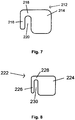
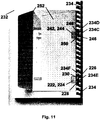
- the sticker of the present invention is substantially as described in Example 6, in particular with reference to Figure 6 , or is substantially as described in Example 7, in particular with reference to Figure 7 , or is substantially as described in Example 8, in particular with reference to Figure 8 .
- the first aspect of the invention also provides a method of attaching (preferably removeably attaching) a sticker, as defined in the first aspect of the invention,
- the material comprises a sheet and/or a generally planar material; more preferably the material comprises a piece of paper, an envelope and/or a plastic sheet, and/or a piece of textile material.
- the material is flexible, and preferably comprises a piece of paper (which is normally flexible), an envelope (which is normally flexible), and/or a flexible plastic sheet, and/or a piece of flexible textile material.
- the method of attaching (preferably removeably attaching) a sticker comprises the following steps (i) and (ii) in any order [preferably step (ii) occurs before step (i)]:
- the first aspect of the invention also provides a method of making a sticker, as defined in the first aspect of the invention, comprising:
- the method of making can also, in one particular embodiment, comprise forming a or the plurality of stickers into one or more pads and/or one or more sheets, wherein the pad(s) and/or sheet(s) comprise (e.g. are formed from) a plurality of, in particular a superposed and/or more particularly a non-superposed plurality of, stickers and/or sheets (preferably stickers) as defined in the first aspect of the invention.
- the pad(s) and/or sheet(s) comprise (e.g. are formed from) a plurality of, in particular a superposed and/or more particularly a non-superposed plurality of, stickers and/or sheets (preferably stickers) as defined in the first aspect of the invention.
- the plurality e.g.
- the superposed plurality and/or preferably the non-superposed plurality) of stickers is in removeable contact with a backing sheet, or (for a superposed plurality of stickers) a bottom sticker (preferably a or the adhesive face thereof) of the superposed plurality of stickers is in removeable contact with a backing sheet.
- the backing sheet is a backing sheet of plastic and/or of paper (or more preferably a backing sheet of plastic and/or of smooth-coated paper).
- a second aspect of the invention provides a pad and/or a sheet, comprising (in particular formed from) a plurality of, in particular a superposed plurality of and/or (preferably) a non-superposed plurality of, stickers and/or sheets (preferably stickers) as defined in the first aspect of the invention.
- the pad and/or the sheet according to the second aspect of the invention, comprises (in particular is formed from) 5 or more or 10 or more stickers and/or sheets (preferably stickers), preferably 5 or more or 10 or more superposed and/or (preferably) non-superposed stickers and/or sheets (preferably stickers), as defined in the first aspect of the invention.
- the plurality e.g.
- the superposed plurality and/or preferably the non-superposed plurality) of stickers is in removeable contact with, or (for a superposed plurality of stickers) a bottom sticker (preferably a or the adhesive face thereof) of the superposed plurality of stickers is in removeable contact with, a backing sheet.
- the backing sheet is a backing sheet of plastic and/or of paper (or more preferably a backing sheet of plastic and/or of smooth-coated paper).
- the second aspect of the invention also provides a pad and/or a sheet, comprising (in particular formed from) a non-superposed plurality of detachably-coupleable stickers (in particular 5 or more or 10 or more non-superposed detachably-coupleable stickers); wherein the non-superposed plurality of detachably-coupleable stickers are suitable for inserting into a loop-bound book and are capable of being detachably coupled to the binding of the loop-bound book; and wherein the plurality of detachably-coupleable stickers (preferably each detachably-coupleable sticker) is or are defined as comprising:
- the plurality of stickers (preferably the non-superposed plurality of stickers) is or are in removeable contact with a backing sheet.
- the backing sheet is a backing sheet of plastic and/or of paper, or even more preferably is a backing sheet of plastic and/or of smooth-coated paper.
- the detachable coupling means is elongate and comprises a finger portion which is capable of being detachably coupled to the binding of the loop-bound book.
- the body of the sticker(s) is or are in the form of a sheet and/or is generally planar; or preferably the body of the sticker(s) is or are in the form of a flexible sheet such as a sheet of flexible plastic or paper; or more preferably the body of the sticker(s) is or are in the form of a flexible plastic sheet(s).
- the sticky body contains, or the body of the sticker excluding any adhesive is at least partially covered by, an adhesive on at least one (preferably one) face of the sheet of the body and/or on at least one (preferably one) face of the generally planar body.
- the adhesive is as defined herein, and in particular the adhesive is preferably as defined for or in the first aspect of the invention (& especially is as defined in the preferred features of the adhesive in the first aspect).
- the detachable coupling means of the sticker is not covered by an adhesive.
- the plurality of stickers and/or the plurality of detachably-coupleable stickers are defined according to the sticker as defined herein (preferably hereinabove) in the first aspect of the invention, and/or (ii) are defined according to the sticker as defined in any of the claims, e.g. as defined in any of claims 1 to 20 and/or claim 21 and/or claim 22 or 23, herein.
- a third aspect of the invention provides a combination, comprising one, two or more stickers (preferably two stickers), according to a first aspect of the invention,
- the third aspect of the invention provides a combination, comprising one, two or more stickers (preferably two stickers), according to a first aspect of the invention,
- the combination comprises two of the stickers, wherein: either
- the material comprises a sheet and/or a generally planar material; more preferably the material comprises a piece of paper, an envelope and/or a plastic sheet, and/or a piece of textile material.
- the material is flexible, and more preferably the material comprises a piece of paper (which is normally flexible), an envelope (which is normally flexible), and/or a flexible plastic sheet, and/or a piece of flexible textile material.
- the pad and/or the sheet and/or the combination comprises one or more preferred (including without limitation more preferred, even or still or yet more preferred, particularly preferred, or most preferred, et al.), particular, optional and/or embodiment features, as described with respect to the sticker and/or method of the first aspect of the invention and/or in embodiments thereof, with all necessary changes being made.
- a fourth aspect of the present invention relates to a book insert and/or bookmark, in particular a multipurpose bookmark, specifically designed for (i.e. adapted for) books with a loop binding (preferably spiral, ring, comb or wire binding), such as a notebook (e.g. a workbook) or a personal organizer.
- a loop binding preferably spiral, ring, comb or wire binding
- the fourth aspect of the present invention also relates to an insert that can be detachably coupled to the binding (binder), in particular for marking a page of the stack and/or for other uses.
- the fourth aspect of the present invention also relates to an insert (e.g. a book insert) and/or a bookmark and/or a divider and/or a device, for marking a page of a book (preferably a loop-bound book, in particular a spiral-bound (coil-bound), ring-bound (e.g. open-and-close ring-bound), comb-bound and/or wire-bound book; in particular a loop-bound (e.g. spiral-bound) notebook (e.g. workbook) or personal organizer),
- the fourth aspect of the present invention provides:
- the fourth aspect of the present invention provides:
- the optional or preferable removeably-affixable sheet (slip) of paper is for (more preferably is suitable for, adapted for and/or intended for) indicating and/or receiving information of use to a user of the book; preferably written information, in particular written information to be added by the user,
- feature (M) preferably enables the insert (preferably a or the book insert, bookmark and/or divider) to function both as a bookmark and as a means for writing (jotting) points or notes.
- the insert preferably a or the book insert, bookmark and/or divider
- the insert is capable of functioning as a note pad or paper, preferably in addition to being a book insert, bookmark and/or divider.
- the body of the insert (preferably a or the book insert, bookmark and/or divider) acting as a bookmark for loop-bound (e.g. spiral- or ring-bound) books
- the body of the insert (preferably a or the book insert, bookmark and/or divider) is provided with a plurality of (preferably two or four) slits (preferably diagonal slits and/or laterally-directed slits) preferably adjacent to and/or inside of some or all of the corners (preferably adjacent to and/or inside of each of the four corners) of the body, e.g. the elongated and/or generally rectangular body, of the insert.
- slits act as insertion points for [and in a particularly preferable embodiment contain and/or hold in place] a slip (sheet) of paper which can be removeably affixed (preferably via one or more, e.g. all, of the slits) onto the body (e.g. the elongate and/or generally rectangular body) of the insert.
- a slip sheet of paper which can be removeably affixed (preferably via one or more, e.g. all, of the slits) onto the body (e.g. the elongate and/or generally rectangular body) of the insert.
- the slip (sheet) of paper is suitable for jotting (writing) points or notes of importance, e.g. to be later recollected, or simply to tabulate points as a reminder list or as a daily planner, etc.
- the fourth aspect of the present invention also provides: an insert (typically a book insert and/or a combination of inserts) comprising a plurality of (preferably three or more, or more preferably four, five, six or seven or more) dividers and/or book inserts having a variety of widths, which overlap each other, in a way that serves to act as a plurality of dividers, such that the user can see the dividers (preferably such that the user can see each (all) of the dividers) individually; and wherein the plurality of dividers and/or book inserts each have first and second detachable coupling means and/or first and second inserting members e.g. extending or projecting and/or e.g. as defined herein.
- This allows the user to use the insert / the combination of inserts / the dividers as an instrument for marking different pages (a plurality of different pages) of the book.
- the material used for the insert / the combination of inserts / the dividers is a sheet (preferably a plurality of sheets) (e.g. thin sheets) of flexible plastic or paper, or is made of cardboard.
- the insert e.g. book insert
- the bookmark e.g. bookmark
- the divider and/or the device comprises one or more preferred (including without limitation more preferred, even or still or yet more preferred, particularly preferred, or most preferred, et al.), particular, optional and/or embodiment features, as described with respect to the sticker and/or method of the first aspect of the invention and/or in embodiments thereof, and/or as described with respect to the pad and/or the sheet and/or the combination of the second and/or third aspects of the invention and/or in embodiments of any of these, with all necessary changes being made.
- the insert preferably the book insert, the bookmark and/or the divider
- the insert is as defined herein, in particular hereinbelow.
- the first detachable coupling means (such as the first inserting member) is elongate and/or narrow; and more preferably is elongate.
- the first detachable coupling means (preferably elongate, and/or preferably the first inserting member) continues (i.e. extends and/or projects) from, or from adjacent to, a top portion of the body.
- the first detachable coupling means (preferably elongate, and/or preferably the first inserting member) is aligned generally parallel to the body and/or to a side (preferably to an adjacent side) of the body.
- the first detachable coupling means preferably elongate and/or preferably the first inserting member
- the body together form a first gap between the first detachable coupling means (preferably the first inserting member) and the body, wherein the first gap is adapted to receive (and/or is adapted to be inserted inside) the loop binding of the book (and/or wherein the first gap is adapted so that a or the loop binding of a or the book can be inserted inside the first gap).
- the first detachable coupling means (preferably the first inserting member) is elongate and comprises a first finger portion which is capable of being detachably coupled to the binding of a loop-bound book.
- the first finger portion is aligned generally parallel to the body and/or to a side (e.g. to an adjacent side) of the body; and/or preferably, the first finger portion is connected (preferably integrally) to the body via a first stem portion (in which case, preferably, a base of the first stem portion extends in a direction generally away from, in particular generally perpendicular to and away from, the body, such as generally away from the side e.g. the adjacent side of the body).
- the first detachable coupling means is elongate and comprises a first finger portion which is capable of being detachably coupled to the binding of a loop-bound book, wherein:
- the first finger portion is connected (preferably integrally) to the body via a first stem portion; in which case, even more preferably, a base of the first stem portion extends in a direction generally away from, in particular generally perpendicular to and away from, the body, such as generally away from the side e.g. the adjacent side of the body.
- the width of the base of the first stem portion is from 2 to 7 mm, preferably from 2 to 6 mm or from 2 to 5 mm, more preferably from 2.5 to 6 mm or from 2.5 to 5 mm or from 2.5 to 4.5 mm, even more preferably from 3 to 5 mm or from 3 to 4.5 mm or from 3 to 4 mm, or most preferably about 3.5 mm.
- the first detachable coupling means is elongate and comprises a first finger portion which is capable of being detachably coupled to the binding of a loop-bound book;
- an outer edge of the first stem portion and/or an outer edge of the elongate first detachable coupling means extends generally away from the body (preferably generally perpendicularly), at the base of the first stem portion, and then forms a curve in a direction generally towards an outer tip of the first finger portion.
- the curved outer edge of the first stem portion (i) extends generally away from the body (preferably generally perpendicularly) at the base of the first stem portion, and (ii) joins the first finger portion (preferably integrally) in a direction generally parallel to a or the longitudinal axis of the first finger portion.
- This curved outer edge, of the first stem portion and/or of the elongate first detachable coupling means has been found to facilitate the smooth insertion of the first finger portion (and/or the elongate first detachable coupling means) between two adjacent loops of a loop bound book, in particular for spiral-bound, ring-bound or comb-bound books.
- an outer edge of the first stem portion and/or an outer edge of the elongate first detachable coupling means is either directed generally towards a or the outer tip of the first finger portion, or extends generally away from the body (preferably generally perpendicularly) and then forms a curve directed generally towards a or the outer tip of the first finger portion, or extends generally away from the body (preferably generally perpendicularly) and then turns at a non-reverse-facing edge so as to be directed generally towards a or the outer tip of the first finger portion.
- This non-reverse-facing shape of the outer edge, of the first stem portion and/or of the elongate first detachable coupling means has been found generally to facilitate the smooth insertion of the first finger portion (and/or the elongate first detachable coupling means) between two adjacent loops of a loop bound book, in particular for spiral-bound, ring-bound or comb-bound books.
- a or the outer edge of the first stem portion (and/or of the elongate first detachable coupling means) does not include a reverse-facing projection or edge which faces generally away from (in particular substantially directly away from) a or the outer tip of the first finger portion.
- the (preferably elongate) first detachable coupling means preferably the first stem portion and/or the first finger portion
- the first detachable coupling means (preferably the first inserting member; and/or preferably the first finger portion and/or the first stem portion; even more preferably the first finger portion and the first stem portion) is or are integrally formed with the body.
- the second detachable coupling means (such as the second inserting member) is elongate and/or narrow; and more preferably is elongate.
- the second detachable coupling means (preferably elongate, and/or preferably the second inserting member) continues (i.e. extends and/or projects) from, or from adjacent to, a bottom portion of the body.
- the second detachable coupling means (preferably elongate, and/or preferably the second inserting member) is aligned generally parallel to the body and/or to a side (preferably to an adjacent side) of the body.
- the second detachable coupling means preferably elongate and/or preferably the second inserting member
- the body together form a second gap between the second detachable coupling means (preferably the second inserting member) and the body, wherein the second gap is adapted to receive (and/or is adapted to be inserted inside) the loop binding of the book (and/or wherein the second gap is adapted so that a or the loop binding of a or the book can be inserted inside the second gap).
- the second detachable coupling means (preferably the second inserting member) is elongate and comprises a second finger portion which is capable of being detachably coupled to the binding of a loop-bound book.
- the second finger portion is aligned generally parallel to the body and/or to a side (e.g. to an adjacent side) of the body; and/or preferably, the second finger portion is connected (preferably integrally) to the body via a second stem portion (in which case, preferably, a base of the second stem portion extends in a direction generally away from, in particular generally perpendicular to and away from, the body, such as generally away from the side e.g. the adjacent side of the body).
- the second detachable coupling means is elongate and comprises a second finger portion which is capable of being detachably coupled to the binding of a loop-bound book, wherein:
- the second finger portion is connected (preferably integrally) to the body via a second stem portion; in which case, more preferably, a base of the second stem portion extends in a direction generally away from, in particular generally perpendicular to and away from, the body, such as generally away from the side e.g. the adjacent side of the body.
- the width of the base of the second stem portion is from 2 to 7 mm, preferably from 2 to 6 mm or from 2 to 5 mm, more preferably from 2.5 to 6 mm or from 2.5 to 5 mm or from 2.5 to 4.5 mm or from 2.5 to 4 mm, even more preferably from 3 to 5 mm or from 3 to 4.5 mm or from 3 to 4 mm, or most preferably from 3 to about 3.5 mm, in particular about 3.5 mm.
- the second detachable coupling means is elongate and comprises a second finger portion which is capable of being detachably coupled to the binding of a loop-bound book;
- an outer edge of the second stem portion and/or an outer edge of the elongate second detachable coupling means extends generally away from the body (preferably generally perpendicularly), at the base of the second stem portion, and then forms a curve in a direction generally towards an outer tip of the second finger portion.
- the curved outer edge of the second stem portion (i) extends generally away from the body (preferably generally perpendicularly) at the base of the second stem portion, and (ii) joins the second finger portion (preferably integrally) in a direction generally parallel to a or the longitudinal axis of the second finger portion.
- This curved outer edge, of the second stem portion and/or of the elongate second detachable coupling means has been found to facilitate the smooth insertion of the second finger portion (and/or the elongate second detachable coupling means) between two adjacent loops of a loop bound book, in particular for spiral-bound, ring-bound or comb-bound books.
- an outer edge of the second stem portion and/or an outer edge of a or the elongate second detachable coupling means is either directed generally towards a or the outer tip of the second finger portion, or extends generally away from the body (preferably generally perpendicularly) and then forms a curve directed generally towards a or the outer tip of the second finger portion, or extends generally away from the body (preferably generally perpendicularly) and then turns at a non-reverse-facing edge so as to be directed generally towards a or the outer tip of the second finger portion.
- This non-reverse-facing shape of the outer edge, of the second stem portion and/or of the elongate second detachable coupling means has been found generally to facilitate the smooth insertion of the second finger portion (and/or the elongate second detachable coupling means) between two adjacent loops of a loop bound book, in particular for spiral-bound, ring-bound or comb-bound books.
- a or the outer edge of the second stem portion (and/or of the elongate second detachable coupling means) does not include a reverse-facing projection or edge which faces generally away from (in particular substantially directly away from) a or the outer tip of the second finger portion.
- the (preferably elongate) second detachable coupling means preferably the second stem portion and/or the second finger portion
- the second detachable coupling means (preferably the second inserting member; and/or preferably the second finger portion and/or the second stem portion; even more preferably the second finger portion and the second stem portion) is or are integrally formed with the body.
- the fourth aspect of the invention is as defined in inventions 134, 135, 136, 137,138,139 or 140, as listed below. More preferably, any one or more of these inventions 134-140 can be combined with any other feature(s), and in particular can be combined with any other preferred (which includes more preferred & most preferred etc.) and/or particular and/or advantageous and/or typical and/or usual and/or optional and/or other feature(s), which feature(s) are as defined anywhere herein in the description and/or in the claims and/or in the figures (drawings), in respect of the fourth, first, second, third and/or any other aspects of the invention and/or in any embodiments thereof. All possible combinations are herein explicitly disclosed and are intended to be protected by the present invention.
- any or all preferred and/or advantageous features including without limitation more preferred, even, still or yet more preferred, particularly preferred, or most preferred features, or similar
- any or all particular or suitable or typical or usual features any or all optional or alternative or embodiment features, and/or any or all features of the examples and/or exemplified embodiments herein
- any other preferred and/or advantageous features any other particular or suitable or typical or usual features, any other optional or alternative or embodiment features, and/or any other features of the examples and/or exemplified embodiments herein, in any or all possible combinations.
- each aspect of the invention can be combined with any preferred and/or advantageous feature(s) (including without limitation more preferred, even, still or yet more preferred, particularly preferred, or most preferred features, or similar), any particular or suitable or typical or usual feature(s), any optional or alternative or embodiment feature(s), and/or any features of the examples and/or exemplified embodiments herein, which apply to or are disclosed in respect of different aspect(s) of the invention, mutatis mutandis (i.e. with any necessary changes made).
- any and/or advantageous feature(s) including without limitation more preferred, even, still or yet more preferred, particularly preferred, or most preferred features, or similar
- any particular or suitable or typical or usual feature(s) any optional or alternative or embodiment feature(s)
- any features of the examples and/or exemplified embodiments herein which apply to or are disclosed in respect of different aspect(s) of the invention, mutatis mutandis (i.e. with any necessary changes made).
- loop binding should be understood as meaning a binding system (or bound by a binding system) which loosely joins a sheaf or stack of pages (preferably pages of a book), wherein the binding system loops around and/or through holes (e.g. sequential holes) on one edge of the pages.
- the binding system preferably comprises loops, typically a plurality of loops.
- the loops may be in a spiral (preferably a continual spiral); or the loops may be as separate, individual loops.
- the loops are curved in some manner; and more preferably the loops are made from circles, rings, spirals, straight lines, and/or ellipses, and/or are made from portions of circles, rings, spirals, straight lines, and/or ellipses.
- ring binding typically as or in a multi ring binding system and/or a ring binder such as a two-ring or three-ring binder (preferably a binder having a plurality of, more preferably two or three, openable and closable rings; and/or preferably an open-and-close ring binder), would be included as a preferred embodiment of "loop binding".
- Other examples, which are alternative and/or additional preferred embodiments of "loop binding” include comb binding, spiral binding (also called coil binding), and/or wire binding.
- a "person” means a “human”, and vice versa.
- FIGURE 1 illustrates an overall view of an insert (100), for loop-bound (e.g. spiral bound) books, notebooks and/or the like, suitable to act as bookmark, comprising an elongated generally rectangular area (body) (200), which is aligned parallel to two narrow (and preferably elongate) inserting members (201) and (202).
- a first narrow inserting member (201) continues (i.e. extends) from the top of the elongated generally rectangular area (200), forming a very narrow gap (203) between the generally rectangular area (body) (200) of the bookmark (insert 100) and the first inserting member (201), wherein the gap (203) is to be inserted inside (i.e. is to receive) the spiral binding.
- a second narrow inserting member (202) continues (i.e. extends) from the bottom of the elongated rectangular area (200); also with very narrow gap similar to the gap formed by the first inserting member of the bookmark, and also to be inserted inside (i.e. is to receive) the spiral binding.
- Example 2 Insert (110) for loop-bound books having a plurality of diagonal slits (204)
- FIGURE 2 illustrates an embodiment of an insert (100) of the present invention, wherein the said insert is suitable for using with a loop-bound (e.g. spiral-bound) book.
- the book insert is further provided with a plurality of diagonal slits (204) adjacent to (just inside of) each of the four corners of the of the elongated generally rectangular area (200) of the insert (100).
- slits act as insertion points for a slip of paper (205), to be temporarily affixed on the generally rectangular area (200) of the insert (100), for jotting points or notes of importance, to be later recollected or simply to tabulate points as a reminder list or a daily planner, etc.
- Example 3 - Book insert comprising a plurality of dividers (206)
- FIGURE 3 illustrates an embodiment of an insert (100) of the present invention, wherein the book insert is provided with multiple clips (dividers) (206) of varying colours and having varying width, which overlap each other, in a way that serves to act as plurality of dividers (206), such that the user can see the said dividers (preferably each of the dividers) individually.
- dividers preferably each of the dividers
- the material used for the insert(s) (206) is a thin sheet of flexible plastic or paper.
- the flexible plastic is as defined herein (e.g. hereinabove); or even more preferably the flexible plastic comprises (e.g. is): PET, PBT, PTT, PEN, another polyester (preferably a biodegradable polyester), PVC, PP, PE and/or other flexible plastic(s) as defined herein.
- the insert(s) and/or book insert(s) and/or dividers (206) is or are made out of paper (various kinds of paper can be used, e.g. a thin sheet of paper, typically flexible paper), and/or is or are made out of cardboard.
- the insert(s) and/or book insert(s) and/or dividers (206) is or are made out of cardboard.
- the cardboard can be flexible (e.g. flexible to a greater or lesser extent, e.g. depending on the thickness of the cardboard) or can be substantially rigid. Even more preferably, the cardboard is flexible; typically the cardboard is flexible to a greater or lesser extent, typically depending on the thickness of the cardboard.
- the plurality of dividers (206) comprises five dividers (206) (as shown in Figure 3 ), the five dividers being of varying colours and having varying widths, and which overlap each other, in such a way (e.g. arranged in the book in such a way) that the five dividers (206) (preferably each of the five dividers) can be seen by the user individually, e.g. as shown in Figure 3 .
- FIGURE 4 illustrates another embodiment of the present invention, wherein the book insert of the present invention, apart from functioning as a bookmark for loop-bound (e.g. spiral-bound) books, also functions as a measuring device.
- the elongated generally rectangular portion (body) (200), of the insert (100) is provided with ruler markings (207) printed on the surface thereof along or adjacent to one edge, preferably along or adjacent to one long edge, thereby acting as a ruler (207).
- ruler markings e.g. small-to-medium distances
- the ruler markings (207) are printed on the surface of the generally rectangular portion (body), along or adjacent to an edge (preferably a long edge) of the generally rectangular portion which is opposite to (i.e. faces directly away from) the edge (preferably long edge) of the generally rectangular portion (body) from which the first and second inserting members extend and/or project.
- FIGURE 5 illustrates another embodiment of the present invention, wherein the book insert of the present invention, apart from functioning as a bookmark for loop-bound (e.g. spiral-bound) books, also functions as another measuring device and more particularly, a protractor (208).
- the elongated generally rectangular portion (200), of the insert (100) is broader in breadth (and preferably also and longer in length), to accommodate the measurements of a protractor. In this way, angles can be measured using the protractor.
- longitudinal ruler markings are also provided on the protractor (208), for measuring distances.
- Figure 6 depicts a plan view from above of a book insert (sticker, 209) of present invention which functions as an attachment for various materials, as described in this Example 6. More particularly, Figure 6 is a plan view from above of an open loop-bound (e.g. ring-bound, e.g. open-and-close ring-bound) book, into the binding of which has been inserted a book insert (sticker 209), wherein the sticker is attached to a piece of material (in Figure 6 , the piece of material is an envelope).
- an open loop-bound e.g. ring-bound, e.g. open-and-close ring-bound
- FIGURE 6 illustrates another embodiment of the present invention (Example 6), wherein the book insert of the present invention comprises a sticky body (sticker) (209) for attachment of a piece or pieces, in particular a sheet or sheets, of material [preferably of sheet-like material and/or generally planar material, such as paper (preferably as a paper sheet or sheets), an envelope, and/or plastic (preferably as a plastic sheet or sheets)] to the loop-binding (e.g. spiral binding or ring binding) of the book, e.g. of a notebook.
- a sticky body sticker
- the sticker (209) comprises a sticky body (209), and an insert which can be (i.e. which is capable of being) detachably coupled to the binding (binder) of a book, preferably to the binding (binder) of a loop-bound book such as a spiral-bound or ring-bound (e.g. open-and-close ring-bound) book.
- the insert comprises a detachable coupling means and/or an inserting member.
- the insert and/or inserting member of the sticker (209) which is preferably elongate and/or narrow, continues (i.e. extends) from the top of the sticky body (209), and is aligned parallel to the adjacent edge of the sticky body, in such a way as to form a narrow gap between the sticky body (209) and the insert and/or inserting member, wherein the gap is to be inserted inside (i.e. is to receive) the loop binding (e.g. spiral binding) of the book.
- the loop binding e.g. spiral binding
- the insert and/or inserting member of the sticker (209) is generally similar in form, position and/or orientation to the first inserting member (201) of the insert (100) of the Example 1 embodiment of the invention shown in Figure 1 .
- the sticker (209) of Example 6 functions as an attachment for various materials (such as an envelope, as shown in Figure 6 ).
- Figure 7 illustrates another embodiment of the present invention (Example 7), which is a sticker 212, comprising a sticky body 214 for attachment of a piece or pieces, in particular a sheet or sheets, of material [preferably of sheet-like material and/or generally planar material, such as paper (preferably as a paper sheet or sheets), an envelope, and/or plastic (preferably as a plastic sheet or sheets)] to the loop-binding (e.g. spiral binding or ring binding) of the book, e.g. of a notebook.
- a sticker 212 comprising a sticky body 214 for attachment of a piece or pieces, in particular a sheet or sheets, of material [preferably of sheet-like material and/or generally planar material, such as paper (preferably as a paper sheet or sheets), an envelope, and/or plastic (preferably as a plastic sheet or sheets)] to the loop-binding (e.g. spiral binding or ring binding) of the book, e.g. of a notebook.
- the sticker 212 comprises a sticky body 214, and an insert 216 (a finger portion 216) which is capable of being detachably coupled to the binding (binder) of a loop-bound book such as a spiral-bound or ring-bound (e.g. open-and-close ring-bound) book.
- the insert 216 (the finger portion 216) is part of the detachable coupling means as defined in the first aspect of the invention.
- the finger portion 216 of the sticker 212 which is elongate (and generally narrow), extends from the top (i.e. from the upper portion) of the sticky body 214, and is aligned parallel to the adjacent edge of the sticky body 214, in such a way as to form a narrow gap 220 between the sticky body 214 and the finger portion 216, wherein the gap 220 is to be inserted inside (i.e. is to receive) the loop binding (e.g. spiral binding) of the book.
- the loop binding e.g. spiral binding
- the sticker 212 of Example 7 functions as an attachment for various materials (such as an envelope, preferably similar to that shown in Figure 6 , & as shown in Fig. 11 ; or a sheet of paper, preferably similar to that shown in Figures 9 and/or 10).
- the sticker body 214 (but not the finger portion 216) has adhesive on one side, e.g. as defined herein e.g. hereinabove.
- the sticker 212 has a detachable coupling means (216, 218) which comprises the finger portion 216 and a stem portion 218.
- the stem portion 218 connects the finger portion 216 to the sticky body 214; and preferably the stem portion 218 is integrally formed with the finger portion 216 and with the sticky body 214.
- the stem portion 218 extends and/or projects generally perpendicularly away from the upper portion of the sticky body 214 (& is or projects generally in the plane of the sticky body 214); and then the stem portion 218 connects to a rear end of the finger portion 216.
- the stem portion 218 and the finger portion 216 are generally perpendicular to each other. [Note: As illustrated in Figure 7 , it is preferred in all aspects of the invention that the finger portion 216 is substantially straight and/or is generally aligned along a longitudinal axis of the finger portion 216.]
- the outermost part of the outer edge of the stem portion 218, and/or the outer edge of the rear end of the finger portion 216 is or are curved in a direction towards the outer tip of the finger portion 216.
- This curved outer edge improves the performance of the sticker, by enabling the finger portion 216 (and optionally or possibly the outermost part of the stem portion 218) of the sticker 212 to be smoothly, efficiently and/or easily pushed into the loop-binding of a loop-bound book, thereby removeably attaching the finger portion 216 of the sticker 212 to the loop-binding of the loop-bound book.
- the finger portion 216 and/or the gap 220 and/or the stem portion 218 and/or the base of the stem portion 218 have one or more preferred dimension(s) (in particular width and/or length) as defined herein e.g. as preferred or particular features of the invention (in particular with respect to the first aspect of the invention).
- the finger portion 216 has a width as defined in feature (B1) as described herein and/or has a length as defined in feature (B2) as described herein.
- This sticker (222) of Example 8 is generally similar to the sticker (212) of Example 7, but the finger portion (226) & the gap (230) are differently sized in the sticker (222) of Example 8, which is shown in Figure 8 .
- the sticker (222) of Example 8 has generally a similar structure to, and is typically made from the same or similar material(s) (preferably flexible plastic) as, and is intended to be used in generally the same way as, the sticker (212) of Example 7.
- the sticker 222 has a detachable coupling means (226, 228) which comprises the finger portion 226 and a stem portion 228.
- the stem portion 228 connects the finger portion 226 to the sticky body 224; and preferably the stem portion 228 is integrally formed with the finger portion 226 and with the sticky body 224.
- the stem portion 228 extends and/or projects generally perpendicularly away from the upper portion of the sticky body 224 (& is or projects generally in the plane of the sticky body 224); and then the stem portion 228 connects to a rear end of the finger portion 226.
- the stem portion 228 and the finger portion 226 are generally perpendicular to each other. [Note: As illustrated in Figure 8 , it is preferred in all aspects of the invention that the finger portion 226 is substantially straight and/or is generally aligned along a longitudinal axis of the finger portion 226.]
- the outermost part of the outer edge of the stem portion 228, and/or the outer edge of the rear end of the finger portion 226, is or are curved in a direction towards the outer tip of the finger portion 226.
- This curved outer edge improves the performance of the sticker, by enabling the finger portion 226 (and optionally or possibly the outermost part of the stem portion 228) of the sticker 222 to be smoothly, efficiently and/or easily pushed into the loop-binding of a loop-bound book, thereby removeably attaching the finger portion 226 of the sticker 222 to the loop-binding of the loop-bound book.
- the finger portion 226 and/or the gap 230 and/or the stem portion 228 and/or the base of the stem portion 228 have one or more preferred dimension(s) (in particular width and/or length) as defined herein e.g. as preferred or particular features of the invention (in particular with respect to the first aspect of the invention).
- the finger portion 226 has a width as defined in feature (B1) as described herein and/or has a length as defined in feature (B2) as described herein.
- Figures 9-11 are plan views from above showing preferred uses of sticker(s) (222) as disclosed in Example 8/ Figure 8 ; and/or showing preferred uses of sticker(s) (242) which are equivalent to but have a different (oppposite) orientation to the sticker(s) (222) disclosed in Example 8/ Figure 8 ; the stickers (222 and/or 242) are attached to a sheet and/or an envelope; and the detachable coupling means (the finger portion(s), 226 and/or 246) of the sticker(s) (222, 242) are inserted into the loop binding (here, a ring-binding, 234) of a book (232).
- Figures 12A-12C are plan views from above showing a divider (insert) (260) (preferably a book insert, bookmark and/or divider), for marking a page of a loop-bound book, according to Examples 12A-12C.
- a divider insert
- 260 preferably a book insert, bookmark and/or divider
- the body (262) of the insert/divider (260) is elongated and/or generally rectangular.
- a first (upper) finger portion (266) projects / extends from the body (262), from adjacent to a top portion (272) of the body (262) of the insert/divider (260).
- a second (lower) finger portion (276) projects / extends from the body (262), from adjacent to the bottom portion (289) of the body (262) of the insert/divider (260).
- the divider / insert (260) is for (preferably is suitable for, adapted for and/or intended for) indicating and/or receiving information of use to a user of the book ⁇ preferably written information, and/or preferably information relating to (e.g. the number of, and/or the subject-matter, content and/or title of) the book or a page of the book marked by the insert e.g. by the book insert, bookmark, and/or divider ⁇ ; and
- the outwardly-projecting part of the top and/or top portion (272) of the insert (260) (preferably of the book insert, bookmark and/or divider) has a demarked area (296) which is visually distinguished ⁇ preferably by a visually-distinguishable (preferably marked) perimeter (see the marked perimeter around area 296) and/or by a visually-distinguishable shade, colour and/or pattern ⁇ from part or all of the surrounding area (272) of the insert (260) or of the top portion (272) of the insert (260).
- the demarked area (296) of the top and/or top portion (272) of the insert (260) is for (preferably is suitable for, adapted for and/or intended for) indicating and/or receiving information of use to a user of the book ⁇ preferably written information, in particular written information to be added by the user; and/or preferably information e.g. written information relating to (e.g. the number of, and/or the subject-matter, content and/or title of) the book or a page of the book marked by the insert (260), e.g. by the book insert, bookmark and/or divider ⁇ .
- written information relating to (e.g. the number of, and/or the subject-matter, content and/or title of) the book or a page of the book marked by the insert (260), e.g. by the book insert, bookmark and/or divider ⁇ .
- the body (262) of the insert comprises a plurality of (in this case, two) laterally-directed slits (285, 287), adjacent to and/or inside of some or all of the corners (more preferably adjacent to and/or inside of each of the four corners) of the body (262).
- the plurality of laterally-directed slits (285, 287) act as insertion points (285, 287) for [and in a particularly preferable embodiment are capable of and/or adapted to contain and/or hold in place] a sheet (slip) of paper (264, 292, 300 or 310) which can be removeably affixed (via one or two of the plurality of laterally-directed slits, 285, 287) onto the elongate and/or generally rectangular body (262) of the insert / divider (260).
- the insert / divider (260) functions as a bookmark, and also (via the attached sheet (slip) of paper (264, 292, 300 or 310)) also functions as a means for writing (jotting) points or notes, and in particular functions as a note pad or paper (264, 292, 300 or 310).
- Figures 13A-13E are plan views from above showing a divider (insert) (330) (preferably a book insert, bookmark and/or divider), for marking a page of a loop-bound book, according to Examples 13A-13E.
- a divider insert
- 330 preferably a book insert, bookmark and/or divider
- the body (332) of the insert/divider (330) is elongated and/or generally rectangular.
- a first (upper) finger portion (336) projects / extends from the body (332), from adjacent to a top portion (342) of the body (332) of the insert/divider (330).
- a second (lower) finger portion (346) projects / extends from the body (332), from adjacent to the bottom portion (359) of the body (332) of the insert/divider (330).
- the divider / insert (330) is for (preferably is suitable for, adapted for and/or intended for) indicating and/or receiving information of use to a user of the book ⁇ preferably written information, and/or preferably information relating to (e.g. the number of, and/or the subject-matter, content and/or title of) the book or a page of the book marked by the insert e.g. by the book insert, bookmark, and/or divider ⁇ ; and
- the outwardly-projecting part of the top and/or top portion (342) of the insert (330) (preferably of the book insert, bookmark and/or divider) has a demarked area (366) which is visually distinguished ⁇ preferably by a visually-distinguishable (preferably marked) perimeter (see the marked perimeter around area 366) and/or by a visually-distinguishable shade, colour and/or pattern ⁇ from part or all of the surrounding area (332, 342) of the insert/divider (330) or of the top portion (342) of the insert/divider (330).
- the demarked area (366) of the top and/or top portion (342) of the insert (330) is for (preferably is suitable for, adapted for and/or intended for) indicating and/or receiving information of use to a user of the book ⁇ preferably written information, in particular written information to be added by the user; and/or preferably information e.g. written information relating to (e.g. the number of, and/or the subject-matter, content and/or title of) the book or a page of the book marked by the insert (330), e.g. by the book insert, bookmark and/or divider ⁇ .
- the body (332) of the insert comprises a plurality of (in this case, two) laterally-directed slits (355, 357), adjacent to and/or inside of some or all of the corners (more preferably adjacent to and/or inside of each of the four corners) of the body (332).
- the plurality of laterally-directed slits (355, 357) act as insertion points (355, 357) for [and in a particularly preferable embodiment are capable of and/or adapted to contain and/or hold in place] a sheet (slip) of paper (334, 362, 370, 380, or 390) which can be removeably affixed (via one or two of the plurality of laterally-directed slits, 355, 357) onto the elongate and/or generally rectangular body (332) of the insert / divider (330).
- the insert / divider (330) functions as a bookmark, and also (via the attached sheet (slip) of paper (334, 362, 370, 380, or 390)) also functions as a means for writing (jotting) points or notes, and in particular functions as a note pad or paper (334, 362, 370, 380, or 390).
- Figure 14 , Figure 15 and Figure 16A-16C are (respectively) a plan view from above, a perspective view, and plan views from above, of a plurality (400) of dividers (inserts) (402, 404, 406, 408, 410) (preferably book inserts, bookmarks and/or dividers), according to Examples 14, 15 and 16A-16C, each of which is for marking a page of a loop-bound book.
- dividers inserts
- the insert / divider (the combination / plurality of inserts, 400) comprises a plurality of (in the present case, five) dividers and/or book inserts (402, 404, 406, 408, 410) having a variety of widths (see e.g. Figures 16A, 16B and 16C ), which overlap each other, in a way that serves to act as a plurality (400) of dividers (402, 404, 406, 408, 410), such that the user can see the dividers individually.
- Figures 14 and 15 because of the greater width of each lower-down insert/divider compared to insert/divider above it (e.g. the Fig. 16C divider is wider than the Fig.
- the top portions of the dividers/book-inserts (402, 404, 406, 408, 410) project outwardly (upwardly) from a loop-bound book (not shown) when the dividers/book-inserts (402, 404, 406, 408, 410) are detachably coupled to the loop-binding of the book (preferably at different pages of the book), the top portions of the dividers/book-inserts (402, 404, 406, 408, 410) can be seen by a user when attached / coupled to the loop-binding of the book, even when the book is closed.
- This provides an excellent & convenient plurality of bookmarks, which function to mark the position of a plurality of pages, and/or a plurality of different sections, of the book, in a visually- & manually- convenient way & in an immediately-recognizable way.
- the plurality (400) of dividers and/or book inserts (402, 404, 406, 408, 410) each have first (416) and second (426) detachable coupling means, i.e. first (416) and second (426) finger portions, as defined according to various aspects and/or embodiments of the invention herein, which are for attaching the dividers/book-inserts to a loop-binding of a book.
- loop binding should be understood as meaning a binding system (or bound by a binding system) which loosely joins a sheaf or stack of pages (preferably pages of a book), wherein the binding system loops around and/or through holes (in particular sequential holes) on one edge of the pages.
- the binding system preferably comprises loops, typically a plurality of loops.
- the loops may be in a spiral (preferably a continual spiral); or the loops may be as separate, individual loops.
- the loops are curved in some manner; and more preferably the loops are made from circles, rings, spirals, straight lines, and/or ellipses, and/or are made from portions of circles, rings, spirals, straight lines, and/or ellipses.
- ring binding typically as or in a multi ring binding system and/or a ring binder such as a two-ring or three-ring binder (preferably a binder having a plurality of, more preferably two or three, openable and closable rings; and/or preferably an open-and-close ring binder), would be included as a preferred embodiment of "loop binding".
- Other examples, which are alternative and/or additional preferred embodiments of "loop binding” include comb binding, spiral binding (also called coil binding), and/or wire binding.
- a or the loop binding is a or the spiral or ring binding.
- the bookmark, insert (preferably book insert), divider and/or sticker may be made out of a wide variety of materials. It is particularly economical and desirable to make it out of a non-brittle and/or flexible plastic (preferably a non-brittle and/or flexible plastic which is a common plastic and/or which is a flexible plastic as defined herein, preferably PET, PBT, PTT, PEN, another polyester (preferably a biodegradable polyester), PVC, PP, PE and/or other plastic(s) as defined herein).
- a non-brittle and/or flexible plastic preferably a non-brittle and/or flexible plastic which is a common plastic and/or which is a flexible plastic as defined herein, preferably PET, PBT, PTT, PEN, another polyester (preferably a biodegradable polyester), PVC, PP, PE and/or other plastic(s) as defined herein.
- various kinds of paper and/or cardboard may also be used satisfactorily.
Landscapes
- Engineering & Computer Science (AREA)
- Textile Engineering (AREA)
- Sheet Holders (AREA)
- Package Frames And Binding Bands (AREA)
Abstract
(i) a detachable coupling means, which is capable of being detachably coupled to the binding of a loop-bound book; and
(ii) a sticky body for attachment to a material;
wherein the sticker is capable of functioning as an attachment for attaching the material to the loop binding of the book.
Description
- The present invention relates to a sticker, which can be (i.e. which is capable of being) detachably coupled to the binding (binder) of a book, preferably to the binding (binder) of a loop-bound book, in particular a ring-bound (e.g. open-and-close ring-bound), spiral-bound (coil-bound), comb-bound, and/or wire-bound book. Preferably, the sticker can function as an insert capable of being detachably coupled to the binding of a book, preferably of a loop-bound book; and/or, preferably, the sticker is suitable for inserting into a book, preferably into a loop-bound book.
- More preferably, the sticker of the invention comprises a detachable coupling means and/or an inserting member, which typically is capable of being detachably coupled to the binding (binder) of a book, preferably to the binding (binder) of a loop-bound book.
- The present invention also relates to an insert (preferably a book insert, bookmark and/or divider), in particular a multifunctional insert, for a loop-bound book such as a spiral-bound book.
- The present invention also relates to an insert (preferably a book insert, bookmark and/or divider), suitable for using with a loop-bound book (preferably a spiral- or ring- bound book) and/or suitable to act as and/or being a bookmark.
- More preferably, the insert comprises: i) a body (preferably an elongated body); ii) a first detachable coupling means extending and/or projecting from at or adjacent to the top and/or a top portion of the body, wherein the first detachable coupling means is suitably sized, shaped and/or arranged so as to be capable of being inserted inside (i.e. received by) a or the loop binding (preferably a spiral or ring binding) of a or the loop-bound book; and iii) a second detachable coupling means extending and/or projecting from at or adjacent to the bottom and/or a bottom portion of the body, wherein the second detachable coupling means is suitably sized, shaped and/or arranged so as to be capable of being inserted inside (i.e. received by) a or the loop binding (preferably a spiral or ring binding) of a or the loop-bound book.
- As used herein with respect to the present invention, a or the book is preferably a loop-bound book, and/or preferably comprises (e.g. is) a notebook (e.g. a workbook) or a personal organizer. Most preferably, in the present invention, a or the book comprises (e.g. is) a loop-bound notebook (e.g. a loop-bound workbook) or a loop-bound personal organizer.
- The present invention also relates to a multipurpose bookmark specifically designed for (and/or adapted for) a book with loop binding (such as a spiral binding); in particular a bookmark designed for (and/or adapted for) a notebook (e.g. a workbook) or a personal organizer.
- The present invention also relates to an insert which can be (i.e. which is capable of being) detachably coupled to the binding (binder) of a book, preferably to the binding (binder) of a loop-bound book such as a ring-bound (e.g. open-and-close ring-bound), spiral-bound (coil-bound), comb-bound and/or wire-bound book. Preferably, the insert comprises a detachable coupling means and/or an inserting member. In particular, the insert can be for marking a page of the stack and/or for other uses.
- Bookmarks of various sorts have been common for many years. A bookmark is a thin marker or book insert, made from a suitably thin material, such as paper or cardboard, and is placed by a reader inside the book so that it is easy to return to the same book page in the future. It is normally designed to avoid any damage to the book.
- Notebooks (for example workbooks) and/or personal organizers are commonly used for the recording of various kinds of information. These include, amongst other things, calendar planners, personal diaries, names and addresses of contacts, notes, and/or task lists; and/or written information recording some or all of the information discussed in a meeting, the discussions which took place in a meeting, and/or decision(s) made in a meeting (in particular minutes or notes of a or the meeting). Notebooks (e.g. workbooks) and/or personal organizers typically comprise pre-printed sheets of paper for writing the information, tab dividers, pockets, pouches or other features. These pre-printed sheets of paper may include ruled lines, calendars, spaces for names and addresses according to the design of the manufacturer. For versatility, personal organizers often include open-and-close ring binders to conveniently bind or detach sheets of material (e.g. paper sheets). For notebooks, the stack of sheet material (e.g. a stack of paper sheets) is sometimes permanently bound together by a binding coil, such that the relative locations of the material are permanently fixed. These rings and coils are examples of binding guides that guide each sheet of material when it is flipped over while allowing the materials to retain their relative positions in the stack. For open-and-close ring binders, these sheets (e.g. paper sheets) can be removed by opening the rings. In contrast, for binding coils, the sheets (e.g. paper sheets) should usually be torn from the binding coil for removal; or alternatively, for binding coils, the sheets (e.g. paper sheets) should usually be torn off and/or removed along a line of weakness, e.g. a perforated line, in the sheet which is typically generally parallel to and/or is typically adjacent to the binding coil.
- In order to provide greater flexibility, dividers and other components for these personal organizers and/or notebooks which are meant to be detachably used should preferably have features that allow them to be conveniently attached to or removed from the binder. This allows customization because the various components can then be releasably coupled to the binder in any location within the stack of material and are reusable by moving them to another location.
-
US 2633372 A , titled "Bookmark", relates to a bookmark which, allegedly, may be easily and quickly applied to old or to new books, without defacing or damaging the same, or otherwise detracting from the appearance, form or size of the book. -
US 1961527 A , titled "Bookmark", relates generally to reading accessories, and particularly to a book mark arranged for novel association with a book. Also, it discloses a body member for insertion between the inner edges of the pages and the back of the binding of a book, and flexible members extending from the body member and arranged for placing between selected pages of the book, to mark a plurality of places in the book. -
CN 102463763 A , titled "Precise bookmark", discloses a precise bookmark, comprising a bookmark, wherein a V-shaped clamping plate is arranged on the upper part of the bookmark; an indicating bar is in sliding connection with the bookmark; the bookmark is fixed on the top of a book page after reading, the indicating bar is slid to the unread row, and the book is closed; and when the book is opened again, less time can be used to find out the unread paragraph. The precise bookmark disclosed by the invention is alleged to have the advantages of a simple structure and convenience for reading. -
US 2448611 A , titled "Magnetic bookmark", discloses a bookmark having magnetic means secured thereon for placement on opposite sides of the page to be marked, the magnet elements being attracted to each other whereby the mark will be detachably secured to the page. These magnetic elements are not very practical. -
WO 2006/118546 A2 andUS 2009/0311037 A1 (both Chi Lam Leung ) disclose an insert for detachable coupling to a plurality of spaced binding guides holding a stack of sheet material, comprising: (i) a flexible body; and (ii) a hook comprising a finger portion extending substantially parallel to a side of the flexible body to form an elongated slit with the flexible body that is configured for slidably receiving a binding guide through an opening of the elongated slit whereby to engage the binding guide in a position along the elongated slit; wherein the finger portion extends from near an end portion of the side of the flexible body in a direction away from said end portion such that the opening of the elongated slit faces away from said end portion. Preferably, the insert ofWO 2006/118546 A2 also includes a second hook comprising a second finger portion extending substantially parallel to said side of the flexible body to form a second elongated slit with the flexible body that is configured for slidably receiving a second binding guide through an opening of the second elongated slit whereby to engage the second binding guide in a position along the second elongated slit. Preferably, the opening of the second elongated slit faces away from the opening of the first elongated slit. - Preferably, the insert disclosed in
WO 2006/118546 A2 (Chi Lam Leung ) also includes a flange portion projecting from the second hook in the direction of the first hook for engaging another binding guide when the first binding guide is engaged in the first elongated slit. Page 9 of the Detailed Description ofWO 2006/118546 A2 discloses an example of this flange arrangement and its function as follows: "... The flexible body 12 is then unflexed, and the result will be that one binding guide 36a is received by the first elongated slit 18 of the first hook 16 and another binding guide 36b is received by the flange portion 31 of the second hook 26. As can be seen fromFIG. 1 , theinsert 10 is prevented from being separated from the binding guides 36 by the finger portion 22 of the first hook 16 and the flange portion 31 of the second hook 24." However, it has now been found that this flange portion 31 of the second hook 26, which projects and/or faces in the opposite (reverse-facing) direction to that of the main finger portion of the second hook 26, is unnecessary and in some cases may be disadvantageous. - In the insert disclosed in
WO 2006/118546 A2 (Chi Lam Leung ), the flexible body preferably further comprises an attachment portion (specifically, a clip-like flap 32) cut from the flexible body which is pliable for receiving and attaching objects (such as loose pieces of paper) between the attachment portion (e.g. flap 32) and the flexible body (e.g. 12). However, this is not a very secure means of attachment; the pieces of paper can easily fall out of the flap 32. - Compared to the unsecure attachment portion (flap 32) of the flexible body 12 of the
insert 10 disclosed in pages 5-12 and the Figures ofWO 2006/118546 A2 (Chi Lam Leung ), there is a need for a more efficient and/or secure and/or convenient means of attaching loose pieces of paper, envelopes or other flat objects to and/or within a loop-bound book, in particular to and/or within a spiral-bound (coil-bound), ring-bound (e.g. open-and-close ring-bound), comb-bound and/or wire-bound book. - Also, in general, improved and/or alternative versions of the insert(s) disclosed in
WO 2006/118546 A2 (Chi Lam Leung ) would be desirable. - In particular, it would be desirable to have an insert and/or a bookmark and/or a device, for marking a page of a book (preferably a loop-bound book, in particular a spiral-bound (coil-bound), ring-bound (e.g. open-and-close ring-bound), comb-bound and/or wire-bound book; in particular a loop-bound (e.g. spiral- or ring- bound) notebook (e.g. workbook) or personal organizer),
- which has improved convenience and/or design, and/or
- which is for indicating information relating to (e.g. the number of, and/or the subject-matter, content and/or title of) a page of a book marked by the insert, bookmark and/or device, and/or
- which may be easily and/or efficiently manufactured and/or marketed, and/or
- which is of a durable and/or reliable construction, and/or
- which has multiple functions and/or uses, and/or
- which functions both as a bookmark and for jotting points (e.g. functioning as a note pad or paper), and/or
- which functions both to mark a page of a loop-bound book (in particular a spiral-bound book) and also as a geometrical measuring device, preferably a ruler and/or a protractor.
- Compared to the unsecure attachment portion (flap 32) of the flexible body 12 of the
insert 10 disclosed in pages 5-12 and the Figures ofWO 2006/118546 A2 (Chi Lam Leung ), there is a need for a more efficient and/or secure means of attaching loose pieces of paper, envelopes or other flat objects to and/or within a loop-bound book, in particular to and/or within a spiral-bound (coil-bound), ring-bound (e.g. open-and-close ring-bound), comb-bound and/or wire-bound book. - Accordingly, a first aspect of the present invention provides a sticker suitable for inserting into a book (preferably suitable for inserting into a loop-bound book, in particular a spiral-, ring-, comb- and/or wire- bound book), comprising:
- (i) a detachable coupling means (in particular an inserting member), which can be (i.e. which is capable of being) detachably coupled to the binding (binder) of a loop-bound book; and
- (ii) a sticky body for attachment to a material (wherein the material preferably comprises a sheet and/or a generally planar material and/or preferably is flexible; or more preferably the material comprises a piece (in particular a sheet) of paper, an envelope and/or a plastic sheet (e.g. a flexible plastic sheet), and/or a piece of textile material (e.g. a piece of flexible textile material));
- The first aspect of the present invention also provides a sticker suitable for inserting into a book, or preferably a sticker suitable for inserting into a loop-bound book, or more preferably a sticker suitable for inserting into a spiral-bound (coil-bound), ring-bound (e.g. open-and-close ring-bound), comb-bound, and/or wire-bound book,
wherein the sticker comprises: - (i) a detachable coupling means, which is capable of being detachably coupled to the binding of a loop-bound book; and
- (ii) a sticky body for attachment to a material;
- (A) the detachable coupling means of the sticker is not covered by an adhesive;
and/or - (B) the detachable coupling means is elongate and comprises a finger portion which is capable of being detachably coupled to the binding of a loop-bound book, wherein:
- the finger portion is aligned generally parallel to the body and/or to a side (particularly an adjacent side) of the body; and
- the finger portion of the elongate detachable coupling means and the body together form a gap between the finger portion and the body, wherein the gap is adapted to receive the loop binding (preferably a spiral or ring binding) of the book;
and - (B1) the finger portion has a width of: from 1.5 to 6 mm, preferably from 1.5 to 5 mm or from 2 to 5 mm, more preferably from 2 to 4.5 mm or from 2 to 4 mm, even more preferably from 2.5 to 4 mm or from 2.5 to 3.5 mm, or most preferably about 3 mm;
and/or (preferably and) - (B2) the finger portion has a length of: from 5 to 30 mm or from 5 to 25 mm or from 5 to 20 mm or from 5 to 16 mm or from 5 to 14 mm or from 5 to 12 mm; preferably from 7 to 30 mm or from 7 to 25 mm or from 7 to 20 mm or from 7 to 16 mm or from 7 to 14 mm or from 7 to 12 mm; or more preferably from 9 to 30 mm or from 9 to 25 mm or from 9 to 20 mm or from 9 to 16 mm or from 9 to 14 mm or from 9 to 12 mm;
wherein the length of the finger portion is measured, in a direction parallel to a longitudinal axis of the finger portion and/or in a direction parallel to an adjacent edge of the body, - from (i) an outer tip of the finger portion to (ii) the innermost portion of the gap between the finger portion and the body, and/or
- from (i) an outer tip of the finger portion to (ii) to the point where an inner edge of the finger portion, or an inner edge of a or the stem portion connecting the finger portion to the body, extends and/or projects from the body;
- (C) the detachable coupling means is elongate and comprises a finger portion which is capable of being detachably coupled to the binding of a loop-bound book; wherein:
- the finger portion is aligned generally parallel to the body and/or to a side of the body; and
- the finger portion is connected to the body via a stem portion;
and wherein an outer edge of the stem portion and/or an outer edge of the elongate detachable coupling means (i.e. the edge facing away from a or the gap formed between the finger portion and the body) extends generally away from the body (preferably generally perpendicularly), at the base of the stem portion, and then forms a curve in a direction generally towards an outer tip of the finger portion;
- (D) the body of the sticker (in particular the sticky body, or the body before addition of and/or excluding any adhesive) is in the form of a flexible plastic sheet, and has a thickness of from 0.3 to 0.4 mm, or preferably has a thickness of from 0.3 to 0.35 mm;
and/or - (E) the body of the sticker (in particular the sticky body, or more particularly the body before addition of and/or excluding any adhesive)
- (i) is in the form of a flexible plastic sheet; and
- (ii) has a thickness of about 200-350 microns or more, or preferably 300-350 microns or more; and/or has a thickness of from 0.15 to 1 mm or from 0.15 to 0.7 mm or from 0.15 to 0.5 mm, or preferably has a thickness of from 0.2 to 1 mm or from 0.2 to 0.7 mm or from 0.2 to 0.5 mm or from 0.2 to 0.4 mm, or more preferably has a thickness of from 0.25 to 1 mm or from 0.25 to 0.7 mm or from 0.25 to 0.5 mm or from 0.25 to 0.4 mm, or even more preferably has a thickness of from 0.3 to 1 mm or from 0.3 to 0.7 mm or from 0.3 to 0.5 mm or from 0.3 to 0.4 mm, or most preferably has a thickness of from 0.3 to 0.35 mm;
and wherein, in (E), the sticker is made from PET {poly(ethylene terephthalate)} (preferably in sheet form), and/or the sticker is made from a flexible plastic (preferably in sheet form) wherein the flexible plastic has a tear resistance (a tear strength, preferably an initial tear strength) generally similar to and/or generally equivalent to (preferably substantially the same as) that of a PET sheet or film;
[or, preferably, in (E), the sticker is made from PET {poly(ethylene terephthalate)} (preferably in sheet form) and/or from a flexible nylon (preferably in sheet form) wherein the flexible nylon has a tear resistance (a tear strength, preferably an initial tear strength) generally similar to and/or generally equivalent to (preferably substantially the same as) that of a PET sheet or film];
- (F) the sticker, and/or the sticker's detachable coupling means and/or the sticker's body, is or are made out of a flexible plastic (which is preferably also non-brittle); wherein the flexible plastic comprises (e.g. is):
- (i) a flexible polyester, wherein flexible polyester comprises (e.g. is): a flexible poly(butylene terephthalate) (PBT), a flexible poly(trimethylene terephthalate) (PTT), a flexible poly(ethylene naphthalate) (also called poly(
ethylene 2,6-naphthalate) or PEN), a flexible poly(hydroxyalkanoate) (PHA), a flexible poly-ε-caprolactone (PCL) (wherein ε is epsilon), a flexible poly(lactic acid) (PLA), a flexible poly(glycolic acid) (PGA, also called polyglycolide), a flexible poly(ethylene succinate) (PESu), a flexible poly(propylene succinate) (PPSu), a flexible poly(butylene succinate) (PBSu), a flexible poly(ethylene adipate) (PEA) and/or a flexible poly(butylene adipate) (PBA);
and/or - (vi) a flexible polyamide (preferably a flexible nylon, more preferably a flexible nylon comprising a flexible nylon 6, a
flexible nylon 4, a flexible nylon 6,6, aflexible nylon 1,6, and/or a flexible nylon 510);
and/or - (vii) a flexible copolymer of, or containing, one or more of the polymers (i) and/or (vi); in particular a flexible poly(3-hydroxybutyrate-co-3-hydroxyvalerate) (PHBV), a flexible poly(3-hydroxybutyrate-co-3-hydroxyhexanoate) (PHBH), and/or a flexible poly(butylene adipate-co-terephthalate) (PBAT);
- (i) a flexible polyester, wherein flexible polyester comprises (e.g. is): a flexible poly(butylene terephthalate) (PBT), a flexible poly(trimethylene terephthalate) (PTT), a flexible poly(ethylene naphthalate) (also called poly(
- (G) the body of the sticker (in particular the sticky body, or the body before addition of and/or excluding any adhesive), is in the form of a sheet (preferably a flexible plastic sheet);
and wherein, in (G), the body of the sticker (in particular the sticky body, or in particular the body before addition of and/or excluding any adhesive)- has a height of from 5 to 70 mm or from 5 to 60 mm or from 5 to 50 mm or from 5 to 20 mm or from 5 to 15 mm, and/or (preferably and) has a width of from 5 to 70 mm or from 5 to 60 mm or from 5 to 50 mm or from 5 to 20 mm or from 5 to 15 mm;
- or preferably has a height of from 8 to 70 mm or from 8 to 60 mm or from 8 to 50 mm or from 8 to 40 mm or from 8 to 20 mm or from 8 to 15 mm, and/or (preferably and) has a width of from 8 to 70 mm or from 8 to 60 mm or from 8 to 50 mm or from 8 to 40 mm or from 8 to 20 mm or from 8 to 15 mm;
- or even more preferably has a height of from 10 to 70 mm or from 10 to 60 mm or from 10 to 50 mm or from 10 to 40 mm or from 10 to 20 mm or from 10 to 15 mm, and/or (preferably and) has a width of from 10 to 70 mm or from 10 to 60 mm or from 10 to 50 mm or from 10 to 40 mm or from 10 to 20 mm or from 10 to 15 mm;
- or preferably has a height of from 15 to 60 mm or from 15 to 50 mm or from 15 to 40 mm or from 15 to 20 mm, and/or (preferably and) has a width of from 15 to 60 mm or from 15 to 50 mm or from 15 to 40 mm or from 15 to 20 mm.
- As used herein, in or in relation to the first, second, third and/or other aspects of the present invention, the "sticky body" is sometimes shortened or abbreviated to the "body".
- As used herein, for any and/or all aspects and/or embodiments of the present invention, the terms "loop binding", "loop binder", "loop-bound" or similar terms, should be understood as meaning a binding system (or bound by a binding system) which loosely joins a sheaf or stack of pages (preferably pages of a book), wherein the binding system loops around and/or through holes (in particular sequential holes) on one edge of the pages. The binding system preferably comprises loops, typically a plurality of loops. The loops may be in a spiral (preferably a continual spiral); or the loops may be as separate, individual loops. Preferably, the loops are curved in some manner; and more preferably the loops are made from circles, rings, spirals, straight lines, and/or ellipses, and/or are made from portions of circles, rings, spirals, straight lines, and/or ellipses. For example, "ring binding", typically as or in a multi ring binding system and/or a ring binder such as a two-ring or three-ring binder (preferably a binder having a plurality of, more preferably two or three, openable and closable rings; and/or preferably an open-and-close ring binder), would be included as a preferred embodiment of "loop binding". Other examples, which are alternative and/or additional preferred embodiments of "loop binding", include comb binding, spiral binding (also called coil binding), and/or wire binding. Preferably, herein, a or the loop binding is a or the spiral or ring binding.
- Preferably, the detachable coupling means (such as the inserting member) is elongate and/or narrow; and more preferably is elongate.
- Preferably, the detachable coupling means (preferably elongate and/or preferably the inserting member) continues (i.e. extends) from, or from adjacent to, a top portion of the body.
- Preferably, the detachable coupling means (preferably elongate and/or preferably the inserting member) is aligned generally parallel to the body and/or to a side (preferably an adjacent side) of the body.
- Preferably, the detachable coupling means (preferably elongate and/or preferably the inserting member) and the body together form a gap between the detachable coupling means (preferably the inserting member) and the body, wherein the gap is adapted to receive (and/or is adapted to be inserted inside) the loop binding of the book (and/or wherein the gap is adapted so that a or the loop binding of a or the book can be inserted inside the gap).
- Preferably, the detachable coupling means (preferably the inserting member) is elongate and comprises a finger portion which is capable of being detachably coupled to the binding of a loop-bound book. Preferably, the finger portion is aligned generally parallel to the body and/or to a side of the body; and/or preferably, the finger portion is connected (preferably integrally) to the body via a stem portion (in which case, preferably, a base of the stem portion extends in a direction generally away from, in particular generally perpendicular to and away from, the body, such as generally away from the side e.g. adjacent side of the body).
- Particularly preferably, the detachable coupling means is elongate and comprises a finger portion which is capable of being detachably coupled to the binding of a loop-bound book, wherein:
- the finger portion is aligned generally parallel to the body and/or to a side (particularly an adjacent side) of the body; and
- the finger portion of the elongate detachable coupling means and the body together form a gap between the finger portion and the body, wherein the gap is adapted to receive the loop binding (preferably a spiral or ring binding) of the book (and/or wherein the gap is adapted so that the loop binding (preferably a spiral or ring binding) of the book can be inserted inside the gap);
and - the finger portion has a width of from 1.5 to 6 mm, preferably from 1.5 to 5 mm or from 2 to 5 mm, more preferably from 2 to 4.5 mm or from 2 to 4 mm, even more preferably from 2.5 to 4 mm or from 2.5 to 3.5 mm, or most preferably about 3 mm;
and/or (preferably and) - the finger portion has a length of: from 5 to 45 mm or from 5 to 40 mm (preferably, especially for a sticker of the invention, from 5 to 30 mm or from 5 to 25 mm or from 5 to 20 mm or from 5 to 16 mm or from 5 to 14 mm or from 5 to 12 mm), preferably from 7 to 45 mm or from 7 to 40 mm (preferably, especially for a sticker of the invention, from 7 to 30 mm or from 7 to 25 mm or from 7 to 20 mm or from 7 to 16 mm or from 7 to 14 mm or from 7 to 12 mm), more preferably from 9 to 45 mm or from 9 to 40 mm (preferably, especially for a sticker of the invention, from 9 to 30 mm or from 9 to 25 mm or from 9 to 20 mm or from 9 to 16 mm or from 9 to 14 mm or from 9 to 12 mm); for example preferably from 12 to 30 mm and/or from 14 to 25 mm, and/or from 16 to 25 mm; and/or most preferably 7 mm, 9-12 mm, 14-16 mm (in particular 14 mm, 15 mm or 16 mm) or about 20 mm (in particular 20 mm);
wherein the length of the finger portion is measured, in a direction parallel to a longitudinal axis of the finger portion and/or in a direction parallel to an adjacent edge of the body, from (i) an outer tip of the finger portion to (ii) the innermost portion (preferably or i.e. the longitudinally-innermost portion) of the gap between the finger portion and the body (that is, or and/or, from (i) an outer tip of the finger portion to (ii) to the point where an inner edge of the finger portion, or an inner edge of a or the stem portion connecting the finger portion to the body, extends and/or projects from the body). - In the particularly preferred embodiment disclosed in the paragraph(s) immediately hereinabove (and/or in particular in the embodiment(s) and/or paragraph(s) relating to the width and/or length of the finger portion), more preferably, the finger portion is connected (preferably integrally) to the body via a stem portion; in which case, even more preferably, a base of the stem portion extends in a direction generally away from, in particular generally perpendicular to and away from, the body, such as generally away from the side e.g. adjacent side of the body. In this preferred stem portion embodiment, preferably, the width of the base of the stem portion is from 2 to 7 mm, preferably from 2 to 6 mm or from 2 to 5 mm, more preferably from 2.5 to 6 mm or from 2.5 to 5 mm or from 2.5 to 4.5 mm, even more preferably from 3 to 5 mm or from 3 to 4.5 mm or from 3 to 4 mm, most preferably about 3.5 mm.
- Particularly preferably, (especially in the particularly preferred embodiment(s) relating to the dimensions - in particular the width and/or length - of the finger portion and/or relating to the width of the base of the stem portion, in particular as disclosed in the paragraph(s) immediately hereinabove),
- a or the gap, which is formed by and between i) the body and ii) a or the finger portion and/or the detachable coupling means, and which gap is adapted to receive a or the loop binding (preferably a spiral or ring binding) of a or the book, is defined as follows:
the gap has a width of from 1.5 to 8 mm or from 1.5 to 7 mm or from 1.5 to 6 mm or from 1.5 to 5 mm, preferably from 2 to 7 mm or from 2 to 6 mm or from 2 to 5 mm or from 2 to 4.5 mm, more preferably from 2.5 to 6 mm or from 2.5 to 6 mm or from 2.5 to 5 mm or from 2.5 to 4.5 mm or from 2.5 to 4 mm, even more preferably from 3 to 6 mm or from 3 to 5 mm or from 3 to 4.5 mm or from 3 to 4 mm, or most preferably from 3.5 to 4 mm, in particular about 3.8 mm (in particular 3.8 mm). - Preferably, the detachable coupling means is elongate and comprises a finger portion which is capable of being detachably coupled to the binding of a loop-bound book; wherein:
- the finger portion is aligned generally parallel to the body and/or to a side (particularly an adjacent side) of the body; and
- preferably, the finger portion is connected (preferably integrally) to the body via a stem portion.
- Particularly preferably, an outer edge of the stem portion and/or an outer edge of the elongate detachable coupling means (i.e. the edge facing away from a or the gap formed between the finger portion and the body) extends generally away from the body (preferably generally perpendicularly), at the base of the stem portion, and then forms a curve in a direction generally towards an outer tip of the finger portion. More preferably, the curved outer edge of the stem portion (i) extends generally away from the body (preferably generally perpendicularly) at the base of the stem portion, and (ii) joins the finger portion (preferably integrally) in a direction generally parallel to the longitudinal axis of the finger portion. This curved outer edge, of the stem portion and/or of the elongate detachable coupling means, has been found to facilitate the smooth insertion of the finger portion (and/or the elongate detachable coupling means) between two adjacent loops of a loop bound book, in particular for spiral-bound, ring-bound or comb-bound books.
- Particularly preferably, an outer edge of the stem portion and/or an outer edge of a or the elongate detachable coupling means (i.e. the edge facing away from a or the gap formed between (i) the body and (ii) the finger portion and/or the elongate detachable coupling means) is either directed generally towards a or the outer tip of the finger portion, or extends generally away from the body (preferably generally perpendicularly) and then forms a curve directed generally towards a or the outer tip of the finger portion, or extends generally away from the body (preferably generally perpendicularly) and then turns at a non-reverse-facing edge so as to be directed generally towards a or the outer tip of the finger portion. This non-reverse-facing shape of the outer edge, of the stem portion and/or of the elongate detachable coupling means, has been found generally to facilitate the smooth insertion of the finger portion (and/or the elongate detachable coupling means) between two adjacent loops of a loop bound book, in particular for spiral-bound, ring-bound or comb-bound books.
- Particularly preferably, a or the outer edge of the stem portion (and/or of the elongate detachable coupling means) does not include a reverse-facing projection or edge which faces generally away from (in particular substantially directly away from) a or the outer tip of the finger portion. In this way, the (preferably elongate) detachable coupling means (preferably the stem portion and/or the finger portion) does not "snag" on the loop binding, in particular a or the spiral binding, of a book when the detachable coupling means and/or a or the stem portion and/or a or the finger portion is inserted between two adjacent loops in the loop-bound book, especially in a spiral-bound book. This arrangement is an improvement on the arrangement disclosed in the example(s) and figure(s) of
WO 2006/118546 A2 (Chi Lam Leung ) which discloses a finger portion with a reverse-facing projection (the second hook 24 has a reverse-facing flange portion 31, in theWO 2006/118546 A2 example(s) and figure(s)), which, though it works reasonably for ring-bounds books, has been found not to work well for spiral-bound (coil-bound) books, as it often "snags" on the spiral binding during insertion and/or removal. - Preferably, the detachable coupling means (preferably the inserting member; and/or preferably the finger portion and/or the stem portion; even more preferably the finger portion and the stem portion) is or are integrally formed with the body.
- Preferably, the sticker suitable for inserting into a book (preferably suitable for inserting into a loop-bound book) is made out of a non-brittle and/or flexible plastic, paper or cardboard. More preferably, the sticker suitable for inserting into a book is made out of a non-brittle and/or flexible plastic or paper; even more preferably a non-brittle and/or flexible plastic; yet more preferably a flexible plastic.
- In the present invention, a "flexible" material, e.g. a "flexible" plastic, and/or other uses of the term "flexible", should be interpreted in a way consistent with a or the purpose(s) of the present invention, i.e. or e.g. to enable and/or to facilitate the detachable coupling means (preferably elongate and/or preferably a or the inserting member and/or preferably a or the finger portion) to be flexible enough, and/or to enable and/or to facilitate the body (e.g. of the sticker, insert, book insert, bookmark, divider and/or device) to be flexible enough:
- so that a or the gap between the detachable coupling means and the body can receive (ideally easily receive) the loop binding e.g. spiral or ring binding, of the book, and/or
- so that the gap can be inserted, ideally easily inserted, inside the loop binding e.g. spiral or ring binding, of the book; and/or
- so that the detachable coupling means (preferably elongate and/or preferably a or the inserting member and/or preferably a or the finger portion) can be inserted, ideally easily inserted, into the loop binding e.g. the spiral or ring binding, of the book.
- Preferably, the sticker and/or the detachable coupling means (preferably elongate and/or preferably the inserting member) and/or the body (in particular the sticky body, or more particularly the body before addition of and/or excluding any adhesive) [and/or, in other aspects of the invention, the insert, book insert, bookmark, divider and/or device] is or are made out of a non-brittle and/or flexible plastic, paper or cardboard; or more preferably a flexible plastic; or most preferably a flexible plastic as defined herein e.g. hereinbelow.
- Particularly preferably, the sticker [and/or the sticker's detachable coupling means and/or the sticker's body (and/or, in other aspects of the invention, the insert, book insert, bookmark, divider and/or device)] is or are made out of a flexible plastic (which is generally also non-brittle), wherein the flexible plastic comprises:
- (i) a flexible polyester [preferably comprising (e.g. being) a flexible poly(ethylene terephthalate) (PET), a flexible poly(butylene terephthalate) (PBT), a flexible poly(trimethylene terephthalate) (PTT), a flexible poly(ethylene naphthalate) (also called poly(
ethylene 2,6-naphthalate) or PEN), a flexible poly(hydroxyalkanoate) (PHA), a flexible poly-ε-caprolactone (PCL) (wherein ε is epsilon), a flexible poly(lactic acid) (PLA), a flexible poly(glycolic acid) (PGA, also called polyglycolide), a flexible poly(ethylene succinate) (PESu), a flexible poly(propylene succinate) (PPSu), a flexible poly(butylene succinate) (PBSu), a flexible poly(ethylene adipate) (PEA) and/or a flexible poly(butylene adipate) (PBA)]; - (ii) a flexible polyvinyl chloride (PVC) (preferably PVC comprising a plasticizer, typically a phthalate-based plasticizer and/or a poly-ε-caprolactone (PCL) plasticizer);
- (iii) a flexible polypropylene (PP);
- (iv) a flexible polyethylene (PE)
[preferably:- a flexible high-density polyethylene (HDPE, typically defined by a density of greater than or equal to 0.941 g/cm3),
- a flexible medium-density polyethylene (MDPE, typically defined by a density range of from 0.926 to 0.940 g/cm3),
- a flexible low-density polyethylene (LDPE, typically defined by a density range of from 0.910 to 0.940 g/cm3),
- a flexible linear low-density polyethylene (LLDPE, typically a substantially linear polyethylene and/or defined by a density range of from 0.915 to 0.925 g/cm3; typically the polymer containing some short-chain branches, preferably some C1-C8alkyl or C2-C6alkyl branches; and/or the LLDPE typically having been made by copolymerization of ethylene with short-chain (preferably C4-C8) alpha-alkenes (1-alkenes) such as 1-butene, 1-hexene and/or 1-octene), and/or
- a flexible very-low-density polyethylene (VLDPE, defined by a density range of from 0.880 to 0.915 g/cm3; and typically being a substantially linear polymer containing some short-chain branches (preferably some C1-C8alkyl or C2-C6alkyl, e.g. C2, C4 or C6 alkyl, branches) (more preferably containing high levels of such short-chain branches, e.g. higher levels of short-chain branches than that present in LLDPE), the VLDPE typically having been made by copolymerization of ethylene with short-chain (preferably C4-C8) alpha-alkenes (1-alkenes) such as 1-butene, 1-hexene and/or 1-octene];
- (v) a flexible acrylate-polymer-based plastic; preferably comprising a flexible polyacrylic-acid-based plastic, a flexible poly(methyl acrylate) plastic, a flexible poly(ethyl acrylate) plastic, a flexible poly(methacrylate) plastic and/or a flexible poly(methyl methacrylate) plastic;
and/or - (vi) a flexible polyamide (preferably a flexible nylon, more preferably comprising a flexible nylon 6, a
flexible nylon 4, a flexible nylon 6,6, aflexible nylon 1,6, and/or a flexible nylon 510);
and/or - (vii) a flexible copolymer of, or containing, one or more of the polymers (i), (ii), (iii), (iv), (v) and/or (vi); in particular a flexible polypropylene-polyethylene copolymer (PP-PE), a flexible ethylene-vinyl acetate (EVA) copolymer, a flexible poly(3-hydroxybutyrate-co-3-hydroxyvalerate) (PHBV), a flexible poly(3-hydroxybutyrate-co-3-hydroxyhexanoate) (PHBH), and/or a flexible poly(butylene adipate-co-terephthalate) (PBAT).
- In any or all aspects and/or embodiments of the present invention, a flexible polyester preferably comprises (e.g. is):
[and/or, preferably, a or the sticker, insert, bookmark, divider or other article of the invention, (and/or a or the sticker's detachable coupling means and/or a or the sticker's body), is made out of or from]: - a flexible poly(ethylene terephthalate) (PET), a flexible poly(butylene terephthalate) (PBT), a flexible poly(trimethylene terephthalate) (PTT), a flexible poly(hydroxyalkanoate) (PHA) [preferably a flexible poly(hydroxybutyrate) (PHB), a flexible poly(hydroxyvalerate) (PHV) and/or a flexible poly(hydroxyhexanoate) (PHH), e.g. a flexible PHB, PHV and/or PHH as further defined herein], a flexible poly(lactic acid) (PLA), a flexible poly(glycolic acid) (PGA, also called polyglycolide), a flexible poly(ethylene succinate) (PESu), a flexible poly(propylene succinate) (PPSu), a flexible poly(butylene succinate) (PBSu), and/or a flexible poly(ethylene adipate) (PEA);
- and/or comprises (e.g. is) a flexible polyester-containing copolymer; preferably a flexible poly(3-hydroxybutyrate-co-3-hydroxyvalerate) (PHBV), a flexible poly(3-hydroxybutyrate-co-3-hydroxyhexanoate) (PHBH), and/or a flexible poly(butylene adipate-co-terephthalate) (PBAT).
- If a biodegradable polyester is desired, e.g. to reduce the negative impact on the land and/or marine environment of discarded articles of the invention (e.g. small stickers according to the invention), then, preferably, in any or all aspects and/or embodiments of the present invention, a flexible polyester preferably comprises (e.g. is):
[and/or, preferably, a or the sticker, insert, bookmark, divider or other article of the invention, (and/or a or the sticker's detachable coupling means and/or a or the sticker's body), is made out of or from]: - a flexible poly-ε-caprolactone (PCL) (wherein ε is epsilon), a flexible poly(hydroxyalkanoate) (PHA) [preferably a flexible poly(hydroxybutyrate) (PHB), a flexible poly(hydroxyvalerate) (PHV) and/or a flexible poly(hydroxyhexanoate) (PHH), e.g. a flexible PHB, PHV and/or PHH as further defined herein], a flexible poly(lactic acid) (PLA) [preferably present as a blend, preferably as a blend with another biodegradable polyester], a flexible poly(glycolic acid) (PGA, also called polyglycolide), a flexible poly(ethylene succinate) (PESu), a flexible poly(propylene succinate) (PPSu), a flexible poly(butylene succinate) (PBSu), a flexible poly(ethylene adipate) (PEA), and/or a flexible poly(butylene adipate) (PBA);
- and/or comprises (e.g. is) a flexible poly(3-hydroxybutyrate-co-3-hydroxyvalerate) (PHBV), a flexible poly(3-hydroxybutyrate-co-3-hydroxyhexanoate) (PHBH), and/or a flexible poly(butylene adipate-co-terephthalate) (PBAT).
- If a robust, strong, flexible and/or workable (and optionally printable) polyester is desired, then, preferably, in any or all aspects and/or embodiments of the present invention, a flexible polyester preferably comprises (e.g. is):
[and/or, preferably, a or the sticker, insert, bookmark, divider or other article of the invention, (and/or a or the sticker's detachable coupling means and/or a or the sticker's body), is made out of or from]: - a flexible poly(ethylene terephthalate) (PET), a flexible poly(butylene terephthalate) (PBT), a flexible poly(trimethylene terephthalate) (PTT), a flexible poly(ethylene naphthalate) (also called poly(
ethylene 2,6-naphthalate) or PEN), a flexible poly(hydroxyalkanoate) (PHA) [preferably as further defined herein, e.g. a flexible PHB, PHV and/or PHH], a flexible poly(ethylene succinate) (PESu), a flexible poly(propylene succinate) (PPSu), and/or a flexible poly(butylene succinate) (PBSu); - and/or (possibly) a flexible poly(lactic acid) (PLA) (preferably present as a blend, preferably as a blend with another polyester which is preferably biodegradable) and/or a flexible poly(ethylene adipate) (PEA) and/or a flexible poly(butylene adipate) (PBA);
- and/or comprises (e.g. is) a flexible poly(3-hydroxybutyrate-co-3-hydroxyvalerate) (PHBV), a flexible poly(3-hydroxybutyrate-co-3-hydroxyhexanoate) (PHBH), and/or a flexible poly(butylene adipate-co-terephthalate) (PBAT).
- In any or all aspects and/or embodiments of the present invention, a flexible poly(lactic acid) (PLA, also called polylactide) is preferably a flexible poly-(DL-lactic acid) (PDLLA, also called poly-DL-lactide), or a flexible poly-(L-lactic acid) (PLLA, also called poly-L-lactide), or a flexible poly(L-lactide-co-DL-lactide) (PLDLLA) copolymer.
- Preferably, in any or all aspects and/or embodiments of the present invention, a flexible poly(lactic acid) (PLA, also called polylactide) is present as a blend, more preferably as a blend with a flexible non-PLA-polyester (preferably a flexible biodegradable non-PLA-polyester), even more preferably as a blend with PBAT, PEA, PBA, PESu, PPSu and/or PBSu. PLA, and also PGA, PCL, PBAT, PEA, PBA, PESu, PPSu and PBSu, are biodegradable polyesters. PLA-PBAT (5-20 wt% PBAT), PLA-PBA (5-20 wt% PBA), and PLA-PBSu (5-20 wt% PBSu) blends have been shown to modify and/or improve the properties of PLA, e.g. exhibiting a higher elongation at break and a slightly lower strength than PLA alone; see e.g. Peng et al., J. Nanomaterials, 2010, vol. 2010, . Preferably, in a blend (of a flexible plastic, polymer and/or polyester) which contains a flexible poly(lactic acid) (PLA) blended with a flexible non-PLA-polyester (in particular with a flexible biodegradable non-PLA-polyester), the blend contains 0.5-50 wt% or 2-40 wt% or 2.5-30 wt% or 5-20 wt% of the non-PLA-polyester, by weight of the PLA-(non-PLA-polyester) blend present.
- In any or all aspects and/or embodiments of the present invention, preferably, a flexible poly(hydroxyalkanoate) (PHA) is:
[and/or, preferably, a or the sticker, insert, bookmark, divider or other article of the invention, (and/or a or the sticker's detachable coupling means and/or a or the sticker's body), is made out of or from]: - a flexible poly(hydroxybutyrate) (PHB) [more preferably a flexible poly(3-hydroxybutyrate) (P3HB) (preferably a flexible poly((R)-3-hydroxybutyrate) (P(R)3HB)) and/or a flexible poly(4-hydroxybutyrate) (P4HB); even more preferably a flexible P3HB comprising 1000 to 30000 3-hydroxybutyrate monomers and/or a flexible P4HB comprising 1000 to 30000 4-hydroxybutyrate monomers, and/or even more preferably a flexible P3HB or P4HB having an average (preferably number average) molecular weight of from 0.03 to 100 MDa, from 0.2 to 60 MDa, from 0.5 to 40 MDa, or from 1 to 30 MDa (Da = Daltons, MDa = mega-Daltons)];
- a flexible poly(hydroxyvalerate) (PHV) [more preferably a flexible poly(3-hydroxyvalerate) (P3HV), still more preferably a flexible poly((R)-3-hydroxyvalerate) (P(R)3HV)];
- a flexible poly(hydroxyhexanoate) (PHH) [more preferably a flexible poly(3-hydroxyhexanoate) (P3HH), in particular a flexible poly((R)-3-hydroxyhexanoate)];
- a flexible poly(hydroxyoctanoate) (PHO);
- a flexible poly(3-hydroxybutyrate-co-3-hydroxyvalerate); and/or
- More preferably, in the invention, a flexible poly(hydroxyalkanoate) (PHA) is:
[and/or, more preferably, a or the sticker, insert, bookmark, divider or other article of the invention, (and/or a or the sticker's detachable coupling means and/or a or the sticker's body), is made out of or from]: - a flexible poly(hydroxybutyrate) (PHB) [more preferably a flexible P3HB (in particular a flexible P(R)3HB) and/or a flexible P4HB, and/or as further defined herein];
- a flexible poly(hydroxyvalerate) (PHV) [more preferably a flexible poly(3-hydroxyvalerate) (P3HV), still more preferably a flexible P(R)3HV]; and/or
- a flexible poly(3-hydroxybutyrate-co-3-hydroxyvalerate).
- In any or all aspects and/or embodiments of the present invention, a flexible poly(propylene succinate) (PPSu), which can be poly(1,3-propylene succinate) or poly(1,2-propylene succinate), and/or a flexible poly(ethylene succinate) (PESu), and/or a flexible poly(butylene succinate) (PBSu), preferably has an average (preferably number average) molecular weight of from 2000 to 2,000,000 g/mol (Daltons), preferably from 5000 to 500,000 g/mol (Daltons), more preferably from 10,000 to 200,000 g/mol (Daltons). The poly(alkylene succinates) PESu, PPSu and PBSu are useful biodegradable polyesters (PPSu is most preferred, as it has the fastest biodegradation rate of the three), and generally and/or often PESu, PPSu and/or PBSu have a useful balance of properties, e.g. regarding flexibility, strength, glass-transition temperature and/or melting temperature. In one preferred embodiment, a flexible PPSu, PESu and/or PBSu is present as a blend with a flexible polylactide (PLA); in which case, preferably, the polymer (polyester) blend contains 0.5-50 wt% or 2-40 wt% or 2.5-30 wt% or 5-20 wt% of (PPSu, PESu and/or PBSu) by weight of the PLA-(PPSu, PESu and/or PBSu) blend present (see e.g. Peng et al., J. Nanomaterials, 2010, vol. 2010, ).
- In any or all aspects and/or embodiments of the present invention, a flexible ethylene-vinyl acetate (EVA) copolymer is typically a flexible EVA copolymer containing from 0.001 to 30% or from 0.01 to 30% of copolymerized vinyl acetate, preferably from 0.01 to 15% of copolymerized vinyl acetate, more preferably from 0.01 to 5% or from 0.05 to 5% or from 0.1 to 4% of copolymerized vinyl acetate. Preferably, the percentages of copolymerized vinyl acetate stated are % by weight of the ethylene-vinyl acetate copolymer present.
- In any or all aspects and/or embodiments of the present invention, preferably, a flexible poly(3-hydroxybutyrate-co-3-hydroxyvalerate) (PHBV) is:
[and/or, preferably, a or the sticker, insert, bookmark, divider or other article of the invention, (and/or a or the sticker's detachable coupling means and/or a or the sticker's body), is made out of or from]:
a flexible PHBV containing from 0.3 to 50% or from 0.5 to 40%, more preferably from 1 to 30% or from 2 to 25%, even more preferably from 2 to 20% or from 5 to 20%, typically about 1%, about 2%, about 5%, about 8% or about 12%, of copolymerized 3-hydroxyvalerate by weight of the poly(3-hydroxybutyrate-co-3-hydroxyvalerate) present. - In any or all aspects and/or embodiments of the present invention, preferably, a flexible poly(3-hydroxybutyrate-co-3-hydroxyhexanoate) (PHBH) is:
[and/or, preferably, a or the sticker, insert, bookmark, divider or other article of the invention, (and/or a or the sticker's detachable coupling means and/or a or the sticker's body), is made out of or from]:
a flexible PHBH containing from 0.3 to 50% or from 0.5 to 40%, more preferably from 1 to 30% or from 2 to 25%, even more preferably from 2 to 20% or from 5 to 20%, typically about 1%, about 2%, about 5%, about 8% or about 12%, of copolymerized 3-hydroxyhexanoate by weight of the poly(3-hydroxybutyrate-co-3-hydroxyhexanoate) present. - In any or all aspects and/or embodiments of the present invention, a flexible poly(butylene adipate-co-terephthalate) (PBAT) is preferably a flexible PBAT obtainable from and/or synthesized from adipic acid, (terephthalic acid and/or preferably dimethyl terephthalate), and 1,4-butane diol (see e.g. the Wikipedia entry for this polymer). PBAT is a useful biodegradable polyester. Preferably, a flexible poly(butylene adipate-co-terephthalate) (PBAT) can contain from 1 to 99 wt% or from 5 to 95 wt% or from 10 to 90 wt% or from 20 to 80 wt% or from 30 to 75 wt% of copolymerized butylene adipate by weight of PBAT present. In one preferred embodiment, a flexible poly(butylene adipate-co-terephthalate) (PBAT) is present as a blend of a flexible polylactide (PLA) and a flexible poly(butylene adipate-co-terephthalate), which more preferably contains 0.5-50 wt% or 2-40 wt% or 2.5-30 wt% or 5-20 wt% of PBAT by weight of the PBAT-PLA blend present (see e.g. Jiang et al., Biomacromolecules, 2005, vol. 7(1), 199; and/or Peng et al., J. Nanomaterials, 2010, vol. 2010, ).
- More particularly preferably, in the first, second and/or third aspects of the invention and/or in embodiments thereof, the sticker [and/or the sticker's detachable coupling means and/or the sticker's body (and/or, in other aspects of the invention, the insert, book insert, bookmark, divider and/or device)] is made out of a flexible plastic (which is preferably also non-brittle), wherein the flexible plastic comprises:
- (i) a flexible polyester (preferably a flexible PET, a flexible PBT, a flexible PTT, a flexible PEN, a flexible polyhydroxyalkanoate (PHA) (in particular a flexible PHB, a flexible PHV and/or a flexible PHH), a flexible PCL, a flexible PLA, a flexible PGA, a flexible PESu, a flexible PPSu, a flexible PBSu, a flexible PEA, and/or a flexible PBA);
- (ii) a flexible polyvinyl chloride (PVC) (preferably PVC comprising a plasticizer, typically a phthalate-based plasticizer and/or a PCL plasticizer);
- (iii) a flexible polypropylene (PP); and/or
- (iv) a flexible polyethylene (PE); and/or
- (vi) a flexible polyamide (preferably a flexible nylon, more preferably comprising a flexible nylon 6, a
flexible nylon 4, a flexible nylon 6,6, aflexible nylon 1,6, and/or a flexible nylon 510); and/or - (vii) a flexible copolymer of, or containing, one or more of the polymers (i), (ii), (iii), (iv) and/or
- (vi) [in particular a flexible polypropylene-polyethylene copolymer (PP-PE), a flexible ethylene-vinyl acetate (EVA) copolymer, a flexible poly(3-hydroxybutyrate-co-3-hydroxyvalerate) (PHBV), a flexible poly(3-hydroxybutyrate-co-3-hydroxyhexanoate) (PHBH), and/or a flexible poly(butylene adipate-co-terephthalate) (PBAT)].
- Even more particularly preferably, in the first, second and/or third aspects of the invention and/or in embodiments thereof, the sticker [and/or the sticker's detachable coupling means and/or the sticker's body (and/or, in other aspects of the invention, the insert, book insert, bookmark, divider and/or device)] is made out of a flexible plastic (which is preferably also non-brittle), wherein the flexible plastic comprises:
- (i) a flexible PET, a flexible PBT, a flexible PTT, a flexible PEN, a flexible polyhydroxyalkanoate (PHA) (in particular a flexible PHB, a flexible PHV and/or a flexible PHH), a flexible PLA, a flexible PESu, a flexible PPSu, a flexible PBSu, and/or a flexible PEA;
- (ii) a flexible polyvinyl chloride (PVC) (preferably PVC comprising a plasticizer, typically a phthalate-based plasticizer and/or a PCL plasticizer);
- (iii) a flexible polypropylene (PP); and/or
- (vi) a flexible polyamide (preferably a flexible nylon, more preferably comprising a flexible nylon 6, a
flexible nylon 4, a flexible nylon 6,6, aflexible nylon 1,6, and/or a flexible nylon 510); and/or - (vii) a flexible copolymer of, or containing, one or more of the polymers (i), (ii), (iii) and/or (vi) (preferably a flexible polypropylene-polyethylene copolymer (PP-PE), a flexible poly(3-hydroxybutyrate-co-3-hydroxyvalerate) (PHBV), a flexible poly(3-hydroxybutyrate-co-3-hydroxyhexanoate) (PHBH), and/or a flexible poly(butylene adipate-co-terephthalate) (PBAT)).
- Yet more particularly preferably, in the first, second and/or third aspects of the invention and/or in embodiments thereof, the sticker [and/or the sticker's detachable coupling means and/or the sticker's body (and/or, in other aspects of the invention, the insert, book insert, bookmark, divider and/or device)] is made out of a flexible plastic (which is preferably also non-brittle), wherein the flexible plastic comprises:
- (i) a flexible PET, a flexible PBT, a flexible PTT, a flexible PEN, a flexible polyhydroxyalkanoate (PHA) (in particular a flexible PHB, a flexible PHV and/or a flexible PHH), a flexible PLA, a flexible PESu, a flexible PPSu, a flexible PBSu, and/or a flexible PEA; and/or
- (ii) a flexible polyvinyl chloride (PVC) (preferably PVC comprising a plasticizer, typically a phthalate-based plasticizer and/or a PCL plasticizer); and/or
- (vii) a flexible copolymer of, or containing, one or more of the polymers (i) and/or (ii) (preferably a flexible poly(3-hydroxybutyrate-co-3-hydroxyvalerate) (PHBV), a flexible poly(3-hydroxybutyrate-co-3-hydroxyhexanoate) (PHBH), and/or a flexible poly(butylene adipate-co-terephthalate) (PBAT)).
- Most preferably, in the first, second and/or third aspects of the invention and/or in embodiments thereof, the sticker [and/or the sticker's detachable coupling means and/or the sticker's body (and/or, in other aspects of the invention, the insert, book insert, bookmark, divider and/or device)] is made out of a flexible plastic (which is preferably also non-brittle), wherein the flexible plastic comprises a flexible polyethylene terephthalate (PET).
- It has been found that, e.g. for the sticker invention and/or in other aspects of the invention, PET (and presumably also PBT and PTT and PEN) is a more preferred plastic than PP, based on PET being more workable than, and/or more able to be printed upon, than PP. PVC is likely to be approximately as good as PET in a technical sense, but PET is cheaper than PVC which may be important for disposable and/or low-cost stationery-type goods.
- On the other hand, PET (and PEN, and presumably also PBT and PTT) is or are often very persistent in (i.e. can take a long time to biodegrade in) natural (e.g. marine) environments. These essentially-non-biodegradable polyesters, typified by PET (a great amount of which is present in marine environments currently), are at present a major environmental problem and can be damaging to marine life. A sticker according to the first aspect of the present invention, which is usually of a small size and which usually has an extending finger portion and/or inserting member, has the potential to be damaging if & when eaten e.g. by fish, turtles or other marine life; so biodegradable and/or UV-degradable polyesters or polymers or plastics are preferable in an "environmentally friendly or responsible" embodiment of the invention.
- Therefore, in another preferred embodiment of the first, second and/or third aspects of the invention, the sticker [and/or the sticker's detachable coupling means and/or the sticker's body (and/or, in other aspects of the invention, the insert, book insert, bookmark, divider and/or device)] is made out of a flexible plastic (e.g. as further defined herein) which generally biodegrades at a faster rate than PET in land and/or marine environments, in particular in typical and/or representative (e.g. most) land and/or marine environments, more particularly in temperate, Mediterranean, semi-equatorial, and/or equatorial climates and/or environments (e.g. land and/or marine environments). Such a biodegradable flexible plastic can for example be made and/or derived from biological materials, preferably from suitable plant-based materials, such as corn husks, grass e.g. switch grass, bark e.g. pine bark, oat hulls, orange peels, potato peels, and/or other agricultural byproducts; alternatively, some biodegradable flexible plastics can be biosynthesized by certain microorganisms e.g. certain bacteria. Several polyesters (typically aliphatic polyesters, e.g. PCL, PHA (e.g. PHB, PHV and/or PHH), PLA, PGA, PESu, PPSu, PBSu, PEA and/or PBA, and/or any other aliphatic polyesters listed herein, and/or the at-least-partially-aliphatic polyester copolymers listed herein (PHBV, PHBH and/or PBAT)) are thought to be generally-suitable, biodegradable (relative to PET), flexible plastics. Alternatively, flexible nylons, more preferably flexible nylon comprising a flexible nylon 6, a
flexible nylon 4, a flexible nylon 6,6, aflexible nylon 1,6, and/or a flexible nylon 510), may be suitable as moderately-biodegradable flexible plastics (especially flexible nylon 4), because nylons degrade moderately slowly, but generally more quickly than PET, in the environment. - Preferably, the body, in particular of the sticker (in particular the sticky body, or the body excluding and/or before addition of any adhesive), is in the form of a sheet and/or is generally planar. More preferably, the body, in particular of the sticker, is in the form of a thin and/or generally planar sheet and/or more preferably a flexible sheet; even more preferably a sheet of flexible plastic or paper; most preferably a flexible plastic sheet (which is usually generally planar).
- Preferably, the body, in particular of the sticker (in particular the sticky body, or the body excluding and/or before addition of any adhesive), is in the form of a sheet and/or is generally planar (or more preferably is in the form of a flexible and/or generally planar sheet, or most preferably is a flexible plastic sheet, which is usually generally planar); and the body, in particular of the sticker (in particular the sticky body, or in particular the body before addition of and/or excluding any adhesive), has a thickness of from 0.01 to 1 mm, preferably from 0.02 to 1 mm or from 0.02 to 0.5 mm, or more preferably from 0.05 to 1 mm or from 0.05 to 0.5 mm or from 0.025 to 0.25 mm, or for example from 0.03 to 0.2 mm or from 0.05 to 0.1 mm.
- For a good resistance to tearing (also called tear resistance or tear strength), it has been found that (at least for a sticker made from PET) the sticker body (in particular the sticky body, or in particular the body before addition of and/or excluding any adhesive) should ideally have a thickness of about 200-350 microns or more, e.g. 300-350 microns or more. Therefore, more preferably, the body, in particular of the sticker (in particular the sticky body, or in particular the body before addition of and/or excluding any adhesive), has a thickness of 0.05 mm or more or from 0.05 to 1 mm or from 0.05 to 0.7 mm or from 0.05 to 0.5 mm, or preferably has a thickness of 0.15 mm or more or from 0.15 to 1 mm or from 0.15 to 0.7 mm or from 0.15 to 0.5 mm, or preferably has a thickness of 0.2 mm or more or from 0.2 to 1 mm or from 0.2 to 0.7 mm or from 0.2 to 0.5 mm or from 0.2 to 0.4 mm, or more preferably has a thickness of 0.25 mm or more or from 0.25 to 1 mm or from 0.25 to 0.7 mm or from 0.25 to 0.5 mm or from 0.25 to 0.4 mm, or even more preferably has a thickness of 0.3 mm or more or from 0.3 to 1 mm or from 0.3 to 0.7 mm or from 0.3 to 0.5 mm or from 0.3 to 0.4 mm, or most preferably has a thickness of from 0.3 to 0.35 mm. Preferably, the body, in particular of the sticker (in particular the sticky body, or in particular the body before addition of and/or excluding any adhesive), is in the form of a sheet and/or is generally planar, or more preferably is in the form of a flexible and/or generally planar sheet, or most preferably is in the form of a flexible plastic sheet (which is usually generally planar). Preferably, any of the above-mentioned preferred thicknesses apply, and the sticker is made out of a flexible plastic, and/or the detachable coupling means (preferably elongate) and/or the body (in particular the sticky body, or more particularly the body before addition of and/or excluding any adhesive) is or are made out of a flexible plastic. Particularly preferably, any of the above-mentioned preferred thicknesses apply, and the sticker is made from PET, and/or the sticker is made from a flexible plastic (in particular a flexible nylon) wherein the flexible plastic has a tear resistance (a tear strength, preferably an initial tear strength) generally similar to and/or generally equivalent to (preferably substantially the same as) that of PET (preferably that of PET in sheet form).
- Therefore, even more preferably,
- (i) the body, in particular of the sticker (in particular the sticky body, or in particular the body before addition of and/or excluding any adhesive), has a thickness as defined herein (preferably as defined hereinabove or in the claims, preferably a thickness as defined immediately hereinabove e.g. in any of the preceding 1, 2, 3 or 4 paragraphs);
and - (ii) the detachable coupling means (preferably elongate and/or preferably a or the inserting member) and/or the body (in particular the sticky body, or more particularly the body before addition of and/or excluding any adhesive)
- is or are made out of a non-brittle and/or flexible plastic;
- or more preferably is or are made out of a flexible plastic;
- or even more preferably is or are made out of a flexible plastic as defined herein (in particular as defined hereinabove or in the claims);
- or yet more preferably is or are made from a flexible nylon [preferably a flexible nylon having a tear resistance (a tear strength, preferably an initial tear strength) generally similar to and/or generally equivalent to (preferably substantially the same as) that of PET (preferably that of PET in sheet form); and/or preferably a flexible nylon in sheet form and/or generally planar], and/or most preferably is or are made from from PET [poly(ethylene terephthalate)] (preferably generally planar and/or in sheet form).
- Yet more preferably,
- (i) the body, in particular of the sticker (in particular the sticky body, or in particular the body before addition of and/or excluding any adhesive), has a thickness as defined herein (preferably as defined hereinabove and/or in the claims, preferably a thickness as defined immediately hereinabove e.g. in any of the preceding 1, 2, 3 or 4 paragraphs);
and - (ii) the sticker is made from PET [poly(ethylene terephthalate)] (preferably in sheet form and/or generally planar) and/or the sticker is made from a flexible plastic (preferably in sheet form and/or generally planar) wherein the flexible plastic has a tear resistance (a tear strength, preferably an initial tear strength) generally similar to and/or generally equivalent to (preferably substantially the same as) that of a PET sheet or film. Flexible nylon (in particular as a sheet or film) often has a tear resistance or tear strength (preferably an initial tear strength) generally similar to and/or generally equivalent to (preferably substantially the same as) that of a PET sheet or film; see Table 8.5 below. Therefore, particularly preferably, the sticker is made from PET (preferably in sheet form and/or generally planar) and/or from a flexible nylon (preferably in sheet form and/or generally planar) wherein the flexible nylon has a tear resistance (a tear strength, preferably an initial tear strength) generally similar to and/or generally equivalent to (preferably substantially the same as) that of a PET sheet or film.
- As an example, the initial tear strength of a PET sheet or film is believed to be about 18 to about 54 grams per micrometre (see e.g. https://www.azom.com/article.aspx?ArticleID=2047, and http://www.goodfellow.com/E/Polyethylene-terephthalate.html).
- Also, for the purposes of the invention, the tear strengths of some flexible packaging plastics (sheet plastics) suitable for use in the present invention [as a ratio to the tear strength of oriented polypropylene (OPP), as a reference], including the tear strengths of PET, LDPE, HDPE, LLDPE, nylon, PVDC (polyvinylidene chloride), and oriented polypropylene (OPP), are shown in Table 8.5 below, which is reproduced from page 833 of An Introduction to Materials Engineering and Science for Chemical and Materials Engineers, by Brian S. Mitchell, John Wiley & Sons, 2004 (954 pages):
Table 8.5 Tensile, Tear, and Impact Strengths of Some Packaging Polymers a Polymer Tensile Strength Ratio (vs. LDPE) Tear Strength Ratio (vs. OPP) Impact Strength Ratio (vs. Nylon or HDPE) Low-density polyethylene (LDPE) 1.0-3.5 25.0-100.0 1.8-3.5 High-density polyethylene (HDPE) 3.0-9.0 10.5-75.0 1.0-1.7 Linear low-density polyethylene (LLDPE) 3.5-9.0 30.0-150.0 2.2-3.2 Polyvinyl chloride (PVC) 2.2-18.0 - 3.4-4.8 Nylon 6.0-19.0 4.5-18.0 1.0-1.7 Polyvinylidene chloride (PVDC) 8.0-20.0 2.5-4.5 3.0-4.0 Oriented polypropylene (OPP) 27.0-37.0 1.0-1.8 1.2-4.0 Polyethylene terephthalate (PET) 27.0-40.0 3.5-25.0 6.0-7.8 "Spread in ratios reflects the influence of grade of resin and orientation of production (in or normal to machine direction).
Source: G. Lewis, Selection of Engineering Materials. Copyright © 1990 by Prentice-Hill. Inc.
Notes on Table 8.5 above: The tear strength of PVC (sheet) in not shown in Table 8.5 above because PVC has widely-varying tear strength values. PE plastics generally have relatively low tensile strengths, but relatively high tear strengths. OPP has a relatively high tensile strength, but a relatively low tear strength. It can be seen that PET has a relatively high tensile strength and also has a relatively high tear strength (PET has a tear strength of from 3.5 to 25.0, as a ratio to the tear strength of OPP, e.g. according to Table 8.5). Nylon packaging polymer (nylon sheet) also has a relatively high tear strength of from 4.5 to 18.0, as a ratio to the tear strength of OPP, e.g. according to Table 8.5. Nylon sheet is therefore generally similar/equivalent to (and substantially the same as) PET sheet, with respect to its tear strength. Therefore, nylon (e.g. as a sheet or film) is a preferred flexible plastic according to the invention; and/or, preferably, in particular in the sticker of the present invention, the detachable coupling means (preferably elongate and/or preferably a or the inserting member) and/or the body (in particular the sticky body, or more particularly the body before addition of and/or excluding any adhesive) is or are made out of nylon (e.g. as a sheet). Preferably, the flexible nylon comprises a flexible nylon 6, aflexible nylon 4, a flexible nylon 6,6, aflexible nylon 1,6, and/or a flexible nylon 510. - Preferably, the body, in particular of the sticker (in particular the sticky body, or the body before addition of and/or excluding any adhesive), is in the form of a sheet and/or is generally planar;
and the body, in particular of the sticker (in particular the sticky body, or in particular the body before addition of and/or excluding any adhesive), - has a height of from 5 to 130 mm or from 5 to 100 mm or from 5 to 70 mm or from 5 to 60 mm or from 5 to 50 mm or from 5 to 20 mm or from 5 to 15 mm, and/or (preferably and) has a width of from 5 to 130 mm or from 5 to 100 mm or from 5 to 70 mm or from 5 to 60 mm or from 5 to 50 mm or from 5 to 20 mm or from 5 to 15 mm;
- or more preferably has a height of from 8 to 100 mm or from 8 to 70 mm or from 8 to 60 mm or from 8 to 50 mm or from 8 to 40 mm or from 8 to 20 mm or from 8 to 15 mm, and/or (preferably and) has a width of from 8 to 100 mm or from 8 to 70 mm or from 8 to 60 mm or from 8 to 50 mm or from 8 to 40 mm or from 8 to 20 mm or from 8 to 15 mm;
- or even more preferably has a height of from 10 to 70 mm or from 10 to 60 mm or from 10 to 50 mm or from 10 to 40 mm or from 10 to 20 mm or from 10 to 15 mm, and/or (preferably and) has a width of from 10 to 70 mm or from 10 to 60 mm or from 10 to 50 mm or from 10 to 40 mm or from 10 to 20 mm or from 10 to 15 mm;
- or preferably has a height of from 15 to 60 mm or from 15 to 50 mm or from 15 to 40 mm or from 15 to 20 mm, and/or (preferably and) has a width of from 15 to 60 mm or from 15 to 50 mm or from 15 to 40 mm or from 15 to 20 mm;
- or in particular has a height of from 20 to 60 mm or from 20 to 50 mm or from 20 to 40 mm, and/or (preferably and) has a width of from 20 to 60 mm or from 20 to 50 mm or from 20 to 40 mm.
- Preferably, the body, in particular of the sticker (in particular the sticky body, or the body excluding any adhesive), contains, or is at least partially (preferably partially) covered by, an adhesive on at least one (preferably one) face of the sheet and/or on at least one (preferably one) face of the generally planar body.
- Preferably, the detachable coupling means (preferably the inserting member and/or elongate and/or extending and/or made of flexible plastic; and/or preferably a or the finger portion and/or a or the stem portion; even more preferably a or the finger portion and a or the stem portion), in particular of the sticker of the present invention, is not covered by an adhesive. Preferably, upper and lower faces of the detachable coupling means (preferably the inserting member and/or elongate and/or extending and/or made of flexible plastic; and/or preferably a or the finger portion and/or a or the stem portion; even more preferably a or the finger portion and a or the stem portion), in particular of the sticker of the present invention, are not covered by an adhesive.
- Preferably, the adhesive, and/or the application or distribution pattern of the adhesive, on at least one (preferably one) face of the sheet and/or on at least one (preferably one) face of the generally planar body, is such that the sticker can be removed from the material (in particular can be removed from a piece of paper, an envelope, or a plastic sheet, or a piece of textile material), preferably substantially without damaging (e.g. without tearing or delaminating) the material.
- More preferably, the adhesive, and/or the application or distribution pattern of the adhesive, is such that, after removal from the material, the sticker can then be repositioned and re-stuck to the material (in particular re-stuck to the piece of paper, the envelope, or the plastic sheet, or a piece of textile material).
- Particularly preferably, the chemical composition of the adhesive, and/or the manner and/or pattern in or by which the adhesive has been applied to and/or distributed around the at least one (preferably one) face of the sheet and/or generally planar body, is such that:
- the sticker can be removed from the material (in particular can be removed from a piece of paper, an envelope, or a plastic sheet, or a piece of textile material), preferably substantially without damaging (e.g. without tearing or delaminating) the material; and
- (optionally, and/or more preferably) the sticker can then be repositioned and re-stuck to the material (in particular re-stuck to the piece of paper, the envelope, or the plastic sheet, or the piece of textile material).
- Particularly preferably, the adhesive is a pressure-sensitive adhesive and/or is a removeable adhesive. Particularly preferably, the adhesive is a removeable and re-stickable adhesive; and/or the application or distribution pattern of the adhesive achieves said removeability and re-stickability.
- In one particularly preferred embodiment of this, the adhesive (in particular as applied to at least one (preferably one) face of the sheet and/or generally planar body of the sticker of the invention) can comprise elastomeric copolymer microspheres, wherein the microspheres comprise 80% or more (preferably from 90% to 99.5% or from 95% to 99%) by weight of at least one polymerized and/or copolymerized C3-C10 alkyl acrylate ester (preferably at least one polymerized C4-C8 alkyl acrylate ester, more preferably iso-octyl acrylate, 4-methyl-2-pentyl acrylate, 2-methylbutyl acrylate, sec-butyl acrylate and/or tert-butyl acrylate), which is preferably oleophilic. Preferably, these microspheres further comprise 20% or less (preferably from 0.5% to 10% or from 1 % to 5%) of at least one polymerized and/or copolymerized ionic monomer and/or maleic anhydride. The ionic monomer, which is preferably water-soluble and/or substantially oil-insoluble, preferably comprises sodium, potassium or ammonium methacrylate; ammonium, sodium or potassium acrylate; trimethylamine methacrylimide; 1,1-dimethyl-1-(2,3-dihydroxypropyl)amine methacrylimide; and/or a zwitterionic monomer. An adhesive comprising elastomeric copolymer microspheres of this type was disclosed in
US patent 3,691,140 (S.F. Silver, 3M), incorporated herein by reference as though fully set forth (seee.g. columns US patent 3,691,140 for more details). The copolymer microspheres disclosed inUS patent 3,691,140 were used as the repositionable, pressure-sensitive glue which was used at first in the well-known "Post-It"™ notes/pads commercialised by 3M. - In an alternative particularly preferred embodiment of a pressure-sensitive and/or removeable adhesive, the adhesive (in particular as applied to at least one (preferably one) face of the sheet and/or generally planar body of the sticker of the invention) comprises a pattern (preferably a non-repetitive discontinuous pattern) of pressure-sensitive adhesive islands on at least a portion of at least one (preferably one) face of the sheet and/or of the generally planar body (e.g. as disclosed in claim 6 of
EP 0 276 557 A1 in the name of 3M, incorporated herein by reference as though fully set forth - which adhesive islands are an alternative adhesive pattern that can be used in "Post-It" notes/pads). - In this alternative particularly preferred embodiment, preferably, the sticker, and/or the sheet or body thereof, and/or the adhesive and/or the adhesive islands thereon, is or are further defined as follows:
- the pressure-sensitive adhesive is sufficiently adherent to newspaper that, if sheet material having a continuous coating of said adhesive were applied to newspaper, it could not be peeled away at normal removal rates without tearing or delaminating said newspaper;
- wherein the adhesive islands have a thickness of from 0.01 to 0.15 mm (preferably from 0.02 to 0.10 mm); the adhesive islands have at least one other dimension (typically a lateral and/or sheet-planar dimension) no greater than from 0.02 to 1.5 mm (typically the adhesive islands have at least one other dimension of from 0.05 to 0.08 mm); and the adhesive islands occupy from 10 to 85% (preferably from 20 to 60%) of the area over which said adhesive is applied; so as to achieve an adhesion to untreated polyester film of from 8 to 80 grams per centimeter width (more preferably, the force required to remove the sheet material from untreated polyester film is from 10 to 50 g/cm width);
- whereby the at least one (typically one) face of the sheet and/or generally planar body, which is at least partially (preferably partially) covered by the pressure-sensitive adhesive islands, can be adhered to newspaper, allowed to remain in contact with the newspaper for two weeks at room temperature (typically 20-25 °C, e.g. 22 °C) and then removed from the newspaper without visibly damaging the newspaper
- (e.g., as disclosed in
claims 10, 13, 15, 16 and/or 17 ofEP 0 276 557 A1 in the name of 3M, incorporated herein by reference as though fully set forth); and/or
- the adhesive is the dried deposition product of an aqueous emulsion (e.g., see claim 14 of
EP 0 276 557 A1 in the name of 3M, incorporated herein by reference as though fully set forth); and/or - the non-repetitive pattern of pressure-sensitive adhesive islands is present only adjacent one edge of the sheet or body, the remainder of the sheet or body being substantially free from adhesive islands (e.g., see
claim 7 ofEP 0 276 557 A1 in the name of 3M); and/or - the pattern of adhesive islands is such that the adhesive island population density in the portion of an adhesive strip adjacent to an adhesive-free portion of the sheet is less than at another portion of the strip (e.g., see
claim 8 ofEP 0 276 557 A1 in the name of 3M). - Preferably:
- the body is in the form of a sheet; more preferably a thin and/or generally planar sheet and/or more preferably a flexible sheet; even more preferably a sheet of flexible plastic or paper; and
- the detachable coupling means (preferably elongate and/or preferably the inserting member) extends (i.e. continues) substantially from a top portion of the body in a plane which is generally coplanar with the plane of the sheet.
- The flexible plastic is preferably of the type(s) as defined herein, e.g. hereinabove and/or hereinbelow.
- Particularly preferably, the sticker of the present invention is substantially as described in Example 6, in particular with reference to
Figure 6 , or is substantially as described in Example 7, in particular with reference toFigure 7 , or is substantially as described in Example 8, in particular with reference toFigure 8 . - The first aspect of the invention also provides a method of attaching (preferably removeably attaching) a sticker, as defined in the first aspect of the invention,
- to the binding of a loop-bound book; preferably by inserting (more preferably by removeably inserting), into the loop binding of the book, a or the detachable coupling means and/or a or the inserting member (preferably an elongate and/or narrow detachable coupling means and/or inserting member, e.g. a or the finger portion);
and/or - to a or the material; preferably by attaching (preferably by removeably attaching) the sticky body (e.g. the at least one, e.g. one, face of the sticky body at least partially covered with an adhesive e.g. as defined herein) to the material.
- Preferably, the material comprises a sheet and/or a generally planar material; more preferably the material comprises a piece of paper, an envelope and/or a plastic sheet, and/or a piece of textile material. Preferably, the material is flexible, and preferably comprises a piece of paper (which is normally flexible), an envelope (which is normally flexible), and/or a flexible plastic sheet, and/or a piece of flexible textile material.
- Preferably, according to the first aspect of the invention, the method of attaching (preferably removeably attaching) a sticker comprises the following steps (i) and (ii) in any order [preferably step (ii) occurs before step (i)]:
- (i) attaching (preferably removeably attaching) two stickers to the binding of a loop-bound book;
- wherein the two stickers, preferably independently of each other, are as defined herein for the sticker of the first aspect of the invention, and wherein the two stickers each have an elongate detachable coupling means and/or a or the finger portion;
- and wherein the two stickers are attached to the loop binding of the book by inserting (more preferably by removeably inserting), into the loop binding of the book, the elongate detachable coupling means and/or the finger portion of each of the two stickers;
- (ii) attaching (preferably removeably attaching) the two stickers to a or the material (preferably to sheet material and/or to generally planar material);
wherein the two stickers are attached to the material by attaching (preferably by removeably attaching) to the material the sticky body of each of the two stickers (preferably by attaching to the material the at least one, or preferably the one, face of the sticky body (preferably of each of the 2 stickers) which sticky body is at least partially covered with an adhesive, preferably an adhesive as defined herein e.g. hereinabove);
and wherein, preferably,
either- (a) the two stickers, preferably independently of each other, are shaped, adhesive-covered and positioned in such a way that, when the two stickers are attached to the book's loop binding and to the material, then the elongate detachable coupling means and/or the finger portion(s) of each of the two stickers are directed (extend) in generally the same direction as each other, preferably in a direction generally along a central and/or longitudinal axis of the loop-binding of the book (for example, in an arrangement as shown e.g. in
Figure 6 and/orFigure 9 herein, with respect to the 2 stickers and the loop-binding and the material);
or, more preferably, - (b) the two stickers, independently of each other, are shaped, adhesive-covered and positioned in such a way that, when the two stickers are attached to the book's loop binding and to the material, then the elongate detachable coupling means and/or the finger portion(s) of each of the two stickers are directed (extend) generally towards each other [i.e. are both inwardly-directed generally towards each other, e.g. they are both oppositely-directed with respect to each other], preferably in a direction generally along a central and/or longitudinal axis of the loop-binding of the book (for example, in an arrangement as shown e.g. in
Figure 10 and/orFigure 11 herein, with respect to the 2 stickers and the loop-binding and the material).
- (a) the two stickers, preferably independently of each other, are shaped, adhesive-covered and positioned in such a way that, when the two stickers are attached to the book's loop binding and to the material, then the elongate detachable coupling means and/or the finger portion(s) of each of the two stickers are directed (extend) in generally the same direction as each other, preferably in a direction generally along a central and/or longitudinal axis of the loop-binding of the book (for example, in an arrangement as shown e.g. in
- The first aspect of the invention also provides a method of making a sticker, as defined in the first aspect of the invention, comprising:
- (i) forming a sheet of sticker material from which the stickers are to be made (preferably by rolling and/or by extruding, in particular for flexible and/or thermoplastic plastic material);
- (ii) optionally (preferably) masking some areas on a first face of the sheet of sticker material (preferably masking some generally-parallel strips, and/or preferably masking areas of the sheet of sticker material which are destined to form detachable coupling means comprised in the produced sticker(s), on a first face of the sheet of sticker material);
- (iii) applying an adhesive (preferably as defined herein) to a or the first face of the sheet of sticker material, in such as way that, by virtue of the method of application of the adhesive to the sheet of sticker material and/or by virtue of the masking of the sheet of sticker material, those areas of the sheet of sticker material which are destined to form detachable coupling means comprised in the produced sticker(s) are substantially not covered by adhesive, and those areas of the sheet of sticker material which are destined to form sticky body(ies) comprised in the produced sticker(s) are substantially covered by adhesive;
- (iv) optionally allowing or causing the adhesive to dry at least partially;
- (v) optionally removing any masking if present, either before or (preferably) after the drying step (iv);
- (vi) either before or after the optional masking removing step (v), cutting (preferably die-cutting) the sheet of sticker material into a plurality of (preferably 5 or more of, e.g. 10 or more of, e.g. 50 or more of) stickers as defined in the first aspect of the invention; and
- (vii) optionally placing, in particular sticking, the plurality of stickers onto a backing sheet, for example onto a backing sheet made of plastic and/or of paper, preferably plastic or smooth-coated paper.
- The method of making can also, in one particular embodiment, comprise forming a or the plurality of stickers into one or more pads and/or one or more sheets, wherein the pad(s) and/or sheet(s) comprise (e.g. are formed from) a plurality of, in particular a superposed and/or more particularly a non-superposed plurality of, stickers and/or sheets (preferably stickers) as defined in the first aspect of the invention. In a method of making a pad and/or a sheet comprising a plurality of stickers and/or sheets (preferably stickers) of the invention, preferably, the plurality (e.g. the superposed plurality and/or preferably the non-superposed plurality) of stickers is in removeable contact with a backing sheet, or (for a superposed plurality of stickers) a bottom sticker (preferably a or the adhesive face thereof) of the superposed plurality of stickers is in removeable contact with a backing sheet. Preferably, the backing sheet is a backing sheet of plastic and/or of paper (or more preferably a backing sheet of plastic and/or of smooth-coated paper).
- A second aspect of the invention provides a pad and/or a sheet, comprising (in particular formed from) a plurality of, in particular a superposed plurality of and/or (preferably) a non-superposed plurality of, stickers and/or sheets (preferably stickers) as defined in the first aspect of the invention. Preferably, the pad and/or the sheet, according to the second aspect of the invention, comprises (in particular is formed from) 5 or more or 10 or more stickers and/or sheets (preferably stickers), preferably 5 or more or 10 or more superposed and/or (preferably) non-superposed stickers and/or sheets (preferably stickers), as defined in the first aspect of the invention. Preferably, for the pad and/or sheet according to the second aspect of the invention, the plurality (e.g. the superposed plurality and/or preferably the non-superposed plurality) of stickers is in removeable contact with, or (for a superposed plurality of stickers) a bottom sticker (preferably a or the adhesive face thereof) of the superposed plurality of stickers is in removeable contact with, a backing sheet. Preferably, the backing sheet is a backing sheet of plastic and/or of paper (or more preferably a backing sheet of plastic and/or of smooth-coated paper).
- The second aspect of the invention also provides a pad and/or a sheet, comprising (in particular formed from) a non-superposed plurality of detachably-coupleable stickers (in particular 5 or more or 10 or more non-superposed detachably-coupleable stickers);
wherein the non-superposed plurality of detachably-coupleable stickers are suitable for inserting into a loop-bound book and are capable of being detachably coupled to the binding of the loop-bound book;
and wherein the plurality of detachably-coupleable stickers (preferably each detachably-coupleable sticker) is or are defined as comprising: - (i) a detachable coupling means, which is capable of being detachably coupled to the binding of the loop-bound book; and
- (ii) a sticky body for attachment to a material;
- Preferably, in the pad and/or the sheet of the second aspect(s) of the invention, the plurality of stickers (preferably the non-superposed plurality of stickers) is or are in removeable contact with a backing sheet. More preferably, the backing sheet is a backing sheet of plastic and/or of paper, or even more preferably is a backing sheet of plastic and/or of smooth-coated paper.
- Preferably, for the pad and/or the sheet of the second aspect(s) of the invention, in the plurality of stickers and/or in the plurality of detachably-coupleable stickers, the detachable coupling means is elongate and comprises a finger portion which is capable of being detachably coupled to the binding of the loop-bound book.
- Preferably, for the pad and/or the sheet of the second aspect(s) of the invention, in the plurality of stickers and/or in the plurality of detachably-coupleable stickers, the body of the sticker(s) is or are in the form of a sheet and/or is generally planar; or preferably the body of the sticker(s) is or are in the form of a flexible sheet such as a sheet of flexible plastic or paper; or more preferably the body of the sticker(s) is or are in the form of a flexible plastic sheet(s).
- Preferably, for the pad and/or the sheet of the second aspect(s) of the invention, in the plurality of stickers and/or in the plurality of detachably-coupleable stickers, the sticky body contains, or the body of the sticker excluding any adhesive is at least partially covered by, an adhesive on at least one (preferably one) face of the sheet of the body and/or on at least one (preferably one) face of the generally planar body. Preferably, the adhesive is as defined herein, and in particular the adhesive is preferably as defined for or in the first aspect of the invention (& especially is as defined in the preferred features of the adhesive in the first aspect).
- Preferably, for the pad and/or the sheet of the second aspect(s) of the invention, in the plurality of stickers and/or in the plurality of detachably-coupleable stickers, the detachable coupling means of the sticker is not covered by an adhesive.
- Preferably, for the pad and/or the sheet of the second aspect(s) of the invention, the plurality of stickers and/or the plurality of detachably-coupleable stickers (i) are defined according to the sticker as defined herein (preferably hereinabove) in the first aspect of the invention, and/or (ii) are defined according to the sticker as defined in any of the claims, e.g. as defined in any of
claims 1 to 20 and/or claim 21 and/or claim 22 or 23, herein. - A third aspect of the invention provides a combination, comprising one, two or more stickers (preferably two stickers), according to a first aspect of the invention,
- wherein the one, two or more stickers (preferably two stickers) are attached via the sticky body(ies) thereof to a material;
and/or - wherein the one, two or more stickers (preferably two stickers) are attached to (typically have been inserted into) the binding of a loop-bound book, in particular via a or the detachable coupling means and/or a or the inserting member (preferably via an elongate and/or narrow detachable coupling means and/or inserting member, e.g. via a or the finger portion).
- Preferably, the third aspect of the invention provides a combination, comprising one, two or more stickers (preferably two stickers), according to a first aspect of the invention,
- wherein the one, two or more stickers (preferably two stickers) are attached via the sticky body(ies) thereof to a material;
and - wherein, optionally and/or preferably, the one, two or more stickers (preferably two stickers) are also attached to (typically have been inserted into) the binding of a loop-bound book, in particular via the detachable coupling means and/or the inserting member (preferably via an elongate and/or narrow detachable coupling means and/or inserting member, e.g. via a or the finger portion).
- Preferably, in particular in the third aspect of the invention and/or in embodiments thereof, the combination comprises two of the stickers, wherein:
either - (a) the two stickers are shaped, adhesive-covered and positioned in such a way that, when the two stickers are attached to the book's loop binding and to the material, then a or the elongate detachable coupling means and/or the finger portion(s) of each of the two stickers are directed (extend) in generally the same direction as each other, preferably in a direction generally along a central and/or longitudinal axis of the loop-binding of the book (for example, in an arrangement as shown e.g. in
Figure 6 and/orFigure 9 herein, with respect to the 2 stickers and the loop-binding and the material);
or, more preferably, - (b) the two stickers are shaped, adhesive-covered and positioned in such a way that, when the two stickers are attached to the book's loop binding and to the material, then a or the elongate detachable coupling means and/or the finger portion(s) of each of the two stickers are directed (extend) generally towards each other [i.e. are both inwardly-directed generally towards each other, e.g. they are both oppositely-directed with respect to each other], preferably in a direction generally along a central and/or longitudinal axis of the loop-binding of the book (for example, in an arrangement as shown e.g. in
Figure 10 and/orFigure 11 herein, with respect to the 2 stickers and the loop-binding and the material). - Preferably, in particular in the first, second and/or third aspects of the invention and/or in embodiments thereof, the material comprises a sheet and/or a generally planar material; more preferably the material comprises a piece of paper, an envelope and/or a plastic sheet, and/or a piece of textile material. Preferably, the material is flexible, and more preferably the material comprises a piece of paper (which is normally flexible), an envelope (which is normally flexible), and/or a flexible plastic sheet, and/or a piece of flexible textile material.
- Preferably, in the second and/or third aspects of the invention and/or in embodiments thereof, the pad and/or the sheet and/or the combination comprises one or more preferred (including without limitation more preferred, even or still or yet more preferred, particularly preferred, or most preferred, et al.), particular, optional and/or embodiment features, as described with respect to the sticker and/or method of the first aspect of the invention and/or in embodiments thereof, with all necessary changes being made.
- A fourth aspect of the present invention relates to a book insert and/or bookmark, in particular a multipurpose bookmark, specifically designed for (i.e. adapted for) books with a loop binding (preferably spiral, ring, comb or wire binding), such as a notebook (e.g. a workbook) or a personal organizer.
- The fourth aspect of the present invention also relates to an insert that can be detachably coupled to the binding (binder), in particular for marking a page of the stack and/or for other uses.
- The fourth aspect of the present invention also relates to an insert (e.g. a book insert) and/or a bookmark and/or a divider and/or a device, for marking a page of a book (preferably a loop-bound book, in particular a spiral-bound (coil-bound), ring-bound (e.g. open-and-close ring-bound), comb-bound and/or wire-bound book; in particular a loop-bound (e.g. spiral-bound) notebook (e.g. workbook) or personal organizer),
- which has improved convenience and/or design, and/or
- which is for indicating information relating to (e.g. the number of, and/or the subject-matter, content and/or title of) a page of a book marked by the insert, bookmark and/or device, and/or
- which may be easily and/or efficiently manufactured and/or marketed, and/or
- which is of a durable and/or reliable construction, and/or
- which has multiple functions and/or uses, and/or
- which functions both as a bookmark and as a means for writing (jotting) points or notes (in particular functioning as a note pad or paper), and/or
- which functions both to mark a page of a loop-bound book (in particular a spiral-bound book) and also as a geometrical measuring device (preferably a ruler and/or a protractor); and/or
- which is substantially as described in Example 1 (in particular with reference to
Figure 1 ), Example 2 (in particular with reference toFigure 2 ), Example 3 (in particular with reference toFigure 3 ), Example 4 (in particular with reference toFigure 4 ), and/or Example 5 (in particular with reference toFigure 5 ), herein;
and/or - which is substantially as described in and/or as shown in or with reference to
Figure 12A ,12B and/or 12C, and/or in or with reference toFigure 13A, 13B ,13C, 13D and/or 13E, and/or in or with reference toFigure 14 and/or 15, and/or in or with reference toFigure 16A, 16B and/or 16C, herein. - Preferably, the fourth aspect of the present invention provides:
- an insert (preferably a book insert, bookmark and/or divider), suitable for using with a loop-bound (e.g. spiral- or ring- bound) book and/or suitable to act as and/or being a bookmark,
- wherein the insert comprises:
- a body (preferably an elongated, e.g. generally rectangular, body), which is aligned generally parallel to first and second detachable coupling means (in particular to first and second inserting members, preferably narrow and/or elongate inserting members), wherein a first detachable coupling means (in particular a first inserting member) continues (i.e. extends and/or projects) from at or adjacent to the top and/or a top portion of the body, in a direction generally parallel to a side edge of the body, and forming a first gap (preferably a narrow first gap) between (i) the body of the bookmark and/or of the insert and (ii) the first detachable coupling means and/or the first inserting member, wherein the first gap formed by the first detachable coupling means and/or the first inserting member is suitably sized, shaped and/or arranged so as to be capable of being inserted inside (i.e. to be received by) a or the loop binding (e.g. spiral or ring binding) of a or the loop-bound book;
- and wherein a second detachable coupling means (in particular a second inserting member) continues (i.e. extends and/or projects) from at or adjacent to the bottom and/or a bottom portion of the body, in a direction generally parallel to a side edge of the body; wherein the second detachable coupling means and/or the second inserting member forms a second gap (preferably a narrow second gap) between (i) the body of the bookmark and/or of the insert and (ii) the second detachable coupling means and/or the second inserting member, wherein the second gap formed by the second detachable coupling means and/or the second inserting member is suitably sized, shaped and/or arranged so as to be capable of being inserted inside (i.e. to be received by) a or the loop binding (e.g. spiral or ring binding) of a or the loop-bound book.
- Particularly preferably, the fourth aspect of the present invention provides:
- an insert (preferably a book insert, bookmark and/or divider), suitable for using with a loop-bound (e.g. spiral- or ring- bound) book and/or suitable to act as and/or being a bookmark,
- wherein the insert comprises:
- a body (preferably an elongated, e.g. generally rectangular, body), which is aligned generally parallel to first and second detachable coupling means (in particular to first and second inserting members, preferably narrow and/or elongate inserting members),
- wherein a first detachable coupling means (in particular a first inserting member) continues (i.e. extends and/or projects) from at or adjacent to the top and/or a top portion of the body, in a direction generally parallel to a side edge of the body, and forming a first gap (preferably a narrow first gap) between (i) the body of the bookmark and/or of the insert and (ii) the first detachable coupling means and/or the first inserting member, wherein the first gap formed by the first detachable coupling means and/or the first inserting member is suitably sized, shaped and/or arranged so as to be capable of being inserted inside (i.e. to be received by) a or the loop binding (e.g. spiral or ring binding) of a or the loop-bound book;
- and wherein a second detachable coupling means (in particular a second inserting member) continues (i.e. extends and/or projects) from at or adjacent to the bottom and/or a bottom portion of the body, in a direction generally parallel to a side edge of the body; wherein the second detachable coupling means and/or the second inserting member forms a second gap (preferably a narrow second gap) between (i) the body of the bookmark and/or of the insert and (ii) the second detachable coupling means and/or the second inserting member, wherein the second gap formed by the second detachable coupling means and/or the second inserting member is suitably sized, shaped and/or arranged so as to be capable of being inserted inside (i.e. to be received by) a or the loop binding (e.g. spiral or ring binding) of a or the loop-bound book;
- and wherein the first detachable coupling means is as defined in (J) below; and/or wherein the second detachable coupling means is as defined in (K) below; and/or wherein the insert (preferably a book insert, bookmark and/or divider) is as defined in (L) and/or (M) below:
- (J) the first detachable coupling means is elongate and comprises a first finger portion which is capable of being detachably coupled to the binding of a loop-bound book, wherein:
- the first finger portion is aligned generally parallel to the body and/or to a side (particularly to an adjacent side) of the body; and
- the first finger portion (of the elongate first detachable coupling means) and the body together form a first gap between the first finger portion and the body, wherein the first gap is adapted to receive the loop binding (preferably a spiral or ring binding) of the book (and/or wherein the first gap is adapted so that the loop binding (preferably a spiral or ring binding) of the book can be inserted inside the first gap);
and - (J1) the first finger portion has a width of from 1.5 to 6 mm, preferably from 1.5 to 5 mm or from 2 to 5 mm, more preferably from 2 to 4.5 mm or from 2 to 4 mm, even more preferably from 2.5 to 4 mm or from 2.5 to 3.5 mm, or most preferably about 3 mm;
and/or (preferably and) - (J2) the first finger portion has a length of: from 5 to 45 mm or from 5 to 40 mm (preferably, from 5 to 30 mm or from 5 to 25 mm or from 5 to 20 mm or from 5 to 16 mm or from 5 to 14 mm), preferably from 7 to 45 mm or from 7 to 40 mm (preferably, from 7 to 30 mm or from 7 to 25 mm or from 7 to 20 mm or from 7 to 16 mm or from 7 to 14 mm), more preferably from 9 to 45 mm or from 9 to 40 mm (preferably, from 9 to 30 mm or from 9 to 25 mm or from 9 to 20 mm or from 9 to 16 mm or from 9 to 14 mm); even more preferably from 12 to 30 mm (preferably, from 12 to 25 mm or from 12 to 20 mm or from 12 to 16 mm or from 12 to 14 mm), and/or particularly preferably from 14 to 25 mm (preferably, from 14 to 20 mm or from 14 to 16 mm), and/or for example preferably from 16 to 25 mm (preferably, from 16 to 20 mm); and/or most preferably 7 mm, 9-12 mm, 12-14 mm, 14-16 mm (in particular 14 mm, 15 mm or 16 mm), 16-20 mm, or about 20 mm (in particular 20 mm);
wherein the length of the first finger portion is measured, in a direction parallel to a longitudinal axis of the first finger portion and/or in a direction parallel to an adjacent edge of the body, from (i) an outer tip of the first finger portion to (ii) the innermost portion (preferably or i.e. the longitudinally-innermost portion) of the first gap between the first finger portion and the body (that is, or and/or, from (i) an outer tip of the first finger portion to (ii) to the point where an inner edge of the first finger portion, or an inner edge of a or the first stem portion connecting the first finger portion to the body, extends and/or projects from the body);
and/or (preferably and) - (J3) the first gap, formed by and between the first finger portion and the body, and which is adapted to receive the loop binding (preferably spiral or ring binding) of the book, is defined as follows:
the first gap has a width of from 1.5 to 8 mm or from 1.5 to 7 mm or from 1.5 to 6 mm or from 1.5 to 5 mm, preferably from 2 to 7 mm or from 2 to 6 mm or from 2 to 5 mm or from 2 to 4.5 mm, more preferably from 2.5 to 6 mm or from 2.5 to 6 mm or from 2.5 to 5 mm or from 2.5 to 4.5 mm or from 2.5 to 4 mm, even more preferably from 3 to 6 mm or from 3 to 5 mm or from 3 to 4.5 mm or from 3 to 4 mm, or most preferably from 3.5 to 4 mm, or in particular about 3.8 mm (in particular 3.8 mm);
and/or (preferably and)
- (K) the second detachable coupling means is elongate and comprises a second finger portion which is capable of being detachably coupled to the binding of a loop-bound book, wherein:
- the second finger portion is aligned generally parallel to the body and/or to a side (particularly to an adjacent side) of the body; and
- the second finger portion (of the elongate second detachable coupling means) and the body together form a second gap between the second finger portion and the body, wherein the second gap is adapted to receive the loop binding (preferably a spiral or ring binding) of the book (and/or wherein the second gap is adapted so that the loop binding (preferably a spiral or ring binding) of the book can be inserted inside the second gap);
and - (K1) the second finger portion has a width of from 1.5 to 6 mm, preferably from 1.5 to 5 mm or from 2 to 5 mm, more preferably from 2 to 4.5 mm or from 2 to 4 mm, even more preferably from 2.5 to 4 mm or from 2.5 to 3.5 mm, or most preferably about 3 mm;
and/or (preferably and) - (K2) the second finger portion has a length of: from 5 to 30 mm (preferably, from 5 to 25 mm or from 5 to 20 mm or from 5 to 16 mm or from 5 to 14 mm or from 5 to 12 mm or from 5 to 9 mm), preferably from 7 to 30 mm (preferably, from 7 to 25 mm or from 7 to 20 mm or from 7 to 16 mm or from 7 to 14 mm or from 7 to 12 mm or from 7 to 9 mm), more preferably from 9 to 30 mm (preferably, from 9 to 25 mm or from 9 to 20 mm or from 9 to 16 mm or from 9 to 14 mm or from 9 to 12 mm); for example preferably 5 mm, 7 mm, 9 mm, 12 mm, 14 mm, 15 mm, 16 mm, 5-7 mm, 7-9 mm, 9-12 mm, 12-14 mm or 14-16 mm or 16-20 mm or about 20 mm (in particular 20 mm); and/or even more preferably from 5 to 20 mm or from 5 to 16 mm or from 5 to 14 mm or from 5 to 12 mm or from 5 to 9 mm, and/or yet more preferably from 7 to 20 mm or from 7 to 16 mm or from 7 to 14 mm or from 7 to 12 mm or from 7 to 9 mm; and/or most preferably about 9 mm (in particular 9 mm);
wherein the length of the second finger portion is measured, in a direction parallel to a longitudinal axis of the second finger portion and/or in a direction parallel to an adjacent edge of the body, from (i) an outer tip of the second finger portion to (ii) the innermost portion (preferably or i.e. the longitudinally-innermost portion) of the second gap between the second finger portion and the body (that is, or and/or, from (i) an outer tip of the second finger portion to (ii) to the point where an inner edge of the second finger portion, or an inner edge of a or the second stem portion connecting the second finger portion to the body, extends and/or projects from the body);
and/or (preferably and) - (K3) the second finger portion is connected (preferably integrally) to the body via a second stem portion; and a base of the second stem portion extends in a direction generally away from, in particular generally perpendicular to and away from, the body, such as generally away from the side e.g. the adjacent side of the body;
wherein the width of the base of the second stem portion is from 2 to 7 mm, preferably from 2 to 6 mm or from 2 to 5 mm, more preferably from 2.5 to 6 mm or from 2.5 to 5 mm or from 2.5 to 4.5 mm or from 2.5 to 4 mm, even more preferably from 3 to 5 mm or from 3 to 4.5 mm or from 3 to 4 mm, or most preferably from 3 to about 3.5 mm, or in particular about 3.5 mm;
and/or (preferably and) - (K4) the second gap, formed by and between the second finger portion and the body, and which is adapted to receive the loop binding (preferably spiral or ring binding) of the book, is defined as follows:
the second gap has a width of from 1.5 to 8 mm or from 1.5 to 7 mm or from 1.5 to 6 mm or from 1.5 to 5 mm, preferably from 2 to 7 mm or from 2 to 6 mm or from 2 to 5 mm or from 2 to 4.5 mm, more preferably from 2.5 to 6 mm or from 2.5 to 6 mm or from 2.5 to 5 mm or from 2.5 to 4.5 mm or from 2.5 to 4 mm, even more preferably from 3 to 6 mm or from 3 to 5 mm or from 3 to 4.5 mm or from 3 to 4 mm, or most preferably from 3.5 to 4 mm, in particular about 3.8 mm (in particular 3.8 mm);
and/or (preferably and)
- (L) the insert (preferably a or the book insert, bookmark and/or divider), for marking a page of a book {preferably a loop-bound book, in particular a spiral-bound (coil-bound), ring-bound (e.g. open-and-close ring-bound), comb-bound and/or wire-bound book; in particular a loop-bound (e.g. spiral-bound) notebook (e.g. workbook) or personal organizer},
is for (preferably is suitable for, adapted for and/or intended for) indicating and/or receiving information of use to a user of the book {preferably written information, and/or preferably information relating to (e.g. the number of, and/or the subject-matter, content and/or title of) the book or a page of the book marked by the insert e.g. by the book insert, bookmark, and/or divider}; and- the top and/or the top portion, of the insert (preferably of the book insert, bookmark and/or divider), and the first detachable coupling means, are arranged and/or positioned with respect to each other such that,
- when the first detachable coupling means is inserted into the uppermost loop of a or the loop-bound book,
- then the top and/or the top portion of the insert (preferably of the book insert, bookmark and/or divider) projects at least partly outwards, generally in the direction of the longitudinal axis of the loop-binding, beyond the uppermost loop of a or the loop-bound book,
- in such a way that when the loop-bound book is closed, after the first detachable coupling means has been inserted into the uppermost loop of the book, then at least part of the top and/or the top portion of the insert (preferably of the book insert, bookmark and/or divider) projects outwardly from a or the top width of the book;
and wherein the demarked area of the top and/or top portion of the insert (preferably of the book insert, bookmark and/or divider) is for (preferably is suitable for, adapted for and/or intended for) indicating and/or receiving information of use to a user of the book {preferably written information, in particular written information to be added by the user; and/or preferably information e.g. written information relating to (e.g. the number of, and/or the subject-matter, content and/or title of) the book or a page of the book marked by the insert, e.g. by the book insert, bookmark and/or divider};
and/or (preferably and) - the top and/or the top portion, of the insert (preferably of the book insert, bookmark and/or divider), and the first detachable coupling means, are arranged and/or positioned with respect to each other such that,
- (M) the insert (preferably a or the book insert, bookmark and/or divider), preferably the body of the insert, comprises a plurality of (preferably two) laterally-directed slits, preferably adjacent to and/or inside of some or all of the corners (more preferably adjacent to and/or inside of each of the four corners) of the body, e.g. the elongated and/or generally rectangular body, of the insert;
and wherein the plurality of laterally-directed slits act as insertion points for [and in a particularly preferable embodiment are capable of and/or adapted to contain and/or hold in place] a sheet (slip) of paper which can be removeably affixed (preferably via one or more, preferably by two, e.g. all, of the plurality of laterally-directed slits) onto the body (e.g. the elongate and/or generally rectangular body) of the insert.
- (J) the first detachable coupling means is elongate and comprises a first finger portion which is capable of being detachably coupled to the binding of a loop-bound book, wherein:
- Preferably, in feature (M), the optional or preferable removeably-affixable sheet (slip) of paper is for (more preferably is suitable for, adapted for and/or intended for) indicating and/or receiving information of use to a user of the book; preferably written information, in particular written information to be added by the user,
- In this way, feature (M) preferably enables the insert (preferably a or the book insert, bookmark and/or divider) to function both as a bookmark and as a means for writing (jotting) points or notes.
- Preferably, via feature (M), the insert (preferably a or the book insert, bookmark and/or divider) is capable of functioning as a note pad or paper, preferably in addition to being a book insert, bookmark and/or divider.
- Particularly preferably, for example in addition to the said insert (preferably a or the book insert, bookmark and/or divider) acting as a bookmark for loop-bound (e.g. spiral- or ring-bound) books,
the body of the insert (preferably a or the book insert, bookmark and/or divider) is provided with a plurality of (preferably two or four) slits (preferably diagonal slits and/or laterally-directed slits) preferably adjacent to and/or inside of some or all of the corners (preferably adjacent to and/or inside of each of the four corners) of the body, e.g. the elongated and/or generally rectangular body, of the insert. - These slits act as insertion points for [and in a particularly preferable embodiment contain and/or hold in place] a slip (sheet) of paper which can be removeably affixed (preferably via one or more, e.g. all, of the slits) onto the body (e.g. the elongate and/or generally rectangular body) of the insert.
- The slip (sheet) of paper is suitable for jotting (writing) points or notes of importance, e.g. to be later recollected, or simply to tabulate points as a reminder list or as a daily planner, etc.
- Preferably, the fourth aspect of the present invention also provides:
an insert (typically a book insert and/or a combination of inserts) comprising a plurality of (preferably three or more, or more preferably four, five, six or seven or more) dividers and/or book inserts having a variety of widths, which overlap each other, in a way that serves to act as a plurality of dividers, such that the user can see the dividers (preferably such that the user can see each (all) of the dividers) individually; and wherein the plurality of dividers and/or book inserts each have first and second detachable coupling means and/or first and second inserting members e.g. extending or projecting and/or e.g. as defined herein. This allows the user to use the insert / the combination of inserts / the dividers as an instrument for marking different pages (a plurality of different pages) of the book. - Preferably, the material used for the insert / the combination of inserts / the dividers is a sheet (preferably a plurality of sheets) (e.g. thin sheets) of flexible plastic or paper, or is made of cardboard.
- Preferably, in the fourth aspect of the invention and/or in embodiments thereof, the insert (e.g. book insert), the bookmark, the divider and/or the device comprises one or more preferred (including without limitation more preferred, even or still or yet more preferred, particularly preferred, or most preferred, et al.), particular, optional and/or embodiment features, as described with respect to the sticker and/or method of the first aspect of the invention and/or in embodiments thereof, and/or as described with respect to the pad and/or the sheet and/or the combination of the second and/or third aspects of the invention and/or in embodiments of any of these, with all necessary changes being made.
- Therefore, preferably, in the fourth aspect of the invention and/or in embodiments thereof, the insert (preferably the book insert, the bookmark and/or the divider) is as defined herein, in particular hereinbelow.
- Preferably, in the fourth aspect of the invention and/or in embodiments thereof, the first detachable coupling means (such as the first inserting member) is elongate and/or narrow; and more preferably is elongate.
- Preferably, in the fourth aspect of the invention and/or in embodiments thereof, the first detachable coupling means (preferably elongate, and/or preferably the first inserting member) continues (i.e. extends and/or projects) from, or from adjacent to, a top portion of the body.
- Preferably, in the fourth aspect of the invention and/or in embodiments thereof, the first detachable coupling means (preferably elongate, and/or preferably the first inserting member) is aligned generally parallel to the body and/or to a side (preferably to an adjacent side) of the body.
- Preferably, in the fourth aspect of the invention and/or in embodiments thereof, the first detachable coupling means (preferably elongate and/or preferably the first inserting member) and the body together form a first gap between the first detachable coupling means (preferably the first inserting member) and the body, wherein the first gap is adapted to receive (and/or is adapted to be inserted inside) the loop binding of the book (and/or wherein the first gap is adapted so that a or the loop binding of a or the book can be inserted inside the first gap).
- Preferably, in the fourth aspect of the invention and/or in embodiments thereof, the first detachable coupling means (preferably the first inserting member) is elongate and comprises a first finger portion which is capable of being detachably coupled to the binding of a loop-bound book. Preferably, the first finger portion is aligned generally parallel to the body and/or to a side (e.g. to an adjacent side) of the body; and/or preferably, the first finger portion is connected (preferably integrally) to the body via a first stem portion (in which case, preferably, a base of the first stem portion extends in a direction generally away from, in particular generally perpendicular to and away from, the body, such as generally away from the side e.g. the adjacent side of the body).
- Particularly preferably, in the fourth aspect of the invention and/or in embodiments thereof, the first detachable coupling means is elongate and comprises a first finger portion which is capable of being detachably coupled to the binding of a loop-bound book, wherein:
- the first finger portion is aligned generally parallel to the body and/or to a side (particularly to an adjacent side) of the body; and
- the first finger portion (of the elongate first detachable coupling means) and the body together form a first gap between the first finger portion and the body, wherein the first gap is adapted to receive the loop binding (preferably a spiral or ring binding) of the book (and/or wherein the first gap is adapted so that the loop binding (preferably a spiral or ring binding) of the book can be inserted inside the first gap);
and - the first finger portion has a width of from 1.5 to 6 mm, preferably from 1.5 to 5 mm or from 2 to 5 mm, more preferably from 2 to 4.5 mm or from 2 to 4 mm, even more preferably from 2.5 to 4 mm or from 2.5 to 3.5 mm, or most preferably about 3 mm;
and/or (preferably and) - the first finger portion has a length of: from 5 to 45 mm or from 5 to 40 mm (preferably, from 5 to 30 mm or from 5 to 25 mm or from 5 to 20 mm or from 5 to 16 mm or from 5 to 14 mm), preferably from 7 to 45 mm or from 7 to 40 mm (preferably, from 7 to 30 mm or from 7 to 25 mm or from 7 to 20 mm or from 7 to 16 mm or from 7 to 14 mm), more preferably from 9 to 45 mm or from 9 to 40 mm (preferably, from 9 to 30 mm or from 9 to 25 mm or from 9 to 20 mm or from 9 to 16 mm or from 9 to 14 mm); even more preferably from 12 to 30 mm (preferably, from 12 to 25 mm or from 12 to 20 mm or from 12 to 16 mm or from 12 to 14 mm), and/or particularly preferably from 14 to 25 mm (preferably, from 14 to 20 mm or from 14 to 16 mm), and/or for example preferably from 16 to 25 mm (preferably, from 16 to 20 mm); and/or most preferably 7 mm, 9-12 mm, 14-16 mm (in particular 14 mm, 15 mm or 16 mm) or about 20 mm (in particular 20 mm);
wherein the length of the first finger portion is measured, in a direction parallel to a longitudinal axis of the first finger portion and/or in a direction parallel to an adjacent edge of the body, from (i) an outer tip of the first finger portion to (ii) the innermost portion (preferably or i.e. the longitudinally-innermost portion) of the first gap between the first finger portion and the body (that is, or and/or, from (i) an outer tip of the first finger portion to (ii) to the point where an inner edge of the first finger portion, or an inner edge of a or the first stem portion connecting the first finger portion to the body, extends and/or projects from the body). - In the particularly preferred embodiment disclosed in the paragraph(s) immediately hereinabove (and/or in particular in the embodiment(s) and/or paragraph(s) relating to the width and/or length of the first finger portion), more preferably, the first finger portion is connected (preferably integrally) to the body via a first stem portion; in which case, even more preferably, a base of the first stem portion extends in a direction generally away from, in particular generally perpendicular to and away from, the body, such as generally away from the side e.g. the adjacent side of the body. In this preferred first stem portion embodiment, preferably, the width of the base of the first stem portion is from 2 to 7 mm, preferably from 2 to 6 mm or from 2 to 5 mm, more preferably from 2.5 to 6 mm or from 2.5 to 5 mm or from 2.5 to 4.5 mm, even more preferably from 3 to 5 mm or from 3 to 4.5 mm or from 3 to 4 mm, or most preferably about 3.5 mm.
- Particularly preferably, in the fourth aspect of the invention and/or in embodiments thereof (and, especially preferably, in the particularly preferred embodiment(s) relating to the dimensions - in particular the width and/or length - of the first finger portion and/or relating to the width of the base of the first stem portion, in particular as disclosed in the paragraph(s) immediately hereinabove),
- the first gap, formed by and between the first finger portion and the body, and which is adapted to receive the loop binding (preferably spiral binding) of the book, is defined as follows:
the first gap has a width of from 1.5 to 8 mm or from 1.5 to 7 mm or from 1.5 to 6 mm or from 1.5 to 5 mm, preferably from 2 to 7 mm or from 2 to 6 mm or from 2 to 5 mm or from 2 to 4.5 mm, more preferably from 2.5 to 6 mm or from 2.5 to 6 mm or from 2.5 to 5 mm or from 2.5 to 4.5 mm or from 2.5 to 4 mm, even more preferably from 3 to 6 mm or from 3 to 5 mm or from 3 to 4.5 mm or from 3 to 4 mm, or most preferably from 3.5 to 4 mm, in particular about 3.8 mm (in particular 3.8 mm). - Preferably, in the fourth aspect of the invention and/or in embodiments thereof, the first detachable coupling means is elongate and comprises a first finger portion which is capable of being detachably coupled to the binding of a loop-bound book; wherein:
- the first finger portion is aligned generally parallel to the body and/or to a side (particularly to an adjacent side) of the body; and
- preferably, the first finger portion is connected (preferably integrally) to the body via a first stem portion.
- Particularly preferably, in the fourth aspect of the invention and/or in embodiments thereof, an outer edge of the first stem portion and/or an outer edge of the elongate first detachable coupling means (i.e. the edge facing away from a or the first gap formed between the first finger portion and the body) extends generally away from the body (preferably generally perpendicularly), at the base of the first stem portion, and then forms a curve in a direction generally towards an outer tip of the first finger portion. More preferably, the curved outer edge of the first stem portion (i) extends generally away from the body (preferably generally perpendicularly) at the base of the first stem portion, and (ii) joins the first finger portion (preferably integrally) in a direction generally parallel to a or the longitudinal axis of the first finger portion. This curved outer edge, of the first stem portion and/or of the elongate first detachable coupling means, has been found to facilitate the smooth insertion of the first finger portion (and/or the elongate first detachable coupling means) between two adjacent loops of a loop bound book, in particular for spiral-bound, ring-bound or comb-bound books.
- Particularly preferably, an outer edge of the first stem portion and/or an outer edge of the elongate first detachable coupling means (i.e. the edge facing away from a or the first gap formed between (i) the body and (ii) the first finger portion and/or the elongate first detachable coupling means) is either directed generally towards a or the outer tip of the first finger portion, or extends generally away from the body (preferably generally perpendicularly) and then forms a curve directed generally towards a or the outer tip of the first finger portion, or extends generally away from the body (preferably generally perpendicularly) and then turns at a non-reverse-facing edge so as to be directed generally towards a or the outer tip of the first finger portion. This non-reverse-facing shape of the outer edge, of the first stem portion and/or of the elongate first detachable coupling means, has been found generally to facilitate the smooth insertion of the first finger portion (and/or the elongate first detachable coupling means) between two adjacent loops of a loop bound book, in particular for spiral-bound, ring-bound or comb-bound books.
- Particularly preferably, a or the outer edge of the first stem portion (and/or of the elongate first detachable coupling means) does not include a reverse-facing projection or edge which faces generally away from (in particular substantially directly away from) a or the outer tip of the first finger portion. In this way, the (preferably elongate) first detachable coupling means (preferably the first stem portion and/or the first finger portion) does not "snag" on the loop binding, in particular a or the spiral binding, of a book when the first detachable coupling means and/or a or the first stem portion and/or a or the first finger portion is inserted between two adjacent loops in the loop-bound book, especially in a spiral-bound book. This arrangement is an improvement on the arrangement disclosed in the example(s) and figure(s) of
WO 2006/118546 A2 (Chi Lam Leung ) which discloses a finger portion with a reverse-facing projection (the second hook 24 has a reverse-facing flange portion 31, in theWO 2006/118546 A2 example(s) and figure(s)), which, though it works reasonably for ring-bound books, has been found not to work well for spiral-bound (coil-bound) books, as it often "snags" on the spiral binding during insertion and/or removal. - Preferably, the first detachable coupling means (preferably the first inserting member; and/or preferably the first finger portion and/or the first stem portion; even more preferably the first finger portion and the first stem portion) is or are integrally formed with the body.
- Preferably, in the fourth aspect of the invention and/or in embodiments thereof, the second detachable coupling means (such as the second inserting member) is elongate and/or narrow; and more preferably is elongate.
- Preferably, in the fourth aspect of the invention and/or in embodiments thereof, the second detachable coupling means (preferably elongate, and/or preferably the second inserting member) continues (i.e. extends and/or projects) from, or from adjacent to, a bottom portion of the body.
- Preferably, in the fourth aspect of the invention and/or in embodiments thereof, the second detachable coupling means (preferably elongate, and/or preferably the second inserting member) is aligned generally parallel to the body and/or to a side (preferably to an adjacent side) of the body.
- Preferably, in the fourth aspect of the invention and/or in embodiments thereof, the second detachable coupling means (preferably elongate and/or preferably the second inserting member) and the body together form a second gap between the second detachable coupling means (preferably the second inserting member) and the body, wherein the second gap is adapted to receive (and/or is adapted to be inserted inside) the loop binding of the book (and/or wherein the second gap is adapted so that a or the loop binding of a or the book can be inserted inside the second gap).
- Preferably, in the fourth aspect of the invention and/or in embodiments thereof, the second detachable coupling means (preferably the second inserting member) is elongate and comprises a second finger portion which is capable of being detachably coupled to the binding of a loop-bound book. Preferably, the second finger portion is aligned generally parallel to the body and/or to a side (e.g. to an adjacent side) of the body; and/or preferably, the second finger portion is connected (preferably integrally) to the body via a second stem portion (in which case, preferably, a base of the second stem portion extends in a direction generally away from, in particular generally perpendicular to and away from, the body, such as generally away from the side e.g. the adjacent side of the body).
- Particularly preferably, in the fourth aspect of the invention and/or in embodiments thereof, the second detachable coupling means is elongate and comprises a second finger portion which is capable of being detachably coupled to the binding of a loop-bound book, wherein:
- the second finger portion is aligned generally parallel to the body and/or to a side (particularly to an adjacent side) of the body; and
- the second finger portion (of the elongate second detachable coupling means) and the body together form a second gap between the second finger portion and the body, wherein the second gap is adapted to receive the loop binding (preferably a spiral or ring binding) of the book (and/or wherein the second gap is adapted so that the loop binding (preferably a spiral or ring binding) of the book can be inserted inside the second gap);
and - the second finger portion has a width of from 1.5 to 6 mm, preferably from 1.5 to 5 mm or from 2 to 5 mm, more preferably from 2 to 4.5 mm or from 2 to 4 mm, even more preferably from 2.5 to 4 mm or from 2.5 to 3.5 mm, or most preferably about 3 mm;
and/or (preferably and) - the second finger portion has a length of: from 5 to 30 mm (preferably, from 5 to 25 mm or from 5 to 20 mm or from 5 to 16 mm or from 5 to 14 mm or from 5 to 12 mm or from 5 to 9 mm), preferably from 7 to 30 mm (preferably, from 7 to 25 mm or from 7 to 20 mm or from 7 to 16 mm or from 7 to 14 mm or from 7 to 12 mm or from 7 to 9 mm), more preferably from 9 to 30 mm (preferably, from 9 to 25 mm or from 9 to 20 mm or from 9 to 16 mm or from 9 to 14 mm or from 9 to 12 mm); for example preferably 5 mm, 7 mm, 9 mm, 12 mm, 14 mm, 15 mm, 16 mm, 5-7 mm, 7-9 mm, 9-12 mm, 12-14 mm or 14-16 mm or about 20 mm (in particular 20 mm); even more preferably from 5 to 20 mm or from 5 to 16 mm or from 5 to 14 mm or from 5 to 12 mm or from 5 to 9 mm, and/or yet more preferably from 7 to 20 mm or from 7 to 16 mm or from 7 to 14 mm or from 7 to 12 mm or from 7 to 9 mm; and/or most preferably about 9 mm (in particular 9 mm);
wherein the length of the second finger portion is measured, in a direction parallel to a longitudinal axis of the second finger portion and/or in a direction parallel to an adjacent edge of the body, from (i) an outer tip of the second finger portion to (ii) the innermost portion (preferably or i.e. the longitudinally-innermost portion) of the second gap between the second finger portion and the body (that is, or and/or, from (i) an outer tip of the second finger portion to (ii) to the point where an inner edge of the second finger portion, or an inner edge of a or the second stem portion connecting the second finger portion to the body, extends and/or projects from the body). - Particularly preferably, in the fourth aspect of the invention and/or in embodiments thereof (and, especially preferably, in the particularly preferred embodiment(s) relating to the dimensions - in particular the width and/or length - of the second finger portion, in particular as disclosed in the paragraph(s) immediately hereinabove), the second finger portion is connected (preferably integrally) to the body via a second stem portion; in which case, more preferably, a base of the second stem portion extends in a direction generally away from, in particular generally perpendicular to and away from, the body, such as generally away from the side e.g. the adjacent side of the body. In this particularly and/or especially and/or more preferred second stem portion embodiment, further preferably, the width of the base of the second stem portion is from 2 to 7 mm, preferably from 2 to 6 mm or from 2 to 5 mm, more preferably from 2.5 to 6 mm or from 2.5 to 5 mm or from 2.5 to 4.5 mm or from 2.5 to 4 mm, even more preferably from 3 to 5 mm or from 3 to 4.5 mm or from 3 to 4 mm, or most preferably from 3 to about 3.5 mm, in particular about 3.5 mm.
- Particularly preferably, in the fourth aspect of the invention and/or in embodiments thereof (and, especially preferably, in the particularly preferred embodiment(s) relating to the dimensions - in particular the width and/or length - of the second finger portion and/or relating to the width of the base of the second stem portion, in particular as disclosed in the paragraph(s) immediately hereinabove),
- the second gap, formed by and between the second finger portion and the body, and which is adapted to receive the loop binding (preferably spiral binding) of the book, is defined as follows:
the second gap has a width of from 1.5 to 8 mm or from 1.5 to 7 mm or from 1.5 to 6 mm or from 1.5 to 5 mm, preferably from 2 to 7 mm or from 2 to 6 mm or from 2 to 5 mm or from 2 to 4.5 mm, more preferably from 2.5 to 6 mm or from 2.5 to 6 mm or from 2.5 to 5 mm or from 2.5 to 4.5 mm or from 2.5 to 4 mm, even more preferably from 3 to 6 mm or from 3 to 5 mm or from 3 to 4.5 mm or from 3 to 4 mm, or most preferably from 3.5 to 4 mm, in particular about 3.8 mm (in particular 3.8 mm). - Preferably, in the fourth aspect of the invention and/or in embodiments thereof, the second detachable coupling means is elongate and comprises a second finger portion which is capable of being detachably coupled to the binding of a loop-bound book; wherein:
- the second finger portion is aligned generally parallel to the body and/or to a side (particularly to an adjacent side) of the body; and
- preferably, the second finger portion is connected (preferably integrally) to the body via a second stem portion.
- Particularly preferably, in the fourth aspect of the invention and/or in embodiments thereof, an outer edge of the second stem portion and/or an outer edge of the elongate second detachable coupling means (i.e. the edge facing away from a or the second gap formed between the second finger portion and the body) extends generally away from the body (preferably generally perpendicularly), at the base of the second stem portion, and then forms a curve in a direction generally towards an outer tip of the second finger portion. More preferably, the curved outer edge of the second stem portion (i) extends generally away from the body (preferably generally perpendicularly) at the base of the second stem portion, and (ii) joins the second finger portion (preferably integrally) in a direction generally parallel to a or the longitudinal axis of the second finger portion. This curved outer edge, of the second stem portion and/or of the elongate second detachable coupling means, has been found to facilitate the smooth insertion of the second finger portion (and/or the elongate second detachable coupling means) between two adjacent loops of a loop bound book, in particular for spiral-bound, ring-bound or comb-bound books.
- Particularly preferably, an outer edge of the second stem portion and/or an outer edge of a or the elongate second detachable coupling means (i.e. the edge facing away from a or the second gap formed between (i) the body and (ii) the second finger portion and/or the elongate second detachable coupling means) is either directed generally towards a or the outer tip of the second finger portion, or extends generally away from the body (preferably generally perpendicularly) and then forms a curve directed generally towards a or the outer tip of the second finger portion, or extends generally away from the body (preferably generally perpendicularly) and then turns at a non-reverse-facing edge so as to be directed generally towards a or the outer tip of the second finger portion. This non-reverse-facing shape of the outer edge, of the second stem portion and/or of the elongate second detachable coupling means, has been found generally to facilitate the smooth insertion of the second finger portion (and/or the elongate second detachable coupling means) between two adjacent loops of a loop bound book, in particular for spiral-bound, ring-bound or comb-bound books.
- Particularly preferably, a or the outer edge of the second stem portion (and/or of the elongate second detachable coupling means) does not include a reverse-facing projection or edge which faces generally away from (in particular substantially directly away from) a or the outer tip of the second finger portion. In this way, the (preferably elongate) second detachable coupling means (preferably the second stem portion and/or the second finger portion) does not "snag" on the loop binding, in particular a or the spiral binding, of a book when the second detachable coupling means and/or a or the second stem portion and/or a or the second finger portion is inserted between two adjacent loops in the loop-bound book, especially in a spiral-bound book. This arrangement is an improvement on the arrangement disclosed in the example(s) and figure(s) of
WO 2006/118546 A2 (Chi Lam Leung ) which discloses a finger portion with a reverse-facing projection (the second hook 24 has a reverse-facing flange portion 31, in theWO 2006/118546 A2 example(s) and figure(s)), which, though it works reasonably for ring-bounds books, has been found not to work well for spiral-bound (coil-bound) books, as it often "snags" on the spiral binding during insertion and/or removal. - Preferably, the second detachable coupling means (preferably the second inserting member; and/or preferably the second finger portion and/or the second stem portion; even more preferably the second finger portion and the second stem portion) is or are integrally formed with the body.
- Preferably, the fourth aspect of the invention is as defined in inventions 134, 135, 136, 137,138,139 or 140, as listed below. More preferably, any one or more of these inventions 134-140 can be combined with any other feature(s), and in particular can be combined with any other preferred (which includes more preferred & most preferred etc.) and/or particular and/or advantageous and/or typical and/or usual and/or optional and/or other feature(s), which feature(s) are as defined anywhere herein in the description and/or in the claims and/or in the figures (drawings), in respect of the fourth, first, second, third and/or any other aspects of the invention and/or in any embodiments thereof. All possible combinations are herein explicitly disclosed and are intended to be protected by the present invention.
- Invention 134. An insert, suitable for using with a loop-bound book (preferably a spiral- or ring- bound book) and/or suitable to act as and/or being a bookmark,
wherein the insert comprises:- a body (preferably an elongated, e.g. generally rectangular, body), which is aligned generally parallel to first and second detachable coupling means,
- wherein a first detachable coupling means extends and/or projects from at or adjacent to the top and/or a top portion of the body, in a direction generally parallel to a side edge of the body, and forming a first gap (preferably a narrow first gap) between (i) the body of the bookmark and/or of the insert and (ii) the first detachable coupling means, wherein the first gap formed by the first detachable coupling means is suitably sized, shaped and/or arranged so as to be capable of being inserted inside (i.e. received by) a or the loop binding (preferably spiral or ring binding) of a or the loop-bound book;
- and wherein a second detachable coupling means extends and/or projects from at or adjacent to the bottom and/or a bottom portion of the body, in a direction generally parallel to a side edge of the body; wherein the second detachable coupling means forms a second gap (preferably a narrow second gap) between (i) the body of the bookmark and/or of the insert and (ii) the second detachable coupling means, wherein the second gap formed by the second detachable coupling means is suitably sized, shaped and/or arranged so as to be capable of being inserted inside (i.e. received by) a or the loop binding (preferably spiral or ring binding) of a or the loop-bound book;
- and wherein the first detachable coupling means is as defined in (J) below;
- and/or wherein the second detachable coupling means is as defined in (K) below;
- and/or wherein the insert (preferably a book insert, a bookmark and/or a divider) is as defined in (L) and/or (M) below:
- (J) the first detachable coupling means is elongate and comprises a first finger portion which is capable of being detachably coupled to the binding of a loop-bound book, wherein:
- the first finger portion is aligned generally parallel to the body and/or to a side (particularly to an adjacent side) of the body; and
- the first finger portion (of the elongate first detachable coupling means) and the body together form a first gap between the first finger portion and the body, wherein the first gap is adapted to receive the loop binding (preferably a spiral or ring binding) of the book (and/or wherein the first gap is adapted so that the loop binding (preferably a spiral or ring binding) of the book can be inserted inside the first gap);
and - (J1) the first finger portion has a width of from 1.5 to 6 mm, preferably from 1.5 to 5 mm or from 2 to 5 mm, more preferably from 2 to 4.5 mm or from 2 to 4 mm, even more preferably from 2.5 to 4 mm or from 2.5 to 3.5 mm, or most preferably about 3 mm;
and/or - (J2) the first finger portion has a length of: from 5 to 45 mm or from 5 to 40 mm (preferably, from 5 to 30 mm or from 5 to 25 mm or from 5 to 20 mm or from 5 to 16 mm or from 5 to 14 mm), preferably from 7 to 45 mm or from 7 to 40 mm (preferably, from 7 to 30 mm or from 7 to 25 mm or from 7 to 20 mm or from 7 to 16 mm or from 7 to 14 mm), more preferably from 9 to 45 mm or from 9 to 40 mm (preferably, from 9 to 30 mm or from 9 to 25 mm or from 9 to 20 mm or from 9 to 16 mm or from 9 to 14 mm); even more preferably from 12 to 30 mm (preferably, from 12 to 25 mm or from 12 to 20 mm or from 12 to 16 mm or from 12 to 14 mm), and/or particularly preferably from 14 to 25 mm (preferably, from 14 to 20 mm or from 14 to 16 mm);
wherein the length of the first finger portion is measured, in a direction parallel to a longitudinal axis of the first finger portion and/or in a direction parallel to an adjacent edge of the body, - from (i) an outer tip of the first finger portion to (ii) the innermost portion of the first gap between the first finger portion and the body, and/or
- from (i) an outer tip of the first finger portion to (ii) to the point where an inner edge of the first finger portion, or an inner edge of a or the first stem portion connecting the first finger portion to the body, extends and/or projects from the body;
and/or - (J3) the first gap, formed by and between the first finger portion and the body, and which is adapted to receive the loop binding (preferably spiral or ring binding) of the book, is defined as follows:
the first gap has a width of from 1.5 to 8 mm or from 1.5 to 7 mm or from 1.5 to 6 mm or from 1.5 to 5 mm, preferably from 2 to 7 mm or from 2 to 6 mm or from 2 to 5 mm or from 2 to 4.5 mm, more preferably from 2.5 to 6 mm or from 2.5 to 6 mm or from 2.5 to 5 mm or from 2.5 to 4.5 mm or from 2.5 to 4 mm, even more preferably from 3 to 6 mm or from 3 to 5 mm or from 3 to 4.5 mm or from 3 to 4 mm, or most preferably from 3.5 to 4 mm, in particular about 3.8 mm (in particular 3.8 mm);
- (K) the second detachable coupling means is elongate and comprises a second finger portion which is capable of being detachably coupled to the binding of a loop-bound book, wherein:
- the second finger portion is aligned generally parallel to the body and/or to a side (particularly to an adjacent side) of the body; and
- the second finger portion (of the elongate second detachable coupling means) and the body together form a second gap between the second finger portion and the body, wherein the second gap is adapted to receive the loop binding (preferably a spiral or ring binding) of the book (and/or wherein the second gap is adapted so that the loop binding (preferably a spiral or ring binding) of the book can be inserted inside the second gap);
and - (K1) the second finger portion has a width of from 1.5 to 6 mm, preferably from 1.5 to 5 mm or from 2 to 5 mm, more preferably from 2 to 4.5 mm or from 2 to 4 mm, even more preferably from 2.5 to 4 mm or from 2.5 to 3.5 mm, or most preferably about 3 mm;
and/or - (K2) the second finger portion has a length of: from 5 to 30 mm (preferably, from 5 to 25 mm or from 5 to 20 mm or from 5 to 16 mm or from 5 to 14 mm or from 5 to 12 mm or from 5 to 9 mm), preferably from 7 to 30 mm (preferably, from 7 to 25 mm or from 7 to 20 mm or from 7 to 16 mm or from 7 to 14 mm or from 7 to 12 mm or from 7 to 9 mm), more preferably from 9 to 30 mm (preferably, from 9 to 25 mm or from 9 to 20 mm or from 9 to 16 mm or from 9 to 14 mm or from 9 to 12 mm); and/or even more preferably from 5 to 20 mm or from 5 to 16 mm or from 5 to 14 mm or from 5 to 12 mm or from 5 to 9 mm, and/or yet more preferably from 7 to 20 mm or from 7 to 16 mm or from 7 to 14 mm or from 7 to 12 mm or from 7 to 9 mm; and/or most preferably about 9 mm (in particular 9 mm);
wherein the length of the second finger portion is measured, in a direction parallel to a longitudinal axis of the second finger portion and/or in a direction parallel to an adjacent edge of the body, - from (i) an outer tip of the second finger portion to (ii) the innermost portion of the second gap between the second finger portion and the body, and/or
- from (i) an outer tip of the second finger portion to (ii) to the point where an inner edge of the second finger portion, or an inner edge of a or the second stem portion connecting the second finger portion to the body, extends and/or projects from the body;
and/or - (K3) the second finger portion is connected (preferably integrally) to the body via a second stem portion; and a base of the second stem portion extends in a direction generally away from, in particular generally perpendicular to and away from, the body, such as generally away from the side e.g. the adjacent side of the body;
wherein the width of the base of the second stem portion is from 2 to 7 mm, preferably from 2 to 6 mm or from 2 to 5 mm, more preferably from 2.5 to 6 mm or from 2.5 to 5 mm or from 2.5 to 4.5 mm or from 2.5 to 4 mm, even more preferably from 3 to 5 mm or from 3 to 4.5 mm or from 3 to 4 mm, or most preferably from 3 to about 3.5 mm, in particular about 3.5 mm;
and/or - (K4) the second gap, formed by and between the second finger portion and the body, and which is adapted to receive the loop binding (preferably spiral or ring binding) of the book, is defined as follows:
the second gap has a width of from 1.5 to 8 mm or from 1.5 to 7 mm or from 1.5 to 6 mm or from 1.5 to 5 mm, preferably from 2 to 7 mm or from 2 to 6 mm or from 2 to 5 mm or from 2 to 4.5 mm, more preferably from 2.5 to 6 mm or from 2.5 to 6 mm or from 2.5 to 5 mm or from 2.5 to 4.5 mm or from 2.5 to 4 mm, even more preferably from 3 to 6 mm or from 3 to 5 mm or from 3 to 4.5 mm or from 3 to 4 mm, or most preferably from 3.5 to 4 mm, in particular about 3.8 mm (in particular 3.8 mm);
- (L) the insert (preferably a or the book insert, bookmark and/or divider), for marking a page of a book {preferably a loop-bound book, in particular a spiral-bound (coil-bound), ring-bound (e.g. open-and-close ring-bound), comb-bound and/or wire-bound book; in particular a loop-bound (preferably spiral-bound or ring-bound) notebook (e.g. workbook) or personal organizer},
is for (preferably is suitable for, adapted for and/or intended for) indicating and/or receiving information of use to a user of the book {preferably written information, and/or preferably information relating to (e.g. the number of, and/or the subject-matter, content and/or title of) the book or a page of the book marked by the insert e.g. by the book insert, bookmark, and/or divider}; and- the top and/or the top portion, of the insert (preferably of the book insert, bookmark and/or divider), and the first detachable coupling means, are arranged and/or positioned with respect to each other such that,
- when the first detachable coupling means is inserted into the uppermost loop of a or the loop-bound book,
- then the top and/or the top portion of the insert (preferably of the book insert, bookmark and/or divider) projects at least partly outwards, generally in the direction of the longitudinal axis of the loop-binding, beyond the uppermost loop of a or the loop-bound book,
- in such a way that when the loop-bound book is closed, after the first detachable coupling means has been inserted into the uppermost loop of the book, then at least part of the top and/or the top portion of the insert (preferably of the book insert, bookmark and/or divider) projects outwardly from a or the top width of the book;
and wherein the demarked area of the top and/or top portion of the insert (preferably of the book insert, bookmark and/or divider) is for (preferably is suitable for, adapted for and/or intended for) indicating and/or receiving information of use to a user of the book {preferably written information, in particular written information to be added by the user; and/or preferably information e.g. written information relating to (e.g. the number of, and/or the subject-matter, content and/or title of) the book or a page of the book marked by the insert, e.g. by the book insert, bookmark and/or divider};
and/or - the top and/or the top portion, of the insert (preferably of the book insert, bookmark and/or divider), and the first detachable coupling means, are arranged and/or positioned with respect to each other such that,
- (M) the insert (preferably a or the book insert, bookmark and/or divider), preferably the body of the insert, comprises a plurality of (preferably two) laterally-directed slits, preferably adjacent to and/or inside of some or all of the corners (more preferably adjacent to and/or inside of each of the four corners) of the body, e.g. the elongated and/or generally rectangular body, of the insert;
and wherein the plurality of laterally-directed slits act as insertion points for [and in a particularly preferable embodiment are capable of and/or adapted to contain and/or hold in place] a sheet (slip) of paper which can be removeably affixed (preferably via one or more, preferably by two, e.g. all, of the plurality of laterally-directed slits) onto the body (e.g. the elongate and/or generally rectangular body) of the insert.
- (J) the first detachable coupling means is elongate and comprises a first finger portion which is capable of being detachably coupled to the binding of a loop-bound book, wherein:
- Invention 135. An insert as defined in invention 134, wherein:
- the insert is a book insert, a bookmark and/or a divider; and
- the insert is suitable for using with a loop-bound book (preferably a spiral-bound or ring-bound book) and/or the insert is and/or is suitable to act as a bookmark.
- Invention 136. An insert as defined in invention 134 or 135, wherein:
(J) the first detachable coupling means is elongate and comprises a first finger portion which is capable of being detachably coupled to the binding of a loop-bound book, wherein:- the first finger portion is aligned generally parallel to the body and/or to a side (particularly to an adjacent side) of the body; and
- the first finger portion (of the elongate first detachable coupling means) and the body together form a first gap between the first finger portion and the body, wherein the first gap is adapted to receive the loop binding (preferably a spiral or ring binding) of the book (and/or wherein the first gap is adapted so that the loop binding (preferably a spiral or ring binding) of the book can be inserted inside the first gap);
and - (J1) the first finger portion has a width of from 1.5 to 6 mm, preferably from 1.5 to 5 mm or from 2 to 5 mm, more preferably from 2 to 4.5 mm or from 2 to 4 mm, even more preferably from 2.5 to 4 mm or from 2.5 to 3.5 mm, or most preferably about 3 mm;
and/or - (J2) the first finger portion has a length of: from 5 to 45 mm or from 5 to 40 mm (preferably, from 5 to 30 mm or from 5 to 25 mm or from 5 to 20 mm or from 5 to 16 mm or from 5 to 14 mm), preferably from 7 to 45 mm or from 7 to 40 mm (preferably, from 7 to 30 mm or from 7 to 25 mm or from 7 to 20 mm or from 7 to 16 mm or from 7 to 14 mm), more preferably from 9 to 45 mm or from 9 to 40 mm (preferably, from 9 to 30 mm or from 9 to 25 mm or from 9 to 20 mm or from 9 to 16 mm or from 9 to 14 mm); even more preferably from 12 to 30 mm (preferably, from 12 to 25 mm or from 12 to 20 mm or from 12 to 16 mm or from 12 to 14 mm), and/or particularly preferably from 14 to 25 mm (preferably, from 14 to 20 mm or from 14 to 16 mm);
wherein the length of the first finger portion is measured, in a direction parallel to a longitudinal axis of the first finger portion and/or in a direction parallel to an adjacent edge of the body, - from (i) an outer tip of the first finger portion to (ii) the innermost portion of the first gap between the first finger portion and the body, and/or
- from (i) an outer tip of the first finger portion to (ii) to the point where an inner edge of the first finger portion, or an inner edge of a or the first stem portion connecting the first finger portion to the body, extends and/or projects from the body;
and/or - (J3) the first gap, formed by and between the first finger portion and the body, and which is adapted to receive the loop binding (preferably spiral or ring binding) of the book, is defined as follows:
the first gap has a width of from 1.5 to 8 mm or from 1.5 to 7 mm or from 1.5 to 6 mm or from 1.5 to 5 mm, preferably from 2 to 7 mm or from 2 to 6 mm or from 2 to 5 mm or from 2 to 4.5 mm, more preferably from 2.5 to 6 mm or from 2.5 to 6 mm or from 2.5 to 5 mm or from 2.5 to 4.5 mm or from 2.5 to 4 mm, even more preferably from 3 to 6 mm or from 3 to 5 mm or from 3 to 4.5 mm or from 3 to 4 mm, or most preferably from 3.5 to 4 mm, in particular about 3.8 mm (in particular 3.8 mm).
- Invention 137. An insert as defined in invention 134, 135 or 136, wherein:
(K) the second detachable coupling means is elongate and comprises a second finger portion which is capable of being detachably coupled to the binding of a loop-bound book, wherein:- the second finger portion is aligned generally parallel to the body and/or to a side (particularly to an adjacent side) of the body; and
- the second finger portion (of the elongate second detachable coupling means) and the body together form a second gap between the second finger portion and the body, wherein the second gap is adapted to receive the loop binding (preferably a spiral or ring binding) of the book (and/or wherein the second gap is adapted so that the loop binding (preferably a spiral or ring binding) of the book can be inserted inside the second gap);
and - (K1) the second finger portion has a width of from 1.5 to 6 mm, preferably from 1.5 to 5 mm or from 2 to 5 mm, more preferably from 2 to 4.5 mm or from 2 to 4 mm, even more preferably from 2.5 to 4 mm or from 2.5 to 3.5 mm, or most preferably about 3 mm;
and/or - (K2) the second finger portion has a length of: from 5 to 30 mm (preferably, from 5 to 25 mm or from 5 to 20 mm or from 5 to 16 mm or from 5 to 14 mm or from 5 to 12 mm or from 5 to 9 mm), preferably from 7 to 30 mm (preferably, from 7 to 25 mm or from 7 to 20 mm or from 7 to 16 mm or from 7 to 14 mm or from 7 to 12 mm or from 7 to 9 mm), more preferably from 9 to 30 mm (preferably, from 9 to 25 mm or from 9 to 20 mm or from 9 to 16 mm or from 9 to 14 mm or from 9 to 12 mm); and/or even more preferably from 5 to 20 mm or from 5 to 16 mm or from 5 to 14 mm or from 5 to 12 mm or from 5 to 9 mm, and/or yet more preferably from 7 to 20 mm or from 7 to 16 mm or from 7 to 14 mm or from 7 to 12 mm or from 7 to 9 mm; and/or most preferably about 9 mm (in particular 9 mm);
wherein the length of the second finger portion is measured, in a direction parallel to a longitudinal axis of the second finger portion and/or in a direction parallel to an adjacent edge of the body, - from (i) an outer tip of the second finger portion to (ii) the innermost portion of the second gap between the second finger portion and the body, and/or
- from (i) an outer tip of the second finger portion to (ii) to the point where an inner edge of the second finger portion, or an inner edge of a or the second stem portion connecting the second finger portion to the body, extends and/or projects from the body;
and/or - (K3) the second finger portion is connected (preferably integrally) to the body via a second stem portion; and a base of the second stem portion extends in a direction generally away from, in particular generally perpendicular to and away from, the body, such as generally away from the side e.g. the adjacent side of the body;
wherein the width of the base of the second stem portion is from 2 to 7 mm, preferably from 2 to 6 mm or from 2 to 5 mm, more preferably from 2.5 to 6 mm or from 2.5 to 5 mm or from 2.5 to 4.5 mm or from 2.5 to 4 mm, even more preferably from 3 to 5 mm or from 3 to 4.5 mm or from 3 to 4 mm, or most preferably from 3 to about 3.5 mm, in particular about 3.5 mm;
and/or - (K4) the second gap, formed by and between the second finger portion and the body, and which is adapted to receive the loop binding (preferably spiral or ring binding) of the book, is defined as follows:
the second gap has a width of from 1.5 to 8 mm or from 1.5 to 7 mm or from 1.5 to 6 mm or from 1.5 to 5 mm, preferably from 2 to 7 mm or from 2 to 6 mm or from 2 to 5 mm or from 2 to 4.5 mm, more preferably from 2.5 to 6 mm or from 2.5 to 6 mm or from 2.5 to 5 mm or from 2.5 to 4.5 mm or from 2.5 to 4 mm, even more preferably from 3 to 6 mm or from 3 to 5 mm or from 3 to 4.5 mm or from 3 to 4 mm, or most preferably from 3.5 to 4 mm, in particular about 3.8 mm (in particular 3.8 mm);
- Invention 138. An insert as defined in invention 134, 135, 136 or 137, wherein:
(L) the insert (preferably a or the book insert, bookmark and/or divider), for marking a page of a book (preferably a loop-bound book),
is for (preferably is suitable for, adapted for and/or intended for) indicating and/or receiving information of use to a user of the book {preferably written information, and/or preferably information relating to (e.g. the number of, and/or the subject-matter, content and/or title of) the book or a page of the book marked by the insert e.g. by the book insert, bookmark, and/or divider}; and- the top and/or the top portion, of the insert (preferably of the book insert, bookmark and/or divider), and the first detachable coupling means, are arranged and/or positioned with respect to each other such that,
- when the first detachable coupling means is inserted into the uppermost loop of a or the loop-bound book,
- then the top and/or the top portion of the insert (preferably of the book insert, bookmark and/or divider) projects at least partly outwards, generally in the direction of the longitudinal axis of the loop-binding, beyond the uppermost loop of a or the loop-bound book,
- in such a way that when the loop-bound book is closed, after the first detachable coupling means has been inserted into the uppermost loop of the book, then at least part of the top and/or the top portion of the insert (preferably of the book insert, bookmark and/or divider) projects outwardly from a or the top width of the book;
and wherein the demarked area of the top and/or top portion of the insert (preferably of the book insert, bookmark and/or divider) is for (preferably is suitable for, adapted for and/or intended for) indicating and/or receiving information of use to a user of the book {preferably written information, in particular written information to be added by the user; and/or preferably information e.g. written information relating to (e.g. the number of, and/or the subject-matter, content and/or title of) the book or a page of the book marked by the insert, e.g. by the book insert, bookmark and/or divider}. - the top and/or the top portion, of the insert (preferably of the book insert, bookmark and/or divider), and the first detachable coupling means, are arranged and/or positioned with respect to each other such that,
- Invention 139. An insert as defined in invention 134, 135, 136, 137 or 138, wherein:
(M) the insert (preferably a or the book insert, bookmark and/or divider), preferably the body of the insert, comprises a plurality of (preferably two) laterally-directed slits, preferably adjacent to and/or inside of some or all of the corners (more preferably adjacent to and/or inside of each of the four corners) of the body, preferably of the elongated and/or generally rectangular body, of the insert;
and wherein the plurality of laterally-directed slits act as insertion points for [and in a particularly preferable embodiment are capable of and/or adapted to contain and/or hold in place] a sheet (slip) of paper which can be removeably affixed (preferably via one or more, preferably by two, e.g. all, of the plurality of laterally-directed slits) onto the body (preferably onto the elongate and/or generally rectangular body) of the insert. - Invention 140. An insert as defined in invention 134, 135, 136, 137, 138 or 139, wherein:
- the insert (preferably a book insert and/or a combination of inserts) comprises a plurality of (preferably three or more, or more preferably four, five, six or seven or more) dividers and/or book inserts having a variety of widths, which overlap each other, in a way that serves to act as a plurality of dividers, such that the user can see the dividers (preferably such that the user can see each (all) of the dividers) individually;
- and wherein the plurality of dividers and/or book inserts each have first and second detachable coupling means as defined in invention 134, 135, 136, 137, 138 and/or 139.
- In the present specification, for all aspects and/or embodiments of the invention, any or all preferred and/or advantageous features (including without limitation more preferred, even, still or yet more preferred, particularly preferred, or most preferred features, or similar), any or all particular or suitable or typical or usual features, any or all optional or alternative or embodiment features, and/or any or all features of the examples and/or exemplified embodiments herein, can be combined with any other preferred and/or advantageous features, any other particular or suitable or typical or usual features, any other optional or alternative or embodiment features, and/or any other features of the examples and/or exemplified embodiments herein, in any or all possible combinations. Also, in the present specification, each aspect of the invention can be combined with any preferred and/or advantageous feature(s) (including without limitation more preferred, even, still or yet more preferred, particularly preferred, or most preferred features, or similar), any particular or suitable or typical or usual feature(s), any optional or alternative or embodiment feature(s), and/or any features of the examples and/or exemplified embodiments herein, which apply to or are disclosed in respect of different aspect(s) of the invention, mutatis mutandis (i.e. with any necessary changes made). Each and all such combinations of features are explicitly disclosed herein, and it is intended that any or all of these combinations may be the subject of future patent protection.
- A used herein, the terms "loop binding", "loop binder", "loop-bound" or similar terms, should be understood as meaning a binding system (or bound by a binding system) which loosely joins a sheaf or stack of pages (preferably pages of a book), wherein the binding system loops around and/or through holes (e.g. sequential holes) on one edge of the pages. The binding system preferably comprises loops, typically a plurality of loops. The loops may be in a spiral (preferably a continual spiral); or the loops may be as separate, individual loops. Preferably, the loops are curved in some manner; and more preferably the loops are made from circles, rings, spirals, straight lines, and/or ellipses, and/or are made from portions of circles, rings, spirals, straight lines, and/or ellipses. For example, "ring binding", typically as or in a multi ring binding system and/or a ring binder such as a two-ring or three-ring binder (preferably a binder having a plurality of, more preferably two or three, openable and closable rings; and/or preferably an open-and-close ring binder), would be included as a preferred embodiment of "loop binding". Other examples, which are alternative and/or additional preferred embodiments of "loop binding", include comb binding, spiral binding (also called coil binding), and/or wire binding.
- As used herein, a "person" means a "human", and vice versa.
-
-
Figure 1 shows a plan view from above of an insert for a spiral bound book of the present invention, as described in Example 1 herein. -
Figure 2 illustrates a plan view from above of an embodiment of the present invention, as described in Example 2 herein. -
Figure 3 illustrates a plan view from above of a further embodiment of the present invention, as described in Example 3 herein. -
Figure 4 illustrates a plan view from above of an insert or bookmark of the present invention, having the additional feature to function as a measuring device (ruler), as described in Example 4 herein. -
Figure 5 illustrates a plan view from above of an insert or bookmark of the present invention, having the additional feature to function as a measuring device (protractor), as described in Example 5 herein. -
Figure 6 depicts a plan view from above of a book insert (sticker) (209) of present invention which functions as an attachment for various materials, as described in Example 6 herein. More particularly,Figure 6 is a plan view from above of an open loop-bound (e.g. ring-bound, e.g. open-and-close ring-bound) book, into the binding of which has been inserted a book insert (sticker 209), wherein the sticker is attached to a piece of material (inFigure 6 , the piece of material is an envelope). -
Figure 7 depicts a plan view from above of a book insert (sticker) (212) of present invention which functions as an attachment for various materials, as described in Example 7 herein. -
Figure 8 depicts a plan view from above of a book insert (sticker) (222) of present invention which functions as an attachment for various materials, as described in Example 8 herein. -
Figures 9-11 are top plan views showing preferred uses of sticker(s) (222) as disclosed in Example 8/Figure 8 ; and/or showing preferred uses of sticker(s) (242) which are equivalent to but have a different (opposite) orientation to the sticker(s) (222) disclosed in Example 8/Figure 8 ; the stickers (222 and/or 242) are attached to a sheet and/or an envelope; and the detachable coupling means (the finger portion(s), 226 and/or 246) of the sticker(s) (222, 242) are inserted into the loop binding (here, a ring-binding, 234) of a book (232). -
Figures 12A-12C are plan views from above showing a divider (insert) (260) (preferably a book insert, bookmark and/or divider), for marking a page of a loop-bound book. -
Figures 13A-13E are plan views from above showing a divider (insert) (330) (preferably a book insert, bookmark and/or divider), for marking a page of a loop-bound book. -
Figure 14 ,Figure 15 andFigure 16A-16C are (respectively) a plan view from above, a perspective view, and plan views from above, of a plurality (400) of dividers (inserts) (402, 404, 406, 408, 410) (preferably book inserts, bookmarks and/or dividers), according to Examples 14, 15 and 16A-16C, each of which is for marking a page of a loop-bound book. - The present invention is further described and/or illustrated, by way of example only, in the following non-limiting examples and/or non-limiting embodiments, with reference to the accompanying Figures which are listed and briefly described in the "Brief Description of the Drawings" section hereinabove.
-
FIGURE 1 illustrates an overall view of an insert (100), for loop-bound (e.g. spiral bound) books, notebooks and/or the like, suitable to act as bookmark, comprising an elongated generally rectangular area (body) (200), which is aligned parallel to two narrow (and preferably elongate) inserting members (201) and (202). A first narrow inserting member (201) continues (i.e. extends) from the top of the elongated generally rectangular area (200), forming a very narrow gap (203) between the generally rectangular area (body) (200) of the bookmark (insert 100) and the first inserting member (201), wherein the gap (203) is to be inserted inside (i.e. is to receive) the spiral binding. A second narrow inserting member (202) continues (i.e. extends) from the bottom of the elongated rectangular area (200); also with very narrow gap similar to the gap formed by the first inserting member of the bookmark, and also to be inserted inside (i.e. is to receive) the spiral binding. -
FIGURE 2 illustrates an embodiment of an insert (100) of the present invention, wherein the said insert is suitable for using with a loop-bound (e.g. spiral-bound) book. In addition to the said insert acting as a normal bookmark for loop-bound (e.g. spiral-bound) books, the book insert is further provided with a plurality of diagonal slits (204) adjacent to (just inside of) each of the four corners of the of the elongated generally rectangular area (200) of the insert (100). These slits act as insertion points for a slip of paper (205), to be temporarily affixed on the generally rectangular area (200) of the insert (100), for jotting points or notes of importance, to be later recollected or simply to tabulate points as a reminder list or a daily planner, etc. -
FIGURE 3 illustrates an embodiment of an insert (100) of the present invention, wherein the book insert is provided with multiple clips (dividers) (206) of varying colours and having varying width, which overlap each other, in a way that serves to act as plurality of dividers (206), such that the user can see the said dividers (preferably each of the dividers) individually. This allows the user to use the insert(s) / dividers (206) as a marking instrument for different pages of the book. - Preferably, in Example 3, the material used for the insert(s) (206) is a thin sheet of flexible plastic or paper. Where the material used for the insert(s) (206) is a thin sheet of flexible plastic, then, more preferably, the flexible plastic is as defined herein (e.g. hereinabove); or even more preferably the flexible plastic comprises (e.g. is): PET, PBT, PTT, PEN, another polyester (preferably a biodegradable polyester), PVC, PP, PE and/or other flexible plastic(s) as defined herein. However, various kinds of paper and/or cardboard
- In an alternative embodiment or variant of Example 3, which is also preferable, the insert(s) and/or book insert(s) and/or dividers (206) is or are made out of paper (various kinds of paper can be used, e.g. a thin sheet of paper, typically flexible paper), and/or is or are made out of cardboard. In this alternative embodiment, more preferably, the insert(s) and/or book insert(s) and/or dividers (206) is or are made out of cardboard. The cardboard can be flexible (e.g. flexible to a greater or lesser extent, e.g. depending on the thickness of the cardboard) or can be substantially rigid. Even more preferably, the cardboard is flexible; typically the cardboard is flexible to a greater or lesser extent, typically depending on the thickness of the cardboard.
- Preferably, in Example 3, the plurality of dividers (206) comprises five dividers (206) (as shown in
Figure 3 ), the five dividers being of varying colours and having varying widths, and which overlap each other, in such a way (e.g. arranged in the book in such a way) that the five dividers (206) (preferably each of the five dividers) can be seen by the user individually, e.g. as shown inFigure 3 . -
FIGURE 4 illustrates another embodiment of the present invention, wherein the book insert of the present invention, apart from functioning as a bookmark for loop-bound (e.g. spiral-bound) books, also functions as a measuring device. For achieving this outcome, the elongated generally rectangular portion (body) (200), of the insert (100), is provided with ruler markings (207) printed on the surface thereof along or adjacent to one edge, preferably along or adjacent to one long edge, thereby acting as a ruler (207). In this way, distances, e.g. small-to-medium distances, can be measured using the ruler. - Preferably, as shown in
Figure 4 , in the ruler (207), the ruler markings (207) are printed on the surface of the generally rectangular portion (body), along or adjacent to an edge (preferably a long edge) of the generally rectangular portion which is opposite to (i.e. faces directly away from) the edge (preferably long edge) of the generally rectangular portion (body) from which the first and second inserting members extend and/or project. -
FIGURE 5 illustrates another embodiment of the present invention, wherein the book insert of the present invention, apart from functioning as a bookmark for loop-bound (e.g. spiral-bound) books, also functions as another measuring device and more particularly, a protractor (208). In this embodiment, the elongated generally rectangular portion (200), of the insert (100), is broader in breadth (and preferably also and longer in length), to accommodate the measurements of a protractor. In this way, angles can be measured using the protractor. - Preferably, as shown in
Figure 5 , longitudinal ruler markings are also provided on the protractor (208), for measuring distances. - As mentioned hereinabove,
Figure 6 depicts a plan view from above of a book insert (sticker, 209) of present invention which functions as an attachment for various materials, as described in this Example 6. More particularly,Figure 6 is a plan view from above of an open loop-bound (e.g. ring-bound, e.g. open-and-close ring-bound) book, into the binding of which has been inserted a book insert (sticker 209), wherein the sticker is attached to a piece of material (inFigure 6 , the piece of material is an envelope). -
FIGURE 6 illustrates another embodiment of the present invention (Example 6), wherein the book insert of the present invention comprises a sticky body (sticker) (209) for attachment of a piece or pieces, in particular a sheet or sheets, of material [preferably of sheet-like material and/or generally planar material, such as paper (preferably as a paper sheet or sheets), an envelope, and/or plastic (preferably as a plastic sheet or sheets)] to the loop-binding (e.g. spiral binding or ring binding) of the book, e.g. of a notebook. - In particular, the sticker (209) comprises a sticky body (209), and an insert which can be (i.e. which is capable of being) detachably coupled to the binding (binder) of a book, preferably to the binding (binder) of a loop-bound book such as a spiral-bound or ring-bound (e.g. open-and-close ring-bound) book. Preferably, the insert comprises a detachable coupling means and/or an inserting member.
- Preferably, as shown in
Figure 6 , the insert and/or inserting member of the sticker (209), which is preferably elongate and/or narrow, continues (i.e. extends) from the top of the sticky body (209), and is aligned parallel to the adjacent edge of the sticky body, in such a way as to form a narrow gap between the sticky body (209) and the insert and/or inserting member, wherein the gap is to be inserted inside (i.e. is to receive) the loop binding (e.g. spiral binding) of the book. - Thus, preferably, in Example 6, the insert and/or inserting member of the sticker (209) is generally similar in form, position and/or orientation to the first inserting member (201) of the insert (100) of the Example 1 embodiment of the invention shown in
Figure 1 . However, unlike Example 1, the sticker (209) of Example 6 functions as an attachment for various materials (such as an envelope, as shown inFigure 6 ). -
Figure 7 illustrates another embodiment of the present invention (Example 7), which is asticker 212, comprising asticky body 214 for attachment of a piece or pieces, in particular a sheet or sheets, of material [preferably of sheet-like material and/or generally planar material, such as paper (preferably as a paper sheet or sheets), an envelope, and/or plastic (preferably as a plastic sheet or sheets)] to the loop-binding (e.g. spiral binding or ring binding) of the book, e.g. of a notebook. - In particular, the
sticker 212 comprises asticky body 214, and an insert 216 (a finger portion 216) which is capable of being detachably coupled to the binding (binder) of a loop-bound book such as a spiral-bound or ring-bound (e.g. open-and-close ring-bound) book. The insert 216 (the finger portion 216) is part of the detachable coupling means as defined in the first aspect of the invention. - As shown in
Figure 7 , thefinger portion 216 of thesticker 212, which is elongate (and generally narrow), extends from the top (i.e. from the upper portion) of thesticky body 214, and is aligned parallel to the adjacent edge of thesticky body 214, in such a way as to form anarrow gap 220 between thesticky body 214 and thefinger portion 216, wherein thegap 220 is to be inserted inside (i.e. is to receive) the loop binding (e.g. spiral binding) of the book. - The
sticker 212 of Example 7 functions as an attachment for various materials (such as an envelope, preferably similar to that shown inFigure 6 , & as shown inFig. 11 ; or a sheet of paper, preferably similar to that shown inFigures 9 and/or 10). - The sticker body 214 (but not the finger portion 216) has adhesive on one side, e.g. as defined herein e.g. hereinabove.
- In a preferred embodiment of Example 7 (named Example 7A), and as shown in
Figure 7 , thesticker 212 has a detachable coupling means (216, 218) which comprises thefinger portion 216 and astem portion 218. As shown inFigure 7 , thestem portion 218 connects thefinger portion 216 to thesticky body 214; and preferably thestem portion 218 is integrally formed with thefinger portion 216 and with thesticky body 214. As shown inFigure 7 , thestem portion 218 extends and/or projects generally perpendicularly away from the upper portion of the sticky body 214 (& is or projects generally in the plane of the sticky body 214); and then thestem portion 218 connects to a rear end of thefinger portion 216. As shown inFigure 7 , thestem portion 218 and thefinger portion 216 are generally perpendicular to each other.
[Note: As illustrated inFigure 7 , it is preferred in all aspects of the invention that thefinger portion 216 is substantially straight and/or is generally aligned along a longitudinal axis of thefinger portion 216.] - In Example 7A, and as shown in the top-left part of the
sticker 212 inFigure 7 , the outermost part of the outer edge of thestem portion 218, and/or the outer edge of the rear end of thefinger portion 216, is or are curved in a direction towards the outer tip of thefinger portion 216. This curved outer edge improves the performance of the sticker, by enabling the finger portion 216 (and optionally or possibly the outermost part of the stem portion 218) of thesticker 212 to be smoothly, efficiently and/or easily pushed into the loop-binding of a loop-bound book, thereby removeably attaching thefinger portion 216 of thesticker 212 to the loop-binding of the loop-bound book. - Preferably, in Example 7A, the
finger portion 216 and/or thegap 220 and/or thestem portion 218 and/or the base of thestem portion 218 have one or more preferred dimension(s) (in particular width and/or length) as defined herein e.g. as preferred or particular features of the invention (in particular with respect to the first aspect of the invention). Preferably, thefinger portion 216 has a width as defined in feature (B1) as described herein and/or has a length as defined in feature (B2) as described herein. - This sticker (222) of Example 8 is generally similar to the sticker (212) of Example 7, but the finger portion (226) & the gap (230) are differently sized in the sticker (222) of Example 8, which is shown in
Figure 8 . The sticker (222) of Example 8 has generally a similar structure to, and is typically made from the same or similar material(s) (preferably flexible plastic) as, and is intended to be used in generally the same way as, the sticker (212) of Example 7. - In a preferred embodiment of Example 8 (named Example 8A), and as shown in
Figure 8 , thesticker 222 has a detachable coupling means (226, 228) which comprises thefinger portion 226 and astem portion 228. As shown inFigure 8 , thestem portion 228 connects thefinger portion 226 to thesticky body 224; and preferably thestem portion 228 is integrally formed with thefinger portion 226 and with thesticky body 224. As shown inFigure 8 , thestem portion 228 extends and/or projects generally perpendicularly away from the upper portion of the sticky body 224 (& is or projects generally in the plane of the sticky body 224); and then thestem portion 228 connects to a rear end of thefinger portion 226. As shown inFigure 8 , thestem portion 228 and thefinger portion 226 are generally perpendicular to each other.
[Note: As illustrated inFigure 8 , it is preferred in all aspects of the invention that thefinger portion 226 is substantially straight and/or is generally aligned along a longitudinal axis of thefinger portion 226.] - In Example 8A, and as shown in the top-left part of the
sticker 222 inFigure 8 , the outermost part of the outer edge of thestem portion 228, and/or the outer edge of the rear end of thefinger portion 226, is or are curved in a direction towards the outer tip of thefinger portion 226. This curved outer edge improves the performance of the sticker, by enabling the finger portion 226 (and optionally or possibly the outermost part of the stem portion 228) of thesticker 222 to be smoothly, efficiently and/or easily pushed into the loop-binding of a loop-bound book, thereby removeably attaching thefinger portion 226 of thesticker 222 to the loop-binding of the loop-bound book. - Preferably, in Example 8A, the
finger portion 226 and/or thegap 230 and/or thestem portion 228 and/or the base of thestem portion 228 have one or more preferred dimension(s) (in particular width and/or length) as defined herein e.g. as preferred or particular features of the invention (in particular with respect to the first aspect of the invention). Preferably, thefinger portion 226 has a width as defined in feature (B1) as described herein and/or has a length as defined in feature (B2) as described herein. -
Figures 9-11 are plan views from above showing preferred uses of sticker(s) (222) as disclosed in Example 8/Figure 8 ; and/or showing preferred uses of sticker(s) (242) which are equivalent to but have a different (oppposite) orientation to the sticker(s) (222) disclosed in Example 8/Figure 8 ; the stickers (222 and/or 242) are attached to a sheet and/or an envelope; and the detachable coupling means (the finger portion(s), 226 and/or 246) of the sticker(s) (222, 242) are inserted into the loop binding (here, a ring-binding, 234) of a book (232). -
Figures 12A-12C are plan views from above showing a divider (insert) (260) (preferably a book insert, bookmark and/or divider), for marking a page of a loop-bound book, according to Examples 12A-12C. - The body (262) of the insert/divider (260) is elongated and/or generally rectangular. A first (upper) finger portion (266) projects / extends from the body (262), from adjacent to a top portion (272) of the body (262) of the insert/divider (260). A second (lower) finger portion (276) projects / extends from the body (262), from adjacent to the bottom portion (289) of the body (262) of the insert/divider (260).
- The divider / insert (260) is for (preferably is suitable for, adapted for and/or intended for) indicating and/or receiving information of use to a user of the book {preferably written information, and/or preferably information relating to (e.g. the number of, and/or the subject-matter, content and/or title of) the book or a page of the book marked by the insert e.g. by the book insert, bookmark, and/or divider}; and
- the top and/or the top portion (272), of the insert (preferably of the book insert, bookmark and/or divider) (260), and the first detachable coupling means (the first finger portion 266), are arranged and/or positioned with respect to each other such that,
- when the first finger portion (266) is inserted into the uppermost loop (not shown) of a or the loop-bound book,
- then the top and/or the top portion (272) of the insert (book insert, bookmark or divider 260) projects at least partly outwards, generally in the direction of the longitudinal axis of the loop-binding, beyond the uppermost loop of a or the loop-bound book,
- in such a way that when the loop-bound book is closed, after the first finger portion (266) has been inserted into the uppermost loop of the book, then at least part of the top and/or the top portion (262, 272) of the insert/divider (260) projects outwardly from a or the top width of the book;
- The outwardly-projecting part of the top and/or top portion (272) of the insert (260) (preferably of the book insert, bookmark and/or divider) has a demarked area (296) which is visually distinguished {preferably by a visually-distinguishable (preferably marked) perimeter (see the marked perimeter around area 296) and/or by a visually-distinguishable shade, colour and/or pattern} from part or all of the surrounding area (272) of the insert (260) or of the top portion (272) of the insert (260).
- The demarked area (296) of the top and/or top portion (272) of the insert (260) (preferably of the book insert, bookmark and/or divider) is for (preferably is suitable for, adapted for and/or intended for) indicating and/or receiving information of use to a user of the book {preferably written information, in particular written information to be added by the user; and/or preferably information e.g. written information relating to (e.g. the number of, and/or the subject-matter, content and/or title of) the book or a page of the book marked by the insert (260), e.g. by the book insert, bookmark and/or divider}.
- In the divider / insert (260) (preferably a book insert, bookmark and/or divider), the body (262) of the insert comprises a plurality of (in this case, two) laterally-directed slits (285, 287), adjacent to and/or inside of some or all of the corners (more preferably adjacent to and/or inside of each of the four corners) of the body (262).
- The plurality of laterally-directed slits (285, 287) act as insertion points (285, 287) for [and in a particularly preferable embodiment are capable of and/or adapted to contain and/or hold in place] a sheet (slip) of paper (264, 292, 300 or 310) which can be removeably affixed (via one or two of the plurality of laterally-directed slits, 285, 287) onto the elongate and/or generally rectangular body (262) of the insert / divider (260).
- The insert / divider (260) functions as a bookmark, and also (via the attached sheet (slip) of paper (264, 292, 300 or 310)) also functions as a means for writing (jotting) points or notes, and in particular functions as a note pad or paper (264, 292, 300 or 310).
-
Figures 13A-13E are plan views from above showing a divider (insert) (330) (preferably a book insert, bookmark and/or divider), for marking a page of a loop-bound book, according to Examples 13A-13E. - The body (332) of the insert/divider (330) is elongated and/or generally rectangular. A first (upper) finger portion (336) projects / extends from the body (332), from adjacent to a top portion (342) of the body (332) of the insert/divider (330). A second (lower) finger portion (346) projects / extends from the body (332), from adjacent to the bottom portion (359) of the body (332) of the insert/divider (330).
- The divider / insert (330) is for (preferably is suitable for, adapted for and/or intended for) indicating and/or receiving information of use to a user of the book {preferably written information, and/or preferably information relating to (e.g. the number of, and/or the subject-matter, content and/or title of) the book or a page of the book marked by the insert e.g. by the book insert, bookmark, and/or divider}; and
- the top and/or the top portion (342), of the insert (preferably of the book insert, bookmark and/or divider) (330), and the first detachable coupling means (the first finger portion 336), are arranged and/or positioned with respect to each other such that,
- when the first finger portion (336) is inserted into the uppermost loop (not shown) of a or the loop-bound book,
- then the top and/or the top portion (342) of the insert (book insert, bookmark or divider, 330) projects at least partly outwards, generally in the direction of the longitudinal axis of the loop-binding, beyond the uppermost loop of a or the loop-bound book,
- in such a way that when the loop-bound book is closed, after the first finger portion (336) has been inserted into the uppermost loop of the book, then at least part of the top and/or the top portion (342) of the insert/divider (330) projects outwardly from a or the top width of the book (not shown);
- The outwardly-projecting part of the top and/or top portion (342) of the insert (330) (preferably of the book insert, bookmark and/or divider) has a demarked area (366) which is visually distinguished {preferably by a visually-distinguishable (preferably marked) perimeter (see the marked perimeter around area 366) and/or by a visually-distinguishable shade, colour and/or pattern} from part or all of the surrounding area (332, 342) of the insert/divider (330) or of the top portion (342) of the insert/divider (330).
- The demarked area (366) of the top and/or top portion (342) of the insert (330) (preferably of the book insert, bookmark and/or divider) is for (preferably is suitable for, adapted for and/or intended for) indicating and/or receiving information of use to a user of the book {preferably written information, in particular written information to be added by the user; and/or preferably information e.g. written information relating to (e.g. the number of, and/or the subject-matter, content and/or title of) the book or a page of the book marked by the insert (330), e.g. by the book insert, bookmark and/or divider}.
- In the divider / insert (330) (preferably a book insert, bookmark and/or divider), the body (332) of the insert comprises a plurality of (in this case, two) laterally-directed slits (355, 357), adjacent to and/or inside of some or all of the corners (more preferably adjacent to and/or inside of each of the four corners) of the body (332).
- The plurality of laterally-directed slits (355, 357) act as insertion points (355, 357) for [and in a particularly preferable embodiment are capable of and/or adapted to contain and/or hold in place] a sheet (slip) of paper (334, 362, 370, 380, or 390) which can be removeably affixed (via one or two of the plurality of laterally-directed slits, 355, 357) onto the elongate and/or generally rectangular body (332) of the insert / divider (330).
- The insert / divider (330) functions as a bookmark, and also (via the attached sheet (slip) of paper (334, 362, 370, 380, or 390)) also functions as a means for writing (jotting) points or notes, and in particular functions as a note pad or paper (334, 362, 370, 380, or 390).
-
Figure 14 ,Figure 15 andFigure 16A-16C are (respectively) a plan view from above, a perspective view, and plan views from above, of a plurality (400) of dividers (inserts) (402, 404, 406, 408, 410) (preferably book inserts, bookmarks and/or dividers), according to Examples 14, 15 and 16A-16C, each of which is for marking a page of a loop-bound book. - The insert / divider (the combination / plurality of inserts, 400) comprises a plurality of (in the present case, five) dividers and/or book inserts (402, 404, 406, 408, 410) having a variety of widths (see e.g.
Figures 16A, 16B and16C ), which overlap each other, in a way that serves to act as a plurality (400) of dividers (402, 404, 406, 408, 410), such that the user can see the dividers individually. In particular, as shown inFigures 14 and15 , because of the greater width of each lower-down insert/divider compared to insert/divider above it (e.g. theFig. 16C divider is wider than theFig. 16B divider which is wider than theFig. 16A divider), then when the dividers (400) are attached to the loop-binding of a book (not shown), the user can see each (all) of the dividers (402, 404, 406, 408, 410) individually, in particular when looking at the book from above and/or from the front. - Because the top portions of the dividers/book-inserts (402, 404, 406, 408, 410) project outwardly (upwardly) from a loop-bound book (not shown) when the dividers/book-inserts (402, 404, 406, 408, 410) are detachably coupled to the loop-binding of the book (preferably at different pages of the book), the top portions of the dividers/book-inserts (402, 404, 406, 408, 410) can be seen by a user when attached / coupled to the loop-binding of the book, even when the book is closed. This provides an excellent & convenient plurality of bookmarks, which function to mark the position of a plurality of pages, and/or a plurality of different sections, of the book, in a visually- & manually- convenient way & in an immediately-recognizable way.
- The plurality (400) of dividers and/or book inserts (402, 404, 406, 408, 410) each have first (416) and second (426) detachable coupling means, i.e. first (416) and second (426) finger portions, as defined according to various aspects and/or embodiments of the invention herein, which are for attaching the dividers/book-inserts to a loop-binding of a book.
- A used herein, the terms "loop binding", "loop binder", "loop-bound" or similar terms, should be understood as meaning a binding system (or bound by a binding system) which loosely joins a sheaf or stack of pages (preferably pages of a book), wherein the binding system loops around and/or through holes (in particular sequential holes) on one edge of the pages. The binding system preferably comprises loops, typically a plurality of loops. The loops may be in a spiral (preferably a continual spiral); or the loops may be as separate, individual loops. Preferably, the loops are curved in some manner; and more preferably the loops are made from circles, rings, spirals, straight lines, and/or ellipses, and/or are made from portions of circles, rings, spirals, straight lines, and/or ellipses. For example, "ring binding", typically as or in a multi ring binding system and/or a ring binder such as a two-ring or three-ring binder (preferably a binder having a plurality of, more preferably two or three, openable and closable rings; and/or preferably an open-and-close ring binder), would be included as a preferred embodiment of "loop binding". Other examples, which are alternative and/or additional preferred embodiments of "loop binding", include comb binding, spiral binding (also called coil binding), and/or wire binding. Preferably, herein, a or the loop binding is a or the spiral or ring binding.
- The bookmark, insert (preferably book insert), divider and/or sticker may be made out of a wide variety of materials. It is particularly economical and desirable to make it out of a non-brittle and/or flexible plastic (preferably a non-brittle and/or flexible plastic which is a common plastic and/or which is a flexible plastic as defined herein, preferably PET, PBT, PTT, PEN, another polyester (preferably a biodegradable polyester), PVC, PP, PE and/or other plastic(s) as defined herein). However, various kinds of paper and/or cardboard may also be used satisfactorily.
- Having described the invention in detail and by reference to the preferred embodiments, it will be apparent that modifications and variations thereof are possible without departing from the scope of the invention. For example, although the preferred embodiment of the invention is described in relation to its use to engage the loop-binding (loop-binders) of the book, in the form of ring binders or binding coils (spiral binding), it would be appreciated that it is also applicable to other forms of loop binding, such as comb binding and/or wire binding.
and wherein the detachable coupling means is as defined in (A), (B) and/or (C) below; and/or wherein the sticker and/or the body of the sticker is or are as defined in (D), (E), (F) and/or (G) below:
Claims (36)
- A sticker suitable for inserting into a loop-bound book, comprising:(i) a detachable coupling means, which is capable of being detachably coupled to the binding of the loop-bound book; and(ii) a sticky body for attachment to a material;
wherein the sticker is capable of functioning as an attachment for attaching the material to the loop binding of the book;
and wherein the detachable coupling means is as defined in (A), (B) and/or (C) below; and/or wherein the sticker and/or the body of the sticker is or are as defined in (D), (E), (F) and/or (G) below:(A) the detachable coupling means of the sticker is not covered by an adhesive;
and/or(B) the detachable coupling means is elongate and comprises a finger portion which is capable of being detachably coupled to the binding of the loop-bound book, wherein:- the finger portion is aligned generally parallel to the body and/or to a side (particularly to an adjacent side) of the body; and- the finger portion of the elongate detachable coupling means and the body together form a gap between the finger portion and the body, wherein the gap is adapted to receive the loop binding (preferably a spiral or ring binding) of the book;
and- (B1) the finger portion has a width of: from 1.5 to 6 mm, preferably from 1.5 to 5 mm or from 2 to 5 mm, more preferably from 2 to 4.5 mm or from 2 to 4 mm, even more preferably from 2.5 to 4 mm or from 2.5 to 3.5 mm, or most preferably about 3 mm;
and/or- (B2) the finger portion has a length of: from 5 to 30 mm or from 5 to 25 mm or from 5 to 20 mm or from 5 to 16 mm or from 5 to 14 mm or from 5 to 12 mm; preferably from 7 to 30 mm or from 7 to 25 mm or from 7 to 20 mm or from 7 to 16 mm or from 7 to 14 mm or from 7 to 12 mm; or more preferably from 9 to 30 mm or from 9 to 25 mm or from 9 to 20 mm or from 9 to 16 mm or from 9 to 14 mm or from 9 to 12 mm;
wherein the length of the finger portion is measured, in a direction parallel to a longitudinal axis of the finger portion and/or in a direction parallel to an adjacent edge of the body,- from (i) an outer tip of the finger portion to (ii) the innermost portion of the gap between the finger portion and the body, and/or- from (i) an outer tip of the finger portion to (ii) to the point where an inner edge of the finger portion, or an inner edge of a or the stem portion connecting the finger portion to the body, extends and/or projects from the body;and/or(C) the detachable coupling means is elongate and comprises a finger portion which is capable of being detachably coupled to the binding of a loop-bound book; wherein:- the finger portion is aligned generally parallel to the body and/or to a side of the body; and- the finger portion is connected to the body via a stem portion;and/or
and wherein an outer edge of the stem portion and/or an outer edge of the elongate detachable coupling means (i.e. the edge facing away from a or the gap formed between the finger portion and the body) extends generally away from the body (preferably generally perpendicularly), at the base of the stem portion, and then forms a curve in a direction generally towards an outer tip of the finger portion;(D) the body of the sticker (in particular the sticky body, or the body before addition of and/or excluding any adhesive) is in the form of a flexible plastic sheet, and has a thickness of from 0.3 to 0.4 mm, or preferably has a thickness of from 0.3 to 0.35 mm;
and/or(E) the body of the sticker (in particular the sticky body, or more particularly the body before addition of and/or excluding any adhesive)(i) is in the form of a flexible plastic sheet; and(ii) has a thickness of about 200-350 microns or more, or preferably 300-350 microns or more; and/or has a thickness of from 0.15 to 1 mm or from 0.15 to 0.7 mm or from 0.15 to 0.5 mm, or preferably has a thickness of from 0.2 to 1 mm or from 0.2 to 0.7 mm or from 0.2 to 0.5 mm or from 0.2 to 0.4 mm, or more preferably has a thickness of from 0.25 to 1 mm or from 0.25 to 0.7 mm or from 0.25 to 0.5 mm or from 0.25 to 0.4 mm, or even more preferably has a thickness of from 0.3 to 1 mm or from 0.3 to 0.7 mm or from 0.3 to 0.5 mm or from 0.3 to 0.4 mm, or most preferably has a thickness of from 0.3 to 0.35 mm;and/or
and wherein, in (E), the sticker is made from PET {poly(ethylene terephthalate)}, and/or the sticker is made from a flexible plastic which has a tear resistance (a tear strength, preferably an initial tear strength) generally similar to and/or generally equivalent to (preferably substantially the same as) that of a PET sheet or film;(F) the sticker, and/or the sticker's detachable coupling means and/or the sticker's body, is or are made out of a flexible plastic; wherein the flexible plastic comprises (e.g. is):(i) a flexible polyester, wherein flexible polyester comprises (e.g. is): a flexible poly(butylene terephthalate) (PBT), a flexible poly(trimethylene terephthalate) (PTT), a flexible poly(ethylene naphthalate) (also called poly(ethylene 2,6-naphthalate) or PEN), a flexible poly(hydroxyalkanoate) (PHA), a flexible poly-e-caprolactone (PCL) (wherein ε is epsilon), a flexible poly(lactic acid) (PLA), a flexible poly(glycolic acid) (PGA, also called polyglycolide), a flexible poly(ethylene succinate) (PESu), a flexible poly(propylene succinate) (PPSu), a flexible poly(butylene succinate) (PBSu), a flexible poly(ethylene adipate) (PEA) and/or a flexible poly(butylene adipate) (PBA);
and/or(vi) a flexible polyamide, preferably a flexible nylon, or more preferably a flexible nylon comprising a flexible nylon 6, a flexible nylon 4, a flexible nylon 6,6, a flexible nylon 1,6, and/or a flexible nylon 510;
and/or(vii) a flexible copolymer of, or containing, one or more of the polymers (i) and/or (vi); in particular a flexible poly(3-hydroxybutyrate-co-3-hydroxyvalerate) (PHBV), a flexible poly(3-hydroxybutyrate-co-3-hydroxyhexanoate) (PHBH), and/or a flexible poly(butylene adipate-co-terephthalate) (PBAT);and/or(G) the body of the sticker (in particular the sticky body, or the body before addition of and/or excluding any adhesive), is in the form of a sheet, preferably a flexible plastic sheet;
and wherein, in (G), the body of the sticker (in particular the sticky body, or in particular the body before addition of and/or excluding any adhesive)- has a height of from 5 to 70 mm or from 5 to 60 mm or from 5 to 50 mm or from 5 to 20 mm or from 5 to 15 mm, and/or (preferably and) has a width of from 5 to 70 mm or from 5 to 60 mm or from 5 to 50 mm or from 5 to 20 mm or from 5 to 15 mm;- or preferably has a height of from 8 to 70 mm or from 8 to 60 mm or from 8 to 50 mm or from 8 to 40 mm or from 8 to 20 mm or from 8 to 15 mm, and/or (preferably and) has a width of from 8 to 70 mm or from 8 to 60 mm or from 8 to 50 mm or from 8 to 40 mm or from 8 to 20 mm or from 8 to 15 mm;- or even more preferably has a height of from 10 to 70 mm or from 10 to 60 mm or from 10 to 50 mm or from 10 to 40 mm or from 10 to 20 mm or from 10 to 15 mm, and/or (preferably and) has a width of from 10 to 70 mm or from 10 to 60 mm or from 10 to 50 mm or from 10 to 40 mm or from 10 to 20 mm or from 10 to 15 mm. - A sticker as claimed in claim 1, wherein the sticky body is suitable for attachment to a material comprising a sheet and/or a generally planar material.
- A sticker as claimed in claim 1 or 2, wherein the body of the sticker is in the form of a sheet and/or is generally planar; or preferably the body of the sticker is in the form of a flexible sheet such as a sheet of flexible plastic or paper; or more preferably the body of the sticker is in the form of a flexible plastic sheet.
- A sticker as claimed in claim 3, wherein the sticky body contains, or the body of the sticker excluding any adhesive is at least partially covered by, an adhesive on at least one (preferably one) face of the sheet of the body and/or on at least one (preferably one) face of the generally planar body.
- A sticker as claimed in claim 1, 2, 3 or 4, wherein the detachable coupling means of the sticker is not covered by an adhesive.
- A sticker as claimed in claim 4, or as claimed in claim 5 when dependent on claim 4, wherein a or the adhesive, and/or the application or distribution pattern of a or the adhesive, on at least one (preferably one) face of a or the sheet of the body and/or on at least one (preferably one) face of a or the generally planar body, is such that the sticker can be removed from the material (in particular can be removed from a piece of paper, an envelope, or a plastic sheet), preferably substantially without damaging (in particular without tearing or delaminating) the material.
- A sticker as claimed in claim 6, wherein the adhesive, and/or the application or distribution pattern of the adhesive, is such that, after removal from the material, the sticker can then be repositioned and re-stuck to the material, or preferably the sticker can then be repositioned and re-stuck to a or the piece of paper, to a or the envelope, or to a or the plastic sheet.
- A sticker as claimed in claim 1, 2, 3, 4, 5, 6 or 7, wherein
the detachable coupling means is elongate; and
the detachable coupling means and the body together form a gap between the detachable coupling means and the body,
wherein the gap is adapted to receive the loop binding of the book, and/or wherein the gap is adapted so that the loop binding of the book can be inserted inside the gap. - A sticker as claimed in claim 1, 2, 3, 4, 5, 6, 7 or 8, wherein the detachable coupling means is elongate and comprises a finger portion which is capable of being detachably coupled to the binding of the loop-bound book.
- A sticker as claimed in claim 1, 2, 3, 4, 5, 6, 7, 8 or 9, wherein the finger portion is aligned generally parallel to the body and/or to a side of the body; and the finger portion is connected to the body via a stem portion.
- A sticker as claimed in claim 1, 2, 3, 4, 5, 6, 7, 8, 9 or 10, wherein the detachable coupling means (preferably a or the finger portion and/or a or the stem portion; more preferably a or the finger portion and a or the stem portion) is or are integrally formed with the body.
- A sticker as claimed in claim 1, 2, 3, 4, 5, 6, 7, 8, 9, 10 or 11, wherein:the detachable coupling means is elongate and comprises a finger portion which is capable of being detachably coupled to the binding of a loop-bound book; wherein:- the finger portion is aligned generally parallel to the body and/or to a side of the body; and- the finger portion is connected to the body via a stem portion;and wherein an outer edge of the stem portion and/or an outer edge of the elongate detachable coupling means (i.e. the edge facing away from a or the gap formed between the finger portion and the body) extends generally away from the body (preferably generally perpendicularly), at the base of the stem portion, and then forms a curve in a direction generally towards an outer tip of the finger portion.
- A sticker as claimed in claim 1, 2, 3, 4, 5, 6, 7, 8, 9, 10, 11 or 12, wherein the detachable coupling means is elongate and comprises a finger portion which is capable of being detachably coupled to the binding of the loop-bound book, wherein:- the finger portion is aligned generally parallel to the body and/or to a side (particularly to an adjacent side) of the body; and- the finger portion of the elongate detachable coupling means and the body together form a gap between the finger portion and the body, wherein the gap is adapted to receive the loop binding (preferably a spiral or ring binding) of the book;
and- (B1) the finger portion has a width of; from 1.5 to 6 mm, preferably from 1.5 to 5 mm or from 2 to 5 mm, more preferably from 2 to 4.5 mm or from 2 to 4 mm, even more preferably from 2.5 to 4 mm or from 2.5 to 3.5 mm, or most preferably about 3 mm;
and/or- (B2) the finger portion has a length of: from 5 to 30 mm or from 5 to 25 mm or from 5 to 20 mm or from 5 to 16 mm or from 5 to 14 mm or from 5 to 12 mm; preferably from 7 to 30 mm or from 7 to 25 mm or from 7 to 20 mm or from 7 to 16 mm or from 7 to 14 mm or from 7 to 12 mm; or more preferably from 9 to 30 mm or from 9 to 25 mm or from 9 to 20 mm or from 9 to 16 mm or from 9 to 14 mm or from 9 to 12 mm;
wherein the length of the finger portion is measured, in a direction parallel to a longitudinal axis of the finger portion and/or in a direction parallel to an adjacent edge of the body,- from (i) an outer tip of the finger portion to (ii) the innermost portion of the gap between the finger portion and the body, and/or- from (i) an outer tip of the finger portion to (ii) to the point where an inner edge of the finger portion, or an inner edge of a or the stem portion connecting the finger portion to the body, extends and/or projects from the body. - A sticker as claimed in claim 1, 2, 3, 4, 5, 6, 7, 8, 9, 10, 11, 12 or 13, wherein the detachable coupling means is elongate and comprises a finger portion which is capable of being detachably coupled to the binding of a loop-bound book, wherein:- the finger portion is aligned generally parallel to the body and/or to a side (particularly to an adjacent side) of the body; and- the finger portion of the elongate detachable coupling means and the body together form a gap between the finger portion and the body, wherein the gap is adapted to receive the loop binding (preferably a spiral or ring binding) of the book;
and- the finger portion has a width of from 2 to 5 mm, preferably from 2 to 4.5 mm or from 2 to 4 mm, or more preferably from 2.5 to 4 mm or from 2.5 to 3.5 mm, or most preferably about 3 mm;
and- the finger portion has a length of from 5 to 25 mm, preferably from 5 to 20 mm or from 7 to 25 mm, more preferably from 7 to 20 mm, even more preferably from 7 to 16 mm, or most preferably from 7 to 14 mm;
wherein the length of the finger portion is measured, in a direction parallel to a longitudinal axis of the finger portion and/or in a direction parallel to an adjacent edge of the body,- from (i) an outer tip of the finger portion to (ii) the innermost portion of the gap between the finger portion and the body, and/or- from (i) an outer tip of the finger portion to (ii) to the point where an inner edge of the finger portion, or an inner edge of a or the stem portion connecting the finger portion to the body, extends and/or projects from the body. - A sticker as claimed in claim 1, 2, 3, 4, 5, 6, 7, 8, 9, 10, 11, 12, 13 or 14,
wherein the sticker has a or the gap, which is formed by and between i) the body and ii) a or the finger portion and/or the detachable coupling means;
wherein the gap is adapted to receive a or the loop binding (preferably a spiral or ring binding) of a or the book,
and wherein the gap has a width of from 1.5 to 8 mm or from 1.5 to 7 mm or from 1.5 to 6 mm or from 1.5 to 5 mm, preferably from 2 to 7 mm or from 2 to 6 mm or from 2 to 5 mm or from 2 to 4.5 mm, more preferably from 2.5 to 6 mm or from 2.5 to 6 mm or from 2.5 to 5 mm or from 2.5 to 4.5 mm or from 2.5 to 4 mm, even more preferably from 3 to 6 mm or from 3 to 5 mm or from 3 to 4.5 mm or from 3 to 4 mm, or most preferably from 3.5 to 4 mm, in particular about 3.8 mm (in particular 3.8 mm). - A sticker as claimed in claim 1, 2, 3, 4, 5, 6, 7, 8, 9, 10, 11, 12, 13, 14 or 15, wherein the body of the sticker is in the form of a sheet and/or is generally planar; and the body of the sticker has a height of from 5 to 70 mm and/or a width of from 5 to 70 mm; or more preferably has a height of from 8 to 70 mm and/or a width of from 8 to 70 mm; or even more preferably has a height of from 8 to 50 mm and/or a width of from 8 to 50 mm; or yet more preferably has a height of from 10 to 40 mm and/or a width of from 10 to 40 mm.
- A sticker as claimed in claim 1, 2, 3, 4, 5, 6, 7, 8, 9, 10, 11, 12, 13, 14, 15 or 16, wherein the body of the sticker, being the sticky body or the body before addition of and/or excluding any adhesive,(i) is in the form of a flexible plastic sheet; and(ii) has a thickness of about 200-350 microns or more, or preferably 300-350 microns or more; and/or has a thickness of from 0.15 to 1 mm or from 0.15 to 0.7 mm or from 0.15 to 0.5 mm, or preferably has a thickness of from 0.2 to 1 mm or from 0.2 to 0.7 mm or from 0.2 to 0.5 mm or from 0.2 to 0.4 mm, or more preferably has a thickness of from 0.25 to 1 mm or from 0.25 to 0.7 mm or from 0.25 to 0.5 mm or from 0.25 to 0.4 mm, or even more preferably has a thickness of from 0.3 to 1 mm or from 0.3 to 0.7 mm or from 0.3 to 0.5 mm or from 0.3 to 0.4 mm, or most preferably has a thickness of from 0.3 to 0.35 mm;
and wherein, the sticker is made from PET {poly(ethylene terephthalate)}, and/or the sticker is made from a flexible plastic (preferably a flexible nylon) which has a tear resistance (a tear strength, preferably an initial tear strength) generally similar to and/or generally equivalent to (preferably substantially the same as) that of a PET sheet or film. - A sticker as claimed in claim 1, 2, 3, 4, 5, 6, 7, 8, 9, 10, 11, 12, 13, 14, 15, 16 or 17, wherein the body of the sticker, being the sticky body or the body before addition of and/or excluding any adhesive, is in the form of a flexible plastic sheet; and the body of the sticker has a thickness of from 0.3 to 0.4 mm, or preferably has a thickness of from 0.3 to 0.35 mm.
- A sticker as claimed in claim 1, 2, 3, 4, 5, 6, 7, 8, 9, 10, 11, 12, 13, 14, 15, 16, 17 or 18, wherein
the sticker, and/or the sticker's detachable coupling means and/or the sticker's body, is made out of a flexible plastic, wherein the flexible plastic comprises:(i) a flexible polyester;(ii) a flexible polyvinyl chloride (PVC);(iii) a flexible polypropylene (PP);(iv) a flexible polyethylene (PE);(v) a flexible acrylate-polymer-based plastic;
and/or(vi) a flexible polyamide (preferably a flexible nylon, more preferably a flexible nylon 6, a flexible nylon 4, a flexible nylon 6,6, a flexible nylon 1,6, and/or a flexible nylon 510);
and/or(vii) a flexible copolymer of, or containing, one or more of the polymers (i), (ii), (iii), (iv), (v) and/or (vi); in particular a flexible polypropylene-polyethylene copolymer (PP-PE), a flexible ethylene-vinyl acetate (EVA) copolymer, a flexible poly(3-hydroxybutyrate-co-3-hydroxyvalerate) (PHBV), a flexible poly(3-hydroxybutyrate-co-3-hydroxyhexanoate) (PHBH), and/or a flexible poly(butylene adipate-co-terephthalate) (PBAT). - A sticker as claimed in claim 1, 2, 3, 4, 5, 6, 7, 8, 9, 10, 11, 12, 13, 14, 15, 16, 17, 18 or 19, wherein
the sticker, and/or the sticker's detachable coupling means and/or the sticker's body, is made out of a flexible plastic, wherein the flexible plastic comprises:(i) a flexible polyester comprising (e.g. being):
a flexible poly(ethylene terephthalate) (PET), a flexible poly(butylene terephthalate) (PBT), a flexible poly(trimethylene terephthalate) (PTT), a flexible poly(ethylene naphthalate) (PEN), a flexible poly(hydroxyalkanoate) (PHA), a flexible poly-ε-caprolactone (PCL) (wherein ε is epsilon), a flexible poly(lactic acid) (PLA), a flexible poly(glycolic acid) (PGA), a flexible poly(ethylene succinate) (PESu), a flexible poly(propylene succinate) (PPSu), a flexible poly(butylene succinate) (PBSu), a flexible poly(ethylene adipate) (PEA) and/or a flexible poly(butylene adipate) (PBA);(ii) a flexible polyvinyl chloride (PVC), preferably a flexible PVC comprising a plasticizer;(iii) a flexible polypropylene (PP);(iv) a flexible polyethylene (PE), wherein the flexible polyethylene is:- a flexible high-density polyethylene (HDPE, defined by a density of greater than or equal to 0.941 g/cm3),- a flexible medium-density polyethylene (MDPE, defined by a density range of from 0.926 to 0.940 g/cm3),- a flexible low-density polyethylene (LDPE, defined by a density range of from 0.910 to 0.940 g/cm3),- a flexible linear low-density polyethylene (LLDPE, which is a substantially linear polyethylene and/or which is defined by a density range of from 0.915 to 0.925 g/cm3), and/or- a flexible very-low-density polyethylene (VLDPE, defined by a density range of from 0.880 to 0.915 g/cm3; and being a substantially linear polymer containing some C1-C8alkyl branches);(v) a flexible acrylate-polymer-based plastic, which comprises a flexible polyacrylic-acid-based plastic, a flexible poly(methyl acrylate) plastic, a flexible poly(ethyl acrylate) plastic, a flexible poly(methacrylate) plastic and/or a flexible poly(methyl methacrylate) plastic;
and/or(vi) a flexible nylon, which preferably comprises a flexible nylon 6, a flexible nylon 4, a flexible nylon 6,6, a flexible nylon 1,6, and/or a flexible nylon 510;
and/or(vii) a flexible copolymer which is a flexible polypropylene-polyethylene copolymer (PP-PE), a flexible ethylene-vinyl acetate (EVA) copolymer, a flexible poly(3-hydroxybutyrate-co-3-hydroxyvalerate) (PHBV), a flexible poly(3-hydroxybutyrate-co-3-hydroxyhexanoate) (PHBH), and/or a flexible poly(butylene adipate-co-terephthatate) (PBAT). - A method of making a sticker, as defined in any of claims 1 to 20, comprising:(i) forming a sheet of sticker material from which the stickers are to be made;(ii) optionally masking some areas on a first face of the sheet of sticker material;(iii) applying an adhesive, preferably as defined in any of claims 4, 6 or 7, to a or the first face of the sheet of sticker material, in such as way that, by virtue of the method of application of the adhesive to the sheet of sticker material and/or by virtue of the masking of the sheet of sticker material, those areas of the sheet of sticker material which are destined to form detachable coupling means comprised in the produced sticker(s) are substantially not covered by adhesive, and those areas of the sheet of sticker material which are destined to form sticky body(ies) comprised in the produced sticker(s) are substantially covered by adhesive;(iv) optionally allowing or causing the adhesive to dry at least partially;(v) optionally removing any masking if present, either before or after the drying step (iv);(vi) either before or after the optional masking removing step (v), cutting (preferably die-cutting) the sheet of sticker material into a plurality of stickers as defined in any of claims 1 to 20; and(vii) optionally placing, in particular sticking, the plurality of stickers onto a backing sheet, for example onto a backing sheet of plastic and/or of smooth-coated paper.
- A method of attaching (preferably removeably attaching) a sticker, as defined in any of claims 1 to 20 and/or claim 21,- to the binding of a loop-bound book; preferably by inserting (more preferably by removeably inserting), into the loop binding of the book, a or the detachable coupling means (preferably an elongate detachable coupling means, more preferably a or the finger portion);
and/or- to a or the material (preferably to sheet material and/or to generally planar material); preferably by attaching (preferably by removeably attaching) the sticky body (in particular the at least one, preferably one, face of the sticky body at least partially covered with an adhesive, preferably an adhesive as defined in any of claims 4, 6 or 7) to the material. - A method as claimed in claim 22, which method comprises the steps (i) and (ii) in any order [preferably step (ii) occurs before step (i)]:(i) attaching (preferably removeably attaching) two stickers to the binding of a loop-bound book;wherein the two stickers, preferably independently of each other, are as defined for the sticker in any of claims 1 to 20 and/or claim 21, and wherein the two stickers each have an elongate detachable coupling means and/or a or the finger portion;and wherein the two stickers are attached to the loop binding of the book by inserting (more preferably by removeably inserting), into the loop binding of the book, the elongate detachable coupling means and/or the finger portion of each of the two stickers;and(ii) attaching (preferably removeably attaching) the two stickers to a or the material (preferably to sheet material and/or to generally planar material);
wherein the two stickers are attached to the material by attaching (preferably by removeably attaching) to the material the sticky body of each of the two stickers (preferably by attaching to the material the at least one, or preferably the one, face of the sticky body (preferably of each of the two stickers) which sticky body is at least partially covered with an adhesive, preferably an adhesive as defined in any of claims 4, 6 or 7);
and wherein, preferably,
either(a) the two stickers, preferably independently of each other, are shaped, adhesive-covered and positioned in such a way that, when the two stickers are attached to the book's loop binding and to the material, then the elongate detachable coupling means and/or the finger portion(s) of each of the two stickers are directed (extend) in generally the same direction as each other, preferably in a direction generally along a central and/or longitudinal axis of the loop-binding of the book;
or, more preferably,(b) the two stickers, independently of each other, are shaped, adhesive-covered and positioned in such a way that, when the two stickers are attached to the book's loop binding and to the material, then the elongate detachable coupling means and/or the finger portion(s) of each of the two stickers are directed (extend) generally towards each other [i.e. are both inwardly-directed generally towards each other, e.g. they are both oppositely-directed with respect to each other], preferably in a direction generally along a central and/or longitudinal axis of the loop-binding of the book. - A pad and/or a sheet, comprising (in particular formed from) a plurality of stickers (in particular 5 or more or 10 or more stickers) as defined in any of claims 1 to 20 and/or claim 21, 22 and/or 23.
- A pad and/or a sheet, comprising (in particular formed from) a non-superposed plurality of detachably-coupleable stickers (in particular 5 or more or 10 or more non-superposed detachably-coupleable stickers);
wherein the non-superposed plurality of detachably-coupleable stickers are suitable for inserting into a loop-bound book and are capable of being detachably coupled to the binding of the loop-bound book;
and wherein the plurality of detachably-coupleable stickers (preferably each detachably-coupleable sticker) is or are defined as comprising:(i) a detachable coupling means, which is capable of being detachably coupled to the binding of the loop-bound book; and(ii) a sticky body for attachment to a material;and wherein the detachably-coupleable stickers are capable of functioning as attachments for attaching the material to the loop binding of the book. - A pad and/or a sheet as claimed in claim 25, wherein the non-superposed plurality of stickers is or are in removeable contact with a backing sheet.
- A pad and/or a sheet as claimed in claim 26, wherein the backing sheet is a backing sheet of plastic and/or of paper, or preferably is a backing sheet of plastic and/or of smooth-coated paper.
- A pad and/or a sheet as claimed in claim 25, 26 or 27, wherein, in the detachably-coupleable sticker(s), the detachable coupling means is elongate and comprises a finger portion which is capable of being detachably coupled to the binding of the loop-bound book.
- A pad and/or a sheet as claimed in claim 25, 26, 27 or 28, wherein the detachably-coupleable stickers are defined as being according to the sticker as defined in any of claims 1 to 20 and/or claim 21, 22 and/or 23.
- A combination, comprising one, two or more stickers (preferably two stickers), as defined in any of claims 1 to 20 and/or claim 21, 22 and/or 23,- wherein the one, two or more stickers (preferably two stickers) are attached via the sticky body(ies) thereof to a material;
and/or- wherein the one, two or more stickers (preferably two stickers) are attached to (typically have been inserted into) the binding of a loop-bound book, in particular via a or the detachable coupling means (preferably via an elongate detachable coupling means, more preferably via a or the finger portion). - A combination, comprising one, two or more stickers (preferably two stickers), as defined in any of claims 1 to 20 and/or claim 21, 22 and/or 23,- wherein the one, two or more stickers (preferably two stickers) are attached via the sticky body(ies) thereof to a material;
and- wherein, optionally, the one, two or more stickers (preferably two stickers) are also attached to (typically have been inserted into) the binding of a loop-bound book, in particular via the detachable coupling means (preferably via an elongate detachable coupling means, more preferably via a or the finger portion). - A combination as claimed in claim 30 or 31, comprising two of the stickers, and wherein:
either(a) the two stickers, preferably independently of each other, are shaped, adhesive-covered and positioned in such a way that, when the two stickers are attached to the book's loop binding and to the material, then a or the elongate detachable coupling means and/or the finger portion(s) of each of the two stickers are directed (extend) in generally the same direction as each other, preferably in a direction generally along a central and/or longitudinal axis of the loop-binding of the book;
or, more preferably,(b) the two stickers, independently of each other, are shaped, adhesive-covered and positioned in such a way that, when the two stickers are attached to the book's loop binding and to the material, then a or the elongate detachable coupling means and/or the finger portion(s) of each of the two stickers are directed (extend) generally towards each other [i.e. are both inwardly-directed generally towards each other, e.g. they are both oppositely-directed with respect to each other], preferably in a direction generally along a central and/or longitudinal axis of the loop-binding of the book. - A sticker, a method, a pad and/or a sheet, or a combination, as claimed in any of claims 1 to 20, and/or claim 21, and/or claim 22 or 23, and/or any of claims 24 to 29, and/or claim 30, 31 or 32, wherein the material comprises a piece of paper, an envelope and/or a plastic sheet.
- An insert, suitable for using with a loop-bound book (preferably a spiral- or ring- bound book) and/or suitable to act as and/or being a bookmark,
wherein the insert comprises:a body (preferably an elongated, e.g. generally rectangular, body), which is aligned generally parallel to first and second detachable coupling means,wherein a first detachable coupling means extends and/or projects from at or adjacent to the top and/or a top portion of the body, in a direction generally parallel to a side edge of the body, and forming a first gap (preferably a narrow first gap) between (i) the body of the bookmark and/or of the insert and (ii) the first detachable coupling means, wherein the first gap formed by the first detachable coupling means is suitably sized, shaped and/or arranged so as to be capable of being inserted inside (i.e. received by) a or the loop binding (preferably spiral or ring binding) of a or the loop-bound book;and wherein a second detachable coupling means extends and/or projects from at or adjacent to the bottom and/or a bottom portion of the body, in a direction generally parallel to a side edge of the body; wherein the second detachable coupling means forms a second gap (preferably a narrow second gap) between (i) the body of the bookmark and/or of the insert and (ii) the second detachable coupling means, wherein the second gap formed by the second detachable coupling means is suitably sized, shaped and/or arranged so as to be capable of being inserted inside (i.e. received by) a or the loop binding (preferably spiral or ring binding) of a or the loop-bound book;and wherein the first detachable coupling means is as defined in (J) below;and/or wherein the second detachable coupling means is as defined in (K) below;and/or wherein the insert (preferably a book insert, a bookmark and/or a divider) is as defined in (L) and/or (M) below:(J) the first detachable coupling means is elongate and comprises a first finger portion which is capable of being detachably coupled to the binding of a loop-bound book, wherein:- the first finger portion is aligned generally parallel to the body and/or to a side (particularly to an adjacent side) of the body; and- the first finger portion (of the elongate first detachable coupling means) and the body together form a first gap between the first finger portion and the body, wherein the first gap is adapted to receive the loop binding (preferably a spiral or ring binding) of the book (and/or wherein the first gap is adapted so that the loop binding (preferably a spiral or ring binding) of the book can be inserted inside the first gap);
and- (J1) the first finger portion has a width of from 1.5 to 6 mm, preferably from 1.5 to 5 mm or from 2 to 5 mm, more preferably from 2 to 4.5 mm or from 2 to 4 mm, even more preferably from 2.5 to 4 mm or from 2.5 to 3.5 mm, or most preferably about 3 mm;
and/or- (J2) the first finger portion has a length of: from 5 to 45 mm or from 5 to 40 mm (preferably, from 5 to 30 mm or from 5 to 25 mm or from 5 to 20 mm or from 5 to 16 mm or from 5 to 14 mm), preferably from 7 to 45 mm or from 7 to 40 mm (preferably, from 7 to 30 mm or from 7 to 25 mm or from 7 to 20 mm or from 7 to 16 mm or from 7 to 14 mm), more preferably from 9 to 45 mm or from 9 to 40 mm (preferably, from 9 to 30 mm or from 9 to 25 mm or from 9 to 20 mm or from 9 to 16 mm or from 9 to 14 mm); even more preferably from 12 to 30 mm (preferably, from 12 to 25 mm or from 12 to 20 mm or from 12 to 16 mm or from 12 to 14 mm), and/or particularly preferably from 14 to 25 mm (preferably, from 14 to 20 mm or from 14 to 16 mm);
wherein the length of the first finger portion is measured, in a direction parallel to a longitudinal axis of the first finger portion and/or in a direction parallel to an adjacent edge of the body,- from (i) an outer tip of the first finger portion to (ii) the innermost portion of the first gap between the first finger portion and the body, and/or- from (i) an outer tip of the first finger portion to (ii) to the point where an inner edge of the first finger portion, or an inner edge of a or the first stem portion connecting the first finger portion to the body, extends and/or projects from the body;
and/or- (J3) the first gap, formed by and between the first finger portion and the body, and which is adapted to receive the loop binding (preferably spiral or ring binding) of the book, is defined as follows:and/or
the first gap has a width of from 1.5 to 8 mm or from 1.5 to 7 mm or from 1.5 to 6 mm or from 1.5 to 5 mm, preferably from 2 to 7 mm or from 2 to 6 mm or from 2 to 5 mm or from 2 to 4.5 mm, more preferably from 2.5 to 6 mm or from 2.5 to 6 mm or from 2.5 to 5 mm or from 2.5 to 4.5 mm or from 2.5 to 4 mm, even more preferably from 3 to 6 mm or from 3 to 5 mm or from 3 to 4.5 mm or from 3 to 4 mm, or most preferably from 3.5 to 4 mm, in particular about 3.8 mm (in particular 3.8 mm);(K) the second detachable coupling means is elongate and comprises a second finger portion which is capable of being detachably coupled to the binding of a loop-bound book, wherein:- the second finger portion is aligned generally parallel to the body and/or to a side (particularly to an adjacent side) of the body; and- the second finger portion (of the elongate second detachable coupling means) and the body together form a second gap between the second finger portion and the body, wherein the second gap is adapted to receive the loop binding (preferably a spiral or ring binding) of the book (and/or wherein the second gap is adapted so that the loop binding (preferably a spiral or ring binding) of the book can be inserted inside the second gap);
and- (K1) the second finger portion has a width of from 1.5 to 6 mm, preferably from 1.5 to 5 mm or from 2 to 5 mm, more preferably from 2 to 4.5 mm or from 2 to 4 mm, even more preferably from 2.5 to 4 mm or from 2.5 to 3.5 mm, or most preferably about 3 mm;
and/or- (K2) the second finger portion has a length of: from 5 to 30 mm (preferably, from 5 to 25 mm or from 5 to 20 mm or from 5 to 16 mm or from 5 to 14 mm or from 5 to 12 mm or from 5 to 9 mm), preferably from 7 to 30 mm (preferably, from 7 to 25 mm or from 7 to 20 mm or from 7 to 16 mm or from 7 to 14 mm or from 7 to 12 mm or from 7 to 9 mm), more preferably from 9 to 30 mm (preferably, from 9 to 25 mm or from 9 to 20 mm or from 9 to 16 mm or from 9 to 14 mm or from 9 to 12 mm); and/or even more preferably from 5 to 20 mm or from 5 to 16 mm or from 5 to 14 mm or from 5 to 12 mm or from 5 to 9 mm, and/or yet more preferably from 7 to 20 mm or from 7 to 16 mm or from 7 to 14 mm or from 7 to 12 mm or from 7 to 9 mm; and/or most preferably about 9 mm (in particular 9 mm);
wherein the length of the second finger portion is measured, in a direction parallel to a longitudinal axis of the second finger portion and/or in a direction parallel to an adjacent edge of the body,- from (i) an outer tip of the second finger portion to (ii) the innermost portion of the second gap between the second finger portion and the body, and/or- from (i) an outer tip of the second finger portion to (ii) to the point where an inner edge of the second finger portion, or an inner edge of a or the second stem portion connecting the second finger portion to the body, extends and/or projects from the body;
and/or- (K3) the second finger portion is connected (preferably integrally) to the body via a second stem portion; and a base of the second stem portion extends in a direction generally away from, in particular generally perpendicular to and away from, the body, such as generally away from the side e.g. the adjacent side of the body;
wherein the width of the base of the second stem portion is from 2 to 7 mm, preferably from 2 to 6 mm or from 2 to 5 mm, more preferably from 2.5 to 6 mm or from 2.5 to 5 mm or from 2.5 to 4.5 mm or from 2.5 to 4 mm, even more preferably from 3 to 5 mm or from 3 to 4.5 mm or from 3 to 4 mm, or most preferably from 3 to about 3.5 mm, in particular about 3.5 mm;
and/or- (K4) the second gap, formed by and between the second finger portion and the body, and which is adapted to receive the loop binding (preferably spiral or ring binding) of the book, is defined as follows:
the second gap has a width of from 1.5 to 8 mm or from 1.5 to 7 mm or from 1.5 to 6 mm or from 1.5 to 5 mm, preferably from 2 to 7 mm or from 2 to 6 mm or from 2 to 5 mm or from 2 to 4.5 mm, more preferably from 2.5 to 6 mm or from 2.5 to 6 mm or from 2.5 to 5 mm or from 2.5 to 4.5 mm or from 2.5 to 4 mm, even more preferably from 3 to 6 mm or from 3 to 5 mm or from 3 to 4.5 mm or from 3 to 4 mm, or most preferably from 3.5 to 4 mm, in particular about 3.8 mm (in particular 3.8 mm);
and/or(L) the insert (preferably a or the book insert, bookmark and/or divider), for marking a page of a book {preferably a loop-bound book, in particular a spiral-bound (coil-bound), ring-bound (e.g. open-and-close ring-bound), comb-bound and/or wire-bound book; in particular a loop-bound (preferably spiral-bound or ring-bound) notebook (e.g. workbook) or personal organizer},
is for (preferably is suitable for, adapted for and/or intended for) indicating and/or receiving information of use to a user of the book {preferably written information, and/or preferably information relating to (e.g. the number of, and/or the subject-matter, content and/or title of) the book or a page of the book marked by the insert e.g. by the book insert, bookmark, and/or divider}; and- the top and/or the top portion, of the insert (preferably of the book insert, bookmark and/or divider), and the first detachable coupling means, are arranged and/or positioned with respect to each other such that,and wherein the outwardly-projecting part of the top and/or top portion of the insert (preferably of the book insert, bookmark and/or divider) has a demarked area which is visually distinguished {preferably by a visually-distinguishable (preferably marked) perimeter and/or by a visually-distinguishable shade, colour and/or pattern} from part or all of the surrounding area of the insert or of the top portion of the insert;- when the first detachable coupling means is inserted into the uppermost loop of a or the loop-bound book,- then the top and/or the top portion of the insert (preferably of the book insert, bookmark and/or divider) projects at least partly outwards, generally in the direction of the longitudinal axis of the loop-binding, beyond the uppermost loop of a or the loop-bound book,- in such a way that when the loop-bound book is closed, after the first detachable coupling means has been inserted into the uppermost loop of the book, then at least part of the top and/or the top portion of the insert (preferably of the book insert, bookmark and/or divider) projects outwardly from a or the top width of the book;
and wherein the demarked area of the top and/or top portion of the insert (preferably of the book insert, bookmark and/or divider) is for (preferably is suitable for, adapted for and/or intended for) indicating and/or receiving information of use to a user of the book {preferably written information, in particular written information to be added by the user; and/or preferably information e.g. written information relating to (e.g. the number of, and/or the subject-matter, content and/or title of) the book or a page of the book marked by the insert, e.g. by the book insert, bookmark and/or divider};
and/or(M) the insert (preferably a or the book insert, bookmark and/or divider), preferably the body of the insert, comprises a plurality of (preferably two) laterally-directed slits, preferably adjacent to and/or inside of some or all of the corners (more preferably adjacent to and/or inside of each of the four corners) of the body, e.g. the elongated and/or generally rectangular body, of the insert;
and wherein the plurality of laterally-directed slits act as insertion points for [and in a particularly preferable embodiment are capable of and/or adapted to contain and/or hold in place] a sheet (slip) of paper which can be removeably affixed (preferably via one or more, preferably by two, e.g. all, of the plurality of laterally-directed slits) onto the body (e.g. the elongate and/or generally rectangular body) of the insert. - An insert as claimed in claim 34, wherein:
(K) the second detachable coupling means is elongate and comprises a second finger portion which is capable of being detachably coupled to the binding of a loop-bound book, wherein:- the second finger portion is aligned generally parallel to the body and/or to a side (particularly to an adjacent side) of the body; and- the second finger portion (of the elongate second detachable coupling means) and the body together form a second gap between the second finger portion and the body, wherein the second gap is adapted to receive the loop binding (preferably a spiral or ring binding) of the book (and/or wherein the second gap is adapted so that the loop binding (preferably a spiral or ring binding) of the book can be inserted inside the second gap);
and- (K1) the second finger portion has a width of from 1.5 to 6 mm, preferably from 1.5 to 5 mm or from 2 to 5 mm, more preferably from 2 to 4.5 mm or from 2 to 4 mm, even more preferably from 2.5 to 4 mm or from 2.5 to 3.5 mm, or most preferably about 3 mm;
and/or- (K2) the second finger portion has a length of: from 5 to 30 mm (preferably, from 5 to 25 mm or from 5 to 20 mm or from 5 to 16 mm or from 5 to 14 mm or from 5 to 12 mm or from 5 to 9 mm), preferably from 7 to 30 mm (preferably, from 7 to 25 mm or from 7 to 20 mm or from 7 to 16 mm or from 7 to 14 mm or from 7 to 12 mm or from 7 to 9 mm), more preferably from 9 to 30 mm (preferably, from 9 to 25 mm or from 9 to 20 mm or from 9 to 16 mm or from 9 to 14 mm or from 9 to 12 mm); and/or even more preferably from 5 to 20 mm or from 5 to 16 mm or from 5 to 14 mm or from 5 to 12 mm or from 5 to 9 mm, and/or yet more preferably from 7 to 20 mm or from 7 to 16 mm or from 7 to 14 mm or from 7 to 12 mm or from 7 to 9 mm; and/or most preferably about 9 mm (in particular 9 mm);
wherein the length of the second finger portion is measured, in a direction parallel to a longitudinal axis of the second finger portion and/or in a direction parallel to an adjacent edge of the body,- from (i) an outer tip of the second finger portion to (ii) the innermost portion of the second gap between the second finger portion and the body, and/or- from (i) an outer tip of the second finger portion to (ii) to the point where an inner edge of the second finger portion, or an inner edge of a or the second stem portion connecting the second finger portion to the body, extends and/or projects from the body;
and/or- (K3) the second finger portion is connected (preferably integrally) to the body via a second stem portion; and a base of the second stem portion extends in a direction generally away from, in particular generally perpendicular to and away from, the body, such as generally away from the side e.g. the adjacent side of the body;
wherein the width of the base of the second stem portion is from 2 to 7 mm, preferably from 2 to 6 mm or from 2 to 5 mm, more preferably from 2.5 to 6 mm or from 2.5 to 5 mm or from 2.5 to 4.5 mm or from 2.5 to 4 mm, even more preferably from 3 to 5 mm or from 3 to 4.5 mm or from 3 to 4 mm, or most preferably from 3 to about 3.5 mm, in particular about 3.5 mm;
and/or- (K4) the second gap, formed by and between the second finger portion and the body, and which is adapted to receive the loop binding (preferably spiral or ring binding) of the book, is defined as follows:
the second gap has a width of from 1.5 to 8 mm or from 1.5 to 7 mm or from 1.5 to 6 mm or from 1.5 to 5 mm, preferably from 2 to 7 mm or from 2 to 6 mm or from 2 to 5 mm or from 2 to 4.5 mm, more preferably from 2.5 to 6 mm or from 2.5 to 6 mm or from 2.5 to 5 mm or from 2.5 to 4.5 mm or from 2.5 to 4 mm, even more preferably from 3 to 6 mm or from 3 to 5 mm or from 3 to 4.5 mm or from 3 to 4 mm, or most preferably from 3.5 to 4 mm, in particular about 3.8 mm (in particular 3.8 mm). - An insert as claimed in claim 34 or 35, wherein:the insert (preferably a book insert and/or a combination of inserts) comprises a plurality of (preferably three or more, or more preferably four, five, six or seven or more) dividers and/or book inserts having a variety of widths, which overlap each other, in a way that serves to act as a plurality of dividers, such that the user can see the dividers (preferably such that the user can see each (all) of the dividers) individually;and wherein the plurality of dividers and/or book inserts each have first and second detachable coupling means as defined in claim 34 and/or 35.
Applications Claiming Priority (3)
| Application Number | Priority Date | Filing Date | Title |
|---|---|---|---|
| GBGB1806715.7A GB201806715D0 (en) | 2018-04-24 | 2018-04-24 | A sticker, and an insert for a book |
| GB1806975.7A GB2570740B (en) | 2017-04-27 | 2018-04-30 | A sticker, and an insert for a book |
| GBGB1905114.3A GB201905114D0 (en) | 2019-04-10 | 2019-04-10 | A sticker, and/or an insert for a book |
Publications (1)
| Publication Number | Publication Date |
|---|---|
| EP3560723A1 true EP3560723A1 (en) | 2019-10-30 |
Family
ID=66379679
Family Applications (1)
| Application Number | Title | Priority Date | Filing Date |
|---|---|---|---|
| EP19000195.8A Withdrawn EP3560723A1 (en) | 2018-04-24 | 2019-04-24 | A sticker suitable for inserting into a book; and/or an insert for a book |
Country Status (2)
| Country | Link |
|---|---|
| EP (1) | EP3560723A1 (en) |
| JP (1) | JP6924996B2 (en) |
Cited By (2)
| Publication number | Priority date | Publication date | Assignee | Title |
|---|---|---|---|---|
| USD930743S1 (en) * | 2019-02-07 | 2021-09-14 | Davis W. Jaspers | Journal |
| USD1117461S1 (en) * | 2025-04-23 | 2026-03-10 | Jacob R. Stewart | Clip-in bookmark |
Citations (8)
| Publication number | Priority date | Publication date | Assignee | Title |
|---|---|---|---|---|
| US1961527A (en) | 1933-03-31 | 1934-06-05 | Petro John Stephen | Bookmark |
| US2448611A (en) | 1947-05-14 | 1948-09-07 | Martin William Stanley | Magnetic bookmark |
| US2633372A (en) | 1948-11-22 | 1953-03-31 | John N B Wilson | Bookmark |
| US3691140A (en) | 1970-03-09 | 1972-09-12 | Spencer Ferguson Silver | Acrylate copolymer microspheres |
| EP0276557A1 (en) | 1986-12-31 | 1988-08-03 | Minnesota Mining And Manufacturing Company | Repositionable pressure-sensitive adhesive sheet material |
| WO2006118546A2 (en) | 2005-04-29 | 2006-11-09 | Chi Lam Leung | Insert for detachable coupling to binders |
| US20120098246A1 (en) * | 2010-10-22 | 2012-04-26 | Staples The Office Superstore, Llc | Repositionable notebook accessories |
| CN102463763A (en) | 2010-11-16 | 2012-05-23 | 陈倍丽 | Precise bookmark |
-
2019
- 2019-04-24 EP EP19000195.8A patent/EP3560723A1/en not_active Withdrawn
- 2019-04-24 JP JP2019083396A patent/JP6924996B2/en active Active
Patent Citations (9)
| Publication number | Priority date | Publication date | Assignee | Title |
|---|---|---|---|---|
| US1961527A (en) | 1933-03-31 | 1934-06-05 | Petro John Stephen | Bookmark |
| US2448611A (en) | 1947-05-14 | 1948-09-07 | Martin William Stanley | Magnetic bookmark |
| US2633372A (en) | 1948-11-22 | 1953-03-31 | John N B Wilson | Bookmark |
| US3691140A (en) | 1970-03-09 | 1972-09-12 | Spencer Ferguson Silver | Acrylate copolymer microspheres |
| EP0276557A1 (en) | 1986-12-31 | 1988-08-03 | Minnesota Mining And Manufacturing Company | Repositionable pressure-sensitive adhesive sheet material |
| WO2006118546A2 (en) | 2005-04-29 | 2006-11-09 | Chi Lam Leung | Insert for detachable coupling to binders |
| US20090311037A1 (en) | 2005-04-29 | 2009-12-17 | Chi Lam Leung | Insert for detachable coupling to binders |
| US20120098246A1 (en) * | 2010-10-22 | 2012-04-26 | Staples The Office Superstore, Llc | Repositionable notebook accessories |
| CN102463763A (en) | 2010-11-16 | 2012-05-23 | 陈倍丽 | Precise bookmark |
Non-Patent Citations (4)
| Title |
|---|
| BIOMACROMOLECULES, vol. 7, no. 1, 2005, pages 199 |
| BRIAN S. MITCHELL: "Introduction to Materials Engineering and Science for Chemical and Materials Engineers", 2004, JOHN WILEY & SONS, pages: 954 |
| PENG ET AL., J. NANOMATERIALS, vol. 2010, 2010 |
| PENG ET AL., J. NANOMATERIALS, vol. 2010, 2010, pages 8 |
Cited By (2)
| Publication number | Priority date | Publication date | Assignee | Title |
|---|---|---|---|---|
| USD930743S1 (en) * | 2019-02-07 | 2021-09-14 | Davis W. Jaspers | Journal |
| USD1117461S1 (en) * | 2025-04-23 | 2026-03-10 | Jacob R. Stewart | Clip-in bookmark |
Also Published As
| Publication number | Publication date |
|---|---|
| JP2019217765A (en) | 2019-12-26 |
| JP6924996B2 (en) | 2021-08-25 |
Similar Documents
| Publication | Publication Date | Title |
|---|---|---|
| EP0638438B1 (en) | Sheet dispenser and dispenser subassemblies | |
| JP3009725U (en) | Sheet dispenser | |
| US20240123753A1 (en) | Sticker, and an Insert for a Book | |
| JPH11508200A (en) | Adhesive strip for documents | |
| JP6924996B2 (en) | Stickers, how to make stickers, how to attach stickers, memo pads with multiple stickers, sticker combinations, and book inserts | |
| US20130157246A1 (en) | Removable dry erase board | |
| KR20090057246A (en) | Repositionable Privacy Note | |
| EP1984190B1 (en) | Articles with selective adhesive mechanism | |
| US6994052B1 (en) | Double icon page markers and method of page marking | |
| GB2570740A (en) | A sticker, and an insert for a book | |
| US9221294B2 (en) | Sheet with integral tab | |
| US20050271848A1 (en) | Adhesive clip assembly | |
| US20150010736A1 (en) | Stretchable tape flag | |
| WO2006107653A1 (en) | Repositionable indexing tab device | |
| US8864177B2 (en) | Movable highlight strip | |
| EP1156933B1 (en) | Heavy duty pre-cut adhesive coated tapes | |
| US5140934A (en) | Bookmark | |
| US20060003131A1 (en) | Printed self-adhesive photo sheet | |
| US20060251845A1 (en) | Advertising inserts and methods of making same | |
| US20140353957A1 (en) | Easily sheet dispensing note pad | |
| US20050271849A1 (en) | Shingled assembly of repositionable devices | |
| JP2607216Y2 (en) | Sheet goods | |
| WO2014163711A1 (en) | Writing tab for clipping to a substrate providing a firm flat writing surface | |
| US20090184509A1 (en) | Tabbed label device for home or office organizational tasks | |
| CA2586312A1 (en) | Desk pad with sticker sheet |
Legal Events
| Date | Code | Title | Description |
|---|---|---|---|
| PUAI | Public reference made under article 153(3) epc to a published international application that has entered the european phase |
Free format text: ORIGINAL CODE: 0009012 |
|
| STAA | Information on the status of an ep patent application or granted ep patent |
Free format text: STATUS: THE APPLICATION HAS BEEN PUBLISHED |
|
| AK | Designated contracting states |
Kind code of ref document: A1 Designated state(s): AL AT BE BG CH CY CZ DE DK EE ES FI FR GB GR HR HU IE IS IT LI LT LU LV MC MK MT NL NO PL PT RO RS SE SI SK SM TR |
|
| AX | Request for extension of the european patent |
Extension state: BA ME |
|
| STAA | Information on the status of an ep patent application or granted ep patent |
Free format text: STATUS: REQUEST FOR EXAMINATION WAS MADE |
|
| 17P | Request for examination filed |
Effective date: 20200504 |
|
| RBV | Designated contracting states (corrected) |
Designated state(s): AL AT BE BG CH CY CZ DE DK EE ES FI FR GB GR HR HU IE IS IT LI LT LU LV MC MK MT NL NO PL PT RO RS SE SI SK SM TR |
|
| STAA | Information on the status of an ep patent application or granted ep patent |
Free format text: STATUS: EXAMINATION IS IN PROGRESS |
|
| 17Q | First examination report despatched |
Effective date: 20220328 |
|
| STAA | Information on the status of an ep patent application or granted ep patent |
Free format text: STATUS: THE APPLICATION HAS BEEN WITHDRAWN |
|
| 18W | Application withdrawn |
Effective date: 20220831 |