EP3558831B1 - Verfahren zum komprimieren von gewebebündeln - Google Patents
Verfahren zum komprimieren von gewebebündeln Download PDFInfo
- Publication number
- EP3558831B1 EP3558831B1 EP16822982.1A EP16822982A EP3558831B1 EP 3558831 B1 EP3558831 B1 EP 3558831B1 EP 16822982 A EP16822982 A EP 16822982A EP 3558831 B1 EP3558831 B1 EP 3558831B1
- Authority
- EP
- European Patent Office
- Prior art keywords
- tissue
- stack
- tissues
- final
- compression
- Prior art date
- Legal status (The legal status is an assumption and is not a legal conclusion. Google has not performed a legal analysis and makes no representation as to the accuracy of the status listed.)
- Active
Links
Images


Classifications
-
- B—PERFORMING OPERATIONS; TRANSPORTING
- B65—CONVEYING; PACKING; STORING; HANDLING THIN OR FILAMENTARY MATERIAL
- B65B—MACHINES, APPARATUS OR DEVICES FOR, OR METHODS OF, PACKAGING ARTICLES OR MATERIALS; UNPACKING
- B65B11/00—Wrapping, e.g. partially or wholly enclosing, articles or quantities of material, in strips, sheets or blanks, of flexible material
- B65B11/06—Wrapping articles, or quantities of material, by conveying wrapper and contents in common defined paths
- B65B11/08—Wrapping articles, or quantities of material, by conveying wrapper and contents in common defined paths in a single straight path
- B65B11/10—Wrapping articles, or quantities of material, by conveying wrapper and contents in common defined paths in a single straight path to fold the wrappers in tubular form about contents
-
- B—PERFORMING OPERATIONS; TRANSPORTING
- B65—CONVEYING; PACKING; STORING; HANDLING THIN OR FILAMENTARY MATERIAL
- B65B—MACHINES, APPARATUS OR DEVICES FOR, OR METHODS OF, PACKAGING ARTICLES OR MATERIALS; UNPACKING
- B65B25/00—Packaging other articles presenting special problems
- B65B25/14—Packaging paper or like sheets, envelopes, or newspapers, in flat, folded, or rolled form
-
- B—PERFORMING OPERATIONS; TRANSPORTING
- B65—CONVEYING; PACKING; STORING; HANDLING THIN OR FILAMENTARY MATERIAL
- B65B—MACHINES, APPARATUS OR DEVICES FOR, OR METHODS OF, PACKAGING ARTICLES OR MATERIALS; UNPACKING
- B65B61/00—Auxiliary devices, not otherwise provided for, for operating on sheets, blanks, webs, binding material, containers or packages
- B65B61/24—Auxiliary devices, not otherwise provided for, for operating on sheets, blanks, webs, binding material, containers or packages for shaping or reshaping completed packages
-
- B—PERFORMING OPERATIONS; TRANSPORTING
- B65—CONVEYING; PACKING; STORING; HANDLING THIN OR FILAMENTARY MATERIAL
- B65B—MACHINES, APPARATUS OR DEVICES FOR, OR METHODS OF, PACKAGING ARTICLES OR MATERIALS; UNPACKING
- B65B63/00—Auxiliary devices, not otherwise provided for, for operating on articles or materials to be packaged
- B65B63/02—Auxiliary devices, not otherwise provided for, for operating on articles or materials to be packaged for compressing or compacting articles or materials prior to wrapping or insertion in containers or receptacles
- B65B63/026—Auxiliary devices, not otherwise provided for, for operating on articles or materials to be packaged for compressing or compacting articles or materials prior to wrapping or insertion in containers or receptacles for compressing by feeding articles through a narrowing space
-
- B—PERFORMING OPERATIONS; TRANSPORTING
- B65—CONVEYING; PACKING; STORING; HANDLING THIN OR FILAMENTARY MATERIAL
- B65B—MACHINES, APPARATUS OR DEVICES FOR, OR METHODS OF, PACKAGING ARTICLES OR MATERIALS; UNPACKING
- B65B13/00—Bundling articles
- B65B13/18—Details of, or auxiliary devices used in, bundling machines or bundling tools
- B65B13/20—Means for compressing or compacting bundles prior to bundling
-
- B—PERFORMING OPERATIONS; TRANSPORTING
- B65—CONVEYING; PACKING; STORING; HANDLING THIN OR FILAMENTARY MATERIAL
- B65B—MACHINES, APPARATUS OR DEVICES FOR, OR METHODS OF, PACKAGING ARTICLES OR MATERIALS; UNPACKING
- B65B2220/00—Specific aspects of the packaging operation
- B65B2220/16—Packaging contents into primary and secondary packaging
- B65B2220/20—Packaging contents into primary and secondary packaging the primary packaging being bags, the secondary packaging being further bags, the primary bags being either finished or formed concurrently with the secondary bags
Definitions
- the present disclosure relates to a method of handling tissues, in particular, the type of tissues that are provided as a stack of folded individual tissues for use in dispensers.
- the disclosure relates in particular to methods of compression of such tissues to form compressed tissue bundles and to the resulting bundles.
- Stacks of absorbent tissue paper material are used for providing web material to users for wiping, drying and or cleaning purposes.
- the stacks of tissue paper material are designed for introduction into a dispenser, which facilitates feeding of the tissue paper material to the end user.
- the stacks provide a convenient form for transportation of the folded tissue paper material.
- the stacks are often provided with a packaging, to maintain and protect the stack during transport and storage thereof.
- packages comprising a stack of tissue paper material, and a corresponding packaging.
- the volume of a package including a stack of tissue paper material includes substantial amounts of air between panels and inside the panels of the tissue paper material.
- substantial cost savings could be made if the bulk of the package could be reduced, such that greater amounts of tissue paper material may be transported, e.g., per pallet or truck.
- tissue paper material when filling a dispenser for providing tissue paper material to users there is a desire to reduce the bulk of the stack to be introduced into the dispenser, such that a greater amount of tissue paper material may be introduced in a fixed housing volume in a dispenser. If a greater amount of tissue paper material may be introduced into a dispenser, the dispenser will need refilling less frequently. This provides cost saving opportunities in view of a diminished need for attendance of the dispenser.
- a further difficulty lies in the tendency of the upper and lower tissues to become damaged or creased due to the high pressure being applied as the rollers or bands continue to transport the tissue stack or log.
- the first part of the log may be evenly compressed, while the rear part of the log may become steadily more distorted.
- Such creasing is unsightly and can also affect the ease of dispensing in due course. Actual damage to the tissue may build up during a production run and eventually lead to machine failure.
- an improved tissue bundle may be achieved by compressing the stack in a two-step process.
- a method is disclosed of forming a tissue bundle, comprising a stack of folded absorbent tissues, the method comprising: forming a stack of folded absorbent tissues; compressing the stack to an initial density in a first compression step; wrapping the stack a first time in a supporting wrapper to form an initial bundle and maintain the initial density; subsequently applying a second compression step to compress the stack to a final density that is higher than the initial density; and wrapping the stack a second time to form a final bundle and to maintain the final density.
- the stack is wrapped the second time in a final wrapper that is different to the supporting wrapper.
- This may allow a simple wrapper to be used as the supporting wrapper, while a significantly stronger wrapper may be used to wrap the tight bundle and maintain the final density.
- the tissue will be subject to a certain amount of spring-back after compression and that this spring-back must be resisted by the wrapper.
- reference to the initial density and final density is understood to be the density after spring back against the wrapper has occurred.
- the stack may thus be compressed to a slightly higher density and on relaxing against the wrapper, will assume a slightly lower density.
- the compressed density at the termination of the compression step may be 4% to 40% higher than the wrapped density after spring-back, depending upon the arrangement and effectiveness of the wrapping operation. In one embodiment, this over-compression may be around 20-25%.
- the stack is wrapped the second time by re-wrapping the supporting wrapper. This may be achieved by nipping, i.e., pleating and folding the supporting wrapper to take up the slack.
- the supporting wrapper may be adhered to itself by any appropriate means, including adhesive, heat sealing or additional elements such as tape. If the supporting wrapper is used as the final wrapper, it must be strong enough to withstand the spring-back pressure exerted by the stack.
- high-tensile paper such as virgin-pulp based paper having a weight of at least 70 gsm, preferably at least 80 gsm and even over 90 gsm and a tensile strength in a direction along the height H of the stack of at least 3.5 kN/m2, preferably at least 4.5 kN/m2, most preferred at least 5.5 kN/m2.
- the initial density may be any density that is a suitable starting point for achieving the final density. It will also depend upon the sort of tissue that is being packaged as further defined below. In many cases, it will be the density that is achieved using the existing compression step according to the known art. On the other hand, advantages may be achieved by reducing or increasing the compression of the first step, given that it is the final density that is the primary objective.
- the initial density is more than 0.15 g/cm3 but less than 0.3 g/cm3, depending upon the sort of tissue. More specifically, for structured tissue the, initial density may be less than 0.2 g/cm3, for hybrid tissue the density may be less than 0.25 g/cm3 and for dry crepe, the initial density may be less than 0.3 g/cm3.
- the final density will also depend upon the sort of tissue that is being packaged.
- the tissues are of structured tissue and the final density is greater than 0.2 g/cm3, optionally greater than 0.25 g/cm3 and even greater than 0.3 g/cm3.
- the tissues are of hybrid tissue and the final density is greater than 0.25 g/cm3, optionally greater than 0.3 g/cm3 and even greater than 0.4 g/cm3.
- the tissues are of dry crepe tissue and the final density is greater than 0.3 g/cm3, optionally greater than 0.35 g/cm3 and even greater than 0.45 g/cm. In most cases it will be greater than 0.3 g/cm3, optionally greater than 0.4 g/cm3 and even greater than 0.5 g/cm3.
- the stack is compressed in a height direction during the second compression and the final bundle has a height that is less than 70% of the initial bundle, preferably less than 60% and optionally even less than 50% of the initial loose bundle.
- These values may be achieved by application of a compression with a pressure of greater than 120 kN/m2, preferably greater than 160 kN/m2 and optionally greater than 225 kN/m2. It will be noted that the pressure values quoted here and below are calculated average values based on the machine construction and the forces encountered at the machine. Actual values encountered within the tissue will be transitory and may vary from these averaged values.
- the second compression step may take place at a time or location that is distant from the first compression step.
- the initial bundle may be held together by only the supporting wrapper, and not by a compression apparatus.
- An advantageous result of the first wrapping step and the supporting wrapper is that the product of the first compression step is a stable item that can be stored and/or transported as desired. From a logistical perspective, this makes the second compression step independent of the remainder of the tissue production process rather than being a potentially limiting link in the production chain.
- the initial bundle will be in the form of an elongate log, having a length corresponding to the width of the tissue production line.
- the method comprises cutting the log transverse to its elongate dimension to form a plurality of tissue packages.
- a typical log will have a length of more than 1.5 meters, typically from around 1.8 meters to 2.6 meters and may be cut into from 8 to 12 individual packages although it will be understood that this will depend upon the actual width of tissue required.
- the log is cut into tissue packages subsequent to the second compression step. It will however not be excluded that the log is cut between the first and second compression steps and that the second compression step and final wrapping are for individual packages.
- tissue is herein to be understood as a soft absorbent paper having a basis weight below 65 g/m2, and typically between 10 and 50 g/m2. Its uncompressed density is typically below 0.30 g/cm3, preferably between 0.08 and 0.20 g/cm3.
- the fibres contained in the tissue are mainly pulp fibres from chemical pulp, mechanical pulp, thermo-mechanical pulp, chemo-mechanical pulp and/or chemo-thermo-mechanical pulp (CTMP).
- CTMP chemo-thermo-mechanical pulp
- the tissue may also contain other types of fibres enhancing, e.g., strength, absorption or softness of the paper.
- the absorbent tissue material may include recycled or virgin fibres or a combination thereof.
- the absorbent tissue material may be a dry crepe material, a structured tissue material, or a combination of at least a dry crepe material and at least a structured tissue material.
- a structured tissue material is a three-dimensionally structured tissue paper web.
- the structured tissue material may be a TAD (Through-Air-Dried) material, a UCTAD (Uncreped-Through-Air-Dried) material, an ATMOS (Advanced-Tissue-Molding-System), an NTT material (New Tissue Technology from Valmet Technologies) or a combination of any of these materials.
- a combination material is a tissue paper material comprising at least two plies, where one ply is of a first material, and the second ply is of a second material, different from said first material.
- the tissue paper material may be a hybrid tissue.
- this is defined as a combination material comprising at least one ply of a structured tissue paper material and at least one ply of a dry crepe material.
- the ply of a structured tissue paper material may be a ply of TAD material or an ATMOS material.
- the combination may consist of structured tissue material and dry crepe material, preferably consist of one ply of a structured tissue paper material and one ply of a dry crepe material, for example the combination may consist of one ply of TAD or ATMOS material and one ply of dry crepe material.
- TAD is known from US 5 5853 547 ; ATMOS from US 7 744 726 , US 7 550 061 and US 7 527 709 ; and UCTAD from EP 1 156 925 .
- a combination material may include other materials than those mentioned in the above, such as for example a nonwoven material.
- the tissue paper material may be free from nonwoven material
- the folded tissues may be provided in any appropriate format as required by the end user. Most typically, the folded tissues will be interleaved, in order to facilitate dispensing. They may be interleaved in a V, M or Z configuration.
- the initial bundle is provided in the form of an elongate log.
- the second compression step may take place by transporting the log along a compression path.
- a compression path is understood to be a path whereby the log is progressively compressed as it passes along the path.
- the compression path may be defined by rollers or bands that pinch the log as it moves along the compression path. Wrapping may also take place as the log passes along the path.
- a characteristic of such paths is that the leading end of the log may be under compression for a longer period of time than the trailing end of the log. For an unwrapped log, this can have the effect of producing distortion in the upper and lower surfaces. If the log is still wrapped in its supporting wrapper, these distortions may be reduced or eliminated.
- the log may also be compressed in a batch process, i.e., by compression in a stationary situation in a press.
- the second compression step may be distanced from the first compression step, different logistics may be applied and the continuous speed of the tissue production line need have no influence on the batch-wise second compression step.
- a first compression step may occur continuously, while a second compression step may occur in batch.
- Embodiments of the invention also relate to a tissue bundle comprising a stack of interleaved absorbent tissues, wrapped in a wrapper to form a tight final bundle and compressed in a two-step compression process as described above or hereinafter.
- the bundle has a final density, which for structured tissues is greater than 0.2 g/cm3, optionally greater than 0.25 g/cm3 and even greater than 0.3 g/cm3.
- the final density may be greater than 0.25 g/cm3, optionally greater than 0.3 g/cm3 and even greater than 0.4 g/cm3.
- the final density may be greater than 0.3 g/cm3, optionally greater than 0.35 g/cm3 and even greater than 0.45 g/cm.
- the tissue bundle may be distinguished in various ways from existing bundles. Not only is it more highly compressed but it is also more consistently compressed along its length. Furthermore, as a result of the re-wrapping step, the initial supporting wrapper may be nipped to tightly wrap the bundle and to maintain the final density.
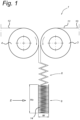
- FIG. 1 is a schematic side view onto an output part of a conventional tissue production machine 1 that may be used according to the present invention.
- the machine 1 is for the production of 2-ply dry-crepe tissue 10 according to the SCA article number 140299, each of the plies being 18 gsm.
- the skilled person will nevertheless understand that any other suitable tissue may also be used.
- the machine 1 provides its output as two webs 11, 12 of tissue 10, that are passed around output rollers 3, 4 and cut and folded together at a folding station 6.
- the tissue 10 coming from the respective webs 11, 12 is folded together in Z-formation, with folds of the respective webs 11, 12 interleaved together as is otherwise well known in the art.
- the folded tissue 10 is collected as a stack 14 in stacking station 8 until the stack reaches an uncompressed height H0, which in this case is around 130 mm.
- the stack 14 has a stack width W, which in this case is around 85mm, being a standardized dimension for use in certain tissue dispensers. These dimensions can of course be adjusted according to the tissue material, the process and/or the required end use.
- Figure 2 is a schematic view in the direction II of Figure 1 , in the process direction of the machine 1. It will be understood that the machine 1 is a complex installation having many more components that are neither shown nor discussed as they are otherwise not relevant to the present invention.
- the roller 4 is shown above the folding station 6 and the stacking station 8.
- the tissue webs 11, 12, the rollers 3, 4, the folding station 6 and the stacking station 8 all have an effective width L, which defines the length of the stack 14.
- this length L is 2200 mm although the skilled person will understand that this is a variable that will be determined by the machine and/or the end use.
- a compressing and wrapping line 20 comprising a first transport station 22, a first compression station 24 and a first wrapping station 26.
- the first transport station 22 comprises first transport bands 28, that engage the stack 14 and move it laterally out of the machine 1 in the direction X. This takes place once the stack 14 has reached the uncompressed height H0. Additional rollers, grippers, guides and transport provisions may be present to facilitate this movement.
- the stack 14 proceeds in the lateral direction X through the first compression station 24, where first compression bands 30 apply compression to the stack 14 to reduce it in height from the uncompressed height H0 to an initial height H1, which in this embodiment is around 120 mm.
- first wrapping station 26 further transport bands 32 move the stack 14 in the lateral direction X, while a supporting wrapper 34 is applied around the stack 14 to form an initial loose bundle or log 40.
- the supporting wrapper is in the form of a wrap-around strip, extending over the full length and width of the stack 14, joined to itself along a longitudinal seam by a hotmelt adhesive. It will be understood that a two part wrapper may also be used, employing two seams.
- the wrapper material is Puro Performance TM , available from SCA Hygiene products, with surface weight 60 gsm. In this context, it should be noted that although reference is given to a loose bundle 40, the bundle may be relatively tightly packed due to the first compression step.
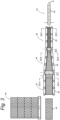
- Figure 3 shows operation of a process according to the present disclosure, which in this case takes place at a location distant from the machine 1 of Figure 1 . It will however be understood that the process and equipment of Figure 3 could be implemented directly following the first wrapping station 26 of Figure 2 .
- a pallet 48 of loose bundles or logs 40 is provided. These may be provided from storage or as a buffer within a production line.
- a loose bundle 40 is loaded onto a second transport station 42, which moves it by means of second transport bands 62, in the lateral direction X towards a second compression station 44.
- the second compression station 44 comprises second compression bands 64 that operate to pinch the loose bundle 40 as it progresses.
- the second compression station 44 acts at a considerably higher pressure than the first compression station 24.
- the pressure of the first compression station may be around 20 kN/m2, while the pressure of the second compression station may be around 160 kN/m2, according to requirements. This compression is sufficient to reduce the height of the stack 14 from the initial height H1 to a final height H2.
- the compression is 2 bar
- the final height H2 is around 60 mm
- the final density is around 60 g/cm3.
- the tissue 10 is still viable and will spring back if not contained.
- the supporting wrapper 34 due to the presence of the supporting wrapper 34, distortion of the upper- and lowermost tissues 10 within the stack 14 is avoided. A number of factors are believed to further assist in achieving a high quality result. Due to the fact that the compression takes place in two steps, distortion may be reduced. To this end, the amount of compression during the respective first and second compressions may be adjusted. Furthermore, the use of a relatively strong wrapping material may further prevent distortion.
- the supporting wrapper may be chosen specifically for the purpose of facilitating the second compression step with the final wrapper being dedicated to withstanding the high compression.
- the stack 14 then progresses to a second wrapping station 46, where the stack 14 is rewrapped to form a final tight bundle 50 to maintain the final density and the final height H2, thus preventing it from springing back to the uncompressed state.
- a tight bundle is intended to refer to the bundle in its final condition.
- the tight bundle advances to a sawing station 52, where it is cut into a number of shorter tissue packages 54.
- the tight bundle 50 is cut into 10 tissue packages 54, each having a length of 212 mm.
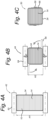
- Figures 4a-c show cross-sectional views through the second transport station 42, second compression station 44 and second wrapping station 46 of Figure 3 in the directions IVa, IVb and IVc respectively.
- the stack 14 in its supporting wrapper 34 is held between the second transport bands 62. At this position, it is still under its initial compression and has its initial height H1. Individual tissues 10 are still visible.
- Figure 4b illustrates a cross-section at a position through the second compression station 44 where the stack 14 is fully compressed to its final density.
- the second compression bands 64 exert a force F on the stack 14 to maintain it at the final height H2.
- this force F is around 2 bar and the final height H2 is around half of the initial height H1.
- the supporting wrapper 34 develops slack at the sides of the stack 14, which is gathered together as the stack 14 progresses through the compression station by an appropriate guide into a nip 66.
- the compression of the stack 14 is such that individual tissues can no longer be discerned and at this density, the stack is brick-like.
- the nip 66 on the right of the stack 14 is gathered at the base of the stack 14 and the nip 66 on the left is gathered at the top of the stack 14.
- Figure 4c is a view through the tight bundle 50 at the exit to the second wrapping station 46.
- the supporting wrapper 34 has been tightly wrapped around the stack 14 by folding this nips 66 against the stack 14 and adhering them to the supporting wrapper 34 using adhesive tape 68.
- the compression of the tight bundle 50 is maintained entirely by the supporting wrapper 34, which must be sufficiently strong to withstand the spring-back force.
- the tight bundle 50 is shown with flat upper and lower surfaces, these will inevitably become bowed as the stack 14 relaxes.
- the positions of the nips 66 allows them to be folded upwards and downwards respectively, limiting an increase in width of the tight bundle 50.
- FIG 5A shows an alternative way in which a tight bundle 50 may be rewrapped.
- the nips 66 are formed at the position at which the supporting wrapper 34 has been glued to form the loose bundle. Cuts K are made through the nip 66 to remove the glued portion 68.
- the supporting wrapper 34 is re-glued by overlapping the ends 70 of the supporting wrapper 34 at the location of the cut.
- FIG. 6A and 6B A further alternative method of rewrapping is shown in Figure 6A and 6B .
- compression of the tight bundle 50 allows nips 66 to be formed in the supporting wrapper 34 as indicated above.
- each nip 66 is cut at two separate locations K' and K" to remove the glued portion 68, which is at the upper side of the nip 66.
- the ends 70 comprising the lower side of the nip 66 are folded upwards and adhered to the remainder of the supporting wrapper 34.
- FIGS 7A and 7B A still further alternative for rewrapping the supporting wrapper 34 is shown in Figures 7A and 7B .
- cutting takes place of the supporting wrapper 34 while the stack 14 is still a loose bundle 40. Cuts K', K" on either side of the loose bundle 40 remove the glued portion 68. Subsequent compression of the stack 14 as shown in Figure 7B allows the ends 70 of the supporting wrapper 34 to overlap where they can be again glued together to form the tight bundle 50.
Landscapes
- Engineering & Computer Science (AREA)
- Mechanical Engineering (AREA)
- Sanitary Thin Papers (AREA)
- Auxiliary Devices For And Details Of Packaging Control (AREA)
Claims (15)
- Verfahren zum Ausbilden einer Vielzahl an Gewebepackungen aus einem, aus einem Stapel gefalteten Absorbiergeweben bestehenden Gewebebündel (40), wobei das Verfahren Folgendes aufweist:Ausbilden eines Stapels (14) aus gefalteten Absorbiergeweben;Komprimieren des Stapels zu einer Anfangsdichte in einem ersten Kompressionsschritt;Umwickeln des Stapels ein erstes Mal in einer Stützumhüllung (34) zum Ausbilden eines Anfangsbündels;anschließendes Anwenden eines zweiten Kompressionsschrittes zum Komprimieren des Stapels zu einer Enddichte, die höher ist als die Anfangsdichte; underneutes Umhüllen des gleichen Stapels ein zweites Mal zum Ausbilden eines Endbündels (50) und zum Halten der Enddichte,
dadurch gekennzeichnet, dassdie Gewebe aus strukturiertem Gewebe sind und die Enddichte größer ist als 0,2 g/m3; oder das Gewebe aus Hybridgewebe ist und die Enddichte größer ist als 0,25 g/m3; oder die Gewebe aus Trockenkreppgewebe sind und die Enddichte größer ist als 0,3 g/m3, undwobei das Anfangsbündel in der Form eines länglichen Klotzes ist und das Verfahren Folgendes aufweist: Schneiden des Klotzes quer zu seinem Längsmaß zum Ausbilden einer Vielzahl an Gewebepackungen. - Verfahren gemäß Anspruch 1, wobei der Stapel das zweite Mal in einer Endumhüllung umwickelt wird, die sich von der Stützumhüllung unterscheidet.
- Verfahren gemäß Anspruch 1, wobei der Stapel das zweite Mal durch erneutes Umwickeln der Stützumhüllung gewickelt wird.
- Verfahren gemäß einem der vorherigen Ansprüche, wobei der zweite Kompressionsschritt ohne Entfernen der Stützumhüllung ausgeführt wird.
- Verfahren gemäß einem der vorherigen Ansprüche, wobei die Gewebe aus strukturiertem Gewebe sind und die Enddichte größer als 0,25 g/m3 und wahlweise größer als 0,3 g/m3 ist; oder die Gewebe aus Hybridgewebe sind und die Enddichte größer als 0,3 g/m3 und wahlweise größer als 0,4 g/m3 ist; oder die Gewebe aus Trockenkreppgewebe sind und die Enddichte größer als 0,35 g/m3 und wahlweise größer als 0,45 g/m3 ist.
- Verfahren gemäß einem der vorherigen Ansprüche, wobei der Stapel in einer Höhenrichtung während der zweiten Kompression komprimiert wird und das Endbündel eine Höhe hat, die geringer ist als 70 % des Anfangsbündels, wahlweise geringer als 60 % und möglicherweise geringer als 50 %.
- Verfahren gemäß einem der vorherigen Ansprüche, wobei der Stapel in einer Höhenrichtung während der zweiten Kompression mit einem Druck komprimiert wird, der größer ist als 120 kN/m2, vorzugsweise größer als 160 kN/m2 und wahlweise größer als 225 kN/m2.
- Verfahren gemäß einem der vorherigen Ansprüche, wobei der zweite Kompressionsschritt zu einem Zeitpunkt oder an einem Ort stattfindet, der von dem ersten Kompressionsschritt beabstandet ist.
- Verfahren gemäß einem der vorherigen Ansprüche, wobei der Klotz anschließend an den zweiten Kompressionsschritt geschnitten wird.
- Verfahren gemäß einem der vorherigen Ansprüche, wobei die Gewebe in einer V-Konfiguration, einer M-Konfiguration oder einer Z-Konfiguration verschachtelt sind.
- Verfahren gemäß einem der vorherigen Ansprüche, wobei der zweite Kompressionsschritt stattfindet, indem der Klotz entlang eines Kompressionspfades transportiert wird, der mit einer Längsrichtung des Klotzes ausgerichtet ist.
- Verfahren gemäß einem der vorherigen Ansprüche, wobei ein Abschnitt der Stützumhüllung weggeschnitten wird, bevor der Stapel ein zweites Mal zum Ausbilden eines Endbündels umwickelt wird, und der weggeschnittene Abschnitt vorzugsweise ein Abschnitt ist, der zuvor angeheftet wurde beim erstmaligen Umwickeln des Stapels.
- Gewebepackung, die ausgebildet ist, indem ein umhüllter länglicher Klotz quer zu seiner Längsrichtung geschnitten wird, wobei der längliche Klotz einen Stapel an gefalteten und verschachtelten Absorbiergeweben aufweist, die in einer Umhüllung gewickelt sind zum Ausbilden eines Endbündels, und der in einem in zwei Schritten erfolgenden Kompressionsprozess gemäß dem Verfahren nach einem der Ansprüche 1 bis 12 komprimiert ist, wobei die Gewebe aus strukturiertem Gewebe sind und die Enddichte größer als 0,2 g/cm3 ist; oder die Gewebe aus Hybridgewebe sind und die Enddichte größer als 0,25 g/cm3 ist; oder die Gewebe aus Trockenkreppgewebe sind und die Enddichte größer als 0,3 g/cm3 ist.
- Gewebepackung gemäß Anspruch 13, wobei die Gewebe aus strukturiertem Gewebe sind und die Enddichte größer als 0,25 g/cm3 und wahlweise sogar größer als 0,3 g/cm3 ist; oder die Gewebe aus Hybridgewebe sind und die Enddichte größer als 0,3 g/cm3 ist und wahlweise sogar größer als 0,4 g/cm3 ist; oder die Gewebe aus Trockenkreppgewebe sind und die Enddichte größer als 0,35 g/cm3 ist und wahlweise sogar größer als 0,45 g/cm3 ist.
- Gewebepackung gemäß Anspruch 13 oder 14, wobei die Umhüllung geklemmt ist und gefaltet ist, um das Endbündel dicht zu umwickeln und die Enddichte beizubehalten.
Applications Claiming Priority (1)
| Application Number | Priority Date | Filing Date | Title |
|---|---|---|---|
| PCT/EP2016/082012 WO2018113936A1 (en) | 2016-12-20 | 2016-12-20 | Method of compressing tissue bundles |
Publications (3)
| Publication Number | Publication Date |
|---|---|
| EP3558831A1 EP3558831A1 (de) | 2019-10-30 |
| EP3558831B1 true EP3558831B1 (de) | 2025-06-25 |
| EP3558831C0 EP3558831C0 (de) | 2025-06-25 |
Family
ID=57755277
Family Applications (1)
| Application Number | Title | Priority Date | Filing Date |
|---|---|---|---|
| EP16822982.1A Active EP3558831B1 (de) | 2016-12-20 | 2016-12-20 | Verfahren zum komprimieren von gewebebündeln |
Country Status (6)
| Country | Link |
|---|---|
| US (1) | US11247794B2 (de) |
| EP (1) | EP3558831B1 (de) |
| CN (1) | CN110088004B (de) |
| ES (1) | ES3035733T3 (de) |
| RU (1) | RU2751229C2 (de) |
| WO (1) | WO2018113936A1 (de) |
Citations (1)
| Publication number | Priority date | Publication date | Assignee | Title |
|---|---|---|---|---|
| EP0828671A1 (de) * | 1995-06-02 | 1998-03-18 | The Procter & Gamble Company | Spenderverpackung für in verschiedenen stadien komprimierte tücher, komprimierte tücher für diese verpackungund verfahren zur verpackung dieser später abzugebenden tücher |
Family Cites Families (29)
| Publication number | Priority date | Publication date | Assignee | Title |
|---|---|---|---|---|
| US3172563A (en) * | 1961-05-09 | 1965-03-09 | Kimberly Clark Co | Package of paper tissues |
| FR1395509A (fr) * | 1962-01-19 | 1965-04-16 | Comptoir Linier | Procédé d'emballage de produits compressibles |
| SU996277A1 (ru) | 1981-07-08 | 1983-02-15 | Всесоюзный научно-исследовательский и проектно-технологический институт электроугольных изделий | Способ упаковки нетканых углеродных волокнистых материалов |
| US4909388A (en) | 1983-05-24 | 1990-03-20 | Kouzou Watanabe | Compressed roll paper, method of and apparatus for producing same |
| US4679379A (en) | 1983-09-13 | 1987-07-14 | Cassoli S.R.L. Macchine Automatiche Confezionatrici | Automatic bundling machine |
| US4623074A (en) * | 1985-02-25 | 1986-11-18 | The Procter & Gamble Company | Dual dispensing mode carton and concomitant package |
| FR2587682B1 (fr) | 1985-09-25 | 1987-12-18 | Saint Gobain Isover | Constitution de fardeaux d'isolants thermiques fibreux |
| SE9200529L (sv) | 1992-02-21 | 1993-08-22 | Moelnlycke Ab | Förfarande för att förpacka och komprimera absorberande engångsartiklar samt förpackningen tillverad enligt förfarandet |
| US5195300A (en) | 1992-03-17 | 1993-03-23 | Hayssen Manufacturing Company | Compressed roll packaging method and apparatus |
| US5535887A (en) * | 1995-06-02 | 1996-07-16 | The Procter & Gamble Company | Dispensing package for discrete stage compressed tissues, compressed tissues therefor, and method of dispensing such tissues |
| US5853547A (en) | 1996-02-29 | 1998-12-29 | Asten, Inc. | Papermaking fabric, process for producing high bulk products and the products produced thereby |
| US6423180B1 (en) | 1998-12-30 | 2002-07-23 | Kimberly-Clark Worldwide, Inc. | Soft and tough paper product with high bulk |
| WO2002096756A1 (de) | 2001-05-26 | 2002-12-05 | Deutsche Rockwool Mineralwoll Gmbh & Co. Ohg | Verfahren zur herstellung einer verpackungs- und/oder transporteinheit für plattenförmige dämmstoffe aus mineralfasern, verpackungs- und/oder transporteinheit sowie dämmstoffplatte |
| US20030066268A1 (en) * | 2001-10-09 | 2003-04-10 | George Daniel C. | Process for packaging a polyurethane foam filled article of furniture |
| US7104031B2 (en) * | 2004-12-20 | 2006-09-12 | Kimberly-Clark Worldwide, Inc. | Variable position constant force packaging system and process for using same |
| US20070090009A1 (en) * | 2005-10-20 | 2007-04-26 | Kimberly-Clark Worldwide, Inc. | Packaging and packaging process for compressible articles |
| US7527709B2 (en) | 2006-03-14 | 2009-05-05 | Voith Paper Patent Gmbh | High tension permeable belt for an ATMOS system and press section of paper machine using the permeable belt |
| WO2007111544A1 (en) | 2006-03-27 | 2007-10-04 | Sca Hygiene Products Ab | End plug for a paper roll |
| EP1845187A3 (de) | 2006-04-14 | 2013-03-06 | Voith Patent GmbH | Doppelsiebformer für ein Atmos-System |
| US7550061B2 (en) | 2006-04-28 | 2009-06-23 | Voith Paper Patent Gmbh | Dewatering tissue press fabric for an ATMOS system and press section of a paper machine using the dewatering fabric |
| JP5635355B2 (ja) | 2010-09-30 | 2014-12-03 | ユニ・チャーム株式会社 | 包装構造 |
| WO2012087211A1 (en) | 2010-12-22 | 2012-06-28 | Sca Hygiene Products Ab | A stack of plurality of cellulose-containing absorbent towels and a process for manufacturing the stack. |
| ITBO20120619A1 (it) | 2012-11-09 | 2014-05-10 | Tissue Machinery Co Spa | Apparato e metodo di confezionamento di pannolini o altri oggetti sanitari morbidi piatti ripiegati. |
| PL2935065T3 (pl) | 2012-12-19 | 2019-12-31 | Essity Hygiene And Health Aktiebolag | Stos złożonego materiału wstęgowego na wyroby higieniczne |
| US9623989B2 (en) * | 2013-03-01 | 2017-04-18 | The Procter & Gamble Company | Method and apparatus for bundling packages of absorbent articles |
| US10308384B2 (en) * | 2014-03-17 | 2019-06-04 | Clinpet Japan Co., Ltd. | Method for packing stacked bundles made of paper |
| CN104129542B (zh) | 2014-07-18 | 2016-04-06 | 上海松川远亿机械设备有限公司 | 一种扁卷卫生纸的包装方法 |
| AU2015399432B2 (en) * | 2015-06-22 | 2018-12-06 | Essity Hygiene And Health Aktiebolag | Package comprising a stack of absorbent tissue paper material and a packaging |
| CN106144084B (zh) | 2016-08-22 | 2018-09-25 | 襄阳市诚展机械制造有限公司 | 一种可隐藏水口的卷纸包装理料方法及设备 |
-
2016
- 2016-12-20 EP EP16822982.1A patent/EP3558831B1/de active Active
- 2016-12-20 ES ES16822982T patent/ES3035733T3/es active Active
- 2016-12-20 US US16/469,052 patent/US11247794B2/en active Active
- 2016-12-20 CN CN201680091498.4A patent/CN110088004B/zh active Active
- 2016-12-20 WO PCT/EP2016/082012 patent/WO2018113936A1/en not_active Ceased
- 2016-12-20 RU RU2019122844A patent/RU2751229C2/ru active
Patent Citations (1)
| Publication number | Priority date | Publication date | Assignee | Title |
|---|---|---|---|---|
| EP0828671A1 (de) * | 1995-06-02 | 1998-03-18 | The Procter & Gamble Company | Spenderverpackung für in verschiedenen stadien komprimierte tücher, komprimierte tücher für diese verpackungund verfahren zur verpackung dieser später abzugebenden tücher |
Also Published As
| Publication number | Publication date |
|---|---|
| RU2751229C2 (ru) | 2021-07-12 |
| RU2019122844A3 (de) | 2021-01-22 |
| ES3035733T3 (en) | 2025-09-08 |
| EP3558831A1 (de) | 2019-10-30 |
| US11247794B2 (en) | 2022-02-15 |
| RU2019122844A (ru) | 2021-01-22 |
| WO2018113936A1 (en) | 2018-06-28 |
| CN110088004B (zh) | 2021-11-02 |
| CN110088004A (zh) | 2019-08-02 |
| US20200002036A1 (en) | 2020-01-02 |
| EP3558831C0 (de) | 2025-06-25 |
Similar Documents
| Publication | Publication Date | Title |
|---|---|---|
| US11981465B2 (en) | Method for compressing structured tissues | |
| US11180272B2 (en) | Method and apparatus for compressing an elongate stack of folded tissues | |
| US6702118B2 (en) | Packaging a strip of material | |
| US7721511B2 (en) | Method and machine for banding logs of sheet material | |
| US7174697B2 (en) | System and process for packaging products | |
| US6729471B2 (en) | Packaging a strip of material with compression to reduce volume | |
| JP5701912B2 (ja) | 梱包装置及び梱包方法 | |
| US11247794B2 (en) | Method of compressing tissue bundles | |
| US6176068B1 (en) | Packaging a strip of material in layers with intervening splices | |
| US8153230B2 (en) | Multilayer paper tape | |
| US6009689A (en) | Packaging a strip of material in layers | |
| HK40011797A (en) | Method of compressing tissue bundles | |
| RU2397929C2 (ru) | Способ и устройство для получения большого тюка с листами целлюлозы, а также соответствующий большой тюк | |
| HK40011797B (en) | Method of compressing tissue bundles | |
| HK40037083A (en) | Method and apparatus for compressing an elongate stack of folded tissues | |
| HK40037083B (en) | Method and apparatus for compressing an elongate stack of folded tissues |
Legal Events
| Date | Code | Title | Description |
|---|---|---|---|
| STAA | Information on the status of an ep patent application or granted ep patent |
Free format text: STATUS: UNKNOWN |
|
| STAA | Information on the status of an ep patent application or granted ep patent |
Free format text: STATUS: THE INTERNATIONAL PUBLICATION HAS BEEN MADE |
|
| PUAI | Public reference made under article 153(3) epc to a published international application that has entered the european phase |
Free format text: ORIGINAL CODE: 0009012 |
|
| STAA | Information on the status of an ep patent application or granted ep patent |
Free format text: STATUS: REQUEST FOR EXAMINATION WAS MADE |
|
| 17P | Request for examination filed |
Effective date: 20190703 |
|
| AK | Designated contracting states |
Kind code of ref document: A1 Designated state(s): AL AT BE BG CH CY CZ DE DK EE ES FI FR GB GR HR HU IE IS IT LI LT LU LV MC MK MT NL NO PL PT RO RS SE SI SK SM TR |
|
| AX | Request for extension of the european patent |
Extension state: BA ME |
|
| DAV | Request for validation of the european patent (deleted) | ||
| DAX | Request for extension of the european patent (deleted) | ||
| STAA | Information on the status of an ep patent application or granted ep patent |
Free format text: STATUS: EXAMINATION IS IN PROGRESS |
|
| 17Q | First examination report despatched |
Effective date: 20200617 |
|
| GRAP | Despatch of communication of intention to grant a patent |
Free format text: ORIGINAL CODE: EPIDOSNIGR1 |
|
| STAA | Information on the status of an ep patent application or granted ep patent |
Free format text: STATUS: GRANT OF PATENT IS INTENDED |
|
| INTG | Intention to grant announced |
Effective date: 20250219 |
|
| GRAS | Grant fee paid |
Free format text: ORIGINAL CODE: EPIDOSNIGR3 |
|
| GRAA | (expected) grant |
Free format text: ORIGINAL CODE: 0009210 |
|
| STAA | Information on the status of an ep patent application or granted ep patent |
Free format text: STATUS: THE PATENT HAS BEEN GRANTED |
|
| AK | Designated contracting states |
Kind code of ref document: B1 Designated state(s): AL AT BE BG CH CY CZ DE DK EE ES FI FR GB GR HR HU IE IS IT LI LT LU LV MC MK MT NL NO PL PT RO RS SE SI SK SM TR |
|
| REG | Reference to a national code |
Ref country code: GB Ref legal event code: FG4D |
|
| REG | Reference to a national code |
Ref country code: CH Ref legal event code: EP |
|
| REG | Reference to a national code |
Ref country code: CH Ref legal event code: EP |
|
| REG | Reference to a national code |
Ref country code: IE Ref legal event code: FG4D |
|
| REG | Reference to a national code |
Ref country code: DE Ref legal event code: R096 Ref document number: 602016092679 Country of ref document: DE |
|
| U01 | Request for unitary effect filed |
Effective date: 20250714 |
|
| U07 | Unitary effect registered |
Designated state(s): AT BE BG DE DK EE FI FR IT LT LU LV MT NL PT RO SE SI Effective date: 20250718 |
|
| REG | Reference to a national code |
Ref country code: ES Ref legal event code: FG2A Ref document number: 3035733 Country of ref document: ES Kind code of ref document: T3 Effective date: 20250908 |
|
| PG25 | Lapsed in a contracting state [announced via postgrant information from national office to epo] |
Ref country code: GR Free format text: LAPSE BECAUSE OF FAILURE TO SUBMIT A TRANSLATION OF THE DESCRIPTION OR TO PAY THE FEE WITHIN THE PRESCRIBED TIME-LIMIT Effective date: 20250926 Ref country code: NO Free format text: LAPSE BECAUSE OF FAILURE TO SUBMIT A TRANSLATION OF THE DESCRIPTION OR TO PAY THE FEE WITHIN THE PRESCRIBED TIME-LIMIT Effective date: 20250925 |
|
| PG25 | Lapsed in a contracting state [announced via postgrant information from national office to epo] |
Ref country code: HR Free format text: LAPSE BECAUSE OF FAILURE TO SUBMIT A TRANSLATION OF THE DESCRIPTION OR TO PAY THE FEE WITHIN THE PRESCRIBED TIME-LIMIT Effective date: 20250625 |
|
| PG25 | Lapsed in a contracting state [announced via postgrant information from national office to epo] |
Ref country code: RS Free format text: LAPSE BECAUSE OF FAILURE TO SUBMIT A TRANSLATION OF THE DESCRIPTION OR TO PAY THE FEE WITHIN THE PRESCRIBED TIME-LIMIT Effective date: 20250925 |
|
| PG25 | Lapsed in a contracting state [announced via postgrant information from national office to epo] |
Ref country code: IS Free format text: LAPSE BECAUSE OF FAILURE TO SUBMIT A TRANSLATION OF THE DESCRIPTION OR TO PAY THE FEE WITHIN THE PRESCRIBED TIME-LIMIT Effective date: 20251025 |
|
| PGFP | Annual fee paid to national office [announced via postgrant information from national office to epo] |
Ref country code: GB Payment date: 20251223 Year of fee payment: 10 |
|
| PG25 | Lapsed in a contracting state [announced via postgrant information from national office to epo] |
Ref country code: SM Free format text: LAPSE BECAUSE OF FAILURE TO SUBMIT A TRANSLATION OF THE DESCRIPTION OR TO PAY THE FEE WITHIN THE PRESCRIBED TIME-LIMIT Effective date: 20250625 |
|
| PGFP | Annual fee paid to national office [announced via postgrant information from national office to epo] |
Ref country code: TR Payment date: 20251203 Year of fee payment: 10 |
|
| PG25 | Lapsed in a contracting state [announced via postgrant information from national office to epo] |
Ref country code: CZ Free format text: LAPSE BECAUSE OF FAILURE TO SUBMIT A TRANSLATION OF THE DESCRIPTION OR TO PAY THE FEE WITHIN THE PRESCRIBED TIME-LIMIT Effective date: 20250625 |
|
| PG25 | Lapsed in a contracting state [announced via postgrant information from national office to epo] |
Ref country code: PL Free format text: LAPSE BECAUSE OF FAILURE TO SUBMIT A TRANSLATION OF THE DESCRIPTION OR TO PAY THE FEE WITHIN THE PRESCRIBED TIME-LIMIT Effective date: 20250625 |
|
| PG25 | Lapsed in a contracting state [announced via postgrant information from national office to epo] |
Ref country code: SK Free format text: LAPSE BECAUSE OF FAILURE TO SUBMIT A TRANSLATION OF THE DESCRIPTION OR TO PAY THE FEE WITHIN THE PRESCRIBED TIME-LIMIT Effective date: 20250625 |
|
| U20 | Renewal fee for the european patent with unitary effect paid |
Year of fee payment: 10 Effective date: 20251223 |
|
| PGFP | Annual fee paid to national office [announced via postgrant information from national office to epo] |
Ref country code: ES Payment date: 20260122 Year of fee payment: 10 |
|
| PLBE | No opposition filed within time limit |
Free format text: ORIGINAL CODE: 0009261 |
|
| STAA | Information on the status of an ep patent application or granted ep patent |
Free format text: STATUS: NO OPPOSITION FILED WITHIN TIME LIMIT |
|
| REG | Reference to a national code |
Ref country code: CH Ref legal event code: L10 Free format text: ST27 STATUS EVENT CODE: U-0-0-L10-L00 (AS PROVIDED BY THE NATIONAL OFFICE) Effective date: 20260507 |
|
| 26N | No opposition filed |
Effective date: 20260326 |
|
| PG25 | Lapsed in a contracting state [announced via postgrant information from national office to epo] |
Ref country code: MC Free format text: LAPSE BECAUSE OF FAILURE TO SUBMIT A TRANSLATION OF THE DESCRIPTION OR TO PAY THE FEE WITHIN THE PRESCRIBED TIME-LIMIT Effective date: 20250625 |
|
| REG | Reference to a national code |
Ref country code: CH Ref legal event code: H13 Free format text: ST27 STATUS EVENT CODE: U-0-0-H10-H13 (AS PROVIDED BY THE NATIONAL OFFICE) Effective date: 20260723 |