EP3558090B1 - Systems for wide field-of-view optical coherence tomography - Google Patents
Systems for wide field-of-view optical coherence tomography Download PDFInfo
- Publication number
- EP3558090B1 EP3558090B1 EP17825967.7A EP17825967A EP3558090B1 EP 3558090 B1 EP3558090 B1 EP 3558090B1 EP 17825967 A EP17825967 A EP 17825967A EP 3558090 B1 EP3558090 B1 EP 3558090B1
- Authority
- EP
- European Patent Office
- Prior art keywords
- oct
- scan
- scanner
- imaging
- reflector
- Prior art date
- Legal status (The legal status is an assumption and is not a legal conclusion. Google has not performed a legal analysis and makes no representation as to the accuracy of the status listed.)
- Active
Links
Images

Classifications
-
- A—HUMAN NECESSITIES
- A61—MEDICAL OR VETERINARY SCIENCE; HYGIENE
- A61B—DIAGNOSIS; SURGERY; IDENTIFICATION
- A61B3/00—Apparatus for testing the eyes; Instruments for examining the eyes
- A61B3/10—Objective types, i.e. instruments for examining the eyes independent of the patients' perceptions or reactions
- A61B3/102—Objective types, i.e. instruments for examining the eyes independent of the patients' perceptions or reactions for optical coherence tomography [OCT]
-
- G—PHYSICS
- G01—MEASURING; TESTING
- G01B—MEASURING LENGTH, THICKNESS OR SIMILAR LINEAR DIMENSIONS; MEASURING ANGLES; MEASURING AREAS; MEASURING IRREGULARITIES OF SURFACES OR CONTOURS
- G01B9/00—Measuring instruments characterised by the use of optical techniques
- G01B9/02—Interferometers
- G01B9/02015—Interferometers characterised by the beam path configuration
- G01B9/02032—Interferometers characterised by the beam path configuration generating a spatial carrier frequency, e.g. by creating lateral or angular offset between reference and object beam
-
- G—PHYSICS
- G06—COMPUTING OR CALCULATING; COUNTING
- G06T—IMAGE DATA PROCESSING OR GENERATION, IN GENERAL
- G06T1/00—General purpose image data processing
- G06T1/0007—Image acquisition
-
- G—PHYSICS
- G06—COMPUTING OR CALCULATING; COUNTING
- G06T—IMAGE DATA PROCESSING OR GENERATION, IN GENERAL
- G06T3/00—Geometric image transformations in the plane of the image
- G06T3/04—Context-preserving transformations, e.g. by using an importance map
- G06T3/047—Fisheye or wide-angle transformations
-
- G—PHYSICS
- G06—COMPUTING OR CALCULATING; COUNTING
- G06T—IMAGE DATA PROCESSING OR GENERATION, IN GENERAL
- G06T2207/00—Indexing scheme for image analysis or image enhancement
- G06T2207/10—Image acquisition modality
- G06T2207/10072—Tomographic images
- G06T2207/10101—Optical tomography; Optical coherence tomography [OCT]
Definitions
- the present disclosure relates to medical device imaging systems, including optical coherence tomography (OCT) systems.
- OCT optical coherence tomography
- OCT Optical Coherence Tomography
- OCT systems perform high-resolution, cross sectional imaging in semitransparent samples (such as biological tissues) by measuring the echo time delay of reflected light.
- OCT is often used by ophthalmic surgeons to assist with precision cutting and/or removal of tissues such as the vitreous.
- Providing wide-field-of-view OCT imaging across a curved surface such as a retina can be challenging because the images become curved and distorted at wide scan angles, particularly in highly myopic patients. Accordingly, there exists a need for improved wide-field-of-view OCT imaging in the ophthalmic context.
- WO 2016/178298 discloses an SS-OCT adapted to change the optical path length difference between the reference light and the measurement light and to image the fundus over a wider angle of view.
- US 2010/0302508 discloses an OCT comprising a reference mirror driving unit configured to move the reference mirror to adjust the optical path length of the reference light.
- an optical coherence tomography (OCT) system includes the features defined in claim 1.
- the scan rate is between 200 Hz and 400 Hz, or is at least 300 Hz.
- the scanner may be configured to scan the imaging beam at each of the scan angles according to a raster pattern, and the raster pattern may generate a B-scan at least 12 mm in length or at least 16 mm in length.
- the linear actuator is configured to translate the reference reflector at least 2mm in a direction parallel to the reference beam.
- the linear actuator may further be configured to translate the reference reflector at least 4mm in a direction parallel to the reference beam.
- the OCT system may comprise a spectral-domain OCT (SD-OCT) system or a swept-source OCT (SS-OCT) system.
- SD-OCT spectral-domain OCT
- SS-OCT swept-source OCT
- an optical coherence tomography (OCT) system comprises a light source configured to generate an OCT beam, and a beam splitter, configured to split the OCT beam into a reference beam and an imaging beam, direct the reference beam toward a reference reflector, and direct the imaging beam toward a scanner.
- the system also includes a linear actuator, such as a piezoelectric actuator or voice coil actuator, configured to move the reference reflector to change the length of the reference beam, and the scanner, configured to scan the imaging beam onto a target surface over a plurality of scan angles, wherein the scanner and target surface are separated by a first sample distance at a first scan angle and a second sample distance at a second scan angle.
- the system includes an OCT controller comprising a processor and instructions stored on a memory, the instructions executable by the processor to cause the OCT controller to generate signals to cause the scanner to repeatedly scan the imaging beam onto the target surface at the first scan angle and the second scan angle according to a scan rate to generate live OCT images, and cause the actuator to move the reference reflector synchronously with the scan rate while the scanner scans the imaging beam onto the target surface, thereby adjusting the length of the reference beam to account for a difference between the first sample distance and the second sample distance.
- the system further includes a detector configured to receive the reference beam reflected by the reference reflector and the imaging beam reflected by the target surface, and output an interference signal based on the received reference beam and the imaging beam.
- the linear actuator comprises a piezoelectric stack or voice coil configured to translate the reference reflector at least 2mm in a direction parallel to the reference beam.
- the first scan angle and the second scan angle are separated by at least 20 degrees.
- the scan generates a B-scan at least 12 mm in length.
- the OCT system may comprise a spectral-domain OCT (SD-OCT) system or a swept-source OCT (SS-OCT) system.
- an optical coherence tomography (OCT) system comprises a light source, configured to generate an OCT beam, and a beam splitter, configured to split the OCT beam into a reference beam and an imaging beam, direct the reference beam toward a reference reflector, and direct the imaging beam toward a scanner.
- the system further includes a linear actuator, configured to translate the reference reflector at least 2mm in a direction parallel to the reference beam and the scanner, configured to scan the imaging beam onto a target surface at a plurality of scan angles.
- the system includes an OCT controller comprising a processor and instructions stored on a memory, the instructions executable by the processor to cause the OCT controller to generate signals to cause the scanner to repeatedly scan the imaging beam at each of the scan angles at a first scan rate to generate live OCT images, and cause the actuator to translate the reference reflector synchronously with the scan rate, such that a path length of the reference beam is maintained within a tolerance range of a path length of the imaging beam throughout the scan.
- an OCT controller comprising a processor and instructions stored on a memory, the instructions executable by the processor to cause the OCT controller to generate signals to cause the scanner to repeatedly scan the imaging beam at each of the scan angles at a first scan rate to generate live OCT images, and cause the actuator to translate the reference reflector synchronously with the scan rate, such that a path length of the reference beam is maintained within a tolerance range of a path length of the imaging beam throughout the scan.
- the tolerance range is less than 0.5mm or 1mm.
- the scan rate may be between 200 Hz and 400 Hz.
- the scanner may be configured to scan the imaging beam at each of the scan angles according to a raster pattern.
- the linear actuator may be a piezoelectric stack or voice coil configured to translate the reference reflector at least 2mm in a direction parallel to the reference beam.
- improved OCT imaging systems may provide ultra-wide field-of-view OCT imaging with reduced distortion.
- Certain embodiments generate OCT images in which a target surface is centered throughout an OCT image window, despite relative variations in target depth.
- certain embodiments provide improved live OCT imaging of curved surfaces, such as high-myopia retinal surfaces.
- OCT optical coherence tomographic
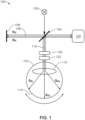
- FIG. 1 is a simple schematic illustration of components in a conventional OCT system 100.
- System 100 may comprise a spectral-domain OCT (SD-OCT) system or swept-source (SS-OCT) system.
- SD-OCT spectral-domain OCT
- SS-OCT swept-source
- system 100 includes a light source 102, beam splitter/combiner 104, reference reflector 108, scanner 120, and a detector 124.
- Light source 102 may comprise any suitable low-coherence light source such as a super-luminescent diode, ultrashort (e.g., femtosecond) pulsed laser, or supercontinuum laser, and may comprise a frequency-swept or tunable laser in certain examples, such as SS-OCT systems.
- Beam splitter 104 may comprise a non-polarized beam splitter for splitting the OCT beam into an imaging beam and a reference beam and combining or directing reflected imaging and reference light toward detector 124.
- Reference reflector 108 is typically a mirror, but may comprise any suitable component which reflects the reference beam 106 toward the detector 124.
- Scanner 120 may comprise one or more galvanometer-controlled mirrors to scan the imaging beam in the x-y plane toward a target or sample, such as retina 114 (when discussing the object being imaged, the terms "target” and “sample” are used interchangeably herein).
- scanner 120 may additionally include focusing optics to scan the imaging beam in a z-direction.
- Scanner 120 may comprise any suitable scanning mirror arrangement.
- scanner 120 may comprise any suitable scanner components, such as microelectromechanical systems (MEMS) or a resonant scanner.
- MEMS microelectromechanical systems
- Detector 124 comprises an interferometer which receives the imaging beam reflected from the target and the reference beam reflected from the reflector 108 and outputs an interference signal from which an OCT image can be generated.
- Particular components included in detector 124 depend on the type of OCT system and may include any suitable combination of spectrometers, photodetectors, array detectors, analog-to-digital converters (ADCs), diffraction grating(s), or other components known to those skilled in the art.
- ADCs analog-to-digital converters
- detector 124 in an SD-OCT system may include a diffraction grating, lenses, and an array detector such as a charge-coupled device (CCD).
- detector 124 in an SS-OCT system may include a photodetector and a analog-to-digital converter.
- System 100 may include an OCT controller (not shown in FIG. 1 ) comprising hardware, firmware, and software configured to control components of system 100 to acquire and display OCT images of a target.
- System 100 may additionally include one or more displays (not shown) to present OCT images generated by the OCT controller.
- the display may include any one or more monitors, projectors, oculars, heads-up displays, screens, glasses, goggles, etc.
- the OCT images may be displayed as 2D or 3D images.
- light source 102 emits a low-coherence light beam directed to beam splitter 104, which splits the light into a reference beam 106 directed through a reference arm (which may comprise any suitable transmission and focusing optics including optical fibers) toward reflector 108 and an imaging beam 110 directed through an imaging arm (which likewise may include any suitable transmission and focusing optics including optical fibers) toward a scanner 120.
- a reference arm which may comprise any suitable transmission and focusing optics including optical fibers
- an imaging beam 110 directed through an imaging arm (which likewise may include any suitable transmission and focusing optics including optical fibers) toward a scanner 120.
- Scanner 120 may scan the imaging beam toward optics 122 and the lens 112 of eye 101 according to a scan pattern (e.g., raster scan, radial scan, cube scan, circle group scan, line group scan, etc.) to generate the desired scan (e.g., A-scan, B-scan, or C-scan).
- a depth-resolved axial scan (A-scan) comprises a measurement of the light signal interference at a point.
- Cross-sectional images (B-scans) may be generated by scanning the OCT beam across the tissue surface and acquiring multiple axial measurements over a line, curve, circle, etc.
- a 3D image may be constructed from a series of B-scans generated over an area of the tissue surface. Scanning may be repeated at a scan rate or frequency to generate live or real-time OCT images which may useful for pre-operative diagnostics as well as intra-operative guidance.
- Imaging beam light reflected by the retina 114 and reference beam light reflected by the reflector 108 may be received at detector 124, which interferes the back-reflected or backscattered imaging beam with the reference beam to generate OCT images. Interference occurs when the path length of the reference beam (i.e., the distance imaging light travels between source 102 and reflector 108) and the path length of the imaging beam (i.e., the stance imaging light travels between source 102 and a target such as retina 114) are matched within the coherence length of the light emitted by light source 102. This interference signal conveys information about the target at a depth which corresponds to the reference beam path length.
- OCT systems are calibrated prior to use by setting the reference beam path length according to the target depth, so that the path length of the reference beam is approximately equal to the path length of the imaging beam at the target depth.
- the difference between the path length of the reference beam and the path length of the imaging beam at the target depth in an OCT system is referred to as the optical path difference (OPD).
- OPD optical path difference
- the reference beam path length (illustrated as reference beam distance Rd) is set to match the path length of the imaging beam measured to the center of retina 114 (illustrated as center sample distance Sdc).
- SD-OCT spectral-domain OCT
- SS-OCT swept-source OCT
- OCT imaging systems may be broadly classified into time-domain OCT (TD-OCT) systems, SD-OCT systems, and SS-OCT systems.
- TD-OCT systems obtain an interference pattern by moving a reference mirror to vary the reference path length at each point in a scan pattern. That is, at a given point in a TD-OCT scan pattern, the reference mirror in the reference arm must be moved to change the reference path length.
- the movement of this mirror in the reference arm of TD-OCT systems is a speed gating factor, because the mirror must be moved through a distance (z-range) at each (x,y) point of an OCT scan pattern in order to generate the required interference signal.
- SD-OCT and SS-OCT systems operate according to different principles and avoid this speed gate by employing a fixed-position reference reflector which requires no mechanical scanning of the reference path at any point in a scan pattern.
- SD-OCT systems use a broadband light source and obtain depth information measuring the spectral density in the sample arm using a spectrometer.
- SS-OCT systems utilize a frequency-swept laser or tunable laser and a single-point detector.
- OCT images are generated from the received interference signal using fast Fourier transforms. Accordingly, the reference reflector position is fixed at each (x,y) point of an OCT scan pattern executed by conventional SD-OCT and SS-OCT systems.
- Typical SD-OCT and SS-OCT systems for posterior-segment imaging may scan between 20° and 40° (e.g., ⁇ 10° or ⁇ 20° from a center position) across a retinal target. Over such scan angles, the targeted portion of the retina may be imaged without significant distortion because variations in the depth of the retina attributable to retinal curvature are not significant. Stated differently, the variations in OPD resulting from retinal curvature are typically not very significant across smaller scan angle ranges (e.g., between 20° and 40°). However, over wider fields-of-view (e.g., 40° or more), the curvature of the retina across the imaged area results in significant variation in OPD, particularly in high-myopia patients. This variation in OPD can cause distortion in the OCT image.
- 20° and 40° e.g., ⁇ 10° or ⁇ 20° from a center position
- FIG. 2 illustrates an example wide field-of-view B-scan (approximately 40°) of a retina generated by a conventional SD-OCT or SS-OCT system.
- the image of the retina is curved in a wide "U" shape, such that the edges appear to "fall off' the image range on each side.
- This distortion results from variations in the OPD attributable to retinal curvature and the fixed reference beam path length. That is, the reference beam path length is calibrated to image at a particular depth, e.g., so that the OPD is approximately zero at the center of the retina.
- the natural curvature of the retina results in the fundus surface outside that depth because the OPD changes as the imaging beam is scanned across tissues which are closer to scanner 120.
- This characteristic "U”-shaped distortion is undesirable and problematic.
- a surgeon may "zoom in” to a particular area of the retina, such one of windows A-C.
- Each of windows A-C represents an image area for enlargement, though it is noted that any portion of the image may be enlarged.
- the retinal image is generally horizontal in window B, windows A and C each display a portion of the retinal surface with a steep angular orientation in the image window. This angular orientation results in distortion and truncation of the retinal image and, among other things, it makes the image more difficult to read and use, particularly in an intra-operative context.
- Embodiments of the present disclosure address this problem by modulating the position of a reference reflector, thereby adjusting the reference beam path length to account for or match variations of the target depth within a scan and "flatten" out the OCT image as shown in FIG. 3 .
- the position of the reference reflector is modulated so that the system OPD is maintained at or near zero throughout a scan pattern.
- image windows A and C of FIG. 3 display larger portions of the retina with increased clarity and reduced distortion.
- improved OCT systems facilitate high-speed (e.g., 200-400+ Hz), wide-angle scans (e.g., ⁇ 20°- ⁇ 90° sweeps) across large retinal cross-sections and provide improved images that are substantially free of distortion and easy to use during a surgical procedure.
- high-speed e.g., 200-400+ Hz
- wide-angle scans e.g., ⁇ 20°- ⁇ 90° sweeps
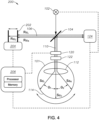
- FIG. 4 illustrates an example of an improved OCT imaging system 200 to generate images as shown in FIG. 3 .
- System 200 may be a probe-based system, a stand-alone imaging system, or an imaging system integrated with other components, such as a surgical microscope. It is noted that FIG. 4 does not attempt to exhaustively illustrate all components of an OCT system, nor is it drawn to scale. Rather, it is provided to qualitatively illustrate how the optical path of the imaging beam 110 varies according to scan angle.
- System 200 comprises an SD-OCT or SS-OCT imaging system which includes many of the same components as system 100 (like numerals indicate like components).
- system 200 includes a light source 102, beam splitter/combiner 104, scanner 120, and a detector 124.
- Light source 102 may comprise any suitable low-coherence light source such as a super-luminescent diode, ultrashort (e.g., femtosecond) pulsed laser, or supercontinuum laser, and may comprise a frequency-swept or tunable laser in certain examples, such as SS-OCT systems.
- Beam splitter 104 may comprise a non-polarized beam splitter for splitting the OCT beam into an imaging beam transmitted through the sample arm and a reference beam transmitted through the reference arm (sometimes referred to as a delay line) of the OCT system. Beam splitter 104 also receives and combines reflected imaging light (reflected by the sample, such as eye 114) and reference light (reflected by reference reflector 202) toward detector 124.
- Scanner 120 may comprise one or more galvanometer-controlled mirrors to scan the imaging beam in the x-y plane through a sample arm of the OCT system toward the sample, such as retina 114. Scanner 120 may additionally include focusing optics to scan the imaging beam in a z-direction.
- Scanner 120 may comprise any suitable scanner, such as a galvanometer-controlled mirror scanner.
- the imaging beam scanned by scanner 120 is directed through optical elements 122 which may comprise focusing and/or collimating lenses of the sample arm.
- Detector 124 comprises an interferometer which receives the imaging beam reflected from the target and the reference beam reflected from the reflector 202 and outputs an interference signal from which an OCT image can be generated.
- Particular components included in detector 124 depend on the type of OCT system and may include any suitable combination of spectrometers, photodetectors, array detectors, analog-to-digital converters (ADCs), diffraction grating(s), or other components known to those skilled in the art.
- ADCs analog-to-digital converters
- Detector 124 in an SD-OCT system may include a diffraction grating, lenses, and an array detector such as a charge-coupled device (CCD).
- Detector 124 in an SS-OCT system may include a photodetector an analog-to-digital converter.
- system 200 includes a movable reflector 202 coupled to an actuator 204, as well as an OCT controller 206 communicatively coupled to actuator 204 and scanner 120.
- OCT controller 206 may also be communicatively coupled to detector 124 and light source 102.
- Reflector 202 typically comprises a mirror, but may comprise any reflector suitable for reflecting the reference beam of system 200 towards detector 124.
- actuator 204 comprises a linear actuator, such as a stacked piezoelectrionic array or linear voice coil actuator(s), configured to translate reflector 202 laterally between positions Rdc and Rd L /Rd R , as indicated by the arrow above reflector 202.
- actuator 204 may comprise any suitable linear, rotary, or oscillatory actuator arranged to move reflector 202 and thereby adjust the reference beam path length.
- a stacked piezo array or voice coil actuator may provide increased simplicity compared with the galvanometer mirrors used for delay line modulation in time-domain OCT systems.
- the OCT controller 206 comprises hardware and software configured to perform the enhanced OCT imaging processes described herein.
- the OCT controller 206 includes one or more processors coupled to a memory.
- the processor may include one or more CPUs, microprocessors, field-programmable gate arrays (FPGAs), application-specific integrated circuits (ASICs), digital-signal processors (DSPs), system-on-chip (SoC) processors, or analogous components.
- the memory may include volatile or nonvolatile memory including, magnetic media, optical media, random access memory (RAM), read-only memory (ROM), removable media, or analogous components.
- the memory may store instructions for software programs and algorithms that, when executed by the processor, allow the OCT controller 206 to direct the operation of (e.g., by generating control signals sent to) scanner 120, actuator 204, light source 102, detector 124, and/or other components of system 200 to provide improved wide-field of view OCT imaging.
- processor or memory
- instructions each refers to a classes of structures known in the field of OCT imaging and familiar to those of ordinary skill in the art. Accordingly, these terms are to be understood as denoting structural rather than functional elements of the disclosed system.
- light source 102 generates an OCT beam which is split by beam splitter 104 into a reference beam 106 and an imaging beam 110.
- Imaging beam 110 is directed through an imaging or sample arm comprising transmission optics toward scanner 120 which, in response to signals generated by the OCT controller 206, scans the imaging beam 110 onto the target eye 101 according to a scan pattern to image a portion of the retina 114.
- the scan pattern executed by system 200 may be any suitable pattern, such as a raster scan, radial scan, cube scan, circle group scan, line group scan, etc.
- imaging beam 110 is scanned onto retina 114
- reference beam 106 is directed toward reflector 202 through a reference arm comprising transmission optics.
- Actuator 204 configured to move reflector 202 in response to signals generated by the OCT controller 206 modulate the position of reflector 202 while scanner 120 scans imaging beam 110 onto retina 114 across a plurality scan angles in a scan pattern, so that the system OPD is maintained at or near zero.
- Detector 124 receives imaging light reflected from retina 114 and reference light reflected from the reflector 202 and outputs an interference signal from which an OCT image can be generated.
- scanner 120 may scan the target surface according to a variety of scan patterns.
- scanner 120 comprises two or more galvanometer scanners configured to scan imaging beam 110 according to a high-speed raster pattern. Raster patterns are typically generated using one fast galvanometer and one slow galvanometer. The fast galvanometer may sweep across a scan angle range at the raster scan frequency.
- scanner 120 may implement a raster scan having a frequency in the range of 100-400 Hz, 150-350 Hz, 200-325 Hz, or 200-300 Hz.
- the raster scan frequency may be at least 200 Hz, 250 Hz, 275 Hz, 300 Hz, 325 Hz, 350 Hz, or 375 Hz, or 400 Hz.
- the raster pattern may be scanned across scan angles of at least ⁇ 20 degrees (40° sweep), ⁇ 25 degrees (50° sweep), ⁇ 30 degrees (60° sweep), ⁇ 40 degrees (80° sweep), ⁇ 50 degrees (100° sweep), ⁇ 60 degrees (120° sweep), or more.
- the pattern may generate a B-scan at least 12mm, 14mm, 16mm, 18mm, or 20mm, 22mm, or 24mm in length.
- imaging beam 110 and reference beam 106 depicted in FIG. 4 are simplified schematic illustrations provided to convey the principles of system 200, without concern for optical details of system 200.
- reference beam 110 and/or imaging beam 114 may be refracted and/or reflected by various elements in the beam path, including but not limited to scanner 120, optics 122, and crystalline lens 112.
- the path of imaging beam 114 may be reflected and/or refracted between scanner 120 and lens 112, though straight paths are depicted for simplicity.
- FIG. 4 illustrates, the surface of retina 114 is curved.
- the relative distance between scanner 120 an example fixed reference point along the image beam path
- scan angles ⁇ i in the example of FIG. 4 are based on a point of reference within lens 112 (where the path of imaging beam 110 at each scan angle intersects), one skilled in the art will appreciate that the location of the applicable reference point by which to measure a scan angle may vary in different embodiments.
- scanner 110 scans the imaging beam 110 so that it sweeps across retina 114, as indicated by the curved arrow below retina 114 in FIG. 4 .
- the scan angle increases from 0° to ⁇ 1 , and the distance between scanner 120 and the scanned surface of retina 114 decreases moving from Sdc to the left-position sample distance Sdc (though it is noted that the actual change in beam path length may be impacted by other features in the imaging arm of system 200).
- the imaging beam path length in system 200 varies according to the scan angle of the imaging beam. Given a fixed reference beam path length, this variation can cause the OCT image to "fall off” at the edges in a "U" shape, as depicted in FIG. 2 .
- System 200 reduces or eliminates such distortion by adjusting the position of reflector 202 according to the scan angle to offset variations in the imaging beam path length.
- OCT controller 206 controls actuator 204 to modulate the position of reflector 202 synchronously with the scan angle and maintain OPD at or near zero, or within a tolerance range. For example, when scanner 120 scans imaging beam 110 to the center of retina 114, the sample beam 110 traverses a center-position path distance represented by Sdc, and reflector 202 is positioned at a corresponding center-position reference beam distance Rdc which is equal or approximately equal to Sdc, such that OPD is at or near zero.
- imaging beam 110 traverses a path represented by the left sample beam distance Sd L , and reflector 202 is positioned at a left reference beam distance Rd L such that the reflector 202 is translated a distance commensurate with the change in imaging beam path length (such that OPD is kept at or near zero). This may be performed at any number of points in the scan pattern. In this manner, the path length of reference beam 106 is actively adjusted during the scan to match the variation in the path length of imaging beam 110 at different scan angles in a scan pattern.
- an actuator 204 may translate reflector 202 by a distance Rd C - Rd L to reduce the reference beam path length by an amount such that the OPD between reference and sample arms is kept at or near zero. It is noted that, in practice, it may be necessary to translate reflector 202 more or less than 2mm to maintain overall OPD at or near zero. This may be at least partially caused by differences between the optical paths of the imaging beam 110 and reference beam 106.
- specific translation distances for reference reflector 202 may be calibrated to account for system- and implementation-specific factors to maintain OPD at or near zero or within a tolerance range.
- Tdx may be 0.1mm, 0.25mm, 0.5mm, 1mm, or any other suitable value. In certain examples, Tdx may be variable. For example, Tdx may increase or decrease depending on the scan angle. Tdx may be set or configured by a system operator.
- actuator 204 may include one or more linear actuators 204 configured to move reflector 202 (under the control of OCT controller 206) synchronously with the movement of scanner 120.
- linear actuators 204 comprise stacked array of piezoelectric actuators having at least 2mm of stroke, operated in a double-path delay line to yield over 4mm of effective reference beam path length modulation (e.g., by moving reflector 202 across a 4+mm range between Rd C and Rd L /Rd R ).
- actuators 204 may comprise linear voice coil actuator(s) configured to modulate the position of reference reflector 202 across a a 4+mm range between Rd C and Rd L /Rd R .
- Values defining the correct position of reference reflector 202 at particular scan points and/or scan angles in a scan pattern may comprise pre-loaded default values. Alternatively, such values may be input by a system operator or generated from patient-specific data. Such patient-specific data may comprise eye modeling data, biometric data, OCT image data, and/or any other suitable information, including data obtained during a preoperative procedure or during a calibration or initialization phase of an imaging procedure.
- OCT controller 206 may cause scanner 120 to generate a calibration OCT image by scanning the imaging beam 110 according to a scan pattern while reflector 202 remains stationary in an initial position.
- OCT controller 206 may receive and analyze the generated calibration OCT image to determine a plurality of sample distance values (e.g., Sd 1 , Sd 2 , ... Sd n ) associated with particular scan angle values (e.g., ⁇ 1 , ⁇ 2 ,... ⁇ n ). Based on the sample distance values, OCT controller 206 may calculate a plurality of reflector position values (e.g., Rp 1 , Rp 2 , ... Rp n ) which will change the reference beam path length to maintain the OPD within the specified tolerance.
- a plurality of reflector position values e.g., Rp 1 , Rp 2 , ... Rp n
- OCT controller 206 may then associate the calculated reflector position values with corresponding scan angle values and store the association in memory.
- OCT controller 206 may generate signals which cause scanner 120 to scan imaging beam 110 across scan angles in the scan pattern and simultaneously control actuator 204 to position of reflector 202 according to the stored reflector position values associated with each scan angle.
- reflector 202 may sweep across a plurality of positions synchronously with the scan rate, thereby adjusting the length of the reference beam to maintain OPD within a desired tolerance Tdx.
- embodiments of system 200 are capable of providing an ultra-wide field-of-view OCT image of a target, such as a retina, at high scan rates without image distortion characteristic of conventional OCT systems.
- a target such as a retina
- the systems and advantages described in the present disclosure may not be confined to imaging curved target surfaces but also include enhanced imaging of flat target surfaces based on the same principles.
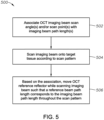
- FIG. 5 depicts a process performed by components of system 200 in certain embodiments.
- an OCT controller 206 of system 200 associates one or more scan angles of a scan pattern with a plurality of reference reflector positions.
- the associations may be pre-loaded or calculated based on input by a system operator.
- the associations are determined by an OCT controller 206 based on patient data, eye modeling data, OCT image data, and/or other information.
- an OCT controller 206 calculates and stores a reference reflector position value for each of a plurality of scan angles in a scan pattern based on an analysis of a calibration OCT image.
- the calculated reflector position values for each scan angle may, in certain embodiments, also account for characteristics or features in the imaging beam path, such as the refractive index of eye 101.
- the pattern may be scanned across scan angles of at least ⁇ 20 degrees (40° sweep), ⁇ 25 degrees (50° sweep), ⁇ 30 degrees (60° sweep), ⁇ 40 degrees (80° sweep), ⁇ 50 degrees (100° sweep), ⁇ 60 degrees (120° sweep), or more.
- the pattern may be a raster pattern generating a B-scan at least 12mm, 14mm, 16mm, 18mm, 20mm, 22mm, or 24mm in length.
- the scan pattern may be selected by a user or automatically selected by system 200.
- an OCT controller 206 generates signals to cause scanner 120 to scan imaging beam 110 onto retina 114 at each scan angle within the scan pattern.
- the scan frequency may be at least 200 Hz, 250 Hz, 300 Hz, 325 Hz, 350 Hz, or 375 Hz, or 400 Hz.
- the OCT controller 206 Based on the association at step 502, the OCT controller 206 generates signals causing the actuator 204 (e.g., a stacked piezo array or voice coil actuator(s)) to move reference reflector 202 while imaging beam 110 is scanned at step 504 such that the reference beam path length is modulated according to the imaging beam path length throughout the scan pattern, so that the
- the OCT controller may generate an instruction set which combines a reflector position sequence with the scan pattern. The instruction set may be executed by a processor of the OCT controller 206 without interruptions or delays attributable to on-the-fly calculations or lookup operations.
- an improved OCT image may be generated that "flattens out” the characteristic "U” shape, as shown in FIG. 3 .
- This allows for imaging and analysis of a greater portion of the retinal surface may be imaged and, in contrast to FIG. 2 , a surgeon may easily "zoom in” to any of windows A, B, or C of FIG. 3 to view a particular area of the retina in greater detail.
- the OCT image shown in FIG. 3 is more easily readable and more useful to surgeons, particularly for intraoperative real-time imaging.
- embodiments of the disclosure provide methods and systems for wide field-of-view OCT imaging which overcomes limitations of conventional systems and methods. It will be appreciated that above-disclosed and other features and functions, or alternatives thereof, may be desirably combined into many other different systems or applications in accordance with the disclosure. It will also be appreciated that various presently unforeseen or unanticipated alternatives, modifications, variations or improvements therein may be subsequently made by those skilled in the art which alternatives, variations and improvements are also intended to be encompassed by the following claims.
Landscapes
- Health & Medical Sciences (AREA)
- Life Sciences & Earth Sciences (AREA)
- Physics & Mathematics (AREA)
- Engineering & Computer Science (AREA)
- General Physics & Mathematics (AREA)
- Biomedical Technology (AREA)
- Medical Informatics (AREA)
- Nuclear Medicine, Radiotherapy & Molecular Imaging (AREA)
- Biophysics (AREA)
- Ophthalmology & Optometry (AREA)
- Theoretical Computer Science (AREA)
- Heart & Thoracic Surgery (AREA)
- Radiology & Medical Imaging (AREA)
- Molecular Biology (AREA)
- Surgery (AREA)
- Animal Behavior & Ethology (AREA)
- General Health & Medical Sciences (AREA)
- Public Health (AREA)
- Veterinary Medicine (AREA)
- Eye Examination Apparatus (AREA)
- Investigating Or Analysing Materials By Optical Means (AREA)
Description
- The present disclosure relates to medical device imaging systems, including optical coherence tomography (OCT) systems.
- Optical Coherence Tomography (OCT) is an imaging technique widely adopted in the biomedical fields, including ophthalmology. OCT systems perform high-resolution, cross sectional imaging in semitransparent samples (such as biological tissues) by measuring the echo time delay of reflected light. OCT is often used by ophthalmic surgeons to assist with precision cutting and/or removal of tissues such as the vitreous. Providing wide-field-of-view OCT imaging across a curved surface such as a retina can be challenging because the images become curved and distorted at wide scan angles, particularly in highly myopic patients. Accordingly, there exists a need for improved wide-field-of-view OCT imaging in the ophthalmic context.
-
WO 2016/178298 discloses an SS-OCT adapted to change the optical path length difference between the reference light and the measurement light and to image the fundus over a wider angle of view. -
US 2010/0302508 discloses an OCT comprising a reference mirror driving unit configured to move the reference mirror to adjust the optical path length of the reference light. - In certain embodiments, an optical coherence tomography (OCT) system includes the features defined in claim 1.
- In certain embodiments, the scan rate is between 200 Hz and 400 Hz, or is at least 300 Hz. The scanner may be configured to scan the imaging beam at each of the scan angles according to a raster pattern, and the raster pattern may generate a B-scan at least 12 mm in length or at least 16 mm in length.
- In certain embodiments, the linear actuator is configured to translate the reference reflector at least 2mm in a direction parallel to the reference beam. The linear actuator may further be configured to translate the reference reflector at least 4mm in a direction parallel to the reference beam.
- The OCT system may comprise a spectral-domain OCT (SD-OCT) system or a swept-source OCT (SS-OCT) system.
- In certain embodiments, an optical coherence tomography (OCT) system according to claim 10 comprises a light source configured to generate an OCT beam, and a beam splitter, configured to split the OCT beam into a reference beam and an imaging beam, direct the reference beam toward a reference reflector, and direct the imaging beam toward a scanner. The system also includes a linear actuator, such as a piezoelectric actuator or voice coil actuator, configured to move the reference reflector to change the length of the reference beam, and the scanner, configured to scan the imaging beam onto a target surface over a plurality of scan angles, wherein the scanner and target surface are separated by a first sample distance at a first scan angle and a second sample distance at a second scan angle. The system includes an OCT controller comprising a processor and instructions stored on a memory, the instructions executable by the processor to cause the OCT controller to generate signals to cause the scanner to repeatedly scan the imaging beam onto the target surface at the first scan angle and the second scan angle according to a scan rate to generate live OCT images, and cause the actuator to move the reference reflector synchronously with the scan rate while the scanner scans the imaging beam onto the target surface, thereby adjusting the length of the reference beam to account for a difference between the first sample distance and the second sample distance. The system further includes a detector configured to receive the reference beam reflected by the reference reflector and the imaging beam reflected by the target surface, and output an interference signal based on the received reference beam and the imaging beam.
- In certain embodiments, the linear actuator comprises a piezoelectric stack or voice coil configured to translate the reference reflector at least 2mm in a direction parallel to the reference beam. In certain embodiments, the first scan angle and the second scan angle are separated by at least 20 degrees. In certain embodiments, the scan generates a B-scan at least 12 mm in length. The OCT system may comprise a spectral-domain OCT (SD-OCT) system or a swept-source OCT (SS-OCT) system.
- According to claim 15, an optical coherence tomography (OCT) system comprises a light source, configured to generate an OCT beam, and a beam splitter, configured to split the OCT beam into a reference beam and an imaging beam, direct the reference beam toward a reference reflector, and direct the imaging beam toward a scanner. The system further includes a linear actuator, configured to translate the reference reflector at least 2mm in a direction parallel to the reference beam and the scanner, configured to scan the imaging beam onto a target surface at a plurality of scan angles. The system includes an OCT controller comprising a processor and instructions stored on a memory, the instructions executable by the processor to cause the OCT controller to generate signals to cause the scanner to repeatedly scan the imaging beam at each of the scan angles at a first scan rate to generate live OCT images, and cause the actuator to translate the reference reflector synchronously with the scan rate, such that a path length of the reference beam is maintained within a tolerance range of a path length of the imaging beam throughout the scan.
- In certain embodiments, the tolerance range is less than 0.5mm or 1mm. The scan rate may be between 200 Hz and 400 Hz. Further, the scanner may be configured to scan the imaging beam at each of the scan angles according to a raster pattern. The linear actuator may be a piezoelectric stack or voice coil configured to translate the reference reflector at least 2mm in a direction parallel to the reference beam.
- Certain embodiments may provide one or more technical advantages. For example, improved OCT imaging systems according to the disclosure may provide ultra-wide field-of-view OCT imaging with reduced distortion. Certain embodiments generate OCT images in which a target surface is centered throughout an OCT image window, despite relative variations in target depth. Thus, certain embodiments provide improved live OCT imaging of curved surfaces, such as high-myopia retinal surfaces. These and other advantages will be apparent to those skilled in the art in view of the present drawings and specification.
- For a more complete understanding of the present disclosure and the advantages thereof, reference is now made to the following description taken in conjunction with the accompanying drawings in which like reference numerals indicate like features and wherein:
-
FIG. 1 illustrates a block diagram of a conventional OCT system; -
FIG. 2 illustrates a retinal image generated by a conventional OCT imaging system; -
FIG. 3 illustrates a retinal image generated by an improved OCT imaging system according to certain embodiments; -
FIG. 4 illustrates a block diagram of an improved OCT imaging system according to certain embodiments; and -
FIG. 5 illustrates a method performed by an improved OCT imaging system according to certain embodiments. - One skilled in the art will understand that the drawings, described below, are for illustration purposes only, and are not intended to limit the scope of applicant's disclosure.
- For the purposes of promoting an understanding of the principles of the present disclosure, reference will now be made to the embodiments illustrated in the drawings, and specific language will be used to describe the same. It will nevertheless be understood that no limitation of the scope of the disclosure is intended. Alterations and further modifications to the described systems, devices, and methods, and any further application of the principles of the present disclosure are contemplated as would normally occur to one skilled in the art to which the disclosure relates. In particular, it is contemplated that the systems, devices, and/or methods described with respect to one embodiment may be combined with the features, components, and/or steps described with respect to other embodiments of the present disclosure. For the sake of brevity, however, the numerous iterations of these combinations will not be described separately. For simplicity, in some instances the same reference numbers are used throughout the drawings to refer to the same or like parts.
- Optical coherence tomographic (OCT) imaging systems are useful in an array of biological applications including ophthalmology, dentistry, cardiology, gastroenterology, and others. The general design and principles of OCT systems are known and described in, for example: (a) "Signal Processing Overview of Optical Coherence Tomography Systems for Medical Imaging," Texas Instruments White Paper SPRABB9 (June 2010) and (b) "Biomedical Optical Imaging," Progress Report of the Research Laboratory of Electronics at MIT, No. 152 (2009-2010).
-
FIG. 1 is a simple schematic illustration of components in aconventional OCT system 100.System 100 may comprise a spectral-domain OCT (SD-OCT) system or swept-source (SS-OCT) system. In general, the components ofsuch systems 100 are well-known to the skilled artisan. Among other things,system 100 includes alight source 102, beam splitter/combiner 104,reference reflector 108,scanner 120, and adetector 124.Light source 102 may comprise any suitable low-coherence light source such as a super-luminescent diode, ultrashort (e.g., femtosecond) pulsed laser, or supercontinuum laser, and may comprise a frequency-swept or tunable laser in certain examples, such as SS-OCT systems.Beam splitter 104 may comprise a non-polarized beam splitter for splitting the OCT beam into an imaging beam and a reference beam and combining or directing reflected imaging and reference light towarddetector 124.Reference reflector 108 is typically a mirror, but may comprise any suitable component which reflects thereference beam 106 toward thedetector 124.Scanner 120 may comprise one or more galvanometer-controlled mirrors to scan the imaging beam in the x-y plane toward a target or sample, such as retina 114 (when discussing the object being imaged, the terms "target" and "sample" are used interchangeably herein). In certain embodiments,scanner 120 may additionally include focusing optics to scan the imaging beam in a z-direction.Scanner 120 may comprise any suitable scanning mirror arrangement. Alternatively,scanner 120 may comprise any suitable scanner components, such as microelectromechanical systems (MEMS) or a resonant scanner. The imaging beam scanned byscanner 120 is directed throughoptical elements 122 which may comprise focusing and/or collimating lenses.Detector 124 comprises an interferometer which receives the imaging beam reflected from the target and the reference beam reflected from thereflector 108 and outputs an interference signal from which an OCT image can be generated. Particular components included indetector 124 depend on the type of OCT system and may include any suitable combination of spectrometers, photodetectors, array detectors, analog-to-digital converters (ADCs), diffraction grating(s), or other components known to those skilled in the art. For example,detector 124 in an SD-OCT system may include a diffraction grating, lenses, and an array detector such as a charge-coupled device (CCD). As another example,detector 124 in an SS-OCT system may include a photodetector and a analog-to-digital converter. -
System 100 may include an OCT controller (not shown inFIG. 1 ) comprising hardware, firmware, and software configured to control components ofsystem 100 to acquire and display OCT images of a target.System 100 may additionally include one or more displays (not shown) to present OCT images generated by the OCT controller. In various examples, the display may include any one or more monitors, projectors, oculars, heads-up displays, screens, glasses, goggles, etc. The OCT images may be displayed as 2D or 3D images. - In operation,
light source 102 emits a low-coherence light beam directed tobeam splitter 104, which splits the light into areference beam 106 directed through a reference arm (which may comprise any suitable transmission and focusing optics including optical fibers) towardreflector 108 and animaging beam 110 directed through an imaging arm (which likewise may include any suitable transmission and focusing optics including optical fibers) toward ascanner 120. Scanner 120 (under the control of the OCT controller) may scan the imaging beam towardoptics 122 and thelens 112 ofeye 101 according to a scan pattern (e.g., raster scan, radial scan, cube scan, circle group scan, line group scan, etc.) to generate the desired scan (e.g., A-scan, B-scan, or C-scan). A depth-resolved axial scan (A-scan) comprises a measurement of the light signal interference at a point. Cross-sectional images (B-scans) may be generated by scanning the OCT beam across the tissue surface and acquiring multiple axial measurements over a line, curve, circle, etc. A 3D image may be constructed from a series of B-scans generated over an area of the tissue surface. Scanning may be repeated at a scan rate or frequency to generate live or real-time OCT images which may useful for pre-operative diagnostics as well as intra-operative guidance. - Imaging beam light reflected by the
retina 114 and reference beam light reflected by thereflector 108 may be received atdetector 124, which interferes the back-reflected or backscattered imaging beam with the reference beam to generate OCT images. Interference occurs when the path length of the reference beam (i.e., the distance imaging light travels betweensource 102 and reflector 108) and the path length of the imaging beam (i.e., the stance imaging light travels betweensource 102 and a target such as retina 114) are matched within the coherence length of the light emitted bylight source 102. This interference signal conveys information about the target at a depth which corresponds to the reference beam path length. - Accordingly, OCT systems are calibrated prior to use by setting the reference beam path length according to the target depth, so that the path length of the reference beam is approximately equal to the path length of the imaging beam at the target depth. The difference between the path length of the reference beam and the path length of the imaging beam at the target depth in an OCT system is referred to as the optical path difference (OPD). Ideally, OPD is zero, though absolute precision necessary in practice. Thus, in the example of
FIG. 1 , if the primary target depth is the center surface ofretina 114, the reference beam path length (illustrated as reference beam distance Rd) is set to match the path length of the imaging beam measured to the center of retina 114 (illustrated as center sample distance Sdc). In conventional spectral-domain OCT (SD-OCT) systems or swept-source OCT (SS-OCT) systems such assystem 100, this reference beam path length is fixed at the outset of the imaging procedure and remains fixed throughout the OCT scan. - It is noted that OCT imaging systems may be broadly classified into time-domain OCT (TD-OCT) systems, SD-OCT systems, and SS-OCT systems. TD-OCT systems obtain an interference pattern by moving a reference mirror to vary the reference path length at each point in a scan pattern. That is, at a given point in a TD-OCT scan pattern, the reference mirror in the reference arm must be moved to change the reference path length. The movement of this mirror in the reference arm of TD-OCT systems is a speed gating factor, because the mirror must be moved through a distance (z-range) at each (x,y) point of an OCT scan pattern in order to generate the required interference signal.
- Conventional SD-OCT and SS-OCT systems operate according to different principles and avoid this speed gate by employing a fixed-position reference reflector which requires no mechanical scanning of the reference path at any point in a scan pattern. SD-OCT systems use a broadband light source and obtain depth information measuring the spectral density in the sample arm using a spectrometer. SS-OCT systems utilize a frequency-swept laser or tunable laser and a single-point detector. In both SD-OCT and SS-OCT systems, OCT images are generated from the received interference signal using fast Fourier transforms. Accordingly, the reference reflector position is fixed at each (x,y) point of an OCT scan pattern executed by conventional SD-OCT and SS-OCT systems.
- Typical SD-OCT and SS-OCT systems for posterior-segment imaging may scan between 20° and 40° (e.g., ±10° or ±20° from a center position) across a retinal target. Over such scan angles, the targeted portion of the retina may be imaged without significant distortion because variations in the depth of the retina attributable to retinal curvature are not significant. Stated differently, the variations in OPD resulting from retinal curvature are typically not very significant across smaller scan angle ranges (e.g., between 20° and 40°). However, over wider fields-of-view (e.g., 40° or more), the curvature of the retina across the imaged area results in significant variation in OPD, particularly in high-myopia patients. This variation in OPD can cause distortion in the OCT image.
-
FIG. 2 illustrates an example wide field-of-view B-scan (approximately 40°) of a retina generated by a conventional SD-OCT or SS-OCT system. As illustrated in this example, the image of the retina is curved in a wide "U" shape, such that the edges appear to "fall off' the image range on each side. This distortion results from variations in the OPD attributable to retinal curvature and the fixed reference beam path length. That is, the reference beam path length is calibrated to image at a particular depth, e.g., so that the OPD is approximately zero at the center of the retina. However, the natural curvature of the retina results in the fundus surface outside that depth because the OPD changes as the imaging beam is scanned across tissues which are closer toscanner 120. - This characteristic "U"-shaped distortion is undesirable and problematic. For example, during a procedure, a surgeon may "zoom in" to a particular area of the retina, such one of windows A-C. Each of windows A-C represents an image area for enlargement, though it is noted that any portion of the image may be enlarged. Although the retinal image is generally horizontal in window B, windows A and C each display a portion of the retinal surface with a steep angular orientation in the image window. This angular orientation results in distortion and truncation of the retinal image and, among other things, it makes the image more difficult to read and use, particularly in an intra-operative context.
- Embodiments of the present disclosure address this problem by modulating the position of a reference reflector, thereby adjusting the reference beam path length to account for or match variations of the target depth within a scan and "flatten" out the OCT image as shown in
FIG. 3 . In other words, the position of the reference reflector is modulated so that the system OPD is maintained at or near zero throughout a scan pattern. Compared againstFIG. 2 , image windows A and C ofFIG. 3 display larger portions of the retina with increased clarity and reduced distortion. Accordingly, improved OCT systems according to the present disclosure facilitate high-speed (e.g., 200-400+ Hz), wide-angle scans (e.g., ±20°- ±90° sweeps) across large retinal cross-sections and provide improved images that are substantially free of distortion and easy to use during a surgical procedure. -
FIG. 4 illustrates an example of an improvedOCT imaging system 200 to generate images as shown inFIG. 3 .System 200 may be a probe-based system, a stand-alone imaging system, or an imaging system integrated with other components, such as a surgical microscope. It is noted thatFIG. 4 does not attempt to exhaustively illustrate all components of an OCT system, nor is it drawn to scale. Rather, it is provided to qualitatively illustrate how the optical path of theimaging beam 110 varies according to scan angle. -
System 200 comprises an SD-OCT or SS-OCT imaging system which includes many of the same components as system 100 (like numerals indicate like components). In particular,system 200 includes alight source 102, beam splitter/combiner 104,scanner 120, and adetector 124.Light source 102 may comprise any suitable low-coherence light source such as a super-luminescent diode, ultrashort (e.g., femtosecond) pulsed laser, or supercontinuum laser, and may comprise a frequency-swept or tunable laser in certain examples, such as SS-OCT systems.Beam splitter 104 may comprise a non-polarized beam splitter for splitting the OCT beam into an imaging beam transmitted through the sample arm and a reference beam transmitted through the reference arm (sometimes referred to as a delay line) of the OCT system.Beam splitter 104 also receives and combines reflected imaging light (reflected by the sample, such as eye 114) and reference light (reflected by reference reflector 202) towarddetector 124.Scanner 120 may comprise one or more galvanometer-controlled mirrors to scan the imaging beam in the x-y plane through a sample arm of the OCT system toward the sample, such asretina 114.Scanner 120 may additionally include focusing optics to scan the imaging beam in a z-direction.Scanner 120 may comprise any suitable scanner, such as a galvanometer-controlled mirror scanner. The imaging beam scanned byscanner 120 is directed throughoptical elements 122 which may comprise focusing and/or collimating lenses of the sample arm.Detector 124 comprises an interferometer which receives the imaging beam reflected from the target and the reference beam reflected from thereflector 202 and outputs an interference signal from which an OCT image can be generated. Particular components included indetector 124 depend on the type of OCT system and may include any suitable combination of spectrometers, photodetectors, array detectors, analog-to-digital converters (ADCs), diffraction grating(s), or other components known to those skilled in the art.Detector 124 in an SD-OCT system may include a diffraction grating, lenses, and an array detector such as a charge-coupled device (CCD).Detector 124 in an SS-OCT system may include a photodetector an analog-to-digital converter. - In contrast to
system 100,system 200 includes amovable reflector 202 coupled to anactuator 204, as well as anOCT controller 206 communicatively coupled toactuator 204 andscanner 120. In certain embodiments,OCT controller 206 may also be communicatively coupled todetector 124 andlight source 102.Reflector 202 typically comprises a mirror, but may comprise any reflector suitable for reflecting the reference beam ofsystem 200 towardsdetector 124. In certain embodiments,actuator 204 comprises a linear actuator, such as a stacked piezoelectrionic array or linear voice coil actuator(s), configured to translatereflector 202 laterally between positions Rdc and RdL/RdR, as indicated by the arrow abovereflector 202. In other embodiments,actuator 204 may comprise any suitable linear, rotary, or oscillatory actuator arranged to movereflector 202 and thereby adjust the reference beam path length. A stacked piezo array or voice coil actuator may provide increased simplicity compared with the galvanometer mirrors used for delay line modulation in time-domain OCT systems. -
OCT controller 206 comprises hardware and software configured to perform the enhanced OCT imaging processes described herein. In certain embodiments, theOCT controller 206 includes one or more processors coupled to a memory. The processor may include one or more CPUs, microprocessors, field-programmable gate arrays (FPGAs), application-specific integrated circuits (ASICs), digital-signal processors (DSPs), system-on-chip (SoC) processors, or analogous components. The memory may include volatile or nonvolatile memory including, magnetic media, optical media, random access memory (RAM), read-only memory (ROM), removable media, or analogous components. The memory may store instructions for software programs and algorithms that, when executed by the processor, allow theOCT controller 206 to direct the operation of (e.g., by generating control signals sent to)scanner 120,actuator 204,light source 102,detector 124, and/or other components ofsystem 200 to provide improved wide-field of view OCT imaging. As used in the claims, the terms "processor," "memory," and "instructions" each refers to a classes of structures known in the field of OCT imaging and familiar to those of ordinary skill in the art. Accordingly, these terms are to be understood as denoting structural rather than functional elements of the disclosed system. - In operation,
light source 102 generates an OCT beam which is split bybeam splitter 104 into areference beam 106 and animaging beam 110.Imaging beam 110 is directed through an imaging or sample arm comprising transmission optics towardscanner 120 which, in response to signals generated by theOCT controller 206, scans theimaging beam 110 onto thetarget eye 101 according to a scan pattern to image a portion of theretina 114. The scan pattern executed bysystem 200 may be any suitable pattern, such as a raster scan, radial scan, cube scan, circle group scan, line group scan, etc. - While
imaging beam 110 is scanned ontoretina 114,reference beam 106 is directed towardreflector 202 through a reference arm comprising transmission optics.Actuator 204 configured to movereflector 202 in response to signals generated by theOCT controller 206 modulate the position ofreflector 202 whilescanner 120scans imaging beam 110 ontoretina 114 across a plurality scan angles in a scan pattern, so that the system OPD is maintained at or near zero.Detector 124 receives imaging light reflected fromretina 114 and reference light reflected from thereflector 202 and outputs an interference signal from which an OCT image can be generated. - As noted above,
scanner 120 may scan the target surface according to a variety of scan patterns. In certain embodiments,scanner 120 comprises two or more galvanometer scanners configured to scanimaging beam 110 according to a high-speed raster pattern. Raster patterns are typically generated using one fast galvanometer and one slow galvanometer. The fast galvanometer may sweep across a scan angle range at the raster scan frequency. In various embodiments ofsystem 200,scanner 120 may implement a raster scan having a frequency in the range of 100-400 Hz, 150-350 Hz, 200-325 Hz, or 200-300 Hz. In certain examples, the raster scan frequency may be at least 200 Hz, 250 Hz, 275 Hz, 300 Hz, 325 Hz, 350 Hz, or 375 Hz, or 400 Hz. Further, the raster pattern may be scanned across scan angles of at least ±20 degrees (40° sweep), ±25 degrees (50° sweep), ±30 degrees (60° sweep), ±40 degrees (80° sweep), ±50 degrees (100° sweep), ±60 degrees (120° sweep), or more. The pattern may generate a B-scan at least 12mm, 14mm, 16mm, 18mm, or 20mm, 22mm, or 24mm in length. - It is noted that the trajectories of
imaging beam 110 andreference beam 106 depicted inFIG. 4 are simplified schematic illustrations provided to convey the principles ofsystem 200, without concern for optical details ofsystem 200. One skilled in the art will appreciate that, in practice,reference beam 110 and/orimaging beam 114 may be refracted and/or reflected by various elements in the beam path, including but not limited toscanner 120,optics 122, andcrystalline lens 112. For example, the path ofimaging beam 114 may be reflected and/or refracted betweenscanner 120 andlens 112, though straight paths are depicted for simplicity. Moreover,imaging beam 114 - As
FIG. 4 illustrates, the surface ofretina 114 is curved. Thus, asimaging beam 110 is scanned across the curved surface ofretina 114, the relative distance between scanner 120 (an example fixed reference point along the image beam path) and theretina 114 varies. In this example, an initial scan angle Θi = 0° corresponds to a center-position sample distance, Sdc. Although scan angles Θi in the example ofFIG. 4 are based on a point of reference within lens 112 (where the path ofimaging beam 110 at each scan angle intersects), one skilled in the art will appreciate that the location of the applicable reference point by which to measure a scan angle may vary in different embodiments. - During an imaging procedure,
scanner 110 scans theimaging beam 110 so that it sweeps acrossretina 114, as indicated by the curved arrow belowretina 114 inFIG. 4 . As the scanner directs the imaging beam to the left side ofretina 114, the scan angle increases from 0° to Θ1, and the distance betweenscanner 120 and the scanned surface ofretina 114 decreases moving from Sdc to the left-position sample distance Sdc (though it is noted that the actual change in beam path length may be impacted by other features in the imaging arm of system 200). Likewise, asscanner 120 causes the beam to sweep to the right side ofretina 114, the scan angle returns to 0° at Sdc and then increases to Θ2, and the distance betweenscanner 120 andretina 114 returns to SdC and then increases moving to the right-position sample distance SdR (again, the actual change in beam path length may be also impacted by other features in the imaging arm). Hence, the imaging beam path length insystem 200 varies according to the scan angle of the imaging beam. Given a fixed reference beam path length, this variation can cause the OCT image to "fall off" at the edges in a "U" shape, as depicted inFIG. 2 . -
System 200 reduces or eliminates such distortion by adjusting the position ofreflector 202 according to the scan angle to offset variations in the imaging beam path length. In particular,OCT controller 206 controls actuator 204 to modulate the position ofreflector 202 synchronously with the scan angle and maintain OPD at or near zero, or within a tolerance range. For example, whenscanner 120scans imaging beam 110 to the center ofretina 114, thesample beam 110 traverses a center-position path distance represented by Sdc, andreflector 202 is positioned at a corresponding center-position reference beam distance Rdc which is equal or approximately equal to Sdc, such that OPD is at or near zero. Whenscanner 120scans imaging beam 110 at scan angle Θ1,imaging beam 110 traverses a path represented by the left sample beam distance SdL, andreflector 202 is positioned at a left reference beam distance RdL such that thereflector 202 is translated a distance commensurate with the change in imaging beam path length (such that OPD is kept at or near zero). This may be performed at any number of points in the scan pattern. In this manner, the path length ofreference beam 106 is actively adjusted during the scan to match the variation in the path length ofimaging beam 110 at different scan angles in a scan pattern. - For example, if difference in the optical path length between Sdc and SdL is 2mm, then an
actuator 204 may translatereflector 202 by a distance RdC - RdL to reduce the reference beam path length by an amount such that the OPD between reference and sample arms is kept at or near zero. It is noted that, in practice, it may be necessary to translatereflector 202 more or less than 2mm to maintain overall OPD at or near zero. This may be at least partially caused by differences between the optical paths of theimaging beam 110 andreference beam 106. For example, the sample arm ofsystem 200 includesscanner 120,optics 122, andeye 101. Withineye 101, the refractive index is approximately n=1.3. On the other hand, thereference beam 202 traversing the reference arm may be in air, where n=1.0. In such a system, to maintain overall OPD near zero given a 2mm change in imaging beam path length, it may be necessary to movereference reflector 202 more than 2mm. Accordingly, in various embodiments, specific translation distances forreference reflector 202 may be calibrated to account for system- and implementation-specific factors to maintain OPD at or near zero or within a tolerance range. - In some examples,
system 200 may maintain equal imaging beam and reference beam path lengths (OPD = 0) for all scan angles Θn in a scan pattern. However, in other examples, it may not be necessary or feasible to maintain OPD at exactly zero for all scan angles. Accordingly, in certain embodiments OPD may be maintained within a tolerance value Tdx, such that any difference between the imaging beam path length and reference beam path length is less than or equal to Tdx (e.g., |OPD| ≤TdX for all scan angles Θn in a scan pattern). In some examples, Tdx may be 0.1mm, 0.25mm, 0.5mm, 1mm, or any other suitable value. In certain examples, Tdx may be variable. For example, Tdx may increase or decrease depending on the scan angle. Tdx may be set or configured by a system operator. - In the context of a retinal imaging procedure, a raster pattern executed across wide angles at high rates presents particular challenges because the imaging beam path length changes most rapidly as
retina 114 is scanned in a straight line. Hence, a high-frequency raster pattern requires that the reference beam path length must be modulated at a very high speed. To modulate the reference beam path length synchronously with the fast galvanometer executing a high-speed, wide-angle raster scan,actuator 204 may include one or morelinear actuators 204 configured to move reflector 202 (under the control of OCT controller 206) synchronously with the movement ofscanner 120. For example,linear actuators 204 comprise stacked array of piezoelectric actuators having at least 2mm of stroke, operated in a double-path delay line to yield over 4mm of effective reference beam path length modulation (e.g., by movingreflector 202 across a 4+mm range between RdC and RdL/RdR). In other examples,actuators 204 may comprise linear voice coil actuator(s) configured to modulate the position ofreference reflector 202 across a a 4+mm range between RdC and RdL/RdR. - Values defining the correct position of
reference reflector 202 at particular scan points and/or scan angles in a scan pattern may comprise pre-loaded default values. Alternatively, such values may be input by a system operator or generated from patient-specific data. Such patient-specific data may comprise eye modeling data, biometric data, OCT image data, and/or any other suitable information, including data obtained during a preoperative procedure or during a calibration or initialization phase of an imaging procedure. - For example, in certain embodiments,
OCT controller 206 may causescanner 120 to generate a calibration OCT image by scanning theimaging beam 110 according to a scan pattern whilereflector 202 remains stationary in an initial position.OCT controller 206 may receive and analyze the generated calibration OCT image to determine a plurality of sample distance values (e.g., Sd1, Sd2, ... Sdn) associated with particular scan angle values (e.g., Θ1, Θ2,...Θn). Based on the sample distance values,OCT controller 206 may calculate a plurality of reflector position values (e.g., Rp1, Rp2, ... Rpn) which will change the reference beam path length to maintain the OPD within the specified tolerance.OCT controller 206 may then associate the calculated reflector position values with corresponding scan angle values and store the association in memory. During an imaging procedure,OCT controller 206 may generate signals which causescanner 120 to scanimaging beam 110 across scan angles in the scan pattern and simultaneously controlactuator 204 to position ofreflector 202 according to the stored reflector position values associated with each scan angle. As a result,reflector 202 may sweep across a plurality of positions synchronously with the scan rate, thereby adjusting the length of the reference beam to maintain OPD within a desired tolerance Tdx. - Accordingly, embodiments of
system 200 are capable of providing an ultra-wide field-of-view OCT image of a target, such as a retina, at high scan rates without image distortion characteristic of conventional OCT systems. Although a curved target surface is discussed in the example ofFIG. 4 , the systems and advantages described in the present disclosure may not be confined to imaging curved target surfaces but also include enhanced imaging of flat target surfaces based on the same principles. -
FIG. 5 depicts a process performed by components ofsystem 200 in certain embodiments. Atstep 502, anOCT controller 206 ofsystem 200 associates one or more scan angles of a scan pattern with a plurality of reference reflector positions. The associations may be pre-loaded or calculated based on input by a system operator. In certain embodiments, the associations are determined by anOCT controller 206 based on patient data, eye modeling data, OCT image data, and/or other information. In certain embodiments, anOCT controller 206 calculates and stores a reference reflector position value for each of a plurality of scan angles in a scan pattern based on an analysis of a calibration OCT image. The calculated reflector position values for each scan angle may, in certain embodiments, also account for characteristics or features in the imaging beam path, such as the refractive index ofeye 101. In some embodiments, the pattern may be scanned across scan angles of at least ±20 degrees (40° sweep), ±25 degrees (50° sweep), ±30 degrees (60° sweep), ±40 degrees (80° sweep), ±50 degrees (100° sweep), ±60 degrees (120° sweep), or more. The pattern may be a raster pattern generating a B-scan at least 12mm, 14mm, 16mm, 18mm, 20mm, 22mm, or 24mm in length. The scan pattern may be selected by a user or automatically selected bysystem 200. - At
step 504, anOCT controller 206 generates signals to causescanner 120 to scanimaging beam 110 ontoretina 114 at each scan angle within the scan pattern. In certain examples, the scan frequency may be at least 200 Hz, 250 Hz, 300 Hz, 325 Hz, 350 Hz, or 375 Hz, or 400 Hz. - At
step 506, based on the association atstep 502, theOCT controller 206 generates signals causing the actuator 204 (e.g., a stacked piezo array or voice coil actuator(s)) to movereference reflector 202 whileimaging beam 110 is scanned atstep 504 such that the reference beam path length is modulated according to the imaging beam path length throughout the scan pattern, so that the |OPD| ≤TdX for all or a subset of scan angles Θn in the scan pattern. In other embodiments, the OCT controller may generate an instruction set which combines a reflector position sequence with the scan pattern. The instruction set may be executed by a processor of theOCT controller 206 without interruptions or delays attributable to on-the-fly calculations or lookup operations. - In this manner, an improved OCT image may be generated that "flattens out" the characteristic "U" shape, as shown in
FIG. 3 . This allows for imaging and analysis of a greater portion of the retinal surface may be imaged and, in contrast toFIG. 2 , a surgeon may easily "zoom in" to any of windows A, B, or C ofFIG. 3 to view a particular area of the retina in greater detail. Compared withFIG. 2 , the OCT image shown inFIG. 3 is more easily readable and more useful to surgeons, particularly for intraoperative real-time imaging. - Accordingly, embodiments of the disclosure provide methods and systems for wide field-of-view OCT imaging which overcomes limitations of conventional systems and methods. It will be appreciated that above-disclosed and other features and functions, or alternatives thereof, may be desirably combined into many other different systems or applications in accordance with the disclosure. It will also be appreciated that various presently unforeseen or unanticipated alternatives, modifications, variations or improvements therein may be subsequently made by those skilled in the art which alternatives, variations and improvements are also intended to be encompassed by the following claims.
Claims (15)
- An optical coherence tomography (OCT) system (200), comprising:a light source (102), configured to generate an OCT beam;a beam splitter (104), configured to:split the OCT beam into a reference beam (106) and an imaging beam (110);direct the reference beam (106) toward a reference reflector (202); anddirect the imaging beam (110) toward a scanner (120);a linear actuator (204), configured to move the reference reflector (202) to adjust the length of the reference beam (106);the scanner (120), configured to scan the imaging beam (110) onto a target surface (114) at a plurality of scan angles (θ1, θ2), wherein the scanner (120) and target surface (114) are separated by a sample distance (SdL, SdC, SdR) that varies at each of the scan angles (Θ1, Θ2);further comprising
an OCT controller (206) comprising a processor and instructions stored on a memory, the instructions executable by the processor to cause the OCT controller (206) to generate signals to:cause the scanner (120) to repeatedly scan the imaging beam (110) at each of the scan angles (θ1, θ2) at a first scan rate to generate live OCT images; andcause the actuator (204) to adjust the length of the reference beam (106) during the scan synchronously with the scan rate to offset the variation in sample distance (SdL, Sdc, SdR) at each of the scan angles (Θ1, Θ2). - The system of claim 1, wherein the scan rate is between 200 Hz and 400 Hz.
- The system of claim 1, wherein the scan rate is at least 300 Hz.
- The system of claim 1, wherein the scanner (120) is configured to scan the imaging beam (110) at each of the scan angles (Θ1, Θ2) according to a raster pattern.
- The system of claim 4, wherein the raster pattern generates a B-scan at least 12 mm in length.
- The system of claim 4, wherein the raster pattern generates a B-scan at least 16 mm in length.
- The system of claim 1, wherein the linear actuator (204) comprises a piezoelectric actuator or voice coil actuator, configured to translate the reference reflector (202) at least 2mm in a direction parallel to the reference beam (106).
- The system of claim 1, wherein the linear actuator comprises a piezoelectric actuator or voice coil actuator, configured to translate the reference reflector (202) at least 4mm in a direction parallel to the reference beam (106).
- The system of claim 1, wherein the OCT system comprises a spectral-domain OCT (SD-OCT) system or a swept-source OCT (SS-OCT) system.
- An optical coherence tomography (OCT) system (200), comprising:a light source (102), configured to generate an OCT beam;a beam splitter (104), configured to:split the OCT beam into a reference beam (106) and an imaging beam (110);direct the reference beam (106) toward a reference reflector (202); anddirect the imaging beam (110) toward a scanner (120);a linear actuator (204), configured to move the reference reflector (202) to change the length of the reference beam (106); andthe scanner (120), configured to scan the imaging beam (110) onto a target surface (114) over a plurality of scan angles (θ1, θ2), wherein the scanner (120) and target surface (114) are separated by a first sample distance (SdL, Sdc, SdR) at a first scan angle (Θ1, Θ2) and a second sample distance (SdL, Sdc, SdR) at a second scan angle (Θ1, Θ2);further comprising
an OCT controller (206) comprising a processor and instructions stored on a memory, the instructions executable by the processor to cause the OCT controller (206) to generate signals to:cause the scanner (204) to repeatedly scan the imaging beam (110) onto the target surface (114) at the first scan angle (Θ1, Θ2) and the second scan angle (Θ1, Θ2) according to a scan rate to generate live OCT images; andcause the actuator (204) to move the reference reflector (202) synchronously with the scan rate while the scanner (120) scans the imaging beam (110) onto the target surface (114), thereby adjusting the length of the reference beam (106) to account for a difference between the first sample distance (SdL, Sdc, SdR) and the second sample distance (SdL, SdC, SdR); anda detector (124) configured to:receive the reference beam (106) reflected by the reference reflector (202) and the imaging beam (110) reflected by the target surface (114); andoutput an interference signal based on the received reference beam (106) and the imaging beam (114). - The system of claim 10, wherein the linear actuator (204) comprises a piezoelectric stack or a voice coil actuator, configured to translate the reference reflector (202) at least 2mm in a direction parallel to the reference beam (106).
- The system of claim 10, wherein the first scan angle (Θ1, Θ2) and the second scan angle (Θ1, Θ2) are separated by at least 20 degrees.
- The system of claim 10, wherein the scan generates a B-scan at least 12 mm in length.
- The OCT system of claim 10, wherein the OCT system (200) comprises a spectral-domain OCT (SD-OCT) system or a swept-source OCT (SS-OCT) system.
- An optical coherence tomography (OCT) system (200), comprising:a light source (102), configured to generate an OCT beam;a beam splitter (104), configured to:split the OCT beam into a reference beam (106) and an imaging beam (110);direct the reference beam (106) toward a reference reflector (202); anddirect the imaging beam (110) toward a scanner (120);a linear actuator (204), configured to translate the reference reflector (202) at least 2mm in a direction parallel to the reference beam (106);the scanner (120), configured to scan the imaging beam (110) onto a target surface (114) at a plurality of scan angles (Θ1, Θ2);further comprising
an OCT controller (206) comprising a processor and instructions stored on a memory, the instructions executable by the processor to cause the OCT controller (206) to generate signals to:cause the scanner (120) to repeatedly scan the imaging beam at each of the scan angles (θ1, θ2) at a first scan rate to generate live OCT images; andmove the actuator (204) to translate the reference reflector (202) synchronously with the scan rate, such that a path length of the reference beam (106) is maintained within a tolerance range of a path length of the imaging beam (110) throughout the scan.
Applications Claiming Priority (2)
| Application Number | Priority Date | Filing Date | Title |
|---|---|---|---|
| US201662436732P | 2016-12-20 | 2016-12-20 | |
| PCT/IB2017/058061 WO2018116128A1 (en) | 2016-12-20 | 2017-12-18 | Systems and methods for wide field-of-view optical coherence tomography |
Publications (2)
| Publication Number | Publication Date |
|---|---|
| EP3558090A1 EP3558090A1 (en) | 2019-10-30 |
| EP3558090B1 true EP3558090B1 (en) | 2024-10-02 |
Family
ID=60937834
Family Applications (1)
| Application Number | Title | Priority Date | Filing Date |
|---|---|---|---|
| EP17825967.7A Active EP3558090B1 (en) | 2016-12-20 | 2017-12-18 | Systems for wide field-of-view optical coherence tomography |
Country Status (8)
| Country | Link |
|---|---|
| US (1) | US10327632B2 (en) |
| EP (1) | EP3558090B1 (en) |
| JP (1) | JP2020502501A (en) |
| CN (1) | CN110035689B (en) |
| AU (1) | AU2017383451B2 (en) |
| CA (1) | CA3042355A1 (en) |
| ES (1) | ES2996701T3 (en) |
| WO (1) | WO2018116128A1 (en) |
Families Citing this family (16)
| Publication number | Priority date | Publication date | Assignee | Title |
|---|---|---|---|---|
| WO2018119077A1 (en) | 2016-12-21 | 2018-06-28 | Acucela Inc. | Miniaturized mobile, low cost optical coherence tomography system for home based ophthalmic applications |
| JP7330993B2 (en) | 2017-11-07 | 2023-08-22 | ノータル ビジョン リミテッド | Retinal imaging device and related method |
| CN111542258B (en) | 2017-11-07 | 2023-10-20 | 诺达尔视觉有限公司 | Methods and systems for alignment of ophthalmic imaging devices |
| JP7402866B2 (en) | 2018-06-20 | 2023-12-21 | アキュセラ インコーポレイテッド | Miniaturized mobile low-cost optical coherence tomography system for home ophthalmology applications |
| JP7215862B2 (en) * | 2018-09-26 | 2023-01-31 | 株式会社トプコン | OPHTHALMIC PHOTOGRAPHIC APPARATUS, CONTROL METHOD, PROGRAM, AND RECORDING MEDIUM THEREOF |
| US10595722B1 (en) | 2018-10-03 | 2020-03-24 | Notal Vision Ltd. | Automatic optical path adjustment in home OCT |
| US10653311B1 (en) | 2019-06-12 | 2020-05-19 | Notal Vision Ltd. | Home OCT with automatic focus adjustment |
| JP7343331B2 (en) * | 2019-08-08 | 2023-09-12 | 株式会社トプコン | Ophthalmological device, its control method, program, and recording medium |
| WO2021134087A1 (en) | 2019-12-26 | 2021-07-01 | Acucela Inc. | Optical coherence tomography patient alignment system for home based ophthalmic applications |
| US10959613B1 (en) | 2020-08-04 | 2021-03-30 | Acucela Inc. | Scan pattern and signal processing for optical coherence tomography |
| CN116390683A (en) | 2020-08-14 | 2023-07-04 | 奥克塞拉有限公司 | System and method for optical coherence tomography A-scan de-warping |
| US11393094B2 (en) | 2020-09-11 | 2022-07-19 | Acucela Inc. | Artificial intelligence for evaluation of optical coherence tomography images |
| AU2021352417A1 (en) | 2020-09-30 | 2023-04-06 | Acucela Inc. | Myopia prediction, diagnosis, planning, and monitoring device |
| EP4312717A4 (en) | 2021-03-24 | 2025-02-19 | Acucela Inc. | Axial length measurement monitor |
| CN113326565B (en) | 2021-05-26 | 2022-11-22 | 南京航空航天大学 | Three-dimensional braided fabric trace distance detection method |
| WO2023022183A1 (en) * | 2021-08-18 | 2023-02-23 | 株式会社ニコン | Ophthalmic device, control method, and program |
Family Cites Families (11)
| Publication number | Priority date | Publication date | Assignee | Title |
|---|---|---|---|---|
| WO2006078802A1 (en) | 2005-01-21 | 2006-07-27 | Massachusetts Institute Of Technology | Methods and apparatus for optical coherence tomography scanning |
| JP5601612B2 (en) * | 2009-06-02 | 2014-10-08 | 株式会社ニデック | Ophthalmic imaging equipment |
| JP5794664B2 (en) * | 2011-01-20 | 2015-10-14 | キヤノン株式会社 | Tomographic image generating apparatus and tomographic image generating method |
| JP5704946B2 (en) * | 2011-02-04 | 2015-04-22 | 株式会社ニデック | Ophthalmic imaging equipment |
| US8777412B2 (en) | 2012-04-05 | 2014-07-15 | Bioptigen, Inc. | Surgical microscopes using optical coherence tomography and related methods |
| JP5941761B2 (en) * | 2012-06-11 | 2016-06-29 | 株式会社トプコン | Ophthalmic photographing apparatus and ophthalmic image processing apparatus |
| JP2015102537A (en) * | 2013-11-28 | 2015-06-04 | キヤノン株式会社 | Optical interference tomograph meter |
| US9339178B2 (en) | 2013-12-23 | 2016-05-17 | Novartis Ag | Forward scanning optical probes and associated devices, systems, and methods |
| JP6552200B2 (en) | 2015-01-09 | 2019-07-31 | キヤノン株式会社 | Optical tomographic imaging apparatus, control method thereof, and program |
| WO2016178298A1 (en) * | 2015-05-01 | 2016-11-10 | Canon Kabushiki Kaisha | Imaging apparatus |
| JP6685673B2 (en) * | 2015-05-01 | 2020-04-22 | キヤノン株式会社 | Imaging device |
-
2017
- 2017-12-18 AU AU2017383451A patent/AU2017383451B2/en active Active
- 2017-12-18 EP EP17825967.7A patent/EP3558090B1/en active Active
- 2017-12-18 WO PCT/IB2017/058061 patent/WO2018116128A1/en not_active Ceased
- 2017-12-18 US US15/844,914 patent/US10327632B2/en active Active
- 2017-12-18 CA CA3042355A patent/CA3042355A1/en active Pending
- 2017-12-18 JP JP2019529498A patent/JP2020502501A/en active Pending
- 2017-12-18 ES ES17825967T patent/ES2996701T3/en active Active
- 2017-12-18 CN CN201780074402.8A patent/CN110035689B/en active Active
Also Published As
| Publication number | Publication date |
|---|---|
| CA3042355A1 (en) | 2018-06-28 |
| JP2020502501A (en) | 2020-01-23 |
| US10327632B2 (en) | 2019-06-25 |
| CN110035689B (en) | 2021-12-07 |
| AU2017383451A1 (en) | 2019-05-16 |
| US20180168445A1 (en) | 2018-06-21 |
| WO2018116128A1 (en) | 2018-06-28 |
| EP3558090A1 (en) | 2019-10-30 |
| CN110035689A (en) | 2019-07-19 |
| ES2996701T3 (en) | 2025-02-13 |
| AU2017383451B2 (en) | 2023-02-02 |
Similar Documents
| Publication | Publication Date | Title |
|---|---|---|
| EP3558090B1 (en) | Systems for wide field-of-view optical coherence tomography | |
| US8678588B2 (en) | Optical coherence tomographic imaging apparatus | |
| US10076243B2 (en) | Ophthalmic imaging device | |
| JP5685013B2 (en) | Optical tomographic imaging apparatus, control method therefor, and program | |
| US9042622B2 (en) | Optical coherence tomographic apparatus, control method for optical coherence tomographic apparatus and storage medium | |
| CN104640497B (en) | Improvement in scanning laser ophthalmoscope or the improvement about scanning laser ophthalmoscope | |
| JP5601613B2 (en) | Fundus photographing device | |
| US10743758B2 (en) | Multiple depth optical coherence tomography system and method and laser eye surgery system incorporating the same | |
| US9675243B2 (en) | Ophthalmic photographing apparatus | |
| US8358421B2 (en) | Optical tomographic imaging apparatus that changes reference beam path lengths | |
| US9820645B2 (en) | Ophthalmologic apparatus | |
| WO2010098204A1 (en) | Optical image measurement device | |
| JP7368581B2 (en) | Ophthalmology equipment and ophthalmology information processing equipment | |
| JP2019063242A (en) | Oct apparatus and ophthalmologic image processing program | |
| EP2230990B1 (en) | Ophthalmic instrument alignment apparatus and method of using same | |
| US20240008739A1 (en) | Oct device | |
| JP6606640B2 (en) | Ophthalmic apparatus and control method thereof | |
| WO2018203506A1 (en) | Optical coherence tomography apparatus | |
| JP7777004B2 (en) | Ophthalmic imaging device, method for controlling an ophthalmic imaging device, and program | |
| JP2017046924A (en) | Optical coherence tomography and control method thereof | |
| JP6305463B2 (en) | Imaging apparatus and control method thereof | |
| JP2023050416A (en) | Fundus imaging apparatus |
Legal Events
| Date | Code | Title | Description |
|---|---|---|---|
| STAA | Information on the status of an ep patent application or granted ep patent |
Free format text: STATUS: UNKNOWN |
|
| STAA | Information on the status of an ep patent application or granted ep patent |
Free format text: STATUS: THE INTERNATIONAL PUBLICATION HAS BEEN MADE |
|
| PUAI | Public reference made under article 153(3) epc to a published international application that has entered the european phase |
Free format text: ORIGINAL CODE: 0009012 |
|
| STAA | Information on the status of an ep patent application or granted ep patent |
Free format text: STATUS: REQUEST FOR EXAMINATION WAS MADE |
|
| 17P | Request for examination filed |
Effective date: 20190717 |
|
| AK | Designated contracting states |
Kind code of ref document: A1 Designated state(s): AL AT BE BG CH CY CZ DE DK EE ES FI FR GB GR HR HU IE IS IT LI LT LU LV MC MK MT NL NO PL PT RO RS SE SI SK SM TR |
|
| AX | Request for extension of the european patent |
Extension state: BA ME |
|
| RAP1 | Party data changed (applicant data changed or rights of an application transferred) |
Owner name: ALCON INC. |
|
| DAV | Request for validation of the european patent (deleted) | ||
| DAX | Request for extension of the european patent (deleted) | ||
| STAA | Information on the status of an ep patent application or granted ep patent |
Free format text: STATUS: EXAMINATION IS IN PROGRESS |
|
| 17Q | First examination report despatched |
Effective date: 20210914 |
|
| P01 | Opt-out of the competence of the unified patent court (upc) registered |
Effective date: 20230507 |
|
| GRAP | Despatch of communication of intention to grant a patent |
Free format text: ORIGINAL CODE: EPIDOSNIGR1 |
|
| STAA | Information on the status of an ep patent application or granted ep patent |
Free format text: STATUS: GRANT OF PATENT IS INTENDED |
|
| INTG | Intention to grant announced |
Effective date: 20231128 |
|
| GRAJ | Information related to disapproval of communication of intention to grant by the applicant or resumption of examination proceedings by the epo deleted |
Free format text: ORIGINAL CODE: EPIDOSDIGR1 |
|
| STAA | Information on the status of an ep patent application or granted ep patent |
Free format text: STATUS: EXAMINATION IS IN PROGRESS |
|
| GRAP | Despatch of communication of intention to grant a patent |
Free format text: ORIGINAL CODE: EPIDOSNIGR1 |
|
| STAA | Information on the status of an ep patent application or granted ep patent |
Free format text: STATUS: GRANT OF PATENT IS INTENDED |
|
| INTC | Intention to grant announced (deleted) | ||
| INTG | Intention to grant announced |
Effective date: 20240429 |
|
| GRAS | Grant fee paid |
Free format text: ORIGINAL CODE: EPIDOSNIGR3 |
|
| GRAA | (expected) grant |
Free format text: ORIGINAL CODE: 0009210 |
|
| STAA | Information on the status of an ep patent application or granted ep patent |
Free format text: STATUS: THE PATENT HAS BEEN GRANTED |
|
| AK | Designated contracting states |
Kind code of ref document: B1 Designated state(s): AL AT BE BG CH CY CZ DE DK EE ES FI FR GB GR HR HU IE IS IT LI LT LU LV MC MK MT NL NO PL PT RO RS SE SI SK SM TR |
|
| REG | Reference to a national code |
Ref country code: GB Ref legal event code: FG4D |
|
| REG | Reference to a national code |
Ref country code: CH Ref legal event code: EP |
|
| REG | Reference to a national code |
Ref country code: DE Ref legal event code: R096 Ref document number: 602017085251 Country of ref document: DE |
|
| REG | Reference to a national code |
Ref country code: IE Ref legal event code: FG4D |
|
| REG | Reference to a national code |
Ref country code: LT Ref legal event code: MG9D |
|
| REG | Reference to a national code |
Ref country code: NL Ref legal event code: MP Effective date: 20241002 |
|
| REG | Reference to a national code |
Ref country code: ES Ref legal event code: FG2A Ref document number: 2996701 Country of ref document: ES Kind code of ref document: T3 Effective date: 20250213 |
|
| REG | Reference to a national code |
Ref country code: AT Ref legal event code: MK05 Ref document number: 1727871 Country of ref document: AT Kind code of ref document: T Effective date: 20241002 |
|
| PG25 | Lapsed in a contracting state [announced via postgrant information from national office to epo] |
Ref country code: NL Free format text: LAPSE BECAUSE OF FAILURE TO SUBMIT A TRANSLATION OF THE DESCRIPTION OR TO PAY THE FEE WITHIN THE PRESCRIBED TIME-LIMIT Effective date: 20241002 |
|
| PG25 | Lapsed in a contracting state [announced via postgrant information from national office to epo] |
Ref country code: NL Free format text: LAPSE BECAUSE OF FAILURE TO SUBMIT A TRANSLATION OF THE DESCRIPTION OR TO PAY THE FEE WITHIN THE PRESCRIBED TIME-LIMIT Effective date: 20241002 |
|
| PG25 | Lapsed in a contracting state [announced via postgrant information from national office to epo] |
Ref country code: IS Free format text: LAPSE BECAUSE OF FAILURE TO SUBMIT A TRANSLATION OF THE DESCRIPTION OR TO PAY THE FEE WITHIN THE PRESCRIBED TIME-LIMIT Effective date: 20250202 Ref country code: PT Free format text: LAPSE BECAUSE OF FAILURE TO SUBMIT A TRANSLATION OF THE DESCRIPTION OR TO PAY THE FEE WITHIN THE PRESCRIBED TIME-LIMIT Effective date: 20250203 Ref country code: HR Free format text: LAPSE BECAUSE OF FAILURE TO SUBMIT A TRANSLATION OF THE DESCRIPTION OR TO PAY THE FEE WITHIN THE PRESCRIBED TIME-LIMIT Effective date: 20241002 |
|
| PG25 | Lapsed in a contracting state [announced via postgrant information from national office to epo] |
Ref country code: FI Free format text: LAPSE BECAUSE OF FAILURE TO SUBMIT A TRANSLATION OF THE DESCRIPTION OR TO PAY THE FEE WITHIN THE PRESCRIBED TIME-LIMIT Effective date: 20241002 |
|
| PG25 | Lapsed in a contracting state [announced via postgrant information from national office to epo] |
Ref country code: BG Free format text: LAPSE BECAUSE OF FAILURE TO SUBMIT A TRANSLATION OF THE DESCRIPTION OR TO PAY THE FEE WITHIN THE PRESCRIBED TIME-LIMIT Effective date: 20241002 |
|
| PGFP | Annual fee paid to national office [announced via postgrant information from national office to epo] |
Ref country code: ES Payment date: 20250115 Year of fee payment: 8 |
|
| PG25 | Lapsed in a contracting state [announced via postgrant information from national office to epo] |
Ref country code: NO Free format text: LAPSE BECAUSE OF FAILURE TO SUBMIT A TRANSLATION OF THE DESCRIPTION OR TO PAY THE FEE WITHIN THE PRESCRIBED TIME-LIMIT Effective date: 20250102 |
|
| PG25 | Lapsed in a contracting state [announced via postgrant information from national office to epo] |
Ref country code: AT Free format text: LAPSE BECAUSE OF FAILURE TO SUBMIT A TRANSLATION OF THE DESCRIPTION OR TO PAY THE FEE WITHIN THE PRESCRIBED TIME-LIMIT Effective date: 20241002 Ref country code: LV Free format text: LAPSE BECAUSE OF FAILURE TO SUBMIT A TRANSLATION OF THE DESCRIPTION OR TO PAY THE FEE WITHIN THE PRESCRIBED TIME-LIMIT Effective date: 20241002 Ref country code: GR Free format text: LAPSE BECAUSE OF FAILURE TO SUBMIT A TRANSLATION OF THE DESCRIPTION OR TO PAY THE FEE WITHIN THE PRESCRIBED TIME-LIMIT Effective date: 20250103 |
|
| PG25 | Lapsed in a contracting state [announced via postgrant information from national office to epo] |
Ref country code: CZ Free format text: LAPSE BECAUSE OF FAILURE TO SUBMIT A TRANSLATION OF THE DESCRIPTION OR TO PAY THE FEE WITHIN THE PRESCRIBED TIME-LIMIT Effective date: 20241002 Ref country code: PL Free format text: LAPSE BECAUSE OF FAILURE TO SUBMIT A TRANSLATION OF THE DESCRIPTION OR TO PAY THE FEE WITHIN THE PRESCRIBED TIME-LIMIT Effective date: 20241002 |
|
| PG25 | Lapsed in a contracting state [announced via postgrant information from national office to epo] |
Ref country code: RS Free format text: LAPSE BECAUSE OF FAILURE TO SUBMIT A TRANSLATION OF THE DESCRIPTION OR TO PAY THE FEE WITHIN THE PRESCRIBED TIME-LIMIT Effective date: 20250102 |
|
| PG25 | Lapsed in a contracting state [announced via postgrant information from national office to epo] |
Ref country code: SM Free format text: LAPSE BECAUSE OF FAILURE TO SUBMIT A TRANSLATION OF THE DESCRIPTION OR TO PAY THE FEE WITHIN THE PRESCRIBED TIME-LIMIT Effective date: 20241002 |
|
| REG | Reference to a national code |
Ref country code: DE Ref legal event code: R097 Ref document number: 602017085251 Country of ref document: DE |
|
| PG25 | Lapsed in a contracting state [announced via postgrant information from national office to epo] |
Ref country code: MC Free format text: LAPSE BECAUSE OF FAILURE TO SUBMIT A TRANSLATION OF THE DESCRIPTION OR TO PAY THE FEE WITHIN THE PRESCRIBED TIME-LIMIT Effective date: 20241002 |
|
| PG25 | Lapsed in a contracting state [announced via postgrant information from national office to epo] |
Ref country code: DK Free format text: LAPSE BECAUSE OF FAILURE TO SUBMIT A TRANSLATION OF THE DESCRIPTION OR TO PAY THE FEE WITHIN THE PRESCRIBED TIME-LIMIT Effective date: 20241002 |
|
| PG25 | Lapsed in a contracting state [announced via postgrant information from national office to epo] |
Ref country code: EE Free format text: LAPSE BECAUSE OF FAILURE TO SUBMIT A TRANSLATION OF THE DESCRIPTION OR TO PAY THE FEE WITHIN THE PRESCRIBED TIME-LIMIT Effective date: 20241002 |
|
| PG25 | Lapsed in a contracting state [announced via postgrant information from national office to epo] |
Ref country code: RO Free format text: LAPSE BECAUSE OF FAILURE TO SUBMIT A TRANSLATION OF THE DESCRIPTION OR TO PAY THE FEE WITHIN THE PRESCRIBED TIME-LIMIT Effective date: 20241002 |
|
| PG25 | Lapsed in a contracting state [announced via postgrant information from national office to epo] |
Ref country code: SK Free format text: LAPSE BECAUSE OF FAILURE TO SUBMIT A TRANSLATION OF THE DESCRIPTION OR TO PAY THE FEE WITHIN THE PRESCRIBED TIME-LIMIT Effective date: 20241002 |
|
| REG | Reference to a national code |
Ref country code: CH Ref legal event code: PL |
|
| PLBE | No opposition filed within time limit |
Free format text: ORIGINAL CODE: 0009261 |
|
| STAA | Information on the status of an ep patent application or granted ep patent |
Free format text: STATUS: NO OPPOSITION FILED WITHIN TIME LIMIT |
|
| PG25 | Lapsed in a contracting state [announced via postgrant information from national office to epo] |
Ref country code: LU Free format text: LAPSE BECAUSE OF NON-PAYMENT OF DUE FEES Effective date: 20241218 |
|
| PG25 | Lapsed in a contracting state [announced via postgrant information from national office to epo] |
Ref country code: SE Free format text: LAPSE BECAUSE OF FAILURE TO SUBMIT A TRANSLATION OF THE DESCRIPTION OR TO PAY THE FEE WITHIN THE PRESCRIBED TIME-LIMIT Effective date: 20241002 |
|
| 26N | No opposition filed |
Effective date: 20250703 |
|
| REG | Reference to a national code |
Ref country code: BE Ref legal event code: MM Effective date: 20241231 |
|
| PG25 | Lapsed in a contracting state [announced via postgrant information from national office to epo] |
Ref country code: BE Free format text: LAPSE BECAUSE OF NON-PAYMENT OF DUE FEES Effective date: 20241231 |
|
| PG25 | Lapsed in a contracting state [announced via postgrant information from national office to epo] |
Ref country code: CH Free format text: LAPSE BECAUSE OF NON-PAYMENT OF DUE FEES Effective date: 20241231 |
|
| PG25 | Lapsed in a contracting state [announced via postgrant information from national office to epo] |
Ref country code: IE Free format text: LAPSE BECAUSE OF NON-PAYMENT OF DUE FEES Effective date: 20241218 |
|
| PGFP | Annual fee paid to national office [announced via postgrant information from national office to epo] |
Ref country code: DE Payment date: 20251119 Year of fee payment: 9 |
|
| PGFP | Annual fee paid to national office [announced via postgrant information from national office to epo] |
Ref country code: GB Payment date: 20251120 Year of fee payment: 9 |
|
| PGFP | Annual fee paid to national office [announced via postgrant information from national office to epo] |
Ref country code: IT Payment date: 20251126 Year of fee payment: 9 |
|
| PGFP | Annual fee paid to national office [announced via postgrant information from national office to epo] |
Ref country code: FR Payment date: 20251124 Year of fee payment: 9 |