EP3557679A1 - Electrolyte for rechargeable lithium battery and rechargeable lithium battery - Google Patents
Electrolyte for rechargeable lithium battery and rechargeable lithium battery Download PDFInfo
- Publication number
- EP3557679A1 EP3557679A1 EP19169746.5A EP19169746A EP3557679A1 EP 3557679 A1 EP3557679 A1 EP 3557679A1 EP 19169746 A EP19169746 A EP 19169746A EP 3557679 A1 EP3557679 A1 EP 3557679A1
- Authority
- EP
- European Patent Office
- Prior art keywords
- substituted
- unsubstituted
- group
- electrolyte
- lithium battery
- Prior art date
- Legal status (The legal status is an assumption and is not a legal conclusion. Google has not performed a legal analysis and makes no representation as to the accuracy of the status listed.)
- Granted
Links
Images




Classifications
-
- H—ELECTRICITY
- H01—ELECTRIC ELEMENTS
- H01M—PROCESSES OR MEANS, e.g. BATTERIES, FOR THE DIRECT CONVERSION OF CHEMICAL ENERGY INTO ELECTRICAL ENERGY
- H01M10/00—Secondary cells; Manufacture thereof
- H01M10/05—Accumulators with non-aqueous electrolyte
- H01M10/052—Li-accumulators
-
- H—ELECTRICITY
- H01—ELECTRIC ELEMENTS
- H01M—PROCESSES OR MEANS, e.g. BATTERIES, FOR THE DIRECT CONVERSION OF CHEMICAL ENERGY INTO ELECTRICAL ENERGY
- H01M10/00—Secondary cells; Manufacture thereof
- H01M10/05—Accumulators with non-aqueous electrolyte
- H01M10/052—Li-accumulators
- H01M10/0525—Rocking-chair batteries, i.e. batteries with lithium insertion or intercalation in both electrodes; Lithium-ion batteries
-
- H—ELECTRICITY
- H01—ELECTRIC ELEMENTS
- H01M—PROCESSES OR MEANS, e.g. BATTERIES, FOR THE DIRECT CONVERSION OF CHEMICAL ENERGY INTO ELECTRICAL ENERGY
- H01M10/00—Secondary cells; Manufacture thereof
- H01M10/05—Accumulators with non-aqueous electrolyte
- H01M10/056—Accumulators with non-aqueous electrolyte characterised by the materials used as electrolytes, e.g. mixed inorganic/organic electrolytes
- H01M10/0564—Accumulators with non-aqueous electrolyte characterised by the materials used as electrolytes, e.g. mixed inorganic/organic electrolytes the electrolyte being constituted of organic materials only
- H01M10/0566—Liquid materials
- H01M10/0567—Liquid materials characterised by the additives
-
- H—ELECTRICITY
- H01—ELECTRIC ELEMENTS
- H01M—PROCESSES OR MEANS, e.g. BATTERIES, FOR THE DIRECT CONVERSION OF CHEMICAL ENERGY INTO ELECTRICAL ENERGY
- H01M10/00—Secondary cells; Manufacture thereof
- H01M10/05—Accumulators with non-aqueous electrolyte
- H01M10/056—Accumulators with non-aqueous electrolyte characterised by the materials used as electrolytes, e.g. mixed inorganic/organic electrolytes
- H01M10/0564—Accumulators with non-aqueous electrolyte characterised by the materials used as electrolytes, e.g. mixed inorganic/organic electrolytes the electrolyte being constituted of organic materials only
- H01M10/0566—Liquid materials
- H01M10/0569—Liquid materials characterised by the solvents
-
- H—ELECTRICITY
- H01—ELECTRIC ELEMENTS
- H01M—PROCESSES OR MEANS, e.g. BATTERIES, FOR THE DIRECT CONVERSION OF CHEMICAL ENERGY INTO ELECTRICAL ENERGY
- H01M2300/00—Electrolytes
- H01M2300/0017—Non-aqueous electrolytes
- H01M2300/0025—Organic electrolyte
-
- Y—GENERAL TAGGING OF NEW TECHNOLOGICAL DEVELOPMENTS; GENERAL TAGGING OF CROSS-SECTIONAL TECHNOLOGIES SPANNING OVER SEVERAL SECTIONS OF THE IPC; TECHNICAL SUBJECTS COVERED BY FORMER USPC CROSS-REFERENCE ART COLLECTIONS [XRACs] AND DIGESTS
- Y02—TECHNOLOGIES OR APPLICATIONS FOR MITIGATION OR ADAPTATION AGAINST CLIMATE CHANGE
- Y02E—REDUCTION OF GREENHOUSE GAS [GHG] EMISSIONS, RELATED TO ENERGY GENERATION, TRANSMISSION OR DISTRIBUTION
- Y02E60/00—Enabling technologies; Technologies with a potential or indirect contribution to GHG emissions mitigation
- Y02E60/10—Energy storage using batteries
Definitions
- An electrolyte for a rechargeable lithium battery and a rechargeable lithium battery including the same are disclosed.
- a rechargeable lithium battery may be recharged and has three or more times as high energy density per unit weight as a conventional lead storage battery, nickel-cadmium battery, nickel hydrogen battery, nickel zinc battery and the like. It may be also charged at a high rate and thus, is commercially manufactured for a laptop, a cell phone, an electric tool, an electric bike, and the like, and researches on improvement of additional energy density have been actively made.
- Such a rechargeable lithium battery is manufactured by injecting an electrolyte into a battery cell, which includes a positive electrode including a positive active material capable of intercalating/deintercalating lithium ions and a negative electrode including a negative active material capable of intercalating/deintercalating lithium ions.
- an electrolyte includes an organic solvent in which a lithium salt is dissolved and critically determines stability and performance of a rechargeable lithium battery.
- LiPF 6 that is most commonly used as a lithium salt of an electrolyte, but has the problem of reacting with the electrolytic solvent causing depletion of the organic solvent generation of a large amount of gas.
- LiPF 6 When LiPF 6 is decomposed, it generates LiF and PF 5 , which leads to electrolyte depletion in the battery, resulting in degradation in high temperature performance and poor safety.
- An embodiment provides an electrolyte for a rechargeable lithium battery capable of ensuring high-temperature stability and thus improving battery performance.
- Another embodiment provides a rechargeable lithium battery including the electrolyte for a rechargeable lithium battery.
- An embodiment of the present disclosure provides an electrolyte for a rechargeable lithium battery including a non-aqueous organic solvent, a lithium salt, and an additive, wherein the additive includes a compound represented by Chemical Formula 1.
- Chemical Formula 1 the additive includes a compound represented by Chemical Formula 1.
- Chemical Formula 1 may be represented by Chemical Formula 1A.
- Chemical Formula 1A In Chemical Formula 1A,
- the compound represented by Chemical Formula 1 may be included in an amount of 0.001 wt% to 5 wt% based on a total amount of the electrolyte for a rechargeable lithium battery.
- the additive may further include at least one additional additive selected from vinylethylene carbonate (VEC), fluoroethylene carbonate (FEC), propenesultone (PST), propanesultone (PS), lithium tetrafluoroborate (LiBF 4 ), lithium bis(oxalato)borate (LiBOB), and succinonitrile (SN).
- VEC vinylethylene carbonate
- FEC fluoroethylene carbonate
- PST propenesultone
- PS propanesultone
- LiBF 4 lithium tetrafluoroborate
- LiBOB lithium bis(oxalato)borate
- succinonitrile SN
- the additional additive may be included in an amount of 0.1 wt% to less than 5 wt% based on a total amount of the electrolyte for a rechargeable lithium battery.
- Another embodiment provides a rechargeable lithium battery including a positive electrode; a negative electrode; and the electrolyte.
- the rechargeable lithium battery may realize improved high-temperature stability and cycle-life characteristics.
- 'substituted' refers to replacement of hydrogen of a compound by a substituent selected from a halogen atom (F, Br, CI, or I), a hydroxy group, an alkoxy group, a nitro group, a cyano group, an amino group, an azido group, an amidino group, a hydrazino group, a hydrazono group, a carbonyl group, a carbamyl group, a thiol group, an ester group, a carboxyl acid group or a salt thereof, a sulfonic acid group or a salt thereof, a phosphoric acid group or a salt thereof, a C1 to C20 alkyl group, a C2 to C20 alkenyl group, a C2 to C20 alkynyl group, a C6 to C30 aryl group, a C7 to C30 arylalkyl group, a C1
- An electrolyte for a rechargeable lithium battery includes a non-aqueous organic solvent, a lithium salt, and an additive, wherein the additive includes a compound represented by Chemical Formula 1.
- Chemical Formula 1 the additive includes a compound represented by Chemical Formula 1.
- LiPF 6 that is a kind of lithium salt
- LiF and PF 5 in the electrolyte which may include a small amount of water.
- These compounds may react with the organic solvent and thereby partly consume the same.
- the surface of the electrodes may be damaged by the process. Therefore, high-temperature stability and cycle-life characteristics of a lithium battery may be deteriorated.
- a robust SEI (solid electrolyte interface) film having an excellent ion conductivity is formed on the surface of a negative electrode, and thereby it may suppress the decomposition of the surface of the negative electrode during a high-temperature cycle operation and may prevent an oxidation reaction of the electrolyte.
- the compound represented by Chemical Formula 1 may be coordinated with a pyrolyzed product of a lithium salt such as LiPF 6 or anions dissociated from the lithium salt and thus form a complex, and the complex formation may stabilize the pyrolyzed product of the lithium salt such as LiPF 6 or the anions dissociated from the lithium salt. Therefore, it may suppress an undesired side reaction of the anions with the electrolyte and prevent gas generation inside a rechargeable lithium battery and thus greatly reduce a defect rate as well as improve cycle-life characteristics of the rechargeable lithium battery.
- a lithium salt such as LiPF 6 or anions dissociated from the lithium salt
- the complex formation may stabilize the pyrolyzed product of the lithium salt such as LiPF 6 or the anions dissociated from the lithium salt. Therefore, it may suppress an undesired side reaction of the anions with the electrolyte and prevent gas generation inside a rechargeable lithium battery and thus greatly reduce a defect rate as well as improve cycle-life characteristics of the rechargeable lithium battery.
- the compound represented by Chemical Formula 1 may participate in an electrochemical reaction with the components of the SEI film to make the film more robust, and may also improve stability of other components included in the electrolyte due to an oxidative decomposition.
- the compound represented by Chemical Formula 1 may be decomposed into a difluorophosphite group (-OPF 2 ) and an oxide fragment.
- the difluorophosphite group (-OPF 2 ) and the oxide fragment have excellent electrical and chemical reactivity and thus may form a donor-acceptor bond with a transition metal oxide exposed to the surface of a positive active material and accordingly, form a protective layer in a form of a complex and suppress elution of metal ions.
- the difluorophosphite group (-OPF 2 ) adhered to the transition metal oxide during the initial charge of a rechargeable lithium battery may be oxidized into a plurality of fluorophosphate and resultantly, form a non-active layer having more stability about a positive electrode and excellent ion conductivity. Accordingly, oxidization of other components of the electrolyte may be prevented, and resultantly, cycle-life performance of the rechargeable lithium battery may be improved, and simultaneously, swelling of the rechargeable lithium battery may be prevented.
- the difluorophosphite group substituted with a fluoro group maintains an appropriate reactivity and thus prevents decomposition of water or the electrolyte by a side reaction and also generation of an undesired byproduct and accordingly, may work as an appropriate additive in the electrolyte.
- L of Chemical Formula 1 is a substituted or unsubstituted C2 to C20 alkylene group or C n (R 1 ) 2n -O-C m (R 2 ) 2m
- R 1 and R 2 are independently hydrogen, a substituted or unsubstituted C1 to C10 alkyl group, or a substituted or unsubstituted C3 to C10 cycloalkyl group
- n and m are independently an integer of 2 to 10
- preferably n and m are independently an integer of 2 to 5
- more preferred n and m are the same, most preferred n and m are 2.
- R 1 may be respectively the same or different one another.
- R 2 may be respectively the same or different one another.
- R 1 and R 2 are hydrogen.
- L of Chemical Formula 1 may be a substituted or unsubstituted C2 to C20 alkylene group.
- L is a substituted or unsubstituted C2 to C10 alkylene group, more preferably L is a substituted or unsubstituted C2 to C5 alkylene group.
- L may represent one of a methylene group (C1), an ethylene group (C2), and a propylene group (C3).
- the compound represented by Chemical Formula 1 may have a structure of including an ethylene group or a diethylene ether group (i.e. when n and m are 2 and R 1 and R 2 are hydrogen) as a minimum unit in L.
- the compound represented by Chemical Formula 1 may generally be decomposed by reduction in the electrolyte to form an SEI film and to stabilize an electrode interface, and resultantly, may further improve an effect of suppressing an additional decomposition reaction of the electrolyte.
- Chemical Formula 1 may be represented by Chemical Formula 1A.
- Chemical Formula 1A In Chemical Formula 1A,
- a in Formula 1 or Formula 1A may be a C1-C30 alkyl group, which refers to a linear or branched aliphatic monovalent hydrocarbon group having 1 to 30 carbon atoms.
- A represents a C1-C10 alkyl group, more preferred a C1-C5 alkyl group and most preferred one of a methyl group (C1), an ethyl group (C2), and a propyl group (C3).
- Chemical Formula 1A may be for example a compound represented by Chemical Formula 1A-1.
- the compound represented by Chemical Formula 1 may be included in an of 0.001 wt% to 5 wt%, specifically 0.01 wt% to 5 wt%, more specifically 0.1 wt% to 5 wt%, for example 0.5 wt% to 3 wt% based on a total amount of the electrolyte for a rechargeable lithium battery.
- the additive according to an embodiment may further include an additional additive.
- the additional additive may be for example at least one selected from vinylethylene carbonate (VEC), fluoroethylene carbonate (FEC), propenesultone (PST), propanesultone (PS), lithiumtetrafluoroborate (LiBF 4 ), lithium bis(oxalato)borate (LiBOB), and succinonitrile (SN).
- VEC vinylethylene carbonate
- FEC fluoroethylene carbonate
- PST propenesultone
- PS propanesultone
- LiBF 4 lithiumtetrafluoroborate
- LiBOB lithium bis(oxalato)borate
- succinonitrile SN
- the additional additive may be included in an amount of 0.1 wt% to 5 wt% and specifically, in an amount of 0.5 wt% to 3 wt% based on a total amount of the electrolyte for a rechargeable lithium battery.
- the non-aqueous organic solvent serves as a medium for transmitting ions taking part in the electrochemical reaction of a battery.
- the non-aqueous organic solvent may be a carbonate-based, ester-based, ether-based, ketone-based, alcohol-based, or aprotic solvent.
- the carbonate-based solvent may include dimethyl carbonate (DMC), diethyl carbonate (DEC), dipropyl carbonate (DPC), methylpropyl carbonate (MPC), ethylpropyl carbonate (EPC), methylethyl carbonate (MEC), ethylene carbonate (EC), propylene carbonate (PC), and butylene carbonate (BC).
- the ester-based solvent may include methyl acetate, ethyl acetate, n-propyl acetate, dimethylacetate, methylpropionate, ethylpropionate, propylpropionate, decanolide, mevalonolactone, and caprolactone.
- the ether-based solvent may include dibutyl ether, tetraglyme, diglyme, dimethoxyethane, 2-methyltetrahydrofuran, and tetrahydrofuran.
- the ketone-based solvent may include cyclohexanone.
- the alcohol-based solvent may include ethanol, and isopropyl alcohol and the aprotic solvent may include nitriles such as R-CN (wherein R is a hydrocarbon group having a C2 to C20 linear, branched, or cyclic structure and may include a double bond, an aromatic ring, or an ether bond), dioxolanes such as 1,3-dioxolane, and sulfolanes.
- the non-aqueous organic solvent may be used alone or in a mixture.
- the mixture ratio may be controlled in accordance with a desirable battery performance.
- the carbonate-based solvent is prepared by mixing a cyclic carbonate and a linear carbonate.
- a cyclic carbonate and a linear carbonate are mixed together in a volume ratio of about 1:1 to about 1:9, an electrolyte performance may be improved.
- the non-aqueous organic solvent may further include an aromatic hydrocarbon-based organic solvent in addition to the carbonate based solvent.
- the carbonate-based solvent and the aromatic hydrocarbon-based organic solvent may be mixed in a volume ratio of about 1:1 to about 30:1.
- the aromatic hydrocarbon-based organic solvent may be an aromatic hydrocarbon-based compound of Chemical Formula 2.
- R 3 to R 8 are the same or different and are selected from hydrogen, a halogen, a C1 to C10 alkyl group, and a haloalkyl group.
- aromatic hydrocarbon-based organic solvent may be selected from benzene, fluorobenzene, 1,2-difluorobenzene, 1,3-difluorobenzene, 1,4-difluorobenzene, 1,2,3-trifluorobenzene, 1,2,4-trifluorobenzene, chlorobenzene, 1,2-dichlorobenzene, 1,3-dichlorobenzene, 1,4-dichlorobenzene, 1,2,3-trichlorobenzene, 1,2,4-trichlorobenzene, iodobenzene, 1,2-diiodobenzene, 1,3-diiodobenzene, 1,4-diiodobenzene, 1,2,3-triiodobenzene, 1,2,4-triiodobenzene, toluene, fluorotoluene, 2,3-difluorotoluene, 2,4-di
- the electrolyte may further include vinylene carbonate or an ethylene carbonate-based compound represented by Chemical Formula 3 in order to improve cycle-life of a battery.
- R 9 and R 10 are the same or different and selected from hydrogen, a halogen, a cyano group (CN), a nitro group (NO 2 ), and a fluorinated C1 to C5 alkyl group, provided that at least one of R 9 and R 10 is a halogen, a cyano group (CN), a nitro group (NO 2 ), and a fluorinated C1 to C5 alkyl group and R 9 and R 10 are not simultaneously hydrogen.
- Examples of the ethylene carbonate-based compound are difluoroethylene carbonate, chloroethylene carbonate, dichloroethylene carbonate, bromoethylene carbonate, dibromoethylene carbonate, nitroethylene carbonate, cyanoethylene carbonate, or fluoroethylene carbonate.
- the amount of the additive for improving cycle-life may be used within an appropriate range.
- the lithium salt dissolved in the non-organic solvent supplies lithium ions in a battery, enables a basic operation of a rechargeable lithium battery, and improves transportation of the lithium ions between positive and negative electrodes.
- the lithium salt include at least one supporting salt selected from LiPF 6 , LiBF 4 , LiSbF 6 , LiAsF 6 , LiN(SO 2 C 2 F 5 ) 2 , Li(CF 3 SO 2 ) 2 N, LiN(SO 3 C 2 F 5 ) 2 , LiC 4 F 9 SO 3 , LiClO 4 , LiAlO 2 , LiAlCl 4 , LiN(C x F 2x+1 SO 2 )(C y F 2y+1 SO 2 ) (wherein x and y are natural numbers, for example, an integer ranging from 1 to 20), LiCI, Lil and LiB(C 2 O 4 ) 2 (lithium bis(oxalato) borate; LiBOB).
- the lithium salt is LiPF 6 .
- the lithium salt may be used in a concentration ranging from 0.1 M to 2.0 M.
- an electrolyte may have excellent performance and lithium ion mobility due to optimal electrolyte conductivity and viscosity.
- Another embodiment provides a rechargeable lithium battery including a positive electrode; a negative electrode; and the electrolyte.
- the positive electrode includes a current collector and a positive active material layer disposed on the current collector and including a positive active material.
- the positive active material may include lithiated intercalation compounds that reversibly intercalate and deintercalate lithium ions.
- At least one composite oxide of lithium and a metal of cobalt, manganese, nickel, or a combination thereof may be used.
- Examples of the positive active material may be a compound represented by one of following chemical formulae.
- Li a A 1-b X b D 2 (0.90 ⁇ a ⁇ 1.8, 0 ⁇ b ⁇ 0.5);
- Li a A 1-b X b O 2-c D c (0.90 ⁇ a ⁇ 1.8, 0 ⁇ b ⁇ 0.5, 0 ⁇ c ⁇ 0.05);
- Li a E 1-b X b O 2-c D c (0.90 ⁇ a ⁇ 1.8, 0 ⁇ b ⁇ 0.5, 0 ⁇ c ⁇ 0.05);
- Li a E 2-b X b O 4-c D c (0.90 ⁇ a ⁇ 1.8, 0 ⁇ b ⁇ 0.5, 0 ⁇ c ⁇ 0.05);
- Li a Ni 1-b-c Co b X c D ⁇ (0.90 ⁇ a ⁇ 1.8, 0 ⁇ b ⁇ 0.5
- the compounds may have a coating layer on the surface, or may be mixed with another compound having a coating layer.
- the coating layer may include at least one coating element compound selected from an oxide of a coating element, a hydroxide of a coating element, an oxyhydroxide of a coating element, an oxycarbonate of a coating element, and a hydroxy carbonate of a coating element.
- the compound for the coating layer may be amorphous or crystalline.
- the coating element included in the coating layer may include Mg, Al, Co, K, Na, Ca, Si, Ti, V, Sn, Ge, Ga, B, As, Zr, or a mixture thereof.
- the coating layer may be disposed in a method having no adverse influence on properties of a positive active material by using these elements in the compound.
- the method may include any coating method (e.g., spray coating, dipping, etc.), but is not illustrated in more detail since it is well-known to those skilled in the related field.
- positive active material may be lithium cobalt oxide.
- the positive active material may be included in an amount of about 90 wt% to about 98 wt% based on a total weight of the positive active material layer.
- the positive active material layer may include a binder and a conductive material.
- the binder and the conductive material may be included in an amount of about 1 wt% to about 5 wt%, respectively based on a total amount of the positive active material layer.
- the binder improves binding properties of positive active material particles with one another and with a current collector.
- examples thereof may be polyvinyl alcohol, carboxylmethyl cellulose, hydroxypropyl cellulose, diacetyl cellulose, polyvinylchloride, carboxylated polyvinylchloride, polyvinylfluoride, an ethylene oxide-containing polymer, polyvinylpyrrolidone, polyurethane, polytetrafluoroethylene, polyvinylidene fluoride, polyethylene, polypropylene, a styrene-butadiene rubber, an acrylated styrene-butadiene rubber, an epoxy resin, nylon, and the like, but is not limited thereto.
- the conductive material is included to provide electrode conductivity. Any electrically conductive material may be used as a conductive material unless it causes a chemical change. Examples of the conductive material may include a carbon-based material such as natural graphite, artificial graphite, carbon black, acetylene black, ketjen black, a carbon fiber, and the like; a metal-based material of a metal powder or a metal fiber including copper, nickel, aluminum, silver, and the like; a conductive polymer such as a polyphenylene derivative; or a mixture thereof.
- a carbon-based material such as natural graphite, artificial graphite, carbon black, acetylene black, ketjen black, a carbon fiber, and the like
- a metal-based material of a metal powder or a metal fiber including copper, nickel, aluminum, silver, and the like
- a conductive polymer such as a polyphenylene derivative
- the current collector may use Al, but is not limited thereto.
- the negative electrode includes a current collector and a negative active material layer formed on the current collector and including a negative active material.
- the negative active material may include a material that reversibly intercalates/deintercalates lithium ions, a lithium metal, a lithium metal alloy, a material being capable of doping/dedoping lithium, or transition metal oxide.
- the material that reversibly intercalates/deintercalates lithium ions may include a carbon material.
- the carbon material may be any generally-used carbon-based negative active material in a rechargeable lithium ion battery. Examples thereof may be crystalline carbon, amorphous carbon, or a mixture thereof.
- the crystalline carbon may be non-shaped, or sheet, flake, spherical, or fiber shaped natural graphite or artificial graphite.
- the amorphous carbon may be a soft carbon, a hard carbon, a mesophase pitch carbonization product, fired coke, and the like.
- the lithium metal alloy includes an alloy of lithium and a metal selected from Na, K, Rb, Cs, Fr, Be, Mg, Ca, Sr, Si, Sb, Pb, In, Zn, Ba, Ra, Ge, Al, and Sn.
- the material being capable of doping/dedoping lithium may be Si, Si-C composite, SiO x (0 ⁇ x ⁇ 2), a Si-Q alloy (wherein Q is an element selected from an alkali metal, an alkaline-earth metal, a Group 13 element, a Group 14 element, a Group 15 element, a Group 16 element, a transition metal, a rare earth element, and a combination thereof, and not Si), Sn, SnO 2 , a Sn-R alloy (wherein R is an element selected from an alkali metal, an alkaline-earth metal, a Group 13 element, a Group 14 element, a Group 15 element, a Group 16 element, a transition metal, a rare earth element, and a combination thereof, and not Sn), and the like.
- Q is an element selected from an alkali metal, an alkaline-earth metal, a Group 13 element, a Group 14 element, a Group 15 element, a Group 16 element, a transition metal, a
- the elements Q and R may be selected from Mg, Ca, Sr, Ba, Ra, Sc, Y, Ti, Zr, Hf, Rf, V, Nb, Ta, Db, Cr, Mo, W, Sg, Tc, Re, Bh, Fe, Pb, Ru, Os, Hs, Rh, Ir, Pd, Pt, Cu, Ag, Au, Zn, Cd, B, Al, Ga, Sn, In, TI, Ge, P, As, Sb, Bi, S, Se, Te, Po, and a combination thereof.
- the transition metal oxide may be vanadium oxide, lithium vanadium oxide, or lithium titanium oxide.
- the negative active material may be included in an amount of about 95 wt% to about 99 wt% based on a total weight of the negative active material layer.
- the negative active material layer includes a binder, and optionally a conductive material.
- a content of the binder may be about 1 wt% to about 5 wt% based on a total weight of the negative active material layer.
- the negative active material layer includes a conductive material, the negative active material layer includes about 90 wt% to about 98 wt% of the negative active material, about 1 wt% to about 5 wt% of the binder, and about 1 wt% to about 5 wt% of the conductive material.
- the binder improves binding properties of negative active material particles with one another and with a current collector.
- the binder includes a non-water-soluble binder, a water-soluble binder, or a combination thereof.
- the non-water-soluble binder may be selected from polyvinylchloride, carboxylated polyvinylchloride, polyvinylfluoride, an ethylene oxide-containing polymer, polyvinylpyrrolidone, polyurethane, polytetrafluoroethylene, polyvinylidene fluoride, polyethylene, polypropylene, polyamideimide, polyimide, or a combination thereof.
- the water-soluble binder may be a rubber-based binder or a polymer resin binder.
- the rubber-based binder may be selected from a styrene-butadiene rubber, an acrylated styrene-butadiene rubber (SBR), an acrylonitrile-butadiene rubber, an acrylic rubber, a butyl rubber, a fluorine rubber, and a combination thereof.
- the polymer resin binder may be selected from polytetrafluoroethylene, polyethylene, polypropylene, ethylenepropylenecopolymer, polyethyleneoxide, polyvinylpyrrolidone, polyepichlorohydrine, polyphosphazene, polyacrylonitrile, polystyrene, an ethylenepropylenediene copolymer, polyvinylpyridine, chlorosulfonated polyethylene, latex, a polyester resin, an acrylic resin, a phenolic resin, an epoxy resin, polyvinyl alcohol, and a combination thereof.
- a cellulose-based compound may be further used to provide viscosity.
- the cellulose-based compound includes one or more of carboxymethyl cellulose, hydroxypropylmethyl cellulose, methyl cellulose, or alkali metal salts thereof.
- the alkali metals may be Na, K, or Li.
- Such a thickener may be included in an amount of about 0.1 to about 3 parts by weight based on 100 parts by weight of the negative active material.
- the conductive material is included to provide electrode conductivity. Any electrically conductive material may be used as a conductive material unless it causes a chemical change.
- the conductive material include a carbon-based material such as natural graphite, artificial graphite, carbon black, acetylene black, ketjen black, a carbon fiber, and the like; a metal-based material of a metal powder or a metal fiber including copper, nickel, aluminum, silver, and the like; a conductive polymer such as a polyphenylene derivative; or a mixture thereof.
- the current collector may include one selected from a copper foil, a nickel foil, a stainless steel foil, a titanium foil, a nickel foam, a copper foam, a polymer substrate coated with a conductive metal, and a combination thereof.
- the rechargeable lithium battery may further include a separator between the negative electrode and the positive electrode, depending on a type of the rechargeable lithium battery.
- a suitable separator material include polyethylene, polypropylene, polyvinylidene fluoride, and multi-layers thereof such as a polyethylene/polypropylene double-layered separator, a polyethylene/polypropylene/polyethylene triple-layered separator, and a polypropylene/polyethylene/polypropylene triple-layered separator.
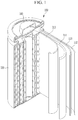
- FIG. 1 is a schematic view of a rechargeable lithium battery according to an embodiment of the present disclosure.
- a rechargeable lithium battery according to an embodiment is for example a cylindrical battery.
- the present disclosure is not limited thereto, and may be applied to various types of batteries such as a prismatic type, a pouch type, and the like.
- a rechargeable lithium battery 100 includes a battery cell including a negative electrode 112, a positive electrode 114 facing the negative electrode 112, a separator 113 interposed between the negative electrode 112 and the positive electrode 114, and an electrolyte (not shown) for a rechargeable lithium battery impregnating the negative electrode 112, the positive electrode 114, and the separator 113, a battery case 120 housing the battery cell, and a sealing member 140 sealing the battery case 120.
- Positive active material slurry was prepared by using LiCoO 2 as a positive active material, polyvinylidene fluoride as a binder, and ketjen black as a conductive material in a weight ratio of 97.3:1.4:1.3 and dispersing the mixture in N-methyl pyrrolidone.
- the positive active material slurry was coated on a 15 ⁇ m-thick Al foil, dried at 100°C, and pressed to manufacture a positive electrode.
- negative active material slurry was prepared by mixing graphite as a negative active material, polyvinylidene fluoride as a binder, and ketjen black as a conductive material in a weight ratio of 98:1:1 and then, dispersing the mixture in N-methyl pyrrolidone.
- the negative active material slurry was coated on a 10 ⁇ m-thick Cu foil, dried at 100°C, and pressed to manufacture a negative electrode.
- the positive and negative electrodes, a 25 ⁇ m-thick polyethylene separator, and an electrolyte were used to manufacture a rechargeable lithium battery cell.
- the electrolyte has a following composition.
- a rechargeable lithium battery cell was manufactured according to the same method as Example 1 except that the electrolyte composition was changed as follows.
- a rechargeable lithium battery cell was manufactured according to the same method as Example 2 except that the amount of the compound represented by Chemical Formula 1A-1 was changed into 0.5 wt%.
- a rechargeable lithium battery cell was manufactured according to the same method as Example 2 except that the amount of the compound represented by Chemical Formula 1A-1 was changed into 3 wt%.
- a rechargeable lithium battery cell was manufactured according to the same method as Example 1 except that the compound represented by Chemical Formula 1A-1 was not used as the additive.
- a rechargeable lithium battery cell was manufactured according to the same method as Example 2 except that the compound represented by Chemical Formula 1A-1 was not used as the additive.
- Electrochemical stability of the rechargeable lithium battery cells according to Example 1 and Comparative Example 1 was evaluated by measuring cyclic voltammetry (CV), and the results are shown in FIGS. 2 to 4 .
- a cyclic voltammetry (CV) was measured by using a triple electrode electrochemical cell using graphite as a working electrode and Li metals as a reference electrode and a counter electrode.
- scan was 3 cycles performed from 3 V to 0 V and from 0 V to 3 V at a rate of 0.1 mV/sec.
- FIG. 2 is a graph showing a cyclic voltammetry (CV) of the electrolyte according to Comparative Example 1.
- FIG. 3 is a graph showing a cyclic voltammetry (CV) of the electrolyte according to Example 1.
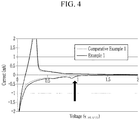
- FIG. 4 is a graph showing a cyclic voltammetry (CV) comparison of the electrolytes according to Example 1 and Comparative Example 1 at the initial cycle.
- the three-electrode cell of Comparative Example 1 showed a cycle-life deterioration phenomenon, as discharge capacity thereof continuously decreased depending on a cycle, and also, an output resistance increase tendency, as a peak area reacting for the same time became smaller compared to the peaks in the CV of Example 1.
- Example 1 indirectly showed improvement of output and cycle-life characteristics compared with the three-electrode cell not including a compound represented by Chemical Formula 1 as an additive according to Comparative Example 1.
- a three-electrode cell including the electrolyte according to Example 1 showed a reduction peak at about 0.8 V in a cyclic voltammetry (CV) curve, but a three-electrode cell including the electrolyte according to Comparative Example 1 showed no reduction peak in a cyclic voltammetry (CV) curve.
- an initial SEI film may be expected to be formed in the rechargeable lithium battery cell including the electrolyte according to Example 1
- the rechargeable lithium battery cell according to Example 1 may be expected to have excellent battery performance compared with the rechargeable lithium battery cell having no initial SEI film according to Comparative Example 1.
- Oxidative electrode decomposition of the electrolytes according to Example 1 and Comparative Example 1 was evaluated by using a linear sweep voltammetry (LSV) method at 25 °C, and the results are shown in FIG. 5 .
- LSV linear sweep voltammetry
- a three-electrode electrochemical cell using a Cu electrode as a working electrode) and Li metal as a reference electrode and a counter electrode was used.
- scan was performed at a rate of 1 mV/sec in a range of 2.5 V to 7.0 V.
- FIG. 5 shows LSV evaluation results of Example 1 and Comparative Example 1.
- the electrolyte of Example 1 including the compound represented by Chemical Formula a as an additive maintained a low oxidation current in a considerably wide voltage section compared with that of Comparative Example 1. Resultantly, the electrolyte of Example 1 was effectively suppressed from an oxidation reaction with a positive electrode in the considerably wide voltage section and thus may be expected to have an excellent metal elution suppression effect at the positive electrode.
- the CID (Current Interrupt Device) open time were measured by twice performing a formation charge/discharge at 0.2 C/0.5 C and then, once an charge/discharge experiment at a standard charge/discharge current density of 0.5 C/0.2 C, a charge cut-off voltage of 4.2 V (Li/graphite), and a discharge cut-off voltage of 3.0 V (Li/graphite) and then, placing the cells in a 90°C chamber for 60 hours.
- FIG. 6 is a graph showing the CID (Current Interrupt Device) operation starting points of the rechargeable lithium battery cells according to Example 2 and Comparative Example 2.
- the cell of Comparative Example 2 not including the compound represented by Chemical Formula a as an additive showed a sharp voltage drop before 5 hours, when stored at a high temperature of 90°C, but the cell of Example 2 including the compound represented by Chemical Formula a as an additive delayed decomposition of the electrolyte and decreased a resistance increase and thus showed an OCV drop delay effect.
- a rechargeable lithium battery cell according to the present disclosure shows an excellent effect of suppressing gas generation, when stored at a high temperature.
- the rechargeable lithium battery cells according to Examples 2 to 4 and Comparative Example 2 were set to have residual capacity (a state of charge) of 100 % and then, discharged at 1 C for 10 seconds, at 2 C for 10 seconds, at 3 C for 10 seconds, at 5 C for 10 seconds, and then, their cut-off voltages were extrapolated to calculate a slope and thus obtain DC-internal resistance (DC-IR).
- DC-IR DC-internal resistance
- the rechargeable lithium battery cells according to Examples 2 to 4 and Comparative Example 2 were placed at 60°C for 10 days, and then, their DC-internal resistances were measured again in the same method as aforementioned.
- Examples 2 to 4 showed small DC-internal resistance after being placed at 60°C for 10 days unlike Comparative Example 2. Accordingly, when the compound represented by Chemical Formula a was used as an additive, antioxidation at a high temperature and antiresistance of the battery cells in a charge state were improved.
Landscapes
- Chemical & Material Sciences (AREA)
- Engineering & Computer Science (AREA)
- Manufacturing & Machinery (AREA)
- Chemical Kinetics & Catalysis (AREA)
- Electrochemistry (AREA)
- General Chemical & Material Sciences (AREA)
- Physics & Mathematics (AREA)
- Condensed Matter Physics & Semiconductors (AREA)
- General Physics & Mathematics (AREA)
- Inorganic Chemistry (AREA)
- Materials Engineering (AREA)
- Secondary Cells (AREA)
Abstract

A is a substituted or unsubstituted C1 to C30 alkyl group, a substituted or unsubstituted C2 to C30 alkenyl group, a substituted or unsubstituted C2 to C30 alkynyl group, a substituted or unsubstituted C3 to C30 cycloalkyl group, a substituted or unsubstituted C3 to C30 cycloalkenyl group, a substituted or unsubstituted C3 to C30 cycloalkynyl group, or a substituted or unsubstituted C6 to C30 aryl group,
L is a substituted or unsubstituted C1 to C20 alkylene group, or Cn(R1)2n-O-Cm(R2)2m,
R1 and R2 are independently hydrogen, a substituted or unsubstituted C1 to C10 alkyl group, or a substituted or unsubstituted C3 to C10 cycloalkyl group, and
n and m are independently an integer ranging from 1 to 10.
Description
- An electrolyte for a rechargeable lithium battery and a rechargeable lithium battery including the same are disclosed.
- A rechargeable lithium battery may be recharged and has three or more times as high energy density per unit weight as a conventional lead storage battery, nickel-cadmium battery, nickel hydrogen battery, nickel zinc battery and the like. It may be also charged at a high rate and thus, is commercially manufactured for a laptop, a cell phone, an electric tool, an electric bike, and the like, and researches on improvement of additional energy density have been actively made.
- Such a rechargeable lithium battery is manufactured by injecting an electrolyte into a battery cell, which includes a positive electrode including a positive active material capable of intercalating/deintercalating lithium ions and a negative electrode including a negative active material capable of intercalating/deintercalating lithium ions.
- Particularly, an electrolyte includes an organic solvent in which a lithium salt is dissolved and critically determines stability and performance of a rechargeable lithium battery.
- LiPF6 that is most commonly used as a lithium salt of an electrolyte, but has the problem of reacting with the electrolytic solvent causing depletion of the organic solvent generation of a large amount of gas. When LiPF6 is decomposed, it generates LiF and PF5, which leads to electrolyte depletion in the battery, resulting in degradation in high temperature performance and poor safety.
- There are needs for an electrolyte which suppresses side reactions of such a lithium salt and improves the performance of the battery.
- An embodiment provides an electrolyte for a rechargeable lithium battery capable of ensuring high-temperature stability and thus improving battery performance.
- Another embodiment provides a rechargeable lithium battery including the electrolyte for a rechargeable lithium battery.
- An embodiment of the present disclosure provides an electrolyte for a rechargeable lithium battery including a non-aqueous organic solvent, a lithium salt, and an additive, wherein the additive includes a compound represented by Chemical Formula 1.

- A is a substituted or unsubstituted C1 to C30 alkyl group, a substituted or unsubstituted C2 to C30 alkenyl group, a substituted or unsubstituted C2 to C30 alkynyl group, a substituted or unsubstituted C3 to C30 cycloalkyl group, a substituted or unsubstituted C3 to C30 cycloalkenyl group, a substituted or unsubstituted C3 to C30 cycloalkynyl group, or a substituted or unsubstituted C6 to C30 aryl group,
- L is a substituted or unsubstituted C1 to C20 alkylene group, or Cn(R1)2n-O-Cm(R2)2m,
- R1 and R2 are independently hydrogen, a substituted or unsubstituted C1 to C10 alkyl group, or a substituted or unsubstituted C3 to C10 cycloalkyl group, and
- n and m are independently an integer ranging from 1 to 10.
- L of Chemical Formula 1 may be a substituted or unsubstituted C2 to C20 alkylene group, or Cn(R1)2n-O-Cm(R2)2m,
- R1 and R2 are independently hydrogen, a substituted or unsubstituted C1 to C10 alkyl group, or a substituted or unsubstituted C3 to C10 cycloalkyl group, and
- n and m are independently an integer ranging from 2 to 10.
- Chemical Formula 1 may be represented by Chemical Formula 1A.

- A is a substituted or unsubstituted C1 to C30 alkyl group, and
- k is an integer of 1 to 5.
- The compound represented by Chemical Formula 1 may be included in an amount of 0.001 wt% to 5 wt% based on a total amount of the electrolyte for a rechargeable lithium battery. The additive may further include at least one additional additive selected from vinylethylene carbonate (VEC), fluoroethylene carbonate (FEC), propenesultone (PST), propanesultone (PS), lithium tetrafluoroborate (LiBF4), lithium bis(oxalato)borate (LiBOB), and succinonitrile (SN).
- The additional additive may be included in an amount of 0.1 wt% to less than 5 wt% based on a total amount of the electrolyte for a rechargeable lithium battery.
- Another embodiment provides a rechargeable lithium battery including a positive electrode; a negative electrode; and the electrolyte.
- The rechargeable lithium battery may realize improved high-temperature stability and cycle-life characteristics.
-
-
FIG. 1 is a schematic view showing a rechargeable lithium battery according to an embodiment of the present disclosure. -
FIG. 2 is a graph showing a cyclic voltammetry (CV) of an electrolyte according to Comparative Example 1. -
FIG. 3 is a graph showing a cyclic voltammetry (CV) of an electrolyte according to Example 1. -
FIG. 4 is a graph showing a cyclic voltammetry (CV) of the electrolytes according to Example 1 and Comparative Example 1. -
FIG. 5 is a graph showing LSV evaluation results of Example 1 and Comparative Example 1. -
FIG. 6 is a graph showing CID (Current Interrupt Device) operation starting points of rechargeable lithium battery cells according to Example 2 and Comparative Example 2. - Hereinafter, embodiments of the present disclosure are illustrated in detail. However, these embodiments are exemplary, the present disclosure is not limited thereto and the present disclosure is defined by the scope of claims.
- As used herein, when a definition is not otherwise provided, 'substituted' refers to replacement of hydrogen of a compound by a substituent selected from a halogen atom (F, Br, CI, or I), a hydroxy group, an alkoxy group, a nitro group, a cyano group, an amino group, an azido group, an amidino group, a hydrazino group, a hydrazono group, a carbonyl group, a carbamyl group, a thiol group, an ester group, a carboxyl acid group or a salt thereof, a sulfonic acid group or a salt thereof, a phosphoric acid group or a salt thereof, a C1 to C20 alkyl group, a C2 to C20 alkenyl group, a C2 to C20 alkynyl group, a C6 to C30 aryl group, a C7 to C30 arylalkyl group, a C1 to C4 alkoxy group, a C1 to C20 heteroalkyl group, a C3 to C20 heteroarylalkyl group, a C3 to C30 cycloalkyl group, a C3 to C15 cycloalkenyl group, a C6 to C15 cycloalkynyl group, and a C2 to C20 heterocycloalkyl group.
- Hereinafter, an electrolyte for a rechargeable lithium battery according to an embodiment is described.
- An electrolyte for a rechargeable lithium battery according to an embodiment includes a non-aqueous organic solvent, a lithium salt, and an additive, wherein the additive includes a compound represented by Chemical Formula 1.


- A is a substituted or unsubstituted C1 to C30 alkyl group, a substituted or unsubstituted C2 to C30 alkenyl group, a substituted or unsubstituted C2 to C30 alkynyl group, a substituted or unsubstituted C3 to C30 cycloalkyl group, a substituted or unsubstituted C3 to C30 cycloalkenyl group, a substituted or unsubstituted C3 to C30 cycloalkynyl group, or a substituted or unsubstituted C6 to C30 aryl group,
- L is a substituted or unsubstituted C1 to C20 alkylene group, or Cn(R1)2n-O-Cm(R2)2m,
- R1 and R2 are independently hydrogen, a substituted or unsubstituted C1 to C10 alkyl group, or a substituted or unsubstituted C3 to C10 cycloalkyl group, and
- n and m are independently an integer ranging from 1 to 10.
- Generally, when an electrolyte is exposed to a high temperature, LiPF6 that is a kind of lithium salt, is decomposed into LiF and PF5 in the electrolyte which may include a small amount of water. These compounds may react with the organic solvent and thereby partly consume the same. Furthermore, the surface of the electrodes may be damaged by the process. Therefore, high-temperature stability and cycle-life characteristics of a lithium battery may be deteriorated.
- When the additive including the compound represented by Formula 1 is added to the electrolyte, a robust SEI (solid electrolyte interface) film having an excellent ion conductivity is formed on the surface of a negative electrode, and thereby it may suppress the decomposition of the surface of the negative electrode during a high-temperature cycle operation and may prevent an oxidation reaction of the electrolyte.
- Specifically, the compound represented by Chemical Formula 1 may be coordinated with a pyrolyzed product of a lithium salt such as LiPF6 or anions dissociated from the lithium salt and thus form a complex, and the complex formation may stabilize the pyrolyzed product of the lithium salt such as LiPF6 or the anions dissociated from the lithium salt. Therefore, it may suppress an undesired side reaction of the anions with the electrolyte and prevent gas generation inside a rechargeable lithium battery and thus greatly reduce a defect rate as well as improve cycle-life characteristics of the rechargeable lithium battery.
- In addition, since the side reaction with the electrolyte is suppressed, a SEI film having a low resistance may be formed, and accordingly, battery internal resistance may be reduced.
- In addition, the compound represented by Chemical Formula 1 may participate in an electrochemical reaction with the components of the SEI film to make the film more robust, and may also improve stability of other components included in the electrolyte due to an oxidative decomposition.
- On the other hand, the compound represented by Chemical Formula 1 may be decomposed into a difluorophosphite group (-OPF2) and an oxide fragment.
- The difluorophosphite group (-OPF2) and the oxide fragment have excellent electrical and chemical reactivity and thus may form a donor-acceptor bond with a transition metal oxide exposed to the surface of a positive active material and accordingly, form a protective layer in a form of a complex and suppress elution of metal ions.
- In addition, the difluorophosphite group (-OPF2) adhered to the transition metal oxide during the initial charge of a rechargeable lithium battery may be oxidized into a plurality of fluorophosphate and resultantly, form a non-active layer having more stability about a positive electrode and excellent ion conductivity. Accordingly, oxidization of other components of the electrolyte may be prevented, and resultantly, cycle-life performance of the rechargeable lithium battery may be improved, and simultaneously, swelling of the rechargeable lithium battery may be prevented.
- Particularly, the difluorophosphite group substituted with a fluoro group maintains an appropriate reactivity and thus prevents decomposition of water or the electrolyte by a side reaction and also generation of an undesired byproduct and accordingly, may work as an appropriate additive in the electrolyte.
- According to one embodiment, L of Chemical Formula 1 is a substituted or unsubstituted C2 to C20 alkylene group or Cn(R1)2n-O-Cm(R2)2m,
R1 and R2 are independently hydrogen, a substituted or unsubstituted C1 to C10 alkyl group, or a substituted or unsubstituted C3 to C10 cycloalkyl group, and
n and m are independently an integer of 2 to 10, preferably n and m are independently an integer of 2 to 5, more preferred n and m are the same, most preferred n and m are 2. - When n is 2 or more, R1 may be respectively the same or different one another.
- In addition, when m is 2 or more, R2 may be respectively the same or different one another. Preferably, R1 and R2 are hydrogen.
- L of
Chemical Formula 1 may be a substituted or unsubstituted C2 to C20 alkylene group. Preferably, L is a substituted or unsubstituted C2 to C10 alkylene group, more preferably L is a substituted or unsubstituted C2 to C5 alkylene group. In particular, L may represent one of a methylene group (C1), an ethylene group (C2), and a propylene group (C3). - For example, the compound represented by
Chemical Formula 1 may have a structure of including an ethylene group or a diethylene ether group (i.e. when n and m are 2 and R1 and R2 are hydrogen) as a minimum unit in L. The compound represented byChemical Formula 1 may generally be decomposed by reduction in the electrolyte to form an SEI film and to stabilize an electrode interface, and resultantly, may further improve an effect of suppressing an additional decomposition reaction of the electrolyte. - For example,
Chemical Formula 1 may be represented by Chemical Formula 1A.
- A is a substituted or unsubstituted C1 to C30 alkyl group, and
- k is an integer of 1 to 5, more preferably k is an integer of 1 to 3, most preferred k is 1.
- A in
Formula 1 or Formula 1A may be a C1-C30 alkyl group, which refers to a linear or branched aliphatic monovalent hydrocarbon group having 1 to 30 carbon atoms. Preferably, A represents a C1-C10 alkyl group, more preferred a C1-C5 alkyl group and most preferred one of a methyl group (C1), an ethyl group (C2), and a propyl group (C3). - Chemical Formula 1A may be for example a compound represented by Chemical Formula 1A-1.

- The compound represented by
Chemical Formula 1 may be included in an of 0.001 wt% to 5 wt%, specifically 0.01 wt% to 5 wt%, more specifically 0.1 wt% to 5 wt%, for example 0.5 wt% to 3 wt% based on a total amount of the electrolyte for a rechargeable lithium battery. - When the amount of the compound represented by
Chemical Formula 1 is in the above ranges, a resistance increase at a high temperature may be prevented, and a rechargeable lithium battery having improved cycle-life characteristics may be realized. - In other words, when the compound represented by
Chemical Formula 1 is included in an amount of less than 0.001 wt%, storage characteristics at a high temperature and a swelling improvement effect may be deteriorated, but when the compound represented byChemical Formula 1 is included in an amount of greater than 5 wt%, a cycle-life may be deteriorated due to an interface resistance increase. - The additive according to an embodiment may further include an additional additive.
- The additional additive may be for example at least one selected from vinylethylene carbonate (VEC), fluoroethylene carbonate (FEC), propenesultone (PST), propanesultone (PS), lithiumtetrafluoroborate (LiBF4), lithium bis(oxalato)borate (LiBOB), and succinonitrile (SN).
- The additional additive may be included in an amount of 0.1 wt% to 5 wt% and specifically, in an amount of 0.5 wt% to 3 wt% based on a total amount of the electrolyte for a rechargeable lithium battery.
- When the additional additive is included within the range, battery resistance may be effectively suppressed, and a rechargeable lithium battery having much excellent cycle-life characteristics may be realized.
- The non-aqueous organic solvent serves as a medium for transmitting ions taking part in the electrochemical reaction of a battery.
- The non-aqueous organic solvent may be a carbonate-based, ester-based, ether-based, ketone-based, alcohol-based, or aprotic solvent.
- The carbonate-based solvent may include dimethyl carbonate (DMC), diethyl carbonate (DEC), dipropyl carbonate (DPC), methylpropyl carbonate (MPC), ethylpropyl carbonate (EPC), methylethyl carbonate (MEC), ethylene carbonate (EC), propylene carbonate (PC), and butylene carbonate (BC). The ester-based solvent may include methyl acetate, ethyl acetate, n-propyl acetate, dimethylacetate, methylpropionate, ethylpropionate, propylpropionate, decanolide, mevalonolactone, and caprolactone. The ether-based solvent may include dibutyl ether, tetraglyme, diglyme, dimethoxyethane, 2-methyltetrahydrofuran, and tetrahydrofuran. In addition, the ketone-based solvent may include cyclohexanone. The alcohol-based solvent may include ethanol, and isopropyl alcohol and the aprotic solvent may include nitriles such as R-CN (wherein R is a hydrocarbon group having a C2 to C20 linear, branched, or cyclic structure and may include a double bond, an aromatic ring, or an ether bond), dioxolanes such as 1,3-dioxolane, and sulfolanes.
- The non-aqueous organic solvent may be used alone or in a mixture. When the organic solvent is used in a mixture, the mixture ratio may be controlled in accordance with a desirable battery performance.
- The carbonate-based solvent is prepared by mixing a cyclic carbonate and a linear carbonate. When the cyclic carbonate and linear carbonate are mixed together in a volume ratio of about 1:1 to about 1:9, an electrolyte performance may be improved.
- The non-aqueous organic solvent may further include an aromatic hydrocarbon-based organic solvent in addition to the carbonate based solvent. Herein, the carbonate-based solvent and the aromatic hydrocarbon-based organic solvent may be mixed in a volume ratio of about 1:1 to about 30:1.
- The aromatic hydrocarbon-based organic solvent may be an aromatic hydrocarbon-based compound of
Chemical Formula 2.

Chemical Formula 2, R3 to R8 are the same or different and are selected from hydrogen, a halogen, a C1 to C10 alkyl group, and a haloalkyl group. - Specific examples of the aromatic hydrocarbon-based organic solvent may be selected from benzene, fluorobenzene, 1,2-difluorobenzene, 1,3-difluorobenzene, 1,4-difluorobenzene, 1,2,3-trifluorobenzene, 1,2,4-trifluorobenzene, chlorobenzene, 1,2-dichlorobenzene, 1,3-dichlorobenzene, 1,4-dichlorobenzene, 1,2,3-trichlorobenzene, 1,2,4-trichlorobenzene, iodobenzene, 1,2-diiodobenzene, 1,3-diiodobenzene, 1,4-diiodobenzene, 1,2,3-triiodobenzene, 1,2,4-triiodobenzene, toluene, fluorotoluene, 2,3-difluorotoluene, 2,4-difluorotoluene, 2,5-difluorotoluene, 2,3,4-trifluorotoluene, 2,3,5-trifluorotoluene, chlorotoluene, 2,3-dichlorotoluene, 2,4-dichlorotoluene, 2,5-dichlorotoluene, 2,3,4-trichlorotoluene, 2,3,5-trichlorotoluene, iodotoluene, 2,3-diiodotoluene, 2,4-diiodotoluene, 2,5-diiodotoluene, 2,3,4-triiodotoluene, 2,3,5-triiodotoluene, xylene, and a combination thereof.
- The electrolyte may further include vinylene carbonate or an ethylene carbonate-based compound represented by
Chemical Formula 3 in order to improve cycle-life of a battery.
Chemical Formula 3, R9 and R10 are the same or different and selected from hydrogen, a halogen, a cyano group (CN), a nitro group (NO2), and a fluorinated C1 to C5 alkyl group, provided that at least one of R9 and R10 is a halogen, a cyano group (CN), a nitro group (NO2), and a fluorinated C1 to C5 alkyl group and R9 and R10 are not simultaneously hydrogen. - Examples of the ethylene carbonate-based compound are difluoroethylene carbonate, chloroethylene carbonate, dichloroethylene carbonate, bromoethylene carbonate, dibromoethylene carbonate, nitroethylene carbonate, cyanoethylene carbonate, or fluoroethylene carbonate. The amount of the additive for improving cycle-life may be used within an appropriate range.
- The lithium salt dissolved in the non-organic solvent supplies lithium ions in a battery, enables a basic operation of a rechargeable lithium battery, and improves transportation of the lithium ions between positive and negative electrodes. Examples of the lithium salt include at least one supporting salt selected from LiPF6, LiBF4, LiSbF6, LiAsF6, LiN(SO2C2F5)2, Li(CF3SO2)2N, LiN(SO3C2F5)2, LiC4F9SO3, LiClO4, LiAlO2, LiAlCl4, LiN(CxF2x+1SO2)(CyF2y+1SO2) (wherein x and y are natural numbers, for example, an integer ranging from 1 to 20), LiCI, Lil and LiB(C2O4)2 (lithium bis(oxalato) borate; LiBOB). preferably, the lithium salt is LiPF6. The lithium salt may be used in a concentration ranging from 0.1 M to 2.0 M. When the lithium salt is included at the above concentration range, an electrolyte may have excellent performance and lithium ion mobility due to optimal electrolyte conductivity and viscosity.
- Another embodiment provides a rechargeable lithium battery including a positive electrode; a negative electrode; and the electrolyte.
- The positive electrode includes a current collector and a positive active material layer disposed on the current collector and including a positive active material.
- The positive active material may include lithiated intercalation compounds that reversibly intercalate and deintercalate lithium ions.
- Specifically, at least one composite oxide of lithium and a metal of cobalt, manganese, nickel, or a combination thereof may be used.
- Examples of the positive active material may be a compound represented by one of following chemical formulae.
LiaA1-bXbD2 (0.90 ≤ a ≤ 1.8, 0 ≤ b ≤ 0.5); LiaA1-bXbO2-cDc (0.90 ≤ a ≤ 1.8, 0 ≤ b ≤ 0.5, 0 ≤ c ≤ 0.05); LiaE1-bXbO2-cDc (0.90 ≤ a ≤ 1.8, 0 ≤ b ≤ 0.5, 0 ≤ c ≤ 0.05); LiaE2-bXbO4-cDc (0.90 ≤ a ≤ 1.8, 0 ≤ b ≤ 0.5, 0 ≤ c ≤ 0.05); LiaNi1-b-cCobXcD α (0.90 ≤ a ≤1.8, 0 ≤ b ≤ 0.5, 0 ≤ c ≤ 0.5, 0 < α ≤ 2); LiaNi1-b-cCObXcO2-α T α (0.90 ≤ a ≤ 1.8, 0 ≤ b ≤ 0.5, 0 ≤ c ≤ 0.05, 0 < α < 2); LiaNi1-b-cCobXcO2-α T2 (0.90 ≤ a ≤ 1.8, 0 ≤ b ≤ 0.5, 0 ≤ c ≤ 0.05, 0 < α < 2); LiaNi1-b-cMnbXcD α (0.90 ≤ a ≤ 1.8, 0 ≤ b ≤ 0.5, 0 ≤ c ≤ 0.05, 0 < α ≤ 2); LiaNi1-b-cMnbXcO2-α T α (0.90 ≤ a ≤ 1.8, 0 ≤ b ≤ 0.5, 0 ≤ c ≤ 0.05, 0 < α < 2); LiaNi1-b-cMnbXcO2-α T2 (0.90 ≤ a ≤ 1.8, 0 ≤ b ≤ 0.5, 0 ≤ c ≤ 0.05, 0 < α < 2); LiaNibEcGdO2 (0.90 ≤ a ≤ 1.8, 0 ≤ b ≤ 0.9, 0 ≤ c ≤ 0.5, 0.001 ≤ d ≤ 0.1); LiaNibCocMndGeO2 (0.90 ≤ a ≤ 1.8, 0 ≤ b ≤ 0.9, 0 ≤ c ≤ 0.5, 0 ≤ d ≤0.5, 0.001 ≤ e ≤ 0.1); LiaNiGbO2 (0.90 ≤ a ≤ 1.8, 0.001 ≤ b ≤ 0.1); LiaCoGbO2 (0.90 ≤ a ≤ 1.8, 0.001 ≤ b ≤ 0.1); LiaMn1-4GbO2 (0.90 ≤ a ≤ 1.8, 0.001 ≤ b ≤ 0.1); LiaMn2GbO4 (0.90 ≤ a ≤ 1.8, 0.001 ≤ b ≤ 0.1); LiaMn1-gGgPO4 (0.90 ≤ a ≤ 1.8, 0 ≤ g ≤ 0.5); QO2; QS2; LiQS2; V2O5; LiV2O5; LiZO2; LiNiVO4; Li(3-f)J2(PO4)3 (0 ≤ f ≤ 2); Li(3-f)Fe2(PO4)3 (0 ≤ f ≤ 2); LiaFePO4 (0.90 ≤ a ≤ 1.8)
In chemical formulae, A is selected from Ni, Co, Mn, and a combination thereof; X is selected from Al, Ni, Co, Mn, Cr, Fe, Mg, Sr, V, a rare earth element, and a combination thereof; D is selected from O, F, S, P, and a combination thereof; E is selected from Co, Mn, and a combination thereof; T is selected from F, S, P, and a combination thereof; G is selected from Al, Cr, Mn, Fe, Mg, La, Ce, Sr, V, and a combination thereof; Q is selected from Ti, Mo, Mn, and a combination thereof; Z is selected from Cr, V, Fe, Sc, Y, and a combination thereof; and J is selected from V, Cr, Mn, Co, Ni, Cu, and a combination thereof. - The compounds may have a coating layer on the surface, or may be mixed with another compound having a coating layer. The coating layer may include at least one coating element compound selected from an oxide of a coating element, a hydroxide of a coating element, an oxyhydroxide of a coating element, an oxycarbonate of a coating element, and a hydroxy carbonate of a coating element. The compound for the coating layer may be amorphous or crystalline. The coating element included in the coating layer may include Mg, Al, Co, K, Na, Ca, Si, Ti, V, Sn, Ge, Ga, B, As, Zr, or a mixture thereof. The coating layer may be disposed in a method having no adverse influence on properties of a positive active material by using these elements in the compound. For example, the method may include any coating method (e.g., spray coating, dipping, etc.), but is not illustrated in more detail since it is well-known to those skilled in the related field.
- Specific examples of the positive active material according to an embodiment may be lithium cobalt oxide.
- The positive active material may be included in an amount of about 90 wt% to about 98 wt% based on a total weight of the positive active material layer.
- In an embodiment of the present disclosure, the positive active material layer may include a binder and a conductive material. Herein, the binder and the conductive material may be included in an amount of about 1 wt% to about 5 wt%, respectively based on a total amount of the positive active material layer.
- The binder improves binding properties of positive active material particles with one another and with a current collector. Examples thereof may be polyvinyl alcohol, carboxylmethyl cellulose, hydroxypropyl cellulose, diacetyl cellulose, polyvinylchloride, carboxylated polyvinylchloride, polyvinylfluoride, an ethylene oxide-containing polymer, polyvinylpyrrolidone, polyurethane, polytetrafluoroethylene, polyvinylidene fluoride, polyethylene, polypropylene, a styrene-butadiene rubber, an acrylated styrene-butadiene rubber, an epoxy resin, nylon, and the like, but is not limited thereto.
- The conductive material is included to provide electrode conductivity. Any electrically conductive material may be used as a conductive material unless it causes a chemical change. Examples of the conductive material may include a carbon-based material such as natural graphite, artificial graphite, carbon black, acetylene black, ketjen black, a carbon fiber, and the like; a metal-based material of a metal powder or a metal fiber including copper, nickel, aluminum, silver, and the like; a conductive polymer such as a polyphenylene derivative; or a mixture thereof.
- The current collector may use Al, but is not limited thereto.
- The negative electrode includes a current collector and a negative active material layer formed on the current collector and including a negative active material.
- The negative active material may include a material that reversibly intercalates/deintercalates lithium ions, a lithium metal, a lithium metal alloy, a material being capable of doping/dedoping lithium, or transition metal oxide.
- The material that reversibly intercalates/deintercalates lithium ions may include a carbon material. The carbon material may be any generally-used carbon-based negative active material in a rechargeable lithium ion battery. Examples thereof may be crystalline carbon, amorphous carbon, or a mixture thereof. The crystalline carbon may be non-shaped, or sheet, flake, spherical, or fiber shaped natural graphite or artificial graphite. The amorphous carbon may be a soft carbon, a hard carbon, a mesophase pitch carbonization product, fired coke, and the like.
- The lithium metal alloy includes an alloy of lithium and a metal selected from Na, K, Rb, Cs, Fr, Be, Mg, Ca, Sr, Si, Sb, Pb, In, Zn, Ba, Ra, Ge, Al, and Sn.
- The material being capable of doping/dedoping lithium may be Si, Si-C composite, SiOx (0 < x < 2), a Si-Q alloy (wherein Q is an element selected from an alkali metal, an alkaline-earth metal, a Group 13 element, a Group 14 element, a
Group 15 element, a Group 16 element, a transition metal, a rare earth element, and a combination thereof, and not Si), Sn, SnO2, a Sn-R alloy (wherein R is an element selected from an alkali metal, an alkaline-earth metal, a Group 13 element, a Group 14 element, aGroup 15 element, a Group 16 element, a transition metal, a rare earth element, and a combination thereof, and not Sn), and the like. At least one of these materials may be mixed with SiO2. The elements Q and R may be selected from Mg, Ca, Sr, Ba, Ra, Sc, Y, Ti, Zr, Hf, Rf, V, Nb, Ta, Db, Cr, Mo, W, Sg, Tc, Re, Bh, Fe, Pb, Ru, Os, Hs, Rh, Ir, Pd, Pt, Cu, Ag, Au, Zn, Cd, B, Al, Ga, Sn, In, TI, Ge, P, As, Sb, Bi, S, Se, Te, Po, and a combination thereof. - The transition metal oxide may be vanadium oxide, lithium vanadium oxide, or lithium titanium oxide.
- In the negative active material layer, the negative active material may be included in an amount of about 95 wt% to about 99 wt% based on a total weight of the negative active material layer.
- In an embodiment of the present disclosure, the negative active material layer includes a binder, and optionally a conductive material. In the negative active material layer, a content of the binder may be about 1 wt% to about 5 wt% based on a total weight of the negative active material layer. When the negative active material layer includes a conductive material, the negative active material layer includes about 90 wt% to about 98 wt% of the negative active material, about 1 wt% to about 5 wt% of the binder, and about 1 wt% to about 5 wt% of the conductive material.
- The binder improves binding properties of negative active material particles with one another and with a current collector. The binder includes a non-water-soluble binder, a water-soluble binder, or a combination thereof.
- The non-water-soluble binder may be selected from polyvinylchloride, carboxylated polyvinylchloride, polyvinylfluoride, an ethylene oxide-containing polymer, polyvinylpyrrolidone, polyurethane, polytetrafluoroethylene, polyvinylidene fluoride, polyethylene, polypropylene, polyamideimide, polyimide, or a combination thereof.
- The water-soluble binder may be a rubber-based binder or a polymer resin binder. The rubber-based binder may be selected from a styrene-butadiene rubber, an acrylated styrene-butadiene rubber (SBR), an acrylonitrile-butadiene rubber, an acrylic rubber, a butyl rubber, a fluorine rubber, and a combination thereof. The polymer resin binder may be selected from polytetrafluoroethylene, polyethylene, polypropylene, ethylenepropylenecopolymer, polyethyleneoxide, polyvinylpyrrolidone, polyepichlorohydrine, polyphosphazene, polyacrylonitrile, polystyrene, an ethylenepropylenediene copolymer, polyvinylpyridine, chlorosulfonated polyethylene, latex, a polyester resin, an acrylic resin, a phenolic resin, an epoxy resin, polyvinyl alcohol, and a combination thereof.
- When the water-soluble binder is used as a negative electrode binder, a cellulose-based compound may be further used to provide viscosity. The cellulose-based compound includes one or more of carboxymethyl cellulose, hydroxypropylmethyl cellulose, methyl cellulose, or alkali metal salts thereof. The alkali metals may be Na, K, or Li. Such a thickener may be included in an amount of about 0.1 to about 3 parts by weight based on 100 parts by weight of the negative active material.
- The conductive material is included to provide electrode conductivity. Any electrically conductive material may be used as a conductive material unless it causes a chemical change. Examples of the conductive material include a carbon-based material such as natural graphite, artificial graphite, carbon black, acetylene black, ketjen black, a carbon fiber, and the like; a metal-based material of a metal powder or a metal fiber including copper, nickel, aluminum, silver, and the like; a conductive polymer such as a polyphenylene derivative; or a mixture thereof.
- The current collector may include one selected from a copper foil, a nickel foil, a stainless steel foil, a titanium foil, a nickel foam, a copper foam, a polymer substrate coated with a conductive metal, and a combination thereof.
- The rechargeable lithium battery may further include a separator between the negative electrode and the positive electrode, depending on a type of the rechargeable lithium battery. Examples of a suitable separator material include polyethylene, polypropylene, polyvinylidene fluoride, and multi-layers thereof such as a polyethylene/polypropylene double-layered separator, a polyethylene/polypropylene/polyethylene triple-layered separator, and a polypropylene/polyethylene/polypropylene triple-layered separator.
-
FIG. 1 is a schematic view of a rechargeable lithium battery according to an embodiment of the present disclosure. A rechargeable lithium battery according to an embodiment is for example a cylindrical battery. However, the present disclosure is not limited thereto, and may be applied to various types of batteries such as a prismatic type, a pouch type, and the like. - Referring to
FIG. 1 , arechargeable lithium battery 100 according to an embodiment includes a battery cell including anegative electrode 112, apositive electrode 114 facing thenegative electrode 112, aseparator 113 interposed between thenegative electrode 112 and thepositive electrode 114, and an electrolyte (not shown) for a rechargeable lithium battery impregnating thenegative electrode 112, thepositive electrode 114, and theseparator 113, abattery case 120 housing the battery cell, and a sealingmember 140 sealing thebattery case 120. - Hereinafter, examples of the present disclosure and comparative examples are described.
- Positive active material slurry was prepared by using LiCoO2 as a positive active material, polyvinylidene fluoride as a binder, and ketjen black as a conductive material in a weight ratio of 97.3:1.4:1.3 and dispersing the mixture in N-methyl pyrrolidone.
- The positive active material slurry was coated on a 15µm-thick Al foil, dried at 100°C, and pressed to manufacture a positive electrode.
- On the other hand, negative active material slurry was prepared by mixing graphite as a negative active material, polyvinylidene fluoride as a binder, and ketjen black as a conductive material in a weight ratio of 98:1:1 and then, dispersing the mixture in N-methyl pyrrolidone.
- The negative active material slurry was coated on a 10µm-thick Cu foil, dried at 100°C, and pressed to manufacture a negative electrode.
- The positive and negative electrodes, a 25µm-thick polyethylene separator, and an electrolyte were used to manufacture a rechargeable lithium battery cell.
- The electrolyte has a following composition.
- Salt: 1.5 M LiPF6
Solvent: ethylene carbonate:ethylmethyl carbonate:dimethyl carbonate (EC:EMC:DMC = volume ratio of 2:1:7)
Additive: 1 wt% of the compound represented by Chemical Formula 1A-1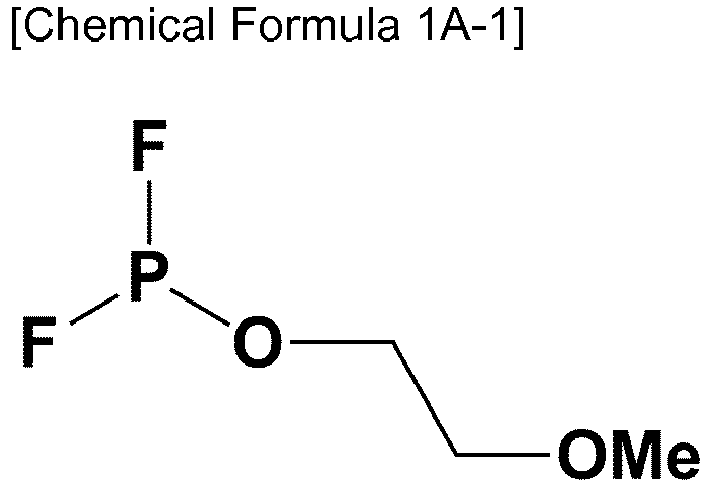
- A rechargeable lithium battery cell was manufactured according to the same method as Example 1 except that the electrolyte composition was changed as follows.
- Salt: 1.5 M LiPF6
Solvent: ethylene carbonate:ethylmethyl carbonate:dimethyl carbonate: fluoroethylene carbonate (EC:EMC:DMC:FEC= volume ratio of 15:10:59:16)
Additive: 1 wt% of the compound represented by Chemical Formula 1A-1, 0.2 wt% of lithium tetrafluoroborate (LiBF4), 1 wt% of lithium bis(oxalato)borate (LiBOB), and 1 wt% of SN - A rechargeable lithium battery cell was manufactured according to the same method as Example 2 except that the amount of the compound represented by Chemical Formula 1A-1 was changed into 0.5 wt%.
- A rechargeable lithium battery cell was manufactured according to the same method as Example 2 except that the amount of the compound represented by Chemical Formula 1A-1 was changed into 3 wt%.
- A rechargeable lithium battery cell was manufactured according to the same method as Example 1 except that the compound represented by Chemical Formula 1A-1 was not used as the additive.
- A rechargeable lithium battery cell was manufactured according to the same method as Example 2 except that the compound represented by Chemical Formula 1A-1 was not used as the additive.
- Electrochemical stability of the rechargeable lithium battery cells according to Example 1 and Comparative Example 1 was evaluated by measuring cyclic voltammetry (CV), and the results are shown in
FIGS. 2 to 4 . - A cyclic voltammetry (CV) was measured by using a triple electrode electrochemical cell using graphite as a working electrode and Li metals as a reference electrode and a counter electrode. Herein, scan was 3 cycles performed from 3 V to 0 V and from 0 V to 3 V at a rate of 0.1 mV/sec.
-
FIG. 2 is a graph showing a cyclic voltammetry (CV) of the electrolyte according to Comparative Example 1. -
FIG. 3 is a graph showing a cyclic voltammetry (CV) of the electrolyte according to Example 1. -
FIG. 4 is a graph showing a cyclic voltammetry (CV) comparison of the electrolytes according to Example 1 and Comparative Example 1 at the initial cycle. - As shown in
FIG. 2 , the three-electrode cell of Comparative Example 1 showed a cycle-life deterioration phenomenon, as discharge capacity thereof continuously decreased depending on a cycle, and also, an output resistance increase tendency, as a peak area reacting for the same time became smaller compared to the peaks in the CV of Example 1. - On the contrary, the three-electrode cell of Example 1 exhibited a sharp CV cycle compared with that of Comparative Example 1 as shown in
FIG. 3 . The reason is that the three-electrode cell of Example 1 received less resistance than that of Comparative Example 1. - In addition, discharge capacity of the three-electrode cell depending on a cycle was maintained. Accordingly, the three-electrode cell according to Example 1 indirectly showed improvement of output and cycle-life characteristics compared with the three-electrode cell not including a compound represented by
Chemical Formula 1 as an additive according to Comparative Example 1. - Referring to
FIG. 4 , a three-electrode cell including the electrolyte according to Example 1 showed a reduction peak at about 0.8 V in a cyclic voltammetry (CV) curve, but a three-electrode cell including the electrolyte according to Comparative Example 1 showed no reduction peak in a cyclic voltammetry (CV) curve. Referring to these results, in the rechargeable lithium battery cell including the electrolyte according to Example 1, an initial SEI film may be expected to be formed. Accordingly, the rechargeable lithium battery cell according to Example 1 may be expected to have excellent battery performance compared with the rechargeable lithium battery cell having no initial SEI film according to Comparative Example 1. - Oxidative electrode decomposition of the electrolytes according to Example 1 and Comparative Example 1 was evaluated by using a linear sweep voltammetry (LSV) method at 25 °C, and the results are shown in
FIG. 5 . - A three-electrode electrochemical cell using a Cu electrode as a working electrode) and Li metal as a reference electrode and a counter electrode was used. Herein, scan was performed at a rate of 1 mV/sec in a range of 2.5 V to 7.0 V.
-
FIG. 5 shows LSV evaluation results of Example 1 and Comparative Example 1. - Referring to
FIG. 5 , the electrolyte of Example 1 including the compound represented by Chemical Formula a as an additive maintained a low oxidation current in a considerably wide voltage section compared with that of Comparative Example 1. Resultantly, the electrolyte of Example 1 was effectively suppressed from an oxidation reaction with a positive electrode in the considerably wide voltage section and thus may be expected to have an excellent metal elution suppression effect at the positive electrode. - Storage characteristics of the rechargeable lithium battery cells of Example 2 and Comparative Example 2 at a high temperature were evaluated by measuring their CID open time, and the results are shown in Table 1 and
FIG. 6 . - The CID (Current Interrupt Device) open time were measured by twice performing a formation charge/discharge at 0.2 C/0.5 C and then, once an charge/discharge experiment at a standard charge/discharge current density of 0.5 C/0.2 C, a charge cut-off voltage of 4.2 V (Li/graphite), and a discharge cut-off voltage of 3.0 V (Li/graphite) and then, placing the cells in a 90°C chamber for 60 hours.
-
FIG. 6 is a graph showing the CID (Current Interrupt Device) operation starting points of the rechargeable lithium battery cells according to Example 2 and Comparative Example 2.[Table 1] CID OPEN TIME (hr) (@ 90°C) Comparative Example 2 3.1 Example 2 7.8 - Referring to Table 1 and
FIG. 6 , the cell of Comparative Example 2 not including the compound represented by Chemical Formula a as an additive showed a sharp voltage drop before 5 hours, when stored at a high temperature of 90°C, but the cell of Example 2 including the compound represented by Chemical Formula a as an additive delayed decomposition of the electrolyte and decreased a resistance increase and thus showed an OCV drop delay effect. In other words, a rechargeable lithium battery cell according to the present disclosure shows an excellent effect of suppressing gas generation, when stored at a high temperature. - The rechargeable lithium battery cells according to Examples 2 to 4 and Comparative Example 2 were set to have residual capacity (a state of charge) of 100 % and then, discharged at 1 C for 10 seconds, at 2 C for 10 seconds, at 3 C for 10 seconds, at 5 C for 10 seconds, and then, their cut-off voltages were extrapolated to calculate a slope and thus obtain DC-internal resistance (DC-IR).
- After measuring the DC-internal resistance, the rechargeable lithium battery cells according to Examples 2 to 4 and Comparative Example 2 were placed at 60°C for 10 days, and then, their DC-internal resistances were measured again in the same method as aforementioned.
- The DC-internal resistances of the cells were respectively twice measured, and their resistance increase rates after the storage for 10 days are shown in Table 2.

[Table 2] Cell Nos. DC-IR (mOhm) Δ DC-IR (%) 0D 10D 0-10D Comparative Example 2 1 19.65 25.43 29.39 Comparative Example 2 2 19.72 25.56 29.63 Example 2 3 19.67 24.11 22.57 Example 2 4 19.57 24.60 25.67 Example 3 5 20.04 24.69 23.19 Example 3 6 20.20 24.97 23.66 Example 4 7 20.10 23.44 16.65 Example 4 8 19.91 23.52 18.11 - Referring to Table 2, Examples 2 to 4 showed small DC-internal resistance after being placed at 60°C for 10 days unlike Comparative Example 2. Accordingly, when the compound represented by Chemical Formula a was used as an additive, antioxidation at a high temperature and antiresistance of the battery cells in a charge state were improved.
-
- 100: rechargeable lithium battery
- 112: negative electrode
- 113: separator
- 114: positive electrode
- 120: battery case
- 140: sealing member
Claims (9)
- An electrolyte for a rechargeable lithium battery (100), comprising a non-aqueous organic solvent, a lithium salt, and an additive,
wherein the additive comprises a compound represented by Chemical Formula 1: A is a substituted or unsubstituted C1 to C30 alkyl group, a substituted or unsubstituted C2 to C30 alkenyl group, a substituted or unsubstituted C2 to C30 alkynyl group, a substituted or unsubstituted C3 to C30 cycloalkyl group, a substituted or unsubstituted C3 to C30 cycloalkenyl group, a substituted or unsubstituted C3 to C30 cycloalkynyl group, or a substituted or unsubstituted C6 to C30 aryl group,L is a substituted or unsubstituted C1 to C20 alkylene group, or Cn(R1)2n-O-Cm(R2)2m,R1 and R2 are independently hydrogen, a substituted or unsubstituted C1 to C10 alkyl group, or a substituted or unsubstituted C3 to C10 cycloalkyl group, andn and m are independently an integer ranging from 1 to 10.
 - The electrolyte for a rechargeable lithium battery of claim 1, wherein L of Chemical Formula 1 is a substituted or unsubstituted C2 to C20 alkylene group, or Cn(R1)2n-O-Cm(R2)2m,
R1 and R2 are independently hydrogen, a substituted or unsubstituted C1 to C10 alkyl group, or a substituted or unsubstituted C3 to C10 cycloalkyl group, and
the n and m are independently an integer of 2 to 10. - The electrolyte for a rechargeable lithium battery of claim 1, wherein Chemical Formula 1 is represented by Chemical Formula 1A:
 A is a substituted or unsubstituted C1 to C30 alkyl group, andk is an integer of 1 to 5.
 - The electrolyte for a rechargeable lithium battery of claim 1, wherein the compound represented by Chemical Formula 1 is included in an amount of 0.001 wt% to 5 wt% based on a total amount of the electrolyte for a rechargeable lithium battery.
- The electrolyte for a rechargeable lithium battery of claim 1, wherein the additive further comprises at least one additional additive of vinylethylene carbonate (VEC), fluoroethylene carbonate (FEC), propenesultone (PST), propanesultone (PS), lithiumtetrafluoroborate (LiBF4), lithium bis(oxalato)borate (LiBOB), and succinonitrile (SN).
- The electrolyte for a rechargeable lithium battery of claim 5, wherein the additional additive is included in an amount of 0.1 wt% to less than 5 wt% based on a total amount of the electrolyte for a rechargeable lithium battery.
- The electrolyte for a rechargeable lithium battery of any one of the preceding claims, wherein the lithium salt is LiPF6.
- The electrolyte for a rechargeable lithium battery of any one of the preceding claims, wherein the additive is a compound represented by Chemical Formula 1A-1:

- A rechargeable lithium battery (100), comprising
a positive electrode (114);
a negative electrode (112); and
an electrolyte of any one of the preceding claims.
Applications Claiming Priority (1)
| Application Number | Priority Date | Filing Date | Title |
|---|---|---|---|
| KR1020180045645A KR102152306B1 (en) | 2018-04-19 | 2018-04-19 | Electrolyte for rechargeable lithium battery and rechargeable lithium battery |
Publications (2)
| Publication Number | Publication Date |
|---|---|
| EP3557679A1 true EP3557679A1 (en) | 2019-10-23 |
| EP3557679B1 EP3557679B1 (en) | 2020-12-30 |
Family
ID=66217883
Family Applications (1)
| Application Number | Title | Priority Date | Filing Date |
|---|---|---|---|
| EP19169746.5A Active EP3557679B1 (en) | 2018-04-19 | 2019-04-17 | Electrolyte for rechargeable lithium battery and rechargeable lithium battery |
Country Status (4)
| Country | Link |
|---|---|
| US (1) | US10886568B2 (en) |
| EP (1) | EP3557679B1 (en) |
| KR (1) | KR102152306B1 (en) |
| CN (1) | CN110391462B (en) |
Cited By (2)
| Publication number | Priority date | Publication date | Assignee | Title |
|---|---|---|---|---|
| EP3883038A1 (en) * | 2020-03-20 | 2021-09-22 | Ningde Amperex Technology Limited | Electrolytic solution, electrochemical device, and electronic device |
| EP4148828A1 (en) * | 2021-09-08 | 2023-03-15 | SK On Co., Ltd. | Lithium secondary battery |
Families Citing this family (7)
| Publication number | Priority date | Publication date | Assignee | Title |
|---|---|---|---|---|
| US11545656B2 (en) * | 2019-11-07 | 2023-01-03 | Enevate Corporation | Method and system for battery electrode lamination using overlapped irregular shaped active material and adhesive |
| KR102724325B1 (en) * | 2018-12-05 | 2024-11-01 | 에스케이온 주식회사 | Electrolyte for Secondary Battery and Lithium Secondary Battery Containing the Same |
| KR102611043B1 (en) * | 2019-08-28 | 2023-12-06 | 에스케이온 주식회사 | Lithium Secondary Battery |
| CN111430798B (en) * | 2020-04-03 | 2021-09-28 | 珠海冠宇电池股份有限公司 | Electrolyte, preparation method thereof and lithium ion battery |
| KR102901414B1 (en) * | 2020-04-03 | 2025-12-16 | 에스케이온 주식회사 | Electrolyte for lithium secondary battery and lithium secondary battery including the same |
| JP2023004087A (en) * | 2021-06-25 | 2023-01-17 | オルガノ株式会社 | Storage method of non-aqueous electrolyte |
| CN115769400B (en) * | 2021-12-31 | 2025-08-22 | 东莞新能源科技有限公司 | Electrochemical devices and electronic devices |
Citations (1)
| Publication number | Priority date | Publication date | Assignee | Title |
|---|---|---|---|---|
| WO2018062719A1 (en) * | 2016-09-30 | 2018-04-05 | 삼성에스디아이 주식회사 | Electrolyte for lithium secondary battery, and lithium secondary battery comprising electrolyte |
Family Cites Families (14)
| Publication number | Priority date | Publication date | Assignee | Title |
|---|---|---|---|---|
| JP2004146346A (en) | 2002-08-28 | 2004-05-20 | Nisshinbo Ind Inc | Non-aqueous electrolyte and non-aqueous electrolyte secondary battery |
| JP2008041308A (en) * | 2006-08-02 | 2008-02-21 | Bridgestone Corp | Nonaqueous electrolyte for battery and nonaqueous electrolyte battery provided with same |
| JP2008041296A (en) * | 2006-08-02 | 2008-02-21 | Bridgestone Corp | Nonaqueous electrolyte for battery and nonaqueous electrolyte battery provided with same |
| JP2008047480A (en) * | 2006-08-21 | 2008-02-28 | Bridgestone Corp | Nonaqueous electrolyte for cell, and nonaqueous electrolyte cell equipped with the same |
| JP2008071499A (en) | 2006-09-12 | 2008-03-27 | Nippon Chem Ind Co Ltd | Electrolyte, electrolytic solution for lithium ion secondary battery containing the same, and lithium ion secondary battery using the same |
| JP2008084945A (en) * | 2006-09-26 | 2008-04-10 | Bridgestone Corp | Nonaqueous electrolyte for electric double layer capacitor and nonaqueous electrolyte electric double layer capacitor having the same |
| JP5471333B2 (en) * | 2009-11-16 | 2014-04-16 | 三菱化学株式会社 | Non-aqueous electrolyte and non-aqueous electrolyte battery using the same |
| CN103998527B (en) | 2011-12-20 | 2017-10-13 | 东丽株式会社 | High molecular electrolyte composition and polyelectrolyte membrane, film electrode composite element and the polymer electrolyte fuel cell using said composition |
| US20140220426A1 (en) * | 2013-02-06 | 2014-08-07 | Samsung Sdi Co., Ltd. | Phosphorus containing compound, method of preparing same, and electrolyte for rechargeable lithium battery and rechargeable lithium battery including the same |
| KR102296816B1 (en) * | 2014-02-03 | 2021-08-31 | 삼성에스디아이 주식회사 | Electrolyte and rechargeable lithium battery including the same |
| KR102240720B1 (en) * | 2014-04-09 | 2021-04-14 | 삼성에스디아이 주식회사 | Electrolyte for rechargeable lithium battery and rechargeable lithium battery including the same |
| KR102499393B1 (en) * | 2015-04-30 | 2023-02-13 | 솔브레인 주식회사 | Electrolyte for rechargeable lithium battery and rechargeable lithium battery including the same |
| KR20170072032A (en) * | 2015-12-16 | 2017-06-26 | 삼성에스디아이 주식회사 | Electrolyte for rechargeable lithium battery and rechargeable lithium battery including the same |
| CN107171022B (en) * | 2017-06-14 | 2019-10-29 | 厦门首能科技有限公司 | A kind of lithium-ion electrolyte and its lithium ion battery |
-
2018
- 2018-04-19 KR KR1020180045645A patent/KR102152306B1/en active Active
-
2019
- 2019-04-16 US US16/385,923 patent/US10886568B2/en active Active
- 2019-04-17 CN CN201910308159.2A patent/CN110391462B/en active Active
- 2019-04-17 EP EP19169746.5A patent/EP3557679B1/en active Active
Patent Citations (1)
| Publication number | Priority date | Publication date | Assignee | Title |
|---|---|---|---|---|
| WO2018062719A1 (en) * | 2016-09-30 | 2018-04-05 | 삼성에스디아이 주식회사 | Electrolyte for lithium secondary battery, and lithium secondary battery comprising electrolyte |
Non-Patent Citations (1)
| Title |
|---|
| SERGEI A LERMONTOV ET AL: "2-Hydroperfluoropropyl Azide - a Versatile Reagent for the Oxidative Fluorination of Orginic Compounds of Trivalent Phosphorus", HETEROATOM CHEMISTRY VOLUME, vol. 4, no. 6, 1 December 1993 (1993-12-01), pages 579 - 585, XP055608392, DOI: https://doi.org/10.1002/hc.520040610 * |
Cited By (3)
| Publication number | Priority date | Publication date | Assignee | Title |
|---|---|---|---|---|
| EP3883038A1 (en) * | 2020-03-20 | 2021-09-22 | Ningde Amperex Technology Limited | Electrolytic solution, electrochemical device, and electronic device |
| EP4546483A3 (en) * | 2020-03-20 | 2025-07-16 | Ningde Amperex Technology Limited | Electrolytic solution, electrochemical device, and electronic device |
| EP4148828A1 (en) * | 2021-09-08 | 2023-03-15 | SK On Co., Ltd. | Lithium secondary battery |
Also Published As
| Publication number | Publication date |
|---|---|
| US10886568B2 (en) | 2021-01-05 |
| US20190326636A1 (en) | 2019-10-24 |
| CN110391462A (en) | 2019-10-29 |
| CN110391462B (en) | 2022-05-27 |
| KR20190122024A (en) | 2019-10-29 |
| EP3557679B1 (en) | 2020-12-30 |
| KR102152306B1 (en) | 2020-09-04 |
Similar Documents
| Publication | Publication Date | Title |
|---|---|---|
| US12074287B2 (en) | Electrolyte for lithium secondary battery, and lithium secondary battery including same | |
| EP3522287B1 (en) | Electrolyte for lithium secondary battery, and lithium secondary battery comprising the same | |
| EP3557679B1 (en) | Electrolyte for rechargeable lithium battery and rechargeable lithium battery | |
| EP3540842B1 (en) | Electrolyte for rechargeable lithium battery and rechargeable lithium battery | |
| US10985404B2 (en) | Electrolyte for lithium secondary battery, and lithium secondary battery comprising electrolyte | |
| US10998580B2 (en) | Electrolyte for rechargeable lithium battery and rechargeable lithium battery | |
| US11056720B2 (en) | Lithium secondary battery comprising electrolyte | |
| EP4142007A1 (en) | Rechargeable lithium battery | |
| US20200052336A1 (en) | Lithium secondary battery comprising electrolyte | |
| US11283108B2 (en) | Electrolyte for rechargeable lithium battery and rechargeable lithium battery | |
| US20200052333A1 (en) | Lithium secondary battery | |
| EP4142005B1 (en) | Rechargeable lithium battery | |
| EP4261975A1 (en) | Rechargeable lithium battery | |
| EP3817121B1 (en) | Electrolyte for rechargeable lithium battery, and rechargeable lithium battery comprising the same | |
| US12294055B2 (en) | Electrolyte solution for lithium secondary battery and lithium secondary battery comprising same | |
| EP3767729B1 (en) | Electrolyte for rechargeable lithium battery and rechargeable lithium battery | |
| EP4239747A1 (en) | Electrolyte for rechargeable lithium battery and rechargeable lithium battery including same | |
| US20230015911A1 (en) | Electrolyte for rechargeable lithium battery and rechargeable lithium battery including the same | |
| US11367900B2 (en) | Lithium secondary battery comprising electrolyte | |
| US20230027225A1 (en) | Additive, electrolyte for lithium secondary battery comprising same, and lithium secondary battery | |
| EP3796450B1 (en) | Additive, electrolyte for rechargeable lithium battery, and rechargeable lithium battery including the same |
Legal Events
| Date | Code | Title | Description |
|---|---|---|---|
| PUAI | Public reference made under article 153(3) epc to a published international application that has entered the european phase |
Free format text: ORIGINAL CODE: 0009012 |
|
| STAA | Information on the status of an ep patent application or granted ep patent |
Free format text: STATUS: REQUEST FOR EXAMINATION WAS MADE |
|
| 17P | Request for examination filed |
Effective date: 20190417 |
|
| AK | Designated contracting states |
Kind code of ref document: A1 Designated state(s): AL AT BE BG CH CY CZ DE DK EE ES FI FR GB GR HR HU IE IS IT LI LT LU LV MC MK MT NL NO PL PT RO RS SE SI SK SM TR |
|
| AX | Request for extension of the european patent |
Extension state: BA ME |
|
| RIC1 | Information provided on ipc code assigned before grant |
Ipc: H01M 10/0567 20100101ALI20200807BHEP Ipc: H01M 10/0525 20100101AFI20200807BHEP |
|
| GRAP | Despatch of communication of intention to grant a patent |
Free format text: ORIGINAL CODE: EPIDOSNIGR1 |
|
| STAA | Information on the status of an ep patent application or granted ep patent |
Free format text: STATUS: GRANT OF PATENT IS INTENDED |
|
| INTG | Intention to grant announced |
Effective date: 20200918 |
|
| GRAS | Grant fee paid |
Free format text: ORIGINAL CODE: EPIDOSNIGR3 |
|
| GRAA | (expected) grant |
Free format text: ORIGINAL CODE: 0009210 |
|
| STAA | Information on the status of an ep patent application or granted ep patent |
Free format text: STATUS: THE PATENT HAS BEEN GRANTED |
|
| AK | Designated contracting states |
Kind code of ref document: B1 Designated state(s): AL AT BE BG CH CY CZ DE DK EE ES FI FR GB GR HR HU IE IS IT LI LT LU LV MC MK MT NL NO PL PT RO RS SE SI SK SM TR |
|
| REG | Reference to a national code |
Ref country code: GB Ref legal event code: FG4D |
|
| REG | Reference to a national code |
Ref country code: AT Ref legal event code: REF Ref document number: 1350848 Country of ref document: AT Kind code of ref document: T Effective date: 20210115 |
|
| REG | Reference to a national code |
Ref country code: DE Ref legal event code: R096 Ref document number: 602019001935 Country of ref document: DE |
|
| REG | Reference to a national code |
Ref country code: IE Ref legal event code: FG4D |
|
| PG25 | Lapsed in a contracting state [announced via postgrant information from national office to epo] |
Ref country code: RS Free format text: LAPSE BECAUSE OF FAILURE TO SUBMIT A TRANSLATION OF THE DESCRIPTION OR TO PAY THE FEE WITHIN THE PRESCRIBED TIME-LIMIT Effective date: 20201230 Ref country code: FI Free format text: LAPSE BECAUSE OF FAILURE TO SUBMIT A TRANSLATION OF THE DESCRIPTION OR TO PAY THE FEE WITHIN THE PRESCRIBED TIME-LIMIT Effective date: 20201230 Ref country code: NO Free format text: LAPSE BECAUSE OF FAILURE TO SUBMIT A TRANSLATION OF THE DESCRIPTION OR TO PAY THE FEE WITHIN THE PRESCRIBED TIME-LIMIT Effective date: 20210330 Ref country code: GR Free format text: LAPSE BECAUSE OF FAILURE TO SUBMIT A TRANSLATION OF THE DESCRIPTION OR TO PAY THE FEE WITHIN THE PRESCRIBED TIME-LIMIT Effective date: 20210331 |
|
| REG | Reference to a national code |
Ref country code: AT Ref legal event code: MK05 Ref document number: 1350848 Country of ref document: AT Kind code of ref document: T Effective date: 20201230 |
|
| PG25 | Lapsed in a contracting state [announced via postgrant information from national office to epo] |
Ref country code: LV Free format text: LAPSE BECAUSE OF FAILURE TO SUBMIT A TRANSLATION OF THE DESCRIPTION OR TO PAY THE FEE WITHIN THE PRESCRIBED TIME-LIMIT Effective date: 20201230 Ref country code: SE Free format text: LAPSE BECAUSE OF FAILURE TO SUBMIT A TRANSLATION OF THE DESCRIPTION OR TO PAY THE FEE WITHIN THE PRESCRIBED TIME-LIMIT Effective date: 20201230 Ref country code: BG Free format text: LAPSE BECAUSE OF FAILURE TO SUBMIT A TRANSLATION OF THE DESCRIPTION OR TO PAY THE FEE WITHIN THE PRESCRIBED TIME-LIMIT Effective date: 20210330 |
|
| REG | Reference to a national code |
Ref country code: NL Ref legal event code: MP Effective date: 20201230 |
|
| PG25 | Lapsed in a contracting state [announced via postgrant information from national office to epo] |
Ref country code: HR Free format text: LAPSE BECAUSE OF FAILURE TO SUBMIT A TRANSLATION OF THE DESCRIPTION OR TO PAY THE FEE WITHIN THE PRESCRIBED TIME-LIMIT Effective date: 20201230 |
|
| REG | Reference to a national code |
Ref country code: LT Ref legal event code: MG9D |
|
| PG25 | Lapsed in a contracting state [announced via postgrant information from national office to epo] |
Ref country code: CZ Free format text: LAPSE BECAUSE OF FAILURE TO SUBMIT A TRANSLATION OF THE DESCRIPTION OR TO PAY THE FEE WITHIN THE PRESCRIBED TIME-LIMIT Effective date: 20201230 Ref country code: EE Free format text: LAPSE BECAUSE OF FAILURE TO SUBMIT A TRANSLATION OF THE DESCRIPTION OR TO PAY THE FEE WITHIN THE PRESCRIBED TIME-LIMIT Effective date: 20201230 Ref country code: SK Free format text: LAPSE BECAUSE OF FAILURE TO SUBMIT A TRANSLATION OF THE DESCRIPTION OR TO PAY THE FEE WITHIN THE PRESCRIBED TIME-LIMIT Effective date: 20201230 Ref country code: LT Free format text: LAPSE BECAUSE OF FAILURE TO SUBMIT A TRANSLATION OF THE DESCRIPTION OR TO PAY THE FEE WITHIN THE PRESCRIBED TIME-LIMIT Effective date: 20201230 Ref country code: PT Free format text: LAPSE BECAUSE OF FAILURE TO SUBMIT A TRANSLATION OF THE DESCRIPTION OR TO PAY THE FEE WITHIN THE PRESCRIBED TIME-LIMIT Effective date: 20210430 Ref country code: RO Free format text: LAPSE BECAUSE OF FAILURE TO SUBMIT A TRANSLATION OF THE DESCRIPTION OR TO PAY THE FEE WITHIN THE PRESCRIBED TIME-LIMIT Effective date: 20201230 |
|
| PG25 | Lapsed in a contracting state [announced via postgrant information from national office to epo] |
Ref country code: AT Free format text: LAPSE BECAUSE OF FAILURE TO SUBMIT A TRANSLATION OF THE DESCRIPTION OR TO PAY THE FEE WITHIN THE PRESCRIBED TIME-LIMIT Effective date: 20201230 Ref country code: PL Free format text: LAPSE BECAUSE OF FAILURE TO SUBMIT A TRANSLATION OF THE DESCRIPTION OR TO PAY THE FEE WITHIN THE PRESCRIBED TIME-LIMIT Effective date: 20201230 |
|
| PG25 | Lapsed in a contracting state [announced via postgrant information from national office to epo] |
Ref country code: IS Free format text: LAPSE BECAUSE OF FAILURE TO SUBMIT A TRANSLATION OF THE DESCRIPTION OR TO PAY THE FEE WITHIN THE PRESCRIBED TIME-LIMIT Effective date: 20210430 |
|
| REG | Reference to a national code |
Ref country code: DE Ref legal event code: R097 Ref document number: 602019001935 Country of ref document: DE |
|
| PG25 | Lapsed in a contracting state [announced via postgrant information from national office to epo] |
Ref country code: AL Free format text: LAPSE BECAUSE OF FAILURE TO SUBMIT A TRANSLATION OF THE DESCRIPTION OR TO PAY THE FEE WITHIN THE PRESCRIBED TIME-LIMIT Effective date: 20201230 Ref country code: IT Free format text: LAPSE BECAUSE OF FAILURE TO SUBMIT A TRANSLATION OF THE DESCRIPTION OR TO PAY THE FEE WITHIN THE PRESCRIBED TIME-LIMIT Effective date: 20201230 |
|
| PLBE | No opposition filed within time limit |
Free format text: ORIGINAL CODE: 0009261 |
|
| STAA | Information on the status of an ep patent application or granted ep patent |
Free format text: STATUS: NO OPPOSITION FILED WITHIN TIME LIMIT |
|
| PG25 | Lapsed in a contracting state [announced via postgrant information from national office to epo] |
Ref country code: DK Free format text: LAPSE BECAUSE OF FAILURE TO SUBMIT A TRANSLATION OF THE DESCRIPTION OR TO PAY THE FEE WITHIN THE PRESCRIBED TIME-LIMIT Effective date: 20201230 Ref country code: MC Free format text: LAPSE BECAUSE OF FAILURE TO SUBMIT A TRANSLATION OF THE DESCRIPTION OR TO PAY THE FEE WITHIN THE PRESCRIBED TIME-LIMIT Effective date: 20201230 |
|
| 26N | No opposition filed |
Effective date: 20211001 |
|
| PG25 | Lapsed in a contracting state [announced via postgrant information from national office to epo] |
Ref country code: LU Free format text: LAPSE BECAUSE OF NON-PAYMENT OF DUE FEES Effective date: 20210417 |
|
| REG | Reference to a national code |
Ref country code: BE Ref legal event code: MM Effective date: 20210430 |
|
| PG25 | Lapsed in a contracting state [announced via postgrant information from national office to epo] |
Ref country code: ES Free format text: LAPSE BECAUSE OF FAILURE TO SUBMIT A TRANSLATION OF THE DESCRIPTION OR TO PAY THE FEE WITHIN THE PRESCRIBED TIME-LIMIT Effective date: 20201230 |
|
| PG25 | Lapsed in a contracting state [announced via postgrant information from national office to epo] |
Ref country code: SI Free format text: LAPSE BECAUSE OF FAILURE TO SUBMIT A TRANSLATION OF THE DESCRIPTION OR TO PAY THE FEE WITHIN THE PRESCRIBED TIME-LIMIT Effective date: 20201230 |
|
| PG25 | Lapsed in a contracting state [announced via postgrant information from national office to epo] |
Ref country code: IE Free format text: LAPSE BECAUSE OF NON-PAYMENT OF DUE FEES Effective date: 20210417 |
|
| PG25 | Lapsed in a contracting state [announced via postgrant information from national office to epo] |
Ref country code: IS Free format text: LAPSE BECAUSE OF FAILURE TO SUBMIT A TRANSLATION OF THE DESCRIPTION OR TO PAY THE FEE WITHIN THE PRESCRIBED TIME-LIMIT Effective date: 20210430 |
|
| PG25 | Lapsed in a contracting state [announced via postgrant information from national office to epo] |
Ref country code: BE Free format text: LAPSE BECAUSE OF NON-PAYMENT OF DUE FEES Effective date: 20210430 |
|
| REG | Reference to a national code |
Ref country code: CH Ref legal event code: PL |
|
| PG25 | Lapsed in a contracting state [announced via postgrant information from national office to epo] |
Ref country code: LI Free format text: LAPSE BECAUSE OF NON-PAYMENT OF DUE FEES Effective date: 20220430 Ref country code: CH Free format text: LAPSE BECAUSE OF NON-PAYMENT OF DUE FEES Effective date: 20220430 |
|
| PG25 | Lapsed in a contracting state [announced via postgrant information from national office to epo] |
Ref country code: NL Free format text: LAPSE BECAUSE OF NON-PAYMENT OF DUE FEES Effective date: 20201230 Ref country code: CY Free format text: LAPSE BECAUSE OF FAILURE TO SUBMIT A TRANSLATION OF THE DESCRIPTION OR TO PAY THE FEE WITHIN THE PRESCRIBED TIME-LIMIT Effective date: 20201230 |
|
| P01 | Opt-out of the competence of the unified patent court (upc) registered |
Effective date: 20230528 |
|
| PG25 | Lapsed in a contracting state [announced via postgrant information from national office to epo] |
Ref country code: SM Free format text: LAPSE BECAUSE OF FAILURE TO SUBMIT A TRANSLATION OF THE DESCRIPTION OR TO PAY THE FEE WITHIN THE PRESCRIBED TIME-LIMIT Effective date: 20201230 Ref country code: HU Free format text: LAPSE BECAUSE OF FAILURE TO SUBMIT A TRANSLATION OF THE DESCRIPTION OR TO PAY THE FEE WITHIN THE PRESCRIBED TIME-LIMIT; INVALID AB INITIO Effective date: 20190417 |
|
| PG25 | Lapsed in a contracting state [announced via postgrant information from national office to epo] |
Ref country code: MK Free format text: LAPSE BECAUSE OF FAILURE TO SUBMIT A TRANSLATION OF THE DESCRIPTION OR TO PAY THE FEE WITHIN THE PRESCRIBED TIME-LIMIT Effective date: 20201230 |
|
| PG25 | Lapsed in a contracting state [announced via postgrant information from national office to epo] |
Ref country code: MT Free format text: LAPSE BECAUSE OF FAILURE TO SUBMIT A TRANSLATION OF THE DESCRIPTION OR TO PAY THE FEE WITHIN THE PRESCRIBED TIME-LIMIT Effective date: 20201230 |
|
| PGFP | Annual fee paid to national office [announced via postgrant information from national office to epo] |
Ref country code: DE Payment date: 20250408 Year of fee payment: 7 |
|
| PGFP | Annual fee paid to national office [announced via postgrant information from national office to epo] |
Ref country code: GB Payment date: 20250403 Year of fee payment: 7 |
|
| PGFP | Annual fee paid to national office [announced via postgrant information from national office to epo] |
Ref country code: FR Payment date: 20250409 Year of fee payment: 7 |
|
| PG25 | Lapsed in a contracting state [announced via postgrant information from national office to epo] |
Ref country code: TR Free format text: LAPSE BECAUSE OF FAILURE TO SUBMIT A TRANSLATION OF THE DESCRIPTION OR TO PAY THE FEE WITHIN THE PRESCRIBED TIME-LIMIT Effective date: 20201230 |