EP3557671A1 - Method for operating redox flow cell - Google Patents
Method for operating redox flow cell Download PDFInfo
- Publication number
- EP3557671A1 EP3557671A1 EP17882999.0A EP17882999A EP3557671A1 EP 3557671 A1 EP3557671 A1 EP 3557671A1 EP 17882999 A EP17882999 A EP 17882999A EP 3557671 A1 EP3557671 A1 EP 3557671A1
- Authority
- EP
- European Patent Office
- Prior art keywords
- electrolyte
- pressure
- negative electrode
- positive electrode
- sub
- Prior art date
- Legal status (The legal status is an assumption and is not a legal conclusion. Google has not performed a legal analysis and makes no representation as to the accuracy of the status listed.)
- Withdrawn
Links
- 238000000034 method Methods 0.000 title claims description 30
- 239000003792 electrolyte Substances 0.000 claims description 73
- 239000012528 membrane Substances 0.000 claims description 9
- 230000001360 synchronised effect Effects 0.000 claims description 3
- 239000007788 liquid Substances 0.000 description 24
- QAOWNCQODCNURD-UHFFFAOYSA-N Sulfuric acid Chemical compound OS(O)(=O)=O QAOWNCQODCNURD-UHFFFAOYSA-N 0.000 description 8
- 230000000052 comparative effect Effects 0.000 description 8
- 238000004140 cleaning Methods 0.000 description 4
- 239000000126 substance Substances 0.000 description 4
- OKTJSMMVPCPJKN-UHFFFAOYSA-N Carbon Chemical compound [C] OKTJSMMVPCPJKN-UHFFFAOYSA-N 0.000 description 3
- 239000004809 Teflon Substances 0.000 description 3
- 229920006362 Teflon® Polymers 0.000 description 3
- 229910052799 carbon Inorganic materials 0.000 description 3
- 239000000428 dust Substances 0.000 description 3
- 239000011148 porous material Substances 0.000 description 3
- 229910001456 vanadium ion Inorganic materials 0.000 description 3
- 229920000557 Nafion® Polymers 0.000 description 2
- 239000007864 aqueous solution Substances 0.000 description 2
- 230000000694 effects Effects 0.000 description 2
- 239000000243 solution Substances 0.000 description 2
- XUIMIQQOPSSXEZ-UHFFFAOYSA-N Silicon Chemical group [Si] XUIMIQQOPSSXEZ-UHFFFAOYSA-N 0.000 description 1
- 238000007792 addition Methods 0.000 description 1
- 239000003575 carbonaceous material Substances 0.000 description 1
- 230000008602 contraction Effects 0.000 description 1
- 230000003247 decreasing effect Effects 0.000 description 1
- 238000010586 diagram Methods 0.000 description 1
- 239000012153 distilled water Substances 0.000 description 1
- 239000003014 ion exchange membrane Substances 0.000 description 1
- 239000000463 material Substances 0.000 description 1
- 238000005259 measurement Methods 0.000 description 1
- 238000012986 modification Methods 0.000 description 1
- 230000004048 modification Effects 0.000 description 1
- 229910052710 silicon Inorganic materials 0.000 description 1
- 239000010703 silicon Substances 0.000 description 1
- XLYOFNOQVPJJNP-UHFFFAOYSA-N water Chemical compound O XLYOFNOQVPJJNP-UHFFFAOYSA-N 0.000 description 1
Images
Classifications
-
- H—ELECTRICITY
- H01—ELECTRIC ELEMENTS
- H01M—PROCESSES OR MEANS, e.g. BATTERIES, FOR THE DIRECT CONVERSION OF CHEMICAL ENERGY INTO ELECTRICAL ENERGY
- H01M8/00—Fuel cells; Manufacture thereof
- H01M8/18—Regenerative fuel cells, e.g. redox flow batteries or secondary fuel cells
- H01M8/184—Regeneration by electrochemical means
- H01M8/188—Regeneration by electrochemical means by recharging of redox couples containing fluids; Redox flow type batteries
-
- H—ELECTRICITY
- H01—ELECTRIC ELEMENTS
- H01M—PROCESSES OR MEANS, e.g. BATTERIES, FOR THE DIRECT CONVERSION OF CHEMICAL ENERGY INTO ELECTRICAL ENERGY
- H01M8/00—Fuel cells; Manufacture thereof
- H01M8/04—Auxiliary arrangements, e.g. for control of pressure or for circulation of fluids
- H01M8/04223—Auxiliary arrangements, e.g. for control of pressure or for circulation of fluids during start-up or shut-down; Depolarisation or activation, e.g. purging; Means for short-circuiting defective fuel cells
-
- H—ELECTRICITY
- H01—ELECTRIC ELEMENTS
- H01M—PROCESSES OR MEANS, e.g. BATTERIES, FOR THE DIRECT CONVERSION OF CHEMICAL ENERGY INTO ELECTRICAL ENERGY
- H01M8/00—Fuel cells; Manufacture thereof
- H01M8/04—Auxiliary arrangements, e.g. for control of pressure or for circulation of fluids
- H01M8/04298—Processes for controlling fuel cells or fuel cell systems
- H01M8/04694—Processes for controlling fuel cells or fuel cell systems characterised by variables to be controlled
- H01M8/04746—Pressure; Flow
- H01M8/04753—Pressure; Flow of fuel cell reactants
-
- Y—GENERAL TAGGING OF NEW TECHNOLOGICAL DEVELOPMENTS; GENERAL TAGGING OF CROSS-SECTIONAL TECHNOLOGIES SPANNING OVER SEVERAL SECTIONS OF THE IPC; TECHNICAL SUBJECTS COVERED BY FORMER USPC CROSS-REFERENCE ART COLLECTIONS [XRACs] AND DIGESTS
- Y02—TECHNOLOGIES OR APPLICATIONS FOR MITIGATION OR ADAPTATION AGAINST CLIMATE CHANGE
- Y02E—REDUCTION OF GREENHOUSE GAS [GHG] EMISSIONS, RELATED TO ENERGY GENERATION, TRANSMISSION OR DISTRIBUTION
- Y02E60/00—Enabling technologies; Technologies with a potential or indirect contribution to GHG emissions mitigation
- Y02E60/30—Hydrogen technology
- Y02E60/50—Fuel cells
Definitions
- the present invention relates to a method for operating a redox flow battery.
- Patent Document 1 discloses a method in which a cleaning liquid (distilled water, a sulfuric acid, or an electrolyte) is forwarded into a battery cell, and thus a foreign substance such as dust clogging an electrode portion is removed.
- a cleaning liquid distilled water, a sulfuric acid, or an electrolyte
- Patent Document Japanese Unexamined Patent Application, First Publication No. H10-308232
- a foreign substance which is required to be cleaned is likely to occur in a portion of an electrode where an electrolyte stays.
- the air bubble closes pores of an electrode, above-described thus the electrolyte easily stays at the portion.
- a deaerator or the like is used to remove an air bubble in an electrolyte, this leads to an unnecessary power loss.
- the present invention has been made in light of the problems, and an object thereof is to provide a method for operating a redox flow battery, capable of operating the redox flow battery for a long period of time, without causing an unnecessary power loss, by increasing a cleaning interval.
- the present invention provides the following means in order to solve the problems.
- a first aspect of the present invention is the following method for operating a redox flow battery.
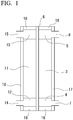
- FIG. 1 is a schematic diagram illustrating a sectional view of a preferable aspect (single cell) of a redox flow battery available in the present invention.
- a redox flow battery has two electrodes such as a positive electrode and a negative electrode, and a membrane, and is charged and discharged by supplying a positive electrode electrolyte to the positive electrode and supplying a negative electrode electrolyte to the negative electrode.
- a carbon material or the like having pores such as a carbon felt is preferably used as a material of an electrode for the positive electrode and the negative electrode.
- an ion exchange membrane such as Nafion (registered trademark) is preferably used.
- a sulfuric acid solution containing vanadium ions is frequently used as the positive electrode and negative electrode electrolytes.
- the electrolyte is supplied such that a pressure of the electrolyte supplied to at least one of the electrodes is changed in a cycle of 1/60 to 10 seconds.
- a pressure of the electrolyte supplied to at least one of the electrodes is changed in a cycle of 1/60 to 10 seconds.
- the pressure is changed in the above-described way, an air bubble repeats expansion and contraction such that electrolyte staying at the periphery is alleviated, and the air bubble is destroyed depending on cases.
- the cycle of pressure change is too short, a pressure change is likely to be alleviated due to elasticity of a pipe or the like.
- the cycle is too long, it is hard to remove the air bubble.
- a cycle of changing the pressure may be selected within the range depending on situations.
- the pressure may be changed in a cycle of 1/10 seconds to 9 seconds.
- the pressure may be changed in a cycle of 2 to 8 seconds and the electrolyte may be supplied, and the pressure may be changed in a cycle of 1/60 to 60/60 second and the electrolyte may be supplied.
- a step of changing a pressure may include a sub-step A of applying a pressure and a sub-step B of not applying a pressure, the sub-step A may be performed in a period within a range of 1/60 to 10 seconds, the sub-step B may be performed in a period within a range of 1/60 to 10 seconds, and the sub-step A and the sub-step B may be alternately performed a plurality of times.
- the cycle may be the cycle described in the above examples.
- Each condition for the step in a combination of the sub-step A and the sub-step B may be changed once, or twice or more in the middle.
- there may be two or more types of combinations of the sub-step A and the sub-step B the combinations may be combined with each other as necessary, so as to be performed, for example, alternately, sequentially a plurality of times, or at random.
- the sub-step A and the sub-step B may have the periods of an identical length, or the sub-step A may be longer or shorter than the sub-step B.
- the sub-step A and the sub-step B may have the periods of an identical length, or the sub-step A may be longer or shorter than the sub-step B.
- a step of changing a pressure may include a sub-step C of applying a pressure at a preferably selected value and a sub-step C of applying a pressure lower than the pressure in the sub-step C, the sub-step C may be performed in a period within a range of 1/60 to 10 seconds, the sub-step D may be performed in a period within a range of 1/60 to 10 seconds, and the sub-step D and the sub-step D may be alternately performed a plurality of times.
- the cycle may be the cycle described in the above examples.
- a condition for each step in a combination of the sub-step C and the sub-step D may be changed once, or twice or more in the middle.
- there may be two or more types of combinations of the sub-step C and the sub-step D the combinations may be combined with each other as necessary, so as to be performed, for example, alternately, sequentially a plurality of times, or at random.
- the sub-step C and the sub-step D may have the periods of an identical length, or the sub-step C may be longer or shorter than the sub-step D.
- any value of a pressure may be selected as necessary as a pressure used in the step wherein a pressure is changed.
- a value of a pressure may be 0 to 200 KPa or 10 to 20 KPa, but is not limited to the examples.
- any value of a pressure used in the sub-step A may be selected as necessary, and may be, for example, 5 to 20 KPa, or 50 to 150 KPa.
- Any value of a pressure used in the sub-step C may be selected as necessary, and may be, for example, 10 to 20 KPa, or 80 to 150 KPa.
- Any value of a pressure used in the sub-step D may be selected as necessary, and may be, for example, 3 to 10 KPa, or 20 to 80 KPa.
- a combination of the sub-step A and the sub-step B may be combined with a combination of the sub-step C and the sub-step D.
- the pressure change described above may be realized according to any method or by any device.
- the pressure change may be realized, for example, by moving a plunger pump intermittently or under different conditions, and/or may be realized by causing a flexible pipe to vibrate with a vibrator or the like consecutively or intermittently or under different conditions.
- the latter method using a vibrator is a method in which 1/60 seconds or 1/50 seconds corresponding to a commercial power supply frequency is easily obtained.
- the amplitude of the change becomes larger as long as a mechanical strength of the redox flow battery system to be used is allowed, it becomes easier to remove a foreign substance such as the dust or the air bubble.
- the amplitude of the change is preferably equal to or more than 10% of an average pressure of a supplied electrolyte, more preferably equal to or more than 20%, and most preferably equal to or more than 50%.
- the amplitude is a difference between the maximum value and the minimum value of a changing pressure.
- the average pressure of a supplied electrolyte indicates an average pressure in the cycle.
- the pressure is to be measured at a portion close to the electrodes.
- the pressure may be measured at an inlet of an electrolyte to a redox flow battery cell.
- the system may be operated by simply using an outlet pressure of a pump or the like as an index.
- the method for operating a redox flow battery according to the present invention includes a charge step and a discharge step.
- the step of supplying an electrolyte while changing a pressure may be performed in both of the charge step and the discharge step, or may be performed in only one thereof.
- the mass of the electrolyte in the pipe through which the electrolyte exhausted from the electrode passes is preferably equal to or more than one time the mass of the electrolyte from a pump or the like causing a pressure change to an inlet of the pipe, more preferably equal to or more than two times, and most preferably equal to or more than five times.
- Any upper limit of a mass ratio of an electrolyte may be selected.
- the mass ratio may be 1000 times or less, 100 times or less, 30 times or less, 15 times or less, or 10 times or less.
- a cell of the redox flow battery having the configuration illustrated in FIG. 1 was used.
- An inlet nozzle 7 of a positive electrode chamber 3 of the cell was connected to a positive electrode liquid feed pump (not illustrated) via a Teflon (registered trademark) tube (an inner diameter of 5 mm and a length of 200 cm), and a suction side of the liquid feed pump was connected to a positive electrode liquid tank (not illustrated).
- An outlet nozzle 8 was connected to the positive electrode liquid tank via a Teflon (registered trademark) tube (an inner diameter of 5 mm and a length of 20 cm) such that a positive electrode electrolyte is returned to the positive electrode liquid tank from the outlet nozzle 8 of the positive electrode chamber 3 of the cell.
- An inlet nozzle 14 of a negative electrode chamber 11 was connected to a negative electrode liquid feed pump by using a similar tube on the negative electrode side, and a suction side of the liquid feed pump was connected to a negative electrode liquid tank.
- An outlet nozzle 15 was connected to the negative electrode liquid tank via a Teflon (registered trademark) tube such that a negative electrode electrolyte is returned to the negative electrode liquid tank from the outlet nozzle 15 of the negative electrode chamber 11.
- a pressure sensor was inserted into an opening of the inlet nozzle 7 from a gasket 16 of a positive electrode liquid inflow gutter 4 portion, and a pressure sensor was inserted into an opening of the inlet nozzle 14 from the gasket 16 of a negative electrode liquid inflow gutter 12 portion. As all of the pumps, volute pumps were used.
- a Nafion (registered trademark) 212 membrane was used as the membrane 6.
- each electrode chamber has a horizontal width of 3 cm, a height of 15 cm, and a thickness of 0.2 cm, and the electrode chamber has a structure in which a liquid enters a lower part (the inlet nozzles 7 and 14 sides), and the liquid comes out of an upper part (the outlet nozzle 8 and 15 sides).
- a carbon rolled plate was used as each of a collector plate 17 on the positive electrode side and a collector plate 18 on the negative electrode.
- a positive electrode electrolyte a sulfuric acid aqueous solution of 4.5 mol/L containing a tetravalent vanadium ion of 1.8 mol/L was used.
- a negative electrode electrolyte a sulfuric acid aqueous solution of 4.5 mol/L containing a trivalent vanadium ion of 1.8 mol/L was used. Each electrolyte amount was 200 mL.
- the positive electrode electrolyte and the negative electrode electrolyte were respectively supplied to and circulated in the positive electrode chamber 3 and the negative electrode chamber 11 of the battery under 12 KPa as pressures (gauge pressures) of the inlet nozzles 7 and 14.
- Charge was performed at a current density of 100 mA/cm 2 while circulating the positive electrode electrolyte and the negative electrode electrolyte as mentioned above. The charge was stopped when a voltage reached 1.75 V, discharge was subsequently performed at 100 mA/cm 2 , and the discharge was stopped when a voltage reached 1.0 V.
- Power efficiency % dicharge voltage V ⁇ discharge current A ⁇ dicharge time h / charge voltage V ⁇ charge current A ⁇ charge time h ⁇ 100
- a plunger pump was used instead of the volute pump.
- the cell used in Comparative Example 1 can be used without hindrance under the pressure of 110 KPa, and thus a positive electrode electrolyte and a negative electrode electrolyte were respectively supplied to the positive electrode chamber 3 and the negative electrode chamber 11 simultaneously as follows.
- a positive electrode electrolyte and a negative electrode electrolyte were respectively supplied to the positive electrode chamber 3 and the negative electrode chamber 11 simultaneously as follows.
- a gear pump was used instead of the volute pump.
- Both of the two tubes between the inlet nozzles 7 and 14 and the liquid feed pumps were replaced with silicon tubes (each having an inner diameter of 3 mm, an outer diameter of 5 mm, and a length of 20 cm). Both of the tubes were pressed and fixed onto a laboratory table with a vibrator available in the market, and the test was performed by operating the vibrator by using a commercial power supply of 50 Hz.
- a method for operating a redox flow battery capable of operating the redox flow battery for a long period of time.
Landscapes
- Life Sciences & Earth Sciences (AREA)
- Engineering & Computer Science (AREA)
- Manufacturing & Machinery (AREA)
- Sustainable Development (AREA)
- Sustainable Energy (AREA)
- Chemical & Material Sciences (AREA)
- Chemical Kinetics & Catalysis (AREA)
- Electrochemistry (AREA)
- General Chemical & Material Sciences (AREA)
- Fuel Cell (AREA)
Abstract
Description
- The present invention relates to a method for operating a redox flow battery.
- Priority is claimed on Japanese Patent Application No.
2016-245564, filed on December 19, 2016 - It is known that, in a case where charge and discharge of a redox flow battery are repeatedly performed, cell efficiency is gradually reduced.
- As a countermeasure therefor, for example, Patent Document 1 discloses a method in which a cleaning liquid (distilled water, a sulfuric acid, or an electrolyte) is forwarded into a battery cell, and thus a foreign substance such as dust clogging an electrode portion is removed.
- Patent Document: Japanese Unexamined Patent Application, First Publication No.
H10-308232 - However, as disclosed in PTL 1, a redox flow battery cannot be operated during cleaning in this method. Thus, in a case where frequent cleaning is performed, this is not efficient.
- A foreign substance which is required to be cleaned is likely to occur in a portion of an electrode where an electrolyte stays. Particularly, in a case where an air bubble is mixed into an electrolyte, the air bubble closes pores of an electrode, above-described thus the electrolyte easily stays at the portion. In other words, there is a probability that a foreign substance may be seized at a location where pores are closed. However, in a case where a deaerator or the like is used to remove an air bubble in an electrolyte, this leads to an unnecessary power loss.
- The present invention has been made in light of the problems, and an object thereof is to provide a method for operating a redox flow battery, capable of operating the redox flow battery for a long period of time, without causing an unnecessary power loss, by increasing a cleaning interval.
- The present invention provides the following means in order to solve the problems.
- In other words, a first aspect of the present invention is the following method for operating a redox flow battery.
- [1] A method for operating a redox flow battery which has two electrodes including a positive electrode and a negative electrode and a membrane, and performs charge and discharge by supplying a positive electrode electrolyte to the positive electrode and supplying a negative electrode electrolyte to the negative electrode, the method including:
- a step of changing one or both of pressures of the positive electrode electrolyte which is supplied to the positive electrode and the negative electrode electrolyte which is supplied to the negative electrode in a cycle of 1/60 to 10 seconds.
- The method for operating a redox flow battery of the first aspect preferably has the following features.
- [2] The method for operating a redox flow battery according to the above [1],
in which an amplitude of the change is equal to or more than 10% of an average pressure of the supplied electrolytes. - [3] The method for operating a redox flow battery according to the above [1] or [2],
in which both of the pressures of the electrolyte which is supplied to the positive electrode and the electrolyte which is supplied to the negative electrode are changed. - [4] The method for operating a redox flow battery according to the above [3],
in which a pressure change of the electrolyte which is supplied to the positive electrode and a pressure change of the electrolyte which is supplied to the negative electrode are synchronized with each other. - [5] The method for operating a redox flow battery according to any one of the above [1] to [4],
in which, in the step, the electrolyte is supplied to the electrode while changing a pressure of the electrolyte, and the electrolyte is exhausted from the electrode at a constant speed. - According to the present invention, it is possible to operate a redox flow battery for a long period of time.
-
FIG. 1 is a schematic diagram illustrating a sectional view of a preferable aspect (single cell) of a redox flow battery available in the present invention. - Hereinafter, a method for operating a redox flow battery will be described in detail by exemplifying a preferable embodiment, but the present invention is not limited thereto. Appropriate modifications may occur within the scope of being capable of achieving the effect of the present invention. Additions, omissions, replacements, and other changes may occur as necessary within the scope without departing from the spirit of the present invention.
- Generally, a redox flow battery has two electrodes such as a positive electrode and a negative electrode, and a membrane, and is charged and discharged by supplying a positive electrode electrolyte to the positive electrode and supplying a negative electrode electrolyte to the negative electrode. A carbon material or the like having pores such as a carbon felt is preferably used as a material of an electrode for the positive electrode and the negative electrode. As the membrane, an ion exchange membrane such as Nafion (registered trademark) is preferably used. A sulfuric acid solution containing vanadium ions is frequently used as the positive electrode and negative electrode electrolytes.
- In operating the redox flow battery, in the present embodiment, the electrolyte is supplied such that a pressure of the electrolyte supplied to at least one of the electrodes is changed in a cycle of 1/60 to 10 seconds. In a case where the pressure is changed in the above-described way, an air bubble repeats expansion and contraction such that electrolyte staying at the periphery is alleviated, and the air bubble is destroyed depending on cases. In a case where the cycle of pressure change is too short, a pressure change is likely to be alleviated due to elasticity of a pipe or the like. In a case where the cycle is too long, it is hard to remove the air bubble.
- A cycle of changing the pressure may be selected within the range depending on situations. For example, the pressure may be changed in a cycle of 1/10 seconds to 9 seconds. In other situations, the pressure may be changed in a cycle of 2 to 8 seconds and the electrolyte may be supplied, and the pressure may be changed in a cycle of 1/60 to 60/60 second and the electrolyte may be supplied.
- More specifically, for example, a step of changing a pressure may include a sub-step A of applying a pressure and a sub-step B of not applying a pressure, the sub-step A may be performed in a period within a range of 1/60 to 10 seconds, the sub-step B may be performed in a period within a range of 1/60 to 10 seconds, and the sub-step A and the sub-step B may be alternately performed a plurality of times. The cycle may be the cycle described in the above examples. Each condition for the step in a combination of the sub-step A and the sub-step B may be changed once, or twice or more in the middle. Alternatively, there may be two or more types of combinations of the sub-step A and the sub-step B, the combinations may be combined with each other as necessary, so as to be performed, for example, alternately, sequentially a plurality of times, or at random.
- Regarding periods of the sub-step A and the sub-step B, the sub-step A and the sub-step B may have the periods of an identical length, or the sub-step A may be longer or shorter than the sub-step B.
- Regarding periods of the sub-step A and the sub-step B, the sub-step A and the sub-step B may have the periods of an identical length, or the sub-step A may be longer or shorter than the sub-step B.
- Furthermore specifically, for example, a step of changing a pressure may include a sub-step C of applying a pressure at a preferably selected value and a sub-step C of applying a pressure lower than the pressure in the sub-step C, the sub-step C may be performed in a period within a range of 1/60 to 10 seconds, the sub-step D may be performed in a period within a range of 1/60 to 10 seconds, and the sub-step D and the sub-step D may be alternately performed a plurality of times. The cycle may be the cycle described in the above examples. A condition for each step in a combination of the sub-step C and the sub-step D may be changed once, or twice or more in the middle. Alternatively, there may be two or more types of combinations of the sub-step C and the sub-step D, the combinations may be combined with each other as necessary, so as to be performed, for example, alternately, sequentially a plurality of times, or at random.
- Regarding periods of the sub-step C and the sub-step D, the sub-step C and the sub-step D may have the periods of an identical length, or the sub-step C may be longer or shorter than the sub-step D.
- Any value of a pressure may be selected as necessary as a pressure used in the step wherein a pressure is changed. For example, a value of a pressure may be 0 to 200 KPa or 10 to 20 KPa, but is not limited to the examples. Furthermore specifically, for example, any value of a pressure used in the sub-step A may be selected as necessary, and may be, for example, 5 to 20 KPa, or 50 to 150 KPa. Any value of a pressure used in the sub-step C may be selected as necessary, and may be, for example, 10 to 20 KPa, or 80 to 150 KPa. Any value of a pressure used in the sub-step D may be selected as necessary, and may be, for example, 3 to 10 KPa, or 20 to 80 KPa.
- A combination of the sub-step A and the sub-step B may be combined with a combination of the sub-step C and the sub-step D.
- The pressure change described above may be realized according to any method or by any device. The pressure change may be realized, for example, by moving a plunger pump intermittently or under different conditions, and/or may be realized by causing a flexible pipe to vibrate with a vibrator or the like consecutively or intermittently or under different conditions. Particularly, the latter method using a vibrator is a method in which 1/60 seconds or 1/50 seconds corresponding to a commercial power supply frequency is easily obtained.
- As the amplitude of the change becomes larger as long as a mechanical strength of the redox flow battery system to be used is allowed, it becomes easier to remove a foreign substance such as the dust or the air bubble. Thus, the amplitude of the change is preferably equal to or more than 10% of an average pressure of a supplied electrolyte, more preferably equal to or more than 20%, and most preferably equal to or more than 50%. The amplitude is a difference between the maximum value and the minimum value of a changing pressure. The average pressure of a supplied electrolyte indicates an average pressure in the cycle.
- In measurement of the pressure, in order to obtain a more accurate value, the pressure is to be measured at a portion close to the electrodes. Specifically, the pressure may be measured at an inlet of an electrolyte to a redox flow battery cell. However, in a case of a redox flow battery system in which a pipe or the like having a certain degree of rigidity is used and a pressure change is hard to alleviate, the system may be operated by simply using an outlet pressure of a pump or the like as an index.
- Changing both of the pressures of electrolytes supplied to the positive electrode and the negative electrode as described above enables the redox flow battery to be operated for a long period of time and is preferable.
- In a case where the pressure change is synchronized between both of the negative electrode and the positive electrode, this is preferable since a pressure difference between both sides of the membrane is reduced such that damage to the membrane is suppressed.
- The method for operating a redox flow battery according to the present invention includes a charge step and a discharge step. The step of supplying an electrolyte while changing a pressure may be performed in both of the charge step and the discharge step, or may be performed in only one thereof.
- In a case where an electrolyte is exhausted from an electrode at a constant speed, this is preferable since a pressure change in the electrode is hardly alleviated. Any method of exhausting an electrolyte from an electrode at a constant speed may be selected, but the simplest method is a method in which a pipe through which an electrolyte exhausted from the electrode passes is lengthened, and a constant flow velocity is obtained by inertia which is generated by the mass of the electrolyte in the pipe. In order to cause an electrolyte to flow at a more constant speed, the mass of the electrolyte in the pipe through which the electrolyte exhausted from the electrode passes is preferably equal to or more than one time the mass of the electrolyte from a pump or the like causing a pressure change to an inlet of the pipe, more preferably equal to or more than two times, and most preferably equal to or more than five times. Any upper limit of a mass ratio of an electrolyte may be selected. For example, the mass ratio may be 1000 times or less, 100 times or less, 30 times or less, 15 times or less, or 10 times or less.
- Hereinafter, the present invention will be described in more detail on the basis of Examples, but the present invention is not limited to the Examples.
- A cell of the redox flow battery having the configuration illustrated in
FIG. 1 was used. Aninlet nozzle 7 of apositive electrode chamber 3 of the cell was connected to a positive electrode liquid feed pump (not illustrated) via a Teflon (registered trademark) tube (an inner diameter of 5 mm and a length of 200 cm), and a suction side of the liquid feed pump was connected to a positive electrode liquid tank (not illustrated). An outlet nozzle 8 was connected to the positive electrode liquid tank via a Teflon (registered trademark) tube (an inner diameter of 5 mm and a length of 20 cm) such that a positive electrode electrolyte is returned to the positive electrode liquid tank from the outlet nozzle 8 of thepositive electrode chamber 3 of the cell. Aninlet nozzle 14 of anegative electrode chamber 11 was connected to a negative electrode liquid feed pump by using a similar tube on the negative electrode side, and a suction side of the liquid feed pump was connected to a negative electrode liquid tank. Anoutlet nozzle 15 was connected to the negative electrode liquid tank via a Teflon (registered trademark) tube such that a negative electrode electrolyte is returned to the negative electrode liquid tank from theoutlet nozzle 15 of thenegative electrode chamber 11. A pressure sensor was inserted into an opening of theinlet nozzle 7 from agasket 16 of a positive electrodeliquid inflow gutter 4 portion, and a pressure sensor was inserted into an opening of theinlet nozzle 14 from thegasket 16 of a negative electrodeliquid inflow gutter 12 portion. As all of the pumps, volute pumps were used. - A Nafion (registered trademark) 212 membrane was used as the
membrane 6. - Seven carbon felts (sheet form) were overlapped to fill each of the
positive electrode chamber 3 and thenegative electrode chamber 11, and were used as a positive electrode and a negative electrode. A shape of each electrode chamber has a horizontal width of 3 cm, a height of 15 cm, and a thickness of 0.2 cm, and the electrode chamber has a structure in which a liquid enters a lower part (theinlet nozzles outlet nozzle 8 and 15 sides). - A carbon rolled plate was used as each of a
collector plate 17 on the positive electrode side and acollector plate 18 on the negative electrode. - As a positive electrode electrolyte, a sulfuric acid aqueous solution of 4.5 mol/L containing a tetravalent vanadium ion of 1.8 mol/L was used. As a negative electrode electrolyte, a sulfuric acid aqueous solution of 4.5 mol/L containing a trivalent vanadium ion of 1.8 mol/L was used. Each electrolyte amount was 200 mL.
- First, the positive electrode electrolyte and the negative electrode electrolyte were respectively supplied to and circulated in the
positive electrode chamber 3 and thenegative electrode chamber 11 of the battery under 12 KPa as pressures (gauge pressures) of theinlet nozzles - Charge was performed at a current density of 100 mA/cm2 while circulating the positive electrode electrolyte and the negative electrode electrolyte as mentioned above. The charge was stopped when a voltage reached 1.75 V, discharge was subsequently performed at 100 mA/cm2, and the discharge was stopped when a voltage reached 1.0 V.
- Generally, in a case where dust, an air bubble, or the like is accumulated in an electrode, an effective area thereof is decreased, and thus internal resistance is increased such that power efficiency is reduced. Thus, charge and discharge were repeated, and a power efficiency in the 10th cycle was obtained.
- In the present comparative example and each Example which will be described later, the power efficiency was calculated according to the following equation.

- Subsequently, a current density for charge and discharge was increased to 600 mA/cm2 from the 11th cycle, the circulated electrolytes were supplied in a state in which pressures (gauge pressures) of the
inlet nozzles - In this case, power efficiencies in the 20th cycle and the 100th cycle were measured.
- Results of measuring power efficiencies are shown in Table 1.
- The test was performed in the same manner as in Comparative Example 1 except for the following contents.
- A plunger pump was used instead of the volute pump. The cell used in Comparative Example 1 can be used without hindrance under the pressure of 110 KPa, and thus a positive electrode electrolyte and a negative electrode electrolyte were respectively supplied to the
positive electrode chamber 3 and thenegative electrode chamber 11 simultaneously as follows. - 1) Up to the 10th cycle, the electrolytes were supplied under 110 KPa as pressures (gauge pressures) of the
inlet nozzle 7 and theinlet nozzle 14 for one second, and then were supplied under 0 KPa as the pressures for seven seconds, and this was repeatedly performed such that the electrolytes were supplied under an average pressure of 13.75 KPa. The amplitude of a pressure change in this case was 800% (=[110-0]/13.75). - 2) In the 11th cycle and the subsequent cycles, the electrolytes were supplied under 110 KPa as pressures (gauge pressures) of the
inlet nozzle 7 and theinlet nozzle 14 for three seconds, and then were supplied under 0 KPa as the pressures for one second, and this was repeatedly performed such that the electrolytes were supplied under an average pressure of 82.5 KPa. The amplitude of a pressure change in this case was 133% (=[110-0]/82.5). - Results of measuring power efficiencies are shown in Table 1.
- The test was performed in the same manner as in Comparative Example 1 except for the following contents.
- A positive electrode electrolyte and a negative electrode electrolyte were respectively supplied to the
positive electrode chamber 3 and thenegative electrode chamber 11 simultaneously as follows. - 1) Up to the 10th cycle, the electrolytes were supplied under 13 KPa as pressures (gauge pressures) of the
inlet nozzle 7 and theinlet nozzle 14 for 0.2 seconds, and then were supplied under 11 KPa as the pressures for 0.2 seconds, and this was repeatedly performed such that the electrolytes were supplied under an average pressure of 12 KPa. The amplitude of a pressure change in this case was 17% (=[13-11]/12). - 2) In the 11th cycle and the subsequent cycles, the electrolytes were supplied under 80 KPa as pressures (gauge pressures) of the
inlet nozzle 7 and theinlet nozzle 14 for 0.5 seconds, and then were supplied under 70 KPa as the pressures for 0.5 seconds, and this was repeatedly performed such that the electrolytes were supplied under an average pressure of 75 KPa. The amplitude of a pressure change in this case was 13% (=[80-70]/75). - Results of measuring power efficiencies are shown in Table 1.
- The test was performed in the same manner as in Comparative Example 1 except for the following contents.
- A gear pump was used instead of the volute pump.
- Both of the two tubes between the
inlet nozzles - 1) Up to the 10th cycle, each of pressures (gauge pressures) of the
inlet nozzle 7 and theinlet nozzle 14 was average 12 KPa, and it was observed that the pressure changed between about 10 and 15 KPa. The amplitude of a pressure change was 42% (=[15-10]/12). - 2) In the 11th cycle and the subsequent cycles, each of pressures (gauge pressures) of the
inlet nozzle 7 and theinlet nozzle 14 was average 75 KPa, and it was observed that the pressure changed between about 60 and 80 KPa. The amplitude of a pressure change was 27% (=[80-60]/75). - Results are shown in Table 1.
[Table 1] Power efficiency (%) 10th cycle 20th cycle 100th cycle Comparative Example 1 86 68 8 Example 1 87 73 41 Example 2 86 70 32 Example 3 88 71 37 - It can be seen in each Example that a reduction in a power efficiency is smaller even in the 100th cycle than in the comparative example.
- Provided is a method for operating a redox flow battery, capable of operating the redox flow battery for a long period of time.
-
- 3:
- POSITIVE ELECTRODE CHAMBER
- 4:
- POSITIVE ELECTRODE LIQUID INFLOW GUTTER
- 5:
- POSITIVE ELECTRODE LIQUID OUTFLOW GUTTER
- 6:
- MEMBRANE
- 7:
- POSITIVE ELECTRODE LIQUID INLET NOZZLE
- 8:
- POSITIVE ELECTRODE LIQUID OUTLET NOZZLE
- 11:
- NEGATIVE ELECTRODE CHAMBER
- 12:
- NEGATIVE ELECTRODE LIQUID INFLOW GUTTER
- 13:
- NEGATIVE ELECTRODE LIQUID OUTFLOW GUTTER
- 14:
- NEGATIVE ELECTRODE LIQUID INLET NOZZLE
- 15:
- NEGATIVE ELECTRODE LIQUID OUTLET NOZZLE
- 16:
- GASKET
- 17:
- POSITIVE ELECTRODE COLLECTOR PLATE
- 18:
- NEGATIVE ELECTRODE COLLECTOR PLATE
Claims (7)
- A method for operating a redox flow battery which has two electrodes including a positive electrode and a negative electrode and a membrane, and performs charge and discharge by supplying a positive electrode electrolyte to the positive electrode and supplying a negative electrode electrolyte to the negative electrode, the method comprising:
a step of changing one or both of pressures of the positive electrode electrolyte which is supplied to the positive electrode and the negative electrode electrolyte which is supplied to the negative electrode in a cycle of 1/60 to 10 seconds. - The method for operating a redox flow battery according to claim 1,
wherein an amplitude of the change is equal to or more than 10% of an average pressure of the supplied electrolytes. - The method for operating a redox flow battery according to claim 1 or 2,
wherein both of the pressures of the electrolyte which is supplied to the positive electrode and the electrolyte which is supplied to the negative electrode are changed. - The method for operating a redox flow battery according to claim 3,
wherein a pressure change of the electrolyte which is supplied to the positive electrode and a pressure change of the electrolyte which is supplied to the negative electrode are synchronized with each other. - The method for operating a redox flow battery according to any one of claims 1 to 4,
wherein, in the step, the electrolyte is supplied to the electrode while changing a pressure of the electrolyte, and the electrolyte is exhausted from the electrode at a constant speed. - The method for operating a redox flow battery according to any one of claims 1 to 5,
wherein the step of changing a pressure has a sub-step of applying a pressure and a sub-step of not applying a pressure. - The method for operating a redox flow battery according to any one of claims 1 to 6,
wherein the step of changing a pressure has a sub-step of applying a pressure and a sub-step of applying a pressure lower than the pressure in the sub-step.
Applications Claiming Priority (2)
| Application Number | Priority Date | Filing Date | Title |
|---|---|---|---|
| JP2016245564 | 2016-12-19 | ||
| PCT/JP2017/045434 WO2018117069A1 (en) | 2016-12-19 | 2017-12-19 | Method for operating redox flow cell |
Publications (2)
| Publication Number | Publication Date |
|---|---|
| EP3557671A1 true EP3557671A1 (en) | 2019-10-23 |
| EP3557671A4 EP3557671A4 (en) | 2020-08-19 |
Family
ID=62626371
Family Applications (1)
| Application Number | Title | Priority Date | Filing Date |
|---|---|---|---|
| EP17882999.0A Withdrawn EP3557671A4 (en) | 2016-12-19 | 2017-12-19 | Method for operating redox flow cell |
Country Status (5)
| Country | Link |
|---|---|
| US (1) | US20190334192A1 (en) |
| EP (1) | EP3557671A4 (en) |
| JP (1) | JP6430682B2 (en) |
| CN (1) | CN109983608A (en) |
| WO (1) | WO2018117069A1 (en) |
Families Citing this family (2)
| Publication number | Priority date | Publication date | Assignee | Title |
|---|---|---|---|---|
| BR112021020113A2 (en) * | 2019-04-12 | 2021-12-07 | Ascend Performance Mat Operations Llc | Non-woven multilayer structures having nanofiber layers |
| KR20250130061A (en) * | 2024-02-23 | 2025-09-01 | 스탠다드에너지(주) | Preparing method of electrolyte solution for redox battery, electrolyte solution for redox battery prepared by the method and sealed type redox battery comprising the same |
Family Cites Families (7)
| Publication number | Priority date | Publication date | Assignee | Title |
|---|---|---|---|---|
| JP3425060B2 (en) | 1997-05-09 | 2003-07-07 | 住友電気工業株式会社 | Electrolyte flow battery with internal resistance recovery mechanism |
| WO2008011746A1 (en) * | 2006-06-22 | 2008-01-31 | Pacific New Energy Limited | Electrochemical cell |
| JP5172230B2 (en) * | 2007-07-05 | 2013-03-27 | 住友電気工業株式会社 | Redox flow battery system having emergency power supply function and emergency operation method of redox flow battery system |
| US9786944B2 (en) * | 2008-06-12 | 2017-10-10 | Massachusetts Institute Of Technology | High energy density redox flow device |
| JP6256202B2 (en) * | 2014-05-29 | 2018-01-10 | 住友電気工業株式会社 | Electrolyte circulating battery |
| JP6403009B2 (en) * | 2015-02-09 | 2018-10-10 | 住友電気工業株式会社 | Redox flow battery system and operating method of redox flow battery |
| KR20180019725A (en) * | 2015-06-23 | 2018-02-26 | 메모리얼 슬로안-케터링 캔서 센터 | Novel pd-1 immune modulating agents |
-
2017
- 2017-12-19 US US16/468,943 patent/US20190334192A1/en not_active Abandoned
- 2017-12-19 EP EP17882999.0A patent/EP3557671A4/en not_active Withdrawn
- 2017-12-19 WO PCT/JP2017/045434 patent/WO2018117069A1/en not_active Ceased
- 2017-12-19 JP JP2018518539A patent/JP6430682B2/en active Active
- 2017-12-19 CN CN201780071555.7A patent/CN109983608A/en active Pending
Also Published As
| Publication number | Publication date |
|---|---|
| JP6430682B2 (en) | 2018-11-28 |
| WO2018117069A1 (en) | 2018-06-28 |
| JPWO2018117069A1 (en) | 2018-12-20 |
| CN109983608A (en) | 2019-07-05 |
| US20190334192A1 (en) | 2019-10-31 |
| EP3557671A4 (en) | 2020-08-19 |
Similar Documents
| Publication | Publication Date | Title |
|---|---|---|
| AU2014379883B2 (en) | Redox flow battery | |
| JP6734920B2 (en) | Cathode, production method thereof, electrolytic cell using the same, and hydrogen production method | |
| JPWO2018174281A1 (en) | Water electrolysis system, water electrolysis method, and hydrogen production method | |
| JP5422083B2 (en) | Non-flow redox battery | |
| EP3557671A1 (en) | Method for operating redox flow cell | |
| JP2000511973A (en) | Electrochemical half-cell with pressure compensation | |
| US10017897B1 (en) | Method of enhancing efficiency of carbon felts in flow battery through sonication | |
| JP2018076577A (en) | Water electrolysis apparatus and method for producing hydrogen water | |
| EP3557672A1 (en) | Method for operating redox flow cell | |
| WO2018075920A1 (en) | Ozone generators, methods of making ozone generators, and methods of generating ozone | |
| CN210114982U (en) | Device suitable for ceramic membrane module performance test | |
| CN212610916U (en) | High-efficiency ozone water electrolysis device | |
| CN205252631U (en) | Plate filtration system | |
| JP3110555B2 (en) | Ion exchange membrane electrolyzer | |
| CN115228611B (en) | Plasma environmental protection treatment device and system for eliminating harmful smoke and dust | |
| JP2001104956A (en) | Simple type electrolyzed water production equipment | |
| JP2000334465A (en) | Device for removing nitrogen and phosphorus in waste water | |
| KR101303966B1 (en) | Total Residual Oxidant Measuring Device for Ship ballast | |
| JP6187793B2 (en) | Air battery regeneration device, air battery system, and air battery regeneration method | |
| CN108187912A (en) | A kind of novel honeycomb electric field and the Industrial cleaning facility equipment containing the electric field | |
| CN221906512U (en) | Electrodialysis device for desalting fermentation liquor | |
| CN219415337U (en) | Square copper temperature reducing device for electrolytic cell | |
| CN215563022U (en) | Miniature intelligent integrated non-negative pressure water supply equipment | |
| HRP20050929A2 (en) | Apparatus for carrying out an electrolytic process on a halogenide compounds | |
| CN215179484U (en) | Evaluation device of hollow fiber degassing membrane |
Legal Events
| Date | Code | Title | Description |
|---|---|---|---|
| STAA | Information on the status of an ep patent application or granted ep patent |
Free format text: STATUS: THE INTERNATIONAL PUBLICATION HAS BEEN MADE |
|
| PUAI | Public reference made under article 153(3) epc to a published international application that has entered the european phase |
Free format text: ORIGINAL CODE: 0009012 |
|
| STAA | Information on the status of an ep patent application or granted ep patent |
Free format text: STATUS: REQUEST FOR EXAMINATION WAS MADE |
|
| 17P | Request for examination filed |
Effective date: 20190719 |
|
| AK | Designated contracting states |
Kind code of ref document: A1 Designated state(s): AL AT BE BG CH CY CZ DE DK EE ES FI FR GB GR HR HU IE IS IT LI LT LU LV MC MK MT NL NO PL PT RO RS SE SI SK SM TR |
|
| AX | Request for extension of the european patent |
Extension state: BA ME |
|
| DAV | Request for validation of the european patent (deleted) | ||
| DAX | Request for extension of the european patent (deleted) | ||
| A4 | Supplementary search report drawn up and despatched |
Effective date: 20200716 |
|
| RIC1 | Information provided on ipc code assigned before grant |
Ipc: H01M 8/04746 20160101ALI20200710BHEP Ipc: H01M 8/18 20060101AFI20200710BHEP Ipc: H01M 8/04223 20160101ALI20200710BHEP |
|
| STAA | Information on the status of an ep patent application or granted ep patent |
Free format text: STATUS: THE APPLICATION IS DEEMED TO BE WITHDRAWN |
|
| 18D | Application deemed to be withdrawn |
Effective date: 20210216 |