EP3557405A1 - Display control method and device of flexible display screen - Google Patents
Display control method and device of flexible display screen Download PDFInfo
- Publication number
- EP3557405A1 EP3557405A1 EP16923682.5A EP16923682A EP3557405A1 EP 3557405 A1 EP3557405 A1 EP 3557405A1 EP 16923682 A EP16923682 A EP 16923682A EP 3557405 A1 EP3557405 A1 EP 3557405A1
- Authority
- EP
- European Patent Office
- Prior art keywords
- sensor
- distance
- unfolded
- display screen
- flexible display
- Prior art date
- Legal status (The legal status is an assumption and is not a legal conclusion. Google has not performed a legal analysis and makes no representation as to the accuracy of the status listed.)
- Withdrawn
Links
Images





Classifications
-
- G—PHYSICS
- G06—COMPUTING OR CALCULATING; COUNTING
- G06F—ELECTRIC DIGITAL DATA PROCESSING
- G06F1/00—Details not covered by groups G06F3/00 - G06F13/00 and G06F21/00
- G06F1/16—Constructional details or arrangements
- G06F1/1613—Constructional details or arrangements for portable computers
- G06F1/1633—Constructional details or arrangements of portable computers not specific to the type of enclosures covered by groups G06F1/1615 - G06F1/1626
- G06F1/1637—Details related to the display arrangement, including those related to the mounting of the display in the housing
- G06F1/1652—Details related to the display arrangement, including those related to the mounting of the display in the housing the display being flexible, e.g. mimicking a sheet of paper, or rollable
-
- G—PHYSICS
- G06—COMPUTING OR CALCULATING; COUNTING
- G06F—ELECTRIC DIGITAL DATA PROCESSING
- G06F1/00—Details not covered by groups G06F3/00 - G06F13/00 and G06F21/00
- G06F1/16—Constructional details or arrangements
-
- G—PHYSICS
- G06—COMPUTING OR CALCULATING; COUNTING
- G06F—ELECTRIC DIGITAL DATA PROCESSING
- G06F1/00—Details not covered by groups G06F3/00 - G06F13/00 and G06F21/00
- G06F1/16—Constructional details or arrangements
- G06F1/1613—Constructional details or arrangements for portable computers
- G06F1/1633—Constructional details or arrangements of portable computers not specific to the type of enclosures covered by groups G06F1/1615 - G06F1/1626
- G06F1/1675—Miscellaneous details related to the relative movement between the different enclosures or enclosure parts
- G06F1/1677—Miscellaneous details related to the relative movement between the different enclosures or enclosure parts for detecting open or closed state or particular intermediate positions assumed by movable parts of the enclosure, e.g. detection of display lid position with respect to main body in a laptop, detection of opening of the cover of battery compartment
-
- G—PHYSICS
- G06—COMPUTING OR CALCULATING; COUNTING
- G06F—ELECTRIC DIGITAL DATA PROCESSING
- G06F1/00—Details not covered by groups G06F3/00 - G06F13/00 and G06F21/00
- G06F1/26—Power supply means, e.g. regulation thereof
- G06F1/32—Means for saving power
- G06F1/3203—Power management, i.e. event-based initiation of a power-saving mode
- G06F1/3206—Monitoring of events, devices or parameters that trigger a change in power modality
- G06F1/3215—Monitoring of peripheral devices
-
- G—PHYSICS
- G06—COMPUTING OR CALCULATING; COUNTING
- G06F—ELECTRIC DIGITAL DATA PROCESSING
- G06F1/00—Details not covered by groups G06F3/00 - G06F13/00 and G06F21/00
- G06F1/26—Power supply means, e.g. regulation thereof
- G06F1/32—Means for saving power
- G06F1/3203—Power management, i.e. event-based initiation of a power-saving mode
- G06F1/3234—Power saving characterised by the action undertaken
- G06F1/325—Power saving in peripheral device
- G06F1/3262—Power saving in digitizer or tablet
-
- G—PHYSICS
- G06—COMPUTING OR CALCULATING; COUNTING
- G06F—ELECTRIC DIGITAL DATA PROCESSING
- G06F1/00—Details not covered by groups G06F3/00 - G06F13/00 and G06F21/00
- G06F1/26—Power supply means, e.g. regulation thereof
- G06F1/32—Means for saving power
- G06F1/3203—Power management, i.e. event-based initiation of a power-saving mode
- G06F1/3234—Power saving characterised by the action undertaken
- G06F1/325—Power saving in peripheral device
- G06F1/3265—Power saving in display device
-
- G—PHYSICS
- G06—COMPUTING OR CALCULATING; COUNTING
- G06F—ELECTRIC DIGITAL DATA PROCESSING
- G06F3/00—Input arrangements for transferring data to be processed into a form capable of being handled by the computer; Output arrangements for transferring data from processing unit to output unit, e.g. interface arrangements
- G06F3/01—Input arrangements or combined input and output arrangements for interaction between user and computer
- G06F3/048—Interaction techniques based on graphical user interfaces [GUI]
- G06F3/0481—Interaction techniques based on graphical user interfaces [GUI] based on specific properties of the displayed interaction object or a metaphor-based environment, e.g. interaction with desktop elements like windows or icons, or assisted by a cursor's changing behaviour or appearance
- G06F3/0483—Interaction with page-structured environments, e.g. book metaphor
-
- G—PHYSICS
- G06—COMPUTING OR CALCULATING; COUNTING
- G06F—ELECTRIC DIGITAL DATA PROCESSING
- G06F3/00—Input arrangements for transferring data to be processed into a form capable of being handled by the computer; Output arrangements for transferring data from processing unit to output unit, e.g. interface arrangements
- G06F3/01—Input arrangements or combined input and output arrangements for interaction between user and computer
- G06F3/048—Interaction techniques based on graphical user interfaces [GUI]
- G06F3/0487—Interaction techniques based on graphical user interfaces [GUI] using specific features provided by the input device, e.g. functions controlled by the rotation of a mouse with dual sensing arrangements, or of the nature of the input device, e.g. tap gestures based on pressure sensed by a digitiser
- G06F3/0488—Interaction techniques based on graphical user interfaces [GUI] using specific features provided by the input device, e.g. functions controlled by the rotation of a mouse with dual sensing arrangements, or of the nature of the input device, e.g. tap gestures based on pressure sensed by a digitiser using a touch-screen or digitiser, e.g. input of commands through traced gestures
- G06F3/04883—Interaction techniques based on graphical user interfaces [GUI] using specific features provided by the input device, e.g. functions controlled by the rotation of a mouse with dual sensing arrangements, or of the nature of the input device, e.g. tap gestures based on pressure sensed by a digitiser using a touch-screen or digitiser, e.g. input of commands through traced gestures for inputting data by handwriting, e.g. gesture or text
-
- G—PHYSICS
- G06—COMPUTING OR CALCULATING; COUNTING
- G06F—ELECTRIC DIGITAL DATA PROCESSING
- G06F3/00—Input arrangements for transferring data to be processed into a form capable of being handled by the computer; Output arrangements for transferring data from processing unit to output unit, e.g. interface arrangements
- G06F3/14—Digital output to display device ; Cooperation and interconnection of the display device with other functional units
- G06F3/147—Digital output to display device ; Cooperation and interconnection of the display device with other functional units using display panels
-
- G—PHYSICS
- G09—EDUCATION; CRYPTOGRAPHY; DISPLAY; ADVERTISING; SEALS
- G09G—ARRANGEMENTS OR CIRCUITS FOR CONTROL OF INDICATING DEVICES USING STATIC MEANS TO PRESENT VARIABLE INFORMATION
- G09G3/00—Control arrangements or circuits, of interest only in connection with visual indicators other than cathode-ray tubes
- G09G3/03—Control arrangements or circuits, of interest only in connection with visual indicators other than cathode-ray tubes specially adapted for displays having non-planar surfaces, e.g. curved displays
- G09G3/035—Control arrangements or circuits, of interest only in connection with visual indicators other than cathode-ray tubes specially adapted for displays having non-planar surfaces, e.g. curved displays for flexible display surfaces
-
- G—PHYSICS
- G09—EDUCATION; CRYPTOGRAPHY; DISPLAY; ADVERTISING; SEALS
- G09G—ARRANGEMENTS OR CIRCUITS FOR CONTROL OF INDICATING DEVICES USING STATIC MEANS TO PRESENT VARIABLE INFORMATION
- G09G3/00—Control arrangements or circuits, of interest only in connection with visual indicators other than cathode-ray tubes
- G09G3/20—Control arrangements or circuits, of interest only in connection with visual indicators other than cathode-ray tubes for presentation of an assembly of a number of characters, e.g. a page, by composing the assembly by combination of individual elements arranged in a matrix no fixed position being assigned to or needed to be assigned to the individual characters or partial characters
-
- G—PHYSICS
- G09—EDUCATION; CRYPTOGRAPHY; DISPLAY; ADVERTISING; SEALS
- G09G—ARRANGEMENTS OR CIRCUITS FOR CONTROL OF INDICATING DEVICES USING STATIC MEANS TO PRESENT VARIABLE INFORMATION
- G09G5/00—Control arrangements or circuits for visual indicators common to cathode-ray tube indicators and other visual indicators
- G09G5/003—Details of a display terminal, the details relating to the control arrangement of the display terminal and to the interfaces thereto
-
- G—PHYSICS
- G09—EDUCATION; CRYPTOGRAPHY; DISPLAY; ADVERTISING; SEALS
- G09G—ARRANGEMENTS OR CIRCUITS FOR CONTROL OF INDICATING DEVICES USING STATIC MEANS TO PRESENT VARIABLE INFORMATION
- G09G2330/00—Aspects of power supply; Aspects of display protection and defect management
- G09G2330/02—Details of power systems and of start or stop of display operation
- G09G2330/021—Power management, e.g. power saving
- G09G2330/022—Power management, e.g. power saving in absence of operation, e.g. no data being entered during a predetermined time
-
- G—PHYSICS
- G09—EDUCATION; CRYPTOGRAPHY; DISPLAY; ADVERTISING; SEALS
- G09G—ARRANGEMENTS OR CIRCUITS FOR CONTROL OF INDICATING DEVICES USING STATIC MEANS TO PRESENT VARIABLE INFORMATION
- G09G2354/00—Aspects of interface with display user
-
- Y—GENERAL TAGGING OF NEW TECHNOLOGICAL DEVELOPMENTS; GENERAL TAGGING OF CROSS-SECTIONAL TECHNOLOGIES SPANNING OVER SEVERAL SECTIONS OF THE IPC; TECHNICAL SUBJECTS COVERED BY FORMER USPC CROSS-REFERENCE ART COLLECTIONS [XRACs] AND DIGESTS
- Y02—TECHNOLOGIES OR APPLICATIONS FOR MITIGATION OR ADAPTATION AGAINST CLIMATE CHANGE
- Y02D—CLIMATE CHANGE MITIGATION TECHNOLOGIES IN INFORMATION AND COMMUNICATION TECHNOLOGIES [ICT], I.E. INFORMATION AND COMMUNICATION TECHNOLOGIES AIMING AT THE REDUCTION OF THEIR OWN ENERGY USE
- Y02D10/00—Energy efficient computing, e.g. low power processors, power management or thermal management
Definitions
- the present disclosure relates to the technical field of a flexible display screen, and more particularly to a method and device for controlling display of a flexible display screen.
- a flexible display device consumes a large amount of energy, and the greatest electricity component is a flexible display screen.
- the flexible display screen remains open.
- the flexible display screen is partially folded, the folded area is not visible, but the flexible display screen corresponding to the folded area still on, thus consuming power, and increasing the overall energy consumption of flexible display screen.
- the flexible display is turned on not only in a folded state but also in an unfolded state; an executable human-computer interaction mode is relatively monotonous; and the user experience is poor.
- An exemplary embodiment of the present disclosure provides a method for controlling display of a flexible display screen, to solve a technical problem that the flexible display screen consumes a large amount of energy.
- a method for controlling display of a flexible display screen which is performed by a processor; the processor is coupled to a set of distance sensors distributed around side edges of the flexible display screen; the distance sensors are sequentially arranged around the side edges of the flexible display screen to form detection sequences corresponding to the side edges; and the method includes:
- an exemplary embodiment of the present disclosure further provides a device for controlling display of a flexible display screen, including:
- distance sensors are uniformly distributed around side edges or adjacent to the side edges of a flexible display screen.
- an unfolded position of an unfolded boundary is obtained by detected distances of the distance sensors, thus determining a visible area of the flexible display screen in the unfolded process.
- the visible area is gradually increased by unfolding the flexible display screen, the visible area is correspondingly displayed, the folded part of the flexible display screen is continuously unfolding, the visible area is gradually increased, a corresponding display area is also gradually increased, and a display function of the invisible area can be turned off, thus reducing energy consumption.
- a detection of unfolding the visible area can be combined with different functional interfaces, thus improving the user's operating experience.
- a method for controlling display of a flexible display screen is provided.
- An implementation of the method may rely on a computer program.
- the computer program may be a driver manager or a virtual device manager of the flexible display screen.
- the computer program can run on a computer system based on a von Neumann Computer system.
- the computer program can be a terminal device with the flexible display screen, such as a personal computer, a notebook computer, a tablet computer, and a smart phone.
- the flexible display screen may be a transformable and flexible display device made from a soft material.
- FIG. 1 a schematic view of a flexible display screen is shown.
- Distance sensors are uniformly distributed around side edges or adjacent to the side edges of the flexible display screen.
- FIG. 1 is only a schematic view for briefly introducing the flexible display screen.
- the number and specific positions of the distance sensors may be determined as necessary, but not limitative.
- Each of the distance sensors is also named as a displacement sensor, principle being that a physical variation of an object is detected by various elements, and a distance between the detecting sensor and the object is measured by converting the variation into the distance.
- the distance sensors can be classified into an optical distance sensor, a linear proximity sensor, an ultrasonic distance sensor, and the like according to different components.
- the optical distance sensor is taken as an example to illustrate the method.
- a signal transmitting end of the distance sensor transmits a pulsed infrared light signal to other distance sensors, records the time it takes to transmit the light pulses and have the light pulses received, thus detecting a distance from other distance sensors.
- the processor is coupled to a set of distance sensors distributed around side edges of the flexible display screen, and the distance sensors is sequentially arranged on the side edges of the flexible display screen to form detection sequences corresponding to the side edges.
- the processor may record a position and sequence number of each of the distance sensors, and a distance between adjacent distance sensors can be the same or different.
- FIG. 2 is a schematic view of the distance sensors arranged on the flexible display screen.
- the flexible display screen is rectangular.
- the flexible display screen may also be polygonal, circular, elliptical, and the like.
- four sides of the flexible display screen are respectively defined as A, B, C, and D, and the distance sensors on each side are sequentially numbered, for example, A 1 , A 2 , ⁇ , A m -1 , A m , A m +1 , ⁇ , A n -1 , A n , A n +1 , ⁇ , B 1 , B 2 , ⁇ , B m -1 , B m , B m +1 , ⁇ , B n -1 , B n , B n +1 , ⁇ , and a distance between two adjacent distance sensors is set to d.
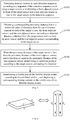
- FIG. 3 is a flowchart of a method for controlling display of a flexible display screen provided by an exemplary embodiment, and the method includes the following steps.
- distance sensors in each detection sequence are traversed according to a sequence of the detection sequence. Each one is taken as a target sensor. A front adjacent sensor in front of the target sensor and a rear adjacent sensor in rear of the target sensor are obtained in the detection sequence.
- the processor sequentially detects A 1 , A 2 , ⁇ , A m -1 , A m , A m +1 , ⁇ , A n -1 , A n , A n +1 , ⁇ , of the distance sensors.
- the A m is a target sensor
- the A m -1 is the front adjacent sensor
- the A m +1 is the rear adjacent sensor.
- a corresponding proximity distance that is a minimum value of distances from the set of distance sensors to each of the target sensor, the front adjacent sensor, and the rear adjacent sensor is obtained according to detected distances obtained from the target sensor and the front adjacent sensor and the rear adjacent sensor corresponding to the target sensor.
- Each distance sensor may detect distances relative to the other distance sensors, and select the minimum value from the distances as a proximity distance of the distance sensor. It should be noted that, within the protection scope of the solution of the present disclosure, the flexible display screen is unfolding in a folded state, and the minimum value of the distances detected by the target sensor, the front adjacent sensor, and the rear adjacent sensor in a folded position is less than a distance d between distance sensors. When the minimum value of the distances detected by the distance sensor in the folding position is equal to the distance d, which does not belong to a condition that the flexible display screen is unfolding in the folded state, thus not performing the above method.
- proximity distances detected by some of distance sensors may change. For example, as illustrated in FIG. 4 , when the flexible display screen is folded along the side A, the side B of the flexible display screen coincides with the side C of the flexible display screen. At this time, the proximity distances detected by the overlapped distance sensors are 0, or when a gap in a folded state of the flexible display panel is greater than 0, there is still a fixed proximity distance corresponding to the minimum value of the distances that is a minimum distance when the flexible display screen is folded. In the following discussion, the minimum distance is defined as d 0 , such as 0.1mm. For another example, when a partial area of the flexible display panel is folded, as illustrated in FIG.
- the proximity distance detected by the distance sensors A m and A n adjacent to both sides of the side edge of the flexible display screen is different from the proximity distance in an initial state, thus the proximity distance detected by each distance sensor can be detected to determine whether the flexible display screen has been unfolded.
- FIG. 6 is a schematic view of the distance sensors.
- the preset distance d between the distance sensors is larger than the proximity distance between the distance sensors.
- the processor traverses the distance sensor A m as the target sensor in the detection sequence of the side A.
- the distance sensor closest to the distance sensor A m is A n
- the distance between the distance sensor A n and the distance sensor A m is the proximity distance of A m and A n .
- the distance between the distance sensor A m and the distance sensor A n is s 1
- the front adjacent sensor in front of the distance sensor A m is A m -1 .
- the distance sensor corresponding to the distance sensor A m -1 is A n +1 .
- a distance between the distance sensor A m -1 and the distance sensor A n +1 is s 2
- the proximity distance detected by the A m is s 2 .
- the rear adjacent sensor in back of the distance sensor A m is A m +1 .
- the distance sensor corresponding to the distance sensor A m +1 is A n -1 .
- a distance between the distance sensor A m +1 and the distance sensor A n -1 is s 3
- the proximity distance detected by the A m +1 is s 3 .
- the proximity distance of the target sensor A m is s 1 .
- the proximity distance of the front adjacent sensor A m -1 in front of the A m is s 2 .
- the proximity distance of the rear adjacent sensor A m +1 in back of the A m is s 3 .
- a visible area of the flexible display screen is determined according to the unfolded position, and a corresponding display content is displayed on the visible area of the flexible display screen.
- a first unfolded position where the target sensor is located among the detection sequence is obtained, and a second unfolded position where a distance sensor corresponding to the proximity distance of the target sensor is located among the detection sequence of the corresponding distance sensor is obtained.
- a position of the distance sensor A m (represented by the number m) is the first unfolded position, and a position of the distance sensor (represented by the number n) is the second unfolded position.
- a connecting line between the two unfolded positions is a connecting line between the distance sensor A m (or the distance sensor A n ) and the distance sensor D m (or the distance sensor D n ), that is a unfolded boundary of the flexible display screen.
- the target sensor and the distance sensor corresponding to the proximity distance may be located in the same detection sequence.
- the target sensor is A m
- the distance sensor corresponding to the proximity distance is A n
- both are located on the side A.
- the distance sensor D m and the distance sensor D n in the figure are located in the same detection sequence.
- a target sensor and a distance sensor corresponding to the proximity distance may be located in different detection sequences.
- the target sensor is A m .
- the distance sensor corresponding to the proximity distance is A n .
- Both the target sensor A m and the distance sensor A n are located on the side A.
- the target sensor is B m .
- the distance sensor corresponding to the proximity distance is C m .
- the target sensor B m is located on the side B, and the distance sensor C m is located on the side C.
- the flexible display screen is square, the flexible display screen is folded diagonally. At this case, one group of the unfolding positions is correspondingly located on the side A and the side B, and the other group of the unfolded positions is correspondingly located on the side C and the side D.
- a first unfolded boundary is determined according to the first unfolded position.
- the second unfolded boundary is determined according to the second unfolded position.
- the first unfolded boundary is disjoint from the second unfolded boundary.
- a visible area of the flexible display screen is determined, which is enclosed by the first unfolded boundary and the side edges of the flexible display screen.
- a visible area of the flexible display screen is determined, which is enclosed by the second unfolded boundary and the side edges of the flexible display screen.
- a connecting line between the first unfolded positions is a connecting line between the A m and the D m , which is the first unfolded boundary.
- a connecting line between the second unfolded positions is a connecting line between the A n and the D n , which is the second unfolded boundary.
- the first unfolded boundary is disjoint from the second unfolded boundary.
- a visible area is enclosed by the first unfolded boundary that the connecting line between the A m and the D m , and the sides A, B, and D of the flexible display screen.
- a visible area is enclosed by the second unfolded boundary that the connecting line between the A n and the D n , and the sides A, C, and D of the flexible display screen.
- 20 distance sensors are arranged on the side A and the side D, respectively, which are numbered 1 ⁇ 20.
- a 1 and D 1 are the distance sensors closest to the side B.
- a 20 and D 20 are the distance sensors closest to the side C.
- the first unfolded positions arrange A 5 and D 5
- the second unfolding positions arrange A 16 and D 16 .
- the visible areas are the area enclosed by the connecting line between A 5 and D 5 and the sides A, B, and D, and the area enclosed by the connecting line between A 16 and D 16 and the sides A, C, and D.
- the first unfolded position of the A m and the second unfolded position of the A n are the same as the above case.
- the first unfolded position located at the side B arranges the distance sensor B m
- the second unfolded position located at the side C arranges the distance sensor C m .
- a numbering sequence of the distance sensors is B 1 , B 2 , ⁇ , B m , ⁇ .
- the numbering sequence is the same as the traversed sequence in the detection.
- a numbering sequence of the distance sensors is C 1 , C 2 , ⁇ , C m , ⁇ .
- a connecting line between the first unfolded positions is a first unfolded boundary.
- a connecting line between the second unfolded positions is a second unfolded boundary.
- the first unfolded boundary is disjoint from the second unfolded boundary.
- Avisible area is determined, which is enclosed by the first unfolded boundary connecting the A m and the B m , and the sides A and B of the flexible display screen.
- a visible area is determined, which is enclosed by the second unfolded boundary connecting the A n and the C m , and the sides A and C of the flexible display screen.
- a 1 is a distance sensor closest to the side B.
- a 20 is a distance sensor closest to the side C.
- B 1 and C 1 are distance sensors closest to the side A.
- B 20 and C 20 are distance sensors closest to the side D.
- the first unfolded positions arrange A 6 and B 5
- the second unfolding positions arrange A 14 and C 5 .
- the visible areas are the area enclosed by a connecting line between the A 6 and the B 5 , and the sides A and B, and the area enclosed by a connecting line between the A 14 and the C 5 , and the sides A and C.
- the sequence of the numbers may be in ascending or descending order, providing that the sequence follows a certain order.
- the first unfolded boundary is determined according to two first unfolded positions of the two groups of unfolded positions
- the second unfolded boundary is determined according to two second unfolded positions of the two groups of unfolded positions. It is not limited to the examples provided in the embodiments of the present disclosure, and the first unfolding boundary and the second unfolding boundary may also be determined by the following methods providing that the first unfolding boundary is disjoint from the second unfolding boundary.
- the visible areas include the area enclosed by the first unfolded boundary and side edges of the flexible display screen, and the area enclosed by the second unfolded boundary and side edges of the flexible display screen, the side edges and the side edges of the flexible display screen being selected preferably such that the side edges and the side edges respectively includes intersects and may form an enclosed area with the first unfolded boundary and the second unfolded boundary.
- the target sensor is A m
- the distance sensor corresponding to the proximity distance is A n .
- a threshold is set to ignore the misoperation.
- a distance sensor has a proximity distance of 5 mm
- a first threshold is set to be 10 mm.
- the second unfolded position when the second unfolded position is greater than a second sequence position threshold, it is determined that the second unfolded position is invalid.
- the target sensor is A m
- the distance sensor corresponding to the proximity distance is A n .
- a threshold is set to ignore the misoperation. For example, a distance sensor has a proximity distance of 5 mm, and the set second threshold is set to be 10 mm.
- the second unfolded position detected at this time is invalid, thus avoiding lighting the flexible display screen due to the misoperation, and decreasing power consumption.
- the distance sensor corresponding to the proximity distance of the front adjacent sensor is not the target sensor, it is determined that whether the proximity distance of the front adjacent sensor is greater than the distance threshold, and if so, the step of determining the unfolded position according to the target sensor is performed. Taking FIG. 6 as an example, when the distance sensor A m is the target sensor, the front adjacent sensor is A m -1 .
- a distance sensor corresponding to the proximity distance of the front adjacent sensor A m -1 is A n +1 .
- the step of determining the unfolded position according to the target sensor is performed.
- the distance s 2 is less than the preset distance threshold, an unfolded distance of the flexible display screen is relatively small, which may be caused by misoperation.
- the flexible display screen may be kept from being lightened due to misoperation, thus decreasing power consumption.
- an unfolded angle is calculated according to the proximity distance of the front adjacent sensor and the distance between the front adjacent sensor and the target sensor.
- the unfolded angle is greater than an angle threshold
- the step of determining the unfolded position according to the target sensor is performed.
- the unfolded angle threshold is set to be 10°
- the calculated unfolded angle is 8°.
- the unfolded angle of the flexible display screen expands can be calculated by the following steps.
- the distance sensor A m and the distance sensor A n are located at the unfolded points, and a distance between them is s 4 .
- a distance between the adjacent distance sensor A m -1 and the distance sensor A n +1 is s 5 .
- a distance between the distance sensor A m -1 and the distance sensor A m is s 3 .
- the area computing method of the visible area of the flexible display screen varies with different shapes of the visible area.
- the visible area is trapezoidal.
- the length of each of the side B and the side C of the flexible display screen is b, and the unfolded points arrange the distance sensors A m , A n , D m , and D n .
- a distance between the distance sensor A m and the side B is s 1 .
- a distance between the distance sensor A n and the side C is s 2 .
- a distance between the distance sensor D m and the side B is s 3 .
- a distance between the distance sensor D n and the side C is s 4 .
- the visible area is substantially a triangle, and the unfolded points arrange the distance sensors A m , A n , B m , C m .
- a distance between the side B and the distance sensor A m is s 1 .
- Adistance between the side C and the distance sensor A n is s 2 .
- a distance between the side D and the distance sensor B m is s 5 .
- a distance between the side D and the distance sensor C m is s 6 .
- the shape of the visible area and the corresponding calculating method of the area are not limited to the examples given in the embodiment.
- an unfolded area of the flexible display screen is smaller than a preset area threshold which is assumed to be 5cm 2
- the unfolded area of the visible area at this time is 0.5cm 2 , which is smaller than the preset area threshold.
- the unfolded operation at this time is an invalid operation, thus eliminating the unfolding of the flexible display screen due to the misoperation, and thereby avoiding power loss caused by lighting up the flexible display screen.
- the recommended display content may be a menu, a control panel, a content of an extended current page or a control member manipulating the current page.
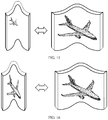
- the recommended display content may be a graphic card, a text box, a comment area, a page content of an up level of the current page, a page content of a low level of the current page, and the like. For example, as illustrated in FIG. 13 , when the area of the visible area is small, only a few icons, and basic applications such as a call function are displayed. As illustrated in FIG.
- the flexible display screen may display different contents with the change of the area of the visible area.
- a common photo album function as an example, when the visible area is relatively small, a thumbnail of a photo is displayed; when the area of the view area is relatively large, a clear image of a specific photo is displayed, as illustrated in FIG. 15 .
- the flexible display screen when the flexible display screen is unfolded to change the visible area, the displayed picture may have different deformation effects as the gesture changes, as illustrated in FIG. 16 . According to the size of different visible areas, different content can be displayed, thus increasing the diversity in the use of flexible display, and thereby enriching the display content.
- different contents can be displayed by calculating a rate of change of the visible area. For example, when an unfolding operation of the flexible display screen becomes faster, a browsing speed of replacing pictures may also become faster correspondingly. When the unfolding operation of the flexible display screen becomes slower, the browsing speed of replacing the pictures may also become slower correspondingly, thus enriching an operation of the flexible display screen.
- different display contents can also be set according to an unfolded angle of the flexible display screen.
- the current application is an e-book reader.
- different books recently read are displayed and a page skip is performed in response to finger clicking.
- a chapter content of the book is displayed.
- different contents can be displayed, thus increasing the diversity in the use of flexible display screen, and enriching the display content.
- different contents can be set by calculating a rate of changing the unfolded angle of the flexible display screen.
- a page-turning speed of the current reading interface is also fast relatively.
- the page-turning speed of the current reading interface is also slow relatively.
- fonts of the current reading interface are enlarged.
- the fonts of the reading interface is reduced.
- a page-turning direction may also be set according to different change trends of the angle. For example, when the angle of the visible area is gradually increased, the page is turned backwards; when the angle of the visible area is gradually decreased, the page is turned forwards.
- different display contents can also be set according to an unfolded curvature of the flexible display screen.
- the detected distance s 1 between the A m and the A n the detected distance s 2 between the A m -1 and the A n +1 , and the detected distance s 3 between the A m -2 and the A n +2 , whether s 1 , s 2 , and s 3 are changed in a linear trend is determined, and a curvature of the visible area is calculated, thus displaying different display contents.
- s 1 4mm
- s 2 6mm
- s 3 8mm.
- s 1 , s 2 , and s 3 are changed in a linear fashion. It is assumed that the preset display content corresponding to the linear-fashion trend corresponds to enlarging fonts on the flexible display screen, and the display content corresponding to a certain curvature corresponds to zooming fonts on the flexible display screen according to the curvature, then the displayed fonts on the flexible display screen is enlarged. Different display contents are displayed in response to determining different curvatures of the visible area, thus increasing the diversity in the use of the flexible display screen, and enriching the displayed contents.
- a controller presets display contents for different shapes (such as rectangle, and triangle) of the visible area according to the current application interface.
- the display contents may include a control, a directory, a content window, a status window, and the like, which are not limitative.
- an unfolded gesture is detected, different contents are displayed according to the current interface and the determined visible area.
- the visible area is a triangular area, a separate and simple control may be displayed appropriately, such as an operation button, a selector.
- the visible area is a long strip area, a list of a menu directory, a text box, and an app quick entry, a status bar, and the like can be displayed.
- the visible area is a large square area, more complex interfaces can be displayed, such as a widget, a graphic card, a complicated control panel, a video player, an interface of a second application.
- an unfolding gesture is detected during reading, and a control member of the page turning is displayed on the visible area.
- the number of pages represented by a sliding distance of the finger is determined. For example, when the total number of pages of the book that the user is currently reading is 300, the total width of the visible area is 12cm, the page of the book that the user is currently reading is on page 80, and it determines that the sliding distance of the user is 2cm according to a distance detected by a distance sensor, then the corresponding number of the page turning is 50.
- a direction of the page turning can be set according to a sliding direction of the user's finger. For example, when the user's finger slides to the right, the book is turned backward to the 130th page. When the user's finger slides to the left, the book is turned forward to the 30th page.
- a multimedia application when a multimedia application is applied to play a movie, a movie comment information, a setting of a volume subtitle, a movie control panel, and the like are displayed in response to turned gestures.
- a control member When the multimedia application is applied to show an image, a control member adjusting the image, a sharing option, and the like are displayed in response to the turned gestures.
- a setting of a sorting order, a quick jump, and the like are displayed in response to the turned gestures.
- an app quick entry, a desktop widget, a real-time information, and the like are displayed in response to the turned gestures.
- different control members are set according to the shape of the visible area, and gesture operations is added, thus displaying different display contents, enriching the function of the flexible display screen, and improving the user's operating experience.
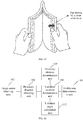
- a device for controlling display of a flexible display screen includes a target sensor obtaining unit 102, a proximity distance obtaining unit 104, an unfolded position determination unit 106, a visible area determination unit 108, a proximity distance determination unit 110, and an unfolded angle calculation unit 112.
- the target sensor obtaining unit 102 is configured to traverse distance sensors in each detection sequence according to a sequence of the detection sequence, take each one as a target sensor, and obtain a front adjacent sensor in front of the target sensor and a rear adjacent sensor in the rear of the target sensor in the detection sequence.
- the proximity distance obtaining unit 104 is configured to obtain a corresponding proximity distance that is a minimum value of distances from the set of distance sensors to each of the target sensor, the front adjacent sensor, and the rear adjacent sensor according to detected distances obtained from the target sensor and the front adjacent sensor and the rear adjacent sensor corresponding to the target sensor.
- the unfolded position determination unit 106 is configured to, when the proximity distance of the target sensor is less than the proximity distance of the front adjacent sensor, and is less than or equal to the proximity distance of the rear adjacent sensor, determine an unfolded position according to the target sensor, and end the traversal.
- the visible area determination unit 108 is configured to determine a visible area of the flexible display screen according to the unfolded position, and display a corresponding display content on the visible area of the flexible display screen.
- the folded position corresponding to the target sensor includes a first unfolded position and a second unfolded position.
- the unfolded position determination unit 106 is further configured to obtain the first unfolded position where the target sensor is located among the detection sequence, and obtain the second unfolded position where the distance sensor corresponding to the proximity distance of the target sensor is located among the detection sequence of the corresponding distance sensor.
- the visible area determination unit 108 is further configured to determine a first unfolded boundary according to the first unfolded position, determine a second unfolded boundary according to the second unfolded position. The first unfolded boundary is disjoint from the second unfolded boundary. the visible area determination unit 108 is further configured to determine a visible area of the flexible display screen which is enclosed by the first unfolded boundary and the side edges of the flexible display screen; and determine a visible area of the flexible display screen which is enclosed by the second unfolded boundary and the side edges of the flexible display screen as the visible area of the flexible display screen.
- the unfolded position determination unit 106 is further configured to, when the first unfolded position is less than a first sequence position threshold, determine the first unfolded position is invalid; or when the second unfolded position is greater than a second sequence position threshold, determine the second unfolded position is invalid.
- the distance sensor corresponding to the proximity distance of the target sensor and the target sensor belong to the same detection sequence; or the distance sensor corresponding to the proximity distance of the target sensor and the target sensor belong to the different detection sequences.
- the device further includes a proximity distance determination unit 110 configured to, when the distance sensor corresponding to the proximity distance of the front adjacent sensor is not the target sensor, determine whether the proximity distance of the front adjacent sensor is greater than a distance threshold, and if yes, perform the step of determining the unfolded position according to the target sensor.
- a proximity distance determination unit 110 configured to, when the distance sensor corresponding to the proximity distance of the front adjacent sensor is not the target sensor, determine whether the proximity distance of the front adjacent sensor is greater than a distance threshold, and if yes, perform the step of determining the unfolded position according to the target sensor.
- the device further includes an unfolded angle calculation unit 112 configured to, when the distance sensor corresponding to the proximity distance of the front adjacent sensor is not the target sensor, calculate an unfolded angle according to the proximity distance of the front adjacent sensor and a distance between the front adjacent sensor and the target sensor, and when the unfolded angle is greater than an angle threshold, perform the step of determining the unfolded position according to the target sensor.
- an unfolded angle calculation unit 112 configured to, when the distance sensor corresponding to the proximity distance of the front adjacent sensor is not the target sensor, calculate an unfolded angle according to the proximity distance of the front adjacent sensor and a distance between the front adjacent sensor and the target sensor, and when the unfolded angle is greater than an angle threshold, perform the step of determining the unfolded position according to the target sensor.
- the visible area determination unit 108 is configured to calculate an area of the visible area; and when the area of the visible area is greater than or equal to a preset area threshold, perform the step of displaying the corresponding display content on the visible area of the flexible display screen.
- distance sensors are uniformly distributed around the side edges or adjacent to the side edges of a flexible display screen.
- an unfolded position of an unfolded boundary is obtained by detected distances of the distance sensors, thus determining a visible area of the flexible display screen according to the unfolded position of the folding boundary and the unfolded direction.
- the visible area is gradually increased by unfolding the flexible display screen, the visible area is correspondingly displayed, the folded part of the flexible display screen is continuously unfolding, the visible area is gradually increased, a corresponding display area is also gradually increased, and a display function of the invisible area can be turned off, thus reducing energy consumption.
- a detection of unfolding the visible area can be combined with different functional interfaces, thus improving the user's operating experience.
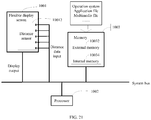
- FIG. 21 illustrates a terminal device 10 of a computer system based on a von Neumann Computer system which operates the above method for controlling display of the flexible display screen.
- the computer system can be a terminal device, such as a smart phone, a tablet, a palmtop, a laptop, or a personal computer.
- the computer system 10 further includes a flexible display screen 1001, a processor 1002, and a memory 1003, which are connected with each other by a system bus.
- the flexible display screen 1001 can alternatively include at least a distance sensor 10012.
- the memory 1003 may include an external memory 10032 (such as, a hard disk, an optical disk, or a floppy disk) and an internal memory 10034.
- the processor 1002 is further configured to perform the above method for controlling the display of the flexible display screen. The method includes the following steps.
- Distance sensors in each detection sequence is traversed according to a sequence of the detection sequence, each one is taken as a target sensor, and a front adjacent sensor in front of the target sensor and a rear adjacent sensor in rear of the target sensor is obtained in the detection sequence.
- a corresponding proximity distance that is a minimum value of distances from the set of distance sensors to each of the target sensor, the front adjacent sensor, and the rear adjacent sensor is obtained according to detected distances obtained from the target sensor and the front adjacent sensor and the rear adjacent sensor corresponding to the target sensor.
- a visible area of the flexible display screen is determined according to the unfolded position, and a corresponding display content is displayed on the visible area of the flexible display screen.
- the unfolded position corresponding to the target sensor includes a first unfolded position and a second unfolded position. Determining the unfolded position according to the target sensor includes the following steps.
- the first unfolded position where the target sensor is located among the detection sequence is obtained.
- the second unfolded position where a distance sensor corresponding to the proximity distance of the target sensor is located among the detection sequence of the corresponding distance sensor is obtained.
- determining the visible area of the flexible display screen according to the unfolded position includes the following steps.
- a first unfolded boundary is determined according to the first unfolded position
- a second unfolded boundary is determined according to the second unfolded position
- the first unfolded boundary is disjoint from the second unfolded boundary.
- determining the unfolded position according to the target sensor includes the following steps.
- first unfolded position When the first unfolded position is less than a first sequence position threshold, the first unfolded position is determined to be invalid; or when the second unfolded position is greater than a second sequence position threshold, the second unfolded position is determined to be invalid.
- the distance sensor corresponding to the proximity distance of the target sensor and the target sensor belong to the same detection sequence; or the distance sensor corresponding to the proximity distance of the target sensor and the target sensor belong to the different detection sequences.
- the method before determining the unfolded position according to the target sensor, the method further includes the following steps.
- the distance sensor corresponding to the proximity distance of the front adjacent sensor determines whether the proximity distance of the front adjacent sensor is greater than a distance threshold, and if yes, the step of determining the unfolded position according to the target sensor is performed.
- the method before determining the unfolded position according to the target sensor, the method further includes the following steps.
- an unfolded angle is calculated according to the proximity distance of the front adjacent sensor and a distance between the front adjacent sensor and the target sensor, and when the unfolded angle is greater than an angle threshold, the step of determining the unfolded position according to the target sensor is performed.
- the method further includes the following steps.
- An area of the visible area is calculated.
- the step of displaying the corresponding display content on the visible area of the flexible display screen is performed.
- the method is run based on the computer program.
- Program files of the computer program are stored in the external memory 10032 of the above computer system 10 based on a von Neumann Computer system, which are loaded into the internal memory 10034 at runtime, compiled into a machine code, and then transmitted to the processor 1002 for processing, thus forming the logical target sensor obtaining unit 102, proximity distance obtaining unit 104, unfolded position determination unit 106, visible area determination unit 108, proximity distance determination unit 110, and unfolded angle calculation unit 112 in the computer system 10 based on the von Neumann Computer system.
- a distance parameter obtained by the distance sensor is transmitted to the memory 1003 for caching, and then input to the processor 1002 for processing.
- the processed result data is cached in the memory 1003 for subsequent processing, or transmitted to the flexible display screen 1001 for display.
Landscapes
- Engineering & Computer Science (AREA)
- Theoretical Computer Science (AREA)
- Physics & Mathematics (AREA)
- General Physics & Mathematics (AREA)
- General Engineering & Computer Science (AREA)
- Computer Hardware Design (AREA)
- Human Computer Interaction (AREA)
- Controls And Circuits For Display Device (AREA)
- User Interface Of Digital Computer (AREA)
Abstract
A method for controlling display of a flexible display screen includes: traversing distance sensors (A 1 ··· , A m-1, Am , A m+1, ···, A n-1, An, A n+1, ···,) in each detection sequence according to a sequence of the detection sequence, each being a target sensor (Am ), and obtaining a front adjacent sensor (A m-1) in front of the target sensor (Am ) and a rear adjacent sensor (A m+1) in rear of the target sensor (Am ) in the detection sequence; obtaining a corresponding proximity distance (s 1, s 2, s 3) of the target sensor (Am ), the front adjacent sensor (A m-1), and the rear adjacent sensor (A m+1); when the proximity distance (s 1) of the target sensor (Am ) is less than the proximity distance (s 2) of the front adjacent sensor (A m-1), and is less than or equal to the proximity distance (s 3) of the rear adjacent sensor (A m+1), determining an unfolded position according to the target sensor (Am ); and ending the traversal; determining a visible area of the flexible display screen according to the unfolded position, and displaying a corresponding display content on the visible area of the flexible display screen. Only a part of the visible area can be displayed by adopting the present disclosure in an unfolded process of the flexible display screen, thus reducing energy consumption.
Description
- The present disclosure relates to the technical field of a flexible display screen, and more particularly to a method and device for controlling display of a flexible display screen.
- Currently, common interactive modes of electronic devices include touch and click interaction. With the rise of flexible display screens in recent years, it will bring possibilities of many new gestures, and gesture interactions may be more intuitive and easy to use. Most of the existing flexible display screens use flexible OLED technology, which have bendable, twistable and foldable characteristics, thus a high-resolution and large-sized area and the portability of the devices may be no longer contradictory, durable programs may be also significantly higher than previous screens, and a probability of accidental damage of the device may be reduced.
- In a normal state, a flexible display device consumes a large amount of energy, and the greatest electricity component is a flexible display screen. When the flexible display device is turned on, the flexible display screen remains open. When the flexible display screen is partially folded, the folded area is not visible, but the flexible display screen corresponding to the folded area still on, thus consuming power, and increasing the overall energy consumption of flexible display screen.
- In addition, the flexible display is turned on not only in a folded state but also in an unfolded state; an executable human-computer interaction mode is relatively monotonous; and the user experience is poor.
- An exemplary embodiment of the present disclosure provides a method for controlling display of a flexible display screen, to solve a technical problem that the flexible display screen consumes a large amount of energy.
- A method for controlling display of a flexible display screen, which is performed by a processor; the processor is coupled to a set of distance sensors distributed around side edges of the flexible display screen; the distance sensors are sequentially arranged around the side edges of the flexible display screen to form detection sequences corresponding to the side edges; and the method includes:
- traversing the distance sensors in each the detection sequence according to a sequence of the detection sequence, each being a target sensor, and obtaining a front adjacent sensor in front of the target sensor and a rear adjacent sensor in rear of the target sensor in the detection sequence;
- obtaining a corresponding proximity distance that is a minimum value of distances from the set of distance sensors to each of the target sensor, the front adjacent sensor, and the rear adjacent sensor according to detected distances obtained from the target sensor and the front adjacent sensor and the rear adjacent sensor corresponding to the target sensor;
- when the proximity distance of the target sensor is less than the proximity distance of the front adjacent sensor, and is less than or equal to the proximity distance of the rear adjacent sensor, determining an unfolded position according to the target sensor; and ending the traversal; and
- determining a visible area of the flexible display screen according to the unfolded position, and displaying a corresponding display content on the visible area of the flexible display screen.
- In addition, an exemplary embodiment of the present disclosure further provides a device for controlling display of a flexible display screen, including:
- a target sensor obtaining unit configured to traverse distance sensors in each detection sequence according to a sequence of the detection sequence, take each one as a target sensor, and obtain a front adjacent sensor in front of the target sensor and a rear adjacent sensor in rear the target sensor in the detection sequence;
- an proximity distance obtaining unit configured to obtain a corresponding proximity distance that is a minimum value of distances from the set of distance sensors to each of the target sensor, the front adjacent sensor, and the rear adjacent sensor according to detected distances obtained from the target sensor and the front adjacent sensor and the rear adjacent sensor corresponding to the target sensor;
- an unfolded position determination unit configured to, when the proximity distance of the target sensor is less than the proximity distance of the front adjacent sensor, and is less than or equal to the proximity distance of the rear adjacent sensor, determine an unfolded position according to the target sensor; and end the traversal; and
- a visible area determination unit configured to determine a visible area of the flexible display screen according to the unfolded position, and display a corresponding display content on the visible area of the flexible display screen.
- In the embodiment of the present disclosure, distance sensors are uniformly distributed around side edges or adjacent to the side edges of a flexible display screen. In an unfolded process of the flexible display screen, an unfolded position of an unfolded boundary is obtained by detected distances of the distance sensors, thus determining a visible area of the flexible display screen in the unfolded process. In the unfolded process of the flexible display screen, the visible area is gradually increased by unfolding the flexible display screen, the visible area is correspondingly displayed, the folded part of the flexible display screen is continuously unfolding, the visible area is gradually increased, a corresponding display area is also gradually increased, and a display function of the invisible area can be turned off, thus reducing energy consumption. In addition, a detection of unfolding the visible area can be combined with different functional interfaces, thus improving the user's operating experience.
- In order to more clearly illustrate the technical solution of the present disclosure, the accompanying drawings required for describing the embodiments will be briefly described below. Apparently, the accompanying drawings in the following description are merely the embodiments of the present disclosure, and other drawings may be obtained by those skilled in the art according to these accompanying drawings without paying any creative labor.
-
FIG. 1 is a schematic view of a flexible display screen provided by an exemplary embodiment of the present disclosure. -
FIG. 2 is a schematic view of a flexible display screen provided by an exemplary embodiment of the present disclosure. -
FIG. 3 is a flowchart of a method for controlling display of a flexible display screen provided by an exemplary embodiment of the present disclosure. -
FIG. 4 is a schematic view of a flexible display screen in a folded state provided by an exemplary embodiment of the present disclosure. -
FIG. 5 is a schematic view of a flexible display screen in a partially unfolded state provided by an exemplary embodiment of the present disclosure. -
FIG. 6 is a schematic view of a flexible display screen provided by an exemplary embodiment of the present disclosure. -
FIG. 7 is a schematic view of a flexible display screen provided by an exemplary embodiment of the present disclosure. -
FIG. 8 is a schematic view of a visible area of a flexible display screen provided by an exemplary embodiment of the present disclosure. -
FIG. 9 is a schematic view of a visible area of a flexible display screen provided by an exemplary embodiment of the present disclosure. -
FIG. 10 is a schematic view of a flexible display screen in a partially unfolded state provided by an exemplary embodiment of the present disclosure. -
FIG. 11 is a schematic view of a visible area of a flexible display screen provided by an exemplary embodiment of the present disclosure. -
FIG. 12 is a schematic view of a flexible display screen in a partially unfolded state provided by an exemplary embodiment of the present disclosure. -
FIG. 13 is a schematic view of a display interface in a partially unfolded state of a flexible display screen provided by an exemplary embodiment of the present disclosure. -
FIG. 14 is a schematic view of a display interface in a partially unfolded state of a flexible display screen provided by an exemplary embodiment of the present disclosure. -
FIG. 15 is a schematic view of a display interface in a partially unfolded state of a flexible display screen provided by an exemplary embodiment of the present disclosure. -
FIG. 16 is a schematic view of a display interface in a partially unfolded state of a flexible display screen provided by an exemplary embodiment of the present disclosure. -
FIG. 17 is a schematic view of a flexible display screen in a partially unfolded state provided by an exemplary embodiment of the present disclosure. -
FIG. 18 is a schematic view of a flexible display screen in a partially unfolded state provided by an exemplary embodiment of the present disclosure. -
FIG. 19 is a schematic view of a flexible display screen in a partially unfolded state provided by an exemplary embodiment of the present disclosure. -
FIG. 20 is a structural schematic view of a device for controlling display of a flexible display screen provided by an exemplary embodiment of the present disclosure. -
FIG. 21 is a hardware architecture view of a computer system operating the above method for controlling display of the flexible display screen provided by an exemplary embodiment of the present disclosure. - The technical solutions in the embodiments of the present disclosure will be clearly and completely described below with reference to the accompanying drawings in the embodiments of the present disclosure. Apparently, the described embodiments are merely some but not all of the embodiments of the present disclosure. All other embodiments obtained by a person of ordinary skill in the art based on the embodiments of the present disclosure without creative efforts shall fall within the protection scope of the present disclosure.
- In an exemplary embodiment, a method for controlling display of a flexible display screen is provided. An implementation of the method may rely on a computer program. The computer program may be a driver manager or a virtual device manager of the flexible display screen. The computer program can run on a computer system based on a von Neumann Computer system. The computer program can be a terminal device with the flexible display screen, such as a personal computer, a notebook computer, a tablet computer, and a smart phone.
- In the embodiment, the flexible display screen may be a transformable and flexible display device made from a soft material. As illustrated in
FIG. 1 , a schematic view of a flexible display screen is shown. Distance sensors are uniformly distributed around side edges or adjacent to the side edges of the flexible display screen. In the embodiment,FIG. 1 is only a schematic view for briefly introducing the flexible display screen. The number and specific positions of the distance sensors may be determined as necessary, but not limitative. Each of the distance sensors is also named as a displacement sensor, principle being that a physical variation of an object is detected by various elements, and a distance between the detecting sensor and the object is measured by converting the variation into the distance. The distance sensors can be classified into an optical distance sensor, a linear proximity sensor, an ultrasonic distance sensor, and the like according to different components. In the embodiment, the optical distance sensor is taken as an example to illustrate the method. A signal transmitting end of the distance sensor transmits a pulsed infrared light signal to other distance sensors, records the time it takes to transmit the light pulses and have the light pulses received, thus detecting a distance from other distance sensors. - The processor is coupled to a set of distance sensors distributed around side edges of the flexible display screen, and the distance sensors is sequentially arranged on the side edges of the flexible display screen to form detection sequences corresponding to the side edges. When the distance sensors are arranged on the flexible display, the processor may record a position and sequence number of each of the distance sensors, and a distance between adjacent distance sensors can be the same or different. As illustrated in
FIG. 2 , in the embodiment,FIG. 2 is a schematic view of the distance sensors arranged on the flexible display screen. In the embodiment, the flexible display screen is rectangular. In other embodiments, the flexible display screen may also be polygonal, circular, elliptical, and the like. - In the embodiment, four sides of the flexible display screen are respectively defined as A, B, C, and D, and the distance sensors on each side are sequentially numbered, for example, A 1, A 2, ···, A m-1, Am , A m+1, ···, A n-1, An , A n+1, ···, B 1, B 2, ···, B m-1, Bm , B m+1, ···, B n-1, Bn , B n+1, ···, and a distance between two adjacent distance sensors is set to d.
- As illustrated in
FIG. 3, FIG. 3 is a flowchart of a method for controlling display of a flexible display screen provided by an exemplary embodiment, and the method includes the following steps. - At block S102, distance sensors in each detection sequence are traversed according to a sequence of the detection sequence. Each one is taken as a target sensor. A front adjacent sensor in front of the target sensor and a rear adjacent sensor in rear of the target sensor are obtained in the detection sequence.
- That is, the side A of the flexible display screen is taken as an example to illustrate the method. The processor sequentially detects A 1, A 2, ···, A m-1, Am , A m+1, ···, A n-1, An , A n+1, ···, of the distance sensors. When the Am is detected, the Am is a target sensor, the A m-1 is the front adjacent sensor, and the A m+1 is the rear adjacent sensor.
- At block S104, a corresponding proximity distance that is a minimum value of distances from the set of distance sensors to each of the target sensor, the front adjacent sensor, and the rear adjacent sensor is obtained according to detected distances obtained from the target sensor and the front adjacent sensor and the rear adjacent sensor corresponding to the target sensor.
- Each distance sensor may detect distances relative to the other distance sensors, and select the minimum value from the distances as a proximity distance of the distance sensor. It should be noted that, within the protection scope of the solution of the present disclosure, the flexible display screen is unfolding in a folded state, and the minimum value of the distances detected by the target sensor, the front adjacent sensor, and the rear adjacent sensor in a folded position is less than a distance d between distance sensors. When the minimum value of the distances detected by the distance sensor in the folding position is equal to the distance d, which does not belong to a condition that the flexible display screen is unfolding in the folded state, thus not performing the above method.
- When the flexible display screen is folded, proximity distances detected by some of distance sensors may change. For example, as illustrated in
FIG. 4 , when the flexible display screen is folded along the side A, the side B of the flexible display screen coincides with the side C of the flexible display screen. At this time, the proximity distances detected by the overlapped distance sensors are 0, or when a gap in a folded state of the flexible display panel is greater than 0, there is still a fixed proximity distance corresponding to the minimum value of the distances that is a minimum distance when the flexible display screen is folded. In the following discussion, the minimum distance is defined as d 0, such as 0.1mm. For another example, when a partial area of the flexible display panel is folded, as illustrated inFIG. 5 , partial areas along the side A and the side D are overlapped, and the proximity distances detected by the overlapped distance sensors are d 0. For the distance sensors (here is Am and An ) at a critical point adjacent to the folded portion, when a distance s between Am and An is smaller than the preset distance d between the distance sensors, the proximity distance detected by Am and An is the distance s between Am and An . According to preset number sequences, it is determined whether the proximity distance detected by the distance sensors Am and An adjacent to both sides of the side edge of the flexible display screen is different from the proximity distance in an initial state, thus the proximity distance detected by each distance sensor can be detected to determine whether the flexible display screen has been unfolded. - As illustrated in
FIG. 6, FIG. 6 is a schematic view of the distance sensors. The preset distance d between the distance sensors is larger than the proximity distance between the distance sensors. At this time, the processor traverses the distance sensor Am as the target sensor in the detection sequence of the side A. When the flexible display screen is folded, the distance sensor closest to the distance sensor Am is An , and the distance between the distance sensor An and the distance sensor Am is the proximity distance of Am and An . When the distance between the distance sensor Am and the distance sensor An is s 1, and the preset distance d between the distance sensors is larger than the proximity distance between the distance sensors Am and An , such as d=10 mm, s 1=1 mm, and the proximity distance detected by the Am is s 1. The front adjacent sensor in front of the distance sensor Am is A m-1 . When the flexible display screen is folded, the distance sensor corresponding to the distance sensor A m-1 is A n+1. A distance between the distance sensor A m-1 and the distance sensor A n+1 is s 2, and the proximity distance detected by the Am is s 2. The rear adjacent sensor in back of the distance sensor Am is A m+1. When the flexible display screen is folded, the distance sensor corresponding to the distance sensor A m+1 is A n-1. A distance between the distance sensor A m+1 and the distance sensor A n-1 is s 3, and the proximity distance detected by the A m+1 is s 3. - Therefore, the proximity distance of the target sensor Am is s 1. The proximity distance of the front adjacent sensor A m-1 in front of the Am is s 2. The proximity distance of the rear adjacent sensor A m+1 in back of the Am is s 3.
- At block S106, when the proximity distance of the target sensor is smaller than the proximity distance of the front adjacent sensor, and is less than or equal to the proximity distance of the rear adjacent sensor, an unfolded position is determined according to the target sensor, and the traversal is ended.
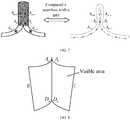
- That is, in the above embodiment, when s 1 < s 2 and s 1 ≤ s 3, it is determined that the distance sensor Am and the distance sensor An are located at the unfolded positions of the folded flexible display screen. As illustrated in
FIG. 7 , an unfolded process of the folded flexible display screen without gaps is illustrated at left inFIG. 7 , and the folded areas are completely overlapped, at this time, s 1 = s 3. An unfolded process of the folded flexible display screen with gaps is illustrated at right inFIG. 7 , and a gap is formed in the folded part of the flexible display screen, at this time, s 1 < s 3. - At block S108, a visible area of the flexible display screen is determined according to the unfolded position, and a corresponding display content is displayed on the visible area of the flexible display screen.
- In the embodiment, a first unfolded position where the target sensor is located among the detection sequence is obtained, and a second unfolded position where a distance sensor corresponding to the proximity distance of the target sensor is located among the detection sequence of the corresponding distance sensor is obtained.
- In above embodiment, a position of the distance sensor Am (represented by the number m) is the first unfolded position, and a position of the distance sensor (represented by the number n) is the second unfolded position.
- When the flexible display screen in a folded state is unfolded, unfolded positions are formed on the two sides. The distance sensor Am and the distance sensor An are located at the first unfolded position and the second unfolded position, respectively. Correspondingly, when an unfolded area of the flexible display screen is a quadrilateral, the corresponding target sensors can also be found on the side D by the above method, that is, the distance sensor Dm and the distance sensor Dn are located at the first unfolded position and the second unfolded position, respectively as illustrated in
FIG. 8 . A connecting line between the two unfolded positions is a connecting line between the distance sensor Am (or the distance sensor An ) and the distance sensor Dm (or the distance sensor Dn ), that is a unfolded boundary of the flexible display screen. - In the embodiment, the target sensor and the distance sensor corresponding to the proximity distance may be located in the same detection sequence. For example, for a rectangular flexible display screen, still taking
FIG. 5 as an example, the target sensor is Am , the distance sensor corresponding to the proximity distance is An , and both are located on the side A. Similarly, the distance sensor Dm and the distance sensor Dn in the figure are located in the same detection sequence. - In another embodiment, a target sensor and a distance sensor corresponding to the proximity distance may be located in different detection sequences. For example, in
FIG. 9 , the target sensor is Am . The distance sensor corresponding to the proximity distance is An . Both the target sensor Am and the distance sensor An are located on the side A. The target sensor is Bm . The distance sensor corresponding to the proximity distance is Cm . The target sensor Bm is located on the side B, and the distance sensor Cm is located on the side C. For another example, when the flexible display screen is square, the flexible display screen is folded diagonally. At this case, one group of the unfolding positions is correspondingly located on the side A and the side B, and the other group of the unfolded positions is correspondingly located on the side C and the side D. - In the embodiment, a first unfolded boundary is determined according to the first unfolded position. The second unfolded boundary is determined according to the second unfolded position. The first unfolded boundary is disjoint from the second unfolded boundary. A visible area of the flexible display screen is determined, which is enclosed by the first unfolded boundary and the side edges of the flexible display screen. A visible area of the flexible display screen is determined, which is enclosed by the second unfolded boundary and the side edges of the flexible display screen.
- When the target sensor and the distance sensor corresponding to the proximity distance are located in the same detection sequence, for example, as illustrated in
FIG. 8 , there are two groups of unfolded positions, that is, the first unfolded positions arrange the distance sensor Am on the side A and the distance sensor Dm on the side D, respectively; and second unfolded positions arrange the distance sensor An on the side A and the distance sensor Dn on the side D, respectively. In the embodiment, a connecting line between the first unfolded positions is a connecting line between the Am and the Dm, which is the first unfolded boundary. A connecting line between the second unfolded positions is a connecting line between the An and the Dn , which is the second unfolded boundary. The first unfolded boundary is disjoint from the second unfolded boundary. A visible area is enclosed by the first unfolded boundary that the connecting line between the Am and the Dm, and the sides A, B, and D of the flexible display screen. A visible area is enclosed by the second unfolded boundary that the connecting line between the An and the Dn , and the sides A, C, and D of the flexible display screen. - For example, 20 distance sensors are arranged on the side A and the side D, respectively, which are numbered 1∼20. A 1 and D 1 are the distance sensors closest to the side B. A 20 and D 20 are the distance sensors closest to the side C. The first unfolded positions arrange A 5 and D 5, and the second unfolding positions arrange A 16 and D 16. The visible areas are the area enclosed by the connecting line between A 5 and D 5 and the sides A, B, and D, and the area enclosed by the connecting line between A 16 and D 16 and the sides A, C, and D.
- When the target sensor and the distance sensor corresponding to the proximity distance are located in different detection sequences, for example, as illustrated in
FIG. 9 , the first unfolded position of the Am and the second unfolded position of the An are the same as the above case. The first unfolded position located at the side B arranges the distance sensor Bm , and the second unfolded position located at the side C arranges the distance sensor Cm . At the side B, a numbering sequence of the distance sensors is B 1, B 2, ···, Bm , ···. The numbering sequence is the same as the traversed sequence in the detection. At the side C, a numbering sequence of the distance sensors is C1, C2, ···, Cm, ···. The numbering sequence is the same as the traversed sequence in the detection. At this time, in the embodiment, a connecting line between the first unfolded positions, that is a connecting line between the Am and the Bm , is a first unfolded boundary. A connecting line between the second unfolded positions, that is a connecting line between the An and the Cm , is a second unfolded boundary. The first unfolded boundary is disjoint from the second unfolded boundary. Avisible area is determined, which is enclosed by the first unfolded boundary connecting the Am and the Bm , and the sides A and B of the flexible display screen. A visible area is determined, which is enclosed by the second unfolded boundary connecting the An and the Cm , and the sides A and C of the flexible display screen. - For example, 20 distance sensors are respectively arranged on the sides A, B and C, which are numbered 1∼20 in sequence. A 1 is a distance sensor closest to the side B. A 20 is a distance sensor closest to the side C. B 1 and C 1 are distance sensors closest to the side A. B20 and C20 are distance sensors closest to the side D. The first unfolded positions arrange A 6 and B5, and the second unfolding positions arrange A 14 and C5. The visible areas are the area enclosed by a connecting line between the A 6 and the B5, and the sides A and B, and the area enclosed by a connecting line between the A 14 and the C5, and the sides A and C.
- It should be noted that, in the embodiment, the sequence of the numbers may be in ascending or descending order, providing that the sequence follows a certain order. After finding the first unfolded position and the second unfolded position according to the certain order, the first unfolded boundary is determined according to two first unfolded positions of the two groups of unfolded positions, and the second unfolded boundary is determined according to two second unfolded positions of the two groups of unfolded positions. It is not limited to the examples provided in the embodiments of the present disclosure, and the first unfolding boundary and the second unfolding boundary may also be determined by the following methods providing that the first unfolding boundary is disjoint from the second unfolding boundary. The visible areas include the area enclosed by the first unfolded boundary and side edges of the flexible display screen, and the area enclosed by the second unfolded boundary and side edges of the flexible display screen, the side edges and the side edges of the flexible display screen being selected preferably such that the side edges and the side edges respectively includes intersects and may form an enclosed area with the first unfolded boundary and the second unfolded boundary.
- In an exemplary embodiment, when the first unfolded position is less than a first sequence position threshold, it is determined that the first unfolded position is invalid. Taking
FIG. 5 and FIG. 6 as an example again, the target sensor is Am , and the distance sensor corresponding to the proximity distance is An . When the first unfolded position arranging Am is close to the side B, the edge of the flexible display screen may be slightly bent due to misoperation, and may not need to display content. At this time, a threshold is set to ignore the misoperation. For example, a distance sensor has a proximity distance of 5 mm, and a first threshold is set to be 10 mm. When the distance between the first unfolded position arranging Am and the side B is less than 10 mm, it is determined that the first unfolded position detected at this time is invalid, thus avoiding lightening the flexible display screen due to the misoperation, and decreasing power consumption. - Correspondingly, in an exemplary embodiment, when the second unfolded position is greater than a second sequence position threshold, it is determined that the second unfolded position is invalid. Taking
FIG. 5 and FIG. 6 as an example again, the target sensor is Am , and the distance sensor corresponding to the proximity distance is An . When the second unfolded position arranging An is close to the side C, the edge of the flexible display screen may be slightly bent due to the misoperation, and may not need to display content. At this time, a threshold is set to ignore the misoperation. For example, a distance sensor has a proximity distance of 5 mm, and the set second threshold is set to be 10 mm. When a distance between the second unfolded position arranging Am and the side C is less than 10 mm, it is determined that the second unfolded position detected at this time is invalid, thus avoiding lighting the flexible display screen due to the misoperation, and decreasing power consumption. In another exemplary embodiment, when the distance sensor corresponding to the proximity distance of the front adjacent sensor is not the target sensor, it is determined that whether the proximity distance of the front adjacent sensor is greater than the distance threshold, and if so, the step of determining the unfolded position according to the target sensor is performed. TakingFIG. 6 as an example, when the distance sensor Am is the target sensor, the front adjacent sensor is A m-1 . When the distance between the distance sensors Am and A m-1 is large than the proximity distance between the distance sensors. A distance sensor corresponding to the proximity distance of the front adjacent sensor A m-1 is A n+1 . When the distance s 2 of A m-1 and A n+1 is greater than the preset distance threshold, the step of determining the unfolded position according to the target sensor is performed. When the distance s 2 is less than the preset distance threshold, an unfolded distance of the flexible display screen is relatively small, which may be caused by misoperation. By using the method for determination, the flexible display screen may be kept from being lightened due to misoperation, thus decreasing power consumption. - In an exemplary embodiment, when the distance sensor corresponding to the proximity distance of the front adjacent sensor is not the target sensor, an unfolded angle is calculated according to the proximity distance of the front adjacent sensor and the distance between the front adjacent sensor and the target sensor. When the unfolded angle is greater than an angle threshold, the step of determining the unfolded position according to the target sensor is performed. For example, the unfolded angle threshold is set to be 10°, and the calculated unfolded angle is 8°. When the unfolded angle is less than the preset unfolded angle threshold, it is determined that the unfolded operation belongs to misoperation, thus avoiding lighting the flexible display screen due to the misoperation, and decreasing power consumption.
- The unfolded angle of the flexible display screen expands can be calculated by the following steps.
- As illustrated in
FIG. 10 , the distance sensor Am and the distance sensor An are located at the unfolded points, and a distance between them is s 4. A distance between the adjacent distance sensor A m-1 and the distance sensor A n+1 is s 5. A distance between the distance sensor A m-1 and the distance sensor Am is s 3. The unfolded angle α of the flexible display screen is calculated as:
- In an exemplary embodiment, when the area of the visible area on the flexible display screen is calculated, and the area of the visible area is greater than or equal to a preset area threshold, the content corresponding to an unfolded operation is displayed on the visible area of the flexible display screen. The area computing method of the visible area of the flexible display screen varies with different shapes of the visible area. When the flexible display screen is folded along the side A and the side D, as illustrated in
FIG. 11 , the visible area is trapezoidal. The length of each of the side B and the side C of the flexible display screen is b, and the unfolded points arrange the distance sensors Am , An , Dm, and Dn . A distance between the distance sensor Am and the side B is s 1. A distance between the distance sensor An and the side C is s 2. A distance between the distance sensor Dm and the side B is s 3. A distance between the distance sensor Dn and the side C is s 4. The area of the visible area is calculated as:

- When the flexible display screen is folded along the side A, the side B, and the side C, as illustrated in
FIG. 9 , the visible area is substantially a triangle, and the unfolded points arrange the distance sensors Am , An , Bm , Cm . A distance between the side B and the distance sensor Am is s 1. Adistance between the side C and the distance sensor An is s 2. A distance between the side D and the distance sensor Bm is s 5. A distance between the side D and the distance sensor Cm is s 6. The area of the visible area is:

- It should be noted that, in an actual condition, the shape of the visible area and the corresponding calculating method of the area are not limited to the examples given in the embodiment.
- In an exemplary embodiment, after calculating the area of the visible area, when the area of the visible area is smaller than a preset area threshold, it is determined that the unfolding operation is invalid for the flexible display screen, and the corresponding content is not displayed on the flexible display screen. For example, as illustrated in
FIG. 12 , an unfolded area of the flexible display screen is smaller than a preset area threshold which is assumed to be 5cm2, and the unfolded area of the visible area at this time is 0.5cm2, which is smaller than the preset area threshold. The unfolded operation at this time is an invalid operation, thus eliminating the unfolding of the flexible display screen due to the misoperation, and thereby avoiding power loss caused by lighting up the flexible display screen. - When the detected area of the visible area is greater than a preset threshold, different display contents may be preset according to different area sizes. When the area of the visible area is within a certain range, the recommended display content may be a menu, a control panel, a content of an extended current page or a control member manipulating the current page. When the area of the visible area is larger than the certain range, the recommended display content may be a graphic card, a text box, a comment area, a page content of an up level of the current page, a page content of a low level of the current page, and the like. For example, as illustrated in
FIG. 13 , when the area of the visible area is small, only a few icons, and basic applications such as a call function are displayed. As illustrated inFIG. 14 , when the area of the visible area is large, the number of icons displayed on the flexible display screen increases. In another exemplary embodiment, in the same application, the flexible display screen may display different contents with the change of the area of the visible area. Taking a common photo album function as an example, when the visible area is relatively small, a thumbnail of a photo is displayed; when the area of the view area is relatively large, a clear image of a specific photo is displayed, as illustrated inFIG. 15 . In further another exemplary embodiment, when the flexible display screen is unfolded to change the visible area, the displayed picture may have different deformation effects as the gesture changes, as illustrated inFIG. 16 . According to the size of different visible areas, different content can be displayed, thus increasing the diversity in the use of flexible display, and thereby enriching the display content. - In another exemplary embodiment, according to the time it takes to change the area of the visible area, different contents can be displayed by calculating a rate of change of the visible area. For example, when an unfolding operation of the flexible display screen becomes faster, a browsing speed of replacing pictures may also become faster correspondingly. When the unfolding operation of the flexible display screen becomes slower, the browsing speed of replacing the pictures may also become slower correspondingly, thus enriching an operation of the flexible display screen.
- In an exemplary embodiment, different display contents can also be set according to an unfolded angle of the flexible display screen. As illustrated in
FIG. 17 , the current application is an e-book reader. When the unfolded angle of the flexible display screen is small relatively, such as α=60°, different books recently read are displayed and a page skip is performed in response to finger clicking. When the unfolded angle of the flexible display screen is small relatively, such as α=120°, a chapter content of the book is displayed. According to different unfolded angles, different contents can be displayed, thus increasing the diversity in the use of flexible display screen, and enriching the display content. - In another exemplary embodiment, according to the time it takes to unfold the flexible display screen at a preset angle, different contents can be set by calculating a rate of changing the unfolded angle of the flexible display screen. For example, on an e-book reader interface, when the angle changes fast relatively, a page-turning speed of the current reading interface is also fast relatively. On the e-book reader interface, when the angle changes slow relatively, the page-turning speed of the current reading interface is also slow relatively. For another example, when the angle changes fast relatively, fonts of the current reading interface are enlarged. On the e-book reader interface, when the angle changes slow relatively, the fonts of the reading interface is reduced.
- In another exemplary embodiment, a page-turning direction may also be set according to different change trends of the angle. For example, when the angle of the visible area is gradually increased, the page is turned backwards; when the angle of the visible area is gradually decreased, the page is turned forwards.
- In one exemplary embodiment, different display contents can also be set according to an unfolded curvature of the flexible display screen. As illustrated in
FIG. 18 , according to the detected distance s 1 between the A m and the A n , the detected distance s 2 between the A m-1 and the A n+1, and the detected distance s3 between the A m-2 and the A n+2, whether s 1, s 2, and s3 are changed in a linear trend is determined, and a curvature of the visible area is calculated, thus displaying different display contents. For example, s 1=4mm, s 2=6mm, s 3=8mm. After obtaining the s 1, s 2, and s3 by the processor, it is determined that s 1, s 2, and s3 are changed in a linear fashion. It is assumed that the preset display content corresponding to the linear-fashion trend corresponds to enlarging fonts on the flexible display screen, and the display content corresponding to a certain curvature corresponds to zooming fonts on the flexible display screen according to the curvature, then the displayed fonts on the flexible display screen is enlarged. Different display contents are displayed in response to determining different curvatures of the visible area, thus increasing the diversity in the use of the flexible display screen, and enriching the displayed contents. - In an exemplary embodiment, a controller presets display contents for different shapes (such as rectangle, and triangle) of the visible area according to the current application interface. The display contents may include a control, a directory, a content window, a status window, and the like, which are not limitative. When an unfolded gesture is detected, different contents are displayed according to the current interface and the determined visible area. When the visible area is a triangular area, a separate and simple control may be displayed appropriately, such as an operation button, a selector. When the visible area is a long strip area, a list of a menu directory, a text box, and an app quick entry, a status bar, and the like can be displayed. When the visible area is a large square area, more complex interfaces can be displayed, such as a widget, a graphic card, a complicated control panel, a video player, an interface of a second application.
- For example, as illustrated in
FIG. 19 , an unfolding gesture is detected during reading, and a control member of the page turning is displayed on the visible area. According to a width of the visible area in a horizontal direction and the total number of pages of a book, the number of pages represented by a sliding distance of the finger is determined. For example, when the total number of pages of the book that the user is currently reading is 300, the total width of the visible area is 12cm, the page of the book that the user is currently reading is on page 80, and it determines that the sliding distance of the user is 2cm according to a distance detected by a distance sensor, then the corresponding number of the page turning is 50. In addition, a direction of the page turning can be set according to a sliding direction of the user's finger. For example, when the user's finger slides to the right, the book is turned backward to the 130th page. When the user's finger slides to the left, the book is turned forward to the 30th page. - For another example, when a multimedia application is applied to play a movie, a movie comment information, a setting of a volume subtitle, a movie control panel, and the like are displayed in response to turned gestures. When the multimedia application is applied to show an image, a control member adjusting the image, a sharing option, and the like are displayed in response to the turned gestures. When the multimedia application is applied to show an address book, a setting of a sorting order, a quick jump, and the like are displayed in response to the turned gestures. When the multimedia application is applied to a terminal home page, an app quick entry, a desktop widget, a real-time information, and the like are displayed in response to the turned gestures. For different application pages, different control members are set according to the shape of the visible area, and gesture operations is added, thus displaying different display contents, enriching the function of the flexible display screen, and improving the user's operating experience.
- In addition, in an exemplary embodiment, a device for controlling display of a flexible display screen is also provided. As illustrated in
FIG. 20 , the device for controlling the display of the flexible display screen includes a targetsensor obtaining unit 102, a proximitydistance obtaining unit 104, an unfoldedposition determination unit 106, a visiblearea determination unit 108, a proximitydistance determination unit 110, and an unfoldedangle calculation unit 112. - The target
sensor obtaining unit 102 is configured to traverse distance sensors in each detection sequence according to a sequence of the detection sequence, take each one as a target sensor, and obtain a front adjacent sensor in front of the target sensor and a rear adjacent sensor in the rear of the target sensor in the detection sequence. - The proximity
distance obtaining unit 104 is configured to obtain a corresponding proximity distance that is a minimum value of distances from the set of distance sensors to each of the target sensor, the front adjacent sensor, and the rear adjacent sensor according to detected distances obtained from the target sensor and the front adjacent sensor and the rear adjacent sensor corresponding to the target sensor. - The unfolded
position determination unit 106 is configured to, when the proximity distance of the target sensor is less than the proximity distance of the front adjacent sensor, and is less than or equal to the proximity distance of the rear adjacent sensor, determine an unfolded position according to the target sensor, and end the traversal. - The visible
area determination unit 108 is configured to determine a visible area of the flexible display screen according to the unfolded position, and display a corresponding display content on the visible area of the flexible display screen. - Alternatively, the folded position corresponding to the target sensor includes a first unfolded position and a second unfolded position. The unfolded
position determination unit 106 is further configured to obtain the first unfolded position where the target sensor is located among the detection sequence, and obtain the second unfolded position where the distance sensor corresponding to the proximity distance of the target sensor is located among the detection sequence of the corresponding distance sensor. - Alternatively, the visible
area determination unit 108 is further configured to determine a first unfolded boundary according to the first unfolded position, determine a second unfolded boundary according to the second unfolded position. The first unfolded boundary is disjoint from the second unfolded boundary. the visiblearea determination unit 108 is further configured to determine a visible area of the flexible display screen which is enclosed by the first unfolded boundary and the side edges of the flexible display screen; and determine a visible area of the flexible display screen which is enclosed by the second unfolded boundary and the side edges of the flexible display screen as the visible area of the flexible display screen. - Alternatively, the unfolded
position determination unit 106 is further configured to, when the first unfolded position is less than a first sequence position threshold, determine the first unfolded position is invalid; or when the second unfolded position is greater than a second sequence position threshold, determine the second unfolded position is invalid. - Alternatively, the distance sensor corresponding to the proximity distance of the target sensor and the target sensor belong to the same detection sequence; or the distance sensor corresponding to the proximity distance of the target sensor and the target sensor belong to the different detection sequences.
- Alternatively, the device further includes a proximity
distance determination unit 110 configured to, when the distance sensor corresponding to the proximity distance of the front adjacent sensor is not the target sensor, determine whether the proximity distance of the front adjacent sensor is greater than a distance threshold, and if yes, perform the step of determining the unfolded position according to the target sensor. - Alternatively, the device further includes an unfolded
angle calculation unit 112 configured to, when the distance sensor corresponding to the proximity distance of the front adjacent sensor is not the target sensor, calculate an unfolded angle according to the proximity distance of the front adjacent sensor and a distance between the front adjacent sensor and the target sensor, and when the unfolded angle is greater than an angle threshold, perform the step of determining the unfolded position according to the target sensor. - Alternatively, the visible
area determination unit 108 is configured to calculate an area of the visible area; and when the area of the visible area is greater than or equal to a preset area threshold, perform the step of displaying the corresponding display content on the visible area of the flexible display screen. - In an exemplary embodiment of the present disclosure, distance sensors are uniformly distributed around the side edges or adjacent to the side edges of a flexible display screen. In an unfolded process of the flexible display screen, an unfolded position of an unfolded boundary is obtained by detected distances of the distance sensors, thus determining a visible area of the flexible display screen according to the unfolded position of the folding boundary and the unfolded direction. In the unfolded process of the flexible display screen, the visible area is gradually increased by unfolding the flexible display screen, the visible area is correspondingly displayed, the folded part of the flexible display screen is continuously unfolding, the visible area is gradually increased, a corresponding display area is also gradually increased, and a display function of the invisible area can be turned off, thus reducing energy consumption. In addition, a detection of unfolding the visible area can be combined with different functional interfaces, thus improving the user's operating experience.
- In an exemplary embodiment, as illustrated in
FIG. 21, FIG. 21 illustrates a terminal device 10 of a computer system based on a von Neumann Computer system which operates the above method for controlling display of the flexible display screen. The computer system can be a terminal device, such as a smart phone, a tablet, a palmtop, a laptop, or a personal computer. Specifically, the computer system 10 further includes aflexible display screen 1001, aprocessor 1002, and amemory 1003, which are connected with each other by a system bus. Theflexible display screen 1001 can alternatively include at least adistance sensor 10012. Thememory 1003 may include an external memory 10032 (such as, a hard disk, an optical disk, or a floppy disk) and aninternal memory 10034. Theprocessor 1002 is further configured to perform the above method for controlling the display of the flexible display screen. The method includes the following steps. - Distance sensors in each detection sequence is traversed according to a sequence of the detection sequence, each one is taken as a target sensor, and a front adjacent sensor in front of the target sensor and a rear adjacent sensor in rear of the target sensor is obtained in the detection sequence.
- A corresponding proximity distance that is a minimum value of distances from the set of distance sensors to each of the target sensor, the front adjacent sensor, and the rear adjacent sensor is obtained according to detected distances obtained from the target sensor and the front adjacent sensor and the rear adjacent sensor corresponding to the target sensor.
- When the proximity distance of the target sensor is less than the proximity distance of the front adjacent sensor, and is less than or equal to the proximity distance of the rear adjacent sensor, an unfolded position is determined according to the target sensor; and the traversal is ended.
- A visible area of the flexible display screen is determined according to the unfolded position, and a corresponding display content is displayed on the visible area of the flexible display screen.
- Alternatively, the unfolded position corresponding to the target sensor includes a first unfolded position and a second unfolded position. Determining the unfolded position according to the target sensor includes the following steps.
- The first unfolded position where the target sensor is located among the detection sequence is obtained.
- The second unfolded position where a distance sensor corresponding to the proximity distance of the target sensor is located among the detection sequence of the corresponding distance sensor is obtained.
- Alternatively, determining the visible area of the flexible display screen according to the unfolded position includes the following steps.
- A first unfolded boundary is determined according to the first unfolded position, a second unfolded boundary is determined according to the second unfolded position, and the first unfolded boundary is disjoint from the second unfolded boundary.
- A area visible area of the flexible display screen, which is enclosed by the first unfolded boundary and the side edges of the flexible display screen, is determined.
- Aarea visible area of the flexible display screen, which is enclosed by the second unfolded boundary and the side edges of the flexible display screen, is determined.
- Alternatively, determining the unfolded position according to the target sensor includes the following steps.
- When the first unfolded position is less than a first sequence position threshold, the first unfolded position is determined to be invalid; or when the second unfolded position is greater than a second sequence position threshold, the second unfolded position is determined to be invalid.
- Alternatively, the distance sensor corresponding to the proximity distance of the target sensor and the target sensor belong to the same detection sequence; or the distance sensor corresponding to the proximity distance of the target sensor and the target sensor belong to the different detection sequences.
- Alternatively, before determining the unfolded position according to the target sensor, the method further includes the following steps.
- When the distance sensor corresponding to the proximity distance of the front adjacent sensor is not the target sensor, it determines whether the proximity distance of the front adjacent sensor is greater than a distance threshold, and if yes, the step of determining the unfolded position according to the target sensor is performed.
- Alternatively, before determining the unfolded position according to the target sensor, the method further includes the following steps.
- When the distance sensor corresponding to the proximity distance of the front adjacent sensor is not the target sensor, an unfolded angle is calculated according to the proximity distance of the front adjacent sensor and a distance between the front adjacent sensor and the target sensor, and when the unfolded angle is greater than an angle threshold, the step of determining the unfolded position according to the target sensor is performed.
- Alternatively, after determining the unfolded position according to the target sensor, the method further includes the following steps.
- An area of the visible area is calculated.
- When the area of the visible area is greater than or equal to a preset area threshold, the step of displaying the corresponding display content on the visible area of the flexible display screen is performed.
- In the embodiment, the method is run based on the computer program. Program files of the computer program are stored in the
external memory 10032 of the above computer system 10 based on a von Neumann Computer system, which are loaded into theinternal memory 10034 at runtime, compiled into a machine code, and then transmitted to theprocessor 1002 for processing, thus forming the logical targetsensor obtaining unit 102, proximitydistance obtaining unit 104, unfoldedposition determination unit 106, visiblearea determination unit 108, proximitydistance determination unit 110, and unfoldedangle calculation unit 112 in the computer system 10 based on the von Neumann Computer system. In the implementation of the method for controlling display of the flexible display screen, a distance parameter obtained by the distance sensor is transmitted to thememory 1003 for caching, and then input to theprocessor 1002 for processing. The processed result data is cached in thememory 1003 for subsequent processing, or transmitted to theflexible display screen 1001 for display. - The above is only the preferable embodiment of the present disclosure, the scope of the present disclosure is not limited to thereof, and equivalent changes made in the claims of the present disclosure are still within the scope of the present disclosure.
Claims (16)
- A method for controlling display of a flexible display screen, which is performed by a processor; wherein the processor is coupled to a set of distance sensors distributed around side edges of the flexible display screen; the distance sensors are sequentially arranged around the side edges of the flexible display screen to form detection sequences corresponding to the side edges; the method comprises:traversing the distance sensors in each of the detection sequences according to a sequence of the detection sequence, each being a target sensor, and obtaining a front adjacent sensor in front of the target sensor and a rear adjacent sensor in rear of the target sensor in the detection sequence;obtaining a corresponding proximity distance that is a minimum value of distances from the set of distance sensors to each of the target sensor, the front adjacent sensor, and the rear adjacent sensor according to detected distances obtained from the target sensor and the front adjacent sensor and the rear adjacent sensor corresponding to the target sensor;when the proximity distance of the target sensor is less than the proximity distance of the front adjacent sensor, and is less than or equal to the proximity distance of the rear adjacent sensor, determining an unfolded position according to the target sensor; and ending the traversal; anddetermining a visible area of the flexible display screen according to the unfolded position, and displaying a corresponding display content on the visible area of the flexible display screen.
- The method of claim 1, wherein the unfolded position corresponding to the target sensor comprises a first unfolded position and a second unfolded position; and determining the unfolded position according to the target sensor comprises:obtaining the first unfolded position where the target sensor is located among the detection sequence; andobtaining the second unfolded position where a distance sensor corresponding to the proximity distance of the target sensor is located among the detection sequence of the corresponding distance sensor.
- The method of claim 2, wherein determining the visible area of the flexible display screen according to the unfolded position comprises:determining a first unfolded boundary according to the first unfolded position, determining a second unfolded boundary according to the second unfolded position, wherein the first unfolded boundary is disjoint from the second unfolded boundary;determining a visible area of the flexible display screen which is enclosed by the first unfolded boundary and the side edges of the flexible display screen; anddetermining a visible area of the flexible display screen which is enclosed by the second unfolded boundary and the side edges of the flexible display screen.
- The method of claim 2, wherein determining the unfolded position according to the target sensor comprises:when the first unfolded position is less than a first sequence position threshold, determining the first unfolded position is invalid; orwhen the second unfolded position is greater than a second sequence position threshold, determining the second unfolded position is invalid.
- The method of any one of claims 1 to 4, wherein the distance sensor corresponding to the proximity distance of the target sensor and the target sensor belong to the same detection sequence; or
the distance sensor corresponding to the proximity distance of the target sensor and the target sensor belong to the different detection sequences. - The method of claim 1, wherein before determining the unfolded position according to the target sensor, the method further comprises:
when the distance sensor corresponding to the proximity distance of the front adjacent sensor is not the target sensor, determining whether the proximity distance of the front adjacent sensor is greater than a distance threshold, and if yes, performing the step of determining the unfolded position according to the target sensor. - The method of claim 1, wherein before determining the unfolded position according to the target sensor, the method further comprises:
when the distance sensor corresponding to the proximity distance of the front adjacent sensor is not the target sensor, calculating an unfolded angle according to the proximity distance of the front adjacent sensor and a distance between the front adjacent sensor and the target sensor, and when the unfolded angle is greater than an angle threshold, performing the step of determining the unfolded position according to the target sensor. - The method of claim 1, wherein after determining the unfolded position according to the target sensor, the method further comprises:calculating an area of the visible area; andwhen the area of the visible area is greater than or equal to a preset area threshold, performing the step of displaying the corresponding display content on the visible area of the flexible display screen.
- A device for controlling display of a flexible display screen, comprising:a target sensor obtaining unit configured to traverse the distance sensors in each detection sequence according to a sequence of the corresponding detection sequence, take each one as a target sensor, and obtain a front adjacent sensor in front of the target sensor and a rear adjacent sensor in rear the target sensor in the corresponding detection sequence;an proximity distance obtaining unit configured to obtain a corresponding proximity distance that is a minimum value of distances from the set of distance sensors to each of the target sensor, the front adjacent sensor, and the rear adjacent sensor according to detected distances obtained from the target sensor and the front adjacent sensor and the rear adjacent sensor corresponding to the target sensor;an unfolded position determination unit configured to, when the proximity distance of the target sensor is less than the proximity distance of the front adjacent sensor, and is less than or equal to the proximity distance of the rear adjacent sensor, determine an unfolded position according to the target sensor; and end the traversal; anda visible area determination unit configured to determine a visible area of the flexible display screen according to the unfolded position, and display a corresponding display content on the visible area of the flexible display screen.
- The device of claim 9, wherein the unfolded position corresponding to the target sensor comprises a first unfolded position and a second unfolded position; and the unfolded position determination unit is configured to obtain the first unfolded position where the target sensor is located among the detection sequence, and obtain the second unfolded position where the distance sensor corresponding to the proximity distance of the target sensor is located among the detection sequence of the corresponding distance sensor.
- The device of claim 10, wherein the visible area determination unit is configured to determine a first unfolded boundary according to the first unfolded position, determine a second unfolded boundary according to the second unfolded position, and wherein the first unfolded boundary is disjoint from the second unfolded boundary; determine a visible area of the flexible display screen which is enclosed by the first unfolded boundary and the side edges of the flexible display screen; and determine a visible area of the flexible display screen which is enclosed by the second unfolded boundary and the side edges of the flexible display screen.
- The device of claim 10, wherein the unfolded position determination unit is configured to, when the first unfolded position is less than a first sequence position threshold, determine the first unfolded position is invalid; or when the second unfolded position is greater than a second sequence position threshold, determine the second unfolded position is invalid.
- The device of any one of claims 9 to 12, wherein the distance sensor corresponding to the proximity distance of the target sensor and the target sensor belong to the same detection sequence; or the distance sensor corresponding to the proximity distance of the target sensor and the target sensor belong to the different detection sequences.
- The device of claim 9, wherein the device further comprises a proximity distance determination unit, configured to, when the distance sensor corresponding to the proximity distance of the front adjacent sensor is not the target sensor, determine whether the proximity distance of the front adjacent sensor is greater than a distance threshold, and if yes, perform the step of determining the unfolded position according to the target sensor.
- The device of claim 9, wherein the device further comprises an unfolded angle calculation unit configured to, when the distance sensor corresponding to the proximity distance of the front adjacent sensor is not the target sensor, calculate an unfolded angle according to the proximity distance of the front adjacent sensor and a distance between the front adjacent sensor and the target sensor, and when the unfolded angle is greater than an angle threshold, perform the step of determining the unfolded position according to the target sensor.
- The device of claim 9, wherein the visible area determination unit is configured to calculate an area of the visible area; and when the area of the visible area is greater than or equal to a preset area threshold, perform the step of displaying the corresponding display content on the visible area of the flexible display screen.
Applications Claiming Priority (1)
| Application Number | Priority Date | Filing Date | Title |
|---|---|---|---|
| PCT/CN2016/110067 WO2018107421A1 (en) | 2016-12-15 | 2016-12-15 | Display control method and device of flexible display screen |
Publications (1)
| Publication Number | Publication Date |
|---|---|
| EP3557405A1 true EP3557405A1 (en) | 2019-10-23 |
Family
ID=62005253
Family Applications (1)
| Application Number | Title | Priority Date | Filing Date |
|---|---|---|---|
| EP16923682.5A Withdrawn EP3557405A1 (en) | 2016-12-15 | 2016-12-15 | Display control method and device of flexible display screen |
Country Status (4)
| Country | Link |
|---|---|
| US (1) | US10706811B2 (en) |
| EP (1) | EP3557405A1 (en) |
| CN (1) | CN107980158B (en) |
| WO (1) | WO2018107421A1 (en) |
Families Citing this family (14)
| Publication number | Priority date | Publication date | Assignee | Title |
|---|---|---|---|---|
| US11122512B2 (en) * | 2018-12-21 | 2021-09-14 | Qualcomm Incorporated | Modem-based form factor sensor |
| CN109584777B (en) | 2019-01-24 | 2020-11-20 | 京东方科技集团股份有限公司 | Wearable display device and display control method thereof |
| CN112558898A (en) * | 2019-09-10 | 2021-03-26 | 华为技术有限公司 | Display method and electronic equipment |
| CN110888178B (en) * | 2019-11-29 | 2024-05-28 | 北京小米移动软件有限公司 | Proximity detection circuit and terminal equipment |
| CN111028760B (en) * | 2019-12-26 | 2022-08-23 | 武汉华星光电半导体显示技术有限公司 | Display panel and driving method thereof |
| KR102666210B1 (en) * | 2019-12-30 | 2024-05-14 | 엘지디스플레이 주식회사 | Display device and method for processing data thereof |
| CN113726947B (en) * | 2020-05-26 | 2022-09-09 | Oppo广东移动通信有限公司 | Voice calling method, device, terminal and storage medium |
| CN113760079B (en) * | 2020-06-02 | 2025-01-24 | Oppo广东移动通信有限公司 | Screen control method, device, mobile terminal and storage medium |
| CN113986071B (en) * | 2020-07-27 | 2024-10-29 | Oppo广东移动通信有限公司 | Equipment control method and device, storage medium and electronic equipment |
| CN112181269B (en) * | 2020-09-23 | 2022-06-10 | 维沃移动通信有限公司 | Content display method and device and electronic equipment |
| CN116547630A (en) * | 2020-12-04 | 2023-08-04 | 三星电子株式会社 | Electronic device and electronic device operation method |
| EP4239624A4 (en) | 2020-12-04 | 2024-03-20 | Samsung Electronics Co., Ltd. | Electronic device and electronic device operation method |
| WO2023107170A1 (en) * | 2021-12-10 | 2023-06-15 | Microsoft Technology Licensing, Llc. | Visual content rendering for electronic display system |
| CN115002277A (en) * | 2022-04-24 | 2022-09-02 | 西安中诺通讯有限公司 | Display method, device, equipment and storage medium of intelligent terminal |
Family Cites Families (16)
| Publication number | Priority date | Publication date | Assignee | Title |
|---|---|---|---|---|
| JP3911515B2 (en) * | 2005-10-13 | 2007-05-09 | パイオニア株式会社 | Display control apparatus, display method, display program, and recording medium |
| KR20130059233A (en) | 2011-11-28 | 2013-06-05 | 삼성전자주식회사 | Device and method for displaying application in wireless terminal |
| JP6102748B2 (en) * | 2011-12-28 | 2017-03-29 | 日本電気株式会社 | Display device, display method, and program |
| KR20130080937A (en) * | 2012-01-06 | 2013-07-16 | 삼성전자주식회사 | Apparatus and method for dislplaying a screen of portable device having a flexible display |
| KR101903742B1 (en) * | 2012-05-22 | 2018-10-04 | 삼성디스플레이 주식회사 | Display device |
| KR101880913B1 (en) * | 2012-07-03 | 2018-07-23 | 삼성전자 주식회사 | Method and apparatus for controlling flexible display panel |
| KR102079348B1 (en) * | 2012-07-30 | 2020-04-07 | 삼성전자주식회사 | Flexible device and methods for controlling operation thereof |
| KR101916416B1 (en) * | 2012-07-30 | 2018-11-08 | 삼성전자주식회사 | Flexible display apparatus and display method thereof |
| KR20140036499A (en) * | 2012-09-17 | 2014-03-26 | 삼성전자주식회사 | Flexible display apparatus and display method thereof |
| KR102057583B1 (en) | 2012-10-08 | 2019-12-20 | 삼성디스플레이 주식회사 | Flexible display apparatus and method of operating the same |
| TW201426545A (en) * | 2012-12-24 | 2014-07-01 | Fih Hong Kong Ltd | Method and system for controlling dormancy and awakening of mobile electronic device |
| KR102131825B1 (en) * | 2013-03-20 | 2020-07-09 | 엘지전자 주식회사 | Foldable display device providing adaptive touch sensitive region and method for controlling the same |
| US10656799B2 (en) * | 2014-05-02 | 2020-05-19 | Semiconductor Energy Laboratory Co., Ltd. | Display device and operation method thereof |
| WO2016017948A1 (en) * | 2014-07-31 | 2016-02-04 | Samsung Electronics Co., Ltd. | Flexible device and interfacing method thereof |
| CN105677006B (en) * | 2014-11-20 | 2019-01-15 | 昆山工研院新型平板显示技术中心有限公司 | Flexible display device method of controlling operation thereof |
| TWI507966B (en) * | 2014-12-03 | 2015-11-11 | Au Optronics Corp | Flexible display panel and operation method of flexible display panel |
-
2016
- 2016-12-15 US US16/461,230 patent/US10706811B2/en not_active Expired - Fee Related
- 2016-12-15 CN CN201680039407.2A patent/CN107980158B/en not_active Expired - Fee Related
- 2016-12-15 EP EP16923682.5A patent/EP3557405A1/en not_active Withdrawn
- 2016-12-15 WO PCT/CN2016/110067 patent/WO2018107421A1/en not_active Ceased
Also Published As
| Publication number | Publication date |
|---|---|
| CN107980158B (en) | 2021-05-04 |
| US20190279594A1 (en) | 2019-09-12 |
| CN107980158A (en) | 2018-05-01 |
| WO2018107421A1 (en) | 2018-06-21 |
| US10706811B2 (en) | 2020-07-07 |
Similar Documents
| Publication | Publication Date | Title |
|---|---|---|
| US10706811B2 (en) | Method and device for controlling display of a flexible display screen | |
| US12131005B2 (en) | Systems, methods, and user interfaces for interacting with multiple application windows | |
| EP4038498B1 (en) | User interface adaptations based on inferred content occlusion and user intent | |
| US20200356250A1 (en) | Devices, methods, and systems for manipulating user interfaces | |
| US8468460B2 (en) | System and method for displaying, navigating and selecting electronically stored content on a multifunction handheld device | |
| EP2815299B1 (en) | Thumbnail-image selection of applications | |
| US8850360B2 (en) | Skipping through electronic content on an electronic device | |
| US20190302984A1 (en) | Method and device for controlling a flexible display device | |
| US9104440B2 (en) | Multi-application environment | |
| US9400601B2 (en) | Techniques for paging through digital content on touch screen devices | |
| US8799827B2 (en) | Page manipulations using on and off-screen gestures | |
| US9965165B2 (en) | Multi-finger gestures | |
| US9310994B2 (en) | Use of bezel as an input mechanism | |
| US20090315841A1 (en) | Touchpad Module which is Capable of Interpreting Multi-Object Gestures and Operating Method thereof | |
| US20200326841A1 (en) | Devices, methods, and systems for performing content manipulation operations | |
| EP4610850A1 (en) | Method and apparatus for content presentation, device, and storage medium | |
| US20110209098A1 (en) | On and Off-Screen Gesture Combinations | |
| US20110209093A1 (en) | Radial menus with bezel gestures | |
| US9286279B2 (en) | Bookmark setting method of e-book, and apparatus thereof | |
| CN108064371A (en) | A kind of control method and device of flexible display screen | |
| EP2715516A1 (en) | Multi-application environment | |
| US20090135152A1 (en) | Gesture detection on a touchpad | |
| KR20140029096A (en) | Method and terminal for displaying a plurality of pages | |
| KR101692848B1 (en) | Control method of virtual touchpad using hovering and terminal performing the same | |
| KR20150109824A (en) | Screen control method, terminal, and recording medium |
Legal Events
| Date | Code | Title | Description |
|---|---|---|---|
| PUAI | Public reference made under article 153(3) epc to a published international application that has entered the european phase |
Free format text: ORIGINAL CODE: 0009012 |
|
| 17P | Request for examination filed |
Effective date: 20190515 |
|
| AK | Designated contracting states |
Kind code of ref document: A1 Designated state(s): AL AT BE BG CH CY CZ DE DK EE ES FI FR GB GR HR HU IE IS IT LI LT LU LV MC MK MT NL NO PL PT RO RS SE SI SK SM TR |
|
| AX | Request for extension of the european patent |
Extension state: BA ME |
|
| STAA | Information on the status of an ep patent application or granted ep patent |
Free format text: STATUS: THE APPLICATION HAS BEEN WITHDRAWN |
|
| 18W | Application withdrawn |
Effective date: 20191112 |