EP3556286A1 - Impedance spectroscopy and optical technique-based multi-sensor noninvasive blood sugar detection apparatus - Google Patents
Impedance spectroscopy and optical technique-based multi-sensor noninvasive blood sugar detection apparatus Download PDFInfo
- Publication number
- EP3556286A1 EP3556286A1 EP17829115.9A EP17829115A EP3556286A1 EP 3556286 A1 EP3556286 A1 EP 3556286A1 EP 17829115 A EP17829115 A EP 17829115A EP 3556286 A1 EP3556286 A1 EP 3556286A1
- Authority
- EP
- European Patent Office
- Prior art keywords
- frequency
- blood glucose
- sensor
- electrodes
- impedance spectroscopy
- Prior art date
- Legal status (The legal status is an assumption and is not a legal conclusion. Google has not performed a legal analysis and makes no representation as to the accuracy of the status listed.)
- Granted
Links
Images

Classifications
-
- A—HUMAN NECESSITIES
- A61—MEDICAL OR VETERINARY SCIENCE; HYGIENE
- A61B—DIAGNOSIS; SURGERY; IDENTIFICATION
- A61B5/00—Measuring for diagnostic purposes; Identification of persons
- A61B5/145—Measuring characteristics of blood in vivo, e.g. gas concentration or pH-value ; Measuring characteristics of body fluids or tissues, e.g. interstitial fluid or cerebral tissue
- A61B5/1468—Measuring characteristics of blood in vivo, e.g. gas concentration or pH-value ; Measuring characteristics of body fluids or tissues, e.g. interstitial fluid or cerebral tissue using chemical or electrochemical methods, e.g. by polarographic means
- A61B5/1477—Measuring characteristics of blood in vivo, e.g. gas concentration or pH-value ; Measuring characteristics of body fluids or tissues, e.g. interstitial fluid or cerebral tissue using chemical or electrochemical methods, e.g. by polarographic means non-invasive
-
- A—HUMAN NECESSITIES
- A61—MEDICAL OR VETERINARY SCIENCE; HYGIENE
- A61B—DIAGNOSIS; SURGERY; IDENTIFICATION
- A61B5/00—Measuring for diagnostic purposes; Identification of persons
- A61B5/05—Detecting, measuring or recording for diagnosis by means of electric currents or magnetic fields; Measuring using microwaves or radio waves
- A61B5/053—Measuring electrical impedance or conductance of a portion of the body
-
- A—HUMAN NECESSITIES
- A61—MEDICAL OR VETERINARY SCIENCE; HYGIENE
- A61B—DIAGNOSIS; SURGERY; IDENTIFICATION
- A61B5/00—Measuring for diagnostic purposes; Identification of persons
- A61B5/145—Measuring characteristics of blood in vivo, e.g. gas concentration or pH-value ; Measuring characteristics of body fluids or tissues, e.g. interstitial fluid or cerebral tissue
- A61B5/14532—Measuring characteristics of blood in vivo, e.g. gas concentration or pH-value ; Measuring characteristics of body fluids or tissues, e.g. interstitial fluid or cerebral tissue for measuring glucose, e.g. by tissue impedance measurement
-
- A—HUMAN NECESSITIES
- A61—MEDICAL OR VETERINARY SCIENCE; HYGIENE
- A61B—DIAGNOSIS; SURGERY; IDENTIFICATION
- A61B5/00—Measuring for diagnostic purposes; Identification of persons
- A61B5/145—Measuring characteristics of blood in vivo, e.g. gas concentration or pH-value ; Measuring characteristics of body fluids or tissues, e.g. interstitial fluid or cerebral tissue
- A61B5/1455—Measuring characteristics of blood in vivo, e.g. gas concentration or pH-value ; Measuring characteristics of body fluids or tissues, e.g. interstitial fluid or cerebral tissue using optical sensors, e.g. spectral photometrical oximeters
-
- A—HUMAN NECESSITIES
- A61—MEDICAL OR VETERINARY SCIENCE; HYGIENE
- A61B—DIAGNOSIS; SURGERY; IDENTIFICATION
- A61B5/00—Measuring for diagnostic purposes; Identification of persons
- A61B5/68—Arrangements of detecting, measuring or recording means, e.g. sensors, in relation to patient
- A61B5/6801—Arrangements of detecting, measuring or recording means, e.g. sensors, in relation to patient specially adapted to be attached to or worn on the body surface
- A61B5/6802—Sensor mounted on worn items
-
- A—HUMAN NECESSITIES
- A61—MEDICAL OR VETERINARY SCIENCE; HYGIENE
- A61B—DIAGNOSIS; SURGERY; IDENTIFICATION
- A61B5/00—Measuring for diagnostic purposes; Identification of persons
- A61B5/68—Arrangements of detecting, measuring or recording means, e.g. sensors, in relation to patient
- A61B5/6801—Arrangements of detecting, measuring or recording means, e.g. sensors, in relation to patient specially adapted to be attached to or worn on the body surface
- A61B5/6813—Specially adapted to be attached to a specific body part
- A61B5/6824—Arm or wrist
-
- A—HUMAN NECESSITIES
- A61—MEDICAL OR VETERINARY SCIENCE; HYGIENE
- A61B—DIAGNOSIS; SURGERY; IDENTIFICATION
- A61B5/00—Measuring for diagnostic purposes; Identification of persons
- A61B5/72—Signal processing specially adapted for physiological signals or for diagnostic purposes
- A61B5/7203—Signal processing specially adapted for physiological signals or for diagnostic purposes for noise prevention, reduction or removal
-
- A—HUMAN NECESSITIES
- A61—MEDICAL OR VETERINARY SCIENCE; HYGIENE
- A61B—DIAGNOSIS; SURGERY; IDENTIFICATION
- A61B5/00—Measuring for diagnostic purposes; Identification of persons
- A61B5/72—Signal processing specially adapted for physiological signals or for diagnostic purposes
- A61B5/7225—Details of analogue processing, e.g. isolation amplifier, gain or sensitivity adjustment, filtering, baseline or drift compensation
-
- G—PHYSICS
- G01—MEASURING; TESTING
- G01N—INVESTIGATING OR ANALYSING MATERIALS BY DETERMINING THEIR CHEMICAL OR PHYSICAL PROPERTIES
- G01N27/00—Investigating or analysing materials by the use of electric, electrochemical, or magnetic means
- G01N27/02—Investigating or analysing materials by the use of electric, electrochemical, or magnetic means by investigating impedance
- G01N27/026—Dielectric impedance spectroscopy
-
- A—HUMAN NECESSITIES
- A61—MEDICAL OR VETERINARY SCIENCE; HYGIENE
- A61B—DIAGNOSIS; SURGERY; IDENTIFICATION
- A61B2562/00—Details of sensors; Constructional details of sensor housings or probes; Accessories for sensors
- A61B2562/02—Details of sensors specially adapted for in-vivo measurements
- A61B2562/0209—Special features of electrodes classified in A61B5/24, A61B5/25, A61B5/283, A61B5/291, A61B5/296, A61B5/053
-
- A—HUMAN NECESSITIES
- A61—MEDICAL OR VETERINARY SCIENCE; HYGIENE
- A61B—DIAGNOSIS; SURGERY; IDENTIFICATION
- A61B2562/00—Details of sensors; Constructional details of sensor housings or probes; Accessories for sensors
- A61B2562/02—Details of sensors specially adapted for in-vivo measurements
- A61B2562/0233—Special features of optical sensors or probes classified in A61B5/00
- A61B2562/0238—Optical sensor arrangements for performing transmission measurements on body tissue
-
- A—HUMAN NECESSITIES
- A61—MEDICAL OR VETERINARY SCIENCE; HYGIENE
- A61B—DIAGNOSIS; SURGERY; IDENTIFICATION
- A61B2562/00—Details of sensors; Constructional details of sensor housings or probes; Accessories for sensors
- A61B2562/02—Details of sensors specially adapted for in-vivo measurements
- A61B2562/0271—Thermal or temperature sensors
-
- A—HUMAN NECESSITIES
- A61—MEDICAL OR VETERINARY SCIENCE; HYGIENE
- A61B—DIAGNOSIS; SURGERY; IDENTIFICATION
- A61B2562/00—Details of sensors; Constructional details of sensor housings or probes; Accessories for sensors
- A61B2562/02—Details of sensors specially adapted for in-vivo measurements
- A61B2562/029—Humidity sensors
-
- A—HUMAN NECESSITIES
- A61—MEDICAL OR VETERINARY SCIENCE; HYGIENE
- A61B—DIAGNOSIS; SURGERY; IDENTIFICATION
- A61B5/00—Measuring for diagnostic purposes; Identification of persons
- A61B5/68—Arrangements of detecting, measuring or recording means, e.g. sensors, in relation to patient
- A61B5/6801—Arrangements of detecting, measuring or recording means, e.g. sensors, in relation to patient specially adapted to be attached to or worn on the body surface
- A61B5/683—Means for maintaining contact with the body
- A61B5/6831—Straps, bands or harnesses
Definitions
- the present invention relates to non-invasive blood glucose monitoring of human body, particularly to a multi-sensor non-invasive blood glucose monitoring instrument based on impedance spectroscopy-optical method, and belongs to the technical field of medical instruments.
- Diabetes is a group of metabolic diseases characterized by high blood glucose, and at present there is no radical cure to it yet.
- the treatment of diabetes needs frequently monitoring glucose to control the blood glucose level.
- the conventional invasive blood sampling method has obvious defects, and, it causes wound and pain to the patient during measurement, and is inconvenient for continuous monitoring.
- Non-invasive blood glucose monitoring technology overcomes the drawbacks of the conventional method, which can effectively meet the demand of diabetic patients for real-time and frequent monitoring of blood glucose concentration.
- Non-invasive method is the developing direction of blood glucose detection technology.
- Optical method is the most studied non-invasive glucose monitoring method. However, due to numerous interferences and individual differences, most of the them are still in a laboratory research stage.
- the high-frequency method has a high requirement for stability of tissue characteristics. However, owing to a severe difference in skin thickness and tissues among different individuals, it is hard to attain a satisfactory result if the high-frequency method is used alone.
- the electrodes included a vertical bar electrode and annular electrodes around the vertical bar electrode, and the distances between the vertical bar electrode and the surrounding annular electrodes were 0.3mm, 1.5mm, and 4mm respectively; the wavelengths used by the optical sensor were 550/660/880nm.
- the electrodes used by the research team had a strip shape at one end and an annular shape at the other end, and the electrodes operating at different frequencies were close to each other and were surrounded by identical grounding wires; therefore, interference existed among the electrodes; since two electrodes operating at the same frequency were very close to each other, the penetration depth in the tissue was shallow; the temperature and humidity sensors were directly attached to the skin, causing humidity saturation easily and influencing temperature and humidity test.
- the object of the present invention is to overcome the drawbacks in the prior art, and the present invention provides a multi-sensor non-invasive blood glucose monitoring instrument based on impedance spectroscopy-optical method, in order to further improve blood glucose measuring accuracy.
- a multi-sensor non-invasive blood glucose monitoring instrument based on an impedance spectroscopy-optical method comprising a detection probe, a microprocessor, a display unit, and a storage unit.
- the detection probe comprises a pair of high-frequency electrodes, a pair of low-frequency electrodes, a temperature and humidity sensor, an LED array, a photoelectric sensor, and a contact plate.
- the microprocessor controls an excitation signal generation circuit to generate high frequency and low frequency excitation signals. Feedback signals from the high-frequency electrodes and the low-frequency electrodes are inputted via an amplitude and phase detection circuit to the microprocessor, and high-frequency impedance and low-frequency impedance are obtained through calculation.
- Temperature signals and humidity signals which are measured with the temperature and humidity sensor, are conditioned and inputted to the microprocessor.
- the LED array is controlled by a transmitter control circuit.
- Light intensity signals which are measured by the photoelectric sensor, are amplified and filtered and then inputted to the microprocessor to obtain optical characteristics of the tissue.
- the microprocessor inputs the processing result to the display system for display, and the test data is saved in the storage unit at the same time.
- the monitoring instrument is characterized in that: the high-frequency electrodes employ parallel electrodes, and a matching inductor L is directly soldered to the positive electrode or negative electrode; the distance between the positive electrode and the negative electrode of the low-frequency electrodes is 1 cm ⁇ 2m; the vertical distance from the bottom of the temperature and humidity sensor to the bottom of the contact plate is 0.1mm ⁇ 20mm; the temperature and humidity sensor and the tested part of human body form an enclosed space, and slits or pores are arranged in the wall of the enclosed space to form a balanced heat and moisture storage structure.
- the above-mentioned technical scheme is further characterized in that: a shielding electrode is provided around the high-frequency electrodes, the shielding electrode is connected to the positive electrode or negative electrode of the high-frequency electrodes via the inductor L.
- the high-frequency electrodes preferably are flexible electrodes.
- the enclosed space formed by the temperature and humidity sensor and the tested part of human body is formed by a sensor mounting plate and a base plate with a cavity structure, and the base plate is mounted right above the contact plate.
- the multi-sensor non-invasive blood glucose monitoring instrument based on an impedance spectroscopy-optical method in the present invention is also characterized in that: the LED array 4 and the photoelectric sensor 5 are arranged in the blood flow direction of the human body, and the center distance between them is 1mm-200mm.
- the LED array 4 in the present invention contains 4 LEDs, the wavelengths of which are 660nm, 760nm, 850nm and 940nm respectively.
- the detection probe in the present invention is fixed to the tested part of human body via a wrist strap.
- the contact plate is a rubber plate.
- the present invention has the following advantages and prominent effects: (1) in the present invention, the distances between the high-frequency electrodes for impedance spectroscopy are optimized, a matching inductor is directly soldered to one of the high-frequency electrodes, a conducting rectangular frame arranged around the electrodes is directly connected to one of the electrodes, the electrodes are flexible and can be attached to the skin closely, so that noise interference is reduced; (2) since the distance between the low-frequency electrodes for impedance spectroscopy in the present invention is far, the measured signals are more stable, and the correlation of the extracted characteristic parameters with the blood glucose is higher; (3) a temperature and humidity sensor is utilized in the present invention to measure the temperature and humidity of skin surface, so as to correct the measurement result obtained in the impedance spectroscopy and photoelectrical channels; the temperature and humidity sensor is kept at a certain distance from the skin of human body, and forms a non-enclosed space with slits or pores; thus, a balanced heat and moisture storage structure is formed, to eliminate the influence
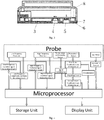
- Figs. 1, 2 and 3 are schematic structural diagrams of the detection probe of the multi-sensor non-invasive blood glucose monitoring instrument based on an impedance spectroscopy-optical method.
- the detection probe comprises a temperature and humidity sensor 2, an LED array 4, a photoelectric sensor 5, a pair of low-frequency electrodes 1, a pair of high-frequency electrodes 3, and a contact plate 6.
- the detection probe in the present invention may further comprises a housing, which comprises a base plate 7 and a top cover 8; a structure on the top cover 8 is used to fix the housing to a tested part (e.g., wrist or upper arm, etc.) of human body via a wrist strap, and the wrist strap may be made of an elastic material and provided with a hook & loop fastener; in order to improve the comfort level during use of the instrument, the contact plate 6 is made of rubber material.
- the high-frequency electrodes 3 in the present invention employs parallel electrodes, a matching inductor L is directly soldered to the positive electrode or negative electrode of the high-frequency electrodes, and a shielding electrode 10 is provided around the high-frequency electrodes, and the shielding electrode is connected to the positive electrode or negative electrode of the high-frequency electrodes via the inductor L.
- the high-frequency electrodes may be flexible electrodes. There is a certain distance (1cm ⁇ 2m) between the two low-frequency electrodes 1.
- the low-frequency electrodes may adopt a split design, wherein, one of the low-frequency electrodes is arranged separately, and the other one is arranged together with the rest sensors, as shown in Fig. 1 .
- the low-frequency electrodes 1, temperature and humidity sensor 2, LED array 4, photoelectric sensor 5, and high-frequency electrodes 3 in the present invention are arranged on the base plate 7, and aligned along the tested part of human body.
- the base plate 7 and the top cover 8 in the present invention may be made of an insulating material (e.g., PVC material).
- the high-frequency excitation electrical signals frequency range is 1MHz ⁇ 100MHz
- the low-frequency electrodes are made of stainless steel or any other metal material, such as CuCrZr, BeCu, CuAl2O3, Ag/AgCl, and the excitation electrical signals frequency range is 1KHz ⁇ 1MHz.
- the vertical distance from the bottom of the temperature and humidity sensor 2 to the bottom of the contact plate 6 is 0.1mm ⁇ 20mm; the temperature and humidity sensor 2 and the tested part of human body form an enclosed space, and slits or pores are arranged in the wall of the enclosed space to form a balanced heat and moisture storage structure.
- the enclosed space formed by the temperature and humidity sensor 2 and the tested part of human body is formed by a sensor mounting plate 9 and a base plate 7 with a cavity structure, and the base plate 7 is mounted right above the contact plate 6.
- the slits or pores in the wall of the enclosed space may be pores arranged in the temperature and humidity sensor mounting plate, as indicated by 11 in Fig. 2 .
- the LED array 4 in the present invention contains 4 LEDs, the wavelengths of which are 660nm, 760nm, 850nm and 940nm respectively.
- the LED array 4 and the photoelectric sensor 5 are arranged in the blood flow direction in the human body, and the center distance between them is 1mm-200mm.
- Fig. 4 is a functional block diagram of the circuits of the data processing and display system in the present invention.
- the data processing and display system comprises a microprocessor , a display unit and a storage unit connected to the microprocessor respectively;
- the high-frequency electrodes 3 contact with the tested part (e.g., wrist or upper arm, etc.) and transfers a high-frequency excitation swept-frequency signal generated by a high-frequency excitation signal generation circuit into the human body, a high-frequency amplitude and phase detection circuit receives the high-frequency excitation signal and a feedback signal from the tested part of human body, processes the signals, and then transmit the amplitude ratio and phase difference between the two signals to the microprocessor, so that a high-frequency impedance spectroscopy ZH is obtained finally;
- the low-frequency electrodes 1 contact with the tested part (e.g., wrist or upper arm, etc.), and transfers a low-frequency excitation swept-frequency signal generated by a low-frequency excitation signal generation circuit into the human
- the measuring principle of the multi-sensor non-invasive blood glucose monitoring instrument based on impedance spectroscopy-optical method is as follows: in the present invention, blood glucose measurement is carried out on the basis of high-frequency impedance spectroscopy principle, low-frequency impedance spectroscopy principle, and optical principle respectively, and then the blood glucose levels obtained on the basis of the three principles are considered comprehensively, to obtain an optimal merged result of blood glucose level.
- the current can't pass through the cell membranes, and the information obtained is mainly information on the tissue fluid; meanwhile, since there is no need to concern the impact of radio frequency transmission, high-frequency noise interference, and electrode polarization, etc., the information on the composition of the tissue fluid can be obtained more easily, and the fluctuations of blood glucose concentration in the tissue fluid in the metabolic process can be characterized at a macro level.
- the low-frequency impedance measurement is right based on that principle.
- the obtained information on fluctuations of blood glucose is characterized by extracting characteristic values from the low-frequency impedance spectroscopy ZL and processing with certain algorithm.
- the current penetrates through the cell membranes; thus, complete information on the tissue fluid and the cell sap can be obtained, and the variations of blood glucose concentration can be characterized more sensitively and more quickly; however, the high-frequency information is susceptible to the influence of skin thickness and the tissue difference, and other fluctuating factors in the tissue fluid, has poor anti-interference ability, and is difficult to characterize the blood glucose level separately.
- characteristic values are extracted from the high-frequency impedance spectroscopy ZH and are processed with certain algorithm to characterize the blood glucose.
- the information of low-frequency impedance spectroscopy and high-frequency impedance spectroscopy are used in combination to realize merged processing, so as to obtain a result superior to the separate measurements.
- the working process of the multi-sensor non-invasive blood glucose monitoring instrument based on impedance spectroscopy-optical method is as follows:
- the detection probe described in the present invention is fixed to the tested part (e.g., wrist or upper arm, etc.) of human body via a wrist trap, the detection probe operates with multiple channels in a cyclic manner, and the temperature and humidity sensor 2, high-frequency electrodes 3, low-frequency electrodes 1, and photoelectric sensor 5 acquire the data in corresponding channels respectively and transmits the acquired data in four channels to the data processing and display system.
- the temperature and humidity sensor measures the temperature signal T at the tested part of human body and the ambient humidity signal H, and the signals passes through transmission line and signal conditioning circuits sequentially and are transmitted to the microprocessor.
- the high-frequency electrodes 3 contact with the tested part (e.g., wrist or upper arm, etc.) and transfers a high-frequency excitation swept-frequency signal generated by a high-frequency excitation signal generation circuit into the human body, the high-frequency amplitude and phase detection circuit receives the high-frequency excitation signal and a feedback signal from the tested part of human body, processes the signals, and then transmit the amplitude ratio and phase difference between the two signals to the microprocessor, so that the high-frequency impedance spectroscopy ZH is obtained finally.
- the tested part e.g., wrist or upper arm, etc.
- the low-frequency electrodes 1 contact with the tested part (e.g., wrist or upper arm, etc.), and transfers a low-frequency excitation swept-frequency signal generated by a low-frequency excitation signal generation circuit into the human body, the low-frequency amplitude and phase detection circuit receives the low-frequency excitation signal and a feedback signal from the tested part of human body, processes the signals, and then transmits the amplitude ratio and phase difference between the two signals to the microprocessor, so that the low-frequency impedance spectroscopy ZL is obtained finally.
- the tested part e.g., wrist or upper arm, etc.
- the light waves emitted from the LED array 4 passes through the tested part (e.g., finger or ear, etc.) and then reflection spectrum signals A1 ⁇ A4 are generated and received by the photoelectric sensor 5, then the signals are processed through the first-order amplification and filtering circuit, the integrating circuit, and the second-order amplification and filtering circuit, and transmitted to the microprocessor.
- the operation of the LED array 4 is controlled by a transmitter control circuit, which is connected to the microprocessor through control lines; the first-order amplification and filtering circuit is controlled by a potentiometer switching circuit, which is connected to the microprocessor through control lines; the second-order amplification and filtering circuit is directly connected to the microprocessor through control lines.
- the transmitter control circuit, the first-order amplification and filtering circuit, and the second-order amplification and filtering circuit are subjected to the control of the microprocessor.
- the microprocessor Under the control of the microprocessor, all signals are transmitted to the microprocessor, and those signals are processed under the non-invasive blood glucose detection principle described in the present invention, so that the blood glucose level measured by the instrument is obtained.
- the blood glucose level and key intermediate data are inputted through transmission lines to the display unit and the storage unit respectively, to realize data display and storage functions.
- the microprocessor has the following three functions: the first function is to acquire all data and carry out data computation and processing; the second function is to generate control signals to control the transmitter control circuit, the second-order amplification and filtering circuit, and the potentiometer switching circuit; the third function is to transmit the data to the display unit and storage unit, to accomplish display and storage respectively.
Landscapes
- Health & Medical Sciences (AREA)
- Life Sciences & Earth Sciences (AREA)
- Physics & Mathematics (AREA)
- Engineering & Computer Science (AREA)
- Pathology (AREA)
- General Health & Medical Sciences (AREA)
- Biomedical Technology (AREA)
- Biophysics (AREA)
- Veterinary Medicine (AREA)
- Heart & Thoracic Surgery (AREA)
- Medical Informatics (AREA)
- Molecular Biology (AREA)
- Surgery (AREA)
- Animal Behavior & Ethology (AREA)
- Public Health (AREA)
- Signal Processing (AREA)
- Optics & Photonics (AREA)
- Spectroscopy & Molecular Physics (AREA)
- Artificial Intelligence (AREA)
- Computer Vision & Pattern Recognition (AREA)
- Physiology (AREA)
- Psychiatry (AREA)
- Chemical & Material Sciences (AREA)
- Emergency Medicine (AREA)
- Radiology & Medical Imaging (AREA)
- Nuclear Medicine, Radiotherapy & Molecular Imaging (AREA)
- Chemical Kinetics & Catalysis (AREA)
- Power Engineering (AREA)
- Analytical Chemistry (AREA)
- Biochemistry (AREA)
- General Physics & Mathematics (AREA)
- Immunology (AREA)
- Electrochemistry (AREA)
- General Chemical & Material Sciences (AREA)
- Measurement Of The Respiration, Hearing Ability, Form, And Blood Characteristics Of Living Organisms (AREA)
- Investigating Or Analysing Materials By Optical Means (AREA)
Abstract
Description
- The present invention relates to non-invasive blood glucose monitoring of human body, particularly to a multi-sensor non-invasive blood glucose monitoring instrument based on impedance spectroscopy-optical method, and belongs to the technical field of medical instruments.
- Diabetes is a group of metabolic diseases characterized by high blood glucose, and at present there is no radical cure to it yet. The treatment of diabetes needs frequently monitoring glucose to control the blood glucose level. The conventional invasive blood sampling method has obvious defects, and, it causes wound and pain to the patient during measurement, and is inconvenient for continuous monitoring. Non-invasive blood glucose monitoring technology overcomes the drawbacks of the conventional method, which can effectively meet the demand of diabetic patients for real-time and frequent monitoring of blood glucose concentration. Non-invasive method is the developing direction of blood glucose detection technology. Optical method is the most studied non-invasive glucose monitoring method. However, due to numerous interferences and individual differences, most of the them are still in a laboratory research stage.
- Since Lukaski put forward using bioelectrical impedance analysis (BIA) to measure body components of human in 1985, researchers have used BIA method to differentiate components of human body, including fats, muscles, minerals, and aqueous substances, etc.. Fatty substances and non-fatty substances have different current conducting properties, so that different tissues and organs have different impedance characteristics. The Inbody series human body composition analyzers developed by a Korean listed company measure the balance condition of human body components at high accuracy. It employs a multi-frequency bioelectrical impedance analysis method in different segment of body.
- Based on the biological impedance technique, some progress has been made in the research on non-invasive blood glucose monitoring based on impedance spectroscopy (IS) method. Most of researches on impedance spectroscopy focus on frequencies within 0-50kHz and below 10MHz.
Harry Richardson Elden, et al., (WO1999039627 A1 ) from USA measures impedance amplitude and phase of the skin of human body at specific frequency points (20kHz, 500kHz) and utilizes a linear combination of impedance and phase to predict blood glucose; a research team led by Kiseok Song in Korea incorporates impedance spectroscopy and infrared spectrometry to carry out non-invasive blood glucose tests, with a frequency range of 10kHz-76kHz. Researches at a low frequency are relatively easy since there is no need to concern the impact of radio frequency transmission, high-frequency noise interference, and electrode polarization, etc.; however, at low frequency, the current bypasses cells and flows through the extracellular fluid, influencing the result of non-invasive blood glucose monitoring. - A research team led by
Caduff A (US2013/0211204A1 ,US7693561B2 ) in Swiss has found that there is an apparent relation between blood glucose concentration and impedance value in higher frequency bands. The research team designed an impedance measurement system within 30-60MHz frequency, and studied the correlation between obtained impedance information and blood glucose. The high-frequency method has a high requirement for stability of tissue characteristics. However, owing to a severe difference in skin thickness and tissues among different individuals, it is hard to attain a satisfactory result if the high-frequency method is used alone. In the subsequent researches, the research team began to employ a multi-sensor and multi-parameter measurement method to improve the accuracy, including electrodes in high frequency band, intermediate frequency band and low frequency band, temperature, humidity and optical sensors. The electrodes included a vertical bar electrode and annular electrodes around the vertical bar electrode, and the distances between the vertical bar electrode and the surrounding annular electrodes were 0.3mm, 1.5mm, and 4mm respectively; the wavelengths used by the optical sensor were 550/660/880nm. The electrodes used by the research team had a strip shape at one end and an annular shape at the other end, and the electrodes operating at different frequencies were close to each other and were surrounded by identical grounding wires; therefore, interference existed among the electrodes; since two electrodes operating at the same frequency were very close to each other, the penetration depth in the tissue was shallow; the temperature and humidity sensors were directly attached to the skin, causing humidity saturation easily and influencing temperature and humidity test. - The object of the present invention is to overcome the drawbacks in the prior art, and the present invention provides a multi-sensor non-invasive blood glucose monitoring instrument based on impedance spectroscopy-optical method, in order to further improve blood glucose measuring accuracy.
- The technical scheme of the present invention is as follows:
A multi-sensor non-invasive blood glucose monitoring instrument based on an impedance spectroscopy-optical method, comprising a detection probe, a microprocessor, a display unit, and a storage unit. The detection probe comprises a pair of high-frequency electrodes, a pair of low-frequency electrodes, a temperature and humidity sensor, an LED array, a photoelectric sensor, and a contact plate. The microprocessor controls an excitation signal generation circuit to generate high frequency and low frequency excitation signals. Feedback signals from the high-frequency electrodes and the low-frequency electrodes are inputted via an amplitude and phase detection circuit to the microprocessor, and high-frequency impedance and low-frequency impedance are obtained through calculation. Temperature signals and humidity signals, which are measured with the temperature and humidity sensor, are conditioned and inputted to the microprocessor. The LED array is controlled by a transmitter control circuit. Light intensity signals, which are measured by the photoelectric sensor, are amplified and filtered and then inputted to the microprocessor to obtain optical characteristics of the tissue. The microprocessor inputs the processing result to the display system for display, and the test data is saved in the storage unit at the same time. The monitoring instrument is characterized in that: the high-frequency electrodes employ parallel electrodes, and a matching inductor L is directly soldered to the positive electrode or negative electrode; the distance between the positive electrode and the negative electrode of the low-frequency electrodes is 1 cm∼2m; the vertical distance from the bottom of the temperature and humidity sensor to the bottom of the contact plate is 0.1mm∼20mm; the temperature and humidity sensor and the tested part of human body form an enclosed space, and slits or pores are arranged in the wall of the enclosed space to form a balanced heat and moisture storage structure. - The above-mentioned technical scheme is further characterized in that: a shielding electrode is provided around the high-frequency electrodes, the shielding electrode is connected to the positive electrode or negative electrode of the high-frequency electrodes via the inductor L. The high-frequency electrodes preferably are flexible electrodes.
- Another technical feature of the present invention is: the enclosed space formed by the temperature and humidity sensor and the tested part of human body is formed by a sensor mounting plate and a base plate with a cavity structure, and the base plate is mounted right above the contact plate.
- The multi-sensor non-invasive blood glucose monitoring instrument based on an impedance spectroscopy-optical method in the present invention is also characterized in that: the
LED array 4 and thephotoelectric sensor 5 are arranged in the blood flow direction of the human body, and the center distance between them is 1mm-200mm. - The
LED array 4 in the present invention contains 4 LEDs, the wavelengths of which are 660nm, 760nm, 850nm and 940nm respectively. - The detection probe in the present invention is fixed to the tested part of human body via a wrist strap. The contact plate is a rubber plate.
- Compared with the prior art, the present invention has the following advantages and prominent effects: (1) in the present invention, the distances between the high-frequency electrodes for impedance spectroscopy are optimized, a matching inductor is directly soldered to one of the high-frequency electrodes, a conducting rectangular frame arranged around the electrodes is directly connected to one of the electrodes, the electrodes are flexible and can be attached to the skin closely, so that noise interference is reduced; (2) since the distance between the low-frequency electrodes for impedance spectroscopy in the present invention is far, the measured signals are more stable, and the correlation of the extracted characteristic parameters with the blood glucose is higher; (3) a temperature and humidity sensor is utilized in the present invention to measure the temperature and humidity of skin surface, so as to correct the measurement result obtained in the impedance spectroscopy and photoelectrical channels; the temperature and humidity sensor is kept at a certain distance from the skin of human body, and forms a non-enclosed space with slits or pores; thus, a balanced heat and moisture storage structure is formed, to eliminate the influence of body temperature change and sweatiness on the measurement, thus the obtained temperature and humidity result is more accurate.
-
-
Fig. 1 is a top view of the probe viewed from the direction of the base plate in the present invention; -
Fig. 2 is a sectional view B-B of the structure inFig. 1 ; -
Fig. 3 is a sectional view C-C of the structure inFig. 1 ; -
Fig. 4 is a functional block diagram of the circuits of the non-invasive blood glucose detection instrument. - In the
figures: 1 - low-frequency electrodes; 2 - temperature and humidity sensor; 3 - high-frequency electrodes; 4 - LED array; 5 - photoelectric sensor; 6 - contact plate; 7 - base plate; 8 - top cover; 9 - temperature and humidity sensor mounting plate; 10 - shielding electrode; 11- pores in the temperature and humidity sensor mounting plate; L - matching inductor of high-frequency electrodes. - The structure, working principle and working process of the multi-sensor non-invasive blood glucose monitoring instrument based on an impedance spectroscopy-optical method will be further detailed with reference to the attached drawings.
-
Figs. 1, 2 and3 are schematic structural diagrams of the detection probe of the multi-sensor non-invasive blood glucose monitoring instrument based on an impedance spectroscopy-optical method. The detection probe comprises a temperature andhumidity sensor 2, anLED array 4, aphotoelectric sensor 5, a pair of low-frequency electrodes 1, a pair of high-frequency electrodes 3, and acontact plate 6. In order to ease the use of the instrument and make the structure more compact, the detection probe in the present invention may further comprises a housing, which comprises abase plate 7 and atop cover 8; a structure on thetop cover 8 is used to fix the housing to a tested part (e.g., wrist or upper arm, etc.) of human body via a wrist strap, and the wrist strap may be made of an elastic material and provided with a hook & loop fastener; in order to improve the comfort level during use of the instrument, thecontact plate 6 is made of rubber material. - According to the requirement for measurement, the high-
frequency electrodes 3 in the present invention employs parallel electrodes, a matching inductor L is directly soldered to the positive electrode or negative electrode of the high-frequency electrodes, and ashielding electrode 10 is provided around the high-frequency electrodes, and the shielding electrode is connected to the positive electrode or negative electrode of the high-frequency electrodes via the inductor L. In order to improve the quality of contact between the high-frequency electrodes and the body skin, the high-frequency electrodes may be flexible electrodes. There is a certain distance (1cm∼2m) between the two low-frequency electrodes 1. The low-frequency electrodes may adopt a split design, wherein, one of the low-frequency electrodes is arranged separately, and the other one is arranged together with the rest sensors, as shown inFig. 1 . The low-frequency electrodes 1, temperature andhumidity sensor 2,LED array 4,photoelectric sensor 5, and high-frequency electrodes 3 in the present invention are arranged on thebase plate 7, and aligned along the tested part of human body. Thebase plate 7 and thetop cover 8 in the present invention may be made of an insulating material (e.g., PVC material). - The high-frequency excitation electrical signals frequency range is 1MHz∼100MHz, the low-frequency electrodes are made of stainless steel or any other metal material, such as CuCrZr, BeCu, CuAl2O3, Ag/AgCl, and the excitation electrical signals frequency range is 1KHz∼1MHz.
- The vertical distance from the bottom of the temperature and
humidity sensor 2 to the bottom of thecontact plate 6 is 0.1mm∼20mm; the temperature andhumidity sensor 2 and the tested part of human body form an enclosed space, and slits or pores are arranged in the wall of the enclosed space to form a balanced heat and moisture storage structure. The enclosed space formed by the temperature andhumidity sensor 2 and the tested part of human body is formed by asensor mounting plate 9 and abase plate 7 with a cavity structure, and thebase plate 7 is mounted right above thecontact plate 6. The slits or pores in the wall of the enclosed space may be pores arranged in the temperature and humidity sensor mounting plate, as indicated by 11 inFig. 2 . - The
LED array 4 in the present invention contains 4 LEDs, the wavelengths of which are 660nm, 760nm, 850nm and 940nm respectively. TheLED array 4 and thephotoelectric sensor 5 are arranged in the blood flow direction in the human body, and the center distance between them is 1mm-200mm. -
Fig. 4 is a functional block diagram of the circuits of the data processing and display system in the present invention. The data processing and display system comprises a microprocessor , a display unit and a storage unit connected to the microprocessor respectively; the high-frequency electrodes 3 contact with the tested part (e.g., wrist or upper arm, etc.) and transfers a high-frequency excitation swept-frequency signal generated by a high-frequency excitation signal generation circuit into the human body, a high-frequency amplitude and phase detection circuit receives the high-frequency excitation signal and a feedback signal from the tested part of human body, processes the signals, and then transmit the amplitude ratio and phase difference between the two signals to the microprocessor, so that a high-frequency impedance spectroscopy ZH is obtained finally; the low-frequency electrodes 1 contact with the tested part (e.g., wrist or upper arm, etc.), and transfers a low-frequency excitation swept-frequency signal generated by a low-frequency excitation signal generation circuit into the human body, a low-frequency amplitude and phase detection circuit receives the low-frequency excitation signal and a feedback signal from the tested part of human body, processes the signals, and then transmits the amplitude ratio and phase difference between the two signals to the microprocessor, so that a low-frequency impedance spectroscopy ZL is obtained finally; a reflected light intensity signal A measured by the photoelectric sensor 5 passes through a first-order amplification and filtering circuit, an integrating circuit, and a second-order amplification and filtering circuit, and then is inputted to the microprocessor by means of analog acquisition; the LED array 4 is controlled by a transmitter control circuit, and the microprocessor is connected with the transmitter control circuit through control lines; the microprocessor is connected with the first-order amplification and filtering circuit through control lines and a potentiometer switching circuit, and is connected with the second-order amplification and filtering circuit through control lines. - The measuring principle of the multi-sensor non-invasive blood glucose monitoring instrument based on impedance spectroscopy-optical method is as follows: in the present invention, blood glucose measurement is carried out on the basis of high-frequency impedance spectroscopy principle, low-frequency impedance spectroscopy principle, and optical principle respectively, and then the blood glucose levels obtained on the basis of the three principles are considered comprehensively, to obtain an optimal merged result of blood glucose level.
- In the measuring principle based on impedance spectroscopy, it is believed that the electrolytic equilibrium between the tissue fluid and the cells is upset in the glucose metabolism process, and thereby the electrolyte concentrations inside and outside the cells are changed, and the permeability characteristic of the cell membranes is changed, resulting in change of the dielectric constant, and on a macro level resulting in change of impedance information. Based on the impedance model of human body, in a low-frequency excitation state (<100kHz), the current can't pass through the cell membranes, and the information obtained is mainly information on the tissue fluid; meanwhile, since there is no need to concern the impact of radio frequency transmission, high-frequency noise interference, and electrode polarization, etc., the information on the composition of the tissue fluid can be obtained more easily, and the fluctuations of blood glucose concentration in the tissue fluid in the metabolic process can be characterized at a macro level. In the present invention, the low-frequency impedance measurement is right based on that principle. The obtained information on fluctuations of blood glucose is characterized by extracting characteristic values from the low-frequency impedance spectroscopy ZL and processing with certain algorithm. Under high-frequency excitation (>10MHz), the current penetrates through the cell membranes; thus, complete information on the tissue fluid and the cell sap can be obtained, and the variations of blood glucose concentration can be characterized more sensitively and more quickly; however, the high-frequency information is susceptible to the influence of skin thickness and the tissue difference, and other fluctuating factors in the tissue fluid, has poor anti-interference ability, and is difficult to characterize the blood glucose level separately. In the present invention, characteristic values are extracted from the high-frequency impedance spectroscopy ZH and are processed with certain algorithm to characterize the blood glucose. In the present invention, the information of low-frequency impedance spectroscopy and high-frequency impedance spectroscopy are used in combination to realize merged processing, so as to obtain a result superior to the separate measurements.
- Based on the optical measurement principle, it is believed that when the light waves of a particular wavelength penetrate through the tissues of human body, a part of energy of the light waves will be absorbed by human body, and the difference in the absorption characteristics reflects the magnitude of blood glucose concentration in the human body; by measuring the intensity of reflected light, the corresponding blood glucose level can be obtained; the transmitted light intensity is measured by the
photoelectric sensor 5. - The working process of the multi-sensor non-invasive blood glucose monitoring instrument based on impedance spectroscopy-optical method is as follows:
The detection probe described in the present invention is fixed to the tested part (e.g., wrist or upper arm, etc.) of human body via a wrist trap, the detection probe operates with multiple channels in a cyclic manner, and the temperature andhumidity sensor 2, high-frequency electrodes 3, low-frequency electrodes 1, andphotoelectric sensor 5 acquire the data in corresponding channels respectively and transmits the acquired data in four channels to the data processing and display system. - The temperature and humidity sensor measures the temperature signal T at the tested part of human body and the ambient humidity signal H, and the signals passes through transmission line and signal conditioning circuits sequentially and are transmitted to the microprocessor.
- The high-
frequency electrodes 3 contact with the tested part (e.g., wrist or upper arm, etc.) and transfers a high-frequency excitation swept-frequency signal generated by a high-frequency excitation signal generation circuit into the human body, the high-frequency amplitude and phase detection circuit receives the high-frequency excitation signal and a feedback signal from the tested part of human body, processes the signals, and then transmit the amplitude ratio and phase difference between the two signals to the microprocessor, so that the high-frequency impedance spectroscopy ZH is obtained finally. - The low-
frequency electrodes 1 contact with the tested part (e.g., wrist or upper arm, etc.), and transfers a low-frequency excitation swept-frequency signal generated by a low-frequency excitation signal generation circuit into the human body, the low-frequency amplitude and phase detection circuit receives the low-frequency excitation signal and a feedback signal from the tested part of human body, processes the signals, and then transmits the amplitude ratio and phase difference between the two signals to the microprocessor, so that the low-frequency impedance spectroscopy ZL is obtained finally. - The light waves emitted from the
LED array 4 passes through the tested part (e.g., finger or ear, etc.) and then reflection spectrum signals A1∼A4 are generated and received by thephotoelectric sensor 5, then the signals are processed through the first-order amplification and filtering circuit, the integrating circuit, and the second-order amplification and filtering circuit, and transmitted to the microprocessor. The operation of theLED array 4 is controlled by a transmitter control circuit, which is connected to the microprocessor through control lines; the first-order amplification and filtering circuit is controlled by a potentiometer switching circuit, which is connected to the microprocessor through control lines; the second-order amplification and filtering circuit is directly connected to the microprocessor through control lines. Thus, the transmitter control circuit, the first-order amplification and filtering circuit, and the second-order amplification and filtering circuit are subjected to the control of the microprocessor. - Under the control of the microprocessor, all signals are transmitted to the microprocessor, and those signals are processed under the non-invasive blood glucose detection principle described in the present invention, so that the blood glucose level measured by the instrument is obtained. The blood glucose level and key intermediate data are inputted through transmission lines to the display unit and the storage unit respectively, to realize data display and storage functions. As the core unit for data processing, the microprocessor has the following three functions: the first function is to acquire all data and carry out data computation and processing; the second function is to generate control signals to control the transmitter control circuit, the second-order amplification and filtering circuit, and the potentiometer switching circuit; the third function is to transmit the data to the display unit and storage unit, to accomplish display and storage respectively.
Claims (9)
- A multi-sensor non-invasive blood glucose monitoring instrument based on impedance spectroscopy-optical method, comprising a detection probe, a microprocessor, a display unit, and a storage unit, wherein, the detection probe comprises a pair of high-frequency electrodes (3), a pair of low-frequency electrodes (1), a temperature and humidity sensor (2), an LED array (4), a photoelectric sensor (5), and a contact plate (6); the microprocessor controls an excitation signal generation circuit to generate high frequency and low frequency excitation signals, feedback signals from the high-frequency electrodes and the low-frequency electrodes are inputted to the microprocessor via an amplitude and phase detection circuit, and then high-frequency impedance and low-frequency impedance are obtained through calculation; temperature signals and humidity signals of the tested part are measured with the temperature and humidity sensor, and then are conditioned and inputted to the microprocessor; the LED array is controlled by a transmitter control circuit; light intensity signals measured by the photoelectric sensor are amplified and filtered, and then inputted to the microprocessor to obtain optical characteristics of the tissue; the microprocessor outputs the calculation result to the display unit for display, and the test data is saved in the storage unit at the same time; the monitoring instrument is characterized in that: the high-frequency electrodes (3) employs a pair of parallel electrodes, and a matching inductor L is directly soldered to one of the electrodes; the distance between the positive electrode and the negative electrode of the low-frequency electrodes is 1cm∼2m; the vertical distance from the bottom of the temperature and humidity sensor (2) to the bottom of the contact plate (6) is 0.1mm∼20mm; the temperature and humidity sensor (2) and the tested part of human body form an enclosed space, and slits or pores are arranged in the wall of the enclosed space to form a balanced heat and moisture storage structure.
- The multi-sensor non-invasive blood glucose monitoring instrument based on impedance spectroscopy-optical method according to claim 1, wherein, a shielding electrode (10) is provided around the high-frequency electrodes (3), and the shielding electrode (10) is connected to the positive electrode or negative electrode of the high-frequency electrodes via the inductor L.
- The multi-sensor non-invasive blood glucose monitoring instrument based on impedance spectroscopy-optical method according to claim 1, wherein, the low-frequency electrodes adopt a split design.
- The multi-sensor non-invasive blood glucose monitoring instrument based on impedance spectroscopy-optical method according to claim 1, wherein, the high-frequency electrodes (3) are flexible electrodes.
- The multi-sensor non-invasive blood glucose monitoring instrument based on impedance spectroscopy-optical method according to claim 1, wherein, the enclosed space between the temperature and humidity sensor (2) and the tested part of human body is formed by a sensor mounting plate (9) and a base plate (7) with a cavity structure, and the base plate (7) is mounted on top of the contact plate (6).
- The multi-sensor non-invasive blood glucose monitoring instrument based on impedance spectroscopy-optical method according to claim 1, wherein, the LED array (4) and the photoelectric sensor (5) are arranged in the blood flow direction in the human body, and the center distance between them is 1mm∼200mm.
- The multi-sensor non-invasive blood glucose monitoring instrument based on impedance spectroscopy-optical method according to claim 1, wherein, the LED array (4) contains 4 LEDs, the wavelengths of which are 660nm, 760nm, 850nm and 940nm, respectively.
- The multi-sensor non-invasive blood glucose monitoring instrument based on impedance spectroscopy-optical method according to claim 1, wherein, the detection probe is fixed to the tested part of human body via a wrist strap.
- The multi-sensor non-invasive blood glucose monitoring instrument based on impedance spectroscopy-optical method according to claim 1, wherein, the contact plate (6) is a rubber plate.
Applications Claiming Priority (2)
| Application Number | Priority Date | Filing Date | Title |
|---|---|---|---|
| CN201611048179.3A CN106691449A (en) | 2016-11-21 | 2016-11-21 | Impedance spectroscopy-optical method based multi-sensor noninvasive blood glucose testing equipment |
| PCT/CN2017/108521 WO2018090817A1 (en) | 2016-11-21 | 2017-10-31 | Impedance spectroscopy and optical technique-based multi-sensor noninvasive blood sugar detection apparatus |
Publications (3)
| Publication Number | Publication Date |
|---|---|
| EP3556286A1 true EP3556286A1 (en) | 2019-10-23 |
| EP3556286A4 EP3556286A4 (en) | 2020-09-30 |
| EP3556286B1 EP3556286B1 (en) | 2021-11-24 |
Family
ID=58934898
Family Applications (1)
| Application Number | Title | Priority Date | Filing Date |
|---|---|---|---|
| EP17829115.9A Active EP3556286B1 (en) | 2016-11-21 | 2017-10-31 | Impedance spectroscopy and optical technique-based multi-sensor noninvasive blood sugar detection apparatus |
Country Status (4)
| Country | Link |
|---|---|
| US (1) | US10765352B2 (en) |
| EP (1) | EP3556286B1 (en) |
| CN (1) | CN106691449A (en) |
| WO (1) | WO2018090817A1 (en) |
Families Citing this family (13)
| Publication number | Priority date | Publication date | Assignee | Title |
|---|---|---|---|---|
| CN106691449A (en) * | 2016-11-21 | 2017-05-24 | 清华大学 | Impedance spectroscopy-optical method based multi-sensor noninvasive blood glucose testing equipment |
| TWI694811B (en) * | 2017-06-02 | 2020-06-01 | 昇陽國際半導體股份有限公司 | Blood sugar measuring apparatus |
| CN108169285B (en) * | 2017-12-26 | 2020-02-04 | 河北农业大学 | Method for measuring content of soluble sugar in kalopanax pohuashanensis by adopting electrical impedance loss coefficient delta value method |
| US20200253513A1 (en) | 2019-02-12 | 2020-08-13 | Medtronic Minimed, Inc. | Miniaturized noninvasive glucose sensor and continuous glucose monitoring system |
| US12082910B2 (en) * | 2019-02-12 | 2024-09-10 | Medtronic Minimed, Inc. | Miniaturized noninvasive glucose sensor and continuous glucose monitoring system |
| US12507914B2 (en) | 2019-02-12 | 2025-12-30 | Medtronic Minimed, Inc. | Miniaturized noninvasive glucose sensor and continuous glucose monitoring system |
| CN111317473A (en) * | 2020-03-12 | 2020-06-23 | 桂林电子科技大学 | Blood glucose detection method based on hybrid measurement technology |
| CN113495087B (en) * | 2020-04-03 | 2023-04-07 | 深圳市帝迈生物技术有限公司 | POCT blood cell analyzer and detection method thereof |
| CN111632228B (en) * | 2020-05-19 | 2021-05-25 | 中国科学院深圳先进技术研究院 | Closed-loop artificial pancreas system based on wearable monitoring method |
| WO2024020900A1 (en) * | 2022-07-27 | 2024-02-01 | 深圳市怡康安家保健科技有限公司 | Portable flip-type non-invasive blood glucose meter |
| CN115969366A (en) * | 2023-03-05 | 2023-04-18 | 北京大学第三医院(北京大学第三临床医学院) | Blood glucose measurement method based on near-infrared absorption spectrum-impedance spectrum analysis combination |
| CN117030796B (en) * | 2023-06-30 | 2025-09-26 | 南京晶捷生物科技有限公司 | A CGM electrode detection tool and detection method thereof |
| CN119688651B (en) * | 2024-12-04 | 2025-10-24 | 中国农业大学 | A nondestructive detection system and method for fresh mutton quality |
Family Cites Families (17)
| Publication number | Priority date | Publication date | Assignee | Title |
|---|---|---|---|---|
| AU762922B2 (en) | 1998-02-04 | 2003-07-10 | Dermal Therapy (Barbados) Inc. | Method and apparatus for non-invasive determination of glucose in body fluids |
| WO2002069791A1 (en) | 2001-03-06 | 2002-09-12 | Pendragon Medical Ltd. | Method and device for determining the concentration of a substance in body liquid |
| WO2005077260A1 (en) * | 2004-02-12 | 2005-08-25 | Biopeak Corporation | Non-invasive method and apparatus for determining a physiological parameter |
| CN1297229C (en) * | 2004-07-27 | 2007-01-31 | 天津大学 | Non-invasive detection device of pulse impedance spectrum blood sugar or other biood component and its detection method |
| WO2007053963A1 (en) * | 2005-11-10 | 2007-05-18 | Solianis Holding Ag | Device for determining the glucose level in body tissue |
| WO2008090862A1 (en) * | 2007-01-23 | 2008-07-31 | Tohoku Techno Arch Co., Ltd. | Fetus electrocardiogram signal measuring method and its device |
| WO2009004001A1 (en) * | 2007-07-02 | 2009-01-08 | Biogauge - Nordic Bioimpedance Research As | Method and kit for sweat activity measurement |
| CN100591271C (en) | 2008-11-07 | 2010-02-24 | 中南大学 | Non-invasive blood glucose detection sensor integrator |
| WO2011094875A1 (en) * | 2010-02-05 | 2011-08-11 | Solianis Holding Ag | Wearable sensor device |
| US8235897B2 (en) * | 2010-04-27 | 2012-08-07 | A.D. Integrity Applications Ltd. | Device for non-invasively measuring glucose |
| CN102293654B (en) * | 2011-06-17 | 2014-07-16 | 清华大学 | Non-invasive blood glucose detector based on metabolic heat-optical method |
| CN103815916A (en) | 2014-03-23 | 2014-05-28 | 王素常 | Rapid blood glucose testing system with built-in bioimpedance analysis method |
| CN105559794B (en) * | 2016-02-23 | 2018-03-23 | 杨立峰 | A kind of Wearable hurtless measure Dynamic Blood Glucose Monitoring instrument based on optoacoustic spectrum signature |
| CN105852879A (en) * | 2016-03-30 | 2016-08-17 | 王卫东 | Blood composition non-invasive detecting device |
| CN105816186A (en) * | 2016-05-22 | 2016-08-03 | 张侃 | Noninvasive type automated hand-held blood analyzer |
| CN106691449A (en) | 2016-11-21 | 2017-05-24 | 清华大学 | Impedance spectroscopy-optical method based multi-sensor noninvasive blood glucose testing equipment |
| CN206491802U (en) * | 2016-11-21 | 2017-09-15 | 清华大学 | A kind of multisensor noninvasive dynamics monitoring equipment based on impedance spectrum optical means |
-
2016
- 2016-11-21 CN CN201611048179.3A patent/CN106691449A/en active Pending
-
2017
- 2017-10-31 WO PCT/CN2017/108521 patent/WO2018090817A1/en not_active Ceased
- 2017-10-31 EP EP17829115.9A patent/EP3556286B1/en active Active
- 2017-10-31 US US15/744,469 patent/US10765352B2/en active Active
Also Published As
| Publication number | Publication date |
|---|---|
| EP3556286A4 (en) | 2020-09-30 |
| CN106691449A (en) | 2017-05-24 |
| WO2018090817A1 (en) | 2018-05-24 |
| US20190261900A1 (en) | 2019-08-29 |
| EP3556286B1 (en) | 2021-11-24 |
| US10765352B2 (en) | 2020-09-08 |
Similar Documents
| Publication | Publication Date | Title |
|---|---|---|
| EP3556286B1 (en) | Impedance spectroscopy and optical technique-based multi-sensor noninvasive blood sugar detection apparatus | |
| KR101527664B1 (en) | Armband comprising a detection device for the detection of a blood count parameter | |
| KR101754941B1 (en) | Device for n0n-invasively measuring glucose | |
| KR101964025B1 (en) | Non-invasive blood glucose meter | |
| US12484800B2 (en) | Systems and methods for calibrating dry electrode bioelectrical impedance sensing | |
| US20240065584A1 (en) | Dual-Mode Biosensor | |
| MXPA04008713A (en) | Compact apparatus for noninvasive measurement of glucose through near-infrared spectroscopy. | |
| JP2012507382A (en) | Impedance spectroscopy with coupled antennas. | |
| KR102185556B1 (en) | Non-Invasive Glucose Sensor | |
| CN103126672A (en) | Vesica urinaria urine accumulation real-time monitoring method and device based on bioelectrical impedance | |
| CN116965810A (en) | A blood glucose detection system | |
| KR101324560B1 (en) | Multi-channel impedance measuring method and device | |
| CN204666826U (en) | The continuous safety check imaging device of a kind of Terahertz | |
| CN103997959B (en) | Diagnostic measuring device | |
| CN204654946U (en) | A kind of non-invasive blood sugar instrument detected based on ear-lobe | |
| CN206491802U (en) | A kind of multisensor noninvasive dynamics monitoring equipment based on impedance spectrum optical means | |
| CN110876617A (en) | Charging system of cardiovascular measuring device | |
| CN117898681B (en) | Edema signal acquisition method and device based on wireless monitoring | |
| CN115135241A (en) | Non-invasive blood sugar detector | |
| CN204654954U (en) | A kind of Terahertz continuous blood sugar measuring apparatus | |
| CN204654951U (en) | A kind of Terahertz noninvasive dynamics monitoring device based on detecting between volume | |
| CN113768475A (en) | A non-invasive cerebrovascular autonomic regulation function monitoring system based on magnetic induction technology | |
| CN204654948U (en) | A kind of Terahertz Woundless blood sugar measures finger ring | |
| WO2022184633A1 (en) | Dual-mode biosensor | |
| Kossowski et al. | Robust IR attenuation measurement for non-invasive glucose level analysis |
Legal Events
| Date | Code | Title | Description |
|---|---|---|---|
| STAA | Information on the status of an ep patent application or granted ep patent |
Free format text: STATUS: UNKNOWN |
|
| STAA | Information on the status of an ep patent application or granted ep patent |
Free format text: STATUS: THE INTERNATIONAL PUBLICATION HAS BEEN MADE |
|
| PUAI | Public reference made under article 153(3) epc to a published international application that has entered the european phase |
Free format text: ORIGINAL CODE: 0009012 |
|
| STAA | Information on the status of an ep patent application or granted ep patent |
Free format text: STATUS: REQUEST FOR EXAMINATION WAS MADE |
|
| 17P | Request for examination filed |
Effective date: 20180124 |
|
| AK | Designated contracting states |
Kind code of ref document: A1 Designated state(s): AL AT BE BG CH CY CZ DE DK EE ES FI FR GB GR HR HU IE IS IT LI LT LU LV MC MK MT NL NO PL PT RO RS SE SI SK SM TR |
|
| AX | Request for extension of the european patent |
Extension state: BA ME |
|
| DAV | Request for validation of the european patent (deleted) | ||
| DAX | Request for extension of the european patent (deleted) | ||
| A4 | Supplementary search report drawn up and despatched |
Effective date: 20200831 |
|
| RIC1 | Information provided on ipc code assigned before grant |
Ipc: A61B 5/053 20060101AFI20200825BHEP |
|
| GRAP | Despatch of communication of intention to grant a patent |
Free format text: ORIGINAL CODE: EPIDOSNIGR1 |
|
| STAA | Information on the status of an ep patent application or granted ep patent |
Free format text: STATUS: GRANT OF PATENT IS INTENDED |
|
| INTG | Intention to grant announced |
Effective date: 20210617 |
|
| GRAS | Grant fee paid |
Free format text: ORIGINAL CODE: EPIDOSNIGR3 |
|
| GRAA | (expected) grant |
Free format text: ORIGINAL CODE: 0009210 |
|
| STAA | Information on the status of an ep patent application or granted ep patent |
Free format text: STATUS: THE PATENT HAS BEEN GRANTED |
|
| AK | Designated contracting states |
Kind code of ref document: B1 Designated state(s): AL AT BE BG CH CY CZ DE DK EE ES FI FR GB GR HR HU IE IS IT LI LT LU LV MC MK MT NL NO PL PT RO RS SE SI SK SM TR |
|
| REG | Reference to a national code |
Ref country code: GB Ref legal event code: FG4D |
|
| REG | Reference to a national code |
Ref country code: AT Ref legal event code: REF Ref document number: 1449226 Country of ref document: AT Kind code of ref document: T Effective date: 20211215 |
|
| REG | Reference to a national code |
Ref country code: DE Ref legal event code: R096 Ref document number: 602017049925 Country of ref document: DE |
|
| REG | Reference to a national code |
Ref country code: IE Ref legal event code: FG4D |
|
| REG | Reference to a national code |
Ref country code: LT Ref legal event code: MG9D |
|
| REG | Reference to a national code |
Ref country code: NL Ref legal event code: MP Effective date: 20211124 |
|
| REG | Reference to a national code |
Ref country code: AT Ref legal event code: MK05 Ref document number: 1449226 Country of ref document: AT Kind code of ref document: T Effective date: 20211124 |
|
| PG25 | Lapsed in a contracting state [announced via postgrant information from national office to epo] |
Ref country code: RS Free format text: LAPSE BECAUSE OF FAILURE TO SUBMIT A TRANSLATION OF THE DESCRIPTION OR TO PAY THE FEE WITHIN THE PRESCRIBED TIME-LIMIT Effective date: 20211124 Ref country code: LT Free format text: LAPSE BECAUSE OF FAILURE TO SUBMIT A TRANSLATION OF THE DESCRIPTION OR TO PAY THE FEE WITHIN THE PRESCRIBED TIME-LIMIT Effective date: 20211124 Ref country code: FI Free format text: LAPSE BECAUSE OF FAILURE TO SUBMIT A TRANSLATION OF THE DESCRIPTION OR TO PAY THE FEE WITHIN THE PRESCRIBED TIME-LIMIT Effective date: 20211124 Ref country code: BG Free format text: LAPSE BECAUSE OF FAILURE TO SUBMIT A TRANSLATION OF THE DESCRIPTION OR TO PAY THE FEE WITHIN THE PRESCRIBED TIME-LIMIT Effective date: 20220224 Ref country code: AT Free format text: LAPSE BECAUSE OF FAILURE TO SUBMIT A TRANSLATION OF THE DESCRIPTION OR TO PAY THE FEE WITHIN THE PRESCRIBED TIME-LIMIT Effective date: 20211124 |
|
| PG25 | Lapsed in a contracting state [announced via postgrant information from national office to epo] |
Ref country code: IS Free format text: LAPSE BECAUSE OF FAILURE TO SUBMIT A TRANSLATION OF THE DESCRIPTION OR TO PAY THE FEE WITHIN THE PRESCRIBED TIME-LIMIT Effective date: 20220324 Ref country code: SE Free format text: LAPSE BECAUSE OF FAILURE TO SUBMIT A TRANSLATION OF THE DESCRIPTION OR TO PAY THE FEE WITHIN THE PRESCRIBED TIME-LIMIT Effective date: 20211124 Ref country code: PT Free format text: LAPSE BECAUSE OF FAILURE TO SUBMIT A TRANSLATION OF THE DESCRIPTION OR TO PAY THE FEE WITHIN THE PRESCRIBED TIME-LIMIT Effective date: 20220324 Ref country code: PL Free format text: LAPSE BECAUSE OF FAILURE TO SUBMIT A TRANSLATION OF THE DESCRIPTION OR TO PAY THE FEE WITHIN THE PRESCRIBED TIME-LIMIT Effective date: 20211124 Ref country code: NO Free format text: LAPSE BECAUSE OF FAILURE TO SUBMIT A TRANSLATION OF THE DESCRIPTION OR TO PAY THE FEE WITHIN THE PRESCRIBED TIME-LIMIT Effective date: 20220224 Ref country code: NL Free format text: LAPSE BECAUSE OF FAILURE TO SUBMIT A TRANSLATION OF THE DESCRIPTION OR TO PAY THE FEE WITHIN THE PRESCRIBED TIME-LIMIT Effective date: 20211124 Ref country code: LV Free format text: LAPSE BECAUSE OF FAILURE TO SUBMIT A TRANSLATION OF THE DESCRIPTION OR TO PAY THE FEE WITHIN THE PRESCRIBED TIME-LIMIT Effective date: 20211124 Ref country code: HR Free format text: LAPSE BECAUSE OF FAILURE TO SUBMIT A TRANSLATION OF THE DESCRIPTION OR TO PAY THE FEE WITHIN THE PRESCRIBED TIME-LIMIT Effective date: 20211124 Ref country code: GR Free format text: LAPSE BECAUSE OF FAILURE TO SUBMIT A TRANSLATION OF THE DESCRIPTION OR TO PAY THE FEE WITHIN THE PRESCRIBED TIME-LIMIT Effective date: 20220225 Ref country code: ES Free format text: LAPSE BECAUSE OF FAILURE TO SUBMIT A TRANSLATION OF THE DESCRIPTION OR TO PAY THE FEE WITHIN THE PRESCRIBED TIME-LIMIT Effective date: 20211124 |
|
| PG25 | Lapsed in a contracting state [announced via postgrant information from national office to epo] |
Ref country code: SM Free format text: LAPSE BECAUSE OF FAILURE TO SUBMIT A TRANSLATION OF THE DESCRIPTION OR TO PAY THE FEE WITHIN THE PRESCRIBED TIME-LIMIT Effective date: 20211124 Ref country code: SK Free format text: LAPSE BECAUSE OF FAILURE TO SUBMIT A TRANSLATION OF THE DESCRIPTION OR TO PAY THE FEE WITHIN THE PRESCRIBED TIME-LIMIT Effective date: 20211124 Ref country code: RO Free format text: LAPSE BECAUSE OF FAILURE TO SUBMIT A TRANSLATION OF THE DESCRIPTION OR TO PAY THE FEE WITHIN THE PRESCRIBED TIME-LIMIT Effective date: 20211124 Ref country code: EE Free format text: LAPSE BECAUSE OF FAILURE TO SUBMIT A TRANSLATION OF THE DESCRIPTION OR TO PAY THE FEE WITHIN THE PRESCRIBED TIME-LIMIT Effective date: 20211124 Ref country code: DK Free format text: LAPSE BECAUSE OF FAILURE TO SUBMIT A TRANSLATION OF THE DESCRIPTION OR TO PAY THE FEE WITHIN THE PRESCRIBED TIME-LIMIT Effective date: 20211124 Ref country code: CZ Free format text: LAPSE BECAUSE OF FAILURE TO SUBMIT A TRANSLATION OF THE DESCRIPTION OR TO PAY THE FEE WITHIN THE PRESCRIBED TIME-LIMIT Effective date: 20211124 |
|
| REG | Reference to a national code |
Ref country code: DE Ref legal event code: R097 Ref document number: 602017049925 Country of ref document: DE |
|
| PLBE | No opposition filed within time limit |
Free format text: ORIGINAL CODE: 0009261 |
|
| STAA | Information on the status of an ep patent application or granted ep patent |
Free format text: STATUS: NO OPPOSITION FILED WITHIN TIME LIMIT |
|
| PG25 | Lapsed in a contracting state [announced via postgrant information from national office to epo] |
Ref country code: AL Free format text: LAPSE BECAUSE OF FAILURE TO SUBMIT A TRANSLATION OF THE DESCRIPTION OR TO PAY THE FEE WITHIN THE PRESCRIBED TIME-LIMIT Effective date: 20211124 |
|
| 26N | No opposition filed |
Effective date: 20220825 |
|
| PG25 | Lapsed in a contracting state [announced via postgrant information from national office to epo] |
Ref country code: SI Free format text: LAPSE BECAUSE OF FAILURE TO SUBMIT A TRANSLATION OF THE DESCRIPTION OR TO PAY THE FEE WITHIN THE PRESCRIBED TIME-LIMIT Effective date: 20211124 |
|
| PG25 | Lapsed in a contracting state [announced via postgrant information from national office to epo] |
Ref country code: MC Free format text: LAPSE BECAUSE OF FAILURE TO SUBMIT A TRANSLATION OF THE DESCRIPTION OR TO PAY THE FEE WITHIN THE PRESCRIBED TIME-LIMIT Effective date: 20211124 Ref country code: IT Free format text: LAPSE BECAUSE OF FAILURE TO SUBMIT A TRANSLATION OF THE DESCRIPTION OR TO PAY THE FEE WITHIN THE PRESCRIBED TIME-LIMIT Effective date: 20211124 |
|
| REG | Reference to a national code |
Ref country code: CH Ref legal event code: PL |
|
| REG | Reference to a national code |
Ref country code: BE Ref legal event code: MM Effective date: 20221031 |
|
| PG25 | Lapsed in a contracting state [announced via postgrant information from national office to epo] |
Ref country code: LU Free format text: LAPSE BECAUSE OF NON-PAYMENT OF DUE FEES Effective date: 20221031 |
|
| PG25 | Lapsed in a contracting state [announced via postgrant information from national office to epo] |
Ref country code: LI Free format text: LAPSE BECAUSE OF NON-PAYMENT OF DUE FEES Effective date: 20221031 Ref country code: CH Free format text: LAPSE BECAUSE OF NON-PAYMENT OF DUE FEES Effective date: 20221031 |
|
| PG25 | Lapsed in a contracting state [announced via postgrant information from national office to epo] |
Ref country code: BE Free format text: LAPSE BECAUSE OF NON-PAYMENT OF DUE FEES Effective date: 20221031 |
|
| PG25 | Lapsed in a contracting state [announced via postgrant information from national office to epo] |
Ref country code: IE Free format text: LAPSE BECAUSE OF NON-PAYMENT OF DUE FEES Effective date: 20221031 |
|
| PG25 | Lapsed in a contracting state [announced via postgrant information from national office to epo] |
Ref country code: HU Free format text: LAPSE BECAUSE OF FAILURE TO SUBMIT A TRANSLATION OF THE DESCRIPTION OR TO PAY THE FEE WITHIN THE PRESCRIBED TIME-LIMIT; INVALID AB INITIO Effective date: 20171031 |
|
| PG25 | Lapsed in a contracting state [announced via postgrant information from national office to epo] |
Ref country code: CY Free format text: LAPSE BECAUSE OF FAILURE TO SUBMIT A TRANSLATION OF THE DESCRIPTION OR TO PAY THE FEE WITHIN THE PRESCRIBED TIME-LIMIT Effective date: 20211124 |
|
| PG25 | Lapsed in a contracting state [announced via postgrant information from national office to epo] |
Ref country code: MK Free format text: LAPSE BECAUSE OF FAILURE TO SUBMIT A TRANSLATION OF THE DESCRIPTION OR TO PAY THE FEE WITHIN THE PRESCRIBED TIME-LIMIT Effective date: 20211124 |
|
| PG25 | Lapsed in a contracting state [announced via postgrant information from national office to epo] |
Ref country code: MT Free format text: LAPSE BECAUSE OF FAILURE TO SUBMIT A TRANSLATION OF THE DESCRIPTION OR TO PAY THE FEE WITHIN THE PRESCRIBED TIME-LIMIT Effective date: 20211124 |
|
| PGFP | Annual fee paid to national office [announced via postgrant information from national office to epo] |
Ref country code: DE Payment date: 20241121 Year of fee payment: 8 |
|
| PGFP | Annual fee paid to national office [announced via postgrant information from national office to epo] |
Ref country code: GB Payment date: 20241030 Year of fee payment: 8 |
|
| PGFP | Annual fee paid to national office [announced via postgrant information from national office to epo] |
Ref country code: FR Payment date: 20241030 Year of fee payment: 8 |
|
| PG25 | Lapsed in a contracting state [announced via postgrant information from national office to epo] |
Ref country code: TR Free format text: LAPSE BECAUSE OF FAILURE TO SUBMIT A TRANSLATION OF THE DESCRIPTION OR TO PAY THE FEE WITHIN THE PRESCRIBED TIME-LIMIT Effective date: 20211124 |