EP3554530B1 - Procédé antibactérien - Google Patents
Procédé antibactérien Download PDFInfo
- Publication number
- EP3554530B1 EP3554530B1 EP17835815.6A EP17835815A EP3554530B1 EP 3554530 B1 EP3554530 B1 EP 3554530B1 EP 17835815 A EP17835815 A EP 17835815A EP 3554530 B1 EP3554530 B1 EP 3554530B1
- Authority
- EP
- European Patent Office
- Prior art keywords
- bacteriocin
- sequence
- bacteria
- peptide
- seq
- Prior art date
- Legal status (The legal status is an assumption and is not a legal conclusion. Google has not performed a legal analysis and makes no representation as to the accuracy of the status listed.)
- Active
Links
Images
Classifications
-
- A—HUMAN NECESSITIES
- A61—MEDICAL OR VETERINARY SCIENCE; HYGIENE
- A61K—PREPARATIONS FOR MEDICAL, DENTAL OR TOILETRY PURPOSES
- A61K38/00—Medicinal preparations containing peptides
- A61K38/16—Peptides having more than 20 amino acids; Gastrins; Somatostatins; Melanotropins; Derivatives thereof
- A61K38/164—Peptides having more than 20 amino acids; Gastrins; Somatostatins; Melanotropins; Derivatives thereof from bacteria
-
- A—HUMAN NECESSITIES
- A01—AGRICULTURE; FORESTRY; ANIMAL HUSBANDRY; HUNTING; TRAPPING; FISHING
- A01N—PRESERVATION OF BODIES OF HUMANS OR ANIMALS OR PLANTS OR PARTS THEREOF; BIOCIDES, e.g. AS DISINFECTANTS, AS PESTICIDES OR AS HERBICIDES; PEST REPELLANTS OR ATTRACTANTS; PLANT GROWTH REGULATORS
- A01N63/00—Biocides, pest repellants or attractants, or plant growth regulators containing microorganisms, viruses, microbial fungi, animals or substances produced by, or obtained from, microorganisms, viruses, microbial fungi or animals, e.g. enzymes or fermentates
- A01N63/50—Isolated enzymes; Isolated proteins
-
- A—HUMAN NECESSITIES
- A23—FOODS OR FOODSTUFFS; TREATMENT THEREOF, NOT COVERED BY OTHER CLASSES
- A23B—PRESERVATION OF FOODS, FOODSTUFFS OR NON-ALCOHOLIC BEVERAGES; CHEMICAL RIPENING OF FRUIT OR VEGETABLES
- A23B2/00—Preservation of foods or foodstuffs, in general
- A23B2/05—Preservation of foods or foodstuffs, in general by heating using irradiation or electric treatment
-
- A—HUMAN NECESSITIES
- A23—FOODS OR FOODSTUFFS; TREATMENT THEREOF, NOT COVERED BY OTHER CLASSES
- A23B—PRESERVATION OF FOODS, FOODSTUFFS OR NON-ALCOHOLIC BEVERAGES; CHEMICAL RIPENING OF FRUIT OR VEGETABLES
- A23B2/00—Preservation of foods or foodstuffs, in general
- A23B2/40—Preservation of foods or foodstuffs, in general by heating loose unpacked materials
-
- A—HUMAN NECESSITIES
- A23—FOODS OR FOODSTUFFS; TREATMENT THEREOF, NOT COVERED BY OTHER CLASSES
- A23B—PRESERVATION OF FOODS, FOODSTUFFS OR NON-ALCOHOLIC BEVERAGES; CHEMICAL RIPENING OF FRUIT OR VEGETABLES
- A23B2/00—Preservation of foods or foodstuffs, in general
- A23B2/70—Preservation of foods or foodstuffs, in general by treatment with chemicals
- A23B2/725—Preservation of foods or foodstuffs, in general by treatment with chemicals in the form of liquids or solids
- A23B2/729—Organic compounds; Microorganisms; Enzymes
- A23B2/783—Microorganisms; Enzymes
-
- A—HUMAN NECESSITIES
- A23—FOODS OR FOODSTUFFS; TREATMENT THEREOF, NOT COVERED BY OTHER CLASSES
- A23B—PRESERVATION OF FOODS, FOODSTUFFS OR NON-ALCOHOLIC BEVERAGES; CHEMICAL RIPENING OF FRUIT OR VEGETABLES
- A23B4/00—Preservation of meat, sausages, fish or fish products
-
- A—HUMAN NECESSITIES
- A61—MEDICAL OR VETERINARY SCIENCE; HYGIENE
- A61L—METHODS OR APPARATUS FOR STERILISING MATERIALS OR OBJECTS IN GENERAL; DISINFECTION, STERILISATION OR DEODORISATION OF AIR; CHEMICAL ASPECTS OF BANDAGES, DRESSINGS, ABSORBENT PADS OR SURGICAL ARTICLES; MATERIALS FOR BANDAGES, DRESSINGS, ABSORBENT PADS OR SURGICAL ARTICLES
- A61L2/00—Disinfection or sterilisation of materials or objects, in general; Accessories therefor
- A61L2/16—Disinfection or sterilisation of materials or objects, in general; Accessories therefor using chemical substances
-
- A—HUMAN NECESSITIES
- A61—MEDICAL OR VETERINARY SCIENCE; HYGIENE
- A61L—METHODS OR APPARATUS FOR STERILISING MATERIALS OR OBJECTS IN GENERAL; DISINFECTION, STERILISATION OR DEODORISATION OF AIR; CHEMICAL ASPECTS OF BANDAGES, DRESSINGS, ABSORBENT PADS OR SURGICAL ARTICLES; MATERIALS FOR BANDAGES, DRESSINGS, ABSORBENT PADS OR SURGICAL ARTICLES
- A61L2/00—Disinfection or sterilisation of materials or objects, in general; Accessories therefor
- A61L2/16—Disinfection or sterilisation of materials or objects, in general; Accessories therefor using chemical substances
- A61L2/18—Liquid substances
-
- A—HUMAN NECESSITIES
- A61—MEDICAL OR VETERINARY SCIENCE; HYGIENE
- A61P—SPECIFIC THERAPEUTIC ACTIVITY OF CHEMICAL COMPOUNDS OR MEDICINAL PREPARATIONS
- A61P31/00—Antiinfectives, i.e. antibiotics, antiseptics, chemotherapeutics
- A61P31/04—Antibacterial agents
-
- C—CHEMISTRY; METALLURGY
- C07—ORGANIC CHEMISTRY
- C07K—PEPTIDES
- C07K14/00—Peptides having more than 20 amino acids; Gastrins; Somatostatins; Melanotropins; Derivatives thereof
- C07K14/195—Peptides having more than 20 amino acids; Gastrins; Somatostatins; Melanotropins; Derivatives thereof from bacteria
-
- C—CHEMISTRY; METALLURGY
- C07—ORGANIC CHEMISTRY
- C07K—PEPTIDES
- C07K14/00—Peptides having more than 20 amino acids; Gastrins; Somatostatins; Melanotropins; Derivatives thereof
- C07K14/195—Peptides having more than 20 amino acids; Gastrins; Somatostatins; Melanotropins; Derivatives thereof from bacteria
- C07K14/315—Peptides having more than 20 amino acids; Gastrins; Somatostatins; Melanotropins; Derivatives thereof from bacteria from Streptococcus (G), e.g. Enterococci
-
- A—HUMAN NECESSITIES
- A23—FOODS OR FOODSTUFFS; TREATMENT THEREOF, NOT COVERED BY OTHER CLASSES
- A23V—INDEXING SCHEME RELATING TO FOODS, FOODSTUFFS OR NON-ALCOHOLIC BEVERAGES AND LACTIC OR PROPIONIC ACID BACTERIA USED IN FOODSTUFFS OR FOOD PREPARATION
- A23V2002/00—Food compositions, function of food ingredients or processes for food or foodstuffs
-
- A—HUMAN NECESSITIES
- A61—MEDICAL OR VETERINARY SCIENCE; HYGIENE
- A61K—PREPARATIONS FOR MEDICAL, DENTAL OR TOILETRY PURPOSES
- A61K38/00—Medicinal preparations containing peptides
-
- A—HUMAN NECESSITIES
- A61—MEDICAL OR VETERINARY SCIENCE; HYGIENE
- A61L—METHODS OR APPARATUS FOR STERILISING MATERIALS OR OBJECTS IN GENERAL; DISINFECTION, STERILISATION OR DEODORISATION OF AIR; CHEMICAL ASPECTS OF BANDAGES, DRESSINGS, ABSORBENT PADS OR SURGICAL ARTICLES; MATERIALS FOR BANDAGES, DRESSINGS, ABSORBENT PADS OR SURGICAL ARTICLES
- A61L2103/00—Materials or objects being the target of disinfection or sterilisation
- A61L2103/05—Living organisms or biological materials
-
- A—HUMAN NECESSITIES
- A61—MEDICAL OR VETERINARY SCIENCE; HYGIENE
- A61L—METHODS OR APPARATUS FOR STERILISING MATERIALS OR OBJECTS IN GENERAL; DISINFECTION, STERILISATION OR DEODORISATION OF AIR; CHEMICAL ASPECTS OF BANDAGES, DRESSINGS, ABSORBENT PADS OR SURGICAL ARTICLES; MATERIALS FOR BANDAGES, DRESSINGS, ABSORBENT PADS OR SURGICAL ARTICLES
- A61L2103/00—Materials or objects being the target of disinfection or sterilisation
- A61L2103/15—Laboratory, medical or dentistry appliances, e.g. catheters or sharps
Definitions
- the present invention is defined in the claims and relates to use of a bacteriocin as defined herein as an antibacterial agent, which may optionally be combined with the induction of a stress response.
- the bacteriocin is particularly useful in treating a variety of bacterial infections, particularly drug-resistant strains of bacteria.
- New bacteriocins, nucleotide sequences encoding them and methods of their preparation are also provided.
- enterococci have emerged as important healthcare-associated pathogens due to their resistance to antibiotics and environmental stress factors ( Arias and Murray, 2012, Nat. Rev. Microbiol., 10:266-278 ).
- VRE vancomycin
- Amicillin and high-levels of aminoglycosides is of particular concern ( Agudelo Higuita and Huycke, 2014, Enterococcal Disease, Epidemiology , and Implications for Treatment.
- VRE vancomycin
- Enterococci From Commensals to Leading Causes of Drug Resistant Infection. Massachusetts Eye and Ear Infirmary, Bost on).
- E. faecium is now a nosocomial pathogen as common as E. faecalis (Arias and Murray, 2012, supra).
- Bacteriocins are a group of antimicrobial peptides ( Cotter et al., 2013, Nat. Rev. Microbiol., 11:95-105 ). Bacteriocins are ribosomally synthesized peptides produced by bacteria to inhibit or kill other bacteria in competition for nutrients or habitats. They are almost without exception cationic, amphiphilic, and heat-stable.
- the antimicrobial inhibition spectra and potency of bacteriocins differ greatly, with the majority being active only against closely related bacteria while some having broader spectra, targeting cells from different genera ( Nes et al., 2014, Enterococcal Bacteriocins and Antimicrobial Proteins that Contribute to Niche Control. In Gilmore et al. (eds), Enterococci: From Commensals to Leading Causes of Drug Resistant Infection. Massachusetts Eye and Ear Infirmary, Bost on).
- Bacteriocins have a number of advantages over conventional antibiotics and chemical food preservatives. Bacteriocins show antimicrobial activity at pico- to nanomolar concentrations and are common in many fermented foods and in the human gut microflora. These properties make them very attractive as natural food preservatives ( Nes et al., 1996, Antonie Van Leeuwenhoek, 70:113-128 ). Most bacteriocins from Gram-positive bacteria are known as membrane-active peptides, i.e., they disrupt membrane integrity, leading to leakage of intracellular solutes and cell death ( Kjos et al., 2011, Microbiology 157:3256-3267 ).
- bacteriocins do not discriminate between antibiotic resistant and sensitive bacteria (Nes et al., 2014, supra). However, since bacteriocin activity also causes selective pressure on bacterial populations to produce resistant strains, there remains a need for new antibacterials, particularly against drug-resistant bacteria.
- the present invention has identified bacteriocins from Enterococcus which are effective against hard to treat bacteria, as well as methods for improving their efficacy and thus offers new strategies for killing bacteria, particularly nosocomial bacteria, particularly from Enterococcus, e.g. E. faecium and E. faecalis. New bacteriocins have also been identified.
- bacteriocins undergo posttranslational modifications, including cleavage of the N-terminal leader sequence of the bacteriocin precursor by dedicated ABC transporters during exporting from the cell ( Nissen-Meyer & Nes, 1997, Arch. Microbiol., 167:67-77 ).
- leaderless bacteriocins whose members are different from others in that they do not undergo any post-translational modifications and are synthesized without N-terminal leader sequences.
- EntK1 is a member of a family of leaderless bacteriocins which presently contains four members: EntK1, LsbB, EntQ and EntEJ97 ( Ovchinnikov et al., 2014, J. Biol. Chem., 289:23838-23845 ).
- LsbB is a 30 amino acid (aa) residues peptide produced by Lactococcus lactis and it has a very narrow inhibition spectrum which contains only lactococcal strains ( Gajic et al., 2003, J. Biol. Chem., 278:34291-34298 .). The remaining three bacteriocins are produced by different enterococcal strains.
- EntQ (34 aa residues) and especially EntEJ97 (44 aa residues) have broader antimicrobial spectra than LsbB ( Basanta et al., 2008, Int. J. Food. Microbiol., 125:293-307 ; Galvez et al., 1998, Arch. Microbiol., 171:59-65 ; Cintas et al., 2000, J. Bacteriol., 182:6806-6814 .). Little is known about the activity of the newly discovered EntK1 (37 aa residues), although it has been shown to inhibit L . lactis IL1403 ( Ovchinnikov et al., 2014, J. Biol. Chem., 289:23838-23845 ).
- EntEJ97 and EntK1 are particularly effective in targetting E. faecalis and E . faecium, respectively. It has also been found that after treatment with these bacteriocins, mutants with high or low resistance to the bacteriocins develop. Surprisingly it has been found that these mutants are particularly sensitive to treatment with stress conditions. Variants of these molecules with different bacterial specificity (particularly for Staphylococcus ) have also been identified.
- Bacteriocins are known to bind to specific receptors on target membranes to kill cells. It has previously been shown that the site-2 protease family Zn-dependent metallopeptidase YvjB (also known as RseP) serves as LsbB receptor in L. lactis ( Uzelac et al., 2013, J. Bacteriol., 195:5614-5621 ; Miljkovic et al., 2016, Appl. Environ. Microbiol., 82:5364-5374 ), and it is believed that the peptide binds to its receptor using its unstructured C-terminal part (Ovchinnikov et al., 2014, supra).
- the receptor for the enterococcal bacteriocins and how the enterococcal bacteriocins target genera other than Lactococcus was unknown. Without wishing to be bound by theory, based on the inventors' work, it is believed that the enterococcal bacteriocins bind to the RseP receptor. Mutants with high resistance to the enterococcal bacteriocins were found to have mutations in this receptor.
- the present invention provides an in vitro or ex vivo method of killing, damaging or preventing the replication of bacteria comprising administering or applying a bacteriocin to said bacteria, wherein said bacteriocin and said bacteria are selected from:
- the invention provides a bacteriocin peptide selected from:
- the bacteriocins described herein have antibacterial activity.
- antibacterial activity refers to the ability of the bacteriocins to kill, damage or prevent the replication of selected bacteria under in vitro conditions, e.g. as set forth in the Examples.
- the bacteria are preferably as described hereinafter.
- bacteria are referred to in both the singular and plural. In particular they are referred to in the singular when defining the type of bacteria to be targetted (i.e. the type, e.g. species, applicable to each bacterium) and in the plural when referring to the treatment to which they may be subjected (i.e.
- “Kill” refers to destruction of a bacteria to the extent that no further replication can take place.
- “Damage” refers to affecting the bacteria's ability to function normally, such that it may die or be unable to replicate.
- Preventing replication refers to prevention of the replication of the bacteria partially or completely, e.g. according to the percentages described hereinafter. Preferably a method, treatment or use described herein results in the death or damage of at least 25, 50, 75 or 90% of the bacteria to which the treatment is applied or prevents replication such that a bacterial infection is prevented or reduced, e.g. by at least 30, 40, 50, 60, 70, 80 or 90% relative to a control to which the treatment is not applied.
- the antibacterial activity is assessed by determining the MIC value against one or more bacteria.
- the bacteria to be tested may be selected from a strain of bacteria selected from the genera Enterococcus, Listeria and Lactococcus (or other bacteria as described herein).
- the strain is a strain as set forth in Table 3 (e.g. E. faecium LMGT 3104 or E. faecalis LMGT 3358).
- a bacteriocin as described herein, with antibacterial activity preferably has a MIC value of less than 500nM, preferably less than 300nM, especially preferably less than 100nM, preferably against E. faecium LMGT 3104 or E. faecalis LMGT 3358.
- said bacteriocin has a MIC value of less than 20, 10, 5 or 2 ⁇ g/ml for a bacteria as described herein, e.g. a bacteria as set forth in Table 6A or B (of the same genera or species).
- the bacteria are to be killed, damaged or their replication prevented.
- different methods of administration or application may be used.
- the bacteriocin, or a composition comprising or producing the same is directly applied to the bacteria or an object, item, cell(s) or tissue on which the bacteria is present or it is suspected it may be present.
- Such application may be in the form of contact with a liquid containing the bacteriocin (or composition), which may, for example, be applied via a solution or spray.
- Alternative preparations may also be used, which are described hereinafter.
- in in vivo methods methods of administration appropriate to the bacterial infection, its site, and the animal being treated may be used, as described hereinafter. Appropriate concentrations of the bacteriocin to be used are also as described hereinafter.
- a "bacteriocin” as described herein has the sequence disclosed herein and has antibacterial activity as described hereinbefore.
- the bacteriocin is a peptide.
- a "peptide” is a polymer comprising at least 15 amino acids, preferably at least 25 or 30 amino acids.
- the peptide contains less than 40 or 35 amino acids.
- the bacteriocin is not a naturally occurring molecule (e.g. its sequence may be modified or it may be made up of one or more amino acids that are not naturally occurring).
- the amino acids making up the peptide may be natural L or D amino acids (preferably L amino acids).
- one or more non-naturally occurring amino acids may be present in the peptides.
- Such non-naturally occurring amino acids are derivatives of naturally occurring amino acids and include alkyl (e.g. methyl), nor and aminoalkyl derivatives. Appropriate derivatives are selected to maintain functionality.
- the peptides for use according to the invention also include those which are modified without affecting the sequence of the peptide, e.g. by chemical modification, including by deglycosylation or glycosylation. Such peptides may be prepared by post-synthesis/isolation modification of the peptide without affecting functionality, e.g. certain glycosylation, methylation etc. of particular residues.
- the peptides for use according to the invention may also take the form of peptidomimetics which may be considered derivatives in which the functional features of the peptide are retained but are presented in the context of a different, e.g. non-peptide structure.
- Peptidomimetics particularly non-peptidic molecules may be generated through various processes, including conformational-based drug design, screening, focused library design and classical medicinal chemistry. Not only may oligomers of unnatural amino acids or other organic building blocks be used, but also carbohydrates, heterocyclic or macrocyclic compounds or any organic molecule that comprises structural elements and conformation that provides a molecular electrostatic surface that mimics the same properties of the 3-dimensional conformation of the peptide may be used and prepared by methods known in the art.
- peptidomimetics may bear little or no resemblance to a peptide backbone.
- Peptidomimetics may comprise an entirely synthetic non-peptide form (e.g. based on a carbohydrate backbone with appropriate substituents) or may retain one or more elements of the peptide on which it is based, e.g. by derivatizing one or more amino acids or replacing one or more amino acids with alternative non-peptide components.
- Peptide-like templates include pseudopeptides and cyclic peptides. Structural elements considered redundant for the function of the peptide may be minimized to retain a scaffold function only or removed where appropriate.
- peptidomimetics retain one or more peptide elements, i.e. more than one amino acid, such amino acids may be replaced with a non-standard or structural analogue thereof.
- Amino acids retained in the sequences may also be derivatised or modified (e.g. labelled, glycosylated or methylated) as long as the functional properties of the peptides for use according to the invention (or peptides of the invention), are retained.
- the peptidomimetics are referred to as being "derivable from" a certain peptide sequence. By this it is meant that the peptidomimetic is designed with reference to a defined peptide sequence, such that it retains the structural features of the peptide which are essential for its function.
- This may be the particular side chains of the peptide, or hydrogen bonding potential of the structure.
- Such features may be provided by non-peptide components or one or more of the amino acid residues or the bonds linking said amino acid residues of the peptide may be modified so as to improve certain functions of the peptide such as stability or protease resistance, while retaining the structural features of the peptide which are essential for its function.
- non-standard or structural analogue amino acids which may be used are D amino acids, amide isosteres (such as N-methyl amide, retro-inverse amide, thioamide, thioester, phosphonate, ketomethylene, hydroxymethylene, fluorovinyl, (E)-vinyl, methyleneamino, methylenethio or alkane), L-N methylamino acids, D- ⁇ methylamino acids and D-N-methylamino acids.
- amide isosteres such as N-methyl amide, retro-inverse amide, thioamide, thioester, phosphonate, ketomethylene, hydroxymethylene, fluorovinyl, (E)-vinyl, methyleneamino, methylenethio or alkane
- L-N methylamino acids D- ⁇ methylamino acids and D-N-methylamino acids.
- the peptides also include derivatives which have been modified, e.g. to facilitate their use in various applications, e.g. pharmaceutical applications (discussed below), e.g. by the addition of targeting or functional groups, e.g. to improve lipophilicity, aid cellular transport, solubility and/or stability.
- oligosaccharides, fatty acids, fatty alcohols, amino acids, peptides or polypeptides may be conjugated to the aforementioned peptides.
- the peptides also encompass derivatives in the form of "pro-drugs" or "propeptides” such that the added component may be removed by cleavage once administered, e.g. by cleavage of a substituent added through esterification which may be removed by the action of esterases.
- pro-drugs include native precursors of the naturally occurring peptides which are cleaved e.g. by proteolysis to yield the peptide of interest. Such precursors may be inactive in the precursor form but may be activated by proteolytic cleavage.
- One bacteriocin of the first aspect for uses and methods according to the invention is a peptide of less than 40 amino acids comprising an amino sequence selected from: MKFKFNPTGTIVKKLTQYEIAWFKNKHGYYPWEIPRC, or a sequence with at least 90% sequence identity thereto, and said bacteriocin has antibacterial activity, wherein the bacteriocin comprises at least the consensus sequence KXXXGXXPWE, wherein X may be any amino acid. In the uses and methods of the invention this bacteriocin is used against vancomycin-resistant E. faecium.
- sequences for EntK1 are preferably at least 95, 96, 97, 98 or 99% identical to that sequence (e.g. SEQ ID NO 1), preferably they have at least 95% sequence identity.
- sequences comprise the consensus sequence KXXXGXXPWE.
- this sequence is KNKHGYYPWE and in EntEJ97 this sequence is KQQYGRYPWE.
- X 1 is N or Q
- X 2 is K or Q
- X 3 is H or Y
- X 4 is Y or R
- X 5 is Y.
- this consensus sequence appears at the C-terminus of the peptide in which it appears.
- a and/or B includes the options i) A, ii) B or iii) A and B.
- A, B and/or C includes the options i) A, ii) B, iii) C, iv) A and B; v) A and C; vi) B and C, and vii) A, B and C.
- Sequence identity may be determined by, e.g. using the SWISS-PROT protein sequence databank using FASTA pep-cmp with a variable pamfactor, and gap creation penalty set at 12.0 and gap extension penalty set at 4.0, and a window of 2 amino acids.
- Preferably said comparison is made over the full length of the sequence, but may be made over a smaller window of comparison, e.g. less than, or equal to, 50, 40, 30, 20 or 15 contiguous amino acids.
- sequences of nonidentical length are compared, the comparison is over the corresponding region which shows identity, e.g. the 90% identity is established by comparison to said less than 40 consecutive amino acids.
- Consecutive amino acids are those which follow consecutively, without interruption, in the sequence as set forth.
- a second bacteriocin of the first aspect for uses and methods according to the invention is a truncated peptide of
- the peptide consists of the sequence: MIKKFPNPYTLAAKLTTYEINWYKQQYGRYPWERPVA or a sequence with at least 90% sequence identity thereto (preferably MIKKFPNPYTLAAKLTTYEINWYKQQYGRYPWERPVA, SEQ ID NO:3).
- sequence identity for the above described aspects is as described hereinbefore (thus preferably, the sequence identity is at least 95%, for example).
- Hybrid bacteriocins for use in the invention comprise sequences from MKFKFNPTGTIVKKLTQYEIAWFKNKHGYYPWEIPRC and MLAKIKAMIKKFPNPYTLAAKLTTYEINWYKQQYGRYPWERPVA.
- the invention provides a third bacteriocin of the first aspect for uses and methods according to the invention which is a hybrid peptide of less than 40 amino acids comprising an amino acid sequence selected from:
- sequence identity for the above described aspects is as described hereinbefore (thus preferably, the sequence identity is at least 95%, for example).
- EntK1 and EntEJ97 have 48% sequence identity across the 37 amino acids of EntK1.
- said at least 90% sequence identity is at least 95, 96, 97, 98 or 99% sequence identity.
- Similar preferred sequence identities are applicable to other embodiments of the invention describing 90% sequence identity.
- the bacteriocin which is a peptide may comprise or consist of the above described amino acid sequence, as stated above.
- the peptide may additionally contain flanking sequences, e.g. of 1 amino acid at the N and/or C-terminal end. These flanking sequences may be ignored in calculating sequence identity.
- peptides described herein including the sequence identity related peptides, and peptides containing non-natural amino acids (e.g. peptidomimetics as described above) are functionally equivalent to the peptides which are set forth in the recited SEQ ID NOs 1, 2, 3 and 4 (particularly SEQ ID NOs:1 and 4).
- Peptides which show "functional equivalence" exhibit the same or substantially the same antibacterial effects as the peptide from which they are derived (by sequence variation or use of different amino acids). The antibacterial effects may be assessed by examining the effect of the bacteriocin on selected bacteria.
- a functionally equivalent peptide when tested has at least 50%, preferably at least 70, 80 or 90% of the antibacterial activity exhibited by EntK1 (and/or EntEJ97 or the described variants) on a strain of bacteria selected from the genera Enterococcus, Listeria and Lactococcus (or other bacteria on which tests have been conducted as described herein).
- the strain is a strain as set forth in Table 3 (e.g. E. faecium LMGT 3104 or E . faecalis LMGT 3358) or Table 6A or B.
- Antibacterial activity may be determined by reference to the MIC value, minimum inhibition concentration (MIC), which is defined as the minimum amount of bacteriocin that inhibits at least 50 % of the growth of the bacteria in 200 ⁇ L of culture.
- MIC minimum inhibition concentration
- Particularly preferred functionally-equivalent variants are natural biological variations (e.g. allelic variants or geographical variations). In an alternative embodiment the variants may be non-natural.
- the peptides described herein may be prepared by any convenient means known in the art, e.g. direct chemical synthesis or by recombinant means by expressing a nucleic acid molecule of the appropriate encoding sequence in a cell.
- the peptides provided may be synthetic or recombinant, i.e. not produced in the bacteria in which they were identified.
- the peptides may be produced from host cells as described hereinafter.
- the peptides for use according to the invention (or the peptides of the invention) may be isolated or purified after production.
- the peptide may be provided in the form of a composition, e.g. as described hereinafter, for the uses or methods of the invention.
- the composition described herein may also comprise impurities, e.g. after the preparation of said composition from one of the natural sources described herein or after synthesis of the peptides.
- the peptide may be present in the range of 0.001-1 mg/ml or 0.01 - 100 mg/ml (e.g. 0.1 to 10 mg/ml) of the composition, e.g. for use in in vitro or in vivo methods.
- the composition may be treated to enrich the peptide (e.g. after chemical synthesis or production in host cells) or may be used without further purification, e.g. the supernatant of the host cell expressing the peptide. Host cells expressing the peptide for use according to the invention (or the peptide of the invention) are described in more detail hereinafter.
- purification refers to removing contaminants from a sample.
- the peptide described herein is preferably substantially free of any contaminating components derived from the source material or materials used in the isolation procedure or in its synthetic preparation.
- the peptide is purified to a degree of purity of more than 50 or 60 %, e.g. >70, 80 or 90%, preferably more than 95 or 99% purity as assessed w/w (dry weight).
- Such purity levels correspond to the specific molecule of interest, but includes its degradation products.
- enriched preparations may be used which have lower purity, e.g. contain more than 1, 2, 5 or 10% of the molecule of interest, e.g. more than 20 or 30%.
- the peptide for use according to the invention may be purified by, for example, chromatography (e.g. HPLC, size-exclusion, ion-exchange, affinity, hydrophobic interaction, reversephase) or capillary electrophoresis.
- chromatography e.g. HPLC, size-exclusion, ion-exchange, affinity, hydrophobic interaction, reversephase
- capillary electrophoresis e.g.
- the native sequences of EntK1 and EntEJ97 are used, in another aspect, non-native sequences may be used.
- the peptide has the features described hereinbefore but is not a peptide with the sequence as set forth in SEQ ID NOs:1 or 2.
- the composition has antibacterial activity against a variety of different bacteria.
- the peptide has antibacterial activity against at least one (or one or more) bacteria selected from the genera Enterococcus, Listeria and Lactococcus.
- the peptide may also have activity against one or more strains of the genera Staphylococcus , e.g. S . pseudointermedius and/or S . hemolyticus.
- the composition has antibacterial activity against at least one bacteria selected from the species Enterococcus faecalis, Enterococcus faecium, Enterococcus hirae, Listeria monocytogenes, Listeria innocua, Lactococcus garvieae, Lactococcus curvatus and Lactococcus cremoris, particularly preferably Vancomycin-resistant Enterococci (VRE) (such as E . faecalis and/or E. faecium ) and antibiotic-resistant strains of Listeria monocytogenes.
- VRE Vancomycin-resistant Enterococci
- the composition may also have activity against and may be used to treat S . pseudointermedius and/or S . hemolyticus.
- the composition may also be used to treat non-VRE Enterococcus.
- said peptide has antibacterial activity against E. faecium and/or E. faecalis (particularly vancomycin-resistant strains thereof).
- said peptide or composition has antibacterial activity against at least one bacteria from each of the genera Enterococcus, Listeria and Lactococcus.
- Preferred strains against which the peptides or compositions have activity are provided in the Examples. Methods of the first aspect of the invention described hereinbefore are concerned with use against specific bacteria as stated hereinbefore.
- said bacteria may be subjected to a stress condition during said method, particularly said bacteria may be subjected to heating at between 40 and 50°C before, during and/or after administering or applying said bacteriocin.
- a "stress condition” is a condition which, when applied to living cells (either in vitro or ex vivo ) results in a cellular stress response, i.e. results in molecular changes within the cell as part of the cell's adaptive response to those conditions. Such response are largely mediated through stress proteins. Stress conditions include heat, toxins (e.g. ethanol, metals, UV light), sugars and detergents. The stress condition may be selected from heat, detergent, sugar and salt. However, in methods of the invention the stress condition is subjecting the bacteria to heating at between 40 and 50°C before, during and/or after administering or applying said bacteriocin.
- the heating is conducted for at least 2 hours, preferably for at least 4 hours, e.g. from 4 to 24, e.g. from 4 or 5-12 hours.
- the heating may be constant during this period, of may be, for example, conducted at a lower temperature for the majority of the time with one or more brief higher heating periods, e.g. during the above time periods at a temperature of around 40°C, the temperature may be raised to 50-55°C for 10-30 minutes, one or more times.
- the stress condition may be applied before, during and/or after administering or applying said bacteriocin, preferably during said administration or application.
- the bacteriocin may be provided by a host cell which produces said bacteriocin.
- a host cell which produces said bacteriocin.
- native cells which express the bacteriocin of interest and/or cells containing a nucleic acid molecule encoding a bacteriocin described herein (which may have been transformed or transfected with a nucleic acid molecule and/or recombinant construct as described hereinafter).
- nucleic acid molecules which encode the peptides described herein may be used, i.e. a nucleic acid molecule comprising a nucleotide sequence encoding a peptide as described herein.
- nucleic acid molecule may be single or double stranded DNA, cDNA or RNA, preferably DNA. Ideally however the molecules are DNA or cDNA. Functionally equivalent molecules may also be provided, e.g. in which non-native bases are used.
- non-native nucleic acid molecules are provided, e.g. which contain at least one, two or three nucleotide modifications (e.g. addition, deletion or substitution) relative to the native sequence.
- polynucleotides described herein may be provided as free molecules (e.g. providing just the encoding or RNA sequence), or may be provided in a recombinant construct, e.g. operatively linked with regulatory, control, marker or other sequences of interest, to allow intracellular expression of the peptides for use according to the invention (or the peptides of the invention), as a gene product, the expression of which is directed by the gene(s) introduced into cells of interest.
- a recombinant nucleic acid molecule comprises a regulatory sequence, and at least one nucleotide sequence as defined herein.
- a "recombinant nucleic acid molecule” as referred to herein is a non-native nucleic acid molecule.
- the molecule contains a regulatory sequence which is not a regulatory sequence found in conjunction with the encoding sequences to which it is attached, i.e. the encoding sequences are heterologous relative to the regulatory sequence.
- the recombinant nucleic acid molecule may be in the form of an expression cassette to allow expression.
- Appropriate expression vectors include appropriate control sequences such as for example translational (e.g. start and stop codons, ribosomal binding sites) and transcriptional control elements (e.g. promoter-operator regions, termination stop sequences) linked in matching reading frame with the nucleic acid molecules as described herein.
- Appropriate promoters may be used to allow low, high or inducible expression.
- Appropriate vectors may include plasmids and viruses (including both bacteriophage and eukaryotic viruses).
- the nucleic acid molecules e.g. in the form of recombinant constructs, may be presented in a vector molecule, e.g. in a plasmid.
- Suitable viral vectors include baculovirus and also adenovirus, adeno-associated virus, herpes and vaccinia/pox viruses. Many other viral vectors are described in the art.
- Preferred vectors include bacterial and mammalian expression vectors pGEX-KG, pEF-neo and pEF-HA.
- One or more constructs, vector molecules and/or plasmids may be used for the nucleic acid molecules as described in more detail hereinafter.
- a recombinant nucleic acid molecule e.g. in the form of a vector or plasmid, may be used for incorporation in the genome or for independent replication or transient transfection/expression in a cell.
- integration into the genome is achieved, e.g. by homologous recombinant technology.
- Suitable transformation or transfection techniques are well described in the literature and may be used to introduce such vectors into prokaryotic or eukaryotic cells for expression.
- the naked nucleic acid molecule e.g. DNA molecule
- Nucleic acid molecules may be introduced into a host cell by any appropriate means. Suitable transformation or transfection techniques are well described in the literature. A variety of techniques are known and may be used to introduce such vectors into prokaryotic or eukaryotic cells for expression.
- Preferred host cells for this purpose include insect cells, plant cells, eukaryotic cells and prokaryotic cells.
- the host cell is a microorganism.
- Preferred microorganisms are bacteria, such as lactic acid bacteria (e.g. Lactobacillus or Lactococcus ) or E. coli. Yeasts may also be used.
- bacteriocin may be provided in a host cell selected from:
- the peptide bacteriocin for use according to the invention may be prepared from a host cell as described herein by growing (e.g. culturing) said host cell under conditions whereby said peptide is expressed and recovering said peptide thus produced.
- the peptides may be purified, e.g. as described hereinbefore.
- bacteriocin peptides described herein may be co-administered or co-applied with one or more additional antibacterial agent.
- Antibacterial agents in this context refer to agents which are able to kill one or more bacteria though not necessarily with the same potency as the bacteriocins for use according to the invention (or bacteriocins of the invention).
- Appropriate agents include additional bacteriocins or antibiotics.
- Preferred antibiotics include penicillins (such as penicillin and amoxicillin), cephalosporins (such as cephalexin (Keflex)), macrolides (such as erythromycin (E-Mycin), clarithromycin (Biaxin) and azithromycin (Zithromax)), fluoroquinolones (such as ofloxacin (Cipro), levofloxacin (Levaquin) and ofloxacin (Floxin)), sulfonamides (such as co-trimoxazole (Bactrim) and trimethoprim (Proloprim)), tetracyclines (such as tetracycline (Sumycin, Panmycin) and doxycycline (Vibramycin)) and aminoglycosides (such as gentamicin (Garamycin) and tobramycin (Tobrex)).
- penicillins such as penicillin and amoxicillin
- cephalosporins such as cephalexin (Keflex)
- Preferred bacteriocins include nisin, pediocin PA-1, BHT-B ( Hyink et al., 2005, FEMS Microbiol. Lett., 252:235-241 ) and garvicin ML.
- more than one (e.g. two or three) of the peptide bacteriocins for use according to the invention (or of the invention) may be used in the composition, e.g. a co-mixture of EntK1 and EntEJ97 (or their related sequences or peptides as defined herein).
- the bacteriocin and the antibacterial agent may be provided in a composition. Alternatively they may be in separate solutions or compositions allowing different mechanisms or timings for administration or application. As referred to herein "coadministration” and “co-application” refers to use of both components in the same method rather than simultaneous use (either in terms of timing or in the same composition).
- the methods may be used in vitro or ex vivo.
- a stress condition is used as described hereinbefore.
- Preferred in vitro methods are to preserve food products, to avoid food spoilage and to disinfect or decontaminate an item.
- the present invention provides a method of preparing a preserved food product comprising adding a bacteriocin of the invention (in the second aspect) as defined herein to a food product and optionally subjecting said food product to a stress condition which is heating as defined hereinbefore.
- a “preserved” food product refers to a food product to which a bacteriocin described herein (which may be in the form of a composition or a host cell, as described herein) has been applied to provide antibacterial (preservative) properties.
- a “food product” is an edible product that may be consumed by animals which provides nutritional benefits. Food products include in particular animalderived food products, such as dairy and meat products as well as plant-derived food products. Various foods and beverages which may be susceptible to bacterial infection are contemplated. When host cells are to be added, these may be in the form of, for example, a plant or plant part containing those host cells and that plant, plant part or an extract thereof may be added to the food product, e.g. as an addition to a beverage which may also provide nutritional benefits, e.g. in sports drinks.
- the method thus provides a preserved food product comprising a food product and a peptide, composition or a host cell (preferably microorganism) as defined herein.
- the invention also provides a method of avoiding food spoilage comprising mixing a food product with a bacteriocin of the invention (in the second aspect) as defined herein (which may be in the form of a composition or a host cell, as described herein) and optionally subjecting said food product to a stress condition which is heating as described hereinbefore.
- Food "spoilage” refers to a reduction in the nutritional properties, decay or bacterial infection of food.
- the food is mixed with the bacteriocin in appropriate proportions to provide beneficial antibacterial properties but without substantial deleterious effects on the taste or nutritional properties of the food product. Appropriate concentrations may be readily determined by methods known in the art.
- the bacteriocin (e.g. provided in compositions and host cells) as described herein may also be used to provide antibacterial properties to non-food items, e.g. medical products.
- the present invention provides a method of disinfecting or decontaminating an item, of bacteria present on said item, comprising covering, impregnating, or coating said item with a bacteriocin or applying said bacteriocin to said item, wherein said bacteriocin and said bacteria are as defined hereinbefore in the first aspect and optionally in said method said bacteria are subjected to a stress condition which is heating as defined hereinbefore.
- disinfecting or “decontaminating” refers to killing, damaging or preventing the replication of bacteria (as defined herein), to the extent that at most 5%, e.g. at most 1% (preferably 0%) of bacteria remain (or bacteria with the ability to replicate remain) after the treatment relative to the amount of bacteria present at the start of the treatment.
- the “item” refers to any inanimate object.
- the item is a medical device, instrument, implement or equipment, a prosthetic or material, tissue or wound dressing.
- Medical devices include pacemakers and heart valves, medical implements include catheters and scalpels, medical equipment includes gloves and other clothing, prosthetics or material include artificial joints, breast implants and scaffold material.
- Wound dressings include plasters and bandages as well as cements, glues or matrices which may be used for wound repair.
- the item may also be a personal health care product (including cosmetic products).
- the product may be a product which is susceptible to bacterial contamination or which may be used to provide antibacterial protection to the body to which it is applied.
- the health care products may be body, face or lip milks, foams, sprays, lotions, creams, gels or balms, make-up products (such as eye or face products, including eye shadow, powder, lipstick, foundation, mascara, blush, eyeliner, nail polish, tinted creams and foundations, sun make-up), creams, lotions or colourants, hair products such as hair rinse, spray mist, gel, mousse, shampoo, conditioner, lotion, emulsion or colouring product and oral health or dental products such as toothpaste, mouthwash, mouth gel or spray, lozenge or chewing gum.
- the product is toothpaste, mouthwash, skin cream, lotion or spray.
- the item or product is covered, impregnated, coated or mixed with the bacteriocin (e.g. in the form of a composition or provided by host cells) in appropriate proportions to provide beneficial antibacterial properties but without substantial deleterious effects on the item or product, e.g. its functional properties.
- the bacteriocin e.g. in the form of a composition or provided by host cells
- Appropriate concentrations and methods of covering, impregnation or coating may be readily determined by methods known in the art.
- bacteriocins described herein may be used as antibacterials in in vitro, ex vivo or in vivo methods.
- a further aspect of the invention provides use of a bacteriocin as defined herein as an antibacterial in vitro or ex vivo, wherein when said bacteriocin is a bacteriocin of the first aspect of the invention it is used as an antibacterial against the bacteria as defined in the first aspect optionally with heating as defined in that aspect.
- the bacteriocin may be provided in a composition or by a host cell, e.g. a microorganism).
- the bacteriocin for use in the invention has particular utility in various therapeutic and prophylactic methods and uses.
- the bacteriocin may be used as a peptide, and optionally may be provided in a composition or host cell.
- the host cells may be in a more complex structure which may be used to prepare a composition or may be used directly for the claimed methods and uses. For example, if the host cell is a plant cell, plant material comprising the host cells may be generated and the plant material used for preparing compositions or used directly for the methods and uses of the invention.
- the active ingredients i.e. the peptide or the host cell
- the active ingredients may be appropriately modified for use in a pharmaceutical or probiotic composition or a composition for use in preparing food products or other items or products.
- the peptide or host cell used in accordance with the invention may be stabilized against degradation for example by the use of appropriate additives such as salts or nonelectrolytes, acetate, SDS, EDTA, citrate or acetate buffers, mannitol, glycine, HSA or polysorbate.
- the peptide or host cell may be provided in the form of a pharmaceutical composition comprising in addition one or more pharmaceutically acceptable diluents, carriers or excipients, which may be for use, e.g. in therapy as described herein. Similar diluents, carriers or excipients may also be provided in compositions for non-pharmaceutical compositions but are not necessarily of pharmaceutical grade, e.g. for antibacterial protection of products.
- “Pharmaceutically acceptable” as referred to herein refers to ingredients that are compatible with other ingredients of the composition or host cells (or products) as well as physiologically acceptable to the recipient.
- the host cell or peptides may be provided as part of a probiotic composition.
- a probiotic is a live microorganism (a yeast or bacteria) that renders health benefits to the host when consumed in adequate quantities. For example, they may help in enhancing the microbial gut flora of the host and prevent proliferation of death-causing diseases. They may also help in reducing instances of gastrointestinal problems, enhance immunity of the consumer and improve skin and gut functionality.
- the host cell defined herein may be a probiotic, e.g. a lactic acid bacteria and thus provide a probiotic for uses as described herein.
- compositions comprising the bacteriocin described herein and for use according to the invention (or of the invention) may additionally comprise a probiotic microorganism which provides additional health benefits.
- a probiotic microorganism which provides additional health benefits.
- both the host cell and the probiotic microorganism are preferably live (as is preferred in other compositions described herein), and remain capable of replication in the patient/subject after administration.
- compositions for use in the invention include a probiotic composition
- a probiotic composition comprising a composition or host cell (preferably microorganism) as defined herein, wherein said composition additionally comprises at least one probiotic microorganism (which is not a host cell (microorganism) as described herein).
- the probiotic microorganism is a lactic acid bacteria, preferably selected from the genus Lactobacillus or Streptococcus, preferably Lactobacillus bulgaricus, Lactobacillus bifidus and Streptococcus thermophilus.
- compositions described herein may be formulated in a conventional manner with one or more physiologically acceptable (where necessary) carriers, excipients and/or diluents, according to techniques well known in the art using readily available ingredients.
- the active ingredient may be incorporated, optionally together with other active substances as a combined preparation, with one or more conventional carriers, diluents and/or excipients, to produce conventional galenic preparations such as tablets, pills, powders (for topical administration or inhalation), lozenges, sachets, cachets, elixirs, suspensions (as injection or infusion fluids), emulsions, solutions, syrups, sprays, aerosols (as a solid or in a liquid medium), ointments, soft and hard gelatin capsules, suppositories, sterile injectable solutions, sterile packaged powders, and the like .
- Biodegradable polymers such as polyesters, polyanhydrides, polylactic acid, or polyglycolic acid
- the compositions may be stabilized by use of freeze-drying, undercooling or Permazyme.
- Suitable excipients, carriers or diluents are lactose, dextrose, sucrose, sorbitol, mannitol, starches, gum acacia, calcium phosphate, calcium carbonate, calcium lactose, corn starch, aglinates, tragacanth, gelatin, calcium silicate, microcrystalline cellulose, polyvinylpyrrolidone, cellulose, water syrup, water, water/ethanol, water/glycol, water/polyethylene, glycol, propylene glycol, methyl cellulose, methylhydroxybenzoates, propyl hydroxybenzoates, talc, magnesium stearate, mineral oil or fatty substances such as hard fat or suitable mixtures thereof.
- Agents for obtaining sustained release formulations such as carboxypolymethylene, carboxymethyl cellulose, cellulose acetate phthalate, or polyvinyl acetate may also be used.
- compositions may additionally include lubricating agents, wetting agents, emulsifying agents, viscosity increasing agents, granulating agents, disintegrating agents, binding agents, osmotic active agents, suspending agents, preserving agents, sweetening agents, flavouring agents, adsorption enhancers (e.g. surface penetrating agents or for nasal delivery, e.g.
- bile salts bile salts, lecithins, surfactants, fatty acids, chelators), browning agents, organic solvent, antioxidant, stabilizing agents, emollients, silicone, alpha-hydroxy acid, demulcent, anti-foaming agent, moisturizing agent, vitamin, fragrance, ionic or non-ionic thickeners, surfactants, filler, ionic or non-ionic thickener, sequestrant, polymer, propellant, alkalinizing or acidifying agent, opacifier, colouring agents and fatty compounds and the like.
- compositions described herein may be formulated so as to provide quick, sustained or delayed release of the active ingredient after administration to the body by employing techniques well known in the art.
- composition may be in any appropriate dosage form to allow delivery or for targeting particular cells or tissues, e.g. as an emulsion or in liposomes, niosomes, microspheres, nanoparticles or the like with which the active ingredient may be absorbed, adsorbed, incorporated or bound. This can effectively convert the product to an insoluble form.
- These particulate forms may overcome both stability (e.g. degradation) and delivery problems.
- These particles may carry appropriate surface molecules to improve circulation time (e.g. serum components, surfactants, polyoxamine908, PEG etc.).
- appropriate surface molecules e.g. serum components, surfactants, polyoxamine908, PEG etc.
- the active ingredient may be carried in water, a gas, a water-based liquid, an oil, a gel, an emulsion, an oil-in water or water-in-oil emulsion, a dispersion or a mixture thereof.
- compositions may be for topical (i.e. to the skin or mucosal membranes), oral or parenteral administration, e.g. by injection. Injections may be used to provide systemic effects or to provide local effects at the site of infection.
- Topical compositions and administration are however preferred, and include gels, creams, ointments, sprays, lotions, liniments, salves, sticks, soaps, powders, films, aerosols, drops, foams, solutions, emulsions, suspensions, dispersions e.g. non-ionic vesicle dispersions, milks and any other conventional pharmaceutical or cosmetic forms in the art.
- Ointments, gels and creams may, for example, be formulated with an aqueous or oily base with the addition of suitable thickening and/or gelling agents.
- Lotions may be formulated with an aqueous or oily base and will, in general, also contain one or more emulsifying, dispersing, suspending, thickening or colouring agents.
- Powders may be formed with the aid of any suitable powder base.
- Drops and solutions may be formulated with an aqueous or non-aqueous base also comprising one or more dispersing, solubilising or suspending agents. Aerosol sprays are conveniently delivered from pressurised packs, with the use of a suitable propellant.
- compositions may be provided in a form adapted for oral or parenteral administration.
- Alternative pharmaceutical forms thus include plain or coated tablets, capsules, suspensions and solutions containing the active component optionally together with one or more inert conventional carriers and/or diluents, e.g. with corn starch, lactose, sucrose, microcrystalline cellulose, magnesium stearate, polyvinylpyrrolidone, citric acid, tartaric acid, water, water/ethanol, water/glycerol, water/sorbitol, water/polyethylene glycol, propylene glycol, stearyl alcohol, carboxymethylcellulose or fatty substances such as hard fat or suitable mixtures thereof.
- inert conventional carriers and/or diluents e.g. with corn starch, lactose, sucrose, microcrystalline cellulose, magnesium stearate, polyvinylpyrrolidone, citric acid, tartaric acid, water, water/ethanol, water/glycerol, water/sorbitol
- the peptides, compositions and host cells described herein may be used for therapeutic or prophylactic purposes.
- the peptide, composition or host cell (preferably microorganism) as defined herein may be used for therapy.
- the peptides, compositions and host cells may be used in treating or preventing bacterial infection.
- the peptides, compositions and host cells may be suitable for treating humans or for veterinary use.
- the present invention provides a bacteriocin (which may be in the form of a composition or provided by a host cell, as described herein) for use in treating or preventing a bacterial infection in a subject or patient, wherein said treating or preventing is to comprise administering said bacteriocin to said subject or patient or a part of said subject's or patient's body, wherein said bacteriocin and said bacteria are as in the first aspect of the invention and are selected from:
- the present invention also provides a bacteriocin of the second aspect of the invention for use in treating or preventing a bacterial infection in a subject or patient, wherein said treating or preventing is to comprise administering said bacteriocin or composition to said subject or patient or a part of said subject's or patient's body.
- a product containing a peptide as described herein and optionally one or more additional active ingredients e.g. an additional antibacterial as described hereinbefore
- additional active ingredients e.g. an additional antibacterial as described hereinbefore
- treatment refers to reducing, alleviating or eliminating one or more symptoms of the bacterial infection which is being treated, relative to the symptoms prior to treatment. Such symptoms may be correlated with the abundance of bacteria present on the treated patient or subject.
- prevention refers to delaying or preventing the onset of the symptoms of the bacterial infection. Prevention may be absolute (such that no bacterial infection occurs) or may be effective only in some individuals or for a limited amount of time.
- bacterial infection is invasion of bodily tissue by a bacteria that proliferates at that site and which may result in injury to that tissue.
- the bacterial infection is a skin infection (preferably caused by Enterococcus or Listeria, or by S . pseudointermedius and/or S . hemolyticus ).
- the bacterial infection is caused by at least one bacteria as described herein, e.g. selected from the genera Enterococcus, Listeria and Lactococcus (or Staphylococcus), preferably selected from the species Enterococcus faecalis, Enterococcus faecium, Enterococcus hirae, Listeria monocytogenes, Listeria innocua and Lactococcus garvieae (and/or S . pseudointermedius and/or S . hemolyticus).
- the bacterial infection is caused by Vancomycin-resistant Entercocci (VRE) (e.g. vancomycin resistant E. faecium and/or E. faecalis ) and antibiotic-resistant strains of Listeria monocytogenes.
- VRE Vancomycin-resistant Entercocci
- the invention also extends to the treatment of non-VRE Enterococcus.
- Animals (or patients/subjects) to which the peptides, compositions or host cells may be applied or administered include mammals, reptiles, birds, insects and fish particularly during fish aquaculture (e.g. salmon or cod).
- animals to which the peptides, compositions or host cells are applied are mammals, particularly primates, domestic animals, livestock and laboratory animals.
- preferred animals include mice, rats, rabbits, guinea pigs, cats, dogs, monkeys, pigs, cows, goats, sheep and horses.
- the compositions are to be applied, or administered, to humans.
- a "part" of the subject or patient refers to a body part of area to be treated, e.g. an infected region of the skin or other organ of the body.
- the administration may be by any suitable method known in the medicinal arts, including for example oral, parenteral (e.g. intramuscular, subcutaneous, intraperitoneal or intravenous), intestinal, percutaneous, buccal, rectal or topical administration or administration by inhalation.
- parenteral e.g. intramuscular, subcutaneous, intraperitoneal or intravenous
- intestinal percutaneous
- buccal rectal
- topical administration or administration by inhalation The preferred administration forms will be administered orally (e.g. in food for animals), or most preferably topically.
- oral administration has its limitations if the active ingredient is digestible. To overcome such problems, ingredients may be stabilized as mentioned previously.
- the bacterial infection is an infection on the skin and/or the bacteriocin/composition/host cell is to be administered topically.
- the active ingredient for performance of the invention takes a variety of forms, e.g. a host cell (which may itself be contained in a more complex structure) or peptides
- the form of the composition and route of delivery will vary.
- liquid solutions, creams or suspensions would be employed, particularly e.g. for oral delivery or topical administration.
- the host cell may be ingested directly, e.g. plant material, or in a product prepared therefrom, e.g. an extract which may be solid or liquid.
- concentration of active ingredient in solution or compositions containing or providing the peptide bacteriocin described herein depends upon the nature of the compound used (i.e. the peptides or host cells), the mode of administration, the course of treatment, the age and weight of the patient/subject, the medical indication, the body or body area to be treated and may be varied or adjusted according to choice.
- appropriate concentration ranges for the peptide of the composition are 0.0001, 0.0005, 0.001 or 0.01 to 25%, e.g. 0.0005-15%, e.g. 0.01 to 10%, such as 0.1 or 0.5 to 5, e.g.
- Effective single doses for a bacteriocin peptide as described herein may lie in the range of from 0.1-100mg/cm 2 /day, preferably 0.1-10mg/cm 2 /day, when applied topically, depending on the animal being treated, taken as a single dose.
- the present invention also provides novel variants of the bacteriocins as described herein as the second aspect of the invention. Unexpectedly and as disclosed in the Examples these variants have superior antibacterial properties against particular bacteria. In particular truncated variants and fusion peptides of the disclosed bacteriocins are provided.
- the second aspect of the invention provides a bacteriocin peptide selected from:
- sequence identity may be, for example, at least 95%.
- the invention also extends to a composition comprising the bacteriocin peptide of the second aspect of the invention (or a host cell containing the same) as described herein.
- This may be in the form of a pharmaceutical composition comprising in addition one or more pharmaceutically acceptable diluents, carriers or excipients, which may be for use, e.g. in therapy as described herein.
- the invention also provides a nucleic acid molecule comprising a nucleotide sequence encoding a peptide of the second aspect as described hereinbefore.
- the nucleic acid molecule is as defined hereinbefore.
- the polynucleotide may be provided as a free molecule or may be provided in a recombinant construct as described hereinbefore.
- Such a recombinant nucleic acid molecule comprises a regulatory sequence, and at least one nucleotide sequence as defined hereinbefore.
- the bacteriocin may also be provided in a host cell, as described hereinbefore.
- the invention also provides a recombinant nucleic acid molecule comprising a regulatory sequence, and at least one nucleotide sequence (encoding a peptide of the second aspect) as defined hereinbefore.
- the recombinant nucleic acid molecule may be as described hereinbefore, and may be a plasmid or vector, for example.
- the invention further provides a host cell comprising a nucleic acid molecule or recombinant nucleic acid molecule (of the invention) as described hereinbefore.
- the host cell may be used to prepare the bacteriocin and thus further provided is a method of preparing a bacteriocin of the second aspect of the invention as described hereinbefore comprising growing (e.g. culturing) said host cell under conditions whereby said peptide is expressed and recovering said peptide thus produced.
- the peptides may be purified, e.g. as described hereinbefore.
- the bacteriocin according to the invention may be used as described for the other bacteriocins described hereinbefore. Thus they may be used to treat or kill particular bacteria (e.g. E. faecium, E. faecalis, E. hirae, S. pseudointermedius and/or S . hemolyticus ). Conveniently they may be used in methods described herein, but not limited to such methods. In particular they may be used in all of the methods or uses as described hereinbefore, but are not limited to the specific bacteria to which the methods or uses should be applied or to the use of stress conditions.
- bacteria e.g. E. faecium, E. faecalis, E. hirae, S. pseudointermedius and/or S . hemolyticus .
- E. faecium e.g. E. faecium, E. faecalis, E. hirae, S. pseudointermedius and/or S .
- the present invention also provides an in vitro or ex vivo method of killing, damaging or preventing the replication of bacteria comprising administering or applying a bacteriocin of the second aspect of the invention as defined herein to said bacteria.
- a bacteriocin of the second aspect as defined herein as an antibacterial is also provided.
- methods of preparing preserved food products, avoiding food spillage, disinfecting or decontaminating an item, for use in treating or preventing a bacterial infection in a subject or patient are also provided in which the methods and uses (and their preferred aspects) are as described herein, but are not limited to specific bacteria or the use of stress conditions.
- Bacterial strains, growth conditions, bacteriocins and antimicrobial assays Bacterial strains, growth conditions, bacteriocins and antimicrobial assays.
- Synthesized peptides were solubilized to concentrations of 10.0 - 0.1 mg/ml in 0.1% (vol/vol) trifluoroacetic acid and stored at -20°C until use.
- Garvicin ML was purified to 95% as described by ( Borrero et al., 2011, Appl. Environ. Microbiol., 77:369-373 ).
- Bacteriocin activity was determined by microtiter plate assay as previously described ( Holo et al., 1991, J. Bacteriol., 173:3879-3887 ). The MIC was defined as the minimal bacteriocin concentration that inhibited the growth of the indicator strain by at least 50% (50% of the turbidity of the control culture without bacteriocin) in 200 ⁇ l culture.
- Circular dichroism (CD) spectra were recorded using a Jasco J-810 spectropolarimeter (Jasco International Co) calibrated with D-camphor-10-sulfonate (Icatayama Chemical). All measurements were made using a quartz cuvette (Starna) with 0.1 cm path length. Samples were scanned five times with a scanning rate of 50 nm/min with a bandwidth of 0.5 nm and response time of 1 s over the wavelength range 190-250 nm. Spectra were recorded at different (30 and 50%) trifluoroethanol (TFE) (Aldridge) concentrations at 25°C. The approximate ⁇ -helical content of the protein was estimated from its molar ellipticity at 222 nm ( Scholtz et al., 1991, Biopolymers 31:1463-1470 ).
- TFE trifluoroethanol
- 2D NOESY Jeener et al., 1979, J. Magn. Reson., 71:4546-4553
- 2D TOCSY Braunschweiler and Ernst, 1983, J. Magn. Reson., 53:521-528
- 2D DQCOSY 15 N-HSQC ( Davis et al., 1992, J. Magn. Reson., 98:207-216 ) and 13 C- HSQC ( Hurd, 1991, J. Magn. Reson., 91:648-653 ) were recorded.
- the data was acquired on a 600 MHz Bruker Avance II spectrometer with four channels and a 5 mm TCI cryoprobe (Bruker Biospin).
- Dihedral angle restraints were obtained from the chemical shift values using the program TALOS-N ( Shen and Bax, 2013, J. Biomol. NMR, 56:227-241 ).
- Nuclear Overhauser effect (NOE) distance restraints were calculated from the peak volumes in the NOESY spectra with NOESY mixing time of 200 ms.
- EntEJ97 and EntK1 resistant mutants were obtained by a spot-on-lawn assay using 20 ⁇ l of bacteriocin with concentrations of 1.0 - 0.1 mg/ml. After overnight incubation at 30°C, resistant colonies of E. faecalis LMGT3358 (resistant to EntEJ97) and E. faecium LMGT2787 (resistant to EntEJ97 and EntK1) were picked randomly from the BHI agar plates. The level of resistance against EntEJ97 and EntK1 was determined by a microtitre plate assay (Holo et al., 1991, supra).
- DNA from the bacteriocin resistant mutants was extracted from overnight cultures with a GenElute TM Bacterial Genomic DNA Kit (Sigma-Aldrich) and PCR of the rseP gene was performed using primers Ent, EF (F, M, R) (Table 1).
- EF F, M, R
- additional primers EF_R2, T1_F, T2_F and T3_F
- PCR products were purified with NucleoSpin Extract II (Macherey-Nagel, Düren, Germany) and sent to GATC Biotech, Germany, for sequencing.
- E. faecalis rseP To express the E. faecalis rseP gene heterologously in S. pneumoniae, the gene was placed by homologous recombination in the genome of strain SPH131, behind the ComS-inducible P comX promoter (ComRS system) ( Berg et al., 2011, J. Bacteriol., 193:5207-5215 ). The P comX - rseP construct was created by overlap extension PCR ( Higuchi et al., 1988, Nature. 332:543-546 ). First, the E. faecalis LMGT3358 rseP was amplified using the primer pair ds171/ds172 with genomic E . faecalis DNA as template.
- ComRS system ComS-inducible P comX promoter
- the P comX promoter and its ⁇ 1000 bp upstream and downstream regions were amplified using the primer pairs khb31/khb36 and khb33/khb34, respectively.
- Genomic DNA derived from strain SPH131 served as template.
- the P comX with its upstream region was fused to the 5' end of the E . faecalis rseP gene using the primers khb31 and ds172.
- the P comX downstream fragment was fused to the 3' end of the rseP gene using primer pair ds171 and khb34. Finally, these two fragments were fused using primer khb31 and khb34 giving rise to P comX - rseP .
- S . pneumoniae has a gene homologous to the lactococcal rseP. To avoid the potential background noise of the S . pneumoniae rseP, this gene was removed from the genome in strain ds218 using the Janus cassette (Sung et al. , 2011, supra).
- An rseP deletion cassette was constructed by amplifying Janus with the primers kan484F and RpsL41.R ( Johnsborg et al., 2008, Mol. Microbiol. 69:245-253 ) where genomic DNA from strain RH426 (Johnsborg et al., 2008, supra) served as template.
- the Janus cassette was then fused to the ⁇ 1000 bp upstream (primers th009 and th010 with genomic RH1 (Johnsborg et al., 2008, supra) DNA as template) and downstream region (primers th011 and th012 with genomic RH1 DNA as template) of rseP using primers th009 and th012.
- the resulting fragment was used to transform strain ds218 resulting in the replacement of S . pneumoniae rseP with Janus generating strain ds219. Janus was then removed from strain ds219 by transforming with a fragment consisting of the rseP flanking regions only.
- This fragment was constructed by amplifying the rseP ⁇ 1000 bp upstream region using primers th009 and ds87, while the ⁇ 1000 bp downstream region was amplified with the primers ds88 and th012. The upstream and downstream fragments were then fused using the primers pair th009/th012. The resulting fragment was used to replace the Janus in strain ds219 resulting in strain ds220.
- NMR spectra were assigned using standard methods as described in Materials and Methods. Chemical shift indexing indicates that there is an ⁇ -helix in EntK1 from residue 8 to 27 and TALOS-N torsion angle predictions (Shen & Bax, 2013, supra) indicated backbone torsion angles ( ⁇ - and ⁇ -angle) consistent with ⁇ -helical regions from residue 8 to 25 (data not shown).
- Structures of EntK1 based on the experimentally obtained constrains were calculated using CYANA.
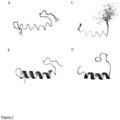
- a superimposition of the structure ensemble of the 20 lowest energy structures of EntK1 and the cartoon depiction of the lowest energy structure of EntK1 are shown in Figure 1 A and B respectively.
- the NMR structure of EntK1 contains an ⁇ -helix from residue 8 to residue 24.
- the structure ensemble has been deposited to the Protein Data Bank with access code: 5L82 and the NMR data have been deposited to the Biomagnetic Resonance Data Bank with the access code 34006.
- EntEJ97 showed the broadest activity spectrum, inhibiting E. faecium, E. faecalis, L. lactis, S. aureus, L. garvieae, and L. monocytogenes. It is important to note that EntK1 appeared to have significantly lower MIC values (i.e., being more potent) than EntEJ97 against E. faecium (Table 3). Similarly, all three bacteriocins were active against L. lactis IL1403, but LsbB was about 340 and 70 times more potent than EntK1 and EntEJ97, respectively (Table 3). Since EntK1 and EntEJ97 were active against E .
- Susceptible E. faecalis and E. faecium can be adapted to provide resistant mutants in response to EntEJ97 and EntK1.
- the strains E. faecalis LMGT3358 and E. faecium LMGT2787 were exposed to various concentrations of EntEJ97 and EntK1 at 30°C and many resistant colonies appeared within the inhibition zones on agar plates (see below).
- E. faecalis twelve EntEJ97 resistant colonies were randomly selected and examined for resistance to EntEJ97 by microtiter assays.
- E. faecium the same was done for six EntEJ97 and six EntK1 mutants.
- faecium HR mutants carried a transposon within the rseP gene (data not shown). In all cases, mutations caused frameshift in the rseP gene and premature termination, indicating that a functional ResP is necessary for the sensitivity toward EntEJ97/EntK1. Surprisingly, no mutations were found in rseP from all EntEJ97 LR mutants, indicating that additional genes can affect the sensitivity of the bacterium to these bacteriocins.
- the rseP gene from E. faecalis LMGT3358 was inserted into the genome of the distantly related and non-sensitive host S. pneumoniae strain SPH131 as described in (Berg et al., 2011, supra).
- the endogenous rseP of S. pneumoniae SPH131 was removed to avoid potential background noise.
- enterococcal rseP expression was under the control of the inducible promoter P comX ( Berg et al., 2011, supra).
- the active site of RseP is partly involved in the sensitivity to the EntEJ97/EntK1 bacteriocins.
- EntK1 and EntEJ97 resistant mutants become sensitive at elevated growth temperature.
- aureus LMGT 3310 >7000 >5500 590 S .
- aureus LMGT 3260 >7000 >5500 2300 S .
- aureus LMGT 3266 >7000 >5500 1175 S .
- epidermidis LMGT 3026 >7000 >5500 >4700 Enterococcus.
- faecalis LMGT 3199 >7000 5500 145 E. faecalis LMGT 3571 >7000 >5500 295 E. faecalis LMGT 3572 >7000 >5500 145 E. faecalis LMGT 3330 >7000 >5500 145 E. faecalis LMGT 3143 >7000 >5500 145 E. faecalis LMGT 3359 >7000 >5500 145 E. faecalis LMGT 3200 >7000 >5500 295 E. faecalis LMGT 3386 >7000 >5500 295 E. faecalis LMGT 3370 >7000 5500 145 E.
- cereus LMGT 3025 >7000 >5500 2300 B. cereus LMGT 2731 >7000 >5500 >4700 B. cereus LMGT 2711 >7000 2750 >4700 B. cereus LMGT 2735 >7000 >5500 >4700 Listeria monocytogenes LMGT 2651 >7000 >5500 2300 L. monocytogenes LMGT 2605 >7000 >5500 1175 Table 4.
- EntK1 in 50% TFE is very similar to that of LsbB ( Fig. 1 ). Both bacteriocins have an N-terminal part mostly composed of an amphiphilic ⁇ -helical motif, and an unstructured C-terminal half. EntK1's ⁇ -helix is longer than the one of LsbB, being 16-19 residues, versus 13-15 residues in LsbB. A closer look at the ⁇ -helices of EntK1 and LsbB showed that both are amphiphilic with the basic amino acids along one side of the helix and nonpolar residues along the other side (data not shown).
- the ⁇ -helical part of the bacteriocins is believed to be involved in a pore-formation mechanism, where the hydrophobic part is facing the hydrophobic core of the membrane or a protein (receptor), while the hydrophilic part is facing the pore to cause cellular leakage.
- the C-terminal unstructured parts of EntK1 and LsbB are about the same lengths, 10-13 residues and more similar in sequence.
- Structure prediction servers (PONDR ® VL-XT, JPred 4) indicated that EntEJ97 also contains an ⁇ -helix from Lys10 to Gly 35 with an unstructured C-terminal tail of 10 residues, which corresponds with our data on LsbB and EntK1 structures.
- enterocin 7, lacticin Q and aureocin A53 resemble the structure of circular bacteriocins, which are also highly structured in aqueous solutions. EntK1 and LsbB structures are very different from those bacteriocins by being unstructured in water and containing only one single helix ( Fig. 1 ).
- EntEJ97 and EntK1 employ the enterococcal RseP (in addition to the lactococcal one) as receptor.
- the lactococcal Zn-dependent metallopeptidase RseP has been shown to be responsible for the sensitivity to LsbB in L. lactis IL1403 ( Uzelac et al., 2013, J. Bacteriol., 195:5614-5621 ). According to our study, this conclusion is based on the fact that mutants of E. faecalis LMGT3358/ E .
- faecium LMGT2787 that are highly resistant to EntEJ97/EntK1, contain frameshift mutations in rseP, and, more conclusively, heterologous expression of the enterococcal rseP rendered resistant pneumococcal cells sensitive to these bacteriocins (Table 5).
- E. faecalis LMGT3358 EntEJ97 LR mutants had intact rseP.
- Both types of resistance were specific to EntEJ97 and EntK1 because all resistant cells were sensitive to the non-related bacteriocins BHT-B (leaderless type) and garvicin ML (circular type).
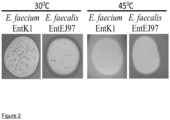
- both (high and low) types of resistance share one common feature - they emerge at the standard growth temperature of 30°C but not at the elevated 45°C, indicating that both resistance types are linked to the stress response ( Fig. 2 ).
- RseP deletion mutants have shown increased susceptibility to lysozyme and other treatments compared to the susceptibility of the WT strain ( Varahan et al., 2103, J Bacteriol., 195:3125-3134 ) and RseP plays a role in the bacterial stress response ( Kim, 2015, J. Microbiol., 53:306-310 , Alba et al., 2002, Genes Dev., 16:2156-2168 ).
- enterococcal EntK1 and EntEJ97 resistant mutants with frame shift rseP obtained at 30°C could not grow at 45°C, while the WT cells grew well.
- resistance types in which no mutations in resP existed were also susceptible to stress.
- the putative active site of enterococcal RseP proteases is located near the N-terminal part of the molecule and contains a consensus sequence motif HExxH, in which the two histidine residues are thought to coordinate a zinc atom together with a conserved glutamate residue.
- E. coli RseP active site is located ⁇ 14 ⁇ into the lipid membrane surface ( Feng et al., 2007, Science, 318:1608-1612 ).
- replacing the conserved residues with alanines in E. faecalis RseP increased cells resistance to EntEJ97 and EntK1 especially when all three conserved residues were replaced.
- this version of RseP did not give total resistance to EntEJ97 unlike the HR mutants of E.
- EntK1 and EntEJ97 inhibition spectrum showed an interesting detail - EntK1 had generally narrower antibacterial spectrum than EntEJ97.
- EntK1 was much more potent (i.e., lower MIC values) than EntEJ97 (Table 3, 4).
- EntEJ97 was equally active against E. faecalis and E. faecium (Table 3, 4).
- multiple sequence alignment analysis using Clustal Omega
- RseP (30 from E. faecalis and 30 from E. faecium
- did not show any pronounced differences between the two RseP groups did not show any pronounced differences between the two RseP groups (data not shown).
- the properties of RseP that define the different levels of sensitivity toward EntEJ97 and EntK1 await further investigation.
- Bacterial strains, growth conditions, bacteriocins and antimicrobial assays Bacterial strains, growth conditions, bacteriocins and antimicrobial assays.
- NisinZ and micrococcin P1 were purified from source. Synthesized peptides were solubilized to concentrations of 10.0 - 0.1 mg/ml in 0.1% (vol/vol) trifluoroacetic acid and stored at -20°C until use.
- Garvicin KS is made up of 3 peptides:
- NisinZ has the sequence: ITSISLCTPGCKTGALMGCNMKTATCNCSIHVSK Micrococcin P1 has the structure:
- Bacteriocin activity was determined using a microtitre plate assay. The plates were incubated at 30°C for 8 h and the growth was measured spectrophotometrically at 600 nm (A 600 ) with 15 min intervals using SPECTROstarNano (BMG LABTECH, Germany). The MIC was defined as the bacteriocin concentration that inhibited the growth of the indicator strain by at least 50% in 200 ⁇ l culture (i.e., 50% of the turbidity of the control culture without bacteriocin).
- EntEJ97short and K1-EJ hybrid compared to other bacteriocins (Table 6B).
- EntEJ97short was particularly effective against E. hirae, E. faecalis and S . pseudointermedius and K1-EJ proved particularly effective against E. hirae, E. faecium, E. faecalis and S . haemolyticus.
Landscapes
- Life Sciences & Earth Sciences (AREA)
- Health & Medical Sciences (AREA)
- Chemical & Material Sciences (AREA)
- Engineering & Computer Science (AREA)
- General Health & Medical Sciences (AREA)
- Zoology (AREA)
- Wood Science & Technology (AREA)
- Proteomics, Peptides & Aminoacids (AREA)
- Organic Chemistry (AREA)
- Animal Behavior & Ethology (AREA)
- Veterinary Medicine (AREA)
- Medicinal Chemistry (AREA)
- Public Health (AREA)
- Polymers & Plastics (AREA)
- Food Science & Technology (AREA)
- Gastroenterology & Hepatology (AREA)
- Epidemiology (AREA)
- Chemical Kinetics & Catalysis (AREA)
- General Chemical & Material Sciences (AREA)
- Pharmacology & Pharmacy (AREA)
- Microbiology (AREA)
- Molecular Biology (AREA)
- Biophysics (AREA)
- Genetics & Genomics (AREA)
- Biochemistry (AREA)
- Pest Control & Pesticides (AREA)
- Dentistry (AREA)
- Virology (AREA)
- Plant Pathology (AREA)
- Agronomy & Crop Science (AREA)
- Biotechnology (AREA)
- Environmental Sciences (AREA)
- Bioinformatics & Cheminformatics (AREA)
- Immunology (AREA)
- Nuclear Medicine, Radiotherapy & Molecular Imaging (AREA)
- Oncology (AREA)
- Communicable Diseases (AREA)
- Peptides Or Proteins (AREA)
- Medicines That Contain Protein Lipid Enzymes And Other Medicines (AREA)
Claims (15)
- Procédé in vitro ou ex vivo destiné à tuer, endommager ou prévenir la réplication de bactéries comprenant l'administration ou l'application d'une bactériocine à ladite bactérie,
dans lequel ladite bactériocine et ladite bactérie sont sélectionnées parmi :i) ladite bactériocine est un peptide de moins de 40 acides aminés comprenant une séquence d'acides aminés sélectionnée parmi :MKFKFNPTGTIVKKLTQYEIAWFKNKHGYYPWEIPRC (SEQ ID NO : 1 - EntK1) ou une séquence avec au moins 90 % d'identité de séquence avec celle-ci, et ladite bactériocine présente une activité antibactérienne,et ladite bactérie est E. faecium résistant à la vancomycine ;ii) ladite bactériocine est un peptide tronqué deMLAKIKAMIKKFPNPYTLAAKLTTYEINWYKQQYGRYPWERPVA (SEQ ID NO : 2 - EntEJ97), consistant en la séquence :KAMIKKFPNPYTLAAKLTTYEINWYKQQYGRYPWERPVA,AMIKKFPNPYTLAAKLTTYEINWYKQQYGRYPWERPVA,MIKKFPNPYTLAAKLTTYEINWYKQQYGRYPWERPVA,IKKFPNPYTLAAKLTTYEINWYKQQYGRYPWERPVA, ouKKFPNPYTLAAKLTTYEINWYKQQYGRYPWERPVA, ou une séquence avec au moins 90 % d'identité de séquence avec une quelconque de ces séquences, et ladite bactériocine présente une activité antibactérienne,de préférence MIKKFPNPYTLAAKLTTYEINWYKQQYGRYPWERPVA (SEQ ID NO : 3 - EntEJ97short) ou une séquence avec au moins 90 % d'identité de séquence avec celle-ci, etladite bactérie est S. pseudointermedius et/ou S. hemolyticus ; etiii) ladite bactériocine est un peptide de moins de 40 acides aminés comprenant une séquence d'acides aminés sélectionnée parmi :MKFKFNPTGTIVKKLTQYEINWYKQQYGRYPWERPVA (SEQ ID N0: 4 - K1-EJ) ou une séquence avec au moins 90 % d'identité de séquence avec celle-ci, et ladite bactériocine présente une activité antibactérienne, etladite bactérie est E. faecium, E. faecalis et/ou S. hemolyticus ;et éventuellement ladite bactérie est soumise à un chauffage compris entre 40 et 50 °C avant, pendant et/ou après administration ou application de ladite bactériocine,dans lequel ladite bactériocine comprend au moins la séquence consensus KXXXGXXPWE, dans lequel X peut être un quelconque acide aminé,dans lequel, de préférence, ladite bactériocine est fournie dans une cellule hôte qui produit ladite bactériocine. - Procédé selon la revendication 1, dans lequel ladite bactériocine est co-administrée ou co-appliquée avec un ou plusieurs agents antibactériens supplémentaires, de préférence sélectionnés parmi une ou plusieurs bactériocines ou un ou plusieurs antibiotiques, dans lequel ladite bactériocine est sous forme d'une composition comprenant ladite bactériocine et lesdits un ou plusieurs agents antibactériens supplémentaires.
- Utilisation d'une bactériocine selon la revendication 1 en tant qu'antibactérien in vitro ou ex vivo, dans laquelle ladite bactériocine est utilisée en tant qu'antibactérien contre la bactérie selon la revendication 1, éventuellement avec un chauffage selon la revendication 1.
- Procédé selon la revendication 1 destiné à désinfecter ou à décontaminer un article, d'une bactérie présente sur ledit article, comprenant l'enduction, l'imprégnation, ou le revêtement dudit article avec une bactériocine ou l'application de ladite bactériocine sur ledit article, dans lequel ladite bactériocine et ladite bactérie sont telles que définies dans la revendication 1, dans lequel éventuellement dans ledit procédé lesdites bactéries sont soumises à un chauffage selon la revendication 1,
dans lequel, de préférence, ledit article esti) un dispositif médical, un instrument, un accessoire ou un équipement, une prothèse ou une matière, un tissu ou un pansement, ouii) un produit d'hygiène corporelle, de préférence du dentifrice, un bain de bouche, une crème pour la peau, une lotion ou un spray. - Bactériocine destinée à être utilisée dans le traitement ou la prévention d'une infection bactérienne chez un sujet ou patient, dans laquelle ledit traitement ou ladite prévention doit comprendre l'administration de ladite bactériocine au dit sujet ou patient ou à une partie du corps dudit sujet ou patient,
dans laquelle ladite bactériocine et ladite bactérie sont sélectionnées parmi :i) ladite bactériocine est un peptide de moins de 40 acides aminés comprenant une séquence d'acides aminés sélectionnée parmi :MKFKFNPTGTIVKKLTQYEIAWFKNKHGYYPWEIPRC (SEQ ID NO : 1 - EntK1) ou une séquence avec au moins 90 % d'identité de séquence avec celle-ci, et ladite bactériocine présente une activité antibactérienne,et ladite bactérie est E. faecium résistant à la vancomycine ;ii) ladite bactériocine est un peptide tronqué deMLAKIKAMIKKFPNPYTLAAKLTTYEINWYKQQYGRYPWERPVA (SEQ ID NO : 2 - EntEJ97), consistant en la séquence :KAMIKKFPNPYTLAAKLTTYEINWYKQQYGRYPWERPVA,AMIKKFPNPYTLAAKLTTYEINWYKQQYGRYPWERPVA,MIKKFPNPYTLAAKLTTYEINWYKQQYGRYPWERPVA,IKKFPNPYTLAAKLTTYEINWYKQQYGRYPWERPVA, ouKKFPNPYTLAAKLTTYEINWYKQQYGRYPWERPVA,ou une séquence avec au moins 90 % d'identité de séquence avec une quelconque des ces séquences, et ladite bactériocine présente une activité antibactérienne,de préférence MIKKFPNPYTLAAKLTTYEINWYKQQYGRYPWERPVA (SEQ ID NO : 3 - EntEJ97short) ou une séquence avec au moins 90 % d'identité de séquence avec celle-ci, etladite bactérie est S. pseudointermedius et/ou S. hemolyticus ; etiii) ladite bactériocine est un peptide de moins de 40 acides aminés comprenant une séquence d'acides aminés sélectionnée parmi :MKFKFNPTGTIVKKLTQYEINWYKQQYGRYPWERPVA (SEQ ID NO : 4- K1-EJ) ou une séquence avec au moins 90 % d'identité de séquence avec celle-ci, et ladite bactériocine présente une activité antibactérienne, etladite bactérie est E. faecium, E. faecalis et/ou S. hemolyticus ;dans laquelle ladite bactériocine comprend au moins la séquence consensus KXXXGXXPWE, dans laquelle X peut être un quelconque acide aminé,dans laquelle, de préférence, ledit sujet ou patient est un mammifère,dans laquelle, de préférence, ladite infection bactérienne est une infection sur la peau et ladite bactériocine est, ou doit être, administrée localement,dans laquelle, de préférence, ladite bactériocine est fournie dans une cellule hôte qui produit ladite bactériocine,dans laquelle, de préférence, ladite bactériocine est à co-administrer ou co-appliquer avec un ou plusieurs agents antibactériens supplémentaires, de préférence sélectionnés parmi une ou plusieurs bactériocines ou un ou plusieurs antibiotiques, dans laquelle éventuellement ladite bactériocine est sous forme d'une composition comprenant ladite bactériocine et lesdits un ou plusieurs agents antibactériens supplémentaires. - Peptide bactériocine sélectionné parmi :a) un peptide tronqué deMLAKIKAMIKKFPNPYTLAAKLTTYEINWYKQQYGRYPWERPVA (SEQ ID NO : 2 - EntEJ97), consistant en la séquence :KAMIKKFPNPYTLAAKLTTYEINWYKQQYGRYPWERPVA,AMIKKFPNPYTLAAKLTTYEINWYKQQYGRYPWERPVA,MIKKFPNPYTLAAKLTTYEINWYKQQYGRYPWERPVA,IKKFPNPYTLAAKLTTYEINWYKQQYGRYPWERPVA, ouKKFPNPYTLAAKLTTYEINWYKQQYGRYPWERPVA, ou une séquence avec au moins 90 % d'identité de séquence avec une quelconque de ces séquences, et ladite bactériocine présente une activité antibactérienne,de préférence MIKKFPNPYTLAAKLTTYEINWYKQQYGRYPWERPVA (SEQ ID NO : 3 - EntEJ97short) ou une séquence avec au moins 90 % d'identité de séquence avec celle-ci, etb) un peptide de moins de 40 acides aminés comprenant la séquence d'acides aminés MKFKFNPTGTIVKKLTQYEINWYKQQYGRYPWERPVA (SEQ ID NO : 4 - K1-EJ), ou une séquence avec au moins 90 % d'identité de séquence avec celle-ci, et ladite bactériocine présente une activité antibactérienne.
- Molécule d'acide nucléique comprenant une séquence nucléotidique codant pour un peptide bactériocine selon la revendication 6.
- Molécule d'acide nucléique recombinante comprenant une séquence régulatrice, et au moins une séquence nucléotidique selon la revendication 7.
- Cellule hôte comprenant une molécule d'acide nucléique ou une molécule d'acide nucléique recombinante selon la revendication 7 ou 8.
- Composition comprenant un peptide bactériocine selon la revendication 6 ou une cellule hôte selon la revendication 9.
- Procédé de préparation d'un peptide bactériocine selon la revendication 6 comprennant la croissance d'une cellule hôte selon la revendication 9 dans des conditions selon lesquelles ledit peptide est exprimé et la récupération dudit peptide ainsi produit.
- Procédé in vitro ou ex vivo destiné à tuer, endommager ou prévenir la réplication de bactéries comprenant l'administration ou l'application d'une bactériocine selon la revendication 6 ou d'une composition selon la revendication 10 à ladite bactérie,
dans lequel, de préférence, ladite bactérie est E. faecium, E. faecalis, E. hirae, S. pseudointermedius et/ou S. hemolyticus. - Utilisation d'une bactériocine selon la revendication 6 ou d'une composition selon la revendication 10 en tant qu'antibactérien in vitro ou ex vivo.
- Bactériocine selon la revendication 6 ou composition selon la revendication 10 destinée à être utilisée dans le traitement ou la prévention d'une infection bactérienne chez un sujet ou patient,dans laquelle ledit traitement ou ladite prévention doit comprendre l'administration de ladite bactériocine ou composition au dit sujet ou patient ou à une partie du corps dudit sujet ou patient,dans laquelle, de préférence, ledit sujet ou patient est un mammifère,dans laquelle, de préférence, ladite infection bactérienne est une infection sur la peau et ladite bactériocine est, ou doit être, administrée localement,dans laquelle, de préférence, ladite bactériocine est fournie dans une cellule hôte qui produit ladite bactériocine,dans laquelle, de préférence, ladite bactériocine est à co-administrer ou co-appliquer avec un ou plusieurs agents antibactériens supplémentaires, de préférence sélectionnés parmi une ou plusieurs bactériocines ou un ou plusieurs antibiotiques, dans laquelle éventuellement ladite bactériocine est sous forme d'une composition comprenant ladite bactériocine et lesdits un ou plusieurs agents antibactériens supplémentaires.
- Procédé de préparation d'un produit alimentaire en conserve ou destiné à éviter l'altération des aliments comprenant l'ajout d'une bactériocine selon la revendication 6 à un produit alimentaire et éventuellement le fait de soumettre ledit produit alimentaire à un chauffage selon la revendication 1.
Applications Claiming Priority (2)
| Application Number | Priority Date | Filing Date | Title |
|---|---|---|---|
| GBGB1621295.3A GB201621295D0 (en) | 2016-12-14 | 2016-12-14 | Antibacterial method |
| PCT/EP2017/082937 WO2018109135A1 (fr) | 2016-12-14 | 2017-12-14 | Procédé antibactérien |
Publications (3)
| Publication Number | Publication Date |
|---|---|
| EP3554530A1 EP3554530A1 (fr) | 2019-10-23 |
| EP3554530C0 EP3554530C0 (fr) | 2023-08-23 |
| EP3554530B1 true EP3554530B1 (fr) | 2023-08-23 |
Family
ID=58222159
Family Applications (1)
| Application Number | Title | Priority Date | Filing Date |
|---|---|---|---|
| EP17835815.6A Active EP3554530B1 (fr) | 2016-12-14 | 2017-12-14 | Procédé antibactérien |
Country Status (5)
| Country | Link |
|---|---|
| US (3) | US10851139B2 (fr) |
| EP (1) | EP3554530B1 (fr) |
| CA (1) | CA3047045A1 (fr) |
| GB (1) | GB201621295D0 (fr) |
| WO (1) | WO2018109135A1 (fr) |
Families Citing this family (1)
| Publication number | Priority date | Publication date | Assignee | Title |
|---|---|---|---|---|
| GB202014427D0 (en) | 2020-09-14 | 2020-10-28 | Norwegian Univ Of Life Sciences | Composition and use |
-
2016
- 2016-12-14 GB GBGB1621295.3A patent/GB201621295D0/en not_active Ceased
-
2017
- 2017-12-14 EP EP17835815.6A patent/EP3554530B1/fr active Active
- 2017-12-14 US US16/469,757 patent/US10851139B2/en active Active
- 2017-12-14 CA CA3047045A patent/CA3047045A1/fr active Pending
- 2017-12-14 WO PCT/EP2017/082937 patent/WO2018109135A1/fr not_active Ceased
-
2020
- 2020-10-01 US US17/060,592 patent/US20210024588A1/en not_active Abandoned
- 2020-10-01 US US17/060,648 patent/US11648289B2/en active Active
Also Published As
| Publication number | Publication date |
|---|---|
| EP3554530C0 (fr) | 2023-08-23 |
| US10851139B2 (en) | 2020-12-01 |
| US20190322705A1 (en) | 2019-10-24 |
| US11648289B2 (en) | 2023-05-16 |
| EP3554530A1 (fr) | 2019-10-23 |
| CA3047045A1 (fr) | 2018-06-21 |
| US20210017236A1 (en) | 2021-01-21 |
| WO2018109135A1 (fr) | 2018-06-21 |
| US20210024588A1 (en) | 2021-01-28 |
| GB201621295D0 (en) | 2017-01-25 |
Similar Documents
| Publication | Publication Date | Title |
|---|---|---|
| US10781236B2 (en) | Bacteriocin composition and method | |
| KR101899552B1 (ko) | 전복에서 유래한 항균 펩타이드 유사체 및 이를 포함하는 항균용 약학 조성물 | |
| JP6818349B2 (ja) | アシネトバクター溶解素 | |
| JP2010207227A (ja) | 新規な抗菌性ポリペプチド及び使用方法 | |
| AU2013226402B2 (en) | Variants of the lantibiotic MU1140 and other lantibiotics with improved pharmacological properties and structural features | |
| US11648289B2 (en) | Antibacterial method | |
| Kim et al. | Synergistic inhibitory effect of cationic peptides and antimicrobial agents on the growth of oral streptococci | |
| AU2017296061B2 (en) | Lantibiotic variants and uses thereof | |
| KR101430084B1 (ko) | 프로피오니박테리움 아크네스에 작용하는 신규한 항생 펩타이드 및 이의 용도 | |
| KR102311729B1 (ko) | 유산균에서 분리한 항균 펩타이드 플랜타리신 및 이의 용도 | |
| US9326523B2 (en) | Class I and II lantibiotics from geobacillus thermodenitrificans | |
| US20240041976A1 (en) | Composition and use |
Legal Events
| Date | Code | Title | Description |
|---|---|---|---|
| STAA | Information on the status of an ep patent application or granted ep patent |
Free format text: STATUS: UNKNOWN |
|
| STAA | Information on the status of an ep patent application or granted ep patent |
Free format text: STATUS: THE INTERNATIONAL PUBLICATION HAS BEEN MADE |
|
| PUAI | Public reference made under article 153(3) epc to a published international application that has entered the european phase |
Free format text: ORIGINAL CODE: 0009012 |
|
| STAA | Information on the status of an ep patent application or granted ep patent |
Free format text: STATUS: REQUEST FOR EXAMINATION WAS MADE |
|
| 17P | Request for examination filed |
Effective date: 20190627 |
|
| AK | Designated contracting states |
Kind code of ref document: A1 Designated state(s): AL AT BE BG CH CY CZ DE DK EE ES FI FR GB GR HR HU IE IS IT LI LT LU LV MC MK MT NL NO PL PT RO RS SE SI SK SM TR |
|
| AX | Request for extension of the european patent |
Extension state: BA ME |
|
| DAV | Request for validation of the european patent (deleted) | ||
| DAX | Request for extension of the european patent (deleted) | ||
| STAA | Information on the status of an ep patent application or granted ep patent |
Free format text: STATUS: EXAMINATION IS IN PROGRESS |
|
| 17Q | First examination report despatched |
Effective date: 20200529 |
|
| GRAP | Despatch of communication of intention to grant a patent |
Free format text: ORIGINAL CODE: EPIDOSNIGR1 |
|
| STAA | Information on the status of an ep patent application or granted ep patent |
Free format text: STATUS: GRANT OF PATENT IS INTENDED |
|
| INTG | Intention to grant announced |
Effective date: 20220413 |
|
| RAP3 | Party data changed (applicant data changed or rights of an application transferred) |
Owner name: NORWEGIAN UNIVERSITY OF LIFE SCIENCE |
|
| GRAJ | Information related to disapproval of communication of intention to grant by the applicant or resumption of examination proceedings by the epo deleted |
Free format text: ORIGINAL CODE: EPIDOSDIGR1 |
|
| STAA | Information on the status of an ep patent application or granted ep patent |
Free format text: STATUS: EXAMINATION IS IN PROGRESS |
|
| INTC | Intention to grant announced (deleted) | ||
| GRAP | Despatch of communication of intention to grant a patent |
Free format text: ORIGINAL CODE: EPIDOSNIGR1 |
|
| STAA | Information on the status of an ep patent application or granted ep patent |
Free format text: STATUS: GRANT OF PATENT IS INTENDED |
|
| INTG | Intention to grant announced |
Effective date: 20221006 |
|
| RAP3 | Party data changed (applicant data changed or rights of an application transferred) |
Owner name: NORWEGIAN UNIVERSITY OF LIFE SCIENCES |
|
| GRAJ | Information related to disapproval of communication of intention to grant by the applicant or resumption of examination proceedings by the epo deleted |
Free format text: ORIGINAL CODE: EPIDOSDIGR1 |
|
| STAA | Information on the status of an ep patent application or granted ep patent |
Free format text: STATUS: EXAMINATION IS IN PROGRESS |
|
| GRAP | Despatch of communication of intention to grant a patent |
Free format text: ORIGINAL CODE: EPIDOSNIGR1 |
|
| STAA | Information on the status of an ep patent application or granted ep patent |
Free format text: STATUS: GRANT OF PATENT IS INTENDED |
|
| INTC | Intention to grant announced (deleted) | ||
| INTG | Intention to grant announced |
Effective date: 20230313 |
|
| GRAS | Grant fee paid |
Free format text: ORIGINAL CODE: EPIDOSNIGR3 |
|
| GRAA | (expected) grant |
Free format text: ORIGINAL CODE: 0009210 |
|
| STAA | Information on the status of an ep patent application or granted ep patent |
Free format text: STATUS: THE PATENT HAS BEEN GRANTED |
|
| AK | Designated contracting states |
Kind code of ref document: B1 Designated state(s): AL AT BE BG CH CY CZ DE DK EE ES FI FR GB GR HR HU IE IS IT LI LT LU LV MC MK MT NL NO PL PT RO RS SE SI SK SM TR |
|
| REG | Reference to a national code |
Ref country code: GB Ref legal event code: FG4D |
|
| RIN1 | Information on inventor provided before grant (corrected) |
Inventor name: THORSTENSEN, TAGE Inventor name: NES, INGOLF F. Inventor name: KRISTIANSEN, PER E. Inventor name: OVCHINNIKOV, KIRILL V. Inventor name: DIEP, DZUNG B. |
|
| REG | Reference to a national code |
Ref country code: CH Ref legal event code: EP |
|
| REG | Reference to a national code |
Ref country code: DE Ref legal event code: R096 Ref document number: 602017073216 Country of ref document: DE |
|
| REG | Reference to a national code |
Ref country code: IE Ref legal event code: FG4D |
|
| U01 | Request for unitary effect filed |
Effective date: 20230824 |
|
| U07 | Unitary effect registered |
Designated state(s): AT BE BG DE DK EE FI FR IT LT LU LV MT NL PT SE SI Effective date: 20230831 |
|
| REG | Reference to a national code |
Ref country code: NO Ref legal event code: T2 Effective date: 20230823 |
|
| PG25 | Lapsed in a contracting state [announced via postgrant information from national office to epo] |
Ref country code: GR Free format text: LAPSE BECAUSE OF FAILURE TO SUBMIT A TRANSLATION OF THE DESCRIPTION OR TO PAY THE FEE WITHIN THE PRESCRIBED TIME-LIMIT Effective date: 20231124 |
|
| PG25 | Lapsed in a contracting state [announced via postgrant information from national office to epo] |
Ref country code: IS Free format text: LAPSE BECAUSE OF FAILURE TO SUBMIT A TRANSLATION OF THE DESCRIPTION OR TO PAY THE FEE WITHIN THE PRESCRIBED TIME-LIMIT Effective date: 20231223 |
|
| U20 | Renewal fee for the european patent with unitary effect paid |
Year of fee payment: 7 Effective date: 20231219 |
|
| PG25 | Lapsed in a contracting state [announced via postgrant information from national office to epo] |
Ref country code: RS Free format text: LAPSE BECAUSE OF FAILURE TO SUBMIT A TRANSLATION OF THE DESCRIPTION OR TO PAY THE FEE WITHIN THE PRESCRIBED TIME-LIMIT Effective date: 20230823 Ref country code: IS Free format text: LAPSE BECAUSE OF FAILURE TO SUBMIT A TRANSLATION OF THE DESCRIPTION OR TO PAY THE FEE WITHIN THE PRESCRIBED TIME-LIMIT Effective date: 20231223 Ref country code: HR Free format text: LAPSE BECAUSE OF FAILURE TO SUBMIT A TRANSLATION OF THE DESCRIPTION OR TO PAY THE FEE WITHIN THE PRESCRIBED TIME-LIMIT Effective date: 20230823 Ref country code: GR Free format text: LAPSE BECAUSE OF FAILURE TO SUBMIT A TRANSLATION OF THE DESCRIPTION OR TO PAY THE FEE WITHIN THE PRESCRIBED TIME-LIMIT Effective date: 20231124 |
|
| PGFP | Annual fee paid to national office [announced via postgrant information from national office to epo] |
Ref country code: NO Payment date: 20231220 Year of fee payment: 7 |
|
| PG25 | Lapsed in a contracting state [announced via postgrant information from national office to epo] |
Ref country code: PL Free format text: LAPSE BECAUSE OF FAILURE TO SUBMIT A TRANSLATION OF THE DESCRIPTION OR TO PAY THE FEE WITHIN THE PRESCRIBED TIME-LIMIT Effective date: 20230823 |
|
| PG25 | Lapsed in a contracting state [announced via postgrant information from national office to epo] |
Ref country code: ES Free format text: LAPSE BECAUSE OF FAILURE TO SUBMIT A TRANSLATION OF THE DESCRIPTION OR TO PAY THE FEE WITHIN THE PRESCRIBED TIME-LIMIT Effective date: 20230823 |
|
| PG25 | Lapsed in a contracting state [announced via postgrant information from national office to epo] |
Ref country code: SM Free format text: LAPSE BECAUSE OF FAILURE TO SUBMIT A TRANSLATION OF THE DESCRIPTION OR TO PAY THE FEE WITHIN THE PRESCRIBED TIME-LIMIT Effective date: 20230823 Ref country code: RO Free format text: LAPSE BECAUSE OF FAILURE TO SUBMIT A TRANSLATION OF THE DESCRIPTION OR TO PAY THE FEE WITHIN THE PRESCRIBED TIME-LIMIT Effective date: 20230823 Ref country code: ES Free format text: LAPSE BECAUSE OF FAILURE TO SUBMIT A TRANSLATION OF THE DESCRIPTION OR TO PAY THE FEE WITHIN THE PRESCRIBED TIME-LIMIT Effective date: 20230823 Ref country code: CZ Free format text: LAPSE BECAUSE OF FAILURE TO SUBMIT A TRANSLATION OF THE DESCRIPTION OR TO PAY THE FEE WITHIN THE PRESCRIBED TIME-LIMIT Effective date: 20230823 Ref country code: SK Free format text: LAPSE BECAUSE OF FAILURE TO SUBMIT A TRANSLATION OF THE DESCRIPTION OR TO PAY THE FEE WITHIN THE PRESCRIBED TIME-LIMIT Effective date: 20230823 |
|
| REG | Reference to a national code |
Ref country code: DE Ref legal event code: R097 Ref document number: 602017073216 Country of ref document: DE |
|
| PLBE | No opposition filed within time limit |
Free format text: ORIGINAL CODE: 0009261 |
|
| STAA | Information on the status of an ep patent application or granted ep patent |
Free format text: STATUS: NO OPPOSITION FILED WITHIN TIME LIMIT |
|
| 26N | No opposition filed |
Effective date: 20240524 |
|
| REG | Reference to a national code |
Ref country code: CH Ref legal event code: PL |
|
| PG25 | Lapsed in a contracting state [announced via postgrant information from national office to epo] |
Ref country code: MC Free format text: LAPSE BECAUSE OF FAILURE TO SUBMIT A TRANSLATION OF THE DESCRIPTION OR TO PAY THE FEE WITHIN THE PRESCRIBED TIME-LIMIT Effective date: 20230823 |
|
| GBPC | Gb: european patent ceased through non-payment of renewal fee |
Effective date: 20231214 |
|
| PG25 | Lapsed in a contracting state [announced via postgrant information from national office to epo] |
Ref country code: MC Free format text: LAPSE BECAUSE OF FAILURE TO SUBMIT A TRANSLATION OF THE DESCRIPTION OR TO PAY THE FEE WITHIN THE PRESCRIBED TIME-LIMIT Effective date: 20230823 |
|
| REG | Reference to a national code |
Ref country code: IE Ref legal event code: MM4A |
|
| PG25 | Lapsed in a contracting state [announced via postgrant information from national office to epo] |
Ref country code: IE Free format text: LAPSE BECAUSE OF NON-PAYMENT OF DUE FEES Effective date: 20231214 |
|
| PG25 | Lapsed in a contracting state [announced via postgrant information from national office to epo] |
Ref country code: GB Free format text: LAPSE BECAUSE OF NON-PAYMENT OF DUE FEES Effective date: 20231214 |
|
| PG25 | Lapsed in a contracting state [announced via postgrant information from national office to epo] |
Ref country code: CH Free format text: LAPSE BECAUSE OF NON-PAYMENT OF DUE FEES Effective date: 20231231 |
|
| PG25 | Lapsed in a contracting state [announced via postgrant information from national office to epo] |
Ref country code: IE Free format text: LAPSE BECAUSE OF NON-PAYMENT OF DUE FEES Effective date: 20231214 Ref country code: GB Free format text: LAPSE BECAUSE OF NON-PAYMENT OF DUE FEES Effective date: 20231214 Ref country code: CH Free format text: LAPSE BECAUSE OF NON-PAYMENT OF DUE FEES Effective date: 20231231 |
|
| PG25 | Lapsed in a contracting state [announced via postgrant information from national office to epo] |
Ref country code: CY Free format text: LAPSE BECAUSE OF FAILURE TO SUBMIT A TRANSLATION OF THE DESCRIPTION OR TO PAY THE FEE WITHIN THE PRESCRIBED TIME-LIMIT; INVALID AB INITIO Effective date: 20171214 |
|
| U90 | Renewal fees not paid: noting of loss of rights |
Free format text: RENEWAL FEE NOT PAID FOR YEAR 08 Effective date: 20250711 |
|
| PG25 | Lapsed in a contracting state [announced via postgrant information from national office to epo] |
Ref country code: HU Free format text: LAPSE BECAUSE OF FAILURE TO SUBMIT A TRANSLATION OF THE DESCRIPTION OR TO PAY THE FEE WITHIN THE PRESCRIBED TIME-LIMIT; INVALID AB INITIO Effective date: 20171214 |
|
| PG25 | Lapsed in a contracting state [announced via postgrant information from national office to epo] |
Ref country code: NO Free format text: LAPSE BECAUSE OF NON-PAYMENT OF DUE FEES Effective date: 20241231 |
|
| U93 | Unitary patent lapsed |
Free format text: RENEWAL FEE NOT PAID Effective date: 20241231 |
|
| PG25 | Lapsed in a contracting state [announced via postgrant information from national office to epo] |
Ref country code: TR Free format text: LAPSE BECAUSE OF FAILURE TO SUBMIT A TRANSLATION OF THE DESCRIPTION OR TO PAY THE FEE WITHIN THE PRESCRIBED TIME-LIMIT Effective date: 20230823 |