EP3554497B1 - Use of cannabidiol in the treatment of anxiety in angelman syndrome - Google Patents
Use of cannabidiol in the treatment of anxiety in angelman syndrome Download PDFInfo
- Publication number
- EP3554497B1 EP3554497B1 EP17817833.1A EP17817833A EP3554497B1 EP 3554497 B1 EP3554497 B1 EP 3554497B1 EP 17817833 A EP17817833 A EP 17817833A EP 3554497 B1 EP3554497 B1 EP 3554497B1
- Authority
- EP
- European Patent Office
- Prior art keywords
- cbd
- treatment
- mice
- angelman syndrome
- anxiety
- Prior art date
- Legal status (The legal status is an assumption and is not a legal conclusion. Google has not performed a legal analysis and makes no representation as to the accuracy of the status listed.)
- Active
Links
Images


Classifications
-
- A—HUMAN NECESSITIES
- A61—MEDICAL OR VETERINARY SCIENCE; HYGIENE
- A61P—SPECIFIC THERAPEUTIC ACTIVITY OF CHEMICAL COMPOUNDS OR MEDICINAL PREPARATIONS
- A61P25/00—Drugs for disorders of the nervous system
-
- A—HUMAN NECESSITIES
- A61—MEDICAL OR VETERINARY SCIENCE; HYGIENE
- A61K—PREPARATIONS FOR MEDICAL, DENTAL OR TOILETRY PURPOSES
- A61K31/00—Medicinal preparations containing organic active ingredients
- A61K31/185—Acids; Anhydrides, halides or salts thereof, e.g. sulfur acids, imidic, hydrazonic or hydroximic acids
- A61K31/19—Carboxylic acids, e.g. valproic acid
- A61K31/192—Carboxylic acids, e.g. valproic acid having aromatic groups, e.g. sulindac, 2-aryl-propionic acids, ethacrynic acid
-
- A—HUMAN NECESSITIES
- A61—MEDICAL OR VETERINARY SCIENCE; HYGIENE
- A61K—PREPARATIONS FOR MEDICAL, DENTAL OR TOILETRY PURPOSES
- A61K31/00—Medicinal preparations containing organic active ingredients
- A61K31/658—Medicinal preparations containing organic active ingredients o-phenolic cannabinoids, e.g. cannabidiol, cannabigerolic acid, cannabichromene or tetrahydrocannabinol
-
- A—HUMAN NECESSITIES
- A61—MEDICAL OR VETERINARY SCIENCE; HYGIENE
- A61K—PREPARATIONS FOR MEDICAL, DENTAL OR TOILETRY PURPOSES
- A61K36/00—Medicinal preparations of undetermined constitution containing material from algae, lichens, fungi or plants, or derivatives thereof, e.g. traditional herbal medicines
- A61K36/18—Magnoliophyta (angiosperms)
- A61K36/185—Magnoliopsida (dicotyledons)
- A61K36/348—Cannabaceae
- A61K36/3482—Cannabis
-
- A—HUMAN NECESSITIES
- A61—MEDICAL OR VETERINARY SCIENCE; HYGIENE
- A61K—PREPARATIONS FOR MEDICAL, DENTAL OR TOILETRY PURPOSES
- A61K45/00—Medicinal preparations containing active ingredients not provided for in groups A61K31/00 - A61K41/00
- A61K45/06—Mixtures of active ingredients without chemical characterisation, e.g. antiphlogistics and cardiaca
-
- A—HUMAN NECESSITIES
- A61—MEDICAL OR VETERINARY SCIENCE; HYGIENE
- A61P—SPECIFIC THERAPEUTIC ACTIVITY OF CHEMICAL COMPOUNDS OR MEDICINAL PREPARATIONS
- A61P25/00—Drugs for disorders of the nervous system
- A61P25/20—Hypnotics; Sedatives
Definitions
- the present invention relates to cannabidiol (CBD) for use in the treatment of anxiety associated with Angelman syndrome (AS), wherein the CBD is present as a highly purified extract of cannabis which comprises at least 98% (w/w) CBD and wherein the extract comprises less than 0.15% (w/w) THC.
- CBD cannabidiol
- the CBD may be used concomitantly with one or more other medicaments.
- the CBD may be formulated for administration separately, sequentially or simultaneously with one or more medicaments or the combination may be provided in a single dosage form.
- the CBD is formulated for administration separately, sequentially or simultaneously it may be provided as a kit or together with instructions to administer the one or more components in the manner indicated. It may also be used as the sole medication, i.e. as a monotherapy.
- AS Angelman syndrome
- UBE3A gene A genetic anomaly responsible for AS occurs by chance around the time of conception.
- the UBE3A gene is either absent or malfunctions.
- a child usually inherits one copy of the UBE3A gene from each parent. Both copies are switched on (active) in most of the body's tissues. However, in certain areas of the brain, only the gene inherited from the mother is active. In most cases of AS (about 70%), the child's maternal copy of the UBE3A gene is missing, which means there's no active copy of the UBE3A gene in the child's brain.
- the UBE3A mouse model is used to evaluate a compounds effectiveness in the treatment of AS. This model has been shown to recapitulate many of the phenotypic features of AS, including motor dysfunction, increased seizure susceptibility, and hippocampal-dependent learning and memory deficits in mice with the knockout gene.
- the NOR test is used to evaluate cognition, particularly recognition memory, in rodent models of CNS disorders, such as Angelman syndrome.
- the test is based on the tendency of rodents to spend more time exploring a novel object than a familiar one.
- the choice to explore the novel object reflects the use of learning and recognition memory.
- the NOR test is conducted in an open field arena with two different kinds of objects. Both objects are generally consistent in height and volume, but are different in shape and appearance.
- the animals are allowed to explore an empty arena. Twenty-four hours after habituation, the animals are exposed to the familiar arena with two identical objects placed at an equal distance. The next day, the mice are allowed to explore the open field in the presence of the familiar object and a novel object to test short-term and long-term recognition memory. The time spent exploring each object and the discrimination index percentage is recorded. This test is useful for assessing cognitive dysfunction in rodent models of AS.
- the phytocannabinoids are known to interact with the endocannabinoid system.
- the phytocannabinoid tetrahydrocannabinol (THC) in the form of dronabinol, CB1 agonist, has been used to treat an autistic child (Kurz and Blass, 2010). Problems associated with the use of CB1 agonists are psychoactivity, anxiety and hallucinations.
- Patent application WO 2014/146699 describes the use of CB1 receptor antagonists in the treatment of diseases associated with dendritic abnormalities. Such diseases include AS and RS.
- the application is exemplified by the use of rimonabant in the FMR1 knockout mouse model which is a model of FXS.
- the CB1 antagonist rimonabant
- GB 2 531 282 A discloses cannabidiol (CBD) for use in the treatment of epilepsy, wherein the epilepsy is treatment-resistant epilepsy (TRE), and wherein the epilepsy to be treated is characterised by atonic seizures.
- CBD cannabidiol
- WO 2010/012506 A1 discloses the use of at least one cannabinoid in the manufacture of a medicament for use in treating or preventing or in the manufacture of a dietary supplement for preventing a disease or condition benefiting from a reduced activity of the enzyme indoleamine 2,3-dioxygenase (IDO).
- IDO indoleamine 2,3-dioxygenase
- GB 2 438 682 A discloses the use of one or more cannabinoids in the manufacture of medicaments for use in the treatment of diseases and conditions benefiting from inverse agonism of the CB 1 and/or the CB 2 cannabinoid receptor.
- US 2016/256411 A1 discloses a method of treating a disease state or condition in humans via topical brainstem afferent stimulation therapy via the administration of a cannabinoid drug(s) to the back of the neck of a human patient to provide regional neuro-affective therapy.
- the present application relates to the use of a phytocannabinoid which is neither a CB1 agonist nor antagonist.
- CBD is known to have a low affinity for the CB1 receptor (Mechoulam et al. 2007).
- CBD Cannabidiol
- the CBD is present as a highly purified extract of cannabis which comprises at least 98% (w/w) CBD and wherein the extract comprises less than 0.15% (w/w) THC.
- the CBD is for use in combination with one or more concomitant medicaments which may be taken by the patient to treat the condition and / or one or more symptoms associated therewith.
- one or more concomitant medicaments such as, for example, melatonin for sleeping problems, SSRI for depression, anticonvulsants for epilepsy, methylphenidate for ADHD or antipsychotics for aggression or self-harming behaviour.
- the one or more concomitant medicaments is an anti-epileptic drug (AED).
- Determining an effective dose in humans will depend on, for example the mode of delivery (e.g. i.v. or oral), the formulation and the bioavailability of the CBD when delivered and might range between 0.1 and 100 mg/kg/day. Furthermore, the fact that cannabinoids often show bell-shaped dose response curves makes determining a dose of CBD more difficult.
- mode of delivery e.g. i.v. or oral
- bioavailability of the CBD when delivered might range between 0.1 and 100 mg/kg/day.
- cannabinoids often show bell-shaped dose response curves makes determining a dose of CBD more difficult.
- the dose of CBD is greater than 0.1 mg/kg/day.
- a dose of greater than 1.5mg of CBD per day would be provided.
- Doses greater than 1mg/kg/day such as greater than 5/mg/kg/day, greater than 10 mg/kg/day, greater than 15mg/kg/day and greater than 20 mg/kg/day are also envisaged to be effective.
- the CBD is provided over an extended period; more preferably this period is at least seven days.
- the CBD may be used as a dietary supplement or food additive in order to improve symptoms in Angelman syndrome.
- the CBD is for use in treating anxiety in an Angelman syndrome subject comprising administering an effective amount of the cannabidiol (CBD) to the subject in need thereof, wherein the subject is a human.
- CBD cannabidiol
- HED Human equivalent dose
- the HED calculated may need to be adjusted to take account of the different mode of delivery.
- the HED may need to be increased in order to obtain an equivalent oral dose, depending on the formulation used, mode of delivery and bioavailability of the active. This is something a skilled pharmacologist will recognise.
- the cannabinoids described in the present application are listed below along with their standard abbreviations. Table 1. Cannabinoids and their abbreviations CBD Cannabidiol THC Tetrahydrocannabinol
- cannabinoids which are identified in the present application for reference. So far over 60 different cannabinoids have been identified and these cannabinoids can be split into different groups as follows: Phytocannabinoids; Endocannabinoids and Synthetic cannabinoids (which may be novel cannabinoids or synthetically produced phytocannabinoids or endocannabinoids).
- phytocannabinoids are cannabinoids that originate from nature and can be found in the cannabis plant.
- the phytocannabinoids can be isolated from plants to produce a highly purified extract or can be reproduced synthetically.
- substantially pure CBD is defined as CBD that is greater than 98% (w/w) pure. More preferably greater than 98.5% (w/w) through 99% (w/w) to 99.5% (w/w) and greater.
- “Highly purified cannabinoid extracts” are defined as cannabinoids that have been extracted from the cannabis plant and purified to the extent that other cannabinoids and non-cannabinoid components that are co-extracted with the cannabinoids have been substantially removed, such that the highly purified cannabinoid is greater than or equal to 98% (w/w) pure.
- Botanical drug substance or "(BDS)” is defined in the Guidance for Industry Botanical Drug Products Draft Guidance, August 2000, US Department of Health and Human Services, Food and Drug Administration Centre for Drug Evaluation and Research as: "A drug derived from one or more plants, algae, or microscopic fungi. It is prepared from botanical raw materials by one or more of the following processes: pulverisation, decoction, expression, aqueous extraction, ethanolic extraction or other similar processes.”
- a botanical drug substance does not include a highly purified or chemically modified substance derived from natural sources.
- BDS derived from cannabis plants do not include highly purified Pharmacopoeial grade cannabinoids.
- the cannabinoid will be present in an amount of less than 95% (w/w).
- Synthetic cannabinoids are compounds that have a cannabinoid or cannabinoid-like structure and are manufactured using chemical means rather than by the plant.
- Phytocannabinoids can be obtained as either the neutral (decarboxylated form) or the carboxylic acid form depending on the method used to extract the cannabinoids. For example it is known that heating the carboxylic acid form will cause most of the carboxylic acid form to decarboxylate into the neutral form.
- EXAMPLE 1 USE OF CANNABIDIOL (CBD) IN A MOUSE MODEL OF ANGELMAN SYNDROME
- CBD was tested in the neurological, behavioural and motor disorders in a transgenic mouse model of Angelman Syndrome.
- Animals were housed under controlled illumination (12:12-hour light/dark cycle; light on 6 hours) and environmental conditions (room temperature: 20°C-22°C, humidity: 55%-60%) with food and tap water were available ad libitum.
- Drugs were dissolved in 1:1:18 ethanol:cremophor:0.9% saline, for intraperitoneal (i.p.) administration. Drug treatment was performed daily for 35 days. CBD was administered at 20 mg/kg.
- Rotarod test assesses balance and motor coordination of mice. Mice have been measured for the time (in seconds) of equilibrium before falling on a rotary cylinder by a magnet that, activated from the fall of the mouse on the plate, allows to record the time of permanence on the cylinder. After a period of adaptation of 30 s, the spin speed gradually increased from 3 to 30 rpm for a maximum time of 5 min. The animals were analysed by 2 separate tests at 1-h interval in the same day.
- the clasping test assesses ataxia in mice. Mice were suspended by the base of the tail and their behaviours were recorded for 30 seconds. The time for which the mice clasped their hind limbs was recorded. The time was then scored as follows: 4, 15-30 s, 3, 10-15 s, 2, 5-10 s, 1, 0-5 s and 0,0 s
- Tail suspension The tail suspension test assesses depressive-like behaviour in mice. Mice were individually suspended by the tail on a horizontal bar (50 cm from floor) using adhesive tape placed approximately 4 cm from the tip of the tail. The duration of immobility was recorded in seconds over a period of 6 minutes by a time recorder. Immobility time was defined as the absence of escape-oriented behaviour.
- Novel Object Recognition assesses recognition memory in mice.
- the experiment started with the habituation period, during which mice were allowed to freely explore for 1 hour the apparatus which consists of a rectangular open box (40 ⁇ 30 ⁇ 30 cm width ⁇ length ⁇ height) made of grey polyvinyl chloride (PVC) illuminated by a dim light.
- PVC grey polyvinyl chloride
- a video camera recorded the time spent on exploration of each object.
- the time spent exploring the object was the time that the mouse spent with its nose directed and within 1 cm from the object.
- the behaviour of mice was analyzed by an observer blind to the treatment. Data are expressed as percentage of recognition index (RI %), which was calculated as the percentage of the time spent exploring the novel object / time spent exploring the novel object + time spent exploring the familiar object x 100.
- Behavioural data are represented as means ⁇ SEM and statistical analysis of these data was performed by two way analysis of variance (ANOVA) for repeated measured followed by the Student Newman--Keuls for multiple comparisons to determine statistical significance between different treated groups of mouse. p ⁇ 0.05 was considered statistically significant.
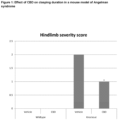
- Figure 1 shows that AS mice treated with vehicle showed significantly longer clasping duration at 10 weeks of age compared to WT mice treated with vehicle. In AS mice chronic treatment (30 days) with CBD significantly reduced clasping duration at 10 weeks of age compared to AS mice treated with vehicle.
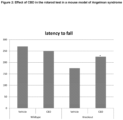
- Figure 2 demonstrates that AS mice treated with vehicle showed a significant motor impairment at 10 weeks of compared to WT mice treated with vehicle.
- chronic treatment (30 days) with CBD significantly reduced latency to fall compared to AS mice treated with vehicle.
- mice were assessed at the age of 7-8 weeks in the novel object recognition test.
- AS mice treated with vehicle showed a significant decrease in the discrimination index compared with WT mice that received the same treatment.
- Figure 3 shows that AS mice treated with CBD slightly increased the discrimination index compared to AS mice treated with vehicle.
- Figure 4 shows that in the tail suspension test the time of immobility were significantly higher in AS mice that received vehicle compared to WT mice that received the same treatment. In AS mice treatment with CBD significantly reduced the duration of immobility time compared to AS mice treated with vehicle.
- CBD is considered to be a viable treatment option for AS.
- Example 1 the use of CBD in a model of Angelman syndrome is able to produce statistically significant reversal of the symptoms associated with this disorder.
- CBD has been shown to produce positive results in the Tail Suspension test in this model and as such demonstrates unequivocally that this phytocannabinoid could reverse anxiety in this disorder.
- CBD could be used to treat additional symptoms associated with this disorder as it was able to reduce ataxia and balance and motor coordination symptoms in a model of Angelman syndrome.
- CBD provides a real treatment option to individuals suffering from AS.
Landscapes
- Health & Medical Sciences (AREA)
- Life Sciences & Earth Sciences (AREA)
- Pharmacology & Pharmacy (AREA)
- Chemical & Material Sciences (AREA)
- Veterinary Medicine (AREA)
- Public Health (AREA)
- General Health & Medical Sciences (AREA)
- Medicinal Chemistry (AREA)
- Animal Behavior & Ethology (AREA)
- Natural Medicines & Medicinal Plants (AREA)
- Epidemiology (AREA)
- Engineering & Computer Science (AREA)
- Botany (AREA)
- Mycology (AREA)
- Microbiology (AREA)
- Medical Informatics (AREA)
- Biotechnology (AREA)
- Alternative & Traditional Medicine (AREA)
- Neurosurgery (AREA)
- Biomedical Technology (AREA)
- Neurology (AREA)
- Bioinformatics & Cheminformatics (AREA)
- Chemical Kinetics & Catalysis (AREA)
- General Chemical & Material Sciences (AREA)
- Nuclear Medicine, Radiotherapy & Molecular Imaging (AREA)
- Organic Chemistry (AREA)
- Anesthesiology (AREA)
- Acyclic And Carbocyclic Compounds In Medicinal Compositions (AREA)
- Pharmaceuticals Containing Other Organic And Inorganic Compounds (AREA)
Description
- The present invention relates to cannabidiol (CBD) for use in the treatment of anxiety associated with Angelman syndrome (AS), wherein the CBD is present as a highly purified extract of cannabis which comprises at least 98% (w/w) CBD and wherein the extract comprises less than 0.15% (w/w) THC.
- In use the CBD may be used concomitantly with one or more other medicaments. Alternatively the CBD may be formulated for administration separately, sequentially or simultaneously with one or more medicaments or the combination may be provided in a single dosage form. Where the CBD is formulated for administration separately, sequentially or simultaneously it may be provided as a kit or together with instructions to administer the one or more components in the manner indicated. It may also be used as the sole medication, i.e. as a monotherapy.
- Angelman syndrome (AS) occurs in approximately 1 in 12,000 to 15,000 individuals and is caused by abnormalities on chromosome 15. Individuals with AS typically show severe to profound learning disability, significant difficulties with mobility and communication in addition to seizures.
- It has been suggested that between 50% and 80% of individuals with AS meet the criteria for autism spectrum disorder.
- Typical characteristics of Angelman syndrome include: delayed development which is usually noticeable from 6-12 months of age; severe language impairment with little or no speech; movement and balance problems (ataxia); frequent seizures (epilepsy) in around 85% of cases; a small head size (microcephaly); sociable behaviour with frequent smiling.
- A genetic anomaly responsible for AS occurs by chance around the time of conception. The UBE3A gene is either absent or malfunctions. A child usually inherits one copy of the UBE3A gene from each parent. Both copies are switched on (active) in most of the body's tissues. However, in certain areas of the brain, only the gene inherited from the mother is active. In most cases of AS (about 70%), the child's maternal copy of the UBE3A gene is missing, which means there's no active copy of the UBE3A gene in the child's brain.
- Testing compounds for their effectiveness on signs and symptoms of Angelman syndrome is challenging given that this disorder has so many different affected symptom domains.
- The UBE3A mouse model is used to evaluate a compounds effectiveness in the treatment of AS. This model has been shown to recapitulate many of the phenotypic features of AS, including motor dysfunction, increased seizure susceptibility, and hippocampal-dependent learning and memory deficits in mice with the knockout gene.
- The NOR test is used to evaluate cognition, particularly recognition memory, in rodent models of CNS disorders, such as Angelman syndrome. The test is based on the tendency of rodents to spend more time exploring a novel object than a familiar one. The choice to explore the novel object reflects the use of learning and recognition memory.
- The NOR test is conducted in an open field arena with two different kinds of objects. Both objects are generally consistent in height and volume, but are different in shape and appearance. During habituation, the animals are allowed to explore an empty arena. Twenty-four hours after habituation, the animals are exposed to the familiar arena with two identical objects placed at an equal distance. The next day, the mice are allowed to explore the open field in the presence of the familiar object and a novel object to test short-term and long-term recognition memory. The time spent exploring each object and the discrimination index percentage is recorded. This test is useful for assessing cognitive dysfunction in rodent models of AS.
- K. Pelc, et al., Neuropsychiatr. Dis. Treat., 2008, 4, 577-584 mentions that apparent happiness is the hallmark of Angelman syndrome, associated with profuse smiling, poorly specific laughing and general exuberance, with hypermotor behaviour, stereotypies, and proactive social contact. However, behavioural adaptation is reduced, and this seemingly happy demeanour may be deceptive, in particular with regard to anxiety.
- M. Giroud, et al., Eur. Neurol., 2015, 73, 119-125 discloses a study that aimed to evaluate the clinical symptoms of Angelman syndrome (AS) in adults and to identify the neurological pathways affected in this disease. It was found that movement disorders of the hands and mouth, laughing spells, severe expressive speech disorders, a happy nature, hyposomnia and anxiety are the major neurological characteristics of AS in adulthood.
- There is no specific therapy for Angelman syndrome. Medication is usually required to control seizures. Physical and occupational therapies, communication therapy, and behavioral therapies are also important.
- The endocannabinoid system has been linked to physiological progression of autism spectrum disorders, possibly implicating CB1 and CB2 receptors.
- The phytocannabinoids are known to interact with the endocannabinoid system.
- The phytocannabinoid tetrahydrocannabinol (THC) in the form of dronabinol, CB1 agonist, has been used to treat an autistic child (Kurz and Blass, 2010). Problems associated with the use of CB1 agonists are psychoactivity, anxiety and hallucinations.
- Patent application
WO 2014/146699 describes the use of CB1 receptor antagonists in the treatment of diseases associated with dendritic abnormalities. Such diseases include AS and RS. The application is exemplified by the use of rimonabant in the FMR1 knockout mouse model which is a model of FXS. - The CB1 antagonist, rimonabant, has been shown to have serious side effects which limit its use, such as suicide ideation.
-
GB 2 531 282 A -
WO 2010/012506 A1 discloses the use of at least one cannabinoid in the manufacture of a medicament for use in treating or preventing or in the manufacture of a dietary supplement for preventing a disease or condition benefiting from a reduced activity of theenzyme indoleamine 2,3-dioxygenase (IDO). -
GB 2 438 682 A -
US 2016/256411 A1 discloses a method of treating a disease state or condition in humans via topical brainstem afferent stimulation therapy via the administration of a cannabinoid drug(s) to the back of the neck of a human patient to provide regional neuro-affective therapy. - E. M. Blessing, et al., Neurotherapeutics, 12, 825-836 found that existing preclinical evidence supports CBD as a treatment for generalized anxiety disorder, panic disorder, social anxiety disorder, obsessive-compulsive disorder, and post-traumatic stress disorder when administered acutely.
- M. M. Bergamaschi, et al., Neuropsychopharmacology, 2011, 36, 1219-1226 describes preliminary results which indicate that a single dose of CBD can reduce the anxiety-enhancing effect provoked by a simulation public speaking test in patients with Generalized Social Anxiety Disorder.
- The present application relates to the use of a phytocannabinoid which is neither a CB1 agonist nor antagonist. CBD is known to have a low affinity for the CB1 receptor (Mechoulam et al. 2007).
- To date there are no studies of the use of CBD in the treatment of AS. Such symptoms as described above are difficult to treat, therefore many patients with AS have unmet needs with respect to the treatment of their disease.
- In accordance with a first aspect of the present invention there is provided Cannabidiol (CBD) for use in the treatment of anxiety associated with Angelman syndrome, wherein the CBD is present as a highly purified extract of cannabis which comprises at least 98% (w/w) CBD and wherein the extract comprises less than 0.15% (w/w) THC.
- In a further embodiment the CBD is for use in combination with one or more concomitant medicaments which may be taken by the patient to treat the condition and / or one or more symptoms associated therewith. Such as, for example, melatonin for sleeping problems, SSRI for depression, anticonvulsants for epilepsy, methylphenidate for ADHD or antipsychotics for aggression or self-harming behaviour. Preferably the one or more concomitant medicaments is an anti-epileptic drug (AED).
- Determining an effective dose in humans will depend on, for example the mode of delivery (e.g. i.v. or oral), the formulation and the bioavailability of the CBD when delivered and might range between 0.1 and 100 mg/kg/day. Furthermore, the fact that cannabinoids often show bell-shaped dose response curves makes determining a dose of CBD more difficult.
- Preferably the dose of CBD is greater than 0.1 mg/kg/day. Thus, for a 15 kg patient a dose of greater than 1.5mg of CBD per day would be provided. Doses greater than 1mg/kg/day such as greater than 5/mg/kg/day, greater than 10 mg/kg/day, greater than 15mg/kg/day and greater than 20 mg/kg/day are also envisaged to be effective.
- Preferably the CBD is provided over an extended period; more preferably this period is at least seven days.
- In a further embodiment the CBD may be used as a dietary supplement or food additive in order to improve symptoms in Angelman syndrome.
- Preferably, the CBD is for use in treating anxiety in an Angelman syndrome subject comprising administering an effective amount of the cannabidiol (CBD) to the subject in need thereof, wherein the subject is a human.
- The human equivalent dose (HED) can be estimated using the following formula:

- Furthermore, when animal data is obtained using an intraperitoneal form of dosing, but the drug is to be administered using a different delivery method, then the HED calculated may need to be adjusted to take account of the different mode of delivery. In the case of an oral dose the HED may need to be increased in order to obtain an equivalent oral dose, depending on the formulation used, mode of delivery and bioavailability of the active. This is something a skilled pharmacologist will recognise.
- Definitions of some of the terms used herein are detailed below:
- The cannabinoids described in the present application are listed below along with their standard abbreviations.
Table 1. Cannabinoids and their abbreviations CBD Cannabidiol 
THC Tetrahydrocannabinol 
- The table above is not exhaustive and merely details the cannabinoids which are identified in the present application for reference. So far over 60 different cannabinoids have been identified and these cannabinoids can be split into different groups as follows: Phytocannabinoids; Endocannabinoids and Synthetic cannabinoids (which may be novel cannabinoids or synthetically produced phytocannabinoids or endocannabinoids).
- "Phytocannabinoids" are cannabinoids that originate from nature and can be found in the cannabis plant. The phytocannabinoids can be isolated from plants to produce a highly purified extract or can be reproduced synthetically.
- "Substantially pure CBD" is defined as CBD that is greater than 98% (w/w) pure. More preferably greater than 98.5% (w/w) through 99% (w/w) to 99.5% (w/w) and greater.
- "Highly purified cannabinoid extracts" are defined as cannabinoids that have been extracted from the cannabis plant and purified to the extent that other cannabinoids and non-cannabinoid components that are co-extracted with the cannabinoids have been substantially removed, such that the highly purified cannabinoid is greater than or equal to 98% (w/w) pure.
- "Botanical drug substance" or "(BDS)" is defined in the Guidance for Industry Botanical Drug Products Draft Guidance, August 2000, US Department of Health and Human Services, Food and Drug Administration Centre for Drug Evaluation and Research as: "A drug derived from one or more plants, algae, or microscopic fungi. It is prepared from botanical raw materials by one or more of the following processes: pulverisation, decoction, expression, aqueous extraction, ethanolic extraction or other similar processes." A botanical drug substance does not include a highly purified or chemically modified substance derived from natural sources. Thus, in the case of cannabis, BDS derived from cannabis plants do not include highly purified Pharmacopoeial grade cannabinoids. In a BDS comprising cannabinoids the cannabinoid will be present in an amount of less than 95% (w/w).
- "Synthetic cannabinoids" are compounds that have a cannabinoid or cannabinoid-like structure and are manufactured using chemical means rather than by the plant.
- Phytocannabinoids can be obtained as either the neutral (decarboxylated form) or the carboxylic acid form depending on the method used to extract the cannabinoids. For example it is known that heating the carboxylic acid form will cause most of the carboxylic acid form to decarboxylate into the neutral form.
- "Cognitive dysfunction" is defined as the loss of intellectual functions such as thinking, remembering, and reasoning with sufficient severity to interfere with daily functioning. Patients with cognitive dysfunction have trouble with verbal recall, basic arithmetic, and concentration.
- Embodiments of the disclosure are further described hereinafter with reference to the accompanying drawings, in which
-
Figure 1 shows the effect of CBD on clasping duration in a mouse model of Angelman syndrome; -
Figure 2 shows the effect of CBD in the rotarod test in a mouse model of Angelman syndrome; -
Figure 3 shows the effect of CBD in the novel object recognition test in a mouse model of Angelman syndrome; and -
Figure 4 shows the effect of CBD in the tail suspension test in a mouse model of Angelman syndrome. - Data are expressed as mean ± S.E.M. *p<0.05,***p<0.001 vs WT-vehicle; °°p<0.01,°°°p<0.001 vs KO-vehicle. Two-way ANOVA followed by Bonferroni post hoc test.
- The effect of CBD was tested in the neurological, behavioural and motor disorders in a transgenic mouse model of Angelman Syndrome.
- Heterozygous mice with maternal deficiency of Ube3A (Ube3am- / p +) and wild type (Ube3am+/p+) were purchased from The Jackson Laboratory (Jackson code: B6.129S7-Ube3a tm1Alb /J) and maintained in a C57BL/6 background.
- Animals were housed under controlled illumination (12:12-hour light/dark cycle; light on 6 hours) and environmental conditions (room temperature: 20°C-22°C, humidity: 55%-60%) with food and tap water were available ad libitum.
- Drugs were dissolved in 1:1:18 ethanol:cremophor:0.9% saline, for intraperitoneal (i.p.) administration. Drug treatment was performed daily for 35 days. CBD was administered at 20 mg/kg.
- Rotarod: The rotarod test assesses balance and motor coordination of mice. Mice have been measured for the time (in seconds) of equilibrium before falling on a rotary cylinder by a magnet that, activated from the fall of the mouse on the plate, allows to record the time of permanence on the cylinder. After a period of adaptation of 30 s, the spin speed gradually increased from 3 to 30 rpm for a maximum time of 5 min. The animals were analysed by 2 separate tests at 1-h interval in the same day.
- Clasping: The clasping test assesses ataxia in mice. Mice were suspended by the base of the tail and their behaviours were recorded for 30 seconds. The time for which the mice clasped their hind limbs was recorded. The time was then scored as follows: 4, 15-30 s, 3, 10-15 s, 2, 5-10 s, 1, 0-5 s and 0,0 s
- Tail suspension: The tail suspension test assesses depressive-like behaviour in mice. Mice were individually suspended by the tail on a horizontal bar (50 cm from floor) using adhesive tape placed approximately 4 cm from the tip of the tail. The duration of immobility was recorded in seconds over a period of 6 minutes by a time recorder. Immobility time was defined as the absence of escape-oriented behaviour.
- Novel Object Recognition: The novel object recognition assesses recognition memory in mice. The experiment started with the habituation period, during which mice were allowed to freely explore for 1 hour the apparatus which consists of a rectangular open box (40 × 30 × 30 cm width × length × height) made of grey polyvinyl chloride (PVC) illuminated by a dim light. The day after each mouse was allowed to explore two identical objects positioned in the back left and right corners for 5 min (acquisition). A video camera recorded the time spent on exploration of each object. In the test trial, which was carried out for 2 hrs after the acquisition, one of the two objects was replaced with a new different object. The time spent exploring the object was the time that the mouse spent with its nose directed and within 1 cm from the object. The behaviour of mice was analyzed by an observer blind to the treatment. Data are expressed as percentage of recognition index (RI %), which was calculated as the percentage of the time spent exploring the novel object / time spent exploring the novel object + time spent exploring the familiar object x 100.
- Statistical Analysis: Behavioural data are represented as means ± SEM and statistical analysis of these data was performed by two way analysis of variance (ANOVA) for repeated measured followed by the Student Newman--Keuls for multiple comparisons to determine statistical significance between different treated groups of mouse. p < 0.05 was considered statistically significant.
-
Figure 1 shows that AS mice treated with vehicle showed significantly longer clasping duration at 10 weeks of age compared to WT mice treated with vehicle. In AS mice chronic treatment (30 days) with CBD significantly reduced clasping duration at 10 weeks of age compared to AS mice treated with vehicle. -
Figure 2 demonstrates that AS mice treated with vehicle showed a significant motor impairment at 10 weeks of compared to WT mice treated with vehicle. In AS mice, chronic treatment (30 days) with CBD significantly reduced latency to fall compared to AS mice treated with vehicle. - Mice were assessed at the age of 7-8 weeks in the novel object recognition test. AS mice treated with vehicle showed a significant decrease in the discrimination index compared with WT mice that received the same treatment.
Figure 3 shows that AS mice treated with CBD slightly increased the discrimination index compared to AS mice treated with vehicle. -
Figure 4 shows that in the tail suspension test the time of immobility were significantly higher in AS mice that received vehicle compared to WT mice that received the same treatment. In AS mice treatment with CBD significantly reduced the duration of immobility time compared to AS mice treated with vehicle. - These data demonstrate that the treatment of 20 mg/kg CBD to mice which were deficient in the Ube3A gene and subsequently suffered symptoms to individuals with AS, were able to reverse these symptoms. In particular CBD was able to statistically significantly improve movement and balance problems (ataxia) and anxiety. As such CBD is considered to be a viable treatment option for AS.
- As is shown in Example 1 above, the use of CBD in a model of Angelman syndrome is able to produce statistically significant reversal of the symptoms associated with this disorder.
- In particular CBD has been shown to produce positive results in the Tail Suspension test in this model and as such demonstrates unequivocally that this phytocannabinoid could reverse anxiety in this disorder.
- In addition, other tests in this model provide support that CBD could be used to treat additional symptoms associated with this disorder as it was able to reduce ataxia and balance and motor coordination symptoms in a model of Angelman syndrome. As such CBD provides a real treatment option to individuals suffering from AS.
-
- Hill T et al. (2012) Br J Pharmacol. Dec;167(8):1629-42. Cannabidivarin is anticonvulsant in mouse and rat.
- Erica Zamberletti, Sarah Beggiato, Luca Steardo Jr., Pamela Prini, Tiziana Antonelli, Luca Ferraro, Tiziana Rubino, Daniela Parolaro. Neurobiology of Disease (2014), Volume 63, Pages 35-47. "Alterations of prefrontal cortex GABAergic transmission in the complex psychotic-like phenotype induced by adolescent delta-9-tetrahydrocannabinol exposure in rats."
- Kurz and Blass 2010 Use of dronabinol (delta-9-THC) in autism: A prospective single-case study with an early infantile autistic child. Cannabinoids, 5 (4) 4-6.
- Marta Kruk-Somka, Agnieszka Michalak, Barbara Budzyn'ska, Graz yna Bia
 a. Pharmacological Reports 66 (2014), 638-646. "A comparison of mecamylamine and bupropion effects on memory-related responses induced by nicotine and scopolamine in the novel object recognition test in mice."
Claims (4)
- Cannabidiol (CBD) for use in the treatment of anxiety associated with Angelman syndrome, wherein the CBD is present as a highly purified extract of cannabis which comprises at least 98% (w/w) CBD and wherein the extract comprises less than 0.15% (w/w) THC.
- CBD for use according to claim 1, wherein the CBD is for use in combination with one or more concomitant medications.
- CBD for use according to claim 2, wherein the one or more concomitant medications is an anti-epileptic drug (AED).
- CBD for use according to any of the preceding claims, wherein the dose of CBD is greater than 5 mg/kg/day.
Priority Applications (1)
| Application Number | Priority Date | Filing Date | Title |
|---|---|---|---|
| EP25187891.4A EP4640275A3 (en) | 2016-12-16 | 2017-12-13 | USE OF CANNABIDIOL TO TREAT ANXIETY IN ANGELMAN SYNDROME |
Applications Claiming Priority (2)
| Application Number | Priority Date | Filing Date | Title |
|---|---|---|---|
| GB1621480.1A GB2557921A (en) | 2016-12-16 | 2016-12-16 | Use of cannabinoids in the treatment of angelman syndrome |
| PCT/GB2017/053735 WO2018109471A1 (en) | 2016-12-16 | 2017-12-13 | Use of cannabidiol in the treatment of angelman syndrome |
Related Child Applications (1)
| Application Number | Title | Priority Date | Filing Date |
|---|---|---|---|
| EP25187891.4A Division EP4640275A3 (en) | 2016-12-16 | 2017-12-13 | USE OF CANNABIDIOL TO TREAT ANXIETY IN ANGELMAN SYNDROME |
Publications (2)
| Publication Number | Publication Date |
|---|---|
| EP3554497A1 EP3554497A1 (en) | 2019-10-23 |
| EP3554497B1 true EP3554497B1 (en) | 2025-07-09 |
Family
ID=58284492
Family Applications (2)
| Application Number | Title | Priority Date | Filing Date |
|---|---|---|---|
| EP17817833.1A Active EP3554497B1 (en) | 2016-12-16 | 2017-12-13 | Use of cannabidiol in the treatment of anxiety in angelman syndrome |
| EP25187891.4A Pending EP4640275A3 (en) | 2016-12-16 | 2017-12-13 | USE OF CANNABIDIOL TO TREAT ANXIETY IN ANGELMAN SYNDROME |
Family Applications After (1)
| Application Number | Title | Priority Date | Filing Date |
|---|---|---|---|
| EP25187891.4A Pending EP4640275A3 (en) | 2016-12-16 | 2017-12-13 | USE OF CANNABIDIOL TO TREAT ANXIETY IN ANGELMAN SYNDROME |
Country Status (6)
| Country | Link |
|---|---|
| US (2) | US11679087B2 (en) |
| EP (2) | EP3554497B1 (en) |
| AU (2) | AU2017374777B2 (en) |
| CA (1) | CA3046442A1 (en) |
| GB (1) | GB2557921A (en) |
| WO (1) | WO2018109471A1 (en) |
Families Citing this family (35)
| Publication number | Priority date | Publication date | Assignee | Title |
|---|---|---|---|---|
| GB2487712B (en) | 2011-01-04 | 2015-10-28 | Otsuka Pharma Co Ltd | Use of the phytocannabinoid cannabidiol (CBD) in combination with a standard anti-epileptic drug (SAED) in the treatment of epilepsy |
| GB2495118B (en) | 2011-09-29 | 2016-05-18 | Otsuka Pharma Co Ltd | A pharmaceutical composition comprising the phytocannabinoids cannabidivarin (CBDV) and cannabidiol (CBD) |
| GB2530001B (en) | 2014-06-17 | 2019-01-16 | Gw Pharma Ltd | Use of cannabidiol in the reduction of convulsive seizure frequency in treatment-resistant epilepsy |
| GB2531282A (en) | 2014-10-14 | 2016-04-20 | Gw Pharma Ltd | Use of cannabinoids in the treatment of epilepsy |
| GB2531281A (en) | 2014-10-14 | 2016-04-20 | Gw Pharma Ltd | Use of cannabidiol in the treatment of intractable epilepsy |
| GB2539472A (en) | 2015-06-17 | 2016-12-21 | Gw Res Ltd | Use of cannabinoids in the treatment of epilepsy |
| GB2551986A (en) | 2016-07-01 | 2018-01-10 | Gw Res Ltd | Parenteral formulations |
| GB2551987A (en) | 2016-07-01 | 2018-01-10 | Gw Res Ltd | Oral cannabinoid formulations |
| US10239808B1 (en) | 2016-12-07 | 2019-03-26 | Canopy Holdings, LLC | Cannabis extracts |
| GB2557921A (en) | 2016-12-16 | 2018-07-04 | Gw Res Ltd | Use of cannabinoids in the treatment of angelman syndrome |
| GB2560019A (en) | 2017-02-27 | 2018-08-29 | Gw Res Ltd | Use of cannabinoids in the treatment of leukaemia |
| GB2564383B (en) | 2017-06-23 | 2021-04-21 | Gw Res Ltd | Use of cannabidiol in the treatment of tumours assoicated with Tuberous Sclerosis Complex |
| MX2020003606A (en) | 2017-09-28 | 2020-10-28 | Zynerba Pharmaceuticals Inc | TREATMENT OF FRAGILE X CHROMOSOME SYNDROME WITH CANABIDIOL. |
| GB201715919D0 (en) | 2017-09-29 | 2017-11-15 | Gw Res Ltd | use of cannabinoids in the treatment of epilepsy |
| GB2568929A (en) | 2017-12-01 | 2019-06-05 | Gw Res Ltd | Use of cannabinoids in the treatment of epilepsy |
| GB2569961B (en) | 2018-01-03 | 2021-12-22 | Gw Res Ltd | Pharmaceutical |
| CA3089994A1 (en) | 2018-01-31 | 2019-08-08 | Canopy Holdings, LLC | Hemp powder |
| BR102018002843A2 (en) * | 2018-02-09 | 2019-08-27 | Prati, Donaduzzi & Cia Ltda | pharmaceutical composition and use thereof |
| GB201806953D0 (en) | 2018-04-27 | 2018-06-13 | Gw Res Ltd | Cannabidiol Preparations |
| CA3119729A1 (en) | 2018-10-10 | 2020-04-16 | Treehouse Biotech, Inc. | Synthesis of cannabigerol |
| MX2021007076A (en) | 2018-12-14 | 2021-08-11 | Zynerba Pharmaceuticals Inc | Treatment of 22q11.2 deletion syndrome with cannabidiol. |
| US11147805B2 (en) * | 2019-02-07 | 2021-10-19 | Medipure Pharmaceuticals Inc. | Cannabinoid receptor agonists and serine hydrolase enzyme inhibitor based anxiolytic therapeutic product |
| GB201910389D0 (en) | 2019-07-19 | 2019-09-04 | Gw Pharma Ltd | Novel compounds, methods for their manufacture, and uses thereof |
| GB2588576A (en) | 2019-08-27 | 2021-05-05 | Gw Res Ltd | Use of cannabinoids in the treatment of dyskinesia associated with Parkinson's disease |
| GB201916846D0 (en) | 2019-11-19 | 2020-01-01 | Gw Res Ltd | Cannabidiol-type cannabinoid compound |
| GB201916849D0 (en) | 2019-11-19 | 2020-01-01 | Gw Res Ltd | Cannabidiol-type cannabinoid compound |
| GB201916977D0 (en) | 2019-11-21 | 2020-01-08 | Gw Res Ltd | Cannibidol-type cannabinoid compound |
| GB201916974D0 (en) | 2019-11-21 | 2020-01-08 | Gw Res Ltd | Cannabidol-type cannabinoid compound |
| GB202002754D0 (en) | 2020-02-27 | 2020-04-15 | Gw Res Ltd | Methods of treating tuberous sclerosis complex with cannabidiol and everolimus |
| GB2597321A (en) | 2020-07-20 | 2022-01-26 | Gw Res Ltd | Use of cannabidiol in the treatment of seizures associated with rare epilepsy syndromes related to genetic abnormalities |
| GB2597309A (en) | 2020-07-20 | 2022-01-26 | Gw Res Ltd | Use of cannabidiol in the treatment of seizures associated with rare epilepsy syndromes related to genetic abnormalities |
| GB202013765D0 (en) | 2020-09-02 | 2020-10-14 | Gw Res Ltd | Method of preparing cannabinoids |
| GB2602019A (en) | 2020-12-15 | 2022-06-22 | Gw Res Ltd | Cannabinoid derivative as a pharmaceutically active compound and method of preparation thereof |
| EP4568702A1 (en) | 2022-08-12 | 2025-06-18 | Jazz Pharmaceuticals Research UK Limited | Oral solid dosage forms comprising cannabinoids |
| WO2024168426A1 (en) | 2023-02-13 | 2024-08-22 | Apogee Pharmaceuticals, Inc. | Small molecules as monoacylglycerol lipase (magl) inhibitors, compositions and use thereof |
Family Cites Families (129)
| Publication number | Priority date | Publication date | Assignee | Title |
|---|---|---|---|---|
| US6403126B1 (en) | 1999-05-26 | 2002-06-11 | Websar Innovations Inc. | Cannabinoid extraction method |
| US6949582B1 (en) | 1999-05-27 | 2005-09-27 | Wallace Walter H | Method of relieving analgesia and reducing inflamation using a cannabinoid delivery topical liniment |
| DE10051427C1 (en) | 2000-10-17 | 2002-06-13 | Adam Mueller | Process for the production of an extract containing tetrahydrocannabinol and cannabidiol from cannabis plant material and cannabis extracts |
| AU2002231970B2 (en) | 2001-02-14 | 2007-08-16 | CNX Therapeutics Limited | Mucoadhesive pharmaceutical formulations |
| GB2381450B (en) | 2001-10-31 | 2006-05-31 | Gw Pharma Ltd | Compositions for administration of natural or synthetic cannabinoids by vaporisation |
| GB0202385D0 (en) | 2002-02-01 | 2002-03-20 | Gw Pharma Ltd | Compositions for the treatment of nausea,vomiting,emesis,motion sicknes or like conditions |
| ITPD20020138A1 (en) | 2002-05-24 | 2003-11-24 | Matteo Bevilacqua | COMPOSITION OF TERPENIC-BASED SUBSTANCES, METHOD OF PREPARATION AND METHOD OF DISPERSION IN THE ENVIRONMENT OF THE SAME. |
| DE10226494A1 (en) | 2002-06-14 | 2004-01-08 | Lts Lohmann Therapie-Systeme Ag | Film-shaped mucoadhesive dosage forms for administration of cannabis active ingredients |
| ES2392510T3 (en) | 2002-08-14 | 2012-12-11 | Gw Pharma Limited | Extraction of pharmaceutically active cannabinoids from plant materials |
| PT1542657E (en) | 2002-08-14 | 2012-02-29 | Gw Pharma Ltd | Cannabinoid liquid formulations for mucosal amdinistration |
| US6946150B2 (en) * | 2002-08-14 | 2005-09-20 | Gw Pharma Limited | Pharmaceutical formulation |
| US10538373B2 (en) | 2002-08-14 | 2020-01-21 | Gw Pharma Limited | Pharmaceutical formulation |
| GB0222077D0 (en) | 2002-09-23 | 2002-10-30 | Gw Pharma Ltd | Methods of preparing cannabinoids from plant material |
| US20040110828A1 (en) | 2002-11-27 | 2004-06-10 | Chowdhury Dipak K. | Tetrahydrocannabinol compositions and methods of manufacture and use thereof |
| GB0425248D0 (en) | 2004-11-16 | 2004-12-15 | Gw Pharma Ltd | New use for cannabinoid |
| AU2005305675B2 (en) | 2004-11-16 | 2012-12-13 | Jazz Pharmaceuticals Operations Uk Limited | New use for cannabinoid |
| TWI366460B (en) | 2005-06-16 | 2012-06-21 | Euro Celtique Sa | Cannabinoid active pharmaceutical ingredient for improved dosage forms |
| US20070060638A1 (en) | 2005-08-26 | 2007-03-15 | Olmstead Mary C | Methods and therapies for potentiating therapeutic activities of a cannabinoid receptor agonist via administration of a cannabinoid receptor antagonist |
| GB2434312B (en) | 2006-01-18 | 2011-06-29 | Gw Pharma Ltd | Cannabinoid-containing plant extracts as neuroprotective agents |
| WO2007142957A2 (en) | 2006-05-30 | 2007-12-13 | Air Systems | Gear drive damper |
| GB2438682A (en) | 2006-06-01 | 2007-12-05 | Gw Pharma Ltd | New use for cannabinoids |
| EP2046290A4 (en) | 2006-08-04 | 2011-08-17 | Insys Therapeutics Inc | AQUEOUS FORMULATIONS OF DRONABINOL |
| WO2008021394A2 (en) | 2006-08-15 | 2008-02-21 | Theraquest Biosciences, Llc | Pharmaceutical formulations of cannabinoids and method of use |
| US20080188461A1 (en) | 2007-02-01 | 2008-08-07 | Regents Of The University Of Michigan | Compositions and methods for detecting, preventing and treating seizures and seizure related disorders |
| CN101040855A (en) | 2007-04-12 | 2007-09-26 | 杨喜鸿 | Compound including rimonabant and poloxamer, solid dispersion and the preparation and the application of the medicine |
| GB2448535A (en) | 2007-04-19 | 2008-10-22 | Gw Pharma Ltd | New use for cannabinoid-containing plant extracts |
| US9084771B2 (en) | 2007-05-17 | 2015-07-21 | Sutter West Bay Hospitals | Methods and compositions for treating cancer |
| GB2449691A (en) | 2007-05-31 | 2008-12-03 | Gw Pharma Ltd | A reference plant lacking medicinal active compound expression |
| EP2023121A1 (en) | 2007-07-06 | 2009-02-11 | Bp Oil International Limited | Optical cell |
| GB2450753B (en) | 2007-07-06 | 2012-07-18 | Gw Pharma Ltd | New Pharmaceutical formulation |
| ES2534900T3 (en) | 2007-07-30 | 2015-04-30 | Zynerba Pharmaceuticals, Inc. | Cannabidiol prodrugs, compositions comprising cannabidiol prodrugs and methods of use thereof |
| WO2009020666A1 (en) | 2007-08-06 | 2009-02-12 | Insys Therapeutics Inc. | Oral cannabinoid liquid formulations and methods of treatment |
| GB2456183A (en) | 2008-01-04 | 2009-07-08 | Gw Pharma Ltd | Anti-psychotic composition comprising cannabinoids and anti-psychotic medicament |
| GB2459637B (en) | 2008-01-21 | 2012-06-06 | Gw Pharma Ltd | New use for cannabinoids |
| SI2280687T1 (en) | 2008-03-26 | 2019-09-30 | Stichting Sanammad | Chewing gum compositions containing cannabinoids |
| GB2478074B (en) | 2008-06-04 | 2012-12-26 | Gw Pharma Ltd | Anti-tumoural effects of cannabinoid combinations |
| GB2478072B (en) | 2008-06-04 | 2012-12-26 | Gw Pharma Ltd | Anti-tumoural effects of cannabinoid combinations |
| GB2460672B (en) | 2008-06-04 | 2012-01-04 | Gw Pharma Ltd | Cannabinoids in combination with non-cannabinoid chemotherapeutic agents that are alkylating agents |
| GB2471987B (en) | 2008-06-04 | 2012-02-22 | Gw Pharma Ltd | Anti-tumoural effects of cannabinoid combinations |
| WO2010012506A1 (en) * | 2008-07-31 | 2010-02-04 | Bionorica Research Gmbh | Cannabinoids for use in treating or preventing cognitive impairment and dementia |
| EP2424568A1 (en) | 2009-04-29 | 2012-03-07 | University Of Kentucky Research Foundation | Cannabinoid-containing compositions and methods for their use |
| CN102481264B (en) | 2009-06-29 | 2015-04-22 | 本德尔分析控股有限公司 | Drug delivery system comprising polyoxazoline and a bioactive agent |
| GB2471523A (en) | 2009-07-03 | 2011-01-05 | Gw Pharma Ltd | Use of tetrahydrocannibivarin (THCV) and optionally cannabidiol (CBD) in the treatment of epilepsy |
| US8735374B2 (en) | 2009-07-31 | 2014-05-27 | Intelgenx Corp. | Oral mucoadhesive dosage form |
| GB2478595B (en) | 2010-03-12 | 2018-04-04 | Gw Pharma Ltd | Phytocannabinoids in the treatment of glioma |
| TWI583374B (en) | 2010-03-30 | 2017-05-21 | Gw伐瑪有限公司 | Use of plant cannabinoid cannabinol (CBDV) for the treatment of epilepsy |
| GB2479153B (en) | 2010-03-30 | 2014-03-19 | Gw Pharma Ltd | The phytocannabinoid cannabidivarin (CBDV) for use in the treatment of epilepsy |
| HRP20180904T1 (en) | 2010-08-04 | 2018-08-24 | Grünenthal GmbH | PHARMACEUTICAL FORM DOSAGE CONTAINING 6'-FLUORO- (N-METHYL-OR N, N-DIMETHYL) - 4-PHENYL-4 ', 9'-DIHYDRO-3'H-SPIRO [CYCLOHEXANE-1,1'-PIRANO [3,4, B] INDOL] -4-AMINE FOR THE TREATMENT OF NEUROPATHIC PAIN |
| WO2012033478A1 (en) | 2010-09-07 | 2012-03-15 | Murty Pharmaceuticals, Inc. | An improved oral dosage form of tetrahydrocannabinol and a method of avoiding and/or suppressing hepatic first pass metabolism via targeted chylomicron/lipoprotein delivery |
| US8895536B2 (en) | 2010-10-29 | 2014-11-25 | Infirst Healthcare Ltd. | Compositions and methods for treating chronic inflammation and inflammatory diseases |
| GB2487712B (en) | 2011-01-04 | 2015-10-28 | Otsuka Pharma Co Ltd | Use of the phytocannabinoid cannabidiol (CBD) in combination with a standard anti-epileptic drug (SAED) in the treatment of epilepsy |
| CA2737447A1 (en) | 2011-04-27 | 2012-10-27 | Antony Paul Hornby | Hayley's comet |
| GB201111261D0 (en) | 2011-07-01 | 2011-08-17 | Gw Pharma Ltd | Cannabinoids for use in the treatment of neuro-degenerative diseases or disorders |
| CA2847235C (en) | 2011-08-26 | 2020-07-07 | Bial - Portela & Ca, S.A. | Treatments involving eslicarbazepine acetate or eslicarbazepine |
| GB2495118B (en) | 2011-09-29 | 2016-05-18 | Otsuka Pharma Co Ltd | A pharmaceutical composition comprising the phytocannabinoids cannabidivarin (CBDV) and cannabidiol (CBD) |
| GB2496687A (en) | 2011-11-21 | 2013-05-22 | Gw Pharma Ltd | Tetrahydrocannabivarin (THCV) in the protection of pancreatic islet cells |
| US9254272B2 (en) | 2011-11-30 | 2016-02-09 | Sutter West Bay Hospitals | Resorcinol derivatives |
| GB2504263B (en) | 2012-06-08 | 2015-09-16 | Gw Pharma Ltd | Synergistic therapies for neuroprotection |
| DE102012105063C5 (en) | 2012-06-12 | 2023-09-14 | Thc Pharm Gmbh The Health Concept | Stabilization of cannabinoids and their pharmaceutical preparations |
| US9345771B2 (en) | 2012-10-04 | 2016-05-24 | Insys Development Company, Inc. | Oral cannabinoid formulations |
| CN103110582A (en) | 2013-03-04 | 2013-05-22 | 上海医药工业研究院 | Cannabis phenolic compound microemulsion and preparation method thereof |
| WO2014145490A2 (en) | 2013-03-15 | 2014-09-18 | Biotech Institute, Llc | Breeding, production, processing and use of specialty cannabis |
| PT2976074T (en) * | 2013-03-19 | 2020-03-11 | Univ Pompeu Fabra | ANTAGONISTS OF THE CB1 CANABINOID RECEPTOR FOR USE IN THE TREATMENT OF DISEASES ASSOCIATED WITH NEURONAL DENDRITIC ANOMALIES |
| US9549909B2 (en) | 2013-05-03 | 2017-01-24 | The Katholieke Universiteit Leuven | Method for the treatment of dravet syndrome |
| GB2516814B (en) | 2013-06-19 | 2016-08-31 | Otsuka Pharma Co Ltd | Use of phytocannabinoids for increasing radiosensitivity in the treatment of cancer |
| GB2515312A (en) | 2013-06-19 | 2014-12-24 | Gw Pharma Ltd | The use of phytocannabinoids in the treatment of ovarian carcinoma |
| US20150181924A1 (en) | 2013-10-31 | 2015-07-02 | Michael R. Llamas | Cannabidiol liquid composition for smoking |
| US9259449B2 (en) | 2014-01-07 | 2016-02-16 | Joshua Michael Raderman | Method for modifying THC content in a lipid-based extract of cannabis |
| US10052339B2 (en) | 2014-03-21 | 2018-08-21 | Bodybio Inc. | Methods and compositions for treating symptoms of diseases related to imbalance of essential fatty acids |
| CA2950424C (en) | 2014-05-29 | 2023-03-14 | Insys Pharma, Inc. | Stable cannabinoid formulations |
| GB2530001B (en) | 2014-06-17 | 2019-01-16 | Gw Pharma Ltd | Use of cannabidiol in the reduction of convulsive seizure frequency in treatment-resistant epilepsy |
| GB2527599A (en) | 2014-06-27 | 2015-12-30 | Gw Pharma Ltd | Use of 7-OH-Cannabidiol (7-OH-CBD) and/or 7-OH-Cannabidivarin (7-OH-CBDV) in the treatment of epilepsy |
| GB2527591A (en) | 2014-06-27 | 2015-12-30 | Gw Pharma Ltd | 7-hydroxy cannabidiol (7-OH-CBD) for use in the treatment of non-alcoholic fatty liver disease (NAFLD) |
| GB2527590A (en) | 2014-06-27 | 2015-12-30 | Otsuka Pharma Co Ltd | Active pharmaceutical ingredient (API) comprising cannabinoids for use in the treatment of cancer |
| WO2016022936A1 (en) | 2014-08-07 | 2016-02-11 | Murty Pharmaceuticals, Inc. | An improved oral gastrointestinal dosage form delivery system of cannabinoids and/or standardized marijuana extracts |
| CA2859934A1 (en) | 2014-09-22 | 2016-03-22 | A. Paul Hornby | Hayley's comet ii |
| GB2531282A (en) | 2014-10-14 | 2016-04-20 | Gw Pharma Ltd | Use of cannabinoids in the treatment of epilepsy |
| GB2531278A (en) | 2014-10-14 | 2016-04-20 | Gw Pharma Ltd | Use of cannabidiol in the treatment of intractable epilepsy |
| GB2531280A (en) | 2014-10-14 | 2016-04-20 | Gw Pharma Ltd | Use of cannabidiol in the treatment of intractable epilepsy |
| GB2531281A (en) | 2014-10-14 | 2016-04-20 | Gw Pharma Ltd | Use of cannabidiol in the treatment of intractable epilepsy |
| GB2531283A (en) | 2014-10-14 | 2016-04-20 | Gw Pharma Ltd | Use of cannabidiols in the treatment of degenerative skeletal muscle diseases |
| CA3135893C (en) | 2014-10-21 | 2023-11-14 | United Cannabis Corp. | Cannabis extracts and methods of preparing and using same |
| WO2016084075A1 (en) | 2014-11-26 | 2016-06-02 | One World Cannabis Ltd | Synergistic use of cannabis for treating multiple myeloma |
| US10172786B2 (en) | 2014-12-16 | 2019-01-08 | Axim Biotechnologies, Inc. | Oral care composition comprising cannabinoids |
| WO2016118391A1 (en) | 2015-01-25 | 2016-07-28 | India Globalization Capital, Inc. | Composition and method for treating seizure disorders |
| HK1244715A1 (en) * | 2015-03-02 | 2018-08-17 | 阿福金制药有限责任公司 | Topical regional neuro-affective therapy with cannabinoids |
| US20160338974A1 (en) * | 2015-03-02 | 2016-11-24 | Afgin Pharma, Llc | Topical regional neuro affective therapy with cannabinoid combination products |
| AU2016231788A1 (en) | 2015-03-19 | 2017-10-12 | One World Cannabis Ltd | Preparations of cannabis emulsions and methods thereof |
| US20180185324A1 (en) | 2015-06-11 | 2018-07-05 | One World Cannabis Ltd | Novel cannabinoid combination therapies for multiple myeloma (mm) |
| GB2539472A (en) | 2015-06-17 | 2016-12-21 | Gw Res Ltd | Use of cannabinoids in the treatment of epilepsy |
| GB2541191A (en) | 2015-08-10 | 2017-02-15 | Gw Pharma Ltd | Use of cannabinoids in the treatment of epilepsy |
| GB2542797A (en) | 2015-09-29 | 2017-04-05 | Gw Pharma Ltd | Use of cannabinoids in the treatment of inflammatory skin diseases |
| GB2548873B (en) | 2016-03-31 | 2020-12-02 | Gw Res Ltd | Use of Cannabidiol in the Treatment of SturgeWeber Syndrome |
| GB2551987A (en) | 2016-07-01 | 2018-01-10 | Gw Res Ltd | Oral cannabinoid formulations |
| GB2551985B (en) | 2016-07-01 | 2019-01-30 | Gw Res Ltd | Novel formulation |
| GB2551986A (en) | 2016-07-01 | 2018-01-10 | Gw Res Ltd | Parenteral formulations |
| GB2553139A (en) | 2016-08-25 | 2018-02-28 | Gw Res Ltd | Use of cannabinoids in the treatment of multiple myeloma |
| GB2557921A (en) | 2016-12-16 | 2018-07-04 | Gw Res Ltd | Use of cannabinoids in the treatment of angelman syndrome |
| GB2559774B (en) | 2017-02-17 | 2021-09-29 | Gw Res Ltd | Oral cannabinoid formulations |
| GB2560019A (en) | 2017-02-27 | 2018-08-29 | Gw Res Ltd | Use of cannabinoids in the treatment of leukaemia |
| GB2564383B (en) | 2017-06-23 | 2021-04-21 | Gw Res Ltd | Use of cannabidiol in the treatment of tumours assoicated with Tuberous Sclerosis Complex |
| GB201715919D0 (en) | 2017-09-29 | 2017-11-15 | Gw Res Ltd | use of cannabinoids in the treatment of epilepsy |
| GB2568471B (en) | 2017-11-15 | 2022-04-13 | Gw Res Ltd | Use of cannabinoids in the treatment of epilepsy |
| GB2568929A (en) | 2017-12-01 | 2019-06-05 | Gw Res Ltd | Use of cannabinoids in the treatment of epilepsy |
| GB2572126B (en) | 2018-01-03 | 2021-01-13 | Gw Res Ltd | Pharmaceutical |
| GB2572125B (en) | 2018-01-03 | 2021-01-13 | Gw Res Ltd | Pharmaceutical |
| GB2569961B (en) | 2018-01-03 | 2021-12-22 | Gw Res Ltd | Pharmaceutical |
| GB2572737A (en) | 2018-01-24 | 2019-10-16 | Gw Res Ltd | Use of cannabinoids in the treatment of epilepsy |
| GB201806953D0 (en) | 2018-04-27 | 2018-06-13 | Gw Res Ltd | Cannabidiol Preparations |
| GB2579179A (en) | 2018-11-21 | 2020-06-17 | Gw Res Ltd | Cannabidiol-type cannabinoid compound |
| GB2580881A (en) | 2018-11-30 | 2020-08-05 | Gw Res Ltd | Use of cannabinoids in the treatment of epilepsy |
| GB2580653A (en) | 2019-01-21 | 2020-07-29 | Gw Res Ltd | Use of cannabinoids in the treatment of comorbidities associated with epilepsy |
| GB2581517A (en) | 2019-02-22 | 2020-08-26 | Gw Res Ltd | Use of cannabinoids in the treatment of epilepsy |
| GB2581987B (en) | 2019-03-06 | 2021-11-17 | Gw Res Ltd | Use of cannabidiol in combination with antibiotics |
| GB2584140A (en) | 2019-05-23 | 2020-11-25 | Gw Res Ltd | Use of cannabidiol in the treatment of epileptic spasms |
| GB2584341B (en) | 2019-05-31 | 2023-03-01 | Gw Res Ltd | Cannabinoid formulations |
| GB2586026A (en) | 2019-07-29 | 2021-02-03 | Gw Res Ltd | Use of cannabidol in the treatment of Dravet syndrome |
| GB2588576A (en) | 2019-08-27 | 2021-05-05 | Gw Res Ltd | Use of cannabinoids in the treatment of dyskinesia associated with Parkinson's disease |
| GB2588457B (en) | 2019-10-25 | 2022-12-21 | Gw Res Ltd | Cannabinoid compound |
| GB2588461A (en) | 2019-10-25 | 2021-04-28 | Gw Res Ltd | Use of cannabidiol preparations in the treatment of absence epilepsy |
| GB201916846D0 (en) | 2019-11-19 | 2020-01-01 | Gw Res Ltd | Cannabidiol-type cannabinoid compound |
| GB201916849D0 (en) | 2019-11-19 | 2020-01-01 | Gw Res Ltd | Cannabidiol-type cannabinoid compound |
| GB201916974D0 (en) | 2019-11-21 | 2020-01-08 | Gw Res Ltd | Cannabidol-type cannabinoid compound |
| GB201916977D0 (en) | 2019-11-21 | 2020-01-08 | Gw Res Ltd | Cannibidol-type cannabinoid compound |
| GB201918846D0 (en) | 2019-12-19 | 2020-02-05 | Gw Res Ltd | Oral cannabinoid formulations |
| GB202002754D0 (en) | 2020-02-27 | 2020-04-15 | Gw Res Ltd | Methods of treating tuberous sclerosis complex with cannabidiol and everolimus |
| US20220087951A1 (en) | 2020-09-18 | 2022-03-24 | GW Research Limited | Use of cannabinoids in the treatment of epilepsy |
| US11160757B1 (en) | 2020-10-12 | 2021-11-02 | GW Research Limited | pH dependent release coated microparticle cannabinoid formulations |
| US11815187B2 (en) | 2022-01-26 | 2023-11-14 | Maag Germany Gmbh | 3-port valve |
-
2016
- 2016-12-16 GB GB1621480.1A patent/GB2557921A/en not_active Withdrawn
-
2017
- 2017-12-13 WO PCT/GB2017/053735 patent/WO2018109471A1/en not_active Ceased
- 2017-12-13 US US16/467,639 patent/US11679087B2/en active Active
- 2017-12-13 EP EP17817833.1A patent/EP3554497B1/en active Active
- 2017-12-13 EP EP25187891.4A patent/EP4640275A3/en active Pending
- 2017-12-13 AU AU2017374777A patent/AU2017374777B2/en active Active
- 2017-12-13 CA CA3046442A patent/CA3046442A1/en active Pending
-
2023
- 2023-05-02 US US18/311,221 patent/US12616705B2/en active Active
- 2023-10-16 AU AU2023251394A patent/AU2023251394B2/en active Active
Non-Patent Citations (4)
| Title |
|---|
| BERGAMASCHI MATEUS M ET AL: "Cannabidiol Reduces the Anxiety Induced by Simulated Public Speaking in Treatment-Naïve Social Phobia Patients", NEUROPSYCHOPHARMACOLOGY, vol. 36, no. 6, 1 May 2011 (2011-05-01), Cham, pages 1219 - 1226, XP055836924, ISSN: 0893-133X, Retrieved from the Internet <URL:https://www.nature.com/articles/npp20116.pdf> [retrieved on 20211129], DOI: 10.1038/npp.2011.6 * |
| BLESSING ESTHER M ET AL: "Cannabidiol as a Potential Treatment for Anxiety Disorders", NEUROTHERAPEUTICS, SPRINGER INTERNATIONAL PUBLISHING, CHAM, vol. 12, no. 4, 4 September 2015 (2015-09-04), pages 825 - 836, XP036051105, ISSN: 1933-7213, [retrieved on 20150904], DOI: 10.1007/S13311-015-0387-1 * |
| GIROUD MARIE: "Angelman Syndrome: A Case Series Assessing Neurological Issues in Adulthood", EUROPEAN NEUROLOGY, vol. 73, no. 1-2, 1 January 2015 (2015-01-01), S. Karger AG, Switzerland, pages 119 - 125, XP055867118, ISSN: 0014-3022, DOI: 10.1159/000369454 * |
| PELC KARINE ET AL: "Behavior and neuropsychiatric manifestations in Angelman syndrome", NEUROPSYCHIATRIC DISEASE AND TREATMENT, 1 June 2008 (2008-06-01), pages 577 - 584, XP093196062, Retrieved from the Internet <URL:https://www.ncbi.nlm.nih.gov/pmc/articles/PMC2526368/pdf/ndt-0403-577.pdf> [retrieved on 20240818], DOI: 10.2147/ndt.s2749 * |
Also Published As
| Publication number | Publication date |
|---|---|
| NZ754352A (en) | 2025-05-30 |
| AU2017374777A1 (en) | 2019-06-27 |
| EP4640275A2 (en) | 2025-10-29 |
| US20230263744A1 (en) | 2023-08-24 |
| AU2023251394B2 (en) | 2026-01-22 |
| GB201621480D0 (en) | 2017-02-01 |
| AU2023251394A1 (en) | 2023-11-02 |
| US11679087B2 (en) | 2023-06-20 |
| US20190321307A1 (en) | 2019-10-24 |
| US12616705B2 (en) | 2026-05-05 |
| WO2018109471A1 (en) | 2018-06-21 |
| CA3046442A1 (en) | 2018-06-21 |
| EP3554497A1 (en) | 2019-10-23 |
| AU2017374777B2 (en) | 2023-07-27 |
| GB2557921A (en) | 2018-07-04 |
| EP4640275A3 (en) | 2025-12-31 |
Similar Documents
| Publication | Publication Date | Title |
|---|---|---|
| AU2023251394B2 (en) | Use of cannabidiol in the treatment of angelman syndrome | |
| EP3442513B1 (en) | Use of cannabidiolic acid in the treatment of autism spectrum disorder and associated disorders | |
| Fernandes et al. | Repeated treatment with a low dose of reserpine as a progressive model of Parkinson's disease | |
| Takahashi et al. | Effect of paroxetine on enhanced contextual fear induced by single prolonged stress in rats | |
| EP3442581B1 (en) | Use of cannabidivarin in the treatment of autism spectrum disorder, associated disorders and schizophrenia | |
| Vendruscolo et al. | Chronic methylphenidate treatment during adolescence increases anxiety-related behaviors and ethanol drinking in adult spontaneously hypertensive rats | |
| Li et al. | Alleviation of cognitive deficits and high copper levels by an NMDA receptor antagonist in a rat depression model | |
| Kumar et al. | Ameliorative effect of curcumin on altered expression of CACNA1A and GABRD in the pathogenesis of FeCl3-induced epilepsy | |
| AU2021390590A9 (en) | Antiinflammatory compositions comprising cannabidiol, delta-9- tetrahydrocannabinol and linalool | |
| CA3020500C (en) | Use of cannabidivarin in the treatment of autism spectrum disorder, associated disorders and schizophrenia | |
| Famitafreshi et al. | Morphine Addiction is Tolerated Better in Socialized Male Rats | |
| Soti et al. | Dual Effect of CB1R Antagonist on Motor and Psychological Behaviors in 6OHDA-Induced Parkinsonism Model: Probable Role of Ih Currents | |
| McWaters | Stress-induced anxiety and FOS immunoreactivity in adulthood following chronic juvenile methylphenidate exposure | |
| de Lille | Marie-Line REYNAERT | |
| Furrow | Chronic Adolescent Exposure to Cannabinoids and Environmental Factors Interact to Change Vulnerability for Later Development of Psychopathology |
Legal Events
| Date | Code | Title | Description |
|---|---|---|---|
| STAA | Information on the status of an ep patent application or granted ep patent |
Free format text: STATUS: UNKNOWN |
|
| STAA | Information on the status of an ep patent application or granted ep patent |
Free format text: STATUS: THE INTERNATIONAL PUBLICATION HAS BEEN MADE |
|
| PUAI | Public reference made under article 153(3) epc to a published international application that has entered the european phase |
Free format text: ORIGINAL CODE: 0009012 |
|
| STAA | Information on the status of an ep patent application or granted ep patent |
Free format text: STATUS: REQUEST FOR EXAMINATION WAS MADE |
|
| 17P | Request for examination filed |
Effective date: 20190607 |
|
| AK | Designated contracting states |
Kind code of ref document: A1 Designated state(s): AL AT BE BG CH CY CZ DE DK EE ES FI FR GB GR HR HU IE IS IT LI LT LU LV MC MK MT NL NO PL PT RO RS SE SI SK SM TR |
|
| AX | Request for extension of the european patent |
Extension state: BA ME |
|
| DAV | Request for validation of the european patent (deleted) | ||
| DAX | Request for extension of the european patent (deleted) | ||
| REG | Reference to a national code |
Ref country code: HK Ref legal event code: DE Ref document number: 40015227 Country of ref document: HK |
|
| STAA | Information on the status of an ep patent application or granted ep patent |
Free format text: STATUS: EXAMINATION IS IN PROGRESS |
|
| 17Q | First examination report despatched |
Effective date: 20210317 |
|
| REG | Reference to a national code |
Ref country code: DE Ref legal event code: R079 Free format text: PREVIOUS MAIN CLASS: A61K0031352000 Ref country code: DE Ref legal event code: R079 Ref document number: 602017090490 Country of ref document: DE Free format text: PREVIOUS MAIN CLASS: A61K0031352000 Ipc: A61K0031050000 |
|
| GRAP | Despatch of communication of intention to grant a patent |
Free format text: ORIGINAL CODE: EPIDOSNIGR1 |
|
| STAA | Information on the status of an ep patent application or granted ep patent |
Free format text: STATUS: GRANT OF PATENT IS INTENDED |
|
| RAP3 | Party data changed (applicant data changed or rights of an application transferred) |
Owner name: JAZZ PHARMACEUTICALS RESEARCH UK LIMITED |
|
| RIC1 | Information provided on ipc code assigned before grant |
Ipc: A61P 25/00 20060101ALI20250217BHEP Ipc: A61K 36/185 20060101ALI20250217BHEP Ipc: A61K 45/06 20060101ALI20250217BHEP Ipc: A61K 31/05 20060101AFI20250217BHEP |
|
| RIN1 | Information on inventor provided before grant (corrected) |
Inventor name: LUONGO, LIVIO Inventor name: WOOLLEY-ROBERTS, MARIE Inventor name: BRODIE, JAMES Inventor name: WRIGHT, STEPHEN Inventor name: GUY, GEOFFREY |
|
| INTG | Intention to grant announced |
Effective date: 20250303 |
|
| GRAS | Grant fee paid |
Free format text: ORIGINAL CODE: EPIDOSNIGR3 |
|
| GRAA | (expected) grant |
Free format text: ORIGINAL CODE: 0009210 |
|
| STAA | Information on the status of an ep patent application or granted ep patent |
Free format text: STATUS: THE PATENT HAS BEEN GRANTED |
|
| P01 | Opt-out of the competence of the unified patent court (upc) registered |
Free format text: CASE NUMBER: APP_24353/2025 Effective date: 20250521 |
|
| AK | Designated contracting states |
Kind code of ref document: B1 Designated state(s): AL AT BE BG CH CY CZ DE DK EE ES FI FR GB GR HR HU IE IS IT LI LT LU LV MC MK MT NL NO PL PT RO RS SE SI SK SM TR |
|
| REG | Reference to a national code |
Ref country code: GB Ref legal event code: FG4D |
|
| REG | Reference to a national code |
Ref country code: CH Ref legal event code: EP |
|
| REG | Reference to a national code |
Ref country code: IE Ref legal event code: FG4D |
|
| REG | Reference to a national code |
Ref country code: DE Ref legal event code: R096 Ref document number: 602017090490 Country of ref document: DE |
|
| REG | Reference to a national code |
Ref country code: NL Ref legal event code: FP |
|
| PGFP | Annual fee paid to national office [announced via postgrant information from national office to epo] |
Ref country code: FR Payment date: 20250930 Year of fee payment: 9 |
|
| PGFP | Annual fee paid to national office [announced via postgrant information from national office to epo] |
Ref country code: NL Payment date: 20251003 Year of fee payment: 9 |
|
| PG25 | Lapsed in a contracting state [announced via postgrant information from national office to epo] |
Ref country code: PT Free format text: LAPSE BECAUSE OF FAILURE TO SUBMIT A TRANSLATION OF THE DESCRIPTION OR TO PAY THE FEE WITHIN THE PRESCRIBED TIME-LIMIT Effective date: 20251110 |
|
| REG | Reference to a national code |
Ref country code: AT Ref legal event code: MK05 Ref document number: 1811190 Country of ref document: AT Kind code of ref document: T Effective date: 20250709 |
|
| REG | Reference to a national code |
Ref country code: CH Ref legal event code: U11 Free format text: ST27 STATUS EVENT CODE: U-0-0-U10-U11 (AS PROVIDED BY THE NATIONAL OFFICE) Effective date: 20260101 |
|
| PG25 | Lapsed in a contracting state [announced via postgrant information from national office to epo] |
Ref country code: IS Free format text: LAPSE BECAUSE OF FAILURE TO SUBMIT A TRANSLATION OF THE DESCRIPTION OR TO PAY THE FEE WITHIN THE PRESCRIBED TIME-LIMIT Effective date: 20251109 |
|
| PGFP | Annual fee paid to national office [announced via postgrant information from national office to epo] |
Ref country code: DE Payment date: 20250930 Year of fee payment: 9 |
|
| PGFP | Annual fee paid to national office [announced via postgrant information from national office to epo] |
Ref country code: GB Payment date: 20251001 Year of fee payment: 9 |
|
| PG25 | Lapsed in a contracting state [announced via postgrant information from national office to epo] |
Ref country code: NO Free format text: LAPSE BECAUSE OF FAILURE TO SUBMIT A TRANSLATION OF THE DESCRIPTION OR TO PAY THE FEE WITHIN THE PRESCRIBED TIME-LIMIT Effective date: 20251009 |
|
| REG | Reference to a national code |
Ref country code: LT Ref legal event code: MG9D |
|
| PG25 | Lapsed in a contracting state [announced via postgrant information from national office to epo] |
Ref country code: AT Free format text: LAPSE BECAUSE OF FAILURE TO SUBMIT A TRANSLATION OF THE DESCRIPTION OR TO PAY THE FEE WITHIN THE PRESCRIBED TIME-LIMIT Effective date: 20250709 |
|
| PG25 | Lapsed in a contracting state [announced via postgrant information from national office to epo] |
Ref country code: FI Free format text: LAPSE BECAUSE OF FAILURE TO SUBMIT A TRANSLATION OF THE DESCRIPTION OR TO PAY THE FEE WITHIN THE PRESCRIBED TIME-LIMIT Effective date: 20250709 |
|
| PG25 | Lapsed in a contracting state [announced via postgrant information from national office to epo] |
Ref country code: HR Free format text: LAPSE BECAUSE OF FAILURE TO SUBMIT A TRANSLATION OF THE DESCRIPTION OR TO PAY THE FEE WITHIN THE PRESCRIBED TIME-LIMIT Effective date: 20250709 |
|
| PG25 | Lapsed in a contracting state [announced via postgrant information from national office to epo] |
Ref country code: GR Free format text: LAPSE BECAUSE OF FAILURE TO SUBMIT A TRANSLATION OF THE DESCRIPTION OR TO PAY THE FEE WITHIN THE PRESCRIBED TIME-LIMIT Effective date: 20251010 |
|
| PG25 | Lapsed in a contracting state [announced via postgrant information from national office to epo] |
Ref country code: SE Free format text: LAPSE BECAUSE OF FAILURE TO SUBMIT A TRANSLATION OF THE DESCRIPTION OR TO PAY THE FEE WITHIN THE PRESCRIBED TIME-LIMIT Effective date: 20250709 |
|
| PG25 | Lapsed in a contracting state [announced via postgrant information from national office to epo] |
Ref country code: LV Free format text: LAPSE BECAUSE OF FAILURE TO SUBMIT A TRANSLATION OF THE DESCRIPTION OR TO PAY THE FEE WITHIN THE PRESCRIBED TIME-LIMIT Effective date: 20250709 |
|
| PG25 | Lapsed in a contracting state [announced via postgrant information from national office to epo] |
Ref country code: BG Free format text: LAPSE BECAUSE OF FAILURE TO SUBMIT A TRANSLATION OF THE DESCRIPTION OR TO PAY THE FEE WITHIN THE PRESCRIBED TIME-LIMIT Effective date: 20250709 Ref country code: PL Free format text: LAPSE BECAUSE OF FAILURE TO SUBMIT A TRANSLATION OF THE DESCRIPTION OR TO PAY THE FEE WITHIN THE PRESCRIBED TIME-LIMIT Effective date: 20250709 |
|
| PG25 | Lapsed in a contracting state [announced via postgrant information from national office to epo] |
Ref country code: RS Free format text: LAPSE BECAUSE OF FAILURE TO SUBMIT A TRANSLATION OF THE DESCRIPTION OR TO PAY THE FEE WITHIN THE PRESCRIBED TIME-LIMIT Effective date: 20251009 |
|
| PG25 | Lapsed in a contracting state [announced via postgrant information from national office to epo] |
Ref country code: ES Free format text: LAPSE BECAUSE OF FAILURE TO SUBMIT A TRANSLATION OF THE DESCRIPTION OR TO PAY THE FEE WITHIN THE PRESCRIBED TIME-LIMIT Effective date: 20250709 |
|
| PG25 | Lapsed in a contracting state [announced via postgrant information from national office to epo] |
Ref country code: RO Free format text: LAPSE BECAUSE OF FAILURE TO SUBMIT A TRANSLATION OF THE DESCRIPTION OR TO PAY THE FEE WITHIN THE PRESCRIBED TIME-LIMIT Effective date: 20250709 |
|
| PG25 | Lapsed in a contracting state [announced via postgrant information from national office to epo] |
Ref country code: SM Free format text: LAPSE BECAUSE OF FAILURE TO SUBMIT A TRANSLATION OF THE DESCRIPTION OR TO PAY THE FEE WITHIN THE PRESCRIBED TIME-LIMIT Effective date: 20250709 |
|
| PG25 | Lapsed in a contracting state [announced via postgrant information from national office to epo] |
Ref country code: DK Free format text: LAPSE BECAUSE OF FAILURE TO SUBMIT A TRANSLATION OF THE DESCRIPTION OR TO PAY THE FEE WITHIN THE PRESCRIBED TIME-LIMIT Effective date: 20250709 |
|
| PG25 | Lapsed in a contracting state [announced via postgrant information from national office to epo] |
Ref country code: IT Free format text: LAPSE BECAUSE OF FAILURE TO SUBMIT A TRANSLATION OF THE DESCRIPTION OR TO PAY THE FEE WITHIN THE PRESCRIBED TIME-LIMIT Effective date: 20250709 |
|
| PG25 | Lapsed in a contracting state [announced via postgrant information from national office to epo] |
Ref country code: CZ Free format text: LAPSE BECAUSE OF FAILURE TO SUBMIT A TRANSLATION OF THE DESCRIPTION OR TO PAY THE FEE WITHIN THE PRESCRIBED TIME-LIMIT Effective date: 20250709 |
|
| PGFP | Annual fee paid to national office [announced via postgrant information from national office to epo] |
Ref country code: CH Payment date: 20260101 Year of fee payment: 9 |
|
| PG25 | Lapsed in a contracting state [announced via postgrant information from national office to epo] |
Ref country code: SK Free format text: LAPSE BECAUSE OF FAILURE TO SUBMIT A TRANSLATION OF THE DESCRIPTION OR TO PAY THE FEE WITHIN THE PRESCRIBED TIME-LIMIT Effective date: 20250709 Ref country code: EE Free format text: LAPSE BECAUSE OF FAILURE TO SUBMIT A TRANSLATION OF THE DESCRIPTION OR TO PAY THE FEE WITHIN THE PRESCRIBED TIME-LIMIT Effective date: 20250709 |
|
| PLBE | No opposition filed within time limit |
Free format text: ORIGINAL CODE: 0009261 |
|
| STAA | Information on the status of an ep patent application or granted ep patent |
Free format text: STATUS: NO OPPOSITION FILED WITHIN TIME LIMIT |