EP3554426B1 - Method for constructing a range of humeral components for shoulder joint prostheses - Google Patents
Method for constructing a range of humeral components for shoulder joint prostheses Download PDFInfo
- Publication number
- EP3554426B1 EP3554426B1 EP17821707.1A EP17821707A EP3554426B1 EP 3554426 B1 EP3554426 B1 EP 3554426B1 EP 17821707 A EP17821707 A EP 17821707A EP 3554426 B1 EP3554426 B1 EP 3554426B1
- Authority
- EP
- European Patent Office
- Prior art keywords
- variables
- humerus
- humeral
- statistical data
- range
- Prior art date
- Legal status (The legal status is an assumption and is not a legal conclusion. Google has not performed a legal analysis and makes no representation as to the accuracy of the status listed.)
- Active
Links
Images




Classifications
-
- A—HUMAN NECESSITIES
- A61—MEDICAL OR VETERINARY SCIENCE; HYGIENE
- A61F—FILTERS IMPLANTABLE INTO BLOOD VESSELS; PROSTHESES; DEVICES PROVIDING PATENCY TO, OR PREVENTING COLLAPSING OF, TUBULAR STRUCTURES OF THE BODY, e.g. STENTS; ORTHOPAEDIC, NURSING OR CONTRACEPTIVE DEVICES; FOMENTATION; TREATMENT OR PROTECTION OF EYES OR EARS; BANDAGES, DRESSINGS OR ABSORBENT PADS; FIRST-AID KITS
- A61F2/00—Filters implantable into blood vessels; Prostheses, i.e. artificial substitutes or replacements for parts of the body; Appliances for connecting them with the body; Devices providing patency to, or preventing collapsing of, tubular structures of the body, e.g. stents
- A61F2/02—Prostheses implantable into the body
- A61F2/30—Joints
- A61F2/40—Joints for shoulders
- A61F2/4059—Humeral shafts
-
- A—HUMAN NECESSITIES
- A61—MEDICAL OR VETERINARY SCIENCE; HYGIENE
- A61B—DIAGNOSIS; SURGERY; IDENTIFICATION
- A61B34/00—Computer-aided surgery; Manipulators or robots specially adapted for use in surgery
- A61B34/10—Computer-aided planning, simulation or modelling of surgical operations
-
- A—HUMAN NECESSITIES
- A61—MEDICAL OR VETERINARY SCIENCE; HYGIENE
- A61F—FILTERS IMPLANTABLE INTO BLOOD VESSELS; PROSTHESES; DEVICES PROVIDING PATENCY TO, OR PREVENTING COLLAPSING OF, TUBULAR STRUCTURES OF THE BODY, e.g. STENTS; ORTHOPAEDIC, NURSING OR CONTRACEPTIVE DEVICES; FOMENTATION; TREATMENT OR PROTECTION OF EYES OR EARS; BANDAGES, DRESSINGS OR ABSORBENT PADS; FIRST-AID KITS
- A61F2/00—Filters implantable into blood vessels; Prostheses, i.e. artificial substitutes or replacements for parts of the body; Appliances for connecting them with the body; Devices providing patency to, or preventing collapsing of, tubular structures of the body, e.g. stents
- A61F2/02—Prostheses implantable into the body
- A61F2/30—Joints
- A61F2/3094—Designing or manufacturing processes
-
- A—HUMAN NECESSITIES
- A61—MEDICAL OR VETERINARY SCIENCE; HYGIENE
- A61B—DIAGNOSIS; SURGERY; IDENTIFICATION
- A61B34/00—Computer-aided surgery; Manipulators or robots specially adapted for use in surgery
- A61B34/10—Computer-aided planning, simulation or modelling of surgical operations
- A61B2034/108—Computer aided selection or customisation of medical implants or cutting guides
-
- A—HUMAN NECESSITIES
- A61—MEDICAL OR VETERINARY SCIENCE; HYGIENE
- A61F—FILTERS IMPLANTABLE INTO BLOOD VESSELS; PROSTHESES; DEVICES PROVIDING PATENCY TO, OR PREVENTING COLLAPSING OF, TUBULAR STRUCTURES OF THE BODY, e.g. STENTS; ORTHOPAEDIC, NURSING OR CONTRACEPTIVE DEVICES; FOMENTATION; TREATMENT OR PROTECTION OF EYES OR EARS; BANDAGES, DRESSINGS OR ABSORBENT PADS; FIRST-AID KITS
- A61F2/00—Filters implantable into blood vessels; Prostheses, i.e. artificial substitutes or replacements for parts of the body; Appliances for connecting them with the body; Devices providing patency to, or preventing collapsing of, tubular structures of the body, e.g. stents
- A61F2/02—Prostheses implantable into the body
- A61F2/30—Joints
- A61F2002/30001—Additional features of subject-matter classified in A61F2/28, A61F2/30 and subgroups thereof
- A61F2002/30316—The prosthesis having different structural features at different locations within the same prosthesis; Connections between prosthetic parts; Special structural features of bone or joint prostheses not otherwise provided for
- A61F2002/30329—Connections or couplings between prosthetic parts, e.g. between modular parts; Connecting elements
- A61F2002/30331—Connections or couplings between prosthetic parts, e.g. between modular parts; Connecting elements made by longitudinally pushing a protrusion into a complementarily-shaped recess, e.g. held by friction fit
- A61F2002/30332—Conically- or frustoconically-shaped protrusion and recess
-
- A—HUMAN NECESSITIES
- A61—MEDICAL OR VETERINARY SCIENCE; HYGIENE
- A61F—FILTERS IMPLANTABLE INTO BLOOD VESSELS; PROSTHESES; DEVICES PROVIDING PATENCY TO, OR PREVENTING COLLAPSING OF, TUBULAR STRUCTURES OF THE BODY, e.g. STENTS; ORTHOPAEDIC, NURSING OR CONTRACEPTIVE DEVICES; FOMENTATION; TREATMENT OR PROTECTION OF EYES OR EARS; BANDAGES, DRESSINGS OR ABSORBENT PADS; FIRST-AID KITS
- A61F2/00—Filters implantable into blood vessels; Prostheses, i.e. artificial substitutes or replacements for parts of the body; Appliances for connecting them with the body; Devices providing patency to, or preventing collapsing of, tubular structures of the body, e.g. stents
- A61F2/02—Prostheses implantable into the body
- A61F2/30—Joints
- A61F2002/30001—Additional features of subject-matter classified in A61F2/28, A61F2/30 and subgroups thereof
- A61F2002/30316—The prosthesis having different structural features at different locations within the same prosthesis; Connections between prosthetic parts; Special structural features of bone or joint prostheses not otherwise provided for
- A61F2002/30535—Special structural features of bone or joint prostheses not otherwise provided for
- A61F2002/30604—Special structural features of bone or joint prostheses not otherwise provided for modular
- A61F2002/30616—Sets comprising a plurality of prosthetic parts of different sizes or orientations
-
- A—HUMAN NECESSITIES
- A61—MEDICAL OR VETERINARY SCIENCE; HYGIENE
- A61F—FILTERS IMPLANTABLE INTO BLOOD VESSELS; PROSTHESES; DEVICES PROVIDING PATENCY TO, OR PREVENTING COLLAPSING OF, TUBULAR STRUCTURES OF THE BODY, e.g. STENTS; ORTHOPAEDIC, NURSING OR CONTRACEPTIVE DEVICES; FOMENTATION; TREATMENT OR PROTECTION OF EYES OR EARS; BANDAGES, DRESSINGS OR ABSORBENT PADS; FIRST-AID KITS
- A61F2/00—Filters implantable into blood vessels; Prostheses, i.e. artificial substitutes or replacements for parts of the body; Appliances for connecting them with the body; Devices providing patency to, or preventing collapsing of, tubular structures of the body, e.g. stents
- A61F2/02—Prostheses implantable into the body
- A61F2/30—Joints
- A61F2/3094—Designing or manufacturing processes
- A61F2/30942—Designing or manufacturing processes for designing or making customized prostheses, e.g. using templates, CT or NMR scans, finite-element analysis or CAD-CAM techniques
- A61F2002/30943—Designing or manufacturing processes for designing or making customized prostheses, e.g. using templates, CT or NMR scans, finite-element analysis or CAD-CAM techniques using mathematical models
-
- A—HUMAN NECESSITIES
- A61—MEDICAL OR VETERINARY SCIENCE; HYGIENE
- A61F—FILTERS IMPLANTABLE INTO BLOOD VESSELS; PROSTHESES; DEVICES PROVIDING PATENCY TO, OR PREVENTING COLLAPSING OF, TUBULAR STRUCTURES OF THE BODY, e.g. STENTS; ORTHOPAEDIC, NURSING OR CONTRACEPTIVE DEVICES; FOMENTATION; TREATMENT OR PROTECTION OF EYES OR EARS; BANDAGES, DRESSINGS OR ABSORBENT PADS; FIRST-AID KITS
- A61F2/00—Filters implantable into blood vessels; Prostheses, i.e. artificial substitutes or replacements for parts of the body; Appliances for connecting them with the body; Devices providing patency to, or preventing collapsing of, tubular structures of the body, e.g. stents
- A61F2/02—Prostheses implantable into the body
- A61F2/30—Joints
- A61F2/3094—Designing or manufacturing processes
- A61F2/30942—Designing or manufacturing processes for designing or making customized prostheses, e.g. using templates, CT or NMR scans, finite-element analysis or CAD-CAM techniques
- A61F2002/30952—Designing or manufacturing processes for designing or making customized prostheses, e.g. using templates, CT or NMR scans, finite-element analysis or CAD-CAM techniques using CAD-CAM techniques or NC-techniques
-
- A—HUMAN NECESSITIES
- A61—MEDICAL OR VETERINARY SCIENCE; HYGIENE
- A61F—FILTERS IMPLANTABLE INTO BLOOD VESSELS; PROSTHESES; DEVICES PROVIDING PATENCY TO, OR PREVENTING COLLAPSING OF, TUBULAR STRUCTURES OF THE BODY, e.g. STENTS; ORTHOPAEDIC, NURSING OR CONTRACEPTIVE DEVICES; FOMENTATION; TREATMENT OR PROTECTION OF EYES OR EARS; BANDAGES, DRESSINGS OR ABSORBENT PADS; FIRST-AID KITS
- A61F2/00—Filters implantable into blood vessels; Prostheses, i.e. artificial substitutes or replacements for parts of the body; Appliances for connecting them with the body; Devices providing patency to, or preventing collapsing of, tubular structures of the body, e.g. stents
- A61F2/02—Prostheses implantable into the body
- A61F2/30—Joints
- A61F2/40—Joints for shoulders
- A61F2/4014—Humeral heads or necks; Connections of endoprosthetic heads or necks to endoprosthetic humeral shafts
- A61F2002/4037—Connections of heads to necks
Definitions
- the present invention relates to the field of shoulder joint prostheses, and more particularly to the field of short humeral components for shoulder joint prostheses.
- the closest state of the art is given by the document US 5,725,592 A , which discloses a method of constructing a range of humeral components for introduction into a proximal portion of the humerus.
- the present invention relates in particular to a method for constructing a range of humeral components for shoulder joint prostheses.
- the present invention finds application during surgical operations to reconstruct the shoulder.
- the humeral component intended to be introduced into the proximal part of the humerus, must have an endocanal shape adapted to the greatest possible number of morphotypes in the population.
- a humeral component it is still particularly desirable for a humeral component to ensure angular locking in optimal rotation, in order to avoid any loosening, once it is placed in the proximal part of the humerus.
- the rotational stability of the humeral components according to the prior art can be improved, in particular for short humeral components - that is to say typically with a length of less than 100 mm.
- One of the objects of the invention is to allow the design of a range of humeral components capable of allowing the restoration of the mobility of the joint that they replace, in particular the various lever arms observed at the level of the replaced joint. .
- One of the objects of the invention is to allow the design of a range of humeral components having an endocanal shape adapted to the greatest possible number of morphotypes in the population.
- One of the objects of the invention is to reduce the time required to develop a range of humeral components.
- One of the objects of the invention is to allow the design of a range of short humeral components capable of ensuring optimum angular locking in rotation, in order to avoid any loosening, once placed in the proximal part of the humerus.
- the range being optimized as a function of information relating to a representative sample of a population, the range offered to the surgeon makes it possible to assist in the choice of a suitable humeral component.
- the statistical distribution can be determined, for each of the variables, as a function of the mean value and the standard deviation, relating to said variable, in the statistical data set.
- each humeral component of the range has a length less than substantially 100 mm.
- the method can then include a step of obtaining at least one reference value of a torque capable of causing a loosening of a humeral component installed in a proximal humerus portion, and, wherein, the measurement for each variable, for each of said sizes, is determined as a function of the set of statistical data and as a function of said at least one reference value.
- the corresponding set of geometric parameters can be determined as a function of the set of statistical data relating to the variables capable of allowing the characterization of the geometry of a proximal part of the humerus, and as a function of said at least one reference value.
- the sections are for example of substantially octagonal shape, each section being provided with configurable radii fillets, the values of the configurable radii being chosen as a function of said at least one reference value.
- the octagonal sections thus make it possible to go from a stabilizing section - that is to say with a very small radius - to a distal section which is substantially in a quasi-circular shape so as not to come into contact with the diaphysis.
- each humeral component being constructed. according to the construction method according to the first aspect.
- the invention relates to a system for constructing a range of humeral components intended to be introduced into the proximal part of the humerus during a reconstructive surgical operation of the shoulder.
- the figure 1 illustrates a construction method 100, for constructing a range of humeral components for prostheses, in particular the range visible in FIG. 17.
- the humeral components of the range are intended for reconstructive surgery of the shoulder.
- Each humeral component in the range has an endocanal part intended to be introduced into the proximal part of the humerus.
- the range of humeral components includes a plurality of short humeral components - that is to say typically less than 100mm in length - visible in Figure 17. It is indeed advantageous to provide short humeral components, as it is advantageous to provide short humeral components. is thus possible to facilitate the surgical operations of revision.
- the different endocanal shapes of the humeral components of the range obtained by implementing the method leave surgeons the possibility of choosing a humeral component in said range, with a high probability that said humeral component is adapted to the morphology of the proximal part of the the patient's humerus to be operated on.
- the recovery is typically 95% of the population for a range drawn with a size 1 having the parameters of ⁇ -2 ⁇ and a size 9 having the parameters of ⁇ + 2 ⁇ , as detailed below in the description.
- the method comprises a first step 110 during which morphometric data D M , corresponding to variables V n capable of characterizing proximal parts of the humerus belonging to a sample E representative of a population, are collected.
- step 110 a set E VS of statistical data relating to the variables V n is obtained.
- the method comprises a second optional step 120, during which the reference values V Er of torsional torques capable of causing loosening of humeral components, installed in proximal parts of the humerus belonging to a representative sample E ' of a population are obtained.
- the method comprises a third step 130 during which, from a statistical distribution D T , a set G of sizes T n making up the range of humeral components is determined.
- the method comprises a fourth step 140 during which, for each size T n of the set G, a measure m iTn-n is determined , for each variable V n , as a function of the set E VS of statistical data, and, advantageously, as a function of the reference values V Er .
- the method comprises a fifth step 150 during which the range of humeral components is obtained by producing, for each size T n of the set G, a humeral component according to the measurements m iTn-n relating to the variables V n corresponding to said size T n .
- FIG 2 in which is shown schematically a construction system, according to one embodiment of the invention.
- the system is particularly suitable for implementing the construction method 100, for constructing a range of humeral components for prostheses.
- the system facilitates the design steps of the range of humeral components, including the ability to modify and evaluate the geometry of each humeral component designed based on morphometric data and the experience of surgeons.
- the system comprises a database 210 comprising the morphometric data D M , corresponding to the variables V n capable of characterizing proximal parts of the humerus belonging to the sample E.
- the system also comprises a model 220 capable of describing, for each size T n of the set G, the measures m iTn-n , for each variable V n , as a function of the set E VS of statistical data, and, advantageously , as a function of the reference values V Er .
- the system comprises a configurator 230, coupled to the database 210 and to the model 220, and able to define, for each size T n of the set G, a humeral component according to the measurements m iTn-n relating to the variables V n corresponding to said size T n .
- the configurator 230 can advantageously be coupled to computer-aided design software, in order for example to make it possible to simulate, automatically, the humeral components of the set G, as a function of the data and morphometric laws available.
- the system comprises a production tool 240, coupled to the configurator 230, configured to produce, for each size T n of the set G, a humeral component as a function of the measurements m iTn-n relating to the variables V n corresponding to said size T n .
- the system advantageously comprises a tool for taking account of feedback 250 to collect new sets of statistical data, and coupled to the configurator 230 so as to allow the latter to take into account said new sets of statistical data.
- a reference construction for a proximal part of the humerus is a geometric model comprising geometric objects, characterized by a set of variables whose values make it possible to describe the geometries of the proximal parts of the humerus.
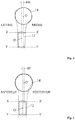
- FIG. 1 More particularly, on figures 2 to 5 , is shown a model of metaphyseal cylinder 12 and epiphysis sphere 14.
- the metaphyseal cylinder 12 is represented by a least squares cylinder, typically between the XX 'and YY' planes, orthogonal to the diaphyseal axis of the humerus, and separated substantially respectively by 65 mm and 105 mm, relative to the top of the articular surface C - also called Hinge point, and noted C on the figure 6 .
- the epiphysis sphere 14 is represented by a least squares sphere passing through the points palpated on the articular surface of the epiphysis sphere of the humerus 10.
- the set E VS of statistical data, relating to morphological variables V n of proximal parts of the humerus belonging to the sample E, is thus determined, for said variables.
- the set E VS of statistical data, relating to morphological variables V n of proximal parts of the humerus belonging to sample E, is thus determined in particular from information, for example included in a database, grouping together values obtained for said variables V n during statistical studies.
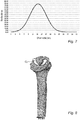
- the diagram shown on figure 7 representing the number of people corresponding to different values in mm of medial offset O MD can be obtained from statistical data on the sample E, grouped together in a database.
- the figure 8 represents a schematic three-dimensional view, resulting from a finite element simulation, in which is represented a torque C T capable of causing loosening of said humeral component when the latter is implanted in a humerus.
- the set G of sizes T (n) included in the range of humeral components, is determined, as a function of the set E VS of statistical data, from the statistical distribution D T .
- a size is an arbitrary value referring to a set of values for the different variables V n , the diaphyseal dimensions being predominant.
- the statistical distribution D T is determined, for each of the variables V n , as a function of the mean value M and the standard deviation ⁇ , relating to said variable V n , in the data set statistics for sample E.
- the statistical distribution DT can be as follows: Size 1 mean value M - 2 x standard deviation ⁇ Size 3 mean value M - 1 x standard deviation ⁇ Size 5 mean value M Size 7 mean value M + 1 x standard deviation ⁇ Size 9 mean value M + 2 x standard deviation ⁇
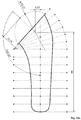
- FIG. 12 a three-dimensional model of a humeral component for a joint prosthesis.
- the model comprises sections S n distributed in different planes P n .
- nine sections S 1 ..S 9 are distributed in planes P 1 ..P 9 parallel, orthogonal to the vertical axis XX '.
- the sections S 1 ..S 9 are spaced, two by two, at a constant distance, proportional to the total length of the humeral component.
- Six sections S 10 ..S 11 are distributed in plans P 10 ..P 15 .
- the plane P 10 is inclined at an angle ⁇ 10 relative to the plane P 9 .
- the plane P 11 is inclined at an angle ⁇ 11 with respect to the plane P 10 .
- the plane P 12 is inclined at an angle ⁇ 12 with respect to the plane P 11 .
- the plane P 13 is inclined at an angle ⁇ 13 relative to the plane P 12 .
- the plane P 14 is inclined at an angle ⁇ 14 relative to the plane P 13 .
- the plane P 15 is inclined at an angle ⁇ 15 with respect to the plane P 14
- the set of parameters P Sn is determined, for each of the sections S n , as a function of the set Evs of statistical data. Then, for each parameter P Sn describing the sections S n , the variations in the value of said parameter between each plane P n are interpolated.
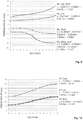
- the figures 9 to 11 show various functions F PSn clean the various interpolation parameters P Sn, for size 5.
- the functions F PSn interpolation are typically interpolation functions of the 3rd degree (therefore with two inflection points).
- the set of parameters P Sn is determined, for each of the sections S n , as a function of the set E VS of statistical data and in function of the reference values V Er of the torques likely to cause loosening of humeral components, determined during the second step 120.
- the lateral radius RL n and the medial radius RM n for each of the sections S n can be determined as a function of the reference values V Er of the torsional torque forces liable to cause loosening of humeral components.
- the range of humeral components is obtained by producing, for each size T (n) of the set G, a humeral component according to the corresponding model obtained, as described previously.
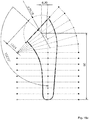
- the figure 16a shows in particular an example of a humoral component of size 1 (measurements expressed in mm) obtained by means of the method according to the invention.
- the figure 16b shows in particular an example of a humoral component of size 9 (measurements expressed in mm) obtained by means of the method according to the invention.
Landscapes
- Health & Medical Sciences (AREA)
- Engineering & Computer Science (AREA)
- Life Sciences & Earth Sciences (AREA)
- Veterinary Medicine (AREA)
- Public Health (AREA)
- General Health & Medical Sciences (AREA)
- Animal Behavior & Ethology (AREA)
- Biomedical Technology (AREA)
- Heart & Thoracic Surgery (AREA)
- Oral & Maxillofacial Surgery (AREA)
- Vascular Medicine (AREA)
- Transplantation (AREA)
- Cardiology (AREA)
- Orthopedic Medicine & Surgery (AREA)
- Surgery (AREA)
- Manufacturing & Machinery (AREA)
- Nuclear Medicine, Radiotherapy & Molecular Imaging (AREA)
- Robotics (AREA)
- Medical Informatics (AREA)
- Molecular Biology (AREA)
- Prostheses (AREA)
Description
La présente invention se rapporte au domaine des prothèses articulaires de l'épaule, et plus particulièrement au domaine des composants huméraux courts pour prothèses articulaires de l'épaule. L'état de la technique le plus proche est donné par le document
La présente invention concerne notamment un procédé de construction d'une gamme de composants huméraux pour prothèses articulaires de l'épaule. La présente invention trouve application lors d'opérations chirurgicales de reconstruction de l'épaule.The present invention relates in particular to a method for constructing a range of humeral components for shoulder joint prostheses. The present invention finds application during surgical operations to reconstruct the shoulder.
Il est particulièrement souhaitable pour une prothèse articulaire de permettre la restitution des mobilités de l'articulation qu'elle remplace.It is particularly desirable for a joint prosthesis to allow the restoration of mobility of the joint that it replaces.
Dans le cas particulier d'une prothèse articulaire d'épaule, les divers bras de levier observés au niveau de l'articulation remplacée - c'est-à-dire les distances entre les centres de rotation et les points d'application des efforts au niveau des insertions musculaires correspondantes - doivent pouvoir être restitués avec la plus grande précision possible. Ces distances sont définies entre la forme endocanalaire du composant huméral de la prothèse et le centre de la surface articulaire.In the particular case of a shoulder joint prosthesis, the various lever arms observed at the level of the replaced joint - that is to say the distances between the centers of rotation and the points of application of the forces at the level of the corresponding muscle insertions - must be able to be reproduced with the greatest possible precision. These distances are defined between the endocanal shape of the humeral component of the prosthesis and the center of the articular surface.
Pour répondre notamment à l'objectif de conservation des divers bras de levier, le composant huméral, destiné à être introduit dans la partie proximale de l'humérus, doit présenter une forme endocanalaire adaptée au plus grand nombre possible de morphotypes de la population.In order to meet the objective of preserving the various lever arms in particular, the humeral component, intended to be introduced into the proximal part of the humerus, must have an endocanal shape adapted to the greatest possible number of morphotypes in the population.
Or, les gammes de composants huméraux selon l'art antérieur ne permettent généralement de s'adapter que très partiellement aux diverses morphologies des patients, dont les tailles varient fortement.However, the ranges of humeral components according to the prior art generally allow only very partial adaptation to the various morphologies of patients, the sizes of which vary greatly.
En outre, le temps nécessaire pour développer une gamme de composants huméraux selon les procédés de construction connus est encore particulièrement important, car il est nécessaire de reprendre les calculs et la conception pour chaque taille de composants huméraux constituant la gamme. Il s'agit d'un processus itératif long et complexe, nécessitant un temps de marquage important.In addition, the time required to develop a range of humeral components according to known construction methods is still particularly important, as it is necessary to repeat the calculations and design for each size of humeral components constituting the range. This is a long and complex iterative process, requiring significant tagging time.
Il est encore particulièrement souhaitable pour un composant huméral d'assurer un blocage angulaire en rotation optimale, afin d'éviter tous descellements, une fois disposé dans la partie proximale de l'humérus.It is still particularly desirable for a humeral component to ensure angular locking in optimal rotation, in order to avoid any loosening, once it is placed in the proximal part of the humerus.
Or, la stabilité en rotation des composants huméraux selon l'art antérieur peut être améliorée, en particulier pour les composants huméraux courts - c'est-à-dire typiquement d'une longueur inférieure à 100 mm.However, the rotational stability of the humeral components according to the prior art can be improved, in particular for short humeral components - that is to say typically with a length of less than 100 mm.
L'état de la technique peut également être illustré par les enseignements des documents
Un des objets de l'invention est de permettre la conception d'une gamme de composants huméraux aptes à permettre la restitution des mobilités de l'articulation qu'ils remplacent, en particulier les divers bras de levier observés au niveau de l'articulation remplacée.One of the objects of the invention is to allow the design of a range of humeral components capable of allowing the restoration of the mobility of the joint that they replace, in particular the various lever arms observed at the level of the replaced joint. .
Un des objets de l'invention est de permettre la conception d'une gamme de composants huméraux présentant une forme endocanalaire adaptée au plus grand nombre possible de morphotypes de la population.One of the objects of the invention is to allow the design of a range of humeral components having an endocanal shape adapted to the greatest possible number of morphotypes in the population.
Un des objets de l'invention est de réduire le temps nécessaire pour développer une gamme de composants huméraux.One of the objects of the invention is to reduce the time required to develop a range of humeral components.
Un des objets de l'invention est de permettre la conception d'une gamme de composants huméraux courts aptes à assurer un blocage angulaire en rotation optimale, afin d'éviter tous descellements, une fois disposé dans la partie proximale de l'humérus.One of the objects of the invention is to allow the design of a range of short humeral components capable of ensuring optimum angular locking in rotation, in order to avoid any loosening, once placed in the proximal part of the humerus.
Un ou plusieurs de ces objets sont remplis par le procédé selon l'invention.One or more of these objects are fulfilled by the method according to the invention.
Plus particulièrement, selon un premier aspect, l'invention se rapporte à un procédé de construction d'une gamme de composants huméraux destinés à être introduits dans la partie proximale de l'humérus lors d'une opération chirurgicale reconstructrice de l'épaule. Le procédé comporte les étapes suivantes :
- obtention d'un ensemble de données statistiques relatives à des variables aptes à permettre la caractérisation de la géométrie d'une partie proximale d'humérus, à partir de données morphométriques de parties proximales d'humérus appartenant à un échantillon représentatif d'une population ;
- détermination, à partir d'une distribution statistique, d'un ensemble de tailles composant la gamme de composants huméraux ;
- pour chacune desdites tailles, détermination d'une mesure pour chacune des variables, en fonction de l'ensemble de données statistiques ;
- pour chacune desdites tailles, production d'un composant huméral en fonction de la mesure de chacune des variables correspondant à ladite taille.
- obtaining a set of statistical data relating to variables capable of allowing characterization of the geometry of a proximal humerus part, from morphometric data of proximal humerus parts belonging to a representative sample of a population;
- determining, from a statistical distribution, a set of sizes making up the range of humeral components;
- for each of said sizes, determining a measure for each of the variables, based on the set of statistical data;
- for each of said sizes, production of a humeral component as a function of the measurement of each of the variables corresponding to said size.
En mettant en oeuvre le procédé selon l'invention, il est possible de maîtriser le temps nécessaire au développement d'une gamme de composants huméraux.By implementing the method according to the invention, it is possible to control the time necessary for the development of a range of humeral components.
En outre, il est aussi possible d'optimiser la gestion de la gamme, au moyen de la distribution statistique, et donc définir une taille de stock optimale au niveau de la production, mais également aussi dans les cliniques et hôpitaux.In addition, it is also possible to optimize the management of the range, by means of statistical distribution, and therefore define an optimal stock size at the level of production, but also in clinics and hospitals.
En outre, la gamme étant optimisée en fonction d'informations relatives à un échantillon représentatif d'une population, la gamme offerte au chirurgien permet d'aider aux choix d'un composant huméral adapté.In addition, the range being optimized as a function of information relating to a representative sample of a population, the range offered to the surgeon makes it possible to assist in the choice of a suitable humeral component.
Les variables aptes à permettre la caractérisation de la géométrie d'une partie proximale d'humérus comprennent par exemple une ou plusieurs des variables suivantes :
- un offset médial,
- un offset postérieur,
- un offset mécanique,
- une rétrotorsion / bi-épicondylienne,
- une rétrotorsion / postérieurs,
- un angle cervico-diaphysaire,
- un diamètre de la surface articulaire,
- une épaisseur de la surface articulaire,
- un encombrement antéro-postérieur et médio-latéral de chacune des sections transverses du composant huméral.
- a medial offset,
- a posterior offset,
- a mechanical offset,
- a retrotorsion / bi-epicondylar,
- a retrotorsion / posterior,
- a cervico-diaphyseal angle,
- a diameter of the articular surface,
- a thickness of the articular surface,
- anteroposterior and medio-lateral crowding of each of the transverse sections of the humeral component.
La distribution statistique peut être déterminée, pour chacune des variables, en fonction de la valeur moyenne et de l'écart-type, relatifs à ladite variable, dans l'ensemble de données statistiques.The statistical distribution can be determined, for each of the variables, as a function of the mean value and the standard deviation, relating to said variable, in the statistical data set.
Avantageusement, chaque composant huméral de la gamme a une longueur inférieure à sensiblement 100 mm.Advantageously, each humeral component of the range has a length less than substantially 100 mm.
Le procédé peut alors comporter une étape d'obtention d'au moins une valeur de référence d'un couple de torsion susceptible de provoquer un descellement d'un composant huméral installé dans une partie proximale d'humérus, et, dans lequel, la mesure pour chaque variable, pour chacune desdites tailles, est déterminée en fonction de l'ensemble de données statistiques et en fonction de ladite au moins une valeur de référence.The method can then include a step of obtaining at least one reference value of a torque capable of causing a loosening of a humeral component installed in a proximal humerus portion, and, wherein, the measurement for each variable, for each of said sizes, is determined as a function of the set of statistical data and as a function of said at least one reference value.
Pour chacune desdites tailles, la mesure pour chacune des variables, en fonction de l'ensemble de données statistiques, peut être déterminée en :
- obtenant un modèle tridimensionnel de composant huméral comportant des sections réparties dans différents plans, chaque section étant définie par un ensemble de paramètres géométriques ;
- déterminant, pour chacune des sections, l'ensemble de paramètres géométriques correspondant, en fonction de l'ensemble de données statistiques relatives aux variables aptes à permettre la caractérisation de la géométrie d'une partie proximale d'humérus ;
- déterminant, pour chacun desdits paramètres géométriques, au moyen d'une fonction d'interpolation, les valeurs dudit paramètre entre chaque section.
- obtaining a three-dimensional model of a humeral component comprising sections distributed in different planes, each section being defined by a set of geometric parameters;
- determining, for each of the sections, the corresponding set of geometric parameters, as a function of the set of statistical data relating to the variables capable of allowing the characterization of the geometry of a proximal part of the humerus;
- determining, for each of said geometric parameters, by means of an interpolation function, the values of said parameter between each section.
Pour chacune des sections, l'ensemble de paramètres géométriques correspondant, peut être déterminé en fonction de l'ensemble de données statistiques relatives aux variables aptes à permettre la caractérisation de la géométrie d'une partie proximale d'humérus, et en fonction de ladite au moins une valeur de référence.For each of the sections, the corresponding set of geometric parameters can be determined as a function of the set of statistical data relating to the variables capable of allowing the characterization of the geometry of a proximal part of the humerus, and as a function of said at least one reference value.
Les sections sont par exemple de forme sensiblement octogonale, chaque section étant pourvues de congés de rayons paramétrables, les valeurs des rayons paramétrables étant choisies en fonction de ladite au moins une valeur de référence.The sections are for example of substantially octagonal shape, each section being provided with configurable radii fillets, the values of the configurable radii being chosen as a function of said at least one reference value.
Les sections octogonales permettent ainsi de passer de section stabilisante - c'est-à-dire à très faible rayon - à une section distale sensiblement en forme quasi-circulaire afin de ne pas entrer en contact avec la diaphyse.The octagonal sections thus make it possible to go from a stabilizing section - that is to say with a very small radius - to a distal section which is substantially in a quasi-circular shape so as not to come into contact with the diaphysis.
Ainsi, il est possible de réduire considérablement les risques liés aux contacts du composant huméral avec la diaphyse, à savoir les problèmes de déviation des contraintes, plus couramment désignés par "stress-shielding" en anglais, et la survenue de douleurs en bout de tige.Thus, it is possible to considerably reduce the risks associated with contacts of the humeral component with the shaft, namely the problems of deviation of the stresses, more commonly referred to as "stress-shielding" in English, and the occurrence of pain at the end of the rod. .
Grâce au procédé de construction selon l'invention, il est donc possible de construire une gamme de composants huméraux destinés à être introduits dans la partie proximale de l'humérus lors d'une opération chirurgicale reconstructrice de l'épaule, chaque composant huméral étant construit suivant le procédé de construction selon le premier aspect.Thanks to the construction method according to the invention, it is therefore possible to construct a range of humeral components intended to be introduced into the proximal part of the humerus during a reconstructive surgical operation of the shoulder, each humeral component being constructed. according to the construction method according to the first aspect.
Selon un deuxième aspect, l'invention se rapporte à système pour construire une gamme de composants huméraux destinés à être introduits dans la partie proximale de l'humérus lors d'une opération chirurgicale reconstructrice de l'épaule.According to a second aspect, the invention relates to a system for constructing a range of humeral components intended to be introduced into the proximal part of the humerus during a reconstructive surgical operation of the shoulder.
Le système est notamment adapté à mettre en oeuvre le procédé selon le premier aspect. Le système comporte :
- une base de données comportant un ensemble de données statistiques relatives à des variables aptes à permettre la caractérisation de la géométrie d'une partie proximale d'humérus, à partir de données morphométriques de parties proximales d'humérus appartenant à un échantillon représentatif d'une population ;
- un configurateur apte à :
- déterminer, à partir d'une distribution statistique, d'un ensemble de tailles composant la gamme de composants huméraux ;
- pour chacune desdites tailles, déterminer une mesure pour chacune des variables, en fonction de l'ensemble de données statistiques ;
- un outil de production configuré pour produire, pour chacune desdites tailles, un composant huméral en fonction de la mesure de chacune des variables correspondant à ladite taille.
- a database comprising a set of statistical data relating to variables capable of allowing the characterization of the geometry of a proximal part of the humerus, from morphometric data of proximal parts of the humerus belonging to a sample representative of a population;
- a configurator capable of:
- determining, from a statistical distribution, a set of sizes making up the range of humeral components;
- for each of said sizes, determining a measure for each of the variables, based on the set of statistical data;
- a production tool configured to produce, for each of said sizes, a humeral component as a function of the measurement of each of the variables corresponding to said size.
La présente invention sera bien comprise et ses avantages ressortiront aussi à la lumière de la description qui va suivre, donnée uniquement à titre d'exemple non limitatif et faite en référence aux dessins annexés, dans lesquels :
- la
figure 1 est un organigramme illustrant un procédé de construction, selon un mode de réalisation de l'invention ; - la
figure 2 est un schéma d'un système de construction, selon un mode de réalisation de l'invention ; - la
figure 3 est une vue schématique d'un modèle de cylindre métaphysaire et de sphère épiphyse, selon une construction de référence, représenté en superposition d'une vue anatomique d'un humérus typique ; - la
figure 4 est une vue schématique du modèle de cylindre métaphysaire et de sphère épiphyse, selon la construction de référence ; - la
figure 5 est une vue schématique, représentant sur une vue anatomique détaillée d'une sphère épiphyse typique, des variables relatives à ladite sphère épiphyse ; - la
figure 6 est une vue schématique, représentant sur une vue anatomique générale d'un humérus typique, des variables relatives audit humérus ; - la
figure 7 est un diagramme représentant le nombre de personnes, dans un échantillon de population, correspondant à différentes valeurs en mm d'offset médial à partir de données statistiques sur un échantillon de population ; - la
figure 8 est une vue tridimensionnelle schématique, issue d'une simulation par éléments finis, sur laquelle est représenté le couple de torsion susceptible de provoquer des descellements dudit composant huméral lorsque ce dernier est implanté dans un humérus ; - la
figure 9 est un diagramme représentant les fonctions d'interpolation pour les paramètres suivants : largeur médiale ML_Med, largeur latérale ML_Lat, largeur médiale totale ML_Med_Total et largeur latérale totale ML_Lat_Total ; - la
figure 10 est un diagramme représentant les fonctions d'interpolation pour les paramètres suivant : épaisseur médiale AP_Med, épaisseur latérale AP_Lat et épaisseur totale AP_Total ; - la
figure 11 est un diagramme représentant les fonctions d'interpolation pour les paramètres suivants: rayon médial des octogones R_Med et rayon latéral des octogones R_Lat ; - la
figure 12 est un schéma, représentant, dans un mode de réalisation selon l'invention, un modèle tridimensionnel de composant huméral pour prothèse articulaire (mesures exprimées en mm) ; - la
figure 13 est un schéma, représentant, dans un mode de réalisation selon l'invention, d'une section proximale du modèle tridimensionnel de composant huméral pour prothèse articulaire ; - la
figure 14 est un schéma, représentant, dans un mode de réalisation selon l'invention, d'une section distale du modèle tridimensionnel de composant huméral pour prothèse articulaire (mesures exprimées en mm) ; - la
figure 15 est un schéma, représentant, dans un mode de réalisation selon l'invention, la distribution et le positionnement relatif des sections du modèle tridimensionnel de composant huméral pour prothèse articulaire ; - la
figure 16a est une vue tridimensionnelle montrant un composant humoral de taille 1, obtenu au moyen du procédé selon l'invention ; - la
figure 16b est une vue tridimensionnelle montrant un composant humoral de taille 9, obtenu au moyen du procédé selon l'invention ; - la figure 17 est une vue tridimensionnelle représentant une gamme de composants huméraux pour prothèses, obtenue au moyen du procédé selon l'invention.
- the
figure 1 is a flowchart illustrating a construction method, according to an embodiment of the invention; - the
figure 2 is a diagram of a construction system, according to an embodiment of the invention; - the
figure 3 is a schematic view of a model of a metaphyseal cylinder and epiphysis sphere, according to a reference construction, shown in superposition of an anatomical view of a typical humerus; - the
figure 4 is a schematic view of the model of metaphyseal cylinder and epiphysis sphere, according to the reference construction; - the
figure 5 is a schematic view, showing in a detailed anatomical view of a typical epiphysis sphere, variables relating to said epiphysis sphere; - the
figure 6 is a schematic view, showing on a general anatomical view of a typical humerus, variables relating to said humerus; - the
figure 7 is a diagram representing the number of people, in a population sample, corresponding to different values in mm of medial offset from statistical data on a population sample; - the
figure 8 is a schematic three-dimensional view, resulting from a simulation by finite elements, on which is represented the torque likely to cause loosening of said humeral component when the latter is implanted in a humerus; - the
figure 9 is a diagram representing the interpolation functions for the following parameters: medial width ML_Med, lateral width ML_Lat, total medial width ML_Med_Total and total lateral width ML_Lat_Total; - the
figure 10 is a diagram representing the interpolation functions for the following parameters: medial thickness AP_Med, lateral thickness AP_Lat and total thickness AP_Total; - the
figure 11 is a diagram representing the interpolation functions for the following parameters: medial radius of R_Med octagons and lateral radius of R_Lat octagons; - the
figure 12 is a diagram showing, in one embodiment according to the invention, a three-dimensional model of a humeral component for a joint prosthesis (measurements expressed in mm); - the
figure 13 is a diagram showing, in an embodiment according to the invention, a proximal section of the three-dimensional model of a humeral component for a joint prosthesis; - the
figure 14 is a diagram showing, in an embodiment according to the invention, a distal section of the three-dimensional model of a humeral component for a joint prosthesis (measurements expressed in mm); - the
figure 15 is a diagram showing, in one embodiment according to the invention, the distribution and the relative positioning of the sections of the three-dimensional model of a humeral component for a joint prosthesis; - the
figure 16a is a three-dimensional view showing a humoral component of size 1, obtained by means of the method according to the invention; - the
figure 16b is a three-dimensional view showing a humoral component of size 9, obtained by means of the method according to the invention; - Fig. 17 is a three-dimensional view showing a range of humeral components for prostheses obtained by means of the method according to the invention.
La
Chaque composant huméral de la gamme comporte une partie endocanalaire destinée à être introduite dans la partie proximale de l'humérus. La gamme de composants huméraux comporte une pluralité de composants huméraux courts - c'est-à-dire typiquement d'une longueur inférieure à 100 mm - visibles sur la figure 17. Il est en effet avantageux de proposer des composants huméraux courts, car il est ainsi possible de faciliter les opérations chirurgicales de reprise.Each humeral component in the range has an endocanal part intended to be introduced into the proximal part of the humerus. The range of humeral components includes a plurality of short humeral components - that is to say typically less than 100mm in length - visible in Figure 17. It is indeed advantageous to provide short humeral components, as it is advantageous to provide short humeral components. is thus possible to facilitate the surgical operations of revision.
Les différentes formes endocanalaires des composants huméraux de la gamme obtenue par la mise en œuvre du procédé laissent aux chirurgiens la possibilité de choisir un composant huméral dans ladite gamme, avec une probabilité élevée que ledit composant huméral soit adapté à la morphologie de la partie proximale de l'humérus du patient à opérer. Le recouvrement est typiquement de 95% de la population pour une gamme dessinée avec une taille 1 ayant les paramètres de µ-2σ et une taille 9 ayant les paramètres de µ+2σ, comme détaillé ci-après dans la description.The different endocanal shapes of the humeral components of the range obtained by implementing the method leave surgeons the possibility of choosing a humeral component in said range, with a high probability that said humeral component is adapted to the morphology of the proximal part of the the patient's humerus to be operated on. The recovery is typically 95% of the population for a range drawn with a size 1 having the parameters of µ-2σ and a size 9 having the parameters of µ + 2σ, as detailed below in the description.
Le procédé comporte une première étape 110 au cours de laquelle des données morphométriques DM, correspondant à des variables Vn aptes à caractériser des parties proximales d'humérus appartenant à un échantillon E représentatif d'une population, sont collectées.The method comprises a
À l'issue de l'étape 110, un ensemble EVS de données statistiques, relatives aux variables Vn, est obtenu.At the end of
Avantageusement, le procédé comporte une deuxième étape 120, optionnelle, au cours de laquelle des valeurs de références VEr de couples de torsion susceptibles de provoquer des descellements de composants huméraux, installés dans des parties proximales d'humérus appartenant à un échantillon E' représentatif d'une population sont obtenues.Advantageously, the method comprises a second
Le procédé comporte une troisième étape 130 au cours de laquelle, à partir d'une distribution statistique DT, un ensemble G de tailles Tn composant la gamme de composants huméraux, est déterminé.The method comprises a
Le procédé comporte une quatrième étape 140 au cours de laquelle, pour chaque taille Tn de l'ensemble G, on détermine une mesure miTn-n, pour chaque variable Vn, en fonction de l'ensemble EVS de données statistiques, et, avantageusement, en fonction des valeurs de références VEr.The method comprises a
Le procédé comporte une cinquième étape 150 au cours de laquelle, la gamme de composants huméraux est obtenue, en produisant, pour chaque taille Tn de l'ensemble G, un composant huméral en fonction des mesures miTn-n relatives aux variables Vn correspondant à ladite taille Tn.The method comprises a
On se réfère à la
Le système permet de faciliter les étapes de conception de la gamme de composants huméraux, en offrant notamment la possibilité de modifier et d'évaluer la géométrie de chaque composant huméral conçu selon les données morphométriques et l'expérience de chirurgiens.The system facilitates the design steps of the range of humeral components, including the ability to modify and evaluate the geometry of each humeral component designed based on morphometric data and the experience of surgeons.
Le système comporte une base de données 210 comportant les données morphométriques DM, correspondant aux variables Vn aptes à caractériser des parties proximales d'humérus appartenant à l'échantillon E.The system comprises a
Le système comporte encore un modèle 220 apte à décrire, pour chaque taille Tn de l'ensemble G, les mesure miTn-n, pour chaque variable Vn, en fonction de l'ensemble EVS de données statistiques, et, avantageusement, en fonction des valeurs de références VEr.The system also comprises a
Le système comporte un configurateur 230, couplé à la base de données 210 et au modèle 220, et apte à définir, pour chaque taille Tn de l'ensemble G, un composant huméral en fonction des mesures miTn-n relatives aux variables Vn correspondant à ladite taille Tn.The system comprises a
Le configurateur 230 peut avantageusement être couplé à un logiciel de conception assisté par ordinateur, afin de permettre par exemple de simuler, automatiquement, les composants huméraux de l'ensemble G, en fonction des données et lois morphométriques disponibles.The
Le système comporte un outil de production 240, couplé au configurateur 230, configuré pour produire, pour chaque taille Tn de l'ensemble G, un composant huméral en fonction des mesures miTn-n relatives aux variables Vn correspondant à ladite taille Tn.The system comprises a
Le système comporte avantageusement un outil de prise en compte de retours d'expérience 250 à collecter de nouveaux ensembles de données statistiques, et couplé au configurateur 230 de sorte à permettre à ce dernier de prendre en compte lesdits nouveaux ensembles de données statistiques.The system advantageously comprises a tool for taking account of
On se réfère maintenant aux
Plus particulièrement, sur les
Dans cette construction de référence, le cylindre métaphysaire 12 est représenté par un cylindre des moindres carrés, typiquement compris entre les plans XX' et YY', orthogonaux à l'axe diaphysaire de l'humérus, et distants sensiblement respectivement de 65 mm et de 105 mm, par rapport au sommet de la surface articulaire C - aussi appelée point de Hinge, et noté C sur la
La sphère épiphyse 14 est représentée par une sphère des moindres carrés passant par les points palpés sur la surface articulaire de la sphère épiphyse de l'humérus 10.The
Sur les
Sur les
- l'offset médial ΔM, correspondant à la distance entre le centre de la tête humérale - c'est-à-dire centre de la sphère des moindres carrés - et l'axe diaphysaire projetée dans le plan frontal ;
- l'offset postérieur ΔP, c'est-à-dire la distance entre le centre de la tête humérale - c'est-à-dire le centre de la sphère des moindres carrés - et l'axe diaphysaire projetée dans le plan sagittal ;
- l'offset mécanique OMC, c'est-à-dire la distance entre le centre de la tête humérale - c'est-à-dire le centre de la sphère des moindres carrés - et l'axe diaphysaire ; l'offset mécanique OMC peut en particulier être déterminé à partir de l'expression mathématique suivante:

- la rétrotorsion / bi-épicondylienne β1, c'est-à-dire l'angle entre la projection dans le plan axial du col de l'humérus et la ligne bi-épicondylienne;
- la rétrotorsion / postérieurs β2, c'est-à-dire l'angle entre l'axe du col de l'humérus et les deux points les plus postérieurs de la surface articulaire distale de l'humérus ;
- l'angle cervico-diaphysaire α entre l'axe diaphysaire de l'humérus et l'axe normal OO' ;
- le diamètre DSA de la surface articulaire, soit la distance entre le point C et le point D ;
- l'épaisseur ESA de la surface articulaire.
- the medial offset ΔM, corresponding to the distance between the center of the humeral head - that is to say the center of the least squares sphere - and the diaphyseal axis projected in the frontal plane;
- the posterior offset ΔP, that is to say the distance between the center of the humeral head - that is to say the center of the least squares sphere - and the diaphyseal axis projected in the sagittal plane;
- the mechanical offset O MC , that is to say the distance between the center of the humeral head - that is to say the center of the least squares sphere - and the diaphyseal axis; the mechanical offset O MC can in particular be determined from the following mathematical expression:
- the retrotorsion / bi-epicondylar β 1 , that is to say the angle between the projection in the axial plane of the neck of the humerus and the bi-epicondylar line;
- the retrotorsion / posterior β 2 , that is to say the angle between the axis of the neck of the humerus and the two most posterior points of the distal articular surface of the humerus;
- the cervico-diaphyseal angle α between the diaphyseal axis of the humerus and the normal axis OO ';
- the diameter D SA of the articular surface, ie the distance between point C and point D;
- the thickness E SA of the articular surface.
Aussi, selon l'exemple de construction de référence précédemment décrite, les variables V(n) de l'ensemble EVS de données statistiques considérées sont donc les suivantes :
- l'offset médial OMD,
- l'offset postérieur OP,
- l'offset mécanique OMC,
- la rétrotorsion / bi-épicondylienne β1,
- la rétrotorsion / postérieurs β2,
- l'angle cervico-diaphysaire α,
- le diamètre DSA de la surface articulaire,
- l'épaisseur ESA de la surface articulaire.
- the medial offset O MD ,
- the posterior offset O P ,
- the mechanical offset O MC ,
- the retrotorsion / bi-epicondylar β 1 ,
- the retrotorsion / posterior β 2 ,
- the cervico-diaphyseal angle α,
- the diameter D SA of the articular surface,
- the thickness E SA of the articular surface.
L'ensemble EVS de données statistiques, relatives à des variables Vn morphologiques de parties proximales d'humérus appartenant à l'échantillon E, est ainsi déterminé, pour lesdites variables.The set E VS of statistical data, relating to morphological variables V n of proximal parts of the humerus belonging to the sample E, is thus determined, for said variables.
Dans un mode de réalisation, l'ensemble EVS de données statistiques, relatives à des variables Vn morphologiques de parties proximales d'humérus appartenant à l'échantillon E, est ainsi déterminé notamment à partir d'informations, par exemple comprises dans une base de données, regroupant des valeurs obtenues pour lesdites variables Vn lors d'études statistiques.In one embodiment, the set E VS of statistical data, relating to morphological variables V n of proximal parts of the humerus belonging to sample E, is thus determined in particular from information, for example included in a database, grouping together values obtained for said variables V n during statistical studies.
Ainsi, le diagramme illustré sur la
Au cours de la deuxième étape 120 optionnelle, au cours de laquelle des valeurs de références VEr de couples de torsion susceptibles de provoquer des descellements de composants huméraux, installées de parties proximales d'humérus, sont déterminées.During the second
La
Ces données peuvent également être obtenues, expérimentalement, en utilisant une clé dynamométrique de sorte à déterminer lesdites valeurs de références sur les couples de torsion susceptibles de provoquer un descellement d'un composant huméral implanté dans la partie proximale d'un humérus.These data can also be obtained, experimentally, by using a torque wrench so as to determine said reference values on the torques likely to cause loosening of a humeral component implanted in the proximal part of a humerus.
Au cours de la troisième étape 130, l'ensemble G de tailles T(n), comprises dans la gamme de composants huméraux, est déterminé, en fonction de l'ensemble EVS de données statistiques, à partir de la distribution statistique DT.During the
Une taille est une valeur arbitraire se référant à un ensemble de valeurs pour les différentes variables Vn, les dimensions diaphysaires étant prédominantes.A size is an arbitrary value referring to a set of values for the different variables V n , the diaphyseal dimensions being predominant.
Dans un mode de réalisation, la distribution statistique DT est déterminée, pour chacune des variables Vn, en fonction de la valeur moyenne M et de l'écart-type σ, relatifs à ladite variable Vn, dans l'ensemble de données statistiques pour l'échantillon E.In one embodiment, the statistical distribution D T is determined, for each of the variables V n , as a function of the mean value M and the standard deviation σ, relating to said variable V n , in the data set statistics for sample E.
Ainsi, pour chaque variable Vn morphologique pour l'échantillon E, pour une gamme comportant 5 différentes tailles, la distribution statistique DT peut être la suivante :
Le tableau suivant regroupe les valeurs moyennes et les écarts type selon la distribution statistique DT précédemment décrite, pour chaque variable Vn morphologique pour l'échantillon E, obtenues à partir de données statistiques collectées à partir d'études médicales et d'essais :
On se réfère maintenant aux
Le modèle comporte des sections Sn réparties dans différents plans Pn. Dans l'exemple représenté sur les
Dans un mode de réalisation les angles α10..15 sont tous sensiblement égaux. La section S15 est représentée sur la
- un rayon latéral RLn,
- un rayon médial RMn,
- une distance latérale MLMn,
- une distance latérale total MLMTn,
- une distance médiale MLLn,
- une distance médiale totale MLLTn,
- une distance latérale APLn,
- une distance médiale APMn,
- une distance totale APTn.
- a lateral radius RL n ,
- a medial radius RM n ,
- a lateral distance MLM n ,
- a total lateral distance MLMT n ,
- a medial distance MLL n ,
- a total medial distance MLLT n ,
- a lateral distance APL n ,
- a medial distance APM n ,
- a total distance APT n.
Aussi, pour chaque taille T(n) de l'ensemble G, l'ensemble de paramètres PSn est déterminé, pour chacune des sections Sn, en fonction de l'ensemble Evs de données statistiques. Puis, pour chaque paramètre PSn décrivant les sections Sn, les variations de la valeur dudit paramètre entre chaque plan Pn sont interpolées.Also, for each size T (n) of the set G, the set of parameters P Sn is determined, for each of the sections S n , as a function of the set Evs of statistical data. Then, for each parameter P Sn describing the sections S n , the variations in the value of said parameter between each plane P n are interpolated.
Les
Dans un mode de réalisation avantageux, pour chaque taille T(n) de l'ensemble G, l'ensemble de paramètres PSn est déterminé, pour chacune des sections Sn, en fonction de l'ensemble EVS de données statistiques et en fonction des valeurs de références VEr des couples de torsions susceptibles de provoquer des descellements de composants huméraux, déterminées au cours de la deuxième étape 120.In an advantageous embodiment, for each size T (n) of the set G, the set of parameters P Sn is determined, for each of the sections S n , as a function of the set E VS of statistical data and in function of the reference values V Er of the torques likely to cause loosening of humeral components, determined during the
Plus particulièrement, le rayon latéral RLn et le rayon médial RMn pour chacune des sections Sn peuvent être déterminé en fonction des valeurs de références VEr des efforts couples de torsion susceptibles de provoquer des descellements de composants huméraux.More particularly, the lateral radius RL n and the medial radius RM n for each of the sections S n can be determined as a function of the reference values V Er of the torsional torque forces liable to cause loosening of humeral components.
Ainsi, les valeurs du rayon latéral RLn et du rayon médial RMn pour chacune des sections Sn sont par exemple déterminées en fonction des valeurs de références VEr et donc du besoin en stabilité rotatoire :
- plus la valeur du rayon latéral RLn et/ou du rayon médial RMn est faible, et plus ladite stabilité rotatoire est importante, ce qui est souhaitable pour la zone proximale du composant huméral ;
- plus la valeur du rayon latéral RLn et/ou du rayon médial RMn est importante, et plus ladite stabilité rotatoire est faible, ce qui est souhaitable pour la zone distale du composant huméral de sorte à faciliter l'insertion dans l'humérus et de limiter les problèmes de déviation des contraintes, plus couramment désignés par "stress-shielding" en anglais.
- the lower the value of the lateral radius RL n and / or the medial radius RM n , the greater the said rotational stability, which is desirable for the proximal region of the humeral component;
- the greater the value of the lateral radius RL n and / or of the medial radius RM n , the lower the said rotational stability, which is desirable for the distal zone of the humeral component so as to facilitate insertion into the humerus and to limit the stress deviation problems, more commonly referred to as “stress-shielding” in English.
La gamme de composants huméraux est obtenue, en produisant, pour chaque taille T(n) de l'ensemble G, un composant huméral en fonction du modèle correspondant obtenu, comme décrit précédemment.The range of humeral components is obtained by producing, for each size T (n) of the set G, a humeral component according to the corresponding model obtained, as described previously.
Après avoir mis en œuvre le procédé de construction, on obtient donc la gamme de composants huméraux courts adaptés aux morphologies des patients, la gamme de composants huméraux permettant aux chirurgiens de disposer, pour, chaque patient, d'un composant huméral court optimisé.After having implemented the construction method, we therefore obtain the range of short humeral components adapted to the morphologies of the patients, the range of humeral components allowing surgeons to have, for each patient, an optimized short humeral component.
La
Claims (9)
- A method for constructing (100) a range of humeral components intended to be introduced into the proximal portion of the humerus during a shoulder reconstruction surgery, the method including the following steps of:- obtaining (110) a set (EVS) of statistical data relating to variables adapted to enable the characterization of the geometry of a humerus proximal portion, from morphometric data (DM) of humerus proximal portions belonging to a representative sample of a population;- determining (130), from a statistical distribution, a set (G) of sizes composing the range of humeral components;- for each of said sizes, determining (140) a measurement (miTn-n) for each of the variables, according to the set of statistical data;- for each of said sizes, producing (150) a humeral component according to the measurement of each of the variables corresponding to said size.
- The construction method according to claim 1, wherein the variables adapted to enable the characterization of the geometry of a humerus proximal portion comprise one or more of the following variables: a medial offset (OMD), a posterior offset (OP), a mechanical offset (OMC), a retrotorsion / bi-epicondylar (β1), a retrotorsion / posterior (β2), a cervico-diaphysial angle (CCD), a diameter (DSA)of the joint surface, a thickness (ESA) of the joint surface, an anteroposterior and mediolateral bulk of each of the transverse sections of the humeral component.
- The construction method according to any one of the preceding claims, wherein the statistical distribution can be determined, for each of the variables, according to the average value and the standard deviation, relating to said variable, in the set of statistical data.
- The construction method according to any one of the preceding claims, wherein each humeral component of the range has a length substantially smaller than 100 mm.
- The construction method according to claim 4, further including a step of obtaining (120) at least one reference value (VEr) of a torsion torque likely to cause loosening of a humeral component installed in a proximal portion of the humerus,
and wherein, the measurement for each variable, for each of said sizes, is determined (140) according to the set of statistical data and according to said at least one reference value. - The construction method according to any one of the preceding claims, wherein for each of said sizes, the measurement (miTn-n) for each of the variables, according to the set of statistical data, is determined by:- obtaining a three-dimensional model of the humeral component including sections (Sn) distributed in different planes (Pn), each section being defined by a set of geometric parameters;- determining, for each of the sections, the set of corresponding geometrical parameters, according to the set (EVS) of statistical data relating to the variables adapted to enable the characterization of the geometry of a proximal portion of the humerus;- determining, for each of said geometrical parameters, by means of an interpolation function, the values of said parameter between each section.
- The construction method according to claims 5 and 6, wherein for each of the sections, the set of corresponding geometrical parameters can be determined according to the set (EVS) of statistical data relating to the variables adapted to enable the characterization of the geometry of a proximal portion of the humerus, and according to said at least one reference value.
- The construction method according to claim 7, wherein the sections have a substantially octagonal shape, each section being provided with fillets with configurable radii, the values of the configurable radii being selected according to said at least one reference value.
- A system for constructing a range of humeral components intended to be introduced into the proximal portion of the humerus during a shoulder reconstruction surgery, the system including:- a database (210) including a set (EVS) of statistical data relating to variables adapted to enable the characterization of the geometry of a proximal portion of the humerus, from morphometric data (DM) of proximal portions of the humerus belonging to a representative sample of a population;- a configurator (230) adapted to:• determine, from a statistical distribution, a set (G) of sizes composing the range of humeral components;• for each of said sizes, determine a measurement (miTn-n) for each of the variables, according to the set of statistical data;- a production tool (240) configured to produce, for each of said sizes, a humeral component according to the measurement of each of the variables corresponding to said size.
Applications Claiming Priority (2)
| Application Number | Priority Date | Filing Date | Title |
|---|---|---|---|
| FR1662380A FR3059891B1 (en) | 2016-12-13 | 2016-12-13 | METHOD FOR CONSTRUCTING A RANGE OF HUMERAL COMPONENTS FOR JOINT SHOULDER PROSTHESES |
| PCT/FR2017/053487 WO2018109341A1 (en) | 2016-12-13 | 2017-12-11 | Method for constructing a range of humeral components for shoulder joint prostheses |
Publications (3)
| Publication Number | Publication Date |
|---|---|
| EP3554426A1 EP3554426A1 (en) | 2019-10-23 |
| EP3554426B1 true EP3554426B1 (en) | 2021-01-06 |
| EP3554426B8 EP3554426B8 (en) | 2021-03-17 |
Family
ID=60080842
Family Applications (1)
| Application Number | Title | Priority Date | Filing Date |
|---|---|---|---|
| EP17821707.1A Active EP3554426B8 (en) | 2016-12-13 | 2017-12-11 | Method for constructing a range of humeral components for shoulder joint prostheses |
Country Status (4)
| Country | Link |
|---|---|
| US (1) | US11141281B2 (en) |
| EP (1) | EP3554426B8 (en) |
| FR (1) | FR3059891B1 (en) |
| WO (1) | WO2018109341A1 (en) |
Families Citing this family (2)
| Publication number | Priority date | Publication date | Assignee | Title |
|---|---|---|---|---|
| FR3074037B1 (en) * | 2017-11-28 | 2019-12-13 | Shoulder Friends Institute | HUMERAL ROD FOR A HUMERAL IMPLANT OF SHOULDER PROSTHESIS |
| CN112618111B (en) * | 2020-12-14 | 2021-09-21 | 徐州医科大学 | Femoral stem prosthesis design method based on vein skeleton structure |
Family Cites Families (8)
| Publication number | Priority date | Publication date | Assignee | Title |
|---|---|---|---|---|
| US5725592A (en) * | 1996-10-29 | 1998-03-10 | Hayes Medical, Inc. | Modular prosthesis having neck component connected to stem component through cavity in body component |
| US7189261B2 (en) * | 1998-04-03 | 2007-03-13 | Smith & Nephew, Inc. | Modular humeral prosthesis and method |
| TW200730138A (en) * | 2006-02-15 | 2007-08-16 | Univ Chung Yuan Christian | Image analysis methods for gleno-humeral joint morphology |
| EP2754419B1 (en) * | 2011-02-15 | 2024-02-07 | ConforMIS, Inc. | Patient-adapted and improved orthopedic implants |
| WO2014040061A1 (en) * | 2012-09-10 | 2014-03-13 | Ortho Transmission, Llc | Transcutaneous implant for skeletal attachment of external prosthetic devices |
| EP3616654B1 (en) * | 2013-11-08 | 2021-09-15 | Imascap | Methods, systems and devices for pre-operatively planned adaptive glenoid implants |
| WO2015103313A1 (en) * | 2013-12-30 | 2015-07-09 | Shoulder Options, Inc. | Instruments and techniques for orienting prosthesis components for joint prostheses |
| US9962266B2 (en) * | 2015-09-11 | 2018-05-08 | Deltoid, Llc | Arthroplasty components |
-
2016
- 2016-12-13 FR FR1662380A patent/FR3059891B1/en not_active Expired - Fee Related
-
2017
- 2017-12-11 EP EP17821707.1A patent/EP3554426B8/en active Active
- 2017-12-11 WO PCT/FR2017/053487 patent/WO2018109341A1/en not_active Ceased
-
2019
- 2019-06-13 US US16/440,530 patent/US11141281B2/en active Active
Non-Patent Citations (1)
| Title |
|---|
| None * |
Also Published As
| Publication number | Publication date |
|---|---|
| FR3059891A1 (en) | 2018-06-15 |
| WO2018109341A1 (en) | 2018-06-21 |
| US11141281B2 (en) | 2021-10-12 |
| US20190290444A1 (en) | 2019-09-26 |
| FR3059891B1 (en) | 2020-09-04 |
| EP3554426B8 (en) | 2021-03-17 |
| EP3554426A1 (en) | 2019-10-23 |
Similar Documents
| Publication | Publication Date | Title |
|---|---|---|
| EP4103089B1 (en) | Method for designing a pair of connection rods intended to be implanted on the spine of a patient, and method for producing such a rod | |
| Green et al. | Limb-size proportions in Australopithecus afarensis and Australopithecus africanus | |
| EP2263614B1 (en) | Trapezo-metacarpal joint implant | |
| EP0677277A2 (en) | Spinal prosthetic assembly | |
| EP3554426B1 (en) | Method for constructing a range of humeral components for shoulder joint prostheses | |
| FR2932674A1 (en) | METHOD FOR MODELING A GLENOIDAL SURFACE OF AN OMOPLATE, DEVICE FOR IMPLANTING A GLENOIDAL COMPONENT OF A SHOULDER PROSTHESIS, AND METHOD FOR MANUFACTURING SUCH COMPOUND | |
| EP3435924A1 (en) | Method for making an implant, notably a vertebral or intervertebral implant, and implant obtained by this method | |
| EP0679375A1 (en) | Modular prosthetic set for the shoulder joint | |
| FR2729557A1 (en) | INTERSOMATIC CAGE TYPE IMPLANT, AND INSTRUMENTATION AND METHOD FOR ITS INSTALLATION | |
| WO2004062515A1 (en) | Osteosynthesis plate for the osteosynthesis of small neighbouring bones | |
| WO2013054057A1 (en) | Intersomatic implant | |
| EP1429691A1 (en) | Femoral hip prosthesis part, a set of such femoral parts and the production method thereof | |
| FR2770128A1 (en) | Hip joint prosthesis and fitting tool | |
| EP3171825B1 (en) | Computer assisted method for developping a patient specific implant | |
| FR2889446A1 (en) | Range of femoral prosthesis for arthroplasty of hip, has series of three necks to be implemented in small or large prosthesis so as to permit surgeon to adapt prosthesis similar to that of anatomical geometry of patient | |
| EP2468217B1 (en) | Metatarsal hemiarthroplasty implant | |
| FR2844994A1 (en) | ANATOMICAL FEMALE IMPLANT FOR HIP PROSTHESIS | |
| FR2811923A1 (en) | DEVICE FOR RATING THE INTRA-MEDULAR CHANNEL OF A BONE AND METHOD FOR MANUFACTURING THE DEVICE | |
| FR3066382A1 (en) | METHOD FOR PRODUCING A TRAPEZO-METACARPIAN PROSTHESIS AND PROSTHESIS OBTAINED | |
| FR2646596A1 (en) | Femoral prosthesis system | |
| WO2020207990A1 (en) | Method for in-vivo measurement of the wear of an implant | |
| FR3128630A1 (en) | Metaglene provided with a perforated graft support | |
| FR2814060A1 (en) | Femoral shaft, for hip replacement joint, has neck at top of medullar insert axes of these two components being at angle of 125 degrees, with ball of joint being mounted on neck with displacement between center and axis of medullar insert | |
| FR3031895A1 (en) | FEMORAL IMPLANT FOR THE RESTORATION OF A HIP JOINT OF A PATIENT, SET OF IMPLANTS AND METHOD FOR MANUFACTURING SUCH AN IMPLANT. | |
| WO2016005684A1 (en) | Assemby for foot arthroplasty |
Legal Events
| Date | Code | Title | Description |
|---|---|---|---|
| STAA | Information on the status of an ep patent application or granted ep patent |
Free format text: STATUS: UNKNOWN |
|
| STAA | Information on the status of an ep patent application or granted ep patent |
Free format text: STATUS: THE INTERNATIONAL PUBLICATION HAS BEEN MADE |
|
| PUAI | Public reference made under article 153(3) epc to a published international application that has entered the european phase |
Free format text: ORIGINAL CODE: 0009012 |
|
| STAA | Information on the status of an ep patent application or granted ep patent |
Free format text: STATUS: REQUEST FOR EXAMINATION WAS MADE |
|
| 17P | Request for examination filed |
Effective date: 20190523 |
|
| AK | Designated contracting states |
Kind code of ref document: A1 Designated state(s): AL AT BE BG CH CY CZ DE DK EE ES FI FR GB GR HR HU IE IS IT LI LT LU LV MC MK MT NL NO PL PT RO RS SE SI SK SM TR |
|
| AX | Request for extension of the european patent |
Extension state: BA ME |
|
| DAV | Request for validation of the european patent (deleted) | ||
| DAX | Request for extension of the european patent (deleted) | ||
| GRAP | Despatch of communication of intention to grant a patent |
Free format text: ORIGINAL CODE: EPIDOSNIGR1 |
|
| STAA | Information on the status of an ep patent application or granted ep patent |
Free format text: STATUS: GRANT OF PATENT IS INTENDED |
|
| INTG | Intention to grant announced |
Effective date: 20200804 |
|
| GRAS | Grant fee paid |
Free format text: ORIGINAL CODE: EPIDOSNIGR3 |
|
| GRAA | (expected) grant |
Free format text: ORIGINAL CODE: 0009210 |
|
| STAA | Information on the status of an ep patent application or granted ep patent |
Free format text: STATUS: THE PATENT HAS BEEN GRANTED |
|
| AK | Designated contracting states |
Kind code of ref document: B1 Designated state(s): AL AT BE BG CH CY CZ DE DK EE ES FI FR GB GR HR HU IE IS IT LI LT LU LV MC MK MT NL NO PL PT RO RS SE SI SK SM TR |
|
| REG | Reference to a national code |
Ref country code: GB Ref legal event code: FG4D Free format text: NOT ENGLISH |
|
| REG | Reference to a national code |
Ref country code: AT Ref legal event code: REF Ref document number: 1351515 Country of ref document: AT Kind code of ref document: T Effective date: 20210115 Ref country code: CH Ref legal event code: EP |
|
| REG | Reference to a national code |
Ref country code: DE Ref legal event code: R096 Ref document number: 602017031128 Country of ref document: DE |
|
| REG | Reference to a national code |
Ref country code: IE Ref legal event code: FG4D Free format text: LANGUAGE OF EP DOCUMENT: FRENCH |
|
| REG | Reference to a national code |
Ref country code: DE Ref legal event code: R081 Ref document number: 602017031128 Country of ref document: DE Owner name: MOVE-UP, FR Free format text: FORMER OWNER: MOVE-UP, ROMANS, FR |
|
| REG | Reference to a national code |
Ref country code: CH Ref legal event code: PK Free format text: RECTIFICATION B8 |
|
| REG | Reference to a national code |
Ref country code: NL Ref legal event code: MP Effective date: 20210106 |
|
| REG | Reference to a national code |
Ref country code: AT Ref legal event code: MK05 Ref document number: 1351515 Country of ref document: AT Kind code of ref document: T Effective date: 20210106 |
|
| REG | Reference to a national code |
Ref country code: LT Ref legal event code: MG9D |
|
| PG25 | Lapsed in a contracting state [announced via postgrant information from national office to epo] |
Ref country code: GR Free format text: LAPSE BECAUSE OF FAILURE TO SUBMIT A TRANSLATION OF THE DESCRIPTION OR TO PAY THE FEE WITHIN THE PRESCRIBED TIME-LIMIT Effective date: 20210407 Ref country code: HR Free format text: LAPSE BECAUSE OF FAILURE TO SUBMIT A TRANSLATION OF THE DESCRIPTION OR TO PAY THE FEE WITHIN THE PRESCRIBED TIME-LIMIT Effective date: 20210106 Ref country code: FI Free format text: LAPSE BECAUSE OF FAILURE TO SUBMIT A TRANSLATION OF THE DESCRIPTION OR TO PAY THE FEE WITHIN THE PRESCRIBED TIME-LIMIT Effective date: 20210106 Ref country code: NO Free format text: LAPSE BECAUSE OF FAILURE TO SUBMIT A TRANSLATION OF THE DESCRIPTION OR TO PAY THE FEE WITHIN THE PRESCRIBED TIME-LIMIT Effective date: 20210406 Ref country code: PT Free format text: LAPSE BECAUSE OF FAILURE TO SUBMIT A TRANSLATION OF THE DESCRIPTION OR TO PAY THE FEE WITHIN THE PRESCRIBED TIME-LIMIT Effective date: 20210506 Ref country code: BG Free format text: LAPSE BECAUSE OF FAILURE TO SUBMIT A TRANSLATION OF THE DESCRIPTION OR TO PAY THE FEE WITHIN THE PRESCRIBED TIME-LIMIT Effective date: 20210406 Ref country code: LT Free format text: LAPSE BECAUSE OF FAILURE TO SUBMIT A TRANSLATION OF THE DESCRIPTION OR TO PAY THE FEE WITHIN THE PRESCRIBED TIME-LIMIT Effective date: 20210106 |
|
| PG25 | Lapsed in a contracting state [announced via postgrant information from national office to epo] |
Ref country code: AT Free format text: LAPSE BECAUSE OF FAILURE TO SUBMIT A TRANSLATION OF THE DESCRIPTION OR TO PAY THE FEE WITHIN THE PRESCRIBED TIME-LIMIT Effective date: 20210106 Ref country code: RS Free format text: LAPSE BECAUSE OF FAILURE TO SUBMIT A TRANSLATION OF THE DESCRIPTION OR TO PAY THE FEE WITHIN THE PRESCRIBED TIME-LIMIT Effective date: 20210106 Ref country code: LV Free format text: LAPSE BECAUSE OF FAILURE TO SUBMIT A TRANSLATION OF THE DESCRIPTION OR TO PAY THE FEE WITHIN THE PRESCRIBED TIME-LIMIT Effective date: 20210106 Ref country code: PL Free format text: LAPSE BECAUSE OF FAILURE TO SUBMIT A TRANSLATION OF THE DESCRIPTION OR TO PAY THE FEE WITHIN THE PRESCRIBED TIME-LIMIT Effective date: 20210106 Ref country code: SE Free format text: LAPSE BECAUSE OF FAILURE TO SUBMIT A TRANSLATION OF THE DESCRIPTION OR TO PAY THE FEE WITHIN THE PRESCRIBED TIME-LIMIT Effective date: 20210106 |
|
| PG25 | Lapsed in a contracting state [announced via postgrant information from national office to epo] |
Ref country code: IS Free format text: LAPSE BECAUSE OF FAILURE TO SUBMIT A TRANSLATION OF THE DESCRIPTION OR TO PAY THE FEE WITHIN THE PRESCRIBED TIME-LIMIT Effective date: 20210506 |
|
| REG | Reference to a national code |
Ref country code: DE Ref legal event code: R097 Ref document number: 602017031128 Country of ref document: DE |
|
| PG25 | Lapsed in a contracting state [announced via postgrant information from national office to epo] |
Ref country code: SM Free format text: LAPSE BECAUSE OF FAILURE TO SUBMIT A TRANSLATION OF THE DESCRIPTION OR TO PAY THE FEE WITHIN THE PRESCRIBED TIME-LIMIT Effective date: 20210106 Ref country code: CZ Free format text: LAPSE BECAUSE OF FAILURE TO SUBMIT A TRANSLATION OF THE DESCRIPTION OR TO PAY THE FEE WITHIN THE PRESCRIBED TIME-LIMIT Effective date: 20210106 Ref country code: EE Free format text: LAPSE BECAUSE OF FAILURE TO SUBMIT A TRANSLATION OF THE DESCRIPTION OR TO PAY THE FEE WITHIN THE PRESCRIBED TIME-LIMIT Effective date: 20210106 |
|
| PLBE | No opposition filed within time limit |
Free format text: ORIGINAL CODE: 0009261 |
|
| STAA | Information on the status of an ep patent application or granted ep patent |
Free format text: STATUS: NO OPPOSITION FILED WITHIN TIME LIMIT |
|
| PG25 | Lapsed in a contracting state [announced via postgrant information from national office to epo] |
Ref country code: SK Free format text: LAPSE BECAUSE OF FAILURE TO SUBMIT A TRANSLATION OF THE DESCRIPTION OR TO PAY THE FEE WITHIN THE PRESCRIBED TIME-LIMIT Effective date: 20210106 Ref country code: DK Free format text: LAPSE BECAUSE OF FAILURE TO SUBMIT A TRANSLATION OF THE DESCRIPTION OR TO PAY THE FEE WITHIN THE PRESCRIBED TIME-LIMIT Effective date: 20210106 Ref country code: RO Free format text: LAPSE BECAUSE OF FAILURE TO SUBMIT A TRANSLATION OF THE DESCRIPTION OR TO PAY THE FEE WITHIN THE PRESCRIBED TIME-LIMIT Effective date: 20210106 |
|
| 26N | No opposition filed |
Effective date: 20211007 |
|
| PG25 | Lapsed in a contracting state [announced via postgrant information from national office to epo] |
Ref country code: ES Free format text: LAPSE BECAUSE OF FAILURE TO SUBMIT A TRANSLATION OF THE DESCRIPTION OR TO PAY THE FEE WITHIN THE PRESCRIBED TIME-LIMIT Effective date: 20210106 Ref country code: AL Free format text: LAPSE BECAUSE OF FAILURE TO SUBMIT A TRANSLATION OF THE DESCRIPTION OR TO PAY THE FEE WITHIN THE PRESCRIBED TIME-LIMIT Effective date: 20210106 |
|
| PG25 | Lapsed in a contracting state [announced via postgrant information from national office to epo] |
Ref country code: SI Free format text: LAPSE BECAUSE OF FAILURE TO SUBMIT A TRANSLATION OF THE DESCRIPTION OR TO PAY THE FEE WITHIN THE PRESCRIBED TIME-LIMIT Effective date: 20210106 |
|
| PG25 | Lapsed in a contracting state [announced via postgrant information from national office to epo] |
Ref country code: IT Free format text: LAPSE BECAUSE OF FAILURE TO SUBMIT A TRANSLATION OF THE DESCRIPTION OR TO PAY THE FEE WITHIN THE PRESCRIBED TIME-LIMIT Effective date: 20210106 |
|
| PG25 | Lapsed in a contracting state [announced via postgrant information from national office to epo] |
Ref country code: IS Free format text: LAPSE BECAUSE OF FAILURE TO SUBMIT A TRANSLATION OF THE DESCRIPTION OR TO PAY THE FEE WITHIN THE PRESCRIBED TIME-LIMIT Effective date: 20210506 |
|
| PG25 | Lapsed in a contracting state [announced via postgrant information from national office to epo] |
Ref country code: MC Free format text: LAPSE BECAUSE OF FAILURE TO SUBMIT A TRANSLATION OF THE DESCRIPTION OR TO PAY THE FEE WITHIN THE PRESCRIBED TIME-LIMIT Effective date: 20210106 |
|
| REG | Reference to a national code |
Ref country code: CH Ref legal event code: PL |
|
| REG | Reference to a national code |
Ref country code: BE Ref legal event code: MM Effective date: 20211231 |
|
| PG25 | Lapsed in a contracting state [announced via postgrant information from national office to epo] |
Ref country code: LU Free format text: LAPSE BECAUSE OF NON-PAYMENT OF DUE FEES Effective date: 20211211 Ref country code: IE Free format text: LAPSE BECAUSE OF NON-PAYMENT OF DUE FEES Effective date: 20211211 |
|
| PG25 | Lapsed in a contracting state [announced via postgrant information from national office to epo] |
Ref country code: BE Free format text: LAPSE BECAUSE OF NON-PAYMENT OF DUE FEES Effective date: 20211231 |
|
| PG25 | Lapsed in a contracting state [announced via postgrant information from national office to epo] |
Ref country code: LI Free format text: LAPSE BECAUSE OF NON-PAYMENT OF DUE FEES Effective date: 20211231 Ref country code: CH Free format text: LAPSE BECAUSE OF NON-PAYMENT OF DUE FEES Effective date: 20211231 |
|
| PG25 | Lapsed in a contracting state [announced via postgrant information from national office to epo] |
Ref country code: NL Free format text: LAPSE BECAUSE OF NON-PAYMENT OF DUE FEES Effective date: 20210206 Ref country code: CY Free format text: LAPSE BECAUSE OF FAILURE TO SUBMIT A TRANSLATION OF THE DESCRIPTION OR TO PAY THE FEE WITHIN THE PRESCRIBED TIME-LIMIT Effective date: 20210106 |
|
| P01 | Opt-out of the competence of the unified patent court (upc) registered |
Effective date: 20230601 |
|
| PG25 | Lapsed in a contracting state [announced via postgrant information from national office to epo] |
Ref country code: HU Free format text: LAPSE BECAUSE OF FAILURE TO SUBMIT A TRANSLATION OF THE DESCRIPTION OR TO PAY THE FEE WITHIN THE PRESCRIBED TIME-LIMIT; INVALID AB INITIO Effective date: 20171211 |
|
| PG25 | Lapsed in a contracting state [announced via postgrant information from national office to epo] |
Ref country code: MK Free format text: LAPSE BECAUSE OF FAILURE TO SUBMIT A TRANSLATION OF THE DESCRIPTION OR TO PAY THE FEE WITHIN THE PRESCRIBED TIME-LIMIT Effective date: 20210106 |
|
| PG25 | Lapsed in a contracting state [announced via postgrant information from national office to epo] |
Ref country code: MT Free format text: LAPSE BECAUSE OF FAILURE TO SUBMIT A TRANSLATION OF THE DESCRIPTION OR TO PAY THE FEE WITHIN THE PRESCRIBED TIME-LIMIT Effective date: 20210106 |
|
| PG25 | Lapsed in a contracting state [announced via postgrant information from national office to epo] |
Ref country code: TR Free format text: LAPSE BECAUSE OF FAILURE TO SUBMIT A TRANSLATION OF THE DESCRIPTION OR TO PAY THE FEE WITHIN THE PRESCRIBED TIME-LIMIT Effective date: 20210106 |
|
| PGFP | Annual fee paid to national office [announced via postgrant information from national office to epo] |
Ref country code: DE Payment date: 20251118 Year of fee payment: 9 |
|
| PGFP | Annual fee paid to national office [announced via postgrant information from national office to epo] |
Ref country code: GB Payment date: 20251117 Year of fee payment: 9 |
|
| PGFP | Annual fee paid to national office [announced via postgrant information from national office to epo] |
Ref country code: FR Payment date: 20251117 Year of fee payment: 9 |