EP3554081A1 - Method and apparatus for encoding and decoding 360-degree image - Google Patents
Method and apparatus for encoding and decoding 360-degree image Download PDFInfo
- Publication number
- EP3554081A1 EP3554081A1 EP17887246.1A EP17887246A EP3554081A1 EP 3554081 A1 EP3554081 A1 EP 3554081A1 EP 17887246 A EP17887246 A EP 17887246A EP 3554081 A1 EP3554081 A1 EP 3554081A1
- Authority
- EP
- European Patent Office
- Prior art keywords
- image
- coding unit
- coding units
- information
- degree
- Prior art date
- Legal status (The legal status is an assumption and is not a legal conclusion. Google has not performed a legal analysis and makes no representation as to the accuracy of the status listed.)
- Pending
Links
Images









Classifications
-
- H—ELECTRICITY
- H04—ELECTRIC COMMUNICATION TECHNIQUE
- H04N—PICTORIAL COMMUNICATION, e.g. TELEVISION
- H04N21/00—Selective content distribution, e.g. interactive television or video on demand [VOD]
- H04N21/80—Generation or processing of content or additional data by content creator independently of the distribution process; Content per se
- H04N21/81—Monomedia components thereof
- H04N21/816—Monomedia components thereof involving special video data, e.g 3D video
-
- H—ELECTRICITY
- H04—ELECTRIC COMMUNICATION TECHNIQUE
- H04N—PICTORIAL COMMUNICATION, e.g. TELEVISION
- H04N19/00—Methods or arrangements for coding, decoding, compressing or decompressing digital video signals
- H04N19/50—Methods or arrangements for coding, decoding, compressing or decompressing digital video signals using predictive coding
- H04N19/597—Methods or arrangements for coding, decoding, compressing or decompressing digital video signals using predictive coding specially adapted for multi-view video sequence encoding
-
- H—ELECTRICITY
- H04—ELECTRIC COMMUNICATION TECHNIQUE
- H04N—PICTORIAL COMMUNICATION, e.g. TELEVISION
- H04N19/00—Methods or arrangements for coding, decoding, compressing or decompressing digital video signals
- H04N19/10—Methods or arrangements for coding, decoding, compressing or decompressing digital video signals using adaptive coding
- H04N19/169—Methods or arrangements for coding, decoding, compressing or decompressing digital video signals using adaptive coding characterised by the coding unit, i.e. the structural portion or semantic portion of the video signal being the object or the subject of the adaptive coding
- H04N19/184—Methods or arrangements for coding, decoding, compressing or decompressing digital video signals using adaptive coding characterised by the coding unit, i.e. the structural portion or semantic portion of the video signal being the object or the subject of the adaptive coding the unit being bits, e.g. of the compressed video stream
-
- H—ELECTRICITY
- H04—ELECTRIC COMMUNICATION TECHNIQUE
- H04N—PICTORIAL COMMUNICATION, e.g. TELEVISION
- H04N19/00—Methods or arrangements for coding, decoding, compressing or decompressing digital video signals
- H04N19/46—Embedding additional information in the video signal during the compression process
-
- H—ELECTRICITY
- H04—ELECTRIC COMMUNICATION TECHNIQUE
- H04N—PICTORIAL COMMUNICATION, e.g. TELEVISION
- H04N19/00—Methods or arrangements for coding, decoding, compressing or decompressing digital video signals
- H04N19/70—Methods or arrangements for coding, decoding, compressing or decompressing digital video signals characterised by syntax aspects related to video coding, e.g. related to compression standards
-
- H—ELECTRICITY
- H04—ELECTRIC COMMUNICATION TECHNIQUE
- H04N—PICTORIAL COMMUNICATION, e.g. TELEVISION
- H04N19/00—Methods or arrangements for coding, decoding, compressing or decompressing digital video signals
- H04N19/85—Methods or arrangements for coding, decoding, compressing or decompressing digital video signals using pre-processing or post-processing specially adapted for video compression
-
- H—ELECTRICITY
- H04—ELECTRIC COMMUNICATION TECHNIQUE
- H04N—PICTORIAL COMMUNICATION, e.g. TELEVISION
- H04N21/00—Selective content distribution, e.g. interactive television or video on demand [VOD]
- H04N21/20—Servers specifically adapted for the distribution of content, e.g. VOD servers; Operations thereof
- H04N21/21—Server components or server architectures
- H04N21/218—Source of audio or video content, e.g. local disk arrays
- H04N21/21805—Source of audio or video content, e.g. local disk arrays enabling multiple viewpoints, e.g. using a plurality of cameras
-
- H—ELECTRICITY
- H04—ELECTRIC COMMUNICATION TECHNIQUE
- H04N—PICTORIAL COMMUNICATION, e.g. TELEVISION
- H04N21/00—Selective content distribution, e.g. interactive television or video on demand [VOD]
- H04N21/20—Servers specifically adapted for the distribution of content, e.g. VOD servers; Operations thereof
- H04N21/23—Processing of content or additional data; Elementary server operations; Server middleware
- H04N21/236—Assembling of a multiplex stream, e.g. transport stream, by combining a video stream with other content or additional data, e.g. inserting a URL [Uniform Resource Locator] into a video stream, multiplexing software data into a video stream; Remultiplexing of multiplex streams; Insertion of stuffing bits into the multiplex stream, e.g. to obtain a constant bit-rate; Assembling of a packetised elementary stream
- H04N21/23614—Multiplexing of additional data and video streams
-
- H—ELECTRICITY
- H04—ELECTRIC COMMUNICATION TECHNIQUE
- H04N—PICTORIAL COMMUNICATION, e.g. TELEVISION
- H04N21/00—Selective content distribution, e.g. interactive television or video on demand [VOD]
- H04N21/20—Servers specifically adapted for the distribution of content, e.g. VOD servers; Operations thereof
- H04N21/23—Processing of content or additional data; Elementary server operations; Server middleware
- H04N21/236—Assembling of a multiplex stream, e.g. transport stream, by combining a video stream with other content or additional data, e.g. inserting a URL [Uniform Resource Locator] into a video stream, multiplexing software data into a video stream; Remultiplexing of multiplex streams; Insertion of stuffing bits into the multiplex stream, e.g. to obtain a constant bit-rate; Assembling of a packetised elementary stream
- H04N21/2362—Generation or processing of Service Information [SI]
-
- H—ELECTRICITY
- H04—ELECTRIC COMMUNICATION TECHNIQUE
- H04N—PICTORIAL COMMUNICATION, e.g. TELEVISION
- H04N21/00—Selective content distribution, e.g. interactive television or video on demand [VOD]
- H04N21/40—Client devices specifically adapted for the reception of or interaction with content, e.g. set-top-box [STB]; Operations thereof
- H04N21/43—Processing of content or additional data, e.g. demultiplexing additional data from a digital video stream; Elementary client operations, e.g. monitoring of home network or synchronising decoder's clock; Client middleware
- H04N21/431—Generation of visual interfaces for content selection or interaction; Content or additional data rendering
- H04N21/4318—Generation of visual interfaces for content selection or interaction; Content or additional data rendering by altering the content in the rendering process, e.g. blanking, blurring or masking an image region
-
- H—ELECTRICITY
- H04—ELECTRIC COMMUNICATION TECHNIQUE
- H04N—PICTORIAL COMMUNICATION, e.g. TELEVISION
- H04N21/00—Selective content distribution, e.g. interactive television or video on demand [VOD]
- H04N21/40—Client devices specifically adapted for the reception of or interaction with content, e.g. set-top-box [STB]; Operations thereof
- H04N21/43—Processing of content or additional data, e.g. demultiplexing additional data from a digital video stream; Elementary client operations, e.g. monitoring of home network or synchronising decoder's clock; Client middleware
- H04N21/434—Disassembling of a multiplex stream, e.g. demultiplexing audio and video streams, extraction of additional data from a video stream; Remultiplexing of multiplex streams; Extraction or processing of SI; Disassembling of packetised elementary stream
- H04N21/4345—Extraction or processing of SI, e.g. extracting service information from an MPEG stream
-
- H—ELECTRICITY
- H04—ELECTRIC COMMUNICATION TECHNIQUE
- H04N—PICTORIAL COMMUNICATION, e.g. TELEVISION
- H04N21/00—Selective content distribution, e.g. interactive television or video on demand [VOD]
- H04N21/40—Client devices specifically adapted for the reception of or interaction with content, e.g. set-top-box [STB]; Operations thereof
- H04N21/43—Processing of content or additional data, e.g. demultiplexing additional data from a digital video stream; Elementary client operations, e.g. monitoring of home network or synchronising decoder's clock; Client middleware
- H04N21/434—Disassembling of a multiplex stream, e.g. demultiplexing audio and video streams, extraction of additional data from a video stream; Remultiplexing of multiplex streams; Extraction or processing of SI; Disassembling of packetised elementary stream
- H04N21/4348—Demultiplexing of additional data and video streams
-
- H—ELECTRICITY
- H04—ELECTRIC COMMUNICATION TECHNIQUE
- H04N—PICTORIAL COMMUNICATION, e.g. TELEVISION
- H04N21/00—Selective content distribution, e.g. interactive television or video on demand [VOD]
- H04N21/80—Generation or processing of content or additional data by content creator independently of the distribution process; Content per se
- H04N21/83—Generation or processing of protective or descriptive data associated with content; Content structuring
- H04N21/845—Structuring of content, e.g. decomposing content into time segments
- H04N21/8451—Structuring of content, e.g. decomposing content into time segments using Advanced Video Coding [AVC]
Definitions
- the present disclosure relates to a method and apparatus for encoding or decoding an image, and more particularly, to a method and apparatus for encoding or decoding a 360-degree image.
- Image data is encoded by a codec based on a predetermined data compression standard, for example, a Moving Picture Experts Group (MPEG) standard, and then stored in the form of a bitstream in a storage medium or transmitted through a communication channel.
- MPEG Moving Picture Experts Group
- VR apparatuses using VR-related technology and apparatuses are in the spotlight.
- Such VR apparatuses are being widely applied to various fields, such as entertainment, education, office work, and medical treatment.
- VR images displayed on a VR apparatus move according to eyes of a user wearing a VR display, and therefore, the VR images should include all surrounding images around the user. That is, VR images that are provided by a VR apparatus are images corresponding to all directions around a user, that is, 360-degree images. Accordingly, the interest in processing 360-degree images is increasing in line with interest in VR apparatuses.
- An image decoding method includes: decoding a projection image of a 360-degree image from an image data; converting the projection image into the 360-degree image; acquiring rotation information of the 360-degree image from the bitstream; and rotating the 360-degree image based on the rotation information to reconstruct an original 360-degree image.
- An image decoding apparatus includes: a data acquirer configured to acquire image data and rotation information of a 360-degree image from a bitstream; a decoder configured to decode a projection image of a 360-degree image from the image data; and a reconstructor configured to convert the projection image into the 360-degree image and to rotate the 360-degree image based on the rotation information to reconstruct an original 360-degree image.
- An image encoding method includes: determining a predetermined angle for rotating an original 360-degree image; rotating the original 360-degree image based on the predetermined angle; converting the rotated 360-degree image into a projection image; encoding the projection image; and generating a bitstream including image data for the encoded projection image and information about the predetermined angle.
- An image encoding apparatus includes: a converter configured to determine a predetermined angle for rotating an original 360-degree image, to rotate the original 360-degree image based on the predetermined angle, and to convert the rotated 360-degree image into a projection image; an encoder to encode the projection image; and a bitstream generator configured to generate a bitstream including image data for the encoded projection image and information about the predetermined angle.
- An image decoding method includes: decoding a projection image of a 360-degree image from an image data; converting the projection image into the 360-degree image; acquiring rotation information of the 360-degree image from the bitstream; and rotating the 360-degree image based on the rotation information to reconstruct an original 360-degree image.
- the projection image may be an image obtained by projecting the 360-degree image by using any one of equirectangular projection, icosahedral projection, cubemap projection, octahedron projection, and rotated sphere projection.
- the rotation information may represent a horizontal angle and a vertical angle with respect to a center of the 360-degree image.
- the rotation information may be total 8 bits including 5 bits representing the horizontal angle and 3 bits representing the vertical angle.
- the rotation information may have been stored in a video parameter set or a sequence parameter set in the bitstream.
- the rotation information may have been stored in supplemental enhancement information (SEI) in the bitstream.
- SEI Supplemental Enhancement information
- the image decoding method may further include: acquiring information about a rotation change amount of the 360-degree image from the bitstream, wherein the 360-degree image may rotate based on the rotation information and the information about the rotation change amount.
- the information about the rotation change amount may have been stored in a picture parameter set in the bitstream.
- the image decoding method may further include: acquiring information about whether the 360-degree image has rotated; and determining whether to acquire the rotation information based on the information about whether the 360-degree image has rotated.
- An image decoding apparatus includes: a data acquirer configured to acquire image data and rotation information of a 360-degree image from a bitstream; a decoder configured to decode a projection image of the 360-degree image from the image data; and a reconstructor configured to convert the projection image into the 360-degree image, to rotate the 360-degree image based on the rotation information, and to reconstruct an original 360-degree image.
- An image encoding method includes: determining a predetermined angle for rotating an original 360-degree image; rotating the original 360-degree image based on the predetermined angle; converting the rotated 360-degree image into a projection image; encoding the projection image; and generating a bitstream including image data for the encoded projection image and information about the predetermined angle.
- the predetermined angle may include a horizontal angle and a vertical angle with respect to a center of the 360-degree image.
- the determining of the predetermined angle for rotating the original 360-degree image may include: applying possible rotation angles to the original 360-degree image to rotate the original 360-degree image; converting each of 360-degree images rotated by the respective possible rotation angles into a projection image; calculating encoding efficiency of the converted projection image; and determining the predetermined angle from among the possible rotation angles based on the calculation result.
- An image encoding apparatus includes: a converter configured to determine a predetermined angle for rotating an original 360-degree image, to rotate the original 360-degree image based on the predetermined angle and to convert the rotated 360-degree image into a projection image; an encoder configured to encode the projection image; and a bitstream generator configured to generate a bitstream including image data for the encoded projection image and information about the predetermined angle.
- portion refers to a unit that can perform at least one function or operation, and may be implemented as a software or hardware component such as a Field Programmable Gate Array (FPGA) or an Application Specific Integrated Circuit (ASIC).
- FPGA Field Programmable Gate Array
- ASIC Application Specific Integrated Circuit
- portion is not limited to software or hardware.
- the “portion”, “module”, or “unit” may be configured in an addressable storage medium, or may be configured to run on at least one processor.
- the "portion”, “module”, or “unit” includes: components such as software components, object-oriented software components, class components, and task components; processors, functions, attributes, procedures, sub-routines, segments of program codes, drivers, firmware, microcodes, circuits, data, databases, data structures, tables, arrays, and variables. Functions provided in the components and "portions", “modules” or “units” may be combined into a smaller number of components and “portions", “modules” and “units”, or sub-divided into additional components and “portions", “modules” or “units”.
- an "image” may represent a static image such as a still image of video, or a moving image, that is, a dynamic image such as video itself.
- sample which is data assigned to a sampling location of an image, means data that is to be processed.
- pixel values in an image of a spatial region and convert coefficients on a convert region may be samples.
- a unit including at least one of the samples may be defined as a block.
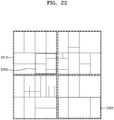
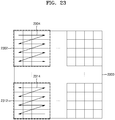
- FIGS. 1 to 23 An image encoding apparatus, an image decoding apparatus, an image encoding method, and an image decoding method, according to embodiments, will be described with reference to FIGS. 1 to 23 .
- a method and apparatus for encoding or decoding a 360-degree image, according to an embodiment, will be described with reference to FIGS. 1 to 9 , below, and a method for determining a data unit that is used in a process of decoding an image by an image decoding apparatus 200 according to an embodiment will be described with reference to FIGS. 10 to 23 , below.
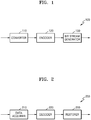
- FIG. 1 is a schematic block diagram of an image encoding apparatus 100 according to an embodiment.
- the image encoding apparatus 100 may include a converter 110, an encoder 120, and a bitstream generator 130.
- the converter 110 may determine a predetermined angle for rotating an original 360-degree image.
- a predetermined angle for rotating the original 360-degree image may be determined.
- a predetermined angle for rotating the original 360-degree image may be determined.
- a predetermined angle for rotating the original 360-degree image may be determined in consideration of both the calculated encoding efficiency and image quality.
- the predetermined angle may include a horizontal angle and a vertical angle with respect to a center of the 360-degree image.
- the converter 110 may rotate the original 360-degree image based on the predetermined angle, and convert the rotated 360-degree image into a projection image.
- the projection image may be an image obtained by projecting the 360-degree image using any one of equirectangular projection, icosahedral projection, cubemap projection, octahedron projection, and rotated sphere projection.
- the bitstream generator 130 may generate a bitstream including image data for an encoded projection image and information about the predetermined angle.
- the information about the predetermined angle may be stored in a video parameter set or a sequence parameter set in the bitstream.
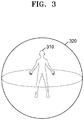
- FIG. 2 is a schematic block diagram of an image decoding apparatus 200 according to an embodiment.
- the image decoding apparatus 200 may include a data acquirer 210, a decoder 220, and a reconstructor 230.
- the data acquirer 210 may parse a bitstream received by the image decoding apparatus 200 to acquire image data and rotation information of a 360-degree image, and output the image data and the rotation information of the 360-degree image to the decoder 220 and the reconstructor 230.
- the rotation information may represent a horizontal angle and a vertical angle with respect to a center of the 360-degree image.
- the rotation information may be total 8 bits including 5 bits representing the horizontal angle and 3 bits representing the vertical angle.
- the rotation information may be acquired from a video parameter set or a sequence parameter set in the bitstream.
- the rotation information may be acquired from supplemental enhancement information (SEI) in the bitstream.
- SEI Supplemental Enhancement information
- information about a rotation change amount of the 360-degree image may be further acquired from the bitstream.
- the information about the rotation change amount may be acquired from a picture parameter set.
- information about whether the 360-degree image has rotated may be further acquired, and whether to acquire the rotation information may be determined according to the information about whether the 360-degree image has rotated.
- the decoder 220 may decode a projection image of the 360-degree image from the image data.
- the reconstructor 230 may convert the projection image into a 360-degree image.
- the projection image may be an image obtained by projecting the 360-degree image using any one of equirectangular projection, icosahedral projection, cubemap projection, octahedron projection, and rotated sphere projection.
- projection methods are not limited to the above-mentioned methods, and other various projection methods may be used.
- the projection image may be a planar rectangular image.
- the reconstructor 230 may rotate the 360-degree image based on the rotation information to reconstruct an original 360-degree image.
- the 360-degree image may rotate based on both the rotation information and the information about the rotation change amount.
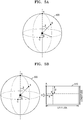
- FIG. 3 shows a 360-degree image according to an embodiment.
- a 360-degree image 320 may be an image representing an ambient environment surrounding a predetermined location 310 at 360 degrees with the predetermined location 310 at the center.
- the 360-degree image 320 may be in the shape of a sphere.
- an image representing an ambient environment surrounding the user at 360 degrees in VR may be a 360-degree image.
- the VR apparatus may provide a 360-degree image to the user so as to provide, even when the user wearing the VR apparatus moves or turns his/her eyes in VR, an appropriate image for the corresponding situation.
- FIG. 4 shows projection images generated by projecting a 360-degree image by using projection methods according to various embodiments.
- a 360-degree image may be converted into a planar image for encoding/decoding.
- a 360-degree image 410 as described above may be projected through various projection methods to be converted into a planar image.
- the 360-degree image 410 may be projected by using the equirectangular projection to be converted into a projection image 420 in the shape of a rectangle.
- the 360-degree image 410 may be projected by using the icosahedral projection to be converted into a projection image 420 in the shape of a planar figure of an icosahedron. Meanwhile, although not shown in FIG.
- projection methods for generating a projection image are not limited to the equirectangular projection and icosahedral projection mentioned above, and various projection methods may be used.
- Projection methods according to various embodiments may be octahedron projection, cubemap projection and rotated sphere projection, and a projection image may be generated in different shapes according to projection methods.
- a projection image generated according to the rotated sphere projection may be in the shape of a rectangle having an aspect ratio of 3:2, like the cubemap projection, and the projection image may be configured with two symmetrical successive segments divided vertically. Edge regions of each segment may remain as they are or be gray-processed in the shape of arcs.
- a projection image generated by using various projection methods may be reconfigured to a rectangular shape by adding spaces.
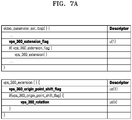
- FIGS. 5A and 5B show a predetermined angle for rotating a 360-degree image according to an embodiment and a projection image corresponding to the 360-degree image.
- a 360-degree image 500 may have an origin A at the top.
- a predetermined point B on the 360-degree image 500 may be selected.
- a predetermined angle corresponding to the selected predetermined point B may be determined.
- the predetermined angle may include a horizontal angle and a vertical angle with respect to a center of the 360-degree image.
- a horizontal angle ⁇ formed between the predetermined point B and a reference point C representing a front side with respect to the center may be determined.
- the horizontal angle ⁇ may be determined in the range of 0 degrees to 360 degrees according to the predetermined point B.
- a vertical angle ⁇ formed by a straight line passing the predetermined point B and the center with respect to a straight line passing the center of the 360-degree image 500 and the origin A may be determined.
- the vertical angle ⁇ may be determined in the range of 0 degrees to 180 degrees according to the predetermined point B.
- information about the predetermined angle may be signaled through a bitstream as rotation information of the 360-degree image 500.
- Various embodiments of syntax for the rotation information of the 360-degree image 500 will be described in detail with reference to FIGS. 7A to 7D .
- a relation between the origin A and the predetermined point B on the 360-degree image 500 described above with reference to FIG. 5A may be expressed as a relation between an origin A and a predetermined point B on a projection image 510 corresponding to the 360-degree image 500.
- the horizontal angle ⁇ and the vertical angle ⁇ with respect to the center of the 360-degree image 500 may respectively correspond to a horizontal distance and a vertical distance between the origin A and the predetermined point B on the projection image 510.
- a horizontal length and a vertical length of the projection image 510 may respectively correspond to an entire longitude and an entire latitude of the 360-degree image 500.
- a predetermined point B having a horizontal-axis coordinate corresponding to the longitude and a vertical-axis coordinate corresponding to the latitude on the corresponding projection image 510 may be selected.
- FIGS. 6A and 6B show a 360-degree image rotated according to an embodiment and a projection image corresponding to the rotated 360-degree image.
- a predetermined point B on the 360-degree image 500 may be selected, and a horizontal angle ⁇ and a vertical angle ⁇ with respect to the center of the 360-degree image 500 may be selected as predetermined angles corresponding to the selected predetermined point B.
- a 360-degree image 600 may rotate based on a horizontal angle ⁇ and a vertical angle ⁇ .
- the 360-degree image 600 may rotate by the horizontal angle ⁇ by using a straight line passing a center of the 360-degree image 600 and an origin A as a rotation axis.
- the 360-degree image 600 may rotate by the vertical angle ⁇ such that the predetermined point B arrives at the origin A located at the top of the 360-degree image 600.
- the predetermined point B may become a new origin at the top of the 360-degree image 610.
- a pixel value corresponding to a reference point C representing a front side may change.
- content of the 360-degree image 600 may not change although the 360-degree image 600 rotates.
- the predetermined point B may become a new origin at a left upper edge on a projection image 620 corresponding to the rotated 360-degree image 610.
- the projection image 620 corresponding to the rotated 360-degree image 610 may be different from content of the projection image 510 before the 360-degree image 600 rotates.
- a projection image may be an image obtained by projecting a 360-degree image using the equirectangular projection. In this case, the projection image may show more significant distortions of content with respect to the 360 degree image toward upper and lower areas from the center.
- an encoding rate may vary depending on a rotation of the 360 degree image according to a selection of a predetermined point, and the image encoding apparatus 100 may compare encoding rates for rotations of the 360 degree image according to predetermined angles to select an optimal rotation angle.
- FIGS. 7A to 7D show various embodiments of syntax related to rotations of a 360-degree image.
- a bitstream may be configured with a plurality of network abstraction layer (NAL) units, and at least one of the NAL units may be a video parameter set raw byte sequence payload (RBSP) region.
- NAL network abstraction layer
- Information included in the video parameter set may be applied to an intra random access point (IRAP) picture and pictures in a coded video sequence (CVS) including subsequent pictures which are not an IRAP picture, according to a decoding order.
- the information included in the video parameter set may be applied to sequence levels of the pictures.
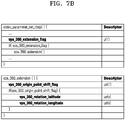
- a 1-bit flag "vps_360_extension_flag” indicating whether an image to be decoded is a projection image of a 360-degree image may be acquired from a video parameter set RBSP region.
- vps_360_extension_flag a value of "vps_360_extension_flag”
- syntax "vps_360_extension()" may be called so that information related to the 360-degree image may be acquired subsequently.
- vps_360_extension() when the syntax "vps_360_extension()" is called, a 1-bit flag “vps_360_origin_point_shift_flag" representing information about whether the 360-degree image has rotated may be acquired, and when “vps_360_origin_point_shift_flag” is 1, "vps_360_rotation” representing rotation information of the 360-degree image may be acquired.
- vps_360_rotation representing the rotation information of the 360-degree image may be total 8 bits including 5 bits representing a horizontal angle with respect to a center of the 360-degree image and 3 bits representing a vertical angle with respect to the center of the 360-degree image.
- vps_360_extension_flag may be acquired from a video parameter set RBSP region, and "vps_360_origin_point_shift_flag” may be acquired from called syntax "vps_360_extension()".
- vps_360_rotation_latitude representing a vertical angle with respect to the center of the 360-degree image
- vps_360_rotation_longitude representing a horizontal angle with respect to the center of the 360-degree image
- the 360-degree image may rotate based on the acquired rotation information of the 360-degree image, so that an original 360-degree image may be reconstructed.
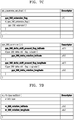
- At least one of the NAL units constructing the bitstream may be a picture parameter set RBSP region.
- Information included in the picture parameter set may be applied to a predetermined number of pictures.
- a 1-bit flag "pps_360_extension_flag" indicating whether an image to be decoded is a projection image of a 360-degree image may be acquired from the picture parameter set RBSP region.
- pps_360_extension_flag a value of "pps_360_extension_flag"
- syntax "pps_360_extension()" may be called so that information related to the 360-degree image may be acquired subsequently.
- a 1-bit flag “pps_360_delta_shift_present_flag_latitude” representing information about whether a rotation change amount with respect to a vertical angle of the 360-degree image exists and a 1-bit flag “pps_360_delta_shift_present_flag_longitude” representing information about whether a rotation change amount with respect to a horizontal angle of the 360-degree image exists may be acquired.
- the 360-degree image may rotate according to the acquired rotation information of the 360-degree image, and rotation amounts with respect to some pictures may be adjusted based on the information about the rotation change amount.
- vr_360_rotation_latitude representing a vertical angle with respect to the center of the 360-degree image
- vr_360_rotation_longitude representing a horizontal angle with respect to the center of the 360-degree image
- FIG. 8 shows a flowchart for describing an image encoding method according to an embodiment.
- a predetermined angle for rotating an original 360-degree image may be determined.
- a predetermined angle for rotating the original 360-degree image may be determined.
- a predetermined angle for rotating the original 360-degree image may be determined.
- a predetermined angle for rotating the original 360-degree image may be determined in consideration of both the calculated encoding efficiency and image quality.
- the predetermined angle may include a horizontal angle and a vertical angle with respect to a center of the 360-degree image.
- the original 360-degree image may rotate based on the predetermined angle, and the rotated 360-degree image may be converted into a projection image.
- the projection image may be an image obtained by projecting the 360-degree image by using the equirectangular projection.
- the projection image may be encoded, and a bitstream including image data for the encoded projection image and information about the predetermined angle may be generated.
- the information about the predetermined angle may be stored in a video parameter set or a sequence parameter set in the bitstream.
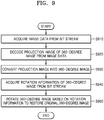
- FIG. 9 shows a flowchart for describing an image decoding method according to an embodiment.
- image data may be acquired from a bitstream, and a projection image of a 360-degree image may be decoded from the image data.
- the projection image may be converted into the 360-degree image.
- the projection image may be an image obtained by projecting the 360-degree image by using the equirectangular projection.
- projection methods are not limited to the above-mentioned methods, and other various projection methods may be used.
- the projection image may be a planar rectangular image.
- rotation information of the 360-degree image may be acquired from the bitstream.
- the rotation information may represent a horizontal angle and a vertical angle with respect to a center of the 360-degree image.
- the rotation information may be total 8 bits including 5 bits representing the horizontal angle and 3 bits representing the vertical angle.
- the rotation information may be acquired from a video parameter set or a sequence parameter set in the bitstream.
- the rotation information may be acquired from SEI in the bitstream.
- information about a rotation change amount of the 360-degree image in addition to the rotation information, may be further acquired from the bitstream.
- the information about the rotation change amount may be acquired from a picture parameter set.
- information about whether the 360-degree image has rotated may be further acquired, and whether to acquire the rotation information may be determined based on the information about whether the 360-degree image has rotated.
- the 360-degree image may rotate based on the rotation information, so that an original 360-degree image may be reconstructed.
- the 360-degree image may rotate based on both the rotation information and the information about the rotation change amount.
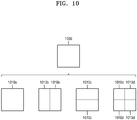
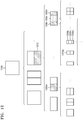
- FIG. 10 illustrates a process, performed by the image decoding apparatus 200, of determining at least one coding unit by splitting a current coding unit, according to an embodiment.
- the image decoding apparatus 200 may determine a shape of a coding unit by using block shape information, and may determine a splitting method of the coding unit by using split shape information. That is, a coding unit splitting method indicated by the split shape information may be determined based on a block shape indicated by the block shape information used by the image decoding apparatus 200.
- the image decoding apparatus 200 may use the block shape information indicating that the current coding unit has a square shape. For example, the image decoding apparatus 200 may determine whether not to split a square coding unit, whether to vertically split the square coding unit, whether to horizontally split the square coding unit, or whether to split the square coding unit into four coding units, based on the split shape information. Referring to FIG.
- a decoder 1030 may determine that a coding unit 1010a having the same size as the current coding unit 1000 is not split, based on the split shape information indicating not to perform splitting, or may determine coding units 1010b, 1010c, or 1010d split based on the split shape information indicating a predetermined splitting method.
- the image decoding apparatus 200 may determine two coding units 1010b obtained by splitting the current coding unit 1000 in a vertical direction, based on the split shape information indicating to perform splitting in a vertical direction.
- the image decoding apparatus 200 may determine two coding units 1010c obtained by splitting the current coding unit 1000 in a horizontal direction, based on the split shape information indicating to perform splitting in a horizontal direction.
- the image decoding apparatus 200 may determine four coding units 1010d obtained by splitting the current coding unit 1000 in vertical and horizontal directions, based on the split shape information indicating to perform splitting in vertical and horizontal directions.
- splitting methods of the square coding unit are not limited to the above-described methods, and the split shape information may indicate various methods. Predetermined splitting methods of splitting the square coding unit will be described in detail below in relation to various embodiments.
- FIG. 11 illustrates a process, performed by the image decoding apparatus 200, of determining at least one coding unit by splitting a non-square coding unit, according to an embodiment.
- the image decoding apparatus 200 may use block shape information indicating that a current coding unit has a non-square shape.
- the image decoding apparatus 200 may determine whether not to split the non-square current coding unit or whether to split the non-square current coding unit by using a predetermined splitting method, based on split shape information. Referring to FIG.
- the image decoding apparatus 200 may determine that a coding unit 1110 or 1160 having the same size as the current coding unit 1100 or 1150 is not split, based on the split shape information indicating not to perform splitting, or determine coding units 1120a and 1120b, 1130a to 1130c, 1170a and 1170b, or 1180a to 1180c split based on the split shape information indicating a predetermined splitting method.
- Predetermined splitting methods of splitting a non-square coding unit will be described in detail below in relation to various embodiments.
- the image decoding apparatus 200 may determine a splitting method of a coding unit by using the split shape information and, in this case, the split shape information may indicate the number of one or more coding units generated by splitting a coding unit.
- the image decoding apparatus 200 may determine two coding units 1120a and 1120b, or 1170a and 1170b included in the current coding unit 1100 or 1150, by splitting the current coding unit 1100 or 1150 based on the split shape information.
- the image decoding apparatus 200 when the image decoding apparatus 200 splits the non-square current coding unit 1100 or 1150 based on the split shape information, the location of a long side of the non-square current coding unit 1100 or 1150 may be considered.
- the image decoding apparatus 200 may determine a plurality of coding units by dividing a long side of the current coding unit 1100 or 1150, in consideration of the shape of the current coding unit 1100 or 1150.
- the image decoding apparatus 200 may determine an odd number of coding units included in the current coding unit 1100 or 1150. For example, when the split shape information indicates to split the current coding unit 1100 or 1150 into three coding units, the image decoding apparatus 200 may split the current coding unit 1100 or 1150 into three coding units 1130a, 1130b, and 1130c, or 1180a, 1180b, and 1180c. According to an embodiment, the image decoding apparatus 200 may determine an odd number of coding units included in the current coding unit 1100 or 1150, and not all the determined coding units may have the same size.
- a predetermined coding unit 1130b or 1180b from among the determined odd number of coding units 1130a, 1130b, and 1130c, or 1180a, 1180b, and 1180c may have a size different from the size of the other coding units 1130a and 1130c, or 1180a and 1180c.
- coding units that may be determined by splitting the current coding unit 1100 or 1150 may have various types and sizes.
- the image decoding apparatus 200 may determine an odd number of coding units included in the current coding unit 1100 or 1150, and may put a predetermined restriction on at least one coding unit from among the odd number of coding units generated by splitting the current coding unit 1100 or 1150. Referring to FIG.
- the image decoding apparatus 200 may allow a decoding method of the coding unit 1130b or 1180b to be different from that of the other coding units 1130a and 1130c, or 1180a and 1180c, wherein the coding unit 1130b or 1180b is at a center location from among the three coding units 1130a, 1130b, and 1130c, or 1180a, 1180b, and 1180c generated by splitting the current coding unit 1100 or 1150.
- the image decoding apparatus 200 may restrict the coding unit 1130b or 1180b at the center location to be no longer split or to be split only a predetermined number of times, unlike the other coding units 1130a and 1130c, or 1180a and 1180c.
- FIG. 12 illustrates a process, performed by the image decoding apparatus 200, of splitting a coding unit based on at least one of block shape information and split shape information, according to an embodiment.
- the image decoding apparatus 200 may determine to split or not to split a square first coding unit 1200 into coding units, based on at least one of the block shape information and the split shape information. According to an embodiment, when the split shape information indicates to split the first coding unit 1200 in a horizontal direction, the image decoding apparatus 200 may determine a second coding unit 1210 by splitting the first coding unit 1200 in a horizontal direction.
- a first coding unit, a second coding unit, and a third coding unit used according to an embodiment are terms used to understand a relation before and after splitting a coding unit. For example, a second coding unit may be determined by splitting a first coding unit, and a third coding unit may be determined by splitting the second coding unit. It will be understood that the structure of the first coding unit, the second coding unit, and the third coding unit follows the above descriptions.
- the image decoding apparatus 200 may determine to split or not to split the determined second coding unit 1210 into coding units, based on at least one of the block shape information and the split shape information. Referring to FIG. 12 , the image decoding apparatus 200 may or may not split the non-square second coding unit 1210, which is determined by splitting the first coding unit 1200, into one or more third coding units 1220a, or 1220b, 1220c, and 1220d based on at least one of the block shape information and the split shape information.
- the image decoding apparatus 200 may obtain at least one of the block shape information and the split shape information, and determine a plurality of various-shaped second coding units (e.g., 1210) by splitting the first coding unit 1200, based on the obtained at least one of the block shape information and the split shape information, and the second coding unit 1210 may be split by using the splitting method of the first coding unit 1200, based on at least one of the block shape information and the split shape information.
- a plurality of various-shaped second coding units e.g., 1210
- the second coding unit 1210 may also be split into the third coding units 1220a, or 1220b, 1220c, and 1220d based on at least one of the block shape information and the split shape information of the second coding unit 1210. That is, a coding unit may be recursively split based on at least one of the block shape information and the split shape information of each coding unit.
- a method that may be used to recursively split a coding unit will be described below in relation to various embodiments.
- the image decoding apparatus 200 may determine to split each of the third coding units 1220a, or 1220b, 1220c, and 1220d into coding units or not to split the second coding unit 1210, based on at least one of the block shape information and the split shape information. According to an embodiment, the image decoding apparatus 200 may split the non-square second coding unit 1210 into the odd number of third coding units 1220b, 1220c, and 1220d. The image decoding apparatus 200 may put a predetermined restriction on a predetermined third coding unit from among the odd number of third coding units 1220b, 1220c, and 1220d.
- the image decoding apparatus 200 may restrict the third coding unit 1220c at a center location from among the odd number of third coding units 1220b, 1220c, and 1220d to be no longer split or to be split a settable number of times. Referring to FIG.
- the image decoding apparatus 200 may restrict the third coding unit 1220c, which is at the center location from among the odd number of third coding units 1220b, 1220c, and 1220d included in the non-square second coding unit 1210, to be no longer split, to be split by using a predetermined splitting method (e.g., split into only four coding units or split by using a splitting method of the second coding unit 1210), or to be split only a predetermined number of times (e.g., split only n times (where n>0)).
- a predetermined splitting method e.g., split into only four coding units or split by using a splitting method of the second coding unit 1210
- a predetermined number of times e.g., split only n times (where n>0)
- the restrictions on the third coding unit 1220c at the center location are not limited to the above-described examples, and may include various restrictions for decoding the third coding unit 1220c at the center location differently from the other third coding units 1220b and 1220d.
- the image decoding apparatus 200 may obtain at least one of the block shape information and the split shape information, which is used to split a current coding unit, from a predetermined location in the current coding unit.
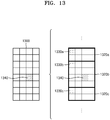
- FIG. 13 illustrates a method, performed by the image decoding apparatus 200, of determining a predetermined coding unit from among an odd number of coding units, according to an embodiment.
- at least one of block shape information and split shape information of a current coding unit 1300 may be obtained from a sample of a predetermined location from among a plurality of samples included in the current coding unit 1300 (e.g., a sample 1340 of a center location).
- the predetermined location in the current coding unit 1300, from which at least one of the block shape information and the split shape information may be obtained is not limited to the center location in FIG.
- the image decoding apparatus 200 may obtain at least one of the block shape information and the split shape information from the predetermined location and determine to split or not to split the current coding unit into various-shaped and various-sized coding units.
- the image decoding apparatus 200 may select one of the coding units.
- Various methods may be used to select one of a plurality of coding units, as will be described below in relation to various embodiments.
- the image decoding apparatus 200 may split the current coding unit into a plurality of coding units, and may determine a coding unit at a predetermined location.
- FIG. 13 illustrates a method, performed by the image decoding apparatus 200, of determining a coding unit of a predetermined location from among an odd number of coding units, according to an embodiment.
- the image decoding apparatus 200 may use information indicating locations of the odd number of coding units, to determine a coding unit at a center location from among the odd number of coding units. Referring to FIG. 13 , the image decoding apparatus 200 may determine an odd number of coding units 1320a, 1320b, and 1320c by splitting the current coding unit 1300. The image decoding apparatus 200 may determine a coding unit 1320b at a center location by using information about locations of the odd number of coding units 1320a to 1320c.
- the image decoding apparatus 200 may determine the coding unit 1320b of the center location by determining the locations of the coding units 1320a, 1320b, and 1320c based on information indicating locations of predetermined samples included in the coding units 1320a, 1320b, and 1320c.
- the image decoding apparatus 200 may determine the coding unit 1320b at the center location by determining the locations of the coding units 1320a, 1320b, and 1320c based on information indicating locations of top left samples 1330a, 1330b, and 1330c of the coding units 1320a, 1320b, and 1320c.
- the information indicating the locations of the top left samples 1330a, 1330b, and 1330c, which are included in the coding units 1320a, 1320b, and 1320c, respectively, may include information about locations or coordinates of the coding units 1320a, 1320b, and 1320c in a picture.
- the information indicating the locations of the top left samples 1330a, 1330b, and 1330c, which are included in the coding units 1320a, 1320b, and 1320c, respectively may include information indicating widths or heights of the coding units 1320a, 1320b, and 1320c included in the current coding unit 1300, and the widths or heights may correspond to information indicating differences between the coordinates of the coding units 1320a, 1320b, and 1320c in the picture.
- the image decoding apparatus 200 may determine the coding unit 1320b at the center location by directly using the information about the locations or coordinates of the coding units 1320a, 1320b, and 1320c in the picture, or by using the information about the widths or heights of the coding units, which correspond to the difference values between the coordinates.
- information indicating the location of the top left sample 1330a of the upper coding unit 1320a may include coordinates (xa, ya)
- information indicating the location of the top left sample 1330b of the middle coding unit 1320b may include coordinates (xb, yb)
- information indicating the location of the top left sample 1330c of the lower coding unit 1320c may include coordinates (xc, yc).
- the image decoding apparatus 200 may determine the middle coding unit 1320b by using the coordinates of the top left samples 1330a, 1330b, and 1330c which are included in the coding units 1320a, 1320b, and 1320c, respectively.
- the coding unit 1320b including the coordinates (xb, yb) of the sample 1330b at a center location may be determined as a coding unit at a center location from among the coding units 1320a, 1320b, and 1320c determined by splitting the current coding unit 1300.
- the coordinates indicating the locations of the top left samples 1330a, 1330b, and 1330c may include coordinates indicating absolute locations in the picture, or may use coordinates (dxb, dyb) indicating a relative location of the top left sample 1330b of the middle coding unit 1320b and coordinates (dxc, dyc) indicating a relative location of the top left sample 1330c of the lower coding unit 1320c with reference to the location of the top left sample 1330a of the upper coding unit 1320a.
- a method of determining a coding unit at a predetermined location by using coordinates of a sample included in the coding unit, as information indicating a location of the sample is not limited to the above-described method, and may include various arithmetic methods capable of using the coordinates of the sample.
- the image decoding apparatus 200 may split the current coding unit 1300 into a plurality of coding units 1320a, 1320b, and 1320c, and may select one of the coding units 1320a, 1320b, and 1320c based on a predetermined criterion. For example, the image decoding apparatus 200 may select the coding unit 1320b, which has a size different from that of the others, from among the coding units 1320a, 1320b, and 1320c.
- the image decoding apparatus 200 may determine the widths or heights of the coding units 1320a, 1320b, and 1320c by using the coordinates (xa, ya) indicating the location of the top left sample 1330a of the upper coding unit 1320a, the coordinates (xb, yb) indicating the location of the top left sample 1330b of the middle coding unit 1320b, and the coordinates (xc, yc) indicating the location of the top left sample 1330c of the lower coding unit 1320c.
- the image decoding apparatus 200 may determine the respective sizes of the coding units 1320a, 1320b, and 1320c by using the coordinates (xa, ya), (xb, yb), and (xc, yc) indicating the locations of the coding units 1320a, 1320b, and 1320c.
- the image decoding apparatus 200 may determine the width of the upper coding unit 1320a to be xb-xa and determine the height thereof to be yb-ya. According to an embodiment, the image decoding apparatus 200 may determine the width of the middle coding unit 1320b to be xc-xb and determine the height thereof to be yc-yb. According to an embodiment, the image decoding apparatus 200 may determine the width or height of the lower coding unit 1320c by using the width or height of the current coding unit 1300 or the widths or heights of the upper and middle coding units 1320a and 1320b.
- the image decoding apparatus 200 may determine a coding unit, which has a size different from that of the others, based on the determined widths and heights of the coding units 1320a to 1320c. Referring to FIG. 13 , the image decoding apparatus 200 may determine the middle coding unit 1320b, which has a size different from the size of the upper and lower coding units 1320a and 1320c, as the coding unit of the predetermined location.
- the above-described method, performed by the image decoding apparatus 200, of determining a coding unit having a size different from the size of the other coding units merely corresponds to an example of determining a coding unit at a predetermined location by using the sizes of coding units, which are determined based on coordinates of samples, and thus various methods of determining a coding unit at a predetermined location by comparing the sizes of coding units, which are determined based on coordinates of predetermined samples, may be used.
- locations of samples considered to determine locations of coding units are not limited to the above-described top left locations, and information about arbitrary locations of samples included in the coding units may be used.
- the image decoding apparatus 200 may select a coding unit at a predetermined location from among an odd number of coding units determined by splitting the current coding unit, considering the shape of the current coding unit. For example, when the current coding unit has a non-square shape, a width of which is longer than a height, the image decoding apparatus 200 may determine the coding unit at the predetermined location in a horizontal direction. That is, the image decoding apparatus 200 may determine one of coding units at different locations in a horizontal direction and put a restriction on the coding unit. When the current coding unit has a non-square shape, a height of which is longer than a width, the image decoding apparatus 200 may determine the coding unit at the predetermined location in a vertical direction. That is, the image decoding apparatus 200 may determine one of coding units at different locations in a vertical direction and may put a restriction on the coding unit.
- the image decoding apparatus 200 may use information indicating respective locations of an even number of coding units, to determine the coding unit at the predetermined location from among the even number of coding units.
- the image decoding apparatus 200 may determine an even number of coding units by splitting the current coding unit, and may determine the coding unit at the predetermined location by using the information about the locations of the even number of coding units.
- An operation related thereto may correspond to the operation of determining a coding unit at a predetermined location (e.g., a center location) from among an odd number of coding units, which has been described in detail above in relation to FIG. 13 , and thus detailed descriptions thereof are not provided here.
- predetermined information about a coding unit at a predetermined location may be used in a splitting operation to determine the coding unit at the predetermined location from among the plurality of coding units.
- the image decoding apparatus 200 may use at least one of block shape information and split shape information, which is stored in a sample included in a coding unit at a center location, in a splitting operation to determine the coding unit at the center location from among the plurality of coding units determined by splitting the current coding unit.
- the image decoding apparatus 200 may split the current coding unit 1300 into a plurality of coding units 1320a, 1320b, and 1320c based on at least one of the block shape information and the split shape information, and may determine a coding unit 1320b at a center location from among the plurality of the coding units 1320a, 1320b, and 1320c. Furthermore, the image decoding apparatus 200 may determine the coding unit 1320b at the center location, in consideration of a location from which at least one of the block shape information and the split shape information is obtained.
- At least one of the block shape information and the split shape information of the current coding unit 1300 may be obtained from the sample 1340 at a center location of the current coding unit 1300 and, when the current coding unit 1300 is split into the plurality of coding units 1320a, 1320b, and 1320c based on at least one of the block shape information and the split shape information, the coding unit 1320b including the sample 1340 may be determined as the coding unit at the center location.
- information used to determine the coding unit at the center location is not limited to at least one of the block shape information and the split shape information, and various types of information may be used to determine the coding unit at the center location.
- predetermined information for identifying the coding unit at the predetermined location may be obtained from a predetermined sample included in a coding unit to be determined.
- the image decoding apparatus 200 may use at least one of the block shape information and the split shape information, which is obtained from a sample at a predetermined location in the current coding unit 1300 (e.g., a sample at a center location of the current coding unit 1300) to determine a coding unit at a predetermined location from among the plurality of the coding units 1320a, 1320b, and 1320c determined by splitting the current coding unit 1300 (e.g., a coding unit at a center location from among a plurality of split coding units).
- the image decoding apparatus 200 may determine the sample at the predetermined location by considering a block shape of the current coding unit 1300, determine the coding unit 1320b including a sample, from which predetermined information (e.g., at least one of the block shape information and the split shape information) may be obtained, from among the plurality of coding units 1320a, 1320b, and 1320c determined by splitting the current coding unit 1300, and may put a predetermined restriction on the coding unit 1320b.
- predetermined information e.g., at least one of the block shape information and the split shape information
- the image decoding apparatus 200 may determine the sample 1340 at the center location of the current coding unit 1300 as the sample from which the predetermined information may be obtained, and may put a predetermined restriction on the coding unit 1320b including the sample 1340, in a decoding operation.
- the location of the sample from which the predetermined information may be obtained is not limited to the above-described location, and may include arbitrary locations of samples included in the coding unit 1320b to be determined for a restriction.
- the location of the sample from which the predetermined information may be obtained may be determined based on the shape of the current coding unit 1300.
- the block shape information may indicate whether the current coding unit has a square or non-square shape, and the location of the sample from which the predetermined information may be obtained may be determined based on the shape.
- the image decoding apparatus 200 may determine a sample located on a boundary for dividing at least one of a width and height of the current coding unit in half, as the sample from which the predetermined information may be obtained, by using at least one of information about the width of the current coding unit and information about the height of the current coding unit.
- the image decoding apparatus 200 may determine one of samples adjacent to a boundary for dividing a long side of the current coding unit in half, as the sample from which the predetermined information may be obtained.
- the image decoding apparatus 200 may use at least one of the block shape information and the split shape information to determine a coding unit at a predetermined location from among the plurality of coding units.
- the image decoding apparatus 200 may obtain at least one of the block shape information and the split shape information from a sample at a predetermined location in a coding unit, and split the plurality of coding units, which are generated by splitting the current coding unit, by using at least one of the split shape information and the block shape information, which is obtained from the sample of the predetermined location in each of the plurality of coding units.
- a coding unit may be recursively split based on at least one of the block shape information and the split shape information, which is obtained from the sample at the predetermined location in each coding unit.
- the image decoding apparatus 200 may determine one or more coding units by splitting the current coding unit, and may determine an order of decoding the one or more coding units, based on a predetermined block (e.g., the current coding unit).
- FIG. 14 illustrates an order of processing a plurality of coding units when the image decoding apparatus 200 determines the plurality of coding units by splitting a current coding unit, according to an embodiment.
- the image decoding apparatus 200 may determine second coding units 1410a and 1410b by splitting a first coding unit 1400 in a vertical direction, determine second coding units 1430a and 1430b by splitting the first coding unit 1400 in a horizontal direction, or determine second coding units 1450a to 1450d by splitting the first coding unit 1400 in vertical and horizontal directions, based on block shape information and split shape information.
- the image decoding apparatus 200 may determine to process the second coding units 1410a and 1410b, which are determined by splitting the first coding unit 1400 in a vertical direction, in a horizontal direction order 1410c.
- the image decoding apparatus 200 may determine to process the second coding units 1430a and 1430b, which are determined by splitting the first coding unit 1400 in a horizontal direction, in a vertical direction order 1430c.
- the image decoding apparatus 200 may determine to process the second coding units 1450a to 1450d, which are determined by splitting the first coding unit 1400 in vertical and horizontal directions, in a predetermined order for processing coding units in a row and then processing coding units in a next row (e.g., in a raster scan order or Z-scan order 1450e).
- the image decoding apparatus 200 may recursively split coding units.
- the image decoding apparatus 200 may determine a plurality of coding units 1410a, 1410b, 1430a, 1430b, 1450a, 1450b, 1450c, and 1450d by splitting the first coding unit 1400, and may recursively split each of the determined plurality of coding units 1410a, 1410b, 1430a, 1430b, 1450a, 1450b, 1450c, and 1450d.
- a splitting method of the plurality of coding units 1410a, 1410b, 1430a, 1430b, 1450a, 1450b, 1450c, and 1450d may correspond to a splitting method of the first coding unit 1400.
- each of the plurality of coding units 1410a, 1410b, 1430a, 1430b, 1450a, 1450b, 1450c, and 1450d may be independently split into a plurality of coding units.
- the image decoding apparatus 200 may determine the second coding units 1410a and 1410b by splitting the first coding unit 1400 in a vertical direction, and may determine to independently split or not to split each of the second coding units 1410a and 1410b.
- the image decoding apparatus 200 may determine third coding units 1420a and 1420b by splitting the left second coding unit 1410a in a horizontal direction, and may not split the right second coding unit 1410b.
- a processing order of coding units may be determined based on an operation of splitting a coding unit.
- a processing order of split coding units may be determined based on a processing order of coding units immediately before being split.
- the image decoding apparatus 200 may determine a processing order of the third coding units 1420a and 1420b determined by splitting the left second coding unit 1410a, independently of the right second coding unit 1410b. Because the third coding units 1420a and 1420b are determined by splitting the left second coding unit 1410a in a horizontal direction, the third coding units 1420a and 1420b may be processed in a vertical direction order 1420c.
- the right second coding unit 1410b may be processed after the third coding units 1420a and 1420b included in the left second coding unit 1410a are processed in the vertical direction order 1420c.
- An operation of determining a processing order of coding units based on a coding unit before being split is not limited to the above-described example, and various methods may be used to independently process coding units, which are split and determined to various shapes, in a predetermined order.
- FIG. 15 illustrates a process, performed by the image decoding apparatus 200, of determining that a current coding unit is to be split into an odd number of coding units, when the coding units are not processable in a predetermined order, according to an embodiment.
- the image decoding apparatus 200 may determine whether the current coding unit is split into an odd number of coding units, based on obtained block shape information and split shape information.
- a square first coding unit 1500 may be split into non-square second coding units 1510a and 1510b, and the second coding units 1510a and 1510b may be independently split into third coding units 1520a and 1520b, and 1520c to 1520e.
- the image decoding apparatus 200 may determine a plurality of third coding units 1520a and 1520b by splitting the left second coding unit 1510a in a horizontal direction, and may split the right second coding unit 1510b into an odd number of third coding units 1520c to 1520e.
- the image decoding apparatus 200 may determine whether any coding unit is split into an odd number of coding units, by determining whether the third coding units 1520a and 1520b, and 1520c to 1520e are processable in a predetermined order. Referring to FIG. 15 , the image decoding apparatus 200 may determine the third coding units 1520a and 1520b, and 1520c to 1520e by recursively splitting the first coding unit 1500.
- the image decoding apparatus 200 may determine whether any of the first coding unit 1500, the second coding units 1510a and 1510b, and the third coding units 1520a and 1520b, and 1520c, 1520d, and 1520e are split into an odd number of coding units, based on at least one of the block shape information and the split shape information. For example, the right second coding unit 1510b may be split into an odd number of third coding units 1520c, 1520d, and 1520e.
- a processing order of a plurality of coding units included in the first coding unit 1500 may be a predetermined order (e.g., a Z-scan order 1530), and the image decoding apparatus 200 may decide whether the third coding units 1520c, 1520d, and 1520e, which are determined by splitting the right second coding unit 1510b into an odd number of coding units, satisfy a condition for processing in the predetermined order.
- a predetermined order e.g., a Z-scan order 1530
- the image decoding apparatus 200 may determine whether the third coding units 1520a and 1520b, and 1520c, 1520d, and 1520e included in the first coding unit 1500 satisfy the condition for processing in the predetermined order, and the condition relates to whether at least one of a width and height of the second coding units 1510a and 1510b is divided in half along a boundary of the third coding units 1520a and 1520b, and 1520c, 1520d, and 1520e.
- the third coding units 1520a and 1520b determined by dividing the height of the non-square left second coding unit 1510a in half satisfy the condition.
- the image decoding apparatus 200 may decide disconnection of a scan order, and determine that the right second coding unit 1510b is split into an odd number of coding units, based on a result of the decision.
- the image decoding apparatus 200 may put a predetermined restriction on a coding unit at a predetermined location from among the split coding units.
- the restriction or the predetermined location has been described above in relation to various embodiments, and thus detailed descriptions thereof will not be provided herein.
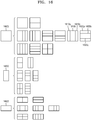
- FIG. 16 illustrates a process, performed by the image decoding apparatus 200, of determining at least one coding unit by splitting a first coding unit 1600, according to an embodiment.
- the image decoding apparatus 200 may split the first coding unit 1600, based on at least one of block shape information and split shape information, which is obtained by the receiver 210.
- the square first coding unit 1600 may be split into four square coding units, or may be split into a plurality of non-square coding units. For example, referring to FIG.
- the image decoding apparatus 200 may split the first coding unit 1600 into a plurality of non-square coding units.
- the image decoding apparatus 200 may split the square first coding unit 1600 into an odd number of coding units, e.g., second coding units 1610a, 1610b, and 1610c determined by splitting the square first coding unit 1600 in a vertical direction or second coding units 1620a, 1620b, and 1620c determined by splitting the square first coding unit 1600 in a horizontal direction.
- odd number of coding units e.g., second coding units 1610a, 1610b, and 1610c determined by splitting the square first coding unit 1600 in a vertical direction
- second coding units 1620a, 1620b, and 1620c determined by splitting the square first coding unit 1600 in a horizontal direction.
- the image decoding apparatus 200 may determine whether the second coding units 1610a, 1610b, 1610c, 1620a, 1620b, and 1620c included in the first coding unit 1600 satisfy a condition for processing in a predetermined order, and the condition relates to whether at least one of a width and height of the first coding unit 1600 is divided in half along a boundary of the second coding units 1610a, 1610b, 1610c, 1620a, 1620b, and 1620c.
- the image decoding apparatus 200 may decide disconnection of a scan order, and may determine that the first coding unit 1600 is split into an odd number of coding units, based on a result of the decision. According to an embodiment, when a coding unit is split into an odd number of coding units, the image decoding apparatus 200 may put a predetermined restriction on a coding unit at a predetermined location from among the split coding units.
- the restriction or the predetermined location has been described above in relation to various embodiments, and thus detailed descriptions thereof will not be provided herein.
- the image decoding apparatus 200 may determine various-shaped coding units by splitting a first coding unit.
- the image decoding apparatus 200 may split the square first coding unit 1600 or a non-square first coding unit 1630 or 1650 into various-shaped coding units.
- FIG. 17 illustrates that a shape into which a second coding unit is splittable by the image decoding apparatus 200 is restricted when the second coding unit having a non-square shape, which is determined by splitting a first coding unit 1700, satisfies a predetermined condition, according to an embodiment.
- the image decoding apparatus 200 may determine to split the square first coding unit 1700 into non-square second coding units 1710a, 1710b, 1720a, and 1720b, based on at least one of block shape information and split shape information, which is obtained by the receiver 210.
- the second coding units 1710a, 1710b, 1720a, and 1720b may be independently split.
- the image decoding apparatus 200 may determine to split or not to split the first coding unit 1700 into a plurality of coding units, based on at least one of the block shape information and the split shape information of each of the second coding units 1710a, 1710b, 1720a, and 1720b.
- the image decoding apparatus 200 may determine third coding units 1712a and 1712b by splitting the non-square left second coding unit 1710a, which is determined by splitting the first coding unit 1700 in a vertical direction, in a horizontal direction. However, when the left second coding unit 1710a is split in a horizontal direction, the image decoding apparatus 200 may restrict the right second coding unit 1710b to not be split in a horizontal direction in which the left second coding unit 1710a is split.
- third coding units 1714a and 1714b are determined by splitting the right second coding unit 1710b in a same direction, because the left and right second coding units 1710a and 1710b are independently split in a horizontal direction, the third coding units 1712a, 1712b, 1714a, and 1714b may be determined.
- this case serves equally as a case in which the image decoding apparatus 200 splits the first coding unit 1700 into four square second coding units 1730a, 1730b, 1730c, and 1730d, based on at least one of the block shape information and the split shape information, and may be inefficient in terms of image decoding.
- the image decoding apparatus 200 may determine third coding units 1722a, 1722b, 1724a, and 1724b by splitting the non-square second coding unit 1720a or 1720b, which is determined by splitting in a horizontal direction, in a vertical direction.
- a second coding unit e.g., the upper second coding unit 1720a
- the image decoding apparatus 200 may restrict the other second coding unit (e.g., the lower second coding unit 1720b) to not be split in a vertical direction in which the upper second coding unit 1720a is split.
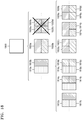
- FIG. 18 illustrates a process, performed by the image decoding apparatus 200, of splitting a square coding unit when split shape information indicates that the square coding unit is not to be split into four square coding units, according to an embodiment.
- the image decoding apparatus 200 may determine second coding units 1810a, 1810b, 1820a, 1820b, etc. by splitting a first coding unit 1800, based on at least one of block shape information and split shape information.
- the split shape information may include information about various methods of splitting a coding unit but, the information about various splitting methods may not include information for splitting a coding unit into four square coding units. According to such split shape information, the image decoding apparatus 200 may not split the first square coding unit 1800 into four square second coding units 1830a, 1830b, 1830c, and 1830d.
- the image decoding apparatus 200 may determine the non-square second coding units 1810a, 1810b, 1820a, 1820b, etc., based on the split shape information.
- the image decoding apparatus 200 may independently split the non-square second coding units 1810a, 1810b, 1820a, 1820b, etc.
- Each of the second coding units 1810a, 1810b, 1820a, 1820b, etc. may be recursively split in a predetermined order, and this splitting method may correspond to a method of splitting the first coding unit 1800, based on at least one of the block shape information and the split shape information.
- the image decoding apparatus 200 may determine square third coding units 1812a and 1812b by splitting the left second coding unit 1810a in a horizontal direction, and may determine square third coding units 1814a and 1814b by splitting the right second coding unit 1810b in a horizontal direction. Furthermore, the image decoding apparatus 200 may determine square third coding units 1816a, 1816b, 1816c, and 1816d by splitting both of the left and right second coding units 1810a and 1810b in a horizontal direction. In this case, coding units having the same shape as the four square second coding units 1830a, 1830b, 1830c, and 1830d split from the first coding unit 1800 may be determined.
- the image decoding apparatus 200 may determine square third coding units 1822a and 1822b by splitting the upper second coding unit 1820a in a vertical direction, and may determine square third coding units 1824a and 1824b by splitting the lower second coding unit 1820b in a vertical direction. Furthermore, the image decoding apparatus 200 may determine square third coding units 1822a, 1822b, 1824a, and 1824b by splitting both of the upper and lower second coding units 1820a and 1820b in a vertical direction. In this case, coding units having the same shape as the four square second coding units 1830a, 1830b, 1830c, and 1830d split from the first coding unit 1800 may be determined.
- FIG. 19 illustrates that a processing order between a plurality of coding units may be changed depending on a process of splitting a coding unit, according to an embodiment.
- the image decoding apparatus 200 may split a first coding unit 1900, based on block shape information and split shape information.
- the image decoding apparatus 200 may determine second coding units 1910a, 1910b, 1920a, 1920b, 1930a, 1930b, 1930c, and 1930d by splitting the first coding unit 1900.
- the non-square second coding units 1910a, 1910b, 1920a, and 1920b determined by splitting the first coding unit 1900 in only a horizontal direction or vertical direction may be independently split based on the block shape information and the split shape information of each coding unit.
- the image decoding apparatus 200 may determine third coding units 1916a, 1916b, 1916c, and 1916d by splitting the second coding units 1910a and 1910b, which are generated by splitting the first coding unit 1900 in a vertical direction, in a horizontal direction, and may determine third coding units 1926a, 1926b, 1926c, and 1926d by splitting the second coding units 1920a and 1920b, which are generated by splitting the first coding unit 1900 in a horizontal direction, in a horizontal direction.
- An operation of splitting the second coding units 1910a, 1910b, 1920a, and 1920b has been described above in relation to FIG. 17 , and thus detailed descriptions thereof will not be provided herein.
- the image decoding apparatus 200 may process coding units in a predetermined order. An operation of processing coding units in a predetermined order has been described above in relation to FIG. 14 , and thus detailed descriptions thereof will not be provided herein.
- the image decoding apparatus 200 may determine four square third coding units 1916a, 1916b, 1916c, and 1916d, and 1926a, 1926b, 1926c, and 1926d by splitting the square first coding unit 1900.
- the image decoding apparatus 200 may determine processing orders of the third coding units 1916a, 1916b, 1916c, and 1916d, and 1926a, 1926b, 1926c, and 1926d based on a splitting method of the first coding unit 1900.
- the image decoding apparatus 200 may determine the third coding units 1916a, 1916b, 1916c, and 1916d by splitting the second coding units 1910a and 1910b generated by splitting the first coding unit 1900 in a vertical direction, in a horizontal direction, and may process the third coding units 1916a, 1916b, 1916c, and 1916d in a processing order 1917 for initially processing the third coding units 1916a and 1916b, which are included in the left second coding unit 1910a, in a vertical direction and then processing the third coding unit 1916c and 1916d, which are included in the right second coding unit 1910b, in a vertical direction.
- the image decoding apparatus 200 may determine the third coding units 1926a, 1926b, 1926c, and 1926d by splitting the second coding units 1920a and 1920b generated by splitting the first coding unit 1900 in a horizontal direction, in a vertical direction, and may process the third coding units 1926a, 1926b, 1926c, and 1926d in a processing order 1927 for initially processing the third coding units 1926a and 1926b, which are included in the upper second coding unit 1920a, in a horizontal direction and then processing the third coding unit 1926c and 1926d, which are included in the lower second coding unit 1920b, in a horizontal direction.
- the square third coding units 1916a, 1916b, 1916c, and 1916d, and 1926a, 1926b, 1926c, and 1926d may be determined by splitting the second coding units 1910a, 1910b, 1920a, and 1920b, respectively.
- the second coding units 1910a and 1910b are determined by splitting the first coding unit 1900 in a vertical direction differently from the second coding units 1920a and 1920b which are determined by splitting the first coding unit 1900 in a horizontal direction
- the third coding units 1916a, 1916b, 1916c, and 1916d, and 1926a, 1926b, 1926c, and 1926d split therefrom eventually show same-shaped coding units split from the first coding unit 1900.
- the image decoding apparatus 200 may process a plurality of coding units in different orders even when the coding units are eventually determined to be the same shape.
- FIG. 20 illustrates a process of determining a depth of a coding unit as a shape and size of the coding unit change, when the coding unit is recursively split such that a plurality of coding units are determined, according to an embodiment.
- the image decoding apparatus 200 may determine the depth of the coding unit, based on a predetermined criterion.
- the predetermined criterion may be the length of a long side of the coding unit.
- the image decoding apparatus 200 may determine that a depth of the current coding unit is increased from a depth of the coding unit before being split, by n.
- a coding unit having an increased depth is expressed as a coding unit of a deeper depth.
- the image decoding apparatus 200 may determine a second coding unit 2002 and a third coding unit 2004 of deeper depths by splitting a square first coding unit 2000 based on block shape information indicating a square shape (for example, the block shape information may be expressed as '0: SQUARE'). Assuming that the size of the square first coding unit 2000 is 2N ⁇ 2N, the second coding unit 2002 determined by dividing a width and height of the first coding unit 2000 to 1/2 1 may have a size of N ⁇ N. Furthermore, the third coding unit 2004 determined by dividing a width and height of the second coding unit 2002 to 1/2 may have a size of N/2xN/2.
- a width and height of the third coding unit 2004 are 1/2 2 times those of the first coding unit 2000.
- a depth of the first coding unit 2000 is D
- a depth of the second coding unit 2002, the width and height of which are 1/2 1 times those of the first coding unit 2000 may be D+1
- a depth of the third coding unit 2004, the width and height of which are 1/2 2 times those of the first coding unit 2000 may be D+2.
- the image decoding apparatus 200 may determine a second coding unit 2012 or 2022 and a third coding unit 2014 or 2024 of deeper depths by splitting a non-square first coding unit 2010 or 2020 based on block shape information indicating a non-square shape (for example, the block shape information may be expressed as '1: NS_VER' indicating a non-square shape, a height of which is longer than a width, or as '2: NS_HOR' indicating a non-square shape, a width of which is longer than a height).
- block shape information may be expressed as '1: NS_VER' indicating a non-square shape, a height of which is longer than a width, or as '2: NS_HOR' indicating a non-square shape, a width of which is longer than a height).
- the image decoding apparatus 200 may determine a second coding unit 2002, 2012, or 2022 by dividing at least one of a width and height of the first coding unit 2010 having a size of N ⁇ 2N. That is, the image decoding apparatus 200 may determine the second coding unit 2002 having a size of N ⁇ N or the second coding unit 2022 having a size of N ⁇ N/2 by splitting the first coding unit 2010 in a horizontal direction, or may determine the second coding unit 2012 having a size of N/2xN by splitting the first coding unit 2010 in horizontal and vertical directions.
- the image decoding apparatus 200 may determine the second coding unit 2002, 2012, or 2022 by dividing at least one of a width and height of the first coding unit 2020 having a size of 2NxN. That is, the image decoding apparatus 200 may determine the second coding unit 2002 having a size of N ⁇ N or the second coding unit 2012 having a size of N/2 ⁇ N by splitting the first coding unit 2020 in a vertical direction, or may determine the second coding unit 2022 having a size of N ⁇ N/2 by splitting the first coding unit 2020 in horizontal and vertical directions.
- the image decoding apparatus 200 may determine a third coding unit 2004, 2014, or 2024 by dividing at least one of a width and height of the second coding unit 2002 having a size of N ⁇ N. That is, the image decoding apparatus 200 may determine the third coding unit 2004 having a size of N/2 ⁇ N/2, the third coding unit 2014 having a size of N/2 2 ⁇ N/2, or the third coding unit 2024 having a size of N/2 ⁇ N/2 2 by splitting the second coding unit 2002 in vertical and horizontal directions.
- the image decoding apparatus 200 may determine the third coding unit 2004, 2014, or 2024 by dividing at least one of a width and height of the second coding unit 2012 having a size of N/2 ⁇ N. That is, the image decoding apparatus 200 may determine the third coding unit 2004 having a size of N/2 ⁇ N/2 or the third coding unit 2024 having a size of N/2 ⁇ N/2 2 by splitting the second coding unit 2012 in a horizontal direction, or may determine the third coding unit 2014 having a size of N/2 2 ⁇ N/2 by splitting the second coding unit 2012 in vertical and horizontal directions.
- the image decoding apparatus 200 may determine the third coding unit 2004, 2014, or 2024 by dividing at least one of a width and height of the second coding unit 2014 having a size of NxN/2. That is, the image decoding apparatus 200 may determine the third coding unit 2004 having a size of N/2 ⁇ N/2 or the third coding unit 2014 having a size of N/2 2 ⁇ N/2 by splitting the second coding unit 2012 in a vertical direction, or may determine the third coding unit 2024 having a size of N/2 ⁇ N/2 2 by splitting the second coding unit 2022 in vertical and horizontal directions.
- the image decoding apparatus 200 may split the square coding unit 2000, 2002, or 2004 in a horizontal or vertical direction. For example, the image decoding apparatus 200 may determine the first coding unit 2010 having a size of Nx2N by splitting the first coding unit 2000 having a size of 2Nx2N in a vertical direction, or may determine the first coding unit 2020 having a size of 2N ⁇ N by splitting the first coding unit 2000 in a horizontal direction.
- a depth of a coding unit determined by splitting the first coding unit 2000, 2002 or 2004 having a size of 2N ⁇ 2N in a horizontal or vertical direction may be the same as the depth of the first coding unit 2000, 2002 or 2004.
- a width and height of the third coding unit 2014 or 2024 may be 1/2 2 times those of the first coding unit 2010 or 2020.
- a depth of the first coding unit 2010 or 2020 is D
- a depth of the second coding unit 2012 or 2014, the width and height of which are 1/2 times those of the first coding unit 2010 or 2020 may be D+1
- a depth of the third coding unit 2014 or 2024, the width and height of which are 1/2 2 times those of the first coding unit 2010 or 2020 may be D+2.
- FIG. 21 illustrates depths that are determinable based on shapes and sizes of coding units, and part indexes (PIDs) that are for distinguishing the coding units, according to an embodiment.
- the image decoding apparatus 200 may determine various-shape second coding units by splitting a square first coding unit 2100.
- the image decoding apparatus 200 may determine second coding units 2102a and 2102b, 2104a and 2104b, and 2106a, 2106b, 2106c, and 2106d by splitting the first coding unit 2100 in at least one of vertical and horizontal directions based on split shape information. That is, the image decoding apparatus 200 may determine the second coding units 2102a and 2102b, 2104a and 2104b, and 2106a, 2106b, 2106c, and 2106d, based on the split shape information of the first coding unit 2100.
- a depth of the second coding units 2102a and 2102b, 2104a and 2104b, and 2106a, 2106b, 2106c, and 2106d which are determined based on the split shape information of the square first coding unit 2100, may be determined based on the length of a long side thereof. For example, because the length of a side of the square first coding unit 2100 equals the length of a long side of the non-square second coding units 2102a and 2102b, and 2104a and 2104b, the first coding unit 2100 and the non-square second coding units 2102a and 2102b, and 2104a and 2104b may have the same depth, e.g., D.
- a depth of the second coding units 2106a, 2106b, 2106c, and 2106d may be D+1 which is deeper than the depth D of the first coding unit 2100 by 1.
- the image decoding apparatus 200 may determine a plurality of second coding units 2112a and 2112b, and 2114a, 2114b, and 2114c by splitting a first coding unit 2110, a height of which is longer than a width, in a horizontal direction based on the split shape information. According to an embodiment, the image decoding apparatus 200 may determine a plurality of second coding units 2122a and 2122b, and 2124a, 2124b, and 2124c by splitting a first coding unit 2120, a width of which is longer than a height, in a vertical direction based on the split shape information.
- a depth of the second coding units 2112a and 2112b, 2114a, 2114b, and 2116a, 2116b, 2116c, and 2116d which are determined based on the split shape information of the non-square first coding unit 2110 or 2120, may be determined based on the length of a long side thereof.
- a depth of the square second coding units 2102a, 2102b, 2104a, and 2104b is D+1 which is deeper than the depth D of the non-square first coding unit 2110 by 1.
- the image decoding apparatus 200 may split the non-square first coding unit 2110 into an odd number of second coding units 2114a, 2114b, and 2114c based on the split shape information.
- the odd number of second coding units 2114a, 2114b, and 2114c may include the non-square second coding units 2114a and 2114c and the square second coding unit 2114b.
- a depth of the second coding units 2114a, 2114b, and 2114c may be D+1 which is deeper than the depth D of the non-square first coding unit 2110 by 1.
- the image decoding apparatus 200 may determine depths of coding units split from the first coding unit 2120 having a non-square shape, a width of which is longer than a height, by using the above-described method of determining depths of coding units split from the first coding unit 2110.
- the image decoding apparatus 200 may determine PIDs for identifying split coding units, based on a size ratio between the coding units when an odd number of split coding units do not have equal sizes.
- a coding unit 2114b of a center location among an odd number of split coding units 2114a, 2114b, and 2114c may have a width equal to that of the other coding units 2114a and 2114c and a height which is two times that of the other coding units 2114a and 2114c. That is, in this case, the coding unit 2114b at the center location may include two of the other coding unit 2114a or 2114c.
- a PID of the coding unit 2114b at the center location is 1 based on a scan order
- a PID of the coding unit 2114c located next to the coding unit 2114b may be increased by 2 and thus may be 3. That is, discontinuity in PID values may be present.
- the image decoding apparatus 200 may determine whether an odd number of split coding units do not have equal sizes, based on whether discontinuity is present in PIDs for identifying the split coding units.
- the image decoding apparatus 200 may determine whether to use a specific splitting method, based on PID values for identifying a plurality of coding units determined by splitting a current coding unit. Referring to FIG. 21 , the image decoding apparatus 200 may determine an even number of coding units 2112a and 2112b or an odd number of coding units 2114a, 2114b, and 2114c by splitting the first coding unit 2110 having a rectangular shape, a height of which is longer than a width. The image decoding apparatus 200 may use PIDs to identify respective coding units. According to an embodiment, the PID may be obtained from a sample of a predetermined location of each coding unit (e.g., a top left sample).
- the image decoding apparatus 200 may determine a coding unit at a predetermined location from among the split coding units, by using the PIDs for distinguishing the coding units.
- the image decoding apparatus 200 may split the first coding unit 2110 into three coding units 2114a, 2114b, and 2114c.
- the image decoding apparatus 200 may assign a PID to each of the three coding units 2114a, 2114b, and 2114c.
- the image decoding apparatus 200 may compare PIDs of an odd number of split coding units to determine a coding unit at a center location from among the coding units.
- the image decoding apparatus 200 may determine the coding unit 2114b having a PID corresponding to a middle value among the PIDs of the coding units, as the coding unit at the center location from among the coding units determined by splitting the first coding unit 2110.
- the image decoding apparatus 200 may determine PIDs for distinguishing split coding units, based on a size ratio between the coding units when the split coding units do not have equal sizes. Referring to FIG.
- the coding unit 2114b generated by splitting the first coding unit 2110 may have a width equal to that of the other coding units 2114a and 2114c and a height which is two times that of the other coding units 2114a and 2114c.
- the PID of the coding unit 2114b at the center location is 1, the PID of the coding unit 2114c located next to the coding unit 2114b may be increased by 2 and thus may be 3.
- the image decoding apparatus 200 may determine that a coding unit is split into a plurality of coding units including a coding unit having a size different from that of the other coding units.
- the image decoding apparatus 200 may split a current coding unit in such a manner that a coding unit of a predetermined location among an odd number of coding units (e.g., a coding unit of a centre location) has a size different from that of the other coding units.
- the image decoding apparatus 200 may determine the coding unit of the centre location, which has a different size, by using PIDs of the coding units.
- the PIDs and the size or location of the coding unit of the predetermined location are not limited to the above-described examples, and various PIDs and various locations and sizes of coding units may be used.
- the image decoding apparatus 200 may use a predetermined data unit where a coding unit starts to be recursively split.
- FIG. 22 illustrates that a plurality of coding units are determined based on a plurality of predetermined data units included in a picture, according to an embodiment.
- a predetermined data unit may be defined as a data unit where a coding unit starts to be recursively split by using at least one of block shape information and split shape information. That is, the predetermined data unit may correspond to a coding unit of an uppermost depth, which is used to determine a plurality of coding units split from a current picture.
- the predetermined data unit is referred to as a reference data unit.
- the reference data unit may have a predetermined size and a predetermined size shape.
- a reference coding unit may include MxN samples.
- M and N may be equal to each other, and may be integers expressed as multipliers of 2. That is, the reference data unit may have a square or non-square shape, and may be split into an integer number of coding units.
- the image decoding apparatus 200 may split the current picture into a plurality of reference data units. According to an embodiment, the image decoding apparatus 200 may split the plurality of reference data units, which are split from the current picture, by using splitting information about each reference data unit. The operation of splitting the reference data unit may correspond to a splitting operation using a quadtree structure.
- the image decoding apparatus 200 may previously determine the minimum size allowed for the reference data units included in the current picture. Accordingly, the image decoding apparatus 200 may determine various reference data units having sizes equal to or greater than the minimum size, and may determine one or more coding units by using the block shape information and the split shape information with reference to the determined reference data unit.
- the image decoding apparatus 200 may use a square reference coding unit 2200 or a non-square reference coding unit 2202.
- the shape and size of reference coding units may be determined based on various data units capable of including one or more reference coding units (e.g., sequences, pictures, slices, slice segments, largest coding units, or the like).
- the receiver 210 of the image decoding apparatus 200 may obtain, from a bitstream, at least one of reference coding unit shape information and reference coding unit size information with respect to each of the various data units.
- An operation of splitting the square reference coding unit 2200 into one or more coding units has been described above in relation to the operation of splitting the current coding unit 300 of FIG. 10
- an operation of splitting the non-square reference coding unit 2200 into one or more coding units has been described above in relation to the operation of splitting the current coding unit 1100 or 1150 of FIG. 11 .
- detailed descriptions thereof will not be provided herein.
- the image decoding apparatus 200 may use a PID for identifying the size and shape of reference coding units, to determine the size and shape of reference coding units according to some data units previously determined based on a predetermined condition. That is, the receiver 210 may obtain, from the bitstream, only the PID for identifying the size and shape of reference coding units with respect to each slice, slice segment, or largest coding unit which is a data unit satisfying a predetermined condition (e.g., a data unit having a size equal to or smaller than a slice) among the various data units (e.g., sequences, pictures, slices, slice segments, largest coding units, or the like).
- a predetermined condition e.g., a data unit having a size equal to or smaller than a slice
- the image decoding apparatus 200 may determine the size and shape of reference data units with respect to each data unit, which satisfies the predetermined condition, by using the PID.
- the reference coding unit shape information and the reference coding unit size information are obtained and used from the bitstream according to each data unit having a relatively small size, efficiency of using the bitstream may not be high, and therefore, only the PID may be obtained and used instead of directly obtaining the reference coding unit shape information and the reference coding unit size information.
- at least one of the size and shape of reference coding units corresponding to the PID for identifying the size and shape of reference coding units may be previously determined.
- the image decoding apparatus 200 may determine at least one of the size and shape of reference coding units included in a data unit serving as a unit for obtaining the PID, by selecting the previously determined at least one of the size and shape of reference coding units based on the PID.
- the image decoding apparatus 200 may use one or more reference coding units included in a largest coding unit. That is, a largest coding unit split from a picture may include one or more reference coding units, and coding units may be determined by recursively splitting each reference coding unit. According to an embodiment, at least one of a width and height of the largest coding unit may be integer times at least one of the width and height of the reference coding units. According to an embodiment, the size of reference coding units may be obtained by splitting the largest coding unit n times based on a quadtree structure.
- the image decoding apparatus 200 may determine the reference coding units by splitting the largest coding unit n times based on a quadtree structure, and may split the reference coding unit based on at least one of the block shape information and the split shape information according to various embodiments.
- FIG. 23 illustrates a processing block serving as a unit for determining a determination order of reference coding units included in a picture 2300, according to an embodiment.
- the image decoding apparatus 200 may determine one or more processing blocks split from a picture.
- the processing block is a data unit including one or more reference coding units split from a picture, and the one or more reference coding units included in the processing block may be determined according to a specific order. That is, a determination order of one or more reference coding units determined in each processing block may correspond to one of various types of orders for determining reference coding units, and may vary depending on the processing block.
- the determination order of reference coding units, which is determined with respect to each processing block may be one of various orders, e.g., raster scan order, Z-scan, N-scan, up-right diagonal scan, horizontal scan, and vertical scan, but is not limited to the above-mentioned scan orders.
- the image decoding apparatus 200 may obtain processing block size information and may determine the size of one or more processing blocks included in the picture.
- the image decoding apparatus 200 may obtain the processing block size information from a bitstream and may determine the size of one or more processing blocks included in the picture.
- the size of processing blocks may be a predetermined size of data units, which is indicated by the processing block size information.
- the receiver 210 of the image decoding apparatus 200 may obtain the processing block size information from the bitstream according to each specific data unit.
- the processing block size information may be obtained from the bitstream in a data unit such as an image, sequence, picture, slice, or slice segment. That is, the receiver 210 may obtain the processing block size information from the bitstream according to each of the various data units, and the image decoding apparatus 200 may determine the size of one or more processing blocks, which are split from the picture, by using the obtained processing block size information.
- the size of the processing blocks may be integer times that of the reference coding units.
- the image decoding apparatus 200 may determine the size of processing blocks 2302 and 2312 included in the picture 2300. For example, the image decoding apparatus 200 may determine the size of processing blocks based on the processing block size information obtained from the bitstream. Referring to FIG. 23 , according to an embodiment, the image decoding apparatus 200 may determine a width of the processing blocks 2302 and 2312 to be four times the width of the reference coding units, and may determine a height of the processing blocks 2302 and 2312 to be four times the height of the reference coding units. The image decoding apparatus 200 may determine a determination order of one or more reference coding units in one or more processing blocks.
- the image decoding apparatus 200 may determine the processing blocks 2302 and 2312, which are included in the picture 2300, based on the size of processing blocks, and may determine a determination order of one or more reference coding units in the processing blocks 2302 and 2312. According to an embodiment, determination of reference coding units may include determination of the size of the reference coding units.
- the image decoding apparatus 200 may obtain, from the bitstream, determination order information of one or more reference coding units included in one or more processing blocks, and may determine a determination order with respect to one or more reference coding units based on the obtained determination order information.
- the determination order information may be defined as an order or direction for determining the reference coding units in the processing block. That is, the determination order of reference coding units may be independently determined with respect to each processing block.
- the image decoding apparatus 200 may obtain, from the bitstream, the determination order information of reference coding units according to each specific data unit.
- the receiver 210 may obtain the determination order information of reference coding units from the bitstream according to each data unit such as an image, sequence, picture, slice, slice segment, or processing block. Because the determination order information of reference coding units indicates an order for determining reference coding units in a processing block, the determination order information may be obtained with respect to each specific data unit including an integer number of processing blocks.
- the image decoding apparatus 200 may determine one or more reference coding units based on the determined determination order.
- the receiver 210 may obtain the determination order information of reference coding units from the bitstream as information related to the processing blocks 2302 and 2312, and the image decoding apparatus 200 may determine a determination order of one or more reference coding units included in the processing blocks 2302 and 2312 and determine one or more reference coding units, which are included in the picture 2300, based on the determination order.
- the image decoding apparatus 200 may determine determination orders 2304 and 2314 of one or more reference coding units in the processing blocks 2302 and 2312, respectively. For example, when the determination order information of reference coding units is obtained with respect to each processing block, different types of the determination order information of reference coding units may be obtained for the processing blocks 2302 and 2312.
- reference coding units included in the processing block 2302 may be determined according to a raster scan order.
- determination order 2314 of reference coding units in the other processing block 2312 is a backward raster scan order
- reference coding units included in the processing block 2312 may be determined according to the backward raster scan order.
- the image decoding apparatus 200 may decode the determined one or more reference coding units.
- the image decoding apparatus 200 may decode an image, based on the reference coding units determined as described above.
- a method of decoding the reference coding units may include various image decoding methods.
- the image decoding apparatus 200 may obtain block shape information indicating the shape of a current coding unit or split shape information indicating a splitting method of the current coding unit, from the bitstream, and may use the obtained information.
- the block shape information or the split shape information may be included in the bitstream related to various data units.
- the image decoding apparatus 200 may use the block shape information or the split shape information included in a sequence parameter set, a picture parameter set, a video parameter set, a slice header, or a slice segment header.
- the image decoding apparatus 200 may obtain, from the bitstream, syntax corresponding to the block shape information or the split shape information according to each largest coding unit, each reference coding unit, or each processing block, and may use the obtained syntax.
- the afore-described embodiments of the present disclosure can be written as computer programs and can be implemented in general-use digital computers that execute the programs by using a computer-readable recording medium.
- Examples of the computer-readable recording medium include magnetic storage media (e.g., ROM, floppy disks, hard disks, etc.), optical recording media (e.g., CD-ROMs, or DVDs), etc.
Landscapes
- Engineering & Computer Science (AREA)
- Multimedia (AREA)
- Signal Processing (AREA)
- Databases & Information Systems (AREA)
- Compression Or Coding Systems Of Tv Signals (AREA)
Abstract
Description
- The present disclosure relates to a method and apparatus for encoding or decoding an image, and more particularly, to a method and apparatus for encoding or decoding a 360-degree image.
- Image data is encoded by a codec based on a predetermined data compression standard, for example, a Moving Picture Experts Group (MPEG) standard, and then stored in the form of a bitstream in a storage medium or transmitted through a communication channel.
- With the development and spread of hardware capable of reproducing and storing high-resolution or high-definition image content, the demand for codecs for effectively encoding or decoding high-resolution or high-definition image content is increasing. Encoded image content can be reproduced by being decoded. Recently, methods for effectively compressing such high-resolution or high-definition image content have been performed. For example, a method for effectively compressing an image to be encoded by processing the image by an arbitrary method has been performed.
- Also, with the recent development of virtual reality (VR)-related technology and apparatuses, VR apparatuses using VR-related technology and apparatuses are in the spotlight. Such VR apparatuses are being widely applied to various fields, such as entertainment, education, office work, and medical treatment.
- VR images displayed on a VR apparatus move according to eyes of a user wearing a VR display, and therefore, the VR images should include all surrounding images around the user. That is, VR images that are provided by a VR apparatus are images corresponding to all directions around a user, that is, 360-degree images. Accordingly, the interest in processing 360-degree images is increasing in line with interest in VR apparatuses.
- Provided are a method and apparatus for encoding or decoding a 360-degree image.
- An image decoding method according to an embodiment includes: decoding a projection image of a 360-degree image from an image data; converting the projection image into the 360-degree image; acquiring rotation information of the 360-degree image from the bitstream; and rotating the 360-degree image based on the rotation information to reconstruct an original 360-degree image.
- An image decoding apparatus according to an embodiment includes: a data acquirer configured to acquire image data and rotation information of a 360-degree image from a bitstream; a decoder configured to decode a projection image of a 360-degree image from the image data; and a reconstructor configured to convert the projection image into the 360-degree image and to rotate the 360-degree image based on the rotation information to reconstruct an original 360-degree image.
- An image encoding method according to an embodiment includes: determining a predetermined angle for rotating an original 360-degree image; rotating the original 360-degree image based on the predetermined angle; converting the rotated 360-degree image into a projection image; encoding the projection image; and generating a bitstream including image data for the encoded projection image and information about the predetermined angle.
- An image encoding apparatus according to an embodiment includes: a converter configured to determine a predetermined angle for rotating an original 360-degree image, to rotate the original 360-degree image based on the predetermined angle, and to convert the rotated 360-degree image into a projection image; an encoder to encode the projection image; and a bitstream generator configured to generate a bitstream including image data for the encoded projection image and information about the predetermined angle.
-
-
FIG. 1 is a schematic block diagram of an image encodingapparatus 100 according to an embodiment. -
FIG. 2 is a schematic block diagram of animage decoding apparatus 200 according to an embodiment. -
FIG. 3 shows a 360-degree image according to an embodiment. -
FIG. 4 shows projection images generated by projecting a 360-degree image by using projection methods according to various embodiments. -
FIGS. 5A and 5B show a predetermined angle for rotating a 360-degree image and a projection image corresponding to the 360-degree image, according to an embodiment. -
FIGS. 6A and 6B show a rotated 360-degree image and a projection image corresponding to the rotated 360-degree image, according to an embodiment. -
FIGS. 7A to 7D show various embodiments of syntax related to rotations of a 360-degree image. -
FIG. 8 shows a flowchart for describing an image encoding method according to an embodiment. -
FIG. 9 shows a flowchart for describing an image decoding method according to an embodiment. -
FIG. 10 illustrates a process of determining at least one coding unit by splitting a current coding unit, according to an embodiment. -
FIG. 11 illustrates a process of determining at least one coding unit by splitting a non-square coding unit, according to an embodiment. -
FIG. 12 illustrates a process of splitting a coding unit based on at least one of block shape information and split shape information, according to an embodiment. -
FIG. 13 illustrates a method of determining a predetermined coding unit from among an odd number of coding units, according to an embodiment. -
FIG. 14 illustrates an order of processing a plurality of coding units when the plurality of coding units are determined by splitting a current coding unit, according to an embodiment. -
FIG. 15 illustrates a process of determining that a current coding unit is to be split into an odd number of coding units, when the coding units are not processable in a predetermined order, according to an embodiment. -
FIG. 16 illustrates a process of determining at least one coding unit by splitting a first coding unit, according to an embodiment. -
FIG. 17 illustrates that a shape into which a second coding unit is splittable is restricted when the second coding unit having a non-square shape, which is determined by splitting a first coding unit, satisfies a predetermined condition, according to an embodiment. -
FIG. 18 illustrates a process of splitting a square coding unit when split shape information indicates that the square coding unit is not to be split into four square coding units, according to an embodiment. -
FIG. 19 illustrates that a processing order between a plurality of coding units may be changed depending on a process of splitting a coding unit, according to an embodiment. -
FIG. 20 illustrates a process of determining a depth of a coding unit as a shape and size of the coding unit change, when the coding unit is recursively split such that a plurality of coding units are determined, according to an embodiment. -
FIG. 21 illustrates depths that are determinable based on shapes and sizes of coding units, and part indexes (PIDs) that are for distinguishing the coding units, according to an embodiment. -
FIG. 22 illustrates that a plurality of coding units are determined based on a plurality of predetermined data units included in a picture, according to an embodiment. -
FIG. 23 illustrates a processing block serving as a unit for determining a determination order of reference coding units included in a picture, according to an embodiment. - An image decoding method according to an embodiment includes: decoding a projection image of a 360-degree image from an image data; converting the projection image into the 360-degree image; acquiring rotation information of the 360-degree image from the bitstream; and rotating the 360-degree image based on the rotation information to reconstruct an original 360-degree image.
- In the image encoding method according to an embodiment, the projection image may be an image obtained by projecting the 360-degree image by using any one of equirectangular projection, icosahedral projection, cubemap projection, octahedron projection, and rotated sphere projection.
- In the image decoding method according to an embodiment, the rotation information may represent a horizontal angle and a vertical angle with respect to a center of the 360-degree image.
- In the image decoding method according to an embodiment, the rotation information may be total 8 bits including 5 bits representing the horizontal angle and 3 bits representing the vertical angle.
- Also, in the image decoding method according to an embodiment, the rotation information may have been stored in a video parameter set or a sequence parameter set in the bitstream.
- Also, in the image decoding method according to an embodiment, the rotation information may have been stored in supplemental enhancement information (SEI) in the bitstream.
- Also, the image decoding method according to an embodiment may further include: acquiring information about a rotation change amount of the 360-degree image from the bitstream, wherein the 360-degree image may rotate based on the rotation information and the information about the rotation change amount.
- Also, in the image decoding method according to an embodiment, the information about the rotation change amount may have been stored in a picture parameter set in the bitstream.
- Also, the image decoding method according to an embodiment may further include: acquiring information about whether the 360-degree image has rotated; and determining whether to acquire the rotation information based on the information about whether the 360-degree image has rotated.
- An image decoding apparatus according to an embodiment includes: a data acquirer configured to acquire image data and rotation information of a 360-degree image from a bitstream; a decoder configured to decode a projection image of the 360-degree image from the image data; and a reconstructor configured to convert the projection image into the 360-degree image, to rotate the 360-degree image based on the rotation information, and to reconstruct an original 360-degree image.
- An image encoding method according to an embodiment includes: determining a predetermined angle for rotating an original 360-degree image; rotating the original 360-degree image based on the predetermined angle; converting the rotated 360-degree image into a projection image; encoding the projection image; and generating a bitstream including image data for the encoded projection image and information about the predetermined angle.
- Also, in the image encoding method according to an embodiment, the predetermined angle may include a horizontal angle and a vertical angle with respect to a center of the 360-degree image.
- Also, in the image encoding method according to an embodiment, the determining of the predetermined angle for rotating the original 360-degree image may include: applying possible rotation angles to the original 360-degree image to rotate the original 360-degree image; converting each of 360-degree images rotated by the respective possible rotation angles into a projection image; calculating encoding efficiency of the converted projection image; and determining the predetermined angle from among the possible rotation angles based on the calculation result.
- An image encoding apparatus according to an embodiment includes: a converter configured to determine a predetermined angle for rotating an original 360-degree image, to rotate the original 360-degree image based on the predetermined angle and to convert the rotated 360-degree image into a projection image; an encoder configured to encode the projection image; and a bitstream generator configured to generate a bitstream including image data for the encoded projection image and information about the predetermined angle.
- Advantages and features of disclosed embodiments and a method of achieving the advantages and features will be apparent by referring to embodiments described below in connection with the accompanying drawings. However, the present disclosure is not restricted by these embodiments but can be implemented in many different forms, and the present embodiments are provided to complete the present disclosure and to allow those having ordinary skill in the art to understand the scope of the disclosure.
- Terms used in this specification will be briefly described, and the disclosed embodiments will be described in detail.
- Although general terms being widely used in the present specification were selected as terminology used in the disclosure while considering the functions of the disclosure, they may vary according to intentions of one of ordinary skill in the art, judicial precedents, the advent of new technologies, and the like. Terms arbitrarily selected by the applicant of the disclosure may also be used in a specific case. In this case, their meanings will be described in detail in the detailed description of the disclosure. Hence, the terms must be defined based on the meanings of the terms and the contents of the entire specification, not by simply stating the terms themselves.
- It is to be understood that the singular forms "a," "an," and "the" include plural referents unless the context clearly dictates otherwise.
- It will be understood that when a certain part "includes" a certain component, the part does not exclude another component but can further include another component, unless the context clearly dictates otherwise. As used herein, the terms "portion", "module", or "unit" refers to a unit that can perform at least one function or operation, and may be implemented as a software or hardware component such as a Field Programmable Gate Array (FPGA) or an Application Specific Integrated Circuit (ASIC). However, the term "portion", "module" or "unit" is not limited to software or hardware. The "portion", "module", or "unit" may be configured in an addressable storage medium, or may be configured to run on at least one processor. Therefore, as an example, the "portion", "module", or "unit" includes: components such as software components, object-oriented software components, class components, and task components; processors, functions, attributes, procedures, sub-routines, segments of program codes, drivers, firmware, microcodes, circuits, data, databases, data structures, tables, arrays, and variables. Functions provided in the components and "portions", "modules" or "units" may be combined into a smaller number of components and "portions", "modules" and "units", or sub-divided into additional components and "portions", "modules" or "units".
- Hereinafter, an "image" may represent a static image such as a still image of video, or a moving image, that is, a dynamic image such as video itself.
- Hereinafter, a "sample", which is data assigned to a sampling location of an image, means data that is to be processed. For example, pixel values in an image of a spatial region and convert coefficients on a convert region may be samples. A unit including at least one of the samples may be defined as a block.
- Hereinafter, embodiments will be described in detail with reference to the accompanying drawings so that the present disclosure may be readily implemented by one of ordinary skill in the technical field to which the present disclosure pertains. Also, in the drawings, parts irrelevant to the description will be omitted for the simplicity of explanation.
- Hereinafter, an image encoding apparatus, an image decoding apparatus, an image encoding method, and an image decoding method, according to embodiments, will be described with reference to
FIGS. 1 to 23 . A method and apparatus for encoding or decoding a 360-degree image, according to an embodiment, will be described with reference toFIGS. 1 to 9 , below, and a method for determining a data unit that is used in a process of decoding an image by animage decoding apparatus 200 according to an embodiment will be described with reference toFIGS. 10 to 23 , below. - Hereinafter, a method and apparatus for encoding or decoding a 360-degree image, according to an embodiment of the present disclosure, will be described with reference to
FIGS. 1 to 9 . -
FIG. 1 is a schematic block diagram of animage encoding apparatus 100 according to an embodiment. - The
image encoding apparatus 100 according to an embodiment may include aconverter 110, anencoder 120, and abitstream generator 130. - According to an embodiment, the
converter 110 may determine a predetermined angle for rotating an original 360-degree image. - According to an embodiment, by applying possible rotation angles to the original 360-degree image to rotate the original 360-degree image, converting each of 360-degree images rotated by the respective rotation angles into a projection image, calculating encoding efficiency of the converted projection image, and determining a predetermined angle from among the possible rotation angles based on the calculation results, a predetermined angle for rotating the original 360-degree image may be determined.
- According to another embodiment, by applying possible rotation angles to the original 360-degree image to rotate the original 360-degree image, converting each of 360-degree images rotated by the respective rotation angles into a projection image, calculating image quality of the converted projection image, and determining a predetermined angle from among the possible rotation angles based on the calculation results, a predetermined angle for rotating the original 360-degree image may be determined.
- According to still another embodiment, by calculating encoding efficiency and image quality of projection images converted according to rotation angles of the original 360-degree image, a predetermined angle for rotating the original 360-degree image may be determined in consideration of both the calculated encoding efficiency and image quality.
- According to an embodiment, the predetermined angle may include a horizontal angle and a vertical angle with respect to a center of the 360-degree image.
- According to an embodiment, the
converter 110 may rotate the original 360-degree image based on the predetermined angle, and convert the rotated 360-degree image into a projection image. According to an embodiment, the projection image may be an image obtained by projecting the 360-degree image using any one of equirectangular projection, icosahedral projection, cubemap projection, octahedron projection, and rotated sphere projection. - According to an embodiment, the
bitstream generator 130 may generate a bitstream including image data for an encoded projection image and information about the predetermined angle. According to an embodiment, the information about the predetermined angle may be stored in a video parameter set or a sequence parameter set in the bitstream. -
FIG. 2 is a schematic block diagram of animage decoding apparatus 200 according to an embodiment. - Referring to
FIG. 2 , theimage decoding apparatus 200 according to an embodiment of the present disclosure may include adata acquirer 210, adecoder 220, and areconstructor 230. - The
data acquirer 210 according to an embodiment may parse a bitstream received by theimage decoding apparatus 200 to acquire image data and rotation information of a 360-degree image, and output the image data and the rotation information of the 360-degree image to thedecoder 220 and thereconstructor 230. - According to an embodiment, the rotation information may represent a horizontal angle and a vertical angle with respect to a center of the 360-degree image. According to an embodiment, the rotation information may be total 8 bits including 5 bits representing the horizontal angle and 3 bits representing the vertical angle. According to an embodiment, the rotation information may be acquired from a video parameter set or a sequence parameter set in the bitstream. According to another embodiment, the rotation information may be acquired from supplemental enhancement information (SEI) in the bitstream.
- According to an embodiment, in addition to the rotation information, information about a rotation change amount of the 360-degree image may be further acquired from the bitstream. The information about the rotation change amount may be acquired from a picture parameter set.
- According to an embodiment, information about whether the 360-degree image has rotated may be further acquired, and whether to acquire the rotation information may be determined according to the information about whether the 360-degree image has rotated.
- The
decoder 220 according to an embodiment may decode a projection image of the 360-degree image from the image data. - The
reconstructor 230 according to an embodiment may convert the projection image into a 360-degree image. According to an embodiment, the projection image may be an image obtained by projecting the 360-degree image using any one of equirectangular projection, icosahedral projection, cubemap projection, octahedron projection, and rotated sphere projection. However, projection methods are not limited to the above-mentioned methods, and other various projection methods may be used. According to an embodiment, the projection image may be a planar rectangular image. - The
reconstructor 230 according to an embodiment may rotate the 360-degree image based on the rotation information to reconstruct an original 360-degree image. According to an embodiment, the 360-degree image may rotate based on both the rotation information and the information about the rotation change amount. -
FIG. 3 shows a 360-degree image according to an embodiment. - As shown in
FIG. 3 , a 360-degree image 320 may be an image representing an ambient environment surrounding apredetermined location 310 at 360 degrees with thepredetermined location 310 at the center. According to an embodiment, the 360-degree image 320 may be in the shape of a sphere. When a user wears a VR apparatus, an image representing an ambient environment surrounding the user at 360 degrees in VR may be a 360-degree image. The VR apparatus may provide a 360-degree image to the user so as to provide, even when the user wearing the VR apparatus moves or turns his/her eyes in VR, an appropriate image for the corresponding situation. -
FIG. 4 shows projection images generated by projecting a 360-degree image by using projection methods according to various embodiments. - Because it is difficult to encode a 360-degree image itself, a 360-degree image may be converted into a planar image for encoding/decoding. Referring to
FIG. 3 , a 360-degree image 410 as described above may be projected through various projection methods to be converted into a planar image. As shown inFIG. 4 , the 360-degree image 410 may be projected by using the equirectangular projection to be converted into aprojection image 420 in the shape of a rectangle. Also, the 360-degree image 410 may be projected by using the icosahedral projection to be converted into aprojection image 420 in the shape of a planar figure of an icosahedron. Meanwhile, although not shown inFIG. 4 , projection methods for generating a projection image are not limited to the equirectangular projection and icosahedral projection mentioned above, and various projection methods may be used. Projection methods according to various embodiments may be octahedron projection, cubemap projection and rotated sphere projection, and a projection image may be generated in different shapes according to projection methods. A projection image generated according to the rotated sphere projection may be in the shape of a rectangle having an aspect ratio of 3:2, like the cubemap projection, and the projection image may be configured with two symmetrical successive segments divided vertically. Edge regions of each segment may remain as they are or be gray-processed in the shape of arcs. According to an embodiment, a projection image generated by using various projection methods may be reconfigured to a rectangular shape by adding spaces. -
FIGS. 5A and 5B show a predetermined angle for rotating a 360-degree image according to an embodiment and a projection image corresponding to the 360-degree image. - As shown in
FIG. 5A , a 360-degree image 500 may have an origin A at the top. To rotate the 360-degree image 500, a predetermined point B on the 360-degree image 500 may be selected. A predetermined angle corresponding to the selected predetermined point B may be determined. The predetermined angle may include a horizontal angle and a vertical angle with respect to a center of the 360-degree image. - According to an embodiment, on a horizontal plane passing the center of the 360-
degree image 500, a horizontal angle α formed between the predetermined point B and a reference point C representing a front side with respect to the center may be determined. The horizontal angle α may be determined in the range of 0 degrees to 360 degrees according to the predetermined point B. - According to an embodiment, a vertical angle β formed by a straight line passing the predetermined point B and the center with respect to a straight line passing the center of the 360-
degree image 500 and the origin A may be determined. The vertical angle β may be determined in the range of 0 degrees to 180 degrees according to the predetermined point B. - For encoding/decoding of the 360-degree image, information about the predetermined angle may be signaled through a bitstream as rotation information of the 360-
degree image 500. Various embodiments of syntax for the rotation information of the 360-degree image 500 will be described in detail with reference toFIGS. 7A to 7D . - As shown in
FIG. 5B , a relation between the origin A and the predetermined point B on the 360-degree image 500 described above with reference toFIG. 5A may be expressed as a relation between an origin A and a predetermined point B on aprojection image 510 corresponding to the 360-degree image 500. The horizontal angle α and the vertical angle β with respect to the center of the 360-degree image 500 may respectively correspond to a horizontal distance and a vertical distance between the origin A and the predetermined point B on theprojection image 510. Also, a horizontal length and a vertical length of theprojection image 510 may respectively correspond to an entire longitude and an entire latitude of the 360-degree image 500. When a predetermined point having a longitude and a latitude on the 360-degree image 500 is selected, a predetermined point B having a horizontal-axis coordinate corresponding to the longitude and a vertical-axis coordinate corresponding to the latitude on the correspondingprojection image 510 may be selected. -
FIGS. 6A and 6B show a 360-degree image rotated according to an embodiment and a projection image corresponding to the rotated 360-degree image. - As described above with reference to
FIGS. 5A and 5B , to rotate the 360-degree image 500, a predetermined point B on the 360-degree image 500 may be selected, and a horizontal angle α and a vertical angle β with respect to the center of the 360-degree image 500 may be selected as predetermined angles corresponding to the selected predetermined point B. - As shown in
FIG. 6A , a 360-degree image 600 may rotate based on a horizontal angle α and a vertical angle β. The 360-degree image 600 may rotate by the horizontal angle α by using a straight line passing a center of the 360-degree image 600 and an origin A as a rotation axis. The 360-degree image 600 may rotate by the vertical angle β such that the predetermined point B arrives at the origin A located at the top of the 360-degree image 600. In a 360-degree image 610 obtained by rotating the 360-degree image 600, the predetermined point B may become a new origin at the top of the 360-degree image 610. By the rotation, a pixel value corresponding to a reference point C representing a front side may change. However, content of the 360-degree image 600 may not change although the 360-degree image 600 rotates. - As shown in
FIG. 6B , the predetermined point B may become a new origin at a left upper edge on aprojection image 620 corresponding to the rotated 360-degree image 610. Although the content of the 360-degree image 600 does not change when the 360-degree image 600 rotates, theprojection image 620 corresponding to the rotated 360-degree image 610 may be different from content of theprojection image 510 before the 360-degree image 600 rotates. For example, a projection image may be an image obtained by projecting a 360-degree image using the equirectangular projection. In this case, the projection image may show more significant distortions of content with respect to the 360 degree image toward upper and lower areas from the center. Because content of a projection image that is to be encoded/decoded changes depending on a rotation of a 360 degree image, an encoding rate may vary depending on a rotation of the 360 degree image according to a selection of a predetermined point, and theimage encoding apparatus 100 may compare encoding rates for rotations of the 360 degree image according to predetermined angles to select an optimal rotation angle. -
FIGS. 7A to 7D show various embodiments of syntax related to rotations of a 360-degree image. - According to an embodiment, a bitstream may be configured with a plurality of network abstraction layer (NAL) units, and at least one of the NAL units may be a video parameter set raw byte sequence payload (RBSP) region. Information included in the video parameter set may be applied to an intra random access point (IRAP) picture and pictures in a coded video sequence (CVS) including subsequent pictures which are not an IRAP picture, according to a decoding order. The information included in the video parameter set may be applied to sequence levels of the pictures.
- As shown in
FIG. 7A , according to an embodiment, a 1-bit flag "vps_360_extension_flag" indicating whether an image to be decoded is a projection image of a 360-degree image may be acquired from a video parameter set RBSP region. When a value of "vps_360_extension_flag" is 1, syntax "vps_360_extension()" may be called so that information related to the 360-degree image may be acquired subsequently. - As shown in
FIG. 7A , when the syntax "vps_360_extension()" is called, a 1-bit flag "vps_360_origin_point_shift_flag" representing information about whether the 360-degree image has rotated may be acquired, and when "vps_360_origin_point_shift_flag" is 1, "vps_360_rotation" representing rotation information of the 360-degree image may be acquired. - According to an embodiment, "vps_360_rotation" representing the rotation information of the 360-degree image may be total 8 bits including 5 bits representing a horizontal angle with respect to a center of the 360-degree image and 3 bits representing a vertical angle with respect to the center of the 360-degree image.
- Referring to
FIG. 7B , as shown inFIG. 7A , "vps_360_extension_flag" may be acquired from a video parameter set RBSP region, and "vps_360_origin_point_shift_flag" may be acquired from called syntax "vps_360_extension()". - According to another embodiment, as shown in
FIG. 7B , "vps_360_rotation_latitude" representing a vertical angle with respect to the center of the 360-degree image and "vps_360_rotation_longitude" representing a horizontal angle with respect to the center of the 360-degree image may be acquired separately, instead of "vps_360_rotation" representing rotation information of the 360-degree image. - According to an embodiment, the 360-degree image may rotate based on the acquired rotation information of the 360-degree image, so that an original 360-degree image may be reconstructed.
- According to an embodiment, at least one of the NAL units constructing the bitstream may be a picture parameter set RBSP region. Information included in the picture parameter set may be applied to a predetermined number of pictures.
- As shown in
FIG. 7C , according to an embodiment, a 1-bit flag "pps_360_extension_flag" indicating whether an image to be decoded is a projection image of a 360-degree image may be acquired from the picture parameter set RBSP region. When a value of "pps_360_extension_flag" is 1, syntax "pps_360_extension()" may be called so that information related to the 360-degree image may be acquired subsequently. - As shown in
FIG. 7C , when the syntax "pps_360_extension()" is called, a 1-bit flag "pps_360_delta_shift_present_flag_latitude" representing information about whether a rotation change amount with respect to a vertical angle of the 360-degree image exists and a 1-bit flag "pps_360_delta_shift_present_flag_longitude" representing information about whether a rotation change amount with respect to a horizontal angle of the 360-degree image exists may be acquired. - As shown in
FIG. 7C , when "pps_360_delta_shift_present_flag_latitude" is 1, "pps_360_delta_rotation_latitude" representing information about the rotation change amount with respect to the vertical angle of the 360-degree image may be acquired, and when "pps_360_delta_shift_present_flag_longitude" is 1, "pps_360_delta_rotation_longitude"representing information about the rotation change amount with respect to the horizontal angle of the 360-degree image may be acquired. - According to an embodiment, the 360-degree image may rotate according to the acquired rotation information of the 360-degree image, and rotation amounts with respect to some pictures may be adjusted based on the information about the rotation change amount.
- As shown in
FIG. 7D , according to an embodiment, "vr_360_rotation_latitude" representing a vertical angle with respect to the center of the 360-degree image and "vr_360_rotation_longitude" representing a horizontal angle with respect to the center of the 360-degree image may be acquired from SEI in the bitstream. The SEI may include time information and additional information related to screen display of decoded data. -
FIG. 8 shows a flowchart for describing an image encoding method according to an embodiment. - In an operation S810, a predetermined angle for rotating an original 360-degree image may be determined.
- According to an embodiment, by applying possible rotation angles to the original 360-degree image to rotate the original 360-degree image, converting each of 360-degree images rotated by the respective rotation angles into a projection image, calculating encoding efficiency of the converted projection image, and determining a predetermined angle from among the possible rotation angles based on the calculation results, a predetermined angle for rotating the original 360-degree image may be determined.
- According to another embodiment, by applying possible rotation angles to the original 360-degree image to rotate the original 360-degree image, converting each of 360-degree images rotated by the respective rotation angles into a projection image, calculating image quality of the converted projection image, and determining a predetermined angle from among the possible rotation angles based on the calculation results, a predetermined angle for rotating the original 360-degree image may be determined.
- According to still another embodiment, by calculating encoding efficiency and image quality of projection images converted according to rotation angles of the original 360-degree image, a predetermined angle for rotating the original 360-degree image may be determined in consideration of both the calculated encoding efficiency and image quality.
- According to an embodiment, the predetermined angle may include a horizontal angle and a vertical angle with respect to a center of the 360-degree image.
- In operations S820 and S830, the original 360-degree image may rotate based on the predetermined angle, and the rotated 360-degree image may be converted into a projection image. According to an embodiment, the projection image may be an image obtained by projecting the 360-degree image by using the equirectangular projection.
- In operations S840 and S850, the projection image may be encoded, and a bitstream including image data for the encoded projection image and information about the predetermined angle may be generated. According to an embodiment, the information about the predetermined angle may be stored in a video parameter set or a sequence parameter set in the bitstream.
-
FIG. 9 shows a flowchart for describing an image decoding method according to an embodiment. - In operations S910 and S920, image data may be acquired from a bitstream, and a projection image of a 360-degree image may be decoded from the image data.
- In an operation S930, the projection image may be converted into the 360-degree image. According to an embodiment, the projection image may be an image obtained by projecting the 360-degree image by using the equirectangular projection. However, projection methods are not limited to the above-mentioned methods, and other various projection methods may be used. According to an embodiment, the projection image may be a planar rectangular image.
- In an operation S940, rotation information of the 360-degree image may be acquired from the bitstream. According to an embodiment, the rotation information may represent a horizontal angle and a vertical angle with respect to a center of the 360-degree image. According to an embodiment, the rotation information may be total 8 bits including 5 bits representing the horizontal angle and 3 bits representing the vertical angle. According to an embodiment, the rotation information may be acquired from a video parameter set or a sequence parameter set in the bitstream. According to another embodiment, the rotation information may be acquired from SEI in the bitstream.
- According to an embodiment, information about a rotation change amount of the 360-degree image, in addition to the rotation information, may be further acquired from the bitstream. The information about the rotation change amount may be acquired from a picture parameter set.
- According to an embodiment, information about whether the 360-degree image has rotated may be further acquired, and whether to acquire the rotation information may be determined based on the information about whether the 360-degree image has rotated.
- In an operation S950, the 360-degree image may rotate based on the rotation information, so that an original 360-degree image may be reconstructed. According to an embodiment, the 360-degree image may rotate based on both the rotation information and the information about the rotation change amount.
- Hereinafter, a method of determining a data unit of an image according to an embodiment will be described with reference to
FIGS. 10 to 23 . -
FIG. 10 illustrates a process, performed by theimage decoding apparatus 200, of determining at least one coding unit by splitting a current coding unit, according to an embodiment. - According to an embodiment, the
image decoding apparatus 200 may determine a shape of a coding unit by using block shape information, and may determine a splitting method of the coding unit by using split shape information. That is, a coding unit splitting method indicated by the split shape information may be determined based on a block shape indicated by the block shape information used by theimage decoding apparatus 200. - According to an embodiment, the
image decoding apparatus 200 may use the block shape information indicating that the current coding unit has a square shape. For example, theimage decoding apparatus 200 may determine whether not to split a square coding unit, whether to vertically split the square coding unit, whether to horizontally split the square coding unit, or whether to split the square coding unit into four coding units, based on the split shape information. Referring toFIG. 10 , when the block shape information of acurrent coding unit 1000 indicates a square shape, a decoder 1030 may determine that acoding unit 1010a having the same size as thecurrent coding unit 1000 is not split, based on the split shape information indicating not to perform splitting, or may determinecoding units - Referring to
FIG. 10 , according to an embodiment, theimage decoding apparatus 200 may determine twocoding units 1010b obtained by splitting thecurrent coding unit 1000 in a vertical direction, based on the split shape information indicating to perform splitting in a vertical direction. Theimage decoding apparatus 200 may determine twocoding units 1010c obtained by splitting thecurrent coding unit 1000 in a horizontal direction, based on the split shape information indicating to perform splitting in a horizontal direction. Theimage decoding apparatus 200 may determine fourcoding units 1010d obtained by splitting thecurrent coding unit 1000 in vertical and horizontal directions, based on the split shape information indicating to perform splitting in vertical and horizontal directions. However, splitting methods of the square coding unit are not limited to the above-described methods, and the split shape information may indicate various methods. Predetermined splitting methods of splitting the square coding unit will be described in detail below in relation to various embodiments. -
FIG. 11 illustrates a process, performed by theimage decoding apparatus 200, of determining at least one coding unit by splitting a non-square coding unit, according to an embodiment. - According to an embodiment, the
image decoding apparatus 200 may use block shape information indicating that a current coding unit has a non-square shape. Theimage decoding apparatus 200 may determine whether not to split the non-square current coding unit or whether to split the non-square current coding unit by using a predetermined splitting method, based on split shape information. Referring toFIG. 11 , when the block shape information of acurrent coding unit image decoding apparatus 200 may determine that acoding unit current coding unit coding units - According to an embodiment, the
image decoding apparatus 200 may determine a splitting method of a coding unit by using the split shape information and, in this case, the split shape information may indicate the number of one or more coding units generated by splitting a coding unit. Referring toFIG. 11 , when the split shape information indicates to split thecurrent coding unit image decoding apparatus 200 may determine twocoding units current coding unit current coding unit - According to an embodiment, when the
image decoding apparatus 200 splits the non-squarecurrent coding unit current coding unit image decoding apparatus 200 may determine a plurality of coding units by dividing a long side of thecurrent coding unit current coding unit - According to an embodiment, when the split shape information indicates to split a coding unit into an odd number of blocks, the
image decoding apparatus 200 may determine an odd number of coding units included in thecurrent coding unit current coding unit image decoding apparatus 200 may split thecurrent coding unit coding units image decoding apparatus 200 may determine an odd number of coding units included in thecurrent coding unit predetermined coding unit coding units other coding units current coding unit - According to an embodiment, when the split shape information indicates to split a coding unit into an odd number of blocks, the
image decoding apparatus 200 may determine an odd number of coding units included in thecurrent coding unit current coding unit FIG. 11 , theimage decoding apparatus 200 may allow a decoding method of thecoding unit other coding units coding unit coding units current coding unit image decoding apparatus 200 may restrict thecoding unit other coding units -
FIG. 12 illustrates a process, performed by theimage decoding apparatus 200, of splitting a coding unit based on at least one of block shape information and split shape information, according to an embodiment. - According to an embodiment, the
image decoding apparatus 200 may determine to split or not to split a squarefirst coding unit 1200 into coding units, based on at least one of the block shape information and the split shape information. According to an embodiment, when the split shape information indicates to split thefirst coding unit 1200 in a horizontal direction, theimage decoding apparatus 200 may determine asecond coding unit 1210 by splitting thefirst coding unit 1200 in a horizontal direction. A first coding unit, a second coding unit, and a third coding unit used according to an embodiment are terms used to understand a relation before and after splitting a coding unit. For example, a second coding unit may be determined by splitting a first coding unit, and a third coding unit may be determined by splitting the second coding unit. It will be understood that the structure of the first coding unit, the second coding unit, and the third coding unit follows the above descriptions. - According to an embodiment, the
image decoding apparatus 200 may determine to split or not to split the determinedsecond coding unit 1210 into coding units, based on at least one of the block shape information and the split shape information. Referring toFIG. 12 , theimage decoding apparatus 200 may or may not split the non-squaresecond coding unit 1210, which is determined by splitting thefirst coding unit 1200, into one or morethird coding units image decoding apparatus 200 may obtain at least one of the block shape information and the split shape information, and determine a plurality of various-shaped second coding units (e.g., 1210) by splitting thefirst coding unit 1200, based on the obtained at least one of the block shape information and the split shape information, and thesecond coding unit 1210 may be split by using the splitting method of thefirst coding unit 1200, based on at least one of the block shape information and the split shape information. According to an embodiment, when thefirst coding unit 1200 is split into thesecond coding units 1210 based on at least one of the block shape information and the split shape information of thefirst coding unit 1200, thesecond coding unit 1210 may also be split into thethird coding units second coding unit 1210. That is, a coding unit may be recursively split based on at least one of the block shape information and the split shape information of each coding unit. A method that may be used to recursively split a coding unit will be described below in relation to various embodiments. - According to an embodiment, the
image decoding apparatus 200 may determine to split each of thethird coding units second coding unit 1210, based on at least one of the block shape information and the split shape information. According to an embodiment, theimage decoding apparatus 200 may split the non-squaresecond coding unit 1210 into the odd number ofthird coding units image decoding apparatus 200 may put a predetermined restriction on a predetermined third coding unit from among the odd number ofthird coding units image decoding apparatus 200 may restrict thethird coding unit 1220c at a center location from among the odd number ofthird coding units FIG. 12 , theimage decoding apparatus 200 may restrict thethird coding unit 1220c, which is at the center location from among the odd number ofthird coding units second coding unit 1210, to be no longer split, to be split by using a predetermined splitting method (e.g., split into only four coding units or split by using a splitting method of the second coding unit 1210), or to be split only a predetermined number of times (e.g., split only n times (where n>0)). However, the restrictions on thethird coding unit 1220c at the center location are not limited to the above-described examples, and may include various restrictions for decoding thethird coding unit 1220c at the center location differently from the otherthird coding units - According to an embodiment, the
image decoding apparatus 200 may obtain at least one of the block shape information and the split shape information, which is used to split a current coding unit, from a predetermined location in the current coding unit. -
FIG. 13 illustrates a method, performed by theimage decoding apparatus 200, of determining a predetermined coding unit from among an odd number of coding units, according to an embodiment. Referring toFIG. 13 , at least one of block shape information and split shape information of acurrent coding unit 1300 may be obtained from a sample of a predetermined location from among a plurality of samples included in the current coding unit 1300 (e.g., asample 1340 of a center location). However, the predetermined location in thecurrent coding unit 1300, from which at least one of the block shape information and the split shape information may be obtained, is not limited to the center location inFIG. 13 , and may include various locations included in the current coding unit 1300 (e.g., top, bottom, left, right, top left, bottom left, top right, and bottom right locations). Theimage decoding apparatus 200 may obtain at least one of the block shape information and the split shape information from the predetermined location and determine to split or not to split the current coding unit into various-shaped and various-sized coding units. - According to an embodiment, when the current coding unit is split into a predetermined number of coding units, the
image decoding apparatus 200 may select one of the coding units. Various methods may be used to select one of a plurality of coding units, as will be described below in relation to various embodiments. - According to an embodiment, the
image decoding apparatus 200 may split the current coding unit into a plurality of coding units, and may determine a coding unit at a predetermined location. -
FIG. 13 illustrates a method, performed by theimage decoding apparatus 200, of determining a coding unit of a predetermined location from among an odd number of coding units, according to an embodiment. - According to an embodiment, the
image decoding apparatus 200 may use information indicating locations of the odd number of coding units, to determine a coding unit at a center location from among the odd number of coding units. Referring toFIG. 13 , theimage decoding apparatus 200 may determine an odd number ofcoding units current coding unit 1300. Theimage decoding apparatus 200 may determine acoding unit 1320b at a center location by using information about locations of the odd number ofcoding units 1320a to 1320c. For example, theimage decoding apparatus 200 may determine thecoding unit 1320b of the center location by determining the locations of thecoding units coding units image decoding apparatus 200 may determine thecoding unit 1320b at the center location by determining the locations of thecoding units left samples coding units - According to an embodiment, the information indicating the locations of the top
left samples coding units coding units left samples coding units coding units current coding unit 1300, and the widths or heights may correspond to information indicating differences between the coordinates of thecoding units image decoding apparatus 200 may determine thecoding unit 1320b at the center location by directly using the information about the locations or coordinates of thecoding units - According to an embodiment, information indicating the location of the top
left sample 1330a of theupper coding unit 1320a may include coordinates (xa, ya), information indicating the location of the topleft sample 1330b of themiddle coding unit 1320b may include coordinates (xb, yb), and information indicating the location of the topleft sample 1330c of thelower coding unit 1320c may include coordinates (xc, yc). Theimage decoding apparatus 200 may determine themiddle coding unit 1320b by using the coordinates of the topleft samples coding units left samples coding unit 1320b including the coordinates (xb, yb) of thesample 1330b at a center location may be determined as a coding unit at a center location from among thecoding units current coding unit 1300. However, the coordinates indicating the locations of the topleft samples left sample 1330b of themiddle coding unit 1320b and coordinates (dxc, dyc) indicating a relative location of the topleft sample 1330c of thelower coding unit 1320c with reference to the location of the topleft sample 1330a of theupper coding unit 1320a. A method of determining a coding unit at a predetermined location by using coordinates of a sample included in the coding unit, as information indicating a location of the sample, is not limited to the above-described method, and may include various arithmetic methods capable of using the coordinates of the sample. - According to an embodiment, the
image decoding apparatus 200 may split thecurrent coding unit 1300 into a plurality ofcoding units coding units image decoding apparatus 200 may select thecoding unit 1320b, which has a size different from that of the others, from among thecoding units - According to an embodiment, the
image decoding apparatus 200 may determine the widths or heights of thecoding units left sample 1330a of theupper coding unit 1320a, the coordinates (xb, yb) indicating the location of the topleft sample 1330b of themiddle coding unit 1320b, and the coordinates (xc, yc) indicating the location of the topleft sample 1330c of thelower coding unit 1320c. Theimage decoding apparatus 200 may determine the respective sizes of thecoding units coding units - According to an embodiment, the
image decoding apparatus 200 may determine the width of theupper coding unit 1320a to be xb-xa and determine the height thereof to be yb-ya. According to an embodiment, theimage decoding apparatus 200 may determine the width of themiddle coding unit 1320b to be xc-xb and determine the height thereof to be yc-yb. According to an embodiment, theimage decoding apparatus 200 may determine the width or height of thelower coding unit 1320c by using the width or height of thecurrent coding unit 1300 or the widths or heights of the upper andmiddle coding units image decoding apparatus 200 may determine a coding unit, which has a size different from that of the others, based on the determined widths and heights of thecoding units 1320a to 1320c. Referring toFIG. 13 , theimage decoding apparatus 200 may determine themiddle coding unit 1320b, which has a size different from the size of the upper andlower coding units image decoding apparatus 200, of determining a coding unit having a size different from the size of the other coding units merely corresponds to an example of determining a coding unit at a predetermined location by using the sizes of coding units, which are determined based on coordinates of samples, and thus various methods of determining a coding unit at a predetermined location by comparing the sizes of coding units, which are determined based on coordinates of predetermined samples, may be used. - However, locations of samples considered to determine locations of coding units are not limited to the above-described top left locations, and information about arbitrary locations of samples included in the coding units may be used.
- According to an embodiment, the
image decoding apparatus 200 may select a coding unit at a predetermined location from among an odd number of coding units determined by splitting the current coding unit, considering the shape of the current coding unit. For example, when the current coding unit has a non-square shape, a width of which is longer than a height, theimage decoding apparatus 200 may determine the coding unit at the predetermined location in a horizontal direction. That is, theimage decoding apparatus 200 may determine one of coding units at different locations in a horizontal direction and put a restriction on the coding unit. When the current coding unit has a non-square shape, a height of which is longer than a width, theimage decoding apparatus 200 may determine the coding unit at the predetermined location in a vertical direction. That is, theimage decoding apparatus 200 may determine one of coding units at different locations in a vertical direction and may put a restriction on the coding unit. - According to an embodiment, the
image decoding apparatus 200 may use information indicating respective locations of an even number of coding units, to determine the coding unit at the predetermined location from among the even number of coding units. Theimage decoding apparatus 200 may determine an even number of coding units by splitting the current coding unit, and may determine the coding unit at the predetermined location by using the information about the locations of the even number of coding units. An operation related thereto may correspond to the operation of determining a coding unit at a predetermined location (e.g., a center location) from among an odd number of coding units, which has been described in detail above in relation toFIG. 13 , and thus detailed descriptions thereof are not provided here. - According to an embodiment, when a non-square current coding unit is split into a plurality of coding units, predetermined information about a coding unit at a predetermined location may be used in a splitting operation to determine the coding unit at the predetermined location from among the plurality of coding units. For example, the
image decoding apparatus 200 may use at least one of block shape information and split shape information, which is stored in a sample included in a coding unit at a center location, in a splitting operation to determine the coding unit at the center location from among the plurality of coding units determined by splitting the current coding unit. - Referring to
FIG. 13 , theimage decoding apparatus 200 may split thecurrent coding unit 1300 into a plurality ofcoding units coding unit 1320b at a center location from among the plurality of thecoding units image decoding apparatus 200 may determine thecoding unit 1320b at the center location, in consideration of a location from which at least one of the block shape information and the split shape information is obtained. That is, at least one of the block shape information and the split shape information of thecurrent coding unit 1300 may be obtained from thesample 1340 at a center location of thecurrent coding unit 1300 and, when thecurrent coding unit 1300 is split into the plurality ofcoding units coding unit 1320b including thesample 1340 may be determined as the coding unit at the center location. However, information used to determine the coding unit at the center location is not limited to at least one of the block shape information and the split shape information, and various types of information may be used to determine the coding unit at the center location. - According to an embodiment, predetermined information for identifying the coding unit at the predetermined location may be obtained from a predetermined sample included in a coding unit to be determined. Referring to
FIG. 13 , theimage decoding apparatus 200 may use at least one of the block shape information and the split shape information, which is obtained from a sample at a predetermined location in the current coding unit 1300 (e.g., a sample at a center location of the current coding unit 1300) to determine a coding unit at a predetermined location from among the plurality of thecoding units image decoding apparatus 200 may determine the sample at the predetermined location by considering a block shape of thecurrent coding unit 1300, determine thecoding unit 1320b including a sample, from which predetermined information (e.g., at least one of the block shape information and the split shape information) may be obtained, from among the plurality ofcoding units current coding unit 1300, and may put a predetermined restriction on thecoding unit 1320b. Referring toFIG. 13 , according to an embodiment, theimage decoding apparatus 200 may determine thesample 1340 at the center location of thecurrent coding unit 1300 as the sample from which the predetermined information may be obtained, and may put a predetermined restriction on thecoding unit 1320b including thesample 1340, in a decoding operation. However, the location of the sample from which the predetermined information may be obtained is not limited to the above-described location, and may include arbitrary locations of samples included in thecoding unit 1320b to be determined for a restriction. - According to an embodiment, the location of the sample from which the predetermined information may be obtained may be determined based on the shape of the
current coding unit 1300. According to an embodiment, the block shape information may indicate whether the current coding unit has a square or non-square shape, and the location of the sample from which the predetermined information may be obtained may be determined based on the shape. For example, theimage decoding apparatus 200 may determine a sample located on a boundary for dividing at least one of a width and height of the current coding unit in half, as the sample from which the predetermined information may be obtained, by using at least one of information about the width of the current coding unit and information about the height of the current coding unit. As another example, when the block shape information of the current coding unit indicates a non-square shape, theimage decoding apparatus 200 may determine one of samples adjacent to a boundary for dividing a long side of the current coding unit in half, as the sample from which the predetermined information may be obtained. - According to an embodiment, when the current coding unit is split into a plurality of coding units, the
image decoding apparatus 200 may use at least one of the block shape information and the split shape information to determine a coding unit at a predetermined location from among the plurality of coding units. According to an embodiment, theimage decoding apparatus 200 may obtain at least one of the block shape information and the split shape information from a sample at a predetermined location in a coding unit, and split the plurality of coding units, which are generated by splitting the current coding unit, by using at least one of the split shape information and the block shape information, which is obtained from the sample of the predetermined location in each of the plurality of coding units. That is, a coding unit may be recursively split based on at least one of the block shape information and the split shape information, which is obtained from the sample at the predetermined location in each coding unit. An operation of recursively splitting a coding unit has been described above in relation toFIG. 12 , and thus detailed descriptions thereof will not be provided here. - According to an embodiment, the
image decoding apparatus 200 may determine one or more coding units by splitting the current coding unit, and may determine an order of decoding the one or more coding units, based on a predetermined block (e.g., the current coding unit). -
FIG. 14 illustrates an order of processing a plurality of coding units when theimage decoding apparatus 200 determines the plurality of coding units by splitting a current coding unit, according to an embodiment. - According to an embodiment, the
image decoding apparatus 200 may determinesecond coding units first coding unit 1400 in a vertical direction, determinesecond coding units 1430a and 1430b by splitting thefirst coding unit 1400 in a horizontal direction, or determinesecond coding units 1450a to 1450d by splitting thefirst coding unit 1400 in vertical and horizontal directions, based on block shape information and split shape information. - Referring to
FIG. 14 , theimage decoding apparatus 200 may determine to process thesecond coding units first coding unit 1400 in a vertical direction, in ahorizontal direction order 1410c. Theimage decoding apparatus 200 may determine to process thesecond coding units 1430a and 1430b, which are determined by splitting thefirst coding unit 1400 in a horizontal direction, in avertical direction order 1430c. Theimage decoding apparatus 200 may determine to process thesecond coding units 1450a to 1450d, which are determined by splitting thefirst coding unit 1400 in vertical and horizontal directions, in a predetermined order for processing coding units in a row and then processing coding units in a next row (e.g., in a raster scan order or Z-scan order 1450e). - According to an embodiment, the
image decoding apparatus 200 may recursively split coding units. Referring toFIG. 14 , theimage decoding apparatus 200 may determine a plurality ofcoding units first coding unit 1400, and may recursively split each of the determined plurality ofcoding units coding units first coding unit 1400. As such, each of the plurality ofcoding units FIG. 14 , theimage decoding apparatus 200 may determine thesecond coding units first coding unit 1400 in a vertical direction, and may determine to independently split or not to split each of thesecond coding units - According to an embodiment, the
image decoding apparatus 200 may determinethird coding units second coding unit 1410a in a horizontal direction, and may not split the rightsecond coding unit 1410b. - According to an embodiment, a processing order of coding units may be determined based on an operation of splitting a coding unit. In other words, a processing order of split coding units may be determined based on a processing order of coding units immediately before being split. The
image decoding apparatus 200 may determine a processing order of thethird coding units second coding unit 1410a, independently of the rightsecond coding unit 1410b. Because thethird coding units second coding unit 1410a in a horizontal direction, thethird coding units second coding units horizontal direction order 1410c, the rightsecond coding unit 1410b may be processed after thethird coding units second coding unit 1410a are processed in the vertical direction order 1420c. An operation of determining a processing order of coding units based on a coding unit before being split is not limited to the above-described example, and various methods may be used to independently process coding units, which are split and determined to various shapes, in a predetermined order. -
FIG. 15 illustrates a process, performed by theimage decoding apparatus 200, of determining that a current coding unit is to be split into an odd number of coding units, when the coding units are not processable in a predetermined order, according to an embodiment. - According to an embodiment, the
image decoding apparatus 200 may determine whether the current coding unit is split into an odd number of coding units, based on obtained block shape information and split shape information. Referring toFIG. 15 , a squarefirst coding unit 1500 may be split into non-squaresecond coding units second coding units third coding units image decoding apparatus 200 may determine a plurality ofthird coding units second coding unit 1510a in a horizontal direction, and may split the rightsecond coding unit 1510b into an odd number ofthird coding units 1520c to 1520e. - According to an embodiment, the
image decoding apparatus 200 may determine whether any coding unit is split into an odd number of coding units, by determining whether thethird coding units FIG. 15 , theimage decoding apparatus 200 may determine thethird coding units first coding unit 1500. Theimage decoding apparatus 200 may determine whether any of thefirst coding unit 1500, thesecond coding units third coding units second coding unit 1510b may be split into an odd number ofthird coding units first coding unit 1500 may be a predetermined order (e.g., a Z-scan order 1530), and theimage decoding apparatus 200 may decide whether thethird coding units second coding unit 1510b into an odd number of coding units, satisfy a condition for processing in the predetermined order. - According to an embodiment, the
image decoding apparatus 200 may determine whether thethird coding units first coding unit 1500 satisfy the condition for processing in the predetermined order, and the condition relates to whether at least one of a width and height of thesecond coding units third coding units third coding units second coding unit 1510a in half satisfy the condition. However, because boundaries of thethird coding units second coding unit 1510b into three coding units do not divide the width or height of the rightsecond coding unit 1510b in half, it may be determined that thethird coding units image decoding apparatus 200 may decide disconnection of a scan order, and determine that the rightsecond coding unit 1510b is split into an odd number of coding units, based on a result of the decision. According to an embodiment, when a coding unit is split into an odd number of coding units, theimage decoding apparatus 200 may put a predetermined restriction on a coding unit at a predetermined location from among the split coding units. The restriction or the predetermined location has been described above in relation to various embodiments, and thus detailed descriptions thereof will not be provided herein. -
FIG. 16 illustrates a process, performed by theimage decoding apparatus 200, of determining at least one coding unit by splitting afirst coding unit 1600, according to an embodiment. According to an embodiment, theimage decoding apparatus 200 may split thefirst coding unit 1600, based on at least one of block shape information and split shape information, which is obtained by thereceiver 210. The squarefirst coding unit 1600 may be split into four square coding units, or may be split into a plurality of non-square coding units. For example, referring toFIG. 16 , when the block shape information indicates that thefirst coding unit 1600 has a square shape and the split shape information indicates to split thefirst coding unit 1600 into non-square coding units, theimage decoding apparatus 200 may split thefirst coding unit 1600 into a plurality of non-square coding units. In detail, when the split shape information indicates to determine an odd number of coding units by splitting thefirst coding unit 1600 in a horizontal direction or a vertical direction, theimage decoding apparatus 200 may split the squarefirst coding unit 1600 into an odd number of coding units, e.g.,second coding units first coding unit 1600 in a vertical direction orsecond coding units 1620a, 1620b, and 1620c determined by splitting the squarefirst coding unit 1600 in a horizontal direction. - According to an embodiment, the
image decoding apparatus 200 may determine whether thesecond coding units first coding unit 1600 satisfy a condition for processing in a predetermined order, and the condition relates to whether at least one of a width and height of thefirst coding unit 1600 is divided in half along a boundary of thesecond coding units FIG. 16 , because boundaries of thesecond coding units first coding unit 1600 in a vertical direction do not divide the width of thefirst coding unit 1600 in half, it may be determined that thefirst coding unit 1600 does not satisfy the condition for processing in the predetermined order. In addition, because boundaries of thesecond coding units 1620a, 1620b, and 1620c determined by splitting the squarefirst coding unit 1600 in a horizontal direction do not divide the width of thefirst coding unit 1600 in half, it may be determined that thefirst coding unit 1600 does not satisfy the condition for processing in the predetermined order. When the condition is not satisfied as described above, theimage decoding apparatus 200 may decide disconnection of a scan order, and may determine that thefirst coding unit 1600 is split into an odd number of coding units, based on a result of the decision. According to an embodiment, when a coding unit is split into an odd number of coding units, theimage decoding apparatus 200 may put a predetermined restriction on a coding unit at a predetermined location from among the split coding units. The restriction or the predetermined location has been described above in relation to various embodiments, and thus detailed descriptions thereof will not be provided herein. - According to an embodiment, the
image decoding apparatus 200 may determine various-shaped coding units by splitting a first coding unit. - Referring to
FIG. 16 , theimage decoding apparatus 200 may split the squarefirst coding unit 1600 or a non-squarefirst coding unit -
FIG. 17 illustrates that a shape into which a second coding unit is splittable by theimage decoding apparatus 200 is restricted when the second coding unit having a non-square shape, which is determined by splitting afirst coding unit 1700, satisfies a predetermined condition, according to an embodiment. - According to an embodiment, the
image decoding apparatus 200 may determine to split the squarefirst coding unit 1700 into non-squaresecond coding units receiver 210. Thesecond coding units image decoding apparatus 200 may determine to split or not to split thefirst coding unit 1700 into a plurality of coding units, based on at least one of the block shape information and the split shape information of each of thesecond coding units image decoding apparatus 200 may determinethird coding units second coding unit 1710a, which is determined by splitting thefirst coding unit 1700 in a vertical direction, in a horizontal direction. However, when the leftsecond coding unit 1710a is split in a horizontal direction, theimage decoding apparatus 200 may restrict the rightsecond coding unit 1710b to not be split in a horizontal direction in which the leftsecond coding unit 1710a is split. Whenthird coding units second coding unit 1710b in a same direction, because the left and rightsecond coding units third coding units image decoding apparatus 200 splits thefirst coding unit 1700 into four squaresecond coding units - According to an embodiment, the
image decoding apparatus 200 may determinethird coding units second coding unit second coding unit 1720a) is split in a vertical direction, for the above-described reason, theimage decoding apparatus 200 may restrict the other second coding unit (e.g., the lowersecond coding unit 1720b) to not be split in a vertical direction in which the uppersecond coding unit 1720a is split. -
FIG. 18 illustrates a process, performed by theimage decoding apparatus 200, of splitting a square coding unit when split shape information indicates that the square coding unit is not to be split into four square coding units, according to an embodiment. - According to an embodiment, the
image decoding apparatus 200 may determinesecond coding units first coding unit 1800, based on at least one of block shape information and split shape information. The split shape information may include information about various methods of splitting a coding unit but, the information about various splitting methods may not include information for splitting a coding unit into four square coding units. According to such split shape information, theimage decoding apparatus 200 may not split the firstsquare coding unit 1800 into four squaresecond coding units image decoding apparatus 200 may determine the non-squaresecond coding units - According to an embodiment, the
image decoding apparatus 200 may independently split the non-squaresecond coding units second coding units first coding unit 1800, based on at least one of the block shape information and the split shape information. - For example, the
image decoding apparatus 200 may determine squarethird coding units second coding unit 1810a in a horizontal direction, and may determine squarethird coding units second coding unit 1810b in a horizontal direction. Furthermore, theimage decoding apparatus 200 may determine squarethird coding units second coding units second coding units first coding unit 1800 may be determined. - As another example, the
image decoding apparatus 200 may determine squarethird coding units second coding unit 1820a in a vertical direction, and may determine squarethird coding units second coding unit 1820b in a vertical direction. Furthermore, theimage decoding apparatus 200 may determine squarethird coding units second coding units second coding units first coding unit 1800 may be determined. -
FIG. 19 illustrates that a processing order between a plurality of coding units may be changed depending on a process of splitting a coding unit, according to an embodiment. - According to an embodiment, the
image decoding apparatus 200 may split afirst coding unit 1900, based on block shape information and split shape information. When the block shape information indicates a square shape and the split shape information indicates to split thefirst coding unit 1900 in at least one of horizontal and vertical directions, theimage decoding apparatus 200 may determinesecond coding units first coding unit 1900. Referring toFIG. 19 , the non-squaresecond coding units first coding unit 1900 in only a horizontal direction or vertical direction may be independently split based on the block shape information and the split shape information of each coding unit. For example, theimage decoding apparatus 200 may determinethird coding units second coding units first coding unit 1900 in a vertical direction, in a horizontal direction, and may determinethird coding units second coding units first coding unit 1900 in a horizontal direction, in a horizontal direction. An operation of splitting thesecond coding units FIG. 17 , and thus detailed descriptions thereof will not be provided herein. - According to an embodiment, the
image decoding apparatus 200 may process coding units in a predetermined order. An operation of processing coding units in a predetermined order has been described above in relation toFIG. 14 , and thus detailed descriptions thereof will not be provided herein. Referring toFIG. 19 , theimage decoding apparatus 200 may determine four squarethird coding units first coding unit 1900. According to an embodiment, theimage decoding apparatus 200 may determine processing orders of thethird coding units first coding unit 1900. - According to an embodiment, the
image decoding apparatus 200 may determine thethird coding units second coding units first coding unit 1900 in a vertical direction, in a horizontal direction, and may process thethird coding units processing order 1917 for initially processing thethird coding units second coding unit 1910a, in a vertical direction and then processing thethird coding unit second coding unit 1910b, in a vertical direction. - According to an embodiment, the
image decoding apparatus 200 may determine thethird coding units second coding units first coding unit 1900 in a horizontal direction, in a vertical direction, and may process thethird coding units processing order 1927 for initially processing thethird coding units second coding unit 1920a, in a horizontal direction and then processing thethird coding unit second coding unit 1920b, in a horizontal direction. - Referring to
FIG. 19 , the squarethird coding units second coding units second coding units first coding unit 1900 in a vertical direction differently from thesecond coding units first coding unit 1900 in a horizontal direction, thethird coding units first coding unit 1900. As such, by recursively splitting a coding unit in different manners based on at least one of the block shape information and the split shape information, theimage decoding apparatus 200 may process a plurality of coding units in different orders even when the coding units are eventually determined to be the same shape. -
FIG. 20 illustrates a process of determining a depth of a coding unit as a shape and size of the coding unit change, when the coding unit is recursively split such that a plurality of coding units are determined, according to an embodiment. - According to an embodiment, the
image decoding apparatus 200 may determine the depth of the coding unit, based on a predetermined criterion. For example, the predetermined criterion may be the length of a long side of the coding unit. When the length of a long side of a coding unit before being split is 2n times (n>0) the length of a long side of a split current coding unit, theimage decoding apparatus 200 may determine that a depth of the current coding unit is increased from a depth of the coding unit before being split, by n. In the following description, a coding unit having an increased depth is expressed as a coding unit of a deeper depth. - Referring to
FIG. 20 , according to an embodiment, theimage decoding apparatus 200 may determine asecond coding unit 2002 and a third coding unit 2004 of deeper depths by splitting a squarefirst coding unit 2000 based on block shape information indicating a square shape (for example, the block shape information may be expressed as '0: SQUARE'). Assuming that the size of the squarefirst coding unit 2000 is 2N×2N, thesecond coding unit 2002 determined by dividing a width and height of thefirst coding unit 2000 to 1/21 may have a size of N×N. Furthermore, the third coding unit 2004 determined by dividing a width and height of thesecond coding unit 2002 to 1/2 may have a size of N/2xN/2. In this case, a width and height of the third coding unit 2004 are 1/22 times those of thefirst coding unit 2000. When a depth of thefirst coding unit 2000 is D, a depth of thesecond coding unit 2002, the width and height of which are 1/21 times those of thefirst coding unit 2000, may be D+1, and a depth of the third coding unit 2004, the width and height of which are 1/22 times those of thefirst coding unit 2000, may be D+2. - According to an embodiment, the
image decoding apparatus 200 may determine asecond coding unit third coding unit 2014 or 2024 of deeper depths by splitting a non-squarefirst coding unit - The
image decoding apparatus 200 may determine asecond coding unit first coding unit 2010 having a size of N×2N. That is, theimage decoding apparatus 200 may determine thesecond coding unit 2002 having a size of N×N or thesecond coding unit 2022 having a size of N×N/2 by splitting thefirst coding unit 2010 in a horizontal direction, or may determine thesecond coding unit 2012 having a size of N/2xN by splitting thefirst coding unit 2010 in horizontal and vertical directions. - According to an embodiment, the
image decoding apparatus 200 may determine thesecond coding unit first coding unit 2020 having a size of 2NxN. That is, theimage decoding apparatus 200 may determine thesecond coding unit 2002 having a size of N×N or thesecond coding unit 2012 having a size of N/2×N by splitting thefirst coding unit 2020 in a vertical direction, or may determine thesecond coding unit 2022 having a size of N×N/2 by splitting thefirst coding unit 2020 in horizontal and vertical directions. - According to an embodiment, the
image decoding apparatus 200 may determine athird coding unit 2004, 2014, or 2024 by dividing at least one of a width and height of thesecond coding unit 2002 having a size of N×N. That is, theimage decoding apparatus 200 may determine the third coding unit 2004 having a size of N/2×N/2, the third coding unit 2014 having a size of N/22×N/2, or thethird coding unit 2024 having a size of N/2×N/22 by splitting thesecond coding unit 2002 in vertical and horizontal directions. - According to an embodiment, the
image decoding apparatus 200 may determine thethird coding unit 2004, 2014, or 2024 by dividing at least one of a width and height of thesecond coding unit 2012 having a size of N/2×N. That is, theimage decoding apparatus 200 may determine the third coding unit 2004 having a size of N/2×N/2 or thethird coding unit 2024 having a size of N/2×N/22 by splitting thesecond coding unit 2012 in a horizontal direction, or may determine the third coding unit 2014 having a size of N/22×N/2 by splitting thesecond coding unit 2012 in vertical and horizontal directions. - According to an embodiment, the
image decoding apparatus 200 may determine thethird coding unit 2004, 2014, or 2024 by dividing at least one of a width and height of the second coding unit 2014 having a size of NxN/2. That is, theimage decoding apparatus 200 may determine the third coding unit 2004 having a size of N/2×N/2 or the third coding unit 2014 having a size of N/22×N/2 by splitting thesecond coding unit 2012 in a vertical direction, or may determine thethird coding unit 2024 having a size of N/2×N/22 by splitting thesecond coding unit 2022 in vertical and horizontal directions. - According to an embodiment, the
image decoding apparatus 200 may split thesquare coding unit image decoding apparatus 200 may determine thefirst coding unit 2010 having a size of Nx2N by splitting thefirst coding unit 2000 having a size of 2Nx2N in a vertical direction, or may determine thefirst coding unit 2020 having a size of 2N×N by splitting thefirst coding unit 2000 in a horizontal direction. According to an embodiment, when a depth is determined based on the length of the longest side of a coding unit, a depth of a coding unit determined by splitting thefirst coding unit first coding unit - According to an embodiment, a width and height of the
third coding unit 2014 or 2024 may be 1/22 times those of thefirst coding unit first coding unit second coding unit 2012 or 2014, the width and height of which are 1/2 times those of thefirst coding unit third coding unit 2014 or 2024, the width and height of which are 1/22 times those of thefirst coding unit -
FIG. 21 illustrates depths that are determinable based on shapes and sizes of coding units, and part indexes (PIDs) that are for distinguishing the coding units, according to an embodiment. - According to an embodiment, the
image decoding apparatus 200 may determine various-shape second coding units by splitting a squarefirst coding unit 2100. Referring toFIG. 21 , theimage decoding apparatus 200 may determinesecond coding units first coding unit 2100 in at least one of vertical and horizontal directions based on split shape information. That is, theimage decoding apparatus 200 may determine thesecond coding units first coding unit 2100. - According to an embodiment, a depth of the
second coding units first coding unit 2100, may be determined based on the length of a long side thereof. For example, because the length of a side of the squarefirst coding unit 2100 equals the length of a long side of the non-squaresecond coding units first coding unit 2100 and the non-squaresecond coding units image decoding apparatus 200 splits thefirst coding unit 2100 into the four squaresecond coding units second coding units first coding unit 2100, a depth of thesecond coding units first coding unit 2100 by 1. - According to an embodiment, the
image decoding apparatus 200 may determine a plurality ofsecond coding units first coding unit 2110, a height of which is longer than a width, in a horizontal direction based on the split shape information. According to an embodiment, theimage decoding apparatus 200 may determine a plurality ofsecond coding units first coding unit 2120, a width of which is longer than a height, in a vertical direction based on the split shape information. - According to an embodiment, a depth of the
second coding units first coding unit second coding units first coding unit 2110 having a non-square shape, a height of which is longer than a width, a depth of the squaresecond coding units first coding unit 2110 by 1. - Furthermore, the
image decoding apparatus 200 may split the non-squarefirst coding unit 2110 into an odd number ofsecond coding units second coding units second coding units second coding unit 2114b. In this case, because the length of a long side of the non-squaresecond coding units second coding unit 2114b are 1/2 times the length of a long side of thefirst coding unit 2110, a depth of thesecond coding units first coding unit 2110 by 1. Theimage decoding apparatus 200 may determine depths of coding units split from thefirst coding unit 2120 having a non-square shape, a width of which is longer than a height, by using the above-described method of determining depths of coding units split from thefirst coding unit 2110. - According to an embodiment, the
image decoding apparatus 200 may determine PIDs for identifying split coding units, based on a size ratio between the coding units when an odd number of split coding units do not have equal sizes. Referring toFIG. 21 , acoding unit 2114b of a center location among an odd number ofsplit coding units other coding units other coding units coding unit 2114b at the center location may include two of theother coding unit coding unit 2114b at the center location is 1 based on a scan order, a PID of thecoding unit 2114c located next to thecoding unit 2114b may be increased by 2 and thus may be 3. That is, discontinuity in PID values may be present. According to an embodiment, theimage decoding apparatus 200 may determine whether an odd number of split coding units do not have equal sizes, based on whether discontinuity is present in PIDs for identifying the split coding units. - According to an embodiment, the
image decoding apparatus 200 may determine whether to use a specific splitting method, based on PID values for identifying a plurality of coding units determined by splitting a current coding unit. Referring toFIG. 21 , theimage decoding apparatus 200 may determine an even number ofcoding units coding units first coding unit 2110 having a rectangular shape, a height of which is longer than a width. Theimage decoding apparatus 200 may use PIDs to identify respective coding units. According to an embodiment, the PID may be obtained from a sample of a predetermined location of each coding unit (e.g., a top left sample). - According to an embodiment, the
image decoding apparatus 200 may determine a coding unit at a predetermined location from among the split coding units, by using the PIDs for distinguishing the coding units. According to an embodiment, when the split shape information of thefirst coding unit 2110 having a rectangular shape, a height of which is longer than a width, indicates to split a coding unit into three coding units, theimage decoding apparatus 200 may split thefirst coding unit 2110 into threecoding units image decoding apparatus 200 may assign a PID to each of the threecoding units image decoding apparatus 200 may compare PIDs of an odd number of split coding units to determine a coding unit at a center location from among the coding units. Theimage decoding apparatus 200 may determine thecoding unit 2114b having a PID corresponding to a middle value among the PIDs of the coding units, as the coding unit at the center location from among the coding units determined by splitting thefirst coding unit 2110. According to an embodiment, theimage decoding apparatus 200 may determine PIDs for distinguishing split coding units, based on a size ratio between the coding units when the split coding units do not have equal sizes. Referring toFIG. 21 , thecoding unit 2114b generated by splitting thefirst coding unit 2110 may have a width equal to that of theother coding units other coding units coding unit 2114b at the center location is 1, the PID of thecoding unit 2114c located next to thecoding unit 2114b may be increased by 2 and thus may be 3. When the PID is not uniformly increased as described above, theimage decoding apparatus 200 may determine that a coding unit is split into a plurality of coding units including a coding unit having a size different from that of the other coding units. According to an embodiment, when the split shape information indicates to split a coding unit into an odd number of coding units, theimage decoding apparatus 200 may split a current coding unit in such a manner that a coding unit of a predetermined location among an odd number of coding units (e.g., a coding unit of a centre location) has a size different from that of the other coding units. In this case, theimage decoding apparatus 200 may determine the coding unit of the centre location, which has a different size, by using PIDs of the coding units. However, the PIDs and the size or location of the coding unit of the predetermined location are not limited to the above-described examples, and various PIDs and various locations and sizes of coding units may be used. - According to an embodiment, the
image decoding apparatus 200 may use a predetermined data unit where a coding unit starts to be recursively split. -
FIG. 22 illustrates that a plurality of coding units are determined based on a plurality of predetermined data units included in a picture, according to an embodiment. - According to an embodiment, a predetermined data unit may be defined as a data unit where a coding unit starts to be recursively split by using at least one of block shape information and split shape information. That is, the predetermined data unit may correspond to a coding unit of an uppermost depth, which is used to determine a plurality of coding units split from a current picture. In the following descriptions, for convenience of explanation, the predetermined data unit is referred to as a reference data unit.
- According to an embodiment, the reference data unit may have a predetermined size and a predetermined size shape. According to an embodiment, a reference coding unit may include MxN samples. Herein, M and N may be equal to each other, and may be integers expressed as multipliers of 2. That is, the reference data unit may have a square or non-square shape, and may be split into an integer number of coding units.
- According to an embodiment, the
image decoding apparatus 200 may split the current picture into a plurality of reference data units. According to an embodiment, theimage decoding apparatus 200 may split the plurality of reference data units, which are split from the current picture, by using splitting information about each reference data unit. The operation of splitting the reference data unit may correspond to a splitting operation using a quadtree structure. - According to an embodiment, the
image decoding apparatus 200 may previously determine the minimum size allowed for the reference data units included in the current picture. Accordingly, theimage decoding apparatus 200 may determine various reference data units having sizes equal to or greater than the minimum size, and may determine one or more coding units by using the block shape information and the split shape information with reference to the determined reference data unit. - Referring to
FIG. 22 , theimage decoding apparatus 200 may use a squarereference coding unit 2200 or a non-squarereference coding unit 2202. According to an embodiment, the shape and size of reference coding units may be determined based on various data units capable of including one or more reference coding units (e.g., sequences, pictures, slices, slice segments, largest coding units, or the like). - According to an embodiment, the
receiver 210 of theimage decoding apparatus 200 may obtain, from a bitstream, at least one of reference coding unit shape information and reference coding unit size information with respect to each of the various data units. An operation of splitting the squarereference coding unit 2200 into one or more coding units has been described above in relation to the operation of splitting the current coding unit 300 ofFIG. 10 , and an operation of splitting the non-squarereference coding unit 2200 into one or more coding units has been described above in relation to the operation of splitting thecurrent coding unit FIG. 11 . Thus, detailed descriptions thereof will not be provided herein. - According to an embodiment, the
image decoding apparatus 200 may use a PID for identifying the size and shape of reference coding units, to determine the size and shape of reference coding units according to some data units previously determined based on a predetermined condition. That is, thereceiver 210 may obtain, from the bitstream, only the PID for identifying the size and shape of reference coding units with respect to each slice, slice segment, or largest coding unit which is a data unit satisfying a predetermined condition (e.g., a data unit having a size equal to or smaller than a slice) among the various data units (e.g., sequences, pictures, slices, slice segments, largest coding units, or the like). Theimage decoding apparatus 200 may determine the size and shape of reference data units with respect to each data unit, which satisfies the predetermined condition, by using the PID. When the reference coding unit shape information and the reference coding unit size information are obtained and used from the bitstream according to each data unit having a relatively small size, efficiency of using the bitstream may not be high, and therefore, only the PID may be obtained and used instead of directly obtaining the reference coding unit shape information and the reference coding unit size information. In this case, at least one of the size and shape of reference coding units corresponding to the PID for identifying the size and shape of reference coding units may be previously determined. That is, theimage decoding apparatus 200 may determine at least one of the size and shape of reference coding units included in a data unit serving as a unit for obtaining the PID, by selecting the previously determined at least one of the size and shape of reference coding units based on the PID. - According to an embodiment, the
image decoding apparatus 200 may use one or more reference coding units included in a largest coding unit. That is, a largest coding unit split from a picture may include one or more reference coding units, and coding units may be determined by recursively splitting each reference coding unit. According to an embodiment, at least one of a width and height of the largest coding unit may be integer times at least one of the width and height of the reference coding units. According to an embodiment, the size of reference coding units may be obtained by splitting the largest coding unit n times based on a quadtree structure. That is, theimage decoding apparatus 200 may determine the reference coding units by splitting the largest coding unit n times based on a quadtree structure, and may split the reference coding unit based on at least one of the block shape information and the split shape information according to various embodiments. -
FIG. 23 illustrates a processing block serving as a unit for determining a determination order of reference coding units included in apicture 2300, according to an embodiment. - According to an embodiment, the
image decoding apparatus 200 may determine one or more processing blocks split from a picture. The processing block is a data unit including one or more reference coding units split from a picture, and the one or more reference coding units included in the processing block may be determined according to a specific order. That is, a determination order of one or more reference coding units determined in each processing block may correspond to one of various types of orders for determining reference coding units, and may vary depending on the processing block. The determination order of reference coding units, which is determined with respect to each processing block, may be one of various orders, e.g., raster scan order, Z-scan, N-scan, up-right diagonal scan, horizontal scan, and vertical scan, but is not limited to the above-mentioned scan orders. - According to an embodiment, the
image decoding apparatus 200 may obtain processing block size information and may determine the size of one or more processing blocks included in the picture. Theimage decoding apparatus 200 may obtain the processing block size information from a bitstream and may determine the size of one or more processing blocks included in the picture. The size of processing blocks may be a predetermined size of data units, which is indicated by the processing block size information. - According to an embodiment, the
receiver 210 of theimage decoding apparatus 200 may obtain the processing block size information from the bitstream according to each specific data unit. For example, the processing block size information may be obtained from the bitstream in a data unit such as an image, sequence, picture, slice, or slice segment. That is, thereceiver 210 may obtain the processing block size information from the bitstream according to each of the various data units, and theimage decoding apparatus 200 may determine the size of one or more processing blocks, which are split from the picture, by using the obtained processing block size information. The size of the processing blocks may be integer times that of the reference coding units. - According to an embodiment, the
image decoding apparatus 200 may determine the size ofprocessing blocks picture 2300. For example, theimage decoding apparatus 200 may determine the size of processing blocks based on the processing block size information obtained from the bitstream. Referring toFIG. 23 , according to an embodiment, theimage decoding apparatus 200 may determine a width of the processing blocks 2302 and 2312 to be four times the width of the reference coding units, and may determine a height of the processing blocks 2302 and 2312 to be four times the height of the reference coding units. Theimage decoding apparatus 200 may determine a determination order of one or more reference coding units in one or more processing blocks. - According to an embodiment, the
image decoding apparatus 200 may determine the processing blocks 2302 and 2312, which are included in thepicture 2300, based on the size of processing blocks, and may determine a determination order of one or more reference coding units in the processing blocks 2302 and 2312. According to an embodiment, determination of reference coding units may include determination of the size of the reference coding units. - According to an embodiment, the
image decoding apparatus 200 may obtain, from the bitstream, determination order information of one or more reference coding units included in one or more processing blocks, and may determine a determination order with respect to one or more reference coding units based on the obtained determination order information. The determination order information may be defined as an order or direction for determining the reference coding units in the processing block. That is, the determination order of reference coding units may be independently determined with respect to each processing block. - According to an embodiment, the
image decoding apparatus 200 may obtain, from the bitstream, the determination order information of reference coding units according to each specific data unit. For example, thereceiver 210 may obtain the determination order information of reference coding units from the bitstream according to each data unit such as an image, sequence, picture, slice, slice segment, or processing block. Because the determination order information of reference coding units indicates an order for determining reference coding units in a processing block, the determination order information may be obtained with respect to each specific data unit including an integer number of processing blocks. - According to an embodiment, the
image decoding apparatus 200 may determine one or more reference coding units based on the determined determination order. - According to an embodiment, the
receiver 210 may obtain the determination order information of reference coding units from the bitstream as information related to the processing blocks 2302 and 2312, and theimage decoding apparatus 200 may determine a determination order of one or more reference coding units included in the processing blocks 2302 and 2312 and determine one or more reference coding units, which are included in thepicture 2300, based on the determination order. Referring toFIG. 23 , theimage decoding apparatus 200 may determinedetermination orders determination order 2304 of reference coding units in theprocessing block 2302 is a raster scan order, reference coding units included in theprocessing block 2302 may be determined according to a raster scan order. On the contrary, when thedetermination order 2314 of reference coding units in theother processing block 2312 is a backward raster scan order, reference coding units included in theprocessing block 2312 may be determined according to the backward raster scan order. - According to an embodiment, the
image decoding apparatus 200 may decode the determined one or more reference coding units. Theimage decoding apparatus 200 may decode an image, based on the reference coding units determined as described above. A method of decoding the reference coding units may include various image decoding methods. - According to an embodiment, the
image decoding apparatus 200 may obtain block shape information indicating the shape of a current coding unit or split shape information indicating a splitting method of the current coding unit, from the bitstream, and may use the obtained information. The block shape information or the split shape information may be included in the bitstream related to various data units. For example, theimage decoding apparatus 200 may use the block shape information or the split shape information included in a sequence parameter set, a picture parameter set, a video parameter set, a slice header, or a slice segment header. Furthermore, theimage decoding apparatus 200 may obtain, from the bitstream, syntax corresponding to the block shape information or the split shape information according to each largest coding unit, each reference coding unit, or each processing block, and may use the obtained syntax. - While the present disclosure has been particularly shown and described with reference to embodiments thereof, it will be understood by one of ordinary skill in the art that various changes in form and details may be made therein without departing from the scope of the disclosure as defined by the following claims. The embodiments should be considered in a descriptive sense only and not for purposes of limitation. Therefore, the scope of the disclosure is defined not by the detailed description of the disclosure but by the following claims, and all differences within the scope will be construed as being included in the present disclosure.
- Meanwhile, the afore-described embodiments of the present disclosure can be written as computer programs and can be implemented in general-use digital computers that execute the programs by using a computer-readable recording medium. Examples of the computer-readable recording medium include magnetic storage media (e.g., ROM, floppy disks, hard disks, etc.), optical recording media (e.g., CD-ROMs, or DVDs), etc.
Claims (15)
- An image decoding method comprising:acquiring image data from a bitstream;decoding a projection image of a 360-degree image from the image data;converting the projection image into the 360-degree image;acquiring rotation information of the 360-degree image from the bitstream; androtating the 360-degree image based on the rotation information to reconstruct an original 360-degree image.
- An image decoding method comprising:acquiring image data from a bitstream;decoding a projection image of the 360-degree image from the image data;converting the projection image into the 360-degree image;acquiring rotation information of the 360-degree image from the bitstream; androtating the 360-degree image based on the rotation information to reconstruct an original 360-degree image.
- The image decoding method of claim 1, wherein
the rotation information represents a horizontal angle and a vertical angle with respect to the center of the 360-degree image. - The image decoding method of claim 3, wherein
the rotation information is total 8 bits including 5 bits representing the horizontal angle and 3 bits representing the vertical angle. - The image decoding method of claim 1, wherein
the rotation information is stored in a video parameter set or a sequence parameter set in the bitstream. - The image decoding method of claim 1, wherein
the rotation information is stored in supplemental enhancement information (SEI) in the bitstream. - The image decoding method of claim 1, further comprising:acquiring information about a rotation change amount of the 360-degree image from the bitstream,wherein the 360-degree image rotates based on the rotation information and the information about the rotation change amount.
- The image decoding method of claim 7, wherein
the information about the rotation change amount is stored in a picture parameter set in the bitstream. - The image decoding method of claim 1, further comprising:acquiring information about whether the 360-degree image has rotated; anddetermining whether to acquire the rotation information based on the information about whether the 360-degree image has rotated.
- An image decoding apparatus comprising:a data acquirer configured to acquire image data and rotation information of a 360-degree image from a bitstream;a decoder configured to decode a projection image of the 360-degree image from the image data; anda reconstructor configured to convert the projection image into the 360-degree image and rotate the 360-degree image based on the rotation information to reconstruct an original 360-degree image.
- An image encoding method comprising:determining a predetermined angle for rotating an original 360-degree image;rotating the original 360-degree image based on the predetermined angle;converting the rotated 360-degree image into a projection image;encoding the projection image; andgenerating a bitstream including image data for the encoded projection image and information about the predetermined angle.
- The image encoding method of claim 11, wherein
the predetermined angle includes a horizontal angle and a vertical angle with respect to the center of the 360-degree image. - The image encoding method of claim 11, wherein
the determining of the predetermined angle for rotating the original 360-degree image comprises:applying possible rotation angles to the original 360-degree image to rotate the original 360-degree image;converting the 360-degree image rotated by each of the possible rotation angles into a projection image;calculating encoding efficiency of the converted projection image; anddetermining the predetermined angle from among the possible rotation angles based on a result of the calculation. - The image encoding method of claim 11, wherein
the projection image is an image obtained by projecting the 360-degree image by using any one of equirectangular projection, icosahedral projection, cubemap projection, octahedron projection, and rotated sphere projection. - The image encoding method of claim 11, wherein
the information about the predetermined angle is stored in a video parameter set or a sequence parameter set in the bitstream.
Applications Claiming Priority (2)
| Application Number | Priority Date | Filing Date | Title |
|---|---|---|---|
| US201662439197P | 2016-12-27 | 2016-12-27 | |
| PCT/KR2017/015525 WO2018124720A1 (en) | 2016-12-27 | 2017-12-27 | Method and apparatus for encoding and decoding 360-degree image |
Publications (2)
| Publication Number | Publication Date |
|---|---|
| EP3554081A1 true EP3554081A1 (en) | 2019-10-16 |
| EP3554081A4 EP3554081A4 (en) | 2019-12-04 |
Family
ID=62709776
Family Applications (1)
| Application Number | Title | Priority Date | Filing Date |
|---|---|---|---|
| EP17887246.1A Pending EP3554081A4 (en) | 2016-12-27 | 2017-12-27 | METHOD AND APPARATUS FOR 360-DEGREE IMAGE ENCODING AND DECODING |
Country Status (5)
| Country | Link |
|---|---|
| US (1) | US10931971B2 (en) |
| EP (1) | EP3554081A4 (en) |
| KR (1) | KR20190092485A (en) |
| CN (1) | CN110326297B (en) |
| WO (1) | WO2018124720A1 (en) |
Families Citing this family (2)
| Publication number | Priority date | Publication date | Assignee | Title |
|---|---|---|---|---|
| US11343510B2 (en) * | 2018-04-03 | 2022-05-24 | Samsung Electronics Co., Ltd. | Methods and apparatus for determining rotation angle for spherical multimedia content |
| KR20250135332A (en) | 2019-06-24 | 2025-09-12 | 후아웨이 테크놀러지 컴퍼니 리미티드 | Sample distance calculation for geometric partition mode |
Family Cites Families (12)
| Publication number | Priority date | Publication date | Assignee | Title |
|---|---|---|---|---|
| JP4355535B2 (en) * | 2003-08-07 | 2009-11-04 | 株式会社岩根研究所 | 360 degree image conversion processing device |
| JP5558973B2 (en) * | 2010-08-31 | 2014-07-23 | 株式会社日立情報通信エンジニアリング | Image correction apparatus, correction image generation method, correction table generation apparatus, correction table generation method, correction table generation program, and correction image generation program |
| JP6030230B2 (en) * | 2012-07-04 | 2016-11-24 | インテル コーポレイション | Panorama-based 3D video coding |
| CN105103192B (en) * | 2013-01-10 | 2018-09-25 | 汤姆逊许可公司 | Method and apparatus for vertex error correction |
| KR20140112909A (en) * | 2013-03-14 | 2014-09-24 | 삼성전자주식회사 | Electronic device and method for generating panorama image |
| EP3016065B1 (en) * | 2013-06-24 | 2019-07-10 | Mitsubishi Electric Corporation | Coordinate computation device and method, and image processing device and method |
| CN105227963B (en) * | 2015-08-31 | 2018-05-01 | 暴风集团股份有限公司 | Streaming Media collection automatic identification direction and the method and system adjusted are carried out to terminal |
| EP3419295A4 (en) * | 2016-02-17 | 2019-08-28 | LG Electronics Inc. | 360-DEGREE VIDEO TRANSMISSION METHOD, 360-DEGREE VIDEO RECEIVING METHOD, 360-DEGREE VIDEO TRANSMITTING APPARATUS, AND 360-DEGREE VIDEO RECEIVING APPARATUS |
| WO2017175888A1 (en) | 2016-04-05 | 2017-10-12 | 삼성전자 주식회사 | Image processing method and apparatus |
| US10249019B2 (en) * | 2016-05-06 | 2019-04-02 | Mediatek Inc. | Method and apparatus for mapping omnidirectional image to a layout output format |
| CN117201817A (en) * | 2016-09-02 | 2023-12-08 | Vid拓展公司 | Method and system for signaling 360-degree video information |
| WO2018064967A1 (en) * | 2016-10-07 | 2018-04-12 | Mediatek Inc. | Video encoding method and apparatus with syntax element signaling of employed projection layout and associated video decoding method and apparatus |
-
2017
- 2017-12-27 WO PCT/KR2017/015525 patent/WO2018124720A1/en not_active Ceased
- 2017-12-27 CN CN201780087197.9A patent/CN110326297B/en not_active Expired - Fee Related
- 2017-12-27 US US16/474,389 patent/US10931971B2/en active Active
- 2017-12-27 KR KR1020197019239A patent/KR20190092485A/en not_active Withdrawn
- 2017-12-27 EP EP17887246.1A patent/EP3554081A4/en active Pending
Also Published As
| Publication number | Publication date |
|---|---|
| KR20190092485A (en) | 2019-08-07 |
| CN110326297A (en) | 2019-10-11 |
| US20190342577A1 (en) | 2019-11-07 |
| EP3554081A4 (en) | 2019-12-04 |
| CN110326297B (en) | 2022-12-02 |
| WO2018124720A1 (en) | 2018-07-05 |
| US10931971B2 (en) | 2021-02-23 |
Similar Documents
| Publication | Publication Date | Title |
|---|---|---|
| US11457231B2 (en) | Methods and apparatus for signaling spatial relationships for point cloud multimedia data tracks | |
| US10771791B2 (en) | View-independent decoding for omnidirectional video | |
| KR102491176B1 (en) | Method and device for encding or decoding encoding unit of picture outline | |
| JP6410918B2 (en) | System and method for use in playback of panoramic video content | |
| US20190191170A1 (en) | System and method for improving efficiency in encoding/decoding a curved view video | |
| WO2017190710A1 (en) | Method and apparatus for mapping omnidirectional image to a layout output format | |
| EP3389274A1 (en) | Video decoding method and apparatus by chroma-multi-transform, and video encoding method and apparatus by chroma-multi-transform | |
| US11463681B2 (en) | Encoding and decoding of volumetric video | |
| EP3396960A1 (en) | Video encoding method and apparatus, and decoding method and apparatus therefor | |
| US20200107026A1 (en) | Intra-prediction for video coding using perspective information | |
| JP2022501902A (en) | Image processing methods, devices, systems, network equipment, terminals and computer programs | |
| US20240114168A1 (en) | Methods and apparatus for signaling 2d and 3d regions in immersive media | |
| KR102264680B1 (en) | Video encoding/decoding method and apparatus therefor | |
| EP3554081A1 (en) | Method and apparatus for encoding and decoding 360-degree image | |
| EP3407606A1 (en) | Video encoding method and device and video decoding method and device | |
| KR102243215B1 (en) | Video encoding method and apparatus, video decoding method and apparatus | |
| KR102437108B1 (en) | A method and apparatus for encoding or decoding a 360 degree image | |
| US20200068205A1 (en) | Geodesic intra-prediction for panoramic video coding | |
| EP3352460A1 (en) | Video decoding method and device, and encoding method and device therefor | |
| WO2015078420A1 (en) | Methods and apparatus for intra picture block copy in video compression | |
| KR20210036834A (en) | Method for processing immersive video and method for producing immversive video | |
| CN113228684A (en) | Image processing apparatus and method | |
| US10805637B2 (en) | Video encoding method and apparatus, video decoding method and apparatus | |
| KR102631308B1 (en) | method and apparatus for encoding/decoding image | |
| US11663690B2 (en) | Video processing method for remapping sample locations in projection-based frame with projection layout to locations on sphere and associated video processing apparatus |
Legal Events
| Date | Code | Title | Description |
|---|---|---|---|
| STAA | Information on the status of an ep patent application or granted ep patent |
Free format text: STATUS: THE INTERNATIONAL PUBLICATION HAS BEEN MADE |
|
| PUAI | Public reference made under article 153(3) epc to a published international application that has entered the european phase |
Free format text: ORIGINAL CODE: 0009012 |
|
| STAA | Information on the status of an ep patent application or granted ep patent |
Free format text: STATUS: REQUEST FOR EXAMINATION WAS MADE |
|
| 17P | Request for examination filed |
Effective date: 20190710 |
|
| AK | Designated contracting states |
Kind code of ref document: A1 Designated state(s): AL AT BE BG CH CY CZ DE DK EE ES FI FR GB GR HR HU IE IS IT LI LT LU LV MC MK MT NL NO PL PT RO RS SE SI SK SM TR |
|
| AX | Request for extension of the european patent |
Extension state: BA ME |
|
| A4 | Supplementary search report drawn up and despatched |
Effective date: 20191107 |
|
| RIC1 | Information provided on ipc code assigned before grant |
Ipc: H04N 13/00 20180101ALI20191031BHEP Ipc: H04N 19/184 20140101ALI20191031BHEP Ipc: H04N 19/597 20140101AFI20191031BHEP |
|
| DAV | Request for validation of the european patent (deleted) | ||
| DAX | Request for extension of the european patent (deleted) | ||
| STAA | Information on the status of an ep patent application or granted ep patent |
Free format text: STATUS: EXAMINATION IS IN PROGRESS |
|
| 17Q | First examination report despatched |
Effective date: 20211015 |