EP3552402B1 - Dispositif d'étalonnage, procédé et programme de réalisation d'une synchronisation entre des données audio et vidéo lors de l'utilisation de dispositifs audio bluetooth - Google Patents
Dispositif d'étalonnage, procédé et programme de réalisation d'une synchronisation entre des données audio et vidéo lors de l'utilisation de dispositifs audio bluetooth Download PDFInfo
- Publication number
- EP3552402B1 EP3552402B1 EP17811789.1A EP17811789A EP3552402B1 EP 3552402 B1 EP3552402 B1 EP 3552402B1 EP 17811789 A EP17811789 A EP 17811789A EP 3552402 B1 EP3552402 B1 EP 3552402B1
- Authority
- EP
- European Patent Office
- Prior art keywords
- bluetooth
- bluetooth devices
- video
- audio
- audio data
- Prior art date
- Legal status (The legal status is an assumption and is not a legal conclusion. Google has not performed a legal analysis and makes no representation as to the accuracy of the status listed.)
- Active
Links
Images





Classifications
-
- H—ELECTRICITY
- H04—ELECTRIC COMMUNICATION TECHNIQUE
- H04N—PICTORIAL COMMUNICATION, e.g. TELEVISION
- H04N21/00—Selective content distribution, e.g. interactive television or video on demand [VOD]
- H04N21/40—Client devices specifically adapted for the reception of or interaction with content, e.g. set-top-box [STB]; Operations thereof
- H04N21/43—Processing of content or additional data, e.g. demultiplexing additional data from a digital video stream; Elementary client operations, e.g. monitoring of home network or synchronising decoder's clock; Client middleware
- H04N21/4302—Content synchronisation processes, e.g. decoder synchronisation
- H04N21/4307—Synchronising the rendering of multiple content streams or additional data on devices, e.g. synchronisation of audio on a mobile phone with the video output on the TV screen
- H04N21/43076—Synchronising the rendering of multiple content streams or additional data on devices, e.g. synchronisation of audio on a mobile phone with the video output on the TV screen of the same content streams on multiple devices, e.g. when family members are watching the same movie on different devices
-
- H—ELECTRICITY
- H04—ELECTRIC COMMUNICATION TECHNIQUE
- H04L—TRANSMISSION OF DIGITAL INFORMATION, e.g. TELEGRAPHIC COMMUNICATION
- H04L65/00—Network arrangements, protocols or services for supporting real-time applications in data packet communication
- H04L65/60—Network streaming of media packets
-
- H—ELECTRICITY
- H04—ELECTRIC COMMUNICATION TECHNIQUE
- H04L—TRANSMISSION OF DIGITAL INFORMATION, e.g. TELEGRAPHIC COMMUNICATION
- H04L65/00—Network arrangements, protocols or services for supporting real-time applications in data packet communication
- H04L65/60—Network streaming of media packets
- H04L65/61—Network streaming of media packets for supporting one-way streaming services, e.g. Internet radio
- H04L65/612—Network streaming of media packets for supporting one-way streaming services, e.g. Internet radio for unicast
-
- H—ELECTRICITY
- H04—ELECTRIC COMMUNICATION TECHNIQUE
- H04M—TELEPHONIC COMMUNICATION
- H04M1/00—Substation equipment, e.g. for use by subscribers
- H04M1/72—Mobile telephones; Cordless telephones, i.e. devices for establishing wireless links to base stations without route selection
- H04M1/724—User interfaces specially adapted for cordless or mobile telephones
- H04M1/72403—User interfaces specially adapted for cordless or mobile telephones with means for local support of applications that increase the functionality
- H04M1/72409—User interfaces specially adapted for cordless or mobile telephones with means for local support of applications that increase the functionality by interfacing with external accessories
- H04M1/72412—User interfaces specially adapted for cordless or mobile telephones with means for local support of applications that increase the functionality by interfacing with external accessories using two-way short-range wireless interfaces
-
- H—ELECTRICITY
- H04—ELECTRIC COMMUNICATION TECHNIQUE
- H04N—PICTORIAL COMMUNICATION, e.g. TELEVISION
- H04N17/00—Diagnosis, testing or measuring for television systems or their details
- H04N17/004—Diagnosis, testing or measuring for television systems or their details for digital television systems
-
- H—ELECTRICITY
- H04—ELECTRIC COMMUNICATION TECHNIQUE
- H04N—PICTORIAL COMMUNICATION, e.g. TELEVISION
- H04N21/00—Selective content distribution, e.g. interactive television or video on demand [VOD]
- H04N21/40—Client devices specifically adapted for the reception of or interaction with content, e.g. set-top-box [STB]; Operations thereof
- H04N21/43—Processing of content or additional data, e.g. demultiplexing additional data from a digital video stream; Elementary client operations, e.g. monitoring of home network or synchronising decoder's clock; Client middleware
- H04N21/436—Interfacing a local distribution network, e.g. communicating with another STB or one or more peripheral devices inside the home
- H04N21/4363—Adapting the video stream to a specific local network, e.g. a Bluetooth® network
- H04N21/43637—Adapting the video stream to a specific local network, e.g. a Bluetooth® network involving a wireless protocol, e.g. Bluetooth, RF or wireless LAN [IEEE 802.11]
-
- H—ELECTRICITY
- H04—ELECTRIC COMMUNICATION TECHNIQUE
- H04N—PICTORIAL COMMUNICATION, e.g. TELEVISION
- H04N21/00—Selective content distribution, e.g. interactive television or video on demand [VOD]
- H04N21/40—Client devices specifically adapted for the reception of or interaction with content, e.g. set-top-box [STB]; Operations thereof
- H04N21/47—End-user applications
- H04N21/485—End-user interface for client configuration
- H04N21/4852—End-user interface for client configuration for modifying audio parameters, e.g. switching between mono and stereo
-
- H—ELECTRICITY
- H04—ELECTRIC COMMUNICATION TECHNIQUE
- H04R—LOUDSPEAKERS, MICROPHONES, GRAMOPHONE PICK-UPS OR LIKE ACOUSTIC ELECTROMECHANICAL TRANSDUCERS; DEAF-AID SETS; PUBLIC ADDRESS SYSTEMS
- H04R5/00—Stereophonic arrangements
- H04R5/02—Spatial or constructional arrangements of loudspeakers
-
- H—ELECTRICITY
- H04—ELECTRIC COMMUNICATION TECHNIQUE
- H04S—STEREOPHONIC SYSTEMS
- H04S7/00—Indicating arrangements; Control arrangements, e.g. balance control
- H04S7/30—Control circuits for electronic adaptation of the sound field
- H04S7/301—Automatic calibration of stereophonic sound system, e.g. with test microphone
-
- H—ELECTRICITY
- H04—ELECTRIC COMMUNICATION TECHNIQUE
- H04W—WIRELESS COMMUNICATION NETWORKS
- H04W4/00—Services specially adapted for wireless communication networks; Facilities therefor
- H04W4/80—Services using short range communication, e.g. near-field communication [NFC], radio-frequency identification [RFID] or low energy communication
Definitions
- a set-top box houses electronic circuits that convert signals received from a service provider into signals usable by consumer devices for displaying audio/video media content such as television programming and movies.
- the service providers include, for example, cable television providers, satellite television providers, internet service providers, and multiple system operators.
- the types of consumer electronic devices being served by set-top boxes are also varied and include devices such as televisions, computers, portable devices, electronic tablets, smart phones, and Bluetooth devices. Whether it is Bluetooth sound bars, Bluetooth headphones or other Bluetooth audio sink devices, a synchronization problem often arises with regard to the audio data being output by the Bluetooth devices and the video data being output by the video sink devices.
- the lip-sync problem is due to the fact that there are primary and secondary delays associated with the use of the Bluetooth devices. The primary delays are related to transmitting the audio data using a Bluetooth protocol and the secondary delays are related to the Bluetooth devices processing the audio data. Additional lip-sync problems can be created when using multiple Bluetooth devices because different Bluetooth devices may have different primary and secondary delays.
- US 2014/376873 A1 relates to video-audio processing devices, and particularly to a video-audio processing device which performs synchronization between a video signal and an audio signal in reproduction.
- WO 2016/008131 A1 relates generally to playing audio and video data, and in particular, to separately playing audio and video data in local networks.
- US 2015/296247 A1 describes a solution that allows a user to utilize a personal portable device such as a smartphone to enjoy audio associated with a public display of video.
- US 2014/348327 A1 relates to techniques for wireless devices to communicate audio data using Bluetooth Low Energy communications.
- an electronic apparatus is implemented to achieve synchronization between video data displayed on a video sink device and audio data executed on one or more Bluetooth devices.
- the electronic apparatus includes an input circuit, an A/V decoder, an output circuit, a Bluetooth transceiver, and a controller.
- the input circuit receives audio and video (A/V) content from an A/V content provider, the A/V decoder decodes the A/V content to obtain video data and audio data, the output circuit outputs the A/V data to the video sink device, and the Bluetooth transceiver wirelessly communicates information with one or more Bluetooth devices according to a wireless protocol, wherein the information includes the audio data.
- the wireless protocol is a Bluetooth wireless protocol, and the electronic apparatus may be a set-top box.
- a method and algorithm are implemented to achieve synchronization between video data executed on a video sink device and audio data executed on one or more Bluetooth devices.
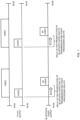
- Fig. 1 is a diagram illustrating synchronization issues between video data and audio data when using Bluetooth audio devices (hereafter Bluetooth devices). As shown in Fig. 1 , there is a noticeable delay between the audio data being output by the Bluetooth device and the audio/video (A/V) data being output by the television (TV) (e.g., video sink device), after receiving A/V data from, for example, a set-top box.
- the A/V content to the set-top box is provided by service providers including cable television providers, satellite television providers, internet service providers, and multiple system operators.
- the synchronization problem between video data and audio data when using a Bluetooth device arises because there are primary and secondary delays associated with using the Bluetooth device, which causes noticeable and annoying lip-sync problems between the video data displayed on the TV and the audio data being output by the Bluetooth device.
- the primary delays are related to transmitting the audio data using a Bluetooth protocol and the secondary delays are related to the Bluetooth devices processing the audio data.
- a user may be using a Bluetooth device (e.g., Bluetooth sound bars, Bluetooth headphones or other Bluetooth audio sink device such as a mobile phone, tablet or the like having Bluetooth capability) to listen to audio data related to video data or content (e.g., television programing and movies) being displayed on the TV.
- a Bluetooth device e.g., Bluetooth sound bars, Bluetooth headphones or other Bluetooth audio sink device such as a mobile phone, tablet or the like having Bluetooth capability
- video data or content e.g., television programing and movies
- Due to the primary and secondary delays associated with using the Bluetooth device there can be a mismatch between the audio data being listened to and the video data being displayed by the TV (i.e., lip-sync problem).
- lip-sync problem i.e., lip-sync problem
- Fig. 2 is a block diagram showing an exemplary system for achieving synchronization between video data and audio data when using a Bluetooth device.
- the system includes a set-top box 20, a video sink device 21, a remote control device (e.g., an electronic remote control) 22, and a Bluetooth device 23.
- a set-top box 20 refers to a stand-alone set-top box, but the present disclosure is not intended to be limited only to this type of set-top box and alternatively the set-top box 20 can be integrated directly into a consumer device such as a television, computer, or any other consumer device, such as electronically equipped appliances.
- the set-top box 20 houses components and circuits (e.g., as shown in Fig. 3 ) that convert the A/V content 24 to the set-top box 20 into audio and video (A/V) data that is usable by the video sink device 21 and the Bluetooth device 23.
- the A/V content 24 to the set-top box 20 may be provided by service providers including cable television providers, satellite television providers, internet service providers, and multiple system operators; and the A/V content may include, but is not limited to, television programing and movies.
- service providers including cable television providers, satellite television providers, internet service providers, and multiple system operators
- the A/V content may include, but is not limited to, television programing and movies.
- the operation of the components and circuits of the set-top box 1 will be discussed in more detail with reference to Fig. 3 .
- the video sink device 21 may include, but is not limited to, a television, a computer, a portable device, an electronic tablet, a smart phone and other consumer electronic device capable to executing and displaying A/V data received from the set-top box 20.
- the Bluetooth devices 23 may include, but are not limited to, Bluetooth sound bars, Bluetooth headphones or other Bluetooth devices such as a smart phone, electronic tablet, televisions, computers, portable electronic devices, or other consumer electronic devices capable of communicating data with the set-top box 20 using a Bluetooth protocol.
- Each Bluetooth device 23 includes components and circuits (e.g., as show in Fig. 4 ) that decode and execute the audio data received from the set-top box 20. The operation of the components and circuits of each Bluetooth device 23 will be discussed in more detail with reference to Fig. 4 .
- the A/V content 24 received by the set-top box 20 is decoded to obtain the audio and the video data (A/V) data, and the A/V data is provided to the video sink device 21 via communication connection 25.
- the communication connection 25 between the video sink device 21 and the set-top box 20 can be a wired connection.
- the communication connection 25 may include, for example, a digital media interface (DMI), high-definition multimedia interface (HDMI) or other audio/video interface for transferring video data and digital audio data from an HDMI-compliant source device.
- DMI digital media interface
- HDMI high-definition multimedia interface
- the communication connection 25 is described as a wired connection, the communication connection 25 may also be a wireless connection that operates in accordance with, but is not limited to, IEEE802.11 protocol, a Radio Frequency For Consumer Electronics (RF4CE) protocol, ZigBee protocol, and/or IEEE802.15.4 protocol.
- IEEE802.11 a Radio Frequency For Consumer Electronics (RF4CE) protocol
- RF4CE Radio Frequency For Consumer Electronics
- ZigBee protocol ZigBee protocol
- IEEE802.15.4 protocol IEEE802.15.4 protocol
- the audio data obtained by decoding the A/V content 24 received by the set-top box 20 is also provided to each of the Bluetooth devices 23 via the communication connections 27.
- the communication connections 27 between the set-top box 20 and each of the Bluetooth devices 23 are wireless connections that operate in accordance with a Bluetooth protocol. That is, the communication connections 27 operate in accordance with a wireless technology standard for exchanging data over short distances using short-wavelength Ultra high frequency (UHF) radio waves from 2.4 to 2.485 GHz.
- UHF Ultra high frequency
- data can be exchanged between the step-top box 20 and the Bluetooth devices 23 via the communication connections 27 at a rate of approximately 1-2 megabits per second and at a range of approximately 1-30 meters.
- the data rate and distance for exchanging data between the set-top box 20 and the Bluetooth devices 23 may vary depending on the generation of Bluetooth technology being implemented.
- the remote device 22 also communicates wirelessly with the set-top box 20 using a wireless communication connection 26.
- the remote device 22 may be a stand-alone remote control, or any electronic device that can be implemented as a remote control for communicating data with the set-top box 20 using an Infrared (IR) signal or protocol sent via the communication connection 26.
- IR Infrared
- the remote device 22 is described as a remote control device using an IR signal or protocol, it is contemplated by the invention that other remote control devices could be implemented that use protocols such as, but not limited to, Bluetooth Audio/Video Remote Control Profile (AVRCP), RF4CE, ZigBee, Wi-Fi, and Z-Wave.
- AVRCP Bluetooth Audio/Video Remote Control Profile
- RF4CE ZigBee
- Wi-Fi Wireless Fidelity
- the A/V content 24 is decoded by the set-top box 24, and the A/V data is transmitted to the video sink device 21 and the audio data is transmitted to one or more Bluetooth devices 23.
- a user of the Bluetooth device 23 can then watch the A/V content such as television programing and movies on the video sink device 21 while listening to the audio data on the Bluetooth devices 23.
- the set-top box 20 implements a manual and an automatic calibration for achieving synchronization between video data watched on the video sink device 21 and audio data listen to on the Bluetooth device 23.
- a detailed discussion of the manual calibration and the automatic calibration for achieving synchronization between video data watched on the video sink device 21 and audio data listened to on a Bluetooth device 23 will be discussed in more detail with reference to Figs. 5-10 .
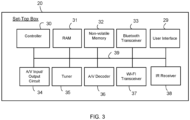
- Fig. 3 is a block diagram showing an exemplary set-top box 20 for achieving synchronization between video data and audio data when using Bluetooth devices.
- the set-top box 20 includes a communication bus 39 through which various components in the set-top box 20 are connected for communicating data there between and for converting input A/V content 24 to the set-top box 20 into A/V data usable by the video sink device 21 and a Bluetooth device 23.
- the components of the set-top box 20 include a controller 30, a random access memory (RAM) 31, a non-volatile memory 32, a Bluetooth transceiver 33, a user interface 29, an A/V input/output circuit 34, a tuner 35, an A/V decoder 36, a Wi-Fi transceiver 37, and an Infrared (IR) receiver 38.
- a controller 30 a random access memory (RAM) 31, a non-volatile memory 32, a Bluetooth transceiver 33, a user interface 29, an A/V input/output circuit 34, a tuner 35, an A/V decoder 36, a Wi-Fi transceiver 37, and an Infrared (IR) receiver 38.
- the controller 30 may be a dedicated controller, CPU, microprocessor, etc., capable of controlling the operation of the components and circuits of the set-top box 20.
- the RAM 31 may be implemented as a working memory for the controller 30, and the non-volatile memory 32 can be provided for storage of program code, user A/V content, determined or calculated delay information, and other data.
- the Bluetooth transceiver 33 transmits data to and receives data from the Bluetooth device 23 in accordance with a Bluetooth protocol. Similar to the Bluetooth devices 23, the Bluetooth transceiver 33 operates in accordance with a wireless technology standard for exchanging data over short distances using short-wavelength UHF radio waves from 2.4 to 2.485 GHz.
- Communications between the Bluetooth transceiver 33 and the Bluetooth devices 23 can be point-to-point or multipoint. Additionally, the data can be exchanged between the Bluetooth transceiver 33 and the Bluetooth devices 23 at, for example, a data rate of approximately 1-25 megabit per second and at a range of approximately 1-30 meters. However, the data rate for exchanging data and the distance for exchanging data between the Bluetooth transceiver 33 and the Bluetooth devices 23 may vary depending on the generation of Bluetooth technology being implemented in the Bluetooth transceiver 23 and the Bluetooth devices 23.
- the user interface 29 provides a means for inputting instructions directly to the set-top box 20.
- the user interface 29 may include, but is not limited to, keys, buttons, knobs, or other similar input device that can be used to input instructions for controlling operations on the set-top box 20 and/or the video sink device 21.
- the A/V input/output circuit 34 includes one or more connectors, such as RF connectors or Ethernet connectors.
- One of the connectors of the A/V input/output circuit 34 can be connected to a content provider, such as a multiple system operator (MSO), by terrestrial antenna, satellite dish, or wired cable. Through this connector of the A/V input/output circuit 34, the set-top box 20 receives the A/V content 24 from the content provider. Additionally, one of the connectors of the A/V input/output circuit 34 can be used to send data to the content provider.
- MSO multiple system operator
- the IR receiver 38 communicates IR signals with the remote device 22, and the IR signal may include data that can be used by the controller 30 to control operations of the components and circuits of the set-top box 20.
- the set-top box 20 is described as implementing the use of an IR receiver 38, it is contemplated by the invention that other types of receivers could be implemented that use protocols such as, but not limited to, Bluetooth AVRCP, RF4CE, ZigBee, Wi-Fi, and Z-Wave.
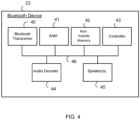
- Fig. 4 is a block diagram showing an exemplary Bluetooth device 23.
- each Bluetooth device 23 includes a communication bus 46 through which various components in the Bluetooth device 23 are connected for communicating data there between.
- the components of the Bluetooth device 23 include a Bluetooth transceiver 40, a random access memory (RAM) 41, a non-volatile memory 42, a controller 43, an audio decoder 44 and a speaker or speakers 45.
- the Bluetooth transceiver 40 transmits data to and receives data from the Bluetooth transceiver 33 of the set-top box 20 in accordance with a Bluetooth protocol.
- the Bluetooth transceiver 40 operates in accordance with a wireless technology standard for exchanging data over short distances using short-wavelength UHF radio waves from 2.4 to 2.485 GHz.
- the data can be exchanged between the Bluetooth transceiver 40 and the Bluetooth transceiver 33 of the set-top box at a rate of approximately 1-25 megabit per second and at a range of approximately 1-30 meters.
- the data rate for exchanging data and the distance for exchanging data between the Bluetooth transceiver 40 and the Bluetooth transceiver 33 of the set-top box 20 may vary depending on the generation of Bluetooth technology being implemented in the Bluetooth transceivers 33, 40.
- the RAM 41 may be implemented as a working memory for the controller 43, and the non-volatile memory 42 can be provided for storage of program code, audio data, ID data, and other information.
- the controller 43 may be a dedicated controller, CPU, microprocessor, etc., capable of controlling the operation of the components of the Bluetooth device 23.
- the audio decoder 44 decodes the signal received from the set-top box 20 so that the audio data is usable by the Bluetooth device 23.
- the audio data decoded by the audio decoder 44 can be converted into a corresponding sound and output by one or more speakers 45 of the Bluetooth device 23. That is, the speakers 45 are audio speakers that include an electroacoustic transducer, which can convert audio signal (e.g., an electrical audio signal) into a corresponding sound.
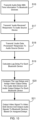
- Fig. 6 is flow chart showing an exemplary algorithm and method that are not part of the invention as specified by the appended set of claims.
- the exemplary algorithm and method are for achieving manual synchronization between video data and audio data when using Bluetooth devices according to the present invention.
- the algorithm and method shown in Fig. 6 can be implemented in the exemplary system and set-top box 20 shown respectively in Figs. 2 , 3 and 5 .
- the method and algorithm can be implemented by a program stored in the RAM 31 or the non-volatile memory 32 and executed by the controller 30, such that the controller 30 controls the operations of the components and circuits of the set-top box 20 to perform operations of the method and algorithm.
- the manual operation for synchronization between video data and audio data when using Bluetooth devices can include the user first entering into a calibration mode, as shown in step S1.
- the user enters the calibration mode by making an input selection on the set-top box 20 either through pushing a button or buttons using the user interface 29 on the set-top box 20 or via IR signal received through the communication connection 26 from the remote device 22.
- step S2 the controller of the set-top box 20 controls the output of a graphical tool stored either in RAM 31 or the non-volatile memory 32 to the video sink device 21 through the communication connection 25, and the graphical tool is displayed on the video sink device 21.
- the graphical tool is a moving animation 50 that illustrates a hammer hitting a nail.
- Fig. 5 illustrates a hammer hitting a nail 50
- the type of animation stored in the set-top box 20 and used for calibration is not meant to be limited to one-type of animation, and can be any moving animation illustrating contact between objects, surfaces, or combination thereof.
- the controller 30 of the set-top box 20 also controls the output of audio data corresponding to the animation 50 to the Bluetooth device 23 through the communication connection 27.
- the user of a Bluetooth device 23 listens to the audio data received from the set-top box 20 and in step S4 determines if the moving animation 50 shown on the video sink device 21 (i.e., hammer hitting the nail) is synchronized with the audio data being listened to on the Bluetooth device 23. That is, contact between the hammer and the nail in the animation 50 should sufficiently correspond with the audio data (e.g., sound of hammer hitting a nail) listened to by the user on the Bluetooth device 23. If the audio data listened to by the user using the Bluetooth device 23 is not synchronized with the animation 50 shown on the video sink device 21, then in step S5 the user can send a command signal for either increasing or decreasing the delay of the animation 50. The user can send the command signal either through pushing a button or buttons using the user interface 29 on the set-top box 20 or via IR signal received through the communication connection 26 from the remote device 22.
- the command signal either through pushing a button or buttons using the user interface 29 on the set-top box 20 or via IR signal
- the user of the Bluetooth device 23 can make selections 51, 53 on the calibration animation 50 in order increase 51 or decrease 53 the value of the delay 52 by sending the command signal.
- Steps S3-S5 can be repeated until acceptable synchronization is achieved between the moving animation 50 shown on the video sink device 21 (i.e., hammer hitting the nail) and the audio data listened to on the Bluetooth device 23.
- the delay value 52 is shown on the animation 50.
- the moving animation 50 shown on the video sink device 21 i.e., hammer hitting the nail
- the user can exit the calibration mode.
- the user can exit the calibration mode using a similar method to that used to enter the calibration mode (e.g., an input instruction selection on the set-top box 20 either through pushing a button or buttons using the user interface 29 on the set-top box 20 or via IR signal received through the communication connection 26 from the remote device 22).
- step S7 the controller 30 of the set-top box 20 determines that the value of the delay 52 set by the user in the animation 50 is the delay needed for synchronization and the delay is stored by the controller 30 in the RAM 31 or the non-volatile memory 32 of the set-top box 20.
- step S8 the controller 30 of the set-top 20 uses the stored delay as calibration information for delaying the output of the A/V data to the video sink device 21 in order to synchronize video data shown on the video sink device 21 with the audio data listened to on the Bluetooth device 23.
- the audio data is output to the Bluetooth device 23 via the communication connection 27 without delay and the A/V data is output to the video sink device 21 via communication connection 25, but only after applying the delay (e.g., .23 sec shown in Fig. 5 ) stored in the RAM 31 or non-volatile memory 32.
- the user can watch the A/V content such as television programing and movies on the video sink device 21 while listening to the audio data on the Bluetooth device 23.
- the A/V content such as television programing and movies
- the audio data on the Bluetooth device 23 By applying delay stored in the RAM 31 or non-volatile memory 32 to the A/V data output to the video sink device 21, the lip-sync problem between the audio data listen to on the Bluetooth device 23 and video data watched on the video sink device 21 is avoided.
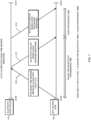
- Figs. 7 and 8 are flow diagrams showing an exemplary algorithm and method that are part of the invention as specified by the appended set of claims.
- the exemplary algorithm and method are for achieving automatic synchronization between video data and audio data when using a Bluetooth device according to the present invention.
- the algorithm and method shown in Figs. 7 and 8 can be implemented in the exemplary system and set-top box 20 shown respectively in Figs. 2 and 3 .
- the method and algorithm can be implemented by a program stored in the RAM 31 or the non-volatile memory 32 and executed by the controller 30, such that the controller 30 controls the operations of the components and circuits of the set-top box 20 to perform operations of the method and algorithm.
- the controller 30 of the set-top box 20 transmits audio data and a timer marker message to the Bluetooth device 23 via the communication connection 27.
- the audio data and timer marker message implemented by the set-top box 20 can be stored in the RAM 31 or the non-volatile memory 32 of the set-top box 20.
- the audio data can be a small amount of sound data (e.g., chirp, beep or audio clip) and the time marker message can be time information such as a time stamp or other time information that indicates the time at which the audio data is transmitted from the set-top box 20 to the Bluetooth device 23.
- step S11 the controller 43 of the Bluetooth device 23 transmits an "Audio Received” response to the set-top box 20.
- step S12 the controller 43 of the Bluetooth device 23 also transmits an "Audio Data Processed” response to the set-top box 20, after processing the audio data received by the set-top box 20.
- step S13 the controller 30 of the set-top box 20 uses the time difference between initial transmission of the audio data and receipt of the "Audio Received" response from the Bluetooth device 23 as an indication of "a round-trip transmission time" between the set-top box 23 and the Bluetooth device 23. Additionally, the controller 30 of the set-top box 20 uses the time difference between the initial transmission of the audio data from the set-top box 20 and receipt of the "Audio Data Processed" response from the Bluetooth device 23 as an indication of data processing time of data by the Bluetooth device 23.
- the delay value is stored in the RAM 31 or the non-volatile memory 32 of the set-top box 20.
- the controller 30 of the set-top 20 uses the stored delay as calibration information for delaying the output of the A/V data to the video sink device 21 in order to synchronization video data shown on the video sink device 21 with the audio data listened to on the Bluetooth device 23. For example, after the A/V content 24 is received by the set-top box 20, the audio data is output to the Bluetooth device 23 via the communication connection 27 without delay and the A/V data is output to the video sink device 21 via communication connection 25, but only after applying the delay stored in the RAM 31 or non-volatile memory 32.
- the user can watch the A/V content such as television programing and movies on the video sink device 21 while listening to the audio data on the one or more Bluetooth devices 23.
- the A/V content such as television programing and movies
- the video sink device 21 By applying delay stored in the RAM 21 or non-volatile memory 32 to the A/V data output to the video sink device 21, the lip-sync problem between the audio data listen to on the Bluetooth device 23 and video data watched on the video sink device 21 is avoided.
- Fig. 9 is a diagram illustrating synchronization issues between video data and audio data when there are multiple Bluetooth devices have different delays.
- synchronization problems between video data displayed on a TV (i.e., video sink device) and audio data listened to on a Bluetooth device 23 arise because there is a time delay in the processing and output of the audio data (e.g., primary and secondary delays) from the Bluetooth device, which causes noticeable and annoying lip-sync problems.
- Bluetooth device 1 and Bluetooth device 2 not only have similar primary and secondary delay issues with respect to the presentation of A/V data by the TV described with reference to Fig. 1 , but also have the added problem of having different primary and secondary delays with respect to each other. That is, Bluetooth device 2 has more of a delay in the presentation of the audio data (with respect to the A/V data presented on the TV) than Bluetooth device 1. Thus, there is a need to address the additional lip-sync problems created when using multiple Bluetooth devices have different primary and secondary delays with respect to each other.
- Fig. 10 is a flow chart showing an exemplary algorithm and method that is part of the invention as specified by the appended set of claims.
- the exemplary algorithm and method are for achieving automatic synchronization between video data and audio data when using multiple Bluetooth devices having different primary and second delays (i.e., hereafter referred to as "lag delay") according to the present invention.
- the algorithm and method shown in Fig. 10 can be implemented in the exemplary system and set-top box 20 shown respectively in Figs. 2 and 3 .
- the method and algorithm can be implemented by a program stored in the RAM 31 or the non-volatile memory 32 and executed by the controller 30, such that the controller 30 controls the operations of the components and circuits of the set-top box 20 to perform operations of the method and algorithm.
- step S16 the controller 30 of the set-top box 20 transmits audio data and a timer marker message to each of the Bluetooth devices 23.
- the audio data and timer marker message can be stored in the RAM 31 or the non-volatile memory 32 of the set-top box 20.
- the audio data can be small amount of sound data (e.g., chirp, beep or audio clip) and the time marker message can be time information such as a time stamp or other time information that indicates the time at which the audio data is transmitted from the set-top box 20 to each of the Bluetooth devices 23.
- step S17 the controller 43 of each Bluetooth device 23 transmits an "Audio Received" response back to the set-top box 20.
- the controller 30 of the set-top box 20 use the time difference between initial transmission of the audio data and receipt of the "Audio Received" response from each of the Bluetooth devices 23 as an indication of "round-trip transmission time" between the set-top box 20 and each of the Bluetooth devices 23 via the communication connections 27.
- step S18 the controller 43 of each of the Bluetooth devices 23 then transmits and "Audio Data Processed" response to the set-top box 20, after each Bluetooth device has processed the audio data transmitted by the set-top box 20.
- the controller 30 of the set-top box 20 uses the time difference between the initial transmission of the audio data from the set-top box 20 and receipt of the "Audio Data Processed" response from each Bluetooth device 23 as an indication of the data processing time of audio data by each Bluetooth device 23.
- the controller 30 of the set-top box 20 uses the responses (i.e., the first response "Audio Received” and second response "Audio Data Processed") from the Bluetooth device 23 for determining the lag delay for each Bluetooth device 23.
- step S20 the controller 30 compares the calculated lag delays and determines a delay for outputting the A/V data to the audio sink device 21 (e.g., TV) via communication connection 25 (hereafter "first delay”) and a delay for outputting the audio data to each of the Bluetooth devices 23 via communication connection 27 (hereafter "second delay”).
- first delay a delay for outputting the A/V data to the audio sink device 21
- second delay a delay for outputting the audio data to each of the Bluetooth devices 23 via communication connection 27
- the controller 30 calculates the lag delays for the three Bluetooth devices (e.g., as in step S19) based on the responses received (e.g. as in steps S17 and S18) from each of the Bluetooth devices 23.
- the Bluetooth devices 23 have the following calculated lag delays: 1) the first Bluetooth device has a calculated lag delay of 0.5 sec; 2) the second Bluetooth device 23 has a calculated lag delay of .35 sec; 3) and the third Bluetooth device 23 has a calculated lag delay of 0.15 sec.
- the controller 30 of the set-top box 20 compares the lag delays (e.g., 0.5 sec, 0.35 sec, and 0.15 sec), and determines the assignment of the first delay for the audio sink device 21 and the second delay for each Bluetooth device 23. Specifically, the controller 30 of the set-top box 20, based on a comparison of all the calculated lag delays, determines the longest calculated lag delay among the Bluetooth devices 23, and then assigns a value for the second delay to each of the Bluetooth devices 23 by taking the difference between the longest calculated lag delay (e.g. Bluetooth device 1) and the other calculated lag delays (e.g., Bluetooth devices 2 and 3), such that the second delay for each of the Bluetooth devices 23 is inversely proportional to the calculated lag delay for each Bluetooth device 23. For example, the Bluetooth device 23 having the longest lag delay will be assigned the shortest second delay by the controller 30.
- the lag delays e.g., 0.5 sec, 0.35 sec, and 0.15 sec
- the controller 30 would determine that the Bluetooth device 23 with the 0.5 sec lag delay has the longest lag delay among the three Bluetooth devices 23.
- the second delay for each of the Bluetooth devices 23 would be assigned by the controller 30 as follows:
- the controller 30 would also assign a first delay to the audio sink device 21 that is equal to the longest lag delay. That is, controller 30 would assign a first delay to the audio sink device 21 of 0.5 sec, which is equal to the lag delay of Bluetooth device 23 will the longest lag delay (i.e., Bluetooth device 1).
- the lag delay values, the first delays and the second delays can be stored in the RAM 31 or non-volatile memory 32 of the set-top box 20 for use by the controller 30.
- the set-top 20 uses the stored delays as calibration information for outputting the A/V data to the video sink device 21 and for outputting the audio data to the Bluetooth devices 23 in order to achieve synchronization between the video data shown on the video sink device 21 and the audio data listened to on all the Bluetooth devices 23.
- the audio data is output to the Bluetooth devices 23 via the communication connections 27 in accordance with the assigned second delay and the A/V data is output to the video sink device 21 via communication connection 25 according to the assigned first delay.
- all the Bluetooth devices 23 can be synchronized with each other as well as with the video sink device 21. In the example provided above, three Bluetooth devices 23 were discussed. However, the method and algorithm shown in Fig. 10 can be implemented with any number of Bluetooth devices 23 receiving audio data from the set-top box 20.
- the set-top box 20 instead of using responses (e.g., first and second response) from the Bluetooth devices 23 as described with reference to Figs. 8 and 10 , may apply a first delay to the audio sink device 21 based on the determination of an acceptable lip-sync tolerance range for the Bluetooth devices 23.
- the set-top box 20 can still provide a better listening experience for the users of the Bluetooth devices 23 by applying a first delay to the video sink device 21 that would result in the synchronization between the A/V data displayed on the audio sink device 21 and the audio data listened to the Bluetooth devices 23 (i.e., lip-sync) that falls within an acceptable lip-sync tolerance range.
- the set-top box 20 may implement the use of a lip-sync tolerance range of between +40 milliseconds (ms) for an acceptable leading audio signal for the Bluetooth devices 23 and -120 ms for an acceptable lagging audio signal for the Bluetooth devices 23.
- the user of the Bluetooth device 23 would experience acceptable synchronization between the A/V data displayed by the video sink device 21 and the audio data listened to by each of the Bluetooth devices 23.
- the set-top box 20 assigns a value of .38 seconds as the first delay for the video sink device 21, which still results in a lip-sync delay at the Bluetooth devices of +30ms on one Bluetooth device 23 and -120ms on another Bluetooth device 23 (i.e., after receiving the audio data from the set-top box 20). Although there is a respective lip-sync delay on each Bluetooth device 23, the lip-sync delays are still with the acceptable lip-sync tolerance range for the Bluetooth devices of between +40 ms for an acceptable leading audio signal and -120 ms for an acceptable lagging audio signal.
- the users of the Bluetooth devices can watch the A/V content such as television programing and movies on the video sink device 21 while listening to the audio data on the Bluetooth devices 23 without experiences noticeable lip-sync problems.
- the acceptable lip-sync tolerance range and the first delay can be predetermined or selected by the user, and stored in the RAM 31 or non-volatile memory 32 for use by the controller 30.
- the acceptable lip-sync tolerance range and the first delay can also be adjusted to accommodate different types of Bluetooth devices and Bluetooth protocols being implemented.
- the present invention can be implemented not only as an apparatus or system, but also as a method and algorithm for achieving synchronization between the A/V data presented by a video sink device and audio data executed on one or Bluetooth devices.
- the present invention can be implemented as a program on a non-transitory computer-readable medium for causing a computer, such as the controller in set-top box, to execute the step described in Figs. 6 , 8 and 10 .
- the non-transitory computer-readable recording medium could be, for example, a CD-ROM, DVD, Blu-ray disc, or an electronic memory device.
- the present invention may be implemented as any combination of a system, a method, an integrated circuit, and a computer program on a non-transitory computer readable recording medium.
- the controller and any other parts of the electronic apparatuses may be implemented as Integrated Circuits (IC), Application-Specific Integrated Circuits (ASIC), or Large Scale Integrated circuits (LSI), system LSI, super LSI, or ultra LSI components which perform a part or all of the functions of the electronic apparatuses, such as set-top boxes.
- IC Integrated Circuits
- ASIC Application-Specific Integrated Circuits
- LSI Large Scale Integrated circuits
- system LSI system LSI
- super LSI super LSI
- ultra LSI components which perform a part or all of the functions of the electronic apparatuses, such as set-top boxes.
- the circuits may also be implemented as a specifically programmed general purpose processor, CPU, a specialized microprocessor such as Digital Signal Processor that can be directed by program instructions on a memory, a Field Programmable Gate Array (FPGA) that can be programmed after manufacturing, or a reconfigurable processor. Some or all of the functions may be implemented by such a processor while some or all of the functions may be implemented by circuitry in any of the forms discussed above.
- CPU general purpose processor
- FPGA Field Programmable Gate Array
- the present invention may be a non-transitory computer-readable recording medium having recorded thereon a program embodying the methods/algorithms discussed above for instructing the controller to perform the methods/algorithms.
- Each of the elements of the present invention may be configured by implementing dedicated hardware or a software program on a memory controlling a processor to perform the functions of any of the components or combinations thereof.
- Any of the components may be implemented as a CPU or other processor reading and executing a software program from a recording medium such as a hard disk or a semiconductor memory.
- the components of the present invention can be in the form of a set-top box as in the exemplary embodiments disclosed above, or in other standalone devices, or may be incorporated in a television or other content playing apparatus, or other device or appliance.
- the scope of the present invention is specified by the appended set of claims.
- the present application describes the embodiments of the present invention with reference to synchronization issues between A/V data displayed on a video sink device and audio data listened to on Bluetooth devices. Whilst not part of the invention as specified by the appended set of claims, it is contemplated that the electronic apparatus, method, and algorithm could be implemented to address synchronization issues between A/V data displayed on a video sink device and audio data listened to on other similar types of short range wireless devices.
- the electronic apparatus could be modified to replace the Bluetooth transceiver with a wireless transceiver that utilizes a wireless protocol that is compatible with the wireless protocol used by any short range wireless device.
- the electronic apparatus, method and algorithm can be applied using other radio communication protocols rather than Bluetooth, such as Zigbee, IEEE802.15.4, IEEE802.11, RF4CE, or other later developed protocols.
Landscapes
- Engineering & Computer Science (AREA)
- Signal Processing (AREA)
- Multimedia (AREA)
- Computer Networks & Wireless Communication (AREA)
- Physics & Mathematics (AREA)
- Acoustics & Sound (AREA)
- Human Computer Interaction (AREA)
- Health & Medical Sciences (AREA)
- Biomedical Technology (AREA)
- General Health & Medical Sciences (AREA)
- Two-Way Televisions, Distribution Of Moving Picture Or The Like (AREA)
- Electromagnetism (AREA)
- Mobile Radio Communication Systems (AREA)
Claims (7)
- Appareil électronique (20) pour obtenir une synchronisation entre des données vidéo affichées sur un dispositif récepteur vidéo (21) et des données audio présentées sur un ou plusieurs dispositifs Bluetooth (23), l'appareil électronique (20) comprenant :un circuit d'entrée (34) qui reçoit un contenu audio/vidéo (A/V) d'un fournisseur de contenu A/V ;un décodeur A/V (36) qui décode le contenu A/V pour obtenir des données vidéo et des données audio ;un circuit de sortie (34) qui fournit en sortie les données vidéo et audio au dispositif récepteur vidéo ;un émetteur-récepteur Bluetooth (33) qui communique sans fil des informations avec les un ou plusieurs dispositifs Bluetooth selon un protocole sans fil, les informations comprenant les données audio ;un dispositif de commande (30) quifournit en sortie un message de marqueur temporel et un clip audio vers les un ou plusieurs dispositifs Bluetooth, et reçoit des réponses depuis les un ou plusieurs dispositifs Bluetooth sur la base de la réception du message de marqueur temporel et d'un clip audio, les réponses comportant une première réponse avec des informations pour déterminer un temps de transmission Bluetooth aller-retour entre l'appareil électronique et les un ou plusieurs dispositifs Bluetooth, et une deuxième réponse avec des informations sur un temps de traitement audio par les un ou plusieurs dispositifs Bluetooth du clip audio, dans lequel le dispositif de commande utilise les première et deuxième réponses provenant des un ou plusieurs dispositifs Bluetooth en tant que deuxièmes informations d'étalonnage ;obtient les deuxièmes informations d'étalonnage pour les un ou plusieurs dispositifs Bluetooth, les deuxièmes informations d'étalonnage étant associées à des retards liés à l'émetteur-récepteur Bluetooth transmettant les données audio aux un ou plusieurs dispositifs Bluetooth en utilisant le protocole sans fil et les un ou plusieurs dispositifs Bluetooth traitant les données audio,détermine un premier retard pour fournir en sortie les données vidéo et audio vers le dispositif récepteur vidéo en utilisant les deuxièmes informations d'étalonnage, le premier retard représentant une différence de temps entre le dispositif récepteur vidéo affichant des données vidéo et les un ou plusieurs dispositifs Bluetooth fournissant en sortie des données audio correspondant aux données vidéo,commande l'émetteur-récepteur Bluetooth pour fournir en sortie les données audio vers les un ou plusieurs dispositifs Bluetooth, etcommande le circuit de sortie pour appliquer le premier retard de manière à fournir en sortie les données vidéo et audio vers le dispositif récepteur vidéo après le premier retard, de sorte que les données vidéo affichées par le dispositif récepteur vidéo sont synchronisées avec les données audio fournies en sortie par les un ou plusieurs dispositifs Bluetooth.
- Appareil électronique (20) selon la revendication 1, dans lequel le dispositif de commande (30) utilise les deuxièmes informations d'étalonnage pour déterminer le premier retard pour fournir en sortie les données vidéo et audio au dispositif récepteur vidéo (21) en utilisant une formule : Premier retard = 1/2 (temps de transmission Bluetooth aller-retour) + (temps de traitement audio).
- Appareil électronique (20) selon la revendication 1, dans lequel les un ou plusieurs dispositifs Bluetooth (23) comprennent une pluralité de dispositifs Bluetooth, dans lequel le dispositif de commande (30) commande en outre l'émetteur-récepteur Bluetooth (33) pour :fournir en sortie le message de marqueur temporel et le clip audio à chacun des dispositifs Bluetooth dans la pluralité de dispositifs Bluetooth, etrecevoir des réponses provenant de chacun des dispositifs Bluetooth dans la pluralité de dispositifs Bluetooth sur la base de la réception du message de marqueur temporel et du clip audio, chacune des réponses comportant une première réponse respective avec des informations pour déterminer un temps de transmission Bluetooth aller-retour respectif entre l'appareil électronique (20) et un dispositif Bluetooth respectif de la pluralité de dispositifs Bluetooth, et une deuxième réponse respective avec des informations sur un temps de traitement audio respectif par le dispositif Bluetooth respectif de la pluralité de dispositifs Bluetooth du clip audio,dans lequel le dispositif de commande (30) utilise les première et deuxième réponses de la pluralité de dispositifs Bluetooth pour :calculer un décalage de retard pour chaque dispositif Bluetooth de la pluralité de dispositifs Bluetooth,comparer les décalages de retard de tous les dispositifs Bluetooth de la pluralité de dispositifs Bluetooth, etdéterminer un deuxième retard pour fournir en sortie les données audio à chaque dispositif Bluetooth de la pluralité de dispositifs Bluetooth sur la base des décalages de retard, respectivement, etle dispositif de commande (30) commande en outre l'émetteur-récepteur Bluetooth (33) pour appliquer les deuxièmes retards de manière à fournir en sortie les données audio vers chacun des dispositifs Bluetooth de la pluralité de dispositifs Bluetooth (23) conformément aux deuxièmes retards, respectivement, de sorte que les données vidéo affichées sur le dispositif récepteur vidéo (21) sont synchronisées avec les données audio fournies en sortie par chacun des dispositifs Bluetooth de la pluralité de dispositifs Bluetooth.
- Appareil électronique (20) selon la revendication 3, dans lequel le dispositif de commande (30) détermine chacun des décalages de retard pour la pluralité de dispositifs Bluetooth (23) en utilisant une formule : Décalage de retard = 1/2 (temps de transmission Bluetooth aller-retour) + (temps de traitement audio).
- Appareil électronique (20) selon la revendication 4, dans lequel le dispositif de commande (30) détermine un décalage de retard le plus long parmi la pluralité de dispositifs Bluetooth (23)
sur la base de la comparaison des décalages de retard de tous les dispositifs Bluetooth dans la pluralité de dispositifs Bluetooth (23), et attribue une valeur pour le deuxième retard à chacun des dispositifs Bluetooth dans la pluralité de dispositifs Bluetooth (23) sur la base d'une différence entre le décalage de retard le plus long et chacun des décalages de retard autres que le décalage de retard le plus long, respectivement, de sorte que le deuxième retard pour chacun des dispositifs Bluetooth dans la pluralité de dispositifs Bluetooth (23) est inversement proportionnel au décalage de retard pour chacun des dispositifs Bluetooth dans la pluralité de dispositifs Bluetooth (23). - Procédé mis en œuvre sur un appareil électronique (20) pour obtenir une synchronisation entre des données vidéo affichées sur un dispositif récepteur vidéo et des données audio présentées sur un ou plusieurs dispositifs récepteurs audio Bluetooth (23), le procédé comprenant :la réception, à l'aide d'un circuit d'entrée (34), d'un contenu audio/vidéo (A/V) provenant d'un fournisseur de contenu A/V ;le décodage, à l'aide d'un décodeur A/V (36), du contenu A/V pour obtenir des données vidéo et des données audio ;la fourniture en sortie, à l'aide d'un circuit de sortie (34), des données vidéo et audio au dispositif récepteur vidéo ;la communication sans fil, à l'aide d'un émetteur-récepteur Bluetooth (33), d'informations avec les un ou plusieurs dispositifs récepteurs audio Bluetooth (23) conformément à un protocole sans fil, les informations comportant les données audio ;l'utilisation d'un dispositif de commande (30) pour réaliser des opérations comportantla commande de l'émetteur-récepteur Bluetooth (33) pour fournir en sortie un message de marqueur temporel et un clip audio vers les un ou plusieurs dispositifs Bluetooth (23), et recevoir des réponses provenant des un ou plusieurs dispositifs Bluetooth (23) sur la base de la réception du message de marqueur temporel et d'un clip audio, les réponses comportant une première réponse avec des informations sur un temps de transmission Bluetooth aller-retour entre l'appareil électronique (20) et les un ou plusieurs dispositifs Bluetooth (23) du message de marqueur temporel et du clip audio, et une deuxième réponse avec des informations sur un temps de traitement audio par les un ou plusieurs dispositifs Bluetooth (23) du clip audio, dans lequel les première et deuxième réponses provenant des un ou plusieurs dispositifs Bluetooth (23) sont utilisées en tant que deuxièmes informations d'étalonnage ;l'obtention des deuxièmes informations d'étalonnage pour les un ou plusieurs dispositifs Bluetooth (23), les deuxièmes informations d'étalonnage étant associées à des retards liés à l'émetteur-récepteur Bluetooth (33) transmettant les données audio aux un ou plusieurs dispositifs Bluetooth (23) en utilisant le protocole sans fil et les un ou plusieurs dispositifs Bluetooth (23) traitant les données audio,la détermination d'un premier retard pour fournir en sortie les données vidéo et audio vers le dispositif récepteur vidéo (21) en utilisant les deuxièmes informations d'étalonnage, le premier retard représentant une différence de temps entre le dispositif récepteur vidéo (21) affichant des données vidéo et les un ou plusieurs dispositifs Bluetooth (23) fournissant en sortie des données audio correspondant aux données vidéo,la commande de l'émetteur-récepteur Bluetooth (33) pour fournir en sortie les données audio vers les un ou plusieurs dispositifs Bluetooth (23), etla commande du circuit de sortie (34) pour appliquer le premier retard de manière à fournir en sortie les données vidéo et audio vers le dispositif récepteur vidéo (21) après le premier retard, de sorte que les données vidéo affichées par le dispositif récepteur vidéo (21) sont synchronisées avec les données audio fournies en sortie par les un ou plusieurs dispositifs Bluetooth (23).
- Procédé selon la revendication 6, dans lequel le dispositif de commande (30) utilise les deuxièmes informations d'étalonnage pour déterminer le premier retard pour fournir en sortie les données vidéo et audio au dispositif récepteur vidéo (21) en utilisant la formule : Premier retard = 1/2 (temps de transmission Bluetooth aller-retour) + (temps de traitement audio).
Applications Claiming Priority (2)
| Application Number | Priority Date | Filing Date | Title |
|---|---|---|---|
| US15/375,044 US10892833B2 (en) | 2016-12-09 | 2016-12-09 | Calibration device, method and program for achieving synchronization between audio and video data when using Bluetooth audio devices |
| PCT/US2017/062786 WO2018106447A1 (fr) | 2016-12-09 | 2017-11-21 | Dispositif d'étalonnage, procédé et programme de réalisation d'une synchronisation entre des données audio et vidéo lors de l'utilisation de dispositifs audio bluetooth |
Publications (2)
| Publication Number | Publication Date |
|---|---|
| EP3552402A1 EP3552402A1 (fr) | 2019-10-16 |
| EP3552402B1 true EP3552402B1 (fr) | 2025-04-09 |
Family
ID=60629829
Family Applications (1)
| Application Number | Title | Priority Date | Filing Date |
|---|---|---|---|
| EP17811789.1A Active EP3552402B1 (fr) | 2016-12-09 | 2017-11-21 | Dispositif d'étalonnage, procédé et programme de réalisation d'une synchronisation entre des données audio et vidéo lors de l'utilisation de dispositifs audio bluetooth |
Country Status (4)
| Country | Link |
|---|---|
| US (2) | US10892833B2 (fr) |
| EP (1) | EP3552402B1 (fr) |
| CA (1) | CA3046645C (fr) |
| WO (1) | WO2018106447A1 (fr) |
Families Citing this family (24)
| Publication number | Priority date | Publication date | Assignee | Title |
|---|---|---|---|---|
| US10432614B2 (en) * | 2017-05-16 | 2019-10-01 | Apple Inc. | Techniques for verifying user intent and securely configuring computing devices |
| EP3759896B1 (fr) * | 2018-03-01 | 2022-11-23 | Sony Group Corporation | Compensation dynamique de synchronisation de lèvres pour dispositifs bluetooth véritablement sans fil |
| US10945101B2 (en) * | 2018-11-02 | 2021-03-09 | Zgmicro Nanjing Ltd. | Method, device and system for audio data communication |
| CN109362099A (zh) * | 2018-12-05 | 2019-02-19 | 南昌黑鲨科技有限公司 | 无线通信延迟测试方法、装置、计算机设备及存储介质 |
| US12127140B2 (en) * | 2019-07-10 | 2024-10-22 | Lg Electronics Inc. | Audio data transmission method using short-range wireless communication in wireless communication system and apparatus therefor |
| CN110602672B (zh) * | 2019-07-29 | 2021-10-08 | 深圳市万普拉斯科技有限公司 | 蓝牙设备回连方法、装置、终端和计算机可读存储介质 |
| US11057451B2 (en) * | 2019-08-19 | 2021-07-06 | Bose Corporation | Audio synchronization in wireless systems |
| CN111314763A (zh) * | 2020-02-20 | 2020-06-19 | RealMe重庆移动通信有限公司 | 流媒体播放方法及装置、存储介质与电子设备 |
| CN111355995A (zh) * | 2020-03-03 | 2020-06-30 | 北京字节跳动网络技术有限公司 | 蓝牙设备声音延迟时长的确定方法、装置及终端设备 |
| US10924636B1 (en) * | 2020-04-30 | 2021-02-16 | Gopro, Inc. | Systems and methods for synchronizing information for videos |
| US11601691B2 (en) * | 2020-05-04 | 2023-03-07 | Kilburn Live, Llc | Method and apparatus for providing audio and video within an acceptable delay tolerance |
| US11196899B1 (en) | 2020-06-18 | 2021-12-07 | Sony Group Corporation | Synchronization of wireless-audio to video |
| US11170820B1 (en) * | 2020-09-18 | 2021-11-09 | Logitech Europe S.A. | Method and apparatus for recording audio information |
| CN112153447B (zh) * | 2020-09-27 | 2022-06-14 | 海信视像科技股份有限公司 | 一种显示设备及音画同步控制方法 |
| US11936949B2 (en) * | 2020-11-12 | 2024-03-19 | Arris Enterprises Llc | Method and system for HDMI smart error recovery and recommended actions |
| US20240022783A1 (en) * | 2020-12-11 | 2024-01-18 | Qualcomm Incorporated | Multimedia playback synchronization |
| CN113490043A (zh) * | 2021-09-08 | 2021-10-08 | 北京百瑞互联技术有限公司 | 一种蓝牙音频数据处理方法、装置、介质及设备 |
| US11895468B2 (en) | 2022-01-31 | 2024-02-06 | Harman International Industries, Incorporated | System and method for synchronization of multi-channel wireless audio streams for delay and drift compensation |
| CN114679665A (zh) * | 2022-03-16 | 2022-06-28 | 深圳市冠旭电子股份有限公司 | 蓝牙耳机音视频同步方法和装置、电子设备、存储介质 |
| US20240094984A1 (en) * | 2022-09-16 | 2024-03-21 | Comcast Cable Communications, Llc | Synchronization of audio output for noise cancellation |
| CN115686630B (zh) * | 2022-10-28 | 2024-09-24 | 龙芯中科(南京)技术有限公司 | 被控组件的控制方法、系统、电子设备及可读介质 |
| KR20250028897A (ko) * | 2023-08-22 | 2025-03-04 | 엘지전자 주식회사 | 영상표시장치 |
| KR20250058882A (ko) * | 2023-10-24 | 2025-05-02 | 엘지전자 주식회사 | 영상표시장치 |
| US20250240477A1 (en) * | 2024-01-24 | 2025-07-24 | Nissan North America, Inc. | Synchronizing Playback of Multimedia Between In-Vehicle and Mobile Devices |
Family Cites Families (30)
| Publication number | Priority date | Publication date | Assignee | Title |
|---|---|---|---|---|
| KR100194608B1 (ko) * | 1996-11-20 | 1999-06-15 | 이계철 | Atm 통신망에서의 멀티캐스트 경로 할당방법 |
| US8190680B2 (en) * | 2004-07-01 | 2012-05-29 | Netgear, Inc. | Method and system for synchronization of digital media playback |
| US7519734B1 (en) * | 2006-03-14 | 2009-04-14 | Amazon Technologies, Inc. | System and method for routing service requests |
| US7907212B2 (en) * | 2006-03-20 | 2011-03-15 | Vixs Systems, Inc. | Multiple path audio video synchronization |
| US8561103B2 (en) * | 2006-06-30 | 2013-10-15 | At&T Intellectual Property Ii, L.P. | Method and apparatus for providing a personalized television channel |
| WO2008046143A1 (fr) * | 2006-10-17 | 2008-04-24 | Avega Systems Pty Ltd | Configuration et connexion à un réseau sans fil multimédia |
| US20090003379A1 (en) * | 2007-06-27 | 2009-01-01 | Samsung Electronics Co., Ltd. | System and method for wireless communication of uncompressed media data having media data packet synchronization |
| US7936790B2 (en) * | 2007-08-30 | 2011-05-03 | Silicon Image, Inc. | Synchronizing related data streams in interconnection networks |
| EP2141689A1 (fr) * | 2008-07-04 | 2010-01-06 | Koninklijke KPN N.V. | Génération d'un flux à contenu interactif |
| US8677437B2 (en) * | 2008-05-07 | 2014-03-18 | Evertz Microsystems Ltd. | Systems and methods for calculating the delay between media signals |
| US8477950B2 (en) * | 2009-08-24 | 2013-07-02 | Novara Technology, LLC | Home theater component for a virtualized home theater system |
| US8505054B1 (en) | 2009-12-18 | 2013-08-06 | Joseph F. Kirley | System, device, and method for distributing audio signals for an audio/video presentation |
| US8700707B2 (en) * | 2011-04-15 | 2014-04-15 | Intel Mobile Communications GmbH | Communication devices and methods for controlling a communication device |
| JP5284451B2 (ja) * | 2011-11-30 | 2013-09-11 | 株式会社東芝 | 電子機器及び音声出力方法 |
| US20150067726A1 (en) * | 2012-02-29 | 2015-03-05 | ExXothermic, Inc. | Interaction of user devices and servers in an environment |
| US20150296247A1 (en) * | 2012-02-29 | 2015-10-15 | ExXothermic, Inc. | Interaction of user devices and video devices |
| JP5957760B2 (ja) * | 2012-03-08 | 2016-07-27 | パナソニックIpマネジメント株式会社 | 映像音声処理装置 |
| EP2891315B1 (fr) * | 2012-08-28 | 2018-05-30 | Koninklijke Philips N.V. | Dispositif de transfert d'audio et procédé correspondant |
| US9257148B2 (en) * | 2013-03-15 | 2016-02-09 | JBF Interlude 2009 LTD | System and method for synchronization of selectably presentable media streams |
| US9712266B2 (en) | 2013-05-21 | 2017-07-18 | Apple Inc. | Synchronization of multi-channel audio communicated over bluetooth low energy |
| KR102170827B1 (ko) * | 2013-11-22 | 2020-10-28 | 삼성전자주식회사 | 영상표시장치 및 영상표시장치의 구동방법, 음향출력장치 및 음향출력장치의 구동방법 |
| US9723180B2 (en) * | 2014-01-08 | 2017-08-01 | Vizio Inc | Device and method for correcting lip sync problems on display devices |
| EP3100458B1 (fr) * | 2014-01-31 | 2018-08-15 | Thomson Licensing | Procédé et appareil de synchronisation de la lecture de deux dispositifs electroniques |
| KR102156467B1 (ko) * | 2014-01-31 | 2020-09-15 | 인터디지털 씨이 페턴트 홀딩스 | 2 개의 전자 디바이스들에서의 재생들을 동기화하기 위한 방법 및 장치 |
| WO2016008131A1 (fr) | 2014-07-17 | 2016-01-21 | 21 Vianet Group, Inc. | Techniques pour lire séparément des données audio et vidéo dans des réseaux locaux |
| US10178281B2 (en) | 2014-07-28 | 2019-01-08 | Starkey Laboratories, Inc. | System and method for synchronizing audio and video signals for a listening system |
| WO2016063137A2 (fr) * | 2014-08-13 | 2016-04-28 | Ferrer Julio | Système et procédé de personnalisation et de synchronisation en temps réel de contenu multimédia |
| US10034035B2 (en) | 2014-12-10 | 2018-07-24 | DISH Technologies L.L.C. | Methods, devices and systems for audiovisual synchronization with multiple output devices |
| IL240927A (en) * | 2015-01-01 | 2017-11-30 | Muvix Media Networks Ltd | Distributed audio and video synchronization and playback methods and tools with the help of an audio and video administrator |
| US9532099B2 (en) * | 2015-03-24 | 2016-12-27 | Intel Corporation | Distributed media stream synchronization control |
-
2016
- 2016-12-09 US US15/375,044 patent/US10892833B2/en active Active
-
2017
- 2017-11-21 CA CA3046645A patent/CA3046645C/fr active Active
- 2017-11-21 WO PCT/US2017/062786 patent/WO2018106447A1/fr not_active Ceased
- 2017-11-21 EP EP17811789.1A patent/EP3552402B1/fr active Active
-
2020
- 2020-12-01 US US17/108,669 patent/US11329735B2/en active Active
Also Published As
| Publication number | Publication date |
|---|---|
| EP3552402A1 (fr) | 2019-10-16 |
| US10892833B2 (en) | 2021-01-12 |
| WO2018106447A1 (fr) | 2018-06-14 |
| US11329735B2 (en) | 2022-05-10 |
| US20210083783A1 (en) | 2021-03-18 |
| CA3046645C (fr) | 2022-06-07 |
| CA3046645A1 (fr) | 2018-06-14 |
| US20180167149A1 (en) | 2018-06-14 |
Similar Documents
| Publication | Publication Date | Title |
|---|---|---|
| US11329735B2 (en) | Calibration device, method and program for achieving synchronization between audio and video data when using short range wireless audio devices | |
| US10178345B2 (en) | Apparatus, systems and methods for synchronization of multiple headsets | |
| EP3032843B1 (fr) | Dispositif de sortie sonore et procédé de commande associé | |
| WO2020060903A1 (fr) | Synchronisation audio d'un haut-parleur passif et d'un haut-parleur connecté en utilisant un code d'étalement | |
| US9026049B2 (en) | Apparatus and method for playing music | |
| US9671998B2 (en) | Synchronised control | |
| CA2890918C (fr) | Procedes et appareil pour imposer des commandes dynamiques de reglage de volume | |
| US9788140B2 (en) | Time to play | |
| CN107566888A (zh) | 多个多媒体播放设备的音频设置方法、多媒体播放系统 | |
| CN105430436A (zh) | 一种移动终端共享电视音频的方法及装置 | |
| US11528389B2 (en) | Method and system for synchronizing playback of independent audio and video streams through a network | |
| KR20110060464A (ko) | 오디오 출력 제어방법 및 이를 적용한 디지털 기기 | |
| US20250008194A1 (en) | Display device, display device coordination system, and audio playback method | |
| US20240380807A1 (en) | Gateway apparatus, method for controlling gateway apparatus, and handshaking system | |
| US9374653B2 (en) | Method for a multi-channel wireless speaker system | |
| US20240406803A1 (en) | Gateway apparatus, method for controlling gateway apparatus, and handshaking system | |
| US20180184141A1 (en) | Device, method, and program for providing subscription content to multiple client devices connected in a home network | |
| KR102279395B1 (ko) | 디지털방송 출력 시스템, 셋톱박스 및 그 디지털방송신호 출력방법, 이동통신단말기 및 그 오디오신호 출력방법 | |
| US20160330506A1 (en) | Method and data processing apparatus supporting simultaneous playback | |
| US20190320220A1 (en) | Set-Top Box with Enhanced Content and System and Method for Use of Same | |
| EP3902294A1 (fr) | Système interconnecté pour la transmission sans fil de signaux audio et vidéo de haute qualité entre des dispositifs électroniques grand public | |
| KR20150079514A (ko) | 오디오 장치 및 이의 오디오 신호 전송 방법, 그리고 오디오 시스템 |
Legal Events
| Date | Code | Title | Description |
|---|---|---|---|
| STAA | Information on the status of an ep patent application or granted ep patent |
Free format text: STATUS: UNKNOWN |
|
| STAA | Information on the status of an ep patent application or granted ep patent |
Free format text: STATUS: THE INTERNATIONAL PUBLICATION HAS BEEN MADE |
|
| PUAI | Public reference made under article 153(3) epc to a published international application that has entered the european phase |
Free format text: ORIGINAL CODE: 0009012 |
|
| STAA | Information on the status of an ep patent application or granted ep patent |
Free format text: STATUS: REQUEST FOR EXAMINATION WAS MADE |
|
| 17P | Request for examination filed |
Effective date: 20190709 |
|
| AK | Designated contracting states |
Kind code of ref document: A1 Designated state(s): AL AT BE BG CH CY CZ DE DK EE ES FI FR GB GR HR HU IE IS IT LI LT LU LV MC MK MT NL NO PL PT RO RS SE SI SK SM TR |
|
| AX | Request for extension of the european patent |
Extension state: BA ME |
|
| DAV | Request for validation of the european patent (deleted) | ||
| DAX | Request for extension of the european patent (deleted) | ||
| STAA | Information on the status of an ep patent application or granted ep patent |
Free format text: STATUS: EXAMINATION IS IN PROGRESS |
|
| 17Q | First examination report despatched |
Effective date: 20200609 |
|
| GRAP | Despatch of communication of intention to grant a patent |
Free format text: ORIGINAL CODE: EPIDOSNIGR1 |
|
| STAA | Information on the status of an ep patent application or granted ep patent |
Free format text: STATUS: GRANT OF PATENT IS INTENDED |
|
| INTG | Intention to grant announced |
Effective date: 20241114 |
|
| GRAS | Grant fee paid |
Free format text: ORIGINAL CODE: EPIDOSNIGR3 |
|
| GRAA | (expected) grant |
Free format text: ORIGINAL CODE: 0009210 |
|
| STAA | Information on the status of an ep patent application or granted ep patent |
Free format text: STATUS: THE PATENT HAS BEEN GRANTED |
|
| AK | Designated contracting states |
Kind code of ref document: B1 Designated state(s): AL AT BE BG CH CY CZ DE DK EE ES FI FR GB GR HR HU IE IS IT LI LT LU LV MC MK MT NL NO PL PT RO RS SE SI SK SM TR |
|
| REG | Reference to a national code |
Ref country code: GB Ref legal event code: FG4D |
|
| REG | Reference to a national code |
Ref country code: CH Ref legal event code: EP |
|
| REG | Reference to a national code |
Ref country code: DE Ref legal event code: R096 Ref document number: 602017088835 Country of ref document: DE |
|
| REG | Reference to a national code |
Ref country code: IE Ref legal event code: FG4D |
|
| REG | Reference to a national code |
Ref country code: NL Ref legal event code: MP Effective date: 20250409 |
|
| PG25 | Lapsed in a contracting state [announced via postgrant information from national office to epo] |
Ref country code: NL Free format text: LAPSE BECAUSE OF FAILURE TO SUBMIT A TRANSLATION OF THE DESCRIPTION OR TO PAY THE FEE WITHIN THE PRESCRIBED TIME-LIMIT Effective date: 20250409 |
|
| REG | Reference to a national code |
Ref country code: AT Ref legal event code: MK05 Ref document number: 1784650 Country of ref document: AT Kind code of ref document: T Effective date: 20250409 |
|
| PG25 | Lapsed in a contracting state [announced via postgrant information from national office to epo] |
Ref country code: FI Free format text: LAPSE BECAUSE OF FAILURE TO SUBMIT A TRANSLATION OF THE DESCRIPTION OR TO PAY THE FEE WITHIN THE PRESCRIBED TIME-LIMIT Effective date: 20250409 Ref country code: PT Free format text: LAPSE BECAUSE OF FAILURE TO SUBMIT A TRANSLATION OF THE DESCRIPTION OR TO PAY THE FEE WITHIN THE PRESCRIBED TIME-LIMIT Effective date: 20250811 Ref country code: ES Free format text: LAPSE BECAUSE OF FAILURE TO SUBMIT A TRANSLATION OF THE DESCRIPTION OR TO PAY THE FEE WITHIN THE PRESCRIBED TIME-LIMIT Effective date: 20250409 |
|
| REG | Reference to a national code |
Ref country code: LT Ref legal event code: MG9D |
|
| PG25 | Lapsed in a contracting state [announced via postgrant information from national office to epo] |
Ref country code: GR Free format text: LAPSE BECAUSE OF FAILURE TO SUBMIT A TRANSLATION OF THE DESCRIPTION OR TO PAY THE FEE WITHIN THE PRESCRIBED TIME-LIMIT Effective date: 20250710 Ref country code: NO Free format text: LAPSE BECAUSE OF FAILURE TO SUBMIT A TRANSLATION OF THE DESCRIPTION OR TO PAY THE FEE WITHIN THE PRESCRIBED TIME-LIMIT Effective date: 20250709 |
|
| PG25 | Lapsed in a contracting state [announced via postgrant information from national office to epo] |
Ref country code: PL Free format text: LAPSE BECAUSE OF FAILURE TO SUBMIT A TRANSLATION OF THE DESCRIPTION OR TO PAY THE FEE WITHIN THE PRESCRIBED TIME-LIMIT Effective date: 20250409 |
|
| PG25 | Lapsed in a contracting state [announced via postgrant information from national office to epo] |
Ref country code: BG Free format text: LAPSE BECAUSE OF FAILURE TO SUBMIT A TRANSLATION OF THE DESCRIPTION OR TO PAY THE FEE WITHIN THE PRESCRIBED TIME-LIMIT Effective date: 20250409 |
|
| PG25 | Lapsed in a contracting state [announced via postgrant information from national office to epo] |
Ref country code: HR Free format text: LAPSE BECAUSE OF FAILURE TO SUBMIT A TRANSLATION OF THE DESCRIPTION OR TO PAY THE FEE WITHIN THE PRESCRIBED TIME-LIMIT Effective date: 20250409 |
|
| PG25 | Lapsed in a contracting state [announced via postgrant information from national office to epo] |
Ref country code: AT Free format text: LAPSE BECAUSE OF FAILURE TO SUBMIT A TRANSLATION OF THE DESCRIPTION OR TO PAY THE FEE WITHIN THE PRESCRIBED TIME-LIMIT Effective date: 20250409 |
|
| PG25 | Lapsed in a contracting state [announced via postgrant information from national office to epo] |
Ref country code: RS Free format text: LAPSE BECAUSE OF FAILURE TO SUBMIT A TRANSLATION OF THE DESCRIPTION OR TO PAY THE FEE WITHIN THE PRESCRIBED TIME-LIMIT Effective date: 20250709 |
|
| PG25 | Lapsed in a contracting state [announced via postgrant information from national office to epo] |
Ref country code: IS Free format text: LAPSE BECAUSE OF FAILURE TO SUBMIT A TRANSLATION OF THE DESCRIPTION OR TO PAY THE FEE WITHIN THE PRESCRIBED TIME-LIMIT Effective date: 20250809 |
|
| PG25 | Lapsed in a contracting state [announced via postgrant information from national office to epo] |
Ref country code: LV Free format text: LAPSE BECAUSE OF FAILURE TO SUBMIT A TRANSLATION OF THE DESCRIPTION OR TO PAY THE FEE WITHIN THE PRESCRIBED TIME-LIMIT Effective date: 20250409 |
|
| PGFP | Annual fee paid to national office [announced via postgrant information from national office to epo] |
Ref country code: DE Payment date: 20251128 Year of fee payment: 9 |
|
| PGFP | Annual fee paid to national office [announced via postgrant information from national office to epo] |
Ref country code: GB Payment date: 20251127 Year of fee payment: 9 |
|
| PG25 | Lapsed in a contracting state [announced via postgrant information from national office to epo] |
Ref country code: DK Free format text: LAPSE BECAUSE OF FAILURE TO SUBMIT A TRANSLATION OF THE DESCRIPTION OR TO PAY THE FEE WITHIN THE PRESCRIBED TIME-LIMIT Effective date: 20250409 Ref country code: SM Free format text: LAPSE BECAUSE OF FAILURE TO SUBMIT A TRANSLATION OF THE DESCRIPTION OR TO PAY THE FEE WITHIN THE PRESCRIBED TIME-LIMIT Effective date: 20250409 |
|
| PG25 | Lapsed in a contracting state [announced via postgrant information from national office to epo] |
Ref country code: CZ Free format text: LAPSE BECAUSE OF FAILURE TO SUBMIT A TRANSLATION OF THE DESCRIPTION OR TO PAY THE FEE WITHIN THE PRESCRIBED TIME-LIMIT Effective date: 20250409 |
|
| PG25 | Lapsed in a contracting state [announced via postgrant information from national office to epo] |
Ref country code: EE Free format text: LAPSE BECAUSE OF FAILURE TO SUBMIT A TRANSLATION OF THE DESCRIPTION OR TO PAY THE FEE WITHIN THE PRESCRIBED TIME-LIMIT Effective date: 20250409 |
|
| PG25 | Lapsed in a contracting state [announced via postgrant information from national office to epo] |
Ref country code: RO Free format text: LAPSE BECAUSE OF FAILURE TO SUBMIT A TRANSLATION OF THE DESCRIPTION OR TO PAY THE FEE WITHIN THE PRESCRIBED TIME-LIMIT Effective date: 20250409 Ref country code: SK Free format text: LAPSE BECAUSE OF FAILURE TO SUBMIT A TRANSLATION OF THE DESCRIPTION OR TO PAY THE FEE WITHIN THE PRESCRIBED TIME-LIMIT Effective date: 20250409 |
|
| PG25 | Lapsed in a contracting state [announced via postgrant information from national office to epo] |
Ref country code: IT Free format text: LAPSE BECAUSE OF FAILURE TO SUBMIT A TRANSLATION OF THE DESCRIPTION OR TO PAY THE FEE WITHIN THE PRESCRIBED TIME-LIMIT Effective date: 20250409 |
|
| PLBE | No opposition filed within time limit |
Free format text: ORIGINAL CODE: 0009261 |
|
| STAA | Information on the status of an ep patent application or granted ep patent |
Free format text: STATUS: NO OPPOSITION FILED WITHIN TIME LIMIT |