EP3552344B1 - Structure de chaîne de blocs à chaînage bidirectionnel - Google Patents
Structure de chaîne de blocs à chaînage bidirectionnel Download PDFInfo
- Publication number
- EP3552344B1 EP3552344B1 EP17809282.1A EP17809282A EP3552344B1 EP 3552344 B1 EP3552344 B1 EP 3552344B1 EP 17809282 A EP17809282 A EP 17809282A EP 3552344 B1 EP3552344 B1 EP 3552344B1
- Authority
- EP
- European Patent Office
- Prior art keywords
- block
- blockchain structure
- dependent
- ciphertext
- function
- Prior art date
- Legal status (The legal status is an assumption and is not a legal conclusion. Google has not performed a legal analysis and makes no representation as to the accuracy of the status listed.)
- Active
Links
Images


Classifications
-
- G—PHYSICS
- G06—COMPUTING OR CALCULATING; COUNTING
- G06F—ELECTRIC DIGITAL DATA PROCESSING
- G06F21/00—Security arrangements for protecting computers, components thereof, programs or data against unauthorised activity
- G06F21/60—Protecting data
- G06F21/64—Protecting data integrity, e.g. using checksums, certificates or signatures
-
- H—ELECTRICITY
- H04—ELECTRIC COMMUNICATION TECHNIQUE
- H04L—TRANSMISSION OF DIGITAL INFORMATION, e.g. TELEGRAPHIC COMMUNICATION
- H04L9/00—Cryptographic mechanisms or cryptographic arrangements for secret or secure communications; Network security protocols
- H04L9/32—Cryptographic mechanisms or cryptographic arrangements for secret or secure communications; Network security protocols including means for verifying the identity or authority of a user of the system or for message authentication, e.g. authorization, entity authentication, data integrity or data verification, non-repudiation, key authentication or verification of credentials
- H04L9/3236—Cryptographic mechanisms or cryptographic arrangements for secret or secure communications; Network security protocols including means for verifying the identity or authority of a user of the system or for message authentication, e.g. authorization, entity authentication, data integrity or data verification, non-repudiation, key authentication or verification of credentials using cryptographic hash functions
-
- H—ELECTRICITY
- H04—ELECTRIC COMMUNICATION TECHNIQUE
- H04L—TRANSMISSION OF DIGITAL INFORMATION, e.g. TELEGRAPHIC COMMUNICATION
- H04L9/00—Cryptographic mechanisms or cryptographic arrangements for secret or secure communications; Network security protocols
- H04L9/32—Cryptographic mechanisms or cryptographic arrangements for secret or secure communications; Network security protocols including means for verifying the identity or authority of a user of the system or for message authentication, e.g. authorization, entity authentication, data integrity or data verification, non-repudiation, key authentication or verification of credentials
- H04L9/3247—Cryptographic mechanisms or cryptographic arrangements for secret or secure communications; Network security protocols including means for verifying the identity or authority of a user of the system or for message authentication, e.g. authorization, entity authentication, data integrity or data verification, non-repudiation, key authentication or verification of credentials involving digital signatures
-
- H—ELECTRICITY
- H04—ELECTRIC COMMUNICATION TECHNIQUE
- H04L—TRANSMISSION OF DIGITAL INFORMATION, e.g. TELEGRAPHIC COMMUNICATION
- H04L9/00—Cryptographic mechanisms or cryptographic arrangements for secret or secure communications; Network security protocols
- H04L9/50—Cryptographic mechanisms or cryptographic arrangements for secret or secure communications; Network security protocols using hash chains, e.g. blockchains or hash trees
Definitions
- the invention relates to a method for tamper-proof storage of data in a bidirectionally chained blockchain structure and to a computer system for carrying out the method.
- a blockchain provides an expandable list of data records, which are in individual blocks are arranged.
- the integrity of the individual blocks is ensured by unidirectional concatenation using cryptographic checksums of the individual blocks. Because each block includes a cryptographic checksum of the previous block including the cryptographic checksum stored in the previous block, there is a chaining of the blocks in which each block includes a checksum based on the contents of all previous blocks. It is therefore difficult to manipulate such a blockchain retrospectively, as not only a single block would have to be manipulated, but all subsequent blocks, since the checksum of each subsequent block also includes the block to be manipulated.
- known blockchains only implement unidirectional chaining and thus securing the data, since only data content from preceding blocks is taken into account in the chaining.
- the chaining can be used to check whether a previous block of a blockchain structure has been manipulated.
- the WO 2016/161073 A1 describes a computer system that communicates with a distributed blockchain computer system that comprises several computing nodes.
- the computer system stores an order book and a variety of digital wallets associated with different customers.
- the computer system receives new data transaction requests that are added to the order book.
- a match between data transaction requirements is identified and hashes associated with the digital wallets associated with the respective Data transaction requests associated with them are generated.
- the parties each receive the other party's hashes along with information about the match and each party causes blockchain transactions to be added to the blockchain of the blockchain computer system.
- the computer system then monitors the blockchain to see if both sides of the match have been added to the blockchain.
- the invention is based on the object of creating a secure method for storing data in a blockchain structure.
- a blockchain structure is understood here to be a data structure that forms a blockchain.
- a “blockchain” is understood to mean an ordered data structure which comprises a plurality of data blocks chained to one another.
- each block of the blockchain is identified by a hash value and references a previous block in the blockchain.
- a unidirectional chained blockchain see https://en.wikipedia.org/wiki/Block_chain_(database) and "Mastering Bitcoin", Chapter 7, The Blockchain, page 161 ff.
- Each block of the blockchain contains the hash of the entire previous block header in its header.
- the sequence of the blocks is thus clearly defined and a chain structure is created.
- the interlinking of the individual blocks implemented in this way ensures that subsequent modification of previous blocks or individual transactions that are secured using the root hash value is practically excluded, since the hash values of all subsequent blocks are also recalculated in a short time would have to.
- the security can be additionally increased.
- the computational intensity required to create new blocks can be controlled via requirements for the hash value of the new block to be created. If valid blocks are generated by a computationally intensive process, such as the Bitcoin process mentioned above, the participants in the blockchain network trust the longest valid blockchain, as it has the most computing power behind it and it can therefore be assumed that this will be used by the majority of participants is recognized as valid. If, for example, a fork, i.e. a branch, arises in the blockchain, the fork with the greater chain length will eventually prevail, since it can be assumed that the majority of the participants are behind it.
- a fork i.e. a branch
- the blockchain structure is implemented, for example, in the form of a private blockchain, with only a selected group of participants being authorized to add valid blocks.
- a consensus can additionally be implemented as a further prerequisite for adding an additional block.
- a consensus can be reached by voting on the inclusion of a proposed block or proposed entries of the block in the blockchain.
- each participant keeps a clear list of other participants whom he trusts as a group.
- Each participant can suggest new entries that are to be included in a new block of the blockchain.
- a vote is taken on the inclusion and thus the recognition of the validity of the proposed entries.
- each participant only votes on those suggestions that come from participants on his list. In other words, for the decision as to whether a proposal for a new entry is recognized as valid, i.e.
- a bidirectional chaining of two blocks is understood here to mean a transformation of both blocks, the transformation being dependent on the data content of both blocks, so that the transformation results of the blocks form pairs which are mutually dependent on one another. If the data content of one of the two blocks is changed, the transformation result of the second block also changes automatically.
- a unidirectional two blocks is understood to mean a transformation of one of the two blocks, the transformation depending on the data content of the non-transformed block, so that the transformation results also depend on the data content of the non-transformed block. If the data content of the block to be transformed is changed, this has no effect on the non-transformed block.
- a chaining function is generally understood here to mean a transformation function which is configured to transform the data content of a first block as a function of the data content of a second block, so that the transformation result is dependent on the data content of the second block.
- a cipher is understood here as a ciphertext which has been changed by a transformation in such a way that it is no longer possible to understand its content.
- Such a transformation, which results in a cipher can be, for example, encryption or obfuscation.
- Embodiments can have the advantage that, on the basis of the bidirectional chaining, it is possible to check not only whether one of the preceding blocks in the chain has been manipulated, but also whether the following block is authentic. It can also be checked whether subsequent blocks have been omitted or whether the blockchain has been shortened. It can also be ensured that the information contained in the cipher, i.e. the data contained in the additional block, is protected from unauthorized access. Only those who have the necessary information to transform the cipher back into the source text can access the data. Without this information, the corresponding data cannot be derived from the cipher, or only with great effort.
- the transformations using the first block-dependent bidirectional concatenation function each include an encryption of the blocks.
- Encryption is generally understood here as a transformation process in which an output text, for example a plain text or a first cipher, is reversibly converted or ciphered into a second cipher.
- the resulting cipher includes the complete information content of the source text, but not the source text itself.
- the transformation function for encrypting the source text also referred to here as the chaining function, thus represents a first key of an asymmetrical encryption process Using an inverse transformation function or inverse concatenation function, it can be transformed back into the source text or deciphered.
- the inverse transformation function thus represents a second key of the asymmetric encryption method.
- the transformation function cannot be derived from the inverse transformation, or can only be derived with great effort.
- the same also applies to a derivation of the inverse transformation function from the transformation function.
- Embodiments can have the advantage that they enable efficient and effective protection of data that is stored in the blockchain structure against unauthorized access.
- the transformation of the using the first block-dependent bidirectional concatenation function comprises in each case an obfuscation of the blocks.
- Obfuscation is generally understood here as a transformation process in which an output text, e.g. a plain text or a first cipher, is reversibly converted or ciphered into a second cipher.
- the resulting cipher includes both the complete information content of the source text and the source text itself.
- the transformation function for obfuscation also referred to here as the concatenation function, inserts, for example, additional bits and / or bytes into the source text according to embodiments. For example, the insertion is carried out using a pseudo-randomly distributed pattern. You therefore need information about which elements of the cipher belong to the source text and which were added in the course of the obfuscation.
- this information can be provided, for example, in the form of an inverse transformation function or inverse concatenation function.
- the second cipher can be transformed or deciphered back into the original text.
- the transformation function cannot be derived from the inverse transformation, or can only be derived with great effort.
- the same also applies to a derivation of the inverse transformation function from the transformation function.
- Embodiments can have the advantage that they enable efficient and effective protection of data that is stored in the blockchain structure against unauthorized access.
- the last block of the blockchain structure is a third cipher, which was generated from plain text using a second block-dependent bidirectional chaining function, the second block-dependent bidirectional chaining function in pairs from both the penultimate block of the blockchain structure and from the last block depends on the blockchain structure.
- Embodiments can have the advantage that the last block of the blockchain structure, which becomes the penultimate block of the blockchain structure after the addition of the additional block, as well as all further inner blocks of the blockchain structure, is dependent on both the preceding and the following block. This increases the security against manipulation of the data which comprise the last block or the other inner blocks. Furthermore, knowledge of both the preceding and the following block is necessary in order to decipher the last block or the other inner blocks. This can further increase the security of the data against unauthorized access.
- Embodiments can have the advantage that both an access to the data stored in the additional block and a check of the validity of the bidirectional chaining of the last block with the additional block are made possible in an effective and efficient manner. If the deciphering of the second cipher produces a meaningful result, the concatenation is valid. At the same time, the result of the decryption, i.e. the plain text of the additional block and thus its data, can be accessed.
- Embodiments can have the advantage that, in an effective and efficient manner, access to the blockchain structure in the last block of the blockchain structure or in the penultimate block of the blockchain structure expanded by the additional block stored data as well as a check of the validity of the bidirectional chaining of the last block with the additional block is made possible. If the deciphering of the first and third cipher results in a meaningful result, the concatenation is valid. At the same time, the result of the decryption, ie the plain text of the additional block and thus its data, can be accessed.
- the method further comprises creating a shortened copy of the bidirectionally chained blockchain structure, wherein in the shortened copy at least one inner chain segment of the blockchain structure between a first block and a second block of the blockchain structure is replaced by a test function, the test function being a combination of all inverses comprises block-dependent bidirectional chaining functions, which are dependent in pairs on blocks of the inner chain segment.
- Embodiments can have the advantage that not the entire blockchain structure, but only a shortened part, is used or passed on. Using a shortened copy can save disk space. Furthermore, a selective removal of one or more inner chain segments makes it possible to selectively prevent the forwarding of blocks with safety-critical data, comparable to the blackening of a text.
- the different encryption of the first and second blocks makes it easy to see that blocks have been removed from the blockchain. At the same time, when the blocks that have been removed are presented, the checking function makes it possible to check whether the blocks presented are actually the blocks that have been removed.
- the checking function also enables the blocks of the shortened copy of the blockchain structure to be deciphered and their data to be made accessible.
- creating the shortened copy of the bi-directionally chained blockchain structure includes replacing a plurality of inner chain segments the blockchain structure through a chain segment-specific test function.
- the removed inner chain segment comprises a plurality of blocks of the bi-directionally chained blockchain structure.
- Embodiments can have the advantage that they enable the blockchain structure to be shortened effectively.
- Embodiments can have the advantage that it can be checked in an efficient manner whether the blocks provided are actually the blocks of the replaced inner chain segment.
- the shortened copy of the bi-directionally chained blockchain structure is supplemented to form a complete bi-directionally chained blockchain structure, the supplement being a replacement of the checking function by the provided blocks of the includes inner chain segment.
- Embodiments can have the advantage that the complete blockchain structure can be restored in an efficient manner or one or more gaps can be closed by removing inner chain segments.
- a “processor” is understood here and in the following to be a logic circuit which is used to execute program instructions.
- the logic circuit can be implemented on one or more discrete components, in particular on a chip.
- a "processor” is a microprocessor or understood a microprocessor system from several processor cores and / or several microprocessors.
- a “memory” is understood here to mean both volatile and non-volatile electronic memories or digital storage media.
- non-volatile memory is understood here to mean an electronic memory for the permanent storage of data.
- a non-volatile memory can be configured as a non-changeable memory, which is also referred to as read-only memory (ROM), or as a changeable memory, which is also referred to as non-volatile memory (NVM).
- ROM read-only memory
- NVM non-volatile memory
- this can be an EEPROM, for example a Flash EEPROM, referred to as Flash for short.
- Flash Flash for short.
- a non-volatile memory is characterized by the fact that the data stored on it are retained even after the power supply has been switched off.
- a “volatile electronic memory” is a memory for the temporary storage of data, which is characterized in that all data is lost after the power supply is switched off.
- this can be a volatile random access memory, which is also referred to as a random access memory (RAM), or a volatile main memory of the processor.
- RAM random access memory
- a “protected memory area” is understood here to mean an area of an electronic memory to which access, that is to say read access or write access, is only possible via an assigned processor of the relevant computer system. According to embodiments, access from the processor coupled to the memory is only possible if a condition required for this is met. This can be, for example, a cryptographic condition, in particular a successful authentication and / or a successful authorization check.
- Asymmetric encryption is used for a large number of cryptosystems and also plays an important role in the signature of electronic documents.
- An asymmetric key pair consists of a public key, which is used to encrypt and / or decrypt data and may be passed on to third parties, for example to a service provider, and a private key, which is used to encrypt and / or decrypt data and as a rule must be kept secret.
- the public key enables anyone to encrypt data for the owner of the private key, to check digital signatures of his documents or to authenticate him.
- a private key enables its owner to decrypt data encrypted with the public key or to create digital signatures for electronic documents. A signature created with a private key can be verified with the associated public key.
- Figures 1A to 1C show embodiments of exemplary blockchain structures 100, 101, 103.
- Figure 1A shows a bidirectionally chained blockchain structure 100, which is to be expanded by an additional block 102.
- the inner blocks of the bidirectionally chained blockchain structure 100 such as the penultimate block 106, are dependent on both the immediately preceding block and the immediately following block by double encryption, indicated schematically by the two overlapping functions.
- a block-independent chaining function 110 For the bidirectional chaining of the last block 104 of the blockchain structure 100 with the additional block 102, a block-independent chaining function 110 is provided.
- a block-dependent bidirectional chaining function 112 is generated from the block-independent chaining function 110.
- a data content of the last block 104 of the blockchain structure 100 is used as a first parameter and a data content of the additional block 102 is used as a second parameter of the block-independent chaining function 110.
- the block-dependent bidirectional chaining function 112 generated in this way is dependent in pairs on both the last block 104 of the blockchain structure 100 and on the additional block 102.
- a bidirectional concatenation of the last block 104 of the blockchain structure 100 with the additional block 102 takes place bidirectional concatenation function 112 performed.
- the bidirectionality of the chaining is based on the fact that the transformation of the last block 104 of the blockchain structure 100 is dependent on the data content of the additional block 102, which is used as the second parameter of the block-independent chaining function 110.
- the transformation of the additional block 102 from the data content of the last block 104 is the Blockchain structure 100 depending on which is used as the first parameter of the block-independent chaining function 110.
- the encrypted block 102 is decrypted again in order to be able to read and use the data contained therein.
- the chaining with the block 104 is released again via the common encryption by the block-dependent bidirectional chaining function 112.
- the block 102 is removed from the expanded bidirectionally chained blockchain structure 101.
- a block-independent chaining function 120 which is the inverse of the block-independent chaining function 110, is provided.
- a block-dependent bidirectional chaining function 122 which is inverse to the block-dependent bidirectional chaining function 112 is generated from the inverse block-independent chaining function 120.
- a data content of the encrypted block 104 is used as a first parameter and a data content of the encrypted block 102 is used as a second parameter of the inverse block-independent chaining function 120.
- the inverse block-dependent bidirectional concatenation function 122 generated in this way is dependent in pairs on both the encrypted block 104 and the encrypted block 102.
- the decryption of the two encrypted blocks 102, 104 is only successful if both blocks 102, 104 have been encrypted with the same block-dependent bidirectional chaining function 112, ie have been chained bidirectionally.
- the encrypted block 102 is converted by an inverse transformation into its output form, which includes the data in plain text.
- Figure 1C shows a bidirectionally chained blockchain structure 100 of which an abbreviated copy 103 is created.
- an inner chain segment 134 is removed between the blocks 132 and 130. Since the ciphers of blocks 132, 130 cannot be back-transformed by a common inverse block-dependent bidirectional chaining function 122, which depends solely on the data content of blocks 132, 130, it is easy to see that blocks have been removed and the shortened copy 103 not of the complete blockchain structure is equivalent to.
- the test function 150 is generated by combining the inverse block-dependent bidirectional chaining functions 140, 142 between the blocks of the inner chain segment 134.
- Combining the can include, for example, multiplying, dividing, adding and / or subtracting the inverse block-dependent bidirectional concatenation functions 140, 142. If, for example, the removed blocks of the inner chain segment 134 are provided to supplement the shortened copy 103, the checking function 150 can be used to check whether the provided blocks are actually the authentic and complete removed blocks or whether they have been manipulated.
- FIG. 3 shows an embodiment of an exemplary computer system 200 for executing a method for tamper-proof storage of data 214 in a bidirectionally chained blockchain structure 100.
- the computer system 200 comprises a processor 202 which is configured to execute program instructions 204.
- the processor 202 controls the computer system 200 such that it executes one of the previously described embodiments of the method for tamper-proof storage of the data 214 in the bidirectionally chained blockchain structure 100.
- the computer system 200 further includes a memory 206 in which a bidirectionally chained blockchain structure 100 is stored, to which the data 214 are to be added in the form of an additional block and thus stored in a tamper-proof manner.
- the block-independent chaining function 110 from which the block-dependent bidirectional chaining functions 112 can be generated by executing the program instructions 204, is also stored in a protected memory area 208 of the memory 206. Only those who have the block-independent chaining function 110 can add additional blocks to the bi-directionally chained blockchain structure 100.
- the memory 206 also includes the inverse block-independent chaining function 120, from which inverse block-dependent bidirectional concatenation functions 122 can be generated.
- the computer system 200 also includes a communication interface 218.
- This communication interface 218 can be, for example, a network interface for communication via a network or via a user interface for the input of commands by a user and for the output of results.
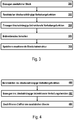
- FIG. 3 shows an embodiment of an exemplary method for tamper-proof storage of data in a bidirectionally chained blockchain structure.
- an additional block is generated with the data to be stored in the bi-directionally linked blockchain structure.
- a block-independent chaining function assigned to the blockchain structure is provided.
- a block-dependent bidirectional chaining function is generated from the block-independent chaining function using data contents of the additional block and the block of the blockchain structure with which the additional block is to be chained bidirectionally.
- the additional block is linked bidirectionally to the corresponding block of the blockchain structure. For this purpose, both blocks are encrypted with the block-dependent bidirectional concatenation function.
- the resulting blockchain structure which has been expanded to include the additional block, is saved.
- FIG. 4 shows an embodiment of an exemplary method for accessing data which is stored in a tamper-proof manner in a bidirectionally chained blockchain structure.
- an inverse block-independent chaining function is provided.
- an inverse block-dependent bidirectional concatenation function is generated from the provided inverse block-independent concatenation function.
- the Transformation or encryption of the additional block Figure 3 can be undone.
- the encrypted additional block is decrypted using the inverse block dependent bidirectional chaining function.
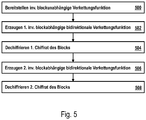
- FIG. 5 shows a further embodiment of an exemplary method for accessing data which is stored in a tamper-proof manner in a bidirectionally chained blockchain structure.
- step 500 inverse block independent chaining function provided.
- step 502 a first inverse block-dependent bidirectional chaining function is generated from the inverse block-independent chaining function, which is dependent on the inner block of the bidirectionally chained blockchain structure and a directly following block with which the inner block is bidirectionally chained.
- a first encryption of the inner block is decrypted using the first inverse block-dependent bidirectional chaining function.
- a second inverse block-dependent bidirectional chaining function is generated from the inverse block-independent chaining function, which is dependent on the once deciphered inner block of the bidirectionally chained blockchain structure and a directly preceding block with which the inner block is bidirectionally chained.
- a second cipher of the inner block is deciphered using the first inverse block dependent bidirectional chaining function. As a result, the data included in the inner block is obtained in plain text.
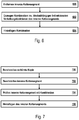
- Figure 6 Figure 3 shows an embodiment of an exemplary method for generating an abbreviated copy of a bi-directionally chained blockchain structure.
- step 600 one or more inner chain segments are removed or removed from the bidirectionally chained blockchain structure.
- step 602 chain segment-specific combinations are generated from the inverse block-dependent bidirectional chaining functions between the blocks of the inner chain segments.
- step 604 the generated ones are used instead of the The removed inner chain segments were added to the shortened blockchain structure as test functions.
- FIG. 10 shows an embodiment of an exemplary method for restoring a complete bi-directionally chained blockchain structure from an abbreviated copy of the blockchain structure.
- step 700 an abbreviated copy of a bidirectionally chained blockchain structure is provided.
- step 702 one or more inner chain segments are provided to restore the blockchain structure.
- step 704 the provided inner chain segments are checked for authenticity and completeness by the combinations of inverse block-dependent bidirectional chaining functions or checking functions comprised by the shortened copy of the bidirectionally chained blockchain structure.
- the provided inner chain segments are added to the abbreviated copy to restore the complete bi-directionally chained blockchain structure.
Landscapes
- Engineering & Computer Science (AREA)
- Computer Security & Cryptography (AREA)
- Computer Networks & Wireless Communication (AREA)
- Signal Processing (AREA)
- Theoretical Computer Science (AREA)
- General Health & Medical Sciences (AREA)
- Bioethics (AREA)
- Computer Hardware Design (AREA)
- Software Systems (AREA)
- Physics & Mathematics (AREA)
- General Engineering & Computer Science (AREA)
- General Physics & Mathematics (AREA)
- Health & Medical Sciences (AREA)
- Storage Device Security (AREA)
- Financial Or Insurance-Related Operations Such As Payment And Settlement (AREA)
Claims (11)
- Procédé permettant le stockage de manière protégée contre des manipulations de données (214) dans une structure de chaîne de blocs (100, 101) concaténée de manière bidirectionnelle, le procédé comprenant :• la création d'un bloc supplémentaire (102) pour la structure de chaîne de blocs (100), lequel comprend les données (214) à stocker,• la mise au point d'une fonction de concaténation (110) non dépendante d'un bloc,• la création d'une première fonction de concaténation (112) bidirectionnelle dépendante d'un bloc à partir de la fonction de concaténation (110) non dépendante d'un bloc, où, pour la création, un contenu de donnée du dernier bloc (104) de la structure de chaîne de blocs (100) est employé en tant que premier paramètre et un contenu de bloc du bloc supplémentaire (102) pour la structure de chaîne de blocs (100) est employé en tant que deuxième paramètre de la fonction de concaténation (110) non dépendante d'un bloc, de sorte que la première fonction de concaténation (112) bidirectionnelle dépendante d'un bloc créée est dépendante formant une paire à la fois du dernier bloc (104) de la structure de chaîne de blocs (100) et du bloc supplémentaire (102) pour la structure de chaine de blocs (100),• la concaténation bidirectionnelle du dernier bloc (104) de la structure de chaîne de blocs (100) avec le bloc supplémentaire (102) pour la structure de chaîne de blocs (100), où la concaténation bidirectionnelle comprend une transformation du dernier bloc (104) de la structure de chaîne de blocs (100) en un premier texte chiffré moyennant l'emploi de la première fonction de concaténation (112) bidirectionnelle dépendante d'un bloc et une transformation du bloc supplémentaire (102) pour la structure de chaîne de blocs (100) moyennant l'emploi de la première fonction de concaténation (112) bidirectionnelle dépendante d'un bloc en un deuxième texte chiffré,• le stockage de la structure de chaîne de blocs (101) élargie résultante, laquelle comprend les premier et deuxième textes chiffrés.
- Procédé selon la revendication 1, dans lequel les transformations moyennant l'emploi de la première fonction de concaténation (112) bidirectionnelle dépendante d'un bloc comprennent respectivement un chiffrement des blocs.
- Procédé selon la revendication 1, dans lequel la transformation moyennant l'emploi de la première fonction de concaténation (112) bidirectionnelle dépendante d'un bloc comprend respectivement une offuscation des blocs.
- Procédé selon l'une des revendications précédentes, dans lequel, dans le cas du dernier bloc (104) de la structure de chaîne de blocs (100), il s'agit d'un troisième texte chiffré, lequel a été généré à partir d'un texte en clair moyennant l'emploi d'une deuxième fonction de concaténation bidirectionnelle dépendante d'un bloc, où la deuxième fonction de concaténation bidirectionnelle dépendante d'un bloc est dépendante en formant une paire à la fois de l'avant-dernier bloc (106) de la structure de chaîne de blocs (100) et du dernier bloc (104) de la chaîne de blocs (100).
- Procédé selon l'une des revendications précédentes, où le procédé comprend en outre, pour l'accès aux données (214) stockées dans le bloc supplémentaire (102) et/ou pour la vérification de la validité de la concaténation bidirectionnelle du dernier bloc (104) avec le bloc supplémentaire (102) :• la mise au point d'une fonction de concaténation inverse (120) non dépendante d'un bloc,• la création d'une première fonction de concaténation inverse (122) bidirectionnelle dépendante d'un bloc à partir de la fonction de concaténation inverse (120) non dépendante d'un bloc, où, pour la création, un contenu de donnée du premier texte chiffré est employé en tant que premier paramètre et un contenu de bloc du deuxième texte chiffré est employé en tant que deuxième paramètre de la fonction de concaténation inverse (120) non dépendante d'un bloc, de sorte que la première fonction de concaténation inverse (122) bidirectionnelle dépendante d'un bloc créée est dépendante en formant une paire à la fois du premier texte chiffré et du deuxième texte chiffré,• le déchiffrement du deuxième texte chiffré, où le déchiffrement comprend une retransformation du deuxième texte chiffré dans le bloc supplémentaire (102) moyennant l'emploi de la première fonction de concaténation inverse (122) bidirectionnelle dépendante du bloc.
- Procédé selon l'une des revendications précédentes, dans lequel, dans le cas de l'avant-dernier bloc (106) de la structure de chaîne de blocs, il s'agit d'un quatrième texte chiffré, lequel a été généré à partir d'un cinquième texte chiffré moyennant l'emploi de la deuxième fonction de concaténation bidirectionnelle dépendante d'un bloc, où le procédé comprend en outre, pour l'accès aux données (214) stockées dans le dernier bloc (104) et/ou pour la vérification de la validité de la concaténation bidirectionnelle du dernier bloc (104) avec le bloc supplémentaire (102) :• le déchiffrement du premier texte chiffré, où le déchiffrement comprend une retransformation du premier texte chiffré dans le troisième texte chiffré moyennant l'emploi de la première fonction de concaténation inverse (122) bidirectionnelle dépendante du bloc,• la création d'une deuxième fonction de concaténation inverse bidirectionnelle dépendante d'un bloc à partir de la fonction de concaténation inverse (120) non dépendante d'un bloc, où, pour la création, un contenu de donnée du quatrième texte chiffré est employé en tant que premier paramètre et un contenu de bloc du troisième texte chiffré est employé en tant que deuxième paramètre de la fonction de concaténation inverse (120) non dépendante d'un bloc, de sorte que la deuxième fonction de concaténation inverse bidirectionnelle dépendante d'un bloc créée est dépendante en formant une paire à la fois du troisième texte chiffré et du quatrième texte chiffré,• le déchiffrement du troisième texte chiffré, où le déchiffrement comprend une retransformation du troisième texte chiffré en texte clair du dernier bloc (104) moyennant l'emploi de la deuxième fonction de concaténation inverse bidirectionnelle dépendante du bloc.
- Procédé selon l'une des revendications précédentes, où le procédé comprend en outre une production d'une copie raccourcie (103) de la structure de chaîne de blocs (100, 101) concaténée de manière bidirectionnelle, où, dans la copie raccourcie (103), au moins un segment de chaîne intérieur (134) de la structure de chaîne de blocs (100, 101) est remplacé par une fonction de vérification entre un premier bloc et un deuxième bloc de la structure de chaîne de blocs (100, 101), où la fonction de vérification comprend une combinaison (150) de toutes les fonctions de concaténation inverses (140, 142) bidirectionnelles dépendantes d'un bloc, lesquelles sont dépendantes en formant des paires de blocs du segment de chaîne (134) intérieur.
- Procédé selon la revendication 7, dans lequel le segment de chaîne (134) intérieur enlevé comprend une multiplicité de blocs de la structure de chaîne de blocs (100, 101) concaténée de manière bidirectionnelle.
- Procédé selon l'une des revendications 7 à 8, où le procédé comprend en outre :• la préparation des blocs du segment de chaîne (134) intérieur remplacé,• la vérification de l'authenticité et/ou de l'intégrité des blocs préparés du segment de chaîne (134) intérieur remplacé, où la vérification comprend une comparaison de la fonction de vérification avec des fonctions de concaténation inverses (140, 142) bidirectionnelles dépendantes d'un bloc, lesquelles sont calculées moyennant l'emploi de la fonction de concaténation inverse (120) non dépendante d'un bloc pour les blocs du segment de chaîne (134) intérieur remplacé.
- Procédé selon la revendication 9, dans lequel, suite à une vérification réussie de l'authenticité et/ou de l'intégrité des blocs préparés du segment de chaîne (134) intérieur remplacé, la copie raccourcie (103) de la structure de chaîne de blocs (100, 101) concaténée de manière bidirectionnelle est complétée pour donner la structure de chaîne de blocs (100, 101) concaténée de manière bidirectionnelle complète, où le complément comprend un remplacement de la fonction de vérification par les blocs du segment de chaîne (134) intérieur.
- Système informatique (200) permettant le stockage (206) de manière protégée contre des manipulations de données (214) dans une structure de chaîne de blocs (100, 101) concaténée de manière bidirectionnelle, dans lequel la structure de chaîne de blocs (100) est stockée dans une mémoire (206) du système informatique (200), où une fonction de concaténation (110) non dépendante d'un bloc est stockée dans une zone de mémoire (208) protégée de la mémoire (206), où le système informatique (200) comprend en outre un processeur (202), où le processeur (202) est conçu pour, par l'exécution des instructions de programme (204), commander le système informatique (200) pour qu'il :• crée un bloc supplémentaire (102) pour la structure de chaîne de blocs (100), lequel comprend les données (214) à stocker,• crée une première fonction de concaténation (112) bidirectionnelle dépendante d'un bloc à partir de la fonction de concaténation (110) non dépendante d'un bloc, où, pour la création, un contenu de donnée du dernier bloc (104) de la structure de chaîne de blocs (100) est employé en tant que premier paramètre et un contenu de bloc du bloc supplémentaire (102) pour la structure de chaîne de blocs (100) est employé en tant que deuxième paramètre de la fonction de concaténation (110) non dépendante d'un bloc, de sorte que la première fonction de concaténation (112) bidirectionnelle dépendante d'un bloc créée est dépendante en formant une paire à la fois du dernier bloc (104) de la structure de chaîne de blocs (100) et du bloc supplémentaire (102) pour la structure de chaine de blocs (100),• effectue la concaténation bidirectionnelle du dernier bloc (104) de la structure de chaîne de bloc (100) avec le bloc supplémentaire (102) pour la structure de chaîne de blocs (100), où la concaténation bidirectionnelle comprend une transformation du dernier bloc (104) de la structure de chaîne de blocs (100) en un premier texte chiffré moyennant l'emploi de la première fonction de concaténation (112) bidirectionnelle dépendante d'un bloc et une transformation du bloc supplémentaire (102) pour la structure de chaîne de blocs (100) moyennant l'emploi de la première fonction de concaténation (112) bidirectionnelle dépendante d'un bloc en un deuxième texte chiffré,• stocke la structure de chaîne de blocs (101) élargie résultante dans la mémoire (206), où le stockage comprend un remplacement du dernier bloc (104) de la structure de chaîne de blocs (100) par le premier texte chiffré et un ajout du deuxième texte chiffré à la structure de chaîne de blocs (100).
Applications Claiming Priority (2)
| Application Number | Priority Date | Filing Date | Title |
|---|---|---|---|
| DE102016224533.3A DE102016224533A1 (de) | 2016-12-08 | 2016-12-08 | Bidirektional verkettete Blockchainstruktur |
| PCT/EP2017/081465 WO2018104277A1 (fr) | 2016-12-08 | 2017-12-05 | Structure de chaîne de blocs à chaînage bidirectionnel |
Publications (2)
| Publication Number | Publication Date |
|---|---|
| EP3552344A1 EP3552344A1 (fr) | 2019-10-16 |
| EP3552344B1 true EP3552344B1 (fr) | 2021-07-21 |
Family
ID=60582588
Family Applications (1)
| Application Number | Title | Priority Date | Filing Date |
|---|---|---|---|
| EP17809282.1A Active EP3552344B1 (fr) | 2016-12-08 | 2017-12-05 | Structure de chaîne de blocs à chaînage bidirectionnel |
Country Status (3)
| Country | Link |
|---|---|
| EP (1) | EP3552344B1 (fr) |
| DE (1) | DE102016224533A1 (fr) |
| WO (1) | WO2018104277A1 (fr) |
Families Citing this family (4)
| Publication number | Priority date | Publication date | Assignee | Title |
|---|---|---|---|---|
| DE102017216974A1 (de) | 2017-09-25 | 2019-05-16 | Bundesdruckerei Gmbh | Dataculestruktur und Verfahren zum manipulationssicheren Speichern von Daten |
| WO2020037623A1 (fr) * | 2018-08-23 | 2020-02-27 | 区链通网络有限公司 | Procédé, dispositif et système d'expansion de capacité pour système de compte à chaîne de blocs à résistance quantique |
| CN109726206B (zh) * | 2018-12-26 | 2021-03-30 | 百度在线网络技术(北京)有限公司 | 区块链节点的数据处理方法、装置、设备和存储介质 |
| CN113689213B (zh) * | 2018-12-26 | 2024-07-26 | 创新先进技术有限公司 | 区块链数据处理方法、装置及系统 |
Family Cites Families (3)
| Publication number | Priority date | Publication date | Assignee | Title |
|---|---|---|---|---|
| US9967334B2 (en) * | 2015-03-02 | 2018-05-08 | Dell Products Lp | Computing device configuration and management using a secure decentralized transaction ledger |
| WO2016160850A1 (fr) * | 2015-03-30 | 2016-10-06 | Iperial, Inc. | Système et procédé d'authentification de contenu numérique |
| US11200564B2 (en) * | 2015-03-31 | 2021-12-14 | Nasdaq, Inc. | Systems and methods of blockchain transaction recordation |
-
2016
- 2016-12-08 DE DE102016224533.3A patent/DE102016224533A1/de not_active Withdrawn
-
2017
- 2017-12-05 EP EP17809282.1A patent/EP3552344B1/fr active Active
- 2017-12-05 WO PCT/EP2017/081465 patent/WO2018104277A1/fr not_active Ceased
Non-Patent Citations (1)
| Title |
|---|
| None * |
Also Published As
| Publication number | Publication date |
|---|---|
| WO2018104277A1 (fr) | 2018-06-14 |
| EP3552344A1 (fr) | 2019-10-16 |
| DE102016224533A1 (de) | 2018-06-14 |
Similar Documents
| Publication | Publication Date | Title |
|---|---|---|
| EP3474172B1 (fr) | Contrôle d'accès à l'aide d'une chaîne de blocs | |
| EP3108610B1 (fr) | Procédé et système d'établissement et vérification de validité de certificats d'appareil | |
| DE69634880T2 (de) | Verfahren und gerät zum kontrollierten zugriff zu verschlüsselten datenakten in einem computersystem | |
| EP3655880B1 (fr) | Système matériel à chaîne de blocs | |
| EP3552345B1 (fr) | Chaîne de blocs maîtresse | |
| DE202018002074U1 (de) | System zur sicheren Speicherung von elektronischem Material | |
| EP3182318B1 (fr) | Génération de signature au moyen d'un jeton de sécurité | |
| DE112011100182T5 (de) | Transaktionsprüfung für Datensicherheitsvorrichtungen | |
| DE102023108024A1 (de) | Verfahren zur blockchain-basierten Sicherung von digitalen Signaturen | |
| EP3910875A1 (fr) | Concept d'échange des informations clés cryptographiques | |
| WO2019057832A1 (fr) | Structure de blocs de données et procédé de stockage de données protégé contre des manipulations | |
| EP3552344A1 (fr) | Structure de chaîne de blocs à chaînage bidirectionnel | |
| EP3599740A1 (fr) | Commande d'un réseau de données concernant une utilisation d'une banque de données distribuée | |
| AT524620B1 (de) | Verfahren zum Migrieren einer IT-Anwendung | |
| DE102014210282A1 (de) | Erzeugen eines kryptographischen Schlüssels | |
| EP2442251A2 (fr) | Actualisation individuelle de programmes informatiques | |
| EP3767513B1 (fr) | Procédé de mise en uvre sécurisée d'une signature à distance ainsi que système de sécurité | |
| AT504634B1 (de) | Verfahren zum transferieren von verschlüsselten nachrichten | |
| EP3618348B1 (fr) | Procédé de fonctionnement d'un système de banques de données distribuée, système de banques de données distribuée et système d'automatisation industrielle | |
| EP2491513B1 (fr) | Procédé et système de fourniture d'objets de données à protection erdm | |
| EP1573955B1 (fr) | Procede de chiffrement | |
| DE102014213454A1 (de) | Verfahren und System zur Erkennung einer Manipulation von Datensätzen | |
| DE4344280C2 (de) | Verfahren zum Autorisieren von digitalisierten Daten aus Texten, Bildern und dergleichen | |
| EP4116849B1 (fr) | Procédé mis en oeuvre par ordinateur permettant de gérer un ensemble de données comprenant des informations relatives à la sécurité | |
| DE102015208176A1 (de) | Gerät und Verfahren zur Autorisierung eines privaten kryptographischen Schlüssels in einem Gerät |
Legal Events
| Date | Code | Title | Description |
|---|---|---|---|
| STAA | Information on the status of an ep patent application or granted ep patent |
Free format text: STATUS: UNKNOWN |
|
| STAA | Information on the status of an ep patent application or granted ep patent |
Free format text: STATUS: THE INTERNATIONAL PUBLICATION HAS BEEN MADE |
|
| PUAI | Public reference made under article 153(3) epc to a published international application that has entered the european phase |
Free format text: ORIGINAL CODE: 0009012 |
|
| STAA | Information on the status of an ep patent application or granted ep patent |
Free format text: STATUS: REQUEST FOR EXAMINATION WAS MADE |
|
| 17P | Request for examination filed |
Effective date: 20190708 |
|
| AK | Designated contracting states |
Kind code of ref document: A1 Designated state(s): AL AT BE BG CH CY CZ DE DK EE ES FI FR GB GR HR HU IE IS IT LI LT LU LV MC MK MT NL NO PL PT RO RS SE SI SK SM TR |
|
| AX | Request for extension of the european patent |
Extension state: BA ME |
|
| DAV | Request for validation of the european patent (deleted) | ||
| DAX | Request for extension of the european patent (deleted) | ||
| GRAP | Despatch of communication of intention to grant a patent |
Free format text: ORIGINAL CODE: EPIDOSNIGR1 |
|
| STAA | Information on the status of an ep patent application or granted ep patent |
Free format text: STATUS: GRANT OF PATENT IS INTENDED |
|
| INTG | Intention to grant announced |
Effective date: 20201113 |
|
| GRAJ | Information related to disapproval of communication of intention to grant by the applicant or resumption of examination proceedings by the epo deleted |
Free format text: ORIGINAL CODE: EPIDOSDIGR1 |
|
| STAA | Information on the status of an ep patent application or granted ep patent |
Free format text: STATUS: REQUEST FOR EXAMINATION WAS MADE |
|
| INTC | Intention to grant announced (deleted) | ||
| GRAP | Despatch of communication of intention to grant a patent |
Free format text: ORIGINAL CODE: EPIDOSNIGR1 |
|
| STAA | Information on the status of an ep patent application or granted ep patent |
Free format text: STATUS: GRANT OF PATENT IS INTENDED |
|
| INTG | Intention to grant announced |
Effective date: 20210219 |
|
| GRAS | Grant fee paid |
Free format text: ORIGINAL CODE: EPIDOSNIGR3 |
|
| GRAA | (expected) grant |
Free format text: ORIGINAL CODE: 0009210 |
|
| STAA | Information on the status of an ep patent application or granted ep patent |
Free format text: STATUS: THE PATENT HAS BEEN GRANTED |
|
| AK | Designated contracting states |
Kind code of ref document: B1 Designated state(s): AL AT BE BG CH CY CZ DE DK EE ES FI FR GB GR HR HU IE IS IT LI LT LU LV MC MK MT NL NO PL PT RO RS SE SI SK SM TR |
|
| REG | Reference to a national code |
Ref country code: GB Ref legal event code: FG4D Free format text: NOT ENGLISH |
|
| REG | Reference to a national code |
Ref country code: CH Ref legal event code: EP |
|
| REG | Reference to a national code |
Ref country code: DE Ref legal event code: R096 Ref document number: 502017010983 Country of ref document: DE |
|
| REG | Reference to a national code |
Ref country code: AT Ref legal event code: REF Ref document number: 1413620 Country of ref document: AT Kind code of ref document: T Effective date: 20210815 |
|
| REG | Reference to a national code |
Ref country code: IE Ref legal event code: FG4D Free format text: LANGUAGE OF EP DOCUMENT: GERMAN |
|
| REG | Reference to a national code |
Ref country code: LT Ref legal event code: MG9D |
|
| REG | Reference to a national code |
Ref country code: NL Ref legal event code: MP Effective date: 20210721 |
|
| PG25 | Lapsed in a contracting state [announced via postgrant information from national office to epo] |
Ref country code: SE Free format text: LAPSE BECAUSE OF FAILURE TO SUBMIT A TRANSLATION OF THE DESCRIPTION OR TO PAY THE FEE WITHIN THE PRESCRIBED TIME-LIMIT Effective date: 20210721 Ref country code: RS Free format text: LAPSE BECAUSE OF FAILURE TO SUBMIT A TRANSLATION OF THE DESCRIPTION OR TO PAY THE FEE WITHIN THE PRESCRIBED TIME-LIMIT Effective date: 20210721 Ref country code: HR Free format text: LAPSE BECAUSE OF FAILURE TO SUBMIT A TRANSLATION OF THE DESCRIPTION OR TO PAY THE FEE WITHIN THE PRESCRIBED TIME-LIMIT Effective date: 20210721 Ref country code: ES Free format text: LAPSE BECAUSE OF FAILURE TO SUBMIT A TRANSLATION OF THE DESCRIPTION OR TO PAY THE FEE WITHIN THE PRESCRIBED TIME-LIMIT Effective date: 20210721 Ref country code: FI Free format text: LAPSE BECAUSE OF FAILURE TO SUBMIT A TRANSLATION OF THE DESCRIPTION OR TO PAY THE FEE WITHIN THE PRESCRIBED TIME-LIMIT Effective date: 20210721 Ref country code: PT Free format text: LAPSE BECAUSE OF FAILURE TO SUBMIT A TRANSLATION OF THE DESCRIPTION OR TO PAY THE FEE WITHIN THE PRESCRIBED TIME-LIMIT Effective date: 20211122 Ref country code: NO Free format text: LAPSE BECAUSE OF FAILURE TO SUBMIT A TRANSLATION OF THE DESCRIPTION OR TO PAY THE FEE WITHIN THE PRESCRIBED TIME-LIMIT Effective date: 20211021 Ref country code: NL Free format text: LAPSE BECAUSE OF FAILURE TO SUBMIT A TRANSLATION OF THE DESCRIPTION OR TO PAY THE FEE WITHIN THE PRESCRIBED TIME-LIMIT Effective date: 20210721 Ref country code: BG Free format text: LAPSE BECAUSE OF FAILURE TO SUBMIT A TRANSLATION OF THE DESCRIPTION OR TO PAY THE FEE WITHIN THE PRESCRIBED TIME-LIMIT Effective date: 20211021 Ref country code: LT Free format text: LAPSE BECAUSE OF FAILURE TO SUBMIT A TRANSLATION OF THE DESCRIPTION OR TO PAY THE FEE WITHIN THE PRESCRIBED TIME-LIMIT Effective date: 20210721 |
|
| PG25 | Lapsed in a contracting state [announced via postgrant information from national office to epo] |
Ref country code: PL Free format text: LAPSE BECAUSE OF FAILURE TO SUBMIT A TRANSLATION OF THE DESCRIPTION OR TO PAY THE FEE WITHIN THE PRESCRIBED TIME-LIMIT Effective date: 20210721 Ref country code: LV Free format text: LAPSE BECAUSE OF FAILURE TO SUBMIT A TRANSLATION OF THE DESCRIPTION OR TO PAY THE FEE WITHIN THE PRESCRIBED TIME-LIMIT Effective date: 20210721 Ref country code: GR Free format text: LAPSE BECAUSE OF FAILURE TO SUBMIT A TRANSLATION OF THE DESCRIPTION OR TO PAY THE FEE WITHIN THE PRESCRIBED TIME-LIMIT Effective date: 20211022 |
|
| REG | Reference to a national code |
Ref country code: DE Ref legal event code: R097 Ref document number: 502017010983 Country of ref document: DE |
|
| PG25 | Lapsed in a contracting state [announced via postgrant information from national office to epo] |
Ref country code: DK Free format text: LAPSE BECAUSE OF FAILURE TO SUBMIT A TRANSLATION OF THE DESCRIPTION OR TO PAY THE FEE WITHIN THE PRESCRIBED TIME-LIMIT Effective date: 20210721 |
|
| PLBE | No opposition filed within time limit |
Free format text: ORIGINAL CODE: 0009261 |
|
| STAA | Information on the status of an ep patent application or granted ep patent |
Free format text: STATUS: NO OPPOSITION FILED WITHIN TIME LIMIT |
|
| PG25 | Lapsed in a contracting state [announced via postgrant information from national office to epo] |
Ref country code: SM Free format text: LAPSE BECAUSE OF FAILURE TO SUBMIT A TRANSLATION OF THE DESCRIPTION OR TO PAY THE FEE WITHIN THE PRESCRIBED TIME-LIMIT Effective date: 20210721 Ref country code: SK Free format text: LAPSE BECAUSE OF FAILURE TO SUBMIT A TRANSLATION OF THE DESCRIPTION OR TO PAY THE FEE WITHIN THE PRESCRIBED TIME-LIMIT Effective date: 20210721 Ref country code: RO Free format text: LAPSE BECAUSE OF FAILURE TO SUBMIT A TRANSLATION OF THE DESCRIPTION OR TO PAY THE FEE WITHIN THE PRESCRIBED TIME-LIMIT Effective date: 20210721 Ref country code: EE Free format text: LAPSE BECAUSE OF FAILURE TO SUBMIT A TRANSLATION OF THE DESCRIPTION OR TO PAY THE FEE WITHIN THE PRESCRIBED TIME-LIMIT Effective date: 20210721 Ref country code: CZ Free format text: LAPSE BECAUSE OF FAILURE TO SUBMIT A TRANSLATION OF THE DESCRIPTION OR TO PAY THE FEE WITHIN THE PRESCRIBED TIME-LIMIT Effective date: 20210721 Ref country code: AL Free format text: LAPSE BECAUSE OF FAILURE TO SUBMIT A TRANSLATION OF THE DESCRIPTION OR TO PAY THE FEE WITHIN THE PRESCRIBED TIME-LIMIT Effective date: 20210721 |
|
| 26N | No opposition filed |
Effective date: 20220422 |
|
| PG25 | Lapsed in a contracting state [announced via postgrant information from national office to epo] |
Ref country code: MC Free format text: LAPSE BECAUSE OF FAILURE TO SUBMIT A TRANSLATION OF THE DESCRIPTION OR TO PAY THE FEE WITHIN THE PRESCRIBED TIME-LIMIT Effective date: 20210721 Ref country code: IT Free format text: LAPSE BECAUSE OF FAILURE TO SUBMIT A TRANSLATION OF THE DESCRIPTION OR TO PAY THE FEE WITHIN THE PRESCRIBED TIME-LIMIT Effective date: 20210721 |
|
| REG | Reference to a national code |
Ref country code: CH Ref legal event code: PL |
|
| REG | Reference to a national code |
Ref country code: BE Ref legal event code: MM Effective date: 20211231 |
|
| PG25 | Lapsed in a contracting state [announced via postgrant information from national office to epo] |
Ref country code: LU Free format text: LAPSE BECAUSE OF NON-PAYMENT OF DUE FEES Effective date: 20211205 Ref country code: IE Free format text: LAPSE BECAUSE OF NON-PAYMENT OF DUE FEES Effective date: 20211205 |
|
| PG25 | Lapsed in a contracting state [announced via postgrant information from national office to epo] |
Ref country code: BE Free format text: LAPSE BECAUSE OF NON-PAYMENT OF DUE FEES Effective date: 20211231 |
|
| PG25 | Lapsed in a contracting state [announced via postgrant information from national office to epo] |
Ref country code: LI Free format text: LAPSE BECAUSE OF NON-PAYMENT OF DUE FEES Effective date: 20211231 Ref country code: CH Free format text: LAPSE BECAUSE OF NON-PAYMENT OF DUE FEES Effective date: 20211231 |
|
| PG25 | Lapsed in a contracting state [announced via postgrant information from national office to epo] |
Ref country code: CY Free format text: LAPSE BECAUSE OF FAILURE TO SUBMIT A TRANSLATION OF THE DESCRIPTION OR TO PAY THE FEE WITHIN THE PRESCRIBED TIME-LIMIT Effective date: 20210721 |
|
| P01 | Opt-out of the competence of the unified patent court (upc) registered |
Effective date: 20230526 |
|
| PG25 | Lapsed in a contracting state [announced via postgrant information from national office to epo] |
Ref country code: HU Free format text: LAPSE BECAUSE OF FAILURE TO SUBMIT A TRANSLATION OF THE DESCRIPTION OR TO PAY THE FEE WITHIN THE PRESCRIBED TIME-LIMIT; INVALID AB INITIO Effective date: 20171205 |
|
| REG | Reference to a national code |
Ref country code: AT Ref legal event code: MM01 Ref document number: 1413620 Country of ref document: AT Kind code of ref document: T Effective date: 20221205 |
|
| PG25 | Lapsed in a contracting state [announced via postgrant information from national office to epo] |
Ref country code: AT Free format text: LAPSE BECAUSE OF NON-PAYMENT OF DUE FEES Effective date: 20221205 |
|
| PG25 | Lapsed in a contracting state [announced via postgrant information from national office to epo] |
Ref country code: MK Free format text: LAPSE BECAUSE OF FAILURE TO SUBMIT A TRANSLATION OF THE DESCRIPTION OR TO PAY THE FEE WITHIN THE PRESCRIBED TIME-LIMIT Effective date: 20210721 Ref country code: AT Free format text: LAPSE BECAUSE OF NON-PAYMENT OF DUE FEES Effective date: 20221205 |
|
| PG25 | Lapsed in a contracting state [announced via postgrant information from national office to epo] |
Ref country code: TR Free format text: LAPSE BECAUSE OF FAILURE TO SUBMIT A TRANSLATION OF THE DESCRIPTION OR TO PAY THE FEE WITHIN THE PRESCRIBED TIME-LIMIT Effective date: 20210721 |
|
| PG25 | Lapsed in a contracting state [announced via postgrant information from national office to epo] |
Ref country code: MT Free format text: LAPSE BECAUSE OF FAILURE TO SUBMIT A TRANSLATION OF THE DESCRIPTION OR TO PAY THE FEE WITHIN THE PRESCRIBED TIME-LIMIT Effective date: 20210721 |
|
| PGFP | Annual fee paid to national office [announced via postgrant information from national office to epo] |
Ref country code: GB Payment date: 20251218 Year of fee payment: 9 |
|
| PGFP | Annual fee paid to national office [announced via postgrant information from national office to epo] |
Ref country code: FR Payment date: 20251218 Year of fee payment: 9 |
|
| PGFP | Annual fee paid to national office [announced via postgrant information from national office to epo] |
Ref country code: DE Payment date: 20251222 Year of fee payment: 9 |
|
| PGFP | Annual fee paid to national office [announced via postgrant information from national office to epo] |
Ref country code: AT Payment date: 20260410 Year of fee payment: 5 |