EP3552260B1 - Linker-functionalized cathodes for solid state batteries - Google Patents
Linker-functionalized cathodes for solid state batteries Download PDFInfo
- Publication number
- EP3552260B1 EP3552260B1 EP17809307.6A EP17809307A EP3552260B1 EP 3552260 B1 EP3552260 B1 EP 3552260B1 EP 17809307 A EP17809307 A EP 17809307A EP 3552260 B1 EP3552260 B1 EP 3552260B1
- Authority
- EP
- European Patent Office
- Prior art keywords
- lithium
- active material
- coating
- cathode active
- cathode
- Prior art date
- Legal status (The legal status is an assumption and is not a legal conclusion. Google has not performed a legal analysis and makes no representation as to the accuracy of the status listed.)
- Active
Links
Images

Classifications
-
- H—ELECTRICITY
- H01—ELECTRIC ELEMENTS
- H01M—PROCESSES OR MEANS, e.g. BATTERIES, FOR THE DIRECT CONVERSION OF CHEMICAL ENERGY INTO ELECTRICAL ENERGY
- H01M10/00—Secondary cells; Manufacture thereof
- H01M10/42—Methods or arrangements for servicing or maintenance of secondary cells or secondary half-cells
- H01M10/4235—Safety or regulating additives or arrangements in electrodes, separators or electrolyte
-
- H—ELECTRICITY
- H01—ELECTRIC ELEMENTS
- H01M—PROCESSES OR MEANS, e.g. BATTERIES, FOR THE DIRECT CONVERSION OF CHEMICAL ENERGY INTO ELECTRICAL ENERGY
- H01M4/00—Electrodes
- H01M4/02—Electrodes composed of, or comprising, active material
- H01M4/36—Selection of substances as active materials, active masses, active liquids
- H01M4/362—Composites
- H01M4/366—Composites as layered products
-
- H—ELECTRICITY
- H01—ELECTRIC ELEMENTS
- H01M—PROCESSES OR MEANS, e.g. BATTERIES, FOR THE DIRECT CONVERSION OF CHEMICAL ENERGY INTO ELECTRICAL ENERGY
- H01M10/00—Secondary cells; Manufacture thereof
- H01M10/05—Accumulators with non-aqueous electrolyte
- H01M10/052—Li-accumulators
-
- H—ELECTRICITY
- H01—ELECTRIC ELEMENTS
- H01M—PROCESSES OR MEANS, e.g. BATTERIES, FOR THE DIRECT CONVERSION OF CHEMICAL ENERGY INTO ELECTRICAL ENERGY
- H01M10/00—Secondary cells; Manufacture thereof
- H01M10/05—Accumulators with non-aqueous electrolyte
- H01M10/052—Li-accumulators
- H01M10/0525—Rocking-chair batteries, i.e. batteries with lithium insertion or intercalation in both electrodes; Lithium-ion batteries
-
- H—ELECTRICITY
- H01—ELECTRIC ELEMENTS
- H01M—PROCESSES OR MEANS, e.g. BATTERIES, FOR THE DIRECT CONVERSION OF CHEMICAL ENERGY INTO ELECTRICAL ENERGY
- H01M10/00—Secondary cells; Manufacture thereof
- H01M10/05—Accumulators with non-aqueous electrolyte
- H01M10/056—Accumulators with non-aqueous electrolyte characterised by the materials used as electrolytes, e.g. mixed inorganic/organic electrolytes
- H01M10/0561—Accumulators with non-aqueous electrolyte characterised by the materials used as electrolytes, e.g. mixed inorganic/organic electrolytes the electrolyte being constituted of inorganic materials only
- H01M10/0562—Solid materials
-
- H—ELECTRICITY
- H01—ELECTRIC ELEMENTS
- H01M—PROCESSES OR MEANS, e.g. BATTERIES, FOR THE DIRECT CONVERSION OF CHEMICAL ENERGY INTO ELECTRICAL ENERGY
- H01M10/00—Secondary cells; Manufacture thereof
- H01M10/05—Accumulators with non-aqueous electrolyte
- H01M10/056—Accumulators with non-aqueous electrolyte characterised by the materials used as electrolytes, e.g. mixed inorganic/organic electrolytes
- H01M10/0564—Accumulators with non-aqueous electrolyte characterised by the materials used as electrolytes, e.g. mixed inorganic/organic electrolytes the electrolyte being constituted of organic materials only
- H01M10/0565—Polymeric materials, e.g. gel-type or solid-type
-
- H—ELECTRICITY
- H01—ELECTRIC ELEMENTS
- H01M—PROCESSES OR MEANS, e.g. BATTERIES, FOR THE DIRECT CONVERSION OF CHEMICAL ENERGY INTO ELECTRICAL ENERGY
- H01M4/00—Electrodes
- H01M4/02—Electrodes composed of, or comprising, active material
- H01M4/36—Selection of substances as active materials, active masses, active liquids
- H01M4/48—Selection of substances as active materials, active masses, active liquids of inorganic oxides or hydroxides
- H01M4/50—Selection of substances as active materials, active masses, active liquids of inorganic oxides or hydroxides of manganese
- H01M4/505—Selection of substances as active materials, active masses, active liquids of inorganic oxides or hydroxides of manganese of mixed oxides or hydroxides containing manganese for inserting or intercalating light metals, e.g. LiMn2O4 or LiMn2OxFy
-
- H—ELECTRICITY
- H01—ELECTRIC ELEMENTS
- H01M—PROCESSES OR MEANS, e.g. BATTERIES, FOR THE DIRECT CONVERSION OF CHEMICAL ENERGY INTO ELECTRICAL ENERGY
- H01M4/00—Electrodes
- H01M4/02—Electrodes composed of, or comprising, active material
- H01M4/36—Selection of substances as active materials, active masses, active liquids
- H01M4/48—Selection of substances as active materials, active masses, active liquids of inorganic oxides or hydroxides
- H01M4/52—Selection of substances as active materials, active masses, active liquids of inorganic oxides or hydroxides of nickel, cobalt or iron
- H01M4/525—Selection of substances as active materials, active masses, active liquids of inorganic oxides or hydroxides of nickel, cobalt or iron of mixed oxides or hydroxides containing iron, cobalt or nickel for inserting or intercalating light metals, e.g. LiNiO2, LiCoO2 or LiCoOxFy
-
- H—ELECTRICITY
- H01—ELECTRIC ELEMENTS
- H01M—PROCESSES OR MEANS, e.g. BATTERIES, FOR THE DIRECT CONVERSION OF CHEMICAL ENERGY INTO ELECTRICAL ENERGY
- H01M4/00—Electrodes
- H01M4/02—Electrodes composed of, or comprising, active material
- H01M4/62—Selection of inactive substances as ingredients for active masses, e.g. binders, fillers
-
- H—ELECTRICITY
- H01—ELECTRIC ELEMENTS
- H01M—PROCESSES OR MEANS, e.g. BATTERIES, FOR THE DIRECT CONVERSION OF CHEMICAL ENERGY INTO ELECTRICAL ENERGY
- H01M4/00—Electrodes
- H01M4/02—Electrodes composed of, or comprising, active material
- H01M2004/026—Electrodes composed of, or comprising, active material characterised by the polarity
- H01M2004/028—Positive electrodes
-
- H—ELECTRICITY
- H01—ELECTRIC ELEMENTS
- H01M—PROCESSES OR MEANS, e.g. BATTERIES, FOR THE DIRECT CONVERSION OF CHEMICAL ENERGY INTO ELECTRICAL ENERGY
- H01M2300/00—Electrolytes
- H01M2300/0017—Non-aqueous electrolytes
- H01M2300/0065—Solid electrolytes
-
- H—ELECTRICITY
- H01—ELECTRIC ELEMENTS
- H01M—PROCESSES OR MEANS, e.g. BATTERIES, FOR THE DIRECT CONVERSION OF CHEMICAL ENERGY INTO ELECTRICAL ENERGY
- H01M2300/00—Electrolytes
- H01M2300/0017—Non-aqueous electrolytes
- H01M2300/0065—Solid electrolytes
- H01M2300/0068—Solid electrolytes inorganic
-
- H—ELECTRICITY
- H01—ELECTRIC ELEMENTS
- H01M—PROCESSES OR MEANS, e.g. BATTERIES, FOR THE DIRECT CONVERSION OF CHEMICAL ENERGY INTO ELECTRICAL ENERGY
- H01M2300/00—Electrolytes
- H01M2300/0017—Non-aqueous electrolytes
- H01M2300/0065—Solid electrolytes
- H01M2300/0082—Organic polymers
-
- Y—GENERAL TAGGING OF NEW TECHNOLOGICAL DEVELOPMENTS; GENERAL TAGGING OF CROSS-SECTIONAL TECHNOLOGIES SPANNING OVER SEVERAL SECTIONS OF THE IPC; TECHNICAL SUBJECTS COVERED BY FORMER USPC CROSS-REFERENCE ART COLLECTIONS [XRACs] AND DIGESTS
- Y02—TECHNOLOGIES OR APPLICATIONS FOR MITIGATION OR ADAPTATION AGAINST CLIMATE CHANGE
- Y02E—REDUCTION OF GREENHOUSE GAS [GHG] EMISSIONS, RELATED TO ENERGY GENERATION, TRANSMISSION OR DISTRIBUTION
- Y02E60/00—Enabling technologies; Technologies with a potential or indirect contribution to GHG emissions mitigation
- Y02E60/10—Energy storage using batteries
Definitions
- Embodiments pertain to batteries. More particularly, embodiments pertain to linker-functionalized cathodes of solid state batteries, such as lithium-ion batteries.
- PVD physical vapor deposition
- CVD chemical vapor deposition
- ALD atomic layer deposition
- Cho et al. (Journal of Power Sources Vol. 282, pp. 45-50 (2015 )) discloses a surface coating of SiO 2 applied to a LiNi 0.6 Co 0.2 Mn 0.2 O 2 cathode material in a bid, through a wet process using nano-sized SiO 2 powder.
- Hou et al. discloses surface modification of Li-rich layered oxide particles with P 2 O 5 through a gas-solid reaction.
- US 2012/0021298 A1 discloses a positive electrode of a solid lithium ion secondary battery including core particles and a coated layer at least partially covering the surfaces of the core particles, wherein the core particles comprise a layered lithium composite oxide and the coated layer comprises a metal compound.
- US 2016/0301063 A1 discloses a method for producing surface-treated oxide particles which can be used in an active-material layer for a positive electrode or a negative electrode in a storage battery, oxide particles in which an alkaline compound is contained in a part or the whole area of the surface of each of the particles are brought into contact with a gas containing a volatile acidic compound to produce a neutralization product by a gas phase reaction, thereby producing surface treated oxide particles in which the neutralization product is contained.
- WO 2015/190250 A1 discloses lithium-nickel composite oxide particles coated with a polymer or copolymer comprising one or more types selected from a group consisting of a modified polyolefin resin, a polyester resin, a polyphenol resin, a polyurethane resin, an epoxy resin, a silane-modified polyether resin, a silane-modified polyester resin, a silane-modified polyphenol resin, a silane-modified polyurethane resin, a silane-modified epoxy resin, and a silane-modified polyamide resin, for use in a lithium-ion battery positive electrode active material.
- US 2013/0302681 A1 discloses a cathode active material comprising a lithium nickel manganese composite oxide with a spinel structure, wherein the cathode active material is surface-coated with a silane compound.
- Hexamethyldisilazane is a well-known compound.
- US 2014/050980 A1 discloses a negative electrode active material comprising a core including a carbon-based material, and an organic polymer coating layer formed of a polymer compound.
- the present invention provides a cathode active material according to claim 1, a solid state or gel battery according to claim 6, and usage of the battery according to claim 8.
- the modifier "about” used in connection with a quantity is inclusive of the stated value and has the meaning dictated by the context (for example, it includes at least the degree of error associated with the measurement of the particular quantity).
- the modifier “about” should also be considered as disclosing the range defined by the absolute values of the two endpoints. For example, the expression “from about 2 to about 4" also discloses the range “from 2 to 4.”
- the term “about” may refer to plus or minus 10% of the indicated number. For example, “about 10%” may indicate a range of 9% to 11%, and “about 1" may mean from 0.9-1.1. Other meanings of "about” may be apparent from the context, such as rounding off, so, for example "about 1” may also mean from 0.5 to 1.4.
- the conjunctive term "or” includes any and all combinations of one or more listed elements associated by the conjunctive term.
- the phrase “an apparatus comprising A or B” may refer to an apparatus including A where B is not present, an apparatus including B where A is not present, or an apparatus where both A and B are present.
- the phrase "at least one of A, B,...and N" or “at least one of A, B,...N, or combinations thereof' are defined in the broadest sense to mean one or more elements selected from the group comprising A, B,...and N, that is to say, any combination of one or more elements A, B,...or N including any one element alone or in combination with one or more of the other elements, which may also include, in combination, additional elements not listed.
- embodiments relate to solid state batteries, in particular to solid state batteries with soft (e.g., polymeric or sulfidic) electrolytes.
- a battery made from the active materials described herein is provided.
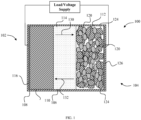
- Figure 1 depicts an embodiment of a lithium-ion cell 100, which includes a negative electrode 102 (anode), a positive electrode 104 (cathode), and a separator region 106 between the negative electrode 102 and the positive electrode 104.
- the negative electrode 102, positive electrode 104, and separator region 106 are contained within a pouch 108.
- the negative electrode 102 includes an active material plate 110, which includes active material into which lithium can be inserted along with inert materials, and a current collector 116.
- the separator region 106 includes an electrolyte 114 (including a catholyte region) with a lithium cation and serves as a physical and electrical barrier between the negative electrode 102 and the positive electrode 104, so that the electrodes are not electronically connected within the cell 100 while allowing transfer of lithium ions between the negative electrode 102 and the positive electrode 104.
- an electrolyte 114 including a catholyte region
- the separator region 106 includes an electrolyte 114 (including a catholyte region) with a lithium cation and serves as a physical and electrical barrier between the negative electrode 102 and the positive electrode 104, so that the electrodes are not electronically connected within the cell 100 while allowing transfer of lithium ions between the negative electrode 102 and the positive electrode 104.
- the positive electrode 104 includes a cathode layer as described herein and a current collector 126.
- the cathode current collector 126 is Al-foil.
- the solid electrolyte separator is: a) a solid polymer electrolyte, (block)-copolymer separator (e.g. polystyrene-poly(ethylene oxide) (PS-PEO)), and/or solid polyelectrolytes mixed optionally with ceramic powders or nanowires; b) a ceramic thin layer prepared such as by sputtering (e.g. lithium phosphorous oxy-nitride (LiPON)); or c) a "free standing" ceramic or glass ceramic layer (e.g. lithium aluminum titanium phosphate (LATP)).
- the separator can be some combination of these components (mixtures or alternating layers).
- the lithium-ion cell 100 operates in a manner similar to the lithium-ion battery cell disclosed in U.S. Patent No. 7,726,975, filed on June 28, 2006 .
- electrons are generated at the negative electrode 102 during discharging and an equal amount of electrons are consumed at the positive electrode 104 as lithium and electrons move in the direction of the arrow 130 of Figure 1 .
- the electrons are generated at the negative electrode 102 because there is extraction via oxidation of lithium ions from the active material 110 of the negative electrode 102, and the electrons are consumed at the positive electrode 104 because there is reduction of lithium ions into the active material 120 of the positive electrode 104.
- the reactions are reversed, with lithium and electrons moving in the direction of the arrow 132.
- a cell stack comprises (1) a cathode current collector, which may have an optional surface treatment (e.g., carbon coating); (2) a cathode layer as described herein; (3) a solid electrolyte separator; (4) an anode layer; and optionally (5) an anode current collector.
- the cathode electrolyte may be the same or different as the electrolyte separator and/or the anode electrolyte.
- the electrolyte separator may be the same or different as the anode electrolyte.
- the lithium-ion cell (battery) is preferably operated at voltages greater than 3.5 V.
- the negative electrode 102 may be provided in various alternative forms.
- the negative electrode 102 may incorporate dense Li metal or a Li metal alloy. Incorporation of Li metal is desired since the Li metal affords a higher specific energy than graphite.
- the anode layer is: a) lithium metal, an electronically conductive foil (such as copper) that may be covered by a thin layer of Li metal (e.g., less than 20 ⁇ m), or a 3D structure (e.g., copper foil with conductive fibers) filled with lithium metal; orb) a composite electrode consisting of a mixture of active material (e.g.
- PVDF polyvinylidene fluoride
- SBR styrenebutadiene rubber
- the anode current collector is Cu-foil, which is optionally surface treated.
- a cathode 104 comprises a functionalized cathode active material 120 as described herein, a Li-ion conducting electrolyte 112, and an electronically conductive additive 124.
- the conductive additive 124 is carbon black, carbon fiber, or graphite.
- the suitable cathode material comprises 1) a Li-intercalation material (such as lithium nickel cobalt aluminum oxide (NCA) or lithium nickel cobalt manganese oxide (NCM)); (2) a coating on the lithium intercalation material, comprising SiO 2 ; and (3) a silane compound which is bound to the coating via a covalent bond, wherein the silane compound is formed from (tridecafluoro-1,1,2,2-tetrahydrooctyl)trichlorosilane, trialkoxysilane, or (4-bromophenyl)trimethoxysilane.
- a Li-intercalation material such as lithium nickel cobalt aluminum oxide (NCA) or lithium nickel cobalt manganese oxide (NCM)
- a coating on the lithium intercalation material comprising SiO 2
- a silane compound which is bound to the coating via a covalent bond wherein the silane compound is formed from (tridecafluoro-1,1,2,2-tetrahydrooctyl
- the cathode composition comprises about 60 to about 85 weight percent or about 50 to about 70 weight percent cathode active material; up to about 15 weight percent or about 3 to about 10 weight percent conductive additive; and about 15 to about 35 weight percent or about 20 to about 40 weight percent electrolyte.
- the cathode may be prepared, for example, by a simple slurry process, mixing conductive additive and active material together with polymer and lithium salt in an adequate solvent, followed by doctor blading or tape casting the desired electrode.
- the cathode active material comprises lithium-insertion materials, such as a lithium metal oxide (Li x MO 0 ), where M is a transition metal, such as Ni, Co, Mn, and Al, and where x is from 0 to 1.
- Lithium Intercalation Material such as Li x MO 0 , where M is a transition metal, such as Ni, Co, Mn, and Al, and where x is from 0 to 1.
- lithium-insertion material lithium intercalation material
- Li-intercalation material Li-intercalation material
- Suitable lithium-insertion materials include lithium nickel manganese cobalt oxide (NMC) (LiNiMnCoO 2 ), lithium-rich NMC, lithium nickel manganese oxide (LiNi 0.5 Mm 1.5 O 4 ), lithium-rich layered oxides, lithium cobalt oxide (LiCoO 2 ), lithium iron phosphate (LiFePO 4 ), lithium manganese oxide (LiMn 2 O 4 ), lithium nickel cobalt aluminum oxide (NCA) (LiNiCoAlO 2 ), and combinations thereof.
- NCA or NCM811 (LiNi 0.8 Co 0.2 Mn 0.2 O) is coated with SiO 2 via atomic layer deposition, such as can be currently purchased from vendors like Pneumaticoat, Inc.
- SiO 2 is coated onto an active material via a wet chemical nanopowder approach, such as described in Journal of Power Sources 282 (2015) 45-50 .
- the SiO 2 -coated particles may be subsequently treated with oxygen plasma, UV-ozone, or with a Piranha-type solution (a mixture of sulfuric acid and hydrogen peroxide).
- This coated cathode material is then functionalized with tridecafluoro-1,1,2,2-tetrahydrooctyl)trichlorosilane, such as by exposure to an open vial or dish of this material in a shaking pan in a low vacuum (about or greater than 5 torr), or in a stirred solution of aqueous alcohol.
- the NCA or NCM811 is prepared with silica as described before.
- (4-bromophenyl)trimethoxysilane is attached to the silica-coated cathode powder.
- This material so coated can then be introduced to the reactions described in Humbeck et al., "Tetraarylborate polymer networks as single-ion conducting solid electrolytes," Chem. Sci. 2015, 6, 5499-5505 (DOI: 10.1039/c5sc02052b ) to polymerize active material into an arylborate-based Li-ion conducting network ( Figure 2 ).
- the subsequent product can be milled or ground if required to achieve a powder with a polymeric Li-ionic conductive coating bonded to a SiO 2 -coated NCA or NCM active material core.
- the coating on the lithium intercalation material comprises SiO 2 .
- the coating may have a thickness of up to about 500 nm.
- the coating may have a thickness of less than about 50 nm.
- the coating may have a thickness of less than about 25nm.
- the coating may have a thickness of about 0.1 to about 15 nm.
- the coating may have a thickness of about 0.1 to about 25 nm.
- All embodiments provide a silane compound bound to the coating.
- the silane compound is formed from tridecafluoro-1,1,2,2-tetrahydrooctyl)trichlorosilane, which can bond with SiO 2 following hydrolysis and provides a relatively voltage-stable, hydrophobic buffer layer; or the silane compound may be a trialkoxysilane capable of condensing to form a relatively voltage-stable polysiloxane on the particle surface; or the silane compound may be (4-bromophenyl)trimethoxysilane, which could similarly bond with SiO 2 via the silane and subsequently be subject to further reaction, e.g., with Sonogashira coupling, to Li-ion conducting polymers.
- the bond between the moiety and the coating is covalent.
- the moiety may be used to tune the voltage stability, surface energy, and/or interfacial resistance between the cathode material and the battery electrolyte (catholyte).
- catholyte refers to a portion of the electrolyte adjoining the cathode.
- the catholyte material can include, but is not limited to, polyethylene oxide (PEO), polyelectrolytes, sulfidic glass, etc.
- a sulfidic ceramic or glass e.g., Li 3 PS 4 , Li 10 GeP 2 S 12 , Li 7 P 2 S 8 I, or related compositions
- the Li-ion conducting electrolyte is a PEO or PEO-based polymer with a lithium salt, such as LiTFSI, or a single-ion conducting polymer, optionally containing a plasticizer, or a polyacrylonitrile (PAN)/Lithium salt (LiClO 4 ), or a polymer-ceramic composite such as PAN/lithium lanthanum titanium oxide (LLTO)/Li salt.
- a lithium salt such as LiTFSI
- a single-ion conducting polymer optionally containing a plasticizer, or a polyacrylonitrile (PAN)/Lithium salt (LiClO 4 ), or a polymer-ceramic composite such as PAN/lithium lanthanum titanium oxide (LLTO)/Li salt.
- electrolyte Various types are available, including solid polymers, glass-ceramic electrolytes, and other suitable electrolyte.
- One aspect provides a technology to create cathodes with high-V capability, high rate capability, and/or low capacity fade by adding a functionalizable substrate and a functional linker to common cathode active material particles.
- cathode materials and designs which can combine high energy density with high conductivity, low interfacial resistances, and high thermal and voltage stability.
- use of these cathodes may lead to increased discharge capacity, especially over time, because they are resistant to thermal, chemical, and/or electrochemical degradation mechanisms that trouble otherwise comparable materials.
- embodiments therefore affect an important component of the cell - enabling improved reversibility/rechargeability, roundtrip efficiency, energy, and life time of the cell.
- solid state batteries include a solid state Li-ion cell with a modified cathode material, which may possess a high chemical and voltage stability relative to a given catholyte.
- the cathode material may also have high lithium-ion areal conductance, and low interfacial impedance with both the active material particles and the electrolyte.
- the cathode material may also have favorable cost and manufacturability. Additionally, in certain embodiments, for achievement of high energy density, the volume and weight fraction of catholyte relative to active material must be kept small.
- the cathode provides superior performance in the form of:
Landscapes
- Chemical & Material Sciences (AREA)
- Chemical Kinetics & Catalysis (AREA)
- Electrochemistry (AREA)
- General Chemical & Material Sciences (AREA)
- Engineering & Computer Science (AREA)
- Manufacturing & Machinery (AREA)
- Inorganic Chemistry (AREA)
- Composite Materials (AREA)
- Physics & Mathematics (AREA)
- Condensed Matter Physics & Semiconductors (AREA)
- General Physics & Mathematics (AREA)
- Dispersion Chemistry (AREA)
- Materials Engineering (AREA)
- Secondary Cells (AREA)
- Battery Electrode And Active Subsutance (AREA)
Description
- Embodiments pertain to batteries. More particularly, embodiments pertain to linker-functionalized cathodes of solid state batteries, such as lithium-ion batteries.
- Current Li-ion cells are reaching their maximum energy storage capability (about 250 Wh/kg) and yet are still unable to provide a safe, low-cost battery with storage sufficient for electric vehicles with 100 or more mile ranges. A new generation of batteries with energy densities of at least 400 Wh/kg, low cost (less than $125/kWh), excellent safety, and low environmental impact is urgently needed.
- On safety and environmental fronts, solid state batterieps are among the highest performers. All-solid-state Li-ion batteries can possess high energy densities (greater than 400 Wh/kg) and very good safety properties due to the lack of liquid electrolyte. Up to now, key factors inhibiting the commercialization of solid-state-cells are the voltage and/or chemical instabilities of common solid electrolytes against oxidizing cathodes during cycling. These instabilities can be mitigated via use of a cathode particle coating.
- Most common coatings involve a simple layer of inorganic metal oxide processed by vapor phase deposition - such as physical vapor deposition (PVD), chemical vapor deposition (CVD), or atomic layer deposition (ALD) - or wet coating. Many function adequately, but the surface properties of these coatings are hard to control, and interfaces between these and catholyte systems are frequently highly resistive.
- Cho et al. (Journal of Power Sources Vol. 282, pp. 45-50 (2015)) discloses a surface coating of SiO2 applied to a LiNi0.6Co0.2Mn0.2O2 cathode material in a bid, through a wet process using nano-sized SiO2 powder.
- Hou et al. (Electrochemistry Communications Vol. 49, pp. 83-87 (2014)) discloses surface modification of Li-rich layered oxide particles with P2O5 through a gas-solid reaction.
-
US 2012/0021298 A1 discloses a positive electrode of a solid lithium ion secondary battery including core particles and a coated layer at least partially covering the surfaces of the core particles, wherein the core particles comprise a layered lithium composite oxide and the coated layer comprises a metal compound. -
US 2016/0301063 A1 discloses a method for producing surface-treated oxide particles which can be used in an active-material layer for a positive electrode or a negative electrode in a storage battery, oxide particles in which an alkaline compound is contained in a part or the whole area of the surface of each of the particles are brought into contact with a gas containing a volatile acidic compound to produce a neutralization product by a gas phase reaction, thereby producing surface treated oxide particles in which the neutralization product is contained. -
WO 2015/190250 A1 discloses lithium-nickel composite oxide particles coated with a polymer or copolymer comprising one or more types selected from a group consisting of a modified polyolefin resin, a polyester resin, a polyphenol resin, a polyurethane resin, an epoxy resin, a silane-modified polyether resin, a silane-modified polyester resin, a silane-modified polyphenol resin, a silane-modified polyurethane resin, a silane-modified epoxy resin, and a silane-modified polyamide resin, for use in a lithium-ion battery positive electrode active material. -
US 2013/0302681 A1 discloses a cathode active material comprising a lithium nickel manganese composite oxide with a spinel structure, wherein the cathode active material is surface-coated with a silane compound. - Hexamethyldisilazane is a well-known compound.
-
US 2014/050980 A1 discloses a negative electrode active material comprising a core including a carbon-based material, and an organic polymer coating layer formed of a polymer compound. - The present invention provides a cathode active material according to claim 1, a solid state or gel battery according to
claim 6, and usage of the battery according toclaim 8. -
-
FIG.1 shows a schematic drawing of a lithium-ion cell according to the present disclosure. -
FIG. 2 shows a synthetic approach to a first generation solid lithium electrolyte based on a (proteo)phenylborate monomer. The depicted reaction scheme can be used for tetraarylborate Li-ionic conductor polymerization. - Before any embodiments are explained in detail, it is to be understood that embodiments are not limited in their application to the details of construction and the arrangement of components set forth in the following description or illustrated in the following drawings. Other embodiments are possible and capable of being practiced or of being carried out in various ways.
- Unless otherwise defined, all technical and scientific terms used herein have the same meaning as commonly understood by one of ordinary skill in the art. In case of conflict, the present document, including definitions, will control. Preferred methods and materials are described below, although methods and materials similar or equivalent to those described herein can be used in practice or testing of embodiments. The materials, methods, and examples disclosed herein are illustrative only and not intended to be limiting.
- The terms "comprise(s)," "include(s)," "having," "has," "can," "contain(s)," and variants thereof, as used herein, are intended to be open-ended transitional phrases, terms, or words that do not preclude the possibility of additional acts or structures. The singular forms "a," "an" and "the" include plural references unless the context clearly dictates otherwise. The present disclosure also contemplates other embodiments "comprising," "consisting of" and "consisting essentially of," the embodiments or elements presented herein, whether explicitly set forth or not.
- The modifier "about" used in connection with a quantity is inclusive of the stated value and has the meaning dictated by the context (for example, it includes at least the degree of error associated with the measurement of the particular quantity). The modifier "about" should also be considered as disclosing the range defined by the absolute values of the two endpoints. For example, the expression "from about 2 to about 4" also discloses the range "from 2 to 4." The term "about" may refer to plus or minus 10% of the indicated number. For example, "about 10%" may indicate a range of 9% to 11%, and "about 1" may mean from 0.9-1.1. Other meanings of "about" may be apparent from the context, such as rounding off, so, for example "about 1" may also mean from 0.5 to 1.4.
- The conjunctive term "or" includes any and all combinations of one or more listed elements associated by the conjunctive term. For example, the phrase "an apparatus comprising A or B" may refer to an apparatus including A where B is not present, an apparatus including B where A is not present, or an apparatus where both A and B are present. The phrase "at least one of A, B,...and N" or "at least one of A, B,...N, or combinations thereof' are defined in the broadest sense to mean one or more elements selected from the group comprising A, B,...and N, that is to say, any combination of one or more elements A, B,...or N including any one element alone or in combination with one or more of the other elements, which may also include, in combination, additional elements not listed.
- For purposes of this disclosure, the chemical elements are identified in accordance with the Periodic Table of the Elements (CAS version), and the Handbook of Chemistry and Physics (98th Ed., inside cover).
- In one aspect, embodiments relate to solid state batteries, in particular to solid state batteries with soft (e.g., polymeric or sulfidic) electrolytes. In another aspect, a battery made from the active materials described herein is provided.
-
Figure 1 depicts an embodiment of a lithium-ion cell 100, which includes a negative electrode 102 (anode), a positive electrode 104 (cathode), and aseparator region 106 between thenegative electrode 102 and thepositive electrode 104. Thenegative electrode 102,positive electrode 104, andseparator region 106 are contained within apouch 108. Thenegative electrode 102 includes anactive material plate 110, which includes active material into which lithium can be inserted along with inert materials, and acurrent collector 116. - In one embodiment, the
separator region 106 includes an electrolyte 114 (including a catholyte region) with a lithium cation and serves as a physical and electrical barrier between thenegative electrode 102 and thepositive electrode 104, so that the electrodes are not electronically connected within thecell 100 while allowing transfer of lithium ions between thenegative electrode 102 and thepositive electrode 104. - In another embodiment, the
positive electrode 104 includes a cathode layer as described herein and acurrent collector 126. In certain embodiments, the cathodecurrent collector 126 is Al-foil. - In certain embodiments, the solid electrolyte separator is: a) a solid polymer electrolyte, (block)-copolymer separator (e.g. polystyrene-poly(ethylene oxide) (PS-PEO)), and/or solid polyelectrolytes mixed optionally with ceramic powders or nanowires; b) a ceramic thin layer prepared such as by sputtering (e.g. lithium phosphorous oxy-nitride (LiPON)); or c) a "free standing" ceramic or glass ceramic layer (e.g. lithium aluminum titanium phosphate (LATP)). The separator can be some combination of these components (mixtures or alternating layers).
- The lithium-
ion cell 100 operates in a manner similar to the lithium-ion battery cell disclosed inU.S. Patent No. 7,726,975, filed on June 28, 2006 . In general, electrons are generated at thenegative electrode 102 during discharging and an equal amount of electrons are consumed at thepositive electrode 104 as lithium and electrons move in the direction of thearrow 130 ofFigure 1 . - In the ideal discharging of the
cell 100, the electrons are generated at thenegative electrode 102 because there is extraction via oxidation of lithium ions from theactive material 110 of thenegative electrode 102, and the electrons are consumed at thepositive electrode 104 because there is reduction of lithium ions into theactive material 120 of thepositive electrode 104. During discharging, the reactions are reversed, with lithium and electrons moving in the direction of thearrow 132. - In yet another embodiment, a cell stack comprises (1) a cathode current collector, which may have an optional surface treatment (e.g., carbon coating); (2) a cathode layer as described herein; (3) a solid electrolyte separator; (4) an anode layer; and optionally (5) an anode current collector. In certain embodiments, the cathode electrolyte may be the same or different as the electrolyte separator and/or the anode electrolyte. In certain embodiments, the electrolyte separator may be the same or different as the anode electrolyte.
- In certain embodiments, the lithium-ion cell (battery) is preferably operated at voltages greater than 3.5 V.
- In one embodiment, the
negative electrode 102 may be provided in various alternative forms. For example, thenegative electrode 102 may incorporate dense Li metal or a Li metal alloy. Incorporation of Li metal is desired since the Li metal affords a higher specific energy than graphite. - In certain embodiments, the anode layer is: a) lithium metal, an electronically conductive foil (such as copper) that may be covered by a thin layer of Li metal (e.g., less than 20 µm), or a 3D structure (e.g., copper foil with conductive fibers) filled with lithium metal; orb) a composite electrode consisting of a mixture of active material (e.g. graphite, hard carbon, Li4Ti5O12, Si, Sn, or intermetallic compounds), an ionically conductive electrolyte (e.g., solid or liquid electrolytes described below), and/or an electronically conductive additive (as described below), and optionally polymeric binder (e.g., polyvinylidene fluoride (PVDF) or styrenebutadiene rubber (SBR)).
- In some embodiments, the anode current collector is Cu-foil, which is optionally surface treated.
- In certain embodiments, a
cathode 104 comprises a functionalized cathodeactive material 120 as described herein, a Li-ion conducting electrolyte 112, and an electronicallyconductive additive 124. In certain embodiments, theconductive additive 124 is carbon black, carbon fiber, or graphite. - The suitable cathode material comprises 1) a Li-intercalation material (such as lithium nickel cobalt aluminum oxide (NCA) or lithium nickel cobalt manganese oxide (NCM)); (2) a coating on the lithium intercalation material, comprising SiO2; and (3) a silane compound which is bound to the coating via a covalent bond, wherein the silane compound is formed from (tridecafluoro-1,1,2,2-tetrahydrooctyl)trichlorosilane, trialkoxysilane, or (4-bromophenyl)trimethoxysilane.
- In certain embodiments, the cathode composition comprises about 60 to about 85 weight percent or about 50 to about 70 weight percent cathode active material; up to about 15 weight percent or about 3 to about 10 weight percent conductive additive; and about 15 to about 35 weight percent or about 20 to about 40 weight percent electrolyte.
- The cathode may be prepared, for example, by a simple slurry process, mixing conductive additive and active material together with polymer and lithium salt in an adequate solvent, followed by doctor blading or tape casting the desired electrode.
- The cathode active material comprises lithium-insertion materials, such as a lithium metal oxide (Li x MO0), where M is a transition metal, such as Ni, Co, Mn, and Al, and where x is from 0 to 1. Lithium Intercalation Material
- The terms "lithium-insertion material," "lithium intercalation material," and "Li-intercalation material" are used interchangeably herein.
- Suitable lithium-insertion materials include lithium nickel manganese cobalt oxide (NMC) (LiNiMnCoO2), lithium-rich NMC, lithium nickel manganese oxide (LiNi0.5Mm1.5O4), lithium-rich layered oxides, lithium cobalt oxide (LiCoO2), lithium iron phosphate (LiFePO4), lithium manganese oxide (LiMn2O4), lithium nickel cobalt aluminum oxide (NCA) (LiNiCoAlO2), and combinations thereof.
- In a particular embodiment, NCA or NCM811 (LiNi0.8Co0.2Mn0.2O) is coated with SiO2 via atomic layer deposition, such as can be currently purchased from vendors like Pneumaticoat, Inc. In another embodiment, SiO2 is coated onto an active material via a wet chemical nanopowder approach, such as described in Journal of Power Sources 282 (2015) 45-50.
- To improve the hydroxyl density of the SiO2 surface, the SiO2-coated particles may be subsequently treated with oxygen plasma, UV-ozone, or with a Piranha-type solution (a mixture of sulfuric acid and hydrogen peroxide). This coated cathode material is then functionalized with tridecafluoro-1,1,2,2-tetrahydrooctyl)trichlorosilane, such as by exposure to an open vial or dish of this material in a shaking pan in a low vacuum (about or greater than 5 torr), or in a stirred solution of aqueous alcohol.
- In a particular embodiment, the NCA or NCM811 is prepared with silica as described before. However, instead of the fluorinated alkyl silane, (4-bromophenyl)trimethoxysilane is attached to the silica-coated cathode powder. This material so coated can then be introduced to the reactions described in Humbeck et al., "Tetraarylborate polymer networks as single-ion conducting solid electrolytes," Chem. Sci. 2015, 6, 5499-5505 (DOI: 10.1039/c5sc02052b) to polymerize active material into an arylborate-based Li-ion conducting network (
Figure 2 ). The subsequent product can be milled or ground if required to achieve a powder with a polymeric Li-ionic conductive coating bonded to a SiO2-coated NCA or NCM active material core. - The coating on the lithium intercalation material comprises SiO2.
- In certain embodiments, the coating may have a thickness of up to about 500 nm. The coating may have a thickness of less than about 50 nm. The coating may have a thickness of less than about 25nm. The coating may have a thickness of about 0.1 to about 15 nm. The coating may have a thickness of about 0.1 to about 25 nm.
- All embodiments provide a silane compound bound to the coating.
- The silane compound is formed from tridecafluoro-1,1,2,2-tetrahydrooctyl)trichlorosilane, which can bond with SiO2 following hydrolysis and provides a relatively voltage-stable, hydrophobic buffer layer; or the silane compound may be a trialkoxysilane capable of condensing to form a relatively voltage-stable polysiloxane on the particle surface; or the silane compound may be (4-bromophenyl)trimethoxysilane, which could similarly bond with SiO2 via the silane and subsequently be subject to further reaction, e.g., with Sonogashira coupling, to Li-ion conducting polymers.
- Suitably, the bond between the moiety and the coating is covalent. In certain embodiments, the moiety may be used to tune the voltage stability, surface energy, and/or interfacial resistance between the cathode material and the battery electrolyte (catholyte).
- As used herein, catholyte refers to a portion of the electrolyte adjoining the cathode. The catholyte material can include, but is not limited to, polyethylene oxide (PEO), polyelectrolytes, sulfidic glass, etc.
- In certain embodiments, the Li-ion conducting electrolyte is a sulfidic ceramic or glass (e.g., Li3PS4, Li10GeP2S12, Li7P2S8I, or related compositions), an oxide ceramic (e.g., (Li,La)TiO3, LiMIV2(PO4)3 (MIV=Ti, Zr, Ge), Li5La3M2O12 (M=transition metal)), or polymer-based (e.g., PEO with bis(trifluoromethane)sulfonimide lithium salt (LiTFSI) in a concentration range between 0.1 and 2 M), or combinations of the above.
- Suitably the Li-ion conducting electrolyte is a PEO or PEO-based polymer with a lithium salt, such as LiTFSI, or a single-ion conducting polymer, optionally containing a plasticizer, or a polyacrylonitrile (PAN)/Lithium salt (LiClO4), or a polymer-ceramic composite such as PAN/lithium lanthanum titanium oxide (LLTO)/Li salt.
- Various types of electrolyte are available, including solid polymers, glass-ceramic electrolytes, and other suitable electrolyte.
- One aspect provides a technology to create cathodes with high-V capability, high rate capability, and/or low capacity fade by adding a functionalizable substrate and a functional linker to common cathode active material particles.
- Another aspect provides several cathode materials and designs, which can combine high energy density with high conductivity, low interfacial resistances, and high thermal and voltage stability. Without wanting to be limited by theory, use of these cathodes may lead to increased discharge capacity, especially over time, because they are resistant to thermal, chemical, and/or electrochemical degradation mechanisms that trouble otherwise comparable materials. In another aspect, embodiments therefore affect an important component of the cell - enabling improved reversibility/rechargeability, roundtrip efficiency, energy, and life time of the cell.
- In a particular embodiment, solid state batteries according to the present disclosure include a solid state Li-ion cell with a modified cathode material, which may possess a high chemical and voltage stability relative to a given catholyte. The cathode material may also have high lithium-ion areal conductance, and low interfacial impedance with both the active material particles and the electrolyte. The cathode material may also have favorable cost and manufacturability. Additionally, in certain embodiments, for achievement of high energy density, the volume and weight fraction of catholyte relative to active material must be kept small.
- In a particular embodiment, without wanting to be limited by theory, the cathode provides superior performance in the form of:
- (1) high energy density - such as a gravimetric energy density greater than about 700 Wh/kg at the material level and/or greater than about 250 Wh/kg at the cell level; and/or volumetric energy density greater than about 3000 Wh/L at the material level and/or greater than about 700 Wh/L at the cell level - and/or high rate capability - such as greater than about 1 C pulse discharge (10 seconds at 20% state of charge (SOC)) capability and/or charging to 75% SOC in less than about 30 minutes, suitably greater than about 3 C pulse discharge capability and/or charging to 75% SOC in less than about 15 minutes - due to low interfacial resistance between a catholyte and an active material; and/or
- (2) high cycle life - such as greater than about 500 cycles with at least about 80% of the initial cell capacity retained, more suitably, greater than about 2000 cycles with at least about 80% of the initial cell capacity retained - due to reduced voltage-induced degradation of polymeric catholytes.
- Various features, advantages, and embodiments are set forth in the following claims.
Claims (8)
- A cathode active material (120) comprising:(1) a lithium intercalation material;(2) a coating on the lithium intercalation material, comprising SiO2; and(3) a silane compound which is bound to the coating via a covalent bond, wherein the silane compound is formed from (tridecafluoro-1,1,2,2-tetrahydrooctyl)trichlorosilane, trialkoxysilane, or (4-bromophenyl)trimethoxysilane.
- The cathode active material (120) of claim 1, wherein the lithium intercalation material is selected from lithium nickel cobalt aluminum oxide (NCA) and lithium nickel cobalt manganese oxide (NCM).
- The cathode active material (120) of claim 1, wherein the lithium intercalation material is coated partially or fully with silica.
- The cathode active material (120) of claim 1, wherein the coating has a thickness of 0.1 to 15 nm.
- The cathode active material (120) of claim 1, wherein the coating has functional groups formed by treatment with oxygen plasma, UV-ozone, or a Piranha-type solution.
- A solid state or gel battery (100) comprising the cathode active material (120) of claim 1.
- The battery (100) of claim 6, further comprising a polymeric electrolyte (114).
- Usage of the battery (100) of claim 6, for operation at voltages greater than 3.5V.
Applications Claiming Priority (2)
| Application Number | Priority Date | Filing Date | Title |
|---|---|---|---|
| US201662431007P | 2016-12-07 | 2016-12-07 | |
| PCT/EP2017/081776 WO2018104423A1 (en) | 2016-12-07 | 2017-12-07 | Linker-functionalized cathodes for solid state batteries |
Publications (2)
| Publication Number | Publication Date |
|---|---|
| EP3552260A1 EP3552260A1 (en) | 2019-10-16 |
| EP3552260B1 true EP3552260B1 (en) | 2023-10-11 |
Family
ID=60582605
Family Applications (1)
| Application Number | Title | Priority Date | Filing Date |
|---|---|---|---|
| EP17809307.6A Active EP3552260B1 (en) | 2016-12-07 | 2017-12-07 | Linker-functionalized cathodes for solid state batteries |
Country Status (4)
| Country | Link |
|---|---|
| US (1) | US20180159182A1 (en) |
| EP (1) | EP3552260B1 (en) |
| CN (1) | CN110235287B (en) |
| WO (1) | WO2018104423A1 (en) |
Families Citing this family (7)
| Publication number | Priority date | Publication date | Assignee | Title |
|---|---|---|---|---|
| DE102018114009A1 (en) * | 2018-06-12 | 2019-12-12 | Volkswagen Aktiengesellschaft | Active material body for a rechargeable battery |
| WO2020047540A1 (en) * | 2018-08-31 | 2020-03-05 | The Trustees Of Columbia University In The City Of New York | Nanoscale interfacial coating for stabilizing electrolyte with high-voltage cathode |
| US10826127B2 (en) * | 2018-09-29 | 2020-11-03 | International Business Machines Corporation | Composite separator for lithium metal batteries |
| CN114868277B (en) * | 2019-12-26 | 2024-09-17 | 松下知识产权经营株式会社 | Electrode for nonaqueous electrolyte secondary battery and nonaqueous electrolyte secondary battery |
| CN111434618B (en) * | 2020-01-17 | 2022-07-22 | 蜂巢能源科技有限公司 | Cobalt-free layered positive electrode material, preparation method and lithium ion battery |
| WO2022040236A1 (en) * | 2020-08-19 | 2022-02-24 | The Regents Of The University Of California | Free-standing lithium phosphorus oxynitride thin films and methods of their manufacture |
| CN114024023B (en) * | 2021-10-21 | 2024-06-04 | 中国科学院上海硅酸盐研究所 | All-solid-state lithium metal battery with high-strength high-conductivity anode coupling interface |
Family Cites Families (22)
| Publication number | Priority date | Publication date | Assignee | Title |
|---|---|---|---|---|
| US7726975B2 (en) | 2006-06-28 | 2010-06-01 | Robert Bosch Gmbh | Lithium reservoir system and method for rechargeable lithium ion batteries |
| FR2952384B1 (en) * | 2009-11-10 | 2012-12-14 | Commissariat Energie Atomique | SELECTIVE DEPOSITION OF NANOPARTICLES |
| CN102770991A (en) * | 2010-02-24 | 2012-11-07 | 日立麦克赛尔能源株式会社 | Positive electrode material, method of production therefor, positive electrode for nonaqueous rechargeable battery, and nonaqueous rechargeable battery |
| KR20120010552A (en) * | 2010-07-26 | 2012-02-03 | 삼성전자주식회사 | Solid lithium lithium ion secondary batteries and electrodes that can be used |
| US9450223B2 (en) * | 2012-02-06 | 2016-09-20 | Samsung Sdi Co., Ltd. | Lithium secondary battery |
| US9325000B2 (en) * | 2012-04-18 | 2016-04-26 | Lg Chem, Ltd. | Cathode active material and the secondary battery comprising the same |
| KR101511822B1 (en) * | 2012-05-30 | 2015-04-13 | 주식회사 엘지화학 | Negative active material for lithium battery and battery comprising the same |
| CN103474666B (en) * | 2013-07-23 | 2016-03-02 | 江苏华东锂电技术研究院有限公司 | The preparation method of lithium ion battery anode active material |
| US9692041B2 (en) * | 2013-10-02 | 2017-06-27 | Samsung Electronics Co., Ltd. | Lithium battery and method of preparing cathode active material for the lithium battery |
| KR101816945B1 (en) * | 2013-10-29 | 2018-01-09 | 주식회사 엘지화학 | Cathode active material, preparation method thereof, and lithium secondary battery comprising the same |
| KR101774516B1 (en) * | 2013-10-31 | 2017-09-04 | 주식회사 엘지화학 | A method for manufacturing cathode, a cathode manufactured thereby and a lithium secondary battery including the same |
| US9627680B2 (en) * | 2013-11-15 | 2017-04-18 | Sumitomo Metal Mining Co., Ltd. | Method for producing surface-treated oxide particles, and oxide particles produced by said production method |
| KR102273772B1 (en) * | 2014-05-21 | 2021-07-06 | 삼성에스디아이 주식회사 | Composite cathode active material, lithium battery comprising the same, and preparation method thereof |
| EP3528324B1 (en) * | 2014-06-12 | 2021-11-17 | Sumitomo Metal Mining Co., Ltd. | Coated lithium-nickel composite oxide particles and method for producing coated lithium-nickel composite oxide particles |
| KR102280682B1 (en) * | 2014-09-15 | 2021-07-22 | 삼성전자주식회사 | Cathode and lithium air battery comprising the cathode, and preparation method thereof |
| JP2016062829A (en) * | 2014-09-19 | 2016-04-25 | 株式会社東芝 | Negative electrode material for nonaqueous electrolyte secondary battery, negative electrode for nonaqueous electrolyte secondary battery, nonaqueous electrolyte secondary battery, and battery pack |
| US20160149263A1 (en) * | 2014-11-26 | 2016-05-26 | Johnson Controls Technology Company | Lithium ion electrolytes with lifsi for improved wide operating temperature range |
| TWI581484B (en) * | 2014-12-31 | 2017-05-01 | 財團法人工業技術研究院 | A battery electrode paste composition |
| KR102368363B1 (en) * | 2015-01-30 | 2022-03-02 | 주식회사 엘 앤 에프 | Positive active material for rechargeable lithium battery, method of preparing the same, and rechargeable lithium battery including the same |
| WO2016210371A1 (en) * | 2015-06-24 | 2016-12-29 | Quantumscape Corporation | Composite electrolytes |
| KR102556588B1 (en) * | 2015-11-11 | 2023-07-17 | 스미또모 가가꾸 가부시끼가이샤 | Manufacturing method of positive electrode active material, positive electrode active material, positive electrode and lithium ion secondary battery |
| KR102617728B1 (en) * | 2016-09-30 | 2023-12-27 | 삼성전자주식회사 | Negative electrode for lithium secondary battery and lithium secondary battery including the same |
-
2017
- 2017-12-06 US US15/833,417 patent/US20180159182A1/en not_active Abandoned
- 2017-12-07 WO PCT/EP2017/081776 patent/WO2018104423A1/en not_active Ceased
- 2017-12-07 EP EP17809307.6A patent/EP3552260B1/en active Active
- 2017-12-07 CN CN201780085776.XA patent/CN110235287B/en active Active
Also Published As
| Publication number | Publication date |
|---|---|
| CN110235287B (en) | 2024-09-03 |
| WO2018104423A1 (en) | 2018-06-14 |
| EP3552260A1 (en) | 2019-10-16 |
| US20180159182A1 (en) | 2018-06-07 |
| CN110235287A (en) | 2019-09-13 |
Similar Documents
| Publication | Publication Date | Title |
|---|---|---|
| EP3552260B1 (en) | Linker-functionalized cathodes for solid state batteries | |
| JP7041804B2 (en) | Electrodes for all-solid-state batteries containing solid electrolytes | |
| US20230071080A1 (en) | Electrode compositions | |
| CN109326770B (en) | Conformal coating of lithium anodes for rechargeable lithium-ion batteries by vapor deposition | |
| CN109565035B (en) | Manufacturing method of electrode comprising polymer electrolyte and electrode obtained therefrom | |
| KR102247502B1 (en) | Composite cathode active material, preparation method thereof, and lithium battery comprising the same | |
| CN111799439B (en) | Lithium ion battery | |
| CN107394120A (en) | Sulfide solid electrolyte material, positive electrode and battery | |
| CN112602208B (en) | Electrode for all-solid-state battery and method of manufacturing electrode assembly including same | |
| HK1215757A1 (en) | Positive electrode for a lithium battery | |
| CN112652756B (en) | In-situ polymerization protection lithium metal electrode | |
| KR20190017047A (en) | Cathode composition, method for manufacturing cathode, and lithium ion battery | |
| TW201630233A (en) | Anode material for lithium ion battery pack and method of manufacturing and using same | |
| JP6000243B2 (en) | Lithium electrochemical accumulator with bipolar structure operating based on a pair of lithium sulfur compound electrodes | |
| CN102947974A (en) | Lithium electrochemical accumulator having a specific bipolar architecture | |
| US20250183479A1 (en) | Separator for electrochemical device, and electrochemical device having same | |
| KR20200050627A (en) | Composite Electrode Including Gel-Type Polymer Electrolyte for All-Solid-State Battery, Method Of Manufacturing The Same, And All-Solid-State Lithium Battery Comprising The Same | |
| KR101340924B1 (en) | Method for modification of a lithiated oxide comprising at least one transition metal positive electrode comprising said oxide and lithium battery | |
| JP2017147194A (en) | Nonaqueous electrolyte secondary battery | |
| EP3695452B1 (en) | Ceramic-polymer composite single ion conducting thin film electrolyte | |
| WO2020184125A1 (en) | Non-aqueous electrolyte power storage element and power storage device | |
| Koller et al. | Next-generation materials for electrochemical energy storage–silicon and magnesium | |
| EP4239715B1 (en) | Lithium secondary battery | |
| JP2025095264A (en) | Lithium-ion secondary battery | |
| KR20260028417A (en) | An electrode composition for printing, an electrode for an electrochemical device comprising the same and an electrochemical device comprising the same |
Legal Events
| Date | Code | Title | Description |
|---|---|---|---|
| STAA | Information on the status of an ep patent application or granted ep patent |
Free format text: STATUS: UNKNOWN |
|
| STAA | Information on the status of an ep patent application or granted ep patent |
Free format text: STATUS: THE INTERNATIONAL PUBLICATION HAS BEEN MADE |
|
| PUAI | Public reference made under article 153(3) epc to a published international application that has entered the european phase |
Free format text: ORIGINAL CODE: 0009012 |
|
| STAA | Information on the status of an ep patent application or granted ep patent |
Free format text: STATUS: REQUEST FOR EXAMINATION WAS MADE |
|
| 17P | Request for examination filed |
Effective date: 20190708 |
|
| AK | Designated contracting states |
Kind code of ref document: A1 Designated state(s): AL AT BE BG CH CY CZ DE DK EE ES FI FR GB GR HR HU IE IS IT LI LT LU LV MC MK MT NL NO PL PT RO RS SE SI SK SM TR |
|
| AX | Request for extension of the european patent |
Extension state: BA ME |
|
| DAV | Request for validation of the european patent (deleted) | ||
| DAX | Request for extension of the european patent (deleted) | ||
| RAP1 | Party data changed (applicant data changed or rights of an application transferred) |
Owner name: ROBERT BOSCH GMBH |
|
| STAA | Information on the status of an ep patent application or granted ep patent |
Free format text: STATUS: EXAMINATION IS IN PROGRESS |
|
| 17Q | First examination report despatched |
Effective date: 20210902 |
|
| GRAP | Despatch of communication of intention to grant a patent |
Free format text: ORIGINAL CODE: EPIDOSNIGR1 |
|
| STAA | Information on the status of an ep patent application or granted ep patent |
Free format text: STATUS: GRANT OF PATENT IS INTENDED |
|
| RIC1 | Information provided on ipc code assigned before grant |
Ipc: H01M 10/0565 20100101ALI20230405BHEP Ipc: H01M 10/0562 20100101ALI20230405BHEP Ipc: H01M 10/052 20100101ALI20230405BHEP Ipc: H01M 4/62 20060101ALI20230405BHEP Ipc: H01M 4/525 20100101ALI20230405BHEP Ipc: H01M 4/505 20100101ALI20230405BHEP Ipc: H01M 4/36 20060101AFI20230405BHEP |
|
| INTG | Intention to grant announced |
Effective date: 20230504 |
|
| GRAS | Grant fee paid |
Free format text: ORIGINAL CODE: EPIDOSNIGR3 |
|
| GRAA | (expected) grant |
Free format text: ORIGINAL CODE: 0009210 |
|
| STAA | Information on the status of an ep patent application or granted ep patent |
Free format text: STATUS: THE PATENT HAS BEEN GRANTED |
|
| AK | Designated contracting states |
Kind code of ref document: B1 Designated state(s): AL AT BE BG CH CY CZ DE DK EE ES FI FR GB GR HR HU IE IS IT LI LT LU LV MC MK MT NL NO PL PT RO RS SE SI SK SM TR |
|
| REG | Reference to a national code |
Ref country code: GB Ref legal event code: FG4D |
|
| REG | Reference to a national code |
Ref country code: CH Ref legal event code: EP |
|
| REG | Reference to a national code |
Ref country code: DE Ref legal event code: R096 Ref document number: 602017075257 Country of ref document: DE |
|
| REG | Reference to a national code |
Ref country code: IE Ref legal event code: FG4D |
|
| REG | Reference to a national code |
Ref country code: LT Ref legal event code: MG9D |
|
| REG | Reference to a national code |
Ref country code: NL Ref legal event code: MP Effective date: 20231011 |
|
| REG | Reference to a national code |
Ref country code: AT Ref legal event code: MK05 Ref document number: 1621123 Country of ref document: AT Kind code of ref document: T Effective date: 20231011 |
|
| PG25 | Lapsed in a contracting state [announced via postgrant information from national office to epo] |
Ref country code: NL Free format text: LAPSE BECAUSE OF FAILURE TO SUBMIT A TRANSLATION OF THE DESCRIPTION OR TO PAY THE FEE WITHIN THE PRESCRIBED TIME-LIMIT Effective date: 20231011 |
|
| PG25 | Lapsed in a contracting state [announced via postgrant information from national office to epo] |
Ref country code: GR Free format text: LAPSE BECAUSE OF FAILURE TO SUBMIT A TRANSLATION OF THE DESCRIPTION OR TO PAY THE FEE WITHIN THE PRESCRIBED TIME-LIMIT Effective date: 20240112 |
|
| PG25 | Lapsed in a contracting state [announced via postgrant information from national office to epo] |
Ref country code: IS Free format text: LAPSE BECAUSE OF FAILURE TO SUBMIT A TRANSLATION OF THE DESCRIPTION OR TO PAY THE FEE WITHIN THE PRESCRIBED TIME-LIMIT Effective date: 20240211 |
|
| PG25 | Lapsed in a contracting state [announced via postgrant information from national office to epo] |
Ref country code: LT Free format text: LAPSE BECAUSE OF FAILURE TO SUBMIT A TRANSLATION OF THE DESCRIPTION OR TO PAY THE FEE WITHIN THE PRESCRIBED TIME-LIMIT Effective date: 20231011 |
|
| PG25 | Lapsed in a contracting state [announced via postgrant information from national office to epo] |
Ref country code: AT Free format text: LAPSE BECAUSE OF FAILURE TO SUBMIT A TRANSLATION OF THE DESCRIPTION OR TO PAY THE FEE WITHIN THE PRESCRIBED TIME-LIMIT Effective date: 20231011 |
|
| PG25 | Lapsed in a contracting state [announced via postgrant information from national office to epo] |
Ref country code: ES Free format text: LAPSE BECAUSE OF FAILURE TO SUBMIT A TRANSLATION OF THE DESCRIPTION OR TO PAY THE FEE WITHIN THE PRESCRIBED TIME-LIMIT Effective date: 20231011 |
|
| PG25 | Lapsed in a contracting state [announced via postgrant information from national office to epo] |
Ref country code: LT Free format text: LAPSE BECAUSE OF FAILURE TO SUBMIT A TRANSLATION OF THE DESCRIPTION OR TO PAY THE FEE WITHIN THE PRESCRIBED TIME-LIMIT Effective date: 20231011 Ref country code: IS Free format text: LAPSE BECAUSE OF FAILURE TO SUBMIT A TRANSLATION OF THE DESCRIPTION OR TO PAY THE FEE WITHIN THE PRESCRIBED TIME-LIMIT Effective date: 20240211 Ref country code: GR Free format text: LAPSE BECAUSE OF FAILURE TO SUBMIT A TRANSLATION OF THE DESCRIPTION OR TO PAY THE FEE WITHIN THE PRESCRIBED TIME-LIMIT Effective date: 20240112 Ref country code: ES Free format text: LAPSE BECAUSE OF FAILURE TO SUBMIT A TRANSLATION OF THE DESCRIPTION OR TO PAY THE FEE WITHIN THE PRESCRIBED TIME-LIMIT Effective date: 20231011 Ref country code: BG Free format text: LAPSE BECAUSE OF FAILURE TO SUBMIT A TRANSLATION OF THE DESCRIPTION OR TO PAY THE FEE WITHIN THE PRESCRIBED TIME-LIMIT Effective date: 20240111 Ref country code: AT Free format text: LAPSE BECAUSE OF FAILURE TO SUBMIT A TRANSLATION OF THE DESCRIPTION OR TO PAY THE FEE WITHIN THE PRESCRIBED TIME-LIMIT Effective date: 20231011 Ref country code: PT Free format text: LAPSE BECAUSE OF FAILURE TO SUBMIT A TRANSLATION OF THE DESCRIPTION OR TO PAY THE FEE WITHIN THE PRESCRIBED TIME-LIMIT Effective date: 20240212 |
|
| PG25 | Lapsed in a contracting state [announced via postgrant information from national office to epo] |
Ref country code: SE Free format text: LAPSE BECAUSE OF FAILURE TO SUBMIT A TRANSLATION OF THE DESCRIPTION OR TO PAY THE FEE WITHIN THE PRESCRIBED TIME-LIMIT Effective date: 20231011 Ref country code: RS Free format text: LAPSE BECAUSE OF FAILURE TO SUBMIT A TRANSLATION OF THE DESCRIPTION OR TO PAY THE FEE WITHIN THE PRESCRIBED TIME-LIMIT Effective date: 20231011 Ref country code: PL Free format text: LAPSE BECAUSE OF FAILURE TO SUBMIT A TRANSLATION OF THE DESCRIPTION OR TO PAY THE FEE WITHIN THE PRESCRIBED TIME-LIMIT Effective date: 20231011 Ref country code: NO Free format text: LAPSE BECAUSE OF FAILURE TO SUBMIT A TRANSLATION OF THE DESCRIPTION OR TO PAY THE FEE WITHIN THE PRESCRIBED TIME-LIMIT Effective date: 20240111 Ref country code: LV Free format text: LAPSE BECAUSE OF FAILURE TO SUBMIT A TRANSLATION OF THE DESCRIPTION OR TO PAY THE FEE WITHIN THE PRESCRIBED TIME-LIMIT Effective date: 20231011 Ref country code: HR Free format text: LAPSE BECAUSE OF FAILURE TO SUBMIT A TRANSLATION OF THE DESCRIPTION OR TO PAY THE FEE WITHIN THE PRESCRIBED TIME-LIMIT Effective date: 20231011 |
|
| PG25 | Lapsed in a contracting state [announced via postgrant information from national office to epo] |
Ref country code: DK Free format text: LAPSE BECAUSE OF FAILURE TO SUBMIT A TRANSLATION OF THE DESCRIPTION OR TO PAY THE FEE WITHIN THE PRESCRIBED TIME-LIMIT Effective date: 20231011 |
|
| REG | Reference to a national code |
Ref country code: DE Ref legal event code: R097 Ref document number: 602017075257 Country of ref document: DE |
|
| PG25 | Lapsed in a contracting state [announced via postgrant information from national office to epo] |
Ref country code: CZ Free format text: LAPSE BECAUSE OF FAILURE TO SUBMIT A TRANSLATION OF THE DESCRIPTION OR TO PAY THE FEE WITHIN THE PRESCRIBED TIME-LIMIT Effective date: 20231011 |
|
| PG25 | Lapsed in a contracting state [announced via postgrant information from national office to epo] |
Ref country code: SK Free format text: LAPSE BECAUSE OF FAILURE TO SUBMIT A TRANSLATION OF THE DESCRIPTION OR TO PAY THE FEE WITHIN THE PRESCRIBED TIME-LIMIT Effective date: 20231011 |
|
| PG25 | Lapsed in a contracting state [announced via postgrant information from national office to epo] |
Ref country code: SM Free format text: LAPSE BECAUSE OF FAILURE TO SUBMIT A TRANSLATION OF THE DESCRIPTION OR TO PAY THE FEE WITHIN THE PRESCRIBED TIME-LIMIT Effective date: 20231011 Ref country code: SK Free format text: LAPSE BECAUSE OF FAILURE TO SUBMIT A TRANSLATION OF THE DESCRIPTION OR TO PAY THE FEE WITHIN THE PRESCRIBED TIME-LIMIT Effective date: 20231011 Ref country code: RO Free format text: LAPSE BECAUSE OF FAILURE TO SUBMIT A TRANSLATION OF THE DESCRIPTION OR TO PAY THE FEE WITHIN THE PRESCRIBED TIME-LIMIT Effective date: 20231011 Ref country code: IT Free format text: LAPSE BECAUSE OF FAILURE TO SUBMIT A TRANSLATION OF THE DESCRIPTION OR TO PAY THE FEE WITHIN THE PRESCRIBED TIME-LIMIT Effective date: 20231011 Ref country code: EE Free format text: LAPSE BECAUSE OF FAILURE TO SUBMIT A TRANSLATION OF THE DESCRIPTION OR TO PAY THE FEE WITHIN THE PRESCRIBED TIME-LIMIT Effective date: 20231011 Ref country code: DK Free format text: LAPSE BECAUSE OF FAILURE TO SUBMIT A TRANSLATION OF THE DESCRIPTION OR TO PAY THE FEE WITHIN THE PRESCRIBED TIME-LIMIT Effective date: 20231011 Ref country code: CZ Free format text: LAPSE BECAUSE OF FAILURE TO SUBMIT A TRANSLATION OF THE DESCRIPTION OR TO PAY THE FEE WITHIN THE PRESCRIBED TIME-LIMIT Effective date: 20231011 |
|
| REG | Reference to a national code |
Ref country code: CH Ref legal event code: PL |
|
| PLBE | No opposition filed within time limit |
Free format text: ORIGINAL CODE: 0009261 |
|
| STAA | Information on the status of an ep patent application or granted ep patent |
Free format text: STATUS: NO OPPOSITION FILED WITHIN TIME LIMIT |
|
| PG25 | Lapsed in a contracting state [announced via postgrant information from national office to epo] |
Ref country code: LU Free format text: LAPSE BECAUSE OF NON-PAYMENT OF DUE FEES Effective date: 20231207 |
|
| PG25 | Lapsed in a contracting state [announced via postgrant information from national office to epo] |
Ref country code: MC Free format text: LAPSE BECAUSE OF FAILURE TO SUBMIT A TRANSLATION OF THE DESCRIPTION OR TO PAY THE FEE WITHIN THE PRESCRIBED TIME-LIMIT Effective date: 20231011 |
|
| REG | Reference to a national code |
Ref country code: BE Ref legal event code: MM Effective date: 20231231 |
|
| PG25 | Lapsed in a contracting state [announced via postgrant information from national office to epo] |
Ref country code: MC Free format text: LAPSE BECAUSE OF FAILURE TO SUBMIT A TRANSLATION OF THE DESCRIPTION OR TO PAY THE FEE WITHIN THE PRESCRIBED TIME-LIMIT Effective date: 20231011 Ref country code: LU Free format text: LAPSE BECAUSE OF NON-PAYMENT OF DUE FEES Effective date: 20231207 |
|
| 26N | No opposition filed |
Effective date: 20240712 |
|
| REG | Reference to a national code |
Ref country code: IE Ref legal event code: MM4A |
|
| PG25 | Lapsed in a contracting state [announced via postgrant information from national office to epo] |
Ref country code: IE Free format text: LAPSE BECAUSE OF NON-PAYMENT OF DUE FEES Effective date: 20231207 |
|
| PG25 | Lapsed in a contracting state [announced via postgrant information from national office to epo] |
Ref country code: BE Free format text: LAPSE BECAUSE OF NON-PAYMENT OF DUE FEES Effective date: 20231231 |
|
| PG25 | Lapsed in a contracting state [announced via postgrant information from national office to epo] |
Ref country code: CH Free format text: LAPSE BECAUSE OF NON-PAYMENT OF DUE FEES Effective date: 20231231 |
|
| PG25 | Lapsed in a contracting state [announced via postgrant information from national office to epo] |
Ref country code: SI Free format text: LAPSE BECAUSE OF FAILURE TO SUBMIT A TRANSLATION OF THE DESCRIPTION OR TO PAY THE FEE WITHIN THE PRESCRIBED TIME-LIMIT Effective date: 20231011 |
|
| PG25 | Lapsed in a contracting state [announced via postgrant information from national office to epo] |
Ref country code: SI Free format text: LAPSE BECAUSE OF FAILURE TO SUBMIT A TRANSLATION OF THE DESCRIPTION OR TO PAY THE FEE WITHIN THE PRESCRIBED TIME-LIMIT Effective date: 20231011 Ref country code: IE Free format text: LAPSE BECAUSE OF NON-PAYMENT OF DUE FEES Effective date: 20231207 Ref country code: CH Free format text: LAPSE BECAUSE OF NON-PAYMENT OF DUE FEES Effective date: 20231231 Ref country code: BE Free format text: LAPSE BECAUSE OF NON-PAYMENT OF DUE FEES Effective date: 20231231 |
|
| PG25 | Lapsed in a contracting state [announced via postgrant information from national office to epo] |
Ref country code: FI Free format text: LAPSE BECAUSE OF FAILURE TO SUBMIT A TRANSLATION OF THE DESCRIPTION OR TO PAY THE FEE WITHIN THE PRESCRIBED TIME-LIMIT Effective date: 20231011 |
|
| PG25 | Lapsed in a contracting state [announced via postgrant information from national office to epo] |
Ref country code: CY Free format text: LAPSE BECAUSE OF FAILURE TO SUBMIT A TRANSLATION OF THE DESCRIPTION OR TO PAY THE FEE WITHIN THE PRESCRIBED TIME-LIMIT; INVALID AB INITIO Effective date: 20171207 |
|
| PG25 | Lapsed in a contracting state [announced via postgrant information from national office to epo] |
Ref country code: HU Free format text: LAPSE BECAUSE OF FAILURE TO SUBMIT A TRANSLATION OF THE DESCRIPTION OR TO PAY THE FEE WITHIN THE PRESCRIBED TIME-LIMIT; INVALID AB INITIO Effective date: 20171207 |
|
| PG25 | Lapsed in a contracting state [announced via postgrant information from national office to epo] |
Ref country code: TR Free format text: LAPSE BECAUSE OF FAILURE TO SUBMIT A TRANSLATION OF THE DESCRIPTION OR TO PAY THE FEE WITHIN THE PRESCRIBED TIME-LIMIT Effective date: 20231011 |
|
| PGFP | Annual fee paid to national office [announced via postgrant information from national office to epo] |
Ref country code: GB Payment date: 20251218 Year of fee payment: 9 |
|
| PGFP | Annual fee paid to national office [announced via postgrant information from national office to epo] |
Ref country code: FR Payment date: 20251217 Year of fee payment: 9 |
|
| PGFP | Annual fee paid to national office [announced via postgrant information from national office to epo] |
Ref country code: DE Payment date: 20260223 Year of fee payment: 9 |