EP3551737B1 - Verfahren zur destillation von fettsäuren aus palmkernöl für minimalen abfall - Google Patents
Verfahren zur destillation von fettsäuren aus palmkernöl für minimalen abfall Download PDFInfo
- Publication number
- EP3551737B1 EP3551737B1 EP17829019.3A EP17829019A EP3551737B1 EP 3551737 B1 EP3551737 B1 EP 3551737B1 EP 17829019 A EP17829019 A EP 17829019A EP 3551737 B1 EP3551737 B1 EP 3551737B1
- Authority
- EP
- European Patent Office
- Prior art keywords
- column
- cut
- withdrawing
- top portion
- distributing
- Prior art date
- Legal status (The legal status is an assumption and is not a legal conclusion. Google has not performed a legal analysis and makes no representation as to the accuracy of the status listed.)
- Active
Links
Images
Classifications
-
- C—CHEMISTRY; METALLURGY
- C11—ANIMAL OR VEGETABLE OILS, FATS, FATTY SUBSTANCES OR WAXES; FATTY ACIDS THEREFROM; DETERGENTS; CANDLES
- C11B—PRODUCING, e.g. BY PRESSING RAW MATERIALS OR BY EXTRACTION FROM WASTE MATERIALS, REFINING OR PRESERVING FATS, FATTY SUBSTANCES, e.g. LANOLIN, FATTY OILS OR WAXES; ESSENTIAL OILS; PERFUMES
- C11B1/00—Production of fats or fatty oils from raw materials
- C11B1/10—Production of fats or fatty oils from raw materials by extracting
-
- C—CHEMISTRY; METALLURGY
- C11—ANIMAL OR VEGETABLE OILS, FATS, FATTY SUBSTANCES OR WAXES; FATTY ACIDS THEREFROM; DETERGENTS; CANDLES
- C11B—PRODUCING, e.g. BY PRESSING RAW MATERIALS OR BY EXTRACTION FROM WASTE MATERIALS, REFINING OR PRESERVING FATS, FATTY SUBSTANCES, e.g. LANOLIN, FATTY OILS OR WAXES; ESSENTIAL OILS; PERFUMES
- C11B3/00—Refining fats or fatty oils
- C11B3/12—Refining fats or fatty oils by distillation
-
- C—CHEMISTRY; METALLURGY
- C11—ANIMAL OR VEGETABLE OILS, FATS, FATTY SUBSTANCES OR WAXES; FATTY ACIDS THEREFROM; DETERGENTS; CANDLES
- C11C—FATTY ACIDS FROM FATS, OILS OR WAXES; CANDLES; FATS, OILS OR FATTY ACIDS BY CHEMICAL MODIFICATION OF FATS, OILS, OR FATTY ACIDS OBTAINED THEREFROM
- C11C1/00—Preparation of fatty acids from fats, fatty oils, or waxes; Refining the fatty acids
- C11C1/005—Splitting up mixtures of fatty acids into their constituents
-
- C—CHEMISTRY; METALLURGY
- C11—ANIMAL OR VEGETABLE OILS, FATS, FATTY SUBSTANCES OR WAXES; FATTY ACIDS THEREFROM; DETERGENTS; CANDLES
- C11C—FATTY ACIDS FROM FATS, OILS OR WAXES; CANDLES; FATS, OILS OR FATTY ACIDS BY CHEMICAL MODIFICATION OF FATS, OILS, OR FATTY ACIDS OBTAINED THEREFROM
- C11C1/00—Preparation of fatty acids from fats, fatty oils, or waxes; Refining the fatty acids
- C11C1/08—Refining
- C11C1/10—Refining by distillation
Definitions
- Fatty acids are an industrial commodity of commercial significance. Industries that consume large amounts of fatty acids include the grease and lubricant industry, the rubber industry, the soap and cosmetic industry, and the textile industry. Fatty acids can serve as activators, accelerators, softening agents, waxes, cooking oils, and numerous other commercially significant products.
- fatty acid distillation often requires numerous intermediate separation steps that produce unwanted secondary products. These unwanted cuts must then be recycled by external processes that are cumbersome and inefficient. Furthermore, when the number of process steps increases, the amount of waste, resources, and plant equipment such as piping, tanks, and valves also increases. The fatty acid distillation process can also be complicated to control. Desired product purity levels can often only be achieved through the manipulation of numerous variables such as temperature, flow rate, pressure, and stream composition. This results in a process that requires more time and resources to operate.
- Certain embodiments are directed to methods of fatty acid distillation using indirect distillation and inferential controls.
- the method comprising: passing a feed stream comprising fatty acids with chain lengths C6 to C20 through a first column; distributing a C6-C8 cut to a top portion of the first column; distributing a C8-C10 cut to a middle portion of the first column; withdrawing a C12+ cut from a bottom portion of the first column and passing the C12+ cut through a second column; distributing a C12-C14 cut to a top portion of the second column; withdrawing a C16+ cut from a bottom portion of the second column and passing the C16+ cut through a third column; distributing a C16-C18 cut to a top portion of the third column; and distributing a C18+ cut to a bottom portion of the third column.
- the feed stream comprises a vegetable oil.
- the feed stream comprises palm kernel oil.
- the method can further comprise withdrawing the C6-C8 cut from the top portion of the first column; and withdrawing the C8-C10 cut from the middle portion or side arm of the first column.
- the purity of the C8-C10 cut is greater than or equal to 99.0% by weight. In particular aspects the purity of the C8-C10 is greater than or equal to 99.8% by weight.
- the method can further comprise withdrawing the C12-C14 cut from the top portion of the second column.
- the purity of the C12-C14 cut is greater than or equal to 99.0% by weight.
- the methods can further comprise withdrawing the C16-C18 cut from the top portion of the third column.
- the purity of the C16-C18 cut is greater than or equal to 99.0% by weight. In a particular aspect preferably wherein the purity of the C16-C18 cut is greater than or equal to 99.9% by weight.
- the method can comprise a temperature controller setting the flowrate of the C8-C10 cut based on temperature readings at some convenient location inside the first column.
- the method can further comprise a temperature controller to set the flowrate of the C16+ cut based on the temperature at some convenient location inside the second column.
- the method can further comprise a temperature controller to set the flowrate of the C18+ cut based on the temperature at some convenient location inside the third column.
- the method can use a reboiler temperature that is less than or equal to 240 °C for the first column.
- the first column can be operated at a pressure of 9 to 15 kPa and a temperature of 140 to 235 °C.
- the second column can be operated at a pressure of 1 to 4 kPa and a temperature of 175 to 232 °C.
- the third column can be operated at a pressure of 0.3 to 1 kPa and a temperature of 187 to 224 °C.
- Certain embodiments are directed to methods of fatty acid distillation, comprising: passing a feed stream comprising palm kernel oil through a first column; distributing a C6-C8 cut to a top portion of the first column and withdrawing the C6-C8 cut from the top portion of the first column; distributing a C8-C10 cut to a middle portion of the first column and withdrawing the C8-C10 cut from the middle portion of the first column, wherein a purity of the C8-C10 cut is greater than or equal to 99.8% by weight; withdrawing a C12+ cut from a bottom portion of the first column and passing the C12+ cut through a second column; distributing a C12-C14 cut to a top portion of the second column and withdrawing the C12-C14 cut from the top portion of the second column, wherein a purity of the C12-C14 cut is greater than or equal to 99% by weight; withdrawing a C16+ cut from a bottom portion of the second column and passing the C16+ cut through a third
- the words “comprising” (and any form of comprising, such as “comprise” and “comprises”), “having” (and any form of having, such as “have” and “has”), "including” (and any form of including, such as “includes” and “include”) or “containing” (and any form of containing, such as “contains” and “contain”) are inclusive or open-ended and do not exclude additional, unrecited elements or method steps.
- the method disclosed herein can provide a simplified method of distillation that can produce high purity fatty acid products in a minimum number of process steps using minimal input for control.
- the method disclosed herein can significantly reduce the number of intermediate steps required to produce high purity fatty acids.
- fewer waste streams and secondary streams are produced.
- less than or equal to three distillation steps are required.
- C10-C12 and C14-C16 cuts and/or fractions are not generated or required.
- the methods require fewer external recycling processes.
- the total number of streams is reduced and the secondary streams contain only components too light or too heavy for inclusion in the final products, the overall process operates with minimum waste and maximum efficiency.
- the methods disclosed herein also can require less overall process equipment. Certain configurations utilize fewer columns, pipes, valves, tanks, controllers, and other components for operation. The method disclosed herein also requires less input for control. In certain aspects the methods are compatible with and incorporate inferential composition control. Inferential composition control refers to a control mechanism that indirectly controls a composition by controlling some temperature that exhibits a one-to-one correspondence with this composition. In certain aspects product purities can be maintained using only distillation column temperature measurements. As a result, less time and fewer resources are required for operation. The method disclosed herein can produce high purity fatty acid products. Fatty acid products of greater than or equal to 90%, 99%, 99.6%, 99.8%, or 99.9% purity can be achieved.
- a method of fatty acid distillation can include passing a feed stream comprising a glyceride or fatty acid through a first column.
- a C6-C8 cut can be distributed to a top portion of the first column
- a C8-C10 cut can be distributed to a middle portion or side arm of the first column
- a C12+ cut can be distributed to a bottom portion of the first column.
- a method of fatty acid distillation can include withdrawing a C12+ cut from a bottom portion of the first column and passing the C12+ cut through a second column.
- a C12-C14 cut can be distributed to a top portion of the second column and a C16+ cut can be distributed to a bottom portion of the second column.
- a C16+ cut can further be withdrawn from a bottom portion of the second column and passed through a third column.
- a method of fatty acid distillation can include distributing a C16-C18 cut to a top portion of the third column and distributing a C18+ cut to a bottom portion of the third column.
- the method disclosed herein can include a feed stream.
- the feed stream can comprise a glyceride, a mixture of glycerides, a fatty acid, or a mixture of fatty acids.
- the feed stream can comprise C6+ fatty acids, e.g., C6-C20+ fatty acids.
- the feed steam can comprise octanoic fatty acids, decanoic fatty acids, dodecanoic fatty acids, tetradecanoic fatty acids, hexadecanoic fatty acids, octadecanoic fatty acids, or a combination comprising at least one of the foregoing.
- the feed stream can comprise vegetable oils.
- the feed stream can comprise coconut oil, corn oil, cottonseed oil, palm oil, peanut oil, rapeseed oil, safflower oil, sesame oil, sunflower oil, palm kernel oil, or a combination comprising at least one of the foregoing.
- the feed stream can comprise palm kernel oil.
- One method described herein can comprise passing a feed stream through a first distillation column.
- the first column can distribute a C6-C8 cut and/or fraction to a top portion of the first column.
- the C6-C8 cut can comprise hexanoic to octanoic fatty acids.
- the first column can distribute a C8-C10 cut to a middle portion or side arm of the first column.
- the C8-C10 cut can comprise octanoic to decanoic fatty acids.
- An inferential composition control scheme can be used to set the flow of the C8-C10 cut stream based on the temperature at some convenient location inside the first column. Using only temperature measurements, the purity level of the C8-C10 cut stream can be maintained at greater than or equal to 99.8% by weight for typical variations in the feed composition and feed flowrate, as proved in the attached simulation results.
- the first column can distribute a C12+ cut to a bottom portion of the first column.
- the C12+ cut can comprise dodecanoic, tetradecanoic, palmitic, stearic, oleic, linoleic, and eicosanoic fatty acids.
- the pressure inside the first column can vary from 9 to 15 kPa.
- the temperature inside the first column can vary from 140 to 235 °C.
- the reboiler temperature for the first column can be less than or equal to 240°C. In particular aspects, the reboiler temperature is less than or equal to 238°C.
- the C12+ cut stream can be passed through a second distillation column.
- the second column can distribute a C12-C14 cut to a top portion of the column.
- the C12-C14 cut can comprise dodecanonic to tetradecanoic fatty acids.
- the second column can distribute a C16+ cut to a bottom portion of the column.
- the C16+ cut can comprise palmitic, stearic, oleic, linoleic, and eicosanoic fatty acids.
- An inferential composition control scheme can be used to set the flow of the C16+ cut stream based on the temperature at some convenient location inside the second column. Using only temperature measurements, the purity level of the C12-C14 cut stream can be maintained at greater than or equal to 99% by weight for typical variations in the feed composition and feed flowrate, as proved in the attached simulation results.
- the pressure inside the second column can vary from 1 to 4 kPa.
- the temperature inside this column can vary from 174 to 232 oC.
- a reboiler temperature for the second column can be less than or equal to 240°C. In particular aspects the reboiler temperature is less than or equal to 234°C.
- the C16+ stream can be passed through a third distillation column.
- the third column can distribute a C16-C18 cut to a top portion of the third column.
- the C16-C18 cut can comprise palmitic, stearic, oleic, and linoleic fatty acids.
- the third column can distribute a C18+ cut to a bottom portion of the third column.
- the C18+ cut can comprise stearic, oleic, linoleic, and eicosanoic fatty acids.
- An inferential composition control scheme can be used to set the flow of the C18+ cut stream based on the temperature at some convenient location inside the third column. Using only temperature measurements, the purity level of the C16-C18 cut stream can be maintained at greater than or equal to 99.9% by weight for typical variations in the feed composition and feed flowrate, as proved in the attached simulation results.
- the pressure inside the third column can vary from 0.3 to 1 kPa.
- the temperature inside this column can vary from 187 to 224 oC.
- the reboiler temperature for the third column can be less than or equal to 228°C. In still a further aspect the reboiler temperature for the third column can be less than or equal to 225°C.
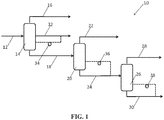
- this simplified schematic diagram represents a method 10 for fatty acid distillation.
- the method can include passing feed stream 12 through first column 14.
- feed stream 12 can comprise one or more of glyceride, a mixture of glycerides, fatty acids, a mixture of fatty acids.
- feed stream 12 can comprise palm kernel oil.
- the first distillation column 14 can distribute a C6-C8 cut and/or fraction to a top portion of the column 14.
- the C6-C8 cut can comprise hexanoic to octanoic fatty acids.
- the C6-C8 cut can be withdrawn from the first column 14 through C6-C8 cut stream 16.
- the first column can distribute a C8-C10 cut to a middle portion of the first column 14.
- the C8-C10 cut can comprise octanoic to decanoic fatty acids.
- the C8-C10 cut can be withdrawn from the first column through a C8-C10 cut stream 32.
- a first temperature controller 34 for inferential composition control can be present and in communication with the first column 14 and the C8-C10 cut stream 32.
- the C12+ cut can comprise dodecanoic, tetradecanoic, palmitic, stearic, oleic, linoleic, and eicosanoic fatty acids.
- the C12+ cut can be withdrawn from the bottom portion of the first column 14 through C12+ cut stream 18.
- the C12+ cut stream 18 can be passed through a second distillation column 20.
- the second column 20 can distribute a C12-C14 cut to a top portion of the column 20.
- the C12-C14 cut can comprise dodecanonic to tetradecanoic fatty acids.
- the C12-C14 cut can be withdrawn from the second column 20 through C12-C14 cut stream 22.
- the second column 20 can distribute a C16+ cut to a bottom portion of the column 20.
- the C16+ cut can comprise palmitic, stearic, oleic, linoleic, and eicosanoic fatty acids.
- the C16+ cut can be withdrawn from the bottom portion of the second column 20 through C16+ cut stream 24.
- a second temperature controller 36 for inferential composition control can be present and in communication with the second column 20 and the C16+ cut stream 24.
- the C16+ cut stream 24 can be passed through a third distillation column 26.
- the third column 26 can distribute a C16-C18 cut to a top portion of the column 26.
- the C16-C18 cut can comprise palmitic to octadecanoic fatty acids.
- the C16-C18 cut can be withdrawn from the third column 26 through the C16-C18 cut stream 28.
- the third column 26 can distribute a C18+ cut to a bottom portion of the column 26.
- the C18+ cut can comprise stearic, oleic, linoleic, and eicosanoic fatty acids.
- the C18+ cut can be withdrawn from the bottom portion of the third column 26 through C18+ cut stream 30.
- a third temperature controller 38 for inferential composition control can be present and in communication with the third column 26 and the C18+ cut stream 30.
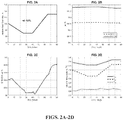
- Simulations of a fatty acid distillation method in accordance with the present disclosure were conducted using Aspen Plus simulation computer software. Steady-state and dynamic models were used. No tuning was required other than for the three temperature controllers where their inherent measurement lags were modelled as 5 minute dead times.
- FIG. 2 depicts the effects of +/- 15% ramped variations in the feed flowrate to the process.
- FIG. 2B shows that a purity level greater than or equal to 99.8% by weight can be maintained for the C8-C10 and C16-C18 cuts.
- FIG. 2C indicates that the purity level can be kept higher than 99% by weight.
- These levels of purities are maintained by temperature controllers, as previously discussed, without the need of changes in their corresponding set points or retuning.
- FIG. 2D shows that the reboiler temperatures of all columns do not exceed 240 °C.
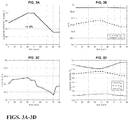
- FIG. 3 depicts the impact of changes in the feed composition, where the proportion of C12-C14 is manipulated in ramped variations within the range +/- 6%.
- FIG. 3B shows that a purity level greater than or equal to 99.8% by weight can be maintained for the C8-C10 and C16-C18 cuts.
- FIG. 3C indicates that the purity level can be kept higher than 99% by weight.
Landscapes
- Chemical & Material Sciences (AREA)
- Life Sciences & Earth Sciences (AREA)
- Engineering & Computer Science (AREA)
- Chemical Kinetics & Catalysis (AREA)
- Oil, Petroleum & Natural Gas (AREA)
- Wood Science & Technology (AREA)
- Organic Chemistry (AREA)
- Microbiology (AREA)
- General Chemical & Material Sciences (AREA)
- Fats And Perfumes (AREA)
- Production Of Liquid Hydrocarbon Mixture For Refining Petroleum (AREA)
- Organic Low-Molecular-Weight Compounds And Preparation Thereof (AREA)
Claims (16)
- Verfahren zur Fettsäuredestillation, umfassend:Leiten eines Zuführstroms, der Fettsäuren mit Kettenlängen C6 bis C20 umfasst, durch eine erste Kolonne;Verteilen eines C6-C8-Schnitts auf einen oberen Teil der ersten Kolonne;Verteilen eines C8-C10-Schnitts auf einen mittleren Teil der ersten Kolonne;Abziehen eines C12+-Schnitts von einem unteren Teil der ersten Kolonne und Leiten des C12+-Schnitts durch eine zweite Kolonne;Verteilen eines C12-C14-Schnitts auf einen oberen Teil der zweiten Kolonne;Abziehen eines C16+-Schnitts von einem unteren Teil der zweiten Kolonne und Leiten des C16+-Schnitts durch eine dritte Kolonne;Verteilen eines C16-C18-Schnitts auf einen oberen Teil der dritten Kolonne; undVerteilen eines C18+-Schnitts auf einen unteren Teil der dritten Kolonne.
- Verfahren nach Anspruch 1, wobei der Zuführstrom ein pflanzliches Öl umfasst.
- Verfahren nach Anspruch 2, wobei der Zuführstrom Palmkernöl umfasst.
- Verfahren nach einem der Ansprüche 1 oder 2, weiter umfassend:Abziehen des C6-C8-Schnitts von dem oberen Teil der ersten Kolonne; undAbziehen des C8-C10-Schnitts von dem mittleren Teil der ersten Kolonne.
- Verfahren nach Anspruch 4, wobei eine Reinheit des C8-C10-Schnitts größer als oder gleich 99,0 Gewichts-% ist.
- Verfahren nach den Ansprüchen 1 oder 2, weiter umfassend das Abziehen des C12-C14-Schnitts von dem oberen Teil der zweiten Kolonne.
- Verfahren nach Anspruch 6, wobei eine Reinheit des C12-C14-Schnitts größer als oder gleich 99,0 Gewichts-% ist.
- Verfahren nach den Ansprüchen 1 oder 2, weiter umfassend das Abziehen des C16-C18-Schnitts von dem oberen Teil der dritten Kolonne.
- Verfahren nach Anspruch 8, wobei eine Reinheit des C16-C18-Schnitts größer als oder gleich 99,0 Gewichts-% ist.
- Verfahren nach den Ansprüchen 1 oder 2, wobei das Verfahren mit inferenzieller Zusammensetzungssteuerung kompatibel ist.
- Verfahren nach den Ansprüchen 1 oder 2, weiter umfassend eine Temperartursteuereinheit in Kommunikation mit der ersten Kolonne und dem C8-C10-Schnitt.
- Verfahren nach den Ansprüchen 1 oder 2, weiter umfassend eine Temperatursteuereinheit in Kommunikation mit der zweiten Kolonne und dem C16+-Schnitt.
- Verfahren nach den Ansprüchen 1 oder 2, weiter umfassend eine Temperatursteuereinheit in Kommunikation mit der dritten Kolonne und dem C18+-Schnitt.
- Verfahren nach den Ansprüchen 1 oder 2, wobei eine Rückverdampfertemperatur geringer als oder gleich 240 °C für die erste Kolonne, die zweite Kolonne, die dritte Kolonne oder eine Kombination, umfassend mindestens eine der vorstehenden, ist.
- Verfahren nach den Ansprüchen 1 oder 2, wobei die erste Kolonne bei einem Druck von 9 bis 15 kPa und einer Temperatur von 140 bis 235 °C betrieben wird; die zweite Kolonne bei einem Druck von 1 bis 4 kPa und einer Temperatur von 175 bis 232 °C betrieben wird; und die dritte Kolonne bei einem Druck von 0,3 bis 1 kPa und einer Temperatur von 187 bis 224 °C betrieben wird.
- Verfahren zur Fettsäuredestillation, umfassend:Leiten eines Zuführstroms, der Palmkernöl umfasst, durch eine erste Kolonne;Verteilen eines C6-C8-Schnitts auf einen oberen Teil der ersten Kolonne und Abziehen des C6-C8-Schnitts von dem oberen Teil der ersten Kolonne;Verteilen eines C8-C10-Schnitts auf einen mittleren Teil der ersten Kolonne und Abziehen des C8-C10-Schnitts von dem mittleren Teil der ersten Kolonne, wobei eine Reinheit des C8-C10-Schnitts größer als oder gleich 99,8 Gewichts-% ist;Abziehen eines C12+-Schnitts von einem unteren Teil der ersten Kolonne und Leiten des C12+-Schnitts durch eine zweite Kolonne;Verteilen eines C12-C14-Schnitts auf einen oberen Teil der zweiten Kolonne und Abziehen des C12-C14-Schnitts von dem oberen Teil der zweiten Kolonne, wobei eine Reinheit des C12-C14-Schnitts größer als oder gleich 99 Gewichts-% ist;Abziehen eines C16+-Schnitts von einem unteren Teil der zweiten Kolonne und Leiten des C16+-Schnitts durch eine dritte Kolonne;Verteilen eines C16-C18-Schnitts auf einen oberen Teil der dritten Kolonne und Abziehen des C16-C18-Schnitts von dem oberen Teil der dritten Kolonne, wobei eine Reinheit des C16-C18-Schnitts größer als oder gleich 99,9 Gewichts-% ist; undVerteilen eines C18+-Schnitts auf einen unteren Teil der dritten Kolonne.
Applications Claiming Priority (2)
| Application Number | Priority Date | Filing Date | Title |
|---|---|---|---|
| US201662432789P | 2016-12-12 | 2016-12-12 | |
| PCT/IB2017/057802 WO2018109644A1 (en) | 2016-12-12 | 2017-12-11 | Process for distillation of fatty acids from palm kern oil for minimum waste |
Publications (2)
| Publication Number | Publication Date |
|---|---|
| EP3551737A1 EP3551737A1 (de) | 2019-10-16 |
| EP3551737B1 true EP3551737B1 (de) | 2020-10-14 |
Family
ID=60957353
Family Applications (1)
| Application Number | Title | Priority Date | Filing Date |
|---|---|---|---|
| EP17829019.3A Active EP3551737B1 (de) | 2016-12-12 | 2017-12-11 | Verfahren zur destillation von fettsäuren aus palmkernöl für minimalen abfall |
Country Status (6)
| Country | Link |
|---|---|
| US (1) | US10577559B2 (de) |
| EP (1) | EP3551737B1 (de) |
| CN (1) | CN110268041A (de) |
| CO (1) | CO2019007192A2 (de) |
| MY (1) | MY190464A (de) |
| WO (1) | WO2018109644A1 (de) |
Families Citing this family (1)
| Publication number | Priority date | Publication date | Assignee | Title |
|---|---|---|---|---|
| EP4212226A1 (de) * | 2022-01-17 | 2023-07-19 | Sulzer Management AG | Anlage und verfahren zur fraktionierung von fettsäuregemischen |
Family Cites Families (6)
| Publication number | Priority date | Publication date | Assignee | Title |
|---|---|---|---|---|
| US2351249A (en) * | 1940-09-28 | 1944-06-13 | Armour & Co | Treating fatty acids |
| US5892072A (en) * | 1996-01-19 | 1999-04-06 | Twin Rivers Technologies, Lp | C 12-16-90% fatty acids and a process of making the same |
| WO2009085324A1 (en) * | 2007-12-31 | 2009-07-09 | University Of North Dakota | Method for production of short chain carboxylic acids and esters from biomass and product of same |
| HUE029846T2 (en) * | 2008-10-06 | 2017-04-28 | Sulzer Chemtech Ag | Method and apparatus for separating carboxylic acids and / or carboxylic acid esters |
| CN102703222B (zh) * | 2012-05-30 | 2013-12-18 | 常州大学 | 一种使用分隔壁精馏塔分离混合脂肪酸的方法 |
| CN104711119B (zh) * | 2015-03-20 | 2017-10-27 | 丹阳同泰化工机械有限公司 | 废弃油脂生产生物柴油的四塔精馏方法 |
-
2017
- 2017-12-11 CN CN201780086038.7A patent/CN110268041A/zh active Pending
- 2017-12-11 US US16/468,797 patent/US10577559B2/en active Active
- 2017-12-11 MY MYPI2019003270A patent/MY190464A/en unknown
- 2017-12-11 WO PCT/IB2017/057802 patent/WO2018109644A1/en not_active Ceased
- 2017-12-11 EP EP17829019.3A patent/EP3551737B1/de active Active
-
2019
- 2019-07-03 CO CONC2019/0007192A patent/CO2019007192A2/es unknown
Non-Patent Citations (1)
| Title |
|---|
| None * |
Also Published As
| Publication number | Publication date |
|---|---|
| MY190464A (en) | 2022-04-22 |
| BR112019011756A2 (pt) | 2019-10-29 |
| EP3551737A1 (de) | 2019-10-16 |
| CN110268041A (zh) | 2019-09-20 |
| US10577559B2 (en) | 2020-03-03 |
| CO2019007192A2 (es) | 2019-08-20 |
| WO2018109644A1 (en) | 2018-06-21 |
| US20190300819A1 (en) | 2019-10-03 |
Similar Documents
| Publication | Publication Date | Title |
|---|---|---|
| Araujo et al. | Phase behaviour measurements for the system (carbon dioxide+ biodiesel+ ethanol) at high pressures | |
| Ndiaye et al. | Phase behavior of soybean oil, castor oil and their fatty acid ethyl esters in carbon dioxide at high pressures | |
| Tang et al. | Phase equilibria of methanol–triolein system at elevated temperature and pressure | |
| Fiori et al. | Supercritical CO2 fractionation of omega-3 lipids from fish by-products: Plant and process design, modeling, economic feasibility | |
| Espinosa et al. | Thermodynamic modeling and process optimization of supercritical fluid fractionation of fish oil fatty acid ethyl esters | |
| Souza et al. | Simulation and preliminary economic assessment of a biodiesel plant and comparison with reactive distillation | |
| De Melo et al. | Scale-up studies of the supercritical fluid extraction of triterpenic acids from Eucalyptus globulus bark | |
| US10577559B2 (en) | Process for distillation of fatty acids from palm kern oil for minimum waste | |
| Ndiaye et al. | Phase behavior of olive and soybean oils in compressed propane and n-butane | |
| Noriega et al. | UNIFAC correlated parameters for liquid-liquid equilibrium prediction of ternary systems related to biodiesel production process | |
| da Costa et al. | Supercritical CO2 extraction and transesterification of the residual oil from industrial palm kernel cake with supercritical methanol | |
| Lanza et al. | Phase behavior of castor oil in compressed propane and n-butane | |
| Wulandani et al. | Modification of biodiesel reactor by using of triple obstacle within the bubble column reactor | |
| Simasatitkul et al. | Design methodology for bio-based processing: Biodiesel and fatty alcohol production | |
| Salimon et al. | Saponification of Jatropha curcas seed oil: optimization by D‐optimal design | |
| Silva et al. | Supercritical fluid extraction of carqueja (Baccharis trimera) oil: Process parameters and composition profiles | |
| Karacan et al. | Simulation of reactive distillation column for biodiesel production at optimum conditions | |
| Zahedi et al. | Genetic algorithm optimization of supercritical fluid extraction of nimbin from neem seeds | |
| Cotabarren et al. | Thermodynamic model for process design, simulation and optimization in the production of biodiesel | |
| BR112019011756B1 (pt) | Processo para destilação de ácidos graxos do óleo de palmiste para um mínimo de resíduos | |
| Olazar et al. | One-dimensional modelling of conical spouted beds | |
| Komintarachat et al. | Density of ethyl acetate-palm oil mixture in supercritical condition | |
| Saejio et al. | Kinetics and control of palm fatty acid distillate esterification for a feasible biodiesel production. | |
| Lersbamrungsuk et al. | Design and control of Alkali-Catalyzed transesterification reactors | |
| Bessa et al. | Liquid-liquid equilibrium of systems composed of soybean oil+ monoacylglycerols+ diacylglycerols+ ethyl oleate+ oleic acid+ ethanol at 303.15 and 318.15 K |
Legal Events
| Date | Code | Title | Description |
|---|---|---|---|
| STAA | Information on the status of an ep patent application or granted ep patent |
Free format text: STATUS: UNKNOWN |
|
| STAA | Information on the status of an ep patent application or granted ep patent |
Free format text: STATUS: THE INTERNATIONAL PUBLICATION HAS BEEN MADE |
|
| PUAI | Public reference made under article 153(3) epc to a published international application that has entered the european phase |
Free format text: ORIGINAL CODE: 0009012 |
|
| STAA | Information on the status of an ep patent application or granted ep patent |
Free format text: STATUS: REQUEST FOR EXAMINATION WAS MADE |
|
| 17P | Request for examination filed |
Effective date: 20190703 |
|
| AK | Designated contracting states |
Kind code of ref document: A1 Designated state(s): AL AT BE BG CH CY CZ DE DK EE ES FI FR GB GR HR HU IE IS IT LI LT LU LV MC MK MT NL NO PL PT RO RS SE SI SK SM TR |
|
| AX | Request for extension of the european patent |
Extension state: BA ME |
|
| DAV | Request for validation of the european patent (deleted) | ||
| DAX | Request for extension of the european patent (deleted) | ||
| REG | Reference to a national code |
Ref country code: DE Ref legal event code: R079 Ref document number: 602017025640 Country of ref document: DE Free format text: PREVIOUS MAIN CLASS: C11B0003120000 Ipc: C11C0001100000 |
|
| RIC1 | Information provided on ipc code assigned before grant |
Ipc: C11B 3/12 20060101ALI20200511BHEP Ipc: C11C 1/10 20060101AFI20200511BHEP Ipc: C11C 1/00 20060101ALI20200511BHEP |
|
| GRAP | Despatch of communication of intention to grant a patent |
Free format text: ORIGINAL CODE: EPIDOSNIGR1 |
|
| STAA | Information on the status of an ep patent application or granted ep patent |
Free format text: STATUS: GRANT OF PATENT IS INTENDED |
|
| GRAS | Grant fee paid |
Free format text: ORIGINAL CODE: EPIDOSNIGR3 |
|
| GRAL | Information related to payment of fee for publishing/printing deleted |
Free format text: ORIGINAL CODE: EPIDOSDIGR3 |
|
| GRAS | Grant fee paid |
Free format text: ORIGINAL CODE: EPIDOSNIGR3 |
|
| INTG | Intention to grant announced |
Effective date: 20200729 |
|
| GRAA | (expected) grant |
Free format text: ORIGINAL CODE: 0009210 |
|
| STAA | Information on the status of an ep patent application or granted ep patent |
Free format text: STATUS: THE PATENT HAS BEEN GRANTED |
|
| AK | Designated contracting states |
Kind code of ref document: B1 Designated state(s): AL AT BE BG CH CY CZ DE DK EE ES FI FR GB GR HR HU IE IS IT LI LT LU LV MC MK MT NL NO PL PT RO RS SE SI SK SM TR |
|
| REG | Reference to a national code |
Ref country code: GB Ref legal event code: FG4D |
|
| REG | Reference to a national code |
Ref country code: AT Ref legal event code: REF Ref document number: 1323559 Country of ref document: AT Kind code of ref document: T Effective date: 20201015 Ref country code: CH Ref legal event code: EP |
|
| REG | Reference to a national code |
Ref country code: DE Ref legal event code: R096 Ref document number: 602017025640 Country of ref document: DE |
|
| REG | Reference to a national code |
Ref country code: IE Ref legal event code: FG4D |
|
| REG | Reference to a national code |
Ref country code: NL Ref legal event code: FP |
|
| REG | Reference to a national code |
Ref country code: AT Ref legal event code: MK05 Ref document number: 1323559 Country of ref document: AT Kind code of ref document: T Effective date: 20201014 |
|
| PG25 | Lapsed in a contracting state [announced via postgrant information from national office to epo] |
Ref country code: FI Free format text: LAPSE BECAUSE OF FAILURE TO SUBMIT A TRANSLATION OF THE DESCRIPTION OR TO PAY THE FEE WITHIN THE PRESCRIBED TIME-LIMIT Effective date: 20201014 Ref country code: RS Free format text: LAPSE BECAUSE OF FAILURE TO SUBMIT A TRANSLATION OF THE DESCRIPTION OR TO PAY THE FEE WITHIN THE PRESCRIBED TIME-LIMIT Effective date: 20201014 Ref country code: PT Free format text: LAPSE BECAUSE OF FAILURE TO SUBMIT A TRANSLATION OF THE DESCRIPTION OR TO PAY THE FEE WITHIN THE PRESCRIBED TIME-LIMIT Effective date: 20210215 Ref country code: NO Free format text: LAPSE BECAUSE OF FAILURE TO SUBMIT A TRANSLATION OF THE DESCRIPTION OR TO PAY THE FEE WITHIN THE PRESCRIBED TIME-LIMIT Effective date: 20210114 Ref country code: GR Free format text: LAPSE BECAUSE OF FAILURE TO SUBMIT A TRANSLATION OF THE DESCRIPTION OR TO PAY THE FEE WITHIN THE PRESCRIBED TIME-LIMIT Effective date: 20210115 |
|
| REG | Reference to a national code |
Ref country code: LT Ref legal event code: MG4D |
|
| PG25 | Lapsed in a contracting state [announced via postgrant information from national office to epo] |
Ref country code: AT Free format text: LAPSE BECAUSE OF FAILURE TO SUBMIT A TRANSLATION OF THE DESCRIPTION OR TO PAY THE FEE WITHIN THE PRESCRIBED TIME-LIMIT Effective date: 20201014 Ref country code: ES Free format text: LAPSE BECAUSE OF FAILURE TO SUBMIT A TRANSLATION OF THE DESCRIPTION OR TO PAY THE FEE WITHIN THE PRESCRIBED TIME-LIMIT Effective date: 20201014 Ref country code: SE Free format text: LAPSE BECAUSE OF FAILURE TO SUBMIT A TRANSLATION OF THE DESCRIPTION OR TO PAY THE FEE WITHIN THE PRESCRIBED TIME-LIMIT Effective date: 20201014 Ref country code: LV Free format text: LAPSE BECAUSE OF FAILURE TO SUBMIT A TRANSLATION OF THE DESCRIPTION OR TO PAY THE FEE WITHIN THE PRESCRIBED TIME-LIMIT Effective date: 20201014 Ref country code: PL Free format text: LAPSE BECAUSE OF FAILURE TO SUBMIT A TRANSLATION OF THE DESCRIPTION OR TO PAY THE FEE WITHIN THE PRESCRIBED TIME-LIMIT Effective date: 20201014 Ref country code: IS Free format text: LAPSE BECAUSE OF FAILURE TO SUBMIT A TRANSLATION OF THE DESCRIPTION OR TO PAY THE FEE WITHIN THE PRESCRIBED TIME-LIMIT Effective date: 20210214 Ref country code: BG Free format text: LAPSE BECAUSE OF FAILURE TO SUBMIT A TRANSLATION OF THE DESCRIPTION OR TO PAY THE FEE WITHIN THE PRESCRIBED TIME-LIMIT Effective date: 20210114 |
|
| PG25 | Lapsed in a contracting state [announced via postgrant information from national office to epo] |
Ref country code: HR Free format text: LAPSE BECAUSE OF FAILURE TO SUBMIT A TRANSLATION OF THE DESCRIPTION OR TO PAY THE FEE WITHIN THE PRESCRIBED TIME-LIMIT Effective date: 20201014 |
|
| REG | Reference to a national code |
Ref country code: DE Ref legal event code: R097 Ref document number: 602017025640 Country of ref document: DE |
|
| PG25 | Lapsed in a contracting state [announced via postgrant information from national office to epo] |
Ref country code: SK Free format text: LAPSE BECAUSE OF FAILURE TO SUBMIT A TRANSLATION OF THE DESCRIPTION OR TO PAY THE FEE WITHIN THE PRESCRIBED TIME-LIMIT Effective date: 20201014 Ref country code: RO Free format text: LAPSE BECAUSE OF FAILURE TO SUBMIT A TRANSLATION OF THE DESCRIPTION OR TO PAY THE FEE WITHIN THE PRESCRIBED TIME-LIMIT Effective date: 20201014 Ref country code: SM Free format text: LAPSE BECAUSE OF FAILURE TO SUBMIT A TRANSLATION OF THE DESCRIPTION OR TO PAY THE FEE WITHIN THE PRESCRIBED TIME-LIMIT Effective date: 20201014 Ref country code: LT Free format text: LAPSE BECAUSE OF FAILURE TO SUBMIT A TRANSLATION OF THE DESCRIPTION OR TO PAY THE FEE WITHIN THE PRESCRIBED TIME-LIMIT Effective date: 20201014 Ref country code: EE Free format text: LAPSE BECAUSE OF FAILURE TO SUBMIT A TRANSLATION OF THE DESCRIPTION OR TO PAY THE FEE WITHIN THE PRESCRIBED TIME-LIMIT Effective date: 20201014 Ref country code: CZ Free format text: LAPSE BECAUSE OF FAILURE TO SUBMIT A TRANSLATION OF THE DESCRIPTION OR TO PAY THE FEE WITHIN THE PRESCRIBED TIME-LIMIT Effective date: 20201014 |
|
| REG | Reference to a national code |
Ref country code: CH Ref legal event code: PL |
|
| PLBE | No opposition filed within time limit |
Free format text: ORIGINAL CODE: 0009261 |
|
| STAA | Information on the status of an ep patent application or granted ep patent |
Free format text: STATUS: NO OPPOSITION FILED WITHIN TIME LIMIT |
|
| PG25 | Lapsed in a contracting state [announced via postgrant information from national office to epo] |
Ref country code: MC Free format text: LAPSE BECAUSE OF FAILURE TO SUBMIT A TRANSLATION OF THE DESCRIPTION OR TO PAY THE FEE WITHIN THE PRESCRIBED TIME-LIMIT Effective date: 20201014 Ref country code: DK Free format text: LAPSE BECAUSE OF FAILURE TO SUBMIT A TRANSLATION OF THE DESCRIPTION OR TO PAY THE FEE WITHIN THE PRESCRIBED TIME-LIMIT Effective date: 20201014 |
|
| 26N | No opposition filed |
Effective date: 20210715 |
|
| PG25 | Lapsed in a contracting state [announced via postgrant information from national office to epo] |
Ref country code: IT Free format text: LAPSE BECAUSE OF FAILURE TO SUBMIT A TRANSLATION OF THE DESCRIPTION OR TO PAY THE FEE WITHIN THE PRESCRIBED TIME-LIMIT Effective date: 20201014 Ref country code: LU Free format text: LAPSE BECAUSE OF NON-PAYMENT OF DUE FEES Effective date: 20201211 Ref country code: AL Free format text: LAPSE BECAUSE OF FAILURE TO SUBMIT A TRANSLATION OF THE DESCRIPTION OR TO PAY THE FEE WITHIN THE PRESCRIBED TIME-LIMIT Effective date: 20201014 Ref country code: IE Free format text: LAPSE BECAUSE OF NON-PAYMENT OF DUE FEES Effective date: 20201211 |
|
| PG25 | Lapsed in a contracting state [announced via postgrant information from national office to epo] |
Ref country code: CH Free format text: LAPSE BECAUSE OF NON-PAYMENT OF DUE FEES Effective date: 20201231 Ref country code: SI Free format text: LAPSE BECAUSE OF FAILURE TO SUBMIT A TRANSLATION OF THE DESCRIPTION OR TO PAY THE FEE WITHIN THE PRESCRIBED TIME-LIMIT Effective date: 20201014 Ref country code: LI Free format text: LAPSE BECAUSE OF NON-PAYMENT OF DUE FEES Effective date: 20201231 |
|
| PG25 | Lapsed in a contracting state [announced via postgrant information from national office to epo] |
Ref country code: IS Free format text: LAPSE BECAUSE OF FAILURE TO SUBMIT A TRANSLATION OF THE DESCRIPTION OR TO PAY THE FEE WITHIN THE PRESCRIBED TIME-LIMIT Effective date: 20210214 Ref country code: TR Free format text: LAPSE BECAUSE OF FAILURE TO SUBMIT A TRANSLATION OF THE DESCRIPTION OR TO PAY THE FEE WITHIN THE PRESCRIBED TIME-LIMIT Effective date: 20201014 Ref country code: MT Free format text: LAPSE BECAUSE OF FAILURE TO SUBMIT A TRANSLATION OF THE DESCRIPTION OR TO PAY THE FEE WITHIN THE PRESCRIBED TIME-LIMIT Effective date: 20201014 Ref country code: CY Free format text: LAPSE BECAUSE OF FAILURE TO SUBMIT A TRANSLATION OF THE DESCRIPTION OR TO PAY THE FEE WITHIN THE PRESCRIBED TIME-LIMIT Effective date: 20201014 |
|
| PG25 | Lapsed in a contracting state [announced via postgrant information from national office to epo] |
Ref country code: MK Free format text: LAPSE BECAUSE OF FAILURE TO SUBMIT A TRANSLATION OF THE DESCRIPTION OR TO PAY THE FEE WITHIN THE PRESCRIBED TIME-LIMIT Effective date: 20201014 |
|
| GBPC | Gb: european patent ceased through non-payment of renewal fee |
Effective date: 20211211 |
|
| PG25 | Lapsed in a contracting state [announced via postgrant information from national office to epo] |
Ref country code: GB Free format text: LAPSE BECAUSE OF NON-PAYMENT OF DUE FEES Effective date: 20211211 |
|
| P01 | Opt-out of the competence of the unified patent court (upc) registered |
Effective date: 20230518 |
|
| PGFP | Annual fee paid to national office [announced via postgrant information from national office to epo] |
Ref country code: DE Payment date: 20251211 Year of fee payment: 9 |
|
| PGFP | Annual fee paid to national office [announced via postgrant information from national office to epo] |
Ref country code: FR Payment date: 20251229 Year of fee payment: 9 Ref country code: NL Payment date: 20251219 Year of fee payment: 9 |
|
| PGFP | Annual fee paid to national office [announced via postgrant information from national office to epo] |
Ref country code: BE Payment date: 20251219 Year of fee payment: 9 |