EP3550657A1 - Electrolyte and secondary lithium battery - Google Patents
Electrolyte and secondary lithium battery Download PDFInfo
- Publication number
- EP3550657A1 EP3550657A1 EP17876629.1A EP17876629A EP3550657A1 EP 3550657 A1 EP3550657 A1 EP 3550657A1 EP 17876629 A EP17876629 A EP 17876629A EP 3550657 A1 EP3550657 A1 EP 3550657A1
- Authority
- EP
- European Patent Office
- Prior art keywords
- group
- lithium
- electrolyte
- electrolyte according
- ion secondary
- Prior art date
- Legal status (The legal status is an assumption and is not a legal conclusion. Google has not performed a legal analysis and makes no representation as to the accuracy of the status listed.)
- Granted
Links
Classifications
-
- H—ELECTRICITY
- H01—ELECTRIC ELEMENTS
- H01M—PROCESSES OR MEANS, e.g. BATTERIES, FOR THE DIRECT CONVERSION OF CHEMICAL ENERGY INTO ELECTRICAL ENERGY
- H01M10/00—Secondary cells; Manufacture thereof
- H01M10/05—Accumulators with non-aqueous electrolyte
- H01M10/056—Accumulators with non-aqueous electrolyte characterised by the materials used as electrolytes, e.g. mixed inorganic/organic electrolytes
- H01M10/0564—Accumulators with non-aqueous electrolyte characterised by the materials used as electrolytes, e.g. mixed inorganic/organic electrolytes the electrolyte being constituted of organic materials only
- H01M10/0566—Liquid materials
- H01M10/0569—Liquid materials characterised by the solvents
-
- H—ELECTRICITY
- H01—ELECTRIC ELEMENTS
- H01M—PROCESSES OR MEANS, e.g. BATTERIES, FOR THE DIRECT CONVERSION OF CHEMICAL ENERGY INTO ELECTRICAL ENERGY
- H01M10/00—Secondary cells; Manufacture thereof
- H01M10/05—Accumulators with non-aqueous electrolyte
- H01M10/056—Accumulators with non-aqueous electrolyte characterised by the materials used as electrolytes, e.g. mixed inorganic/organic electrolytes
- H01M10/0564—Accumulators with non-aqueous electrolyte characterised by the materials used as electrolytes, e.g. mixed inorganic/organic electrolytes the electrolyte being constituted of organic materials only
- H01M10/0566—Liquid materials
- H01M10/0567—Liquid materials characterised by the additives
-
- H—ELECTRICITY
- H01—ELECTRIC ELEMENTS
- H01M—PROCESSES OR MEANS, e.g. BATTERIES, FOR THE DIRECT CONVERSION OF CHEMICAL ENERGY INTO ELECTRICAL ENERGY
- H01M10/00—Secondary cells; Manufacture thereof
- H01M10/05—Accumulators with non-aqueous electrolyte
- H01M10/052—Li-accumulators
-
- H—ELECTRICITY
- H01—ELECTRIC ELEMENTS
- H01M—PROCESSES OR MEANS, e.g. BATTERIES, FOR THE DIRECT CONVERSION OF CHEMICAL ENERGY INTO ELECTRICAL ENERGY
- H01M10/00—Secondary cells; Manufacture thereof
- H01M10/05—Accumulators with non-aqueous electrolyte
- H01M10/052—Li-accumulators
- H01M10/0525—Rocking-chair batteries, i.e. batteries with lithium insertion or intercalation in both electrodes; Lithium-ion batteries
-
- H—ELECTRICITY
- H01—ELECTRIC ELEMENTS
- H01M—PROCESSES OR MEANS, e.g. BATTERIES, FOR THE DIRECT CONVERSION OF CHEMICAL ENERGY INTO ELECTRICAL ENERGY
- H01M10/00—Secondary cells; Manufacture thereof
- H01M10/05—Accumulators with non-aqueous electrolyte
- H01M10/056—Accumulators with non-aqueous electrolyte characterised by the materials used as electrolytes, e.g. mixed inorganic/organic electrolytes
- H01M10/0564—Accumulators with non-aqueous electrolyte characterised by the materials used as electrolytes, e.g. mixed inorganic/organic electrolytes the electrolyte being constituted of organic materials only
- H01M10/0566—Liquid materials
- H01M10/0568—Liquid materials characterised by the solutes
-
- H—ELECTRICITY
- H01—ELECTRIC ELEMENTS
- H01M—PROCESSES OR MEANS, e.g. BATTERIES, FOR THE DIRECT CONVERSION OF CHEMICAL ENERGY INTO ELECTRICAL ENERGY
- H01M2300/00—Electrolytes
- H01M2300/0017—Non-aqueous electrolytes
- H01M2300/0025—Organic electrolyte
-
- Y—GENERAL TAGGING OF NEW TECHNOLOGICAL DEVELOPMENTS; GENERAL TAGGING OF CROSS-SECTIONAL TECHNOLOGIES SPANNING OVER SEVERAL SECTIONS OF THE IPC; TECHNICAL SUBJECTS COVERED BY FORMER USPC CROSS-REFERENCE ART COLLECTIONS [XRACs] AND DIGESTS
- Y02—TECHNOLOGIES OR APPLICATIONS FOR MITIGATION OR ADAPTATION AGAINST CLIMATE CHANGE
- Y02E—REDUCTION OF GREENHOUSE GAS [GHG] EMISSIONS, RELATED TO ENERGY GENERATION, TRANSMISSION OR DISTRIBUTION
- Y02E60/00—Enabling technologies; Technologies with a potential or indirect contribution to GHG emissions mitigation
- Y02E60/10—Energy storage using batteries
Definitions
- the present invention relates to the field of battery technology, and more specifically relates to an electrolyte and a secondary lithium battery.
- an electrolyte has great effect on charge and discharge rate performances, high and low temperature performances of the lithium-ion secondary battery.
- it is contradictory to improve charge and discharge rate performances, low temperature discharge performance and high temperature performance of the lithium-ion secondary battery on basis of the electrolyte.
- high temperature performance can be improved by adding a film forming additive to passivate interfaces of the positive electrode plate and negative electrode plate, but because interface resistances of the positive electrode plate and negative electrode plate are increased at the same time, charge and discharge rate performances and low temperature discharge performance of the lithium-ion secondary battery are significantly adversely affected.
- an object of the present invention is to provide an electrolyte and a secondary lithium battery, when the electrolyte is applied to the secondary lithium battery, the secondary lithium battery can have excellent high temperature cycle performance, high temperature storage performance, low temperature discharge performance and large rate charging performance at the same time, and low temperature lithium precipitation of the secondary lithium battery can be significantly inhibited.
- the present invention provides an electrolyte, which comprises a lithium salt, an organic solvent and an additive.
- the additive comprises fluoroborate and lithium difluorophosphate.
- the present invention provides an secondary lithium battery, which comprises the electrolyte according to the one aspect of the present invention.
- the present invention has the following beneficial effects: when the electrolyte of the present invention is applied to the secondary lithium battery, the secondary lithium battery can have excellent high temperature cycle performance, high temperature storage performance, low temperature discharge performance and large rate charging performance at the same time, and low temperature lithium precipitation of the secondary lithium battery can be significantly inhibited.
- the electrolyte according to the first aspect of the present invention comprises a lithium salt, an organic solvent and an additive.
- the additive comprises fluoroborate and lithium difluorophosphate (LiPO 2 F 2 ).
- lithium difluorophosphate can improve high temperature cycle performance, high temperature storage performance and low temperature discharge performance of a secondary lithium battery, the reason is that two oxygen atoms in the structure of lithium difluorophosphate can complex with transition metal element of a positive electrode active material, the positive electrode active material will be improved in stability and will be reduced in oxidative activity to the electrolyte, so that high temperature cycle performance of the secondary lithium battery is effectively improved and volume expansion of the secondary lithium battery under high temperature is inhibited. Meanwhile, the interaction of lithium difluorophosphate and the positive electrode active material is beneficial to reduce electrochemical reaction resistance of a positive electrode plate, improve dynamics performance of the positive electrode plate and improve low temperature discharge performance of the secondary lithium battery.
- lithium difluorophosphate will reductively decompose on a negative electrode plate, a decomposition product will cover a surface of the negative electrode plate, resulting in an increase of lithium intercalation resistance of the negative electrode plate, which is not beneficial to large rate charging performance, especially when charging under low temperature environment, and the increased lithium intercalation resistance will probably cause lithium metal to precipitate on the surface of the negative electrode plate, thereby deteriorating low temperature charging performance of the secondary lithium battery.
- a SEI film having high ionic conductivity can be formed on the surface of the negative electrode plate, which can effectively improve low temperature charging performance and large rate charging performance of the secondary lithium battery.
- Fluoroborate can preferentially reductively decompose on the surface of the negative electrode plate, which can improve stability of the SEI film and inhibit further reductive decomposition of an organic solvent.
- fluoroborate is a boron-based anion acceptor, which can combine with anion such as F - , O 2 - , O 2 2- and the like, promote dissolution of inert constituent such as inorganic salt, for example, LiF, Li 2 O, Li 2 O 2 and the like, in the SEI film, improve constitution of the SEI film, effectively reduce interface resistance of the negative electrode plate, thus improve low temperature charging performance and large rate charging performance of the secondary lithium battery.
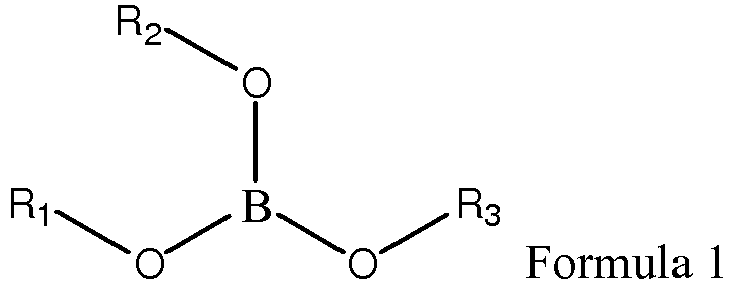
- fluoroborate is one or more selected from a group consisting of compounds represented by formula 1.
- R 1 , R 2 and R 3 each independently are one selected from a group consisting of C1 ⁇ C20 alkyl group and C6 ⁇ C16 aryl group, and at least one of R 1 , R 2 and R 3 makes a hydrogen atom substituted with a fluorine atom.
- the C1 ⁇ C20 alkyl group may be chain alkyl group or cycle alkyl group.
- the C1 ⁇ C20 alkyl group may be one selected from a group consisting of methyl group, ethyl group, n-propyl group, isopropyl group, cyclopropyl group, n-butyl group, isobutyl group, sec-butyl group, tert-butyl group, n-pentyl group, isopentyl group, neo-pentyl group, cyclopentyl group, n-hexyl group, isohexyl group, cyclohexyl group, heptyl group, cycloheptyl group, octyl group, cyclooctyl group, nonyl group, decyl group, undecyl group, dodecyl group, tridecyl group,
- C6 ⁇ C16 aryl group may be one selected from a group consisting of phenyl group, benzyl group, biphenylyl group, p-methylphenyl group, o-methylphenyl group, m-methylphenyl group, p-ethylphenyl group, m-ethylphenyl group, o-ethylphenyl group, 3,5-dimethylphenyl group, 2,6-dimethylphenyl group, 3,5-diethylphenyl group, 2,6-diethylphenyl group, 3,5-diisopropylphenyl, 2,6-diisopropylphenyl, 3,5-di-n-propyl phenly group, 2,6-di-n-propyl phenly group, 3,5-dibutylphenyl group, 2,6-dibutylphenyl group, 3,5-diisobutylphen
- each of R 1 , R 2 and R 3 makes the hydrogen atom substituted with the fluorine atom.
- R 1 , R 2 and R 3 are the same.
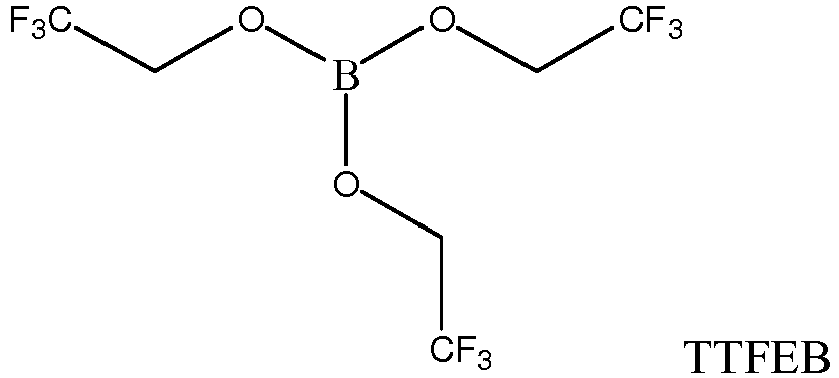
- fluoroborate is one or more selected from a group consisting of tris(2,2,2-trifluoroethyl) borate (TTFEB), tris(2,2,3,3-tetrafluoropropyl) borate (TTFPB), tris(hexafluoroisopropyl) borate (THFPB) and tris(pentafluorophenyl) borate (TPFPBA).
- TFEB tris(2,2,2-trifluoroethyl) borate
- TTFPB tris(2,2,3,3-tetrafluoropropyl) borate
- THFPB tris(hexafluoroisopropyl) borate
- TPFPBA tris(pentafluorophenyl) borate
- a content of lithium difluorophosphate is 0.1% ⁇ 3% of a total mass of the electrolyte.
- the content of lithium difluorophosphate is lower than 0.1% of the total mass of the electrolyte, the reaction of forming the passive film having low resistance on the surface of the positive electrode plate is insufficient, so the improvement on performance under high temperature is not obvious; when the content of lithium difluorophosphate is higher than 3% of the total mass of the electrolyte, the film formed on the surface of the negative electrode plate is too thick, and the resistance is significantly increased, which is not beneficial to improve performance of the secondary lithium battery.
- a content of fluoroborate is 0.01% ⁇ 5% of the total mass of the electrolyte.
- the content of fluoroborate is lower than 0.01% of the total mass of the electrolyte, the modification of SEI film of the negative electrode plate by fluoroborate is not obvious, it cannot effectively reduce interface resistance, and there is no obvious improvement on large rate charging performance and low temperature lithium precipitation;
- fluoroborate promotes decomposition of the lithium salt, the generated PF 5 will catalyze polymerization of the electrolyte, causing high temperature cycle performance and high temperature storage performance of the secondary lithium battery to be poor.
- the lithium salt is one or more selected from a group consisting of LiPF 6 , LiBF 4 , LiClO 4 , LiAsF 6 , LiTFSI, LiTFS, LiFSI, LiDFOB and LiBOB.
- the organic solvent is one or more selected from a group consisting of ethylene carbonate (EC), propylene carbonate (PC), dimethyl carbonate (DMC), diethyl carbonate (DEC), ethyl methyl carbonate (EMC), ⁇ -butyrolactone (BL), methyl formate (MF), ethyl formate (MA), ethyl acetate (EA), ethyl propionate (EP), propyl propionate (PP), dimethyl sulfoxide (DMSO), tetramethylene sulfone (TMSO), methyl sulfonyl mathane (MSM) and tetrahydrofuran (THF).
- EC ethylene carbonate
- PC propylene carbonate
- DMC dimethyl carbonate
- DEC diethyl carbonate
- EMC ethyl methyl carbonate
- BL ⁇ -butyrolactone
- MF methyl formate
- MA ethyl formate
- the secondary lithium battery according to the second aspect of the present invention comprises the electrolyte according to the first aspect of the present invention.
- the secondary lithium battery further comprises a positive electrode plate, a negative electrode plate, a separator and a package case.
- the secondary lithium battery may be a lithium-ion secondary battery or a lithium-metal secondary battery.
- the positive electrode plate may comprise a positive electrode current collector and a positive electrode film, the positive electrode film is provided on the positive electrode current collector and comprises a positive electrode active material.
- the positive electrode active material may be selected one or more from a group consisting of lithium cobalt oxide, lithium iron phosphate, lithium manganese oxide, nickel cobalt manganese ternary material and nickel cobalt aluminum ternary material.
- the negative electrode plate may comprises a negative electrode current collector and a negative electrode film, the negative electrode film is provided on the negative electrode current collector and comprises a negative electrode active material.
- the negative electrode active material may be selected from graphite and/or silicon.
- the negative electrode plate may also directly use lithium metal and its alloy.
- the specific type of the separator is not limited, it may be any separator material used in the prior art, such as a polyethylene film, a polypropylene film, a polyvinylidene fluoride film and a multilayer composite film thereof, but it is not limited thereto.
- Pouch-type lithium-ion secondary battery is selected in the present invention to perform related tests.
- the lithium-ion secondary batteries of examples 1-17 and comparative examples 1-6 were prepared as follows.
- the lithium-ion secondary battery was then charged to a voltage of 4.3V at a constant current of 1C, then the lithium-ion secondary battery was charged to a current of 0.05C at a constant voltage of 4.3V, a volume of the lithium-ion secondary battery was tested and marked as V 0 ; then the fully charged lithium-ion secondary battery was stored under 85°C in the thermostat, after storing for 10 days, drainage method was used to test the volume and the volume was marked as V 1 .
- Volume expansion rate of the lithium-ion secondary battery after stored for 10 days under 85 ° C % V 1 ⁇ V 0 / V 0 ⁇ 100 ⁇ % .
- the lithium-ion secondary battery was charged to a voltage of 4.3V at a constant current of 3C, then further charged to a current of 0.05C at a constant voltage of 4.3V, after standing-by for 5 minutes, the lithium-ion secondary was discharged to a voltage of 2.8V at a constant current of 1C, this was a charge-discharge cycle, the discharging capacity of the lithium-ion secondary battery at this time was the discharging capacity after first cycle.
- the lithium-ion secondary battery was discharged to 2.8V at a constant current of 1C, after standing-by for 5 minutes, the lithium-ion secondary battery was charged to 4.3V at a constant current of 0.5C, then after standing-by for 5 minutes, the lithium-ion secondary battery was discharged to 2.8V at a constant current of 2.8V, the charging capacity charged under 0.5C was obtained.
- the lithium-ion secondary battery was charged to a voltage of 4.3V at a constant current of 1C, then further charged to a current of 0.05C at a constant voltage of 4.3V, after standing-by for 5 minutes, the lithium-ion secondary battery was stand-by for 4 hours respectively under different temperature (25°C, 0°C, -10°C), then the lithium-ion secondary battery was discharged to 2.8V at a constant current of 1C, after discharging, standing-by was performed for 5 minutes, discharging capacity of the lithium-ion secondary battery at this time was marked.
- Discharging capacity rate of the lithium-ion secondary battery under different temperature % Discharging capacity under 0 ° C , ⁇ 10 ° C / Discharging capacity under 25 ° C ⁇ 100 ⁇ % .
- the lithium-ion secondary battery was charged to a voltage of 4.3V at a constant current of 5C, then further charged to a current of 0.05C at a constant voltage of 4.3V, after standing-by for 5 minutes, the lithium-ion secondary battery was discharged to a voltage of 2.8V at a constant current of 1C, this was a charge-discharge cycle, the lithium-ion secondary battery was cycled 10 times according to the above process, then the lithium-ion secondary battery was charged to a voltage of 4.3V at a constant current of 5C.
- the lithium-ion secondary battery charged to 4.3V was disassembled, and the lithium precipitated on the surface of the negative electrode plate was observed.
- the degree of the lithium precipitation was divided into no lithium precipitation, slight lithium precipitation, moderate lithium precipitation and serious lithium precipitation.
- lithium-ion secondary battery had excellent high temperature cycle performance, high temperature storage performance, low temperature discharge performance and large rate charging performance at the same time, and low temperature lithium precipitation of the lithium-ion secondary battery was significantly inhibited.
Landscapes
- Chemical & Material Sciences (AREA)
- Engineering & Computer Science (AREA)
- Manufacturing & Machinery (AREA)
- Chemical Kinetics & Catalysis (AREA)
- Electrochemistry (AREA)
- General Chemical & Material Sciences (AREA)
- Physics & Mathematics (AREA)
- Condensed Matter Physics & Semiconductors (AREA)
- General Physics & Mathematics (AREA)
- Inorganic Chemistry (AREA)
- Materials Engineering (AREA)
- Secondary Cells (AREA)
Abstract
Description
- The present invention relates to the field of battery technology, and more specifically relates to an electrolyte and a secondary lithium battery.
- High energy density, long cycle life, wide range of operating temperature and green environmental protection of a lithium-ion secondary battery have made it become the main energy source of mobile electronic devices at present. In terms of user experience, people are demanding higher and higher requirements for charge and discharge rate, that is to say, the lithium-ion secondary battery needs to have large rate charge and discharge capability; in addition, they also propose higher demands on its environmental adaptability, because current electronic products sometimes need to be used under extreme conditions, such as very high temperature or very low temperature environment, in general, performance of the lithium-ion secondary battery is significantly deteriorated under extreme conditions compared to normal environment.
- As an important part of the lithium-ion secondary battery, an electrolyte has great effect on charge and discharge rate performances, high and low temperature performances of the lithium-ion secondary battery. However, in general, it is contradictory to improve charge and discharge rate performances, low temperature discharge performance and high temperature performance of the lithium-ion secondary battery on basis of the electrolyte. On one hand, high temperature performance can be improved by adding a film forming additive to passivate interfaces of the positive electrode plate and negative electrode plate, but because interface resistances of the positive electrode plate and negative electrode plate are increased at the same time, charge and discharge rate performances and low temperature discharge performance of the lithium-ion secondary battery are significantly adversely affected. On the other hand, by optimizing constitute of an organic solvent to reduce viscosity of the electrolyte under low temperature and to improve conductivity, for example, by adding a large amount of low viscosity organic solvent, charge and discharge rate performances and low temperature discharge performance of the lithium-ion secondary battery can be improved, but high temperature performance of the lithium-ion secondary battery normally becomes poor, and the problems of the lithium-ion secondary battery in application cannot be solved perfectly.
- In view of the problems existing in the background, an object of the present invention is to provide an electrolyte and a secondary lithium battery, when the electrolyte is applied to the secondary lithium battery, the secondary lithium battery can have excellent high temperature cycle performance, high temperature storage performance, low temperature discharge performance and large rate charging performance at the same time, and low temperature lithium precipitation of the secondary lithium battery can be significantly inhibited.
- In order to achieve the above object, in one aspect of the present invention, the present invention provides an electrolyte, which comprises a lithium salt, an organic solvent and an additive. The additive comprises fluoroborate and lithium difluorophosphate.
- In another aspect of the present invention, the present invention provides an secondary lithium battery, which comprises the electrolyte according to the one aspect of the present invention.
- Compared to the technologies in the background, the present invention has the following beneficial effects: when the electrolyte of the present invention is applied to the secondary lithium battery, the secondary lithium battery can have excellent high temperature cycle performance, high temperature storage performance, low temperature discharge performance and large rate charging performance at the same time, and low temperature lithium precipitation of the secondary lithium battery can be significantly inhibited.
- Hereinafter an electrolyte and a secondary lithium battery according to the present invention will be described in detail.
- Firstly, an electrolyte according to a first aspect of the present invention will be described.
- The electrolyte according to the first aspect of the present invention comprises a lithium salt, an organic solvent and an additive. The additive comprises fluoroborate and lithium difluorophosphate (LiPO2F2).
- In the electrolyte according to the first aspect of the present invention, lithium difluorophosphate can improve high temperature cycle performance, high temperature storage performance and low temperature discharge performance of a secondary lithium battery, the reason is that two oxygen atoms in the structure of lithium difluorophosphate can complex with transition metal element of a positive electrode active material, the positive electrode active material will be improved in stability and will be reduced in oxidative activity to the electrolyte, so that high temperature cycle performance of the secondary lithium battery is effectively improved and volume expansion of the secondary lithium battery under high temperature is inhibited. Meanwhile, the interaction of lithium difluorophosphate and the positive electrode active material is beneficial to reduce electrochemical reaction resistance of a positive electrode plate, improve dynamics performance of the positive electrode plate and improve low temperature discharge performance of the secondary lithium battery. However, lithium difluorophosphate will reductively decompose on a negative electrode plate, a decomposition product will cover a surface of the negative electrode plate, resulting in an increase of lithium intercalation resistance of the negative electrode plate, which is not beneficial to large rate charging performance, especially when charging under low temperature environment, and the increased lithium intercalation resistance will probably cause lithium metal to precipitate on the surface of the negative electrode plate, thereby deteriorating low temperature charging performance of the secondary lithium battery. After introducing fluoroborate into the electrolyte containing lithium difluorophosphate, a SEI film having high ionic conductivity can be formed on the surface of the negative electrode plate, which can effectively improve low temperature charging performance and large rate charging performance of the secondary lithium battery. The forming mechanism of the SEI film is explained as follows, but it is not limited thereto. Fluoroborate can preferentially reductively decompose on the surface of the negative electrode plate, which can improve stability of the SEI film and inhibit further reductive decomposition of an organic solvent. Moreover, fluoroborate is a boron-based anion acceptor, which can combine with anion such as F-, O2 -, O2 2- and the like, promote dissolution of inert constituent such as inorganic salt, for example, LiF, Li2O, Li2O2 and the like, in the SEI film, improve constitution of the SEI film, effectively reduce interface resistance of the negative electrode plate, thus improve low temperature charging performance and large rate charging performance of the secondary lithium battery.
- In the electrolyte according to the first aspect of the present invention, fluoroborate is one or more selected from a group consisting of compounds represented by formula 1. Where, R1, R2 and R3 each independently are one selected from a group consisting of C1∼C20 alkyl group and C6∼C16 aryl group, and at least one of R1, R2 and R3 makes a hydrogen atom substituted with a fluorine atom.

- In the electrolyte according to the first aspect of the present invention, the C1∼C20 alkyl group may be chain alkyl group or cycle alkyl group. Specifically, the C1∼C20 alkyl group may be one selected from a group consisting of methyl group, ethyl group, n-propyl group, isopropyl group, cyclopropyl group, n-butyl group, isobutyl group, sec-butyl group, tert-butyl group, n-pentyl group, isopentyl group, neo-pentyl group, cyclopentyl group, n-hexyl group, isohexyl group, cyclohexyl group, heptyl group, cycloheptyl group, octyl group, cyclooctyl group, nonyl group, decyl group, undecyl group, dodecyl group, tridecyl group, tetradecyl group, pentadecyl group, hexadecyl group, heptadecyl group, octadecyl group, nonadecyl group and eicosyl group.
- In the electrolyte according to the first aspect of the present invention, C6∼C16 aryl group may be one selected from a group consisting of phenyl group, benzyl group, biphenylyl group, p-methylphenyl group, o-methylphenyl group, m-methylphenyl group, p-ethylphenyl group, m-ethylphenyl group, o-ethylphenyl group, 3,5-dimethylphenyl group, 2,6-dimethylphenyl group, 3,5-diethylphenyl group, 2,6-diethylphenyl group, 3,5-diisopropylphenyl, 2,6-diisopropylphenyl, 3,5-di-n-propyl phenly group, 2,6-di-n-propyl phenly group, 3,5-dibutylphenyl group, 2,6-dibutylphenyl group, 3,5-diisobutylphenyl group, 2,6-diisobutylphenyl group, 3,5-di-tert-butylphenyl group, 2,6-di-tert-butylphenyl group, triphenylmethyl group, 1-naphthyl group and 2-naphthyl group.
- In the electrolyte according to the first aspect of the present invention, each of R1, R2 and R3 makes the hydrogen atom substituted with the fluorine atom.
- In the electrolyte according to the first aspect of the present invention, preferably,R1, R2 and R3 are the same.
- In the electrolyte according to the first aspect of the present invention, fluoroborate is one or more selected from a group consisting of tris(2,2,2-trifluoroethyl) borate (TTFEB), tris(2,2,3,3-tetrafluoropropyl) borate (TTFPB), tris(hexafluoroisopropyl) borate (THFPB) and tris(pentafluorophenyl) borate (TPFPBA).


- In the electrolyte according to the first aspect of the present invention, a content of lithium difluorophosphate is 0.1% ∼ 3% of a total mass of the electrolyte. When the content of lithium difluorophosphate is lower than 0.1% of the total mass of the electrolyte, the reaction of forming the passive film having low resistance on the surface of the positive electrode plate is insufficient, so the improvement on performance under high temperature is not obvious; when the content of lithium difluorophosphate is higher than 3% of the total mass of the electrolyte, the film formed on the surface of the negative electrode plate is too thick, and the resistance is significantly increased, which is not beneficial to improve performance of the secondary lithium battery.
- In the electrolyte according to the first aspect of the present invention, a content of fluoroborate is 0.01% ∼ 5% of the total mass of the electrolyte. When the content of fluoroborate is lower than 0.01% of the total mass of the electrolyte, the modification of SEI film of the negative electrode plate by fluoroborate is not obvious, it cannot effectively reduce interface resistance, and there is no obvious improvement on large rate charging performance and low temperature lithium precipitation; when the content of fluoroborate is higher than 5% of the total mass of the electrolyte, fluoroborate promotes decomposition of the lithium salt, the generated PF5 will catalyze polymerization of the electrolyte, causing high temperature cycle performance and high temperature storage performance of the secondary lithium battery to be poor.
- In the electrolyte according to the first aspect of the present invention, the lithium salt is one or more selected from a group consisting of LiPF6, LiBF4, LiClO4, LiAsF6, LiTFSI, LiTFS, LiFSI, LiDFOB and LiBOB.
- In the electrolyte according to the first aspect of the present invention, the organic solvent is one or more selected from a group consisting of ethylene carbonate (EC), propylene carbonate (PC), dimethyl carbonate (DMC), diethyl carbonate (DEC), ethyl methyl carbonate (EMC), γ-butyrolactone (BL), methyl formate (MF), ethyl formate (MA), ethyl acetate (EA), ethyl propionate (EP), propyl propionate (PP), dimethyl sulfoxide (DMSO), tetramethylene sulfone (TMSO), methyl sulfonyl mathane (MSM) and tetrahydrofuran (THF).
- Next, a secondary lithium battery according to a second aspect of the present invention is described.
- The secondary lithium battery according to the second aspect of the present invention comprises the electrolyte according to the first aspect of the present invention.
- In the secondary lithium battery according to the second aspect of the present invention, the secondary lithium battery further comprises a positive electrode plate, a negative electrode plate, a separator and a package case.
- In the secondary lithium battery according to the second aspect of the present invention, the secondary lithium battery may be a lithium-ion secondary battery or a lithium-metal secondary battery.
- In the secondary lithium battery according to the second aspect of the present invention, the positive electrode plate may comprise a positive electrode current collector and a positive electrode film, the positive electrode film is provided on the positive electrode current collector and comprises a positive electrode active material. The positive electrode active material may be selected one or more from a group consisting of lithium cobalt oxide, lithium iron phosphate, lithium manganese oxide, nickel cobalt manganese ternary material and nickel cobalt aluminum ternary material.
- In the secondary lithium battery according to the second aspect of the present invention, the negative electrode plate may comprises a negative electrode current collector and a negative electrode film, the negative electrode film is provided on the negative electrode current collector and comprises a negative electrode active material. The negative electrode active material may be selected from graphite and/or silicon.
- In the secondary lithium battery according to the second aspect of the present invention, the negative electrode plate may also directly use lithium metal and its alloy.
- In the secondary lithium battery according to the second aspect of the present invention, the specific type of the separator is not limited, it may be any separator material used in the prior art, such as a polyethylene film, a polypropylene film, a polyvinylidene fluoride film and a multilayer composite film thereof, but it is not limited thereto.
- Hereinafter the present invention will be described in detail in combination with examples. It should be noted that, the examples described in the present invention are only used for explaining the present invention, and are not intended to limit the scope of the present invention. Pouch-type lithium-ion secondary battery is selected in the present invention to perform related tests.
- In the following examples and comparative examples, the materials, reagents and instruments used are commercially available unless otherwise specified.
- The lithium-ion secondary batteries of examples 1-17 and comparative examples 1-6 were prepared as follows.
- (1) Preparation of a positive electrode plate: LiNi0.5Co0.2Mn0.3O2 (positive electrode active material), polyvinylidene fluoride (binder), acetylene black (conductive agent) were mixed according a mass ratio of 97:1:2, then 1-methyl-2-pyrrolidinone (NMP) was added, mixing was performed under vacuum mixer until the system became uniform and transparent, a positive electrode slurry was obtained; then the positive electrode slurry was uniformly coated on an aluminum foil (positive electrode current collector) having a thickness of 14µm; drying under room temperature was then performed, which was followed by moving the aluminum foil to an oven for baking 1h under 120°C, then after cold-pressing and slitting, the positive electrode plate was obtained.
- (2) Preparation of a negative electrode plate: artificial graphite (negative electrode active material), sodium carboxymethylcellulose (thickening agent, CMC), styrene butadiene rubber latex (binder) were mixed according to a mass ratio of 98:1:1, then deionized water was added, a negative electrode slurry was obtained under vacuum mixer; then the positive electrode slurry was uniformly coated on a copper foil (negative electrode current collector) having a thickness of 8µm; after drying under room temperature, the copper foil was moved to an oven for baking 1h under 120°C, then after cold-pressing and slitting, the negative electrode plate was obtained
- (3) Preparation of an electrolyte: in an argon atmosphere glove box in which the water content was less than 10ppm, EC, EMC and DEC according to a mass ratio of EC:EMC:DEC=30:50:20 were mixed as an organic solvent, then fully dried LiPF6 (lithium salt) was dissolved into the mixed organic solvent, then fluoroborate and lithium difluorophosphate were added, after uniformly mixed, an electrolyte was obtained. Where, a concentration of LiPF6 was 1mol/L. A specific type and content of fluoroborate and lithium difluorophosphate used in the electrolyte were shown in table 1, the added amount of fluoroborate and lithium difluorophosphate were mass percentage calculated based on the total mass of the electrolyte.
- (4) Preparation of a separator: a polypropylene film with a thickness of 12µm was used as a separator.
- (5) Preparation of a lithium-ion secondary battery: the positive electrode plate, the separator and the negative electrode plate were laminated in order to make the separator separate the positive electrode plate from the negative electrode plate, then were wound to form a square electrode assembly, the square electrode assembly was placed in an aluminum-plastic film, then drying was performed at 80°C to remove water, and the corresponding electrolyte was injected into the aluminum-plastic film and the aluminum-plastic film was sealed, after standing-by, hot-cold pressing, forming, clamping, capacity grading and the like, the pouch-type lithium-ion secondary battery was obtained.
- Next, test processes of the lithium-ion secondary batteries were described.
- At 25°C, after standing-by for 30 minutes, the lithium-ion secondary battery was then charged to a voltage of 4.3V at a constant current of 1C, then the lithium-ion secondary battery was charged to a current of 0.05C at a constant voltage of 4.3V, a volume of the lithium-ion secondary battery was tested and marked as V0; then the fully charged lithium-ion secondary battery was stored under 85°C in the thermostat, after storing for 10 days, drainage method was used to test the volume and the volume was marked as V1.

- At 45°C, after standing-by for 30 minutes, the lithium-ion secondary battery was charged to a voltage of 4.3V at a constant current of 3C, then further charged to a current of 0.05C at a constant voltage of 4.3V, after standing-by for 5 minutes, the lithium-ion secondary was discharged to a voltage of 2.8V at a constant current of 1C, this was a charge-discharge cycle, the discharging capacity of the lithium-ion secondary battery at this time was the discharging capacity after first cycle. Charge/discharge test of the lithium-ion secondary battery was performed for 500 times cycles according to the above method.

- At 25°C, after standing-by for 30 minutes, the lithium-ion secondary battery was discharged to 2.8V at a constant current of 1C, after standing-by for 5 minutes, the lithium-ion secondary battery was charged to 4.3V at a constant current of 0.5C, then after standing-by for 5 minutes, the lithium-ion secondary battery was discharged to 2.8V at a constant current of 2.8V, the charging capacity charged under 0.5C was obtained.
- At 25°C, after standing-by for 30 minutes, the lithium-ion secondary battery was discharged to 2.8V at a constant current of 1C, after standing-by for 5 minutes, the lithium-ion secondary battery was separately charged to 4.3V at different rates (1C, 3C, 5C), then after standing-by for 5 minutes, the lithium-ion secondary battery was discharged to 2.8V at a constant current of 1C, charging capacity charged under different rate (1C, 3C, 5C) were obtained.

- At 25°C, after standing-by for 30 minutes, the lithium-ion secondary battery was charged to a voltage of 4.3V at a constant current of 1C, then further charged to a current of 0.05C at a constant voltage of 4.3V, after standing-by for 5 minutes, the lithium-ion secondary battery was stand-by for 4 hours respectively under different temperature (25°C, 0°C, -10°C), then the lithium-ion secondary battery was discharged to 2.8V at a constant current of 1C, after discharging, standing-by was performed for 5 minutes, discharging capacity of the lithium-ion secondary battery at this time was marked.

- At 25°C, after standing-by for 30 minutes, the lithium-ion secondary battery was charged to a voltage of 4.3V at a constant current of 5C, then further charged to a current of 0.05C at a constant voltage of 4.3V, after standing-by for 5 minutes, the lithium-ion secondary battery was discharged to a voltage of 2.8V at a constant current of 1C, this was a charge-discharge cycle, the lithium-ion secondary battery was cycled 10 times according to the above process, then the lithium-ion secondary battery was charged to a voltage of 4.3V at a constant current of 5C. In a desiccation room environment, the lithium-ion secondary battery charged to 4.3V was disassembled, and the lithium precipitated on the surface of the negative electrode plate was observed. Where, the degree of the lithium precipitation was divided into no lithium precipitation, slight lithium precipitation, moderate lithium precipitation and serious lithium precipitation. The slight lithium precipitation indicated that the area of the lithium precipitation on the surface of the negative electrode was one-tenth or less of the entire area of the surface of the negative electrode plate, serious lithium precipitation indicated that the area of the lithium precipitation on the surface of the negative electrode plate was more than one-third of the entire area of the surface of the negative electrode plate.
Table 2 Test results of examples 1-17 and comparative examples 1-6 Capacity retention rate after cycling for N times under 45°C / % Volume expansion rate after stored for 10 days under 85°C / % Discharging capacity rate under different temperature / % Charged capacity rate charged under different rate / % Lithium precipitation performance of the negative electrode plate 300 800 1500 0°C -10°C 1C 3C 5C Example 1 95.2 90.1 83.3 23.5 93.7 81.9 97.1 84.3 71.6 Moderate lithium precipitation Example 2 94.8 89.6 82.3 24.9 94.0 81.3 97.6 88.3 76.2 Slight lithium precipitation Example 3 94.3 89.0 81.3 26.2 93.5 80.2 97.5 89.6 80.2 No lithium precipitation Example 4 93.2 87.8 79.6 30.7 93.6 83.1 97.4 92.3 83.4 No lithium precipitation Example 5 90.5 85.4 75.4 54.4 93.5 82.4 96.3 94.5 85.6 No lithium precipitation Example 6 93.3 76.4 66.3 67.5 90.2 76.5 98.0 91.0 83.1 No lithium precipitation Example 7 93.5 80.4 72.7 45.2 91.5 80.3 97.9 90.6 82.5 No lithium precipitation Example 8 94.0 84.4 77.3 34.2 92.4 81.4 97.7 90.2 81.9 No lithium precipitation Example 9 93.1 83.4 72.0 19.4 88.6 78.4 96.3 80.5 73.0 Slight lithium precipitation Example 10 90.8 78.9 68.3 17.4 87.5 75.3 95.4 79.7 69.5 Slight lithium precipitation Example 11 94.6 91.2 83.4 28.4 93.2 78.5 97.5 91.3 83.2 No lithium precipitation Example 12 95.2 89.8 83.6 26.3 94.3 81.4 97.3 90.7 82.1 No lithium precipitation Example 13 95.5 90.1 84.0 28.4 95.0 82.4 98.5 91.4 84.3 No lithium precipitation Example 14 95.4 90.5 82.8 27.5 92.7 80.8 98.6 91.5 81.9 No lithium precipitation Example 15 95.3 91.4 93.2 30.4 92.5 78.4 96.5 92.0 80.6 No lithium precipitation Example 16 95.0 91.6 85.2 26.2 94.3 79.9 97.3 92.2 80.9 No lithium precipitation Example 17 94.7 89.8 81.6 28.2 94.0 82.4 97.5 91.4 82.5 No lithium precipitation Comparative example 1 94.2 75.1 60.3 83.3 88.6 70.5 97.7 86.8 76.9 Slight lithium precipitation Comparative example 2 95.3 90.2 83.4 23.5 93.4 80.3 95.4 83.4 71.2 Serious lithium precipitation Comparative example 3 93.1 70.4 53.2 90.1 88.1 73.9 98 91.3 83.4 No lithium precipitation Comparative example 4 90.1 74.5 62.3 15.2 85.2 75.0 94.2 76.4 65.2 Serious lithium precipitation Comparative example 5 82.4 73.2 48.9 65.4 93.5 81.4 95.3 93.4 84.6 No lithium precipitation Comparative example 6 89.9 81.3 57.2 43.5 84.3 67.4 94.4 87.5 80.2 Serious lithium precipitation - From the comparison of the comparative examples 1-2, it could be seen that when lithium difluorophosphate was added into the electrolyte, high temperature cycle performance and high temperature storage performance of the lithium-ion secondary battery were significantly improved, and low temperature discharge performance of the lithium-ion secondary battery was improved to a large extent, but large rate charging performance and low temperature lithium precipitation of the lithium-ion secondary battery were significantly deteriorated. From the comparison of the comparative example 1 and comparative example 3, it could be seen that when tris(hexafluoroisopropyl) borate was added into the electrolyte, large rate charging performance and low temperature lithium precipitation of the lithium-ion secondary battery were significantly improved, but high temperature cycle performance and high temperature storage performance of the lithium-ion secondary battery were deteriorated. Lithium difluorophosphate and fluoroborate were added into the electrolyte at the same time in examples 1-17, lithium-ion secondary battery had excellent high temperature cycle performance, high temperature storage performance, low temperature discharge performance and large rate charging performance at the same time, and low temperature lithium precipitation of the lithium-ion secondary battery was significantly inhibited.
- In comparative examples 4-6, that the content of fluoroborate and/or lithium difluorophosphate were/was too high all would deteriorate performances of lithium-ion secondary battery.
- According to the invention of the above description, those skilled in the art may also make an appropriate change and modification to the above examples. Therefore, the present invention is not limited to the specific examples disclosed and described above, and some modifications and change to the present invention should also fall within the scope of protection of the Claims of the present invention.
| Additive and added amount (%) | |||||
| Lithium difluorophosphate | Fluoroborate | ||||
| THFPB | TTFEB | TTFPB | TPFPBA | ||
| Example 1 | 1 | 0.05 | / | / | / |
| Example 2 | 1 | 0.5 | / | / | / |
| Example 3 | 1 | 1 | / | / | / |
| Example 4 | 1 | 3 | / | / | / |
| Example 5 | 1 | 5 | / | / | / |
| Example 6 | 0.1 | 1 | / | / | / |
| Example 7 | 0.3 | 1 | / | / | / |
| Example 8 | 0.5 | 1 | / | / | / |
| Example 9 | 2 | 1 | / | / | / |
| Example 10 | 3 | 1 | / | / | / |
| Example 11 | 1 | / | 1 | / | / |
| Example 12 | 1 | / | / | 1 | / |
| Example 13 | 1 | / | / | / | 1 |
| Example 14 | 1 | 0.5 | 0.5 | / | |
| Example 15 | 1 | 0.5 | / | 0.5 | |
| Example 16 | 1 | 0.5 | / | / | 0.5 |
| Example 17 | 1 | 0.5 | 0.2 | 0.3 | |
| Comparative example 1 | / | / | / | / | |
| Comparative example 2 | 1 | / | / | / | |
| Comparative example 3 | / | 1 | / | / | |
| Comparative example 4 | 4 | 1 | / | / | |
| Comparative example 5 | 1 | 6 | / | / | |
| Comparative example 6 | 4 | 6 | / | / | |
Claims (10)
- An electrolyte, comprising:a lithium salt;an organic solvent; andan additive;wherein,the additive comprises fluoroborate and lithium difluorophosphate.
- The electrolyte according to Claim 1, wherein fluoroborate is one or more selected from a group consisting of compounds represented by formula 1;
- The electrolyte according to Claim 2, wherein
the C1∼C20 alkyl group is one selected from a group consisting of methyl group, ethyl group, n-propyl group, isopropyl group, cyclopropyl group, n-butyl group, isobutyl group, sec-butyl group, tert-butyl group, n-pentyl group, isopentyl group, neo-pentyl group, cyclopentyl group, n-hexyl group, isohexyl group, cyclohexyl group, heptyl group, cycloheptyl group, octyl group, cyclooctyl group, nonyl group, decyl group, undecyl group, dodecyl group, tridecyl group, tetradecyl group, pentadecyl group, hexadecyl group, heptadecyl group, octadecyl group, nonadecyl group and eicosyl group;
the C6∼C16 aryl group is one selected from a group consisting of phenyl group, benzyl group, biphenylyl group, p-methylphenyl group, o-methylphenyl group, m-methylphenyl group, p-ethylphenyl group, m-ethylphenyl group, o-ethylphenyl group, 3,5-dimethylphenyl group, 2,6-dimethylphenyl group, 3,5-diethylphenyl group, 2,6-diethylphenyl group, 3,5-diisopropylphenyl, 2,6-diisopropylphenyl, 3,5-di-n-propyl phenly group, 2,6-di-n-propyl phenly group, 3,5-dibutylphenyl group, 2,6-dibutylphenyl group, 3,5-diisobutylphenyl group, 2,6-diisobutylphenyl group, 3,5-di-tert-butylphenyl group, 2,6-di-tert-butylphenyl group, triphenylmethyl group, 1-naphthyl group and 2-naphthyl group. - The electrolyte according to Claim 1, wherein each of R1, R2 and R3 makes the hydrogen atom substituted with the fluorine atom.
- The electrolyte according to Claim 1 or 4, wherein R1, R2 and R3 are the same.
- The electrolyte according to Claim 4, wherein fluoroborate is one or more selected from a group consisting of tris(2,2,2-trifluoroethyl) borate, tris(2,2,3,3-tetrafluoropropyl) borate, tris(hexafluoroisopropyl) borate and tris(pentafluorophenyl) borate.
- The electrolyte according to Claim 1, wherein
a content of lithium difluorophosphate is 0.1% ∼ 3% of a total mass of the electrolyte;
a content of fluoroborate is 0.01% ∼ 5% of the total mass of the electrolyte. - The electrolyte according to Claim 1, wherein the lithium salt is one or more selected from a group consisting of LiPF6, LiBF4, LiClO4, LiAsF6, LiTFSI, LiTFS, LiFSI, LiDFOB and LiBOB.
- The electrolyte according to Claim 1,wherein the organic solvent is one or more selected from a group consisting of ethylene carbonate, propylene carbonate, dimethyl carbonate, diethyl carbonate, ethyl methyl carbonate, γ-butyrolactone, methyl formate, ethyl formate, ethyl acetate, ethyl propionate, propyl propionate, dimethyl sulfoxide, tetramethylene sulfone, methyl sulfonyl mathane and tetrahydrofuran.
- A secondary lithium battery comprising the electrolyte according to any one of Claims 1 to 9.
Applications Claiming Priority (2)
| Application Number | Priority Date | Filing Date | Title |
|---|---|---|---|
| CN201611073063.5A CN108123172B (en) | 2016-11-29 | 2016-11-29 | Electrolyte and secondary lithium battery |
| PCT/CN2017/093745 WO2018099097A1 (en) | 2016-11-29 | 2017-07-20 | Electrolyte and secondary lithium battery |
Publications (3)
| Publication Number | Publication Date |
|---|---|
| EP3550657A1 true EP3550657A1 (en) | 2019-10-09 |
| EP3550657A4 EP3550657A4 (en) | 2020-08-19 |
| EP3550657B1 EP3550657B1 (en) | 2023-06-28 |
Family
ID=62225646
Family Applications (1)
| Application Number | Title | Priority Date | Filing Date |
|---|---|---|---|
| EP17876629.1A Active EP3550657B1 (en) | 2016-11-29 | 2017-07-20 | Electrolyte and secondary lithium battery |
Country Status (4)
| Country | Link |
|---|---|
| US (1) | US20190267671A1 (en) |
| EP (1) | EP3550657B1 (en) |
| CN (1) | CN108123172B (en) |
| WO (1) | WO2018099097A1 (en) |
Cited By (1)
| Publication number | Priority date | Publication date | Assignee | Title |
|---|---|---|---|---|
| CN112240983A (en) * | 2020-09-22 | 2021-01-19 | 清华大学 | Method and device for detecting lithium separation of battery |
Families Citing this family (17)
| Publication number | Priority date | Publication date | Assignee | Title |
|---|---|---|---|---|
| EP3447828B1 (en) * | 2016-10-13 | 2023-09-20 | LG Energy Solution, Ltd. | Method for producing a negative electrode for lithium ion secondary batteries |
| CN109270150B (en) * | 2018-09-29 | 2022-11-04 | 东莞东阳光科研发有限公司 | Method and device for representing capacity ratio of aluminum electrolytic capacitor |
| CN111864261A (en) * | 2019-04-26 | 2020-10-30 | 宁德时代新能源科技股份有限公司 | Electrolyte and Lithium Ion Batteries |
| EP4020651A4 (en) * | 2019-12-25 | 2023-05-10 | Ningde Amperex Technology Limited | ELECTROCHEMICAL DEVICE AND ELECTRONIC DEVICE COMPRISING THEM |
| CN111063883A (en) * | 2019-12-25 | 2020-04-24 | 宁德新能源科技有限公司 | Electrochemical device and electronic device comprising same |
| CN111276744A (en) * | 2020-02-12 | 2020-06-12 | 清华大学 | Local high-concentration lithium metal battery electrolyte containing anion receptor additive |
| KR102913787B1 (en) * | 2020-08-12 | 2026-01-15 | 주식회사 엘지에너지솔루션 | Degenerated cell manufacturing method and degenerated cell evaluation method |
| CN113359039A (en) * | 2021-06-23 | 2021-09-07 | 万向一二三股份公司 | Lithium ion power battery evaluation and recycling method |
| CN113659200B (en) * | 2021-06-30 | 2022-12-23 | 厦门海辰储能科技股份有限公司 | An electrolyte additive, electrolyte and electrochemical device for improving the high temperature performance of lithium batteries |
| CN113991180B (en) * | 2021-11-02 | 2023-04-07 | 惠州锂威新能源科技有限公司 | Lithium ion battery electrolyte and lithium ion battery |
| CN116137347B (en) * | 2021-11-17 | 2025-07-04 | 浙江省化工研究院有限公司 | Application of lithium difluorophosphate fluoroborate as main lithium salt and its electrolyte |
| CN114267882A (en) * | 2021-12-17 | 2022-04-01 | 珠海冠宇电池股份有限公司 | Battery with a battery cell |
| CN114665152A (en) * | 2022-04-06 | 2022-06-24 | 香河昆仑新能源材料股份有限公司 | Electrolyte containing fluoroalkyl borate compound and battery composed of electrolyte |
| CN115863764A (en) * | 2022-12-20 | 2023-03-28 | 上海兰钧新能源科技有限公司 | Additive for lithium ion battery, lithium ion battery and electric equipment |
| CN117457987B (en) * | 2023-11-28 | 2024-06-21 | 广东聚圣科技有限公司 | Electrolyte additive, preparation method thereof and battery |
| CN118040062A (en) * | 2024-01-26 | 2024-05-14 | 上海盈偌新材料科技有限公司 | Electrolyte for battery field |
| CN121035358B (en) * | 2025-10-29 | 2026-02-24 | 广州天赐高新材料股份有限公司 | An electrolyte, electrolyte solution and secondary battery |
Family Cites Families (9)
| Publication number | Priority date | Publication date | Assignee | Title |
|---|---|---|---|---|
| JP3439085B2 (en) * | 1997-08-21 | 2003-08-25 | 三洋電機株式会社 | Non-aqueous electrolyte secondary battery |
| JP5988134B2 (en) * | 2011-05-11 | 2016-09-07 | 株式会社Gsユアサ | Electricity storage element |
| CN103259040B (en) * | 2013-03-25 | 2016-01-13 | 中山市华玮新能源科技有限公司 | Organotin fluoride is utilized to prepare the method for high-purity lithium difluorophosphate |
| KR20150095248A (en) * | 2014-02-13 | 2015-08-21 | 파낙스 이텍(주) | Electrolyte with additive for lithium secondary battery and lithium secondary battery |
| KR102164007B1 (en) * | 2014-04-07 | 2020-10-12 | 삼성에스디아이 주식회사 | Rechargeable lithium battery |
| CN104051784A (en) * | 2014-07-02 | 2014-09-17 | 东莞市凯欣电池材料有限公司 | Lithium secondary battery electrolyte, preparation method thereof, and lithium secondary battery |
| CN104445133B (en) * | 2014-10-13 | 2016-04-27 | 浙江凯圣氟化学有限公司 | A kind of preparation method of difluorophosphate and non-aqueous electrolyte for lithium ion cell thereof |
| CN105206875A (en) * | 2015-10-29 | 2015-12-30 | 哈尔滨工业大学 | Electrolyte for improving cycle performance of anode materials of lithium-ion batteries |
| CN105800582B (en) * | 2016-03-15 | 2018-05-15 | 衢州氟硅技术研究院 | The preparation method and lithium ion battery non-aqueous electrolyte of a kind of difluorophosphate |
-
2016
- 2016-11-29 CN CN201611073063.5A patent/CN108123172B/en active Active
-
2017
- 2017-07-20 EP EP17876629.1A patent/EP3550657B1/en active Active
- 2017-07-20 WO PCT/CN2017/093745 patent/WO2018099097A1/en not_active Ceased
-
2019
- 2019-05-13 US US16/410,938 patent/US20190267671A1/en not_active Abandoned
Cited By (2)
| Publication number | Priority date | Publication date | Assignee | Title |
|---|---|---|---|---|
| CN112240983A (en) * | 2020-09-22 | 2021-01-19 | 清华大学 | Method and device for detecting lithium separation of battery |
| CN112240983B (en) * | 2020-09-22 | 2021-10-26 | 清华大学 | Method and device for detecting lithium separation of battery |
Also Published As
| Publication number | Publication date |
|---|---|
| CN108123172A (en) | 2018-06-05 |
| CN108123172B (en) | 2020-08-28 |
| WO2018099097A1 (en) | 2018-06-07 |
| EP3550657A4 (en) | 2020-08-19 |
| EP3550657B1 (en) | 2023-06-28 |
| US20190267671A1 (en) | 2019-08-29 |
Similar Documents
| Publication | Publication Date | Title |
|---|---|---|
| EP3550657B1 (en) | Electrolyte and secondary lithium battery | |
| EP3633768B1 (en) | Lithium secondary battery | |
| CN106797021B (en) | Additive for alkali metal-based energy stores | |
| KR101822064B1 (en) | Nonaqueous electrolyte and lithium secondary battery comprising the same | |
| EP4120418A1 (en) | Lithium-ion secondary battery, battery module, battery pack, and electrical device | |
| EP3796426A1 (en) | Negative electrode for lithium secondary battery, method for pre-lithiating same, and lithium secondary battery including same | |
| EP3588625B1 (en) | Positive electrode plate and lithium-ion secondary battery | |
| EP4037052B1 (en) | Secondary battery and device containing secondary battery | |
| KR20190057953A (en) | Additive, non-aqueous electrolyte comprising the same, and lithium secondary battery comprising the same | |
| EP4503193A1 (en) | Electrochemical apparatus and electronic apparatus comprising same | |
| CN113381072A (en) | Electrolyte and battery containing the same | |
| KR20250003788A (en) | Lithium-ion batteries and electrical appliances | |
| EP4421916A1 (en) | Lithium-ion secondary battery, battery module, battery pack, and electric apparatus | |
| US20260074287A1 (en) | Lithium-ion secondary battery and electric apparatus | |
| US20260024822A1 (en) | Secondary battery and electric apparatus | |
| KR20160039484A (en) | Non-aqueous electrolyte solution and lithium secondary battery including the same | |
| KR102288294B1 (en) | Positive electrode active material for lithium secondary battery and lithium secondary battery | |
| EP4318701A1 (en) | Secondary battery and electrical apparatus comprising same | |
| US20240396088A1 (en) | Non-aqueous electrolyte, secondary battery, and electrical device | |
| EP4621907A1 (en) | Non-aqueous electrolyte solution and lithium secondary battery thereof, and electrical device | |
| KR102816873B1 (en) | Electrolyte, secondary battery, battery module, battery pack and device | |
| KR20130073926A (en) | Secondary battery with high capacity and longevity comprising silazane-based compound | |
| KR20240037317A (en) | Adhesive tape for electrode tabs, its uses, attachment method, secondary batteries, battery modules, battery packs and electrical devices | |
| EP4629339A1 (en) | Electrode sheet and preparation method therefor, battery, and electric device | |
| KR101551593B1 (en) | Secondary battery with high capacity and longevity comprising silazane-based compound |
Legal Events
| Date | Code | Title | Description |
|---|---|---|---|
| STAA | Information on the status of an ep patent application or granted ep patent |
Free format text: STATUS: THE INTERNATIONAL PUBLICATION HAS BEEN MADE |
|
| PUAI | Public reference made under article 153(3) epc to a published international application that has entered the european phase |
Free format text: ORIGINAL CODE: 0009012 |
|
| STAA | Information on the status of an ep patent application or granted ep patent |
Free format text: STATUS: REQUEST FOR EXAMINATION WAS MADE |
|
| 17P | Request for examination filed |
Effective date: 20190507 |
|
| AK | Designated contracting states |
Kind code of ref document: A1 Designated state(s): AL AT BE BG CH CY CZ DE DK EE ES FI FR GB GR HR HU IE IS IT LI LT LU LV MC MK MT NL NO PL PT RO RS SE SI SK SM TR |
|
| AX | Request for extension of the european patent |
Extension state: BA ME |
|
| DAV | Request for validation of the european patent (deleted) | ||
| DAX | Request for extension of the european patent (deleted) | ||
| A4 | Supplementary search report drawn up and despatched |
Effective date: 20200716 |
|
| RIC1 | Information provided on ipc code assigned before grant |
Ipc: H01M 10/0569 20100101ALI20200710BHEP Ipc: H01M 10/0568 20100101ALI20200710BHEP Ipc: H01M 10/0525 20100101ALI20200710BHEP Ipc: H01M 10/0567 20100101AFI20200710BHEP |
|
| GRAP | Despatch of communication of intention to grant a patent |
Free format text: ORIGINAL CODE: EPIDOSNIGR1 |
|
| STAA | Information on the status of an ep patent application or granted ep patent |
Free format text: STATUS: GRANT OF PATENT IS INTENDED |
|
| INTG | Intention to grant announced |
Effective date: 20230412 |
|
| GRAS | Grant fee paid |
Free format text: ORIGINAL CODE: EPIDOSNIGR3 |
|
| GRAA | (expected) grant |
Free format text: ORIGINAL CODE: 0009210 |
|
| STAA | Information on the status of an ep patent application or granted ep patent |
Free format text: STATUS: THE PATENT HAS BEEN GRANTED |
|
| P01 | Opt-out of the competence of the unified patent court (upc) registered |
Effective date: 20230516 |
|
| AK | Designated contracting states |
Kind code of ref document: B1 Designated state(s): AL AT BE BG CH CY CZ DE DK EE ES FI FR GB GR HR HU IE IS IT LI LT LU LV MC MK MT NL NO PL PT RO RS SE SI SK SM TR |
|
| REG | Reference to a national code |
Ref country code: CH Ref legal event code: EP |
|
| REG | Reference to a national code |
Ref country code: AT Ref legal event code: REF Ref document number: 1583546 Country of ref document: AT Kind code of ref document: T Effective date: 20230715 |
|
| REG | Reference to a national code |
Ref country code: IE Ref legal event code: FG4D |
|
| REG | Reference to a national code |
Ref country code: DE Ref legal event code: R096 Ref document number: 602017070803 Country of ref document: DE |
|
| REG | Reference to a national code |
Ref country code: LT Ref legal event code: MG9D |
|
| PG25 | Lapsed in a contracting state [announced via postgrant information from national office to epo] |
Ref country code: SE Free format text: LAPSE BECAUSE OF FAILURE TO SUBMIT A TRANSLATION OF THE DESCRIPTION OR TO PAY THE FEE WITHIN THE PRESCRIBED TIME-LIMIT Effective date: 20230628 Ref country code: NO Free format text: LAPSE BECAUSE OF FAILURE TO SUBMIT A TRANSLATION OF THE DESCRIPTION OR TO PAY THE FEE WITHIN THE PRESCRIBED TIME-LIMIT Effective date: 20230928 |
|
| REG | Reference to a national code |
Ref country code: NL Ref legal event code: MP Effective date: 20230628 |
|
| REG | Reference to a national code |
Ref country code: AT Ref legal event code: MK05 Ref document number: 1583546 Country of ref document: AT Kind code of ref document: T Effective date: 20230628 |
|
| PG25 | Lapsed in a contracting state [announced via postgrant information from national office to epo] |
Ref country code: RS Free format text: LAPSE BECAUSE OF FAILURE TO SUBMIT A TRANSLATION OF THE DESCRIPTION OR TO PAY THE FEE WITHIN THE PRESCRIBED TIME-LIMIT Effective date: 20230628 Ref country code: NL Free format text: LAPSE BECAUSE OF FAILURE TO SUBMIT A TRANSLATION OF THE DESCRIPTION OR TO PAY THE FEE WITHIN THE PRESCRIBED TIME-LIMIT Effective date: 20230628 Ref country code: LV Free format text: LAPSE BECAUSE OF FAILURE TO SUBMIT A TRANSLATION OF THE DESCRIPTION OR TO PAY THE FEE WITHIN THE PRESCRIBED TIME-LIMIT Effective date: 20230628 Ref country code: LT Free format text: LAPSE BECAUSE OF FAILURE TO SUBMIT A TRANSLATION OF THE DESCRIPTION OR TO PAY THE FEE WITHIN THE PRESCRIBED TIME-LIMIT Effective date: 20230628 Ref country code: HR Free format text: LAPSE BECAUSE OF FAILURE TO SUBMIT A TRANSLATION OF THE DESCRIPTION OR TO PAY THE FEE WITHIN THE PRESCRIBED TIME-LIMIT Effective date: 20230628 Ref country code: GR Free format text: LAPSE BECAUSE OF FAILURE TO SUBMIT A TRANSLATION OF THE DESCRIPTION OR TO PAY THE FEE WITHIN THE PRESCRIBED TIME-LIMIT Effective date: 20230929 |
|
| PG25 | Lapsed in a contracting state [announced via postgrant information from national office to epo] |
Ref country code: FI Free format text: LAPSE BECAUSE OF FAILURE TO SUBMIT A TRANSLATION OF THE DESCRIPTION OR TO PAY THE FEE WITHIN THE PRESCRIBED TIME-LIMIT Effective date: 20230628 |
|
| PG25 | Lapsed in a contracting state [announced via postgrant information from national office to epo] |
Ref country code: SK Free format text: LAPSE BECAUSE OF FAILURE TO SUBMIT A TRANSLATION OF THE DESCRIPTION OR TO PAY THE FEE WITHIN THE PRESCRIBED TIME-LIMIT Effective date: 20230628 |
|
| PG25 | Lapsed in a contracting state [announced via postgrant information from national office to epo] |
Ref country code: ES Free format text: LAPSE BECAUSE OF FAILURE TO SUBMIT A TRANSLATION OF THE DESCRIPTION OR TO PAY THE FEE WITHIN THE PRESCRIBED TIME-LIMIT Effective date: 20230628 |
|
| PG25 | Lapsed in a contracting state [announced via postgrant information from national office to epo] |
Ref country code: IS Free format text: LAPSE BECAUSE OF FAILURE TO SUBMIT A TRANSLATION OF THE DESCRIPTION OR TO PAY THE FEE WITHIN THE PRESCRIBED TIME-LIMIT Effective date: 20231028 |
|
| PG25 | Lapsed in a contracting state [announced via postgrant information from national office to epo] |
Ref country code: SM Free format text: LAPSE BECAUSE OF FAILURE TO SUBMIT A TRANSLATION OF THE DESCRIPTION OR TO PAY THE FEE WITHIN THE PRESCRIBED TIME-LIMIT Effective date: 20230628 Ref country code: SK Free format text: LAPSE BECAUSE OF FAILURE TO SUBMIT A TRANSLATION OF THE DESCRIPTION OR TO PAY THE FEE WITHIN THE PRESCRIBED TIME-LIMIT Effective date: 20230628 Ref country code: RO Free format text: LAPSE BECAUSE OF FAILURE TO SUBMIT A TRANSLATION OF THE DESCRIPTION OR TO PAY THE FEE WITHIN THE PRESCRIBED TIME-LIMIT Effective date: 20230628 Ref country code: PT Free format text: LAPSE BECAUSE OF FAILURE TO SUBMIT A TRANSLATION OF THE DESCRIPTION OR TO PAY THE FEE WITHIN THE PRESCRIBED TIME-LIMIT Effective date: 20231030 Ref country code: IS Free format text: LAPSE BECAUSE OF FAILURE TO SUBMIT A TRANSLATION OF THE DESCRIPTION OR TO PAY THE FEE WITHIN THE PRESCRIBED TIME-LIMIT Effective date: 20231028 Ref country code: ES Free format text: LAPSE BECAUSE OF FAILURE TO SUBMIT A TRANSLATION OF THE DESCRIPTION OR TO PAY THE FEE WITHIN THE PRESCRIBED TIME-LIMIT Effective date: 20230628 Ref country code: EE Free format text: LAPSE BECAUSE OF FAILURE TO SUBMIT A TRANSLATION OF THE DESCRIPTION OR TO PAY THE FEE WITHIN THE PRESCRIBED TIME-LIMIT Effective date: 20230628 Ref country code: CZ Free format text: LAPSE BECAUSE OF FAILURE TO SUBMIT A TRANSLATION OF THE DESCRIPTION OR TO PAY THE FEE WITHIN THE PRESCRIBED TIME-LIMIT Effective date: 20230628 Ref country code: AT Free format text: LAPSE BECAUSE OF FAILURE TO SUBMIT A TRANSLATION OF THE DESCRIPTION OR TO PAY THE FEE WITHIN THE PRESCRIBED TIME-LIMIT Effective date: 20230628 |
|
| PG25 | Lapsed in a contracting state [announced via postgrant information from national office to epo] |
Ref country code: PL Free format text: LAPSE BECAUSE OF FAILURE TO SUBMIT A TRANSLATION OF THE DESCRIPTION OR TO PAY THE FEE WITHIN THE PRESCRIBED TIME-LIMIT Effective date: 20230628 |
|
| REG | Reference to a national code |
Ref country code: CH Ref legal event code: PL |
|
| PG25 | Lapsed in a contracting state [announced via postgrant information from national office to epo] |
Ref country code: MC Free format text: LAPSE BECAUSE OF FAILURE TO SUBMIT A TRANSLATION OF THE DESCRIPTION OR TO PAY THE FEE WITHIN THE PRESCRIBED TIME-LIMIT Effective date: 20230628 |
|
| REG | Reference to a national code |
Ref country code: BE Ref legal event code: MM Effective date: 20230731 |
|
| PG25 | Lapsed in a contracting state [announced via postgrant information from national office to epo] |
Ref country code: LU Free format text: LAPSE BECAUSE OF NON-PAYMENT OF DUE FEES Effective date: 20230720 |
|
| PG25 | Lapsed in a contracting state [announced via postgrant information from national office to epo] |
Ref country code: MC Free format text: LAPSE BECAUSE OF FAILURE TO SUBMIT A TRANSLATION OF THE DESCRIPTION OR TO PAY THE FEE WITHIN THE PRESCRIBED TIME-LIMIT Effective date: 20230628 Ref country code: LU Free format text: LAPSE BECAUSE OF NON-PAYMENT OF DUE FEES Effective date: 20230720 |
|
| REG | Reference to a national code |
Ref country code: DE Ref legal event code: R097 Ref document number: 602017070803 Country of ref document: DE |
|
| REG | Reference to a national code |
Ref country code: IE Ref legal event code: MM4A |
|
| PG25 | Lapsed in a contracting state [announced via postgrant information from national office to epo] |
Ref country code: DK Free format text: LAPSE BECAUSE OF FAILURE TO SUBMIT A TRANSLATION OF THE DESCRIPTION OR TO PAY THE FEE WITHIN THE PRESCRIBED TIME-LIMIT Effective date: 20230628 Ref country code: CH Free format text: LAPSE BECAUSE OF NON-PAYMENT OF DUE FEES Effective date: 20230731 |
|
| PLBE | No opposition filed within time limit |
Free format text: ORIGINAL CODE: 0009261 |
|
| STAA | Information on the status of an ep patent application or granted ep patent |
Free format text: STATUS: NO OPPOSITION FILED WITHIN TIME LIMIT |
|
| PG25 | Lapsed in a contracting state [announced via postgrant information from national office to epo] |
Ref country code: IT Free format text: LAPSE BECAUSE OF FAILURE TO SUBMIT A TRANSLATION OF THE DESCRIPTION OR TO PAY THE FEE WITHIN THE PRESCRIBED TIME-LIMIT Effective date: 20230628 Ref country code: BE Free format text: LAPSE BECAUSE OF NON-PAYMENT OF DUE FEES Effective date: 20230731 |
|
| 26N | No opposition filed |
Effective date: 20240402 |
|
| PG25 | Lapsed in a contracting state [announced via postgrant information from national office to epo] |
Ref country code: IE Free format text: LAPSE BECAUSE OF NON-PAYMENT OF DUE FEES Effective date: 20230720 |
|
| PG25 | Lapsed in a contracting state [announced via postgrant information from national office to epo] |
Ref country code: IE Free format text: LAPSE BECAUSE OF NON-PAYMENT OF DUE FEES Effective date: 20230720 Ref country code: SI Free format text: LAPSE BECAUSE OF FAILURE TO SUBMIT A TRANSLATION OF THE DESCRIPTION OR TO PAY THE FEE WITHIN THE PRESCRIBED TIME-LIMIT Effective date: 20230628 |
|
| REG | Reference to a national code |
Ref country code: DE Ref legal event code: R081 Ref document number: 602017070803 Country of ref document: DE Owner name: CONTEMPORARY AMPEREX TECHNOLOGY (HONG KONG) LI, HK Free format text: FORMER OWNER: CONTEMPORARY AMPEREX TECHNOLOGY CO., LIMITED, NINGDE, FUJIAN, CN |
|
| REG | Reference to a national code |
Ref country code: GB Ref legal event code: 732E Free format text: REGISTERED BETWEEN 20240822 AND 20240828 |
|
| PG25 | Lapsed in a contracting state [announced via postgrant information from national office to epo] |
Ref country code: BG Free format text: LAPSE BECAUSE OF FAILURE TO SUBMIT A TRANSLATION OF THE DESCRIPTION OR TO PAY THE FEE WITHIN THE PRESCRIBED TIME-LIMIT Effective date: 20230628 |
|
| PG25 | Lapsed in a contracting state [announced via postgrant information from national office to epo] |
Ref country code: BG Free format text: LAPSE BECAUSE OF FAILURE TO SUBMIT A TRANSLATION OF THE DESCRIPTION OR TO PAY THE FEE WITHIN THE PRESCRIBED TIME-LIMIT Effective date: 20230628 |
|
| PG25 | Lapsed in a contracting state [announced via postgrant information from national office to epo] |
Ref country code: CY Free format text: LAPSE BECAUSE OF FAILURE TO SUBMIT A TRANSLATION OF THE DESCRIPTION OR TO PAY THE FEE WITHIN THE PRESCRIBED TIME-LIMIT; INVALID AB INITIO Effective date: 20170720 |
|
| PG25 | Lapsed in a contracting state [announced via postgrant information from national office to epo] |
Ref country code: HU Free format text: LAPSE BECAUSE OF FAILURE TO SUBMIT A TRANSLATION OF THE DESCRIPTION OR TO PAY THE FEE WITHIN THE PRESCRIBED TIME-LIMIT; INVALID AB INITIO Effective date: 20170720 |
|
| PGFP | Annual fee paid to national office [announced via postgrant information from national office to epo] |
Ref country code: DE Payment date: 20250724 Year of fee payment: 9 |
|
| PGFP | Annual fee paid to national office [announced via postgrant information from national office to epo] |
Ref country code: GB Payment date: 20250722 Year of fee payment: 9 |
|
| PGFP | Annual fee paid to national office [announced via postgrant information from national office to epo] |
Ref country code: FR Payment date: 20250722 Year of fee payment: 9 |
|
| PG25 | Lapsed in a contracting state [announced via postgrant information from national office to epo] |
Ref country code: TR Free format text: LAPSE BECAUSE OF FAILURE TO SUBMIT A TRANSLATION OF THE DESCRIPTION OR TO PAY THE FEE WITHIN THE PRESCRIBED TIME-LIMIT Effective date: 20230628 |