EP3548443B1 - Therapeutisches material - Google Patents
Therapeutisches material Download PDFInfo
- Publication number
- EP3548443B1 EP3548443B1 EP17805208.0A EP17805208A EP3548443B1 EP 3548443 B1 EP3548443 B1 EP 3548443B1 EP 17805208 A EP17805208 A EP 17805208A EP 3548443 B1 EP3548443 B1 EP 3548443B1
- Authority
- EP
- European Patent Office
- Prior art keywords
- mol
- oxide
- glass composition
- bioactive glass
- gallium
- Prior art date
- Legal status (The legal status is an assumption and is not a legal conclusion. Google has not performed a legal analysis and makes no representation as to the accuracy of the status listed.)
- Active
Links
Images




Classifications
-
- A—HUMAN NECESSITIES
- A61—MEDICAL OR VETERINARY SCIENCE; HYGIENE
- A61L—METHODS OR APPARATUS FOR STERILISING MATERIALS OR OBJECTS IN GENERAL; DISINFECTION, STERILISATION OR DEODORISATION OF AIR; CHEMICAL ASPECTS OF BANDAGES, DRESSINGS, ABSORBENT PADS OR SURGICAL ARTICLES; MATERIALS FOR BANDAGES, DRESSINGS, ABSORBENT PADS OR SURGICAL ARTICLES
- A61L27/00—Materials for grafts or prostheses or for coating grafts or prostheses
- A61L27/02—Inorganic materials
- A61L27/10—Ceramics or glasses
-
- C—CHEMISTRY; METALLURGY
- C03—GLASS; MINERAL OR SLAG WOOL
- C03C—CHEMICAL COMPOSITION OF GLASSES, GLAZES OR VITREOUS ENAMELS; SURFACE TREATMENT OF GLASS; SURFACE TREATMENT OF FIBRES OR FILAMENTS MADE FROM GLASS, MINERALS OR SLAGS; JOINING GLASS TO GLASS OR OTHER MATERIALS
- C03C3/00—Glass compositions
- C03C3/04—Glass compositions containing silica
- C03C3/062—Glass compositions containing silica with less than 40% silica by weight
-
- C—CHEMISTRY; METALLURGY
- C03—GLASS; MINERAL OR SLAG WOOL
- C03C—CHEMICAL COMPOSITION OF GLASSES, GLAZES OR VITREOUS ENAMELS; SURFACE TREATMENT OF GLASS; SURFACE TREATMENT OF FIBRES OR FILAMENTS MADE FROM GLASS, MINERALS OR SLAGS; JOINING GLASS TO GLASS OR OTHER MATERIALS
- C03C3/00—Glass compositions
- C03C3/04—Glass compositions containing silica
- C03C3/076—Glass compositions containing silica with 40% to 90% silica, by weight
- C03C3/097—Glass compositions containing silica with 40% to 90% silica, by weight containing phosphorus, niobium or tantalum
-
- C—CHEMISTRY; METALLURGY
- C03—GLASS; MINERAL OR SLAG WOOL
- C03C—CHEMICAL COMPOSITION OF GLASSES, GLAZES OR VITREOUS ENAMELS; SURFACE TREATMENT OF GLASS; SURFACE TREATMENT OF FIBRES OR FILAMENTS MADE FROM GLASS, MINERALS OR SLAGS; JOINING GLASS TO GLASS OR OTHER MATERIALS
- C03C4/00—Compositions for glass with special properties
- C03C4/0007—Compositions for glass with special properties for biologically-compatible glass
-
- C—CHEMISTRY; METALLURGY
- C03—GLASS; MINERAL OR SLAG WOOL
- C03C—CHEMICAL COMPOSITION OF GLASSES, GLAZES OR VITREOUS ENAMELS; SURFACE TREATMENT OF GLASS; SURFACE TREATMENT OF FIBRES OR FILAMENTS MADE FROM GLASS, MINERALS OR SLAGS; JOINING GLASS TO GLASS OR OTHER MATERIALS
- C03C4/00—Compositions for glass with special properties
- C03C4/0007—Compositions for glass with special properties for biologically-compatible glass
- C03C4/0014—Biodegradable glass
-
- A—HUMAN NECESSITIES
- A61—MEDICAL OR VETERINARY SCIENCE; HYGIENE
- A61L—METHODS OR APPARATUS FOR STERILISING MATERIALS OR OBJECTS IN GENERAL; DISINFECTION, STERILISATION OR DEODORISATION OF AIR; CHEMICAL ASPECTS OF BANDAGES, DRESSINGS, ABSORBENT PADS OR SURGICAL ARTICLES; MATERIALS FOR BANDAGES, DRESSINGS, ABSORBENT PADS OR SURGICAL ARTICLES
- A61L2430/00—Materials or treatment for tissue regeneration
- A61L2430/02—Materials or treatment for tissue regeneration for reconstruction of bones; weight-bearing implants
Definitions
- the present invention relates to a therapeutic material for use in treating bone cancer.
- this invention relates to a bioactive glass composition and methods of treating bone cancer using a bioactive glass composition.
- the minimum key requirements for an effective therapeutic material for use in osteosarcoma therapy are (1) to successfully eradicate any residual tumour not excised during the surgery without being cytotoxic to the surrounding tissue and (2) to provide a suitable platform for the regeneration of new bone.
- Bioactive glasses and bioactive glass-ceramics are a group of surface-reactive glass or glass-ceramic biomaterials which, when implanted into living tissue, induce formation of an interfacial bond between the biomaterial and the surrounding tissue. They are one of the most promising bone replacement/ regeneration materials; they bond to existing bone, are degradable and can stimulate new bone growth by the action of their dissolution products on cells.
- Bioglass ® (a SiO 2 -CaO-Na 2 O-P 2 O 5 based glass) exhibits class A bioactivity meaning it bonds to bone and stimulates new bone growth even away from the glass-bone interface.
- Bioglass ® was originally developed to provide a controlled release of calcium and phosphorous ions under physiological conditions. The calcium and phosphorous ions precipitate into amorphous calcium phosphate which then crystallises into hydroxyapatite to form new bone mineral. Furthermore, gene expressions are upregulated through controlled release of calcium, phosphorus and silicon ions. Bioglass ® has received FDA approval and has been in clinical use since 1985.
- bioactive glasses Whilst bioactive glasses have been developed for cancer therapy these glasses were developed for treating liver cancer and are not suitable for sarcoma applications. Instead these glasses were designed to provide a controlled dose of beta radiation via radioactive 90-Yttrium and 153-Samarium isotopes. Consequently the isotopes were contained in highly bio-inert alumina-silicate glasses.
- the incorporation of radioactive 90 Y or 153 Sm isotopes into these glasses means that the base glass must be highly insoluble to prevent the release of radioactive ions which could potentially circulate throughout the body once released. Given that bioactivity and regenerative powers of Bioglass TM stem from the controlled release of Ca, P and Si ions it is clear that the incorporation of radioactive beta emitting ions is clearly a non-viable approach.
- Bioactive glasses have also been modified to incorporate metal ions for other medical applications.
- cobalt ions have been added to bioactive glasses to enhance vascularisation and silver ions have been incorporated to enhance the antimicrobial properties of bioactive glasses.
- Gallium is the most widely used metal ion for cancer treatment with the exception of platinum. Based on its clinical efficacy, gallium nitrate (Ganite TM ) is used as a treatment for cancer-associated hypercalcaemia. Furthermore, gallium nitrate has been shown to inhibit increased bone turnover and to decrease osteolysis in patients with bone metastases from a variety of different cancers. Uptake of bioavailable gallium is however low when administered orally as a salt.
- a site specific local delivery system for gallium would therefore be highly advantageous.
- WO 2016/055650 A1 proposes a gallium-based glass composition.
- MIRCO FRANCHINI ET AL "Gallium-containing phospho-silicate glasses: Synthesis and in vitro bioactivity”
- MATERIALS SCIENCE AND ENGINEERING C ELSEVIER SCIENCE S.A, CH, vol. 32. no. 6, 12 April 2012 (2012-04-12 ) proposes a series of Ga-containing phosphorsilicate glasses based on Bioglass 45S5.
- KEENAN TIMOTHY J ET AL "Relating ion release and pH to in vitro cell viability for galliuminclusive bioactive glasses", JOURNAL OF MATERIALS SCIENCE, KLUWER ACADEMIC PUBLISHERS, DORDRECHT, vol. 51, no. 2, 5 October 2015 (2015-10-05 ) proposes a bioactive glass in which Ga was substituted for Zn.
- the present invention provides a bioactive glass composition as set out in claim 1.
- the bioactive glass composition comprises gallium.
- the bioactive glass composition provides a site specific delivery system for gallium.
- the composition can be provided in a patient's bones e.g. at a site where bone mass has been depleted after surgery to treat bone cancer e.g. osteosarcoma.
- the bioactive glass composition bonds to and stimulates new bone growth whilst the toxicity of the gallium destroys any residual cancerous cells not excised during the surgery (whilst not detrimentally affecting surrounding tissue).
- glass composition is used throughout this specification to encompass both bioactive glasses and bioactive glass-ceramics (which contain a crystalline phase in addition to the glass phase).
- bioactive is used to means that the glass composition actively promotes apatite formation under physiological conditions (in situ / in vivo).
- the bioactive glass composition is a degradable bioactive glass composition i.e. it degrades/dissolves in physiological conditions to release gallium ions.
- bioactive glasses have a typical network connectivity of ⁇ 2. If the connectivity exceeds ⁇ 3 the rate of dissolution of ions from the glass (in an aqueous medium such as simulated body fluid, SBF) reduces to the extent that bioactivity ceases.
- an aqueous medium such as simulated body fluid, SBF
- the connectivity can be controlled by adjusting the ratio of network formers (SiO 2 ) to network modifiers (such as Na 2 O, P 2 O 5 and CaO).
- the network modifiers disrupt the Si-O-Si bonds in the bioactive glass composition to reduce the connectivity.
- gallium ions act primarily as a network former and enters the glass replacing Si primarily as a 4-fold tetrahedral although it is possible that some gallium enters the glass as a network intermediate i.e. acting as both a network former (4-fold) and network modifier (6-fold).
- the inventors found that it was necessary to modify the concentration of network formers e.g. silicon dioxide and/or network modifiers e.g. calcium oxide, sodium oxide or phosphorous pentoxide. For example, they found that reducing the concentration of SiO 2 in the bioactive glass composition compared to a glass composition without the gallium ions resulted in a soluble/degradable gallium-containing bioactive glass composition. The inventors found that 3 parts SiO 2 had to be omitted for every 1 part of gallium oxide added. A similar result may be obtained by increasing the amount of network modifiers (e.g. CaO, P 2 O 5 or Na 2 O) in the composition (which is effectively the same as reducing the relative silicon dioxide concentration).
- network modifiers e.g. CaO, P 2 O 5 or Na 2 O
- the silicon dioxide is present in an amount between 25 to 75 mol%, e.g. between 35 and 60 mol% such as between 35 and 52 mol% e.g. around 45 mol%.
- the bioactive glass composition comprises calcium oxide CaO and/or SrO.
- the calcium/strontium oxide may be present in an amount between 10 to 30 mol%.
- the gallium is preferably provided as Ga 3+ ions in the form of a soluble oxide or salt such as gallium oxide Ga 2 O 3 , gallium nitrate Ga(NO 3 ) 3 (commercially available as Ganite TM ), or a gallium halide such as gallium fluoride GaF 3 or chloride GaCl 3 .
- a soluble oxide or salt such as gallium oxide Ga 2 O 3 , gallium nitrate Ga(NO 3 ) 3 (commercially available as Ganite TM ), or a gallium halide such as gallium fluoride GaF 3 or chloride GaCl 3 .
- the composition contains greater than 5 mol% gallium oxide (Ga 2 O 3 ). It may comprise greater than 1 mol% gallium nitrate/halide.
- the composition contains up to 10 mol% gallium oxide. It may comprise up to 20 mol% gallium halide/nitrate.
- the composition contains between 5 and 10 mol% gallium oxide. It may comprise between 2 and 10 mol% gallium nitrate/halide e.g. between 4 and 10 mol% gallium nitrate/halide or around 6 mol% gallium nitrate/halide.
- the bioactive glass composition further comprises sodium oxide Na 2 O.
- the sodium oxide is present in an amount of 1-30 mol% such as between 6-30 mol%.
- the bioactive composition further comprises phosphorous pentoxide P 2 O 5 .
- the phosphorous pentoxide is present in an amount of 1 to 15 mol% such as 1 to 10 mol%.
- composition described in the present disclosure provides a bioactive glass composition comprising:
- Embodiments of the invention contain silicon dioxide, calcium oxide and/or strontium oxide, sodium oxide, phosphorous pentoxide and gallium.
- the silicon dioxide is present in an amount between 25 to 75 mol%, e.g. between 35 and 55 mol%
- the calcium oxide and/or strontium oxide is present in an amount between 10 to 30 mol%
- the sodium oxide is present in an amount between 1 and 30 mol% e.g. between 6 and 30 mol%
- the phosphorous pentoxide is present in an amount between 1 and 15 mol% e.g. between 1 and 10 mol%.
- the bioactive glass composition comprises between 35.5 and 45.0 mol% SiO 2 .
- it may contain between 37.0 and 44.0 mol%, e.g. between 38.0 and 42.0 or between 39.0 and 40.0 mol% such as around 39.8 mol% SiO 2 .
- the bioactive glass composition may comprise greater than 26.9 mol% CaO.
- it may comprise between 27.0 and 30.0 mol% e.g. between 27.5 and 29.5 mol% or between 28.0 and 29.0 mol% such as around 28.6 mol% CaO.
- the bioactive glass composition may comprise greater than 24.4 mol% Na 2 O.
- it may comprise between 24.5 and 27.0 mol%, e.g. between 24.7 and 26.5 mol% or between 24.9 and 26.0 mol% such as around 25.9 mol% Na 2 O.
- the bioactive glass composition may comprise less than 3.1 mol% P 2 O 5 .
- it may comrpise between 2.7 and 3.0 mol% e.g. between 2.7 and 2.8 mol% P 2 O 5 .
- composition described in the present disclosure may comprise:
- the bioactive glass composition comprising silicon dioxide and calcium oxide and/or strontium oxide, and optionally sodium oxide and/or phosphorous pentoxide composition may additionally comprise one or more of the following components:
- bioactive glass composition comprising silicon dioxide, calcium oxide and/or strontium oxide, sodium oxide, phosphorous pentoxide, magnesium oxide and potassium oxide, the bioactive glass composition further comprising gallium.
- the silicon dioxide is present in an amount between 25 to 75 mol%, e.g. between 35 and 55 mol%
- the calcium oxide and/or strontium oxide is present in an amount between 10 to 30 mol%
- the sodium oxide is present in an amount between 1 and 30 mol% (e.g. between 6 and 10 mol%)
- the phosphorous pentoxide is present in an amount between 1 and 15 mol% (e.g. between 1 and 10 mol%)
- the magnesium oxide may be present in an amount between 5 and 15 mol% (e.g. between 5 and 12 mol% such as around 10 mol%)
- the potassium oxide may be present in an amount between 5 and 15 mol% (e.g. between 5 and 12 mol% such as around 10 mol%).
- composition described in the present disclosure is glass composition comprising:
- the bioactive glass composition comprises between 40.0 and 53.0 mol% SiO 2 .
- it may contain between 45.0 mol% and 53.0 mol%, e.g. between 44.5 and 52.5 mol%, between 45.0 and 52.0 or between 47.0 and 50.0 mol% such as around 48.5 mol% SiO 2 .
- the bioactive glass composition may comprise less than 27.5 mol% CaO.
- it may contain between 22.5 and 25.0 mol% e.g. between 23.0 and 24.5 mol% or between 23.5 and 24.0 mol% such as around 23.6 mol% CaO.
- the bioactive glass composition may comprise less than 7.5 mol% Na 2 O.
- it may contain between 6.1 and 7.0 mol%, e.g. between 6.2 and 6.7 mol% or between 6.3 and 6.6 mol% such as around 6.4 or 6.5 mol% Na 2 O.
- the bioactive glass composition may comprise less than 2.1 mol% P 2 O 5 .
- it may contain between 1.7 and 1.9 mol% e.g. around 1.8 mol% P 2 O 5 .
- the bioactive glass composition may comprise between 7.9 and 9.0 mol% MgO, e.g. between 8.1 and 8.8 mol% or between 8.2 and 8.6 mol% such as around 8.3 or 8.4 mol% MgO.
- the bioactive glass composition may comprise less than 9.5 mol% K 2 O.
- it may contain between 7.9 and 9.0 mol%, e.g. between 8.0 and 8.6 mol% or between 8.1 and 8.5 mol% such as around 8.3 or 8.4 mol% K 2 O.
- composition described in the present disclosure may comprise:
- the bioactive glass composition comprising silicon dioxide, calcium oxide and/or strontium oxide, sodium oxide, phosphorous pentoxide, magnesium oxide and potassium oxide may additionally comprise one or more of the following components:
- bioactive glass composition comprising silicon dioxide, calcium oxide and/or strontium oxide, sodium oxide, phosphorous pentoxide, magnesium oxide, potassium oxide and optionally zinc oxide, the bioactive glass composition further comprising gallium.
- the silicon dioxide may be present in an amount between 25 to 75 mol%, e.g. between 35 and 55 mol%
- the calcium oxide and/or strontium oxide may be present in an amount between 10 to 40 mol% (e.g. between 20 to 40 mol%)
- the sodium oxide may be present in an amount between 1 and 30 mol% (e.g. between 1 and 20 mol% or 1 and 10 mol%, such as between 1 and 5 mol%)
- the phosphorous pentoxide may be present in an amount between 1 and 15 mol% (e.g. between 1 and 10 mol%)
- the magnesium oxide may be present in an amount between 5 and 15 mol% (e.g.
- the potassium oxide may be present in an amount between 1 and 15 mol% (e.g. between 1 and 10 mol% or 1 and 5 mol% such as around 4 mol%).
- Zinc oxide may also be present in an amount up to 10 wt% e.g. between 1-10 wt% such as between 1 and 5 wt%.
- composition described in the present disclosure is a glass composition comprising:
- the bioactive glass composition comprises between 40.0 and 53.0 mol% SiO 2 .
- it may contain between 40.0 mol% and 45.0 mol%, e.g. between 42.0 and 44.0 mol%, such as around 43.0 mol% SiO 2 .
- the bioactive glass composition may comprise less than 37.5 mol% CaO.
- it may contain between 30.0 and 37.0 mol% e.g. between 32.0 and 36.0 mol% such as around 35.0 or 34.9 mol% CaO.
- the bioactive glass composition may comprise less than 10.0 mol% Na 2 O.
- it may contain between 1.0 and 4.0 mol%, e.g. between 2.0 and 4.0 mol% such as around 3.5 mol% Na 2 O.
- the bioactive glass composition may comprise less than 3.0 mol% P 2 O 5 .
- it may contain between 1.0 and 2.0 mol% e.g. around 1.1 mol% P 2 O 5 .
- the bioactive glass composition may comprise between 6.0 and 9.0 mol% MgO, e.g. between 7.0 and 8.0 mol% such as around 7.7 or 7.8 mol% MgO.
- the bioactive glass composition may comprise less than 7.0 mol% K 2 O.
- it may contain between 1.0 and 6.0 mol%, e.g. between 2.0 and 5.0 mol% or between 3.0 and 4.0 mol% such as around 3.5 mol% K 2 O.
- the bioactive glass composition may comprise less than 7.0 mol% ZnO.
- it may contain between 1.0 and 6.0 mol%, e.g. between 2.0 and 5.0 mol% or between 3.0 and 4.0 mol% such as around 3.2 mol% ZnO.
- composition described in the present disclosure may comprise:
- the bioactive glass composition of the second aspect comprising silicon dioxide, calcium oxide and/or strontium oxide, sodium oxide, phosphorous pentoxide, magnesium oxide, potassium oxide and optionally zinc oxide may additionally comprise one or more of the following components:
- the present invention provides a bioactive glass composition as a medicament, as defined in claim 14.
- the present invention provides a bioactive glass composition for use in the treatment of bone cancer e.g. osteosarcoma, as defined in claim 15.
- Also discussed herein is a method of treating bone cancer e.g. osteosarcoma using a bioactive glass composition according to the first aspect or second aspect.
- the method may comprise providing the bioactive glass composition within the patient at a site of depleted bone mass e.g. at a site where surgical bone removal has occurred.
- the method may comprise forming a powder e.g. by grinding the bioactive glass composition and providing the bioactive glass composition as a powder within the patient.
- the bioactive glass composition will act to actively promote apatite formation under physiological conditions and the gallium ions will be toxic to any remaining cancer cells whilst having no undesirable effects on any other surrounding tissue.
- Precursors were thoroughly mixed and placed into a 90% platinum - 10% rhodium crucible.
- the crucible was placed into a furnace at room temperature and heated at a rate of 10°C/min to 1450 °C and held at this temperature for 90 min.
- the melt was then poured into a graphite mould which had been preheated to 370 °C and annealed at this temperature overnight before being allowed to cool slowly to room temperature.
- Glass discs were cut using an IsoMet TM 1000 Precision Diamond Saw (Buehler). The discs, 10mm diameter and 2mm thick, were polished using a MetaServ ® (Buehler) polishing machine to a finish of 0.06 ⁇ m using colloidal silica. Glass particles were prepared using a planetary ball mill (PM100, Retsch) and the particles were sieved to give a size distribution between 40 to 60 microns.
- X-ray diffraction experiments were conducted using a Bruker D8 diffractometer operating at the copper k ⁇ wavelength of 1.54 ⁇ .
- the powdered glass samples were measured over a two theta range of 10 to 80° in 0.02° steps. Measurements were taken at one second per point and no smoothing was undertaken.
- the glasses of Example 1-3 were completely amorphous with no visible signs of Bragg peaks when examined using X-ray diffraction.
- Ga-doped bioactive glasses were prepared using SiO 2 , CaCO 3 , Na 2 CO 3 , NH 4 H 2 PO 4 , MgCO 3 , K 2 CO 3 and Ga 2 O 3 (and ZnO for Example 13) along with an un-doped control having the formula (SiO 2 ) 54.6 (CaO) 22.1 (Na 2 O) 6 (P 2 O 5 ) 1.7 (MgO) 7.7 (K 2 O) 7.9 as shown in Table 2 below.
- Precursors were thoroughly mixed and placed into a 90% platinum - 10% rhodium crucible.
- the crucible was placed into a furnace at room temperature and heated at a rate of 10°C/min to 1450 °C and held at this temperature for 90 min.
- the melt was then poured into a graphite mould which had been preheated to 370 °C and annealed at this temperature overnight before being allowed to cool slowly to room temperature.
- Glass discs were cut using an IsoMet TM 1000 Precision Diamond Saw (Buehler). The discs, 10mm diameter and 2mm thick, were polished using a MetaServ ® (Buehler) polishing machine to a finish of 0.06 ⁇ m using colloidal silica. Glass particles were prepared using a planetary ball mill (PM100, Retsch) and the particles were sieved to give a size distribution between 40 to 60 microns.
- SBF simulated body fluid
- the three gallium containing glasses of Examples 1-3 containing 1%, 2% and 3% together with the control glass (45S5) were placed in separate containers and 40 ml of SBF salt ion solution was added.
- the samples were sealed and maintained at 37 °C for 7 days. After reacting in SBF the samples were removed and rinsed with distilled water and acetone to remove any residual salts and halt reactions. Samples were dried at 60 °C and then assessed for apatite formation using X-ray diffraction.
- FT-IR Fourier Transform Infrared Spectroscopy.
- FT-IR Fourier Transform Infrared Spectroscopy.
- FTIR spectra for the gallium doped bioglasses, after immersion in SBF for 1 week, are shown in Figure 8 together with a spectra of pure hydroxyapatite for reference. Each of the spectra exhibit the characteristic hydroxyapatite bands at 560, 600, and 1018 cm -1 .
- X-ray Photoelectron Spectroscopy. (XPS) measurements were performed using a Kratos axis HSi XP spectrometer fitted with a charge neutralizer and Mg k ⁇ anode (1253.6 eV) and a base pressure of 5 ⁇ 10-9 Torr. Samples were loaded via adhesion onto carbon tape and spectra were calibrated to adventitious carbon (284.8 eV). Spectra were fit using CASA v2.3.15 using Gaussian-Lorentz (30) peak shapes and background subtracted with a Shirley background. Calcium peaks were fit with a doublet separation of 3.5 eV and phosphorus peaks with a doublet separation of 0.87 eV.
- XPS X-ray Photoelectron Spectroscopy.
- SEM images were recorded using a Carl Zeiss EVO MA10 scanning electron microscope operating at 10 kV and a working distance of 12.5 mm.
- the bioactive glass discs were immersed in SBF and maintained at 37 °C for 1 week.
- the samples were then removed, rinsed with water and acetone to remove residual salts and halt any further reactions.
- the samples were mounted onto SEM stubs using conductive carbon tape and splutter coated with gold. Images were recorded at magnifications of 500 ⁇ and 3000 ⁇ .
- Figures 9a and 9b show XPS analysis of the glass surface following submersion in simulated body fluid for 1 week. This analysis revealed Ca:P ratios consistent with hydroxyapatite (Ca:P atomic ratio ⁇ 1.64 ⁇ 0.02) for all samples, corroborating the findings from X-ray diffraction. The Ca 2p3/2 peak binding energy was found to be ⁇ 347.5 eV and phosphorus 2p3/2 ⁇ 133.5 eV, again consistent with previously reported literature values for Ca2+ and P5+ within an apatite formation.
- Figure 4 shows the glass surface following immersion in SBF for 1 week. As shown there is full surface coverage after 1 week. All samples show similar features; a relatively smooth surface layer composed of smaller fused spherical apatite precipitates is clearly visible. Termination of the surface reaction using acetone caused dehydration and cracking of the apatite layer. Larger fused apatite spheres, as typically observed for bioglass are seen on top of this initial layer.
- the concentration of gallium ions released in distilled water as a function of time for 10mg/ml solutions are given in Figure 2 .
- a rapid release of ions was observed during the first few hours followed by a slower more gradual increase in ion concentration.
- the concentration of gallium ions increases in an approximately linear trend with increasing gallium oxide content.
- the average gallium ion concentrations were 7.3, 18.8 and 30.2 ppm for the Ga1%, Ga2% and Ga3% respectively.
- the gallium concentration approximately stabilised after 24 hours and minimal increases in concentrations were observed at 48 and 72 hours.
- the release rate of Ca, P and Si is essential for upregulating gene expression.
- the ion concentrations are not significant for altered Ca, P and Si due to the incorporation of gallium oxide into the glasses.
- the concentration of Si is 65, 70, 61 and 67 ppm for 45S5 (control), Ga1% (Example 1), Ga2% (Example 2) and Ga3% (Example 3) respectively.
- Human osteosarcoma (Saos-2) cells were purchased from the American Tissue Culture Collection and maintained in McCoy's 5A medium containing 1.5mM L-glutamine and 2200mg/L sodium bicarbonate. Media was supplemented with 1% penicillin, streptomycin and 15% foetal bovine serum (FBS).
- FeBS foetal bovine serum
- Stock solutions of conditioned media were prepared by dissolving glass particles (from Example 1-3) in complete McCoy's 5A medium to treat Saos-2 cells and Clonetics OGM Osteoblast complete growth media to treat osteoblasts.
- Stock solutions were prepared at a concentration of 10mg/ml and left to incubate in a shaker incubator at 250rpm at 37°C for 24 hours. Following the 24 hour incubation period, stock solutions were filtered using 0.2 micron syringe filter. 3ml samples were excluded to record stock solution pH values following glass dissolution.
- the conditioned media shows a significant rise in pH as sodium and calcium ions rapidly leach from the glass in the surrounding media. pH readings taken directly after conditioning the media are designated as time point 0 in Figure 3 . Deviations from neutral pH are known to have detrimental effects on cell viability/proliferation, furthermore it is known that the body naturally buffers pH.
- the conditioned media was incubated at 37°C in a humidified atmosphere of 5% CO 2 for up to 72 hours to buffer the pH. McCoy' s media was used as a control and it is clearly evident over the course of 72 hours the pH of the media fluctuated marginally from 7.91 at time point 0 to 7.23 at 72 hours, both readings within the physiological pH range acceptable for cell growth and maintenance.
- MTT viability assay (Thermo Fisher), where 5000 cells per well of both Saos-2 and NHOst cells were cultured using conditioned media containing 10mg/ml respective glass compositions (Examples 1-3), for a period of 72 hours. 10 ⁇ M Etoposide was used as a positive control, while cells grown using normal cell media served as a negative control.
- MTT assay a 12mM stock solution of 3-(4.5-dimethylthiazol-2-yl)-2.5-diphenyltetrazolium bromide (MTT) was prepared as per manufacturer' s instructions and diluted 1/10 in phenol red free media before being added to the cells, which were incubated for 4 hours at 37°C.
- DMSO Dimethyl sulfoxide
- Ethidium homodimer-1 enters cells with damaged membranes and undergoes a 40-fold enhancement of fluorescence upon binding to nucleic acids, thereby producing a bright red fluorescence in dead cells.
- EthD-1 Ethidium homodimer-1
- Cells were overlaid with 100 ⁇ l of staining solution and left to incubate for 45 minutes at room temperature. Cells were photographed using a fluorescent microscope at 100X magnification.
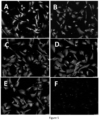
- FIG. 4 shows media containing Ga3% glass significantly increases osteosarcoma (tumorous) cell death relative to the Ga1% and Ga2% glasses and 45S5 control as shown in Figure 4 where figure 4A shows cells after treatment with McCoy basal media, Figure 4B shows cells after treatment with conditioned media containing 45S5 Bioglass TM (control), Figure 4C shows cells after treatment with conditioned media containing Ga1% (Ex 1) bioactive glass composition, Figure 4D shows cells after treatment with conditioned media containing Ga2% (Ex 2) bioactive glass composition, Figure 4E shows cells after treatment with conditioned media containing Ga3% (Ex 3) bioactive glass composition and Figure 4F shows cells after a 1nM Etoposide treatment as a positive inducer of cell death.
- Figure 4A shows cells after treatment with McCoy basal media
- Figure 4B shows cells after treatment with conditioned media containing 45S5 Bioglass TM (control)
- Figure 4C shows cells after treatment with conditioned media containing Ga1% (Ex 1) bioactive glass composition
- Figure 4D shows cells after treatment with
- FIG. 5 shows cells after treatment with McCoy basal media
- Figure 5B shows cells after treatment with conditioned media containing 45S5 Bioglass TM (control)
- Figure 5C shows cells after treatment with conditioned media containing Ga1% (Ex 1) bioactive glass composition
- Figure 5D shows cells after treatment with conditioned media containing Ga2% (Ex 2) bioactive glass composition
- Figure 5E shows cells after treatment with conditioned media containing Ga3% (Ex 3) bioactive glass composition
- Figure 5F shows cells after a 1nM Etoposide treatment as a positive inducer of cell death).
Landscapes
- Chemical & Material Sciences (AREA)
- Life Sciences & Earth Sciences (AREA)
- Engineering & Computer Science (AREA)
- Health & Medical Sciences (AREA)
- Chemical Kinetics & Catalysis (AREA)
- General Chemical & Material Sciences (AREA)
- Geochemistry & Mineralogy (AREA)
- Materials Engineering (AREA)
- Organic Chemistry (AREA)
- Ceramic Engineering (AREA)
- Molecular Biology (AREA)
- Inorganic Chemistry (AREA)
- Dermatology (AREA)
- Medicinal Chemistry (AREA)
- Oral & Maxillofacial Surgery (AREA)
- Transplantation (AREA)
- Epidemiology (AREA)
- Animal Behavior & Ethology (AREA)
- General Health & Medical Sciences (AREA)
- Public Health (AREA)
- Veterinary Medicine (AREA)
- Biodiversity & Conservation Biology (AREA)
- Glass Compositions (AREA)
Claims (15)
- Bioaktive Glaszusammensetzung, umfassend:5 bis 10 Mol-% Galliumoxid;25 bis 75 Mol-% Siliciumdioxid;10 bis 30 Mol-% Calciumoxid und/oder Strontiumoxid;1 bis 30 Mol-% Natriumoxid; und1 bis 15 Mol-% Phosphorpentoxid.
- Bioaktive Glaszusammensetzung nach Anspruch 1, umfassend zwischen 35 und 55 Mol-% SiO2.
- Bioaktive Glaszusammensetzung nach Anspruch 1 oder 2, umfassend zwischen 35,5 und 45,0 Mol-% SiO2.
- Bioaktive Glaszusammensetzung nach Anspruch 3, umfassend zwischen 39,0 und 40,0 Mol-% Siliciumdioxid.
- Bioaktive Glaszusammensetzung nach einem der Ansprüche 1 bis 4, umfassend zwischen 27,0 und 30,0 Mol-% CaO.
- Bioaktive Glaszusammensetzung nach Anspruch 5, umfassend zwischen 28,0 und 29,0 Mol-% CaO.
- Bioaktive Glaszusammensetzung nach einem der Ansprüche 1 bis 6, umfassend zwischen 24,5 und 27,0 Mol-% Natriumoxid.
- Bioaktive Glaszusammensetzung nach Anspruch 7, umfassend zwischen 24,9 und 26,0 Mol-% Natriumoxid.
- Bioaktive Glaszusammensetzung nach einem der Ansprüche 1 bis 8, umfassend zwischen 2,7 und 3,0 Mol-% Phosphorpentoxid.
- Bioaktive Glaszusammensetzung nach einem der Ansprüche 1 bis 9, weiters umfassend Magnesiumoxid und/oder Kaliumoxid.
- Bioaktive Glaszusammensetzung nach einem der Ansprüche 1 bis 10 und die weiters Folgendes umfasst:5 bis 15 Mol-% Magnesiumoxid;1 bis 15 Mol-% Kaliumoxid; und0 bis 10 Mol-% Zinkoxid.
- Bioaktive Glaszusammensetzung nach Anspruch 11, umfassend:5 Mol-% Galliumoxid;45,0 bis 53,0 Mol-% SiO2;23,0 bis 24,5 Mol-% CaO;6,3 bis 6,6 Mol-% Na2O;1,7 bis 1,9 Mol-% P2O5;8,2 bis 8,6 Mol-% MgO; und8,1 bis 8,5 Mol-% K2O.
- Bioaktive Glaszusammensetzung nach Anspruch 11, umfassend:5 Mol-% Galliumoxid;42,0 bis 44,0 Mol-% SiO2;32,0 bis 36,0 Mol-% CaO;2,0 bis 4,0 Mol-% Na2O;1,0 bis 2,0 Mol-% P2O5;7,0 bis 8,0 Mol-% MgO;3,0 bis 4,0 Mol-% K2O; und3,0 bis 4,0 Mol-% ZnO.
- Bioaktive Glaszusammensetzung nach einem der Ansprüche 1 bis 13 als Medikament.
- Bioaktive Glaszusammensetzung nach einem der Ansprüche 1 bis 13 zur Verwendung bei der Behandlung von Knochenkrebs.
Applications Claiming Priority (2)
| Application Number | Priority Date | Filing Date | Title |
|---|---|---|---|
| GBGB1620308.5A GB201620308D0 (en) | 2016-11-30 | 2016-11-30 | Tharapeutic material |
| PCT/EP2017/080865 WO2018099997A1 (en) | 2016-11-30 | 2017-11-29 | Therapeutic material |
Publications (2)
| Publication Number | Publication Date |
|---|---|
| EP3548443A1 EP3548443A1 (de) | 2019-10-09 |
| EP3548443B1 true EP3548443B1 (de) | 2024-02-21 |
Family
ID=58073185
Family Applications (1)
| Application Number | Title | Priority Date | Filing Date |
|---|---|---|---|
| EP17805208.0A Active EP3548443B1 (de) | 2016-11-30 | 2017-11-29 | Therapeutisches material |
Country Status (4)
| Country | Link |
|---|---|
| US (1) | US11311646B2 (de) |
| EP (1) | EP3548443B1 (de) |
| GB (1) | GB201620308D0 (de) |
| WO (1) | WO2018099997A1 (de) |
Families Citing this family (3)
| Publication number | Priority date | Publication date | Assignee | Title |
|---|---|---|---|---|
| US11433598B2 (en) * | 2018-01-08 | 2022-09-06 | The University Of Toledo | Bioactive glass/polymer composite filament, and methods of making |
| CN110776315B (zh) * | 2019-11-01 | 2022-03-15 | 深圳先进技术研究院 | 镁锶-磷酸硅盐材料及制备方法、包含其的结构可控的多孔骨修复复合支架材料 |
| CN119430661A (zh) * | 2023-08-07 | 2025-02-14 | 康宁股份有限公司 | 作为用于受控释放的核酸载体的生物活性玻璃颗粒 |
Family Cites Families (4)
| Publication number | Priority date | Publication date | Assignee | Title |
|---|---|---|---|---|
| WO2005087274A1 (en) | 2004-03-05 | 2005-09-22 | Xl Sci-Tech, Inc. | Particulate materials and compositions for radio therapy |
| GB201415005D0 (en) | 2014-08-22 | 2014-10-08 | Univ Nottingham | Porous and non-pourous bodies |
| GB2531068A (en) | 2014-10-10 | 2016-04-13 | Univ Dublin City | A gallium-based glass composition |
| EP3285716A4 (de) | 2015-04-24 | 2018-07-11 | Novabone Products, LLC | Bewässerungsresistente zusammensetzungen zur regenerierung von hartem gewebe und verfahren und kits zur verwendung davon |
-
2016
- 2016-11-30 GB GBGB1620308.5A patent/GB201620308D0/en not_active Ceased
-
2017
- 2017-11-29 WO PCT/EP2017/080865 patent/WO2018099997A1/en not_active Ceased
- 2017-11-29 US US16/464,561 patent/US11311646B2/en active Active
- 2017-11-29 EP EP17805208.0A patent/EP3548443B1/de active Active
Also Published As
| Publication number | Publication date |
|---|---|
| GB201620308D0 (en) | 2017-01-11 |
| EP3548443A1 (de) | 2019-10-09 |
| US20200054784A1 (en) | 2020-02-20 |
| US11311646B2 (en) | 2022-04-26 |
| WO2018099997A1 (en) | 2018-06-07 |
Similar Documents
| Publication | Publication Date | Title |
|---|---|---|
| Shoaib et al. | Magnesium doped mesoporous bioactive glass nanoparticles: A promising material for apatite formation and mitomycin c delivery to the MG-63 cancer cells | |
| Taye | Biomedical applications of ion-doped bioactive glass: A review | |
| Goudarzi et al. | Formation of hydroxyapatite on surface of SiO2–P2O5–CaO–SrO–ZnO bioactive glass synthesized through sol-gel route | |
| Farag et al. | In vitro drug release behavior of Ce-doped nano-bioactive glass carriers under oxidative stress | |
| JP6400753B2 (ja) | コーティングおよびコーティング方法 | |
| Rana et al. | Development and characterization of gallium-doped bioactive glasses for potential bone cancer applications | |
| Abulyazied et al. | Synthesis, structural and biomedical characterization of hydroxyapatite/borosilicate bioactive glass nanocomposites | |
| El-Meliegy et al. | Dissolution and drug release profiles of phosphate glasses doped with high valency oxides | |
| Choudhary et al. | Impact of forsterite addition on mechanical and biological properties of composites | |
| Miola et al. | Antibacterial and bioactive composite bone cements containing surface silver-doped glass particles | |
| US11311646B2 (en) | Therapeutic material | |
| Mostafa et al. | Bioactive glass doped with noble metal nanoparticles for bone regeneration: in vitro kinetics and proliferative impact on human bone cell line | |
| Iqbal et al. | Characterization and biological evaluation of silver containing fluoroapatite nanoparticles prepared through microwave synthesis | |
| Yılmaz et al. | Bioactive apatite–wollastonite glass ceramics coating on metallic titanium for biomedical applications: effect of boron | |
| Wren et al. | Comparison of a SiO2–CaO–ZnO–SrO glass polyalkenoate cement to commercial dental materials: ion release, biocompatibility and antibacterial properties | |
| Possolli et al. | Antimicrobial characteristics of the Li2O–ZrO2–Si2O bioactive glass and glass‐ceramic for bone regeneration and wound healing | |
| GB2531068A (en) | A gallium-based glass composition | |
| Kargozar et al. | Bioactive glasses: multifunctional delivery systems for cancer theranostic applications | |
| Coco et al. | Effect of incorporating silver on the structure and ion release profile of binary SiO2–Ag2O mesoporous bioactive glass submicron spherical particles | |
| He et al. | Construction of antimicrobial material-loaded porous tricalcium phosphate beads for treatment of bone infections | |
| Singh et al. | Study of human osteosarcoma cell line growth, hemocompatibility, in-vitro analysis and physical properties of V2O5 substituted borosilicate glass | |
| Keenan et al. | Relating ion release and pH to in vitro cell viability for gallium-inclusive bioactive glasses | |
| Yadav et al. | Bioactive glass for biomedical application: An overview | |
| Ferreira et al. | Titanium biomimetically coated with hydroxyapatite, silver nitrate and polycaprolactone, for use in biomaterials (biomedicine) | |
| Rahmani et al. | A comprehensive investigation of the effect of Ag on the structure and antibacterial efficacy of Li-substituted 58S and 68S bioactive glasses |
Legal Events
| Date | Code | Title | Description |
|---|---|---|---|
| STAA | Information on the status of an ep patent application or granted ep patent |
Free format text: STATUS: UNKNOWN |
|
| STAA | Information on the status of an ep patent application or granted ep patent |
Free format text: STATUS: THE INTERNATIONAL PUBLICATION HAS BEEN MADE |
|
| PUAI | Public reference made under article 153(3) epc to a published international application that has entered the european phase |
Free format text: ORIGINAL CODE: 0009012 |
|
| STAA | Information on the status of an ep patent application or granted ep patent |
Free format text: STATUS: REQUEST FOR EXAMINATION WAS MADE |
|
| 17P | Request for examination filed |
Effective date: 20190701 |
|
| AK | Designated contracting states |
Kind code of ref document: A1 Designated state(s): AL AT BE BG CH CY CZ DE DK EE ES FI FR GB GR HR HU IE IS IT LI LT LU LV MC MK MT NL NO PL PT RO RS SE SI SK SM TR |
|
| AX | Request for extension of the european patent |
Extension state: BA ME |
|
| DAV | Request for validation of the european patent (deleted) | ||
| DAX | Request for extension of the european patent (deleted) | ||
| STAA | Information on the status of an ep patent application or granted ep patent |
Free format text: STATUS: EXAMINATION IS IN PROGRESS |
|
| 17Q | First examination report despatched |
Effective date: 20201207 |
|
| GRAP | Despatch of communication of intention to grant a patent |
Free format text: ORIGINAL CODE: EPIDOSNIGR1 |
|
| STAA | Information on the status of an ep patent application or granted ep patent |
Free format text: STATUS: GRANT OF PATENT IS INTENDED |
|
| INTG | Intention to grant announced |
Effective date: 20230922 |
|
| GRAS | Grant fee paid |
Free format text: ORIGINAL CODE: EPIDOSNIGR3 |
|
| GRAA | (expected) grant |
Free format text: ORIGINAL CODE: 0009210 |
|
| STAA | Information on the status of an ep patent application or granted ep patent |
Free format text: STATUS: THE PATENT HAS BEEN GRANTED |
|
| AK | Designated contracting states |
Kind code of ref document: B1 Designated state(s): AL AT BE BG CH CY CZ DE DK EE ES FI FR GB GR HR HU IE IS IT LI LT LU LV MC MK MT NL NO PL PT RO RS SE SI SK SM TR |
|
| REG | Reference to a national code |
Ref country code: GB Ref legal event code: FG4D |
|
| REG | Reference to a national code |
Ref country code: CH Ref legal event code: EP |
|
| REG | Reference to a national code |
Ref country code: DE Ref legal event code: R096 Ref document number: 602017079377 Country of ref document: DE |
|
| REG | Reference to a national code |
Ref country code: IE Ref legal event code: FG4D |
|
| REG | Reference to a national code |
Ref country code: DE Ref legal event code: R081 Ref document number: 602017079377 Country of ref document: DE Owner name: ASTON UNIVERSITY, GB Free format text: FORMER OWNER: ASTON PARTICLE TECHNOLOGIES LTD., BIRMINGHAM, GB |
|
| REG | Reference to a national code |
Ref country code: LT Ref legal event code: MG9D |
|
| REG | Reference to a national code |
Ref country code: NL Ref legal event code: MP Effective date: 20240221 |
|
| PG25 | Lapsed in a contracting state [announced via postgrant information from national office to epo] |
Ref country code: IS Free format text: LAPSE BECAUSE OF FAILURE TO SUBMIT A TRANSLATION OF THE DESCRIPTION OR TO PAY THE FEE WITHIN THE PRESCRIBED TIME-LIMIT Effective date: 20240621 |
|
| PG25 | Lapsed in a contracting state [announced via postgrant information from national office to epo] |
Ref country code: LT Free format text: LAPSE BECAUSE OF FAILURE TO SUBMIT A TRANSLATION OF THE DESCRIPTION OR TO PAY THE FEE WITHIN THE PRESCRIBED TIME-LIMIT Effective date: 20240221 |
|
| PG25 | Lapsed in a contracting state [announced via postgrant information from national office to epo] |
Ref country code: GR Free format text: LAPSE BECAUSE OF FAILURE TO SUBMIT A TRANSLATION OF THE DESCRIPTION OR TO PAY THE FEE WITHIN THE PRESCRIBED TIME-LIMIT Effective date: 20240522 |
|
| REG | Reference to a national code |
Ref country code: AT Ref legal event code: MK05 Ref document number: 1659003 Country of ref document: AT Kind code of ref document: T Effective date: 20240221 |
|
| PG25 | Lapsed in a contracting state [announced via postgrant information from national office to epo] |
Ref country code: HR Free format text: LAPSE BECAUSE OF FAILURE TO SUBMIT A TRANSLATION OF THE DESCRIPTION OR TO PAY THE FEE WITHIN THE PRESCRIBED TIME-LIMIT Effective date: 20240221 Ref country code: NL Free format text: LAPSE BECAUSE OF FAILURE TO SUBMIT A TRANSLATION OF THE DESCRIPTION OR TO PAY THE FEE WITHIN THE PRESCRIBED TIME-LIMIT Effective date: 20240221 Ref country code: RS Free format text: LAPSE BECAUSE OF FAILURE TO SUBMIT A TRANSLATION OF THE DESCRIPTION OR TO PAY THE FEE WITHIN THE PRESCRIBED TIME-LIMIT Effective date: 20240521 |
|
| PG25 | Lapsed in a contracting state [announced via postgrant information from national office to epo] |
Ref country code: ES Free format text: LAPSE BECAUSE OF FAILURE TO SUBMIT A TRANSLATION OF THE DESCRIPTION OR TO PAY THE FEE WITHIN THE PRESCRIBED TIME-LIMIT Effective date: 20240221 |
|
| PG25 | Lapsed in a contracting state [announced via postgrant information from national office to epo] |
Ref country code: AT Free format text: LAPSE BECAUSE OF FAILURE TO SUBMIT A TRANSLATION OF THE DESCRIPTION OR TO PAY THE FEE WITHIN THE PRESCRIBED TIME-LIMIT Effective date: 20240221 |
|
| PG25 | Lapsed in a contracting state [announced via postgrant information from national office to epo] |
Ref country code: RS Free format text: LAPSE BECAUSE OF FAILURE TO SUBMIT A TRANSLATION OF THE DESCRIPTION OR TO PAY THE FEE WITHIN THE PRESCRIBED TIME-LIMIT Effective date: 20240521 Ref country code: NO Free format text: LAPSE BECAUSE OF FAILURE TO SUBMIT A TRANSLATION OF THE DESCRIPTION OR TO PAY THE FEE WITHIN THE PRESCRIBED TIME-LIMIT Effective date: 20240521 Ref country code: NL Free format text: LAPSE BECAUSE OF FAILURE TO SUBMIT A TRANSLATION OF THE DESCRIPTION OR TO PAY THE FEE WITHIN THE PRESCRIBED TIME-LIMIT Effective date: 20240221 Ref country code: LT Free format text: LAPSE BECAUSE OF FAILURE TO SUBMIT A TRANSLATION OF THE DESCRIPTION OR TO PAY THE FEE WITHIN THE PRESCRIBED TIME-LIMIT Effective date: 20240221 Ref country code: IS Free format text: LAPSE BECAUSE OF FAILURE TO SUBMIT A TRANSLATION OF THE DESCRIPTION OR TO PAY THE FEE WITHIN THE PRESCRIBED TIME-LIMIT Effective date: 20240621 Ref country code: HR Free format text: LAPSE BECAUSE OF FAILURE TO SUBMIT A TRANSLATION OF THE DESCRIPTION OR TO PAY THE FEE WITHIN THE PRESCRIBED TIME-LIMIT Effective date: 20240221 Ref country code: GR Free format text: LAPSE BECAUSE OF FAILURE TO SUBMIT A TRANSLATION OF THE DESCRIPTION OR TO PAY THE FEE WITHIN THE PRESCRIBED TIME-LIMIT Effective date: 20240522 Ref country code: FI Free format text: LAPSE BECAUSE OF FAILURE TO SUBMIT A TRANSLATION OF THE DESCRIPTION OR TO PAY THE FEE WITHIN THE PRESCRIBED TIME-LIMIT Effective date: 20240221 Ref country code: ES Free format text: LAPSE BECAUSE OF FAILURE TO SUBMIT A TRANSLATION OF THE DESCRIPTION OR TO PAY THE FEE WITHIN THE PRESCRIBED TIME-LIMIT Effective date: 20240221 Ref country code: BG Free format text: LAPSE BECAUSE OF FAILURE TO SUBMIT A TRANSLATION OF THE DESCRIPTION OR TO PAY THE FEE WITHIN THE PRESCRIBED TIME-LIMIT Effective date: 20240221 Ref country code: AT Free format text: LAPSE BECAUSE OF FAILURE TO SUBMIT A TRANSLATION OF THE DESCRIPTION OR TO PAY THE FEE WITHIN THE PRESCRIBED TIME-LIMIT Effective date: 20240221 |
|
| PG25 | Lapsed in a contracting state [announced via postgrant information from national office to epo] |
Ref country code: PT Free format text: LAPSE BECAUSE OF FAILURE TO SUBMIT A TRANSLATION OF THE DESCRIPTION OR TO PAY THE FEE WITHIN THE PRESCRIBED TIME-LIMIT Effective date: 20240621 Ref country code: PL Free format text: LAPSE BECAUSE OF FAILURE TO SUBMIT A TRANSLATION OF THE DESCRIPTION OR TO PAY THE FEE WITHIN THE PRESCRIBED TIME-LIMIT Effective date: 20240221 |
|
| PG25 | Lapsed in a contracting state [announced via postgrant information from national office to epo] |
Ref country code: SE Free format text: LAPSE BECAUSE OF FAILURE TO SUBMIT A TRANSLATION OF THE DESCRIPTION OR TO PAY THE FEE WITHIN THE PRESCRIBED TIME-LIMIT Effective date: 20240221 Ref country code: PT Free format text: LAPSE BECAUSE OF FAILURE TO SUBMIT A TRANSLATION OF THE DESCRIPTION OR TO PAY THE FEE WITHIN THE PRESCRIBED TIME-LIMIT Effective date: 20240621 Ref country code: PL Free format text: LAPSE BECAUSE OF FAILURE TO SUBMIT A TRANSLATION OF THE DESCRIPTION OR TO PAY THE FEE WITHIN THE PRESCRIBED TIME-LIMIT Effective date: 20240221 Ref country code: LV Free format text: LAPSE BECAUSE OF FAILURE TO SUBMIT A TRANSLATION OF THE DESCRIPTION OR TO PAY THE FEE WITHIN THE PRESCRIBED TIME-LIMIT Effective date: 20240221 |
|
| PG25 | Lapsed in a contracting state [announced via postgrant information from national office to epo] |
Ref country code: DK Free format text: LAPSE BECAUSE OF FAILURE TO SUBMIT A TRANSLATION OF THE DESCRIPTION OR TO PAY THE FEE WITHIN THE PRESCRIBED TIME-LIMIT Effective date: 20240221 |
|
| PG25 | Lapsed in a contracting state [announced via postgrant information from national office to epo] |
Ref country code: SM Free format text: LAPSE BECAUSE OF FAILURE TO SUBMIT A TRANSLATION OF THE DESCRIPTION OR TO PAY THE FEE WITHIN THE PRESCRIBED TIME-LIMIT Effective date: 20240221 |
|
| PG25 | Lapsed in a contracting state [announced via postgrant information from national office to epo] |
Ref country code: EE Free format text: LAPSE BECAUSE OF FAILURE TO SUBMIT A TRANSLATION OF THE DESCRIPTION OR TO PAY THE FEE WITHIN THE PRESCRIBED TIME-LIMIT Effective date: 20240221 Ref country code: CZ Free format text: LAPSE BECAUSE OF FAILURE TO SUBMIT A TRANSLATION OF THE DESCRIPTION OR TO PAY THE FEE WITHIN THE PRESCRIBED TIME-LIMIT Effective date: 20240221 |
|
| PG25 | Lapsed in a contracting state [announced via postgrant information from national office to epo] |
Ref country code: SK Free format text: LAPSE BECAUSE OF FAILURE TO SUBMIT A TRANSLATION OF THE DESCRIPTION OR TO PAY THE FEE WITHIN THE PRESCRIBED TIME-LIMIT Effective date: 20240221 |
|
| PG25 | Lapsed in a contracting state [announced via postgrant information from national office to epo] |
Ref country code: SM Free format text: LAPSE BECAUSE OF FAILURE TO SUBMIT A TRANSLATION OF THE DESCRIPTION OR TO PAY THE FEE WITHIN THE PRESCRIBED TIME-LIMIT Effective date: 20240221 Ref country code: SK Free format text: LAPSE BECAUSE OF FAILURE TO SUBMIT A TRANSLATION OF THE DESCRIPTION OR TO PAY THE FEE WITHIN THE PRESCRIBED TIME-LIMIT Effective date: 20240221 Ref country code: RO Free format text: LAPSE BECAUSE OF FAILURE TO SUBMIT A TRANSLATION OF THE DESCRIPTION OR TO PAY THE FEE WITHIN THE PRESCRIBED TIME-LIMIT Effective date: 20240221 Ref country code: EE Free format text: LAPSE BECAUSE OF FAILURE TO SUBMIT A TRANSLATION OF THE DESCRIPTION OR TO PAY THE FEE WITHIN THE PRESCRIBED TIME-LIMIT Effective date: 20240221 Ref country code: DK Free format text: LAPSE BECAUSE OF FAILURE TO SUBMIT A TRANSLATION OF THE DESCRIPTION OR TO PAY THE FEE WITHIN THE PRESCRIBED TIME-LIMIT Effective date: 20240221 Ref country code: CZ Free format text: LAPSE BECAUSE OF FAILURE TO SUBMIT A TRANSLATION OF THE DESCRIPTION OR TO PAY THE FEE WITHIN THE PRESCRIBED TIME-LIMIT Effective date: 20240221 |
|
| REG | Reference to a national code |
Ref country code: DE Ref legal event code: R097 Ref document number: 602017079377 Country of ref document: DE |
|
| PG25 | Lapsed in a contracting state [announced via postgrant information from national office to epo] |
Ref country code: IT Free format text: LAPSE BECAUSE OF FAILURE TO SUBMIT A TRANSLATION OF THE DESCRIPTION OR TO PAY THE FEE WITHIN THE PRESCRIBED TIME-LIMIT Effective date: 20240221 |
|
| PLBE | No opposition filed within time limit |
Free format text: ORIGINAL CODE: 0009261 |
|
| STAA | Information on the status of an ep patent application or granted ep patent |
Free format text: STATUS: NO OPPOSITION FILED WITHIN TIME LIMIT |
|
| PG25 | Lapsed in a contracting state [announced via postgrant information from national office to epo] |
Ref country code: IT Free format text: LAPSE BECAUSE OF FAILURE TO SUBMIT A TRANSLATION OF THE DESCRIPTION OR TO PAY THE FEE WITHIN THE PRESCRIBED TIME-LIMIT Effective date: 20240221 |
|
| 26N | No opposition filed |
Effective date: 20241122 |
|
| PG25 | Lapsed in a contracting state [announced via postgrant information from national office to epo] |
Ref country code: SI Free format text: LAPSE BECAUSE OF FAILURE TO SUBMIT A TRANSLATION OF THE DESCRIPTION OR TO PAY THE FEE WITHIN THE PRESCRIBED TIME-LIMIT Effective date: 20240221 |
|
| REG | Reference to a national code |
Ref country code: DE Ref legal event code: R119 Ref document number: 602017079377 Country of ref document: DE |
|
| REG | Reference to a national code |
Ref country code: CH Ref legal event code: PL |
|
| PG25 | Lapsed in a contracting state [announced via postgrant information from national office to epo] |
Ref country code: MC Free format text: LAPSE BECAUSE OF FAILURE TO SUBMIT A TRANSLATION OF THE DESCRIPTION OR TO PAY THE FEE WITHIN THE PRESCRIBED TIME-LIMIT Effective date: 20240221 |
|
| PG25 | Lapsed in a contracting state [announced via postgrant information from national office to epo] |
Ref country code: LU Free format text: LAPSE BECAUSE OF NON-PAYMENT OF DUE FEES Effective date: 20241129 |
|
| REG | Reference to a national code |
Ref country code: CH Ref legal event code: PL |
|
| PG25 | Lapsed in a contracting state [announced via postgrant information from national office to epo] |
Ref country code: CH Free format text: LAPSE BECAUSE OF NON-PAYMENT OF DUE FEES Effective date: 20241130 |
|
| REG | Reference to a national code |
Ref country code: BE Ref legal event code: MM Effective date: 20241130 |
|
| PG25 | Lapsed in a contracting state [announced via postgrant information from national office to epo] |
Ref country code: DE Free format text: LAPSE BECAUSE OF NON-PAYMENT OF DUE FEES Effective date: 20250603 |
|
| PG25 | Lapsed in a contracting state [announced via postgrant information from national office to epo] |
Ref country code: BE Free format text: LAPSE BECAUSE OF NON-PAYMENT OF DUE FEES Effective date: 20241130 |
|
| PG25 | Lapsed in a contracting state [announced via postgrant information from national office to epo] |
Ref country code: FR Free format text: LAPSE BECAUSE OF NON-PAYMENT OF DUE FEES Effective date: 20241130 |
|
| PG25 | Lapsed in a contracting state [announced via postgrant information from national office to epo] |
Ref country code: IE Free format text: LAPSE BECAUSE OF NON-PAYMENT OF DUE FEES Effective date: 20241129 |
|
| PGFP | Annual fee paid to national office [announced via postgrant information from national office to epo] |
Ref country code: GB Payment date: 20251020 Year of fee payment: 9 |
|
| PG25 | Lapsed in a contracting state [announced via postgrant information from national office to epo] |
Ref country code: HU Free format text: LAPSE BECAUSE OF FAILURE TO SUBMIT A TRANSLATION OF THE DESCRIPTION OR TO PAY THE FEE WITHIN THE PRESCRIBED TIME-LIMIT; INVALID AB INITIO Effective date: 20171129 |
|
| PG25 | Lapsed in a contracting state [announced via postgrant information from national office to epo] |
Ref country code: CY Free format text: LAPSE BECAUSE OF FAILURE TO SUBMIT A TRANSLATION OF THE DESCRIPTION OR TO PAY THE FEE WITHIN THE PRESCRIBED TIME-LIMIT; INVALID AB INITIO Effective date: 20171129 |