EP3548033B1 - Compounds and their methods of use - Google Patents
Compounds and their methods of use Download PDFInfo
- Publication number
- EP3548033B1 EP3548033B1 EP17874657.4A EP17874657A EP3548033B1 EP 3548033 B1 EP3548033 B1 EP 3548033B1 EP 17874657 A EP17874657 A EP 17874657A EP 3548033 B1 EP3548033 B1 EP 3548033B1
- Authority
- EP
- European Patent Office
- Prior art keywords
- mmol
- alkyl
- compound
- mixture
- carbocyclyl
- Prior art date
- Legal status (The legal status is an assumption and is not a legal conclusion. Google has not performed a legal analysis and makes no representation as to the accuracy of the status listed.)
- Active
Links
Classifications
-
- C—CHEMISTRY; METALLURGY
- C07—ORGANIC CHEMISTRY
- C07D—HETEROCYCLIC COMPOUNDS
- C07D487/00—Heterocyclic compounds containing nitrogen atoms as the only ring hetero atoms in the condensed system, not provided for by groups C07D451/00 - C07D477/00
- C07D487/02—Heterocyclic compounds containing nitrogen atoms as the only ring hetero atoms in the condensed system, not provided for by groups C07D451/00 - C07D477/00 in which the condensed system contains two hetero rings
- C07D487/04—Ortho-condensed systems
-
- A—HUMAN NECESSITIES
- A61—MEDICAL OR VETERINARY SCIENCE; HYGIENE
- A61K—PREPARATIONS FOR MEDICAL, DENTAL OR TOILETRY PURPOSES
- A61K45/00—Medicinal preparations containing active ingredients not provided for in groups A61K31/00 - A61K41/00
- A61K45/06—Mixtures of active ingredients without chemical characterisation, e.g. antiphlogistics and cardiaca
-
- A—HUMAN NECESSITIES
- A61—MEDICAL OR VETERINARY SCIENCE; HYGIENE
- A61K—PREPARATIONS FOR MEDICAL, DENTAL OR TOILETRY PURPOSES
- A61K31/00—Medicinal preparations containing organic active ingredients
- A61K31/33—Heterocyclic compounds
- A61K31/395—Heterocyclic compounds having nitrogen as a ring hetero atom, e.g. guanethidine or rifamycins
- A61K31/495—Heterocyclic compounds having nitrogen as a ring hetero atom, e.g. guanethidine or rifamycins having six-membered rings with two or more nitrogen atoms as the only ring heteroatoms, e.g. piperazine or tetrazines
- A61K31/4985—Pyrazines or piperazines ortho- or peri-condensed with heterocyclic ring systems
-
- A—HUMAN NECESSITIES
- A61—MEDICAL OR VETERINARY SCIENCE; HYGIENE
- A61K—PREPARATIONS FOR MEDICAL, DENTAL OR TOILETRY PURPOSES
- A61K31/00—Medicinal preparations containing organic active ingredients
- A61K31/33—Heterocyclic compounds
- A61K31/395—Heterocyclic compounds having nitrogen as a ring hetero atom, e.g. guanethidine or rifamycins
- A61K31/495—Heterocyclic compounds having nitrogen as a ring hetero atom, e.g. guanethidine or rifamycins having six-membered rings with two or more nitrogen atoms as the only ring heteroatoms, e.g. piperazine or tetrazines
- A61K31/50—Pyridazines; Hydrogenated pyridazines
- A61K31/5025—Pyridazines; Hydrogenated pyridazines ortho- or peri-condensed with heterocyclic ring systems
-
- A—HUMAN NECESSITIES
- A61—MEDICAL OR VETERINARY SCIENCE; HYGIENE
- A61P—SPECIFIC THERAPEUTIC ACTIVITY OF CHEMICAL COMPOUNDS OR MEDICINAL PREPARATIONS
- A61P25/00—Drugs for disorders of the nervous system
-
- A—HUMAN NECESSITIES
- A61—MEDICAL OR VETERINARY SCIENCE; HYGIENE
- A61P—SPECIFIC THERAPEUTIC ACTIVITY OF CHEMICAL COMPOUNDS OR MEDICINAL PREPARATIONS
- A61P25/00—Drugs for disorders of the nervous system
- A61P25/08—Antiepileptics; Anticonvulsants
-
- A—HUMAN NECESSITIES
- A61—MEDICAL OR VETERINARY SCIENCE; HYGIENE
- A61P—SPECIFIC THERAPEUTIC ACTIVITY OF CHEMICAL COMPOUNDS OR MEDICINAL PREPARATIONS
- A61P25/00—Drugs for disorders of the nervous system
- A61P25/18—Antipsychotics, i.e. neuroleptics; Drugs for mania or schizophrenia
Definitions
- Sodium ion (Na+) channels primarily open in a transient manner and are quickly inactivated, thereby generating a fast Na+ current to initiate the action potential.
- the late or persistent sodium current (INaL) is a sustained component of the fast Na+ current of cardiac myocytes and neurons.
- INaL enhancement contributes to the pathogenesis of both electrical and contractile dysfunction in mammals (see, e.g., Pharmacol Ther (2008) 119:326-339 ). Accordingly, pharmaceutical compounds that selectively modulate sodium channel activity, e.g., abnormal INaL, are useful in treating such disease states.
- Described herein are fused heteroaryl compounds and compositions useful for preventing and/or treating a disease, disorder, or condition, e.g., a disease, disorder, or condition relating to aberrant function of a sodium ion channel, e.g., abnormal late sodium current (INaL).
- a disease, disorder, or condition e.g., a disease, disorder, or condition relating to aberrant function of a sodium ion channel, e.g., abnormal late sodium current (INaL).
- the present invention provides a compound of Formula (VII): or a pharmaceutically acceptable salt thereof, wherein:
- the present disclosure features compounds of Formula (I): or a pharmaceutically acceptable salt thereof, wherein each of X, Y, and Z is independently N or CR 2 , wherein at least one of X, Y, and Z is independently N;
- A is aryl or heteroaryl (e.g., monocyclic 6-membered aryl or heteroaryl), each of which is optionally substituted by one or more R 3 ;
- R 2 is hydrogen, alkyl, or halo;
- R 1 is hydrogen, alkyl, alkenyl, alkynyl, -OR b , carbocyclyl, heterocyclyl, aryl, heteroaryl, wherein alkyl, alkenyl, alkynyl, carbocyclyl, heterocyclyl, aryl, and heteroaryl are optionally substituted with one or more R 4 ;
- each R 3 is independently alkyl, carbocyclyl, heterocyclyl, halo, cyano, nitro,
- the present disclosure provides a compound of Formula (I), or a pharmaceutically acceptable salt thereof, for use in a method of treating a neurological disorder or a psychiatric disorder in a subject in need thereof : wherein:
- the present disclosure provides a compound of Formula (I-2), or a pharmaceutically acceptable salt thereof, a method of treating a neurological disorder or a psychiatric disorder in a subject in need thereof: wherein:
- the neurological disorder is epilepsy.
- the neurological disorder is an epileptic encephalopathy.
- the epileptic encephalopathy comprises Dravet syndrome, infantile spasms, or Lennox-Gastaut syndrome.
- the compound is selected from: pharmaceutically acceptable salt thereof.
- the present invention provides a compound of Formula (VII): or a pharmaceutically acceptable salt thereof, wherein:
- R 1 is hydrogen, C 1 alkyl, C 1-6 haloalkyl, or C 3-8 carbocyclyl, wherein C 1 alkyl, C 1-6 haloalkyl, or C 3-8 carbocyclyl is optionally substituted by one or more halo, 3-8 membered heterocyclyl, or -ORc.
- R 1 is CF 3 or CHF 2 .
- R 1 is hydrogen
- R 3 is -OR 7 .
- R 7 is C 1-6 alkyl optionally substituted with 1, 2, or 3 substituents selected from halogen or cyano; C 1-6 alkyl substituted with C 3-8 carbocyclyl optionally substituted with 1, 2, or 3 substituents selected from halogen or cyano; or C 3-8 carbocyclyl optionally substituted with 1, 2, or 3 substituents selected from halogen or cyano.
- R 7 is C 1-6 alkyl optionally substituted with 1, 2, or 3 halogens.
- R 3 is -OCF 3 or -O-CH 2 CF 3 .
- R 4 is independently C 1-6 alkyl, -OR c , or halogen.
- R 4 is methyl or fluoride.
- m is 1 or 2.
- m is 1.
- the compound is selected from: or a pharmaceutically acceptable salt thereof.
- the compound is selected from: or a pharmaceutically acceptable salt thereof.
- the present invention provides a compound of Formula (VIIa): or a pharmaceutically acceptable salt thereof, wherein:
- R 1 is C 1-6 haloalkyl optionally substituted with -OR c or C 3-4 carbocyclyl optionally substituted with one or two halogens.
- R 1 is CF 3 or CHF 2 .
- R 2 is hydrogen
- R 7 is C 1-6 alkyl optionally substituted with 1, 2, or 3 substituents selected from halogen or cyano; C 1-6 alkyl substituted with C 3-8 carbocyclyl optionally substituted with 1, 2, or 3 substituents selected from halogen or cyano; or C 3-8 carbocyclyl optionally substituted with 1, 2, or 3 substituents selected from halogen or cyano.
- R 7 is C 1-6 alkyl optionally substituted with 1, 2, or 3 halogens.
- -OR 7 is -OCF 3 or -O-CH 2 CF 3 .
- R 4 is independently C 1-6 alkyl, -OR c , or halogen.
- R 4 is methyl or fluoride.
- m is 1 or 2.
- m is 1.
- the compound is selected from: or a pharmaceutically acceptable salt thereof.
- the compound is selected from: or a pharmaceutically acceptable salt thereof.
- the present invention provides a compound of Formula (VIIb): or a pharmaceutically acceptable salt thereof, wherein:
- R 1 is C 1-6 haloalkyl optionally substituted with -OR c or C 3-4 carbocyclyl optionally substituted with one or two halogens.
- R 1 is CF 3 or CHF 2 .
- R 2 is hydrogen
- R 7 is C 1-6 alkyl optionally substituted with 1, 2, or 3 substituents selected from halogen or cyano; C 1-6 alkyl substituted with C 3-8 carbocyclyl optionally substituted with 1, 2, or 3 substituents selected from halogen or cyano; or C 3-8 carbocyclyl optionally substituted with 1, 2, or 3 substituents selected from halogen or cyano.
- R 7 is C 1-6 alkyl optionally substituted with 1, 2, or 3 halogens.
- -OR 7 is -OCF 3 or -O-CH 2 CF 3 .
- R 4 is fluoride
- the compound is selected from: or a pharmaceutically acceptable salt thereof.
- the present disclosure provides a pharmaceutical composition
- a pharmaceutical composition comprising a disclosed compound or pharmaceutically acceptable salt thereof, and a pharmaceutically acceptable carrier.
- the present disclosure provides a disclosed compound or a pharmaceutically acceptable salt thereof or a disclosed pharmaceutical composition for use in a method of treating a neurological disorder or a psychiatric disorder in a subject in need thereof.
- the present invention provides compounds and compositions useful for preventing and/or treating a disease, disorder, or condition described herein, e.g., a disease, disorder, or condition relating to aberrant function of a sodium ion channel, such as abnormal late sodium current (INaL).
- a disease, disorder, or condition described herein e.g., a disease, disorder, or condition relating to aberrant function of a sodium ion channel, such as abnormal late sodium current (INaL).
- exemplary diseases, disorders, or conditions include epilepsy or an epilepsy syndrome.
- Compounds described herein can comprise one or more asymmetric centers, and thus can exist in various isomeric forms, e.g., enantiomers and/or diastereomers.
- the compounds described herein can be in the form of an individual enantiomer, diastereomer or geometric isomer, or can be in the form of a mixture of stereoisomers, including racemic mixtures and mixtures enriched in one or more stereoisomer.
- Isomers can be isolated from mixtures by methods known to those skilled in the art, including chiral high pressure liquid chromatography (HPLC) and the formation and crystallization of chiral salts; or preferred isomers can be prepared by asymmetric syntheses.
- HPLC high pressure liquid chromatography
- a pure enantiomeric compound is substantially free from other enantiomers or stereoisomers of the compound (i.e. , in enantiomeric excess).
- an "S" form of the compound is substantially free from the "R” form of the compound and is, thus, in enantiomeric excess of the "R” form.
- enantiomerically pure or “pure enantiomer” denotes that the compound comprises more than 75% by weight, more than 80% by weight, more than 85% by weight, more than 90% by weight, more than 91% by weight, more than 92% by weight, more than 93% by weight, more than 94% by weight, more than 95% by weight, more than 96% by weight, more than 97% by weight, more than 98% by weight, more than 98.5% by weight, more than 99% by weight, more than 99.2% by weight, more than 99.5% by weight, more than 99.6% by weight, more than 99.7% by weight, more than 99.8% by weight or more than 99.9% by weight, of the enantiomer.
- the weights are based upon total weight of all enantiomers or stereoisomers of the compound.
- an enantiomerically pure compound can be present with other active or inactive ingredients.
- a pharmaceutical composition comprising enantiomerically pure R-compound can comprise, for example, about 90% excipient and about 10% enantiomerically pure R-compound.
- the enantiomerically pure R-compound in such compositions can, for example, comprise, at least about 95% by weight R-compound and at most about 5% by weight S-compound, by total weight of the compound.
- a pharmaceutical composition comprising enantiomerically pure S-compound can comprise, for example, about 90% excipient and about 10% enantiomerically pure S-compound.
- the enantiomerically pure S-compound in such compositions can, for example, comprise, at least about 95% by weight S-compound and at most about 5% by weight R-compound, by total weight of the compound.
- the active ingredient can be formulated with little or no excipient or carrier.
- Compound described herein may also comprise one or more isotopic substitutions.
- H may be in any isotopic form, including 1 H, 2 H (D or deuterium), and 3 H (T or tritium);
- C may be in any isotopic form, including 12 C, 13 C, and 14 C;
- O may be in any isotopic form, including 16 O and 18 O; and the like.
- analogue means one analogue or more than one analogue.
- C 1-6 alkyl is intended to encompass, C 1 , C 2 , C 3 , C 4 , C 5 , C 6 , C 1-6 , C 1-5 , C 1-4 , C 1-3 , C 1-2 , C 2-6 , C 2-5 , C 2-4 , C 2-3 , C 3-6 , C 3-5 , C 3-4 , C 4-6 , C 4-5 , and C 5-6 alkyl.
- alkyl refers to a radical of a straight-chain or branched saturated hydrocarbon group, e.g., having 1 to 20 carbon atoms (“C 1-20 alkyl”). In some embodiments, an alkyl group has 1 to 10 carbon atoms (“C 1-10 alkyl”). In some embodiments, an alkyl group has 1 to 9 carbon atoms ("C 1-9 alkyl”). In some embodiments, an alkyl group has 1 to 8 carbon atoms (“C 1-8 alkyl”). In some embodiments, an alkyl group has 1 to 7 carbon atoms (“C 1-7 alkyl”). In some embodiments, an alkyl group has 1 to 6 carbon atoms ("C 1-6 alkyl”).
- an alkyl group has 1 to 5 carbon atoms ("C 1-5 alkyl”). In some embodiments, an alkyl group has 1 to 4 carbon atoms ("C 1-4 alkyl”). In some embodiments, an alkyl group has 1 to 3 carbon atoms ("C 1-3 alkyl”). In some embodiments, an alkyl group has 1 to 2 carbon atoms ("C 1-2 alkyl”). In some embodiments, an alkyl group has 1 carbon atom (“C 1 alkyl”). Examples of C 1-6 alkyl groups include methyl, ethyl, propyl, isopropyl, butyl, isobutyl, pentyl, hexyl, and the like.
- alkenyl refers to a radical of a straight-chain or branched hydrocarbon group having from 2 to 20 carbon atoms, one or more carbon-carbon double bonds (e.g., 1, 2, 3, or 4 carbon-carbon double bonds), and optionally one or more carbon-carbon triple bonds (e.g., 1, 2, 3, or 4 carbon-carbon triple bonds) ("C 2-20 alkenyl"). In certain embodiments, alkenyl does not contain any triple bonds. In some embodiments, an alkenyl group has 2 to 10 carbon atoms (“C 2-10 alkenyl”). In some embodiments, an alkenyl group has 2 to 9 carbon atoms (“C 2-9 alkenyl").
- an alkenyl group has 2 to 8 carbon atoms ("C 2-8 alkenyl”). In some embodiments, an alkenyl group has 2 to 7 carbon atoms ("C 2-7 alkenyl”). In some embodiments, an alkenyl group has 2 to 6 carbon atoms ("C 2-6 alkenyl”). In some embodiments, an alkenyl group has 2 to 5 carbon atoms ("C 2-5 alkenyl”). In some embodiments, an alkenyl group has 2 to 4 carbon atoms (“C 2-4 alkenyl”). In some embodiments, an alkenyl group has 2 to 3 carbon atoms ("C 2-3 alkenyl”).
- an alkenyl group has 2 carbon atoms ("C 2 alkenyl").
- the one or more carbon-carbon double bonds can be internal (such as in 2-butenyl) or terminal (such as in 1-butenyl).
- Examples of C 2-4 alkenyl groups include ethenyl (C 2 ), 1-propenyl (C 3 ), 2-propenyl (C 3 ), 1-butenyl (C 4 ), 2-butenyl (C 4 ), butadienyl (C 4 ), and the like.
- C 2-6 alkenyl groups include the aforementioned C 2-4 alkenyl groups as well as pentenyl (C 5 ), pentadienyl (C 5 ), hexenyl (C 6 ), and the like. Additional examples of alkenyl include heptenyl (C 7 ), octenyl (C 8 ), octatrienyl (C 8 ), and the like.
- alkynyl refers to a radical of a straight-chain or branched hydrocarbon group having from 2 to 20 carbon atoms, one or more carbon-carbon triple bonds (e.g., 1, 2, 3, or 4 carbon-carbon triple bonds), and optionally one or more carbon-carbon double bonds (e.g., 1, 2, 3, or 4 carbon-carbon double bonds) ("C 2-20 alkynyl"). In certain embodiments, alkynyl does not contain any double bonds. In some embodiments, an alkynyl group has 2 to 10 carbon atoms (“C 2-10 alkynyl”). In some embodiments, an alkynyl group has 2 to 9 carbon atoms (“C 2-9 alkynyl").
- an alkynyl group has 2 to 8 carbon atoms ("C 2-8 alkynyl”). In some embodiments, an alkynyl group has 2 to 7 carbon atoms ("C 2-7 alkynyl”). In some embodiments, an alkynyl group has 2 to 6 carbon atoms ("C 2-6 alkynyl”). In some embodiments, an alkynyl group has 2 to 5 carbon atoms ("C 2-5 alkynyl”). In some embodiments, an alkynyl group has 2 to 4 carbon atoms (“C 2-4 alkynyl”). In some embodiments, an alkynyl group has 2 to 3 carbon atoms ("C 2-3 alkynyl”).
- an alkynyl group has 2 carbon atoms ("C 2 alkynyl").
- the one or more carbon-carbon triple bonds can be internal (such as in 2-butynyl) or terminal (such as in 1-butynyl).
- Examples of C 2-4 alkynyl groups include, without limitation, ethynyl (C 2 ), 1-propynyl (C 3 ), 2-propynyl (C 3 ), 1-butynyl (C 4 ), 2-butynyl (C 4 ), and the like.
- C 2-6 alkenyl groups include the aforementioned C 2-4 alkynyl groups as well as pentynyl (C 5 ), hexynyl (C 6 ), and the like. Additional examples of alkynyl include heptynyl (C 7 ), octynyl (C 8 ), and the like.
- alkylene As used herein, “alkylene,” “alkenylene,” and “alkynylene,” refer to a divalent radical of an alkyl, alkenyl, and alkynyl group respectively. When a range or number of carbons is provided for a particular “alkylene,” “alkenylene,” or “alkynylene,” group, it is understood that the range or number refers to the range or number of carbons in the linear carbon divalent chain.
- Alkylene,” “alkenylene,” and “alkynylene,” groups may be substituted or unsubstituted with one or more substituents as described herein.
- aryl refers to a radical of a monocyclic or polycyclic ( e . g ., bicyclic or tricyclic) 4n+2 aromatic ring system (e.g., having 6, 10, or 14 ⁇ electrons shared in a cyclic array) having 6-14 ring carbon atoms and zero heteroatoms provided in the aromatic ring system ("C 6-14 aryl").
- an aryl group has six ring carbon atoms ("C 6 aryl”; e . g ., phenyl).
- an aryl group has ten ring carbon atoms ("C 10 aryl"; e .
- an aryl group has fourteen ring carbon atoms ("C 14 aryl”; e . g ., anthracyl).
- Aryl also includes ring systems wherein the aryl ring, as defined above, is fused with one or more carbocyclyl or heterocyclyl groups wherein the radical or point of attachment is on the aryl ring, and in such instances, the number of carbon atoms continue to designate the number of carbon atoms in the aryl ring system.
- Typical aryl groups include, but are not limited to, groups derived from aceanthrylene, acenaphthylene, acephenanthrylene, anthracene, azulene, benzene, chrysene, coronene, fluoranthene, fluorene, hexacene, hexaphene, hexalene, as-indacene, s-indacene, indane, indene, naphthalene, octacene, octaphene, octalene, ovalene, penta-2,4-diene, pentacene, pentalene, pentaphene, perylene, phenalene, phenanthrene, picene, pleiadene, pyrene, pyranthrene, rubicene, triphenylene, and trinaphthalene.
- Particularly aryl groups include pheny
- heteroaryl refers to a radical of a 5-10 membered monocyclic or bicyclic 4n+2 aromatic ring system (e . g ., having 6 or 10 ⁇ electrons shared in a cyclic array) having ring carbon atoms and 1-4 ring heteroatoms provided in the aromatic ring system, wherein each heteroatom is independently selected from nitrogen, oxygen and sulfur ("5-10 membered heteroaryl").
- the point of attachment can be a carbon or nitrogen atom, as valency permits.
- Heteroaryl bicyclic ring systems can include one or more heteroatoms in one or both rings.
- Heteroaryl includes ring systems wherein the heteroaryl ring, as defined above, is fused with one or more carbocyclyl or heterocyclyl groups wherein the point of attachment is on the heteroaryl ring, and in such instances, the number of ring members continue to designate the number of ring members in the heteroaryl ring system.
- Heteroaryl also includes ring systems wherein the heteroaryl ring, as defined above, is fused with one or more aryl groups wherein the point of attachment is either on the aryl or heteroaryl ring, and in such instances, the number of ring members designates the number of ring members in the fused (aryl/heteroaryl) ring system.
- Bicyclic heteroaryl groups wherein one ring does not contain a heteroatom e.g., indolyl, quinolinyl, carbazolyl, and the like
- the point of attachment can be on either ring, i.e. , either the ring bearing a heteroatom ( e.g. , 2-indolyl) or the ring that does not contain a heteroatom ( e . g ., 5-indolyl).
- a heteroaryl group is a 5-10 membered aromatic ring system having ring carbon atoms and 1-4 ring heteroatoms provided in the aromatic ring system, wherein each heteroatom is independently selected from nitrogen, oxygen, and sulfur ("5-10 membered heteroaryl").
- a heteroaryl group is a 5-8 membered aromatic ring system having ring carbon atoms and 1-4 ring heteroatoms provided in the aromatic ring system, wherein each heteroatom is independently selected from nitrogen, oxygen, and sulfur ("5-8 membered heteroaryl").
- a heteroaryl group is a 5-6 membered aromatic ring system having ring carbon atoms and 1-4 ring heteroatoms provided in the aromatic ring system, wherein each heteroatom is independently selected from nitrogen, oxygen, and sulfur ("5-6 membered heteroaryl").
- the 5-6 membered heteroaryl has 1-3 ring heteroatoms selected from nitrogen, oxygen, and sulfur.
- the 5-6 membered heteroaryl has 1-2 ring heteroatoms selected from nitrogen, oxygen, and sulfur.
- the 5-6 membered heteroaryl has 1 ring heteroatom selected from nitrogen, oxygen, and sulfur.
- Exemplary 5-membered heteroaryl groups containing one heteroatom include, without limitation, pyrrolyl, furanyl and thiophenyl.
- Exemplary 5-membered heteroaryl groups containing two heteroatoms include, without limitation, imidazolyl, pyrazolyl, oxazolyl, isoxazolyl, thiazolyl, and isothiazolyl.
- Exemplary 5-membered heteroaryl groups containing three heteroatoms include, without limitation, triazolyl, oxadiazolyl, and thiadiazolyl.
- Exemplary 5-membered heteroaryl groups containing four heteroatoms include, without limitation, tetrazolyl.
- Exemplary 6-membered heteroaryl groups containing one heteroatom include, without limitation, pyridinyl.
- Exemplary 6-membered heteroaryl groups containing two heteroatoms include, without limitation, pyridazinyl, pyrimidinyl, and pyrazinyl.
- Exemplary 6-membered heteroaryl groups containing three or four heteroatoms include, without limitation, triazinyl and tetrazinyl, respectively.
- Exemplary 7-membered heteroaryl groups containing one heteroatom include, without limitation, azepinyl, oxepinyl, and thiepinyl.
- Exemplary 5,6-bicyclic heteroaryl groups include, without limitation, indolyl, isoindolyl, indazolyl, benzotriazolyl, benzothiophenyl, isobenzothiophenyl, benzofuranyl, benzoisofuranyl, benzimidazolyl, benzoxazolyl, benzisoxazolyl, benzoxadiazolyl, benzthiazolyl, benzisothiazolyl, benzthiadiazolyl, indolizinyl, and purinyl.
- Exemplary 6,6-bicyclic heteroaryl groups include, without limitation, naphthyridinyl, pteridinyl, quinolinyl, isoquinolinyl, cinnolinyl, quinoxalinyl, phthalazinyl, and quinazolinyl.
- heteroaryls examples include the following: wherein each Z is selected from carbonyl, N, NR 65 , O, and S; and R 65 is independently hydrogen, C 1 -C 8 alkyl, C 3 -C 10 carbocyclyl, 4-10 membered heterocyclyl, C 6 -C 10 aryl, and 5-10 membered heteroaryl.
- carbocyclyl or “carbocyclic” refers to a radical of a non-aromatic cyclic hydrocarbon group having from 3 to 10 ring carbon atoms ("C 3-10 carbocyclyl") and zero heteroatoms in the non-aromatic ring system.
- a carbocyclyl group has 3 to 8 ring carbon atoms ("C 3-8 carbocyclyl”).
- a carbocyclyl group has 3 to 6 ring carbon atoms (“C 3-6 carbocyclyl”).
- a carbocyclyl group has 3 to 6 ring carbon atoms (“C 3-6 carbocyclyl”).
- a carbocyclyl group has 5 to 10 ring carbon atoms ("C 5-10 carbocyclyl").
- Exemplary C 3-6 carbocyclyl groups include, without limitation, cyclopropyl (C 3 ), cyclopropenyl (C 3 ), cyclobutyl (C 4 ), cyclobutenyl (C 4 ), cyclopentyl (C 5 ), cyclopentenyl (C 5 ), cyclohexyl (C 6 ), cyclohexenyl (C 6 ), cyclohexadienyl (C 6 ), and the like.
- Exemplary C 3-8 carbocyclyl groups include, without limitation, the aforementioned C 3-6 carbocyclyl groups as well as cycloheptyl (C 7 ), cycloheptenyl (C 7 ), cycloheptadienyl (C 7 ), cycloheptatrienyl (C 7 ), cyclooctyl (C 8 ), cyclooctenyl (C 8 ), bicyclo[2.2.1]heptanyl (C 7 ), bicyclo[2.2.2]octanyl (C 8 ), and the like.
- Exemplary C 3-10 carbocyclyl groups include, without limitation, the aforementioned C 3-8 carbocyclyl groups as well as cyclononyl (C 9 ), cyclononenyl (C 9 ), cyclodecyl (C 10 ), cyclodecenyl (C 10 ), octahydro-1 H -indenyl (C 9 ), decahydronaphthalenyl (C 10 ), spiro[4.5]decanyl (C 10 ), and the like.
- the carbocyclyl group is either monocyclic (“monocyclic carbocyclyl”) or contain a fused, bridged or spiro ring system such as a bicyclic system (“bicyclic carbocyclyl”) and can be saturated or can be partially unsaturated.
- “Carbocyclyl” also includes ring systems wherein the carbocyclyl ring, as defined above, is fused with one or more aryl or heteroaryl groups wherein the point of attachment is on the carbocyclyl ring, and in such instances, the number of carbons continue to designate the number of carbons in the carbocyclic ring system.
- cycloalkyl refers to a monocyclic saturated or partially unsaturated hydrocarbon ring system, for example, having 3-8 or 3-6 carbon atoms in its ring system, referred to herein as C 3 - 8 cycloalkyl or C 3 - 6 cycloalkyl, respectively.
- exemplary cycloalkyl groups include, but are not limited to, cyclohexyl, cyclohexenyl, cyclopentyl, cyclopentenyl, cyclobutyl, and cyclopropyl.
- heterocyclyl or “heterocyclic” refers to a radical of a 3- to 10-membered non-aromatic ring system having ring carbon atoms and 1 to 4 ring heteroatoms, wherein each heteroatom is independently selected from nitrogen, oxygen, sulfur, boron, phosphorus, and silicon ("3-10 membered heterocyclyl”).
- the point of attachment can be a carbon or nitrogen atom, as valency permits.
- a heterocyclyl group can either be monocyclic ("monocyclic heterocyclyl”) or a fused, bridged or spiro ring system such as a bicyclic system ("bicyclic heterocyclyl”), and can be saturated or can be partially unsaturated.
- Heterocyclyl bicyclic ring systems can include one or more heteroatoms in one or both rings.
- Heterocyclyl also includes ring systems wherein the heterocyclyl ring, as defined above, is fused with one or more carbocyclyl groups wherein the point of attachment is either on the carbocyclyl or heterocyclyl ring, or ring systems wherein the heterocyclyl ring, as defined above, is fused with one or more aryl or heteroaryl groups, wherein the point of attachment is on the heterocyclyl ring, and in such instances, the number of ring members continue to designate the number of ring members in the heterocyclyl ring system.
- a heterocyclyl group is a 5-10 membered non-aromatic ring system having ring carbon atoms and 1-4 ring heteroatoms, wherein each heteroatom is independently selected from nitrogen, oxygen, sulfur, boron, phosphorus, and silicon ("5-10 membered heterocyclyl").
- a heterocyclyl group is a 5-8 membered non-aromatic ring system having ring carbon atoms and 1-4 ring heteroatoms, wherein each heteroatom is independently selected from nitrogen, oxygen, and sulfur ("5-8 membered heterocyclyl").
- a heterocyclyl group is a 5-6 membered non-aromatic ring system having ring carbon atoms and 1-4 ring heteroatoms, wherein each heteroatom is independently selected from nitrogen, oxygen, and sulfur ("5-6 membered heterocyclyl").
- the 5-6 membered heterocyclyl has 1-3 ring heteroatoms selected from nitrogen, oxygen, and sulfur.
- the 5-6 membered heterocyclyl has 1-2 ring heteroatoms selected from nitrogen, oxygen, and sulfur.
- the 5-6 membered heterocyclyl has one ring heteroatom selected from nitrogen, oxygen, and sulfur.
- Exemplary 3-membered heterocyclyl groups containing one heteroatom include, without limitation, azirdinyl, oxiranyl, thiorenyl.
- Exemplary 4-membered heterocyclyl groups containing one heteroatom include, without limitation, azetidinyl, oxetanyl and thietanyl.
- Exemplary 5-membered heterocyclyl groups containing one heteroatom include, without limitation, tetrahydrofuranyl, dihydrofuranyl, tetrahydrothiophenyl, dihydrothiophenyl, pyrrolidinyl, dihydropyrrolyl and pyrrolyl-2,5-dione.
- Exemplary 5-membered heterocyclyl groups containing two heteroatoms include, without limitation, dioxolanyl, oxasulfuranyl, disulfuranyl, and oxazolidin-2-one.
- Exemplary 5-membered heterocyclyl groups containing three heteroatoms include, without limitation, triazolinyl, oxadiazolinyl, and thiadiazolinyl.
- Exemplary 6-membered heterocyclyl groups containing one heteroatom include, without limitation, piperidinyl, tetrahydropyranyl, dihydropyridinyl, and thianyl.
- Exemplary 6-membered heterocyclyl groups containing two heteroatoms include, without limitation, piperazinyl, morpholinyl, dithianyl, dioxanyl. Exemplary 6-membered heterocyclyl groups containing two heteroatoms include, without limitation, triazinanyl. Exemplary 7-membered heterocyclyl groups containing one heteroatom include, without limitation, azepanyl, oxepanyl and thiepanyl. Exemplary 8-membered heterocyclyl groups containing one heteroatom include, without limitation, azocanyl, oxecanyl and thiocanyl.
- Exemplary 5-membered heterocyclyl groups fused to a C 6 aryl ring include, without limitation, indolinyl, isoindolinyl, dihydrobenzofuranyl, dihydrobenzothienyl, benzoxazolinonyl, and the like.
- Exemplary 6-membered heterocyclyl groups fused to an aryl ring include, without limitation, tetrahydroquinolinyl, tetrahydroisoquinolinyl, and the like.
- hetero when used to describe a compound or a group present on a compound means that one or more carbon atoms in the compound or group have been replaced by a nitrogen, oxygen, or sulfur heteroatom. Hetero may be applied to any of the hydrocarbyl groups described above such as alkyl, e.g., heteroalkyl; carbocyclyl, e.g., heterocyclyl; aryl, e.g , . heteroaryl; and the like having from 1 to 5, and particularly from 1 to 3 heteroatoms.
- cyano refers to -CN.
- halo or halogen refers to fluoro (F), chloro (Cl), bromo (Br), and iodo (I).
- the halo group is either fluoro or chloro.
- haloalkyl refers to an alkyl group substituted with one or more halogen atoms.
- nitro refers to-NO 2 .
- substituted means that at least one hydrogen present on a group (e.g. , a carbon or nitrogen atom) is replaced with a permissible substituent, e . g ., a substituent which upon substitution results in a stable compound, e . g ., a compound which does not spontaneously undergo transformation such as by rearrangement, cyclization, elimination, or other reaction.
- a "substituted" group has a substituent at one or more substitutable positions of the group, and when more than one position in any given structure is substituted, the substituent is either the same or different at each position.
- a "counterion” or “anionic counterion” is a negatively charged group associated with a cationic quaternary amino group in order to maintain electronic neutrality.
- exemplary counterions include halide ions (e.g. , F - , Cl - , Br, I - ), NO 3 - , ClO 4 - ; OH - , H 2 PO 4 - , HSO 4 - , SO 4 -2 sulfonate ions (e.g., methansulfonate, trifluoromethanesulfonate, p-toluenesulfonate, benzenesulfonate, 10-camphor sulfonate, naphthalene-2-sulfonate, naphthalene-1-sulfonic acid-5-sulfonate, ethan-1-sulfonic acid-2-sulfonate, and the like), and carboxylate ions (e.g.,
- Nitrogen atoms can be substituted or unsubstituted as valency permits, and include primary, secondary, tertiary, and quarternary nitrogen atoms.
- the term "pharmaceutically acceptable salt” refers to those salts which are, within the scope of sound medical judgment, suitable for use in contact with the tissues of humans and lower animals without undue toxicity, irritation, allergic response and the like, and are commensurate with a reasonable benefit/risk ratio.
- Pharmaceutically acceptable salts are well known in the art. For example, Berge et al. , describes pharmaceutically acceptable salts in detail in J. Pharmaceutical Sciences (1977) 66:1-19 .
- Pharmaceutically acceptable salts of the compounds of this invention include those derived from suitable inorganic and organic acids and bases.
- Examples of pharmaceutically acceptable, nontoxic acid addition salts are salts of an amino group formed with inorganic acids such as hydrochloric acid, hydrobromic acid, phosphoric acid, sulfuric acid and perchloric acid or with organic acids such as acetic acid, oxalic acid, maleic acid, tartaric acid, citric acid, succinic acid or malonic acid or by using other methods used in the art such as ion exchange.
- inorganic acids such as hydrochloric acid, hydrobromic acid, phosphoric acid, sulfuric acid and perchloric acid
- organic acids such as acetic acid, oxalic acid, maleic acid, tartaric acid, citric acid, succinic acid or malonic acid or by using other methods used in the art such as ion exchange.
- salts include adipate, alginate, ascorbate, aspartate, benzenesulfonate, benzoate, bisulfate, borate, butyrate, camphorate, camphorsulfonate, citrate, cyclopentanepropionate, digluconate, dodecylsulfate, ethanesulfonate, formate, fumarate, glucoheptonate, glycerophosphate, gluconate, hemisulfate, heptanoate, hexanoate, hydroiodide, 2-hydroxy-ethanesulfonate, lactobionate, lactate, laurate, lauryl sulfate, malate, maleate, malonate, methanesulfonate, 2-naphthalenesulfonate, nicotinate, nitrate, oleate, oxalate, palmitate, pamoate, pectinate,
- Pharmaceutically acceptable salts derived from appropriate bases include alkali metal, alkaline earth metal, ammonium and N + (C 1-4 alkyl) 4 salts.
- Representative alkali or alkaline earth metal salts include sodium, lithium, potassium, calcium, magnesium, and the like.
- Further pharmaceutically acceptable salts include, when appropriate, nontoxic ammonium, quaternary ammonium, and amine cations formed using counterions such as halide, hydroxide, carboxylate, sulfate, phosphate, nitrate, lower alkyl sulfonate, and aryl sulfonate.
- a "subject" to which administration is contemplated includes, but is not limited to, humans (i.e. , a male or female of any age group, e.g., a pediatric subject (e.g , infant, child, adolescent) or adult subject ( e . g ., young adult, middle-aged adult or senior adult)) and/or a non-human animal, e.g., a mammal such as primates ( e.g. , cynomolgus monkeys, rhesus monkeys), cattle, pigs, horses, sheep, goats, rodents, cats, and/or dogs.
- the subject is a human.
- the subject is a non-human animal.
- the terms "human,” “patient,” and “subject” are used interchangeably herein.
- the terms “treat,” “treating” and “treatment” contemplate an action that occurs while a subject is suffering from the specified disease, disorder or condition, which reduces the severity of the disease, disorder or condition, or retards or slows the progression of the disease, disorder or condition ("therapeutic treatment”), and also contemplates an action that occurs before a subject begins to suffer from the specified disease, disorder or condition (“prophylactic treatment").
- the "effective amount" of a compound refers to an amount sufficient to elicit the desired biological response.
- the effective amount of a compound of the invention may vary depending on such factors as the desired biological endpoint, the pharmacokinetics of the compound, the disease being treated, the mode of administration, and the age, health, and condition of the subject.
- An effective amount encompasses therapeutic and prophylactic treatment.
- a "therapeutically effective amount" of a compound is an amount sufficient to provide a therapeutic benefit in the treatment of a disease, disorder or condition, or to delay or minimize one or more symptoms associated with the disease, disorder or condition.
- a therapeutically effective amount of a compound means an amount of therapeutic agent, alone or in combination with other therapies, which provides a therapeutic benefit in the treatment of the disease, disorder or condition.
- the term "therapeutically effective amount” can encompass an amount that improves overall therapy, reduces or avoids symptoms or causes of disease or condition, or enhances the therapeutic efficacy of another therapeutic agent.
- a compound provided by the present invention is effective in the treatment of epilepsy or an epilepsy syndrome, a neurodevelopmental disorder, pain, or a neuromuscular disorder.
- Compounds of the invention may also modulate all sodium ion channels, or may be specific to only one or a plurality of sodium ion channels, e.g., Nav 1.1, 1.2, 1.5, 1.6, 1.7, 1.8, and/or 1.9.
- the present invention is intended to encompass the compounds disclosed herein, and the pharmaceutically acceptable salts of such compounds.
- references to methods of treatment in the subsequent paragraphs of this description are to be interpreted as references to the compounds, pharmaceutical compositions and medicaments for use in a method for treatment of the human (or animal) body by therapy.
- Epilepsy is a CNS disorder in which nerve cell activity in the brain becomes disrupted, causing seizures or periods of unusual behavior, sensations and sometimes loss of consciousness. Seizure symptoms will vary widely, from a simple blank stare for a few seconds to repeated twitching of their arms or legs during a seizure.
- Epilepsy may involve a generalized seizure or a partial or focal seizure. All areas of the brain are involved in a generalized seizure. A person experiencing a generalized seizure may cry out or make some sound, stiffen for several seconds to a minute a then have rhythmic movements of the arms and legs. The eyes are generally open, the person may appear not to be breathing and actually turn blue. The return to consciousness is gradual and the person maybe confused from minutes to hours. There are six main types of generalized seizures: tonic-clonic, tonic, clonic, myoclonic, absence, and atonic seizures. In a partial or focal seizure, only part of the brain is involved, so only part of the body is affected. Depending on the part of the brain having abnormal electrical activity, symptoms may vary.
- Epilepsy includes a generalized, partial, complex partial, tonic clonic, clonic, tonic, refractory seizures, status epilepticus, absence seizures, febrile seizures, or temporal lobe epilepsy.
- the compounds described herein may also be useful in the treatment of epilepsy syndromes. Severe syndromes with diffuse brain dysfunction caused, at least partly, by some aspect of epilepsy, are also referred to as epileptic encephalopathies. These are associated with frequent seizures that are resistant to treatment and severe cognitive dysfunction, for instance West syndrome.
- the epilepsy syndrome comprises an epileptic encephalopathy, such as Dravet syndrome, Angelman syndrome, CDKL5 disorder, frontal lobe epilepsy, infantile spasms, West's syndrome, Juvenile Myoclonic Epilepsy, Landau-Kleffner syndrome, Lennox-Gastaut syndrome, Ohtahara syndrome, PCDH19 epilepsy, or Glut1 deficiency.
- an epileptic encephalopathy such as Dravet syndrome, Angelman syndrome, CDKL5 disorder, frontal lobe epilepsy, infantile spasms, West's syndrome, Juvenile Myoclonic Epilepsy, Landau-Kleffner syndrome, Lennox-Gastaut syndrome, Ohtahara syndrome, PCDH19 epilepsy, or Glut1 deficiency.
- the epilepsy or epilepsy syndrome is a genetic epilepsy or a genetic epilepsy syndrome.
- epilepsy or an epilepsy syndrome comprises epileptic encephalopathy, epileptic encephalopathy with SCN1A, SCN2A, SCN8A mutations, early infantile epileptic encephalopathy, Dravet syndrome, Dravet syndrome with SCN1A mutation, generalized epilepsy with febrile seizures, intractable childhood epilepsy with generalized tonic-clonic seizures, infantile spasms, benign familial neonatal-infantile seizures, SCN2A epileptic encephalopathy, focal epilepsy with SCN3A mutation, cryptogenic pediatric partial epilepsy with SCN3A mutation, SCN8A epileptic encephalopathy, sudden unexpected death in epilepsy, Rasmussen encephalitis, malignant migrating partial seizures of infancy, autosomal dominant nocturnal frontal lobe epilepsy, sudden expected death in epilepsy
- the methods described herein further comprise identifying a subject having epilepsy or an epilepsy syndrome (e.g., epileptic encephalopathy, epileptic encephalopathy with SCN1A, SCN2A, SCN8A mutations, early infantile epileptic encephalopathy, Dravet syndrome, Dravet syndrome with SCN1A mutation, generalized Epilepsy with febrile seizures, intractable childhood epilepsy with generalized tonic-clonic seizures, infantile spasms, benign familial neonatal-infantile seizures, SCN2A epileptic encephalopathy, focal epilepsy with SCN3A mutation, cryptogenic pediatric partial epilepsy with SCN3A mutation, SCN8A epileptic encephalopathy, sudden unexpected death in epilepsy, Rasmussen encephalitis, malignant migrating partial seizures of infancy, autosomal dominant nocturnal frontal lobe epilepsy, sudden expected death in epilepsy (SUDEP), KCNQ2 epileptic syndrome
- the present disclosure features a compound of Formula (I)a method of treating epilepsy or an epilepsy syndrome (e.g., epileptic encephalopathy, epileptic encephalopathy with SCN1A, SCN2A, SCN8A mutations, early infantile epileptic encephalopathy, Dravet syndrome, Dravet syndrome with SCN1A mutation, generalized Epilepsy with febrile seizures, intractable childhood epilepsy with generalized tonic-clonic seizures, infantile spasms, benign familial neonatal-infantile seizures, SCN2A epileptic encephalopathy, focal epilepsy with SCN3A mutation, cryptogenic pediatric partial epilepsy with SCN3A mutation, SCN8A epileptic encephalopathy, sudden unexpected death in epilepsy, Rasmussen encephalitis, malignant migrating partial seizures of infancy, autosomal dominant nocturnal frontal lobe epilepsy, sudden expected death in epilepsy (SUDEP), KCNQ2 epilepsy
- a compound of the present disclosure may also be used to treat an epileptic encephalopathy, wherein the subject has a mutation in one or more of ALDH7A1, ALG13, ARHGEF9, ARX, ASAH1, CDKL5, CHD2, CHRNA2, CHRNA4, CHRNB2, CLN8, CNTNAP2, CPA6, CSTB, DEPDC5, DNM1, EEF1A2, EPM2A, EPM2B, GABRA1, GABRB3, GABRG2, GNAO1, GOSR2, GRIN1, GRIN2A, GRIN2B, HCN1, IER3IP1, KCNA2, KCNB1, KCNC1, KCNMA1, KCNQ2, KCNQ3, KCNT1, KCTD7, LGI1, MEF2C, NHLRC1, PCDH19, PLCB1, PNKP, PNPO, PRICKLE1, PRICKLE2, PRRT2, RELN, SCARB2, SCN1A, SCN1B,
- the methods described herein further comprise identifying a subject having a mutation in one or more of ALDH7A1, ALG13, ARHGEF9, ARX, ASAH1, CDKL5, CHD2, CHRNA2, CHRNA4, CHRNB2, CLN8, CNTNAP2, CPA6, CSTB, DEPDC5, DNM1, EEF1A2, EPM2A, EPM2B, GABRA1, GABRB3, GABRG2, GNAO1, GOSR2, GRIN1, GRIN2A, GRIN2B, HCN1, IER3IP1, KCNA2, KCNB1, KCNC1, KCNMA1, KCNQ2, KCNQ3, KCNT1, KCTD7, LGI1, MEF2C, NHLRC1, PCDH19, PLCB1, PNKP, PNPO, PRICKLE1, PRICKLE2, PRRT2, RELN, SCARB2, SCN1A, SCN1B, SCN2A, SCN8A, SCN9A, SIAT9, SIK1, S
- the neurodevelopmental disorder comprises autism, autism with epilepsy, tuberous sclerosis, Fragile X syndrome, Rett syndrome, Angelman syndrome, Dup15q syndrome, 22q13.3 Deletion syndrome, Prader-Willi syndrome, velocardiofacial syndrome, Smith-Lemli-Opitz syndrome, or a neurodevelopmental disorder with epilepsy.
- the methods described herein further comprise identifying a subject having a neurodevelopmental disorder (e.g., autism, autism with epilepsy, tuberous sclerosis, Fragile X syndrome, Rett syndrome, Angelman syndrome, Dup15q syndrome, 22q13.3 Deletion syndrome, Prader-Willi syndrome, velocardiofacial syndrome, Smith-Lemli-Opitz syndrome, or a neurodevelopmental disorder with epilepsy) prior to administration of a compound described herein (e.g., a compound of Formula (I)).
- a neurodevelopmental disorder e.g., autism, autism with epilepsy, tuberous sclerosis, Fragile X syndrome, Rett syndrome, Angelman syndrome, Dup15q syndrome, 22q13.3 Deletion syndrome, Prader-Willi syndrome, velocardiofacial syndrome, Smith-Lemli-Opitz syndrome, or a neurodevelopmental disorder with epilepsy
- the present disclosure features a method of treating a neurodevelopmental disorder (e.g., autism, autism with epilepsy, tuberous sclerosis, Fragile X syndrome, Rett syndrome, Angelman syndrome, Dup15q syndrome, 22q13.3 Deletion syndrome, Prader-Willi syndrome, velocardiofacial syndrome, Smith-Lemli-Opitz syndrome, or a neurodevelopmental disorder with epilepsy) comprising administering to a subject in need thereof a compound of Formula (I): or a pharmaceutically acceptable salt thereof, wherein each of X, Y, and Z is independently N or CR 2 , wherein at least one of X, Y, and Z is independently N;
- A is aryl or heteroaryl (e.g., monocyclic 6-membered aryl or heteroaryl), each of which is optionally substituted by one or more R 3 ;
- R 2 is hydrogen, alkyl, or halo;
- R 1 is hydrogen, alkyl, alkenyl
- the pain comprises neuropathic pain, trigeminal neuralgia, migraine, hemiplegic migraine, familial hemiplegic migraine, familial hemiplegic migraine type 3, cluster headache, trigeminal neuralgia, cerebellar ataxia, or a related headache disorder.
- the methods described herein further comprise identifying a subject having pain (e.g., neuropathic pain, trigeminal neuralgia, migraine, hemiplegic migraine, familial hemiplegic migraine, familial hemiplegic migraine type 3, cluster headache, trigeminal neuralgia, cerebellar ataxia, or a related headache disorder) prior to administration of a compound described herein (e.g., a compound of Formula (I)).
- pain e.g., neuropathic pain, trigeminal neuralgia, migraine, hemiplegic migraine, familial hemiplegic migraine, familial hemiplegic migraine type 3, cluster headache, trigeminal neuralgia, cerebellar ataxia, or a related headache disorder
- the present disclosure features a method of treating pain (e.g., neuropathic pain, trigeminal neuralgia, migraine, hemiplegic migraine, familial hemiplegic migraine, familial hemiplegic migraine type 3, cluster headache, trigeminal neuralgia, cerebellar ataxia, or a related headache disorder) comprising administering to a subject in need thereof a compound of Formula (I): or a pharmaceutically acceptable salt thereof, wherein each of X, Y, and Z is independently N or CR 2 , wherein at least one of X, Y, and Z is independently N;
- A is aryl or heteroaryl (e.g., monocyclic 6-membered aryl or heteroaryl), each of which is optionally substituted by one or more R 3 ;
- R 2 is hydrogen, alkyl, or halo;
- R 1 is hydrogen, alkyl, alkenyl, alkynyl, -OR b , carbocyclyl
- the compounds described herein may be useful in the treatment of a neuromuscular disorder.
- the neuromuscular disorder comprises amyotrophic lateral sclerosis, multiple sclerosism, myotonia, paramyotonia congenita, potassium-aggravated myotonia, periodic paralysis, hyperkalemic periodic paralysis, hypokalemic periodic paralysis, or laryngospasm with SCN4A mutation.
- the methods described herein further comprise identifying a subject having a neuromuscular disorder (e.g., amyotrophic lateral sclerosis, multiple sclerosism, myotonia, paramyotonia congenita, potassium-aggravated myotonia, periodic paralysis, hyperkalemic periodic paralysis, hypokalemic periodic paralysis, or laryngospasm with SCN4A mutation) prior to administration of a compound described herein (e.g., a compound of Formula (I)).
- a neuromuscular disorder e.g., amyotrophic lateral sclerosis, multiple sclerosism, myotonia, paramyotonia congenita, potassium-aggravated myotonia, periodic paralysis, hyperkalemic periodic paralysis, hypokalemic periodic paralysis, or laryngospasm with SCN4A mutation
- the present disclosure features a method of treating a neuromuscular disorder (e.g., amyotrophic lateral sclerosis, multiple sclerosism, myotonia, paramyotonia congenita, potassium-aggravated myotonia, periodic paralysis, hyperkalemic periodic paralysis, hypokalemic periodic paralysis, or laryngospasm with SCN4A mutation) comprising administering to a subject in need thereof a compound of Formula (I): or a pharmaceutically acceptable salt thereof, wherein each of X, Y, and Z is independently N or CR 2 , wherein at least one of X, Y, and Z is independently N;
- A is aryl or heteroaryl (e.g., monocyclic 6-membered aryl or heteroaryl), each of which is optionally substituted by one or more R 3 ;
- R 2 is hydrogen, alkyl, or halo;
- R 1 is hydrogen, alkyl, alkenyl, alkynyl, -OR
- a compound of the present disclosure may have appropriate pharmacokinetic properties such that they may active with regard to the central and/or peripheral nervous system.
- the compounds provided herein are used to treat a cardiovascular disease such as atrial and ventricular arrhythmias, including atrial fibrillation, Prinzmetal's (variant) angina, stable angina, unstable angina, ischemia and reperfusion injury in cardiac, kidney, liver and the brain, exercise induced angina, pulmonary hypertension, congestive heart disease including diastolic and systolic heart failure, and myocardial infarction.
- a cardiovascular disease such as atrial and ventricular arrhythmias, including atrial fibrillation, Prinzmetal's (variant) angina, stable angina, unstable angina, ischemia and reperfusion injury in cardiac, kidney, liver and the brain, exercise induced angina, pulmonary hypertension, congestive heart disease including diastolic and systolic heart failure, and myocardial infarction.
- the compounds provided herein may be used in the treatment of diseases affecting the neuromuscular system resulting in itching, seizures, or paralysis, or in the treatment of diabetes or reduced insulin sensitivity, and disease states related to diabetes, such as diabetic peripheral neuropathy.
- the compound of Formula (I) is selected from: , or a pharmaceutically acceptable salt thereof.
- the compound of Formula (I) is selected from: or a pharmaceutically acceptable salt thereof.
- compositions that contain, as the active ingredient, one or more of the compounds described, or a pharmaceutically acceptable salt or ester thereof, and one or more pharmaceutically acceptable excipients, carriers, including inert solid diluents and fillers, diluents, including sterile aqueous solution and various organic solvents, permeation enhancers, solubilizers and adjuvants.
- the pharmaceutical compositions may be administered alone or in combination with other therapeutic agents.
- Such compositions are prepared in a manner well known in the pharmaceutical art (see, e.g., Remington's Pharmaceutical Sciences, Mace Publishing Co., Philadelphia, Pa. 17th Ed. (1985 ); and Modern Pharmaceutics, Marcel Dekker, Inc. 3rd Ed. (G. S. Banker & C. T. Rhodes, Eds .)
- compositions may be administered in either single or multiple doses by any of the accepted modes of administration of agents having similar utilities, for example as described in those patents and patent applications incorporated by reference, including rectal, buccal, intranasal and transdermal routes, by intra-arterial injection, intravenously, intraperitoneally, parenterally, intramuscularly, subcutaneously, orally, topically, as an inhalant, or via an impregnated or coated device such as a stent, for example, or an artery-inserted cylindrical polymer.
- agents having similar utilities for example as described in those patents and patent applications incorporated by reference, including rectal, buccal, intranasal and transdermal routes, by intra-arterial injection, intravenously, intraperitoneally, parenterally, intramuscularly, subcutaneously, orally, topically, as an inhalant, or via an impregnated or coated device such as a stent, for example, or an artery-inserted cylindrical polymer.
- compositions of the present invention are parenteral, particularly by injection.
- forms in which the novel compositions of the present invention may be incorporated for administration by injection include aqueous or oil suspensions, or emulsions, with sesame oil, corn oil, cottonseed oil, or peanut oil, as well as elixirs, mannitol, dextrose, or a sterile aqueous solution, and similar pharmaceutical vehicles.
- Aqueous solutions in saline are also conventionally used for injection, but less preferred in the context of the present invention.
- Ethanol, glycerol, propylene glycol, liquid polyethylene glycol, and the like (and suitable mixtures thereof), cyclodextrin derivatives, and vegetable oils may also be employed.
- the proper fluidity can be maintained, for example, by the use of a coating, such as lecithin, by the maintenance of the required particle size in the case of dispersion and by the use of surfactants.
- Sterile injectable solutions are prepared by incorporating a compound according to the present invention in the required amount in the appropriate solvent with various other ingredients as enumerated above, as required, followed by filtered sterilization.
- dispersions are prepared by incorporating the various sterilized active ingredients into a sterile vehicle which contains the basic dispersion medium and the required other ingredients from those enumerated above.
- the preferred methods of preparation are vacuum-drying and freeze-drying techniques which yield a powder of the active ingredient plus any additional desired ingredient from a previously sterile-filtered solution thereof.
- Oral administration is another route for administration of compounds in accordance with the invention. Administration may be via capsule or enteric coated tablets, or the like.
- the active ingredient is usually diluted by an excipient and/or enclosed within such a carrier that can be in the form of a capsule, sachet, paper or other container.
- the excipient serves as a diluent, it can be in the form of a solid, semi-solid, or liquid material (as above), which acts as a vehicle, carrier or medium for the active ingredient.
- compositions can be in the form of tablets, pills, powders, lozenges, sachets, cachets, elixirs, suspensions, emulsions, solutions, syrups, aerosols (as a solid or in a liquid medium), ointments containing, for example, up to 10% by weight of the active compound, soft and hard gelatin capsules, sterile injectable solutions, and sterile packaged powders.
- excipients include lactose, dextrose, sucrose, sorbitol, mannitol, starches, gum acacia, calcium phosphate, alginates, tragacanth, gelatin, calcium silicate, microcrystalline cellulose, polyvinylpyrrolidone, cellulose, sterile water, syrup, and methyl cellulose.
- the formulations can additionally include: lubricating agents such as talc, magnesium stearate, and mineral oil; wetting agents; emulsifying and suspending agents; preserving agents such as methyl and propylhydroxy-benzoates; sweetening agents; and flavoring agents.
- compositions of the invention can be Formulated so as to provide quick, sustained or delayed release of the active ingredient after administration to the patient by employing procedures known in the art.
- Controlled release drug delivery systems for oral administration include osmotic pump systems and dissolutional systems containing polymer-coated reservoirs or drug-polymer matrix formulations. Examples of controlled release systems are given in U.S. Pat. Nos. 3,845,770 ; 4,326,525 ; 4,902,514 ; and 5,616,345 .
- Another formulation for use in the methods of the present invention employs transdermal delivery devices ("patches"). Such transdermal patches may be used to provide continuous or discontinuous infusion of the compounds of the present invention in controlled amounts.
- transdermal patches for the delivery of pharmaceutical agents is well known in the art. See, e.g., U.S. Pat. Nos. 5,023,252 , 4,992,445 and 5,001,139 . Such patches may be constructed for continuous, pulsatile, or on demand delivery of pharmaceutical agents.
- compositions are preferably Formulated in a unit dosage form.
- unit dosage forms refers to physically discrete units suitable as unitary dosages for human subjects and other mammals, each unit containing a predetermined quantity of active material calculated to produce the desired therapeutic effect, in association with a suitable pharmaceutical excipient (e.g., a tablet, capsule, ampoule).
- the compounds are generally administered in a pharmaceutically effective amount.
- each dosage unit contains from 1 mg to 2 g of a compound described herein, and for parenteral administration, preferably from 0.1 to 700 mg of a compound a compound described herein.
- the amount of the compound actually administered usually will be determined by a physician, in the light of the relevant circumstances, including the condition to be treated, the chosen route of administration, the actual compound administered and its relative activity, the age, weight, and response of the individual patient, the severity of the patient's symptoms, and the like.
- the principal active ingredient is mixed with a pharmaceutical excipient to form a solid preformulation composition containing a homogeneous mixture of a compound of the present invention.
- a pharmaceutical excipient for preparing solid compositions such as tablets, the principal active ingredient is mixed with a pharmaceutical excipient to form a solid preformulation composition containing a homogeneous mixture of a compound of the present invention.
- these preformulation compositions as homogeneous, it is meant that the active ingredient is dispersed evenly throughout the composition so that the composition may be readily subdivided into equally effective unit dosage forms such as tablets, pills and capsules.
- the tablets or pills of the present invention may be coated or otherwise compounded to provide a dosage form affording the advantage of prolonged action, or to protect from the acid conditions of the stomach.
- the tablet or pill can comprise an inner dosage and an outer dosage component, the latter being in the form of an envelope over the former.
- the two components can be separated by an enteric layer that serves to resist disintegration in the stomach and permit the inner component to pass intact into the duodenum or to be delayed in release.
- enteric layers or coatings such materials including a number of polymeric acids and mixtures of polymeric acids with such materials as shellac, cetyl alcohol, and cellulose acetate.
- compositions for inhalation or insufflation include solutions and suspensions in pharmaceutically acceptable, aqueous or organic solvents, or mixtures thereof, and powders.
- the liquid or solid compositions may contain suitable pharmaceutically acceptable excipients as described supra.
- the compositions are administered by the oral or nasal respiratory route for local or systemic effect.
- Compositions in preferably pharmaceutically acceptable solvents may be nebulized by use of inert gases. Nebulized solutions may be inhaled directly from the nebulizing device or the nebulizing device may be attached to a facemask tent, or intermittent positive pressure breathing machine. Solution, suspension, or powder compositions may be administered, preferably orally or nasally, from devices that deliver the formulation in an appropriate manner.
- a compound or composition described herein may be administered in combination with another agent or therapy.
- a subject to be administered a compound disclosed herein may have a disease, disorder, or condition, or a symptom thereof, that would benefit from treatment with another agent or therapy.
- diseases or conditions can relate to epilepsy or an epilepsy syndrome, a neurodevelopmental disorder, pain, or a neuromuscular disorder.
- Anti-epilepsy agents include brivaracetam, carbamazepine, clobazam, clonazepam, diazepam, divalproex, eslicarbazepine, ethosuximide, ezogabine, felbamate, gabapentin, lacosamide, lamotrigine, levetiracetam, lorazepam, oxcarbezepine, permpanel, phenobarbital, phenytoin, pregabalin, primidone, rufinamide, tigabine, topiramate, valproic acid, vigabatrin, zonisamide.
- Cardiovascular related diseases or conditions that can benefit from a combination treatment of the sodium channel blockers of the invention with other therapeutic agents include, without limitation, angina including stable angina, unstable angina (UA), exercised-induced angina, variant angina, arrhythmias, intermittent claudication, myocardial infarction including non-STE myocardial infarction (NSTEMI), pulmonary hypertension including pulmonary arterial hypertension, heart failure including congestive (or chronic) heart failure and diastolic heart failure and heart failure with preserved ejection fraction (diastolic dysfunction), acute heart failure, or recurrent ischemia.
- angina including stable angina, unstable angina (UA), exercised-induced angina, variant angina, arrhythmias, intermittent claudication, myocardial infarction including non-STE myocardial infarction (NSTEMI), pulmonary hypertension including pulmonary arterial hypertension, heart failure including congestive (or chronic) heart failure and diastolic heart failure and heart failure with preserved ejection fraction (
- Therapeutic agents suitable for treating cardiovascular related diseases or conditions include anti-anginals, heart failure agents, antithrombotic agents, antiarrhythmic agents, antihypertensive agents, and lipid lowering agents.
- the co-administration of the sodium channel blockers of the invention with therapeutic agents suitable for treating cardiovascular related conditions allows enhancement in the standard of care therapy the patient is currently receiving.
- Anti-anginals include beta-blockers, calcium channel blockers, and nitrates. Beta blockers reduce the heart's need for oxygen by reducing its workload resulting in a decreased heart rate and less vigorous heart contraction.
- beta-blockers include acebutolol (Sectral), atenolol (Tenormin), betaxolol (Kerlone), bisoprolol/hydrochlorothiazide (Ziac), bisoprolol (Zebeta), carteolol (Cartrol), esmolol (Brevibloc), labetalol (Normodyne, Trandate), metoprolol (Lopressor, Toprol XL), nadolol (Corgard), propranolol (Inderal), sotalol (Badorece), and timolol (Blocadren).
- Nitrates dilate the arteries and veins thereby increasing coronary blood flow and decreasing blood pressure.
- examples of nitrates include nitroglycerin, nitrate patches, isosorbide dinitrate, and isosorbide-5-mononitrate.
- Calcium channel blockers prevent the normal flow of calcium into the cells of the heart and blood vessels causing the blood vessels to relax thereby increasing the supply of blood and oxygen to the heart.
- Examples of calcium channel blockers include amlodipine (Norvasc, Lotrel), bepridil (Vascor), diltiazem (Cardizem, Tiazac), felodipine (Plendil), nifedipine (Adalat, Procardia), nimodipine (Nimotop), nisoldipine (Sular), verapamil (Calan, Isoptin, Verelan), and nicardipine.
- Diuretics eliminate excess fluids in the tissues and circulation thereby relieving many of the symptoms of heart failure.
- diuretics include hydrochlorothiazide, metolazone (Zaroxolyn), furosemide (Lasix), bumetanide (Bumex), spironolactone (Aldactone), and eplerenone (lnspra).
- Angiotensin converting enzyme (ACE) inhibitors reduce the workload on the heart by expanding the blood vessels and decreasing resistance to blood flow.
- ACE inhibitors include benazepril (Lotensin), captopril (Capoten), enalapril (Vasotec), fosinopril (Monopril), lisinopril (Prinivil, Zestril), moexipril (Univasc), perindopril (Aceon), quinapril (Accupril), ramipril (Altace), and trandolapril (Mavik).
- Vasodilators reduce pressure on the blood vessels by making them relax and expand.
- vasodilators include hydralazine, diazoxide, prazosin, clonidine, and methyldopa.
- ACE inhibitors, nitrates, potassium channel activators, and calcium channel blockers also act as vasodilators.
- Cardiac glycosides are compounds that increase the force of the heart's contractions. These compounds strengthen the pumping capacity of the heart and improve irregular heartbeat activity. Examples of cardiac glycosides include digitalis, digoxin, and digitoxin.
- Antithrombotics inhibit the clotting ability of the blood.
- Platelet inhibitors inhibit the clotting activity of platelets, thereby reducing clotting in the arteries.
- platelet inhibitors include acetylsalicylic acid (aspirin), ticlopidine, clopidogrel (plavix), dipyridamole, cilostazol, persantine sulfinpyrazone, dipyridamole, indomethacin, and glycoprotein IIb/IIIa inhibitors, such as abciximab, tirofiban, and eptifibatide (Integrelin).
- Beta blockers and calcium channel blockers also have a platelet-inhibiting effect.
- Anticoagulants prevent blood clots from growing larger and prevent the formation of new clots.
- anticoagulants include bivalirudin (Angiomax), warfarin (Coumadin), unfractionated heparin, low molecular weight heparin, danaparoid, lepirudin, and argatroban.
- Thrombolytic agents act to break down an existing blood clot.
- examples of thrombolytic agents include streptokinase, urokinase, and tenecteplase (TNK), and tissue plasminogen activator (t-PA).
- Antiarrhythmic agents are used to treat disorders of the heart rate and rhythm.
- Examples of antiarrhythmic agents include amiodarone, dronedarone, quinidine, procainamide, lidocaine, and propafenone.
- Cardiac glycosides and beta blockers are also used as antiarrhythmic agents.
- Combinations with amiodarone and dronedarone are of particular interest given the recently discovered synergistic effects of the sodium channel blocker ranolazine and amioarone and dronedarone.
- Antihypertensive agents are used to treat hypertension, a condition in which the blood pressure is consistently higher than normal. Hypertension is associated with many aspects of cardiovascular disease, including congestive heart failure, atherosclerosis, and clot for illation.
- antihypertensive agents include alpha-1-adrenergic antagonists, such as prazosin (Minipress), doxazosin mesylate (Cardura), prazosin hydrochloride (Minipress), prazosin, polythiazide (Minizide), and terazosin hydrochloride (Hytrin); beta-adrenergic antagonists, such as propranolol (Inderal), nadolol (Corgard), timolol (Blocadren), metoprolol (Lopressor), and pindolol (Visken); central alpha-adrenoceptor agonists, such as clonidine hydrochloride (Catapres), clonidine hydrochlor
- Lipid lowering agents are used to lower the amounts of cholesterol or fatty sugars present in the blood.
- lipid lowering agents include bezafibrate (Bezalip), ciprofibrate (Modalim), and statins, such as atorvastatin (Lipitor), fluvastatin (Lescol), lovastatin (Mevacor, Altocor), mevastatin, pitavastatin (Livalo, Pitava) pravastatin (Lipostat), rosuvastatin (Crestor), and simvastatin (Zocor).
- statins such as atorvastatin (Lipitor), fluvastatin (Lescol), lovastatin (Mevacor, Altocor), mevastatin, pitavastatin (Livalo, Pitava) pravastatin (Lipostat), rosuvastatin (Crestor), and simvastatin (Zocor).
- the patient presenting with an acute coronary disease event often suffers from secondary medical conditions such as one or more of a metabolic disorder, a pulmonary disorder, a peripheral vascular disorder, or a gastrointestinal disorder.
- secondary medical conditions such as one or more of a metabolic disorder, a pulmonary disorder, a peripheral vascular disorder, or a gastrointestinal disorder.
- Such patients can benefit from treatment of a combination therapy comprising administering to the patient ranolazine in combination with at least one therapeutic agent.
- Pulmonary disorder refers to any disease or condition related to the lungs.
- pulmonary disorders include, without limitation, asthma, chronic obstructive pulmonary disease (COPD), bronchitis, and emphysema.
- COPD chronic obstructive pulmonary disease
- bronchitis bronchitis
- emphysema emphysema
- therapeutics agents used to treat pulmonary disorders include bronchodilators including beta2 agonists and anticholinergics, corticosteroids, and electrolyte supplements.
- Specific examples of therapeutic agents used to treat pulmonary disorders include epinephrine, terbutaline (Brethaire, Bricanyl), albuterol (Proventil), salmeterol (Serevent, Serevent Diskus), theophylline, ipratropium bromide (Atrovent), tiotropium (Spiriva), methylprednisolone (Solu-Medrol, Medrol), magnesium, and potassium.
- metabolic disorders include, without limitation, diabetes, including type I and type II diabetes, metabolic syndrome, dyslipidemia, obesity, glucose intolerance, hypertension, elevated serum cholesterol, and elevated triglycerides.
- therapeutic agents used to treat metabolic disorders include antihypertensive agents and lipid lowering agents, as described in the section "Cardiovascular Agent Combination Therapy" above.
- Additional therapeutic agents used to treat metabolic disorders include insulin, sulfonylureas, biguanides, alpha-glucosidase inhibitors, and incretin mimetics.
- Peripheral vascular disorders are disorders related to the blood vessels (arteries and veins) located outside the heart and brain, including, for example peripheral arterial disease (PAD), a condition that develops when the arteries that supply blood to the internal organs, arms, and legs become completely or partially blocked as a result of atherosclerosis.
- PAD peripheral arterial disease
- Gastrointestinal disorders refer to diseases and conditions associated with the gastrointestinal tract. Examples of gastrointestinal disorders include gastroesophageal reflux disease (GERD), inflammatory bowel disease (IBD), gastroenteritis, gastritis and peptic ulcer disease, and pancreatitis.
- GFD gastroesophageal reflux disease
- IBD inflammatory bowel disease
- pancreatitis pancreatitis
- therapeutic agents used to treat gastrointestinal disorders include proton pump inhibitors, such as pantoprazole (Protonix), lansoprazole (Prevacid), esomeprazole (Nexium), omeprazole (Prilosec), rabeprazole; H2 blockers, such as cimetidine (Tagamet), ranitidine (Zantac), famotidine (Pepcid), nizatidine (Axid); prostaglandins, such as misoprostoL (Cytotec); sucralfate; and antacids.
- proton pump inhibitors such as pantoprazole (Protonix), lansoprazole (Prevacid), esomeprazole (Nexium), omeprazole (Prilosec), rabeprazole
- H2 blockers such as cimetidine (Tagamet), ranitidine (Zantac), famotidine (Pepcid), nizatidine (Axid);
- Patients presenting with an acute coronary disease event may exhibit conditions that benefit from administration of therapeutic agent or agents that are antibiotics, analgesics, antidepressant and anti-anxiety agents in combination with ranolazine.
- Antibiotics are therapeutic agents that kill, or stop the growth of, microorganisms, including both bacteria and fungi.
- Example of antibiotic agents include .beta.-Lactam antibiotics, including penicillins (amoxicillin), cephalosporins, such as cefazolin, cefuroxime, cefadroxil (Duricef), cephalexin (Keflex), cephradine (Velosef), cefaclor (Ceclor), cefuroxime axtel (Ceftin), cefprozil (Cefzil), loracarbef (Lorabid), cefixime (Suprax), cefpodoxime proxetil (Vantin), ceftibuten (Cedax), cefdinir (Omnicef), ceftriaxone (Rocephin), carbapenems, and monobactams; tetracyclines, such as tetracycline; macrolide antibiotics, such as
- Analgesics are therapeutic agents that are used to relieve pain.
- Examples of analgesics include opiates and morphinomimetics, such as fentanyl and morphine; paracetamol; NSAIDs, and COX-2 inhibitors.
- opiates and morphinomimetics such as fentanyl and morphine
- paracetamol such as fentanyl and morphine
- NSAIDs such as fentanyl and morphine
- COX-2 inhibitors COX-2 inhibitors.
- Antidepressant and anti-anxiety agents include those agents used to treat anxiety disorders, depression, and those used as sedatives and tranquillizers.
- Examples of antidepressant and anti-anxiety agents include benzodiazepines, such as diazepam, lorazepam, and midazolam; benzodiazepines; barbiturates; glutethimide; chloral hydrate; meprobamate; sertraline (Zoloft, Lustral, Apo-Sertral, Asentra, Gladem, Serlift, Stimuloton); escitalopram (Lexapro, Cipralex); fluoxetine (Prozac, Sarafem, Fluctin, Fontex, Prodep, Fludep, Lovan); venlafaxine (Effexor XR, Efexor); citalopram (Celexa, Cipramil, Talohexane); paroxetine (Paxil, Seroxat, Aropax); traz
- one aspect of the invention provides for a composition comprising the sodium channel blockers of the invention and at least one therapeutic agent.
- the composition comprises the sodium channel blockers of the invention and at least two therapeutic agents.
- the composition comprises the sodium channel blockers of the invention and at least three therapeutic agents, the sodium channel blockers of the invention and at least four therapeutic agents, or the sodium channel blockers of the invention and at least five therapeutic agents.
- the methods of combination therapy include co-administration of a single formulation containing the sodium channel blockers of the invention and therapeutic agent or agents, essentially contemporaneous administration of more than one formulation comprising the sodium channel blocker of the invention and therapeutic agent or agents, and consecutive administration of a sodium channel blocker of the invention and therapeutic agent or agents, in any order, wherein preferably there is a time period where the sodium channel blocker of the invention and therapeutic agent or agents simultaneously exert their therapeutic effect.
- the compounds provided herein can be prepared from readily available starting materials using the following general methods and procedures. It will be appreciated that where typical or preferred process conditions (i.e., reaction temperatures, times, mole ratios of reactants, solvents, pressures, etc.) are given, other process conditions can also be used unless otherwise stated. Optimal reaction conditions may vary with the particular reactants or solvent used, but such conditions can be determined by one skilled in the art by routine optimization.
- protecting groups may be necessary to prevent certain functional groups from undergoing undesired reactions.
- the choice of a suitable protecting group for a particular functional group as well as suitable conditions for protection and deprotection are well known in the art. For example, numerous protecting groups, and their introduction and removal, are described in T. W. Greene and P. G. M. Wuts, Protecting Groups in Organic Synthesis, Second Edition, Wiley, New York, 1991 , and references cited therein.
- the compounds provided herein may be isolated and purified by known standard procedures. Such procedures include recrystallization, filtration, flash chromatography, trituration, high pressure liquid chromatography (HPLC), or supercritical fluid chromatography (SFC). Note that flash chromatography may either be performed manually or via an automated system.
- the compounds provided herein may be characterized by known standard procedures, such as nuclear magnetic resonance spectroscopy (NMR) or liquid chromatography mass spectrometry (LCMS). NMR chemical shifts are reported in part per million (ppm) and are generated using methods well known to those of skill in the art.
- a mixture of A-1 (80.00 mg, 359.45 ⁇ mol), 2-methoxy-4-(trifluoromethoxy)phenylboronic acid (84.81 mg, 359.45 ⁇ mol), Pd(dppf)Cl 2 .CH 2 Cl 2 (29.35 mg, 35.95 ⁇ mol and Cs 2 CO 3 (234.23 mg, 718.90 ⁇ mol) in dioxane (5 mL) and water (500 ⁇ L) was stirred at 85 °C for 16 hours in a 10 mL sealed tube under N 2 . The reaction mixture was cooled to room temperature, concentrated, and purified by prep-TLC (silica gel, PE:EtAOAc 2:1) to give Compound 5 as a solid.
- 1 H NMR (400MHz, CDCl 3 ) ⁇ H 8.51 (d, 1H), 7.99 (dd, 1H), 6.83 (d, 1H), 4.79 (q, 2H), 1.34 (s, 12H).
- a mixture of A-1 (100.00 mg, 449.32 ⁇ mol), 4-(1-cyanocyclopropyl)-phenylboronic acid (84.02 mg, 449.32 ⁇ mol), Pd(t-Bu 3 P) 2 (45.92 mg, 89.86 ⁇ mol) and K 3 PO 4 (190.75 mg, 898.64 ⁇ mol) in dioxane (8 mL) and H 2 O (900 ⁇ L) was stirred at 80 °C for16 hours under N. The mixture was concentrated and the residue purified by prep-TLC (silica gel, DCM:EtOAc 2:1) to give Compound 12 (73.82 mg, 224.19 ⁇ mol) as a solid.
- a mixture of A-22 (1.20 g, 3.00 mmol, 1.00 eq) in HBr/AcOH (10 mL) was stirred under N 2 at 80 °C for 16 hours. After cooling to room temperature, the mixture was concentrated, diluted with H 2 O (30 mL), extracted by EtOAc (40 mL x 2), and the combined organic phase was washed with brine (20 mL), dried over Na 2 SO 4 , filtered, and concentrated to give A-23 (800.00 mg) as a solid.
- LCMS R t 0.83 min using Method B, MS ESI calcd. for C 13 H 8 BrF 3 N 4 O [M+H+2] + 375.0, found 375.0.
- a mixture of A-27 (2.50 g, 11.52 mmol) in SOCh (15 mL) was stirred at 70 °C for 2 hours. The mixture was concentrated, and the residue was diluted with EtOAc (150 mL). The organic phase was washed with water (30 mL) and brine (30 mL), dried over Na 2 SO 4 , filtered and concentrated to give A-28 (2.60 g, 11.04 mmol) as an oil.
- 1 H NMR (400MHz DMSO- d 6 ) ⁇ H 7.57 (d, 1H), 7.20 (d, 1H), 6.97 (dd, 1H), 4.74 (s, 2H), 3.86 (s, 3H).
- a mixture of A-30 (500 mg, 1.98 mmol), 4,4,5,5-tetramethyl-2-(4,4,5,5-tetramethyl-1,3,2-dioxaborolan-2-yl)-1,3,2-dioxaborolane (1.51 g, 5.94 mmol), Pd(dppf)Cl 2 .CH 2 Cl 2 (242.54 mg, 297.00 ⁇ mol) and KOAc (388.63 mg, 3.96 mmol) in dioxane (25mL) was stirred 85 °C for 12 hours under N 2 . After cooling to room temperature, the mixture was concentrated, diluted with H 2 O (30 mL), and extracted with EtOAc (100 mL ⁇ 2).
- A-35 A mixture of cyclopropylboronic acid (1.94 g, 22.58 mmol), A-34 (3.07 mL, 22.58 mmol), Pd(OAc) 2 (506.84 mg, 2.26 mmol), Cs 2 CO 3 (14.71 g, 45.16 mmol) and P(Cy) 3 (1.82 mL, 5.65 mmol) in H 2 O (8 mL) and toluene (80 mL) was stirred at 80 °C for 16 hours under N 2 .
- A-36 A mixture of A-35 (2.29 g, 9.03 mmol), A-1 (550.00 mg, 3.01 mmol), KOAc (679.42 mg, 6.92 mmol) and Pd( t Bu 3 P) 2 (153.89 mg, 301.00 ⁇ mol) in dioxane (25 mL) was stirred at 85 °C for 12 hours under N 2 . The mixture was concentrated, diluted with H 2 O (30 mL), and extracted with EtOAc (50 mL ⁇ 2).
- a mixture of A-42 (900 mg, 3.33 mmol),4,4,5,5-tetramethyl-2-(4,4,5,5-tetramethyl-1,3,2-dioxaborolan-2-yl)-1,3,2-dioxaborolane (1.27 g, 5.00 mmol), KOAc (654.15 mg, 6.67 mmol) and Pd(dppf)Cl 2 .CH 2 Cl 2 (544.33 mg, 666.54 ⁇ mol) in dioxane (20 mL) was stirred at 90 °C for 16 hours. After cooling to room temperature, the mixture was diluted with H 2 O (20 mL ⁇ 3), and extracted with EtOAc (50 mL ⁇ 2).
- A-45 (200.00 mg, 740.60 ⁇ mol), 4,4,5,5-tetramethyl-2-(4,4,5,5-tetramethyl-1,3,2-dioxaborolan-2-yl)-1,3,2-dioxaborolane (564.20 mg, 2.22 mmol), Pd(dppf)Cl 2 .CH 2 Cl 2 (60.48 mg, 74.06 ⁇ mol) and KOAc (145.36 mg, 1.48 mmol) in dioxane (5 mL) was stirred under N 2 at 90 °C for 16 hours.
- a mixture of A-50 (500.00 mg, 1.85 mmol), 4,4,5,5-tetramethyl-2-(4,4,5,5-tetramethyl-1,3,2-dioxaborolan-2-yl)-1,3,2-dioxaborolane (1.41 g, 5.55 mmol), Pd(dppf)Cl 2 .CH 2 Cl 2 (151.08 mg, 185.00 ⁇ mol) and KOAc (363.12 mg, 3.70 mmol) in dioxane (10 mL) was stirred at 90 °C for 16 hours.
- a mixture of A-52 (800.00 mg, 3.17 mmol), 4,4,5,5-tetramethyl-2-(4,4,5,5-tetramethyl-1,3,2-dioxaborolan-2-yl)-1,3,2-dioxaborolane (2.41 g, 9.51 mmol), Pd 2 (dba) 3 (290.28 mg, 317.00 ⁇ mol), XPhos (377.80 mg, 792.50 ⁇ mol) and KOAc (622.21 mg, 6.34 mmol) in dioxane (30 mL) was stirred at 90 °C for 16 hours under N 2 .
- a mixture of A-56 (500.00 mg, 1.75 mmol), 4,4,5,5-tetramethyl-2-(4,4,5,5-tetramethyl-1,3,2-dioxaborolan-2-yl)-1,3,2-dioxaborolane (1.33 g, 5.25 mmol), Pd(dppf)Cl 2 .CH 2 Cl 2 (285.82 mg, 350.00 ⁇ mol) and KOAc (343.49 mg, 3.50 mmol) in dioxane (10 mL) was stirred at 90 °C for 16 hours.
- 1 H NMR (400MHz, CDCl 3 ) ⁇ H 8.10 - 8.01 (m, 2H), 6.03 (br s, 1H), 3.85 (br s, 2H).
- a mixture of A-69 (300.00 mg, 1.05 mmol) and PPA (6.00 g) was stirred at 165 °C for 4 hours.
- the mixture was then diluted with H 2 O (20 mL) and basified with Na 2 CO 3 (solid) to pH ⁇ 9, and then extracted with EtOAc (50 mL x 2).
- a mixture A-79 (230 mg, 753.48 ⁇ m ⁇ l) and NHzNHz.HzO (188.60 mg, 3.77 mmol) in EtOH (5 mL) was heated to 90 °C and stirred for 2 hours. After cooling, the reaction mixture was concentrated and the residue was treated with H 2 O (10 mL), and the mixture was extracted with EtOAc (10 mL x 3). The combined organic phase was washed with brine (10 mL), dried over Na 2 SO 4 , filtered and concentrated to afford A-80 (200 mg) as a solid.
- LCMS R t 0.68 min using Method B, MS ESI calcd. for C 11 H 11 F 3 N 3 O 2 [M+H] + 274.1, found 273.9.
- a mixture A-81 (80 mg, 294.99 ⁇ m ⁇ l) in POCl 3 (1 mL) was heated to 100 °C and stirred for 16 hours. After cooling, the reaction mixture was concentrated, and the residue was dissolved in DCM (10 mL) then treated with sat.NaHCO 3 to pH 8. The mixture was extracted with DCM (10 mL ⁇ 3), and the combined organic phase was washed with brine (10 mL), dried over Na 2 SO 4 , filtered and concentrated to afford A-82 (70 mg, 241.68 ⁇ m ⁇ l) as a solid.
- LCMS R t 0.79 min using Method B, MS ESI calcd. for C 11 H 8 ClF 3 N 3 O [M+H] + 290.0, found 289.9.
- 1 H NMR (400MHz, CDCl 3 ) ⁇ H 8.50 (br s, 1H), 8.49 (d, 1H), 8.15 (d, 1H), 7.16 - 7.11 (m, 1H).
- A-104 A mixture of A-103 (250 mg, 0.95 mmol), [4-(trifluoromethoxy)-phenyl]boronic acid (294.03 mg, 1.43 mmol), Pd(dppf)Cl 2. CH 2 Cl 2 (194.33 mg, 0.24 mmol) and Cs 2 CO 3 (620.24 mg, 1.9 mmol) in 1,4-dioxane (3 mL) and water (0.3 mL) was stirred at 90 °C for 16 hours under N 2 . The mixture was cooled to room temperature, diluted with EtOAc (30 mL), filtered through silica gel and eluted with EtOAc (30 mL).
- a mixtue of A-105 (324.91 mg, 1.35 mmol), A-72 (200 mg, 0.90 mmol), Pd( t -Bu 3 P) 2 (91.85 mg, 0.18 mmol) and K 3 PO 4 (381.56 mg, 1.8 mmol) in 1,4-dioxane (10 mL) and water (2 mL) was stirred at 80 °C for 16 hours under N 2 . After cooling to room temperature, the mixture was concentrated to give the crude product, which was purified by flash chromatography on silica gel (EtOAc in PE 0 to 30% ) to afford A-106 (100 mg, 0.32 mmol) as a solid.
- LCMS R t 0.73 min using Method B, MS ESI calcd. for C 13 H 10 F 3 N 4 O [M+H] + 295.1, found 294.9
- 1 H NMR (400MHz DMSO- d 6 ) ⁇ H 7.61 (d, 2H), 7.47 (d, 2H), 5.05 (s, 1H), 1.40 (s, 6H), 1.28 (s, 12H).
- a mixture of A-125 (643 mg, 2.72 mmol), 4,4,5,5-tetramethyl-2-(4,4,5,5-tetramethyl-1,3,2-dioxaborolan-2-yl)-1,3,2-dioxaborolane (2.07 g, 8.17 mmol), KOAc (534.53 mg, 5.45 mmol) and Pd(dppf)Cl 2 .CH 2 Cl 2 (208.76 mg, 0.41 mmol) in 1,4-dioxane (20 mL) was stirred at 90 °C for 16 hours under N 2 .
- the combined organic phase was washed with brine (10 mL), dried over Na 2 SO 4 , filtered and concentrated to give the crude product.
- the crude product was purified by Prep-HPLC (Column: Waters Xbridge 150*25 5u, mobile phase: water (10 mM NH 4 HCO 3 ) - ACN, B%: 30%-50%, 8 min) to give the product (30.28 mg, 0.25 mmol) as a solid.
- the impure product (50 mg) was purified by Prep-HPLC (column: Waters Xbridge 150*25 5um; mobile phase: [water (0.05% ammonia hydroxide v/v)-ACN]; B%: 35%-60%, 9min ) to give the product (17.18 mg) as a solid.
- LCMS R t 1.08 min in 2.0 min chromatography, 10-80AB, purity 100.00 %, MS ESI calcd. for C 14 H 9 F 6 N 4 O 2 [M+H] + 379.1, found 379.0.
Landscapes
- Health & Medical Sciences (AREA)
- Chemical & Material Sciences (AREA)
- Organic Chemistry (AREA)
- Veterinary Medicine (AREA)
- Public Health (AREA)
- General Health & Medical Sciences (AREA)
- Animal Behavior & Ethology (AREA)
- Life Sciences & Earth Sciences (AREA)
- Medicinal Chemistry (AREA)
- Pharmacology & Pharmacy (AREA)
- Bioinformatics & Cheminformatics (AREA)
- Engineering & Computer Science (AREA)
- General Chemical & Material Sciences (AREA)
- Nuclear Medicine, Radiotherapy & Molecular Imaging (AREA)
- Biomedical Technology (AREA)
- Chemical Kinetics & Catalysis (AREA)
- Epidemiology (AREA)
- Neurosurgery (AREA)
- Neurology (AREA)
- Pain & Pain Management (AREA)
- Psychiatry (AREA)
- Pharmaceuticals Containing Other Organic And Inorganic Compounds (AREA)
- Nitrogen Condensed Heterocyclic Rings (AREA)
- Organic Low-Molecular-Weight Compounds And Preparation Thereof (AREA)
- Heterocyclic Carbon Compounds Containing A Hetero Ring Having Nitrogen And Oxygen As The Only Ring Hetero Atoms (AREA)
- Nitrogen And Oxygen Or Sulfur-Condensed Heterocyclic Ring Systems (AREA)
Description
- This application claims priority to and the benefit of
U.S. Provisional Application Number 62/427,044 filed November 28, 2016 U.S. Provisional Application Number 62/458,306 filed February 13, 2017 U.S. Provisional Application Number 62/552,073 filed August 30, 2017 - Sodium ion (Na+) channels primarily open in a transient manner and are quickly inactivated, thereby generating a fast Na+ current to initiate the action potential. The late or persistent sodium current (INaL) is a sustained component of the fast Na+ current of cardiac myocytes and neurons. Many common neurological and cardiac conditions are associated with abnormal INaL enhancement, which contributes to the pathogenesis of both electrical and contractile dysfunction in mammals (see, e.g., Pharmacol Ther (2008) 119:326-339). Accordingly, pharmaceutical compounds that selectively modulate sodium channel activity, e.g., abnormal INaL, are useful in treating such disease states.
-
US2011/021521 describes fused heterocyclic compounds as ion channel modulators. - Described herein are fused heteroaryl compounds and compositions useful for preventing and/or treating a disease, disorder, or condition, e.g., a disease, disorder, or condition relating to aberrant function of a sodium ion channel, e.g., abnormal late sodium current (INaL).
- The present invention is defined in the appended claims.
- The present invention provides a compound of Formula (VII):

- R1 is hydrogen, C1 alkyl, C1-6haloalkyl, C3-8carbocyclyl, phenyl, O-phenyl, wherein C1 alkyl, C1-6haloalkyl, C3-8carbocyclyl, phenyl, or O-phenyl is optionally substituted by one or more halo, 3-8 membered heterocyclyl, or -ORc;
- R2 is independently hydrogen, C1-6alkyl, or halo;
- R3 is -OR7, C1-6alkyl, halo, cyano, nitro, C3-8carbocyclyl, 3-8 membered heterocyclyl, - N(Rd)2, -C(O)Rc, -C(O)ORc, or -C(O)N(Rd)2, wherein C1-6alkyl, C3-8carbocyclyl, or 3-8 membered heterocyclyl is optionally substituted with one or more R5;
- R4 is halo, C1-6alkyl, cyano, nitro, C3-8carbocyclyl, 3-8 membered heterocyclyl, -ORc, - N(Rd)2, -C(O)Rc, -C(O)ORc, or -C(O)N(Rd)2, wherein C1-6alkyl, C3-8carbocyclyl, or 3-8 membered heterocyclyl are optionally substituted with one or more R5;
- m is 1, 0, or 2;
- each R5 is independently halo, cyano, nitro, C1-6alkyl, C3-8carbocyclyl, 3-8 membered heterocyclyl, -ORc, -C(O)N(Rd)2, -SO2Rc, -SO2ORc, -SO2N(Rd)2, -NRdC(O)(Rc), or -N(Rd)2;
- each Rc is independently hydrogen or C1-6alkyl, wherein each C1-6alkyl is optionally substituted with one or more R6;
- each Rd is independently hydrogen or C1-6alkyl;
- each R6 is independently halogen, cyano, C3-8carbocyclyl, or 3-8 membered heterocyclyl; wherein the C3-8carbocyclyl is optionally substituted with one or more halogens or cyano; and
- R7 is C1-6alkyl or C3-8carbocyclyl wherein C1-6alkyl or C3-8carbocyclyl is optionally substituted with one or more R6.
- The technical information below set out below may in some respects go beyond the scope of the present invention, which is defined by the appended claims. The additional technical information is provided to place the present invention in a broader technical context and to illustrate possible related technical developments.
- In one aspect, the present disclosure features compounds of Formula (I):

- In one aspect, the present disclosure provides a compound of Formula (I), or a pharmaceutically acceptable salt thereof, for use in a method of treating a neurological disorder or a psychiatric disorder in a subject in need thereof :

- each of X, Y, and Z is independently N or CR2, wherein at least one of X, Y, and Z is independently N;
- A is aryl or heteroaryl ring, each of which is optionally substituted by one or more R3;
- R1 is hydrogen, alkyl, alkenyl, alkynyl, -ORb, carbocyclyl, heterocyclyl, aryl, or heteroaryl, wherein alkyl, alkenyl, alkynyl, carbocyclyl, heterocyclyl, aryl, and heteroaryl are optionally substituted with one or more R4;
- R2 is hydrogen, alkyl, or halo;
- each R3 is independently alkyl, carbocyclyl, heterocyclyl, halo, cyano, nitro, -ORc, - N(Rd)2, -C(O)Rc, -C(O)ORc, or -C(O)N(Rd)2, wherein alkyl, carbocyclyl, and heterocyclyl are optionally substituted with one or more R5;
- each of R4 and R5 is independently alkyl, carbocyclyl, heterocyclyl, aryl, heteroaryl, halo, cyano, nitro, -ORc, -C(O)N(Rd)2, -SO2Rc, -SO2ORc, -SO2N(Rd)2, -NRdC(O)(Rc), or-N(Rd)2, wherein alkyl, carbocyclyl, heterocyclyl, aryl, and heteroaryl are optionally substituted by one or more R7;
- each Rb is hydrogen;
- each Rc is independently hydrogen, alkyl, aryl, or heteroaryl, wherein alkyl, aryl, or heteroaryl is optionally substituted by one or more R6;
- Rd is independently hydrogen or alkyl, wherein each alkyl is optionally substituted by one or more R6;
- each R6 is independently alkyl, carbocyclyl, heterocyclyl, halo, cyano, nitro, or -OH; and
- and each R7 is independently alkyl, halo, or oxo.
- In another aspect, the present disclosure provides a compound of Formula (I-2), or a pharmaceutically acceptable salt thereof, a method of treating a neurological disorder or a psychiatric disorder in a subject in need thereof:

- each of X, Y, and Z is independently N or CR2, wherein at least one of X, Y, and Z is independently N;
- A is aryl or heteroaryl ring, each of which is optionally substituted by one or more R3;
- R1 is hydrogen, alkyl, alkenyl, alkynyl, -ORb, -N(Rd)2, carbocyclyl, heterocyclyl, aryl, or heteroaryl, wherein alkyl, alkenyl, alkynyl, carbocyclyl, heterocyclyl, aryl, and heteroaryl are optionally substituted with one or more R4;
- R2 is hydrogen, alkyl, halo, N(Rd)2, -C(O)ORc, -NRdC(O)(Rc), or -C(O)N(Rd)2, wherein the alkyl is optionally substituted with -OH or -O-alkyl;
- each R3 is independently alkyl, carbocyclyl, heterocyclyl, halo, cyano, nitro, -ORc, - N(Rd)2, -C(O)Rc, -C(O)ORc, or -C(O)N(Rd)2, wherein alkyl, carbocyclyl, and heterocyclyl are optionally substituted with one or more R5;
- each of R4 and R5 is independently alkyl, carbocyclyl, heterocyclyl, aryl, heteroaryl, halo, cyano, nitro, -ORc, -C(O)N(Rd)2,-SO2Rc, -SO2ORc, -SO2N(Rd)2, -NRdC(O)(Rc), or -N(Rd)2, wherein alkyl, carbocyclyl, heterocyclyl, aryl, and heteroaryl are optionally substituted by one or more R7;
- each Rb is hydrogen, alkyl, heteroaryl, or aryl, wherein the alkyl or aryl is optionally substituted by one or more halogens;
- each Rc is independently hydrogen, alkyl, aryl, or heteroaryl, wherein alkyl, aryl, or heteroaryl is optionally substituted by one or more R6;
- Rd is independently hydrogen or alkyl, wherein each alkyl is optionally substituted by one or more R6; wherein two Rd can be taken together with the nitrogen atom to which they are attached to form a heterocyclyl;
- each R6 is independently alkyl, carbocyclyl, heterocyclyl, halo, cyano, nitro, or -OH; and
- and each R7 is independently alkyl, halo, or oxo.
- In some embodiments, the neurological disorder is epilepsy.
- In some embodiments, the neurological disorder is an epileptic encephalopathy.
- In some embodiments, the epileptic encephalopathy comprises Dravet syndrome, infantile spasms, or Lennox-Gastaut syndrome.
- In some embodiments, the compound is selected from:


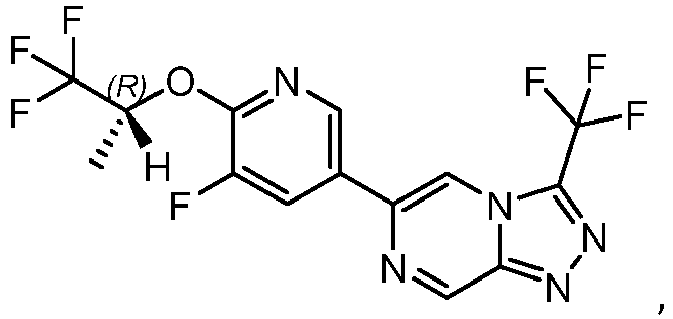


- R1 is hydrogen, C1 alkyl, C1-6haloalkyl, C3-8carbocyclyl, phenyl, O-phenyl, wherein C1 alkyl, C1-6haloalkyl, C3-8carbocyclyl, phenyl, or O-phenyl is optionally substituted by one or more halo, 3-8 membered heterocyclyl, or -ORc;
- R2 is independently hydrogen, C1-6alkyl, or halo;
- R3 is C1-6alkyl, halo, cyano, nitro, C3-8carbocyclyl, 3-8 membered heterocyclyl, -OR7, - N(Rd)2, -C(O)Rc, -C(O)ORc, or -C(O)N(Rd)2, wherein C1-6alkyl, C3-8carbocyclyl, or 3-8 membered heterocyclyl is optionally substituted with one or more R5;
- R4 is C1-6alkyl, halo, cyano, nitro, C3-8carbocyclyl, 3-8 membered heterocyclyl, -ORc, - N(Rd)2, -C(O)Rc, -C(O)ORc, or -C(O)N(Rd)2, wherein C1-6alkyl, C3-8carbocyclyl, or 3-8 membered heterocyclyl are optionally substituted with one or more R5;
- m is 0, 1 or 2;
- each R5 is independently halo, cyano, nitro, C1-6alkyl, C3-8carbocyclyl, 3-8 membered heterocyclyl, -ORc, -C(O)N(Rd)2, -SO2Rc, -SO2ORc, -SO2N(Rd)2, -NRdC(O)(Rc), or -N(Rd)2;
- each Rc is independently hydrogen or C1-6alkyl, wherein each C1-6alkyl is optionally substituted with one or more R6;
- each Rd is independently hydrogen or C1-6alkyl;
- each R6 is independently halogen, cyano, C3-8carbocyclyl, or 3-8 membered heterocyclyl; wherein the C3-8carbocyclyl is optionally substituted with one or more halogens or cyano; and
- R7 is C1-6alkyl or C3-8carbocyclyl wherein C1-6alkyl or C3-8carbocyclyl is optionally substituted with one or more R6.
- In some embodiments, R1 is hydrogen, C1 alkyl, C1-6haloalkyl, or C3-8carbocyclyl, wherein C1 alkyl, C1-6haloalkyl, or C3-8carbocyclyl is optionally substituted by one or more halo, 3-8 membered heterocyclyl, or -ORc.
- In some embodiments, R1 is CF3 or CHF2.
- In some embodiments, R1 is hydrogen.
- In some embodiments, R3 is -OR7.
- In some embodiments, R7 is C1-6alkyl optionally substituted with 1, 2, or 3 substituents selected from halogen or cyano; C1-6alkyl substituted with C3-8carbocyclyl optionally substituted with 1, 2, or 3 substituents selected from halogen or cyano; or C3-8carbocyclyl optionally substituted with 1, 2, or 3 substituents selected from halogen or cyano.
- In some embodiments, R7 is C1-6alkyl optionally substituted with 1, 2, or 3 halogens.
- In some embodiments, R3 is -OCF3 or -O-CH2CF3.
- In some embodiments, R4 is independently C1-6 alkyl, -ORc, or halogen.
- In some embodiments, R4 is methyl or fluoride.
- In some embodiments, m is 1 or 2.
- In some embodiments, m is 1.
- In some embodiments, the compound is selected from:


- In some embodiments, the compound is selected from:


- In another aspect, the present invention provides a compound of Formula (VIIa):

- R1 is hydrogen, C1 alkyl, C1-6haloalkyl, or C3-8carbocyclyl, wherein C1 alkyl, C1-6haloalkyl, or C3-8carbocyclyl is optionally substituted by one or more halo, 3-8 membered heterocyclyl, or -ORc;
- R2 is independently hydrogen, C1-6alkyl, or halo;
- R4 is C1-6alkyl, halo, cyano, nitro, C3-8carbocyclyl, 3-8 membered heterocyclyl, -ORc, - N(Rd)2, -C(O)Rc, -C(O)ORc, or -C(O)N(Rd)2, wherein C1-6alkyl, C3-8carbocyclyl, or 3-8 membered heterocyclyl are optionally substituted with one or more R5;
- m is 0, 1 or 2;
- each R5 is independently halo, cyano, nitro, C1-6alkyl, C3-8carbocyclyl, 3-8 membered heterocyclyl, -ORc, -C(O)N(Rd)2, -SO2Rc, -SO2ORc, -SO2N(Rd)2, -NRdC(O)(Rc), or -N(Rd)2;
- each Rc is independently hydrogen or C1-6alkyl, wherein each C1-6alkyl is optionally substituted with one or more R6;
- each Rd is independently hydrogen or C1-6alkyl;
- each R6 is independently halogen, cyano, C3-8carbocyclyl, or 3-8 membered heterocyclyl; wherein the C3-8carbocyclyl is optionally substituted with one or more halogens or cyano; and
- R7 is C1-6alkyl or C3-8carbocyclyl wherein C1-6alkyl or C3-8carbocyclyl is optionally substituted with one or more R6.
- In some embodiments, R1 is C1-6haloalkyl optionally substituted with -ORc or C3-4carbocyclyl optionally substituted with one or two halogens.
- In some embodiments, R1 is CF3 or CHF2.
- In some embodiments, R2 is hydrogen.
- In some embodiments, R7 is C1-6alkyl optionally substituted with 1, 2, or 3 substituents selected from halogen or cyano; C1-6alkyl substituted with C3-8carbocyclyl optionally substituted with 1, 2, or 3 substituents selected from halogen or cyano; or C3-8carbocyclyl optionally substituted with 1, 2, or 3 substituents selected from halogen or cyano.
- In some embodiments, R7 is C1-6alkyl optionally substituted with 1, 2, or 3 halogens.
- In some embodiments, -OR7 is -OCF3 or -O-CH2CF3.
- In some embodiments, R4 is independently C1-6 alkyl, -ORc, or halogen.
- In some embodiments, R4 is methyl or fluoride.
- In some embodiments, m is 1 or 2.
- In some embodiments, m is 1.
- In some embodiments, the compound is selected from:


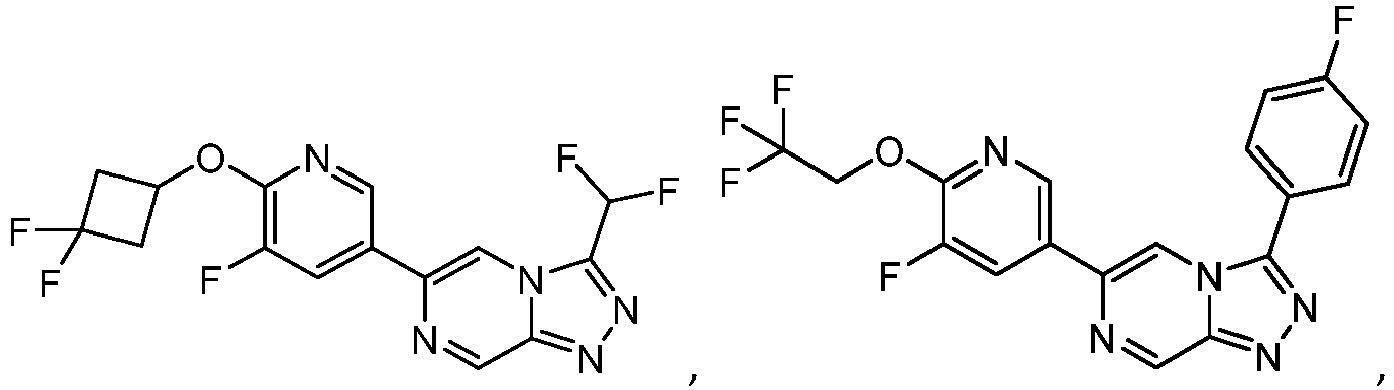
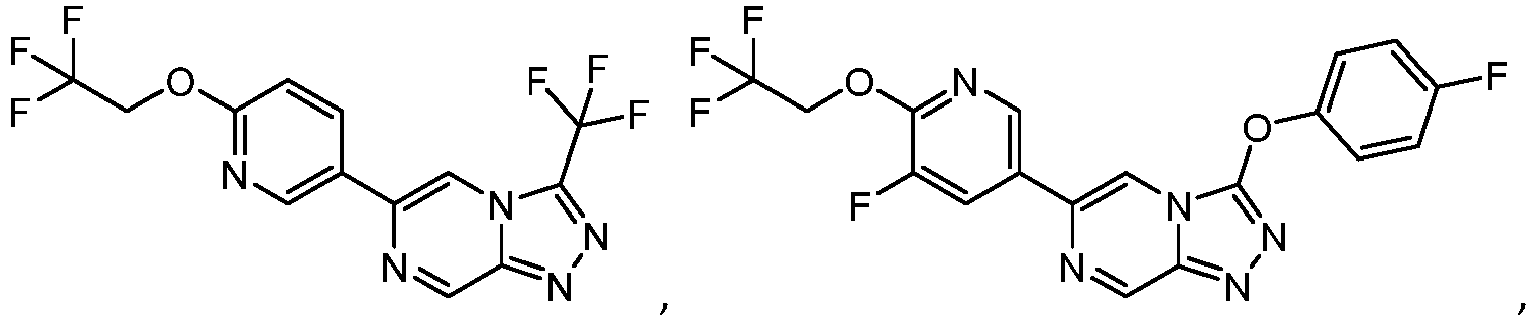
- In some embodiments, wherein the compound is selected from:

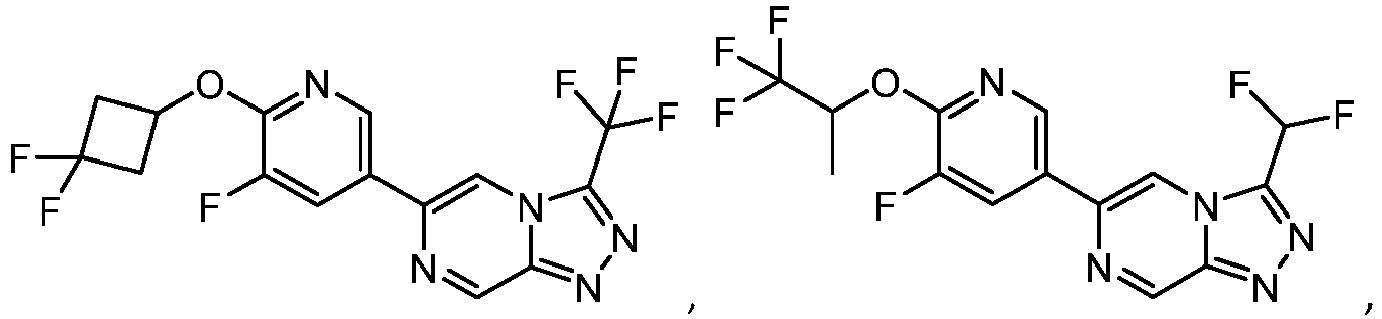


- In another aspect, the present invention provides a compound of Formula (VIIb):

- R1 is hydrogen, C1 alkyl, C1-6haloalkyl, or C3-8carbocyclyl, wherein C1 alkyl, C1-6haloalkyl, or C3-8carbocyclyl is optionally substituted by one or more halo, 3-8 membered heterocyclyl, or -ORc;
- R2 is independently hydrogen, C1-6alkyl, or halo;
- R4 is halogen;
- each R5 is independently halo, cyano, nitro, C1-6alkyl, C3-8carbocyclyl, 3-8 membered heterocyclyl, -ORc, -C(O)N(Rd)2, -SO2Rc, -SO2ORc, -SO2N(Rd)2, -NRdC(O)(Rc), or -N(Rd)2;
- each Rc is independently hydrogen or C1-6alkyl, wherein each C1-6alkyl is optionally substituted with one or more R6;
- each Rd is independently hydrogen or C1-6alkyl;
- each R6 is independently halogen, cyano, C3-8carbocyclyl, or 3-8 membered heterocyclyl; wherein the C3-8carbocyclyl is optionally substituted with one or more halogens or cyano; and
- R7 is C1-6alkyl or C3-8carbocyclyl wherein C1-6alkyl or C3-8carbocyclyl is optionally substituted with one or more R6.
- In some embodiments, R1 is C1-6haloalkyl optionally substituted with -ORc or C3-4carbocyclyl optionally substituted with one or two halogens.
- In some embodiments, R1 is CF3 or CHF2.
- In some embodiments, R2 is hydrogen.
- In some embodiments, R7 is C1-6alkyl optionally substituted with 1, 2, or 3 substituents selected from halogen or cyano; C1-6alkyl substituted with C3-8carbocyclyl optionally substituted with 1, 2, or 3 substituents selected from halogen or cyano; or C3-8carbocyclyl optionally substituted with 1, 2, or 3 substituents selected from halogen or cyano.
- In some embodiments, R7 is C1-6alkyl optionally substituted with 1, 2, or 3 halogens.
- In some embodiments, -OR7 is -OCF3 or -O-CH2CF3.
- In some embodiments, R4 is fluoride.
- In some embodiments, the compound is selected from:


- In another aspect, the present disclosure provides a pharmaceutical composition comprising a disclosed compound or pharmaceutically acceptable salt thereof, and a pharmaceutically acceptable carrier.
- In another aspect, the present disclosure provides a disclosed compound or a pharmaceutically acceptable salt thereof or a disclosed pharmaceutical composition for use in a method of treating a neurological disorder or a psychiatric disorder in a subject in need thereof.
- Other objects and advantages will become apparent to those skilled in the art from a consideration of the ensuing Detailed Description, Examples, and Claims.
- As generally described herein, the present invention provides compounds and compositions useful for preventing and/or treating a disease, disorder, or condition described herein, e.g., a disease, disorder, or condition relating to aberrant function of a sodium ion channel, such as abnormal late sodium current (INaL). Exemplary diseases, disorders, or conditions include epilepsy or an epilepsy syndrome.
- Definitions of specific functional groups and chemical terms are described in more detail below. The chemical elements are identified in accordance with the Periodic Table of the Elements, CAS version, Handbook of Chemistry and Physics, 75th Ed., inside cover, and specific functional groups are generally defined as described therein. Additionally, general principles of organic chemistry, as well as specific functional moieties and reactivity, are described in Thomas Sorrell, Organic Chemistry, University Science Books, Sausalito, 1999; Smith and March, March's Advanced Organic Chemistry, 5th Edition, John Wiley & Sons, Inc., New York, 2001; Larock, Comprehensive Organic Transformations, VCH Publishers, Inc., New York, 1989; and Carruthers, Some Modern Methods of Organic Synthesis, 3rd Edition, Cambridge University Press, Cambridge, 1987.
- Compounds described herein can comprise one or more asymmetric centers, and thus can exist in various isomeric forms, e.g., enantiomers and/or diastereomers. For example, the compounds described herein can be in the form of an individual enantiomer, diastereomer or geometric isomer, or can be in the form of a mixture of stereoisomers, including racemic mixtures and mixtures enriched in one or more stereoisomer. Isomers can be isolated from mixtures by methods known to those skilled in the art, including chiral high pressure liquid chromatography (HPLC) and the formation and crystallization of chiral salts; or preferred isomers can be prepared by asymmetric syntheses. See, for example, Jacques et al., Enantiomers, Racemates and Resolutions (Wiley Interscience, New York, 1981); Wilen et al., Tetrahedron 33:2725 (1977); Eliel, Stereochemistry of Carbon Compounds (McGraw-Hill, NY, 1962); and Wilen, Tables of Resolving Agents and Optical Resolutions p. 268 (E.L. Eliel, Ed., Univ. of Notre Dame Press, Notre Dame, IN 1972).
- As used herein a pure enantiomeric compound is substantially free from other enantiomers or stereoisomers of the compound (i.e., in enantiomeric excess). In other words, an "S" form of the compound is substantially free from the "R" form of the compound and is, thus, in enantiomeric excess of the "R" form. The term "enantiomerically pure" or "pure enantiomer" denotes that the compound comprises more than 75% by weight, more than 80% by weight, more than 85% by weight, more than 90% by weight, more than 91% by weight, more than 92% by weight, more than 93% by weight, more than 94% by weight, more than 95% by weight, more than 96% by weight, more than 97% by weight, more than 98% by weight, more than 98.5% by weight, more than 99% by weight, more than 99.2% by weight, more than 99.5% by weight, more than 99.6% by weight, more than 99.7% by weight, more than 99.8% by weight or more than 99.9% by weight, of the enantiomer. In certain embodiments, the weights are based upon total weight of all enantiomers or stereoisomers of the compound.
- In the compositions provided herein, an enantiomerically pure compound can be present with other active or inactive ingredients. For example, a pharmaceutical composition comprising enantiomerically pure R-compound can comprise, for example, about 90% excipient and about 10% enantiomerically pure R-compound. In certain embodiments, the enantiomerically pure R-compound in such compositions can, for example, comprise, at least about 95% by weight R-compound and at most about 5% by weight S-compound, by total weight of the compound. For example, a pharmaceutical composition comprising enantiomerically pure S-compound can comprise, for example, about 90% excipient and about 10% enantiomerically pure S-compound. In certain embodiments, the enantiomerically pure S-compound in such compositions can, for example, comprise, at least about 95% by weight S-compound and at most about 5% by weight R-compound, by total weight of the compound. In certain embodiments, the active ingredient can be formulated with little or no excipient or carrier.
- Compound described herein may also comprise one or more isotopic substitutions. For example, H may be in any isotopic form, including 1H, 2H (D or deuterium), and 3H (T or tritium); C may be in any isotopic form, including 12C, 13C, and 14C; O may be in any isotopic form, including 16O and 18O; and the like.
- The following terms are intended to have the meanings presented therewith below and are useful in understanding the description and intended scope of the present invention. When describing the invention, which may include compounds, pharmaceutical compositions containing such compounds and methods of using such compounds and compositions, the following terms, if present, have the following meanings unless otherwise indicated. It should also be understood that when described herein any of the moieties defined forth below may be substituted with a variety of substituents, and that the respective definitions are intended to include such substituted moieties within their scope as set out below. Unless otherwise stated, the term "substituted" is to be defined as set out below. It should be further understood that the terms "groups" and "radicals" can be considered interchangeable when used herein. The articles "a" and "an" may be used herein to refer to one or to more than one (i.e. at least one) of the grammatical objects of the article. By way of example "an analogue" means one analogue or more than one analogue.
- When a range of values is listed, it is intended to encompass each value and sub-range within the range. For example "C1-6 alkyl" is intended to encompass, C1, C2, C3, C4, C5, C6, C1-6, C1-5, C1-4, C1-3, C1-2, C2-6, C2-5, C2-4, C2-3, C3-6, C3-5, C3-4, C4-6, C4-5, and C5-6 alkyl.
- As used herein, "alkyl" refers to a radical of a straight-chain or branched saturated hydrocarbon group, e.g., having 1 to 20 carbon atoms ("C1-20 alkyl"). In some embodiments, an alkyl group has 1 to 10 carbon atoms ("C1-10 alkyl"). In some embodiments, an alkyl group has 1 to 9 carbon atoms ("C1-9 alkyl"). In some embodiments, an alkyl group has 1 to 8 carbon atoms ("C1-8 alkyl"). In some embodiments, an alkyl group has 1 to 7 carbon atoms ("C1-7 alkyl"). In some embodiments, an alkyl group has 1 to 6 carbon atoms ("C1-6 alkyl"). In some embodiments, an alkyl group has 1 to 5 carbon atoms ("C1-5 alkyl"). In some embodiments, an alkyl group has 1 to 4 carbon atoms ("C1-4 alkyl"). In some embodiments, an alkyl group has 1 to 3 carbon atoms ("C1-3 alkyl"). In some embodiments, an alkyl group has 1 to 2 carbon atoms ("C1-2 alkyl"). In some embodiments, an alkyl group has 1 carbon atom ("C1 alkyl"). Examples of C1-6 alkyl groups include methyl, ethyl, propyl, isopropyl, butyl, isobutyl, pentyl, hexyl, and the like.
- As used herein, "alkenyl" refers to a radical of a straight-chain or branched hydrocarbon group having from 2 to 20 carbon atoms, one or more carbon-carbon double bonds (e.g., 1, 2, 3, or 4 carbon-carbon double bonds), and optionally one or more carbon-carbon triple bonds (e.g., 1, 2, 3, or 4 carbon-carbon triple bonds) ("C2-20 alkenyl"). In certain embodiments, alkenyl does not contain any triple bonds. In some embodiments, an alkenyl group has 2 to 10 carbon atoms ("C2-10 alkenyl"). In some embodiments, an alkenyl group has 2 to 9 carbon atoms ("C2-9 alkenyl"). In some embodiments, an alkenyl group has 2 to 8 carbon atoms ("C2-8 alkenyl"). In some embodiments, an alkenyl group has 2 to 7 carbon atoms ("C2-7 alkenyl"). In some embodiments, an alkenyl group has 2 to 6 carbon atoms ("C2-6 alkenyl"). In some embodiments, an alkenyl group has 2 to 5 carbon atoms ("C2-5 alkenyl"). In some embodiments, an alkenyl group has 2 to 4 carbon atoms ("C2-4 alkenyl"). In some embodiments, an alkenyl group has 2 to 3 carbon atoms ("C2-3 alkenyl"). In some embodiments, an alkenyl group has 2 carbon atoms ("C2 alkenyl"). The one or more carbon-carbon double bonds can be internal (such as in 2-butenyl) or terminal (such as in 1-butenyl). Examples of C2-4 alkenyl groups include ethenyl (C2), 1-propenyl (C3), 2-propenyl (C3), 1-butenyl (C4), 2-butenyl (C4), butadienyl (C4), and the like. Examples of C2-6 alkenyl groups include the aforementioned C2-4 alkenyl groups as well as pentenyl (C5), pentadienyl (C5), hexenyl (C6), and the like. Additional examples of alkenyl include heptenyl (C7), octenyl (C8), octatrienyl (C8), and the like.
- As used herein, "alkynyl" refers to a radical of a straight-chain or branched hydrocarbon group having from 2 to 20 carbon atoms, one or more carbon-carbon triple bonds (e.g., 1, 2, 3, or 4 carbon-carbon triple bonds), and optionally one or more carbon-carbon double bonds (e.g., 1, 2, 3, or 4 carbon-carbon double bonds) ("C2-20 alkynyl"). In certain embodiments, alkynyl does not contain any double bonds. In some embodiments, an alkynyl group has 2 to 10 carbon atoms ("C2-10 alkynyl"). In some embodiments, an alkynyl group has 2 to 9 carbon atoms ("C2-9 alkynyl"). In some embodiments, an alkynyl group has 2 to 8 carbon atoms ("C2-8 alkynyl"). In some embodiments, an alkynyl group has 2 to 7 carbon atoms ("C2-7 alkynyl"). In some embodiments, an alkynyl group has 2 to 6 carbon atoms ("C2-6 alkynyl"). In some embodiments, an alkynyl group has 2 to 5 carbon atoms ("C2-5 alkynyl"). In some embodiments, an alkynyl group has 2 to 4 carbon atoms ("C2-4 alkynyl"). In some embodiments, an alkynyl group has 2 to 3 carbon atoms ("C2-3 alkynyl"). In some embodiments, an alkynyl group has 2 carbon atoms ("C2 alkynyl"). The one or more carbon-carbon triple bonds can be internal (such as in 2-butynyl) or terminal (such as in 1-butynyl). Examples of C2-4 alkynyl groups include, without limitation, ethynyl (C2), 1-propynyl (C3), 2-propynyl (C3), 1-butynyl (C4), 2-butynyl (C4), and the like. Examples of C2-6 alkenyl groups include the aforementioned C2-4 alkynyl groups as well as pentynyl (C5), hexynyl (C6), and the like. Additional examples of alkynyl include heptynyl (C7), octynyl (C8), and the like.
- As used herein, "alkylene," "alkenylene," and "alkynylene," refer to a divalent radical of an alkyl, alkenyl, and alkynyl group respectively. When a range or number of carbons is provided for a particular "alkylene," "alkenylene," or "alkynylene," group, it is understood that the range or number refers to the range or number of carbons in the linear carbon divalent chain. "Alkylene," "alkenylene," and "alkynylene," groups may be substituted or unsubstituted with one or more substituents as described herein.
- As used herein,"aryl" refers to a radical of a monocyclic or polycyclic (e.g., bicyclic or tricyclic) 4n+2 aromatic ring system (e.g., having 6, 10, or 14 π electrons shared in a cyclic array) having 6-14 ring carbon atoms and zero heteroatoms provided in the aromatic ring system ("C6-14 aryl"). In some embodiments, an aryl group has six ring carbon atoms ("C6 aryl"; e.g., phenyl). In some embodiments, an aryl group has ten ring carbon atoms ("C10 aryl"; e.g., naphthyl such as 1-naphthyl and 2-naphthyl). In some embodiments, an aryl group has fourteen ring carbon atoms ("C14 aryl"; e.g., anthracyl). "Aryl" also includes ring systems wherein the aryl ring, as defined above, is fused with one or more carbocyclyl or heterocyclyl groups wherein the radical or point of attachment is on the aryl ring, and in such instances, the number of carbon atoms continue to designate the number of carbon atoms in the aryl ring system. Typical aryl groups include, but are not limited to, groups derived from aceanthrylene, acenaphthylene, acephenanthrylene, anthracene, azulene, benzene, chrysene, coronene, fluoranthene, fluorene, hexacene, hexaphene, hexalene, as-indacene, s-indacene, indane, indene, naphthalene, octacene, octaphene, octalene, ovalene, penta-2,4-diene, pentacene, pentalene, pentaphene, perylene, phenalene, phenanthrene, picene, pleiadene, pyrene, pyranthrene, rubicene, triphenylene, and trinaphthalene. Particularly aryl groups include phenyl, naphthyl, indenyl, and tetrahydronaphthyl.
- As used herein, "heteroaryl" refers to a radical of a 5-10 membered monocyclic or bicyclic 4n+2 aromatic ring system (e.g., having 6 or 10 π electrons shared in a cyclic array) having ring carbon atoms and 1-4 ring heteroatoms provided in the aromatic ring system, wherein each heteroatom is independently selected from nitrogen, oxygen and sulfur ("5-10 membered heteroaryl"). In heteroaryl groups that contain one or more nitrogen atoms, the point of attachment can be a carbon or nitrogen atom, as valency permits. Heteroaryl bicyclic ring systems can include one or more heteroatoms in one or both rings. "Heteroaryl" includes ring systems wherein the heteroaryl ring, as defined above, is fused with one or more carbocyclyl or heterocyclyl groups wherein the point of attachment is on the heteroaryl ring, and in such instances, the number of ring members continue to designate the number of ring members in the heteroaryl ring system. "Heteroaryl" also includes ring systems wherein the heteroaryl ring, as defined above, is fused with one or more aryl groups wherein the point of attachment is either on the aryl or heteroaryl ring, and in such instances, the number of ring members designates the number of ring members in the fused (aryl/heteroaryl) ring system. Bicyclic heteroaryl groups wherein one ring does not contain a heteroatom (e.g., indolyl, quinolinyl, carbazolyl, and the like) the point of attachment can be on either ring, i.e., either the ring bearing a heteroatom (e.g., 2-indolyl) or the ring that does not contain a heteroatom (e.g., 5-indolyl).
- In some embodiments, a heteroaryl group is a 5-10 membered aromatic ring system having ring carbon atoms and 1-4 ring heteroatoms provided in the aromatic ring system, wherein each heteroatom is independently selected from nitrogen, oxygen, and sulfur ("5-10 membered heteroaryl"). In some embodiments, a heteroaryl group is a 5-8 membered aromatic ring system having ring carbon atoms and 1-4 ring heteroatoms provided in the aromatic ring system, wherein each heteroatom is independently selected from nitrogen, oxygen, and sulfur ("5-8 membered heteroaryl"). In some embodiments, a heteroaryl group is a 5-6 membered aromatic ring system having ring carbon atoms and 1-4 ring heteroatoms provided in the aromatic ring system, wherein each heteroatom is independently selected from nitrogen, oxygen, and sulfur ("5-6 membered heteroaryl"). In some embodiments, the 5-6 membered heteroaryl has 1-3 ring heteroatoms selected from nitrogen, oxygen, and sulfur. In some embodiments, the 5-6 membered heteroaryl has 1-2 ring heteroatoms selected from nitrogen, oxygen, and sulfur. In some embodiments, the 5-6 membered heteroaryl has 1 ring heteroatom selected from nitrogen, oxygen, and sulfur.
- Exemplary 5-membered heteroaryl groups containing one heteroatom include, without limitation, pyrrolyl, furanyl and thiophenyl. Exemplary 5-membered heteroaryl groups containing two heteroatoms include, without limitation, imidazolyl, pyrazolyl, oxazolyl, isoxazolyl, thiazolyl, and isothiazolyl. Exemplary 5-membered heteroaryl groups containing three heteroatoms include, without limitation, triazolyl, oxadiazolyl, and thiadiazolyl. Exemplary 5-membered heteroaryl groups containing four heteroatoms include, without limitation, tetrazolyl. Exemplary 6-membered heteroaryl groups containing one heteroatom include, without limitation, pyridinyl. Exemplary 6-membered heteroaryl groups containing two heteroatoms include, without limitation, pyridazinyl, pyrimidinyl, and pyrazinyl. Exemplary 6-membered heteroaryl groups containing three or four heteroatoms include, without limitation, triazinyl and tetrazinyl, respectively. Exemplary 7-membered heteroaryl groups containing one heteroatom include, without limitation, azepinyl, oxepinyl, and thiepinyl. Exemplary 5,6-bicyclic heteroaryl groups include, without limitation, indolyl, isoindolyl, indazolyl, benzotriazolyl, benzothiophenyl, isobenzothiophenyl, benzofuranyl, benzoisofuranyl, benzimidazolyl, benzoxazolyl, benzisoxazolyl, benzoxadiazolyl, benzthiazolyl, benzisothiazolyl, benzthiadiazolyl, indolizinyl, and purinyl. Exemplary 6,6-bicyclic heteroaryl groups include, without limitation, naphthyridinyl, pteridinyl, quinolinyl, isoquinolinyl, cinnolinyl, quinoxalinyl, phthalazinyl, and quinazolinyl.
- Examples of representative heteroaryls include the following:


- As used herein, "carbocyclyl" or "carbocyclic" refers to a radical of a non-aromatic cyclic hydrocarbon group having from 3 to 10 ring carbon atoms ("C3-10 carbocyclyl") and zero heteroatoms in the non-aromatic ring system. In some embodiments, a carbocyclyl group has 3 to 8 ring carbon atoms ("C3-8 carbocyclyl"). In some embodiments, a carbocyclyl group has 3 to 6 ring carbon atoms ("C3-6 carbocyclyl"). In some embodiments, a carbocyclyl group has 3 to 6 ring carbon atoms ("C3-6 carbocyclyl"). In some embodiments, a carbocyclyl group has 5 to 10 ring carbon atoms ("C5-10 carbocyclyl"). Exemplary C3-6 carbocyclyl groups include, without limitation, cyclopropyl (C3), cyclopropenyl (C3), cyclobutyl (C4), cyclobutenyl (C4), cyclopentyl (C5), cyclopentenyl (C5), cyclohexyl (C6), cyclohexenyl (C6), cyclohexadienyl (C6), and the like. Exemplary C3-8 carbocyclyl groups include, without limitation, the aforementioned C3-6 carbocyclyl groups as well as cycloheptyl (C7), cycloheptenyl (C7), cycloheptadienyl (C7), cycloheptatrienyl (C7), cyclooctyl (C8), cyclooctenyl (C8), bicyclo[2.2.1]heptanyl (C7), bicyclo[2.2.2]octanyl (C8), and the like. Exemplary C3-10 carbocyclyl groups include, without limitation, the aforementioned C3-8 carbocyclyl groups as well as cyclononyl (C9), cyclononenyl (C9), cyclodecyl (C10), cyclodecenyl (C10), octahydro-1H-indenyl (C9), decahydronaphthalenyl (C10), spiro[4.5]decanyl (C10), and the like. As the foregoing examples illustrate, in certain embodiments, the carbocyclyl group is either monocyclic ("monocyclic carbocyclyl") or contain a fused, bridged or spiro ring system such as a bicyclic system ("bicyclic carbocyclyl") and can be saturated or can be partially unsaturated. "Carbocyclyl" also includes ring systems wherein the carbocyclyl ring, as defined above, is fused with one or more aryl or heteroaryl groups wherein the point of attachment is on the carbocyclyl ring, and in such instances, the number of carbons continue to designate the number of carbons in the carbocyclic ring system.
- The term "cycloalkyl," as used herein, refers to a monocyclic saturated or partially unsaturated hydrocarbon ring system, for example, having 3-8 or 3-6 carbon atoms in its ring system, referred to herein as C3-8 cycloalkyl or C3-6 cycloalkyl, respectively. Exemplary cycloalkyl groups include, but are not limited to, cyclohexyl, cyclohexenyl, cyclopentyl, cyclopentenyl, cyclobutyl, and cyclopropyl.
- As used herein, "heterocyclyl" or "heterocyclic" refers to a radical of a 3- to 10-membered non-aromatic ring system having ring carbon atoms and 1 to 4 ring heteroatoms, wherein each heteroatom is independently selected from nitrogen, oxygen, sulfur, boron, phosphorus, and silicon ("3-10 membered heterocyclyl"). In heterocyclyl groups that contain one or more nitrogen atoms, the point of attachment can be a carbon or nitrogen atom, as valency permits. A heterocyclyl group can either be monocyclic ("monocyclic heterocyclyl") or a fused, bridged or spiro ring system such as a bicyclic system ("bicyclic heterocyclyl"), and can be saturated or can be partially unsaturated. Heterocyclyl bicyclic ring systems can include one or more heteroatoms in one or both rings. "Heterocyclyl" also includes ring systems wherein the heterocyclyl ring, as defined above, is fused with one or more carbocyclyl groups wherein the point of attachment is either on the carbocyclyl or heterocyclyl ring, or ring systems wherein the heterocyclyl ring, as defined above, is fused with one or more aryl or heteroaryl groups, wherein the point of attachment is on the heterocyclyl ring, and in such instances, the number of ring members continue to designate the number of ring members in the heterocyclyl ring system.
- In some embodiments, a heterocyclyl group is a 5-10 membered non-aromatic ring system having ring carbon atoms and 1-4 ring heteroatoms, wherein each heteroatom is independently selected from nitrogen, oxygen, sulfur, boron, phosphorus, and silicon ("5-10 membered heterocyclyl"). In some embodiments, a heterocyclyl group is a 5-8 membered non-aromatic ring system having ring carbon atoms and 1-4 ring heteroatoms, wherein each heteroatom is independently selected from nitrogen, oxygen, and sulfur ("5-8 membered heterocyclyl"). In some embodiments, a heterocyclyl group is a 5-6 membered non-aromatic ring system having ring carbon atoms and 1-4 ring heteroatoms, wherein each heteroatom is independently selected from nitrogen, oxygen, and sulfur ("5-6 membered heterocyclyl"). In some embodiments, the 5-6 membered heterocyclyl has 1-3 ring heteroatoms selected from nitrogen, oxygen, and sulfur. In some embodiments, the 5-6 membered heterocyclyl has 1-2 ring heteroatoms selected from nitrogen, oxygen, and sulfur. In some embodiments, the 5-6 membered heterocyclyl has one ring heteroatom selected from nitrogen, oxygen, and sulfur.
- Exemplary 3-membered heterocyclyl groups containing one heteroatom include, without limitation, azirdinyl, oxiranyl, thiorenyl. Exemplary 4-membered heterocyclyl groups containing one heteroatom include, without limitation, azetidinyl, oxetanyl and thietanyl. Exemplary 5-membered heterocyclyl groups containing one heteroatom include, without limitation, tetrahydrofuranyl, dihydrofuranyl, tetrahydrothiophenyl, dihydrothiophenyl, pyrrolidinyl, dihydropyrrolyl and pyrrolyl-2,5-dione. Exemplary 5-membered heterocyclyl groups containing two heteroatoms include, without limitation, dioxolanyl, oxasulfuranyl, disulfuranyl, and oxazolidin-2-one. Exemplary 5-membered heterocyclyl groups containing three heteroatoms include, without limitation, triazolinyl, oxadiazolinyl, and thiadiazolinyl. Exemplary 6-membered heterocyclyl groups containing one heteroatom include, without limitation, piperidinyl, tetrahydropyranyl, dihydropyridinyl, and thianyl. Exemplary 6-membered heterocyclyl groups containing two heteroatoms include, without limitation, piperazinyl, morpholinyl, dithianyl, dioxanyl. Exemplary 6-membered heterocyclyl groups containing two heteroatoms include, without limitation, triazinanyl. Exemplary 7-membered heterocyclyl groups containing one heteroatom include, without limitation, azepanyl, oxepanyl and thiepanyl. Exemplary 8-membered heterocyclyl groups containing one heteroatom include, without limitation, azocanyl, oxecanyl and thiocanyl. Exemplary 5-membered heterocyclyl groups fused to a C6 aryl ring (also referred to herein as a 5,6-bicyclic heterocyclic ring) include, without limitation, indolinyl, isoindolinyl, dihydrobenzofuranyl, dihydrobenzothienyl, benzoxazolinonyl, and the like. Exemplary 6-membered heterocyclyl groups fused to an aryl ring (also referred to herein as a 6,6-bicyclic heterocyclic ring) include, without limitation, tetrahydroquinolinyl, tetrahydroisoquinolinyl, and the like.
- As used herein, "hetero" when used to describe a compound or a group present on a compound means that one or more carbon atoms in the compound or group have been replaced by a nitrogen, oxygen, or sulfur heteroatom. Hetero may be applied to any of the hydrocarbyl groups described above such as alkyl, e.g., heteroalkyl; carbocyclyl, e.g., heterocyclyl; aryl, e.g,. heteroaryl; and the like having from 1 to 5, and particularly from 1 to 3 heteroatoms.
- As used herein, "cyano" refers to -CN.
- As used herein, "halo" or "halogen" refers to fluoro (F), chloro (Cl), bromo (Br), and iodo (I). In certain embodiments, the halo group is either fluoro or chloro.
- As used herein, "haloalkyl" refers to an alkyl group substituted with one or more halogen atoms.
- As used herein, "nitro" refers to-NO2.
- As used herein, "oxo" refers to -C=O.
- In general, the term "substituted", whether preceded by the term "optionally" or not, means that at least one hydrogen present on a group (e.g., a carbon or nitrogen atom) is replaced with a permissible substituent, e.g., a substituent which upon substitution results in a stable compound, e.g., a compound which does not spontaneously undergo transformation such as by rearrangement, cyclization, elimination, or other reaction. Unless otherwise indicated, a "substituted" group has a substituent at one or more substitutable positions of the group, and when more than one position in any given structure is substituted, the substituent is either the same or different at each position.
- As used herein, a "counterion" or "anionic counterion" is a negatively charged group associated with a cationic quaternary amino group in order to maintain electronic neutrality. Exemplary counterions include halide ions (e.g., F-, Cl-, Br, I-), NO3 -, ClO4 -; OH-, H2PO4 -, HSO4 -, SO4 -2sulfonate ions (e.g., methansulfonate, trifluoromethanesulfonate, p-toluenesulfonate, benzenesulfonate, 10-camphor sulfonate, naphthalene-2-sulfonate, naphthalene-1-sulfonic acid-5-sulfonate, ethan-1-sulfonic acid-2-sulfonate, and the like), and carboxylate ions (e.g., acetate, ethanoate, propanoate, benzoate, glycerate, lactate, tartrate, glycolate, and the like).
- Nitrogen atoms can be substituted or unsubstituted as valency permits, and include primary, secondary, tertiary, and quarternary nitrogen atoms. Exemplary nitrogen atom substitutents include, but are not limited to, hydrogen, -OH, -ORaa, -N(Rcc)2, -CN, -C(=O)Raa, -C(=O)N(Rcc)2, -CO2Raa, -SO2Raa, -C(=NRbb)Raa, -C(=NRcc)ORaa, -C(=NRcc)N(Rcc)2, - SO2N(Rcc)2, -SO2Rcc, -SO2ORcc, -SORaa, -C(=S)N(Rcc)2, -C(=O)SRcc, -C(=S)SRcc, - P(=O)2Raa, -P(=O)(Raa)2, -P(=O)2N(Rcc)2, -P(=O)(NRcc)2, C1-10 alkyl, C1-10 perhaloalkyl, C2-10 alkenyl, C2-10 alkynyl, C3-10 carbocyclyl, 3-14 membered heterocyclyl, C6-14 aryl, and 5-14 membered heteroaryl, or two Rcc groups attached to a nitrogen atom are joined to form a 3-14 membered heterocyclyl or 5-14 membered heteroaryl ring, wherein each alkyl, alkenyl, alkynyl, carbocyclyl, heterocyclyl, aryl, and heteroaryl is independently substituted with 0, 1, 2, 3, 4, or 5 Rdd groups, and wherein Raa, Rbb, Rcc and Rdd are as defined above.
- These and other exemplary substituents are described in more detail in the Detailed Description, Examples, and Claims. The invention is not intended to be limited in any manner by the above exemplary listing of substituents.
- As used herein, the term "pharmaceutically acceptable salt" refers to those salts which are, within the scope of sound medical judgment, suitable for use in contact with the tissues of humans and lower animals without undue toxicity, irritation, allergic response and the like, and are commensurate with a reasonable benefit/risk ratio. Pharmaceutically acceptable salts are well known in the art. For example, Berge et al., describes pharmaceutically acceptable salts in detail in J. Pharmaceutical Sciences (1977) 66:1-19. Pharmaceutically acceptable salts of the compounds of this invention include those derived from suitable inorganic and organic acids and bases. Examples of pharmaceutically acceptable, nontoxic acid addition salts are salts of an amino group formed with inorganic acids such as hydrochloric acid, hydrobromic acid, phosphoric acid, sulfuric acid and perchloric acid or with organic acids such as acetic acid, oxalic acid, maleic acid, tartaric acid, citric acid, succinic acid or malonic acid or by using other methods used in the art such as ion exchange. Other pharmaceutically acceptable salts include adipate, alginate, ascorbate, aspartate, benzenesulfonate, benzoate, bisulfate, borate, butyrate, camphorate, camphorsulfonate, citrate, cyclopentanepropionate, digluconate, dodecylsulfate, ethanesulfonate, formate, fumarate, glucoheptonate, glycerophosphate, gluconate, hemisulfate, heptanoate, hexanoate, hydroiodide, 2-hydroxy-ethanesulfonate, lactobionate, lactate, laurate, lauryl sulfate, malate, maleate, malonate, methanesulfonate, 2-naphthalenesulfonate, nicotinate, nitrate, oleate, oxalate, palmitate, pamoate, pectinate, persulfate, 3-phenylpropionate, phosphate, picrate, pivalate, propionate, stearate, succinate, sulfate, tartrate, thiocyanate, p-toluenesulfonate, undecanoate, valerate salts, and the like. Pharmaceutically acceptable salts derived from appropriate bases include alkali metal, alkaline earth metal, ammonium and N+(C1-4alkyl)4 salts. Representative alkali or alkaline earth metal salts include sodium, lithium, potassium, calcium, magnesium, and the like. Further pharmaceutically acceptable salts include, when appropriate, nontoxic ammonium, quaternary ammonium, and amine cations formed using counterions such as halide, hydroxide, carboxylate, sulfate, phosphate, nitrate, lower alkyl sulfonate, and aryl sulfonate.
- As used herein, a "subject" to which administration is contemplated includes, but is not limited to, humans (i.e., a male or female of any age group, e.g., a pediatric subject (e.g, infant, child, adolescent) or adult subject (e.g., young adult, middle-aged adult or senior adult)) and/or a non-human animal, e.g., a mammal such as primates (e.g., cynomolgus monkeys, rhesus monkeys), cattle, pigs, horses, sheep, goats, rodents, cats, and/or dogs. In certain embodiments, the subject is a human. In certain embodiments, the subject is a non-human animal. The terms "human," "patient," and "subject" are used interchangeably herein.
- Disease, disorder, and condition are used interchangeably herein.
- As used herein, and unless otherwise specified, the terms "treat," "treating" and "treatment" contemplate an action that occurs while a subject is suffering from the specified disease, disorder or condition, which reduces the severity of the disease, disorder or condition, or retards or slows the progression of the disease, disorder or condition ("therapeutic treatment"), and also contemplates an action that occurs before a subject begins to suffer from the specified disease, disorder or condition ("prophylactic treatment").
- As used herein, the "effective amount" of a compound refers to an amount sufficient to elicit the desired biological response. As will be appreciated by those of ordinary skill in this art, the effective amount of a compound of the invention may vary depending on such factors as the desired biological endpoint, the pharmacokinetics of the compound, the disease being treated, the mode of administration, and the age, health, and condition of the subject. An effective amount encompasses therapeutic and prophylactic treatment.
- As used herein, and unless otherwise specified, a "therapeutically effective amount" of a compound is an amount sufficient to provide a therapeutic benefit in the treatment of a disease, disorder or condition, or to delay or minimize one or more symptoms associated with the disease, disorder or condition. A therapeutically effective amount of a compound means an amount of therapeutic agent, alone or in combination with other therapies, which provides a therapeutic benefit in the treatment of the disease, disorder or condition. The term "therapeutically effective amount" can encompass an amount that improves overall therapy, reduces or avoids symptoms or causes of disease or condition, or enhances the therapeutic efficacy of another therapeutic agent.
- Described herein are compounds and compositions thereof and their use to treat a disease, disorder, or condition relating to aberrant function of a sodium channel ion channel, e.g., abnormal late sodium (INaL) current. In some embodiments, a compound provided by the present invention is effective in the treatment of epilepsy or an epilepsy syndrome, a neurodevelopmental disorder, pain, or a neuromuscular disorder. Compounds of the invention may also modulate all sodium ion channels, or may be specific to only one or a plurality of sodium ion channels, e.g., Nav 1.1, 1.2, 1.5, 1.6, 1.7, 1.8, and/or 1.9.
- In typical embodiments, the present invention is intended to encompass the compounds disclosed herein, and the pharmaceutically acceptable salts of such compounds.
- The references to methods of treatment in the subsequent paragraphs of this description are to be interpreted as references to the compounds, pharmaceutical compositions and medicaments for use in a method for treatment of the human (or animal) body by therapy.
- The compounds described herein are useful in the treatment of epilepsy and epilepsy syndromes. Epilepsy is a CNS disorder in which nerve cell activity in the brain becomes disrupted, causing seizures or periods of unusual behavior, sensations and sometimes loss of consciousness. Seizure symptoms will vary widely, from a simple blank stare for a few seconds to repeated twitching of their arms or legs during a seizure.
- Epilepsy may involve a generalized seizure or a partial or focal seizure. All areas of the brain are involved in a generalized seizure. A person experiencing a generalized seizure may cry out or make some sound, stiffen for several seconds to a minute a then have rhythmic movements of the arms and legs. The eyes are generally open, the person may appear not to be breathing and actually turn blue. The return to consciousness is gradual and the person maybe confused from minutes to hours. There are six main types of generalized seizures: tonic-clonic, tonic, clonic, myoclonic, absence, and atonic seizures. In a partial or focal seizure, only part of the brain is involved, so only part of the body is affected. Depending on the part of the brain having abnormal electrical activity, symptoms may vary.
- Epilepsy, as described herein, includes a generalized, partial, complex partial, tonic clonic, clonic, tonic, refractory seizures, status epilepticus, absence seizures, febrile seizures, or temporal lobe epilepsy.
- The compounds described herein may also be useful in the treatment of epilepsy syndromes. Severe syndromes with diffuse brain dysfunction caused, at least partly, by some aspect of epilepsy, are also referred to as epileptic encephalopathies. These are associated with frequent seizures that are resistant to treatment and severe cognitive dysfunction, for instance West syndrome.
- In some embodiments, the epilepsy syndrome comprises an epileptic encephalopathy, such as Dravet syndrome, Angelman syndrome, CDKL5 disorder, frontal lobe epilepsy, infantile spasms, West's syndrome, Juvenile Myoclonic Epilepsy, Landau-Kleffner syndrome, Lennox-Gastaut syndrome, Ohtahara syndrome, PCDH19 epilepsy, or Glut1 deficiency.
- In some embodiments, the epilepsy or epilepsy syndrome is a genetic epilepsy or a genetic epilepsy syndrome. In some embodiments, epilepsy or an epilepsy syndrome comprises epileptic encephalopathy, epileptic encephalopathy with SCN1A, SCN2A, SCN8A mutations, early infantile epileptic encephalopathy, Dravet syndrome, Dravet syndrome with SCN1A mutation, generalized epilepsy with febrile seizures, intractable childhood epilepsy with generalized tonic-clonic seizures, infantile spasms, benign familial neonatal-infantile seizures, SCN2A epileptic encephalopathy, focal epilepsy with SCN3A mutation, cryptogenic pediatric partial epilepsy with SCN3A mutation, SCN8A epileptic encephalopathy, sudden unexpected death in epilepsy, Rasmussen encephalitis, malignant migrating partial seizures of infancy, autosomal dominant nocturnal frontal lobe epilepsy, sudden expected death in epilepsy (SUDEP), KCNQ2 epileptic encephalopathy, or KCNT1 epileptic encephalopathy.
- In some embodiments, the methods described herein further comprise identifying a subject having epilepsy or an epilepsy syndrome (e.g., epileptic encephalopathy, epileptic encephalopathy with SCN1A, SCN2A, SCN8A mutations, early infantile epileptic encephalopathy, Dravet syndrome, Dravet syndrome with SCN1A mutation, generalized Epilepsy with febrile seizures, intractable childhood epilepsy with generalized tonic-clonic seizures, infantile spasms, benign familial neonatal-infantile seizures, SCN2A epileptic encephalopathy, focal epilepsy with SCN3A mutation, cryptogenic pediatric partial epilepsy with SCN3A mutation, SCN8A epileptic encephalopathy, sudden unexpected death in epilepsy, Rasmussen encephalitis, malignant migrating partial seizures of infancy, autosomal dominant nocturnal frontal lobe epilepsy, sudden expected death in epilepsy (SUDEP), KCNQ2 epileptic encephalopathy, or KCNT1 epileptic encephalopathy) prior to administration of a compound described herein (e.g., a compound of Formula (I)).
- In one aspect, the present disclosure features a compound of Formula (I)a method of treating epilepsy or an epilepsy syndrome (e.g., epileptic encephalopathy, epileptic encephalopathy with SCN1A, SCN2A, SCN8A mutations, early infantile epileptic encephalopathy, Dravet syndrome, Dravet syndrome with SCN1A mutation, generalized Epilepsy with febrile seizures, intractable childhood epilepsy with generalized tonic-clonic seizures, infantile spasms, benign familial neonatal-infantile seizures, SCN2A epileptic encephalopathy, focal epilepsy with SCN3A mutation, cryptogenic pediatric partial epilepsy with SCN3A mutation, SCN8A epileptic encephalopathy, sudden unexpected death in epilepsy, Rasmussen encephalitis, malignant migrating partial seizures of infancy, autosomal dominant nocturnal frontal lobe epilepsy, sudden expected death in epilepsy (SUDEP), KCNQ2 epileptic encephalopathy, or KCNT1 epileptic encephalopathy) comprising administering to a subject in need thereof a compound of Formula (I):

- A compound of the present disclosure (e.g., a compound of Formula (I)) may also be used to treat an epileptic encephalopathy, wherein the subject has a mutation in one or more of ALDH7A1, ALG13, ARHGEF9, ARX, ASAH1, CDKL5, CHD2, CHRNA2, CHRNA4, CHRNB2, CLN8, CNTNAP2, CPA6, CSTB, DEPDC5, DNM1, EEF1A2, EPM2A, EPM2B, GABRA1, GABRB3, GABRG2, GNAO1, GOSR2, GRIN1, GRIN2A, GRIN2B, HCN1, IER3IP1, KCNA2, KCNB1, KCNC1, KCNMA1, KCNQ2, KCNQ3, KCNT1, KCTD7, LGI1, MEF2C, NHLRC1, PCDH19, PLCB1, PNKP, PNPO, PRICKLE1, PRICKLE2, PRRT2, RELN, SCARB2, SCN1A, SCN1B, SCN2A, SCN8A, SCN9A, SIAT9, SIK1, SLC13A5, SLC25A22, SLC2A1, SLC35A2, SLC6A1, SNIP1, SPTAN1, SRPX2, ST3GAL3, STRADA, STX1B, STXBP1, SYN1, SYNGAP1, SZT2, TBC1D24, and WWOX.
- In some embodiments, the methods described herein further comprise identifying a subject having a mutation in one or more of ALDH7A1, ALG13, ARHGEF9, ARX, ASAH1, CDKL5, CHD2, CHRNA2, CHRNA4, CHRNB2, CLN8, CNTNAP2, CPA6, CSTB, DEPDC5, DNM1, EEF1A2, EPM2A, EPM2B, GABRA1, GABRB3, GABRG2, GNAO1, GOSR2, GRIN1, GRIN2A, GRIN2B, HCN1, IER3IP1, KCNA2, KCNB1, KCNC1, KCNMA1, KCNQ2, KCNQ3, KCNT1, KCTD7, LGI1, MEF2C, NHLRC1, PCDH19, PLCB1, PNKP, PNPO, PRICKLE1, PRICKLE2, PRRT2, RELN, SCARB2, SCN1A, SCN1B, SCN2A, SCN8A, SCN9A, SIAT9, SIK1, SLC13A5, SLC25A22, SLC2A1, SLC35A2, SLC6A1, SNIP1, SPTAN1, SRPX2, ST3GAL3, STRADA, STX1B, STXBP1, SYN1, SYNGAP1, SZT2, TBC1D24, and WWOX prior to administration of a compound described herein (e.g., a compound of Formula (I)).
- The compounds described herein may be useful in the treatment of a neurodevelopmental disorder. In some embodiments, the neurodevelopmental disorder comprises autism, autism with epilepsy, tuberous sclerosis, Fragile X syndrome, Rett syndrome, Angelman syndrome, Dup15q syndrome, 22q13.3 Deletion syndrome, Prader-Willi syndrome, velocardiofacial syndrome, Smith-Lemli-Opitz syndrome, or a neurodevelopmental disorder with epilepsy. In some embodiments, the methods described herein further comprise identifying a subject having a neurodevelopmental disorder (e.g., autism, autism with epilepsy, tuberous sclerosis, Fragile X syndrome, Rett syndrome, Angelman syndrome, Dup15q syndrome, 22q13.3 Deletion syndrome, Prader-Willi syndrome, velocardiofacial syndrome, Smith-Lemli-Opitz syndrome, or a neurodevelopmental disorder with epilepsy) prior to administration of a compound described herein (e.g., a compound of Formula (I)).
- In one aspect, the present disclosure features a method of treating a neurodevelopmental disorder (e.g., autism, autism with epilepsy, tuberous sclerosis, Fragile X syndrome, Rett syndrome, Angelman syndrome, Dup15q syndrome, 22q13.3 Deletion syndrome, Prader-Willi syndrome, velocardiofacial syndrome, Smith-Lemli-Opitz syndrome, or a neurodevelopmental disorder with epilepsy) comprising administering to a subject in need thereof a compound of Formula (I):

- The compounds described herein may be useful in the treatment of pain. In some embodiments, the pain comprises neuropathic pain, trigeminal neuralgia, migraine, hemiplegic migraine, familial hemiplegic migraine, familial hemiplegic migraine type 3, cluster headache, trigeminal neuralgia, cerebellar ataxia, or a related headache disorder. In some embodiments, the methods described herein further comprise identifying a subject having pain (e.g., neuropathic pain, trigeminal neuralgia, migraine, hemiplegic migraine, familial hemiplegic migraine, familial hemiplegic migraine type 3, cluster headache, trigeminal neuralgia, cerebellar ataxia, or a related headache disorder) prior to administration of a compound described herein (e.g., a compound of Formula (I)).
- In one aspect, the present disclosure features a method of treating pain (e.g., neuropathic pain, trigeminal neuralgia, migraine, hemiplegic migraine, familial hemiplegic migraine, familial hemiplegic migraine type 3, cluster headache, trigeminal neuralgia, cerebellar ataxia, or a related headache disorder) comprising administering to a subject in need thereof a compound of Formula (I):

- The compounds described herein may be useful in the treatment of a neuromuscular disorder. In some embodiments, the neuromuscular disorder comprises amyotrophic lateral sclerosis, multiple sclerosism, myotonia, paramyotonia congenita, potassium-aggravated myotonia, periodic paralysis, hyperkalemic periodic paralysis, hypokalemic periodic paralysis, or laryngospasm with SCN4A mutation. In some embodiments, the methods described herein further comprise identifying a subject having a neuromuscular disorder (e.g., amyotrophic lateral sclerosis, multiple sclerosism, myotonia, paramyotonia congenita, potassium-aggravated myotonia, periodic paralysis, hyperkalemic periodic paralysis, hypokalemic periodic paralysis, or laryngospasm with SCN4A mutation) prior to administration of a compound described herein (e.g., a compound of Formula (I)).
- In one aspect, the present disclosure features a method of treating a neuromuscular disorder (e.g., amyotrophic lateral sclerosis, multiple sclerosism, myotonia, paramyotonia congenita, potassium-aggravated myotonia, periodic paralysis, hyperkalemic periodic paralysis, hypokalemic periodic paralysis, or laryngospasm with SCN4A mutation) comprising administering to a subject in need thereof a compound of Formula (I):

- In some embodiments, a compound of the present disclosure (e.g., a compound of Formula (I)) may have appropriate pharmacokinetic properties such that they may active with regard to the central and/or peripheral nervous system. In some embodiments, the compounds provided herein are used to treat a cardiovascular disease such as atrial and ventricular arrhythmias, including atrial fibrillation, Prinzmetal's (variant) angina, stable angina, unstable angina, ischemia and reperfusion injury in cardiac, kidney, liver and the brain, exercise induced angina, pulmonary hypertension, congestive heart disease including diastolic and systolic heart failure, and myocardial infarction. In some embodiments, the compounds provided herein may be used in the treatment of diseases affecting the neuromuscular system resulting in itching, seizures, or paralysis, or in the treatment of diabetes or reduced insulin sensitivity, and disease states related to diabetes, such as diabetic peripheral neuropathy.
- In any and all aspects, in some embodiments, the compound of Formula (I) is selected from:


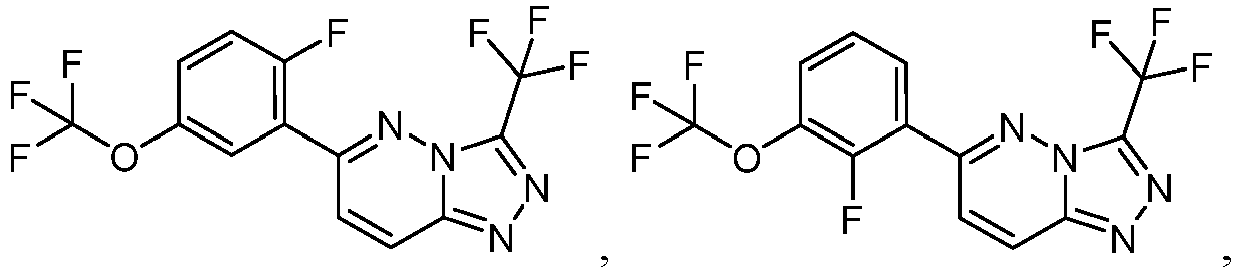


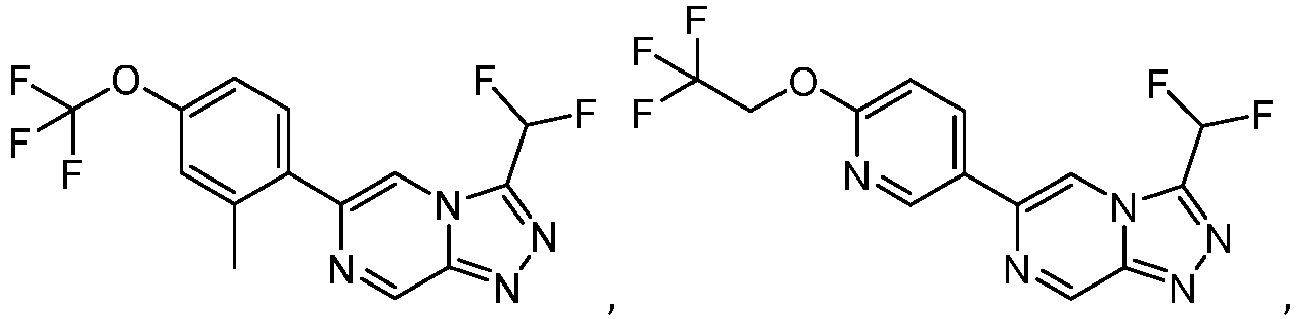


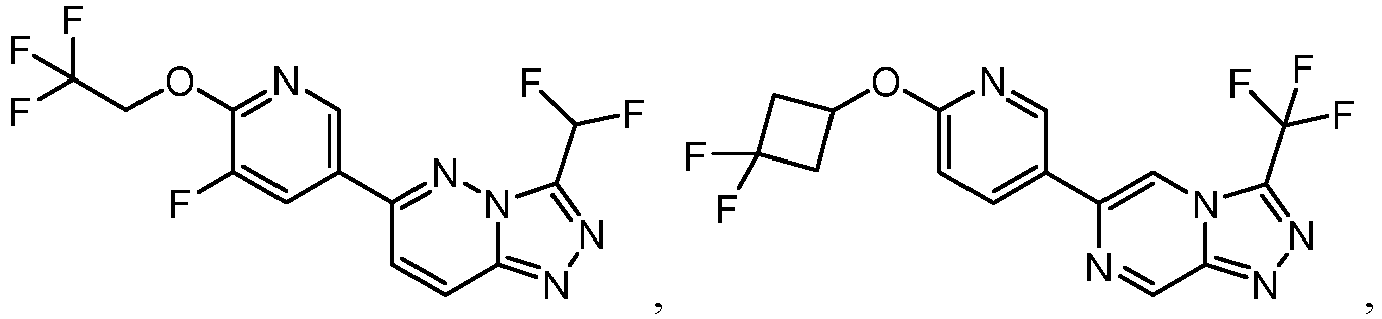





- In some embodiments, the compound of Formula (I) is selected from:


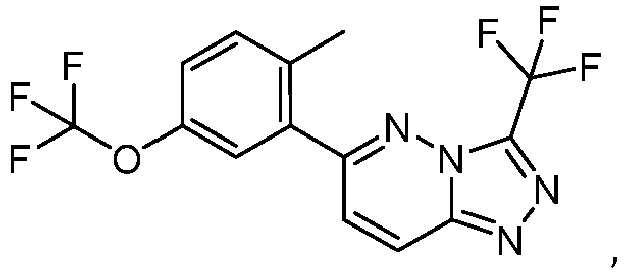


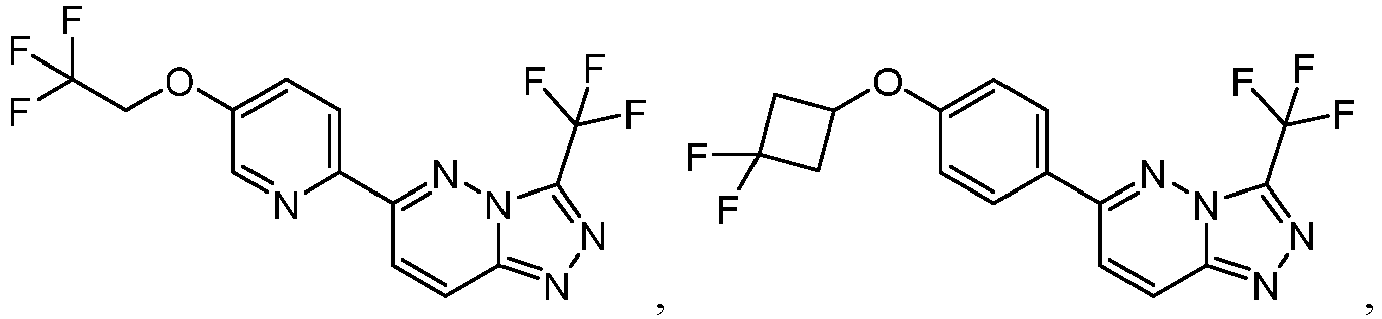





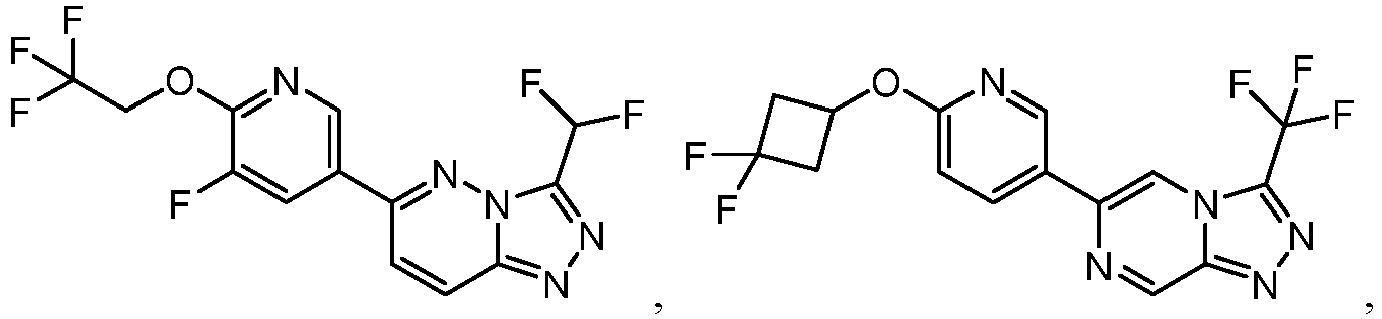


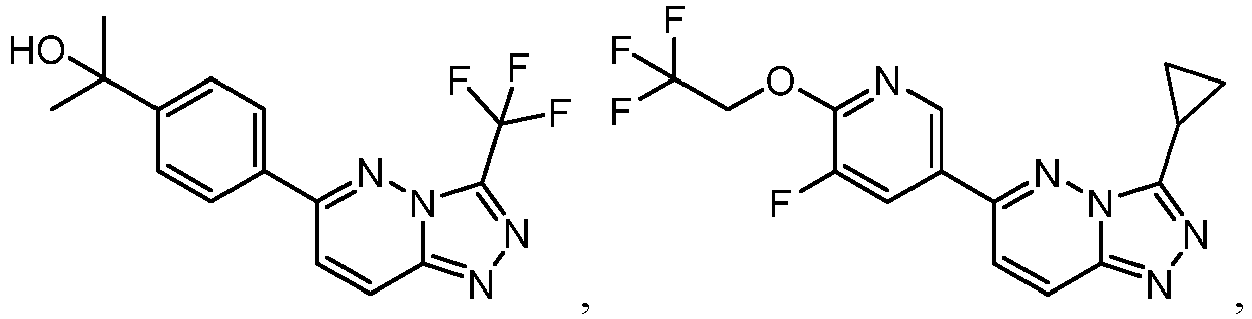


- Compounds provided in accordance with the present invention are usually administered in the form of pharmaceutical compositions. This invention therefore provides pharmaceutical compositions that contain, as the active ingredient, one or more of the compounds described, or a pharmaceutically acceptable salt or ester thereof, and one or more pharmaceutically acceptable excipients, carriers, including inert solid diluents and fillers, diluents, including sterile aqueous solution and various organic solvents, permeation enhancers, solubilizers and adjuvants. The pharmaceutical compositions may be administered alone or in combination with other therapeutic agents. Such compositions are prepared in a manner well known in the pharmaceutical art (see, e.g., Remington's Pharmaceutical Sciences, Mace Publishing Co., Philadelphia, Pa. 17th Ed. (1985); and Modern Pharmaceutics, Marcel Dekker, Inc. 3rd Ed. (G. S. Banker & C. T. Rhodes, Eds.)
- The pharmaceutical compositions may be administered in either single or multiple doses by any of the accepted modes of administration of agents having similar utilities, for example as described in those patents and patent applications incorporated by reference, including rectal, buccal, intranasal and transdermal routes, by intra-arterial injection, intravenously, intraperitoneally, parenterally, intramuscularly, subcutaneously, orally, topically, as an inhalant, or via an impregnated or coated device such as a stent, for example, or an artery-inserted cylindrical polymer.
- One mode for administration is parenteral, particularly by injection. The forms in which the novel compositions of the present invention may be incorporated for administration by injection include aqueous or oil suspensions, or emulsions, with sesame oil, corn oil, cottonseed oil, or peanut oil, as well as elixirs, mannitol, dextrose, or a sterile aqueous solution, and similar pharmaceutical vehicles. Aqueous solutions in saline are also conventionally used for injection, but less preferred in the context of the present invention. Ethanol, glycerol, propylene glycol, liquid polyethylene glycol, and the like (and suitable mixtures thereof), cyclodextrin derivatives, and vegetable oils may also be employed. The proper fluidity can be maintained, for example, by the use of a coating, such as lecithin, by the maintenance of the required particle size in the case of dispersion and by the use of surfactants. The prevention of the action of microorganisms can be brought about by various antibacterial and antifungal agents, for example, parabens, chlorobutanol, phenol, sorbic acid, thimerosal, and the like.
- Sterile injectable solutions are prepared by incorporating a compound according to the present invention in the required amount in the appropriate solvent with various other ingredients as enumerated above, as required, followed by filtered sterilization. Generally, dispersions are prepared by incorporating the various sterilized active ingredients into a sterile vehicle which contains the basic dispersion medium and the required other ingredients from those enumerated above. In the case of sterile powders for the preparation of sterile injectable solutions, the preferred methods of preparation are vacuum-drying and freeze-drying techniques which yield a powder of the active ingredient plus any additional desired ingredient from a previously sterile-filtered solution thereof.
- Oral administration is another route for administration of compounds in accordance with the invention. Administration may be via capsule or enteric coated tablets, or the like. In making the pharmaceutical compositions that include at least one compound described herein, the active ingredient is usually diluted by an excipient and/or enclosed within such a carrier that can be in the form of a capsule, sachet, paper or other container. When the excipient serves as a diluent, it can be in the form of a solid, semi-solid, or liquid material (as above), which acts as a vehicle, carrier or medium for the active ingredient. Thus, the compositions can be in the form of tablets, pills, powders, lozenges, sachets, cachets, elixirs, suspensions, emulsions, solutions, syrups, aerosols (as a solid or in a liquid medium), ointments containing, for example, up to 10% by weight of the active compound, soft and hard gelatin capsules, sterile injectable solutions, and sterile packaged powders.
- Some examples of suitable excipients include lactose, dextrose, sucrose, sorbitol, mannitol, starches, gum acacia, calcium phosphate, alginates, tragacanth, gelatin, calcium silicate, microcrystalline cellulose, polyvinylpyrrolidone, cellulose, sterile water, syrup, and methyl cellulose. The formulations can additionally include: lubricating agents such as talc, magnesium stearate, and mineral oil; wetting agents; emulsifying and suspending agents; preserving agents such as methyl and propylhydroxy-benzoates; sweetening agents; and flavoring agents.
- The compositions of the invention can be Formulated so as to provide quick, sustained or delayed release of the active ingredient after administration to the patient by employing procedures known in the art. Controlled release drug delivery systems for oral administration include osmotic pump systems and dissolutional systems containing polymer-coated reservoirs or drug-polymer matrix formulations. Examples of controlled release systems are given in
U.S. Pat. Nos. 3,845,770 ;4,326,525 ;4,902,514 ; and5,616,345 . Another formulation for use in the methods of the present invention employs transdermal delivery devices ("patches"). Such transdermal patches may be used to provide continuous or discontinuous infusion of the compounds of the present invention in controlled amounts. The construction and use of transdermal patches for the delivery of pharmaceutical agents is well known in the art. See, e.g.,U.S. Pat. Nos. 5,023,252 ,4,992,445 and5,001,139 . Such patches may be constructed for continuous, pulsatile, or on demand delivery of pharmaceutical agents. - The compositions are preferably Formulated in a unit dosage form. The term "unit dosage forms" refers to physically discrete units suitable as unitary dosages for human subjects and other mammals, each unit containing a predetermined quantity of active material calculated to produce the desired therapeutic effect, in association with a suitable pharmaceutical excipient (e.g., a tablet, capsule, ampoule). The compounds are generally administered in a pharmaceutically effective amount. Preferably, for oral administration, each dosage unit contains from 1 mg to 2 g of a compound described herein, and for parenteral administration, preferably from 0.1 to 700 mg of a compound a compound described herein. It will be understood, however, that the amount of the compound actually administered usually will be determined by a physician, in the light of the relevant circumstances, including the condition to be treated, the chosen route of administration, the actual compound administered and its relative activity, the age, weight, and response of the individual patient, the severity of the patient's symptoms, and the like.
- For preparing solid compositions such as tablets, the principal active ingredient is mixed with a pharmaceutical excipient to form a solid preformulation composition containing a homogeneous mixture of a compound of the present invention. When referring to these preformulation compositions as homogeneous, it is meant that the active ingredient is dispersed evenly throughout the composition so that the composition may be readily subdivided into equally effective unit dosage forms such as tablets, pills and capsules.
- The tablets or pills of the present invention may be coated or otherwise compounded to provide a dosage form affording the advantage of prolonged action, or to protect from the acid conditions of the stomach. For example, the tablet or pill can comprise an inner dosage and an outer dosage component, the latter being in the form of an envelope over the former. The two components can be separated by an enteric layer that serves to resist disintegration in the stomach and permit the inner component to pass intact into the duodenum or to be delayed in release. A variety of materials can be used for such enteric layers or coatings, such materials including a number of polymeric acids and mixtures of polymeric acids with such materials as shellac, cetyl alcohol, and cellulose acetate.
- Compositions for inhalation or insufflation include solutions and suspensions in pharmaceutically acceptable, aqueous or organic solvents, or mixtures thereof, and powders. The liquid or solid compositions may contain suitable pharmaceutically acceptable excipients as described supra. Preferably, the compositions are administered by the oral or nasal respiratory route for local or systemic effect. Compositions in preferably pharmaceutically acceptable solvents may be nebulized by use of inert gases. Nebulized solutions may be inhaled directly from the nebulizing device or the nebulizing device may be attached to a facemask tent, or intermittent positive pressure breathing machine. Solution, suspension, or powder compositions may be administered, preferably orally or nasally, from devices that deliver the formulation in an appropriate manner.
- A compound or composition described herein (e.g., for use in modulating a sodium ion channel, e.g., the late sodium (INaL) current) may be administered in combination with another agent or therapy. A subject to be administered a compound disclosed herein may have a disease, disorder, or condition, or a symptom thereof, that would benefit from treatment with another agent or therapy. These diseases or conditions can relate to epilepsy or an epilepsy syndrome, a neurodevelopmental disorder, pain, or a neuromuscular disorder.
- Anti-epilepsy agents include brivaracetam, carbamazepine, clobazam, clonazepam, diazepam, divalproex, eslicarbazepine, ethosuximide, ezogabine, felbamate, gabapentin, lacosamide, lamotrigine, levetiracetam, lorazepam, oxcarbezepine, permpanel, phenobarbital, phenytoin, pregabalin, primidone, rufinamide, tigabine, topiramate, valproic acid, vigabatrin, zonisamide.
- Cardiovascular related diseases or conditions that can benefit from a combination treatment of the sodium channel blockers of the invention with other therapeutic agents include, without limitation, angina including stable angina, unstable angina (UA), exercised-induced angina, variant angina, arrhythmias, intermittent claudication, myocardial infarction including non-STE myocardial infarction (NSTEMI), pulmonary hypertension including pulmonary arterial hypertension, heart failure including congestive (or chronic) heart failure and diastolic heart failure and heart failure with preserved ejection fraction (diastolic dysfunction), acute heart failure, or recurrent ischemia.
- Therapeutic agents suitable for treating cardiovascular related diseases or conditions include anti-anginals, heart failure agents, antithrombotic agents, antiarrhythmic agents, antihypertensive agents, and lipid lowering agents.
- The co-administration of the sodium channel blockers of the invention with therapeutic agents suitable for treating cardiovascular related conditions allows enhancement in the standard of care therapy the patient is currently receiving.
- Anti-anginals include beta-blockers, calcium channel blockers, and nitrates. Beta blockers reduce the heart's need for oxygen by reducing its workload resulting in a decreased heart rate and less vigorous heart contraction. Examples of beta-blockers include acebutolol (Sectral), atenolol (Tenormin), betaxolol (Kerlone), bisoprolol/hydrochlorothiazide (Ziac), bisoprolol (Zebeta), carteolol (Cartrol), esmolol (Brevibloc), labetalol (Normodyne, Trandate), metoprolol (Lopressor, Toprol XL), nadolol (Corgard), propranolol (Inderal), sotalol (Betapace), and timolol (Blocadren).
- Nitrates dilate the arteries and veins thereby increasing coronary blood flow and decreasing blood pressure. Examples of nitrates include nitroglycerin, nitrate patches, isosorbide dinitrate, and isosorbide-5-mononitrate.
- Calcium channel blockers prevent the normal flow of calcium into the cells of the heart and blood vessels causing the blood vessels to relax thereby increasing the supply of blood and oxygen to the heart. Examples of calcium channel blockers include amlodipine (Norvasc, Lotrel), bepridil (Vascor), diltiazem (Cardizem, Tiazac), felodipine (Plendil), nifedipine (Adalat, Procardia), nimodipine (Nimotop), nisoldipine (Sular), verapamil (Calan, Isoptin, Verelan), and nicardipine.
- Agents used to treat heart failure include diuretics, ACE inhibitors, vasodilators, and cardiac glycosides. Diuretics eliminate excess fluids in the tissues and circulation thereby relieving many of the symptoms of heart failure. Examples of diuretics include hydrochlorothiazide, metolazone (Zaroxolyn), furosemide (Lasix), bumetanide (Bumex), spironolactone (Aldactone), and eplerenone (lnspra).
- Angiotensin converting enzyme (ACE) inhibitors reduce the workload on the heart by expanding the blood vessels and decreasing resistance to blood flow. Examples of ACE inhibitors include benazepril (Lotensin), captopril (Capoten), enalapril (Vasotec), fosinopril (Monopril), lisinopril (Prinivil, Zestril), moexipril (Univasc), perindopril (Aceon), quinapril (Accupril), ramipril (Altace), and trandolapril (Mavik).
- Vasodilators reduce pressure on the blood vessels by making them relax and expand. Examples of vasodilators include hydralazine, diazoxide, prazosin, clonidine, and methyldopa. ACE inhibitors, nitrates, potassium channel activators, and calcium channel blockers also act as vasodilators.
- Cardiac glycosides are compounds that increase the force of the heart's contractions. These compounds strengthen the pumping capacity of the heart and improve irregular heartbeat activity. Examples of cardiac glycosides include digitalis, digoxin, and digitoxin.
- Antithrombotics inhibit the clotting ability of the blood. There are three main types of antithrombotics--platelet inhibitors, anticoagulants, and thrombolytic agents.
- Platelet inhibitors inhibit the clotting activity of platelets, thereby reducing clotting in the arteries. Examples of platelet inhibitors include acetylsalicylic acid (aspirin), ticlopidine, clopidogrel (plavix), dipyridamole, cilostazol, persantine sulfinpyrazone, dipyridamole, indomethacin, and glycoprotein IIb/IIIa inhibitors, such as abciximab, tirofiban, and eptifibatide (Integrelin). Beta blockers and calcium channel blockers also have a platelet-inhibiting effect.
- Anticoagulants prevent blood clots from growing larger and prevent the formation of new clots. Examples of anticoagulants include bivalirudin (Angiomax), warfarin (Coumadin), unfractionated heparin, low molecular weight heparin, danaparoid, lepirudin, and argatroban.
- Thrombolytic agents act to break down an existing blood clot. Examples of thrombolytic agents include streptokinase, urokinase, and tenecteplase (TNK), and tissue plasminogen activator (t-PA).
- Antiarrhythmic agents are used to treat disorders of the heart rate and rhythm. Examples of antiarrhythmic agents include amiodarone, dronedarone, quinidine, procainamide, lidocaine, and propafenone. Cardiac glycosides and beta blockers are also used as antiarrhythmic agents.
- Combinations with amiodarone and dronedarone are of particular interest given the recently discovered synergistic effects of the sodium channel blocker ranolazine and amioarone and dronedarone.
- Antihypertensive agents are used to treat hypertension, a condition in which the blood pressure is consistently higher than normal. Hypertension is associated with many aspects of cardiovascular disease, including congestive heart failure, atherosclerosis, and clot for illation. Examples of antihypertensive agents include alpha-1-adrenergic antagonists, such as prazosin (Minipress), doxazosin mesylate (Cardura), prazosin hydrochloride (Minipress), prazosin, polythiazide (Minizide), and terazosin hydrochloride (Hytrin); beta-adrenergic antagonists, such as propranolol (Inderal), nadolol (Corgard), timolol (Blocadren), metoprolol (Lopressor), and pindolol (Visken); central alpha-adrenoceptor agonists, such as clonidine hydrochloride (Catapres), clonidine hydrochloride and chlorthalidone (Clorpres, Combipres), guanabenz Acetate (Wytensin), guanfacine hydrochloride (Tenex), methyldopa (Aldomet), methyldopa and chlorothiazide (Aldoclor), methyldopa and hydrochlorothiazide (Aldoril); combined alpha/beta-adrenergic antagonists, such as labetalol (Normodyne, Trandate), Carvedilol (Coreg); adrenergic neuron blocking agents, such as guanethidine (ismelin), reserpine (Serpasil); central nervous system-acting antihypertensives, such as clonidine (Catapres), methyldopa (Aldomet), guanabenz (Wytensin); anti-angiotensin II agents; ACE inhibitors, such as perindopril (Aceon) captopril (Capoten), enalapril (Vasotec), lisinopril (Prinivil, Zestril); angiotensin-II receptor antagonists, such as Candesartan (Atacand), Eprosartan (Teveten), Irbesartan (Avapro), Losartan (Cozaar), Telmisartan (Micardis), Valsartan (Diovan); calcium channel blockers, such as verapamil (Calan, Isoptin), diltiazem (Cardizem), nifedipine (Adalat, Procardia); diuretics; direct vasodilators, such as nitroprusside (Nipride), diazoxide (Hyperstat IV), hydralazine (Apresoline), minoxidil (Loniten), verapamil; and potassium channel activators, such as aprikalim, bimakalim, cromakalim, emakalim, nicorandil, and pinacidil.
- Lipid lowering agents are used to lower the amounts of cholesterol or fatty sugars present in the blood. Examples of lipid lowering agents include bezafibrate (Bezalip), ciprofibrate (Modalim), and statins, such as atorvastatin (Lipitor), fluvastatin (Lescol), lovastatin (Mevacor, Altocor), mevastatin, pitavastatin (Livalo, Pitava) pravastatin (Lipostat), rosuvastatin (Crestor), and simvastatin (Zocor).
- In this invention, the patient presenting with an acute coronary disease event often suffers from secondary medical conditions such as one or more of a metabolic disorder, a pulmonary disorder, a peripheral vascular disorder, or a gastrointestinal disorder. Such patients can benefit from treatment of a combination therapy comprising administering to the patient ranolazine in combination with at least one therapeutic agent.
- Pulmonary disorder refers to any disease or condition related to the lungs. Examples of pulmonary disorders include, without limitation, asthma, chronic obstructive pulmonary disease (COPD), bronchitis, and emphysema.
- Examples of therapeutics agents used to treat pulmonary disorders include bronchodilators including beta2 agonists and anticholinergics, corticosteroids, and electrolyte supplements. Specific examples of therapeutic agents used to treat pulmonary disorders include epinephrine, terbutaline (Brethaire, Bricanyl), albuterol (Proventil), salmeterol (Serevent, Serevent Diskus), theophylline, ipratropium bromide (Atrovent), tiotropium (Spiriva), methylprednisolone (Solu-Medrol, Medrol), magnesium, and potassium.
- Examples of metabolic disorders include, without limitation, diabetes, including type I and type II diabetes, metabolic syndrome, dyslipidemia, obesity, glucose intolerance, hypertension, elevated serum cholesterol, and elevated triglycerides.
- Examples of therapeutic agents used to treat metabolic disorders include antihypertensive agents and lipid lowering agents, as described in the section "Cardiovascular Agent Combination Therapy" above. Additional therapeutic agents used to treat metabolic disorders include insulin, sulfonylureas, biguanides, alpha-glucosidase inhibitors, and incretin mimetics.
- Peripheral vascular disorders are disorders related to the blood vessels (arteries and veins) located outside the heart and brain, including, for example peripheral arterial disease (PAD), a condition that develops when the arteries that supply blood to the internal organs, arms, and legs become completely or partially blocked as a result of atherosclerosis.
- Gastrointestinal disorders refer to diseases and conditions associated with the gastrointestinal tract. Examples of gastrointestinal disorders include gastroesophageal reflux disease (GERD), inflammatory bowel disease (IBD), gastroenteritis, gastritis and peptic ulcer disease, and pancreatitis.
- Examples of therapeutic agents used to treat gastrointestinal disorders include proton pump inhibitors, such as pantoprazole (Protonix), lansoprazole (Prevacid), esomeprazole (Nexium), omeprazole (Prilosec), rabeprazole; H2 blockers, such as cimetidine (Tagamet), ranitidine (Zantac), famotidine (Pepcid), nizatidine (Axid); prostaglandins, such as misoprostoL (Cytotec); sucralfate; and antacids.
- Patients presenting with an acute coronary disease event may exhibit conditions that benefit from administration of therapeutic agent or agents that are antibiotics, analgesics, antidepressant and anti-anxiety agents in combination with ranolazine.
- Antibiotics are therapeutic agents that kill, or stop the growth of, microorganisms, including both bacteria and fungi. Example of antibiotic agents include .beta.-Lactam antibiotics, including penicillins (amoxicillin), cephalosporins, such as cefazolin, cefuroxime, cefadroxil (Duricef), cephalexin (Keflex), cephradine (Velosef), cefaclor (Ceclor), cefuroxime axtel (Ceftin), cefprozil (Cefzil), loracarbef (Lorabid), cefixime (Suprax), cefpodoxime proxetil (Vantin), ceftibuten (Cedax), cefdinir (Omnicef), ceftriaxone (Rocephin), carbapenems, and monobactams; tetracyclines, such as tetracycline; macrolide antibiotics, such as erythromycin; aminoglycosides, such as gentamicin, tobramycin, amikacin; quinolones such as ciprofloxacin; cyclic peptides, such as vancomycin, streptogramins, polymyxins; lincosamides, such as clindamycin; oxazolidinoes, such as linezolid; and sulfa antibiotics, such as sulfisoxazole.
- Analgesics are therapeutic agents that are used to relieve pain. Examples of analgesics include opiates and morphinomimetics, such as fentanyl and morphine; paracetamol; NSAIDs, and COX-2 inhibitors. Given the ability of the sodium channel blockers of the invention to treat neuropathic pain via inhibition of the Nav 1.7 and 1.8 sodium channels, combination with analgesics are particularly envisioned. See
U.S. Patent Application Publication 20090203707 . - Antidepressant and anti-anxiety agents include those agents used to treat anxiety disorders, depression, and those used as sedatives and tranquillizers. Examples of antidepressant and anti-anxiety agents include benzodiazepines, such as diazepam, lorazepam, and midazolam; benzodiazepines; barbiturates; glutethimide; chloral hydrate; meprobamate; sertraline (Zoloft, Lustral, Apo-Sertral, Asentra, Gladem, Serlift, Stimuloton); escitalopram (Lexapro, Cipralex); fluoxetine (Prozac, Sarafem, Fluctin, Fontex, Prodep, Fludep, Lovan); venlafaxine (Effexor XR, Efexor); citalopram (Celexa, Cipramil, Talohexane); paroxetine (Paxil, Seroxat, Aropax); trazodone (Desyrel); amitriptyline (Elavil); and bupropion (Wellbutrin, Zyban).
- Accordingly, one aspect of the invention provides for a composition comprising the sodium channel blockers of the invention and at least one therapeutic agent. In an alternative embodiment, the composition comprises the sodium channel blockers of the invention and at least two therapeutic agents. In further alternative embodiments, the composition comprises the sodium channel blockers of the invention and at least three therapeutic agents, the sodium channel blockers of the invention and at least four therapeutic agents, or the sodium channel blockers of the invention and at least five therapeutic agents.
- The methods of combination therapy include co-administration of a single formulation containing the sodium channel blockers of the invention and therapeutic agent or agents, essentially contemporaneous administration of more than one formulation comprising the sodium channel blocker of the invention and therapeutic agent or agents, and consecutive administration of a sodium channel blocker of the invention and therapeutic agent or agents, in any order, wherein preferably there is a time period where the sodium channel blocker of the invention and therapeutic agent or agents simultaneously exert their therapeutic effect.
- In order that the invention described herein may be more fully understood, the following examples are set forth. The synthetic and biological examples described in this application are offered to illustrate the compounds, pharmaceutical compositions and methods provided herein and are not to be construed in any way as limiting their scope.
- The compounds provided herein can be prepared from readily available starting materials using the following general methods and procedures. It will be appreciated that where typical or preferred process conditions (i.e., reaction temperatures, times, mole ratios of reactants, solvents, pressures, etc.) are given, other process conditions can also be used unless otherwise stated. Optimal reaction conditions may vary with the particular reactants or solvent used, but such conditions can be determined by one skilled in the art by routine optimization.
- Additionally, as will be apparent to those skilled in the art, conventional protecting groups may be necessary to prevent certain functional groups from undergoing undesired reactions. The choice of a suitable protecting group for a particular functional group as well as suitable conditions for protection and deprotection are well known in the art. For example, numerous protecting groups, and their introduction and removal, are described in T. W. Greene and P. G. M. Wuts, Protecting Groups in Organic Synthesis, Second Edition, Wiley, New York, 1991, and references cited therein.
- The compounds provided herein may be isolated and purified by known standard procedures. Such procedures include recrystallization, filtration, flash chromatography, trituration, high pressure liquid chromatography (HPLC), or supercritical fluid chromatography (SFC). Note that flash chromatography may either be performed manually or via an automated system. The compounds provided herein may be characterized by known standard procedures, such as nuclear magnetic resonance spectroscopy (NMR) or liquid chromatography mass spectrometry (LCMS). NMR chemical shifts are reported in part per million (ppm) and are generated using methods well known to those of skill in the art.
- Exemplary general methods for analytical LCMS include Method A (Xtimate C18 (2.1 mm × 30mm, 3 µm); A = H2O (0.04% TFA) and B = CH3CN (0.02% TFA); 50 °C; 1.2 mL/min; 10-80% B over 0.9 minutes, then 80% B for 0.6 minutes); Method B (Chromolith Flash RP-18 endcapped C18 (2mm × 25mm); A = H2O (0.04% TFA) and B = CH3CN (0.02% TFA); 50 °C; 1.5 mL/min; 5-95% B over 0.7 minutes, then 95% B for 0.4 minutes); and Method C (Xtimate C18 (2.1 mm × 30mm, 3 µm); A = H2O (0.04% TFA) and B = CH3CN (0.02% TFA); 50 °C; 0.8mL/min; 10-80% B over 6 minutes, then 80% B for 0.5 minutes).
-
- NIS
- N-iodosuccinimide
- DMF
- N,N-dimethylformamide
- THF
- tetrahydrofuran
- MeOH
- methanol
- DCM
- dichloromethane
- LiHMDS
- lithium bis(trimethylsilyl)amide
- EtOH
- ethanol
- Et3N
- trimethylamine
- Pd(dppf)Cl2
- [1,1'-bis(diphenylphosphino)ferrocene]palladium(II) dichloride
- MeI
- methyliodide
- Et3SiH
- triethylsilane
- DBU
- 1,8-diazabicyclo(5.4.0)undec-7-ene
- AcN
- acetonitrile
- TMSCF3
- trifluoromethyltrimethylsilane
- TBAB
- tetrabutylammonium bromide
- Pd(t-Bu3P)2
- bis(tri-tert-butylphosphine)palladium(0)
- DAST
- diethylaminosulfur trifluoride
- DIPEA
- N,N-diisopropylethylamine
- HATU
- 1-[bis(dimethylamino)methylene]-1H-1,2,3-triazolo[4,5-b]pyridinium 3-oxide hexafluorophosphate
- Pd(dba)3
- tris(dibenzylideneacetone)dipalladium(0)
- XPhos
- 2-dicyclohexylphosphino-2',4',6'-triisopropylbiphenyl
-
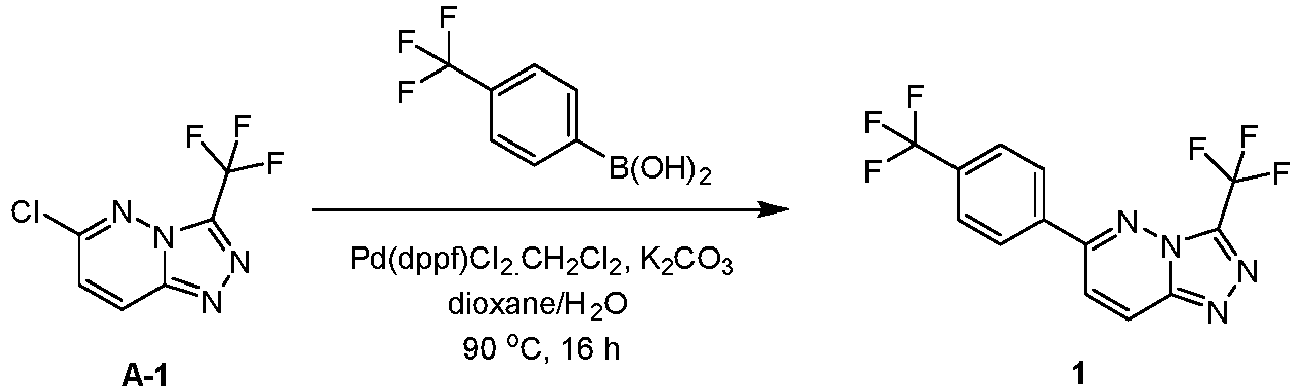
- A mixture of A-1 (100.00 mg, 449.32 µmol), 4-(trifluoromethyl)phenylboronic acid (102.41 mg, 539.18 µmol), K2CO3 (124.20 mg, 898.64 µmol) and Pd(dppf)Cl2.CH2Cl2 (55.04 mg, 67.40 µmol) in dioxane (6 mL) and water (600 µL) under N2 was heated to 90 °C and stirred for 16 h. The reaction mixture was diluted with EtOAc (10 mL), filtered, and concentrated to give a residue that was purified by prep-TLC (silica gel, PE:EtOAc = 2:1) to afford Compound 1 (26.00 mg) as a solid. 1H NMR: (400MHz, CDCl3) δ H = 8.37 (d, 1H), 8.14 (d, 2H), 7.85 (d, 2H), 7.79 (d, 1H). LCMS: Rt = 1.16 min using Method A, MS ESI calcd. for C13H7F6N4 [M+H]+ 333.05, found 333.1.
-

- A mixture of A-1 (100.00 mg, 449.32 µmol), 3-methyl-4-(trifluoromethoxy)-phenylboronic acid (118.59 mg, 539.18 µmol), Pd(dppf)Cl2.CH2Cl2 (55.04 mg, 67.40 µmol) and K2CO3 (124.20 mg, 898.64 µmol) in dioxane (6 mL) and water (600 µL) under N2 was heated to 90 °C and stirred for 16 h. The reaction mixture was diluted with EtOAc (10 mL), filtered, and concentrated to give a residue that was purified by prep-HPLC (Kromasil (150 mm × 25 mm, 10 µm) A = H2O (0.05% NH4OH) and B = CH3CN; 50-80 %B over 8 minutes) to afford Compound 2 (26.80 mg) as a solid. 1H NMR (400MHz, CDCl3) δ H = 8.31 (d, 1H), 7.95-7.85 (m, 2H), 7.74 (d, 1H), 7.41 (d, 1H), 2.45 (s, 3H). LCMS Rt = 1.22 min using Method A, MS ESI calcd. for C14H9F6N4O [M+H]+ 363.06, found 363.1.
-

- A mixture of A-1 (100.00 mg, 449.32 µmol), [2-methyl-4-(trifluoromethyl)phenyl]boronic acid (109.97 mg, 539.18 µmol), Pd(pddf)Cl2.CH2Cl2 (55.04 mg, 67.40 µmol) and K2CO3 (124.20 mg, 898.63 µmol) in dioxane (6 mL) and water (600 µL) under N2 was heated to 90 °C and stirred for 16 hours. The reaction mixture was diluted with EtOAc (10 mL), filtered, and concentrated to give a residue that was purified by prep-TLC (silica gel, PE:EtAOAc = 2:1) to afford Compound 3 as a solid. 1H NMR (400MHz, CDCl3) δ H = 8.34 (d, 1H), 7.65 - 7.58 (m, 3H), 7.47 (d, 1H), 2.53 (s, 3H). LCMS Rt = 1.18 min using Method A, MS ESI calcd. for C14H9F6N4 [M+H]+ 347.1, found 347.1.
-

- A mixture of A-1 (100.00 mg, 449.32 µmol), 2-(4,4,5,5-tetramethyl-1,3,2-dioxaborolan-2-yl)-5-(trifluoromethyl)benzonitrile (160.18 mg, 539.18 µmol), K3PO4 (190.75 mg, 898.64 µmol) and Pd(t-Bu3P)2 (22.96 mg, 44.93 µmol) in dioxane (10 mL) and H2O (900 µL) was stirred at 80 °C for 16 hours in a 20 mL sealed tube under N2. The reaction mixture was cooled to room temperature, concentrated, and purified by prep-TLC (silica gel, DCM:EtAOAc = 5:1) to give Compound 4 as a solid. 1H NMR (400MHz, CDCl3) δ H = 8.48 (d, 1H), 8.20 (s, 1H), 8.13-8.03 (m, 2H), 7.78 (d, 1H). LCMS Rt = 1.08 min using Method A, MS ESI calcd. for C14H6F6N5 [M+H]+ 358.0, found 357.9.
-

- A mixture of A-1 (80.00 mg, 359.45 µmol), 2-methoxy-4-(trifluoromethoxy)phenylboronic acid (84.81 mg, 359.45 µmol), Pd(dppf)Cl2.CH2Cl2 (29.35 mg, 35.95 µmol and Cs2CO3 (234.23 mg, 718.90 µmol) in dioxane (5 mL) and water (500 µL) was stirred at 85 °C for 16 hours in a 10 mL sealed tube under N2. The reaction mixture was cooled to room temperature, concentrated, and purified by prep-TLC (silica gel, PE:EtAOAc = 2:1) to give Compound 5 as a solid. 1H NMR (400MHz, CDCl3) δ H = 8.20 (d, 1H), 7.82 (d, 1H), 7.80 (d, 1H), 7.04 (d, 1H), 6.91 (s, 1H), 3.94 (s, 3H). LCMS Rt = 1.18 min using Method A, MS ESI calcd. for C14H9F6N4O2 [M+H]+ 379.0, found 379.1.
-

- Synthesis of A-4: To a solution of A-2 (100.00 mg, 691.75 µmol) in toluene (10 mL) was added 3,3,3-trifluoropropanoyl chloride (121.61 mg, 830.10 µmol), and the mixture was stirred at 110°C for 6 hours. The reaction mixture was concentrated, and to the residue was added AcOH (10 mL). The resulting mixture was stirred at 120 °C for 1 hour in a microwave reactor. The mixture was concentrated, diluted with H2O (10 mL), basified with solid NaHCO3 to pH~9 and extracted with EtOAc (30 mL × 2). The combined organic phase was washed with brine (10 mL), dried over Na2SO4, filtered and concentrated to give the crude product, which was purified by flash chromatography on silica gel (EtOAc in PE = 25% to 33% to 50% to 66%) to afford A-4 as a solid. LCMS Rt = 0.66 min using Method B, MS ESI calcd. for C7H5ClF3N4 [M+H]+237.0, found 237.0.
- Synthesis of Compound 6: A mixture of A-4 (100.00 mg, 422.69 µmol), 4-(trifluoromethoxy)phenylboronic acid (104.45 mg, 507.23 µmol), Pd(dppf)Cl2.CH2Cl2 (34.52 mg, 42.27 µmol) and K2CO3 (116.84 mg, 845.38 µmol) in dioxane (10 mL) and H2O (1 mL) was stirred at 90 °C for 4 hours. The mixture was diluted with EtOAc (20 mL), filtered through silica gel and eluted with EtOAc (30 mL × 2), then concentrated to give a residue that was purified by prep-TLC (silica gel, PE:EtAOAc = 2:1) to give Compound 6 (17.30 mg) as a solid. 1H NMR (400MHz, CDCl3) δ H = 8.26 (d, 1H), 8.08 - 8.02 (m, 2H), 7.63 (d, 1H), 7.43 (d, 2H), 4.27 - 4.16 (m, 2H). LCMS Rt = 1.14 min using Method A, MS ESI calcd. For C14H9F6N4O [M+H]+ 363.0, found 362.9.
-

- Synthesis of A-6: To a mixture of NaH (2.70 g, 67.55 mmol, 60% purity) in DMF (50 mL) was added 2,2,2-trifluoroethanol (4.86 mL, 67.55 mmol) dropwise at 10 °C, and the mixture was stirred for 1 hr. A-5 (10.00 g, 51.96 mmol) was then added in one portion, and the reaction was stirred at 30 °C for 16 hrs. The reaction mixture was quenched with sat.NH4Cl (250 mL), extracted with EtOAc (100 mL × 3), and the combined organic phase was washed with brine (200 mL), dried over Na2SO4, filtered and concentrated. The resulting residue was purified by flash chromatography on silica gel (EtOAc in PE = 0% to 5%) to give A-6 (11.00 g) as an oil. 1H NMR (400MHz, CDCl3) δ H = 8.20 (d, 1H), 7.73 (dd, 1H), 6.80 (d, 1H), 4.73 (q, 2H).
- Synthesis of A-7: A mixture of A-6 (2.00 g, 7.81 mmol), 4,4,5,5-tetramethyl-2-(4,4,5,5-tetramethyl-1,3,2-dioxaborolan-2-yl)-1,3,2-dioxaborolane (4.96 g, 19.52 mmol), Pd(dppf)Cl2.CH2Cl2 (637.95 mg, 781.00 µmol) and KOAc (1.92 g, 19.52 mmol) was stirred at 90 °C for 12 hours. The mixture was concentrated and the residue was purified by flash chromatography on silica gel (EtOAc in PE = 0% to 10%) to give A-7 (1.90 g, 6.27 mmol) as an oil. 1H NMR (400MHz, CDCl3) δ H = 8.51 (d, 1H), 7.99 (dd, 1H), 6.83 (d, 1H), 4.79 (q, 2H), 1.34 (s, 12H).
- Synthesis of Compound 7: A mixture of A-4 (100.00 mg, 422.69 µmol, A-7 (128.11 mg, 422.69 µmol), Cs2CO3 (275.44 mg, 845.38 µmol) and Pd(dppf)Cl2.CH2Cl2 (34.52 mg, 42.27 µmol) in H2O (500 µL) and dioxane (5 mL) was stirred at 90 °C for 3 hours in microwave reactor, at which point the desired product was observed by LCMS. The mixture was diluted with EtOAc (10 mL), filtered through silica gel and eluted with EtOAc (10 mL x 2). The filtrate was concentrated and the residue was purified by prep-TLC (silica gel, EtOAc:DCM = 1:2) to give Compound 7 (42.10 mg) as a solid. 1H NMR (400MHz, CDCl3) δ H = 8.78 (d, 1H), 8.33 (dd, 2.4, 1H), 8.26 (d, 1H), 7.61 (d, 1H), 7.08 (d, 1H), 4.27, 4.88 (q, 2H), 4.21 (q, 2H). LCMS Rt = 1.10 min using Method A, MS ESI calcd. For C14H10F6N5O [M+H]+ 378.1, found 377.9.
-

- Synthesis of A-9: A mixture of A-2 (200.00 mg, 1.38 mmol) and cyclopropanecarbonyl chloride (150.54 µL, 1.66 mmol) in toluene (10 mL) was stirred at 100 °C for 12 hour. This mixture was concentrated and AcOH (10 mL) was added to the residue. The mixture was stirred at 120 °C for 0.5 hour in a microwave reactor, then the mixture was concentrated, diluted with H2O (10 mL), basified with solid NaHCO3 to pH ~ 9, extracted with EtOAc (30 mL x 2), and the combined organic phase was washed with brine (10 mL), dried over NazSOa, filtered and concentrated to give crude A-9 (170.00 mg). LCMS Rt = 0.64 min using Method B, MS ESI calcd. for C8H8ClN4 [M+H]+194.9, found 195.0.
- Synthesis of Compound 8: A mixture of A-9 (150.00 mg, 770.73 µmol), A-7 (233.59 mg, 770.73 µmol), Cs2CO3 (502.24 mg, 1.54 mmol) and Pd(dppf)Cl2.CH2Cl2 (62.94 mg, 77.07 µmol) in H2O (500 µL) and dioxane (5 mL) was stirred at 90 °C for 12 hours. After cooling to room temperature, the mixture was diluted with EtOAc (10 mL), filtered through silica gel and eluted with EtOAc (10 mL × 2), and the filtrated was concentrated to five a residue that was purified by prep-HPLC (Kromasil (150 mm × 25 mm, 10 µm) A = H2O (0.05% NH4OH) and B = CH3CN; 30-60 %B over 8 minutes) to give Compound 8 (11.90 mg) as a solid. 1H NMR (400MHz, CDCl3) δ H = 8.77 (d, 1H), 8.04 (dd, 1H), 8.15 (d, 1H), 7.47 (d, 1H), 7.06 (d1H), 4.87 (q, 2H), 2.65 - 2.53 (m, 1H), 1.50 - 1.39 (m, 2H), 1.29 - 1.22 (m, 2H). LCMS Rt = 1.10 min using Method A, MS ESI calcd. for C15H13F3N5O [M+H]+ 336.1, found 336.1.
-

- Synthesis of A-10: A mixture of A-2 (200.00 mg, 1.38 mmol) and 2,2,3,3,3-pentafluoropropanoyl 2,2,3,3,3-pentafluoropropanoate (327.03 µL, 1.66 mmol) in toluene (10 mL) was stirred at 100 °C for 16 hours. The mixture was concentrated, diluted with H2O (10 mL), basified with solid NaHCO3 to pH~9, extracted with EtOAc (30 mL × 2), and the combined organic phase was washed with brine (10 mL), dried over Na2SO4, filtered and concentrated to give A-10 as a solid. LCMS Rt = 0.76 min using Method B, MS ESI calcd. for C7H3ClF5N4 [M+H]+ 273.0, found 272.9.
- Synthesis of Compound 9: A mixture of A-10 (130.00 mg, 476.96 µmol), A-7 (173.47 mg, 572.35 µmol), Cs2CO3 (310.81 mg, 953.92 µmol) and Pd(dppf)Cl2.CH2Cl2 (38.95 mg, 47.70 µmol) in dioxane (10 mL) and H2O (1 mL) was stirred at 90 °C for 16 hours. The mixture was diluted with EtOAc (10 mL), filtered through silica gel and eluted with EtOAc (10 m L × 2). The filtrate was concentrated and the residue was purified by prep-HPLC (Kromasil (150 mm × 25 mm, 10 µm) A = H2O (0.05% NH4OH) and B = CH3CN; 45-75 %B over 8 minutes to give Compound 9 (14.70 mg, 35.37 µmol) as a solid. 1H NMR (400MHz, CDCl3) δH = 8.80 (d, 1H), 8.36 (d, 1H), 8.36 (d, 1H), 7.76 (d, 1H), 7.09 (d, 1H), 4.88 (q, 2H). LCMS Rt = 1.18 min using Method A, MS ESI calcd. For C14H8F8N5O [M+H]+ 414.1, found 414.0.
-

- Synthesis of A-11: To a mixture of A-2 (100.00 mg, 691.75 µmol), PYBOP (539.97 mg, 1.04 mmol) in DCM (10.00 mL) was added 2-tetrahydrofuran-3-ylacetic acid (90.02 mg, 691.75 µmol) and DIPEA (362.44 µL, 2.08 mmol), and the mixture was stirred at 25 °C for 1 hour. The mixture was concentrated to give crude A-11 (800.00 mg), which was used directly without any further purification. LCMS Rt = 0.18 min using Method B, MS ESI calcd. For C10H14ClN4O2 [M+H]+ 257.1, found 257.0.
- Synthesis of A-12: A mixture of A-11 (800.00 mg, 3.12 mmol, 1.00 eq) in AcOH (5 mL) was stirred at 120 °C for 0.75 hour in a microwave reactor. The mixture was concentrated, diluted with H2O (10 mL), basified with solid NaHCO3 to pH ~ 9, extracted with EtOAc (30 mL x 2), and the combined organic phase was washed with brine (10 mL), dried over Na2SO4, filtered and concentrated to give the crude product that was purified by flash chromatography on silica gel (MeOH in DCM = 0% to 3% to 5%) to give A-12 (180.00 mg) as an oil. LCMS Rt = 0.68 min using Method B, MS ESI calcd. For C10H12ClN4O [M+H]+ 239.1, found 239.0.
- Synthesis of Compound 10: A mixture of A-12 (180.00 mg, 754.18 µmol), [4-(trifluoromethoxy)phenyl]boronic acid (186.37 mg, 905.02 µmol), Pd(dppf)Cl2.CH2Cl2 (61.59 mg, 75.42 µmol) and Cs2CO3 (491.45 mg, 1.51 mmol) in dioxane (5 mL) and H2O (500 µL) was stirred at 90 °C for 16 hours. The mixture was concentrated and the residue purified by prep-TLC (silica gel, DCM:EtOAc = 3:2) to Compound 10 (15.20 mg) as a solid. 1H NMR (400MHz, CDCl3) δ H = 8.19 (d, 1H), 8.04 (d, 2H), 7.55 (d, 1H), 7.42 (br d, 2H), 4.06 - 3.93 (m, 2H), 3.83 (q, 1H), 3.69 (dd, 1H), 3.37 (d, 2H), 3.11 - 2.96 (m, 1H), 2.25 - 2.12 (m, 1H), 1.91 - 1.76 (m, 1H). LCMS Rt = 1.10 min using Method A, MS ESI calcd. For C17H16F3N4O2 [M+H]+ 365.1, found 365.3.
-

- Synthesis of A-13: To a mixture of A-2 (83.00 mg, 574.16 µmol) and 2-tetrahydrofuran-2-ylacetic acid (74.72 mg, 574.16 µmol) in DCM (10 mL) was added PYBOP (448.18 mg, 861.23 µmol) and DIPEA (601.66 µL, 3.44 mmol), and the mixture was stirred at 25 °C for 16 hour. The mixture was concentrated to give A-13, which was used for next step without further purification. LCMS Rt = 0.25 min using Method B, MS ESI calcd. For C10H14ClN4O2 [M+H]+ 257.1, found 256.9.
- Synthesis of A-14: A mixture of A-13 (800.00 mg, 3.12 mmol, 1.00 eq) in AcOH (6 mL) was stirred at 130 °C for 1 hour in microwave reactor. The mixture was concentrated, diluted with H2O (10 mL), basified with solid NaHCO3 to pH~9, extracted with EtOAc (30 mL x2), and the combined organic phase was washed with brine (10 mL), dried over Na2SO4,filtered and concentrated to give a residue that was purified by flash chromatography on silica gel (MeOH in DCM = 0% to 3% to 5%) to give A-14 (100.00 mg as an oil. LCMS Rt = 0.66 min using Method B, MS ESI calcd. For C10H12ClN4O [M+H]+ 239.1, found 239.0.
- Synthesis of Compound 11: A mixture of A-14 (100.00 mg, 418.99 µmol), 4-(trifluoromethoxy)phenylboronic acid (103.54 mg, 502.79 µmol), Pd(dppf)Cl2.CH2Cl2 (34.22 mg, 41.90 µmol) and Cs2CO3 (273.03 mg, 837.98 µmol) in dioxane (5 mL) and H2O (500 µL) was stirred at 90 °C for 12 hour. The mixture was diluted with EtOAc (10 mL), and filtered through silica gel. The filtrate was concentrated and the residue was purified by prep-HPLC (Kromasil (150 mm × 25 mm, 10 µm) A = H2O (0.05% NH4OH) and B = CH3CN; 35-65 %B over 8 minutes) to give Compound 11 (24.30 mg, 66.70 µmol) as a solid. 1H NMR (400MHz, CDCl3) δ H = 8.18 (d, 1H), 8.04 (d, 2H), 7.53 (d, 1H), 7.41 (d, 2H), 4.61 (quin, 1H), 4.02 - 3.90 (m, 1H), 3.85 - 3.74 (m, 1H), 3.60 (dd, 1H), 3.42 (dd, 1H), 2.20 - 2.08 (m, 1H), 2.06 - 1.91 (m, 2H), 1.89 - 1.77 (m, 1H). LCMS Rt = 1.11 min using Method A, MS ESI calcd. For C17H16F3N4O2 [M+H]+ 365.1, found 365.0.
-

- A mixture of A-1 (100.00 mg, 449.32 µmol), 4-(1-cyanocyclopropyl)-phenylboronic acid (84.02 mg, 449.32 µmol), Pd(t-Bu3P)2 (45.92 mg, 89.86 µmol) and K3PO4 (190.75 mg, 898.64 µmol) in dioxane (8 mL) and H2O (900 µL) was stirred at 80 °C for16 hours under N. The mixture was concentrated and the residue purified by prep-TLC (silica gel, DCM:EtOAc = 2:1) to give Compound 12 (73.82 mg, 224.19 µmol) as a solid. 1H NMR (400MHz, CDCl3) δ H = 8.32 (d, 1H), 8.03 (d, 2H), 7.77 (d, 1H), 7.50 (d, 2H), 1.91 - 1.85 (m, 2H), 1.55 - 1.50 (m, 2H). LCMS Rt = 1.09 min using Method A, MS ESI calcd. for C16H11F3N5 [M+H]+ 330.1, found 330.1.
-

- Synthesis of A-15: To a mixture of A-2 (400.00 mg, 2.77 mmol), 3,3-difluorocyclobutanecarboxylic acid (414.70 mg, 3.05 mmol) in DCM (30 mL) was added PYBOP (2.16 g, 4.16 mmol) and DIPEA (1.45 mL, 8.31 mmol), and the mixture was stirred at 25 °C for 16 hours. The reaction mixture was concentrated, diluted with NH4Cl (30 mL), and extracted with EtOAc (40 mL × 2). The combined organic phase was washed with brine (20 mL), dried over Na2SO4,filtered and concentrated to give crude A-15 (2.45 g) as an oil. LCMS Rt = 0.40 min using Method B, MS ESI calcd. for C9H10ClF2N4O [M+H]+ 263.0, found 262.9.
- Synthesis of A-16: A solution of A-15 (2.45 g, 9.33 mmol) in AcOH (5 mL) was sealed and heated in microwave reactor at 120 °C for 1 hour. After cooling to room temperature, the reaction mixture was concentrated, diluted with sat.NaHCO3 (50 mL), and extracted with DCM (50 mL x 2). The combined organic phase was washed with brine (20 mL), dried over Na2SO4, filtered and concentrated to give a residue that was purified by flash chromatography on silica gel (silica gel, PE:EtOAc = 5:1 to 1:1 to 1:2) to afford A-16 (500.00 mg, 2.04 mmol) as a solid. 1H NMR (400MHz, DMSO-d6 ) δ H = 8.45 (d, 1H), 7.50 (d, 1H), 3.98 - 3.87 (m, 1H), 3.23 - 3.12 (m, 4H).
- Synthesis of Compound 13: A mixture of A-16 (100.00 mg, 408.78 µmol), [2-methoxy-4-(trifluoromethoxy)phenyl]boronic acid (96.45 mg, 408.78 µmol), Pd(t-Bu3P)2 (41.78 mg, 81.76 µmol) and K3PO4 (173.54 mg, 817.56 µmol) in dioxane (4 mL) and H2O (400 µL) was stirred under N2 at 90 °C for 16 hours. The mixture was cooled to room temperature, diluted with EtOAc (20 mL), filtered through silica gel and eluted with EtOAc (10 mL), and concentrated to give a residue that was purified by prep-HPLC (Kromasil (150 mm x 25 mm, 10 µm) A = H2O (0.05% NH4OH) and B = CH3CN; 46-76 %B over 10 minutes to afford Compound 13 (100.70 mg, 246.83 µmol) as a solid. 1H NMR (400MHz, CDCl3) δ H = 8.07 (d, 1H), 7.71 (d, 1H), 7.58 (d, 1H), 7.05 - 6.98 (m, 1H), 6.91 (s, 1H), 4.07 - 3.96 (m, 1H), 3.93 (s, 3H), 3.40 - 3.25 (m, 2H), 3.22 - 3.09 (m, 2H). LCMS Rt = 1.17 min using Method A, MS ESI calcd. for C17H14F5N4O2 [M+H]+ 401.1, found 401.0.
-

- A mixture of A-16 (100.00 mg, 408.78 µmol), 4-(trifluoromethoxy)phenyl-boronic acid (84.18 mg, 408.78 µmol), K3PO4 (173.54 mg, 817.56 µmol) and Pd(t-Bu3P)2 (41.78 mg, 81.76 µmol) in dioxane (8 mL) and H2O (800 µL) was stirred under N2 at 90 °C for 16 hours. The mixture was cooled to room temperature and the mixture was concentrated a residue that was purified by prep-HPLC (Xtimate C18 (150 mm x 25 mm, 5 µm); A = H2O (0.05% NH4OH) and B = CH3CN; 44-74 %B over 10 minutes) to afford Compound 14 (78.40 mg, 207.43 µmol) as a solid. 1H NMR (400MHz, CDCl3) δ H = 8.21 (d, 1H), 8.04 (d, 2H), 7.58 (d, 1H), 7.42 (d, 2H), 4.07 (dquin, 1H), 3.43 - 3.29 (m, 2H), 3.25 - 3.14 (m, 2H). LCMS Rt = 1.17 min using Method A, MS ESI calcd. for C16H12F5N4O [M+H]+ 371.1, found 370.9.
-

- Synthesis of A-17: To a mixture of A-2 (400.00 mg, 2.77 mmol), 2,2-difluorocyclopropanecarboxylic acid (371.55 mg, 3.04 mmol) in DCM (30 mL) was added PYBOP (2.16 g, 4.15 mmol) and DIPEA (1.45 mL, 8.30 mmol), and the mixture was stirred at 25 °C for 2 hours. The reaction mixture was concentrated, diluted with NH4Cl (50 mL), extracted with EtOAc (50 mL x 2), and the combined organic phase was washed with brine (20 mL), dried over Na2SO4,filtered and concentrated to give A-17 (3.43 g, crude) as an oil. LCMS Rt = 0.18 min using Method B, MS ESI calcd. for C8H8ClF2N4O [M+H]+ 249.0, found 248.9.
- Synthesis of A-18: A solution of A-17 (3.30 g, 13.27 mmol) in AcOH (5 mL) was sealed and heated in microwave reactor at 120 °C for 1.5 hours. After cooling to room temperature, the reaction mixture was concentrated, diluted with sat.NaHCO3 (50 mL), and extracted with DCM (50 mL x 2). The combined organic phase was washed with brine (20 mL), dried over Na2SO4, filtered and concentrated to give a residue that was purified by flash chromatography on silica gel (PE:EtOAc = 5:1 to 1:1) to afford A-18 (300.00 mg, 1.30 mmol) as a solid. 1H NMR (400MHz, CDCl3) δ H = 8.09 (d, 1H), 7.15 (d, 1H), 3.24 (ddd, 1H), 2.66 - 2.55 (m, 1H), 2.22 - 2.02 (m, 1H).
- Synthesis of Compound 15: A mixture of 2-methoxy-4-(trifluoromethoxy)phenyl-boronic acid (102.32 mg, 433.65 µmol), A-18 (100.00 mg, 433.65 µmol), Pd(t-Bu3P)2 (44.32 mg, 86.73 µmol) and K3PO4 (184.10 mg, 867.30 µmol) in dioxane (8 mL) and H2O (800 µL) was stirred under N2 at 90 °C for 16 hours. The mixture was cooled to room temperature, diluted with EtOAc (20 mL), filtered through silica gel, and eluted with EtOAc (10 mL). The filtrate was concentrated to give a residue that was purified by prep-HPLC (Xtimate C18 (150 mm x 25 mm, 5 µm); A = H2O (0.05% NH4OH) and B = CH3CN; 42-72 %B over 10 minutes) to afford Compound 15 (38.20 mg, 96.35 µmol) as a solid. 1H NMR (400MHz, CDCl3) δ H = 8.07 (d, 1H), 7.77 (d, 1H), 7.60 (d, 1H), 7.05 - 6.99 (m, 1H), 6.92 - 6.89 (m, 1H), 3.93 (s, 3H), 3.36 - 3.24 (m, 1H), 2.69 - 2.58 (m, 1H), 2.20 - 2.08 (m, 1H). LCMS Rt = 1.16 min using Method A, MS ESI calcd. for C16H12F5N4O2 [M+H]+ 387.1, found 387.0.
-

- Synthesis of A-19: To a suspension of A-2 (500.00 mg, 3.46 mmol) in toluene (10 mL) was added (2,2-difluoroacetyl) 2,2-difluoroacetate (662.43 mg, 3.81 mmol) slowly. The reaction mixture was stirred at 110 °C for 16 hours. The reaction mixture was concentrated, diluted with sat.NaHCO3 (30 mL), and the product was extracted with EtOAc (20 mL × 2). The combined organic phase was washed with brine (10 mL), dried over Na2SO4, filtered and concentrated to give A-19 (600.00 mg, 2.91 mmol) as a solid. LCMS Rt = 0.33 min using Method B, MS ESI calcd. for C6H4ClF2N4 [M+H]+ 205.0, found 204.9.
- Synthesis of Compound 16: A mixture of A-19 (100.00 mg, 488.85 µmol), [2-methoxy-4-(trifluoromethoxy)phenyl]boronic acid (115.35 mg, 488.85 µmol), Pd(t-Bu3P)2 (49.97 mg, 97.77 µmol) and K3PO4 (207.54 mg, 977.71 µmol) in H2O (1 mL) and dioxane (5 mL) was stirred under N2 at 90 °C for 16 hours. The mixture was cooled to room temperature, diluted with EtOAc (40 mL), filtered through silica gel, and eluted with EtOAc (10 mL). The filtrate was concentrated to give a residue that was purified by prep-HPLC (Xtimate C18 (150 mm x 25 mm, 5 µm); A = H2O (0.05% NH4OH) and B = CH3CN; 39-69 %B over 10 minutes) to afford Compound 16 (61.10 mg, 166.81 µmol) as a solid. 1H NMR (400MHz, DMSO-d6 ) δ H = 8.52 (d, 1H), 7.92 - 7.53 (m, 3H), 7.30 - 7.27 (m, 1H), 7.21 - 7.14 (m, 1H), 3.91 (s, 3H). LCMS Rt = 1.14 min using Method A, MS ESI calcd. for C14H10F5N4O2 [M+H]+ 361.1, found 360.9.
-

- A mixture of A-1 (150.00 mg, 673.98 µmol), [3-(trifluoromethoxy)phenyl]-boronic acid (166.55 mg, 808.78 µmol), Cs2CO3 (439.19 mg, 1.35 mmol) and Pd(dppf)Cl2.CH2Cl2 (82.56 mg, 101.10 µmol) in dioxane (3 mL) and H2O (300 µL) under N2 was stirred at 90 °C for 16 hours. The mixture was cooled to room temperature, diluted with EtOAc (30 mL), filtered through silica gel and eluted with EtOAc (10 mL). The filtrate was concentrated to a residue that was purified by prep-HPLC (Xtimate C18 (150 mm × 25 mm, 5 µm); A = H2O (0.05% NH4OH) and B = CH3CN; 46-76 %B over 10 minutes) to afford Compound 17 (50.28 mg, 142.96 µmol) as a solid. 1H NMR (400MHz, CDCl3) δ H = 8.36 (d, 1H), 7.97 (d, 1H), 7.88 (s, 1H), 7.77 (d, 1H), 7.65 (t, 1H), 7.50 - 7.45 (m, 1H). LCMS Rt = 1.19 min using Method A, MS ESI calcd. for C13H7F6N4O [M+H]+ 349.0, found 348.9.
-

- A mixture of A-1 (150.00 mg, 673.98 µmol), [2-fluoro-5-(trifluoromethoxy)phenyl]boronic acid (150.92 mg, 673.98 µmol) and Cs2CO3 (439.19 mg, 1.35 mmol) in dioxane (3 mL) and H2O (300 µL) was added Pd(dppf)Cl2.CH2Cl2 (82.56 mg, 101.10 µmol) was stirred at 90 °C for 16 hours under N2. After cooling to room temperature, the mixture was concentrated to give a residue that was purified by prep-TLC (silica gel, EtOAc:PE = 1:2) to afford Compound 18 (22.78 mg, 62.21 µmol) as a solid. 1H NMR (400MHz, CDCl3) δ H = 8.34 (d, 1H), 7.85 - 7.79 (m, 2H), 7.50 - 7.43 (m, 1H), 7.37 - 7.31 (t, 1H). LCMS Rt = 1.19 min using Method A, MS ESI calcd. for C13H6F7N4O [M+H]+ 367.0, found 367.2.
-

-

- Synthesis of A-20: To a solution of A-2 (2.00 g, 13.84 mmol), 2-benzyloxyacetic acid (2.30 g, 13.84 mmol, 1.98 mL) and PYBOP (10.80 g, 20.76 mmol) in DCM (100 mL) was added DIPEA (7.25 mL, 41.52 mmol) and the mixture was stirred at 25 °C for 16 hour. The reaction mixture was concentrated, diluted with NH4Cl (20 mL), extracted with EtOAc (30 mL x 2), and the combined organic phase was washed with brine (15 mL), dried over Na2SO4,filtered, and concentrated to give crude A-20 (13.00 g) as an oil. LCMS Rt = 0.67 min using Method B, MS ESI calcd. for C13H14ClN4O2 [M+H]+ 293.1, found 293.0.
- Synthesis of A-21: A mixture of A-20 (10.00 g, 34.16 mmol) in AcOH (50 mL) was stirred at 120 °C for 16 hours. After cooling to room temperature, the reaction mixture was concentrated, diluted with sat.NaHCO3 (50 mL), extracted with EtOAc (80 mL x 2), and the combined organic phase was washed with brine (20 mL), dried over Na2SO4, filtered, and concentrated to give a residue that was purified by flash chromatography on silica gel (PE:EtOAc = 1: 1 to 1:2) to afford A-21 (1.80 g, 5.71 mmol) as a solid. LCMS Rt = 0.98 min using Method A, MS ESI calcd. for C13H12ClN4O [M+H]+ 275.1, found 274.9.
- Synthesis of A-22: A mixture of A-21 (1.80 g, 6.55 mmol), [4-(trifluoromethoxy)phenyl]boronic acid (1.48 g, 7.20 mmol), Cs2CO3 (4.27 g, 13.10 mmol) and Pd(dppf)Cl2.CH2Cl2 (802.64 mg, 982.50 µmol) in dioxane (30 mL) and H2O (3 mL) was stirred at 90 °C for 16 hours. The mixture was cooled to room temperature, diluted with EtOAc (30 mL), filtered through silica gel, eluted with EtOAc (10 mL). The filtrate was concentrated to give a residue that was purified by flash chromatography on silica gel (PE:EtOAc = 2:1 to 1:1) to afford A-22 (1.30 g, 2.88 mmol) as a solid. LCMS Rt = 0.88 min using Method B, MS ESI calcd. for C20H16F3N4O2 [M+H]+ 401.1, found 401.1.
- Synthesis of A-23: A mixture of A-22 (1.20 g, 3.00 mmol, 1.00 eq) in HBr/AcOH (10 mL) was stirred under N2 at 80 °C for 16 hours. After cooling to room temperature, the mixture was concentrated, diluted with H2O (30 mL), extracted by EtOAc (40 mL x 2), and the combined organic phase was washed with brine (20 mL), dried over Na2SO4, filtered, and concentrated to give A-23 (800.00 mg) as a solid. LCMS Rt = 0.83 min using Method B, MS ESI calcd. for C13H8BrF3N4O [M+H+2]+ 375.0, found 375.0.
- Synthesis of A-24: To a mixture of A-23 (1.10 g, 2.95 mmol) in toluene (20 mL) was added PPh3 (773.74 mg, 2.95 mmol). The reaction was stirred at 110 °C for 16 hours. The reaction mixture was cooled and diluted with PE (20 mL), filtered, and dried to A-24 (800.00 mg) as a solid.
- Synthesis of A-25: To a mixture of A-24 (700.00 mg, 1.10 mmol) in THF (10 mL) at 0 °C under N2 was added n-BuLi (2.5 M, 528.00 µL), and the reaction mixture was stirred at 0 °C for 30 min. Oxetan-3-one (198.17 mg, 2.75 mmol) was then added, and the reaction mixture was stirred at 20 °C for 16 hours. The reaction was quenched with sat.NH4Cl (10 mL), extracted with EtOAc (10 mL × 3), and the combined organic phase was washed with brine (10 mL), dried over Na2SO4, filtered, and concentrated to give a residue that was purified by flash chromatography on silica gel (EtOAc in PE = 30% to 50% to 80%) to afford A-25 (120.00 mg) as a solid. LCMS Rt = 0.82 min using Method B, MS ESI calcd. for C16H12F3NaO2 [M+H]+ 349.1, found 349.1.
- Synthesis of Compound 20: A mixture of A-25 (120.00 mg, 344.55 µmol) and wet Pd/C (50.00 mg) in EtOAc (10 mL) under N2 was degassed and refilled with H2. The reaction mixture was stirred under H2 (15 psi) for 2 hours at 20 °C. The reaction mixture was diluted with EtOAc (20 mL), filtered through a Celite pad, eluted with EtOAc (20 mL), and concentrated to give a residue that was purified by prep-HPLC (Xtimate C18 (150 mm × 25 mm, 5 µm); A = H2O (0.05% NHaOH) and B = CH3CN; 27-57 %B over 10 minutes) to afford Compound 20 (42.00 mg, 118.71 µmol) as a solid. 1H NMR (400MHz, CDCl3) δ H = 8.19 (d, 1H), 8.04 (d, 2H), 7.55 (d, 1H), 7.42 (d, 2H), 4.97 (t, 2H), 4.66 (t, 2H), 3.80 - 3.70 (m, 1H), 3.69 - 3.62 (m, 2H). LCMS Rt = 0.76 min using Method B, MS ESI calcd. for C16H14F3N4O2 [M+H]+ 351.1, found 351.1.
-

- A mixture of A-21 (100.00 mg, 249.78 µmol) in TFA (3 mL) was stirred at 80 °C for 16 hours. After cooling to room temperature, the mixture was concentrated to give a residue that was purified by prep-HPLC (Xtimate C18 (150 mm × 25 mm, 5 µm); A = H2O (0.05% NH4OH) and B = CH3CN; 22-52 % B over 10 minutes) to afford Compound 21 (30.59 mg, 96.14 µmol) as a solid. 1H NMR (400MHz, CDCl3) δ H = 8.23 (d, 1H), 8.05 (d, 2H), 7.60 (d, 1H), 7.42 (d, 2H), 5.34 (d, 2H), 2.76 (t, 1H). LCMS Rt = 0.99 min using Method A, MS ESI calcd. for C13H10F3N4O2 [M+H]+ 311.1, found 310.9.
-

- Synthesis of A-27: To a mixture of A-26 (3.00 g, 12.24 mmol) in THF (40 mL) was added LiAlH4 (1.39 g, 36.72 mmol) at -40°C under N2, and the mixture was stirred at -40°C for 2 hours. To the mixture was added H2O (1.76 g) dropwise at -40 °C, and the mixture was stirred at 0 °C for 0.5 hour, followed by stirring at 50 °C for 0.5 hour. The mixture was then filtered through Celite, eluted by THF (100 mL × 2), concentrated, dissolved in EtOAc (200 mL), washed with water (30 mL × 2) and brine (50 mL), dried over Na2SO4,filtered and concentrated to give A-27 (2.50 g, 11.52 mmol) as an oil. 1H NMR (400MHz DMSO-d 6) δ H = 7.49 (d, 1H), 7.06 (s, 1H), 6.84 (d, 1H), 5.29 (t, 1H), 4.47 (d, 2H), 3.83 (s, 3H).
- Synthesis of A-28: A mixture of A-27 (2.50 g, 11.52 mmol) in SOCh (15 mL) was stirred at 70 °C for 2 hours. The mixture was concentrated, and the residue was diluted with EtOAc (150 mL). The organic phase was washed with water (30 mL) and brine (30 mL), dried over Na2SO4, filtered and concentrated to give A-28 (2.60 g, 11.04 mmol) as an oil. 1H NMR (400MHz DMSO-d 6) δ H = 7.57 (d, 1H), 7.20 (d, 1H), 6.97 (dd, 1H), 4.74 (s, 2H), 3.86 (s, 3H).
- Synthesis of A-29: To a mixture of A-28 (2.60 g, 11.04 mmol) in CH3CN (30 mL) was added TMSCN (2.08 mL, 16.56 mmol) and TBAF (1 M, 16.56 mL), and the mixture was stirred at 25 °C for 36 hours. The mixture was diluted with H2O (50 mL) and extracted with EtOAc (100 mL x 2), and the combined organic phase was washed with water (30 mL × 2) and brine (50 mL), dried over Na2SO4,filtered and concentrated to give a residue that was purified by flash chromatography on silica gel (EtOAc in PE = 5% to 10% to 15%) to afford A-29 (2.15 g, 9.51 mmol) as an oil. 1H NMR (400MHz, CDCl3) δ H = 7.54 (d, 1H), 6.87 (d, 1H), 6.81 (dd, 1H), 3.93 (s, 3H), 3.74 (s, 2H).
- Synthesis of A-30: To a mixture of A-29 (2.00 g, 8.85 mmol), TBAB (114.08 mg, 353.87 µmol), KOH (4.96 g, 88.47 mmol) in toluene (40 mL) and H2O (4 mL) was added 1,2-dibromoethane (1.33 mL, 17.69 mmol) at 100 °C, and the mixture was stirred at 100 °C for 1 hour. The mixture was diluted with EtOAc (150 mL), then washed with water (30 mL × 2) and brine (30 mL), dried over Na2SO4, filtered and concentrated to give a residue that was purified by flash chromatography on silica gel (EtOAc in PE = 5% to 10%) to afford A-30 (1.72 g) as a solid. 1H NMR (400MHz CDCl3) δ H = 7.49 (d, 1H), 6.93 (d, 1H), 6.67 (dd, 1H), 3.93 (s, 3H), 1.79-1.72 (m, 2H), 1.45-1.38 (m, 2H).
- Synthesis of A-31: A mixture of A-30 (500 mg, 1.98 mmol), 4,4,5,5-tetramethyl-2-(4,4,5,5-tetramethyl-1,3,2-dioxaborolan-2-yl)-1,3,2-dioxaborolane (1.51 g, 5.94 mmol), Pd(dppf)Cl2.CH2Cl2 (242.54 mg, 297.00 µmol) and KOAc (388.63 mg, 3.96 mmol) in dioxane (25mL) was stirred 85 °C for 12 hours under N2. After cooling to room temperature, the mixture was concentrated, diluted with H2O (30 mL), and extracted with EtOAc (100 mL × 2). The combined organic phase was washed with water (20 mL x 2) and brine (20 mL), dried over Na2SO4, filtered and concentrated to give a residue that was purified by flash chromatography on silica gel (EtOAc in PE = 1% to 5% to 10%) to afford A-31 (510.00 mg) as an oil. 1H NMR (400MHz CDCl3) δ H = 7.64 (d, 1H), 6.87 (d, 1H), 6.73 (dd, 1H), 3.87 (s, 3H), 1.78-1.72 (m, 2H), 1.47-1.41 (m, 2H), 1.35 (s, 12H).
- Synthesis of Compound 22: A mixture of A-31 (403.27 mg, 1.35 mmol), A-1 (150.00 mg, 673.98 µmol), Pd(t-Bu3P)2 (51.67 mg, 101.10 µmol) and K3PO4 (286.13 mg, 1.35 mmol) in dioxane (10 mL) and H2O (1.35 mL) was stirred at 80 °C for 16 hours in a 20 mL sealed tube under N2. After cooling to room temperature, the mixture was concentrated, diluted with H2O (20 mL), and extracted with EtOAc (50 mL x 2). The combined organic phase was washed with water (20 mL × 2) and brine (20 mL), dried over Na2SO4, filtered and concentrated to give a residue that was purified by prep-TLC (silica gel, EtOAc:DCM = 1:2) to afford Compound 22 (147.51 mg) as a solid. 1H NMR (400MHz, CDCl3) δ H = 8.18 (d, 1H), 7.83 (d, 1H), 7.74 (d, 1H), 7.16 (s, 1H), 6.89 (d, 1H), 3.97 (s, 3H), 1.90-1.81 (m, 2H), 1.56-1.49 (m, 2H). LCMS Rt = 1.11 min using Method A, MS ESI calcd. for C17H13F3N5O [M+H]+ 360.1, found 360.0.
-

- Synthesis of A-33: A mixture of A-32 (1.25 g, 4.83 mmol), 4,4,5,5-tetramethyl-2-(4,4,5,5-tetramethyl-1,3,2-dioxaborolan-2-yl)-1,3,2-dioxaborolane (3.68 g, 14.48 mmol), Pd(dppf)Cl2.CH2Cl2 (394.13 mg, 482.63 µmol) and KOAc (947.30 mg, 9.65 mmol) in dioxane (30 mL) was stirred at 90 °C for 16 hours. After cooling to room temperature, the mixture was diluted with EtOAc (50 mL), filtered through silica gel, and concentrated to give a residue that was purified by flash chromatography on silica gel (EtOAc in PE = 0% to 1%) to afford A-32 (1.29 g) as an oil. 1H NMR (400MHz CDCl3) δ H = 7.78 (dd, 1H), 7.01 (d, 1H), 6.93 (d, 1H), 1.37 (s, 12H).
- Synthesis of Compound 23: A mixture of A-33 (275.04 mg, 898.64 µmol), A-1 (100.00 mg, 449.32 µmol), Pd(t-Bu3P)2 (45.92 mg, 89.86 µmol), K3PO4 (190.75 mg, 898.64 µmol) in dioxane (8 mL) and H2O (1 mL) was stirred at 80 °C for 16 hours. After cooling to room temperature, the mixture was concentrated to give a residue that was purified by prep-HPLC (Xtimate C18 (150 mm × 25 mm, 5 µm); A = H2O (0.05% NH4OH) and B = CH3CN; 45-75 %B over 10 minutes) to afford Compound 23 (107.00 mg) as a solid. 1H NMR (400MHz DMSO-d6 ) δ H = 8.73 (d, 1H), 8.02 - 7.96 (m, 2H), 7.72 (br d, 1H), 7.53 (br d, 1H). LCMS Rt = 1.197 min using Method A, MS ESI calcd. for C13H6F7N4O [M+H]+ 367.0, found 366.9.
-

- Synthesis of A-35: A mixture of cyclopropylboronic acid (1.94 g, 22.58 mmol), A-34 (3.07 mL, 22.58 mmol), Pd(OAc)2 (506.84 mg, 2.26 mmol), Cs2CO3 (14.71 g, 45.16 mmol) and P(Cy)3 (1.82 mL, 5.65 mmol) in H2O (8 mL) and toluene (80 mL) was stirred at 80 °C for 16 hours under N2. After cooling to room temperature, the mixture was washed with water (20 mL) and brine (20 mL), dried over Na2SO4,filtered and concentrated to give a residue that was purified by flash chromatography on silica gel (EtOAc in PE = 0% to 1% to 2%) to afford A-35 (2.70 g, 14.78 mmol) as an oil. 1H NMR (400MHz, CDCl3) δ H = 7.22 (d, 1H), 6.68 (d, 1H), 6.59 (dd, 1H), 3.90 (s, 3H), 1.93-1.84 (m, 1H), 1.02-0.94 (m, 2H), 0.72-0.66 (m, 2H).
- Synthesis of A-36: A mixture of A-35 (2.29 g, 9.03 mmol), A-1 (550.00 mg, 3.01 mmol), KOAc (679.42 mg, 6.92 mmol) and Pd( t Bu3P)2 (153.89 mg, 301.00 µmol) in dioxane (25 mL) was stirred at 85 °C for 12 hours under N2. The mixture was concentrated, diluted with H2O (30 mL), and extracted with EtOAc (50 mL × 2). The combined organic phase was washed with water (20 mL × 2) and brine (20 mL), dried over Na2SO4, filtered and concentrated to give a residue that was purified by flash chromatography on silica gel (EtOAc in PE = 0% to 1% to 2%) to afford A-36 (350.00 mg) as a solid. 1H NMR (400MHz CDCl3) δ H = 7.58 (d, 1H), 6.67-6.58 (m, 2H), 3.83 (s, 3H), 1.96-1.84 (m, 1H), 1.34 (s, 12H), 1.02-0.94 (m, 2H), 0.78-0.70 (m, 2H).
- Synthesis of Compound 24: A mixture of A-36 (310.42 mg, 1.13 mmol), A-1 (140.00 mg, 629.04 µmol), Pd(t-Bu3P)2 (48.22 mg, 94.36 µmol) and K3PO4 (267.05 mg, 1.26 mmol) in dioxane (10 mL) and H2O (1.35 mL) was stirred at 80 °C for 12 hours in a 20 mL sealed tube under N2. The mixture was concentrated, diluted with H2O (20 mL), and extracted with EtOAc (50 mL x 2). The combined organic phase was washed with water (20 mL x 2) and brine (20 mL), dried over Na2SO4, filtered and concentrated to give a residue that was purified by prep-TLC (silica gel, EtOAc:DCM = 1:3) to afford Compound 24 (42.91 mg) as a solid. 1H NMR (400MHz, CDCl3) δ H = 8.13 (d, 1H), 7.85 (d, 1H), 7.66 (d, 1H), 6.85-6.76 (m, 2H), 3.91 (s, 3H), 2.04-1.93 (m, 1H), 1.14-1.04 (m, 2H), 0.85-0.77 (m, 2H). LCMS Rt = 1.21 min using Method A, MS ESI calcd. for C16H14F3N4O [M+H]+ 335.1, found 334.9.
-

- Synthesis of A-38: To a mixture of A-37 (2.14 mL, 13.10 mmol) in THF (80 mL) was added MeMgBr (3 M, 26.20 mL, 6.00 eq) dropwise at -30°C. The reaction mixture was allowed to warm to room temperature and stirred at 25°C for 16 hours. The reaction was quenched with sat.NH4Cl (200 mL), extracted with EtOAc (200 mL × 2), and the combined organic layers were washed with H2O (200mL × 2), brine (100 mL), dried over Na2SO4, filtered and concentrated to give A-38 (2.80 g, crude) as an oil. 1H NMR (400MHz DMSO-d6 ) δ H = 7.50 - 7.44 (m, 2H), 7.44 - 7.38 (m, 2H), 5.10 (s, 1H), 1.40 (s, 6H).
- Synthesis of A-39: To a mixture of A-38 (2.80 g, 13.02 mmol) in THF (30 mL) was added NaH (1.04 g, 26.04 mmol, 60% purity) and CH3I (1.62 mL, 26.04 mmol) at 0 °C and the mixture was stirred at 25 °C for 16 hours. The mixture was quenched with a saturated solution of NHaCl (50 mL), extracted with EtOAc (100 mL × 2), and the combined organic phase was washed with brine (30 mL), dried over Na2SO4, filtered and concentrated to A-39 (2.70 g, 11.78 mmol) as an oil. 1H NMR (400MHz CDCl3) δ H = 7.47 (d, 2H), 7.29 (d, 2H), 3.07 (s, 3H), 1.51 (s, 6H).
- Synthesis of A-40: A mixture of A-39 (1.30 g, 5.67 mmol), 4,4,5,5-tetramethyl-2-(4,4,5,5-tetramethyl-1,3,2-dioxaborolan-2-yl)-1,3,2-dioxaborolane (4.32 g, 17.01 mmol), Pd(dppf)Cl2.CH2Cl2 (695.06 mg, 850.50 µmol) and KOAc (1.11 g, 11.34 mmol) in dioxane (70 mL) was stirred at 90 °C for 16 hours. After cooling to room temperature, the mixture was diluted with EtOAc (100 mL), filtered through silica gel and eluted with EtOAc (100 mL x 2). The filtrate was concentrated to give a residue that was purified by flash chromatography on silica gel (PE) to afford A-40 (950.00 mg, 3.44 mmol) as a solid. 1H NMR (400MHz CDCl3) δ H = 7.81 (d, 2H), 7.43 (d, 2H), 3.08 (s, 3H), 1.53 (s, 6H), 1.35 (s, 12H).
- Synthesis of Compound 25: A mixture of A-40 (372.28 mg, 1.35 mmol), A-1 (150.00 mg, 673.98 µmol), Pd(t-Bu3P)2 (34.44 mg, 67.40 µmol) and K3PO4 (286.13 mg, 1.35 mmol) in dioxane (10 mL) and H2O (1 mL) was stirred at 80 °C for 16 hours. After cooling to room temperature, the mixture was concentrated to give a residue that was purified by prep-TLC (silica gel, PE:EtOAc = 2: 1) and prep-HPLC (Xtimate C18 (150 mm × 25 mm, 5 µm); A = H2O (0.05% NH4OH) and B = CH3CN; 55-85 %B over 10 minutes) to afford Compound 25 (23.00 mg) as a solid. 1H NMR (400MHz, CDCl3 + D2O) δ H = 8.30 (d, 1H), 8.01 (d, 2H), 7.79 (d, 1H), 7.63 (d, 2H), 3.14 (s, 3H), 1.59 (s, 6H). LCMS Rt = 1.14 min using Method A, MS ESI calcd. for C16H16F3N4O [M+H]+ 337.1, found 336.9.
-

- Synthesis of A-42: To a solution of 2,2,2-trifluoroethanol (522.51 µL, 7.26 mmol) was added NaH (290.40 mg, 7.26 mmol, 60% purity) in DMF (20 mL) at 0 °C slowly, and the mixture was stirred at 0 °C for 30 mins. Then to the mixture was added A-40 (1.00 g, 4.84 mmol), and the mixture was stirred at 20 °C for 16 hours. The reaction was quenched with a saturation solution of NH4Cl (30 mL) and extracted with EtOAc (50 mL x 2). The combined organic phase was washed with brine (30 mL), dried over Na2SO4, filtered, and concentrated to give a residue that was purified by flash chromatography on silica gel (EtOAc in PE = 0% to 1%) to afford A-42 (900 mg, ) as an oil. LCMS Rt = 0.89 min using Method B, MS ESI calcd. for C8H8BrF3NO [M+H+2]+ 272.0, found 271.9.
- Synthesis of A-43: A mixture of A-42 (900 mg, 3.33 mmol),4,4,5,5-tetramethyl-2-(4,4,5,5-tetramethyl-1,3,2-dioxaborolan-2-yl)-1,3,2-dioxaborolane (1.27 g, 5.00 mmol), KOAc (654.15 mg, 6.67 mmol) and Pd(dppf)Cl2.CH2Cl2 (544.33 mg, 666.54 µmol) in dioxane (20 mL) was stirred at 90 °C for 16 hours. After cooling to room temperature, the mixture was diluted with H2O (20 mL × 3), and extracted with EtOAc (50 mL × 2). The combined organic phase was washed with brine (50 mL), dried over Na2SO4,filtered and concentrated to give a residue that was purified by flash chromatography on silica gel (EtOAc in PE = 0% to 1%) to afford A-43 (600 mg, 1.52 mmol) as an oil. 1H NMR (400MHz, CDCl3) δ H = 8.44 (s, 1H), 6.65 (s, 1H), 4.78 (q, 2H), 2.48 (s, 3H), 1.34 (s, 12H). LCMS Rt = 0.98min using Method B, MS ESI calcd. for C14H20BF3NO3 [M+H]+ 318.1, found 318.4.
- Synthesis of Compound 26: A mixture of A-43 (320.59 mg, 1.01 mmol), A-1 (150.00 mg, 673.98 µmol), Pd(t-Bu3P)2 (51.67 mg, 101.10 µmol) and K3PO4 (286.13 mg, 1.35 mmol) in dioxane (8 mL) and H2O (1 mL) was stirred at 80 °C for 16 hours. After cooling to room temperature, the mixture was concentrated and purified by prep-TLC (silica gel, EtOAc:DCM = 1:3) and prep-HPLC (Kromasil (150 mm × 25 mm, 10 µm) A = H2O (0.05% NH4OH) and B = CH3CN; 50-60 %B over 8 minutes) to afford Compound 26 (24.13 mg, 63.43 µmol) as a solid. 1H NMR (400MHz, CDCl3) δ H = 8.36-8.30 (m, 2H), 7.51 (d, 1H), 6.92 (s, 1H), 4.85 (q, 2H), 2.53 (s, 3H). LCMS Rt = 0.84 min using Method B, MS ESI calcd. for C14H10F6N5O [M+H]+ 378.1, found 378.1.
-

- Synthesis of A-45: To a mixture of NaH (387.20 mg, 9.68 mmol, 60% purity) in DMF (20 mL) was added 2,2,2-trifluoroethanol (731.52 µL, 10.16 mmol) under N2 at 0°C and the mixture was stirred at 0 °C for 0.5 hour. Then 3-bromo-6-chloro-2-methyl-pyridine (1.00 g, 4.84 mmol) was added, and the mixture was stirred at 25 °C for 16 hours. The mixture was quenched with NH4Cl (80 mL) and extracted with EtOAc (40 mL × 2). The combined organic was washed by brine (20 mL), dried over Na2SO4, filtered and concentrated to give a residue that was purified by flash chromatography on silica gel (PE) to give A-45 (500.00 mg, 1.85 mmol) as an oil. 1H NMR (400MHz, CDCl3) δ H = 7.70 (d, 1H), 6.60 (d, 1H), 4.74 (q, 2H), 2.55 (s, 3H).
- Synthesis of A-46: A-45 (200.00 mg, 740.60 µmol), 4,4,5,5-tetramethyl-2-(4,4,5,5-tetramethyl-1,3,2-dioxaborolan-2-yl)-1,3,2-dioxaborolane (564.20 mg, 2.22 mmol), Pd(dppf)Cl2.CH2Cl2 (60.48 mg, 74.06 µmol) and KOAc (145.36 mg, 1.48 mmol) in dioxane (5 mL) was stirred under N2 at 90 °C for 16 hours. The mixture was cooled to room temperature, diluted with EtOAc (10 mL), filtered through silica gel, eluted with EtOAc (10 mL) and the filtrate was concentrated to give a residue that was purified by flash chromatography on silica gel (PE: EtOAc = 50:1) to afford A-46 (200.00 mgl) as an oil. 1H NMR (400MHz CDCl3) δ H = 7.97 (d, 1H), 6.64 (d, 1H), 4.80 (q, 2H), 2.65 (s, 3H), 1.34 (s, 12H).
- Synthesis of Compound 27: A mixture of A-46 (170.98 mg, 539.18 µmol), A-1 (100.00 mg, 449.32 µmol), K3PO4 (190.75 mg, 898.64 µmol) and Pd(t-Bu3P)2 (45.92 mg, 89.86 µmol) in dioxane (6 mL) and H2O (1 mL) was stirred at 90 °C for 16 hours. The mixture was cooled to room temperature, diluted with EtOAc (20 mL), filtered and concentrated to give a residue that was purified by prep-HPLC (Xtimate C18 (150 mm × 25 mm, 5 µm); A = H2O (0.05% NH4OH) and B = CH3CN; 46-76 %B over 10 minutes) to afford Compound 27 (53.15 mg, 138.45 µmol) as a solid. 1H NMR (400MHz, CDCl3) δ H = 8.31 (d, 1H), 7.81 (d, 1H), 7.47 (d, 1H), 6.90 (d, 1H), 4.87 (q, 2H), 2.64 (s, 3H). LCMS Rt = 3.42 min in using Method C, MS ESI calcd. for C14H10F6N5O [M+H]+ 378.1, found 377.9.
-

- Synthesis of A-48: To a mixture of NaH (387.47 mg, 9.69 mmol, 60% purity) in DMF (20 mL) was added 2,2,2-trifluoroethanol (732.02 µL, 10.17 mmol) under N2 at 0°C and the mixture was stirred at 0 °C for 0.5 hour. Then A-47 (1.00 g, 4.84 mmol) was added and the yellow mixture was stirred at 25 °C for 16 hours. The mixture was quenched with NH4Cl (80 mL) and extracted with EtOAc (50 mL × 2). The combine organic phase was washed with brine (20 mL), dried over Na2SO4,filtered and concentrated to give a residue that was purified by flash chromatography on silica gel (PE) to afford A-48 (480.00 mg) as an oil. 1H NMR (400MHz, CDCl3) δ H = 8.02 (d, 1H), 7.57 (d, 1H), 4.73 (q, 2H), 2.23 (s, 3H).
- Synthesis of A-49: A mixture of A-48 (200.00 mg, 740.60 µmol), 4,4,5,5-tetramethyl-2-(4,4,5,5-tetramethyl-1,3,2-dioxaborolan-2-yl)-1,3,2-dioxaborolane (564.20 mg, 2.22 mmol), Pd(dppf)Cl2.CH2Cl2 (60.48 mg, 74.06 µmol) and KOAc (72.68 mg, 740.60 µmol) in dioxane (5 mL) was stirred under N2 at 90 °C for 16 hours. The mixture was cooled to room temperature, diluted with EtOAc (10 mL), filtered through silica gel, eluted with EtOAc (10 mL) and concentrated to give a residue that was purified by flash chromatography on silica gel (PE:EtOAc = 50:1) to afford A-49 (180.00 mg) as an oil. LCMS Rt = 1.00 min using Method B, MS ESI calcd. for C14H20BF3NO3 [M+H]+ 318.1, found 318.1.
- Synthesis of Compound 28: A mixture of A-49 (170.98 mg, 539.18 µmol), A-1 (100.00 mg, 449.32 µmol), K3PO4 (190.75 mg, 898.64 µmol) and Pd(t-Bu3P)2 (45.92 mg, 89.86 µmol) in dioxane (6 mL) and H2O (1 mL) was stirred under N2 at 90 °C for 16 hoursMS. The mixture was cooled to room temperature, diluted with EtOAc (20 mL), filtered and concentrated to give a residue that was purified by prep-HPLC (Xtimate C18 (150 mm × 25 mm, 5 µm); A = H2O (0.05% NH4OH) and B = CH3CN; 46-76 %B over 10 minutes to afford Compound 28 (31.40 mg) as a solid. 1H NMR (400MHz CDCl3) δ H = 8.62 (s, 1H), 8.32 (d, 1H), 8.16 (s, 1H), 7.74 (d, 1H), 4.88 (q, 2H), 2.39 (s, 3H). LCMS Rt = 3.52 min using Method C, MS ESI calcd. for C14H10F6N5O [M+H]+ 378.1, found 377.9.
-

- Synthesis of A-50: To a mixture of 1,1,1-trifluoropropan-2-ol (1.19 g, 10.40 mmol, 941.53 µL) in DMF (20 mL) was added NaH (415.71 mg, 10.40 mmol, 60% purity) at 0 °C. The reaction was stirred at 0 °C for 15 min, and then A-5 (1.00 g, 5.20 mmol, 1.00 eq) was added at 0 °C. The reaction mixture was allowed to warm to 25 °C and stirred for 16 hours. The mixture was quenched with sat.NH4Cl (100 mL) and extracted with EtOAc (100 mL x 2). The combined organic layers were washed with H2O (100 mL), brine (100 mL), dried over Na2SO4, filtered and concentrated to give a residue that was purified by flash chromatography on silica gel (EtOAc in PE = 0% to 1%) to afford A-50 (1.00 g, 3.67 mmol) as an oil. LCMS Rt = 0.94 min using Method B, MS ESI calcd. for C8H8BrF3NO [M+H]+ 270.0, found 269.9.
- Synthesis of A-51: A mixture of A-50 (500.00 mg, 1.85 mmol), 4,4,5,5-tetramethyl-2-(4,4,5,5-tetramethyl-1,3,2-dioxaborolan-2-yl)-1,3,2-dioxaborolane (1.41 g, 5.55 mmol), Pd(dppf)Cl2.CH2Cl2 (151.08 mg, 185.00 µmol) and KOAc (363.12 mg, 3.70 mmol) in dioxane (10 mL) was stirred at 90 °C for 16 hours. After cooling to room temperature, the mixture was concentrated to give a residue that was purified by flash chromatography on silica gel (EtOAc in PE = 0% to 1%) to afford A-51 (400.00 mg) as a solid. 1H NMR (400MHz, CDCl3) δ H = 8.51 (d, 1H), 7.98 (dd, 1H), 6.79 (d, 1H), 5.87 (td, 1H), 1.49 (d, 3H), 1.34 (s, 12H).
- Synthesis of Compound 29: A mixture of A-51 (320.59 mg, 1.01 mmol), A-1 (150.00 mg, 673.98 µmol), Pd(t-Bu3P)2 (34.44 mg, 67.40 µmol) and K3PO4 (286.13 mg, 1.35 mmol) in dioxane (10 mL) and H2O (1 mL) was stirred at 90 °C for 16 hours. After cooling to room temperature, the mixture was concentrated to give a residue that was purified by prep-HPLC (Xtimate C18 (150 mm × 25 mm, 5 µm); A = H2O (0.05% NH4OH) and B = CH3CN; 45-75 %B over 10 minutes) to afford Compound 29 (72.61 mg, 192.48 µmol) as a solid. 1H NMR (400MHz, CDCl3) δ H = 8.79 (d, 1H), 8.34 (dt, 2H), 7.74 (d, 1H), 7.03 (d, 1H), 5.90 (td, 1H), 1.56 (d, 3H). LCMS Rt = 1.21 min using Method A, MS ESI calcd. for C14H10F6N5O [M+H]+ 378.1, found 377.9.
-

- A mixture of A-1 (150.00 mg, 673.98 µmol), 5-(4,4,5,5-tetramethyl-1,3,2-dioxaborolan-2-yl)-2- (2,2,2-trifluoroethoxy)pyridine (204.27 mg, 673.98 µmol), K3PO4 (286.13 mg, 1.35 mmol), and Pd(t-Bu3P)2 (34.44 mg, 67.40 µmol) in dioxane (3 mL) and H2O (1 mL) was stirred at 90 °C in a microwave reactor for 45 mins. After cooling to room temperature, the mixture was diluted with EtOAc (10 mL), filtered through Celite and eluted with EtOAc (10 mL x 3). The combined organic phase was washed with brine (10 mL), dried over Na2SO4, filtered and concentrated to give a residue that was purified by flash chromatography on silica gel (EtOAc in DCM = 20% to 40% to 60%) and triturated form i-PrzO (3 mL) to afford Compound 30 (33.50 mg) as a solid. 1H NMR (400MHz, CDCl3) δ H = 8.80 (d, 1H), 8.40 - 8.31 (m, 2H), 7.75 (d, 1H), 7.09 (d, 1H), 4.88 (q, 2H). LCMS Rt = 0.84 min using Method B, MS ESI calcd. for C13H8F6N5O [M+H]+ 364.1, found 364.0.
-
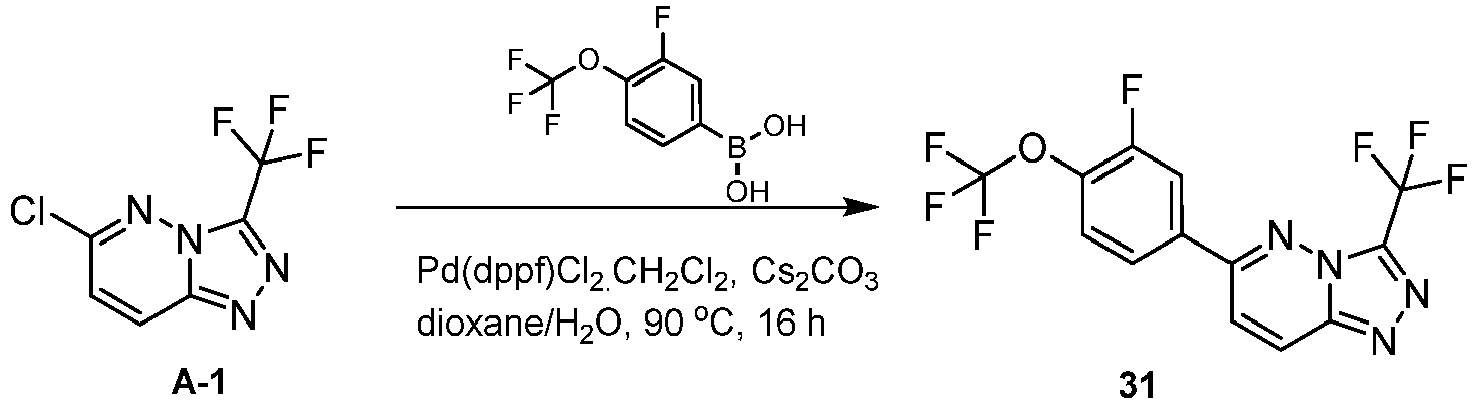
- A mixture of A-1 (150.00 mg, 673.98 µmol), [3-fluoro-4-(trifluoromethoxy)phenyl]boronic acid (181.10 mg, 808.78 µmol), Pd(dppf)Cl2.CH2Cl2 (82.56 mg, 101.10 µmol) and Cs2CO3 (439.19 mg, 1.35 mmol) in dioxane (3 mL) and H2O (300 µL) was stirred at 90 °C for 16 hours. The mixture was cooled to room temperature, diluted with EtOAc (30 mL), filtered through silica gel and eluted with EtOAc (10 mL). The filtrate was concentrated to give a residue that was purified by prep-HPLC (Xtimate C18 (150 mm × 25 mm, 5 µm); A = H2O (0.05% NH4OH) and B = CH3CN; 46-76 %B over 10 minutes) to afford Compound 31 (35.50 mg) as a solid. 1H NMR (400MHz, CDCl3) δ H = 8.37 (d, 1H), 7.93 (dd, 1H), 7.87 - 7.82 (m, 1H), 7.74 (d, 1H), 7.54 (t, 1H). LCMS Rt = 1.21 min using Method A, MS ESI calcd. for C13H6F7N4O [M+H]+ 367.0, found 366.9.
-

- Synthesis of A-52: To a mixture of [2-chloro-5-(trifluoromethoxy)phenyl]boronic acid (4.81 g, 20.00 mmol), NiI2 (312.53 mg, 1.00 mmol) and (1R,2R)-2-aminocyclohexanol (115.18 mg, 1.00 mmol) in i-PrOH (20 mL) was added NaHMDS (1 M, 20.00 mL) under N2, then the mixture was stirred at 25 °C for 10 minutes. A solution of 3-iodooxetane (1.84 g, 10.00 mmol) in i-PrOH (1 mL) was added and the mixture was stirred at 80 °C for 40 minutes under microwave conditions. After cooling to room temperature, the mixture was quenched with a saturated solution of NH4Cl (30 mL) and extracted with EtOAc (50 mL × 2). The combined organic phase was then washed with brine (15 mL), dried over Na2SO4,filtered and concentrated to give the crude product, which was purified by flash chromatography on silica gel (EtOAc in PE = 0% to 2.5% to 5%) to give A-52 (820.00 mg) as an oil. 1H NMR (400MHz, CDCl3) δ H = 7.39 (d, 1H), 7.29 (d, 1H), 7.11 (dd, 1H), 5.13-5.06 (m, 2H), 4.84-4.77 (m, 2H), 4.67-4.57 (m, 1H).
- Synthesis of A-53: A mixture of A-52 (800.00 mg, 3.17 mmol), 4,4,5,5-tetramethyl-2-(4,4,5,5-tetramethyl-1,3,2-dioxaborolan-2-yl)-1,3,2-dioxaborolane (2.41 g, 9.51 mmol), Pd2(dba)3 (290.28 mg, 317.00 µmol), XPhos (377.80 mg, 792.50 µmol) and KOAc (622.21 mg, 6.34 mmol) in dioxane (30 mL) was stirred at 90 °C for 16 hours under N2. After cooling to room temperature, the mixture was concentrated to a residue that was dissolved in H2O (30 mL), and extracted with EtOAc (50 mL x 2). The combined organic phase was washed with water (20 mL × 2) and brine (20 mL), dried over Na2SO4, filtered, and the residue was purified by flash chromatography on silica gel (EtOAc in PE = 0% to 2% to 3%) to give A-53 (500 mg, crude) as an oil. The crude product was used for next step directly without any further purification.
- Synthesis of Compound 32: A mixture of A-53 (500.00 mg, 1.45 mmol), A-1 (70.00 mg, 314.52 µmol), Pd(t-Bu3P)2 (24.11 mg, 47.18 µmol) and K3PO4 (133.53 mg, 629.04 µmol) in dioxane (6 mL) and H2O (600 µL) was stirred at 80 °C for 12 hours in 20 mL sealed tube under N2. After cooling to room temperature, the mixture was concentrated and the residue was diluted with H2O (20 mL) and extracted with EtOAc (30 mL x 2). The combined organic phase was washed with water (15 mL × 2) and brine (20 mL), dried over Na2SO4. filtered and purified by prep-TLC (silica gel, EtOAc:PE = 1:1) to give Compound 32 (25.11 mg) as a solid. 1H NMR (400MHz, CDCl3) δ H = 8.36 (d, 1H), 7.68 (d, 1H), 7.55 (d, 1H), 7.43 (d, 1H), 7.35 (dd, 1H), 5.00-4.94 (m, 2H), 4.72-4.66 (m, 2H), 4.65-4.56 (m, 1H). LCMS Rt = 1.14 min using Method A, MS ESI calcd. for C16H11F6N4O2 [M+H]+ 405.1, found 405.2
-

- Synthesis of A-54: A mixture of A-2 (3.00 g, 20.75 mmol) and (2-chloro-2,2-difluoroacetyl) 2-chloro-2,2-difluoro-acetate (5.55 g, 22.83 mmol) in toluene (30 mL) was stirred at 110 °C for 3 hours. The mixture was concentrated, dissolved in sat.NaHCO3 (50 mL), and extracted with EtOAc (150 mL × 2). The combined organic phase was washed with brine (50 mL), dried over Na2SO4,filtered and concentrated to give A-54 (3.60 g, 15.06 mmol) as a solid. 1H NMR (400MHz, CDCl3) δ H = 8.22 (d, 1H), 7.35 (d, 1H). LCMS Rt = 0.69 min using Method B, MS ESI calcd. for C6H3Cl2F2N4 [M+H]+ 239.0, found 238.9.
- Synthesis of A-55: A mixture of A-54 (400.00 mg, 1.67 mmol), [2-methoxy-4-(trifluoromethoxy)phenyl]boronic acid (394.04 mg, 1.67 mmol), Pd(t-Bu3P)2 (128.02 mg, 250.50 µmol) and K3PO4 (708.98 mg, 3.34 mmol) in dioxane (14 mL) and H2O (2 mL) was stirred at 80 °C for 16 hours under N2. After cooling to room temperature, the mixture was concentrated, diluted with H2O (50 mL), and extracted with EtOAc (100 mL x 2). The combined organic phase was washed with water (30 mL × 2) and brine (50 mL), dried over Na2SO4, filtered, and concentrated, and the crude product was purified by flash chromatography on silica gel (EtOAc in PE = 20% to 40% to 60%) to give A-55 (400.00 mg) as a solid. 1H NMR (400MHz CDCl3) δ H = 8.19 (d, 1H), 7.87-7.78 (m, 2H), 7.04 (d, 1H), 6.92 (s, 1H), 3.95 (s, 3H).
- Synthesis of Compound 33: To a mixture of A-55 (120.00 mg, 304.04 µmol) in MeOH (3 mL) and CH3CN (4 mL) was added AgOTf (390.61 mg, 1.52 mmol), and the mixture was stirred at 95 °C for 120 hours. The mixture was then diluted with H2O (20mL) and extracted with EtOAc (50 mL × 2). The combined organic phase was washed with water (20 mL × 2), dried over Na2SO4, filtered and concentrated to give the crude product. The crude product was purified by prep-TLC (silica gel, EtOAc:PE = 1:2), triturated from i-Pr2O (1 mL), and dried to give Compound 33 (18.04 mg) as a solid. 1H NMR (400MHz CDCl3) δ H = 8.14 (d, 1H), 7.80 (d, 1H), 7.73 (d, 1H), 7.03 (d, 1H), 6.90 (s, 1H), 3.93 (s, 3H), 3.90 (s, 3H). LCMS Rt = 1.16 min using Method A, MS ESI calcd. for C15H12F5N4O3 [M+H]+ 391.1, found 391.0.
-

- To a mixture of A-55 (120.00 mg, 304.04 µmol) and cyclopropylmethanol (1.93 mL, 24.32 mmol) in CH3CN (4 mL) was added AgOTf (390.61 mg, 1.52 mmol), and the mixture was stirred at 95 °C for 120 hours. The mixture was then diluted with H2O (20 mL), and extracted with EtOAc (50 mL × 2). The combined organic phase was washed with water (20 mL × 2), dried over Na2SO4,filtered and concentrated to give the crude product, which was purified by prep-TLC (silica gel, EtOAc:PE = 1:2) and prep-HPLC (Kromasil (150 mm × 25 mm, 10 µm) A = H2O (0.05% NH4OH) and B = CH3CN; 48-78 %B over 8 minutes) to afford Compound 34 (3.52 mg) as a solid. 1H NMR (400MHz DMSO-d 6) δ H = 8.51 (d, 1H), 7.84 (d, 1H), 7.71 (d, 1H), 7.29 (s, 1H), 7.19 (d, 1H), 3.97 (d, 2H), 3.91 (s, 3H), 1.21-1.12 (m, 1H), 0.59-0.52 (m, 2H), 0.36-0.29 (m, 2H). LCMS Rt = 1.24 min using Method A, MS ESI calcd. for C18H16F5N4O3 [M+H]+ 431.1, found 430.9.
-

- A mixture of A-1 (1.00 g, 4.49 mmol), [2-chloro-5-(trifluoromethoxy)phenyl]-boronic acid (1.19 g, 4.94 mmol), Pd(t-Bu3P)2 (344.44 mg, 673.50 µmol) and K3PO4 (1.91 g, 8.98 mmol) in dioxane (30 mL) and H2O (4 mL) was stirred at 80 °C for 16 hours under N2. The mixture was diluted with H2O (50mL) and extracted with EtOAc (100 mL × 2). The combined organic phase was washed with brine (50 mL), dried over Na2SO4, filtered, concentrated, and purified by flash chromatography on silica gel (EtOAc in PE = 5% to 10% to 15%) to give the impure product, which was triturated from PE (10 mL) and dried to give Compound 35 (1.09 g) as a solid. 1H NMR (400MHz CDCl3) δ H = 8.32 (d, 1H), 7.67 (d, 1H), 7.63 (d, 1H), 7.53 (d, 1H), 7.41 (dd, 1H). LCMS Rt = 1.19 min using Method A, MS ESI calcd. for C13H6ClF6N4O [M+H]+ 383.0, found 382.8.
-

- A mixture of Compound 35 (50.00 mg, 130.67 µmol), 2,4,6-trimethyl-1,3,5,2,4,6-trioxatriborinane (49.21 mg, 392.01 µmol), K2CO3 (27.09 mg, 196.01 µmol) and Pd(PPh3)4 (15.10 mg, 13.07 µmol) in dioxane (3 mL) was stirred at 110 °C for 16 hours. The mixture was cooled to room temperature, diluted with EtOAc (10 mL), filtered with silica gel, and eluted with EtOAc (5 mL), concentrated, and purified by prep-HPLC (Xtimate C18 (150 mm × 25 mm, 5 µm); A = H2O (0.05% NH4OH) and B = CH3CN; 45-75 %B over 10 minutes) to give Compound 36 (33.50 mg) as a solid. 1H NMR (400MHz CDCl3) δ H = 8.34 (d, 1H), 7.48 (d, 1H), 7.44 (d, 1H), 7.37 - 7.30 (m, 2H), 2.48 (s, 3H). LCMS Rt= 1.19 min using Method A, MS ESI calcd. for C14H9F6N4O [M+H]+ 363.1, found 362.8
-

- Synthesis of A-56: To a solution of 2,2,2-trifluoroethanol (971.22 µL, 13.49 mmol) in DMF (20 mL) was added NaH (540.00 mg, 13.50 mmol, 60% purity) in portions at 0 °C, and the mixture was stirred at 0 °C for 30 mins. Then 3-bromo-6-chloro-2-methoxy-pyridine (700.00 mg, 3.15 mmol) was added, and the mixture was stirred at 35 °C for 16 hours. The mixture was then quenched with a saturated solution of NH4Cl (60 mL) and extracted with EtOAc (50 mL x 2). The combined organic phase was washed with brine (30 mL), dried over Na2SO4,filtered and concentrated, and the residue was purified by flash chromatography on silica gel (PE) to give A-56 (600.00 mg) as an oil. 1H NMR (400MHz CDCl3) δ H = 7.73 (d, 1H), 6.38 (d, 1H), 4.73 (q, 2H), 3.99 (s, 3H).
- Synthesis of A-57: A mixture of A-56 (500.00 mg, 1.75 mmol), 4,4,5,5-tetramethyl-2-(4,4,5,5-tetramethyl-1,3,2-dioxaborolan-2-yl)-1,3,2-dioxaborolane (1.33 g, 5.25 mmol), Pd(dppf)Cl2.CH2Cl2 (285.82 mg, 350.00 µmol) and KOAc (343.49 mg, 3.50 mmol) in dioxane (10 mL) was stirred at 90 °C for 16 hours. The mixture was then concentrated and the residue was purified by flash chromatography on silica gel (EtOAc in PE = 0% to 2%) to give A-57 as a solid. 1H NMR (400MHz, CDCl3) δ H = 7.97 (d, 1H), 6.41 (d, 1H), 4.82 - 4.73 (m, 2H), 3.95 (s, 3H), 1.34 (s, 12H).
- Synthesis of Compound 37: A mixture of A-57 (299.35 mg, 898.64 µmol), A-1 (100.00 mg, 449.32 µmol), K3PO4 (190.75 mg, 898.64 µmol) and Pd(t-Bu3P)2 (45.92 mg, 89.86 µmol) in dioxane (10 mL) and H2O (900 µL) was stirred at 80 °C for 16 hours. The mixture was then concentrated and purified by prep-HPLC (Kromasil (150 mm × 25 mm, 10 µm) A = H2O (0.05% NH4OH) and B = CH3CN; 53-63 %B over 8 minutes) to give Compound 37 (53.76 mg) as a solid. 1H NMR (400MHz CDCl3) δ H = 8.27 - 8.18 (m, 2H), 8.01 (d, 1H), 6.68 (d, 1H), 4.85 (q, 2H), 4.08 (s, 3H). LCMS Rt = 0.91 min using Method B, MS ESI calcd. for C14H10F6N5O2 [M+H]+ 394.1, found 394.1.
-

- Synthesis of A-58: To a mixture of A-24 (500.00 mg, 786.89 µmol) in THF (10 mL) at 0 °C under N2 was added n-BuLi (2.5 M, 377.71 µL). The reaction mixture was stirred at 0 °C for 30 min, then tetrahydropyran-3-one (196.96 mg, 1.97 mmol) was added. The mixture was stirred at 20 °C for 16 hours. The mixture was quenched with NH4Cl (50 mL), extracted with EtOAc (50 mL × 2). The combined organic phase was washed with brine (20 mL), dried over Na2SO4,filtered and concentrated, and the residue was purified by flash chromatography on silica gel (EtOAc:PE = 2:1) to give A-58 (100.00 mg) as a solid. 1H NMR (400MHz, CDCl3) δ H = 8.20 (dd, 1H), 8.08 - 8.04 (m, 2H), 7.54 (dd, 1H), 7.42 (d, 2H), 6.74 (d, 1H), 5.02 (s, 1H), 4.35 (s, 1H), 3.95 - 3.83 (m, 2H), 3.33 (t, 1H), 2.70 (t, 1H), 1.97 - 1.86 (m, 2H).
- Synthesis of Compound 38: A mixture of A-58 (100.00 mg, 265.72 µmol) and Pd/C (80.00 mg) in EtOAc (20 mL) under N2 was degassed, and refilled with H2. The mixture was stirred under an H2 balloon (15 psi) at 25 °C for 2 hours. The mixture was the diluted with EtOAc (10 mL), filtered with silica gel, eluted with EtOAc (5 mL) and concentrated, and the residue was purified by prep-HPLC (Xtimate C18 (150 mm x 25 mm, 5 µm); A = H2O (0.05% NH4OH) and B = CH3CN; 40-70 %B over 10 minutes to give Compound 38 (42.50 mg, 110.71 µmol) as a solid. 1H NMR (400MHz, CDCl3) δ H = 8.21 - 8.16 (m, 1H), 8.06 - 8.02 (m, 2H), 7.56 - 7.50 (m, 1H), 7.42 (d, 2H), 3.97 (dd, 1H), 3.87 (td, 1H), 3.52 - 3.42 (m, 1H), 3.40 - 3.27 (m, 1H), 3.20 (d, 2H), 2.41 (tdd, 1H), 1.99 - 1.89 (m, 1H), 1.74 - 1.59 (m, 2H), 1.49 - 1.37 (m, 1H). LCMS Rt = 1.12 min using Method A, MS ESI calcd. for C18H18F3N4O2 [M+H]+ 379.1, found 378.9.
-

- Synthesis of A-59: To a mixture of A-24 (500.00 mg, 786.89 µmol) in THF (10 mL) at 0 °C under N2 was added n-BuLi (2.5 M, 377.71 µL). The reaction mixture was stirred at 0 °C for 30 mins, and then tetrahydropyran-4-one (180.70 µL, 1.97 mmol) was added. The mixture was stirred at 20 °C for 16 hours. The mixture was quenched by sat.NH4Cl (30 mL), extracted with EtOAc (30 mL × 2), and the combined organic was washed with brine (15 mL), dried over Na2SO4,filtered and concentrated to give a residue that was purified by flash chromatography on silica gel (EtOAc) to give A-59 (100.00 mg) as a solid. LCMS Rt = 0.82 min using Method B, MS ESI calcd. for C18H16F3N4O2 [M+H]+ 377.1, found 377.0.
- Synthesis of Compound 39: A mixture of A-59 (100.00 mg, 265.72 µmol, 1.00 eq) and Pd/C (50.00 mg) in EtOAc (20.00 mL) under N2 was degassed and refilled with H2. The mixture was stirred under an H2 balloon (15 psi) at 25 °C for 2 hours. The mixture was diluted with EtOAc (10 mL), filtered with silica gel, eluted with EtOAc (5 mL), and concentrated to give a residue that was purified by flash chromatography on silica gel (EtOAc) and prep-TLC (silica gel, EtOAc) to give Compound 39 (7.80 mg) as a solid. 1H NMR (400MHz, CDCl3) δ H = 8.19 (d, 1H), 8.04 (d, 2H), 7.54 (d, 1H), 7.42 (br d, 2H), 3.99 (dd, 2H), 3.47 - 3.37 (m, 2H), 3.25 (d, 2H), 2.43 - 2.29 (m, 1H), 1.73 (br d, 2H), 1.58 - 1.49 (m, 2H). LCMS Rt = 1.12 min using Method A, MS ESI calcd. for C18H18F3N4O2 [M+H]+ 379.1, found 378.9.
-

- A mixture of Compound 35 (500.00 mg, 1.31 mmol), Zn(CN)2 (461.46 mg, 3.93 mmol), Zn (8.57 mg, 131.00 µmol) and Pd(t-Bu3P)2 (133.90 mg, 262.00 µmol) in DMF (20 mL) was stirred at 110 °C for 36 hours in a 20 mL sealed tube under N2. The mixture was diluted with H2O (50 mL) and extracted with EtOAc (100 mL × 2). The combined organic phase was washed with water (40 mL × 2) and brine (50 mL), dried over Na2SO4,filtered and concentrated to give a residue that was purified by prep-HPLC (Xtimate C18 (150 mm x 25 mm, 5 µm); A = H2O (0.05% NH4OH) and B = CH3CN; 40-70 %B over 10 minutes to give Compound 40 (24.90 mg) as a solid. 1H NMR (400MHz, CDCl3) δ H = 8.46 (d, 1H), 8.00 (d, 1H), 7.77 (d, 1H), 7.71 (s, 1H), 7.59 - 7.55 (m, 1H). LCMS Rt = 1.25 min using Method A, MS ESI calcd. for C14H6F6N5O [M+H]+ 373.0, found 374.0.
-

- Synthesis of A-60: A mixture of A-54 (1.00 g, 4.18 mmol), [4-(trifluoromethoxy)phenyl]boronic acid (1.03 g, 5.02 mmol), Pd(t-Bu3P)2 (213.62 mg, 418.00 µmol) and K3PO4 (1.77 g, 8.36 mmol) in dioxane (20 mL) and H2O (2 mL) was stirred at 80 °C for 16 hours. The mixture was then concentrated to give a residue that was purified by flash chromatography on silica gel (EtOAc in PE = 10% to 50% to 100%) to give A-59 (1.20 g, 2.52 mmol) as a solid. 1H NMR (400MHz CDCl3) δ H = 8.33 (d, 1H), 8.10 (d, 2H), 7.78 (d, 1H), 7.44 (d, 2H). LCMS Rt = 0.88 min using Method B, MS ESI calcd. for C13H7ClF5N4O [M+H]+ 365.0, found 365.0.
- Synthesis of Compound 41: To a mixture of A-59 (50.00 mg, 137.11 µmol) in MeOH (1 mL) and CH3CN (1 mL) was added AgOTf (176.15 mg, 685.55 µmol), and the mixture was stirred at 95 °C for 60 hours. The mixture was then diluted with H2O (20 mL) and extracted with EtOAc (30 mL × 2). The combined organic phase was washed with water (10 mL x 2) and brine (20 mL), dried over Na2SO4, filtered and concentrated to give a residue that was purified by prep-TLC (silica gel, EtOAc:PE = 1:1) to give Compound 41 (6.42 mg) as a solid. 1H NMR (400MHz, CDCl3) δ H = 8.28 (d, 1H), 8.08 (d, 2H), 7.69 (d, 1H), 7.42 (d, 2H), 3.93 (s, 3H). LCMS Rt = 1.14 min using Method A, MS ESI calcd. for C14H10F5N4O2 [M+H]+ 361.1, found 360.9
-

- To a mixture of 2-tetrahydropyran-2-ylacetic acid (498.65 mg, 3.46 mmol) and (6-chloropyridazin-3-yl)hydrazine (500 mg, 3.46 mmol) in DCM (20 mL) was added PyBOP (2.70 g, 5.19 mmol) and DIPEA (1.81 mL, 10.38 mmol). The mixture was stirred at 25 °C for 16 hours. The reaction was diluted with sat.NH4Cl (20 mL), and the mixture was extracted with DCM (20 mL × 2). The combined organic phase was washed with brine (10 mL), dried over Na2SO4,filtered and concentrated to give the crude product (2800 mg, 7.83 mmol, crude) as a solid. LCMS Rt = 0.67 min in 1.5 min chromatography, 5-95AB, purity 75.67%, MS ESI calcd. for C11H16ClN4O2 [M+H]+ 271.1, found 271.0.
- A mixture of N'-(6-chloropyridazin-3-yl)-2-tetrahydropyran-2-yl-acetohydrazide (2.80 g, 10.34 mmol) in acetic acid (8 mL) was stirred at 120 °C for 16 hours. After cooling to r.t., the mixture was concentrated, the residue was diluted with EtOAc (20 mL), neutralized with sat.NaHCO3 to pH = 9, and extracted with EtOAc (20 mL x 2). Then the combined organic phase was washed with brine (15 mL), dried over Na2SO4 and concentrated to give the crude product. The crude product was purified by flash chromatography on silica gel (EtOAc in PE = 50% to 70% to 100%) to give the product (420 mg) as a solid. 1H NMR (400MHz, CDCl3) δH = 8.05 (d, 1H), 7.08 (d, 1H), 4.02 - 3.90 (m, 2H), 3.48 - 3.39 (m, 2H), 3.30 - 3.22 (m, 1H), 1.91 - 1.81 (m, 1H), 1.77-1.71 (m, 1H), 1.64 - 1.42 (m, 4H).
- A mixture of 6-chloro-3-(tetrahydropyran-2-ylmethyl)-[1,2,4]triazolo[4,3-b]pyridazine (420 mg, 1.66 mmol), [4-(trifluoromethoxy)phenyl]boronic acid (410.72 mg, 1.99 mmol), Pd(t-Bu3P)2 (169.88 mg, 0.33 mmol) and K3PO4 (705.71 mg, 3.32 mmol) in 1,4-dioxane (10 mL) and water (2 mL) was stirred at 80 °C under N2 for 16 hours. After cooling to r.t., the mixture was concentrated, the residue was diluted with NH4Cl (20 mL) and extracted with EtOAc (20 mL x 2). Then the combined organic phase was washed with brine (15 mL), dried over Na2SO4 and concentrated to give the crude product. The crude product was purified by flash chromatography on silica gel (EtOAc in PE = 70% to 100%) to give the impure product. Then the impure product was triturated from i-PrzO (10 mL) to give the (440 mg, 70% yield) as a solid. 1H NMR (400MHz, CDCl3) δH = 8.17 (d, 1H), 8.05 (d, 2H), 7.52 (d, 1H), 7.41 (d, 2H), 4.10 - 3.93 (m, 2H), 3.61 - 3.52 (m, 1H), 3.51 - 3.42 (m, 1H), 3.40 - 3.31 (m, 1H), 1.93 - 1.83 (m, 1H), 1.80 - 1.72 (m, 1H), 1.58 - 1.44 (m, 4H).
- The product was separated by SFC (C2 (250 mm x 30 mm, 10 µm); A = COz and B = EtOH (0.1% NH3H2O); 38°C; 60 mL/min; 20% B; 10 min run; 12 injections, Rt of peak 1 = 7.2 min, Rt of Peak 2 = 8.8 min) to give the product of 3-[[(2R)-tetrahydropyran-2-yl]methyl]-6-[4-(trifluoromethoxy)phenyl]-[1,2,4]triazolo[4,3-b]pyridazine (133.87 mg) (Peak 1, Rt = 6.26 min in SFC) as a solid and 3-[[(2S)-tetrahydropyran-2-yl]methyl]-6-[4-(trifluoromethoxy)phenyl]-[1,2,4]triazolo[4,3-b]pyridazine (135.71 mg,0.37 mmol (Peak 2: Rt = 6.93 min in SFC) as a solid.
- Note: the enantiomers were randomly assigned.
- Compound 42: 1H NMR (400MHz, DMSO-d6 + D2O) δH = 8.37 (d, 1H), 8.22 (d, 2H), 7.89 (d, 1H), 7.58 (d, 2H), 3.96 - 3.86 (m, 1H), 3.82 - 3.73 (m, 1H), 3.40 - 3.23 (m, 3H), 1.80 - 1.64 (m, 2H), 1.51 - 1.31 (m, 4H). LCMS Rt = 1.29 min in 2 min chromatography, 10-80AB, purity 100%, MS ESI calcd. for C18H18F3N4O2 [M+H]+ 379.1, found 379.0.
- Compound 43: 1H NMR (400MHz, DMSO-d6 + D2O) δH = 8.26 (d, 1H), 8.16 (d, 2H), 7.84 (d, 1H), 7.58 - 7.47 (m, 2H), 3.95 - 3.85 (m, 1H), 3.79 - 3.68 (m, 1H), 3.39 - 3.22 (m, 3H), 1.76 - 1.61 (m, 2H), 1.45 - 1.28 (m, 4H).
- LCMS Rt = 1.29 min in 2 min chromatography, 10-80AB, purity 100%, MS ESI calcd. for C18H18F3N4O2 [M+H]+ 379.1, found 379.0.
-

- A mixture of A-18 (100.00 mg, 433.65 µmol), [4-(trifluoromethoxy)-phenyl]boronic acid (98.23 mg, 477.02 µmol), Pd(t-Bu3P)2 (22.16 mg, 43.37 µmol) and K3PO4 (184.10 mg, 867.30 µmol) in dioxane (2 mL) and H2O (200 µL) was stirred at 85 °C for 16 hours. The mixture was diluted with EtOAc (10 mL), filtered through silica gel, eluted with EtOAc (10 mL) and concentrated to give a residue that was purified by prep-HPLC (Xbridge (150 mm × 25 mm, 5 µm); A = H2O (0.05% NH4HCO3) and B = CH3CN; 5-65 %B over 10 minutes) to give Compound 44 (25.89 mg, 72.67 µmol) as a solid. 1H NMR (400MHz, MeOD-d4 ) δ H = 8.31 (d, 1H), 8.29 - 8.22 (m, 2H), 7.98 (d, 1H), 7.51 (d, 2H), 3.62 - 3.46 (m, 1H), 2.58 - 2.41 (m, 1H), 2.37 - 2.25 (m, 1H). LCMS Rt = 1.13 min using Method A, MS ESI calcd. for C15H10F5N4O [M+H]+ 357.1, found 356.9. Compound 44 was purified by SFC (Chiralcel AD (250 mm x 30 mm, 5 µm); A = COz and B = EtOH (0.1% NH3H2O); 38°C; 50 mL/min; 15% B over 10 minutes; multiple injections) to afford Enantiomer 1, randomly assigned as Compound 45 (Rt = 7.0 min) and Enantiomer 2, randomly assigned as Compound 46 (Rt = 8.2 min). Compound 45 (120.64 mg) 1H NMR (400MHz, CDCl3) δ = 8.21 (d, 1H), 8.07 (d, 2H), 7.59 (d, 1H), 7.43 (d, 2H), 3.39 - 3.29 (m, 1H), 2.71 - 2.60 (m, 1H), 2.23 - 2.13 (m, 1H). LCMS Rt = 1.22 min using Method A, MS ESI calcd. for C15H10F5N4O [M+H]+ 357.1, found 357.0. Compound 46 (130.7 mg) 1H NMR (400MHz, CDCl3) δ = 8.21 (d, 1H), 8.07 (d, 2H), 7.59 (d, 1H), 7.43 (d, 2H), 3.40 - 3.28 (m, 1H), 2.71 - 2.61 (m, 1H), 2.24 - 2.13 (m, 1H). LCMS Rt = 1.22 min using Method A, MS ESI calcd. for C15H10F5N4O [M+H]+ 357.1, found 357.0.
-

- Synthesis of A-64: A mixture of A-63 (10.00 g, 67.12 mmol) in EtOH (80 mL) was stirred under N2 at 80 °C for 16 hours. The mixture was concentrated to give the crude product, which was triturated from H2O (20 mL) to give A-64 (1.60 g, 11.07 mmol) as a solid. 1H NMR (400MHz, CDCl3) δ H = 8.10 - 8.01 (m, 2H), 6.03 (br s, 1H), 3.85 (br s, 2H).
- Synthesis of A-65: A mixture of A-64 (1.99 g, 11.42 mmol) in toluene (20 mL) was stirred at 120 °C for 72 hours. The mixture was diluted with H2O (50 mL) and extracted with EtOAc (50 mL × 2). The combined organic phase was washed with brine (20 mL), dried over Na2SO4,filtered and concentrated to give a residue that was purified by flash chromatography on silica gel (PE:EtOAc = 5:1 to 1:1) to give A-65 (600.00 mg) as a solid. LCMS Rt = 0.19 min using Method B, MS ESI calcd. for C6H4ClF2N4 [M+H]+ 205.0, found 204.8.
- Synthesis of Compound 47: A mixture of A-65 (50.00 mg, 244.43 µmol), [4-(trifluoromethoxy)phenyl]boronic acid (50.33 mg, 244.43 µmol), K3PO4 (103.77 mg, 488.85 µmol) and Pd(t-Bu3P)2 (24.98 mg, 48.89 µmol) in dioxane (2 mL) and H2O (200 µL) under N2 was heated to 85 °C and stirred for 16 hours. After cooling, the mixture was diluted with EtOAc (10 mL), filtered through a Celite pad, and eluted with EtOAc (10 mL). The filtrate was concentrated, and the residue was purified by prep-HPLC (Xtimate C18 (150 mm × 25 mm, 5 µm); A = H2O (0.05% NH4OH) and B = CH3CN; 42-72 %B over 10 minutes) to give Compound 47 (3.04 mg, 9.21 µmol) as a solid. 1H NMR (400MHz DMSO-d6 ) δ H = 9.69 (s, 1H), 9.23 (s, 1H), 8.25 (d, 2H), 7.85 (t, 1H), 7.56 (d, 2H). LCMS Rt = 0.82 min using Method B, MS ESI calcd. for C13H8F5N4O [M+H]+ 331.1, found 330.9
-

- A mixture of A-65 (100.00 mg, 488.85 µmol, 1.00 eq), [2-methoxy-4-(trifluoromethoxy)phenyl]boronic acid (115.35 mg, 488.85 µmol), K3PO4 (207.54 mg, 977.70 µmol) and Pd(t-Bu3P)2 (49.97 mg, 97.77 µmol) in dioxane (3 mL) and H2O (300 µL) under N2 was heated to 85 °C and stirred for 16 hours. The reaction mixture was diluted with EtOAc (10 mL), filtered through a Celite pad, and eluted with EtOAc (10 mL). The filtrate was concentrated and the residue was purified by prep-TLC (silica gel, PE:EtOAc = 1:1) to afford Compound 48 (13.14 mg, 36.48 µmol) as a solid. 1H NMR (400MHz MeOD-d4 ) δ H = 9.54 (d, 1H), 9.18 (d, 1H), 8.33 (d, 1H), 7.60 (t, 1H), 7.15 - 7.07 (m, 2H), 4.04 (s, 3H). LCMS Rt = 1.16 min using Method A, MS ESI calcd. for C14H10F5N4O2 [M+H]+ 361.1, found 360.9.
-

- A mixture of A-65 (50.00 mg, 244.42 µmol), [2-methyl-4-(trifluoromethoxy)phenyl]boronic acid (59.14 mg, 268.86 µmol), K3PO4 (103.77 mg, 488.84 µmol) and Pd(t-Bu3P)2 (24.98 mg, 48.88 µmol) in dioxane (2 mL) and H2O (200 µL) was stirred under N2 at 80 °C for 16 hours. The mixture was diluted with EtOAc (5 mL), filtered through silica gel, eluted with EtOAc (10 mL). The filtrate was concentrated to give a residue that was purified by prep-HPLC (Xtimate C18 (150 mm x 25 mm, 5 µm); A = H2O (0.05% NH4OH) and B = CH3CN; 40-70 %B over 10 minutes) to give Compound 49 (7.26 mg) as a solid. 1H NMR (400MHz, MeOD-d4 ) δ H = 9.52 (d, 1H), 8.62 (d, 1H), 7.70 - 7.43 (m, 2H), 7.32 - 7.22 (m, 2H), 2.44 (s, 3H). LCMS Rt = 1.27 min using Method A, MS ESI calcd. for C14H10F5N4O [M+H]+ 345.1, found 344.9.
-

- A mixture of A-65 (50.00 mg, 244.42 µmol), 5-(4,4,5,5-tetramethyl-1,3,2-dioxaborolan-2-yl)-2-(2,2,2-trifluoroethoxy)pyridine (81.49 mg, 268.86 µmol), K3PO4 (103.77 mg, 488.84 µmol) and Pd(t-Bu3P)2 (24.98 mg, 48.88 µmol) in dioxane (2 mL) and H2O (200 µL) was stirred under N2 at 80 °C for 16 hours. The mixture was diluted with EtOAc (5 mL), filtered through silica gel, and eluted with EtOAc (5 mL). The filtrate was concentrated to give a residue that was purified by prep-HPLC (Xtimate C18 (150 mm × 25 mm, 5 µm); A = H2O (0.05% NH4OH) and B = CH3CN; 35-65 %B over 10 minutes) to afford Compound 50 (18.08 mg) as a solid. 1H NMR (400MHz, DMSO-d 6) δ H = 9.69 (s, 1H), 9.23 (s, 1H), 8.93 (d, 1H), 8.51 (dd, 1H), 7.82 (t, 1H), 7.20 (d, 1H), 5.09 (q, 2H). LCMS Rt = 1.20 min using Method A, MS ESI calcd. for C13H9F5N5O [M+H]+ 346.1, found 345.9.
-

- A mixture of A-65 (100.00 mg, 488.83 µmol), 2-[4-(1-methoxy-1-methyl-ethyl)phenyl]-4,4,5,5-tetramethyl-1,3,2-dioxaborolane (148.51 mg, 537.71 µmol), Pd2(dba)3 (67.14 mg, 73.32 µmol), XPhos (81.56 mg, 171.09 µmol) and Cs2CO3 (318.54 mg, 977.66 µmol) in dioxane (3 mL) and H2O (300 µL) was stirred at 85 °C for 16 hours. The mixture was diluted with EtOAc (10 mL), filtered through silica gel, eluted with EtOAc (20 mL) and concentrated to give a residue that was purified by prep-HPLC (Xbridge (150 mm × 25 mm, 5 µm); A = H2O (0.05% NH4HCO3) and B = CH3CN; 27-57 %B over 10 minutes) to afford Compound 51 (43.81 mg) as a solid. 1H NMR (400MHz, MeOD-d4 ) δ H = 9.53 (d, 1H), 8.88 (d, 1H), 8.08 (d, 2H), 7.73 - 7.46 (m, 3H), 3.12 (s, 3H), 1.57 (s, 6H). LCMS Rt = 1.16 min using Method A, MS ESI calcd. for C16H17F2N4O [M+H]+ 319.1, found 318.9.
-

- A mixture A-65 (50.00 mg, 244.42 µmol), 2-[2-fluoro-4-(trifluoromethoxy)phenyl]-4,4,5,5-tetramethyl-1,3,2-dioxaborolane (74.81 mg, 244.42 µmol), K3PO4 (103.77 mg, 488.84 µmol) and Pd(t-Bu3P)2 (24.98 mg, 48.88 µmol) in H2O (200 µL) and dioxane (2 mL) was stirred under N2 at 80 °C for 16 hours. The mixture was diluted with EtOAc (20 mL), filtered through silica gel, and eluted with EtOAc (10 mL). The filtrate was concentrated to give a residue that was purified by prep-HPLC (Xtimate C18 (150 mm × 25 mm, 5 µm); A = H2O (0.05% NH4OH) and B = CH3CN; 40-70 %B over 10 minutes) to afford Compound 52 (6.68 mg) as a solid. 1H NMR (400MHz, DMSO-d6 ) δ H = 9.72 (d, 1H), 8.96 (d, 1H), 8.17 (t, 1H), 7.87 (t, 1H), 7.64 (dd, 1H), 7.47 (d, 1H). LCMS Rt = 1.28 min using Method A, MS ESI calcd. for C13H7F6N4O [M+H]+ 349.0, found 348.9.
-

- Synthesis of A-69: A mixture of A-68 (1.00 g, 5.29 mmol) and TFAA (1.11 g, 5.29 mmol, 735.80 µL) in toluene (20 mL) was stirred at 110 °C for 16 hours. After cooling to room temperature, the mixture was diluted with H2O (10 mL) and extracted with EtOAc (30 mL x 2). The combined organic phase was washed with brine (15 mL), dried over Na2SO4, filtered and concentrated to give A-69 (1.30 g, 4.56 mmol) as a solid. 1H NMR (400MHz, CDCl3) δ H = 8.87 - 8.56 (m, 1H), 8.41 (s, 2H)
- Synthesis of A-70: A mixture of A-69 (300.00 mg, 1.05 mmol) and PPA (6.00 g) was stirred at 165 °C for 4 hours. The mixture was then diluted with H2O (20 mL) and basified with Na2CO3 (solid) to pH~ 9, and then extracted with EtOAc (50 mL x 2). The combined organic phase was washed with water (20 mL x 2) and brine (20 mL), dried over Na2SO4, filtered and concentrated to give a residue that was purified by flash chromatography on silica gel (EtOAc in PE = 10% to 15%) to afford A-70 (190.00 mg, 630.75 µmοl) as a solid. 1H NMR (400MHz, CDCl3) δ H = 9.07 (d, 1H), 8.99 (d, 1H). LCMS Rt = 0.681 min using Method B, MS ESI calcd. for C6H3BrF3N4 [M+H]+ 266.9, found 266.8.
- Synthesis of Compound 54: A mixture of A-70 (100.00 mg, 374.52 µmol), [4-(trifluoromethoxy)phenyl]boronic acid (115.69 mg, 561.78 µmοl) Pd(t-Bu3P)2 (28.71 mg, 56.18 µmol) and K3PO4 (159.00 mg, 749.04 µmol) in dioxane (5 mL) and H2O (1 mL) was stirred at 80 °C for 16 hours under N2. The mixture was then concentrated to give a residue that was purified by prep-TLC (silica gel, PE:EtOAc = 2:1) to afford Compound 54 (7.92 mg) as a solid. 1H NMR (400MHz, CDCl3) δ H = 9.20 (d, 1H), 9.03 (d, 1H), 7.67 (m, 2H), 7.46 (d, 2H). LCMS Rt = 1.29 mins using Method A, MS ESI calcd. for C13H7F6N4O [M+H]+ 349.0, found 348.9.
-

- Synthesis of A-71: A mixture of A-68 (500.00 mg, 2.65 mmol) in CH(OEt)3 (882.54 µL, 5.30 mmol) was stirred at 120 °C for 16 hours The mixture was diluted with EtOH (5 mL) and the solid formed was collected by filtration, washed with EtOH (5 mL × 3) and dried in oven to afford A-71 (400.00 mg, 1.99 mmol) as a solid. 1H NMR (400MHz, CDCl3) δ H = 8.81 (s, 1H), 8.68 (d, 1H), 8.62 (d, 1H). LCMS Rt = 0.15 min using Method B, MS ESI calcd. for C5H4BrN4 [M+H+2]+ 201.0, found 200.9
- Synthesis of Compound 55: A mixture of A-71 (150.00 mg, 753.73 µmol), [4-(trifluoromethoxy)phenyl]boronic acid (232.82 mg, 1.13 mmol), Pd(t-Bu3P)2 (57.78 mg, 113.06 µmοl) and K3PO4 (319.99 mg, 1.51 mmol) in dioxane (7 mL) and H2O (2 mL) was stirred at 80 °C for 16 hours under N2. The mixture was concentrated to give a residue that was purified by flash chromatography on silica gel (EtOAc in PE = 20% to 60% to 100%) and prep-HPLC (Kromasil (150 mm x 25 mm, 10 µm) A = H2O (0.05% NH4OH) and B = CH3CN; 25-55 %B over 8 minutes) to afford Compound 55 (17.21 mg, 60.66 µmol) as a solid. 1H NMR (400MHz CDCl3) δ H = 9.08 (d, 1H), 9.01 (d, 1H), 8.58 (s, 1H), 7.69 - 7.63 (m, 2H), 7.43 (d, 2H). LCMS Rt = 1.10 min using Method A, MS ESI calcd. for C12H8F3N4O [M+H]+ 281.1, found 280.9.
-

- Synthesis of A-72: A mixture of A-64 (1 g, 6.92 mmol) and TFAA (1.06 mL, 7.61 mmol) in toluene (20 mL) was stirred at 110 °C for 72 hours. The mixture was cooled to room temperature, concentrated, and the residue was basified with sat.NaHCO3 until pH =7-8. The mixture was extracted with EtOAc (20 mL × 2), and the combined organic phase was washed with brine (10 mL), dried over Na2SO4, filtered and concentrated to give the crude product, which was purified by flash chromatography on silica gel (MeOH in DCM = 0% to 5% to 10%) to afford A-72 (150 mg) as a solid. LCMS Rt = 0.41 min using Method B, MS ESI calcd. for C6H3ClF3N4 [M+H]+ 223.0, found 222.8.
- Synthesis of Compound 56: A mixture of A-72 (100 mg, 449.33 µmol), [4-(trifluoromethoxy)phenyl]boronic acid (111.03 mg, 539.19 µmol), Pd(t-Bu3P)2 (34.44 mg, 67.40 µmol) and K3PO4 (190.76 mg, 898.65 µmol) in dioxane (3 mL) and H2O (0.3 mL) was stirred at 80 °C for 16 hours. The mixture was cooled to room temperature, diluted with EtOAc (5 mL), filtered through silica gel, eluted with EtOAc (10 mL) and the filtrate was concentrated to give the crude product that was purified by prep-HPLC (Waters Xbridge (150 mm × 25mm, 5 µm) A = H2O (10 mM NH4HCO3) and B = CH3CN; 50-80 % B over 10 minutes) to afford Compound 54 (16.13 mg) as a solid. 1H NMR (400MHz, CDCl3) δ H = 9.60 (s, 1H), 8.42 (s, 1H), 8.04 (d, 2H), 7.41 (d, 2H). LCMS Rt = 1.16 min using Method A, MS ESI calcd. for C13H7F6N4O [M+H]+ 349.0, found 348.7.
-

- Synthesis of A-73: To a solution of 2-(4-bromophenyl)acetonitrile (2.00 g, 10.20 mmo) in THF (20 mL) was added NaH (1.22 g, 30.60 mmol, 60% purity) at 0 °C. The mixture was stirred at 0 °C for 30 mins, then MeI (4.34 g, 30.60 mmol, 1.90 mL, 3.00 eq) was added to the mixture. The mixture was stirred at 15 °C for 16 hours. The mixture was quenched with sat.NH4Cl (50 mL) and extracted with EtOAc (50 mL x 2). The combined organic phase was washed with brine (20 mL), dried over Na2SO4, filtered and concentrated to give the crude product that was purified by flash chromatography on silica gel (PE: EtOAc = 20:1 to 10:1) to afford A-73 (400.00 mg) as an oil. 1H NMR (400MHz, CDCl3) δ H = 7.53 (d, 2H), 7.36 (d, 2H), 1.72 (s, 6H).
- Synthesis of A-74: A mixture of A-73 (400 mg, 1.78 mmol), 4,4,5,5-tetramethyl-2-(4,4,5,5-tetramethyl-1,3,2-dioxaborolan-2-yl)-1,3,2-dioxaborolane (543.92 mg, 2.14 mmol), KOAc (525.54 mg, 5.35 mmol) and Pd(dppf)Cl2.CH2Cl2 (218.65 mg, 267.74 µmol) in dioxane (10 mL) was stirred at 90 °C for 16 hours. The mixture was cooled to room temperature, diluted with EtOAc (10 mL), filtered through silica gel, eluted with EtOAc (10 mL) and concentrated to give the crude product, which was purified by flash chromatography on silica gel (PE : EtOAc = 50:1 to 20 :1 to 15:1) to afford A-74 (360 mg) as a solid. 1H NMR (400MHz CDCl3) δ H = 7.84 (d, 2H), 7.49 (d, 2H), 1.74 (s, 6H), 1.36 (s, 12H).
- Synthesis of Compound 57: A mixture of A-74 (0.1 g, 488.84 µmol), A-70 (159.07 mg, 586.61 µmol), Pd(t-Bu3P)2 (49.96 mg, 97.77 µmol) and K3PO4 (207.53 mg, 977.68 µmol) in dioxane (3 mL) and H2O (0.3 mL) was stirred at 80 °C for 16 hours. The mixture was cooled to room temperature, diluted with EtOAc (5 mL), filtered through silica gel, eluted with EtOAc (10 mL) and concentrated to give the crude product. The crude product was purified by prep-HPLC (Waters Xbridge (150 mm × 25mm, 5 µm) A = H2O (10 mM NH4HCO3) and B = CH3CN; 23-53 %B over 10 minutes) to afford Compound 57 (15.48 mg) as a solid. 1H NMR (400MHz, MeOD-d4 ) δ H = 9.53 (d, 1H), 8.92 (d, 1H), 8.15 (d, 2H), 7.73 - 7.45 (m, 3H), 1.78 (s, 6H). LCMS Rt = 1.02 min using Method A, MS ESI calcd. for C16H14F2N5 [M+H]+ 314.1, found 313.9.
-

- Synthesis of A-75: A mixture of 2-bromo-5-(2,2,2-trifluoroethoxy)pyridine (2 g, 7.81 mmol), Pd(dppf)Cl2.CH2Cl2 (637.95 mg, 781.19 µmol) and Et3N (2.37 g, 23.44 mmol, 3.26 mL) was degassed and refilled with CO. The reaction mixture was stirred under CO (50 psi) for 16 hours at 80 °C, at which point the desired product was observed by LCMS. The reaction mixture was diluted with EtOAc (20 mL), and filtered through a Celite pad, eluted with EtOAc (20 mL) and concentrated. The residue was purified by flash chromatography on silica gel (PE/EtOAc = 5/1 to 2/1 to 1/1) to afford A-75 (1.5 g) as a solid. 1H NMR (400MHz, CDCl3) δ H = 8.48 (d, 1H), 8.16 (d, 1H), 7.34 (dd, 1H), 4.55 - 4.38 (m, 4H), 1.45 (t, 3H).
- Synthesis of A-76: To a solution of [methoxy(methyl)phosphoryl]oxymethane (548.66 mg, 4.42 mmol, 472.99 µL) in THF (15 mL) under N2 was added n-BuLi (2.5 M, 1.61 mL) drop wise at -70 °C, and the reaction was stirred at -70 °C for 30 min. A-75 (500 mg, 2.01 mmol) was added, and the reaction was stirred at -70 °C for 1.5. The reaction was quenched with sat.NH4Cl (20 mL), and extracted with EtOAc (20 mL × 3). The combined organic phase was washed with brine (20 mL), dried over Na2SO4, filtered and concentrated to give a residue was purified by flash chromatography on silica gel (PE/EtOAc = 5/1 to 2/1 to 1/1) to afford A-76 (500 mg, 1.53 mmol) as a solid. 1H NMR (400MHz, CDCl3) δ H = 8.42 (d, 1H), 8.13 (d, 1H), 7.35 (dd, 1H), 4.50 (q, 2H), 3.99 (d, 2H), 3.81 (s, 3H), 3.78 (s, 3H).
- Synthesis of A-77: To a solution of A-76 (460.52 mg, 1.41 mmol) and ethyl 2-oxoacetate (574.75 mg, 2.81 mmol) in THF (10 mL) at 0 °C was added t-BuOK (205.32 mg, 1.83 mmol). The reaction mixture was stirred at 15 °C for 16 hours. The reaction was quenched with sat.NH4Cl (20 mL), extracted with EtOAc (20 mL x 3), and the combined organic phase was washed with brine (20 mL), dried over Na2SO4, filtered and concentrated. The residue was purified by flash chromatography on silica gel (PE/EtOAc = 5/1 to 2/1) to afford A-77 (350 mg) as a solid. LCMS Rt = 0.84 min using Method B, MS ESI calcd. for C13H13F3NO4 [M+H]+ 304.1, found 304.0.
- Synthesis of A-78: A mixture of A-77 (350 mg, 1.15 mmol, 1 eq) and Pd/C (100 mg) in N2 was degassed and refilled with Hz (15 psi). The reaction mixture was stirred under H2 (15 psi) at 15 °C for 2 hours. The reaction mixture was diluted with EtOAc (20 mL), filtered through a Celite pad, and eluted with EtOAc (10 mL). The filtrate was concentrated to afford A-78 (300 mg) as a solid. 1H NMR (400MHz, CDCl3) δ H = 8.29 (t, 1H), 7.31 (d, 2H), 4.85 - 4.76 (m, 1H), 4.42 (q, 2H), 4.13 (q, 2H), 2.58 - 2.36 (m, 2H), 2.25 - 2.13 (m, 1H), 2.01 - 1.90 (m, 1H), 1.26 (t, 3H).
- Synthesis of A-79: To a solution of A-78 (300 mg, 976.36 µmol, 1 eq) in DCM (10 mL) was added Dess-Martin (621.17 mg, 1.46 mmol). The reaction mixture was stirred at 15 °C for 2 hours. The reaction mixture was treated with sat.Na2SO3 (10 mL) and extracted with DCM (20 mL x 3). The combined organic phase was washed with sat.NaHCO3 (10 mL), dried over Na2SO4, filtered, concentrated, and the residue was purified by flash chromatography on silica gel (PE/EtOAc = 20/1 to 10/1 to 5/1) to afford A-79 (230 mg) as a solid. 1H NMR (400MHz, CDCl3) δ H = 8.40 (d, 1H), 8.08 (d, 1H), 7.34 (dd, 1H), 4.49 (q, 2H), 4.16 (q, 2H), 3.52 (t, 2H), 2.75 (t, 2H), 1.27 (t, 3H).
- Synthesis of A-80: A mixture A-79 (230 mg, 753.48 µmοl) and NHzNHz.HzO (188.60 mg, 3.77 mmol) in EtOH (5 mL) was heated to 90 °C and stirred for 2 hours. After cooling, the reaction mixture was concentrated and the residue was treated with H2O (10 mL), and the mixture was extracted with EtOAc (10 mL x 3). The combined organic phase was washed with brine (10 mL), dried over Na2SO4, filtered and concentrated to afford A-80 (200 mg) as a solid. LCMS Rt = 0.68 min using Method B, MS ESI calcd. for C11H11F3N3O2 [M+H]+ 274.1, found 273.9.
- Synthesis of A-81: To a mixture of A-80 (150 mg, 549.03 µmol) and sodium 3-nitrobenzenesulfonate (247.23 mg, 1.10 mmol) in H2O (10 mL) was added NaOH (87.84 mg, 2.20 mmol). The reaction mixture was stirred at 100 °C for 16 hours. After cooling, the reaction mixture was adjust to pH = 8 with 1M HCl solution, and then the mixture was extracted with EtOAc (20 mL x 3). The combined organic phase was washed with brine (10 mL), dried over Na2SO4, filtered and concentrated to afford A-81 (80 mg) as a solid. 1H NMR (400MHz, CDCl3) δ H = 11.29 (s, 1H), 8.42 - 8.35 (m, 2H), 8.13 (d, 1H), 7.37 (dd, 1H), 7.08 (d, 1H), 4.48 (q, 2H).
- Synthesis of A-82: A mixture A-81 (80 mg, 294.99 µmοl) in POCl3 (1 mL) was heated to 100 °C and stirred for 16 hours. After cooling, the reaction mixture was concentrated, and the residue was dissolved in DCM (10 mL) then treated with sat.NaHCO3 to pH = 8. The mixture was extracted with DCM (10 mL × 3), and the combined organic phase was washed with brine (10 mL), dried over Na2SO4, filtered and concentrated to afford A-82 (70 mg, 241.68 µmοl) as a solid. LCMS Rt = 0.79 min using Method B, MS ESI calcd. for C11H8ClF3N3O [M+H]+ 290.0, found 289.9.
- Synthesis of A-83: To a solution of A-82 (70 mg, 241.68 µmol) in EtOH (5 mL) was added hydrazine (87.41 µL, 2.42 mmol). The reaction mixture was stirred at 90 °C for 16 hours. After cooling, the reaction mixture was concentrated to afford crude A-83 (70 mg) as a solid. LCMS Rt = 0.64 min using Method B, MS ESI calcd. for C11H11F3N5O [M+H]+ 286.1, found 285.9.
- Synthesis of Compound 58: To a mixture of A-83 (65 mg, 227.89 µmol) in toluene (5 mL) was added TFAA (34.87 µL, 250.68 µmol). The reaction mixture was stirred at 110 °C for 16 hours. After cooling, the reaction mixture was concentrated, and the residue was purified by prep-HPLC (Phenomenex Gemini (150 mm × 25mm,10 µm); A = H2O (0.05% NH4OH) and B = CH3CN); 45-70% B over 9 minutes) to afford Compound 58 (36.03 mg) as a solid. 1H NMR (400MHz, CDCl3) δ H = 8.54 - 8.48 (m, 2H), 8.45 (d, 1H), 8.30 (d, 1H), 7.47 (dd, 1H), 4.53 (q, 2H). LCMS Rt = 0.82 min using Method B, MS ESI calcd. for C13H8F6N5O [M+H]+ 364.1, found 364.0.
-

- Synthesis of A-84: A mixture of A-1 (200 mg, 0.90 mmol), (4-hydroxyphenyl)boronic acid (185.92 mg, 1.35 mmol), Pd(t-Bu3P)2 (68.88 mg, 0.13 mmol) and K3PO4 (381.02 mg, 1.8 mmol) in 1,4-dioxane (10 mL) and water (2 mL) was stirred at 80 °C for 16 hours under N2. After cooling to room temperature, the mixture was concentrated to a residue that was diluted with H2O (30 mL) and extracted with EtOAc (50 mL x 5). The combined organic phase was washed with brine (20 mL), dried over Na2SO4, filtered and concentrated to give the crude product, which was purified by flash chromatography on silica gel (EtOAc in PE = 20% to 60% to 100%) to afford A-84 (200 mg) as a solid. 1H NMR (400MHz, DMSO-d6 ) δ H = 10.26 (s, 1H), 8.59 (d, 1H), 8.15 (d, 1H), 8.01 (d, 2H), 6.98 (d, 2H). LCMS Rt = 0.72 min using Method B, MS ESI calcd. for C12H8F3N4O [M+H]+ 281.1, found 280.9
- Synthesis of Compound 59: To a mixture of A-84 (40 mg, 0.14 mmol), 3,3-difluorocyclobutanol (18.52 mg, 0.17 mmol) and Ph3P (74.89 mg, 0.29 mmol) in THF (2 mL) was added DIAD (57.73 mg, 0.29 mmol) under N2 at 60 °C. The mixture was stirred at 60 °C for 16 hours. After cooling to room temperature, the mixture was concentrated to the crude product that was purified by prep-TLC (silica gel, DCM) and prep-HPLC (Phenomenex Gemini (250 mm x 50 mm, 10 µm) A = H2O (0.05% NH4OH) and B = CH3CN; 58-68 %B over 8 minutes) to afford Compound 59 (7.80 mg, 20.8 µmol) as a solid. 1H NMR (400MHz, CDCl3) δ H = 8.26 (d, 1H), 8.01 (d, 2H), 7.74 (d, 1H), 6.99 (d, 2H), 4.81-4.70 (m, 1H), 3.23-3.10 (m, 2H), 2.90-2.75 (m, 2H). LCMS Rt = 1.29 min using Method A, MS ESI calcd. for C16H12F5N4O [M+H]+ 371.1, found 371.0.
-

- Synthesis of A-85: To a solution of 2-(4-bromophenyl)acetonitrile (5000 mg, 25.5 mmol) and TBAB (328.88 mg, 1.02 mmol) in toluene (30 mL) was added KOH (7155.43 mg, 127.52 mmol) (75% in H2O), followed by 1,3-dibromopropane (10298.41 mg, 51.01 mmol), and the mixture was stirred at 100 °C for 2 hours. The mixture was then poured into water (50 mL) and extracted with EtOAc (100 mL × 2). The combined organic phase was washed with brine (10 mL), dried over Na2SO4, filtered and concentrated to give the crude product, which was purified by flash chromatography on silica gel (DCM in PE = 20% to 40% to 60%) to afford A-85 (1600 mg) as a solid. 1H NMR (400MHz, DMSO-d6 ) δ H = 7.64 (d, 2H), 7.43 (d, 2H), 2.78 - 2.70 (m, 2H), 2.64 - 2.56 (m, 2H), 2.27 (m, 1H), 2.05 - 1.95 (m, 1H).
- Synthesis of A-86: A mixture of A-85 (1600 mg, 6.78 mmol), 4,4,5,5-tetramethyl-2-(4,4,5,5-tetramethyl-1,3,2-dioxaborolan-2-yl)-1,3,2-dioxaborolane (5162.48 mg, 20.33 mmol), KOAc (1330.09 mg, 13.55 mmol) and Pd(dppf)Cl2.CH2Cl2 (829.44 mg, 1.02 mmol) in 1,4-dioxane (20 mL) was stirred at 90 °C for 16 hours. After cooling to room temperature, the mixture was filtered through Celite, eluted with EtOAc (50 mL x 2) concentrated to give a residue that was purified by flash chromatography on silica gel (EtOAc in PE = 5% to 15% to 60%). The impure product was triturated from i-Pr2O (20 mL) and dried in oven to afford A-86 (1250 mg, 4.41 mmol) as a solid. 1H NMR (400MHz, DMSO-d6 ) δ H = 7.85 (d, 2H), 7.43 (d, 2H), 2.90 - 2.78 (m, 2H), 2.70 - 2.59 (m, 2H), 2.45 (m, 1H), 2.09 (m, 1H), 1.36 (s, 12H).
- Synthesis of Compound 60: A mixture of A-86 (152.68 mg, 0.54 mmol), A-1 (100 mg, 0.45 mmol), K3PO4 (181.52 mg, 0.90 mmol) and Pd(t-Bu3P)2 (45.92 mg, 0.09 mmol) in 1,4-dioxane (7 mL) and water (1 mL) was stirred at 90 °C for 16 hours. After cooling to room temperature, the mixture was concentrated and purified by prep-TLC (silica gel, PE: EtOAc =1:1) to give the crude product, which was triturated from i-PrzO (10 mL) and dried in oven to afford Compound 60 (58.8 mg, 0.17 mmol) as a solid. 1H NMR (400MHz, DMSO-d6 ) δ H = 8.33 (d, 1H), 8.08 (d, 2H), 7.79 (d, 1H), 7.66 (d, 2H), 2.97 - 2.86 (m, 2H), 2.74 - 2.65 (m, 2H), 2.58 - 2.45 (m, 1H), 2.23 - 2.10 (m, 1H). LCMS Rt = 1.29 min using Method A, MS ESI calcd. for C17H13F3N5 [M+H]+ 344.1, found 343.9.
-

- Synthesis of A-87: To a mixture of A-2 (300 mg, 2.08 mmol), 1-fluorocyclopropanecarboxylic acid (237.59 mg, 2.28 mmol) in DCM (5mL) was added PyBOP (1618.71 mg, 3.11 mmol) and DIPEA (803.13 mg, 6.23 mmol) and the mixture was stirred at 15°C for 16 hours. The reaction mixture was concentrated, diluted with NH4Cl (50 mL), and extracted with EtOAc (50 mL × 2). The combined organic phase was washed with brine (20 mL), dried over Na2SO4, filtered and concentrated to give the crude product of A-87 (2000 mg, 8.68 mmol) as an oil, which was used in the next step without further purification.
- Synthesis of A-88: A solution of A-87 (2 g, 8.67 mmol) in acetic acid (10 mL) was sealed and heated in microwave reactor at 120 °C for 1.5 hours. After cooling to room temperature, the reaction mixture was concentrated, then diluted with sat.NaHCOs (50 mL) and extracted with DCM (50 mL × 2). The combined organic phase was washed with brine (20 mL), dried over Na2SO4, filtered and concentrated to give the crude product, which was purified by flash chromatography on silica gel (PE : EtOAc = 5:1 to 1:1) to afford A-88 (250 mg, 1.18 mmol) as a solid. 1H NMR (400MHz, CDCl3) δ H = 8.12 (d, 1H), 7.21 (d, 1H), 1.75 - 1.66 (m, 2H), 1.53 - 1.46 (m, 2H).
- Synthesis of Compound 61: A mixture of A-88 (100 mg, 0.47 mmol), [4-(trifluoromethoxy)phenyl]boronic acid (106.54 mg, 0.5200 mmol), Pd(t-BuP3)2 (36.05mg, 0.07 mmol) and K3PO4 (129.82 mg, 0.9400 mmol) in 1,4-dioxane (3 mL) and water (0.3 mL) was stirred at 85 °C for 16 hours. The mixture was cooled to room temperature, diluted with EtOAc (5 mL), filtered through silica gel, eluted with EtOAc (10 mL), and concentrated to give the crude product, which was purified by prep-HPLC (Phenomenex Gemini (250 mm × 50 mm, 10 µm) A = H2O (0.05% NH4OH) and B = CH3CN; 50-80 %B over 8 minutes) to afford Compound 61 (36.2 mg, 0.11 mmol) as a solid. 1H NMR (400MHz, DMSO-d6 ) δ H = 8.57 (d, 1H), 8.26 (d, 2H), 8.09 (d, 1H), 7.63 (d, 2H), 1.76 - 1.62 (m, 2H), 1.51 - 1.45 (m, 2H). LCMS Rt = 1.23 min using Method A, MS ESI calcd. for C15H11F4N4O [M+H]+ 339.1, found 338.9
-

- To a solution of A-72 (200 mg, 0.90 mmol) in 1,4-dioxane (2 mL) and water (0.20 mL) was added [4-(trifluoromethyl)phenyl]boronic acid (204.81 mg, 1.08 mmol), Pd(t-Bu3P)2 (68.89 mg, 0.13 mmol) and K3PO4 (381.56 mg, 1.8 mmol). The resulting mixture was stirred at 85 °C under N2 for 16 hours. The reaction mixture was cooled to room temperature, filtered through Celite, and the filtrate was concentrated to give the crude product that was purified by prep-HPLC (Phenomenex Gemini (250 mm x 50 mm, 10 µm) A = H2O (0.05% NH4OH) and B = CH3CN; 50-80 %B over 8 minutes) to afford Compound 62 (38.43 mg, 0.12 mmol) as a solid. 1H NMR (400MHz, CDCl3) δ H = 9.64 (s, 1H), 8.49 (s, 1H), 8.13 (d, 2H), 7.83 (d, 2H). LCMS Rt = 1.22 mins using Method A, MS ESI calcd. for C13H7F6N4 [M+H]+ 333.0, found 332.9.
-

- To a solution of A-72 (150 mg, 0.6700 mmol) in 1,4-dioxane (3 mL) and water (0.30 mL) was added [2-methyl-4-(trifluoromethoxy)phenyl]boronic acid (177.89 mg, 0.81 mmol), Pd(t-Bu3P)2 (51.67 mg, 0.10 mmol) and K3PO4 (286.17 mg, 1.35 mmol). The resulting mixture was stirred at 85 °C under N2 for 16 hours. The reaction mixture was cooled to room temperature, filtered through Celite, concentrated, and purified by prep-HPLC (Phenomenex Gemini (250 mm x 50 mm, 10 µm) A = H2O (0.05% NH4OH) and B = CH3CN; 50-80 %B over 8 minutes) to afford Compound 63 (21.69 mg, 0.06 mmol) as a solid. 1H NMR (400MHz, CDCl3) δ H = 9.60 (s, 1H), 8.18 (s, 1H), 7.48 (d, 1H), 7.25 - 7.19 (m, 2H), 2.44 (s, 3H). LCMS Rt = 1.26 mins using Method A, MS ESI calcd. for C14H9F6N4O [M+H]+ 363.1, found 363.0.
-

- A mixture of A-72 (200 mg, 0.90 mmol), A-31 (349.5 mg, 1.17 mmol), Pd(t-Bu3P)2 (68.88 mg, 0.13 mmol) and K3PO4 (340 mg, 1.6 mmol) in 1,4-dioxane (10 mL) and water (2 mL) was stirred at 70 °C for 16 hours under N2.S After cooling to room temperature, the mixture was diluted with H2O (30 mL), and extracted with EtOAc (50 mL × 2). The combined organic phase was washed with water (20 mL × 2) and brine (20 mL), dried over Na2SO4, filtered and concentrated to give the crude product. The crude product was purified by prep-TLC (silica gel, DCM:MeOH = 100:1), triturated from CH3CN (0.5 mL), and dried in oven to afford Compound 64 (9.24 mg, 0.03 mmol) as a solid. 1H NMR (400MHz, CDCl3) δ H = 9.56 (s, 1H), 9.01 (s, 1H), 8.23 (d, 1H), 7.14 (s, 1H), 6.92 (dd, 1H), 4.04 (s, 3H), 1.87-1.81 (m, 2H), 1.54-1.49 (m, 2H). LCMS Rt = 1.16 min using Method A, MS ESI calcd. for C17H13F3N5O [M+H]+ 360.1, found 360.0.
-

- Synthesis of A-89: A mixture of Pd(t-Bu3P)2 (68.88 mg, 0.13 mmol), K3PO4 (381.02 mg, 1.8 mmol), A-1 (200 mg, 0.90 mmol) and (6-fluoro-3-pyridyl)boronic acid (189.94 mg, 1.35 mmol) in 1,4-dioxane (10 mL) and water (2 mL) was stirred at 80 °C for 16 hours under N2. After cooling to room temperature, the mixture was concentrated, diluted with H2O (30 mL), and extracted with EtOAc (100 mL × 2). The combined organic phase was washed with brine (20 mL), dried over Na2SO4, filtered and concentrated to give the crude product, which was purified by flash chromatography on silica gel (EtOAc in PE = 20% to 60% to 100%) to afford A-89 (140 mg, 0.49 mmol) as a solid. 1H NMR (400MHz, CDCl3) δ H = 8.87 (d, 1H), 8.53 (ddd, 1H), 8.39 (d, 1H), 7.77 (d, 1H), 7.20 (dd, 1H).
- Synthesis of Compound 65 : To a mixture of 3,3-difluorocyclobutanol (28 mg, 0.26 mmol) in THF (5 mL) was added NaH (14 mg, 0.35 mmol), and the mixture was stirred at 0 °C for 10 minutes. To the mixture was added A-89 (50 mg, 0.18 mmol), and the mixture was stirred at 20 °C for 2 hours. The mixture was quenched with sat. NH4Cl (10 mL) and extracted with EtOAc (30 mL × 2). The combined organic phase was washed with brine (10 mL), dried over Na2SO4, filtered, and concentrated to give the crude product, which was purified by prep-TLC (silica gel, PE:EtOAc = 1:3) to afford Compound 65 (54.57 mg, 0.15 mmol) as a solid. 1H NMR (400MHz, CDCl3) δ H = 8.79 (d, 1H), 8.36 - 8.28 (m, 2H), 7.74 (d, 1H), 6.97 (d, 1H), 5.30 - 5.19 (m, 1H), 3.25 - 3.12 (m, 2H), 2.86 - 2.70 (m, 2H). LCMS Rt = 1.21 min using Method A, MS ESI calcd. for C15H11F5N5O [M+H]+ 372.1, found 372.0.
-

- Synthesis of A-90: A mixture of A-64 (5 g, 34.59 mmol) and 2,2,2-trifluoroacetaldehyde (5.65 g, 43.23 mmol) in ethanol (25 mL) was stirred at 90 °C for 16 hours. After cooling to room temperature, the mixture was concentrated, triturated from n-hexanes (20 mL), and dried to afford A-90 (7500 mg, 33.34 mmol) as a solid. 1H NMR (400MHz, CDCl3) δ H = 8.50 (br s, 1H), 8.49 (d, 1H), 8.15 (d, 1H), 7.16 - 7.11 (m, 1H).
- Synthesis of A-91: To a mixture of A-90 (7500 mg, 33.4 mmol) in DMF (30 mL) was added a solution ofNBS (6241.93 mg, 35.07 mmol) in DMF (30 mL). The mixture was stirred at 20 °C for 1 hour. The mixture was diluted with H2O (200 mL) and extracted with n-hexanes (200 mL × 3). The combined organic phase was washed with water (50 mL × 2) and brine (50 mL), dried over Na2SO4, filtered and concentrated to afford A-91 (9500 mg, 31.31 mmol) as a solid. 1H NMR (400MHz, CDCl3) δ H = 8.60 (br s, 1H), 8.47 (d, 1H), 8.21 (d, 1H).
- Synthesis of A-72: To a mixture of A-91 (9.5 g, 31.3 mmol) in toluene (20 mL) was added Et3N (6.32 g, 62.61 mmol). The mixture was stirred at 20 °C for 2 hours. The mixture was diluted with H2O (50 mL) and extracted with EtOAc (100 mL x 2). The combined organic phase was washed with water (20 mL × 2) and brine (20 mL), dried over Na2SO4, filtered, and concentrated to give the crude product, which was purified by flash chromatography on silica gel (EtOAc in PE = 0% to 5% to 10%) to afford A-72 (4100 mg, 17.03 mmol) as a solid. 1H NMR (400MHz, CDCl3) δ H = 9.38 (d, 1H), 8.25 (s, 1H). LCMS Rt = 0.35 min using Method B, MS ESI calcd. for C6H3ClF3N4 [M+H]+ 223.0, found 222.8.
- Synthesis of Compound 66 : A mixture of A-72 (100 mg, 0.45 mmol), 2-[2-(methoxymethyl)-4-(trifluoromethoxy)phenyl]-4,4,5,5-tetramethyl-1,3,2-dioxaborolane (179.07 mg, 0.54 mmol), Pd(dppf)Cl2.CH2Cl2 (55.04 mg, 0.07 mmol) and Cs2CO3 (292.95 mg, 0.90 mmol) in 1,4-dioxane (3 mL) and water (0.50 mL) was stirred at 80 °C for 16 hours. The mixture was cooled to room temperature, diluted with EtOAc (5 mL), filtered through silica gel, eluted with EtOAc (5 mL), and concentrated to give the crude produc, which was purified by prep-HPLC (Xbridge (150 mm × 25 mm, 5 µm); A = H2O (0.05% NH4HCO3) and B = CH3CN; 42-72% B over 10 minutes) to afford Compound 66 (85.78 mg, 0.22 mmol) as a solid. 1H NMR (400MHz, CDCl3) δ H=9.59 (d, 1H), 8.68 (s, 1H), 7.75 (d, 1H), 7.45 (s, 1H), 7.37 (d, 1H), 4.47 (s, 2H), 3.46 (s, 3H). LCMS Rt = 1.24 min using Method A, MS ESI calcd. for C15H11F6N4O2 [M+H]+ 393.1, found 393.0.
-

- A mixture of 1-[4-(4,4,5,5-tetramethyl-1,3,2-dioxaborolan-2-yl)phenyl]cyclopropanecarbonitrile (199.54 mg, 0.74 mmol), A-72 (150 mg, 0.67 mmol), Pd(dppf)Cl2.CH2Cl2 (82.56 mg, 0.10 mmol) and Cs2CO3 (439.43 mg, 1.35 mmol) in 1,4-dioxane (2 mL) and water (0.20 mL) was stirred at 80 °C for 16 hours. The mixture was cooled to room temperature, diluted with EtOAc (5 mL), filtered through silica gel, eluted with EtOAc (5 mL) and concentrated to give the crude product, which was purified by flash chromatography on silica gel (PE: EtOAc = 5:1 to 1:1) to afford Compound 67 (77.03 mg, 0.24 mmol) as a solid. 1H NMR (400MHz, DMSO-d6 ) δ H = 9.76 (d, 1H), 9.01 (s, 1H), 8.20 (d, 2H), 7.49 (d, 2H), 1.86 - 1.82 (m, 2H), 1.63 - 1.59 (m, 2H). LCMS Rt = 1.11 min using Method A, MS ESI calcd. for C16H11F3N5 [M+H]+ 330.1, found 329.9
-

- Synthesis of A-92: To a suspension of NaH (2.94 g, 73.56 mmol) in THF (50 mL) was added 2,2,2-trifluoroethanol (7.36 g, 73.56 mmol) slowly at 20 °C, and the mixture was stirred for 1 hour. 5-chloro-2,3-difluoro-pyridine (10 g, 66.88 mmol) was then added, and the mixture was stirred at 20 °C for another 4 hours. The mixture was quenched with sat.NH4Cl (50 mL) and extracted with EtOAc (100 mL × 2). The combined organic phase was washed with brine (50 mL ), dried over Na2SO4, filtered and concentrated to afford A-92 (15000 mg, 65.34 mmol) as an oil. 1H NMR (400MHz, CDCl3) δ H = 7.83 (d, 1H), 7.38 (dd, 1H), 4.73 (q, 2H).
- Synthesis of A-93: A mixture of A-92 (8 g, 34.85 mmol), 4,4,5,5-tetramethyl-2-(4,4,5,5-tetramethyl-1,3,2-dioxaborolan-2-yl)-1,3,2-dioxaborolane (26.55 g, 104.55 mmol), K3PO4 (14.79 g, 69.7 mmol), SPhos (4.29 g, 10.45 mmol) and Pd(OAc)2 (782.4 mg, 3.48 mmol) in 1,4-dioxane (250 mL) was stirred at 85 °C for 16 hours. After cooling to room temperature, the mixture was filtered through Celite and eluted with EtOAc (50 mL × 2). The filtrate was concentrated and diluted with EtOAc (200 mL), washed with water (100 mL × 2) and brine (100 mL), dried over Na2SO4, filtered and concentrated to give the crude product, which was purified by flash chromatography on silica gel (EtOAc in PE = 0 to 10% to 40%) to afford A-93 (3 g, 4.6021 mmol) as an oil. 1H NMR (400MHz, CDCl3) δ H = 8.26 (d, 1H), 7.72 (dd, 1H), 4.87 (q, 2H), 1.35 (s, 12H). LCMS Rt = 0.94 min using Method B, MS ESI calcd. for C13H17BF4NO3 [M+H]+ 322.1, found 322.3.
- Synthesis of Compound 68: A mixture of 3-fluoro-5-(4,4,5,5-tetramethyl-1,3,2-dioxaborolan-2-yl)-2-(2,2,2-trifluoroethoxy)pyridine (163.24 mg, 0.51 mmol), A-65 (80 mg, 0.39 mmol), Pd(dppf)Cl2.CH2Cl2 (39.97 mg, 0.08 mmol) and Cs2CO3 (254.83 mg, 0.78 mmol) in 1,4-dioxane (3 mL) and water (0.50 mL) at 85 °C for 16 hours. After cooling to room temperature, the mixture was filtered through silica gel and eluted with EtOAc (20 mL × 2). The filtrate was concentrated and diluted with EtOAc (30 mL), washed with water (10 mL × 2) and brine (10 mL), dried over Na2SO4, filtered and concentrated to give the crude product, which was purified by prep-TLC (PE : EtOAc =1:1) to afford Compound 68 (29.36 mg, 0.0798 mmol) as a solid. 1H NMR (400MHz, DMSO-d6 ) δ H = 9.69 (s, 1H), 9.29 (s, 1H), 8.78 (d, 1H), 8.53 (dd, 1H), 7.81 (t, 1H), 5.19 (q, 2H). LCMS Rt = 1.12 min using Method A, MS ESI calcd. for C13H8F6N5O [M+H]+ 364.1, found 363.9.
-

- Synthesis of A-94: A mixture of 2-bromo-1-chloro-4-(trifluoromethoxy)benzene (5.00 g, 18.15 mmol), Pd(dppf)Cl2.CH2Cl2 (1.48 g, 1.82 mmol) and Et3N (7.55 mL, 54.45 mmol) in EtOH (30.00 mL) was degassed, and refilled with CO. The reaction was stirred under CO (50 psi) for 16 hours at 80 °C. The reaction mixture was diluted with EtOH (20 mL), filtered through Celite, concentrated, and purified by flash chromatography on silica gel (EtOAc in PE = 0% ~ 5%) to afford A-94 (2.40 g, 8.93 mmol) as an oil. 1H NMR (400MHz, CDCl3) δ H = 7.66 - 7.59 (m, 1H), 7.42 (d, 1H), 7.24 - 7.19 (m, 1H), 4.36 (q, 2H), 1.35 (t, 3H).
- Synthesis of A-95: To a solution of A-94 (2.40 g, 8.93 mmol) in THF (30 mL) at -40 °C was added LiAlH4 (406.67 mg, 10.72 mmol) slowly. The reaction was stirred at -40 °C for 1 hour. The reaction was quenched with sat.NH4Cl (0.4 mL), diluted with EtOAc (30 mL), and the solid formed was filtered through Celite and eluted with EtOAc (30 mL). The filtrate was concentrated and purified by flash chromatography on silica gel (EtOAc in PE = 0% to 10% to 20%) to afford A-95 (1.50 g, 6.62 mmol) as a solid. 1H NMR (400MHz, CDCl3) δ H = 7.45 - 7.42 (m, 1H), 7.38 (d, 1H), 7.13 - 7.08 (m, 1H), 4.80 (d, 2H), 2.04 (t, 1H).
- Synthesis of A-96: To a solution of A-96 (1.50 g, 6.62 mmol, 1.00 eq) in THF (20 mL) at 0 °C was added NaH (317.76 mg, 7.94 mmol, 60% purity) slowly. The mixture was stirred at 0 °C for 30 min, then MeI (1.24 mL, 19.86 mmol) was added, and the reaction was stirred at 20 °C for 16 hours. The reaction mixture was quenched with sat.NH4Cl (50 mL), extracted with EtOAc (50 mL x 3). The combined organic phase was washed with brine (50 mL), dried over Na2SO4, filtered, and concentrated, and the residue was purified by flash chromatography on silica gel (EtOAc in PE = 0% to 5% to 10%) to afford A-96 (1.40 g, 5.82 mmol) as an oil. 1H NMR (400MHz CDCl3) δ H = 7.43 - 7.32 (m, 2H), 7.09 (dd, 1H), 4.54 (s, 2H), 3.50 (s, 3H).
- Synthesis of A-97: A mixture of A-96 (400.00 mg, 1.66 mmol), 4,4,5,5-tetramethyl-2-(4,4,5,5-tetramethyl-1,3,2-dioxaborolan-2-yl)-1,3,2-dioxaborolane (505.85 mg, 1.99 mmol), KOAc (325.82 mg, 3.32 mmol), X-Phos (197.84 mg, 415.00 µmol) and Pd2(dba)3 (152.01 mg, 166.00 µmol) in dioxane (6 mL) was stirred under N2 at 80 °C for 16 hours. The mixture was cooled to room temperature, concentrated, and the residue was purified by flash chromatography on silica gel (PE:EtOAc = 1:0 to 50:1) to afford A-97 (300.00 mg, 903.29 µmol) as an oil. LCMS Rt = 0.99 min using Method B, MS ESI calcd. for C15H21BF3O4 [M+H]+ 333.1, found 332.7.
- Synthesis of Compound 69: A mixture of A-97 (298.46 mg, 898.64 µmol), A-1 (100.00 mg, 449.32 µmol), Pd(t-Bu3P)2 (45.92 mg, 89.86 µmol) and K3PO4 (190.75 mg, 898.64 µmol) was stirred under N2 at 80 °C for 16 hours. The mixture was cooled to room temperature, diluted with EtOAc (10 mL), filtered through Celite, eluted with EtOAc (5 mL), and concentrated to give the crude product, which was purified by prep-HPLC (Kromasil (150 mm × 25 mm, 10 µm) A = H2O (0.05% NH4OH) and B = CH3CN; 53-63 %B over 8 minutes) to afford Compound 69 (32.30 mg, 81.58 µmοl) as a solid. 1H NMR (400MHz, CDCl3) δ H = 8.32 (d, 1H), 7.65 - 7.55 (m, 3H), 7.35 (d, 1H), 4.65 (s, 2H), 3.37 (s, 3H). LCMS Rt = 0.87 min using Method B, MS ESI calcd. for C15H11F6N4O2 [M+H]+ 393.1, found 392.9.
-

- A mixture of [2-methoxy-4-(trifluoromethoxy)phenyl]boronic acid (127.22 mg, 0.54 mmol), A-72 (100 mg, 0.45 mmol), Pd(dppf)Cl2.CH2Cl2 (73.39 mg, 0.09 mmol) and Cs2CO3 (292.77 mg, 0.90 mmol) in 1,4-dioxane (3 mL) and water (0.50 mL) was stirred at 90 °C for 16 hours under N2. After cooling to room temperature, the mixture was filtered through silica gel and eluted with EtOAc (20 mL × 2). The filtrate was concentrated and diluted with EtOAc (30 mL), washed with water (10 mL × 2) and brine (10 mL), dried over Na2SO4, filtered and concentrated to give the crude product, which was purified by prep-HPLC (Phenomenex Gemini (250 mm × 50 mm,10 µm); A = H2O (0.05% NH4OH) and B = CH3CN; 63-73% B over 8 minutes) to afford Compound 70 (5.62 mg) as a solid. 1H NMR (400MHz, CDCl3) δ H = 9.57 (d, 1H), 8.98 (s, 1H), 8.28 (d, 1H), 7.05 (d, 1H), 6.92 (s, 1H), 4.01 (s, 3H). LCMS Rt = 1.24 min using Method A, MS ESI calcd. for C14H9F6N4O2 [M+H]+ 379.1, found 378.9
-

- A mixture of A-86 (152.68 mg, 0.54 mmol), A-72 (100 mg, 0.45 mmol), Pd(dppf)Cl2.DCM (73.39 mg, 0.09 mmol) and Cs2CO3 (292.77 mg, 0.90 mmol) in 1,4-dioxane (3 mL) and water (0.50 mL) was stirred at 90 °C for 16 hours. After cooling to room temperature, the mixture was filtered through silica gel and eluted with EtOAc (20 mL × 2). The filtrate was concentrated and diluted with EtOAc (30 mL), washed with water (10 mL × 2) and brine (10 mL), dried over Na2SO4, filtered and concentrated to give the crude product, which was purified by prep-HPLC (Phenomenex Gemini (250 mm x 50 mm,10 µm); A = H2O (0.05% NH4OH) and B = CH3CN; 55-65% B over 8 minutes) to afford Compound 71 (29.77 mg, 0.09 mmol) as a solid. 1H NMR (400MHz, CDCl3) δ H = 9.61 (d, 1H), 8.44 (s, 1H), 8.03 (d, 2H), 7.62 (d, 2H), 2.96 - 2.86 (m, 2H), 2.74 - 2.64 (m, 2H), 2.57 - 2.43 (m, 1H), 2.22 - 2.09 (m, 1H). LCMS Rt = 1.12 min using Method A, MS ESI calcd. for C17H13F3N5 [M+H]+ 344.1, found 344.0.
-

- A mixture of 2-[2-fluoro-4-(trifluoromethoxy)phenyl]-4,4,5,5-tetramethyl-1,3,2-dioxaborolane (165.02 mg, 0.5400 mmol), A-72 (100 mg, 0.45 mmol), Pd(dppf)Cl2.DCM (73.39 mg, 0.09 mmol) and Cs2CO3 (292.77 mg, 0.90 mmol) in 1,4-dioxane (3 mL) and water (0.5 mL) was stirred at 90 °C for 16 hours. After cooling to room temperature, the mixture was filtered through silica gel, and eluted with EtOAc (20 mL × 2). The organic phase was concentrated and diluted with EtOAc (30 mL), washed with water (10 mL × 2) and brine (10 mL), dried over Na2SO4, filtered and concentrated to give the crude product, which was purified by prep-HPLC (Phenomenex Gemini (250 mm x 50 mm,10 µm); A = H2O (0.05% NH4OH) and B = CH3CN; 61-71% B over 8 minutes) to afford Compound 72 (36.18 mg, 0.10 mmol) as a solid. 1H NMR (400MHz, DMSO-d6 ) δ H = 9.81 (d, 1H), 8.90 (s, 1H), 8.15 (t, 1H), 7.65 (d, 1H), 7.47 (d, 1H). LCMS Rt = 1.23 min using Method A, MS ESI calcd. for C13H6F7N4O [M+H]+ 367.0, found 366.9.
-

- A mixture of A-72 (100 mg, 0.45 mmol), [2-methyl-4-(trifluoromethyl)phenyl]boronic acid (109.97 mg, 0.54 mmol), Pd(dppf)Cl2.DCM (73.39 mg, 0.09 mmol) and Cs2CO3 (292.77 mg, 0.90 mmol) in 1,4-dioxane (3 mL) and water (0.5 mL) was stirred at 90 °C for 16 hours. After cooling to room temperature, the mixture was filtered through silica gel and eluted with EtOAc (20 mL × 2). The filtrate was concentrated and diluted with EtOAc (30 mL), washed with water (10 mL × 2) and brine (10 mL), dried over Na2SO4, filtered and concentrated to give the crude product, which was purified by prep-HPLC (Phenomenex Gemini (250 mm × 50 mm,10 µm); A = H2O (0.05% NH4OH) and B = CH3CN; 63-73% B over 8 minutes) to afford Compound 73 (69.69 mg, 0.20 mmol) as an oil. 1H NMR (400MHz, CDCl3) δ H = 9.61 (d, 1H), 8.21 (s, 1H), 7.65 - 7.55 (m, 3H), 2.49 (s, 3H). LCMS Rt = 1.19 min using Method A, MS ESI calcd. for C14H9F6N4 [M+H]+ 347.1, found 346.9
-

- A mixture of A-72 (100 mg, 0.45 mmol), (4-ethoxyphenyl)boronic acid (89.49 mg, 0.54 mmol), Pd(dppf)Cl2.DCM (73.39 mg, 0.09 mmol) and Cs2CO3 (146.39 mg, 0.45 mmol) in 1,4-dioxane (3 mL) and water (0.50 mL) was stirred at 90 °C for 16 hours. After cooling to room temperature, the mixture was filtered through silica gel and eluted with EtOAc (20 mL x 2). The filtrate was concentrated and diluted with EtOAc (30 mL), washed with water (10 mL x 2) and brine (10 mL), dried over Na2SO4, filtered and concentrated to give the crude product, which was purified by prep-HPLC (Phenomenex Gemini (250 mm x 50 mm,10 µm); A = H2O (0.05% NH4OH) and B = CH3CN; 58-68% B over 8 minutes) to afford Compound 74 (31.15 mg, 0.10 mmol) as a solid. 1H NMR (400MHz, CDCl3) δ H = 9.56 (d, 1H), 8.33 (s, 1H), 7.92 (d, 2H), 7.05 (d, 2H), 4.13 (q, 2H), 1.48 (t, 3H).
- LCMS Rt = 1.13 min using Method A, MS ESI calcd. for C14H12F3N4O [M+H]+ 309.1, found 308.9.
-

- Synthesis of A-98: To a mixture of A-64 (1 g, 6.92 mmol) and Et3N (1.91 mL, 13.84 mmol) in DCM (20 mL) was added 2-methylpropanoyl chloride (810.77 mg, 7.61 mmol). The reaction mixture was stirred at 20 °C for 16 hours. The reaction mixture was quenched with sat.NaHCO3 (50 mL) and extracted with DCM (30 mL ×3). The combined organic phase was washed with brine (20 mL), dried over Na2SO4, filtered, and concentrated to afford A-98 (1500 mg, 7.0 mmol) as a solid. 1H NMR (400MHz, CDCl3) δ H = 8.12 (d, 1H), 7.91 (d, 1H), 7.47 (s, 1H), 6.78 (s, 1H), 2.56 - 2.47 (m, 1H), 1.25 (d, 6H).
- Synthesis of A-99: A mixture of A-98 (500 mg, 2.33 mmol), [4-(trifluoromethoxy)-phenyl]boronic acid (527.66 mg, 2.56 mmol), Pd(dppf)Cl2.CH2Cl2 (190.23 mg, 0.23 mmol) and Cs2CO3 (1.52 g, 4.66 mmol) in 1,4-dioxane (10 mL) and water (1 mL) under N2 was stirred at 90 °C for 16 hours. After cooling, the reaction mixture was diluted with EtOAc (20 mL), filtered through a Celite pad, eluted with EtOAc (10 mL), and concentrated to give a residue that was purified by flash chromatography on silica gel (EtOAc in PE = 0% to 20% to 40%) to afford A-99 (250 mg, 0.73 mmol) as a solid.
1H NMR (400MHz, CDCl3) δ H = 8.53 (d, 1H), 8.20 (d, 1H), 7.92 (d, 2H), 7.58 (d, 1H), 7.31 (d, 2H), 6.87 (d, 1H), 2.60 - 2.53 (m, 1H), 1.28 (d, 6H). - Synthesis of Compound 75: A mixture of A-99 (150 mg, 0.44 mmol) in acetic acid (3 mL) was stirred at 120 °C for 16 hours. After cooling, the reaction mixture was concentrated and the mixture was diluted with sat.NaHCO3 (30 mL) and extracted with EtOAc (30 mL × 2). The combined organic phase was washed with brine (30 mL), dried over Na2SO4, filtered and concentrated to give a crude product that was purified by flash chromatography on silica gel (EtOAc in PE = 0% to 20% to 40%) to afford Compound 75 (90.4 mg, 0.27 mmol) as a solid. 1H NMR (400MHz, CDCl3) δ H = 9.42 (d, 1H), 8.14 (d, 1H), 8.00 (d, 2H), 7.38 (d, 2H), 3.49 (spt, 1H), 1.61 (d, 6H). LCMS Rt = 1.15 min using Method A, MS ESI calcd. for C15H14F3N4O [M+H]+ 323.1, found 322.9.
-

- A mixture of A-72 (100 mg, 0.45 mmol), [2-fluoro-4-(trifluoromethyl)phenyl]boronic acid (112.11 mg, 0.54 mmol), Pd(dppf)Cl2.CH2Cl2 (73.39 mg, 0.09 mmol) and Cs2CO3 (292.77 mg, 0.90 mmol) in 1,4-dioxane (3 mL) and water (0.5 mL) was stirred at 90 °C for 16 hours under N2. After cooling to room temperature, the mixture was filtered through silica gel and eluted with EtOAc (20 mL × 2). The filtrate was concentrated and diluted with EtOAc (30 mL), washed with water (10 mL × 2) and brine (10 mL), dried over Na2SO4, filtered and concentrated to give the crude product, which was purified by prep-HPLC (Phenomenex Gemini (250 mm × 50 mm,10 µm); A = H2O (0.05% NH4OH) and B = CH3CN; 58-68% B over 8 minutes) to afford Compound 76 (22.67 mg, 0.06 mmol) as a solid. 1H NMR (400MHz, CDCl3) δ H = 9.63 (d, 1H), 8.80 (s, 1H), 8.45 (t, 1H), 7.65 (d, 1H), 7.55 (d, 1H). LCMS Rt = 1. 18min using Method A, MS ESI calcd. for C13H6F7N4 [M+H]+ 351.0, found 350.9.
-

- A mixture of A-72 (100 mg, 0.45 mmol), (4-isopropoxyphenyl)boronic acid (105.15 mg, 0.58 mmol), Pd(dppf)Cl2.CH2Cl2 (73.39 mg, 0.09 mmol) and Cs2CO3 (292.77 mg, 0.90 mmol) in 1,4-dioxane (3 mL) and water (0.50 mL) was stirred at 90 °C for 16 hours under N2. After cooling to room temperature, the mixture was filtered through silica gel and eluted with EtOAc (20 mL x 2). The filtrate was concentrated and diluted with EtOAc (30 mL), washed with water (10 mL x 2) and brine (10 mL), dried over Na2SO4, filtered and concentrated to give the crude product, which was purified by prep-HPLC (Phenomenex Gemini (250 mm x 50 mm, 10 µm); A = H2O (0.05% NHaOH) and B = CH3CN; 63-73% B over 8 minutes) to afford Compound 77 (23.16 mg, 0.07 mmol) as a solid. 1H NMR (400MHz, CDCl3) δ H = 9.56 (d, 1H), 8.32 (s, 1H), 7.91 (d, 2H), 7.04 (d, 2H), 4.66 (quin, 1H), 1.40 (d, 6H). LCMS Rt = 1.17 min using Method A, MS ESI calcd. for C15H14F3N4O [M+H]+ 323.1, found 322.9.
-

- A mixture of 3-fluoro-5-(4,4,5,5-tetramethyl-1,3,2-dioxaborolan-2-yl)-2-(2,2,2-trifluoroethoxy)pyridine (173.12 mg, 0.54 mmol), A-72 (100 mg, 0.45 mmol), Pd(dppf)Cl2.CH2Cl2 (73.39 mg, 0.09 mmol) and Cs2CO3 (292.77 mg, 0.90 mmol) in 1,4-dioxane (3 mL) and water (0.5 mL) was stirred at 90 °C for 16 hours under N2. After cooling to room temperature, the mixture was filtered through silica gel and eluted with EtOAc (20 mL × 2). The filtrate was concentrated and diluted with EtOAc (30 mL), washed with water (10 mL × 2) and brine (10 mL), dried over Na2SO4, filtered and concentrated to give the crude product, which was purified by prep-HPLC (Phenomenex Gemini (250 mm × 50 mm,10 µm); A = H2O (0.05% NH4OH) and B = CH3CN; 58-68% B over 8 minutes) to afford Compound 78 (45.53 mg, 0.12 mmol) as a solid. 1H NMR (400MHz, CDCl3) δ H = 9.60 (d, 1H), 8.54 (d, 1H), 8.41 (s, 1H), 8.09 (dd, 1H), 4.94 (q, 2H). LCMS Rt = 1.16 min using Method A, MS ESI calcd. for C13H7F7N5O [M+H]+ 382.0, found 381.
-

- A mixture of A-72 (100 mg, 0.45 mmol), [3-fluoro-4-(trifluoromethoxy)phenyl]boronic acid (120.73 mg, 0.54 mmol), Pd(dppf)Cl2.DCM (73.39 mg, 0.09 mmol) and Cs2CO3 (292.77 mg, 0.90 mmol) in 1,4-dioxane (3 mL) and water (0.5 mL) was stirred at 90 °C for 16 hours. After cooling to r.t, the mixture was filtered through silica gel and eluted with EtOAc (20 mL × 2). The filtrate was concentrated and diluted with EtOAc (30 mL), washed with water (10 mL × 2) and brine (10 mL), dried over Na2SO4, filtered and concentrated to give the crude product, which was purified by prep-HPLC (Phenomenex Gemini (250 mm × 50 mm,10 µm); A = H2O (0.05% NH4OH) and B = CH3CN; 60-70% B over 8 minutes) to afford Compound 79 (27.15 mg, 0.07 mmol) as a solid. 1H NMR (400MHz, CDCl3) δ H = 9.60 (d, 1H), 8.43 (s, 1H), 7.92 (dd, 1H), 7.79 (td, 1H), 7.53 - 7.47 (m, 1H). LCMS Rt = 1.20 min using Method A, MS ESI calcd. for C13H6F7N4O [M+H]+ 367.0, found 366.9.
-

- Synthesis of A-100: To a mixture of A-64 (500 mg, 3.46 mmol) and Et3N (0.96 mL, 6.92 mmol) in DCM (10 mL) was added cyclopropanecarbonyl chloride (433.85 mg, 4.15 mmol) dropwise. The reaction mixture was stirred at 20 °C for 2 hours. The reaction mixture was quenched with sat.NaHCO3 (50 mL), extracted with DCM (30 mL x 3). The combined organic phase was washed with brine (20 mL), dried over Na2SO4, filtered and concentrated, and the residue was purified by flash chromatography on silica gel (EtOAc in PE = 0% to 20% to 50%) to afford A-100 (500 mg, 2.35 mmol) as a solid.
- 1H NMR (400MHz, CDCl3) δ H = 8.12 (s, 1H), 7.94 (s, 1H), 7.59 (s, 1H), 6.81 (s, 1H), 1.56 - 1.48 (m, 1H), 1.10 - 1.05 (m, 2H), 0.95 - 0.88 (m, 2H).
- Synthesis of A-101: To a mixture of N'-(5-chloropyrazin-2-yl)cyclopropane-carbohydrazide (350 mg, 1.65 mmol) in MeCN (10 mL) was added SOCh (0.36 mL, 4.94 mmol). The reaction mixture was stirred at 90 °C for 1 hour. After cooling, the reaction mixture was concentrated and the resulting mixture was treated with sat.NaHCO3 (20 mL) and extracted with EtOAc (20 mL x 3). The combined organic phase was washed with brine (20 mL), dried over Na2SO4, filtered and concentrated to provide a residue that was was purified by flash chromatography on silica gel (EtOAc in PE = 0% to 20% to 50%) to afford A-101 (130 mg, 0.67 mmol) as a solid. 1H NMR (400MHz, CDCl3) δ H = 9.14 (d, 1H), 8.10 (d, 1H), 2.10 - 2.02 (m, 1H), 1.35 - 1.26 (m, 4H).
- Synthesis of Compound 80: A mixture of A-101 (130 mg, 0.67 mmol), [4-(trifluoromethoxy)phenyl]boronic acid (165.07 mg, 0.8 mmol), Cs2CO3 (435.25 mg, 1.34 mmol), and Pd(dppf)Cl2.CH2Cl2 (81.82 mg, 0.1 mmol) and in 1,4-dioxane (3 mL) and water (0.3 mL) was stirred at 90 °C for 16 hours under N2. The mixture was cooled to room temperature, diluted with EtOAc (20 mL), filtered through silica gel and eluted with EtOAc (20 mL). The filtrate was concentrated to give the crude product, which was purified by prep-HPLC (Xbridge (150 mm × 25 mm, 5 µm); A = H2O (0.05% NH4HCO3) and B = CH3CN; 40-70 %B over 10 minutes) to afford Compound 80 (74.19 mg, 0.23 mmol) as a solid. 1H NMR (400MHz, CDCl3) δH = 9.38 (d, 1H), 8.31 (d, 1H), 8.03 (d, 2H), 7.38 (d, 2H), 2.19 - 2.11 (m, 1H), 1.38 - 1.27 (m, 4H). LCMS Rt = 1.12 min using Method A, ESI calcd. for C15H12F3N4O [M+H]+ 321.1, found 320.9.
-

- Synthesis of A-102: A mixture of A-72 (300 mg, 1.35 mmol), (4-hydroxyphenyl)boronic acid (241.7 mg, 1.75 mmol), Pd(dppf)Cl2.CH2Cl2 (220.16 mg, 0.27 mmol) and Cs2CO3 (878.32 mg, 2.7 mmol) in 1,4-dioxane (15 mL) and water (3 mL) was stirred at 90 °C for 16 hours. After cooling to room temperature, the mixture was filtered through silica gel and eluted with EtOAc (20 mL × 2). The filtrate was concentrated and diluted with EtOAc (30 mL), washed with water (10 mL × 2) and brine (10 mL), dried over Na2SO4, filtered and concentrated to give the crude product, which was purified by flash chromatography on silica gel (EtOAc in PE = 0 to 30% to 100%) to afford A-102 (180 mg, 0.59 mmol) as a solid. LCMS Rt = 0.69 min using Method B, MS ESI calcd. for C12H8F3N4O [M+H]+ 281.1, found 280.9
- Synthesis of Compound 81: To a mixture of A-102 (180 mg, 0.61 mmol), 3,3-difluorocyclobutanol (98.5 mg, 0.91 mmol) and PPh3 (286.81 mg, 1.09 mmol) in THF (3 mL) was added DEAD (190.43 mg, 1.09 mmol) at 0 °C. The mixture was allowed to warm and then was stirred at 70 °C for 16 hours. After cooling to room temperature, the mixture was concentrated to give the crude product, which was purified by prep-TLC (silica gel, PE: EtOAc = 3:1) and prep-HPLC (Phenomenex Gemini (250 mm × 50 mm, 10 µm); A = H2O (0.05% NH4OH) and B = CH3CN; 48-78% B over 8 minutes) to afford Compound 81 (5.08 mg, 0.01 mmol) as a solid. 1H NMR (400MHz, CDCl3) δ H = 9.57 (d, 1H), 8.34 (s, 1H), 7.93 (d, 2H), 6.97 (d, 2H), 4.83 - 4.65 (m, 1H), 3.23 - 3.06 (m, 2H), 2.91 - 2.75 (m, 2H). LCMS Rt = 1.19 min using Method A, MS ESI calcd. for C16H12F5N4O [M+H]+ 371.1, found 371.0.
-
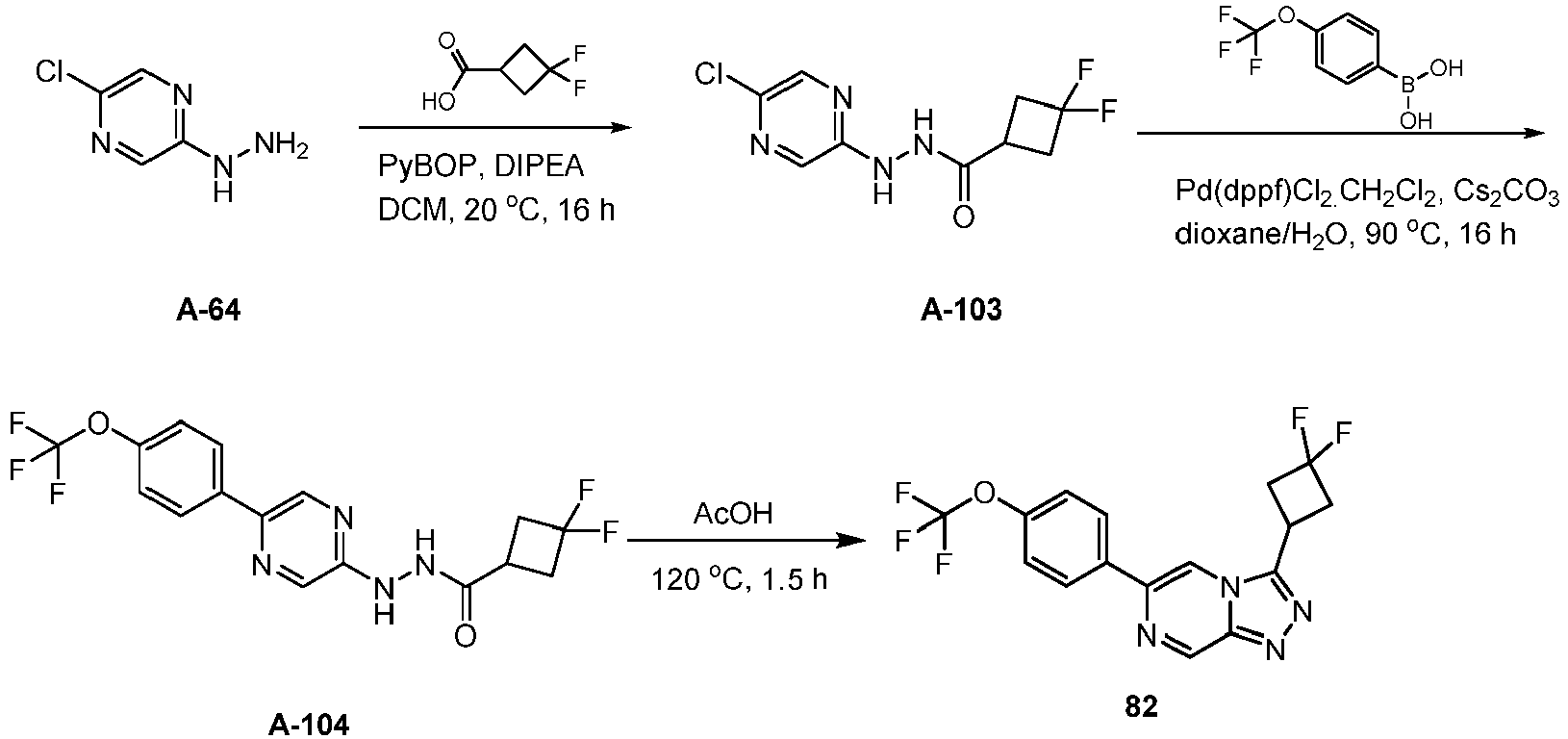
- Synthesis of A-103: To a mixture of A-64 (500 mg, 3.46 mmol), 3,3-difluorocyclobutanecarboxylic acid (517.81 mg, 3.8 mmol) and PyBOP (2.7 g, 5.19 mmol) in DCM (30 mL) was added DIPEA (1.21 mL, 6.92 mmol). The reaction mixture was stirred at 20 °C for 16 hours. The reaction was quenched with sat.NH4Cl (50 mL) and extracted with DCM (50 mL × 3). The combined organic phase was washed with brine (20 mL), dried over Na2SO4, filtered, and concentrated to give the crude product, which was purified by flash chromatography on silica gel (EtOAc in PE = 20% to 50%) to afford A-103 (600 mg, 1.64 mmol) as a solid. 1H NMR (400MHz, DMSO-d6 ) δ H = 10.10 (s, 1H), 9.12 (s, 1H), 8.19 (d, 1H), 7.83 (d, 1H), 3.03 - 2.95 (m, 1H), 2.84 - 2.66 (m, 4H).
- Synthesis of A-104: A mixture of A-103 (250 mg, 0.95 mmol), [4-(trifluoromethoxy)-phenyl]boronic acid (294.03 mg, 1.43 mmol), Pd(dppf)Cl2.CH2Cl2 (194.33 mg, 0.24 mmol) and Cs2CO3 (620.24 mg, 1.9 mmol) in 1,4-dioxane (3 mL) and water (0.3 mL) was stirred at 90 °C for 16 hours under N2. The mixture was cooled to room temperature, diluted with EtOAc (30 mL), filtered through silica gel and eluted with EtOAc (30 mL). The filtrate was concentrated to give the crude product, which was purified by flash chromatography on silica gel (EtOAc in PE = 20% to 50%) to afford A-104 (150 mg, 0.39 mmol) as a solid. 1H NMR (400MHz, DMSO-d6 ) δ H = 10.12 (s, 1H), 9.12 (s, 1H), 8.70 (d, 1H), 8.11 - 8.06 (m, 3H), 7.44 (d, 2H), 3.08 - 2.99 (m, 1H), 2.84 - 2.73 (m, 4H).
- Synthesis of Compound 82: A mixture of A-104 (150 mg, 0.39 mmol) in acetic acid (2 mL) was stirred in microwave reactor at 120 °C for 1.5 hours. The mixture was cooled to room temperature and concentrated, and the residue was neutralized with 1N NaHCO3 to pH = 7-8 and extracted with EtOAc (20 mL × 2). The combined organic phase was washed with brine (10 mL), dried over Na2SO4 and filtered, and the filtrate was concentrated to give the crude product, which was purified by prep-HPLC (Xbridge (150 mm × 25 mm, 5 µm); A = H2O (0.05% NH4HCO3) and B = CH3CN; 38-78 %B over 10 minutes) to afford Compound 82 (44.06 mg, 0.12 mmol) as a solid.
- 1H NMR (400MHz, DMSO-d6 ) δ H = 9.46 (d, 1H), 8.97 (s, 1H), 8.22 (d, 2H), 7.52 (d, 2H), 4.16 - 4.03 (m, 1H), 3.33 - 3.07 (m, 4H). LCMS Rt = 1.17 min using Method A, MS ESI calcd. for C16H12F5N4O [M+H]+ 371.1, found 371.0
-

- A mixture of A-16 (100 mg, 0.41 mmol), 3-fluoro-5-(4,4,5,5-tetramethyl-1,3,2-dioxaborolan-2-yl)-2-(2,2,2-trifluoroethoxy)pyridine (196.88 mg, 0.61 mmol), Pd(dppf)Cl2.CH2Cl2 (83.46 mg, 0.1 mmol), and Cs2CO3 (266.36 mg, 0.82 mmol) in 1,4-dioxane (3 mL) and water (0.3 mL) was stirred at 80 °C for 16 hours under N2. The mixture was cooled to room temperature, diluted with EtOAc (30 mL), filtered through silica gel and eluted with EtOAc (30 mL). The filtrate was concentrated to give the crude product, which was purified by prep-HPLC (Xtimate C18 (150 mm x 25 mm, 5 µm); A = H2O (0.05% NH4HCO3) and B = CH3CN; 40-65 %B over 9.5 minutes) to afford Compound 83 (61.78 mg, 0.15 mmol) as a solid. 1H NMR (400MHz, CDCl3) δ H = 8.53 (d, 1H), 8.24 (d, 1H), 8.11 (dd, 1H), 7.55 (d, 1H), 4.95 (q, 2H), 4.14 - 3.98 (m, 1H), 3.42 - 3.15 (m, 4H). LCMS Rt = 1.16 min using Method A, MS ESI calcd. for C16H12F6N5O [M+H]+ 404.1, found 404.0.
-

- Synthesis of A-105: A mixture of 5-bromo-2,3-difluoro-pyridine (2 g, 10.31 mmol), 4,4,5,5-tetramethyl-2-(4,4,5,5-tetramethyl-1,3,2-dioxaborolan-2-yl)-1,3,2-dioxaborolane (3.4 g, 13.4 mmol), Pd(dppf)Cl2.CH2Cl2 (1.26 g, 1.55 mmol) and KOAc (2.02 g, 20.62 mmol) in 1,4-dioxane (100 mL) was stirred at 90 °C for 16 hours. After cooling to room temperature, the mixture was filtered through silica gel and eluted with EtOAc (50 mL x 2). The mixture was concentrated and diluted with EtOAc (150 mL), washed with water (100 mL x 2) and brine (80 mL), dried over Na2SO4, filtered and concentrated to give the crude product, which was purified by flash chromatography on silica gel (EtOAc in PE = 0 to 10%) to afford A-105 (2200 mg, 2.32 mmol) as a solid. LCMS Rt = 0.88 min using Method B, MS ESI calcd. for C11H15BF2NO2 [M+H+2]+ 242.1, found 242.0
- Synthesis ofA-106: A mixtue of A-105 (324.91 mg, 1.35 mmol), A-72 (200 mg, 0.90 mmol), Pd(t-Bu3P)2 (91.85 mg, 0.18 mmol) and K3PO4 (381.56 mg, 1.8 mmol) in 1,4-dioxane (10 mL) and water (2 mL) was stirred at 80 °C for 16 hours under N2. After cooling to room temperature, the mixture was concentrated to give the crude product, which was purified by flash chromatography on silica gel (EtOAc in PE = 0 to 30% ) to afford A-106 (100 mg, 0.32 mmol) as a solid. 1H NMR (400MHz CDCl3) δ H = 9.62 (d, 1H), 8.58 (s, 1H), 8.48 (s, 1H), 8.31 - 8.24 (m, 1H). LCMS Rt = 0.74 min using Method B, MS ESI calcd. for C11H5F5N5 [M+H]+ 302.0, found 301.8.
- Synthesis of Compound 84: To a mixture of A-106 (50 mg, 0.16 mmol) and 3,3-difluorocyclobutanol (34.06 mg, 0.32 mmol) in 1,4-dioxane (2 mL) was added t-BuOK (35.35 mg, 0.32 mmol) at 0°C. The mixture was stirred at 20 °C for 2 hours. The mixture was concentrated to give the crude product, which was purified by prep-HPLC (Phenomenex Gemini (250 mm x 50 mm,10 µm); A = H2O (0.05% NH4OH) and B = CH3CN; 50-80% B over 8 minutes) to afford Compound 84 (13.63 mg, 0.04 mmol) as a solid. 1H NMR (400MHz, CDCl3) δ H = 9.59 (d, 1H), 8.51 (d, 1H), 8.39 (s, 1H), 8.03 (dd, 1H), 5.33 - 5.23 (m, 1H), 3.27 - 3.14 (m, 2H), 2.93 - 2.79 (m, 2H).
- LCMS Rt = 1.18 min using Method A, MS ESI calcd. for C15H10F6N5O [M+H]+ 390.1, found 390.0.
-

- A mixture of A-67 (99.02 mg, 0.48 mmol), A-93 (202.05 mg, 0.63 mmol), K3PO4 (205.54 mg, 0.97 mmol) and Pd(t-Bu3P)2 (37.11 mg, 0.07 mmol) in 1,4-dioxane (3 mL) and water (0.50 mL) was stirred at 80 °C for 16 hours. After cooling to room temperature, the mixture was concentrated to give the crude product, which was purified by prep-HPLC (Phenomenex Gemini (250 mm × 50 mm,10 µm); A = H2O (0.05% NH4OH) and B = CH3CN; 40-70% B over 8 minutes) to afford Compound 85 (108.7 mg, 0.30 mmol) as a solid. 1H NMR (400MHz DMSO-d 6 ) δ H = 8.86 (d, 1H), 8.67 (d, 1H), 8.56 (dd, 1H), 8.21 (d, 1H), 7.83 (t, 1H), 5.22 (q, 2H). LCMS Rt = 1.14 min using Method A, MS ESI calcd. for C13H8F6N5O [M+H]+ 364.1, found 364.0.
-

- Synthesis of A-107: A mixture of A-72 (200 mg, 0.90 mmol), (6-fluoro-3-pyridyl)boronic acid (151.95 mg, 1.08 mmol), Pd(dppf)Cl2.CH2Cl2 (146.77 mg, 0.18 mmol) and Cs2CO3 (585.55 mg, 1.8 mmol) in 1,4-dioxane (15 mL) and water (3 mL) was stirred at 90 °C for 16 hours. The mixture was filtered through silica gel and eluted with EtOAc (20 mL × 2). The filtrate was concentrated and diluted with EtOAc (30 mL), washed with water (10 mL × 2) and brine (10 mL), dried over Na2SO4, filtered and concentrated to give the crude product, which was purified by flash chromatography on silica gel (EtOAc in PE = 0 to 30% to 50%) to afford A-107 (140 mg, 0.40 mmol) as a solid.
- 1H NMR (400MHz, CDCl3) δ H = 9.62 (d, 1H), 8.84 (d, 1H), 8.47-8.40 (m, 2H), 7.15 (dd, 1H).
- LCMS Rt = 0.69 min using Method B, MS ESI calcd. for C11H6F4N5 [M+H]+ 284.0, found 283.9.
- Synthesis of Compound 86: To a mixture of 3,3-difluorocyclobutanol (25.19 mg, 0.23 mmol) and A-107 (33 mg, 0.12 mmol) in 1,4-dioxane (4 mL) was added t-BuOK (26.15 mg, 0.23 mmol) at 20 °C. The mixture was stirred at 20 °C for 2 hours. The mixture was quenched with sat. NH4Cl (10 mL) and extracted with EtOAc (20 mL x 2). The combined organic phase was washed with brine (15 mL), dried over Na2SO4, filtered and concentrated to give the crude product, which was purified by prep-TLC (silica gel, PE:EtOAc = 1:1) and prep-HPLC (Phenomenex Gemini (250 mm x 50 mm,10 µm); A = H2O (0.05% NH4OH) and B = CH3CN; 55-65% B over 8 minutes) to afford Compound 86 (1.72 mg, 0.05 mmol) as a solid. 1H NMR (400MHz, CDCl3) δ H = 9.59 (d, 1H), 8.75 (d, 1H), 8.36 (s, 1H), 8.20 (dd, 1H), 6.94 (d, 1H), 5.30-5.18 (m, 1H), 3.24-3.11 (m, 2H), 2.85-2.71 (m, 2H). LCMS Rt = 1.14 min using Method A, MS ESI calcd. for C15H11F5N5O [M+H]+ 372.1, found 372.0.
-

- Synthesis of A-108: A mixture of A-63 (1 g, 6.71mmol), [4-(trifluoromethoxy)phenyl]-boronic acid (1.52 g, 7.38 mmol), Pd(dppf)Cl2.CH2Cl2 (822.23 mg, 1.01 mmol) and Cs2CO3 (4373.74 mg, 13.42 mmol) in 1,4-dioxane (20 mL) and water (4 mL) under N2 was stirred at 90 °C for 16 hours. After cooling, the reaction mixture was diluted with EtOAc (20 mL), and filtered through a Celite pad, eluted with EtOAc (20 mL), and concentrated. The residue was purified by flash chromatography on silica gel (EtOAc in PE = 0% to 3% to 8%) to afford A-108 (250 mg, 0.91 mmol) as a solid. 1H NMR (400MHz, CDCl3) δ H = 8.79 (d, 1H), 8.65 (d, 1H), 8.05 (d, 2H), 7.37 (d, 2H)
- Synthesis of A-109: A mixture of A-108 (250 mg, 0.91 mmol) and hydrazine (175.05 mg, 5.46 mmol) in ethanol (5 mL) was stirred at 90 °C for 16 hours. After cooling, the reaction mixture was concentrated, and the residue was diluted with sat.NaHCO3 (10 mL), and extracted with EtOAc (10 mL × 3). The combined organic phase was washed with brine (10 mL), dried over Na2SO4, filtered and concentrated afford A-109 (170 mg, 0.63 mmol) as a solid. 1H NMR (400MHz, DMSO-d6 ) δ H = 8.60 (d, 1H), 8.23 - 8.17 (m, 2H), 8.05 (d, 2H), 7.41 (d, 2H), 4.36 (s, 2H).
- Synthesis of A-110: To a mixture of A-109 (80 mg, 0.3 mmol), 3,3,3-trifluoropropanoic acid (41.7 mg, 0.33 mmol) and PyBOP (231.1 mg, 0.44 mmol) in DCM (30 mL) was added DIPEA (0.1 mL, 0.59 mmol). The reaction mixture was stirred at 20 °C for 16 hours. The reaction was quenched with sat.NH4Cl (50 mL) and extracted with DCM (50 mL × 3). The combined organic phase was washed with brine (20 mL), dried over Na2SO4, filtered and concentrated to afford A-110 (200 mg, 0.28 mmol) as an oil. LCMS Rt = 0.81 min using Method B, MS ESI calcd. for C14H11F6N4O2 [M+H]+ 381.1, found 381.0.
- Synthesis of Compound 87: A mixture of A-1 10 (200 mg, 0.53 mmol) in acetic acid (2 mL) was stirred at 120 °C for 16 hours. The mixture was cooled to room temperature and concentrated, and the residue was neutralized with 1N NaHCO3 to pH = 7- 8 and extracted with EtOAc (20 mL × 2). The combined phase organic was washed with brine (10 mL), dried over Na2SO4, filtered, and concentrated to give the crude product, which was purified by prep-HPLC (Xbridge (150 mm × 25 mm, 5 µm); A = H2O (0.05% NH4HCO3) and B = CH3CN; 46-76 %B over 6 minutes) to afford Compound 87 (25.13 mg, 0.07 mmol) as a solid. 1H NMR (400MHz, DMSO-d6 ) δ H = 9.57 (s, 1H), 9.33 (s, 1H), 8.23 (d, 2H), 7.57 (d, 2H), 4.61 (q, 2H). LCMS Rt = 1.16 min using Method A, MS ESI calcd. for C14H9F6N4O [M+H]+ 363.1, found 363.0.
-

- A mixture of A-88 (100 mg, 0.47 mmol), K3PO4 (199.71 mg, 0.94 mmol), 3-fluoro-5-(4,4,5,5-tetramethyl-1,3,2-dioxaborolan-2-yl)-2-(2,2,2-trifluoroethoxy)pyridine (226.53 mg, 0.71 mmol), and Pd(t-Bu3P)2 (36.06 mg, 0.07 mmol) and in 1,4-dioxane (3 mL) and water (0.3 mL) was stirred at 90 °C for 16 hours under N2. The mixture was cooled to room temperature, diluted with EtOAc (20 mL), filtered through silica gel and eluted with EtOAc (20 mL). The filtrate was concentrated to give the crude product, which was purified by prep-HPLC (Xbridge (150 mm × 25 mm, 5 µm); A = H2O (0.05% NH4HCO3) and B = CH3CN; 40-80 %B over 10 minutes) to afford Compound 88 (61.29 mg, 0.16 mmol) as a solid. 1H NMR (400MHz DMSO-d6 ) δ H = 8.82 (d, 1H), 8.59 (d, 1H), 8.47 (dd, 1H), 8.13 (d, 1H), 5.22 (q, 2H), 1.76 - 1.66 (m, 2H), 1.52 - 1.44 (m, 2H). LCMS Rt = 1.14 min using Method A, MS ESI calcd. for C15H11F5N5O [M+H]+ 372.1, found 372.0.
-

- A mixture of [2-methoxy-4-(trifluoromethyl)phenyl]boronic acid (118.59 mg, 0.54 mmol), A-1 (100 mg, 0.45 mmol), K3PO4 (190.78 mg, 0.9 mmol) and Pd(t-Bu3P)2 (34.44 mg, 0.07 mmol) in 1,4-dioxane (2 mL) and water (0.2 mL) was stirred at 80 °C for 16 hours under the N2. The mixture was filtered through silica gel, and concentrated to the crude product, which was purified by prep-HPLC (Xbridge (150 mm x 25 mm, 5 µm); A = H2O (0.05% NH4HCO3) and B = CH3CN; 52-72 %B over 6.5 minutes) to afford Compound 89 (32.47 mg, 0.09 mmol) as a solid. 1H NMR (400MHz, DMSO-d6 ) δ H = 8.62 (d, 1H), 7.94 (d, 1H), 7.80 (d, 1H), 7.61 - 7.51 (m, 2H), 3.97 (s, 3H). LCMS Rt = 1.22 min using Method A, MS ESI calcd. for C14H9F6N4O [M+H]+ 363.1, found 363.0.
-

- A mixture of A-18 (69.39 mg, 0.30 mmol), 3-fluoro-5-(4,4,5,5-tetramethyl-1,3,2-dioxaborolan-2-yl)-2-(2,2,2-trifluoroethoxy)pyridine (125.61 mg, 0.39 mmol), K3PO4 (127.77 mg, 0.60 mmol) and Pd(t-Bu3P)2 (23.07 mg, 0.05 mmol) in 1,4-dioxane (3 mL) and water (0.50 mL) was stirred at 80 °C for 16 hours. After cooling to room temperature, the mixture was diluted with H2O (20 mL) and extracted with EtOAc (50 mL x 2). The combined organic phase was washed with brine (20 mL), dried over Na2SO4, filtered and concentrated to give the crude product, which was purified by flash chromatography on silica gel (EtOAc in PE = 0 to 10% to 80%) to afford Compound 90 (90 mg). Compound 90 was purified by SFC (Chiralcel OJ (250 mm × 30 mm, 5 µm); A = CO2 and B = EtOH (0.1% NH3H2O); 38°C; 60 mL/min; 15% B over 6 minutes; multiple injections) to afford Enantiomer 1, randomly assigned as Compound 91 (Rt = 4.5 min) and Enantiomer 2, randomly assigned as Compound 92 (Rt = 4.9 min). Compound 91 (25.85 mg, 0.07 mmol) 1H NMR (CDCl3,00MHz) δ H = 8.55 (d, 1H), 8.23 (d, 1H), 8.15 (dd, 1H), 7.56 (d, 1H), 4.95 (q, 2H), 3.37 - 3.29 (m, 1H), 2.70 - 2.60 (m, 1H), 2.25 - 2.15 (m, 1H). LCMS Rt = 1.14 min using Method A, MS ESI calcd. for C15H10F6N5O [M+H]+ 390.1, found 390.0. Compound 92 (8.36 mg, 0.02 mmol) 1H NMR (400MHz, CDCl3) δ H = 8.55 (d, 1H), 8.23 (d, 1H), 8.15 (dd, 1H), 7.56 (d, 1H), 4.95 (q, 2H), 3.36 - 3.28 (m, 1H), 2.70 - 2.61 (m, 1H), 2.25 - 2.15 (m, 1H). LCMS Rt = 1.16 min using Method A, MS ESI calcd. for C15H10F6N5O [M+H]+ 390.1, found 390.0
-

- Synthesis of A-111: A mixture of A-1 (200 mg, 0.90 mmol), 2,3-difluoro-5-(4,4,5,5-tetramethyl-1,3,2-dioxaborolan-2-yl)pyridine (281.59 mg, 1.17 mmol), Pd(t-Bu3P)2 (91.85 mg, 0.18 mmol) and K3PO4 (381.56 mg, 1.8 mmol) in 1,4-dioxane (10 mL) and water (1.5 mL) was stirred at 90 °C for 16 hours under N2. After cooling to room temperature, the mixture was concentrated to give the crude product, which was purified by flash chromatography on silica gel (EtOAc in PE = 0 to 50% to 100%) to afford A-111 (250 mg, 0.83 mmol) as a solid. 1H NMR (400MHz, CDCl3) δ H = 8.62 (s, 1H), 8.42 (d, 1H), 8.32 (dt, 1H), 7.77 (d, 1H). LCMS Rt = 0.76 min using Method B, MS ESI calcd. for C11H5F5N5 [M+H]+ 302.0, found 301.9.
- Synthesis of Compound 93: To a mixture of A-1 11 (50 mg, 0.17 mmol) and 3,3-difluorocyclobutanol (26.92 mg, 0.25 mmol) in 1,4-dioxane (2 mL) was added t-BuOK (37.26 mg, 0.33 mmol) at 0 °C. The mixture was stirred at 20 °C for 2 hours. The mixture was concentrated to give the crude product, which was purified by prep-HPLC (Phenomenex Gemini (250 mm × 50 mm,10 µm); A = H2O (0.05% NH4OH) and B = CH3CN; 48-78% B over 8 minutes) to give the product of Compound 93 (8.04 mg, 0.02 mmol) as a solid. 1H NMR (400MHz, CDCl3) δ H = 8.55 (d, 1H), 8.34 (d, 1H), 8.11 (dd, 1H), 7.73 (d, 1H), 5.36 - 5.23 (m, 1H), 3.27 - 3.16 (m, 2H), 2.94 - 2.81 (m, 2H). LCMS Rt = 1.22 min using Method A, MS ESI calcd. for C15H10F6N5O [M+H]+ 390.1, found 390.0.
-

- Synthesis of A-112: A mixture of A-1 (300 mg, 1.35 mmol), (4-hydroxy-2-methylphenyl)boronic acid (266.29 mg, 1.75 mmol), Pd(t-Bu3P)2 (137.77 mg, 0.27 mmol) and K3PO4 (572.34 mg, 2.7 mmol) in 1,4-dioxane (10 mL) and water (1.5 mL) was stirred at 90 °C for 16 hours under N2. After cooling to room temperature, the mixture was concentrated to give the crude product, which was purified by flash chromatography on silica gel (EtOAc in PE = 0 to 100%) to afford A-112 (300 mg, 0.97 mmol) as a solid. LCMS Rt = 0.73 min using Method B, MS ESI calcd. for C13H10F3N4O [M+H]+ 295.1, found 294.9
- Synthesis of Compound 94: To a mixture of A-112 (100 mg, 0.34 mmol), 3,3-difluorocyclobutanol (55.1 mg, 0.51 mmol) and PPh3 (160.46 mg, 0.61 mmol) in THF (3mL) was added DEAD (106.54 mg, 0.61 mmol) at 0 °C under N2. The mixture was allowed to warm and stir at 70 °C for 16 hours. After cooling to room temperature, the mixture was concentrated to give the crude product, which was purified by prep-HPLC (Phenomenex Gemini (250 mm x 50 mm,10 µm); A = H2O (0.05% NH4OH) and B = CH3CN; 55-85% B over 8 minutes) to afford Compound 94 (7.45 mg, 0.02 mmol) as a solid. 1H NMR (400MHz, CDCl3) δ H = 8.25 (d, 1H), 7.50 - 7.44 (m, 2H), 6.84 - 6.78 (m, 2H), 4.80 - 4.65 (m, 1H), 3.22 - 3.09 (m, 2H), 2.88 - 2.73 (m, 2H), 2.49 (s, 3H). LCMS Rt = 1.21 min using Method A, MS ESI calcd. for C17H14F5N4O [M+H]+ 385.1, found 385.0.
-

- Synthesis of A-113: To a mixture of A-109 (100 mg, 0.37 mmol) and Et3N (0.15 mL, 1.11 mmol) in DCM (3 mL) was added acetyl chloride (58.1 mg, 0.74 mmol). The reaction mixture was stirred at 20 °C for 1 hour. The reaction mixture was concentrated, diluted with sat.NaHCO3 (15 mL), and extracted with EtOAc (10 mL × 2). The combined organic phase was washed with brine (10 mL), dried over Na2SO4, filtered and concentrated afford A-113 (150 mg, 0.48 mmol) as an oil. LCMS Rt = 0.745 min using Method B, MS ESI calcd. for C13H12F3N4O2 [M+H]+ 313.1, found 312.9.
- Synthesis of Compound 95: A mixture of A-113 (150 mg, 0.48 mmol) in acetic acid (3 mL) was heated to 120 °C and stirred for 16 hours. The reaction mixture was concentrated, diluted with sat.NaHCO3 (10 mL). and extracted with EtOAc (15 mL × 2). The combined organic phase was washed with brine (10 mL), dried over Na2SO4, filtered, concentrated, and purified by flash chromatrography on silica gel (EtOAc in PE, 0% to 40% to 100%) to afford Compound 95 (59.99 mg, 0.21 mmol) as a solid. 1H NMR (400MHz, DMSO-d6 ) δ H = 9.45 (d, 1H), 9.03 (d, 1H), 8.25 (d, 2H), 7.54 (d, 2H), 2.81 (s, 3H). LCMS Rt = 1.09 min using Method A, MS ESI calcd. for C13H10F3N4O [M+H]+ 295.1, found 294.9
-

- Synthesis of A-114: A mixture of A-54(150 mg, 0.63 mmol), 3-fluoro-5-(4,4,5,5-tetramethyl-1,3,2-dioxaborolan-2-yl)-2-(2,2,2-trifluoroethoxy)pyridine (302.26 mg, 0.94 mmol), Pd(t-Bu3P)2 (48.11 mg, 0.09 mmol) and K3PO4 (266.47 mg, 1.26 mmol) in 1,4-dioxane (3 mL) and water (0.3 mL) under N2 was stirred at 90 °C for 16 hours. After cooling, the reaction mixture was diluted with EtOAc (10 mL), filtered through a Celite pad, eluted with EtOAc (10 mL), concentrated, and purified by flash chromatography on silica gel (EtOAc in PE, 0% to 20% to 40%) to afford A-114 (160 mg, 0.4024 mmol) as a solid. 1H NMR (400MHz DMSO-d6 ) δ H = 8.84 (d, 1H), 8.76 (d, 1H), 8.47 (dd, 1H), 8.29 (d, 1H), 5.22 (q, 2H).
- Synthesis of Compound 96: To a mixture of A-114 (160 mg, 0.4 mmol) in methanol (2 mL) and MeCN (2 mL) was added AgOTf (516.9 mg, 2.01 mmol), then the mixture was sealed and stirred at 95 °C for 120 hoursMS. After cooling, the mixture was diluted with H2O (15 mL) and extracted with EtOAc (30 mL × 2). The combined organic phase was washed with brine (20 mL), dried over Na2SO4, filtered, concentrated, and purified by flash chromatography on silica gel (EtOAc in PE, 0% to 20% to 40%) to afford Compound 96 (26.07 mg, 0.07 mmol) as a solid. 1H NMR (400MHz, CDCl3) δ H = 8.56 (d, 1H), 8.31 (d, 1H), 8.16 (dd, 1H), 7.67 (d, 1H), 4.95 (q, 2H), 3.94 (s, 3H). LCMS Rt = 1.15min using Method A, MS ESI calcd. for C14H10F6N5O2 [M+H]+ 394.1, found 394.0.
-
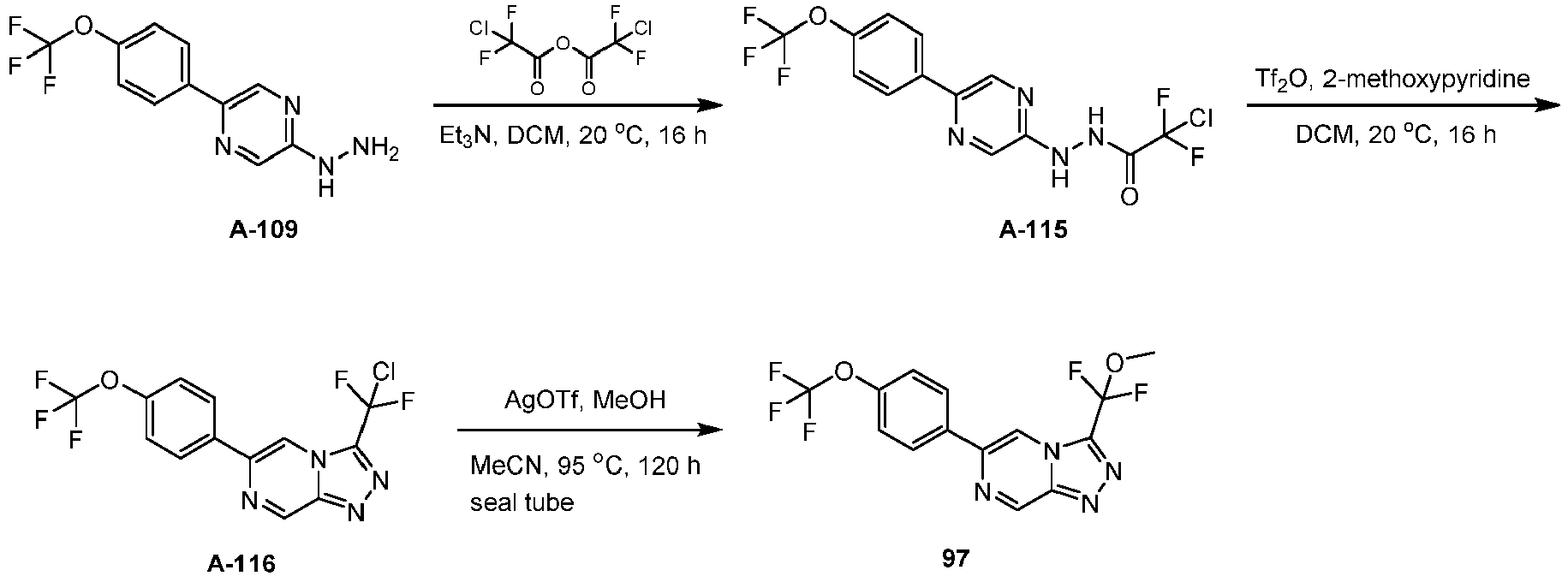
- Synthesis of A-115: To a mixture of A-109 (200 mg, 0.74 mmol) and Et3N (0.2 mL, 1.48 mmol) in DCM (5 mL) was added (2-chloro-2,2-difluoro-acetyl) 2-chloro-2,2-difluoro-acetate (197.8 mg, 0.81 mmol). The reaction mixture was stirred at 20 °C for 16 hours. The reaction mixture was concentrated, diluted with sat.NaHCO3 (20 mL), and was extracted with EtOAc (20 mL × 2). The combined organic phase was washed with brine (10 mL), dried over Na2SO4, filtered and concentrated to afford A-115 (300 mg, 0.78 mmol) as an oil, which was used directly in next step. LCMS Rt = 0.83 min using Method B, MS ESI calcd. for C13H9ClF5N4O2 [M+H]+ 383.0, found 382.9.
- Synthesis of A-116: To a mixture of A-115 (300 mg, 0.78 mmol) and 2-methoxypyridine (102.66 mg, 0.94 mmol) in DCM (5 mL) was added TfzO (243.31 mg, 0.86 mmol). The reaction mixture was stirred at 20 °C for 16 hours. The reaction mixture was concentrated, diluted with sat.NaHCO3 (10 mL), extracted with EtOAc (15 mL × 2). The combined organic phase was washed with brine (10 mL), dried over Na2SO4, filtered, concentrated, and purified by flash chromatography on silica gel (EtOAc in PE, 0% to 10% to 20%) to afford A-116 (30 mg, 0.08 mmol) as a solid. 1H NMR (400MHz CDCl3) δ H = 9.59 (d, 1H), 8.45 (s, 1H), 8.04 (d, 2H), 7.41 (d, 2H).
- Synthesis of Compound 97: A mixture of A-116 (30 mg, 0.08 mmol) and AgOTf (211.38 mg, 0.82 mmol) in MeCN (1 mL) and methanol (1 mL) was sealed and stirred at 95 °C for 120 hours. After cooling, the mixture was diluted with H2O (15 mL) and extracted with EtOAc (30 mL × 2). The combined organic phase was washed with brine (20 mL), dried over Na2SO4, filtered, concentrated, and purified by flash chromatography (EtOAc in PE, 0% to 20% to 40%) to afford Compound 97 (11.95 mg, 0.03 mmol) as a solid. 1H NMR (400MHz CDCl3) δ H = 9.53 (d, 1H), 8.47 (s, 1H), 8.02 (d, 2H), 7.40 (d, 2H), 3.98 (s, 3H). LCMS Rt = 1.17 min using Method A, MS ESI calcd. for C14H10F5N4O2 [M+H]+ 361.1, found 361.0.
-

- Synthesis of A-117: A mixture of 4-bromo-2-methyl-1-(trifluoromethyl)benzene (500 mg, 2.09 mmol), 4,4,5,5-tetramethyl-2-(4,4,5,5-tetramethyl-1,3,2-dioxaborolan-2-yl)-1,3,2-dioxaborolane (690.55 mg, 2.72 mmol) and Pd(dppf)Cl2.CH2Cl2 (160.35 mg, 0.31 mmol) and KOAc (410.58 mg, 4.18 mmol) in 1,4-dioxane (5 mL) was stirred at 90 °C for 16 hours. The mixture was filtered through silica gel, eluted with EtOAc (10 mL × 2), and the filtrate was concentrated to the crude product, which was purified by flash chromatography on silica gel (PE: EtOAc = 10:1) to afford A-117 (300 mg, 1.05 mmol) as a solid. 1H NMR (400MHz ,CDCl3) δ H = 7.71 - 7.59 (m, 2H), 7.52 (d, 1H), 2.41 (d, 3H), 1.28 (s, 12H).
- Synthesis of Compound 98: A mixture of A-1 (150 mg, 0.67 mmol), A-117 (250.67 mg, 0.88 mmol), K3PO4 (286.17 mg, 1.35 mmol) and Pd(t-Bu3P)2 (51.67 mg, 0.1 mmol) in 1,4-dioxane (2 mL) and water (0.2 mL) was stirred at 90 °C for 16 hours. After cooling to room temperature, the suspension was diluted with EtOAc (10 mL), filtered through silica gel, eluted with EtOAc (20 mL), and concentrated to give the crude product which was purified by prep-HPLC (Xbridge (150 mm × 25 mm, 5 µm); A = H2O (0.05% NH4HCO3) and B = CH3CN; 58-65 %B over 6 minutes) to afford Compound 98 (19.86 mg, 0.06 mmol) as a solid. 1H NMR (400MHz, CDCl3) δ H = 8.35 (d, 1H), 7.97 - 7.88 (m, 2H), 7.85 - 7.81 (m, 1H), 7.78 (d, 1H), 2.64 (s, 3H) LCMS Rt = 1.25 min using Method A, MS ESI calcd. for C14H9F6N4 [M+H]+ 347.1, found 346.9.
-

- Synthesis of A-118: A mixture of 5-bromo-3-fluoro-2-(trifluoromethyl)pyridine (163.95 mg, 0.82 mmol), 4,4,5,5-tetramethyl-2-(4,4,5,5-tetramethyl-1,3,2-dioxaborolan-2-yl)-1,3,2-dioxaborolane (270.61 mg, 1.07 mmol), KOAc (160.9 mg, 1.64 mmol) and Pd(dppf)Cl2.CH2Cl2 (62.84 mg, 0.12 mmol) in 1,4-dioxane (4 mL) was stirred at 90 °C under N2 for 16 hours. The mixture was cooled to room temperature, diluted with EtOAc (10 mL), filtered through silica gel, and eluted with EtOAc (20 mL). The combined filtrates were concentrated to give the crude product, which was purified by flash chromatography on silica gel (PE: EtOAc = 10:1) to afford A-118 (100 mg, 0.34 mmol) as a solid. 1H NMR (400MHz, CDCl3) δ H = 8.82 - 8.75 (m, 1H), 7.93 (d, 1H), 1.37 (s, 12H).
- Synthesis of Compound 99: A mixture of A-1 (100 mg, 0.45 mmol), A-118 (143.85 mg, 0.49 mmol), K3PO4 (190.78mg, 0.9 mmol) and Pd(t-Bu3P)2 (34.44 mg, 0.07 mmol) in 1,4-dioxane (2 mL) and water (0.2 mL) was stirred at 80 °C under the N2 for 16 hours. After cooling to room temperature, the suspension was diluted with EtOAc (10 mL), filtered through silica gel, eluted with EtOAc (20 mL), and concentrated to give a crude product that was purified by prep-TLC (silica gel, PE: EtOAc = 1:1) to afford Compound 99 (32.76 mg, 0.09 mmol) as a solid. 1H NMR (400MHz, DMSO-d6 ) δ H = 9.28 (s, 1H), 8.88 (d, 1H), 8.78 (d, 1H), 8.34 (d, 1H). LCMS Rt = 1.15 min using Method A, MS ESI calcd. for C12H5F7N5 [M+H]+ 352.0, found 351.9.
-

- Synthesis of A-119: A mixture of A-119 (300 mg, 1.35 mmol), (3-fluoro-4-hydroxyphenyl)boronic acid (273.22 mg, 1.75 mmol), Pd(t-Bu3P)2 (137.77 mg, 0.27 mmol) and K3PO4 (572.34 mg, 2.7 mmol) in 1,4-dioxane (15 mL) and water (3 mL) was stirred at 90 °C for 16 hours. After cooling to room temperature, the mixture was concentrated and purified by flash chromatography on silica gel (EtOAc in PE = 0 to 100%) to afford A-119 (250 mg, 0.83 mmol) as a solid. 1H NMR (400MHz DMSO-d6 ) δ H = 10.78 (s, 1H), 8.63 (d, 1H), 8.19 (d, 1H), 7.96 (d, 1H), 7.87 (d, 1H), 7.18 (t, 1H).
- Synthesis of Compound 100: To a mixture of A-1 19 (100 mg, 0.34 mmol), 3,3-difluorocyclobutanol (54.37 mg, 0.50 mmol) and PPh3 (158.32 mg, 0.60 mmol) in THF (3 mL) was added DEAD (105.12 mg, 0.60 mmol) at 0 °C under N2. The mixture was heat and stirred at 70 °C for 16 hours, at which point the desired product was observed by LCMS. After cooling to room temperature, the mixture was concentrated and purified by flash chromatography on silica gel (EtOAc in PE = 0 to 100%) and prep-HPLC (Phenomenex Gemini (250 mm × 50 mm,10 µm); A = H2O (0.05% NH4OH) and B = CH3CN; 50-80% B over 8 minutes) to afford Compound 100 (51.33 mg, 0.13 mmol) as a solid. 1H NMR (400MHz CDCl3) δ H = 8.29 (d, 1H), 7.85 (dd, 1H), 7.77 (d, 1H), 7.71 (d, 1H), 6.97 (t, 1H), 4.87 - 4.24 (m, 1H), 3.24 - 3.11 (m, 2H), 2.98 - 2.82 (m, 2H). LCMS Rt = 1.20 min using Method A, MS ESI calcd. for C16H11F6N4O [M+H]+ 389.1, found 389.0.
-

- Synthesis of A-120: To a mixture of [2-chloro-5-(trifluoromethoxy)phenyl]methanol (200 mg, 0.88 mmol) and KOAc (519.76 mg, 5.3 mmol) in DCM (0.50 mL) and water (0.50 mL) was added [bromo(difluoro)methyl]-trimethyl-silane (537.82 mg, 2.65 mmol), then the mixture was stirred at 20 °C for 36 hours. The mixture was diluted with DCM (30 mL), and the organic phase was washed with water (15 mL) and brine (15 mL), dried over Na2SO4, filtered and concentrated to give the crude product, which was purified by flash chromatography on silica gel (EtOAc in PE = 0% to 2%) to afford A-120 (160 mg, 0.58 mmol) as an oil. 1H NMR (400MHz DMSO-d6 ) δ H = 7.67 (d, 1H), 7.54 (d, 1H), 7.45 (dd, 1H), 6.88 (t, 1H), 5.03 (s, 2H)
- Synthesis of A-121: A mixture of A-120 (110 mg, 0.40 mmol), 4,4,5,5-tetramethyl-2-(4,4,5,5-tetramethyl-1,3,2-dioxaborolan-2-yl)-1,3,2-dioxaborolane (302.98 mg, 1.19 mmol), X-Phos (47.4 mg, 0.10 mmol), KOAc (78.06 mg, 0.80 mmol) and Pd2(dba)3 (36.42 mg, 0.04 mmol) in 1,4-dioxane (3 mL) was stirred at 90 °C for 16 hours. After cooling to room temperature, the mixture was concentrated to give the crude product, which was purified by flash chromatography on silica gel (EtOAc in PE = 0 to 10%) to afford A-121 (50 mg, 0.14 mmol) as an oil. 1H NMR (400MHz, CDCl3) δ H = 7.89 (d, 1H), 7.34 (s, 1H), 7.17 (d, 1H), 6.57 - 6.15 (m, 1H), 5.20 (s, 2H), 1.35 (s, 12H).
- Synthesis of Compound 101: A mixture of A-121 (50 mg, 0.14 mmol), A-1 (30.23 mg, 0.14 mmol), Pd(t-Bu3P)2 (13.88 mg, 0.03 mmol) and K3PO4 (28.84 mg, 0.14 mmol) in 1,4-dioxane (3 mL) and water (0.50 mL) was stirred at 90 °C for 16 hours under N2. After cooling to room temperature, the mixture was filtered through silica gel, eluted with EtOAc (20 mL × 2), concentrated,diluted with EtOAc (30 mL), washed with water (10 mL × 2) and brine (10 mL), dried over Na2SO4, filtered and concentrated to give the crude product, which was purified by Prep-HPLC (Phenomenex Gemini (250 mm × 50 mm,10 µm); A = H2O (0.05% NH4OH) and B = CH3CN; 50-80% B over 8 minutes) to afford Compound 101 (9.08 mg, 0.02 mmol) as a solid. 1H NMR (400MHz, CDCl3) δ H = 8.36 (br d, 1H), 7.66 (d, 1H), 7.59 (s, 1H), 7.55 (d, 1H), 7.41 (br d, 1H), 6.48 - 6.08 (m, 1H), 5.20 (s, 2H). LCMS Rt = 1.23 min using Method A, MS ESI calcd. for C15H9F8N4O2 [M+H]+ 429.1, found 429.0.
-

- Synthesis of A-122: A mixture of 2-(4-bromophenyl)propan-2-ol (250 mg, 1.16 mmol), A-122 (885.47 mg, 3.49 mmol), Pd(dppf)Cl2.CH2Cl2 (189.84 mg, 0.23 mmol) and KOAc (228.14 mg, 2.32 mmol) in 1,4-dioxane (15 mL) was stirred at 90 °C for 16 hours under N2. After cooling to room temperature, the mixture was concentrated and purified by flash chromatography on silica gel (EtOAc in PE = 0 to 50%) to afford A-122 (250 mg, 0.95 mmol) as a solid. 1H NMR (400MHz DMSO-d6 ) δ H = 7.61 (d, 2H), 7.47 (d, 2H), 5.05 (s, 1H), 1.40 (s, 6H), 1.28 (s, 12H).
- Synthesis of Compound 102: To a mixture of A-122 (250 mg, 0.95 mmol), A-1 (200 mg, 0.90 mmol), Pd(t-Bu3P)2 (91.85 mg, 0.18 mmol) and K3PO4 (381.56 mg, 1.8 mmol) in 1,4-dioxane (15 mL) and water (2 mL) was stirred at 90 °C for 16 hours under N2. After cooling to room temperature, the mixture was concentrated and purified by flash chromatography on silica gel (EtOAc in PE = 0 to 70%) to afford Compound 102 (19.98 mg, 0.06 mmol) as a solid. 1H NMR (400MHz, DMSO-d6 ) δ H = 8.67 (d, 1H), 8.21 (d, 1H), 8.06 (d, 2H), 7.70 (d, 2H), 5.21 (s, 1H), 1.47 (s, 6H). LCMS Rt = 1.04 min using Method A, MS ESI calcd. for C15H14F3N4O [M+H]+ 323.1, found 323.0.
-

- Synthesis of Compound 103: A mixture of A-9 (150 mg, 0.77 mmol), 3-fluoro-5-(4,4,5,5-tetramethyl-1,3,2-dioxaborolan-2-yl)-2-(2,2,2-trifluoroethoxy)pyridine (296.96 mg, 0.92 mmol), K3PO4 (327.25 mg, 1.54 mmol) and Pd(t-Bu3P)2 (59.08 mg, 0.12 mmol) in 1,4-dioxane (3 mL) and water (0.50 mL) was stirred at 80 °C for 16 hours under N2. After cooling to room temperature, the mixture was concentrated and purified by prep-HPLC (Phenomenex Gemini (250 mm × 50 mm,10 µm); A = H2O (0.05% NH4OH) and B = CH3CN; 48-58% B over 8 minutes) to afford Compound 103 (40.99 mg, 0.11 mmol) as a solid. 1H NMR (400MHz, CDCl3) δ H = 8.54 (d, 1H), 8.16 (d, 2H), 7.47 (d, 1H), 4.94 (q, 2H), 2.63 - 2.55 (m, 1H), 1.46 - 1.42 (m, 2H), 1.29 - 1.24 (m, 2H). LCMS Rt = 1.13 min using Method A, MS ESI calcd. for C15H12F4N5O [M+H]+ 354.1, found 354.0
-

- Synthesis of A-123: To a mixture of 2-(4-bromo-2-fluoro-phenyl)acetonitrile (1 g, 4.67 mmol), TBAB (60.25 mg, 0.19 mmol) and KOH (2.62 g, 46.72 mmol) in toluene (40 mL) and water (4 mL) was added 1,2-dibromoethane (1.76 g, 9.34 mmol) at 20 °C, then the mixture was stirred at 100 °C for 1 hour. After cooling to room temperature, the mixture was diluted with H2O (40 mL) and extracted with EtOAc (80 mL × 2). The combined organic phase was washed with brine (50 mL), dried over Na2SO4, filtered and concentrated to give the crude product, which was purified by flash chromatography on silica gel (DCM in PE = 0 to 10%) to afford A-123 (587 mg, 2.34 mmol) as an a solid. 1H NMR (400MHz, CDCl3) δ H = 7.32 - 7.28 (m, 2H), 7.25 - 7.20 (m, 1H), 1.73 - 1.69 (m, 2H), 1.40 - 1.36 (m, 2H). LCMS Rt = 0.81 min using Method B, MS ESI calcd. for C10H7BrFN [M+H]+ 240.0, not found.
- Synthesis of A-124: A mixture of A-123 (587 mg, 2.45 mmol), 4,4,5,5-tetramethyl-2-(4,4,5,5-tetramethyl-1,3,2-dioxaborolan-2-yl)-1,3,2-dioxaborolane (1.86 g, 7.34 mmol), KOAc (479.93 mg, 4.89 mmol) and Pd(dppf)Cl2.CH2Cl2 (187.44 mg, 0.37 mmol) in 1,4-dioxane (20 mL) was stirred at 90 °C for 16 hours under N2. After cooling to room temperature, the mixture was diluted with H2O (20 mL) and extracted with EtOAc (50 mL × 2). The combined organic phase was washed with brine (20 mL), dried over Na2SO4, filtered, and concentrated to give the crude product, which was purified by flash chromatography on silica gel (EtOAc in PE = 0 to 10%) to afford A-124 (1420.7 mg, 2.66 mmol) as a solid. 1H NMR (400MHz, CDCl3) δ H = 7.55 (dd, 1H), 7.50 (d, 1H), 7.34 (t, 1H), 1.73 - 1.67 (m, 2H), 1.44 - 1.41 (m, 2H), 1.34 (s, 12H).
- Synthesis of Compound 104: A mixture of A-124 (322.54 mg, 1.12 mmol), A-1 (100 mg, 0.45 mmol), K3PO4 (190.78 mg, 0.90 mmol) and Pd(t-Bu3P)2 (34.44 mg, 0.07 mmol) in 1,4-dioxane (4 mL) and water (0.90 mL) was stirred at 90 °C for 16 hours under N2. After cooling to room temperature, the mixture was concentrated to give the crude product, which was purified by Prep-HPLC (Phenomenex Gemini (250 mm × 50 mm, 10 µm); A = H2O (0.05% NH4OH) and B = CH3CN; 48-58% B over 8 minutes) to afford Compound 104 (10.01 mg, 0.03 mmol) as a solid. 1H NMR (400MHz, CDCl3) δ H = 8.37 (d, 1H), 7.84 - 7.78 (m, 2H), 7.75 (d, 1H), 7.60 (t, 1H), 1.84 - 1.79 (m, 2H), 1.56 - 1.52 (m, 2H). LCMS Rt = 1.12 min using Method A, MS ESI calcd. for C16H10F4N5 [M+H]+ 348.1, found 348.0.
-

- Synthesis of A-125: To a mixture of 2-(4-bromo-3-methyl-phenyl)acetonitrile (1 g, 4.76 mmol),TBAB (61.38 mg, 0.19 mmol) and KOH (2.67 g, 47.6 mmol) in toluene (40 mL) and water (4 mL) was added 1,2-dibromoethane (1.79 g, 9.52 mmol) at 20 °C, then the mixture was stirred at 100 °C for 1 hour. After cooling to room temperature, the mixture was diluted with H2O (40 mL) and extracted with EtOAc (70 mL × 2). The combined organic phase was washed with brine (40 mL), dried over Na2SO4, filtered and concentrated to give the crude product, which was purified by flash chromatography on silica gel (DCM in PE = 0 to 10%) to afford A-125 (643 mg, 1.0 mmol) as a solid. 1H NMR (400MHz, +CDCl3) δ H = 7.50 (d, 1H), 7.20 (d, 1H), 6.94 (dd, 1H), 2.41 (s, 3H), 1.75 - 1.71 (m, 2H), 1.40 - 1.36 (m, 2H).
- Synthesis of A-126: A mixture of A-125 (643 mg, 2.72 mmol), 4,4,5,5-tetramethyl-2-(4,4,5,5-tetramethyl-1,3,2-dioxaborolan-2-yl)-1,3,2-dioxaborolane (2.07 g, 8.17 mmol), KOAc (534.53 mg, 5.45 mmol) and Pd(dppf)Cl2.CH2Cl2 (208.76 mg, 0.41 mmol) in 1,4-dioxane (20 mL) was stirred at 90 °C for 16 hours under N2. After cooling to room temperature, the mixture was diluted with H2O (20 mL) and extracted with EtOAc (40 mL × 2). The combined organic phase was washed with brine (20 mL), dried over Na2SO4, filtered and concentrated to give the crude product, which was purified by flash chromatography on silica gel (EtOAc in PE = 0 to 10%) to afford A-126 (1309.8 mg, 4.43 mmol) as a solid. 1H NMR (400MHz, CDCl3) δ H = 7.73 (d, 1H), 7.10 (s, 1H), 7.03 (dd, 1H), 2.54 (s, 3H), 1.74 - 1.70 (m, 2H), 1.44 - 1.41 (m, 2H), 1.34 (s, 12H).
- Synthesis of Compound 105: A mixture of A-126 (381.7 mg, 1.35 mmol), A-1 (100 mg, 0.45 mmol), K3PO4 (190.78 mg, 0.90 mmol) and Pd(t-Bu3P)2 (34.44 mg, 0.07 mmol) in 1,4-Dioxane (4 mL) and Water (0.90 mL) was stirred at 90 °C for 16 hours under N2. After cooling to room temperature, the mixture was concentrated to give the crude product, which was purified by prep-HPLC (Phenomenex Gemini (250 mm × 50 mm,10 µm); A = H2O (0.05% NH4OH) and B = CH3CN; 50-60% B over 8 minutes) to afford Compound 105 (11.38 mg, 0.03 mmol) as a solid. 1H NMR (400MHz, DMSO-d6 ) δ H = 8.65 (d, 1H), 7.83 (d, 1H), 7.60 (d, 1H), 7.40 - 7.33 (m, 2H), 2.42 (s, 3H), 1.85 - 1.80 (m, 2H), 1.63 - 1.58 (m, 2H). LCMS Rt = 1.12 min using Method A, MS ESI calcd. for C17H13F3N5 [M+H]+ 344.1, found 344.0.
-

- Synthesis of A-127: To a solution of methyl 4-bromo-3-methoxy-benzoate (1.00 g, 4.08 mmol) in THF (30 mL) was added MeMgBr (3 M, 10.88 mL) dropwise at -30°C. The reaction mixture was allowed to warm to 25 °C and stirred for 8 hours. The mixture was quenched with sat.NH4Cl (200 mL) at 0 °C and extracted with EtOAc (200 mL × 2). The organic layers were concentrated to afford A-127 (960.00 mg) as a solid. 1H NMR (400MHz DMSO-d6 ) = 7.45 (d, 1H), 7.19 (d, 1H), 6.95 (dd, 1H), 5.12 (s, 1H), 3.84 (s, 3H), 1.42 (s, 6H).
- Synthesis of A-128: To a mixture of A-127 (960.00 mg, 3.92 mmol) in THF (20 mL) was added NaH (313.60 mg, 7.84 mmol, 60% purity) and CH3I (1.11 g, 7.84 mmol) at 0 °C, then the mixture was stirred at 25 °C for 16 hours. The mixture was quenched with a sat. NH4Cl (50 mL) and extracted with EtOAc (100 mL × 2). The combined organic phase was washed with brine (50 mL), dried over Na2SO4, filtered and concentrated to afford A-128 (950.00 mg, 3.67 mmol) as an oil. 1H NMR (400MHz, DMSO-d6 ) δ H = 7.51 (d, 1H), 7.04 (d, 1H), 6.89 (dd, 1H), 3.85 (s, 3H), 2.99 (s, 3H), 1.44 (s, 6H).
- Synthesis of A-129: A mixture of A-128 (500.00 mg, 1.93 mmol), 4,4,5,5-tetramethyl-2-(4,4,5,5-tetramethyl-1,3,2-dioxaborolan-2-yl)-1,3,2-dioxaborolane (1.47 g, 5.79 mmol), Pd(dppf)Cl2.CH2Cl2 (157.61 mg, 193.00 µmol) and KOAc (378.82 mg, 3.86 mmol) in dioxane (10 mL) was stirred at 90 °C for 16 hours. After cooling to room temperature, the mixture was concentrated to give the crude product, which was by flash chromatography on silica gel (EtOAc:PE = 0 to 1:50 to 1:30 to 1:20 to 1:10) to afford A-129 (460.00 mg) as a solid. 1H NMR (400MHz, CDCl3) δ H = 7.65 (d, 1H), 6.97 - 6.92 (m, 2H), 3.86 (s, 3H), 3.08 (s, 3H), 1.52 (s, 6H), 1.36 (s, 12H).
- Synthesis of Compound 106: A mixture of A-129 (309.56 mg, 1.01 mmol), A-1 (150.00 mg, 673.98 µmol), Pd(t-Bu3P)2 (68.89 mg, 134.80 µmol) and K3PO4 (286.13 mg, 1.35 mmol) in dioxane (8 mL) and H2O (1 mL) was stirred at 80 °C for 16 hours. After cooling to room temperature, the mixture was concentrated and purified by prep-HPLC (Waters Xbridge (150 mm × 25mm, 5 µm) A = H2O (10 mM NH4OH) and B = CH3CN; 45-75 %B over 10 minutes) to afford Compound 106 (110.05 mg, 297.94 µmol) as a solid. 1H NMR (400MHz, DMSO-d6 ) δ H = 8.55 (d, 1H), 7.93 (d, 1H), 7.58 (d, 1H), 7.23 - 7.14 (m, 2H), 3.90 (s, 3H), 3.07 (s, 3H), 1.50 (s, 6H). LCMS Rt = 1.16 min using Method A, MS ESI calcd. for C17H18F3N4O2 [M+H]+ 367.1, found 367.0.
-

- Synthesis of Compound 107: A mixture of A-93 (250.00 mg, 778.62 µmol), A-1 (115.53 mg, 519.08 µmol), Pd(t-Bu3P)2 (26.53 mg, 51.91 µmol) and K3PO4 (220.37 mg, 1.04 mmol) was stirred at 80 °C for 16 hours. After cooling to room temperature, the mixture was concentrated to give the crude product, which was purified by prep-HPLC (Waters Xbridge (150 mm × 25mm, 5 µm) A = H2O (10 mM NH4OH) and B = CH3CN; 40-70 %B over 10 minutes) to afford Compound 107 (35.63 mg, 92.96 µmol) as a solid. 1H NMR (400MHz, CDCl3) δ H = 8.58 (d, 1H), 8.37 (d, 1H), 8.16 (dd, 1H), 7.75 (d, 1H), 4.95 (q, 2H). LCMS Rt = 1.30 min in 2.0 min chromatography, MS ESI calcd. for C13H7F7N5O [M+H]+ 382.0, found 381.9.
-

- A mixture of A-1 (100.00 mg, 449.32 umol), [4-(trifluoromethoxy)phenyl]boronic acid (111.03 mg, 539.18 umol), K2CO3 (124.20 mg, 898.64 µmol and Pd(dppf)Cl2.CH2Cl2 (55.04 mg, 67.40 µmol) in dioxane (6 mL) and water (600 uL) under N2 was heated to 90°C and stirred for 16 hours. The reaction was diluted with EtOAc (10 mL), and the mixture was filtered and concentrated. The residue was purified by prep-HPLC (Kromasil (150 mm × 25 mm, 10 µm) A = H2O (0.05% NH4OH) and B = CH3CN; 42-72% B over 8 minutes) to afford Compound 108 (18.00 mg) as a solid. 1H NMR (400MHz, CDCl3) δ H= 8.33 (d, 1H), 8.08 (d, 2H), 7.75 (d, 1H), 7.43 (d, 2H). LCMS Rt = 1.16 min using Method A, MS ESI calcd. for C13H7F6N4O [M+H]+ 349.0, found 349.1
-

- A mixture of 6-chloro-3-[chloro(difluoro)methyl]-[1,2,4]triazolo[4,3-b]pyridazine (200 mg, 0.84 mmol), [2-methyl-4-(trifluoromethyl)phenyl]boronic acid (204.79 mg, 1 mmol), Pd(t-Bu3P)2 (51.32 mg, 0.1 mmol) and K3PO4 (355.3 mg, 1.67 mmol) in 1,4-Dioxane (3 mL) and water (0.3 mL) under N2 was stirred at 90 °C for 16 hours. After cooling, the reaction mixture was diluted with EtOAc (10 mL), and filtered through a Celite pad, eluted with EtOAc (10 mL). The filtrate was concentrated. The residue was purified by flash chromatography on silica gel (EtOAc in PE = 0% to 15% to 30%) to give the product (200 mg, 0.5514 mmol) as a solid. 1H NMR (400MHz, CDCl3) δ H = 8.36 (d, 1H), 7.70 - 7.58 (m, 3H), 7.50 (d, 1H), 2.57 (s, 3H).
- A mixture of 3-[chloro(difluoro)methyl]-6-[2-methyl-4-(trifluoromethyl)phenyl]-[1,2,4]triazolo[4,3-b]pyridazine (200 mg, 0.55 mmol) and AgOTf (1.42 g, 5.51 mmol) in MeCN (2 mL) and methanol (2 mL) was sealed and stirred at 95 °C for 120. After cooling, the mixture was diluted with H2O (15 mL), and the mixture was extracted with EtOAc (30 mL × 2). The combined organic phase was washed with brine (20 mL), dried over Na2SO4, filtered and concentrated. The residue was purified by flash chromatography on silica gel (EtOAc in PE = 0% to 20% to 40%) to give the product (77.92 mg, 0.2133mmol) as a solid. 1H NMR (400MHz, CDCl3) δ H = 8.29 (d, 1H), 7.67 - 7.60 (m, 3H), 7.41 (d, 1H), 3.89 (s, 3H), 2.55 (s, 3H). LCMS Rt = 1.185 min in 2.0 min chromatography, 10-80AB, purity 100%, MS ESI calcd. for C15H12F5N4O [M+H]+ 359.1, found 359.0.
-

- To a mixture of [5-[4-(trifluoromethoxy)phenyl]pyrazin-2-yl]hydrazine (150 mg, 0.56 mmol), 1-fluorocyclopropanecarboxylic acid (57.78mg, 0.5600mmol) and PyBop (433.32 mg, 0.83 mmol) in DCM (5 mL) was added DIPEA (0.29 mL, 1.67 mmol). The reaction mixture was stirred at 20 °C for 2 hours. The reaction was quenched with sat.NH4Cl (10 mL), extracted with EtOAc (10 mL × 3). The combined organic phase was washed with brine (10 mL), dried over Na2SO4, filtered and concentrated to give the crude product (300 mg, 0.2878 mmol) as an oil. LCMS Rt = 0.790 min in 1.5 min chromatography, 5-95AB, purity 34.18%, MS ESI calcd. for C15H13F4N4O2 [M+H]+ 357.1, found 356.9.
- A mixture of 1-fluoro-N'-[5-[4-(trifluoromethoxy)phenyl]pyrazin-2-yl]cyclopropanecarbohydrazide (300 mg, 0.84 mmol) in acetic acid (3 mL) was stirred at 120 °C for 48 hours. After cooling, the reaction mixture was concentrated to remove most of the AcOH, then diluted with sat.NaHCO3 (10 mL). The mixture was extracted with EtOAc (10 mL × 2). The combined organic phase was washed with brine (10 mL), dried over Na2SO4, filtered and concentrated. The residue was purified by Prep-HPLC (column: Phenomenex Gemini C18 250*50mm*10 um; mobile phase: [water (0.05% ammonia hydroxide v/v)-ACN]; B%: 48%-78%, 8min) to give the product (37.43 mg, 0.1107 mmol) as a solid. 1H NMR (400MHz, CDCl3) δ H = 9.46 (d, 1H), 8.56 (d, 1H), 8.03 (d, 2H), 7.39 (d, 2H), 1.82 - 1.72 (m, 2H), 1.66 - 1.60 (m, 2H). LCMS Rt= 1.172 min in 2.0 min chromatography, 10-80AB, purity 100%, MS ESI calcd. for C15H11F4N4O [M+H]+ 339.1, found 338.9.
-

- To a solution of [2-bromo-5-(trifluoromethyl)phenyl]methanol (2 g, 7.84 mmol) in THF (40 mL) was added NaH (470.53 mg, 11.76 mmol) at 0 °C and stirred at 0 °C for 0.5 hours. To the resulting mixture was added MeI (1.46 mL, 23.53 mmol). The resulting mixture was stirred at 20 °C for 16 hours.. Saturated NH4Cl aqueous (100 mL) and EtOAc (150 mL) were added to the reaction mixture. After separatation, the organic layer was washed with brine (50 mL × 2), dried over anhydrous Na2SO4, filtered and concentrated to give the crude product. The crude product was purified by flash chromatography on silica gel (EtOAc in PE = 0% to 10%) to give the product (1500 mg) as oil. 1H NMR (400MHz CDCl3) δ H = 7.76 (s, 1H), 7.66 (d, 1H), 7.41 (d, 1H), 4.55 (s, 2H), 3.52 (s, 3H).
- A mixture of 1-bromo-2-(methoxymethyl)-4-(trifluoromethyl)benzene (1.5 g, 5.57 mmol), 4,4,5,5-tetramethyl-2-(4,4,5,5-tetramethyl-1,3,2-dioxaborolan-2-yl)-1,3,2-dioxaborolane (1.84 g, 7.25 mmol) and Pd(dppf)Cl2.CH2Cl2 (427.36 mg, 0.84 mmol) and KOAc (1094.25 mg, 11.15 mmol) in 1,4-Dioxane (8 mL) was stirred at 90 °C under N2 for 16 hours. The mixture was filtered through silica gel, eluted with EtOAc (20 mL × 2), and the filtrate was concentrated to give the crude product. The crude product was purified by flash chromatography on silica gel (PE : EtOAc = 100:1 to 10:1) to give the product (1100 mg, 3.4797 mmol) as an oil. 1H NMR (400MHz, CDCl3) δ H = 7.88 (d, 1H), 7.70 (s, 1H), 7.51 (d, 1H), 4.73 (s, 2H), 3.45 (s, 3H), 1.37 (s, 12H).
- A mixture of 6-chloro-3-(trifluoromethyl)-[1,2,4]triazolo[4,3-a]pyrazine (100 mg, 0.45 mmol), Cs2CO3 (292.77 mg, 0.9 mmol), 2-[2-(methoxymethyl)-4-(trifluoromethyl)phenyl]-4,4,5,5-tetramethyl-1,3,2-dioxaborolane (213.06 mg, 0.67 mmol), and Pd(dppf)Cl2.CH2Cl2 (55.04 mg, 0.07 mmol) and in 1,4-dioxane (3 mL) and water (0.3 mL) was stirred at 90 °C for 16 hours under N2. The mixture was cooled to r.t., diluted with EtOAc (20 mL), filtered through silica gel and eluted with EtOAc (20 mL). The filtrate was concentrated to give the crude product. The crude product was purified by flash chromatography on silica gel (PE : EtOAc = 5 : 1 to 3 : 1) to give the product (88.03 mg, 0.2304 mmol) as a solid. 1H NMR (400MHz, CDCl3) δ H = 9.61 (d, 1H), 8.77 (s, 1H), 7.89 - 7.85 (m, 2H), 7.81 - 7.75 (m, 1H), 4.52 (s, 2H), 3.47 (s, 3H). LCMS Rt = 1.181 min in 2.0 min chromatography, 10-80AB, purity 98.98%, MS ESI calcd. for C15H11F6N4O [M+H]+ 377.1, found 377.0.
-

- To a mixture of [5-[4-(trifluoromethoxy)phenyl]pyrazin-2-yl]hydrazine (1 g, 3.7 mmol), 3-ethoxy-3-oxo-propanoic acid (488.92 mg, 3.7 mmol) in DCM (5 mL) was added PyBOP (2.89 g, 5.55 mmol) and DIPEA (1.94 mL, 11.1 mmol) at 20 °C for 16 hours. The reaction mixture was concentrated to remove most of the DCM, diluted with sat.NH4Cl (30 mL) and extracted with EtOAc (20 mL × 2). The combined organic phase was washed with brine (10 mL), dried over Na2SO4, and concentrated to give the crude product (1200 mg, 3.12 mmol). The product was used directly without any further purification. LCMS Rt = 0.78 min in 1.5 min chromatography, 5-95AB, purity 68.12%, MS ESI calcd. for C16H16F3N4O4 [M+H]+ 385.1, found 385.0.
- A solution of Ethyl 3-oxo-3-[2-[5-[4-(trifluoromethoxy)phenyl]pyrazin-2-yl]hydrazino]propanoate (1.2 g, 3.12 mmol) in acetic acid (10 mL) was stirred at 120 °C for 16 hours. After cooling to r.t., the mixture was concentrated, and the residue was neutralized with sat.NaHCO3 to pH = 8-10 and extracted with EtOAc (20 mL × 2). Then the combined organic phase was washed with brine (15 mL), dried over Na2SO4 and concentrated to give the crude product. The crude product was purified by flash chromatography on silica gel (EtOAc in PE = 20% to 70%) to give the product (340 mg, 0.93 mmol) as a solid. 1H NMR (400MHz, CDCl3) δ H = 9.44 (d, 1H), 8.35 (d, 1H), 8.00 (d, 2H), 7.37 (d, 2H), 4.37 (s, 2H), 4.26 (q, 2H), 1.31 (t, 3H).
- To a solution of ethyl 2-[6-[4-(trifluoromethoxy)phenyl]-[1,2,4]triazolo[4,3-a]pyrazin-3-yl]acetate (340 mg, 0.93 mmol) in THF (1mL) and Water (1 mL) was added LiOH.H2O (46.74 mg, 1.11 mmol) and the mixture was stirred at 20 °C for 20 minutes. The reaction mixture was acidified with HCl to pH = 3 and extracted with EtOAc (10 mL × 2). The combined organic phase was washed with brine (10 mL), dried over Na2SO4, filtered and concentrated to give the crude product (150 mg, 0.44 mmol) as an oil which was used directly without any purification. LCMS Rt = 0.74 min in 1.5 min chromatography, 5-95AB, purity 80.54%, MS ESI calcd. for C14H10F3N4O3 [M+H]+ 339.1, found 338.9.
- To the mixture of 2-[6-[4-(trifluoromethoxy)phenyl]-[1,2,4]triazolo[4,3-a]pyrazin-3-yl]acetic acid (150 mg, 0.44 mmol), pyrrolidine (37.85 mg, 0.53 mmol) and HATU (252.93 mg, 0.67 mmol) in DMF (5 mL) was added DIPEA (0.15 mL, 0.89 mmol), and the mixture was stirred at 20 °C for 16 h. The mixture was diluted with NH4Cl (20 mL) and extracted with EtOAc (20 mL × 2). The combined organic phase was washed with brine (10 mL), dried over Na2SO4, filtered and concentrated to give the crude product. The crude product was purified by Prep-HPLC (Column: Waters Xbridge 150*25 5u, mobile phase: water (10 mM NH4HCO3) - ACN, B%: 30%-50%, 8 min) to give the product (30.28 mg, 0.25 mmol) as a solid. 1H NMR (400MHz, CDCl3) δ H = 9.40 (d, 1H), 8.82 (d, 1H), 8.03 (d, 2H), 7.35 (d, 2H), 4.33 (s, 2H), 3.77 (t, 2H), 3.47 (t, 2H), 2.07 - 2.00 (m, 2H), 1.93 - 1.87 (m, 2H). LCMS Rt = 1.10 min in 2.0 min chromatography, 10-80AB, purity 100%, MS ESI calcd. for C18H17F3N5O2 [M+H]+ 392.1, found 392.1.
-

- To a mixture of 5-bromo-2-(trifluoromethoxy)benzoic acid (1.22 g, 4.28 mmol) in methanol (5 mL) was added H2SO4 (0.68 mL, 12.84 mmol). The mixture was stirred at 70 °C for 16 hours. After cooling to r.t., the mixture was concentrated, the residue was diluted with H2O (50 mL) and extracted with EtOAc (100 mL × 2). The combined organic phase was washed with brine (50 mL), dried over Na2SO4, filtered and concentrated to give the crude product. The crude product was purified by flash chromatography on silica gel (EtOAc in PE = 0 to 20%) to give the product (1250 mg, 4.18 mmol) as an oil. 1H NMR (400MHz, CDCl3) δ H = 8.10 (d, 1H), 7.69 (dd, 1H), 7.22 (dd, 1H), 3.95 (s, 3H).
- A mixture of methyl 5-bromo-2-(trifluoromethoxy)benzoate (1.1 g, 3.68 mmol), 4,4,5,5-tetramethyl-2-(4,4,5,5-tetramethyl-1,3,2-dioxaborolan-2-yl)-1,3,2-dioxaborolane (2.8 g, 11.04 mmol), KOAc (722 mg, 7.36 mmol) and Pd(dppf)Cl2.CH2Cl2 (300.4 mg, 0.37 mmol) in 1,4-dioxane (25 mL) was stirred at 85 °C for 16 hours under N2. After cooling to r.t., the mixture was diluted with H2O (50 mL) and extracted with EtOAc (100 mL × 2). The combined organic phase was washed with brine (50 mL), dried over Na2SO4, filtered and concentrated to give the crude product. The crude product was purified by flash chromatography on silica gel (EtOAc in PE = 0 to 5%) to give the product (2000 mg, 3.69 mmol) as an colorless oil. 1H NMR (400MHz, CDCl3) δ H = 8.37 (d, 1H), 7.98 (dd, 1H), 7.32 (dd, 1H), 3.93 (s, 3H), 1.36 (s, 12H) LCMS Rt = 0.93 min in 1.5 min chromatography, 5-95AB, purity 63.86%, MS ESI calcd. for C15H19BF3O5 [M+H]+ 347.1, found 346.9.
- To a mixture of methyl 5-(4,4,5,5-tetramethyl-1,3,2-dioxaborolan-2-yl)-2-(trifluoromethoxy)benzoate (1 g, 2.89 mmol) in THF (30 mL) was added DiBAl-H (2.05 g, 14.45 mmol) at -40 °C under N2, and the mixture was stirred until the reaction was completed. After warming to r.t., the reaction was quenched with Na2SO4·H2O, filtered through Celite and eluted with THF (10 mL). The filtrate was diluted with H2O (10 mL) and extracted with EtOAc (20 mL × 2). The combined organic phase was washed with brine (10 mL), dried over Na2SO4, filtered and concentrated to give the crude product (810 mg, 2.04 mmol) as a colorless oil. 1H NMR (400MHz, DMSO-d6 ) δH = 7.95 - 7.92 (m, 1H), 7.67 (dd, 1H), 7.31 (dd, 1H), 5.39 (t, 1H), 4.56 (d, 2H), 1.30 (s, 12H).
- A mixture of [5-(4,4,5,5-tetramethyl-1,3,2-dioxaborolan-2-yl)-2-(trifluoromethoxy)phenyl]methanol (400 mg, 1.26 mmol), 6-chloro-3-(trifluoromethyl)-[1,2,4]triazolo[4,3-b]pyridazine (215.28 mg, 0.97 mmol), Pd(t-Bu3P)2 (74.15 mg, 0.15 mmol) and K3PO4 (410.71 mg, 1.93 mmol) in 1,4-dioxane (10 mL) and water (2 mL) was stirred at 90 °C for 16 hours under N2. After cooling to r.t., the mixture was diluted with H2O (20 mL) and extracted with EtOAc (40 mL × 2). The combined organic phase was washed with brine (20 mL), dried over Na2SO4, filtered and concentrated to give the crude product. The crude product was purified by flash chromatography on silica gel (EtOAc in PE = 0 to 50% to 80%) to give the product (160 mg, 0.3718 mmol) a solid.
- The impure product (50 mg) was purified by Prep-HPLC (column: Waters Xbridge 150*25 5um; mobile phase: [water (0.05% ammonia hydroxide v/v)-ACN]; B%: 35%-60%, 9min ) to give the product (17.18 mg) as a solid. 1H NMR (400MHz, DMSO-d6 ) δH = 8.72 (d, 1H), 8.34 (s, 1H), 8.21 (d, 1H), 8.16 - 8.11 (m, 1H), 7.59 (d, 1H), 5.59 (t, 1H), 4.67 (d, 2H). LCMS Rt = 1.08 min in 2.0 min chromatography, 10-80AB, purity 100.00 %, MS ESI calcd. for C14H9F6N4O2 [M+H]+ 379.1, found 379.0.
-

- To a mixture of 1-bromo-4-(difluoromethoxy)benzene (200 mg, 0.90 mmol), 4,4,5,5-tetramethyl-2-(4,4,5,5-tetramethyl-1,3,2-dioxaborolan-2-yl)-1,3,2-dioxaborolane (683.22 mg, 2.69 mmol), Pd(dppf)Cl2.CH2Cl2 (146.48 mg, 0.18 mmol) and KOAc (176.03 mg, 1.79 mmol) in 1,4-Dioxane (5 mL) was stirred at 90 °C for 16 hours under N2. After cooling to r.t., the mixture was concentrated to give the crude product. The crude product was purified by flash chromatography on silica gel (PE) to give the product (300 mg, 1.11 mmol) as colorless oil. 1H NMR (400MHz, CDCl3) δ H = 7.82 (d, 2H), 7.10 (d, 2H), 6.55 (t, 1H), 1.35 (s, 12H).
- A mixture of 2-[4-(difluoromethoxy)phenyl]-4,4,5,5-tetramethyl-1,3,2-dioxaborolane (300 mg, 1.11 mmol), 6-chloro-3-(trifluoromethyl)-[1,2,4]triazolo[4,3-b]pyridazine (100 mg, 0.45 mmol), Pd(t-Bu3P)2 (45.92 mg, 0.09 mmol) and K3PO4 (190.78 mg, 0.90 mmol) in 1,4-dioxane (10 mL) and water (1.5 mL) was stirred at 90 °C for 16 hours under N2. After cooling to r.t., the mixture was filtered through silica gel and eluted with EtOAc (20 mL × 2). The filtrate was concentrated and diluted with EtOAc (30 mL), washed with water (10 mL × 2) and brine (10 mL), dried over Na2SO4, filtered and concentrated to give the crude product. The crude product was purified by Prep-HPLC (column: Phenomenex Gemini C18 250*50 10um; mobile phase: [water (0.05% ammonia hydroxide v/v)-ACN]; B%: 53%-63%,8min) to give the product (62.52 mg, 0.19 mmol) as a solid. 1H NMR (400MHz, CDCl3) δ H = 8.32 (d, 1H), 8.06 (d, 2H), 7.76 (d, 1H), 7.33 (d, 2H), 6.64 (t, 1H). LCMS Rt = 1.14 min in 2 min chromatography, 10-80AB, purity 100.00 %, MS ESI calcd. for C13H8F5N4O [M+H]+ 331.1, found 330.9.
-

- To a mixture of [2-(trifluoromethoxy)-5-[3-(trifluoromethyl)-[1,2,4]triazolo[4,3-b]pyridazin-6-yl]phenyl]methanol (110 mg, 0.29 mmol) in THF (3 mL) was added NaH (10.47 mg, 0.44 mmol) and then MeI (123.84 mg, 0.87 mmol) at 0 °C, then the mixture was stirred at 20 °C for 3 hours. The mixture was diluted with H2O (20 mL) and extracted with EtOAc (40 mL × 2). The combined organic phase was washed with brine (20 mL), dried over Na2SO4, filtered and concentrated to give the crude product. The crude product was purified by Prep-TLC (silica gel, PE : EtOAc = 3 : 1) to give the product (28.15 mg, 0.07 mmol) as a solid. 1H NMR (400MHz CDCl3) δ H = 8.32 (d, 1H), 8.16 (s, 1H), 8.05 (d, 1H), 7.80 (d, 1H), 7.45 (d, 1H), 4.64 (s, 2H), 3.53 (s, 3H). LCMS Rt = 1.18 min in 2.0 min chromatography, 10-80AB, purity 100.00 %, MS ESI calcd. for C15H11F6N4O2 [M+H]+ 393.1, found 393.0.
-

- A mixture of (4-bromophenyl)methanol (1 g, 5.35 mmol), 4,4,5,5-tetramethyl-2-(4,4,5,5-tetramethyl-1,3,2-dioxaborolan-2-yl)-1,3,2-dioxaborolane (4.07 g, 16.04 mmol), KOAc (1.05 g, 10.69 mmol) and Pd(dppf)Cl2.CH2Cl2 (873.27 mg, 1.07 mmol) in 1,4-Dioxane (20 mL) was stirred at 90 °C for 16 hours. After cooling to r.t., the mixture was concentrated to give the crude product. The crude product was purified by flash chromatography on silica gel (EtOAc in PE = 0 to 50%) to give the product (1500 mg) as oil. 1H NMR (400MHz DMSO-d6 ) δH = 7.63 (d, 2H), 7.32 (d, 2H), 5.23 (t, 1H), 4.51 (d, 2H), 1.29 (s, 12H).
- A mixutre of [4-(4,4,5,5-tetramethyl-1,3,2-dioxaborolan-2-yl)phenyl]methanol (1.5 g, 6.41 mmol), 6-chloro-3-(trifluoromethyl)-[1,2,4]triazolo[4,3-b]pyridazine (1 g, 4.49 mmol), Pd(t-Bu3P)2 (459.25 mg, 0.90 mmol) and K3PO4 (1.91 g, 8.99 mmol) in 1,4-dioxane (60 mL) and water (10 mL) was stirred at 90 °C for 16 hours. After cooling to r.t., the mixture was concentrated to give the crude product. The crude product was purified by flash chromatography on silica gel (EtOAc in PE = 0 to 100%) to give the product (670 mg, 2.28 mmol) as a solid. 1H NMR (400MHz, DMSO-d6 ) δH = 8.67 (d, 1H), 8.22 (d, 1H), 8.11 (d, 2H), 7.56 (d, 2H), 5.39 (t, 1H), 4.61 (d, 2H).
- To a mixture of AgOTf (1309.89 mg, 5.1 mmol), KF (394.93 mg, 6.8 mmol), Selectfluor (903.02 mg, 2.55 mmol) and [4-[3-(trifluoromethyl)-[1,2,4]triazolo[4,3-b]pyridazin-6-yl]phenyl]methanol (100 mg, 0.34 mmol) in ethyl acetate (6 mL) was added 2-fluoropyridine (494.97 mg, 5.1 mmol) and trimethyl(trifluoromethyl)silane (483.26 mg, 3.4 mmol) under N2, then the mixture was stirred at 25 °C for 16 hours. The mixture was concentrated to give the crude product. The crude product was purified by Prep-HPLC (Waters Xbridge (150 mm × 25 mm, 5µm), A = H2O (10mM NH4HCO3) and B = CH3CN, 47-67 %B over 8 minutes) to give the impure product. The impure product was purified by Prep-TLC (silica gel, PE : EtOAc = 3:1) to give the product (20.13 mg, 0.06 mmol) as a solid. 1H NMR (400MHz, CDCl3) δ H = 8.33 (d, 1H), 8.07 (d, 2H), 7.79 (d, 1H), 7.59 (d, 2H), 5.11 (s, 2H). LCMS Rt = 1.38 min in 2 min chromatography, 10-80AB, purity 100%, MS ESI calcd. for C14H9F6N4O [M+H]+ 363.1, found 363.0.
-

- To a mixture of [5-[4-(trifluoromethoxy)phenyl]pyrazin-2-yl]hydrazine (1 g, 3.7 mmol), 3-benzyloxypropanoic acid (733.58 mg, 4.07 mmol) in DCM (20 mL) was added PyBOP (2.89 g, 5.55 mmol) and DIPEA (1.94 mL, 11.1 mmol), the mixture was stirred at 20 °C for 16 hours. The mixture was diluted with NH4Cl (40 mL), extracted with CH2Cl2 (20 mL × 2). The combined organic phase was washed with brine (10 mL), dried over Na2SO4, filtered and concentrated to give the crude product (4000 mg, 9.25 mmol, crude) as solid. The crude product was used directly purified without any further purification. LCMS Rt = 0.84 min in 1.5 min chromatography, 5-95AB, purity 13.49%, MS ESI calcd. for C21H20F3N4O3 [M+H]+ 433.1, found 433.1.
- A mixture of 3-benzyloxy-N'-[5-[4-(trifluoromethoxy)phenyl]pyrazin-2-yl]propanehydrazide (4000 mg, 9.25 mmol) in acetic acid (15 mL) was stirred at 120 °C for 16 hours. After cooling to r.t., the mixture was concentrated, the residue was diluted with EtOAc (20 mL), neutralized with sat.NaHCO3 to pH = 9 and extracted with EtOAc (20 mL × 2). Then the combined organic phase was washed with brine (15 mL), dried over Na2SO4 and concentrated to give the crude product. The crude product was purified by flash chromatography on silica gel (EtOAc in PE = 20% to 100%) to give the product (600 mg, 1.45 mmol) as a solid. LCMS Rt = 0.86 min in 1.5 min chromatography, 5-95AB, purity 26.18%, MS ESI calcd. for C21H18F3N4O2 [M+H]+ 414.1, found 415.1.
- A mixture of 3-(2-benzyloxyethyl)-6-[4-(trifluoromethoxy)phenyl]-[1,2,4]triazolo[4,3-a]pyrazine (520 mg, 1.25 mmol) and TFA (10 mL) was stirred at 80 °C for 2 hours. After cooling to r.t., the mixture was concentrated, the residue was diluted with EtOAc (30 mL), neutralized with sat.NaHCO3 to pH = 9 and extracted with EtOAc (25 mL × 2). Then the combined organic phase was washed with brine (15 mL), dried over Na2SO4 and concentrated to give the crude product. The crude product was purified by flash chromatography on silica gel (MeOH in DCM = 10% to 20%) to give the product (217 mg, 0.67 mmol) as a solid. 1H NMR (400MHz, CDCl3) δ H = 9.40 (s, 1H), 8.36 (s, 1H), 8.00 (d, 2H), 7.37 (d, 2H), 4.38 - 4.20 (m, 2H), 3.50 - 3.30 (m, 2H).
- To a solution of 2-[6-[4-(trifluoromethoxy)phenyl]-[1,2,4]triazolo[4,3-a]pyrazin-3-yl]ethanol (100 mg, 0.31 mmol) in DCM (2 mL) was added DAST (497.10 mg, 3.08 mmol). The reaction mixture was stirred at 25 °C for 1 hour. The mixture was diluted with H2O (10 mL), extracted with EtOAc (20 mL × 2). The combined organic phase was washed with brine (10 mL), dried over Na2SO4, filtered and concentrated to give the crude product. The crude product was purified by flash chromatography on silica gel (EtOAc in PE = 50% to 100%) to give product (13.80 mg, 0.04 mmol) as a solid. 1H NMR (400MHz DMSO-d6 ) δH = 9.50 (d, 1H), 9.15 (d, 1H), 8.25 (d, 2H), 7.55 (d, 2H), 5.14 - 4.74 (m, 2H), 3.80 - 3.61 (m, 2H). LCMS Rt = 1.12 min in 2.0 min chromatography, 10-80AB, purity 98.74%, MS ESI calcd. for C14H11F4N4O [M+H]+ 327.1, found 326.9.
-

- A mixture of 1-bromo-4-vinyl-benzene (500 mg, 2.73 mmol), [bromo(difluoro)methyl]-trimethyl-silane (832.15 mg, 4.1 mmol) and TBAB (26.42 mg, 0.08 mmol) in toluene (5 mL) was stirred at 110 °C for 6 hours. After cooling to r.t., the mixture was diluted with H2O (10 mL) and extracted with EtOAc (10 mL × 2). The combined organic phase was washed with brine (10 mL), dried over Na2SO4, filtered and concentrated to give the crude product. The crude product was purified by flash chromatography on silica gel (EtOAc in PE = 0% to 50%) to give the product (400 mg, 1.72 mmol) as an oil. 1H NMR (400MHz, CDCl3) δ H = 7.31 - 7.27 (m, 2H), 6.93 (d, 2H), 2.53 (dt, 1H), 1.91 - 1.77 (m, 1H), 1.47 - 1.39 (m, 1H).
- A mixture of 1-bromo-4-(2,2-difluorocyclopropyl)benzene (400 mg, 1.72 mmol), 4,4,5,5-tetramethyl-2-(4,4,5,5-tetramethyl-1,3,2-dioxaborolan-2-yl)-1,3,2-dioxaborolane (1.31 g, 5.15 mmol), Pd(dppf)Cl2 (251.17 mg, 0.34 mmol) and KOAc (336.89 mg, 3.43 mmol) in 1,4-dioxane (20 mL) was stirred at 90 °C for 16 hours under N2. After cooling to r.t., the mixture was concentrated. The residue was diluted with H2O (20 mL) and extracted with EtOAc (20 mL × 2). The combined organic phase was washed with brine (50 mL), dried over Na2SO4, filtered and concentrated to give the crude product. The crude product was purified by flash chromatography on silica gel (PE) to give the product (450 mg, 1.61 mmol) as oil. 1H NMR (400MHz CDCl3) δ H = 7.78 (d, 2H), 7.24 (d, 2H), 2.77 (dt, 1H), 1.91 - 1.78 (m, 1H), 1.72 - 1.60 (m, 1H), 1.35 (s, 12H).
- A mixture of 2-[4-(2,2-difluorocyclopropyl)phenyl]-4,4,5,5-tetramethyl-1,3,2-dioxaborolane (450 mg, 1.61 mmol), 6-chloro-3-(trifluoromethyl)-[1,2,4]triazolo[4,3-b]pyridazine (300 mg, 1.35mmol), Pd(t-Bu3P)2 (137.77 mg, 0.27 mmol) and K3PO4 (572.34 mg, 2.7 mmol) in 1,4-dioxane (20 mL) and water (3 mL) was stirred at 90 °C for 16 hours. After cooling to r.t., the mixture was concentrated to the residue. The residue was diluted with H2O (50 mL) and extracted with EtOAc (50 mL × 2). The combined organic phase was washed with brine (50 mL), dried over Na2SO4, filtered and concentrated to give the crude product. The crude product was purified by flash chromatography on silica gel (EtOAc in PE = 0% to 50% to 100%) to give the impure product (180 mg). A part of impure product (40 mg) was purified by Prep-TLC (silica gel, PE : EtOAc = 1 : 1) to give the product (9.2 mg, 0.03 mmol) as a solid. 1H NMR (400MHz CDCl3) δ H = 8.30 (d, 1H), 8.00 (d, 2H), 7.77 (d, 1H), 7.44 (d, 2H), 2.85 (dt, 1H), 2.02 - 1.90 (m, 1H), 1.78 - 1.67 (m, 1H). LCMS Rt = 1.21 min in 2 min chromatography, 10-80AB, purity 100.00 %, MS ESI calcd. for C15H10F5N4 [M+H]+ 341.1, found 340.8.
-

- The impure product of 6-[4-(2,2-difluorocyclopropyl)phenyl]-3-(trifluoromethyl)-[1,2,4]triazolo[4,3-b]pyridazine (140 mg, 0.41 mmol) was purified by Prep-TLC (silica gel, PE : EtOAc = 1 : 1) to give the product (40 mg). The product was analyzed by SFC to show two peaks (Peak 1: Rt = 3.16 min, Peak 2: Rt = 3.32 min). Method: Chiralpak AD-3 150 × 4.6 mm I.D., 3 µm Mobile phase: A: CO2 B:methanol (0.05% DEA) Gradient: from 5% to 40% of B in 5 min and hold 40% for 2.5 min, then 5% of B for 2.5 min Flow rate: 2.5 mL/min Column temp: 35°C.
- The product was purified by SFC (Chiralpak AD (250 mm × 30 mm, 5 µm); A = CO2 and B = methanol (0.05% DEA); 38 °C; 50 mL/min; 40% B; 10 min run; 21 injections, Rt of peak 1 = 7.5 min, Rt of Peak 2 = 8.5 min) to give 6-[4-[(1R)-2,2-difluorocyclopropyl]phenyl]-3-(trifluoromethyl)-[1,2,4]triazolo[4,3-b]pyridazine (Peak 1, Rt = 3.16 min in SFC) as a solid and 6-[4-[(1S)-2,2-difluorocyclopropyl]phenyl]-3-(trifluoromethyl)-[1,2,4]triazolo[4,3-b]pyridazine (Peak 2: Rt = 3.32 min in SFC) as a solid.
- Note: the enantiomers were randomly assigned.
- 1H NMR (400MHz CDCl3) δ H = 8.30 (d, 1H), 8.00 (d, 2H), 7.77 (d, 1H), 7.44 (d, 2H), 2.85 (dt, 1H), 2.01 - 1.90 (m, 1H), 1.79 - 1.68 (m, 1H).
- LCMS Rt = 1.27 min in 2 min chromatography, 10-80AB, purity 100.00%, MS ESI calcd. for C15H10F5N4 [M+H]+ 341.1, found 341.1.
- 1H NMR (400MHz CDCl3) δ H = 8.22 (d, 1H), 7.92 (d, 2H), 7.70 (d, 1H), 7.36 (d, 2H), 2.78 (dt, 1H), 1.93 - 1.82 (m, 1H), 1.71 - 1.61 (m, 1H).
- LCMS Rt = 1.27 min in 2 min chromatography, 10-80AB, purity 98.33 %, MS ESI calcd. for C15H10F5N4 [M+H]+ 341.1, found 341.0.
-

- To a suspension of NaH (701.32 mg, 17.53 mmol) in THF (100 mL) was added 1,1,1-trifluoropropan-2-ol (2 g, 17.53 mmol) at 0 °C, and the mixture was stirred at 20 °C for 1 hour. Then to the mixture was added 5-bromo-2,3-difluoro-pyridine (3.09 g, 15.94 mmol), and the mixture was stirred at 20 °C for another 4 hours. The reaction was quenched with sat.NH4Cl (15 mL), and the mixture was extracted with EtOAc (40 mL × 2). The combined organic phase was washed with brine (15 mL), dried over Na2SO4, filtered and concentrated to give the crude product. The crude product was purified by flash chromatography on silica gel (PE) to give the product (4580 mg, 15.90 mmol) as colorless oil. 1H NMR (400MHz, CDCl3) δ H = 7.99 (d, 1H), 7.56 (dd, 1H), 5.82 - 5.68 (m, 1H), 1.54 (d, 3H).
- A mixture of 5-bromo-3-fluoro-2-(2,2,2-trifluoro-1-methyl-ethoxy)pyridine (4.58 g, 15.9 mmol), 4,4,5,5-tetramethyl-2-(4,4,5,5-tetramethyl-1,3,2-dioxaborolan-2-yl)-1,3,2-dioxaborolane (8.08 g, 31.8 mmol), KOAc (3.12 g, 31.8 mmol) and Pd(dppf)Cl2 (1.16 g, 1.59 mmol) in 1,4-dioxane (100 mL) was stirred at 90 °C for 16 hours under N2. After cooling to r.t., the mixture was diluted with H2O (80 mL) and extracted with EtOAc (160 mL × 2). The combined organic phase was washed with brine (80 mL), dried over Na2SO4, filtered and concentrated to give the crude product. The crude product was purified by flash chromatography on silica gel (PE) to give the product (3050 mg, 5.66 mmol) as oil. 1H NMR (400MHz, CDCl3) δ H = 8.25 (d, 1H), 7.70 (dd, 1H), 5.96 - 5.78 (m, 1H), 1.54 (d, 3H), 1.34 (s, 12H).
- A mixture of 3-fluoro-5-(4,4,5,5-tetramethyl-1,3,2-dioxaborolan-2-yl)-2-(2,2,2-trifluoro-1-methyl-ethoxy)pyridine (425.92 mg, 1.27 mmol), 6-chloro-3-(difluoromethyl)-[1,2,4]triazolo[4,3-a]pyrazine (200 mg, 0.98 mmol), Pd(dppf)Cl2 (107.31 mg, 0.15 mmol) and Cs2CO3 (637.07 mg, 1.96 mmol) in 1,4-dioxane (20 mL) and water (4 mL) was stirred at 75 °C for 5 hours. After cooling to r.t, the mixture was diluted with H2O (30 mL) and extracted with EtOAc (60 mL × 2). The combined organic phase was washed with brine (30 mL), dried over Na2SO4, filtered and concentrated to give the crude product. The crude product was purified by flash chromatography on silica gel (EtOAc in PE = 0 to 30%) to give the impure product. The impure product was purified by prep-HPLC (Waters Xbridge (150 mm × 25 mm, 5 µm), A = H2O (0.05% NH4OH) and B = CH3CN; 45-75 %B over 8 minutes) to give the product (58.12 mg, 0.15 mmol) as a solid. 1H NMR (400MHz, DMSO-d6 ) δH = 9.69 (d, 1H), 9.28 (d, 1H), 8.78 (d, 1H), 8.52 (dd, 1H), 7.80 (t, 1H), 6.09 - 5.98 (m, 1H), 1.55 (d, 3H). LCMS Rt = 1.26 min in 2.0 min chromatography, 10-80AB, purity 100%, MS ESI calcd. for C14H10F6N5O [M+H]+ 378.1, found 378.0.
-

- A mixture of 3-fluoro-5-(4,4,5,5-tetramethyl-1,3,2-dioxaborolan-2-yl)-2-(2,2,2-trifluoro-1-methyl-ethoxy)pyridine (489.34 mg, 1.46 mmol), 6-chloro-3-(trifluoromethyl)-[1,2,4]triazolo[4,3-a]pyrazine (250 mg, 1.12 mmol), Pd(dppf)Cl2 (123.29 mg, 0.17 mmol) and Cs2CO3 (731.94 mg, 2.25 mmol) in 1,4-Dioxane (20 mL) and Water (4 mL) was stirred at 75 °C for 5 hours. After cooling to r.t., the mixture was diluted with H2O (10 mL) and extracted with EtOAc (20 mL × 2). The combined organic phase was washed with brine (10 mL), dried over Na2SO4, filtered and concentrated to give the crude product. The crude product was purified by flash chromatography on silica gel (EtOAc in PE = 0 to 20%) to give the product. The product was analyzed by SFC show two peaks (Peak 1: Rt = 1.90 min, Peak 2: Rt = 2.02 min). Method: Column: Chiralpak OJ-H 150×4.6mm I.D., 5 µm Mobile phase: A: CO2 B: Ethanol (0.05% DEA), Gradient: from 5% to 40% of B in 5.5 min and hold 40% for 3 min, then 5% of B for 1.5 min Flow rate: 2.5mL/min Column temp.: 40 °C.
- The product was separated by SFC (OJ (250 mm × 30 mm, 5 µm); A = CO2 and B = EtOH (0.1% NH3H2O); 38 °C; 50 mL/min; 15% B; 8 min run; 25 injections, Rt of peak 1 = 6.48 min, Rt of Peak 2 = 6.87 min) to give the impure Peak 1 (30 mg) and impure Peak 2 (50 mg).
- The impure Peak 1 (30 mg) was purified by SFC (OJ (250 mm × 30 mm, 5 µm); A = CO2 and B = EtOH (0.1% NH3H2O); 38 °C; 50 mL/min; 15% B; 8 min run; 12 injections, Rt of peak 1 = 6.36 min, Rt of Peak 2 = 6.72 min) to give 6-[5-fluoro-6-[(1R)-2,2,2-trifluoro-1-methyl-ethoxy]-3-pyridyl]-3-(trifluoromethyl)-[1,2,4]triazolo[4,3-a]pyrazine (12.71 mg, 0.03 mmol) (Peak 1, Rt = 1.90 min in SFC) as a solid.
- The impure Peak 2 (50 mg) was purified by SFC (OJ (250 mm × 30 mm, 5 µm); A = CO2 and B = EtOH (0.1% NH3H2O); 38°C; 50 mL/min; 15% B; 8 min run; 15 injections, Rt of peak 1 = 6.32 min, Rt of Peak 2 = 6.69 min) to give 6-[5-fluoro-6-[(1S)-2,2,2-trifluoro-1-methyl-ethoxy]-3-pyridyl]-3-(trifluoromethyl)-[1,2,4]triazolo[4,3-a]pyrazine (30.36 mg,0.08 mmol) (Peak 2: Rt = 2.02 min in SFC) as a solid.
- Note: the enantiomers were randomly assigned.
- Compound 124 (peak 1): 1H NMR (400MHz, DMSO-d6 ) δH = 9.78 (s, 1H), 9.16 (s, 1H), 8.83 (d, 1H), 8.63 (dd, 1H), 6.09 - 5.98 (m, 1H), 1.55 (d, 3H). LCMS Rt = 1.21 min in 2.0 min chromatography, 10-80AB, purity 100%, MS ESI calcd. for C14H9F7N5O [M+H]+ 396.1, found 395.9.
- Compound 125 (peak 2): 1H NMR (400MHz DMSO-d6 ) δH = 9.78 (s, 1H), 9.16 (s, 1H), 8.82 (d, 1H), 8.63 (dd, 1H), 6.12 - 5.93 (m, 1H), 1.55 (d, 3H). LCMS Rt = 1.21 min in 2.0 min chromatography, 10-80AB, purity 100%, MS ESI calcd. for C14H9F7N5O [M+H]+ 396.1, found 396.0.
-

- A mixture of 3-fluoro-5-(4,4,5,5-tetramethyl-1,3,2-dioxaborolan-2-yl)-2-(2,2,2-trifluoro-1-methyl-ethoxy)pyridine (391.47 mg, 1.17 mmol), 6-chloro-3-(trifluoromethyl)-[1,2,4]triazolo[4,3-b]pyridazine (200 mg, 0.90 mmol), K3PO4 (381.56 mg, 1.8 mmol) and Pd(t-Bu3P)2 (68.89 mg, 0.13 mmol) in 1,4-Dioxane (10 mL) and Water (2 mL) was stirred at 85 °C for 16 hours. After cooling to r.t., the mixture was diluted with H2O (10 mL) and extracted with EtOAc (20 mL × 2). The combined organic phase was washed with brine (10 mL), dried over Na2SO4, filtered and concentrated to give the crude product. The crude product was purified by Prep-HPLC (Waters Xbridge (150 mm × 25 mm, 5µm), A = H2O (0.05% NH4OH) and B = CH3CN; 57-87%B over 7 minutes) to give the product. The product was analyzed by SFC and showed two peaks (Peak 1: Rt = 4.80 min, Peak 2: Rt = 4.89 min). Method: Column: Chiralpak OD-H 150×4.6 mm I.D., 5 µm Mobile phase: A: CO2 B: IPA (0.05% DEA), Gradient: from 5% to 40% of B in 5.5 min and hold 40% for 3 min, then 5% of B for 1.5 min Flow rate: 2.5mL/min Column temp.: 40°C.
- The product was purified by SFC (OD (250 mm × 30 mm, 5 µm); A = CO2 and B = IPA (0.1% NH3H2O); 38 °C; 60 mL/min; 25% B; 12 min run; 35 injections, Rt of peak 1 = 10.5 min, Rt of Peak 2 = 10.9 min) to give 6-[5-fluoro-6-[(1R)-2,2,2-trifluoro-1-methyl-ethoxy]-3-pyridyl]-3-(trifluoromethyl)-[1,2,4]triazolo[4,3-b]pyridazine (23.12 mg, 0.06 mmol) (Peak 1, Rt = 4.80 min in SFC) as a solid and impure Peak 2 (30 mg).
- The impure Peak 2 (30 mg) was purified by SFC (OD (250 mm × 30 mm, 5 µm); A = CO2 and B = IPA (0.1% NH3H2O); 38 °C; 60 mL/min; 20% B; 13 min run; 10 injections, Rt of peak 1 = 10.7 min, Rt of Peak 2 = 11.0 min) to give 6-[5-fluoro-6-[(1S)-2,2,2-trifluoro-1-methyl-ethoxy]-3-pyridyl]-3-(trifluoromethyl)-[1,2,4]triazolo[4,3-b]pyridazine (13.73 mg, 0.03 mmol) (Peak 2: Rt = 4.89 min in SFC) as a solid.
- Note: the enantiomers were randomly assigned.
- Compound 126 (peak 1): 1H NMR (400MHz DMSO-d6 ) δH = 8.74 (d, 1H), 8.61 (d, 1H), 8.38 (dd, 1H), 8.16 (d, 1H), 6.07 - 5.98 (m, 1H), 1.53 (d, 3H).
- LCMS Rt = 1.29 min in 2.0 min chromatography, 10-80AB, purity 98.45%, MS ESI calcd. for C14H9F7N5O [M+H]+ 396.1, found 395.8.
- Compound 127 (peak 2): 1H NMR (400MHz DMSO-d6 ) δH = 8.82 (d, 1H), 8.77 (d, 1H), 8.46 (dd, 1H), 8.28 (d, 1H), 6.14 - 6.03 (m, 1H), 1.56 (d, 3H).
- LCMS Rt = 1.35 min in 2.0 min chromatography, 10-80AB, purity 100%, MS ESI calcd. for C14H9F7N5O [M+H]+ 396.1, found 396.0.
-

- A mixture of 3-fluoro-5-(4,4,5,5-tetramethyl-1,3,2-dioxaborolan-2-yl)-2-(2,2,2-trifluoro-1-methyl-ethoxy)pyridine (97.87 mg, 0.29 mmol), 6-chloro-3-(trifluoromethyl)-[1,2,4]triazolo[4,3-b]pyridazine (50 mg, 0.22 mmol), Pd(t-Bu3P)2 (17.22 mg, 0.03 mmol) and K3PO4 (95.39 mg, 0.45 mmol) in 1,4-dioxane (4 mL) and water (1 mL) was stirred at 85 °C under N2 for 16 hours. After cooling to r.t., the mixture was diluted with H2O (10 mL) and extracted with EtOAc (10 mL × 2). The combined organic phase was washed with brine (10 mL), dried over Na2SO4, filtered and concentrated to give the crude product. The crude product was purified by prep-HPLC (Waters Xbridge (150 mm × 25 mm, 5µm) A = H2O (0.05% NH4OH) and B = CH3CN; 55-85 %B over 7 minutes) to give the product (36.45 mg, 0.09 mmol) as a solid. 1H NMR (400MHz, DMSO-d6 ) δH = 8.81 (d, 1H), 8.76 (d, 1H), 8.45 (dd, 1H), 8.27 (d, 1H), 6.10 - 6.02 (m, 1H), 1.56 (d, 3H). LCMS Rt = 1.20 min in 2.0 min chromatography, 10-80AB, purity 100%, MS ESI calcd. for C14H9F7N5O [M+H]+ 396.1, found 396.0.
-

- To a mixture of 2-tetrahydropyran-2-ylacetic acid (205.42 mg, 1.42 mmol), DIPEA (0.68 mL, 3.89 mmol) and PyBOP (1.01 g, 1.94 mmol) in DCM (20 mL) was added [5-[4-(trifluoromethoxy)phenyl]pyrazin-2-yl]hydrazine (350 mg, 1.3 mmol), and the mixture was stirred at 20 °C for 16 hours. The mixture was diluted with sat.NH4Cl (80 mL), extracted with DCM (80 mL × 2). The combined organic phase was washed with brine (40 mL), dried over Na2SO4, filtered. The filtrate was concentrated to give the crude product (800 mg). The crude product was used directly in next step without any purification. LCMS Rt = 0.84 min in 1.5 min chromatography, 5-95AB, purity 43.38%, MS ESI calcd. for C18H20F3N4O3 [M+H]+ 397.1, found 396.9.
- A mixture of 2-tetrahydropyran-2-yl-N'-[5-[4-(trifluoromethoxy)phenyl]pyrazin-2-yl]acetohydrazide (800 mg, 2.02 mmol) in acetic acid (6 mL) was stirred at 120 °C for 16 hours. After cooling to r.t., the mixture was concentrated, diluted with EtOAc (10 mL), basified with 1N NaHCO3 to pH = 8 ~ 9, and extracted with EtOAc (20 mL × 2). The combined organic phase was concentrated to give the crude product. The crude product was purified by flash chromatography on silica gel (EtOAc in PE =20% to 50% to 100%) to give the product (200 mg, 0.53 mmol) as a solid. The product was analyzed by SFC to show two peaks (Peak1: Rt = 3.40 min, Peak2: Rt = 3.48 min). Method: (Column: Chiralcel OD-3 150 mm × 4.6 mm I.D., 3 µm Mobile phase: A: CO2 B: ethanol (0.05% DEA), Gradient: from 5% to 40% of B in 5 min and hold 40% for 2.5 min, then 5% of B for 2.5 min Flow rate: 2.5mL/min Column temp.: 35°C).
- The product was purified by SFC (DAICEL CHIRALCEL OD-H (250 mm × 30 mm, 5 µm); A = CO2 and B = EtOH (0.1% NH3H2O); 38 °C; 60 mL/min; 25% B; 8 min run; 6 injections, Rt of Peak 1 = 5.40 min, Rt of Peak 2 = 6.20 min) to give 3-[[(2R)-tetrahydropyran-2-yl]methyl]-6-[4-(trifluoromethoxy)phenyl]-[1,2,4]triazolo[4,3-a]pyrazine (77.43 mg, 0.20 mmol) (Peak1, Rt = 3.40 min in SFC) and 3-[[(2S)-tetrahydropyran-2-yl]methyl]-6-[4-(trifluoromethoxy)phenyl]-[1,2,4]triazolo[4,3-a]pyrazine (86.11 mg, 0.23 mmol) (Peak2, Rt = 3.68 min in SFC).
- Note: the enantiomers were randomly assigned.
- Compound 129 (peak 1): 1H NMR (400MHz, DMSO-d6 + D2O) δH = 9.39 (s, 1H), 8.92 (s, 1H), 8.15 (d, 2H), 7.50 (d, 2H), 3.79 - 3.70 (m, 2H), 3.42 - 3.31 (m, 2H), 3.30 - 3.21 (m, 1H), 1.78 - 1.66 (m, 2H), 1.51 - 1.26 (m, 4H). LCMS Rt = 1.19 min in 2.0 min chromatography, 10-80AB, purity 100%, MS ESI calcd. for C18H18F3N4O2 [M+H]+ 379.1, found 379.1.
- Compound 130 (peak 2): 1H NMR (400MHz, DMSO-d6 + D2O) δH = 9.37 (s, 1H), 8.86 (s, 1H), 8.12 (d, 2H), 7.48 (d, 2H), 3.81 - 3.66 (m, 2H), 3.40 - 3.28 (m, 2H), 3.29 - 3.21 (m, 1H), 1.78 - 1.65 (m, 2H), 1.46 - 1.27 (m, 4H). LCMS Rt = 1.17 min in 2.0 min chromatography, 10-80AB, purity 100%, MS ESI calcd. for C18H18F3N4O2 [M+H]+ 379.1, found 379.1.
-

- A mixture of [5-[4-(trifluoromethoxy)phenyl]pyrazin-2-yl]hydrazine (200 mg, 0.74 mmol), PyBOP (0.58 g, 1.11 mmol), tetrahydrofuran-2-carboxylic acid (103.14 mg, 0.89 mmol) and DIPEA (0.39 mL, 2.22 mmol) in DCM (10 mL) was stirred at 20 °C for 16 hours to give the brown mixture. The mixture was diluted with H2O (10 mL) and extracted with DCM (10 mL × 2). The combined organic phase was washed with brine (10 mL), dried over Na2SO4, filtered and concentrated to give the crude product (300 mg, 0.78 mmol) as oil. LCMS Rt = 0.75 min in 1.5 min chromatography, 5-95AB, purity 42.43%, MS ESI calcd. for C16H16F3N4O3 [M+H]+ 369.1, found 369.0.
- A mixture of N'-[5-[4-(trifluoromethoxy)phenyl]pyrazin-2-yl]tetrahydrofuran-3-carbohydrazide (250 mg, 0.68 mmol) in acetic acid (10 mL) was stirred at 120 °C for 16 hours. After cooling to r.t., the reaction was quenched with sat.NaHCO3 (10 mL), and the mixture was extracted with EtOAc (20 mL × 2). The combined organic phase was washed with brine (10 mL), dried over Na2SO4, filtered and concentrated to give the crude product The crude product was purified by flash chromatography on silica gel (EtOAc in PE = 0 to 70% to 100%) to give the product (22.57 mg, 62.7 µmol) as solid. 1H NMR (400MHz, CDCl3) δ H = 9.43 (d, 1H), 8.36 (d, 1H), 8.00 (d, 2H), 7.38 (d, 2H), 4.33 - 4.22 (m, 3H), 4.15 - 3.97 (m, 2H), 2.66 - 2.53 (m, 1H), 2.51 - 2.38 (m, 1H). LCMS Rt = 1.05 min in 2 min chromatography, 10-80AB, purity 100%, MS ESI calcd. for C16H14F3N4O2 [M+H]+ 351.1, found 351.0.
-

- A mixture of 6-chloro-3-(trifluoromethyl)-[1,2,4]triazolo[4,3-a]pyrazine (100 mg, 0.45 mmol), 2-[4-(difluoromethoxy)phenyl]-4,4,5,5-tetramethyl-1,3,2-dioxaborolane (133.49 mg, 0.49 mmol), Pd(dppf)Cl2 (49.31 mg, 0.07 mmol) and Cs2CO3 (292.77 mg, 0.9 mmol) in 1,4-Dioxane (2 mL) and Water (0.2 mL) was stirred at 85 °C for 16 hours. After cooling to r.t., the mixture was concentrated, diluted with H2O (10 mL) and extracted with EtOAc (20 mL × 2). The combined organic phase was washed with brine (10 mL), dried over Na2SO4, filtered and concentrated to give the crude product. The crude product was purified by flash chromatography on silica gel (EtOAc in PE = 0% to 15% to 25% to 50%) to give the product (36.9 mg, 0.11 mmol) as a solid. 1H NMR (400MHz DMSO-d6 ) δH = 9.76 (d, 1H), 9.02 (s, 1H), 8.25 (d, 2H), 7.57 - 7.16 (m, 3H). LCMS Rt = 1.09 min in 2 min chromatography, 10-80AB, purity 100%, MS ESI calcd. for C13H8F5N4O [M+H]+ 331.1, found 330.9.
-

- A mixture of 3-fluoro-5-(4,4,5,5-tetramethyl-1,3,2-dioxaborolan-2-yl)-2-(2,2,2-trifluoro-1-methyl-ethoxy)pyridine (180.68 mg, 0.54 mmol), 6-chloro-3-(trifluoromethyl)-[1,2,4]triazolo[4,3-a]pyrazine (80 mg, 0.36 mmol), Pd(dppf)Cl2 (39.45 mg, 0.05 mmol) and Cs2CO3 (234.22 mg, 0.72 mmol) in 1,4-dioxane (5 mL) and water (1 mL) was stirred at 70 °C for 3 hours under N2. After cooling to r.t, the mixture was diluted with H2O (30 mL) and extracted with EtOAc (50 mL × 2). The combined organic phase was washed with brine (30 mL), dried over Na2SO4, filtered and concentrated to give the crude product. The product was purified by Prep-TLC (silica gel, PE : EtOAc = 4:1) to give the product (47.38 mg, 0.12 mmol). 1H NMR (400MHz DMSO-d6 ) δH = 9.78 (d, 1H), 9.17 (s, 1H), 8.83 (d, 1H), 8.64 (dd, 1H), 6.10 - 5.92 (m, 1H), 1.55 (d, 3H). LCMS Rt = 1.20 min in 2.0 min chromatography, 10-80AB, purity 100%, MS ESI calcd. for C14H9F7N5O [M+H]+ 396.1, found 396.0.
-
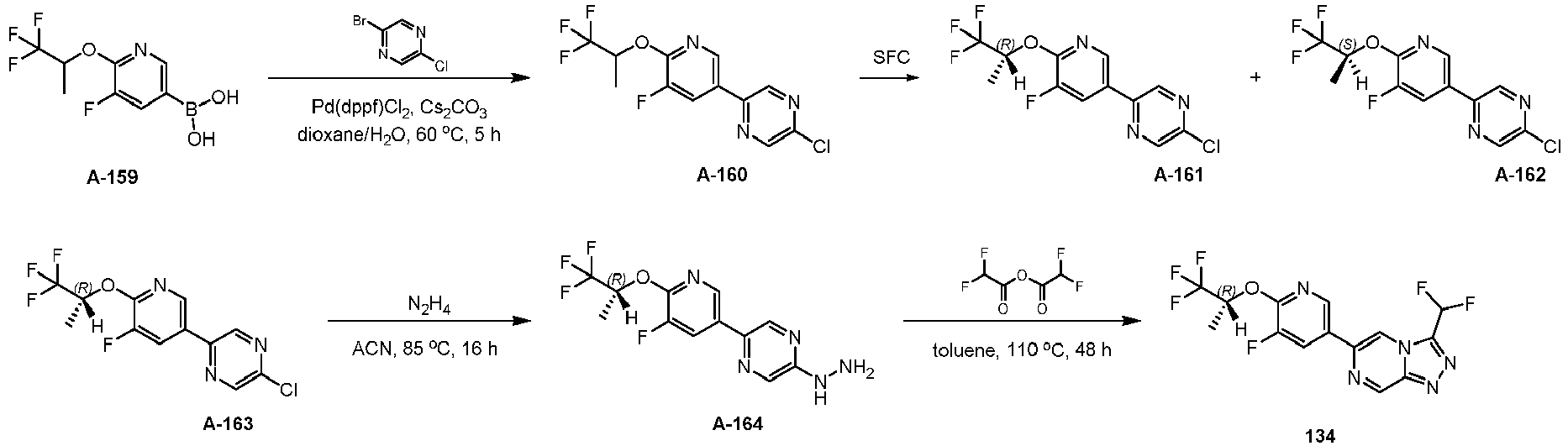
- A mixture of 2-bromo-5-chloro-pyrazine (229.4 mg, 1.19 mmol), [5-fluoro-6-(2,2,2-trifluoro-1-methyl-ethoxy)-3-pyridyl]boronic acid (300 mg, 1.19 mmol), Pd(dppf)Cl2 (130.16 mg, 0.18 mmol) and Cs2CO3 (772.77 mg, 2.37 mmol) in 1,4-dioxane (10 mL) and water (1 mL) was stirred at 60 °C for 5 hours under N2. After cooling to r.t., the mixture was diluted with H2O (30 mL), and the mixture was extracted with EtOAc (50 mL × 2). The combined organic phase was washed with water (20 mL × 2) and brine (20 mL), dried over Na2SO4, filtered and concentrated to give the crude product. The crude product was purified by flash chromatography on silica gel (EtOAc in PE = 0% to 1% to 3%) to give the product (210 mg, 0.64 mmol) as a solid.
- The product was analyzed by SFC to show two peaks (Peak 1: Rt = 2.02 min, Peak 2: Rt = 2.28 min).
- Method: Column: Chiralpak AD-3 150 × 4.6mm I.D, 3µm Mobile phase: A: CO2 B:ethanol (0.05% DEA), Gradient: from 5% to 40% ofB in 5 min and hold 40% for 2.5 min, then 5% of B for 2.5 min Flow rate: 2.5mL/min Column temp.: 35 °C.
- 1H NMR (400MHz CDCl3) δH = 8.77 (d, 1H), 8.65 (d, 1H), 8.53 (d, 1H), 8.08 (dd, 1H), 5.95 - 5.85 (m, 1H), 1.63 - 1.48 (m, 3H). LCMS Rt = 0.92 min in 1.5 min chromatography, 5-95AB, purity 98.54%, MS ESI calcd. for C12H9ClF4N3O [M+H]+ 322.0, found 321.9
- The 2-chloro-5-[5-fluoro-6-(2,2,2-trifluoro-1-methyl-ethoxy)-3-pyridyl]pyrazine (150 mg, 0.46 mmol) was purified by SFC (DAICEL CHIRALPAK AD-H (250 mm × 30 mm, 5µm); A = CO2 and B = EtOH (0.1%NH3H2O); 38°C; 50mL/min; 15% B; 8.8 min run; 15 injections, Rt of Peak 1 = 6.27 min, Rt of Peak 2 = 7.28 min) to give 2-chloro-5-[5-fluoro-6-[(1R)-2,2,2-trifluoro-1-methyl-ethoxy]-3-pyridyl]pyrazine (70 mg, 0.21 mmol) (Peak 1, Rt = 2.02 min in SFC) as a solid and 2-chloro-5-[5-fluoro-6-[(1S)-2,2,2-trifluoro-1-methyl-ethoxy]-3-pyridyl]pyrazine (70 mg, 0.22 mmol) (Peak 2, Rt = 2.28 min in SFC) as a solid.
- Note: the enantiomers were randomly assigned.
- LCMS Rt = 1.27 min in 2.0 min chromatography, 10-80AB, purity 98.05%, MS ESI calcd. for C12H9ClF4N3O [M+H]+ 322.0, found 321.9.
- LCMS Rt = 1.25 min in 2.0 min chromatography, 10-80AB, purity 100%, MS ESI calcd. for C12H9ClF4N3O [M+H]+ 322.0, found 321.9.
- A mixture of 2-chloro-5-[5-fluoro-6-[(1R)-2,2,2-trifluoro-1-methyl-ethoxy]-3-pyridyl]pyrazine (70 mg, 0.22 mmol) and hydrazine (139.5 mg, 4.35 mmol) in MeCN (5 mL) was stirred at 85 °C for 16 hours. After cooling to r.t., the mixture was concentrated to give the crude product (65 mg, 0.20 mmol) as a solid, which was used directly without any further purification. LCMS Rt = 0.72 min in 1.5 min chromatography, 5-95AB, purity 67.77%, MS ESI calcd. for C12H12F4N5O [M+H]+ 318.1, found 317.9.
- To a mixture of [5-[5-fluoro-6-[(1R)-2,2,2-trifluoro-1-methyl-ethoxy]-3-pyridyl]pyrazin-2-yl]hydrazine (65 mg, 0.20 mmol) in toluene (3 mL) was added (2,2-difluoroacetyl) 2,2-difluoroacetate (71.32 mg, 0.41 mmol), then the mixture was stirred at 110 °C for 48 hours. After cooling to r.t., the mixture was diluted with H2O (20 mL), and the mixture was extracted with EtOAc (30 mL × 2). The combined organic phase was washed with water (10 mL) and brine (20 mL), dried over Na2SO4, filtered and concentrated to give the crude product. The crude product was purified by Prep-TLC (silica gel, PE:EtOAc = 4:1) to give the product (46 mg, 0.12 mmol) as a solid. 1H NMR (400MHz, DMSO-d6 ) δ H = 9.69 (d, 1H), 9.28 (d, 1H), 8.78 (d, 1H), 8.52 (dd, 1H), 7.80 (t, 1H), 6.10 - 5.95 (m, 1H), 1.55 (d, 3H). LCMS Rt = 1.21 min in 2.0 min chromatography, 10-80AB, purity 100%, MS ESI calcd. for C14H10F6N5O [M+H]+ 378.1, found 377.9.
-

- A mixture of 2-chloro-5-[5-fluoro-6-[(1S)-2,2,2-trifluoro-1-methyl-ethoxy]-3-pyridyl]pyrazine (70 mg, 0.22 mmol) and hydrazine (139.5 mg, 4.35 mmol) in MeCN (5 mL) was stirred at 85 °C for 16 hours. After cooling to r.t., the mixture was concentrated to give the crude product (65 mg, 0.20 mmol) as a solid, which was used directly without any further purification. LCMS Rt = 0.71 min in 1.5 min chromatography, 5-95AB, purity 75.34%, MS ESI calcd. for C12H12F4N5O [M+H]+ 318.1, found 317.9.
- To a mixture of [5-[5-fluoro-6-[(1S)-2,2,2-trifluoro-1-methyl-ethoxy]-3-pyridyl]pyrazin-2-yl]hydrazine (65 mg, 0.20 mmol) in toluene (3 mL) was added (2,2-difluoroacetyl) 2,2-difluoroacetate (71.32 mg, 0.41 mmol), then the mixture was stirred at 110 °C for 48 hours. After cooling to r.t., the mixture was diluted with H2O (20 mL), and the mixture was extracted with EtOAc (30 mL × 2). The combined organic phase was washed with water (10 mL) and brine (20 mL), dried over Na2SO4, filtered and concentrated to give the crude product. The crude product was purified by Prep-TLC (silica gel, PE : EtOAc = 4 : 1) to give the product (48 mg, 0.13 mmol) as a solid. 1H NMR (400MHz, DMSO-d6 ) δ H = 9.69 (d, 1H), 9.28 (d, 1H), 8.78 (d, 1H), 8.52 (dd, 1H), 7.80 (t, 1H), 6.10 - 5.94 (m, 1H), 1.55 (d, 3H). LCMS Rt = 1.20 min in 2.0 min chromatography, 10-80AB, purity 100%, MS ESI calcd. for C14H10F6N5O [M+H]+ 378.1, found 378.0.
-

- A mixture of 6-chloro-3-(difluoromethyl)-[1,2,4]triazolo[4,3-b]pyridazine (100 mg, 0.49 mmol), 4,4,5,5-tetramethyl-2-[2-methyl-4-(trifluoromethoxy)phenyl]-1,3,2-dioxaborolane (177.22 mg, 0.59 mmol), K3PO4 (207.57 mg, 0.98 mmol) and Pd(t-Bu3P)2 (37.47 mg, 0.07 mmol) in 1,4-dioxane (5 mL) and water (0.50 mL) was stirred at 80 °C under N2 for 16 hours to give a suspension. The mixture was cooled to room temperature and filtered through Celite. The filtrate was concentrated to give a residue. The residue was re-dissolved in EtOAc (20 mL), washed with water (10 mL × 2), brine (10 mL × 2), dried over anhydrous Na2SO4, filtered and concentrated to give the crude product. The crude product was purified by flash chromatography on silica gel (EtOAc in PE = 10% to 30% to 50%) to give the product (87.09 mg, 0.25 mmol) as a solid. 1H NMR (400MHz, MeOD-d4 ) δH = 8.41 (d, 1H), 7.75 - 7.64 (m, 2H), 7.61 - 7.29 (m, 3H), 2.51 (s, 3H). LCMS Rt = 1.13 min in 2.0 min chromatography, 10-80AB, purity 98.84%, MS ESI calcd. for C14H10F5N4O [M+H]+ 345.1, found 344.9.
-

- A mixture of 6-chloro-3-(difluoromethyl)-[1,2,4]triazolo[4,3-b]pyridazine (100 mg, 0.49 mmol), 2-[2-(methoxymethyl)-4-(trifluoromethoxy)phenyl]-4,4,5,5-tetramethyl-1,3,2-dioxaborolane (194.83 mg, 0.59 mmol), K3PO4 (207.57 mg, 0.98 mmol) and Pd(t-Bu3P)2 (37.47 mg, 0.07 mmol) in 1,4-dioxane (5 mL) and water (0.50 mL) was stirred at 80 °C under N2 for 16 hours to give a suspension. The mixture was cooled to room temperature and filtered through Celite. The filtrate was concentrated to give a residue. The residue was re-dissolved in EtOAc (20 mL), washed with water (10 mL × 2), brine (10 mL × 2), dried over anhydrous Na2SO4, filtered and concentrated to give the crude product. The crude product was purified by flash chromatography on silica gel (EtOAc in PE = 10% to 30% to 50%) to give the product (22.42 mg, 59.9 µmol) as a solid. 1H NMR (400MHz, DMSO-d6 ) δ H = 8.62 (d, 1H), 7.88 - 7.51 (m, 5H), 4.67 (s, 2H), 3.23 (s, 3H). LCMS Rt = 1.12 min in 2.0 min chromatography, 10-80AB, purity 100%, MS ESI calcd. for C15H12F5N4O2 [M+H]+ 375.1, found 375.1.
-
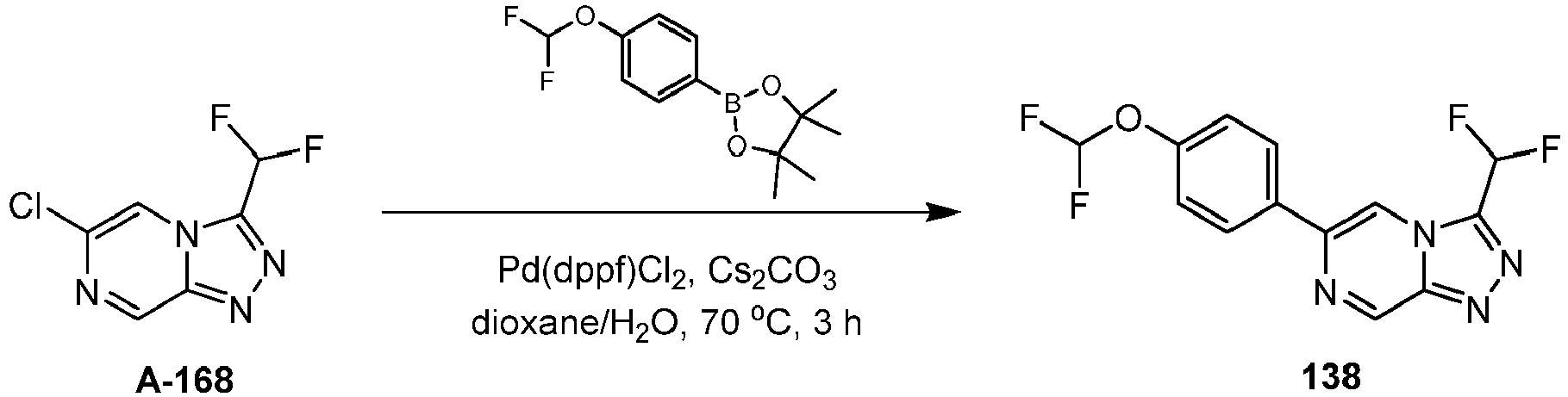
- A mixture of 6-chloro-3-(difluoromethyl)-[1,2,4]triazolo[4,3-a]pyrazine (100 mg, 0.49 mmol), 2-[4-(difluoromethoxy)phenyl]-4,4,5,5-tetramethyl-1,3,2-dioxaborolane (158.44 mg, 0.59 mmol), Cs2CO3 (318.54 mg, 0.98 mmol) and Pd(dppf)Cl2 (53.65 mg, 0.07 mmol) in 1,4-Dioxane (5 mL) and Water (0.50 mL) was stirred under N2 at 70 °C for 3 hours to give a suspension. The mixture was cooled to room temperature and filtered through Celite. The filtrate was concentrated to give a residue. The residue was dissolved in EtOAc (20 mL), washed with water (10 mL × 2), brine (10 mL × 2), dried over anhydrous Na2SO4, filtered and concentrated to give the crude product. The crude product was purified by flash chromatography on silica gel (EtOAc in PE = 10% to 30% to 50%) to give the product (90.42 mg, 0.29 mmol) as a solid. 1H NMR (400MHz, DMSO-d6 ) δ H = 9.67 (s, 1H), 9.18 (d, 1H), 8.19 (d, 2H), 7.85 (t, 1H), 7.58 - 7.16 (m, 3H). LCMS Rt = 1.02 min in 2.0 min chromatography, 10-80AB, purity 100%, MS ESI calcd. for C13H9F4N4O [M+H]+ 313.1, found 312.9.
-

- A mixture of 3,6-dichloro-4-methyl-pyridazine (1.4 g, 8.59 mmol), [4-(trifluoromethoxy)phenyl]boronic acid (1.65 g, 8.01 mmol), Pd(t-Bu3P)2 (265 mg, 0.52 mmol) and K3PO4 (3.1 g, 14.6 mmol) in 1,4-dioxane (80 mL) and water (15 mL) was stirred at 80 °C for 3 hours under N2. After cooling to r.t., the mixture was concentrated. The residue was diluted with H2O (50 mL), and the mixture was extracted with EtOAc (100 mL × 2). The combined organic phase was washed with water (50 mL) and brine (50 mL), dried over Na2SO4, filtered and concentrated to give the crude product. The crude product was purified by flash chromatography on silica gel (EtOAc in PE = 0% to 4% to 8%) to give impure 3-chloro-4-methyl-6-[4-(trifluoromethoxy)phenyl]pyridazine (1400 mg, 2.23 mmol) as a solid and 6-chloro-4-methyl-3-[4-(trifluoromethoxy)phenyl]pyridazine (600 mg, 1.87 mmol) as a solid.
- 3-chloro-4-methyl-6-[4-(trifluoromethoxy)phenyl]pyridazine LCMS Rt = 2.68 min in 4.0 min chromatography, 10-80AB, purity 46.02%, MS ESI calcd. for C12H9ClF3N2O [M+H]+ 289.0, found 288.9.
- 6-chloro-4-methyl-3-[4-(trifluoromethoxy)phenyl]pyridazine 1H NMR (400MHz, CDCl3) δ H = 8.62 (d, 2H), 8.46 (s, 1H), 8.37 (d, 2H), 2.40 (s, 3H). LCMS Rt = 2.54 min in 4.0 min chromatography, 10-80AB, purity 89.88%, MS ESI calcd. for C12H9ClF3N2O [M+H]+ 289.0, found 288.9.
- To a mixture of 3-chloro-4-methyl-6-[4-(trifluoromethoxy)phenyl]pyridazine (700 mg, 2.43 mmol) in ethanol (20 mL) was added hydrazine (2.33 g, 72.75 mmol), then the mixture was stirred at 85 °C for 28 hours. After cooling to r.t., the mixture was concentrated to give the crude product (680 mg, 2.39 mmol as a solid, which was used directly without any further purification. LCMS Rt = 0.71 min in 1.5 min chromatography, 5-95AB, purity 21.62%, MS ESI calcd. for C12H12F3N4O [M+H]+ 285.1, found 284.9.
- To a mixture of [4-methyl-6-[4-(trifluoromethoxy)phenyl]pyridazin-3-yl]hydrazine (680 mg, 2.39 mmol) in toluene (15 mL) was added (2,2,2-trifluoroacetyl) 2,2,2-trifluoroacetate (1.0 g, 4.78 mmol), then the mixture was stirred at 110 °C for 3 hours. After cooling to r.t., the mixture was diluted with H2O (20 mL) and sat.Na2CO3 (10 mL), and the mixture was extracted with EtOAc (30 mL × 2). The combined organic phase was washed with water (20 mL) and brine (20 mL), dried over Na2SO4, filtered and concentrated to give the crude product. The crude product was purified by flash chromatography on silica gel (EtOAc in PE = 0% to 25% to 50%) to give the impure product (310 mg, 0.43 mmol) as a solid.
- The impure product (80 mg, 0.22 mmol) was purified by purified by prep-HPLC [Waters Xbridge (150 mm × 25 mm, 5 µm) A = H2O (0.05% NH4OH) and B = CH3CN; 55-85 %B over 7 minutes] to give the product (27.05 mg, 74.7 µmol) as a solid. 1H NMR (400MHz, CDCl3) δ H = 8.07 (d, 2H), 7.52 (d, 1H), 7.42 (d, 2H), 2.88 (d, 3H). LCMS Rt = 1.23 min in 2.0 min chromatography, 10-80AB, purity 100%, MS ESI calcd. for C14H9F6N4O [M+H]+ 363.1, found 363.0.
-

- To a mixture of 6-chloro-4-methyl-3-[4-(trifluoromethoxy)phenyl]pyridazine (300 mg, 1.04 mmol) in rthanol (10 mL) was added hydrazine (666.2 mg, 20.79 mmol), then the mixture was stirred at 85 °C for 20 hours. After cooling to r.t., the mixture was concentrated to give the crude product (290 mg, 0.73 mmol) as a solid. LCMS Rt = 0.70 min in 1.5 min chromatography, 5-95AB, purity 71.37%, MS ESI calcd. for C12H12F3N4O [M+H]+ 285.1, found 284.9.
- To a mixture of [5-methyl-6-[4-(trifluoromethoxy)phenyl]pyridazin-3-yl]hydrazine (290 mg, 1.02 mmol) in toluene (10 mL) was added (2,2,2-trifluoroacetyl) 2,2,2-trifluoroacetate (428.57 mg, 2.04 mmol), then the mixture was stirred at 110 °C for 3 hours. After cooling to r.t., the mixture was diluted with H2O (20 mL) and sat.Na2CO3 (10 mL), and the mixture was extracted with EtOAc (30 mL × 2). The combined organic phase was washed with water (20 mL) and brine (20 mL), dried over Na2SO4, filtered and concentrated to give the crude product. The crude product was purified by flash chromatography on silica gel (EtOAc in PE = 0% to 25% to 50%) to give the product (220 mg, 0.59 mmol) as a solid.
- The impure product (50 mg, 0.14 mmol) was triturated from i-Pr2O (2 mL) and dried in oven to give the pure product (32.72 mg, 90.3 µmol) as a solid. 1H NMR (400MHz CDCl3) δ H = 8.09 (d, 1H), 7.61 (d, 2H), 7.42 (d, 2H), 2.46 (d, 3H). LCMS Rt = 1.25 min in 2.0 min chromatography, 10-80AB, purity 100%, MS ESI calcd. for C14H9F6N4O [M+H]+ 363.1, found 363.1.
-

- A mixture of 6-chloro-3-(difluoromethyl)-[1,2,4]triazolo[4,3-a]pyrazine (100 mg, 0.49 mmol), 2-[2-(methoxymethyl)-4-(trifluoromethyl)phenyl]-4,4,5,5-tetramethyl-1,3,2-dioxaborolane (185.44 mg, 0.59 mmol), Cs2CO3 (318.54 mg, 0.98 mmol) and Pd(dppf)Cl2 (53.65 mg, 0.07 mmol) in 1,4-dioxane (3 mL) and water (0.50 mL) was stirred at 70 °C under N2 for 16 hours. After cooling to r.t., the suspension was diluted with EtOAc (10 mL), filtered through silica gel, eluted with EtOAc (20 mL). The combined filtrates were concentrated to give the crude product. The crude product was purified by flash chromatography on silica gel (EtOAc in PE = 70% to 100%) to give the product (88.81 mg, 0.25 mmol) as a solid. 1H NMR (400MHz, DMSO-d6 + D2O) δH = 9.65 (d, 1H), 8.88 (d, 1H), 7.95 - 7.65 (m, 4H), 4.57 (s, 2H), 3.30 (s, 3H). LCMS Rt = 1.08 min in 2 min chromatography, 10-80AB, purity 100%, MS ESI calcd. for C15H12F5N4O [M+H]+ 359.1, found 359.0.
-

- A mixture of 6-chloro-3-(difluoromethyl)-[1,2,4]triazolo[4,3-a]pyrazine (100 mg, 0.49 mmol), 2-[2-(methoxymethyl)-4-(trifluoromethoxy)phenyl]-4,4,5,5-tetramethyl-1,3,2-dioxaborolane (194.83 mg, 0.59 mmol), Cs2CO3 (318.54 mg, 0.98 mmol) and Pd(dppf)Cl2 (53.65 mg, 0.07 mmol) in 1,4-dioxane (3 mL) and water (0.50 mL) was stirred at 70 °C under N2 for 16 hours. After cooling to r.t., the suspension was diluted with EtOAc (10 mL), filtered through silica gel, eluted with EtOAc (20 mL). The combined filtrates were concentrated to give the crude product. The crude product was purified by flash chromatography on silica gel (EtOAc in PE = 70% to 100%) to give the product (48.50 mg, 0.13 mmol) as a solid. 1H NMR (400MHz, DMSO-d 6+ D2O) δH = 9.52 (s, 1H), 8.72 (s, 1H), 7.81 - 7.52 (m, 2H), 7.50 - 7.38 (m, 2H), 4.45 (s, 2H), 3.24 (s, 3H). LCMS Rt = 1.10 min in 2 min chromatography, 10-80AB, purity 100%, MS ESI calcd. for C15H12F5N4O2 [M+H]+ 375.1, found 375.0.
-

- To a mixture of 7-methyl-6-[4-(trifluoromethoxy)phenyl]-3-(trifluoromethyl)-[1,2,4]triazolo[4,3-b]pyridazine (150 mg, 0.41 mmol) and NBS (110.55 mg, 0.62 mmol) in carbon tetrachloride (5 mL) was added BPO (100.31 mg, 0.41 mmol) at 90 °C, then the mixture was stirred at 90 °C for 3 hours. After cooling to r.t., the mixture was diluted with H2O (20 mL), and the mixture was extracted with EtOAc (30 mL × 2). The combined organic phase was washed with water (20 mL) and brine (20 mL), dried over Na2SO4, filtered and concentrated to give the crude product. The crude product was purified by Prep-TLC (silica gel, PE:EtOAc = 2:1) to give the impure product (85 mg, 0.17 mmol) as a solid. LCMS Rt = 1.28 min in 2.0 min chromatography, 10-80AB, purity 90.79%, MS ESI calcd. for C14H8BrF6N4O [M+H+2]+ 443.0, found 443.1.
- The mixture of 7-(bromomethyl)-6-[4-(trifluoromethoxy)phenyl]-3-(trifluoromethyl)-[1,2,4]triazolo[4,3-b]pyridazine (80 mg, 0.18 mmol) and K2CO3 (50.13 mg, 0.36 mmol) in THF (3 mL) and Methanol (3 mL) was stirred at 25 °C for 0.5 hour. The mixture was quenched with sat. NH4Cl (10 mL) and extracted with EtOAc (30 mL × 2). The combined organic phase was washed with brine (15 mL), dried over Na2SO4, filtered and concentrated to give the crude product. The crude product was purified by Prep-TLC (silica gel, PE : EtOAc = 2 : 1) to give the product (29.75 mg, 75.8 µmol) as a solid. 1H NMR (400MHz, CDCl3) δ H = 8.42 (t, 1H), 7.63 (d, 2H), 7.42 (d, 2H), 4.39 (d, 2H), 3.49 (s, 3H). LCMS Rt = 1.17 min in 2.0 min chromatography, 10-80AB, purity 100%, MS ESI calcd. for C15H11F6N4O2 [M+H]+ 393.1, found 393.0.
-

- A mixture of 6-chloro-3-(difluoromethyl)-[1,2,4]triazolo[4,3-a]pyrazine (100 mg, 0.49 mmol), [5-(4,4,5,5-tetramethyl-1,3,2-dioxaborolan-2-yl)-2-(trifluoromethoxy)phenyl]methanol (233.26 mg, 0.73 mmol), Cs2CO3 (318.54 mg, 0.98 mmol) and Pd(dppf)Cl2 (53.65 mg, 0.07 mmol) in 1,4-dioxane (5 mL) and water (0.50 mL) was stirred at 70 °C under N2 for 3 hours to give a suspension. The mixture was cooled to room temperature and filtered through Celite. The filtrate was concentrated to give a residue. The residue was re-dissolved in EtOAc (20 mL), washed with water (10 mL × 2), brine (10 mL × 2), dried over anhydrous Na2SO4, filtered and concentrated to give the crude product. The crude product was purified by flash chromatography on silica gel (EtOAc in PE = 10% to 30% to 50%) to give the product (90 mg, 0.24 mmol) as a solid. 1H NMR (400MHz DMSO-d6 ) δ H = 9.69 (d, 1H), 9.20 (d, 1H), 8.37 (d, 1H), 8.13 (dd, 1H), 7.88 (t, 1H), 7.51 (dd, 1H), 5.54 (t, 1H), 4.66 (d, 2H). LCMS Rt = 0.76 min in 1.5 min chromatography, 5-95AB, purity 97.04%, MS ESI calcd. for C14H10F5N4O2 [M+H]+ 361.1, found 361.0.
- To a mixture of [5-[3-(difluoromethyl)-[1,2,4]triazolo[4,3-a]pyrazin-6-yl]-2-(trifluoromethoxy)phenyl]methanol (80 mg, 0.22 mmol) in THF (3 mL) was added NaH (13.32 mg, 0.33 mmol) at 0 °C. To the mixture was added iodomethane (94.56 mg, 0.67 mmol). The resulting mixture was stirred at 20 °C for 1 hour. To the reaction mixture was added saturated NH4Cl aqueous (20 mL). The resulting mixture was extracted with EtOAc (20 mL × 2). After separatation, the combined organic phase was washed with water (20 mL × 2), brine (20 mL × 2), dried over anhydrous Na2SO4, filtered and concentrated to give the crude product. The crude product was purified by flash chromatography on silica gel (EtOAc in PE = 0% to 10% to 20%) to give the product (42.34 mg, 113.1 µmol) as a solid. 1H NMR (400MHz, DMSO-d6 ) δ H = 9.69 (s, 1H), 9.25 (d, 1H), 8.31 (d, 1H), 8.19 (dd, 1H), 7.87 (t, 1H), 7.56 (dd, 1H), 4.58 (s, 2H), 3.39 (s, 3H). LCMS Rt = 1.12 min in 2.0 min chromatography, 10-80AB, purity 100.00%, MS ESI calcd. for C15H12F5N4O2 [M+H]+ 375.1, found 375.0.
-

- A mixture of [5-[4-(trifluoromethoxy)phenyl]pyrazin-2-yl]hydrazine (100 mg, 0.37 mmol), PyBOP (0.29 g, 0.56 mmol) in DCM (3 mL) was added tetrahydropyran-4-carboxylic acid (48.16 mg, 0.37 mmol) and DIPEA (0.19 mL, 1.11 mmol). The reaction mixture was stirred at 20 °C for 16 hours. The mixture was diluted with NH4Cl (15 mL × 2) and extracted with CH2Cl2 (20 mL). The combined organic phase was washed with brine (10 mL), dried over Na2SO4, filtered and concentrated to give the crude product (290 mg, 0.55 mmol). The crude product was used directly without any purification. LCMS Rt = 0.76 min in 1.5 min chromatography, 5-95 AB, purity 72.15%, MS ESI calcd. for C17H18F3N4O3 [M+H]+ 383.1, found 383.0.
- A mixture ofN'-[5-[4-(trifluoromethoxy)phenyl]pyrazin-2-yl]tetrahydropyran-4-carbohydrazide (290 mg, 0.76 mmol) in acetic acid (8 mL) was stirred at 120 °C for 16 hours. After cooling to r.t., the mixture was concentrated, the residue was diluted with EtOAc (20 mL), neutralized with sat.NaHCO3 to pH=9 and extracted with EtOAc (20 mL × 2). Then the combined organic phase was washed with brine (15 mL), dried over Na2SO4 and concentrated to give the crude product. The crude product was purified by flash chromatography on silica gel (EtOAc in PE = 50% to 100%) to give the impure product. The impure product was purified by Prep-TLC (silica gel, PE : EA = 1 : 7) to give the product (28.60 mg, 0.08 mmol) as a solid. 1H NMR (400MHz DMSO-d6 ) δ H = 9.48 (d, 1H), 9.14 (d, 1H), 8.26 (d, 2H), 7.54 (d, 2H), 4.04 - 3.99 (m, 2H), 3.81 - 3.70 (m, 1H), 3.63 - 3.54 (m, 2H), 2.03 - 1.87 (m, 4H). LCMS Rt = 1.08 min in 2 min chromatography, 10-80AB, purity 96.37%, MS ESI calcd. for C17H16F3N4O2 [M+H]+ 365.1, found 365.1.
-

- A mixture of 6-chloro-3-(difluoromethyl)-[1,2,4]triazolo[4,3-b]pyridazine (100 mg, 0.49 mmol), [5-(4,4,5,5-tetramethyl-1,3,2-dioxaborolan-2-yl)-2-(trifluoromethoxy)phenyl]methanol (155.50 mg, 0.49 mmol), Pd(t-Bu3P)2 (37.47 mg, 0.07 mmol) and K3PO4 (207.57 mg, 0.98 mmol) in water (0.2 mL) and 1,4-dioxane (2 mL) was stirred at 90 °C for 16 hours.. After cooling to r.t., the suspension was diluted with EtOAc (10 mL), filtered through silica gel and eluted with EtOAc (20 mL). The combined filtrates were concentrated to give the crude product. The crude product was purified by flash chromatography on silica gel (EtOAc in PE = 20% to 70% to 100%) to give the product (55 mg, 0.15 mmol) as a solid. 1H NMR (400MHz DMSO-d6 ) δ H = 8.63 (d, 1H), 8.33 (d, 1H), 8.18 - 8.09 (m, 2H), 7.77 (t, 1H), 7.62 - 7.55 (m, 1H), 5.59 (t, 1H), 4.67 (d, 2H).
- To a mixture of [5-[3-(difluoromethyl)-[1,2,4]triazolo[4,3-b]pyridazin-6-yl]-2-(trifluoromethoxy)phenyl]methanol (45 mg, 0.12 mmol) in THF (2 mL) was added the NaH (6 mg, 0.15 mmol) at 0 °C, and the mixture was stirred for 30 minutes. Then iodomethane (53.19 mg, 0.37 mmol) was added. The mixture was stirred at 20 °C for 16 hours to give the brown mixture. The mixture was concentrated, the residue was diluted with EtOAc (20 mL), neutralized with HCl to pH = 3 and extracted with EtOAc (20 mL × 2). Then the combined organic phase was washed with brine (15 mL), dried over Na2SO4 and concentrated to give the crude product. The crude product was triturated from i-Pr2O (5 mL) to give the product (20.93 mg, 0.05 mmol) as a solid. 1H NMR (400MHz, DMSO-d 6+ D2O) δ H = 8.57 (d, 1H), 8.24 (d, 1H), 8.20 - 8.15 (m, 1H), 8.11 (d, 1H), 7.91 - 7.58 (m, 2H), 4.56 (s, 2H), 3.37 (s, 3H). LCMS Rt = 1.13 min in 2 min chromatography, 10-80AB, purity 100%, MS ESI calcd. for C15H12F5N4O2 [M+H]+ 375.1, found 375.0.
-

- To a mixture of 5-bromo-2,3-difluoro-pyridine (750 mg, 3.87 mmol) and 3,3-difluorocyclobutanol (501.5 mg, 4.64 mmol) in 1,4-dioxane (10 mL) was added t-BuOK (867.69 mg, 7.73 mmol) under 0 °C. Then the mixture was stirred at 20 °C for 2 hours. The reaction was quenched with sat.NH4Cl (10 mL), and the mixture was extracted with EtOAc (20 mL × 2). The combined organic phase was washed with brine (10 mL ), dried over anhydrous Na2SO4, filtered and concentrated to give the crude product. The crude product was purified by flash chromatography on silica gel (PE) to give the product (930 mg, 3.29 mmol) as colorless oil. 1H NMR (400MHz, CDCl3) δ H = 7.98 (d, 1H), 7.57-7.47 (m, 1H), 5.21-5.09 (m, 1H), 3.24-3.05 (m, 2H), 2.88-2.70 (m, 2H).
- A mixture of 5-bromo-2-(3,3-difluorocyclobutoxy)-3-fluoro-pyridine (930 mg, 3.3 mmol), 4,4,5,5-tetramethyl-2-(4,4,5,5-tetramethyl-1,3,2-dioxaborolan-2-yl)-1,3,2-dioxaborolane (2.5 g, 9.89 mmol), KOAc (647.17 mg, 6.59 mmol) and Pd(dppf)Cl2 (361.88 mg, 0.49 mmol) in 1,4-dioxane (20 mL) was stirred at 90°C under N2 for 16 hours to give a suspension. The mixture was cooled to room temperature and filtered through Celite. The filtrate was concentrated to give a residue. The residue was re-dissolved in EtOAc (50 mL), washed with water (30 mL × 2), brine (30 mL × 2), dried over anhydrous Na2SO4, filtered and concentrated to give the crude product. The crude product was purified by flash chromatography on silica gel (EtOAc in PE = 0% to 3%) to give the product (1000 mg, 3.03 mmol) as a solid. 1H NMR (400MHz, CDCl3) δ H = 8.25 (s, 1H), 7.66 (dd, 1H), 5.32-5.16 (m, 1H), 3.23-3.07 (m, 2H), 2.88-2.71 (m, 2H), 1.34 (s, 12H).
- A mixture of 6-chloro-3-(difluoromethyl)-[1,2,4]triazolo[4,3-a]pyrazine (100 mg, 0.49 mmol), 2-(3,3-difluorocyclobutoxy)-3-fluoro-5-(4,4,5,5-tetramethyl-1,3,2-dioxaborolan-2-yl)pyridine (241.34 mg, 0.73 mmol), Cs2CO3 (318.54 mg, 0.98 mmol) and Pd(dppf)Cl2 (53.65 mg, 0.07 mmol) in 1,4-dioxane (5 mL) and water (0.50 mL) was stirred at 70 °C under N2 for 9 hours to give a suspension. The mixture was cooled to room temperature and filtered through Celite. The filtrate was concentrated to give a residue. The residue was re-dissolved in EtOAc (20 mL), washed with water (10 mL × 2) and brine (10 mL × 2), dried over anhydrous Na2SO4, filtered and concentrated to give the crude product. The crude product was purified by flash chromatography on silica gel (EtOAc in PE = 10% to 30% to 50%) to give the impure product. The impure product was purified again by Prep-HPLC [Waters Xbridge (150 mm × 25 mm, 5 µm) A = H2O (10 mM NH4HCO3) and B = CH3CN; 40-70 %B over 6 minutes] to give the product (108.25 mg, 291.6 µmol) as a solid. 1H NMR (400MHz, DMSO-d6 ) δ H = 9.68 (s, 1H), 9.25 (d, 1H), 8.74 (s, 1H), 8.44 (dd, 1H), 7.80 (t, 1H), 5.35-5.20 (m, 1H), 3.29-3.15 (m, 2H), 2.92 - 2.79 (m, 2H). LCMS Rt = 1.16 min in 2.0 min chromatography, 10-80AB, purity 98.90%, MS ESI calcd. for C15H11F5N5O [M+H]+ 372.1, found 372.1.
-

- A mixture of sodium methoxide (15.45 mg, 0.29 mmol) and 3-chloro-6-[4-(trifluoromethoxy)phenyl]-[1,2,4]triazolo[4,3-a]pyrazine (30 mg, 0.10 mmol) in Methanol (3 mL) was stirred at 75 °C for 16 hours. After cooling to r.t., the mixture was concentrated, the residue was diluted with EtOAc (10 mL) and sat.NH4Cl (10 mL), and extracted with EtOAc (10 mL x 2). Then the combined organic phase was washed with brine (10 mL), dried over Na2SO4 and concentrated to give the crude product. The crude product was purified by Prep-HPLC (Waters Xbridge (150 mm × 25 mm, 5 µm) A = H2O (0.05% NH4OH) and B = CH3CN; 41-65 % B over 6 minutes) to give the product (3.16 mg, 0.01 mmol) as a solid. 1H NMR (400MHz, DMSO-d 6) δ H = 9.31 (s, 1H), 8.72 (s, 1H), 8.22 (d, 2H), 7.48 (d, 2H), 4.32 (s, 3H). LCMS Rt = 1.07 min in 2 min chromatography, 10-80AB, purity 100%, MS ESI calcd. for C13H10F3N4O2 [M+H]+ 311.1, found 310.9.
-

- A mixture of 6-chloro-3-(trifluoromethyl)-[1,2,4]triazolo[4,3-a]pyrazine (100 mg, 0.45 mmol), [4-(4,4,5,5-tetramethyl-1,3,2-dioxaborolan-2-yl)phenyl]methanol (210.37 mg, 0.90 mmol), Pd(dppf)Cl2 (32.88 mg, 0.04 mmol) and Cs2CO3 (292.77 mg, 0.90 mmol) in 1,4-dioxane (3 mL) and water (0.15 mL) was stirred at 70 °C for 16 hours. After cooling to r.t., the mixture was filtered through Celite, and eluted with EtOAc (10 mL × 2). The filtrate was concentrated and diluted with EtOAc (10 mL), washed with water (10 mL × 2) and brine (10 mL), dried over Na2SO4, filtered and concentrated to give the crude product. The crude product was purified by flash chromatography on silica gel (EtOAc in PE = 30% to 80%) to give the product (29 mg, 0.10 mmol) as a solid. 1H NMR (400MHz DMSO-d 6) δ H = 9.76 (d, 1H), 8.96 (s, 1H), 8.15 (d, 2H), 7.49 (d, 2H), 5.31 (t, 1H), 4.58 (d, 2H). LCMS Rt = 0.68 min in 1.5 min chromatography, 5-95AB, purity 100%, MS ESI calcd. for C13H10F3N4O [M+H]+ 295.1, found 294.9.
- To a mixture of AgOTf (558.89 mg, 2.18 mmol), KF (157.97 mg, 2.72 mmol), Selectfluor (385.29 mg, 1.09 mmol) and [4-[3-(trifluoromethyl)-[1,2,4]triazolo[4,3-a]pyrazin-6-yl]phenyl]methanol (80 mg, 0.27 mmol) in ethyl acetate (6 mL) was added 2-fluoropyridine (211.19 mg, 2.18 mmol) and trimethyl(trifluoromethyl)silane (193.3 mg, 1.36 mmol) under N2, then the mixture was stirred at 25 °C for 16 hours. The mixture was filtered through Celite, eluted with EtOAc (30 mL × 2), the filtrate was concentrated to give the crude product. The crude product was purified by flash chromatography on silica gel (EtOAc in PE = 0% to 50%) to give the impure product. The impure product was purified by Prep-HPLC (Waters Xbridge (150 mm × 25 mm, 5 µm) A = H2O (10 mM NH4HCO3) and B = CH3CN; 42 - 72% B over 7 minutes) to give the product (3.34 mg, 9.2 µmol) as a solid. 1H NMR (400MHz CDCl3) δ H = 9.61 (d, 1H), 8.44 (s, 1H), 8.03 (d, 2H), 7.56 (d, 2H), 5.09 (s, 2H). LCMS Rt = 1.18 min in 2.0 min chromatography, 10-80AB, purity 100%, MS ESI calcd. for C14H9F6N4O [M+H]+ 363.1, found 363.0.
-

- A solution of 2,2,2-trifluoroethanol (0.8 mL, 0.50 mmol) in THF (0.50 mL) was added NaH (59.98 mg, 1.50 mmol) at 0 °C. Then 3-chloro-6-[4-(trifluoromethoxy)phenyl]-[1,2,4]triazolo[4,3-a]pyrazine (50 mg, 0.16 mmol) was added. The mixture was stirred at 75 °C for 72 hours. After cooling to r.t., the mixture was concentrated, the residue was diluted with EtOAc (15 mL) and NH4Cl (15 mL), and extracted with EtOAc (15 mL × 2). Then the combined organic phase was washed with brine (10 mL), dried over Na2SO4 and concentrated to give the crude product. The crude product was purified by Prep-HPLC (Waters Xbridge (150 mm × 25 mm, 5 µm) A = H2O (0.05% NH4OH) and B = CH3CN; 47-67 %B over 6 minutes) to give the product (21.12 mg, 55.80 µmol) as a solid. 1H NMR (400MHz, DMSO-d 6) δ H = 9.38 (d, 1H), 8.79 (d, 1H), 8.26 (d, 2H), 7.49 (br d, 2H), 5.41 (q, 2H). LCMS Rt = 1.18 min in 2 min chromatography, 10-80AB, purity 100%, MS ESI calcd. for C14H9F6N4O2 [M+H]+ 379.1, found 379.0.
-

- A mixture of 2-[4-(2,2-difluorocyclopropyl)phenyl]-4,4,5,5-tetramethyl-1,3,2-dioxaborolane (453.11 mg, 1.62 mmol), 6-chloro-3-(trifluoromethyl)-[1,2,4]triazolo[4,3-a]pyrazine (300 mg, 1.35 mmol), Pd(dppf)Cl2 (197.26 mg, 0.27 mmol) and Cs2CO3 (878.32 mg, 2.7 mmol) in 1,4-dioxane (15 mL) and water (3 mL) was stirred at 70 °C for 3 hours. After cooling to r.t., the mixture was concentrated to a residue. The residue was diluted with H2O (50 mL) and extracted with EtOAc (50 mL × 2). The combined organic phase was washed with brine (50 mL), dried over Na2SO4, filtered and concentrated to give the crude product. The crude product was purified by flash chromatography on silica gel (EtOAc in PE = 0% to 30%) to give the impure product. The impure product was purified by TLC (silica gel, PE : EtOAc = 3: 1) to give the product (50 mg). The product was analyzed by SFC and showed two peaks (Peak 1: Rt = 2.96 min, Peak 2: Rt = 3.30 min).
- Method: Column: Chiralpak AD-3 150×4.6mm I.D., 3µm Mobile phase: A: CO2 B:ethanol (0.05% DEA) Gradient: from 5% to 40% of B in 5 min and hold 40% for 2.5 min, then 5% of B for 2.5 min Flow rate: 2.5mL/min Column temp.: 35 °C.
- The product was separated by SFC (DAICEL CHIRALPAK AD-H(250 mm × 30 mm, 5 µm); A = CO2 and B = methanol (0.1%NH3H2O MeOH); 38 °C; 50 mL/min; 30% B; 12 min run; 15 injections, Rt of peak 1 = 8.47 min, Rt of Peak 2 = 10.63 min) to give the product of 6-[4-[(1R)-2,2-difluorocyclopropyl]phenyl]-3-(trifluoromethyl)-[1,2,4]triazolo[4,3-a]pyrazine (10.35 mg, 0.03 mmol, 20.7% yield, 100% purity) (Peak 1, Rt = 2.96 min in SFC) as a solid and 6-[4-[(1S)-2,2-difluorocyclopropyl]phenyl]-3-(trifluoromethyl)-[1,2,4]triazolo[4,3-a]pyrazine (7.36 mg, 0.02 mmol, 14.56% yield, 98.94% purity) (Peak 2: Rt = 3.30 min in SFC) as a solid.
- Compound 151 (peak 1): 1H NMR (400MHz, CDCl3) δ H = 9.60 (d, 1H), 8.41 (s, 1H), 7.95 (d, 2H), 7.41 (d, 2H), 2.90 - 2.79 (m, 1H), 1.98 - 1.88 (m, 1H), 1.77 - 1.68 (m, 1H). LCMS Rt = 1.12 min in 2 min chromatography, 10-80AB, purity 100.00 %, MS ESI calcd. for C15H10F5N4 [M+H]+ 341.1, found 341.0.
- Compound 152 (peak 2): 1H NMR (400MHz, CDCl3) δ H = 9.60 (d, 1H), 8.41 (s, 1H), 7.95 (d, 2H), 7.41 (d, 2H), 2.89 - 2.79 (m, 1H), 1.99 - 1.87 (m, 1H), 1.77 - 1.67 (m, 1H). LCMS Rt = 1.13 min in 2 min chromatography, 10-80AB, purity 100.00 %, MS ESI calcd. for C15H10F5N4 [M+H]+ 341.1, found 341.0.
-

- To a solution of [5-[4-(trifluoromethoxy)phenyl]pyrazin-2-yl]hydrazine (2 g, 7.40 mmol) in THF (20 mL) was added trimethoxymethane (3.93 g, 37.01 mmol) and TFA (0.55 mL, 7.40 mmol). The reaction mixture was stirred at 65 °C for 2 hours. After cooling to r.t., the reaction mixture was concentrated to remove most of THF, then diluted with sat.NaHCO3 (30 mL). The mixture was extracted with EtOAc (30 mL x 2). The combined organic phase was washed with brine (20 mL), dried over Na2SO4, filtered and concentrated to give the product (1600 mg, 5.71 mmol) as a solid. 1H NMR (400MHz DMSO-d 6) δ H = 9.54 (d, 1H), 9.46 (s, 1H), 9.23 (d, 1H), 8.16 (d, 2H), 7.54 (d, 2H).
- A mixture of 6-[4-(trifluoromethoxy)phenyl]-[1,2,4]triazolo[4,3-a]pyrazine (1 g, 3.57 mmol) and NCS (619.50 mg, 4.64 mmol) in DMF (10 mL) was stirred at 75 °C for 1 hour. After cooling to r.t., the mixture was diluted with H2O (20 mL), and the mixture was extracted with EtOAc (20 mL × 2). The combined organic phase was washed with brine (20 mL), dried over Na2SO4, filtered and concentrated. The residue was purified by flash chromatography on silica gel (EtOAc in PE = 0% to 10% to 30%) to give the product (105 mg, 0.33 mmol) as a solid. .1H NMR (400MHz, DMSO-d 6) δ H = 9.57 (d, 1H), 9.01 (d, 1H), 8.30 (d, 2H), 7.53 (d, 2H).
- A solution of 3-chloro-6-[4-(trifluoromethoxy)phenyl]-[1,2,4]triazolo[4,3-a]pyrazine (60 mg, 0.19 mmol) in DMF (1 mL) was added N-methylmethanamine (1 mL, 0.19 mmol, 33% in H2O). The mixture was stirred at 80 °C for 16 hours. After cooling to r.t., the mixture was concentrated, the residue was diluted with EtOAc (15 mL) and NH4Cl (15 mL), then extracted with EtOAc (15 mL × 2). Then the combined organic phase was washed with brine (15 mL), dried over Na2SO4 and concentrated to give the crude product. The crude product was purified by Prep-HPLC (Waters Xbridge (150 mm × 25 mm, 5 µm) A = H2O (0.05% NH4OH) and B = CH3CN; 47-57% B over 6 minutes) to give the product (7.29 mg, 22.60 µmol) as a solid. 1H NMR (400MHz, DMSO-d 6) δ H = 9.50 (d, 1H), 9.01 (d, 1H), 8.21 (d, 2H), 7.48 (d, 2H), 3.11 (s, 6H). LCMS Rt = 1.18 min in 2 min chromatography, 10-80AB, purity 100%, MS ESI calcd. for C14H13F3N5O [M+H]+ 324.1, found 324.0.
-

- To a mixture of [5-[4-(trifluoromethoxy)phenyl]pyrazin-2-yl]hydrazine (200 mg, 0.74 mmol) and PyBOP (0.58 g, 1.11 mmol) in DCM (20 mL) was added the 2-tetrahydropyran-3-ylacetic acid (117.38 mg, 0.81 mmol) and DIPEA (0.39 mL, 2.22 mmol), and the mixture was stirred at 25 °C for 16 hours. The mixture was diluted with sat.NH4Cl (80 mL), extracted with DCM (80 mL × 2). The combined organic phase was washed with brine (40 mL), dried over Na2SO4 and filtered. The filtrate was concentrated to give the crude product (460 mg, 0.70 mmol) as oil, which was used directly in next step without any purification. LCMS Rt = 0.84 min in 1.5 min chromatography, 5-95AB, purity 60.12%, MS ESI calcd. for C18H20F3N4O3 [M+H]+ 397.1, found 397.3.
- A mixture of 2-tetrahydropyran-3-yl-N'-[5-[4-(trifluoromethoxy)phenyl]pyrazin-2-yl]acetohydrazide (460 mg, 1.16 mmol) in acetic acid (20 mL) was stirred at 120 °C for 16 hours. The mixture was cooled to r.t., and concentrated to give the crude product. The crude product was diluted with EtOAc (10 mL), then basified with sat.NaHCO3 to pH = 8 - 9, and extracted with EtOAc (20 mL × 2). The combined organic phase was washed with brine (15 mL), dried over Na2SO4, filtered and concentrated to give the crude product. The crude product was purified by Prep-HPLC (Waters Xbridge 150 mm × 25 mm, 5µm, A = H2O (10 mM NH4HCO3) and B = CH3CN; 40-70% B over 6 minutes) to give the product (90 mg, 0.24 mmol) as a solid. The product was analysed by SFC and showed two peaks (Peak1 Rt = 3.67 min, Peak2 Rt = 4.25 min).
- Method: Column: Chiralcel OJ-H 150 mm × 4.6 mm I.D., 5 µm, Mobile phase: A:CO2 B: ethanol (0.05% DEA), Gradient: hold 5% for 0.5 min, then from 5% to 40% of B in 3.5 min and hold 40% for 2.5 min, then 5% ofB for 1.5 min, Flow rate: 3mL/min Column temp:40 °C.
- The product was separated by SFC (DAICEL CHIRALCEL OJ-H (250 mm × 30 mm, 5 µm); A = CO2 and B = EtOH (0.1% NH3H2O); 35°C; 60 mL/min; 40% B; 9 min run; 14 injections, Rt of peak 1 = 4.80 min, Rt of Peak 2 = 7.10 min) to give the product of 3-[[(3R)-tetrahydropyran-3-yl]methyl]-6-[4-(trifluoromethoxy)phenyl]-[1,2,4]triazolo[4,3-a]pyrazine
- (44.32 mg, 0.12 mmol) (Peak 1, Rt = 3.67 min in SFC) as a solid and 3-[[(3S)-tetrahydropyran-3-yl]methyl]-6-[4-(trifluoromethoxy)phenyl]-[1,2,4]triazolo[4,3-a]pyrazine (32.91 mg, 86.6 µmol) (Peak 2, Rt = 4.25 min in SFC) as a solid.
- Note: the enantiomers were randomly assigned.
- Compound 154 (peak 1): 1H NMR (400MHz, DMSO-d 6+D2O) δ H = 9.35 (d, 1H), 8.86 (d, 1H), 8.13 (d, 2H), 7.45 (d, 2H), 3.83 - 3.76 (m, 1H), 3.72 - 3.65 (m, 1H), 3.36 - 3.28 (m, 1H), 3.23 - 3.16 (m, 1H), 3.14 - 3.01 (m, 2H), 2.18 - 2.08 (m, 1H), 1.77 - 1.69 (m, 1H), 1.60 - 1.52 (m, 1H), 1.48 - 1.38 (m, 1H), 1.34 - 1.24 (m, 1H).
- LCMS Rt = 1.10 min in 2.0 min chromatography, 10-80AB, purity 100%, MS ESI calcd. for C18H18F3N4O2 [M+H]+ 379.1, found 379.1.
- Compound 155 (peak 2): 1H NMR (400MHz, DMSO-d 6+D2O) δ H = 9.37 (d, 1H), 8.89 (d, 1H), 8.15 (d, 2H), 7.47 (d, 2H), 3.83 - 3.76 (m, 1H), 3.74 - 3.65 (m, 1H), 3.36 - 3.28 (m, 1H), 3.23 - 3.16 (m, 1H), 3.15 - 3.02 (m, 2H), 2.19 - 2.06 (m, 1H), 1.79 - 1.69 (m, 1H), 1.60 - 1.52 (m, 1H), 1.49 - 1.38 (m, 1H), 1.35 - 1.24 (m, 1H).
- LCMS Rt = 1.10 min in 2.0 min chromatography, 10-80AB, purity 100%, MS ESI calcd. for C18H18F3N4O2 [M+H]+ 379.1, found 379.0.
-

- A mixture of 4-bromo-2-methyl-1-(trifluoromethyl)benzene (3 g, 12.55 mmol), NBS (2.23 g, 12.55 mmol) and BPO (152.01 mg, 0.63 mmol) in carbon tetrachloride (40 mL) was stirred at 90 °C for 4 hours. After cooling to 0 °C, the mixture was filtered through Celite and elute with CH2Cl2 (20 mL × 2). The filtrate was concentrated to give the crude product. The crude product was purified by flash chromatography (PE) to give the product (3400 mg, 10.69 mmol) as colorless oil. 1H NMR (400MHz, CDCl3) δ H = 7.76 (s, 1H), 7.59 - 7.54 (m, 1H), 7.53 - 7.50 (m, 1H), 4.58 (s, 2H).
- A mixture of K2CO3 (2.61 g, 18.87 mmol) and 4-bromo-2-(bromomethyl)-1-(trifluoromethyl)benzene (3 g, 9.44 mmol) in THF (60 mL) and methanol (60 mL) was stirred at 55 °C for 2 hours. After cooling to r.t., the mixture was concentrated to a residue. The residue was diluted with H2O (50 mL) and extracted with EtOAc (50 mL × 2). The combined organic phase was washed with brine (50 mL), dried over Na2SO4, filtered and concentrated to give the crude product. The crude product was purified by flash chromatography on silica gel (PE) to give the product (1500 mg, 5.57 mmol) as colorless oil. 1H NMR (400MHz, CDCl3) δ H = 7.87 (s, 1H), 7.55 - 7.47 (m, 2H), 4.62 (s, 2H), 3.48 (s, 3H).
- A mixture of 4-bromo-2-(methoxymethyl)-1-(trifluoromethyl)benzene (1500 mg, 5.57 mmol), 4,4,5,5-tetramethyl-2-(4,4,5,5-tetramethyl-1,3,2-dioxaborolan-2-yl)-1,3,2-dioxaborolane (4247.12 mg, 16.72 mmol), Pd(dppf)Cl2 (815.84 mg, 1.11 mmol) and KOAc (1094.25 mg, 11.15 mmol) in 1,4-Dioxane (50 mL) was stirred at 90 °C for 16 hours. After cooling to r.t., the mixture was concentrated to a residue. The residue was diluted with H2O (100 mL) and extracted with EtOAc (100 mL × 2). The combined organic phase was washed with brine (50 mL), dried over Na2SO4, filtered and concentrated to give the crude product. The crude product was purified by flash chromatography on silica gel (EtOAc in PE = 0 to 2%) to give the product (800 mg, 2.5307 mmol) as oil. 1H NMR (400MHz, CDCl3) δ H = 8.00 (s, 1H), 7.73 (d, 1H), 7.56 (d, 1H), 4.56 (s, 2H), 3.38 (s, 3H), 1.28 (s, 12H).
- A mixture of 2-[3-(methoxymethyl)-4-(trifluoromethyl)phenyl]-4,4,5,5-tetramethyl-1,3,2-dioxaborolane (154.54 mg, 0.49 mmol), 6-chloro-3-(difluoromethyl)-[1,2,4]triazolo[4,3-a]pyrazine (100 mg, 0.49 mmol), Pd(dppf)Cl2 (71.54 mg, 0.10 mmol) and Cs2CO3 (318.54 mg, 0.98 mmol) in water (0.50 mL) and 1,4-dioxane (3 mL) was stirred at 70 °C for 3 hours under N2. After cooling to r.t, the mixture was filtered through silica gel and eluted with EtOAc (5 mL × 2). The filtrate was concentrated and diluted with EtOAc (20 mL), washed with water (10 mL × 2) and brine (10 mL), dried over Na2SO4, filtered and concentrated to give the crude product. The crude product was purified by Prep-HPLC [Waters Xbridge (150 mm × 25 mm, 5 µm) A = H2O (0.05% NH3H2O) and B = CH3CN; 47-77 %B over 7 minutes] to give the product (35.94 mg, 0.10 mmol) as a solid. 1H NMR (400MHz, DMSO-d 6) δ H = 9.72 (d, 1H), 9.35 (s, 1H), 8.45 (s, 1H), 8.26 (br d, 1H), 8.03 - 7.73 (m, 2H), 4.67 (s, 2H), 3.42 (s, 3H). LCMS Rt = 1.09 min in 2.0 min chromatography, 10-80AB, purity 100.00 %, MS ESI calcd. for C15H12F5N4O [M+H]+ 359.1, found 359.0.
-

- A mixture of 2-[3-(methoxymethyl)-4-(trifluoromethyl)phenyl]-4,4,5,5-tetramethyl-1,3,2-dioxaborolane (142.04 mg, 0.45 mmol), 6-chloro-3-(trifluoromethyl)-[1,2,4]triazolo[4,3-a]pyrazine (100 mg, 0.45 mmol), Pd(dppf)Cl2 (65.75 mg, 0.09 mmol) and Cs2CO3 (292.77 mg, 0.90 mmol) in 1,4-dioxane (3 mL) and water (0.50 mL) was stirred at 70 °C for 3 hours. After cooling to r.t., the mixture was filtered through silica gel and eluted with EtOAc (5 mL × 2). The filtrate was concentrated and diluted with EtOAc (20 mL), washed with water (10 mL × 2) and brine (10 mL), dried over Na2SO4, filtered and concentrated to give the crude product. The crude product was purified by Prep-HPLC [Waters Xbridge (150 mm × 25 mm, 5 µm) A = H2O (0.05% NH3H2O) and B = CH3CN; 50-80 %B over 7 minutes] to give the product (48.22 mg, 0.12 mmol) as a solid. 1H NMR (400MHz, CDCl3) δ H = 9.63 (d, 1H), 8.51 (s, 1H), 8.30 (s, 1H), 8.03 (d, 1H), 7.83 (d, 1H), 4.75 (s, 2H), 3.55 (s, 3H). LCMS Rt = 1.14 min in 2.0 min chromatography, 10-80AB, purity 98.25 %, MS ESI calcd. for C15H11F6N4O [M+H]+ 377.1, found 377.0.
-

- A mixture of 6-chloro-3-(trifluoromethyl)-[1,2,4]triazolo[4,3-b]pyridazine (100 mg, 0.45 mmol), 2-[3-(methoxymethyl)-4-(trifluoromethyl)phenyl]-4,4,5,5-tetramethyl-1,3,2-dioxaborolane (142.04 mg, 0.45 mmol), Pd(t-Bu3P)2 (45.92 mg, 0.09 mmol) and K3PO4 (190.78 mg, 0.90 mmol) in 1,4-dioxane (3 mL) and water (0.50 mL) was stirred at 90 °C for 16 hours. After cooling to r.t., the mixture was filtered through silica gel and eluted with EtOAc (5 mL × 2). The filtrate was concentrated and diluted with EtOAc (20 mL), washed with water (10 mL × 2) and brine (10 mL), dried over Na2SO4, filtered and concentrated to give the crude product. The crude product was purified by Prep-HPLC [Xtimate C18 (150 mm × 25 mm, 5 µm) A = H2O (0.04% NH3H2O+10mM NH4HCO3) and B = CH3CN; 43-73 %B over 8.5 minutes] to give the product (64.83 mg, 0.17 mmol) as a solid. 1H NMR (400MHz, CDCl3) δ H = 8.36 (d, 1H), 8.31 (s, 1H), 8.08 (d, 1H), 7.88 - 7.80 (m, 2H), 4.76 (s, 2H), 3.55 (s, 3H). LCMS Rt = 1.16 min in 2.0 min chromatography, 10-80AB, purity 100.00 %, MS ESI calcd. for C15H11F6N4O [M+H]+ 377.1, found 377.1.
-

- A mixture of 6-chloro-3-(difluoromethyl)-[1,2,4]triazolo[4,3-b]pyridazine (100 mg, 0.49 mmol), 2-[3-(methoxymethyl)-4-(trifluoromethyl)phenyl]-4,4,5,5-tetramethyl-1,3,2-dioxaborolane (154.54 mg, 0.49 mmol), Pd(t-Bu3P)2 (49.97 mg, 0.10 mmol) and K3PO4 (207.57 mg, 0.98 mmol) in 1,4-dioxane (3 mL) and water (0.50 mL) was sittred at 90 °C for 16 hours. After cooling to r.t., the mixture was filtered through silica gel and eluted with EtOAc (5 mL × 2). The filtrate was concentrated and diluted with EtOAc (20 mL), washed with water (10 mL × 2) and brine (10 mL), dried over Na2SO4, filtered and concentrated to give the crude product. The crude product was purified by Prep-HPLC [Xtimate C18 (150 mm × 25 mm, 5 µm) A = H2O (0.04% NH3H2O+10mM NH4HCO3) and B = CH3CN; 35-65 %B over 8.5 minutes] to give the product (58.03 mg, 0.16 mmol) as a solid. 1H NMR (400MHz, DMSO-d 6) δ H = 8.67 (d, 1H), 8.38 (s, 1H), 8.25 (br d, 1H), 8.19 (d, 1H), 7.99 (d, 1H), 7.80 (t, 1H), 4.69 (s, 2H), 3.42 (s, 3H). LCMS Rt = 1.09 min in 2.0 min chromatography, 10-80AB, purity 100.00 %, MS ESI calcd. for C15H12F5N4O [M+H]+ 359.1, found 359.0.
-

- The product of 3-tetrahydrofuran-3-yl-6-[4-(trifluoromethoxy)phenyl]-[1,2,4]triazolo[4,3-a]pyrazine (110 mg, 0.31 mmol) was analyzed by SFC which showed two peaks (Peak 1: Rt = 3.96 min, Peak 2: Rt = 5.29 min).
- (Method: Column: Chiralpak AD-3, 150×4.6 mm I.D., 3 µm; Mobile phase: 40% of EtOH (0.05% DEA) in CO2, Flow rate: 2.5 mL/min Column temperature: 35 °C).
- The product was purified by SFC (YMC CHIRAL (250 mm×30 mm I.D., 5µm); A = CO2 and B = EtOH(0. 1% NH3H2O); 38 °C; 60 mL/min; 35% B; 8 min run; 7 injections, Rt of Peak 1 = 3.9 min, Rt of Peak 2 = 6.4 min) to give the product of 3-[(3R)-tetrahydrofuran-3-yl]-6-[4-(trifluoromethoxy)phenyl]-[1,2,4]triazolo[4,3-a]pyrazine (26.81 mg, 0.08 mmol) (Peak 1, Rt = 3.96 min in SFC) as a solid, and 3-[(3S)-tetrahydrofuran-3-yl]-6-[4-(trifluoromethoxy)phenyl]-[1,2,4]triazolo[4,3-a]pyrazine (39.04 mg, 0.11 mmol) (Peak 2: Rt = 5.29 min in SFC) as a solid.
- Note: the enantiomers were randomly assigned.
- Compound 160 (peak 1): 1H NMR (400MHz, CDCl3) δ H = 9.42 (d, 1H), 8.36 (d, 1H), 8.03 - 7.98 (m, 2H), 7.38 (d, 2H), 4.31 - 4.23 (m, 3H), 4.14 - 3.95 (m, 2H), 2.66 - 2.53 (m, 1H), 2.51 - 2.35 (m, 1H).
- LCMS Rt = 1.05 min in 2.0 min chromatography, 10-80AB, purity 100%, MS ESI calcd. for C16H14F3N4O2 [M+H]+ 351.1, found 351.0.
- Compound 161 (peak 2): 1H NMR (400MHz, CDCl3) δ H = 9.43 (d, 1H), 8.36 (d, 1H), 8.07 - 7.90 (m, 2H), 7.38 (d, 2H), 4.33 - 4.22 (m, 3H), 4.15 - 3.97 (m, 2H), 2.67 - 2.54 (m, 1H), 2.51 - 2.32 (m, 1H).
- LCMS Rt = 1.06 min in 2.0 min chromatography, 10-80AB, purity 100%, MS ESI calcd. for C16H14F3N4O2 [M+H]+ 351.1, found 351.0.
-

- To a mixture of 6-chloro-3-(trifluoromethyl)-[1,2,4]triazolo[4,3-b]pyridazine (3 g, 13.48 mmol) in DMF (45 mL) was added NCS (14.4 g, 107.84 mmol), then the mixture was stirred at 80 °C for 36 hours. After cooling to r.t., the mixture was diluted with H2O (100 mL), and the mixture was extracted with EtOAc (100 mL × 2). The combined organic phase was washed with water (50 mL × 2) and brine (50 mL), dried over Na2SO4, filtered and concentrated to give the crude product. The crude product was purified by flash chromatography on silica gel (EtOAc in PE = 0% to 10% to 20%) to give the product (480 mg,1.83 mmol) as a solid. LCMS Rt = 0.72 min in 1.5 min chromatography, 5-95AB, purity 98.13%, MS ESI calcd. for C6H2Cl2F3N4 [M+H]+ 257.0, found 256.9.
- A mixture of 6,7-dichloro-3-(trifluoromethyl)-[1,2,4]triazolo[4,3-b]pyridazine (200 mg, 0.78 mmol), [4-(trifluoromethoxy)phenyl]boronic acid (144.23 mg, 0.70 mmol), K3PO4 (330.43 mg, 1.56 mmol) and Pd(t-Bu3P)2 (59.66 mg, 0.12 mmol) in 1,4-dioxane (15 mL) and water (1.5 mL) was stirred at 80 °C under N2 for 16 hours to give a suspension. After cooling to room temperature, the mixture was filtered through Celite. The filtrate was concentrated to give a residue. The residue was diluted with water (20 mL), extracted with EtOAc (20 mL × 2). The combined organic layer was washed with water (10 mL × 2), brine (15 mL × 2), dried over anhydrous Na2SO4, filtered and concentrated to give the crude product. The crude product was purified by Prep-TLC (silica gel, PE: EtOAc = 1:1) to give the product (43.58 mg,112.9 µmol) as a solid. 1H NMR (400MHz, CDCl3) δ H = 8.39 (s, 1H), 7.79 (d, 2H), 7.42 (d, 2H). LCMS Rt = 1.19 min in 2.0 min chromatography, 10-80AB, purity 100.00%, MS ESI calcd. for C13H6ClF6N4O [M+H]+ 383.0, found 383.0.
-

- To a mixture of 8-methyl-6-[4-(trifluoromethoxy)phenyl]-3-(trifluoromethyl)-[1,2,4]triazolo[4,3-b]pyridazine (420 mg, 1.16 mmol) in carbon tetrachloride (10 mL) was added NBS (309.55 mg, 1.74 mmol) and BPO (280.86 mg, 1.16 mmol), then the mixture was stirred at 90 °C for 4 hours. After cooling to r.t., the mixture was diluted with H2O (30 mL), and the mixture was extracted with EtOAc (50 mL × 2). The combined organic phase was washed with water (20 mL) and brine (20 mL), dried over Na2SO4, filtered and concentrated to give the crude product. The crude product was purified by Prep-TLC (silica gel, PE : EtOAc = 2:1) to give the impure product (160 mg, 0.33 mmol) as a solid. LCMS Rt = 0.89 min in 1.5 min chromatography, 5-95AB, purity 92.18%, MS ESI calcd. for C14H8BrF6N4O [M+H+2]+ 443.0, found 442.8.
- The mixture of 8-(bromomethyl)-6-[4-(trifluoromethoxy)phenyl]-3-(trifluoromethyl)-[1,2,4]triazolo[4,3-b]pyridazine (65 mg, 0.15 mmol) and AgOTf (567.9 mg, 2.21 mmol) in Methanol (6 mL) was stirred at 25 °C for 16 hours. The mixture was filtered through Celite, eluted with EtOAc(10 mL × 2), the organic phase was washed with sat.NaHCO3 (20 mL), water (20 mL) and brine (20 mL), dried over Na2SO4, filtered and concentrated to give the crude product. The crude product was purified by Prep-TLC (silica gel, PE:EtOAc = 2:1) to give the product (40.89 mg, 104.2 µmol) as a solid. 1H NMR (400MHz, CDCl3) δ H = 8.12 (d, 2H), 7.86 (t, 1H), 7.42 (d, 2H), 5.08 (d, 2H), 3.66 (s, 3H). LCMS Rt = 1.32 min in 2.0 min chromatography, 10-80AB, purity 100%, MS ESI calcd. for C15H11F6N4O2 [M+H]+ 393.1, found 392.9.
-

- A mixture of 6-chloro-3-(difluoromethyl)-[1,2,4]triazolo[4,3-b]pyridazine (200 mg, 0.98 mmol), 2-[4-(2,2-difluorocyclopropyl)phenyl]-4,4,5,5-tetramethyl-1,3,2-dioxaborolane (328.65 mg, 1.17 mmol), Pd(t-Bu3P)2 (74.95 mg, 0.15 mmol) and K3PO4 (415.13 mg, 1.96 mmol) in 1,4-Dioxane (4 mL) and Water (0.4 mL) was stirred at 85 °C for 16 hours under N2. After cooling to r.t. , the mixture was concentrated and diluted with H2O (10 mL), and the mixture was extracted with EtOAc (20 mL × 2). The combined organic phase was washed with brine (10 mL), dried over Na2SO4, filtered and concentrated to give the crude product. The crude product was purified by flash chromatography on silica gel (EtOAc in PE = 0 to 35% to 70% to 100%) to give the product (90 mg, 0.27 mmol) as a solid. The product was analyzed by SFC, and showed two peaks (Peak 1: Rt = 7.65 min, Peak 2: Rt = 8.6 min).
- Method: Chiralcel AD-3 150 × 4.6mm I.D., 3 µm, mobile phase: A: CO2 B: methanol (0.05% DEA), Flow rate: 2.5 mL/min Column temperature: 35 °C.
- LCMS Rt = 1.07 min in 2.0 min chromatography, 10-80AB, purity 95.93%, MS ESI calcd. for C15H11F4N4 [M+H]+ 323.1, found 323.0.
- The product was separated by SFC (DAICEL CHIRALPAK AD-H (250 mm × 30 mm, 5 µm); A = CO2 and B = MeOH(0.1% NH3H2O); 38 °C; 50 mL/min; 30% B; 10 min run; 24 injections, Rt of Peak 1 = 7.65 min, Rt of Peak 2 = 8.6 min) to give 6-[4-[(1R)-2,2-difluorocyclopropyl]phenyl]-3-(difluoromethyl)-[1,2,4]triazolo[4,3-b]pyridazine (22.39 mg, 0.07 mmol) (Peak 1, Rt = 3.90 min in SFC) as a solid and 6-[4-[(1S)-2,2-difluorocyclopropyl]phenyl]-3-(difluoromethyl)-[1,2,4]triazolo[4,3-b]pyridazine (29.99 mg, 0.09 mmol) (Peak 2: Rt = 4.17 min in SFC) as a solid.
- Note: the enantiomers were randomly assigned.
- Compound 164 (peak 1): 1H NMR (400MHz, DMSO-d 6) δ H = 8.60 (d, 1H), 8.20 - 8.07 (m, 3H), 7.78 (t, 1H), 7.52 (d, 2H), 3.23 - 3.06 (m, 1H), 2.21 - 1.96 (m, 2H). LCMS Rt = 1.07 min in 2.0 min chromatography, 10-80AB, purity 100%, MS ESI calcd. for C15H11F4N4 [M+H]+ 323.1, found 322.9.
- Compoud 165 (peak 2): 1H NMR (400MHz, DMSO-d 6) δ H = 8.61 (d, 1H), 8.19 - 8.06 (m, 3H), 7.78 (t, 1H), 7.53 (d, 2H), 3.23 - 3.08 (m, 1H), 2.18 - 2.00 (m, 2H). LCMS Rt = 1.06 min in 2.0 min chromatography, 10-80AB, purity 100%, MS ESI calcd. for C15H11F4N4 [M+H]+ 323.1, found 323.0.
-

- A mixture of 6-chloro-3-(difluoromethyl)-[1,2,4]triazolo[4,3-a]pyrazine (200 mg, 0.98 mmol), 2-[4-(2,2-difluorocyclopropyl)phenyl]-4,4,5,5-tetramethyl-1,3,2-dioxaborolane (301.26 mg, 1.08 mmol), Pd(dppf)Cl2 (107.31 mg, 0.15 mmol) and Cs2CO3 (637.07 mg, 1.96 mmol) in 1,4-dioxane (4 mL) and water (0.4 mL) was stirred at 70 °C for 16 hours under N2. After cooling to r.t., the mixture was concentrated and diluted with H2O (10 mL) and the mixture was extracted with EtOAc (20 mL × 2). The combined organic phase was washed with brine (10 mL), dried over Na2SO4, filtered and concentrated to give the crude product. The crude product was purified by prep-HPLC (Waters Xbridge (150 mm × 25 mm, 5 µm) A = H2O (0.05% NH4OH) and B = CH3CN; 35 - 75% B over 7 minutes) to give the product (90 mg, 0.28 mmol) as a solid, which was confirmed by LCMS. The product was analyzed by SFC, and showed two peaks (Peak 1: Rt = 3.35 min, Peak 2: Rt = 3.73 min).
- Method: Chiralcel AD-3 250 × 30 mm I.D., 5 µm, mobile phase: A: CO2 B: ethanol (0.05% DEA), Flow rate: 2.5 mL/min Column temperature: 35 °C.
- LCMS Rt = 0.78 min in 1.5 min chromatography, 5-95AB, purity 100%, MS ESI calcd. for C15H11F4N4 [M+H]+ 323.1, found 322.9.
- The product was separated by SFC (DAICEL CHIRALPAK AD-H (250 mm × 30 mm, 5 µm); A = CO2 and B = EtOH(0.1% NH3H2O); 38 °C; 50 mL/min; 25% B; 11 min run; 13 injections, Rt of Peak 1 = 7.7 min, Rt of Peak 2 = 9.28 min) to give 6-[4-[(1R)-2,2-difluorocyclopropyl]phenyl]-3-(difluoromethyl)-[1,2,4]triazolo[4,3-a]pyrazine (21.72 mg, 0.07 mmol,) (Peak 1, Rt = 3.35 min in SFC) as a solid and 6-[4-[(1S)-2,2-difluorocyclopropyl]phenyl]-3-(difluoromethyl)-[1,2,4]triazolo[4,3-a]pyrazine (23.15 mg, 0.07 mmol) (Peak 2: Rt = 3.73 min in SFC) as a solid.
- Note: the enantiomers were randomly assigned.
- Compound 166 (peak 1): 1H NMR (400MHz DMSO-d 6) δ H = 9.66 (d, 1H), 9.16 (d, 1H), 8.10 (d, 2H), 7.85 (t, 1H), 7.46 (d, 2H), 3.17 - 3.04 (m, 1H), 2.10 - 2.00 (m, 2H). LCMS Rt = 1.07 min in 2.0 min chromatography, 10-80AB, purity 100%, MS ESI calcd. for C15H11F4N4 [M+H]+ 323.1, found 322.9.
- Compound 167 (peak 2): 1H NMR (400MHz DMSO-d 6) δ H = 9.67 (d, 1H), 9.16 (d, 1H), 8.10 (d, 2H), 7.85 (t, 1H), 7.46 (d, 2H), 3.18 - 3.02 (m, 1H), 2.12 - 1.98 (m, 2H). LCMS Rt = 1.08 min in 2.0 min chromatography, 10-80AB, purity 100%, MS ESI calcd. for C15H11F4N4 [M+H]+ 323.1, found 322.9.
-

- A mixture of 6-[4-(trifluoromethoxy)phenyl]-3-(trifluoromethyl)-[1,2,4]triazolo[4,3-a]pyrazine (200 mg, 0.57 mmol) and NCS (92.04 mg, 0.69 mmol) in DMF (2 mL) was stirred at 70 °C for 16 hours. After cooling to r.t., the mixture was diluted with H2O (15 mL), and the mixture was extracted with EtOAc (15 mL × 2). The combined organic phase was washed with brine (10 mL), dried over Na2SO4, filtered and concentrated. The residue was purified by flash chromatography on silica gel (EtOAc in PE = 0 to 10% to 30%) to give the product (97 mg, 0.25 mmol) as a solid. 1H NMR (400MHz, DMSO-d 6) δ H = 9.15 (s, 1H), 8.32 - 8.22 (m, 2H), 7.56 (d, 2H).
- A mixture of 8-chloro-6-[4-(trifluoromethoxy)phenyl]-3-(trifluoromethyl)-[1,2,4]triazolo[4,3-a]pyrazine (150 mg, 0.39 mmol), 2,4,6-trimethyl-1,3,5,2,4,6-trioxatriborinane (54.13 mg, 0.43 mmol), Pd(dppf)Cl2 (57.37 mg, 0.08 mmol) and Cs2CO3 (255.43 mg, 0.78 mmol) in 1,4-Dioxane (3 mL) and Water (0.3 mL) was stirred at 70 °C for 16 hours. After cooling to r.t., the mixture was concentrated and diluted with H2O (10 mL) and extracted with EtOAc (20 mL × 2). The combined organic phase was washed with brine (10 mL), dried over Na2SO4, filtered and concentrated to give the crude product. The crude product was purified by flash chromatography on silica gel (EtOAc in PE = 0 to 20% to 50% ) to give the product (17.42 mg, 0.05 mmol) as a solid. 1H NMR (400MHz DMSO-d 6) δ H = 8.94 (s, 1H), 8.29 (d, 2H), 7.53 (d, 2H), 2.98 (s, 3H). LCMS Rt = 1.21 min in 2 min chromatography, 10-80AB, purity 99.05%, MS ESI calcd. for C14H9F6N4O [M+H]+ 363.1, found 363.0.
-

- To a mixture of 6-chloro-3-(difluoromethyl)-[1,2,4]triazolo[4,3-b]pyridazine (200 mg, 0.98 mmol), [4-(4,4,5,5-tetramethyl-1,3,2-dioxaborolan-2-yl)phenyl]methanol (686.64 mg, 2.93 mmol), K3PO4 (415.13 mg, 1.96 mmol) and Pd(t-Bu3P)2 (99.93 mg, 0.2 mmol) in 1,4-dioxane (4 mL) and water (0.4 mL) was stirred at 85 °C for 16 hours under N2. After cooling to r.t., the mixture was concentrated and diluted with H2O (10 mL) and extracted with EtOAc (20 mL × 2). The combined organic phase was washed with brine (10 mL), dried over Na2SO4, filtered and concentrated to give the crude product. The crude product was purified by Prep-HPLC (Kromasil (150 mm × 25 mm, 5 µm) A = H2O (0.05% NH4OH) and B = CH3CN; 13 - 43% B over 8 minutes) to give the product (21.79 mg, 0.08 mmol) as a solid. 1H NMR (400MHz, DMSO-d 6) δ H = 8.59 (d, 1H), 8.18 - 8.07 (m, 3H), 7.77 (t, 1H), 7.55 (d, 2H), 5.39 (t, 1H), 4.61 (d, 2H). LCMS Rt = 1.07 min in 2 min chromatography, 0-60AB, purity 100%, MS ESI calcd. for C13H11F2N4O [M+H]+ 277.1, found 276.9.
-

- To a mixture of [4-[3-(difluoromethyl)-[1,2,4]triazolo[4,3-a]pyrazin-6-yl]phenyl]methanol (100 mg, 0.36 mmol) in THF (2 mL) was added NaH (17.38 mg, 0.43 mmol) at 0 °C, and the mixture was stirred for 30 min. Then iodomethane (154.15 mg, 1.09 mmol) was added. The mixture was stirred at 25 °C for 16 hours. The mixture was diluted with H2O (50 mL), and extracted with EtOAc (50 mL x 2). The combined organic phase was washed with brine (20 mL), dried over Na2SO4, filtered and concentrated to give the crude product. The crude product was purified by Prep-HPLC(Waters Xbridge (150 mm × 25 mm, 5 µm), A = H2O (10 mM NH4HCO3) and B = CH3CN; 30-60% B over 6 minutes) to give the product (27.6 mg, 95.1 mmol) as a solid. 1H NMR (400MHz, DMSO-d 6+D2O) δ H = 9.60 (d, 1H), 9.05 (d, 1H), 8.06 (d, 2H), 7.78 (t, 1H), 7.47 (d, 2H), 4.46 (s, 2H), 3.31 (s, 3H). LCMS Rt = 0.96 min in 2.0 min chromatography, 10-80AB, purity 100%, MS ESI calcd. for C14H13F2N4O [M+H]+ 291.1, found 290.9.
-

- A mixture of [4-[3-(difluoromethyl)-[1,2,4]triazolo[4,3-b]pyridazin-6-yl]phenyl]methanol (50 mg, 0.18 mmol), NaH (14.48 mg, 0.36 mmol) and MeI (102.77 mg, 0.72 mmol) in THF (2 mL) was stirred at 20 °C for 16 hours. The mixture was concentrated and diluted with H2O (10 mL) and extracted with EtOAc (20 mL × 2). The combined organic phase was washed with brine (10 mL), dried over Na2SO4, filtered and concentrated to give the crude product. The crude product was purified by prep-HPLC (Kromasil (150 mm × 25 mm, 5 µm) A = H2O (0.05% NH4OH) and B = CH3CN; 30 - 60% B over 7 minutes) to give the product (3.54 mg, 10 µmol) as a solid. 1H NMR (400MHz, DMSO-d 6+D2O) δ H = 8.53 (d, 1H), 8.13 - 8.07 (m, 3H), 7.74 (t, 1H), 7.54 (d, 2H), 4.51 (s, 2H), 3.32 (s, 3H). LCMS Rt = 0.98 min in 2 min chromatography, 10-80AB, purity 100%, MS ESI calcd. for C14H13F2N4O [M+H]+ 291.1, found 290.9.
-

- A mixture of 6-chloro-3-(difluoromethyl)-[1,2,4]triazolo[4,3-a]pyrazine (300 mg, 1.47 mmol), [4-(4,4,5,5-tetramethyl-1,3,2-dioxaborolan-2-yl)phenyl]methanol (1.03 g, 4.40mmol), Cs2CO3 (955.61 mg, 2.93 mmol) and Pd(dppf)Cl2 (160.96 mg, 0.22 mmol) in 1,4-dioxane (10 mL) and water (0.50 mL) was stirred at 70 °C under N2. The mixture was cooled to room temperature and filtered through Celite. The filtrate was concentrated to give a residue. The residue was diluted in EtOAc (20 mL), washed with water (20 mL x 2) and brine (10 mL), dried over anhydrous Na2SO4, filtered and concentrated to give the crude product. The crude product was purified by flash chromatography on silica gel (EtOAc in PE = 30% to 80%) to give the product (~ 330 mg).
- The impure product (100 mg) was purified by Prep-HPLC (Waters Xbridge (150 mm × 25 mm, 5 µm) A = H2O (10 mM NH4HCO3) and B = CH3CN; 20-40% B over 6 minutes) to give the product (29.12 mg, 0.11 mmol) as a solid. 1H NMR (400MHz DMSO-d 6) δ H = 9.66 (s, 1H), 9.13 (s, 1H), 8.09 (d, 2H), 7.85 (t, 1H), 7.49 (d, 2H), 5.31 (t, 1H), 4.58 (d, 2H). LCMS Rt = 1.04 min in 2.0 min chromatography, 0-60AB, purity 100%, MS ESI calcd. for C13H11F2N4O [M+H]+ 277.1, found 276.9.
-

- A mixture of 6-chloro-3-(trifluoromethyl)-[1,2,4]triazolo[4,3-a]pyrazine (150 mg, 0.67 mmol), [5-(4,4,5,5-tetramethyl-1,3,2-dioxaborolan-2-yl)-2-(trifluoromethoxy)phenyl]methanol (321.59 mg, 1.01 mmol), Pd(dppf)Cl2 (73.97 mg, 0.10 mmol) and Cs2CO3 (439.16 mg, 1.35 mmol) in 1,4-dioxane (12 mL) and water (2 mL) was stirred at 70 °C for 16 hours. The mixture was cooled to r.t., diluted with EtOAc (10 mL), filtered through silica gel and eluted with EtOAc (20 mL). The filtrate was concentrated to give the crude product. The crude product was purified by flash chromatography on silica gel (EtOAc in PE = 20% to 50%) to give the product (70 mg, 0.19 mmol) as a solid. 1H NMR (400MHz, DMSO-d 6) δ H = 9.79 (d, 1H), 9.03 (d, 1H), 8.39 (d,1H), 8.18 (dd, 1H), 7.49 (dd, 1H), 5.52 (t, 1H), 4.65 (d, 2H).
- To a mixture of [2-(trifluoromethoxy)-5-[3-(trifluoromethyl)-[1,2,4]triazolo[4,3-a]pyrazin-6-yl]phenyl]methanol (70 mg, 0.19 mmol) in MeCN (2 mL) was added Ag2O (214.44 mg, 0.93 mmol), followed by iodomethane (131.35 mg, 0.93 mmol), and the mixture was keep out of the light and stirred at 25 °C for 48 hours. The mixture was diluted with MeCN (10 mL), filtered through Celite, eluted with MeCN (20 mL) and the filtrate was concentrated to give the crude product. The crude product was purified by Prep-HPLC (Waters Xbridge (150 mm × 25 mm, 5 µm), A = H2O (10 mM NH4HCO3) and B = CH3CN; 48-68% B over 7 minutes) to give the product (12 mg, 30.6 µmol) as a solid. 1H NMR (400MHz DMSO-d 6) δ H = (d, 1H), 9.09 (s, 1H), 8.35 (d, 1H), 8.25 (dd, 1H), 7.54 (dd, 1H), 4.57 (s, 2H), 3.38 (s, 3H). LCMS Rt = 1.16 min in 2.0 min chromatography, 10-80AB, purity 100%, MS ESI calcd. for C15H11F6N4O2 [M+H]+ 393.1, found 393.0.
-

- A mixture of 6-chloro-3-(trifluoromethyl)-[1,2,4]triazolo[4,3-a]pyrazine (200 mg, 0.9 mmol) , (4-hydroxy-2-methyl-phenyl)boronic acid (204.83 mg, 1.35 mmol), Pd(dppf)Cl2 (98.63 mg, 0.13 mmol) and Cs2CO3 (585.55 mg, 1.8 mmol) in 1,4-dioxane (4 mL) and water (0.4 mL) was stirred at 70 °C for 2 hours. The mixture was cooled to r.t., diluted with EtOAc (10 mL), filtered with silica gel, eluted with EtOAc (20 mL) and concentrated to give the crude product. The crude product was purified by flash chromatograph on silica gel (EtOAc in PE = 20% to 40% to 60%) to give the product (150 mg, 0.51 mmol) as a solid. 1H NMR (400MHz, DMSO-d 6) δ H = 9.75 - 9.60 (m, 2H), 8.51 (s, 1H), 7.32 (d, 1H), 6.81 - 6.68 (m, 2H), 2.30 (s, 3H).
- To a mixture of 3-methyl-4-[3-(trifluoromethyl)-[1,2,4]triazolo[4,3-a]pyrazin-6-yl]phenol (80 mg, 0.27 mmol), 3,3-difluorocyclobutanol (88.17 mg, 0.82 mmol) and Ph3P (142.64 mg, 0.54 mmol) in THF (2 mL) was added DEAD (94.7 mg, 0.54 mmol) at 0 °C under N2. Then the mixture was stirred at 70 °C for 16 hours. The mixture was concentrated to give the crude product. The crude product was purified by Prep-HPLC (Waters Xbridge (150 mm × 25 mm, 5 µm) A = H2O (10 mM NH4HCO3) and B = CH3CN; 43-73% B over 6 minutes) to give the product (4.22 mg, 11.0 µmol) as a solid. 1H NMR (400MHz, CDCl3) δ H = 9.57 (d, 1H), 8.13 (s, 1H), 7.38 (d, 1H), 6.84 - 6.80 (m, 1H), 6.77 (dd, 1H), 4.78 - 4.66 (m, 1H), 3.20 - 3.09 (m, 2H), 2.86 - 2.74 (m, 2H), 2.41 (s, 3H). LCMS Rt = 1.16 min in 2.0 min chromatography, 10-80AB, purity 100%, MS ESI calcd. for C17H14F5N4O [M+H]+ 385.1, found 385.1.
-

- A mixture of 6-[5-fluoro-6-(2,2,2-trifluoroethoxy)-3-pyridyl]-[1,2,4]triazolo[4,3-a]pyrazine (200 mg, 0.64 mmol) and NIS (158.03 mg, 0.7 mmol) in THF (2 mL) was stirred at 20 °C for 16 hours. The mixture was diluted with H2O (20 mL), and the mixture was extracted with EtOAc (20 mL × 2). The combined organic phase was washed with brine (20 mL), dried over Na2SO4, filtered and concentrated. The residue was purified by flash chromatography on silica gel (EtOAc in PE = 0% to 30% to 70%) to give the product (105 mg, 0.24 mmol) as a solid. 1H NMR (400MHz DMSO-d 6) δ H = 9.48 (d, 1H), 8.87 (d, 1H), 8.81 (d, 1H), 8.63 (dd, 1H), 5.18 (q, 2H).
- A mixture of 6-[5-fluoro-6-(2,2,2-trifluoroethoxy)-3-pyridyl]-3-iodo-[1,2,4]triazolo[4,3-a]pyrazine (100 mg, 0.23 mmol), (4-fluorophenyl)boronic acid (35.05 mg, 0.25 mmol), Cs2CO3 (148.39 mg, 0.46 mmol) and Pd(dppf)Cl2 (24.99 mg, 0.03 mmol) in 1,4-dioxane (3 mL) and water (0.5 mL) was stirred at 70 °C for 16 hours. After cooling to r.t. the mixture was concentrated and diluted with H2O (10 mL) and extracted with EtOAc (20 mL × 2). The combined organic phase was washed with brine (10 mL), dried over Na2SO4, filtered and concentrated to give the crude product. The crude product was purified by flash chromatography on silica gel (EtOAc in PE = 0 to 30% to 60% to 100%) to give the impure product (~ 35 mg). The impure product was purified by Prep-TLC (silica gel, PE : EtOAc =1 : 1) to give the product (10 mg, 24.6 µmol) as a solid.
- To a mixture of 4-fluorobenzoic acid (157.11 mg, 1.12 mmol) and PyBOP (875.27 mg, 1.68 mmol) in DCM (15 mL) was added [5-[5-fluoro-6-(2,2,2-trifluoroethoxy)-3-pyridyl]pyrazin-2-yl]hydrazine (170 mg, 0.56 mmol) and DIPEA (0.49 mL, 2.8 mmol) and was stirred at 20 °C for 16 hours. The mixture was diluted with H2O (10 mL) and extracted with DCM (20 mL × 2). The combined organic phase was washed with brine (10 mL), dried over Na2SO4, filtered and concentrated to give the crude product. The crude product was purified by flash chromatography on silica gel (EtOAc in PE = 0 to 50% to 100%) to give the product (155 mg, 0.09 mmol) as a solid. LCMS Rt = 0.80 min in 1.5 min chromatography, 5-95AB, purity 26.03%, MS ESI calcd. for C18H13F5N5O2 [M+H]+ 426.1, found 426.0.
- A mixture of 4-fluoro-N'-[5-[5-fluoro-6-(2,2,2-trifluoroethoxy)-3-pyridyl]pyrazin-2-yl]benzohydrazide (150 mg, 0.35 mmol) in acetic acid (15 mL) was stirred at 120 °C for 16 hours.. After cooling to r.t., the reaction was concentrated and diluted with sat.NaHCO3 (15 mL), and the mixture was extracted with EtOAc (20 mL × 2). The combined organic phase was washed with brine (10 mL), dried over Na2SO4, filtered and concentrated to give the crude product. The crude product was purified by purified by prep-HPLC (Kromasil (150 mm × 25 mm, 5 µm) A = H2O (0.05% NH4OH) and B = CH3CN; 47-62% B over 7 minutes) to give the product (~ 5 mg, 100% purity) as a solid.
- The 2 batches of the product described above were combined and triturated from DCM/haxane (0.5 mL/3 mL) to give the product (8.57 mg, 0.02 mmol) as a solid. 1H NMR (400MHz, DMSO-d 6) δ H = 9.50 (d, 1H), 8.47 (d, 1H), 8.41 (d, 1H), 8.05 (dd, 1H), 7.90 (dd, 2H), 7.39 (t, 2H), 4.91 (q, 2H). LCMS Rt = 1.15 min in 2 min chromatography, 10-80AB, purity 100%, MS ESI calcd. for C18H11F5N5O [M+H]+ 408.1, found 408.0.
-

- A mixture of 7-chloro-6-[4-(trifluoromethoxy)phenyl]-3-(trifluoromethyl)-[1,2,4]triazolo[4,3-b]pyridazine (500 mg, 1.31 mmol) in NH3.H2O (100 mL) and MeCN (40 mL) was stirred at 65 °C for 24 hours. After cooling to r.t., the mixture was concentrated. The residue was diluted with H2O (30 mL), and the mixture was extracted with EtOAc (100 mL × 2). The combined organic phase was washed with water (30 mL) and brine (30 mL), dried over Na2SO4, filtered and concentrated to give the crude product. The crude product was purified by TLC (silica gel, PE : EtOAc = 1 : 1) to give the product (10.26 mg, 28.2 µmol) as a solid. 1H NMR (400MHz, DMSO-d 6) δ H = 8.11 - 7.96 (m, 4H), 7.58 (d, 2H), 6.78 (s, 1H). LCMS Rt = 1.19 min in 2.0 min chromatography, 10-80AB, purity 100.00 %, MS ESI calcd. for C13H8F6N5O [M+H]+ 364.1, found 364.0.
-

- To a mixture of 6-[4-(trifluoromethoxy)phenyl]-3-(trifluoromethyl)-[1,2,4]triazolo[4,3-b]pyridazin-8-amine (50 mg, 0.14 mmol), DMAP (33.64 mg, 0.28 mmol) and TEA (41.79 mg, 0.41 mmol) in DCM (5 mL) was added acetyl chloride (21.61 mg, 0.28 mmol). The mixture was stirred at 20 °C for 16 hours. The mixture was diluted with DCM (10 mL), washed with water (5 mL × 2) and brine (5 mL), dried over Na2SO4, filtered and concentrated to give the crude product. The crude product was purified by TLC (silica gel, PE : EtOAc = 1 : 1) to give the product (17.32 mg, 41.9 µmol) as a solid. 1H NMR (400MHz, CDCl3) δ H = 8.99 (br s, 1H), 8.69 (s, 1H), 8.08 (d, 2H), 7.40 (d, 2H), 2.44 (s, 3H). LCMS Rt = 1.21 min in 2.0 min chromatography, 10-80AB, purity 97.61 %, MS ESI calcd. for C15H10F6N5O2 [M+H]+ 406.1, found 406.0.
-

- A mixture of 6-chloro-3-(difluoromethyl)-[1,2,4]triazolo[4,3-a]pyrazine (300 mg, 1.47 mmol), (4-hydroxyphenyl)boronic acid (262.97 mg, 1.91 mmol), Pd(dppf)Cl2 (214.62 mg, 0.29 mmol) and Cs2CO3 (955.61 mg, 2.93 mmol) in 1,4-dioxane (15 mL) and water (3mL) was stirred at 90 °C for 5 hours. After cooling to r.t., the mixture was filtered through silica gel and eluted with EtOAc (20 mL × 2). The filtrate was concentrated and diluted with EtOAc (30 mL), washed with water (10 mL × 2) and brine (10 mL), dried over Na2SO4, filtered and concentrated to give the crude product. The crude product was purified by silica gel column (EtOAc in PE = 0 to 100%) to give the product (100 mg, 0.25 mmol) as a solid. LCMS Rt = 0.65 min in 1.5 min chromatography, 5-95AB, purity 65.75 %, MS ESI calcd. for C12H9F2N4O [M+H]+ 263.1, found 262.9.
- To a mixture of 4-[3-(difluoromethyl)-[1,2,4]triazolo[4,3-a]pyrazin-6-yl]phenol (100 mg, 0.38 mmol), 3,3-difluorocyclobutanol (82.45 mg, 0.76 mmol) and PPh3 (180.05 mg, 0.69 mmol) in THF (3 mL) was added DEAD (119.55 mg, 0.69 mmol) at 0 °C. Then the mixture was allowed to warm and stirred at 70 °C for 16 hours. After cooling to r.t., the mixture was concentrated to give the crude product. The product was purified by Prep-TLC (silica gel, PE : EtOAc = 3 : 1 ) to give the impure product. The impure product was purified by Prep-HPLC (Waters Xbridge 150mm × 25 mm, 5 µm; A = H2O (0.05% NH4OH) and B = CH3CN; 52-82% B over 7 minutes) to give the product (3.2 mg, 9.1 µmol) as a solid. 1H NMR (400MHz, DMSO-d 6) δ H = 9.64 (d, H), 9.07 (d, 1H), 8.08 (d, 2H), 7.84 (t, 1H), 7.09 (d, 2H), 4.92 - 4.81 (m, 1H), 3.32 - 3.20 (m, 2H), 2.81 - 2.68 (m, 2H). LCMS Rt = 1.11 min in 2.0 min chromatography, 10-80AB, purity 100.00 %, MS ESI calcd. for C16H13F4N4O [M+H]+ 353.1, found 353.0.
-

- A mixture of 5-(4,4,5,5-tetramethyl-1,3,2-dioxaborolan-2-yl)-2-(2,2,2-trifluoroethoxy)pyridine (149.8 mg, 0.49 mmol), 6-chloro-3-(trifluoromethyl)-[1,2,4]triazolo[4,3-a]pyrazine (100 mg, 0.45 mmol), Pd(dppf)Cl2 (65.75 mg, 0.09 mmol) and Cs2CO3 (292.77 mg, 0.9 mmol) in 1,4-dioxane (3 mL) and water (0.3 mL) was stirred at 65 °C for 16 hours. After cooling to r.t., the mixture was concentrated and diluted with H2O (10 mL), and the mixture was extracted with EtOAc (20 mL × 2). The combined organic phase was washed with brine (10 mL), dried over Na2SO4, filtered and concentrated to give the crude product. The crude product was purified by flash chromatography on silica gel (EtOAc in PE = 0 to 10% to 30% to 60% to 100%) to give the product (23.24 mg, 0.06 mmol) as a solid. 1H NMR (400MHz, CDCl3) δ H = 9.60 (d, 1H), 8.77 (d, 1H), 8.39 (s, 1H), 8.26 (dd, 1H), 7.06 (d, 1H), 4.87 (q, 2H). LCMS Rt = 1.21 min in 2 min chromatography, 10-80AB, purity 100%, MS ESI calcd. for C13H8F6N5O [M+H]+ 364.1, found 363.9.
-
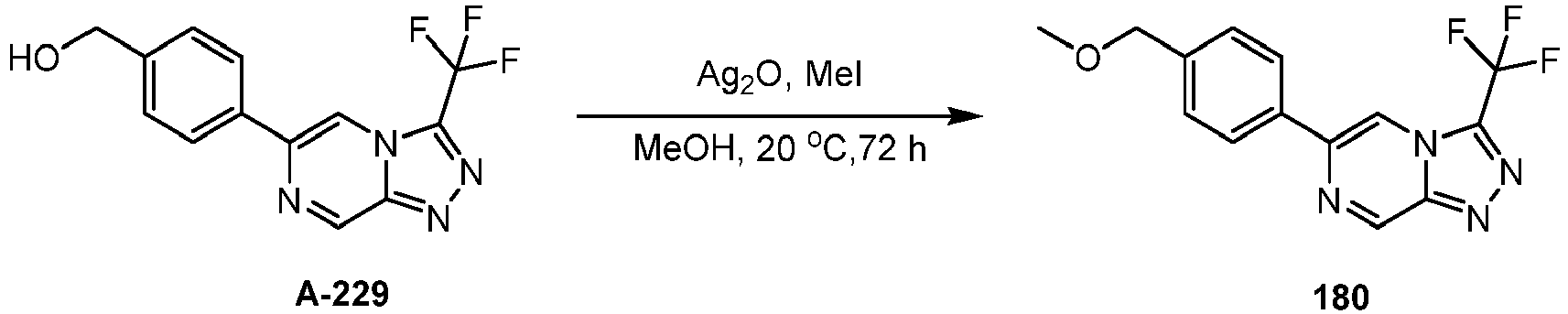
- A mixture of [4-[3-(trifluoromethyl)-[1,2,4]triazolo[4,3-a]pyrazin-6-yl]phenyl]methanol (50 mg, 0.17 mmol), Ag2O (196.90 mg, 0.85 mmol) and CH3I (0.05 mL, 0.85 mmol) in MeCN (3 mL) was keep out of the light and stirred at 20 °C for 72 hours. The mixture was filtered through Celite, and eluted with EtOAc (15 mL × 2). The filtrate was concentrated and diluted with EtOAc (20 mL), washed with water (15 mL × 2) and brine (10 mL), dried over Na2SO4, filtered and concentrated to give the crude product. The crude product was purified by Prep-TLC (silica gel, PE : EtOAc = 2 : 1) to give the product (18.97 mg, 0.06 mmol). 1H NMR (400MHz, CDCl3) δ H = 9.60 (d, 1H), 8.42 (s, 1H), 7.97 (d, 2H), 7.53 (d, 2H), 4.56 (s, 2H), 3.46 (s, 3H). LCMS Rt = 1.02 min in 2.0 min chromatography, 10-80AB, purity 100%, MS ESI calcd. for C14H12F3N4O [M+H]+ 309.1, found 308.9.
-

- A mixture of 3,6-dichloropyridazine-4-carboxylic acid (2 g, 10.36 mmol), [4-(trifluoromethoxy)phenyl]boronic acid (1.99 g, 9.67 mmol), Pd(dppf)Cl2 (758.28 mg, 1.04 mmol) and K2CO3 (2.86 g, 20.73 mmol) in 1,4-dioxane (50 mL) and water (10 mL) was stirred at 80 °C for 16 hours under N2. After cooling to r.t., the mixture was concentrated. The residue was diluted with H2O (50 mL), and acidified with 1 N HCl to pH ~ 2. The mixture was extracted with EtOAc (100 mL × 3). The combined organic phase was washed with brine (50 mL), dried over Na2SO4, filtered and concentrated to give the crude product (3300 mg, 3.46 mmol) as a solid. The crude product was used directly without any further purification. LCMS Rt = 0.79 min in 1.5 min chromatography, 5-95AB, purity 33.38%, MS ESI calcd. for C12H7ClF3N2O3 [M+H]+ 319.0, found 318.9.
- To a mixture of and 3-chloro-6-[4-(trifluoromethoxy)phenyl]pyridazine-4-carboxylic acid (3.3 g, 4.77 mmol) in Ethanol (50 mL) was added hydrazine (3.06 g, 95.32 mmol), then the mixture was stirred at 85 °C for 20 hours. After cooling to r.t., the mixture was concentrated to give the crude product (3000 mg, 9.55 mmol) as a solid, which was used directly without any further purification. LCMS Rt = 0.68 min in 1.5 min chromatography, 5-95AB, purity 28.33%, MS ESI calcd. for C12H10F3N4O3 [M+H]+ 315.1, found 314.9.
- To a mixture of 3-hydrazino-6-[4-(trifluoromethoxy)phenyl]pyridazine-4-carboxylic acid (3 g, 9.55 mmol) in toluene (30 mL) was added TFAA (4.01 g, 19.09 mmol), then the mixture was stirred at 110 °C for 3 hours. After cooling to r.t., the mixture was concentrated. The residue was poured into water (50 mL), basified with NaOH (solid) to pH- 9 and washed with EtOAc (50 mL × 2). The aqueous layer was acidified with 1N HCl solution to pH = 2, then the mixture was extracted with EtOAc (100 mL × 2). The combined organic phase was washed with brine (20 mL), dried over Na2SO4, filtered and concentrated to give the crude product. The crude product was purified by flash chromatography on silica gel (EtOAc in PE = 0% to 50% to 100%) to give the impure product, which was triturated from EtOAc (5 mL) to give the byproduct 5-[4-(trifluoromethoxy)phenyl]-1,2-dihydropyrazolo[3,4-c]pyridazin-3-one (75.11 mg, 0.25 mmol) as a solid.
- Meanwhile, the crude product was purified by flash chromatography on silica gel (MeOH in EtOAc = 0% to 5% to 10%) to give the impure product, which was further purified by prep-HPLC [Kromasil (150 mm × 25 mm, 10 µm) A = H2O (0.05% NHaOH) and B = CH3CN; 50-80 %B over 8 minutes] to give the product, 6-[4-(trifluoromethoxy)phenyl]-3-(trifluoromethyl)-[1,2,4]triazolo[4,3-b]pyridazine-8-carboxylic acid (45.79 mg) as a solid.
- 1H NMR (400MHz, DMSO-d 6) δ H = 8.34 - 8.17 (m, 3H), 7.62 (d, 2H). LCMS Rt = 1.14 min in 2.0 min chromatography, 10-80AB, purity 100%, MS ESI calcd. for C14H7F6N4O3 [M+H]+ 393.0, found 393.0.
-

- To a mixture of 6-[4-(trifluoromethoxy)phenyl]-3-(trifluoromethyl)-[1,2,4]triazolo[4,3-b]pyridazine-8-carboxylic acid (25 mg, 0.06 mmol) in DCM (5 mL) was added (COCl)2 (16.18 mg, 0.13 mmol) and DMF (2.33 mg, 0.03 mmol), then the mixture was stirred at 20 °C for 0.5 hours. To the mixture was added Methanol (1 mL), then the mixture was stirred at 20 °C for 0.5 hour. The mixture was concentrated. To NH3.H2O (10 mL) was added the solution of the residue in Methanol (1 mL) at 0 °C, then the mixture was stirred at 20 °C for 6 hours. The mixture was diluted with H2O (20 mL), and the mixture was extracted with EtOAc (30 mL × 2). The combined organic phase was washed with water (20 mL × 2) and brine (20 mL), dried over Na2SO4, filtered and concentrated to give the crude product. The crude product was triturated from i-Pr2O/hexane (1 mL/2 mL) and dried in oven to give the product (14.17 mg, 36.2 µmol) as a solid.
- 1H NMR (400MHz, CDCl3) δ H = 9.04 (brs, 1H), 8.58 (s, 1H), 8.18 (d, 2H), 7.45 (d, 2H), 6.27 (brs, 1H). LCMS Rt = 1.17 min in 2.0 min chromatography, 10-80AB, purity 100%, MS ESI calcd. for C14H8F6N5O2 [M+H]+ 392.1, found 392.0.
-

- A mixture of 7-chloro-6-[4-(trifluoromethoxy)phenyl]-3-(trifluoromethyl)-[1,2,4]triazolo[4,3-b]pyridazine (100 mg, 0.26 mmol), Pd2(dba)3 (47.82 mg, 0.05 mmol), XPhos (49.79 mg, 0.10 mmol) and Et3N (0.11 mL, 0.78 mmol) in ethanol (20 mL) was stirred at 80 °C under CO (50 psi) for 16 hours. The reaction mixture was concentrated to give a residue. The residue was diluted with water (20 mL), extracted with EtOAc (20 mL × 2). The combined organic layer was washed with water (10 mL × 2) and brine (10 mL × 2), dried over anhydrous Na2SO4, filtered and concentrated to give the crude product. The crude product was purified by flash chromatography on silica gel (EtOAc in PE = 0% to 15% to 30%) to give the product (80 mg, 164.8 µmol) as a solid. LCMS Rt = 0.87 min in 1.5 min chromatography, 5-95AB, purity 86.56%, MS ESI calcd. for C16H11F6N4O3 [M+H]+ 421.1, found 421.0.
- To a mixture of ethyl 6-[4-(trifluoromethoxy)phenyl]-3-(trifluoromethyl)-[1,2,4]triazolo[4,3-b]pyridazine-7-carboxylate (80 mg, 0.19 mmol) in THF (1 mL) and water (1 mL) was added LiOH.H2O (23.96 mg, 0.57 mmol). The resulting mixture was stirred at 20 °C for 1 hour. To the mixture was added 1N HCl aqueous (4 mL) to adjusted the pH = 2. Then the mixture was extracted with EtOAc (5 mL × 2). The combined organic layer was washed with water (5 mL × 2), brine (5 mL × 2), dried over anhydrous Na2SO4, filtered and concentrated to give the crude product (40 mg). The crude product (40 mg) was purified by triturating from n-hexane (1 mL) and i-Pr2O (1 mL) to give the product (26.44 mg, 66.1 µmol) as a solid. 1H NMR (400MHz, DMSO-d 6) δ H = 9.00 (s, 1H), 7.73 (d, 2H), 7.56 (d, 2H). LCMS Rt = 1.16 min in 2.0 min chromatography, 10-80AB, purity 97.85%, MS ESI calcd. for C14H7F6N4O3 [M+H]+ 393.0, found 392.9.
-

- To a mixture of 8-(bromomethyl)-6-[4-(trifluoromethoxy)phenyl]-3-(trifluoromethyl)-[1,2,4]triazolo[4,3-b]pyridazine (155 mg, 0.32 mmol) in THF (15 mL) and Water (15 mL) was added AgOTf (1.55 g, 6.03 mmol), then the mixture was stirred at 50 °C for 6 hours. To the mixture was added saturated NaCl aqueous (20 mL), and the mixture was extracted with EtOAc (20 mL × 2). The combined organic phase was washed with water (20 mL), brine (20 mL), dried over anhydrous Na2SO4, filtered and concentrated to give the crude product. The crude product was purified by Prep-HPLC [Waters Xbridge (150 mm × 25 mm, 5 µm) A = H2O (10 mM NH4HCO3) and B = CH3CN; 46-66% B over 6 minutes] to give the product (7.06 mg, 18.7 µmol) as a solid. 1H NMR (400MHz, CDCl3) δ H = 8.55 (s, 1H), 7.64 (d, 2H), 7.43 (d, 2H), 4.75 (d, 2H), 2.30 - 2.20 (m, 1H). LCMS Rt = 1.10 min in 2.0 min chromatography, 10-80AB, purity 100.00%, MS ESI calcd. for C14H9F6N4O2 [M+H]+ 379.1, found 379.0.
-

- To a mixture of 8-(bromomethyl)-6-[4-(trifluoromethoxy)phenyl]-3-(trifluoromethyl)-[1,2,4]triazolo[4,3-b]pyridazine (80 mg, 0.17 mmol) in THF (15 mL) and water (15 mL) was added AgOTf (800 mg, 3.11 mmol), then the mixture was stirred at 50 °C for 6 hours. To the mixture was added saturated NaCl aqueous (20 mL), and the mixture was extracted with EtOAc (20 mL × 2). The combined organic phase was washed with water (20 mL) and brine (20 mL), dried over anhydrous Na2SO4, filtered and concentrated to give the crude product. The crude product was purified by Prep-HPLC [Waters Xbridge (150 mm × 25 mm, 5 µm) A = H2O (10mM NH4HCO3) and B = CH3CN; 50-70% B over 6 minutes] to give the product (18.67 mg, 49.2 µmol) as a solid. 1H NMR (400MHz, CDCl3) δ H = 8.12 (d, 2H), 7.89 (s, 1H), 7.43 (d, 2H), 5.34 (d, 2H), 2.76 (t, 1H). LCMS Rt = 1.14 min in 2.0 min chromatography, 10-80AB, purity 100.00%, MS ESI calcd. for C14H9F6N4O2 [M+H]+ 379.1, found 379.0.
-

- To a mixture of 7-chloro-6-[4-(trifluoromethoxy)phenyl]-3-(trifluoromethyl)-[1,2,4]triazolo[4,3-b]pyridazine (45 mg, 0.12 mmol) in DMF (1 mL) was added KF (68.33 mg, 1.18 mmol), then the mixture was stirred at 110 °C for 3 hours under N2. After cooling to r.t., the mixture was diluted with H2O (10 mL), and the mixture was extracted with EtOAc (20 mL × 2). The combined organic phase was washed with water (10 mL × 2) and brine (10 mL), dried over Na2SO4, filtered and concentrated to give the crude product. The crude product was purified by Prep-TLC (silica gel, PE : EtOAc = 3:1) to give the product (13.64 mg, 37.1 µmol) as a solid. 1H NMR (400MHz, DMSO-d 6) δ H = 8.83 (d, 1H), 7.99 (d, 2H), 7.66 (d, 2H). LCMS Rt = 1.19 min in 2.0 min chromatography, 10-80AB, purity 100%, MS ESI calcd. for C13H6F7N4O [M+H]+ 367.0, found 367.0.
-

- To a solution of [5-[5-fluoro-6-(2,2,2-trifluoroethoxy)-3-pyridyl]pyrazin-2-yl]hydrazine (1 g, 3.3 mmol) in THF (10 mL) was added trimethoxymethane (1.75 g, 16.49 mmol) and TFA (0.24 mL, 3.3 mmol). The reaction mixture was stirred at 60 °C for 2 hours. After cooling to r.t., the reaction mixture was concentrated to remove most of THF and diluted with sat.NaHCO3 (30 mL). The mixture was extracted with EtOAc (30 mL × 2). The combined organic phase was washed with brine (20 mL), dried over Na2SO4, filtered and concentrated to give the product (980 mg, 3.13 mmol) as a solid. 1H NMR (400MHz DMSO-d 6) δ H = 9.56 (d, 1H), 9.50 (s, 1H), 9.26 (d, 1H), 8.69 (d, 1H), 8.40 (dd, 1H), 5.18 (q, 2H).
- A mixture of 6-[5-fluoro-6-(2,2,2-trifluoroethoxy)-3-pyridyl]-[1,2,4]triazolo[4,3-a]pyrazine (600 mg, 1.92 mmol) and NBS (375.04 mg, 2.11 mmol) in THF (20 mL) was stirred at 65 °C for 2 hours. The mixture was diluted with H2O (20 mL), and the mixture was extracted with EtOAc (20 mL × 2). The combined organic phase was washed with brine (20 mL), dried over Na2SO4, filtered and concentrated. The residue was purified by flash chromatography on silica gel (EtOAc in PE = 0% to 30% to 70%) to give the product (280 mg, 0.71 mmol) as a solid. 1H NMR (400MHz, DMSO-d 6) δ H = 9.55 (d, 1H), 9.01 (d, 1H), 8.82 (d, 1H), 8.62 (dd, 1H), 5.18 (q, 2H).
- A mixture of 3-bromo-6-[5-fluoro-6-(2,2,2-trifluoroethoxy)-3-pyridyl]-[1,2,4]triazolo[4,3-a]pyrazine (100 mg, 0.26 mmol), 4-fluorophenol (42.88 mg, 0.38 mmol), K2CO3 (140.99 mg, 1.02 mmol) and CuI (29.14 mg, 0.15 mmol) in DMSO (1 mL) under N2 was stirred at 100 °C for 16 hours. The mixture was cooled to r.t., diluted with EtOAc (10 mL), filtered through Celite and eluted with EtOAc (20 mL × 2), then the filtrate was washed with H2O (20 mL) and brine (10 mL) and concentrated to give the crude product. The crude product was purified by Prep-HPLC (Waters Xbridge (150 mm × 25 mm, 5 µm), A = H2O (10 mM NH4HCO3) and B = CH3CN; 45-75% B over 6 minutes) to give the product (6.2 mg, 14.6 µmolas a solid. 1H NMR (400MHz, DMSO-d 6) δ H = 9.43 (d, 1H), 9.09 (d, 1H), 8.80 (d, 1H), 8.54 (dd, 1H), 7.59 - 7.54 (m, 2H), 7.39 - 7.33 (m, 2H), 5.17 (q, 2H). LCMS Rt = 1.20 min in 2.0 min chromatography, 10-80AB, purity 96.20%, MS ESI calcd. for C18H11F5N5O2 [M+H]+424.1, found 424.0.
-

- To a mixture of 6-[4-(trifluoromethoxy)phenyl]-3-(trifluoromethyl)-[1,2,4]triazolo[4,3-b]pyridazin-8-amine (60 mg, 0.17 mmol), TBAC (137.14 mg, 0.49 mmol) and TsOH.HzO (47.14 mg, 0.25 mmol) in MeCN (6 mL) was added isopentylnitrite (29.14 mg, 0.25 mmol) and CuCh (4.29 mg, 0.03 mmol), then the mixture was stirred at 20 °C for 6 hours. The mixture was diluted with H2O (20 mL), and the mixture was extracted with EtOAc (30 mL × 2). The combined organic phase was washed with water (20 mL) and brine (20 mL), dried over Na2SO4, filtered and concentrated to give the crude product. The crude product was purified by Prep-TLC (silica gel, PE : EtOAc = 3:1) to give the product (7.24 mg, 18.8 µmol) as a solid. 1H NMR (400MHz, CDCl3) δ H = 8.06 (d, 2H), 7.82 (s, 1H), 7.44 (d, 2H). LCMS Rt = 1.24 min in 2.0 min chromatography, 10-80AB, purity 99.16%, MS ESI calcd. for C13H6ClF6N4O [M+H]+ 383.0, found 382.9.
-

- A mixture of 7-chloro-6-[4-(trifluoromethoxy)phenyl]-3-(trifluoromethyl)-[1,2,4]triazolo[4,3-b]pyridazine (250 mg, 0.65 mmol), diphenylmethanimine (355.21 mg, 1.96 mmol), Pd2(dba)3 (89.74 mg, 0.10 mmol), XantPhos (132.31 mg, 0.23 mmol) and Cs2CO3 (532.14 mg, 1.63 mmol) in toluene (8 mL) was stirred at 95 °C for 5 hours under N2. After cooling to r.t., the mixture was concentrated. The residue was diluted with H2O (30 mL), and the mixture was extracted with EtOAc (50 mL × 2). The combined organic phase was washed with water (20 mL) and brine (20 mL), dried over Na2SO4, filtered and concentrated to give the crude product. The crude product was purified by flash chromatography on silica gel (EtOAc in PE = 0% to 10% to 20%) to give the product (380 mg, 0.62 mmol) as a solid. LCMS Rt = 0.96 min in 1.5 min chromatography, 5-95AB, purity 85.69%, MS ESI calcd. for C26H16F6N5O [M+H]+ 528.1, found 528.1.
- To a mixture of 1,1-diphenyl-N-[6-[4-(trifluoromethoxy)phenyl]-3-(trifluoromethyl)-[1,2,4]triazolo[4,3-b]pyridazin-7-yl]methanimine (80 mg, 0.15 mmol) in DCM (2 mL) was added HCl/dioxane (0.15 mL, 0.61 mmol), then the mixture was stirred at 20 °C for 12 hours. The mixture was diluted with water (5 mL), basified with Na2CO3 (solid) to pH- 8, then extracted with DCM (20 mL × 2). The combined organic phase was washed with brine (10 mL), dried over Na2SO4, filtered and concentrated to give the crude product. The crude product was purified by flash chromatography on silica gel (EtOAc in PE = 0% to 50% to 100% ) to give the product (38.97 mg, 107.3 µmol) as a solid. 1H NMR (400MHz DMSO-d 6) δ H = 7.79 (d, 2H), 7.59 (d, 2H), 7.09 (s, 1H), 6.37 (br s, 2H). LCMS Rt = 1.18 min in 2.0 min chromatography, 10-80AB, purity 100%, MS ESI calcd. for C13H8F6N5O [M+H]+ 364.1, found 364.1.
-

- A mixture of 6-[4-(trifluoromethoxy)phenyl]-3-(trifluoromethyl)-[1,2,4]triazolo[4,3-b]pyridazin-7-amine (70 mg, 0.19 mmol) in pyridine (1 mL) was added acetyl chloride (45.39 mg, 0.58 mmol) and DMAP (23.54 mg, 0.19 mmol), then the mixture was stirred at 70 °C for 12 hours. After cooling to r.t., the mixture was concentrated to give the residue. The residue was diluted with H2O (10 mL), and the mixture was extracted with EtOAc (20 mL × 2). The combined organic phase was washed with water (10 mL) and brine (10 mL), dried over Na2SO4, filtered and concentrated to give the crude product. The crude product was purified by Prep-TLC (silica gel, PE : EtOAc = 1 : 5) to give the product (17.05 mg, 42.1 µmol) as a solid. 1H NMR (400MHz, DMSO-d 6) δ H = 9.90 (s, 1H), 8.77 (s, 1H), 7.81 (d, 2H), 7.59 (d, 2H), 2.05 (s, 3H). LCMS Rt = 1.13 min in 2.0 min chromatography, 10-80AB, purity 100%, MS ESI calcd. for C15H10F6N5O2 [M+H]+ 406.1, found 406.0.
-

- To a mixture of 8-methyl-6-[4-(trifluoromethoxy)phenyl]-3-(trifluoromethyl)-[1,2,4]triazolo[4,3-a]pyrazine (120 mg, 0.33 mmol) and NBS (76.65 mg, 0.43 mmol) in carbon tetrachloride (2 mL) was added BPO (80.25 mg, 0.33 mmol), then the mixture was stirred at 90 °C under N2 for 1 hour. After cooling to r.t., the mixture was diluted with H2O (20 mL), and the mixture was extracted with EtOAc (10 mL × 2). The combined organic phase was washed with water (10 mL) and brine (10 mL), dried over Na2SO4, filtered and concentrated to give the crude product. The crude product was purified by Prep-TLC (silica gel, PE : EtOAc = 5 : 1) to give the impure product (45 mg, 49.9 µmol) as a solid. LCMS Rt = 0.89 min in 1.5 min chromatography, 5-95AB, purity 48.87%, MS ESI calcd. for C14H8BrF6N4O [M+H+2]+ 443.0, found 442.9.
- A mixture of 8-(bromomethyl)-6-[4-(trifluoromethoxy)phenyl]-3-(trifluoromethyl)-[1,2,4]triazolo[4,3-a]pyrazine (40 mg, 0.08 mmol) and AgOTf (192.77 mg, 0.75 mmol) in methanol (5 mL) was stirred at 20 °C for 16 hours. The reaction mixture was diluted with EtOAc (20 mL), and treated with brine (20 mL). The organic phase was separated and concentrated. The residue was purified by Prep-TLC (silica gel, PE : EA = 3 : 1) to give the product (4.93 mg, 12.5 µmol) as a solid. 1H NMR (400MHz, DMSO-d 6) δ H = 9.04 (s, 1H), 8.32 (d, 2H), 7.56 (d, 2H), 5.08 (s, 2H), 3.52 (s, 3H). LCMS Rt = 1.17 min in 2.0 min chromatography, 10-80AB, purity 98.51%, MS ESI calcd. for C15H11F6N4O2 [M+H]+ 393.1, found 393.0.
-

- To a mixture of 6-[4-(trifluoromethoxy)phenyl]-3-(trifluoromethyl)-[1,2,4]triazolo[4,3-b]pyridazine-7-carboxylic acid (37 mg, 0.09 mmol) in DCM (5 mL) was added (COCl)2 (23.95 mg, 0.19 mmol) and DMF (3.45 mg, 0.05 mmol), then the mixture was stirred at 20 °C for 0.5 hours. To the mixture was added methanol (2 mL), then the mixture was stirred at 20 °C for 0.5 hour. The mixture was diluted with EtOAc (30 mL), washed with water (10 mL) and brine (10 mL), dried over anhydrous Na2SO4, filtered and concentrated to give the residue. To NH3.H2O (10 mL, 0.29 mmol) was added the solution of the residue in THF (2 mL) at 0 °C, then the mixture was stirred at 20 °C for 16 hours. To the mixture was added water (15 mL), and extracted with EtOAc (15 mL × 2). The combined organic phase was washed with water (10 mL × 2) and brine (10 mL × 2), dried over anhydrous Na2SO4, filtered and concentrated to give the crude product. The crude product was purified by Prep-TLC (silica gel, PE : EtOAc = 1 : 3) to give the product (5.67 mg, 14.5 µmol) as a solid. 1H NMR (400MHz, DMSO-d 6) δ H = 8.80 (s, 1H), 8.32 (s, 1H), 8.02 (s, 1H), 7.78 (d, 2H), 7.58 (d, 2H). LCMS Rt = 1.14 min in 2.0 min chromatography, 10-80AB, purity 100.00%, MS ESI calcd. for C14H8F6N5O2 [M+H]+ 392.1, found 391.9.
-

- A mixture of 6-chloro-3-(trifluoromethyl)-[1,2,4]triazolo[4,3-a]pyrazine (150 mg, 0.67 mmol), (3-fluoro-4-hydroxy-phenyl)boronic acid (157.63 mg, 1.01 mmol), Pd(dppf)Cl2 (73.97 mg, 0.10 mmol) and Cs2CO3 (439.16 mg, 1.35 mmol) in 1,4-dioxane (4 mL) and water (0.40 mL) was stirred at 70 °C for 3 hours. After cooling to r.t., the mixture was diluted with EtOAc (10 mL), filtered through silica gel, eluted with EtOAc (20 mL) and concentrated to give the crude product. The crude product was purified by flash chromatograph on silica gel (EtOAc in PE = 0% to 40%) to give the product (40 mg, 0.12 mmol) as a solid. LCMS Rt = 0.70 min in 1.5 min chromatography, 5-95AB, purity 93.52%, MS ESI calcd. for C12H7F4N4O [M+H]+ 299.0, found 298.9.
- To a mixture of 2-fluoro-4-[3-(trifluoromethyl)-[1,2,4]triazolo[4,3-a]pyrazin-6-yl]phenol (40 mg, 0.13 mmol), 3,3-difluorocyclobutanol (43.5 mg, 0.40 mmol)and PPh3 (63.33 mg, 0.24 mmol) in THF (3 mL) was added DEAD (42.05 mg, 0.24 mmol) at 0 °C. Then the mixture was allowed to be warmed to 70 °C and stirred for 16 hours. After cooling to r.t., the mixture was concentrated to give the crude product. The product was purified by Prep-TLC (PE : EtOAc = 3 : 1) to give the impure product. The impure product was purified by Prep-HPLC [Xtimate C18 (150 mm × 25 mm, 5 µm) A = H2O (0.05% ammonia hydroxide ) and B = CH3CN; 43-73%B over 8 minutes] to give the product (1.78 mg, 4.5 µmol) as a solid. 1H NMR (400MHz, CDCl3) δ H = 9.57 (d, 1H), 8.34 (s, 1H), 7.79 (dd, 1H), 7.73 - 7.69 (m, 1H), 6.95 (t, 1H), 4.84 - 4.73 (m, 1H), 3.22 - 3.09 (m, 2H), 2.96 - 2.81 (m, 2H). LCMS Rt = 1.18 min in 2.0 min chromatography, 10-80AB, purity 100.00%, MS ESI calcd. for C16H11F6N4O [M+H]+ 389.1, found 389.1.
-

- A mixture of [4-[3-(trifluoromethyl)-[1,2,4]triazolo[4,3-a]pyrazin-6-yl]phenyl]methanol (50 mg, 0.17 mmol) and SOCh (0.06 mL, 0.85 mmol) in DCM (2 mL) was stirred at 20 °C for 16 hours. The mixture was quenched with sat.NaHCOs (20 mL), and the mixture was extracted with DCM (20 mL × 2). The combined organic phase was washed with brine (10 mL), dried over Na2SO4, filtered and concentrated to give the crude product (30 mg, 0.06 mmol) as oil. The crude product was used directly in next step without any purification. LCMS Rt = 0.84 min in 1.5 min chromatography, 5-95AB, purity 64.26%, MS ESI calcd. for C13H9ClF3N4 [M+H]+ 313.0, found 312.9.
- To a solution of 6-[4-(chloromethyl)phenyl]-3-(trifluoromethyl)-[1,2,4]triazolo[4,3-a]pyrazine (50 mg, 0.16 mmol) in IPA (3 mL) was added AgOTf (410.87 mg, 1.60 mmol), and the mixture was stirred at 20 °C for 16 hours. The mixture was filtered through Celite, and eluted with EtOAc (15 mL × 2). The filtrate was concentrated and diluted with EtOAc (20 mL), washed with water (15 mL × 2) and brine (10 mL), dried over Na2SO4, filtered and concentrated to give the crude product. The crude product was purified by Prep-TLC (silica gel, PE : EtOAc = 3:1) to give the product (24.73 mg, 0.07 mmol) as a solid. 1H NMR (400MHz, CDCl3) δ H = 9.60 (d, 1H), 8.41 (s, 1H), 7.96 (d, 2H), 7.54 (d, 2H), 4.61 (s, 2H), 3.80 - 3.66 (m, 1H), 1.26 (d, 6H). LCMS Rt = 1.22 min in 2 min chromatography, 10-80AB, purity 100%, MS ESI calcd. for C16H16F3N4O [M+H]+ 337.1, found 336.9.
-
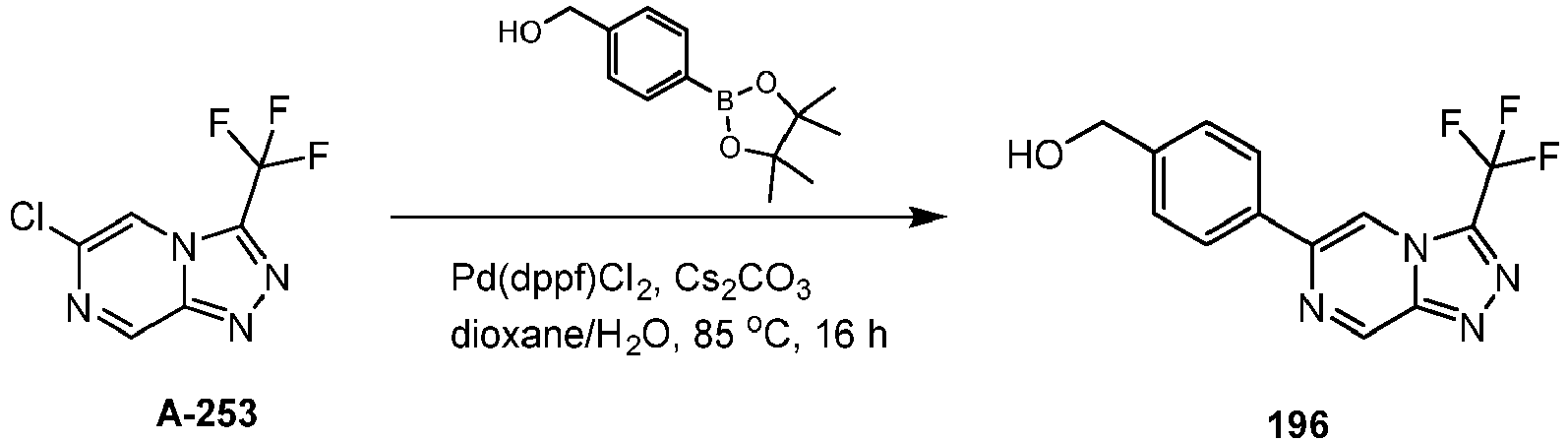
- A mixture of 6-chloro-3-(trifluoromethyl)-[1,2,4]triazolo[4,3-a]pyrazine (300 mg, 1.35 mmol), [4-(hydroxymethyl)phenyl]boronic acid (307.25 mg, 2.02 mmol), Pd(dppf)Cl2 (147.94 mg, 0.20 mmol) and Cs2CO3 (878.32 mg, 2.7 mmol) in 1,4-dioxane (10mL) and water (1mL) was stirred at 85 °C for 16 hours. After cooling to r.t., the mixture was filtered through Celite, and eluted with EtOAc (10 mL × 2). The filtrate was concentrated and diluted with EtOAc (10 mL), washed with water (10 mL × 2) and brine (10 mL), dried over Na2SO4, filtered and concentrated to give the crude product. The crude product was purified by flash chromatography on silica gel (EtOAc in PE = 30% to 80%) to give impure product. The impure product was purified by Prep-HPLC (Waters Xbridge (150 mm × 25 mm, 5 µm), A = water (10 mM NH4HCO3) and B = CH3CN; 18 - 48% B over 6 minutes) to give the product (21.13 mg, 0.07 mmol) as a solid. 1H NMR (400MHz, DMSO-d 6) δ H = 9.76 (d, 1H), 8.96 (s, 1H), 8.15 (d, 2H), 7.49 (d, 2H), 5.32 (t, 1H), 4.59 (d, 2H). LCMS Rt = 0.83 min in 2.0 min chromatography, 10-80AB, purity 100%, MS ESI calcd. for C13H10F3N4O [M+H]+ 295.1, found 294.9.
-

- To a mixture of AgOTf (781.31 mg, 3.04 mmol), KF (235.56 mg, 4.05 mmol), Selectfluor (538.62 mg, 1.52 mmol) and [4-[3-(difluoromethyl)-[1,2,4]triazolo[4,3-a]pyrazin-6-yl]phenyl]methanol (140 mg, 0.51 mmol) in ethyl acetate (6 mL) was added 2-fluoropyridine (295.23 mg, 3.04 mmol) and trimethyl(trifluoromethyl)silane (432.38 mg, 3.04 mmol) under N2, and the mixture was stirred at 30 °C for 16 hours. The mixture was diluted with sat.NH4Cl (10 mL), filtered through Celite and eluted with EtOAc (30 mL × 2). The filtrate was concentrated to give the crude product. The crude product was purified by Prep-TLC (silica gel, PE : EtOAc = 3:1) to give the product (8.36 mg, 24.3 µmol) as a solid. 1H NMR (400MHz, DMSO-d 6) δ H = 9.68 (d, 1H), 9.21 (d, 1H), 8.19 (d, 2H), 7.86 (t, 1H), 7.62 (d, 2H), 5.26 (s, 2H). LCMS Rt = 1.19 min in 2.0 min chromatography, 10-80AB, purity 100%, MS ESI calcd. for C14H10F5N4O [M+H]+ 345.1, found 344.9.
-

- A mixture of [6-chloro-3-[4-(trifluoromethoxy)phenyl]pyrazin-2-yl]methanol (500 mg, 1.64 mmol) and SOCl2 (5 mL) was stirred at 60 °C for 1 hour. After cooling to r.t., the mixture was concentrated. The residue was poured into sat.Na2CO3 (20 mL), and the mixture was extracted with EtOAc (50 mL × 2). The combined organic phase was washed with brine (20 mL), dried over Na2SO4, filtered and concentrated to give the crude product (600 mg, 1.86 mmol, crude) as oil, which was used directly without any further purification. LCMS Rt = 0.97 min in 1.5 min chromatography, 5-95AB, purity 47.74%, MS ESI calcd. for C12H8Cl2F3N2O [M+H]+ 323.0, found 323.0.
- A mixture of 5-chloro-3-(chloromethyl)-2-[4-(trifluoromethoxy)phenyl]pyrazine (600 mg, 1.86 mmol) and AgOTf (4771.4 mg, 18.57 mmol) in methanol (15 mL) was stirred at 50 °C for 6 hours. After cooling to r.t., the mixture was quenched with sat.NH4Cl (20 mL), and the mixture was filtered through Celite and eluted with EtOAc (30 mL × 2). The filtrate was concentrated to give the crude product (70 0mg, 1.41 mmol) as an oil. The crude product was used directly without any further purification. LCMS Rt = 0.88 min in 1.5 min chromatography, 5-95AB, purity 64.30%, MS ESI calcd. for C13H11ClF3N2O2 [M+H]+ 319.0, found 318.9.
- A mixture of 5-chloro-3-(methoxymethyl)-2-[4-(trifluoromethoxy)phenyl]pyrazine (700 mg, 2.2 mmol) and N2H4 (2.11 g, 65.9 mmol) in MeCN (10 mL) was stirred at 90 °C for 1 hour. The mixture was stirred at 90 °C for another 30 mins. After cooling to r.t., the mixture was diluted with H2O (20 mL) and extracted with EtOAc (40 mL × 2). The combined organic phase was washed with H2O (20 mL) and brine (20 mL), dried over Na2SO4, filtered and concentrated to give the crude product (350 mg, 0.57 mmol, crude) as a solid. The crude product was used directly without any further purification. LCMS Rt = 0.94 min in 2.0 min chromatography, 10-80AB, purity 50.92%, MS ESI calcd. for C13H14F3N4O2 [M+H]+ 315.1, found 315.1.
- A mixture of [6-(methoxymethyl)-5-[4-(trifluoromethoxy)phenyl]pyrazin-2-yl]hydrazine (350 mg, 1.11 mmol) and 2,2,2-trifluoroacetaldehyde (582.23 mg, 4.45 mmol) in ethanol (1mL) was stirred at 100 °C for 2 hours. After cooling to r.t., the mixture was diluted with H2O (20 mL) and extracted with EtOAc (30 mL × 2). The combined organic phase was washed with brine (20 mL), dried over Na2SO4, filtered and concentrated to give the crude product (400 mg, 1.01 mmol, crude) as an oil, which was used directly without any further purification. LCMS Rt = 0.89 min in 1.5 min chromatography, 5-95AB, purity 52.48%, MS ESI calcd. for C15H13F6N4O2 [M+H]+ 395.1, found 395.4.
- To a solution of 6-(methoxymethyl)-N-(2,2,2-trifluoroethylideneamino)-5-[4-(trifluoromethoxy)phenyl]pyrazin-2-amine (400 mg, 1.01 mmol) in DMF (5 mL) was added NBS (180.57 mg, 1.01 mmol), and the mixture was stirred at 15 °C for 20 minutes. The mixture was diluted with H2O (20 mL) and extracted with EtOAc (50 mL × 2). The combined organic phase was washed with H2O (30 mL) and brine (30 mL), dried over Na2SO4, filtered and concentrated to give the crude product (500 mg, 1.06 mmol, crude) as oil, which was used directly without any further purification. LCMS Rt = 0.99 min in 1.5 min chromatography, 5-95AB, purity 17.37%, MS ESI calcd. for C15H12BrF6N4O2 [M+H+2]+ 475.0, found 475.0.
- To a solution of 2,2,2-trifluoro-N-[6-(methoxymethyl)-5-[4-(trifluoromethoxy)phenyl]pyrazin-2-yl]ethanehydrazonoyl bromide (500 mg, 1.06 mmol) in toluene (10 mL) was added Et3N (0.73 mL, 5.28 mmol), and the mixture was stirred at 15 °C for 30 mins. The mixture was diluted with H2O (10 mL) and extracted with EtOAc (30 mL × 2). The combined organic phase was washed with brine (20 mL), dried over Na2SO4, filtered and concentrated to give the crude product. The crude product was purified by flash chromatography on silica gel (EtOAc in PE = 20% to 40% to 60%) to give the impure product (-100 mg). The impure product was purified by prep-TLC (silica gel, PE : EtOAc = 2:1) to give the product (24.86 mg, 0.06 mmol) as a solid. 1H NMR (400MHz, CDCl3) δ H = 9.54 (s, 1H), 7.77 (d, 2H), 7.40 (d, 2H), 4.68 (s, 2H), 3.44 (s, 3H). LCMS Rt = 1.17 min in 2 min chromatography, 10-80AB, purity 100%, MS ESI calcd. for C15H11F6N4O2 [M+H]+ 393.1, found 393.0.
-

- The sample was analyzed by SFC to show two peaks (Peak 1: Rt = 2.35 min, Peak 2: Rt = 2.49 min).
- Method: Column: ChiralCel OJ-H 150 × 4.6 mm I.D., 5µm Mobile phase: A: CO2 B: IPA (0.05% DEA) Gradient: from 5% to 40% of B in 5.5 min and hold 40% for 3 min, then 5% of B for 1.5 min Flow rate: 2.5 mL/min Column temperature: 40 °C.
- The product was separated by SFC (DAICEL CHIRALCEL OJ-H (250 mm × 30 mm, 5µm)); A = CO2 and B = IPA (0.1% NH3H2O); 35 °C; 50 mL/min; 15% B; 10 min run; 20 injections, Rt of peak 1 = 7.33 min, Rt of peak 2 = 8.3 min) to give 3-(trifluoromethyl)-6-[6-[(1R)-2,2,2-trifluoro-1-methyl-ethoxy]-3-pyridyl]-[1,2,4]triazolo[4,3-b]pyridazine (6.76 mg, 17.9 µmol) (Peak 1, Rt = 2.35 min in SFC) as a solid, and 3-(trifluoromethyl)-6-[6-[(1S)-2,2,2-trifluoro-1-methyl-ethoxy]-3-pyridyl]-[1,2,4]triazolo[4,3-b]pyridazine (16.41 mg, 43.5 µmol) (Peak 2: Rt = 2.49 min in SFC) as a solid.
- Note: the enantiomers were randomly assigned.
- Compound 201 (peak 1): 1H NMR (400MHz, CDCl3 +D2O) δ H = 8.79 (d, 1H), 8.36 - 8.31 (m, 2H), 7.74 (d, 1H), 7.03 (d, 1H), 5.95 - 5.82 (m, 1H), 1.56 (d, 3H) LCMS Rt = 1.20 min in 2 min chromatography, 10-80AB, purity 100%, MS ESI calcd. for C14H10F6N5O [M+H]+ 378.1, found 378.0.
- Compound 202 (peak 2): 1H NMR (400MHz, CDCl3 + D2O) δ H = 8.79 (d, 1H), 8.37 - 8.31 (m, 2H), 7.74 (d, 1H), 7.03 (d, 1H), 5.96 - 5.81 (m, 1H), 1.56 (d, 3H). LCMS Rt = 1.18 min in 2 min chromatography, 10-80AB, purity 100%, MS ESI calcd. for C14H10F6N5O [M+H]+ 378.1, found 378.0.
-

- To a solution of methyl 3-amino-6-chloro-pyrazine-2-carboxylate (3 g, 15.99 mmol) in THF (150 mL) was added DIBAL-H (63.97 mL, 63.97 mmol) at -40 °C and the mixture was allowed to warmed to -10 °C and stirred for 1 hour. To the mixture was added potassium sodium tartrate (sat. aq., ~ 100 mL) slowly, and the mixture was stirred at r.t. for 2 hours. The mixture was extracted with EtOAc (150 mL × 2), and the combined organic phase was washed with brine (50 mL), dried over Na2SO4, filtered and concentrated to give the crude product (2400 mg, 15.04 mmol) as a solid. 1H NMR (400MHz, CDCl3) δ H = 7.98 (s, 1H), 5.00 (br s, 2H), 4.72 (s, 2H), 2.73 (br s, 1H).
- To a mixture of (3-amino-6-chloro-pyrazin-2-yl)methanol (2.4 g, 15.04 mmol) in HBr (20 mL) was added Br2 (2.31 mL, 45.12 mmol) at 0 °C, followed by NaNO2 (2.59g, 37.6mmol) in water (5 mL), and the mixture was stirred at 15 °C for 3 hours. The mixture was diluted with H2O (20 mL) and quenched by NaHSO3 (solid, ~ 5g). The mixture extracted with EtOAc (100 mL × 2), and the combined organic phase was washed with sat.Na2CO3 (50 mL) and brine (50 mL), dried over Na2SO4, filtered and concentrated to give the crude product. The crude product was purified by flash chromatography on silica gel (EtOAc in PE = 5% to 10% to 15% to 20% to 30%) to give the product (1100 mg, 4.92 mmol) as colorless oil. 1H NMR (400MHz, CDCl3) δ H = 8.34 (s, 1H), 4.82 (dd, 2H), 3.32 (t, 1H).
- A mixture of (3-bromo-6-chloro-pyrazin-2-yl)methanol (1.1 g, 4.92 mmol), [4-(trifluoromethoxy)phenyl]boronic acid (1.06 g, 5.17 mmol), Cs2CO3 (3.21 g, 9.85 mmol) and Pd(dppf)Cl2 (360.19 mg, 0.49 mmol) in 1,4-dioxane (20 mL) and water (2 mL) was stirred at 60 °C for 10 hours. After cooling to r.t., the mixture was concentrated to give the crude product. The crude product was purified by flash chromatography on silica gel (EtOAc in PE = 20% to 40% to 50%) to give the pure product (600 mg, 1.97 mmol) as a colorless oil. 1H NMR (400MHz, CDCl3) δ H = 8.63 (s, 1H), 7.65 (d, 2H), 7.37 (d, 2H), 4.80 (d, 2H), 3.40 (t, 1H).
- A mixture of [6-chloro-3-[4-(trifluoromethoxy)phenyl]pyrazin-2-yl]methanol (600 mg, 1.97 mmol) and N2H4 (1890.69 mg, 59.08 mmol) in MeCN (20 mL) was stirred at 90 °C for 2 hours. After cooling to r.t., the mixture was diluted with H2O (30 mL) and extracted with EtOAc (50 mL × 2). The combined organic phase was washed with H2O (20 mL) and brine (20 mL), dried over Na2SO4, filtered and concentrated to give the crude product (460 mg, 1.53 mmol) as a solid, which was used directly without any further purification. LCMS Rt = 0.67 min in 1.5 min chromatography, 5-95AB, purity 59.13%, MS ESI calcd. for C12H12F3N4O2 [M+H]+ 301.1, found 301.0.
- A mixture of [6-hydrazino-3-[4-(trifluoromethoxy)phenyl]pyrazin-2-yl]methanol (460 mg, 1.53 mmol) and 2,2,2-trifluoroacetaldehyde (250.3 mg, 1.92 mmol) in ethanol (2 mL) was stirred at 100 °C for 16 hours. After cooling to r.t., the mixture was diluted with H2O (20 mL) and extracted with EtOAc (40 mL × 2). The combined organic phase was washed with brine (30 mL), dried over Na2SO4, filtered and concentrated to give the crude product (600 mg, 1.58 mmol, crude) as oil. The crude product was used directly without any further purification. LCMS Rt = 0.85 min in 1.5 min chromatography, 5-95AB, purity 35.73%, MS ESI calcd. for C14H11F6N4O2 [M+H]+ 381.1, found 381.0.
- To a solution of [6-[2-(2,2,2-trifluoroethylidene)hydrazino]-3-[4-(trifluoromethoxy)phenyl]pyrazin-2-yl]methanol (600 mg, 1.58 mmol) in DMF (5 mL) was added NBS (294.88 mg, 1.66 mmol), and the mixture was stirred at 15 °C for 20 mins. The mixture was diluted with H2O (20 mL) and extracted with EtOAc (50 mL × 2). The combined organic phase was washed with H2O (30 mL) and brine (30 mL), dried over Na2SO4, filtered and concentrated to give the crude product (800 mg, 1.74mmol) as oil, which was used directly for next step without any further purification. LCMS Rt = 0.91 min in 1.5 min chromatography, 5-95AB, MS ESI calcd. for C14H10BrF6N4O2 [M+H]+ 459.0, found 459.0.
- A mixture of 2,2,2-trifluoro-N-[6-(hydroxymethyl)-5-[4-(trifluoromethoxy)phenyl]pyrazin-2-yl]ethanehydrazonoyl bromide (800 mg, 1.74 mmol) and Et3N (0.72 mL, 5.23 mmol) in Toluene (5 mL) was stirred at 15 °C for 20 mins. The mixture was diluted with H2O (20 mL) and extracted with EtOAc (50 mL × 2). The combined organic phase was washed with brine (20 mL), dried over Na2SO4, filtered and concentrated to give the crude product. The crude product was purified by flash chromatography on silica gel (EtOAc in PE = 20% to 40% to 60%) to give the impure product (~ 400 mg).
- A part of the impure product (~ 30 mg) was by prep-TLC (silica gel, PE : EtOAc = 1 : 1) to give the product (12.8 mg, 33.8 µmol) as a solid. 1H NMR (400MHz, DMSO-d 6) δ H = 9.55 (s, 1H), 7.82 (d, 2H), 7.40 (d, 2H), 5.06 (d, 2H), 2.43 - 2.31 (m, 1H). LCMS Rt = 1.04 min in 2.0 min chromatography, 10-80AB, purity 100.00%, MS ESI calcd. for C14H9F6N4O2 [M+H]+ 379.1, found 379.0.
-

- A mixture of 6-[4-(trifluoromethoxy)phenyl]-3-(trifluoromethyl)-[1,2,4]triazolo[4,3-a]pyrazine (920 mg, 2.64 mmol) and NCS (529.21 mg, 3.96 mmol) in DMF (30 mL) was stirred at 70 °C for 16 hours to give a brown mixture. After cooling to r.t., the mixture was diluted with H2O (50 mL), and the mixture was extracted with EtOAc (100 mL × 2). The combined organic phase was washed with water (50 mL × 2) and brine (50 mL), dried over Na2SO4, filtered and concentrated. The residue was purified by flash chromatography on silica gel (EtOAc in PE = 0% to 10% to 20%) to give the impure product (580 mg) as a solid.
- A part of the impure product (30 mg) was triturated from hexane (1 mL) and dried in an oven to give the product (11 mg) as an off-white solid 1H NMR (400MHz, CDCl3) δ H = 8.37 (s, 1H), 8.02 (d, 2H), 7.41 (dd, 2H). LCMS Rt = 1.21 min in 2.0 min chromatography, 10-80AB, purity 100%, MS ESI calcd. for C13H6ClF6N4O [M+H]+ 383.0, found 382.9.
-

- A mixture of 8-chloro-6-[4-(trifluoromethoxy)phenyl]-3-(trifluoromethyl)-[1,2,4]triazolo[4,3-a]pyrazine (480 mg, 1.25 mmol) in NH3.H2O (100 mL) and MeCN (50 mL) was stirred at 65 °C for 2 hours. After cooling to r.t., the mixture was concentrated. The residue was diluted with H2O (30 mL), and the mixture was extracted with EtOAc (50 mL × 2). The combined organic phase was washed with water (30 mL) and brine (30 mL), dried over Na2SO4, filtered and concentrated to give the crude product (430 mg, 94% yield) as a solid.
- A part of the crude product (30 mg) was purified by Prep-TLC (silica gel, PE : EtOAc = 2 : 1) to give 6-[4-(trifluoromethoxy)phenyl]-3-(trifluoromethyl)-[1,2,4]triazolo[4,3-a]pyrazin-8-amine (17.28 mg) as a solid. 1H NMR (400MHz, CDCl3) δ H = 7.92 (d, 2H), 7.88 (s, 1H), 7.34 (d, 2H), 6.04 (br s, 2H). LCMS Rt = 1.23 min in 2.0 min chromatography, 10-80AB, purity 100%, MS ESI calcd. for C13H8F6N5O [M+H]+ 364.1, found 363.9.
-

- To a solution of 5-chloropyrazin-2-amine (500 mg, 3.86 mmol) in DCM (5mL) was added NBS (686.92 mg, 3.86 mmol), and the brown mixture was stirred at 40 °C for 1 hour. After cooling to r.t., the mixture was filtered through silica gel and eluted with EtOAc (20 mL × 3), and the filtrate was concentrated to give the crude product. The crude product was purified by flash chromatography on silica gel (EtOAc in PE = 20% to 40% to 50%) to give the product (600 mg) as a solid. 1H NMR (400MHz, CDCl3 ) δ H = 7.98 (s, 1H), 5.05 (br s, 2H).
- A mixture of 3-bromo-5-chloro-pyrazin-2-amine (600 mg, 2.88 mmol), 2,4,6-trimethyl-1,3,5,2,4,6-trioxatriborinane (397.48 mg, 3.17 mmol), Cs2CO3 (1.88 g, 5.76 mmol) and Pd(dppf)Cl2 (210.62 mg, 0.29 mmol) in 1,4-Dioxane (5 mL) and Water (0.50 mL) was stirred at 70 °C for 16 hours. After cooling to r.t., the mixture was concentrated to give the crude product. The crude product was purified by flash chromatography on silica gel (EtOAc in PE = 20% to 40% to 60% to 80%) to give the product (200 mg) as a solid. 1H NMR (400MHz, CDCl3) δ H = 7.90 (s, 1H), 4.55 (br s, 2H), 2.40 (s, 3H).
- To a mixture of 5-chloro-3-methyl-pyrazin-2-amine (200 mg, 1.39 mmol) in Acetic acid (3mL) and HBr (3 mL) was added Br2 (0.18 mL, 3.48 mmol) at 0 °C, followed by NaNO2 (288.34 mg, 4.18 mmol) in Water (0.5 mL), and the mixture was stirred at 15 °C for 3 hours. The mixture was quenched with NaHSO3 (solid, ~3 g) and the mixture was basified with Na2CO3 (solid) to pH ~ 8. The mixture was extracted with EtOAc (40 mL × 2), and the combined organic phase was washed with sat.Na2CO3 (30 mL) and brine (30 mL), dried over Na2SO4, filtered and concentrated to give the crude product (40 mg) as an oil LCMS Rt = 0.72 min in 1.5 min chromatography, 5-95AB, purity 94.05%,
- A mixture of 2-bromo-5-chloro-3-methyl-pyrazine (40 mg, 0.19 mmol), [4-(trifluoromethoxy)phenyl]boronic acid (43.68 mg, 0.21 mmol), Cs2CO3 (125.63 mg, 0.39 mmol) and Pd(dppf)Cl2 (14.11 mg, 0.02 mmol) in 1,4-Dioxane (2 mL) and Water (0.2 mL) was stirred at 60 °C for 16 hours. After cooling to r.t., the mixture was concentrated to give the crude product. The crude product was purified by flash chromatography on silica gel (EtOAc in PE = 10% to 20% to 40% to 50%) to give the product (40 mg) as an oil. LCMS Rt = 0.89 min in 1.5 min chromatography, MS ESI calcd. for C12H9ClF3N2O [M+H]+ 289.0, found 288.9.
- A mixture of 5-chloro-3-methyl-2-[4-(trifluoromethoxy)phenyl]pyrazine (40 mg, 0.14 mmol) and N2H4 (88.69 mg, 2.77 mmol) in MeCN (2 mL) was stirred at 90 °C for 16 hours. After cooling to r.t., the mixture was diluted with EtOAc (40 mL), washed with H2O (10 mL) and brine (10 mL), dried over Na2SO4, filtered and concentrated to give the crude product (40 mg) as a solid. LCMS Rt = 0.70 min in 1.5 min chromatography, MS ESI calcd. for C12H12F3N4O [M+H]+ 285.1, found 284.9.
- A mixture of [6-methyl-5-[4-(trifluoromethoxy)phenyl]pyrazin-2-yl]hydrazine (40 mg, 0.14 mmol) and 2,2,2-trifluoroacetaldehyde (18.39 mg, 0.14 mmol, 75% in H2O) in Ethanol (1 mL) was stirred at 100 °C for 3 hours. After cooling to r.t., the mixture was diluted with EtOAc (20 mL) and washed with H2O (10 mL) and brine (10 mL), dried over Na2SO4, filtered and concentrated to give the crude (40 mg) as an oil, which was used directly without any further purification. LCMS Rt = 0.91 min in 1.5 min chromatography, MS ESI calcd. for C14H11F6N4O [M+H]+ 365.1, found 365.0.
- To a solution of 6-methyl-N-(2,2,2-trifluoroethylideneamino)-5-[4-(trifluoromethoxy)phenyl]pyrazin-2-amine (40 mg, 0.11 mmol) in DMF (2 mL) was added NBS (21.5 mg, 0.12 mmol), and the mixture was stirred at 15 °C for 30 mins. The mixture was diluted with EtOAc (50 mL), washed with H2O (10 mL × 2) and brine (20 mL), dried over Na2SO4, filtered and concentrated to give the crude (50 mg) as an oil, which was used directly without any further purification. LCMS Rt = 0.97 min in 1.5 min chromatography, 5-95AB, MS ESI calcd. for C14H10BrF6N4O [M+H+2]+ 445.0, found 444.9.
- To a solution of 2,2,2-trifluoro-N-[6-methyl-5-[4-(trifluoromethoxy)phenyl]pyrazin-2-yl]ethanehydrazonoyl bromide (50 mg, 0.11 mmol) in toluene (2 mL) was added Et3N (0.08 mL, 0.56 mmol), and the solution was stirred at 15 °C for 30 mins. The mixture was diluted with EtOAc (40 mL), washed with H2O (10 mL) and brine (20 mL), dried over Na2SO4, filtered and concentrated to give the crude product. The crude product was purified by Prep-TLC (silica gel, PE : EtOAc = 3 : 1) to give the product (8.8 mg) as a solid. 1H NMR (400MHz, CDCl3 ), δ H = 9.47 (s, 1H), 7.62 (d, 2H), 7.40 (d, 2H), 2.84 (d, 3H). LCMS Rt = 1.15 min in 2.0 min chromatography, MS ESI calcd. for C14H9F6N4O [M+H]+ 363.1, found 363.0.
- Functional characterization of exemplary compounds to modulate INaL expressed by the NaV1.6 voltage-gated sodium channel was accomplished using the PatchXpress™ high throughput electrophysiology platform (Molecular Devices, Sunnyvale, CA). HEK-293 cells expressing recombinant, human Nav1.6 (hNav1.6)were grown in DMEM/high-glucose Dulbecco's modified, 10% FBS, 2 mM sodium pyruvate, 10 mM HEPES and 400 µg/mL G418. Cells were grown to 50% - 80% confluency prior to harvesting. Trypsinized cells were washed, allowed to recover for 1 hour and then resuspended in extracellular recording solution at a concentration of 1 x 10⁶ cells/ml. The onboard liquid handling facility of the PatchXpress was used for dispensing cells and applying test compounds. Nav late currents were evoked by the application of 300 nM ATX-II. INaL was evoked by depolarizing pulses to 0 mV for 200 ms from a non-inactivating holding potential (e.g., -120 mV) at a frequency of 0.1 Hz. INaL amplitude and stability were determined by analyzing the mean current amplitude over the final 20ms of thetest pulse. Following steady state block with exemplary compounds (e.g., as described herein), a Na+ free solution containing an impermeant cation (e.g., Choline or NDMG) was added to confirm the identify of the sodium current. Percent steady-state inhibition of INaL was calculated as: [(INaL_compound)/( INaL_control)]*100, where INaL_compound and INaL _control represent INaL recorded in the presence or absence of compound, respectively.
- Results from this assay relating to percent inhibition of INaL at hNav 1.5 (measured using procedure similar to described above but using HEK-293 cells expressing recombinant, human NaV1.5 (hNaV1.5) at 1 µM are summarized in Table 1 below. In this table, "A" indicates inhibition between less than 0% to 50% and "B" indicates inhibition of greater than 50%.
Table 1 Compound INaL vl.5 (1 µM, % Inhibition) 1 B 2 B 3 B 6 B 7 A 8 B 9 B 10 A 11 A 12 B 13 B 14 B 15 B 16 B 17 A 18 A 19 A 21 A 22 B 23 B 24 B 25 B 26 B 27 B 28 B 29 B 30 B 31 B - Results from this assay relating to percent inhibition of INaL at hNaV1.6 at 1 µM are summarized in Table 2 below. In this table, "A" indicates inhibition of less than 30%; "B" indicates inhibition of between about 30% to about 70%; and "C" indicates inhibition of greater than 70%.
Table 2 Compound INaL v1.6 (1 µM, % Inhibition) 1 C 2 C 3 C 4 A 5 C 6 B 7 B 8 B 9 B 10 B 11 A 12 C 13 C 14 C 15 C 16 C 17 B 18 A 19 A 20 A 21 A 22 C 23 C 24 C 25 B 26 C 27 C 28 C 29 C 30 C 31 C 32 B 33 C 34 C 35 A 36 A 37 C 38 B 39 A 40 A 41 C 42 B 43 B 44 C 45 A 46 C 47 B 48 A 49 C 50 B 51 A 52 B 54 A 55 A 56 C 57 A 58 B 59 B 60 B 61 C 62 B 63 C 64 A 65 C 66 C 67 A 68 B 69 B 70 B 71 B 72 A 73 B 74 A 75 A 76 B 77 C 78 B 79 C 80 B 81 B 82 B 83 B 84 C 85 A 86 B 87 A 88 B 89 C 91 B 92 A 93 C 94 B 95 A 96 C 97 C 98 C 99 A 100 B 101 B 102 A 103 B 104 A 105 B 106 C 107 C 108 C 111 C 112 B 113 C 114 B 115 B 116 C 117 C 118 C 119 A 120 C 121 C 122 C 123 C 124 C 125 C 126 C 127 C 128 C 129 A 130 B 131 A 132 A 133 C 134 C 135 C 136 C 137 B 138 A 139 A 140 B 141 B 142 C 143 A 144 A 145 A 146 B 147 C 148 A 149 C 150 A 151 B 152 C 153 A 154 A 155 A 156 A 157 B 158 B 159 B 160 A 161 A 162 C 163 A 164 B 165 C 166 B 167 B 168 B 169 A 170 A 171 A 172 A 173 B 174 B 175 C 176 A 177 A 178 B 179 B 180 A 181 A 183 A 184 A 185 A 186 A 187 C 188 B 189 A 190 A 191 A 192 A 193 A 194 B 195 A 196 A 197 B 198 B 199 C 200 C 201 A - The IV dosing solution was prepared freshly on the dosing day. Test article (0.5 mg/kg) was prepared in a vehicle, for example, consisting of 5%DMSO/5%solutol/90% water. The concentrations of test article in all dosing solutions were determined by HPLC/UV. Three male Sprague-Dawley rats were used in this study. The animals were confirmed healthy before being assigned to the study. Each animal was given a unique identification number which was marked on the tail or the ear, and written on the cage card. All animals were fasted overnight before dosing and the food was returned at 4 hours post dosing. Water was provided to all animals ad libitum during the fasting period. Animals were weighed prior to dose administration on the day of dosing for calculating the actual dose volume. The body weights were in the range from 212 g to 223 g for males. All animals received test article by single intravenous bolus administration at 0.5 mg/kg. Approximately 0.2 mL blood was collected at each time point via jugular vein from each study animal. The actual time for each sample collection was recorded (0.0833, 0.250, 0.500, 1.00, 2.00, 4.00, 8.00, 12.0, 24.0 hrs). All blood samples were transferred into pre-labeled plastic micro centrifuge tubes and mixed with the pre-loaded anti-coagulant K2EDTA (5 µL, 0.5 M). Plasma samples were then prepared by centrifuging the blood samples. All plasma samples were then quickly frozen over dry ice and kept at -60°C or lower until LC/MS/MS analysis. The concentrations of test article in plasma were determined by using a quantitative bioanalytical LC/MS/MS method. The lower limit of quantitation (LLOQ) for test article in plasma was 1 ng/mL, and the upper limit of quantitation (ULOQ) in plasma was 3000 ng/mL. The plasma concentration of test article in rats was subjected to a non compartmental pharmacokinetic analysis by using the Phoenix WinNonlin software (version 6.3, Pharsight, Mountain View, CA). The linear/log trapezoidal rule was applied in obtaining the PK parameters. The results are summarized in Table 3.
Table 3: Rat Clearance and half life Data Compound No. Clearance (mL/min/kg) T1/2 (h) 23 1.4 21.9 61 1.6 15.2 31 2 15.4 46 4.7 4.5 12 5.1 1.4 3 6 6.7 49 7.6 8.1 63 8.8 10.2 6 9.2 3.2 134 10.9 2.6 107 13.9 1.9 68 15.8 1.5 124 15.9 6.5 22 16.6 0.6 84 21.9 2.1 69 28.3 2.5 30 29 0.36 65 31 0.55 14 32.8 1.4 59 39.8 0.8 16 52.3 0.49 27 88.1 0.7 26 89.2 0.7 - Pooled human liver microsomes were incubated with individual CYP, CYP1A2, isozyme-specific marker substrate (Phenacetin) in the presence of test compound at various concentrations (0.05, 0.15, 0.5, 1.5, 5, 15, 50 uM). The specific marker metabolites are measured with LC/MS/MS. The remaining enzymatic activities and inhibitory potency IC50 are determined.
- Microsomes are removed out of the -80°C freezer to thaw on ice and 20 µL of the substrates solution added to the corresponding wells. Then 20 µL PB was added to blank wells and 2 µL of the test compounds and positive control working solution added to the corresponding wells. 2 µL of solvent was added to No Inhibitor wells and Blank wells. Then 158 µL of the HLM working solution was added to all wells of the incubation plate. The plate was pre-warmed for about 10 min using a 37°C water bath. Then 20 µL of the NADPH cofactor solution was added to all incubation wells, mixed and incubated for 10 minutes at 37°C water bath. The reaction is terminated by adding 400 µL cold stop solution (200 ng/mL Tolbutamide and 200 ng/mL Labetalol in ACN). The samples were centrifuged at 4000 rpm for 20 minutes to precipitate protein. Finally 200 µL of the supernatant was transferred to 100 µL HPLC water, shaken for 10 min and analyzed by LC/MS/MS.
- SigmaPlot (V. 1 1) was used to plot % control activity versus the test compound concentrations, and for non-linear regression analysis of the data. IC50 values were determined using 3- parameter logistic equation. IC50 values are reported as ">50 µM" when % inhibition at highest concentration (50 µM) is less than 50%. Equation for three parameters logistic sigmoidal curve:

- Results from this assay are summarized in Table 4 below. In this table, "A" indicates inhibition of less than 1 µM; "B" indicates inhibition of between about 1 µM to about 15 µM; "C" indicates inhibition of between about 15 µM to about 30 µM; and "D" indicates inhibition of greater than 30 µM.
Table 4: CYP1A2 Inhibition in Human Liver Microsomes Compound No. CYP1A2 IC50 mean 62 A 98 A 1 A 76 A 48 A 70 A 116 A 79 A 97 A 122 A 41 A 118 A 56 A 47 A 112 B 46 B 52 B 108 B 113 B 73 B 72 B 6 B 3 B 12 B 66 B 77 B 84 B 136 B 117 C 49 C 63 C 105 C 30 C 134 D 126 D 125 D 124 D 96 D 78 D 42 D 107 D 127 D 135 D 65 D 43 D 59 D 68 D - In the claims articles such as "a," "an," and "the" may mean one or more than one unless indicated to the contrary or otherwise evident from the context. Claims or descriptions that include "or" between one or more members of a group are considered satisfied if one, more than one, or all of the group members are present in, employed in, or otherwise relevant to a given product or process unless indicated to the contrary or otherwise evident from the context. The invention includes embodiments in which exactly one member of the group is present in, employed in, or otherwise relevant to a given product or process. The invention includes embodiments in which more than one, or all of the group members are present in, employed in, or otherwise relevant to a given product or process.
- Furthermore, the invention encompasses all variations, combinations, and permutations in which one or more limitations, elements, clauses, and descriptive terms from one or more of the listed claims is introduced into another claim. For example, any claim that is dependent on another claim can be modified to include one or more limitations found in any other claim that is dependent on the same base claim. Where elements are presented as lists, e.g., in Markush group format, each subgroup of the elements is also disclosed, and any element(s) can be removed from the group. It should it be understood that, in general, where the invention, or aspects of the invention, is/are referred to as comprising particular elements and/or features, certain embodiments of the invention or aspects of the invention consist, or consist essentially of, such elements and/or features. For purposes of simplicity, those embodiments have not been specifically set forth in haec verba herein. It is also noted that the terms "comprising" and "containing" are intended to be open and permits the inclusion of additional elements or steps. Where ranges are given, endpoints are included. Furthermore, unless otherwise indicated or otherwise evident from the context and understanding of one of ordinary skill in the art, values that are expressed as ranges can assume any specific value or sub-range within the stated ranges in different embodiments of the invention, to the tenth of the unit of the lower limit of the range, unless the context clearly dictates otherwise.
- Those skilled in the art will recognize or be able to ascertain using no more than routine experimentation many equivalents to the specific embodiments described herein. The scope of the present embodiments described herein is not intended to be limited to the above Description, but rather is as set forth in the appended claims. Those of ordinary skill in the art will appreciate that various changes and modifications to this description may be made without departing from the scope of the present invention, as defined in the following claims.
Claims (15)
- A compound of Formula (VII):
 R1 is hydrogen, C1 alkyl, C1-6haloalkyl, C3-8carbocyclyl, phenyl, O-phenyl, wherein C1 alkyl, C1-6haloalkyl, C3-8carbocyclyl, phenyl, or O-phenyl is optionally substituted by one or more halo, 3-8 membered heterocyclyl, or -ORc;R2 is independently hydrogen, C1-6alkyl, or halo;R3 is -OR7, C1-6alkyl, halo, cyano, nitro, C3-8carbocyclyl, 3-8 membered heterocyclyl, -N(Rd)2, -C(O)Rc, -C(O)ORc, or -C(O)N(Rd)2, wherein C1-6alkyl, C3-8carbocyclyl, or 3-8 membered heterocyclyl is optionally substituted with one or more R5;R4 is halo, C1-6alkyl, cyano, nitro, C3-8carbocyclyl, 3-8 membered heterocyclyl, -ORc, -N(Rd)2, -C(O)Rc, -C(O)ORc, or -C(O)N(Rd)2, wherein C1-6alkyl, C3-8carbocyclyl, or 3-8 membered heterocyclyl are optionally substituted with one or more R5;m is 1, 0, or 2;each R5 is independently halo, cyano, nitro, C1-6alkyl, C3-8carbocyclyl, 3-8 membered heterocyclyl, -ORc, -C(O)N(Rd)2, -SO2Rc, -SO2ORc, -SO2N(Rd)2, -NRdC(O)(Rc), or - N(Rd)2;each Rc is independently hydrogen or C1-6alkyl, wherein each C1-6alkyl is optionally substituted with one or more R6;each Rd is independently hydrogen or C1-6alkyl;each R6 is independently halogen, cyano, C3-8carbocyclyl, or 3-8 membered heterocyclyl; wherein the C3-8carbocyclyl is optionally substituted with one or more halogens or cyano; andR7 is C1-6alkyl or C3-8carbocyclyl wherein C1-6alkyl or C3-8carbocyclyl is optionally substituted with one or more R6.
 - The compound of claim 1, wherein one or more of the following applies:a) R1 is hydrogen, C1 alkyl, C1-6haloalkyl, or C3-8carbocyclyl, wherein C1 alkyl, C1-6haloalkyl, or C3-8carbocyclyl is optionally substituted by one or more halo, 3-8 membered heterocyclyl, or -ORc, optionally wherein R1 is CF3 or CHF2;b) R2 is hydrogen;c) R3 is -OR7, preferably wherein R3 is -OCF3 or -O-CH2CF3;d) R7 is C1-6alkyl optionally substituted with 1, 2, or 3 substituents selected from halogen or cyano; C1-6alkyl substituted with C3-8carbocyclyl optionally substituted with 1, 2, or 3 substituents selected from halogen or cyano; or C3-8carbocyclyl optionally substituted with 1, 2, or 3 substituents selected from halogen or cyano, preferably wherein R7 is C1-6alkyl optionally substituted with 1, 2, or 3 halogens;e) R4 is independently C1-6 alkyl, -ORc, or halogen, preferably wherein R4 is methyl or fluoride; orf) m is 1 or 2, preferably wherein m is 1.
- The compound of claim 1, wherein the compound is a compound of Formula (VIla):
 R1 is hydrogen, C1 alkyl, C1-6haloalkyl, or C3-8carbocyclyl, wherein C1 alkyl, C1-6haloalkyl, or C3-8carbocyclyl is optionally substituted by one or more halo, 3-8 membered heterocyclyl, or -ORc;R2 is independently hydrogen, C1-6alkyl, or halo;R4 is C1-6alkyl, halo, cyano, nitro, C3-8carbocyclyl, 3-8 membered heterocyclyl, -ORc, -N(Rd)2, -C(O)Rc, -C(O)ORc, or -C(O)N(Rd)2, wherein C1-6alkyl, C3-8carbocyclyl, or 3-8 membered heterocyclyl are optionally substituted with one or more R5;m is 0, 1 or 2;each R5 is independently halo, cyano, nitro, C1-6alkyl, C3-8carbocyclyl, 3-8 membered heterocyclyl, -ORc, -C(O)N(Rd)2, -SO2Rc, -SO2ORc, -SO2N(Rd)2, -NRdC(O)(Rc), or - N(Rd)2;each Rc is independently hydrogen or C1-6alkyl, wherein each C1-6alkyl is optionally substituted with one or more R6;each Rd is independently hydrogen or C1-6alkyl;each R6 is independently halogen, cyano, C3-8carbocyclyl, or 3-8 membered heterocyclyl; wherein the C3-8carbocyclyl is optionally substituted with one or more halogens or cyano; andR7 is C1-6alkyl or C3-8carbocyclyl wherein C1-6alkyl or C3-8carbocyclyl is optionally substituted with one or more R6.
 - The compound of claim 3, wherein R4 is independently C1-6 alkyl, -ORc, or halogen, preferably wherein R4 is methyl or fluoride.
- The compound of claim 3 or 4, wherein m is 1 or 2, preferably wherein m is 1.
- The compound of claim 1, wherein the compound is a compound of Formula (VIIb):
 R1 is hydrogen, C1 alkyl, C1-6haloalkyl, or C3-8carbocyclyl, wherein C1 alkyl, C1-6haloalkyl, or C3-8carbocyclyl is optionally substituted by one or more halo, 3-8 membered heterocyclyl, or -ORc;R2 is independently hydrogen, C1-6alkyl, or halo;R4 is halogen;each R5 is independently halo, cyano, nitro, C1-6alkyl, C3-8carbocyclyl, 3-8 membered heterocyclyl, -ORc, -C(O)N(Rd)2, -SO2Rc, -SO2ORc, -SO2N(Rd)2, -NRdC(O)(Rc), or - N(Rd)2;each Rc is independently hydrogen or C1-6alkyl, wherein each C1-6alkyl is optionally substituted with one or more R6;each Rd is independently hydrogen or C1-6alkyl;each R6 is independently halogen, cyano, C3-8carbocyclyl, or 3-8 membered heterocyclyl; wherein the C3-8carbocyclyl is optionally substituted with one or more halogens or cyano; andR7 is C1-6alkyl or C3-8carbocyclyl wherein C1-6alkyl or C3-8carbocyclyl is optionally substituted with one or more R6.
 - The compound of claim 6, wherein R4 is fluoride.
- The compound of any of claims 3-7, wherein R1 is C1-6haloalkyl optionally substituted with -ORc or C3-4carbocyclyl optionally substituted with one or two halogens, preferably wherein R1 is CF3 or CHF2.
- The compound of any of claims 3-8, wherein R2 is hydrogen.
- The compound of any of claims 3-9, wherein R7 is C1-6alkyl optionally substituted with 1, 2, or 3 substituents selected from halogen or cyano; C1-6alkyl substituted with C3-8carbocyclyl optionally substituted with 1, 2, or 3 substituents selected from halogen or cyano; or C3-8carbocyclyl optionally substituted with 1, 2, or 3 substituents selected from halogen or cyano, optionally wherein R7 is C1-6alkyl optionally substituted with 1, 2, or 3 halogens, optionally wherein -OR7 is -OCF3 or -O-CH2CF3.
- The compound of claim 1, wherein the compound is selected from:a)


 b)
b)

- A pharmaceutical composition comprising a compound of any one of claims 1-11, or pharmaceutically acceptable salt thereof, and a pharmaceutically acceptable carrier.
- A compound of any one of claims 1-11, or a pharmaceutically acceptable salt thereof, or a pharmaceutical composition of claim 12 for use in a method of treating a neurological disorder or a psychiatric disorder, wherein the method comprises administering to a subject in need thereof a compound of any one of claims 1-11, or a pharmaceutically acceptable salt thereof, or a pharmaceutical composition of claim 12.
- The compound or pharmaceutical composition for use of claim 13, wherein the neurological disorder is epilepsy or epileptic encephalopathy such as Dravet syndrome, infantile spasms, or Lennox- Gastaut syndrome.
- A compound of any one of claims 1-11, or a pharmaceutically acceptable salt thereof, or a pharmaceutical composition of claim 12 for use in a method of treating a neurodevelopmental disorder, pain, or a neuromuscular disorder, wherein the method comprises administering to a subject in need thereof a compound of any one of claims 1-11, or a pharmaceutically acceptable salt thereof, or a pharmaceutical composition of claim 12.
Priority Applications (1)
| Application Number | Priority Date | Filing Date | Title |
|---|---|---|---|
| EP24160394.3A EP4397308A3 (en) | 2016-11-28 | 2017-11-28 | Compounds and their methods ofuse |
Applications Claiming Priority (4)
| Application Number | Priority Date | Filing Date | Title |
|---|---|---|---|
| US201662427044P | 2016-11-28 | 2016-11-28 | |
| US201762458306P | 2017-02-13 | 2017-02-13 | |
| US201762552073P | 2017-08-30 | 2017-08-30 | |
| PCT/US2017/063533 WO2018098499A1 (en) | 2016-11-28 | 2017-11-28 | Compounds and their methods of use |
Related Child Applications (2)
| Application Number | Title | Priority Date | Filing Date |
|---|---|---|---|
| EP24160394.3A Division EP4397308A3 (en) | 2016-11-28 | 2017-11-28 | Compounds and their methods ofuse |
| EP24160394.3A Division-Into EP4397308A3 (en) | 2016-11-28 | 2017-11-28 | Compounds and their methods ofuse |
Publications (3)
| Publication Number | Publication Date |
|---|---|
| EP3548033A1 EP3548033A1 (en) | 2019-10-09 |
| EP3548033A4 EP3548033A4 (en) | 2020-09-09 |
| EP3548033B1 true EP3548033B1 (en) | 2024-04-10 |
Family
ID=62195384
Family Applications (2)
| Application Number | Title | Priority Date | Filing Date |
|---|---|---|---|
| EP17874657.4A Active EP3548033B1 (en) | 2016-11-28 | 2017-11-28 | Compounds and their methods of use |
| EP24160394.3A Pending EP4397308A3 (en) | 2016-11-28 | 2017-11-28 | Compounds and their methods ofuse |
Family Applications After (1)
| Application Number | Title | Priority Date | Filing Date |
|---|---|---|---|
| EP24160394.3A Pending EP4397308A3 (en) | 2016-11-28 | 2017-11-28 | Compounds and their methods ofuse |
Country Status (14)
| Country | Link |
|---|---|
| US (3) | US11629146B2 (en) |
| EP (2) | EP3548033B1 (en) |
| JP (4) | JP7105797B2 (en) |
| CN (2) | CN110337295B (en) |
| AU (3) | AU2017364901A1 (en) |
| BR (1) | BR112019010880A2 (en) |
| CA (2) | CA3045121C (en) |
| DK (1) | DK3548033T3 (en) |
| ES (1) | ES2992063T3 (en) |
| FI (1) | FI3548033T3 (en) |
| HU (1) | HUE068842T2 (en) |
| PL (1) | PL3548033T3 (en) |
| PT (1) | PT3548033T (en) |
| WO (1) | WO2018098499A1 (en) |
Families Citing this family (21)
| Publication number | Priority date | Publication date | Assignee | Title |
|---|---|---|---|---|
| WO2018098499A1 (en) | 2016-11-28 | 2018-05-31 | Praxis Precision Medicines, Inc. | Compounds and their methods of use |
| WO2018098491A1 (en) | 2016-11-28 | 2018-05-31 | Praxis Precision Medicines, Inc. | Compounds and their methods of use |
| WO2018148745A1 (en) | 2017-02-13 | 2018-08-16 | Praxis Precision Medicines , Inc. | Compounds and their methods of use |
| US11731966B2 (en) | 2017-04-04 | 2023-08-22 | Praxis Precision Medicines, Inc. | Compounds and their methods of use |
| WO2019035951A1 (en) | 2017-08-15 | 2019-02-21 | Praxis Precision Medicines, Inc. | Compounds and their methods of use |
| IL309843B2 (en) | 2018-05-30 | 2026-05-01 | Praxis Prec Medicines Inc | [1,2,4]triazolo[4,3-a]pyridine derivatives and their use as sodium ion channel modulators |
| CA3110211A1 (en) | 2018-08-20 | 2020-02-27 | Rogcon, Inc. | Antisense oligonucleotides targeting scn2a for the treatment of scn1a encephalopathies |
| EA202092908A1 (en) * | 2018-09-28 | 2021-05-14 | Праксис Пресижн Медсинз, Инк. | ION CHANNEL MODULATORS |
| US11773099B2 (en) | 2019-05-28 | 2023-10-03 | Praxis Precision Medicines, Inc. | Compounds and their methods of use |
| US11279700B2 (en) | 2019-05-31 | 2022-03-22 | Praxis Precision Medicines, Inc. | Ion channel modulators |
| US11505554B2 (en) | 2019-05-31 | 2022-11-22 | Praxis Precision Medicines, Inc. | Substituted pyridines as ion channel modulators |
| WO2021039961A1 (en) * | 2019-08-30 | 2021-03-04 | 大日本住友製薬株式会社 | Ring-fused pyrazole derivative |
| US11767325B2 (en) | 2019-11-26 | 2023-09-26 | Praxis Precision Medicines, Inc. | Substituted [1,2,4]triazolo[4,3-a]pyrazines as ion channel modulators |
| AU2020394421A1 (en) * | 2019-11-26 | 2022-06-09 | Praxis Precision Medicines, Inc. | Ion channel modulators |
| AU2020392128A1 (en) * | 2019-11-27 | 2022-06-09 | Praxis Precision Medicines, Inc. | Formulations of ion channel modulators and methods of preparation and use of ion channel modulators |
| JP2021195367A (en) * | 2020-06-10 | 2021-12-27 | アムジエン・インコーポレーテツド | Cyclopropyl dihydroquinoline sulfonamide compounds |
| MX2024003126A (en) * | 2021-09-13 | 2024-04-09 | Boehringer Ingelheim Vetmedica Gmbh | Cyclopropyl-(hetero)aryl-substituted ethylsulphonylpyridine derivatives. |
| CA3250706A1 (en) | 2022-04-26 | 2023-11-02 | Praxis Precision Medicines, Inc. | Treatment of neurological disorders |
| CN120641418A (en) * | 2022-10-07 | 2025-09-12 | 腾维治疗公司 | Compounds, compositions and methods |
| WO2026082004A1 (en) * | 2024-10-14 | 2026-04-23 | 上海京新生物医药有限公司 | Fused heteroaryl derivative, preparation method therefor, and application thereof |
| CN119613413B (en) * | 2024-12-26 | 2026-02-06 | 上海皓元医药股份有限公司 | A method for preparing fezonil |
Family Cites Families (70)
| Publication number | Priority date | Publication date | Assignee | Title |
|---|---|---|---|---|
| US3845770A (en) | 1972-06-05 | 1974-11-05 | Alza Corp | Osmatic dispensing device for releasing beneficial agent |
| US4230705A (en) * | 1976-09-22 | 1980-10-28 | American Cyanamid Company | 6-Phenyl-1,2,4-triazolo[4,3-b]pyridazines and their uses in treating anxiety |
| CA1080712A (en) | 1976-09-22 | 1980-07-01 | Jay D. Albright | Hypotensive agents |
| US4112095A (en) * | 1976-10-07 | 1978-09-05 | American Cyanamid Company | 6-Phenyl-1,2,4-triazolo[4,3-b]pyridazine hypotensive agents |
| US4242515A (en) | 1979-03-28 | 1980-12-30 | American Cyanamid Company | Substituted 3-alkyl-6-phenyl-1,2,4-triazolo-[4,3-a]pyridines |
| US4326525A (en) | 1980-10-14 | 1982-04-27 | Alza Corporation | Osmotic device that improves delivery properties of agent in situ |
| US5364620A (en) | 1983-12-22 | 1994-11-15 | Elan Corporation, Plc | Controlled absorption diltiazem formulation for once daily administration |
| US5023252A (en) | 1985-12-04 | 1991-06-11 | Conrex Pharmaceutical Corporation | Transdermal and trans-membrane delivery of drugs |
| US4992445A (en) | 1987-06-12 | 1991-02-12 | American Cyanamid Co. | Transdermal delivery of pharmaceuticals |
| US5001139A (en) | 1987-06-12 | 1991-03-19 | American Cyanamid Company | Enchancers for the transdermal flux of nivadipine |
| US4902514A (en) | 1988-07-21 | 1990-02-20 | Alza Corporation | Dosage form for administering nilvadipine for treating cardiovascular symptoms |
| GB9507348D0 (en) * | 1995-04-08 | 1995-05-31 | Knoll Ag | Therapeutic agents |
| US6589952B2 (en) | 2000-07-14 | 2003-07-08 | Bristol-Myers Squibb Pharma Company | Imidazo[1,2-a]pyrazines for the treatment of neurological disorders |
| KR101159477B1 (en) * | 2003-05-29 | 2012-07-02 | 샤이어 엘엘씨 | Abuse resistant amphetamine compounds |
| WO2005077953A1 (en) * | 2004-02-18 | 2005-08-25 | Banyu Pharmaceutical Co., Ltd. | Nitrogenous fused heteroaromatic ring derivative |
| WO2006061428A2 (en) | 2004-12-10 | 2006-06-15 | Universität Zürich | Gaba-a alpha 2 and alpha 3 receptor agonists for treating neuropathic, inflammatory and migraine associated pain |
| JP2008546376A (en) | 2005-06-16 | 2008-12-25 | バイオノミックス リミテッド | Methods for diagnosing and treating epilepsy by detecting mutations in the SCN1A gene |
| HUE030390T2 (en) | 2005-12-21 | 2017-05-29 | Janssen Pharmaceutica Nv | Triazolopyridazines as tyrosine kinase modulators |
| US8198448B2 (en) | 2006-07-14 | 2012-06-12 | Amgen Inc. | Fused heterocyclic derivatives and methods of use |
| US8217177B2 (en) | 2006-07-14 | 2012-07-10 | Amgen Inc. | Fused heterocyclic derivatives and methods of use |
| PE20080403A1 (en) | 2006-07-14 | 2008-04-25 | Amgen Inc | FUSED HETEROCYCLIC DERIVATIVES AND METHODS OF USE |
| FR2915198B1 (en) | 2007-04-18 | 2009-12-18 | Sanofi Aventis | TRIAZOLOPYRIDINE CARBOXAMIDE AND TRIAZOLOPYRIDINE -CARBOXAMIDE DERIVATIVES, THEIR PREPARATION AND THEIR THERAPEUTIC USE. |
| KR20110013348A (en) | 2008-02-06 | 2011-02-09 | 길리애드 사이언시즈, 인코포레이티드 | Use of Ranolazine for Pain Treatment |
| WO2010053757A1 (en) | 2008-10-29 | 2010-05-14 | Gilead Palo Alto, Inc. | 2 -oxoquinoxalin blockers of the late sodium channel |
| WO2010074807A1 (en) | 2008-10-30 | 2010-07-01 | Gilead Palo Alto, Inc. | 3, 4-dihydroquinolin-2 ( 1h ) -one derivatives as sodium channel modulators |
| WO2010056865A1 (en) | 2008-11-14 | 2010-05-20 | Gilead Palo Alto, Inc. | Quinoline derivatives as ion channel modulators |
| TWI469979B (en) | 2008-12-24 | 2015-01-21 | Bial Portela & Ca Sa | Faah inhibitor, and pharmaceutical composition and use thereof |
| JP5340798B2 (en) | 2009-05-07 | 2013-11-13 | タイガースポリマー株式会社 | Manufacturing method for underground pipe |
| NZ596078A (en) | 2009-05-12 | 2013-06-28 | Janssen Pharmaceuticals Inc | 1,2,4-TRIAZOLO [4,3-a] PYRIDINE DERIVATIVES AND THEIR USE FOR THE TREATMENT OR PREVENTION OF NEUROLOGICAL AND PSYCHIATRIC DISORDERS |
| PT2464645T (en) | 2009-07-27 | 2017-10-11 | Gilead Sciences Inc | HETEROCYCLIC COMPOUNDS FUSIONED AS ION CHANNEL MODULATORS |
| WO2011056985A2 (en) | 2009-11-04 | 2011-05-12 | Gilead Sciences, Inc. | Substituted heterocyclic compounds |
| FR2953520B1 (en) | 2009-12-04 | 2011-11-25 | Sanofi Aventis | DIPHENYL-PYRAZOLOPYRIDINE DERIVATIVES, THEIR PREPARATION AND THEIR THERAPEUTIC APPLICATION |
| JP2013532627A (en) | 2010-07-01 | 2013-08-19 | 武田薬品工業株式会社 | Combination of cMET inhibitor with antibody against HGF and / or cMET |
| WO2012003392A1 (en) | 2010-07-02 | 2012-01-05 | Gilead Sciences, Inc. | Fused heterocyclic compounds as ion channel modulators |
| WO2012065297A1 (en) | 2010-11-16 | 2012-05-24 | Impact Therapeutics, Inc. | 3-ARYL-6-ARYL-[1,2,4]TRIAZOLO[4,3-a]PYRIDINES AS INHIBITORS OF CELL PROLIFERATION AND THE USE THEREOF |
| EP2704573A4 (en) | 2011-05-03 | 2014-10-15 | Merck Sharp & Dohme | AMINOMETHYL-BIARYL-BENZOTRIAZOLE DERIVATIVES |
| AU2012253653A1 (en) | 2011-05-10 | 2013-05-02 | Gilead Sciences, Inc. | Fused heterocyclic compounds as sodium channel modulators |
| NO3175985T3 (en) | 2011-07-01 | 2018-04-28 | ||
| AU2012312266A1 (en) | 2011-09-21 | 2013-05-02 | Gilead Sciences, Inc. | Sodium channel blockers reduce glucagon secretion |
| AU2012314501B2 (en) | 2011-09-27 | 2017-02-16 | Genfit | Derivatives of 6-substituted triazolopyridazines as Rev-Erb agonists |
| CN103122000B (en) * | 2012-09-03 | 2013-12-25 | 中美冠科生物技术(太仓)有限公司 | High-selectivity c-Met kinase inhibitor used as antitumor drug |
| TWI574962B (en) * | 2012-11-14 | 2017-03-21 | 加拓科學公司 | Heteroaromatic compounds as pi3 kinase modulators and methods of use |
| US20150344457A1 (en) | 2012-12-21 | 2015-12-03 | Epizyme, Inc. | Methods of inhibiting prmt5 |
| WO2014179492A1 (en) | 2013-05-01 | 2014-11-06 | Gilead Sciences, Inc. | Combination therapy for the treatment of arrhythmias or heart failure |
| SG11201510409QA (en) | 2013-06-21 | 2016-01-28 | Zenith Epigenetics Corp | Novel bicyclic bromodomain inhibitors |
| PT3035926T (en) | 2013-08-19 | 2020-09-01 | Univ California | Compounds and methods for treating an epileptic disorder |
| GB201321740D0 (en) | 2013-12-09 | 2014-01-22 | Ucb Pharma Sa | Therapeutic agents |
| NZ720651A (en) | 2013-12-19 | 2017-12-22 | Gilead Sciences Inc | Fused heterocyclic compounds as ion channel modulators |
| WO2015157955A1 (en) | 2014-04-17 | 2015-10-22 | Abbvie Inc. | Heterocyclic btk inhibit ors |
| EP3152213B1 (en) * | 2014-06-04 | 2018-10-31 | Rugen Holdings (Cayman) Limited | Difluoroethylpyridine derivatives as nr2b nmda receptor antagonists |
| EP3689941B1 (en) | 2014-06-20 | 2022-04-06 | Mitsubishi Chemical Corporation | Polycarbonatediol, method for producing same, and polyurethane produced using same |
| TWI713455B (en) | 2014-06-25 | 2020-12-21 | 美商伊凡克特治療公司 | Mnk inhibitors and methods related thereto |
| MX375169B (en) | 2014-06-26 | 2025-03-06 | Hoffmann La Roche | DERIVATIVES OF INDOLIN-2-ONE OR PYRROLO-PYRIDIN-2-ONE. |
| JP2017001991A (en) | 2015-06-11 | 2017-01-05 | 大日本住友製薬株式会社 | New benzoxazolone compounds |
| US11352328B2 (en) | 2016-07-12 | 2022-06-07 | Arisan Therapeutics Inc. | Heterocyclic compounds for the treatment of arenavirus |
| TW201819376A (en) | 2016-10-06 | 2018-06-01 | 比利時商健生藥品公司 | Substituted 1H-imidazo[4,5-b]pyridin-2(3H)-ones and their use as GLUN2B receptor modulators |
| WO2018098491A1 (en) | 2016-11-28 | 2018-05-31 | Praxis Precision Medicines, Inc. | Compounds and their methods of use |
| US20210188839A1 (en) | 2016-11-28 | 2021-06-24 | Praxis Precision Medicines, Inc. | Compounds and their methods of use |
| WO2018098499A1 (en) | 2016-11-28 | 2018-05-31 | Praxis Precision Medicines, Inc. | Compounds and their methods of use |
| WO2018148745A1 (en) | 2017-02-13 | 2018-08-16 | Praxis Precision Medicines , Inc. | Compounds and their methods of use |
| US11731966B2 (en) | 2017-04-04 | 2023-08-22 | Praxis Precision Medicines, Inc. | Compounds and their methods of use |
| WO2019035951A1 (en) | 2017-08-15 | 2019-02-21 | Praxis Precision Medicines, Inc. | Compounds and their methods of use |
| IL309843B2 (en) | 2018-05-30 | 2026-05-01 | Praxis Prec Medicines Inc | [1,2,4]triazolo[4,3-a]pyridine derivatives and their use as sodium ion channel modulators |
| EA202092908A1 (en) | 2018-09-28 | 2021-05-14 | Праксис Пресижн Медсинз, Инк. | ION CHANNEL MODULATORS |
| US11773099B2 (en) | 2019-05-28 | 2023-10-03 | Praxis Precision Medicines, Inc. | Compounds and their methods of use |
| US11279700B2 (en) | 2019-05-31 | 2022-03-22 | Praxis Precision Medicines, Inc. | Ion channel modulators |
| US11505554B2 (en) | 2019-05-31 | 2022-11-22 | Praxis Precision Medicines, Inc. | Substituted pyridines as ion channel modulators |
| US11767325B2 (en) | 2019-11-26 | 2023-09-26 | Praxis Precision Medicines, Inc. | Substituted [1,2,4]triazolo[4,3-a]pyrazines as ion channel modulators |
| AU2020394421A1 (en) | 2019-11-26 | 2022-06-09 | Praxis Precision Medicines, Inc. | Ion channel modulators |
| AU2020392128A1 (en) | 2019-11-27 | 2022-06-09 | Praxis Precision Medicines, Inc. | Formulations of ion channel modulators and methods of preparation and use of ion channel modulators |
-
2017
- 2017-11-28 WO PCT/US2017/063533 patent/WO2018098499A1/en not_active Ceased
- 2017-11-28 EP EP17874657.4A patent/EP3548033B1/en active Active
- 2017-11-28 PL PL17874657.4T patent/PL3548033T3/en unknown
- 2017-11-28 CN CN201780084790.8A patent/CN110337295B/en active Active
- 2017-11-28 HU HUE17874657A patent/HUE068842T2/en unknown
- 2017-11-28 JP JP2019548536A patent/JP7105797B2/en active Active
- 2017-11-28 FI FIEP17874657.4T patent/FI3548033T3/en active
- 2017-11-28 CA CA3045121A patent/CA3045121C/en active Active
- 2017-11-28 DK DK17874657.4T patent/DK3548033T3/en active
- 2017-11-28 US US16/464,468 patent/US11629146B2/en active Active
- 2017-11-28 AU AU2017364901A patent/AU2017364901A1/en not_active Abandoned
- 2017-11-28 BR BR112019010880-7A patent/BR112019010880A2/en not_active Application Discontinuation
- 2017-11-28 CA CA3281817A patent/CA3281817A1/en active Pending
- 2017-11-28 CN CN202310582446.9A patent/CN116763791A/en active Pending
- 2017-11-28 PT PT178746574T patent/PT3548033T/en unknown
- 2017-11-28 ES ES17874657T patent/ES2992063T3/en active Active
- 2017-11-28 EP EP24160394.3A patent/EP4397308A3/en active Pending
-
2022
- 2022-07-12 JP JP2022111844A patent/JP7495962B2/en active Active
-
2023
- 2023-03-10 US US18/119,963 patent/US20230322790A1/en not_active Abandoned
- 2023-12-14 AU AU2023282271A patent/AU2023282271A1/en not_active Abandoned
-
2024
- 2024-05-24 JP JP2024084718A patent/JP7801794B2/en active Active
- 2024-12-06 US US18/971,281 patent/US20250163068A1/en active Pending
-
2025
- 2025-09-23 AU AU2025237912A patent/AU2025237912A1/en active Pending
- 2025-12-23 JP JP2025279047A patent/JP2026062794A/en active Pending
Also Published As
| Publication number | Publication date |
|---|---|
| US20230322790A1 (en) | 2023-10-12 |
| PT3548033T (en) | 2024-08-09 |
| EP4397308A2 (en) | 2024-07-10 |
| DK3548033T3 (en) | 2024-07-15 |
| US20210188852A1 (en) | 2021-06-24 |
| FI3548033T3 (en) | 2024-07-10 |
| AU2025237912A1 (en) | 2025-10-16 |
| PL3548033T3 (en) | 2025-06-02 |
| EP3548033A4 (en) | 2020-09-09 |
| HUE068842T2 (en) | 2025-01-28 |
| US11629146B2 (en) | 2023-04-18 |
| JP7105797B2 (en) | 2022-07-25 |
| CA3281817A1 (en) | 2026-03-02 |
| BR112019010880A2 (en) | 2019-10-01 |
| AU2017364901A1 (en) | 2019-06-13 |
| WO2018098499A1 (en) | 2018-05-31 |
| JP2024100974A (en) | 2024-07-26 |
| CN110337295A (en) | 2019-10-15 |
| CA3045121C (en) | 2025-12-16 |
| JP2019535838A (en) | 2019-12-12 |
| JP2026062794A (en) | 2026-04-10 |
| ES2992063T3 (en) | 2024-12-09 |
| CN116763791A (en) | 2023-09-19 |
| JP7495962B2 (en) | 2024-06-05 |
| JP7801794B2 (en) | 2026-01-19 |
| CN110337295B (en) | 2023-06-09 |
| US20250163068A1 (en) | 2025-05-22 |
| EP4397308A3 (en) | 2024-08-21 |
| JP2022141773A (en) | 2022-09-29 |
| EP3548033A1 (en) | 2019-10-09 |
| AU2023282271A1 (en) | 2024-01-18 |
| CA3045121A1 (en) | 2018-05-31 |
Similar Documents
| Publication | Publication Date | Title |
|---|---|---|
| JP7801794B2 (en) | Compounds and methods of use thereof | |
| JP7603118B2 (en) | Ion Channel Modulators | |
| US11918571B2 (en) | Compounds and their methods of use | |
| US11261188B2 (en) | Fused heteroaryl compounds, and methods thereof for treating diseases, disorders, and conditions relating to aberrant function of a sodium channel | |
| US11731966B2 (en) | Compounds and their methods of use | |
| US11492345B2 (en) | Compounds and their methods of use | |
| US20230286984A1 (en) | Ion channel modulators | |
| WO2018098500A1 (en) | Compounds and their methods of use | |
| HK40013290B (en) | Compounds and their methods of use | |
| HK40013290A (en) | Compounds and their methods of use | |
| JP2026083200A (en) | Ion channel modulator | |
| HK40121613A (en) | Ion channel modulators |
Legal Events
| Date | Code | Title | Description |
|---|---|---|---|
| STAA | Information on the status of an ep patent application or granted ep patent |
Free format text: STATUS: THE INTERNATIONAL PUBLICATION HAS BEEN MADE |
|
| PUAI | Public reference made under article 153(3) epc to a published international application that has entered the european phase |
Free format text: ORIGINAL CODE: 0009012 |
|
| STAA | Information on the status of an ep patent application or granted ep patent |
Free format text: STATUS: REQUEST FOR EXAMINATION WAS MADE |
|
| 17P | Request for examination filed |
Effective date: 20190627 |
|
| AK | Designated contracting states |
Kind code of ref document: A1 Designated state(s): AL AT BE BG CH CY CZ DE DK EE ES FI FR GB GR HR HU IE IS IT LI LT LU LV MC MK MT NL NO PL PT RO RS SE SI SK SM TR |
|
| AX | Request for extension of the european patent |
Extension state: BA ME |
|
| DAV | Request for validation of the european patent (deleted) | ||
| DAX | Request for extension of the european patent (deleted) | ||
| RIC1 | Information provided on ipc code assigned before grant |
Ipc: A61K 31/519 20060101ALI20200403BHEP Ipc: A61K 31/551 20060101ALI20200403BHEP Ipc: A61K 31/5377 20060101AFI20200403BHEP |
|
| REG | Reference to a national code |
Ref country code: HK Ref legal event code: DE Ref document number: 40013290 Country of ref document: HK |
|
| A4 | Supplementary search report drawn up and despatched |
Effective date: 20200811 |
|
| RIC1 | Information provided on ipc code assigned before grant |
Ipc: A61K 31/519 20060101ALI20200805BHEP Ipc: A61K 31/551 20060101ALI20200805BHEP Ipc: A61K 31/5377 20060101AFI20200805BHEP |
|
| STAA | Information on the status of an ep patent application or granted ep patent |
Free format text: STATUS: EXAMINATION IS IN PROGRESS |
|
| 17Q | First examination report despatched |
Effective date: 20211004 |
|
| P01 | Opt-out of the competence of the unified patent court (upc) registered |
Effective date: 20230511 |
|
| GRAP | Despatch of communication of intention to grant a patent |
Free format text: ORIGINAL CODE: EPIDOSNIGR1 |
|
| STAA | Information on the status of an ep patent application or granted ep patent |
Free format text: STATUS: GRANT OF PATENT IS INTENDED |
|
| INTG | Intention to grant announced |
Effective date: 20231025 |
|
| GRAS | Grant fee paid |
Free format text: ORIGINAL CODE: EPIDOSNIGR3 |
|
| GRAA | (expected) grant |
Free format text: ORIGINAL CODE: 0009210 |
|
| STAA | Information on the status of an ep patent application or granted ep patent |
Free format text: STATUS: THE PATENT HAS BEEN GRANTED |
|
| AK | Designated contracting states |
Kind code of ref document: B1 Designated state(s): AL AT BE BG CH CY CZ DE DK EE ES FI FR GB GR HR HU IE IS IT LI LT LU LV MC MK MT NL NO PL PT RO RS SE SI SK SM TR |
|
| REG | Reference to a national code |
Ref country code: GB Ref legal event code: FG4D |
|
| REG | Reference to a national code |
Ref country code: CH Ref legal event code: EP |
|
| REG | Reference to a national code |
Ref country code: DE Ref legal event code: R096 Ref document number: 602017080957 Country of ref document: DE |
|
| REG | Reference to a national code |
Ref country code: IE Ref legal event code: FG4D |
|
| REG | Reference to a national code |
Ref country code: FI Ref legal event code: FGE |
|
| REG | Reference to a national code |
Ref country code: DK Ref legal event code: T3 Effective date: 20240710 |
|
| REG | Reference to a national code |
Ref country code: SE Ref legal event code: TRGR |
|
| REG | Reference to a national code |
Ref country code: NL Ref legal event code: FP |
|
| REG | Reference to a national code |
Ref country code: PT Ref legal event code: SC4A Ref document number: 3548033 Country of ref document: PT Date of ref document: 20240809 Kind code of ref document: T Free format text: AVAILABILITY OF NATIONAL TRANSLATION Effective date: 20240805 |
|
| REG | Reference to a national code |
Ref country code: LT Ref legal event code: MG9D |
|
| RAP4 | Party data changed (patent owner data changed or rights of a patent transferred) |
Owner name: PRAXIS PRECISION MEDICINES, INC. |
|
| REG | Reference to a national code |
Ref country code: GR Ref legal event code: EP Ref document number: 20240401609 Country of ref document: GR Effective date: 20240819 |
|
| PG25 | Lapsed in a contracting state [announced via postgrant information from national office to epo] |
Ref country code: IS Free format text: LAPSE BECAUSE OF FAILURE TO SUBMIT A TRANSLATION OF THE DESCRIPTION OR TO PAY THE FEE WITHIN THE PRESCRIBED TIME-LIMIT Effective date: 20240810 |
|
| PG25 | Lapsed in a contracting state [announced via postgrant information from national office to epo] |
Ref country code: BG Free format text: LAPSE BECAUSE OF FAILURE TO SUBMIT A TRANSLATION OF THE DESCRIPTION OR TO PAY THE FEE WITHIN THE PRESCRIBED TIME-LIMIT Effective date: 20240410 |
|
| PG25 | Lapsed in a contracting state [announced via postgrant information from national office to epo] |
Ref country code: HR Free format text: LAPSE BECAUSE OF FAILURE TO SUBMIT A TRANSLATION OF THE DESCRIPTION OR TO PAY THE FEE WITHIN THE PRESCRIBED TIME-LIMIT Effective date: 20240410 |
|
| PG25 | Lapsed in a contracting state [announced via postgrant information from national office to epo] |
Ref country code: LV Free format text: LAPSE BECAUSE OF FAILURE TO SUBMIT A TRANSLATION OF THE DESCRIPTION OR TO PAY THE FEE WITHIN THE PRESCRIBED TIME-LIMIT Effective date: 20240410 |
|
| PG25 | Lapsed in a contracting state [announced via postgrant information from national office to epo] |
Ref country code: LV Free format text: LAPSE BECAUSE OF FAILURE TO SUBMIT A TRANSLATION OF THE DESCRIPTION OR TO PAY THE FEE WITHIN THE PRESCRIBED TIME-LIMIT Effective date: 20240410 Ref country code: IS Free format text: LAPSE BECAUSE OF FAILURE TO SUBMIT A TRANSLATION OF THE DESCRIPTION OR TO PAY THE FEE WITHIN THE PRESCRIBED TIME-LIMIT Effective date: 20240810 Ref country code: HR Free format text: LAPSE BECAUSE OF FAILURE TO SUBMIT A TRANSLATION OF THE DESCRIPTION OR TO PAY THE FEE WITHIN THE PRESCRIBED TIME-LIMIT Effective date: 20240410 Ref country code: BG Free format text: LAPSE BECAUSE OF FAILURE TO SUBMIT A TRANSLATION OF THE DESCRIPTION OR TO PAY THE FEE WITHIN THE PRESCRIBED TIME-LIMIT Effective date: 20240410 Ref country code: RS Free format text: LAPSE BECAUSE OF FAILURE TO SUBMIT A TRANSLATION OF THE DESCRIPTION OR TO PAY THE FEE WITHIN THE PRESCRIBED TIME-LIMIT Effective date: 20240710 |
|
| REG | Reference to a national code |
Ref country code: ES Ref legal event code: FG2A Ref document number: 2992063 Country of ref document: ES Kind code of ref document: T3 Effective date: 20241209 |
|
| REG | Reference to a national code |
Ref country code: DE Ref legal event code: R097 Ref document number: 602017080957 Country of ref document: DE |
|
| PG25 | Lapsed in a contracting state [announced via postgrant information from national office to epo] |
Ref country code: EE Free format text: LAPSE BECAUSE OF FAILURE TO SUBMIT A TRANSLATION OF THE DESCRIPTION OR TO PAY THE FEE WITHIN THE PRESCRIBED TIME-LIMIT Effective date: 20240410 |
|
| PG25 | Lapsed in a contracting state [announced via postgrant information from national office to epo] |
Ref country code: SK Free format text: LAPSE BECAUSE OF FAILURE TO SUBMIT A TRANSLATION OF THE DESCRIPTION OR TO PAY THE FEE WITHIN THE PRESCRIBED TIME-LIMIT Effective date: 20240410 |
|
| PG25 | Lapsed in a contracting state [announced via postgrant information from national office to epo] |
Ref country code: SM Free format text: LAPSE BECAUSE OF FAILURE TO SUBMIT A TRANSLATION OF THE DESCRIPTION OR TO PAY THE FEE WITHIN THE PRESCRIBED TIME-LIMIT Effective date: 20240410 |
|
| REG | Reference to a national code |
Ref country code: HU Ref legal event code: AG4A Ref document number: E068842 Country of ref document: HU |
|
| PG25 | Lapsed in a contracting state [announced via postgrant information from national office to epo] |
Ref country code: SM Free format text: LAPSE BECAUSE OF FAILURE TO SUBMIT A TRANSLATION OF THE DESCRIPTION OR TO PAY THE FEE WITHIN THE PRESCRIBED TIME-LIMIT Effective date: 20240410 Ref country code: SK Free format text: LAPSE BECAUSE OF FAILURE TO SUBMIT A TRANSLATION OF THE DESCRIPTION OR TO PAY THE FEE WITHIN THE PRESCRIBED TIME-LIMIT Effective date: 20240410 Ref country code: EE Free format text: LAPSE BECAUSE OF FAILURE TO SUBMIT A TRANSLATION OF THE DESCRIPTION OR TO PAY THE FEE WITHIN THE PRESCRIBED TIME-LIMIT Effective date: 20240410 |
|
| PLBE | No opposition filed within time limit |
Free format text: ORIGINAL CODE: 0009261 |
|
| STAA | Information on the status of an ep patent application or granted ep patent |
Free format text: STATUS: NO OPPOSITION FILED WITHIN TIME LIMIT |
|
| 26N | No opposition filed |
Effective date: 20250113 |
|
| PG25 | Lapsed in a contracting state [announced via postgrant information from national office to epo] |
Ref country code: SI Free format text: LAPSE BECAUSE OF FAILURE TO SUBMIT A TRANSLATION OF THE DESCRIPTION OR TO PAY THE FEE WITHIN THE PRESCRIBED TIME-LIMIT Effective date: 20240410 |
|
| PG25 | Lapsed in a contracting state [announced via postgrant information from national office to epo] |
Ref country code: MC Free format text: LAPSE BECAUSE OF FAILURE TO SUBMIT A TRANSLATION OF THE DESCRIPTION OR TO PAY THE FEE WITHIN THE PRESCRIBED TIME-LIMIT Effective date: 20240410 |
|
| REG | Reference to a national code |
Ref country code: CH Ref legal event code: U11 Free format text: ST27 STATUS EVENT CODE: U-0-0-U10-U11 (AS PROVIDED BY THE NATIONAL OFFICE) Effective date: 20251201 |
|
| PGFP | Annual fee paid to national office [announced via postgrant information from national office to epo] |
Ref country code: PT Payment date: 20251110 Year of fee payment: 9 |
|
| PGFP | Annual fee paid to national office [announced via postgrant information from national office to epo] |
Ref country code: HU Payment date: 20251107 Year of fee payment: 9 |
|
| PGFP | Annual fee paid to national office [announced via postgrant information from national office to epo] |
Ref country code: LU Payment date: 20251126 Year of fee payment: 9 Ref country code: NL Payment date: 20251126 Year of fee payment: 9 |
|
| PGFP | Annual fee paid to national office [announced via postgrant information from national office to epo] |
Ref country code: DE Payment date: 20251128 Year of fee payment: 9 |
|
| PGFP | Annual fee paid to national office [announced via postgrant information from national office to epo] |
Ref country code: GB Payment date: 20251127 Year of fee payment: 9 |
|
| PGFP | Annual fee paid to national office [announced via postgrant information from national office to epo] |
Ref country code: NO Payment date: 20251128 Year of fee payment: 9 |
|
| PGFP | Annual fee paid to national office [announced via postgrant information from national office to epo] |
Ref country code: AT Payment date: 20251128 Year of fee payment: 9 |
|
| PGFP | Annual fee paid to national office [announced via postgrant information from national office to epo] |
Ref country code: IT Payment date: 20251119 Year of fee payment: 9 Ref country code: FI Payment date: 20251125 Year of fee payment: 9 Ref country code: DK Payment date: 20251125 Year of fee payment: 9 |
|
| PGFP | Annual fee paid to national office [announced via postgrant information from national office to epo] |
Ref country code: FR Payment date: 20251125 Year of fee payment: 9 |
|
| PGFP | Annual fee paid to national office [announced via postgrant information from national office to epo] |
Ref country code: TR Payment date: 20251104 Year of fee payment: 9 Ref country code: BE Payment date: 20251127 Year of fee payment: 9 Ref country code: GR Payment date: 20251126 Year of fee payment: 9 |
|
| PGFP | Annual fee paid to national office [announced via postgrant information from national office to epo] |
Ref country code: SE Payment date: 20251127 Year of fee payment: 9 Ref country code: CH Payment date: 20251201 Year of fee payment: 9 |
|
| PGFP | Annual fee paid to national office [announced via postgrant information from national office to epo] |
Ref country code: IE Payment date: 20251127 Year of fee payment: 9 Ref country code: CZ Payment date: 20251105 Year of fee payment: 9 |
|
| PGFP | Annual fee paid to national office [announced via postgrant information from national office to epo] |
Ref country code: PL Payment date: 20251103 Year of fee payment: 9 |
|
| PGFP | Annual fee paid to national office [announced via postgrant information from national office to epo] |
Ref country code: RO Payment date: 20251110 Year of fee payment: 9 |
|
| PGFP | Annual fee paid to national office [announced via postgrant information from national office to epo] |
Ref country code: ES Payment date: 20251201 Year of fee payment: 9 |
|
| PG25 | Lapsed in a contracting state [announced via postgrant information from national office to epo] |
Ref country code: CY Free format text: LAPSE BECAUSE OF FAILURE TO SUBMIT A TRANSLATION OF THE DESCRIPTION OR TO PAY THE FEE WITHIN THE PRESCRIBED TIME-LIMIT; INVALID AB INITIO Effective date: 20171128 |