EP3547472A1 - Submodule - Google Patents
Submodule Download PDFInfo
- Publication number
- EP3547472A1 EP3547472A1 EP19161957.6A EP19161957A EP3547472A1 EP 3547472 A1 EP3547472 A1 EP 3547472A1 EP 19161957 A EP19161957 A EP 19161957A EP 3547472 A1 EP3547472 A1 EP 3547472A1
- Authority
- EP
- European Patent Office
- Prior art keywords
- connection
- capacitor
- submodule
- pack
- electrode
- Prior art date
- Legal status (The legal status is an assumption and is not a legal conclusion. Google has not performed a legal analysis and makes no representation as to the accuracy of the status listed.)
- Withdrawn
Links
Images



Classifications
-
- H—ELECTRICITY
- H02—GENERATION; CONVERSION OR DISTRIBUTION OF ELECTRIC POWER
- H02J—ELECTRIC POWER NETWORKS; CIRCUIT ARRANGEMENTS OR SYSTEMS FOR SUPPLYING OR DISTRIBUTING ELECTRIC POWER; SYSTEMS FOR STORING ELECTRIC ENERGY
- H02J3/00—Circuit arrangements for AC mains or AC distribution networks
- H02J3/18—Arrangements for adjusting, eliminating or compensating reactive power in networks
- H02J3/1807—Arrangements for adjusting, eliminating or compensating reactive power in networks using series compensators, e.g. thyristor-controlled series capacitors [TCSC]
- H02J3/1814—Arrangements for adjusting, eliminating or compensating reactive power in networks using series compensators, e.g. thyristor-controlled series capacitors [TCSC] having reactive elements actively controlled by bridge converters, e.g. unified power flow controllers [UPFC] or controlled series voltage compensators
-
- H—ELECTRICITY
- H02—GENERATION; CONVERSION OR DISTRIBUTION OF ELECTRIC POWER
- H02J—ELECTRIC POWER NETWORKS; CIRCUIT ARRANGEMENTS OR SYSTEMS FOR SUPPLYING OR DISTRIBUTING ELECTRIC POWER; SYSTEMS FOR STORING ELECTRIC ENERGY
- H02J3/00—Circuit arrangements for AC mains or AC distribution networks
- H02J3/18—Arrangements for adjusting, eliminating or compensating reactive power in networks
-
- H—ELECTRICITY
- H01—ELECTRIC ELEMENTS
- H01G—CAPACITORS; CAPACITORS, RECTIFIERS, DETECTORS, SWITCHING DEVICES, LIGHT-SENSITIVE OR TEMPERATURE-SENSITIVE DEVICES OF THE ELECTROLYTIC TYPE
- H01G2/00—Details of capacitors not covered by a single one of groups H01G4/00-H01G11/00
-
- H—ELECTRICITY
- H01—ELECTRIC ELEMENTS
- H01G—CAPACITORS; CAPACITORS, RECTIFIERS, DETECTORS, SWITCHING DEVICES, LIGHT-SENSITIVE OR TEMPERATURE-SENSITIVE DEVICES OF THE ELECTROLYTIC TYPE
- H01G2/00—Details of capacitors not covered by a single one of groups H01G4/00-H01G11/00
- H01G2/02—Mountings
-
- H—ELECTRICITY
- H01—ELECTRIC ELEMENTS
- H01G—CAPACITORS; CAPACITORS, RECTIFIERS, DETECTORS, SWITCHING DEVICES, LIGHT-SENSITIVE OR TEMPERATURE-SENSITIVE DEVICES OF THE ELECTROLYTIC TYPE
- H01G2/00—Details of capacitors not covered by a single one of groups H01G4/00-H01G11/00
- H01G2/02—Mountings
- H01G2/04—Mountings specially adapted for mounting on a chassis
-
- H—ELECTRICITY
- H01—ELECTRIC ELEMENTS
- H01R—ELECTRICALLY-CONDUCTIVE CONNECTIONS; STRUCTURAL ASSOCIATIONS OF A PLURALITY OF MUTUALLY-INSULATED ELECTRICAL CONNECTING ELEMENTS; COUPLING DEVICES; CURRENT COLLECTORS
- H01R25/00—Coupling parts adapted for simultaneous co-operation with two or more identical counterparts, e.g. for distributing energy to two or more circuits
- H01R25/14—Rails or bus-bars constructed so that the counterparts can be connected thereto at any point along their length
- H01R25/145—Details, e.g. end pieces or joints
-
- H—ELECTRICITY
- H01—ELECTRIC ELEMENTS
- H01R—ELECTRICALLY-CONDUCTIVE CONNECTIONS; STRUCTURAL ASSOCIATIONS OF A PLURALITY OF MUTUALLY-INSULATED ELECTRICAL CONNECTING ELEMENTS; COUPLING DEVICES; CURRENT COLLECTORS
- H01R25/00—Coupling parts adapted for simultaneous co-operation with two or more identical counterparts, e.g. for distributing energy to two or more circuits
- H01R25/16—Rails or bus-bars provided with a plurality of discrete connecting locations for counterparts
- H01R25/161—Details
- H01R25/162—Electrical connections between or with rails or bus-bars
-
- H—ELECTRICITY
- H02—GENERATION; CONVERSION OR DISTRIBUTION OF ELECTRIC POWER
- H02J—ELECTRIC POWER NETWORKS; CIRCUIT ARRANGEMENTS OR SYSTEMS FOR SUPPLYING OR DISTRIBUTING ELECTRIC POWER; SYSTEMS FOR STORING ELECTRIC ENERGY
- H02J3/00—Circuit arrangements for AC mains or AC distribution networks
- H02J3/18—Arrangements for adjusting, eliminating or compensating reactive power in networks
- H02J3/1821—Arrangements for adjusting, eliminating or compensating reactive power in networks using shunt compensators
- H02J3/1835—Arrangements for adjusting, eliminating or compensating reactive power in networks using shunt compensators with stepless control
- H02J3/1864—Arrangements for adjusting, eliminating or compensating reactive power in networks using shunt compensators with stepless control using reactive elements connected in series with semiconductor switches, e.g. static VAR compensators [SVC], thyristor-controlled reactors [TCR] or thyristor-switched capacitors [TSC]
-
- H—ELECTRICITY
- H02—GENERATION; CONVERSION OR DISTRIBUTION OF ELECTRIC POWER
- H02M—APPARATUS FOR CONVERSION BETWEEN AC AND AC, BETWEEN AC AND DC, OR BETWEEN DC AND DC, AND FOR USE WITH MAINS OR SIMILAR POWER SUPPLY SYSTEMS; CONVERSION OF DC OR AC INPUT POWER INTO SURGE OUTPUT POWER; CONTROL OR REGULATION THEREOF
- H02M7/00—Conversion of AC power input into DC power output; Conversion of DC power input into AC power output
- H02M7/003—Constructional details, e.g. physical layout, assembly, wiring or busbar connections
-
- H—ELECTRICITY
- H02—GENERATION; CONVERSION OR DISTRIBUTION OF ELECTRIC POWER
- H02M—APPARATUS FOR CONVERSION BETWEEN AC AND AC, BETWEEN AC AND DC, OR BETWEEN DC AND DC, AND FOR USE WITH MAINS OR SIMILAR POWER SUPPLY SYSTEMS; CONVERSION OF DC OR AC INPUT POWER INTO SURGE OUTPUT POWER; CONTROL OR REGULATION THEREOF
- H02M7/00—Conversion of AC power input into DC power output; Conversion of DC power input into AC power output
- H02M7/42—Conversion of DC power input into AC power output without possibility of reversal
- H02M7/44—Conversion of DC power input into AC power output without possibility of reversal by static converters
- H02M7/48—Conversion of DC power input into AC power output without possibility of reversal by static converters using discharge tubes with control electrode or semiconductor devices with control electrode
- H02M7/483—Converters with outputs that each can have more than two voltages levels
-
- H—ELECTRICITY
- H01—ELECTRIC ELEMENTS
- H01G—CAPACITORS; CAPACITORS, RECTIFIERS, DETECTORS, SWITCHING DEVICES, LIGHT-SENSITIVE OR TEMPERATURE-SENSITIVE DEVICES OF THE ELECTROLYTIC TYPE
- H01G2/00—Details of capacitors not covered by a single one of groups H01G4/00-H01G11/00
- H01G2/10—Housing; Encapsulation
- H01G2/106—Fixing the capacitor in a housing
-
- H—ELECTRICITY
- H02—GENERATION; CONVERSION OR DISTRIBUTION OF ELECTRIC POWER
- H02G—INSTALLATION OF ELECTRIC CABLES OR LINES, OR OF COMBINED OPTICAL AND ELECTRIC CABLES OR LINES
- H02G5/00—Installations of bus-bars
- H02G5/007—Butt joining of bus-bars by means of a common bolt, e.g. splice joint
-
- Y—GENERAL TAGGING OF NEW TECHNOLOGICAL DEVELOPMENTS; GENERAL TAGGING OF CROSS-SECTIONAL TECHNOLOGIES SPANNING OVER SEVERAL SECTIONS OF THE IPC; TECHNICAL SUBJECTS COVERED BY FORMER USPC CROSS-REFERENCE ART COLLECTIONS [XRACs] AND DIGESTS
- Y02—TECHNOLOGIES OR APPLICATIONS FOR MITIGATION OR ADAPTATION AGAINST CLIMATE CHANGE
- Y02E—REDUCTION OF GREENHOUSE GAS [GHG] EMISSIONS, RELATED TO ENERGY GENERATION, TRANSMISSION OR DISTRIBUTION
- Y02E40/00—Technologies for an efficient electrical power generation, transmission or distribution
- Y02E40/10—Flexible AC transmission systems [FACTS]
-
- Y—GENERAL TAGGING OF NEW TECHNOLOGICAL DEVELOPMENTS; GENERAL TAGGING OF CROSS-SECTIONAL TECHNOLOGIES SPANNING OVER SEVERAL SECTIONS OF THE IPC; TECHNICAL SUBJECTS COVERED BY FORMER USPC CROSS-REFERENCE ART COLLECTIONS [XRACs] AND DIGESTS
- Y02—TECHNOLOGIES OR APPLICATIONS FOR MITIGATION OR ADAPTATION AGAINST CLIMATE CHANGE
- Y02E—REDUCTION OF GREENHOUSE GAS [GHG] EMISSIONS, RELATED TO ENERGY GENERATION, TRANSMISSION OR DISTRIBUTION
- Y02E40/00—Technologies for an efficient electrical power generation, transmission or distribution
- Y02E40/30—Reactive power compensation
Definitions
- the present invention relates to a submodule.
- a power system for stably supplying power generated from a production site to a demand site without a loss is becoming increasingly important.
- FACTS Flexible AC Transmission System
- STATCOM STATic synchronous COMpensator
- FIG. 1 illustrates a general power system
- a general electric power system 1 may include a power generation source 20, a power grid 30, a load 40, and a plurality of power compensator devices 50.
- the power generation source 20 refers to a place or facility for generating electric power, and may be understood as a producer that generates electric power.
- the power system 30 may refer to all facilities including a power line, a pylon, a lightning arrester, an insulator, etc., for transmitting power generated in the power generation source 20 to the load 40.
- the load 40 refers to a place or facility that consumes power generated in the power generation source 20, and may be understood as a consumer consuming electric power.
- the power compensator device 50 is a device that is connected to the power system 30 to compensate for active power or reactive power according to supply or lack of the active power or the reactive power among power flowing to the power system 30.
- the MMC type STATCOM includes a plurality of submodules, which are provided with various devices therein.
- the related art power compensator device has to include the plurality of submodules, which causes a difficulty in installation in a limited space.
- the present invention is to solve the aforementioned problem and other drawbacks.
- Another aspect of the present invention is to provide a submodule having a new compact structure.
- Still another aspect of the present invention is to provide a submodule in which a power pack and a capacitor pack can be easily attached and detached.
- a submodule includes a power pack including a plurality of switching modules, first and second input busbars connected to the plurality of switching modules and protruding to a first outer side of the power pack, first and second connection busbars connected to the plurality of switching modules and protruding to a second outer side of the power pack, a capacitor pack including a capacitor element, and first and second connection units provided at both sides of one surface of the capacitor pack.
- the first and second connection busbars may be inserted into the first and second connection units, respectively, so that the power pack and the capacitor pack can be electrically connected to each other.
- connection busbars extending from a power pack can be slidably inserted into connection units coupled to a capacitor pack, thereby facilitating attachment and detachment between the capacitor pack and the power pack.
- FIG. 2 is a view illustrating an MMC-based power compensator device according to an embodiment.
- a power compensator device may include a plurality of insulating units 81, 83, 85 and a plurality of cabinets 91, 93, 95.
- Each of the insulating unit 81, 83, 85 may be a space in which at least one insulator is installed.
- the cabinets 91, 93 and 95 may be accommodation spaces for accommodating submodule units 11-1, 11-3, 11-5 which are constituted by connecting a plurality of submodules 92, 94 and 96 in series.
- the insulating units 81, 83, 85 located between the neighboring cabinets 91, 93, 95 may insulate the submodule units 11-1, 11-3, 11-3 accommodated in the respective cabinets 91, 93, 95.
- a first submodule unit 11-1 accommodated in a first cabinet 91 may include a plurality of submodules 92 for converting a voltage of a first phase, for example, an a-phase, among three-phase alternating-current (AC) voltages.
- a second submodule unit 11-3 accommodated in a second cabinet 93 may include a plurality of submodules 94 for converting a voltage of a second phase, for example, a b-phase, among three-phase AC voltages.
- a third submodule unit 11-5 accommodated in a third cabinet 95 may include a plurality of submodules 96 for converting a voltage of a third phase, for example, a c-phase, among three-phase AC voltages.
- An input busbar 71 may be connected to a first submodule among the plurality of submodules 92.
- An output busbar 75 may be connected to a last submodule.
- Connection busbars 73 may be connected to the other submodules.
- the respective submodules 92, 94 and 96 are guided into the corresponding cabinets 91, 93 and 95 by guide sliding rail units 68 installed on tops of the cabinets 91, 93 and 95, respectively.
- cabinets 91, 93 and 95 and three insulating units 81, 83 and 85 are shown in FIG. 2 for convenience of explanation, the cabinets 91, 93 and 95 and the insulating units 81, 83, and 85 may be variously modified in number according to a user's need, and the scope of the present invention is not limited thereto.
- Wheels 103 for moving a frame 70 may be installed on a bottom of the frame 70, but the present invention is not limited thereto.
- the wheels 103 may facilitate the frame 70 having a heavy load to be moved to a desired place. If the frame 70 is fixed at a specific place, the wheels 103 may be omitted.
- FIG. 3 is a circuit view of an MMC-based power compensator device according to an embodiment.
- an MMC-based power compensator device 10 may include a plurality of submodules 92, 94, and 96 connected in series for each phase. As the plurality of submodules 92, 94, 96 operate, active power or reactive power may be supplied to the power system or may be absorbed from the power system.
- FIG. 3 shows a Y-type power compensator device
- a ⁇ -type power compensator device may alternatively be employed in the present invention.
- the plurality of submodules 92, 94, 96 provided on each phase may be defined as one valve, but the present invention is not limited thereto.
- FIG. 4 is a perspective view of a submodule according to an embodiment of the present invention
- FIG. 5 is an exploded perspective view of the submodule according to the embodiment of the present invention.
- each of submodules 92, 94, 96 may include a power pack 13 and a capacitor pack 55.
- the power pack 13 and the capacitor pack 55 may be electrically connected to each other.
- the capacitor pack 55 may be charged and discharged by a switching operation of the power pack 13.
- the capacitor pack 55 may include a case and a capacitor element provided in the case.
- the capacitor element stores energy (power) to be input to the submodule 92, 94, 96, and this energy may be used as a power source for driving various devices installed in the submodule 92, 94, 96 or may be supplied as reactive power to the power system.
- the capacitor pack 55 may be electrically connected to a rear surface of the power pack 13.
- the power pack 13 and the capacitor pack 55 may be electrically connected to each other in a sliding manner. That is, the power pack 13 and the capacitor pack 55 may be electrically connected to each other in a manner that first and second connection busbars 63 and 65 provided at a rear end of the power pack 13 are slidably inserted into first and second connection units 110 and 120 provided on a front end of the capacitor pack 55.
- the sliding manner according to the embodiment will be described later in detail.
- First and second input busbars 57 and 59 may be provided in a manner of protruding outward, namely, forward from the power pack 13.
- the first and second input busbars 57 and 59 may be connected to a plurality of switching modules installed in a case 141 of the power pack 13 through the case 141.
- first input busbar 57 may be electrically connected to first and third switching modules of first to fourth switching modules provided in the power pack 13, and the second input busbar 59 may be electrically connected to second and fourth switching modules of the first to fourth switching modules.
- a control board 130 for controlling the first to fourth switching modules may be provided in the power pack 13.
- the first and second input busbars 57 and 59 may be the connection busbar 73 illustrated in FIG. 2 or may be connected to the connection busbar 73 illustrated in FIG. 2 .
- first and second input busbars 57 and 59 active power or reactive power absorbed from the power system may be input or energy charged in the capacitor element may be output to the power system as active power or reactive power.
- the first and second input busbars 57 and 59 may be referred to as first and second input terminals, in other words.
- the first and second input busbars 57 and 59 may be electrically connected by a Bypass Switch (BPS) 61. That is, a first switch terminal 61a of the bypass switch 61 may be connected to the first input busbar 57 and a second switch terminal 61b of the bypass switch 61 may be connected to the second input busbar 59.
- BPS Bypass Switch
- the bypass switch 61 may be formed long in a cylindrical shape between the first switch terminal 61a and the second switch terminal 61b.
- the first switch terminal 61a may have a first protrusion protruding from a top of the bypass switch 61 in a first horizontal direction
- the second switch terminal 61b may have a second protrusion protruding from a bottom of the bypass switch 61 in a second horizontal direction opposite to the first horizontal direction.
- the first input busbar 57 may be coupled to the first protrusion of the first switch terminal 61a using screws and the second input busbar 59 may be coupled to the second protrusion of the second switch terminal 61b using screws.
- the bypass switch 61 may electrically short-circuit between the first and second input busbars 57 and 59 so as to bypass a current from the first input busbar 57 to the second input busbar 59 via the bypass switch 61, thereby skipping (dropping) a submodule 92, 94, 96 including the corresponding power pack 13.
- skipping (dropping) may mean that the corresponding sub-module 92, 94, 96 is not used.
- a first sliding guide unit 1191 which allows the power pack 13 to be slidably drawn into the cabinet 91, 93, 95 may be provided on a top of the power pack 13, in correspondence with a sliding rail unit 68 installed on the top of the cabinet 91, 93, 95.
- a second sliding guide unit 1193 which allows the capacitor pack 55 to be slidably drawn into the cabinet 91, 93, 95 may be provided on a top of the capacitor pack 55, in correspondence with the sliding rail unit 68 installed on the top of the cabinet 91, 93, 95.
- the first and second sliding guide portions 1191 and 1193 may be collectively referred to as a sliding guide unit 119.
- the sliding guide unit 119 may be drawn into or pulled out from the sliding rail unit 68 provided on the top of the cabinet 91, 93, 95.
- first sliding guide portion 1191 and the second sliding guide portion 1193 are shown on the top of the power pack 13 and on the top of the capacitor pack 55 in FIG. 4 , the present invention is not limited thereto. If necessary, the first sliding guide portion 1191 and the second sliding guide portion 1193 may be alternatively provided on a bottom and/or a side of the power pack 13 and a bottom and/or a side of the capacitor pack 55, respectively, and the present invention is not limited thereto. In this case, the sliding rail unit 68 may be installed at a bottom or side portion of the cabinet 91, 93, 95.
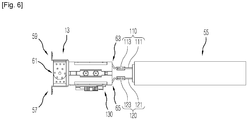
- FIG. 6 is a bottom view of the submodule according to the embodiment
- FIG. 7 is an enlarged bottom view of the submodule according to the embodiment.
- the first connection busbar 63 and the second connection busbar 65 may be provided on a rear end of the power pack 13.
- the first connection busbar 63 may extend from a first side portion of a rear surface of the power pack 13 toward the rear of the power pack 13.
- the second connection busbar 65 may extend from a second side portion of the rear surface of the power pack 13 toward the rear of the power pack 13.
- One side surface of the extended first connection busbar 63 may face one side surface of the extended second connection busbar 65.
- first connection busbar 63 may be electrically connected to first and third switching modules of first to fourth switching modules provided in the power pack 13, and the second connection busbar 65 may be electrically connected to second and fourth switching modules of the first to fourth switching modules.
- the first connection busbar 63 may be coupled to a first output electrode connected to the first and second switching modules using screws and the second connection busbar 65 may be coupled to a second output electrode connected to the third and fourth switching modules using screws.
- a first connection unit 110 and a second connection unit 120 may be provided at a front end of the capacitor pack 55.
- the first connection unit 110 may extend forward from a first region of the capacitor pack 55.
- the second connection unit 120 may extend forward from a second region of the capacitor pack 55.
- the first region and the second region may be spaced apart from each other, for example, located at both sides of the front end of the capacitor pack 55.
- the first connection unit 110 may be electrically connected to a first terminal of the capacitor element included in the capacitor pack 55 and the second connection unit 120 may be electrically connected to a second terminal of the capacitor element included in the capacitor pack 55.
- the first connection unit 110 may include a first capacitor electrode 111 and a first connection electrode 113 coupled to the first capacitor electrode 111.
- the first capacitor electrode 111 may be a first terminal of the capacitor element. Or, the first capacitor electrode 111 may be coupled to the first terminal of the capacitor element.
- the first capacitor electrode 111 may extend from the first region of the capacitor pack 55 toward the power pack 13. One side of the first capacitor electrode 111 may be coupled to the capacitor element and another side of the first capacitor electrode may be coupled to the first connection electrode 113 using a screw 165.
- the first capacitor electrode 111 and the first connection electrode 113 may be made of a good conductive metallic material.
- the first capacitor electrode 111 and the first connection electrode 113 may contain different metallic materials.
- the first capacitor electrode 111 may contain copper and the first connection electrode 113 may contain aluminum.
- the first capacitor electrode 111 and the first connection electrode 113 may contain the same metallic material.
- the first capacitor electrode 111 and the first connection electrode 113 may contain copper.
- the first capacitor electrode 111 may have a plate shape.
- the first connection electrode 113 may include a first coupling groove 151 provided at a first side, and a first guide groove 155 provided at a second side opposite to the first side.
- the first coupling groove 151 and the first guide groove 155 may be arranged on the same line.
- the first coupling groove 151 may be formed at the first side toward the power pack 13.
- the first guide groove 155 may be formed at the second side toward the capacitor pack 55.
- first connection electrode 113 may further include a first sliding guide portion 161 provided at the second side.
- the first sliding guide portion 161 may be connected to the first guide groove 155.
- the first connection busbar 63 may be guided to the first guide groove 155 by the first sliding guide portion 161 of the first connection electrode 113 and then slidably inserted into the first guide groove 155.
- the first capacitor electrode 111 may be coupled to the first connection electrode 113 within the first coupling groove 151 of the first connection electrode 113 using at least one screw 165.
- the screw 165 may be inserted through the first coupling groove 151 from a first outer surface of the first connection electrode 113 and then coupled to a second outer surface as an opposite surface of the first outer surface.
- the screw 165 may alternatively penetrate through the first coupling groove 151 from the second outer surface of the first connection electrode 113.
- the first capacitor electrode 111 may first be coupled to the capacitor pack 55 and then coupled to the first coupling groove 151 of the first connection electrode 113. Alternatively, the first capacitor electrode 111 may first be coupled to the first coupling groove 151 of the first connection electrode 113 and then coupled to the capacitor pack 55.
- the second connection unit 120 may include a second capacitor electrode 121, and a second connection electrode 123 coupled to the second capacitor electrode 121.
- the second capacitor electrode 121 may be a second terminal of the capacitor element. Alternatively, the second capacitor electrode 121 may be coupled to the second terminal of the capacitor element.
- the second capacitor electrode 121 may extend from a second region of the capacitor pack 55 toward the power pack 13. One side of the second capacitor electrode 121 may be coupled to the capacitor element and another side of the second capacitor electrode may be coupled to the second connection electrode 123 using a screw 167.
- the second capacitor electrode 121 and the second connection electrode 123 may be made of a good conductive metallic material.
- the second capacitor electrode 121 and the second connection electrode 123 may contain different metallic materials.
- the second capacitor electrode 121 may contain copper and the second connection electrode 123 may contain aluminum.
- the second capacitor electrode 121 and the second connection electrode 123 may include the same metallic material.
- the second capacitor electrode 121 and the second connection electrode 123 may include copper.
- the first capacitor electrode 111 and the second capacitor electrode 121 may be made of the same metallic material, but the present invention is not limited thereto. Also, the first connection electrode 113 and the second connection electrode 123 may be made of the same metallic material, but the present invention is not limited thereto.
- the second capacitor electrode 121 may have a plate shape.
- the second connection electrode 123 may include a second coupling groove 153 provided at a first side, and a second guide groove 157 provided at a second side opposite to the first side.
- the second coupling groove 153 and the second guide groove 157 may be arranged on the same line.
- the second coupling groove 153 may be formed at the first side toward the power pack 13.
- the second guide groove 157 may be formed at the second side toward the capacitor pack 55.
- the second connection electrode 123 may further include a second sliding guide portion 163 provided at the second side.
- the second sliding guide portion 163 may be connected to the second guide groove 157.
- the second connection busbar 65 may be guided to the second guide groove 157 by the second sliding guide portion 163 of the second connection electrode 123 and then slidably inserted into the second guide groove 157.
- the second capacitor electrode 121 may be coupled to the second connection electrode 123 within the second coupling groove 153 of the second connection electrode 123 using at least one screw 167.
- the screw 167 may be inserted through the second coupling groove 153 from a first outer surface of the second connection electrode 123 and then coupled to a second outer surface as an opposite surface of the first outer surface.
- the second outer surface of the first coupling groove 151 and the second outer surface of the second coupling groove 153 may face each other.
- the screw 167 may alternatively penetrate through the second coupling groove 153 from the second outer surface of the second connection electrode 123.
- the second capacitor electrode 121 may first be coupled to the capacitor pack 55 and then coupled to the second coupling groove 153 of the second connection electrode 123. Alternatively, the second capacitor electrode 121 may first be coupled to the second coupling groove 153 of the second connection electrode 123 and then coupled to the capacitor pack 55.
- the first and second connection busbars 63 and 65 of the power pack 13 may be slidably coupled to the first and second connection units 110 and 120 of the capacitor pack 55, respectively.
- the first connection busbar 63 of the power pack 13 may be slid into the first guide groove 155 of the first connection electrode 113 of the first connection unit 110, so as to be electrically connected to the first connection unit 110.
- the second connection busbar 65 of the power pack 13 may be slid into the second guide groove 157 of the second connection electrode 123 of the second connection unit 120, so as to be electrically connected to the connection unit 110.
- a width of the first guide groove 155 may be equal to or smaller than a thickness of the first connection busbar 63.
- the first connection busbar 63 When the first connection busbar 63 is slid into the first guide groove 155 of the first connection electrode 113 of the first connection unit 110, the first connection busbar 63 can be strongly adhered to an inner surface of the first guide groove 155.
- a large contact area may be made between the first connection busbar 63 and the first connection electrode 113, which may reduce contact resistance between the first connection busbar 63 and the first connection electrode 113, thereby reducing power consumption.
- both side surfaces of the first connection busbar 63 in the first guide groove 155 are brought into contact with an inner surface of the first guide groove 155, the contact area can be maximized and thus the contact resistance can be reduced, thereby reducing the power consumption.
- a width of the second guide groove 157 may be equal to or smaller than a thickness of the second connection busbar 65.
- the first and second connection busbars 63 and 65 may or may not be included in the power pack 13.
- the first and second connection units 110 and 120 may or may not be included in the capacitor pack 55.
Landscapes
- Engineering & Computer Science (AREA)
- Power Engineering (AREA)
- Microelectronics & Electronic Packaging (AREA)
- Charge And Discharge Circuits For Batteries Or The Like (AREA)
- Inverter Devices (AREA)
- Electric Propulsion And Braking For Vehicles (AREA)
- Electric Double-Layer Capacitors Or The Like (AREA)
Abstract
Description
- The present invention relates to a submodule.
- As industries develop and the population increases, electric power demand increases rapidly, but there is a limit to electric power production.
- Accordingly, a power system for stably supplying power generated from a production site to a demand site without a loss is becoming increasingly important.
- There is a need for Flexible AC Transmission System (FACTS) facilities for controlling a power flow and improving stability of a system voltage. A STATic synchronous COMpensator (STATCOM), a type of power compensator device called the third generation of the FACTS facilities, is connected to a power system in parallel to compensate for reactive power and active power required by the power system.
-
FIG. 1 illustrates a general power system. - As illustrated in
FIG. 1 , a generalelectric power system 1 may include apower generation source 20, apower grid 30, aload 40, and a plurality ofpower compensator devices 50. - The
power generation source 20 refers to a place or facility for generating electric power, and may be understood as a producer that generates electric power. - The
power system 30 may refer to all facilities including a power line, a pylon, a lightning arrester, an insulator, etc., for transmitting power generated in thepower generation source 20 to theload 40. - The
load 40 refers to a place or facility that consumes power generated in thepower generation source 20, and may be understood as a consumer consuming electric power. - The
power compensator device 50 is a device that is connected to thepower system 30 to compensate for active power or reactive power according to supply or lack of the active power or the reactive power among power flowing to thepower system 30. - In recent time, a Modular Multilevel Converter (MMC) type STATCOM facility is increasingly used as the
power compensator device 50. The MMC type STATCOM includes a plurality of submodules, which are provided with various devices therein. - Therefore, the related art power compensator device has to include the plurality of submodules, which causes a difficulty in installation in a limited space.
- The present invention is to solve the aforementioned problem and other drawbacks.
- Another aspect of the present invention is to provide a submodule having a new compact structure.
- Still another aspect of the present invention is to provide a submodule in which a power pack and a capacitor pack can be easily attached and detached.
- To achieve the above aspects and other advantages of the present invention, there is provided a submodule according to the present invention includes a power pack including a plurality of switching modules, first and second input busbars connected to the plurality of switching modules and protruding to a first outer side of the power pack, first and second connection busbars connected to the plurality of switching modules and protruding to a second outer side of the power pack, a capacitor pack including a capacitor element, and first and second connection units provided at both sides of one surface of the capacitor pack. The first and second connection busbars may be inserted into the first and second connection units, respectively, so that the power pack and the capacitor pack can be electrically connected to each other.
- The effects of the submodule according to the embodiment will be described as follows.
- According to at least one of embodiments, connection busbars extending from a power pack can be slidably inserted into connection units coupled to a capacitor pack, thereby facilitating attachment and detachment between the capacitor pack and the power pack.
- Further scope of applicability of the embodiments will become apparent from the following detailed description. However, it should be understood that the detailed description and specific examples, while indicating preferred embodiments of the invention, are given by illustration only, since various changes and modifications within the spirit and scope of the invention will become apparent to those skilled in the art from this detailed description.
-
-
FIG. 1 is a view of a general power system. -
FIG. 2 is a view illustrating an MMC-based power compensator device according to an embodiment. -
FIG. 3 is a circuit view of an MMC-based power compensator device according to an embodiment. -
FIG. 4 is a perspective view illustrating a submodule according to an embodiment. -
FIG. 5 is an exploded perspective view of a submodule according to an embodiment. -
FIG. 6 is a bottom view of a submodule according to an embodiment. -
FIG. 7 is an enlarged bottom view of a submodule according to an embodiment - Hereinafter, description will be given in detail of embodiments of the present invention with reference to the accompanying drawings. For the sake of brief description with reference to the drawings, the same or equivalent components will be provided with the same reference numbers, and description thereof will not be repeated. A suffix "module" and "unit" used for constituent elements disclosed in the following description is merely intended for easy description of the specification, and the suffix itself does not give any special meaning or function. In describing the present disclosure, if a detailed explanation for a related known function or construction is considered to unnecessarily divert the gist of the present disclosure, such explanation has been omitted but would be understood by those skilled in the art. The accompanying drawings are used to help easily understand the technical idea of the present disclosure and it should be understood that the idea of the present disclosure is not limited by the accompanying drawings. The idea of the present disclosure should be construed to extend to any alterations, equivalents and substitutes besides the accompanying drawings.
-
FIG. 2 is a view illustrating an MMC-based power compensator device according to an embodiment. - Referring to
FIG. 2 , a power compensator device according to an embodiment may include a plurality ofinsulating units cabinets - Each of the
insulating unit cabinets submodules - The
insulating units cabinets respective cabinets - A first submodule unit 11-1 accommodated in a
first cabinet 91 may include a plurality ofsubmodules 92 for converting a voltage of a first phase, for example, an a-phase, among three-phase alternating-current (AC) voltages. A second submodule unit 11-3 accommodated in asecond cabinet 93 may include a plurality ofsubmodules 94 for converting a voltage of a second phase, for example, a b-phase, among three-phase AC voltages. A third submodule unit 11-5 accommodated in athird cabinet 95 may include a plurality ofsubmodules 96 for converting a voltage of a third phase, for example, a c-phase, among three-phase AC voltages. - An
input busbar 71 may be connected to a first submodule among the plurality ofsubmodules 92. Anoutput busbar 75 may be connected to a last submodule.Connection busbars 73 may be connected to the other submodules. - The
respective submodules corresponding cabinets rail units 68 installed on tops of thecabinets - Although three
cabinets insulating units FIG. 2 for convenience of explanation, thecabinets insulating units -
Wheels 103 for moving aframe 70 may be installed on a bottom of theframe 70, but the present invention is not limited thereto. - The
wheels 103 may facilitate theframe 70 having a heavy load to be moved to a desired place. If theframe 70 is fixed at a specific place, thewheels 103 may be omitted. -
FIG. 3 is a circuit view of an MMC-based power compensator device according to an embodiment. - As illustrated in
FIG. 3 , an MMC-basedpower compensator device 10 may include a plurality ofsubmodules submodules - Although
FIG. 3 shows a Y-type power compensator device, a Δ-type power compensator device may alternatively be employed in the present invention. - The plurality of
submodules -
FIG. 4 is a perspective view of a submodule according to an embodiment of the present invention, andFIG. 5 is an exploded perspective view of the submodule according to the embodiment of the present invention. - Referring to
FIGS. 4 and5 , each ofsubmodules power pack 13 and acapacitor pack 55. - The
power pack 13 and thecapacitor pack 55 may be electrically connected to each other. Thecapacitor pack 55 may be charged and discharged by a switching operation of thepower pack 13. - The
capacitor pack 55 may include a case and a capacitor element provided in the case. The capacitor element stores energy (power) to be input to thesubmodule submodule - The
capacitor pack 55 may be electrically connected to a rear surface of thepower pack 13. - The
power pack 13 and thecapacitor pack 55 may be electrically connected to each other in a sliding manner. That is, thepower pack 13 and thecapacitor pack 55 may be electrically connected to each other in a manner that first andsecond connection busbars power pack 13 are slidably inserted into first andsecond connection units capacitor pack 55. The sliding manner according to the embodiment will be described later in detail. - First and
second input busbars power pack 13. The first andsecond input busbars case 141 of thepower pack 13 through thecase 141. - For example, the
first input busbar 57 may be electrically connected to first and third switching modules of first to fourth switching modules provided in thepower pack 13, and thesecond input busbar 59 may be electrically connected to second and fourth switching modules of the first to fourth switching modules. Acontrol board 130 for controlling the first to fourth switching modules may be provided in thepower pack 13. - The first and
second input busbars connection busbar 73 illustrated inFIG. 2 or may be connected to theconnection busbar 73 illustrated inFIG. 2 . - Through the first and
second input busbars second input busbars - The first and
second input busbars first switch terminal 61a of thebypass switch 61 may be connected to thefirst input busbar 57 and asecond switch terminal 61b of thebypass switch 61 may be connected to thesecond input busbar 59. - The
bypass switch 61 may be formed long in a cylindrical shape between thefirst switch terminal 61a and thesecond switch terminal 61b. Thefirst switch terminal 61a may have a first protrusion protruding from a top of thebypass switch 61 in a first horizontal direction, and thesecond switch terminal 61b may have a second protrusion protruding from a bottom of thebypass switch 61 in a second horizontal direction opposite to the first horizontal direction. - The
first input busbar 57 may be coupled to the first protrusion of thefirst switch terminal 61a using screws and thesecond input busbar 59 may be coupled to the second protrusion of thesecond switch terminal 61b using screws. - When an error occurs in a device including a switching module in the
power pack 13, thebypass switch 61 may electrically short-circuit between the first andsecond input busbars first input busbar 57 to thesecond input busbar 59 via thebypass switch 61, thereby skipping (dropping) asubmodule corresponding power pack 13. Here, the term "skipping (dropping)" may mean that the corresponding sub-module 92, 94, 96 is not used. - A first sliding
guide unit 1191 which allows thepower pack 13 to be slidably drawn into thecabinet power pack 13, in correspondence with a slidingrail unit 68 installed on the top of thecabinet - Likewise, a second sliding
guide unit 1193 which allows thecapacitor pack 55 to be slidably drawn into thecabinet capacitor pack 55, in correspondence with the slidingrail unit 68 installed on the top of thecabinet - The first and second sliding
guide portions guide unit 119. The slidingguide unit 119 may be drawn into or pulled out from the slidingrail unit 68 provided on the top of thecabinet - Although the first sliding
guide portion 1191 and the second slidingguide portion 1193 are shown on the top of thepower pack 13 and on the top of thecapacitor pack 55 inFIG. 4 , the present invention is not limited thereto. If necessary, the first slidingguide portion 1191 and the second slidingguide portion 1193 may be alternatively provided on a bottom and/or a side of thepower pack 13 and a bottom and/or a side of thecapacitor pack 55, respectively, and the present invention is not limited thereto. In this case, the slidingrail unit 68 may be installed at a bottom or side portion of thecabinet -
FIG. 6 is a bottom view of the submodule according to the embodiment, andFIG. 7 is an enlarged bottom view of the submodule according to the embodiment. - Referring to
FIGS. 6 and7 , thefirst connection busbar 63 and thesecond connection busbar 65 may be provided on a rear end of thepower pack 13. Thefirst connection busbar 63 may extend from a first side portion of a rear surface of thepower pack 13 toward the rear of thepower pack 13. Thesecond connection busbar 65 may extend from a second side portion of the rear surface of thepower pack 13 toward the rear of thepower pack 13. One side surface of the extendedfirst connection busbar 63 may face one side surface of the extendedsecond connection busbar 65. - For example, the
first connection busbar 63 may be electrically connected to first and third switching modules of first to fourth switching modules provided in thepower pack 13, and thesecond connection busbar 65 may be electrically connected to second and fourth switching modules of the first to fourth switching modules. Thefirst connection busbar 63 may be coupled to a first output electrode connected to the first and second switching modules using screws and thesecond connection busbar 65 may be coupled to a second output electrode connected to the third and fourth switching modules using screws. - A
first connection unit 110 and asecond connection unit 120 may be provided at a front end of thecapacitor pack 55. Thefirst connection unit 110 may extend forward from a first region of thecapacitor pack 55. Thesecond connection unit 120 may extend forward from a second region of thecapacitor pack 55. The first region and the second region may be spaced apart from each other, for example, located at both sides of the front end of thecapacitor pack 55. - The
first connection unit 110 may be electrically connected to a first terminal of the capacitor element included in thecapacitor pack 55 and thesecond connection unit 120 may be electrically connected to a second terminal of the capacitor element included in thecapacitor pack 55. - The
first connection unit 110 may include afirst capacitor electrode 111 and afirst connection electrode 113 coupled to thefirst capacitor electrode 111. Thefirst capacitor electrode 111 may be a first terminal of the capacitor element. Or, thefirst capacitor electrode 111 may be coupled to the first terminal of the capacitor element. - The
first capacitor electrode 111 may extend from the first region of thecapacitor pack 55 toward thepower pack 13. One side of thefirst capacitor electrode 111 may be coupled to the capacitor element and another side of the first capacitor electrode may be coupled to thefirst connection electrode 113 using ascrew 165. - The
first capacitor electrode 111 and thefirst connection electrode 113 may be made of a good conductive metallic material. Thefirst capacitor electrode 111 and thefirst connection electrode 113 may contain different metallic materials. For example, thefirst capacitor electrode 111 may contain copper and thefirst connection electrode 113 may contain aluminum. Thefirst capacitor electrode 111 and thefirst connection electrode 113 may contain the same metallic material. For example, thefirst capacitor electrode 111 and thefirst connection electrode 113 may contain copper. - The
first capacitor electrode 111 may have a plate shape. Thefirst connection electrode 113 may include afirst coupling groove 151 provided at a first side, and afirst guide groove 155 provided at a second side opposite to the first side. Thefirst coupling groove 151 and thefirst guide groove 155 may be arranged on the same line. Thefirst coupling groove 151 may be formed at the first side toward thepower pack 13. Thefirst guide groove 155 may be formed at the second side toward thecapacitor pack 55. - In addition, the
first connection electrode 113 may further include a first slidingguide portion 161 provided at the second side. The first slidingguide portion 161 may be connected to thefirst guide groove 155. Thefirst connection busbar 63 may be guided to thefirst guide groove 155 by the first slidingguide portion 161 of thefirst connection electrode 113 and then slidably inserted into thefirst guide groove 155. - After the
first capacitor electrode 111 is inserted into thefirst coupling groove 151 of thefirst connection electrode 113, thefirst capacitor electrode 111 may be coupled to thefirst connection electrode 113 within thefirst coupling groove 151 of thefirst connection electrode 113 using at least onescrew 165. - For example, the
screw 165 may be inserted through thefirst coupling groove 151 from a first outer surface of thefirst connection electrode 113 and then coupled to a second outer surface as an opposite surface of the first outer surface. - The
screw 165 may alternatively penetrate through thefirst coupling groove 151 from the second outer surface of thefirst connection electrode 113. - The
first capacitor electrode 111 may first be coupled to thecapacitor pack 55 and then coupled to thefirst coupling groove 151 of thefirst connection electrode 113. Alternatively, thefirst capacitor electrode 111 may first be coupled to thefirst coupling groove 151 of thefirst connection electrode 113 and then coupled to thecapacitor pack 55. - The
second connection unit 120 may include asecond capacitor electrode 121, and asecond connection electrode 123 coupled to thesecond capacitor electrode 121. Thesecond capacitor electrode 121 may be a second terminal of the capacitor element. Alternatively, thesecond capacitor electrode 121 may be coupled to the second terminal of the capacitor element. - The
second capacitor electrode 121 may extend from a second region of thecapacitor pack 55 toward thepower pack 13. One side of thesecond capacitor electrode 121 may be coupled to the capacitor element and another side of the second capacitor electrode may be coupled to thesecond connection electrode 123 using ascrew 167. - The
second capacitor electrode 121 and thesecond connection electrode 123 may be made of a good conductive metallic material. Thesecond capacitor electrode 121 and thesecond connection electrode 123 may contain different metallic materials. For example, thesecond capacitor electrode 121 may contain copper and thesecond connection electrode 123 may contain aluminum. Thesecond capacitor electrode 121 and thesecond connection electrode 123 may include the same metallic material. For example, thesecond capacitor electrode 121 and thesecond connection electrode 123 may include copper. - The
first capacitor electrode 111 and thesecond capacitor electrode 121 may be made of the same metallic material, but the present invention is not limited thereto. Also, thefirst connection electrode 113 and thesecond connection electrode 123 may be made of the same metallic material, but the present invention is not limited thereto. - The
second capacitor electrode 121 may have a plate shape. Thesecond connection electrode 123 may include asecond coupling groove 153 provided at a first side, and asecond guide groove 157 provided at a second side opposite to the first side. Thesecond coupling groove 153 and thesecond guide groove 157 may be arranged on the same line. Thesecond coupling groove 153 may be formed at the first side toward thepower pack 13. Thesecond guide groove 157 may be formed at the second side toward thecapacitor pack 55. - In addition, the
second connection electrode 123 may further include a second slidingguide portion 163 provided at the second side. The second slidingguide portion 163 may be connected to thesecond guide groove 157. Thesecond connection busbar 65 may be guided to thesecond guide groove 157 by the second slidingguide portion 163 of thesecond connection electrode 123 and then slidably inserted into thesecond guide groove 157. - After the
second capacitor electrode 121 is inserted into thesecond coupling groove 153 of thesecond connection electrode 123, thesecond capacitor electrode 121 may be coupled to thesecond connection electrode 123 within thesecond coupling groove 153 of thesecond connection electrode 123 using at least onescrew 167. For example, thescrew 167 may be inserted through thesecond coupling groove 153 from a first outer surface of thesecond connection electrode 123 and then coupled to a second outer surface as an opposite surface of the first outer surface. The second outer surface of thefirst coupling groove 151 and the second outer surface of thesecond coupling groove 153 may face each other. - The
screw 167 may alternatively penetrate through thesecond coupling groove 153 from the second outer surface of thesecond connection electrode 123. - The
second capacitor electrode 121 may first be coupled to thecapacitor pack 55 and then coupled to thesecond coupling groove 153 of thesecond connection electrode 123. Alternatively, thesecond capacitor electrode 121 may first be coupled to thesecond coupling groove 153 of thesecond connection electrode 123 and then coupled to thecapacitor pack 55. - The first and
second connection busbars power pack 13 may be slidably coupled to the first andsecond connection units capacitor pack 55, respectively. In detail, thefirst connection busbar 63 of thepower pack 13 may be slid into thefirst guide groove 155 of thefirst connection electrode 113 of thefirst connection unit 110, so as to be electrically connected to thefirst connection unit 110. Thesecond connection busbar 65 of thepower pack 13 may be slid into thesecond guide groove 157 of thesecond connection electrode 123 of thesecond connection unit 120, so as to be electrically connected to theconnection unit 110. - A width of the
first guide groove 155 may be equal to or smaller than a thickness of thefirst connection busbar 63. When thefirst connection busbar 63 is slid into thefirst guide groove 155 of thefirst connection electrode 113 of thefirst connection unit 110, thefirst connection busbar 63 can be strongly adhered to an inner surface of thefirst guide groove 155. When thefirst connection busbar 63 is drawn into thefirst guide groove 155 as much as possible, a large contact area may be made between thefirst connection busbar 63 and thefirst connection electrode 113, which may reduce contact resistance between thefirst connection busbar 63 and thefirst connection electrode 113, thereby reducing power consumption. In addition, since both side surfaces of thefirst connection busbar 63 in thefirst guide groove 155 are brought into contact with an inner surface of thefirst guide groove 155, the contact area can be maximized and thus the contact resistance can be reduced, thereby reducing the power consumption. - Likewise, a width of the
second guide groove 157 may be equal to or smaller than a thickness of thesecond connection busbar 65. When thesecond connection busbar 65 is slid into thesecond guide groove 157 of thesecond connection electrode 123 of thesecond connection unit 120, thesecond connection busbar 65 can be strongly adhered to an inner surface of thesecond guide groove 157. When thesecond connection busbar 65 is drawn into thesecond guide groove 157 as much as possible, a large contact area may be made between thesecond connection busbar 65 and thesecond connection electrode 123, which may reduce contact resistance between thesecond connection busbar 65 and thesecond connection electrode 123, thereby reducing power consumption. In addition, since both side surfaces of thesecond connection busbar 65 in thesecond guide groove 157 are brought into contact with an inner surface of thesecond guide groove 155, the contact area can be maximized and thus the contact resistance can be reduced, thereby reducing the power consumption. - The first and
second connection busbars power pack 13. The first andsecond connection units capacitor pack 55. - The above detailed description should not be limitedly construed in all aspects and should be considered as illustrative. The scope of the embodiments should be determined by rational interpretation of the appended claims, and all changes within the equivalents of the embodiments are included in the scope of the embodiments.
Claims (14)
- A submodule, comprising:a power pack (13) including a plurality of switching modules;first and second input busbars (57, 59) connected to the plurality of switching modules and protruding to a first outer side of the power pack (13);first and second connection busbars (63, 65) connected to the plurality of switching modules and protruding to a second outer side of the power pack (13);a capacitor pack (55) including a capacitor element; andfirst and second connection units (110, 120) provided at both sides of one surface of the capacitor pack (55),wherein the first and second connection busbars (63, 65) are inserted into the first and second connection units (110, 120), respectively, such that the power pack (13) and the capacitor pack (55) are electrically connected to each other.
- The submodule of claim 1, wherein the first connection unit (110) comprises:a first capacitor electrode (111) coupled to a first terminal of the capacitor element and extending from a first region of the capacitor pack (55) toward the power pack (13); anda first connection electrode (113) coupled to the first capacitor electrode (111) and having the first connection busbar (63) slidably inserted therein.
- The submodule of claim 2, wherein the first connection electrode (113) comprises:a first coupling groove (151) provided at a first side; anda first guide groove (155) provided at a second side.
- The submodule of claim 3, wherein the first coupling groove (151) and the first guide groove (155) are arranged on the same line.
- The submodule of claim 3, wherein the first connection electrode (113) further comprises a first sliding guide portion (161) provided at the second side and connected to the first guide groove (155).
- The submodule of claim 5, wherein the first connection busbar (63) is guided to the first guide groove (155) by the first sliding guide portion (161) so as to be inserted into the first guide groove (155).
- The submodule of claim 3, wherein the first capacitor electrode (111) is fixed to the first coupling groove (151).
- The submodule of claim 3, wherein a width of the first guide groove (155) is equal to or smaller than a thickness of the first connection busbar (63).
- The submodule of claim 2, wherein the second connection unit (120) comprises:a second capacitor electrode (121) coupled to a second terminal of the capacitor element and extending from a second region of the capacitor pack (55) toward the power pack (13); anda second connection electrode (123) coupled to the second capacitor electrode (121) and having the second connection busbar (65) slidably inserted therein.
- The submodule of claim 9, wherein the second connection electrode (123) comprises:a second coupling groove (153) provided at a first side; anda second guide groove (157) provided at a second side.
- The submodule of claim 10, wherein the second connection electrode (123) further comprises a second sliding guide portion (163) provided at the second side and connected to the second guide groove (157).
- The submodule of claim 9, wherein the first and second capacitor electrodes (111, 121) and the first and second connection electrodes (113, 123) are made of the same metallic material.
- The submodule of claim 9, wherein the first and second capacitor electrodes (111, 121) and the first and second connection electrodes (113, 123) are made of different metallic materials.
- The submodule of claim 13, wherein the first and second capacitor electrodes (111, 121) contain copper, and
wherein the first and second connection electrodes (113, 123) contain aluminum.
Applications Claiming Priority (1)
| Application Number | Priority Date | Filing Date | Title |
|---|---|---|---|
| KR1020180034683A KR102030727B1 (en) | 2018-03-26 | 2018-03-26 | Submodule |
Publications (1)
| Publication Number | Publication Date |
|---|---|
| EP3547472A1 true EP3547472A1 (en) | 2019-10-02 |
Family
ID=65763382
Family Applications (1)
| Application Number | Title | Priority Date | Filing Date |
|---|---|---|---|
| EP19161957.6A Withdrawn EP3547472A1 (en) | 2018-03-26 | 2019-03-11 | Submodule |
Country Status (4)
| Country | Link |
|---|---|
| US (1) | US10819114B2 (en) |
| EP (1) | EP3547472A1 (en) |
| KR (1) | KR102030727B1 (en) |
| CN (1) | CN110365226B (en) |
Families Citing this family (2)
| Publication number | Priority date | Publication date | Assignee | Title |
|---|---|---|---|---|
| CN112803243B (en) * | 2020-12-31 | 2022-10-21 | 宁波海融电器有限公司 | Integrative dry-type power electronic capacitor of cylinder formula convenient to installation |
| JP7585161B2 (en) * | 2021-08-17 | 2024-11-18 | 株式会社日立製作所 | Power Converter Device |
Citations (2)
| Publication number | Priority date | Publication date | Assignee | Title |
|---|---|---|---|---|
| EP1469489A1 (en) * | 2003-04-14 | 2004-10-20 | Schneider Electric Industries SAS | Power-factor three-phase correction arrangement |
| WO2017001089A1 (en) * | 2015-06-29 | 2017-01-05 | General Electric Technology Gmbh | Capacitor unit and electrical apparatus |
Family Cites Families (12)
| Publication number | Priority date | Publication date | Assignee | Title |
|---|---|---|---|---|
| DE8626952U1 (en) * | 1986-10-10 | 1986-12-04 | Siemens AG, 1000 Berlin und 8000 München | Switch trolley for an encapsulated electrical switchgear panel |
| US5086372A (en) * | 1990-06-29 | 1992-02-04 | Amp Incorporated | Card edge power distribution system |
| JP2900332B2 (en) * | 1991-09-03 | 1999-06-02 | 三菱電機株式会社 | Draw-out circuit breaker |
| EP2009974B1 (en) * | 2007-06-29 | 2010-08-11 | Siemens Aktiengesellschaft | Switching device with two controlled phases |
| CN102148579B (en) * | 2010-12-20 | 2014-08-27 | 中国电力科学研究院 | Equitime constant reduced submodule plate simulating plurality of submodules of MMC (Multi-level Modular Converte) |
| DE102011078811B3 (en) * | 2011-07-07 | 2012-05-24 | Semikron Elektronik Gmbh & Co. Kg | Power electronic system with a cooling device |
| CN103036452B (en) * | 2012-12-10 | 2015-03-25 | 国网智能电网研究院 | Submodule unit of voltage source transverter based on full control components |
| KR101389579B1 (en) * | 2012-12-28 | 2014-04-29 | 주식회사 효성 | Power converter |
| KR101404373B1 (en) * | 2014-01-08 | 2014-06-09 | 이옥형 | Insulated gate bipolar transistor stack device using clip busbar connect structure |
| KR101613812B1 (en) * | 2015-01-12 | 2016-04-19 | 엘에스산전 주식회사 | Bypass switch for hvdc |
| CN205178894U (en) * | 2015-08-28 | 2016-04-20 | 洛阳中重自动化工程有限责任公司 | Modularized plug-in power unit of explosion-proof frequency converter |
| JP2017168632A (en) * | 2016-03-16 | 2017-09-21 | 富士電機株式会社 | Capacitor connection structure of power converter and connection method of capacitor group |
-
2018
- 2018-03-26 KR KR1020180034683A patent/KR102030727B1/en active Active
-
2019
- 2019-02-25 CN CN201910137803.4A patent/CN110365226B/en active Active
- 2019-02-27 US US16/286,814 patent/US10819114B2/en active Active
- 2019-03-11 EP EP19161957.6A patent/EP3547472A1/en not_active Withdrawn
Patent Citations (2)
| Publication number | Priority date | Publication date | Assignee | Title |
|---|---|---|---|---|
| EP1469489A1 (en) * | 2003-04-14 | 2004-10-20 | Schneider Electric Industries SAS | Power-factor three-phase correction arrangement |
| WO2017001089A1 (en) * | 2015-06-29 | 2017-01-05 | General Electric Technology Gmbh | Capacitor unit and electrical apparatus |
Also Published As
| Publication number | Publication date |
|---|---|
| US20190296527A1 (en) | 2019-09-26 |
| KR20190112553A (en) | 2019-10-07 |
| US10819114B2 (en) | 2020-10-27 |
| CN110365226B (en) | 2021-12-14 |
| KR102030727B1 (en) | 2019-10-10 |
| CN110365226A (en) | 2019-10-22 |
Similar Documents
| Publication | Publication Date | Title |
|---|---|---|
| KR101950442B1 (en) | Submodule | |
| US11196288B2 (en) | Direct current power supply system | |
| RU2566811C2 (en) | Uninterrupted power supply unit, power supply system and usage of uninterrupted power supply unit | |
| KR102145029B1 (en) | Apparatus of sliding a submodule | |
| CN104620469A (en) | Uninterruptible power supply apparatus | |
| RU2702218C1 (en) | Power cell with printed circuit boards and decoupler and multicell power supply medium voltage source | |
| KR20110048005A (en) | Module configured converter device | |
| US12443256B2 (en) | Power supply system for a data centre | |
| US10819114B2 (en) | Submodule that is capable of connecting capacitor and power pack easily | |
| EP3161954B1 (en) | Power converter and assembly method for assembling a power converter | |
| EP2341598B1 (en) | A modular energy storage device for a high voltage electrical power system | |
| US20080055822A1 (en) | Scalable plant with top or bottom entry flexibility | |
| KR20190115600A (en) | Power compensator | |
| CN208142911U (en) | A kind of power supply unit | |
| CN115378111B (en) | Power supply assembly and switch assembly | |
| CN214755701U (en) | Power supply system | |
| Sandeep et al. | Switched-capacitor-based three-phase five-level inverter topology with reduced components | |
| EP3547812A1 (en) | Pressure applying device for a switching module and method of assembling a switching module using the same | |
| Lisy et al. | Three case studies of commercial deployment of 400V DC data and telecom centers in the EMEA region | |
| CN222582081U (en) | Cluster control box of battery cluster and energy storage device | |
| CN221009857U (en) | Power supply cabinet | |
| CN121939813A (en) | Power conversion system | |
| CN117792122A (en) | Current conversion assembly, energy storage current transformer and energy storage system | |
| EP3547485B1 (en) | Switch assembly for a reactive power compensation apparatus | |
| RU2754922C1 (en) | System of conductive busbars used in an electrical cabinet |
Legal Events
| Date | Code | Title | Description |
|---|---|---|---|
| PUAI | Public reference made under article 153(3) epc to a published international application that has entered the european phase |
Free format text: ORIGINAL CODE: 0009012 |
|
| STAA | Information on the status of an ep patent application or granted ep patent |
Free format text: STATUS: THE APPLICATION HAS BEEN PUBLISHED |
|
| AK | Designated contracting states |
Kind code of ref document: A1 Designated state(s): AL AT BE BG CH CY CZ DE DK EE ES FI FR GB GR HR HU IE IS IT LI LT LU LV MC MK MT NL NO PL PT RO RS SE SI SK SM TR |
|
| AX | Request for extension of the european patent |
Extension state: BA ME |
|
| STAA | Information on the status of an ep patent application or granted ep patent |
Free format text: STATUS: REQUEST FOR EXAMINATION WAS MADE |
|
| 17P | Request for examination filed |
Effective date: 20200331 |
|
| RBV | Designated contracting states (corrected) |
Designated state(s): AL AT BE BG CH CY CZ DE DK EE ES FI FR GB GR HR HU IE IS IT LI LT LU LV MC MK MT NL NO PL PT RO RS SE SI SK SM TR |
|
| STAA | Information on the status of an ep patent application or granted ep patent |
Free format text: STATUS: EXAMINATION IS IN PROGRESS |
|
| 17Q | First examination report despatched |
Effective date: 20211213 |
|
| STAA | Information on the status of an ep patent application or granted ep patent |
Free format text: STATUS: THE APPLICATION IS DEEMED TO BE WITHDRAWN |
|
| 18D | Application deemed to be withdrawn |
Effective date: 20220426 |