EP3547111A2 - Systeme und verfahren zum bau von generischen ci/cd-pipelines - Google Patents
Systeme und verfahren zum bau von generischen ci/cd-pipelines Download PDFInfo
- Publication number
- EP3547111A2 EP3547111A2 EP19165992.9A EP19165992A EP3547111A2 EP 3547111 A2 EP3547111 A2 EP 3547111A2 EP 19165992 A EP19165992 A EP 19165992A EP 3547111 A2 EP3547111 A2 EP 3547111A2
- Authority
- EP
- European Patent Office
- Prior art keywords
- environment
- program
- pipeline
- container
- processor
- Prior art date
- Legal status (The legal status is an assumption and is not a legal conclusion. Google has not performed a legal analysis and makes no representation as to the accuracy of the status listed.)
- Pending
Links
Images

Classifications
-
- G—PHYSICS
- G06—COMPUTING OR CALCULATING; COUNTING
- G06F—ELECTRIC DIGITAL DATA PROCESSING
- G06F8/00—Arrangements for software engineering
- G06F8/60—Software deployment
-
- G—PHYSICS
- G06—COMPUTING OR CALCULATING; COUNTING
- G06F—ELECTRIC DIGITAL DATA PROCESSING
- G06F11/00—Error detection; Error correction; Monitoring
- G06F11/36—Prevention of errors by analysis, debugging or testing of software
- G06F11/3668—Testing of software
- G06F11/3672—Test management
- G06F11/3688—Test management for test execution, e.g. scheduling of test suites
-
- G—PHYSICS
- G06—COMPUTING OR CALCULATING; COUNTING
- G06F—ELECTRIC DIGITAL DATA PROCESSING
- G06F11/00—Error detection; Error correction; Monitoring
- G06F11/36—Prevention of errors by analysis, debugging or testing of software
- G06F11/3698—Environments for analysis, debugging or testing of software
-
- G—PHYSICS
- G06—COMPUTING OR CALCULATING; COUNTING
- G06F—ELECTRIC DIGITAL DATA PROCESSING
- G06F8/00—Arrangements for software engineering
- G06F8/70—Software maintenance or management
-
- G—PHYSICS
- G06—COMPUTING OR CALCULATING; COUNTING
- G06F—ELECTRIC DIGITAL DATA PROCESSING
- G06F8/00—Arrangements for software engineering
- G06F8/70—Software maintenance or management
- G06F8/71—Version control; Configuration management
-
- G—PHYSICS
- G06—COMPUTING OR CALCULATING; COUNTING
- G06F—ELECTRIC DIGITAL DATA PROCESSING
- G06F9/00—Arrangements for program control, e.g. control units
- G06F9/06—Arrangements for program control, e.g. control units using stored programs, i.e. using an internal store of processing equipment to receive or retain programs
- G06F9/44—Arrangements for executing specific programs
- G06F9/455—Emulation; Interpretation; Software simulation, e.g. virtualisation or emulation of application or operating system execution engines
-
- G—PHYSICS
- G06—COMPUTING OR CALCULATING; COUNTING
- G06F—ELECTRIC DIGITAL DATA PROCESSING
- G06F9/00—Arrangements for program control, e.g. control units
- G06F9/06—Arrangements for program control, e.g. control units using stored programs, i.e. using an internal store of processing equipment to receive or retain programs
- G06F9/46—Multiprogramming arrangements
- G06F9/54—Interprogram communication
- G06F9/544—Buffers; Shared memory; Pipes
Definitions
- CI/CD continuous integration and delivery
- An example pipeline development and/or deployment process is as follows.
- a developer writes pipeline code encapsulated in one or more files that are tailored for a CI/CD platform (e.g., Jenkinsfile, circle.yml,.drone.yml, etc.).
- the files are sent to a build server that uses a specific CI/CD platform.
- the build server maintains a separate set of software to support each pipeline, for example including CI/CD platform instances, build automation software, compilers, code analysis tools, deployment tools, web browsers, etc. Every pipeline deployed by the build server has its own set of this software. If the pipeline is migrated to a different CI/CD platform, a new file must be written, and the new build server must deploy a new set of software to support the pipeline.
- Pipelines may be placed in containers that are portable to different CI/CD tools.
- the pipelines themselves may include generic scripts that can operate on a variety of different applications. For example, a pipeline may use the same code to run a security scan on both a Java application and a Python application.
- Containers may be delivered to each CI/CD tool's environment with scripts enabling the specific code of the environment to work with the generic containerized pipeline, for example.
- a method of deploying an application may include creating, by a processor, a virtual container including at least one program that is generically executable in a plurality of different continuous integration and delivery (CI/CD) environments.
- the method may include creating, by the processor, a separate pipeline definition for each of the plurality of different CI/CD environments.
- Each pipeline definition may be configured to operate only in the CI/CD environment for which it is created, and each pipeline definition may be configured to cause the CI/CD environment for which it is created to execute the at least one program.
- the method may include deploying, by the processor, at least one of the pipeline definitions along with the virtual container in the CI/CD environment for which the at least one of the pipeline definitions is created, thereby enabling execution of the at least one program within the CI/CD environment for which the at least one of the pipeline definitions is created.
- the creating of the virtual container may include incorporating at least one utility library into the at least one program.
- the at least one utility script library include instructions for at least one generic application task.
- the processor may create the at least one utility library.
- the creating of the virtual container may include incorporating at least one stage script into the at least one program.
- the at least one stage script may include instructions for at least one application task specific to the at least one program.
- the at least one stage script may define a flow for the at least one program.
- the processor may create the at least one stage script.
- the creating of the virtual container may further include incorporating at least one utility library into the at least one program.
- the at least one utility library may include instructions for at least one generic application task.
- the at least one stage script may ingest at least a portion of the at least one utility library to provide the at least one application task specific to the at least one program.
- the at least one utility library may ingest at least a portion of the at least one utility library during at least one step in the flow of the at least one program.
- the creating of each separate pipeline definition may include creating a build script for the CI/CD environment for which the separate pipeline definition is created.
- the build script may be configured to cause the CI/CD environment to cause the at least one program to execute within the virtual container.
- At least one of the plurality of different CI/CD environments may include a local development environment
- the deploying may include testing the at least one program in the local development environment prior to deploying the at least one program in at least one of the plurality of different CI/CD environments separate from the local development environment.
- a non-transitory computer-readable medium may include instructions that, when executed by a processor, cause the processor to deploy at least one application.
- the instructions may include application instructions within a virtual container including at least one program that is generically executable in a plurality of different CI/CD environments.
- the instructions may include a plurality of separate pipeline definition instructions for each of the plurality of different CI/CD environments, each pipeline definition being configured to operate only in the CI/CD environment for which it is created, and each pipeline definition being configured to cause the CI/CD environment for which it is created to execute the at least one program.
- the at least one program may include at least one utility library.
- the at least one utility library may include instructions for at least one generic application task.
- the at least one program may include at least one stage script.
- the at least one stage script may include instructions for at least one application task specific to the at least one program.
- the at least one stage script may define a flow for the at least one program.
- the at least one program may further include at least one utility library.
- the at least one utility library may include instructions for at least one generic application task.
- the at least one stage script may ingest at least a portion of the at least one utility library to provide the at least one application task specific to the at least one program.
- the at least one stage script may ingest at least a portion of the at least one utility library during at least one step in the flow of the at least one program.
- each separate pipeline definition may include a build script for the CI/CD environment for which the separate pipeline definition is configured.
- the build script may be configured to cause the CI/CD environment to cause the at least one program to execute within the virtual container.
- At least one of the plurality of different CI/CD environments may include a local development environment.
- the instructions may further include instructions for testing the at least one program in the local development environment prior to deploying the at least one program in at least one of the plurality of different CI/CD environments separate from the local development environment.
- an application development device may include a processor and a non-transitory memory in communication with the processor.
- the memory may include instructions that, when executed by the processor, cause the processor to perform processing.
- the processing may include creating a virtual container including at least one program that is generically executable in a plurality of different CI/CD environments.
- the processing may include creating a separate pipeline definition for each of the plurality of different CI/CD environments, each pipeline definition being configured to operate only in the CI/CD environment for which it is created, and each pipeline definition being configured to cause the CI/CD environment for which it is created to execute the at least one program.
- At least one of the plurality of different CI/CD environments may include a local development environment.
- the instructions may include operating the local development environment, wherein the operating may include testing the at least one program in the local development environment prior to deploying the at least one program in at least one of the plurality of different CI/CD environments separate from the local development environment.
- the instructions may further cause the processor to perform processing including deploying at least one of the pipeline definitions along with the virtual container in the CI/CD environment for which the at least one of the pipeline definitions is created, thereby enabling execution of the at least one program within the CI/CD environment for which the at least one of the pipeline definitions is created.
- the local development environment may be configured to enable creation and selection of at least one utility library for the at least one program.
- the at least one utility library may include instructions for at least one generic application task.
- the local development environment may be configured to enable creation and selection of at least one stage script for the at least one program.
- the at least one stage script may include instructions for at least one application task specific to the at least one program.
- the at least one stage script may define a flow for the at least one program.
- the local development environment may be further configured to enable creation and selection of at least one utility library for the at least one program.
- the at least one utility library may include instructions for at least one generic application task.
- the at least one stage script may ingest at least a portion of the at least one utility library to provide the at least one application task specific to the at least one program.
- the at least one stage script may ingest at least a portion of the at least one utility library during at least one step in the flow of the at least one program.
- each separate pipeline definition may include a build script for the CI/CD environment for which the separate pipeline definition is created, the build script being configured to cause the CI/CD environment to cause the at least one program to execute within the virtual container.
- Pipelines may be placed in containers that are portable to different CI/CD tools.
- the pipelines themselves may include generic scripts that can operate on a variety of different applications and may include generic and/or specific code that makes the pipeline functionality work.
- Containers may be delivered to each CI/CD tool's environment with scripts enabling the specific code of the environment to work with the generic containerized pipeline, for example.
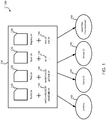
- FIG. 1 shows a generic CI/CD pipeline 100 according to an embodiment of the present disclosure.
- Pipeline 100 may include one or more containers 110.
- container 110 may be a DockerTM container or other container type (e.g., RXT, LXC, or any other container).
- Container 110 may contain a complete program, such as a pipeline, and may utilize a host device's operating system, as opposed to containing a complete virtual machine with its own operating system, in some embodiments. In such cases, container 110 may be distributed with a build script or other data set allowing the host operating system to interact with the pipeline inside container 110.
- the application may be pipeline from one or more scripts and/or libraries.
- these scripts may include utility libraries 120 and/or stage scripts 130.
- Utility libraries 120 may include scripts that are useful for a plurality of different pipelines and can be reused for different pipelines. For example, many CI/CD pipelines may require build scripts, test scripts, security scan scripts, and/or deployment scripts. Accordingly, a set of reusable utility libraries 120 may be provided to enable common functionality.
- the pipeline uses a build.sh utility library 120, a test.sh utility library 120, a scan.sh utility library 120, and a deploy.sh utility library 120.
- Stage scripts 130 may define an overall pipeline flow and may call on utility libraries 120 to perform their functionality at appropriate points in the flow.
- stage scripts 130 may ingest utility libraries 120 to enable at least a portion of the functionality provided by stage scripts 130.
- a stage script 130 configured to perform a specific security scan function at a specific point in the pipeline flow may ingest some or all of the code from a security scan utility library 120 (e.g., scan.sh) and add additional code to the ingested code to provide the added functionality.
- a security scan utility library 120 e.g., scan.sh
- stage scripts 130 netCoreBuild.sh and JavaBuild.sh ingest build.sh utility library 120 (e.g., to provide specific build features starting from the generic build.sh build features).
- Stage scripts 130 nodeTest.sh and goTest.sh ingest test.sh utility library 120 (e.g., to provide specific test features starting from the generic test.sh test features).
- Stage script 130 ec.sh ingests scan.sh utility library 120 (e.g., to provide specific scanning features starting from the generic scan.sh scanning features).
- Stage scripts 130 aws.sh and k8s.sh ingest deploy.sh utility library 120 (e.g., to provide specific deployment features starting from the generic deploy.sh deployment features).
- the utility libraries and stage scripts described herein are examples only, and those of ordinary skill in the art will appreciate that any functionality may be provided by utility libraries and stage scripts (e.g., whitesource, artifactory, sonatype, aws, azure, gcp, etc.).
- the pipeline inside container 110 may be written in a generic language (e.g., Python, Bash, Shell, etc.).
- utility libraries 120 and stage scripts 130 may be written in a generic language.
- the pipeline may be run by any Linux-based operating system and/or other operating systems. This may allow container 110 to be delivered within a variety of CI/CD platforms.
- container 110 may be used with JenkinsTM, Circle CITM, Drone CITM, and/or other platforms 140.
- One platform 140 illustrated in FIG. 1 is a local development environment platform 140.
- Container 110 may run within a local development environment for simulation and/or testing purposes.
- container 110 may be distributed in each CI/CD platform with an associated build script written for the specific platform.
- the same container 110 may be distributed with a JenkinsTM -specific build script when sent to JenkinsTM platform 140, a CircleTM -specific build script when sent to Circle CITM platform 140, and/or a DroneTM-specific build script when sent to Drone CITM platform 140.
- These build scripts may be written in the specific language of the specific environment and may include commands causing execution of the code inside container 110. Accordingly, the same container 110 can be sent to any platform 140, and the only thing that may be changed is a build script distributed with container 110.
- container 110 contains everything it needs to perform the desired processing (written in a generic language), and the only thing that may vary is a build script triggering execution of what is inside container 110.
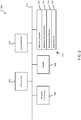
- FIG. 2 is a block diagram of an example computing device 200 that may implement various features and processes as described herein.
- the computing device 200 may be implemented on any electronic device that runs software applications derived from compiled instructions, including without limitation personal computers, servers, smart phones, media players, electronic tablets, game consoles, email devices, etc.
- the computing device 200 may include one or more processors 202, one or more input devices 204, one or more display devices 206, one or more network interfaces 208, and one or more computer-readable mediums 210. Each of these components may be coupled by bus 212.
- Display device 206 may be any known display technology, including but not limited to display devices using Liquid Crystal Display (LCD) or Light Emitting Diode (LED) technology.
- Processor(s) 202 may use any known processor technology, including but not limited to graphics processors and multi-core processors.
- Input device 204 may be any known input device technology, including but not limited to a keyboard (including a virtual keyboard), mouse, track ball, and touch-sensitive pad or display.
- Bus 212 may be any known internal or external bus technology, including but not limited to ISA, EISA, PCI, PCI Express, NuBus, USB, Serial ATA or FireWire.
- Computer-readable medium 210 may be any medium that participates in providing instructions to processor(s) 202 for execution, including without limitation, non-volatile storage media (e.g., optical disks, magnetic disks, flash drives, etc.), or volatile media (e.g., SDRAM, ROM, etc.).
- non-volatile storage media e.g., optical disks, magnetic disks, flash drives, etc.
- volatile media e.g., SDRAM, ROM, etc.
- Computer-readable medium 210 may include various instructions 214 for implementing an operating system (e.g., Mac OS®, Windows®, Linux).
- the operating system may be multiuser, multiprocessing, multitasking, multithreading, real-time, and the like.
- the operating system may perform basic tasks, including but not limited to: recognizing input from input device 204; sending output to display device 206; keeping track of files and directories on computer-readable medium 210; controlling peripheral devices (e.g., disk drives, printers, etc.) which can be controlled directly or through an I/O controller; and managing traffic on bus 212.
- Network communications instructions 216 may establish and maintain network connections (e.g., software for implementing communication protocols, such as TCP/IP, HTTP, Ethernet, telephony, etc.).
- Development service instructions 218 can include instructions that create, edit, and/or test virtual containers for pipeline distribution and implementation as described herein.
- development service instructions 218 may allow users to create pipelines in containers and test the containers and pipelines in a local development environment.
- Application(s) 220 may be an application that uses or implements the processes described herein and/or other processes. The processes may also be implemented in operating system 214.
- the described features may be implemented in one or more computer programs that may be executable on a programmable system including at least one programmable processor coupled to receive data and instructions from, and to transmit data and instructions to, a data storage system, at least one input device, and at least one output device.
- a computer program is a set of instructions that can be used, directly or indirectly, in a computer to perform a certain activity or bring about a certain result.
- a computer program may be written in any form of programming language (e.g., Objective-C, Java), including compiled or interpreted languages, and it may be deployed in any form, including as a stand-alone program or as a module, component, subroutine, or other unit suitable for use in a computing environment.
- Suitable processors for the execution of a program of instructions may include, by way of example, both general and special purpose microprocessors, and the sole processor or one of multiple processors or cores, of any kind of computer.
- a processor may receive instructions and data from a read-only memory or a random access memory or both.
- the essential elements of a computer may include a processor for executing instructions and one or more memories for storing instructions and data.
- a computer may also include, or be operatively coupled to communicate with, one or more mass storage devices for storing data files; such devices include magnetic disks, such as internal hard disks and removable disks; magneto-optical disks; and optical disks.
- Storage devices suitable for tangibly embodying computer program instructions and data may include all forms of non-volatile memory, including by way of example semiconductor memory devices, such as EPROM, EEPROM, and flash memory devices; magnetic disks such as internal hard disks and removable disks; magneto-optical disks; and CD-ROM and DVD-ROM disks.
- semiconductor memory devices such as EPROM, EEPROM, and flash memory devices
- magnetic disks such as internal hard disks and removable disks
- magneto-optical disks and CD-ROM and DVD-ROM disks.
- the processor and the memory may be supplemented by, or incorporated in, ASICs (application-specific integrated circuits).
- ASICs application-specific integrated circuits
- the features may be implemented on a computer having a display device such as a CRT (cathode ray tube) or LCD (liquid crystal display) monitor for displaying information to the user and a keyboard and a pointing device such as a mouse or a trackball by which the user can provide input to the computer.
- a display device such as a CRT (cathode ray tube) or LCD (liquid crystal display) monitor for displaying information to the user and a keyboard and a pointing device such as a mouse or a trackball by which the user can provide input to the computer.
- the features may be implemented in a computer system that includes a back-end component, such as a data server, or that includes a middleware component, such as an application server or an Internet server, or that includes a front-end component, such as a client computer having a graphical user interface or an Internet browser, or any combination thereof.
- the components of the system may be connected by any form or medium of digital data communication such as a communication network. Examples of communication networks include, e.g., a telephone network, a LAN, a WAN, and the computers and networks forming the Internet.
- the computer system may include clients and servers.
- a client and server may generally be remote from each other and may typically interact through a network.
- the relationship of client and server may arise by virtue of computer programs running on the respective computers and having a client-server relationship to each other.
- An API may define one or more parameters that are passed between a calling application and other software code (e.g., an operating system, library routine, function) that provides a service, that provides data, or that performs an operation or a computation.
- software code e.g., an operating system, library routine, function
- the API may be implemented as one or more calls in program code that send or receive one or more parameters through a parameter list or other structure based on a call convention defined in an API specification document.
- a parameter may be a constant, a key, a data structure, an object, an object class, a variable, a data type, a pointer, an array, a list, or another call.
- API calls and parameters may be implemented in any programming language.
- the programming language may define the vocabulary and calling convention that a programmer will employ to access functions supporting the API.
- an API call may report to an application the capabilities of a device running the application, such as input capability, output capability, processing capability, power capability, communications capability, etc.
- FIG. 3 shows a container creation and distribution process 300 according to an embodiment of the present disclosure.
- a computing device 200 including a development environment may perform process 300 to develop and distribute containers 110.
- computing device 200 may create container 110.
- computing device 200 may create container 110 and store container 110 and/or data defining and/or describing container 110 in memory 210 of computing device 200.
- container 110 may be a standard type of container, such as a DockerTM container or other standard container type.
- container 110 may be a proprietary and/or custom container type.
- computing device 200 may add utility libraries 120 to container 110 to start building the containerized pipeline.
- Utility libraries 120 may be stored in and obtained from memory 210 of computing device 200.
- computing device 200 may add utility libraries 120 automatically or container 110 may be formed pre-populated with utility libraries 120.
- a user may select one or more utility libraries 120 to add to container 110 using a user interface provided by computing device 200.
- computing device 200 may provide editing tools allowing a user to create and/or edit utility libraries 120 and save utility libraries 120 in memory 210 of computing device 200.
- computing device 200 may add stage scripts 130 to container 110 to continue building the containerized pipeline.
- Stage scripts 130 may be stored in and obtained from memory 210 of computing device 200.
- a user may select one or more stage scripts 130 to add to container 110 using a user interface provided by computing device 200.
- computing device 200 may provide editing tools allowing a user to create and/or edit stage scripts 130 and save stage scripts 130 in memory 210 of computing device 200.
- stage scripts 130 may be customized for each container 110.
- some or all stage scripts 130 may ingest one or more utility libraries 120 in container 110 and/or portions thereof.
- container 110 may include everything required for execution of the pipeline (e.g., all source code). That is, when container 110 is distributed to a CI/CD platform environment, and the environment executes a command to run the program inside container 110, container 110 may be able to provide the pipeline functionality regardless of the environment in which it is deployed.
- computing device 200 may create pipeline definitions and/or build scripts for distribution with container 110.
- a pipeline definition may indicate a selection of one or more platforms (e.g., JenkinsTM, CircleTM, DroneTM) to which container 110 may be sent.
- Computing device 110 may create an associated build script for each specific platform.
- Build scripts may be generated automatically by computing device 110 and/or by editing tools allowing a user to create and/or edit build scripts and save build scripts in memory 210 of computing device 200.
- Build scripts may be relatively short and simple sets of code. Additionally, a single build script may be reused for different containerized applications sent to the same CI/CD platform (for example, a build script that directs a platform to execute whatever is in a container may be used with any container). Because the only thing that needs to be customized for each platform is the build script, the overall process of transitioning a pipeline from one platform to another may be simplified.
- the following are examples of build scripts that may be used for some platforms, illustrating the small amount of code that may be changed from one platform to another, while the bulk of the code (i.e., what is inside container 110) remains the same:
- computing device 200 may distribute container 110 and build script(s) to one or more platforms. For example, computing device 200 may provide container 110 to a local development environment to enable testing of the pipeline within container 110. If the pipeline is ready for distribution (e.g., after a user tests the pipeline in the development environment, or without testing), computing device 200 may use one or more CI/CD platforms to deliver the container 110 and build script(s) to web hosting environments and/or other cloud computing platforms. A platform receiving container 110 and a build script appropriate to the platform may run the build script and thereby execute the pipeline in container 110 and receive a result of that executing for use in the platform environment (e.g., for output to a web user or the like).
- the combination of containerized pipeline and platform-specific build script may form a generic pipeline that may be easily distributed to any CI/CD platform.
- complex applications may be developed using multiple containers 110 and one or more build scripts causing execution of pipelines in each container 110.
- a first container 110 may include a Java application
- a second container 110 may include a Python application
- a third container may include a .NET application.
- Each container may be distributed together with a build script to a particular CI/CD platform (e.g., Jenkins).
- the build script may cause the platform to execute the code inside the appropriate container 110 in the appropriate situation.
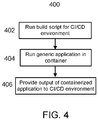
- FIG. 4 shows a generic pipeline execution process 400 according to an embodiment of the present disclosure.
- a computing device 200 including a CI/CD environment may perform process 400 to execute pipelines in containers 110.
- computing device 200 may be, but is not necessarily, the same computing device 200 that performs container creation and distribution process 300.
- the same pipeline device 200 may perform container creation and distribution process 300 and generic application execution process 400 when container 110 is being tested in the local development environment.
- a first computing device 200 may perform container creation and distribution process 300 and thereby deliver container 110 to a second computing device that may perform generic pipeline execution process 400 in a CI/CD environment such as JenkinsTM, Circle CITM, Drone CITM, or the like.
- computing device 200 may run a build script generated as described above.
- the build script may be configured to run in the specific environment of computing device 200 (e.g., JenkinsTM, Circle CITM, Drone CITM, etc.).
- the build script may direct the pipeline in container 110 to execute.
- computing device 200 may run the generic pipeline in container 110.
- pipeline may execute in response to computing device 200 running the build script.
- the pipeline may be written in a generic language and may contain all code necessary to execute. Accordingly, the pipeline may execute the same way across different computing environments. For example, the pipeline may do the same thing when container 110 is deployed in a JenkinsTM platform as it would when container 110 is employed in a CircleTM platform or a test environment.
- computing device 200 may use the output of pipeline 0execution.
- container 110 may output a result of execution, and this result may be used in any way an execution result may be used normally in the platform.
Landscapes
- Engineering & Computer Science (AREA)
- Theoretical Computer Science (AREA)
- Software Systems (AREA)
- General Engineering & Computer Science (AREA)
- Physics & Mathematics (AREA)
- General Physics & Mathematics (AREA)
- Computer Hardware Design (AREA)
- Quality & Reliability (AREA)
- Computer Security & Cryptography (AREA)
- Stored Programmes (AREA)
- Debugging And Monitoring (AREA)
Applications Claiming Priority (3)
| Application Number | Priority Date | Filing Date | Title |
|---|---|---|---|
| US15/938,833 US10120670B1 (en) | 2018-03-28 | 2018-03-28 | Systems and methods for building generic CI/CD pipelines |
| US16/151,528 US10275231B1 (en) | 2018-03-28 | 2018-10-04 | Systems and methods for building generic CI/CD pipelines |
| US16/356,530 US10528332B2 (en) | 2018-03-28 | 2019-03-18 | Systems and methods for building generic CI/CD pipelines |
Publications (2)
| Publication Number | Publication Date |
|---|---|
| EP3547111A2 true EP3547111A2 (de) | 2019-10-02 |
| EP3547111A3 EP3547111A3 (de) | 2019-10-16 |
Family
ID=66223595
Family Applications (1)
| Application Number | Title | Priority Date | Filing Date |
|---|---|---|---|
| EP19165992.9A Pending EP3547111A3 (de) | 2018-03-28 | 2019-03-28 | Systeme und verfahren zum bau von generischen ci/cd-pipelines |
Country Status (3)
| Country | Link |
|---|---|
| US (3) | US10528332B2 (de) |
| EP (1) | EP3547111A3 (de) |
| CA (1) | CA3038300C (de) |
Families Citing this family (24)
| Publication number | Priority date | Publication date | Assignee | Title |
|---|---|---|---|---|
| US11886390B2 (en) | 2019-04-30 | 2024-01-30 | JFrog Ltd. | Data file partition and replication |
| US11386233B2 (en) | 2019-04-30 | 2022-07-12 | JFrog, Ltd. | Data bundle generation and deployment |
| US10999314B2 (en) | 2019-07-19 | 2021-05-04 | JFrog Ltd. | Software release tracking and logging |
| WO2021014326A2 (en) | 2019-07-19 | 2021-01-28 | JFrog Ltd. | Software release verification |
| US11328065B1 (en) * | 2019-07-26 | 2022-05-10 | Stripe Inc. | Architectures, systems, and methods for building trusted and secure artifacts |
| US11237941B2 (en) * | 2019-12-12 | 2022-02-01 | Cognizant Technology Solutions India Pvt. Ltd. | System and method for application transformation to cloud based on semi-automated workflow |
| US10878467B1 (en) | 2020-07-28 | 2020-12-29 | Instabase, Inc. | Systems and methods for distribution of enterprise software and compensation for usage of the enterprise software |
| US10891211B1 (en) * | 2020-07-29 | 2021-01-12 | Instabase, Inc. | Systems and methods for version control of pipelined enterprise software |
| US11301246B2 (en) * | 2020-08-18 | 2022-04-12 | Red Hat, Inc. | Automatically generating continuous integration pipelines |
| US12561223B2 (en) | 2020-08-25 | 2026-02-24 | Cognizant Technology Solutions U.S. Corporation | Method for decentralized accessioning for distributed machine learning and other applications |
| CN112671531B (zh) * | 2020-09-24 | 2023-03-07 | 紫光云技术有限公司 | 一种基于Jenkins的跨云持续化构建方法 |
| CN114500549B (zh) * | 2020-11-13 | 2023-08-08 | 天翼云科技有限公司 | 在公共云中为用户部署k8s托管集群的方法、设备和介质 |
| US11860680B2 (en) * | 2020-11-24 | 2024-01-02 | JFrog Ltd. | Software pipeline and release validation |
| US12333331B2 (en) * | 2021-02-16 | 2025-06-17 | Cisco Technology, Inc. | Automated construction of software pipeline |
| US12293165B2 (en) | 2021-08-30 | 2025-05-06 | Calibo LLC | System and method for monitoring of software applications and health analysis |
| CN113778486B (zh) * | 2021-09-09 | 2024-06-07 | 上海浦东发展银行股份有限公司 | 一种代码流水线的容器化处理方法、装置、介质及设备 |
| US12061889B2 (en) | 2021-10-29 | 2024-08-13 | JFrog Ltd. | Software release distribution across a hierarchical network |
| US12536008B2 (en) | 2021-10-29 | 2026-01-27 | JFrog Ltd. | Managing a federated software repository across multiple devices |
| US11822916B2 (en) | 2022-01-06 | 2023-11-21 | Bank Of America Corporation | Correlation engine for detecting security vulnerabilities in continuous integration/continuous delivery pipelines |
| CN114697307B (zh) * | 2022-02-25 | 2024-09-06 | 智己汽车科技有限公司 | 一种代码仓库自动同步下载的管理系统与方法 |
| CN114996123B (zh) * | 2022-05-06 | 2024-06-21 | 江苏康众汽配有限公司 | 一种基于保障测试的应用发布质量管理方法及系统 |
| CN115185552A (zh) * | 2022-07-15 | 2022-10-14 | 中国银行股份有限公司 | 适用于流水线构建机环境的安装方法及装置 |
| US12554851B2 (en) | 2022-10-25 | 2026-02-17 | Cisco Technology, Inc. | Systems and methods for API security integration |
| US12536026B2 (en) * | 2022-12-08 | 2026-01-27 | Dell Products L.P. | Simulation of one or more pipeline jobs in a software deployment pipeline |
Family Cites Families (7)
| Publication number | Priority date | Publication date | Assignee | Title |
|---|---|---|---|---|
| US8914879B2 (en) * | 2010-06-11 | 2014-12-16 | Trustwave Holdings, Inc. | System and method for improving coverage for web code |
| US9396037B2 (en) * | 2012-02-27 | 2016-07-19 | Microsoft Technology Licensing, Llc | Model-based data pipeline system optimization |
| CN103377080B (zh) * | 2012-04-23 | 2016-12-14 | 国际商业机器公司 | 用于在运行时支持微件的跨容器移动的方法和系统 |
| CN103685399B (zh) * | 2012-09-17 | 2018-03-23 | 腾讯科技(深圳)有限公司 | 一种登录类Unix虚拟容器的方法、装置和系统 |
| WO2015112170A1 (en) | 2014-01-27 | 2015-07-30 | Hewlett-Packard Development Company, L.P. | Continuous integration with reusable context aware jobs |
| US9823950B1 (en) | 2016-08-16 | 2017-11-21 | International Business Machines Corporation | Dynamically forming and executing application programming interface pipelines |
| US10402302B1 (en) * | 2018-03-13 | 2019-09-03 | Red Hat Israel, Ltd. | Reproduction of testing scenarios in a continuous integration environment |
-
2019
- 2019-03-18 US US16/356,530 patent/US10528332B2/en active Active
- 2019-03-28 CA CA3038300A patent/CA3038300C/en active Active
- 2019-03-28 EP EP19165992.9A patent/EP3547111A3/de active Pending
- 2019-10-10 US US16/597,994 patent/US10866793B2/en active Active
-
2020
- 2020-11-13 US US17/097,318 patent/US11249739B2/en active Active
Non-Patent Citations (1)
| Title |
|---|
| None |
Also Published As
| Publication number | Publication date |
|---|---|
| US20190303119A1 (en) | 2019-10-03 |
| US20210064354A1 (en) | 2021-03-04 |
| CA3038300A1 (en) | 2019-09-28 |
| EP3547111A3 (de) | 2019-10-16 |
| US10528332B2 (en) | 2020-01-07 |
| US20200042299A1 (en) | 2020-02-06 |
| US11249739B2 (en) | 2022-02-15 |
| US10866793B2 (en) | 2020-12-15 |
| CA3038300C (en) | 2020-07-21 |
Similar Documents
| Publication | Publication Date | Title |
|---|---|---|
| US11249739B2 (en) | Systems and methods for building generic CI/CD pipelines | |
| US10275231B1 (en) | Systems and methods for building generic CI/CD pipelines | |
| US9946525B2 (en) | Extracting source code | |
| US9529630B1 (en) | Cloud computing platform architecture | |
| US11816464B1 (en) | Cloud computing platform architecture | |
| US12118361B2 (en) | Unicontainers | |
| EP3035191B1 (de) | Identifizierung von zur bildung von ausführbaren dateien verwendetem quellcode | |
| US9378013B2 (en) | Incremental source code analysis | |
| US20170097837A1 (en) | Binary editing of applications executed by virtual machines | |
| US10929162B2 (en) | Virtual machine container for applications | |
| EP3171275A1 (de) | Transparente verfahrensinterzeption | |
| CN104915239B (zh) | 使用容器进行多进程启动的方法及装置 | |
| US20170168843A1 (en) | Thread-agile execution of dynamic programming language programs | |
| US8904346B1 (en) | Method and system for automated load testing of web applications | |
| CN114298313A (zh) | 一种人工智能计算机视觉推理方法 | |
| Stenbom | Refunction: Eliminating serverless cold starts through container reuse | |
| US10114830B2 (en) | Lazy logger wrappers | |
| US9672081B1 (en) | Native service controller | |
| US20250147745A1 (en) | Query-backed ci/cd pipeline modules and distribution method | |
| US11537682B1 (en) | Experience convergence for multiple platforms | |
| Strokova et al. | Cloud Computing for Mobile Devices-Reducing Energy Consumption. |
Legal Events
| Date | Code | Title | Description |
|---|---|---|---|
| PUAI | Public reference made under article 153(3) epc to a published international application that has entered the european phase |
Free format text: ORIGINAL CODE: 0009012 |
|
| STAA | Information on the status of an ep patent application or granted ep patent |
Free format text: STATUS: THE APPLICATION HAS BEEN PUBLISHED |
|
| PUAL | Search report despatched |
Free format text: ORIGINAL CODE: 0009013 |
|
| AK | Designated contracting states |
Kind code of ref document: A2 Designated state(s): AL AT BE BG CH CY CZ DE DK EE ES FI FR GB GR HR HU IE IS IT LI LT LU LV MC MK MT NL NO PL PT RO RS SE SI SK SM TR |
|
| AX | Request for extension of the european patent |
Extension state: BA ME |
|
| AK | Designated contracting states |
Kind code of ref document: A3 Designated state(s): AL AT BE BG CH CY CZ DE DK EE ES FI FR GB GR HR HU IE IS IT LI LT LU LV MC MK MT NL NO PL PT RO RS SE SI SK SM TR |
|
| AX | Request for extension of the european patent |
Extension state: BA ME |
|
| RIC1 | Information provided on ipc code assigned before grant |
Ipc: G06F 8/71 20180101ALI20190910BHEP Ipc: G06F 8/60 20180101AFI20190910BHEP Ipc: G06F 8/70 20180101ALI20190910BHEP |
|
| STAA | Information on the status of an ep patent application or granted ep patent |
Free format text: STATUS: REQUEST FOR EXAMINATION WAS MADE |
|
| 17P | Request for examination filed |
Effective date: 20200416 |
|
| RBV | Designated contracting states (corrected) |
Designated state(s): AL AT BE BG CH CY CZ DE DK EE ES FI FR GB GR HR HU IE IS IT LI LT LU LV MC MK MT NL NO PL PT RO RS SE SI SK SM TR |
|
| STAA | Information on the status of an ep patent application or granted ep patent |
Free format text: STATUS: EXAMINATION IS IN PROGRESS |
|
| 17Q | First examination report despatched |
Effective date: 20200714 |
|
| GRAP | Despatch of communication of intention to grant a patent |
Free format text: ORIGINAL CODE: EPIDOSNIGR1 |
|
| STAA | Information on the status of an ep patent application or granted ep patent |
Free format text: STATUS: GRANT OF PATENT IS INTENDED |
|
| INTG | Intention to grant announced |
Effective date: 20260203 |