EP3546460A1 - Pyrimido[5,4-b]indolizine or pyrimido[5,4-b]pyrrolizine compound, preparation method and use thereof - Google Patents
Pyrimido[5,4-b]indolizine or pyrimido[5,4-b]pyrrolizine compound, preparation method and use thereof Download PDFInfo
- Publication number
- EP3546460A1 EP3546460A1 EP17874613.7A EP17874613A EP3546460A1 EP 3546460 A1 EP3546460 A1 EP 3546460A1 EP 17874613 A EP17874613 A EP 17874613A EP 3546460 A1 EP3546460 A1 EP 3546460A1
- Authority
- EP
- European Patent Office
- Prior art keywords
- compound
- cancer
- substituted
- group
- alkyl
- Prior art date
- Legal status (The legal status is an assumption and is not a legal conclusion. Google has not performed a legal analysis and makes no representation as to the accuracy of the status listed.)
- Granted
Links
- 0 CC(C)(C)OC(NC(CCc1c2-c(cc3)ccc3C(NC(*)[Al])=O)C[n]1c1c2c(N)ncn1)=O Chemical compound CC(C)(C)OC(NC(CCc1c2-c(cc3)ccc3C(NC(*)[Al])=O)C[n]1c1c2c(N)ncn1)=O 0.000 description 9
- PKEAUVYBWZLGKK-QGZVFWFLSA-N C=CC(N[C@H](CCc1c2-c(cc3)ccc3Oc(cc3)ccc3F)C[n]1c1c2c(N)ncn1)=O Chemical compound C=CC(N[C@H](CCc1c2-c(cc3)ccc3Oc(cc3)ccc3F)C[n]1c1c2c(N)ncn1)=O PKEAUVYBWZLGKK-QGZVFWFLSA-N 0.000 description 1
- KCNOZNNQMUNMPU-UHFFFAOYSA-M CC(C)(C)OC(NC(CCc1c2-c(cc3)ccc3C(N[AlH2])=O)C[n]1c1c2c(N)ncn1)=O Chemical compound CC(C)(C)OC(NC(CCc1c2-c(cc3)ccc3C(N[AlH2])=O)C[n]1c1c2c(N)ncn1)=O KCNOZNNQMUNMPU-UHFFFAOYSA-M 0.000 description 1
- LGINGNDHZQLLDD-UHFFFAOYSA-N CC(C)(C)OC(NC(CCc1c2-c(cc3)ccc3C(O)=O)C[n]1c1c2c(N)ncn1)=O Chemical compound CC(C)(C)OC(NC(CCc1c2-c(cc3)ccc3C(O)=O)C[n]1c1c2c(N)ncn1)=O LGINGNDHZQLLDD-UHFFFAOYSA-N 0.000 description 1
- YLQPVYZGDTZGJP-UHFFFAOYSA-N CC(C)(C)OC(NC(C[n]1c2ncnc(N)c2c(I)c1)C=C)=O Chemical compound CC(C)(C)OC(NC(C[n]1c2ncnc(N)c2c(I)c1)C=C)=O YLQPVYZGDTZGJP-UHFFFAOYSA-N 0.000 description 1
- CAMMPFCXKLHLJF-FQEVSTJZSA-N CC(C)(C)OC(N[C@@H](C[n](c1c2-c(cc3)ccc3Oc3ccccc3)c3c2c(N)ncn3)C1=C)=O Chemical compound CC(C)(C)OC(N[C@@H](C[n](c1c2-c(cc3)ccc3Oc3ccccc3)c3c2c(N)ncn3)C1=C)=O CAMMPFCXKLHLJF-FQEVSTJZSA-N 0.000 description 1
- REIZEQZILPXYKS-UHFFFAOYSA-N CC1(C)OB(c(cc2)ccc2C(OC)=O)OC1(C)C Chemical compound CC1(C)OB(c(cc2)ccc2C(OC)=O)OC1(C)C REIZEQZILPXYKS-UHFFFAOYSA-N 0.000 description 1
- DYTLWCHNDRXZEL-UHFFFAOYSA-N CC1N(CC(C=C)NC(OC(C)(C)C)=O)c2ncnc(N)c2C1 Chemical compound CC1N(CC(C=C)NC(OC(C)(C)C)=O)c2ncnc(N)c2C1 DYTLWCHNDRXZEL-UHFFFAOYSA-N 0.000 description 1
- RBRPFBQZRFIFFQ-LSVPIWPGSA-N C[C@H](/C(/CN/C=N\C(C)N(CC(C=C)NC(OC(C)(C)C)=O)C(Br)=C)=C/C=C)OC Chemical compound C[C@H](/C(/CN/C=N\C(C)N(CC(C=C)NC(OC(C)(C)C)=O)C(Br)=C)=C/C=C)OC RBRPFBQZRFIFFQ-LSVPIWPGSA-N 0.000 description 1
Classifications
-
- C—CHEMISTRY; METALLURGY
- C07—ORGANIC CHEMISTRY
- C07D—HETEROCYCLIC COMPOUNDS
- C07D471/00—Heterocyclic compounds containing nitrogen atoms as the only ring hetero atoms in the condensed system, at least one ring being a six-membered ring with one nitrogen atom, not provided for by groups C07D451/00 - C07D463/00
- C07D471/02—Heterocyclic compounds containing nitrogen atoms as the only ring hetero atoms in the condensed system, at least one ring being a six-membered ring with one nitrogen atom, not provided for by groups C07D451/00 - C07D463/00 in which the condensed system contains two hetero rings
- C07D471/04—Ortho-condensed systems
-
- C—CHEMISTRY; METALLURGY
- C07—ORGANIC CHEMISTRY
- C07D—HETEROCYCLIC COMPOUNDS
- C07D471/00—Heterocyclic compounds containing nitrogen atoms as the only ring hetero atoms in the condensed system, at least one ring being a six-membered ring with one nitrogen atom, not provided for by groups C07D451/00 - C07D463/00
- C07D471/12—Heterocyclic compounds containing nitrogen atoms as the only ring hetero atoms in the condensed system, at least one ring being a six-membered ring with one nitrogen atom, not provided for by groups C07D451/00 - C07D463/00 in which the condensed system contains three hetero rings
- C07D471/14—Ortho-condensed systems
-
- A—HUMAN NECESSITIES
- A61—MEDICAL OR VETERINARY SCIENCE; HYGIENE
- A61K—PREPARATIONS FOR MEDICAL, DENTAL OR TOILETRY PURPOSES
- A61K31/00—Medicinal preparations containing organic active ingredients
- A61K31/33—Heterocyclic compounds
- A61K31/395—Heterocyclic compounds having nitrogen as a ring hetero atom, e.g. guanethidine or rifamycins
- A61K31/495—Heterocyclic compounds having nitrogen as a ring hetero atom, e.g. guanethidine or rifamycins having six-membered rings with two or more nitrogen atoms as the only ring heteroatoms, e.g. piperazine or tetrazines
- A61K31/505—Pyrimidines; Hydrogenated pyrimidines, e.g. trimethoprim
- A61K31/519—Pyrimidines; Hydrogenated pyrimidines, e.g. trimethoprim ortho- or peri-condensed with heterocyclic rings
-
- A—HUMAN NECESSITIES
- A61—MEDICAL OR VETERINARY SCIENCE; HYGIENE
- A61P—SPECIFIC THERAPEUTIC ACTIVITY OF CHEMICAL COMPOUNDS OR MEDICINAL PREPARATIONS
- A61P29/00—Non-central analgesic, antipyretic or antiinflammatory agents, e.g. antirheumatic agents; Non-steroidal antiinflammatory drugs [NSAID]
-
- A—HUMAN NECESSITIES
- A61—MEDICAL OR VETERINARY SCIENCE; HYGIENE
- A61P—SPECIFIC THERAPEUTIC ACTIVITY OF CHEMICAL COMPOUNDS OR MEDICINAL PREPARATIONS
- A61P35/00—Antineoplastic agents
-
- A—HUMAN NECESSITIES
- A61—MEDICAL OR VETERINARY SCIENCE; HYGIENE
- A61P—SPECIFIC THERAPEUTIC ACTIVITY OF CHEMICAL COMPOUNDS OR MEDICINAL PREPARATIONS
- A61P35/00—Antineoplastic agents
- A61P35/02—Antineoplastic agents specific for leukemia
-
- A—HUMAN NECESSITIES
- A61—MEDICAL OR VETERINARY SCIENCE; HYGIENE
- A61P—SPECIFIC THERAPEUTIC ACTIVITY OF CHEMICAL COMPOUNDS OR MEDICINAL PREPARATIONS
- A61P37/00—Drugs for immunological or allergic disorders
- A61P37/02—Immunomodulators
-
- C—CHEMISTRY; METALLURGY
- C07—ORGANIC CHEMISTRY
- C07D—HETEROCYCLIC COMPOUNDS
- C07D487/00—Heterocyclic compounds containing nitrogen atoms as the only ring hetero atoms in the condensed system, not provided for by groups C07D451/00 - C07D477/00
- C07D487/12—Heterocyclic compounds containing nitrogen atoms as the only ring hetero atoms in the condensed system, not provided for by groups C07D451/00 - C07D477/00 in which the condensed system contains three hetero rings
- C07D487/14—Ortho-condensed systems
Definitions
- the present disclosure relates to small molecule inhibitors targeting BTK kinase, and in particular to a pyrimido[5,4- b ]indolizine or pyrimido[5,4- b ]pyrrolizine compound, preparation method and use thereof.
- Bruton's tyrosine kinase is a class of non-receptor tyrosine kinases, and belongs to the TEC tyrosine kinase family including Tec, Bmx, BTK, Itk and Txk. BTK is currently a clinically proven drug target in the TEC family.
- BTK is mainly expressed in cells related to hematopoietic system, such as B cells, mast cells, macrophages, and the like. B cells produce a variety of physiological signals through signal transduction of the B cell receptor (BCR). BCR signaling pathway plays a key role in the development and mutation of B cells. BCR signaling pathway disorder and dysfunction often lead to severe immunodeficiency and inflammatory response, and BCR signaling pathway is also closely related to the occurrence and development of a variety of B cell-associated tumors. BTK is a key regulator in the formation of early B cells and survival of mature B cells, and mediates upstream signaling pathway of BCR signaling pathway. In addition, BTK is also closely related to cell proliferation and apoptosis.
- BCR After stimulating the body's immune response, BCR recognizes the antigen, and activates the expression of NF- ⁇ B/Rel transcription factors by BTK-mediated BCR signaling pathway to regulate the proliferation of B cells.
- the activated BTK can also regulate the transcriptional activity of BAP-135/TFII-I, and then regulate the expression of apoptosis-related proteins such as VpreB, CD5 and Bcl-2. Therefore, inhibitors against BTK can be used to treat certain hematological tumor and autoimmune diseases.
- Ibrutinib developed by Pharmacyclics Inc. is the only commercially available small molecule inhibitor targeting BTK kinase currently. The drug is approved to the market in November 2013 by FDA, as a breakthrough therapeutic drug for clinical treatment of relapsed or refractory mantle cell lymphoma (MCL). Ibrutinib has an overall relief rate of 65.8%, with a median duration of relief of 1.9 months. However, ibrutinib has a relatively severe toxic and side effect, since it has a good inhibition for kinase such as Tek and EGFR.
- the present disclosure provides a 5-aryl-pyrimidoindolizine or 5-aryl-pyrimidopyrrolizine compound as shown in formula I or a pharmaceutically acceptable salt thereof, wherein:
- Ar is phenyl, 4-fluorophenyl, 4-trifluoromethylphenyl, pyridin-2-yl, 3-fluoropyridin-6-yl or 4-trifluoromethylpyridine-6-yl.
- R 3 is hydrogen
- R 4 is H or methyl.
- R 3 , R 4 and the carbon atom attached thereto form cyclopropyl.
- n 0.
- R 5 is H, cyano or methyl.
- R 6 is H.
- R 7 is H, t -butyl or dimethylaminomethyl.
- R 8 is H or methyl.
- T is vinyl or propynyl.
- halogen includes fluorine, chlorine, bromine and iodine.
- C6-C20 aryl means a 6-20 membered monocyclic or polycyclic aromatic group whose ring is composed of only carbon atoms, such as phenyl, naphthyl or the like.
- C6-C10 aryl has a similar meaning.
- 5-20 membered heteroaryl means a 5-20 membered monocyclic or polycyclic aromatic group whose ring comprises one or more heteroatoms selected from the group consisting of O, N and S, e.g., furanyl, pyrrolyl, pyridyl, pyrimidinyl and the like.
- 5-10 and 5-6 membered heteroaryl have a similar meaning.
- 3 to 10 membered heterocyclyl means a 3-10 membered monocyclic or polycyclic non-aromatic group whose ring comprises one or more heteroatoms selected from the group consisting of O, N and S, e.g., aziridinyl, oxiranyl, azetidinyl, oxetanyl, tetrahydrofuranyl, azacyclopentanyl, piperidinyl and the like.
- 3-6 membered heterocyclyl has a similar meaning.
- the compound is selected from the group consisting of the compounds shown in the following table: Compound Structure Compound Structure S1 S2 S3 S4 S5 S6 S7 S8 S9 S10 S11 S12 S13 S14 S15 S16 S17 S18 S19 S20 S21 S22
- the present invention also provides a method for preparing 5-aryl-pyrimidoindolizine or 5-aryl-pyrimidopyrrolizine compound.
- the abbreviations and symbols used in the preparation method are as follows:
- the preparation method of the compound includes the following steps:
- R 2 is hydrogen or substituted or unsubstituted C1-C3 alkyl, wherein the substituent in R 2 is halogen or C1-C3 alkoxy;
- Ar is substituted or unsubstituted C6-C20 aryl, substituted or unsubstituted 5-20 membered heteroaryl containing one or more heteroatoms selected from the group consisting of O, N and S, preferably substituted or unsubstituted C6-C10 aryl, substituted or unsubstituted 5-10 membered heteroaryl containing one or more heteroatoms selected from the group consisting of O, N and S, more preferably substituted or unsubstituted phenyl, substituted or unsubstituted 5 to 6-membered heteroaryl (particularly pyridyl), wherein the substituent in Ar is halogen, C1-C6 alkyl, C1-C6 alkoxy, trifluoromethyl or trifluoromethoxy, preferably
- Ar is phenyl, 4-fluorophenyl, 4-trifluoromethylphenyl, pyridin-2-yl, 3-fluoropyridin-6-yl or 4-trifluoromethylpyridine-6-yl.
- R 3 is hydrogen
- R 4 is H or methyl.
- R 3 , R 4 and the carbon atom attached thereto form cyclopropyl.
- n 0.
- R 5 is H, cyano or methyl.
- R 6 is H.
- R 7 is H, t -butyl or dimethylaminomethyl.
- R 8 is H or methyl.
- T is vinyl or propynyl.
- the compounds of the invention may have asymmetric centers, chiral axes and chiral planes, and may exist in the form of enantiomers, diastereomers, racemates, and mixtures thereof.
- the pharmaceutically acceptable salt of the compound of formula I may be a conventional non-toxic salt formed by reaction of the compound of formula I with an inorganic or organic acid.
- a conventional non-toxic salt may be prepared by reacting a compound of formula I with an inorganic or organic acid.
- the inorganic acid includes hydrochloric acid, hydrobromic acid, sulfuric acid, nitric acid, aminosulfonic acid, phosphoric acid, and the like.
- organic acid include citric acid, tartaric acid, lactic acid, pyruvic acid, acetic acid, benzenesulfonic acid, p -toluenesulfonic acid, methanesulfonic acid, naphthalenesulfonic acid, ethanesulfonic acid, naphthalenedisulfonic acid, maleic acid, malic acid, malonic acid, fumaric acid, succinic acid, propionic acid, oxalic acid, trifluoroacetic acid, stearic acid, pamoic acid, hydroxymaleic acid, phenylacetic acid, benzoic acid, salicylic acid, glutamic acid, ascorbic acid, p-aminobenzenesulfonic acid, 2-acetoxybenzoic acid, hydroxyethanesulfonic acid, etc.
- the pharmaceutically acceptable salt of the compound of formula I may be a sodium salt, a potassium salt, a calcium salt, an aluminum salt or an ammonium salt, which is formed by reacting the compound of formula I with propionic acid, oxalic acid, malonic acid, succinic acid, fumaric acid, maleic acid, lactic acid, malic acid, tartaric acid, citric acid, aspartic acid or glutamic acid to form an ester, and then reacting with an inorganic base; or a methylamine salt, ethylamine salt or ethanolamine salt formed by reacting a compound of the formula I with an organic base; or an inorganic acid salt which is formed by reacting the compound of formula I with lysine, arginine or ornithine to form an ester, and then reacting with hydrochloric acid, hydrobromic acid, hydrofluoric acid, sulfuric acid, nitric acid or phosphoric acid; or an organic acid salt which is formed by reacting the compound of formula I
- the present invention provides use of a compound of the above formula I for manufacture of a medicament in treatment of a disease associated with the BTK kinase signal transduction pathway.
- the invention also provides use of a compound of the above formula I in treatment of a disease associated with the BTK kinase signal transduction pathway.
- the invention also provides a method of treating a disease associated with a BTK kinase signal transduction pathway, which comprises administering a therapeutically effective amount of one or more compounds of the above formula I or a pharmaceutically acceptable salt thereof to a subject.
- the disease associated with the BTK kinase signal transduction pathway is selected from the group consisting of, for example, cancer, hyperplasia, restenosis, immune disorders, and inflammation.
- the invention also provides use of a compound of the above formula I in manufacture of a medicament for inhibiting BTK kinase.
- the invention also provides a pharmaceutical composition
- a pharmaceutical composition comprising a therapeutically effective amount of a compound of the above formula I or a pharmaceutically acceptable salt thereof, and one or more pharmaceutically acceptable carriers.
- the pharmaceutical composition may further comprise a pharmaceutical excipient such as an odorant, a fragrance, and the like.
- the pharmaceutical composition of the present invention preferably contains an active ingredient in a weight ratio of 1 to 99%.
- the compound of the formula I is in a ratio of 65% to 99% by weight as an active ingredient, and the remainder being pharmaceutically acceptable carriers, such as a diluent or a solvent or a salt solution.
- the compounds and compositions of the invention are also useful in treatment, prevention or modulation of cancer cells and metastatic tumors of cancer. Accordingly, the present invention also provides use of a compound of the above formula I in manufacture of a medicament for treatment, prevention or modulation of cancer cells and metastatic tumors of cancer.
- the cancer in the present invention includes, but is not limited to, histiocytic lymphoma, ovarian cancer, head and neck squamous cell carcinoma, gastric cancer, breast cancer, childhood hepatocellular carcinoma, colorectal cancer, cervical cancer, lung cancer, sarcoma, nasopharyngeal carcinoma, pancreatic cancer, glioblastoma, prostate cancer, small cell lung cancer, non-small cell lung cancer, multiple myeloma, thyroid cancer, testicular cancer, cervical cancer, endometrial cancer, esophageal cancer, leukemia, renal cell carcinoma, bladder cancer, liver cancer, astrocytoma, etc.; more preferably head and neck squamous cell carcinoma, histiocytic lymphoma, lung adenocarcinoma, small cell lung cancer, non-small cell lung cancer, pancreatic cancer, papillary kidney cells cancer, liver cancer, gastric cancer, colon cancer, multiple myeloma, and glioblast
- the compound and the pharmaceutical composition of the present invention may be in various forms such as tablets, capsules, powders, syrups, solutions, suspensions, aerosols, and the like, and may be present in a suitable solid or liquid carrier or diluent, and a suitable sterilizing device for injection or drip.
- a unit dosage of the formulation contains 0.05 mg to 200 mg of the compound of formula I, preferably, a unit dosage of the formulation contains 0.1 mg to 100 mg of the compound of formula I.
- the compound and the pharmaceutical composition of the present invention can be clinically administered to a mammal, including human and animal, and can be administered via a route such as oral, nose, skin, lung, or gastrointestinal tract, most preferably via oral.
- the most preferred daily dose is 0.01 to 200 mg/kg body weight by once, or 0.01 to 100 mg/kg body weight by several times.
- the optimal dosage for the individual should be based on the particular treatment regardless of the method of administration. Usually, the most suitable dose is determined by starting with a small dose, and then gradually increasing the dose until it is found.
- the compound of the present invention has good inhibitory activities against BTK at molecular and cellular level.
- the compound of the present invention has low activity against normal human B lymphoma Ramos cells, and high activity against BTK-sensitive human diffuse large B lymphoma TMD8 cells, indicating that this type of compounds with novel structure have a high selectivity, and low off-target possibility and low side effects, and thus are a class of selective inhibitor of BTK with development potential.
- Step 1 Synthesis of 4-amino-5-iodo-7 H -pyrrolo[2,3- d ]pyrimidine
- Step 2 Synthesis of t -butyl ( R )-(1-(4-amino-5-iodo-7 H -pyrrolo[2,3- d ]pyrimidin-7-yl) but-3-en-2-yl)carbamate
- Triphenylphosphine (787 mg, 3 mmol) was added into a reaction flask, then 15 mL of anhydrous THF was added as solvent, and the resultant was cooled to 0 °C.
- Diisopropyl azodicarboxylate (DIAD) (606 mg, 3 mmol) was added dropwise, and stirred at this temperature for 15 min, then t -butyl ( R )-(1-hydroxybut-3-en-2-yl)carbamate (562 mg, 3 mmol) was added, followed by addition of 4-amino-5-iodo-7 H -pyrrolo[2,3- d ]pyrimidine (520 mg, 2 mmol).
- Step 3 Synthesis of t -butyl ( R )-(1-(4-amino-5-(4-(phenoxyphenyl)-7 H -pyrrolo[2,3- d ]pyrimidin-7-yl) but-3-en-2-yl)carbamate
- Step 4 Synthesis of t -butyl ( R )-(1-(4-amino-5-(4-(phenoxyphenyl)-6-bromo-7 H -pyrrolo[2,3- d ]pyrimidin-7-yl) but-3-en-2-yl)carbamate
- Step 5 Synthesis of t -butyl ( R )-(4-amino-5-(4-phenoxyphenyl)-6,7,8,9-tetrahydropyrimido[5,4- b ]indolizine-8-yl)ca rbamate
- the S2 was synthesized by referring to the synthesis steps of the S1 in Example 1, except that in step 2, t -butyl ( S )-(1-hydroxybut-3-en-2-yl)carbamate was used instead of t -butyl ( R )-(1-hydroxybut-3-en-2-yl)carbamate.
- the S3 was synthesized by referring to the synthesis steps of the S1 in Example 1, except that in step 2, racemic t -butyl (1-hydroxybut-3-en-2-yl)carbamate was used instead of t -butyl ( R )-(1-hydroxybut-3-en-2-yl)carbamate.
- the S4 was synthesized by referring to the synthesis steps of the S1 in Example 1, except that in step 6, 2-cyano-4,4-dimethyl-2-pentenoic acid was used instead of acrylic acid.
- the S5 was synthesized by referring to the synthesis steps of the S1 in Example 1, except that in step 6, ( E )-4-dimethylamino-2-butenoic acid was used instead of acrylic acid.
- the S6 was synthesized by referring to the synthesis steps of the S1 in Example 1, except that in step 6, 2-acrylamidoacetic acid was used instead of acrylic acid.
- the S7 was synthesized by referring to the synthesis steps of the S1 in Example 1, except that in step 6, 2-acrylamidopropionic acid was used instead of acrylic acid.
- the S8 was synthesized by referring to the synthesis steps of the S1 in Example 1, except that in step 6, 1-acrylamidocyclopropanecarboxylic acid was used instead of acrylic acid.
- the S10 was synthesized by referring to the synthesis steps of the S1 in Example 1, except that in step 6, But-2-ynoic acid was used instead of acrylic acid.
- the S11 was synthesized by referring to the synthesis steps of the S1 in Example 1, except that in step 3, 4-(4-fluorophenoxy)phenylboronic acid was used instead of 4-phenoxyphenylboronic acid.
- the S12 was synthesized by referring to the synthesis steps of the S1 in Example 1, except that in step 3, 4-(4-trifluoromethylphenoxy)phenylboronic acid was used instead of 4-phenoxyphenylboronic acid.
- Step 1 Synthesis of methyl ( R )-4-(4-amino-7-(2-((t-butoxycarbonyl)amino) but-3-en-1-yl)-7 H -pyrrolo[2,3- d ]pyrimidin-5-yl)benzoate
- Methyl ( R )-4-(4-amino-7-(2-(( t -butoxycarbonyl)amino)but-3-en-1-yl)-7 H -pyrrolo[2,3- d ]pyrimi din-5-yl)benzoate was synthesized by referring to the step 3 in Example 1, except using 4-methoxycarbonylphenylboronic acid instead of 4-phenoxyphenylboronic acid.
- Step 2 Synthesis of methyl ( R )-4-(4-amino-6-bromo-7-(2-(( t -butoxycarbonyl) amino)but-3-en-1-yl)-7 H -pyrrolo[2,3- d ]pyrimidin-5-yl)benzoate
- Methyl ( R )-4-(4-amino-6-bromo-7-(2-(( t -butoxycarbonyl)amino) but-3-en-1-yl)-7 H -pyrrolo[2,3- d ]pyrimidin-5-yl)benzoate was synthesized by referring to the step 4 in Example 1, except using the compound obtained from the step 1 of the present Example 13 instead of the corresponding compound in the step 4 of Example 1.
- Step 3 Synthesis of methyl ( R )-4-(4-amino-8-(( t -butoxycarbonyl) amino)-6,7,8,9-tetrahydropyrimido[5,4- b ]indolizine-5-yl)benzoate
- Methyl ( R )-4-(4-amino-8-(( t -butoxycarbonyl)amino)-6,7,8,9-tetrahydropyrimido[5,4- b ]indolizin e-5-yl)benzoate was synthesized by referring to the step 5 in Example 1, except using the compound obtained from the step 2 of the present Example 13 instead of the corresponding compound in the step 5 of Example 1.
- Step 4 Synthesis of ( R )-4-(4-amino-8-(( t -butoxycarbonyl)amino) -6,7,8,9-tetrahydropyrimido[5,4- b ]indolizine-5-yl)benzoic acid
- Step 5 Synthesis of t -butyl ( R )-(4-amino-5-(4-(pyridin-2-ylcarbamoyl) phenyl)-6,7,8,9-tetrahydropyrimido[5,4- b ]indolizine-8-yl)carbamate
- Step 6 Synthesis of ( R )-4-(8-acrylamido-4-amino-6,7,8,9-tetrahydropyrimido [5,4- b ]indolizine-5-yl)-N-(pyridin-2-yl)benzamide(S13)
- the S13 was synthesized by referring to the step 6 in Example 1, except using the compound obtained from the step 5 of the present Example 13 instead of the corresponding compound in the step 6 of Example 1.
- the S14 was synthesized by referring to the step 6 in Example 1, except using the compound obtained from the step 5 of the present Example 13 instead of the corresponding compound in the step 6 of Example 1, and using but-2-ynoic acid instead of acrylic acid in the step 6 of Example 1.
- the S15 was synthesized by referring to the synthesis steps of the S13 in Example 13, except using 2-amino-5-fluoropyridine instead of 2-aminopyridine in the step 5 of Example 13.
- the S16 was synthesized by referring to the synthesis steps of the S13 in Example 13, except using 2-amino-4-trifluoromethylpyridine instead of 2-aminopyridine in the step 5 of Example 13.
- the S17 was synthesized by referring to the synthesis steps of the S13 in Example 13, except using ( R )-2-methoxy-1-phenylethylamine instead of 2-aminopyridine in the step 5 of Example 13.
- Step 1 Synthesis of t -butyl ( R )-(4-amino-6-methylidene-5-(4-phenoxyphenyl)-7,8-dihydro-6 H -pyrimido[5,4- b ]pyrr olizin-7-yl)carbamate
- Step 2 Synthesis of ( R )-N-(4-amino-6-methylidene-5-(4-phenoxyphenyl)-7,8-dihydro-6 H -pyrimido[5,4- b ]p yrrolizin-7-yl)acrylamide (S18)
- the S18 was synthesized by referring to the step 6 in Example 1, except using the compound obtained from the step 1 of the Example 18 instead of the corresponding compound in the step 6 of Example 1.
- the S19 was synthesized by referring to the synthesis step of the S18 in Example 18, except using the compound obtained from the step 1 of the present Example 18 instead of the corresponding compound in the step 6 of Example 1, and using but-2-ynoic acid instead of acrylic acid in the step 6 of Example 1.
- Example 13 except using the instead of the compound in the step 2 of Example 13.
- Step 1 Synthesis of t -butyl ((7 R )-(4-amino-6-methyl-5-(4-phenoxyphenyl)-7,8-dihydro-6 H -pyrimido[5,4- b ]pyrroliz in-7-yl)carbamate
- Step 2 Synthesis of N-((7 R )-4-amino-6-methyl-5-(4-phenoxyphenyl)-7,8-dihydro-6 H -pyrimido[5,4- b ]pyrrol izin-7-yl)acrylamide (S21)
- the S21 was synthesized by referring to the step 6 in Example 1, except using the compound obtained from the step 1 of the present Example 21 instead of the corresponding compound in the step 6 of Example 1.
- the S22 was synthesized by referring to the step 1 to step 2 in Example 21 except using the instead of t -butyl ( R )-(4-amino-6-methylidene-5-(4-phenoxyphenyl)-7,8-dihydro-6 H -pyrimido[5,4- b ]pyrr olizin-7-yl)carbamate (the compound obtained from the step 1 of Example 18).
- Poly(Glu, Tyr) 4:1 as a substrate for enzyme catalyzed reaction was diluted with potassium-free PBS (10 mM sodium phosphate buffer, 150 mM NaCl, pH 7.2-7.4) to 20 ⁇ g/mL to coat a ELISA plate.
- the plate was cultured at 37 °C for 12-16 h, washed with 200 ⁇ L/well of T-PBS (PBS containing 0.1% of Tween-20) three times, and dried in an oven at 37 °C for 1-2 h.
- an ATP solution diluted with a reaction buffer 50 mM HEPES, pH 7.4, 50 mM MgCl 2 , 5 mM MnCl 2 , 0.2 mM Na 3 VO 4 , 1 mM DTT
- a reaction buffer 50 mM HEPES, pH 7.4, 50 mM MgCl 2 , 5 mM MnCl 2 , 0.2 mM Na 3 VO 4 , 1 mM DTT
- the above reaction system was placed on a shaker (100 rpm) at 37 °C for 1 h, then washed with T-PBS for three times, primary antibody PY99 (Cell Signaling Technology) was added at 100 ⁇ L/well, and the reaction was conducted on the shaker at 37 °C for 0.5 h. After the plate was washed with T-PBS, secondary antibody horseradish peroxidase-labeled goat anti-mouse IgG was added at 100 ⁇ L/well, and the reaction was conducted on the shaker at 37 °C for 0.5 h.
- primary antibody PY99 Cell Signaling Technology
- inhibition rate (%) (OD control well - OD administration well )/OD control well ⁇ 100%.
- IC 50 was calculated by fitting the inhibition curve using a four-parameter method.
- Compound IC 50 (nM) Compound IC 50 (nM) S1 ⁇ 1 S12 ⁇ 1 S2 ⁇ 1 S13 1 ⁇ 10 S3 ⁇ 1 S14 1 ⁇ 10 S4 >100 S15 1 ⁇ 10 S5 ⁇ 1 S16 1 ⁇ 10 S6 1 ⁇ 10 S17 1 ⁇ 10 S7 10 ⁇ 100 S18 1 ⁇ 10 S8 >100 S19 ⁇ 1 S9 10 ⁇ 100 S20 1 ⁇ 10 S10 1 ⁇ 10 S21 1 ⁇ 10 S11 ⁇ 1 S22 1 ⁇ 10
- inhibition rate (%) (OD control well - OD administration well )/OD control well ⁇ 100%.
- IC 50 value was calculated by fitting the inhibition curve using a four-parameter method. The experiment was repeated 3 times independently.
- the present invention provides a series of 5-aryl-pyrimidopyrrolizine or 5-aryl-pyrimidoindolizine tricyclic compounds.
- the series of derivatives are Bruton kinase inhibitors with novel structures, and some of the compounds have considerable inhibitory activities against BTK enzymes and considerable inhibitory activities against BTK-dependent TMD8 cells at molecular level. And it is more important that some of the compounds (e.g., S1) shows low cell activity against human B lymphoma Ramos cells, and good selectivity to BTK, and therefore they are a class of BTK selective inhibitors with much potential.
Landscapes
- Health & Medical Sciences (AREA)
- Chemical & Material Sciences (AREA)
- Organic Chemistry (AREA)
- General Health & Medical Sciences (AREA)
- Veterinary Medicine (AREA)
- Medicinal Chemistry (AREA)
- Public Health (AREA)
- Pharmacology & Pharmacy (AREA)
- Life Sciences & Earth Sciences (AREA)
- Animal Behavior & Ethology (AREA)
- Nuclear Medicine, Radiotherapy & Molecular Imaging (AREA)
- General Chemical & Material Sciences (AREA)
- Chemical Kinetics & Catalysis (AREA)
- Immunology (AREA)
- Engineering & Computer Science (AREA)
- Oncology (AREA)
- Hematology (AREA)
- Bioinformatics & Cheminformatics (AREA)
- Pain & Pain Management (AREA)
- Rheumatology (AREA)
- Epidemiology (AREA)
- Pharmaceuticals Containing Other Organic And Inorganic Compounds (AREA)
- Nitrogen Condensed Heterocyclic Rings (AREA)
Abstract
Description
- The present disclosure relates to small molecule inhibitors targeting BTK kinase, and in particular to a pyrimido[5,4-b]indolizine or pyrimido[5,4-b]pyrrolizine compound, preparation method and use thereof.
- Bruton's tyrosine kinase (BTK) is a class of non-receptor tyrosine kinases, and belongs to the TEC tyrosine kinase family including Tec, Bmx, BTK, Itk and Txk. BTK is currently a clinically proven drug target in the TEC family.
- BTK is mainly expressed in cells related to hematopoietic system, such as B cells, mast cells, macrophages, and the like. B cells produce a variety of physiological signals through signal transduction of the B cell receptor (BCR). BCR signaling pathway plays a key role in the development and mutation of B cells. BCR signaling pathway disorder and dysfunction often lead to severe immunodeficiency and inflammatory response, and BCR signaling pathway is also closely related to the occurrence and development of a variety of B cell-associated tumors. BTK is a key regulator in the formation of early B cells and survival of mature B cells, and mediates upstream signaling pathway of BCR signaling pathway. In addition, BTK is also closely related to cell proliferation and apoptosis. After stimulating the body's immune response, BCR recognizes the antigen, and activates the expression of NF-κB/Rel transcription factors by BTK-mediated BCR signaling pathway to regulate the proliferation of B cells. On the other hand, the activated BTK can also regulate the transcriptional activity of BAP-135/TFII-I, and then regulate the expression of apoptosis-related proteins such as VpreB, CD5 and Bcl-2. Therefore, inhibitors against BTK can be used to treat certain hematological tumor and autoimmune diseases.
- Ibrutinib developed by Pharmacyclics Inc. is the only commercially available small molecule inhibitor targeting BTK kinase currently. The drug is approved to the market in November 2013 by FDA, as a breakthrough therapeutic drug for clinical treatment of relapsed or refractory mantle cell lymphoma (MCL). Ibrutinib has an overall relief rate of 65.8%, with a median duration of relief of 1.9 months. However, ibrutinib has a relatively severe toxic and side effect, since it has a good inhibition for kinase such as Tek and EGFR.
- Therefore, there is still a need to further develop other small molecule inhibitors targeting BTK kinase.
- The present disclosure provides a 5-aryl-pyrimidoindolizine or 5-aryl-pyrimidopyrrolizine compound as shown in formula I or a pharmaceutically acceptable salt thereof,

- R1 is H, methyl or methylidene;
- L is -O-, -C(=O)NH- or -C(=O)NHCHR2-, wherein, R2 is hydrogen or substituted or unsubstituted C1-C3 alkyl, wherein, the substituent in R2 is halogen or C1-C3 alkoxy;
- m is 0 or 1;
- Ar is substituted or unsubstituted C6-C20 aryl, substituted or unsubstituted 5-20 membered heteroaryl containing one or more heteroatoms selected from the group consisting of O, N and S, preferably substituted or unsubstituted C6-C10 aryl, substituted or unsubstituted 5-10 membered heteroaryl containing one or more heteroatoms selected from the group consisting of O, N and S, more preferably substituted or unsubstituted phenyl, substituted or unsubstituted 5 to 6-membered heteroaryl (particularly pyridyl), wherein the substituent in Ar is halogen, C1-C6 alkyl, C1-C6 alkoxy, trifluoromethyl or trifluoromethoxy, preferably halogen, C1-C3 alkyl, C1-C3 alkoxy, trifluoromethyl or trifluoromethoxy, more preferably halogen, C1-C3 alkyl, C1-C3 alkoxy, trifluoromethyl or trifluoromethoxy;
- A is carbonyl, sulfonyl, or

- n is 0, 1 or 2, preferably 0 or 1;
- T is

- R5, R6 and R7 may be independently selected from the group consisting of hydrogen, cyano, halogen, and substituted or unsubstituted C1-C20 alkyl, preferably are independently selected from the group consisting of hydrogen, cyano, halogen, and substituted or unsubstituted C1-C10 alkyl, more preferably are independently selected from the group consisting of hydrogen, cyano, halogen, and substituted or unsubstituted C1-C5 alkyl; the substituent in R5, R6 or R7 is dimethylamino, C1-C10 alkoxy, or 3 to 10 membered heterocyclyl containing one or more heteroatoms selected from the group consisting of O, N and S; preferably dimethylamino, C1-C6 alkoxy, or 3 to 10 membered heterocyclyl containing one or more heteroatoms selected from the group consisting of O, N and S; more preferably dimethylamino, C1-C5 alkoxy, or 3 to 6 membered heterocyclyl containing 1 to 3 heteroatoms selected from the group consisting of O, N and S;
- R8 is selected from the group consisting of hydrogen and C1-C10 alkyl, preferably selected from the group consisting of hydrogen and C1-C5 alkyl, more preferably selected from the group consisting of hydrogen and C1-C3 alkyl.
- In one embodiment, L is -O- or -C(=O)NH-.
- In one embodiment, Ar is phenyl, 4-fluorophenyl, 4-trifluoromethylphenyl, pyridin-2-yl, 3-fluoropyridin-6-yl or 4-trifluoromethylpyridine-6-yl.
- In one embodiment, R3 is hydrogen.
- In one embodiment, R4 is H or methyl.
- In one embodiment, R3, R4 and the carbon atom attached thereto form cyclopropyl.
- In one embodiment, n is 0.
- In one embodiment, R5 is H, cyano or methyl.
- In one embodiment, R6 is H.
- In one embodiment, R7 is H, t-butyl or dimethylaminomethyl.
- In one embodiment, R8 is H or methyl.
- In one embodiment, T is vinyl or propynyl.
- In the present invention, halogen includes fluorine, chlorine, bromine and iodine.
- In the present invention, C6-C20 aryl means a 6-20 membered monocyclic or polycyclic aromatic group whose ring is composed of only carbon atoms, such as phenyl, naphthyl or the like. C6-C10 aryl has a similar meaning.
- In the present invention, 5-20 membered heteroaryl means a 5-20 membered monocyclic or polycyclic aromatic group whose ring comprises one or more heteroatoms selected from the group consisting of O, N and S, e.g., furanyl, pyrrolyl, pyridyl, pyrimidinyl and the like. 5-10 and 5-6 membered heteroaryl have a similar meaning.
- In the present invention, 3 to 10 membered heterocyclyl means a 3-10 membered monocyclic or polycyclic non-aromatic group whose ring comprises one or more heteroatoms selected from the group consisting of O, N and S, e.g., aziridinyl, oxiranyl, azetidinyl, oxetanyl, tetrahydrofuranyl, azacyclopentanyl, piperidinyl and the like. 3-6 membered heterocyclyl has a similar meaning.
- More preferably, the compound is selected from the group consisting of the compounds shown in the following table:
Compound Structure Compound Structure S1 
S2 
S3 
S4 
S5 
S6 
S7 
S8 
S9 
S10 
S11 
S12 
S13 
S14 
S15 
S16 
S17 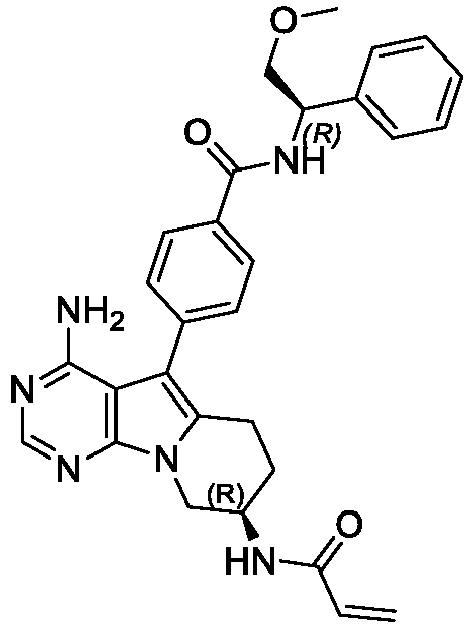
S18 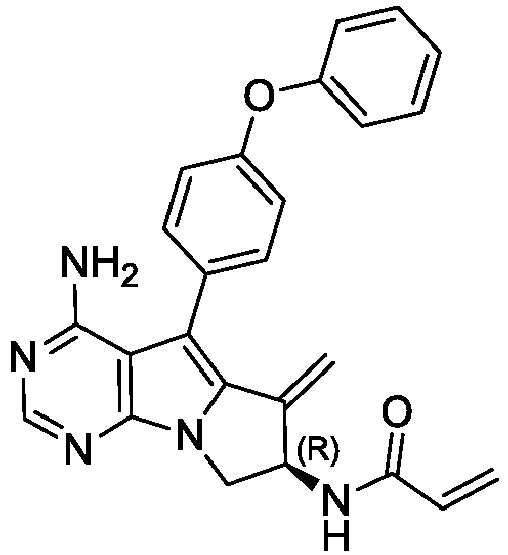
S19 
S20 
S21 
S22 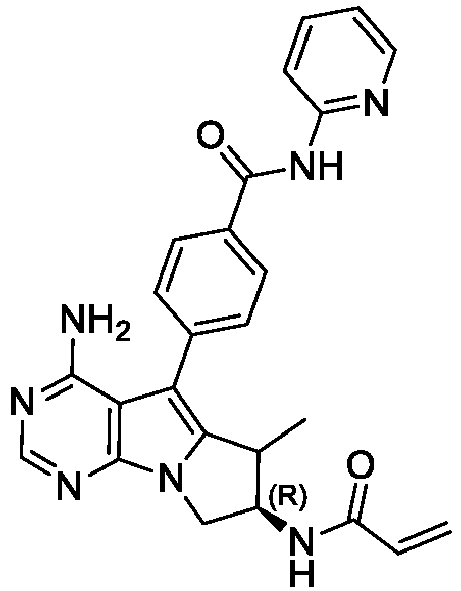
- The present invention also provides a method for preparing 5-aryl-pyrimidoindolizine or 5-aryl-pyrimidopyrrolizine compound. The abbreviations and symbols used in the preparation method (also in the other locations of the present description) are as follows:
-
- 9-BBN: 9-boronbicyclo[3.3.1]nonane
- DCM: dichloromethane
- DIAD: diisopropyl azodicarboxylate
- DIPEA: diisopropylethylamine
- DMF: N,N-dimethylformamide
- EA: ethyl acetate
- HATU: 2-(7-oxybenzotriazole)-N,N,N',N'-tetramethylurea hexafluorophosphate
- NBS: N-bromosuccinimide
- NIS: N-iodosuccinimide
- PdCl2(dppf): [1,1'-bis(diphenylphosphinyl)ferrocene]palladium dichloride
- PE: petroleum ether
- THF: tetrahydrofuran
- The preparation method of the compound includes the following steps:


- Scheme 1a:
- Commercially available 4-amino-pyrrolo[2,3-d]pyrimidine, i.e. Compound 1 as a starting material is iodo-substituted with N-iodosuccinimide (NIS) on 5-position to give Compound 2,
- Fragment 3 is incorporated into Compound 2 through Mitsunobu reaction to give compound 4,
- Compound 4 is coupled with a substituted phenylboronic acid or borate to give Compound 6,
- Bromine is introduced at 6-position of Compound 6 by N-bromosuccinimide (NBS) to give Compound 7,
- Compound 7 reacts with 9-boronbicyclo[3.3.1]nonane (9-BBN) in anhydrous tetrahydrofuran (THF), then forms a six-membered ring through a self-Suzuki-Miyaura coupling in the presence of [1,1'-bis(diphenylphosphinyl)ferrocene]palladium dichloride (PdCl2(dppf)), and is deprotected to give Compound 8 with a core of tetrahydrogenpyrido[5,4-b]indole,
- Compound 8 condensates with a carboxylic acid or a sulfonic acid to give Compound 9,
- Scheme 1b:
Compound 7 forms a five-membered cyclic compound through an intramolecular Heck reaction in the presence of PdCl2(dppf), and is deprotected to give Compound 10, which condensates with a substituted carboxylic acid to give Compound 11,
or - Scheme 1c:
- Compound 10 is hydrogenated in the presence of a catalyst to give Compound 12,
- Compound 12 condensates with an acid to give Compound 13;

- Compound 8 condensates with a N-Boc protected amino acid 14, and is deprotected to give Compound 15,
- Compound 15 condensates with a substituted carboxylic acid to give Compound 16;


- Scheme 3a:
- Compound 4 is coupled with a substituted phenylboronic acid or borate 17 to give Compound 18,
- Bromine is incorporated at 6-position of Compound 18 by NBS to give brominated Compound 19,
- Compound 19 reacts with 9-BBN in anhydrous THF, forms a six-membered ring through a self-Suzuki-Miyaura coupling in the presence of PdCl2(dppf), and then is hydrolyzed in the presence of lithium hydroxide to give Compound 20,
- Compound 20 condensates with a substituted alkylamine to give Compound 21,
- Compound 21 is deprotected and condensates with a carboxylic acid to give Compound 22, or
- Scheme 3b:
- Compound 20 condensates with an arylamine to give Compound 23,
- Compound 23 is deprotected and condensates with a carboxylic acid to give Compound 24;


- Brominated compound 19 forms a five-membered cyclic compound through an intramolecular Heck reaction in the presence of PdCl2(dppf), and treated with LiOH to give a carboxylic acid 25,
- The carboxylic acid 25 condensates with an arylamine to give an amide 26,
- The amide 26 is hydrogenated in the presence of a catalyst to give Compound 27,
- Compound 27 is deprotected with CF3COOH to remove Boc-protection, and condensates with a carboxylic acid to give Compound 28.
- In the above reactions,
R2 is hydrogen or substituted or unsubstituted C1-C3 alkyl, wherein the substituent in R2 is halogen or C1-C3 alkoxy;
Ar is substituted or unsubstituted C6-C20 aryl, substituted or unsubstituted 5-20 membered heteroaryl containing one or more heteroatoms selected from the group consisting of O, N and S, preferably substituted or unsubstituted C6-C10 aryl, substituted or unsubstituted 5-10 membered heteroaryl containing one or more heteroatoms selected from the group consisting of O, N and S, more preferably substituted or unsubstituted phenyl, substituted or unsubstituted 5 to 6-membered heteroaryl (particularly pyridyl), wherein the substituent in Ar is halogen, C1-C6 alkyl, C1-C6 alkoxy, trifluoromethyl or trifluoromethoxy, preferably halogen, C1-C3 alkyl, C1-C3 alkoxy, trifluoromethyl or trifluoromethoxy, more preferably halogen, C1-C3 alkyl, C1-C3 alkoxy, trifluoromethyl or trifluoromethoxy;
R3 and R4 may be independently hydrogen or C1-C3 alkyl, or R3, R4 and the carbon atom attached thereto form C3-C5 cycloalkyl;
n is 0, 1 or 2, preferably 0 or 1;
T is
- R5, R6 and R7 may be independently selected from the group consisting of hydrogen, cyano, halogen, and substituted or unsubstituted C1-C20 alkyl, preferably are independently selected from the group consisting of hydrogen, cyano, halogen, and substituted or unsubstituted C1-C10 alkyl, more preferably are independently selected from the group consisting of hydrogen, cyano, halogen, and substituted or unsubstituted C1-C5 alkyl; the substituent in R5, R6 or R7 is dimethylamino, C1-C10 alkoxy, or 3 to 10 membered heterocyclyl containing one or more heteroatoms selected from the group consisting of O, N and S; preferably dimethylamino, C1-C6 alkoxy, or 3 to 10 membered heterocyclyl containing one or more heteroatoms selected from the group consisting of O, N and S; more preferably dimethylamino, C1-C5 alkoxy, or 3 to 6 membered heterocyclyl containing 1 to 3 heteroatoms selected from the group consisting of O, N and S;
- R8 is selected from the group consisting of hydrogen and C1-C10 alkyl, preferably selected from the group consisting of hydrogen and C1-C5 alkyl, more preferably selected from the group consisting of hydrogen and C1-C3 alkyl.
- In one embodiment, Ar is phenyl, 4-fluorophenyl, 4-trifluoromethylphenyl, pyridin-2-yl, 3-fluoropyridin-6-yl or 4-trifluoromethylpyridine-6-yl.
- In one embodiment, R3 is hydrogen.
- In one embodiment, R4 is H or methyl.
- In one embodiment, R3, R4 and the carbon atom attached thereto form cyclopropyl.
- In one embodiment, n is 0.
- In one embodiment, R5 is H, cyano or methyl.
- In one embodiment, R6 is H.
- In one embodiment, R7 is H, t-butyl or dimethylaminomethyl.
- In one embodiment, R8 is H or methyl.
- In one embodiment, T is vinyl or propynyl.
- The compounds of the invention may have asymmetric centers, chiral axes and chiral planes, and may exist in the form of enantiomers, diastereomers, racemates, and mixtures thereof.
- The pharmaceutically acceptable salt of the compound of formula I may be a conventional non-toxic salt formed by reaction of the compound of formula I with an inorganic or organic acid. For example, a conventional non-toxic salt may be prepared by reacting a compound of formula I with an inorganic or organic acid. The inorganic acid includes hydrochloric acid, hydrobromic acid, sulfuric acid, nitric acid, aminosulfonic acid, phosphoric acid, and the like. And the organic acid include citric acid, tartaric acid, lactic acid, pyruvic acid, acetic acid, benzenesulfonic acid, p-toluenesulfonic acid, methanesulfonic acid, naphthalenesulfonic acid, ethanesulfonic acid, naphthalenedisulfonic acid, maleic acid, malic acid, malonic acid, fumaric acid, succinic acid, propionic acid, oxalic acid, trifluoroacetic acid, stearic acid, pamoic acid, hydroxymaleic acid, phenylacetic acid, benzoic acid, salicylic acid, glutamic acid, ascorbic acid, p-aminobenzenesulfonic acid, 2-acetoxybenzoic acid, hydroxyethanesulfonic acid, etc. Alternatively, the pharmaceutically acceptable salt of the compound of formula I may be a sodium salt, a potassium salt, a calcium salt, an aluminum salt or an ammonium salt, which is formed by reacting the compound of formula I with propionic acid, oxalic acid, malonic acid, succinic acid, fumaric acid, maleic acid, lactic acid, malic acid, tartaric acid, citric acid, aspartic acid or glutamic acid to form an ester, and then reacting with an inorganic base; or a methylamine salt, ethylamine salt or ethanolamine salt formed by reacting a compound of the formula I with an organic base; or an inorganic acid salt which is formed by reacting the compound of formula I with lysine, arginine or ornithine to form an ester, and then reacting with hydrochloric acid, hydrobromic acid, hydrofluoric acid, sulfuric acid, nitric acid or phosphoric acid; or an organic acid salt which is formed by reacting the compound of formula I with lysine, arginine or ornithine to form an ester, and then reacting with formic acid, acetic acid, picric acid, methanesulfonic acid and ethanesulfonic acid.
- The present invention provides use of a compound of the above formula I for manufacture of a medicament in treatment of a disease associated with the BTK kinase signal transduction pathway.
- The invention also provides use of a compound of the above formula I in treatment of a disease associated with the BTK kinase signal transduction pathway.
- The invention also provides a method of treating a disease associated with a BTK kinase signal transduction pathway, which comprises administering a therapeutically effective amount of one or more compounds of the above formula I or a pharmaceutically acceptable salt thereof to a subject.
- The disease associated with the BTK kinase signal transduction pathway is selected from the group consisting of, for example, cancer, hyperplasia, restenosis, immune disorders, and inflammation.
- The invention also provides use of a compound of the above formula I in manufacture of a medicament for inhibiting BTK kinase.
- The invention also provides a pharmaceutical composition comprising a therapeutically effective amount of a compound of the above formula I or a pharmaceutically acceptable salt thereof, and one or more pharmaceutically acceptable carriers. The pharmaceutical composition may further comprise a pharmaceutical excipient such as an odorant, a fragrance, and the like.
- The pharmaceutical composition of the present invention preferably contains an active ingredient in a weight ratio of 1 to 99%. Preferably, the compound of the formula I is in a ratio of 65% to 99% by weight as an active ingredient, and the remainder being pharmaceutically acceptable carriers, such as a diluent or a solvent or a salt solution.
- The compounds and compositions of the invention are also useful in treatment, prevention or modulation of cancer cells and metastatic tumors of cancer. Accordingly, the present invention also provides use of a compound of the above formula I in manufacture of a medicament for treatment, prevention or modulation of cancer cells and metastatic tumors of cancer.
- The cancer in the present invention includes, but is not limited to, histiocytic lymphoma, ovarian cancer, head and neck squamous cell carcinoma, gastric cancer, breast cancer, childhood hepatocellular carcinoma, colorectal cancer, cervical cancer, lung cancer, sarcoma, nasopharyngeal carcinoma, pancreatic cancer, glioblastoma, prostate cancer, small cell lung cancer, non-small cell lung cancer, multiple myeloma, thyroid cancer, testicular cancer, cervical cancer, endometrial cancer, esophageal cancer, leukemia, renal cell carcinoma, bladder cancer, liver cancer, astrocytoma, etc.; more preferably head and neck squamous cell carcinoma, histiocytic lymphoma, lung adenocarcinoma, small cell lung cancer, non-small cell lung cancer, pancreatic cancer, papillary kidney cells cancer, liver cancer, gastric cancer, colon cancer, multiple myeloma, and glioblastoma; preferably, the cancer is lymphoma.
- The compound and the pharmaceutical composition of the present invention may be in various forms such as tablets, capsules, powders, syrups, solutions, suspensions, aerosols, and the like, and may be present in a suitable solid or liquid carrier or diluent, and a suitable sterilizing device for injection or drip.
- Various dosage forms of the pharmaceutical composition of the present invention can be prepared according to a conventional preparation method in the pharmaceutical art. A unit dosage of the formulation contains 0.05 mg to 200 mg of the compound of formula I, preferably, a unit dosage of the formulation contains 0.1 mg to 100 mg of the compound of formula I.
- The compound and the pharmaceutical composition of the present invention can be clinically administered to a mammal, including human and animal, and can be administered via a route such as oral, nose, skin, lung, or gastrointestinal tract, most preferably via oral. The most preferred daily dose is 0.01 to 200 mg/kg body weight by once, or 0.01 to 100 mg/kg body weight by several times. The optimal dosage for the individual should be based on the particular treatment regardless of the method of administration. Usually, the most suitable dose is determined by starting with a small dose, and then gradually increasing the dose until it is found.
- According to the experiments of the present invention, the compound of the present invention has good inhibitory activities against BTK at molecular and cellular level. Importantly, the compound of the present invention has low activity against normal human B lymphoma Ramos cells, and high activity against BTK-sensitive human diffuse large B lymphoma TMD8 cells, indicating that this type of compounds with novel structure have a high selectivity, and low off-target possibility and low side effects, and thus are a class of selective inhibitor of BTK with development potential.
-

- 4-amino-7H-pyrrolo[2,3-d]pyrimidine (2.7 g, 20 mmol) was dissolved in 60 mL of chloroform, NIS (4.5 g, 20 mmol) was added therein. The reaction solution was refluxed for 2 h, and the insolubles were collected by filtration. The crude was purified by column chromatography with CHCl3/MeOH = 20/1 to give 4.2 g of target product, yield 81%.
-
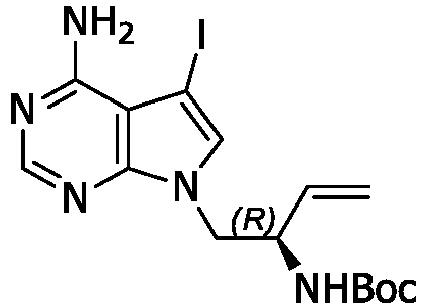
- Triphenylphosphine (787 mg, 3 mmol) was added into a reaction flask, then 15 mL of anhydrous THF was added as solvent, and the resultant was cooled to 0 °C. Diisopropyl azodicarboxylate (DIAD) (606 mg, 3 mmol) was added dropwise, and stirred at this temperature for 15 min, then t-butyl (R)-(1-hydroxybut-3-en-2-yl)carbamate (562 mg, 3 mmol) was added, followed by addition of 4-amino-5-iodo-7H-pyrrolo[2,3-d]pyrimidine (520 mg, 2 mmol). 30 min later, the reaction mixture was warmed to room temperature and stirred for 12 h. The insolubles were filtered off, the filtrate was concentrated, and the crude was purified by column chromatography with CHCl3/MeOH = 30/1 to give 308 mg of target product, yield 35.9%.
-
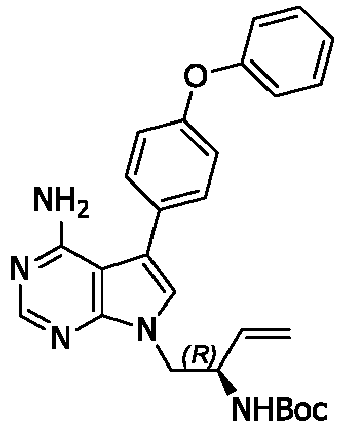
- t-butyl (R)-(1-(4-amino-5-iodo-7H-pyrrolo[2,3-d]pyrimidin-7-yl)but-3-en-2-yl)carbamate (859 mg, 2 mmol), 4-phenoxyphenylboronic acid (642 mg, 3 mmol), Pd(PPh3)4 (116 mg, 0.1 mmol) and K2CO3 (553 mg, 4 mmol) were added in a sealed tube, 25 mL of 1,4-dioxane and 5 mL of water were added as the solvent, the reaction was conducted in the sealed tube under N2 at 90 °C in an oil bath for 2 h. After completion of the reaction, the resultant was extracted by ethyl acetate and dried over anhydrous Na2SO4. The crude was purified by column chromatography with PE/EA = 2/1 to give 493 mg of target product, yield 52.3%.
-

- t-butyl (R)-(1-(4-amino-5-(4-(phenoxyphenyl)-7H-pyrrolo[2,3-d]pyrimidin-7-yl) but-3-en-2-yl)carbamate (943 mg, 2 mmol) was added to 50 mL of DMF, NBS (356 mg, 2 mmol) was added slowly, the reaction was stirred at room temperature for 8 h. After completion of the reaction, the resultant was extracted by ethyl acetate and dried over anhydrous Na2SO4. The crude was purified by column chromatography with PE/EA = 2/1 to give 1.05 g of target product, yield 95.4%.
-

- t-butyl (R)-(1-(4-amino-5-(4-(phenoxyphenyl)-6-bromo-7H-pyrrolo[2,3-d]pyrimidin-7-yl) but-3-en-2-yl)carbamate (550 mg, 1 mmol) was added to a sealed tube, 10 mL of anhydrous THF was added under N2, and cooled to 0 °C. A solution of 9-BBN in tetrahydrofuran (12 mL, 0.5 M) was added dropwise, and the mixture was stirred at 0 °C for 10 min, and then at room temperature for 5 h. NaOH aqueous solution (4.7 mL, 3 M) and PdCl2(dppf)(190 mg, 0.25 mmol) were added successively, the reaction was conducted at 80 °C in the sealed tube for 15 h. After completion of the reaction, the resultant was extracted by ethyl acetate and dried over anhydrous Na2SO4. The crude was purified by column chromatography with EA to give 316 mg of target product, yield 67.0%.
-

- t-butyl (R)-(4-amino-5-(4-phenoxyphenyl)-6,7,8,9-tetrahydropyrimido[5,4-b]indolizine-8-yl)ca rbamate (472 mg, 1 mmol) was dissolved in 15 mL of methanol, a solution of HCl in methanol (5 mL, 2 M) was added dropwise at 0 °C, the reaction was warmed to room temperature and stirred for 8 h. After the reaction solution was concentrated and rotated to dryness, 20 mL of DCM was directly added, followed by dropwise addition of Et3N (280 µL, 2 mmol) and acrylic acid (75 µL, 1.1 mmol), HATU (418 mg, 1.1 mmol) was added and the reaction was conducted under room temperature for 2 h. After completion of the reaction, the resultant was extracted by ethyl acetate and dried over anhydrous Na2SO4. The crude was purified by column chromatography with CHCl3/MeOH = 30/1 to give 129 mg of target product, yield 30.3%.
1H NMR (300 MHz, CDCl3) δ 8.12 (s, 1H), 7.38 (dd, J = 14.2, 7.3 Hz, 4H), 7.16 (t, J = 7.2 Hz, 1H), 7.09 (d, J = 8.1 Hz, 4H), 6.78 (d, J = 6.7 Hz, 1H), 6.38 (d, J = 16.4 Hz, 1H), 6.24 (dd, J = 16.9, 10.0 Hz, 1H), 5.69 (d, J = 9.8 Hz, 1H), 5.04 (s, 2H), 4.72 (br, 1H), 4.36 (dd, J = 12.7, 4.6 Hz, 1H), 4.16 (dd, J = 12.7, 5.7 Hz, 1H), 2.97 (t, J = 6.2 Hz, 2H), 2.16 - 2.04 (m, 2H). -

- The S2 was synthesized by referring to the synthesis steps of the S1 in Example 1, except that in step 2, t-butyl (S)-(1-hydroxybut-3-en-2-yl)carbamate was used instead of t-butyl (R)-(1-hydroxybut-3-en-2-yl)carbamate.
1H NMR (300 MHz, CDCl3) δ 8.11 (s, 1H), 7.38 (dd, J = 14.2, 7.3 Hz, 4H), 7.15 (t, J = 7.2 Hz, 1H), 7.09 (d, J = 8.1 Hz, 4H), 6.78 (d, J = 6.7 Hz, 1H), 6.37 (d, J = 16.4 Hz, 1H), 6.23(dd, J = 16.9, 10.0 Hz, 1H), 5.67 (d, J = 9.8 Hz, 1H), 5.08 (s, 2H), 4.70 (br, 1H), 4.35 (dd, J = 12.7, 4.6 Hz, 1H), 4.16 (dd, J = 12.7, 5.7 Hz, 1H), 2.95(t, J = 6.2 Hz, 2H), 2.15 - 2.02 (m, 2H). -

- The S3 was synthesized by referring to the synthesis steps of the S1 in Example 1, except that in step 2, racemic t-butyl (1-hydroxybut-3-en-2-yl)carbamate was used instead of t-butyl (R)-(1-hydroxybut-3-en-2-yl)carbamate.
1H NMR (300 MHz, CDCl3) δ 8.11 (s, 1H), 7.38 (dd, J = 14.2, 7.3 Hz, 4H), 7.15 (t, J = 7.2 Hz, 1H), 7.08 (d, J = 8.1 Hz, 4H), 6.77 (d, J = 6.7 Hz, 1H), 6.36 (d, J = 16.4 Hz, 1H), 6.23 (dd, J = 16.9, 10.0 Hz, 1H), 5.69 (d, J = 9.8 Hz, 1H), 5.10 (s, 2H), 4.72 (s, br, 1H), 4.35 (dd, J = 12.7, 4.6 Hz, 1H), 4.15 (dd, J = 12.7, 5.7 Hz, 1H), 2.96 (t, J = 6.2 Hz, 2H), 2.16 - 2.03 (m, 2H). -

- The S4 was synthesized by referring to the synthesis steps of the S1 in Example 1, except that in step 6, 2-cyano-4,4-dimethyl-2-pentenoic acid was used instead of acrylic acid.
1H NMR (300 MHz, CDCl3) δ 8.28 (s, 1H), 7.43 - 7.29 (m, 4H), 7.16 (t, J = 7.3 Hz, 1H), 7.09 (d, J = 8.3 Hz, 4H), 5.05 (s, 2H), 4.72 (dd, J = 12.6, 5.7 Hz, 1H), 4.58 - 4.40 (m, 1H), 3.79 (d, J = 2.9 Hz, 2H), 3.65 (d, J = 2.9 Hz, 1H), 3.11 (dt, J = 17.3, 4.3 Hz, 1H), 2.86 (ddd, J = 16.7, 11.3, 5.2 Hz, 1H), 2.45 (ddd, J = 16.5, 12.0, 5.4 Hz, 1H), 2.23 (dd, J = 12.4, 4.0 Hz, 1H), 1.97 (s, 1H), 1.09 (s, 9H). -

- The S5 was synthesized by referring to the synthesis steps of the S1 in Example 1, except that in step 6, (E)-4-dimethylamino-2-butenoic acid was used instead of acrylic acid.
1H NMR (300 MHz, CDCl3) δ 8.10 (s, 1H), 7.42 - 7.28 (m, 5H), 7.15 (t, J = 7.5 Hz, 1H), 7.07 (dd, J = 7.5, 5.2 Hz, 4H), 6.94 - 6.80 (m, 1H), 6.29 (d, J = 15.2 Hz, 1H), 5.24 (s, 2H), 4.65 (dd, J = 10.4, 5.6 Hz, 1H), 4.36 (dd, J = 11.9, 4.3 Hz, 1H), 4.11 (dd, J = 12.9, 5.6 Hz, 1H), 3.36 (d, J = 6.1 Hz, 2H), 3.04 - 2.88 (m, 2H), 2.49 (s, 6H), 2.07 (d, J = 4.7 Hz, 2H). -

- The S6 was synthesized by referring to the synthesis steps of the S1 in Example 1, except that in step 6, 2-acrylamidoacetic acid was used instead of acrylic acid.
1H NMR (300 MHz, CDCl3) δ 8.12 (s, 1H), 7.44 - 7.30 (m, 4H), 7.16 (t, J = 7.3 Hz, 1H), 7.13 - 7.01 (m, 4H), 6.36 - 6.07 (m, 2H), 5.67 (d, J = 9.8 Hz, 1H), 5.41 (s, 2H), 4.58 - 4.46 (m, 1H), 4.37 (dd, J = 12.7, 4.8 Hz, 1H), 4.02 (dd, J = 12.7, 6.1 Hz, 3H), 3.11 - 2.82 (m, 2H), 2.17 - 1.90 (m, 2H). -

- The S7 was synthesized by referring to the synthesis steps of the S1 in Example 1, except that in step 6, 2-acrylamidopropionic acid was used instead of acrylic acid.
1H NMR (300 MHz, CDCl3) δ 8.17 (s, 1H), 7.49 - 7.35 (m, 4H), 7.21 (t, J = 7.3 Hz, 1H), 7.17 - 7.04 (m, 4H), 6.41 - 6.12 (m, 2H), 5.70 (d, J = 9.8 Hz, 1H), 5.26 (s, 2H), 4.62 - 4.46 (m, 2H), 4.39 (dd, J = 12.7, 4.8 Hz, 1H), 4.03 (dd, J = 12.7, 5.7 Hz,1H), 3.16 - 2.87 (m, 2H), 2.21 - 1.94 (m, 2H), 1.48 (d, J= 4.5 Hz, 3H). -

- The S8 was synthesized by referring to the synthesis steps of the S1 in Example 1, except that in step 6, 1-acrylamidocyclopropanecarboxylic acid was used instead of acrylic acid.
1H NMR (300 MHz, CDCl3) δ 8.12 (s, 1H), 7.44 - 7.30 (m, 4H), 7.16 (t, J = 7.3 Hz, 1H), 7.13 - 7.01 (m, 4H), 6.36 - 6.07 (m, 2H), 5.67 (d, J = 9.8 Hz, 1H), 5.41 (s, 2H), 4.58 - 4.46 (m, 1H), 4.37 (dd, J = 12.7, 4.8 Hz, 1H), 4.02 (dd, J = 12.7, 6.1 Hz, 3H), 3.11 - 2.82 (m, 2H), 2.17 - 1.90 (m, 2H), 1.26 - 1.18 (m, 2H), 1.00 - 0.88 (m, 2H). -

- t-butyl (R)-(4-amino-5-(4-phenoxyphenyl)-6,7,8,9-tetrahydropyrimido[5,4-b]indolizine-8-yl)ca rbamate (472 mg, 1 mmol) (prepared according to the step 1-5 in Example 1) was dissolved in 15 mL of methanol, a solution of HCl in methanol (5 mL, 2 M) was added dropwise at 0 °C, the reaction was warmed to room temperature with stirring for 8 h. After the reaction solution was concentrated and rotated to dryness, 20 mL of DCM was directly added, followed by addition of Et3N (280 µL, 2 mmol) and vinylsulfonyl chloride (138 mg, 1.1 mmol), and the reaction was conducted under room temperature for 2 h. After completion of the reaction, the resultant was extracted by ethyl acetate and dried over anhydrous Na2SO4. The crude was purified by column chromatography with CHCl3/MeOH = 30/1 to give 115 mg of target product, yield 24.9%.
1H NMR (300 MHz, CDCl3) δ 8.12 (s, 1H), 7.38 (dd, J = 14.2, 7.3 Hz, 4H), 7.16 (t, J = 7.2 Hz, 1H), 7.09 (d, J = 8.1 Hz, 4H), 6.78 (d, J = 6.7 Hz, 1H), 6.38 (d, J = 16.4 Hz, 1H), 6.24 (dd, J = 16.9, 10.0 Hz, 1H), 5.69 (d, J = 9.8 Hz, 1H), 5.04 (s, 2H), 4.72 (br, 1H), 4.36 (dd, J = 12.7, 4.6 Hz, 1H), 4.16 (dd, J = 12.7, 5.7 Hz, 1H), 2.97 (t, J = 6.2 Hz, 2H), 2.16 - 2.04 (m, 2H). -

- The S10 was synthesized by referring to the synthesis steps of the S1 in Example 1, except that in step 6, But-2-ynoic acid was used instead of acrylic acid.
1H NMR (300 MHz, CDCl3) δ 8.14 (s, 1H), 7.31 (dd, J = 16.2, 8.4 Hz, 4H), 7.10 (t, J = 7.8 Hz, 1H), 7.02 (d, J = 8.1 Hz, 4H), 6.50 (d, J = 7.5 Hz, 1H), 4.94 (s, 2H), 4.58 (dd, J = 12.4, 5.3 Hz, 1H), 4.31 (dd, J = 13.0, 4.7 Hz, 1H), 4.04 (dd, J = 12.9, 5.8 Hz, 1H), 2.91 (t, J = 6.2 Hz, 2H), 2.01 (dd, J = 10.6, 5.0 Hz, 2H), 1.87 (s, 3H). -

- The S11 was synthesized by referring to the synthesis steps of the S1 in Example 1, except that in step 3, 4-(4-fluorophenoxy)phenylboronic acid was used instead of 4-phenoxyphenylboronic acid.
1H NMR (300 MHz, CDCl3) δ 8.12 (s, 1H), 7.38 (dd, J = 14.2, 7.3 Hz, 4H), 7.16 (t, J = 7.2 Hz, 1H), 7.09 (d, J = 8.1 Hz, 4H), 6.78 (d, J = 6.7 Hz, 1H), 6.38 (d, J = 16.4 Hz, 1H), 6.24 (dd, J = 16.9, 10.0 Hz, 1H), 5.69 (d, J = 9.8 Hz, 1H), 5.04 (s, 2H), 4.72 (br, 1H), 4.36 (dd, J = 12.7, 4.6 Hz, 1H), 4.16 (dd, J = 12.7, 5.7 Hz, 1H), 2.97 (t, J = 6.2 Hz, 2H), 2.16 - 2.04 (m, 2H). -

- The S12 was synthesized by referring to the synthesis steps of the S1 in Example 1, except that in step 3, 4-(4-trifluoromethylphenoxy)phenylboronic acid was used instead of 4-phenoxyphenylboronic acid.
1H NMR (300 MHz, CDCl3) δ 8.15 (s, 1H), 7.38 (dd, J = 14.2, 7.3 Hz, 4H), 7.21 (d, J = 8.1 Hz, 4H), 6.78 (d, J = 6.7 Hz, 1H), 6.38 (d, J = 16.4 Hz, 1H), 6.24 (dd, J = 16.9, 10.0 Hz, 1H), 5.69 (d, J = 9.8 Hz, 1H), 5.04 (s, 2H), 4.72 (br, 1H), 4.36 (dd, J = 12.7, 4.6 Hz, 1H), 4.16 (dd, J = 12.7, 5.7 Hz, 1H), 2.97 (t, J = 6.2 Hz, 2H), 2.16 - 2.04 (m, 2H). -

-

- Methyl (R)-4-(4-amino-7-(2-((t-butoxycarbonyl)amino)but-3-en-1-yl)-7H-pyrrolo[2,3-d]pyrimi din-5-yl)benzoate was synthesized by referring to the step 3 in Example 1, except using 4-methoxycarbonylphenylboronic acid instead of 4-phenoxyphenylboronic acid.
-

- Methyl (R)-4-(4-amino-6-bromo-7-(2-((t-butoxycarbonyl)amino) but-3-en-1-yl)-7H-pyrrolo[2,3-d]pyrimidin-5-yl)benzoate was synthesized by referring to the step 4 in Example 1, except using the compound obtained from the step 1 of the present Example 13 instead of the corresponding compound in the step 4 of Example 1.
-

- Methyl (R)-4-(4-amino-8-((t-butoxycarbonyl)amino)-6,7,8,9-tetrahydropyrimido[5,4-b]indolizin e-5-yl)benzoate was synthesized by referring to the step 5 in Example 1, except using the compound obtained from the step 2 of the present Example 13 instead of the corresponding compound in the step 5 of Example 1.
-

- Methyl (R)-4-(4-amino-8-((t-butoxycarbonyl)amino)-6,7,8,9-tetrahydropyrimido[5,4-b]indolizin e-5-yl)benzoate (437 mg, 1 mmol) was added in 10 mL methanol/10 mL water, lithium hydroxide (72 mg, 3 mmol) was added, the reaction was stirred at room temperature for 12 h. After completion of the reaction, dilute hydrochloric acid was added to adjust the pH to be neutral, 330 mg of crude was obtained by filtration, yield 77.9%.
-

- (R)-4-(4-amino-8-((t-butoxycarbonyl)amino)-6,7,8,9-tetrahydropyrimido [5,4-b]indolizine-5-yl)benzoic acid (423 mg, 1 mmol) was added to 20 mL of DCM as solvent, followed by dropwise addition of Et3N (280 µL, 2 mmol) and 2-aminopyridine (104 mg, 1.1 mmol) in sequence, 2-(7-oxobenzotriazole)-N,N,N',N'-tetramethylurea hexafluorophosphate (HATU) (418 mg, 1.1 mmol) was added, the reaction was conducted at room temperature for 8 h. After completion of the reaction, the resultant was extracted by EA and dried over anhydrous Na2SO4. The crude was purified by column chromatography with CHCl3/MeOH = 30/1 to give 264 mg of target product, yield 52.8%.
-

- The S13 was synthesized by referring to the step 6 in Example 1, except using the compound obtained from the step 5 of the present Example 13 instead of the corresponding compound in the step 6 of Example 1.
1H NMR (300 MHz, CDCl3) δ 9.15 (s, 1H), 8.38 (d, J = 8.4 Hz, 1H), 8.28 (d, br, 1H), 8.20 (s, 1H), 7.77 (t, br, 1H), 7.44 - 7.30 (m, 4H), 7.08 (ddd, J = 7.3, 4.9, 0.9 Hz, 1H), 6.78 (s, 1H), 6.38 (d, J = 16.4 Hz, 1H), 6.24 (dd, J = 16.9, 10.0 Hz, 1H), 5.69 (d, J = 9.8 Hz, 1H), 5.20 (s, 2H), 4.72 (br, 1H), 4.36 (dd, J = 12.7, 4.6 Hz, 1H), 4.16 (dd, J = 12.7, 5.7 Hz, 1H), 2.97 (t, J = 6.2 Hz, 2H), 2.16 - 2.04 (m, 2H). -

- The S14 was synthesized by referring to the step 6 in Example 1, except using the compound obtained from the step 5 of the present Example 13 instead of the corresponding compound in the step 6 of Example 1, and using but-2-ynoic acid instead of acrylic acid in the step 6 of Example 1.
1H NMR (300 MHz, CDCl3) δ 9.20 (s, 1H), 8.38 (d, J = 8.4 Hz, 1H), 8.27 (d, br, 1H), 8.19 (s, 1H), 7.75 (t, br, 1H), 7.44 - 7.30 (m, 4H), 7.08 (ddd, J = 7.3, 4.9, 0.9 Hz, 1H), 6.70 (s, 1H), 5.03 (s, 2H), 4.57 (dd, J = 12.4, 5.3 Hz, 1H), 4.30 (dd, J = 13.0, 4.7 Hz, 1H), 4.03 (dd, J = 12.9, 5.8 Hz, 1H), 2.91 (t, J = 6.2 Hz, 2H), 2.02 (dd, J = 10.6, 5.0 Hz, 2H), 1.86 (s, 3H). -

- The S15 was synthesized by referring to the synthesis steps of the S13 in Example 13, except using 2-amino-5-fluoropyridine instead of 2-aminopyridine in the step 5 of Example 13.
1H NMR (300 MHz, CDCl3) δ 8.90 (s, 1H), 8.28 (d, J = 8.0 Hz, 1H), 8.17 (s, 1H), 8.04 (s, 1H), 7.85 (d, J = 8.0 Hz, 2H), 7.65 (d, J = 8.0 Hz, 2H), 7.59 (d, J = 8.0 Hz, 1H), 6.78 (s, 1H), 6.38 (d, J = 16.4 Hz, 1H), 6.24 (dd, J = 16.9, 10.0 Hz, 1H), 5.69 (d, J = 9.8 Hz, 1H), 5.20 (s, 2H), 4.72 (br, 1H), 4.36 (dd, J = 12.7, 4.6 Hz, 1H), 4.16 (dd, J = 12.7, 5.7 Hz, 1H), 2.97 (t, J = 6.2 Hz, 2H), 2.16 - 2.04 (m, 2H). -

- The S16 was synthesized by referring to the synthesis steps of the S13 in Example 13, except using 2-amino-4-trifluoromethylpyridine instead of 2-aminopyridine in the step 5 of Example 13.
1H NMR (300 MHz, CDCl3) δ 8.80 (s, 1H), 8.25 (s, 1H), 8.21 (s, 1H), 8.07 (d, J = 5.1 Hz, 1H), 7.86 (dd, J = 6.8, 1.8 Hz, 2H), 7.45 (dd, J = 6.8, 1.8 Hz, 2H), 6.89 (d, J = 5 Hz, 1H), 6.78 (s, 1H), 6.38 (d, J = 16.4 Hz, 1H), 6.24 (dd, J = 16.9, 10.0 Hz, 1H), 5.69 (d, J = 9.8 Hz, 1H), 5.20 (s, 2H), 4.72 (br, 1H), 4.36 (dd, J = 12.7, 4.6 Hz, 1H), 4.16 (dd, J = 12.7, 5.7 Hz, 1H), 2.97 (t, J = 6.2 Hz, 2H), 2.16 - 2.04 (m, 2H). -

- The S17 was synthesized by referring to the synthesis steps of the S13 in Example 13, except using (R)-2-methoxy-1-phenylethylamine instead of 2-aminopyridine in the step 5 of Example 13.
1H NMR (300 MHz, CDCl3) δ 8.40 (s, 1H), 7.99 (d, J = 7.9 Hz, 2H), 7.78 (d, J = 7.8 Hz, 2H), 7.49 - 7.28 (m, 5H), 6.99 (d, J = 7.0 Hz, 1H), 6.78 (d, J = 6.7 Hz, 1H), 6.38 (d, J = 16.4 Hz, 1H), 6.24 (dd, J = 16.9, 10.0 Hz, 1H), 5.69 (d, J = 9.8 Hz, 1H), 5.42 - 5.35 (m, 1H), 5.04 (s, 2H), 4.72 (br, 1H), 4.36 (dd, J = 12.7, 4.6 Hz, 1H), 4.16 (dd, J = 12.7, 5.7 Hz, 1H), 4.09 (s, 1H), 3.84 (s, 1H), 3.42 (s, 3H), 2.97 (t, J = 6.2 Hz, 2H), 2.16 - 2.04 (m, 2H). -

- t-butyl (R)-(1-(4-amino-5-(4-phenoxyphenyl)-6-bromo-7H-pyrrolo[2,3-d] pyrimidin-7-yl)but-3-en-2-yl)carbamate (550 mg, 1 mmol)(the compound synthesized in step 4 of Example 1) was added to a sealed tube under N2. 10 mL of anhydrous THF was added, then NaOH aqueous solution (4.7 mL, 3 M) and PdCl2(dppf)(190 mg, 0.25 mmol) were added successively, the reaction was conducted at 80 °C for 15 h. After completion of the reaction, the resultant was extracted by ethyl acetate and dried over anhydrous Na2SO4. The crude was purified by column chromatography with EA to give 245 mg of target product, yield 52.0%.
-

- The S18 was synthesized by referring to the step 6 in Example 1, except using the compound obtained from the step 1 of the Example 18 instead of the corresponding compound in the step 6 of Example 1.
1H NMR (300 MHz, CDCl3) δ 8.25 (s, 1H), 7.50 - 7.36 (m, 4H), 7.18 (t, J = 7.4 Hz, 1H), 7.10 (d, J = 8.4 Hz, 4H), 6.40 (d, J = 16.9 Hz, 1H), 6.28 - 6.08 (m, 2H), 5.75 (d, J = 10.4 Hz, 1H), 5.73 - 5.66 (m, 1H), 5.53 (s, 1H), 5.19 (s, 1H), 5.09 (s, 2H), 4.75 - 4.62 (m, 1H), 3.99 (dd, J = 11.5, 4.7 Hz, 1H). -

- The S19 was synthesized by referring to the synthesis step of the S18 in Example 18, except using the compound obtained from the step 1 of the present Example 18 instead of the corresponding compound in the step 6 of Example 1, and using but-2-ynoic acid instead of acrylic acid in the step 6 of Example 1.
1H NMR (300 MHz, CDCl3) δ 8.21 (s, 1H), 7.45 - 7.29 (m, 4H), 7.12 (t, J = 7.2 Hz, 1H), 7.05 (d, J = 8.1 Hz, 4H), 6.19 - 6.07 (m, 1H), 5.63 - 5.52 (m, 1H), 5.47 (s, 1H), 5.14 (s, 1H), 4.97 (s, 2H), 4.62 (dd, J = 11.4, 7.8 Hz, 1H), 3.92 (dd, J = 11.5, 4.7 Hz, 1H), 1.91 (s, 3H). -


- Example 13 except using the

1H NMR (300 MHz, CDCl3) δ 9.15 (s, 1H), 8.38 (d, J = 8.4 Hz, 1H), 8.28 (d, br, 1H), 8.20 (s, 1H), 7.77 (t, br, 1H), 7.44 - 7.30 (m, 4H), 7.08 (ddd, J = 7.3, 4.9, 0.9 Hz, 1H), 6.78 (s, 1H), 6.40 (d, J = 16.9 Hz, 1H), 6.28 - 6.08 (m, 2H), 5.73 - 5.66 (m, 1H), 5.53 (s, 1H), 5.19 (s, 1H), 5.09 (s, 2H), 4.75 - 4.62 (m, 1H), 3.99 (dd, J = 11.5, 4.7 Hz, 1H). -

- t-butyl (R)-(4-amino-6-methylidene-5-(4-phenoxyphenyl)-7,8-dihydro-6H-pyrimido[5,4-b]pyrr olizin-7-yl)carbamate (the compound obtained in step 1 of Example 18)(470 mg, 1 mmol) was added to 20 mL of methanol, Pd/C (213 mg, 0.2 mmol, 10%) was added, the reaction was stirred while introducing H2 for 6 h. After completion of the reaction, Pd/C was removed by filtration. The reaction solution was separated and purified by column chromatography with CHCl3/MeOH = 20/1 to give 102 mg of target product, yield 21.6%.
-

- The S21 was synthesized by referring to the step 6 in Example 1, except using the compound obtained from the step 1 of the present Example 21 instead of the corresponding compound in the step 6 of Example 1.
1H NMR (300 MHz, CDCl3) δ 8.17 (s, 1H), 7.44 - 7.35 (m, 4H), 7.16 (t, J = 7.4 Hz, 1H), 7.08 (dd, J = 7.7, 3.7 Hz, 4H), 6.78 (s, 1H), 6.38 (d, J = 16.4 Hz, 1H), 6.24 (dd, J = 16.9, 10.0 Hz, 1H), 5.85 (s, 2H), 5.69 (d, J = 9.8 Hz, 1H), 4.41 (dd, J = 11.0, 6.7 Hz, 1H), 4.20 (dd, J = 12.3, 5.8 Hz, 1H), 3.85 (dd, J = 10.7, 6.2 Hz, 1H), 3.50 - 3.33 (m, 1H), 1.15 (d, J = 7.2 Hz, 3H). -


in Example 21 except using the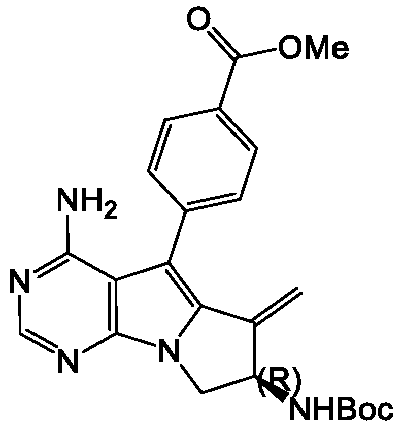
1H NMR (300 MHz, CDCl3) δ 9.15 (s, 1H), 8.38 (d, J = 8.4 Hz, 1H), 8.28 (d, br, 1H), 8.20 (s, 1H), 7.77 (t, br, 1H), 7.44 - 7.30 (m, 4H), 7.08 (ddd, J = 7.3, 4.9, 0.9 Hz, 1H), 6.78 (s, 1H), 6.38 (d, J = 16.4 Hz, 1H), 6.24 (dd, J = 16.9, 10.0 Hz, 1H), 5.85 (s, 2H), 5.69 (d, J = 9.8 Hz, 1H), 4.41 (dd, J = 11.0, 6.7 Hz, 1H), 4.20 (dd, J = 12.3, 5.8 Hz, 1H), 3.85 (dd, J = 10.7,6.2 Hz, 1H), 3.50 - 3.33 (m, 1H), 1.15 (d, J = 7.2 Hz, 3H). - Poly(Glu, Tyr) 4:1 as a substrate for enzyme catalyzed reaction was diluted with potassium-free PBS (10 mM sodium phosphate buffer, 150 mM NaCl, pH 7.2-7.4) to 20 µg/mL to coat a ELISA plate. The plate was cultured at 37 °C for 12-16 h, washed with 200 µL/well of T-PBS (PBS containing 0.1% of Tween-20) three times, and dried in an oven at 37 °C for 1-2 h. Into the above ELISA plate coated with the substrate, an ATP solution diluted with a reaction buffer (50 mM HEPES, pH 7.4, 50 mM MgCl2, 5 mM MnCl2, 0.2 mM Na3VO4, 1 mM DTT) was first added at 50 µL/well (concentration of 10 µM). Then, a test compound diluted by 1% DMSO to a suitable concentration was added (10 µL/well), and negative control well and positive compound control well were provided separately. Finally, the reaction was initiated by adding BTK tyrosine kinase protein diluted in 40 µL of reaction buffer.
- The above reaction system was placed on a shaker (100 rpm) at 37 °C for 1 h, then washed with T-PBS for three times, primary antibody PY99 (Cell Signaling Technology) was added at 100 µL/well, and the reaction was conducted on the shaker at 37 °C for 0.5 h. After the plate was washed with T-PBS, secondary antibody horseradish peroxidase-labeled goat anti-mouse IgG was added at 100 µL/well, and the reaction was conducted on the shaker at 37 °C for 0.5 h. After the plate was washed with T-PBS, 2 mg/mL of OPD developing solution was added at 100 µL/well, and the reaction was conducted in the dark at 25 °C for 1 to 10 minutes. Then the reaction was quenched by adding 2 M H2SO4 at 50 µL/well. The data were read on a wavelength-tunable microplate reader ELISA SPECTRA MAX 190 at a wavelength of 490 nm.
- The inhibition rate of the compound was calculated by the following equation: inhibition rate (%) = (ODcontrol well - ODadministration well)/ODcontrol well × 100%. IC50 was calculated by fitting the inhibition curve using a four-parameter method.
-
Compound IC50 (nM) Compound IC50 (nM) S1 < 1 S12 < 1 S2 < 1 S13 1 ∼ 10 S3 < 1 S14 1 ∼ 10 S4 >100 S15 1 ∼ 10 S5 < 1 S16 1 ∼ 10 S6 1 ∼ 10 S17 1 ∼ 10 S7 10 ∼ 100 S18 1 ∼ 10 S8 >100 S19 < 1 S9 10 ∼ 100 S20 1 ∼ 10 S10 1 ∼ 10 S21 1 ∼ 10 S11 < 1 S22 1 ∼ 10 - Cells were seeded at 10000-15000/well into a 96-well culture plate, different concentrations of a test compound were added to each well (3 replicate-wells for each concentration), and blank control, positive compound control and negative control were provided. 48 hours after the administration of the drugs, 20 ml of MTT (5 mg/ml) was added, and the plate was incubated at 37 °C for 4 h, and then 100 ml of a triad solution (10% SDS, 5% isobutanol, 0.01 M HCl) was added. The resultant was cultured at 37 °C overnight, and the OD value was measured at a wavelength of 570 nm using a wavelength-tunable microplate reader ELISA SPECTRA MAX 190. The inhibition rate of the compound was calculated by the following equation: inhibition rate (%) = (ODcontrol well - ODadministration well)/ODcontrol well × 100%. The IC50 value was calculated by fitting the inhibition curve using a four-parameter method. The experiment was repeated 3 times independently.
-
(1) Inhibition activity against proliferation of human B lymphoma Ramos cells of representative compounds Compound IC50 for proliferation of Ramos cells S1 94.73±45.06 µM S3 11.4±0.8 µM S5 6.6±2.1 µM S6 5.5±1.0 µM S10 8.72±8.58 µM S19 16.9±7.9 µM Ibrutinib ∼ 8.53 µM (2) Inhibition activity against proliferation of human diffuse large B lymphoma TMD8 cells of representative compounds Compound IC50 for the inhibition of TMD cells S1 0.0058 µM S10 0.03 µM Ibrutinib 0.0045 µM - The present invention provides a series of 5-aryl-pyrimidopyrrolizine or 5-aryl-pyrimidoindolizine tricyclic compounds. The series of derivatives are Bruton kinase inhibitors with novel structures, and some of the compounds have considerable inhibitory activities against BTK enzymes and considerable inhibitory activities against BTK-dependent TMD8 cells at molecular level. And it is more important that some of the compounds (e.g., S1) shows low cell activity against human B lymphoma Ramos cells, and good selectivity to BTK, and therefore they are a class of BTK selective inhibitors with much potential.
Claims (10)
- A 5-aryl-pyrimidoindolizine or 5-aryl-pyrimidopyrrolizine compound as shown in formula I or a pharmaceutically acceptable salt thereof,
 R1 is H, methyl or methylidene;L is -O-, -C(=O)NH- or -C(=O)NHCHR2-, wherein, R2 is hydrogen or substituted or unsubstituted C1-C3 alkyl, wherein, the substituent in R2 is halogen or C1-C3 alkoxy;m is 0 or 1;Ar is substituted or unsubstituted C6-C20 aryl, substituted or unsubstituted 5-20 membered heteroaryl containing one or more heteroatoms selected from the group consisting of O, N and S, wherein the substituent in Ar is halogen, C1-C6 alkyl, C1-C6 alkoxy, trifluoromethyl or trifluoromethoxy,A is carbonyl, sulfonyl, or
 n is 0, 1 or 2;T is
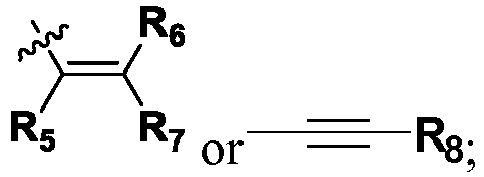 R5, R6 and R7 are independently selected from the group consisting of hydrogen, cyano, halogen, and substituted or unsubstituted C1-C20 alkyl; the substituent in R5, R6 or R7 is dimethylamino, C1-C10 alkoxy, or 3 to 10 membered heterocyclyl containing one or more heteroatoms selected from the group consisting of O, N and S;R8 is selected from the group consisting of hydrogen and C1-C10 alkyl.
 - The 5-aryl-pyrimidoindolizine or 5-aryl-pyrimidopyrrolizine compound or a pharmaceutically acceptable salt thereof according to claim 1,
wherein Ar is substituted or unsubstituted C6-C10 aryl, substituted or unsubstituted 5-10 membered heteroaryl containing one or more heteroatoms selected from the group consisting of O, N and S, wherein the substituent in Ar is halogen, C1-C3 alkyl, C1-C3 alkoxy, trifluoromethyl or trifluoromethoxy;
n is 0 or 1;
T is R5, R6 and R7 are independently selected from the group consisting of hydrogen, cyano, halogen, and substituted or unsubstituted C1-C10 alkyl; the substituent in R5, R6 or R7 is dimethylamino, C1-C5 alkoxy, or 3 to 6 membered heterocyclyl containing 1 to 3 heteroatoms selected from the group consisting of O, N and S;R8 is selected from the group consisting of hydrogen and C1-C5 alkyl.
 - The 5-aryl-pyrimidoindolizine or 5-aryl-pyrimidopyrrolizine compound or a pharmaceutically acceptable salt thereof according to claim 1,
wherein Ar is substituted or unsubstituted phenyl, substituted or unsubstituted 5 to 6-membered heteroaryl, wherein the substituent in Ar is halogen, C1-C3 alkyl, C1-C3 alkoxy, trifluoromethyl or trifluoromethoxy;
n is 0 or 1; T is R5, R6 and R7 are independently selected from the group consisting of hydrogen, cyano, halogen, and substituted or unsubstituted C1-C5 alkyl; the substituent in R5, R6 or R7 is dimethylamino, C1-C5 alkoxy, or 3 to 6 membered heterocyclyl containing 1 to 3 heteroatoms selected from the group consisting of O, N and S;R8 is selected from the group consisting of hydrogen and C1-C3 alkyl.
 - The 5-aryl-pyrimidoindolizine or 5-aryl-pyrimidopyrrolizine compound or a pharmaceutically acceptable salt thereof according to claim 1,
wherein L is -O-, -C(=O)NH-,
wherein, Ar is phenyl, 4-fluorophenyl, 4-trifluoromethylphenyl, pyridin-2-yl, 3-fluoropyridin-6-yl or 4-trifluoromethylpyridine-6-yl;
wherein A is carbonyl, sulfonyl, or
wherein T is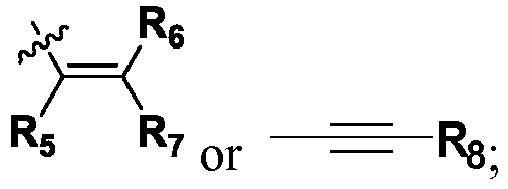
- The 5-aryl-pyrimidoindolizine or 5-aryl-pyrimidopyrrolizine compound or a pharmaceutically acceptable salt thereof according to claim 1, wherein the compound is selected from the group consisting of the compounds shown in the following table:
Compound Structure Compound Structure S1 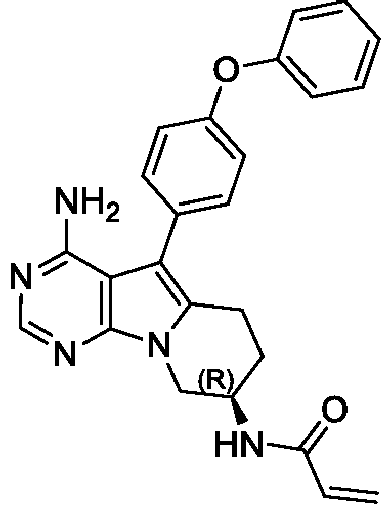
S2 
S3 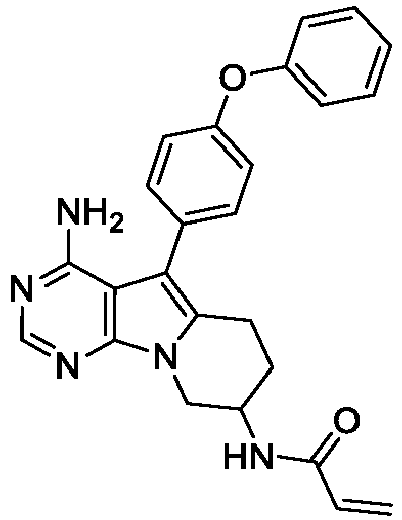
S4 
S5 
S6 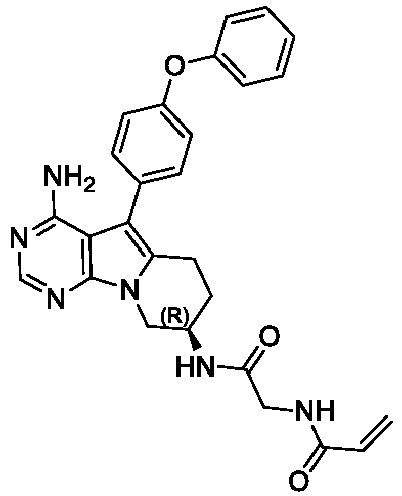
S7 
S8 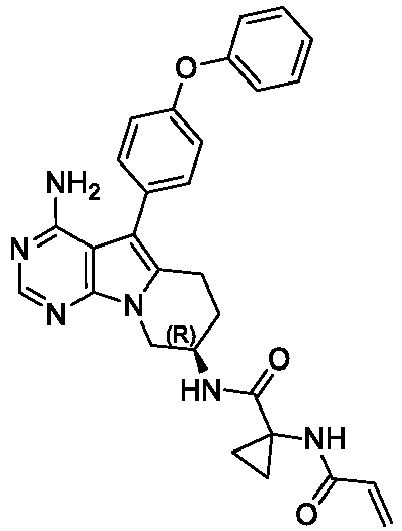
S9 
S10 
S11 
S12 
S13 
S14 
S15 
S16 
S17 
S18 
S19 
S20 
S21 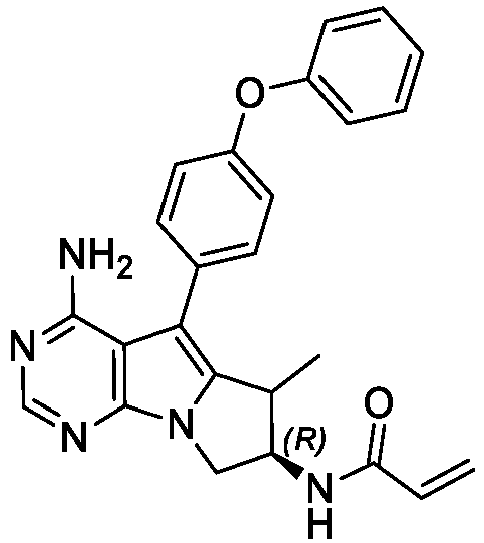
S22 
- A method for preparing a 5-aryl-pyrimidoindolizine or 5-aryl-pyrimidopyrrolizine compound, wherein the preparation method includes the following schemes and steps:
 Scheme 1a:Commercially available 4-amino-pyrrolo[2,3-d]pyrimidine, i.e. Compound 1 as a starting material is iodo-substituted with N-iodosuccinimide (NIS) on 5-position to give Compound 2,Fragment 3 is incorporated into Compound 2 through Mitsunobu reaction to give compound 4,Compound 4 is coupled with a substituted phenylboronic acid or borate to give Compound 6,Bromine is introduced at 6-position of Compound 6 by N-bromosuccinimide (NBS) to give Compound 7,Compound 7 reacts with 9-boronbicyclo[3.3.1]nonane (9-BBN) in anhydrous tetrahydrofuran (THF), then forms a six-membered ring through a self-Suzuki-Miyaura coupling in the presence of [1,1'-bis(diphenylphosphinyl)ferrocene]palladium dichloride (PdCl2(dppf)), and is deprotected to give Compound 8 with a core of tetrahydrogenpyrido[5,4-b]indole,Compound 8 condensates with a carboxylic acid or a sulfonic acid to give Compound 9,orScheme 1b:
Compound 7 forms a five-membered cyclic compound through an intramolecular Heck reaction in the presence of PdCl2(dppf), and is deprotected to give Compound 10, which condensates with a substituted carboxylic acid to give Compound 11,
orScheme 1c:Compound 10 is hydrogenated in the presence of a catalyst to give Compound 12,Compound 12 condensates with an acid to give Compound 13;or Compound 8 condensates with a N-Boc protected amino acid 14, and is deprotected to give Compound 15,Compound 15 condensates with a substituted carboxylic acid to give Compound 16;or
 Scheme 3a:Compound 4 is coupled with a substituted phenylboronic acid or borate 17 to give Compound 18,Bromine is incorporated at 6-position of Compound 18 by NBS to give brominated Compound 19,Compound 19 reacts with 9-BBN in anhydrous THF, forms a six-membered ring through a self-Suzuki-Miyaura coupling in the presence of PdCl2(dppf), and then is hydrolyzed in the presence of lithium hydroxide to give Compound 20,Compound 20 condensates with a substituted alkylamine to give Compound 21,Compound 21 is deprotected and condensates with a carboxylic acid to give Compound 22, orScheme 3b:Compound 20 condensates with an arylamine to give Compound 23,Compound 23 is deprotected and condensates with a carboxylic acid to give Compound 24;or
 Brominated compound 19 forms a five-membered cyclic compound through an intramolecular Heck reaction in the presence of PdCl2(dppf), and treated with LiOH to give a carboxylic acid 25,The carboxylic acid 25 condensates with an arylamine to give an amide 26,The amide 26 is hydrogenated in the presence of a catalyst to give Compound 27,Compound 27 is deprotected with CF3COOH to remove Boc-protection, and condensates with a carboxylic acid to give Compound 28,in the above schemes,R2 is hydrogen or substituted or unsubstituted C1-C3 alkyl, wherein the substituent in R2 is halogen or C1-C3 alkoxy;Ar is substituted or unsubstituted C6-C20 aryl, substituted or unsubstituted 5-20 membered heteroaryl containing one or more heteroatoms selected from the group consisting of O, N and S, wherein the substituent in Ar is halogen, C1-C6 alkyl, C1-C6 alkoxy, trifluoromethyl or trifluoromethoxy;R3 and R4 may be independently hydrogen or C1-C3 alkyl, or R3, R4 and the carbon atom attached thereto form C3-C5 cycloalkyl;n is 0, 1 or 2;T is
 R5, R6 and R7 may be independently selected from the group consisting of hydrogen, cyano, halogen, and substituted or unsubstituted C1-C20 alkyl, preferably are independently selected from the group consisting of hydrogen, cyano, halogen, and substituted or unsubstituted C1-C10 alkyl, more preferably are independently selected from the group consisting of hydrogen, cyano, halogen, and substituted or unsubstituted C1-C5 alkyl; the substituent in R5, R6 or R7 is dimethylamino, C1-C10 alkoxy, or 3 to 10 membered heterocyclyl containing one or more heteroatoms selected from the group consisting of O, N and S; preferably dimethylamino, C1-C6 alkoxy, or 3 to 10 membered heterocyclyl containing one or more heteroatoms selected from the group consisting of O, N and S; more preferably dimethylamino, C1-C5 alkoxy, or 3 to 6 membered heterocyclyl containing 1 to 3 heteroatoms selected from the group consisting of O, N and S;R8 is selected from the group consisting of hydrogen and C1-C10 alkyl, preferably selected from the group consisting of hydrogen and C1-C5 alkyl, more preferably selected from the group consisting of hydrogen and C1-C3 alkyl.
 - A pharmaceutical composition comprising a therapeutically effective amount of the 5-aryl-pyrimidoindolizine or 5-aryl-pyrimidopyrrolizine compound or a pharmaceutically acceptable salt thereof according to any one of the claims 1 to 5, and one or more pharmaceutically acceptable carriers.
- Use of the 5-aryl-pyrimidoindolizine or 5-aryl-pyrimidopyrrolizine compound or a pharmaceutically acceptable salt thereof according to any one of the claims 1 to 5 for manufacture of a medicament for the treatment of a disease associated with the BTK kinase signal transduction pathway, for manufacture of a medicament for inhibiting BTK kinase, or for manufacture of a medicament for treatment, prevention or modulation of cancer cells and metastatic tumors of cancer.
- The use according to claim 8, wherein
the disease associated with the BTK kinase signal transduction pathway is selected from the group consisting of cancer, hyperplasia, restenosis, immune disorders, and inflammation. - The use according to claim 9, wherein the cancer includes histiocytic lymphoma, ovarian cancer, head and neck squamous cell carcinoma, gastric cancer, breast cancer, childhood hepatocellular carcinoma, colorectal cancer, cervical cancer, lung cancer, sarcoma, nasopharyngeal carcinoma, pancreatic cancer, glioblastoma, prostate cancer, small cell lung cancer, non-small cell lung cancer, multiple myeloma, thyroid cancer, testicular cancer, cervical cancer, endometrial cancer, esophageal cancer, leukemia, renal cell carcinoma, bladder cancer, liver cancer, astrocytoma; more preferably head and neck squamous cell carcinoma, histiocytic lymphoma, lung adenocarcinoma, small cell lung cancer, non-small cell lung cancer, pancreatic cancer, papillary kidney cells cancer, liver cancer, gastric cancer, colon cancer, multiple myeloma, and glioblastoma; preferably, the cancer is lymphoma.
Applications Claiming Priority (2)
| Application Number | Priority Date | Filing Date | Title |
|---|---|---|---|
| CN201611045301.1A CN108101905A (en) | 2016-11-24 | 2016-11-24 | Pyrimido [5,4-b] indolizine or pyrimido [5,4-b] pyrrole biopterin compound, preparation method and the usage |
| PCT/CN2017/112729 WO2018095398A1 (en) | 2016-11-24 | 2017-11-24 | Pyrimido[5,4-b]indolizine or pyrimido[5,4-b]pyrrolizine compound, preparation method and use thereof |
Publications (3)
| Publication Number | Publication Date |
|---|---|
| EP3546460A1 true EP3546460A1 (en) | 2019-10-02 |
| EP3546460A4 EP3546460A4 (en) | 2019-12-18 |
| EP3546460B1 EP3546460B1 (en) | 2020-07-08 |
Family
ID=62194774
Family Applications (1)
| Application Number | Title | Priority Date | Filing Date |
|---|---|---|---|
| EP17874613.7A Active EP3546460B1 (en) | 2016-11-24 | 2017-11-24 | Pyrimido[5,4-b]indolizine or pyrimido[5,4-b]pyrrolizine compound, preparation method and use thereof |
Country Status (9)
| Country | Link |
|---|---|
| US (1) | US10829491B2 (en) |
| EP (1) | EP3546460B1 (en) |
| JP (1) | JP6804647B2 (en) |
| KR (1) | KR102359993B1 (en) |
| CN (2) | CN108101905A (en) |
| AU (1) | AU2017366529B2 (en) |
| CA (1) | CA3044889C (en) |
| RU (1) | RU2721774C1 (en) |
| WO (1) | WO2018095398A1 (en) |
Families Citing this family (12)
| Publication number | Priority date | Publication date | Assignee | Title |
|---|---|---|---|---|
| CA3224985C (en) | 2018-07-31 | 2025-11-18 | Loxo Oncology, Inc. | Spray-dried dispersions, formulations, and polymorphs of (s)-5-amino-3-(4-((5-fluoro-2-methoxybenzamido)methyl)phenyl)-1-(1,1,1-trifluoropropan-2-yl)-1h-pyrazole-4-carboxamide |
| EP3942045A1 (en) | 2019-03-21 | 2022-01-26 | Onxeo | A dbait molecule in combination with kinase inhibitor for the treatment of cancer |
| EP3960743A4 (en) * | 2019-04-24 | 2022-05-04 | Shanghai Institute of Materia Medica, Chinese Academy of Sciences | PYRIMIDO[5,4-B]PYRROLIZIN COMPOUND, ITS OPTICAL ISOMER, ITS PREPARATION METHOD AND ITS USE |
| WO2021037188A1 (en) * | 2019-08-29 | 2021-03-04 | 中国科学院上海药物研究所 | Pharmaceutical use of pyrimido[5,4-b]pyrrolizine compound |
| CN112574208B (en) * | 2019-09-29 | 2022-09-13 | 深圳市塔吉瑞生物医药有限公司 | Substituted fused tricyclic derivatives, compositions and uses thereof |
| EP4054579A1 (en) | 2019-11-08 | 2022-09-14 | Institut National de la Santé et de la Recherche Médicale (INSERM) | Methods for the treatment of cancers that have acquired resistance to kinase inhibitors |
| WO2021148581A1 (en) | 2020-01-22 | 2021-07-29 | Onxeo | Novel dbait molecule and its use |
| US12129265B2 (en) | 2020-07-21 | 2024-10-29 | Ankh Life Sciences Limited | Therapeutic agents and uses thereof |
| CN114478548B (en) * | 2020-10-23 | 2026-01-02 | 上海润石医药科技有限公司 | Uses of a Bruton's tyrosine kinase inhibitor |
| WO2022083733A1 (en) * | 2020-10-23 | 2022-04-28 | 上海润石医药科技有限公司 | Bruton tyrosine kinase inhibitor compound in solid form and use thereof |
| CN113024556B (en) * | 2021-04-01 | 2022-03-01 | 中国科学技术大学 | A kind of preparation method of fused ring compound containing indole skeleton |
| CA3213079A1 (en) | 2021-04-13 | 2022-10-20 | Kristin Lynne ANDREWS | Amino-substituted heterocycles for treating cancers with egfr mutations |
Family Cites Families (18)
| Publication number | Priority date | Publication date | Assignee | Title |
|---|---|---|---|---|
| RU2081039C1 (en) * | 1994-08-04 | 1997-06-10 | Давид Моисеевич Ихельсон | Conveyor installation |
| CN1523991A (en) * | 2001-08-10 | 2004-08-25 | ��˹��ŵ�� | Use of a c-Src inhibitor alone or in combination with STI571 for the treatment of leukemia |
| PL2526933T3 (en) * | 2006-09-22 | 2015-08-31 | Pharmacyclics Llc | Inhibitors of Bruton's tyrosine kinase |
| SG10201508035TA (en) * | 2007-03-28 | 2015-10-29 | Pharmacyclics Inc | Inhibitors of bruton's tyrosine kinase |
| CA2730930C (en) * | 2008-07-16 | 2015-01-13 | Pharmacyclics, Inc. | Inhibitors of bruton's tyrosine kinase for the treatment of solid tumors |
| AU2012285987C1 (en) * | 2011-07-19 | 2016-09-08 | Merck Sharp & Dohme B.V. | 4 - imidazopyridazin- 1 -yl-benzamides and 4 - imidazotriazin- 1 - yl - benzamides as Btk- inhibitors |
| UA111756C2 (en) * | 2011-11-03 | 2016-06-10 | Ф. Хоффманн-Ля Рош Аг | HETEROARYLPYRIDONE AND AZAPIRIDONE COMPOUNDS AS BRUTON TYROSINKINASE INHIBITORS |
| WO2013125709A1 (en) * | 2012-02-23 | 2013-08-29 | 大鵬薬品工業株式会社 | Quinolylpyrrolopyrimidyl fused-ring compound or salt thereof |
| US9266895B2 (en) * | 2012-09-10 | 2016-02-23 | Principia Biopharma Inc. | Substituted pyrazolo[3,4-d]pyrimidines as kinase inhibitors |
| CN105073752B (en) * | 2013-02-22 | 2017-08-15 | 大鹏药品工业株式会社 | Method for producing tricyclic compound and tricyclic compound which can be produced by said production method |
| TWI648272B (en) * | 2013-06-25 | 2019-01-21 | 美商必治妥美雅史谷比公司 | Substituted tetrahydrocarbazole and carbazole carbamide compounds |
| BR112016003247B1 (en) * | 2013-08-22 | 2022-05-10 | Taiho Pharmaceutical Co., Ltd | COMPOUND SUBSTITUTED BY QUINOLINE, PHARMACEUTICAL COMPOSITION COMPRISING SUCH COMPOUND AND ITS USE |
| WO2015057992A1 (en) * | 2013-10-16 | 2015-04-23 | Izumi Raquel | Btk inhibitors for hematopoietic mobilization |
| WO2017064558A1 (en) * | 2015-10-14 | 2017-04-20 | 大鵬薬品工業株式会社 | Novel immunostimulant |
| WO2017077507A1 (en) * | 2015-11-06 | 2017-05-11 | Acerta Pharma B.V. | Imidazopyrazine inhibitors of bruton's tyrosine kinase |
| JP2018002644A (en) * | 2016-06-30 | 2018-01-11 | 大鵬薬品工業株式会社 | (S)-N-(4-AMINO-5-(QUINOLINE-3-YL)-6,7,8,9-TETRAHYDROPYRIMIDO[5,4-b]INDOLIZINE-8-YL)ACRYLAMIDE CRYSTAL |
| JP2018002662A (en) * | 2016-07-01 | 2018-01-11 | 大鵬薬品工業株式会社 | Intermediate useful for synthesizing quinolylpyrrolopyrimidyl fused-ring compound |
| MX390435B (en) * | 2016-10-31 | 2025-03-20 | Taiho Pharmaceutical Co Ltd | EXON 20 INSERTION MUTANT EPIDERMAL GROWTH FACTOR RECEPTOR SELECTIVE INHIBITOR. |
-
2016
- 2016-11-24 CN CN201611045301.1A patent/CN108101905A/en active Pending
-
2017
- 2017-11-24 KR KR1020197017785A patent/KR102359993B1/en active Active
- 2017-11-24 JP JP2019528085A patent/JP6804647B2/en active Active
- 2017-11-24 CN CN201780071569.9A patent/CN109983016B/en active Active
- 2017-11-24 US US16/463,868 patent/US10829491B2/en active Active
- 2017-11-24 CA CA3044889A patent/CA3044889C/en active Active
- 2017-11-24 AU AU2017366529A patent/AU2017366529B2/en active Active
- 2017-11-24 WO PCT/CN2017/112729 patent/WO2018095398A1/en not_active Ceased
- 2017-11-24 EP EP17874613.7A patent/EP3546460B1/en active Active
- 2017-11-24 RU RU2019117719A patent/RU2721774C1/en active
Also Published As
| Publication number | Publication date |
|---|---|
| CN109983016B (en) | 2022-02-01 |
| CA3044889A1 (en) | 2018-05-31 |
| JP2020503266A (en) | 2020-01-30 |
| KR20190080951A (en) | 2019-07-08 |
| EP3546460A4 (en) | 2019-12-18 |
| RU2721774C1 (en) | 2020-05-22 |
| WO2018095398A1 (en) | 2018-05-31 |
| CN108101905A (en) | 2018-06-01 |
| CA3044889C (en) | 2021-08-03 |
| US20190292183A1 (en) | 2019-09-26 |
| KR102359993B1 (en) | 2022-02-07 |
| AU2017366529A1 (en) | 2019-07-11 |
| US10829491B2 (en) | 2020-11-10 |
| JP6804647B2 (en) | 2020-12-23 |
| EP3546460B1 (en) | 2020-07-08 |
| AU2017366529B2 (en) | 2021-08-19 |
| CN109983016A (en) | 2019-07-05 |
Similar Documents
| Publication | Publication Date | Title |
|---|---|---|
| EP3546460B1 (en) | Pyrimido[5,4-b]indolizine or pyrimido[5,4-b]pyrrolizine compound, preparation method and use thereof | |
| JP6634519B2 (en) | Substituted triazolopiperazines PARP inhibitors, their production and use | |
| TW202128691A (en) | Kras mutein inhibitors | |
| JP6035423B2 (en) | Novel condensed pyrimidine compound or salt thereof | |
| EP4255912A1 (en) | Tricyclic kras g12c inhibitors | |
| CN107428763A (en) | As the pyrimido-pyrimidine derovatives of EGFR inhibitor and its application | |
| US11267815B2 (en) | Class of amino-substituted nitrogen-containing fused ring compounds, preparation method therefor, and use thereof | |
| CN114907350B (en) | Nitrogen-containing condensed ring compound, preparation method and application | |
| CN111704610A (en) | A class of pyrrole amido pyridone compounds, preparation method and use | |
| CN114437113B (en) | Thiazolopyridine cyclotriazole compound, and preparation method and application thereof | |
| CN113527311B (en) | FGFR4 inhibitor, composition and use in pharmaceutical preparation | |
| CN103373971B (en) | Urea compounds as protein kinase inhibitors | |
| KR102629854B1 (en) | Pyridoquinazoline derivatives useful as protein kinase inhibitors | |
| WO2022037691A1 (en) | Aromatic ring-lactam compound, preparation method therefor and use thereof | |
| CN112209933B (en) | BTK inhibitors containing 4-azaspiroheptane | |
| AU2018278284A1 (en) | Carboxylic acid derivatives of pyridoquinazolines useful as protein kinase inhibitors | |
| CN104211687B (en) | The indole of heterocyclic substituted naphthalene ketone derivant, its preparation method, medical composition and its use | |
| HK40042846B (en) | Fgfr4 inhibitor and use thereof | |
| CN104211687A (en) | Heterocyclic substituted indolonaphthalenone derivatives, and preparation method, pharmaceutical compositions and application thereof |
Legal Events
| Date | Code | Title | Description |
|---|---|---|---|
| STAA | Information on the status of an ep patent application or granted ep patent |
Free format text: STATUS: THE INTERNATIONAL PUBLICATION HAS BEEN MADE |
|
| PUAI | Public reference made under article 153(3) epc to a published international application that has entered the european phase |
Free format text: ORIGINAL CODE: 0009012 |
|
| STAA | Information on the status of an ep patent application or granted ep patent |
Free format text: STATUS: REQUEST FOR EXAMINATION WAS MADE |
|
| 17P | Request for examination filed |
Effective date: 20190527 |
|
| AK | Designated contracting states |
Kind code of ref document: A1 Designated state(s): AL AT BE BG CH CY CZ DE DK EE ES FI FR GB GR HR HU IE IS IT LI LT LU LV MC MK MT NL NO PL PT RO RS SE SI SK SM TR |
|
| AX | Request for extension of the european patent |
Extension state: BA ME |
|
| A4 | Supplementary search report drawn up and despatched |
Effective date: 20191118 |
|
| RIC1 | Information provided on ipc code assigned before grant |
Ipc: A61K 31/519 20060101ALI20191112BHEP Ipc: A61P 35/00 20060101ALI20191112BHEP Ipc: C07D 471/14 20060101AFI20191112BHEP Ipc: A61P 35/02 20060101ALI20191112BHEP Ipc: A61P 37/02 20060101ALI20191112BHEP Ipc: A61P 29/00 20060101ALI20191112BHEP Ipc: C07D 487/14 20060101ALI20191112BHEP |
|
| GRAP | Despatch of communication of intention to grant a patent |
Free format text: ORIGINAL CODE: EPIDOSNIGR1 |
|
| STAA | Information on the status of an ep patent application or granted ep patent |
Free format text: STATUS: GRANT OF PATENT IS INTENDED |
|
| DAV | Request for validation of the european patent (deleted) | ||
| DAX | Request for extension of the european patent (deleted) | ||
| INTG | Intention to grant announced |
Effective date: 20200227 |
|
| GRAS | Grant fee paid |
Free format text: ORIGINAL CODE: EPIDOSNIGR3 |
|
| GRAA | (expected) grant |
Free format text: ORIGINAL CODE: 0009210 |
|
| STAA | Information on the status of an ep patent application or granted ep patent |
Free format text: STATUS: THE PATENT HAS BEEN GRANTED |
|
| AK | Designated contracting states |
Kind code of ref document: B1 Designated state(s): AL AT BE BG CH CY CZ DE DK EE ES FI FR GB GR HR HU IE IS IT LI LT LU LV MC MK MT NL NO PL PT RO RS SE SI SK SM TR |
|
| REG | Reference to a national code |
Ref country code: CH Ref legal event code: EP Ref country code: AT Ref legal event code: REF Ref document number: 1288330 Country of ref document: AT Kind code of ref document: T Effective date: 20200715 |
|
| REG | Reference to a national code |
Ref country code: DE Ref legal event code: R096 Ref document number: 602017019614 Country of ref document: DE |
|
| REG | Reference to a national code |
Ref country code: IE Ref legal event code: FG4D |
|
| REG | Reference to a national code |
Ref country code: LT Ref legal event code: MG4D |
|
| REG | Reference to a national code |
Ref country code: AT Ref legal event code: MK05 Ref document number: 1288330 Country of ref document: AT Kind code of ref document: T Effective date: 20200708 |
|
| REG | Reference to a national code |
Ref country code: NL Ref legal event code: MP Effective date: 20200708 |
|
| PG25 | Lapsed in a contracting state [announced via postgrant information from national office to epo] |
Ref country code: BG Free format text: LAPSE BECAUSE OF FAILURE TO SUBMIT A TRANSLATION OF THE DESCRIPTION OR TO PAY THE FEE WITHIN THE PRESCRIBED TIME-LIMIT Effective date: 20201008 Ref country code: PT Free format text: LAPSE BECAUSE OF FAILURE TO SUBMIT A TRANSLATION OF THE DESCRIPTION OR TO PAY THE FEE WITHIN THE PRESCRIBED TIME-LIMIT Effective date: 20201109 Ref country code: ES Free format text: LAPSE BECAUSE OF FAILURE TO SUBMIT A TRANSLATION OF THE DESCRIPTION OR TO PAY THE FEE WITHIN THE PRESCRIBED TIME-LIMIT Effective date: 20200708 Ref country code: LT Free format text: LAPSE BECAUSE OF FAILURE TO SUBMIT A TRANSLATION OF THE DESCRIPTION OR TO PAY THE FEE WITHIN THE PRESCRIBED TIME-LIMIT Effective date: 20200708 Ref country code: AT Free format text: LAPSE BECAUSE OF FAILURE TO SUBMIT A TRANSLATION OF THE DESCRIPTION OR TO PAY THE FEE WITHIN THE PRESCRIBED TIME-LIMIT Effective date: 20200708 Ref country code: HR Free format text: LAPSE BECAUSE OF FAILURE TO SUBMIT A TRANSLATION OF THE DESCRIPTION OR TO PAY THE FEE WITHIN THE PRESCRIBED TIME-LIMIT Effective date: 20200708 Ref country code: SE Free format text: LAPSE BECAUSE OF FAILURE TO SUBMIT A TRANSLATION OF THE DESCRIPTION OR TO PAY THE FEE WITHIN THE PRESCRIBED TIME-LIMIT Effective date: 20200708 Ref country code: NO Free format text: LAPSE BECAUSE OF FAILURE TO SUBMIT A TRANSLATION OF THE DESCRIPTION OR TO PAY THE FEE WITHIN THE PRESCRIBED TIME-LIMIT Effective date: 20201008 Ref country code: GR Free format text: LAPSE BECAUSE OF FAILURE TO SUBMIT A TRANSLATION OF THE DESCRIPTION OR TO PAY THE FEE WITHIN THE PRESCRIBED TIME-LIMIT Effective date: 20201009 Ref country code: FI Free format text: LAPSE BECAUSE OF FAILURE TO SUBMIT A TRANSLATION OF THE DESCRIPTION OR TO PAY THE FEE WITHIN THE PRESCRIBED TIME-LIMIT Effective date: 20200708 |
|
| PG25 | Lapsed in a contracting state [announced via postgrant information from national office to epo] |
Ref country code: PL Free format text: LAPSE BECAUSE OF FAILURE TO SUBMIT A TRANSLATION OF THE DESCRIPTION OR TO PAY THE FEE WITHIN THE PRESCRIBED TIME-LIMIT Effective date: 20200708 Ref country code: LV Free format text: LAPSE BECAUSE OF FAILURE TO SUBMIT A TRANSLATION OF THE DESCRIPTION OR TO PAY THE FEE WITHIN THE PRESCRIBED TIME-LIMIT Effective date: 20200708 Ref country code: RS Free format text: LAPSE BECAUSE OF FAILURE TO SUBMIT A TRANSLATION OF THE DESCRIPTION OR TO PAY THE FEE WITHIN THE PRESCRIBED TIME-LIMIT Effective date: 20200708 Ref country code: IS Free format text: LAPSE BECAUSE OF FAILURE TO SUBMIT A TRANSLATION OF THE DESCRIPTION OR TO PAY THE FEE WITHIN THE PRESCRIBED TIME-LIMIT Effective date: 20201108 |
|
| PG25 | Lapsed in a contracting state [announced via postgrant information from national office to epo] |
Ref country code: NL Free format text: LAPSE BECAUSE OF FAILURE TO SUBMIT A TRANSLATION OF THE DESCRIPTION OR TO PAY THE FEE WITHIN THE PRESCRIBED TIME-LIMIT Effective date: 20200708 |
|
| REG | Reference to a national code |
Ref country code: DE Ref legal event code: R097 Ref document number: 602017019614 Country of ref document: DE |
|
| PG25 | Lapsed in a contracting state [announced via postgrant information from national office to epo] |
Ref country code: SM Free format text: LAPSE BECAUSE OF FAILURE TO SUBMIT A TRANSLATION OF THE DESCRIPTION OR TO PAY THE FEE WITHIN THE PRESCRIBED TIME-LIMIT Effective date: 20200708 Ref country code: IT Free format text: LAPSE BECAUSE OF FAILURE TO SUBMIT A TRANSLATION OF THE DESCRIPTION OR TO PAY THE FEE WITHIN THE PRESCRIBED TIME-LIMIT Effective date: 20200708 Ref country code: EE Free format text: LAPSE BECAUSE OF FAILURE TO SUBMIT A TRANSLATION OF THE DESCRIPTION OR TO PAY THE FEE WITHIN THE PRESCRIBED TIME-LIMIT Effective date: 20200708 Ref country code: RO Free format text: LAPSE BECAUSE OF FAILURE TO SUBMIT A TRANSLATION OF THE DESCRIPTION OR TO PAY THE FEE WITHIN THE PRESCRIBED TIME-LIMIT Effective date: 20200708 Ref country code: DK Free format text: LAPSE BECAUSE OF FAILURE TO SUBMIT A TRANSLATION OF THE DESCRIPTION OR TO PAY THE FEE WITHIN THE PRESCRIBED TIME-LIMIT Effective date: 20200708 Ref country code: CZ Free format text: LAPSE BECAUSE OF FAILURE TO SUBMIT A TRANSLATION OF THE DESCRIPTION OR TO PAY THE FEE WITHIN THE PRESCRIBED TIME-LIMIT Effective date: 20200708 |
|
| PLBE | No opposition filed within time limit |
Free format text: ORIGINAL CODE: 0009261 |
|
| STAA | Information on the status of an ep patent application or granted ep patent |
Free format text: STATUS: NO OPPOSITION FILED WITHIN TIME LIMIT |
|
| PG25 | Lapsed in a contracting state [announced via postgrant information from national office to epo] |
Ref country code: AL Free format text: LAPSE BECAUSE OF FAILURE TO SUBMIT A TRANSLATION OF THE DESCRIPTION OR TO PAY THE FEE WITHIN THE PRESCRIBED TIME-LIMIT Effective date: 20200708 |
|
| 26N | No opposition filed |
Effective date: 20210409 |
|
| PG25 | Lapsed in a contracting state [announced via postgrant information from national office to epo] |
Ref country code: SK Free format text: LAPSE BECAUSE OF FAILURE TO SUBMIT A TRANSLATION OF THE DESCRIPTION OR TO PAY THE FEE WITHIN THE PRESCRIBED TIME-LIMIT Effective date: 20200708 Ref country code: MC Free format text: LAPSE BECAUSE OF FAILURE TO SUBMIT A TRANSLATION OF THE DESCRIPTION OR TO PAY THE FEE WITHIN THE PRESCRIBED TIME-LIMIT Effective date: 20200708 |
|
| REG | Reference to a national code |
Ref country code: CH Ref legal event code: PL |
|
| PG25 | Lapsed in a contracting state [announced via postgrant information from national office to epo] |
Ref country code: LU Free format text: LAPSE BECAUSE OF NON-PAYMENT OF DUE FEES Effective date: 20201124 |
|
| REG | Reference to a national code |
Ref country code: BE Ref legal event code: MM Effective date: 20201130 |
|
| PG25 | Lapsed in a contracting state [announced via postgrant information from national office to epo] |
Ref country code: LI Free format text: LAPSE BECAUSE OF NON-PAYMENT OF DUE FEES Effective date: 20201130 Ref country code: CH Free format text: LAPSE BECAUSE OF NON-PAYMENT OF DUE FEES Effective date: 20201130 Ref country code: SI Free format text: LAPSE BECAUSE OF FAILURE TO SUBMIT A TRANSLATION OF THE DESCRIPTION OR TO PAY THE FEE WITHIN THE PRESCRIBED TIME-LIMIT Effective date: 20200708 |
|
| PG25 | Lapsed in a contracting state [announced via postgrant information from national office to epo] |
Ref country code: IE Free format text: LAPSE BECAUSE OF NON-PAYMENT OF DUE FEES Effective date: 20201124 |
|
| PG25 | Lapsed in a contracting state [announced via postgrant information from national office to epo] |
Ref country code: TR Free format text: LAPSE BECAUSE OF FAILURE TO SUBMIT A TRANSLATION OF THE DESCRIPTION OR TO PAY THE FEE WITHIN THE PRESCRIBED TIME-LIMIT Effective date: 20200708 Ref country code: MT Free format text: LAPSE BECAUSE OF FAILURE TO SUBMIT A TRANSLATION OF THE DESCRIPTION OR TO PAY THE FEE WITHIN THE PRESCRIBED TIME-LIMIT Effective date: 20200708 Ref country code: CY Free format text: LAPSE BECAUSE OF FAILURE TO SUBMIT A TRANSLATION OF THE DESCRIPTION OR TO PAY THE FEE WITHIN THE PRESCRIBED TIME-LIMIT Effective date: 20200708 |
|
| PG25 | Lapsed in a contracting state [announced via postgrant information from national office to epo] |
Ref country code: MK Free format text: LAPSE BECAUSE OF FAILURE TO SUBMIT A TRANSLATION OF THE DESCRIPTION OR TO PAY THE FEE WITHIN THE PRESCRIBED TIME-LIMIT Effective date: 20200708 |
|
| PG25 | Lapsed in a contracting state [announced via postgrant information from national office to epo] |
Ref country code: BE Free format text: LAPSE BECAUSE OF NON-PAYMENT OF DUE FEES Effective date: 20201130 |
|
| P01 | Opt-out of the competence of the unified patent court (upc) registered |
Effective date: 20230529 |
|
| PGFP | Annual fee paid to national office [announced via postgrant information from national office to epo] |
Ref country code: DE Payment date: 20251118 Year of fee payment: 9 |
|
| PGFP | Annual fee paid to national office [announced via postgrant information from national office to epo] |
Ref country code: GB Payment date: 20251010 Year of fee payment: 9 |
|
| PGFP | Annual fee paid to national office [announced via postgrant information from national office to epo] |
Ref country code: FR Payment date: 20251010 Year of fee payment: 9 |