EP3546338A1 - System and method for switching ship fuel oil - Google Patents
System and method for switching ship fuel oil Download PDFInfo
- Publication number
- EP3546338A1 EP3546338A1 EP17872517.2A EP17872517A EP3546338A1 EP 3546338 A1 EP3546338 A1 EP 3546338A1 EP 17872517 A EP17872517 A EP 17872517A EP 3546338 A1 EP3546338 A1 EP 3546338A1
- Authority
- EP
- European Patent Office
- Prior art keywords
- fuel oil
- engine
- viscosity
- fuel
- type
- Prior art date
- Legal status (The legal status is an assumption and is not a legal conclusion. Google has not performed a legal analysis and makes no representation as to the accuracy of the status listed.)
- Pending
Links
Images
Classifications
-
- F—MECHANICAL ENGINEERING; LIGHTING; HEATING; WEAPONS; BLASTING
- F02—COMBUSTION ENGINES; HOT-GAS OR COMBUSTION-PRODUCT ENGINE PLANTS
- F02D—CONTROLLING COMBUSTION ENGINES
- F02D41/00—Electrical control of supply of combustible mixture or its constituents
- F02D41/0025—Controlling engines characterised by use of non-liquid fuels, pluralities of fuels, or non-fuel substances added to the combustible mixtures
-
- B—PERFORMING OPERATIONS; TRANSPORTING
- B63—SHIPS OR OTHER WATERBORNE VESSELS; RELATED EQUIPMENT
- B63H—MARINE PROPULSION OR STEERING
- B63H21/00—Use of propulsion power plant or units on vessels
- B63H21/38—Apparatus or methods specially adapted for use on marine vessels, for handling power plant or unit liquids, e.g. lubricants, coolants, fuels or the like
-
- F—MECHANICAL ENGINEERING; LIGHTING; HEATING; WEAPONS; BLASTING
- F02—COMBUSTION ENGINES; HOT-GAS OR COMBUSTION-PRODUCT ENGINE PLANTS
- F02D—CONTROLLING COMBUSTION ENGINES
- F02D19/00—Controlling engines characterised by their use of non-liquid fuels, pluralities of fuels, or non-fuel substances added to the combustible mixtures
- F02D19/06—Controlling engines characterised by their use of non-liquid fuels, pluralities of fuels, or non-fuel substances added to the combustible mixtures peculiar to engines working with pluralities of fuels, e.g. alternatively with light and heavy fuel oil, other than engines indifferent to the fuel consumed
- F02D19/0602—Control of components of the fuel supply system
- F02D19/0613—Switch-over from one fuel to another
-
- F—MECHANICAL ENGINEERING; LIGHTING; HEATING; WEAPONS; BLASTING
- F02—COMBUSTION ENGINES; HOT-GAS OR COMBUSTION-PRODUCT ENGINE PLANTS
- F02D—CONTROLLING COMBUSTION ENGINES
- F02D19/00—Controlling engines characterised by their use of non-liquid fuels, pluralities of fuels, or non-fuel substances added to the combustible mixtures
- F02D19/06—Controlling engines characterised by their use of non-liquid fuels, pluralities of fuels, or non-fuel substances added to the combustible mixtures peculiar to engines working with pluralities of fuels, e.g. alternatively with light and heavy fuel oil, other than engines indifferent to the fuel consumed
- F02D19/0626—Measuring or estimating parameters related to the fuel supply system
- F02D19/0628—Determining the fuel pressure, temperature or flow, the fuel tank fill level or a valve position
-
- F—MECHANICAL ENGINEERING; LIGHTING; HEATING; WEAPONS; BLASTING
- F02—COMBUSTION ENGINES; HOT-GAS OR COMBUSTION-PRODUCT ENGINE PLANTS
- F02D—CONTROLLING COMBUSTION ENGINES
- F02D19/00—Controlling engines characterised by their use of non-liquid fuels, pluralities of fuels, or non-fuel substances added to the combustible mixtures
- F02D19/06—Controlling engines characterised by their use of non-liquid fuels, pluralities of fuels, or non-fuel substances added to the combustible mixtures peculiar to engines working with pluralities of fuels, e.g. alternatively with light and heavy fuel oil, other than engines indifferent to the fuel consumed
- F02D19/0626—Measuring or estimating parameters related to the fuel supply system
- F02D19/0634—Determining a density, viscosity, composition or concentration
-
- F—MECHANICAL ENGINEERING; LIGHTING; HEATING; WEAPONS; BLASTING
- F02—COMBUSTION ENGINES; HOT-GAS OR COMBUSTION-PRODUCT ENGINE PLANTS
- F02D—CONTROLLING COMBUSTION ENGINES
- F02D19/00—Controlling engines characterised by their use of non-liquid fuels, pluralities of fuels, or non-fuel substances added to the combustible mixtures
- F02D19/06—Controlling engines characterised by their use of non-liquid fuels, pluralities of fuels, or non-fuel substances added to the combustible mixtures peculiar to engines working with pluralities of fuels, e.g. alternatively with light and heavy fuel oil, other than engines indifferent to the fuel consumed
- F02D19/0663—Details on the fuel supply system, e.g. tanks, valves, pipes, pumps, rails, injectors or mixers
-
- F—MECHANICAL ENGINEERING; LIGHTING; HEATING; WEAPONS; BLASTING
- F02—COMBUSTION ENGINES; HOT-GAS OR COMBUSTION-PRODUCT ENGINE PLANTS
- F02D—CONTROLLING COMBUSTION ENGINES
- F02D19/00—Controlling engines characterised by their use of non-liquid fuels, pluralities of fuels, or non-fuel substances added to the combustible mixtures
- F02D19/06—Controlling engines characterised by their use of non-liquid fuels, pluralities of fuels, or non-fuel substances added to the combustible mixtures peculiar to engines working with pluralities of fuels, e.g. alternatively with light and heavy fuel oil, other than engines indifferent to the fuel consumed
- F02D19/0663—Details on the fuel supply system, e.g. tanks, valves, pipes, pumps, rails, injectors or mixers
- F02D19/0665—Tanks, e.g. multiple tanks
-
- F—MECHANICAL ENGINEERING; LIGHTING; HEATING; WEAPONS; BLASTING
- F02—COMBUSTION ENGINES; HOT-GAS OR COMBUSTION-PRODUCT ENGINE PLANTS
- F02D—CONTROLLING COMBUSTION ENGINES
- F02D19/00—Controlling engines characterised by their use of non-liquid fuels, pluralities of fuels, or non-fuel substances added to the combustible mixtures
- F02D19/06—Controlling engines characterised by their use of non-liquid fuels, pluralities of fuels, or non-fuel substances added to the combustible mixtures peculiar to engines working with pluralities of fuels, e.g. alternatively with light and heavy fuel oil, other than engines indifferent to the fuel consumed
- F02D19/0663—Details on the fuel supply system, e.g. tanks, valves, pipes, pumps, rails, injectors or mixers
- F02D19/0673—Valves; Pressure or flow regulators; Mixers
- F02D19/0678—Pressure or flow regulators therefor; Fuel metering valves therefor
-
- F—MECHANICAL ENGINEERING; LIGHTING; HEATING; WEAPONS; BLASTING
- F02—COMBUSTION ENGINES; HOT-GAS OR COMBUSTION-PRODUCT ENGINE PLANTS
- F02D—CONTROLLING COMBUSTION ENGINES
- F02D19/00—Controlling engines characterised by their use of non-liquid fuels, pluralities of fuels, or non-fuel substances added to the combustible mixtures
- F02D19/06—Controlling engines characterised by their use of non-liquid fuels, pluralities of fuels, or non-fuel substances added to the combustible mixtures peculiar to engines working with pluralities of fuels, e.g. alternatively with light and heavy fuel oil, other than engines indifferent to the fuel consumed
- F02D19/0663—Details on the fuel supply system, e.g. tanks, valves, pipes, pumps, rails, injectors or mixers
- F02D19/0673—Valves; Pressure or flow regulators; Mixers
- F02D19/0681—Shut-off valves; Check valves; Safety valves; Pressure relief valves
-
- F—MECHANICAL ENGINEERING; LIGHTING; HEATING; WEAPONS; BLASTING
- F02—COMBUSTION ENGINES; HOT-GAS OR COMBUSTION-PRODUCT ENGINE PLANTS
- F02D—CONTROLLING COMBUSTION ENGINES
- F02D19/00—Controlling engines characterised by their use of non-liquid fuels, pluralities of fuels, or non-fuel substances added to the combustible mixtures
- F02D19/06—Controlling engines characterised by their use of non-liquid fuels, pluralities of fuels, or non-fuel substances added to the combustible mixtures peculiar to engines working with pluralities of fuels, e.g. alternatively with light and heavy fuel oil, other than engines indifferent to the fuel consumed
- F02D19/08—Controlling engines characterised by their use of non-liquid fuels, pluralities of fuels, or non-fuel substances added to the combustible mixtures peculiar to engines working with pluralities of fuels, e.g. alternatively with light and heavy fuel oil, other than engines indifferent to the fuel consumed simultaneously using pluralities of fuels
- F02D19/081—Adjusting the fuel composition or mixing ratio; Transitioning from one fuel to the other
-
- F—MECHANICAL ENGINEERING; LIGHTING; HEATING; WEAPONS; BLASTING
- F02—COMBUSTION ENGINES; HOT-GAS OR COMBUSTION-PRODUCT ENGINE PLANTS
- F02M—SUPPLYING COMBUSTION ENGINES IN GENERAL WITH COMBUSTIBLE MIXTURES OR CONSTITUENTS THEREOF
- F02M21/00—Apparatus for supplying engines with non-liquid fuels, e.g. gaseous fuels stored in liquid form
- F02M21/08—Apparatus for supplying engines with non-liquid fuels, e.g. gaseous fuels stored in liquid form for non-gaseous fuels
- F02M21/10—Apparatus for supplying engines with non-liquid fuels, e.g. gaseous fuels stored in liquid form for non-gaseous fuels for fuels with low melting point, e.g. apparatus having heating means
-
- F—MECHANICAL ENGINEERING; LIGHTING; HEATING; WEAPONS; BLASTING
- F02—COMBUSTION ENGINES; HOT-GAS OR COMBUSTION-PRODUCT ENGINE PLANTS
- F02M—SUPPLYING COMBUSTION ENGINES IN GENERAL WITH COMBUSTIBLE MIXTURES OR CONSTITUENTS THEREOF
- F02M37/00—Apparatus or systems for feeding liquid fuel from storage containers to carburettors or fuel-injection apparatus; Arrangements for purifying liquid fuel specially adapted for, or arranged on, internal-combustion engines
- F02M37/0047—Layout or arrangement of systems for feeding fuel
- F02M37/0064—Layout or arrangement of systems for feeding fuel for engines being fed with multiple fuels or fuels having special properties, e.g. bio-fuels; varying the fuel composition
-
- Y—GENERAL TAGGING OF NEW TECHNOLOGICAL DEVELOPMENTS; GENERAL TAGGING OF CROSS-SECTIONAL TECHNOLOGIES SPANNING OVER SEVERAL SECTIONS OF THE IPC; TECHNICAL SUBJECTS COVERED BY FORMER USPC CROSS-REFERENCE ART COLLECTIONS [XRACs] AND DIGESTS
- Y02—TECHNOLOGIES OR APPLICATIONS FOR MITIGATION OR ADAPTATION AGAINST CLIMATE CHANGE
- Y02T—CLIMATE CHANGE MITIGATION TECHNOLOGIES RELATED TO TRANSPORTATION
- Y02T10/00—Road transport of goods or passengers
- Y02T10/10—Internal combustion engine [ICE] based vehicles
- Y02T10/30—Use of alternative fuels, e.g. biofuels
Definitions
- the present invention relates to a ship fuel oil change over system and method which are capable of changing over the fuel for an engine between different types of fuel oils.
- Examples of fuel oil that can be used as fuel for a marine engine include heavy fuel oil (HFO), marine gas oil (MGO), and marine diesel oil (MDO).
- HFO heavy fuel oil
- MGO marine gas oil
- MDO marine diesel oil
- HFO is dark brown viscous oil obtained after extracting gasoline, kerosene, light oil, etc. from crude oil and is the densest petroleum product obtained in liquid form. Since HFO has a flash point of about 40°C, is harder to evaporate than kerosene, light oil, and especially gasoline, and has a viscosity of 180 cSt to 700 cSt, it is necessary to heat HFO to a temperature of 100°C to 140°C to adjust the viscosity of HFO to 10 cSt to 25 cSt, which is a viscosity level required by an engine. Further, since HFO contains water, foreign matter, and solids, HFO needs to be cleaned by a purifier before being supplied to a marine engine.
- MGO and MDO are marine fuel oil of higher quality than HFO and are classified according to presence/absence of residue and sulfur content. MGO and MDO do not require any separate heater to be adjusted to a viscosity level required by an engine due to low viscosity thereof, have a high calorific value, and are free from residues. In addition, MGO and MDO are much lower in content of sulfur, which generates sulfur oxide (SO x ), than HFO. Therefore, a ship sailing in a sulfur oxide emission control area or entering a port within a sulfur oxide emission control area needs to use MGO or MDO as fuel for an engine. However, MGO and MDO are more expensive than HFO and often have a viscosity below a minimum level required by an engine, thus requiring a cooling device to increase viscosity.
- the present invention is aimed at providing a ship fuel oil switching system and method which can minimize the cost of fuel without affecting the operating speed of a ship and the performance and lifespan of an engine and various related devices.
- a system for switching ship fuel oil for an engine between different types of fuel oils including: a supply unit supplying fuel oil; a circulation unit circulating the fuel oil received from the supply unit; and a controller controlling the supply unit and the circulation unit, wherein the supply unit comprises a plurality of tanks respectively storing the different types of fuel oils; the engine receives the fuel oil from the circulation unit; the fuel oil remaining after use in the engine is recirculated through the circulation unit; and the controller regulates a blended ratio of the fuel oil to be sent to the engine by controlling flow rates of the different types of fuel oils discharged from the plurality of tanks.
- the supply unit may further include: a plurality of discharge lines through which the respective different types of fuel oils are discharged from the plurality of tanks; and a plurality of control valves disposed on the plurality of discharge lines, respectively, and the controller may regulate the blended ratio of the fuel oil by adjusting opening rates of the plurality of control valves.
- the supply unit may further include a first flow meter measuring a flow rate of the fuel oil to be sent to the circulation unit.
- the first flow meter may indicate a flow rate equal to a fuel oil consumption per hour of the engine.
- the supply unit may further include a plurality of check valves disposed on the plurality of discharge lines, respectively.
- the circulation unit may further include a circulation pump pressurizing and circulating the fuel oil.
- the circulation pump may maintain a pressure of the fuel oil circulating through the circulation unit at 8 bar to 10 bar.
- a flow rate of the fuel oil circulating through the circulation unit may correspond to about three times a maximum fuel consumption of the engine.
- the controller may include a ratio calculation unit; the circulation unit may further include a first temperature sensor measuring a temperature of the fuel oil to be supplied to the engine and a viscosity sensor measuring a viscosity of the fuel oil to be supplied to the engine; a value of the temperature of the fuel oil measured by the first temperature sensor and a value of the viscosity of the fuel oil measured by the viscosity sensor may be transmitted to the ratio calculation unit; and the ratio calculation unit may calculate a blended ratio of the different types of fuel oils in the fuel oil circulating through the circulation unit.
- the controller may further include an integrated automation system, wherein the integrated automation system may receive: a value of the blended ratio of the fuel oil calculated by the ratio calculation unit; the value of the temperature of the fuel oil transmitted from the first temperature sensor to the ratio calculation unit; and the value of the viscosity of the fuel oil transmitted from the viscosity sensor to the ratio calculation unit, from the ratio calculation unit.
- the integrated automation system may regulate the temperature and blended ratio of the fuel oil such that the viscosity value of the fuel oil received from the ratio calculation unit meets a viscosity level required by the engine, may receive feedback on the regulated temperature of the fuel oil from the temperature value measured by the first temperature sensor and received from the ratio calculation unit, and may receive feedback on the regulated blended ratio of the fuel oil from the viscosity value measured by the viscosity sensor and received from the ratio calculation unit.
- the circulation unit may further include a heater, wherein, when a viscosity of the fuel oil circulating through the circulation unit is above a viscosity level required by the engine, the heater may heat the fuel oil.
- the circulation unit may further include a cooler, wherein, when a viscosity of the fuel oil circulating through the circulation unit is below a viscosity level required by the engine, the cooler may cool the fuel oil.
- the circulation unit may further include a fuel oil duct disposed downstream of the engine to temporarily store the fuel oil remaining after use in the engine.
- a method for switching fuel for an engine between different types of fuel oils comprising the steps of: 1) supplying only a second type of fuel oil to the engine by fully opening a second control valve supplying the second type of fuel oil and fully closing a first control valve supplying a first type of fuel oil; 2) calculating, by a ratio calculation unit, a blended ratio of the different types of fuel oils in fuel oil to be supplied to the engine; 3) receiving a fuel oil change over signal from a user; 4) gradually opening the first control valve such that the first type of fuel oil is increasingly discharged at a predetermined rate of change in flow rate per hour; 5) gradually closing the second control valve such that the second type of fuel oil is decreasingly discharged at a predetermined rate of change in flow rate per hour, when the first control valve is fully opened; and 6) determining that fuel oil change over has been completed, when the second control valve is fully closed and a proportion of the first type of fuel oil calculated by the ratio calculation unit is more than or equal
- the ratio calculation unit may calculate a blended ratio of fuel oil to be supplied to the engine using a temperature and viscosity of the fuel oil as variables.
- a viscosity of fuel oil to be supplied to the engine may be automatically set, and, upon determining that fuel oil change over has been completed in step 6), the viscosity of the fuel oil to be supplied to the engine may be automatically set.
- a method for switching fuel oil supplied to a marine engine between a first type of fuel oil and a second type of fuel oil wherein the first type of fuel oil has a different viscosity than the second type of fuel oil, and a flow rate of the first type of fuel oil and a flow rate of the second type of fuel oil are controlled such that the time required for mixing the first type of fuel oil with the second type of fuel oil and sending the fuel oil blend to the engine is less than or equal to a predetermined value and a temperature change upon mixing the first type of fuel oil with the second type fuel oil is less than or equal to a predetermined value.
- a feed rate of the second type of fuel oil may be increased until the feed rate of the second type of fuel oil reaches a maximum value thereof, followed by decreasing a feed rate of the first type of fuel oil such that only the second type of fuel oil is supplied to the engine.
- Feedback on flow rate control may be received by calculating a blended ratio of fuel oil to be supplied to the engine using a viscosity and temperature of the fuel oil as variables.
- the present invention provides a ship fuel oil switching system and method which can precisely predict when changing over of fuel oil is completed, thereby providing accurate determination as to when a ship can enter a sulfur oxide emission control area.
- the ship fuel oil switching system can ensure that fuel oil change over is completed, thereby satisfying emission regulations in the sulfur oxide emission control area.
- the ship fuel oil switching system and method according to the present invention can minimize fuel oil change over time so as to minimize use of MGO or MDO, which is relatively expensive, thereby reducing the cost of fuel.
- the ship fuel oil switching system and method according to the present invention can satisfy the temperature change per minute and viscosity of the fuel oil required by each device, thereby minimizing damage to the devices. Moreover, the fuel oil change over process can be performed automatically, thereby saving labor costs while improving accuracy.
- the ship fuel oil switching system and method according to the present invention can improve operational safety by including a safety device protecting each device during change-over of fuel oil.
- a ship fuel oil switching system and method according to the present invention may be applied to various ships such as LNG carriers, LNG-fueled ships, drill ships, and offshore structures.
- the ship fuel oil switching system and method according to the present invention may be applied to any engine capable of running on different types of fuel oils. It should be understood that the present invention may be embodied in different ways and is not limited to the following embodiments.
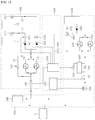
- FIG. 1 is a schematic view of a ship fuel oil switching system according to a first exemplary embodiment of the present invention.
- the ship fuel oil switching system includes a supply unit 100, a circulation unit 200, and a controller 300.
- the supply unit 100 includes a plurality of tanks T1, T2, a plurality of control valves V11, V12, and a supply pump 110 and sends fuel oil stored in the plurality of tanks T1, T2 to the circulation unit 200.
- the plurality of tanks T1, T2 stores different types of fuel oils.
- each of the plurality of tanks T1, T2 may be any one of an HFO service tank, an HFO settling tank, an HFO bunker tank, an MDO service tank, an MDO storage tank, an MGO service tank, and an MGO storage tank.
- Emergency shutoff valves V41, V42 may be disposed on respective discharge lines L1, L2 through which the different types of fuel oils are discharged from the plurality of tanks T1, T2.
- the emergency shutoff valves V41, V42 are on-off controlled by pneumatic or hydraulic pressure and serve to shutoff supply of fuel oil when a fire occurs, thereby preventing the fire from spreading.
- the present invention will be described assuming that the supply unit includes two tanks T1, T2, wherein a first tank T1 stores MGO and a second tank T2 stores HFO.
- the plurality of control valves V11, V12 is respectively disposed on the plurality of discharge lines L1, L2 through which the different types of fuel oils are discharged from the plurality of tanks T1, T2.
- the supply unit according to this embodiment includes two tanks T1, T2, a first control valve V11 is disposed on a first discharge line L1 through which a first type of fuel oil is discharged from the first tank T1 and a second control valve V12 is disposed on a second discharge line L2 through which a second type of fuel oil is discharged from the second tank T2.
- the plurality of control valves V11, V12 is controlled in opening rate by an integrated automation system (IAS) 320 of the controller 300 described below to regulate respective flow rates of the different types of fuel oils supplied from the plurality of tanks T1, T2 to the supply pump 110.
- IAS integrated automation system
- the plurality of control valves V11, V12 may be configured to be automatically controlled in opening rate by the integrated automation system 320 in ordinary times and to be manually operated in an emergency.
- the supply pump 110 increases the pressure of fuel oil discharged from the plurality of tanks T1, T2 to supply the fuel oil to the circulation unit 200 and may include a plurality of supply pumps connected in parallel.
- the different types of fuel oils respectively discharged from the plurality of tanks T1, T2 are mixed together before being supplied to the supply pump 110.
- the supply unit includes the first tank T1 storing MGO and the second tank T2 storing HFO
- the first discharge line L1 delivering MGO from the first tank T1 to the supply pump 110 and the second discharge line L2 delivering HFO from the second tank T2 to the supply pump 110 join each other upstream of the supply pump 110, such that MGO discharged from the first tank T1 and HFO discharged from the second tank T2 are mixed together upstream of the supply pump 110 before being supplied to the supply pump 110.
- the supply unit 100 may further include a return line L3 branching off downstream of the supply pump 110 and joining upstream of the supply pump 110.
- the fuel oil pressurized by the supply pump 110 in excess of what is required by an engine E is returned upstream of the supply pump 110 through the return line L3.
- a first valve V31 controlling the flow rate and on-off of a fluid may be disposed on the return line L3.
- the supply unit 100 may further include a first flow meter 120 disposed downstream of the supply pump 110.
- the first flow meter 120 measures the flow rate of fuel oil that is a blend of the different types of fuel oils respectively discharged from the plurality of tanks T1, T2 to be supplied to the circulation unit 200 by the supply pump 110.
- a flow rate value measured by the first flow meter 120 may be transmitted to the integrated automation system 320.
- the circulation unit 200 circulates the fuel oil blend to the engine E and the supply unit 100 resupplies the same amount of fuel oil as that consumed by the engine E to the circulation unit 200.
- the system may be operated such that the first flow meter 120 indicates a flow rate equal to a fuel oil consumption per hour of the engine E. Accordingly, if the flow rate indicated by the first flow meter 120 is below or above the fuel oil consumption per hour of the engine E, it can be determined that the system fails.
- the supply unit 100 may further include a plurality of check valves V21, V22 respectively disposed on the plurality of discharge lines L1, L2 through which the different types of fuel oils are discharged from the plurality of tanks T1, T2.
- a first check valve V21 is disposed on the first discharge line L1 through which a first type of fuel oil is discharged from the first tank T1 and a second check line V2 is disposed on the second discharge line L2 through which a second type of fuel oil is discharged from the second tank T2.
- both of the plurality of control valves V11, V12 can be open, there is a possibility of that fuel oil discharged from one tank flow into the other tank.
- the supply unit according to this embodiment includes the first tank T1 storing MGO and the second tank T2 storing HFO
- both the first control valve V11 and the second control valve V12 are open during fuel oil change over, whereby a fraction of MGO discharged from the first tank T1 can flow into the second tank T2 through the first control valve V11 and the second control valve V12, or a fraction of HFO discharged from the second tank T2 can flow into the first tank T1 through the second control valve V12 and the first control valve V11.
- the circulation unit 200 includes a circulation pump 210, a first temperature sensor 241, and a viscosity sensor 230 and circulates the fuel oil supplied from the supply unit 100 to supply the fuel oil to the engine E.
- the circulation pump 210 increases the pressure of the fuel oil supplied from the supply unit 100 to circulate the fuel oil and may include a plurality of circulation pumps connected in parallel.
- the circulation unit 200 is preferably maintained at a pressure of about 8 bar to about 10 bar by being pressurized by the circulation pump 210.
- heating of the HFO may be required to adjust the viscosity of the HFO to a level required by the engine E. Heating of the HFO can vaporize impurities contained in HFO, such as organic compounds, water, and the like, which can damage the pump and interfere with fuel oil injection into the engine E.
- the pressure and thus boiling point of impurities contained in the HFO can also increase, thereby preventing evaporation of the impurities.
- pressurizing HFO to about 7 bar can prevent water contained in the HFO from evaporating even when the HFO is heated to about 130°C since the water has a boiling point of about 170°C.
- the fuel oil circulating through the circulation unit 200 is supplied to the engine E to be used as fuel and the fuel oil remaining after use in the engine E is discharged from the engine E to be recirculated through the circulation unit 200.
- the supply unit 100 supplies the same amount of fuel oil as that consumed by the engine E to the circulation unit 200 such that a flow rate of the fuel oil circulating through the circulation unit 200 can be constant on average.
- the flow rate of the fuel oil circulating through the circulation unit 200 preferably corresponds to about three times a maximum fuel consumption of the engine E.
- the first temperature sensor 241 measures the temperature of the fuel oil to be supplied to the engine E and a temperature value of the fuel oil measured by the first temperature sensor 241 is transmitted to a ratio calculation unit 310.
- the viscosity sensor 230 measures the viscosity of the fuel oil to be supplied to the engine E and a viscosity value of the fuel oil measured by the viscosity sensor 230 is transmitted to the ratio calculation unit 310.
- the circulation unit 200 may further include a heater 220 heating the fuel oil circulating through the circulation unit 200.
- the heater 220 when the viscosity of the fuel oil circulating through the circulation unit 200 is higher than a viscosity level required by the engine E, the heater 220 heats the fuel oil to reduce the viscosity of the fuel oil.
- the heater 220 may use steam or electricity as a heating source.
- the heater 220 may be connected to a steam control valve V52 regulating the flow rate and on-off of steam.
- the engine E may require a viscosity level of about 10 cSt to 25 cSt.
- HFO needs to be heated to meet the viscosity level required by the engine E
- MGO or MDO often meets the viscosity level required by the engine E without any additional heating process.
- the heater 220 is used particularly when the engine E uses only HFO as fuel or when the engine uses a mixture of HFO and a different type of fuel oil as fuel.
- the circulation unit 200 may further include a second valve V32 connected in parallel to the heater 220.
- the second valve V32 is opened when the fuel oil does not need to be heated by the heater 220 and thus bypasses the heater 220.
- MGO and MDO have low viscosity and thus may not be heated by the heater 220.
- the circulation unit 200 may further include a cooler 250 cooling the fuel oil circulating through the circulation unit 200.
- the cooler 250 cools the fuel oil to increase the viscosity of the fuel oil.
- the cooler 250 may cool the fuel oil using cooling water or the like as a refrigerant, wherein the ship fuel oil switching system according to this embodiment may include a separate cooling device lowering the temperature of the refrigerant.
- MGO needs to be increased in viscosity by being cooled by the cooler 250 before being supplied to the engine E since the engine E may require a viscosity level of about 10 cSt to 25 cSt.
- a three-way valve V60 may be disposed on a line through which the fuel oil supplied from the supply unit 100 to the circulation unit 200 is delivered to the cooler 250.
- the three-way valve V60 may divide the fuel oil into two streams: one stream to be sent to the cooler 250 and the other stream to be sent directly to the engine, bypassing the cooler 250.
- a third valve V33 may be disposed to control the flow rate and on-off of the fuel oil stream.
- a third check valve V23 may be disposed to prevent backflow of the fuel oil stream.
- the fuel oil stream cooled by the cooler 250 and having been discharged from the cooler 250 may be sent to the engine E after joining the other fuel oil stream branched off by the three-way valve V60 and having bypassed the cooler 250.
- the circulation unit 200 may further include a fuel oil duct 240 disposed downstream of the engine E to temporarily store the fuel oil remaining after use in the engine E and to supply the remaining fuel oil to the circulation pump 210.
- the controller 300 includes the ratio calculation unit 310 and the integrated automation system 320 and controls the supply unit 100 and the circulation unit 200.
- the ratio calculation unit 310 calculates a blended ratio of different types of fuel oils in the fuel oil circulating through the circulation unit 200.
- a process of calculating the blended ratio by the ratio calculation unit 310 is as follows:
- a temperature-dependent viscosity of each component contained in a fuel oil blend may be found according to the equations described further below.
- viscosity may be found directly according to the following equation.
- v denotes viscosity
- T denotes temperature.
- Equation 1 X and Y are values depending on the type of fuel oil and are found according to the following equation.
- V1 denotes a viscosity at a fuel oil temperature of T1
- V2 is a viscosity at a fuel oil temperature of T2.
- X log log V 2 + 0.7 + B ⁇ log T 2
- Y log log V 2 + 0.7 ⁇ log log V 1 + 0.7 / log T 1 ⁇ log T 2
- v_blend the viscosity (v_blend) of a fuel oil blend
- VBI viscosity blending index
- VBI_blend a viscosity blending index (VBI_blend) of the fuel oil blend is found according to the following equation.
- w_A denotes a weight proportion of component A in the fuel oil blend
- VBI_A is a viscosity blending index of component A found in the first step.
- the weight proportion w of each component is determined at a given temperature.
- VBI _ blend w _ A ⁇ VBI _ A + w _ B ⁇ VBI _ B + ... ...
- VBI _ blend w _ A ⁇ VBI _ A + w _ B ⁇ VBI _ B
- the viscosity of the fuel oil blend is found as follows.
- MGO has a viscosity of 2.85 cSt at 47.6°C
- HFO has a viscosity of 245.02 cSt at 47.6°C.
- v_MGO denotes a viscosity of MGO
- v_HFO denotes a viscosity of HFO.
- w_B may be found by concatenating Equation 5 and Equation 6 as follows, thereby finding a weight ratio of the components in the fuel oil blend.
- the ratio calculation process by the ratio calculation unit 310 includes the following steps:
- the blended ratio of the components of the fuel oil blend can be determined.
- the integrated automation system 320 may receive feedback on control over the blended ratio of the fuel oil through regulation of the opening rates of the plurality of control valves V11, V12, based on a value of the blended ratio calculated by the ratio calculation unit 310.
- the integrated automation system 320 receives a value of the blended ratio of the fuel oil calculated by the ratio calculation unit 310, a value of the temperature of the fuel oil transmitted from the first temperature sensor 241 to the ratio calculation unit 310, and a value of the viscosity of the fuel oil transmitted from the viscosity sensor 230 to the ratio calculation unit 310.
- the integrated automation system 320 may receive a value of the flow rate measured by the first flow meter 120.
- the integrated automation system 320 regulates the temperature and blended ratio of the fuel oil such that the viscosity value of the fuel oil received from the ratio calculation unit 310 meets a viscosity level required by the engine E.
- the integrated automation system 320 receives feedback on the regulated temperature of the fuel oil based on the temperature value measured by the first temperature sensor 241 and received from the ratio calculation unit 310 and receives feedback on the regulated blended ratio of the fuel oil based on the viscosity value measured by the viscosity sensor 230 and received from the ratio calculation unit 310.
- the integrated automation system 320 regulates the blended ratio of the fuel oil by controlling the opening rates of the plurality of control valves V11, V12.
- the integrated automation system 320 regulates the degree of heating of the fuel oil by regulating the opening rate of the steam control valve V52.
- the integrated automation system 320 regulates the degree of cooling of the fuel oil by regulating the opening rate of the three-way valve V60.
- the ship fuel oil switching system may further include a steam tracing valve V51, wherein the opening rate of the steam tracing valve V51 may be regulated by the integrated automation system 320 according to this embodiment.
- the steam tracing valve V51 is used to heat HFO which cannot be delivered through a pipe due to temperature drop caused by long-term shutdown of the system.
- the steam tracing valve V51 is not used for MGO or MDO.
- the ship fuel oil switching system includes the first tank T1 storing MGO, the second tank T2 storing HFO, the cooler 250, the third valve V33, and the three-way valve V60 and a maximum viscosity level required by the engine E is 25 cSt.
- the first control valve V11 When only HFO is supplied as fuel for the engine E, the first control valve V11 is fully closed (opening degree: 0%) and only the second control valve V12 is open (opening degree: 100%).
- the viscosity of the fuel oil supplied to the engine E automatically set by the fuel oil switching system according to this embodiment, may be 15 cSt.
- a user When there is a need to change over fuel for the engine E from HFO to MGO, such as when a ship will enter a sulfur oxide emission control area, a user sends a signal for change over fuel for the engine E from HFO to MGO to the ship fuel oil switching system according to this embodiment.
- the fuel oil switching system may automatically set the viscosity of fuel oil to be supplied to the engine E to 23 cSt, which is slightly lower than the maximum viscosity level required by the engine E.
- load of the heater 220 which serves to reduce the viscosity, is adjusted to 0%, and, for example, when the circulation unit 200 according to this embodiment includes the steam control valve V52, the integrated automation system 320 fully closes the steam control valve V52.
- a temperature drop of the fuel oil can cause increase in the viscosity of the fuel oil. Accordingly, when the temperature of the fuel oil drops, the heater 220 may be operated to prevent the viscosity of the fuel oil from exceeding the set value and the integrated automation system 320 may open the steam control valve V52.
- the fuel oil switching system Upon receiving the signal for change over fuel for the engine E from HFO to MGO, the fuel oil switching system according to this embodiment gradually opens the first control valve V11 having been fully closed (0%) while keeping the second control valve V12 open (100%).
- the first control valve V11 may be gradually opened through feedback control.
- feedback control refers to a control method in which some of controlled output signals from a system are returned to an input side of the system to generate an operating control signal based on a difference between the output signals and a target value or a reference value.
- a signal path for feedback control forms a closed loop.
- a rate of opening the first control valve V11 may be determined depending on the temperature change per minute (dT/dt, where T is temperature and t is time) of the fuel oil as measured by the first temperature sensor 241.
- the first control valve V11 may be controlled by the integrated automation system 320 to be gradually opened such that the temperature of the fuel oil as measured by the first temperature sensor 241 is changed at a rate of 2°C/min.
- the fuel oil switching system When the first control valve V11 is fully opened (100%), the fuel oil switching system according to this embodiment gradually closes the second control valve V12 having been fully open (100%).
- the second control valve V12 may be gradually closed by feedback control.
- a rate of closing the second control valve V12 may be determined depending on the temperature change (dT/dt) per minute of the fuel oil as measured by the first temperature sensor 241.
- the second control valve V12 may be controlled by the integrated automation system 320 to be gradually closed such that the temperature of the fuel oil as measured by the first temperature sensor 241 is changed at a rate of 2°C/min.
- the opening rates of the first control valve V11 and the second control valve V12 may be adjusted based on the increment of MGO and the decrement of HFO determined through the above calculation process.
- the feedback control is interrupted and is not resumed until the rate of temperature change becomes 2°C/min.
- the heater 220 is operated to prevent the viscosity of the fuel oil from exceeding a maximum allowable viscosity value.
- the fuel oil switching system may determine that fuel oil change over has been completed. Upon determining that fuel oil change over has been completed and MGO is thus supplied to the engine E, the viscosity of the fuel oil to be supplied to the engine E may be automatically set to 6 cSt by the fuel oil switching system according to this embodiment.
- the fuel oil switching system may open the three-way valve V60 and the third valve V33 to send MGO to the cooler 250 to adjust the viscosity of MGO circulating through the circulation unit 200 to a viscosity level required by the engine E.
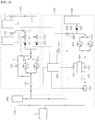
- FIG. 2 is a schematic diagram of a ship fuel oil switching system according to a second exemplary embodiment of the present invention.
- a ship fuel oil switching system according to the second embodiment as shown in FIG. 2 differs from the ship fuel oil switching system according to the first embodiment as shown in FIG. 1 in that the ratio calculation unit 310 is omitted and a second flow meter 122 is further included, and the differences will be mainly described below. In addition, detailed description of the same components as those of the ship fuel oil switching system according to the first embodiment described above will be omitted.
- the ship fuel oil switching system includes a supply unit 100, a circulation unit 200, and a controller 300, as in the first embodiment.
- the supply unit 100 includes a plurality of tanks T1, T2, a plurality of control valves V11, V12, and a supply pump 110 and sends fuel oil stored in the plurality of tanks T1, T2 to the circulation unit 200, as in the first embodiment.
- the plurality of tanks T1, T2 stores different types of fuel oils and may each be any one of an HFO service tank, an HFO settling tank, an HFO bunker tank, an MDO service tank, an MDO storage tank, an MGO service tank, and an MGO storage tank, as in the first embodiment.
- emergency shutoff valves V41, V42 may be disposed on respective discharge lines L1, L2 through which the different types of fuel oils are discharged from the plurality of tanks T1, T2.
- the emergency shutoff valves V41, V42 are on-off controlled by pneumatic or hydraulic pressure and serve to shutoff supply of fuel oil when a fire occurs to prevent the fire from spreading, as in the first embodiment.
- the supply unit includes two tanks T1, T2, wherein a first tank T1 stores MGO and a second tank T2 stores HFO.
- the plurality of control valves V11, V12 is respectively disposed on the plurality of discharge lines L1, L2 through which the different types of fuel oils are discharged from the plurality of tanks T1, T2, as in the first embodiment.
- a first control valve V11 is disposed on a first discharge line L1 through which a first type of fuel oil is discharged from the first tank T1
- a second control valve V12 is disposed on a second discharge line L2 through which a second type of fuel oil is discharged from the second tank T2, as in the first embodiment.
- the plurality of control valves V11, V12 is controlled in opening rate by an integrated automation system (IAS) 320 of the controller 300 described below to regulate respective flow rates of the different types of fuel oils supplied from the plurality of tanks T1, T2 to the supply pump 110.
- IAS integrated automation system
- the plurality of control valves V11, V12 may be configured to be automatically controlled in opening rate by the integrated automation system 320 in ordinary times and to be manually operated in an emergency, as in the first embodiment.
- the supply pump 110 increases the pressure of fuel oil from the plurality of tanks T1, T2 to supply the fuel oil to the circulation unit 200 and may include a plurality of supply pumps connected in parallel.
- the different types of fuel oils respectively discharged from the plurality of tanks T1, T2 are mixed together before being supplied to the supply pump 110, as in the first embodiment.
- the supply unit when the supply unit according to this embodiment includes the first tank T1 storing MGO and the second tank T2 storing HFO, the first discharge line L1 delivering MGO discharged from the first tank T1 to the supply pump 110 and a second discharge line L2 delivering HFO discharged from the second tank T2 to the supply pump 110 join each other upstream of the supply pump 110, such that MGO discharged from the first tank T1 and HFO discharged from the second tank T2 are mixed together upstream of the supply pump 110 before being supplied to the supply pump 110, as in the first embodiment.
- the supply unit 100 may further include a return line L3 branching off downstream of the supply pump 110 and joining upstream of the supply pump 110, as in the first embodiment.
- the fuel oil compressed by the supply pump 110 in excess of what is required by an engine E is delivered upstream of the supply pump 110 through the return line L3, as in the first embodiment.
- a first valve V31 controlling the flow rate and on-off of a fluid may be disposed on the return line L3.
- the supply unit 100 may further include a second flow meter 122 disposed on all or some of the plurality of discharge lines L1, L2 through which the different types of fuel oils are discharged from the plurality of tanks T1, T2, in addition to a first flow meter disposed downstream of the supply pump 110.
- the first flow meter 120 measures the flow rate of fuel oil that is a blend of the different types of fuel oils discharged from the plurality of tanks T1, T2 to be supplied to the circulation unit 200 by the supply pump 110, as in the first embodiment.
- the ship fuel oil switching system is operated such that the first flow meter 120 indicates a flow rate equal to a fuel oil consumption per hour of the engine E. Accordingly, if the flow rate indicated by the first flow meter 120 is below or above the fuel oil consumption per hour of the engine E, it can be determined that the system has failed.
- the second flow meter 122 measures the flow rate of fuel oil discharged from the tank T1 or T2 upstream of the discharge line L1 or L2 on which the second flow meter 122 is disposed. Since the first flow meter 120 measures the flow rate of the fuel oil that is a blend of the different types of fuel oils discharged from the plurality of tanks T1, T2 to be supplied to the circulation unit 200, the flow rate of fuel oil discharged from one tank T1 or T2 can be found by subtracting a value of the flow rate of fuel oil discharged from the other tank as measured by the second flow meter 122 from a value of the flow rate measured by the first flow meter 120.
- the second flow meter 122 may be disposed on the first discharge line L1 to measure the flow rate of MGO discharged from the first tank T1, as shown in FIG. 2 . Since the flow rate of HFO discharged from the second tank T2 can be found by subtracting the flow rate value measured by the second flow meter 122 from the flow rate value measured by the first flow meter 120, the blended ratio of MGO to HFO can be determined.
- the time t required for completion of fuel oil change over can be calculated using the flow rate value measured by the first flow meter 120, the flow rate value measured by the second flow meter 122, and the following equation.
- Y denotes the amount of fuel oil to be changed over
- V denotes the sum of the total volume of pipes through which fuel oil is circulated and the internal volumes of the aforementioned components
- Y0 denotes the initial amount of fuel oil (to be changed over) in a fuel oil blend at the start of fuel oil change over
- FOC denotes the amount of fuel oil consumed by the engine per unit time
- t denotes the elapsed time.
- FOC may be determined based on a variation of the flow rate value measured by the first flow meter 120.
- Y represents the amount of HFO to be changed over and Y0 represents the initial amount of HFO at the start of fuel oil change over, which may generally be equal to zero.
- the proportion of MGO reaches 96% or more, it can be determined that fuel oil change over is completed, and a value of t at a point in time when the proportion of MGO reaches 96% or more is the time required for completion of fuel oil change over.
- the flow rate value measured by the first flow meter 120 and the flow rate value measured by the second flow meter 122 are transmitted to the integrated automation system 320.
- the supply unit 100 may further include a plurality of check valves V21, V22 respectively disposed on the plurality of discharge lines L1, L2 through which the different types of fuel oils are discharged from the plurality of tanks T1, T2, as in the first embodiment.
- a first check valve V21 is disposed on the first discharge line L1 through which a first type of fuel oil is discharged from the first tank T1
- a second check line V2 is disposed on the second discharge line L2 through which a second type of fuel oil is discharged from the second tank T2, as in the first embodiment.
- the plurality of check valves V21, V22 serves to prevent fuel oil discharged from one tank from flowing into the other tank, thereby preventing different types of fuel oils from being mixed in each of the tanks T1, T2, as in the first embodiment.
- the circulation unit 200 includes a circulation pump 210, a first temperature sensor 241, and a viscosity sensor 230 and circulates fuel oil received from the supply unit 100 to supply the fuel oil to the engine E, as in the first embodiment.
- the circulation pump 210 increases the pressure of the fuel oil supplied from the supply unit 100 to the circulation unit 200 to circulate the fuel oil and may include a plurality of circulation pumps connected in parallel, as in the first embodiment.
- the circulation unit 200 is preferably maintained at a pressure of about 8 bar to about 10 bar by being pressurized by the circulation pump 210.
- fuel oil circulating through the circulation unit 200 is supplied to the engine E to be used as fuel and the fuel oil remaining after use in the engine E is discharged from the engine E to be recirculated through the circulation unit 200, as in the first embodiment.
- the supply unit 100 resupplies the same amount of fuel oil as that consumed by the engine E to the circulation unit 200 such that a flow rate of the fuel oil circulating through the circulation unit 200 can be constant on average.
- the flow rate of the fuel oil circulating through the circulation unit 200 preferably corresponds to about three times the maximum fuel consumption of the engine E, as in the first embodiment.
- the first temperature sensor 241 measures the temperature of fuel oil to be supplied to the engine E.
- the temperature value of the fuel oil measured by the first temperature sensor 241 is transmitted to the integrated automation system 320, unlike in the first embodiment.
- the viscosity sensor 230 measures the viscosity of fuel oil to be supplied to the engine E.
- the viscosity value of the fuel oil measured by the viscosity sensor 230 is transmitted to the integrated automation system 320, unlike in the first embodiment.
- the circulation unit 200 may further include a heater 220 heating the fuel oil circulating through the circulation unit 200, as in the first embodiment.
- a heater 220 heating the fuel oil circulating through the circulation unit 200, as in the first embodiment.
- the heater 220 heats the fuel oil to reduce the viscosity of the fuel oil.
- the heater 220 may use steam or electricity as a heating source.
- the heater 220 may be connected to a steam control valve V52 regulating the flow rate and on-off of steam, as in the first embodiment.
- the heater 220 is used particularly when the engine E uses only HFO as fuel or when the engine uses a fuel oil blend of HFO and a different type of fuel oil as fuel.
- the circulation unit 200 may further include a second valve V32 connected in parallel to the heater 220, as in the first embodiment.
- the second valve V32 is opened when fuel oil does not need to be heated by the heater 220 and thus bypasses the heater 220.
- MGO and MDO have low viscosity and thus may not be heated by the heater 220.
- the circulation unit 200 may further include a cooler 250 cooling the fuel oil circulating through the circulation unit 200, as in the first embodiment.
- the cooler 250 cools the fuel oil to increase the viscosity of the fuel oil, as in the first embodiment.
- MGO needs to be increased in viscosity by being cooled by the cooler 250 before being supplied to the engine E.
- the cooler 250 may cool the fuel oil using cooling water or the like as a refrigerant, wherein the ship fuel oil switching system according to this embodiment may include a separate cooling device lowering the temperature of the refrigerant, as in the first embodiment.
- a three-way valve V60 may be disposed on a line through which fuel oil supplied from the supply unit 100 to the circulation unit 200 is delivered to the cooler 250, as in the first embodiment.
- the three-way valve V60 may divide the fuel oil into two streams: one stream to be sent to the cooler 250 and the other stream to be sent directly to the engine E, bypassing the cooler 250.
- a third valve V33 may be disposed to control the flow rate and on-off of the fuel oil stream, as in the first embodiment.
- a third check valve V23 may be disposed to prevent backflow of the fuel oil stream, as in the first embodiment.
- the fuel oil stream cooled by the cooler 250 and having been discharged from the cooler 250 may be sent to the engine E after joining the other fuel oil stream branched off by the three-way valve V60 and having bypassed the cooler 250, as in the first embodiment.
- the circulation unit 200 may further include a fuel oil duct 240 disposed downstream of the engine E to temporarily store the fuel oil remaining after use in the engine E and to supply the remaining fuel oil to the circulation pump 210, as in the first embodiment.
- the controller 300 includes the integrated automation system 320 and controls the supply unit 100 and the circulation unit 200, as in the first embodiment.
- the controller 300 does not include the ratio calculation unit 310, unlike in the first embodiment, and the ship fuel oil switching system according to this embodiment calculates the blended ratio of the fuel oil using the flow rate values measured by the first flow meter 120 and the second flow meter 122.
- the integrated automation system 320 receives the flow rate value measured by the first flow meter, the flow rate value measured by the second flow meter 122, the temperature value measured by the first temperature sensor 241, and the viscosity value measured by the viscosity sensor 230.
- the integrated automation system 320 calculates the blended ratio of the fuel oil to be supplied to the engine E using the flow rate value measured by the first flow meter 120 and the flow rate value measured by the second flow meter 122.
- the integrated automation system 320 regulates the temperature and blended ratio of the fuel oil such that the viscosity value of the fuel oil received from the viscosity sensor 230 meets a viscosity level required by the engine E.
- the integrated automation system 320 receives feedback on the regulated temperature of the fuel oil based on the temperature value received from the first temperature sensor 241 and receives feedback on the regulated blended ratio of the fuel oil based on the viscosity value received from the viscosity sensor 230.
- the integrated automation system 320 regulates the blended ratio of the fuel oil by controlling the opening rates of the plurality of control valves V11, V12, as in the first embodiment.
- the integrated automation system 320 regulates a degree of heating of the fuel oil by regulating the opening rate of the steam control valve V52.
- the integrated automation system 320 regulates a degree of cooling of the fuel oil by regulating the opening rate of the three-way valve V60.
- the ship fuel oil switching system may further include a steam tracing valve V51, wherein the opening rate of the steam tracing valve V51 may be regulated by the integrated automation system 320 according to this embodiment.
- the steam tracing valve V51 As in the first embodiment, the steam tracing valve V51 according to this embodiment is used to heat HFO that cannot be delivered through pipes due to temperature drop caused by long-term shutdown of the system. Generally, the steam tracing valve V51 is not used for MGO or MDO.
- the ship fuel oil switching system includes the first tank T1 storing MGO, the second tank T2 storing HFO, the cooler 250, the third valve V33, and the three-way valve V60 and a maximum viscosity required by the engine E is 25 cSt, a method of switching fuel for the engine E from HFO alone to MGO is the same as described in the first embodiment.
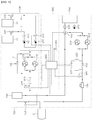
- FIG. 3 is a schematic diagram of a ship fuel oil switching system according to a third exemplary embodiment of the present invention.
- a ship fuel oil switching system according to the third embodiment as shown in FIG. 3 differs from the ship fuel oil switching system according to the first embodiment as shown in FIG. 1 in that the ratio calculation unit 310 is omitted and a second temperature sensor 122 and a third temperature sensor are further included, and the differences will be mainly described below. In addition, detailed description of the same components as those of the ship fuel oil switching system according to the first embodiment described above will be omitted.
- the ship fuel oil switching system includes a supply unit 100, a circulation unit 200, and a controller 300, as in the first embodiment.
- the supply unit 100 includes a plurality of tanks T1, T2, a plurality of control valves V11, V12, and a supply pump 110 and sends fuel oil stored in the plurality of tanks T1, T2 to the circulation unit 200, as in the first embodiment.
- the plurality of tanks T1, T2 stores different types of fuel oils and may each be any one of an HFO service tank, an HFO settling tank, an HFO bunker tank, an MDO service tank, an MDO storage tank, an MGO service tank, and an MGO storage tank, as in the first embodiment.
- emergency shutoff valves V41, V42 may be disposed on respective discharge lines L1, L2 through which the different types of fuel oils are discharged from the plurality of tanks T1, T2.
- the emergency shutoff valves V41, V42 are on-off controlled by pneumatic or hydraulic pressure and serve to shutoff supply of the fuel oil when a fire occurs to prevent the fire from spreading, as in the first embodiment.
- the supply unit includes two tanks T1, T2, wherein a first tank T1 stores MGO and a second tank T2 stores HFO.
- the plurality of control valves V11, V12 is respectively disposed on the plurality of discharge lines L1, L2 through which the different types of fuel oils are discharged from the plurality of tanks T1, T2, as in the first embodiment.
- a first control valve V11 is disposed on a first discharge line L1 through which a first type of fuel oil is discharged from the first tank T1
- a second control valve V12 is disposed on a second discharge line L2 through which a second type of fuel oil is discharged from the second tank T2, as in the first embodiment.
- the plurality of control valves V11, V12 is controlled in opening rate by an integrated automation system (IAS) 320 of the controller 300 described below to regulate respective flow rates of the different types of fuel oils supplied from the plurality of tanks T1, T2 to the supply pump 110.
- IAS integrated automation system
- the plurality of control valves V11, V12 may be configured to be automatically controlled in opening rate by the integrated automation system 320 in ordinary times and to be manually operated in an emergency, as in the first embodiment.
- the supply pump 110 increases the pressure of fuel oil discharged from the plurality of tanks T1, T2 to supply the fuel oil to the circulation unit 200 and may include a plurality of supply pumps connected in parallel.
- the different types of fuel oils discharged from the plurality of tanks T1, T2 are mixed together before being supplied to the supply pump 110, as in the first embodiment.
- the supply unit when the supply unit according to this embodiment includes the first tank T1 storing MGO and the second tank T2 storing HFO, the first discharge line L1 delivering MGO discharged from the first tank T1 to the supply pump 110 and a second discharge line L2 delivering HFO discharged from the second tank T2 to the supply pump 110 join each other upstream of the supply pump 110, such that MGO discharged from the first tank T1 and HFO discharged from the second tank T2 are mixed together upstream of the supply pump 110 before being supplied to the supply pump 110, as in the first embodiment.
- the supply unit 100 may further include a return line L3 branching off downstream of the supply pump 110 and joining upstream of the supply pump 110, as in the first embodiment.
- the fuel oil compressed by the supply pump 110 in excess of what is required by an engine E is delivered upstream of the supply pump 110 through the return line L3, as in the first embodiment.
- a first valve V31 controlling the flow rate and on-off of a fluid may be disposed on the return line L3.
- the supply unit 100 may further include a first flow meter 120 disposed downstream of the supply pump 110, as in the first embodiment.
- the first flow meter 120 measures the flow rate of fuel oil that is a blend of the different types of fuel oils discharged from the plurality of tanks T1, T2 to be supplied to the circulation unit 200 by the supply pump 110, as in the first embodiment.
- the ship fuel oil switching system is operated such that the first flow meter 120 indicates a flow rate equal to a fuel oil consumption per hour of the engine E. Accordingly, if the flow rate indicated by the first flow meter 120 is below or above the fuel oil consumption per hour of the engine E, it can be determined that the system has failed.
- the supply unit 100 may further include a second temperature sensor 244 disposed downstream of the supply pump 110.
- the second temperature sensor 244 measures the temperature of fuel oil that is a blend of the different types of fuel oils discharged from the plurality of tanks T1, T2 to be supplied to the circulation unit 200, and a value of the temperature of the fuel oil measured by the second temperature sensor is transmitted to the integrated automation system 320.
- the supply unit 100 may further include a plurality of check valves V21, V22 respectively disposed on the plurality of discharge lines L1, L2 through which the different types of fuel oils are discharged from the plurality of tanks T1, T2, as in the first embodiment.
- a first check valve V21 is disposed on the first discharge line L1 through which a first type of fuel oil is discharged from the first tank T1
- a second check line V2 is disposed on the second discharge line L2 through which a second type of fuel oil is discharged from the second tank T2, as in the first embodiment.
- the plurality of check valves V21, V22 serves to prevent fuel oil discharged from one tank from flowing into the other tank, thereby preventing different types of fuel oils from being mixed in each of the tanks T1, T2, as in the first embodiment.
- the circulation unit 200 includes a circulation pump 210, a first temperature sensor 241, and a viscosity sensor 230 and circulates fuel oil received from the supply unit 100 to supply the fuel oil to the engine E, as in the first embodiment.
- the circulation pump 210 increases the pressure of the fuel oil supplied from the supply unit 100 to the circulation unit 200 to circulate the fuel oil and may include a plurality of circulation pumps connected in parallel, as in the first embodiment.
- the circulation unit 200 is preferably maintained at a pressure of about 8 bar to about 10 bar by being pressurized by the circulation pump 210.
- fuel oil circulating through the circulation unit 200 is supplied to the engine E to be used as fuel and the fuel oil remaining after use in the engine E is discharged from the engine E to be recirculated through the circulation unit 200, as in the first embodiment.
- the supply unit 100 resupplies the same amount of fuel oil as that consumed by the engine E to the circulation unit 200 such that a flow rate of the fuel oil circulating through the circulation unit 200 can be constant on average.
- the flow rate of the fuel oil circulating through the circulation unit 200 preferably corresponds to about three times a maximum fuel consumption of the engine E, as in the first embodiment.
- the first temperature sensor 241 measures the temperature of the fuel oil to be supplied to the engine E.
- the temperature value of the fuel oil measured by the first temperature sensor 241 is transmitted to the integrated automation system 320, unlike in the first embodiment.
- the viscosity sensor 230 measures the viscosity of the fuel oil to be supplied to the engine E.
- the viscosity value of the fuel oil measured by the viscosity sensor 230 is transmitted to the integrated automation system 320, unlike in the first embodiment.
- the circulation unit 200 may further include a heater 220 heating the fuel oil circulating through the circulation unit 200, as in the first embodiment.
- a heater 220 heating the fuel oil circulating through the circulation unit 200, as in the first embodiment.
- the heater 220 heats the fuel oil to reduce the viscosity of the fuel oil, as in the first embodiment.
- the heater 220 may use steam or electricity as a heating source.
- the heater 220 may be connected to a steam control valve V52 regulating the flow rate and on-off of steam, as in the first embodiment.
- the heater 220 is used particularly when the engine E uses only HFO as fuel or when the engine uses a fuel oil blend of HFO and a different type of fuel oil as fuel.
- the circulation unit 200 may further include a second valve V32 connected in parallel to the heater 220, as in the first embodiment.
- the second valve V32 is opened when fuel oil does not need to be heated by the heater 220 and thus bypasses the heater 220.
- the circulation unit 200 may further include a cooler 250 cooling the fuel oil circulating through the circulation unit 200, as in the first embodiment.
- the cooler 250 cools the fuel oil to increase the viscosity of the fuel oil, as in the first embodiment.
- MGO needs to be increased in viscosity by being cooled by the cooler 250 before being supplied to the engine E.
- the cooler 250 may cool the fuel oil using cooling water or the like as a refrigerant, wherein the ship fuel oil switching system according to this embodiment may include a separate cooling device lowering the temperature of the refrigerant, as in the first embodiment.
- a three-way valve V60 may be disposed on a line through which the fuel oil supplied from the supply unit 100 to the circulation unit 200 is delivered to the cooler 250, as in the first embodiment.
- the three-way valve V60 may divide the fuel oil into two streams: one stream to be sent to the cooler 250 and the other stream to be sent directly to the engine E, bypassing the cooler 250.
- a third valve V33 may be disposed to control the flow rate and on-off of the fuel oil stream, as in the first embodiment.
- a third check valve V23 may be disposed to prevent backflow of the fuel oil stream, as in the first embodiment.
- the fuel oil stream cooled by the cooler 250 and having been discharged from the cooler 250 may be sent to the engine E after joining the other fuel oil stream branched off by the three-way valve V60 and having bypassed the cooler 250, as in the first embodiment.
- the circulation unit 200 may further include a fuel oil duct 240 disposed downstream of the engine E to temporarily store the fuel oil remaining after use in the engine E and to supply the remaining fuel oil to the circulation pump 210, as in the first embodiment.
- the circulation unit 200 further includes a third temperature sensor 245 measuring the temperature of the fuel oil remaining after use in the engine E. A value of the temperature of the fuel oil measured by the third temperature sensor 245 is transmitted to the integrated automation system 320.
- the controller 300 includes the integrated automation system 320 and controls the supply unit 100 and the circulation unit 200, as in the first embodiment.
- the controller 300 according to this embodiment does not include the ratio calculation unit 310, unlike in the first embodiment.
- the integrated automation system 320 receives the temperature value measured by the first temperature sensor 241, the temperature value measured by the second temperature sensor 244, the temperature value measured by the third temperature sensor 245, and the viscosity value measured by the viscosity sensor 230.
- the integrated automation system 320 regulates the temperature and blended ratio of the fuel oil such that the viscosity value of the fuel oil received from the viscosity sensor 230 meets a viscosity level required by the engine E.
- the integrated automation system 320 receives feedback on the regulated temperature of the fuel oil based on the temperature value of the fuel oil received from the first temperature sensor 241 and receives feedback on the regulated blended ratio of the fuel oil based on the viscosity value of the fuel oil received from the viscosity sensor 230.
- the integrated automation system 320 regulates the blended ratio of the fuel oil by controlling the opening rates of the plurality of control valves V11, V12.
- the integrated automation system 320 regulates a degree of heating of the fuel oil by regulating the opening rate of the steam control valve V52.
- the integrated automation system 320 regulates a degree of cooling of the fuel oil by regulating the opening rate of the three-way valve V60.
- the integrated automation system 320 may adjust the temperature of the fuel oil measured by the first temperature sensor 241 to a preset value.
- the preset value for the first temperature sensor 241 may be calculated using the following equation.
- T1 denotes the preset value for the first temperature sensor 241
- Q1 denotes the flow rate value of the fuel oil measured by the first flow meter 120
- T2 denotes the temperature of the fuel oil measured by the second temperature sensor 244
- Q2 is the amount of the fuel oil remaining after use in the engine E and discharged from the engine E
- T3 denotes the temperature of the fuel oil measured by the third temperature sensor 245
- Q3 is the capacity of the circulation pump 210.
- the ship fuel oil switching system may further include a steam tracing valve V51, wherein the opening rate of the steam tracing valve V51 may be regulated by the integrated automation system 320, as in the first embodiment.
- the steam tracing valve V51 is used to heat HFO that cannot be delivered through pipes due to temperature drop caused by long-term shutdown of the system. Generally, the steam tracing valve V51 is not used for MGO or MDO.
- the ship fuel oil switching system includes the first tank T1 storing MGO, the second tank T2 storing HFO, the cooler 250, the third valve V33, and the three-way valve V60 and a maximum viscosity level required by the engine E is 25 cSt, a method of switching fuel for the engine E from HFO alone to MGO is the same as described in the first embodiment.
Landscapes
- Engineering & Computer Science (AREA)
- Chemical & Material Sciences (AREA)
- Combustion & Propulsion (AREA)
- Mechanical Engineering (AREA)
- General Engineering & Computer Science (AREA)
- Oil, Petroleum & Natural Gas (AREA)
- Ocean & Marine Engineering (AREA)
- Chemical Kinetics & Catalysis (AREA)
- General Chemical & Material Sciences (AREA)
- Output Control And Ontrol Of Special Type Engine (AREA)
- Combined Controls Of Internal Combustion Engines (AREA)
- Fuel-Injection Apparatus (AREA)
Abstract
Description
- The present invention relates to a ship fuel oil change over system and method which are capable of changing over the fuel for an engine between different types of fuel oils.
- Examples of fuel oil that can be used as fuel for a marine engine include heavy fuel oil (HFO), marine gas oil (MGO), and marine diesel oil (MDO).
- HFO is dark brown viscous oil obtained after extracting gasoline, kerosene, light oil, etc. from crude oil and is the densest petroleum product obtained in liquid form. Since HFO has a flash point of about 40°C, is harder to evaporate than kerosene, light oil, and especially gasoline, and has a viscosity of 180 cSt to 700 cSt, it is necessary to heat HFO to a temperature of 100°C to 140°C to adjust the viscosity of HFO to 10 cSt to 25 cSt, which is a viscosity level required by an engine. Further, since HFO contains water, foreign matter, and solids, HFO needs to be cleaned by a purifier before being supplied to a marine engine.
- MGO and MDO are marine fuel oil of higher quality than HFO and are classified according to presence/absence of residue and sulfur content. MGO and MDO do not require any separate heater to be adjusted to a viscosity level required by an engine due to low viscosity thereof, have a high calorific value, and are free from residues. In addition, MGO and MDO are much lower in content of sulfur, which generates sulfur oxide (SOx), than HFO. Therefore, a ship sailing in a sulfur oxide emission control area or entering a port within a sulfur oxide emission control area needs to use MGO or MDO as fuel for an engine. However, MGO and MDO are more expensive than HFO and often have a viscosity below a minimum level required by an engine, thus requiring a cooling device to increase viscosity.
- Since fuel oil products, such as HFO, MGO and MDO, have different chemical and physical characteristics and are different in price, it is necessary to appropriately change the kind of fuel oil supplied to an engine in accordance with operating conditions of a ship.
- When changing over the fuel for the engine between different types of fuel oils having different temperatures is performed through a mixing process, it is necessary to maintain a viscosity of a fuel oil blend supplied to the engine within a certain range meeting a viscosity level required by the engine while maintaining a rate of temperature change of a fuel oil blend less than or equal to a predetermined value per minute so as to prevent damage to the engine and various related devices. If sudden temperature changes occur in the fuel oil blend due to an incorrect blending ratio, the engine and various related devices can suffer from rapid thermal expansion or thermal shrinkage, causing damage thereto, such as leakage, loss of lubricating functions, wear, and the like.
- Gradual fuel change over a long period of time can prevent sudden temperature changes of the fuel oil blend. However, with increasing change over time, consumption of expensive MGO or MDO increases, causing economic loss.
- The present invention is aimed at providing a ship fuel oil switching system and method which can minimize the cost of fuel without affecting the operating speed of a ship and the performance and lifespan of an engine and various related devices.
- In accordance with one aspect of the present invention, there is provided a system for switching ship fuel oil for an engine between different types of fuel oils, the system including: a supply unit supplying fuel oil; a circulation unit circulating the fuel oil received from the supply unit; and a controller controlling the supply unit and the circulation unit, wherein the supply unit comprises a plurality of tanks respectively storing the different types of fuel oils; the engine receives the fuel oil from the circulation unit; the fuel oil remaining after use in the engine is recirculated through the circulation unit; and the controller regulates a blended ratio of the fuel oil to be sent to the engine by controlling flow rates of the different types of fuel oils discharged from the plurality of tanks.
- The supply unit may further include: a plurality of discharge lines through which the respective different types of fuel oils are discharged from the plurality of tanks; and a plurality of control valves disposed on the plurality of discharge lines, respectively, and the controller may regulate the blended ratio of the fuel oil by adjusting opening rates of the plurality of control valves.
- The supply unit may further include a first flow meter measuring a flow rate of the fuel oil to be sent to the circulation unit.
- The first flow meter may indicate a flow rate equal to a fuel oil consumption per hour of the engine.
- The supply unit may further include a plurality of check valves disposed on the plurality of discharge lines, respectively.
- The circulation unit may further include a circulation pump pressurizing and circulating the fuel oil.
- The circulation pump may maintain a pressure of the fuel oil circulating through the circulation unit at 8 bar to 10 bar.
- A flow rate of the fuel oil circulating through the circulation unit may correspond to about three times a maximum fuel consumption of the engine.
- The controller may include a ratio calculation unit; the circulation unit may further include a first temperature sensor measuring a temperature of the fuel oil to be supplied to the engine and a viscosity sensor measuring a viscosity of the fuel oil to be supplied to the engine; a value of the temperature of the fuel oil measured by the first temperature sensor and a value of the viscosity of the fuel oil measured by the viscosity sensor may be transmitted to the ratio calculation unit; and the ratio calculation unit may calculate a blended ratio of the different types of fuel oils in the fuel oil circulating through the circulation unit.
- The ratio calculation unit may find a viscosity blending index (VBI) according to Equation: VBI = 14.534×ln(ln(v+0.8))+10.975, where v denotes a viscosity in cSt of each component of the fuel oil circulating through the circulation unit and may find w_A and w_B according to Equations: VBI_blend = (w_A×VBI_A) + (w_B×VBI_B), where w_A denotes a weight proportion of component A in a fuel oil blend and a weight proportion w of each component is determined at a given temperature; and v_blend = {exp(exp(VBI_blend-10.975) ÷ 14.534} - 0.8, where v_blend denotes a viscosity of the fuel oil blend.
- The controller may further include an integrated automation system, wherein the integrated automation system may receive: a value of the blended ratio of the fuel oil calculated by the ratio calculation unit; the value of the temperature of the fuel oil transmitted from the first temperature sensor to the ratio calculation unit; and the value of the viscosity of the fuel oil transmitted from the viscosity sensor to the ratio calculation unit, from the ratio calculation unit.
- The integrated automation system may regulate the temperature and blended ratio of the fuel oil such that the viscosity value of the fuel oil received from the ratio calculation unit meets a viscosity level required by the engine, may receive feedback on the regulated temperature of the fuel oil from the temperature value measured by the first temperature sensor and received from the ratio calculation unit, and may receive feedback on the regulated blended ratio of the fuel oil from the viscosity value measured by the viscosity sensor and received from the ratio calculation unit.
- The circulation unit may further include a heater, wherein, when a viscosity of the fuel oil circulating through the circulation unit is above a viscosity level required by the engine, the heater may heat the fuel oil.
- The circulation unit may further include a cooler, wherein, when a viscosity of the fuel oil circulating through the circulation unit is below a viscosity level required by the engine, the cooler may cool the fuel oil.
- The circulation unit may further include a fuel oil duct disposed downstream of the engine to temporarily store the fuel oil remaining after use in the engine.
- In accordance with another aspect of the present invention, there is provided a method for switching fuel for an engine between different types of fuel oils, the method comprising the steps of: 1) supplying only a second type of fuel oil to the engine by fully opening a second control valve supplying the second type of fuel oil and fully closing a first control valve supplying a first type of fuel oil; 2) calculating, by a ratio calculation unit, a blended ratio of the different types of fuel oils in fuel oil to be supplied to the engine; 3) receiving a fuel oil change over signal from a user; 4) gradually opening the first control valve such that the first type of fuel oil is increasingly discharged at a predetermined rate of change in flow rate per hour; 5) gradually closing the second control valve such that the second type of fuel oil is decreasingly discharged at a predetermined rate of change in flow rate per hour, when the first control valve is fully opened; and 6) determining that fuel oil change over has been completed, when the second control valve is fully closed and a proportion of the first type of fuel oil calculated by the ratio calculation unit is more than or equal to a predetermined value.
- The ratio calculation unit may calculate a blended ratio of fuel oil to be supplied to the engine using a temperature and viscosity of the fuel oil as variables.
- When the fuel oil change over signal is received from the user in step 3), a viscosity of fuel oil to be supplied to the engine may be automatically set, and, upon determining that fuel oil change over has been completed in step 6), the viscosity of the fuel oil to be supplied to the engine may be automatically set.
- In accordance with a further aspect of the present invention, there is provided a method for switching fuel oil supplied to a marine engine between a first type of fuel oil and a second type of fuel oil, wherein the first type of fuel oil has a different viscosity than the second type of fuel oil, and a flow rate of the first type of fuel oil and a flow rate of the second type of fuel oil are controlled such that the time required for mixing the first type of fuel oil with the second type of fuel oil and sending the fuel oil blend to the engine is less than or equal to a predetermined value and a temperature change upon mixing the first type of fuel oil with the second type fuel oil is less than or equal to a predetermined value.
- When only the first fuel oil is supplied to the engine, a feed rate of the second type of fuel oil may be increased until the feed rate of the second type of fuel oil reaches a maximum value thereof, followed by decreasing a feed rate of the first type of fuel oil such that only the second type of fuel oil is supplied to the engine.
- Feedback on flow rate control may be received by calculating a blended ratio of fuel oil to be supplied to the engine using a viscosity and temperature of the fuel oil as variables.
- The present invention provides a ship fuel oil switching system and method which can precisely predict when changing over of fuel oil is completed, thereby providing accurate determination as to when a ship can enter a sulfur oxide emission control area. In addition, the ship fuel oil switching system can ensure that fuel oil change over is completed, thereby satisfying emission regulations in the sulfur oxide emission control area.
- In addition, the ship fuel oil switching system and method according to the present invention can minimize fuel oil change over time so as to minimize use of MGO or MDO, which is relatively expensive, thereby reducing the cost of fuel.
- Further, the ship fuel oil switching system and method according to the present invention can satisfy the temperature change per minute and viscosity of the fuel oil required by each device, thereby minimizing damage to the devices. Moreover, the fuel oil change over process can be performed automatically, thereby saving labor costs while improving accuracy.
- Furthermore, the ship fuel oil switching system and method according to the present invention can improve operational safety by including a safety device protecting each device during change-over of fuel oil.
-
-
FIG. 1 is a schematic diagram of a ship fuel oil switching system according to a first exemplary embodiment of the present invention. -
FIG. 2 is a schematic diagram of a ship fuel oil switching system according to a second exemplary embodiment of the present invention. -
FIG. 3 is a schematic diagram of a ship fuel oil switching system according to a third exemplary embodiment of the present invention. - Hereinafter, embodiments of the present invention will be described with reference to the accompanying drawings. A ship fuel oil switching system and method according to the present invention may be applied to various ships such as LNG carriers, LNG-fueled ships, drill ships, and offshore structures. In addition, the ship fuel oil switching system and method according to the present invention may be applied to any engine capable of running on different types of fuel oils. It should be understood that the present invention may be embodied in different ways and is not limited to the following embodiments.
-
FIG. 1 is a schematic view of a ship fuel oil switching system according to a first exemplary embodiment of the present invention. - Referring to
FIG. 1 , the ship fuel oil switching system according to this embodiment includes asupply unit 100, acirculation unit 200, and acontroller 300. - In this embodiment, the
supply unit 100 includes a plurality of tanks T1, T2, a plurality of control valves V11, V12, and asupply pump 110 and sends fuel oil stored in the plurality of tanks T1, T2 to thecirculation unit 200. - In this embodiment, the plurality of tanks T1, T2 stores different types of fuel oils. In this embodiment, each of the plurality of tanks T1, T2 may be any one of an HFO service tank, an HFO settling tank, an HFO bunker tank, an MDO service tank, an MDO storage tank, an MGO service tank, and an MGO storage tank.
- Emergency shutoff valves V41, V42 may be disposed on respective discharge lines L1, L2 through which the different types of fuel oils are discharged from the plurality of tanks T1, T2. In this embodiment, the emergency shutoff valves V41, V42 are on-off controlled by pneumatic or hydraulic pressure and serve to shutoff supply of fuel oil when a fire occurs, thereby preventing the fire from spreading.
- In this embodiment, the present invention will be described assuming that the supply unit includes two tanks T1, T2, wherein a first tank T1 stores MGO and a second tank T2 stores HFO.
- In this embodiment, the plurality of control valves V11, V12 is respectively disposed on the plurality of discharge lines L1, L2 through which the different types of fuel oils are discharged from the plurality of tanks T1, T2. When the supply unit according to this embodiment includes two tanks T1, T2, a first control valve V11 is disposed on a first discharge line L1 through which a first type of fuel oil is discharged from the first tank T1 and a second control valve V12 is disposed on a second discharge line L2 through which a second type of fuel oil is discharged from the second tank T2.
- In this embodiment, the plurality of control valves V11, V12 is controlled in opening rate by an integrated automation system (IAS) 320 of the
controller 300 described below to regulate respective flow rates of the different types of fuel oils supplied from the plurality of tanks T1, T2 to thesupply pump 110. In this embodiment, the plurality of control valves V11, V12 may be configured to be automatically controlled in opening rate by theintegrated automation system 320 in ordinary times and to be manually operated in an emergency. - In this embodiment, the
supply pump 110 increases the pressure of fuel oil discharged from the plurality of tanks T1, T2 to supply the fuel oil to thecirculation unit 200 and may include a plurality of supply pumps connected in parallel. The different types of fuel oils respectively discharged from the plurality of tanks T1, T2 are mixed together before being supplied to thesupply pump 110. - When the supply unit according to this embodiment includes the first tank T1 storing MGO and the second tank T2 storing HFO, the first discharge line L1 delivering MGO from the first tank T1 to the
supply pump 110 and the second discharge line L2 delivering HFO from the second tank T2 to thesupply pump 110 join each other upstream of thesupply pump 110, such that MGO discharged from the first tank T1 and HFO discharged from the second tank T2 are mixed together upstream of thesupply pump 110 before being supplied to thesupply pump 110. - In this embodiment, the
supply unit 100 may further include a return line L3 branching off downstream of thesupply pump 110 and joining upstream of thesupply pump 110. In this embodiment, the fuel oil pressurized by thesupply pump 110 in excess of what is required by an engine E is returned upstream of thesupply pump 110 through the return line L3. A first valve V31 controlling the flow rate and on-off of a fluid may be disposed on the return line L3. - In this embodiment, the
supply unit 100 may further include afirst flow meter 120 disposed downstream of thesupply pump 110. In this embodiment, thefirst flow meter 120 measures the flow rate of fuel oil that is a blend of the different types of fuel oils respectively discharged from the plurality of tanks T1, T2 to be supplied to thecirculation unit 200 by thesupply pump 110. In this embodiment, a flow rate value measured by thefirst flow meter 120 may be transmitted to theintegrated automation system 320. - The
circulation unit 200 circulates the fuel oil blend to the engine E and thesupply unit 100 resupplies the same amount of fuel oil as that consumed by the engine E to thecirculation unit 200. Thus, the system may be operated such that thefirst flow meter 120 indicates a flow rate equal to a fuel oil consumption per hour of the engine E. Accordingly, if the flow rate indicated by thefirst flow meter 120 is below or above the fuel oil consumption per hour of the engine E, it can be determined that the system fails. - In this embodiment, the
supply unit 100 may further include a plurality of check valves V21, V22 respectively disposed on the plurality of discharge lines L1, L2 through which the different types of fuel oils are discharged from the plurality of tanks T1, T2. When the supply unit according to this embodiment includes two tanks T1, T2, a first check valve V21 is disposed on the first discharge line L1 through which a first type of fuel oil is discharged from the first tank T1 and a second check line V2 is disposed on the second discharge line L2 through which a second type of fuel oil is discharged from the second tank T2. - When all of the plurality of control valves V11, V12 can be open, there is a possibility of that fuel oil discharged from one tank flow into the other tank. For example, when the supply unit according to this embodiment includes the first tank T1 storing MGO and the second tank T2 storing HFO, both the first control valve V11 and the second control valve V12 are open during fuel oil change over, whereby a fraction of MGO discharged from the first tank T1 can flow into the second tank T2 through the first control valve V11 and the second control valve V12, or a fraction of HFO discharged from the second tank T2 can flow into the first tank T1 through the second control valve V12 and the first control valve V11.
- According to the present invention, with the plurality of check valves V21, V22, it is possible to prevent fuel oil discharged from one tank from flowing into the other tank, thereby prevent different types of fuel oils from being mixed in each of the tanks T1, T2.
- In this embodiment, the
circulation unit 200 includes acirculation pump 210, afirst temperature sensor 241, and aviscosity sensor 230 and circulates the fuel oil supplied from thesupply unit 100 to supply the fuel oil to the engine E. - In this embodiment, the
circulation pump 210 increases the pressure of the fuel oil supplied from thesupply unit 100 to circulate the fuel oil and may include a plurality of circulation pumps connected in parallel. In this embodiment, thecirculation unit 200 is preferably maintained at a pressure of about 8 bar to about 10 bar by being pressurized by thecirculation pump 210. - When HFO, which has low viscosity, is used as fuel for the engine E, heating of the HFO may be required to adjust the viscosity of the HFO to a level required by the engine E. Heating of the HFO can vaporize impurities contained in HFO, such as organic compounds, water, and the like, which can damage the pump and interfere with fuel oil injection into the engine E.
- In the ship fuel oil switching system according to this embodiment, since heating of HFO is conducted after increasing the pressure of the HFO, the pressure and thus boiling point of impurities contained in the HFO can also increase, thereby preventing evaporation of the impurities. For example, pressurizing HFO to about 7 bar can prevent water contained in the HFO from evaporating even when the HFO is heated to about 130°C since the water has a boiling point of about 170°C.
- In this embodiment, the fuel oil circulating through the
circulation unit 200 is supplied to the engine E to be used as fuel and the fuel oil remaining after use in the engine E is discharged from the engine E to be recirculated through thecirculation unit 200. Thesupply unit 100 supplies the same amount of fuel oil as that consumed by the engine E to thecirculation unit 200 such that a flow rate of the fuel oil circulating through thecirculation unit 200 can be constant on average. In this embodiment, the flow rate of the fuel oil circulating through thecirculation unit 200 preferably corresponds to about three times a maximum fuel consumption of the engine E. - In this embodiment, the
first temperature sensor 241 measures the temperature of the fuel oil to be supplied to the engine E and a temperature value of the fuel oil measured by thefirst temperature sensor 241 is transmitted to aratio calculation unit 310. - In this embodiment, the
viscosity sensor 230 measures the viscosity of the fuel oil to be supplied to the engine E and a viscosity value of the fuel oil measured by theviscosity sensor 230 is transmitted to theratio calculation unit 310. - In this embodiment, the
circulation unit 200 may further include aheater 220 heating the fuel oil circulating through thecirculation unit 200. In this embodiment, when the viscosity of the fuel oil circulating through thecirculation unit 200 is higher than a viscosity level required by the engine E, theheater 220 heats the fuel oil to reduce the viscosity of the fuel oil. In this embodiment, theheater 220 may use steam or electricity as a heating source. When theheater 220 uses steam as a heating source, theheater 220 may be connected to a steam control valve V52 regulating the flow rate and on-off of steam. - The engine E may require a viscosity level of about 10 cSt to 25 cSt. Although, in general, HFO needs to be heated to meet the viscosity level required by the engine E, MGO or MDO often meets the viscosity level required by the engine E without any additional heating process. Accordingly, in this embodiment, the
heater 220 is used particularly when the engine E uses only HFO as fuel or when the engine uses a mixture of HFO and a different type of fuel oil as fuel. - In this embodiment, the
circulation unit 200 may further include a second valve V32 connected in parallel to theheater 220. The second valve V32 is opened when the fuel oil does not need to be heated by theheater 220 and thus bypasses theheater 220. For example, MGO and MDO have low viscosity and thus may not be heated by theheater 220. - In this embodiment, the
circulation unit 200 may further include a cooler 250 cooling the fuel oil circulating through thecirculation unit 200. In this embodiment, when the viscosity of the fuel oil circulating through thecirculation unit 200 is below the viscosity level required by the engine E, the cooler 250 cools the fuel oil to increase the viscosity of the fuel oil. The cooler 250 may cool the fuel oil using cooling water or the like as a refrigerant, wherein the ship fuel oil switching system according to this embodiment may include a separate cooling device lowering the temperature of the refrigerant. Particularly, MGO needs to be increased in viscosity by being cooled by the cooler 250 before being supplied to the engine E since the engine E may require a viscosity level of about 10 cSt to 25 cSt. - In this embodiment, a three-way valve V60 may be disposed on a line through which the fuel oil supplied from the
supply unit 100 to thecirculation unit 200 is delivered to the cooler 250. The three-way valve V60 may divide the fuel oil into two streams: one stream to be sent to the cooler 250 and the other stream to be sent directly to the engine, bypassing the cooler 250. - In this embodiment, on a line through which a fuel oil stream branched off by the three-way valve V60 is sent to the cooler 250, a third valve V33 may be disposed to control the flow rate and on-off of the fuel oil stream. In addition, on a line through which the fuel oil stream cooled by the cooler 250 is discharged from the cooler 250, a third check valve V23 may be disposed to prevent backflow of the fuel oil stream.
- In this embodiment, the fuel oil stream cooled by the cooler 250 and having been discharged from the cooler 250 may be sent to the engine E after joining the other fuel oil stream branched off by the three-way valve V60 and having bypassed the cooler 250.
- In this embodiment, the
circulation unit 200 may further include afuel oil duct 240 disposed downstream of the engine E to temporarily store the fuel oil remaining after use in the engine E and to supply the remaining fuel oil to thecirculation pump 210. - In this embodiment, the
controller 300 includes theratio calculation unit 310 and theintegrated automation system 320 and controls thesupply unit 100 and thecirculation unit 200. - In this embodiment, the
ratio calculation unit 310 calculates a blended ratio of different types of fuel oils in the fuel oil circulating through thecirculation unit 200. A process of calculating the blended ratio by theratio calculation unit 310 is as follows: - First, a temperature-dependent viscosity of each component contained in a fuel oil blend may be found according to the equations described further below. For single-component fuel oil, viscosity may be found directly according to the following equation. In this equation, v denotes viscosity and T denotes temperature.

- In Equation 1, X and Y are values depending on the type of fuel oil and are found according to the following equation. In this equation, V1 denotes a viscosity at a fuel oil temperature of T1 and V2 is a viscosity at a fuel oil temperature of T2.

- In addition, the viscosity (v_blend) of a fuel oil blend may be found by the following method:
- First, a viscosity blending index (VBI) of each component contained in the fuel oil blend is found according to the following equation. In this equation, v denotes a viscosity in cSt of each component.

- Next, a viscosity blending index (VBI_blend) of the fuel oil blend is found according to the following equation. In this equation, w_A denotes a weight proportion of component A in the fuel oil blend and VBI_A is a viscosity blending index of component A found in the first step. Here, the weight proportion w of each component is determined at a given temperature.

- For a fuel oil blend including two types of fuel oils, the viscosity blending index may be expressed as follows:

- On the other hand, a viscosity (v_blend) of the fuel oil blend may be expressed as follows:

- For example, when the temperature of a fuel oil blend in which HFO and MGO are mixed at a weight ratio of 1:1 is 47.6°C, the viscosity of the fuel oil blend is found as follows. MGO has a viscosity of 2.85 cSt at 47.6°C and HFO has a viscosity of 245.02 cSt at 47.6°C. In the following, v_MGO denotes a viscosity of MGO and v_HFO denotes a viscosity of HFO.

-

-

-

- Therefore, w_B may be found by concatenating Equation 5 and Equation 6 as follows, thereby finding a weight ratio of the components in the fuel oil blend.

- The ratio calculation process by the
ratio calculation unit 310 includes the following steps: - In a first step, the temperature of a fuel oil blend flowing through a pipe is determined by the
temperature sensor 241 and the viscosity of the fuel oil blend is determined by theviscosity sensor 230. - In a second step, the viscosity v of each component at the temperature T determined by the
temperature sensor 241 in the first step is found using Equation 1. - In a third step, the viscosity blending index VBI of each component is found using the viscosity v found in the second step and Equation 3.
- In a fourth step, the viscosity blending index (VBI_Blend) of the fuel oil blend is found using the viscosity blending index (VBI_A, VBI_B) of each component found in the third step and Equation 5.
- In a fifth step, the weight proportion (w_A, w_B) of each component is found using the viscosity blending index (VBI_blend) of the fuel oil blend found in the fourth step and Equation 6 regarding the viscosity (v_blend) of the fuel oil blend. The viscosity determined by the
viscosity sensor 230 in the first step represents the viscosity (v_blend) of the fuel oil blend. - When the weight proportion of each component of the fuel oil blend is found in the fifth step, the blended ratio of the components of the fuel oil blend can be determined.
- In this embodiment, the
integrated automation system 320 may receive feedback on control over the blended ratio of the fuel oil through regulation of the opening rates of the plurality of control valves V11, V12, based on a value of the blended ratio calculated by theratio calculation unit 310. - In this embodiment, from the
ratio calculation unit 310, theintegrated automation system 320 receives a value of the blended ratio of the fuel oil calculated by theratio calculation unit 310, a value of the temperature of the fuel oil transmitted from thefirst temperature sensor 241 to theratio calculation unit 310, and a value of the viscosity of the fuel oil transmitted from theviscosity sensor 230 to theratio calculation unit 310. In addition, in this embodiment, theintegrated automation system 320 may receive a value of the flow rate measured by thefirst flow meter 120. - In this embodiment, the
integrated automation system 320 regulates the temperature and blended ratio of the fuel oil such that the viscosity value of the fuel oil received from theratio calculation unit 310 meets a viscosity level required by the engine E. In addition, theintegrated automation system 320 receives feedback on the regulated temperature of the fuel oil based on the temperature value measured by thefirst temperature sensor 241 and received from theratio calculation unit 310 and receives feedback on the regulated blended ratio of the fuel oil based on the viscosity value measured by theviscosity sensor 230 and received from theratio calculation unit 310. - In this embodiment, the
integrated automation system 320 regulates the blended ratio of the fuel oil by controlling the opening rates of the plurality of control valves V11, V12. For example, when thecirculation unit 200 according to this embodiment includes the steam control valve V52, theintegrated automation system 320 regulates the degree of heating of the fuel oil by regulating the opening rate of the steam control valve V52. For example, when thecirculation unit 200 according to this embodiment includes the cooler 250 and the three-way valve V60, theintegrated automation system 320 regulates the degree of cooling of the fuel oil by regulating the opening rate of the three-way valve V60. - The ship fuel oil switching system according to this embodiment may further include a steam tracing valve V51, wherein the opening rate of the steam tracing valve V51 may be regulated by the
integrated automation system 320 according to this embodiment. - In this embodiment, the steam tracing valve V51 is used to heat HFO which cannot be delivered through a pipe due to temperature drop caused by long-term shutdown of the system. Generally, the steam tracing valve V51 is not used for MGO or MDO.
- Next, a method of switching fuel for the engine E from HFO alone to MGO will be described assuming that the ship fuel oil switching system according to this embodiment includes the first tank T1 storing MGO, the second tank T2 storing HFO, the cooler 250, the third valve V33, and the three-way valve V60 and a maximum viscosity level required by the engine E is 25 cSt.
- When only HFO is supplied as fuel for the engine E, the first control valve V11 is fully closed (opening degree: 0%) and only the second control valve V12 is open (opening degree: 100%). When only HFO is supplied as fuel for the engine E, the viscosity of the fuel oil supplied to the engine E, automatically set by the fuel oil switching system according to this embodiment, may be 15 cSt.
- When there is a need to change over fuel for the engine E from HFO to MGO, such as when a ship will enter a sulfur oxide emission control area, a user sends a signal for change over fuel for the engine E from HFO to MGO to the ship fuel oil switching system according to this embodiment.
- Upon receiving the signal for change over fuel for the engine E from HFO to MGO, the fuel oil switching system according to this embodiment may automatically set the viscosity of fuel oil to be supplied to the engine E to 23 cSt, which is slightly lower than the maximum viscosity level required by the engine E.
- Since the set viscosity is increased from 15 cSt to 23 cSt, load of the
heater 220, which serves to reduce the viscosity, is adjusted to 0%, and, for example, when thecirculation unit 200 according to this embodiment includes the steam control valve V52, theintegrated automation system 320 fully closes the steam control valve V52. A temperature drop of the fuel oil can cause increase in the viscosity of the fuel oil. Accordingly, when the temperature of the fuel oil drops, theheater 220 may be operated to prevent the viscosity of the fuel oil from exceeding the set value and theintegrated automation system 320 may open the steam control valve V52. - Upon receiving the signal for change over fuel for the engine E from HFO to MGO, the fuel oil switching system according to this embodiment gradually opens the first control valve V11 having been fully closed (0%) while keeping the second control valve V12 open (100%). Here, the first control valve V11 may be gradually opened through feedback control.
- As used herein, the term "feedback control" refers to a control method in which some of controlled output signals from a system are returned to an input side of the system to generate an operating control signal based on a difference between the output signals and a target value or a reference value. Here, a signal path for feedback control forms a closed loop.
- In addition, a rate of opening the first control valve V11 may be determined depending on the temperature change per minute (dT/dt, where T is temperature and t is time) of the fuel oil as measured by the
first temperature sensor 241. For example, the first control valve V11 may be controlled by theintegrated automation system 320 to be gradually opened such that the temperature of the fuel oil as measured by thefirst temperature sensor 241 is changed at a rate of 2°C/min. - When the first control valve V11 is fully opened (100%), the fuel oil switching system according to this embodiment gradually closes the second control valve V12 having been fully open (100%). The second control valve V12 may be gradually closed by feedback control. A rate of closing the second control valve V12 may be determined depending on the temperature change (dT/dt) per minute of the fuel oil as measured by the
first temperature sensor 241. For example, the second control valve V12 may be controlled by theintegrated automation system 320 to be gradually closed such that the temperature of the fuel oil as measured by thefirst temperature sensor 241 is changed at a rate of 2°C/min. - For example, for fuel oil change-over from HFO to MGO, it is required that HFO at 130°C be changed over with MGO at 40°C. That is, the proportion of MGO needs to be gradually increased such that the temperature of the fuel oil is 40°C when the proportion of MGO reaches 100%.
- Since it takes 45 minutes to lower the temperature of the fuel oil by 90°C at a rate of temperature change of 2°C/min, it is required that the proportion of MGO be increased from 0% to 100% for 45 minutes and the proportion of HFO be decreased from 100% to 0% for 45 minutes. Therefore, the following equation is satisfied: Increment of MGO = Decrement of HFO = 100 ÷ 45 = 2.22%.
- In this embodiment, the opening rates of the first control valve V11 and the second control valve V12 may be adjusted based on the increment of MGO and the decrement of HFO determined through the above calculation process.
- If the rate of temperature change exceeds 2°C/min during control, the feedback control is interrupted and is not resumed until the rate of temperature change becomes 2°C/min. In addition, when the viscosity of the fuel oil increases, the
heater 220 is operated to prevent the viscosity of the fuel oil from exceeding a maximum allowable viscosity value. - When the second control valve V12 is fully closed (0%), only the first control valve V11 is fully open (100%) and the
supply unit 100 supplies only MGO to thecirculation unit 200. - In this embodiment, when the proportion of MGO in the fuel oil blend as calculated by the
ratio calculation unit 310 is 96% or more, the fuel oil switching system may determine that fuel oil change over has been completed. Upon determining that fuel oil change over has been completed and MGO is thus supplied to the engine E, the viscosity of the fuel oil to be supplied to the engine E may be automatically set to 6 cSt by the fuel oil switching system according to this embodiment. - In addition, upon determining that fuel oil change over has been completed and MGO is thus supplied to the engine E, the fuel oil switching system according to this embodiment may open the three-way valve V60 and the third valve V33 to send MGO to the cooler 250 to adjust the viscosity of MGO circulating through the
circulation unit 200 to a viscosity level required by the engine E. -
FIG. 2 is a schematic diagram of a ship fuel oil switching system according to a second exemplary embodiment of the present invention. - A ship fuel oil switching system according to the second embodiment as shown in
FIG. 2 differs from the ship fuel oil switching system according to the first embodiment as shown inFIG. 1 in that theratio calculation unit 310 is omitted and asecond flow meter 122 is further included, and the differences will be mainly described below. In addition, detailed description of the same components as those of the ship fuel oil switching system according to the first embodiment described above will be omitted. - Referring to
FIG. 2 , the ship fuel oil switching system according to this embodiment includes asupply unit 100, acirculation unit 200, and acontroller 300, as in the first embodiment. - In this embodiment, the
supply unit 100 includes a plurality of tanks T1, T2, a plurality of control valves V11, V12, and asupply pump 110 and sends fuel oil stored in the plurality of tanks T1, T2 to thecirculation unit 200, as in the first embodiment. - In this embodiment, the plurality of tanks T1, T2 stores different types of fuel oils and may each be any one of an HFO service tank, an HFO settling tank, an HFO bunker tank, an MDO service tank, an MDO storage tank, an MGO service tank, and an MGO storage tank, as in the first embodiment.
- As in the first embodiment, emergency shutoff valves V41, V42 may be disposed on respective discharge lines L1, L2 through which the different types of fuel oils are discharged from the plurality of tanks T1, T2. In this embodiment, the emergency shutoff valves V41, V42 are on-off controlled by pneumatic or hydraulic pressure and serve to shutoff supply of fuel oil when a fire occurs to prevent the fire from spreading, as in the first embodiment.
- Also in this embodiment, as in the first embodiment, the present invention will be described assuming that the supply unit includes two tanks T1, T2, wherein a first tank T1 stores MGO and a second tank T2 stores HFO.
- In this embodiment, the plurality of control valves V11, V12 is respectively disposed on the plurality of discharge lines L1, L2 through which the different types of fuel oils are discharged from the plurality of tanks T1, T2, as in the first embodiment. For example, when the supply unit includes two tanks T1, T2, a first control valve V11 is disposed on a first discharge line L1 through which a first type of fuel oil is discharged from the first tank T1 and a second control valve V12 is disposed on a second discharge line L2 through which a second type of fuel oil is discharged from the second tank T2, as in the first embodiment.
- In this embodiment, the plurality of control valves V11, V12 is controlled in opening rate by an integrated automation system (IAS) 320 of the
controller 300 described below to regulate respective flow rates of the different types of fuel oils supplied from the plurality of tanks T1, T2 to thesupply pump 110. In addition, in this embodiment, the plurality of control valves V11, V12 may be configured to be automatically controlled in opening rate by theintegrated automation system 320 in ordinary times and to be manually operated in an emergency, as in the first embodiment. - In this embodiment, the
supply pump 110 increases the pressure of fuel oil from the plurality of tanks T1, T2 to supply the fuel oil to thecirculation unit 200 and may include a plurality of supply pumps connected in parallel. The different types of fuel oils respectively discharged from the plurality of tanks T1, T2 are mixed together before being supplied to thesupply pump 110, as in the first embodiment. - For example, when the supply unit according to this embodiment includes the first tank T1 storing MGO and the second tank T2 storing HFO, the first discharge line L1 delivering MGO discharged from the first tank T1 to the
supply pump 110 and a second discharge line L2 delivering HFO discharged from the second tank T2 to thesupply pump 110 join each other upstream of thesupply pump 110, such that MGO discharged from the first tank T1 and HFO discharged from the second tank T2 are mixed together upstream of thesupply pump 110 before being supplied to thesupply pump 110, as in the first embodiment. - In this embodiment, the
supply unit 100 may further include a return line L3 branching off downstream of thesupply pump 110 and joining upstream of thesupply pump 110, as in the first embodiment. In this embodiment, the fuel oil compressed by thesupply pump 110 in excess of what is required by an engine E is delivered upstream of thesupply pump 110 through the return line L3, as in the first embodiment. As in the first embodiment, a first valve V31 controlling the flow rate and on-off of a fluid may be disposed on the return line L3. - However, unlike in the first embodiment, the
supply unit 100 according to this embodiment may further include asecond flow meter 122 disposed on all or some of the plurality of discharge lines L1, L2 through which the different types of fuel oils are discharged from the plurality of tanks T1, T2, in addition to a first flow meter disposed downstream of thesupply pump 110. - In this embodiment, the
first flow meter 120 measures the flow rate of fuel oil that is a blend of the different types of fuel oils discharged from the plurality of tanks T1, T2 to be supplied to thecirculation unit 200 by thesupply pump 110, as in the first embodiment. - In this embodiment, the ship fuel oil switching system is operated such that the
first flow meter 120 indicates a flow rate equal to a fuel oil consumption per hour of the engine E. Accordingly, if the flow rate indicated by thefirst flow meter 120 is below or above the fuel oil consumption per hour of the engine E, it can be determined that the system has failed. - In this embodiment, the
second flow meter 122 measures the flow rate of fuel oil discharged from the tank T1 or T2 upstream of the discharge line L1 or L2 on which thesecond flow meter 122 is disposed. Since thefirst flow meter 120 measures the flow rate of the fuel oil that is a blend of the different types of fuel oils discharged from the plurality of tanks T1, T2 to be supplied to thecirculation unit 200, the flow rate of fuel oil discharged from one tank T1 or T2 can be found by subtracting a value of the flow rate of fuel oil discharged from the other tank as measured by thesecond flow meter 122 from a value of the flow rate measured by thefirst flow meter 120. - For example, when the supply unit according to this embodiment includes a first tank T1 storing MGO and a second tank T2 storing HFO, the
second flow meter 122 may be disposed on the first discharge line L1 to measure the flow rate of MGO discharged from the first tank T1, as shown inFIG. 2 . Since the flow rate of HFO discharged from the second tank T2 can be found by subtracting the flow rate value measured by thesecond flow meter 122 from the flow rate value measured by thefirst flow meter 120, the blended ratio of MGO to HFO can be determined. - In addition, the time t required for completion of fuel oil change over can be calculated using the flow rate value measured by the
first flow meter 120, the flow rate value measured by thesecond flow meter 122, and the following equation. In this equation, Y denotes the amount of fuel oil to be changed over, V denotes the sum of the total volume of pipes through which fuel oil is circulated and the internal volumes of the aforementioned components, Y0 denotes the initial amount of fuel oil (to be changed over) in a fuel oil blend at the start of fuel oil change over, FOC denotes the amount of fuel oil consumed by the engine per unit time, and t denotes the elapsed time. Here, FOC may be determined based on a variation of the flow rate value measured by thefirst flow meter 120.
- For example, when HFO is changed over with MGO, Y represents the amount of HFO to be changed over and Y0 represents the initial amount of HFO at the start of fuel oil change over, which may generally be equal to zero. In addition, if the proportion of MGO reaches 96% or more, it can be determined that fuel oil change over is completed, and a value of t at a point in time when the proportion of MGO reaches 96% or more is the time required for completion of fuel oil change over.
- In this embodiment, the flow rate value measured by the
first flow meter 120 and the flow rate value measured by thesecond flow meter 122 are transmitted to theintegrated automation system 320. - In this embodiment, the
supply unit 100 may further include a plurality of check valves V21, V22 respectively disposed on the plurality of discharge lines L1, L2 through which the different types of fuel oils are discharged from the plurality of tanks T1, T2, as in the first embodiment. For example, when the supply unit according to this embodiment includes two tanks T1, T2, a first check valve V21 is disposed on the first discharge line L1 through which a first type of fuel oil is discharged from the first tank T1 and a second check line V2 is disposed on the second discharge line L2 through which a second type of fuel oil is discharged from the second tank T2, as in the first embodiment. - In this embodiment, the plurality of check valves V21, V22 serves to prevent fuel oil discharged from one tank from flowing into the other tank, thereby preventing different types of fuel oils from being mixed in each of the tanks T1, T2, as in the first embodiment.
- In this embodiment, the
circulation unit 200 includes acirculation pump 210, afirst temperature sensor 241, and aviscosity sensor 230 and circulates fuel oil received from thesupply unit 100 to supply the fuel oil to the engine E, as in the first embodiment. - In this embodiment, the
circulation pump 210 increases the pressure of the fuel oil supplied from thesupply unit 100 to thecirculation unit 200 to circulate the fuel oil and may include a plurality of circulation pumps connected in parallel, as in the first embodiment. In this embodiment, thecirculation unit 200 is preferably maintained at a pressure of about 8 bar to about 10 bar by being pressurized by thecirculation pump 210. - In the ship fuel oil switching system according to this embodiment, since heating of HFO is performed after increasing the pressure of the HFO, as in the first embodiment, the pressure and thus boiling point of impurities contained in the HFO can also become higher, thereby preventing evaporation of the impurities.
- In this embodiment, fuel oil circulating through the
circulation unit 200 is supplied to the engine E to be used as fuel and the fuel oil remaining after use in the engine E is discharged from the engine E to be recirculated through thecirculation unit 200, as in the first embodiment. Thesupply unit 100 resupplies the same amount of fuel oil as that consumed by the engine E to thecirculation unit 200 such that a flow rate of the fuel oil circulating through thecirculation unit 200 can be constant on average. In this embodiment, the flow rate of the fuel oil circulating through thecirculation unit 200 preferably corresponds to about three times the maximum fuel consumption of the engine E, as in the first embodiment. - In this embodiment, the
first temperature sensor 241 measures the temperature of fuel oil to be supplied to the engine E. However, the temperature value of the fuel oil measured by thefirst temperature sensor 241 is transmitted to theintegrated automation system 320, unlike in the first embodiment. - In this embodiment, the
viscosity sensor 230 measures the viscosity of fuel oil to be supplied to the engine E. However, the viscosity value of the fuel oil measured by theviscosity sensor 230 is transmitted to theintegrated automation system 320, unlike in the first embodiment. - In this embodiment, the
circulation unit 200 may further include aheater 220 heating the fuel oil circulating through thecirculation unit 200, as in the first embodiment. In this embodiment, when the viscosity of the fuel oil circulating through thecirculation unit 200 is above a viscosity level required by the engine E, theheater 220 heats the fuel oil to reduce the viscosity of the fuel oil. As in the first embodiment, theheater 220 may use steam or electricity as a heating source. For example, when theheater 220 uses steam as a heating source, theheater 220 may be connected to a steam control valve V52 regulating the flow rate and on-off of steam, as in the first embodiment. - In this embodiment, the
heater 220 is used particularly when the engine E uses only HFO as fuel or when the engine uses a fuel oil blend of HFO and a different type of fuel oil as fuel. - In this embodiment, the
circulation unit 200 may further include a second valve V32 connected in parallel to theheater 220, as in the first embodiment. The second valve V32 is opened when fuel oil does not need to be heated by theheater 220 and thus bypasses theheater 220. For example, MGO and MDO have low viscosity and thus may not be heated by theheater 220. - In this embodiment, the
circulation unit 200 may further include a cooler 250 cooling the fuel oil circulating through thecirculation unit 200, as in the first embodiment. In this embodiment, when the viscosity of the fuel oil circulating through thecirculation unit 200 is below the viscosity level required by the engine E, the cooler 250 cools the fuel oil to increase the viscosity of the fuel oil, as in the first embodiment. Particularly, MGO needs to be increased in viscosity by being cooled by the cooler 250 before being supplied to the engine E. - In this embodiment, the cooler 250 may cool the fuel oil using cooling water or the like as a refrigerant, wherein the ship fuel oil switching system according to this embodiment may include a separate cooling device lowering the temperature of the refrigerant, as in the first embodiment.
- In this embodiment, a three-way valve V60 may be disposed on a line through which fuel oil supplied from the
supply unit 100 to thecirculation unit 200 is delivered to the cooler 250, as in the first embodiment. The three-way valve V60 may divide the fuel oil into two streams: one stream to be sent to the cooler 250 and the other stream to be sent directly to the engine E, bypassing the cooler 250. - In this embodiment, on a line through which a fuel oil stream branched off by the three-way valve V60 is sent to the cooler 250, a third valve V33 may be disposed to control the flow rate and on-off of the fuel oil stream, as in the first embodiment. In addition, on a line through which the fuel oil stream cooled by the cooler 250 is discharged from the cooler 250, a third check valve V23 may be disposed to prevent backflow of the fuel oil stream, as in the first embodiment.
- In this embodiment, the fuel oil stream cooled by the cooler 250 and having been discharged from the cooler 250 may be sent to the engine E after joining the other fuel oil stream branched off by the three-way valve V60 and having bypassed the cooler 250, as in the first embodiment.
- In this embodiment, the
circulation unit 200 may further include afuel oil duct 240 disposed downstream of the engine E to temporarily store the fuel oil remaining after use in the engine E and to supply the remaining fuel oil to thecirculation pump 210, as in the first embodiment. - In this embodiment, the
controller 300 includes theintegrated automation system 320 and controls thesupply unit 100 and thecirculation unit 200, as in the first embodiment. - However, the
controller 300 according to this embodiment does not include theratio calculation unit 310, unlike in the first embodiment, and the ship fuel oil switching system according to this embodiment calculates the blended ratio of the fuel oil using the flow rate values measured by thefirst flow meter 120 and thesecond flow meter 122. - In this embodiment, the
integrated automation system 320 receives the flow rate value measured by the first flow meter, the flow rate value measured by thesecond flow meter 122, the temperature value measured by thefirst temperature sensor 241, and the viscosity value measured by theviscosity sensor 230. - In this embodiment, the
integrated automation system 320 calculates the blended ratio of the fuel oil to be supplied to the engine E using the flow rate value measured by thefirst flow meter 120 and the flow rate value measured by thesecond flow meter 122. - In addition, the
integrated automation system 320 according to this embodiment regulates the temperature and blended ratio of the fuel oil such that the viscosity value of the fuel oil received from theviscosity sensor 230 meets a viscosity level required by the engine E. The integratedautomation system 320 receives feedback on the regulated temperature of the fuel oil based on the temperature value received from thefirst temperature sensor 241 and receives feedback on the regulated blended ratio of the fuel oil based on the viscosity value received from theviscosity sensor 230. - In this embodiment, the
integrated automation system 320 regulates the blended ratio of the fuel oil by controlling the opening rates of the plurality of control valves V11, V12, as in the first embodiment. For example, when thecirculation unit 200 according to this embodiment includes the steam control valve V52, theintegrated automation system 320 regulates a degree of heating of the fuel oil by regulating the opening rate of the steam control valve V52. For example, when thecirculation unit 200 according to this embodiment includes the cooler 250 and the three-way valve V60, theintegrated automation system 320 regulates a degree of cooling of the fuel oil by regulating the opening rate of the three-way valve V60. - As in the first embodiment, the ship fuel oil switching system according to this embodiment may further include a steam tracing valve V51, wherein the opening rate of the steam tracing valve V51 may be regulated by the
integrated automation system 320 according to this embodiment. - As in the first embodiment, the steam tracing valve V51 according to this embodiment is used to heat HFO that cannot be delivered through pipes due to temperature drop caused by long-term shutdown of the system. Generally, the steam tracing valve V51 is not used for MGO or MDO.
- For example, when the ship fuel oil switching system according to this embodiment includes the first tank T1 storing MGO, the second tank T2 storing HFO, the cooler 250, the third valve V33, and the three-way valve V60 and a maximum viscosity required by the engine E is 25 cSt, a method of switching fuel for the engine E from HFO alone to MGO is the same as described in the first embodiment.
- However, in this embodiment, it is determined that fuel oil change over is completed when the second control valve is fully closed (0%) and the proportion of the first type of fuel oil determined using the flow rate value transmitted by the first flow meter and the flow rate value transmitted by the second flow meter is more than or equal to a predetermined value.
-
FIG. 3 is a schematic diagram of a ship fuel oil switching system according to a third exemplary embodiment of the present invention. - A ship fuel oil switching system according to the third embodiment as shown in
FIG. 3 differs from the ship fuel oil switching system according to the first embodiment as shown inFIG. 1 in that theratio calculation unit 310 is omitted and asecond temperature sensor 122 and a third temperature sensor are further included, and the differences will be mainly described below. In addition, detailed description of the same components as those of the ship fuel oil switching system according to the first embodiment described above will be omitted. - Referring to
FIG. 3 , the ship fuel oil switching system according to this embodiment includes asupply unit 100, acirculation unit 200, and acontroller 300, as in the first embodiment. - In this embodiment, the
supply unit 100 includes a plurality of tanks T1, T2, a plurality of control valves V11, V12, and asupply pump 110 and sends fuel oil stored in the plurality of tanks T1, T2 to thecirculation unit 200, as in the first embodiment. - In this embodiment, the plurality of tanks T1, T2 stores different types of fuel oils and may each be any one of an HFO service tank, an HFO settling tank, an HFO bunker tank, an MDO service tank, an MDO storage tank, an MGO service tank, and an MGO storage tank, as in the first embodiment.
- As in the first embodiment, emergency shutoff valves V41, V42 may be disposed on respective discharge lines L1, L2 through which the different types of fuel oils are discharged from the plurality of tanks T1, T2. In this embodiment, the emergency shutoff valves V41, V42 are on-off controlled by pneumatic or hydraulic pressure and serve to shutoff supply of the fuel oil when a fire occurs to prevent the fire from spreading, as in the first embodiment.
- Also in this embodiment, as in the first embodiment, the present invention will be described assuming that the supply unit includes two tanks T1, T2, wherein a first tank T1 stores MGO and a second tank T2 stores HFO.
- In this embodiment, the plurality of control valves V11, V12 is respectively disposed on the plurality of discharge lines L1, L2 through which the different types of fuel oils are discharged from the plurality of tanks T1, T2, as in the first embodiment. For example, when the supply unit includes two tanks T1, T2, a first control valve V11 is disposed on a first discharge line L1 through which a first type of fuel oil is discharged from the first tank T1 and a second control valve V12 is disposed on a second discharge line L2 through which a second type of fuel oil is discharged from the second tank T2, as in the first embodiment.
- In this embodiment, the plurality of control valves V11, V12 is controlled in opening rate by an integrated automation system (IAS) 320 of the
controller 300 described below to regulate respective flow rates of the different types of fuel oils supplied from the plurality of tanks T1, T2 to thesupply pump 110. In addition, in this embodiment, the plurality of control valves V11, V12 may be configured to be automatically controlled in opening rate by theintegrated automation system 320 in ordinary times and to be manually operated in an emergency, as in the first embodiment. - In this embodiment, the
supply pump 110 increases the pressure of fuel oil discharged from the plurality of tanks T1, T2 to supply the fuel oil to thecirculation unit 200 and may include a plurality of supply pumps connected in parallel. The different types of fuel oils discharged from the plurality of tanks T1, T2 are mixed together before being supplied to thesupply pump 110, as in the first embodiment. - For example, when the supply unit according to this embodiment includes the first tank T1 storing MGO and the second tank T2 storing HFO, the first discharge line L1 delivering MGO discharged from the first tank T1 to the
supply pump 110 and a second discharge line L2 delivering HFO discharged from the second tank T2 to thesupply pump 110 join each other upstream of thesupply pump 110, such that MGO discharged from the first tank T1 and HFO discharged from the second tank T2 are mixed together upstream of thesupply pump 110 before being supplied to thesupply pump 110, as in the first embodiment. - In this embodiment, the
supply unit 100 may further include a return line L3 branching off downstream of thesupply pump 110 and joining upstream of thesupply pump 110, as in the first embodiment. - In this embodiment, the fuel oil compressed by the
supply pump 110 in excess of what is required by an engine E is delivered upstream of thesupply pump 110 through the return line L3, as in the first embodiment. As in the first embodiment, a first valve V31 controlling the flow rate and on-off of a fluid may be disposed on the return line L3. - In this embodiment, the
supply unit 100 may further include afirst flow meter 120 disposed downstream of thesupply pump 110, as in the first embodiment. In this embodiment, thefirst flow meter 120 measures the flow rate of fuel oil that is a blend of the different types of fuel oils discharged from the plurality of tanks T1, T2 to be supplied to thecirculation unit 200 by thesupply pump 110, as in the first embodiment. - In this embodiment, the ship fuel oil switching system is operated such that the
first flow meter 120 indicates a flow rate equal to a fuel oil consumption per hour of the engine E. Accordingly, if the flow rate indicated by thefirst flow meter 120 is below or above the fuel oil consumption per hour of the engine E, it can be determined that the system has failed. - However, unlike in the first embodiment, the
supply unit 100 according to this embodiment may further include asecond temperature sensor 244 disposed downstream of thesupply pump 110. In this embodiment, thesecond temperature sensor 244 measures the temperature of fuel oil that is a blend of the different types of fuel oils discharged from the plurality of tanks T1, T2 to be supplied to thecirculation unit 200, and a value of the temperature of the fuel oil measured by the second temperature sensor is transmitted to theintegrated automation system 320. - In this embodiment, the
supply unit 100 may further include a plurality of check valves V21, V22 respectively disposed on the plurality of discharge lines L1, L2 through which the different types of fuel oils are discharged from the plurality of tanks T1, T2, as in the first embodiment. For example, when the supply unit according to this embodiment includes two tanks T1, T2, a first check valve V21 is disposed on the first discharge line L1 through which a first type of fuel oil is discharged from the first tank T1 and a second check line V2 is disposed on the second discharge line L2 through which a second type of fuel oil is discharged from the second tank T2, as in the first embodiment. - In this embodiment, the plurality of check valves V21, V22 serves to prevent fuel oil discharged from one tank from flowing into the other tank, thereby preventing different types of fuel oils from being mixed in each of the tanks T1, T2, as in the first embodiment.
- In this embodiment, the
circulation unit 200 includes acirculation pump 210, afirst temperature sensor 241, and aviscosity sensor 230 and circulates fuel oil received from thesupply unit 100 to supply the fuel oil to the engine E, as in the first embodiment. - In this embodiment, the
circulation pump 210 increases the pressure of the fuel oil supplied from thesupply unit 100 to thecirculation unit 200 to circulate the fuel oil and may include a plurality of circulation pumps connected in parallel, as in the first embodiment. In this embodiment, thecirculation unit 200 is preferably maintained at a pressure of about 8 bar to about 10 bar by being pressurized by thecirculation pump 210. - In the ship fuel oil switching system according to this embodiment, since heating of HFO is performed after increasing the pressure of the HFO, as in the first embodiment, the pressure and thus boiling point of impurities contained in HFO can also become higher, thereby preventing evaporation of the impurities.
- In this embodiment, fuel oil circulating through the
circulation unit 200 is supplied to the engine E to be used as fuel and the fuel oil remaining after use in the engine E is discharged from the engine E to be recirculated through thecirculation unit 200, as in the first embodiment. Thesupply unit 100 resupplies the same amount of fuel oil as that consumed by the engine E to thecirculation unit 200 such that a flow rate of the fuel oil circulating through thecirculation unit 200 can be constant on average. In this embodiment, the flow rate of the fuel oil circulating through thecirculation unit 200 preferably corresponds to about three times a maximum fuel consumption of the engine E, as in the first embodiment. - In this embodiment, the
first temperature sensor 241 measures the temperature of the fuel oil to be supplied to the engine E. However, the temperature value of the fuel oil measured by thefirst temperature sensor 241 is transmitted to theintegrated automation system 320, unlike in the first embodiment. - In this embodiment, the
viscosity sensor 230 measures the viscosity of the fuel oil to be supplied to the engine E. However, the viscosity value of the fuel oil measured by theviscosity sensor 230 is transmitted to theintegrated automation system 320, unlike in the first embodiment. - In this embodiment, the
circulation unit 200 may further include aheater 220 heating the fuel oil circulating through thecirculation unit 200, as in the first embodiment. In this embodiment, when the viscosity of the fuel oil circulating through thecirculation unit 200 is above a viscosity level required by the engine E, theheater 220 heats the fuel oil to reduce the viscosity of the fuel oil, as in the first embodiment. In addition, as in the first embodiment, theheater 220 may use steam or electricity as a heating source. For example, when theheater 220 uses steam as a heating source, theheater 220 may be connected to a steam control valve V52 regulating the flow rate and on-off of steam, as in the first embodiment. - In this embodiment, the
heater 220 is used particularly when the engine E uses only HFO as fuel or when the engine uses a fuel oil blend of HFO and a different type of fuel oil as fuel. - In this embodiment, the
circulation unit 200 may further include a second valve V32 connected in parallel to theheater 220, as in the first embodiment. The second valve V32 is opened when fuel oil does not need to be heated by theheater 220 and thus bypasses theheater 220. - In this embodiment, the
circulation unit 200 may further include a cooler 250 cooling the fuel oil circulating through thecirculation unit 200, as in the first embodiment. In this embodiment, when the viscosity of the fuel oil circulating through thecirculation unit 200 is below the viscosity level required by the engine E, the cooler 250 cools the fuel oil to increase the viscosity of the fuel oil, as in the first embodiment. Particularly, MGO needs to be increased in viscosity by being cooled by the cooler 250 before being supplied to the engine E. - In this embodiment, the cooler 250 may cool the fuel oil using cooling water or the like as a refrigerant, wherein the ship fuel oil switching system according to this embodiment may include a separate cooling device lowering the temperature of the refrigerant, as in the first embodiment.
- As in the first embodiment, a three-way valve V60 may be disposed on a line through which the fuel oil supplied from the
supply unit 100 to thecirculation unit 200 is delivered to the cooler 250, as in the first embodiment. The three-way valve V60 may divide the fuel oil into two streams: one stream to be sent to the cooler 250 and the other stream to be sent directly to the engine E, bypassing the cooler 250. - In this embodiment, on a line through which a fuel oil stream branched off by the three-way valve V60 is sent to the cooler 250, a third valve V33 may be disposed to control the flow rate and on-off of the fuel oil stream, as in the first embodiment. In addition, on a line through which the fuel oil stream cooled by the cooler 250 is discharged from the cooler 250, a third check valve V23 may be disposed to prevent backflow of the fuel oil stream, as in the first embodiment.
- In this embodiment, the fuel oil stream cooled by the cooler 250 and having been discharged from the cooler 250 may be sent to the engine E after joining the other fuel oil stream branched off by the three-way valve V60 and having bypassed the cooler 250, as in the first embodiment.
- In this embodiment, the
circulation unit 200 may further include afuel oil duct 240 disposed downstream of the engine E to temporarily store the fuel oil remaining after use in the engine E and to supply the remaining fuel oil to thecirculation pump 210, as in the first embodiment. - However, unlike in the first embodiment, the
circulation unit 200 according to this embodiment further includes athird temperature sensor 245 measuring the temperature of the fuel oil remaining after use in the engine E. A value of the temperature of the fuel oil measured by thethird temperature sensor 245 is transmitted to theintegrated automation system 320. - In this embodiment, the
controller 300 includes theintegrated automation system 320 and controls thesupply unit 100 and thecirculation unit 200, as in the first embodiment. However, thecontroller 300 according to this embodiment does not include theratio calculation unit 310, unlike in the first embodiment. - In this embodiment, the
integrated automation system 320 receives the temperature value measured by thefirst temperature sensor 241, the temperature value measured by thesecond temperature sensor 244, the temperature value measured by thethird temperature sensor 245, and the viscosity value measured by theviscosity sensor 230. - In this embodiment, the
integrated automation system 320 regulates the temperature and blended ratio of the fuel oil such that the viscosity value of the fuel oil received from theviscosity sensor 230 meets a viscosity level required by the engine E. The integratedautomation system 320 receives feedback on the regulated temperature of the fuel oil based on the temperature value of the fuel oil received from thefirst temperature sensor 241 and receives feedback on the regulated blended ratio of the fuel oil based on the viscosity value of the fuel oil received from theviscosity sensor 230. - In this embodiment, the
integrated automation system 320 regulates the blended ratio of the fuel oil by controlling the opening rates of the plurality of control valves V11, V12. For example, when thecirculation unit 200 according to this embodiment includes the steam control valve V52, theintegrated automation system 320 regulates a degree of heating of the fuel oil by regulating the opening rate of the steam control valve V52. For example, when thecirculation unit 200 according to this embodiment includes the cooler 250 and the three-way valve V60, theintegrated automation system 320 regulates a degree of cooling of the fuel oil by regulating the opening rate of the three-way valve V60. - However, in this embodiment, the
integrated automation system 320 may adjust the temperature of the fuel oil measured by thefirst temperature sensor 241 to a preset value. Here, the preset value for thefirst temperature sensor 241 may be calculated using the following equation. In this equation, T1 denotes the preset value for thefirst temperature sensor 241, Q1 denotes the flow rate value of the fuel oil measured by thefirst flow meter 120, T2 denotes the temperature of the fuel oil measured by thesecond temperature sensor 244, Q2 is the amount of the fuel oil remaining after use in the engine E and discharged from the engine E, T3 denotes the temperature of the fuel oil measured by thethird temperature sensor 245, and Q3 is the capacity of thecirculation pump 210. In addition, 2 means that a required rate of change in temperature of the fuel oil is 2°C/min.
- In this embodiment, the ship fuel oil switching system may further include a steam tracing valve V51, wherein the opening rate of the steam tracing valve V51 may be regulated by the
integrated automation system 320, as in the first embodiment. - In this embodiment, the steam tracing valve V51 is used to heat HFO that cannot be delivered through pipes due to temperature drop caused by long-term shutdown of the system. Generally, the steam tracing valve V51 is not used for MGO or MDO.
- For example, when the ship fuel oil switching system according to this embodiment includes the first tank T1 storing MGO, the second tank T2 storing HFO, the cooler 250, the third valve V33, and the three-way valve V60 and a maximum viscosity level required by the engine E is 25 cSt, a method of switching fuel for the engine E from HFO alone to MGO is the same as described in the first embodiment.
- Although some embodiments have been described herein, it should be understood that these embodiments are provided for illustration only and are not to be construed in any way as limiting the present invention, and that various modifications, changes, alterations, and equivalent embodiments can be made by those skilled in the art without departing from the spirit and scope of the invention.
Claims (21)
- A system for switching ship fuel oil for an engine between different types of fuel oils, the system comprising:a supply unit supplying fuel oil;a circulation unit circulating the fuel oil received from the supply unit; anda controller controlling the supply unit and the circulation unit,wherein the supply unit comprises a plurality of tanks respectively storing the different types of fuel oils;the engine receives the fuel oil from the circulation unit;the fuel oil remaining after use in the engine is recirculated through the circulation unit; andthe controller regulates a blended ratio of the fuel oil to be sent to the engine by controlling flow rates of the different types of fuel oils discharged from the plurality of tanks.
- The system according to claim 1, wherein the supply unit further comprises: a plurality of discharge lines through which the respective different types of fuel oils are discharged from the plurality of tanks; and a plurality of control valves disposed on the plurality of discharge lines, respectively, and the controller regulates the blended ratio of the fuel oil by adjusting opening rates of the plurality of control valves.
- The system according to claim 1, wherein the supply unit further comprises a first flow meter measuring a flow rate of the fuel oil to be sent to the circulation unit.
- The system according to claim 3, wherein the first flow meter indicates a flow rate equal to a fuel oil consumption per hour of the engine.
- The system according to claim 2, wherein the supply unit further comprises a plurality of check valves disposed on the plurality of discharge lines, respectively.
- The system according to claim 1, wherein the circulation unit further comprises a circulation pump pressurizing and circulating the fuel oil.
- The system according to claim 6, wherein the circulation pump maintains a pressure of the fuel oil circulating through the circulation unit at 8 bar to 10 bar.
- The system according to claim 1, wherein a flow rate of the fuel oil circulating through the circulation unit corresponds to about three times a maximum fuel consumption of the engine.
- The system according to claim 1, wherein the controller comprises a ratio calculation unit; the circulation unit further comprises a first temperature sensor measuring a temperature of the fuel oil to be supplied to the engine and a viscosity sensor measuring a viscosity of the fuel oil to be supplied to the engine; a value of the temperature of the fuel oil measured by the first temperature sensor and a value of the viscosity of the fuel oil measured by the viscosity sensor are transmitted to the ratio calculation unit; and the ratio calculation unit calculates a blended ratio of the different types of fuel oils in the fuel oil circulating through the circulation unit.
- The system according to claim 9, wherein the ratio calculation unit finds a viscosity blending index (VBI) according to Equation: VBI = 14.534×ln(ln(v+0.8))+10.975, where v denotes a viscosity in cSt of each component of the fuel oil circulating through the circulation unit and finds w_A and w_B according to Equations: VBI_blend = (w_A×VBI_A) + (w_B×VBI_B), where w_A denotes a weight proportion of component A in a fuel oil blend and a weight proportion w of each component is determined at a given temperature; and v_blend = {exp(exp(VBI_blend-10.975) ÷ 14.534} - 0.8, where v_blend denotes a viscosity of the fuel oil blend.
- The system according to claim 9, wherein the controller further comprises an integrated automation system, the integrated automation system receiving: a value of the blended ratio of the fuel oil calculated by the ratio calculation unit; the value of the temperature of the fuel oil transmitted from the first temperature sensor to the ratio calculation unit; and the value of the viscosity of the fuel oil transmitted from the viscosity sensor to the ratio calculation unit, from the ratio calculation unit.
- The system according to claim 11, wherein the integrated automation system regulates the temperature and blended ratio of the fuel oil such that the viscosity value of the fuel oil received from the ratio calculation unit meets a viscosity level required by the engine, receives feedback on the regulated temperature of the fuel oil based on the temperature value measured by the first temperature sensor and received from the ratio calculation unit, and receives feedback on the regulated blended ratio of the fuel oil based on the viscosity value measured by the viscosity sensor and received from the ratio calculation unit.
- The system according to claim 1, wherein the circulation unit further comprises a heater, and, when a viscosity of the fuel oil circulating through the circulation unit is above a viscosity level required by the engine, the heater heats the fuel oil.
- The system according to claim 1, wherein the circulation unit further comprises a cooler, and, when a viscosity of the fuel oil circulating through the circulation unit is below a viscosity level required by the engine, the cooler cools the fuel oil.
- The system according to claim 1, wherein the circulation unit further comprises a fuel oil duct disposed downstream of the engine to temporarily store the fuel oil remaining after use in the engine.
- A method for switching ship fuel oil for an engine between different types of fuel oils, the method comprising the steps of:1) supplying only a second type of fuel oil to the engine by fully opening a second control valve supplying the second type of fuel oil and fully closing a first control valve supplying a first type of fuel oil;2) calculating, by a ratio calculation unit, a blended ratio of the different types of fuel oils in fuel oil to be supplied to the engine;3) receiving a fuel oil change over signal from a user;4) gradually opening the first control valve such that the first type of fuel oil is increasingly discharged at a predetermined rate of change in flow rate per hour;5) gradually closing the second control valve such that the second type of fuel oil is decreasingly discharged at a predetermined rate of change in flow rate per hour, when the first control valve is fully opened;6) determining that fuel oil change over has been completed, when the second control valve is fully closed and a proportion of the first type of fuel oil calculated by the ratio calculation unit is more than or equal to a predetermined value.
- The method according to claim 16, wherein the ratio calculation unit calculates a blended ratio of fuel oil to be supplied to the engine using a temperature and viscosity of the fuel oil as variables.
- The method according to claim 17, wherein, when the fuel oil change over signal is received from the user in step 3), a viscosity of fuel oil to be supplied to the engine is automatically set, and, upon determining that fuel oil change over has been completed in step 6), the viscosity of the fuel oil to be supplied to the engine is automatically set.
- A method for switching fuel oil supplied to a marine engine between a first type of fuel oil and a second type of fuel oil,
wherein the first type of fuel oil has a different viscosity than the second type of fuel oil, and a flow rate of the first type of fuel oil and a flow rate of the second type of fuel oil are controlled such that the time required for mixing the first type of fuel oil with the second type of fuel oil and sending the fuel oil blend to the engine is less than or equal to a predetermined value and a temperature change upon mixing the first type of fuel oil with the second type fuel oil is less than or equal to a predetermined value. - The method according to claim 19, wherein, when only the first fuel oil is supplied to the engine, a feed rate of the second type of fuel oil is increased until the feed rate of the second type of fuel oil reaches a maximum value thereof, followed by decreasing a feed rate of the first type of fuel oil such that only the second type of fuel oil is supplied to the engine.
- The method according to claim 19, wherein feedback on flow rate control is received by calculating a blended ratio of fuel oil to be supplied to the engine using a viscosity and temperature of the fuel oil as variables.
Applications Claiming Priority (2)
| Application Number | Priority Date | Filing Date | Title |
|---|---|---|---|
| KR1020160154939A KR101805507B1 (en) | 2016-11-21 | 2016-11-21 | Fuel Oil Change Over System and Method for Vessel |
| PCT/KR2017/012081 WO2018093064A1 (en) | 2016-11-21 | 2017-10-30 | System and method for switching ship fuel oil |
Publications (2)
| Publication Number | Publication Date |
|---|---|
| EP3546338A1 true EP3546338A1 (en) | 2019-10-02 |
| EP3546338A4 EP3546338A4 (en) | 2020-07-08 |
Family
ID=60920589
Family Applications (1)
| Application Number | Title | Priority Date | Filing Date |
|---|---|---|---|
| EP17872517.2A Pending EP3546338A4 (en) | 2016-11-21 | 2017-10-30 | SYSTEM AND METHOD FOR CHANGING SHIP HEATING OIL |
Country Status (5)
| Country | Link |
|---|---|
| EP (1) | EP3546338A4 (en) |
| JP (1) | JP7181196B2 (en) |
| KR (1) | KR101805507B1 (en) |
| CN (1) | CN110023188B (en) |
| WO (1) | WO2018093064A1 (en) |
Cited By (1)
| Publication number | Priority date | Publication date | Assignee | Title |
|---|---|---|---|---|
| WO2023187247A1 (en) * | 2022-03-28 | 2023-10-05 | Wärtsilä Finland Oy | Monitoring fuel characteristics |
Families Citing this family (10)
| Publication number | Priority date | Publication date | Assignee | Title |
|---|---|---|---|---|
| KR102140228B1 (en) * | 2018-10-30 | 2020-07-31 | 대우조선해양 주식회사 | Fuel Oil Change Over Method and System for Vessel |
| KR102415524B1 (en) * | 2018-11-20 | 2022-06-30 | 삼성중공업 주식회사 | Apparatus for supplying fuel |
| KR102632392B1 (en) * | 2018-12-31 | 2024-02-01 | 한화오션 주식회사 | Fuel Oil Change Over System and Method for Vessel |
| KR102662430B1 (en) * | 2019-02-21 | 2024-05-02 | 한화오션 주식회사 | Fuel Oil Changer Over System and Method for a Vessel |
| CN112302811B (en) * | 2019-07-31 | 2023-08-01 | 上海齐耀科技集团有限公司 | Switching control method of high-low sulfur oil switching device and high-low sulfur oil switching device |
| CN112169615A (en) * | 2020-09-28 | 2021-01-05 | 同济大学 | On-board double-fuel switchable biodiesel blending device |
| CN112963255B (en) * | 2021-03-11 | 2023-02-24 | 西华大学 | Detachable two-stroke aeroengine active fuel auxiliary starting system and method |
| CN114033562A (en) * | 2021-10-15 | 2022-02-11 | 沪东中华造船(集团)有限公司 | Diesel oil and heavy oil conversion method for ship oil supply system |
| CN116771528B (en) * | 2023-06-27 | 2025-09-19 | 潍柴动力股份有限公司 | Fuel switching control method and device, electronic equipment and medium |
| CN117145625A (en) * | 2023-08-24 | 2023-12-01 | 沪东中华造船(集团)有限公司 | A low-temperature fresh water temperature control system and its control method |
Family Cites Families (17)
| Publication number | Priority date | Publication date | Assignee | Title |
|---|---|---|---|---|
| JPS58200050A (en) * | 1982-05-15 | 1983-11-21 | Dotsutoueru & Komupanii Ltd | Program temperature adjusting device |
| JPS5937239A (en) * | 1982-08-26 | 1984-02-29 | Ishikawajima Harima Heavy Ind Co Ltd | Diesel engine fuel oil switching device |
| JPS60153871U (en) * | 1984-03-23 | 1985-10-14 | ダイハツデイーゼル株式会社 | fuel supply device |
| JPS60226620A (en) * | 1984-04-24 | 1985-11-11 | Kokusai Tekunikaruzu:Kk | Method of mixing fuel oil |
| JP2530378Y2 (en) * | 1992-01-24 | 1997-03-26 | 晃技研株式会社 | Fluid mixing device |
| JP4865683B2 (en) | 2007-11-15 | 2012-02-01 | ヤンマー株式会社 | Fuel supply apparatus and fuel supply method |
| DE102007056819A1 (en) * | 2007-11-23 | 2009-05-28 | Thomas Porep - Bernd Mamerow GbR (vertretungsberechtiger Gesellschafter: Thomas Porep, 23775 Großenbrode) | Method for switching a marine engine from heavy oil to diesel oil operation |
| WO2009118302A2 (en) | 2008-03-26 | 2009-10-01 | Shell Internationale Research Maatschappij B.V. | Automotive fuel compositions |
| KR20110080785A (en) * | 2010-01-07 | 2011-07-13 | 삼성중공업 주식회사 | Vessels with fuel oil automatic switching device |
| JP2012176672A (en) | 2011-02-25 | 2012-09-13 | Mitsubishi Heavy Ind Ltd | Fuel supply system |
| KR20130014147A (en) * | 2011-07-29 | 2013-02-07 | 현대중공업 주식회사 | Fuel changeover system of ship |
| KR20130088335A (en) * | 2012-01-31 | 2013-08-08 | 에스티엑스조선해양 주식회사 | Fuel auto change-over device and method of ship |
| DE102012025021A1 (en) * | 2012-12-20 | 2014-06-26 | Man Diesel & Turbo Se | Fuel system plant for marine diesel combustion engine of ship, has control valve controlled based on measuring signal such that constant amount of fuel is conveyed into mixing tank irrespective of actual fuel consumption of engine |
| ITMI20131599A1 (en) | 2013-09-27 | 2015-03-28 | Alfa Laval Corp Ab | FUEL SUPPLY SYSTEM FOR AN INTERNAL COMBUSTION ENGINE AND RELATIVE POWER SUPPLY SWITCHING PROCEDURE |
| KR101559408B1 (en) * | 2014-01-07 | 2015-10-12 | 대우조선해양 주식회사 | Apparatus and method for computing completion time of fuel oil changeover |
| KR20160044094A (en) * | 2014-10-14 | 2016-04-25 | 현대중공업 주식회사 | A Treatment System Of Liquefied Gas |
| KR20160074839A (en) * | 2014-12-18 | 2016-06-29 | 삼성중공업 주식회사 | Fuel change over system for vessel |
-
2016
- 2016-11-21 KR KR1020160154939A patent/KR101805507B1/en active Active
-
2017
- 2017-10-30 JP JP2019523860A patent/JP7181196B2/en active Active
- 2017-10-30 CN CN201780071673.8A patent/CN110023188B/en active Active
- 2017-10-30 EP EP17872517.2A patent/EP3546338A4/en active Pending
- 2017-10-30 WO PCT/KR2017/012081 patent/WO2018093064A1/en not_active Ceased
Cited By (1)
| Publication number | Priority date | Publication date | Assignee | Title |
|---|---|---|---|---|
| WO2023187247A1 (en) * | 2022-03-28 | 2023-10-05 | Wärtsilä Finland Oy | Monitoring fuel characteristics |
Also Published As
| Publication number | Publication date |
|---|---|
| WO2018093064A1 (en) | 2018-05-24 |
| KR101805507B1 (en) | 2017-12-07 |
| JP2019535571A (en) | 2019-12-12 |
| CN110023188B (en) | 2022-03-08 |
| JP7181196B2 (en) | 2022-11-30 |
| CN110023188A (en) | 2019-07-16 |
| EP3546338A4 (en) | 2020-07-08 |
Similar Documents
| Publication | Publication Date | Title |
|---|---|---|
| EP3546338A1 (en) | System and method for switching ship fuel oil | |
| KR102092326B1 (en) | Ship | |
| KR102662430B1 (en) | Fuel Oil Changer Over System and Method for a Vessel | |
| KR101805508B1 (en) | Fuel Oil Change Over System and Method for Vessel | |
| JP2012524207A5 (en) | ||
| KR102140228B1 (en) | Fuel Oil Change Over Method and System for Vessel | |
| KR20130014569A (en) | A dual fuel supply system for a direct-injection system of a diesel engine with on-board mixing | |
| KR102001258B1 (en) | Fuel supply system and method for operating the same | |
| FI110201B (en) | Internal combustion engine | |
| WO2017104633A1 (en) | Ship | |
| KR20190033067A (en) | Ship | |
| KR101805509B1 (en) | Fuel Oil Change Over System and Method for Vessel | |
| JP4947292B2 (en) | Fuel temperature control device | |
| KR20130044297A (en) | Specific gravity monitoring control device and fuel supply apparatus provided with same | |
| US4393854A (en) | Mixing unit | |
| KR101775052B1 (en) | Fuel change over control system of ship and method for controlling change over fuel using the same | |
| RU2686651C2 (en) | System and method for controlling fuel supply to ship motor | |
| KR20140080426A (en) | Fuel supply system and method for operating the same | |
| KR102418127B1 (en) | Fuel supply system for engine | |
| KR20220014726A (en) | Fuel Oil Change Over System and Method for a Vessel | |
| KR102632392B1 (en) | Fuel Oil Change Over System and Method for Vessel | |
| KR102884338B1 (en) | Fuel Oil Changer Over System and Method for a Vessel | |
| CN108661837B (en) | Oil supply system | |
| KR102418129B1 (en) | Back up oil overheating preventing apparatus of engine | |
| KR100647503B1 (en) | Emulsion fuel supply device of diesel engine |
Legal Events
| Date | Code | Title | Description |
|---|---|---|---|
| STAA | Information on the status of an ep patent application or granted ep patent |
Free format text: STATUS: THE INTERNATIONAL PUBLICATION HAS BEEN MADE |
|
| PUAI | Public reference made under article 153(3) epc to a published international application that has entered the european phase |
Free format text: ORIGINAL CODE: 0009012 |
|
| STAA | Information on the status of an ep patent application or granted ep patent |
Free format text: STATUS: REQUEST FOR EXAMINATION WAS MADE |
|
| 17P | Request for examination filed |
Effective date: 20190621 |
|
| AK | Designated contracting states |
Kind code of ref document: A1 Designated state(s): AL AT BE BG CH CY CZ DE DK EE ES FI FR GB GR HR HU IE IS IT LI LT LU LV MC MK MT NL NO PL PT RO RS SE SI SK SM TR |
|
| AX | Request for extension of the european patent |
Extension state: BA ME |
|
| DAV | Request for validation of the european patent (deleted) | ||
| DAX | Request for extension of the european patent (deleted) | ||
| A4 | Supplementary search report drawn up and despatched |
Effective date: 20200604 |
|
| RIC1 | Information provided on ipc code assigned before grant |
Ipc: F02M 37/00 20060101ALI20200529BHEP Ipc: F02D 19/06 20060101ALI20200529BHEP Ipc: B63H 21/38 20060101AFI20200529BHEP Ipc: F02D 19/08 20060101ALI20200529BHEP Ipc: F02D 41/00 20060101ALI20200529BHEP |
|
| STAA | Information on the status of an ep patent application or granted ep patent |
Free format text: STATUS: EXAMINATION IS IN PROGRESS |
|
| 17Q | First examination report despatched |
Effective date: 20220927 |
|
| RAP3 | Party data changed (applicant data changed or rights of an application transferred) |
Owner name: HANWHA OCEAN CO., LTD. |
|
| GRAP | Despatch of communication of intention to grant a patent |
Free format text: ORIGINAL CODE: EPIDOSNIGR1 |
|
| STAA | Information on the status of an ep patent application or granted ep patent |
Free format text: STATUS: GRANT OF PATENT IS INTENDED |
|
| RIC1 | Information provided on ipc code assigned before grant |
Ipc: B63H 21/38 20060101AFI20251203BHEP Ipc: F02D 19/06 20060101ALI20251203BHEP Ipc: F02D 19/08 20060101ALI20251203BHEP Ipc: F02M 37/00 20060101ALI20251203BHEP Ipc: F02D 41/00 20060101ALI20251203BHEP Ipc: F02M 21/10 20060101ALI20251203BHEP |
|
| INTG | Intention to grant announced |
Effective date: 20251219 |
|
| GRAS | Grant fee paid |
Free format text: ORIGINAL CODE: EPIDOSNIGR3 |
|
| GRAA | (expected) grant |
Free format text: ORIGINAL CODE: 0009210 |
|
| STAA | Information on the status of an ep patent application or granted ep patent |
Free format text: STATUS: THE PATENT HAS BEEN GRANTED |