EP3545296B1 - Systeme, verfahren und vorrichtungen zur breitenbasierten analyse von spitzenspuren - Google Patents
Systeme, verfahren und vorrichtungen zur breitenbasierten analyse von spitzenspuren Download PDFInfo
- Publication number
- EP3545296B1 EP3545296B1 EP17874213.6A EP17874213A EP3545296B1 EP 3545296 B1 EP3545296 B1 EP 3545296B1 EP 17874213 A EP17874213 A EP 17874213A EP 3545296 B1 EP3545296 B1 EP 3545296B1
- Authority
- EP
- European Patent Office
- Prior art keywords
- peak
- height
- width
- analyte
- concentration
- Prior art date
- Legal status (The legal status is an assumption and is not a legal conclusion. Google has not performed a legal analysis and makes no representation as to the accuracy of the status listed.)
- Active
Links
Images









Classifications
-
- G—PHYSICS
- G01—MEASURING; TESTING
- G01N—INVESTIGATING OR ANALYSING MATERIALS BY DETERMINING THEIR CHEMICAL OR PHYSICAL PROPERTIES
- G01N30/00—Investigating or analysing materials by separation into components using adsorption, absorption or similar phenomena or using ion-exchange, e.g. chromatography or field flow fractionation
- G01N30/02—Column chromatography
- G01N30/86—Signal analysis
- G01N30/8624—Detection of slopes or peaks; baseline correction
- G01N30/8631—Peaks
- G01N30/8637—Peak shape
-
- B—PERFORMING OPERATIONS; TRANSPORTING
- B01—PHYSICAL OR CHEMICAL PROCESSES OR APPARATUS IN GENERAL
- B01D—SEPARATION
- B01D15/00—Separating processes involving the treatment of liquids with solid sorbents; Apparatus therefor
- B01D15/08—Selective adsorption, e.g. chromatography
- B01D15/10—Selective adsorption, e.g. chromatography characterised by constructional or operational features
- B01D15/16—Selective adsorption, e.g. chromatography characterised by constructional or operational features relating to the conditioning of the fluid carrier
- B01D15/161—Temperature conditioning
-
- B—PERFORMING OPERATIONS; TRANSPORTING
- B01—PHYSICAL OR CHEMICAL PROCESSES OR APPARATUS IN GENERAL
- B01D—SEPARATION
- B01D15/00—Separating processes involving the treatment of liquids with solid sorbents; Apparatus therefor
- B01D15/08—Selective adsorption, e.g. chromatography
- B01D15/10—Selective adsorption, e.g. chromatography characterised by constructional or operational features
- B01D15/16—Selective adsorption, e.g. chromatography characterised by constructional or operational features relating to the conditioning of the fluid carrier
- B01D15/163—Pressure or speed conditioning
-
- G—PHYSICS
- G01—MEASURING; TESTING
- G01N—INVESTIGATING OR ANALYSING MATERIALS BY DETERMINING THEIR CHEMICAL OR PHYSICAL PROPERTIES
- G01N30/00—Investigating or analysing materials by separation into components using adsorption, absorption or similar phenomena or using ion-exchange, e.g. chromatography or field flow fractionation
- G01N30/02—Column chromatography
-
- G—PHYSICS
- G01—MEASURING; TESTING
- G01N—INVESTIGATING OR ANALYSING MATERIALS BY DETERMINING THEIR CHEMICAL OR PHYSICAL PROPERTIES
- G01N30/00—Investigating or analysing materials by separation into components using adsorption, absorption or similar phenomena or using ion-exchange, e.g. chromatography or field flow fractionation
- G01N30/02—Column chromatography
- G01N30/04—Preparation or injection of sample to be analysed
- G01N30/16—Injection
-
- G—PHYSICS
- G01—MEASURING; TESTING
- G01N—INVESTIGATING OR ANALYSING MATERIALS BY DETERMINING THEIR CHEMICAL OR PHYSICAL PROPERTIES
- G01N30/00—Investigating or analysing materials by separation into components using adsorption, absorption or similar phenomena or using ion-exchange, e.g. chromatography or field flow fractionation
- G01N30/02—Column chromatography
- G01N30/26—Conditioning of the fluid carrier; Flow patterns
- G01N30/28—Control of physical parameters of the fluid carrier
- G01N30/30—Control of physical parameters of the fluid carrier of temperature
-
- G—PHYSICS
- G01—MEASURING; TESTING
- G01N—INVESTIGATING OR ANALYSING MATERIALS BY DETERMINING THEIR CHEMICAL OR PHYSICAL PROPERTIES
- G01N30/00—Investigating or analysing materials by separation into components using adsorption, absorption or similar phenomena or using ion-exchange, e.g. chromatography or field flow fractionation
- G01N30/02—Column chromatography
- G01N30/86—Signal analysis
-
- G—PHYSICS
- G01—MEASURING; TESTING
- G01N—INVESTIGATING OR ANALYSING MATERIALS BY DETERMINING THEIR CHEMICAL OR PHYSICAL PROPERTIES
- G01N30/00—Investigating or analysing materials by separation into components using adsorption, absorption or similar phenomena or using ion-exchange, e.g. chromatography or field flow fractionation
- G01N30/02—Column chromatography
- G01N2030/022—Column chromatography characterised by the kind of separation mechanism
- G01N2030/025—Gas chromatography
-
- G—PHYSICS
- G01—MEASURING; TESTING
- G01N—INVESTIGATING OR ANALYSING MATERIALS BY DETERMINING THEIR CHEMICAL OR PHYSICAL PROPERTIES
- G01N30/00—Investigating or analysing materials by separation into components using adsorption, absorption or similar phenomena or using ion-exchange, e.g. chromatography or field flow fractionation
- G01N30/02—Column chromatography
- G01N2030/022—Column chromatography characterised by the kind of separation mechanism
- G01N2030/027—Liquid chromatography
Definitions
- This disclosure relates generally to analytical chemistry. More specifically, this disclosure pertains to all analytical techniques that produce peak-shaped responses separated in time or space, for example flow injection analysis, capillary or microchip electrophoresis and especially chromatography techniques.
- the science of chromatography techniques addresses the separation and analysis of chemical components in mixtures.
- This disclosure relates to techniques for the quantitation of chromatographic peaks based on a width measurement of a peak trace, and assays of purity of a putatively pure separated band, or detection of impurities therein.
- US6438499 relates to an analyzer which analyzes a chromatogram obtained by applying a sample containing plural analytes to liquid or gas chromatography or electrophoresis.
- the present invention provides a method of chromatographic quantitation of an analyte as set out in claim 1 and a system for chromatographic peak quantitation as set out in claim 14.
- Width as a function of height describes the shape of a peak; if two halves are considered independently it also describes its symmetry. Embodiments disclosed herein provide a new way to describe peak shapes and symmetry.
- width based quantitation can provide a near-infinite number of calibration equations. Spectrum reconstruction of a truncated peak due to detector saturation is possible through width considerations. While this can also be done by other means, the width based approach may readily provide clues to the presence of an impurity.
- Embodiments of this disclosure entail WBQ techniques.
- WBQ can offer superior overall performance (lower root mean square error over the entire calibration range compared to area or height based linear regression method), rivaling 1/x 2 - weighted linear regression.
- a WBQ quantitation model is presented based on modeling a chromatographic peak as two different independent exponential functions which respectively represent the leading and trailing halves of the peak. Unlike previous models that use a single function for the entire peak, the disclosed approach not only allows excellent fits to actual chromatographic peaks, it makes possible simple and explicit expressions for the width of a peak at any height. WBQ is applicable to many situations where height or area based quantitation is simply inapplicable.
- the disclosed WBQ embodiments present a general model that provides good fits to both Gaussian and non-Gaussian peaks without having to provide for additional dispersion and allows ready formulation of the width at any height.
- peak width is measured at some fixed height (not at some fixed fraction of the peak maximum, such as asymmetry that is often measured at 5% or 10% of the peak maximum).
- This disclosure relates generally to methods of analyzing data obtained from instrumental analysis techniques used in analytical chemistry and, in particular, to methods (and related systems and devices) of automatically identifying peaks in liquid chromatograms, gas chromatograms, mass chromatograms, flow-injection analysis results (fiagrams), electropherograms, image-processed thin-layer chromatograms, or optical or other spectra.
- methods and related systems and devices of automatically identifying peaks in liquid chromatograms, gas chromatograms, mass chromatograms, flow-injection analysis results (fiagrams), electropherograms, image-processed thin-layer chromatograms, or optical or other spectra.
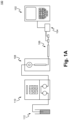
- Figure 1A depicts a chromatographic system 100 in accordance with some embodiments.
- the system 100 comprises a controlling and computing device 102, a detecting unit 104, a suppressor unit 106, a separation unit 108 (e.g., chromatographic column), a delivery unit 110 (e.g., pump), and a solvent providing unit 112 (e.g., an eluent providing system or container).
- a controlling and computing device 102 the system 100 comprises a controlling and computing device 102, a detecting unit 104, a suppressor unit 106, a separation unit 108 (e.g., chromatographic column), a delivery unit 110 (e.g., pump), and a solvent providing unit 112 (e.g., an eluent providing system or container).
- a separation unit 108 e.g., chromatographic column
- delivery unit 110 e.g., pump
- a solvent providing unit 112 e.g., an eluent providing system or
- the controlling and computing device 102 contains a processor and memory.
- the device 102 is implemented with executable computing instructions for performing a predetermined specific functions.
- the executable computing instructions are compiled or structured as a computer software, which configures the processor and the electron storing structures to store and locate voltages for performing a predetermined functions according to the loaded algorithm (e.g., the peak width determining algorithm disclosed herein).
- the controlling and computing device 102 controls/commands the performance of the system 100.
- the detecting unit 104 comprises a chromatography detector, including destructive and non-destructive detectors.
- the destructive detectors comprise a charged aerosol detector (CAD), a flame ionization detector (FID), an aerosol-based detector (NQA), a flame photometric detector (FPD), an atomicemission detector (AED), a nitrogen phosphorus detector (NPD), an evaporative light scattering detector (ELSD), a mass spectrometer (MS), an electrolytic conductivity detector (ELCD), a sumon detector (SMSD), a Mira detector (MD).
- CAD charged aerosol detector
- FDD flame ionization detector
- NQA flame photometric detector
- AED atomicemission detector
- NPD nitrogen phosphorus detector
- ELSD evaporative light scattering detector
- MS mass spectrometer
- ELCD electrolytic conductivity detector
- SMSD sumon detector
- MD Mira detector
- the non-destructive detectors comprise UV detectors, fixed or variable wavelength, which includes diode array detector (DAD or PDA), a thermal conductivity detector (TCD), a fluorescence detector, an electron capture detector (ECD), a conductivity monitor, a photoionization detector (PID), a refractive index detector (RI or RID), a radio flow detector, a chiral detector continuously measures the optical angle of rotation of the effluent.
- DAD or PDA diode array detector
- TCD thermal conductivity detector
- ECD electron capture detector
- PID photoionization detector
- RI or RID refractive index detector
- radio flow detector a chiral detector continuously measures the optical angle of rotation of the effluent.
- the separation unit 108 comprises a chromatographic column.
- the chromatographic column is able to be liquid chromatographic column, gas chromatographic column, and ion-exchange chromatographic column.
- a person of ordinary skill in the art will appreciate that any other chromatographic column is within the scope of the present disclosure, so long as the chromatographic column is able to be used to separate one analyte from another.
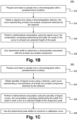
- FIG. 1B illustrates a flow chart of a width based single signal curve analyte quantitation method 200.
- a sample is prepared and injected into a chromatography (e.g., ion-exchange chromatography) with a predetermined condition (e.g., 65°C at a flow rate of 0.5 mL/min.)
- a signal curve is obtained using a chromatographic detector, the curve being a representation of at least one analyte component detected by the detector.
- a mathematical computation is performed using the signal curve via the computing device described above with one or more implemented algorithms disclosed herein, wherein the computation comprises determining the width of a peak in the curve in at least one selected height of the peak.
- the determined width is used to determine a characteristic associated with the at least one analyte component.
- Figure 1C illustrates a flow chart of a plurality of signal curves determining (peak trace analysis) method 300.
- a sample is prepared and injected into a chromatography with a predetermined condition.
- a plurality of signal curves are obtained using a detector, each curve being a representation of a concentration of at least one analyte component detected by the detector.
- a mathematical computation is performed using the plurality of signal curves, wherein the computation comprises determining the width of a peak in each curve at a selected height of the respective peak.
- the determined peak widths are used to produce at least one calibration curve.
- FIG. 1D illustrates a flow chart of an impurity detecting method 400.
- a sample is prepared and injected into a chromatography with a predetermined condition.
- a signal curve is obtained using a chromatographic detector, the curve being a representation of a chemical mixture detected by the detector.
- a mathematical computation is performed using the signal curve, wherein the computation comprises determining the respective width of a peak in the curve at a plurality of selected heights of the peak.
- the determined widths are used to detect an impurity in the mixture.
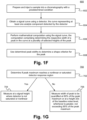
- Figure 1E illustrates a peak trace analyzing method 500.
- a sample is prepared and injected into a chromatography with a predetermined condition.
- a signal curve is obtained using a detector.
- a fitting of a peak in the signal curve is determined by performing a mathematical computation, wherein the computation comprises independently fitting each side of the peak with a generalized Gaussian distribution function.
- Figure 1F illustrates a peak trace analyzing method 600.
- a sample is prepared and injected into a chromatography with a predetermined condition.
- a signal curve is obtained using a detector, the curve being a representation of at least one analyte component detected by the detector.
- a mathematical computation is performed using the signal curve, wherein the computation comprises determining the widths of a peak in the curve at a plurality of selected heights of the peak.
- the determined peak widths are used to determine a shape criterion for the peak. The computations are performed via the techniques disclosed herein.
- FIG. 1G illustrates a width-based analyte peak quantitation method 700.
- a Step 702 it is determined if the peak maximum reaches a nonlinear or saturated detector response region.
- the process goes to Step 704 if it is determined that the peak maximum reaches a nonlinear or saturated detector response region, and the process goes to Step 706 if it is determined that the peak maximum does not reach a nonlinear or saturated detector response region.
- the width is measured at a signal height, where the detector is not saturated or nonlinear.
- a calibration curve is constructed at that height from stored calibration peaks.
- the calibration curve is used to interpret the concentration of the unknown.
- the width of the peak is measured at the greater of 60% of the peak maximum or at a height 20x the baseline noise level but not exceeding 95% of the peak maximum.
- a calibration curve is constructed at that height from stored calibration peaks.
- the calibration curve is used to interpret the concentration of the unknown.
- a height is chosen for quantitation for which a calibration already exists as long as it is not below 5% of the peak height or 20x the baseline noise level.
- the disclosed Width-Based Quantitation (hereinafter "WBQ") measuring methods and devices are applicable to both Gaussian and non-Gaussian peaks of one or more analytes from a chromatography device, with the merit that the resulting RMS errors are comparable to those using height or area-based quantitation using weighted regression.
- Embodiments of the disclosed WBQ method, process, and system may also be used as a complement to conventional techniques: quantitation can be height-based at the low-end, width-based at the high end (where detector saturation/nonlinearity may set in) and area-based at intermediate concentrations.
- WBQ provides notable advantages, including: (a) lower overall RMS error without weighting compared to unweighted area or height based quantitation, (b) applicability over a large range of concentrations, (c) accurate quantitation when (i) the detector response is in the nonlinear response range, (ii) the detector response is saturated at the high end, and (iii) the detector response is not a single valued function of concentration, and (d) detection of co-eluting impurities, none of which situations can be handled by area or height-based quantitation.
- s is the standard deviation (SD) and h max is the amplitude of the perfectly Gaussian peak.
- the height h at which width is being measured is low enough to be in the linear response domain of the detector/analyte/column system.
- the ascending peak has no foreknowledge of whether the peak maximum will remain within the linear response domain, or in the extreme case, become completely clipped.
- h max computed from Equation (4) is the height that would have been registered if the analyte peak remained within the linear domain, regardless of whether it actually was or not.
- Non-Gaussian Peaks Non-Gaussian Peaks.
- Non-Gaussian peaks (tailing or fronting or peaks that do both) have been modeled as exponentially modified Gaussian (EMG) or polynomial modified Gaussian (PMG) peaks.
- EMG exponentially modified Gaussian
- PMG polynomial modified Gaussian
- Equations (7) - (9) There are limitations on the ranges of parameters in Equations (7) - (9) that can be easily imposed.
- a consideration of peak shapes of the exponential functions in Equations (7) - (8) will indicate that for real chromatographic peaks the values of m and n would usually lie between 1 and 2, the reciprocals 1/ m and 1/ n therefore lie between 1 and 0.5.
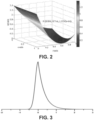
- Figure 2 illustrates a plot of L2 error function in the parameter space ( c, r ) for the region [0,1]x[0,1] in accordance with some embodiments.
- ⁇ ( c,r ) ⁇ [0, 1] ⁇ [0, 1] ⁇ , we compute the error function as depicted in Figure 2 .
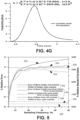
- Figure 4A illustrates the fit of the 1 mM chloride to Equation (9) analog.
- Figure 4B illustrates the fit of the 6 mM nitrate to Equation (9) analog.
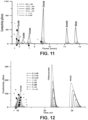
- the chromatographic conditions for the chloride fit are illustrated in Figure 11 and in Figure 12 for the nitrate fit. From 1%-99% of peak height, RMSE as a percentage of h max : Chloride: 0.66% ( r 2 0.9996), Nitrate: 1.2% ( r 2 0.9987).
- Figure 4C illustrates the fit of experimental 5 mM citrate peak to Equation (9) analog.
- the chromatographic conditions being as illustrated in Figure 11 , the RMSE as a percentage of h max : 0.55% ( r 2 0.9998).
- Figures 4D and 4E illustrate the Equation (9) analog fits for 6 mM formate.
- Figure 4D has the best fit using the data for the entire peak. This fit is obviously poorer at the low and especially high h extremes compared to Figures 4A-4C .
- the RMSE as a fraction of h max improves from 2.4 to 1.4%; r 2 improves from 0.9944 to 0.9975.
- Figures 4F-4G illustrate the Equation (9) analog fits for 2 mM acetate. Similar to Figures 4D-4E , Figure 4F has the best fit using the data for the entire peak. In Figure 4G , only the time intervals that comprise 5-95% of the peak height in the original data are used.
- the RMSE as a fraction of h max improves from 1.2 to 0.81%; r 2 improves from 0.9986 to 0.9991.
- the value of n' is equal to n. In other embodiments, the value of n' is different from n. In some embodiments, n' is a constant like n.
- Theoretical Limits, Height vs. Area vs. Width-Based Quantitation It is useful to first examine the theoretical limits of each of these disclosed quantitation methods for an ideal condition.
- the limits being calculated here pertain to the accuracy with which one can evaluate the height, or area, or the width of a peak (at some specified height) for a perfectly Gaussian band with a realistic amount of noise.
- An uncertainty in height or area is linearly translated into the uncertainty in quantitation as we are dealing with ideal situations.
- the peak to peak baseline noise is 20 ⁇ AU at a sampling frequency of 10 Hz, this would be the best case for a present-day diode array detector.
- the true absorbance amplitude of 1 mAU will not be observed unless the sampling frequency is sufficiently high but the computed area is not affected.
- Embodiments of this disclosure entail the detection of the beginning and the end of a peak, generally through the specifications of a threshold slope or a minimum area of a peak. Finding the height maximum is thereafter straightforward as it corresponds to the maximum value observed within the domain of the peak so-defined. However, the measured maximum is affected by the noise and that translates both into inaccuracy and uncertainty. To simulate random noise, the results below represent 10,000 trials.
- the error in the average height (consider this as the bias or accuracy) ranges from -1.7% at 10 Hz to +1.6% at 50 Hz, the errors are a combined result of inadequacy of sampling frequency (this is the dominant factor at low sampling rates), noise and stray light; the relative SD ("RSD") of this perceived height (the uncertainty) is quite low and is in the 0.3-0.4% range from 10-50 Hz.
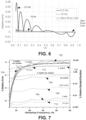
- Figure 5 illustrates the relative bias (solid lines, left ordinate) and relative precision (dashed lines right ordinate) computed for a case of absorbance detection in accordance with some embodiments.
- the situation assumes a Gaussian analyte peak with a true absorbance amplitude of 1 mAU, a SD of 1 s, 20 ⁇ AU of peak to peak random noise at10 Hz and 0.05% stray light.
- the results shown depict averages and SDs of 10,000 computational trials.
- 502, 504 and 506 traces resectively depict height, width, and area-based quantitation; width measured at 150 ⁇ AU. Both bias and precision improves as absorbance increases until bias is affected by the stray light.
- Errors and uncertainties in area measurement stem from locating the beginning and the end of the peak, in the presence of noise. The success of different algorithm embodiments in doing so will differ. However, the accuracy will essentially be unaffected if the detection span ranges ⁇ 5 ⁇ or greater. A lower span will result in an increasingly negative error while integrating over a larger span will increase the uncertainty due to noise. Under the present constraints, the error is negligible ( ⁇ -0.1%, arising primarily from stray light), while the uncertainty is also very small, under 0.5% (integrated over ⁇ 5 ⁇ ).
- Some embodiments to determine the width at a given height first proceed to determine the location of the specified height h on the signal curve on the ascending and descending edges of the signal and determine the times t 1 and t 2 corresponding to h, and hence determine W h as t 2 -t 1 . It is unlikely, however, that the discrete data collected will have any datum precisely located at h, but the location of h will be interpolated from discrete data present at locations h-h' and h+h" corresponding to temporal locations of t' and t", where the data acquisition frequency f is given by 1/
- Figure 5 illustrates the relative error in h max computed based on the width-based quantitation using Equation (5) for the same base case as above as a function of f and ranges from -1.4% at 10 Hz to ⁇ 0.3% at 50 Hz, better than that based strictly on height ( Figure 5 ). But at 2-3% RSD, uncertainties in this range are significantly higher than either height or area based quantitation, although hardly in the unacceptable range considering the width measurement is actually being made at a height below the limit of quantitation (LOQ, at 10 times the noise level this would be 200 ⁇ AU). At 10 mAU for example, the bias and precision are already -0.5 % and 0.7%, respectively at a sampling frequency of 20 Hz (See Figure 7 ).
- Figure 7 illustrates the relative error (solid lines, left ordinate) and RSD (dashed lines right ordinate, note logarithmic scaling) computed for a case of absorbance detection and WBQ.
- the situation assumes a Gaussian analyte peak with a true absorbance amplitude of 1, 10, 100, 1000, and 10,000 mAU (red 702, blue 704, green 706, purple 708, and orange 710 traces respectively), all measured at 1 / h of 0.15, a SD of 1 s.
- the peak to peak random noise is 20 ⁇ AU at10 Hz and corresponding noise values under other conditions.
- the stray light is assumed to be 0.05%.
- the results shown depict averages and SDs of 10,000 computational trials.
- the black trace indicates the 1 mAU case without any noise.
- Figures 9A-9B illustrate the sensitivity of the width measurement due to uncertainty in height in two different ways in accordance with some embodiments.
- Figure 9A covers the primary range of interest, 5% to 95% of peak height; the negative sign of the ordinate values results from the fact that width always decreases with increasing height, the absolute values have been multiplied by 100 to indicate percentage dependence. The magnitude of this sensitivity increases steeply at either end.
- Figure 9B illustrates a plot of the log of dW h /d h after changing its sign (to permit logarithmic depiction) vs. 1 / h .
- Figure 10 illustrates the relative error (or relative bias, solid lines, left ordinate) and RSD (or relative precision, dashed lines right ordinate) computed for a case of absorbance detection and WBQ in accordance with some embodiments.
- the situation assumes a Gaussian analyte peak with a true absorbance amplitude of 1 mAU, a SD of 1 s, 20 ⁇ AU of peak to peak random noise at 10 Hz and 0.05% stray light.
- the results shown depict averages and SDs of 10,000 computational trials. Red 1002, purple 1004 and brown 1006 traces respectively measured at 1 / h of 0.15, 0.60 and 0.85.
- the accuracy for 10-1000 mAU are all generally better than -0.5% (at f ⁇ 30Hz) and are all superior to that at 1 mAU (See Figure 8 for a closer view of the relevant part of Figure 7 ) but becomes worse at 10 AU (width is being measured at 1.5 AU) due to stray light.
- This accuracy (still largely better than -1%) is notable, as in any real detector, height or area based quantitation will not be possible at all with any acceptable accuracy.
- Weighted and Unweighted %RMS Errors Area, Height, Width based Quantitation. (Near)-Gaussian Peaks % RMS Errors, unweighted %RMS Errors, 1/x 2 weighted Area Height Width Area Height Width Fluoride 40.6 65.8 9.7 8.2 8.1 9.4 Acetate 128.4 213.0 13.6 16.7 22.9 13.2 Formate 23.3 31.2 16.5 6.9 4.6 15.1 Chloride 53.5 31.3 4.2 9.5 8.1 4.1 Bromide 61.2 80.4 7.3 10.8 15.6 7.2 Nitrate 67.1 67.5 6.3 13.2 13.4 6.2
- WBQ substantially outperforms area or height based quantitation by unweighted regression and rivals 1/x 2 -weighted regression.
- the choice of the height may be made after the peak height is measured.
- the height for width measurement should be low enough to be below the peak height of the lowest concentration of interest but it should not be so low that the measurement is severely impacted by noise.
- the analyte of interest is not completely separate from the adjacent eluites, it is intuitive that the effect of the adjacent peaks on the measured widths will be more pronounced at lower heights than higher. Results are shown below in Table 3 below. Table 3.
- the highest height at which the width can be measured depends on the analyte, whereas a height of 0.5 ⁇ S/cm can be used readily for 50 ⁇ M chloride, the same concentration of the other analytes leads to a peak response below this value, making it impossible to choose this height for width measurement.
- WBQ is effective while height or area-based calibration fail. For example, this may occur when the detector reaches a nonlinear response region, or are simply inapplicable, as when the detector/data system is in the saturation region causing clipping/truncation of the signal, or the detector signal is not a single valued function of concentration, as when a fluorescence signal goes into the self-quenched domain.
- WBQ can also benefit post-column reaction based detection methods which exhibit a finite detector background from the post-column reagent because it is not necessary to have a stoichiometric amount of the post-column reagent to accommodate the highest analyte concentration of interest.
- WBQ can make use of the two-dimensional nature of chromatographic data: If multiple heights are used for quantitation or if used in conjunction with height or area based quantitation it is possible to check for and detect co-eluting impurities.
- Nonlinear response situations include scenarios where the detector response is not a single valued response of concentration, a notable example being fluorescence behavior of a fluor at high enough concentrations in the self-quenched domain. While such phenomena have occasionally been used advantageously in indirect fluorometric detection using fluorescent eluents at high concentrations to produce positive signals, a fluorescent substance with a peak concentration in the self-quenched domain will produce an M-shaped peak.
- a single quantitation paradigm involving both the low concentration unquenched and the higher concentration self-quenched domain has not been possible. Similar situations may be encountered in post-column reaction detection. WBQ can be applied in these situations to provide accurate quantitation.
- Width can be measured at many heights.
- Co-eluting impurities by definition are smaller than the principal component in the peak, and therefore contribute to a greater degree to the peak width towards the bottom than towards the top. As such, the presence of an impurity may not be readily apparent from asymmetry changes. But, if the concentration of the examined band is ascertained by a calibration curve generated from pure standards, the telltale indication of an impurity is a significantly higher predicted concentration when interpreted with a width-based measurement at a lower height compared to one at a higher height.
- the width of the left half and the right half can be independently measured and their depiction as a function of height directly (or in a transformed form) provides information about asymmetry and other characteristics of the band not available from any single parameter description of peak asymmetry.
- Figure 13 illustrates a nitrate peak chromatogram detected at 200 nm with the concentration spanning two orders of magnitude on an Agilent 1290 DAD instrument - chromatographic details ICS 5000 IC system: AG11 (2 x 50 mm)+ AS11 (2x 250 mm) columns. KOH gradient at 0.3 mL/min: 0-10 min, 2.0 mM; 10-15 min, 2.0-10 mM; 15-32 min, 10 mM; Injection volume, 10 ⁇ L.
- the quantitation errors in the three paradigms are shown in Table 5 below.
- WBQ outperforms area and especially height-based quantitation in both unweighted and 1/x 2 -weighted regression. Height has a much higher error than other paradigms because it is the most affected by nonlinearity. WBQ is not significantly affected by weighting, it outperforms the other paradigms always but more so in the unweighted regression mode. Table 5.
- PCR post-column reagent
- a well-known example is the detection of metal ions after chromatographic separation with a chromogenic dye.
- a unique relevant example is the detection of acidic eluites by introducing a small amount of a base post- column (the column background is pure water) and then allowing the mixture to flow through a conductivity detector, which we have explored for some time.
- the detector background reflects the conductivity from the base added; when an acid eluite comes out, the acid HX is neutralized forming X - and water. The net result is thus the replacement of OH - by X - .
- OH - has the highest mobility of all anions, a negative response in the conductivity baseline results.
- the conductivity will go back up as the peak concentration is approached.
- Figure 14 illustrates two different concentrations of H 2 SO 4 injected into a 100 ⁇ M strong base carrier in accordnace with some embodiments.
- a negative peak results (red trace 1402).
- a W-shaped peak results (black trace 1404).
- a fluorescent substance is injected into a nonfluorescent carrier, and the resulting signal monitored with a fluorescence detector, an M-shaped peak will result if the fluorescence is in the self-quenched domain at the peak. Both belong to a general case where the response is not a single-valued function of the concentration.
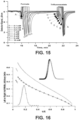
- Figure 15 illustrates conductometric responses of two anions, each over two orders of magnitude, to a detection system using a permeative amine introduction system (PAID) in accordance with some embodiments.
- Formic acid is moderately weak (pK a 3.75); trifluoroacetic acid is almost a strong acid (pK a 0.25). These responses cannot be quantitated by height or area-based methods.
- the depicted set of illustrative data is from a post-column reaction system where a base (Et 2 NH 2 OH) is introduced to react with formic and trifluoroacetic acid eluites to produce the resulting salt that is detected in a background of base.
- Et 2 NH 2 OH itself has a measurable detector background, it is desirable to minimize the added amount to reduce the baseline noise.
- the width was measured at a fixed height (1.2 and 0.4 ⁇ S/cm for formate and trifluoroacetate, respectively) below the baseline to construct a calibration plot.
- the Relative RMSE over the two orders of magnitude range of concentration was 6.6% for formate and 13.6% for trifluoroacetate.
- the error is relatively high in the second case because the peak shape actually changes at the higher concentrations.
- WBQ still provides a viable option.
- the orange solid trace and the dashed black trace in the main plot respectively shows the left and right half width for this peak as a function of 1/ h ( h being h max / h ) .
- the two halves are mirror images and the half-width plots therefore appear superimposed.
- SD standard deviation
- the circles representing the leading half of the top peak completely overlap the previous half-width vs. 1/ h traces.
- the right half of the top peak provides a very different half-width vs. 1/ h trace. This figure emphasizes that peak symmetry (or lack thereof) is much easier to ascertain in combined left half-width and right half-width vs. 1/ h plots than in the original chromatographic peaks.
- WBQ is essentially a depiction of width as a function of height.
- a clear visual depiction of asymmetry appears if the left and right half widths are independently shown as a function of height.
- the 1/ h bounds are deliberately limited to 0.05 to 0.95 (in our experience, conformity of each side of real chromatographic peaks to a generalized Gaussian distribution model (GGDM) is better attained within these limits (See Figures 4D-4G )). As such, in these depictions, greater concern was given to the general shape of the peak rather than fronting or tailing only near the peak base.
- Figure 17 indicates how this type of depiction reveals symmetry in real peaks in accordance with some embodiments.
- Figure 17 illustrates the left (leading) and right (trailing) half-width vs. 1 / h plots for acetate, formate, chloride, nitrite, nitrate, and citrate.
- the original chromatograms can be seen in Figures 4A-4G . Note that while generally the trailing half is wider than the leading half, it is the reverse for the formate peak which fronts quite obviously.
- the absolute value of the width is dependent on the SD of the peak and the injected concentration. With the exception of formate, which has a strongly fronting peak, the trailing halves are always wider than the leading halves.
- Figure 15 depicts, for a Gaussian peak, a plot of W h vs. 1/ h is not expected to be linear, but departs increasingly from linearity as 1/ h decreases.
- a linear W h vs. 1/ h plot connotes a triangle, a near-triangular shape can be seen for the strongly fronting leading edge of the formate peak).
- Nitrate exhibits the largest asymmetry; the trailing half is much wider than the leading half throughout and increasingly so with decreasing 1/ h .
- Figure 18 illustrates the relevant plots for both the leading and trailing halves for the five analyte peaks (shown in Figures 4A-4G ) along with the slope (an index of departure from true Gaussian distribution) and the coefficient of determination (an index of conformity to GGDM), and the SD (an index of the width of the corresponding halves of the peak).
- the circles represent the leading edge
- dashed lines represent the trailing edge.
- WBQ predictions for a lower SD impurity at a higher 1/ h will mean a greater relative change in concentration compared to that at a lower 1/ h and the reverse would be the case when the SD of the impurity is higher than that of the analyte.
- increasing SD of the impurity will increase the width and thence the concentration prediction more and more at lower 1/ h values, whereas near the apex the contribution of the impurity will remain the same if its amplitude remains the same.
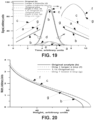
- Figure 20 illustrates a width vs. height plot for the situation in Figure 19 ; the same conclusions are reached.
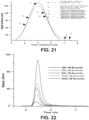
- Figure 21 illustrates changes in peak shape as impurity retention time shifts relative to analyte retention time.
- the impurity peak is assumed to be 10% in amplitude and has 0.71 times the SD of the analyte peak. The presence of an impurity is unlikely to be suspected by a casual observer for all but the brown trace.
- ln ( W h0.2 / W h0.4 )/ln( W h0.4 / W h0.8 ) is expected to be 0.3988. This is essentially a shape criterion. Even if a peak does not perfectly follow the GGDM, we suggest that ln ( W h0.2 / W h0.4 )/ln( W h0.4 / W h0.8 ) or a similar parameter be determined for calibration standard peaks nearest to, or bracketing the height of the peak suspected to contain an impurity. The corresponding value for the suspect peak can then be compared with that for the standard(s), including the uncertainty and it can be determined whether within the desired limits of uncertainty the suspect peak falls within the expected shape parameter range. As this approach does not require detailed calibration curves, its use is illustrated below in impurity detection.
- FIG. 22 illustrates a set of chromatograms from an injection of bromide ion at concentrations of 200, 500, 800, 1000 and 2000 ⁇ M in a typical suppressed ion chromatographic setup in accordance with some embodiments.
- Chromatographic conditions ThermoFisher Dionex ICS-5000 system, AG20 (2 x 50 mm) + AS20 (2 x 250 mm), Electrogenerated KOH eluent 8.0 mM, 0.25 mL/min, Dionex AERS 500 2 mm suppressor.
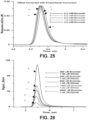
- Figure 26 illustrates the chromatograms for the same bromide samples except that they now contain the same constant concentration of nitrate (20 ⁇ M) as impurity, the relative amount thus being 1-10% on a relative molar basis.
- the presence of the impurity is not readily discernible by visual examination.
- Table 6 below presents data on impurity detection based on this criterion (the numbers in red in the last column indicate values outside the 95% confidence range and hence that peak shapes are different from that of the standards: an impurity may be present). It will be observed that this strategy was able to detect a change in peak shape (and hence a presence of an impurity) in all but the three cases where the impurity concentration was the lowest (in the 1-2% range).
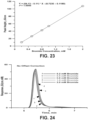
- FIG. 27 illustrates the data for chloride in Figure 11 along with the best fit equations in accordance with some embodiments; the data is plotted in the form of Equation (20), a linear plot results throughout.
- the intercept b in Equation (20) should be linearly proportional to ln C provided the data is entirely in the linear response domain.
- Figure 28 illustrates the plot of the intercepts ( b ) in Figure 27 vs. ln C, displaying that the correspondence of b with ln C also holds an excellent linear correlation.
- Figure 30 illustrates that the linear correspondence between the intercept b and ln C also breaks down in accordance with some embodiments. This plot is similar to that in Figure 28 .
- All the data red triangles
- Figure 29 deviation from linearity at the higher concentration end is evident. If the data in the top left quadrant of Figure 29 are omitted before performing regression (black circles), a much better linear fit is obtained.
- the impurity is invisible when the caffeine peak is plotted to accommodate the maximum peak height but becomes readily apparent when observed in a magnified view of the baseline being measured.
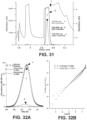
- Figure 31 illustrates how the trace at 20,000 ng (red trace A) would appear to be a perfectly normal peak.
- the detector is predictably saturated at 10,000 ng (black trace B), but no abnormality is readily evident on its tail; only when examined at a high magnification (blue trace C), the appearance of an impurity peaking at just over 3.2 min becomes readily apparent. It is clear that width measurement at low heights in the present case will lead to error. Indeed, the failure of the caffeine data to fit the general model in Equations (10) and (21) - (22) is what led us to examine the baseline of the high concentration peaks in greater detail. In other words, efforts to WBQ quantitation led to the detection of this impurity, of which those that generated the data were unaware.
- FIG 32A illustrates the separation of Dimethylnaphthalene (DMN) isomers by Gas Chromatography Vacuum Ultraviolet Spectroscopy (from Schenk, J.; Mao, J. X.; Smuts, J.; Walsh, P.; Kroll, P.; Schug, K. A. Anal. Chim. Acta 2016, 945, 1-8 ).
- the mixture contained 10% 1,4-DMN and 90% 2,3-DMN.
- the circles represent the detector response with the red and blue lines representing best estimates on the response of each isomer based on spectral deconvolution.
- Figure 32B illustrates independent left and right edge ln W h vs. ln (ln h ) plots to aide in the detection of impurity.
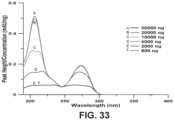
- Figure 33 illustrates normalized spectra obtained from peak height maxima at different wavelengths as described above when different amounts of solute (caffeine) are injected in a chromatographic system.
- the spectra at 800 ng and 2000 ng are completely overlapped and do not show any evidence of detector saturation.
- Peak maxima absorbance-based reconstruction can be done in other ways. One approach is to move away from the peak maximum to a location on the rising or the trailing edge of the peak where there is no saturation.
- the best fit of the h vs. t data to Equation (24) is sought by varying h max , which is implicit in h using any nonlinear fitting routine e.g., Microsoft Excel Solver TM .
- Items such as applications, module, components, etc. may be implemented as software constructs stored in a machine accessible storage medium, such as an optical disk, a hard disk drive, etc., and those constructs may take the form of applications, programs, subroutines, instructions, objects, methods, classes, or any other suitable form of control logic; such items may also be implemented as firmware or hardware, or as any combination of software, firmware and hardware, or any combination of any two of software, firmware and hardware.
- processor or "microprocessor” may refer to one or more processors.
- an article of manufacture comprises a non-transitory machine-accessible medium containing instructions, the instructions comprising a software application or software service, wherein the instructions, when executed by the machine, cause the machine to perform the respective method.
- the machine may be, e.g., a processor, a processor-based system such as the systems described herein, or a processor-based device such as the user interface devices described herein.
Landscapes
- Chemical & Material Sciences (AREA)
- Analytical Chemistry (AREA)
- General Health & Medical Sciences (AREA)
- Life Sciences & Earth Sciences (AREA)
- Health & Medical Sciences (AREA)
- Biochemistry (AREA)
- Physics & Mathematics (AREA)
- General Physics & Mathematics (AREA)
- Immunology (AREA)
- Pathology (AREA)
- Chemical Kinetics & Catalysis (AREA)
- Investigating Or Analysing Materials By Optical Means (AREA)
- Treatment Of Liquids With Adsorbents In General (AREA)
Claims (19)
- Verfahren zur chromatographischen Quantifizierung eines Analyten, umfassend:a) Einfließen einer ersten Konzentration des Analyten in eine chromatographische Säule (108);b) Erkennen des aus der chromatographischen Säule (108) austretenden Analyten unter Verwendung eines chromatographischen Detektors (104);c) Erhalten einer ersten Signalkurve vom chromatographischen Detektor (104), wobei die erste Signalkurve eine Darstellung der ersten Konzentration des vom chromatographischen Detektor (104) erkannten Analyten ist; undd) Bestimmen einer ersten Breite einer ersten Spitze in der ersten Signalkurve bei einer ersten absoluten Höhe der ersten Spitze unter Verwendung einer Rechenvorrichtung (102);wobei die Methode dadurch gekennzeichnet ist, dass sie ferner umfasst:
e) Quantifizieren der ersten Konzentration des Analyten basierend auf der ersten ermittelten Breite des ersten Peaks. - Verfahren nach Anspruch 1, ferner umfassend das Einstellen der ersten absoluten Höhe auf einen Wert zwischen dem 8- und dem 12-Fachen eines Baseline-Rauschpegels.
- Verfahren nach Anspruch 1, wobei die erste absolute Höhe ungefähr 60 % einer maximalen Höhe des ersten Peaks des Analyten beträgt.
- Verfahren nach Anspruch 1, wobei das Verfahren ferner umfasst:f) Einfließen des Analyten in einer zweiten Konzentration in die chromatographische Säule (108);g) Erkennen des aus der chromatographischen Säule austretenden Analyten unter Verwendung des chromatographischen Detektors (104);h) Erhalten einer zweiten Signalkurve vom chromatographischen Detektor (104), wobei die zweite Signalkurve auch eine Darstellung der zweiten Konzentration des vom chromatographischen Detektor (104) erkannten Analyten ist;i) Bestimmen einer ersten maximalen Höhe des ersten Peaks des Analyten in der ersten Signalkurve und einer zweiten maximalen Höhe des zweiten Peaks des Analyten in der zweiten Signalkurve unter Verwendung der Rechenvorrichtung (102);j) Festlegen der ersten, der zweiten oder beider absoluten Höhen des Analyten auf einen Wert, der größer als das 8-Fache eines Baseline-Rauschpegels und kleiner als die kleinste der ersten oder zweiten maximalen Höhe ist; undk) Bestimmen einer Breite auf der ersten oder der zweiten absoluten Höhe.
- Verfahren nach Anspruch 1, ferner umfassend die Bestimmung der am besten passenden Werte von p und q in einer Formel Wh = p(In
h )q, worin Wh die erste Breite in der ersten absoluten Höhe h des ersten Peaks ist,h hmax /h ist, hmax die Peak-Amplitude ist und p und q Konstanten sind, die aus Daten des ersten Peaks der ersten Konzentration berechnet werden. - Verfahren nach Anspruch 1, wobei die erste absolute Höhe für die erste ermittelte Breite der kleinere Wert von 55 % bis 65 % der Höhe eines Peak-Maximums für den ersten Peak und 55 % bis 65 % der Höhe eines Peak-Maximums für den zweiten Peak ist.
- Verfahren nach Anspruch 1, wobei die erste Signalkurve einen nicht-Gaußschen Peak darstellt.
- Verfahren nach Anspruch 7, wobei der nicht-Gaußsche Peak durch zwei separate verallgemeinerte Gaußsche Verteilungsfunktionen (GGD) modelliert wird, wobei die beiden separaten verallgemeinerten Gaußschen Verteilungsfunktionen (GGD) vorzugsweise eine Konzentration aufweisen, die in einer linearen Beziehung zur Peak-Amplitude hmax steht, dargestellt durch eine Formel: In C = aWh n + b, worin C eine Konzentration des erkannten Analyten ist, worin Wh die erste Breite in der ersten absoluten Höhe h des ersten Peaks ist, und ferner worin n, a und b Konstanten sind.
- Verfahren nach Anspruch 1, wobei das Bestimmen der ersten Breite des ersten Peaks das Verwenden unabhängiger Exponentialfunktionen umfasst, die Vorder- und Hinterkanten in der Signalkurve darstellen, um einen Peak zu modellieren.
- Verfahren nach Anspruch 1, ferner umfassend das Bestimmen mehrerer Breiten des ersten Peaks in der ersten Signalkurve bei mehreren Höhen des ersten Peaks.
- Verfahren nach Anspruch 1, wobei das Bestimmen der ersten Breite des Peaks unterhalb einer Peak-Höhe durchgeführt wird, die von der ersten Signalkurve der niedrigsten Analytkonzentration von Interesse aufgenommen wird, wobei das Bestimmen der ersten Breite des Peaks vorzugsweise bei einer Peak-Höhe von 60 % bis 90 % einer ersten maximalen Höhe des Peaks einer niedrigsten Analytkonzentration durchgeführt wird.
- Verfahren nach Anspruch 1, wobei der erste Peak abgeschnitten ist.
- Verfahren nach Anspruch 1, ferner umfassend einen Suppressor (106), der mit der chromatographischen Säule (108) gekoppelt ist, um eine Ausgabe von der chromatographischen Säule zu empfangen, wobei der Suppressor (106) mit dem chromatographischen Detektor (104) gekoppelt ist, so dass eine Ausgabe von dem Suppressor (106) durch den chromatographischen Detektor (104) erkannt wird.
- System (100) zur chromatographischen Peak-Quantifizierung, umfassend:a) eine chromatographische Säule (108);b) einen chromatographischen Detektor (104), der konfiguriert ist, um eine Analytmenge aus der chromatographischen Säule zu erkennen; undc) einen Signalkonverter, der die Menge eines erkannten Analyten in eine Signalkurve umwandelt;wobei das System dadurch gekennzeichnet ist, dass sie ferner umfasst:
d) eine algorithmusimplementierte Rechenvorrichtung (102), die konfiguriert ist, um eine Breite eines Peaks in der Signalkurve in mindestens einer ausgewählten Höhe des Peaks zu bestimmen und die Konzentration des Analyten basierend auf der ermittelten Breite des Peaks zu quantifizieren. - System nach Anspruch 14, wobei der Algorithmus Wh = p(In
h )q, worin Wh die Breite in der Höhe (h) des Peaks ist, (h ) hmax /h ist, hmax die Peak-Amplitude ist, worin p und q Konstanten sind. - System nach Anspruch 14, wobei eine Anpassungsgüte an den Algorithmus Wh = p(In
h )q als Hinweis auf die Reinheit des Peaks verwendet wird, worin Wh die erste Breite in der ersten absoluten Höhe h des ersten Peaks ist, worin p und q Konstanten sind. - System nach Anspruch 14, wobei eine maximale Fläche, die angepasst werden kann durch Wh = p(In
h )q und die vollständig im Peak enthalten ist, der Teil des Analyten ist, worin Wh die erste Breite in der ersten absoluten Höhe h des ersten Peaks ist, worin p und q Konstanten sind. - System nach Anspruch 14, wobei das Bestimmen der Breite eines Peaks das Bestimmen der Breite des Peaks in der Signalkurve bei mehreren Höhen des Peaks umfasst.
- System nach Anspruch 14, ferner umfassend einen Suppressor (106), der mit der chromatographischen Säule (108) gekoppelt ist, um eine Ausgabe von der chromatographischen Säule (108) zu empfangen, wobei der Suppressor (106) mit dem chromatographischen Detektor (104) gekoppelt ist, so dass eine Ausgabe von dem Suppressor (106) durch den chromatographischen Detektor (104) erkannt wird.
Applications Claiming Priority (2)
| Application Number | Priority Date | Filing Date | Title |
|---|---|---|---|
| US201662427119P | 2016-11-28 | 2016-11-28 | |
| PCT/US2017/063536 WO2018098502A1 (en) | 2016-11-28 | 2017-11-28 | Systems, methods and devices for width-based analysis of peak traces |
Publications (3)
| Publication Number | Publication Date |
|---|---|
| EP3545296A1 EP3545296A1 (de) | 2019-10-02 |
| EP3545296A4 EP3545296A4 (de) | 2020-07-08 |
| EP3545296B1 true EP3545296B1 (de) | 2025-06-25 |
Family
ID=62190755
Family Applications (1)
| Application Number | Title | Priority Date | Filing Date |
|---|---|---|---|
| EP17874213.6A Active EP3545296B1 (de) | 2016-11-28 | 2017-11-28 | Systeme, verfahren und vorrichtungen zur breitenbasierten analyse von spitzenspuren |
Country Status (4)
| Country | Link |
|---|---|
| US (1) | US10634653B2 (de) |
| EP (1) | EP3545296B1 (de) |
| CN (1) | CN110234990B (de) |
| WO (1) | WO2018098502A1 (de) |
Families Citing this family (11)
| Publication number | Priority date | Publication date | Assignee | Title |
|---|---|---|---|---|
| US11467140B2 (en) * | 2017-11-15 | 2022-10-11 | Mecanique Analytique Inc. | Method and apparatus for analysing a gas chromatography elution peak |
| US11244818B2 (en) * | 2018-02-19 | 2022-02-08 | Agilent Technologies, Inc. | Method for finding species peaks in mass spectrometry |
| EP3839546B1 (de) * | 2019-12-20 | 2025-01-29 | Bruker Switzerland AG | System und verfahren zur bereitstellung von trainingsdaten zur befähigung eines neuronalen netzwerks, signale in nmr-messungen zu identifizieren |
| WO2021173967A1 (en) * | 2020-02-28 | 2021-09-02 | Waters Technologies Corporation | Controllable sample introduction |
| CN115667913B (zh) * | 2020-05-29 | 2025-04-08 | 株式会社岛津制作所 | 数据处理装置、数据处理方法、数据处理程序及分析装置 |
| US20220042957A1 (en) * | 2020-08-04 | 2022-02-10 | Dionex Corporation | Peak Profile for Identifying an Analyte in a Chromatogram |
| WO2022265110A1 (ja) * | 2021-06-18 | 2022-12-22 | 株式会社島津製作所 | モデル関数フィッティング装置およびモデル関数フィッティング方法 |
| US11860143B2 (en) * | 2021-12-21 | 2024-01-02 | Dionex Corporation | Method and system for self-regulating a suppressor |
| CN115840248B (zh) * | 2022-12-01 | 2025-07-15 | 四川轻化工大学 | 基于一种碲锌镉探测器伽马能谱全能峰函数的解析方法 |
| CN119936284B (zh) * | 2025-04-07 | 2025-06-27 | 山东金特安全科技有限公司 | 一种基于液相色谱法的乙交酯含量检测方法 |
| CN120490370B (zh) * | 2025-07-17 | 2025-10-14 | 杭州华润老桐君药业有限公司 | 一种用于止咳糖浆制备的植物成分提取方法 |
Family Cites Families (20)
| Publication number | Priority date | Publication date | Assignee | Title |
|---|---|---|---|---|
| US4468742A (en) * | 1981-03-17 | 1984-08-28 | The Regents Of University Of California | Microprocessor system for quantitative chromatographic data analysis |
| US5121443A (en) | 1989-04-25 | 1992-06-09 | Spectra-Physics, Inc. | Neural net system for analyzing chromatographic peaks |
| US6438499B1 (en) * | 1998-09-10 | 2002-08-20 | Tosoh Corporation | Chromatogram analyzer |
| US6983213B2 (en) * | 2003-10-20 | 2006-01-03 | Cerno Bioscience Llc | Methods for operating mass spectrometry (MS) instrument systems |
| US7391016B2 (en) * | 2005-05-12 | 2008-06-24 | Analiza, Inc. | Method for quantitative analysis of mixtures of compounds |
| US20080206883A1 (en) * | 2007-02-26 | 2008-08-28 | Cody Laboratories, Inc. | Hplc method for separation and detection of hydromorphone and related opioid pharmacophores |
| CN102124749B (zh) * | 2009-06-01 | 2013-05-29 | 松下电器产业株式会社 | 立体图像显示装置 |
| DE102009035587B3 (de) * | 2009-07-31 | 2011-03-24 | Siemens Aktiengesellschaft | Verfahren zur Filterung eines Chromatogramms |
| EP2322922B1 (de) * | 2009-08-26 | 2015-02-25 | Thermo Fisher Scientific (Bremen) GmbH | Verfahren zur Verbesserung der Auflösung von Verbindungen, die von einer Chromatografievorrichtung abgegeben werden |
| CN101819168B (zh) * | 2010-01-06 | 2012-06-13 | 北京矿冶研究总院 | 一种光谱分析方法 |
| US8428889B2 (en) * | 2010-10-07 | 2013-04-23 | Thermo Finnigan Llc | Methods of automated spectral peak detection and quantification having learning mode |
| US8952324B2 (en) * | 2011-01-07 | 2015-02-10 | Hitachi High-Technologies Corporation | Mass analyzing apparatus, analyzing method and calibration sample |
| WO2013008611A1 (ja) * | 2011-07-08 | 2013-01-17 | 株式会社島津製作所 | クロマトグラフ用データ処理装置 |
| CN103063751A (zh) * | 2011-10-20 | 2013-04-24 | 苏州赛分科技有限公司 | 一种测定美洛西林钠中聚合物杂质的检测方法 |
| US9453825B2 (en) | 2012-09-04 | 2016-09-27 | Shimadzu Corporation | Chromatogram peak purity determination apparatus |
| CN104730181B (zh) * | 2013-12-18 | 2017-10-24 | 北京普源精电科技有限公司 | 谱峰终点调整方法及具有谱峰终点调整功能的色谱工作站 |
| US9804136B2 (en) * | 2014-09-18 | 2017-10-31 | Dionex Corporation | Automated method of calibrating a chromatography system and analysis of a sample |
| WO2016051357A1 (en) * | 2014-10-01 | 2016-04-07 | Ldetek Inc. | Detection of gas impurities with a gas chromatograph |
| US10369521B2 (en) * | 2016-10-07 | 2019-08-06 | Thermo Finnigan Llc | System and method for real-time isotope identification |
| KR102759512B1 (ko) * | 2016-10-25 | 2025-02-03 | 리제너론 파아마슈티컬스, 인크. | 크로마토그래피 데이터 분석을 위한 방법 및 시스템 |
-
2017
- 2017-11-28 US US15/824,962 patent/US10634653B2/en active Active
- 2017-11-28 WO PCT/US2017/063536 patent/WO2018098502A1/en not_active Ceased
- 2017-11-28 CN CN201780084712.8A patent/CN110234990B/zh not_active Expired - Fee Related
- 2017-11-28 EP EP17874213.6A patent/EP3545296B1/de active Active
Also Published As
| Publication number | Publication date |
|---|---|
| WO2018098502A1 (en) | 2018-05-31 |
| US10634653B2 (en) | 2020-04-28 |
| US20180149629A1 (en) | 2018-05-31 |
| EP3545296A1 (de) | 2019-10-02 |
| CN110234990B (zh) | 2022-11-29 |
| CN110234990A (zh) | 2019-09-13 |
| EP3545296A4 (de) | 2020-07-08 |
Similar Documents
| Publication | Publication Date | Title |
|---|---|---|
| US10634653B2 (en) | Systems, methods and devices for width-based analysis of peak traces | |
| Tiscione et al. | Ethanol analysis by headspace gas chromatography with simultaneous flame-ionization and mass spectrometry detection | |
| US10605793B2 (en) | Automated method of calibrating a chromatography system and analysis of a sample | |
| Bailey et al. | Chemometric resolution and quantification of four-way data arising from comprehensive 2D-LC-DAD analysis of human urine | |
| US10935526B2 (en) | Liquid chromatograph and method for correcting detector output value fluctuation of liquid chromatograph | |
| US20240210366A1 (en) | Data processing method and device for chromatogram, chromatographic device, and recording medium | |
| EP3951384A1 (de) | Spitzenprofil zur identifizierung eines analyten in einem chromatogramm | |
| Zhang et al. | A highly sensitive method for analyzing marker phytoplankton pigments: Ultra‐high‐performance liquid chromatography‐tandem triple quadrupole mass spectrometry | |
| Fraga | Chemometric approach for the resolution and quantification of unresolved peaks in gas chromatography–selected-ion mass spectrometry data | |
| Djurdjevic et al. | Chemometric optimization of a RP‐HPLC method for the simultaneous analysis of abacavir, lamivudine, and zidovudine in tablets | |
| Viinamäki et al. | Photodiode array to charged aerosol detector response ratio enables comprehensive quantitative monitoring of basic drugs in blood by ultra-high performance liquid chromatography | |
| US9739756B2 (en) | Data processing system and method for chromatograph | |
| Bryant-Genevier et al. | Multivariate curve resolution of co-eluting vapors from a gas chromatograph with microsensor array detector | |
| Oller-Moreno et al. | Sliding window multi-curve resolution: Application to gas chromatography–ion mobility spectrometry | |
| Szabó et al. | Mathematical modeling of Taylor-Aris dispersion-assisted mass spectrometry for the study of operating conditions | |
| Hansen | Quantitative and qualitative chromatographic analysis | |
| US20250329422A1 (en) | Method for quantifying overlapping chemical signals | |
| Mahapatra et al. | Analytical method development and statistical validation of dapagliflozin in tablet dosage form and bulk drug | |
| Zhu et al. | A LEAN Approach for the Determination of Residual Solvents Using Headspace Gas Chromatography with Relative Response Factors | |
| Vivó-Truyols et al. | Towards unsupervised analysis of second-order chromatographic data: Automated selection of number of components in multivariate curve-resolution methods | |
| Johnson et al. | Non-target analysis of vapor mixtures using silicon nanowire array sampling and thermal desorption | |
| Hendriks | Theoretical models in LC based bioanalytical method development | |
| Rodriguez et al. | Application of capillary ion chromatography and capillary ion chromatography coupled with mass spectrometry to determine methanesulfonate and inorganic anions in microliter sample volumes of Antarctic snow and ice | |
| Birajdar | New Method Development by HPLC and Validation as per ICH Guidelines | |
| Zanella et al. | Quantitative analysis and method validation |
Legal Events
| Date | Code | Title | Description |
|---|---|---|---|
| STAA | Information on the status of an ep patent application or granted ep patent |
Free format text: STATUS: THE INTERNATIONAL PUBLICATION HAS BEEN MADE |
|
| PUAI | Public reference made under article 153(3) epc to a published international application that has entered the european phase |
Free format text: ORIGINAL CODE: 0009012 |
|
| STAA | Information on the status of an ep patent application or granted ep patent |
Free format text: STATUS: REQUEST FOR EXAMINATION WAS MADE |
|
| 17P | Request for examination filed |
Effective date: 20190621 |
|
| AK | Designated contracting states |
Kind code of ref document: A1 Designated state(s): AL AT BE BG CH CY CZ DE DK EE ES FI FR GB GR HR HU IE IS IT LI LT LU LV MC MK MT NL NO PL PT RO RS SE SI SK SM TR |
|
| AX | Request for extension of the european patent |
Extension state: BA ME |
|
| RIN1 | Information on inventor provided before grant (corrected) |
Inventor name: SRINIVASAN, KANNAN Inventor name: KADJO, AKINDE F. Inventor name: DASGUPTA, PURNENDU |
|
| DAV | Request for validation of the european patent (deleted) | ||
| DAX | Request for extension of the european patent (deleted) | ||
| A4 | Supplementary search report drawn up and despatched |
Effective date: 20200608 |
|
| RIC1 | Information provided on ipc code assigned before grant |
Ipc: G01N 30/38 20060101ALI20200602BHEP Ipc: G01N 30/02 20060101AFI20200602BHEP Ipc: G01N 30/86 20060101ALI20200602BHEP |
|
| STAA | Information on the status of an ep patent application or granted ep patent |
Free format text: STATUS: EXAMINATION IS IN PROGRESS |
|
| 17Q | First examination report despatched |
Effective date: 20221104 |
|
| GRAP | Despatch of communication of intention to grant a patent |
Free format text: ORIGINAL CODE: EPIDOSNIGR1 |
|
| STAA | Information on the status of an ep patent application or granted ep patent |
Free format text: STATUS: GRANT OF PATENT IS INTENDED |
|
| INTG | Intention to grant announced |
Effective date: 20241105 |
|
| GRAS | Grant fee paid |
Free format text: ORIGINAL CODE: EPIDOSNIGR3 |
|
| GRAA | (expected) grant |
Free format text: ORIGINAL CODE: 0009210 |
|
| STAA | Information on the status of an ep patent application or granted ep patent |
Free format text: STATUS: THE PATENT HAS BEEN GRANTED |
|
| AK | Designated contracting states |
Kind code of ref document: B1 Designated state(s): AL AT BE BG CH CY CZ DE DK EE ES FI FR GB GR HR HU IE IS IT LI LT LU LV MC MK MT NL NO PL PT RO RS SE SI SK SM TR |
|
| REG | Reference to a national code |
Ref country code: GB Ref legal event code: FG4D |
|
| REG | Reference to a national code |
Ref country code: CH Ref legal event code: EP |
|
| REG | Reference to a national code |
Ref country code: CH Ref legal event code: EP |
|
| REG | Reference to a national code |
Ref country code: IE Ref legal event code: FG4D |
|
| REG | Reference to a national code |
Ref country code: DE Ref legal event code: R096 Ref document number: 602017090186 Country of ref document: DE |
|
| PG25 | Lapsed in a contracting state [announced via postgrant information from national office to epo] |
Ref country code: FI Free format text: LAPSE BECAUSE OF FAILURE TO SUBMIT A TRANSLATION OF THE DESCRIPTION OR TO PAY THE FEE WITHIN THE PRESCRIBED TIME-LIMIT Effective date: 20250625 |
|
| REG | Reference to a national code |
Ref country code: LT Ref legal event code: MG9D |
|
| PG25 | Lapsed in a contracting state [announced via postgrant information from national office to epo] |
Ref country code: NO Free format text: LAPSE BECAUSE OF FAILURE TO SUBMIT A TRANSLATION OF THE DESCRIPTION OR TO PAY THE FEE WITHIN THE PRESCRIBED TIME-LIMIT Effective date: 20250925 Ref country code: GR Free format text: LAPSE BECAUSE OF FAILURE TO SUBMIT A TRANSLATION OF THE DESCRIPTION OR TO PAY THE FEE WITHIN THE PRESCRIBED TIME-LIMIT Effective date: 20250926 |
|
| PG25 | Lapsed in a contracting state [announced via postgrant information from national office to epo] |
Ref country code: BG Free format text: LAPSE BECAUSE OF FAILURE TO SUBMIT A TRANSLATION OF THE DESCRIPTION OR TO PAY THE FEE WITHIN THE PRESCRIBED TIME-LIMIT Effective date: 20250625 |
|
| PG25 | Lapsed in a contracting state [announced via postgrant information from national office to epo] |
Ref country code: HR Free format text: LAPSE BECAUSE OF FAILURE TO SUBMIT A TRANSLATION OF THE DESCRIPTION OR TO PAY THE FEE WITHIN THE PRESCRIBED TIME-LIMIT Effective date: 20250625 |
|
| PG25 | Lapsed in a contracting state [announced via postgrant information from national office to epo] |
Ref country code: RS Free format text: LAPSE BECAUSE OF FAILURE TO SUBMIT A TRANSLATION OF THE DESCRIPTION OR TO PAY THE FEE WITHIN THE PRESCRIBED TIME-LIMIT Effective date: 20250925 |
|
| PG25 | Lapsed in a contracting state [announced via postgrant information from national office to epo] |
Ref country code: LV Free format text: LAPSE BECAUSE OF FAILURE TO SUBMIT A TRANSLATION OF THE DESCRIPTION OR TO PAY THE FEE WITHIN THE PRESCRIBED TIME-LIMIT Effective date: 20250625 |
|
| REG | Reference to a national code |
Ref country code: NL Ref legal event code: MP Effective date: 20250625 |
|
| PG25 | Lapsed in a contracting state [announced via postgrant information from national office to epo] |
Ref country code: NL Free format text: LAPSE BECAUSE OF FAILURE TO SUBMIT A TRANSLATION OF THE DESCRIPTION OR TO PAY THE FEE WITHIN THE PRESCRIBED TIME-LIMIT Effective date: 20250625 |
|
| PG25 | Lapsed in a contracting state [announced via postgrant information from national office to epo] |
Ref country code: PT Free format text: LAPSE BECAUSE OF FAILURE TO SUBMIT A TRANSLATION OF THE DESCRIPTION OR TO PAY THE FEE WITHIN THE PRESCRIBED TIME-LIMIT Effective date: 20251027 |
|
| REG | Reference to a national code |
Ref country code: AT Ref legal event code: MK05 Ref document number: 1806933 Country of ref document: AT Kind code of ref document: T Effective date: 20250625 |
|
| PG25 | Lapsed in a contracting state [announced via postgrant information from national office to epo] |
Ref country code: IS Free format text: LAPSE BECAUSE OF FAILURE TO SUBMIT A TRANSLATION OF THE DESCRIPTION OR TO PAY THE FEE WITHIN THE PRESCRIBED TIME-LIMIT Effective date: 20251025 |
|
| PG25 | Lapsed in a contracting state [announced via postgrant information from national office to epo] |
Ref country code: AT Free format text: LAPSE BECAUSE OF FAILURE TO SUBMIT A TRANSLATION OF THE DESCRIPTION OR TO PAY THE FEE WITHIN THE PRESCRIBED TIME-LIMIT Effective date: 20250625 Ref country code: SM Free format text: LAPSE BECAUSE OF FAILURE TO SUBMIT A TRANSLATION OF THE DESCRIPTION OR TO PAY THE FEE WITHIN THE PRESCRIBED TIME-LIMIT Effective date: 20250625 |
|
| PG25 | Lapsed in a contracting state [announced via postgrant information from national office to epo] |
Ref country code: CZ Free format text: LAPSE BECAUSE OF FAILURE TO SUBMIT A TRANSLATION OF THE DESCRIPTION OR TO PAY THE FEE WITHIN THE PRESCRIBED TIME-LIMIT Effective date: 20250625 |
|
| PG25 | Lapsed in a contracting state [announced via postgrant information from national office to epo] |
Ref country code: PL Free format text: LAPSE BECAUSE OF FAILURE TO SUBMIT A TRANSLATION OF THE DESCRIPTION OR TO PAY THE FEE WITHIN THE PRESCRIBED TIME-LIMIT Effective date: 20250625 |
|
| PG25 | Lapsed in a contracting state [announced via postgrant information from national office to epo] |
Ref country code: EE Free format text: LAPSE BECAUSE OF FAILURE TO SUBMIT A TRANSLATION OF THE DESCRIPTION OR TO PAY THE FEE WITHIN THE PRESCRIBED TIME-LIMIT Effective date: 20250625 |
|
| PG25 | Lapsed in a contracting state [announced via postgrant information from national office to epo] |
Ref country code: SK Free format text: LAPSE BECAUSE OF FAILURE TO SUBMIT A TRANSLATION OF THE DESCRIPTION OR TO PAY THE FEE WITHIN THE PRESCRIBED TIME-LIMIT Effective date: 20250625 |
|
| PG25 | Lapsed in a contracting state [announced via postgrant information from national office to epo] |
Ref country code: ES Free format text: LAPSE BECAUSE OF FAILURE TO SUBMIT A TRANSLATION OF THE DESCRIPTION OR TO PAY THE FEE WITHIN THE PRESCRIBED TIME-LIMIT Effective date: 20250625 |
|
| PG25 | Lapsed in a contracting state [announced via postgrant information from national office to epo] |
Ref country code: RO Free format text: LAPSE BECAUSE OF FAILURE TO SUBMIT A TRANSLATION OF THE DESCRIPTION OR TO PAY THE FEE WITHIN THE PRESCRIBED TIME-LIMIT Effective date: 20250625 |
|
| REG | Reference to a national code |
Ref country code: DE Ref legal event code: R097 Ref document number: 602017090186 Country of ref document: DE |
|
| PG25 | Lapsed in a contracting state [announced via postgrant information from national office to epo] |
Ref country code: DK Free format text: LAPSE BECAUSE OF FAILURE TO SUBMIT A TRANSLATION OF THE DESCRIPTION OR TO PAY THE FEE WITHIN THE PRESCRIBED TIME-LIMIT Effective date: 20250625 |
|
| PG25 | Lapsed in a contracting state [announced via postgrant information from national office to epo] |
Ref country code: IT Free format text: LAPSE BECAUSE OF FAILURE TO SUBMIT A TRANSLATION OF THE DESCRIPTION OR TO PAY THE FEE WITHIN THE PRESCRIBED TIME-LIMIT Effective date: 20250625 |
|
| PLBE | No opposition filed within time limit |
Free format text: ORIGINAL CODE: 0009261 |
|
| STAA | Information on the status of an ep patent application or granted ep patent |
Free format text: STATUS: NO OPPOSITION FILED WITHIN TIME LIMIT |
|
| REG | Reference to a national code |
Ref country code: CH Ref legal event code: L10 Free format text: ST27 STATUS EVENT CODE: U-0-0-L10-L00 (AS PROVIDED BY THE NATIONAL OFFICE) Effective date: 20260507 |
|
| REG | Reference to a national code |
Ref country code: DE Ref legal event code: R119 Ref document number: 602017090186 Country of ref document: DE |
|
| 26N | No opposition filed |
Effective date: 20260326 |
|
| REG | Reference to a national code |
Ref country code: CH Ref legal event code: H13 Free format text: ST27 STATUS EVENT CODE: U-0-0-H10-H13 (AS PROVIDED BY THE NATIONAL OFFICE) Effective date: 20260623 |
|
| PG25 | Lapsed in a contracting state [announced via postgrant information from national office to epo] |
Ref country code: LT Free format text: LAPSE BECAUSE OF FAILURE TO SUBMIT A TRANSLATION OF THE DESCRIPTION OR TO PAY THE FEE WITHIN THE PRESCRIBED TIME-LIMIT Effective date: 20250625 |
|
| PG25 | Lapsed in a contracting state [announced via postgrant information from national office to epo] |
Ref country code: MC Free format text: LAPSE BECAUSE OF FAILURE TO SUBMIT A TRANSLATION OF THE DESCRIPTION OR TO PAY THE FEE WITHIN THE PRESCRIBED TIME-LIMIT Effective date: 20250625 |
|
| PG25 | Lapsed in a contracting state [announced via postgrant information from national office to epo] |
Ref country code: LU Free format text: LAPSE BECAUSE OF NON-PAYMENT OF DUE FEES Effective date: 20251128 Ref country code: CH Free format text: LAPSE BECAUSE OF NON-PAYMENT OF DUE FEES Effective date: 20251130 |
|
| PG25 | Lapsed in a contracting state [announced via postgrant information from national office to epo] |
Ref country code: SE Free format text: LAPSE BECAUSE OF FAILURE TO SUBMIT A TRANSLATION OF THE DESCRIPTION OR TO PAY THE FEE WITHIN THE PRESCRIBED TIME-LIMIT Effective date: 20250625 |