EP3544685B1 - Hetroarylamine compounds for modulating the hedgehog pathway and preparing method and uses thereof - Google Patents
Hetroarylamine compounds for modulating the hedgehog pathway and preparing method and uses thereof Download PDFInfo
- Publication number
- EP3544685B1 EP3544685B1 EP17874894.3A EP17874894A EP3544685B1 EP 3544685 B1 EP3544685 B1 EP 3544685B1 EP 17874894 A EP17874894 A EP 17874894A EP 3544685 B1 EP3544685 B1 EP 3544685B1
- Authority
- EP
- European Patent Office
- Prior art keywords
- phenyl
- benzamide
- ylamino
- pyrimidin
- methyl
- Prior art date
- Legal status (The legal status is an assumption and is not a legal conclusion. Google has not performed a legal analysis and makes no representation as to the accuracy of the status listed.)
- Active
Links
Classifications
-
- C—CHEMISTRY; METALLURGY
- C07—ORGANIC CHEMISTRY
- C07D—HETEROCYCLIC COMPOUNDS
- C07D401/00—Heterocyclic compounds containing two or more hetero rings, having nitrogen atoms as the only ring hetero atoms, at least one ring being a six-membered ring with only one nitrogen atom
- C07D401/02—Heterocyclic compounds containing two or more hetero rings, having nitrogen atoms as the only ring hetero atoms, at least one ring being a six-membered ring with only one nitrogen atom containing two hetero rings
- C07D401/04—Heterocyclic compounds containing two or more hetero rings, having nitrogen atoms as the only ring hetero atoms, at least one ring being a six-membered ring with only one nitrogen atom containing two hetero rings directly linked by a ring-member-to-ring-member bond
-
- A—HUMAN NECESSITIES
- A61—MEDICAL OR VETERINARY SCIENCE; HYGIENE
- A61K—PREPARATIONS FOR MEDICAL, DENTAL OR TOILETRY PURPOSES
- A61K31/00—Medicinal preparations containing organic active ingredients
- A61K31/13—Amines
- A61K31/135—Amines having aromatic rings, e.g. ketamine, nortriptyline
- A61K31/138—Aryloxyalkylamines, e.g. propranolol, tamoxifen, phenoxybenzamine
-
- A—HUMAN NECESSITIES
- A61—MEDICAL OR VETERINARY SCIENCE; HYGIENE
- A61K—PREPARATIONS FOR MEDICAL, DENTAL OR TOILETRY PURPOSES
- A61K31/00—Medicinal preparations containing organic active ingredients
- A61K31/185—Acids; Anhydrides, halides or salts thereof, e.g. sulfur acids, imidic, hydrazonic or hydroximic acids
- A61K31/19—Carboxylic acids, e.g. valproic acid
- A61K31/195—Carboxylic acids, e.g. valproic acid having an amino group
- A61K31/196—Carboxylic acids, e.g. valproic acid having an amino group the amino group being directly attached to a ring, e.g. anthranilic acid, mefenamic acid, diclofenac, chlorambucil
-
- A—HUMAN NECESSITIES
- A61—MEDICAL OR VETERINARY SCIENCE; HYGIENE
- A61K—PREPARATIONS FOR MEDICAL, DENTAL OR TOILETRY PURPOSES
- A61K31/00—Medicinal preparations containing organic active ingredients
- A61K31/33—Heterocyclic compounds
- A61K31/395—Heterocyclic compounds having nitrogen as a ring hetero atom, e.g. guanethidine or rifamycins
- A61K31/435—Heterocyclic compounds having nitrogen as a ring hetero atom, e.g. guanethidine or rifamycins having six-membered rings with one nitrogen as the only ring hetero atom
- A61K31/4353—Heterocyclic compounds having nitrogen as a ring hetero atom, e.g. guanethidine or rifamycins having six-membered rings with one nitrogen as the only ring hetero atom ortho- or peri-condensed with heterocyclic ring systems
- A61K31/436—Heterocyclic compounds having nitrogen as a ring hetero atom, e.g. guanethidine or rifamycins having six-membered rings with one nitrogen as the only ring hetero atom ortho- or peri-condensed with heterocyclic ring systems the heterocyclic ring system containing a six-membered ring having oxygen as a ring hetero atom, e.g. rapamycin
-
- A—HUMAN NECESSITIES
- A61—MEDICAL OR VETERINARY SCIENCE; HYGIENE
- A61K—PREPARATIONS FOR MEDICAL, DENTAL OR TOILETRY PURPOSES
- A61K31/00—Medicinal preparations containing organic active ingredients
- A61K31/33—Heterocyclic compounds
- A61K31/395—Heterocyclic compounds having nitrogen as a ring hetero atom, e.g. guanethidine or rifamycins
- A61K31/435—Heterocyclic compounds having nitrogen as a ring hetero atom, e.g. guanethidine or rifamycins having six-membered rings with one nitrogen as the only ring hetero atom
- A61K31/44—Non condensed pyridines; Hydrogenated derivatives thereof
-
- A—HUMAN NECESSITIES
- A61—MEDICAL OR VETERINARY SCIENCE; HYGIENE
- A61K—PREPARATIONS FOR MEDICAL, DENTAL OR TOILETRY PURPOSES
- A61K31/00—Medicinal preparations containing organic active ingredients
- A61K31/33—Heterocyclic compounds
- A61K31/395—Heterocyclic compounds having nitrogen as a ring hetero atom, e.g. guanethidine or rifamycins
- A61K31/495—Heterocyclic compounds having nitrogen as a ring hetero atom, e.g. guanethidine or rifamycins having six-membered rings with two or more nitrogen atoms as the only ring heteroatoms, e.g. piperazine or tetrazines
- A61K31/505—Pyrimidines; Hydrogenated pyrimidines, e.g. trimethoprim
- A61K31/506—Pyrimidines; Hydrogenated pyrimidines, e.g. trimethoprim not condensed and containing further heterocyclic rings
-
- A—HUMAN NECESSITIES
- A61—MEDICAL OR VETERINARY SCIENCE; HYGIENE
- A61K—PREPARATIONS FOR MEDICAL, DENTAL OR TOILETRY PURPOSES
- A61K31/00—Medicinal preparations containing organic active ingredients
- A61K31/33—Heterocyclic compounds
- A61K31/395—Heterocyclic compounds having nitrogen as a ring hetero atom, e.g. guanethidine or rifamycins
- A61K31/495—Heterocyclic compounds having nitrogen as a ring hetero atom, e.g. guanethidine or rifamycins having six-membered rings with two or more nitrogen atoms as the only ring heteroatoms, e.g. piperazine or tetrazines
- A61K31/505—Pyrimidines; Hydrogenated pyrimidines, e.g. trimethoprim
- A61K31/517—Pyrimidines; Hydrogenated pyrimidines, e.g. trimethoprim ortho- or peri-condensed with carbocyclic ring systems, e.g. quinazoline, perimidine
-
- A—HUMAN NECESSITIES
- A61—MEDICAL OR VETERINARY SCIENCE; HYGIENE
- A61K—PREPARATIONS FOR MEDICAL, DENTAL OR TOILETRY PURPOSES
- A61K31/00—Medicinal preparations containing organic active ingredients
- A61K31/33—Heterocyclic compounds
- A61K31/395—Heterocyclic compounds having nitrogen as a ring hetero atom, e.g. guanethidine or rifamycins
- A61K31/535—Heterocyclic compounds having nitrogen as a ring hetero atom, e.g. guanethidine or rifamycins having six-membered rings with at least one nitrogen and one oxygen as the ring hetero atoms, e.g. 1,2-oxazines
- A61K31/5375—1,4-Oxazines, e.g. morpholine
- A61K31/5377—1,4-Oxazines, e.g. morpholine not condensed and containing further heterocyclic rings, e.g. timolol
-
- A—HUMAN NECESSITIES
- A61—MEDICAL OR VETERINARY SCIENCE; HYGIENE
- A61K—PREPARATIONS FOR MEDICAL, DENTAL OR TOILETRY PURPOSES
- A61K31/00—Medicinal preparations containing organic active ingredients
- A61K31/56—Compounds containing cyclopenta[a]hydrophenanthrene ring systems; Derivatives thereof, e.g. steroids
- A61K31/565—Compounds containing cyclopenta[a]hydrophenanthrene ring systems; Derivatives thereof, e.g. steroids not substituted in position 17 beta by a carbon atom, e.g. estrane, estradiol
-
- A—HUMAN NECESSITIES
- A61—MEDICAL OR VETERINARY SCIENCE; HYGIENE
- A61K—PREPARATIONS FOR MEDICAL, DENTAL OR TOILETRY PURPOSES
- A61K31/00—Medicinal preparations containing organic active ingredients
- A61K31/66—Phosphorus compounds
- A61K31/675—Phosphorus compounds having nitrogen as a ring hetero atom, e.g. pyridoxal phosphate
-
- A—HUMAN NECESSITIES
- A61—MEDICAL OR VETERINARY SCIENCE; HYGIENE
- A61P—SPECIFIC THERAPEUTIC ACTIVITY OF CHEMICAL COMPOUNDS OR MEDICINAL PREPARATIONS
- A61P35/00—Antineoplastic agents
-
- C—CHEMISTRY; METALLURGY
- C07—ORGANIC CHEMISTRY
- C07D—HETEROCYCLIC COMPOUNDS
- C07D213/00—Heterocyclic compounds containing six-membered rings, not condensed with other rings, with one nitrogen atom as the only ring hetero atom and three or more double bonds between ring members or between ring members and non-ring members
- C07D213/02—Heterocyclic compounds containing six-membered rings, not condensed with other rings, with one nitrogen atom as the only ring hetero atom and three or more double bonds between ring members or between ring members and non-ring members having three double bonds between ring members or between ring members and non-ring members
- C07D213/04—Heterocyclic compounds containing six-membered rings, not condensed with other rings, with one nitrogen atom as the only ring hetero atom and three or more double bonds between ring members or between ring members and non-ring members having three double bonds between ring members or between ring members and non-ring members having no bond between the ring nitrogen atom and a non-ring member or having only hydrogen or carbon atoms directly attached to the ring nitrogen atom
- C07D213/60—Heterocyclic compounds containing six-membered rings, not condensed with other rings, with one nitrogen atom as the only ring hetero atom and three or more double bonds between ring members or between ring members and non-ring members having three double bonds between ring members or between ring members and non-ring members having no bond between the ring nitrogen atom and a non-ring member or having only hydrogen or carbon atoms directly attached to the ring nitrogen atom with hetero atoms or with carbon atoms having three bonds to hetero atoms with at the most one bond to halogen, e.g. ester or nitrile radicals, directly attached to ring carbon atoms
- C07D213/72—Nitrogen atoms
- C07D213/74—Amino or imino radicals substituted by hydrocarbon or substituted hydrocarbon radicals
-
- C—CHEMISTRY; METALLURGY
- C07—ORGANIC CHEMISTRY
- C07D—HETEROCYCLIC COMPOUNDS
- C07D239/00—Heterocyclic compounds containing 1,3-diazine or hydrogenated 1,3-diazine rings
- C07D239/02—Heterocyclic compounds containing 1,3-diazine or hydrogenated 1,3-diazine rings not condensed with other rings
- C07D239/24—Heterocyclic compounds containing 1,3-diazine or hydrogenated 1,3-diazine rings not condensed with other rings having three or more double bonds between ring members or between ring members and non-ring members
- C07D239/28—Heterocyclic compounds containing 1,3-diazine or hydrogenated 1,3-diazine rings not condensed with other rings having three or more double bonds between ring members or between ring members and non-ring members with hetero atoms or with carbon atoms having three bonds to hetero atoms with at the most one bond to halogen, directly attached to ring carbon atoms
- C07D239/32—One oxygen, sulfur or nitrogen atom
- C07D239/38—One sulfur atom
-
- C—CHEMISTRY; METALLURGY
- C07—ORGANIC CHEMISTRY
- C07D—HETEROCYCLIC COMPOUNDS
- C07D239/00—Heterocyclic compounds containing 1,3-diazine or hydrogenated 1,3-diazine rings
- C07D239/02—Heterocyclic compounds containing 1,3-diazine or hydrogenated 1,3-diazine rings not condensed with other rings
- C07D239/24—Heterocyclic compounds containing 1,3-diazine or hydrogenated 1,3-diazine rings not condensed with other rings having three or more double bonds between ring members or between ring members and non-ring members
- C07D239/28—Heterocyclic compounds containing 1,3-diazine or hydrogenated 1,3-diazine rings not condensed with other rings having three or more double bonds between ring members or between ring members and non-ring members with hetero atoms or with carbon atoms having three bonds to hetero atoms with at the most one bond to halogen, directly attached to ring carbon atoms
- C07D239/46—Two or more oxygen, sulphur or nitrogen atoms
- C07D239/47—One nitrogen atom and one oxygen or sulfur atom, e.g. cytosine
-
- C—CHEMISTRY; METALLURGY
- C07—ORGANIC CHEMISTRY
- C07D—HETEROCYCLIC COMPOUNDS
- C07D239/00—Heterocyclic compounds containing 1,3-diazine or hydrogenated 1,3-diazine rings
- C07D239/02—Heterocyclic compounds containing 1,3-diazine or hydrogenated 1,3-diazine rings not condensed with other rings
- C07D239/24—Heterocyclic compounds containing 1,3-diazine or hydrogenated 1,3-diazine rings not condensed with other rings having three or more double bonds between ring members or between ring members and non-ring members
- C07D239/28—Heterocyclic compounds containing 1,3-diazine or hydrogenated 1,3-diazine rings not condensed with other rings having three or more double bonds between ring members or between ring members and non-ring members with hetero atoms or with carbon atoms having three bonds to hetero atoms with at the most one bond to halogen, directly attached to ring carbon atoms
- C07D239/46—Two or more oxygen, sulphur or nitrogen atoms
- C07D239/48—Two nitrogen atoms
-
- C—CHEMISTRY; METALLURGY
- C07—ORGANIC CHEMISTRY
- C07D—HETEROCYCLIC COMPOUNDS
- C07D401/00—Heterocyclic compounds containing two or more hetero rings, having nitrogen atoms as the only ring hetero atoms, at least one ring being a six-membered ring with only one nitrogen atom
- C07D401/02—Heterocyclic compounds containing two or more hetero rings, having nitrogen atoms as the only ring hetero atoms, at least one ring being a six-membered ring with only one nitrogen atom containing two hetero rings
- C07D401/12—Heterocyclic compounds containing two or more hetero rings, having nitrogen atoms as the only ring hetero atoms, at least one ring being a six-membered ring with only one nitrogen atom containing two hetero rings linked by a chain containing hetero atoms as chain links
-
- C—CHEMISTRY; METALLURGY
- C07—ORGANIC CHEMISTRY
- C07D—HETEROCYCLIC COMPOUNDS
- C07D403/00—Heterocyclic compounds containing two or more hetero rings, having nitrogen atoms as the only ring hetero atoms, not provided for by group C07D401/00
- C07D403/02—Heterocyclic compounds containing two or more hetero rings, having nitrogen atoms as the only ring hetero atoms, not provided for by group C07D401/00 containing two hetero rings
- C07D403/04—Heterocyclic compounds containing two or more hetero rings, having nitrogen atoms as the only ring hetero atoms, not provided for by group C07D401/00 containing two hetero rings directly linked by a ring-member-to-ring-member bond
-
- C—CHEMISTRY; METALLURGY
- C07—ORGANIC CHEMISTRY
- C07D—HETEROCYCLIC COMPOUNDS
- C07D403/00—Heterocyclic compounds containing two or more hetero rings, having nitrogen atoms as the only ring hetero atoms, not provided for by group C07D401/00
- C07D403/02—Heterocyclic compounds containing two or more hetero rings, having nitrogen atoms as the only ring hetero atoms, not provided for by group C07D401/00 containing two hetero rings
- C07D403/12—Heterocyclic compounds containing two or more hetero rings, having nitrogen atoms as the only ring hetero atoms, not provided for by group C07D401/00 containing two hetero rings linked by a chain containing hetero atoms as chain links
-
- C—CHEMISTRY; METALLURGY
- C07—ORGANIC CHEMISTRY
- C07D—HETEROCYCLIC COMPOUNDS
- C07D413/00—Heterocyclic compounds containing two or more hetero rings, at least one ring having nitrogen and oxygen atoms as the only ring hetero atoms
- C07D413/02—Heterocyclic compounds containing two or more hetero rings, at least one ring having nitrogen and oxygen atoms as the only ring hetero atoms containing two hetero rings
- C07D413/12—Heterocyclic compounds containing two or more hetero rings, at least one ring having nitrogen and oxygen atoms as the only ring hetero atoms containing two hetero rings linked by a chain containing hetero atoms as chain links
-
- C—CHEMISTRY; METALLURGY
- C07—ORGANIC CHEMISTRY
- C07D—HETEROCYCLIC COMPOUNDS
- C07D413/00—Heterocyclic compounds containing two or more hetero rings, at least one ring having nitrogen and oxygen atoms as the only ring hetero atoms
- C07D413/14—Heterocyclic compounds containing two or more hetero rings, at least one ring having nitrogen and oxygen atoms as the only ring hetero atoms containing three or more hetero rings
-
- A—HUMAN NECESSITIES
- A61—MEDICAL OR VETERINARY SCIENCE; HYGIENE
- A61K—PREPARATIONS FOR MEDICAL, DENTAL OR TOILETRY PURPOSES
- A61K45/00—Medicinal preparations containing active ingredients not provided for in groups A61K31/00 - A61K41/00
- A61K45/06—Mixtures of active ingredients without chemical characterisation, e.g. antiphlogistics and cardiaca
Definitions
- the present invention relates to heteroarylamine compounds which are useful for modulating the Hedgehog pathway and pharmaceutical compositions comprising the compounds, as well as preparing methods and uses of the compounds.
- the compounds of the present invention are particularly effective in patients who show resistance to known smoothened (Smo) antagonists such as vismodegib/GDC-0449 and sonidegib/NVPLDE225.
- the compounds of the present invention are active against a Smo wild type and mutant (D473H) cell line identified in medulloblastoma patients who experienced a relapse after an initial response to vismodegib.
- the compounds of the present invention are also multikinase inhibitors that have activity against Flt-3, CSF1-R and AXL.
- Hedgehog (Hh) pathway plays an important role in embryonic development and tissue patterning, and a lesser role in adults for tissue maintenance and repair.
- Smo a 7-pass transmembrane receptor with a GPCR-like architecture, is a key component of the Hh signaling pathway, the activity of which is suppressed by the 12-pass transmembrane protein Patched (Ptch).
- Ptch 12-pass transmembrane protein Patched
- Hh pathway Genetic activation of the Hh pathway, mostly by Ptch loss-of-function or Smo gain-of-function mutations, has been linked to tumorigenesis in cancers such as basal cell carcinoma (BCC) and medulloblastoma. Furthermore, up-regulation of the pathway has been linked to tumor growth in pancreatic, prostate, lung, colorectal, bladder, and ovarian cancers. Recently, Smo-dependent non-canonical signaling through a Ca 2+ -Ampk axis has been implicated in stimulating glucose uptake, resulting in Warburg-like metabolism in muscle and brown fat.
- BCC basal cell carcinoma
- medulloblastoma medulloblastoma
- up-regulation of the pathway has been linked to tumor growth in pancreatic, prostate, lung, colorectal, bladder, and ovarian cancers.
- Smo-dependent non-canonical signaling through a Ca 2+ -Ampk axis has been implicated in stimulating glucose uptake,
- Smo antagonists such as vismodegib/GDC-0449 and sonidegib/NVPLDE225
- Vismodegib was approved in January 2012 by the U.S.A. Food and Drug Administration (FDA) for the treatment of adults with metastatic or locally advanced BCC.
- FDA Food and Drug Administration
- micromolar concentrations are required in preclinical models for efficacy, and in at least one patient, loss of efficacy occurred from a single point mutation in Smo that prevented the binding of GDC-0449.
- adverse events of muscle spasms and weight loss occurred in >50% of the patients, possibly related to activation of non-canonical Hedgehog signaling.
- CN103864770 A discloses pyrimidinamine and pyridinamine Hedgehog signal conduction inhibitors having the following formula:
- CN103864770 A does not disclose any compounds in which R 3 is attached to a pyrimidinyl ring or pyridinyl ring via an oxygen atom or a sulfur atom.
- WO 2008/112913 A1 discloses compounds of formula I: specifically, in the compound of formula I of WO 2008/112913 A1 , R 2 , and R 3 , together with the pyrimidinyl to which they are attached, form a heterocyclic group.
- US 2010/029638 A1 discloses a compound of general Formula (I) having histone deacetylase (HDAC) and/or Cyclin-dependent kinase (CDK) inhibitory activity, a pharmaceutical composition comprising the compound, and a method useful to treat diseases using the compound.
- HDAC histone deacetylase
- CDK Cyclin-dependent kinase
- One aspect of the invention is to provide a compound of formula (I): wherein X, Y, Z 1 , Z 2 , R 1 , R 2 , A, B, p and q are as defined in claim 1, or a pharmaceutically acceptable salt, geometric isomer, enantiomer, diastereomer, racemate, solvate, or hydrate thereof.
- Another aspect of the invention is to provide a pharmaceutical composition as defined in claim 5, comprising a therapeutically effective amount of a compound of formula (I) or a pharmaceutically acceptable salt, geometric isomer, enantiomer, diastereomer, racemate, solvate, or hydrate thereof, and one or more pharmaceutically acceptable carriers or excipients therefor.
- the pharmaceutical composition of the present invention is effective in modulating the Hedgehog pathway.
- Another aspect of the invention is to provide the use defined in claim 6, of a compound of formula (I) or a pharmaceutically acceptable salt, geometric isomer, enantiomer, diastereomer, racemate, solvate, or hydrate thereof in the manufacture of a medicament for modulating the Hedgehog pathway.
- Another aspect of the invention is to provide a method for preparing a compound of formula (I) or a pharmaceutically acceptable salt, geometric isomer, enantiomer, diastereomer, racemate, prodrug, solvate, or hydrate thereof, as defined in claim 10.
- ranges are expressed herein as from “about” one particular value and/or to “about” another particular value. When such a range is expressed, an embodiment includes the range from the one particular value and/or to the other particular value. Similarly, when values are expressed as approximations, by use of the word “about,” it will be understood that the particular value forms another embodiment. It will be further understood that the endpoints of each of the ranges are significant both in relation to and independently of the other endpoint. As used herein, the term “about” refers to ⁇ 20%, preferably ⁇ 10%, and even more preferably ⁇ 5%.
- substituents for a "substituted" group are those found in the exemplary compounds and embodiments disclosed herein and can include, for example, halo, cyano, alkyl, alkoxy, haloalkyl, alkylamino, aminoalkyl, dialkylamino, hydroxylalkyl, alkoxyalkyl, hydroxyalkoxy, alkoxyalkoxy, aminoalkoxy, alkylaminoalkoxy, alkylaminoalkyl, and the like.
- halo includes fluoro, chloro, bromo and iodio.
- Halo used as a prefix of a group, means that one or more hydrogens on the group are replaced with one or more halogens.
- alkyl refers to a monovalent, saturated, straight or branched hydrocarbon radical containing 1 to 12 carbon atoms.
- the alkyl is a C 1 -C 8 alkyl group. More preferably, the alkyl is a C 1 -C 6 alkyl group.
- the alkyl can be unsubstituted or substituted with one or more substituents.
- Examples of a C 1 -C 6 alkyl group include, but are not limited to, methyl, ethyl, n-propyl, isopropyl, n-butyl, isobutyl, sec-butyl, t-butyl, pentyl (including all isomeric forms), and hexyl (including all isomeric forms), heptyl (including all isomeric forms), octyl (including all isomeric forms) and the like.
- alkoxy refers to radicals of the general formula -O-(alkyl), wherein alkyl is defined above.
- exemplary alkoxy includes, but is not limited to, methoxy, ethoxy, n-propoxy, isopropoxy, n-butoxy, iso-butoxy, sec-butoxy, tert-butoxy, and the like.
- amino used as a prefix or suffix of a group, means one or more hydrogens on the group are replaced with one or more amino groups.
- cycloalkyl refers to a saturated, monovalent hydrocarbon radical having cyclic configurations, including monocyclic, bicyclic, tricyclic, and higher multicyclic alkyl radicals (and, when multicyclic, including fused and bridged bicyclic and spirocyclic moieties) wherein each cyclic moiety has from 3 to 12 carbon atoms.
- the cycloalkyl has from 3 to 8 carbon atoms. More preferably, the cycloalkyl has from 3 to 6 carbon atoms.
- the rings may be fused or unfused and include bicyclo radicals. Fused rings generally refer to at least two rings sharing two atoms therebetween.
- Such cycloalkyl groups include, by way of example, single ring structures such as cyclopropyl, cyclobutyl, cyclopentyl, cyclohexyl, cycloheptyl, cyclooctyl, 1-methylcyclopropyl, 2-methylcyclopentyl, 2-methylcyclooctyl, and the like, or multiple or bridged ring structures such as adamantyl and the like.
- aryl means a monovalent six- to fourteen-membered, mono- or bi-carbocyclic ring, wherein the monocyclic ring is aromatic and at least one of the rings in the bicyclic ring is aromatic.
- Representative examples include, but are not limited to, phenyl, biphenyl, naphthyl, indenyl and the like.
- Heteroaryl means a monocyclic, fused bicyclic, or fused tricyclic, monovalent radical of 5 to 14 ring atoms containing one or more, for example one, two, three, or four ring heteroatoms independently selected from -O-, -S(O)n- (n is 0, 1, or 2), -N-, -N(R x )-, and the remaining ring atoms being carbon, wherein the ring comprising a monocyclic radical is aromatic and wherein at least one of the fused rings comprising a bicyclic or tricyclic radical is aromatic.
- R x is hydrogen, alkyl, hydroxy, alkoxy, acyl, or alkylsulfonyl.
- a fused bicyclic radical includes bridged ring systems.
- the valency may be located on any atom of any ring of the heteroaryl group, valency rules permitting. In particular, when the point of valency is located on the nitrogen, R x is absent.
- heteroaryl includes, but is not limited to, 1,2,4-triazolyl, 1,3,5-triazolyl, phthalimidyl, pyridinyl, pyrrolyl, imidazolyl, thienyl, furanyl, indolyl, 2,3-dihydro-1H-indolyl (including, for example, 2,3-dihydro-1H-indol-2-yl or 2,3-dihydro-1H-indol-5-yl, and the like), isoindolyl, indolinyl, isoindolinyl, benzimidazolyl, benzodioxol-4-yl, benzofuranyl, cinnolinyl, indolizinyl, naphthyridin-3-yl, phthalazin-3-yl, phthalazin-4-yl, pteridinyl, purinyl, quinazolinyl, quinox
- a fused bicyclic radical includes bridged ring systems. Unless otherwise stated, the valency of the group may be located on any atom of any ring within the radical, valency rules permitting. In particular, when the point of valency is located on a nitrogen atom, Ry is absent.
- heterocycloalkyl includes, but is not limited to, piperidinyl, pyrimidinyl, morpholinyl, piperazinyl, azetidinyl, pyrrolidinyl, 2-oxopyrrolidinyl, 2,5-dihydro-1H-pyrrolyl, 4-piperidonyl, 2-oxopiperazinyl, tetrahydropyranyl, 2-oxopiperidinyl, thiomorpholinyl, thiamorpholinyl, perhydroazepinyl, pyrazolidinyl, imidazolinyl, imidazolidinyl, dihydropyridinyl, tetrahydropyridinyl, oxazolinyl, oxazolidinyl, isoxazolidinyl, thiazolinyl, thiazolidinyl, quinuclidinyl, isothiazolidinyl
- the term "pharmaceutically acceptable salt” refers to a derivative of the disclosed compound wherein the parent compound is modified by making a pharmaceutically acceptable acid or base salt thereof.
- pharmaceutically acceptable salts include, but are not limited to, mineral or organic acid salts of basic residues such as amines; alkali or organic salts of acidic residues such as carboxylic acids; and the like.
- the pharmaceutically acceptable salts include the conventional non-toxic salts or the quaternary ammonium salts of the parent compound formed, for example, from non-toxic inorganic or organic acids.
- Suitable non-toxic acids include, but are not limited to, inorganic and organic acids such as acetic, alginic, anthranilic, benzenesulfonic, benzoic, camphorsulfonic, citric, ethenesulfonic, formic, fumaric, furoic, galacturonic, gluconic, glucuronic, glutamic, glycolic, hydrobromic, hydrochloric, isethionic, lactic, maleic, malic, mandelic, methanesulfonic, mucic, nitric, pamoic, pantothenic, phenylacetic, phosphoric, propionic, salicylic, stearic, succinic, sulfanilic, sulfuric, tartaric acid, and p-toluenesulfonic acid.
- inorganic and organic acids such as acetic, alginic, anthranilic, benzenesulfonic, benzoic, camphorsulfonic
- Nonlimiting examples of salts of compounds of the invention include, but are not limited to, hydrochloride, hydrobromide, hydroiodide, sulfate, bisulfate, 2-hydroxyethanesulfonate, phosphate, hydrogen phosphate, acetate, adipate, alginate, aspartate, benzoate, butyrate, camphorate, camphorsulfonate, citrate, digluconate, glycerolphosphate, hemisulfate, heptanoate, hexanoate, formate, succinate, malonate, fumarate, maleate, methanesulfonate, mesitylenesulfonate, naphthylenesulfonate, nicotinate, oxalate, pamoate, pectinate, persulfate, 3-phenylpropionate, picrate, pivalate, propionate, trichloroacetate, trifluoroacetate, glutamate, bi
- geometric isomers includes, but is not limited to, cis- and trans-forms; E- and Z-forms; c-, t-, and r-forms; endo- and exo-forms; R-, S-, and meso-forms; boat-, chair-, twist-, envelope-, and halfchair-forms; and combinations thereof.
- enantiomers refers to a pair of stereoisomers that are nonsuperimposable mirror images of each other.
- a 1:1 mixture of a pair of enantiomers is a racemic mixture.
- the term “enantiomers” is used to designate a racemic mixture where appropriate.
- “Diastereoisomers” are stereoisomers that have at least two asymmetric atoms, but which are not mirror-images of each other.
- the absolute stereochemistry may be specified according to the Cahn- lngold- Prelog R-S system. When a compound is a pure enantiomer, the stereochemistry at each chiral carbon may be specified by either R or S.
- Resolved compounds can be designated as (+) or (-) depending on the direction (dextro- or levorotatory) at which they rotate plane polarized light at the wavelength of the sodium D line.
- Certain of the compounds described herein contain one or more asymmetric centers or axes and may thus give rise to enantiomers, diastereomers, and other stereoisomeric forms that may be defined, in terms of absolute stereochemistry, as (R)- or (S)-.
- the present invention is meant to include all such possible isomers, including racemic mixtures, optically pure forms and intermediate mixtures.
- Optically active (R)- and (S)- isomers may be prepared using chiral synthons or chiral reagents, or resolved using conventional techniques. If the compound contains a double bond, the substituent may be an E or Z configuration. If the compound contains a disubstituted cycloalkyl, the cycloalkyl substituent may have a cis- or trans-configuration.
- prodrugs are intended to include any covalently bonded carriers that release the active parent drug according to formula (I) through in vivo physiological action, such as hydrolysis, metabolism and the like, when such prodrug is administered to a subject.
- the suitability and techniques involved in making and using prodrugs are well known by a person of ordinary skill in the art.
- Prodrugs of the compounds of formula (I) can be prepared by modifying functional groups present in the compounds in such a way that the modifications are cleaved, either in routine manipulation or in vivo, to the parent compounds.
- Prodrugs include the compounds of formula (I) wherein a hydroxy, amino, or sulfhydryl group is bonded to any group that, when the prodrugs are administered to a subject, cleaves to form a free hydroxyl, free amino, or free sulfhydryl group, respectively.
- Examples of prodrugs include, but are not limited to, derivatives and metabolites of the compounds of formula (I) that include biohydrolyzable moieties such as biohydrolyzable amides, biohydrolyzable esters, biohydrolyzable carbamates, biohydrolyzable carbonates, biohydrolyzable ureides, and biohydrolyzable phosphate analogues.
- prodrugs of the compounds of formula (I) with carboxyl functional groups are the lower alkyl (e.g., C1-C6) esters of the carboxylic acid.
- the carboxylate esters are conveniently formed by esterifying any of the carboxylic acid moieties present on the molecule.
- solvate means a compound or a pharmaceutically acceptable salt thereof, that further includes a stoichiometric or non-stoichiometric amount of a solvent bound by non-covalent intermolecular forces. If the solvent is water, the solvate may be conveniently referred to as a "hydrate,” for example, a hemi-hydrate, a mono-hydrate, a sesqui-hydrate, a di-hydrate, a tri-hydrate, etc.
- Coupled agent refers to compounds which enable a coupling reaction.
- Examples of coupling agents include, but are not limited to, primary and secondary amines, thiols, thiolates, and thioethers, alcohols, alkoxide, azides, semicarbazides, and the like.
- the coupling agent is N-hydroxysuccinimide (HOSu), 1-oxo-2-hydroxydihydrobenzotriazine (HODhbt), 1-hydroxybenzotriazole (HOBt), 7-aza-1-hydroxybenzotriazole (HOAt), N-hydroxytetrazole (Hot) ethyl 1-hydroxy-1H-1,2,3 -triazole-4-carboxylate (HOCt), (benzotriazol-1-yloxy)tris(dimethylamino)phosphonium hexafluorophosphate (BOP), (benzotriazol-1-yloxy)tris(pyrrolidino) phosphonium hexafluorophosphate (PyBOP), and N-[(dimethylamino)-1H-1,2,3-triazolo[4,5-b]pyridin-1-ylmethylene-N-methylmethanaminium hexafluorophosphate N-oxide (N-oxide (
- the present invention provides a compound of formula (I): wherein:
- At least one of X and Y is N; both Z 1 and Z 2 are CH, or one of Z 1 and Z 2 is N and the other is CH; R 1 is OR 3 , or SR 3 ; R 3 is optionally substituted alkyl; R 2 is aryl, heteroaryl, or heterocycloalkyl, which are optionally substituted with 1, 2, or 3 R 4 ; R 4 is halo, hydroxy, mercapto, cyano, nitro, amino, alkyl, alkoxy, alkylamino, dialkylamino, cycloalkyl, haloalkyl, or haloalkoxy; A is hydrogen, halo, cyano, amino, alkyl, haloalkyl, alkoxy, or haloalkoxy, wherein the alkyl and alkoxy are optionally substituted; B is hydrogen, halo, cyano, amino, alkyl, haloalkyl, alkoxy,
- both X and Y are N, or X is CH and Y is N; both Z 1 and Z 2 are CH, or Z 1 is N and Z 2 is CH; R 1 is OR 3 or SR 3 ; R 3 is optionally substituted alkyl; R 2 is aryl or heteroaryl, which is optionally substituted with 1, 2, or 3 R 4 ; R 4 is halo, cyano, alkyl, or haloalkoxy; A is hydrogen or halogen; B is cyano, halo, alkyl, haloalkyl, alkoxy, alkyl-heterocycloalkyl, or alkylaminodialkyl; p is 0 or 1; and q is 0, 1, or 2.
- the present invention provides a compound selected from:
- the compounds of the present invention can be therapeutically administered as the neat chemical, but it may be useful to administer the compounds as a pharmaceutical composition or formulation.
- the present invention provides a pharmaceutical composition comprising a therapeutically effective amount of a compound of formula (I) or a pharmaceutically acceptable salt, geometric isomer, enantiomer, diastereomer, or solvate thereof, and one or more pharmaceutically acceptable carriers or excipients.
- compositions can be administered in a variety of dosage forms including, but not limited to, a solid dosage form or a liquid dosage form, an oral dosage form, a parenteral dosage form, an intranasal dosage form, a suppository, a lozenge, a troche, buccal, a controlled release dosage form, a pulsed release dosage form, an immediate release dosage form, an intravenous solution, a suspension, or combinations thereof.
- the compounds can be administered, for example, by oral or parenteral routes, including intravenous, intramuscular, intraperitoneal, subcutaneous, transdermal, airway (aerosol), rectal, vaginal and topical (including buccal and sublingual) administration.
- the compound of formula (I) is administered orally.
- the compounds will generally be provided in unit dosage form of a tablet, pill, dragee, lozenge or capsule; as a powder or granules; or as an aqueous solution, suspension, liquid, gel, syrup, slurry, etc. suitable for ingestion by the subject.
- the dosage form can be a controlled release dosage form formulated as a tablet or a caplet. Tablets for oral use may include the active ingredients mixed with one or more pharmaceutically acceptable excipients.
- excipient generally refers to a substance, often an inert substance, added to a pharmacological composition or otherwise used as a vehicle to further facilitate administration of a compound.
- excipients include, but are not limited to, inert diluents, disintegrating agents, binding agents, lubricating agents, sweetening agents, flavoring agents, coloring agents, preservatives, effervescent mixtures, and adsorbents.
- Suitable inert diluents include, but are not limited to, sodium and calcium carbonate, sodium and calcium phosphate, lactose, and the like.
- Suitable disintegrating agents include, but are not limited to, starches, such as corn starch, cross-linked polyvinyl pyrrolidone, agar, alginic acid, or a salt thereof, such as sodium alginate, and the like. Binding agents may include, but are not limited to, magnesium aluminum silicate, starches such as corn, wheat or rice starch, gelatin, methylcellulose, sodium carboxymethylcellulose, polyvinylpyrrolidone, and the like.
- a lubricating agent if present, will generally be magnesium stearate and calcium stearate, stearic acid, talc, or hydrogenated vegetable oils.
- the tablet may be coated with a material such as glyceryl monostearate or glyceryl distearate, to delay absorption in the gastrointestinal tract.
- a material such as glyceryl monostearate or glyceryl distearate.
- the compositions can also be formulated as chewable tablets, for example, by using substances such as mannitol in the formulation.
- compositions for oral use can be obtained through combination of the compound of formula (I) with a solid excipient, optionally grinding the resulting mixture, and processing the mixture of granules, after adding suitable additional compounds, if desired, to obtain tablets or dragee cores.
- Suitable solid excipients in addition to those previously mentioned are carbohydrate or protein fillers that include, but are not limited to, sugars, including lactose, sucrose, mannitol, or sorbitol; starch from corn, wheat, rice, potato, or other plants; cellulose such as methyl cellulose, hydroxypropylmethyl-cellulose or sodium carboxymethylcellulose; and gums including arabic and tragacanth; as well as proteins such as gelatin and collagen.
- Capsules for oral use include hard gelatin capsules in which the active ingredient is mixed with a solid diluent, and soft gelatin capsules wherein the active ingredient is mixed with water or an oil such as peanut oil, liquid paraffin or olive oil.
- Dragee cores are provided with suitable coatings.
- suitable coatings For this purpose, concentrated sugar solutions may be used, which may optionally contain gum arabic, talc, polyvinyl pyrrolidone, carbopol gel, polyethylene glycol, and/or titanium dioxide, lacquer solutions, and suitable organic solvents or solvent mixtures.
- Dyestuffs or pigments may be added to the tablets or dragee coatings for identification or to characterize different combinations of active compound doses.
- compositions also may comprise suitable solid or gel phase carriers.
- suitable solid or gel phase carriers include, but are not limited to, calcium carbonate, calcium phosphate, various sugars, starches, cellulose derivatives, gelatin, and polymers such as polyethylene glycols.
- Compounds and pharmaceutical compositions suitable for use in the present invention include those wherein the active ingredient is administered in an effective amount to achieve its intended purpose.
- the term "therapeutically effective amount” refers to the situation wherein the amount of the compound of formula (I) or pharmaceutically acceptable salts, geometric isomers, enantiomers, diastereomers, or solvates thereof, alone or in combination with ionizing radiation or an anticancer agent which, upon single or multiple dose administration to the subject, provides the desired effect in the subject under treatment.
- prodrugs and their administration can also be envisaged to achieve aforementioned "therapeutically effective amount”.
- Toxicity and therapeutic efficacy of such compounds can be determined by standard pharmaceutical procedures in cell cultures or experimental animals, e.g., for determining the IC 50 values.
- IC 50 refers to the concentration of an agent which produces 50% of the maximal inhibitory response possible for that agent.
- the amount of the compound of formula (I) actually administered will be determined by a physician under the relevant circumstances, including the condition to be treated, the size and the type of neoplasia, the chosen route of administration, the actual compound of the present invention administered, the timing of the administration of the Hedgehog pathway modulator relative to the other therapies, the type, species, age, weight, sex and medical condition of the subject, the renal and hepatic function of the subject, and the severity of the subject's symptoms.
- Optimal precision in achieving concentration of drug within the range that yields efficacy requires a regimen based on the kinetics of the drug's availability to target sites. This involves consideration of the distribution, equilibrium, and elimination of a drug. In some instances, dosage levels below the lower limit of the aforesaid range may be more than adequate, while in the other cases still larger doses may be employed.
- a "subject" to be treated by the method of the present invention means either a human or non-human animal, such as a primate, mammal, and vertebrate.
- In vivo means within a living subject, as within an animal or human.
- agents can be used therapeutically in vivo to retard or eliminate the proliferation of aberrantly replicating cells.
- the agents also can be used in vivo as a prophylactic to prevent aberrant cell proliferation or the manifestation of symptoms associated therewith.
- Ex vivo means outside a living subject.
- ex vivo cell populations include cell cultures and biological samples, such as fluid or tissue samples from humans or animals. Such samples can be obtained by methods well known in the art.
- Exemplary biological fluid samples include blood, cerebrospinal fluid, urine, and saliva.
- Exemplary tissue samples include tumors and biopsies thereof. In this context, the present compounds can be employed in numerous applications, both therapeutic and experimental.
- the present invention also relates to the use of the compound of formula (I) or a pharmaceutically acceptable salt, geometric isomer, enantiomer, diastereomer, or solvate thereof, in the manufacture of a medicament for modulating the Hedgehog pathway.
- the compounds of present invention are suitable in a method for treating cancer in a subject in need thereof.
- Such method comprises administering a therapeutically effective amount of a compound of formula (I) or a pharmaceutically acceptable salt, geometric isomer, enantiomer, diastereomer, prodrug, or solvate thereof to the subject.
- Cardiac cancers such as sarcoma (e.g., angiosarcoma, fibrosarcoma, rhabdomyosarcoma, and liposarcoma), myxoma, rhabdomyoma, fibroma, lipoma and teratoma; Lung cancers, such as bronchogenic carcinoma (e.g., squamous cell carcinoma, undifferentiated small cell carcinoma, undifferentiated large cell carcinoma, and adenocarcinoma carcinoma), alveolar carcinoma (e.g., bronchiolar carcinoma), bronchial adenoma, sarcoma, lymphoma, chondromatous hanlartoma, and inesothelioma; Gastrointestinal cancers, such as esophagus carcinoma (e.g., squamous cell carcinoma, adenocarcinom
- the compounds of formula (I) can be administered as the sole active agent, or in combination with other known cancer treatments.
- the term "in combination with” means that the compound of formula (I) may be administered shortly before, shortly after, concurrently, or any combination of before, after, or concurrently, with one or more other anti-neoplasm therapies.
- the compound of formula (I) and a second anticancer agent may be administered simultaneously either as a single composition or as two separate compositions or sequentially as two separate compositions.
- the compound of formula (I) and a chemotherapy or ionizing radiation therapy may be administered simultaneously, separately or sequentially.
- the amount of the compound of formula (I) to be administered in combination with anticancer therapies is preferably that amount sufficient to enhance the effect of the anticancer therapies or that amount sufficient to induce apoptosis or cell death along with the anticancer therapies and/or to maintain an antiangiogenic effect.
- second anticancer agent refers to an agent capable of inhibiting or preventing the growth of neoplasms, or checking the maturation and proliferation of malignant (cancer) cells.
- Second anticancer agents suitable for use in combination with the compounds of formula (I) include, but are not limited to targeted cancer drugs, such as trastuzumab, ramucirumab, bevacizumab, everolimus, tamoxifen, toremifene, fulvestrant, anastrozole, exemestane, lapatinib, letrozole, pertuzumab, ado-trastuzumab emtansine, palbociclib, cetuximab, panitumumab, ziv-aflibercept, regorafenib, lmatinib mesylate, lanreotide acetate, sunitinib, regorafenib, denosumab,
- targeted cancer drugs such as trastuzuma
- treating means reversing, alleviating, inhibiting the progress of, or preventing the disorder or condition to which such term applies, or one or more symptoms of such disorder or condition.
- treatment refers to the act of treating as “treating” is defined immediately above.
- the invention also relates to a method for preparing the compound of formula (I) or pharmaceutically acceptable salts, geometric isomers, enantiomers, distereomers, or solvates thereof.
- the compounds of the present invention can be made by one skilled in the art using conventional organic synthesis and commercially available materials.
- the method for preparing the compound of formula (I) or a pharmaceutically acceptable salt, geometric isomer, enantiomer, diastereomer, prodrug, or solvate thereof comprises:
- the compound of formula (I) or a pharmaceutically acceptable salt, geometric isomer, enantiomer, diastereomer, prodrug, or solvate thereof can be prepared as outlined in Schemes 1 to 3 shown below.
- a compound of formula (3) can be prepared as outlined in Scheme 4 below or directly obtained from commercial sources. It should be noted that one skilled in the art can modify the procedures set forth in the illustrative schemes and examples to arrive at the desired product.
- R 5 and R 6 together with the N atom to which they attach, form (i) a unsubstituted or substituted morpholine ring, (ii) substituted or unsubstituted heteroaryl, (iii) substituted or unsubstituted heterocyclyl, (iv) substituted or unsubstituted aryl, or (v) substituted or unsubstituted C 1 -C 6 -alkyl.
- a cell-based screen for inhibitors of the hedgehog pathway was performed using a transient transfection system in C 3 H 10 T 1/2 cells with pGL3-7xGli-Luciferase reporter plasmids.
- C 3 H 10 T 1/2 cells (ATCC, cat.#CCL-226) were seeded into 6-well plates at 8 ⁇ 10 4 cells/well in a BME medium containing 10% heat-inactived FBS. Cells were transfected the next morning with 500 ng/well pGL3-7xGli-Luciferase reporter plasmids and 100ng/well pRL-TK Renilla luciferase reporter plasmids (Promega) using GeneJuice transfection reagent (Novagene).
- transfected cells were collected by trypsin treatment and re-plated in 96-well plates in an RPMI medium containing 0.5% FBS with a density of 1.5 ⁇ 10 4 cells/well. Compounds were dissolved in DMSO with serial dilutions and were then added to the assay plate. SAG (Hh-Ag 1.3) (Santa Cruz) was added to the assay plated for a final concentration 20 nM. The assay plates were incubated at 37°C for 48 hr.
- a transient transfection system with a Smo wild type or a Smo D473H mutant was also used for compound screening.
- cells were transfected with an additional 500 ng/well of wild-type or D473H-mutant type SMO construct (pLPCX-SMO or pLPCX-SMO-D473H). After 24h, transfected cells were collected by trypsin treatment and re-plated in 96-well plates in an RPMI medium containing 0.5% FBS with a density of 1.5 ⁇ 10 4 cells/well. Compounds were dissolved in DMSO with serial dilutions and were then added to the assay plate. The assay plates were incubated at 37 °C for 48 hr.
- Firefly luciferase and Renilla luciferase activity was determined using the Dual-Glo Luciferase reporter assay system (Promega) with a Victor3 plate reader (PerkinElmer Life Sciences). Firefly luciferase readings were normalized to Renilla luciferase to correct for transfection efficiency. Luminance reading for the C 3 H 10 T 1/2 -Gli-Luc assay was normalized based on DMSO control with SAG stimulation (100% pathway activity) and without SAG stimulation (0% pathway activity). IC 50 values, defined as the inflection point of the logistic curve, were determined by nonlinear regression using the Prism 5 software (GraphPad).
- the reporter assay of C 3 H 10 T 1/2 -Gli-Luc cells transfected with a wild-type, D473H mutant Smo mutant was carried out with the same protocol but without SAG stimulation.
- Luminance reading for the SMO inhibition experiments assay was normalized based on DMSO control (100% of the pathway activity) and a known Smo antagonist (ALLO-2 at 10 ⁇ M, 0% of the pathway activity).
- Hedgehog pathway modulators in Table 2 have a cellular activity of about 2000 nM or less in a C 3 H 10 T 1/2 cell assay. In another embodiment, the Hedgehog pathway modulators in Table 2 have a cellular activity of about 250 nM or less in a C 3 H 10 T 1/2 cell assay.
Landscapes
- Chemical & Material Sciences (AREA)
- Organic Chemistry (AREA)
- Health & Medical Sciences (AREA)
- Animal Behavior & Ethology (AREA)
- Medicinal Chemistry (AREA)
- Pharmacology & Pharmacy (AREA)
- Life Sciences & Earth Sciences (AREA)
- General Health & Medical Sciences (AREA)
- Public Health (AREA)
- Veterinary Medicine (AREA)
- Epidemiology (AREA)
- Nuclear Medicine, Radiotherapy & Molecular Imaging (AREA)
- General Chemical & Material Sciences (AREA)
- Chemical Kinetics & Catalysis (AREA)
- Pharmaceuticals Containing Other Organic And Inorganic Compounds (AREA)
Description
- The present invention relates to heteroarylamine compounds which are useful for modulating the Hedgehog pathway and pharmaceutical compositions comprising the compounds, as well as preparing methods and uses of the compounds. The compounds of the present invention are particularly effective in patients who show resistance to known smoothened (Smo) antagonists such as vismodegib/GDC-0449 and sonidegib/NVPLDE225. In particular, the compounds of the present invention are active against a Smo wild type and mutant (D473H) cell line identified in medulloblastoma patients who experienced a relapse after an initial response to vismodegib. The compounds of the present invention are also multikinase inhibitors that have activity against Flt-3, CSF1-R and AXL. Although described in the present specification, methods of treatment of the human or animal body are not included in the invention, which is limited to the scope as defined by the appended claims.
- The Hedgehog (Hh) pathway plays an important role in embryonic development and tissue patterning, and a lesser role in adults for tissue maintenance and repair. Smo, a 7-pass transmembrane receptor with a GPCR-like architecture, is a key component of the Hh signaling pathway, the activity of which is suppressed by the 12-pass transmembrane protein Patched (Ptch). The binding of secreted proteins of the Hh family to Ptch results in relief of the suppression of Smo, initiating downstream signaling and activation of Gli transcription factors which lead to cell proliferation, differentiation and survival. Genetic activation of the Hh pathway, mostly by Ptch loss-of-function or Smo gain-of-function mutations, has been linked to tumorigenesis in cancers such as basal cell carcinoma (BCC) and medulloblastoma. Furthermore, up-regulation of the pathway has been linked to tumor growth in pancreatic, prostate, lung, colorectal, bladder, and ovarian cancers. Recently, Smo-dependent non-canonical signaling through a Ca2+-Ampk axis has been implicated in stimulating glucose uptake, resulting in Warburg-like metabolism in muscle and brown fat. Smo antagonists, such as vismodegib/GDC-0449 and sonidegib/NVPLDE225, have demonstrated clinical response in patients with BCC and medulloblastoma. Vismodegib was approved in January 2012 by the U.S.A. Food and Drug Administration (FDA) for the treatment of adults with metastatic or locally advanced BCC. However, micromolar concentrations are required in preclinical models for efficacy, and in at least one patient, loss of efficacy occurred from a single point mutation in Smo that prevented the binding of GDC-0449. Furthermore, adverse events of muscle spasms and weight loss occurred in >50% of the patients, possibly related to activation of non-canonical Hedgehog signaling. Because of resistance and the presence of mutations downstream of Smo, not all patients respond to Smo inhibitors. It has been found that patients who are administered with vismodegib/GDC-0449 and sonidegib/NVPLDE225 show resistance to these Smo antagonists.
- Documents relating to Hedgehog signal conduction inhibitors are also seen in, for example,
CN103864770 A ,WO 2008/112913 A1 andUS 2010/029638 A1 . -
CN103864770 A discloses pyrimidinamine and pyridinamine Hedgehog signal conduction inhibitors having the following formula:
-
CN103864770 A does not disclose any compounds in which R3 is attached to a pyrimidinyl ring or pyridinyl ring via an oxygen atom or a sulfur atom. -
WO 2008/112913 A1 discloses compounds of formula I:
WO 2008/112913 A1 , R2, and R3, together with the pyrimidinyl to which they are attached, form a heterocyclic group. -
US 2010/029638 A1 discloses a compound of general Formula (I)
- However, there is a need for new compounds that are potent Hedgehog pathway modulators. The present invention addresses this need.
- One aspect of the invention is to provide a compound of formula (I):

or a pharmaceutically acceptable salt, geometric isomer, enantiomer, diastereomer, racemate, solvate, or hydrate thereof. - Another aspect of the invention is to provide a pharmaceutical composition as defined in claim 5, comprising a therapeutically effective amount of a compound of formula (I) or a pharmaceutically acceptable salt, geometric isomer, enantiomer, diastereomer, racemate, solvate, or hydrate thereof, and one or more pharmaceutically acceptable carriers or excipients therefor. The pharmaceutical composition of the present invention is effective in modulating the Hedgehog pathway.
- Another aspect of the invention is to provide the use defined in claim 6, of a compound of formula (I) or a pharmaceutically acceptable salt, geometric isomer, enantiomer, diastereomer, racemate, solvate, or hydrate thereof in the manufacture of a medicament for modulating the Hedgehog pathway.
- Another aspect of the invention is to provide a method for preparing a compound of formula (I) or a pharmaceutically acceptable salt, geometric isomer, enantiomer, diastereomer, racemate, prodrug, solvate, or hydrate thereof, as defined in claim 10.
- Advantageous embodiments are the subject of the dependent claims.
- The present invention can be understood more readily by reference to the following detailed description of various embodiments of the invention, the examples, and the tables with their relevant descriptions. Unless otherwise defined, all terms (including technical and scientific terms) used herein have the same meaning as commonly understood by one of ordinary skill in the art to which this invention belongs. It will be further understood that terms such as those defined in commonly used dictionaries should be interpreted consistently with their meaning in the context of the relevant art and will not be interpreted in an idealized or overly formal sense unless expressly so defined herein. It is also to be understood that the terminology used herein is for the purpose of describing particular embodiments only, and is not intended to be limiting.
- The definitions set forth in this section are intended to clarify terms used throughout this application. The term "herein" means the entire application.
- It must be noted that, as used herein, the singular forms "a," "an" and "the" include plural referents unless the context clearly dictates otherwise. Thus, unless otherwise required by context, singular terms shall include the plural, and plural terms shall include the singular.
- Often, ranges are expressed herein as from "about" one particular value and/or to "about" another particular value. When such a range is expressed, an embodiment includes the range from the one particular value and/or to the other particular value. Similarly, when values are expressed as approximations, by use of the word "about," it will be understood that the particular value forms another embodiment. It will be further understood that the endpoints of each of the ranges are significant both in relation to and independently of the other endpoint. As used herein, the term "about" refers to ± 20%, preferably ± 10%, and even more preferably ± 5%.
- As used herein, the phrase "optionally substituted" means that substitution is optional. In the event that a substitution is desired. then such substitution means that any number of hydrogens on the designated atom is replaced with a selection from the indicated group, provided that the normal valence of the designated atom is not exceeded, and that the substitution results in a stable compound. For example, when a substituent is keto (i.e., =O), then 2 hydrogens on the atom are replaced. Examples of substituents for a "substituted" group are those found in the exemplary compounds and embodiments disclosed herein and can include, for example, halo, cyano, alkyl, alkoxy, haloalkyl, alkylamino, aminoalkyl, dialkylamino, hydroxylalkyl, alkoxyalkyl, hydroxyalkoxy, alkoxyalkoxy, aminoalkoxy, alkylaminoalkoxy, alkylaminoalkyl, and the like.
- As used herein, the term "halo" includes fluoro, chloro, bromo and iodio. "Halo," used as a prefix of a group, means that one or more hydrogens on the group are replaced with one or more halogens.
- The term "alkyl" used herein refers to a monovalent, saturated, straight or branched hydrocarbon radical containing 1 to 12 carbon atoms. Preferably, the alkyl is a C1-C8 alkyl group. More preferably, the alkyl is a C1-C6 alkyl group. The alkyl can be unsubstituted or substituted with one or more substituents. Examples of a C1-C6 alkyl group include, but are not limited to, methyl, ethyl, n-propyl, isopropyl, n-butyl, isobutyl, sec-butyl, t-butyl, pentyl (including all isomeric forms), and hexyl (including all isomeric forms), heptyl (including all isomeric forms), octyl (including all isomeric forms) and the like.
- The term "alkoxy," used alone or as a suffix or prefix, refers to radicals of the general formula -O-(alkyl), wherein alkyl is defined above. Exemplary alkoxy includes, but is not limited to, methoxy, ethoxy, n-propoxy, isopropoxy, n-butoxy, iso-butoxy, sec-butoxy, tert-butoxy, and the like.
- "Amino," used as a prefix or suffix of a group, means one or more hydrogens on the group are replaced with one or more amino groups.
- The term "cycloalkyl" used herein refers to a saturated, monovalent hydrocarbon radical having cyclic configurations, including monocyclic, bicyclic, tricyclic, and higher multicyclic alkyl radicals (and, when multicyclic, including fused and bridged bicyclic and spirocyclic moieties) wherein each cyclic moiety has from 3 to 12 carbon atoms. Preferably, the cycloalkyl has from 3 to 8 carbon atoms. More preferably, the cycloalkyl has from 3 to 6 carbon atoms. When cycloalkyl contains more than one ring, the rings may be fused or unfused and include bicyclo radicals. Fused rings generally refer to at least two rings sharing two atoms therebetween. Such cycloalkyl groups include, by way of example, single ring structures such as cyclopropyl, cyclobutyl, cyclopentyl, cyclohexyl, cycloheptyl, cyclooctyl, 1-methylcyclopropyl, 2-methylcyclopentyl, 2-methylcyclooctyl, and the like, or multiple or bridged ring structures such as adamantyl and the like.
- The term "aryl" means a monovalent six- to fourteen-membered, mono- or bi-carbocyclic ring, wherein the monocyclic ring is aromatic and at least one of the rings in the bicyclic ring is aromatic. Representative examples include, but are not limited to, phenyl, biphenyl, naphthyl, indenyl and the like.
- "Heteroaryl" means a monocyclic, fused bicyclic, or fused tricyclic, monovalent radical of 5 to 14 ring atoms containing one or more, for example one, two, three, or four ring heteroatoms independently selected from -O-, -S(O)n- (n is 0, 1, or 2), -N-, -N(Rx)-, and the remaining ring atoms being carbon, wherein the ring comprising a monocyclic radical is aromatic and wherein at least one of the fused rings comprising a bicyclic or tricyclic radical is aromatic. One or two ring carbon atoms of any nonaromatic rings comprising a bicyclic or tricyclic radical may be replaced by a -C(O)-, -C(S)-, or -C(=NH)- group. Rx is hydrogen, alkyl, hydroxy, alkoxy, acyl, or alkylsulfonyl. A fused bicyclic radical includes bridged ring systems. Unless stated otherwise, the valency may be located on any atom of any ring of the heteroaryl group, valency rules permitting. In particular, when the point of valency is located on the nitrogen, Rx is absent. More specifically, the term heteroaryl includes, but is not limited to, 1,2,4-triazolyl, 1,3,5-triazolyl, phthalimidyl, pyridinyl, pyrrolyl, imidazolyl, thienyl, furanyl, indolyl, 2,3-dihydro-1H-indolyl (including, for example, 2,3-dihydro-1H-indol-2-yl or 2,3-dihydro-1H-indol-5-yl, and the like), isoindolyl, indolinyl, isoindolinyl, benzimidazolyl, benzodioxol-4-yl, benzofuranyl, cinnolinyl, indolizinyl, naphthyridin-3-yl, phthalazin-3-yl, phthalazin-4-yl, pteridinyl, purinyl, quinazolinyl, quinoxalinyl, tetrazoyl, pyrazolyl, pyrazinyl, pyrimidinyl, pyridazinyl, oxazolyl, isooxazolyl, oxadiazolyl, benzoxazolyl, quinolinyl, isoquinolinyl, tetrahydroisoquinolinyl (including, for example, tetrahydroisoquinolin-4-yl or tetrahydroisoquinolin-6-yl, and the like), pyrrolo[3,2-cjpyridinyl (including, for example, pyrrolo[3,2-c]pyridin-2-yl or pyrrolo[3,2-c]pyridin-7-yl, and the like), benzopyranyl, thiazolyl, isothiazolyl, thiadiazolyl, benzothiazolyl, benzothienyl, and the derivatives thereof, or N-oxide or a protected derivative thereof.
- "Heterocycloalkyl" means a saturated or partially unsaturated monovalent monocyclic group of 3 to 9 ring atoms or a saturated or partially unsaturated monovalent fused bicyclic group of 5 to 12 ring atoms in which one or more, for example one, two, three, or four ring heteroatoms independently selected from -O-, -S(O)n- (n is 0, 1, or 2), -N=, -N(Ry)- (where Ry is hydrogen, alkyl, hydroxy, alkoxy, acyl, or alkylsulfonyl), the remaining ring atoms being carbon. One or two ring carbon atoms may be replaced by a -C(O)-, -C(S)-, or -C(=NH)-group. A fused bicyclic radical includes bridged ring systems. Unless otherwise stated, the valency of the group may be located on any atom of any ring within the radical, valency rules permitting. In particular, when the point of valency is located on a nitrogen atom, Ry is absent. More specifically the term "heterocycloalkyl" includes, but is not limited to, piperidinyl, pyrimidinyl, morpholinyl, piperazinyl, azetidinyl, pyrrolidinyl, 2-oxopyrrolidinyl, 2,5-dihydro-1H-pyrrolyl, 4-piperidonyl, 2-oxopiperazinyl, tetrahydropyranyl, 2-oxopiperidinyl, thiomorpholinyl, thiamorpholinyl, perhydroazepinyl, pyrazolidinyl, imidazolinyl, imidazolidinyl, dihydropyridinyl, tetrahydropyridinyl, oxazolinyl, oxazolidinyl, isoxazolidinyl, thiazolinyl, thiazolidinyl, quinuclidinyl, isothiazolidinyl, octahydroindolyl, octahydroisoindolyl, decahydroisoquinolyl, tetrahydrofuryl, and tetrahydropyranyl, and the derivatives thereof and N-oxide or a protected derivative thereof.
- As used herein, the term "pharmaceutically acceptable salt" refers to a derivative of the disclosed compound wherein the parent compound is modified by making a pharmaceutically acceptable acid or base salt thereof. Examples of pharmaceutically acceptable salts include, but are not limited to, mineral or organic acid salts of basic residues such as amines; alkali or organic salts of acidic residues such as carboxylic acids; and the like. The pharmaceutically acceptable salts include the conventional non-toxic salts or the quaternary ammonium salts of the parent compound formed, for example, from non-toxic inorganic or organic acids. Suitable non-toxic acids include, but are not limited to, inorganic and organic acids such as acetic, alginic, anthranilic, benzenesulfonic, benzoic, camphorsulfonic, citric, ethenesulfonic, formic, fumaric, furoic, galacturonic, gluconic, glucuronic, glutamic, glycolic, hydrobromic, hydrochloric, isethionic, lactic, maleic, malic, mandelic, methanesulfonic, mucic, nitric, pamoic, pantothenic, phenylacetic, phosphoric, propionic, salicylic, stearic, succinic, sulfanilic, sulfuric, tartaric acid, and p-toluenesulfonic acid. Nonlimiting examples of salts of compounds of the invention include, but are not limited to, hydrochloride, hydrobromide, hydroiodide, sulfate, bisulfate, 2-hydroxyethanesulfonate, phosphate, hydrogen phosphate, acetate, adipate, alginate, aspartate, benzoate, butyrate, camphorate, camphorsulfonate, citrate, digluconate, glycerolphosphate, hemisulfate, heptanoate, hexanoate, formate, succinate, malonate, fumarate, maleate, methanesulfonate, mesitylenesulfonate, naphthylenesulfonate, nicotinate, oxalate, pamoate, pectinate, persulfate, 3-phenylpropionate, picrate, pivalate, propionate, trichloroacetate, trifluoroacetate, glutamate, bicarbonate, undecanoate, lactate, citrate, tartrate, gluconate, benzene sulphonate, and p-toluenesulphonate salts.
- As used herein, the term "geometric isomers" includes, but is not limited to, cis- and trans-forms; E- and Z-forms; c-, t-, and r-forms; endo- and exo-forms; R-, S-, and meso-forms; boat-, chair-, twist-, envelope-, and halfchair-forms; and combinations thereof.
- As used herein, the term "enantiomers" refers to a pair of stereoisomers that are nonsuperimposable mirror images of each other. A 1:1 mixture of a pair of enantiomers is a racemic mixture. The term "enantiomers" is used to designate a racemic mixture where appropriate. "Diastereoisomers" are stereoisomers that have at least two asymmetric atoms, but which are not mirror-images of each other. The absolute stereochemistry may be specified according to the Cahn- lngold- Prelog R-S system. When a compound is a pure enantiomer, the stereochemistry at each chiral carbon may be specified by either R or S. Resolved compounds can be designated as (+) or (-) depending on the direction (dextro- or levorotatory) at which they rotate plane polarized light at the wavelength of the sodium D line. Certain of the compounds described herein contain one or more asymmetric centers or axes and may thus give rise to enantiomers, diastereomers, and other stereoisomeric forms that may be defined, in terms of absolute stereochemistry, as (R)- or (S)-. The present invention is meant to include all such possible isomers, including racemic mixtures, optically pure forms and intermediate mixtures. Optically active (R)- and (S)- isomers may be prepared using chiral synthons or chiral reagents, or resolved using conventional techniques. If the compound contains a double bond, the substituent may be an E or Z configuration. If the compound contains a disubstituted cycloalkyl, the cycloalkyl substituent may have a cis- or trans-configuration.
- As used herein, "prodrugs" are intended to include any covalently bonded carriers that release the active parent drug according to formula (I) through in vivo physiological action, such as hydrolysis, metabolism and the like, when such prodrug is administered to a subject. The suitability and techniques involved in making and using prodrugs are well known by a person of ordinary skill in the art. Prodrugs of the compounds of formula (I) (parent compounds) can be prepared by modifying functional groups present in the compounds in such a way that the modifications are cleaved, either in routine manipulation or in vivo, to the parent compounds. "Prodrugs" include the compounds of formula (I) wherein a hydroxy, amino, or sulfhydryl group is bonded to any group that, when the prodrugs are administered to a subject, cleaves to form a free hydroxyl, free amino, or free sulfhydryl group, respectively. Examples of prodrugs include, but are not limited to, derivatives and metabolites of the compounds of formula (I) that include biohydrolyzable moieties such as biohydrolyzable amides, biohydrolyzable esters, biohydrolyzable carbamates, biohydrolyzable carbonates, biohydrolyzable ureides, and biohydrolyzable phosphate analogues. In certain embodiments, prodrugs of the compounds of formula (I) with carboxyl functional groups are the lower alkyl (e.g., C1-C6) esters of the carboxylic acid. The carboxylate esters are conveniently formed by esterifying any of the carboxylic acid moieties present on the molecule.
- As used herein, the term "solvate" means a compound or a pharmaceutically acceptable salt thereof, that further includes a stoichiometric or non-stoichiometric amount of a solvent bound by non-covalent intermolecular forces. If the solvent is water, the solvate may be conveniently referred to as a "hydrate," for example, a hemi-hydrate, a mono-hydrate, a sesqui-hydrate, a di-hydrate, a tri-hydrate, etc.
- The term "coupling agent" refers to compounds which enable a coupling reaction. Examples of coupling agents include, but are not limited to, primary and secondary amines, thiols, thiolates, and thioethers, alcohols, alkoxide, azides, semicarbazides, and the like. Preferably, the coupling agent is N-hydroxysuccinimide (HOSu), 1-oxo-2-hydroxydihydrobenzotriazine (HODhbt), 1-hydroxybenzotriazole (HOBt), 7-aza-1-hydroxybenzotriazole (HOAt), N-hydroxytetrazole (Hot) ethyl 1-hydroxy-1H-1,2,3 -triazole-4-carboxylate (HOCt), (benzotriazol-1-yloxy)tris(dimethylamino)phosphonium hexafluorophosphate (BOP), (benzotriazol-1-yloxy)tris(pyrrolidino) phosphonium hexafluorophosphate (PyBOP), and N-[(dimethylamino)-1H-1,2,3-triazolo[4,5-b]pyridin-1-ylmethylene-N-methylmethanaminium hexafluorophosphate N-oxide (N-HATU).
- The present invention provides a compound of formula (I):

- X and Y are each independently N or CH, and at least one of X and Y is N;
- Z1 and Z2 are each independently N or CH, and at least one of Z1 and Z2 is CH;
- R1 is OR3, or, SR3;
- R2 is alkyl, cycloalkyl, aryl, heteroaryl, or heterocycloalkyl, wherein the alkyl, cycloalkyl, aryl, heteroaryl, and heterocycloalkyl are optionally substituted with 1, 2, or 3 R4;
- R3 is optionally substituted alkyl or cycloalkyl;
- R4 is halo, hydroxy, mercapto, cyano, nitro, amino, alkyl, alkoxy, alkylamino, dialkylamino, cycloalkyl, haloalkyl, haloalkoxy, aryl, heteroaryl, or heterocycloalkyl;
- A and B are each independently hydrogen, halo, cyano, amino, alkyl, haloalkyl, alkoxy, haloalkoxy, cycloalkyl, halocycloalkyl, alkylaminoalkyl, alkylaminodialkyl, or alkyl-heterocycloalkyl, wherein the alkyl, alkoxy, cycloalkyl and heterocycloalkyl are optionally substituted;
- p is 0, 1, 2, 3, or 4; and
- q is 0, 1, 2, 3, or 4;
- or a pharmaceutically acceptable salt, geometric isomer, enantiomer, diastereomer, or solvate thereof.
- In an embodiment of the compound of formula (I), at least one of X and Y is N; both Z1 and Z2 are CH, or one of Z1 and Z2 is N and the other is CH; R1 is OR3, or SR3; R3 is optionally substituted alkyl; R2 is aryl, heteroaryl, or heterocycloalkyl, which are optionally substituted with 1, 2, or 3 R4; R4 is halo, hydroxy, mercapto, cyano, nitro, amino, alkyl, alkoxy, alkylamino, dialkylamino, cycloalkyl, haloalkyl, or haloalkoxy; A is hydrogen, halo, cyano, amino, alkyl, haloalkyl, alkoxy, or haloalkoxy, wherein the alkyl and alkoxy are optionally substituted; B is hydrogen, halo, cyano, amino, alkyl, haloalkyl, alkoxy, haloalkoxy, alkylaminoalkyl, alkylaminodialkyl, or alkyl-heterocycloalkyl, wherein the alkyl and alkoxy are optionally substituted; p is 0, 1, or 2; and q is 0, 1, 2, or 3.
- In another embodiment of the compound of formula (I), both X and Y are N, or X is CH and Y is N; both Z1 and Z2 are CH, or Z1 is N and Z2 is CH; R1 is OR3 or SR3; R3 is optionally substituted alkyl; R2 is aryl or heteroaryl, which is optionally substituted with 1, 2, or 3 R4; R4 is halo, cyano, alkyl, or haloalkoxy; A is hydrogen or halogen; B is cyano, halo, alkyl, haloalkyl, alkoxy, alkyl-heterocycloalkyl, or alkylaminodialkyl; p is 0 or 1; and q is 0, 1, or 2.
- In yet another preferred embodiment, the present invention provides a compound selected from:
- N-(2,6-Dimethyl-phenyl)-4-[5-methylsulfanyl-4-(4-trifluoromethoxy-phenyl)-pyrimidin-2-yla mino]-benzamide;
- 4-[4-(4-Cyano-phenyl)-5-methylsulfanyl-pyrimidin-2-ylamino]-N-(2,6-dimethyl-phenyl)-ben zamide;
- 4-[4-(4-Cyano-phenyl)-5-methylsulfanyl-pyrimidin-2-ylamino]-N-phenyl-benzamide;
- N-(3-Chloro-4-trifluoromethyl-phenyl)-4-[4-(4-cyano-phenyl)-5-methylsulfanyl-pyrimidin-2-ylamino]-benzamide;
- 4-[4-(2-Fluoro-pyridin-3-yl)-5-methylsulfanyl-pyrimidin-2-ylamino]-N-phenyl-benzamide;
- N-(2,6-Dimethyl-phenyl)-4-[4-(2-fluoro-pyridin-3-yl)-5-methylsulfanyl-pyrimidin-2-ylamino ]-benzamide;
- N-(4-Chloro-3-trifluoromethyl-phenyl)-4-[4-(6-ethoxy-pyridin-3-yl)-5-methylsulfanyl-pyrimi din-2-ylamino]-benzamide;
- N-(2,6-Difluoro-phenyl)-4-[4-(2-fluoro-pyridin-3-yl)-5-methylsulfanyl-pyrimidin-2-ylamino] -benzamide;
- N-(2,6-Dimethoxy-phenyl)-4-[4-(2-fluoro-pyridin-3-yl)-5-methylsulfanyl-pyrimidin-2-ylamin o]-benzamide;
- N-(2,6-Difluoro-phenyl)-4-(5-methylsulfanyl-4-pyridin-3-yl-pyrimidin-2-ylamino)-benzamid e;
- 4-[4-(2-Fluoro-pyridin-3-yl)-5-methylsulfanyl-pyrimidin-2-ylamino]-N-o-tolyl-benzamide;
- N-(2,6-Dimethyl-phenyl)-3-fluoro-4-[4-(2-fluoro-pyridin-3-yl)-5-methylsulfanyl-pyrimidin-2 -ylamino]-benzamide;
- N-(2,6-Dimethoxy-phenyl)-3-fluoro-4-[4-(2-fluoro-pyridin-3-yl)-5-methylsulfanyl-pyrimidin-2-ylamino]-benzamide;
- 4-[4-(2-Fluoro-pyridin-3-yl)-5-methylsulfanyl-pyrimidin-2-ylamino]-N-(2-methoxy-6-methyl -phenyl)-benzamide;
- 3-Fluoro-4-[4-(2-fluoro-pyridin-3-yl)-5-methylsulfanyl-pyrimidin-2-ylamino]-N-(2-methoxy-6-methyl-phenyl)-benzamide;
- 3-Fluoro-4-[4-(2-fluoro-pyridin-3-yl)-5-methylsulfanyl-pyrimidin-2-ylamino]-N-o-tolyl-benz amide;
- 3-Fluoro-4-[4-(6-fluoro-pyridin-3-yl)-5-methylsulfanyl-pyrimidin-2-ylamino]-N-(2-methoxy-6-methyl-phenyl)-benzamide;
- N-(4-Cyano-phenyl)-4-[4-(2-fluoro-pyridin-3-yl)-5-methylsulfanyl-pyrimidin-2-ylamino]-ben zamide;
- 4-(5-Methylsulfanyl-4-phenyl-pyrimidin-2-ylamino)-N-o-tolyl-benzamide;
- N-(2-Methyl-5-morpholin-4-ylmethyl-phenyl)-4-(5-methylsulfanyl-4-phenyl-pyrimidin-2-yla mino)-benzamide;
- N-(2,6-Dimethoxy-phenyl)-4-(5-methylsulfanyl-4-phenyl-pyrimidin-2-ylamino)-benzamide;
- N-(2,6-Dimethoxy-phenyl)-4-[5-methylsulfanyl-4-(4-trifluoromethoxy-phenyl)-pyrimidin-2-y lamino]-benzamide;
- 4-[5-Methylsulfanyl-4-(4-trifluoromethoxy-phenyl)-pyrimidin-2-ylamino]-N-o-tolyl-benzami de;
- N-(2-Methyl-5-morpholin-4-ylmethyl-phenyl)-4-[5-methylsulfanyl-4-(4-trifluoromethoxy-ph enyl)-pyrimidin-2-ylamino]-benzamide;
- N-(2-Methoxy-6-methyl-phenyl)-4-[5-methylsulfanyl-4-(4-trifluoromethoxy-phenyl)-pyrimid in-2-ylamino]-benzamide;
- N-(2-Methyl-5-morpholin-4-ylmethyl-phenyl)-4-(5-methylsulfanyl-4-pyridin-4-yl-pyrimidin-2-ylamino)-benzamide;
- N-(2-Methyl-5-morpholin-4-ylmethyl-phenyl)-4-[5-methylsulfanyl-4-(4-trifluoromethyl-phen yl)-pyrimidin-2-ylamino]-benzamide;
- N-(2-Methyl-5-piperidin-1-ylmethyl-phenyl)-4-[5-methylsulfanyl-4-(4-trifluoromethyl-pheny l)-pyrimidin-2-ylamino]-benzamide;
- N-(2,6-Dimethyl-phenyl)-4-[4-(4-fluoro-phenyl)-5-methylsulfanyl-pyrimidin-2-ylamino]-ben zamide;
- 4-[4-(4-Fluoro-phenyl)-5-methylsulfanyl-pyrimidin-2-ylamino]-N-(2-methyl-5-morpholin-4-y lmethyl-phenyl)-benzamide;
- N-(5-Dimethylaminomethyl-2-methyl-phenyl)-4-[4-(4-fluoro-phenyl)-5-methylsulfanyl-pyri midin-2-ylamino]-benzamide;
- N-(5-Dimethylaminomethyl-2-methyl-phenyl)-4-[5-methylsulfanyl-4-(4-trifluoromethyl-phen yl)-pyrimidin-2-ylamino]-benzamide;
- 4-[4-(4-Cyano-phenyl)-5-methylsulfanyl-pyrimidin-2-ylamino]-N-(2-methyl-5-morpholin-4-y lmethyl-phenyl)-benzamide;
- 4-[4-(4-Cyano-phenyl)-5-methylsulfanyl-pyrimidin-2-ylamino]-N-(5-dimethylaminomethyl-2 -methyl-phenyl)-benzamide;
- 4-[4-(4-Cyano-phenyl)-5-methylsulfanyl-pyrimidin-2-ylamino]-N-[2-methyl-5-(4-methyl-pip erazin- 1-ylmethyl)-phenyl]-benzamide;
- 4-[4-(4-Fluoro-phenyl)-5-methylsulfanyl-pyrimidin-2-ylamino]-N-[2-methyl-5-(4-methyl-pip erazin-1-ylmethyl)-phenyl]-benzamide;
- N-[2-Methyl-5-(4-methyl-piperazin-1-ylmethyl)-phenyl]-4-[5-methylsulfanyl-4-(4-trifluorom ethoxy-phenyl)-pyrimidin-2-ylamino]-benzamide;
- 4-[5-Methoxy-4-(4-trifluoromethoxy-phenyl)-pyrimidin-2-ylamino]-N-(2-methyl-5-morpholi n-4-ylmethyl-phenyl)-benzamide;
- N-(2-Methyl-5-morpholin-4-ylmethyl-phenyl)-4-[4-(1-methyl-1H-pyrazol-4-yl)-5-methylsulf anyl-pyrimidin-2-ylamino]-benzamide;
- 3-Fluoro-N-(2-methyl-5-morpholin-4-ylmethyl-phenyl)-4-[5-methylsulfanyl-4-(4-trifluoromet hoxy-phenyl)-pyrimidin-2-ylamino]-benzamide;
- 3-Fluoro-4-[4-(4-fluoro-phenyl)-5-methylsulfanyl-pyrimidin-2-ylamino]-N-(2-methyl-5-morp holin-4-ylmethyl-phenyl)-benzamide;
- 3-Fluoro-4-[4-(4-fluoro-phenyl)-5-methylsulfanyl-pyrimidin-2-ylamino]-N-(2-methyl-5-piper idin-1-ylmethyl-phenyl)-benzamide;
- 4-[4-(4-Fluoro-phenyl)-5-methylsulfanyl-pyrimidin-2-ylamino]-N-(3-morpholin-4-ylmethyl-p henyl)-benzamide;
- 3-Fluoro-4-[5-methylsulfanyl-4-(4-trifluoromethoxy-phenyl)-pyrimidin-2-ylamino]-N-(3-mor pholin-4-ylmethyl-phenyl)-benzamide;
- 3-Fluoro-N-(2-methyl-5-morpholin-4-ylmethyl-phenyl)-4-[4-(1-methyl-1H-pyrazol-4-yl)-5-m ethylsulfanyl-pyrimidin-2-ylamino]-benzamide;
- 3-Fluoro-N-[2-methyl-5-(4-methyl-piperazin-1-ylmethyl)-phenyl]-4-[4-(1-methyl-1H-pyrazol -4-yl)-5-methylsulfanyl-pyrimidin-2-ylamino]-benzamide;
- N-(5-Diethylaminomethyl-2-methyl-phenyl)-4-[4-(4-fluoro-phenyl)-5-methylsulfanyl-pyrimi din-2-ylamino]-benzamide;
- 4-[4-(4-Fluoro-phenyl)-5-methylsulfanyl-pyrimidin-2-ylamino]-N-(2-methyl-5-piperidin-1-yl methyl-phenyl)-benzamide;
- 4-[4-(4-Cyano-phenyl)-5-methoxy-pyrimidin-2-ylamino]-N-(2-methyl-5-morpholin-4-ylmeth yl-phenyl)-benzamide;
- 4-[4-(4-Cyano-phenyl)-5-methoxy-pyrimidin-2-ylamino]-N-(5-diethylaminomethyl-2-methylphenyl)-benzamide;
- 4-[4-(4-Cyano-phenyl)-5-methoxy-pyrimidin-2-ylamino]-N-[2-methyl-5-(4-methyl-piperazin-1-ylmethyl)-phenyl]-benzamide;
- 4-[5-Methoxy-4-(4-trifluoromethoxy-phenyl)-pyrimidin-2-ylamino]-N-[2-methyl-5-(4-methyl -piperazin-1-ylmethyl)-phenyl]-benzamide;
- N-(5-Diethylaminomethyl-2-methyl-phenyl)-3-fluoro-4-[4-(4-fluoro-phenyl)-5-methylsulfany l-pyrimidin-2-ylamino]-benzamide;
- N-(5-Dimethylaminomethyl-2-methyl-phenyl)-4-[5-methylsulfanyl-4-(4-trifluoromethoxy-ph enyl)-pyrimidin-2-ylamino]-benzamide;
- 3-Fluoro-N-(2-fluoro-5-morpholin-4-ylmethyl-phenyl)-4-[5-methylsulfanyl-4-(4-trifluoromet hoxy-phenyl)-pyrimidin-2-ylamino]-benzamide;
- N-(3-Diethylaminomethyl-phenyl)-3-fluoro-4-[5-methylsulfanyl-4-(4-trifluoromethoxy-pheny l)-pyrimidin-2-ylamino]-benzamide;
- 3-Fluoro-N-(2-fluoro-5-morpholin-4-ylmethyl-phenyl)-4-[4-(4-fluoro-phenyl)-5-methylsulfan yl-pyrimidin-2-ylamino]-benzamide;
- 3-Fluoro-N-(2-methoxy-5-morpholin-4-ylmethyl-phenyl)-4-[5-methylsulfanyl-4-(4-trifluorom ethoxy-phenyl)-pyrimidin-2-ylamino]-benzamide;
- 4-[4-(4-Fluoro-phenyl)-5-methylsulfanyl-pyrimidin-2-ylamino]-N-(2-methoxy-5-morpholin-4 -ylmethyl-phenyl)-benzamide;
- 3-Fluoro-4-[4-(4-fluoro-phenyl)-5-methoxy-pyrimidin-2-ylamino]-N-(2-methyl-5-morpholin-4-ylmethyl-phenyl)-benzamide;
- N-(5-Diethylaminomethyl-2-methyl-phenyl)-3-fluoro-4-[5-methoxy-4-(4-trifluoromethoxy-ph enyl)-pyrimidin-2-ylamino]-benzamide;
- 3-Fluoro-4-[5-methoxy-4-(4-trifluoromethoxy-phenyl)-pyrimidin-2-ylamino]-N-[2-methyl-5-( 4-methyl-piperazin-1-ylmethyl)-phenyl]-benzamide;
- N-(2-Methyl-5-morpholin-4-ylmethyl-phenyl)-6-[5-methylsulfanyl-4-(4-trifluoromethoxy-ph enyl)-pyrimidin-2-ylamino]-nicotinamide;
- 6-[5-Methylsulfanyl-4-(4-trifluoromethoxy-phenyl)-pyrimidin-2-ylamino]-N-(3-morpholin-4-ylmethyl-phenyl)-nicotinamide;
- 4-[5-Methylsulfanyl-4-(4-trifluoromethoxy-phenyl)-pyrimidin-2-ylamino]-N-(3-morpholin-4-ylmethyl-phenyl)-benzamide;
- N-(5-Diethylaminomethyl-2-methyl-phenyl)-6-[5-methylsulfanyl-4-(4-trifluoromethoxy-phen yl)-pyrimidin-2-ylamino]-nicotinamide;
- 4-[4-(6-Fluoro-pyridin-3-yl)-5-methylsulfanyl-pyrimidin-2-ylamino]-N-(2-methyl-5-morpholi n-4-ylmethyl-phenyl)-benzamide;
- N-(2-Methyl-5-morpholin-4-ylmethyl-phenyl)-4-[5-methylsulfanyl-4-(6-trifluoromethyl-pyrid in-3-yl)-pyrimidin-2-ylamino]-benzamide;
- 4-[5-Methylsulfanyl-4-(6-trifluoromethyl-pyridin-3-yl)-pyrimidin-2-ylamino]-N-(3-morpholi n-4-ylmethyl-phenyl)-benzamide;
- N-(2-Fluoro-5-morpholin-4-ylmethyl-phenyl)-4-[5-methylsulfanyl-4-(4-trifluoromethoxy-phe nyl)-pyrimidin-2-ylamino]-benzamide;
- N-(2-Fluoro-5-morpholin-4-ylmethyl-phenyl)-4-[4-(4-fluoro-phenyl)-5-methylsulfanyl-pyrim idin-2-ylamino]-benzamide;
- 4-[5-Ethoxy-4-(4-trifluoromethoxy-phenyl)-pyrimidin-2-ylamino]-N-(2-methyl-5-morpholin-4-ylmethyl-phenyl)-benzamide;
- 4-[5-Ethoxy-4-(4-trifluoromethoxy-phenyl)-pyrimidin-2-ylamino]-N-[2-methyl-5-(4-methyl-p iperazin-1-ylmethyl)-phenyl]-benzamide;
- N-(5-Diethylaminomethyl-2-methyl-phenyl)-4-[5-ethoxy-4-(4-trifluoromethoxy-phenyl)-pyri midin-2-ylamino]-benzamide;
- 4-[5-Ethoxy-4-(4-fluoro-phenyl)-pyrimidin-2-ylamino]-N-(2-methyl-5-morpholin-4-ylmethyl -phenyl)-benzamide;
- 4-[5-Ethoxy-4-(4-fluoro-phenyl)-pyrimidin-2-ylamino]-N-[2-methyl-5-(4-methyl-piperazin-1-ylmethyl)-phenyl]-benzamide;
- N-(5-Diethylaminomethyl-2-methyl-phenyl)-4-[5-ethoxy-4-(4-fluoro-phenyl)-pyrimidin-2-yla mino]-benzamide;
- 3-Fluoro-4-[4-(4-fluoro-phenyl)-5-methylsulfanyl-pyrimidin-2-ylamino]-N-(2-methyl-5-piper azin-1-ylmethyl-phenyl)-benzamide;
- 4-[4-(4-Fluoro-phenyl)-5-methoxy-pyrimidin-2-ylamino]-N-(2-methyl-5-piperazin-1-ylmethy 1-phenyl)-benzamide;
- 3-Fluoro-4-[4-(4-fluoro-phenyl)-5-methoxy-pyrimidin-2-ylamino]-N-(2-methyl-5-piperazin-1 -ylmethyl-phenyl)-benzamide;
- N-(2-Methyl-5-morpholin-4-ylmethyl-phenyl)-4-[5-methylsulfanyl-4-(4-trifluoromethoxy-ph enyl)-pyridin-2-ylamino]-benzamide;
- N-[2-Methyl-5-(4-methyl-piperazin-l-ylmethyl)-phenyl]-4-[5-methylsulfanyl-4-(4-trifluorom ethoxy-phenyl)-pyridin-2-ylamino]-benzamide;
- N-(5-Dimethylaminomethyl-2-methyl-phenyl)-4-[5-methylsulfanyl-4-(4-trifluoromethoxy-ph enyl)-pyridin-2-ylamino]-benzamide;
- 4-((4-(4-fluorophenyl)-5-(methylthio)pyridin-2-yl)amino)-N-(2-methyl-5-(morpholinomethyl) phenyl)benzamide;
- N-(2-methyl-5-(morpholinomethyl)phenyl)-4-((5-(methylthio)-6-(4-(trifluoromethoxy)phenyl )pyridin-2-yl)amino)benzamide;
- N-(5-((diethylamino)methyl)-2-methylphenyl)-4-((5-(methylthio)-4-(4-(trifluoromethoxy)phe nyl)pyridin-2-yl)amino)benzamide;
- 4-((4-(4-fluorophenyl)-5-(methylthio)pyridin-2-yl)amino)-N-(2-methyl-5-((4-methylpiperazin -1-yl)methyl)phenyl)benzamide; and
- N-(2-methyl-5-((4-methylpiperazin-1-yl)methyl)phenyl)-4-((5-(methylthio)-4-(4-(trifluoromet hyl)phenyl)pyridin-2-yl)amino)benzamide;
- or a pharmaceutically acceptable salt, geometric isomer, enantiomer, diastereomer, prodrug, or solvate thereof.
- The compounds of the present invention can be therapeutically administered as the neat chemical, but it may be useful to administer the compounds as a pharmaceutical composition or formulation. Thus, the present invention provides a pharmaceutical composition comprising a therapeutically effective amount of a compound of formula (I) or a pharmaceutically acceptable salt, geometric isomer, enantiomer, diastereomer, or solvate thereof, and one or more pharmaceutically acceptable carriers or excipients.
- The pharmaceutical compositions can be administered in a variety of dosage forms including, but not limited to, a solid dosage form or a liquid dosage form, an oral dosage form, a parenteral dosage form, an intranasal dosage form, a suppository, a lozenge, a troche, buccal, a controlled release dosage form, a pulsed release dosage form, an immediate release dosage form, an intravenous solution, a suspension, or combinations thereof. The compounds can be administered, for example, by oral or parenteral routes, including intravenous, intramuscular, intraperitoneal, subcutaneous, transdermal, airway (aerosol), rectal, vaginal and topical (including buccal and sublingual) administration.
- In one embodiment of the invention, the compound of formula (I) is administered orally. For oral administration, the compounds will generally be provided in unit dosage form of a tablet, pill, dragee, lozenge or capsule; as a powder or granules; or as an aqueous solution, suspension, liquid, gel, syrup, slurry, etc. suitable for ingestion by the subject. The dosage form can be a controlled release dosage form formulated as a tablet or a caplet. Tablets for oral use may include the active ingredients mixed with one or more pharmaceutically acceptable excipients.
- An "excipient" generally refers to a substance, often an inert substance, added to a pharmacological composition or otherwise used as a vehicle to further facilitate administration of a compound. Examples of excipients include, but are not limited to, inert diluents, disintegrating agents, binding agents, lubricating agents, sweetening agents, flavoring agents, coloring agents, preservatives, effervescent mixtures, and adsorbents. Suitable inert diluents include, but are not limited to, sodium and calcium carbonate, sodium and calcium phosphate, lactose, and the like. Suitable disintegrating agents include, but are not limited to, starches, such as corn starch, cross-linked polyvinyl pyrrolidone, agar, alginic acid, or a salt thereof, such as sodium alginate, and the like. Binding agents may include, but are not limited to, magnesium aluminum silicate, starches such as corn, wheat or rice starch, gelatin, methylcellulose, sodium carboxymethylcellulose, polyvinylpyrrolidone, and the like. A lubricating agent, if present, will generally be magnesium stearate and calcium stearate, stearic acid, talc, or hydrogenated vegetable oils. If desired, the tablet may be coated with a material such as glyceryl monostearate or glyceryl distearate, to delay absorption in the gastrointestinal tract. The compositions can also be formulated as chewable tablets, for example, by using substances such as mannitol in the formulation.
- Pharmaceutical compositions for oral use can be obtained through combination of the compound of formula (I) with a solid excipient, optionally grinding the resulting mixture, and processing the mixture of granules, after adding suitable additional compounds, if desired, to obtain tablets or dragee cores. Suitable solid excipients in addition to those previously mentioned are carbohydrate or protein fillers that include, but are not limited to, sugars, including lactose, sucrose, mannitol, or sorbitol; starch from corn, wheat, rice, potato, or other plants; cellulose such as methyl cellulose, hydroxypropylmethyl-cellulose or sodium carboxymethylcellulose; and gums including arabic and tragacanth; as well as proteins such as gelatin and collagen.
- Capsules for oral use include hard gelatin capsules in which the active ingredient is mixed with a solid diluent, and soft gelatin capsules wherein the active ingredient is mixed with water or an oil such as peanut oil, liquid paraffin or olive oil.
- Dragee cores are provided with suitable coatings. For this purpose, concentrated sugar solutions may be used, which may optionally contain gum arabic, talc, polyvinyl pyrrolidone, carbopol gel, polyethylene glycol, and/or titanium dioxide, lacquer solutions, and suitable organic solvents or solvent mixtures. Dyestuffs or pigments may be added to the tablets or dragee coatings for identification or to characterize different combinations of active compound doses.
- The pharmaceutical compositions also may comprise suitable solid or gel phase carriers. Examples of such carriers include, but are not limited to, calcium carbonate, calcium phosphate, various sugars, starches, cellulose derivatives, gelatin, and polymers such as polyethylene glycols.
- Compounds and pharmaceutical compositions suitable for use in the present invention include those wherein the active ingredient is administered in an effective amount to achieve its intended purpose. The term "therapeutically effective amount" refers to the situation wherein the amount of the compound of formula (I) or pharmaceutically acceptable salts, geometric isomers, enantiomers, diastereomers, or solvates thereof, alone or in combination with ionizing radiation or an anticancer agent which, upon single or multiple dose administration to the subject, provides the desired effect in the subject under treatment. Though not encompassed as such by the present invention, prodrugs and their administration can also be envisaged to achieve aforementioned "therapeutically effective amount". Toxicity and therapeutic efficacy of such compounds can be determined by standard pharmaceutical procedures in cell cultures or experimental animals, e.g., for determining the IC50 values. As used herein, "IC50" refers to the concentration of an agent which produces 50% of the maximal inhibitory response possible for that agent.
- The amount of the compound of formula (I) actually administered will be determined by a physician under the relevant circumstances, including the condition to be treated, the size and the type of neoplasia, the chosen route of administration, the actual compound of the present invention administered, the timing of the administration of the Hedgehog pathway modulator relative to the other therapies, the type, species, age, weight, sex and medical condition of the subject, the renal and hepatic function of the subject, and the severity of the subject's symptoms. Optimal precision in achieving concentration of drug within the range that yields efficacy requires a regimen based on the kinetics of the drug's availability to target sites. This involves consideration of the distribution, equilibrium, and elimination of a drug. In some instances, dosage levels below the lower limit of the aforesaid range may be more than adequate, while in the other cases still larger doses may be employed.
- A "subject" to be treated by the method of the present invention means either a human or non-human animal, such as a primate, mammal, and vertebrate.
- "In vivo" means within a living subject, as within an animal or human. In this context, agents can be used therapeutically in vivo to retard or eliminate the proliferation of aberrantly replicating cells. The agents also can be used in vivo as a prophylactic to prevent aberrant cell proliferation or the manifestation of symptoms associated therewith.
- "Ex vivo" means outside a living subject. Examples of ex vivo cell populations include cell cultures and biological samples, such as fluid or tissue samples from humans or animals. Such samples can be obtained by methods well known in the art. Exemplary biological fluid samples include blood, cerebrospinal fluid, urine, and saliva. Exemplary tissue samples include tumors and biopsies thereof. In this context, the present compounds can be employed in numerous applications, both therapeutic and experimental.
- The present invention also relates to the use of the compound of formula (I) or a pharmaceutically acceptable salt, geometric isomer, enantiomer, diastereomer, or solvate thereof, in the manufacture of a medicament for modulating the Hedgehog pathway.
- Furthermore, the compounds of present invention are suitable in a method for treating cancer in a subject in need thereof. Such method comprises administering a therapeutically effective amount of a compound of formula (I) or a pharmaceutically acceptable salt, geometric isomer, enantiomer, diastereomer, prodrug, or solvate thereof to the subject.
- "Cancer" refers to cellular-proliferative disease states, including but not limited to: Cardiac cancers, such as sarcoma (e.g., angiosarcoma, fibrosarcoma, rhabdomyosarcoma, and liposarcoma), myxoma, rhabdomyoma, fibroma, lipoma and teratoma; Lung cancers, such as bronchogenic carcinoma (e.g., squamous cell carcinoma, undifferentiated small cell carcinoma, undifferentiated large cell carcinoma, and adenocarcinoma carcinoma), alveolar carcinoma (e.g., bronchiolar carcinoma), bronchial adenoma, sarcoma, lymphoma, chondromatous hanlartoma, and inesothelioma; Gastrointestinal cancers, such as esophagus carcinoma (e.g., squamous cell carcinoma, adenocarcinoma, leiomyosarcoma, and lymphoma), stomach carcinoma (e.g., carcinoma, lymphoma, and leiomyosarcoma), pancreas carcinoma (e.g., ductal adenocarcinoma, insulinoma, glucagonoma, gastrinoma, carcinoid tumors, and vipoma), small bowel carcinoma (e.g., adenocarcinoma, lymphoma, carcinoid tumors, Karposi's sarcoma, leiomyoma, hemangioma, lipoma, neurofibroma, and fibroma), large bowel carcinoma (e.g., adenocarcinoma, tubular adenoma, villous adenoma, hamartoma, and leiomyoma); Genitourinary tract cancers, such as kidney carcinoma (e.g., adenocarcinoma, Wilm's tumor [nephroblastoma], lymphoma, and leukemia), bladder and urethra carcinoma (e.g., squamous cell carcinoma, transitional cell carcinoma, and adenocarcinoma), prostate carcinoma (e.g., adenocarcinoma, and sarcoma), testis carcinoma (e.g., seminoma, teratoma, embryonal carcinoma, teratocarcinoma, choriocarcinoma, sarcoma, interstitial cell carcinoma, fibroma, fibroadenoma, adenomatoid tumors, and lipoma); Liver cancers, such as hepatoma (e.g., hepatocellular carcinoma), cholangiocarcinoma, hepatoblastoma, angiosarcoma, hepatocellular adenoma, and hemangioma; Bone cancers, such as osteogenic sarcoma (e.g., osteosarcoma), fibrosarcoma, malignant fibrous histiocytoma, chondrosarcoma, Ewing's sarcoma, malignant lymphoma (e.g., reticulum cell sarcoma), multiple myeloma, malignant giant cell tumor chordoma, osteochronfroma (e.g., osteocartilaginous exostoses), benign chondroma, chondroblastoma, chondromyxofibroma, osteoid osteoma, and giant cell tumors; Nervous system cancers, such as skull carcinoma (e.g., osteoma, hemangioma, granuloma, xanthoma, and osteitis deformans), meninx carcinoma (e.g., meningioma, meningiosarcoma, and gliomatosis), brain carcinoma (e.g., astrocytoma, medulloblastoma, glioma, ependymoma, germinoma (pineal oma), glioblastoma multiform, oligodendroglioma, schwannoma, retinoblastoma, and congenital tumors), spinal cord neurofibroma, meningioma, glioma, and sarcoma; Gynecological cancers, such as uterus carcinoma (e.g., endometrial carcinoma), cervix carcinoma (e.g., cervical carcinoma, and pre- tumor cervical dysplasia), ovary carcinoma (e.g., ovarian carcinoma [e.g., serous cystadenocarcinoma, mucinous cystadenocarcinoma, and unclassified carcinoma], granulosa-thecal cell tumors, Sertoli-Leydig cell tumors, dysgerminoma, and malignant teratoma), vulva carcinoma (e.g., squamous cell carcinoma, intraepithelial carcinoma, adenocarcinoma, fibrosarcoma, and melanoma), vagina carcinoma (e.g., clear cell carcinoma, squamous cell carcinoma, botryoid sarcoma (e.g., embryonal rhabdomyosarcoma], and fallopian tube carcinoma); Hematologic cancers, such as blood carcinoma (myeloid leukemia [acute and chronic], acute lymphoblastic leukemia, chronic lymphocytic leukemia, myeloproliferative diseases, multiple myeloma, and myelodysplastic syndrome), Hodgkin's disease, non-Hodgkin's lymphoma [malignant lymphoma]; Skin cancers, such as malignant melanoma, basal cell carcinoma, squamous cell carcinoma, Karposi's sarcoma, moles dysplastic nevi, lipoma, angioma, dermatofibroma, keloids, psoriasis; Adrenal Gland cancers, such as neuroblastoma; or breast cancer.
- The compounds of formula (I) can be administered as the sole active agent, or in combination with other known cancer treatments.
- The term "in combination with" means that the compound of formula (I) may be administered shortly before, shortly after, concurrently, or any combination of before, after, or concurrently, with one or more other anti-neoplasm therapies. Thus, the compound of formula (I) and a second anticancer agent may be administered simultaneously either as a single composition or as two separate compositions or sequentially as two separate compositions. Likewise, the compound of formula (I) and a chemotherapy or ionizing radiation therapy may be administered simultaneously, separately or sequentially. One skilled in the art will recognize that the amount of the compound of formula (I) to be administered in combination with anticancer therapies is preferably that amount sufficient to enhance the effect of the anticancer therapies or that amount sufficient to induce apoptosis or cell death along with the anticancer therapies and/or to maintain an antiangiogenic effect.
- The term "second anticancer agent" as used herein, unless otherwise indicated, refers to an agent capable of inhibiting or preventing the growth of neoplasms, or checking the maturation and proliferation of malignant (cancer) cells. Second anticancer agents suitable for use in combination with the compounds of formula (I) include, but are not limited to targeted cancer drugs, such as trastuzumab, ramucirumab, bevacizumab, everolimus, tamoxifen, toremifene, fulvestrant, anastrozole, exemestane, lapatinib, letrozole, pertuzumab, ado-trastuzumab emtansine, palbociclib, cetuximab, panitumumab, ziv-aflibercept, regorafenib, lmatinib mesylate, lanreotide acetate, sunitinib, regorafenib, denosumab, alitretinoin, sorafenib, pazopanib, temsirolimus, everolimus, tretinoin, dasatinib, nilotinib, bosutinib, rituximab, alemtuzumab, ofatumumab, obinutuxumab, ibrutinib, idelalisib, blinatumomab, soragenib, crizotinib, erlotinib, gefitinib, afatinib dimaleate, ceritnib, ramucirumab, nivolumab, pembrolizumab, osimertinib, and necitumumab; an alkylating agent, such as busulfan, chlorambucil, cyclophosphamide, iphosphamide, melphalan, nitrogen mustard, streptozocin, thiotepa, uracil nitrogen mustard, triethylenemelamine, temozolomide, and 2-chloroethyl-3-sarcosinamide-1-nitrosourea (SarCNU); an antibiotic or plant alkaloid, such as actinomycin-D, bleomycin, cryptophycins, daunorubicin, doxorubicin, idarubicin, irinotecan, L-asparaginase, mitomycin-C, mitramycin, navelbine, paclitaxel, docetaxel, topotecan, vinblastine, vincristine, teniposide (VM-26), and etoposide (VP-16); a hormone or steroid, such as 5α-reductase inhibitor, aminoglutethimide, anastrozole, bicalutamide, chlorotrianisene, diethylstilbestrol (DES), dromostanolone, estramustine, ethinyl estradiol, flutamide, fluoxymesterone, goserelin, hydroxyprogesterone, letrozole, leuprolide, medroxyprogesterone acetate, megestrol acetate, methyl prednisolone, methyltestosterone, mitotane, nilutamide, prednisolone, arzoxifene (SERM-3), tamoxifen, testolactone, testosterone, triamicnolone, and zoladex; a synthetic, such as all-trans retinoic acid, carmustine (BCNU), carboplatin (CBDCA), lomustine (CCNU), cis-diaminedichloroplatinum (cisplatin), dacarbazine, gliadel, hexamethylmelamine, hydroxyurea, levamisole, mitoxantrone, o,p'- dichlorodiphenyldichloroethane (o,p'-DDD) (also known as lysodren or mitotane), oxaliplatin, porfimer sodium, procarbazine, and imatinib mesylate (Gleevec®); an antimetabolite, such as chlorodeoxyadenosine, cytosine arabinoside, 2'-deoxycoformycin, fludarabine phosphate, 5-fluorouracil (5-FU), 5-fluoro-2'-deoxyuridine (5-FUdR), gemcitabine, camptothecin, 6-mercaptopurine, methotrexate, 4-methylthioamphetamine (4-MTA), and thioguanine; and a biologic, such as alpha interferon, BCG (Bacillus Calmette-Guerin), granulocyte colony stimulating factor (G-CSF), granulocyte-macrophage colony-stimulating factor (GM-CSF), interleukin-2, and herceptin.
- The term "treating," as used herein, unless otherwise indicated, means reversing, alleviating, inhibiting the progress of, or preventing the disorder or condition to which such term applies, or one or more symptoms of such disorder or condition. The term "treatment," as used herein, unless otherwise indicated, refers to the act of treating as "treating" is defined immediately above.
- The invention also relates to a method for preparing the compound of formula (I) or pharmaceutically acceptable salts, geometric isomers, enantiomers, distereomers, or solvates thereof. The compounds of the present invention can be made by one skilled in the art using conventional organic synthesis and commercially available materials.
- In one embodiment, the method for preparing the compound of formula (I) or a pharmaceutically acceptable salt, geometric isomer, enantiomer, diastereomer, prodrug, or solvate thereof comprises:
- a. reacting a compound of formula (1)


- b. reacting the compound of formula (2) with a compound of formula (3)

- By way of example and not limitation, the compound of formula (I) or a pharmaceutically acceptable salt, geometric isomer, enantiomer, diastereomer, prodrug, or solvate thereof can be prepared as outlined in Schemes 1 to 3 shown below. A compound of formula (3) can be prepared as outlined in Scheme 4 below or directly obtained from commercial sources. It should be noted that one skilled in the art can modify the procedures set forth in the illustrative schemes and examples to arrive at the desired product.


- Without further elaboration, it is believed that the above description has adequately enabled the present invention. The following examples are, therefore, to be construed as merely illustrative, and not limitative of the remainder of the disclosure in any way whatsoever. The scope of the invention is defined by the claims.
-

- Compound 1 was prepared according to Scheme 1 below:

- To a degassed (argon) solution of 2,4-dichloro-5-(methylthio)pyrimidine (1.0 g, 1.0 eq) and 4-trifluoromethoxy phenyl boronic acid (1.1 g, 1.05eq) in 1,2-dimethoxy ethane (15 mL) were added 2.0 M Na2CO3 (5.1 mL ) and Pd(dppf)Cl2 (0.21 g, 0.05eq). The reaction mixture was heated to 70°C for 10 h. After that, the reaction mixture was cooled to room temperature (r.t.) and quenched with water. The reaction mixture was extracted with CH2Cl2 for several times. Combined organic extracts were washed with brine, dried over Mg2SO4 and concentrated under reduced pressure to obtain a crude residue. The crude residue was purified by column chromatography (EtOAc/hexane, 1:5) to afford a white solid product of 0.71g (yield = 43%). 1H NMR (500MHz, CDCl3): 8.48 (s, 1H), 7.85 (d, 2H), 7.33 (d, 2H), 2.47 (s, 3H). LC/MS m/z 321.01 ([M+H]+), C12H8ClF3N2OS.
- A mixture of 2-chloro-5-methylsulfanyl-4-(4-trifluoromethoxy-phenyl)-pyrimidine (1-a) (700 mg, 1.0 eq) and 4-amino-benzoic acid ethyl ester (415 mg, 1.15 eq), PTSA (291 mg, 0.7eq) in dioxane (6 mL) was heated to 130°C for 16h and then cooled to r.t. The mixture was dried under reduced pressure. Water was added to the mixture. The mixture was extracted with ethyl acetate (EA) several times. Combined organic extracts were washed with brine, dried over Mg2SO4 and concentrated under reduced pressure to obtain a crude residue. The crude residue was purified by column chromatography (EtOAc/hexane, 1:2) to afford a yellow oil product of 806 mg (yield = 82%). 1H NMR (500MHz, CDCl3): 8.55 (s, 1H), 8.02 (d, 2H), 7.90 (d, 2H), 7.71 (d, 2H), 7.54 (s, 1H), 7.33(d ,2H), 4.36 (dd, 2H), 2.29 (s, 3H), 1.39 (t, 3H). LC/MS m/z 450.33 ([M+H]+), C21H18F3N3O3S.
- In a 50 mL reaction bottle, NaOH (214 mg, 3.0 eq) and H2O (10 mL) were added to a solution of 4-[5-methylsulfanyl-4-(4-trifluoromethoxy-phenyl)-pyrimidin-2-ylamino]-benzoic acid ethyl ester (1-b) (800 mg, 1 eq) in MeOH (10 mL). The mixture was stirred at reflux for 2h. The reaction mixture was cooled to room temperature, poured into ice water (20 mL), and stirred vigorously. After acidification with 2M HCl, the precipitated solid was collected by filtration. The solid was washed with ice water and dried in vacuum to give a pale yellow solid (72 mg, yield = 88%). 1H NMR (500MHz, d-DMSO): 10.23 (s, 1H), 8.69 (s, 1H), 7.90-7.87 (m, 6H), 7.53 (s, 2H), 2.38 (s, 3H). LC/MS m/z 422.28 ([M+H]+), C19H14F3N3O3S.
- In a 25 mL reaction vial, HOBT (50 mg, 1.3 eq), EDCI (71 mg, 1.3 eq), and TEA (58 mg, 2.0 eq) were added to a solution of 4-[5-methylsulfanyl-4-(4-trifluoromethoxy-phenyl)-pyrimidin-2-ylamino]-benzoic acid (1-c) (120 mg, 1.0 eq) and 2,6-dimethylaniline (41 mg, 1.2 eq) in DMF (5mL). The mixture was stirred at r.t. for 16h in an N2 atmosphere. The resulting mixture was poured into water followed by extraction with EtOAc several times. Combined organic extracts were dried over andydrous MgSO4, and concentrated in vacuum to obtain a crude residue. The crude residue was purified by chromatography (EtOAc/ hexane, 1:1) to give the product (Compound 1) (40 mg, 49 %) as a white solid. 1H NMR (500MHz, d-DMSO): 9.71 (s, 1H), 9.35 (s, 1H), 8.69 (s, 1H), 8.35 (s, 1H), 8.00 (d, 2H), 7.75 (t, 2H), 7.40 (d, 2H), 7.11 (dd, 4H), 2.39 (s,3H), 2.17 (s, 6H). MS: (ESI+) MH+ = 525.29.
- The following compounds listed in Table 1 were synthesized by using the procedures similar to those given in Example 1:
Table 1 Cmpd No. Structure Name 2 
4-[4-(4-Cyano-phenyl)-5-methylsulfanyl-pyrimi din-2-ylamino]-N-(2,6-dimethyl-phenyl)-benza mide 3 
4-[4-(4-Cyano-phenyl)-5-methylsulfanyl-pyrimi din-2-ylamino]-N-phenyl-benzamide 4 
N-(3-Chloro-4-trifluoromethyl-phenyl)-4-[4-(4-cyano-phenyl)-5-methylsulfanyl-pyrimidin-2-yl amino]-benzamide 5 
4-[4-(2-Fluoro-pyridin-3-yl)-5-methylsulfanyl-p yrimidin-2-ylamino]-N-phenyl-benzamide 6 
N-(2,6-Dimethyl-phenyl)-4-[4-(2-fluoro-pyridin -3-yl)-5-methylsulfanyl-pyrimidin-2-ylamino]-b enzamide 7 
N-(4-Chloro-3-trifluoromethyl-phenyl)-4-[4-(6-ethoxy-pyridin-3-yl)-5-methylsulfanyl-pyrimidi n-2-ylamino]-benzamide 8 
N-(2,6-Difluoro-phenyl)-4-[4-(2-fluoro-pyridin-3-yl)-5-methylsulfanyl-pyrimidin-2-ylamino]-b enzamide 9 
N-(2,6-Dimethoxy-phenyl)-4-[4-(2-fluoro-pyridi n-3-yl)-5-methylsulfanyl-pyrimidin-2-ylamino]-benzamide 10 
N-(2,6-Difluoro-phenyl)-4-(5-methylsulfanyl-4-pyridin-3-yl-pyrimidin-2-ylamino)-benzamide 11 
4-[4-(2-Fluoro-pyridin-3-yl)-5-methylsulfanyl-p yrimidin-2-ylamino]-N-o-tolyl-benzamide 12 
N-(2,6-Dimethyl-phenyl)-3-fluoro-4-[4-(2-fluor o-pyridin-3-yl)-5-methylsulfanyl-pyrimidin-2-y lamino]-benzamide 13 
N-(2,6-Dimethoxy-phenyl)-3-fluoro-4-[4-(2-fluo ro-pyridin-3-yl)-5-methylsulfanyl-pyrimidin-2-ylamino]-benzamide 14 
4- [4-(2-Fluoro-pyridin-3-yl)-5-methylsulfanyl-p yrimidin-2-ylamino]-N-(2-methoxy-6-methyl-p henyl)-benzamide 15 
3-Fluoro-4-[4-(2-fluoro-pyridin-3-yl)-5-methyls ulfanyl-pyrimidin-2-ylamino]-N-(2-methoxy-6-methyl- phenyl)- benzamide 16 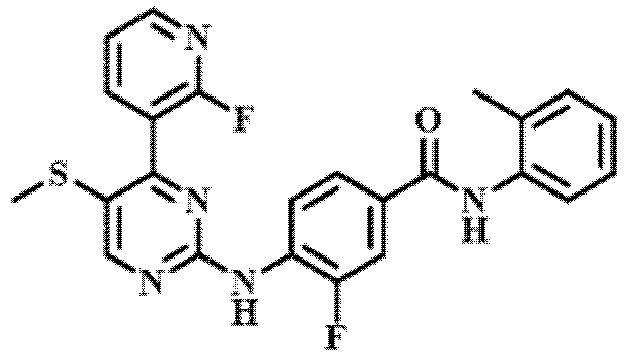
3-Fluoro-4-[4-(2-fluoro-pyridin-3-yl)-5-methyls ulfanyl-pyrimidin-2-ylamino]-N-o-tolyl-benza mide 17 
3-Fluoro-4-[4-(6-fluoro-pyridin-3-yl)-5-methyls ulfanyl-pyrimidin-2-ylamino]-N-(2-methoxy-6-methyl- phenyl)- benzamide 18 
N-(4-Cyano-phenyl)-4-[4-(2-fluoro-pyridin-3-yl )-5-methylsulfanyl-pyrimidin-2-ylamino]-benza mide 19 
4-5-Methylsulfanyl-4-phenyl-pyrimidin-2-yla mino)-N-o-tolyl-benzamide 20 
N-(2-Methyl-5-morpholin-4-ylmethyl-phenyl)-4 -(5-methylsulfanyl-4-phenyl-pyrimidin-2-ylami no)-benzamide 21 
N-(2,6-Dimethoxy-phenyl)-4-(5-methylsulfanyl-4-phenyl-pyrimidin-2-ylamino)-benzamide 22 
N-(2,6-Dimethoxy-phenyl)-4-[5-methylsulfanyl-4-(4-trifluoromethoxy-phenyl)-pyrimidin-2-yla mino]-benzamide 23 
4-[5-Methylsulfanyl-4-(4-trifluoromethoxy-phe nyl)-pyrimidin-2-ylamino]-N-o-tolyl-benzamid e 24 
N-(2-Methyl-5-morpholin-4-ylmethyl-phenyl)-4 -[5-methylsulfanyl-4-(4-trifluoromethoxy-phen yl)-pyrimidin-2-ylamino]-benzamide 25 
N-(2-Methoxy-6-methyl-phenyl)-4-[5-methylsul fanyl-4-(4-trifluoromethoxy-phenyl)-pyrimidin -2-ylamino]-benzamide 26 
N-(2-Methyl-5-morpholin-4-ylmethyl-phenyl)-4 -(5-methylsulfanyl-4-pyridin-4-yl-pyrimidin-2-ylamino)-benzamide 27 
N-(2-Methyl-5-morpholin-4-ylmethyl-phenyl)-4 -[5-methylsulfanyl-4-(4-trifluoromethyl-phenyl )-pyrimidin-2-ylamino]-benzamide 28 
N-(2-Methyl-5-piperidin-1-ylmethyl-phenyl)-4-[5-methylsulfanyl-4-(4-trifluoromethyl-phenyl) -pyrimidin-2-ylamino]-benzamide 29 
N-(2,6-Dimethyl-phenyl)-4-[4-(4-fluoro-phenyl) -5-methylsulfanyl-pyrimidin-2-ylamino]-benza mide 30 
4-[4-(4-Fluoro-phenyl)-5-methylsulfanyl-pyrim idin-2-ylamino]-N-(2-methyl-5-morpholin-4-yl methyl-phenyl)-benzamide 31 
N-(5-Dimethylaminomethyl-2-methyl-phenyl)-4-[4-(4-fluoro-phenyl)-5-methylsulfanyl-pyrimi din-2-ylamino]-benzamide 32 
N-(5-Dimethylaminomethyl-2-methyl-phenyl)-4-[5-methylsulfanyl-4-(4-trifluoromethyl-pheny l)-pyrimidin-2-ylamino]-benzamide 33 
4-[4-(4-Cyano-phenyl)-5-methylsulfanyl-pyrimi din-2-ylamino]-N-(2-methyl-5-morpholin-4-yl methyl- phenyl)- benzamide 34 
4-[4-(4-Cyano-phenyl)-5-methylsulfanyl-pyrimi din-2-ylamino]-N-(5-dimethylaminomethyl-2-methyl- phenyl)- benzamide 35 
4-[4-(4-Cyano-phenyl)-5-methylsulfanyl-pyrimi din-2-ylamino]-N-[2-methyl-5-(4-methyl-pipera zin-1-ylmethyl)-phenyl]-benzamide 36 
4-[4-(4-Fluoro-phenyl)-5-methylsulfanyl-pyrim idin-2-ylamino]-N-[2-methyl-5-(4-methyl-piper azin-1-ylmethyl)-phenyl]-benzamide 37 
N-[2-Methyl-5-(4-methyl-piperazin-1-ylmethyl) -phenyl]-4-[5-methylsulfanyl-4-(4-trifluoromet hoxy-phenyl)-pyrimidin-2-ylamino]-benzamide 38 
4-[5-Methoxy-4-(4-trifluoromethoxy-phenyl)-p yrimidin-2-ylamino]-N-(2-methyl-5-morpholin-4-ylmethyl-phenyl)-benzamide 39 
N-(2-Methyl-5-morpholin-4-ylmethyl-phenyl)-4 -[4-(1-methyl-1H-pyrazol-4-yl)-5-methylsulfan yl-pyrimidin-2-ylamino]-benzamide 40 
3-Fluoro-N-(2-methyl-5-morpholin-4-ylmethylphenyl)-4-[5-methylsulfanyl-4-(4-trifluorometh oxy-phenyl)-pyrimidin-2-ylamino]-benzamide 41 
3-Fluoro-4-[4-(4-fluoro-phenyl)-5-methylsulfan yl-pyrimidin-2-ylamino]-N-(2-methyl-5-morph olin-4-ylmethyl-phenyl)- benzamide 42 
3-Fluoro-4-[4-(4-fluoro-phenyl)-5-methylsulfan yl-pyrimidin-2-ylamino]-N-(2-methyl-5-piperid in-1-ylmethyl-phenyl)-benzamide 43 
4-[4-(4-Fluoro-phenyl)-5-methylsulfanyl-pyrim idin-2-ylamino]-N-(3-morpholin-4-ylmethyl-ph enyl)-benzamide 44 
3-Fluoro-4-[5-methylsulfanyl-4-(4-trifluoromet hoxy-phenyl)-pyrimidin-2-ylamino]-N-(3-morp holin-4-ylmethyl-phenyl)- benzamide 45 
3-Fluoro- N-(2-methyl-5-morpholin-4-ylmethylphenyl)-4-[4-(1-methyl-1H-pyrazol-4-yl)-5-met hylsulfanyl-pyrimidin-2-ylamino]-benzamide 46 
3-Fluoro-N-[2-methyl-5-(4-methyl-piperazin-1-ylmethyl)-phenyl]-4-[4-(1-methyl-1H-pyrazol-4 -yl)-5-methylsulfanyl-pyrimidin-2-ylamino]-be nzamide 47 
N-(5-Diethylaminomethyl-2-methyl-phenyl)-4-[ 4-(4-fluoro-phenyl)-5-methylsulfanyl-pyrimidi n-2-ylamino]-benzamide 48 
4-[4-(4-Fluoro-phenyl)-5-methylsulfanyl-pyrim idin-2-ylamino]-N-(2-methyl-5-piperidin-1-ylm ethyl- phenyl)- benzamide 49 
4-[4-(4-Cyano-phenyl)-5-methoxy-pyrimidin-2-ylamino]-N-(2-methyl-5-morpholin-4-ylmethyl-phenyl)-benzamide 50 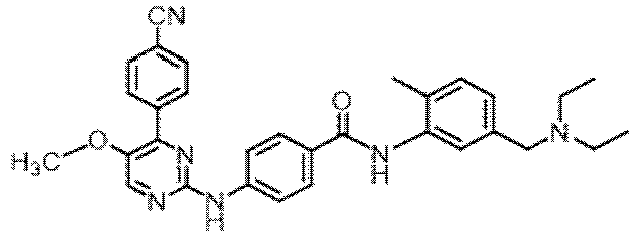
4-[4-(4-Cyano-phenyl)-5-methoxy-pyrimidin-2-ylamino]-N-(5-diethylaminomethyl-2-methyl-p henyl)-benzamide 51 
4-[4-(4-Cyano-phenyl)-5-methoxy-pyrimidin-2-ylamino]-N-[2-methyl-5-(4-methyl-piperazin-1-ylmethyl)-phenyl]-benzamide 52 
4-[5-Methoxy-4-(4-trifluoromethoxy-phenyl)-p yrimidin-2-ylamino]-N-[2-methyl-5-(4-methyl-piperazin-1-ylmethyl)-phenyl]-benzamide 53 
N-(5-Diethylaminomethyl-2-methyl-phenyl)-3-f luoro-4-[4-(4-fluoro-phenyl)-5-methylsulfanyl-pyrimidin-2-ylamino]-benzamide 54 
N-(5-Dimethylaminomethyl-2-methyl-phenyl)-4-[5-methylsulfanyl-4-(4-trifluoromethoxy-phe nyl)-pyrimidin-2-ylamino]-benzamide 55 
3-Fluoro-N-(2-fluoro-5-morpholin-4-ylmethyl-phenyl)-4-[5-methylsulfanyl-4-(4-trifluorometh oxy-phenyl)-pyrimidin-2-ylamino]-benzamide 56 
N-(3-Diethylaminomethyl-phenyl)-3-fluoro-4-[ 5-methylsulfanyl-4-(4-trifluoromethoxy-phenyl )-pyrimidin-2-ylamino]-benzamide 57 
3-Fluoro-N-(2-fluoro-5-morpholin-4-ylmethyl-phenyl)-4-[4-(4-fluoro-phenyl)-5-methylsulfany l-pyrimidin-2-ylamino]-benzamide 58 
3-Fluoro-N-(2-methoxy-5-morpholin-4-ylmethy l-phenyl)-4-[5-methylsulfanyl-4-(4-trifluoromet hoxy-phenyl)-pyrimidin-2-ylamino]-benzamide 59 
4-[4-(4-Fluoro-phenyl)-5-methylsulfanyl-pyrim idin-2-ylamino]-N-(2-methoxy-5-morpholin-4-y lmethyl-phenyl)- benzamide 60 
3-Fluoro-4-[4-(4-fluoro-phenyl)-5-methoxy-pyr imidin-2-ylamino]-N-(2-methyl-5-morpholin-4-ylmethyl-phenyl)-benzamide 61 
N-(5-Diethylaminomethyl-2-methyl-phenyl)-3-f luoro-4-[5-methoxy-4-(4-trifluoromethoxy-phe nyl)-pyrimidin-2-ylamino]-benzamide 62 
3-Fluoro-4-[5-methoxy-4-(4-trifluoromethoxyphenyl)-pyrimidin-2-ylamino]-N-[2-methyl-5-( 4-methyl-piperazin-1-ylmethyl)-phenyl]-benza mide 63 
N-(2-Methyl-5-morpholin-4-ylmethyl-phenyl)-6 -[5-methylsulfanyl-4-(4-trifluoromethoxy-phen yl)-pyrimidin-2-ylamino]-nicotinamide 64 
6- [5-Methylsulfanyl-4-(4-trifluoromethoxy-phe nyl)-pyrimidin-2-ylamino]-N-(3-morpholin-4-yl methyl- phenyl)- nicotinamide 65 
4-[5-Methylsulfanyl-4-(4-trifluoromethoxy-phe nyl)-pyrimidin-2-ylamino]-N-(3-morpholin-4-yl methyl-phenyl)-benzamide 66 
N-(5-Diethylaminomethyl-2-methyl-phenyl)-6- [ 5-methylsulfanyl-4-(4-trifluoromethoxy-phenyl )-pyrimidin-2-ylamino]-nicotinamide 67 
4-[4-(6-Fluoro-pyridin-3-yl)-5-methylsulfanyl-p yrimidin-2-ylamino]-N-(2-methyl-5-morpholin-4-ylmethyl-phenyl)-benzamide 68 
N-(2-Methyl-5-morpholin-4-ylmethyl-phenyl)-4 -[5-methylsulfanyl-4-(6-trifluoromethyl-pyridi n-3-yl)-pyrimidin-2-ylamino]-benzamide 69 
4-[5-Methylsulfanyl-4-(6-trifluoromethyl-pyrid in-3-yl)-pyrimidin-2-ylamino]-N-(3-morpholin-4-ylmethyl-phenyl)-benzamide 70 
N-(2-Fluoro-5-morpholin-4-ylmethyl-phenyl)-4 -[5-methylsulfanyl-4-(4-trifluoromethoxy-phen yl)-pyrimidin-2-ylamino]-benzamide 71 
N-(2-Fluoro-5-morpholin-4-ylmethyl-phenyl)-4 -[4-(4-fluoro-phenyl)-5-methylsulfanyl-pyrimid in-2-ylamino]-benzamide 72 
4-[5-Ethoxy-4-(4-trifluoromethoxy-phenyl)-pyr imidin-2-ylamino]-N-(2-methyl-5-morpholin-4-ylmethyl-phenyl)-benzamide 73 
4-[5-Ethoxy-4-(4-trifluoromethoxy-phenyl)-pyr imidin-2-ylamino]-N-[2-methyl-5-(4-methyl-pip erazin-1-ylmethyl)-phenyl]-benzamide 74 
N-(5-Diethylaminomethyl-2-methyl-phenyl)-4-[ 5-ethoxy-4-(4-trifluoromethoxy-phenyl)-pyrimi din-2-ylamino]-benzamide 75 
4- [5-Ethoxy-4-(4-fluoro-phenyl)-pyrimidin-2-yl amino]-N-(2-methyl-5-morpholin-4-ylmethyl-p henyl)-benzamide 76 
4- [5-Ethoxy-4-(4-fluoro-phenyl)-pyrimidin-2-yl amino]-N-[2-methyl-5-(4-methyl-piperazin-1-yl methyl)- phenyl] -benzamide 77 
N-(5-Diethylaminomethyl-2-methyl-phenyl)-4-[ 5-ethoxy-4-(4-fluoro-phenyl)-pyrimidin-2-ylam ino]-benzamide 78 
3-Fluoro-4-[4-(4-fluoro-phenyl)-5-methylsulfan yl-pyrimidin-2-ylamino]-N-(2-methyl-5-piperaz in-1-ylmethyl-phenyl)-benzamide 79 
4-[4-(4-Fluoro-phenyl)-5-methoxy-pyrimidin-2-ylamino]-N-(2-methyl-5-piperazin-1-ylmethylphenyl)-benzamide 80 
3-Fluoro-4-[4-(4-fluoro-phenyl)-5-methoxy-pyr imidin-2-ylamino]-N-(2-methyl-5-piperazin-1-y lmethyl-phenyl)- benzamide 81 
N-(2-Methyl-5-morpholin-4-ylmethyl-phenyl)-4 -[5-methylsulfanyl-4-(4-trifluoromethoxy-phen yl)-pyridin-2-ylamino]-benzamide 82 
N-[2-Methyl-5-(4-methyl-piperazin-1-ylmethyl) -phenyl]-4-[5-methylsulfanyl-4-(4-trifluoromet hoxy-phenyl)-pyridin-2-ylamino]-benzamide 83 
N-(5-Dimethylaminomethyl-2-methyl-phenyl)-4-[5-methylsulfanyl-4-(4-trifluoromethoxy-phe nyl)-pyridin-2-ylamino]-benzamide 84 
4-((4-(4-fluorophenyl)-5-(methylthio)pyridin-2-yl)amino)-N-(2-methyl-5-(morpholinomethyl)p henyl)benzamide - The data of the compounds of Examples 2 to 84 are given below:
- 1H NMR (500 MHz, d-DMSO): 10.25 (s, 1H), 9.57 (s, 1H), 8.74 (s, 1H), 8.02 (d, 2H), 7.95 (d, 2H), 7.90 (dd, 4H), 7.11 (s, 3H), 2.37(s,3H), 2.17 (s, 6H).
- MS: (ESI+) MH+ = 466.14.
- 1H NMR (500 MHz, d-DMSO): 10.26 (s, 1H), 10.04 (s, 1H), 8.74 (s, 1H), 8.02 (d, 2H), 8.00 (d, 2H), 7.91 (t, 6H), 7.77 (d, 2H), 7.33 (t, 2H), 7.07 (d, 1H), 2.38 (s, 3H).
- MS: (ESI+) MH+= 438.14.
- 1H NMR (500 MHz, d-DMSO): 10.45 (s, 1H), 10.31 (s, 1H), 8.74 (s, 1H), 8.37 (s, 1H), 8.10 (d, 1H), 8.01 (d,2H), 7.91 (t, 6H), 7.69 (s, 1H), 2.38 (s,3H).
- MS: (ESI+) MH+ = 540.1.
- 1H NMR (500 MHz, d-DMSO): 10.32 (s, 1H), 10.03 (s, 1H), 8.78 (s, 1H), 8.42 (s, 1H), 8.19 (t, 1H), 7.90 (d, 2H), 7.88 (d, 2H), 7.76 (d, 2H), 7.56 (s,1H), 7.33 (d, 2H), 7.07 (t, 1H), 2.35 (s,3H). MS: (ESI+) MH+= 432.10
- 1H NMR (500 MHz, d-DMSO): 10.30 (s, 1H), 9.56 (s, 1H), 8.78 (s, 1H), 8.41 (s, 1H), 8.19 (s, 1H), 7.94 (d, 2H), 7.87 (d, 2H), 7.56 (d, 1H), 7.11 (s,3H), 2.35 (s,3H), 2.16 (s, 6H).
- MS: (ESI+) MH+= 460.03.
- 1H NMR (500 MHz, d-DMSO): 10.46 (s, 1H), 10.24 (s, 1H), 8.68 (s, 1H), 8.61 (s, 1H), 8.37 (d, 1H), 8.13-8.09 (m, 2H), 8.09 (s, 4H), 7.71 (d, 1H), 6.94 (d, 1H), 4.40 (dd, 2H), 2.36 (s,3H), 1.35(t, 3H).
- MS: (ESI+) MH+ = 560.38.
- 1H NMR(500 MHz, CDCl3): 8.64 (d, 1H), 8.37 (s, 1H), 7.95 (d, 1H), 7.92 (d, 2H), 7.77 (d, 2H), 7.48 (s, 1H), 7.36 (d, 2H), 7.26-7.22 (m, 1H), 7.01-6.97 (m,2H), 2.32 (s,3H).
- MS: (ESI+) MH+ = 468.29.
- 1H NMR(500 MHz, CDCl3): 8.63 (s, 1H), 8.37 (d, 1H), 7.95-7.91 (m, 3H), 7.73-7.71 (d, 2H), 7.43 (d, 1H), 7.35 (d, 1H), 7.25 (d, 1H), 7.18 (d, 1H), 6.62 (s,2H), 3.83 (s,6H), 2.31 (s, 3H).
- MS: (ESI+) MH+ = 492.28.
- 1H NMR (500 MHz, CDCl3): 9.10 (d, 1H), 8.73 (d, 1H), 8.60 (s, 1H), 8.20 (d, 1H), 7.93 (d, 2H), 7.80 (d, 2H), 7.52 (s, 1H), 7.45 (d, 2H), 7.26-7.22 (m, 1H), 7.01-6.97 (m,2H), 2.30 (s,3H).
- MS: (ESI+) MH+ = 450.47.
- 1H NMR(500 MHz, CDCl3): 8.65 (s, 1H), 8.38 (d, 1H), 7.97-7.87 (m, 4H), 7.77 (d, 2H), 7.69 (s, 1H), 7.64 (s, 1H), 7.36-7.12 (m, 3H), 7.12 (d, 1H), 2.34 (s,3H), 2.33 (s, 3H).
- MS: (ESI+) MH+ = 446.21.
- 1H NMR(500 MHz, d-DMSO): 9.82 (s, 1H), 9.74 (s, 1H), 8.72 (s, 1H), 8.39 (s, 1H), 8.14 (d, 1H), 7.98 (d, 1H), 7.83 (d, 2H), 7.54 (d, 1H), 7.12 (s, 3H), 2.34 (s, 3H), 2.17 (s, 6H).
- MS: (ESI+) MH+ = 478.34.
- 1H NMR(500 MHz, d-DMSO): 9.78 (s, 1H), 9.32 (s, 1H), 8.72 (s, 1H), 8.39 (s, 1H), 8.14 (d, 1H), 7.96 (d, 1H), 7.81 (d, 2H), 7.54 (d, 1H), 7.26 (d, 1H), 6.71 (d, 2H), 3.72 (s, 6H), 2.34 (s, 3H). MS: (ESI+) MH+ = 510.19.
- 1H NMR (500 MHz, d-DMSO): 10.30 (s, 1H), 9.37 (s, 1H), 8.78 (s, 1H), 8.41 (d, 1H), 8.18 (d, 1H), 7.94 (d, 2H), 7.86 (d, 2H), 7.57 (d, 1H), 7.18 (d, 1H), 6.90 (d, 1H), 6.86 (d, 1H), 3.72 (s, 3H), 2.35 (s, 3H), 1.98 (s, 3H).
- MS: (ESI+) MH+ = 476.58.
- 1H NMR (500 MHz, d-DMSO): 10.31 (s, 1H), 9.81 (s, 1H), 9.57 (s, 1H), 8.72 (s, 1H), 8.40 (d, 1H), 8.14 (d, 1H), 7.97 (d, 2H), 7.84 (d, 1H), 7.55 (d, 1H), 7.18 (d, 1H), 6.90 (dd, 2H), 3.73 (s, 3H), 2.35 (s, 3H), 1.98 (s, 3H).
- MS: (ESI+) MH+ = 494.18.
- 1H NMR (500 MHz, CDCl3): 8.66 (d, 2H), 8.38 (s, 1H), 7.97-7.91 (m, 2H), 7.73-7.61 (m, 4H), 7.37 (s, 1H), 7.23 (dd, 2H), 7.13 (d, 1H), 2.33 (s, 6H).
- MS: (ESI+) MH+ = 464.22.
- 1H NMR (500 MHz, CDCl3): 8.78 (s, 1H), 8.65 (s, 1H), 8.62 (s, 1H) 8.34 (d, 1H), 7.72 (dd, 2H), 7.62 (d, 1H), 7.53 (s, 1H), 7.16 (d, 1H), 7.07 (d, 1H), 6.89 (d, 1H), 6.78 (d, 1H), 3.80 (s, 3H), 2.33 (s, 3H), 2.32 (s, 3H).
- MS: (ESI+) MH+ = 494.17.
- 1H NMR (500 MHz, d-DMSO): 10.45 (s, 1H), 10.38 (s, 1H), 8.78 (s, 1H), 8.42 (d, 1H), 8.19 (d, 1H), 7.97 (d, 2H), 7.93-7.88 (dd, 4H), 7.80 (d, 2H), 7.56 (s, 1H), 2.35 (s, 3H).
- MS: (ESI+) MH+ = 457.05.
- 1H NMR (500 MHz, CDCl3): 8.54 (s, 1H), 7.97 (d, 1H), 7.88-7.79 (m, 6H), 7.64 (s, 1H), 7.52-7.51 (d,3H), 7.47 (s, 1H), 7.26-7.22 (dd, 2H), 7.10 (s, 1H), 2.34 (s, 3H), 2.29 (s, 3H).
- MS: (ESI+) MH+ = 427.40.
- 1H NMR (500 MHz, CDCl3): 8.54 (s, 1H), 7.93 (s, 1H), 7.88-7.79 (m, 6H), 7.62 (s, 1H), 7.50 (s, 3H), 7.46 (s,1H), 7.18 (s, 1H), 7.07 (s, 1H), 3.70 (d, 4H),3.49 (s, 2H), 2.46 (s, 4H), 2.32 (s, 3H), 2.29 (s, 3H).
- MS: (ESI+) MH+= 526.35.
- 1H NMR (500 MHz, CDCl3): 8.54 (d, 1H), 7.92 (d, 2H), 7.83-7.77 (dd, 4H), 7.60 (s, 1H), 7.51 (s, 3H), 7.27 (s, 1H), 7.18 (s, 1H), 6.62 (d, 2H), 3.83 (s, 6H), 2.28 (s, 3H).
- MS: (ESI+) MH+ = 473.24.
- 1H NMR (500 MHz, CDCl3): 8.56 (d, 1H), 7.94-7.90 (dd, 4H), 7.75 (d, 2H), 7.39-7.18 (m, 5H), 6.62 (d, 2H), 3.83 (s, 6H), 2.29 (s, 3H).
- MS: (ESI+) MH+ = 557.60.
- 1H NMR (500MHz, CDCl3): 8.56 (s, 1H), 7.97 (d, 1H), 7.92-7.90 (dd, 4H), 7.79 (d, 2H), 7.63 (s, 1H), 7.43 (s, 1H), 7.35 (d, 2H), 7.28-7.22 (m, 3H), 7.10 (d, 1H), 2.35 (s, 3H), 2.30 (s, 3H).
- MS: (ESI+) MH+ = 511.20.
- 1H NMR (500 MHz · CDCl3): 8.56 (s, 1H), 7.92-7.87 (m, 5H), 7.80 (d, 2H), 7.62 (s, 1H), 7.42 (d, 1H), 7.36 (d, 2H), 7.18 (d,1H), 7.08 (d, 1H), 3.70 (t, 4H), 3.49 (s, 2H), 2.46 (s, 4H), 2.32 (s, 3H), 2.30 (s, 3H).
- MS: (ESI+) MH+ = 610.42.
- 1H NMR (500 MHz, CDCl3): 8.56 (d, 1H), 7.94-7.90 (dd, 4H), 7.77 (d, 2H), 7.53 (s, 1H), 7.41 (s, 1H), 7.33 (d, 2H), 7.15 (d, 1H), 6.90 (d, 1H), 6.77 (d, 1H), 3.80 (s, 6H), 2.30 (s, 3H), 2.27 (s, 3H). MS: (ESI+) MH+ = 541.15.
- 1H NMR (500MHz, CDCl3): 8.79 (d, 2H), 8.60 (s, 1H), 7.91-7.78 (m, 3H), 7.79-7.73 (dd, 4H), 7.65 (s, 1H), 7.53 (s,1H), 7.18 (d, 1H), 7.08 (d, 1H), 3.70 (d, 4H), 3.49 (s, 2H), 2.46 (s, 4H), 2.32 (s, 3H), 2.30 (s, 3H).
- MS: (ESI+) MH+ = 527.59.
- 1H NMR (500 MHz, CDCl3): 8.59 (s, 1H), 7.95-7.89 (m, 3H), 7.87 (d, 2H), 7.78 (dd, 4H), 7.62 (s, 1H), 7.47 (s, 1H), 7.26 (s, 1H), 7.18 (d, 1H), 7.08 (d, 1H), 3.71 (d, 4H), 3.499 (s, 2H), 2.46 (s,4H), 2.32 (s, 3H), 2.29 (s, 3H).
- MS: (ESI+) MH+ = 594.20.
- 1H NMR (500 MHz, d-DMSO): 10.25 (s, 1H), 9.70 (s, 1H), 8.73 (s ,1H), 7.96-7.89 (m, 4H), 7.58 (d, 1H), 7.43 (d, 1H), 7.06 (d, 1H), 7.04 (d, 1H), 7.02 (d, 3H), 3.43 (s, 2H), 2.40 (b, 4H), 2.30 (b,7H), 1.25 (b, 2H).
- MS: (ESI+) MH+ = 592.24.
- 1H NMR (500MHz, CDCl3): 8.55 (s, 1H), 7.92 (d, 2H), 7.88 (d, 2H), 7.79 (d, 2H), 7.40 (s, 1H), 7.30 (s, 1H), 7.33 (d, 1H), 7.20 (d,1H), 7.13 (t, 3H), 2.29 (s, 9H).
- MS: (ESI+) MH+ = 459.10.
- 1H NMR (500 MHz, CDCl3): 8.54 (s, 1H), 7.93 (s, 1H), 7.86 (dd, 4H), 7.79 (d, 2H), 7.62 (s, 1H), 7.42 (s, 1H), 7.18 (d, 3H), 7.08 (d, 1H), 3.70 (d, 4H), 3.49 (s, 2H), 2.46 (s, 4H), 2.32 (s, 3H), 2.29 (s, 3H).
- MS: (ESI+) MH+ = 544.45.
- 1H NMR (500 MHz, d-DMSO): 10.18 (s, 1H), 9.69 (s, 1H), 8.67 (s, 1H), 7.84 (d, 3H), 7.78 (s, 1H), 7.56 (d, 1H), 7.43 (d, 2H), 7.26 (d, 1H), 7.04 (d, 1H), 7.00 (d, 2H), 3.34 (s, 2H), 2.35 (s, 6H), 2.20 (s, 3H), 2.13 (s, 3H).
- MS: (ESI+) MH+ = 502.53.
- 1H NMR (500 MHz, CDCl3): 8.59 (s, 1H), 7.95 (d, 2H), 7.88 (d, 3H), 7.78 (dd, 4H), 7.62 (s, 1H), 7.46 (s, 1H), 7.19 (d, 1H), 7.09 (d, 1H), 3.45 (s, 2H), 2.32 (s, 3H), 2.29 (s, 6H), 2.26 (s, 3H).
- MS: (ESI+) MH+ = 552.23.
- 1H NMR (500 MHz, CDCl3): 8.60 (s, 1H), 7.96-7.96 (m, 2H), 7.87 (d, 2H), 7.80 (dd, 4H), 7.62 (s, 1H), 7.45 (s, 1H), 7.19 (d, 1H), 7.09 (d, 1H), 7.08 (d, 1H), 3.70 (d, 4H), 3.50 (s, 2H), 2.46 (s, 4H), 2.32 (s, 3H), 2.30 (s, 3H).
- MS: (ESI+) MH+ = 551.35.
- 1H NMR (500 MHz, CDCl3): 8.57 (s, 1H), 7.93 (d, 2H), 7.86 (d, 3H), 7.84 (d, 2H), 7.77 (d, 2H), 7.61 (s, 1H), 7.46 (s, 1H), 7.17 (d, 1H), 7.07 (d, 1H), 3.42 (s, 2H), 2.29 (s, 3H), 2.27 (s, 6H), 2.42 (s, 3H).
- MS: (ESI+) MH+ = 508.87.
- 1H NMR (500MHz, CDCl3): 8.59 (s, 1H), 7.93 (d, 2H), 7.87 (d, 3H), 7.82 (d, 2H), 7.78 (d, 2H), 7.62 (s, 1H), 7.45 (s, 1H), 7.16 (d, 1H), 7.05 (d, 1H), 3.51 (d, 2H), 2.58 (b, 4H), 2.43 (s, 4H), 2.30 (s, 6H), 2.27 (s, 3H).
- MS: (ESI+) MH+ = 564.25.
- 1H NMR (500 MHz, CDCl3): 8.54 (s, 1H), 7.88 (dd, 4H), 7.80 (d, 2H), 7.62 (s, 1H), 7.44 (s, 2H), 7.21 (m, 3H), 7.07 (d, 1H), 3.50 (s, 2H), 2.49 (b, 4H), 2.31 (s, 3H), 2.29 (s, 6H), 1.94 (b, 4H). MS: (ESI+) MH+ = 557.56.
- 1H NMR (500 MHz, CDCl3): 8.56 (s, 1H), 7.90 (d, 2H), 7.88 (d, 2H), 7.78 (d, 2H), 7.64 (s, 1H), 7.53 (s, 1H), 7.34 (d, 2H), 7.16 (d, 1H), 7.08 (d, 1 H), 3.49 (s, 2H), 2.48 (b, 4H), 2.40 (s, 3H), 2.29 (s, 3H), 2.27 (s, 3H), 2.04 (b, 4H).
- MS: (ESI+) MH+ = 623.41.
- 1H NMR (500 MHz, CDCl3): 8.32 (s, 1H), 8.21-8.25 (m, 5H), 8.09 (d, 1H), 7.89 (d,2H), 7.53 (t, 1H), 7.48 (d,1H), 7.42 (t, 1H), 7.34 (d, 2H), 3.97 (s, 3H).
- MS: (ESI+) MH+ = 594.61.
- 1H NMR (500 MHz, CDCl3): 8.50 (s, 1H), 8.46 (d, 2H), 7.93 (s, 1H), 7.90 (d, 2H), 7.66 (s, 2H), 7.41 (s, 1H), 7.25 (s, 1H), 7.19 (d, 1H), 7.09 (d ,1H), 4.00 (s, 3H), 3.70 (s, 4H), 3.50 (s, 2H), 2.46 (s, 4H), 2.38 (s, 3H), 2.33 (s, 3H).
- MS: (ESI+) MH+ = 530.55.
- 1H NMR (500 MHz, CDCl3): 8.72 (d, 1H), 8.71 (s, 1H), 7.90 (t, 3H), 7.73 (d, 1H), 7.66-7.60 (m, 3H), 7.37 (d, 2H), 7.19 (d,1H), 7.10 (d, 1H), 3.70 (t, 4H), 3.49 (s, 2H), 2.60 (s, 4H), 2.30 (s, 6H). MS: (ESI+) MH+ = 628.33.
- 1H NMR (500 MHz, CDCl3): 8.75 (d, 1H), 8.56 (s, 1H), 7.88 (d, 3H), 7.72 (s, 1H), 7.65-7.60 (m, 3H), 7.22-7.17 (m,3H), 7.10 (d, 1H), 3.70 (t, 4H), 3.49 (s, 2H), 2.45 (s, 4H), 2.32 (s, 6H).
- MS: (ESI+) MH+ = 562.32.
- 1H NMR (500 MHz, CDCl3): 8.71 (d, 1H), 8.54 (s, 1H), 7.88 (d, 2H), 7.78 (s, 1H), 7.71-7.76 (m, 4H), 7.21-7.15 (m,3H), 7.09 (s, 1H), 3.47 (s, 2H),2.40 (b, 4H), 2.30 (s, 3H), 1.58 (b, 4H), 1.42 (b, 2H), 1.25 (s, 3H).
- MS: (ESI+) MH+ = 560.54.
- 1H NMR (500 MHz, CDCl3): 8.54 (d, 1H), 7.88-7.85 (dd, 4H), 7.80-77 (m, 3H), 7.59 (d, 2H), 7.45 (s, 1H), 7.33 (s,1H), 7.21 (d, 2H), 7.10 (d, 1H), 3.71 (t, 4H), 3.50 (s, 2H), 2.46 (s, 4H), 2.29 (s, 3H).
- MS: (ESI+) MH+ = 530.59.
- 1H NMR (500 MHz, CDCl3): 8.71 (d, 1H), 8.57 (s, 1H), 7.90 (d, 2H), 7.81 (s, 1H), 7.71 (d, 1H), 7.69 (d, 2H), 7.65 (d,2H), 7.36-7.25 (m, 3H), 7.11 (d, 1H), 3.71 (t, 4H), 3.50 (s, 2H), 2.46 (s, 4H), 2.32 (s ,3H).
- MS: (ESI+) MH+ = 614.27.
- 1H NMR (500 MHz, CDCl3): 8.73 (d, 1H), 8.51 (s, 1H), 8.47 (s, 1H), 8.44 (s, 1H), 7.89 (s, 1H), 7.72-7.65 (m, 3H), 7.53 (d, 1H), 7.18 (d, 1H), 7.09 (d ,1 H), 4.00 (s, 3H), 3.70 (s, 4H), 3.50 (s, 2H), 2.46 (s, 4H), 2.39 (s, 3H), 2.33 (s, 3H).
- MS: (ESI+) MH+ = 548.23.
- 1H NMR (500 MHz, CDCl3): 8.76 (d, 1H), 8.51 (s, 1H), 8.47 (s, 1H), 8.44 (s, 1H), 7.90 (s, 1H), 7.73-7.68 (m, 3H), 7.53 (d, 1H), 7.18 (d, 1H), 7.09 (d ,1 H), 4.01 (s, 3H), 3.57 (s, 2H), 2.74 (b, 4H), 2.46 (s, 4H), 2.37 (s, 3H), 2.40 (s, 3H), 2.33 (s, 3H).
- MS: (ESI+) MH+ = 561.38.
- 1H NMR (500 MHz, CDCl3): 8.54 (s, 1H), 7.91-7.86 (m, 5H), 7.80 (d, 2H), 7.66 (s, 1H), 7.41 (s, 1H), 7.21-7.14 (m, 4H), 3.65 (s, 2H), 2.62 (b, 4H), 2.32 (s, 3H), 2.26 (s, 3H), 1.10 (d. 6H).
- MS: (ESI+) MH+ = 530.65.
- 1H NMR (500 MHz, CDCl3): 8.54 (s, 1H), 7.88-7.86 (m, 5H), 7.78 (d, 2H), 7.63 (s, 1H), 7.47 (s,1H), 7.21-7.16 (m, 3H), 7.10 (d, 1H), 3.49 (s, 2H), 2.41 (b, 4H), 2.31 (s, 3H), 2.29 (s, 3H), 1.58 (b ,4H), 1.42 (b ,2H).
- MS: (ESI+) MH+ = 542.34.
- 1H NMR (500 MHz, CD3OD): 8.44 (s, 1H), 8.24 (d, 2H), 7.97 (d, 2H), 7.789 (t, 4H), 7.32 (s, 1H), 7.24 (d, 1H), 7.16 (d, 1H), 3.94 (s, 3H), 3.67 (t, 4H), 3.51 (s, 2H), 2.45 (s, 4H), 2.29 (s, 3H)
- MS: (ESI+) MH+ = 535.62.
- 1H NMR (500 MHz, CD3OD): 8.44 (s, 1H), 8.24 (d, 2H), 7.97 (d, 2H), 7.789 (t, 4H), 7.32 (s, 1H), 7.24 (d, 1H), 7.16 (d, 1H), 3.94 (s, 3H), 3.67 (t, 2H), 3.51 (s, 2H), 2.45 (s, 2H), 2.29 (s, 3H), 1.23 (s, 6H)
- MS: (ESI+) MH+ = 521.64.
- 1H NMR (500 MHz, CD3OD): 8.45 (s, 1H), 8.30 (d, 1H), 7.86-7.92 (m, 4H), 7.82 (d, 1H), 7.65-7.68 (q, 3H), 7.31 (s, 1H), 7.24-7.26 (m, 1H), 7.16 (s, 1H), 3.93 (d, 3H), 3.52 (s, 2H), 3.41 (s, 3H), 3.30-3.34 (m, 4H), 2.50 (s, 3H), 2.28-2.30 (t, 4H)
- MS: (ESI+) MH+ = 548.66.
- 1H NMR (500 MHz, CD3OD): 8.62-8.63 (t, 1H), 8.40 (m, 1H), 8.20-8.23 (m, 2H), 7.75-7.81 (m, 2H), 7.30 (s, 1H), 7.16-7.26 (m, 4H), 3.92 (s, 3H), 3.5 (s, 2H), 3.30-3.34 (m, 8H), 2.29 (s, 3H), 2.28 (s, 3H)
- MS: (ESI+) MH+ = 607.65.
- 1H NMR (500 MHz, CDCl3): 8.72 (t, 1H), 8.55 (s, 1H), 7.88-7.83 (m, 3H), 7.72 (d, 1H), 7.65 (d, 3H), 7.25-7.17 (m, 3H), 7.13 (d, 1H), 3.58 (s, 2H), 2.56 (d, 4H), 2.30 (s, 6H), 1.06 (d. 6H).
- MS: (ESI+) MH+ = 548.25.
- 1H NMR (500 MHz, CDCl3): 8.56 (s, 1H), 8.03 (s, 1H), 7.91-7.88 (m, 5H), 7.80 (d, 2H), 7.49 (s, 1H), 7.36-7.25 (m, 4H), 3.89 (s, 2H), 2.58 (d, 6H), 2.37 (s, 3H), 2.16 (s. 3H).
- MS: (ESI+) MH+ = 568.09.
- 1H NMR (500 MHz, CDCl3): 8.73 (d, 1H), 8.58 (s, 1H), 8.40 (d, 1H), 7.99 (s, 1H), 7.91 (d, 2H), 7.74 (d,1H), 7.65 (d, 2H), 7.36 (d, 2H), 7.08 (d, 2H), 3.71 (t, 4H), 3.49 (s, 2H), 2.46 (s, 4H), 2.32 (s, 3H).
- MS: (ESI+) MH+ = 632.26
- 1H NMR (500 MHz, CDCl3): 8.72 (s, 1H), 8.58 (s, 1H), 7.91 (d, 2H), 7.82 (s, 1H), 7.72-7.63 (m, 3H), 7.50 (s ,1H), 7.37-7.26 (m, 3H), 7.10 (d, 1H), 3.58 (s, 2H), 2.56 (d, 2H), 2.53 (d, 2H), 2.32 (s, 3H), 1.05 (d. 6H).
- MS: (ESI+) MH+ = 600.35.
- 1H NMR (500 MHz, CDCl3): 8.76 (s, 1H), 8.56 (s, 1H), 8.40 (s, 1H), 7.99 (d, 1H), 7.87 (dd, 2H), 7.72 (d,1H), 7.63 (d, 2H), 7.26-7.19 (m, 2H), 7.08 (d, 2H), 3.71 (t, 4H), 3.50 (s, 2H), 2.46 (s, 4H), 2.32 (s, 3H).
- MS: (ESI+) MH+ = 566.14.
- 1H NMR (500 MHz, CDCl3): 8.73 (d, 1H), 8.57 (s, 1H), 8.47 (d, 2H), 7.91 (d, 2H) , 7.73-7.61 (m, 3H), 7.36 (d,2H), 7.05 (d,1H), 6.87 (d, 1H), 3.93 (s, 3H), 3.71 (t, 4H), 3.48 (s, 2H), 2.46 (s, 4H), 2.32 (s, 3H).
- MS: (ESI+) MH+ = 644.23.
- 1H NMR (500 MHz, CDCl3): 8.54 (s, 1H), 8.49 (d, 2H), 7.90-7.86 (m, 4H), 7.79 (d, 2H), 7.41 (s, 1H), 7.20 (s,2H), 7.04 (d,1H), 6.86 (d, 1H), 3.93 (s, 3H), 3.71 (t, 4H), 3.48 (s, 2H), 2.46 (s, 4H), 2.29 (s, 3H).
- 1H NMR (500 MHz, CD3OD): 8.62 (t, 1H), 8.32 (d, 1H), 8.16-8.19 (m, 2H), 7.73-7.78 (m, 2H), 7.30 (s, 1H), 7.23 (d, 1H), 7.15 (t, 3H), 3.89 (d, 3H), 3.66 (m, 4H), 3.48 (s, 2H), 2.45 (s, 4H), 2.27 (s, 3H)
- MS: (ESI+) MH+ = 546.59.
- 1H NMR (500 MHz, CD3OD): 8.40 (s, 1H), 8.26 (d, 2H), 7.94 (d, 2H), 7.89 (d, 2H), 7.50 (s, 1H), 7.36 (d, 3H), 7.29-7.31 (m, 1H), 4.41 (s, 2H), 3.93 (s, 3H), 3.04-3.08 (m, 3H), 2.34 (s, 3H), 1.22-1.30 (m, 6H)
- MS: (ESI+) MH+ = 598.61.
- 1H NMR (500 MHz, CD3OD): 8.62-8.63 (t, 1H), 8.40 (m, 1H), 8.20-8.23 (m, 2H), 7.75-7.81 (m, 2H), 7.30 (s, 1H), 7.16-7.26 (m, 4H), 3.92 (s, 3H), 3.5 (s, 2H), 3.30-3.34 (m, 8H), 2.29 (s, 3H), 2.28 (s, 3H)
- MS: (ESI+) MH+ = 625.64.
- 1H NMR (500 MHz, CDCl3): 8.95 (s, 1H), 8.91 (s, 1H), 8.65 (s, 1H), 8.56 (d, 1H), 8.20 (d, 1H), 7.91 (d,2H), 7.87 (s,1H), 7.60 (s, 1H), 7.34 (d, 2H), 7.18 (d, 1H), 7.10 (d, 1H), 3.71 (t, 4H), 3.49 (s, 2H), 2.46 (s, 4H), 2.32 (s, 6H).
- MS: (ESI+) MH+ = 611.83.
- 1H NMR (500 MHz, CDCl3): 8.86 (d, 1H), 8.66 (s, 1H), 8.63 (s, 1H), 8.55 (d, 1H), 8.20 (dd, 1H), 7.91 (d, 2H), 7.77 (s, 1H), 7.58 (d, 2H) ,7.36-7.26 (m, 3H), 7.13 (s, 1H), 3.71 (t, 4H), 3.51 (s, 2H), 2.46 (s, 4H), 2.31 (s, 3H).
- MS: (ESI+) MH+ = 597.62.
- 1H NMR (500 MHz, CDCl3): 8.56 (d, 1H), 7.91-7.86 (m, 4H), 7.79 (d, 2H), 7.77 (s, 1H), 7.59 (s, 2H), 7.44 (s,1H), 7.35-7.25 (m, 3H), 7.11 (d, 2H), 3.71 (t, 4H), 3.50 (s, 2H), 2.46 (s, 4H), 2.30 (s, 3H).
- MS: (ESI+) MH+ = 596.30.
- 1H NMR (500 MHz, CDCl3): 8.96 (s, 1H), 8.92 (s, 1H), 8.65 (s, 1H), 8.56 (d ,1H), 8.21 (d, 1H), 7.92 (d, 2H), 7.83 (s, 1H), 7.66 (s, 1H), 7.36 (d, 2H), 7.18 (dd, 2H), 3.63 (s, 2H), 2.58 (dd, 4H), 2.32 (s, 3H), 2.31 (s, 3H), 1.08 (t, 6H).
- MS: (ESI+) MH+ = 597.26.
- 1H NMR (500 MHz, CDCl3): 8.78 (d, 1H), 8.60 (s, 1H), 8.34 (d, 1H), 7.93 (s, 1H), 7.87 (d, 2H), 7.78 (d, 2H), 7.64 (s, 1H), 7.51 (s, 1H), 7.18 (d, 1H), 7.07 (dd, 2H), 3.70 (t, 4H), 3.49 (s, 2H), 2.46 (s, 4H), 2.32 (s, 3H), 2.30 (s ,3H).
- MS: (ESI+) MH+ = 545.49.
- 1H NMR (500 MHz, CDCl3): 9.19 (s, 1H), 8.63 (s, 1H), 8.38 (d, 1H), 7.94 (s, 1H), 7.87-7.86 (m, 2H), 7.82-7.75 (m, 5H), 7.21 (d, 2H), 3.70 (t, 4H), 3.49 (s, 2H), 2.46 (s, 4H), 2.32 (s, 3H), 2.30 (s ,3H).
- MS: (ESI+) MH+ = 595.34.
- 1H NMR (500 MHz, CDCl3): 9.21 (s, 1H), 8.64 (s, 1H), 8.40 (dd, 1H), 7.88 (d, 2H), 7.83 (d, 2H), 7.78 (d,2H), 7.60 (d, 2H), 7.58 (s, 1H), 7.33 (dd, 1H), 7.11 (d ,1H), 3.71 (t, 4H), 3.49 (s, 2H), 2.46 (s, 4H), 2.32 (s, 3H).
- MS: (ESI+) MH+ = 581.47.
- 1H NMR (500 MHz, CDCl3): 8.56 (s, 1H), 8.44 (d, 1H), 8.02 (s, 1H), 7.90 (dd, 4H), 7.80 (d, 2H), 7.43 (s, 1H), 7.36 (d, 2H), 7.08 (d, 2H), 3.71 (t, 4H), 3.49 (s, 2H), 2.46 (s, 4H), 2.32 (s, 3H). MS: (ESI+) MH+ = 614.37.
- 1H NMR (500 MHz, CDCl3): 8.55 (s, 1H), 8.44 (d, 1H), 8.01 (s, 1H), 7.88 (dd, 4H), 7.80 (d, 2H), 7.41 (s, 1H), 7.20 (d, 2H), 7.08 (d, 2H), 3.71 (t, 4H), 3.49 (s, 2H), 2.46 (s, 4H), 2.29 (s, 3H).
- MS: (ESI+) MH+ = 548.36.
- 1H NMR (500 MHz, CDCl3): 8.28 (s, 1H), 8.23 (d, 2H), 7.94 (s, 1H), 7.87 (d, 2H), 7.71 (d, 2H), 7.65 (s, 1H), 7.32 (t, 3H), 7.18 (d, 1H),7.09 (d, 1H), 4.10 (m, 2H), 3.72 (s, 4H), 3.53 (s, 2H), 2.49 (s, 4H), 2.33 (s, 3H), 1.44 (t, 3H)
- MS: (ESI+) MH+ = 608.63.
- 1H NMR (500 MHz, CDCl3): 8.27 (s, 1H), 8.23 (d, 2H), 7.8 (d, 3H), 7.76 (d, 2H),7.66 (s, 1H), 7.41 (s, 1H), 7.32 (d, 2H), 7.16 (d, 1H), 7.06 (d, 1H), 4.09 (m, 2H), 3.50 (s, 2H), 2.48 (m, 6H), 2.32 (s, 4H), 2.28 (s, 4H), 1.43 (t, 3H)
- MS: (ESI+) MH+ = 621.68.
- 1H NMR (500 MHz, CD3OD): 8.40 (s, 1H), 8.26 (d, 2H), 7.94 (d, 2H), 7.89 (d, 2H), 7.50 (s, 1H), 7.36 (d, 3H), 7.29 (t, 1H), 4.14 (s, 2H), 3.93 (s, 3H), 3.59 (s, 2H), 3.04 (s, 4H), 1.22 (m, 6H)
- MS: (ESI+) MH+ = 594.65.
- 1H NMR (500 MHz, CDCl3): 8.25 (s, 1H), 8.19 (m, 2H), 7.93 (s, 1H), 7.88 (d, 2H), 7.66 (s, 1H), 7.38 (s, 1H), 7.16 (t, 3H), 6.97 (d, 1H), 3.71 (t, 4H), 3.51 (s, 2H), 2.47 (s, 4H), 2.32 (s, 3H)
- MS: (ESI+) MH+ = 542.63.
- 1H NMR (500 MHz, CD3OD): 8.65 (t, 1H), 8.40 (s, 1H), 8.20 (m, 2H), 7.75 (m, 2H), 7.30 (s, 1H), 7.16 (m, 4H), 4.44 (s, 2H), 3.92 (d, 3H), 3.52 (s, 2H), 3.30 (m, 4H), 2.52 (s, 3H), 2.28 (m, 6H) MS: (ESI+) MH+ = 555.67.
- 1H NMR (500 MHz, CD3OD): 8.61 (t, 2H), 8.39 (s, 1H), 8.19 (m, 2H), 7.75 (m, 2H), 7.30 (s,1H), 7.24 (d, 1H), 7.11 (m, 3H), 4.11 (s, 2H), 3.93 (s, 3H), 3.61 (s, 2H), 2.55 (m, 4H), 2.28 (s, 3H), 1.07 (m, 6H)
- MS: (ESI+) MH+ = 528.64.
- 1H NMR (500 MHz, CDCl3): 8.71 (t, 1H), 8.69 (s, 1H), 7.86 (dd, 2H), 7.82 (s, 1H), 7.71-7.63 (m, 4H), 7.21- 7.16 (m, 3H), 7.09 (d, 1H), 3.47 (s, 2H), 3.06 (b, 1H), 2.89 (t,4H), 2.43 (s, 4H), 2.30 (s, 6H).
- MS: (ESI+) MH+ = 561.55.
- 1H NMR (500 MHz, CD3OD): 8.65 (t, 1H), 8.40 (s, 1H), 8.20 (t, 2H), 7.75 (m, 2H), 7.30 (s,1H), 7.16 (m, 4H), 3.92 (s, 3H), 3.52 (s, 2H), 3.30 (s, 4H), 2.28 (t, 4H), 1.89 (s, 3H)
- MS: (ESI+) MH+ = 527.62.
- 1H NMR (500 MHz, CD3OD): 8.41 (s, 1H), 8.27 (d, 2H), 7.69 (m, 2H), 7.65 (m, 2H), 7.37 (d, 1H),7.32 (s, 1H), 7.24 (m, 2H), 3.94 (S, 3H), 3.56 (S, 2H), 3.34 (s, 4H), 3.30 (t, 4H), 2.29 (s, 3H) MS: (ESI+) MH+ = 611.61.
- 1H NMR (500 MHz, CDCl3): 8.32 (s, 1H), 7.91 (s, 1H), 7.85 (d, 2H), 7.62 (s, 1H), 7.48 (d, 2H), 7.31 (d, 2H), 7.18 (d,1H), 7.08 (s,1H), 6.97 (d ,1H), 6.87 (s, 1H), 6.79 (d,1H), 6.64 (d,1H), 3.70 (s, 4H), 3.58 (s, 2H), 2.4 (s,4H), 2.31 (s, 3H), 2.14 (s ,3H).
- MS: (ESI+) MH+ = 609.39.
- 1H NMR (500 MHz, CDCl3): 8.32 (d, 1H), 7.90-7.84 (m, 3H), 7.63 (d, 1H), 7.53 (d, 2H), 7.49 (d, 2H), 7.30 (d, 2H), 7.17 (s, 1H), 7.15 (d, 1H), 7.05 (d, 1H), 6.90 (s, 1H), 3.52 (s, 2H), 2.57 (b,8H), 2.32 (s, 3H), 2.25 (s, 3H).
- MS: (ESI+) MH+ = 622.36.
- 1H NMR (500MHz, CDCl3): 8.32 (d, 1H), 7.93 (s, 1H), 7.84-7.79 (m, 3H), 7.61 (d, 2H), 7.56 (d, 2H), 7.50 (d, 2H), 7.30 (d ,2H), 7.17 (s, 1H), 6.82 (s, 1H), 3.70 (s, 2H), 2.50 (s,6H), 2.32 (s, 3H), 2.15 (s, 3H).
- MS: (ESI+) MH+ = 567.54.
- 1H NMR (500MHz, CDCl3): 8.31 (s, 1H), 7.92 (s, 1H), 7.85 (d, 2H), 7.61 (s, 1H), 7.53 (d, 2H), 7.44 (d, 2H), 7.18-7.13 (m ,3H), 7.08 (d, 1H), 6.80 (d, 2H), 3.70 (s, 4H), 3.50 (s, 2H), 2.46 (s, 4H), 2.31 (s, 3H), 2.25 (s, 3H).
- MS: (ESI+) MH+ = 543.68.
-

- To a solution of N-(2-Methyl-5-morpholin-4-ylmethyl-phenyl)-4-[5-methylsulfanyl-4-(4-trifluoromethoxy-ph enyl)-pyrimidin-2-ylamino]-benzamide (245.5 mg, 0.4 mmol) in dichloromethane (3.0 mL) at 0°C was added 70% mCPBA (129 mg, 0.5 mmol). The mixture was stirred at room temperature for 4h and diluted with dichloromethane. The organic layer was washed with saturated sodium carbonate, dried over magnesium sulfate, filtered, and concentrated on a rotary evaporator. The resulting material was purified by flash column chromatography to afford
- 4-[5-methanesulfinyl-4-(4-trifluoromethoxy-phenyl)-pyrimidin-2-ylamino]-N-(2-methyl-5-m orpholin-4-ylmethyl-phenyl)-benzamide as a white solid (8.2 mg, yield = 3.3%).
- 1H NMR (500 MHz, CDCl3): 8.57 (s, 1H), 8.16 (s, 1H), 7.90 (m, 4H), 7.81 (m, 2H), 7.47 (s, 1H), 7.44 (m, 3H), 4.43 (m, 4H), 3.75 (d, 2H), 3.39 (t, 2H), 3.06 (d, 2H), 2.37 (s, 3H), 2.31 (s, 3H).
-

- Compound 86 was prepared according to Scheme 2.
- The data of the compounds of Examples 86 are given below:
- 1H NMR(500MHz, CDCl3):8.30(s, 1H), 7.85(d, 1H), 7.77(d, 2H), 7.54(s, 1H), 7.52 (d, 2H), 7.47(d, 2H), 7.05-7.33(m ,4H), 7.03(d, 2H), 6.80(s, 1H), 3.68(s, 2H), 3.48(s, 4H), 2.69(s, 4H), 2.25(s, 3H), 2.27(s, 3H).
- MS: (ESI+) MH+=608.68.
-
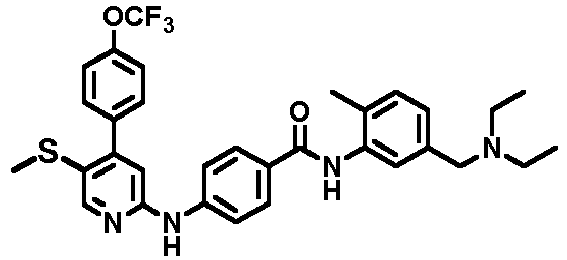
- Compound 87 was prepared according to Scheme 2
- The data of the compounds of Examples 87 are given below:
- 1H NMR(500MHz, CDCl3):7.84(d, 1H), 7.74-7.59 (m, 2H), 7.65(d, 1H), 7.54(d, 2H), 7.53 (d, 2H), 7.42(d, 2H), 7.21-7.24(m ,6H), 6.92(d, 1H), 6.82(s, 1H), 6.75(s, 1H), 6.59(d, 1H), 4.03(s, 4H), 3.99(s, 3H), 2.16(s, 3H) , 2.08(s, 3H), 1.19-1.29(m, 6H).
- MS: (ESI+) MH+=594.70.
-
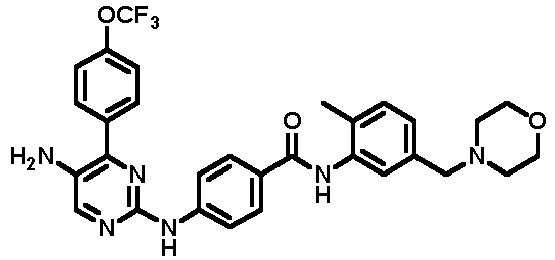
- Compound 88 was prepared according to Scheme 1
- The data of the compounds of Examples 88 are given below:
- 1H NMR(500MHz, CDCl3): 8.01-7.80 (m, 5H), 7.74 (d, 2H),7.62 (s, 1H), 7.39 (d, 2H), 7.18 (d, 2H), 7.08 (d, 1H), 3.72-3.71 (m, 4H), 3.57 (s, 1H), 3.50-3.49 (m, 2H), 2.47-2.46 (m, 4H), 2.32 (s, 3H).
- MS:(ESI+) MH+=579.13.
-

- Compound 89 was prepared according to Scheme 2
- The data of the compounds of Examples 89 are given below:
- 1H NMR(500MHz, CDCl3):8.29(s, 1H), 7.91(d, 2H), 7.88(d, 2H), 7.65(m, 3H), 7.56 (d, 2H), 7.34(m, 3H), 7.14-7.29(m ,4H), 7.12(d, 1H), 3.60(s, 2H), 3.11(s, 4H), 2.73(s, 4H), 2.64(s, 3H), 2.28(s, 3H), 2.19(s, 3H).
- MS: (ESI+) MH+=556.72.
-

- Compound 90 was prepared according to Scheme 2
- The data of the compounds of Examples 90 are given below:
- 1H NMR(500MHz, CDCl3):8.31(s, 1H), 7.80-7.86(m, 4H), 7.59-7.62(m, 2H), 7.47(d0, 2H), 7.26-7.30 (m, 4H), 7.13(d, 1H), 6.96(d ,2H), 6.83(s, 1H), 6.61(m, 2H), 3.50(s, 2H), 2.75(s, 4H), 2.51(s, 4H), 2.36(s, 3H), 2.24(s, 3H) , 2.12(s, 3H).
- MS: (ESI+) MH+=606.32.
-

- Compound 91 was prepared according to Scheme 3
- The data of the compounds of Examples 91 are given below:
- 1H NMR(500MHz, CDCl3): 8.06 (s, 1H), 7.93 (br, 1H), 7.83 (dd, 4H),7.73 (d, 2H), 7.63 (s, 1H), 7.37 (d, 2H), 7.26 (s, 1H), 7.23 (br, 1H),3.71 (m, 4H), 3.47 (s, 2H), 2.87 (d, 2H), 2.46-2.41 (m, 4H), 2.31 (s, 3H).
- MS:(ESI+) MH+=593.3.
- A cell-based screen for inhibitors of the hedgehog pathway was performed using a transient transfection system in C3H10T1/2 cells with pGL3-7xGli-Luciferase reporter plasmids. C3H10T1/2 cells (ATCC, cat.#CCL-226) were seeded into 6-well plates at 8×10⁴ cells/well in a BME medium containing 10% heat-inactived FBS. Cells were transfected the next morning with 500 ng/well pGL3-7xGli-Luciferase reporter plasmids and 100ng/well pRL-TK Renilla luciferase reporter plasmids (Promega) using GeneJuice transfection reagent (Novagene). After 24h, transfected cells were collected by trypsin treatment and re-plated in 96-well plates in an RPMI medium containing 0.5% FBS with a density of 1.5×10⁴ cells/well. Compounds were dissolved in DMSO with serial dilutions and were then added to the assay plate. SAG (Hh-Ag 1.3) (Santa Cruz) was added to the assay plated for a final concentration 20 nM. The assay plates were incubated at 37°C for 48 hr.
- A transient transfection system with a Smo wild type or a Smo D473H mutant was also used for compound screening. For the SMO inhibition experiments, cells were transfected with an additional 500 ng/well of wild-type or D473H-mutant type SMO construct (pLPCX-SMO or pLPCX-SMO-D473H). After 24h, transfected cells were collected by trypsin treatment and re-plated in 96-well plates in an RPMI medium containing 0.5% FBS with a density of 1.5×10⁴ cells/well. Compounds were dissolved in DMSO with serial dilutions and were then added to the assay plate. The assay plates were incubated at 37 °C for 48 hr.
- Firefly luciferase and Renilla luciferase activity was determined using the Dual-Glo Luciferase reporter assay system (Promega) with a Victor3 plate reader (PerkinElmer Life Sciences). Firefly luciferase readings were normalized to Renilla luciferase to correct for transfection efficiency. Luminance reading for the C3H10T1/2-Gli-Luc assay was normalized based on DMSO control with SAG stimulation (100% pathway activity) and without SAG stimulation (0% pathway activity). IC50 values, defined as the inflection point of the logistic curve, were determined by nonlinear regression using the Prism 5 software (GraphPad).
- The reporter assay of C3H10T1/2-Gli-Luc cells transfected with a wild-type, D473H mutant Smo mutant was carried out with the same protocol but without SAG stimulation. Luminance reading for the SMO inhibition experiments assay was normalized based on DMSO control (100% of the pathway activity) and a known Smo antagonist (ALLO-2 at 10 µM, 0% of the pathway activity).
- Compounds of the invention were tested in those assays and demonstrated the ability to modulate the Hedgehog pathway activity. The compounds described in Table 2 were all tested in those assays and have an activity of less than about 2 µM. The following embodiments are directed to the compounds themselves as well as their use in a method of treatment. For example, in one embodiment of the invention, the Hedgehog pathway modulators in Table 2 have a cellular activity of about 2000 nM or less in a C3H10T1/2 cell assay. In another embodiment, the Hedgehog pathway modulators in Table 2 have a cellular activity of about 250 nM or less in a C3H10T1/2 cell assay. The results of assays are shown in Table 2 ( + means > 1000 nM ; ++ means 100 nM to 1000 nM ; and +++ means < 100 nM).
Table 2 Biological Data Compd No. Inhibition of Gli-Luc expression [IC50, nM] Inhibition of C3H10T1/2-Gli-Luc-Smo-WT [IC50, nM] Inhibition of C3H10T1/2-Gli-Luc-Smo-D473H [IC50, nM] Compd No. Inhibition of Gli-Luc expression [IC50, nM] Inhibition of C3H10T1/2-Gli-Luc-Smo-WT [IC50, nM] Inhibition of C3H10T1/2-Gli-Luc-Smo -D473H [IC50, nM] 1 ++ ++ + 2 ++ ++ ++ 3 ++ ++ ++ 4 ++ ++ ++ 5 ++ ++ ++ 6 +++ +++ +++ 7 ++ ++ ++ 8 ++ ++ ++ 9 +++ +++ ++ 10 ++ ++ ++ 11 ++ ++ ++ 12 ++ ++ ++ 13 ++ ++ ++ 14 +++ ++ ++ 15 +++ +++ ++ 16 ++ ++ ++ 17 ++ ++ ++ 18 ++ ++ ++ 19 ++ ++ ++ 20 +++ +++ ++ 21 +++ +++ ++ 22 +++ +++ ++ 23 ++ +++ ++ 24 +++ +++ +++ 25 ++ ++ ++ 26 +++ +++ ++ 27 +++ +++ ++ 28 +++ ++ ++ 29 ++ ++ ++ 30 +++ +++ ++ 31 +++ +++ ++ 32 ++ ++ ++ 33 +++ +++ ++ 34 +++ ++ ++ 35 +++ +++ ++ 36 +++ +++ ++ 37 +++ +++ ++ 38 +++ +++ +++ 39 ++ ++ ++ 40 +++ +++ +++ 41 +++ +++ ++ 42 +++ +++ ++ 43 +++ +++ ++ 44 +++ +++ +++ 45 +++ +++ +++ 46 +++ +++ ++ 47 +++ +++ ++ 48 +++ +++ ++ 49 ++ ++ + 50 +++ +++ ++ 51 +++ +++ ++ 52 +++ +++ + 53 +++ +++ +++ 54 +++ ++ ++ 55 +++ +++ +++ 56 +++ +++ ++ 57 +++ +++ ++ 58 +++ +++ ++ 59 ++ ++ ++ 60 +++ +++ +++ 61 +++ +++ ++ 62 +++ +++ ++ 63 +++ +++ +++ 64 +++ +++ +++ 65 +++ +++ ++ 66 +++ +++ ++ 67 +++ +++ ++ 68 ++ +++ ++ 69 +++ +++ ++ 70 +++ +++ +++ 71 +++ +++ +++ 72 +++ +++ +++ 73 +++ +++ ++ 74 +++ +++ ++ 75 +++ +++ ++ 76 +++ +++ +++ 77 +++ +++ ++ 78 ++ ++ ++ 79 +++ ++ ++ 80 +++ ++ ++ 81 +++ +++ +++ 82 +++ +++ +++ 83 +++ +++ +++ 84 +++ +++ ++ 85 +++ +++ +++ 86 +++ +++ +++ 87 +++ +++ +++ 88 +++ +++ +++ 89 +++ +++ ++ 90 +++ +++ ++ 91 +++ +++ +++
Claims (10)
- A compound of formula (I):
 X and Y are each independently N or CH, and at least one of X and Y is N;Z1 and Z2 are each independently N or CH, and at least one of Z1 and Z2 is CH;R1 is OR3, or SR3;R2 is alkyl, cycloalkyl, aryl, heteroaryl, or heterocycloalkyl wherein the alkyl, cycloalkyl, aryl, heteroaryl, and heterocycloalkyl are optionally substituted with 1, 2, or 3 R4;R3 is optionally substituted alkyl or cycloalkyl;R4 is halo, hydroxy, mercapto, cyano, nitro, amino, alkyl, alkoxy, alkylamino, dialkylamino, cycloalkyl, haloalkyl, haloalkoxy, aryl, heteroaryl, or heterocycloalkyl;A and B are each independently hydrogen, halo, cyano, amino, alkyl, haloalkyl, alkoxy, haloalkoxy, cycloalkyl, halocycloalkyl, alkylaminoalkyl, alkylaminodialkyl, or alkyl-heterocycloalkyl, wherein the alkyl, alkoxy, cycloalkyl and heterocycloalkyl are optionally substituted;p is 0, 1, 2, 3, or 4; andq is 0, 1, 2, 3, or 4;or a pharmaceutically acceptable salt, geometric isomer, enantiomer, diastereomer, or solvate thereof.
 - The compound according to claim 1, wherein at least one of X and Y is N; both Z1 and Z2 are CH, or one of Z1 and Z2 is N and the other is CH; R1 is OR3, or SR3; R3 is optionally substituted alkyl; R2 is aryl, heteroaryl, or heterocycloalkyl, which are optionally substituted with 1, 2, or 3 R4; R4 is halo, hydroxy, mercapto, cyano, nitro, amino, alkyl, alkoxy, alkylamino, dialkylamino, cycloalkyl, haloalkyl, or haloalkoxy; A is hydrogen, halo, cyano, amino, alkyl, haloalkyl, alkoxy, or haloalkoxy, wherein the alkyl and alkoxy are optionally substituted; B is hydrogen, halo, cyano, amino, alkyl, haloalkyl, alkoxy, haloalkoxy, alkylaminoalkyl, alkylaminodialkyl, or alkyl-heterocycloalkyl, wherein the alkyl and alkoxy are optionally substituted; p is 0, 1, or 2; and q is 0, 1, 2, or 3.
- The compound according to claim 2, wherein both X and Y are N, or, X is CH and Y is N; both Z1 and Z2 are CH, or Z1 is N and Z2 is CH; R1 is OR3, or SR3; R3 is optionally substituted alkyl; R2 is aryl or heteroaryl, which is optionally substituted with 1, 2, or 3 R4; R4 is halo, cyano, alkyl, or haloalkoxy; A is hydrogen or halogen; B is cyano, halo, alkyl, haloalkyl, alkoxy, alkyl-heterocycloalkyl, or alkylaminodialkyl; p is 0 or 1; and q is 0, 1, or 2.
- A compound according to claim 1, which is selected from:N-(2,6-Dimethyl-phenyl)-4-[5-methylsulfanyl-4-(4-trifluoromethoxy-phenyl)-pyrimidin-2-yla mino]-benzamide;4-[4-(4-Cyano-phenyl)-5-methylsulfanyl-pyrimidin-2-ylamino]-N-(2,6-dimethyl-phenyl)-ben zamide;4-[4-(4-Cyano-phenyl)-5-methylsulfanyl-pyrimidin-2-ylamino]-N-phenyl-benzamide;N-(3-Chloro-4-trifluoromethyl-phenyl)-4-[4-(4-cyano-phenyl)-5-methylsulfanyl-pyrimidin-2-ylamino]-benzamide;4-[4-(2-Fluoro-pyridin-3-yl)-5-methylsulfanyl-pyrimidin-2-ylamino]-N-phenyl-benzamide; N-(2,6-Dimethyl-phenyl)-4-[4-(2-fluoro-pyridin-3-yl)-5-methylsulfanyl-pyrimidin-2-ylamino ]-benzamide;N-(4-Chloro-3-trifluoromethyl-phenyl)-4-[4-(6-ethoxy-pyridin-3-yl)-5-methylsulfanyl-pyrimi din-2-ylamino]-benzamide;N-(2,6-Difluoro-phenyl)-4-[4-(2-fluoro-pyridin-3-yl)-5-methylsulfanyl-pyrimidin-2-ylamino] -benzamide;N-(2,6-Dimethoxy-phenyl)-4-[4-(2-fluoro-pyridin-3-yl)-5-methylsulfanyl-pyrimidin-2-ylamin o]-benzamide;N-(2,6-Difluoro-phenyl)-4-(5-methylsulfanyl-4-pyridin-3-yl-pyrimidin-2-ylamino)-benzamid e;4-[4-(2-Fluoro-pyridin-3-yl)-5-methylsulfanyl-pyrimidin-2-ylamino]-N-o-tolyl-benzamide;N-(2,6-Dimethyl-phenyl)-3-fluoro-4-[4-(2-fluoro-pyridin-3-yl)-5-methylsulfanyl-pyrimidin-2 -ylamino]-benzamide;N-(2,6-Dimethoxy-phenyl)-3-fluoro-4-[4-(2-fluoro-pyridin-3-yl)-5-methylsulfanyl-pyrimidin-2-ylamino]-benzamide;4-[4-(2-Fluoro-pyridin-3-yl)-5-methylsulfanyl-pyrimidin-2-ylamino]-N-(2-methoxy-6-methyl -phenyl)-benzamide;3-Fluoro-4-[4-(2-fluoro-pyridin-3-yl)-5-methylsulfanyl-pyrimidin-2-ylamino]-N-(2-methoxy-6-methyl-phenyl)-benzamide;3-Fluoro-4-[4-(2-fluoro-pyridin-3-yl)-5-methylsulfanyl-pyrimidin-2-ylamino]-N-o-tolyl-benz amide;3-Fluoro-4-[4-(6-fluoro-pyridin-3-yl)-5-methylsulfanyl-pyrimidin-2-ylamino]-N-(2-methoxy-6-methyl-phenyl)-benzamide;N-(4-Cyano-phenyl)-4-[4-(2-fluoro-pyridin-3-yl)-5-methylsulfanyl-pyrimidin-2-ylamino]-ben zamide;4-(5-Methylsulfanyl-4-phenyl-pyrimidin-2-ylamino)-N-o-tolyl-benzamide;N-(2-Methyl-5-morpholin-4-ylmethyl-phenyl)-4-(5-methylsulfanyl-4-phenyl-pyrimidin-2-yla mino)-benzamide;N-(2,6-Dimethoxy-phenyl)-4-(5-methylsulfanyl-4-phenyl-pyrimidin-2-ylamino)-benzamide;N-(2,6-Dimethoxy-phenyl)-4-[5-methylsulfanyl-4-(4-trifluoromethoxy-phenyl)-pyrimidin-2-y lamino]-benzamide;4-[5-Methylsulfanyl-4-(4-trifluoromethoxy-phenyl)-pyrimidin-2-ylamino]-N-o-tolyl-benzami de;N-(2-Methyl-5-morpholin-4-ylmethyl-phenyl)-4-[5-methylsulfanyl-4-(4-trifluoromethoxy-ph enyl)-pyrimidin-2-ylamino]-benzamide;N-(2-Methoxy-6-methyl-phenyl)-4-[5-methylsulfanyl-4-(4-trifluoromethoxy-phenyl)-pyrimid in-2-ylamino]-benzamide;N-(2-Methyl-5-morpholin-4-ylmethyl-phenyl)-4-(5-methylsulfanyl-4-pyridin-4-yl-pyrimidin-2-ylamino)-benzamide;N-(2-Methyl-5-morpholin-4-ylmethyl-phenyl)-4-[5-methylsulfanyl-4-(4-trifluoromethyl-phen yl)-pyrimidin-2-ylamino]-benzamide;N-(2-Methyl-5-piperidin-1-ylmethyl-phenyl)-4-[5-methylsulfanyl-4-(4-trifluoromethyl-pheny l)-pyrimidin-2-ylamino]-benzamide;N-(2,6-Dimethyl-phenyl)-4-[4-(4-fluoro-phenyl)-5-methylsulfanyl-pyrimidin-2-ylamino]-ben zamide;4-[4-(4-Fluoro-phenyl)-5-methylsulfanyl-pyrimidin-2-ylamino]-N-(2-methyl-5-morpholin-4-y lmethyl-phenyl)-benzamide;N-(5-Dimethylaminomethyl-2-methyl-phenyl)-4-[4-(4-fluoro-phenyl)-5-methylsulfanyl-pyri midin-2-ylamino]-benzamide;N-(5-Dimethylaminomethyl-2-methyl-phenyl)-4-[5-methylsulfanyl-4-(4-trifluoromethyl-phen yl)-pyrimidin-2-ylamino]-benzamide;4-[4-(4-Cyano-phenyl)-5-methylsulfanyl-pyrimidin-2-ylamino]-N-(2-methyl-5-morpholin-4-y lmethyl-phenyl)-benzamide;4-[4-(4-Cyano-phenyl)-5-methylsulfanyl-pyrimidin-2-ylamino]-N-(5-dimethylaminomethyl-2 -methyl-phenyl)-benzamide;4-[4-(4-Cyano-phenyl)-5-methylsulfanyl-pyrimidin-2-ylamino]-N-[2-methyl-5-(4-methyl-pip erazin-1-ylmethyl)-phenyl]-benzamide;4-[4-(4-Fluoro-phenyl)-5-methylsulfanyl-pyrimidin-2-ylamino]-N-[2-methyl-5-(4-methyl-pip erazin-1-ylmethyl)-phenyl]-benzamide;N-[2-Methyl-5-(4-methyl-piperazin-l-ylmethyl)-phenyl]-4-[5-methylsulfanyl-4-(4-trifluorom ethoxy-phenyl)-pyrimidin-2-ylamino]-benzamide;4-[5-Methoxy-4-(4-trifluoromethoxy-phenyl)-pyrimidin-2-ylamino]-N-(2-methyl-5-morpholi n-4-ylmethyl-phenyl)-benzamide;N-(2-Methyl-5-morpholin-4-ylmethyl-phenyl)-4-[4-(1-methyl-1H-pyrazol-4-yl)-5-methylsulf anyl-pyrimidin-2-ylamino]-benzamide;3-Fluoro-N-(2-methyl-5-morpholin-4-ylmethyl-phenyl)-4-[5-methylsulfanyl-4-(4-trifluoromet hoxy-phenyl)-pyrimidin-2-ylamino]-benzamide;3-Fluoro-4-[4-(4-fluoro-phenyl)-5-methylsulfanyl-pyrimidin-2-ylamino]-N-(2-methyl-5-morp holin-4-ylmethyl-phenyl)-benzamide;3-Fluoro-4-[4-(4-fluoro-phenyl)-5-methylsulfanyl-pyrimidin-2-ylamino]-N-(2-methyl-5-piper idin-1-ylmethyl-phenyl)-benzamide;4-[4-(4-Fluoro-phenyl)-5-methylsulfanyl-pyrimidin-2-ylamino]-N-(3-morpholin-4-ylmethyl-p henyl)-benzamide;3-Fluoro-4-[5-methylsulfanyl-4-(4-trifluoromethoxy-phenyl)-pyrimidin-2-ylamino]-N-(3-mor pholin-4-ylmethyl-phenyl)-benzamide;3-Fluoro-N-(2-methyl-5-morpholin-4-ylmethyl-phenyl)-4-[4-(1-methyl-1H-pyrazol-4-yl)-5-m ethylsulfanyl-pyrimidin-2-ylamino]-benzamide;3-Fluoro-N-[2-methyl-5-(4-methyl-piperazin-1-ylmethyl)-phenyl]-4-[4-(1-methyl-1H-pyrazol -4-yl)-5-methylsulfanyl-pyrimidin-2-ylamino]-benzamide;N-(5-Diethylaminomethyl-2-methyl-phenyl)-4-[4-(4-fluoro-phenyl)-5-methylsulfanyl-pyrimi din-2-ylamino]-benzamide;4-[4-(4-Fluoro-phenyl)-5-methylsulfanyl-pyrimidin-2-ylamino]-N-(2-methyl-5-piperidin-1-yl methyl-phenyl)-benzamide;4-[4-(4-Cyano-phenyl)-5-methoxy-pyrimidin-2-ylamino]-N-(2-methyl-5-morpholin-4-ylmeth yl-phenyl)-benzamide;4-[4-(4-Cyano-phenyl)-5-methoxy-pyrimidin-2-ylamino]-N-(5-diethylaminomethyl-2-methylphenyl)-benzamide;4-[4-(4-Cyano-phenyl)-5-methoxy-pyrimidin-2-ylamino]-N-[2-methyl-5-(4-methyl-piperazin-1-ylmethyl)-phenyl]-benzamide;4-[5-Methoxy-4-(4-trifluoromethoxy-phenyl)-pyrimidin-2-ylamino]-N-[2-methyl-5-(4-methyl -piperazin-1-ylmethyl)-phenyl]-benzamide;N-(5-Diethylaminomethyl-2-methyl-phenyl)-3-fluoro-4-[4-(4-fluoro-phenyl)-5-methylsulfany 1-pyrimidin-2-ylamino]-benzamide;N-(5-Dimethylaminomethyl-2-methyl-phenyl)-4-[5-methylsulfanyl-4-(4-trifluoromethoxy-ph enyl)-pyrimidin-2-ylamino]-benzamide;3-Fluoro-N-(2-fluoro-5-morpholin-4-ylmethyl-phenyl)-4-[5-methylsulfanyl-4-(4-trifluoromet hoxy-phenyl)-pyrimidin-2-ylamino]-benzamide;N-(3-Diethylaminomethyl-phenyl)-3-fluoro-4-[5-methylsulfanyl-4-(4-trifluoromethoxy-pheny 1)-pyrimidin-2-ylamino]-benzamide;3-Fluoro-N-(2-fluoro-5-morpholin-4-ylmethyl-phenyl)-4-[4-(4-fluoro-phenyl)-5-methylsulfan yl-pyrimidin-2-ylamino]-benzamide;3-Fluoro-N-(2-methoxy-5-morpholin-4-ylmethyl-phenyl)-4-[5-methylsulfanyl-4-(4-trifluorom ethoxy-phenyl)-pyrimidin-2-ylamino]-benzamide;4-[4-(4-Fluoro-phenyl)-5-methylsulfanyl-pyrimidin-2-ylamino]-N-(2-methoxy-5-morpholin-4 -ylmethyl-phenyl)-benzamide;3-Fluoro-4-[4-(4-fluoro-phenyl)-5-methoxy-pyrimidin-2-ylamino]-N-(2-methyl-5-morpholin-4-ylmethyl-phenyl)-benzamide;N-(5-Diethylaminomethyl-2-methyl-phenyl)-3-fluoro-4-[5-methoxy-4-(4-trifluoromethoxy-ph enyl)-pyrimidin-2-ylamino]-benzamide;3-Fluoro-4-[5-methoxy-4-(4-trifluoromethoxy-phenyl)-pyrimidin-2-ylamino]-N-[2-methyl-5-( 4-methyl-piperazin-1-ylmethyl)-phenyl]-benzamide;N-(2-Methyl-5-morpholin-4-ylmethyl-phenyl)-6-[5-methylsulfanyl-4-(4-trifluoromethoxy-ph enyl)-pyrimidin-2-ylamino]-nicotinamide;6-[5-Methylsulfanyl-4-(4-trifluoromethoxy-phenyl)-pyrimidin-2-ylamino]-N-(3-morpholin-4-ylmethyl-phenyl)-nicotinamide;4-[5-Methylsulfanyl-4-(4-trifluoromethoxy-phenyl)-pyrimidin-2-ylamino]-N-(3-morpholin-4-ylmethyl-phenyl)-benzamide;N-(5-Diethylaminomethyl-2-methyl-phenyl)-6-[5-methylsulfanyl-4-(4-trifluoromethoxy-phen yl)-pyrimidin-2-ylamino]-nicotinamide;4-[4-(6-Fluoro-pyridin-3-yl)-5-methylsulfanyl-pyrimidin-2-ylamino]-N-(2-methyl-5-morpholi n-4-ylmethyl-phenyl)-benzamide;N-(2-Methyl-5-morpholin-4-ylmethyl-phenyl)-4-[5-methylsulfanyl-4-(6-trifluoromethyl-pyrid in-3-yl)-pyrimidin-2-ylamino]-benzamide;4-[5-Methylsulfanyl-4-(6-trifluoromethyl-pyridin-3-yl)-pyrimidin-2-ylamino]-N-(3-morpholi n-4-ylmethyl-phenyl)-benzamide;N-(2-Fluoro-5-morpholin-4-ylmethyl-phenyl)-4-[5-methylsulfanyl-4-(4-trifluoromethoxy-phe nyl)-pyrimidin-2-ylamino]-benzamide;N-(2-Fluoro-5-morpholin-4-ylmethyl-phenyl)-4-[4-(4-fluoro-phenyl)-5-methylsulfanyl-pyrim idin-2-ylamino]-benzamide;4-[5-Ethoxy-4-(4-trifluoromethoxy-phenyl)-pyrimidin-2-ylamino]-N-(2-methyl-5-morpholin-4-ylmethyl-phenyl)-benzamide;4-[5-Ethoxy-4-(4-trifluoromethoxy-phenyl)-pyrimidin-2-ylamino]-N-[2-methyl-5-(4-methyl-p iperazin-1-ylmethyl)-phenyl]-benzamide;N-(5-Diethylaminomethyl-2-methyl-phenyl)-4-[5-ethoxy-4-(4-trifluoromethoxy-phenyl)-pyri midin-2-ylamino]-benzamide;4-[5-Ethoxy-4-(4-fluoro-phenyl)-pyrimidin-2-ylamino]-N-(2-methyl-5-morpholin-4-ylmethyl -phenyl)-benzamide;4-[5-Ethoxy-4-(4-fluoro-phenyl)-pyrimidin-2-ylamino]-N-[2-methyl-5-(4-methyl-piperazin-1-ylmethyl)-phenyl]-benzamide;N-(5-Diethylaminomethyl-2-methyl-phenyl)-4-[5-ethoxy-4-(4-fluoro-phenyl)-pyrimidin-2-yla mino]-benzamide;3-Fluoro-4-[4-(4-fluoro-phenyl)-5-methylsulfanyl-pyrimidin-2-ylamino]-N-(2-methyl-5-piper azin-1-ylmethyl-phenyl)-benzamide;4-[4-(4-Fluoro-phenyl)-5-methoxy-pyrimidin-2-ylamino]-N-(2-methyl-5-piperazin-1-ylmethy 1-phenyl)-benzamide;3-Fluoro-4-[4-(4-fluoro-phenyl)-5-methoxy-pyrimidin-2-ylamino]-N-(2-methyl-5-piperazin-1 -ylmethyl-phenyl)-benzamide;N-(2-Methyl-5-morpholin-4-ylmethyl-phenyl)-4-[5-methylsulfanyl-4-(4-trifluoromethoxy-ph enyl)-pyridin-2-ylamino]-benzamide;N-[2-Methyl-5-(4-methyl-piperazin-1-ylmethyl)-phenyl]-4-[5-methylsulfanyl-4-(4-trifluorom ethoxy-phenyl)-pyridin-2-ylamino]-benzamide;N-(5-Dimethylaminomethyl-2-methyl-phenyl)-4-[5-methylsulfanyl-4-(4-trifluoromethoxy-ph enyl)-pyridin-2-ylamino]-benzamide;4-((4-(4-fluorophenyl)-5-(methylthio)pyridin-2-yl)amino)-N-(2-methyl-5-(morpholinomethyl) phenyl)benzamide;N-(2-methyl-5-(morpholinomethyl)phenyl)-4-((5-(methylthio)-6-(4-(trifluoromethoxy)phenyl )pyridin-2-yl)amino)benzamide;N-(5-((diethylamino)methyl)-2-methylphenyl)-4-((5-(methylthio)-4-(4-(trifluoromethoxy)phe nyl)pyridin-2-yl)amino)benzamide;4-((4-(4-fluorophenyl)-5-(methylthio)pyridin-2-yl)amino)-N-(2-methyl-5-((4-methylpiperazin -1-yl)methyl)phenyl)benzamide; andN-(2-methyl-5-((4-methylpiperazin-1-yl)methyl)phenyl)-4-((5-(methylthio)-4-(4-(trifluoromet hyl)phenyl)pyridin-2-yl)amino)benzamide;or a pharmaceutically acceptable salt, geometric isomer, enantiomer, distereomer, racemate, solvate, or hydrate thereof.
- A pharmaceutical composition comprising a therapeutically effective amount of a compound of any of claims 1 to 4 or a pharmaceutically acceptable salt, geometric isomer, enantiomer, diastereomer, or solvate thereof, and a pharmaceutically acceptable carrier or excipient.
- A compound of any of claims 1 to 4 or a pharmaceutically acceptable salt, geometric isomer, enantiomer, diastereomer, or solvate thereof, or a pharmaceutical composition of claim 5 for use in treating cancer in a subject in need thereof.
- The compound, or the pharmaceutical composition for use according to claim 6, wherein the compound or the pharmaceutically acceptable salt, geometric isomer, enantiomer, diastereomer, or solvate thereof, or the pharmaceutical composition is administered to the subject in combination with a second anticancer agent, a surgical therapy, an ionizing radiation, or a combination thereof.
- The compound, or the pharmaceutical composition for use according to claim 7, wherein the second anticancer agent is selected from: targeted cancer drugs, such as trastuzumab, ramucirumab, bevacizumab, everolimus, tamoxifen, toremifene, fulvestrant, anastrozole, exemestane, lapatinib, letrozole, pertuzumab, ado-trastuzumab emtansine, palbociclib, cetuximab, panitumumab, ziv-aflibercept, regorafenib, lmatinib mesylate, lanreotide acetate, sunitinib, regorafenib, denosumab, alitretinoin, sorafenib, pazopanib, temsirolimus, everolimus, tretinoin, dasatinib, nilotinib, bosutinib, rituximab, alemtuzumab, ofatumumab, obinutuxumab, ibrutinib, idelalisib, blinatumomab, soragenib, crizotinib, erlotinib, gefitinib, afatinib dimaleate, ceritnib, ramucirumab, nivolumab, pembrolizumab, osimertinib, and necitumumab; an alkylating agent, such as busulfan, chlorambucil, cyclophosphamide, iphosphamide, melphalan, nitrogen mustard, streptozocin, thiotepa, uracil nitrogen mustard, triethylenemelamine, temozolomide, and 2-chloroethyl-3-sarcosinamide-1-nitrosourea (SarCNU); an antibiotic or plant alkaloid, such as actinomycin-D, bleomycin, cryptophycins, daunorubicin, doxorubicin, idarubicin, irinotecan, L-asparaginase, mitomycin-C, mitramycin, navelbine, paclitaxel, docetaxel, topotecan, vinblastine, vincristine, teniposide (VM-26), and etoposide (VP-16); a hormone or steroid, such as 5α-reductase inhibitor, aminoglutethimide, anastrozole, bicalutamide, chlorotrianisene, diethylstilbestrol (DES), dromostanolone, estramustine, ethinyl estradiol, flutamide, fluoxymesterone, goserelin, hydroxyprogesterone, letrozole, leuprolide, medroxyprogesterone acetate, megestrol acetate, methyl prednisolone, methyltestosterone, mitotane, nilutamide, prednisolone, arzoxifene (SERM-3), tamoxifen, testolactone, testosterone, triamicnolone, and zoladex; a synthetic, such as all-trans retinoic acid, carmustine (BCNU), carboplatin (CBDCA), lomustine (CCNU), cis-diaminedichloroplatinum (cisplatin), dacarbazine, gliadel, hexamethylmelamine, hydroxyurea, levamisole, mitoxantrone, o,p'-dichlorodiphenyldichloroethane (o,p'-DDD) (also known as lysodren or mitotane), oxaliplatin, porfimer sodium, procarbazine, and imatinib mesylate (Gleevec®); an antimetabolite, such as chlorodeoxyadenosine, cytosine arabinoside, 2'-deoxycoformycin, fludarabine phosphate, 5-fluorouracil (5-FU), 5-fluoro-2'-deoxyuridine (5-FUdR), gemcitabine, camptothecin, 6-mercaptopurine, methotrexate, 4-methylthioamphetamine (4-MTA), and thioguanine; and a biologic, such as alpha interferon, BCG (Bacillus Calmette-Guerin), granulocyte colony stimulating factor (G-CSF), granulocyte-macrophage colony-stimulating factor (GM-CSF), interleukin-2, and herceptin.
- The compound, or the pharmaceutical composition for use according to claim 6, wherein the cancer is Cardiac cancers, such as sarcoma (e.g., angiosarcoma, fibrosarcoma, rhabdomyosarcoma, and liposarcoma), myxoma, rhabdomyoma, fibroma, lipoma and teratoma; Lung cancers, such as bronchogenic carcinoma (e.g., squamous cell carcinoma, undifferentiated small cell carcinoma, undifferentiated large cell carcinoma, and adenocarcinoma carcinoma), alveolar carcinoma (e.g., bronchiolar carcinoma), bronchial adenoma, sarcoma, lymphoma, chondromatous hanlartoma, and inesothelioma; Gastrointestinal cancers, such as esophagus carcinoma (e.g., squamous cell carcinoma, adenocarcinoma, leiomyosarcoma, and lymphoma), stomach carcinoma (e.g., carcinoma, lymphoma, and leiomyosarcoma), pancreas carcinoma (e.g., ductal adenocarcinoma, insulinoma, glucagonoma, gastrinoma, carcinoid tumors, and vipoma), small bowel carcinoma (e.g., adenocarcinoma, lymphoma, carcinoid tumors, Karposi's sarcoma, leiomyoma, hemangioma, lipoma, neurofibroma, and fibroma), large bowel carcinoma (e.g., adenocarcinoma, tubular adenoma, villous adenoma, hamartoma, and leiomyoma); Genitourinary tract cancers, such as kidney carcinoma (e.g., adenocarcinoma, Wilm's tumor [nephroblastoma], lymphoma, and leukemia), bladder and urethra carcinoma (e.g., squamous cell carcinoma, transitional cell carcinoma, and adenocarcinoma), prostate carcinoma (e.g., adenocarcinoma, and sarcoma), testis carcinoma (e.g., seminoma, teratoma, embryonal carcinoma, teratocarcinoma, choriocarcinoma, sarcoma, interstitial cell carcinoma, fibroma, fibroadenoma, adenomatoid tumors, and lipoma); Liver cancers, such as hepatoma (e.g., hepatocellular carcinoma), cholangiocarcinoma, hepatoblastoma, angiosarcoma, hepatocellular adenoma, and hemangioma; Bone cancers, such as osteogenic sarcoma (e.g., osteosarcoma), fibrosarcoma, malignant fibrous histiocytoma, chondrosarcoma, Ewing's sarcoma, malignant lymphoma (e.g., reticulum cell sarcoma), multiple myeloma, malignant giant cell tumor chordoma, osteochronfroma (e.g., osteocartilaginous exostoses), benign chondroma, chondroblastoma, chondromyxofibroma, osteoid osteoma, and giant cell tumors; Nervous system cancers, such as skull carcinoma (e.g., osteoma, hemangioma, granuloma, xanthoma, and osteitis deformans), meninx carcinoma (e.g., meningioma, meningiosarcoma, and gliomatosis), brain carcinoma (e.g., astrocytoma, medulloblastoma, glioma, ependymoma, germinoma (pineal oma), glioblastoma multiform, oligodendroglioma, schwannoma, retinoblastoma, and congenital tumors), spinal cord neurofibroma, meningioma, glioma, and sarcoma; Gynecological cancers, such as uterus carcinoma (e.g., endometrial carcinoma), cervix carcinoma (e.g., cervical carcinoma, and pre- tumor cervical dysplasia), ovary carcinoma (e.g., ovarian carcinoma [e.g., serous cystadenocarcinoma, mucinous cystadenocarcinoma, and unclassified carcinoma], granulosa-thecal cell tumors, Sertoli-Leydig cell tumors, dysgerminoma, and malignant teratoma), vulva carcinoma (e.g., squamous cell carcinoma, intraepithelial carcinoma, adenocarcinoma, fibrosarcoma, and melanoma), vagina carcinoma (e.g., clear cell carcinoma, squamous cell carcinoma, botryoid sarcoma (e.g., embryonal rhabdomyosarcoma], and fallopian tube carcinoma); Hematologic cancers, such as blood carcinoma (myeloid leukemia [acute and chronic], acute lymphoblastic leukemia, chronic lymphocytic leukemia, myeloproliferative diseases, multiple myeloma, and myelodysplastic syndrome), Hodgkin's disease, non-Hodgkin's lymphoma [malignant lymphoma]; Skin cancers, such as malignant melanoma, basal cell carcinoma, squamous cell carcinoma, Karposi's sarcoma, moles dysplastic nevi, lipoma, angioma, dermatofibroma, keloids, psoriasis; Adrenal Gland cancers, such as neuroblastoma; or breast cancer.
- A method for preparing a compound of formula (I):
 X and Y are each independently N or CH, and at least one of X and Y is N;Z1 and Z2 are each independently N or CH, and at least one of Z1 and Z2 is CH;R1 is OR3, or SR3;R2 is alkyl, cycloalkyl, aryl, heteroaryl, or heterocycloalkyl wherein the alkyl, cycloalkyl, aryl, heteroaryl, and heterocycloalkyl are optionally substituted with 1, 2, or 3 R4;R3 is optionally substituted alkyl or cycloalkyl;R4 is halo, hydroxy, mercapto, cyano, nitro, amino, alkyl, alkoxy, alkylamino, dialkylamino, cycloalkyl, haloalkyl, haloalkoxy, aryl, heteroaryl, or heterocycloalkyl;A and B are each independently hydrogen, halo, cyano, amino, alkyl, haloalkyl, alkoxy, haloalkoxy, cycloalkyl, halocycloalkyl, alkylaminoalkyl, alkylaminodialkyl, or alkyl-heterocycloalkyl, wherein the alkyl, alkoxy, cycloalkyl and heterocycloalkyl are optionally substituted;p is 0, 1, 2, 3, or 4; andq is 0, 1, 2, 3, or 4;or a pharmaceutically acceptable salt, geometric isomer, enantiomer, diastereomer, or solvate thereof,the method comprises:a. reacting a compound of formula (1)
with a base to obtain a compound of formula (2) b. reacting a compound of formula (2) with a compound of formula (3)
Applications Claiming Priority (2)
| Application Number | Priority Date | Filing Date | Title |
|---|---|---|---|
| US201662425394P | 2016-11-22 | 2016-11-22 | |
| PCT/US2017/062974 WO2018098250A1 (en) | 2016-11-22 | 2017-11-22 | Hetroarylamine compounds for modulating the hedgehog pathway and preparing method and uses thereof |
Publications (3)
| Publication Number | Publication Date |
|---|---|
| EP3544685A1 EP3544685A1 (en) | 2019-10-02 |
| EP3544685A4 EP3544685A4 (en) | 2020-08-19 |
| EP3544685B1 true EP3544685B1 (en) | 2023-01-04 |
Family
ID=62195366
Family Applications (1)
| Application Number | Title | Priority Date | Filing Date |
|---|---|---|---|
| EP17874894.3A Active EP3544685B1 (en) | 2016-11-22 | 2017-11-22 | Hetroarylamine compounds for modulating the hedgehog pathway and preparing method and uses thereof |
Country Status (5)
| Country | Link |
|---|---|
| US (1) | US10793542B2 (en) |
| EP (1) | EP3544685B1 (en) |
| CN (1) | CN110139692B (en) |
| TW (1) | TWI720269B (en) |
| WO (1) | WO2018098250A1 (en) |
Family Cites Families (6)
| Publication number | Priority date | Publication date | Assignee | Title |
|---|---|---|---|---|
| BRPI0808772A2 (en) | 2007-03-14 | 2014-08-12 | Exelixis Inc | HEDGEHOG INHIBITORS |
| EA020777B1 (en) * | 2007-11-16 | 2015-01-30 | Инсайт Корпорейшн | 4-pyrazolyl-n-arylpyrimidin-2-amines, 4-pyrazolyl-n-pyrazolylpyrimidin-2-amines and 4-pyrazolyl-n-pyridylpyrimidin-2-amines as janus kinase inhibitors |
| JP5640005B2 (en) | 2008-07-14 | 2014-12-10 | ギリアード サイエンシーズ, インコーポレイテッド | Imidazosylpyridine compounds as HDAC and / or CDK inhibitors |
| EP2303881A2 (en) | 2008-07-14 | 2011-04-06 | Gilead Sciences, Inc. | Fused heterocyclyc inhibitors of histone deacetylase and/or cyclin-dependent kinases |
| WO2011080568A2 (en) * | 2009-12-28 | 2011-07-07 | Development Center For Biotechnology | Novel pyrimidine compounds as mtor and p13k inhibitors |
| CN103864770B (en) | 2012-12-10 | 2019-06-11 | 江苏先声药业有限公司 | Aminopyrimidine and pyridyl amine inhibitor as Hedgehog signal transduction |
-
2017
- 2017-11-22 WO PCT/US2017/062974 patent/WO2018098250A1/en not_active Ceased
- 2017-11-22 US US16/462,589 patent/US10793542B2/en active Active
- 2017-11-22 TW TW106140517A patent/TWI720269B/en active
- 2017-11-22 CN CN201780072354.9A patent/CN110139692B/en active Active
- 2017-11-22 EP EP17874894.3A patent/EP3544685B1/en active Active
Also Published As
| Publication number | Publication date |
|---|---|
| US10793542B2 (en) | 2020-10-06 |
| WO2018098250A1 (en) | 2018-05-31 |
| TW201831450A (en) | 2018-09-01 |
| EP3544685A4 (en) | 2020-08-19 |
| US20200079753A1 (en) | 2020-03-12 |
| EP3544685A1 (en) | 2019-10-02 |
| CN110139692B (en) | 2023-08-25 |
| TWI720269B (en) | 2021-03-01 |
| CN110139692A (en) | 2019-08-16 |
Similar Documents
| Publication | Publication Date | Title |
|---|---|---|
| CN108349981B (en) | Novel pyrazolo [3, 4-d ] pyrimidine compound or salt thereof | |
| AU2016391377B2 (en) | 3,5-disubstituted pyrazoles useful as checkpoint kinase 1 (Chk1) inhibitors, and their preparations and applications | |
| WO2020259432A1 (en) | Kras-g12c inhibitor | |
| WO2017101803A1 (en) | Novel egfr and alk dual inhibitor | |
| TW200819439A (en) | 2-amino-5-substituted pyrimidine inhibitors | |
| CN101155786B (en) | N-phenyl-2-pyrimidine-amine derivatives and process for the preparation thereof | |
| ES2766758T3 (en) | Nitroxoline base addition salts and uses thereof | |
| EP3181554B1 (en) | Quinazoline derivative | |
| RU2195452C2 (en) | Cyanoguanidines, methods of their synthesis and pharmaceutical preparation based on thereof | |
| CN111655693A (en) | Inhibition of transient receptor potential A1 ion channels | |
| CN118439992A (en) | Solid forms of 2- (5- (4- (2-morpholinoethoxy) phenyl) pyridin-2-yl) -N-benzyl acetamide | |
| CN107922375B (en) | Antitumor compounds targeting IDH2 mutations and methods of use | |
| WO2018068357A1 (en) | Novel sirt2 protein inhibitor and pharmaceutical use thereof | |
| CN114450278B (en) | Maleate salt of a nicotinic alcohol ether derivative and its crystal form and application | |
| JP2021518836A (en) | Substituted alkynylene compound as an anti-cancer agent | |
| US10793542B2 (en) | Hetroarylamine compounds for modulating the hedgehog pathway and preparing method and uses thereof | |
| US8835446B2 (en) | Quinazoline derivatives and pharmaceutical compositions thereof | |
| EP1864977B1 (en) | Novel cyclic compound having pyrimidinylalkylthio group | |
| JP2022532186A (en) | Amorphous PI3K inhibitor and pharmaceutical composition containing it | |
| CN102532123A (en) | Thiazole-5-methanamide compound and preparation method, medicinal composition and application thereof | |
| CN106543088B (en) | SIRT2 protein inhibitor and application thereof in pharmacy | |
| KR20150002519A (en) | 1,5-diaryl-4,5-dihydro-1h-pyrazole-3-carboxamidine derivatives as cannabinoid cb1 receptor antagonist, method for preparing same, and pharmaceutical composition comprising same | |
| CN104974104A (en) | Propynamide derivatives containing oxazole as well as preparation method, drug composition and application thereof | |
| EA045414B1 (en) | SUBSTITUTED ALKYNYLENE COMPOUNDS AS ANTI-CANCER AGENTS | |
| HK1257146B (en) | Novel pyrazolo[3, 4-d] pyrimidine compound or salt thereof |
Legal Events
| Date | Code | Title | Description |
|---|---|---|---|
| STAA | Information on the status of an ep patent application or granted ep patent |
Free format text: STATUS: THE INTERNATIONAL PUBLICATION HAS BEEN MADE |
|
| PUAI | Public reference made under article 153(3) epc to a published international application that has entered the european phase |
Free format text: ORIGINAL CODE: 0009012 |
|
| STAA | Information on the status of an ep patent application or granted ep patent |
Free format text: STATUS: REQUEST FOR EXAMINATION WAS MADE |
|
| 17P | Request for examination filed |
Effective date: 20190624 |
|
| AK | Designated contracting states |
Kind code of ref document: A1 Designated state(s): AL AT BE BG CH CY CZ DE DK EE ES FI FR GB GR HR HU IE IS IT LI LT LU LV MC MK MT NL NO PL PT RO RS SE SI SK SM TR |
|
| AX | Request for extension of the european patent |
Extension state: BA ME |
|
| DAV | Request for validation of the european patent (deleted) | ||
| DAX | Request for extension of the european patent (deleted) | ||
| A4 | Supplementary search report drawn up and despatched |
Effective date: 20200720 |
|
| RIC1 | Information provided on ipc code assigned before grant |
Ipc: A61K 31/165 20060101ALI20200714BHEP Ipc: C07D 239/28 20060101ALI20200714BHEP Ipc: A61P 35/00 20060101AFI20200714BHEP |
|
| STAA | Information on the status of an ep patent application or granted ep patent |
Free format text: STATUS: EXAMINATION IS IN PROGRESS |
|
| 17Q | First examination report despatched |
Effective date: 20211020 |
|
| REG | Reference to a national code |
Ref country code: DE Ref legal event code: R079 Ref document number: 602017065299 Country of ref document: DE Free format text: PREVIOUS MAIN CLASS: A61P0035000000 Ipc: C07D0213740000 |
|
| RIC1 | Information provided on ipc code assigned before grant |
Ipc: A61P 35/00 20060101ALI20220601BHEP Ipc: A61K 31/675 20060101ALI20220601BHEP Ipc: A61K 31/565 20060101ALI20220601BHEP Ipc: A61K 31/5377 20060101ALI20220601BHEP Ipc: A61K 31/517 20060101ALI20220601BHEP Ipc: A61K 31/506 20060101ALI20220601BHEP Ipc: A61K 31/44 20060101ALI20220601BHEP Ipc: A61K 31/436 20060101ALI20220601BHEP Ipc: A61K 31/196 20060101ALI20220601BHEP Ipc: A61K 31/138 20060101ALI20220601BHEP Ipc: C07D 403/04 20060101ALI20220601BHEP Ipc: C07D 401/04 20060101ALI20220601BHEP Ipc: C07D 239/48 20060101ALI20220601BHEP Ipc: C07D 213/74 20060101AFI20220601BHEP |
|
| GRAP | Despatch of communication of intention to grant a patent |
Free format text: ORIGINAL CODE: EPIDOSNIGR1 |
|
| STAA | Information on the status of an ep patent application or granted ep patent |
Free format text: STATUS: GRANT OF PATENT IS INTENDED |
|
| INTG | Intention to grant announced |
Effective date: 20220714 |
|
| RIN1 | Information on inventor provided before grant (corrected) |
Inventor name: YANG, JU-YING Inventor name: HSIEH, SELINE Inventor name: LIU, CHIA-WEI Inventor name: LU, YANN-YU Inventor name: LEE, YING-SHUAN Inventor name: KUO, MANN-YAN |
|
| GRAS | Grant fee paid |
Free format text: ORIGINAL CODE: EPIDOSNIGR3 |
|
| GRAA | (expected) grant |
Free format text: ORIGINAL CODE: 0009210 |
|
| STAA | Information on the status of an ep patent application or granted ep patent |
Free format text: STATUS: THE PATENT HAS BEEN GRANTED |
|
| AK | Designated contracting states |
Kind code of ref document: B1 Designated state(s): AL AT BE BG CH CY CZ DE DK EE ES FI FR GB GR HR HU IE IS IT LI LT LU LV MC MK MT NL NO PL PT RO RS SE SI SK SM TR |
|
| REG | Reference to a national code |
Ref country code: GB Ref legal event code: FG4D |
|
| REG | Reference to a national code |
Ref country code: DE Ref legal event code: R096 Ref document number: 602017065299 Country of ref document: DE |
|
| REG | Reference to a national code |
Ref country code: CH Ref legal event code: EP |
|
| REG | Reference to a national code |
Ref country code: AT Ref legal event code: REF Ref document number: 1541851 Country of ref document: AT Kind code of ref document: T Effective date: 20230115 |
|
| REG | Reference to a national code |
Ref country code: IE Ref legal event code: FG4D |
|
| REG | Reference to a national code |
Ref country code: LT Ref legal event code: MG9D |
|
| REG | Reference to a national code |
Ref country code: NL Ref legal event code: MP Effective date: 20230104 |
|
| REG | Reference to a national code |
Ref country code: AT Ref legal event code: MK05 Ref document number: 1541851 Country of ref document: AT Kind code of ref document: T Effective date: 20230104 |
|
| PG25 | Lapsed in a contracting state [announced via postgrant information from national office to epo] |
Ref country code: NL Free format text: LAPSE BECAUSE OF FAILURE TO SUBMIT A TRANSLATION OF THE DESCRIPTION OR TO PAY THE FEE WITHIN THE PRESCRIBED TIME-LIMIT Effective date: 20230104 |
|
| PG25 | Lapsed in a contracting state [announced via postgrant information from national office to epo] |
Ref country code: RS Free format text: LAPSE BECAUSE OF FAILURE TO SUBMIT A TRANSLATION OF THE DESCRIPTION OR TO PAY THE FEE WITHIN THE PRESCRIBED TIME-LIMIT Effective date: 20230104 Ref country code: PT Free format text: LAPSE BECAUSE OF FAILURE TO SUBMIT A TRANSLATION OF THE DESCRIPTION OR TO PAY THE FEE WITHIN THE PRESCRIBED TIME-LIMIT Effective date: 20230504 Ref country code: NO Free format text: LAPSE BECAUSE OF FAILURE TO SUBMIT A TRANSLATION OF THE DESCRIPTION OR TO PAY THE FEE WITHIN THE PRESCRIBED TIME-LIMIT Effective date: 20230404 Ref country code: LV Free format text: LAPSE BECAUSE OF FAILURE TO SUBMIT A TRANSLATION OF THE DESCRIPTION OR TO PAY THE FEE WITHIN THE PRESCRIBED TIME-LIMIT Effective date: 20230104 Ref country code: LT Free format text: LAPSE BECAUSE OF FAILURE TO SUBMIT A TRANSLATION OF THE DESCRIPTION OR TO PAY THE FEE WITHIN THE PRESCRIBED TIME-LIMIT Effective date: 20230104 Ref country code: HR Free format text: LAPSE BECAUSE OF FAILURE TO SUBMIT A TRANSLATION OF THE DESCRIPTION OR TO PAY THE FEE WITHIN THE PRESCRIBED TIME-LIMIT Effective date: 20230104 Ref country code: ES Free format text: LAPSE BECAUSE OF FAILURE TO SUBMIT A TRANSLATION OF THE DESCRIPTION OR TO PAY THE FEE WITHIN THE PRESCRIBED TIME-LIMIT Effective date: 20230104 Ref country code: AT Free format text: LAPSE BECAUSE OF FAILURE TO SUBMIT A TRANSLATION OF THE DESCRIPTION OR TO PAY THE FEE WITHIN THE PRESCRIBED TIME-LIMIT Effective date: 20230104 |
|
| PG25 | Lapsed in a contracting state [announced via postgrant information from national office to epo] |
Ref country code: SE Free format text: LAPSE BECAUSE OF FAILURE TO SUBMIT A TRANSLATION OF THE DESCRIPTION OR TO PAY THE FEE WITHIN THE PRESCRIBED TIME-LIMIT Effective date: 20230104 Ref country code: PL Free format text: LAPSE BECAUSE OF FAILURE TO SUBMIT A TRANSLATION OF THE DESCRIPTION OR TO PAY THE FEE WITHIN THE PRESCRIBED TIME-LIMIT Effective date: 20230104 Ref country code: IS Free format text: LAPSE BECAUSE OF FAILURE TO SUBMIT A TRANSLATION OF THE DESCRIPTION OR TO PAY THE FEE WITHIN THE PRESCRIBED TIME-LIMIT Effective date: 20230504 Ref country code: GR Free format text: LAPSE BECAUSE OF FAILURE TO SUBMIT A TRANSLATION OF THE DESCRIPTION OR TO PAY THE FEE WITHIN THE PRESCRIBED TIME-LIMIT Effective date: 20230405 Ref country code: FI Free format text: LAPSE BECAUSE OF FAILURE TO SUBMIT A TRANSLATION OF THE DESCRIPTION OR TO PAY THE FEE WITHIN THE PRESCRIBED TIME-LIMIT Effective date: 20230104 |
|
| REG | Reference to a national code |
Ref country code: DE Ref legal event code: R097 Ref document number: 602017065299 Country of ref document: DE |
|
| PG25 | Lapsed in a contracting state [announced via postgrant information from national office to epo] |
Ref country code: SM Free format text: LAPSE BECAUSE OF FAILURE TO SUBMIT A TRANSLATION OF THE DESCRIPTION OR TO PAY THE FEE WITHIN THE PRESCRIBED TIME-LIMIT Effective date: 20230104 Ref country code: RO Free format text: LAPSE BECAUSE OF FAILURE TO SUBMIT A TRANSLATION OF THE DESCRIPTION OR TO PAY THE FEE WITHIN THE PRESCRIBED TIME-LIMIT Effective date: 20230104 Ref country code: EE Free format text: LAPSE BECAUSE OF FAILURE TO SUBMIT A TRANSLATION OF THE DESCRIPTION OR TO PAY THE FEE WITHIN THE PRESCRIBED TIME-LIMIT Effective date: 20230104 Ref country code: DK Free format text: LAPSE BECAUSE OF FAILURE TO SUBMIT A TRANSLATION OF THE DESCRIPTION OR TO PAY THE FEE WITHIN THE PRESCRIBED TIME-LIMIT Effective date: 20230104 Ref country code: CZ Free format text: LAPSE BECAUSE OF FAILURE TO SUBMIT A TRANSLATION OF THE DESCRIPTION OR TO PAY THE FEE WITHIN THE PRESCRIBED TIME-LIMIT Effective date: 20230104 |
|
| PLBE | No opposition filed within time limit |
Free format text: ORIGINAL CODE: 0009261 |
|
| STAA | Information on the status of an ep patent application or granted ep patent |
Free format text: STATUS: NO OPPOSITION FILED WITHIN TIME LIMIT |
|
| PG25 | Lapsed in a contracting state [announced via postgrant information from national office to epo] |
Ref country code: SK Free format text: LAPSE BECAUSE OF FAILURE TO SUBMIT A TRANSLATION OF THE DESCRIPTION OR TO PAY THE FEE WITHIN THE PRESCRIBED TIME-LIMIT Effective date: 20230104 |
|
| 26N | No opposition filed |
Effective date: 20231005 |
|
| PG25 | Lapsed in a contracting state [announced via postgrant information from national office to epo] |
Ref country code: SI Free format text: LAPSE BECAUSE OF FAILURE TO SUBMIT A TRANSLATION OF THE DESCRIPTION OR TO PAY THE FEE WITHIN THE PRESCRIBED TIME-LIMIT Effective date: 20230104 |
|
| PG25 | Lapsed in a contracting state [announced via postgrant information from national office to epo] |
Ref country code: IT Free format text: LAPSE BECAUSE OF FAILURE TO SUBMIT A TRANSLATION OF THE DESCRIPTION OR TO PAY THE FEE WITHIN THE PRESCRIBED TIME-LIMIT Effective date: 20230104 |
|
| REG | Reference to a national code |
Ref country code: CH Ref legal event code: PL |
|
| PG25 | Lapsed in a contracting state [announced via postgrant information from national office to epo] |
Ref country code: MC Free format text: LAPSE BECAUSE OF FAILURE TO SUBMIT A TRANSLATION OF THE DESCRIPTION OR TO PAY THE FEE WITHIN THE PRESCRIBED TIME-LIMIT Effective date: 20230104 |
|
| PG25 | Lapsed in a contracting state [announced via postgrant information from national office to epo] |
Ref country code: LU Free format text: LAPSE BECAUSE OF NON-PAYMENT OF DUE FEES Effective date: 20231122 |
|
| PG25 | Lapsed in a contracting state [announced via postgrant information from national office to epo] |
Ref country code: CH Free format text: LAPSE BECAUSE OF NON-PAYMENT OF DUE FEES Effective date: 20231130 |
|
| PG25 | Lapsed in a contracting state [announced via postgrant information from national office to epo] |
Ref country code: MC Free format text: LAPSE BECAUSE OF FAILURE TO SUBMIT A TRANSLATION OF THE DESCRIPTION OR TO PAY THE FEE WITHIN THE PRESCRIBED TIME-LIMIT Effective date: 20230104 Ref country code: LU Free format text: LAPSE BECAUSE OF NON-PAYMENT OF DUE FEES Effective date: 20231122 Ref country code: CH Free format text: LAPSE BECAUSE OF NON-PAYMENT OF DUE FEES Effective date: 20231130 |
|
| REG | Reference to a national code |
Ref country code: BE Ref legal event code: MM Effective date: 20231130 |
|
| REG | Reference to a national code |
Ref country code: IE Ref legal event code: MM4A |
|
| PG25 | Lapsed in a contracting state [announced via postgrant information from national office to epo] |
Ref country code: IE Free format text: LAPSE BECAUSE OF NON-PAYMENT OF DUE FEES Effective date: 20231122 |
|
| PG25 | Lapsed in a contracting state [announced via postgrant information from national office to epo] |
Ref country code: BE Free format text: LAPSE BECAUSE OF NON-PAYMENT OF DUE FEES Effective date: 20231130 |
|
| PG25 | Lapsed in a contracting state [announced via postgrant information from national office to epo] |
Ref country code: IE Free format text: LAPSE BECAUSE OF NON-PAYMENT OF DUE FEES Effective date: 20231122 Ref country code: BE Free format text: LAPSE BECAUSE OF NON-PAYMENT OF DUE FEES Effective date: 20231130 |
|
| PG25 | Lapsed in a contracting state [announced via postgrant information from national office to epo] |
Ref country code: BG Free format text: LAPSE BECAUSE OF FAILURE TO SUBMIT A TRANSLATION OF THE DESCRIPTION OR TO PAY THE FEE WITHIN THE PRESCRIBED TIME-LIMIT Effective date: 20230104 |
|
| PG25 | Lapsed in a contracting state [announced via postgrant information from national office to epo] |
Ref country code: BG Free format text: LAPSE BECAUSE OF FAILURE TO SUBMIT A TRANSLATION OF THE DESCRIPTION OR TO PAY THE FEE WITHIN THE PRESCRIBED TIME-LIMIT Effective date: 20230104 |
|
| PG25 | Lapsed in a contracting state [announced via postgrant information from national office to epo] |
Ref country code: CY Free format text: LAPSE BECAUSE OF FAILURE TO SUBMIT A TRANSLATION OF THE DESCRIPTION OR TO PAY THE FEE WITHIN THE PRESCRIBED TIME-LIMIT; INVALID AB INITIO Effective date: 20171122 |
|
| PG25 | Lapsed in a contracting state [announced via postgrant information from national office to epo] |
Ref country code: HU Free format text: LAPSE BECAUSE OF FAILURE TO SUBMIT A TRANSLATION OF THE DESCRIPTION OR TO PAY THE FEE WITHIN THE PRESCRIBED TIME-LIMIT; INVALID AB INITIO Effective date: 20171122 |
|
| PGFP | Annual fee paid to national office [announced via postgrant information from national office to epo] |
Ref country code: FR Payment date: 20250925 Year of fee payment: 9 |
|
| PG25 | Lapsed in a contracting state [announced via postgrant information from national office to epo] |
Ref country code: TR Free format text: LAPSE BECAUSE OF FAILURE TO SUBMIT A TRANSLATION OF THE DESCRIPTION OR TO PAY THE FEE WITHIN THE PRESCRIBED TIME-LIMIT Effective date: 20230104 |
|
| PGFP | Annual fee paid to national office [announced via postgrant information from national office to epo] |
Ref country code: DE Payment date: 20250930 Year of fee payment: 9 |
|
| PGFP | Annual fee paid to national office [announced via postgrant information from national office to epo] |
Ref country code: GB Payment date: 20251001 Year of fee payment: 9 |