EP3543334A1 - A novel cell-based platform for converting lactose containing feedstocks into value-added compounds - Google Patents

A novel cell-based platform for converting lactose containing feedstocks into value-added compounds Download PDF

Info

Publication number
EP3543334A1
EP3543334A1 EP18163608.5A EP18163608A EP3543334A1 EP 3543334 A1 EP3543334 A1 EP 3543334A1 EP 18163608 A EP18163608 A EP 18163608A EP 3543334 A1 EP3543334 A1 EP 3543334A1
Authority
EP
European Patent Office
Prior art keywords
lactose
amino acid
corynebacterium
galactose
polypeptide
Prior art date
Legal status (The legal status is an assumption and is not a legal conclusion. Google has not performed a legal analysis and makes no representation as to the accuracy of the status listed.)
Withdrawn
Application number
EP18163608.5A
Other languages
German (de)
French (fr)
Inventor
Jun Chen
Jing Shen
Peter Ruhdal Jensen
Christian SOLEM
Current Assignee (The listed assignees may be inaccurate. Google has not performed a legal analysis and makes no representation or warranty as to the accuracy of the list.)
Danmarks Tekniske Universitet
Original Assignee
Danmarks Tekniske Universitet
Priority date (The priority date is an assumption and is not a legal conclusion. Google has not performed a legal analysis and makes no representation as to the accuracy of the date listed.)
Filing date
Publication date
Application filed by Danmarks Tekniske Universitet filed Critical Danmarks Tekniske Universitet
Priority to EP18163608.5A priority Critical patent/EP3543334A1/en
Priority to PCT/EP2019/057257 priority patent/WO2019180212A1/en
Publication of EP3543334A1 publication Critical patent/EP3543334A1/en
Withdrawn legal-status Critical Current

Links

Images

Classifications

    • CCHEMISTRY; METALLURGY
    • C12BIOCHEMISTRY; BEER; SPIRITS; WINE; VINEGAR; MICROBIOLOGY; ENZYMOLOGY; MUTATION OR GENETIC ENGINEERING
    • C12NMICROORGANISMS OR ENZYMES; COMPOSITIONS THEREOF; PROPAGATING, PRESERVING, OR MAINTAINING MICROORGANISMS; MUTATION OR GENETIC ENGINEERING; CULTURE MEDIA
    • C12N9/00Enzymes; Proenzymes; Compositions thereof; Processes for preparing, activating, inhibiting, separating or purifying enzymes
    • C12N9/14Hydrolases (3)
    • C12N9/48Hydrolases (3) acting on peptide bonds (3.4)
    • C12N9/50Proteinases, e.g. Endopeptidases (3.4.21-3.4.25)
    • C12N9/52Proteinases, e.g. Endopeptidases (3.4.21-3.4.25) derived from bacteria or Archaea
    • AHUMAN NECESSITIES
    • A23FOODS OR FOODSTUFFS; TREATMENT THEREOF, NOT COVERED BY OTHER CLASSES
    • A23CDAIRY PRODUCTS, e.g. MILK, BUTTER OR CHEESE; MILK OR CHEESE SUBSTITUTES; PREPARATION THEREOF
    • A23C21/00Whey; Whey preparations
    • A23C21/02Whey; Whey preparations containing, or treated with, microorganisms or enzymes
    • A23C21/023Lactose hydrolysing enzymes, e.g. lactase, B-galactosidase
    • AHUMAN NECESSITIES
    • A23FOODS OR FOODSTUFFS; TREATMENT THEREOF, NOT COVERED BY OTHER CLASSES
    • A23CDAIRY PRODUCTS, e.g. MILK, BUTTER OR CHEESE; MILK OR CHEESE SUBSTITUTES; PREPARATION THEREOF
    • A23C9/00Milk preparations; Milk powder or milk powder preparations
    • A23C9/12Fermented milk preparations; Treatment using microorganisms or enzymes
    • A23C9/1203Addition of, or treatment with, enzymes or microorganisms other than lactobacteriaceae
    • A23C9/1206Lactose hydrolysing enzymes, e.g. lactase, beta-galactosidase
    • CCHEMISTRY; METALLURGY
    • C12BIOCHEMISTRY; BEER; SPIRITS; WINE; VINEGAR; MICROBIOLOGY; ENZYMOLOGY; MUTATION OR GENETIC ENGINEERING
    • C12NMICROORGANISMS OR ENZYMES; COMPOSITIONS THEREOF; PROPAGATING, PRESERVING, OR MAINTAINING MICROORGANISMS; MUTATION OR GENETIC ENGINEERING; CULTURE MEDIA
    • C12N15/00Mutation or genetic engineering; DNA or RNA concerning genetic engineering, vectors, e.g. plasmids, or their isolation, preparation or purification; Use of hosts therefor
    • C12N15/09Recombinant DNA-technology
    • C12N15/63Introduction of foreign genetic material using vectors; Vectors; Use of hosts therefor; Regulation of expression
    • C12N15/74Vectors or expression systems specially adapted for prokaryotic hosts other than E. coli, e.g. Lactobacillus, Micromonospora
    • C12N15/77Vectors or expression systems specially adapted for prokaryotic hosts other than E. coli, e.g. Lactobacillus, Micromonospora for Corynebacterium; for Brevibacterium
    • CCHEMISTRY; METALLURGY
    • C12BIOCHEMISTRY; BEER; SPIRITS; WINE; VINEGAR; MICROBIOLOGY; ENZYMOLOGY; MUTATION OR GENETIC ENGINEERING
    • C12NMICROORGANISMS OR ENZYMES; COMPOSITIONS THEREOF; PROPAGATING, PRESERVING, OR MAINTAINING MICROORGANISMS; MUTATION OR GENETIC ENGINEERING; CULTURE MEDIA
    • C12N9/00Enzymes; Proenzymes; Compositions thereof; Processes for preparing, activating, inhibiting, separating or purifying enzymes
    • C12N9/14Hydrolases (3)
    • C12N9/24Hydrolases (3) acting on glycosyl compounds (3.2)
    • C12N9/2402Hydrolases (3) acting on glycosyl compounds (3.2) hydrolysing O- and S- glycosyl compounds (3.2.1)
    • C12N9/2468Hydrolases (3) acting on glycosyl compounds (3.2) hydrolysing O- and S- glycosyl compounds (3.2.1) acting on beta-galactose-glycoside bonds, e.g. carrageenases (3.2.1.83; 3.2.1.157); beta-agarase (3.2.1.81)
    • C12N9/2471Beta-galactosidase (3.2.1.23), i.e. exo-(1-->4)-beta-D-galactanase
    • CCHEMISTRY; METALLURGY
    • C12BIOCHEMISTRY; BEER; SPIRITS; WINE; VINEGAR; MICROBIOLOGY; ENZYMOLOGY; MUTATION OR GENETIC ENGINEERING
    • C12PFERMENTATION OR ENZYME-USING PROCESSES TO SYNTHESISE A DESIRED CHEMICAL COMPOUND OR COMPOSITION OR TO SEPARATE OPTICAL ISOMERS FROM A RACEMIC MIXTURE
    • C12P19/00Preparation of compounds containing saccharide radicals
    • C12P19/14Preparation of compounds containing saccharide radicals produced by the action of a carbohydrase (EC 3.2.x), e.g. by alpha-amylase, e.g. by cellulase, hemicellulase

Definitions

  • the present invention provides a genetically modified Corynebacterium capable of hydrolyzing lactose. Further, the invention provides methods for hydrolyzing lactose and producing value-added compounds using the Corynebacterium of the invention. And even further, the invention provides a gene encoding a modified lactose transporter.
  • Whey represents about 85-95% of the milk volume and retains 55% of milk nutrients; and is a liquid by-product of cheese production, obtained when draining the cheese curd.
  • the worldwide production of cheese whey in 2012 was reported to be 4 ⁇ 10 7 tons and about 50% hereof was used for animal feed or otherwise disposed of as waste. The latter is a serious problem as whey is discarded as liquid waste and has a high BOD (biochemical oxygen demand) and COD (chemical oxygen demand).
  • BOD biochemical oxygen demand
  • COD chemical oxygen demand
  • RWP residual whey permeate
  • the present invention provides a genetically modified Corynebacterium for hydrolyzing lactose, wherein said modified Corynebacterium comprises transgenes encoding polypeptides, wherein said polypeptides include
  • a second aspect of the invention provides a mutant gene encoding a modified lactose transporter wherein the amino acid sequence of said lactose transporter has at least 80% sequence identity to SEQ ID No: 2 wherein amino acid residue Pro148 is substituted by an amino acid selected from the group consisting of glycine, alanine, valine, cysteine, leucine, isoleucine, and methionine.
  • a third aspect of the invention provides a method for hydrolyzing lactose.
  • the hydrolysis of lactose is performed at elevated temperatures, the method comprising the steps of
  • LacSZ means LacS and LacZ. LacSZ should only be considered a combined terminology for LacS and LacZ; it does not refer to whether or not the genes may be linked, such as e.g. transcriptionally or translationally linked. The genes may be fused or be present individually; they may be regulated, transcribed and/or translated dependently or independently.
  • galMKTE means galM, galk, galt and galE.
  • galMKTE should only be considered a combined terminology for galM, galk, galt and galE; it does not refer to whether or not the genes may be linked, such as e.g. transcriptionally or translationally linked.
  • the genes may be fused or be present individually; they may be regulated, transcribed, and/or translated dependently or independently.
  • sequence identity indicates a quantitative measure of the degree of homology between two amino acid sequences of substantially equal length. The two sequences to be compared must be aligned to give a best possible fit, by means of the insertion of gaps or alternatively, truncation at the ends of the protein sequences.
  • sequence identity can be calculated as ((Nref-Ndif)100)/(Nref), wherein Ndif is the total number of non-identical residues in the two sequences when aligned and wherein Nref is the number of residues in one of the sequences. Sequence identity can alternatively be calculated by the BLAST program e.g.
  • the BLASTP program (Pearson W.R and D.J. Lipman (1988)) (www.ncbi.nlm.nih.gov/cgi-bin/BLAST).
  • alignment is performed with the sequence alignment method ClustalW with default parameters as described by Thompson J., et al 1994, available at http://www2.ebi.ac.uk/clustalw/.
  • the numbers of substitutions, insertions, additions or deletions of one or more amino acid residues in the polypeptide as compared to its comparator polypeptide is limited, i.e.
  • substitutions are conservative amino acid substitutions: limited to exchanges within members of group 1: Glycine, Alanine, Valine, Leucine, Isoleucine; group 2: Serine, Cysteine, Selenocysteine, Threonine, Methionine; group 3: Proline; group 4: Phenylalanine, Tyrosine, Tryptophan; Group 5: Aspartate, Glutamate, Asparagine, Glutamine.
  • gi number (genInfo identifier) is a unique integer which identifies a particular sequence, independent of the database source, which is assigned by NCBI to all sequences processed into Entrez, including nucleotide sequences from DDBJ/EMBL/GenBank, protein sequences from SWISS-PROT, PIR and many others.
  • Deleted gene the deletion of a gene from the genome of a microbial cell leads to a loss of function (knockout) of the gene and hence where the gene encodes a polypeptide the deletion results in a loss of expression of the encoded polypeptide.
  • the encoded polypeptide is an enzyme
  • the gene deletion leads to a loss of detectable enzymatic activity of the respective polypeptide in the microbial cell.
  • a deleted gene in the genome of a microbial cell is characterized by a loss of function due to the deletion of, or substitution of, or addition of, at least one nucleotide leading to a loss of expression of a polypeptide encoded by the gene.
  • Oxygen deprived conditions are in the present context defined as growth conditions with such low oxygen content that cell proliferation is suppressed.
  • the cell may consume a variety of sugars such as glucose, fructose, mannose and sucrose under oxygen deprived conditions to produce lactate, succinate and acetate while cellular proliferation remains suppressed during the bioconversion reaction.
  • Aerobic conditions are in the present context defined as growth conditions where oxygen is present in sufficient amounts to support cell proliferation and growth of the cells.
  • Value-added compounds are in the present context microbially synthesized compounds; they may be produced naturally by the microbes or production may be facilitated through genetic engineering of the microbes. Preferably they are produced by utilization of a low value substrate.
  • the compounds may include (but are not limited to) organic acids, sugars, amino acids, peptides, alcohols, alkaloids, terpenoids, flavonoids, polyketides, biofuels, and other chemicals.
  • Whey and whey permeate and residual whey permeate whey is a by-product of cheese manufacture; and comprises whey proteins having a high nutritional value and lactose. Removal of whey proteins, typically by means of ultrafiltration or diafiltration produces a whey protein concentrate and whey permeate that is lactose-rich. The lactose content of the whey permeate is dependent on the treatment conditions and typically it can reach as high as hundreds of grams per liter by reverse osmosis, such as 200 g/L. Removal of fat from whey, or from lactose-rich permeate, typically by centrifugation, yields a fat-free composition (whey or permeate).
  • Residual whey permeate (also called permeate mother liquor) is obtained after the extraction of lactose from whey permeate (typically by lactose crystallisation); and has a lower lactose content of about 150 g/L.
  • the present invention provides a genetically modified Corynebacterium characterized by its ability to hydrolyze lactose.
  • the bacterium of the invention is characterized by having transgenes LacSZ for lactose hydrolysis: (1) LacZ encoding a beta-galactosidase (E.C. 3.2.1.23) for hydrolysis of lactose to glucose and galactose and (2) LacS encoding a lactose transporter facilitating transport of lactose from the media into the cells.
  • LacSZ for lactose hydrolysis: (1) LacZ encoding a beta-galactosidase (E.C. 3.2.1.23) for hydrolysis of lactose to glucose and galactose and (2) LacS encoding a lactose transporter facilitating transport of lactose from the media into the cells.
  • the bacterium of the invention expresses a polypeptide having beta-galactosidase activity (E.C. 3.2.1.23) that converts lactose to glucose and galactose.
  • the amino acid sequence of the polypeptide has at least 70, 72, 74, 76, 78, 80, 82, 84, 86, 88, 90, 92, 94, 96, 98, 99 or 100% sequence identity to the amino acid sequence of the beta-galactosidase encoded by the Streptococcus thermophilus LacZ gene (SEQ ID NO: 8).
  • the amino acid sequence of the polypeptide having beta-galactosidase activity (E.C.
  • 3.2.1.23 has at least 70, 72, 74, 76, 78, 80, 82, 84, 86, 88, 90, 92, 94, 96, 98, 99 or 100% sequence identity to an amino acid sequence selected from among SEQ ID NO: 10 (derived from Streptococcus infantarius CJ18) and SEQ ID NO: 12 (derived from Streptococcus salivarius CCHSS3).
  • the lacZ transgene encoding beta-galactosidase may be present in one or more copies on the genome, such as present in two copies on the genome, such as present in three, four, five or more copies on the genome.
  • the lacZ transgene copies may be identical copies of the same gene or copies of different genes encoding polypeptides having beta-galactosidase activity.
  • the bacterium of the invention further expresses a polypeptide facilitating transport of lactose (a "lactose transporter").
  • a polypeptide facilitating transport of lactose a "lactose transporter”
  • the amino acid sequence of the lactose transporter has at least 70, 72, 74, 76, 78, 80, 82, 84, 86, 88, 90, 92, 94, 96, 98, 99 or 100% sequence identity to the amino acid sequence of the lactose transporter encoded by the Streptococcus thermophilus LacS gene (SEQ ID NO: 2).
  • the amino acid sequence of the polypeptide facilitating transport of lactose has at least 70, 72, 74, 76, 78, 80, 82, 84, 86, 88, 90, 92, 94, 96, 98, 99 or 100% sequence identity to the amino acid sequence selected from among SEQ ID NO: 4 (derived from Streptococcus salivarius HSISS4) and SEQ ID NO: 6 (derived from Streptococcus infantarius CJ18).
  • the amino acid sequence of the lactose transporter has at least 70, 72, 74, 76, 78, 80, 82, 84, 86, 88, 90, 92, 94, 96, 98, 99 or 100% sequence identity to the amino acid sequence of the lactose transporter encoded by the Streptococcus thermophilus LacS gene (SEQ ID NO: 2) wherein amino acid residue Pro148 is substituted by any amino acid other than proline, such as preferably substituted by a non-polar amino acid, such as preferably substituted by an amino acid selected from the group consisting of glycine, alanine, valine, cysteine, leucine, isoleucine, and methionine, such as preferably substituted by an amino acid selected from the group consisting of glycine, alanine, valine, leucine, and isoleucine, such as most preferably substituted by leucine.
  • the amino acid sequence of the polypeptide having beta-galactosidase activity has at least 70, 72, 74, 76, 78, 80, 82, 84, 86, 88, 90, 92, 94, 96, 98, 99 or 100% sequence identity to the amino acid sequence selected from among SEQ ID NO: 4 (derived from Streptococcus salivarius HSISS4) and SEQ ID NO: 6 (derived from Streptococcus infantarius CJ18), wherein amino acid residue Pro148 is substituted by Leu148 any amino acid other than proline, such as preferably substituted by a non-polar amino acid, such as preferably substituted by an amino acid selected from the group consisting of glycine, alanine, valine, cysteine, leucine, isoleucine, and methionine, such as preferably substituted by an amino acid selected from the group consisting of glycine, alanine, valine, leucine,
  • Corynebacterium naturally metabolizes glucose, but lacks genes encoding enzymes required for galactose metabolism. For improved growth on the lactose hydrolysis products: glucose and galactose, it is preferred that the Corynebacterium of the present invention is able to metabolize both glucose and galactose.
  • the bacterium of the invention is further characterized by having transgenes encoding one or more enzymes in the galactose metabolic pathway comprising (1) galM encoding galactose mutarotase (E.C. 5.1.3.3) for converting beta-D-galactose to alpha-D-galactose, (2) galK encoding galactokinase (E.C. 2.7.1.6) for phosphorylating alpha-D-galactose to yield galactose-1-phosphase, (3) galt encoding galactose-1-phosphate uridylyltransferase (E.C.
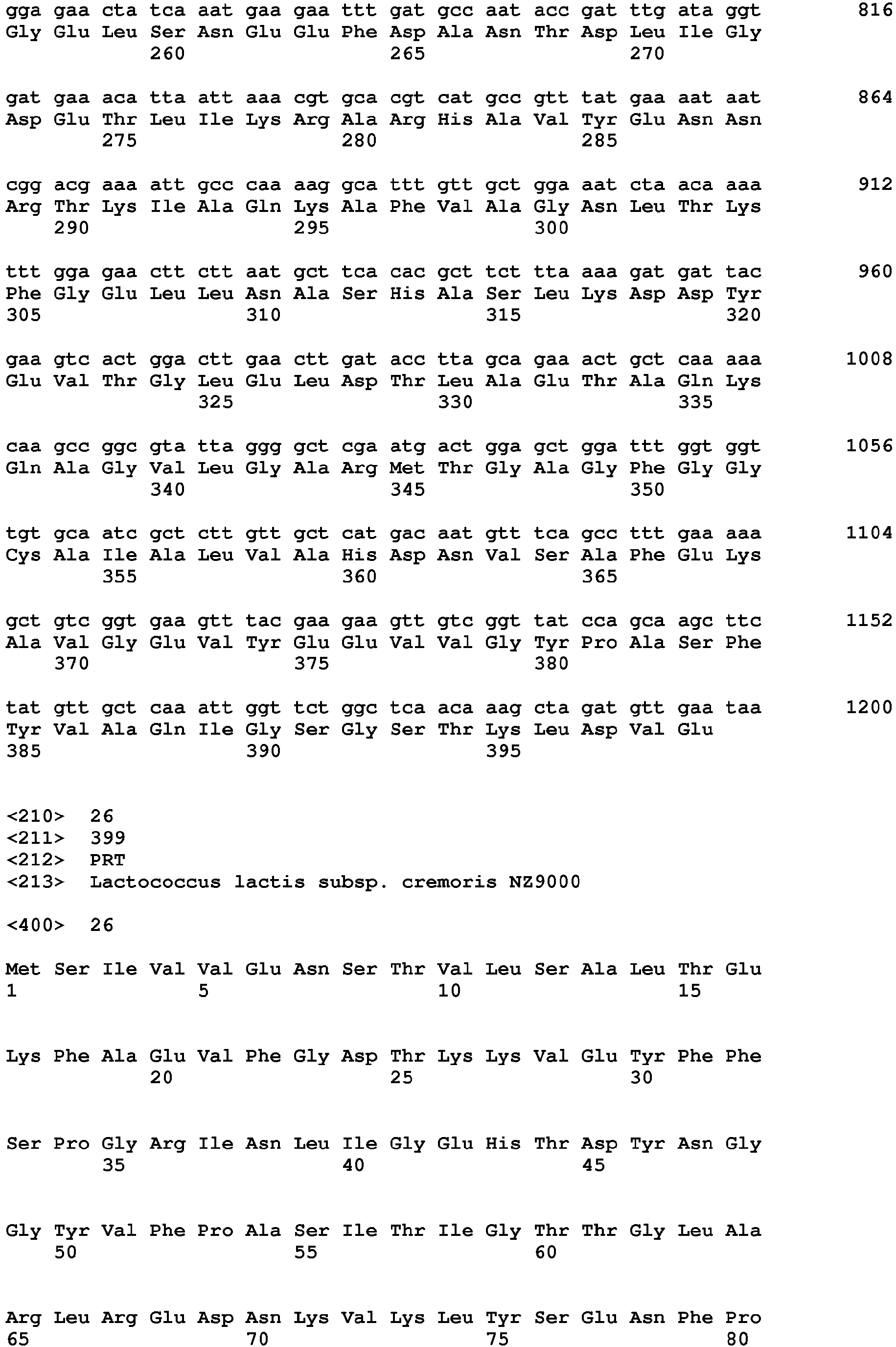
  • the bacterium of the invention may express a polypeptide having galactose mutarotase activity (E.C. 5.1.3.3) that converts beta-D-galactose to alpha-D-galactose, wherein the amino acid sequence of the polypeptide has at least 70, 72, 74, 76, 78, 80, 82, 84, 86, 88, 90, 92, 94, 96, 98, 99 or 100% sequence identity to the amino acid sequence of the galactose mutarotase encoded by the Lactococcus lactic subsp. cremoris NZ9000 galM gene (SEQ ID NO: 20).
  • the amino acid sequence of the polypeptide having galactose mutarotase activity (E.C. 5.1.3.3), has at least 70, 72, 74, 76, 78, 80, 82, 84, 86, 88, 90, 92, 94, 96, 98, 99 or 100% sequence identity to an amino acid sequence selected from among SEQ ID NO: 22 (derived from Lactococcus lactic subsp. lactis) and SEQ ID NO: 24 (derived from Lactococcus lactis subsp. cremoris strain JM1).
  • SEQ ID NO: 22 derived from Lactococcus lactic subsp. lactis
  • SEQ ID NO: 24 derived from Lactococcus lactis subsp. cremoris strain JM1
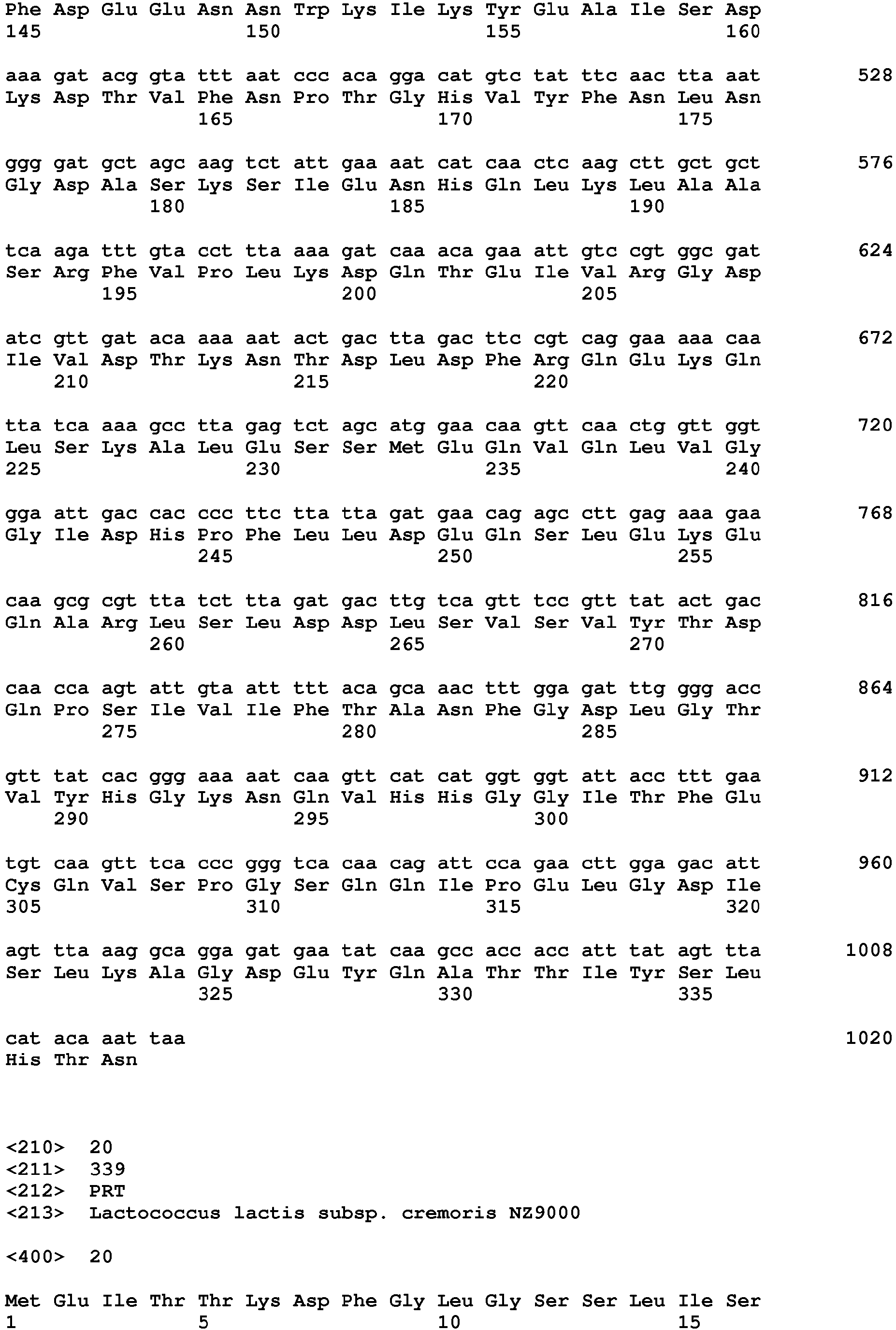
  • the bacterium of the invention may express a polypeptide having galactokinase activity (E.C. 2.7.1.6) that phosphorylates alpha-D-galactose to galactose-1-phosphase, wherein the amino acid sequence of the polypeptide has at least 70, 72, 74, 76, 78, 80, 82, 84, 86, 88, 90, 92, 94, 96, 98, 99 or 100% sequence identity to the amino acid sequence of the galactokinase encoded by the Lactococcus lactis subsp. cremoris NZ9000 galK gene (SEQ ID NO: 26).
  • the amino acid sequence of the polypeptide having galactokinase activity (E.C. 2.7.1.6), has at least 70, 72, 74, 76, 78, 80, 82, 84, 86, 88, 90, 92, 94, 96, 98, 99 or 100% sequence identity to an amino acid sequence selected from among SEQ ID NO: 28 (derived from Lactococcus lactis subsp. lactis) and SEQ ID NO: 30 (derived from Lactococcus garvieae).
  • the bacterium of the invention may express a polypeptide having galactose-1-phosphate uridylyltransferase activity (E.C. 2.7.7.10) that converts galactose-1-phosphate to glucose-1-phosphate, wherein the amino acid sequence of the polypeptide has at least 70, 72, 74, 76, 78, 80, 82, 84, 86, 88, 90, 92, 94, 96, 98, 99 or 100% sequence identity to the amino acid sequence of the galactose-1-phosphate uridylyltransferase encoded by the Lactococcus lactis subsp.
  • E.C. 2.7.7.10 galactose-1-phosphate uridylyltransferase activity
  • cremoris NZ9000 galt gene (SEQ ID NO: 32).
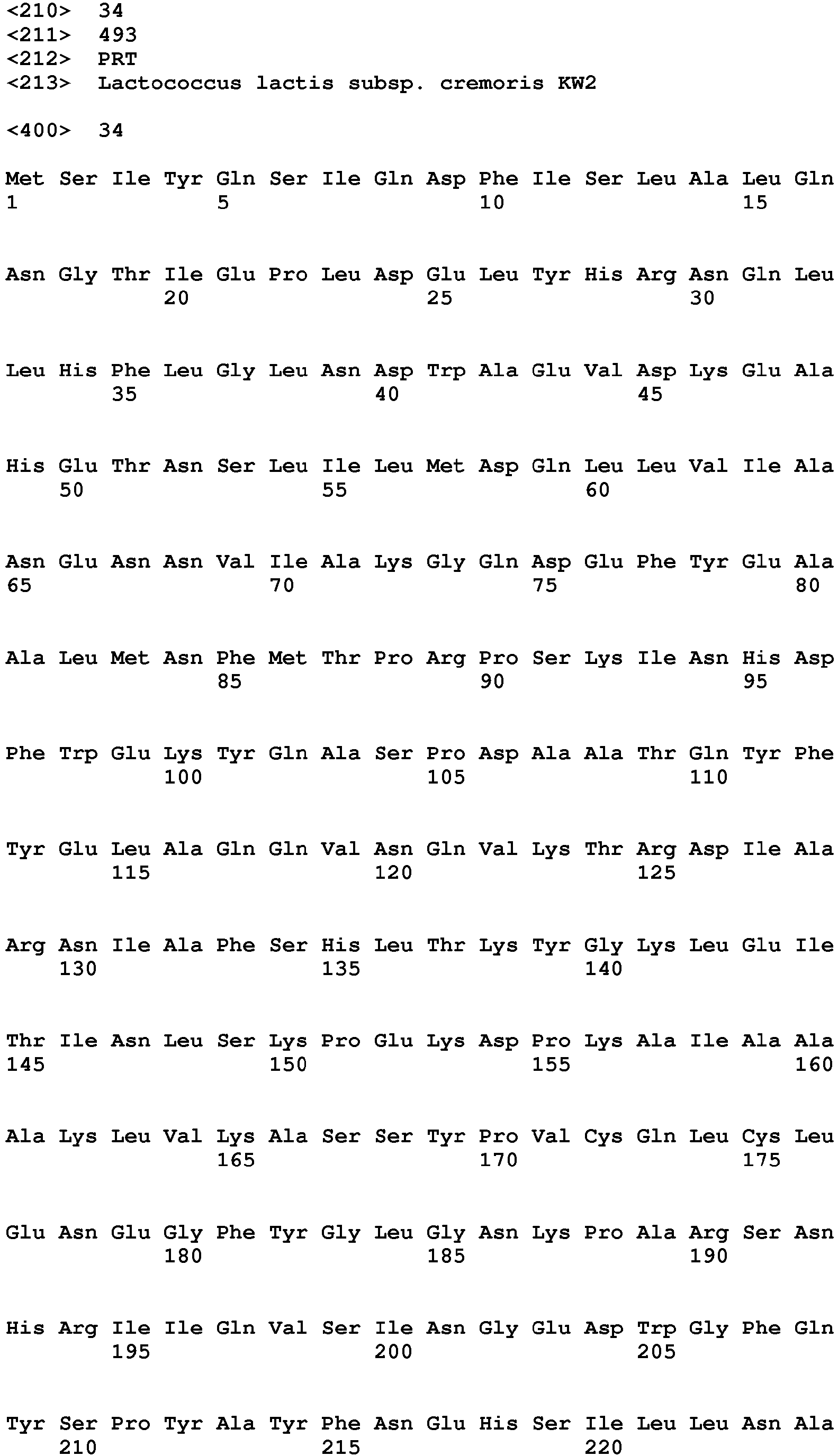
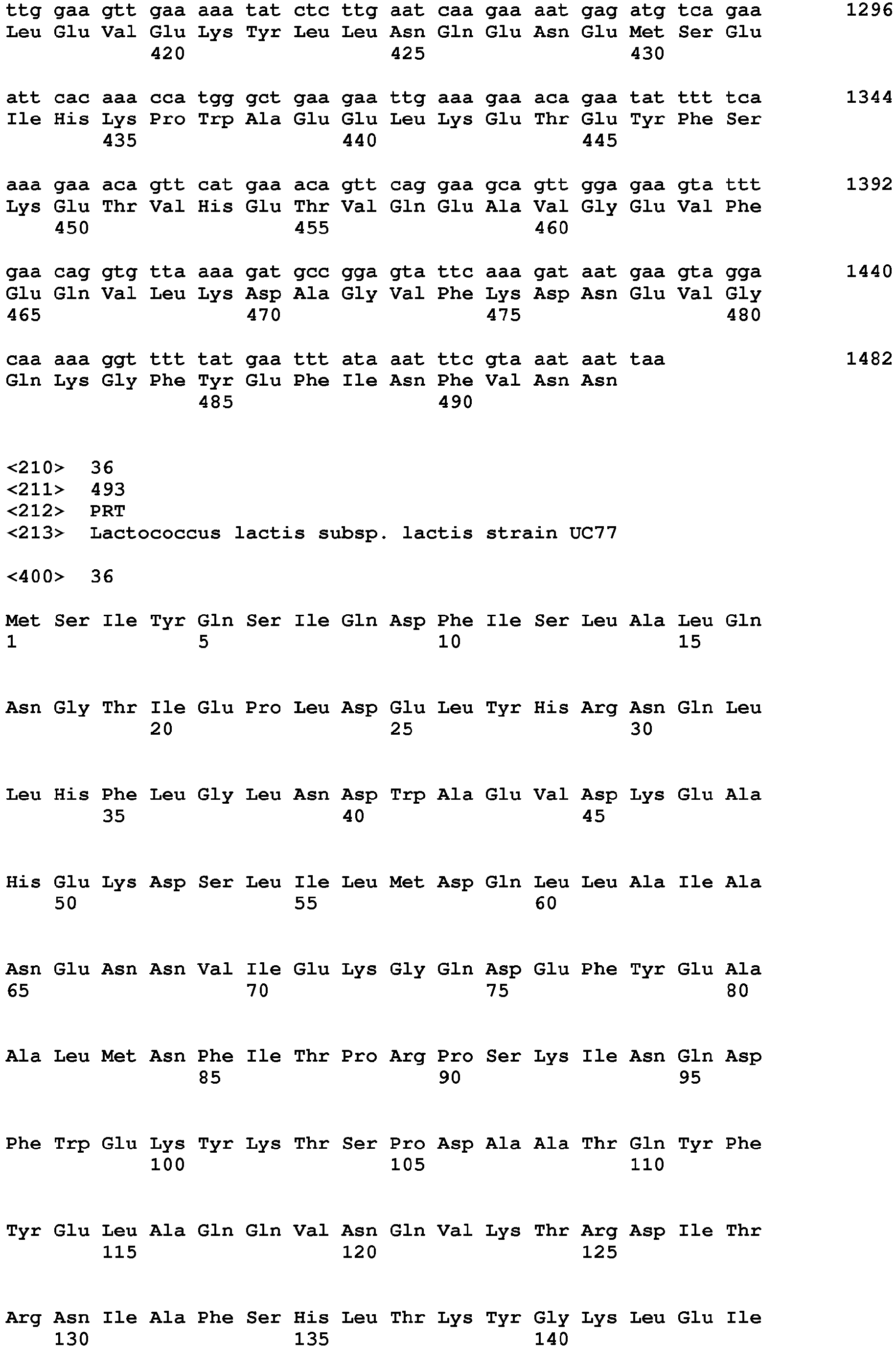
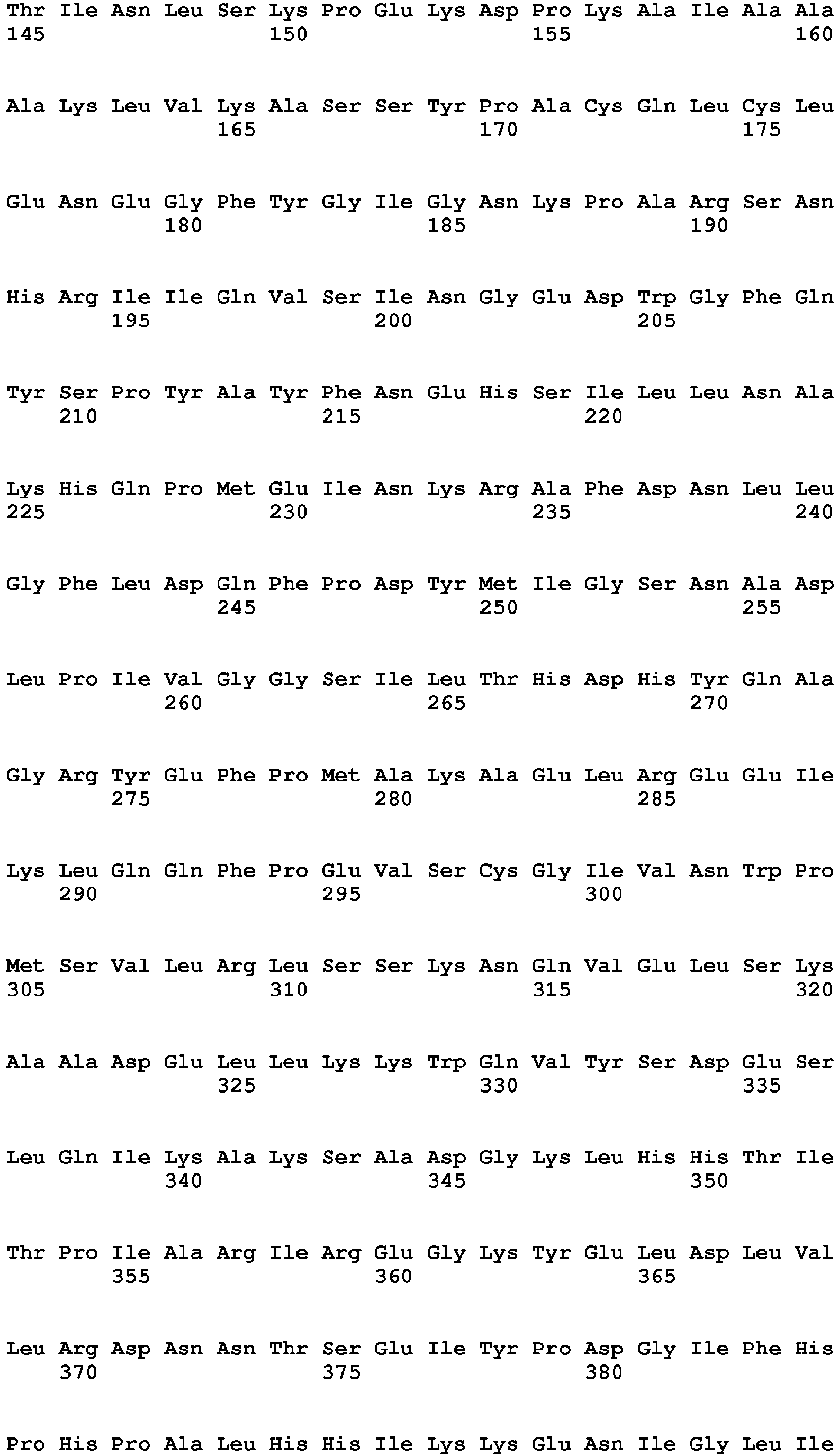
  • the polypeptide having galactose-1-phosphate uridylyltransferase activity (E.C. 2.7.7.10), has at least 70, 72, 74, 76, 78, 80, 82, 84, 86, 88, 90, 92, 94, 96, 98, 99 or 100% sequence identity to an amino acid sequence selected from among SEQ ID NO: 34 (derived from Lactococcus lactis subsp. cremoris KW2) and SEQ ID NO: 36 (derived from Lactococcus lactis subsp. lactis).
  • the bacterium of the invention may express a polypeptide having UDP-galactose-4-epimerase activity (E.C. 5.1.3.2) that converts UDP-galactose to UDP-glucose, wherein the amino acid sequence of the polypeptide has at least 70, 72, 74, 76, 78, 80, 82, 84, 86, 88, 90, 92, 94, 96, 98, 99 or 100% sequence identity to the amino acid sequence of the UDP-galactose-4-epimerase encoded by the Lactococcus lactis subsp. cremoris NZ9000 galE gene (SEQ ID NO: 38).
  • the amino acid sequence of the polypeptide having UDP-galactose-4-epimerase activity (E.C. 5.1.3.2), has at least 70, 72, 74, 76, 78, 80, 82, 84, 86, 88, 90, 92, 94, 96, 98, 99 or 100% sequence identity to an amino acid sequence selected from among SEQ ID NO: 40 (derived from Lactococcus lactis strain AI06) and SEQ ID NO: 42 (derived from Lactococcus garvieae).
  • FIG. 1 shows that genetically modifying reference Corynebacterium strain JS34 by introducing transgenes LacSZ and galMKTE as described above in embodiments of the invention, enables the modified Corynebacterium (strain JS0093) to grow on lactose.
  • strain JS0093 Further development of the strain JS0093 by adapted evolution (Example 2) yielded strain JS0093A which surprisingly grows much faster on lactose and even demonstrates growth rates on lactose comparable to growth rates of the reference Corynebacterium strain (JS34) cultured in glucose.
  • the improvement was surprisingly identified to be caused by a single amino acid substitution in the lactose transporter polypeptides (Example 3); more specifically, the improvement is caused by amino acid residue Pro148 of the lactose transporter being substituted by Leu148 as specified previously in an embodiment of the invention.
  • the bacterium of the invention may further be characterized by having transgenes for conversion of the products of lactose hydrolysis to value-added compounds, such as conversion of glucose and/or galactose to value-added products.
  • value-added compounds may be produced by making use of metabolic pathways within the bacterium, such as by overexpressing selected existing pathways or by introducing new pathways into the bacterium.
  • Such transgenes encoding polypeptides whose enzyme activities are related to existing or introduced metabolic pathways within the cell may facilitate conversion of the lactose hydrolysis products to value-added products such as amino acids, alcohols, proteins, etc.
  • value-added compounds may be produced by introducing transgenes encoding peptides associated with enzymatic action unrelated to cellular metabolism, such as conversion of glucose and galactose to other value-added compounds such as other sugars, including but not limited to fructose and tagatose.
  • the bacterium of the invention expresses one or more polypeptides having xylose/glucose isomerase activity (E.C. 5.3.1.5) for conversion of D-glucose to D-fructose and/or one or more polypeptides having arabinose isomerase activity (E.C. 5.3.1.4) for conversion of D-galactose to D-tagatose.
  • the bacterium of the invention may express a polypeptide having xylose/glucose isomerase activity (E.C. 5.3.1.5) that converts D-glucose to D-fructose, wherein the amino acid sequence of the polypeptide has at least 70, 72, 74, 76, 78, 80, 82, 84, 86, 88, 90, 92, 94, 96, 98, 99 or 100% sequence identity to the amino acid sequence of the xylose isomerase encoded by the Arthrobacter sp XylA gene (SEQ ID NO: 44).
  • the polypeptide having xylose isomerase activity (E.C. 5.3.1.5) has an amino acid sequence selected from among SEQ ID NO: 46 (derived from Arthrobacter Sp. N.R.R.L. B3728) and SEQ ID NO: 48 (derived from Arthrobacter sp. ZXY-2).
  • the bacterium of the invention may express a polypeptide having xylose/glucose isomerase activity (E.C. 5.3.1.5) that converts D-glucose to D-fructose, such as a polypeptide selected from the group consisting of D-glucose-6-phosphate-ketol-isomase, D-glucose ketol-isomerase, and glucose isomerase.
  • a polypeptide having xylose/glucose isomerase activity E.C. 5.3.1.5
  • a polypeptide selected from the group consisting of D-glucose-6-phosphate-ketol-isomase, D-glucose ketol-isomerase, and glucose isomerase such as a polypeptide selected from the group consisting of D-glucose-6-phosphate-ketol-isomase, D-glucose ketol-isomerase, and glucose isomerase.
  • the bacterium of the invention may express a polypeptide having arabinose isomerase activity (E.C. 5.3.1.4) that converts D-galactose to D-tagatose.
  • the amino acid sequence of the polypeptide has at least 70, 72, 74, 76, 78, 80, 82, 84, 86, 88, 90, 92, 94, 96, 98, 99 or 100% sequence identity to the amino acid sequence of the codon optimized arabinose isomerase originating from Bacillus coagulans (SEQ ID NO: 50).
  • the bacterium may be characterized by having a sugar metabolism that is turned off under oxygen deprived or anaerobic conditions; this is facilitated by deletion of one or more genes encoding enzymes of the lactate pathway.
  • the bacterium of the invention is characterized by knockouts of one or more endogenous native genes encoding a polypeptide having lactate dehydrogenase activity causing a block in the lactate synthesis pathway in the bacterium.
  • Deletion of at least one gene encoding a lactate dehydrogenase enzyme (E.C 1.1.1.27) provides a bacterium of the invention that is depleted in lactate production.
  • the deleted endogenous gene is one encoding a polypeptide having lactate dehydrogenase activity in the respective species of Corynebacterium.
  • the amino acid sequence of the polypeptide having lactate dehydrogenase activity (E.C 1.1.1.27) has at least 70, 72, 74, 76, 78, 80, 82, 84, 86, 88, 90, 92, 94, 96, 98, 99 or 100% amino acid sequence identity to a sequence selected from among: SEQ ID NO: 14 in Corynebacterium glutamicum, SEQ ID NO: 16 in Corynebacerium callunae, and SEQ ID NO: 18 in Corynebacterium kutscheri.
  • an endogenous gene encoding a polypeptide having lactate dehydrogenase enzymatic activity (E.C 1.1.1.27), is deleted from the bacterium of the invention.
  • the deleted lactate dehydrogenase gene encodes a polypeptide whose sequence has at least 70, 72, 74, 76, 78, 80, 82, 84, 86, 88, 90, 92, 94, 96, 98, 99 or 100% amino acid sequence identity to SEQ ID NO: 14.
  • the deleted lactate dehydrogenase gene encodes a polypeptide whose sequence has at least 70, 72, 74, 76, 78, 80, 82, 84, 86, 88, 90, 92, 94, 96, 98, 99 or 100% amino acid sequence identity to SEQ ID NO: 16.
  • the deleted lactate dehydrogenase gene encodes a polypeptide whose sequence has at least 70, 72, 74, 76, 78, 80, 82, 84, 86, 88, 90, 92, 94, 96, 98, 99 or 100% amino acid sequence identity to SEQ ID NO: 18.
  • Example 4 Deletion of an endogenous gene encoding a polypeptide having lactate dehydrogenase (ldh) enzymatic activity as provided in one embodiment of the invention is demonstrated in Example 4.
  • the advantageous effect of deleting the ldh gene is reported in Table 1, showing complete elimination of lactate formation and an increase in sugar recovery rate as compared to a strain comprising the native ldh gene.
  • the genetically modified bacterium according to the invention capable of hydrolyzing lactose, is a member of the genus Corynebacterium.
  • the bacterium of the invention may for example be a Corynebacterium species selected from the group consisting of C. accolens, C. afermentans, C. ammoniagenes, C. amycolatum, C. argentoratense, C. aquaticum, C. auris, C. bovis, C. diphtheria, C. equi (now Rhodococcus equi), C. efficiens, C. flavescens, C. glucuronolyticum, C. glutamicum, C. granulosum, C.
  • the bacterium of the invention is selected from the group consisting of Corynebacterium glutamicum, Corynebacterium acetoacidophilum, Corynebacterium callunae, and Corynebacterium ammoniagenes.
  • the bacterium of the invention is Corynebacterium glutamicum.
  • RNA heterologous DNA
  • a nucleic acid molecule that encodes one or more polypeptide(s) associated with lactose hydrolysis, galactose metabolism, and/or conversion of lactose sugars to value added compounds according to the invention, can be introduced into a cell or cells and optionally integrated into the host cell genome using methods and techniques that are standard in the art.
  • nucleic acid molecules can be introduced by standard protocols such as transformation including chemical transformation and electroporation, transduction, particle bombardment, etc.
  • one or more of the genes encoding one or more polypeptide associated with the invention is expressed in a recombinant expression vector.
  • a "vector" may be any of a number of nucleic acids into which a desired sequence or sequences may be inserted by restriction and ligation for transport between different genetic environments or for expression in a host cell.
  • Vectors are typically composed of DNA, although RNA vectors are also available.
  • Vectors include, but are not limited to: plasmids, fosmids, phagemids, virus genomes and artificial chromosomes.
  • a suitable vector includes one which is able to replicate autonomously (self-replicating vector) or is integrated (integration vector) in the genome in a host cell, and which is further characterized by one or more endonuclease restriction sites at which the vector may be cut in a determinable fashion and into which a desired DNA sequence may be ligated such that the new recombinant vector retains its ability to replicate in the host cell.
  • replication of the desired sequence may occur many times as the plasmid increases in copy number within the host cell such as a host bacterium; or may occur just a single time per host before the host reproduces by mitosis.
  • replication may occur actively during a lytic phase or passively during a lysogenic phase.
  • Vectors and other tools suitable for cloning and introducing one or more gene(s) encoding one or more a polypeptide(s) associated with lactose hydrolysis, galactose metabolism, and/or conversion of lactose sugars to value added compounds by a Corynebacterium according to the invention are commercially available and known to those skilled in the art [e.g., Sambrook et al., 1989].
  • regulatory sequences needed for gene expression may vary between species or cell types, but shall in general include, as necessary, 5' non-transcribed and 5' non-translated sequences involved with the initiation of transcription and translation respectively, such as a TATA box, capping sequence, CAAT sequence, and the like.
  • 5' non-transcribed regulatory sequences will include a promoter region which includes a promoter sequence for transcriptional control of the operably joined gene.
  • Expression of the nucleic acid molecule(s) encoding the polypeptide(s) of the claimed invention may be inducible, such as promoters controlled by the presence or absence of a molecule, or constitutive i.e. the promoter is unregulated allowing for continual transcription of its associated gene.
  • the promoter can be a native promoter, i.e., the promoter of the gene in its endogenous context, which provides normal regulation of expression of the gene. In some embodiments the promoter can be constitutive. Regulatory sequences may also include enhancer sequences or upstream activator sequences as desired.
  • the vectors of the invention may optionally include 5' leader or signal sequences. The choice and design of an appropriate expression system is within the ability and discretion of one of ordinary skill in the art.
  • Genetic tools developed for metabolic optimization of Corynebacterium may preferably be applied, such as the synthetic promoter libraries by [Rytter et al 2014] where the interspace nucleotides between the -10 and -35 regions of the promoters are randomized, providing the ability to modulate gene expression; and further the repetitive chromosomal integration system by [Shen et al 2017], facilitated by a vector containing a synthetic cassette including a phage attachment site attP for integration, a bacterial attachment site attB for subsequent integration, a MCS, and two modified loxP sites to facilitate easy removal of undesired vector elements.
  • the vector can easily integrate into the attB site by the corresponding integrase.
  • the phase integrase, as well as Cre recombinase for promoting recombination between the loxP sites, may be expressed by non-replicating circular expression units.
  • Deletion of endogenous genes in a host Corynebacterium can be achieved by a variety of methods; for example by transformation of the host cell with linear DNA fragments containing a locus for resistance to an antibiotic, or any other gene allowing for rapid phenotypic selection, flanked by sequences homologous to closely spaced regions on the cell chromosome on either side of the gene to be deleted.
  • a chromosome disruption can be selected for which has effectively deleted an entire gene.
  • the genetically modified Corynebacterium of the invention will hydrolyze lactose to glucose and galactose when supplied with a suitable source of lactose.
  • suitable lactose sources may comprise milk, butter, cheese, yoghurt, whey, whey permeate, residual whey permeate, and whey mother liquor.
  • the genetically modified Corynebacterium capable of hydrolyzing lactose may according to one embodiment of the invention be further genetically modified to produce other value-added compounds from the lactose hydrolysis products.
  • Glucose and galactose may be converted to other value-added compounds, such as (1) mediated by the native metabolic apparatus of the genetically modified Corynebacterium, where the sugars are consumed and converted into value-added products such as amino acids, alcohols, proteins, or (2) by enzymatic action unrelated to cellular metabolism, such as by means of one or more transgene(s) expressed by the genetically engineered Corynebacterium of the invention, that encode one or more polypeptide(s) having enzymatic activity associated with conversion of glucose and galactose to other value-added compounds such as other sugars, including but not limited to fructose and tagatose.
  • the genetically modified Corynebacterium of the invention is cultured under conditions favorable for growth of the Corynebacterium as one of ordinary skill in the art would recognize; growth, hydrolysis of lactose, and optionally production of value-added compounds will occur concurrently.
  • the genetically modified Corynebacterium of the invention is first cultured under conditions favorable for growth of the Corynebacterium as one of ordinary skill in the art would recognize; then when a desired amount of cell biomass is reached, the culture conditions are changed to limit cell metabolism and favour hydrolysis and (optionally) conversion of the resulting sugars to value-added compounds, as further described below.
  • the Corynebacterium of the invention is first cultured at a mesophilic temperature to obtain an increase in cell biomass, such as at a temperature between 20-37 degree Celsius, between 25-35 degree Celsius, between 28-35 degree Celsius; or such as preferably at 30 degree Celsius, providing optimal growth conditions for the Corynebacterium ( Figure 1(A) ).
  • the temperature is then increased to favor enzyme activity of the beta-galactosidase polypeptide encoded by the transgene expressed by the genetically engineered Corynebacterium of the invention ( Figure 1(C) ).
  • the initial mesophilic culturing temperature is chosen as one of ordinary skill in the art would recognize to favor growth of the Corynebacterium.
  • the temperature may then be increased to a preferred temperature of the heterologous expressed beta-galactosidase enzyme, such as increased to 40, 42, 45, 48, 50, 52, 55, 58, 60°C or even higher if thermostable enzymes are used. Hydrolysis and optionally sugar conversion is allowed to proceed during incubation at the chosen temperature for a selected time period, whereafter the value-added products may be purified.
  • a preferred temperature of the heterologous expressed beta-galactosidase enzyme such as increased to 40, 42, 45, 48, 50, 52, 55, 58, 60°C or even higher if thermostable enzymes are used.
  • Hydrolysis and optionally sugar conversion is allowed to proceed during incubation at the chosen temperature for a selected time period, whereafter the value-added products may be purified.
  • a method for hydrolyzing lactose comprises the steps of (a) bringing a genetically modified Corynebacterium of the invention into contact with a lactose-containing medium, (b) incubating the culture of step (a) under aerobic conditions at temperature 20-37 degree Celsius, (c) increasing temperature of the culture of step (b) to 50 degree Celsius or higher to reach optimum temperature for said beta-galactosidase enzyme, and (d) optionally purifying products of lactose hydrolysis from the culture of step (c), said products comprising any one of glucose, galactose, fructose, tagatose or a combination of any two or more.
  • the genetically modified Corynebacterium of the invention which is deleted for endogenous genes essential for the lactate pathway, is first cultured under aerobic conditions to obtain an increase in cell biomass. At a chosen time, culture conditions are then changed to anaerobic or oxygen-deprived conditions whereby no more of the sugar products (glucose and/or galactose) will be metabolized by the Coynebacterium ( Figure 1(B) ), instead favoring continued hydrolysis of lactose and optionally the conversion of the sugars to value-added products by the enzymatic activities of the polypeptide(s) encoded by the transgene(s) expressed by the genetically engineered Corynebacterium of the invention. Hydrolysis and optionally sugar conversion is allowed to proceed during incubation for a selected time period, whereafter the value-added products may be purified.
  • a method for hydrolyzing lactose comprises the steps of (a) bringing a genetically modified Corynebacterium of the invention into contact with a lactose-containing medium, specifically a bacterium lacking genes essential for the lactate pathway, such as lacking genes encoding polypeptides having an enzymatic activity of lactate dehydrogenase (E.C.
  • step (b) incubating the culture of step (a) under aerobic conditions, (c) shifting culture conditions to incubate the culture obtained in (b) under oxygen-deprived culture conditions, and (d) optionally purifying products of lactose hydrolysis from the culture of step (c), said products comprising any one of glucose, galactose, fructose, tagatose or a combination of any two or more.
  • the two methods for hydrolysing lactose may be combined, such that the method for hydrolyzing lactose comprises the steps of (a) bringing a genetically modified Corynebacterium of the invention into contact with a lactose-containing medium, specifically a bacterium lacking genes essential for the lactate pathway, such as lacking genes encoding polypeptides having an enzymatic activity of lactate dehydrogenase (E.C.
  • step (b) incubating the culture of step (a) under aerobic conditions at temperature 20-37 degree Celsius, (c) increasing the temperature to 50 degree Celsius or higher to reach optimum temperature for said beta-galactosidase enzyme and shifting culture conditions to incubate the culture obtained in (b) under oxygen-deprived culture conditions, and (d) optionally purifying products of lactose hydrolysis from the culture of step (c), said products comprising any one of glucose, galactose, fructose, tagatose or a combination of any two or more.
  • Methods for detecting and quantifying sugars produced by a Corynebacterium of the invention include high performance liquid chromatography (HPLC) combined with refractive index detection to identify and quantify the product compared to standards, as one of ordinary skill in the art would be familiar with.
  • HPLC high performance liquid chromatography
  • Example 4 comprises the outline of one method of detection and quantification of sugars.
  • the invention provides a mutant gene encoding a modified lactose transporter, wherein the amino acid sequence of said lactose transporter has at least 80% sequence identity to SEQ ID No. 2 (derived from Streptococcus thermophilus) wherein amino acid residue Pro148 is substituted by any amino acid other than proline, such as preferably substituted by a non-polar amino acid, such as preferably substituted by an amino acid selected from the group consisting of glycine, alanine, valine, cysteine, leucine, isoleucine, and methionine, such as preferably substituted by an amino acid selected from the group consisting of glycine, alanine, valine, leucine, and isoleucine, such as most preferably substituted by leucine.
  • SEQ ID No. 2 derived from Streptococcus thermophilus
  • the invention provides a mutant gene encoding a modified lactose transporter, wherein the amino acid sequence of said lactose transporter has at least 82, 84, 86, 88, 90, 92, 94, 96, 98, 99 or 100% sequence identity to the amino acid sequence of the lactose transporter encoded by the Streptococcus thermophilus LacS gene (SEQ ID NO: 2) wherein amino acid residue Pro148 is substituted by any amino acid other than proline, such as preferably substituted by a non-polar amino acid, such as preferably substituted by an amino acid selected from the group consisting of glycine, alanine, valine, cysteine, leucine, isoleucine, and methionine, such as preferably substituted by an amino acid selected from the group consisting of glycine, alanine, valine, leucine, and isoleucine, such as most preferably substituted by leucine.
  • SEQ ID NO: 2 Streptococc
  • amino acid sequence encoding a modified lactose transporter of the invention has at least 80% sequence identity to SEQ ID No: 2 (derived from Streptococcus thermophilus) wherein amino acid residue Pro148 is substituted by Leu148.
  • Example 1 Genetic modification of a Corynebacterium glutamicum strain to enable efficient growth on lactose
  • the genetic modifications required to produce a C. glutamicum strain capable of growing on lactose include introduction of transgenes for (i) lactose uptake as well as (ii) lactose hydrolysis to glucose and galactose. Further, introduction of transgenes for (iii) galactose utilization enables the strain to utilize both sugars derived from lactose hydrolysis.
  • transgenes were inserted on the chromosome of C. glutamicum via a site-specific integration as described below.
  • the wild-type Corynebacterium glutamicum strain ATCC 13032 modified by insertion of a bacterial attachment site attB for subsequent site-integration in its chromosome was used as parent strain for the genetic construction of a strain capable of growing on lactose. This strain is referred to as strain JS34 [Shen et al., 2017].
  • E. coli strain TOP10 was used for the cloning purposes.
  • Plasmid pJS31 [Shen et al., 2017] containing a cassette for repetitive integration into the chromosome of Corynebacterium glutamicum JS34 (or other strains carrying the aatB site) was used for integration of transgenes.
  • AatP and attB sites in the cassette enable phage TP901-1 integrase-mediated integration, while loxP sites on each end of the cassette guides Cre-recombinase-facilitated recombination.
  • the cassette further comprises a MCS, an origin of replication, and a kanamycin resistance gene as well as a gene conferring sucrose sensitivity, which both can be used for counter selection.
  • LacSZ a lacS gene (SEQ ID NO: 1, encoding lactose transporter) and a lacZ gene (SEQ ID NO: 7, encoding beta-galactosidase) both from Streptococcus thermophilus
  • SEQ ID NO: 7 encoding beta-galactosidase
  • the amplicons comprised a library, where the target genes were fused to synthetic promoters with different activities [Rytter et al., 2014].
  • the library was cloned into the Xbal site of the vector pJS31 [Shen et al., 2017], and first transformed into E. coli TOP10.
  • the E. coli cells were propagated on the LB agar with 50 ⁇ g/mL kanamycin. The colonies on the agar plates were washed in 0.9% saline solution, and the plasmid library was recovered using GeneJET Plasmid Kit (Thermo Fisher Scientific).
  • the DNA sequence of the TP901-1 integrase was PCR amplified and cyclized using T4-ligase.
  • the library was co-transformed into the C. glutamicum strain JS34 with the cyclized TP901-1 integrase sequence.
  • the lacSZ library was integrated into the att B site on the chromosome of C. glutamicum upon the expression of the TP901-1 integrase [Shen et al., 2017].
  • the lactose-utilizing transformants were screened on the CGXII agar [Eggeling & Bott, 2005] containing 1% lactose. Afterwards, the marker genes on the chromosome were excised when the Cre recombinase was expressed in C. glutamicum [Shen et al., 2017].
  • the expression library comprised a galM gene (SEQ ID NO: 19, encoding galactose mutarotase), a galK gene (SEQ ID NO: 25, encoding galactokinase), a galt gene (SEQ ID NO: 31, encoding galacose-1-phosphate uridylyltransferase), and a galE gene (SEQ ID NO: 37, encoding UDP-glucose 4-epimerase) all from Lactococcus lactis.
  • a galM gene SEQ ID NO: 19, encoding galactose mutarotase
  • a galK gene SEQ ID NO: 25, encoding galactokinase
  • a galt gene SEQ ID NO: 31, encoding galacose-1-phosphate uridylyltransferase
  • a galE gene SEQ ID NO: 37, encoding UDP-glucose 4-epimerase
  • strain JS0093 The C. glutamicum strain comprising transgenes LacSZ and galMKTE is referred to as strain JS0093 .
  • Adapted evolution of C. glutamicum strain JS0093 was conducted using a serial-transfer regime. More specifically, a single colony of strain JS0093 from BHI agar (Sigma) was inoculated into a test tube containing 5 ml CGXII medium [Eggeling & Bott, 2005] with 2% lactose. The tube was incubated in a rotary shaking machine (220 rpm) at 30°C. When the culture entered the stationary phase, it was diluted 100 times in 5 mL fresh medium, and cultivated under same conditions. The passage was repeated 15 times. When the evolution was ceased after 15-time passages, cultures were plated on the BHI agar. Five colonies were randomly picked and their growth on CGXII with 2% lactose was tested using a microbioreactor (Biolector), and compared to the parent strain JS0093. The strain with the highest growth rate was chosen for further development.
  • Biolector microbioreactor
  • strain JS0093A was compared to strain JS0093 and reference strain JS34 .
  • strain JS0093 when cultured in glucose ( Figure 2 , triangle) and galactose ( Figure 2 , diamond), respectively, is only slightly reduced compared to the reference strain JS34 cultured in glucose ( Figure 2 , square). Meanwhile, when strain JS0093 is cultured in lactose ( Figure 2 , asterisk), a large reduction of the growth rate compared to the reference strain JS34 is observed. Similar growth profiles were observed by Barrett et al. 2004 when lactose permease and beta-galactosidase were expressed in C. glutamicum, which indicates that either lactose transport or hydrolysis could be the bottleneck for C. glutamicum growing on lactose.
  • Genomic DNA was purified from the mutant using a DNeasy blood and tissue kit (Qiagen, Hilden, Germany), and the quality was assessed using DNA electrophoresis and a NanoDrop 1000 spectrophotometer (Thermo Fisher Scientific, Waltham, MA, USA). Genome sequencing was performed by Macrogen (Seoul, South Korea). Briefly, 2 ⁇ g of genomic DNA was randomly sheared using a nebulizer (Illumina, San Diego, CA, USA), and the ends were repaired using polynucleotide kinase (Illumina) and Klenow enzyme (Illumina).
  • the 5' ends of the DNA fragments were phosphorylated, and a single adenine base was added to the 3' ends using Klenow exo+ (Illumina). Following the ligation of a pair of Illumina adaptors to the repaired ends, the DNA was amplified in 10 cycles using adaptor primers (Illumina), and fragments of approximately 150 bp were isolated using agarose gel electrophoresis. Sequencing libraries were quantified with a 2100 BioAnalyzer DNA 1000 chip (Agilent, Santa Clara, CA, USA), as well as the PicoGreen fluorescence assay (Invitrogen, Carlsbad, CA, USA). Clusters were generated on an Illumina cluster station (Illumina) using 11 pmol of sequencing libraries.
  • mutant JS0093A Only one mutation was identified in the mutant JS0093A .
  • the mutation was a single nucleotide variation (SNV), and found in the lactose transport gene LacS (C to T in position 443 of the gene), resulting in a change of the deduced amino acid sequence (Pro to Leu in position 148).
  • SNV single nucleotide variation
  • LacS* The mutated lactose transporter LacS gene (C to T in position 443 of the gene; Pro to Leu in position 148 of the corresponding amino acid sequence) identified in strain JS0093A will be referred to as LacS*
  • the ldh gene (SEQ ID NO: 13, encoding lactate dehydrogenase) was deleted based on the method of homologous recombination [Schäfer et al 1994].
  • the 800-bp upstream and downstream fragments of the ldh gene were assembled and inserted into the XbaI site of the vector pK18-mobsacB [Schäfer et al 1994].
  • the construct was transformed into C . glutamicum.
  • the construct was integrated into the chromosome through either of the 800-bp homologous arms, and the mutants were selected on the BHI agar supplied with 25 ⁇ g/ml kanamycin. Afterwards, the counter selection for the mutants was performed on the BHI agar supplied with 10% sucrose.
  • the ldh-deleted mutant was verified by PCR and Sanger sequencing.
  • MOPS 3-(N-morpholino) propanesulfonic acid
  • the concentrations of sugars (carbohydrate monomers and dimers) and lactate were determined using an Ultimate 3000 high-pressure liquid chromatography system (Dionex, Sunnyvale, CA) equipped with an Aminex HPX-87H column (Bio-Rad, Hercules, CA) and a Shodex RI-101 detector (Showa Denko KK, Tokyo, Japan).
  • the column oven temperature was set to 30°C, and the mobile phase consisted of 5mM H2SO4 with a flowrate of 0.5 ml/min.
  • Lactate was found to be a major by-product of lactose hydrolysis by the strain JS0093A comprising the native ldh gene.
  • lactate dehydrogenase was still active in C. glutamicum, 3.2 g/L lactate was produced after a 24-hour lactose hydrolysis at 50°C (Table 1).
  • Deletion of the ldh gene resulted in a complete elimination of lactate formation, and the sugar recovery rate was raised to 97.2% in strain JS0093A ⁇ ldh compared to the strain JS0093A comprising the native ldh (94.7%).
  • Example 5 Genetic modification of a Corynebacterium glutamicum strain for production of tagatose and fructose
  • Construct I, II, III Three expression plasmids: Construct I, II, III have been constructed for simultaneous hydrolysis of lactose and isomerization of glucose and galactose to fructose and tagatose, respectively.
  • the C. glutamicum - E. coli shuttle vector pEC-XC99E [Kirchner & Tauch, 2003] was used as a backbone for the constructs. Cloning was performed using Gibson assembly [Gibson et al., 2009].
  • Construct I the gene fragments of araA (SEQ ID NO: 49, encoding arabinose isomerase) and xylA (SEQ ID NO: 43, encoding xylose isomerase) were cloned into the XbaI site of pEC-XC99E.
  • Construct II two trc promotor core fragments (SEQ UD NO: 51) were first cloned into the BamHI site of pEC-XC99E, which resulted in a pEC-XC99E derivative with three trc promotors and a new BamHI site.
  • Electrocompetent cells were prepared using the protocol as previously described [Eggeling & Bott, 2005]. The constructs were electroprorated into C. glutamicum JS0093A ⁇ ldh on an electroporator with the voltage of 2.5 Kv (MicroPulser, Bio-Rad), and transformants were selected on the BHI agar with 10 ⁇ g/ml chloramphenicol.
  • the C. glutamicum strain deleted for ldh and comprising transgenes LacS*Z, galMKTE and Construct I, I or III are referred to as strains JS0093AI , JS0093AII and JS0093AIII , respectively.
  • Example 6 Production of tagatose and fructose from lactose by genetically modified Corynebacterium glutamicum
  • MOPS 3-(N-morpholino) propanesulfonic acid)
  • the lactose hydrolysis profile of C. glutamicum strains JS0093AI , JS0093AII and JS0093AIII is illustrated in Figure 4 .
  • JA0093A In the lactose-utilizing mutant, JA0093A , only one copy of the lacZ gene was integrated into the chromosome, which could potentially be the rate-limiting step of the cascade reaction. Therefore, an additional lacZ gene was introduced on the expressing vector (Construct III) to expedite the lactose hydrolysis. Lactose hydrolysis is significantly improved in strain JS0093AIII comprising the extra lacZ gene. This is further confirmed when calculating the maximum lactose hydrolysis rates of C. glutamicum strains JS0093AI , JS0093AII and JS0093AIII , arriving at 6.0, 6.1 and 15.7 g/L/h, respectively, as presented in Figure 5 .
  • lactose is first hydrolyzed into glucose and galactose, and the two monosaccharides, glucose and galactose, are further isomerized into fructose and tagatose, respectively.
  • the maximum isomerization rates (identified using linear regression of several data points between 0 and 48 hours) for glucose to fructose and galactose to tagatose of strains JS0093AI, JS0093AII and JS0093AIII are presented in Figure 6 .
  • C. glutamicum plasmids (10 - 30 copies per chromosome) [Patek & Nesvera, 2013] limits the expression level of heterologous proteins. Expression can be enhanced by using multiple promoters [Li et al., 2012]. By introducing additional four trc promotors (construct II), the maximum production rate for fructose and tagatose were increased approximately by 40% and 80%, respectively ( Figure 6 , Construct II vs. Construct I).

Landscapes

  • Life Sciences & Earth Sciences (AREA)
  • Chemical & Material Sciences (AREA)
  • Health & Medical Sciences (AREA)
  • Engineering & Computer Science (AREA)
  • Genetics & Genomics (AREA)
  • Organic Chemistry (AREA)
  • Zoology (AREA)
  • Wood Science & Technology (AREA)
  • Bioinformatics & Cheminformatics (AREA)
  • Microbiology (AREA)
  • General Engineering & Computer Science (AREA)
  • Biotechnology (AREA)
  • Biochemistry (AREA)
  • Biomedical Technology (AREA)
  • General Health & Medical Sciences (AREA)
  • Molecular Biology (AREA)
  • Polymers & Plastics (AREA)
  • Medicinal Chemistry (AREA)
  • Food Science & Technology (AREA)
  • Physics & Mathematics (AREA)
  • Biophysics (AREA)
  • Plant Pathology (AREA)
  • Chemical Kinetics & Catalysis (AREA)
  • General Chemical & Material Sciences (AREA)
  • Micro-Organisms Or Cultivation Processes Thereof (AREA)
  • Preparation Of Compounds By Using Micro-Organisms (AREA)

Abstract

The present invention discloses a genetically modified Corynebacterium for hydrolyzing lactose, a mutant gene encoding a modified lactose transporter, as well as a method for hydrolyzing lactose.

Description

    FIELD OF THE INVENTION
  • The present invention provides a genetically modified Corynebacterium capable of hydrolyzing lactose. Further, the invention provides methods for hydrolyzing lactose and producing value-added compounds using the Corynebacterium of the invention. And even further, the invention provides a gene encoding a modified lactose transporter.
  • BACKGROUND OF THE INVENTION
  • The potential that lies in using microorganisms for converting various substrates into value-added compounds has already been recognized, and intense research is being carried out to establish robust and economically feasible processes for their production.
  • One cheap abundant substrate is cheese whey and its various processed forms, such as whey permeate or whey powder. Whey represents about 85-95% of the milk volume and retains 55% of milk nutrients; and is a liquid by-product of cheese production, obtained when draining the cheese curd. The worldwide production of cheese whey in 2012 was reported to be 4 × 10⁷ tons and about 50% hereof was used for animal feed or otherwise disposed of as waste. The latter is a serious problem as whey is discarded as liquid waste and has a high BOD (biochemical oxygen demand) and COD (chemical oxygen demand). The composition of whey varies according to the source of the milk and the technology used for its production. Normally it contains approximately 90% water, 4% lactose, 1% protein, 0.7% minerals and small amounts of vitamins. Separation of whey proteins generates whey-permeate and further extraction of lactose leads to permeate mother liquor (residual whey permeate, RWP), which comprises about 60% lactose on a dry weight basis, as a leftover product [Ling, 2008].
  • Hydrolysis of the main carbon source in whey (lactose) to glucose and galactose by the enzyme beta-galactosidase is well-known. However, industrial recombinant enzymes are costly. Meanwhile, microbial cells are cheap and easy to maintain, and may further be recycled such as by gel encapsulation. Corynebacterium glutamicum is a GRAS organism that is safe and has been used for amino acid production for decades; it has great potential as a cell factory for production of value-added compounds, due to its well-characterized metabolic network and relative ease of genetic manipulation. However, C. glutamicum is naturally unable to transport and use lactose as carbon source.
  • Accordingly, there exists a need to develop a C. glutamicum strain capable of efficiently hydrolyzing lactose, such as hydrolyzing cheap fermentation media based on nutrient-rich waste substrates like whey and whey-derived substrates.
  • SUMMARY OF THE INVENTION
  • In a first aspect, the present invention provides a genetically modified Corynebacterium for hydrolyzing lactose, wherein said modified Corynebacterium comprises transgenes encoding polypeptides, wherein said polypeptides include
    1. i) a modified lactose transporter, wherein the amino acid sequence of said modified lactose transporter has at least 80% sequence identity to SEQ ID NO: 2 wherein amino acid residue Pro148 is substituted by an amino acid selected from the group consisting of glycine, alanine, valine, cysteine, leucine, isoleucine, and methionine; and
    2. ii) a polypeptide having beta-galactosidase activity (E.C. 3.2.1.23).
  • A second aspect of the invention provides a mutant gene encoding a modified lactose transporter wherein the amino acid sequence of said lactose transporter has at least 80% sequence identity to SEQ ID No: 2 wherein amino acid residue Pro148 is substituted by an amino acid selected from the group consisting of glycine, alanine, valine, cysteine, leucine, isoleucine, and methionine.
  • A third aspect of the invention provides a method for hydrolyzing lactose. In one embodiment, the hydrolysis of lactose is performed at elevated temperatures, the method comprising the steps of
    1. a. bringing a genetically modified Corynebacterium into contact with a lactose-containing medium, wherein said modified Corynebacterium comprises transgenes encoding polypeptides, wherein said polypeptides comprise
      1. i. a lactose transporter and
      2. ii. a polypeptide having beta-galactosidase activity (E.C. 3.2.1.23),
    2. b. incubating the culture of step (a) under aerobic conditions at a temperature between 20-37 degree Celsius,
    3. c. increasing the temperature of the culture of step (b) to 50 degree Celsius or higher to reach an optimum temperature for said beta-galactosidase enzyme, and
    4. d. optionally purifying products of lactose hydrolysis from the culture of step (c).
    DESCRIPTION OF THE INVENTION Description of the figures:
    • Figure 1: illustrates growth and lactose hydrolysis by a Coynebacterium of the present invention under different culture conditions. (A) aerobic growth at 30 °C, (B) anaerobic fermentation at 30 °C, and (C) lactose hydrolysis at 60 °C.
    • Figure 2: shows the growth of the reference strain, mutant strain (expressing lacSZ and galMKTE), and adapted mutant on different carbon sources over a period of 48 hours.
    • Figure 3: shows (A) Plasmid map of construct I comprising genes encoding xylose isomerase (xylA) and arabinose isomerase (araA), (B) Plasmid map of construct II comprising genes encoding xylose isomerase (xylA) and arabinose isomerase (araA), as well as four additional promoter fragments for their expression (trc core promoter), (C) Plasmid map of construct III comprising genes encoding xylose isomerase (xylA) and arabinose isomerase (araA), as well as four additional promoter fragments for their expression (trc core promoter), and further a gene encoding beta-galactosidase (lacZ).
    • Figure 4: shows the lactose hydrolysis profile of adapted mutant strains C. glutamicum JS0093AI, JS0093AII, and JS0093AIII, comprising constructs I, II, and III, respectively, over a period of 48 hours.
    • Figure 5: shows the maximum lactose hydrolysis rates by adapted mutant strains C. glutamicum JS0093AI, JS0093AII, and JS0093AIII, comprising constructs I, II, or III, respectively.
    • Figure 6: shows the maximum isomerization rates (productivity) of glucose to fructose and galactose to tagatose by adapted mutant strains C. glutamicum JS0093AI, JS0093AII, and JS0093AIII, comprising constructs I, II, or III, respectively.
    • Figure 7: shows the simultaneous production of fructose and tagatose from whey by C. glutamicum strain JS0093AIII
    Abbreviations, terms, and definitions:
    • LacS: gene encoding a polypeptide facilitating transport of lactose (a "lactose transporter").
    • LacZ: gene encoding a polypeptide having beta-galactosidase activity (E.C. 3.2.1.23 for hydrolyzing lactose to glucose and galactose.
    • GalM: gene encoding a polypeptide having galactose mutarotase activity (E.C. 5.1.3.3) for converting beta-D-galactose to alpha-D-galactose.
    • GalK: gene encoding a polypeptide having galactokinase activity (E.C. 2.7.1.6) for converting phosphorylating alpha-D-galactose to galactose-1-phosphase.
    • GAlT: gene encoding a polypeptide having galactose-1-phosphate uridylyltransferase activity (E.C. 2.7.7.10) for converting galactose-1-phosphate to glucose-1-phosphate.
    • GalE: gene encoding a polypeptide having UDP-galactose-4-epimerase activity (E.C. 5.1.3.2) for epimerizing UDP-galactose to UDP-glucose.
  • "LacSZ" means LacS and LacZ. LacSZ should only be considered a combined terminology for LacS and LacZ; it does not refer to whether or not the genes may be linked, such as e.g. transcriptionally or translationally linked. The genes may be fused or be present individually; they may be regulated, transcribed and/or translated dependently or independently.
  • "galMKTE" means galM, galk, galt and galE. galMKTE should only be considered a combined terminology for galM, galk, galt and galE; it does not refer to whether or not the genes may be linked, such as e.g. transcriptionally or translationally linked. The genes may be fused or be present individually; they may be regulated, transcribed, and/or translated dependently or independently.
  • Amino acid sequence identity: The term "sequence identity" as used herein, indicates a quantitative measure of the degree of homology between two amino acid sequences of substantially equal length. The two sequences to be compared must be aligned to give a best possible fit, by means of the insertion of gaps or alternatively, truncation at the ends of the protein sequences. The sequence identity can be calculated as ((Nref-Ndif)100)/(Nref), wherein Ndif is the total number of non-identical residues in the two sequences when aligned and wherein Nref is the number of residues in one of the sequences. Sequence identity can alternatively be calculated by the BLAST program e.g. the BLASTP program (Pearson W.R and D.J. Lipman (1988)) (www.ncbi.nlm.nih.gov/cgi-bin/BLAST). In one embodiment of the invention, alignment is performed with the sequence alignment method ClustalW with default parameters as described by Thompson J., et al 1994, available at http://www2.ebi.ac.uk/clustalw/.
    Preferably, the numbers of substitutions, insertions, additions or deletions of one or more amino acid residues in the polypeptide as compared to its comparator polypeptide is limited, i.e. no more than 1, 2, 3, 4, 5, 6, 7, 8, 9, or 10 substitutions, no more than 1, 2, 3, 4, 5, 6, 7, 8, 9, or 10 insertions, no more than 1, 2, 3, 4, 5, 6, 7, 8, 9, or 10 additions, and no more than 1, 2, 3, 4, 5, 6, 7, 8, 9, or 10 deletions. Preferably the substitutions are conservative amino acid substitutions: limited to exchanges within members of group 1: Glycine, Alanine, Valine, Leucine, Isoleucine; group 2: Serine, Cysteine, Selenocysteine, Threonine, Methionine; group 3: Proline; group 4: Phenylalanine, Tyrosine, Tryptophan; Group 5: Aspartate, Glutamate, Asparagine, Glutamine.
  • gi number: (genInfo identifier) is a unique integer which identifies a particular sequence, independent of the database source, which is assigned by NCBI to all sequences processed into Entrez, including nucleotide sequences from DDBJ/EMBL/GenBank, protein sequences from SWISS-PROT, PIR and many others.
  • Deleted gene: the deletion of a gene from the genome of a microbial cell leads to a loss of function (knockout) of the gene and hence where the gene encodes a polypeptide the deletion results in a loss of expression of the encoded polypeptide. Where the encoded polypeptide is an enzyme, the gene deletion leads to a loss of detectable enzymatic activity of the respective polypeptide in the microbial cell. A deleted gene in the genome of a microbial cell is characterized by a loss of function due to the deletion of, or substitution of, or addition of, at least one nucleotide leading to a loss of expression of a polypeptide encoded by the gene.
  • Oxygen deprived conditions: are in the present context defined as growth conditions with such low oxygen content that cell proliferation is suppressed. The cell may consume a variety of sugars such as glucose, fructose, mannose and sucrose under oxygen deprived conditions to produce lactate, succinate and acetate while cellular proliferation remains suppressed during the bioconversion reaction.
  • Aerobic conditions: are in the present context defined as growth conditions where oxygen is present in sufficient amounts to support cell proliferation and growth of the cells.
  • Value-added compounds: are in the present context microbially synthesized compounds; they may be produced naturally by the microbes or production may be facilitated through genetic engineering of the microbes. Preferably they are produced by utilization of a low value substrate. The compounds may include (but are not limited to) organic acids, sugars, amino acids, peptides, alcohols, alkaloids, terpenoids, flavonoids, polyketides, biofuels, and other chemicals.
  • Whey and whey permeate and residual whey permeate: whey is a by-product of cheese manufacture; and comprises whey proteins having a high nutritional value and lactose. Removal of whey proteins, typically by means of ultrafiltration or diafiltration produces a whey protein concentrate and whey permeate that is lactose-rich. The lactose content of the whey permeate is dependent on the treatment conditions and typically it can reach as high as hundreds of grams per liter by reverse osmosis, such as 200 g/L. Removal of fat from whey, or from lactose-rich permeate, typically by centrifugation, yields a fat-free composition (whey or permeate). Residual whey permeate (also called permeate mother liquor) is obtained after the extraction of lactose from whey permeate (typically by lactose crystallisation); and has a lower lactose content of about 150 g/L.
  • Detailed description of the invention: I. A genetically modified Corynebacterium capable of hydrolyzing lactose
  • The present invention provides a genetically modified Corynebacterium characterized by its ability to hydrolyze lactose.
  • I i. Expression of transgenes for lactose hydrolysis
  • The bacterium of the invention is characterized by having transgenes LacSZ for lactose hydrolysis: (1) LacZ encoding a beta-galactosidase (E.C. 3.2.1.23) for hydrolysis of lactose to glucose and galactose and (2) LacS encoding a lactose transporter facilitating transport of lactose from the media into the cells.
  • The bacterium of the invention expresses a polypeptide having beta-galactosidase activity (E.C. 3.2.1.23) that converts lactose to glucose and galactose. The amino acid sequence of the polypeptide has at least 70, 72, 74, 76, 78, 80, 82, 84, 86, 88, 90, 92, 94, 96, 98, 99 or 100% sequence identity to the amino acid sequence of the beta-galactosidase encoded by the Streptococcus thermophilus LacZ gene (SEQ ID NO: 8). Alternatively, the amino acid sequence of the polypeptide having beta-galactosidase activity (E.C. 3.2.1.23), has at least 70, 72, 74, 76, 78, 80, 82, 84, 86, 88, 90, 92, 94, 96, 98, 99 or 100% sequence identity to an amino acid sequence selected from among SEQ ID NO: 10 (derived from Streptococcus infantarius CJ18) and SEQ ID NO: 12 (derived from Streptococcus salivarius CCHSS3).
  • The lacZ transgene encoding beta-galactosidase (E.C. 3.2.1.23) may be present in one or more copies on the genome, such as present in two copies on the genome, such as present in three, four, five or more copies on the genome. The lacZ transgene copies may be identical copies of the same gene or copies of different genes encoding polypeptides having beta-galactosidase activity.
  • The bacterium of the invention further expresses a polypeptide facilitating transport of lactose (a "lactose transporter").
    According to one embodiment of the invention, the amino acid sequence of the lactose transporter has at least 70, 72, 74, 76, 78, 80, 82, 84, 86, 88, 90, 92, 94, 96, 98, 99 or 100% sequence identity to the amino acid sequence of the lactose transporter encoded by the Streptococcus thermophilus LacS gene (SEQ ID NO: 2). Alternatively, the amino acid sequence of the polypeptide facilitating transport of lactose, has at least 70, 72, 74, 76, 78, 80, 82, 84, 86, 88, 90, 92, 94, 96, 98, 99 or 100% sequence identity to the amino acid sequence selected from among SEQ ID NO: 4 (derived from Streptococcus salivarius HSISS4) and SEQ ID NO: 6 (derived from Streptococcus infantarius CJ18).
  • According to another embodiment of the invention, the amino acid sequence of the lactose transporter has at least 70, 72, 74, 76, 78, 80, 82, 84, 86, 88, 90, 92, 94, 96, 98, 99 or 100% sequence identity to the amino acid sequence of the lactose transporter encoded by the Streptococcus thermophilus LacS gene (SEQ ID NO: 2) wherein amino acid residue Pro148 is substituted by any amino acid other than proline, such as preferably substituted by a non-polar amino acid, such as preferably substituted by an amino acid selected from the group consisting of glycine, alanine, valine, cysteine, leucine, isoleucine, and methionine, such as preferably substituted by an amino acid selected from the group consisting of glycine, alanine, valine, leucine, and isoleucine, such as most preferably substituted by leucine.
  • Alternatively, the amino acid sequence of the polypeptide having beta-galactosidase activity (E.C. 3.2.1.23), has at least 70, 72, 74, 76, 78, 80, 82, 84, 86, 88, 90, 92, 94, 96, 98, 99 or 100% sequence identity to the amino acid sequence selected from among SEQ ID NO: 4 (derived from Streptococcus salivarius HSISS4) and SEQ ID NO: 6 (derived from Streptococcus infantarius CJ18), wherein amino acid residue Pro148 is substituted by Leu148 any amino acid other than proline, such as preferably substituted by a non-polar amino acid, such as preferably substituted by an amino acid selected from the group consisting of glycine, alanine, valine, cysteine, leucine, isoleucine, and methionine, such as preferably substituted by an amino acid selected from the group consisting of glycine, alanine, valine, leucine, and isoleucine, such as most preferably substituted by leucine..
  • I ii. Expression of transgenes for galactose metabolism
  • Corynebacterium naturally metabolizes glucose, but lacks genes encoding enzymes required for galactose metabolism. For improved growth on the lactose hydrolysis products: glucose and galactose, it is preferred that the Corynebacterium of the present invention is able to metabolize both glucose and galactose.
  • In one embodiment, the bacterium of the invention is further characterized by having transgenes encoding one or more enzymes in the galactose metabolic pathway comprising (1) galM encoding galactose mutarotase (E.C. 5.1.3.3) for converting beta-D-galactose to alpha-D-galactose, (2) galK encoding galactokinase (E.C. 2.7.1.6) for phosphorylating alpha-D-galactose to yield galactose-1-phosphase, (3) galt encoding galactose-1-phosphate uridylyltransferase (E.C. 2.7.7.10) for converting galactose-1-phosphate to glucose-1-phosphate, and (4) galE encoding UDP-galactose-4-epimerase (E.C. 5.1.3.2) for epimerizing UDP-galactose to UDP-glucose.
  • According to the above, the bacterium of the invention may express a polypeptide having galactose mutarotase activity (E.C. 5.1.3.3) that converts beta-D-galactose to alpha-D-galactose, wherein the amino acid sequence of the polypeptide has at least 70, 72, 74, 76, 78, 80, 82, 84, 86, 88, 90, 92, 94, 96, 98, 99 or 100% sequence identity to the amino acid sequence of the galactose mutarotase encoded by the Lactococcus lactic subsp. cremoris NZ9000 galM gene (SEQ ID NO: 20). Alternatively, the amino acid sequence of the polypeptide having galactose mutarotase activity (E.C. 5.1.3.3), has at least 70, 72, 74, 76, 78, 80, 82, 84, 86, 88, 90, 92, 94, 96, 98, 99 or 100% sequence identity to an amino acid sequence selected from among SEQ ID NO: 22 (derived from Lactococcus lactic subsp. lactis) and SEQ ID NO: 24 (derived from Lactococcus lactis subsp. cremoris strain JM1).
  • Further according to the above, the bacterium of the invention may express a polypeptide having galactokinase activity (E.C. 2.7.1.6) that phosphorylates alpha-D-galactose to galactose-1-phosphase, wherein the amino acid sequence of the polypeptide has at least 70, 72, 74, 76, 78, 80, 82, 84, 86, 88, 90, 92, 94, 96, 98, 99 or 100% sequence identity to the amino acid sequence of the galactokinase encoded by the Lactococcus lactis subsp. cremoris NZ9000 galK gene (SEQ ID NO: 26). Alternatively, the amino acid sequence of the polypeptide having galactokinase activity (E.C. 2.7.1.6), has at least 70, 72, 74, 76, 78, 80, 82, 84, 86, 88, 90, 92, 94, 96, 98, 99 or 100% sequence identity to an amino acid sequence selected from among SEQ ID NO: 28 (derived from Lactococcus lactis subsp. lactis) and SEQ ID NO: 30 (derived from Lactococcus garvieae).
  • Further according to the above, the bacterium of the invention may express a polypeptide having galactose-1-phosphate uridylyltransferase activity (E.C. 2.7.7.10) that converts galactose-1-phosphate to glucose-1-phosphate, wherein the amino acid sequence of the polypeptide has at least 70, 72, 74, 76, 78, 80, 82, 84, 86, 88, 90, 92, 94, 96, 98, 99 or 100% sequence identity to the amino acid sequence of the galactose-1-phosphate uridylyltransferase encoded by the Lactococcus lactis subsp. cremoris NZ9000 galt gene (SEQ ID NO: 32). Alternatively, the polypeptide having galactose-1-phosphate uridylyltransferase activity (E.C. 2.7.7.10), has at least 70, 72, 74, 76, 78, 80, 82, 84, 86, 88, 90, 92, 94, 96, 98, 99 or 100% sequence identity to an amino acid sequence selected from among SEQ ID NO: 34 (derived from Lactococcus lactis subsp. cremoris KW2) and SEQ ID NO: 36 (derived from Lactococcus lactis subsp. lactis).
  • Further according to the above, the bacterium of the invention may express a polypeptide having UDP-galactose-4-epimerase activity (E.C. 5.1.3.2) that converts UDP-galactose to UDP-glucose, wherein the amino acid sequence of the polypeptide has at least 70, 72, 74, 76, 78, 80, 82, 84, 86, 88, 90, 92, 94, 96, 98, 99 or 100% sequence identity to the amino acid sequence of the UDP-galactose-4-epimerase encoded by the Lactococcus lactis subsp. cremoris NZ9000 galE gene (SEQ ID NO: 38). Alternatively, the amino acid sequence of the polypeptide having UDP-galactose-4-epimerase activity (E.C. 5.1.3.2), has at least 70, 72, 74, 76, 78, 80, 82, 84, 86, 88, 90, 92, 94, 96, 98, 99 or 100% sequence identity to an amino acid sequence selected from among SEQ ID NO: 40 (derived from Lactococcus lactis strain AI06) and SEQ ID NO: 42 (derived from Lactococcus garvieae).
  • As mentioned previously, Corynebacterium cannot naturally hydrolyze and utilize lactose as carbon source to support growth of the cell. Figure 2 of Example 1 shows that genetically modifying reference Corynebacterium strain JS34 by introducing transgenes LacSZ and galMKTE as described above in embodiments of the invention, enables the modified Corynebacterium (strain JS0093) to grow on lactose. Further development of the strain JS0093 by adapted evolution (Example 2) yielded strain JS0093A which surprisingly grows much faster on lactose and even demonstrates growth rates on lactose comparable to growth rates of the reference Corynebacterium strain (JS34) cultured in glucose. The improvement was surprisingly identified to be caused by a single amino acid substitution in the lactose transporter polypeptides (Example 3); more specifically, the improvement is caused by amino acid residue Pro148 of the lactose transporter being substituted by Leu148 as specified previously in an embodiment of the invention.
  • I iii. Expression of transgenes for production of value-added compounds
  • The bacterium of the invention may further be characterized by having transgenes for conversion of the products of lactose hydrolysis to value-added compounds, such as conversion of glucose and/or galactose to value-added products. In one embodiment, value-added compounds may be produced by making use of metabolic pathways within the bacterium, such as by overexpressing selected existing pathways or by introducing new pathways into the bacterium. Such transgenes encoding polypeptides whose enzyme activities are related to existing or introduced metabolic pathways within the cell may facilitate conversion of the lactose hydrolysis products to value-added products such as amino acids, alcohols, proteins, etc. In another embodiment, value-added compounds may be produced by introducing transgenes encoding peptides associated with enzymatic action unrelated to cellular metabolism, such as conversion of glucose and galactose to other value-added compounds such as other sugars, including but not limited to fructose and tagatose.
  • In one embodiment, the bacterium of the invention expresses one or more polypeptides having xylose/glucose isomerase activity (E.C. 5.3.1.5) for conversion of D-glucose to D-fructose and/or one or more polypeptides having arabinose isomerase activity (E.C. 5.3.1.4) for conversion of D-galactose to D-tagatose.
  • According to the above, the bacterium of the invention may express a polypeptide having xylose/glucose isomerase activity (E.C. 5.3.1.5) that converts D-glucose to D-fructose, wherein the amino acid sequence of the polypeptide has at least 70, 72, 74, 76, 78, 80, 82, 84, 86, 88, 90, 92, 94, 96, 98, 99 or 100% sequence identity to the amino acid sequence of the xylose isomerase encoded by the Arthrobacter sp XylA gene (SEQ ID NO: 44). Alternatively, the polypeptide having xylose isomerase activity (E.C. 5.3.1.5), has an amino acid sequence selected from among SEQ ID NO: 46 (derived from Arthrobacter Sp. N.R.R.L. B3728) and SEQ ID NO: 48 (derived from Arthrobacter sp. ZXY-2).
  • Further according to the above, the bacterium of the invention may express a polypeptide having xylose/glucose isomerase activity (E.C. 5.3.1.5) that converts D-glucose to D-fructose, such as a polypeptide selected from the group consisting of D-glucose-6-phosphate-ketol-isomase, D-glucose ketol-isomerase, and glucose isomerase.
  • Even further according to the above, the bacterium of the invention may express a polypeptide having arabinose isomerase activity (E.C. 5.3.1.4) that converts D-galactose to D-tagatose. The amino acid sequence of the polypeptide has at least 70, 72, 74, 76, 78, 80, 82, 84, 86, 88, 90, 92, 94, 96, 98, 99 or 100% sequence identity to the amino acid sequence of the codon optimized arabinose isomerase originating from Bacillus coagulans (SEQ ID NO: 50).
  • Production of value-added compounds as provided in one embodiment of the invention by introducing transgenes encoding peptides associated with enzymatic action unrelated to cellular metabolism is demonstrated in Examples 5 and 6, where transgenes encoding polypeptides having xylose isomerase and arabinose isomerase activities were introduced into a Cyanobacterium of the present invention. Figures 6 and 7 show the effects of the transgenes, reported as isomerization rates for conversion of glucose to fructose and galactose to tagatose, as well as yields of fructose and tagatose from whey.
  • I iv. Deletion of endogenous genes to block cell metabolism at oxygen deprived conditions
  • According to one embodiment of the invention, the bacterium may be characterized by having a sugar metabolism that is turned off under oxygen deprived or anaerobic conditions; this is facilitated by deletion of one or more genes encoding enzymes of the lactate pathway.
  • Deletion of the lactate pathway: According to one embodiment, the bacterium of the invention is characterized by knockouts of one or more endogenous native genes encoding a polypeptide having lactate dehydrogenase activity causing a block in the lactate synthesis pathway in the bacterium. Deletion of at least one gene encoding a lactate dehydrogenase enzyme (E.C 1.1.1.27) provides a bacterium of the invention that is depleted in lactate production. For example, where the Corynebacterium of the invention belongs to a given species, the deleted endogenous gene is one encoding a polypeptide having lactate dehydrogenase activity in the respective species of Corynebacterium. Preferably the amino acid sequence of the polypeptide having lactate dehydrogenase activity (E.C 1.1.1.27) has at least 70, 72, 74, 76, 78, 80, 82, 84, 86, 88, 90, 92, 94, 96, 98, 99 or 100% amino acid sequence identity to a sequence selected from among: SEQ ID NO: 14 in Corynebacterium glutamicum, SEQ ID NO: 16 in Corynebacerium callunae, and SEQ ID NO: 18 in Corynebacterium kutscheri.
  • In one embodiment, an endogenous gene, encoding a polypeptide having lactate dehydrogenase enzymatic activity (E.C 1.1.1.27), is deleted from the bacterium of the invention. For example, where the bacterium of the invention belongs to the species Corynebacterium glutamicum, the deleted lactate dehydrogenase gene encodes a polypeptide whose sequence has at least 70, 72, 74, 76, 78, 80, 82, 84, 86, 88, 90, 92, 94, 96, 98, 99 or 100% amino acid sequence identity to SEQ ID NO: 14. Further, for example, where the bacterium of the invention belongs to the species Corynebacterium callunae, the deleted lactate dehydrogenase gene encodes a polypeptide whose sequence has at least 70, 72, 74, 76, 78, 80, 82, 84, 86, 88, 90, 92, 94, 96, 98, 99 or 100% amino acid sequence identity to SEQ ID NO: 16. Even further, for example, where the bacterium of the invention belongs to the species Corynebacerium kutscheri, the deleted lactate dehydrogenase gene encodes a polypeptide whose sequence has at least 70, 72, 74, 76, 78, 80, 82, 84, 86, 88, 90, 92, 94, 96, 98, 99 or 100% amino acid sequence identity to SEQ ID NO: 18.
  • Deletion of an endogenous gene encoding a polypeptide having lactate dehydrogenase (ldh) enzymatic activity as provided in one embodiment of the invention is demonstrated in Example 4. The advantageous effect of deleting the ldh gene is reported in Table 1, showing complete elimination of lactate formation and an increase in sugar recovery rate as compared to a strain comprising the native ldh gene.
  • II. A genetically modified Corynebacterium capable of hydrolyzing lactose
  • The genetically modified bacterium according to the invention, capable of hydrolyzing lactose, is a member of the genus Corynebacterium. The bacterium of the invention may for example be a Corynebacterium species selected from the group consisting of C. accolens, C. afermentans, C. ammoniagenes, C. amycolatum, C. argentoratense, C. aquaticum, C. auris, C. bovis, C. diphtheria, C. equi (now Rhodococcus equi), C. efficiens, C. flavescens, C. glucuronolyticum, C. glutamicum, C. granulosum, C. haemolyticum, C. halofytica, C. kroppenstedtii, C. jeikeium (group JK), C. macginleyi, C. matruchotii, C. minutissimum, C. parvum (Propionibacterium acnes), C. paurometabolum, C. propinquum, C. pseudodiphtheriticum (C. hofmannii), C. pseudotuberculosis, C. pyogenes - Trueperella pyogenes, C. urealyticum (group D2), C. renale, C. resistens, C. spec, C. striatum, C. tenuis, C. ulcerans, C. urealyticum, C. uropygiale, and C. xerosis.
  • Preferably, the bacterium of the invention is selected from the group consisting of Corynebacterium glutamicum, Corynebacterium acetoacidophilum, Corynebacterium callunae, and Corynebacterium ammoniagenes.
  • Even more preferably the bacterium of the invention is Corynebacterium glutamicum.
  • III. Methods for producing a Corynebacterium of the invention III i. Introduction of transgenes
  • Cells of a micro-organism are genetically engineered by the introduction of heterologous DNA (RNA) into the cells. A nucleic acid molecule, that encodes one or more polypeptide(s) associated with lactose hydrolysis, galactose metabolism, and/or conversion of lactose sugars to value added compounds according to the invention, can be introduced into a cell or cells and optionally integrated into the host cell genome using methods and techniques that are standard in the art. For example, nucleic acid molecules can be introduced by standard protocols such as transformation including chemical transformation and electroporation, transduction, particle bombardment, etc.
  • In some embodiments, one or more of the genes encoding one or more polypeptide associated with the invention is expressed in a recombinant expression vector. As used herein, a "vector" may be any of a number of nucleic acids into which a desired sequence or sequences may be inserted by restriction and ligation for transport between different genetic environments or for expression in a host cell. Vectors are typically composed of DNA, although RNA vectors are also available. Vectors include, but are not limited to: plasmids, fosmids, phagemids, virus genomes and artificial chromosomes. A suitable vector includes one which is able to replicate autonomously (self-replicating vector) or is integrated (integration vector) in the genome in a host cell, and which is further characterized by one or more endonuclease restriction sites at which the vector may be cut in a determinable fashion and into which a desired DNA sequence may be ligated such that the new recombinant vector retains its ability to replicate in the host cell. In the case of plasmids, replication of the desired sequence may occur many times as the plasmid increases in copy number within the host cell such as a host bacterium; or may occur just a single time per host before the host reproduces by mitosis. In the case of phage, replication may occur actively during a lytic phase or passively during a lysogenic phase.
  • Vectors and other tools suitable for cloning and introducing one or more gene(s) encoding one or more a polypeptide(s) associated with lactose hydrolysis, galactose metabolism, and/or conversion of lactose sugars to value added compounds by a Corynebacterium according to the invention are commercially available and known to those skilled in the art [e.g., Sambrook et al., 1989].
  • The precise nature of the regulatory sequences needed for gene expression may vary between species or cell types, but shall in general include, as necessary, 5' non-transcribed and 5' non-translated sequences involved with the initiation of transcription and translation respectively, such as a TATA box, capping sequence, CAAT sequence, and the like. In particular, such 5' non-transcribed regulatory sequences will include a promoter region which includes a promoter sequence for transcriptional control of the operably joined gene. Expression of the nucleic acid molecule(s) encoding the polypeptide(s) of the claimed invention may be inducible, such as promoters controlled by the presence or absence of a molecule, or constitutive i.e. the promoter is unregulated allowing for continual transcription of its associated gene. The promoter can be a native promoter, i.e., the promoter of the gene in its endogenous context, which provides normal regulation of expression of the gene. In some embodiments the promoter can be constitutive. Regulatory sequences may also include enhancer sequences or upstream activator sequences as desired. The vectors of the invention may optionally include 5' leader or signal sequences. The choice and design of an appropriate expression system is within the ability and discretion of one of ordinary skill in the art.
  • Expressing the nucleic acid molecule(s) encoding the polypeptide(s) of the claimed invention may be accomplished by integrating the nucleic acid molecule into the genome. Expressing the nucleic acid molecule(s) encoding the polypeptide(s) of the claimed invention may be accomplished by maintaining the nucleic acid molecule(s) on a vector.
  • Genetic tools developed for metabolic optimization of Corynebacterium may preferably be applied, such as the synthetic promoter libraries by [Rytter et al 2014] where the interspace nucleotides between the -10 and -35 regions of the promoters are randomized, providing the ability to modulate gene expression; and further the repetitive chromosomal integration system by [Shen et al 2017], facilitated by a vector containing a synthetic cassette including a phage attachment site attP for integration, a bacterial attachment site attB for subsequent integration, a MCS, and two modified loxP sites to facilitate easy removal of undesired vector elements. When the Corynebacterium has an attB site inserted in its chromosome, the vector can easily integrate into the attB site by the corresponding integrase. The phase integrase, as well as Cre recombinase for promoting recombination between the loxP sites, may be expressed by non-replicating circular expression units.
  • Methods of heterologous expression of genes encoding one or more polypeptide(s) associated with lactose hydrolysis, galactose metabolism, and/or conversion of lactose sugars to value added compounds by a Corynebacterium of the invention is demonstrated in Examples 1 and 5.
  • III ii. Deletion of endogenous gene(s)
  • Deletion of endogenous genes in a host Corynebacterium can be achieved by a variety of methods; for example by transformation of the host cell with linear DNA fragments containing a locus for resistance to an antibiotic, or any other gene allowing for rapid phenotypic selection, flanked by sequences homologous to closely spaced regions on the cell chromosome on either side of the gene to be deleted. By selecting for a double-crossover event between the homologous sequences, shown by the antibiotic resistance or other detectable phenotype, a chromosome disruption can be selected for which has effectively deleted an entire gene. Further inactivation or deletion of the recA gene can prevent recombination or incorporation of extrachromosomal elements from occurring, thereby resulting in a bacterial strain which is useful for screening for functional activity or production of genetically engineered proteins in the absence of specific contaminants. An example describing the deletion of lactate dehydrogenase (ldh) from Corynebacterium glutamicum given in Example 4, illustrates one method for deleting endogenous genes.
  • IV. Use of the genetically modified Corynebacterium of the invention for hydrolyzing lactose
  • The genetically modified Corynebacterium of the invention will hydrolyze lactose to glucose and galactose when supplied with a suitable source of lactose. Suitable lactose sources may comprise milk, butter, cheese, yoghurt, whey, whey permeate, residual whey permeate, and whey mother liquor.
  • V. Use of the genetically modified Corynebacterium of the invention for producing value-added compounds
  • The genetically modified Corynebacterium capable of hydrolyzing lactose may according to one embodiment of the invention be further genetically modified to produce other value-added compounds from the lactose hydrolysis products. Glucose and galactose may be converted to other value-added compounds, such as (1) mediated by the native metabolic apparatus of the genetically modified Corynebacterium, where the sugars are consumed and converted into value-added products such as amino acids, alcohols, proteins, or (2) by enzymatic action unrelated to cellular metabolism, such as by means of one or more transgene(s) expressed by the genetically engineered Corynebacterium of the invention, that encode one or more polypeptide(s) having enzymatic activity associated with conversion of glucose and galactose to other value-added compounds such as other sugars, including but not limited to fructose and tagatose.
  • VI. Methods for hydrolyzing lactose and (optionally) producing value-added compounds using the genetically modified Corynebacterium of the invention
  • Growth of the Corynebacterium, hydrolysis of lactose, and optionally production of value-added compounds may occur concurrently or at different stages.
  • In one embodiment, the genetically modified Corynebacterium of the invention is cultured under conditions favorable for growth of the Corynebacterium as one of ordinary skill in the art would recognize; growth, hydrolysis of lactose, and optionally production of value-added compounds will occur concurrently.
  • In another embodiment, the genetically modified Corynebacterium of the invention is first cultured under conditions favorable for growth of the Corynebacterium as one of ordinary skill in the art would recognize; then when a desired amount of cell biomass is reached, the culture conditions are changed to limit cell metabolism and favour hydrolysis and (optionally) conversion of the resulting sugars to value-added compounds, as further described below.
  • VI i. Hydrolysis of lactose and production of value-added compounds at elevated temperature
  • In one aspect of the invention, the Corynebacterium of the invention is first cultured at a mesophilic temperature to obtain an increase in cell biomass, such as at a temperature between 20-37 degree Celsius, between 25-35 degree Celsius, between 28-35 degree Celsius; or such as preferably at 30 degree Celsius, providing optimal growth conditions for the Corynebacterium (Figure 1(A)). The temperature is then increased to favor enzyme activity of the beta-galactosidase polypeptide encoded by the transgene expressed by the genetically engineered Corynebacterium of the invention (Figure 1(C)). By increasing the temperature, metabolism of the sugar products (glucose and/or galactose) by the Coynebacterium will cease due to cessation of cell growth or even cell death, but hydrolysis of lactose will continue as well as optionally conversion of the sugars to value-added products by the enzymatic activities expressed by the Corynebacterium. The initial mesophilic culturing temperature is chosen as one of ordinary skill in the art would recognize to favor growth of the Corynebacterium. At a chosen time, the temperature may then be increased to a preferred temperature of the heterologous expressed beta-galactosidase enzyme, such as increased to 40, 42, 45, 48, 50, 52, 55, 58, 60°C or even higher if thermostable enzymes are used. Hydrolysis and optionally sugar conversion is allowed to proceed during incubation at the chosen temperature for a selected time period, whereafter the value-added products may be purified.
  • In one embodiment of the invention, a method for hydrolyzing lactose comprises the steps of (a) bringing a genetically modified Corynebacterium of the invention into contact with a lactose-containing medium, (b) incubating the culture of step (a) under aerobic conditions at temperature 20-37 degree Celsius, (c) increasing temperature of the culture of step (b) to 50 degree Celsius or higher to reach optimum temperature for said beta-galactosidase enzyme, and (d) optionally purifying products of lactose hydrolysis from the culture of step (c), said products comprising any one of glucose, galactose, fructose, tagatose or a combination of any two or more.
  • VI ii. Hydrolysis of lactose and production of value-added compounds under oxygen deprived conditions
  • In another aspect of the invention, the genetically modified Corynebacterium of the invention, which is deleted for endogenous genes essential for the lactate pathway, is first cultured under aerobic conditions to obtain an increase in cell biomass. At a chosen time, culture conditions are then changed to anaerobic or oxygen-deprived conditions whereby no more of the sugar products (glucose and/or galactose) will be metabolized by the Coynebacterium (Figure 1(B)), instead favoring continued hydrolysis of lactose and optionally the conversion of the sugars to value-added products by the enzymatic activities of the polypeptide(s) encoded by the transgene(s) expressed by the genetically engineered Corynebacterium of the invention. Hydrolysis and optionally sugar conversion is allowed to proceed during incubation for a selected time period, whereafter the value-added products may be purified.
  • In one embodiment of the invention, a method for hydrolyzing lactose comprises the steps of (a) bringing a genetically modified Corynebacterium of the invention into contact with a lactose-containing medium, specifically a bacterium lacking genes essential for the lactate pathway, such as lacking genes encoding polypeptides having an enzymatic activity of lactate dehydrogenase (E.C. 1.1.1.27), (b) incubating the culture of step (a) under aerobic conditions, (c) shifting culture conditions to incubate the culture obtained in (b) under oxygen-deprived culture conditions, and (d) optionally purifying products of lactose hydrolysis from the culture of step (c), said products comprising any one of glucose, galactose, fructose, tagatose or a combination of any two or more.
  • In a preferred embodiment of the invention, the two methods for hydrolysing lactose (at increased temperature and oxygen-deprived conditions) may be combined, such that the method for hydrolyzing lactose comprises the steps of (a) bringing a genetically modified Corynebacterium of the invention into contact with a lactose-containing medium, specifically a bacterium lacking genes essential for the lactate pathway, such as lacking genes encoding polypeptides having an enzymatic activity of lactate dehydrogenase (E.C. 1.1.1.27), (b) incubating the culture of step (a) under aerobic conditions at temperature 20-37 degree Celsius, (c) increasing the temperature to 50 degree Celsius or higher to reach optimum temperature for said beta-galactosidase enzyme and shifting culture conditions to incubate the culture obtained in (b) under oxygen-deprived culture conditions, and (d) optionally purifying products of lactose hydrolysis from the culture of step (c), said products comprising any one of glucose, galactose, fructose, tagatose or a combination of any two or more.
  • VII. A method of detecting products produced by the genetically modified Corynebacterium
  • Methods for detecting and quantifying sugars produced by a Corynebacterium of the invention include high performance liquid chromatography (HPLC) combined with refractive index detection to identify and quantify the product compared to standards, as one of ordinary skill in the art would be familiar with. Example 4 comprises the outline of one method of detection and quantification of sugars.
  • VIII. A mutant gene encoding a modified lactose transporter
  • The invention provides a mutant gene encoding a modified lactose transporter, wherein the amino acid sequence of said lactose transporter has at least 80% sequence identity to SEQ ID No. 2 (derived from Streptococcus thermophilus) wherein amino acid residue Pro148 is substituted by any amino acid other than proline, such as preferably substituted by a non-polar amino acid, such as preferably substituted by an amino acid selected from the group consisting of glycine, alanine, valine, cysteine, leucine, isoleucine, and methionine, such as preferably substituted by an amino acid selected from the group consisting of glycine, alanine, valine, leucine, and isoleucine, such as most preferably substituted by leucine.
  • In one embodiment, the invention provides a mutant gene encoding a modified lactose transporter, wherein the amino acid sequence of said lactose transporter has at least 82, 84, 86, 88, 90, 92, 94, 96, 98, 99 or 100% sequence identity to the amino acid sequence of the lactose transporter encoded by the Streptococcus thermophilus LacS gene (SEQ ID NO: 2) wherein amino acid residue Pro148 is substituted by any amino acid other than proline, such as preferably substituted by a non-polar amino acid, such as preferably substituted by an amino acid selected from the group consisting of glycine, alanine, valine, cysteine, leucine, isoleucine, and methionine, such as preferably substituted by an amino acid selected from the group consisting of glycine, alanine, valine, leucine, and isoleucine, such as most preferably substituted by leucine.
  • In a preferred embodiment, the amino acid sequence encoding a modified lactose transporter of the invention has at least 80% sequence identity to SEQ ID No: 2 (derived from Streptococcus thermophilus) wherein amino acid residue Pro148 is substituted by Leu148.
  • EXAMPLES Example 1: Genetic modification of a Corynebacterium glutamicum strain to enable efficient growth on lactose
  • The genetic modifications required to produce a C. glutamicum strain capable of growing on lactose include introduction of transgenes for (i) lactose uptake as well as (ii) lactose hydrolysis to glucose and galactose. Further, introduction of transgenes for (iii) galactose utilization enables the strain to utilize both sugars derived from lactose hydrolysis.
  • These transgenes were inserted on the chromosome of C. glutamicum via a site-specific integration as described below.
  • 1.a. Host strains and plasmids
  • The wild-type Corynebacterium glutamicum strain ATCC 13032 modified by insertion of a bacterial attachment site attB for subsequent site-integration in its chromosome was used as parent strain for the genetic construction of a strain capable of growing on lactose. This strain is referred to as strain JS34 [Shen et al., 2017]. E. coli strain TOP10 was used for the cloning purposes. Plasmid pJS31 [Shen et al., 2017] containing a cassette for repetitive integration into the chromosome of Corynebacterium glutamicum JS34 (or other strains carrying the aatB site) was used for integration of transgenes. AatP and attB sites in the cassette enable phage TP901-1 integrase-mediated integration, while loxP sites on each end of the cassette guides Cre-recombinase-facilitated recombination. The cassette further comprises a MCS, an origin of replication, and a kanamycin resistance gene as well as a gene conferring sucrose sensitivity, which both can be used for counter selection.
  • 1.b. Inserting transgenes LacSZ
  • An expression library comprising an operon of LacSZ (a lacS gene (SEQ ID NO: 1, encoding lactose transporter) and a lacZ gene (SEQ ID NO: 7, encoding beta-galactosidase) both from Streptococcus thermophilus), was PCR amplified using the synthetic promoter technology developed for C. glutamicum [Rytter et al., 2014]. Briefly described, degenerate primers harboring synthetic promoter sequences, in which the interspace nucleotides between the -10 and -35 regions of a promoter are randomized, were assembled to the target genes using PCR amplification. The amplicons comprised a library, where the target genes were fused to synthetic promoters with different activities [Rytter et al., 2014]. The library was cloned into the Xbal site of the vector pJS31 [Shen et al., 2017], and first transformed into E. coli TOP10. The E. coli cells were propagated on the LB agar with 50 µg/mL kanamycin. The colonies on the agar plates were washed in 0.9% saline solution, and the plasmid library was recovered using GeneJET Plasmid Kit (Thermo Fisher Scientific). The DNA sequence of the TP901-1 integrase was PCR amplified and cyclized using T4-ligase. The library was co-transformed into the C. glutamicum strain JS34 with the cyclized TP901-1 integrase sequence. The lacSZ library was integrated into the attB site on the chromosome of C. glutamicum upon the expression of the TP901-1 integrase [Shen et al., 2017]. The lactose-utilizing transformants were screened on the CGXII agar [Eggeling & Bott, 2005] containing 1% lactose. Afterwards, the marker genes on the chromosome were excised when the Cre recombinase was expressed in C. glutamicum [Shen et al., 2017].
  • 1.c. Inserting transgenes galMKTE
  • The insertion of the galMKTE operon into the C. glutamicum genome was performed using the same procedure as described for lacSZ, except that screening was performed on the CGXII agar containing 1% galactose. Here, the expression library comprised a galM gene (SEQ ID NO: 19, encoding galactose mutarotase), a galK gene (SEQ ID NO: 25, encoding galactokinase), a galt gene (SEQ ID NO: 31, encoding galacose-1-phosphate uridylyltransferase), and a galE gene (SEQ ID NO: 37, encoding UDP-glucose 4-epimerase) all from Lactococcus lactis.
  • The C. glutamicum strain comprising transgenes LacSZ and galMKTE is referred to as strain JS0093.
  • Example 2: Improving growth on lactose by adapted evolution 2.a. Adapted evolution
  • Adapted evolution of C. glutamicum strain JS0093 was conducted using a serial-transfer regime. More specifically, a single colony of strain JS0093 from BHI agar (Sigma) was inoculated into a test tube containing 5 ml CGXII medium [Eggeling & Bott, 2005] with 2% lactose. The tube was incubated in a rotary shaking machine (220 rpm) at 30°C. When the culture entered the stationary phase, it was diluted 100 times in 5 mL fresh medium, and cultivated under same conditions. The passage was repeated 15 times.
    When the evolution was ceased after 15-time passages, cultures were plated on the BHI agar. Five colonies were randomly picked and their growth on CGXII with 2% lactose was tested using a microbioreactor (Biolector), and compared to the parent strain JS0093. The strain with the highest growth rate was chosen for further development.
  • 2.b. Properties of adapted C. glutamicum strain JS0093A
  • Growth experiments were performed in a 1 ml microbioreactor (Biolector), testing different carbon sources. The adapted strain JS0093A was compared to strain JS0093 and reference strain JS34. The strains were inoculated in 1 ml BHI broth (beef heart infusion, 5 g/L; calf brains infusion, 12.5 g/L; disodium hydrogen phosphate, 2.5 g/L; glucose, 2 g/L; peptone, 10 g/L; sodium chloride, 5 g/L; pH = 7.4) was inoculated into shake flasks with 50-ml CGXII (in 1 liter: 20 g (NH4)2SO4; 5 g urea; 1 g KH2PO4; 1 g K2HPO4; 0.25 g MgSO4×7H2O; 42 g MOPS; 1ml CaCl2 (10 g/L); 1 ml biotin (0.2 g/ml); 1 ml trace elements (10 g/L FeSO4×7 H2O; 10 g/L MnSO4×H2O; 1 g/L ZnSO4×7 H2O; 0.2 g/L CuSO4; 0.02 g/L NiCl2×6 H2O)) [Eggeling & Bott, 2005] supplied with 2% carbon source (lactose, glucose or galactose), incubated at 30 °C, 1500 rpm for 48 hours. Cell density was measured and recorded every 20 minutes. The results are compiled in Figure 2.
  • The growth rate of strain JS0093 when cultured in glucose (Figure 2, triangle) and galactose (Figure 2, diamond), respectively, is only slightly reduced compared to the reference strain JS34 cultured in glucose (Figure 2, square). Meanwhile, when strain JS0093 is cultured in lactose (Figure 2, asterisk), a large reduction of the growth rate compared to the reference strain JS34 is observed. Similar growth profiles were observed by Barrett et al. 2004 when lactose permease and beta-galactosidase were expressed in C. glutamicum, which indicates that either lactose transport or hydrolysis could be the bottleneck for C. glutamicum growing on lactose.
  • By adaptive evolution, the faster growing lactose-metabolizing mutant strain JS0093A was identified. JS0093A grew much faster on lactose (Figure 2, circle) compared to the parent strain JS0093. Cultured in lactose, adapted strain JS0093A even demonstrates growth rates comparable to the reference strain JS34 cultured in glucose.
  • Example 3: Genome sequencing of adapted strain JS0093A
  • The procedure for sample preparation, genome sequencing and data analysis has been described previously [Chen et al 2017]. Genomic DNA was purified from the mutant using a DNeasy blood and tissue kit (Qiagen, Hilden, Germany), and the quality was assessed using DNA electrophoresis and a NanoDrop 1000 spectrophotometer (Thermo Fisher Scientific, Waltham, MA, USA). Genome sequencing was performed by Macrogen (Seoul, South Korea). Briefly, 2 µg of genomic DNA was randomly sheared using a nebulizer (Illumina, San Diego, CA, USA), and the ends were repaired using polynucleotide kinase (Illumina) and Klenow enzyme (Illumina). The 5' ends of the DNA fragments were phosphorylated, and a single adenine base was added to the 3' ends using Klenow exo+ (Illumina). Following the ligation of a pair of Illumina adaptors to the repaired ends, the DNA was amplified in 10 cycles using adaptor primers (Illumina), and fragments of approximately 150 bp were isolated using agarose gel electrophoresis. Sequencing libraries were quantified with a 2100 BioAnalyzer DNA 1000 chip (Agilent, Santa Clara, CA, USA), as well as the PicoGreen fluorescence assay (Invitrogen, Carlsbad, CA, USA). Clusters were generated on an Illumina cluster station (Illumina) using 11 pmol of sequencing libraries. Thirty-eight sequencing cycles were performed using the Illumina Genome Analyzer IIx system (Illumina) according to the manufacturer's specifications. CLC Genomics Workbench (Qiagen, Hilden, Germany) was used to map the reads, detect single-nucleotide variations (SNVs) and insertion/deletion events (INDELs), and identify genomic rearrangements.
  • Only one mutation was identified in the mutant JS0093A. The mutation was a single nucleotide variation (SNV), and found in the lactose transport gene LacS (C to T in position 443 of the gene), resulting in a change of the deduced amino acid sequence (Pro to Leu in position 148).
  • The mutated lactose transporter LacS gene (C to T in position 443 of the gene; Pro to Leu in position 148 of the corresponding amino acid sequence) identified in strain JS0093A will be referred to as LacS*
  • The difference in cell membrane structure among different species of bacteria makes it difficult to express membrane proteins, such as lactose transporter/permease, heterologously. As the lactose transporter/permease expressed in C. glutamicum originate from E. coli [Barrett et al 2004; Brooker, 1990] or S. thermophilus (this study), the variations in the chemical structure of bilayer lipids can profoundly affect the activity of the lactose transporter/permease [Brooker, 1990]. The occurrence of beneficial mutations for the growth on lactose in the lacS gene indicates that the native lactose transporter from S. thermophilis is not optimized for function in C. glutamicum, which represents the rate-limiting step for the engineered C. glutamicum growing well on lactose.
  • Example 4: Lactose hydrolysis by modified Corynebacterium glutamicum
  • Two different hydrolysis conditions were tested: Hydrolysis at elevated temperature and hydrolysis under oxygen deprived conditions.
  • 3.a. Deletion of ldh gene
  • In order to eliminate sugar metabolism by the Corynebacterium strain JS0093A under oxygen deprived conditions, the lactate dehydrogenase gene was deleted.
  • The ldh gene (SEQ ID NO: 13, encoding lactate dehydrogenase) was deleted based on the method of homologous recombination [Schäfer et al 1994]. The 800-bp upstream and downstream fragments of the ldh gene were assembled and inserted into the XbaI site of the vector pK18-mobsacB [Schäfer et al 1994]. The construct was transformed into C. glutamicum. The construct was integrated into the chromosome through either of the 800-bp homologous arms, and the mutants were selected on the BHI agar supplied with 25 µg/ml kanamycin. Afterwards, the counter selection for the mutants was performed on the BHI agar supplied with 10% sucrose. The ldh-deleted mutant was verified by PCR and Sanger sequencing.
  • 3.b Cultivation
  • Independent of the later hydrolysis condition, the initial cultivation conditions was a follows: 1-ml overnight culture of C. glutamicum strain in BHI broth (beef heart infusion, 5 g/L; calf brains infusion, 12.5 g/L; disodium hydrogen phosphate, 2.5 g/L; glucose, 2 g/L; peptone, 10 g/L; sodium chloride, 5 g/L; pH = 7.4) was inoculated into shake flasks with 50-ml CGXII (per 1 liter: 20 g (NH4)2SO4; 5 g urea; 1 g KH2PO4; 1 g K2HPO4; 0.25 g MgSO4×7H2O; 42 g MOPS; 1ml CaCl2 (10 g/L); 1 ml biotin (0.2 g/ml); 1 ml trace elements (10 g/L FeSO4×7 H2O; 10 g/L MnSO4×H2O; 1 g/L ZnSO4×7 H2O; 0.2 g/L CuSO4; 0.02 g/L NiCl2×6 H2O)) [Eggeling & Bott, 2005] supplied with 5% lactose and 1mM IPTG . After 24-hour cultivation at 30°C, 220 rmp; the cells were then centrifuged at 5,000 g for 10 minutes; and the pellets were washed once with 0.9% NaCl solution.
  • 3.c Hydrolysis
  • For the hydrolysis of lactose, the cell pellets were resuspended at a concentration of 15 g (cell dry weight)/L in 40 mM (3-(N-morpholino) propanesulfonic acid) (MOPS) solution (pH=7.5) containing 10% lactose, and incubated under static, oxygen deprived conditions at 50°C.
  • 3.d Analysis of sugar products
  • The concentrations of sugars (carbohydrate monomers and dimers) and lactate were determined using an Ultimate 3000 high-pressure liquid chromatography system (Dionex, Sunnyvale, CA) equipped with an Aminex HPX-87H column (Bio-Rad, Hercules, CA) and a Shodex RI-101 detector (Showa Denko KK, Tokyo, Japan). The column oven temperature was set to 30°C, and the mobile phase consisted of 5mM H2SO4 with a flowrate of 0.5 ml/min.
  • 3.e Results
  • Table 1. The difference in sugar recovery and lactate production between the strains with and without ldh deletion.
    Strain Hydrolysis condition Initial total sugar content (g/l) Sugar content after 24h hydrolysis (g/l) Lactate produce d (g/l) Sugar recovery %
    JS0093A (lacS*Z +galMKT) Elevated temp and oxygen deprived 114.20 ± 0.86 108.13 ± 0.59 3.05 ± 0.06 94.68
    JS0093A Δldh (lacS*Z + galMKT, ldh deleted) Elevated temp and oxygen deprived 114.20 ± 0.86 111.01 ± 0.07 0 ± 0 97.21
  • Lactate was found to be a major by-product of lactose hydrolysis by the strain JS0093A comprising the native ldh gene. When lactate dehydrogenase was still active in C. glutamicum, 3.2 g/L lactate was produced after a 24-hour lactose hydrolysis at 50°C (Table 1). Deletion of the ldh gene resulted in a complete elimination of lactate formation, and the sugar recovery rate was raised to 97.2% in strain JS0093A Δldh compared to the strain JS0093A comprising the native ldh (94.7%).
  • The activities of native glycolytic enzymes are not immediately inactivated upon the rise of temperature above 50°C. Howell et al. show that most glycolytic enzymes from mesophilic bacteria maintain 50% activities after a 0.5-hour incubation at the temperatures above 50°C [Howell et al. 1969]. In C. glutamicum, the lactate dehydrogenase is the major enzyme participating in the regeneration of NAD+, which propels the catabolism of sugars via glycolysis under anoxic conditions [Tsuge et al., 2015]. The deletion of ldh shifts the sugar catabolism via glycolysis, and increases the sugar recovery after hydrolysis (Table 1). Hence, a combination of high-temperatures and oxygen deprived conditions (and a ldh deletion strain) results in only 3% carbohydrates loss after the hydroysis of 10% lactose.
  • Example 5: Genetic modification of a Corynebacterium glutamicum strain for production of tagatose and fructose 5.1 Plasmids for expression of xylA and araA
  • Three expression plasmids: Construct I, II, III have been constructed for simultaneous hydrolysis of lactose and isomerization of glucose and galactose to fructose and tagatose, respectively. The C. glutamicum - E. coli shuttle vector pEC-XC99E [Kirchner & Tauch, 2003] was used as a backbone for the constructs. Cloning was performed using Gibson assembly [Gibson et al., 2009]. For Construct I, the gene fragments of araA (SEQ ID NO: 49, encoding arabinose isomerase) and xylA (SEQ ID NO: 43, encoding xylose isomerase) were cloned into the XbaI site of pEC-XC99E. For Construct II, two trc promotor core fragments (SEQ UD NO: 51) were first cloned into the BamHI site of pEC-XC99E, which resulted in a pEC-XC99E derivative with three trc promotors and a new BamHI site. Two additional copies of the trc promotor core fragment were then cloned into the new BamHI site of the derived vector, which resulted in a pEC-XC99E derivative with a total of five trc promotors (one full length plus four core fragments). Finally, the araA (SEQ ID NO: 49) and xylA (SEQ ID NO: 43) genes were cloned into the SalI site of the pEC-XC99E with the five trc promotors. For Construct III, a lacZ gene from S. thermophilus (SEQ ID NO: 7) was cloned into the PstI site of Construct II. The three constructs are sketched in Figure 3A-C.
  • 5.2 Inserting plasmids Construct I, II, and III
  • Electrocompetent cells were prepared using the protocol as previously described [Eggeling & Bott, 2005]. The constructs were electroprorated into C. glutamicum JS0093A Δldh on an electroporator with the voltage of 2.5 Kv (MicroPulser, Bio-Rad), and transformants were selected on the BHI agar with 10 µg/ml chloramphenicol.
    The C. glutamicum strain deleted for ldh and comprising transgenes LacS*Z, galMKTE and Construct I, I or III are referred to as strains JS0093AI, JS0093AII and JS0093AIII, respectively.
  • Example 6: Production of tagatose and fructose from lactose by genetically modified Corynebacterium glutamicum 6.1 Cultivation, hydrolysis and isomerization conditions
  • 1-ml overnight cultures of C. glutamicum strains JS0093AI, JS0093AII and JS0093AIII in BHI broth (Sigma) were inoculated into shake flasks with 50-ml CGXII [Eggeling & Bott, 2005] supplied with 5% lactose and 1mM IPTG. After 24-hour cultivation at 30°C, 220 rmp; the cells were centrifuged at 5,000 g for 10 minutes. The pellets were washed once with 0.9 % NaCl solution.
  • For the hydrolysis of lactose and further isomerization, the cell pellets were resuspended at a concentration of 15 g (cell dry weight)/L in 40 mM (3-(N-morpholino) propanesulfonic acid) (MOPS)solution (pH=7.5) containing 10% lactose or whey permeate (pH=7.5), and incubated under static (oxygen deprived) conditions at 50°C. The sugar products were analyzed by HPLC as previously described.
  • 6.2 Lactose hydrolysis by C. glutamicum strains JS0093AI, JS0093AII and JS0093AIII
  • The lactose hydrolysis profile of C. glutamicum strains JS0093AI, JS0093AII and JS0093AIII is illustrated in Figure 4. In the lactose-utilizing mutant, JA0093A, only one copy of the lacZ gene was integrated into the chromosome, which could potentially be the rate-limiting step of the cascade reaction. Therefore, an additional lacZ gene was introduced on the expressing vector (Construct III) to expedite the lactose hydrolysis. Lactose hydrolysis is significantly improved in strain JS0093AIII comprising the extra lacZ gene. This is further confirmed when calculating the maximum lactose hydrolysis rates of C. glutamicum strains JS0093AI, JS0093AII and JS0093AIII, arriving at 6.0, 6.1 and 15.7 g/L/h, respectively, as presented in Figure 5.
  • 6.3 Fructose and tagatose production from lactose by C. glutamicum strains JS0093AI, JS0093AII and JS0093AIII
  • For the sugar isomerization, lactose is first hydrolyzed into glucose and galactose, and the two monosaccharides, glucose and galactose, are further isomerized into fructose and tagatose, respectively. The maximum isomerization rates (identified using linear regression of several data points between 0 and 48 hours) for glucose to fructose and galactose to tagatose of strains JS0093AI, JS0093AII and JS0093AIII are presented in Figure 6.
  • The low copy number of C. glutamicum plasmids (10 - 30 copies per chromosome) [Patek & Nesvera, 2013] limits the expression level of heterologous proteins. Expression can be enhanced by using multiple promoters [Li et al., 2012]. By introducing additional four trc promotors (construct II), the maximum production rate for fructose and tagatose were increased approximately by 40% and 80%, respectively (Figure 6, Construct II vs. Construct I).
  • As the lacZ, xylA and araA genes were concurrently expressed in C. glutamicum, the isomerization occurred upon the release of glucose and galactose. By introduction of an extra lacZ and thereby faster release of glucose and galactose with Construct III, the maximum isomerization rates for both sugars were further increased (Figure 6; Construct III vs. Construct II).
  • 6.4 Fructose and tagatose production from whey by C. glutamicum strain JS0093AIII
  • The simultaneous production of fructose and tagatose from whey using C. glutamicum strain JS0093AIII is illustrated in Figure 7. After a 35-h incubation at 60°C, approximately 23 g/L fructose, and 22 g/L tagatose were produced from 98 g/L lactose in the whey permeate, respectively, in which 25 g/L glucose and 26 g/L galactose remained. The total recovery of sugar is approximately 98%.
  • REFERENCES
    • Barrett et al 2004. Heterlogous expression of lactose and galactose utilizing pathways from lactic bacteria in Corynebacterium glutamicum for production of lysine in whey. Appl Envion Microbiol Vol 70, pp 2861-6.
    • Brooker, R.J., 1990. The lactose permease of Escherichia coli. Research in Microbiology. Vol 141, pp 309-315.
    • Eggeling, L. & Bott M., 2005. Handbook of Corynebacterium glutamicum. CRC Press
    • Gibson et al., 2009. Enzymatic assembly of DNA molecules up to several hundred kilobases. .
    • Howell N., Akagi JM., & Himes RH, 1969. Thermostability of glycolytic enzymes from thermophilic clostridia. Canadian journal of microbiology. .
    • Kirchner O. & Tauch A., 2003. Tools for genetic engineering in the amino acid-producing bacterium Corynebacterium glutamicum. Journal of Biotechnology. Vol 104, pp 287 -299.
    • Li M. et al., 2012. A strategy of gene overexpression based on tandem repetitive promoters in Escherichia coli. Microbial Cell Factories. Vol 11, pp 1 - 10.
    • Ling KC, 2008. Whey to Ethanol: A Biofuel Role for Dairy Cooperatives?. USDA Rural Development
    • Patek M. & Nesvera J., 2013. Promoters and Plasmid Vectors of Corynebacterium glutamicum. Microbiology Monographs. Vol 23,
    • Sambrook et al., 1989. Molecular Cloning: A Laboratory Manual, Second Edition, Cold Spring Harbor Laboratory Press.
    • Schäfer A et al 1994. Small mobilizable multi-purpose cloning vectors derived from the Escherichia coli plasmids pK18 and pK19: selection of defined deletions in the chromosome of Corynebacterium glutamicum. Gene. Volume 145, pp 69 - 73.
    • Shen et al 2017: A novel genetic tool for metabolic optimization of Corynebacterium glutamicum: efficient and repetitive chromosomal integration of synthetic promoter-driven expression libraries. Appl Microbiol Biotechnol. 2017 Jun;101(11):4737-4746. doi: 10.1007/s00253-017-8222-8. Epub 2017 Mar 30.
    • Rytter et al 2014: Synthetic promoter libraries for Corynebacterium glutamicum. Appl Microbiol Biotechnol. 2014 Mar;98(6):2617-23. doi: 10.1007/s00253-013-5481-x. Epub 2014 Jan 24.
    • Tsuge Y et al., 2015. Glucose consumption rate critically depends on redox state in Corynebacterium glutamicum under oxygen deprivation. Vol 99, pp 5573 - 5582.
    Figure imgb0001
    Figure imgb0002
    Figure imgb0003
    Figure imgb0004
    Figure imgb0005
    Figure imgb0006
    Figure imgb0007
    Figure imgb0008
    Figure imgb0009
    Figure imgb0010
    Figure imgb0011
    Figure imgb0012
    Figure imgb0013
    Figure imgb0014
    Figure imgb0015
    Figure imgb0016
    Figure imgb0017
    Figure imgb0018
    Figure imgb0019
    Figure imgb0020
    Figure imgb0021
    Figure imgb0022
    Figure imgb0023
    Figure imgb0024
    Figure imgb0025
    Figure imgb0026
    Figure imgb0027
    Figure imgb0028
    Figure imgb0029
    Figure imgb0030
    Figure imgb0031
    Figure imgb0032
    Figure imgb0033
    Figure imgb0034
    Figure imgb0035
    Figure imgb0036
    Figure imgb0037
    Figure imgb0038
    Figure imgb0039
    Figure imgb0040
    Figure imgb0041
    Figure imgb0042
    Figure imgb0043
    Figure imgb0044
    Figure imgb0045
    Figure imgb0046
    Figure imgb0047
    Figure imgb0048
    Figure imgb0049
    Figure imgb0050
    Figure imgb0051
    Figure imgb0052
    Figure imgb0053
    Figure imgb0054
    Figure imgb0055
    Figure imgb0056
    Figure imgb0057
    Figure imgb0058
    Figure imgb0059
    Figure imgb0060
    Figure imgb0061
    Figure imgb0062
    Figure imgb0063
    Figure imgb0064
    Figure imgb0065
    Figure imgb0066
    Figure imgb0067
    Figure imgb0068
    Figure imgb0069
    Figure imgb0070
    Figure imgb0071
    Figure imgb0072
    Figure imgb0073
    Figure imgb0074
    Figure imgb0075
    Figure imgb0076
    Figure imgb0077
    Figure imgb0078
    Figure imgb0079
    Figure imgb0080
    Figure imgb0081
    Figure imgb0082
    Figure imgb0083
    Figure imgb0084
    Figure imgb0085
    Figure imgb0086
    Figure imgb0087
    Figure imgb0088
    Figure imgb0089
    Figure imgb0090
    Figure imgb0091
    Figure imgb0092
    Figure imgb0093
    Figure imgb0094
    Figure imgb0095
    Figure imgb0096
    Figure imgb0097
    Figure imgb0098
    Figure imgb0099
    Figure imgb0100
    Figure imgb0101
    Figure imgb0102
    Figure imgb0103
    Figure imgb0104
    Figure imgb0105
    Figure imgb0106
    Figure imgb0107
    Figure imgb0108
    Figure imgb0109

Claims (13)

  1. A genetically modified Corynebacterium for hydrolyzing lactose, wherein said modified Corynebacterium comprises transgenes encoding polypeptides, wherein said polypeptides comprise
    i. a modified lactose transporter polypeptide, wherein the amino acid sequence of said modified lactose transporter has at least 80% sequence identity to SEQ ID NO: 2, and wherein amino acid residue Pro148 is substituted by an amino acid selected from the group consisting of glycine, alanine, valine, cysteine, leucine, isoleucine, and methionine; and
    ii. a polypeptide having beta-galactosidase activity (E.C. 3.2.1.23).
  2. The genetically modified Corynebacterium according to claim 1, wherein said modified Corynebacterium further comprises transgenes encoding polypeptides having enzymatic activity of
    iii. galactose mutarotase (E.C. 5.1.3.3),
    iv. galactokinase (E.C. 2.7.1.6),
    v. galactose-1-phosphate uridylyltransferase (E.C. 2.7.7.10), and
    vi. UDP-galactose-4-epimerase (E.C. 5.1.3.2).
  3. The genetically modified Corynebacterium according to claim 1 or 2, wherein said modified Corynebacterium further comprises one or more transgenes encoding polypeptides having enzymatic activity of
    vii. xylose isomerase (E.C. 5.3.1.5) and/or
    viii. arabinose isomerase (E.C. 5.3.1.4).
  4. The genetically modified Corynebacterium according to any one of claims 1-3, wherein said modified Corynebacterium is deleted for or lacks genes encoding polypeptides having an enzymatic activity of lactate dehydrogenase (E.C. 1.1.1.27).
  5. The use of a genetically modified Corynebacterium according to any one of claims 1-4 for hydrolyzing lactose in a lactose-containing medium.
  6. The use of a genetically modified Corynebacterium according to claim 5, wherein said lactose-containing medium is whey permeate.
  7. A mutant gene encoding a modified lactose transporter wherein the amino acid sequence of said lactose transporter has at least 80% sequence identity to SEQ ID No: 2 wherein amino acid residue Pro148 is substituted by an amino acid selected from the group consisting of glycine, alanine, valine, cysteine, leucine, isoleucine, and methionine.
  8. A method for hydrolyzing lactose comprising the steps of
    a. bringing a genetically modified Corynebacterium into contact with a lactose-containing medium, wherein said modified Corynebacterium comprises transgenes encoding polypeptides, wherein said polypeptides comprise
    i. a lactose transporter polypeptide and
    ii. a polypeptide having beta-galactosidase activity (E.C. 3.2.1.23),
    b. incubating the culture of step (a) under aerobic conditions at a temperature between 20-37 degree Celsius,
    c. increasing the temperature of the culture of step (b) to 50 degree Celsius or higher to reach an optimum temperature for said beta-galactosidase enzyme, and
    d. optionally purifying products of lactose hydrolysis from the culture of step (c).
  9. The method according to claim 8, wherein said Corynebacterium is further deleted for or lacks genes encoding polypeptides having lactate dehydrogenase activity (E.C. 1.1.1.27); and wherein the culture conditions in step (c) are additionally shifted to oxygen-deprived.
  10. The method according to any one of claims 8-9, wherein the amino acid sequence of said lactose transporter polypeptide has at least 80% sequence identity to SEQ ID NO: 2 wherein amino acid residue Pro148 is substituted by an amino acid selected from the group consisting of glycine, alanine, valine, cysteine, leucine, isoleucine, and methionine.
  11. The method according to any one of claims 8-10, wherein the genetically modified Corynebacterium further comprises transgenes encoding polypeptides having enzymatic activity of
    iii. galactose mutarotase (E.C. 5.1.3.3),
    iv. galactokinase (E.C. 2.7.1.6),
    v. galactose-1-phosphate uridylyltransferase (E.C. 2.7.7.10), and
    vi. UDP-galactose-4-epimerase (E.C. 5.1.3.2).
  12. The method according to any one of claims 8-11, wherein the genetically modified Corynebacterium further comprises one or more transgenes encoding polypeptides having enzymatic activity of
    vii. xylose isomerase (E.C. 5.3.1.5) and/or
    viii. arabinose isomerase (E.C. 5.3.1.4).
  13. The method according to any one of claims 8-12, wherein said lactose-containing medium is whey permeate.
EP18163608.5A 2018-03-23 2018-03-23 A novel cell-based platform for converting lactose containing feedstocks into value-added compounds Withdrawn EP3543334A1 (en)

Priority Applications (2)

Application Number Priority Date Filing Date Title
EP18163608.5A EP3543334A1 (en) 2018-03-23 2018-03-23 A novel cell-based platform for converting lactose containing feedstocks into value-added compounds
PCT/EP2019/057257 WO2019180212A1 (en) 2018-03-23 2019-03-22 A novel cell-based platform for converting lactose containing feedstocks into value-added compounds

Applications Claiming Priority (1)

Application Number Priority Date Filing Date Title
EP18163608.5A EP3543334A1 (en) 2018-03-23 2018-03-23 A novel cell-based platform for converting lactose containing feedstocks into value-added compounds

Publications (1)

Publication Number Publication Date
EP3543334A1 true EP3543334A1 (en) 2019-09-25

Family

ID=61763884

Family Applications (1)

Application Number Title Priority Date Filing Date
EP18163608.5A Withdrawn EP3543334A1 (en) 2018-03-23 2018-03-23 A novel cell-based platform for converting lactose containing feedstocks into value-added compounds

Country Status (2)

Country Link
EP (1) EP3543334A1 (en)
WO (1) WO2019180212A1 (en)

Cited By (2)

* Cited by examiner, † Cited by third party
Publication number Priority date Publication date Assignee Title
NL2030021B1 (en) * 2021-12-03 2023-06-21 Univ Qilu Technology L-ARABINOSE ISOMERASE (L-Al) DERIVED FROM LACTOCOCCUS LACTIS (L. LACTIS), AND USE THEREOF IN PREPARATION OF RARE SUGAR
WO2024186881A3 (en) * 2023-03-06 2024-10-24 Manus Bio Inc. Enzymes, host cells, and methods for producing galactose and compounds derived therefrom

Families Citing this family (1)

* Cited by examiner, † Cited by third party
Publication number Priority date Publication date Assignee Title
CN114990039B (en) * 2022-06-01 2023-07-04 南京工业大学 Recombinant corynebacterium glutamicum for synthesizing L-ornithine by using galactose raw material and application thereof

Non-Patent Citations (17)

* Cited by examiner, † Cited by third party
Title
BARRETT ET AL.: "Heterlogous expression of lactose and galactose utilizing pathways from lactic bacteria in Corynebacterium glutamicum for production of lysine in whey", APPL ENVION MICROBIOL, vol. 70, 2004, pages 2861 - 6
BROOKER, R.J.: "The lactose permease of Escherichia coli", RESEARCH IN MICROBIOLOGY, vol. 141, 1990, pages 309 - 315, XP023924828, DOI: doi:10.1016/0923-2508(90)90004-A
E. BARRETT ET AL: "Heterologous Expression of Lactose- and Galactose-Utilizing Pathways from Lactic Acid Bacteria in Corynebacterium glutamicum for Production of Lysine in Whey", APPLIED AND ENVIRONMENTAL MICROBIOLOGY, vol. 70, no. 5, 1 May 2004 (2004-05-01), US, pages 2861 - 2866, XP055469615, ISSN: 0099-2240, DOI: 10.1128/AEM.70.5.2861-2866.2004 *
EGGELING, L.; BOTT M.: "Handbook of Corynebacterium glutamicum", 2005, CRC PRESS
ERIC R. GEERTSMA ET AL: "The Activity of the Lactose Transporter from Streptococcus thermophilus Is Increased by Phosphorylated IIA and the Action of [beta]-Galactosidase +", BIOCHEMISTRY, vol. 44, no. 48, 1 December 2005 (2005-12-01), US, pages 15889 - 15897, XP055469701, ISSN: 0006-2960, DOI: 10.1021/bi051638w *
GIBSON ET AL.: "Enzymatic assembly of DNA molecules up to several hundred kilobases", NATURE METHODS, vol. 6, 2009, pages 343 - 345, XP055224105, DOI: doi:10.1038/nmeth.1318
HOWELL N.; AKAGI JM.; HIMES RH: "Thermostability of glycolytic enzymes from thermophilic clostridia", CANADIAN JOURNAL OF MICROBIOLOGY, vol. 15, 1969, pages 461 - 464
KIRCHNER O.; TAUCH A.: "Tools for genetic engineering in the amino acid-producing bacterium Corynebacterium glutamicum", JOURNAL OF BIOTECHNOLOGY, vol. 104, 2003, pages 287 - 299, XP002371549, DOI: doi:10.1016/S0168-1656(03)00148-2
LI M. ET AL.: "A strategy of gene overexpression based on tandem repetitive promoters in Escherichia coli", MICROBIAL CELL FACTORIES, vol. 11, 2012, pages 1 - 10
LING KC: "Whey to Ethanol: A Biofuel Role for Dairy Cooperatives?", USDA RURAL DEVELOPMENT, 2008
PATEK M.; NESVERA J.: "Promoters and Plasmid Vectors of Corynebacterium glutamicum", MICROBIOLOGY MONOGRAPHS, vol. 23, 2013
RYTTER ET AL.: "Synthetic promoter libraries for Corynebacterium glutamicum", APPL MICROBIOL BIOTECHNOL, vol. 98, no. 6, March 2014 (2014-03-01), pages 2617 - 23
SAMBROOK ET AL.: "Molecular Cloning: A Laboratory Manual", 1989, COLD SPRING HARBOR LABORATORY PRESS
SCHAFER A ET AL.: "Small mobilizable multi-purpose cloning vectors derived from the Escherichia coli plasmids pK18 and pK19: selection of defined deletions in the chromosome of Corynebacterium glutamicum", GENE, vol. 145, 1994, pages 69 - 73, XP023540831, DOI: doi:10.1016/0378-1119(94)90324-7
SHEN ET AL.: "A novel genetic tool for metabolic optimization of Corynebacterium glutamicum: efficient and repetitive chromosomal integration of synthetic promoter-driven expression libraries", APPL MICROBIOL BIOTECHNOL., vol. 101, no. 11, June 2017 (2017-06-01), pages 4737 - 4746, XP036242581, DOI: doi:10.1007/s00253-017-8222-8
TSUGE Y ET AL., GLUCOSE CONSUMPTION RATE CRITICALLY DEPENDS ON REDOX STATE IN CORYNEBACTERIUM GLUTAMICUM UNDER OXYGEN DEPRIVATION, vol. 99, 2015, pages 5573 - 5582
W BRABETZ ET AL: "Studies on the utilization of lactose by Corynebacterium glutamicum, bearing the lactose operon of Escherichia coli.", ARCHIVES OF MICROBIOLOGY, vol. 155, no. 6, 1 January 1991 (1991-01-01), Berlin/Heidelberg, pages 607 - 612, XP055469697, ISSN: 0302-8933 *

Cited By (2)

* Cited by examiner, † Cited by third party
Publication number Priority date Publication date Assignee Title
NL2030021B1 (en) * 2021-12-03 2023-06-21 Univ Qilu Technology L-ARABINOSE ISOMERASE (L-Al) DERIVED FROM LACTOCOCCUS LACTIS (L. LACTIS), AND USE THEREOF IN PREPARATION OF RARE SUGAR
WO2024186881A3 (en) * 2023-03-06 2024-10-24 Manus Bio Inc. Enzymes, host cells, and methods for producing galactose and compounds derived therefrom

Also Published As

Publication number Publication date
WO2019180212A1 (en) 2019-09-26

Similar Documents

Publication Publication Date Title
US7700319B2 (en) Production of 3-hydroxypropionic acid using beta-alanine/pyruvate aminotransferase
US7534597B2 (en) Methods and materials for the production of L-lactic acid in yeast
KR101674361B1 (en) Use of monascus in organic acid production
DK2239336T3 (en) Microorganism for Preparation of L-Amino Acids and Process for Preparation of L-Amino Acids Using the Same
CN110914435B (en) Yeast for producing Exidocrine
WO2007085443A2 (en) Genetic modification of homolactic thermophilic bacilli
CN110869488B (en) Enhanced metabolite producing yeast
EP3543334A1 (en) A novel cell-based platform for converting lactose containing feedstocks into value-added compounds
US20170349919A1 (en) Micro-organism for the production of stereo-specific s, s-2,3-butanediol
KR101577502B1 (en) Recombinant microorganism having enhanced d(-) 2,3-butanediol producing ability and method for producing d(-) 2,3-butanediol using the same
JP4463200B2 (en) Alcohol dehydrogenase gene of acetic acid bacteria
KR102320074B1 (en) Method of producing a recombinant microorganism
Miller et al. Cloning and characterization of gdhA, the structural gene for glutamate dehydrogenase of Salmonella typhimurium
KR102683624B1 (en) Microorganisms with stabilized copy numbers of functional DNA sequences and related methods
JP4326967B2 (en) Genes involved in acetic acid resistance, acetic acid bacteria bred using the genes, and methods of producing vinegar using the acetic acid bacteria
CN110914434A (en) Threonine producing yeast
KR101551533B1 (en) Recombinant microorganism having enhanced butanediol producing ability and method for producing butanediol using the same
WO2022161914A1 (en) High temperature fermentation process and microorganisms
JPWO2003078622A1 (en) Squalene-hopene cyclase gene of acetic acid bacteria, acetic acid bacteria bred using the gene, and method of producing vinegar using the acetic acid bacteria
CN120442667A (en) Recombinant bacteria for synthesizing lactose and its application
Inui et al. Cre/loxP-mediated deletion system for large genome rearrangements in Corynebacterium glutamicum
JP2005013101A (en) Gene participating in acetic acid resistance, acetic acid bacterium bred with the gene, and method for producing vinegar with the acetic acid bacterium
JP2005040098A (en) Gene participating in acetic acid tolerance
JP2005040020A (en) Gene participating in acetic acid tolerance, acetic acid bacterium bred by using the same gene and method for producing vinegar using the same acetic acid bacterium
JP2005040019A (en) Gene participating in acetic acid tolerance, acetic acid bacterium bred by using the same gene and method for producing vinegar using the same acetic acid bacterium

Legal Events

Date Code Title Description
PUAI Public reference made under article 153(3) epc to a published international application that has entered the european phase

Free format text: ORIGINAL CODE: 0009012

AK Designated contracting states

Kind code of ref document: A1

Designated state(s): AL AT BE BG CH CY CZ DE DK EE ES FI FR GB GR HR HU IE IS IT LI LT LU LV MC MK MT NL NO PL PT RO RS SE SI SK SM TR

AX Request for extension of the european patent

Extension state: BA ME

STAA Information on the status of an ep patent application or granted ep patent

Free format text: STATUS: THE APPLICATION HAS BEEN WITHDRAWN

18W Application withdrawn

Effective date: 20191213