EP3540534A1 - Information processing apparatus and method - Google Patents
Information processing apparatus and method Download PDFInfo
- Publication number
- EP3540534A1 EP3540534A1 EP19162177.0A EP19162177A EP3540534A1 EP 3540534 A1 EP3540534 A1 EP 3540534A1 EP 19162177 A EP19162177 A EP 19162177A EP 3540534 A1 EP3540534 A1 EP 3540534A1
- Authority
- EP
- European Patent Office
- Prior art keywords
- information
- pieces
- characteristic information
- cycle
- machining
- Prior art date
- Legal status (The legal status is an assumption and is not a legal conclusion. Google has not performed a legal analysis and makes no representation as to the accuracy of the status listed.)
- Granted
Links
Images





Classifications
-
- G—PHYSICS
- G05—CONTROLLING; REGULATING
- G05B—CONTROL OR REGULATING SYSTEMS IN GENERAL; FUNCTIONAL ELEMENTS OF SUCH SYSTEMS; MONITORING OR TESTING ARRANGEMENTS FOR SUCH SYSTEMS OR ELEMENTS
- G05B23/00—Testing or monitoring of control systems or parts thereof
- G05B23/02—Electric testing or monitoring
- G05B23/0205—Electric testing or monitoring by means of a monitoring system capable of detecting and responding to faults
- G05B23/0259—Electric testing or monitoring by means of a monitoring system capable of detecting and responding to faults characterized by the response to fault detection
- G05B23/0267—Fault communication, e.g. human machine interface [HMI]
- G05B23/0272—Presentation of monitored results, e.g. selection of status reports to be displayed; Filtering information to the user
-
- B—PERFORMING OPERATIONS; TRANSPORTING
- B23—MACHINE TOOLS; METAL-WORKING NOT OTHERWISE PROVIDED FOR
- B23Q—DETAILS, COMPONENTS, OR ACCESSORIES FOR MACHINE TOOLS, e.g. ARRANGEMENTS FOR COPYING OR CONTROLLING; MACHINE TOOLS IN GENERAL CHARACTERISED BY THE CONSTRUCTION OF PARTICULAR DETAILS OR COMPONENTS; COMBINATIONS OR ASSOCIATIONS OF METAL-WORKING MACHINES, NOT DIRECTED TO A PARTICULAR RESULT
- B23Q17/00—Arrangements for observing, indicating or measuring on machine tools
- B23Q17/09—Arrangements for observing, indicating or measuring on machine tools for indicating or measuring cutting pressure or for determining cutting-tool condition, e.g. cutting ability, load on tool
- B23Q17/0952—Arrangements for observing, indicating or measuring on machine tools for indicating or measuring cutting pressure or for determining cutting-tool condition, e.g. cutting ability, load on tool during machining
- B23Q17/0961—Arrangements for observing, indicating or measuring on machine tools for indicating or measuring cutting pressure or for determining cutting-tool condition, e.g. cutting ability, load on tool during machining by measuring power, current or torque of a motor
-
- G—PHYSICS
- G05—CONTROLLING; REGULATING
- G05B—CONTROL OR REGULATING SYSTEMS IN GENERAL; FUNCTIONAL ELEMENTS OF SUCH SYSTEMS; MONITORING OR TESTING ARRANGEMENTS FOR SUCH SYSTEMS OR ELEMENTS
- G05B19/00—Program-control systems
- G05B19/02—Program-control systems electric
- G05B19/18—Numerical control [NC], i.e. automatically operating machines, in particular machine tools, e.g. in a manufacturing environment, so as to execute positioning, movement or co-ordinated operations by means of program data in numerical form
- G05B19/406—Numerical control [NC], i.e. automatically operating machines, in particular machine tools, e.g. in a manufacturing environment, so as to execute positioning, movement or co-ordinated operations by means of program data in numerical form characterised by monitoring or safety
-
- G—PHYSICS
- G05—CONTROLLING; REGULATING
- G05B—CONTROL OR REGULATING SYSTEMS IN GENERAL; FUNCTIONAL ELEMENTS OF SUCH SYSTEMS; MONITORING OR TESTING ARRANGEMENTS FOR SUCH SYSTEMS OR ELEMENTS
- G05B19/00—Program-control systems
- G05B19/02—Program-control systems electric
- G05B19/18—Numerical control [NC], i.e. automatically operating machines, in particular machine tools, e.g. in a manufacturing environment, so as to execute positioning, movement or co-ordinated operations by means of program data in numerical form
- G05B19/406—Numerical control [NC], i.e. automatically operating machines, in particular machine tools, e.g. in a manufacturing environment, so as to execute positioning, movement or co-ordinated operations by means of program data in numerical form characterised by monitoring or safety
- G05B19/4065—Monitoring tool breakage, life or condition
-
- G—PHYSICS
- G05—CONTROLLING; REGULATING
- G05B—CONTROL OR REGULATING SYSTEMS IN GENERAL; FUNCTIONAL ELEMENTS OF SUCH SYSTEMS; MONITORING OR TESTING ARRANGEMENTS FOR SUCH SYSTEMS OR ELEMENTS
- G05B19/00—Program-control systems
- G05B19/02—Program-control systems electric
- G05B19/18—Numerical control [NC], i.e. automatically operating machines, in particular machine tools, e.g. in a manufacturing environment, so as to execute positioning, movement or co-ordinated operations by means of program data in numerical form
- G05B19/408—Numerical control [NC], i.e. automatically operating machines, in particular machine tools, e.g. in a manufacturing environment, so as to execute positioning, movement or co-ordinated operations by means of program data in numerical form characterised by data handling or data format, e.g. reading, buffering or conversion of data
-
- G—PHYSICS
- G05—CONTROLLING; REGULATING
- G05B—CONTROL OR REGULATING SYSTEMS IN GENERAL; FUNCTIONAL ELEMENTS OF SUCH SYSTEMS; MONITORING OR TESTING ARRANGEMENTS FOR SUCH SYSTEMS OR ELEMENTS
- G05B23/00—Testing or monitoring of control systems or parts thereof
- G05B23/02—Electric testing or monitoring
- G05B23/0205—Electric testing or monitoring by means of a monitoring system capable of detecting and responding to faults
- G05B23/0218—Electric testing or monitoring by means of a monitoring system capable of detecting and responding to faults characterised by the fault detection method dealing with either existing or incipient faults
- G05B23/0221—Preprocessing measurements, e.g. data collection rate adjustment; Standardization of measurements; Time series or signal analysis, e.g. frequency analysis or wavelets; Trustworthiness of measurements; Indexes therefor; Measurements using easily measured parameters to estimate parameters difficult to measure; Virtual sensor creation; De-noising; Sensor fusion; Unconventional preprocessing inherently present in specific fault detection methods like PCA-based methods
-
- G—PHYSICS
- G05—CONTROLLING; REGULATING
- G05B—CONTROL OR REGULATING SYSTEMS IN GENERAL; FUNCTIONAL ELEMENTS OF SUCH SYSTEMS; MONITORING OR TESTING ARRANGEMENTS FOR SUCH SYSTEMS OR ELEMENTS
- G05B2219/00—Program-control systems
- G05B2219/30—Nc systems
- G05B2219/34—Director, elements to supervisory
- G05B2219/34294—Diagnostic, locate failures
-
- G—PHYSICS
- G05—CONTROLLING; REGULATING
- G05B—CONTROL OR REGULATING SYSTEMS IN GENERAL; FUNCTIONAL ELEMENTS OF SUCH SYSTEMS; MONITORING OR TESTING ARRANGEMENTS FOR SUCH SYSTEMS OR ELEMENTS
- G05B2219/00—Program-control systems
- G05B2219/30—Nc systems
- G05B2219/37—Measurements
- G05B2219/37337—Noise, acoustic emission, sound
-
- G—PHYSICS
- G05—CONTROLLING; REGULATING
- G05B—CONTROL OR REGULATING SYSTEMS IN GENERAL; FUNCTIONAL ELEMENTS OF SUCH SYSTEMS; MONITORING OR TESTING ARRANGEMENTS FOR SUCH SYSTEMS OR ELEMENTS
- G05B2219/00—Program-control systems
- G05B2219/30—Nc systems
- G05B2219/37—Measurements
- G05B2219/37434—Measuring vibration of machine or workpiece or tool
-
- G—PHYSICS
- G05—CONTROLLING; REGULATING
- G05B—CONTROL OR REGULATING SYSTEMS IN GENERAL; FUNCTIONAL ELEMENTS OF SUCH SYSTEMS; MONITORING OR TESTING ARRANGEMENTS FOR SUCH SYSTEMS OR ELEMENTS
- G05B2219/00—Program-control systems
- G05B2219/30—Nc systems
- G05B2219/37—Measurements
- G05B2219/37435—Vibration of machine
-
- G—PHYSICS
- G05—CONTROLLING; REGULATING
- G05B—CONTROL OR REGULATING SYSTEMS IN GENERAL; FUNCTIONAL ELEMENTS OF SUCH SYSTEMS; MONITORING OR TESTING ARRANGEMENTS FOR SUCH SYSTEMS OR ELEMENTS
- G05B2219/00—Program-control systems
- G05B2219/30—Nc systems
- G05B2219/37—Measurements
- G05B2219/37518—Prediction, estimation of machining parameters from cutting data
-
- G—PHYSICS
- G05—CONTROLLING; REGULATING
- G05B—CONTROL OR REGULATING SYSTEMS IN GENERAL; FUNCTIONAL ELEMENTS OF SUCH SYSTEMS; MONITORING OR TESTING ARRANGEMENTS FOR SUCH SYSTEMS OR ELEMENTS
- G05B2219/00—Program-control systems
- G05B2219/30—Nc systems
- G05B2219/37—Measurements
- G05B2219/37534—Frequency analysis
-
- G—PHYSICS
- G05—CONTROLLING; REGULATING
- G05B—CONTROL OR REGULATING SYSTEMS IN GENERAL; FUNCTIONAL ELEMENTS OF SUCH SYSTEMS; MONITORING OR TESTING ARRANGEMENTS FOR SUCH SYSTEMS OR ELEMENTS
- G05B2219/00—Program-control systems
- G05B2219/30—Nc systems
- G05B2219/37—Measurements
- G05B2219/37634—By measuring vibration
Definitions
- the present invention relates to an information processing apparatus, a system, an information processing method, and a carrier means.
- chatter estimation information at a certain time and a detected chatter spectrum, without achieving versatile evaluation.
- Example embodiments of the present invention include an information processing apparatus (100) includes: a detected information receiver (112) configured to obtain physical quantity information indicating a physical quantity that occurs in a target device (200) and changes in accordance with operation of the target device; a characteristic information generator (102a) configured to generate characteristic information indicating a characteristic of the physical quantity information; a data manager (103) configured to classify the characteristic information into a plurality of stages contained in one cycle, so as to generate a plurality of pieces of characteristic information for each cycle, the cycle being a cycle including the plurality of stages and to be repeatedly executed by the target device; a storage unit (113) configured to store the plurality of pieces of characteristic information for each cycle; and an output control unit (104) configured to output one or more pieces of the plurality of pieces of characteristic information for a plurality of cycles that are different to an output unit (115).
- a detected information receiver (112) configured to obtain physical quantity information indicating a physical quantity that occurs in a target device (200) and changes in accordance with operation of the target device
- characteristic information which is obtained from detected information of a target device, is classified into a plurality of stages included in one cycle, and the plurality of pieces of characteristic information is obtained for each of a plurality of cycles.
- a state of the target apparatus can be diagnosed with higher accuracy, while enabling versatile evaluation.
- FIG. 1 is a functional block diagram illustrating an example of a general arrangement of a diagnosis system 1 according to an embodiment.
- the diagnosis system 1 includes: a diagnosis apparatus 100 as an information processing apparatus; and a machining device 200 as a target device.
- the diagnosis apparatus 100 includes: a detected information receiver 112 that obtains information regarding a physical quantity that changes according to the operation of the machining device 200; a characteristic extraction unit 102a as a characteristic information generator that generates characteristic information of the physical quantity information obtained by the detected information receiver 112; a storage unit 113 as a storage unit to store a plurality of pieces of characteristic information; and a display control unit 104 to display, on the display unit, certain characteristic information out of the plurality of pieces of characteristic information.
- a diagnosis apparatus 100 includes: a diagnosis apparatus 100 as an information processing apparatus; and a machining device 200 as a target device.
- the diagnosis apparatus 100 includes: a detected information receiver 112 that obtains information regarding a physical quantity that changes according to the operation of the machining device 200;
- the diagnosis system 1 includes: the machining device 200; and the diagnosis apparatus 100 to be connected to the machining device 200.
- the machining device 200 is a machine tool configured to perform machining such as cutting, grinding, polishing or the like on a machining target by using a tool.
- the machining device 200 is an example of a target device to be diagnosed by the diagnosis apparatus 100.
- the diagnosis apparatus 100 is communicably connected to the machining device 200, and performs abnormality diagnosis regarding operation of the machining device 200.
- the machining device 200 as a target device includes a numerical control unit 201, a communication control unit 221, a drive control unit 223, a driving unit 224, and a detector 225.
- the numerical control unit 201 controls the machining process performed by the driving unit 224 by numerical control (NC). For example, the numerical control unit 201 generates and outputs numerical control data for controlling operation of the driving unit 224.
- the numerical control unit 201 outputs, for example, a cutting feed signal being an on/off signal indicating a section (cutting feed section) from feeding operation onto a machining target of the tool up to the end of actual machining process, to the communication control unit 221, as machining information as context information indicating the operation state of the driving unit 224 that drives the tool.
- the context information is a plurality of pieces of information determined for each of operation types of the machining device 200.
- the context information may include, for example, identification information of the machining device 200, identification information of the driving unit 224 (for example, tool identification information, etc.), a diameter of a tool driven by the driving unit 224, configuration information of material of the tool, or the like, and information indicating the operating state of the driving unit 224, the cumulative operating time from the start of use of the driving unit 224, the load applied to the driving unit 224, the number of revolutions of the driving unit 224, machining conditions such as the machining speed of the driving unit 224, etc.
- identification information of the machining device 200 for example, tool identification information, etc.
- identification information of the driving unit 224 for example, tool identification information, etc.
- a diameter of a tool driven by the driving unit 224 for example, tool identification information, etc.
- configuration information of material of the tool or the like
- information indicating the operating state of the driving unit 224 the cumulative operating time from the start of use of the driving unit 224, the load applied to the driving unit 224, the number of revolutions
- the numerical control unit 201 sequentially transmits the context information corresponding to the current operation of the machining device 200 to the diagnosis apparatus 100 via the communication control unit 221, for example.
- the numerical control unit 201 changes the type of the driving unit 224 to drive or the driving state (number of revolutions, rotational speed, etc.) of the driving unit 224 in accordance with machining stages.
- the numerical control unit 201 sequentially transmits the context information corresponding to the changed operation type to the diagnosis apparatus 100 via the communication control unit 221.
- the communication control unit 221 controls communication with an external device such as the diagnosis apparatus 100.
- the communication control unit 221 transmits the context information corresponding to the current operation to the diagnosis apparatus 100, for example.
- the drive control unit 223 controls the driving of the driving unit 224 on the basis of the numerical control data obtained by the numerical control unit 201.
- the driving unit 224 is a target of drive control performed by the drive control unit 223.
- the driving unit 224 drives the tool under the control of the drive control unit 223.
- the driving unit 224 is an actuator (motor) or the like subjected to the driving control of the drive control unit 223.
- the driving unit 224 may be implemented by any type of actuator as long as it is used for machining and is subject to numerical control.
- the number of the driving units 224 may be two or more.
- the detector 225 detects the physical quantity generated by the machining device 200, and outputs information including the detected physical quantity to the diagnosis apparatus 100 as detected information (sensor data).
- the physical quantity generated by the machining device 200 is vibration, sound, or the like generated by the machining device 200. Such vibration, sound, or the like is generated, for example, by a contact between a tool installed in the machining device 200 and a machining target during machining operation. Alternatively, such vibration or sound or the like might be emitted by the tool or the machining device 200 itself.
- the number of detectors 225 may be any number. For example, a plurality of detectors 225 for detecting an identical physical quantity may be provided, or a plurality of detectors 225 for detecting mutually different physical quantities may be provided.
- abnormality in the operation of the machining device 200 can be detected by detecting vibration data and acoustic data by using the detector 225 and making a judgment using a model or the like for judging normal vibration and sound or the like.
- the diagnosis apparatus 100 as an information processing apparatus includes a communication control unit 111, a detected information receiver 112, a machining information acquisition unit 101, a diagnosis unit 102, a data manager 103, a storage unit 113, an input unit 114, a display control unit 104, and a display unit 115.
- the communication control unit 111 controls communication with the machining device 200.
- the communication control unit 111 receives context information from the numerical control unit 201 of the machining device 200 via the communication control unit 221.
- the detected information receiver 112 receives detected information (physical quantity information) from the detector 225 installed in the machining device 200.
- the machining information acquisition unit 101 obtains the context information (machining information) that the communication control unit 111 has received from the machining device 200.
- the diagnosis unit 102 includes a characteristic extraction unit 102a, a model generator 102b, and an abnormality determination unit 102c, and determines an abnormality or the like of the operation of the machining device 200.
- the characteristic extraction unit 102a as the characteristic information generator extracts, from the detected information, characteristic information used for determination or the like to be performed by the abnormality determination unit 102c.
- the characteristic information may be any type of information as long as the information indicates the characteristic of the detected information.
- the model generator 102b generates a model to be used for determining that the machining has been performed normally.
- the model is generated for each of pieces of context information, for example.
- the model generator 102b can be omitted.
- the abnormality determination unit 102c determines whether the operation of the machining device 200 is normal by using the characteristic information extracted by the characteristic extraction unit 102a and the model for each of pieces of context information generated by the model generator 102b.
- the data manager 103 as the context information generator includes a data generator 103a and a data consolidator 103b, and processes and manages detected information, context information, characteristic information, or the like.
- the data generator 103a calculates, as an example, a cutting feed section for each of machining stages in the machining device 200 from the context information. In addition, the data generator 103a classifies the detected information obtained by the detected information receiver 112 and the characteristic information extracted by the characteristic extraction unit 102a for each of machining stages.
- the data consolidator 103b consolidates the data generated by the data generator 103a as time-series data.
- the storage unit 113 as a storage unit stores the detected information obtained by the detected information receiver 112 in association with the context information.
- the storage unit 113 further stores the characteristic information extracted by the characteristic extraction unit 102a in association with the context information.
- the storage unit 113 further stores the model generated by the model generator 102b in association with the context information.
- the input unit 114 performs operation such as input of letters, numbers and the like, selection of various instructions, and movement of a cursor.
- the display control unit 104 controls display operation of the display unit 115. Specifically, the display control unit 104 controls the display unit 115 to display a result of abnormality determination made by the abnormality determination unit 102c or the like. The display control unit 104 further controls the display unit 115 to display time-series data or the like consolidated by the data consolidator 103b. The display unit 115 displays various types of information under the control of the display control unit 104.
- the functional units of the diagnosis apparatus 100 and the machining device 200 are conceptual representations of the functions, and the present invention is not limited to such a configuration.
- a plurality of functional units illustrated as independent functional units in FIG. 1 may be configured as one functional unit.
- the function of one functional unit in FIG. 1 may be divided into a plurality of functional units.
- the machining device 200 and the diagnosis apparatus 100 may be connected in any form of connection.
- the machining device 200 and the diagnosis apparatus 100 may be connected via a dedicated connection line, a fifth generation mobile communication system, a wired network such as a wired local area network (LAN), or a wireless network, etc.
- a dedicated connection line such as a wired local area network (LAN), or a wireless network, etc.
- a wired network such as a wired local area network (LAN), or a wireless network, etc.
- LAN local area network
- wireless network etc.
- FIG. 1 illustrates an example in which one machining device 200 is connected to the diagnosis apparatus 100
- the present invention is not limited to this connection example, and a plurality of machining devices 200 may be mutually communicably connected to the diagnosis apparatus 100.
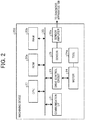
- FIG. 2 is a diagram illustrating an example of a hardware configuration of the machining device 200 according to the embodiment.
- the machining device 200 has a configuration including a central processing unit (CPU) 20, a read only memory (ROM) 20a, a random access memory (RAM) 20b, a communication interface (I/F) 21, and a drive control circuit 23, being communicably connected to each other via a bus 2B.
- CPU central processing unit
- ROM read only memory
- RAM random access memory
- I/F communication interface
- drive control circuit 23 being communicably connected to each other via a bus 2B.
- the CPU 20 is an arithmetic device that controls the entire machining device 200.
- the CPU 20 executes a program stored in the ROM 20a or the like with the RAM 20b as a work area (work region), for example, thereby controlling the operation of the entire machining device 200, leading to execution of the machining function.
- the numerical control unit 201 in FIG. 1 is implemented by a program operative on the CPU 20, for example.
- the communication I/F 21 is an interface used for communication with an external device such as the diagnosis apparatus 100.
- the communication I/F 21 is, for example, a network interface card (NIC) corresponding to Transmission Control Protocol (TCP)/Internet Protocol (IP) or the like.
- NIC network interface card
- TCP Transmission Control Protocol
- IP Internet Protocol
- the communication control unit 221 in FIG. 1 is implemented by, for example, a communication I/F 21 and a program operative on the CPU 20.
- the drive control circuit 23 is a circuit that controls the drive of a motor 24.
- the motor 24 drives a tool 24a used for machining.
- the tool 24a includes a drill, an end mill, a cutting tip, a grinding stone or the like, and a table on which the machining target is mounted and moved in accordance with machining procedures.
- the drive control unit 223 in FIG. 1 is implemented by the drive control circuit 23, for example.
- the driving unit 224 in FIG. 1 is implemented by the motor 24, for example.
- a sensor 25 is constituted by a microphone device, a vibration sensor, an acceleration sensor, an acoustic emission (AE) sensor, or the like, and is installed in the vicinity of a tool that can detect vibration, sound, or the like.
- a sensor amplifier 25a to which the sensor 25 is connected is communicably connected to the diagnosis apparatus 100.
- the sensor 25 and the sensor amplifier 25a may be preliminarily provided in the machining device 200 or may be attached later to the machining device 200 which is a finished machine.
- installation location of the sensor amplifier 25a is not limited to the machining device 200, and may be installed on the diagnosis apparatus 100 side.
- the detector 225 in FIG. 1 is implemented by the sensor 25 and the sensor amplifier 25a, for example.
- the hardware configuration illustrated in FIG. 2 is just an example, and the machining device 200 does not need to have all the constituent devices, and may have other constituent devices.
- the numerical control unit 201 and the communication control unit 221 illustrated in FIG. 1 may be implemented by causing the CPU 20 illustrated in FIG. 2 to execute a program, that is, implemented by software, or implemented by hardware such as an integrated circuit (IC).
- IC integrated circuit
- these controllers may be implemented by using software and hardware in combination.
- FIG. 3 is a diagram illustrating an example of the hardware configuration of the diagnosis apparatus 100 according to the embodiment.
- the diagnosis apparatus 100 has a configuration including a CPU 10, a ROM 10a, a RAM 10b, a communication I/F 11, a sensor I/F 12, an auxiliary memory 13, an input device 14, and a display 15 being communicably connected to each other via a bus 1B.
- the CPU 10 is an arithmetic device that controls the entire diagnosis apparatus 100.
- the CPU 10 executes programs stored in the ROM 10a or the like with the RAM 10b as a work area (work region), for example, thereby controlling the overall operation of the diagnosis apparatus 100, leading to implementation of a diagnostic function.
- the machining information acquisition unit 101, the diagnosis unit 102, the data manager 103, and the display control unit 104 in FIG. 1 are implemented by a program operative on the CPU 10, for example.
- the communication I/F 11 is an interface used for communication with an external device such as the machining device 200.
- An example of the communication I/F 11 includes a NIC compatible with TCP/IP.
- the communication control unit 111 illustrated in FIG. 1 is implemented by a communication I/F 11 illustrated in FIG. 3 and a program operative on the CPU 10.
- the sensor I/F 12 is an interface that receives, via the sensor amplifier 25a, detected information from the sensor 25 installed in the machining device 200.
- the detected information receiver 112 in FIG. 1 is implemented by the sensor I/F 12 and a program operative on the CPU 10, for example.
- auxiliary memory 13 examples include a non-volatile memory devices such as a hard disk drive (HDD), an solid state drive (SSD), or electrically erasable programmable read-only memory (EEPROM), to store various types of data including setting information of the diagnosis apparatus 100, detected information and context information received from the machining device 200, an operating system (OS), and application programs. While the auxiliary memory 13 is assumed to be provided in the diagnosis apparatus 100, the installation location is not limited to this.
- the auxiliary memory 13 may be implemented as a memory device installed outside the diagnosis apparatus 100, or as a memory device provided in a cloud type or an on-premises type server device capable of performing data communication with the diagnosis apparatus 100.
- the storage unit 113 in FIG. 1 is implemented by the RAM 10b and the auxiliary memory 13, for example.
- the input device 14 is an input device such as a mouse or a keyboard to perform operation such as inputting letters and numbers, selecting various instructions, and moving a cursor.
- the input unit 114 in FIG. 1 is implemented by the input device 14, for example.
- the display 15 is a display device such as a cathode ray tube (CRT) display, a liquid crystal display (LCD), or an organic Electro-Luminescence (EL) display, to display characters, numerals, various screens and operation icons, or the like.
- the display 15 may have an independent configuration or may be incorporated in a tablet, a personal computer (PC), or the like.
- the display unit 115 in FIG. 1 is implemented by the display 15, for example.
- the hardware configuration illustrated in FIG. 3 is just an example, and the diagnosis apparatus 100 does not need to have all the constituent devices, and may have other constituent devices.
- the functional units (the machining information acquisition unit 101, the diagnosis unit 102, the data manager 103, and the display control unit 104) of the diagnosis apparatus 100 illustrated in FIG. 1 can cause the CPU 10 to execute a program, that is, may be implemented by software, may be implemented by hardware such as an IC or may be implemented by using software and hardware in combination.
- the diagnosis apparatus 100 is specialized for diagnostic operation of the machining device 200 and transmits the diagnostic result to an external server device or the like, the input device 14 and the display 15 may be omitted from the configuration.
- the machining device 200 repeats execution of a cycle including a plurality of machining stages.
- the diagnosis apparatus 100 obtains sensor data (detected information) such as vibrations and sounds in the machining device 200 together with context information such as a cutting feed signal.
- the characteristic extraction unit 102a of the diagnosis unit 102 extracts, from detected information, characteristic information indicating a characteristic of the detected information.
- the data generator 103a of the data manager 103 discriminates the machining stage from the cutting feed signal and classifies the characteristic information for each of the machining stages.
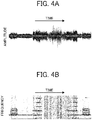
- FIGS. 4A and 4B are diagrams schematically illustrating, by using frequency components, characteristic information extracted from detected information by the diagnosis apparatus 100 according to the embodiment.
- frequency data such as vibration and sound is obtained as detected information from detector 225 such as a vibration sensor and a microphone device.
- the characteristic extraction unit 102a extracts energy, a frequency spectrum, Mel-frequency cepstrum coefficient (MFCC), or the like, as characteristic information.
- MFCC Mel-frequency cepstrum coefficient
- the characteristic extraction unit 102a applies Fourier transform on the detected information for each of frames to extract the characteristic information.
- the frame indicates the data amount of the detected information for a predetermined time period (for example, 20 [ms], 40 [ms], etc.) and this corresponds to the data amount of the window length in a case where the characteristic information is the frequency spectrum to be obtained by application of Fourier transform on the detected information, for example.
- the characteristic information illustrated in FIG. 5 is associated with the frame time of the corresponding detected information.
- FIG. 5 is a diagram schematically illustrating detected information and characteristic information classified for each of machining stages by the diagnosis apparatus 100 according to the embodiment.
- the data generator 103a identifies one cutting feed section in the machining device 200 as one machining stage from the cutting feed signal included in the context information, and calculates the section length of each of the machining stages. It is possible to identify the type of tool that has been used for machining from the tool identification information (tool ID), for example.
- operation number information may be assigned to the management of the engineering stage in the machining stages, in accordance with the purpose. In the example of FIG.
- tool A is used in the machining of the operation number information 1 (machining 1)
- tool E is used in the machining of the operation number information 6 and 7 (machining 6 and 7).
- cycle information included in the context information for example, it can be identified that machining 1 to 3, 6 and 7 are included in one cycle.
- the characteristic information classified for each of the machining stages is stored in the storage unit 113 in association with the corresponding context information.
- These pieces of stored information can be read and displayed as appropriate by the display control unit 104.
- the user can select and display a part or whole of the information according to FIG. 5 , such as frequency, spectrum, or a machining stage.
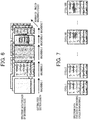
- FIG. 6 is a diagram schematically illustrating characteristic information consolidated for each of identical cycles by the diagnosis apparatus 100 according to the embodiment.
- the data consolidator 103b consolidates the data generated by the data generator 103a, for example, as time-series data for each of identical machining stages within the identical cycle.
- characteristic information for a plurality of cycles is consolidated for machining 1, 2, 3, 6, and 7 being identical machining stages.
- the time-series data consolidated in this manner is stored in the storage unit 113 in association with the corresponding context information. These pieces of stored information can be read and displayed as appropriate by the display control unit 104. At that time, the user can select a certain cycle No. and the number of cycles, and then display information corresponding to these selections.
- FIG. 7 is a diagram illustrating an example of a history screen displayed by the diagnosis apparatus 100 according to the embodiment.
- the display control unit 104 displays data consolidated by the data consolidator 103b in accordance with instructions from a user of the diagnosis apparatus 100, for example, so as to be displayed in parallel for each of the identical machining stages within the identical cycle, for example.
- time-series data in cycles 1 to 1000 of the machining stage of machining 2 are displayed in parallel in cycles including machining 1 to 3, 6 and 7.
- the user can designate the operation number information indicating the machining stage, the number of the cycles to be displayed, etc., in displaying such a history screen. From these data, the user can obtain various types of information. For example, in the example of FIG. 7 , middle and high frequency components not being observed at the beginning of the cycle appear in higher intensity on and after cycle 500. This suggests an occurrence of abnormal phenomenon.
- FIG. 8 is a flowchart illustrating an example of the information processing procedure performed by the diagnosis apparatus 100 according to the embodiment.
- the machining information acquisition unit 101 obtains, in step S101, context information from the machining device 200.
- the detected information receiver 112 receives the detected information from the detector 225.
- step S103 the characteristic extraction unit 102a extracts characteristic information from the received detected information.
- step S104 the data generator 103a identifies the machining stage from the obtained context information and calculates the section length of each of machining stages. Furthermore, the data generator 103a divides the characteristic information for each of machining stages.
- step S105 the data consolidator 103b consolidates the data as time-series data for each of the identical machining stages within the identical cycle.
- step S106 the data manager 103 determines whether the data display range or the like has been selected by the user in order to display the time-series data. In a case where there has been no instruction to display data from the user (No), the processing returns to step S101 to continue data collection.
- the display control unit 104 displays in step S107 the time-series data of the selected display range in parallel on the display unit 115.
- JP-2006-123013-A describes a machine tool that detects wear of a tool by an image photographed by a camera provided in the vicinity of the tool of the machine.
- the machine tool that performs cutting or the like performs machining while spraying a coolant as a lubricant or refrigerant near the tool. This would make it extremely difficult to directly detect wear or the like of the tool by the camera or the like, and difficult to avoid the use of indirect detection of an abnormality using a physical quantity such as a vibration generated in the machine tool.
- chatter is detected by a disturbance observer that estimates a disturbance on the basis of the rotation amount and the torque of the motor in order to grasp the vibration of the cutting process.
- the disclosed vibration detector merely displays the chatter estimation information and the detected chatter spectrum. This information would not be enough for grasping machine tool information, leading to difficulty in performing versatile and sufficient evaluation.
- data processed by the data generator 103a and consolidated by the data consolidator 103b is accumulated in the storage unit 113, and is displayed as time-series data by the display control unit 104.
- This allows the user to display and compare pieces of data having different cycles with each other. Abrasion, minute chipping or the like occurring in the tool often causes very minute changes in the detected information and the characteristic information.
- displaying the characteristic information as time-series data makes it possible for the user to detect such a very minute change. This enables the user to grasp gradual aging in the machining device 200 and to notice, at an early stage, a minute change leading to future abnormality or failure in the machining device 200.
- the diagnosis apparatus according to the first modification of the embodiment is different from the above-described embodiment in that the data consolidator integrates time-series data into one graph when displaying the history screen.
- FIG. 9 is a diagram illustrating an example of a history screen displayed by the diagnosis apparatus according to the first modification of the embodiment.
- the data consolidator compresses and integrates the time-series data into one graph in response to the user's instruction of displaying the history screen. That is, the display width of individual data is compressed to be integrated into one graph. Alternatively, it is allowable to extract and integrate a part of data of a certain length. It is also allowable to use, for compression, an average, sum, product, partial extraction of a specific portion, etc. of machining data for each of cycle.
- pieces of time-series data of cycles 1 to 1000 are integrated into one graph by averaging and compressing the data for each of cycles in the time direction. In this manner, the user can compress (to total) data of different cycles and selectively display the data.
- FIG. 10 is a flowchart illustrating an example of a procedure of information processing of the diagnosis apparatus according to the first modification of the embodiment. As illustrated in FIG. 10 , steps S101 to S106 are performed in a procedure similar to steps S101 to S106 of FIG. 8 for the diagnosis apparatus 100 of the embodiment.
- step S106 When an instruction to display data by the user is given (Yes) in step S106, the data consolidator integrates in step S207 the data in the designated range by the user.
- step S208 the display control unit 104 controls the display unit 115 to collectively display the integrated data.
- Integration of the data in this manner makes it possible to collectively display a larger amount of data on one graph. That is, since more information can be displayed collectively, the user can grasp the state of the machining device on the basis of more abundant information.
- diagnosis apparatus displays a plurality of pieces of data integrated in one graph
- present invention is not limited to this display.
- the data consolidator may dynamically consolidate the transition of a plurality of pieces of data and the display control unit may dynamically display this as an animation.
- the display control unit 104 of the diagnosis apparatus 100 displays various types of data on the display unit 115 in the embodiment described above, the data output method is not limited to this method.
- Various types of data may be printed out to a printer or the like connected to the diagnosis apparatus 100.
- the display control unit 104 is replaced by a print control unit that controls printing.
- the display unit 115 is replaced by a print unit 115 that communicates with the diagnosis apparatus 100 via a network such as a LAN.
- it is possible to adopt data output methods such as outputting by the sound from a speaker, by the lighting of the lamp, or the like. That is, the display control unit 104 and the display unit 115 may be generally referred to as an output control unit 104 configured to control output of information, and an output unit 115 configured to output information.
- the detected information may be other data such as a current value, a load, a torque, a force, a temperature, a distance between a part such as a tool and the measurement object, or an image.
- These pieces of detected information are obtained from, for example, a machining tool, a bearing, a motor, a pump (compressor), a machining target, and a holding member (holder) for the machining target or a tool.
- the diagnosis target device may be a machine such as a lathe machine, an assembling machine, a measuring machine, an inspecting machine, a washing machine, or the like.
- Programs executed by the diagnosis system of the embodiment and each of the modifications described above may be recorded in a computer-readable recording medium such as a compact disc read only memory (CD-ROM), a flexible disk (FD), a compact disk-recordable (CD-R), and a digital versatile disk (DVD) in the installable or executable file format and may be provided as a computer program product.
- a computer-readable recording medium such as a compact disc read only memory (CD-ROM), a flexible disk (FD), a compact disk-recordable (CD-R), and a digital versatile disk (DVD) in the installable or executable file format and may be provided as a computer program product.
- the programs executed by the diagnosis systems of the above-described embodiments and modifications may be stored on a computer connected to a network such as the Internet and may be downloaded via the network to be provided.
- the program executed by the diagnosis system of the above-described embodiment and each of the modifications may be provided or distributed via a network such as the Internet.
- each of the programs executed by the diagnosis systems of the above-described embodiments and each of the modifications is configured as a module including each of the functional units described above.
- the CPU processor
- the CPU reads and executes the program in the ROM to load the individual functional units described above onto main memory to generate the individual functional unit on the main memory.
- the diagnosis apparatus 100 mainly use the cutting feed signal out of context data to perform various types of data processing.
- the present invention is not limited to this.
- various types of information can be included in the context information, and these pieces of obtained information can be utilized in various manners.
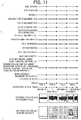
- FIG. 11 is a diagram illustrating an example of context information obtained by a diagnosis apparatus according to a third modification of the embodiment.
- the context information may include information concerning the machine tool, etc. such as the manufacturer of the machine tool, machine types of the lathe machine, machining device, or the like, and machine serial number, etc.
- the context information may include information concerning parts attached to a machine tool or the like, such as the manufacturer and type of machining tool, lot number, identification number, holder, and tool ID.
- the context information may further include information concerning operation number information, cycle information, step information, machining conditions, or the like.
- the context information may further include information indicating a status of the machine tool, such as date, hour, second, ms, status information, environmental information, etc.
- the context information may further include information concerning a machine operator, affiliation, or the like.
- Pieces of context information are selectively displayed together with detected information, characteristic information, or the like obtained from a target device such as a machining device, for example. That is, the user can select and display desired information out of various types of context information.
- capability of designating certain information from various types of context information makes it useful for selecting and displaying desired data from among a large amount of data. It is also possible to enable selection as to which of the various types of context information to record. In this manner, performing acquisition and consolidation of various types of context information together with detected information indicating states of the machine tool, etc. leads to acquisition of more comprehensive information.
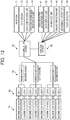
- FIG. 12 is a diagram illustrating a use example of information obtained from the diagnosis apparatus according to the third modification of the embodiment.
- various types of information concerning machines 70 possessed by users 60 such as a machining device, a lathe machine, a washing machine, or the like, individually provided by a plurality of manufacturers 50.
- These users 60 may be factories or the like in one company or may be a plurality of companies etc. working in cooperation.
- the accumulation center 30 includes a hard disk 31 and a data server 32 (may be either the on-premises type or cloud type) and includes functional units such as a data compression unit 33 and a data decompression/restoration unit 34. Such data compression and decompression functions are useful for accumulating huge amounts of data.
- the accumulation center 30 is provided with an analysis center 40 for analyzing accumulated data, for example.
- the analysis center 40 includes at least one, some, or all of functional units including a data selective extraction unit 41, a data display unit 42, an AI analysis unit 43, a failure prediction unit 44, an abnormality detector 45, and a state detector 46.
- accumulation centers 30 and analysis centers 40 may be operated by one company that owns machines from a plurality of manufacturers 50 and used at individual user sites 60.
- the accumulation center 30 and the analysis center 40 may be operated by the users 60, the manufacturers 50, etc. working in cooperation.
- the machine as a diagnosis target is not limited to this example.
- information obtained from the machinery used in the factory or from turbines, etc. in a power plant it is possible to make the whole facility a diagnosis target.
- context information at this time may be time information, position information by a global positioning system (GPS), or the like in addition to the above-described various types of information.
- GPS global positioning system
- time information, position information or the like it is possible to facilitate comparison of time zones on individual machining cycles and comparison on the sites of machining devices, for example.
- diagnosis target machine may be a moving object such as an automobile, an aircraft, or a rocket.
- a moving object such as an automobile, an aircraft, or a rocket.
- details will be described below by using an automobile as an example.
- the context information indicating the section repeated by the apparatus includes time information, position information obtained by GPS, for example.
- the context information may be a signal issued at a timing when the state of the automobile changes, such as a signal indicating foot pedal operation and a signal indicating a gear change.
- Examples of the physical quantity (detected information) that changes with the operation of the apparatus include the accelerator depression amount and energy consumption.
- the present invention can be implemented in any convenient form, for example using dedicated hardware, or a mixture of dedicated hardware and software.
- the present invention may be implemented as computer software implemented by one or more networked processing apparatuses.
- the processing apparatuses can compromise any suitably programmed apparatuses such as a general purpose computer, personal digital assistant, mobile telephone (such as a WAP or 3G-compliant phone) and so on. Since the present invention can be implemented as software, each and every aspect of the present invention thus encompasses computer software implementable on a programmable device.
- the computer software can be provided to the programmable device using any conventional carrier medium (carrier means).
- the carrier medium can compromise a transient carrier medium such as an electrical, optical, microwave, acoustic or radio frequency signal carrying the computer code.
- transient medium is a TCP/IP signal carrying computer code over an IP network, such as the Internet.
- the carrier medium can also comprise a storage medium for storing processor readable code such as a floppy disk, hard disk, CD ROM, magnetic tape device or solid state memory device.
Landscapes
- Engineering & Computer Science (AREA)
- Physics & Mathematics (AREA)
- General Physics & Mathematics (AREA)
- Automation & Control Theory (AREA)
- Human Computer Interaction (AREA)
- Manufacturing & Machinery (AREA)
- Mechanical Engineering (AREA)
- Testing And Monitoring For Control Systems (AREA)
- Numerical Control (AREA)
Abstract
Description
- The present invention relates to an information processing apparatus, a system, an information processing method, and a carrier means.
- There is a known method applied to detect an abnormality or the like of an apparatus that performs certain operation. This method detects a physical quantity such as information of a current value, vibration, force, or the like, of a motor of the apparatus and then spectrally displays the detected information (
JP-2015-229216-A - The technique described above, however, simply displays chatter estimation information at a certain time and a detected chatter spectrum, without achieving versatile evaluation.
- Example embodiments of the present invention include an information processing apparatus (100) includes: a detected information receiver (112) configured to obtain physical quantity information indicating a physical quantity that occurs in a target device (200) and changes in accordance with operation of the target device; a characteristic information generator (102a) configured to generate characteristic information indicating a characteristic of the physical quantity information; a data manager (103) configured to classify the characteristic information into a plurality of stages contained in one cycle, so as to generate a plurality of pieces of characteristic information for each cycle, the cycle being a cycle including the plurality of stages and to be repeatedly executed by the target device; a storage unit (113) configured to store the plurality of pieces of characteristic information for each cycle; and an output control unit (104) configured to output one or more pieces of the plurality of pieces of characteristic information for a plurality of cycles that are different to an output unit (115).
- According to at least one embodiment of the present invention, characteristic information, which is obtained from detected information of a target device, is classified into a plurality of stages included in one cycle, and the plurality of pieces of characteristic information is obtained for each of a plurality of cycles. By referring to one or more pieces of characteristic information for different cycles, a state of the target apparatus can be diagnosed with higher accuracy, while enabling versatile evaluation.
- A more complete appreciation of the disclosure and many of the attendant advantages and features thereof can be readily obtained and understood from the following detailed description with reference to the accompanying drawings, wherein:
-
FIG. 1 is a functional block diagram illustrating an example of a general arrangement of a diagnosis system according to an embodiment; -
FIG. 2 is a diagram illustrating an example of a hardware configuration of a machining device according to the embodiment. -
FIG. 3 is a diagram illustrating an example of a hardware configuration of a diagnosis apparatus according to the embodiment; -
FIGS. 4A and 4B are diagrams schematically illustrating characteristic information extracted from detected information by the diagnosis apparatus according to the embodiment by using frequency components; -
FIG. 5 is a diagram schematically illustrating detected information and characteristic information classified for each of machining stages by the diagnosis apparatus according to the embodiment; -
FIG. 6 is a diagram schematically illustrating characteristic information consolidated for each of identical cycles by the diagnosis apparatus according to the embodiment; -
FIG. 7 is a diagram illustrating an example of a history screen displayed by the diagnosis apparatus according to the embodiment; -
FIG. 8 is a flowchart illustrating an example of a procedure of information processing of the diagnosis apparatus according to the embodiment; -
FIG. 9 is a diagram illustrating an example of a history screen displayed by a diagnosis apparatus according to a first modification of the embodiment; -
FIG. 10 is a flowchart illustrating an example of a procedure of information processing of the diagnosis apparatus according to the first modification of the embodiment; -
FIG. 11 is a diagram illustrating an example of context information obtained by a diagnosis apparatus according to a third modification of the embodiment; and -
FIG. 12 is a diagram illustrating a use example of information obtained from the diagnosis apparatus according to the third modification of the embodiment. - The accompanying drawings are intended to depict embodiments of the present invention and should not be interpreted to limit the scope thereof. The accompanying drawings are not to be considered as drawn to scale unless explicitly noted.
- The terminology used herein is for the purpose of describing particular embodiments only and is not intended to be limiting of the present invention. As used herein, the singular forms "a", "an" and "the" are intended to include the plural forms as well, unless the context clearly indicates otherwise.
- In describing embodiments illustrated in the drawings, specific terminology is employed for the sake of clarity. However, the disclosure of this specification is not intended to be limited to the specific terminology so selected and it is to be understood that each specific element includes all technical equivalents that have a similar function, operate in a similar manner, and achieve a similar result.
- Hereinafter, an information processing apparatus, a system, an information processing method, and an information processing program according to embodiments of the present invention will be described in detail with reference to
FIGS. 1 to 12 . -
FIG. 1 is a functional block diagram illustrating an example of a general arrangement of adiagnosis system 1 according to an embodiment. Thediagnosis system 1 includes: adiagnosis apparatus 100 as an information processing apparatus; and amachining device 200 as a target device. Thediagnosis apparatus 100 includes: a detectedinformation receiver 112 that obtains information regarding a physical quantity that changes according to the operation of themachining device 200; acharacteristic extraction unit 102a as a characteristic information generator that generates characteristic information of the physical quantity information obtained by the detectedinformation receiver 112; astorage unit 113 as a storage unit to store a plurality of pieces of characteristic information; and adisplay control unit 104 to display, on the display unit, certain characteristic information out of the plurality of pieces of characteristic information. Hereinafter, details of thediagnosis system 1 of the embodiment will be described. - As illustrated in
FIG. 1 , thediagnosis system 1 according to the embodiment includes: themachining device 200; and thediagnosis apparatus 100 to be connected to themachining device 200. Themachining device 200 is a machine tool configured to perform machining such as cutting, grinding, polishing or the like on a machining target by using a tool. Themachining device 200 is an example of a target device to be diagnosed by thediagnosis apparatus 100. Thediagnosis apparatus 100 is communicably connected to themachining device 200, and performs abnormality diagnosis regarding operation of themachining device 200. - The
machining device 200 as a target device (machine) includes a numerical control unit 201, a communication control unit 221, adrive control unit 223, a driving unit 224, and a detector 225. - The numerical control unit 201 controls the machining process performed by the driving unit 224 by numerical control (NC). For example, the numerical control unit 201 generates and outputs numerical control data for controlling operation of the driving unit 224. The numerical control unit 201 outputs, for example, a cutting feed signal being an on/off signal indicating a section (cutting feed section) from feeding operation onto a machining target of the tool up to the end of actual machining process, to the communication control unit 221, as machining information as context information indicating the operation state of the driving unit 224 that drives the tool. The context information is a plurality of pieces of information determined for each of operation types of the
machining device 200. In addition to the cutting feed signal, the context information may include, for example, identification information of themachining device 200, identification information of the driving unit 224 (for example, tool identification information, etc.), a diameter of a tool driven by the driving unit 224, configuration information of material of the tool, or the like, and information indicating the operating state of the driving unit 224, the cumulative operating time from the start of use of the driving unit 224, the load applied to the driving unit 224, the number of revolutions of the driving unit 224, machining conditions such as the machining speed of the driving unit 224, etc. - The numerical control unit 201 sequentially transmits the context information corresponding to the current operation of the
machining device 200 to thediagnosis apparatus 100 via the communication control unit 221, for example. When machining a machining target, the numerical control unit 201 changes the type of the driving unit 224 to drive or the driving state (number of revolutions, rotational speed, etc.) of the driving unit 224 in accordance with machining stages. At each of times of the operation type change, the numerical control unit 201 sequentially transmits the context information corresponding to the changed operation type to thediagnosis apparatus 100 via the communication control unit 221. - The communication control unit 221 controls communication with an external device such as the
diagnosis apparatus 100. The communication control unit 221 transmits the context information corresponding to the current operation to thediagnosis apparatus 100, for example. - The
drive control unit 223 controls the driving of the driving unit 224 on the basis of the numerical control data obtained by the numerical control unit 201. - The driving unit 224 is a target of drive control performed by the
drive control unit 223. The driving unit 224 drives the tool under the control of thedrive control unit 223. The driving unit 224 is an actuator (motor) or the like subjected to the driving control of thedrive control unit 223. The driving unit 224 may be implemented by any type of actuator as long as it is used for machining and is subject to numerical control. The number of the driving units 224 may be two or more. - The detector 225 detects the physical quantity generated by the
machining device 200, and outputs information including the detected physical quantity to thediagnosis apparatus 100 as detected information (sensor data). The physical quantity generated by themachining device 200 is vibration, sound, or the like generated by themachining device 200. Such vibration, sound, or the like is generated, for example, by a contact between a tool installed in themachining device 200 and a machining target during machining operation. Alternatively, such vibration or sound or the like might be emitted by the tool or themachining device 200 itself. The number of detectors 225 may be any number. For example, a plurality of detectors 225 for detecting an identical physical quantity may be provided, or a plurality of detectors 225 for detecting mutually different physical quantities may be provided. For example, an occurrence of breakage or chipping of a blade being a tool used for machining would change vibrations and sounds during machining. Accordingly, abnormality in the operation of themachining device 200 can be detected by detecting vibration data and acoustic data by using the detector 225 and making a judgment using a model or the like for judging normal vibration and sound or the like. - The
diagnosis apparatus 100 as an information processing apparatus includes acommunication control unit 111, a detectedinformation receiver 112, a machininginformation acquisition unit 101, adiagnosis unit 102, adata manager 103, astorage unit 113, aninput unit 114, adisplay control unit 104, and adisplay unit 115. - The
communication control unit 111 controls communication with themachining device 200. For example, thecommunication control unit 111 receives context information from the numerical control unit 201 of themachining device 200 via the communication control unit 221. - The detected
information receiver 112 receives detected information (physical quantity information) from the detector 225 installed in themachining device 200. - The machining
information acquisition unit 101 obtains the context information (machining information) that thecommunication control unit 111 has received from themachining device 200. - The
diagnosis unit 102 includes acharacteristic extraction unit 102a, amodel generator 102b, and anabnormality determination unit 102c, and determines an abnormality or the like of the operation of themachining device 200. - The
characteristic extraction unit 102a as the characteristic information generator extracts, from the detected information, characteristic information used for determination or the like to be performed by theabnormality determination unit 102c. The characteristic information may be any type of information as long as the information indicates the characteristic of the detected information. - The
model generator 102b generates a model to be used for determining that the machining has been performed normally. The model is generated for each of pieces of context information, for example. When a model is generated by an external device, themodel generator 102b can be omitted. - The
abnormality determination unit 102c determines whether the operation of themachining device 200 is normal by using the characteristic information extracted by thecharacteristic extraction unit 102a and the model for each of pieces of context information generated by themodel generator 102b. - The
data manager 103 as the context information generator includes adata generator 103a and adata consolidator 103b, and processes and manages detected information, context information, characteristic information, or the like. - The
data generator 103a calculates, as an example, a cutting feed section for each of machining stages in themachining device 200 from the context information. In addition, thedata generator 103a classifies the detected information obtained by the detectedinformation receiver 112 and the characteristic information extracted by thecharacteristic extraction unit 102a for each of machining stages. - The
data consolidator 103b consolidates the data generated by thedata generator 103a as time-series data. - The
storage unit 113 as a storage unit stores the detected information obtained by the detectedinformation receiver 112 in association with the context information. Thestorage unit 113 further stores the characteristic information extracted by thecharacteristic extraction unit 102a in association with the context information. Thestorage unit 113 further stores the model generated by themodel generator 102b in association with the context information. - The
input unit 114 performs operation such as input of letters, numbers and the like, selection of various instructions, and movement of a cursor. - The
display control unit 104 controls display operation of thedisplay unit 115. Specifically, thedisplay control unit 104 controls thedisplay unit 115 to display a result of abnormality determination made by theabnormality determination unit 102c or the like. Thedisplay control unit 104 further controls thedisplay unit 115 to display time-series data or the like consolidated by thedata consolidator 103b. Thedisplay unit 115 displays various types of information under the control of thedisplay control unit 104. - Note that the functional units of the
diagnosis apparatus 100 and themachining device 200 are conceptual representations of the functions, and the present invention is not limited to such a configuration. For example, a plurality of functional units illustrated as independent functional units inFIG. 1 may be configured as one functional unit. In addition, the function of one functional unit inFIG. 1 may be divided into a plurality of functional units. - Meanwhile, the
machining device 200 and thediagnosis apparatus 100 may be connected in any form of connection. For example, themachining device 200 and thediagnosis apparatus 100 may be connected via a dedicated connection line, a fifth generation mobile communication system, a wired network such as a wired local area network (LAN), or a wireless network, etc. - While
FIG. 1 illustrates an example in which onemachining device 200 is connected to thediagnosis apparatus 100, the present invention is not limited to this connection example, and a plurality ofmachining devices 200 may be mutually communicably connected to thediagnosis apparatus 100. - Next, an example of a hardware configuration of the
machining device 200 according to the embodiment will be described with reference toFIG. 2. FIG. 2 is a diagram illustrating an example of a hardware configuration of themachining device 200 according to the embodiment. - As illustrated in
FIG. 2 , themachining device 200 has a configuration including a central processing unit (CPU) 20, a read only memory (ROM) 20a, a random access memory (RAM) 20b, a communication interface (I/F) 21, and a drive control circuit 23, being communicably connected to each other via abus 2B. - The
CPU 20 is an arithmetic device that controls theentire machining device 200. TheCPU 20 executes a program stored in theROM 20a or the like with theRAM 20b as a work area (work region), for example, thereby controlling the operation of theentire machining device 200, leading to execution of the machining function. The numerical control unit 201 inFIG. 1 is implemented by a program operative on theCPU 20, for example. - The communication I/F 21 is an interface used for communication with an external device such as the
diagnosis apparatus 100. The communication I/F 21 is, for example, a network interface card (NIC) corresponding to Transmission Control Protocol (TCP)/Internet Protocol (IP) or the like. The communication control unit 221 inFIG. 1 is implemented by, for example, a communication I/F 21 and a program operative on theCPU 20. - The drive control circuit 23 is a circuit that controls the drive of a motor 24. The motor 24 drives a tool 24a used for machining. The tool 24a includes a drill, an end mill, a cutting tip, a grinding stone or the like, and a table on which the machining target is mounted and moved in accordance with machining procedures. The
drive control unit 223 inFIG. 1 is implemented by the drive control circuit 23, for example. The driving unit 224 inFIG. 1 is implemented by the motor 24, for example. - A
sensor 25 is constituted by a microphone device, a vibration sensor, an acceleration sensor, an acoustic emission (AE) sensor, or the like, and is installed in the vicinity of a tool that can detect vibration, sound, or the like. A sensor amplifier 25a to which thesensor 25 is connected is communicably connected to thediagnosis apparatus 100. Thesensor 25 and the sensor amplifier 25a may be preliminarily provided in themachining device 200 or may be attached later to themachining device 200 which is a finished machine. In addition, installation location of the sensor amplifier 25a is not limited to themachining device 200, and may be installed on thediagnosis apparatus 100 side. The detector 225 inFIG. 1 is implemented by thesensor 25 and the sensor amplifier 25a, for example. - The hardware configuration illustrated in
FIG. 2 is just an example, and themachining device 200 does not need to have all the constituent devices, and may have other constituent devices. For example, the numerical control unit 201 and the communication control unit 221 illustrated inFIG. 1 may be implemented by causing theCPU 20 illustrated inFIG. 2 to execute a program, that is, implemented by software, or implemented by hardware such as an integrated circuit (IC). Alternatively, these controllers may be implemented by using software and hardware in combination. - Next, a hardware configuration example of the
diagnosis apparatus 100 according to the embodiment will be described with reference toFIG. 3. FIG. 3 is a diagram illustrating an example of the hardware configuration of thediagnosis apparatus 100 according to the embodiment. - As illustrated in
FIG. 3 , thediagnosis apparatus 100 has a configuration including a CPU 10, a ROM 10a, a RAM 10b, a communication I/F 11, a sensor I/F 12, an auxiliary memory 13, an input device 14, and a display 15 being communicably connected to each other via abus 1B. - The CPU 10 is an arithmetic device that controls the
entire diagnosis apparatus 100. The CPU 10 executes programs stored in the ROM 10a or the like with the RAM 10b as a work area (work region), for example, thereby controlling the overall operation of thediagnosis apparatus 100, leading to implementation of a diagnostic function. The machininginformation acquisition unit 101, thediagnosis unit 102, thedata manager 103, and thedisplay control unit 104 inFIG. 1 are implemented by a program operative on the CPU 10, for example. - The communication I/F 11 is an interface used for communication with an external device such as the
machining device 200. An example of the communication I/F 11 includes a NIC compatible with TCP/IP. Thecommunication control unit 111 illustrated inFIG. 1 is implemented by a communication I/F 11 illustrated inFIG. 3 and a program operative on the CPU 10. - The sensor I/F 12 is an interface that receives, via the sensor amplifier 25a, detected information from the
sensor 25 installed in themachining device 200. The detectedinformation receiver 112 inFIG. 1 is implemented by the sensor I/F 12 and a program operative on the CPU 10, for example. - Examples of the auxiliary memory 13 include a non-volatile memory devices such as a hard disk drive (HDD), an solid state drive (SSD), or electrically erasable programmable read-only memory (EEPROM), to store various types of data including setting information of the
diagnosis apparatus 100, detected information and context information received from themachining device 200, an operating system (OS), and application programs. While the auxiliary memory 13 is assumed to be provided in thediagnosis apparatus 100, the installation location is not limited to this. The auxiliary memory 13 may be implemented as a memory device installed outside thediagnosis apparatus 100, or as a memory device provided in a cloud type or an on-premises type server device capable of performing data communication with thediagnosis apparatus 100. Thestorage unit 113 inFIG. 1 is implemented by the RAM 10b and the auxiliary memory 13, for example. - The input device 14 is an input device such as a mouse or a keyboard to perform operation such as inputting letters and numbers, selecting various instructions, and moving a cursor. The
input unit 114 inFIG. 1 is implemented by the input device 14, for example. - The display 15 is a display device such as a cathode ray tube (CRT) display, a liquid crystal display (LCD), or an organic Electro-Luminescence (EL) display, to display characters, numerals, various screens and operation icons, or the like. The display 15 may have an independent configuration or may be incorporated in a tablet, a personal computer (PC), or the like. The
display unit 115 inFIG. 1 is implemented by the display 15, for example. - The hardware configuration illustrated in
FIG. 3 is just an example, and thediagnosis apparatus 100 does not need to have all the constituent devices, and may have other constituent devices. For example, the functional units (the machininginformation acquisition unit 101, thediagnosis unit 102, thedata manager 103, and the display control unit 104) of thediagnosis apparatus 100 illustrated inFIG. 1 can cause the CPU 10 to execute a program, that is, may be implemented by software, may be implemented by hardware such as an IC or may be implemented by using software and hardware in combination. Furthermore, in a case where thediagnosis apparatus 100 is specialized for diagnostic operation of themachining device 200 and transmits the diagnostic result to an external server device or the like, the input device 14 and the display 15 may be omitted from the configuration. - Next, an operation example of the
data manager 103 will be described with reference toFIGS. 4 to 7 . - In the case of manufacturing a plurality of predetermined processed products, for example, the
machining device 200 repeats execution of a cycle including a plurality of machining stages. At this time, thediagnosis apparatus 100 obtains sensor data (detected information) such as vibrations and sounds in themachining device 200 together with context information such as a cutting feed signal. Thecharacteristic extraction unit 102a of thediagnosis unit 102 extracts, from detected information, characteristic information indicating a characteristic of the detected information. Thedata generator 103a of thedata manager 103 discriminates the machining stage from the cutting feed signal and classifies the characteristic information for each of the machining stages. -
FIGS. 4A and 4B are diagrams schematically illustrating, by using frequency components, characteristic information extracted from detected information by thediagnosis apparatus 100 according to the embodiment. As illustrated inFIG. 4A , frequency data such as vibration and sound is obtained as detected information from detector 225 such as a vibration sensor and a microphone device. For example, in a case where the detected information is frequency data collected by a vibration sensor or a microphone device, thecharacteristic extraction unit 102a extracts energy, a frequency spectrum, Mel-frequency cepstrum coefficient (MFCC), or the like, as characteristic information. - As illustrated in
FIG. 4B , in a case where the characteristic information to be extracted is a frequency spectrum, thecharacteristic extraction unit 102a, for example, applies Fourier transform on the detected information for each of frames to extract the characteristic information. Here, the frame indicates the data amount of the detected information for a predetermined time period (for example, 20 [ms], 40 [ms], etc.) and this corresponds to the data amount of the window length in a case where the characteristic information is the frequency spectrum to be obtained by application of Fourier transform on the detected information, for example. The characteristic information illustrated inFIG. 5 is associated with the frame time of the corresponding detected information. -
FIG. 5 is a diagram schematically illustrating detected information and characteristic information classified for each of machining stages by thediagnosis apparatus 100 according to the embodiment. As illustrated inFIG. 5 , thedata generator 103a identifies one cutting feed section in themachining device 200 as one machining stage from the cutting feed signal included in the context information, and calculates the section length of each of the machining stages. It is possible to identify the type of tool that has been used for machining from the tool identification information (tool ID), for example. In addition, operation number information may be assigned to the management of the engineering stage in the machining stages, in accordance with the purpose. In the example ofFIG. 5 , tool A is used in the machining of the operation number information 1 (machining 1), and tool E is used in the machining of theoperation number information 6 and 7 (machining 6 and 7). From the cycle information included in the context information, for example, it can be identified that machining 1 to 3, 6 and 7 are included in one cycle. In this manner, the characteristic information classified for each of the machining stages is stored in thestorage unit 113 in association with the corresponding context information. These pieces of stored information can be read and displayed as appropriate by thedisplay control unit 104. At this time, the user can select and display a part or whole of the information according toFIG. 5 , such as frequency, spectrum, or a machining stage. -
FIG. 6 is a diagram schematically illustrating characteristic information consolidated for each of identical cycles by thediagnosis apparatus 100 according to the embodiment. As illustrated inFIG. 6 , thedata consolidator 103b consolidates the data generated by thedata generator 103a, for example, as time-series data for each of identical machining stages within the identical cycle. Incycles including machining 1 to 3, 6, and 7, as illustrated in the example ofFIG. 6 , characteristic information for a plurality of cycles is consolidated formachining storage unit 113 in association with the corresponding context information. These pieces of stored information can be read and displayed as appropriate by thedisplay control unit 104. At that time, the user can select a certain cycle No. and the number of cycles, and then display information corresponding to these selections. -
FIG. 7 is a diagram illustrating an example of a history screen displayed by thediagnosis apparatus 100 according to the embodiment. As illustrated inFIG. 7 , thedisplay control unit 104 displays data consolidated by thedata consolidator 103b in accordance with instructions from a user of thediagnosis apparatus 100, for example, so as to be displayed in parallel for each of the identical machining stages within the identical cycle, for example. In the example ofFIG. 7 , time-series data incycles 1 to 1000 of the machining stage ofmachining 2 are displayed in parallel incycles including machining 1 to 3, 6 and 7. - The user can designate the operation number information indicating the machining stage, the number of the cycles to be displayed, etc., in displaying such a history screen. From these data, the user can obtain various types of information. For example, in the example of
FIG. 7 , middle and high frequency components not being observed at the beginning of the cycle appear in higher intensity on and aftercycle 500. This suggests an occurrence of abnormal phenomenon. - Next, an example of information processing to be performed by the
diagnosis apparatus 100 will be described with reference toFIG. 8. FIG. 8 is a flowchart illustrating an example of the information processing procedure performed by thediagnosis apparatus 100 according to the embodiment. - As illustrated in
FIG. 8 , the machininginformation acquisition unit 101 obtains, in step S101, context information from themachining device 200. In step S102, the detectedinformation receiver 112 receives the detected information from the detector 225. - In step S103, the
characteristic extraction unit 102a extracts characteristic information from the received detected information. - In step S104, the
data generator 103a identifies the machining stage from the obtained context information and calculates the section length of each of machining stages. Furthermore, thedata generator 103a divides the characteristic information for each of machining stages. In step S105, thedata consolidator 103b consolidates the data as time-series data for each of the identical machining stages within the identical cycle. - In step S106, the
data manager 103 determines whether the data display range or the like has been selected by the user in order to display the time-series data. In a case where there has been no instruction to display data from the user (No), the processing returns to step S101 to continue data collection. - When there has been an instruction to display data from the user (Yes), the
display control unit 104 displays in step S107 the time-series data of the selected display range in parallel on thedisplay unit 115. - This completes the information processing to be performed by the
diagnosis apparatus 100. - For example,
JP-2006-123013-A - Meanwhile, for example, in the vibration detector disclosed in
JP-2015-229216-A - In the
diagnosis apparatus 100 according to the embodiment, data processed by thedata generator 103a and consolidated by thedata consolidator 103b is accumulated in thestorage unit 113, and is displayed as time-series data by thedisplay control unit 104. This allows the user to display and compare pieces of data having different cycles with each other. Abrasion, minute chipping or the like occurring in the tool often causes very minute changes in the detected information and the characteristic information. For example, displaying the characteristic information as time-series data makes it possible for the user to detect such a very minute change. This enables the user to grasp gradual aging in themachining device 200 and to notice, at an early stage, a minute change leading to future abnormality or failure in themachining device 200. - Next, a diagnosis apparatus according to a first modification of the embodiment will be described with reference to
FIGS. 9 and10 . The diagnosis apparatus according to the first modification of the embodiment is different from the above-described embodiment in that the data consolidator integrates time-series data into one graph when displaying the history screen. -
FIG. 9 is a diagram illustrating an example of a history screen displayed by the diagnosis apparatus according to the first modification of the embodiment. As illustrated inFIG. 9 , in the diagnosis apparatus according to the first modification of the embodiment, the data consolidator compresses and integrates the time-series data into one graph in response to the user's instruction of displaying the history screen. That is, the display width of individual data is compressed to be integrated into one graph. Alternatively, it is allowable to extract and integrate a part of data of a certain length. It is also allowable to use, for compression, an average, sum, product, partial extraction of a specific portion, etc. of machining data for each of cycle. In the example ofFIG. 9 , pieces of time-series data ofcycles 1 to 1000 are integrated into one graph by averaging and compressing the data for each of cycles in the time direction. In this manner, the user can compress (to total) data of different cycles and selectively display the data. -
FIG. 10 is a flowchart illustrating an example of a procedure of information processing of the diagnosis apparatus according to the first modification of the embodiment. As illustrated inFIG. 10 , steps S101 to S106 are performed in a procedure similar to steps S101 to S106 ofFIG. 8 for thediagnosis apparatus 100 of the embodiment. - When an instruction to display data by the user is given (Yes) in step S106, the data consolidator integrates in step S207 the data in the designated range by the user. In step S208, the
display control unit 104 controls thedisplay unit 115 to collectively display the integrated data. - This completes the information processing performed by the diagnosis apparatus of the first modification of the embodiment.
- Integration of the data in this manner makes it possible to collectively display a larger amount of data on one graph. That is, since more information can be displayed collectively, the user can grasp the state of the machining device on the basis of more abundant information.
- While the diagnosis apparatus according to the first modification of the embodiment displays a plurality of pieces of data integrated in one graph, the present invention is not limited to this display. The data consolidator may dynamically consolidate the transition of a plurality of pieces of data and the display control unit may dynamically display this as an animation.
- While the
display control unit 104 of thediagnosis apparatus 100 displays various types of data on thedisplay unit 115 in the embodiment described above, the data output method is not limited to this method. Various types of data may be printed out to a printer or the like connected to thediagnosis apparatus 100. In such case, thedisplay control unit 104 is replaced by a print control unit that controls printing. Thedisplay unit 115 is replaced by aprint unit 115 that communicates with thediagnosis apparatus 100 via a network such as a LAN. Alternatively, it is possible to adopt data output methods such as outputting by the sound from a speaker, by the lighting of the lamp, or the like. That is, thedisplay control unit 104 and thedisplay unit 115 may be generally referred to as anoutput control unit 104 configured to control output of information, and anoutput unit 115 configured to output information. - While the above-described embodiment defined the detected information as vibration data or acoustic data, for example, the detected information may be other data such as a current value, a load, a torque, a force, a temperature, a distance between a part such as a tool and the measurement object, or an image. These pieces of detected information (physical quantity) are obtained from, for example, a machining tool, a bearing, a motor, a pump (compressor), a machining target, and a holding member (holder) for the machining target or a tool.
- While the above embodiment defines the diagnosis target device as the
machining device 200, the diagnosis target device may be a machine such as a lathe machine, an assembling machine, a measuring machine, an inspecting machine, a washing machine, or the like. - Note that the programs executed by the diagnosis system of the embodiment and each of the modifications described above may be configured to be preliminarily incorporated in a ROM or the like to be provided.
- Programs executed by the diagnosis system of the embodiment and each of the modifications described above may be recorded in a computer-readable recording medium such as a compact disc read only memory (CD-ROM), a flexible disk (FD), a compact disk-recordable (CD-R), and a digital versatile disk (DVD) in the installable or executable file format and may be provided as a computer program product.
- In addition, the programs executed by the diagnosis systems of the above-described embodiments and modifications may be stored on a computer connected to a network such as the Internet and may be downloaded via the network to be provided. In addition, the program executed by the diagnosis system of the above-described embodiment and each of the modifications may be provided or distributed via a network such as the Internet.
- In addition, each of the programs executed by the diagnosis systems of the above-described embodiments and each of the modifications is configured as a module including each of the functional units described above. In practice, the CPU (processor) as hardware reads and executes the program in the ROM to load the individual functional units described above onto main memory to generate the individual functional unit on the main memory.
- In the embodiment described above, the
diagnosis apparatus 100 mainly use the cutting feed signal out of context data to perform various types of data processing. The present invention, however, is not limited to this. As described above, various types of information can be included in the context information, and these pieces of obtained information can be utilized in various manners. -
FIG. 11 is a diagram illustrating an example of context information obtained by a diagnosis apparatus according to a third modification of the embodiment. Specifically, the context information may include information concerning the machine tool, etc. such as the manufacturer of the machine tool, machine types of the lathe machine, machining device, or the like, and machine serial number, etc. In addition, the context information may include information concerning parts attached to a machine tool or the like, such as the manufacturer and type of machining tool, lot number, identification number, holder, and tool ID. The context information may further include information concerning operation number information, cycle information, step information, machining conditions, or the like. The context information may further include information indicating a status of the machine tool, such as date, hour, second, ms, status information, environmental information, etc. The context information may further include information concerning a machine operator, affiliation, or the like. - These pieces of context information are selectively displayed together with detected information, characteristic information, or the like obtained from a target device such as a machining device, for example. That is, the user can select and display desired information out of various types of context information. In addition, capability of designating certain information from various types of context information makes it useful for selecting and displaying desired data from among a large amount of data. It is also possible to enable selection as to which of the various types of context information to record. In this manner, performing acquisition and consolidation of various types of context information together with detected information indicating states of the machine tool, etc. leads to acquisition of more comprehensive information.
-
FIG. 12 is a diagram illustrating a use example of information obtained from the diagnosis apparatus according to the third modification of the embodiment. As illustrated inFIG. 12 , it is possible to integrate, onto anaccumulation center 30, various types ofinformation concerning machines 70 possessed byusers 60, such as a machining device, a lathe machine, a washing machine, or the like, individually provided by a plurality ofmanufacturers 50. Theseusers 60 may be factories or the like in one company or may be a plurality of companies etc. working in cooperation. - The
accumulation center 30 includes ahard disk 31 and a data server 32 (may be either the on-premises type or cloud type) and includes functional units such as adata compression unit 33 and a data decompression/restoration unit 34. Such data compression and decompression functions are useful for accumulating huge amounts of data. Theaccumulation center 30 is provided with ananalysis center 40 for analyzing accumulated data, for example. For the purpose of data analysis, theanalysis center 40 includes at least one, some, or all of functional units including a dataselective extraction unit 41, adata display unit 42, anAI analysis unit 43, afailure prediction unit 44, anabnormality detector 45, and astate detector 46. - These accumulation centers 30 and analysis centers 40 may be operated by one company that owns machines from a plurality of
manufacturers 50 and used atindividual user sites 60. Alternatively, theaccumulation center 30 and theanalysis center 40 may be operated by theusers 60, themanufacturers 50, etc. working in cooperation. - While the above embodiment uses the diagnosis target device as the
machining device 200 or another machine tool as an example, the machine as a diagnosis target is not limited to this example. With various types of information obtained from the machinery used in the factory or from turbines, etc. in a power plant, it is possible to make the whole facility a diagnosis target. As context information at this time may be time information, position information by a global positioning system (GPS), or the like in addition to the above-described various types of information. With the use of time information, position information or the like, it is possible to facilitate comparison of time zones on individual machining cycles and comparison on the sites of machining devices, for example. - Furthermore, the diagnosis target machine may be a moving object such as an automobile, an aircraft, or a rocket. For example, details will be described below by using an automobile as an example.
- In a case where the diagnosis target is an automobile, the context information indicating the section repeated by the apparatus includes time information, position information obtained by GPS, for example. Alternatively, the context information may be a signal issued at a timing when the state of the automobile changes, such as a signal indicating foot pedal operation and a signal indicating a gear change. Examples of the physical quantity (detected information) that changes with the operation of the apparatus include the accelerator depression amount and energy consumption. Some examples of using these pieces of information are illustrated below.
- For example, observation of the energy consumption per unit time (seconds, hours, days, months) as time-series data according to time information would make it easy to grasp the state and time-dependent change of the automobile in the daily cycle.
- Furthermore, observation of the information of the height difference based on an acceleration sensor or map information and the accelerator depression amount in comparison with each other in addition to the GPS position information, for example, would make it easy to notice an abnormality such as excessive accelerator depression amount at a downhill, for example.
- Furthermore, for example, acquisition of a predicted value of energy consumption by calculation from information of height difference based on acceleration sensor or map information in addition to GPS position information and performing comparison of the predicted value with actual energy consumption would lead to early discovery of a certain abnormality.
- The above-described embodiments are illustrative and do not limit the present invention. Thus, numerous additional modifications and variations are possible in light of the above teachings. For example, elements and/or features of different illustrative embodiments may be combined with each other and/or substituted for each other within the scope of the present invention.
- Any one of the above-described operations may be performed in various other ways, for example, in an order different from the one described above.
- The present invention can be implemented in any convenient form, for example using dedicated hardware, or a mixture of dedicated hardware and software. The present invention may be implemented as computer software implemented by one or more networked processing apparatuses. The processing apparatuses can compromise any suitably programmed apparatuses such as a general purpose computer, personal digital assistant, mobile telephone (such as a WAP or 3G-compliant phone) and so on. Since the present invention can be implemented as software, each and every aspect of the present invention thus encompasses computer software implementable on a programmable device. The computer software can be provided to the programmable device using any conventional carrier medium (carrier means). The carrier medium can compromise a transient carrier medium such as an electrical, optical, microwave, acoustic or radio frequency signal carrying the computer code. An example of such a transient medium is a TCP/IP signal carrying computer code over an IP network, such as the Internet. The carrier medium can also comprise a storage medium for storing processor readable code such as a floppy disk, hard disk, CD ROM, magnetic tape device or solid state memory device.
Claims (13)
- An information processing apparatus (100) comprising:a detected information receiver (112) configured to obtain physical quantity information indicating a physical quantity that occurs in a target device (200) and changes in accordance with operation of the target device;a characteristic information generator (102a) configured to generate characteristic information indicating a characteristic of the physical quantity information;a data manager (103) configured to classify the characteristic information into a plurality of stages contained in one cycle, so as to generate a plurality of pieces of characteristic information for each cycle, the cycle being a cycle including the plurality of stages and to be repeatedly executed by the target device;a storage unit (113) configured to store the plurality of pieces of characteristic information for each cycle; andan output control unit (104) configured to output one or more pieces of the plurality of pieces of characteristic information for a plurality of cycles that are different to an output unit (115).
- The information processing apparatus (100) according to claim 1,
wherein the output control unit (104) controls the output unit (115) to output the plurality of pieces of characteristic information for the plurality of cycles to the output unit (115). - The information processing apparatus (100) according to claim 1,
wherein the output control unit (104) selects the one or more pieces of characteristic information that correspond to one or more stages in the cycle, and controls the output unit (115) to output the selected characteristic information for the different cycles. - The information processing apparatus (100) according to claim 1,
wherein the data manager (103) consolidates the plurality of pieces of characteristic information, for each of stages, as a plurality of pieces of time-series data for the plurality of cycles, and
the output control unit (104) integrally outputs the plurality of pieces of time-series data for the plurality of cycles in at least one stage. - The information processing apparatus (100) according to claim 1,
wherein the data manager (103) consolidates the plurality of pieces of characteristic information, for each of stages, as a plurality of pieces of time-series data for the plurality of cycles, and
the output control unit (104) outputs the plurality of pieces of time-series data for the plurality of cycles in parallel in at least one stage. - The information processing apparatus (100) according to any of claims 1 to 5, further comprising a communication control unit (111) configured to receive context information related to the operation of the target device,
wherein the storage unit (113) stores the plurality of pieces of characteristic information in association with the context information. - The information processing apparatus (100) according to claim 6,
wherein the output control unit (104) selectively outputs the context information on the output unit (115). - The information processing apparatus (100) according to claim 6 or 7, further comprising:
the output unit (115) configured to output information under control of the output control unit (104), the output unit (115) being a display. - A system (1) comprising:the information processing apparatus (100) according to any of claims 1 to 6; anda target device (200) to be diagnosed by the information processing apparatus, including:
a detector (225) configured to detect the physical quantity of the target device (200), and outputs information including the physical quantity to the information processing apparatus (100). - The system (1) of claim 9,
wherein the target device (200) is a machining device that performs machining on a machining target. - The system (1) of claim 9, further comprising:
the output unit (115) configured to output information under control of the output control unit (104), the output unit (115) being a printer. - An information processing method to be executed by an information processing apparatus (100) configured to diagnose a target device (200), the method comprising:obtaining (S102) physical quantity information indicating a physical quantity that occurs in the target device and changes in accordance with operation of the target device;generating (SI03) characteristic information indicating a characteristic of the physical quantity information;classifying (S104) the characteristic information into a plurality of stages contained in one cycle, so as to generate a plurality of pieces of characteristic information for each cycle, the cycle being a cycle including the plurality of stages and to be repeatedly executed by the target device;storing the plurality of pieces of characteristic information for each cycle; andoutputting (S107) one or more pieces of the plurality of pieces of characteristic information for a plurality of cycles that are different to an output unit (115).
- A carrier means storing a program code for causing a computer system to perform the information processing method of claim 12.
Applications Claiming Priority (1)
| Application Number | Priority Date | Filing Date | Title |
|---|---|---|---|
| JP2018050224A JP7091743B2 (en) | 2018-03-16 | 2018-03-16 | Information processing equipment, information processing methods, programs, and mechanical equipment |
Publications (2)
| Publication Number | Publication Date |
|---|---|
| EP3540534A1 true EP3540534A1 (en) | 2019-09-18 |
| EP3540534B1 EP3540534B1 (en) | 2024-01-17 |
Family
ID=65817745
Family Applications (1)
| Application Number | Title | Priority Date | Filing Date |
|---|---|---|---|
| EP19162177.0A Active EP3540534B1 (en) | 2018-03-16 | 2019-03-12 | Information processing apparatus, method and computer readable medium |
Country Status (3)
| Country | Link |
|---|---|
| EP (1) | EP3540534B1 (en) |
| JP (1) | JP7091743B2 (en) |
| CN (1) | CN110275488B (en) |
Cited By (3)
| Publication number | Priority date | Publication date | Assignee | Title |
|---|---|---|---|---|
| EP3882724A1 (en) * | 2020-03-17 | 2021-09-22 | Pratt & Whitney Canada Corp. | Aircraft engine graphical diagnostic tool |
| EP4060442A1 (en) * | 2021-03-17 | 2022-09-21 | Ricoh Company, Ltd. | Diagnostic apparatus, system, diagnostic method, and carrier means |
| EP4124919A1 (en) * | 2021-07-29 | 2023-02-01 | Ricoh Company, Ltd. | Diagnostic apparatus, diagnostic method, and carrier medium |
Families Citing this family (5)
| Publication number | Priority date | Publication date | Assignee | Title |
|---|---|---|---|---|
| JP7280841B2 (en) * | 2020-01-28 | 2023-05-24 | 日立Astemo株式会社 | Sensory evaluation prediction system, suspension device, suspension control system |
| JP2021144584A (en) * | 2020-03-13 | 2021-09-24 | 株式会社リコー | Information processing method and program |
| JP7526591B2 (en) * | 2020-05-25 | 2024-08-01 | 株式会社 日立産業制御ソリューションズ | Acoustic recognition system and method |
| DE112021004321T5 (en) * | 2020-08-17 | 2023-06-07 | Fanuc Corporation | INFORMATION PROCESSING DEVICE, COMPUTER-EXECUTABLE METHOD AND COMPUTER-READABLE STORAGE MEDIUM |
| JP7409269B2 (en) * | 2020-09-23 | 2024-01-09 | 株式会社島津製作所 | Pump monitoring device, vacuum pump, pump monitoring method and pump monitoring program |
Citations (4)
| Publication number | Priority date | Publication date | Assignee | Title |
|---|---|---|---|---|
| JP2006123013A (en) | 2004-10-26 | 2006-05-18 | Mazda Motor Corp | Machine tool machining method and apparatus |
| JP2015229216A (en) | 2014-06-05 | 2015-12-21 | ブラザー工業株式会社 | Vibration detector and machine tool |
| WO2017111072A1 (en) * | 2015-12-25 | 2017-06-29 | Ricoh Company, Ltd. | Diagnostic device, computer program, and diagnostic system |
| WO2018030422A2 (en) * | 2016-08-09 | 2018-02-15 | Ricoh Company, Ltd. | Diagnosis device, learning device, and diagnosis system |
Family Cites Families (11)
| Publication number | Priority date | Publication date | Assignee | Title |
|---|---|---|---|---|
| AT280366B (en) * | 1968-05-24 | 1970-04-10 | Siemens Ag | Central command generator for time-dependent, program-controlled functional processes in switching systems, e.g. Telephone systems |
| JP2003281864A (en) * | 2002-03-25 | 2003-10-03 | Sanyo Electric Co Ltd | Recording medium controller and recording device |
| WO2010116599A1 (en) * | 2009-04-10 | 2010-10-14 | オムロン株式会社 | Operation information output device, method for controlling operation information output device, monitoring device, method for controlling monitoring device, and control program |
| US20110292834A1 (en) * | 2010-05-27 | 2011-12-01 | International Business Machines Corporation | Maintaining Time Series Models for Information Technology System Parameters |
| CN103116813B (en) * | 2013-02-25 | 2015-11-25 | 西北工业大学 | The production equipment end manufacturing activities intelligent navigation method that a kind of real-time information drives |
| JP5530020B1 (en) * | 2013-11-01 | 2014-06-25 | 株式会社日立パワーソリューションズ | Abnormality diagnosis system and abnormality diagnosis method |
| JP5937727B1 (en) * | 2015-05-22 | 2016-06-22 | Dmg森精機株式会社 | Tool wear evaluation device |
| JP6572979B2 (en) * | 2016-02-03 | 2019-09-11 | 東芝三菱電機産業システム株式会社 | Manufacturing facility diagnosis support apparatus and manufacturing facility diagnosis support method |
| CN105929806A (en) * | 2016-06-28 | 2016-09-07 | 成都启源电子信息技术有限公司 | Industrial data acquisition system |
| JP6705315B2 (en) * | 2016-07-08 | 2020-06-03 | 株式会社リコー | Diagnostic device, diagnostic system, diagnostic method and program |
| CN206327847U (en) * | 2016-12-15 | 2017-07-14 | 焦作大学 | A kind of plant produced progress control monitoring system |
-
2018
- 2018-03-16 JP JP2018050224A patent/JP7091743B2/en not_active Expired - Fee Related
-
2019
- 2019-03-12 EP EP19162177.0A patent/EP3540534B1/en active Active
- 2019-03-13 CN CN201910188631.3A patent/CN110275488B/en active Active
Patent Citations (4)
| Publication number | Priority date | Publication date | Assignee | Title |
|---|---|---|---|---|
| JP2006123013A (en) | 2004-10-26 | 2006-05-18 | Mazda Motor Corp | Machine tool machining method and apparatus |
| JP2015229216A (en) | 2014-06-05 | 2015-12-21 | ブラザー工業株式会社 | Vibration detector and machine tool |
| WO2017111072A1 (en) * | 2015-12-25 | 2017-06-29 | Ricoh Company, Ltd. | Diagnostic device, computer program, and diagnostic system |
| WO2018030422A2 (en) * | 2016-08-09 | 2018-02-15 | Ricoh Company, Ltd. | Diagnosis device, learning device, and diagnosis system |
Cited By (5)
| Publication number | Priority date | Publication date | Assignee | Title |
|---|---|---|---|---|
| EP3882724A1 (en) * | 2020-03-17 | 2021-09-22 | Pratt & Whitney Canada Corp. | Aircraft engine graphical diagnostic tool |
| US11615657B2 (en) | 2020-03-17 | 2023-03-28 | Pratt & Whitney Canada Corp. | Aircraft engine graphical diagnostic tool |
| EP4060442A1 (en) * | 2021-03-17 | 2022-09-21 | Ricoh Company, Ltd. | Diagnostic apparatus, system, diagnostic method, and carrier means |
| CN115106838A (en) * | 2021-03-17 | 2022-09-27 | 株式会社理光 | Machining determination device, machining determination system, machining determination method, and storage medium |
| EP4124919A1 (en) * | 2021-07-29 | 2023-02-01 | Ricoh Company, Ltd. | Diagnostic apparatus, diagnostic method, and carrier medium |
Also Published As
| Publication number | Publication date |
|---|---|
| CN110275488B (en) | 2022-07-01 |
| CN110275488A (en) | 2019-09-24 |
| JP7091743B2 (en) | 2022-06-28 |
| EP3540534B1 (en) | 2024-01-17 |
| JP2019160250A (en) | 2019-09-19 |
Similar Documents
| Publication | Publication Date | Title |
|---|---|---|
| EP3540534B1 (en) | Information processing apparatus, method and computer readable medium | |
| EP3540548B1 (en) | Diagnosis apparatus, diagnosis method and computer readable medium | |
| US11221608B2 (en) | Diagnosis device, diagnosis system, diagnosis method, and computer-readable medium | |
| WO2019176699A1 (en) | Information processing apparatus, information processing method, and recording medium for detecting an abnormality of a processing device that processes an object | |
| EP3413154B1 (en) | Equipment diagnostic device, equipment diagnostic method, and equipment diagnostic program | |
| US11307117B2 (en) | System and method for interpretation and analysis of manufacturing activity | |
| EP2570879B1 (en) | Condition monitoring system and method | |
| JP6514239B2 (en) | Machine diagnostic device and machine diagnostic method | |
| JP7358755B2 (en) | Diagnostic device, diagnostic method, and diagnostic program | |
| AU2016201724A1 (en) | Method and system for predicting equipment failure | |
| JP2019045942A (en) | Failure diagnosis system | |
| JP2017205821A (en) | Information processing apparatus, information processing method, information processing program, and information processing system | |
| JP2016038657A (en) | Diagnosis support system and diagnosis support method | |
| EP1650624A1 (en) | System and method for monitoring machine health | |
| JP2020154712A (en) | Systems, arithmetic units, and programs | |
| WO2018169069A1 (en) | Diagnosis device, diagnosis system, diagnosis method, and program | |
| CN119414146B (en) | A performance testing method and platform for electric hammer | |
| US12607996B1 (en) | Longitudinal failure analysis using obtained sensor data of a physical machine | |
| US12613164B1 (en) | Post-operative longitudinal failure analysis using obtained sensor data of a physical machine | |
| CN115685885A (en) | Machining determination device, machining determination method, storage medium, and computer device | |
| US20230091235A1 (en) | Information processing apparatus and information processing method | |
| WO2023166355A1 (en) | Information processing apparatus, information processing system, information processing method, and recording medium | |
| JP2023020890A (en) | Diagnostic device, program and diagnostic method | |
| JP2006092434A (en) | Equipment operation information management device |
Legal Events
| Date | Code | Title | Description |
|---|---|---|---|
| PUAI | Public reference made under article 153(3) epc to a published international application that has entered the european phase |
Free format text: ORIGINAL CODE: 0009012 |
|
| STAA | Information on the status of an ep patent application or granted ep patent |
Free format text: STATUS: REQUEST FOR EXAMINATION WAS MADE |
|
| 17P | Request for examination filed |
Effective date: 20190312 |
|
| AK | Designated contracting states |
Kind code of ref document: A1 Designated state(s): AL AT BE BG CH CY CZ DE DK EE ES FI FR GB GR HR HU IE IS IT LI LT LU LV MC MK MT NL NO PL PT RO RS SE SI SK SM TR |
|
| AX | Request for extension of the european patent |
Extension state: BA ME |
|
| STAA | Information on the status of an ep patent application or granted ep patent |
Free format text: STATUS: EXAMINATION IS IN PROGRESS |
|
| 17Q | First examination report despatched |
Effective date: 20200805 |
|
| GRAP | Despatch of communication of intention to grant a patent |
Free format text: ORIGINAL CODE: EPIDOSNIGR1 |
|
| STAA | Information on the status of an ep patent application or granted ep patent |
Free format text: STATUS: GRANT OF PATENT IS INTENDED |
|
| RIC1 | Information provided on ipc code assigned before grant |
Ipc: G05B 19/406 20060101ALN20230813BHEP Ipc: G05B 23/02 20060101ALI20230813BHEP Ipc: G05B 19/042 20060101AFI20230813BHEP |
|
| INTG | Intention to grant announced |
Effective date: 20230905 |
|
| P01 | Opt-out of the competence of the unified patent court (upc) registered |
Effective date: 20231010 |
|
| GRAS | Grant fee paid |
Free format text: ORIGINAL CODE: EPIDOSNIGR3 |
|
| GRAA | (expected) grant |
Free format text: ORIGINAL CODE: 0009210 |
|
| STAA | Information on the status of an ep patent application or granted ep patent |
Free format text: STATUS: THE PATENT HAS BEEN GRANTED |
|
| AK | Designated contracting states |
Kind code of ref document: B1 Designated state(s): AL AT BE BG CH CY CZ DE DK EE ES FI FR GB GR HR HU IE IS IT LI LT LU LV MC MK MT NL NO PL PT RO RS SE SI SK SM TR |
|
| REG | Reference to a national code |
Ref country code: GB Ref legal event code: FG4D |
|
| REG | Reference to a national code |
Ref country code: DE Ref legal event code: R096 Ref document number: 602019045121 Country of ref document: DE |
|
| REG | Reference to a national code |
Ref country code: CH Ref legal event code: EP |
|
| REG | Reference to a national code |
Ref country code: IE Ref legal event code: FG4D |
|
| REG | Reference to a national code |
Ref country code: LT Ref legal event code: MG9D |
|
| REG | Reference to a national code |
Ref country code: NL Ref legal event code: MP Effective date: 20240117 |
|
| REG | Reference to a national code |
Ref country code: AT Ref legal event code: MK05 Ref document number: 1650946 Country of ref document: AT Kind code of ref document: T Effective date: 20240117 |
|
| PG25 | Lapsed in a contracting state [announced via postgrant information from national office to epo] |
Ref country code: NL Free format text: LAPSE BECAUSE OF FAILURE TO SUBMIT A TRANSLATION OF THE DESCRIPTION OR TO PAY THE FEE WITHIN THE PRESCRIBED TIME-LIMIT Effective date: 20240117 |
|
| PG25 | Lapsed in a contracting state [announced via postgrant information from national office to epo] |
Ref country code: NL Free format text: LAPSE BECAUSE OF FAILURE TO SUBMIT A TRANSLATION OF THE DESCRIPTION OR TO PAY THE FEE WITHIN THE PRESCRIBED TIME-LIMIT Effective date: 20240117 |
|
| PG25 | Lapsed in a contracting state [announced via postgrant information from national office to epo] |
Ref country code: IS Free format text: LAPSE BECAUSE OF FAILURE TO SUBMIT A TRANSLATION OF THE DESCRIPTION OR TO PAY THE FEE WITHIN THE PRESCRIBED TIME-LIMIT Effective date: 20240517 |
|
| PG25 | Lapsed in a contracting state [announced via postgrant information from national office to epo] |
Ref country code: LT Free format text: LAPSE BECAUSE OF FAILURE TO SUBMIT A TRANSLATION OF THE DESCRIPTION OR TO PAY THE FEE WITHIN THE PRESCRIBED TIME-LIMIT Effective date: 20240117 |
|
| PG25 | Lapsed in a contracting state [announced via postgrant information from national office to epo] |
Ref country code: GR Free format text: LAPSE BECAUSE OF FAILURE TO SUBMIT A TRANSLATION OF THE DESCRIPTION OR TO PAY THE FEE WITHIN THE PRESCRIBED TIME-LIMIT Effective date: 20240418 |
|
| PG25 | Lapsed in a contracting state [announced via postgrant information from national office to epo] |
Ref country code: HR Free format text: LAPSE BECAUSE OF FAILURE TO SUBMIT A TRANSLATION OF THE DESCRIPTION OR TO PAY THE FEE WITHIN THE PRESCRIBED TIME-LIMIT Effective date: 20240117 Ref country code: RS Free format text: LAPSE BECAUSE OF FAILURE TO SUBMIT A TRANSLATION OF THE DESCRIPTION OR TO PAY THE FEE WITHIN THE PRESCRIBED TIME-LIMIT Effective date: 20240417 |
|
| PG25 | Lapsed in a contracting state [announced via postgrant information from national office to epo] |
Ref country code: ES Free format text: LAPSE BECAUSE OF FAILURE TO SUBMIT A TRANSLATION OF THE DESCRIPTION OR TO PAY THE FEE WITHIN THE PRESCRIBED TIME-LIMIT Effective date: 20240117 |
|
| PG25 | Lapsed in a contracting state [announced via postgrant information from national office to epo] |
Ref country code: AT Free format text: LAPSE BECAUSE OF FAILURE TO SUBMIT A TRANSLATION OF THE DESCRIPTION OR TO PAY THE FEE WITHIN THE PRESCRIBED TIME-LIMIT Effective date: 20240117 |
|
| PG25 | Lapsed in a contracting state [announced via postgrant information from national office to epo] |
Ref country code: RS Free format text: LAPSE BECAUSE OF FAILURE TO SUBMIT A TRANSLATION OF THE DESCRIPTION OR TO PAY THE FEE WITHIN THE PRESCRIBED TIME-LIMIT Effective date: 20240417 Ref country code: NO Free format text: LAPSE BECAUSE OF FAILURE TO SUBMIT A TRANSLATION OF THE DESCRIPTION OR TO PAY THE FEE WITHIN THE PRESCRIBED TIME-LIMIT Effective date: 20240417 Ref country code: LT Free format text: LAPSE BECAUSE OF FAILURE TO SUBMIT A TRANSLATION OF THE DESCRIPTION OR TO PAY THE FEE WITHIN THE PRESCRIBED TIME-LIMIT Effective date: 20240117 Ref country code: IS Free format text: LAPSE BECAUSE OF FAILURE TO SUBMIT A TRANSLATION OF THE DESCRIPTION OR TO PAY THE FEE WITHIN THE PRESCRIBED TIME-LIMIT Effective date: 20240517 Ref country code: HR Free format text: LAPSE BECAUSE OF FAILURE TO SUBMIT A TRANSLATION OF THE DESCRIPTION OR TO PAY THE FEE WITHIN THE PRESCRIBED TIME-LIMIT Effective date: 20240117 Ref country code: GR Free format text: LAPSE BECAUSE OF FAILURE TO SUBMIT A TRANSLATION OF THE DESCRIPTION OR TO PAY THE FEE WITHIN THE PRESCRIBED TIME-LIMIT Effective date: 20240418 Ref country code: FI Free format text: LAPSE BECAUSE OF FAILURE TO SUBMIT A TRANSLATION OF THE DESCRIPTION OR TO PAY THE FEE WITHIN THE PRESCRIBED TIME-LIMIT Effective date: 20240117 Ref country code: ES Free format text: LAPSE BECAUSE OF FAILURE TO SUBMIT A TRANSLATION OF THE DESCRIPTION OR TO PAY THE FEE WITHIN THE PRESCRIBED TIME-LIMIT Effective date: 20240117 Ref country code: BG Free format text: LAPSE BECAUSE OF FAILURE TO SUBMIT A TRANSLATION OF THE DESCRIPTION OR TO PAY THE FEE WITHIN THE PRESCRIBED TIME-LIMIT Effective date: 20240117 Ref country code: AT Free format text: LAPSE BECAUSE OF FAILURE TO SUBMIT A TRANSLATION OF THE DESCRIPTION OR TO PAY THE FEE WITHIN THE PRESCRIBED TIME-LIMIT Effective date: 20240117 |
|
| PG25 | Lapsed in a contracting state [announced via postgrant information from national office to epo] |
Ref country code: PL Free format text: LAPSE BECAUSE OF FAILURE TO SUBMIT A TRANSLATION OF THE DESCRIPTION OR TO PAY THE FEE WITHIN THE PRESCRIBED TIME-LIMIT Effective date: 20240117 Ref country code: PT Free format text: LAPSE BECAUSE OF FAILURE TO SUBMIT A TRANSLATION OF THE DESCRIPTION OR TO PAY THE FEE WITHIN THE PRESCRIBED TIME-LIMIT Effective date: 20240517 |
|
| PG25 | Lapsed in a contracting state [announced via postgrant information from national office to epo] |
Ref country code: SE Free format text: LAPSE BECAUSE OF FAILURE TO SUBMIT A TRANSLATION OF THE DESCRIPTION OR TO PAY THE FEE WITHIN THE PRESCRIBED TIME-LIMIT Effective date: 20240117 Ref country code: PT Free format text: LAPSE BECAUSE OF FAILURE TO SUBMIT A TRANSLATION OF THE DESCRIPTION OR TO PAY THE FEE WITHIN THE PRESCRIBED TIME-LIMIT Effective date: 20240517 Ref country code: PL Free format text: LAPSE BECAUSE OF FAILURE TO SUBMIT A TRANSLATION OF THE DESCRIPTION OR TO PAY THE FEE WITHIN THE PRESCRIBED TIME-LIMIT Effective date: 20240117 Ref country code: LV Free format text: LAPSE BECAUSE OF FAILURE TO SUBMIT A TRANSLATION OF THE DESCRIPTION OR TO PAY THE FEE WITHIN THE PRESCRIBED TIME-LIMIT Effective date: 20240117 |
|
| PG25 | Lapsed in a contracting state [announced via postgrant information from national office to epo] |
Ref country code: DK Free format text: LAPSE BECAUSE OF FAILURE TO SUBMIT A TRANSLATION OF THE DESCRIPTION OR TO PAY THE FEE WITHIN THE PRESCRIBED TIME-LIMIT Effective date: 20240117 |
|
| PG25 | Lapsed in a contracting state [announced via postgrant information from national office to epo] |
Ref country code: SM Free format text: LAPSE BECAUSE OF FAILURE TO SUBMIT A TRANSLATION OF THE DESCRIPTION OR TO PAY THE FEE WITHIN THE PRESCRIBED TIME-LIMIT Effective date: 20240117 |
|
| REG | Reference to a national code |
Ref country code: DE Ref legal event code: R097 Ref document number: 602019045121 Country of ref document: DE |
|
| PG25 | Lapsed in a contracting state [announced via postgrant information from national office to epo] |
Ref country code: EE Free format text: LAPSE BECAUSE OF FAILURE TO SUBMIT A TRANSLATION OF THE DESCRIPTION OR TO PAY THE FEE WITHIN THE PRESCRIBED TIME-LIMIT Effective date: 20240117 Ref country code: CZ Free format text: LAPSE BECAUSE OF FAILURE TO SUBMIT A TRANSLATION OF THE DESCRIPTION OR TO PAY THE FEE WITHIN THE PRESCRIBED TIME-LIMIT Effective date: 20240117 |
|
| PG25 | Lapsed in a contracting state [announced via postgrant information from national office to epo] |
Ref country code: SK Free format text: LAPSE BECAUSE OF FAILURE TO SUBMIT A TRANSLATION OF THE DESCRIPTION OR TO PAY THE FEE WITHIN THE PRESCRIBED TIME-LIMIT Effective date: 20240117 |
|
| PG25 | Lapsed in a contracting state [announced via postgrant information from national office to epo] |
Ref country code: SM Free format text: LAPSE BECAUSE OF FAILURE TO SUBMIT A TRANSLATION OF THE DESCRIPTION OR TO PAY THE FEE WITHIN THE PRESCRIBED TIME-LIMIT Effective date: 20240117 Ref country code: SK Free format text: LAPSE BECAUSE OF FAILURE TO SUBMIT A TRANSLATION OF THE DESCRIPTION OR TO PAY THE FEE WITHIN THE PRESCRIBED TIME-LIMIT Effective date: 20240117 Ref country code: RO Free format text: LAPSE BECAUSE OF FAILURE TO SUBMIT A TRANSLATION OF THE DESCRIPTION OR TO PAY THE FEE WITHIN THE PRESCRIBED TIME-LIMIT Effective date: 20240117 Ref country code: EE Free format text: LAPSE BECAUSE OF FAILURE TO SUBMIT A TRANSLATION OF THE DESCRIPTION OR TO PAY THE FEE WITHIN THE PRESCRIBED TIME-LIMIT Effective date: 20240117 Ref country code: DK Free format text: LAPSE BECAUSE OF FAILURE TO SUBMIT A TRANSLATION OF THE DESCRIPTION OR TO PAY THE FEE WITHIN THE PRESCRIBED TIME-LIMIT Effective date: 20240117 Ref country code: CZ Free format text: LAPSE BECAUSE OF FAILURE TO SUBMIT A TRANSLATION OF THE DESCRIPTION OR TO PAY THE FEE WITHIN THE PRESCRIBED TIME-LIMIT Effective date: 20240117 |
|
| REG | Reference to a national code |
Ref country code: CH Ref legal event code: PL |
|
| PG25 | Lapsed in a contracting state [announced via postgrant information from national office to epo] |
Ref country code: LU Free format text: LAPSE BECAUSE OF NON-PAYMENT OF DUE FEES Effective date: 20240312 |
|
| PG25 | Lapsed in a contracting state [announced via postgrant information from national office to epo] |
Ref country code: MC Free format text: LAPSE BECAUSE OF FAILURE TO SUBMIT A TRANSLATION OF THE DESCRIPTION OR TO PAY THE FEE WITHIN THE PRESCRIBED TIME-LIMIT Effective date: 20240117 |
|
| PLBE | No opposition filed within time limit |
Free format text: ORIGINAL CODE: 0009261 |
|
| STAA | Information on the status of an ep patent application or granted ep patent |
Free format text: STATUS: NO OPPOSITION FILED WITHIN TIME LIMIT |
|
| PG25 | Lapsed in a contracting state [announced via postgrant information from national office to epo] |
Ref country code: MC Free format text: LAPSE BECAUSE OF FAILURE TO SUBMIT A TRANSLATION OF THE DESCRIPTION OR TO PAY THE FEE WITHIN THE PRESCRIBED TIME-LIMIT Effective date: 20240117 Ref country code: LU Free format text: LAPSE BECAUSE OF NON-PAYMENT OF DUE FEES Effective date: 20240312 |
|
| PG25 | Lapsed in a contracting state [announced via postgrant information from national office to epo] |
Ref country code: IT Free format text: LAPSE BECAUSE OF FAILURE TO SUBMIT A TRANSLATION OF THE DESCRIPTION OR TO PAY THE FEE WITHIN THE PRESCRIBED TIME-LIMIT Effective date: 20240117 |
|
| REG | Reference to a national code |
Ref country code: BE Ref legal event code: MM Effective date: 20240331 |
|
| 26N | No opposition filed |
Effective date: 20241018 |
|
| PG25 | Lapsed in a contracting state [announced via postgrant information from national office to epo] |
Ref country code: IT Free format text: LAPSE BECAUSE OF FAILURE TO SUBMIT A TRANSLATION OF THE DESCRIPTION OR TO PAY THE FEE WITHIN THE PRESCRIBED TIME-LIMIT Effective date: 20240117 |
|
| PG25 | Lapsed in a contracting state [announced via postgrant information from national office to epo] |
Ref country code: BE Free format text: LAPSE BECAUSE OF NON-PAYMENT OF DUE FEES Effective date: 20240331 |
|
| PG25 | Lapsed in a contracting state [announced via postgrant information from national office to epo] |
Ref country code: IE Free format text: LAPSE BECAUSE OF NON-PAYMENT OF DUE FEES Effective date: 20240312 |
|
| PG25 | Lapsed in a contracting state [announced via postgrant information from national office to epo] |
Ref country code: IE Free format text: LAPSE BECAUSE OF NON-PAYMENT OF DUE FEES Effective date: 20240312 Ref country code: BE Free format text: LAPSE BECAUSE OF NON-PAYMENT OF DUE FEES Effective date: 20240331 Ref country code: CH Free format text: LAPSE BECAUSE OF NON-PAYMENT OF DUE FEES Effective date: 20240331 |
|
| PGFP | Annual fee paid to national office [announced via postgrant information from national office to epo] |
Ref country code: DE Payment date: 20250319 Year of fee payment: 7 |
|
| PG25 | Lapsed in a contracting state [announced via postgrant information from national office to epo] |
Ref country code: SI Free format text: LAPSE BECAUSE OF FAILURE TO SUBMIT A TRANSLATION OF THE DESCRIPTION OR TO PAY THE FEE WITHIN THE PRESCRIBED TIME-LIMIT Effective date: 20240117 |
|
| PG25 | Lapsed in a contracting state [announced via postgrant information from national office to epo] |
Ref country code: CY Free format text: LAPSE BECAUSE OF FAILURE TO SUBMIT A TRANSLATION OF THE DESCRIPTION OR TO PAY THE FEE WITHIN THE PRESCRIBED TIME-LIMIT; INVALID AB INITIO Effective date: 20190312 |
|
| PG25 | Lapsed in a contracting state [announced via postgrant information from national office to epo] |
Ref country code: HU Free format text: LAPSE BECAUSE OF FAILURE TO SUBMIT A TRANSLATION OF THE DESCRIPTION OR TO PAY THE FEE WITHIN THE PRESCRIBED TIME-LIMIT; INVALID AB INITIO Effective date: 20190312 |
|
| PG25 | Lapsed in a contracting state [announced via postgrant information from national office to epo] |
Ref country code: TR Free format text: LAPSE BECAUSE OF FAILURE TO SUBMIT A TRANSLATION OF THE DESCRIPTION OR TO PAY THE FEE WITHIN THE PRESCRIBED TIME-LIMIT Effective date: 20240117 |
|
| PGFP | Annual fee paid to national office [announced via postgrant information from national office to epo] |
Ref country code: GB Payment date: 20260324 Year of fee payment: 8 |
|
| PGFP | Annual fee paid to national office [announced via postgrant information from national office to epo] |
Ref country code: FR Payment date: 20260320 Year of fee payment: 8 |