EP3540087A1 - Austenitic stainless steel having improved hydrogen embrittlement resistance, and high-pressure hydrogen gas container comprising same - Google Patents
Austenitic stainless steel having improved hydrogen embrittlement resistance, and high-pressure hydrogen gas container comprising same Download PDFInfo
- Publication number
- EP3540087A1 EP3540087A1 EP17870262.7A EP17870262A EP3540087A1 EP 3540087 A1 EP3540087 A1 EP 3540087A1 EP 17870262 A EP17870262 A EP 17870262A EP 3540087 A1 EP3540087 A1 EP 3540087A1
- Authority
- EP
- European Patent Office
- Prior art keywords
- stainless steel
- austenitic stainless
- less
- hydrogen
- excluding
- Prior art date
- Legal status (The legal status is an assumption and is not a legal conclusion. Google has not performed a legal analysis and makes no representation as to the accuracy of the status listed.)
- Withdrawn
Links
- UFHFLCQGNIYNRP-UHFFFAOYSA-N Hydrogen Chemical compound [H][H] UFHFLCQGNIYNRP-UHFFFAOYSA-N 0.000 title claims abstract description 92
- 239000001257 hydrogen Substances 0.000 title claims abstract description 64
- 229910052739 hydrogen Inorganic materials 0.000 title claims abstract description 64
- 229910000963 austenitic stainless steel Inorganic materials 0.000 title claims abstract description 50
- PXHVJJICTQNCMI-UHFFFAOYSA-N Nickel Chemical compound [Ni] PXHVJJICTQNCMI-UHFFFAOYSA-N 0.000 claims abstract description 65
- 239000011572 manganese Substances 0.000 claims abstract description 36
- 239000011651 chromium Substances 0.000 claims abstract description 34
- 229910001566 austenite Inorganic materials 0.000 claims abstract description 23
- 229910052748 manganese Inorganic materials 0.000 claims abstract description 15
- IJGRMHOSHXDMSA-UHFFFAOYSA-N Atomic nitrogen Chemical compound N#N IJGRMHOSHXDMSA-UHFFFAOYSA-N 0.000 claims abstract description 14
- 229910052757 nitrogen Inorganic materials 0.000 claims abstract description 14
- 229910052759 nickel Inorganic materials 0.000 claims abstract description 10
- 229910001220 stainless steel Inorganic materials 0.000 claims abstract description 10
- 229910052804 chromium Inorganic materials 0.000 claims abstract description 9
- 239000010935 stainless steel Substances 0.000 claims abstract description 9
- 229910052799 carbon Inorganic materials 0.000 claims abstract description 8
- 239000012535 impurity Substances 0.000 claims abstract description 8
- OKTJSMMVPCPJKN-UHFFFAOYSA-N Carbon Chemical compound [C] OKTJSMMVPCPJKN-UHFFFAOYSA-N 0.000 claims abstract description 7
- VYZAMTAEIAYCRO-UHFFFAOYSA-N Chromium Chemical compound [Cr] VYZAMTAEIAYCRO-UHFFFAOYSA-N 0.000 claims abstract description 7
- XEEYBQQBJWHFJM-UHFFFAOYSA-N Iron Chemical compound [Fe] XEEYBQQBJWHFJM-UHFFFAOYSA-N 0.000 claims abstract description 7
- PWHULOQIROXLJO-UHFFFAOYSA-N Manganese Chemical compound [Mn] PWHULOQIROXLJO-UHFFFAOYSA-N 0.000 claims abstract description 7
- 229910052710 silicon Inorganic materials 0.000 claims abstract description 7
- 239000010703 silicon Substances 0.000 claims abstract description 7
- 229910000734 martensite Inorganic materials 0.000 claims description 25
- 238000009864 tensile test Methods 0.000 claims description 12
- XUIMIQQOPSSXEZ-UHFFFAOYSA-N Silicon Chemical compound [Si] XUIMIQQOPSSXEZ-UHFFFAOYSA-N 0.000 claims description 6
- 230000000052 comparative effect Effects 0.000 description 18
- 239000000463 material Substances 0.000 description 15
- 230000007797 corrosion Effects 0.000 description 12
- 238000005260 corrosion Methods 0.000 description 12
- 230000009466 transformation Effects 0.000 description 10
- 239000000446 fuel Substances 0.000 description 8
- 238000000137 annealing Methods 0.000 description 7
- 238000000034 method Methods 0.000 description 7
- 230000015572 biosynthetic process Effects 0.000 description 6
- 230000006641 stabilisation Effects 0.000 description 6
- 238000011105 stabilization Methods 0.000 description 6
- 229910000859 α-Fe Inorganic materials 0.000 description 6
- 229910000831 Steel Inorganic materials 0.000 description 5
- 238000001556 precipitation Methods 0.000 description 5
- 239000010959 steel Substances 0.000 description 5
- 238000005728 strengthening Methods 0.000 description 5
- 230000005540 biological transmission Effects 0.000 description 4
- 239000000203 mixture Substances 0.000 description 4
- 230000000087 stabilizing effect Effects 0.000 description 4
- 238000005482 strain hardening Methods 0.000 description 4
- QIVUCLWGARAQIO-OLIXTKCUSA-N (3s)-n-[(3s,5s,6r)-6-methyl-2-oxo-1-(2,2,2-trifluoroethyl)-5-(2,3,6-trifluorophenyl)piperidin-3-yl]-2-oxospiro[1h-pyrrolo[2,3-b]pyridine-3,6'-5,7-dihydrocyclopenta[b]pyridine]-3'-carboxamide Chemical compound C1([C@H]2[C@H](N(C(=O)[C@@H](NC(=O)C=3C=C4C[C@]5(CC4=NC=3)C3=CC=CN=C3NC5=O)C2)CC(F)(F)F)C)=C(F)C=CC(F)=C1F QIVUCLWGARAQIO-OLIXTKCUSA-N 0.000 description 3
- 238000005098 hot rolling Methods 0.000 description 3
- 239000006104 solid solution Substances 0.000 description 3
- 238000005275 alloying Methods 0.000 description 2
- 230000006866 deterioration Effects 0.000 description 2
- 238000011161 development Methods 0.000 description 2
- 230000000694 effects Effects 0.000 description 2
- 238000004519 manufacturing process Methods 0.000 description 2
- 239000002244 precipitate Substances 0.000 description 2
- 238000003860 storage Methods 0.000 description 2
- BIIBYWQGRFWQKM-JVVROLKMSA-N (2S)-N-[4-(cyclopropylamino)-3,4-dioxo-1-[(3S)-2-oxopyrrolidin-3-yl]butan-2-yl]-2-[[(E)-3-(2,4-dichlorophenyl)prop-2-enoyl]amino]-4,4-dimethylpentanamide Chemical compound CC(C)(C)C[C@@H](C(NC(C[C@H](CCN1)C1=O)C(C(NC1CC1)=O)=O)=O)NC(/C=C/C(C=CC(Cl)=C1)=C1Cl)=O BIIBYWQGRFWQKM-JVVROLKMSA-N 0.000 description 1
- DWKNOLCXIFYNFV-HSZRJFAPSA-N 2-[[(2r)-1-[1-[(4-chloro-3-methylphenyl)methyl]piperidin-4-yl]-5-oxopyrrolidine-2-carbonyl]amino]-n,n,6-trimethylpyridine-4-carboxamide Chemical compound CN(C)C(=O)C1=CC(C)=NC(NC(=O)[C@@H]2N(C(=O)CC2)C2CCN(CC=3C=C(C)C(Cl)=CC=3)CC2)=C1 DWKNOLCXIFYNFV-HSZRJFAPSA-N 0.000 description 1
- HFGHRUCCKVYFKL-UHFFFAOYSA-N 4-ethoxy-2-piperazin-1-yl-7-pyridin-4-yl-5h-pyrimido[5,4-b]indole Chemical compound C1=C2NC=3C(OCC)=NC(N4CCNCC4)=NC=3C2=CC=C1C1=CC=NC=C1 HFGHRUCCKVYFKL-UHFFFAOYSA-N 0.000 description 1
- 229910052802 copper Inorganic materials 0.000 description 1
- 230000001627 detrimental effect Effects 0.000 description 1
- 238000009792 diffusion process Methods 0.000 description 1
- 229910000765 intermetallic Inorganic materials 0.000 description 1
- 150000001247 metal acetylides Chemical class 0.000 description 1
- 229910052750 molybdenum Inorganic materials 0.000 description 1
- AYOOGWWGECJQPI-NSHDSACASA-N n-[(1s)-1-(5-fluoropyrimidin-2-yl)ethyl]-3-(3-propan-2-yloxy-1h-pyrazol-5-yl)imidazo[4,5-b]pyridin-5-amine Chemical compound N1C(OC(C)C)=CC(N2C3=NC(N[C@@H](C)C=4N=CC(F)=CN=4)=CC=C3N=C2)=N1 AYOOGWWGECJQPI-NSHDSACASA-N 0.000 description 1
- VOVZXURTCKPRDQ-CQSZACIVSA-N n-[4-[chloro(difluoro)methoxy]phenyl]-6-[(3r)-3-hydroxypyrrolidin-1-yl]-5-(1h-pyrazol-5-yl)pyridine-3-carboxamide Chemical compound C1[C@H](O)CCN1C1=NC=C(C(=O)NC=2C=CC(OC(F)(F)Cl)=CC=2)C=C1C1=CC=NN1 VOVZXURTCKPRDQ-CQSZACIVSA-N 0.000 description 1
- 229910052758 niobium Inorganic materials 0.000 description 1
- XULSCZPZVQIMFM-IPZQJPLYSA-N odevixibat Chemical compound C12=CC(SC)=C(OCC(=O)N[C@@H](C(=O)N[C@@H](CC)C(O)=O)C=3C=CC(O)=CC=3)C=C2S(=O)(=O)NC(CCCC)(CCCC)CN1C1=CC=CC=C1 XULSCZPZVQIMFM-IPZQJPLYSA-N 0.000 description 1
- 230000000704 physical effect Effects 0.000 description 1
- 238000012545 processing Methods 0.000 description 1
- 238000011160 research Methods 0.000 description 1
- 239000000243 solution Substances 0.000 description 1
- 229910052719 titanium Inorganic materials 0.000 description 1
- 238000012546 transfer Methods 0.000 description 1
- KMIOJWCYOHBUJS-HAKPAVFJSA-N vorolanib Chemical compound C1N(C(=O)N(C)C)CC[C@@H]1NC(=O)C1=C(C)NC(\C=C/2C3=CC(F)=CC=C3NC\2=O)=C1C KMIOJWCYOHBUJS-HAKPAVFJSA-N 0.000 description 1
- XLYOFNOQVPJJNP-UHFFFAOYSA-N water Substances O XLYOFNOQVPJJNP-UHFFFAOYSA-N 0.000 description 1
Images



Classifications
-
- C—CHEMISTRY; METALLURGY
- C22—METALLURGY; FERROUS OR NON-FERROUS ALLOYS; TREATMENT OF ALLOYS OR NON-FERROUS METALS
- C22C—ALLOYS
- C22C38/00—Ferrous alloys, e.g. steel alloys
- C22C38/18—Ferrous alloys, e.g. steel alloys containing chromium
- C22C38/40—Ferrous alloys, e.g. steel alloys containing chromium with nickel
- C22C38/58—Ferrous alloys, e.g. steel alloys containing chromium with nickel with more than 1.5% by weight of manganese
-
- C—CHEMISTRY; METALLURGY
- C22—METALLURGY; FERROUS OR NON-FERROUS ALLOYS; TREATMENT OF ALLOYS OR NON-FERROUS METALS
- C22C—ALLOYS
- C22C38/00—Ferrous alloys, e.g. steel alloys
- C22C38/001—Ferrous alloys, e.g. steel alloys containing N
-
- C—CHEMISTRY; METALLURGY
- C22—METALLURGY; FERROUS OR NON-FERROUS ALLOYS; TREATMENT OF ALLOYS OR NON-FERROUS METALS
- C22C—ALLOYS
- C22C38/00—Ferrous alloys, e.g. steel alloys
- C22C38/02—Ferrous alloys, e.g. steel alloys containing silicon
-
- C—CHEMISTRY; METALLURGY
- C22—METALLURGY; FERROUS OR NON-FERROUS ALLOYS; TREATMENT OF ALLOYS OR NON-FERROUS METALS
- C22C—ALLOYS
- C22C38/00—Ferrous alloys, e.g. steel alloys
- C22C38/18—Ferrous alloys, e.g. steel alloys containing chromium
- C22C38/40—Ferrous alloys, e.g. steel alloys containing chromium with nickel
- C22C38/44—Ferrous alloys, e.g. steel alloys containing chromium with nickel with molybdenum or tungsten
-
- C—CHEMISTRY; METALLURGY
- C22—METALLURGY; FERROUS OR NON-FERROUS ALLOYS; TREATMENT OF ALLOYS OR NON-FERROUS METALS
- C22C—ALLOYS
- C22C38/00—Ferrous alloys, e.g. steel alloys
- C22C38/18—Ferrous alloys, e.g. steel alloys containing chromium
- C22C38/40—Ferrous alloys, e.g. steel alloys containing chromium with nickel
- C22C38/48—Ferrous alloys, e.g. steel alloys containing chromium with nickel with niobium or tantalum
-
- F—MECHANICAL ENGINEERING; LIGHTING; HEATING; WEAPONS; BLASTING
- F17—STORING OR DISTRIBUTING GASES OR LIQUIDS
- F17C—VESSELS FOR CONTAINING OR STORING COMPRESSED, LIQUEFIED OR SOLIDIFIED GASES; FIXED-CAPACITY GAS-HOLDERS; FILLING VESSELS WITH, OR DISCHARGING FROM VESSELS, COMPRESSED, LIQUEFIED, OR SOLIDIFIED GASES
- F17C1/00—Pressure vessels, e.g. gas cylinder, gas tank, replaceable cartridge
- F17C1/14—Pressure vessels, e.g. gas cylinder, gas tank, replaceable cartridge constructed of aluminium; constructed of non-magnetic steel
-
- C—CHEMISTRY; METALLURGY
- C21—METALLURGY OF IRON
- C21D—MODIFYING THE PHYSICAL STRUCTURE OF FERROUS METALS; GENERAL DEVICES FOR HEAT TREATMENT OF FERROUS OR NON-FERROUS METALS OR ALLOYS; MAKING METAL MALLEABLE, e.g. BY DECARBURISATION OR TEMPERING
- C21D2211/00—Microstructure comprising significant phases
- C21D2211/001—Austenite
-
- F—MECHANICAL ENGINEERING; LIGHTING; HEATING; WEAPONS; BLASTING
- F17—STORING OR DISTRIBUTING GASES OR LIQUIDS
- F17C—VESSELS FOR CONTAINING OR STORING COMPRESSED, LIQUEFIED OR SOLIDIFIED GASES; FIXED-CAPACITY GAS-HOLDERS; FILLING VESSELS WITH, OR DISCHARGING FROM VESSELS, COMPRESSED, LIQUEFIED, OR SOLIDIFIED GASES
- F17C2203/00—Vessel construction, in particular walls or details thereof
- F17C2203/06—Materials for walls or layers thereof; Properties or structures of walls or their materials
- F17C2203/0602—Wall structures; Special features thereof
- F17C2203/0604—Liners
-
- F—MECHANICAL ENGINEERING; LIGHTING; HEATING; WEAPONS; BLASTING
- F17—STORING OR DISTRIBUTING GASES OR LIQUIDS
- F17C—VESSELS FOR CONTAINING OR STORING COMPRESSED, LIQUEFIED OR SOLIDIFIED GASES; FIXED-CAPACITY GAS-HOLDERS; FILLING VESSELS WITH, OR DISCHARGING FROM VESSELS, COMPRESSED, LIQUEFIED, OR SOLIDIFIED GASES
- F17C2203/00—Vessel construction, in particular walls or details thereof
- F17C2203/06—Materials for walls or layers thereof; Properties or structures of walls or their materials
- F17C2203/0602—Wall structures; Special features thereof
- F17C2203/0612—Wall structures
- F17C2203/0614—Single wall
- F17C2203/0619—Single wall with two layers
-
- F—MECHANICAL ENGINEERING; LIGHTING; HEATING; WEAPONS; BLASTING
- F17—STORING OR DISTRIBUTING GASES OR LIQUIDS
- F17C—VESSELS FOR CONTAINING OR STORING COMPRESSED, LIQUEFIED OR SOLIDIFIED GASES; FIXED-CAPACITY GAS-HOLDERS; FILLING VESSELS WITH, OR DISCHARGING FROM VESSELS, COMPRESSED, LIQUEFIED, OR SOLIDIFIED GASES
- F17C2203/00—Vessel construction, in particular walls or details thereof
- F17C2203/06—Materials for walls or layers thereof; Properties or structures of walls or their materials
- F17C2203/0634—Materials for walls or layers thereof
- F17C2203/0636—Metals
- F17C2203/0639—Steels
- F17C2203/0643—Stainless steels
-
- F—MECHANICAL ENGINEERING; LIGHTING; HEATING; WEAPONS; BLASTING
- F17—STORING OR DISTRIBUTING GASES OR LIQUIDS
- F17C—VESSELS FOR CONTAINING OR STORING COMPRESSED, LIQUEFIED OR SOLIDIFIED GASES; FIXED-CAPACITY GAS-HOLDERS; FILLING VESSELS WITH, OR DISCHARGING FROM VESSELS, COMPRESSED, LIQUEFIED, OR SOLIDIFIED GASES
- F17C2221/00—Handled fluid, in particular type of fluid
- F17C2221/01—Pure fluids
- F17C2221/012—Hydrogen
-
- F—MECHANICAL ENGINEERING; LIGHTING; HEATING; WEAPONS; BLASTING
- F17—STORING OR DISTRIBUTING GASES OR LIQUIDS
- F17C—VESSELS FOR CONTAINING OR STORING COMPRESSED, LIQUEFIED OR SOLIDIFIED GASES; FIXED-CAPACITY GAS-HOLDERS; FILLING VESSELS WITH, OR DISCHARGING FROM VESSELS, COMPRESSED, LIQUEFIED, OR SOLIDIFIED GASES
- F17C2223/00—Handled fluid before transfer, i.e. state of fluid when stored in the vessel or before transfer from the vessel
- F17C2223/03—Handled fluid before transfer, i.e. state of fluid when stored in the vessel or before transfer from the vessel characterised by the pressure level
- F17C2223/036—Very high pressure (>80 bar)
-
- F—MECHANICAL ENGINEERING; LIGHTING; HEATING; WEAPONS; BLASTING
- F17—STORING OR DISTRIBUTING GASES OR LIQUIDS
- F17C—VESSELS FOR CONTAINING OR STORING COMPRESSED, LIQUEFIED OR SOLIDIFIED GASES; FIXED-CAPACITY GAS-HOLDERS; FILLING VESSELS WITH, OR DISCHARGING FROM VESSELS, COMPRESSED, LIQUEFIED, OR SOLIDIFIED GASES
- F17C2260/00—Purposes of gas storage and gas handling
- F17C2260/01—Improving mechanical properties or manufacturing
- F17C2260/011—Improving strength
-
- F—MECHANICAL ENGINEERING; LIGHTING; HEATING; WEAPONS; BLASTING
- F17—STORING OR DISTRIBUTING GASES OR LIQUIDS
- F17C—VESSELS FOR CONTAINING OR STORING COMPRESSED, LIQUEFIED OR SOLIDIFIED GASES; FIXED-CAPACITY GAS-HOLDERS; FILLING VESSELS WITH, OR DISCHARGING FROM VESSELS, COMPRESSED, LIQUEFIED, OR SOLIDIFIED GASES
- F17C2270/00—Applications
- F17C2270/01—Applications for fluid transport or storage
- F17C2270/0165—Applications for fluid transport or storage on the road
- F17C2270/0184—Fuel cells
-
- Y—GENERAL TAGGING OF NEW TECHNOLOGICAL DEVELOPMENTS; GENERAL TAGGING OF CROSS-SECTIONAL TECHNOLOGIES SPANNING OVER SEVERAL SECTIONS OF THE IPC; TECHNICAL SUBJECTS COVERED BY FORMER USPC CROSS-REFERENCE ART COLLECTIONS [XRACs] AND DIGESTS
- Y02—TECHNOLOGIES OR APPLICATIONS FOR MITIGATION OR ADAPTATION AGAINST CLIMATE CHANGE
- Y02E—REDUCTION OF GREENHOUSE GAS [GHG] EMISSIONS, RELATED TO ENERGY GENERATION, TRANSMISSION OR DISTRIBUTION
- Y02E60/00—Enabling technologies; Technologies with a potential or indirect contribution to GHG emissions mitigation
- Y02E60/30—Hydrogen technology
- Y02E60/32—Hydrogen storage
Definitions
- the present invention relates to an austenitic stainless steel and a vessel for high-pressure hydrogen gas containing the same, and more particularly, to an austenitic stainless steel improved in resistance to hydrogen brittleness and a vessel for high-pressure hydrogen gas containing the same.
- a hydrogen storage vessel is also required for the fuel cell vehicles or a hydrogen filling station that handles the fuel of the fuel cell vehicles, and is composed of various parts such as a storage tank, a valve, and a pipe.
- high mechanical strength, resistance to hydrogen brittleness and corrosion resistance are required.
- 316L Under the current hydrogen gas environment, a material commonly used is austenitic stainless steel 316L. 316L at a hydrogen gas pressure of 35MPa, which is a general fuel cell environment, shows good water resistance and corrosion resistance and is widely used. However, to increase the cruising range of the fuel cell vehicles, it is problematic to use 316L in an environment where the hydrogen gas pressure is increased from 35MPa to 70MPa. Therefore, much research has been conducted on various materials that can be used under a high-pressure hydrogen gas environment of 70MPa or more.
- Patent Document 1 controls texture to improve not only strength by cold working but also resistance to hydrogen brittleness. This method is difficult to apply in the steel manufacturing process, and there is a problem of increased costs due to the addition of a process.
- a ferrite-based material or a martensite-based material having high strength has been proposed.
- the diffusion rate of hydrogen in the ferrite-based material or the martensite-based material is higher than that of an austenitic material, thus hydrogen embrittlement easily occurs.
- austenitic stainless steels are very vulnerable to hydrogen embrittlement when a transformation from austenite to martensite ( ⁇ ⁇ ⁇ ') occurs during deformation. Therefore, the phase stability of austenite is one of the most important factors for hydrogen embrittlement.
- the element that has the greatest influence on the phase stability of austenite is Ni, which has a significant effect on the economic cost of the steel.
- Mn is added in an amount of 6% or more, more preferably in an amount of 8% or more for reducing Ni to control the Md30 value showing the austenite stabilization degree to improve the resistance to hydrogen brittleness in a low temperature environment.
- Ni due to the excessive reduction of Ni, it is necessary to add a large amount of Mn and Cu, and there is a possibility of deterioration of corrosion resistance and mechanical properties due to MnS formation.
- Patent Document 1 Korean Patent Laid-Open Publication No. 10-2006-0018250 (published on Feb. 28, 2006 )
- Patent Document 2 Korean Patent Laid-Open Publication No. 10-2011-0004491 (published on Jan. 13, 2011 )
- Embodiments of the present invention are directed to applying an austenitic stainless steel in which the austenite stabilization degree is increased under a high-pressure hydrogen gas environment to suppress the formation of strain-induced martensite, to a vessel body or a liner of the vessel for high-pressure hydrogen gas to improve resistance to hydrogen brittleness.
- An austenite stainless steel with improved resistance to hydrogen brittleness includes by weight percent, 0.1% or less (excluding 0) of carbon (C), 1.0% or less (excluding 0) of silicon (Si), 2.0 to 7.0% of manganese (Mn), 15 to 25% of chromium (Cr), 7 to less than 10% of nickel (Ni), 0.4% or less (excluding 0) of nitrogen (N), and the remainder of iron (Fe) and other unavoidable impurities, and has an SFE (stacking fault energy) of 40 to 70mJ/m 2 defined by the following formula (1).
- SFE 4 ⁇ Ni + 0.6 ⁇ Cr + 7.7 ⁇ Mn ⁇ 44.7 ⁇ Si + 1.2
- the austenitic stainless steel may further include 3.0% or less of Mo.
- the austenitic stainless steel may have a Ni eq of 27 or more, which is defined by the following formula (2).
- Ni eq Ni + 0.65 ⁇ Cr + 0.98 ⁇ Mo + 1.05 ⁇ Mn + 0.35 ⁇ Si + 12.6 ⁇ C + 33.6 ⁇ N
- the austenitic stainless steel may have an RRA of 0.8 or more, which is defined by the following formula (3).
- RRA RA H 2 / RA AIR
- RA H2 is the reduction ratio of area during a tensile test in a hydrogen atmosphere
- RA AIR is the reduction ratio of area during a tensile test in an air atmosphere.
- the austenitic stainless steel may further include Nb: 0.5% or less.
- the austenitic stainless steel may have a tensile strength of 840MPa or more.
- the strain-induced martensite fraction of the austenitic stainless steel may be 1.0% or less.
- a vessel for high-pressure hydrogen gas with improved resistance to hydrogen brittleness includes a vessel body and a liner inside the vessel body, and at least one selected from a group consisting of the vessel body and the liner comprises an austenitic stainless steel comprising by weight percent, 0.1% or less (excluding 0) of carbon (C), 1.0% or less (excluding 0) of silicon (Si), 2.0 to 7.0% of manganese (Mn), 15 to 25% of chromium (Cr), 7 to less than 10% of nickel (Ni), 0.4% or less (excluding 0) of nitrogen (N), and the remainder of iron (Fe) and other unavoidable impurities, and having an SFE (stacking fault energy) of 40 to 70mJ/m 2 defined by the following formula (1).
- SFE 4 ⁇ Ni + 0.6 ⁇ Cr + 7.7 ⁇ Mn ⁇ 44.7 ⁇ Si + 1.2
- the hydrogen gas pressure may be 70MPa or more.
- the Ni content of the austenitic stainless steel applied to the vessel body or the liner of the vessel for high-pressure hydrogen gas is adjusted so that the SFE (stacking fault energy) of the austenitic stainless steel is in the range of 40 to 70mJ/m 2 . Accordingly, the stainless steel of the present invention can secure excellent resistance to hydrogen brittleness and can reduce the manufacturing cost of the vessel for high-pressure hydrogen gas by reducing the Ni content by optimizing the range of the SFE.
- Nb is further added in an amount of 0.5% or less in the austenitic stainless steel, so that a high tensile strength of 840MPa or more can be ensured through grain refinement.
- An austenitic stainless steel with improved resistance to hydrogen brittleness includes by weight percent, 0.1% or less (excluding 0) of carbon (C), 1.0% or less (excluding 0) of silicon (Si), 2.0 to 7.0% of manganese (Mn), 15 to 25% of chromium (Cr), 7 to less than 10% of nickel (Ni), 0.4% or less (excluding 0) of nitrogen (N), and the remainder of iron (Fe) and other unavoidable impurities, and has an SFE (stacking fault energy) of 40 to 70mJ/m 2 defined by the following formula (1).
- SFE 4 ⁇ Ni + 0.6 ⁇ Cr + 7.7 ⁇ Mn ⁇ 44.7 ⁇ Si + 1.2
- a high-pressure hydrogen gas vessel improved in resistance to hydrogen brittleness includes a vessel body and a liner inside the vessel body.
- the hydrogen gas pressure inside the vessel for high-pressure hydrogen gas may be 70MPa or more.
- At least one selected from a group consisting of the vessel body and the liner includes an austenitic stainless steel including, by weight percent, 0.1% or less (excluding 0) of carbon (C), 1.0% or less (excluding 0) of silicon (Si), 2.0 to 7.0% of manganese (Mn), 15 to 25% of chromium (Cr), 7 to less than 10% of nickel (Ni), 0.4% or less (excluding 0) of nitrogen (N), and the remainder of iron (Fe) and other unavoidable impurities.
- an austenitic stainless steel including, by weight percent, 0.1% or less (excluding 0) of carbon (C), 1.0% or less (excluding 0) of silicon (Si), 2.0 to 7.0% of manganese (Mn), 15 to 25% of chromium (Cr), 7 to less than 10% of nickel (Ni), 0.4% or less (excluding 0) of nitrogen (N), and the remainder of iron (Fe) and other unavoidable impurities.
- the component system of the austenitic stainless steel according to one embodiment of the present invention will be described in more detail.
- the content of each component means weight percent.
- C is an element effective for stabilizing austenite, suppressing ⁇ -ferrite and increasing strength by solid-solution strengthening, but it is easily combined with carbide forming elements (Cr, Ti, Nb, etc.) which reduce the corrosion resistance, ductility and toughness of the base material. Accordingly, the C content is preferably 0.1% or less.
- Si 1.0% or less (excluding 0)
- Si is an element effective for solid-solution strengthening, but when it is added excessively, it forms an intermetallic compound such as a sigma phase, which reduces the ductility and toughness of the base material. Accordingly, the Si content is preferably 1.0% or less.
- Mn is an austenite stabilizing element that suppresses the formation of strain-induced martensite and is an element capable of replacing expensive Ni.
- MnS is formed thereby likely causing corrosion of the base material. Accordingly, it is preferable to limit the Mn content to 2.0 to 7.0%.
- Cr is an alloying element which must be added to improve corrosion resistance in stainless steel. In order to secure corrosion resistance, Cr is required to be added in an amount of 15% or more. However, when it is added excessively, Cr is an element for producing ferrite, so that excessive ⁇ -ferrite remains to degrade hot workability, and the austenite becomes unstable. Accordingly, it is preferable to limit the Cr content to the upper limit of 25%.
- Ni is an austenite stabilizing element together with Mn and N, and Mn and N can be added in place of Ni, which is expensive, for cost reduction.
- excessive reduction of the Ni content reduces the corrosion resistance and hot workability due to excessive Mn and N contents, or makes it difficult to secure corrosion resistance due to the reduction in the Cr content.
- the lower limit of Ni is set to 7%.
- a large increase of the SFE is caused and a high density dislocation wall (HDDW) is generated by a planar dislocation multiplication.
- HDDW high density dislocation wall
- the HDDW is a local plasticity region due to hydrogen in the steel, and acts as a starting point of hydrogen embrittlement, which can reduce resistance to hydrogen brittleness. Accordingly, an excessive addition of Ni has disadvantages not only in an increase in material cost but also in resistance to hydrogen brittleness, so it is preferable to limit the Ni content to less than 10%.
- N is an element that stabilizes the austenite and enhances strength through solid-solution strengthening and precipitation strengthening. However, when N is excessively added, hot workability is reduced, so the content of N is limited to 0.4% or less.
- S is a trace amount of an impurity element and is segregated at grain boundaries and is a main element causing processing cracks in hot rolling. Therefore, it is limited to 0.003% or less or as low as possible.
- the austenitic stainless steel according to one embodiment of the present invention may further include 3.0% or less of Mo.
- Mo is an element effective for improving the corrosion resistance in stainless steel and is an element capable of increasing the degree of austenite stabilization for preventing the formation of strain-induced martensite as defined in the present invention.
- the Mo content is limited to 3.0% or less.
- the austenitic stainless steel according to one embodiment of the present invention may further include Nb: 0.5% or less.
- Nb is an effective element for improving the strength through grain refinement, and it can secure a high tensile strength of 840MPa or more through grain refinement by the addition of Nb to the austenitic stainless steel.
- the content of Nb is excessive, it reduces the hot workability or reduces the corrosion resistance due to excessive precipitates. Accordingly, the Nb content is limited to 0.5% or less.
- the austenitic stainless steel has an SFE (stacking fault energy) of 40 to 70mJ/m 2 , which is defined by the following formula (1).
- SFE 4 ⁇ Ni + 0.6 ⁇ Cr + 7.7 ⁇ Mn ⁇ 44.7 ⁇ Si + 1.2
- the SFE is in the range of 40 to 70mJ/m 2 , the strain-induced martensite transformation does not occur during the transformation, and twin develops to be able to improve the strength and resistance to hydrogen brittleness simultaneously. Further, the tensile strength can be improved through grain refinement by adding Nb.
- the SFE is less than 40mJ/m 2 , strain-induced martensite transformation occurs due to deformation in the hydrogen environment, which makes the austenitic stainless steel susceptible to hydrogen embrittlement.
- the austenitic stainless steel with a high SFE of more than 70mJ/m 2 has high austenite stabilization, so that the transformation of strain-induced martensite does not occur.
- the HDDW is generated by the high planar dislocation multiplication. The HDDW is the local plasticity region due to hydrogen in the steel, and acts as a starting point of hydrogen embrittlement, which can reduce resistance to hydrogen brittleness.
- the austenitic stainless steel may have a Ni eq of 27 or more, which is defined by the following formula (2).
- Ni eq Ni + 0.65 ⁇ Cr + 0.98 ⁇ Mo + 1.05 ⁇ Mn + 0.35 ⁇ Si + 12.6 ⁇ C + 33.6 ⁇ N
- the austenite has a high degree of stabilization, and the strain-induced martensite fraction is 1.0% or less. Accordingly, the hydrogen embrittlement due to the martensite transformation caused by deformation can be suppressed.
- the strain-induced martensite fraction of the austenitic stainless steel may be 1.0% or less.
- the austenitic stainless steel may have an RRA of 0.8 or more, defined by the following formula (3).
- RRA RA H 2 / RA AIR
- RA H2 is the reduction ratio of area during a tensile test in a hydrogen atmosphere
- RA AIR is the reduction ratio of area during a tensile test in an air atmosphere
- RRA is the value obtained by dividing the reduction ratio of area during the tensile test in the hydrogen atmosphere by the reduction ratio of area during the tensile test in the air atmosphere.
- the austenitic stainless steel further including Nb of 0.5% or less may have a tensile strength of 840MPa or more.
- the austenitic stainless steel included in the vessel for high-pressure hydrogen gas according to one embodiment of the present invention is produced by subjecting a slab having the above composition to hot rolling and annealing at a temperature of 900 to 1,200°C.
- the annealing temperature greatly influences the residual stress relief and microstructure.
- the annealing temperature is 900 to 1,200°C.
- the annealing temperature is less than 900°C, large carbides are generated thereby making the structure uneven or Cr 23 C 6 precipitates are formed around the grain boundaries, so that intergranular corrosion can occur.
- the annealing temperature is higher than 1,200°C, the grains can be extremely enlarged. Accordingly, it is preferable to limit the annealing temperature to 900 to 1,200°C.
- Ingots containing the respective composition components according to Examples 1 to 11 and Comparative Examples 1 to 4 in Table 1 were cast and hot-rolled, annealed at a temperature of 1,100°C, and pickled to prepare a hot-rolled sheet having a thickness of 15mm.
- Example1 0.03 0.51 5.1 20.2 7.0 0.31 2.0 - Example2 0.02 0.52 5.2 19.4 9.5 0.29 2.0 - Example3 0.03 0.48 2.5 18.7 8.5 0.31 2.0 - Example4 0.1 0.51 5.0 19.8 8.1 0.32 2.0 - Example5 0.02 0.48 5.1 16.4 9.0 0.30 2.0 - Example6 0.02 0.50 4.3 18.3 7.2 0.11 - - Example7 0.02 0.48 5.8 20.2 8.1 0.31 1.5 - Example8 0.03 0.52 5.2 18.9 8.3 0.28 2.7 - Example9 0.02 0.52 3.1 22.2 9.6 0.16 - - Example10 0.02 0.52 5.0 19.8 9.8 0.32 - - Example11 0.02 0.52 4.9 19.7 9.8 0.31 1.9 0.2 Comparative Example1 0.05 0.40 1.1 18.3 8.1 0.04 - - Comparative Example2 0.02 0.48 1.0 16.7 10.1 2.1 0.04 - Comparative Example3
- the tensile test was carried out to measure the RRA which means tensile strength (TS) and resistance to hydrogen brittleness, by a strain rate of 1.25 x 10 -5 /s, in an air atmosphere at room temperature or in high-pressure hydrogen gas of 70MPa at room temperature.
- FIG. 1 is a graph showing a correlation between SFE and Ni eq according to embodiments of the present invention.
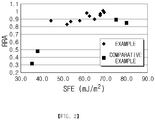
- FIG. 2 is a graph showing a correlation between SFE and RRA according to embodiments of the present invention.
- Examples 1 to 10 controlled the contents of Ni, N, Mn, C, Mo, and Cr thereby being able to secure the stabilized austenite structure as a strain-induced martensite fraction of 1.0% or less. As a result, it was found that the RRA was 0.8 or more, which can obtain excellent resistance to hydrogen brittleness.
- Ni eq was shown as a value lower than 27, indicating that embrittlement due to high-pressure hydrogen gas may appear as the martensite transformation during the deformation easily occurs.
- SFE was shown as a value lower than 40mJ/m 2 , meaning that the strain-induced martensite transformation occurred during the deformation.
- the actual strain-induced martensite fraction was measured to be very high, and the resistance to hydrogen brittleness was increased as a result. Accordingly, the RRA was as low as 0.8 or less.
- Ni eq was shown as a very high value of 41 or more, which means that it has very stable austenite. However, although they had a high Ni eq value, the RRA was shown as a value of less than 0.9, which was less than Examples 1 to 11 having a Ni eq of less than 41.
- the SFE can be explained by the SFE. If the SFE is in the range of 40 to 70mJ/m 2 , the strain-induced martensite transformation does not occur during the deformation and the twin develops, thus the strength and resistance to hydrogen brittleness can be improved simultaneously.
- the austenitic stainless steel with a high SFE of more than 70mJ/m 2 has high austenite stabilization, so that the transformation of strain-induced martensite does not occur, but the HDDW is generated by the high planar dislocation multiplication.
- the HDDW is the local plasticity region due to hydrogen in the steel, and acts as a starting point of hydrogen embrittlement, which can reduce resistance to hydrogen brittleness.
- FIG. 3 is a photograph of a microstructure of a hot-rolled sheet according to an embodiment of the present invention taken by a transmission electron microscope (TEM).
- FIG. 4 is a photograph of a microstructure of a hot-rolled sheet according to a comparative example of the present invention by a transmission electron microscope (TEM).
- TEM transmission electron microscope
- FIG. 3 is a photograph of the TEM microstructure of the hot-rolled sheet of Example 1
- FIG. 4 is a photograph of the TEM microstructure of the hot-rolled sheet of Comparative Example 4.
- Example 1 the SFE was 57.8mJ/m 2 in the range of 40 to 70mJ/m 2 and a twin developed during the deformation.
- Comparative Example 4 the SFE was 75.2mJ/m 2 out the range of 40 to 70mJ/m 2 and it can be seen that an HDDW was generated instead of a twin during deformation.
- Example 11 From the result of Example 11, it can be seen that when Nb is added, grain refinement occurs and the tensile strength shows a high value of 840MPa or more.
- Example 6 From the result of Example 6, it was found that by controlling the austenite stabilizing element, a Ni eq of 27 or more can be obtained and a low strain-induced martensite fraction of less than 1% can be obtained even under a high-pressure hydrogen gas environment, which is required in the present invention. It was found that the RRA was 0.8 or more, which can obtain excellent resistance to hydrogen brittleness.
- the austenitic stainless steel improved in resistance to hydrogen brittleness according to the embodiments of the present invention can be applied to a vessel for high-pressure hydrogen gas or the like.
Landscapes
- Chemical & Material Sciences (AREA)
- Engineering & Computer Science (AREA)
- Mechanical Engineering (AREA)
- Materials Engineering (AREA)
- Metallurgy (AREA)
- Organic Chemistry (AREA)
- General Engineering & Computer Science (AREA)
- Heat Treatment Of Sheet Steel (AREA)
- Fuel Cell (AREA)
Abstract
An austenitic stainless steel improved in resistance to hydrogen brittleness and a vessel for high-pressure hydrogen gas are disclosed. The austenitic stainless steel according to one embodiment of the present invention includes by weight percent, 0.1% or less (excluding 0) of carbon(C), 1.0% or less (excluding 0) of silicon(Si), 2.0 to 7.0% of manganese(Mn), 15 to 25% of chromium (Cr), 7 to less than 10% of nickel (Ni), 0.4% or less (excluding 0) of nitrogen (N), and the remainder of iron (Fe) and other unavoidable impurities, and an SFE (stacking fault energy) of the austenite stainless steel is 40 to 70mJ/m2 defined by the following formula (1). 
Description
- The present invention relates to an austenitic stainless steel and a vessel for high-pressure hydrogen gas containing the same, and more particularly, to an austenitic stainless steel improved in resistance to hydrogen brittleness and a vessel for high-pressure hydrogen gas containing the same.
- As the development and dissemination of fuel cell vehicles using hydrogen as fuel have expanded, it has become necessary to develop vessels and parts for storing hydrogen. A hydrogen storage vessel is also required for the fuel cell vehicles or a hydrogen filling station that handles the fuel of the fuel cell vehicles, and is composed of various parts such as a storage tank, a valve, and a pipe. In order to store high-pressure hydrogen for fuel cells and various applications, high mechanical strength, resistance to hydrogen brittleness and corrosion resistance are required.
- Under the current hydrogen gas environment, a material commonly used is austenitic stainless steel 316L. 316L at a hydrogen gas pressure of 35MPa, which is a general fuel cell environment, shows good water resistance and corrosion resistance and is widely used. However, to increase the cruising range of the fuel cell vehicles, it is problematic to use 316L in an environment where the hydrogen gas pressure is increased from 35MPa to 70MPa. Therefore, much research has been conducted on various materials that can be used under a high-pressure hydrogen gas environment of 70MPa or more.
- In order to withstand the high-pressure hydrogen gas in the direction of development, there is a method of increasing the strength compared with the conventional 316L material. Typically, there is a method of improving the strength by cold working. As another method, a high strength stainless steel using precipitation strengthening by precipitation has been proposed. These methods have a limitation in application due to the problem of additional costs for cold working or generation of precipitation, and the possibility of hydrogen embrittlement due to cold working and precipitation.
-
Patent Document 1 controls texture to improve not only strength by cold working but also resistance to hydrogen brittleness. This method is difficult to apply in the steel manufacturing process, and there is a problem of increased costs due to the addition of a process. - As a stainless steel material other than the austenitic stainless steel 316L, a ferrite-based material or a martensite-based material having high strength has been proposed. However, the diffusion rate of hydrogen in the ferrite-based material or the martensite-based material is higher than that of an austenitic material, thus hydrogen embrittlement easily occurs. Generally, even austenitic stainless steels are very vulnerable to hydrogen embrittlement when a transformation from austenite to martensite (γ → α') occurs during deformation. Therefore, the phase stability of austenite is one of the most important factors for hydrogen embrittlement. The element that has the greatest influence on the phase stability of austenite is Ni, which has a significant effect on the economic cost of the steel.
- In
Patent Document 2, Mn is added in an amount of 6% or more, more preferably in an amount of 8% or more for reducing Ni to control the Md30 value showing the austenite stabilization degree to improve the resistance to hydrogen brittleness in a low temperature environment. However, due to the excessive reduction of Ni, it is necessary to add a large amount of Mn and Cu, and there is a possibility of deterioration of corrosion resistance and mechanical properties due to MnS formation. - (Patent Document 1) Korean Patent Laid-Open Publication No.
10-2006-0018250 (published on Feb. 28, 2006 - (Patent Document 2) Korean Patent Laid-Open Publication No.
10-2011-0004491 (published on Jan. 13, 2011 - Embodiments of the present invention are directed to applying an austenitic stainless steel in which the austenite stabilization degree is increased under a high-pressure hydrogen gas environment to suppress the formation of strain-induced martensite, to a vessel body or a liner of the vessel for high-pressure hydrogen gas to improve resistance to hydrogen brittleness.
- An austenite stainless steel with improved resistance to hydrogen brittleness according to one embodiment of the present invention includes by weight percent, 0.1% or less (excluding 0) of carbon (C), 1.0% or less (excluding 0) of silicon (Si), 2.0 to 7.0% of manganese (Mn), 15 to 25% of chromium (Cr), 7 to less than 10% of nickel (Ni), 0.4% or less (excluding 0) of nitrogen (N), and the remainder of iron (Fe) and other unavoidable impurities, and has an SFE (stacking fault energy) of 40 to 70mJ/m2 defined by the following formula (1).

- Also, according to one embodiment of the present invention, the austenitic stainless steel may further include 3.0% or less of Mo.
- Also, according to one embodiment of the present invention, the austenitic stainless steel may have a Nieq of 27 or more, which is defined by the following formula (2).

- Also, according to one embodiment of the present invention, the austenitic stainless steel may have an RRA of 0.8 or more, which is defined by the following formula (3).

- Here, RAH2 is the reduction ratio of area during a tensile test in a hydrogen atmosphere, and RAAIR is the reduction ratio of area during a tensile test in an air atmosphere.
- Also, according to one embodiment of the present invention, the austenitic stainless steel may further include Nb: 0.5% or less.
- Also, according to one embodiment of the present invention, the austenitic stainless steel may have a tensile strength of 840MPa or more.
- Also, according to one embodiment of the present invention, the strain-induced martensite fraction of the austenitic stainless steel may be 1.0% or less.
- A vessel for high-pressure hydrogen gas with improved resistance to hydrogen brittleness according to one embodiment of the present invention includes a vessel body and a liner inside the vessel body, and at least one selected from a group consisting of the vessel body and the liner comprises an austenitic stainless steel comprising by weight percent, 0.1% or less (excluding 0) of carbon (C), 1.0% or less (excluding 0) of silicon (Si), 2.0 to 7.0% of manganese (Mn), 15 to 25% of chromium (Cr), 7 to less than 10% of nickel (Ni), 0.4% or less (excluding 0) of nitrogen (N), and the remainder of iron (Fe) and other unavoidable impurities, and having an SFE (stacking fault energy) of 40 to 70mJ/m2 defined by the following formula (1).

- Also, according to one embodiment of the present invention, the hydrogen gas pressure may be 70MPa or more.
- According to the embodiments of the present invention, the Ni content of the austenitic stainless steel applied to the vessel body or the liner of the vessel for high-pressure hydrogen gas is adjusted so that the SFE (stacking fault energy) of the austenitic stainless steel is in the range of 40 to 70mJ/m2. Accordingly, the stainless steel of the present invention can secure excellent resistance to hydrogen brittleness and can reduce the manufacturing cost of the vessel for high-pressure hydrogen gas by reducing the Ni content by optimizing the range of the SFE.
- Further, by controlling the contents of Ni, Mn and N in the composition of the austenitic stainless steel, it is possible to stabilize the austenite by increasing the Nieq, thereby suppressing the formation of the strain-induced martensite acting as a cause of hydrogen embrittlement.
- In addition, Nb is further added in an amount of 0.5% or less in the austenitic stainless steel, so that a high tensile strength of 840MPa or more can be ensured through grain refinement.
-
-
FIG. 1 is a graph showing a correlation between SFE and Nieq according to embodiments of the present invention. -
FIG. 2 is a graph showing a correlation between SFE and RRA according to embodiments of the present invention. -
FIG. 3 is a photograph of a microstructure of a hot-rolled sheet according to an embodiment of the present invention taken by a transmission electron microscope (TEM). -
FIG. 4 is a photograph of a microstructure of a hot-rolled sheet according to a comparative example of the present invention by a transmission electron microscope (TEM). - An austenitic stainless steel with improved resistance to hydrogen brittleness according to one embodiment of the present invention includes by weight percent, 0.1% or less (excluding 0) of carbon (C), 1.0% or less (excluding 0) of silicon (Si), 2.0 to 7.0% of manganese (Mn), 15 to 25% of chromium (Cr), 7 to less than 10% of nickel (Ni), 0.4% or less (excluding 0) of nitrogen (N), and the remainder of iron (Fe) and other unavoidable impurities, and has an SFE (stacking fault energy) of 40 to 70mJ/m2 defined by the following formula (1).

- Hereinafter, the embodiments of the present disclosure will be described in detail with reference to the accompanying drawings. The following embodiments are provided to transfer the technical concepts of the present disclosure to one of ordinary skill in the art. However, the present disclosure is not limited to these embodiments, and may be embodied in another form. In the drawings, parts that are irrelevant to the descriptions may be not shown in order to clarify the present disclosure, and also, for easy understanding, the sizes of components are more or less exaggeratedly shown.
- A high-pressure hydrogen gas vessel improved in resistance to hydrogen brittleness according to an embodiment of the present invention includes a vessel body and a liner inside the vessel body.
- For example, the hydrogen gas pressure inside the vessel for high-pressure hydrogen gas may be 70MPa or more.
- At least one selected from a group consisting of the vessel body and the liner includes an austenitic stainless steel including, by weight percent, 0.1% or less (excluding 0) of carbon (C), 1.0% or less (excluding 0) of silicon (Si), 2.0 to 7.0% of manganese (Mn), 15 to 25% of chromium (Cr), 7 to less than 10% of nickel (Ni), 0.4% or less (excluding 0) of nitrogen (N), and the remainder of iron (Fe) and other unavoidable impurities.
- Hereinafter, the component system of the austenitic stainless steel according to one embodiment of the present invention will be described in more detail. Unless otherwise stated, the content of each component means weight percent.
- C is an element effective for stabilizing austenite, suppressing δ-ferrite and increasing strength by solid-solution strengthening, but it is easily combined with carbide forming elements (Cr, Ti, Nb, etc.) which reduce the corrosion resistance, ductility and toughness of the base material. Accordingly, the C content is preferably 0.1% or less.
- Si is an element effective for solid-solution strengthening, but when it is added excessively, it forms an intermetallic compound such as a sigma phase, which reduces the ductility and toughness of the base material. Accordingly, the Si content is preferably 1.0% or less.
- Like N, Mn is an austenite stabilizing element that suppresses the formation of strain-induced martensite and is an element capable of replacing expensive Ni. However, when it is added excessively, MnS is formed thereby likely causing corrosion of the base material. Accordingly, it is preferable to limit the Mn content to 2.0 to 7.0%.
- Cr is an alloying element which must be added to improve corrosion resistance in stainless steel. In order to secure corrosion resistance, Cr is required to be added in an amount of 15% or more. However, when it is added excessively, Cr is an element for producing ferrite, so that excessive δ-ferrite remains to degrade hot workability, and the austenite becomes unstable. Accordingly, it is preferable to limit the Cr content to the upper limit of 25%.
- Ni is an austenite stabilizing element together with Mn and N, and Mn and N can be added in place of Ni, which is expensive, for cost reduction. However, excessive reduction of the Ni content reduces the corrosion resistance and hot workability due to excessive Mn and N contents, or makes it difficult to secure corrosion resistance due to the reduction in the Cr content. Accordingly, in order to secure the intended resistance to hydrogen brittleness of the present invention, the lower limit of Ni is set to 7%. In addition, when added excessively, a large increase of the SFE is caused and a high density dislocation wall (HDDW) is generated by a planar dislocation multiplication. The HDDW is a local plasticity region due to hydrogen in the steel, and acts as a starting point of hydrogen embrittlement, which can reduce resistance to hydrogen brittleness. Accordingly, an excessive addition of Ni has disadvantages not only in an increase in material cost but also in resistance to hydrogen brittleness, so it is preferable to limit the Ni content to less than 10%.
- N is an element that stabilizes the austenite and enhances strength through solid-solution strengthening and precipitation strengthening. However, when N is excessively added, hot workability is reduced, so the content of N is limited to 0.4% or less.
- S is a trace amount of an impurity element and is segregated at grain boundaries and is a main element causing processing cracks in hot rolling. Therefore, it is limited to 0.003% or less or as low as possible.
- The austenitic stainless steel according to one embodiment of the present invention may further include 3.0% or less of Mo.
- Mo is an element effective for improving the corrosion resistance in stainless steel and is an element capable of increasing the degree of austenite stabilization for preventing the formation of strain-induced martensite as defined in the present invention. However, when added excessively, the material cost increases. Accordingly, the Mo content is limited to 3.0% or less.
- The austenitic stainless steel according to one embodiment of the present invention may further include Nb: 0.5% or less.
- Nb is an effective element for improving the strength through grain refinement, and it can secure a high tensile strength of 840MPa or more through grain refinement by the addition of Nb to the austenitic stainless steel. However, if the content of Nb is excessive, it reduces the hot workability or reduces the corrosion resistance due to excessive precipitates. Accordingly, the Nb content is limited to 0.5% or less.
- The austenitic stainless steel has an SFE (stacking fault energy) of 40 to 70mJ/m2, which is defined by the following formula (1).

- If the SFE is in the range of 40 to 70mJ/m2, the strain-induced martensite transformation does not occur during the transformation, and twin develops to be able to improve the strength and resistance to hydrogen brittleness simultaneously. Further, the tensile strength can be improved through grain refinement by adding Nb. When the SFE is less than 40mJ/m2, strain-induced martensite transformation occurs due to deformation in the hydrogen environment, which makes the austenitic stainless steel susceptible to hydrogen embrittlement. The austenitic stainless steel with a high SFE of more than 70mJ/m2 has high austenite stabilization, so that the transformation of strain-induced martensite does not occur. However, the HDDW is generated by the high planar dislocation multiplication. The HDDW is the local plasticity region due to hydrogen in the steel, and acts as a starting point of hydrogen embrittlement, which can reduce resistance to hydrogen brittleness.
- According to one embodiment of the present invention, the austenitic stainless steel may have a Nieq of 27 or more, which is defined by the following formula (2).

- That is, by controlling the contents of Ni, Mn and N in the composition of the austenitic stainless steel to increase the Nieq, it is possible to stabilize the austenite, thereby suppressing the formation of the strain-induced martensite which acts as a cause of hydrogen embrittlement.
- Therefore, when the Nieq of the austenitic stainless steel is controlled to 27 or more, the austenite has a high degree of stabilization, and the strain-induced martensite fraction is 1.0% or less. Accordingly, the hydrogen embrittlement due to the martensite transformation caused by deformation can be suppressed.
- According to one embodiment of the present invention, the strain-induced martensite fraction of the austenitic stainless steel may be 1.0% or less.
- According to one embodiment of the present invention, the austenitic stainless steel may have an RRA of 0.8 or more, defined by the following formula (3).

- Here, RAH2 is the reduction ratio of area during a tensile test in a hydrogen atmosphere, and RAAIR is the reduction ratio of area during a tensile test in an air atmosphere. RRA is the value obtained by dividing the reduction ratio of area during the tensile test in the hydrogen atmosphere by the reduction ratio of area during the tensile test in the air atmosphere.
- The larger the value of RRA for judging the hydrogen brittleness, the lower the ductility due to the hydrogen gas and the smaller the occurrence of embrittlement, which means excellent resistance to hydrogen brittleness. When the RRA is 0.8 or more, it can be judged that the resistance to hydrogen brittleness is excellent because the deterioration of ductility and the occurrence of embrittlement are slight in a high-pressure hydrogen environment.
- According to one embodiment of the present invention, the austenitic stainless steel further including Nb of 0.5% or less may have a tensile strength of 840MPa or more.
- The austenitic stainless steel included in the vessel for high-pressure hydrogen gas according to one embodiment of the present invention is produced by subjecting a slab having the above composition to hot rolling and annealing at a temperature of 900 to 1,200°C.
- In the process of annealing after hot rolling, the annealing temperature greatly influences the residual stress relief and microstructure.
- The annealing temperature is 900 to 1,200°C. When the annealing temperature is less than 900°C, large carbides are generated thereby making the structure uneven or Cr23C6 precipitates are formed around the grain boundaries, so that intergranular corrosion can occur. When the annealing temperature is higher than 1,200°C, the grains can be extremely enlarged. Accordingly, it is preferable to limit the annealing temperature to 900 to 1,200°C.
- Hereinafter, the present invention will be described in more detail with reference to examples.
- Ingots containing the respective composition components according to Examples 1 to 11 and Comparative Examples 1 to 4 in Table 1 were cast and hot-rolled, annealed at a temperature of 1,100°C, and pickled to prepare a hot-rolled sheet having a thickness of 15mm.
[Table 1] (Weight Percent%) C Si Mn Cr Ni N Mo Nb Example1 0.03 0.51 5.1 20.2 7.0 0.31 2.0 - Example2 0.02 0.52 5.2 19.4 9.5 0.29 2.0 - Example3 0.03 0.48 2.5 18.7 8.5 0.31 2.0 - Example4 0.1 0.51 5.0 19.8 8.1 0.32 2.0 - Example5 0.02 0.48 5.1 16.4 9.0 0.30 2.0 - Example6 0.02 0.50 4.3 18.3 7.2 0.11 - - Example7 0.02 0.48 5.8 20.2 8.1 0.31 1.5 - Example8 0.03 0.52 5.2 18.9 8.3 0.28 2.7 - Example9 0.02 0.52 3.1 22.2 9.6 0.16 - - Example10 0.02 0.52 5.0 19.8 9.8 0.32 - - Example11 0.02 0.52 4.9 19.7 9.8 0.31 1.9 0.2 Comparative Example1 0.05 0.40 1.1 18.3 8.1 0.04 - - Comparative Example2 0.02 0.48 1.0 16.7 10.1 2.1 0.04 - Comparative Example3 0.04 0.52 4.7 21.9 13.2 2.0 0.33 - Comparative Example4 0.02 0.52 5.1 19.9 11.5 2.0 0.29 - - In accordance with this, the respective physical properties of the prepared hot-rolled sheets of Examples 1 to 11 and Comparative Examples 1 to 4 were measured and are shown in Table 2 below.
[Table 2] TS (MPa) RRA Nieq SFE (mJ/m2) Strain-induced martensite fraction (%) Example1 753 0.88 38.4 57.8 0.3 Example2 711 0.97 39.7 67.6 < 0.1 Example3 715 0.88 36.2 44.2 0.5 Example4 775 0.98 40.5 61.2 < 0.1 Example5 726 0.90 37.5 64.9 0.3 Example6 713 0.83 27.7 51.7 0.6 Example7 748 1.01 39.6 68.9 < 0.1 Example8 715 0.94 38.7 62.5 < 0.1 Example9 712 0.87 33.1 53.5 0.4 Example10 718 0.95 39.2 67.5 < 0.1 Example11 845 0.99 40.4 66.7 < 0.1 Comparative Example1 833 0.32 23.3 35.2 18.6 Comparative Example2 587 0.48 25.8 37.9 9.3 Comparative Example3 819 0.85 46.0 80.1 < 0.1 Comparative Example4 701 0.89 41.7 75.2 < 0.1 - The hot-rolled sheets of Examples 1 to 11 and Comparative Examples 1 to 4, in which the amounts of various alloying elements were changed, were subjected to a tensile test. The tensile test specimens having a round bar diameter of 6mm were taken. The tensile test was carried out to measure the RRA which means tensile strength (TS) and resistance to hydrogen brittleness, by a strain rate of 1.25 x 10⁻⁵/s, in an air atmosphere at room temperature or in high-pressure hydrogen gas of 70MPa at room temperature. The strain-induced martensite fraction produced after the tensile test in hydrogen gas, which is one of the judging characteristics of hydrogen brittleness, was measured at room temperature using a ferrite scope.
-
FIG. 1 is a graph showing a correlation between SFE and Nieq according to embodiments of the present invention.FIG. 2 is a graph showing a correlation between SFE and RRA according to embodiments of the present invention. - Referring to
FIGS. 1 and2 and Tables 1 and 2, Examples 1 to 10 controlled the contents of Ni, N, Mn, C, Mo, and Cr thereby being able to secure the stabilized austenite structure as a strain-induced martensite fraction of 1.0% or less. As a result, it was found that the RRA was 0.8 or more, which can obtain excellent resistance to hydrogen brittleness. - Referring to
FIGS. 1 and2 , when the Ni content was 10% or more, the RRA was reduced due to the high SFE despite of the Ni content added, which showed detrimental effects in not only in an increase of material cost but also in resistance to hydrogen brittleness. - In Comparative Examples 1 and 2, Nieq was shown as a value lower than 27, indicating that embrittlement due to high-pressure hydrogen gas may appear as the martensite transformation during the deformation easily occurs. Also, the SFE was shown as a value lower than 40mJ/m2, meaning that the strain-induced martensite transformation occurred during the deformation. The actual strain-induced martensite fraction was measured to be very high, and the resistance to hydrogen brittleness was increased as a result. Accordingly, the RRA was as low as 0.8 or less.
- In Comparative Examples 3 and 4, Nieq was shown as a very high value of 41 or more, which means that it has very stable austenite. However, although they had a high Nieq value, the RRA was shown as a value of less than 0.9, which was less than Examples 1 to 11 having a Nieq of less than 41.
- This can be explained by the SFE. If the SFE is in the range of 40 to 70mJ/m2, the strain-induced martensite transformation does not occur during the deformation and the twin develops, thus the strength and resistance to hydrogen brittleness can be improved simultaneously. However, the austenitic stainless steel with a high SFE of more than 70mJ/m2 has high austenite stabilization, so that the transformation of strain-induced martensite does not occur, but the HDDW is generated by the high planar dislocation multiplication. The HDDW is the local plasticity region due to hydrogen in the steel, and acts as a starting point of hydrogen embrittlement, which can reduce resistance to hydrogen brittleness.
-
FIG. 3 is a photograph of a microstructure of a hot-rolled sheet according to an embodiment of the present invention taken by a transmission electron microscope (TEM).FIG. 4 is a photograph of a microstructure of a hot-rolled sheet according to a comparative example of the present invention by a transmission electron microscope (TEM). - Referring to
FIGS. 3 and4 ,FIG. 3 is a photograph of the TEM microstructure of the hot-rolled sheet of Example 1, andFIG. 4 is a photograph of the TEM microstructure of the hot-rolled sheet of Comparative Example 4. - In Example 1, the SFE was 57.8mJ/m2 in the range of 40 to 70mJ/m2 and a twin developed during the deformation. In Comparative Example 4, the SFE was 75.2mJ/m2 out the range of 40 to 70mJ/m2 and it can be seen that an HDDW was generated instead of a twin during deformation.
- From the result of Example 11, it can be seen that when Nb is added, grain refinement occurs and the tensile strength shows a high value of 840MPa or more.
- From the result of Example 6, it was found that by controlling the austenite stabilizing element, a Nieq of 27 or more can be obtained and a low strain-induced martensite fraction of less than 1% can be obtained even under a high-pressure hydrogen gas environment, which is required in the present invention. It was found that the RRA was 0.8 or more, which can obtain excellent resistance to hydrogen brittleness.
- While the present disclosure has been particularly described with reference to exemplary embodiments, it should be understood by those skilled in the art that various changes in form and details may be made without departing from the spirit and scope of the present disclosure.
- The austenitic stainless steel improved in resistance to hydrogen brittleness according to the embodiments of the present invention can be applied to a vessel for high-pressure hydrogen gas or the like.
Claims (9)
- An austenite stainless steel with improved resistance to hydrogen brittleness, the austenite stainless steel comprising by weight percent, 0.1% or less (excluding 0) of carbon (C), 1.0% or less (excluding 0) of silicon (Si), 2.0 to 7.0% of manganese (Mn), 15 to 25% of chromium (Cr), 7 to less than 10% of nickel (Ni), 0.4% or less (excluding 0) of nitrogen (N), and the remainder of iron (Fe) and other unavoidable impurities, and having an SFE (stacking fault energy) of 40 to 70mJ/m2 defined by the following formula (1):

- The austenitic stainless steel with improved resistance to hydrogen brittleness according to claim 1, wherein the austenitic stainless steel further comprises 3.0% or less of Mo.
- The austenitic stainless steel with improved resistance to hydrogen brittleness according to claim 2, wherein the austenitic stainless steel has a Nieq of 27 or more, defined by the following formula (2):

- The austenitic stainless steel with improved resistance to hydrogen brittleness according to claim 1, wherein the austenitic stainless steel has an RRA of 0.8 or more, defined by the following formula (3):

- The austenitic stainless steel with improved resistance to hydrogen brittleness according to claim 1, wherein the austenitic stainless steel further comprises Nb: 0.5% or less.
- The austenitic stainless steel with improved resistance to hydrogen brittleness according to claim 5, wherein the austenitic stainless steel has a tensile strength of 840MPa or more.
- The austenitic stainless steel with improved resistance to hydrogen brittleness according to claim 1, wherein the austenitic stainless steel has a strain-induced martensite fraction of 1.0% or less.
- A vessel for high-pressure hydrogen gas with improved resistance to hydrogen brittleness,
the vessel comprising a vessel body and a liner inside the vessel body, and at least one selected from a group consisting of the vessel body and the liner comprising an austenitic stainless steel which comprises by weight percent, 0.1% or less (excluding 0) of carbon (C), 1.0% or less (excluding 0) of silicon (Si), 2.0 to 7.0% of manganese (Mn), 15 to 25% of chromium (Cr), 7 to less than 10% of nickel (Ni), 0.4% or less (excluding 0) of nitrogen (N), and the remainder of iron (Fe) and other unavoidable impurities, and has an SFE (stacking fault energy) of 40 to 70mJ/m2 defined by the following formula (1):
- The vessel for high-pressure hydrogen gas with improved resistance to hydrogen brittleness according to claim 8, wherein the hydrogen gas pressure is 70MPa or more.
Applications Claiming Priority (2)
| Application Number | Priority Date | Filing Date | Title |
|---|---|---|---|
| KR1020160151319A KR20180054031A (en) | 2016-11-14 | 2016-11-14 | Austenitic stainless steel with improved resistance to hydrogen brittleness and vessel for high pressure hydrogen gas having the same |
| PCT/KR2017/004991 WO2018088652A1 (en) | 2016-11-14 | 2017-05-15 | Austenitic stainless steel having improved hydrogen embrittlement resistance, and high-pressure hydrogen gas container comprising same |
Publications (2)
| Publication Number | Publication Date |
|---|---|
| EP3540087A1 true EP3540087A1 (en) | 2019-09-18 |
| EP3540087A4 EP3540087A4 (en) | 2019-09-18 |
Family
ID=62109786
Family Applications (1)
| Application Number | Title | Priority Date | Filing Date |
|---|---|---|---|
| EP17870262.7A Withdrawn EP3540087A4 (en) | 2016-11-14 | 2017-05-15 | Austenitic stainless steel having improved hydrogen embrittlement resistance, and high-pressure hydrogen gas container comprising same |
Country Status (5)
| Country | Link |
|---|---|
| US (1) | US20190352754A1 (en) |
| EP (1) | EP3540087A4 (en) |
| KR (1) | KR20180054031A (en) |
| CN (1) | CN110191972A (en) |
| WO (1) | WO2018088652A1 (en) |
Families Citing this family (11)
| Publication number | Priority date | Publication date | Assignee | Title |
|---|---|---|---|---|
| KR102326684B1 (en) * | 2019-09-17 | 2021-11-17 | 주식회사 포스코 | Chromium steel sheet having excellent creep strength and high temperature ductility and method of manufacturing the same |
| JP7513867B2 (en) * | 2020-03-06 | 2024-07-10 | 日本製鉄株式会社 | Austenitic stainless steel and method for producing same |
| KR102448744B1 (en) * | 2020-07-17 | 2022-09-30 | 주식회사 포스코 | High nitrogen austenitic stainless steel with improved hydrogen embrittlement resistance |
| CA3192493A1 (en) * | 2020-08-21 | 2022-02-24 | Jarvis B. Jenkins | Portable vessel, regulator and apparatus for storing fluids |
| KR102673080B1 (en) * | 2020-11-23 | 2024-06-10 | 주식회사 포스코 | High strength Austenitic stainless steel with improved low-temperature toughness in a hydrogen environment |
| JP7787416B2 (en) * | 2022-08-02 | 2025-12-17 | 日本製鉄株式会社 | Austenitic stainless steel plate |
| JP7787417B2 (en) * | 2022-08-02 | 2025-12-17 | 日本製鉄株式会社 | Austenitic stainless steel plate |
| JP7765706B2 (en) * | 2022-08-24 | 2025-11-07 | 日本製鉄株式会社 | Austenitic stainless steel pipe |
| JP7787420B2 (en) * | 2022-09-26 | 2025-12-17 | 日本製鉄株式会社 | Austenitic stainless steel plate |
| KR20240094448A (en) * | 2022-12-16 | 2024-06-25 | 주식회사 포스코 | Austenitic stainless steel with improved hydrogen embrittlement resistance and manufacturing method therefor |
| WO2024249963A1 (en) * | 2023-06-02 | 2024-12-05 | Cleveland-Cliffs Steel Properties Inc. | Improved resistance of stainless steel to liquid aluminum attack |
Family Cites Families (9)
| Publication number | Priority date | Publication date | Assignee | Title |
|---|---|---|---|---|
| JP2893236B2 (en) * | 1993-11-19 | 1999-05-17 | 株式会社日本製鋼所 | Overlay welding method with excellent hydrogen embrittlement resistance and hot cracking resistance |
| JP4539559B2 (en) * | 2003-06-10 | 2010-09-08 | 住友金属工業株式会社 | Austenitic stainless steel for hydrogen gas and its manufacturing method |
| JP4907151B2 (en) * | 2005-11-01 | 2012-03-28 | 新日鐵住金ステンレス株式会社 | Austenitic high Mn stainless steel for high-pressure hydrogen gas |
| JP5155634B2 (en) * | 2007-09-27 | 2013-03-06 | 日本精線株式会社 | Stainless steel wire for hydrogen resistant spring and hydrogen resistant spring product using the same |
| JP2010121190A (en) * | 2008-11-21 | 2010-06-03 | Nisshin Steel Co Ltd | Austenitic stainless welded pipe for high-pressure hydrogen transport, and method for producing the same |
| JP5056985B2 (en) * | 2009-11-18 | 2012-10-24 | 住友金属工業株式会社 | Austenitic stainless steel sheet and manufacturing method thereof |
| WO2012043877A1 (en) * | 2010-09-29 | 2012-04-05 | 新日鐵住金ステンレス株式会社 | Austenite high-manganese stainless steel, manufacturing method therefor, and member using said steel |
| JP5896089B1 (en) * | 2014-04-17 | 2016-03-30 | 新日鐵住金株式会社 | Austenitic stainless steel and manufacturing method thereof |
| JP6627373B2 (en) * | 2015-03-04 | 2020-01-08 | 日本製鉄株式会社 | Austenitic stainless steel |
-
2016
- 2016-11-14 KR KR1020160151319A patent/KR20180054031A/en not_active Ceased
-
2017
- 2017-05-15 CN CN201780083333.7A patent/CN110191972A/en active Pending
- 2017-05-15 US US16/349,766 patent/US20190352754A1/en not_active Abandoned
- 2017-05-15 WO PCT/KR2017/004991 patent/WO2018088652A1/en not_active Ceased
- 2017-05-15 EP EP17870262.7A patent/EP3540087A4/en not_active Withdrawn
Also Published As
| Publication number | Publication date |
|---|---|
| EP3540087A4 (en) | 2019-09-18 |
| US20190352754A1 (en) | 2019-11-21 |
| KR20180054031A (en) | 2018-05-24 |
| WO2018088652A1 (en) | 2018-05-17 |
| CN110191972A (en) | 2019-08-30 |
Similar Documents
| Publication | Publication Date | Title |
|---|---|---|
| US20190352754A1 (en) | Austenitic stainless steel with improved resistance to hydrogen brittleness and vessel for high pressure hydrogen gas having the same | |
| EP1944385B1 (en) | High-manganese austenitic stainless steel for high-pressure hydrogen gas | |
| KR101868761B1 (en) | Austenitic stainless steel and method of manufacturing the same | |
| KR101543938B1 (en) | High-strength austenitic stainless steel for high-pressure hydrogen gas | |
| CN103154291B (en) | The component of austenitic high mn stainless steel and manufacture method and this steel of use | |
| KR102858715B1 (en) | High strength Austenitic stainless steel with improved low-temperature toughness in a hydrogen environment | |
| EP3395989B1 (en) | Austenitic steel material having excellent hydrogen-embrittlement resistance | |
| KR102363482B1 (en) | Steel plate and its manufacturing method | |
| KR20170074265A (en) | Austenitic stainless steel with improved creep resistance and tensile strength and method of manufacturing the same | |
| KR102448744B1 (en) | High nitrogen austenitic stainless steel with improved hydrogen embrittlement resistance | |
| EP4606922A1 (en) | Low thermal expansion steel with enhanced low-temperature impact toughness and manufacturing method therefor | |
| US20220056565A1 (en) | Ferritic stainless steel | |
| KR101593336B1 (en) | Austenitic Stainless Steel Having Excellent Corrosion Resistant And High Temperature Properties | |
| JP6798297B2 (en) | Stainless steel | |
| EP4606924A1 (en) | Austenitic stainless steel with improved hydrogen embrittlement resistance and low-temperature impact toughness, and manufacturing method therefor | |
| KR20240017368A (en) | Austenitic stainless steel, its manufacturing method, and hydrogen equipment | |
| EP4613906A1 (en) | Ferritic stainless steel with improved impact toughness, and manufacturing method thereof | |
| KR20250092918A (en) | High strength Austenitic stainless steel having excellent low-temperature toughness | |
| EP4603618A1 (en) | Austenitic stainless steel with improved low-temperature impact toughness and strength and method for manufacturing same | |
| KR20250083816A (en) | Austenitic stainless with improved impact toughness at ultra low temperature and strength, and method for manufacturing the same | |
| JP2026504662A (en) | Austenitic steel material and its manufacturing method | |
| KR20240168767A (en) | Alloy steel having excellent hydrogen embrittlement resistance and impact toughness and method for manufacturing thereof | |
| KR20250092474A (en) | Austenitic stainless steel with improved low-temperature impact toughness and strength, and manufacturing method for the same |
Legal Events
| Date | Code | Title | Description |
|---|---|---|---|
| PUAI | Public reference made under article 153(3) epc to a published international application that has entered the european phase |
Free format text: ORIGINAL CODE: 0009012 |
|
| 17P | Request for examination filed |
Effective date: 20190604 |
|
| A4 | Supplementary search report drawn up and despatched |
Effective date: 20190719 |
|
| AK | Designated contracting states |
Kind code of ref document: A1 Designated state(s): AL AT BE BG CH CY CZ DE DK EE ES FI FR GB GR HR HU IE IS IT LI LT LU LV MC MK MT NL NO PL PT RO RS SE SI SK SM TR |
|
| AX | Request for extension of the european patent |
Extension state: BA ME |
|
| DAV | Request for validation of the european patent (deleted) | ||
| DAX | Request for extension of the european patent (deleted) | ||
| STAA | Information on the status of an ep patent application or granted ep patent |
Free format text: STATUS: THE APPLICATION HAS BEEN WITHDRAWN |
|
| 18W | Application withdrawn |
Effective date: 20200220 |